

Table of Contents
A heat pump in West Virginia is not the same purchase it is in Georgia or Arizona, and the difference is not the equipment. The equipment is the same box, made in the same factory, with the same compressor inside. The difference is the house it goes into and the winter it has to survive. West Virginia winters are real winters — Charleston’s design temperature is 6 degrees, Elkins’ is minus 2 — and the houses are old, with county median build years mostly in the 1970s, leaky ducts, and in a great many cases no ductwork at all. Nearly half the homes in the state heat with electricity, and about one in five already runs a heat pump as its main heat. The other half heats with gas, much of it piped straight out of the Marcellus shale under the state’s own feet, at a price that makes gas the cheapest heat in the state by a clear margin.
So the question this guide answers is narrower than the headline, and more useful for it. Not “what does a heat pump cost” in the abstract, but “what does it cost in a West Virginia house, in a West Virginia winter, on a West Virginia electric bill, and who actually gets their money back.” The installed prices come from NumeralQ’s October 2026 estimator, cross-checked against the national surveys. The running costs come from two published heating models plus arithmetic you can check yourself from the state’s own electricity and gas rates. The rebates come from the state program pages and the utilities, with the September 28, 2026 launch dated and the income rules spelled out. And the cold-climate section does the one job most heat pump guides skip: it translates the ratings on the spec sheet — COP at 5 degrees, capacity retention, HSPF2 — into what your house feels like on a January night in Beckley.
For the national numbers first, see our heat pump cost guide before weighing West Virginia’s figures against them.
How Much Does a Heat Pump Cost in West Virginia in 2026?
Two anchors describe the West Virginia market in 2026, and they agree within a few hundred dollars once you line up what each one is actually measuring. NumeralQ’s West Virginia estimator, priced as of October 26, 2026, puts a standard 3-ton ducted air-source heat pump at $6,110-$10,380 installed. That is the whole job: outdoor unit, indoor air handler, refrigerant lines, pad, wiring, labor, and the contractor’s markup. BetterHouse’s state model, built from the national baseline and scaled by West Virginia’s HVAC wage index (0.80 against the national mean, from BLS May 2025 wages), puts the typical ducted job at $9,830, inside a modeled range of $3,720-$13,010. The two land in the same place because West Virginia labor is cheap by national standards — HVAC mechanics here earn a median of $23.49 an hour against a national median near $31 — and cheap labor pulls the installed price down even when the equipment costs the same as everywhere else.
Set those against the national surveys and the picture sharpens. This Old House put the national average ducted install at $10,575 in August 2026. Angi’s range ran $4,500-$8,000. ConsumerAffairs’ ran $4,000-$14,000. West Virginia’s $6,110-$10,380 sits at the low end of that spread, and the reason is not a bargain — it is wages. A crew that costs less per hour installs the same box for less money. That is the whole explanation, and it is worth remembering when a quote comes in far above the range: in a low-wage state, a high quote is buying something other than labor.
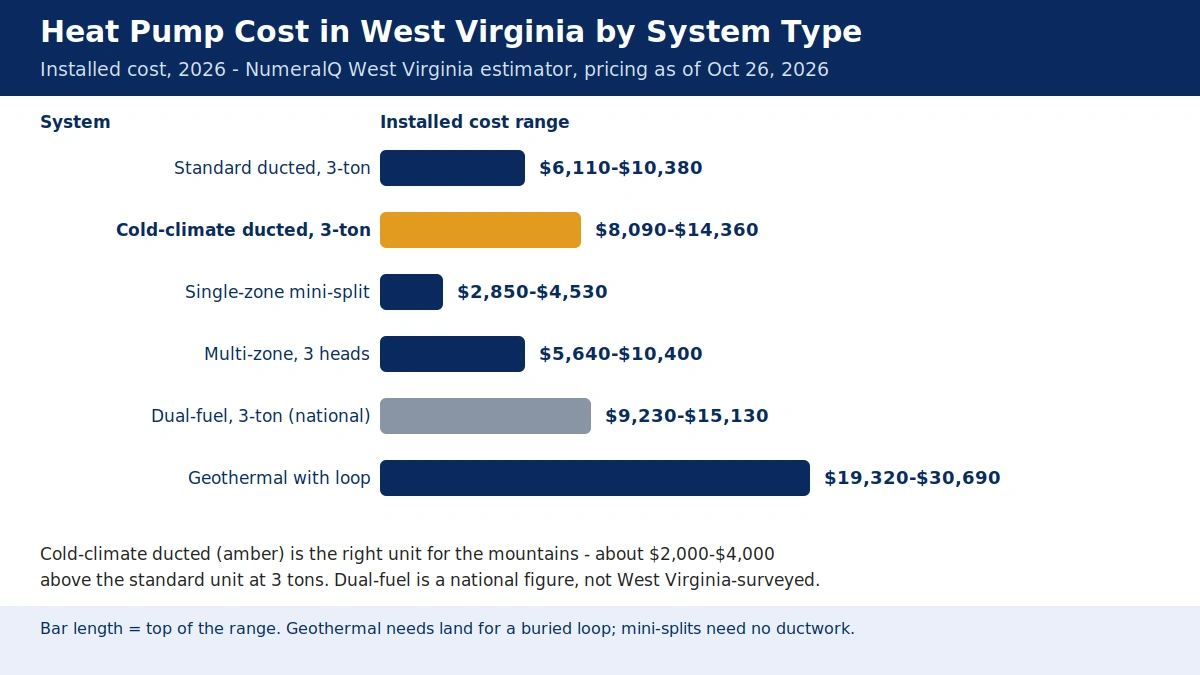
The 3-ton figure is the anchor because 3 tons is the size most West Virginia houses need. A ton of heat pump capacity moves about 12,000 BTU an hour, and a 3-ton system moves about 36,000 — enough for a typical 1,500-2,000 square foot house with average insulation in the Kanawha Valley. A bigger house, a draftier house, or a house in the mountains needs more, and the size table in the next section prices every step. But the number that matters most for the decision is not the 3-ton price. It is the cold-climate price, because in West Virginia the cold-climate unit is not the upgrade — it is the correct unit for a large part of the state. NumeralQ prices a cold-climate ducted 3-ton at $8,090-$14,360, about $2,000-$4,000 above the standard unit. That premium buys a variable-speed inverter compressor, enhanced vapor injection, and a unit that still delivers 70% or more of its rated heat at 5 degrees. In the Ohio River valley, where Charleston and Huntington sit at a 6-degree design temperature, a standard unit can get by. In Elkins, Beckley, and the high country, where the design temperature runs from minus 2 to 5 degrees, the standard unit is the wrong purchase, and the cold-climate premium is not optional.
A single-zone ductless mini-split — one outdoor unit, one indoor head, no ductwork — runs $2,850-$4,530 installed in West Virginia. That is the number that matters for the other half of the state’s housing stock: the houses with baseboard heat, the houses with no ducts, the houses where tearing open walls to run ductwork would cost more than the heat pump itself. A three-head multi-zone system runs $5,640-$10,400. Geothermal, the ground-source system with a buried loop, runs $19,320-$30,690 — the most expensive option in the state by a wide margin, and the one with the most stable winter performance, since the ground stays near 50 degrees all year.
One warning before the tables: the lowest quote in West Virginia is not always the cheapest system. A big share of any installer’s total is overhead and margin, and the cheapest bid in a low-wage market is often the bid that left something out — the pad, the electrical work, the permit, the line-set cover. When bidders are compared side by side, only one figure lines up cleanly: installed cash price for the same equipment, same tonnage, same efficiency rating, on the same house. Collect that figure in writing from at least three installers, and walk away from any bidder who refuses to show it.
| Source | 3-ton ducted | Cold-climate 3-ton | Single-zone mini-split | Notes |
|---|---|---|---|---|
| NumeralQ WV (Oct 26, 2026) | $6,110-$10,380 | $8,090-$14,360 | $2,850-$4,530 | Estimator from Fixr + Home Depot equipment prices + BLS wages |
| BetterHouse WV model (2026) | ~$9,830 typical ($3,720-$13,010) | Not published | Not published | National baseline scaled by WV wage index 0.80 — modeled, not surveyed |
| This Old House national (Aug 2026) | ~$10,575 avg | Not published | ~$3,250 avg single-zone | National average, all states |
| Angi national (Aug 2026) | $4,500-$8,000 | Not published | $2,000-$12,000 | National range |
| ConsumerAffairs national (Jul 2026) | $4,000-$14,000 | Not published | Not published | National range |
Two entries in that table call for a footnote, not a headline. BetterHouse’s $3,720-$13,010 is a modeled range, built by scaling a national baseline with a wage index — it is not a survey of West Virginia quotes, and its low end is not a price anyone should expect to be offered. And the national averages sit above West Virginia’s range for one reason only: labor. The equipment is priced nationally. The crew is priced locally. In West Virginia the crew is cheap, and the installed price shows it.
Heat Pump Cost in West Virginia by System Type
The type decision comes before the size decision in West Virginia, because the type decides whether the system can heat the house at all on the coldest nights — and because in this state the type is often decided by the house, not by the buyer. A house with good ductwork gets a ducted system. A house with baseboard heat and no ducts gets a mini-split. A house with a gas furnace that the owner wants to keep gets a dual-fuel system. The table below prices each type at the 3-ton size where the comparison is cleanest, then the text takes each one in turn.
| System type | Installed (3-ton unless noted) | Best for | Winter behavior |
|---|---|---|---|
| Standard ducted air-source | $6,110-$10,380 | Ducted homes in the Ohio River valley (Charleston, Huntington, Parkersburg) | Loses capacity below freezing; backup heat kicks in on the coldest nights |
| Cold-climate ducted | $8,090-$14,360 | Anywhere in the mountains; any home where the heat pump is the only heat | Holds 70%+ capacity at 5°F; runs to -13°F or lower |
| Ductless mini-split, single zone | $2,850-$4,530 | One room, an addition, a house with no ducts | Cold-climate models hold full capacity at 5°F |
| Ductless multi-zone (3 heads) | $5,640-$10,400 | Whole house with no ducts, 2-3 rooms | Same cold-climate behavior per head |
| Dual-fuel (heat pump + gas furnace) | ~$9,230-$15,130 (national) | Gas-heated homes that want heat pump savings in mild weather | Gas furnace takes over below the balance point |
| Geothermal (ground-source) | $19,320-$30,690 | Large lots, new builds, owners planning to stay decades | Ground loop holds steady; highest upfront, lowest running cost |
Standard ducted. This is the baseline unit: a single-speed or two-stage compressor, an outdoor condenser, an indoor air handler, and your existing ductwork. It heats well down to about 30-35 degrees, then its output falls as the temperature falls. Below freezing it leans on electric strip heat — resistance coils in the air handler that heat at a COP of 1.0, the most expensive heat there is. In Charleston, where the design temperature is 6 degrees and the January average low is 28, a standard unit spends most of the winter in its comfortable range and leans on backup heat for a few dozen hours a year. That is a workable deal, and it is why the standard unit is the right buy in the valley. It is not the right buy in Elkins, where the design temperature is minus 2 and the standard unit would be leaning on strip heat for weeks.
Cold-climate ducted. The premium — roughly $2,000-$4,000 over the standard unit at 3 tons — buys three things. First, a variable-speed inverter compressor that ramps up and down instead of switching on and off, so it holds output as the temperature drops. Second, enhanced vapor injection, which lets the compressor keep moving heat when the outdoor coil is cold. Third, a unit tested and listed on the NEEP cold-climate product list, which requires a COP of at least 1.75 at 5 degrees and at least 70% of rated capacity at that temperature. The best models — Mitsubishi’s Hyper-Heating H2i line, Daikin’s Aurora, Bosch’s IDS Ultra — hold 100% of their rated capacity at 5 degrees and keep running to minus 13 or lower. In the mountains, that is the difference between a heat pump and a heat pump plus a strip-heat bill. The climate section below works through the numbers by city.
Ductless mini-splits. One outdoor unit, one or more indoor heads mounted on the wall, refrigerant lines through a small hole in the wall, no ductwork anywhere. The single-zone price of $2,850-$4,530 covers one room or one open-plan area. A three-head system at $5,640-$10,400 covers a small house. Mini-splits are the natural answer for West Virginia’s older housing stock, because so many of those houses were built with baseboard heat or with no central heat at all, and running new ductwork through a 1950s coal-camp house or a 1970s ranch with a low crawl space can cost $3,610-$6,350 on its own — more than the mini-split. Cold-climate mini-splits are the strongest performers in the whole category: many hold full rated capacity at 5 degrees, and the best hold over 70% at minus 22. If the house has no ducts, the mini-split is not the compromise. It is the plan.
Dual-fuel. A heat pump paired with a gas furnace, with a thermostat that switches between them at a set outdoor temperature — the balance point, usually around 30-35 degrees. Above it, the heat pump runs, because it is cheaper than gas in mild weather. Below it, the furnace takes over, because gas is cheaper than a struggling heat pump in deep cold. The national price for a 3-ton dual-fuel system runs about $9,230-$15,130 (NumeralQ national, flagged as national — no West Virginia-specific dual-fuel figure was verified in this pass). Dual-fuel is the honest answer for a gas-heated West Virginia home that wants a heat pump: it captures the mild-weather savings without asking the heat pump to do a job gas does better. It is also the most expensive ducted option, and it only makes sense if the furnace is due for replacement anyway.
Geothermal. A ground-source heat pump with a buried loop, priced at $19,320-$30,690 in West Virginia. The ground below the frost line holds near 50 degrees all year, so a geothermal system never faces the cold-air problem at all — its efficiency barely moves with the weather. The price is the obstacle: the loop field needs land, drilling or trenching, and a crew that has done it before. For a homeowner staying in the house for twenty years, the running-cost savings are real. For anyone else, the payback stretches past the point where it matters. Geothermal is the best system in this guide and the hardest to justify on the numbers. Loop options, ground conditions, and the long payback case are covered in depth in our geothermal heat pump cost guide.
For the ducted-versus-ductless decision in detail, see our ductless vs ducted heat pump guide, and for mini-split pricing by zone, our mini-split installation cost guide.
Heat Pump Cost by Home Size
Size is the second decision, and in West Virginia it is the one most often got wrong — usually by oversizing. A heat pump that is too big for the house short-cycles: it blasts heat, shuts off, blasts again. Short-cycling wears the compressor, leaves rooms uneven, and does a poor job of dehumidifying in summer. A heat pump that is too small runs constantly on the coldest nights and leans on strip heat, which is the most expensive heat in the house. The right size comes from a Manual J load calculation — a room-by-room accounting of heat loss through walls, windows, roof, and infiltration — and any installer who sizes by square footage alone, or by the size of the unit being replaced, is guessing. Ask for the Manual J in writing. In a state where so many houses are old and leaky, the Manual J matters more than the tonnage table, because two 1,800-square-foot houses in Charleston can need different sizes if one has new windows and the other still has its originals.
The table below prices ducted systems by tonnage from the NumeralQ West Virginia estimator, with the cold-climate column alongside so the premium is visible at every size. Home-size bands are planning guides, not rules — the Manual J governs.
| Tons | Standard ducted | Cold-climate ducted | Typical home size | Heating output |
|---|---|---|---|---|
| 1.5 tons | $4,030-$6,580 | ~$5,300-$8,900 | Up to ~900 sq ft | ~18,000 BTU/hr |
| 2 tons | $4,720-$7,850 | ~$6,200-$10,500 | ~900-1,300 sq ft | ~24,000 BTU/hr |
| 2.5 tons | $5,410-$9,120 | ~$7,100-$12,000 | ~1,300-1,700 sq ft | ~30,000 BTU/hr |
| 3 tons | $6,110-$10,380 | $8,090-$14,360 | ~1,700-2,100 sq ft | ~36,000 BTU/hr |
| 3.5 tons | $6,800-$11,650 | ~$9,000-$15,700 | ~2,100-2,500 sq ft | ~42,000 BTU/hr |
| 4 tons | $7,490-$12,920 | ~$9,900-$17,300 | ~2,500-3,000 sq ft | ~48,000 BTU/hr |
| 5 tons | $8,880-$15,450 | ~$11,800-$20,400 | ~3,000 sq ft and up | ~60,000 BTU/hr |
The cold-climate figures for sizes other than 3 tons are NestPriced estimates, built by applying the 3-ton cold-climate premium (about $1,980-$3,980) proportionally across the size table — they are labeled as estimates here, not as surveyed prices, and a quote is the only number that settles a size.
Three rows of that table deserve a second look. First, the 3-ton row, because it is the state typical size and the one most quotes will land on. Second, the gap between 2.5 and 3 tons: about $700-$1,260 for half a ton of capacity, which is the cheapest capacity on the table — and the reason an installer who rounds up from a 2.5-ton Manual J result to a 3-ton unit is not necessarily padding the bill. Third, the 5-ton row, because a 5-ton heat pump in a West Virginia house is almost always a sign of a leaky envelope rather than a big house. Before paying for 5 tons of equipment, get a blower-door test and a quote for air sealing and attic insulation. A few thousand dollars of envelope work can drop the load by a full ton, and a ton less equipment pays for the insulation twice over.
The mini-split version of the same decision runs by heads, not tons. One head covers one room or one open area — a living room, a master bedroom, an addition over the garage. Two heads cover a small house with a sensible floor plan. Three heads cover a three-bedroom ranch. Each head adds roughly $1,400-$2,950 to the job over the single-zone price, and the heads share one outdoor unit, which is where the savings against three separate single-zone systems come from. A house with four or five rooms that all need heat is usually better served by a ducted system or by two outdoor units, and the installer should say so rather than stacking heads onto one outdoor unit until it cannot keep up on a cold night.
One more sizing note, specific to West Virginia: the heating load and the cooling load are not the same size here, and the gap is wider than in the South. A house in Charleston needs about 36,000 BTU an hour of heat at the 6-degree design temperature and about 24,000-30,000 BTU an hour of cooling on a 95-degree July afternoon. A heat pump sized for the cooling load will be undersized for the heating load, and a heat pump sized for the heating load will be oversized for cooling. The standard answer is to size for the heating load in a cold-climate unit — the variable-speed compressor handles the cooling side gracefully, ramping down instead of short-cycling — and to size for the cooling load only if the house has a furnace as backup. If an installer proposes a single-stage unit sized for cooling in a house with no backup heat, that is a red flag, not a bargain.
Heat Pump Cost by City: Charleston, Huntington, Morgantown & Wheeling
West Virginia is a small state with one real metro market and a string of smaller ones, and the verified price data covers exactly one city. That is worth saying plainly, because a guide that invents city prices for the other three would be guessing, and the guessing would look exactly like data. Charleston is verified. Huntington, Morgantown, and Wheeling are described from their utilities, their climates, and their housing — not from invented prices.
| City | 3-ton ducted (verified) | Utility | Design temp | Notes |
|---|---|---|---|---|
| Charleston | $6,200-$10,510 | Appalachian Power | 6°F | Verified (NumeralQ, Oct 2026); state capital, biggest installer market |
| Huntington | Not verified — use statewide $6,110-$10,380 | Appalachian Power | 6°F | Ohio River valley; same utility and climate as Charleston |
| Morgantown | Not verified — use statewide $6,110-$10,380 | Mon Power | ~5°F | University town; newer housing near campus, older stock downtown |
| Wheeling | Not verified — use statewide $6,110-$10,380 | Wheeling Power (AEP) | ~5°F | Ohio Valley; oldest housing stock of the four |
| Parkersburg | Not verified — use statewide $6,110-$10,380 | Mon Power | ~6°F | Mid-Ohio Valley; Appalachian Power territory edge |
Charleston is the biggest market in the state and the only one with a verified city price: $6,200-$10,510 for a 3-ton ducted system, a touch above the statewide $6,110-$10,380 band. The capital sits in the Kanawha Valley at a 6-degree design temperature, served by Appalachian Power, with the deepest installer bench in the state. That bench is the reason to get three quotes here rather than two — Charleston has more HVAC companies than anywhere else in West Virginia, and the spread between the cheapest and the dearest quote in the same city can run $2,000 or more for the same equipment. Charleston also carries the 1% municipal sales tax on top of the state’s 6%, so a $10,000 quote carries about $700 in tax inside city limits against $600 outside them — a small difference, but one that belongs on the quote as its own line rather than buried in the total.
Huntington, about 50 miles west on the Ohio River, shares Charleston’s climate (6-degree design temperature, 4,665 heating degree days) and its utility (Appalachian Power). No verified Huntington price was pulled in this pass, so the statewide $6,110-$10,380 band is the planning figure. Huntington’s housing runs older than Charleston’s in the neighborhoods near Marshall University and the river, and older housing means more mini-split jobs and more ductwork surprises. A Huntington quote that assumes the existing ducts are usable without inspecting them is a quote to question.
Morgantown sits in the north, served by Mon Power, with a university-driven housing market that splits in two: newer builds and student rentals near West Virginia University, and older homes in the downtown and the hollows. No verified Morgantown price was pulled, so the statewide band applies. The practical difference in Morgantown is the rebate picture, not the price: Mon Power offers no heat pump rebate in West Virginia, so a Morgantown buyer leans entirely on the federal HEAR rebate and the installer’s own pricing. Morgantown’s winters run a little colder than Charleston’s, and a cold-climate unit earns its premium sooner here than in the valley.
Wheeling, in the Northern Panhandle on the Ohio River, is served by Wheeling Power, an Appalachian Power subsidiary. Its housing stock is the oldest of the four cities — a steel-town building boom that ended decades ago — which means more houses with no ductwork, more houses with 100-amp panels, and more houses where a mini-split is the practical answer. No verified Wheeling price was pulled. The statewide band applies, with the same caution as Huntington: old houses hide costs, and the quote should carry a line for ductwork or panel work rather than assuming it away.
Rank the cities on price per ton, never the total, and remember that only Charleston has a verified figure. A Huntington quote that lands inside the statewide band is a normal quote. A Morgantown quote that lands far above it calls for an explanation, and a Wheeling quote that lands far below it calls for a closer look at what was left out. And use the utility column before the price column: a Charleston buyer on Appalachian Power can claim up to $700 from TakeChargeWV, while a Morgantown buyer on Mon Power cannot claim a utility rebate at all. The rebate section below works through that split in full.
West Virginia’s Climate: Appalachian Winters, Design Temps & Cold-Climate Performance
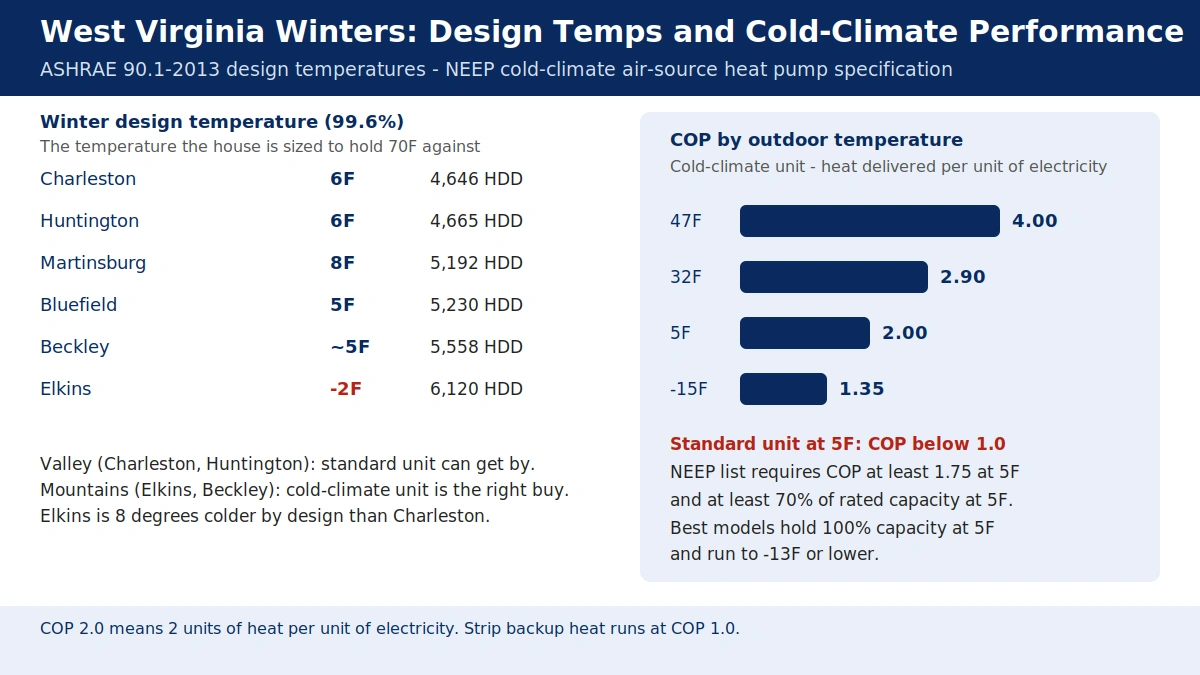
West Virginia’s climate is the reason this guide exists in the form it does, and it is also the reason a heat pump bought on southern advice fails here. The state is not one climate. It is a valley climate and a mountain climate sharing a border, and the two ask different things of a heat pump. The Ohio River valley — Charleston, Huntington, Parkersburg — sits in climate zone 4A, with a 99.6% winter design temperature of 6 degrees and about 4,650 heating degree days a year. The mountains — Elkins, Beckley, the high ridges of the Alleghenies — sit in zone 5, with design temperatures from minus 2 to 5 degrees and 5,200 to 6,100 heating degree days. A unit that is comfortable in Charleston can be out of its depth in Elkins, and the difference between the two is not a matter of opinion. It is printed in the ASHRAE tables.
The design temperature is the number the whole system is sized to. It is the temperature the house is designed to hold 70 degrees against, 99.6% of the time — meaning the outdoor temperature falls below it for only about 35 hours in an average year. Charleston’s is 6 degrees. Huntington’s is 6 degrees. Clarksburg’s heating degree days run 5,512. Beckley’s run 5,558 with a design temperature near 5 degrees. Bluefield’s run 5,230 at 5 degrees. Martinsburg, in the Eastern Panhandle, runs 5,192 at 8 degrees. Elkins, at nearly 2,000 feet in the mountains, runs 6,120 heating degree days at minus 2 degrees. The spread from Charleston to Elkins is 8 degrees of design temperature and nearly 1,500 heating degree days — the difference between a standard unit with a little backup heat and a cold-climate unit that has to carry the house alone.
What the winter actually feels like. Charleston’s January average low is 28 degrees, and the temperature rarely falls below 11. The cold season runs from early December to the end of February, with average highs below 52 degrees. The city sees about 95 days a year with the minimum at or below freezing. That is a real winter, but it is a mild one by northern standards — most winter hours sit in the 20s and 30s, which is exactly the range where a modern heat pump runs at its best. The mountains are a different story: longer cold snaps, more hours below 20 degrees, more snow, and more wind across the ridges. A heat pump that spends its winter in the 20s and 30s is a different machine from one that spends its winter in the single digits, and the spec sheet is where the difference shows up.
The spec sheet, translated. Four numbers decide whether a heat pump can heat a West Virginia house, and all four are printed on the manufacturer’s data sheet — or should be, and if they are not, that is itself an answer.
First, COP at 5 degrees. The coefficient of performance is how many units of heat the system delivers for each unit of electricity it consumes. A COP of 2.0 means two units of heat for one unit of electricity — 200% efficient, in the loose sense. The NEEP cold-climate specification requires a COP of at least 1.75 at 5 degrees. A good cold-climate unit runs about 2.0 to 2.2 at 5 degrees. A standard unit at the same temperature often falls below 1.0 — meaning it is delivering less heat than the electricity it consumes, and the strip heat has taken over. At 47 degrees, a cold-climate unit runs near a COP of 4.0. At 32 degrees, about 2.9. At 5 degrees, about 2.0. At minus 15, about 1.2 to 1.5 — still better than resistance heat, but only just.
Second, capacity at 5 degrees. This is the share of the unit’s rated heating output it still delivers when it is 5 degrees outside. The NEEP list requires at least 70%. The best models hold 100% at 5 degrees and 70% or more at minus 13. A standard unit holds 40-60% at 5 degrees. The practical meaning is simple: a 3-ton standard unit becomes a 1.2-to-1.8-ton unit on a 5-degree night, and the house makes up the difference with strip heat. A 3-ton cold-climate unit stays a 3-ton unit, and the strip heat stays off.
Third, HSPF2, the seasonal heating efficiency rating. The federal minimum in West Virginia’s region is 7.5. A good cold-climate unit runs 8.5 to 10 or higher. Each point of HSPF2 is worth real money over a winter — the running-cost section below shows the difference between a 7.5 and a 9.0 unit at about $124 a year on the NumeralQ model — and it is worth paying for, because the rating is earned across the whole season, not on one mild afternoon.
Fourth, minimum operating temperature. A cold-climate unit is rated to run at minus 13 degrees or lower. A standard unit may shut down or lock out below 0. In Elkins, where the design temperature is minus 2 and the thermometer goes lower, the minimum operating temperature is not a footnote. It is the difference between heat and no heat.
Backup heat: the decision that decides the bill. Every air-source heat pump in West Virginia needs a backup plan for the coldest hours, and the plan you choose decides what the coldest month costs. The three options are electric strip heat, a gas furnace (dual-fuel), and a cold-climate unit sized to carry the load alone. Strip heat is the default in most quotes — coils in the air handler that switch on when the heat pump cannot keep up. It works, and it is expensive: every hour of strip heat costs three to four times what the same hour of heat pump heat costs, because strip heat runs at a COP of 1.0 while the heat pump runs at 2.0 or better. A house whose strip heat runs for a few dozen hours a year barely notices. A house whose strip heat runs for weeks notices on the February bill. Dual-fuel hands the coldest hours to a gas furnace, which at $1.47 a therm is cheaper than strip heat and roughly even with a struggling heat pump. The third option — a cold-climate unit with no backup at all — works in the valley and in well-insulated mountain houses, but it is a bet on the Manual J being right, and it should only be taken with the installer’s written assurance that the unit holds the house at the design temperature without help. Ask for that assurance in writing either way. If the installer will not put the backup-heat strategy in writing, with the balance point and the expected strip-heat hours, the quote is incomplete.
The defrost cycle, and the noise nobody mentions. An air-source heat pump in a humid Appalachian winter ices up. Frost builds on the outdoor coil, the unit reverses itself briefly to melt it, and the house gets a puff of cool air while it does. That is normal, and it costs a little efficiency. What is not normal is a unit that defrosts constantly, which usually means it is oversized, undersized, or installed where the wind drives snow straight into the coil. The other thing nobody mentions is sound: the outdoor unit of a heat pump runs all winter, and in a hollow between two ridges the sound carries. Place the outdoor unit away from bedroom windows, on a solid pad above the snow line, with clearance on all sides for airflow and for the defrost water to drain away instead of freezing into a sheet of ice under the unit. A unit buried in a snowdrift in February is a unit that cannot heat the house.
Heat Pump vs Gas Furnace in West Virginia: The Running-Cost Math
This is the section that decides the purchase for most West Virginia buyers, and it is the section where honesty costs the heat pump industry a sale. In West Virginia, a heat pump costs more to run than a gas furnace. That is the arithmetic, and no amount of enthusiasm changes it. The question is how much more, and whether the households that do not have gas — the nearly half of the state that heats with electricity — care, because for them the comparison is not heat pump against gas. It is heat pump against baseboard heat, and that comparison runs the other way by a wide margin.
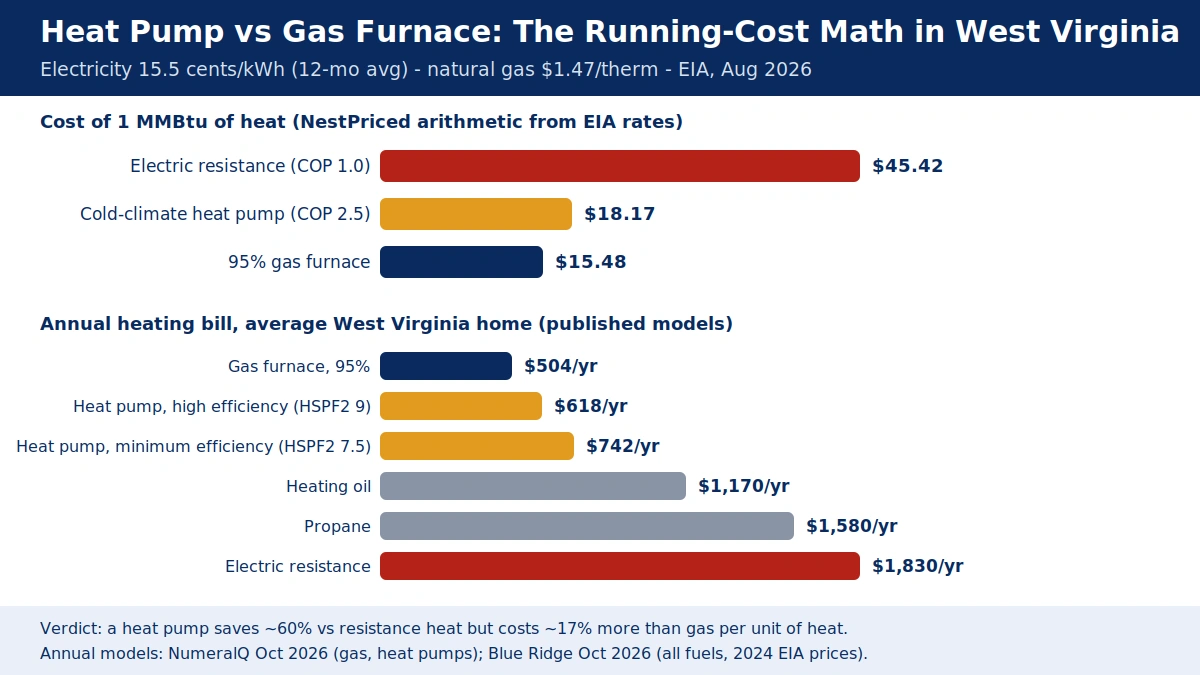
The two prices that decide everything. West Virginia residential electricity averaged 16.31 cents a kilowatt-hour in August 2026, per the EIA, against a national average of 18.16 cents. The 12-month average to August 2026 was 15.5 cents. Natural gas averaged $1.47 a therm over the same 12 months. Those two numbers are the whole running-cost story: electricity is cheap by national standards, and gas is cheaper still, because West Virginia sits on top of the Marcellus shale and the gas does not travel far. A kilowatt-hour of electricity at 15.5 cents carries 3,412 BTU. A therm of gas at $1.47 carries 100,000 BTU. Do the division and gas delivers heat at roughly a third of the price of resistance electricity per unit of energy — before either one is burned or pumped through a machine.
The models. Two published models price the annual heating bill for a West Virginia home, and they agree on the ranking even though they disagree on the dollars. NumeralQ’s model, built from EIA household heating use and current state prices (October 2026), puts a 95% efficient gas furnace at $504 a year, a minimum-efficiency heat pump (HSPF2 7.5) at $742 a year, and a high-efficiency heat pump (HSPF2 9) at $618 a year. Blue Ridge Heating and Air’s standardized-home model, built on 2024 EIA prices and 2024 state heating degree days (published October 13, 2026), puts gas at $620 a year, a heat pump at $800 a year, electric resistance at $1,830 a year, propane at $1,580 a year, and heating oil at $1,170 a year. Both models are planning figures, not bill forecasts — they describe an average home, and no real home is average — but the ranking is the same in both: gas cheapest, heat pump second, oil third, propane fourth, resistance last by a long way.
The arithmetic, worked by hand. Take one million BTU of heat — about what a West Virginia house needs on a cold January day. Electric resistance heat at a COP of 1.0 needs 293 kilowatt-hours, which at 15.5 cents costs $45.42. A cold-climate heat pump at a seasonal COP of 2.5 needs 117 kilowatt-hours, which costs $18.17. A 95% gas furnace needs 10.53 therms, which at $1.47 costs $15.48. So the heat pump saves about 60% against resistance heat and costs about 17% more than gas for the same heat. Over a whole heating season, that 17% is the $114-$124 a year the NumeralQ model shows between a high-efficiency heat pump and a gas furnace. It is real money, but it is not the gulf the resistance-heat comparison shows, and it is the number that has to be weighed against the other half of the purchase: the heat pump also cools the house in summer, which a furnace does not, and the cooling it replaces is a separate air conditioner that would cost $4,000-$8,000 on its own.
Who wins, by what they heat with now. The gas-heated home loses money on running costs by switching to a heat pump alone — about $114-$238 a year on the models — and gains only if the furnace and the air conditioner are both due for replacement, so that one heat pump replaces two machines. The electric-resistance home wins big: about $1,030 a year on the Blue Ridge model ($1,830 of resistance heat against $800 of heat pump heat), which is the single largest saving in this guide. The propane home wins too, by about $780 a year on the same model. The oil home wins by about $370 a year. And the home with an old, standard-efficiency heat pump — the 1990s and 2000s units that still run in a fifth of the state’s houses — wins by the gap between its own HSPF and a new cold-climate unit’s, which is usually several hundred dollars a year. The rule is simple enough to print on a card: if your heat comes from a wire, a heat pump pays. If your heat comes from a gas pipe, a heat pump costs — unless the furnace is dying anyway.
The cooling bonus, priced. A heat pump is also an air conditioner, and in West Virginia that matters more than the brochures admit. Charleston’s cooling design temperature is 88 degrees, Huntington’s 89, Martinsburg’s 91, and the state gets about 3,655 cooling degree days in Charleston against 4,646 heating degree days — a real cooling season, roughly four months long. A household replacing a dead air conditioner and a tired furnace with one heat pump is buying one machine instead of two, and the avoided air conditioner is worth $4,000-$8,000 of the heat pump’s price. That changes the payback math completely, and it is the reason the payback section below treats “furnace plus air conditioner both dying” as a separate case from “furnace fine, air conditioner fine.”
What moves the running cost most. Efficiency first: the gap between an HSPF2 7.5 unit and an HSPF2 9 unit is about $124 a year on the NumeralQ model, every year, for fifteen years. Ductwork second: leaky ducts in a West Virginia attic or crawl space can waste 20-30% of the heat the unit makes, and no efficiency rating survives ducts that leak into the crawl space. The thermostat third: a heat pump that is set back 10 degrees at night and then asked to recover in the morning will call for strip heat to make up the difference, and the strip heat eats the savings. Set it and leave it, or set back no more than 2-3 degrees. And the balance point fourth, for dual-fuel homes: set the switchover too high and the furnace runs on mild days when the heat pump would have been cheaper; set it too low and the heat pump struggles on cold nights. The installer should set it from the actual gas and electric prices, not from a default, and should show the math.
For the national running-cost picture, see our heat pump running cost guide, and for the furnace comparison in full, our heat pump vs furnace guide.
Appalachian Power, Mon Power & the Other West Virginia Rebates for 2026
West Virginia’s rebate picture is a split screen. On one side, the utility that serves the southern half of the state pays a few hundred dollars toward a heat pump. On the other side, the utility that serves the northern half pays nothing at all. And across the whole state, the federal rebate programs that opened on September 28, 2026 pay up to $8,000 — but only to households that already heat with electricity. Which side of each line a buyer falls on is decided by the name on the electric bill, and that name should be checked before the first quote is requested.
Appalachian Power — TakeChargeWV. Appalachian Power serves roughly the southern half of West Virginia, including Charleston, Huntington, Beckley, and Bluefield, and its efficiency programs run under the TakeChargeWV name. Two routes pay toward a heat pump. The Efficient Products route pays up to $700 on an ENERGY STAR certified central air conditioner or air-source heat pump, with the amount tiered by efficiency — $300 at 16-17 SEER, rising to $700 at 19 SEER and above — for purchases made between January 1, 2022 and December 31, 2026, with the application due within 45 days of purchase or by January 15 of the following year, whichever comes first. The Home Performance route, which starts with a home energy assessment, pays up to $400 per unit for a ductless mini-split heat pump, and its older measure list priced a ducted air-source heat pump at up to $450-$600 when it replaced electric resistance heat, and a ground-source heat pump at up to $750. Three conditions run through both routes: the home must be heated with electricity to qualify for the major measures, the equipment must be new and ENERGY STAR certified, and fuel switching is not eligible — a gas-heated home cannot claim a rebate for replacing its furnace with a heat pump. A buyer cannot claim the mini-split rebate through both routes for the same unit. The amounts are small against a $6,000-$14,000 job, and they should be treated as a discount on the quote, not as a reason to buy.
Mon Power and Potomac Edison — nothing in West Virginia. Mon Power and Potomac Edison, both FirstEnergy companies, serve the northern half of the state — Morgantown, Wheeling’s eastern suburbs, the Eastern Panhandle around Martinsburg, and Parkersburg. Neither offers a heat pump rebate to West Virginia customers. The confusion comes from Maryland: Potomac Edison’s EmPOWER Maryland program pays generous HVAC discounts — $800-$1,700 midstream plus a $4,000 Switch-to-Electric bonus, and up to $7,100 for geothermal — but EmPOWER is a Maryland-mandated program, and it covers Maryland accounts only. A Potomac Edison customer in Martinsburg, West Virginia, cannot claim it, and a Mon Power customer in Morgantown cannot claim it either. Multiple trackers confirm the same: Mon Power and Potomac Edison offer no heat pump rebate in West Virginia. A buyer in the north should not budget for utility money that does not exist.
Wheeling Power and the co-ops. Wheeling Power, an Appalachian Power subsidiary serving the Wheeling area, has no verified heat pump rebate in this pass — no rebate figure is stated here, and a Wheeling buyer should ask the utility directly rather than assume the Appalachian Power programs extend across the subsidiary line. The state’s small electric cooperatives likewise have no verified heat pump rebate in this pass. If a co-op or a municipal utility offers one, it will be on that utility’s own program page, and the buyer should get it in writing before signing.
What the utility rebates are worth, stacked. For an Appalachian Power customer buying a 3-ton cold-climate unit at $8,090-$14,360, the TakeChargeWV $700 is about 5-9% of the job. For a mini-split buyer at $2,850-$4,530, the $400 is about 9-14%. For a Mon Power customer, the utility stack is $0, and the whole incentive case rests on the federal HEAR rebate in the next section. The gap between the two utilities is the single largest rebate difference inside one state in this series, and it is decided entirely by which side of the Appalachian Power / FirstEnergy boundary the house sits on. The boundary runs roughly through the middle of the state, and it is worth finding on a map before budgeting.
| Utility | Territory | Heat pump rebate | Conditions |
|---|---|---|---|
| Appalachian Power (TakeChargeWV) | Southern WV: Charleston, Huntington, Beckley, Bluefield | Up to $700 (ducted ASHP / central A/C); up to $400/unit (mini-split) | ENERGY STAR; electrically heated home; no fuel switching; purchases through Dec 31, 2026 |
| Mon Power (FirstEnergy) | Northern WV: Morgantown, Parkersburg, Fairmont | $0 — none offered in WV | — |
| Potomac Edison (FirstEnergy) | Eastern Panhandle: Martinsburg, Charles Town | $0 — none offered in WV (EmPOWER is Maryland-only) | — |
| Wheeling Power (AEP) | Wheeling area | None verified | Ask the utility directly |
| WV electric co-ops | Rural pockets | None verified | Ask the utility directly |
Federal Help in 2026: No Tax Credit — and HEAR Is Now Open
The federal story in West Virginia in 2026 has two halves, and they point in opposite directions. The tax credit is gone. The rebate is open. A buyer who confuses the two will either leave $8,000 on the table or count on $2,000 that no longer exists, and the difference between those two mistakes is $10,000.
The tax credit is $0. The One Big Beautiful Bill Act — Public Law 119-21, signed July 4, 2025 — ended the Energy Efficient Home Improvement Credit (§25C), which used to pay up to $2,000 a year toward a qualifying heat pump, for property placed in service after December 31, 2025. Per IRS fact sheet FS-2025-05, the completion date is what counts: a 2025 deposit buys nothing when the crew finished the job in January 2026. Any 2026 quote that still deducts a federal credit is priced under a law that no longer exists — ask the installer to strip it out and quote again. The same act ended the Residential Clean Energy Credit (§25D) on the same date, which matters for geothermal buyers who used to claim 30%.
HEAR and HOMES launched statewide on September 28, 2026. Governor Patrick Morrisey announced the statewide launch of West Virginia’s two federal home energy rebate programs on September 28, 2026, backed by $88 million in federal funding, with officials projecting the programs could reach about 10,000 households and save them $3 million to $4.5 million a year. More than 300 homeowners had already applied during the pilot phase, which ran in southern West Virginia counties from August 6, 2026. The state expects to need about 350 trained contractors to deliver the work. The announcement is corroborated by the governor’s office, the West Virginia Office of Energy’s training partner Everblue, and a check of the official program pages on October 6, 2026. One tracker still lists West Virginia as “in development” with no launch date — that page’s data was verified November 4, 2026, but it describes the pre-launch state of the program pages, and it is superseded here by the launch announcement itself. Some state webpages still carry pilot-phase or waitlist language even after the launch, so a buyer should confirm the current status on energywv.org and through the Neighborly application portal before counting on the money.
What HEAR pays. The Home Electrification and Appliance Rebates program pays toward specific electric equipment for income-qualifying households. The West Virginia schedule pays up to $8,000 for a heat pump used for space heating or cooling, $1,750 for a heat-pump water heater, $4,000 for an electric load service center (a panel upgrade), $2,500 for wiring, and $1,600 for insulation, air sealing, and ventilation, with a combined household limit of $14,000. The income rule is the one that matters most: households below 80% of the area median income can receive up to 100% of the eligible project cost, and households between 80% and 150% of area median income can receive up to 50%. Both homeowners and renters can apply — renters need the property owner’s authorization — and the rebates are applied to project costs through certified contractors rather than issued as cash. The contractor must be certified through the state’s West Virginia Energy Efficiency Contractor pathway, and the work must go through the state’s application portal.
The rule that catches gas-heated homes. Since the Department of Energy issued Program Notice 26-2 on September 1, 2026, HEAR pays only for electric-to-electric upgrades — replacing electric equipment with more efficient electric equipment. Replacing a gas furnace, a propane furnace, or an oil boiler with a heat pump does not qualify. That rule removes the rebate from exactly the households that might want it most: the gas-heated homes that would save the least on running costs anyway. For a gas-heated home, HEAR is not a consolation prize. It is simply not available. The households HEAR is built for are the electrically heated ones — the baseboard homes, the electric-furnace homes, the homes with an old standard heat pump — and for them it is the largest single discount in this guide: $8,000 against a $8,090-$14,360 cold-climate job can cut the net cost by more than half.
HOMES, the second program. The Home Efficiency Rebates program pays for whole-home improvements — insulation, air sealing, heating and cooling upgrades — with the rebate tied to projected energy savings rather than to a single appliance. It is open to a wider range of incomes than HEAR, and it can stack with HEAR on the same house within the combined limits. No HOMES dollar cap is headlined here, because no cap was verified from a primary source in this pass — one tracker cites up to $20,000, and that figure is not repeated as fact. A buyer planning a whole-home job should ask the Office of Energy or a certified contractor what the modeled savings support before budgeting.
The lease route is not established in West Virginia. The commercial clean-electricity credit (§48E, 30%) survives for third-party-owned systems that enter service by December 31, 2027, with construction begun by July 4, 2026, under IRS Notice 2025-42 — which is why leases and power purchase agreements can still carry a federal subsidy in states where residential third-party ownership is clearly legal. No verified provider was found selling a lease or a PPA to West Virginia homes in this pass, and no DSIRE listing for West Virginia third-party PPA authorization was verified. A lease quote in West Virginia should be read by a lawyer before it is compared on its monthly payment at all. The federal rules for 2026 — credits, rebates, and the lease route — are set out in full in our federal tax credits guide.
Permits & Licensing: West Virginia’s HVAC License and Contractor License
West Virginia licenses heat pump work twice over — once for the person doing the work, and once for the business that bids it — and both licenses are statewide, which makes West Virginia simpler to check than a state that leaves licensing to the counties. The buyer who checks both numbers before signing is protected in a way the buyer who checks neither is not.
The technician’s license. Since January 1, 2016, anyone performing or offering to perform work on a heating, ventilating, and cooling system in West Virginia must hold a license issued by the Commissioner of Labor, under W. Va. Code §21-16-3 and legislative rule 42CSR34. The Division of Labor issues three levels: HVAC Technician-in-Training, HVAC Residential Technician, and HVAC Technician. The full technician license requires at least 2,000 hours of HVAC-related work, training, and experience. The license is issued to a person, not to a company, and the Division states that all persons performing HVAC work must hold one regardless of the dollar amount of the job or their affiliation with a licensed contractor. Exams are administered by Prov and cost $59.95 each. Licenses are valid for up to one year and renew annually. Ask for the technician’s license number and check it on the Division of Labor’s registry — and check that the person who shows up to do the work is the person whose name is on the license, because a company license does not cover an unlicensed crew.
The contractor’s license. The West Virginia Contractor Licensing Board issues the Heating, Ventilating and Cooling Contractor license, and it is required for residential work costing $5,000 or more — which covers every ducted heat pump in this guide and most mini-split jobs — and for commercial work costing $25,000 or more. The qualifying individual for the business must pass two Prov exams, the Business and Law exam and the HVAC Contractor exam, at $59.95 each. The business must register with the West Virginia State Tax Department, carry workers’ compensation and unemployment coverage, and meet wage-bond requirements where they apply. The application fee is $90 a year, with a $25 late penalty if renewal comes more than 15 days after expiration. No continuing education is required for renewal. The two licenses are separate checks, and both should be verified: the contractor license proves the business is allowed to bid the job, and the technician license proves the person doing the work is allowed to do it.
Permits. A heat pump install in West Virginia needs a mechanical permit and, where the electrical work requires it, an electrical permit, from the city or county building department. NumeralQ’s check of 35 West Virginia cities put permit fees at $70-$166 for this kind of job. The building department also sets the rules that matter most for an old house: whether the panel can carry the new load, whether the outdoor unit’s placement meets setback rules, and whether the refrigerant lines and the condensate drain are routed to code. The installer should pull the permits, not the homeowner, and the permit number should be on the contract before work starts. A contractor who suggests skipping the permit is suggesting the buyer give up the inspection that would catch a bad install — and the paper trail that would matter if the unit fails in year two.
What to check before signing. The license numbers, both of them, verified on the registries with names matched to the contract. The permit, pulled by the installer. Proof of workers’ compensation and liability insurance, with the policy dates current. And the Manual J load calculation, in writing, with the design temperature it was sized to — 6 degrees in Charleston, minus 2 in Elkins — named on the page. A contractor who will not show any one of those four is a contractor to walk away from, however good the price looks.
What Pushes Your West Virginia Quote Up or Down
The installed-price anchor is a starting point, not a quote. Eight factors can move a West Virginia quote by thousands of dollars, and four of them come from this state’s housing stock and climate.
Labor is cheap in West Virginia — and that is itself the point. HVAC mechanics and installers in West Virginia earn a median of $23.49 an hour, per BLS May 2025, against a national median near $31 an hour, and contractors bill them out at roughly $47-$61 an hour. Labor is the largest soft-cost component of an install, and in West Virginia it discounts the job by roughly a fifth against the national average. What moves a West Virginia quote is not expensive labor but thin competition: outside Charleston and Morgantown, the installer bench is small, and a small bench means less price pressure. Ask how many installs the crew has done in your part of the state, not just how many years the company has existed. A Charleston crew that has done two hundred heat pumps is a different proposition from a crew that has done twenty, even at the same hourly rate.
The ducts, or the lack of them. West Virginia’s older houses carry ductwork that was built for a furnace, sized for hot air, and in many cases leaking into the attic or the crawl space. A ducted heat pump pushes cooler air than a furnace — about 90-100 degrees at the register against a furnace’s 120-140 — so leaky or undersized ducts show up faster with a heat pump than they did with the furnace. New or extended ductwork runs $3,610-$6,350 a job in West Virginia (NumeralQ), and duct sealing and insulation run less but are rarely free. A quote that assumes the existing ducts are fine without testing them is a quote that will grow. Get the ducts tested — a duct-blaster test costs a few hundred dollars and tells the truth — before the heat pump goes in, not after the first cold snap shows the bedrooms are ten degrees colder than the living room.
The electrical panel. Many West Virginia homes still run on 100-amp service, especially the ranch homes and split-levels from the 1960s to the 1980s, and a heat pump with strip backup can push a 100-amp panel past its limit. A 200-amp panel upgrade runs $2,220-$3,480 in West Virginia (NumeralQ), and it is the most common surprise add-on in West Virginia quotes. Before signing, find out whether the quote covers it — not once the electrician is already in the driveway. One West Virginia wrinkle: a panel upgrade is electrification work, the kind HEAR is designed to pay for — up to $4,000 for an electric load service center — for income-qualifying households that already heat with electricity. For the national panel-upgrade picture, see our electrical panel upgrade guide.
The age of the house. County median build years in West Virginia mostly fall in the 1970s — Doddridge County’s median is 1973, Ritchie County’s 1974, Calhoun County’s 1974, Boone County’s 1975, Taylor and Upshur Counties’ 1979 — and in many counties 13-29% of homes were built in 1939 or earlier. The Eastern Panhandle is the exception, with Berkeley County’s median at 1995. An old house brings three costs a new house does not: insulation that was never installed or has settled to nothing, air leakage through balloon framing and unsealed penetrations, and wiring that predates modern grounding. None of that rules out a heat pump. It does mean the envelope gets checked before the equipment gets sized, because a house that leaks heat needs a bigger heat pump, and a bigger heat pump costs more to buy and more to run than the insulation that would have shrunk the load. A blower-door test and an attic insulation quote belong in the same conversation as the heat pump quote, not in a separate one a year later.
Efficiency tier. A high-efficiency cold-climate unit (HSPF2 9 or better) costs more than a minimum-efficiency unit (HSPF2 7.5) — the premium is roughly $1,000-$2,500 at 3 tons — and in West Virginia the premium pays back faster than in a warm state, because the heating season is long and the unit runs hard for five months. The NumeralQ model puts the annual saving at about $124 a year between HSPF2 7.5 and HSPF2 9, which pays the premium back in roughly 8-20 years on running costs alone, before the HEAR rebate and before the comfort difference is counted. On a tight lot or a small house, paying extra for efficiency is worth it. On a big, leaky house, the money is better spent on the envelope first.
Refrigerant. New heat pumps in 2026 use R-454B or R-32. EPA rules phased R-410A out of new home systems starting in 2025, so a quote for an R-410A unit in 2026 is a quote for old stock, and the buyer should ask why it is being offered and what it costs to service. The refrigerant does not change the installed price much. It changes what the unit is worth in five years.
Financing terms. Paying cash gives the best long-term return. A $0-down loan carries dealer fees of 10-30% of the cash price, sometimes over 50%, buried inside the amount financed — the Consumer Financial Protection Bureau’s August 2024 market spotlight is the source, a national figure, but West Virginia quotes feel it exactly the same way. Judge quotes on cash price, not on the monthly payment. And never let a financing offer decide the equipment: the loan that makes a cold-climate unit affordable is a good loan, and the loan that makes a standard unit look cheap by hiding the dealer fee is not.
Maintenance and lifespan. A heat pump in West Virginia lasts about 12-15 years for a ducted unit and 15-20 years for a mini-split, per the national figures — shorter than in a warm climate, because the heating season is long and the compressor works hard. Annual maintenance — a coil cleaning, a filter change, a refrigerant check — runs a few hundred dollars a year, and the national figures are in our heat pump maintenance cost guide. A unit that is never serviced in the mountains will not last fifteen years. Budget the maintenance the way you budget the install, or the install’s savings will go to the repair bill. For repair pricing, see our heat pump repair cost guide.
Payback: When Does a West Virginia Heat Pump Pay for Itself?
Payback is where a West Virginia heat pump either earns its keep or does not, and the answer turns on what the house heats with now — more sharply than in almost any other state in this series. The same 3-ton cold-climate unit, at the same price, pays back in under a year for one household and never pays back for another. The difference is not the equipment. It is the fuel it replaces and the rebate the household can claim.
The electric-resistance home: the fastest payback in the guide. Take a house heated by electric baseboard or an electric furnace, paying the Blue Ridge model’s $1,830 a year for heat. A heat pump cuts that to about $800 a year — a saving of about $1,030 a year. A standard 3-ton ducted unit at $6,110-$10,380 pays back in about 6-10 years on running costs alone, before any rebate. A cold-climate 3-ton at $8,090-$14,360 pays back in about 8-14 years. Now add HEAR: an income-qualifying household below 80% of area median income can claim up to $8,000, and a household at 80-150% of area median income can claim up to 50% of the project cost. For the household below 80%, the cold-climate unit’s net cost falls to $90-$6,360, and the payback falls to under a year to about 6 years. That is the best payback case in this guide, and it is the household the program was built for. A mini-split makes it better still: a single-zone unit at $2,850-$4,530, against a $1,030-a-year saving on the rooms it heats, can pay back in 3-5 years even without HEAR, and under a year with it.
The gas-heated home: no running-cost payback. Take a house heated by a 95% gas furnace, paying $504 a year for heat on the NumeralQ model. A high-efficiency heat pump costs $618 a year to run — about $114 a year more. The heat pump never pays for itself on heating costs, because there are no heating savings to pay with. The case for a heat pump in a gas-heated home is a different case: the furnace is dying, the air conditioner is dying, and one heat pump replaces both machines for less than a furnace plus an air conditioner would cost together. On those terms, the payback is the avoided air conditioner — $4,000-$8,000 of equipment the buyer does not have to purchase — and the heat pump pays back the day it is installed, because the alternative was two machines, not one. But a gas-heated home with a healthy furnace and a healthy air conditioner should not buy a heat pump for savings. It should wait until one of the two machines dies. And it should know that HEAR will not help: the electric-to-electric rule bars the rebate for a gas-to-heat-pump switch.
The propane and oil homes: a solid middle case. A propane-heated home pays about $1,580 a year for heat on the Blue Ridge model, and a heat pump at $800 saves about $780 a year — a payback of about 8-13 years on a standard unit and 10-18 years on a cold-climate unit, before rebates. An oil-heated home pays about $1,170 and saves about $370 a year — a payback of 16-28 years on a standard unit, which is longer than the unit’s life, and not a case that closes on running costs alone. Propane is the better case of the two, because propane is expensive and its price is volatile, and a heat pump insulates the household from the next price spike. Neither household qualifies for HEAR under the electric-to-electric rule, so the payback rests on the utility rebate — up to $700 for an Appalachian Power customer, nothing for a Mon Power customer — and on the avoided cost of the next propane or oil delivery.
The old-heat-pump home: the quiet winner. About one in five West Virginia homes already heats with a heat pump, and many of those units date from the 1990s and 2000s, when HSPF ratings ran 6.8-8.0 and cold-climate technology did not exist. Replacing a 25-year-old standard unit with a new cold-climate unit at HSPF2 9 saves several hundred dollars a year in running costs and ends the strip-heat habit on cold nights. The payback is slower than the resistance-heat case — roughly 10-15 years on a cold-climate unit — but the comfort difference is immediate, and the old unit’s repair bills stop. If the old unit still runs, the decision can wait for a failure. If it has needed two repairs in two years, the decision is already made.
| Case | Net cost (after rebates) | Annual saving | Simple payback |
|---|---|---|---|
| Resistance heat, standard 3-ton, no rebate | $6,110-$10,380 | ~$1,030/yr | ~6-10 yrs |
| Resistance heat, cold-climate 3-ton, no rebate | $8,090-$14,360 | ~$1,030/yr | ~8-14 yrs |
| Resistance heat, cold-climate 3-ton, HEAR $8,000 (below 80% AMI) | $90-$6,360 | ~$1,030/yr | Under 1 yr to ~6 yrs |
| Resistance heat, cold-climate 3-ton, HEAR 50% (80-150% AMI) | ~$4,045-$7,180 | ~$1,030/yr | ~4-7 yrs |
| Gas heat, high-efficiency heat pump | $6,110-$10,380 | About -$114/yr (costs more) | Never on running costs |
| Gas heat, furnace + A/C both dying | One machine replaces two | Avoided A/C $4,000-$8,000 | Immediate on avoided equipment |
| Propane heat, standard 3-ton | $6,110-$10,380 | ~$780/yr | ~8-13 yrs |
| Oil heat, standard 3-ton | $6,110-$10,380 | ~$370/yr | ~17-28 yrs |
| Old heat pump replaced by cold-climate | $8,090-$14,360 | Several hundred $/yr | ~10-15 yrs |
What moves the payback most. The rebate is the biggest lever, and it is worth more than every other lever combined: $8,000 of HEAR money moves a 14-year payback to under a year. The current heating fuel is the second lever: resistance heat saves $1,030 a year, gas loses $114. Efficiency is the third: an HSPF2 9 unit saves about $124 a year over an HSPF2 7.5 unit. The envelope is the fourth: air sealing and attic insulation can drop the load by a ton and the running cost by more than the insulation costs. And financing is the fifth, in the wrong direction: a loan carrying 10-30% in dealer fees adds years to any payback, so judge the payback on the cash price, not the monthly payment. A buyer who finances a cold-climate unit at a dealer-fee loan and counts the HEAR rebate twice — once in the price and once in the payback — has made the two most common payback mistakes in one quote.
Who should buy, and who should wait. Buy now if the house heats with electric resistance or an electric furnace and the household income qualifies for HEAR — that is the best deal in this guide, and the program’s funding is finite. Buy now if the furnace and the air conditioner are both dying, whatever the fuel, because one machine beats two. Buy now if the house heats with propane and the household plans to stay. Wait if the house heats with gas and the furnace and air conditioner are both healthy — the heat pump costs more to run, HEAR does not apply, and the money is better spent on insulation. Wait if the house needs a new roof or a panel upgrade first, because the heat pump can follow the roof and the panel, and doing it in the wrong order costs twice.
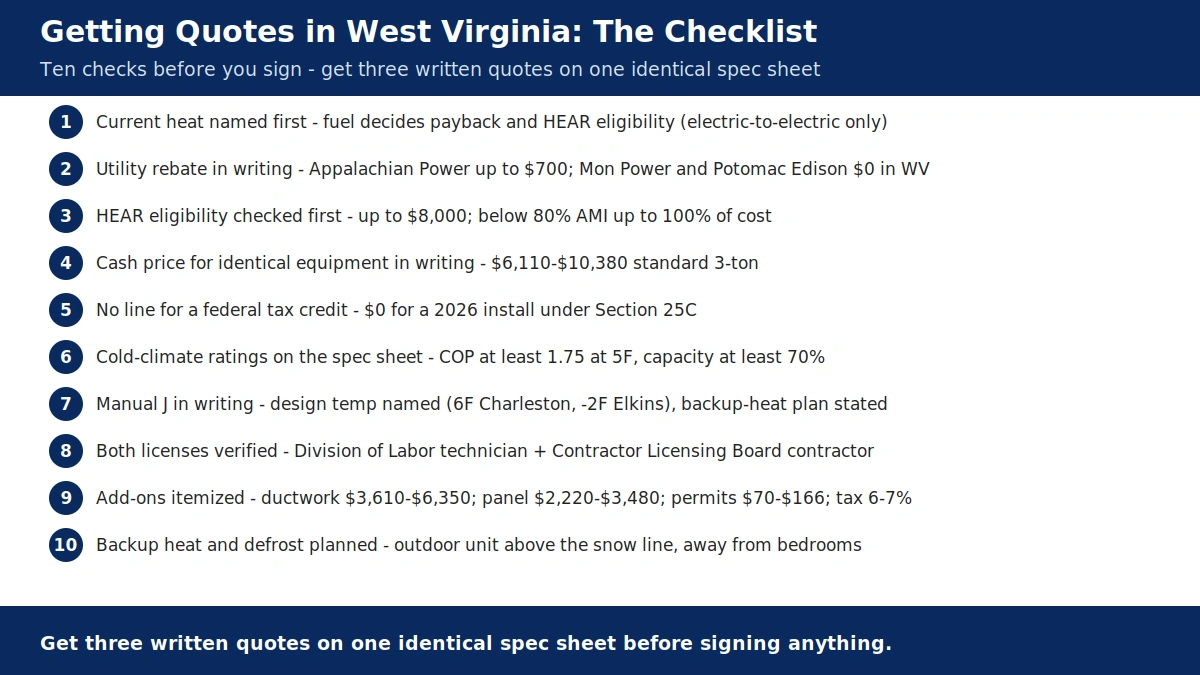
Getting Quotes in West Virginia: The Checklist
West Virginia is a good state to buy a heat pump in — cheap labor, a real rebate for the households that need it most, and a cold-climate product that actually works in the mountains — but only for a buyer who checks the fuel, the utility, and the license before the sales pitch. Run this checklist against every bidder, and sign nothing until each line has an answer in writing.
The ten-item quote checklist:
- Your current heat, named first — gas, electric resistance, electric furnace, propane, oil, or an old heat pump. The fuel decides the payback before anything else, and it decides whether HEAR applies at all: electric-to-electric only, no fuel switching since September 1, 2026.
- Your utility’s rebate, in writing — Appalachian Power TakeChargeWV up to $700 (ducted) or $400 (mini-split), and nothing from Mon Power or Potomac Edison in West Virginia. Do not budget for a utility rebate your utility does not pay.
- HEAR eligibility checked before the quote — income against area median income (below 80% for up to 100% of cost, 80-150% for up to 50%), through a certified contractor via the Neighborly portal, confirmed on energywv.org. The $8,000 is real, and it is not automatic.
- Cash price for the same equipment, in writing — identical tonnage, identical efficiency, all three bidders. The West Virginia anchor is $6,110-$10,380 for a standard 3-ton ducted unit and $8,090-$14,360 for cold-climate. A quote far above it calls for an explanation, and a quote far below it calls for a closer look at what was left out.
- No line for a federal tax credit — a 2026 install gets $0 under §25C, and any quote still deducting it is priced under a dead law. Ask for it to be removed.
- Cold-climate ratings on the spec sheet — COP at 5 degrees of at least 1.75, capacity at 5 degrees of at least 70%, HSPF2 named, minimum operating temperature named, NEEP-listed or ENERGY STAR Cold Climate. In the mountains, these are not nice-to-haves. They are the purchase.
- Manual J load calculation, in writing — with the design temperature named (6 degrees in Charleston, minus 2 in Elkins), and the backup-heat strategy written down with its balance point and expected strip-heat hours.
- Both licenses verified — the installer’s Division of Labor HVAC technician license and the business’s Contractor Licensing Board HVAC contractor license, checked on the registries, with names matched to the contract. Residential work of $5,000 or more requires the contractor license.
- Add-ons itemized — ductwork ($3,610-$6,350), panel upgrade ($2,220-$3,480), permits ($70-$166), refrigerant lines, pad, and thermostat, each as its own line, not folded into the per-ton price. Sales tax shown as its own line — 6% state, 7% in Charleston and other municipalities that levy the 1%.
- Backup heat and defrost planned, not assumed — strip heat, dual-fuel, or cold-climate-only, named in writing; outdoor unit placed above the snow line, away from bedroom windows, with drainage for defrost water.
Buy, lease, or wait? Buying wins for electrically heated homes that qualify for HEAR, for propane-heated homes planning to stay, and for any home whose furnace and air conditioner are both dying. Leasing wins for no one in West Virginia that this guide could verify — no lease or PPA provider was found selling to West Virginia homes, so a lease quote should be read by a lawyer before it is compared at all. Waiting wins for gas-heated homes with healthy equipment, and for any home whose roof or panel needs work first. A heat pump bought in the wrong order — before the roof, before the panel, before the insulation — is a heat pump bought twice.
Sources & methodology
Cost anchors (installed prices):
- NumeralQ West Virginia heat pump cost page, pricing as of 2026-10-26 (estimator from Fixr cost guide + Home Depot equipment prices + BLS wages): 3-ton ducted $6,110-$10,380; cold-climate ducted 3-ton $8,090-$14,360; single-zone mini-split $2,850-$4,530; multi-zone 3 heads $5,640-$10,400; geothermal $19,320-$30,690; by size 1.5t $4,030-$6,580, 2t $4,720-$7,850, 2.5t $5,410-$9,120, 3.5t $6,800-$11,650, 4t $7,490-$12,920, 5t $8,880-$15,450; ductwork $3,610-$6,350; 200A panel $2,220-$3,480; permits $70-$166 (35 cities); HVAC median pay $23.49/hr, billed $47-$61/hr; electricians $31.16/hr
- NumeralQ Charleston page, Oct 2026: 3-ton $6,200-$10,510; dual-fuel 3-ton $8,800-$14,560 (Charleston)
- BetterHouse heat pump cost by state (2026): WV ducted typical $9,830, modeled range $3,720-$13,010, wage index 0.80 (BLS OEWS 49-9021 May 2025) — modeled, not surveyed
- National cross-checks: This Old House Aug 2026 avg $10,575; Angi Aug 2026 $4,500-$8,000; ConsumerAffairs Jul 2026 $4,000-$14,000; NumeralQ national dual-fuel 3-ton $9,230-$15,130 (flagged national)
- Cold-climate figures for sizes other than 3 tons are NestPriced estimates (3-ton premium applied proportionally), labeled as estimates in the draft
Rates:
- EIA Electric Power Monthly Table 5.6.A, Aug 2026 (released Oct 2026): WV residential 16.31 cents/kWh, US 18.16, +4.4% YoY, rank 25 of 51; 12-mo average 15.5 cents, avg bill ~$164/mo, avg use ~1,027-1,069 kWh/mo (EIA via wheredmymoney.com Oct 29, 2026; energyfactbook.com Nov 5, 2026)
- Appalachian Power standard residential tariff: $14.02/mo fixed charge + 0.99 cents/kWh riders, all-in ~18.47 cents/kWh at 900 kWh (priceofelectricity.com, Oct 2026)
- Natural gas: $1.47/therm 12-mo average to Aug 2026 (EIA via wheredmymoney.com); $13.80/Mcf 2025 annual (EIA via utilitycostcalc.com); EIA Natural Gas Monthly Oct 2026 Table 20: WV 2025 YTD $13.45/Mcf
- Heating fuel mix: Census ACS 2024 1-year via NumeralQ — electric heat ~46%, piped gas ~40%; EIA RECS: ~20% of WV homes use a heat pump as main heat
Running-cost models:
- NumeralQ WV heating-cost model (EIA household heating use + current state prices, Oct 2026): gas furnace 95% $504/yr; heat pump HSPF2 7.5 $742/yr; HSPF2 9 $618/yr
- Blue Ridge Heating & Air standardized-home model (2024 EIA prices + 2024 state HDD, published Oct 13, 2026): gas $620, heat pump $800, electric resistance $1,830, propane $1,580, heating oil $1,170
- NestPriced arithmetic from the rates above (15.5 cents/kWh, $1.47/therm): 1 MMBtu heat = $45.42 resistance (COP 1.0), $18.17 heat pump (seasonal COP 2.5), $15.48 gas furnace 95%
Climate:
- ASHRAE 90.1-2013 Table D-1: Charleston HDD 4,646, 99.6% design 6°F; Huntington 4,665, 6°F; Clarksburg 5,512 HDD; Beckley 5,558 HDD; Bluefield 5,230 HDD, 5°F; Martinsburg 5,192 HDD, 8°F; Elkins 6,120 HDD, -2°F
- Charleston climate (WeatherSpark; NWS 2021 annual summary): Jan avg low 28°F, rarely below 11°F; cold season Dec 2-Feb 28; ~95 days/yr min at or below 32°F; cooling design 88°F, 3,655 CDD
- Federal minimum efficiency: 14.3 SEER2 / 7.5 HSPF2 (North region)
Cold-climate performance:
- NEEP ccASHP specification: variable-capacity compressor, AHRI-matched, COP >= 1.75 at 5°F, >= 70% capacity at 5°F
- Typical cold-climate COP: ~4.0 at 47°F, ~2.9 at 32°F, ~2.0-2.2 at 5°F, ~1.2-1.5 at -15°F; capacity 70-100% at 5°F, 50-75% at -13°F; operates to -13°F or lower (DOE Cold Climate Heat Pump Challenge; NEEP; manufacturer data via zerohomes.com, homeenergygeek.com, Jul 2026)
- Brands: Mitsubishi Hyper-Heating H2i, Daikin Aurora/Fit, Bosch IDS Ultra
Rebates — utilities:
- Appalachian Power TakeChargeWV: Efficient Products up to $700 central A/C / ASHP (16-19 SEER tiers), purchases Jan 1, 2022-Dec 31, 2026, apply within 45 days or by Jan 15 next year (TakeChargeWV rebate form); Home Performance mini-split up to $400/unit (takechargeva.com program page, AEP); older WV Home Performance sheet (2024): ASHP up to $450-$600, mini-split up to $350-$750, GSHP up to $750, electrically heated homes only, ENERGY STAR required, no fuel switching
- Mon Power / Potomac Edison: no heat pump rebate in WV (homeenergybasics.com; heat-pump-rebates.com; legalclarity.org — Potomac Edison EmPOWER Maryland discounts are Maryland-only)
- Wheeling Power / WV co-ops: no verified rebate found
Rebates — federal HEAR/HOMES:
- Statewide launch Sep 28, 2026, Gov. Patrick Morrisey: $88M federal, ~10,000 households, $3-4.5M/yr savings, ~350 contractors, 300+ pilot applicants (WV News Sep 29, 2026; Everblue; The American Quorum Sep 30, 2026; startbusinessbystate checked official pages Oct 6, 2026 — WV “Open”)
- HEAR schedule: heat pump up to $8,000, HPWH $1,750, load service center $4,000, wiring $2,500, insulation/air sealing/ventilation $1,600; combined household limit $14,000; below 80% AMI up to 100% of cost, 80-150% AMI up to 50%; via certified contractors, Neighborly portal (The American Quorum; WV News)
- DOE Program Notice 26-2 (Sep 1, 2026): HEAR electric-to-electric only, no fuel switching
- Pilot: HOMES pilot in southern WV counties from Aug 6, 2026 (Marshall University, Sep 10, 2026)
- Conflict noted: heatpumppricing.com (data verified Nov 4, 2026) still lists WV HEAR as “in development” — superseded by the Sep 28 launch announcement; some state pages still show pilot/waitlist language (American Quorum)
- HOMES dollar cap ($20,000 per homeenergybasics) — not verified from a primary source, not headlined
Federal tax credit:
- OBBBA P.L. 119-21 and IRS FS-2025-05: §25C $0 for post-Dec-31-2025 installs, completion date counts; §48E 30% for third-party-owned systems in service by Dec 31, 2027, construction begun by Jul 4, 2026 (IRS Notice 2025-42); no verified WV lease/PPA provider found
Licensing & permits:
- WV Division of Labor HVAC technician licenses: W. Va. Code §21-16-3, 42CSR34; 2,000 hours for HVAC Technician; statewide since Jan 1, 2016; Prov exams $59.95; annual renewal; no CE required (hvac.getverticalos.com verified Oct 20, 2026; servicetitan.com; rocketcert.com Oct 27, 2026)
- WV Contractor Licensing Board HVAC contractor license: W. Va. Code §§30-42-3, 30-42-6; required residential $5,000+ / commercial $25,000+; Business and Law + HVAC exams (Prov $59.95 each); $90 annual fee; $25 late penalty
- Permits $70-$166 (NumeralQ, 35 WV cities, Oct 2026)
Housing stock:
- Census ACS 2023 5-year estimates via Stacker: county median year built mostly 1970s (Doddridge 1973, Ritchie 1974, Calhoun 1974, Boone 1975, Taylor/Upshur 1979); 13-29% of homes built 1939 or earlier in many counties; Berkeley 1995, Jefferson 1990 (Eastern Panhandle exception); no statewide median verified
Sales tax:
- WV 6% state sales tax (W. Va. Code §11-15-3); municipalities may add 1% (combined 6-7%; Charleston and 100+ municipalities at 7% as of Oct 2026; statewide average combined 6.6%, Tax Foundation midyear 2026)
Financing, lifespan (national figures):
- CFPB Solar Financing Market Issue Spotlight, Aug 2024: dealer fees 10-30%, sometimes over 50%
- Ducted heat pump lifespan 12-15 years; mini-split 15-20 years (national figures)
Payback arithmetic:
- Savings from Blue Ridge model: resistance $1,830 – heat pump $800 = ~$1,030/yr; propane $1,580 – $800 = ~$780/yr; oil $1,170 – $800 = ~$370/yr; gas $504 (NumeralQ) vs heat pump $618-$742 = heat pump costs $114-$238/yr more
- All payback figures are simple payback on cash price before financing, labeled as NestPriced arithmetic from the models above
EXCLUDED:
- Any “after 30% credit” prices — stale, excluded
- City-level heat pump prices for Huntington, Morgantown, Wheeling, Parkersburg, Beckley, Martinsburg — only Charleston verified ($6,200-$10,510)
- HOMES dollar cap — not verified from a primary source
- Wheeling Power or WV co-op heat pump rebates — none verified
- WV lease/PPA (§48E) provider — none verified
- WV-specific heat pump running-cost bill data — models only (NumeralQ, Blue Ridge), labeled as models
- Statewide median year built for WV housing — not verified; county medians used instead
- heatpumppricing.com’s “WV HEAR still in development” — superseded by the Sep 28, 2026 launch
- BetterHouse’s $3,720-$13,010 WV range — modeled from national baseline + wage index, cited as modeled only
- Cold-climate prices for sizes other than 3 tons — NestPriced estimates, labeled as estimates
*Disclaimer: The prices here are 2026 West Virginia planning figures. The numbers move with the city, the house, the utility territory, and the contractor. Line up three written quotes from West Virginia installers before you settle on a budget. Read the tax notes in this guide as general information only — not as advice for your own return. Talk to a West Virginia tax professional before you file. Program rules change — TakeChargeWV, HEAR, and HOMES terms — so confirm current terms with Appalachian Power, the West Virginia Office of Energy, or your own utility before signing. HEAR launched statewide September 28, 2026, and the TakeChargeWV Efficient Products rebates run through December 31, 2026 — rate and program figures in this guide are dated to their sources.*
What does a heat pump cost in West Virginia in 2026?
A standard 3-ton ducted heat pump costs $6,110-$10,380 installed in West Virginia in 2026 (NumeralQ, pricing as of October 26, 2026), with Charleston verified a touch higher at $6,200-$10,510. A cold-climate ducted 3-ton runs $8,090-$14,360, a single-zone ductless mini-split runs $2,850-$4,530, and a three-head multi-zone system runs $5,640-$10,400. The 30% federal tax credit is $0 for a 2026 install, but West Virginia’s HEAR rebate pays up to $8,000 for a heat pump to income-qualifying households that already heat with electricity.
Will a heat pump keep up in a West Virginia winter?
A cold-climate heat pump will; a standard one may not, depending on where the house sits. Charleston and Huntington design to 6 degrees, and a standard unit gets by there with some backup heat. Elkins designs to minus 2 degrees, and a standard unit would lean on expensive strip heat for weeks. A NEEP-listed cold-climate unit holds at least 70% of its rated capacity at 5 degrees with a COP of at least 1.75, and the best models hold full capacity at 5 degrees and keep running to minus 13 or lower. In the mountains, the cold-climate unit is not the upgrade — it is the correct unit.
Is a heat pump cheaper to run than a gas furnace in West Virginia?
No. At West Virginia prices — electricity about 16.31 cents a kilowatt-hour, gas about $1.47 a therm — a heat pump costs more to run than a gas furnace. NumeralQ’s model puts a 95% gas furnace at $504 a year and a high-efficiency heat pump at $618 a year. The heat pump wins big against electric resistance heat, saving about $1,030 a year, and against propane, saving about $780 a year. If the house heats with gas and the furnace is healthy, a heat pump does not pay on running costs — it pays only when the furnace and the air conditioner both need replacing, because one machine then replaces two.
What is the West Virginia HEAR rebate for heat pumps?
West Virginia launched its federal home energy rebate programs statewide on September 28, 2026, with $88 million in federal funding. HEAR pays up to $8,000 for a heat pump, with a combined household limit of $14,000 across all HEAR measures. Households below 80% of area median income can receive up to 100% of the project cost, and households at 80-150% of area median income can receive up to 50%. The catch is the federal rule in force since September 1, 2026: HEAR pays only for electric-to-electric upgrades, so replacing a gas furnace with a heat pump does not qualify. The rebate flows through certified contractors via the state’s Neighborly portal — confirm current status on energywv.org before counting on it.
Does Appalachian Power offer a heat pump rebate in West Virginia?
Yes, a small one. TakeChargeWV pays up to $700 on an ENERGY STAR central air conditioner or air-source heat pump, tiered by efficiency, for purchases through December 31, 2026, and up to $400 per unit for a ductless mini-split through the Home Performance Program. The home must be heated with electricity, and fuel switching is not eligible. Mon Power and Potomac Edison offer no heat pump rebate to West Virginia customers — Potomac Edison’s generous EmPOWER Maryland discounts are Maryland-only, and West Virginia customers cannot claim them.
Can I still get the federal tax credit for a heat pump in West Virginia in 2026?
No. The Energy Efficient Home Improvement Credit (§25C), which used to pay up to $2,000 toward a heat pump, ended for property placed in service after December 31, 2025 under the One Big Beautiful Bill Act (P.L. 119-21), and the IRS has made clear the finish date of the installation is the date that decides it. Any 2026 quote that still deducts a federal credit is priced under a law that no longer exists. The commercial credit (§48E) survives for third-party-owned systems, but no lease or PPA provider was verified selling to West Virginia homes — have a lawyer read any lease before signing.
What license should my West Virginia heat pump installer hold?
Two, and both are statewide. The person doing the work needs a Division of Labor HVAC technician license — the full technician license requires at least 2,000 hours of HVAC work, training, and experience — and the business needs a Contractor Licensing Board heating, ventilating, and cooling contractor license, required for residential work costing $5,000 or more. Verify both numbers on the state registries with names matched to the contract, and confirm the installer pulls the mechanical permit ($70-$166 in most West Virginia cities) before work starts.
Should I buy a heat pump or wait in West Virginia?
Buy now if the house heats with electric resistance or an electric furnace and the household income qualifies for HEAR — the $8,000 rebate can cut a cold-climate unit’s net cost to under $6,400, and the running-cost saving is about $1,030 a year. Buy now if the furnace and the air conditioner are both dying, whatever the fuel, because one heat pump replaces two machines. Wait if the house heats with gas and both machines are healthy — the heat pump costs more to run, HEAR does not apply, and the money is better spent on insulation and air sealing first.