

On March 31, 2023, a tornado rated EF3 cut a 34-mile path through Little Rock, North Little Rock, Sherwood, and Jacksonville at 165 miles per hour. It tore roofs off houses near Cantrell Road, snapped trees at Murray Park, and crossed the Arkansas River into Burns Park before it lifted near Cabot. Three years earlier, a different EF3 had gone through Jonesboro and damaged about 300 buildings, including the Mall at Turtle Creek.
Those two afternoons explain why buying a roof in Arkansas is a different job from buying one in a calm state. The roof over a house in Pulaski County or Craighead County is storm equipment first and a weather lid second. It has to hold its shingles through severe hail on 32 days a year, hold its deck through wind that has produced 42 tornadoes a year for 30 years, and then sit through a humid summer that grows algae on every shaded slope.
The price of that roof is the good news. Arkansas is one of the cheapest states in the country to reroof, with roofer pay running 14 percent under the national median and a 2,000 sq ft shingle roof landing under $11,000 at the top of the planning band. The hard part is everything around the price: the material that survives hail, the registration that proves the roofer is real, the permit rule that changes at the city line, and the insurance policy that may pay far less than the roof costs once the roof turns seven.
Arkansas sits below the national band, and the gap is labor, not luck. The national roof replacement cost guide holds the countrywide figures to measure Arkansas against.
Table of Contents
How Much Does a Roof Replacement Cost in Arkansas in 2026?
Four kinds of evidence price the Arkansas market in 2026, and they measure different jobs, which is why their numbers spread and why the spread needs untangling before any quote is compared. NumeralQ publishes planning estimates from a cost model built on materials plus local labor, priced October 26, 2026, and pins down the material, the size, and the scope: architectural shingles, 2,000 sq ft of roof, installed. SmartRoofingCalculator scales national per-square bands by Arkansas roofer wages and goods prices, and lands in the same place by a different road.
MyRoofData models a typical single-family home with tear-off of one layer and prices each material per square before tear-off. Instant Roofer averages real contractor pricing entered into its app across 188,300 measured Arkansas roofs, but on a bigger average roof of 2,712 sq ft, so its average sits higher for a plain reason: more roof.
The NumeralQ band leads here because it states the roof size, the material, and the date, and because it calls itself a planning estimate instead of dressing up as a survey of what Arkansans paid. The midpoint, about $9,985, is the number the lifetime section works from. SmartRoofingCalculator’s 25-square figure of $9,750–$14,000 overlaps the NumeralQ size table closely once the bigger roof is allowed for, and its per-square band of $390–$560 for architectural shingles matches the NumeralQ implied rate of about $451–$548 per square.
MyRoofData’s $11,250–$19,250 covers a typical home with tear-off included and a wider scope, which explains the higher top. HomeCostLens models Little Rock at about $9,830 on average for a 2,200 sq ft home, inside a range of $8,050–$16,090, which sits comfortably against the NumeralQ band.
One model runs well above the rest and is noted rather than followed. RoofingEstimatorPros puts a 2,000 sq ft architectural roof at $12,727–$22,979, about $8.64 per sq ft installed, which is roughly double the NumeralQ rate at the top end.
No scope note in that model explains the gap, so it is recorded here as the high outlier and left out of every band that follows. A central Arkansas contractor, Patriot Roofing, publishes retail ranges of $15,000–$30,000 for most shingle replacements with simple single-story roofs from about $9,000, which describes finished retail jobs on larger and more complex roofs rather than the 2,000 sq ft planning roof.
| Source | What it prices | 2026 figure |
|---|---|---|
| NumeralQ (Oct 26, 2026, planning est.) | 2,000 sq ft roof, architectural shingles, installed | $9,020–$10,950 |
| SmartRoofingCalculator (Nov 9, 2026, modeled) | 25-square roof, architectural shingles, incl. tear-off | $9,750–$14,000 |
| MyRoofData (2026 model) | Typical home, architectural shingles, incl. one-layer tear-off | $11,250–$19,250 |
| Instant Roofer (contractor pricing, 188,300 roofs) | Average Arkansas roof, 2,712 sq ft, asphalt shingle | $13,397 average |
| HomeCostLens Little Rock (Sept 2026, modeled) | 2,200 sq ft home, architectural shingles | ~$9,830 average |
| RoofingEstimatorPros (Aug 2026, modeled) | 2,000 sq ft roof, architectural shingles | $12,727–$22,979 (high outlier) |
Inside the headline band sit the shingles, the underlayment, the starter course, the ridge cap, the flashing, the ventilation pieces, the tear-off of the old roof, the disposal, the labor, and the contractor’s markup. Outside it sit the items that surprise buyers: a second tear-off layer at $1.13–$1.49 per sq ft, decking sheets at $54.91–$80.41 each installed, a full ice-and-water barrier at $0.82–$1.32 per sq ft, new gutters at $7.40–$10.73 per linear ft, and flashing work at $292–$424 for a chimney or wall and $444–$572 to re-flash a skylight.
Those add-on figures come from the NumeralQ Little Rock page, and each one belongs as its own line on a quote. Quotes that fold them into one lump sum hide the part of the job that grows after tear-off.
Arkansas sits about 7 percent under the national band on the same NumeralQ model, which prices a 2,000 sq ft roof at $9,710–$11,840 across the country. The reason is pay: Arkansas roofers earn a median $22.82 an hour against a higher national figure, and contractors bill $46–$59 per worker-hour after insurance, payroll taxes, overhead, and profit.
Materials travel on national prices, so the saving is all in the crew. That also means the saving vanishes on a roof where the crew spends its hours on tear-off, decking, and steep-slope work rather than laying shingles.
Roof Replacement Cost in Arkansas by Material
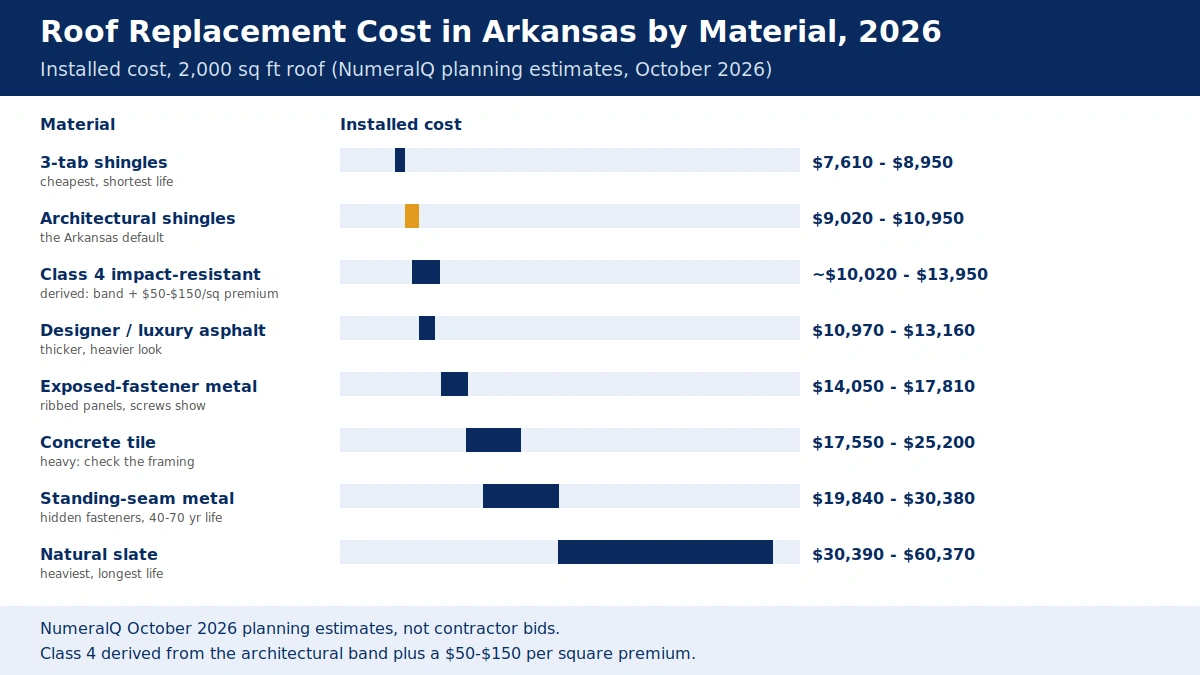
Material is the second-biggest lever on the price after size, and in Arkansas it is also a storm decision. The table below prices a 2,000 sq ft roof in every common material from the NumeralQ Little Rock page, which doubles as the state proxy because the state and city bands match to the dollar.
Rated life comes from the MyRoofData model, and the Arkansas read column says what each material faces in this climate. The Class 4 row is derived, not published: it adds a $50–$150 per square material premium to the architectural band, with labor unchanged, and the derivation is spelled out in the Class 4 section.
| Material | 2,000 sq ft roof, installed | Rated life | Arkansas read |
|---|---|---|---|
| 3-tab asphalt shingles | $7,610–$8,950 | 15–20 years | Cheapest buy; lowest wind ratings; many insurers have moved away from it |
| Architectural asphalt shingles | $9,020–$10,950 | 22–30 years | The default Arkansas roof; 110–130 mph wind ratings |
| Class 4 impact-resistant shingles | ~$10,020–$13,950 (derived) | 25–35 years | Top hail rating; the discount roof; see the Class 4 section |
| Designer / luxury asphalt shingles | $10,970–$13,160 | 25–30 years | Thicker look; same hail exposure as standard architectural |
| Exposed-fastener metal (corrugated, 5V) | $14,050–$17,810 | 30–40 years | Common on rural homes; screws need checking as gaskets age |
| Stone-coated steel | $15,800–$23,020 | 40–50 years | Shingle look in steel; hail dents show less than on flat panels |
| Cedar shakes | $16,550–$29,610 | 25–35 years | Needs upkeep in humidity; rare on Arkansas production homes |
| Synthetic slate or shake (composite) | $16,560–$24,040 | 40–50 years | Slate look at half the weight; Class 4 options exist |
| Concrete tile | $17,550–$25,200 | 40–75 years | Heavy at 850–1,100 lb per square; structure check first |
| Standing-seam metal | $19,840–$30,380 | 40–70 years | Concealed fasteners; the long-life metal roof |
| Clay tile | $23,190–$37,340 | 50–100 years | Brittle underfoot; tile-experienced crews only |
| Natural slate | $30,390–$60,370 | 75–150 years | A lifetime roof at 3–6 times the shingle price; specialist labor |
| Flat: modified bitumen / EPDM / TPO | $9,820–$12,630 / $10,120–$15,970 / $12,000–$16,030 | 20–30 years | Low-slope sections, porches, additions, mid-century flat roofs |
3-tab shingles are the budget buy, and the budget buy costs more than it saves in a hail state. At $7,610–$8,950 the saving against architectural shingles is about 17 percent, roughly $1,400–$2,000 on a 2,000 sq ft roof. The trade is a thinner single-layer shingle with lower wind ratings and a shorter rated life, on a roof that will face the same hail as its thicker neighbor.
Many insurers and builders have moved away from 3-tab, and a buyer who saves $1,500 on the install can lose it in one denied wind claim or one earlier replacement. For most Arkansas homes, 3-tab is a price for comparison, not a roof to buy.
Architectural shingles are the Arkansas default, and the default earns its place. A dimensional, two-layer shingle with 110–130 mph wind ratings, a 22–30 year rated life, and a price every crew in the state knows how to install. The per-square math from MyRoofData runs $392–$653 installed before tear-off, with tear-off adding $100–$200 per square per layer.
On a 2,000 sq ft roof the installed band of $9,020–$10,950 is the number every other material in this table is measured against. The Arkansas caveat on life is plain: a central Arkansas contractor plans on 15–20 years from an asphalt shingle roof in Arkansas weather, not the full rated span, because heat, humidity, and hail cycles wear the roof faster than the lab test assumes.
Designer and luxury asphalt buys a thicker look, not a stronger roof. At $10,970–$13,160 the premium over standard architectural buys depth, shadow lines, and curb appeal on a front-facing slope.
It does not buy a higher impact rating on its own. A buyer who wants the look and the hail rating should price a Class 4 designer line specifically and confirm the UL 2218 rating in writing, rather than assuming thickness means toughness.
Metal splits into two roofs that share a name and little else. Exposed-fastener panels, corrugated or 5V, run $14,050–$17,810 and are screwed through the panel face, which makes them fast to install and common on rural Arkansas homes, barns, and budget metal conversions. The screws and their gaskets are the upkeep item: gaskets age in Arkansas heat and UV, and a roof that is never re-checked can weep at a thousand screw holes.
Standing-seam metal, at $19,840–$30,380, hides its fasteners under raised seams that let the panels move with temperature, which is why it carries the 40–70 year rated life and the premium price. MyRoofData prices standing seam at $827–$1,392 per square before tear-off against $479–$827 for ribbed panels, and SmartRoofingCalculator puts standing seam at $780–$1,210 per square installed with tear-off. Our metal roof cost guide prices gauge, finish, and trim line by line, and our metal vs shingles guide works the head-to-head choice in full.
Tile, slate, cedar, and synthetic are special-case roofs in Arkansas, and each one needs a reason beyond looks. Concrete tile at $17,550–$25,200 and clay tile at $23,190–$37,340 are heavy enough that the structure often needs an engineering check before a switch from shingles, and clay is brittle underfoot, so repairs need tile-experienced crews. Natural slate at $30,390–$60,370 is a lifetime roof that outlives the mortgage, priced by weight and specialist labor.
Cedar shakes at $16,550–$29,610 ask for upkeep in a humid climate and are rare on Arkansas production homes. Synthetic slate or shake at $16,560–$24,040 gives the slate look at about half the weight, and some lines carry Class 4 ratings. Our tile roof cost guide covers the weight and structure questions before any tile quote is signed.
Flat and low-slope sections price on a different scale and often hide inside a shingle quote. Modified bitumen at $9,820–$12,630, EPDM rubber at $10,120–$15,970, and TPO membrane at $12,000–$16,030 cover porches, additions, and mid-century flat roofs where shingles cannot shed water. A house with a flat porch roof and a pitched main roof needs both prices on the quote, on separate lines, because the flat section fails first when it is treated as an afterthought.
Roof Replacement Cost by Roof Size in Arkansas
Roofers price the sloped surface they stand on, not the floor area the family lives in. A 2,000 sq ft single-story house typically carries about 25 squares of roof surface once pitch, overhangs, gables, and waste are counted, and a two-story house of the same living area carries far less roof because the footprint is halved.
Every figure in this section uses sq ft of roof, and every quote worth comparing states the measured roof area in squares. A square is 100 sq ft of roof surface, and it is the unit every Arkansas roofer quotes in.
| Roof size | Squares | Architectural shingles, installed |
|---|---|---|
| 1,000 sq ft of roof | 10 | $4,780–$5,880 |
| 1,500 sq ft of roof | 15 | $6,900–$8,420 |
| 2,000 sq ft of roof | 20 | $9,020–$10,950 |
| 2,500 sq ft of roof | 25 | $11,150–$13,480 |
| 3,000 sq ft of roof | 30 | $13,270–$16,020 |
The 25-square planning roof is the figure to budget from for a typical single-story Arkansas home. At $11,150–$13,480 in architectural shingles, it runs $446–$539 per square installed, which lines up with the 20-square rate and with SmartRoofingCalculator’s independent 25-square figure of $9,750–$14,000.
A buyer with a 2,000 sq ft ranch should budget from the 25-square row, not the 20-square row, and a buyer with a two-story home should measure the footprint and the pitch before assuming either one. The gap between the two rows is about $2,100–$2,500, which is the cost of guessing the roof size from the living area.
Pitch and complexity move the price inside each row. A steep roof slows the crew, needs more safety gear, and wastes more material at the cuts. A cut-up roof with valleys, dormers, hips, and wall intersections adds flashing labor at every joint, and one cost model adds about 15 percent in labor for a cut-up roof.
A simple gable roof on a single story is the cheapest shape per square in Arkansas. A steep, cut-up roof on a two-story house with three dormers is the dearest, and the difference can run into thousands on the same square count.
Layers and decking are the two unknowns that only tear-off settles. When two layers are already on the roof, the code requires a tear-off rather than a third layer, and the extra layer costs $1.13–$1.49 per sq ft to remove. Decking damage hides under the old shingles, and the fix is priced per 4-by-8 sheet at $54.91–$80.41 installed.
With 40 percent of Arkansas homes built before 1980, soft or plank decking is common enough that every quote should state the per-sheet decking price before the roof is opened. A quote with no decking line is a quote with a change order waiting in it.
Roof Replacement Cost by City: Little Rock, Fayetteville, Fort Smith & Jonesboro
Arkansas has no expensive roofing market and no cheap one. The two cities with published cost-model pages sit $20–$30 apart at the low end of the band, which is the flattest city map a buyer could ask for.
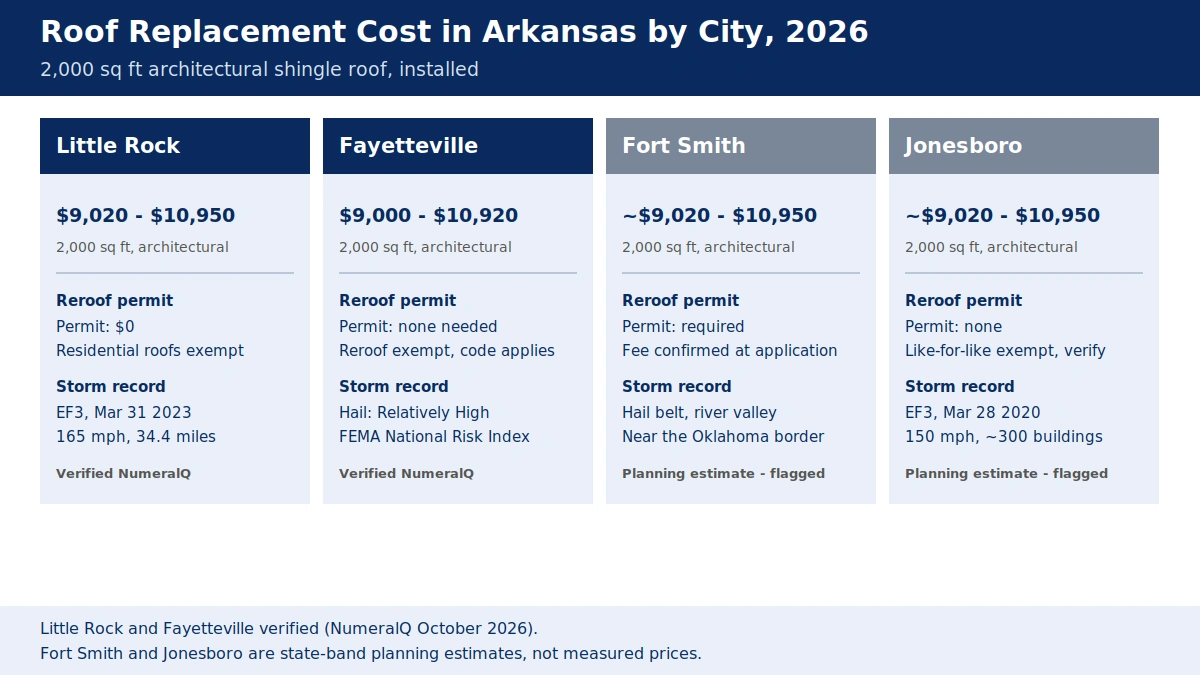
What sets the four cities apart is not the crew’s hourly rate, which shares one state wage figure, but the permit desk, the hail record, the housing stock, and the storm history. Two of the four prices below are verified model figures and two are planning estimates from the state band, and the table says which is which.
| City | 2,000 sq ft roof, architectural | Basis | Permit for a residential reroof |
|---|---|---|---|
| Little Rock | $9,020–$10,950 | NumeralQ verified | $0: residential roofs exempt |
| Fayetteville | $9,000–$10,920 | NumeralQ verified | None needed for a residential reroof |
| Fort Smith | ~$9,020–$10,950 | State band, planning estimate | Permit job: check with the building department |
| Jonesboro | ~$9,020–$10,950 | State band, planning estimate | Generally none for a like-for-like reroof |
Little Rock is the capital, the largest market, and the most storm-marked city in the state. Pulaski County recorded 57 large-hail reports from 2016 to 2025, including two of hail 2 inches or bigger, plus 181 damaging-wind reports and 15 tornado reports, and FEMA rates the county’s tornado risk Very High and its hail risk Relatively High. The housing stock is old: the median Little Rock home was built in 1978 and is worth $236,400, so the typical roof sits over a house that has likely been reroofed at least once already.
Competition is thick, with 51 roofing contractors counted in Pulaski County in 2023, or 2.6 per 10,000 homes against a national rate of 1.7, which helps on price and timing and also draws more fly-by-night operators. The permit costs nothing because residential roofs are exempt from the building permit in Little Rock, which removes a fee and also removes the inspection that a permit would have triggered, so the buyer’s own checks matter more here.
Fayetteville is the Northwest Arkansas hub, the youngest-feeling market of the four, and the cheapest verified figure by a few dollars. Washington County carries a FEMA hail rating of Relatively High, and roofer pay runs 15 percent under the national median.
The city exempts residential reroofing from the permit requirement while holding the work to code, so the $69 figure that shows up in some cost summaries is the general building permit rate applied to a $15,000 job, not a fee an exempt reroof pays. Growth is the local price driver: a fast-growing city with new subdivisions spreading across the Ozark foothills keeps crews busy, and a buyer who books in the spring storm season competes with hail claims for the same crews.
Fort Smith sits in the Arkansas River Valley on the Oklahoma border, in a hail belt that wraps the state line. No published cost model prices the city, so the state band stands in as a planning estimate and three local quotes are the real price. Contractor-pricing data from Instant Roofer averages $13,665 for the city, but on a 27-square average roof, so it describes bigger roofs rather than a higher rate.
The city treats roofing as a repair and alteration permit job and asks builders to discuss the project with the building department, which makes Fort Smith the one city of the four where the permit question needs a phone call before the quote is signed. The local housing runs from historic Belle Grove Victorians to new builds at Chaffee Crossing, and the older homes carry the same decking risk as the rest of the state.
Jonesboro anchors the Delta side of Crowley’s Ridge in northeast Arkansas, and its storm history is the sharpest of the four cities in recent years. The March 28, 2020 EF3 went through the east side of town at 150 miles per hour, damaged about 300 buildings, and hit the Mall at Turtle Creek and the municipal airport. Craighead County recorded 38 tornadoes in the 30 years to 2025.
No published cost model prices Jonesboro either, so the state band is again a planning estimate, and Instant Roofer’s $13,732 city average sits on the same 27-square basis as its Fort Smith figure. A like-for-like reroof generally needs no permit in Jonesboro, while structural changes do, so a straight replacement skips the permit desk and a skylight or pitch change does not. Hail cycles run the local replacement rhythm: many Jonesboro roofs are replaced through insurance claims well before the end of their rated life, which makes the insurance section below required reading for a Jonesboro buyer.
Arkansas Storm Country: Tornadoes, Hail & the Dixie Alley Roof
Arkansas sits in Dixie Alley, the mid-South tornado country that runs from east Texas through Arkansas, Mississippi, Alabama, and Tennessee. The name matters because Dixie Alley tornadoes behave differently from the Plains tornadoes most people picture.
They arrive in outbreaks, in every month of the year, often wrapped in rain and hard to see, and about 2 in 10 touch down at night when people are asleep. A roof bought for Arkansas weather is bought for that pattern, not for a single spring afternoon.
The 30-year record from the NOAA Storm Prediction Center’s Severe Weather Database makes the pattern plain. Arkansas recorded 1,268 tornadoes on 367 days from 1996 to 2025, an average of 42 a year, with 258 reaching EF2 or stronger and 13 reaching EF4. April is the busiest month with 23.4 percent of tornado days, and the busiest single week centers on April 27, but the middle 80 percent of tornado days stretches from March 1 to November 3, which is most of the year.
The night share, 23.3 percent between 9 p.m. and 6 a.m., is the figure that separates Dixie Alley from the High Plains, where storms live and die with afternoon heat. The longest track in the window ran 121.84 miles as an EF4 starting in Yell County on February 5, 2008, in the Super Tuesday outbreak, and the biggest single day, January 21, 1999, produced 52 tornadoes.
| Measure | Arkansas, 1996–2025 |
|---|---|
| Tornadoes | 1,268 on 367 days (42 a year) |
| EF2 or stronger | 258 (8.6 a year) |
| EF4 / EF5 | 13 / 0 |
| Busiest month | April (23.4% of tornado days) |
| Night share (9 p.m.–6 a.m.) | 23.3% |
| Severe hail days | 955 days, 5,044 reports (32 days a year) |
| Hail days with 2-inch stones or larger | 5.6 a year |
| Largest hailstone | 5 inches |
The named storms are the ones Arkansas homeowners remember when they sign a roofing contract. The March 31, 2023 EF3 through Little Rock peaked at 165 miles per hour, ran 34.4 miles, and left one person dead and 54 injured, with a second EF3 the same day cutting through Wynne at 150 miles per hour and killing four people. The March 28, 2020 EF3 through Jonesboro ran 12.55 miles at 150 miles per hour and damaged about 300 buildings.
The April 27, 2014 EF4 at Vilonia, in Faulkner County, is the storm that still sets the standard for what a violent tornado does to a neighborhood. The National Weather Service survey of the 2023 Little Rock tornado records the track, the wind speed, and the damage path in full, and the 30-year NOAA tornado record for Arkansas carries the county-by-county counts behind the table above.
Hail is the more frequent roof killer, and it works quietly where tornadoes work loudly. Arkansas averages 32 severe hail days a year, with 5,044 individual reports across 955 days in the 30-year window, and 5.6 days a year produce stones of 2 inches or larger. The largest stone in the record measured 5 inches.
Pulaski County alone logged 57 large-hail reports from 2016 to 2025, and the rate across Pulaski and its six neighboring counties ran 48.8 reports per 1,000 square miles against a state rate of 30.2 and a national rate of 20.1. Hail rarely takes a roof off. It bruises shingles, knocks off granules, cracks the mat, and shortens the roof’s life by years, and the damage is often invisible from the ground, which is why an inspection after a hail day matters more than a glance from the driveway.
Wind fills the gaps between the tornadoes and the hail. Arkansas ranks 24th in the country for damaging wind, with 3,385 NOAA reports since 2016, and Pulaski County logged 181 damaging-wind reports in the decade to 2025. Straight-line wind lifts shingle tabs, drives rain under worn courses, and tests the nailing pattern on every slope.
Architectural shingles carry 110–130 mph wind ratings, which covers most Arkansas wind events, but the rating on the wrapper only holds if the install matches it: the right nail count, the right placement, and sealed starter courses along the edges. A roof that loses tabs in a 70 mph gust was usually under-nailed or laid in cold weather that never let the sealant bond, not beaten by a storm beyond its rating.
What the storm record means for the buying decision is simple to state and easy to skip under price pressure. The roof needs a wind rating that matches Arkansas gusts, an impact rating that matches Arkansas hail, a deck attachment that holds when the covering is stressed, and an installer who treats the nailing pattern and the sealing as part of the price rather than an upgrade.
The FORTIFIED standard packages those steps with ring-shank deck nailing, a sealed deck, and a certified inspection, and the grant and insurance sections below explain where that standard stands in Arkansas in 2026. A quote for a roof in this state should be priced for hail, wind, and the decking underneath, not for the lowest installed price alone.
Humidity, Algae & Ice: The Slow Arkansas Roof Killers
Storms get the attention, but humidity does the daily work of wearing an Arkansas roof out. Little Rock averages 49.57 inches of rain a year on the 1991–2020 normals, under a humid subtropical climate with hot summers and Gulf moisture riding north all season.
Shaded and north-facing slopes stay damp long after the rain stops, and damp shingles grow the black streaks that mark so many Arkansas roofs. Those streaks are algae, a blue-green growth that feeds on the limestone filler in asphalt shingles, and they hold moisture against the shingle surface while they spread.
Algae streaks are a looks problem first and a life problem second. The growth itself rarely leaks a roof, but the damp mat under it ages faster, and the streaks tell a buyer that the slope never dries properly. Moss is the worse tenant: it lifts shingle edges, holds water against the surface, and works its roots under the courses.
Algae-resistant shingles fight back with copper-bearing granules, and copper kills the growth as rain washes ions across the slope. Several product lines pair algae resistance with impact resistance, including Atlas StormMaster Shake, which is worth knowing in a state where hail and humidity hit the same roof. No published Arkansas price for the algae-resistant upgrade was found, so price it as its own line and compare it across bidders rather than accepting a lump sum that hides it.
Cleaning a stained roof the wrong way costs more than the stain. Pressure washing strips the granules off asphalt shingles, and granule loss is the roof’s UV shield going down the downspout.
A soft wash with the right cleaner, done by a crew that knows shingle roofs, is the safe route, and the manufacturer’s warranty terms should be checked before any cleaning method is used. The cheapest algae control is bought at install time: algae-resistant shingles on the shaded slopes, trees trimmed back so the roof dries after rain, and gutters kept clear so water leaves the edge instead of pooling behind it.
The attic decides how long the shingles last from below. A hot, damp attic cooks shingles from the underside, softens the sealant, and shortens the roof’s life by years, while a vented attic with balanced intake and exhaust lets the roof run cooler and drier.
Every reroof is the moment to fix ventilation, because the crew is already on the roof and the ridge vent, soffit vents, and baffles are cheap against the cost of the job. Our attic insulation cost guide prices the insulation side of the same attic, and insulation plus ventilation should be quoted together, not as two jobs that never meet.
Ice is the winter half of the slow damage, and it surprises buyers who think of Arkansas as a warm state. FEMA rates ice-storm risk Very High in Pulaski County, and freezing rain glazes roofs, loads gutters, and backs water under shingles at the eaves when it melts and refreezes. The building code answers with an ice barrier membrane laid from the eave edge to at least 24 inches inside the exterior wall line, which seals around nail holes and stops the backed-up water from reaching the deck.
Check that the bid includes the barrier at the eaves and in the valleys. A full-roof ice-and-water barrier runs $0.82–$1.32 per sq ft if the whole slope is covered instead of the eaves only.
Timing the job around Arkansas weather saves money and stress. August and September have the fewest days of measurable rain in Little Rock, about four each, which makes late summer the driest window for a tear-off. Spring is storm season, and crews book out after hail events while prices tighten region-wide in the weeks after a major storm, so a planned spring reroof competes with insurance work for the same crews.
Winter installs are possible in Arkansas because days usually warm past 40 degrees all year, but nights drop below 40 from December through February, and shingles laid in cold weather need hand-sealing along the edges because the sealant strip needs warmth and sun to bond. A shingle laid late on a cold day may not seal until a warm spell, and an unsealed shingle is a shingle the next wind can lift.
Asphalt vs Metal in Arkansas: The Lifetime Math
The sticker price answers the wrong question. A roof is bought once and lived under for decades, so the fair comparison is the cost per year of roof life, with the hail record kept in view.
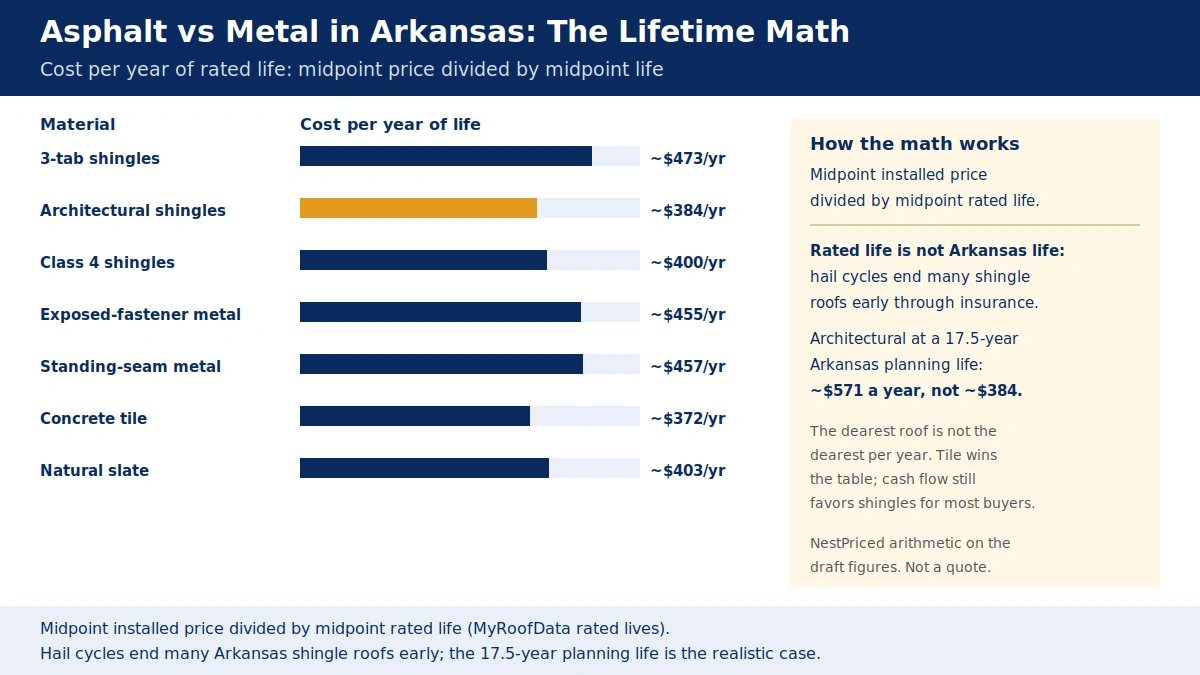
The table below divides the midpoint installed price by the midpoint rated life for each material, using the NumeralQ bands and the MyRoofData rated lives from the material table. It is NestPriced arithmetic on stated figures, not a quote, and it leaves out the structure check a tile roof needs and the upkeep a cedar roof asks for.
| Material | Midpoint installed | Rated life, midpoint | Cost per year of life |
|---|---|---|---|
| 3-tab asphalt | $8,280 | 17.5 years | ~$473 |
| Architectural asphalt | $9,985 | 26 years | ~$384 |
| Class 4 impact-resistant | $11,985 | 30 years | ~$400 |
| Exposed-fastener metal | $15,930 | 35 years | ~$455 |
| Standing-seam metal | $25,110 | 55 years | ~$457 |
| Concrete tile | $21,375 | 57.5 years | ~$372 |
| Natural slate | $45,380 | 112.5 years | ~$403 |
The result surprises buyers who expect the dearest roof to cost the most per year. On rated life alone, every material lands between about $372 and $473 a year, because the dearer roofs last longer in rough proportion to their price. The cheapest roof per year on this math is concrete tile, and the dearest is 3-tab, which is the reverse of the sticker order.
The sticker decides how much cash leaves the bank at once. The yearly figure decides what the roof costs across a lifetime of ownership, and on that measure the materials cluster close together.
Rated life and Arkansas life are different things, and the hail record is the reason. An asphalt roof rated for 26 years can be ended at 12 by two hail cycles, with the replacement paid through insurance rather than out of pocket, which changes the owner’s cash math without changing the roof’s rated life. A central Arkansas contractor plans on 15–20 years from an asphalt shingle roof in Arkansas weather, and at a 17.5-year planning life the architectural roof costs about $571 a year instead of $384.
Metal behaves differently under hail: large stones dent panels and mark the finish, but the panels usually keep shedding water, while shingles lose granules and crack through the mat. That difference is why a metal roof in a hail belt often outlives its shingle neighbor even when both took the same storm.
The cash-flow question still favors shingles for most buyers. A standing-seam roof at $19,840–$30,380 ties up two to three times the cash of an architectural shingle roof, and the yearly saving on the rated-life math is nil. The metal buyer pays for fewer replacements, fewer tear-offs, and a roof that is still standing when the third shingle roof would be going on.
The shingle buyer pays less now, keeps the cash, and accepts a replacement in 15–25 years, quite possibly through an insurance claim after hail. Neither choice is wrong. The wrong choice is the one made without the yearly figure, the hail record, and the insurance schedule in the same conversation.
Two more factors belong in the comparison and neither shows up in the table. The first is the insurance discount: a Class 4 roof or a FORTIFIED roof can earn a premium credit that a standard shingle roof cannot, and the credit runs every year the roof stands, which the Class 4 section prices next.
The second is resale and risk: a metal or tile roof can help a sale in a storm-marked market, and a roof near the end of its life can cost a sale when the buyer’s insurer prices the 7-year schedule into the quote. A roof is part of the house’s insurability in Arkansas, not just its shelter, and the yearly math should carry that weight.
Class 4 Impact-Resistant Shingles in Arkansas: Cost, Discounts & Payback
Class 4 is a test result, not a brand and not a style. Under the UL 2218 impact test, a 2-inch steel ball is dropped from 20 feet onto the shingle, twice on the same spot, and the shingle passes Class 4 if the fiberglass mat does not crack or tear. Class 4 is the highest of the four UL 2218 ratings, and it measures impact only.
Wind resistance and fire rating are separate tests with separate numbers, so a Class 4 label says nothing about wind speed until the wind rating is checked beside it. The rating is printed on the shingle wrapper and the manufacturer certificate, and the insurer will want to see one of the two before any discount is applied.
The product lines are familiar names with tougher mats. GAF sells Timberline AS II and ArmorShield II, Owens Corning sells Duration Storm and Duration FLEX, CertainTeed sells NorthGate and Landmark IR, Atlas sells StormMaster, Malarkey sells Legacy and Vista, IKO sells Nordic, and Tamko sells StormFighter FLEX. Most are polymer-modified asphalt, which means the asphalt is blended with rubber-like polymers that let the shingle flex under impact instead of cracking.
The shingles look like standard architectural shingles from the street. The difference is under the surface and in the test certificate.
The upgrade costs less than most buyers expect, because the labor is the same and only the material changes. The adjuster-style delta for stepping architectural shingles up to Class 4 runs about $50–$150 per square, which on a 20-square roof adds $1,000–$3,000 to the installed price. Applied to the NumeralQ architectural band, a Class 4 roof on a 2,000 sq ft Arkansas roof runs about $10,020–$13,950 installed, derived from the published band plus the stated premium.
A Fort Smith market guide prices Class 4 higher, at $14,300–$20,800 for a 2,000 sq ft home, on a different scope that includes algae-resistant lines and fuller underlayment, which shows why the upgrade must be quoted as its own line. Ask every bidder for two prices on the same roof: standard architectural and Class 4, with the shingle line named and the UL 2218 certificate promised in writing.
The discount is where the upgrade earns its keep, and it is also where buyers get oversold. In hail-belt markets, most major carriers offer a Class 4 discount of 10–35 percent on the wind-and-hail portion of the premium, with Arkansas named among the markets where the discount runs. Arkansas contractors commonly cite 10–25 percent, and one Fort Smith market guide cites roughly 10–30 percent on the wind-and-hail portion.
The percentage is set by the carrier, not by Arkansas law, and no Arkansas statute fixes a Class 4 discount. The discount usually applies to the wind-and-hail portion of the premium only, not to the whole policy, so the dollar saving is smaller than a percentage of the full premium suggests. Get the dollar figure from the agent in writing before the shingles are chosen, with the portion it applies to named.
Arkansas premiums give the discount real weight. NerdWallet’s May 2026 analysis of more than 100 companies put the average Arkansas homeowners premium at $4,955 a year for $400,000 of dwelling coverage, the fourth-highest state average in the country against a national average of $2,490.
The table below works the payback as scenarios, not promises, using that premium figure and the $1,000–$3,000 upgrade range. It is NestPriced arithmetic with the assumptions printed, and the reader’s own agent quote replaces every number in it.
| Scenario | Annual saving | Payback on a $1,000 upgrade | Payback on a $3,000 upgrade |
|---|---|---|---|
| 10% credit on the full $4,955 premium | ~$496 | ~2.0 years | ~6.1 years |
| 15% credit on the full $4,955 premium | ~$743 | ~1.3 years | ~4.0 years |
| 25% credit on the full $4,955 premium | ~$1,239 | ~0.8 years | ~2.4 years |
| 15% credit on half the premium (wind/hail portion) | ~$372 | ~2.7 years | ~8.1 years |
The table’s lesson is that the portion matters more than the percentage. A 25 percent credit on the whole premium pays back a $3,000 upgrade in about 2.4 years, while a 15 percent credit on half the premium takes about 8.1 years. Both are plausible Arkansas outcomes, and only the agent’s written figure says which one a given house gets.
The discount also runs every year the roof stands, so a Class 4 roof that pays back in five years keeps saving for the next 20, while a standard roof keeps paying the full premium for the same span. One avoided hail claim adds a second saving that the table does not count: the deductible, which at 2 percent of $250,000 in dwelling coverage is $5,000 out of pocket before the insurer pays anything.
Class 4 is also one component of a FORTIFIED Roof, not the whole standard. A FORTIFIED Roof adds ring-shank nails in the deck, a sealed deck that keeps water out when the covering is damaged, drip edge, and an inspection by a certified evaluator.
A Class 4 shingle on a poorly nailed deck is still a weak roof in a wind event. The FORTIFIED grant and discount rules are covered in the paying section, and a buyer weighing Class 4 should price the full FORTIFIED scope beside it before deciding how far to go.
Permits & Code in Arkansas: No Statewide Reroof Permit, Local Rules Only
Arkansas has no statewide residential reroof permit. The state registers the roofer, and the city or county where the house sits decides whether the job needs a permit and an inspection.
That split catches buyers who assume one rule covers the state, because the rule changes at the city line and sometimes at the city limit sign. The permit desk for the job address is the only authority that matters, and a roofer who says permits are never needed in Arkansas is a roofer who has not worked across the state.
- Little Rock: no building permit for a residential roof. City Code Section 8-31 requires permits for work over $5,000 in materials and labor or work that needs an inspection, then excludes residential roofs by name, alongside fences under 7 feet, painting, and floor coverings. The permit fee is $0, and no inspection is triggered by the reroof itself. Historic district approval still applies where it exists, including the MacArthur Park Historic District, where a certificate of appropriateness is needed before work that changes design, material, or appearance. Commercial re-roofing is permitted separately and is a different job with its own fees.
- Fayetteville: no permit for reroofing an existing residential dwelling unit, including a detached garage. Unified Development Code Section 173.02(B)(7) states the exemption plainly and adds that the project must still meet all code requirements. The exemption removes the paperwork, not the standard. A reroof that ignores the code is still a code violation, and the roofer’s state registration can be revoked for roofing without a permit where one is required, which makes the exemption worth confirming in writing for the specific address.
- Fort Smith: a permit job. The city lists roofing among repairs and alterations and asks builders to discuss the project with the building department before work starts. No verified fee was found for a Fort Smith residential reroof, so the fee is confirmed at application rather than budgeted from a web figure. The building department phone number is published on the city’s permits page, and a five-minute call settles the question for the address.
- Jonesboro: generally no permit for a like-for-like replacement, meaning the same pitch, the same material, and the same framing. Structural changes need a permit, including skylights, a pitch change, dormers, and a switch to a heavier material that adds weight the framing was not built for. The like-for-like exemption comes from a secondary permit guide rather than the city code, so verify it with the Jonesboro Building Department before relying on it.
- Other towns: the rule varies town by town. A central Arkansas contractor lists Hot Springs, Hot Springs Village, Maumelle, Cabot, Searcy, White Hall, and Haskell as towns that require a roofing permit for a replacement in its service area, with other towns not requiring one. Unincorporated county land follows county rules, which are often lighter than city rules but are not always absent. Check the city or county desk for the job address, and get the answer in writing on the quote.
The code behind the permit desk is the Arkansas Fire Prevention Code, Volume III for residential work, which is based on the 2021 International Residential Code with state amendments. Two code rules shape nearly every Arkansas reroof. The first is the layer limit: when two layers of roofing are already on the deck, the code requires a tear-off rather than a third layer, which is why the extra-layer tear-off price belongs on the quote before the roof is opened.
The second is the ice barrier rule covered in the humidity section, which seals the eaves and valleys against backed-up water. Neither rule depends on whether a permit was pulled. Code compliance is owed whether or not anyone inspects, and a roofer who treats a permit exemption as a code exemption is cutting the wrong corner.
The permit question also decides who carries the risk if the job goes wrong. A permitted job gets an inspection record that follows the house and helps at resale and at the next insurance claim. An exempt job in Little Rock or Fayetteville gets no inspection record unless the buyer arranges an independent inspection, which is worth the cost on a five-figure roof.
Ask the roofer who pulls the permit where one is needed, and put the answer on the contract. A roofer who asks the homeowner to pull the permit is often a roofer who cannot pull one, because the registration, the bond, or the insurance is missing.
Hiring a Roofer in Arkansas: Registration, the $50,000 Line & the Storm-Chaser Test
Arkansas does not license residential roofers the way most states license contractors. It registers them. Since July 1, 2021, no one may act as a residential roofing contractor in Arkansas without a roofing contractor registration certificate from the Residential Contractors Committee of the Arkansas Contractors Licensing Board, under the Arkansas Code sections 17-25-601 to 17-25-611.
The distinction matters: a registration proves the roofer filed, bonded, and insured, while a license would prove the roofer passed a trade exam. Arkansas requires no exam for the roofer registration, so the registration check is the floor, not the ceiling, and references, past work, and the contract terms do the rest of the vetting.
The registration application, read in the statute itself, asks for the applicant’s name, business name and address, and registered agent, sworn under oath, with a statement of any out-of-state registration or discipline. Two attachments carry the weight: a surety bond of at least $15,000 and proof of workers’ compensation coverage. Nonresident roofers must name an in-state registered agent for service, which is the rule that keeps an out-of-state storm crew reachable after it leaves.
The filing fee is $20, the statute caps the fee at $100, and the certificate expires one year after it is issued. The full Residential Contractors Licensing Law, revised April 2026, carries every section quoted in this article, and the Contractors Licensing Board runs a free lookup where any registration number can be checked before signing.
The $50,000 line appears in three different Arkansas rules, and mixing them up is easy. First, a residential license application needs a compiled financial statement when the cost of the work is $50,000 or more, and needs none under that figure, under Section 17-25-506. A limited residential license does not authorize a project of $50,000 or more at all.
Second, commercial roofing work of $50,000 or more needs a full commercial contractor license with the roofing classification, a $10,000 commercial license bond, and the Business and Law exam, which is a different credential from the residential registration. Third, a home improvement contractor under $50,000 is not required to carry workers’ compensation under Section 17-25-514, but the roofing registration separately demands proof of workers’ compensation coverage, so a registered roofer shows it regardless of the job size. Most Arkansas home roofs fall well under $50,000, so the first two rules rarely bite on a house, but the third rule is why the insurance certificate still belongs on the checklist for every job.
Exemptions cover a narrow set of cases. An owner roofing their own single-family home is exempt, as is a person building their own residence once a year. A contractor licensed by another Arkansas board and working inside that license’s scope is exempt, as is an ACLB contractor holding a classification that authorizes roofing.
A home improvement or residential building contractor is exempt from the separate registration when the roofing is no more than 50 percent of the total project cost and the contractor does no door-to-door sales of roofing services. A roofing-only contractor doing a full replacement meets none of those exemptions and needs the registration, full stop. The Contractors Licensing Board’s apply page describes the registration for jobs over $2,000, while the roofing statute itself sets no dollar floor, so treat $2,000 as the Board’s working threshold and check the registration on any job above a minor repair.
Enforcement has teeth that buyers rarely hear about. A roofer who works without a valid certificate faces a civil penalty of $100–$400 for each day of violation, and the Committee may revoke a certificate for fraud, abandoning a contract after payment, mishandling funds, misrepresentation, or roofing without a required local permit. An unregistered roofer cannot sue to enforce the contract or to recover the value of the work under the statute’s bar on enforcement actions.
Acting as a residential contractor without a license is a Class A misdemeanor, with each day a separate offense. Those penalties explain why the registration check comes before the price comparison: an unregistered roofer is not a cheaper roofer, but a roofer outside the system that protects the homeowner.
Storm chasers arrive in Arkansas after every major hail event, and the test for them is a list, not a feeling. The crew that knocked on doors the morning after the storm, offered to handle the insurance claim, and pressed for a signature the same day is following a script that has played in every Arkansas county. Run each bidder through these checks before any signature:
- Registration number on the contract, verified on the Contractors Licensing Board lookup, with the $15,000 bond and workers’ compensation certificates in writing
- A local address and a local phone number that answer, plus an in-state registered agent if the company is based out of state
- A fixed-price contract naming the shingle line, the underlayment, the flashing, the ventilation, and the decking unit price, with no blank lines and no contingency on the insurance payout
- No offer to waive, cover, or rebate the deductible, and no request for full payment upfront
- No pressure to sign before the insurance adjuster has seen the roof, and no contract that hands the roofer control of the claim
- References from Arkansas jobs done before the last storm, with addresses the buyer can drive past
Two Arkansas contract rules protect the homeowner after the signature, and both should be understood before the pen comes out. Under Arkansas Code Section 4-88-903, a contractor signing a contract for work to be paid from an insurance claim must give written notice of the right to cancel. Under Section 4-88-904, the homeowner may cancel within three business days after receiving written notice from the insurer that the claim is denied in whole or in part, and the contractor must refund payments within ten days except for emergency services already done, such as tarping.
The deductible rule needs precision: Arkansas has no specific statute banning deductible waivers, and the 2025 bill that would have created one did not pass, but the Arkansas Insurance Department warns homeowners against contractors who offer to waive a deductible or promise a rebate, because the waived amount usually comes back as an inflated bill to the insurer, which can be treated as insurance fraud and can put the homeowner at risk too. A roofer who offers to absorb the deductible is not doing the buyer a favor. The buyer pays the deductible, the insurer pays the covered balance, and any other arrangement should end the conversation.
The lien rule is the last check, and it protects the buyer after the final check is written. Anyone who works on a roof or supplies material for it and is not paid may file a mechanic’s lien against the house, and unpaid subcontractors can lien even after the owner has paid the contractor in full. An Arkansas residential contractor must hand the owner an “Important Notice to Owner” before work starts or lose its lien rights, under Arkansas Code Section 18-44-115.
The owner may demand a list of the subcontractors and suppliers owed money, and the contractor must answer within five business days, under Section 18-44-108. Ask for that list before the final payment, and pay by the contract schedule rather than ahead of it.
On a roof job, the shingle distributor and any subcontracted crew are the parties most likely to send a lien notice, and a roofer who will not name them is a roofer to pause on. Our questions to ask a roofer guide carries the full interview list for the day the bidders walk the roof.
Insurance in Arkansas: Percentage Deductibles, the 7-Year Rule & What a Claim Really Pays
Insurance decides what a storm roof costs out of pocket, and Arkansas changed the rules on that question in 2023. Before the change, Arkansas was the last state in the country to bar split deductibles, and roof coverage ran on simpler terms. Since November 2, 2023, when the Arkansas Insurance Department issued Bulletin 17-2023, “Claims Settlements for Storm Damaged Roofs,” insurers may apply a mandatory separate wind-and-hail deductible and a mandatory roof schedule endorsement for roofs seven years or older, provided the homeowner receives proper notice approved by the Department.
Act 994 of 2021 had already authorized carriers to switch wind-and-hail roof coverage from replacement cost to actual cash value once a roof reaches seven years, with approved notice and consumer disclosure. Act 471 of 2023, codified at Arkansas Code Section 23-79-168, requires carriers using a percentage deductible to disclose its current dollar value in writing at every renewal. The three measures together mean the declarations page, not the agent’s summary, is the document that decides a claim.
The deductible is usually a percentage, not a flat dollar figure. Most Arkansas carriers write wind-and-hail deductibles of 1–5 percent of Coverage A, which is the dwelling coverage limit, rather than the flat $1,000 deductible that covers other perils.
The table below shows what the percentage means in dollars at two common coverage levels. The disclosure rule means the dollar figure should already be printed on the renewal notice, and any homeowner who cannot find it should ask the agent for it in writing before storm season, not after the first hail day.
| Dwelling coverage (Coverage A) | 1% deductible | 2% deductible | 5% deductible |
|---|---|---|---|
| $250,000 | $2,500 | $5,000 | $12,500 |
| $350,000 | $3,500 | $7,000 | $17,500 |
The settlement type decides what the insurer pays above the deductible, and Arkansas policies now settle roof claims in three ways. Replacement cost value pays the cost to replace the damaged roof with materials of like kind and quality, minus the deductible, and is commonly paid in two parts: the depreciated value first, then the recoverable depreciation after the work is done and documented. Actual cash value pays the depreciated value of the roof minus the deductible, where depreciation reflects the roof’s age and condition, and the depreciation is generally not recovered later.
A roof payment schedule pays a percentage of the replacement cost based on the roof’s age and material, with each insurer filing its own schedule, so the percentage comes from the policy rather than any statewide table. Roof age affects coverage at three points: when a policy is written or renewed, when a claim settles, and when the homeowner weighs repair against replacement.
A worked example shows the gap between the three settlement types on the same roof. Take a 2,000 sq ft architectural roof that costs $10,000 to replace, on a home insured for $250,000 with a 2 percent wind-and-hail deductible of $5,000. Under replacement cost coverage, the insurer pays $5,000 above the deductible once the work is done, in two checks, and the homeowner pays $5,000.
Under actual cash value on a 12-year-old roof, the insurer first depreciates the $10,000 roof for its age and condition, then subtracts the $5,000 deductible, so the check can shrink to a fraction of the replacement cost or to nothing at all if the depreciated value nears the deductible. Under a roof payment schedule, the insurer pays its filed percentage of the $10,000, minus the deductible, and the percentage is whatever the policy’s schedule says for a roof of that age and material.
The example is arithmetic, not a promise: the schedule percentages and depreciation curves are filed per insurer and live in the policy endorsements. Read the endorsement titled “actual cash value loss settlement for roof surfacing” or similar before assuming the roof is covered at replacement cost.
The claim process rewards documentation and patience in equal measure. Photograph the damage from the ground and, safely, the attic signs of leaks before anything is moved. Tarp the roof if water is getting in, and keep the tarping receipt, because emergency work is treated separately from the main contract.
Call the agent, file the claim, and let the adjuster see the roof before signing any roofing contract. Get the adjuster’s scope in writing, with the squares, the tear-off layers, the underlayment, the flashing, and the decking allowance itemized, then compare the roofer’s quote against that scope line by line. A cash bid and an insurance-scope bid can only be compared when both price the same work, and the payment source should never hide a scope difference.
Two cautions close the section, and both come from Arkansas rules rather than general advice. The first is the cancellation right covered in the hiring section: if the claim is denied in whole or in part, the homeowner may cancel the insurance-funded contract within three business days of the written denial notice, with a refund inside ten days except for emergency work done. The second is the matching question: no Arkansas matching statute or rule was located, so no law in this article promises that an insurer must replace undamaged slopes to match.
Ask the adjuster how unmatched slopes are handled, get the answer in writing, and price any unmatched-slope gap into the decision before signing. A roof that is half new and half faded is a resale problem as well as a looks problem, and it should be priced as one.
Paying for an Arkansas Roof in 2026: $0 Federal Credit, the FORTIFIED Grant That Is Not Open Yet & Financing
The federal help for a 2026 Arkansas roof totals $0, and the shortness of that sentence is the point. The One Big Beautiful Bill Act, Public Law 119-21, ended the Section 25C energy efficient home improvement credit and the Section 25D residential clean energy credit for property placed in service after December 31, 2025, and the IRS confirmed the end dates in Fact Sheet FS-2025-05. A homeowner-owned roof installed in Arkansas in 2026 earns no federal tax credit.
The federal government contributes $0, not a reduced amount and not a delayed amount. Strike any federal credit line you see on a 2026 quote: the rules behind it expired on December 31, 2025, and the bidder should reissue the quote clean. The federal energy tax credits guide explains which credits ended, which survived, and what each one is worth now.
The federal rebate programs have not launched in Arkansas either. The Home Energy Rebates Program, run by the Arkansas Energy Office, states on its own page that the program is not available in Arkansas, and three independent trackers confirmed the not-launched status between September and November 2026. Arkansas holds a combined allocation of about $105.07 million, split between $52,433,010 for the electrification rebates and $52,633,292 for the whole-home efficiency rebates, and none of it buys a rebate a homeowner can claim today.
No launch date has been posted. A roof replacement itself is not a covered measure under the electrification rebates in any case, since those rebates pay for appliances, insulation, air sealing, ventilation, wiring, and panels, so even a launched program would not pay for shingles. At most, insulation or ventilation bundled into a whole-home efficiency project could qualify once the program opens, and that is a different project from a reroof.
The state grant program exists in law but not yet in practice. Act 427 of 2025, the Strengthen Arkansas Homes Act, created the Strengthen Arkansas Homes Program inside the State Insurance Department to provide grants for FORTIFIED Roof or FORTIFIED Silver upgrades to owner-occupied single-family homes, awarded first come, first served, to cut losses from catastrophic wind events including hail. The Act sets no grant amount, and applications are not open.
The program calls for an evaluation by a certified evaluator and bids from at least three FORTIFIED-certified contractors, and the FORTIFIED work must include a hail supplement. The Smart Home America Arkansas page tracks the program status and confirms that applications are not open.
Do not budget around a grant that has no published amount and no open window. A buyer replacing a roof in 2026 should price the FORTIFIED scope, ask the Department about timing, and treat any future grant as a bonus rather than part of the budget.
Two live FORTIFIED money routes do exist, and both run through insurance rather than grants. Arkansas law requires insurers that write wind or hail coverage to provide an actuarially justified premium discount or rate reduction for homes with a FORTIFIED designation, for policies issued or renewed on or after July 1, 2026, with the discount varying by insurer. Insurers must also offer an endorsement that upgrades the home to an IBHS FORTIFIED Roof if it is damaged and needs replacing.
The discount is claimed with the designation certificate in hand, through the agent, and the amount is the carrier’s filed figure, not a state promise. The second route is the Federal Home Loan Bank of Dallas FORTIFIED Fund, which offers income-qualified households up to $17,000 to replace an existing roof with a FORTIFIED Roof, applied for through a participating member bank, with funding limited. It is a real program with real limits, and availability should be checked before any project is planned around it.
Financing fills the gap for buyers who cannot pay cash, and the terms vary more than the roof prices do. Contractor financing is the most common route, and one central Arkansas contractor publishes $0 down with 0 percent for 12 months, or about $176 a month on a $15,000 roof at 12.99 percent APR over 240 months with approved credit, which shows both the convenience and the long cost of stretching a roof over 20 years of payments. Home equity borrowing usually carries a lower rate for owners with equity, and personal loans sit between the two on rate and speed.
Disaster loans add one more route after a declared disaster: Small Business Administration disaster assistance loans can be increased by up to 20 percent of the verified physical damage for mitigation improvements, which can fund a stronger roof than the one that was lost. Our roof financing guide compares the routes in full, and the rule for all of them is the same: the financing decision is separate from the roofer decision, and a roofer who bundles the two deserves a second look at both.
Repair or Replace & Getting Quotes in Arkansas: The Decision Rules and the Checklist
Repair is the right call when the damage is local, the roof is young, and the policy still pays replacement cost. A few lifted tabs after a gust, a small leak at a flashing joint, or a single slope bruised by hail on a five-year-old roof are repair jobs, and a typical roof repair in Little Rock averages about $835. Replacement is the right call when the roof is near the end of its Arkansas planning life of 15–20 years, when two layers are already on and the code demands a tear-off, when decking is soft across wide areas, or when the damage covers most slopes.
The 50 percent rule of thumb is a useful screen: when a repair costs more than half of a replacement, replacement usually wins, because the repair buys a few years on a roof that will need replacing anyway. Our roof repair cost guide prices the common repairs before the replace decision is made.
The insurance schedule can flip the decision either way, and it should be read before the repair-or-replace call is made. A roof under seven years old with replacement cost coverage is a strong candidate for a claim-funded replacement after real storm damage, because the insurer pays the covered balance above the deductible. A roof past seven on a payment schedule may pay so little that a repair out of pocket beats a claim that raises the premium and still leaves most of the bill with the owner.
A roof with no storm damage and no leak is a maintenance question, not a claim, and filing a claim without damage wastes the deductible conversation entirely. Age, layers, decking, storm history, and the policy schedule decide together, and no one of them decides alone.
Do not sign anything until every item on this list is in writing, on one identical spec sheet, from three registered roofers. When a line is missing from a quote, the roofer fills it in later as a change order, and by then the buyer has already signed away the power to shop that line around.
- Measured roof area in squares, slope, and included planes, with the same measurement on all three quotes
- Shingle line named with its ratings (UL 2218 Class 4 certificate if Class 4, wind rating, algae resistance) and the underlayment, starter, flashing, and ventilation itemized
- Tear-off layers, disposal, and site protection stated, with the decking price per sheet in writing before the roof is opened
- Cash price in writing for the same scope ($9,020–$10,950 anchor for a 2,000 sq ft architectural roof; ~$10,020–$13,950 for Class 4; $11,150–$13,480 for a 25-square planning roof)
- No line for a federal credit, no line for a HEAR or HOMES rebate, and no line for a Strengthen Arkansas Homes grant on a 2026 job ($0 federal; rebates not launched; grant applications not open)
- Registration verified (Residential Roofer Registration, $15,000 bond, workers’ compensation proof, checked on the Contractors Licensing Board lookup) and the number printed on the contract
- Permit responsibility in writing for the job address (Little Rock and Fayetteville exempt; Fort Smith and other towns checked with the building department; Jonesboro like-for-like generally exempt)
- Insurance figures in writing before signing (the wind-and-hail deductible in dollars, the settlement type, the adjuster’s scope, and the Class 4 or FORTIFIED discount from the agent)
- Storm hardening and ice protection named (nailing pattern, sealed deck and ring-shank nails if FORTIFIED, ice barrier at eaves and valleys, drip edge)
- Contract terms in writing (fixed price, start and finish window, payment schedule with no full payment upfront, cancellation notice under Arkansas Code Sections 4-88-903 and 4-88-904, lien notice, and warranty terms for materials and labor)
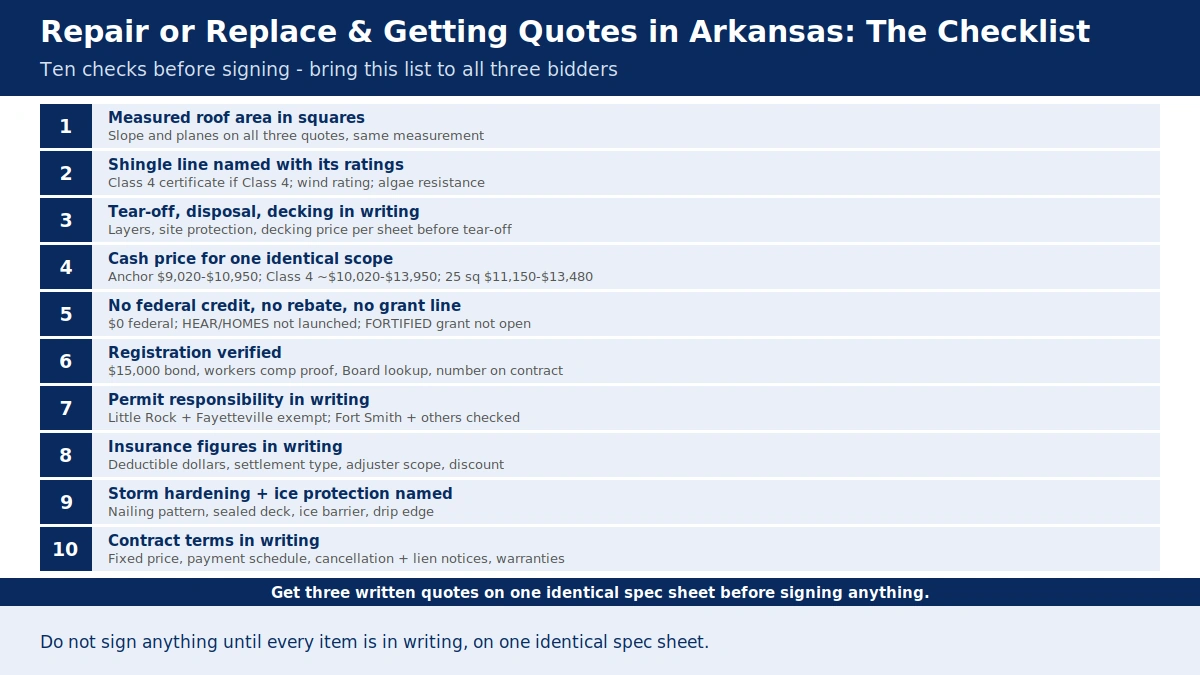
Get three written quotes on one identical spec sheet before signing anything. Compare them on what they name, not on the bottom line alone. The strongest quote names the shingle, shows the measurement, itemizes the add-ons, proves the registration, and puts the insurance figures in writing.
In a state that averages 42 tornadoes and 32 severe hail days a year, the best quote is also the one that was written for Arkansas weather rather than for a national average. A roof bought that way costs what the planning band says it costs, survives the storm season it was bought for, and leaves the owner with a policy that still makes sense when the next adjuster climbs the ladder.
Sources & methodology Installed costs:
- NumeralQ, Roof Replacement Cost in Arkansas (2026), estimator pricing as of Oct 26, 2026 (planning estimates, not contractor bids): 2,000 sq ft roof $9,020-$10,950; by size 1,000 sq ft $4,780-$5,880, 1,500 sq ft $6,900-$8,420, 2,500 sq ft $11,150-$13,480, 3,000 sq ft $13,270-$16,020; national comparison $9,710-$11,840
- NumeralQ, Roof Replacement Cost in Little Rock, AR (2026), pricing Oct 26, 2026: full material table for a 2,000 sq ft roof (3-tab $7,610-$8,950 through natural slate $30,390-$60,370); add-ons (extra tear-off layer $1.13-$1.49/sq ft, decking sheet $54.91-$80.41 installed, full ice-and-water $0.82-$1.32/sq ft, gutters $7.40-$10.73/linear ft, flashing $292-$424, skylight re-flash $444-$572); labor $22.82/hr median pay, $46-$59/hr billed
- NumeralQ, Roof Replacement Cost in Fayetteville, AR (2026), pricing Oct 26, 2026: 2,000 sq ft $9,000-$10,920; exposed-fastener metal $14,020-$17,770; standing seam $19,790-$30,320; building permit rate $4.59 per $1,000 of value
- SmartRoofingCalculator, Arkansas Roof Replacement Cost (updated Nov 9, 2026; page last updated Apr 24, 2026): architectural $390-$560/square installed with tear-off; 25-square roof $9,750-$14,000; standing seam $780-$1,210/square; tile $1,040-$1,550/square; state factor 0.863 from BLS May 2024 wages and BEA 2024 goods RPP; about 860 Arkansas roofers, mean wage $21.08/hr
- MyRoofData, Roof Replacement Cost in Arkansas (2026 model): typical home $11,250-$19,250 including one-layer tear-off; per-square table before tear-off (3-tab $305-$479, architectural $392-$653, ribbed metal $479-$827, standing seam $827-$1,392, cedar $783-$1,305, concrete tile $870-$1,566, clay tile $1,044-$2,175, slate $1,305-$2,610, membrane $479-$827); tear-off $100-$200/square/layer; rated lives; crews $40-$70/hr in the model
- Instant Roofer, Arkansas roof replacement costs (contractor pricing, 188,300 roofs measured, 520 contractors): state average $13,397 on a 2,712 sq ft average roof ($4.94/sq ft); Fort Smith $13,665; Jonesboro $13,732
- HomeCostLens, Roof Replacement Cost in Little Rock (cost data reviewed Sept 2026, modeled): average ~$9,830 for a 2,200 sq ft home, range $8,050-$16,090
- HomeQuoteHQ, Little Rock Roof Replacement Cost (June 21, 2026): average $10,100, range $7,400-$14,900; typical repair $835; about 580 roofers in the Little Rock metro, average annual wage $45,640
- Patriot Roofing and Restoration, Little Rock shingle roofing (updated Nov 5, 2026): most central Arkansas shingle replacements $15,000-$30,000, simple single-story from about $9,000; 15-20 year Arkansas asphalt planning life; financing example $176/month on $15,000 at 12.99% APR over 240 months
- RoofingEstimatorPros, Arkansas (updated Aug 26, 2026): $12,727-$22,979 for a 2,000 sq ft roof; recorded as the high outlier, not adopted
- ContractorsRanked, Little Rock (checked Oct 2026): replacement $6,380-$11,910, typical $8,510; repair $395-$1,968, typical $1,174
Storms and climate:
- NOAA Storm Prediction Center Severe Weather Database 1996-2025, analyzed by MyWild (snapshot Sept 2, 2026; SPC data updated Apr 24, 2026): 1,268 tornadoes on 367 days, 42 a year; 258 EF2 or stronger; 13 EF4; April busiest month; night share 23.3%; county counts (Pulaski 60, Craighead 38, Washington 32); 121.84-mile EF4 track Feb 5, 2008
- NOAA SPC hail data 1996-2025 via MyWild: 955 severe hail days, 5,044 reports, 32 days a year, 5.6 days a year with 2-inch stones or larger; largest stone 5 inches
- National Weather Service Little Rock, damage survey for the March 31, 2023 tornado event (Apr 7, 2023): EF3, 165 mph, 34.4-mile path, 600 yards wide, 1 fatality, 54 injuries; Wynne EF3, 150 mph, 1,600 yards wide
- National Weather Service Memphis, damage survey for the March 28, 2020 Jonesboro tornado (Apr 15, 2020): EF3, 150 mph, 12.55 miles, 600 yards wide, 22 injuries, about 300 buildings damaged
- NumeralQ Little Rock page, NOAA storm data 2016-2025: Pulaski County 57 large-hail reports (2 of 2 inches or bigger), 181 damaging-wind reports, 15 tornado reports; Arkansas 3,385 damaging-wind reports since 2016, ranked 24th; FEMA National Risk Index ratings (Pulaski tornado Very High, ice storm Very High, hail Relatively High; Washington County hail Relatively High)
- Climate normals 1991-2020: Little Rock annual precipitation 49.57 inches, annual high 73 F, annual low 52 F (NOAA normals via usclimatedata.com); snow about 3.8 inches a year; August and September about 4 rain days each (NumeralQ)
- Owens Corning Technical Bulletin TB-10022497-A: hand-seal shingles at 40 F and below (cited by NumeralQ)
- Housing: 40% of Arkansas homes built before 1980 (Census Bureau via NumeralQ); Little Rock median year built 1978, median home value $236,400; 51 roofing contractors in Pulaski County, 2023 (County Business Patterns via NumeralQ)
Class 4, insurance, and premiums:
- UL 2218 Class 4 test (2-inch steel ball, 20 feet, twice, same spot); product lines from GAF, Owens Corning, CertainTeed, Atlas, Malarkey, IKO, Tamko
- Class 4 premium about $50-$150 per square (roofleads.pro, Nov 2, 2026); $150-$200 per square (K1 Roofing, Rapid City, 2026); national installed $650-$1,100 per square vs $550-$850 architectural (Clean Invoice, June 2026); Fort Smith Class 4 $14,300-$20,800 (bestroofingestimates.com, weak source, flagged)
- Class 4 discounts 10-35% of the wind/hail premium portion in hail-belt markets including parts of Arkansas (HomeQuoteHQ guide); 10-25% commonly cited (WinChoice, Mountain Pine, AR); roughly 10-30% on the wind-and-hail portion (Fort Smith market guide); carrier-specific, no Arkansas statute sets a percentage
- NerdWallet, average homeowners insurance cost (May 6, 2026; 100+ companies; $400,000 dwelling coverage; $1,000 deductible): Arkansas $4,955 a year, 4th highest; US average $2,490
- Arkansas Insurance Department Bulletin 17-2023 (Nov 2, 2023, Claims Settlements for Storm Damaged Roofs); Act 994 of 2021 (7-year ACV endorsement authority); Act 471 of 2023, Ark. Code § 23-79-168 (percentage-deductible dollar disclosure at renewal); settlement types and roof payment schedules via J. Cole Roofing / EINPresswire (Oct 19, 2026) and roofingstormdamage.com
Licensing, permits, code, contracts:
- Arkansas Residential Contractors Licensing Law, statutes and rules of the Residential Contractors Committee, revised April 2026 (primary statute text): §§ 17-25-501 to -514 (residential licenses; $50,000 financial-statement rule § 17-25-506; workers’ compensation § 17-25-514) and §§ 17-25-601 to -611 (roofer registration; $15,000 bond and workers’ compensation proof § 17-25-604; penalties and revocation § 17-25-607; 1-year expiry and fee cap § 17-25-609; exemptions § 17-25-610; enforcement bar § 17-25-611)
- ReadyDocs Arkansas roofing compliance file (verified Oct 2026): registration regime, $2,000 working threshold vs no statutory floor, commercial $50,000 license rule, $10,000 commercial bond, Business and Law exam
- RoofingLicenseCheck Arkansas (checked Oct 22, 2026): no exam for registration; $20 filing fee; no specific Arkansas deductible-waiver statute
- Little Rock City Code Sec. 8-31: residential roofs excluded from the building permit requirement; Fayetteville Unified Development Code 173.02(B)(7): residential reroofing needs no permit, code still applies; Fort Smith permits page (roofing under repairs and alterations); Jonesboro like-for-like exemption (secondary permit guide, flagged)
- Arkansas Fire Prevention Code, Volume III (Residential), based on the 2021 IRC with state amendments; IRC R908.3 (two-layer tear-off rule) and R905.1.2 (ice barrier 24 inches inside the wall line), cited by NumeralQ
- Arkansas Code §§ 4-88-903 and 4-88-904 (Act 1360 of 2013): cancellation notice and 3-business-day post-denial cancellation right, 10-day refund; HB1308 (2025) did not pass; Arkansas Insurance Department warning on deductible waivers (Apr 4, 2023)
- Lien law: Ark. Code §§ 18-44-115 (Important Notice to Owner) and 18-44-108 (5-business-day list of subs and suppliers), via NumeralQ citing Levelset (checked Nov 10, 2026)
Federal, state, and FORTIFIED help:
- OBBBA P.L. 119-21; IRS FS-2025-05 (§25C/§25D $0 for property placed in service after Dec 31, 2025)
- HEAR/HOMES not launched in Arkansas: Arkansas Energy Office program page (“not available in Arkansas”); allocations HEEHR $52,433,010 + HOMES $52,633,292 (DOE May 23, 2024 figures); status confirmed Sept-Nov 2026 by referencesource.org, 1-800deals.com, Retrofit Relay, and betterpowered.com; DOE Program Notice 26-2 (May 29, 2026)
- Act 427 of 2025 (SB 366), Strengthen Arkansas Homes Act, Ark. Code § 23-88-601 et seq.: grant program in the State Insurance Department, FORTIFIED Roof or FORTIFIED Silver, first come first served, hail supplement required, no grant amount set in the Act; applications not open (Smart Home America Arkansas page, opened Nov 14, 2026); FORTIFIED discounts and endorsement required for policies issued or renewed on or after July 1, 2026
- FHLB Dallas FORTIFIED Fund: up to $17,000 for income-qualified households, via a participating member bank, funding limited (Smart Home America)
- SBA disaster assistance loans: up to 20% increase over verified physical damage for mitigation (Smart Home America Arkansas page)
NestPriced arithmetic (labeled in the article, not sourced figures):
- Class 4 installed band ~$10,020-$13,950: NumeralQ architectural band $9,020-$10,950 plus 20 squares x $50-$150 premium
- Cost per year of rated life: midpoint installed price divided by midpoint rated life (3-tab $8,280/17.5; architectural $9,985/26; Class 4 $11,985/30; exposed-fastener $15,930/35; standing seam $25,110/55; concrete tile $21,375/57.5; slate $45,380/112.5); architectural at a 17.5-year Arkansas planning life: $9,985/17.5 = ~$571 a year
- Class 4 payback scenarios: upgrade $1,000-$3,000 divided by annual savings at 10%/15%/25% of the $4,955 NerdWallet average premium, and at 15% of half the premium
- Deductible dollars: 1%/2%/5% of $250,000 and $350,000 Coverage A; 2% of $250,000 = $5,000
- Worked claim example: $10,000 roof, $5,000 deductible, RCV vs ACV vs schedule structure (schedule percentages are per-insurer and not assumed)
- Arkansas about 7% under the national band: $9,020/$9,710 and $10,950/$11,840 on the NumeralQ model
- 25-square per-square rate $446-$539: $11,150-$13,480 divided by 25 squares
EXCLUDED:
- Shingle Geek Little Rock/Cabot retail and wholesale figures (same outfit, about 2x gap between two Arkansas markets for the same 22-square scope)
- Any “up to $15,000” Strengthen Arkansas Homes grant figure (single secondary post; the Act sets no amount and applications are not open)
- Any HEAR/HOMES money in a 2026 Arkansas roof quote (not launched; a roof is not a HEAR measure)
- Any federal tax credit for a 2026 roof ($0 under OBBBA) and any §48E lease route for a roof (not applicable to roofing)
- Any Arkansas matching law (none located) and any claim that waiving a deductible violates a specific Arkansas statute (no such statute; HB1308 did not pass)
- Fort Smith reroof permit fee $125, Fayetteville roof permit $150-$250, and Little Rock permit $125-$275 (all contradicted by primary sources or unverified; see the permits section)
- Any Fort Smith or Jonesboro NumeralQ price (no such pages exist; state-band planning estimates only, flagged)
- RoofingEstimatorPros $12,727-$22,979 as the headline band (high outlier model; noted, not adopted)
- Any Arkansas sales-tax figure for roofing (not verified) and any Class 4 discount percentage as an Arkansas guarantee (carrier-specific)
- Any 2027 Strengthen Arkansas Homes opening date or grant amount (not published)
- Algae-resistant upgrade pricing (no Arkansas-verified price found; priced as its own line in the article)
- Vilonia 2014 EF4 details beyond the rating and year
Disclaimer: The prices here are 2026 Arkansas planning figures. What you end up paying moves with the roof size, the pitch, the material, the city, the decking under the old roof, and the contractor. Get written quotes from three registered Arkansas roofers before settling on a budget, and check the registration yourself on the Contractors Licensing Board lookup before anyone touches the roof. Nothing here is tax advice for your own return. Program rules change, including the Strengthen Arkansas Homes application window, the HEAR/HOMES launch status, and insurer discount filings, so confirm current terms with the State Insurance Department, the Arkansas Energy Office, and your own agent before signing. Insurance settlement figures depend on the policy endorsements for your own home, so read the declarations page and the roof schedule endorsement before assuming what a claim pays.
What does a roof replacement cost in Arkansas in 2026?
A 2,000 sq ft roof in architectural shingles costs $9,020–$10,950 installed in Arkansas in 2026, on NumeralQ planning estimates priced October 26, 2026. A 25-square planning roof runs $11,150–$13,480, a 3-tab roof runs $7,610–$8,950, and standing-seam metal runs $19,840–$30,380. Little Rock and Fayetteville publish nearly identical bands, while Fort Smith and Jonesboro carry planning estimates from the state band because no cost model prices those cities directly.
What is the best roofing material for Arkansas weather?
Architectural shingles are the default for most Arkansas homes, with 110–130 mph wind ratings at the lowest installed price that still carries a full warranty. Class 4 impact-resistant shingles are the stronger buy in hail country, at about $10,020–$13,950 installed, because they carry the top UL 2218 impact rating and can earn an insurance discount of 10–35 percent on the wind-and-hail portion of the premium. Standing-seam metal lasts longest at 40–70 years rated life, but costs $19,840–$30,380, so it suits owners who plan to stay in the house for decades.
Do I need a permit to replace a roof in Arkansas?
It depends on the city, because Arkansas has no statewide residential reroof permit. Little Rock exempts residential roofs from the building permit by city code, and Fayetteville exempts residential reroofing while holding the work to code, so neither city charges a reroof permit fee. Fort Smith treats roofing as a permit job and asks builders to check with the building department, Jonesboro generally exempts like-for-like replacements, and other towns vary, so check the desk for the job address before the crew starts.
Does Arkansas require a license for roofers?
Arkansas requires a Residential Roofer Registration, not a trade license, for residential roofing work. The roofer files with the Residential Contractors Committee of the Arkansas Contractors Licensing Board, posts a surety bond of at least $15,000, shows proof of workers’ compensation coverage, and renews every year, with no exam required. Check the registration number on the Board’s free lookup before signing, and confirm the bond and insurance certificates in writing.
How much can Class 4 shingles save on Arkansas homeowners insurance?
Most major carriers offer a Class 4 discount of 10–35 percent on the wind-and-hail portion of the premium in hail-belt markets including parts of Arkansas, but the percentage is set by the carrier and no Arkansas law fixes it. The upgrade adds about $1,000–$3,000 to a 20-square roof, and at a 15 percent credit on a $4,955 average premium the saving would be about $743 a year, paying back the upgrade in about 1.3–4.0 years. Get the dollar figure from your own agent in writing, with the portion it applies to named, before choosing the shingle.
Will insurance pay to replace my roof in Arkansas?
It depends on the deductible, the settlement type, and the roof’s age, and Arkansas rules changed in 2023. Most Arkansas policies now carry a separate wind-and-hail deductible of 1–5 percent of dwelling coverage, so a 2 percent deductible on a $250,000 home means $5,000 out of pocket before the insurer pays anything. Once a roof passes seven years, the insurer may switch the settlement to actual cash value or a roof payment schedule that pays a percentage of replacement cost, so read the declarations page and the roof endorsement before assuming full replacement cost.
Is there a grant for a new roof in Arkansas in 2026?
Not one you can apply for today. The Strengthen Arkansas Homes Program, created by Act 427 of 2025, will offer grants for FORTIFIED Roof or FORTIFIED Silver upgrades through the State Insurance Department, but the Act sets no grant amount and applications are not open. The Federal Home Loan Bank of Dallas FORTIFIED Fund offers up to $17,000 to income-qualified households through a member bank, with funding limited, while the federal tax credit for a 2026 roof is $0 and Arkansas home energy rebates have not launched.
How long does a roof last in Arkansas?
Architectural shingles carry a rated life of 22–30 years, but a central Arkansas contractor plans on 15–20 years in Arkansas weather, because heat, humidity, and hail cycles wear the roof faster than the lab test assumes. Standing-seam metal is rated 40–70 years, concrete tile 40–75 years, and natural slate 75–150 years, though hail can end any roof early through an insurance claim. Ventilation, algae control, and the ice barrier at the eaves all stretch the life a roof actually delivers.