

Kansas is the middle of the map in more ways than one. The sun over Wichita is strong enough to make a kilowatt of panels worth about 1,500 kilowatt-hours a year, the installed price sits a few percent under the national band, and the average home uses 876 kilowatt-hours a month, almost exactly the national average. Nothing about those three numbers warns a buyer that the decision is hard.
The hard part is the rulebook, and Kansas rewrote most of it in 2024 and 2025. State law now turns the last 12 months of electric bills into a legal cap on system size, with a different divisor for Evergy and Liberty customers than for co-op and city-utility customers. The same laws split the state into three export regimes: monthly netting at the two investor-owned utilities, avoided-cost purchase at co-ops and most city utilities, and a municipal net metering policy of its own at Kansas City BPU.
A buyer who prices only the panels misses all of it. The difference between the fast payback case and the slow one in this guide is 17 years on the same roof, the same system, and the same sun, decided by nothing but which company sends the bill and how much power the home uses while the sun shines. Add hail country, a federal credit that ended on December 31, 2025, a seller disclosure law that voids a contract signed without it, and a property tax break that only works if the buyer files for it, and the quote on the kitchen table is the smallest part of the decision.
This guide prices the system first, then works through the size law, the three export regimes, the payback math under each one, batteries, incentives, the lease question, storm durability, and the permits and paperwork. Every figure carries its source and its date, planning estimates are labeled as planning estimates, and anything no source would confirm is stated as a question to ask in writing rather than a number to trust.
The national solar panel cost guide holds the countrywide figures to measure Kansas against, and the 6 kW, 8 kW and 10 kW system cost guide prices the three sizes most Kansas homes end up choosing between.
Table of Contents
How Much Do Solar Panels Cost in Kansas in 2026?
Three kinds of evidence price the Kansas market in 2026, and they measure different things, which is why their per-watt figures spread from $2.47 to $3.23 and why the spread needs untangling before any quote is compared. NumeralQ publishes planning estimates from a cost model built on materials plus local labor, priced October 26, 2026, and pins down the size, the scope, and the date: rooftop solar with a string inverter or microinverters, installed, materials including waste and contractor markup.
EnergySage averages real quotes from its marketplace, updated November 6, 2026, on much bigger average systems. EcoGen publishes a modeled cash price from its Solar Cost Index, September 2026 edition, built on the median system Kansas homeowners actually installed.
The NumeralQ band leads here because it states the roof size, the equipment scope, and the date, and because it calls itself a planning estimate instead of dressing up as a survey of what Kansans paid. The midpoint of the 8 kW band, $22,805, is the number the payback section works from. EnergySage’s $2.66 per watt sits inside the NumeralQ band, and its 8 kW point of $21,271 sits inside the band too, which is reassuring: two different methods, one on modeled costs and one on marketplace quotes, land in the same place for the same size.
EcoGen’s $2.87 per watt sits inside the band as well, near the top of it. Its typical system is the number that looks strange at first: 7.22 kW, against EnergySage’s 12.44 kW average. The two samples explain the gap.
EcoGen’s 7.22 kW is the median size from Berkeley Lab’s 2025 data on 195 Kansas systems actually installed, while EnergySage’s 12.44 kW is the average size quoted through its marketplace, where shoppers tend to size bigger. Neither figure is wrong, and neither is the right size for a given home. The size law in this guide, worked from the buyer’s own 12 months of bills, decides that.
One published page runs above the rest and is noted rather than followed. The national range Berkeley Lab measured for home systems installed in 2024 runs $3.00 to $5.20 per watt, with a $4.00 median, and loan-financed systems carried a $4.70 median against $3.50 for cash, mostly because of dealer fees charged by lenders. That range describes the whole country in 2024, not Kansas in 2026, but it explains why a single installer’s quote can land well above the Kansas averages: financing fees, premium equipment, and a complex roof all push the same system up the range.
One more page needs a warning label, not a citation. SolarReviews still prices Kansas systems after a 30 percent federal credit it describes as available now, with a typical 7.2 kW system at $15,725 after the credit. The credit ended for systems placed in service after December 31, 2025.
Every after-credit figure on that page is wrong for a 2026 buyer, and any quote that still subtracts 30 percent is working from the same stale sheet. The federal energy tax credits guide carries the current status in full.
| Source | What it prices | 2026 figure |
|---|---|---|
| NumeralQ (Oct 26, 2026, planning est.) | 8 kW rooftop, string or microinverters, installed | $19,770–$25,840 ($2.47–$3.23/W) |
| EnergySage (Nov 2026, marketplace quotes) | Average system, 12.44 kW, installed | $33,077 ($2.66/W), range $28,115–$38,039 |
| EcoGen Cost Index (Sept 2026, modeled cash) | Typical system, 7.22 kW, installed | $20,721 ($2.87/W) |
| ConsumerAffairs (Aug 2026, EnergySage data) | Statewide average | $2.63/W; Wichita $2.58/W; Topeka $2.66/W |
| Berkeley Lab (2024 installs, national) | Home systems, all payment types | $3.00–$5.20/W, $4.00 median |
Inside the headline band sit the panels, the inverter or microinverters, the racking, the wiring, the disconnects, the monitoring, the labor, the permit and interconnection handling, and the installer’s markup. Outside it sit the items that surprise buyers: roof work on a roof near the end of its life, an electrical panel upgrade when the panel has no room, a battery, tree work that clears shade, and sales tax, which Kansas charges in full because no exemption exists for home solar equipment.
Each one belongs as its own line on a quote. Quotes that fold them into one lump sum hide the part of the job that grows after the site visit.
Kansas sits a few percent under the national band on the same NumeralQ model, which prices an 8 kW system at $20,460 to $26,740 across the country. The reason is pay: Kansas solar installers earn a median $24.04 an hour, 6 percent under the national median, and contractors bill $48 to $63 per worker-hour after insurance, payroll taxes, overhead, and profit.
Panels and inverters travel on national prices, so the saving is all in the crew. That also means the saving shrinks on a job where the crew spends its hours on roof work, panel work, and a steep or cut-up roof rather than setting panels.
Solar Panel Cost in Kansas by System Size
System size is measured in kilowatts, written kW, which is the peak power the panels can make in full sun. A kilowatt-hour, written kWh, is the energy those panels make over time: one kilowatt running for one hour.
Bills charge by the kilowatt-hour, quotes price by the watt, and the size law in this guide caps the export limit in kilowatts of alternating current, the kind of power a home uses. Keeping those three units apart is half of reading a solar quote correctly.
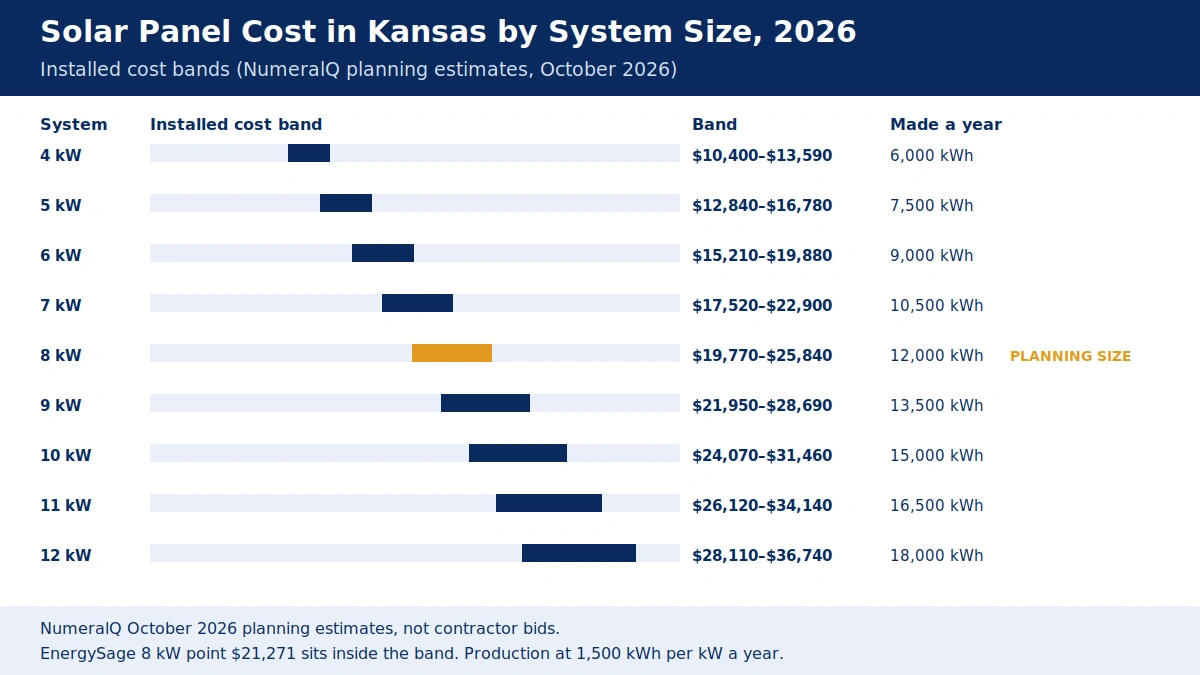
The table below prices every size from 4 kW to 12 kW on the NumeralQ bands, with the EnergySage point alongside where published and the yearly production at the 1,500 kWh per kW planning figure. The planning figure sits inside the published range of 1,416 to 1,567, and the sun section explains where each end of that range comes from. Production here is NestPriced arithmetic, labeled as such, and a real quote must carry a production estimate for the actual roof, with its tilt, direction, and shade stated.
| System size | NumeralQ installed band | EnergySage point | Makes a year at 1,500 kWh/kW |
|---|---|---|---|
| 4 kW | $10,400–$13,590 | $10,636 | 6,000 kWh |
| 5 kW | $12,840–$16,780 | $13,294 | 7,500 kWh |
| 6 kW | $15,210–$19,880 | $15,953 | 9,000 kWh |
| 7 kW | $17,520–$22,900 | $18,612 | 10,500 kWh |
| 8 kW | $19,770–$25,840 | $21,271 | 12,000 kWh |
| 9 kW | $21,950–$28,690 | $23,930 | 13,500 kWh |
| 10 kW | $24,070–$31,460 | $26,589 | 15,000 kWh |
| 11 kW | $26,120–$34,140 | Not published | 16,500 kWh |
| 12 kW | $28,110–$36,740 | Not published | 18,000 kWh |
The 8 kW row is the planning size for this guide, and the average Kansas home is the reason. At 876 kWh a month, the average home uses 10,512 kWh a year, and an 8 kW system at the planning figure makes 12,000, about 14 percent more than the average home uses.
That overshoot is not waste under monthly netting, where exports inside the month cancel imports at retail value, but it is mostly low-value power under parallel generation, where every exported kilowatt-hour earns about 3 cents. The size section and the payback section work that tension out in numbers.
The per-watt price falls as the system grows, and the table shows why quotes for small systems look expensive. Fixed costs, the inverter, the disconnects, the permit, the interconnection application, the crew’s travel and setup, spread across fewer watts on a 4 kW job than on a 12 kW job. The NumeralQ band implies about $2.60 to $3.40 per watt at 4 kW and about $2.34 to $3.06 at 12 kW.
A 4 kW quote at $3.20 a watt is not necessarily a bad quote, and a 12 kW quote at $3.20 a watt is worth challenging. Compare the per-watt figure only between quotes for the same size and the same equipment.
Two size facts from the sources deserve a plain statement because they pull new buyers in opposite directions. The median Kansas system actually installed in 2025 was 7.22 kW, a modest roof of panels that covers most of an average home’s use. The average system quoted through EnergySage in 2026 was 12.44 kW, a much bigger array that makes about 18,660 kWh a year at the planning figure, far more than the average home uses.
A buyer who signs for 12 kW on an average home’s bills is buying a power plant whose extra output earns the export price, not the retail price, and in much of Kansas the export price is about a fifth of the retail price. Size to the bills, not to the roof, and the size formula section shows the arithmetic the law requires.
What the table does not price is the equipment choice inside each row. A string inverter, one box that converts the whole array’s power, costs less upfront than microinverters, small converters under each panel, and the two behave differently in shade and when one panel underperforms. Premium panels with higher wattage per panel, thicker glass, and longer product warranties cost more per watt than standard panels.
Battery-ready inverters cost more than plain ones. None of those choices is priced separately in the published Kansas models, so the quote must name the panel model, the inverter type and model, and the warranty terms, and the buyer should compare quotes with the same equipment named, not just the same size.
Solar Panel Cost by City: Wichita, Overland Park, Kansas City & Topeka
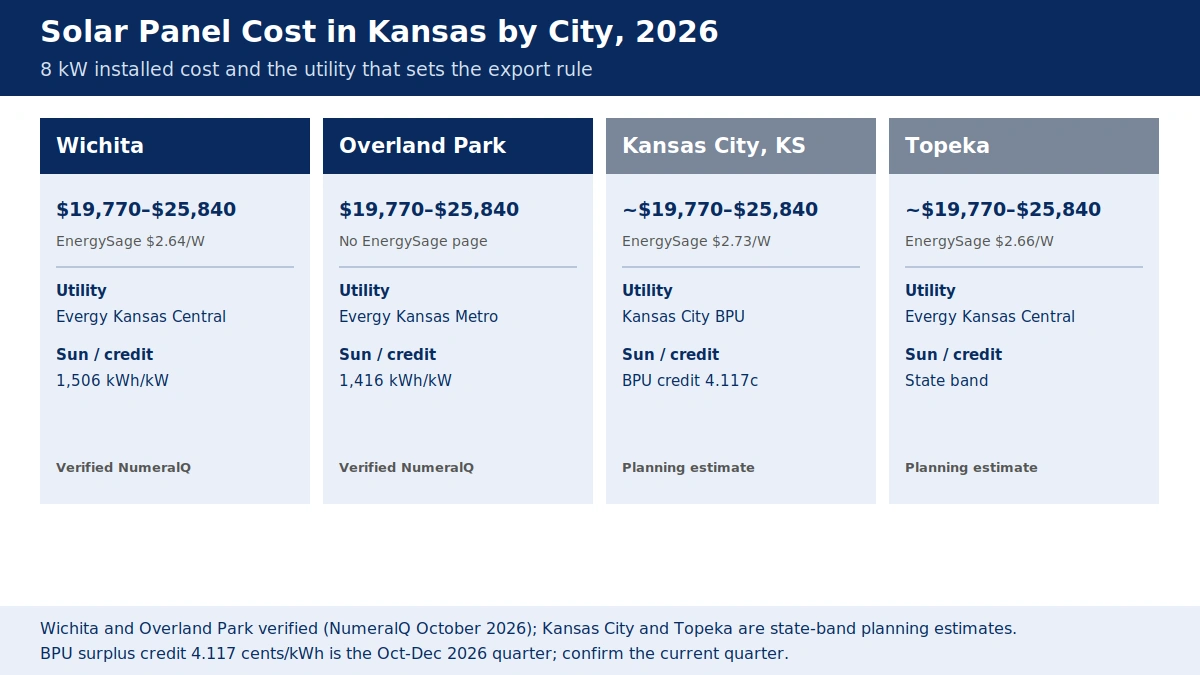
Kansas has no expensive solar market and no cheap one. The two cities with published cost-model pages price an 8 kW system identically, to the dollar, because they share one wage figure for solar installers. The two cities with marketplace data price a watt within 9 cents of each other.
What sets the four cities apart is not the crew’s hourly rate but the sun over each roof, the utility that sends the bill, the permit desk, and the housing stock the panels sit on. Two of the four 8 kW prices below are verified model figures and two are planning estimates from the state band, and the table says which is which.
| City | 8 kW, installed | EnergySage city model (Nov 2026) | Utility | Sun (kWh/kW/yr) |
|---|---|---|---|---|
| Wichita | $19,770–$25,840 | $2.64/W; 11.21 kW avg; $29,597 | Evergy Kansas Central | 1,506 (PVGIS) |
| Overland Park | $19,770–$25,840 | No city page found; state $2.66/W as planning reference | Evergy Kansas Metro | 1,416 (PVGIS) |
| Kansas City, KS | ~$19,770–$25,840 (planning est.) | $2.73/W; 11.49 kW avg; $31,320 | Kansas City BPU (most addresses) | 1,500 (state planning figure) |
| Topeka | ~$19,770–$25,840 (planning est.) | $2.66/W; 12.37 kW avg; $32,865 | Evergy Kansas Central | 1,500 (state planning figure) |
Wichita is the largest market, the sunniest of the four on the published figures, and the city where the typical job looms largest against home values. A kilowatt of panels makes about 1,506 kWh a year there on the PVGIS model, the best of the two published city figures, and the typical job equals about 12.0 percent of the median Wichita home value, against 5.5 percent in Overland Park. EnergySage’s Wichita model is the kindest of the four on payback, at 13.95 years with $27,638 in 25-year savings on an 11.21 kW average system, though that model carries its own unstated rate assumptions and a bigger-than-average system.
The permit path runs through MABCD, the joint city-county building department, which licenses the solar contractor and the electrician separately and requires the full contract price as the job valuation. Evergy Kansas Central sends the bill for most Wichita addresses, which puts Wichita buyers under monthly netting with the separate solar-home rate that applies to connections after October 1, 2018.
Overland Park is the Johnson County suburb where the roofs are newer, the homes are dearer, and the sun is a little weaker. The PVGIS figure of 1,416 kWh per kW is 6 percent under Wichita’s, which on an 8 kW system is about 720 kWh a year, worth about $109 at the retail rate. The median home value of $413,600 makes the typical job feel smaller here than anywhere else in the state, at 5.5 percent of value.
No EnergySage city page for Overland Park was found in this pass, so the state figure of $2.66 per watt stands in as a planning reference and three local quotes are the real price. The city requires a building permit before any solar collector is installed, under its development code, and the fee is not published online. Evergy Kansas Metro sends the bill, which puts Overland Park buyers under the same monthly netting law as Wichita, on a different Evergy territory with its own application and rate sheet.
Kansas City, Kansas, is the city where the bill matters most, because most addresses there are served by the Kansas City Board of Public Utilities, a municipal utility, not by Evergy. BPU nets energy over each billing period on a single two-way meter and credits any surplus at 100 percent of its Energy Rate Component, 4.117 cents per kWh for October to December 2026, reviewed every quarter. BPU also forbids lease or consignment arrangements in which a third party owns or operates the system, which closes the lease route for BPU customers entirely.
EnergySage prices Kansas City at $2.73 per watt, the highest of the four cities, on an 11.49 kW average system at $31,320, with a 15.65-year modeled payback and $21,855 in 25-year savings. No NumeralQ page prices Kansas City, Kansas: its Kansas City page covers Kansas City, Missouri, across the state line, and this guide does not present Missouri figures as Kansas prices.
The 8 kW figure for Kansas City, Kansas, is therefore a planning estimate from the state band, flagged as such, and the BPU policy section below is required reading for any buyer there. A Kansas City, Kansas, buyer should confirm from the bill itself whether BPU or Evergy serves the address, because the two regimes pay very differently for the same exported power.
Topeka, the capital, sits between Wichita and Kansas City on price and shares Wichita’s utility. EnergySage prices Topeka at the state average of $2.66 per watt, on the biggest average system of the four cities at 12.37 kW and $32,865, with a 14.93-year modeled payback and $27,629 in 25-year savings. No NumeralQ Topeka page was found, so the 8 kW figure is a planning estimate from the state band.
Topeka buyers sit under Evergy Kansas Central and monthly netting, the same regime as Wichita, and the same separate solar-home rate question applies. No verified Topeka-specific solar permit fee or ordinance text was found in this pass, so the buyer should confirm the permit requirements with the city before signing, rather than trusting a statewide summary.
The city comparison carries one warning that applies to all four. EnergySage’s city payback figures, 13.95 years in Wichita, 14.93 in Topeka, 15.65 in Kansas City, are modeled on systems of 11 to 12 kW with rate assumptions the pages do not state.
They are useful for comparing cities with each other and misleading as a promise for a specific home. The payback section of this guide works the same math from stated assumptions on an 8 kW system, under each export regime, so the buyer can see which regime their address falls under and what it does to the wait.
Kansas Sun: Hot Summers, Strong Light & What a Kilowatt Really Makes
Kansas sun is generous and hot, and the heat takes back part of what the light gives. A kilowatt of panels in Kansas makes somewhere between 1,416 and 1,567 kWh a year depending on the city modeled and the source, and the planning figure this guide uses, 1,500, sits inside that range.
The spread is not disagreement about Kansas weather. It is the difference between Wichita and Overland Park, between a south-facing roof at a 20-degree tilt and a roof at latitude tilt, and between weather files that average different years.
The published figures line up closely enough to trust the middle. EcoGen’s Cost Index uses 1,567 kWh per kW a year. The PVGIS model with NREL weather data gives 1,506 for Wichita and 1,416 for Overland Park, both at a 20-degree tilt facing south with 14 percent system losses.
A PVWatts estimate for Wichita at latitude tilt gives 1,493. A statewide compilation gives 1,514. Any quote whose production estimate falls far outside 1,400 to 1,570 kWh per kW for a clear, south-facing Kansas roof should explain itself, with the tilt, the direction, and the shade assumptions written down.
Wichita sees about 225 sunny days a year on climate summaries, and the summer that produces the power also produces the heat that trims it. Panels are rated at a cell temperature of 25 degrees Celsius, about 77 Fahrenheit, and they lose output as the cells heat past that point. Wichita averages 12.4 days a year at or above 100 degrees Fahrenheit on the 1991 to 2020 normals, with a July average high of 92.7 degrees, and the summer of 2011 saw 53 days at 100 or hotter.
A dark roof in a Wichita July runs far hotter than the air, and the panels on it run hotter still. The production estimate on a quote should already account for that heat, because the weather files behind it include Kansas summers, but a quote promising label output all summer long promises something no Kansas roof delivers.
Heat is not the only seasonal shape. Kansas production peaks in the long, bright days of late spring and early summer, holds through the hot months with the heat trim applied, and falls in the short days of winter. The seasonal curve matters under monthly netting, because each billing period stands on its own: a big May surplus nets against May use and any remainder becomes a small dollar credit, not a bank of kilowatt-hours for January.
Under the older pre-2014 terms, excess kilowatt-hours carried forward and expired each March 31, but a system bought in 2026 gets no such carry-over. The quote’s monthly production table, not just its annual total, is what the buyer needs to see next to the monthly bills.
Shade decides more individual outcomes than any statewide average. A tree that shades one section of an array for two hours a day cuts that section’s output for those hours, and on a string inverter it can drag down the whole string with it. Microinverters limit the damage to the shaded panel, which is one reason they cost more and one reason shaded roofs often justify them.
East and west facing roofs make less than south facing roofs in Kansas, and a low-pitch roof makes less in winter than a steeper one. None of that makes an east-west roof a bad solar roof, but it does mean the production estimate must be modeled for the actual roof planes, not copied from a statewide average. The seller disclosure law now requires a production guarantee with a remedy if the system falls short in its first year, which gives the buyer a written number to hold the seller to.
Snow and ice play a smaller part in Kansas than in states to the north, but they play one. A snow-covered array makes nothing until the snow slides or melts, and Kansas ice storms glaze roofs and load them. Panels mounted at a tilt shed snow faster than flat ones, and the dark panel surface helps melt light snow once the sun returns.
The annual production figures already include typical Kansas winter weather in their weather files, so snow is a reason to check the monthly table, not a reason to discount the annual figure further. Dust and pollen cost a little output between rains, and Kansas wind usually does the cleaning, but a dry, dusty stretch after harvest can leave a film that a rain washes off. No Kansas-published soiling loss figure was found, so the guide states the effect qualitatively and leaves the number to the quote’s loss assumptions, which should be shown, not hidden.
The honest summary of Kansas sun is that it is a real asset with a heat tax. A kilowatt makes about 1,500 kWh a year on a clear roof, the best city figure beats the weakest by about 6 percent, and the buyer’s own roof, tilt, direction, and shade move the real figure more than the city does.
The production estimate is the most important number on a quote after the price, and Kansas law now requires the seller to guarantee it. A buyer who checks that guarantee against the 1,416 to 1,567 range, and asks why any estimate sits outside it, has done the most useful hour of homework in the whole purchase.
The Size Formula: Your Last 12 Months of Bills Set the Legal Limit
System size in Kansas is not the buyer’s choice, and not the installer’s either. State law turns the home’s own electricity use into the most power the system may send to the grid, called the export limit, and the divisor in the formula depends on who sends the bill.
The rule comes from K.S.A. 66-1267, rewritten by HB 2527 in 2024, and it is the first calculation in any honest Kansas quote. Sizing a system from the roof area alone, without the 12 months of bills, skips a legal step.
For Evergy and Liberty customers, the formula is the last 12 months of kilowatt-hours divided by 8,760, the hours in a year, then divided by 0.144, then rounded up to the next 2 kW. For co-op and city-utility customers under parallel generation, the formula is the same 12 months divided by 8,760 and then by 0.288, then rounded up to the next 1 kW.
The 0.288 divisor halves the result, so a co-op customer with the same bills as an Evergy customer is allowed about half the export limit. The upper limit under net metering is 150 kW of alternating current, far above any home system, and the 2 kW rounding step applies up to 20 kW.
The table below works the formula for four levels of use. The average-home row is the one most buyers should start from, and the worked example shows the arithmetic so any buyer can repeat it with their own bills.
| Last 12 months of use | Evergy or Liberty export limit | Co-op or city utility export limit |
|---|---|---|
| 9,000 kWh | 8 kW | 4 kW |
| 10,510 kWh (average home) | 10 kW | 5 kW |
| 12,000 kWh | 10 kW | 5 kW |
| 15,000 kWh | 12 kW | 6 kW |
The worked example runs like this. A home that used 12,000 kWh in the last 12 months divides 12,000 by 8,760 to get 1.370, divides that by 0.144 to get 9.51, and rounds up to the next 2 kW, which is 10 kW. The same home on a co-op divides 1.370 by 0.288 to get 4.76 and rounds up to the next 1 kW, which is 5 kW.
The same bills, the same roof, and half the allowed system, because the law treats the two utility types differently. A co-op buyer who is quoted a 10 kW system on 12,000 kWh of use is being quoted a system the law does not allow at that export limit.
Two more rules shape what the formula allows in practice. A home with no usable bills, a new build or a recent move, is counted at 7.15 kWh per square foot of heated and cooled space, so a 2,000 sq ft home counts as 14,300 kWh and works through the same formula.
And since January 1, 2026, a net-metered system’s generating capacity, the watts of panels on the roof, may be at most 50 percent above its export limit: an export limit of 10 kW allows up to 15 kW of panels, with a device that holds exports down to the limit, which the customer owns and maintains. The extra panels make more power in the morning, the evening, and on cloudy days, when the array runs below its peak, while the export device keeps the grid feed inside the legal limit at noon.
The formula is also a guard against oversizing, and oversizing is the most expensive mistake a Kansas buyer can make outside the wrong utility regime. A system bigger than the home’s use makes power that must be exported, and exported power earns the export price, which in much of Kansas is about a fifth of the retail price. The average home’s 10 kW Evergy limit is a ceiling, not a target: an 8 kW system already makes about 14 percent more than the average home uses in a year.
A buyer with a heat pump, an electric vehicle, or a pool will use more and can justify more, and the 12 months of bills will show it. A buyer whose bills show 9,000 kWh and who is quoted 12 kW should ask the seller to show the formula with the buyer’s own numbers, in writing, before anything is signed. If the seller cannot show it, the seller has not done the legal homework, and the disclosure law gives the buyer a signed document to demand it on.
Net Metering & Parallel Generation: Evergy, Liberty, Co-ops & Kansas City BPU
The company that sends the electric bill decides which Kansas law credits the solar power a home sends out, and the three regimes pay so differently that the bill matters more than the panel brand. Evergy and Liberty customers get net metering under the Net Metering and Easy Connection Act. Co-op and most city-utility customers get parallel generation under a separate statute.
Kansas City BPU customers get BPU’s own net metering policy, which looks like net metering and pays like neither of the other two. The Kansas Corporation Commission net metering page states which utilities the net metering law covers and which it does not, and it is the first page a buyer should read after the bill itself.
Net metering, as Kansas law defines it for Evergy and Liberty, works inside each billing period. Power the panels send out is subtracted from power the home takes in during the same month, so every exported kilowatt-hour that cancels an imported one saves the full retail rate. What is left over at the end of the month, called net excess generation, becomes a dollar credit at no less than 100 percent of the utility’s monthly system average cost of energy, a wholesale-type figure that leaves out delivery.
Evergy publishes no fixed cents figure for that credit, and no honest guide can print one. Historic descriptions put avoided-cost-style rates at roughly 2 to 3 cents a kilowatt-hour, but a historic description is not a current price, and the buyer should ask Evergy for last month’s credit figure in writing before signing. Any credit balance left after 12 months expires with no payout, and each billing period stands on its own, so summer surplus does not become a bank of kilowatt-hours for winter.
The net metering law itself has moved twice in two years, and older guides describe rules that no longer apply to a new system. HB 2527, effective July 1, 2024, raised the export limit to 150 kW on the size formula, stepped the program cap up each July, and changed monthly billing, including netting inside each time period for customers on time-of-use rates. The cap now stands at 4 percent of the utility’s peak demand during the previous year from July 1, 2026, rising to 5 percent of the historic highest annual peak since 2014 from July 1, 2027, with places taken first come, first served.
Whether room remains under the cap is a question for the utility, because no current fill level is published. Customers who connected before July 1, 2014 keep older kilowatt-hour carry-over terms until January 1, 2030, which matters to a buyer of a home with an old system and not at all to a buyer of a new one.
Two Evergy details deserve their own paragraphs because neither shows up in a quote unless the buyer asks. Evergy Kansas Central customers who connected after October 1, 2018 take a separate rate for solar homes, called Residential Standard Distributed Generation, and the buyer should ask Evergy for that rate sheet before comparing savings figures, because the rate sheet, not the statewide average, decides what each kilowatt-hour is worth. And in April 2020 the Kansas Supreme Court struck down a separate solar-home demand charge of $3 in winter and $9 in summer as price discrimination, holding that a utility cannot charge customers who make part of their own power more than other customers because of that.
The ruling did not change the month-end surplus credit, but it does mean a charge that only solar homes pay should be questioned in writing. The EcoGen Kansas solar hub reads the statutes, the court opinion, and the utility policies together and is the fullest single secondary source for the rules in this section.
Liberty Utilities, the former Empire District in southeast Kansas, falls under the same net metering law as Evergy, with the same monthly netting and the same size formula. Its posted Kansas net metering sheet still showed older, smaller limits when last checked in October 2026, so a Liberty customer should ask the company to confirm the current limits and the current month-end credit figure in writing, and should not rely on a sheet that predates HB 2527. No Liberty export-credit cents figure was published in this pass, and the guide prints none.
Parallel generation is the regime for the rest of the state, and it pays the least for exports. Under K.S.A. 66-1,184, a co-op or city utility buys every kilowatt-hour the system sends out at no less than 100 percent of its monthly avoided cost, which is the cost the utility avoids by not buying or making that power itself, while the home buys power back at its normal retail price. There is no netting inside the month unless the utility volunteers its own version.
HB 2149 cut the co-op price from 150 percent of average energy cost to 100 percent of avoided cost effective May 1, 2025, so any guide still showing 150 percent is stale. Midwest Energy, the largest co-op example with published figures, paid an average buy-back price of 3.205 cents in 2025 and 2.300 cents in 2024, and it also offers its own net metering for home systems up to 15 kW, under which power used in the same month earns full retail value and month-end surplus earns nothing.
A co-op buyer must ask which of the two Midwest-style options, or whatever their own co-op offers, applies to their address, because the choice swings the payback by a decade or more. The parallel generation cap stands at 7 percent of historic peak demand from July 1, 2026, rising to 8 percent on July 1, 2027, and the utility must confirm an application within 30 days and decide within 90 days unless it needs a study.
Kansas City BPU is the exception that proves the co-op rule does not cover every municipal utility. BPU’s own net metering policy nets the energy it supplies against the energy the home exports over each billing period on a single two-way meter, and credits any surplus at 100 percent of its Energy Rate Component, its cost of purchased and generated electricity, reviewed every quarter. For October to December 2026 that component was 4.117 cents per kWh.
The customer still pays the customer charge and the facilities charge every billing period. The policy covers small systems under 20 kVA single-phase, and BPU forbids third-party ownership outright, which closes the lease route for its customers. BPU also warned customers in January 2026 about scam calls claiming a BPU net metering program, a reminder to confirm every solar claim with BPU directly, through the number on the bill, before acting on a cold call.
The practical consequence of the three regimes is a single rule for every Kansas buyer. Before comparing panel prices, confirm in writing which regime covers the address, what the current export credit is in cents, whether the program cap has room, and which rate sheet the home will sit on after connection.
HB 2149 now requires utilities to disclose their historic and current compensation per kilowatt-hour in monthly dollar amounts to retailers on request, so the seller can get the figures and put them in the disclosure document. A quote whose savings math prices every exported kilowatt-hour at the retail rate, in a co-op territory or for month-end surplus at Evergy, is pricing a program that does not exist for that home.
Payback in Kansas: The Export Rule Decides Everything
Payback is the number of years until the electricity savings equal the price paid, and in Kansas it is decided less by the price of the panels than by the value of the power they make. Each kilowatt-hour is worth one of two amounts depending on when it is used and which law covers the home. Power used in the home as it is made saves the full retail rate, about 15.13 cents on the 12-month EIA average to August 2026, a revenue-based figure that includes fixed charges and can overstate what each saved kilowatt-hour is worth.
Power sent out is worth the retail rate only when it nets inside the month at Evergy or Liberty, about 3.205 cents under parallel generation at Midwest Energy’s 2025 average, or the quarterly Energy Rate Component at BPU. The EIA average price table shows Kansas residential power at 15.47 cents for August 2026 against 18.16 cents nationally, which is why each Kansas kilowatt-hour saved is worth less than the national average and why the export rule matters so much.
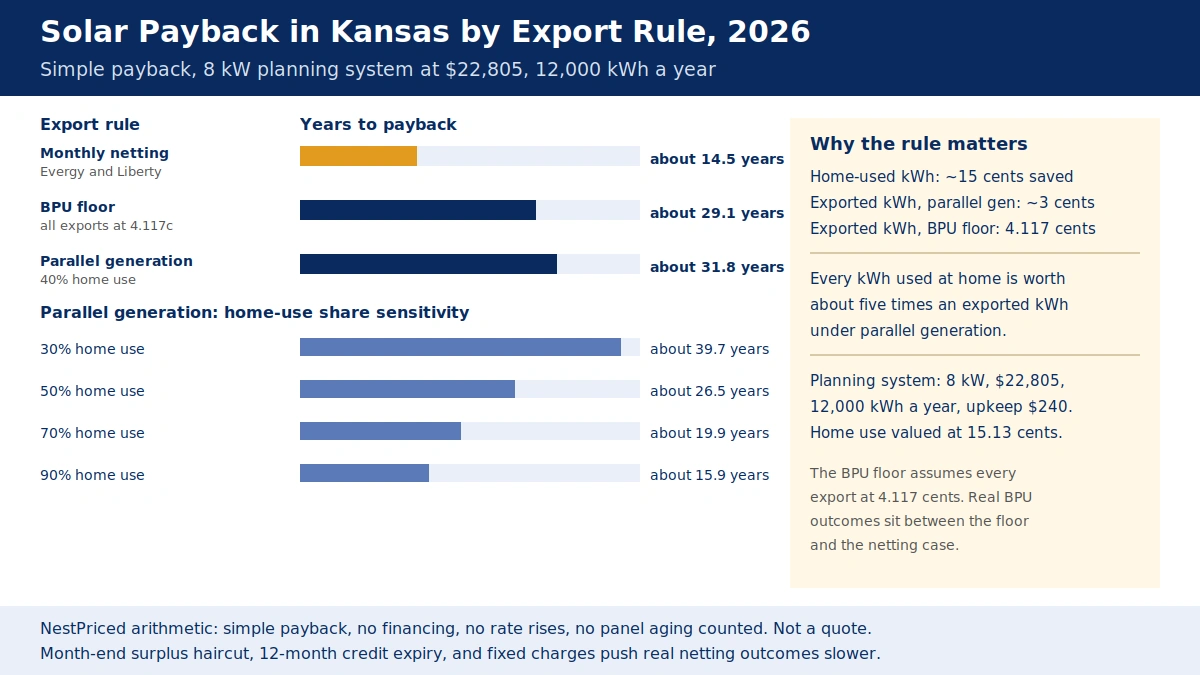
The worked cases below use one planning system so the regimes can be compared fairly: 8 kW at the NumeralQ midpoint price of $22,805, making 12,000 kWh a year at the 1,500 planning figure, with 40 percent of the power used at home as it is made and 60 percent sent out, and upkeep of $240 a year at $30 per kW including an inverter reserve, following EcoGen’s assumption. These are simple payback figures with no financing, no rate rises, no panel aging, and no inverter replacement beyond the upkeep reserve. They are NestPriced arithmetic on stated assumptions, labeled as such, and they are built to be checked, not believed.
| Export regime | Year-one savings | After upkeep | Simple payback |
|---|---|---|---|
| Evergy/Liberty monthly netting, every export netted in-month | $1,816 | $1,576 | 14.5 years |
| Kansas City BPU floor, every export at 4.117 cents | $1,023 | $783 | 29.1 years |
| Parallel generation at 3.205 cents, 40% home use | $957 | $717 | 31.8 years |
The monthly netting case is the fast end, and it is fast for a specific reason: under netting, the hour the power is made barely matters, because an export at noon cancels an import at midnight inside the same billing period. The 14.5-year figure assumes every export nets inside the month, which overstates the outcome for a home whose summer months run a surplus, since month-end surplus earns the energy-cost credit and not the retail rate.
The real Evergy outcome for most homes sits slower than 14.5 years, by an amount that depends on the monthly balance, the fixed charges solar cannot pay, and the credit figure Evergy actually applies. Treat 14.5 years as the best case the regime allows, not as the expected case.
The parallel generation case is the slow end, and the home-use share decides everything inside it. At 40 percent home use the wait is 31.8 years, longer than the panel warranty. At 30 percent home use it stretches to 39.7 years.
At 50 percent it falls to 26.5 years, at 70 percent to 19.9 years, and at 90 percent to 15.9 years. The lesson is practical, not abstract: a co-op customer who runs the dishwasher, the laundry, the water heater, and the electric vehicle charging in the sunlit hours, and who sizes the system to the daytime load rather than the annual total, can cut a decade off the wait.
A co-op customer who is out all day, uses most power after dark, and buys a system sized to the annual bills will wait the longest the math allows. Sizing and timing are the payback levers under parallel generation, and no panel discount replaces them.
The BPU floor of 29.1 years needs its label read carefully. BPU nets inside the billing period, so a BPU home whose months mostly balance will do far better than the floor, and only a home that exports heavily in month after month will approach it.
The floor exists to show the worst case if every exported kilowatt-hour earned only the surplus credit, and the real BPU outcome sits between the floor and the monthly netting case depending on the monthly balance. A BPU buyer should ask BPU for the current quarter’s Energy Rate Component and run the monthly math from their own bills, rather than accepting either end of the range as a promise.
Published models land near the fast end of this guide’s range, and the difference is worth understanding. EnergySage’s Kansas model gives a 15.71-year payback with $24,807 in 25-year savings on a 12.44 kW system at $33,077, a bigger system with rate inflation assumptions the page does not state. EcoGen’s two cases for a 7.22 kW system give 13.9 years under monthly netting and 30.2 years under parallel generation at 3.205 cents, close to this guide’s 14.5 and 31.8 on a different size and price. The NumeralQ Kansas cost model supplies the price bands behind the planning system.
None of these models counts the month-end surplus haircut, the 12-month credit expiry, or the fixed charges in the same way, which is why three honest models give three different answers. The buyer’s own monthly bills, the utility’s current credit figure, and the home-use share are the inputs that settle the question for one roof, and any quote failing to show all three is asking to be trusted rather than checked.
One more payback input deserves a plain warning. Loan financing stretches every figure in this section, because interest and dealer fees raise the true price while the savings stay the same. Nationally, loan-financed systems carried a $4.70 per watt median against $3.50 for cash in 2024, mostly dealer fees, and EnergySage’s Kansas loan case shows negative 25-year savings on its modeled system.
A $0-down loan is still a loan, and the monthly payment must be compared with the monthly savings on the same months, not with the annual average. The disclosure law requires the total cost including all future payments, which is the figure the payback math should use for a financed system.
Batteries in Kansas: Outage Cover That Rarely Pays for Itself
A home battery stores solar power made in daylight for use after dark, and in Kansas it is bought for the storm season more than for the savings math. The battery keeps the refrigerator, the lights, the well pump, and the phone chargers running when the grid goes down, and Kansas grids go down in ice, wind, and tornado outbreaks. What a battery rarely does in Kansas is pay for itself from electricity savings, because the gap between the retail rate and the export price is small in cents and the battery price is large in dollars.
The buyer who understands that trade before signing will be happy with a battery. The buyer who is sold one as an investment will not.
No Kansas-specific battery price was published in this pass, so the figures below are national, labeled as such. Installed home batteries cost roughly $700 to $1,300 per kWh of usable capacity in 2026 on EnergySage marketplace data, and a typical 13.5 kWh battery cost about $15,647 installed in the first half of 2026, about $1,159 per kWh. The most quoted unit, the Tesla Powerwall 3, holds 13.5 kWh, delivers 11.5 kW continuously, carries its solar inverter built in, and costs $13,000 to $16,500 installed depending on the installer, the panel work, and whether it is paired with new solar.
The solar battery cost guide compares the leading units on capacity, power, and warranty. A battery bought with a 2026 Kansas system earns no federal credit, pays Kansas sales tax in full, and is not named in the property tax exemption law, which covers property used mainly to generate electricity.
The savings ceiling is easy to work out and hard to argue with. One full 13.5 kWh cycle a day, displacing power bought at 15.13 cents, is worth at most $2.04 a day, about $745 a year before round-trip losses, which take roughly a tenth of the energy on the way in and out. At $15,647, that ceiling implies about 21 years before losses, and longer after them, on a battery warranted for 10 years.
Under parallel generation the battery’s job is different: it shifts power that would have been exported at 3.205 cents into evening use at 15.13 cents, a gain of about 11.9 cents per kWh, or about $1.61 a day and $588 a year at a full daily cycle, which implies about 27 years at $15,647. Both figures are ceilings, because real cycles are partial, seasonal, and interrupted by cloudy weeks, and both are NestPriced arithmetic on stated assumptions. The battery earns its keep in Kansas when the lights go out, not when the bill arrives.
The outage case is real and should be priced honestly rather than dismissed. A 13.5 kWh battery holds about half a day of the average Kansas home’s use, and far more than a day of essentials-only use with the air conditioning, the electric range, and the dryer left off. Whole-home backup through a Kansas heat wave needs more than one battery, and the quote should state which circuits the battery backs up, whether the air conditioning is among them, and how the system behaves when the battery empties on a cloudy day.
A battery without solar still backs up the home from grid power charged overnight, but a battery with solar recharges from the roof during a multi-day outage, which is the combination Kansas storm season rewards. The installer should also state the battery’s behavior during a grid outage in plain words: most solar systems shut down when the grid fails unless the battery and inverter are set up to island the home, and a system that cannot island is a fair-weather friend in the exact week it is needed most.
Evergy ran a home battery storage pilot that was full and scheduled to run until the end of 2026 at last check, so a buyer should not count on a pilot place. The practical battery checklist for a Kansas quote is short: the usable capacity in kWh, not just the nameplate; the continuous power in kW and whether it starts the loads that matter; the warranty years and the capacity the warranty guarantees at the end of them; the islanding behavior; the circuits backed up; and the price as its own line, with the sales tax stated.
A battery added to make a weak solar case look strong is the wrong purchase. A battery added because the home has a well, medical equipment, a freezer full of beef, or a memory of the last ice storm is a purchase the buyer will not regret, priced as resilience rather than as return.
Kansas Incentives in 2026: One Tax Break, No Rebate & Two Programs Still Waiting
No Kansas program pays cash for rooftop solar, and the incentive section of a Kansas quote should be the shortest section in it. The state has no income tax credit for home solar, no statewide cash rebate, and no sales tax exemption for solar equipment.
What it has is one property tax break that only works if the buyer files for it, two federal rebate programs that have not launched in Kansas, and a farm grant program that just changed its rules. A quote showing a state rebate line, a sales tax exemption line, or a federal credit line for a 2026 homeowner-owned system is wrong on all three, and the buyer should ask for the quote to be rewritten.
The property tax exemption is the one real Kansas break, and it is not automatic. Under K.S.A. 79-201 Eleventh, property used mainly to generate electricity is exempt from property tax for the 10 taxable years after the year the installation is finished. The buyer files the Board of Tax Appeals TX Application Form with the county appraiser, the appraiser adds a recommendation, and the Board decides.
The filing fee is $100 for a personal property exemption or $400 per parcel for a real property exemption, and the buyer should ask the county appraiser which applies before filing. After approval, the exemption must be claimed with the county by March 1 each year. The exemption only saves money if the county adds value to the home for its solar system, so the first question is whether the county does, and the second is who files the paperwork, the buyer or the installer.
One published guide describes the exemption as automatic with no application needed, and that description is wrong: the statute, the Board’s forms and fees, and the state revenue department’s exemption page all describe an application. The buyer who never files never gets the break.
Sales tax is the mirror image: no break exists, and the tax must be shown. K.S.A. 79-3606, the sales tax exemption statute, has no item for home solar equipment, so Kansas charges its standard state-plus-local sales tax on the equipment, at a 6.5 percent state rate plus local add-ons.
Whether a quote’s headline band includes sales tax is a question the buyer must ask, because the published cost models do not state it, and a $22,805 system with 8 or 9 percent combined tax carries roughly $1,800 to $2,050 of tax that a tax-free headline hides. The quote should carry sales tax as its own line, and the buyer should compare quotes on the tax-included total, not on the pre-tax subtotal.
The two federal rebate programs, HOMES and HEAR, have not launched in Kansas, and no launch date is set. Kansas Home Rebates, run through the Kansas Corporation Commission, has a plan still pending federal approval, and applications open only once the state portal opens. The federal allocations for Kansas are $52,663,910 for HEAR and $52,864,974 for HOMES, but allocated money is not available money, and no Kansas homeowner can apply for either program today.
Even after launch, neither program pays for a solar array: HEAR, renamed the High-Efficiency Electric Home Rebate, pays for electric appliances, insulation, air sealing, ventilation, wiring, and panel upgrades for income-qualified households, and a federal notice effective May 29, 2026 limited it to electric-to-electric upgrades with no fuel switching. A panel upgrade bundled with a solar install could in principle be a rebate measure after launch for an income-qualified household, but no dollar figure should be budgeted for it in a 2026 quote, and any quote that subtracts a rebate that has not launched is selling tomorrow’s program at today’s price.
Farm and rural business buyers have one more program, and its rules changed weeks before this guide was written. USDA’s Rural Energy for America Program, REAP, now offers grants of up to 25 percent of project cost, from $1,500 to $500,000 for renewable energy systems, under a final rule effective October 16, 2026, down from up to 50 percent under the earlier law. The project must be built and operating before the owner applies, with 12 months of production data and 12 months of energy-use data from before installation, ground-mounted solar on certified cropland is ineligible, and no application window is open yet.
REAP is competitive, not guaranteed, and a farm system should make sense without the grant. The program covers agricultural producers and rural small businesses, not suburban homeowners, and it belongs in a farm conversation, not in a residential quote.
The community solar alternatives deserve a mention for homes that cannot host panels. Evergy’s Solar Subscription for Kansas Central customers charges $29.63 a month a share, costs about $10 a month more after its credit, and Evergy says it does not lower the bill; it has been full since October 30, 2020, with a waitlist. Kansas City BPU’s Community Solar Farm lets BPU customers, renters included, lease 1 to 10 panels at about $330 each until 2042, with each panel earning about $3.20 a month in bill credits.
Neither is a money saver, and both are honest options for a shaded roof, a rented home, or a buyer who wants solar without a roof full of equipment. The community solar cost guide prices the model in full.
Federal Help in 2026: $0 Credit for Owners & a Lease Route That Barely Exists
The federal picture for a Kansas homeowner in 2026 is short and final. The residential clean energy credit, section 25D, which paid 30 percent of a home solar system’s cost, ended for property placed in service after December 31, 2025, under the One Big Beautiful Bill Act, P.L. 119-21, as the IRS confirmed in FS-2025-05. A homeowner-owned system installed in Kansas in 2026 earns a $0 federal credit, and the federal government contributes $0 to the purchase.
The same law ended the section 25C credit for heat pumps and other home energy equipment on the same date. Any quote, worksheet, or sales pitch that subtracts a federal credit from a 2026 homeowner-owned install is using last year’s law, and the buyer should ask for the arithmetic to be redone with the credit at zero. The federal energy tax credits guide carries the end dates and the transition rules for systems finished in 2025.
The one surviving federal route runs through a company that owns the system, and in Kansas that route is thin to the point of vanishing. The business clean-electricity credit, section 48E, survives for systems placed in service by December 31, 2027, and a leasing company that owns the panels can claim it and pass value through in the monthly payment. In most states that makes leasing the main way to capture federal value in 2026.
In Kansas the market has barely formed: EnergySage’s November 2026 Kansas page lists one installer offering a lease or rental option and two offering rent-to-own, with lease figures based on Kansas quotes at about $134 a month, while a separate October 2026 review found no company leasing to Kansas homes at all. The two sources disagree, and the honest summary is that at most a thin market exists, that any offer must be verified in writing, and that a buyer who cannot find a lease offer is experiencing the normal Kansas market, not bad luck.
The power purchase agreement, the other third-party structure, faces a legal barrier in Kansas rather than a thin market. Kansas law gives each certified utility the exclusive right to sell power in its territory, and the Kansas Department of Revenue reads that law as barring a third-party company from signing a power purchase agreement with a Kansas resident. The national DSIRE map of third-party agreements lists Kansas as disallowed, citing the same revenue opinion.
A power purchase agreement charges the homeowner per kilowatt-hour for power from their own roof, which is a sale of electricity, and that sale is the act the law reserves to the utility. EnergySage’s Kansas page shows power purchase figures, but labels them as based on national quote data, not Kansas quotes, and national figures do not override Kansas law. A per-kilowatt-hour agreement offered to a Kansas homeowner needs the company’s written legal basis before it is read any further, and without that basis the buyer should walk away.
The lease question is narrower than the agreement question, and the distinction matters. The net metering law covers a system’s owner or operator, which does not rule out a lease as a matter of law, and a lease charges a fixed monthly payment for the equipment rather than selling power by the kilowatt-hour. Nothing in the statute forbids a Kansas lease outright.
But Kansas City BPU forbids lease and consignment arrangements in which a third party owns or operates the system, so BPU customers have no lease route at all, and the rest of the state has at most one or two installers offering one. A lease that does appear should state the section 48E pass-through in writing, the monthly payment and any escalator, the end-of-term options, what happens to the panels and the roof when the home is sold, who insures and maintains the system, and what happens if the leasing company is sold or fails. A lease that promises federal credit value without naming the credit, the amount, and the mechanism is promising nothing enforceable.
The comparison that follows from all of this is simple, and it favors ownership for most Kansas buyers who can finance it. Cash ownership pays the full price, keeps every dollar of savings and any home value the system adds, and carries the upkeep and the risk. A loan keeps ownership and spreads the price, at the cost of interest and any dealer fee, and the loan payment must be weighed against the monthly savings on the same months.
A lease avoids the upfront price and the upkeep, gives up ownership and the home-value gain, and depends on a market that barely exists in Kansas. A power purchase agreement is not a lawful option for a Kansas home on the current reading of the law.
The heat pump versus solar guide works the wider electrification choice for buyers weighing panels against a heat pump, and the Kansas heat pump guide prices the heating side of the same home. For most Kansas roofs in 2026, the realistic choice is cash or loan ownership, priced with the federal credit at zero, and the sooner a buyer accepts that framing, the sooner the real comparison, between three written quotes on one identical specification, can begin.
Hail, Tornadoes & the Roof: What Kansas Weather Does to Panels
The 30-year record from the NOAA Storm Prediction Center makes the pattern plain: Kansas averaged 81 tornadoes a year from 1996 to 2025, second only to Texas, with 2,428 tornadoes on 586 days, 194 of them EF2 or stronger, and 13 reaching EF4 or EF5, including the Greensburg EF5 of May 4, 2007, which ran 25.8 miles through Kiowa County with gusts over 200 miles per hour.
The busiest month is May, with 29 percent of tornado days, the busiest week centers on May 25, and the middle 80 percent of tornado days falls between April 16 and August 31. The 30-year Kansas tornado record carries the county counts and the rating ladder behind those figures.
Hail is the more frequent panel killer, and it works quietly where tornadoes work loudly. Kansas averaged 64 severe hail days a year over the same 30 years, with 1,924 hail days and 20,527 individual reports, and 21 days a year produced stones of 2 inches or larger. NOAA logged 838 reports of 2-inch-plus hail in Kansas from 2016 to 2025 alone.
Hail rarely takes a panel off a roof. It cracks glass, bruises cells, and shortens output, and the damage is often invisible from the ground, which is why production monitoring and a post-storm inspection matter more than a glance from the driveway. A stone can crack the silicon cells inside a panel without breaking the glass at all, and the loss shows up as a quiet fall in output weeks later, not as a hole in the array.
Panels are tested for hail before they reach a roof, and the standard test is a fair match for most Kansas hail. Under IEC 61215, panels must survive 1-inch ice balls fired at about 51 miles per hour at 11 impact points, losing less than 5 percent of power output, and the North American UL 61730 standard covers the same ground. The best-known real-world test came in May 2017, when a hailstorm dropped stones up to 2.75 inches across the Denver area and the National Renewable Energy Laboratory campus in Golden, Colorado: only 1 of the campus’s 3,168 panels was damaged.
That result does not promise that Kansas panels are hail-proof. It shows that certified panels survive the hail most storms produce, while stones above the test size, stones driven sideways by high wind, and repeated hits on the same spot can all break glass that the lab test would pass.
The buying response to the hail record is a short list of written requirements, not a different technology. Ask for the panel’s hail rating sheet, including the glass thickness, with 3.2 mm glass as the thicker option worth pricing, and any FM 4473 impact rating where offered. Ask for the mounting wind rating in writing, with the engineering that supports it for the roof type and the exposure.
Ask for the production monitoring that shows a damaged section quickly, and for the inspection terms after a storm, including who climbs the roof and what the visit costs. Confirm with the home insurer, before storm season, that the array is covered for hail and wind, what the deductible is in dollars, and whether damage to the panels is a homeowners claim rather than a warranty claim, which it usually is. Kansas homeowners insurance already averages roughly $4,800 to $5,300 a year for $300,000 of dwelling coverage across 2026 trackers, among the most expensive in the country, because hail and tornado losses drive the market, and an uncovered array on top of that premium is a risk no buyer should carry unknowingly.
Tornadoes need an honest sentence that no sales pitch will give. Panels and mounts rated for hail and straight-line wind are not rated for a direct tornado hit, and no residential mounting system promises to hold through EF4 or EF5 winds. What the buyer can require is a mounting system engineered for the wind speeds the local code and the manufacturer’s ratings cover, installed with the fastening pattern the engineering specifies, on a roof structure that can carry the load.
What the buyer cannot buy is tornado-proof solar, and any seller who implies otherwise is overselling. The storm plan for a Kansas array is insurance, monitoring, a post-storm inspection by a technician before the system runs again after a visible hit, and a roof underneath that is young enough to outlast the panels.
The roof underneath is the last weather question, and in Kansas it is asked of old roofs. About 56 percent of Kansas homes were built before 1980, and a roof near the end of its life should be replaced before panels go on it, because removing and reinstalling the array later adds a cost no published Kansas figure prices, which means the quote must state it.
The quote should name the roof age, the remaining life the installer assumes, the flashing and sealing method at every penetration, and the roof warranty terms after the install, including who honors the roof warranty if the installer and the roofer are different companies. The national roof replacement cost guide prices the reroof side of the decision, and a buyer whose roof has less than 10 years left should price the roof and the panels as one job with one schedule, not as two jobs that meet on the same roof by accident.
Permits, Licenses & the Seller Disclosure: The Kansas Paper Trail
Kansas has no state license for solar installers, no state electrical license, and no statewide solar permit, and the absence of a state system puts the checking work on the buyer. What Kansas does have is local licensing run by cities and counties, local permits and inspections, utility interconnection approval, a seller disclosure law with real teeth, and a lien law that can reach the home if a supplier goes unpaid.
Each layer is simple on its own. Together they are the paper trail that separates a lawful install from an expensive argument, and every item below should be confirmed in writing before the crew arrives.
Licensing starts with the local authority for the job address, because there is no state registry to search. Kansas law supplies a uniform framework, K.S.A. 12-1525 through 12-1526, for cities and counties that choose to license electricians: a journeyman certificate requires at least two years of field experience, and a master certificate requires a valid journeyman certificate for at least two years. Cities and counties decide whether to license, what to charge, and how to administer the program, and a license in one jurisdiction does not authorize work in another.
The buyer should ask each bidder for the local license that covers the job address, check it with the city or county, and match the business name on the license to the business name on the contract. A solar certificate, a credential from another state, or a license from the next county over does not by itself authorize the work.
Wichita and Sedgwick County show what a local system looks like when it is fully built out. MABCD, the Metropolitan Area Building and Construction Department, issues a Solar contractor license as one of its general contractor license types, covering Wichita, unincorporated Sedgwick County, and the small cities it serves, and electrical work needs an MABCD electrical trade license as well. The reported requirements include a Kansas Standard ICC exam score of 75 percent or better, at least $300,000 of general liability insurance plus workers’ compensation and auto coverage, and no reciprocity with other jurisdictions, with review taking up to two weeks; the buyer should confirm the current requirements with MABCD directly.
The county’s own electrical division page states the process plainly: solar PV systems shall be installed by an MABCD Licensed Electrical Contractor, the full contract price must be submitted as the valuation rather than materials alone, and engineering, plans, equipment specifications, one-line drawings, and MABCD forms must go in for review before the building permit issues. The 2023 National Electrical Code with amendments has been enforced there since January 1, 2025. The Wichita permit fee is not published online, and the buyer should confirm it with MABCD rather than trusting a fee figure from a secondary site.
Overland Park requires a building permit before installing any solar collector, under section 18.390.140(K) of its Unified Development Ordinance, and its fee is likewise not published online. For Topeka and Kansas City, Kansas, no verified city-specific solar permit fee or ordinance text was found in this pass, so the general rule applies: expect a building or electrical permit from the city or county plus the utility’s interconnection approval before the system can be switched on, and confirm the specifics with the city for the job address. In every Kansas city, the system must not be switched on until the utility grants permission to operate, and the disclosure form requires proof of permits, inspections, interconnection approval, and permission to operate within 30 days after permission is granted.
The seller disclosure law is the strongest consumer protection in Kansas solar, and it is new enough that many buyers have never heard of it. Since July 1, 2025, under K.S.A. 50-6,147, a distributed energy retailer, anyone who sells, markets, solicits, advertises, finances, installs, or otherwise makes available a distributed energy system in Kansas, must give the customer a separate disclosure document before the contract, written in at least 10-point font and in the language the sale was made in, including the total cost and a guarantee of how much power the system will make, with a remedy if it falls short in the first year. The customer signs and dates the disclosure at least one calendar day after signing the contract.
Without it, the contract is void. The retailer must be registered with the Secretary of State and in good standing, and violations carry a civil penalty of up to $10,000 each.
The Attorney General’s standard form states in plain words that the buyer should not sign the disclosure on the same day as the solar agreement, and that the retailer is not affiliated with any utility or government agency. A seller who pressures a same-day signature on both documents, or who cannot produce the form, is asking the buyer to waive the strongest protection Kansas law gives them.
Two more paper-trail items close the section, and both are easy to skip under time pressure. Kansas has no solar access law: no statute bars a homeowners association from restricting or requiring approval for solar panels, after two bills that would have created that protection failed, HB 2268 in the 2023-2024 session and SB 144, which died in April 2026. Solar easements, voluntary agreements that protect sunlight access, are possible under K.S.A. 58-3801, but they must be negotiated, not assumed.
A buyer in a managed community should get association approval in writing before signing, with the panel placement and any color or setback conditions stated, because the association’s own documents, not state law, decide the question in Kansas. And Kansas lien law reaches the home if a supplier or subcontractor goes unpaid: on an owner-occupied home, a sub or supplier must mail the owner a warning statement first unless the claim is $250 or less, and payments made after receiving that warning are not protected, so the owner should pay that party directly or by joint check. The panel and inverter distributor and any subcontracted electrician are the likely lien claimants on a solar job, and the contract should state the payment schedule, the lien waiver practice, and the proof of payment the buyer receives before the final check.
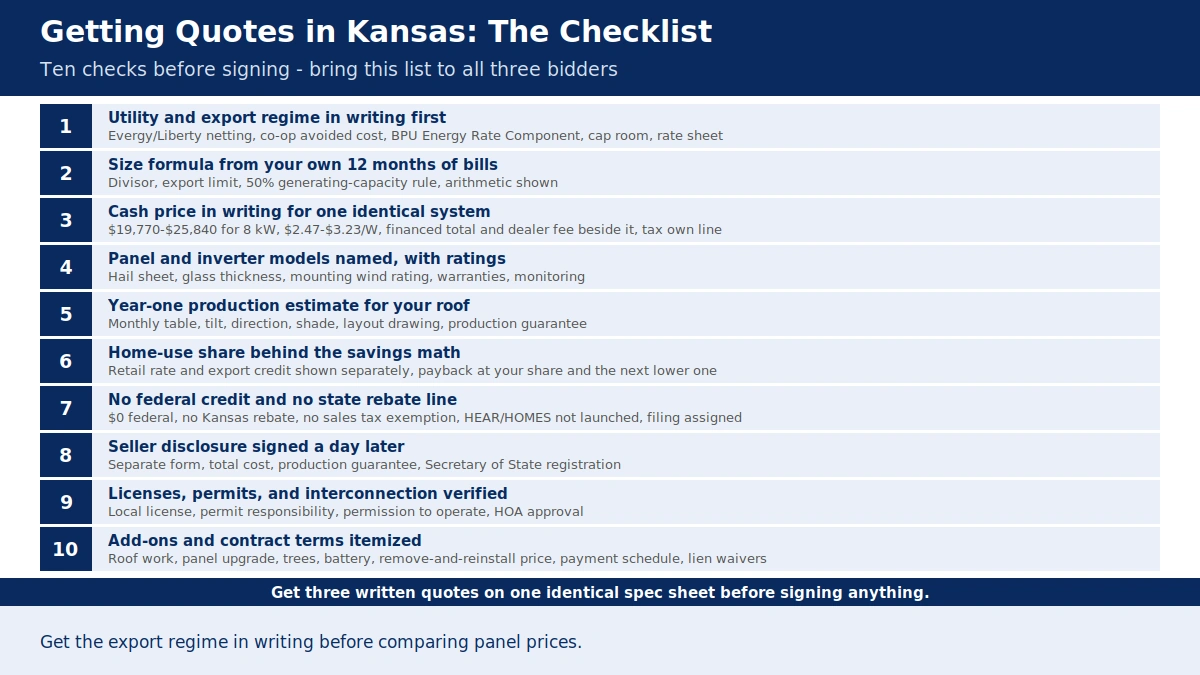
Getting Quotes in Kansas: The Checklist
Three written quotes on one identical specification is the rule that makes every other rule in this guide enforceable, and the specification must be written before the first salesperson arrives. The same system size in kilowatts, the same panel model, the same inverter type and model, the same battery or no battery, the same roof work, the same panel work, and the same assumptions about production, home use, and export value, on all three quotes.
A quote changing the size, the equipment, or the savings assumptions is not a competing quote. It is a different job at a different price, and comparing it with the others proves nothing.
- Your utility and its export regime in writing first: Evergy or Liberty monthly netting with the current month-end credit figure, co-op parallel generation with the current avoided-cost buy-back price, or BPU netting with the current quarter’s Energy Rate Component, plus cap room and the rate sheet the home will sit on.
- The size formula worked from your own 12 months of bills: the divisor for your utility type, the export limit in kilowatts, and the generating-capacity limit 50 percent above it, with the arithmetic shown, not just the answer.
- Cash price in writing for one identical system: the $19,770–$25,840 anchor for 8 kW at $2.47–$3.23 per watt, the financed total beside it with any dealer fee shown, and sales tax as its own line.
- Panel and inverter models named, with the ratings: the hail rating sheet, the glass thickness, the mounting wind rating and engineering, the warranty terms for panels, inverter, and workmanship, and the monitoring that shows a damaged section.
- Year-one production estimate for your roof: the monthly table, the tilt, direction, and shade assumptions, the loss assumptions, the layout drawing, and the seller’s production guarantee with its first-year remedy, as the disclosure law requires.
- Home-use share behind the savings math: the retail rate and the export credit shown separately, the payback worked at your home-use share and at the next lower one, and the same math with last year’s lower export credit where the credit moves.
- No line for a federal credit and no line for a state rebate: $0 federal for a homeowner-owned 2026 install, no Kansas rebate, no sales tax exemption, HEAR and HOMES not launched, and the property tax exemption filing assigned to a named party.
- The seller disclosure document, signed a day later: the separate form, the total cost including all future payments, the production guarantee, the retailer’s Secretary of State registration and good standing, and no signature on the disclosure the same day as the contract.
- Licenses, permits, and interconnection verified: the local license for the job address checked with the city or county, the permit responsibility and fee in writing, the interconnection application and permission to operate before switch-on, and HOA approval in writing where a managed community applies.
- Add-ons and contract terms itemized: roof work, panel upgrade, tree work, ground-mount premium if any, battery if any with its circuits and islanding behavior, remove-and-reinstall price, payment schedule, lien waiver practice, and lease terms in full if leasing, including the section 48E pass-through, the escalator, the end-of-term options, and the home-sale terms.
The decision rules behind the checklist are short enough to carry on one page. Size to the bills, not to the roof, and never above the formula limit. Value exports at the credit your utility actually pays, not at the retail rate, unless the month nets.
Treat the battery as storm cover, not as an investment, and price it separately. File the property tax exemption, or confirm in writing who will.
And sign the disclosure a day after the contract, after reading it, because Kansas law gives the buyer that day for a reason. A system bought on those rules, at a price inside the published bands, from a bidder whose license checks out and whose production guarantee is in writing, is a system the buyer can defend to themselves in any Kansas summer that follows.
Sources & methodology
Cost models:
- NumeralQ, Solar Panel Cost in Kansas (2026), estimator pricing as of Oct 26, 2026 (planning estimates, not contractor bids): 8 kW $19,770-$25,840 at $2.47-$3.23/W; by size 4 kW $10,400-$13,590 through 12 kW $28,110-$36,740; labor $24.04/hr median pay, $48-$63/hr billed
- NumeralQ, Solar Panel Cost in Wichita, KS (2026) and in Overland Park, KS (2026), pricing Oct 26, 2026: both cities $19,770-$25,840 for 8 kW; PVGIS production 1,506 kWh/kW/yr Wichita, 1,416 Overland Park; Overland Park median home value $413,600; permit fees not published
- EnergySage, Kansas Solar Panel Cost: 2026 Prices and Savings (Nov 2026, page updated Nov 6, 2026, marketplace quote data): $2.66/W; 12.44 kW average $33,077, range $28,115-$38,039; payback 15.71 years; 25-year savings $24,807; size table 3 kW $7,977 through 10 kW $26,589
- EnergySage city pages (Nov 2026): Wichita $2.64/W, 11.21 kW, $29,597; Topeka $2.66/W, 12.37 kW, $32,865; Kansas City, KS $2.73/W, 11.49 kW, $31,320; no Overland Park city page found
- EcoGen Solar Cost Index, September 2026 edition, and EcoGen Kansas solar hub (updated Oct 19, 2026): $2.87/W; typical 7.22 kW $20,721; 1,567 kWh/kW/yr; 15.13 cents EIA 12-month average; modeled cash prices, not collected quotes
- ConsumerAffairs, Kansas Solar Panel Costs (updated Aug 26, 2026, EnergySage data): $2.63/W statewide; Wichita $2.58/W; Topeka $2.66/W
- Berkeley Lab, U.S. Distributed Solar and Storage: 2025 Data Update (2024 installs, national): $3.00-$5.20/W, $4.00 median; cash $3.50/W, loan-financed $4.70/W
Rates, use, and production:
- U.S. Energy Information Administration, Electric Power Monthly Table 5.6.A (Aug 2026): Kansas residential 15.47 cents/kWh, US total 18.16 cents
- EIA Form 861 final 2025 data (released Oct 7, 2026): Kansas 876 kWh/month, 14.44 cents, $126.42/month; EIA Form 861M 12 months to Aug 2026: 15.13 cents, 887 kWh/month
- EU Joint Research Centre PVGIS 5.2 with NREL NSRDB irradiance via NumeralQ (20-degree tilt, south-facing, 14 percent losses); NREL PVWatts Wichita estimate 1,493 kWh/kW/yr via iamhome.app
- National Weather Service Wichita, 100-degree temperature statistics (1991-2020 normals): 12.4 days a year at or above 100 F; July average high 92.7 F; 53 days in 2011
Law, utilities, and programs:
- Kansas Corporation Commission, Net Metering in Kansas: IOUs Evergy and Liberty required to offer net metering; co-ops and municipal providers not mandated; bi-directional meter at no additional cost
- K.S.A. 66-1263 through 66-1271 (Net Metering and Easy Connection Act, as amended by HB 2527 in 2024); K.S.A. 66-1,184 (parallel generation, as amended by HB 2149 in 2025); K.S.A. 66-1,173 (exclusive service territories); K.S.A. 50-6,147 (seller disclosures); K.S.A. 79-201 Eleventh, 79-210, and 79-3606 (property tax exemption, yearly claim, sales tax); K.S.A. 12-1525 and 12-1526 (local electrician licensing); K.S.A. 58-3801 (solar easements); K.S.A. 60-1103 and 60-1103a (liens)
- Substitute for HB 2149 (2025) and the Kansas Attorney General standard disclosure form: one-calendar-day signing wait, void contract, $10,000 civil penalty, Secretary of State registration
- Kansas Supreme Court No. 120,436 (Apr 3, 2020): solar-home demand charge held price discrimination under K.S.A. 66-117d
- Kansas City Board of Public Utilities, Electric Service Policies Section 15.00 and Energy Rate Component history: billing-period netting, surplus at 100 percent of the Energy Rate Component, 4.117 cents/kWh Oct-Dec 2026, third-party ownership forbidden
- Midwest Energy renewable interconnection page: average buy-back 3.205 cents in 2025, 2.300 cents in 2024; own net metering to 15 kW
- Evergy solar and net metering customer document (2025): 150 kW AC maximum, size formula, wholesale-rate surplus credit, 12-month credit expiry
- DSIRE third-party solar PPA map (Mar 2026) and Kansas Department of Revenue Opinion O-2016-001: Kansas PPA disallowed
- U.S. Department of Energy Home Energy Rebates program and Program Notice 26-2 (effective May 29, 2026); Kansas allocations $52,663,910 (HEEHR) + $52,864,974 (HOMES); Kansas launch status verified Nov 4-9, 2026 (not launched, no date set)
- USDA Rural Energy for America Program final rule (Oct 1, 2026, effective Oct 16, 2026): grants to 25 percent, $1,500-$500,000, build-first, cropland exclusion, no window open
- IRS FS-2025-05 and P.L. 119-21 (OBBBA): sections 25C and 25D ended for property placed in service after Dec 31, 2025; section 48E through systems in service by Dec 31, 2027
Weather and durability:
- NOAA Storm Prediction Center Severe Weather Database 1996-2025, analyzed by MyWild (snapshot Sept 2, 2026; SPC data updated Apr 24, 2026): 2,428 tornadoes on 586 days, 81 a year; 194 EF2 or stronger; 13 EF4/EF5 including the Greensburg EF5 of May 4, 2007; 1,924 severe hail days, 64 a year, 21 a year with 2-inch stones or larger
- IEC 61215 hail testing standard (1-inch ice balls at 23 m/s, 11 points) and the National Renewable Energy Laboratory 2017 hail case (1 of 3,168 panels damaged)
- 2026 homeowners insurance tracker compilations (Insurance.com/Quadrant $5,260, insurancecostcalc $5,289, truerateguide $4,810 at $300,000 dwelling; NerdWallet $5,455 at $400,000 dwelling)
Payback, production, and battery illustrations are NestPriced arithmetic on the stated figures and assumptions, labeled as such in the text. Planning estimates are labeled as planning estimates wherever they appear.
Figures that rest on a single source, or that no published source confirms, are flagged in the text as single-source, as planning estimates, or as questions to confirm in writing. Prices are 2026 figures and change with equipment, labor, and utility tariffs; get three written local quotes before budgeting.
Disclaimer: Prices in this guide are 2026 planning figures and marketplace averages for Kansas, not quotes for a specific home. Your price depends on your roof, your equipment, your installer, your utility, and your 12 months of electricity use. Tax and rebate information is general information, not tax or legal advice; confirm the property tax exemption, the seller disclosure, and any program status with the county appraiser, the Attorney General’s published form, and the program office before signing. Solar installation involves roof work and high-voltage electrical work; use licensed local professionals and never switch a system on before the utility grants permission to operate.
What do solar panels cost in Kansas in 2026?
An 8 kW rooftop system costs $19,770–$25,840 installed in Kansas in 2026, or $2.47–$3.23 per watt, on NumeralQ planning estimates priced October 26, 2026. EnergySage averages $2.66 per watt on marketplace quotes, and EcoGen models $2.87 per watt for a typical 7.22 kW system at $20,721. Roof work, a panel upgrade, a battery, and sales tax sit outside that band and appear as their own lines on a complete quote.
How big a solar system does Kansas law allow on my home?
The size comes from your last 12 months of electricity use, divided by 8,760 hours and then by 0.144 for Evergy and Liberty customers or 0.288 for co-op and city-utility customers, rounded up to the next 2 kW or 1 kW. The average home at 10,510 kWh a year is allowed a 10 kW export limit with Evergy or Liberty and 5 kW with a co-op or city utility, up to a 150 kW ceiling. Since January 1, 2026, the panels on the roof may total at most 50 percent above the export limit, with a device holding exports down.
Does Kansas still have net metering?
Yes, for Evergy and Liberty customers, under the Net Metering and Easy Connection Act, with monthly netting inside each billing period at retail value. Power left over at the end of a month becomes a dollar credit at no less than the utility’s monthly system average cost of energy, a wholesale-type figure, and Evergy publishes no fixed cents figure for it. Co-ops and most city utilities are not covered by the net metering law and offer parallel generation instead, buying every exported kilowatt-hour at avoided cost.
What does Kansas City BPU pay for exported solar power?
BPU nets the energy it supplies against the energy a home exports over each billing period on a single two-way meter, and credits any surplus at 100 percent of its Energy Rate Component, which was 4.117 cents per kWh for October to December 2026 and is reviewed every quarter. The customer still pays the customer charge and the facilities charge every billing period. BPU forbids third-party ownership, so a lease is not an option for BPU customers, and the current quarter’s component should be confirmed with BPU in writing.
When do solar panels pay for themselves in Kansas?
Payback depends on the export regime more than on the panel price: about 14.5 years for an 8 kW system at the $22,805 midpoint price when every export nets inside the month at Evergy or Liberty, and about 31.8 years under parallel generation at 3.205 cents with 40 percent of the power used at home. Under parallel generation the home-use share decides the wait, from about 39.7 years at 30 percent home use to about 15.9 years at 90 percent. Those are simple payback figures with upkeep counted and no financing, rate rises, or panel aging counted.
Is there a tax credit or rebate for solar in Kansas in 2026?
No cash help exists for a homeowner-owned system in 2026. The federal credit ended for systems placed in service after December 31, 2025, so the federal credit is $0, and Kansas has no state income tax credit, no statewide rebate, and no sales tax exemption for solar equipment. The one Kansas break is a 10-year property tax exemption that the buyer must apply for through the Board of Tax Appeals, and the state’s HEAR and HOMES rebate programs have not launched and would not pay for a solar array even after launch.
Can I lease solar panels in Kansas, and what about a power purchase agreement?
A lease is lawful in principle but barely offered: EnergySage lists one or two installers with lease or rent-to-own options in Kansas, while another October 2026 review found none, and Kansas City BPU forbids third-party ownership outright. A power purchase agreement that charges per kilowatt-hour faces a legal barrier, because Kansas law reserves the sale of power to the certified utility and the state revenue department reads that as barring a third-party agreement with a resident. Any lease should state the section 48E pass-through, the escalator, and the end-of-term options in writing, and any per-kilowatt-hour agreement needs the company’s written legal basis.
Will hail and tornadoes damage solar panels in Kansas?
Panels are tested for hail: the standard test fires 1-inch ice balls at about 51 miles per hour at 11 points, and a 2017 hailstorm at the National Renewable Energy Laboratory campus damaged only 1 panel out of 3,168 despite stones up to 2.75 inches in the area. Kansas averages 64 severe hail days and 81 tornadoes a year, so buyers should ask for thicker glass, an impact rating sheet, and a mounting wind rating in writing. No residential mounting is rated for a direct tornado hit, so confirm hail and wind coverage with the home insurer before storm season, and have a technician inspect any system that takes a visible hit before it runs again.