

Utah gives a roof three different winters depending on where the house sits. A bench home above Salt Lake City can hold snow for weeks while a house ten minutes down the hill sits bare, and a St. George roof may never see a snow load worth naming while it bakes through a July that averages 102 degrees.
The price of the roof follows that split. What the roof must carry, what the code demands under it, and what the insurer will pay after a storm all change with the address.
The second Utah split is age. The median Salt Lake City home dates to 1965, and about 65 percent of the city’s homes were built before 1980.
Those houses have often been roofed twice already, and the second roof sometimes sits on top of the first. A reroof on a house like that is partly archaeology: layers, old plank decking, flashing that predates the current code, and an attic that was never sealed the way a new roof needs it to be.
The third split is fire. Utah counted 1,159 wildfires and 164,874 burned acres in 2025, and the state has now mapped about 60,000 homes inside a high-risk wildland-urban interface boundary.
From January 1, 2027, a new wildfire building code sets the roof rules inside locally designated interface areas. A roof bought in 2026 should already meet the rule it will face at its first permit check.
Our national roof replacement cost guide sets the countrywide baseline for the same job, and Utah’s numbers below read against it. The national guide prices the same job at $9,710–$11,840 for a 2,000 sq ft architectural shingle roof, so Utah sits about 6 percent under the national figure.
Table of Contents
How Much Does a Roof Replacement Cost in Utah in 2026?
Four kinds of evidence price the Utah market, and they measure different jobs. NumeralQ publishes planning estimates from a cost model built on materials plus local labor, priced October 26, 2026. Utah contractors publish installed ranges from real jobs, with overhead, disposal, and crew time inside the number.
Model sites blend local rates into estimates with methods they do not show. The contractor ranges run higher than the model ranges, and the gap is the most useful fact in this section: budget from the model, and expect real bids to land above it.
The NumeralQ statewide band leads here because it pins down the job: architectural asphalt shingles, 2,000 sq ft of roof surface, installed, at $9,130–$11,090. NumeralQ calls the figure a planning estimate, not a bid and not a record of completed jobs.
The band’s midpoint, about $10,110, is the number the lifetime math section works from. Salt Lake City sits a touch under the state band at $9,090–$11,030, and Provo a touch under that at $8,950–$10,860, which tells its own story: roofer pay barely moves across Utah, so city gaps come from the house and the job, not from the labor market.
Roofers price by the square, and the square is the unit every Utah quote will use. One square covers 100 sq ft of roof surface, so a 2,000 sq ft roof is 20 squares and a 2,500 sq ft roof is 25 squares.
A per-square price without a measured square count is not comparable to anything. Every bid should state the measured roof area, the slope, and which planes are included, in writing, before any per-square figure is compared.
The band covers the standard job: tear-off of one layer, disposal, synthetic underlayment, ice barrier at the eaves where the code requires it, flashing, ridge venting, and the shingles themselves. It leaves out the extras that show up once the old roof comes off. A second layer to remove, soft decking sheets, a skylight that needs re-flashing, and gutters all price separately, and the permits section carries Salt Lake City unit prices for the tear-off, decking, flashing, skylight, and gutter lines.
| Source | 2,000 sq ft architectural shingle | What it measures |
|---|---|---|
| NumeralQ, Utah statewide (Oct 2026) | $9,130–$11,090 | Planning estimate, cost model |
| NumeralQ, Salt Lake City (Oct 2026) | $9,090–$11,030 | Planning estimate, cost model |
| NumeralQ, Provo (Oct 2026) | $8,950–$10,860 | Planning estimate, cost model |
| 360 Roofing, northern Utah (Oct 2026) | $9,500–$15,500 | Contractor installed prices |
| SmartRoofingCalculator, 25-square roof (Apr 2026) | $10,750–$15,500 | Planning estimate, per-square model |
| MyRoofData, Utah typical home (2026) | $12,500–$21,750 | Cost model, tear-off included |
| Instant Roofer, Utah average (2026) | ~$14,916 | Contractor pricing in app, 2,620 sq ft average roof |
Read the last two rows of that table as different jobs, not as higher prices for the same job. The MyRoofData and Instant Roofer figures price larger or differently scoped jobs than the NumeralQ 2,000 sq ft standard, so they sit above the band without contradicting it. The 360 Roofing range is the one to weigh most heavily after NumeralQ: a Utah contractor’s own installed prices for the same 2,000 sq ft roof, and its top end shows what a cut-up roof with a second layer and steep slopes actually costs.
A quote that never states the measured roof size cannot be compared with any other quote, however detailed the rest of it looks. Ask for the measurement sheet, the square count, and the slope on every bid. Three written quotes on one identical scope, from licensed contractors, is the minimum before signing.
Roof Replacement Cost in Utah by Material
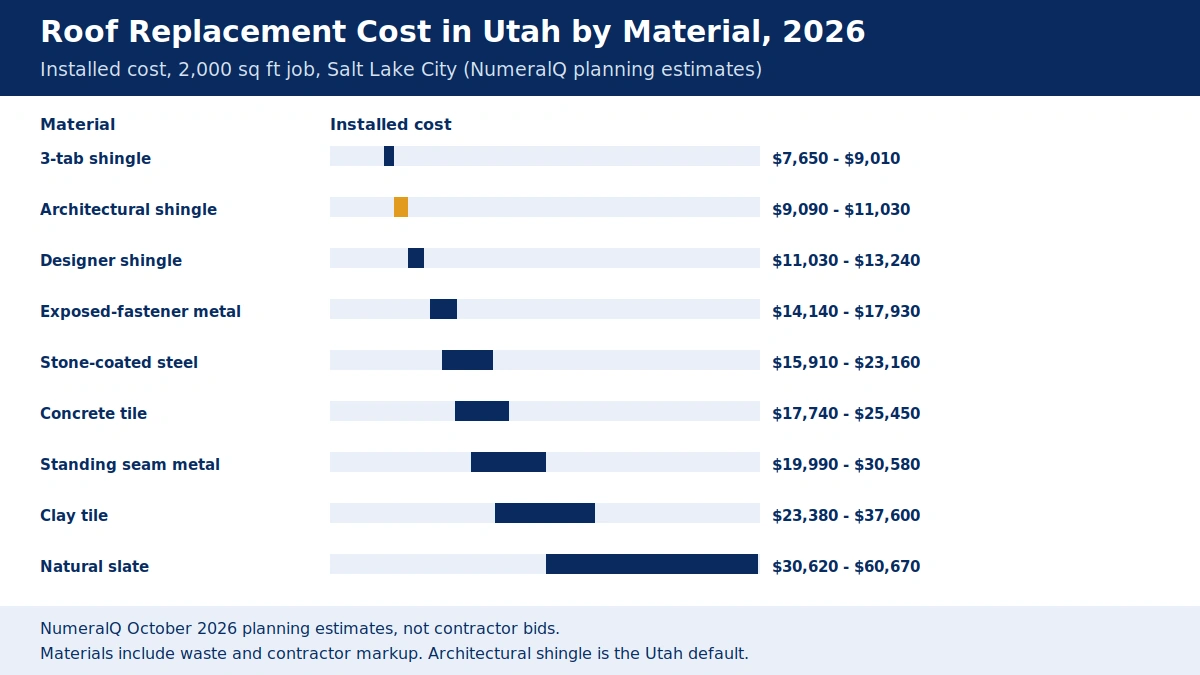
Material is the second-biggest lever after size, and in Utah it swings the same 2,000 sq ft job from under $8,000 to over $60,000. The table below is the full Salt Lake City material table from NumeralQ, with Provo figures beside it for the materials most Utah buyers weigh. Both cities use the same 2,000 sq ft typical job, and both tables include waste and contractor markup.
| Material | Salt Lake City, 2,000 sq ft | Provo, 2,000 sq ft | Installed per sq ft (SLC) |
|---|---|---|---|
| 3-tab asphalt shingles | $7,650–$9,010 | $7,560–$8,890 | $3.56–$4.10 |
| Architectural asphalt shingles | $9,090–$11,030 | $8,950–$10,860 | $4.27–$5.11 |
| Flat roof: modified bitumen | $9,900–$12,740 | $9,730–$12,520 | $4.68–$5.96 |
| Flat roof: EPDM rubber | $10,200–$16,070 | $10,020–$15,840 | $4.83–$7.63 |
| Designer / luxury asphalt shingles | $11,030–$13,240 | $10,900–$13,070 | $5.24–$6.21 |
| Flat roof: TPO membrane | $12,110–$16,170 | $11,870–$15,860 | $5.78–$7.68 |
| Metal panels, exposed fastener | $14,140–$17,930 | $13,950–$17,670 | $6.80–$8.56 |
| Stone-coated steel | $15,910–$23,160 | $15,680–$22,860 | $7.68–$11.17 |
| Synthetic slate or shake | $16,670–$24,190 | $16,430–$23,870 | $8.06–$11.68 |
| Cedar shakes | $16,680–$29,790 | $16,400–$29,420 | $8.07–$14.48 |
| Concrete tile | $17,740–$25,450 | $17,330–$24,920 | $8.60–$12.31 |
| Standing-seam metal | $19,990–$30,580 | $19,670–$30,160 | $9.73–$14.88 |
| Clay tile | $23,380–$37,600 | $22,960–$37,050 | $11.42–$18.39 |
| Natural slate | $30,620–$60,670 | $30,120–$60,020 | $15.04–$29.92 |
Architectural asphalt is the Utah default, and the default for a plain reason. It costs the least of any durable option, every crew in the state installs it, and its thicker, layered profile handles Wasatch Front wind better than the flat 3-tab shingle it replaced. A Salt Lake City contractor guide puts its local life at 18 to 25 years, against 20 to 30 years nationally, because high-altitude sun and freeze-thaw cycles wear shingles faster here. Polymer-modified architectural shingles, made with rubberized asphalt that stays pliable in cold weather, cost more per square and carry the Class 4 impact rating and higher wind warranties that the hail section prices.
3-tab shingles are the budget buy, and the buy most Utah roofers now steer past. The statewide 3-tab band runs $7,680–$9,050, about 17 percent under architectural. The saving buys a thinner, flatter shingle with lower wind ratings and a shorter life, on a roof that will face canyon gusts and ice dams.
For a rental with a short hold or a tight budget, 3-tab still has a place. For a home the buyer plans to keep, the step up to architectural is the cheapest upgrade in the whole table.
Designer and luxury asphalt shingles sell the look of slate or shake at a third of the price. The Salt Lake City band runs $11,030–$13,240, roughly $2,000 above architectural on the same job. They weigh about the same as architectural shingles, so no structural check is needed, and they suit the Avenues and east-bench houses where the street expects a heavier-looking roof. What they do not buy is a longer life: the premium pays for appearance, not durability.
Exposed-fastener metal is the cheapest way onto a metal roof, and the one that needs the most care. Corrugated and 5V panels run $14,140–$17,930 in Salt Lake City. The fasteners sit on the surface, and each one is a future leak point as washers age and panels move with temperature swings.
Standing seam hides the fasteners under raised seams, which is why it costs $19,990–$30,580 and why it lasts. Our metal roof cost guide prices both systems in full, and the lifetime math section below works out when the standing-seam premium pays back.
Concrete tile is the St. George roof, and a weight question everywhere else. The Salt Lake City band runs $17,740–$25,450, and St. George contractor ranges run $18,000–$30,000 and up for a new tile roof. Standard concrete tile weighs 900 to 1,200 pounds per square, against roughly 250 to 400 pounds for architectural asphalt, so a house framed for shingles needs an engineer to confirm the frame can carry tile before anyone orders it.
Salt Lake City requires that engineer report whenever the added roofing weight passes 3 pounds per sq ft. Houses already under tile need no such check, and St. George adds a third option the north never sees: re-felt, where the tile is lifted, the underlayment is replaced, and the same tile goes back down for $550–$900 per square.
Clay tile, cedar, synthetic, and slate each fit a narrow Utah buyer. Clay tile at $23,380–$37,600 suits St. George and the southern counties, where freeze-thaw is gentler; in the north, the tile grade must suit severe frost exposure, so the product data sheet matters more than the color sample. Cedar shakes at $16,680–$29,790 are the wrong buy inside any mapped wildfire area, since untreated wood cannot meet the Class A assembly rule the 2027 code brings. Synthetic slate and shake at $16,670–$24,190 mimic the look without the weight or the fire risk.
Natural slate at $30,620–$60,670 is the longest-lived and heaviest option in the table, and it belongs on houses whose frames were built for it. Our tile roof cost guide covers tile weights, underlayment, and the re-felt decision in detail.
Flat and low-slope roofs price by membrane, not by shingle. Modified bitumen, EPDM rubber, and TPO cover the mid-century flat roofs in the Salt Lake Valley and the low-slope additions everywhere else. Modified bitumen runs $9,900–$12,740 in Salt Lake City, EPDM $10,200–$16,070, and TPO $12,110–$16,170. Ponding water and seam work decide the life of a flat roof more than the membrane brand does, so the bid should name the drainage plan and the seam method, not just the material.
Roof Replacement Cost by Roof Size: The 25-Square Planning Roof
Size is the biggest driver of all, and the easiest to get wrong. A roof’s surface area is larger than the home’s floor area, because slope stretches it and overhangs add to it.
A 2,000 sq ft house rarely has a 2,000 sq ft roof. The planning roof in this section is 25 squares, or 2,500 sq ft of roof surface, which matches the typical Utah home in the contractor guides better than the 20-square standard job does.
| Roof size | Squares | Architectural asphalt, Utah statewide |
|---|---|---|
| 1,000 sq ft | 10 | $4,840–$5,950 |
| 1,500 sq ft | 15 | $6,980–$8,520 |
| 2,000 sq ft | 20 | $9,130–$11,090 |
| 2,500 sq ft | 25 | $11,270–$13,650 |
| 3,000 sq ft | 30 | $13,420–$16,220 |
The 25-square planning roof at $11,270–$13,650 is the number to carry into a budget conversation. It comes from the same NumeralQ model as the headline band, so the two figures hang together. A SmartRoofingCalculator model prices the same 25-square architectural roof at $10,750–$15,500 from per-square rates of $430–$620, which brackets the NumeralQ band closely enough to trust the shape of it.
Contractor per-square rates price the same roof higher, and the difference is worth seeing in the open. At 360 Roofing’s $475–$775 per square, a 25-square architectural roof runs $11,875–$19,375 by simple multiplication.
At the same contractor’s standing-seam rates of $900–$1,600 per square, the 25-square metal roof runs $22,500–$40,000. Those products are NestPriced arithmetic from published per-square rates, not published totals, and they show why a per-square quote must be multiplied out before it is believed.
Slope and complexity move the price inside every row of the size table. A steep roof slows the crew, needs staging and safety gear, and wastes more material at hips and valleys. A cut-up roof with dormers, skylights, and multiple planes needs more flashing and more cutting than a plain gable of the same area.
No verified Utah multiplier for pitch was found, so no percentage is stated here. The bid should name the slope and the plane count, and a bid that prices a steep, cut-up roof at the plain-gable rate has left something out.
Waste sits inside the NumeralQ figures, which state that materials include waste and contractor markup. Valleys, hips, starter courses, and ridge caps all consume shingles beyond the flat area of the roof, and the waste share grows with complexity.
A bid that charges the flat area only, with no waste line, will grow a supplement later. Ask how many squares of material the bid orders against how many squares of measured roof, and why.
Roof Replacement Cost by City: Salt Lake City, Provo, Ogden & St. George
Utah’s city map is flat on labor and steep on weather. Roofer pay moves only 3 points between Provo and Salt Lake City, so the price gaps between cities come from the house, the snow load, the permit desk, and the material mix.
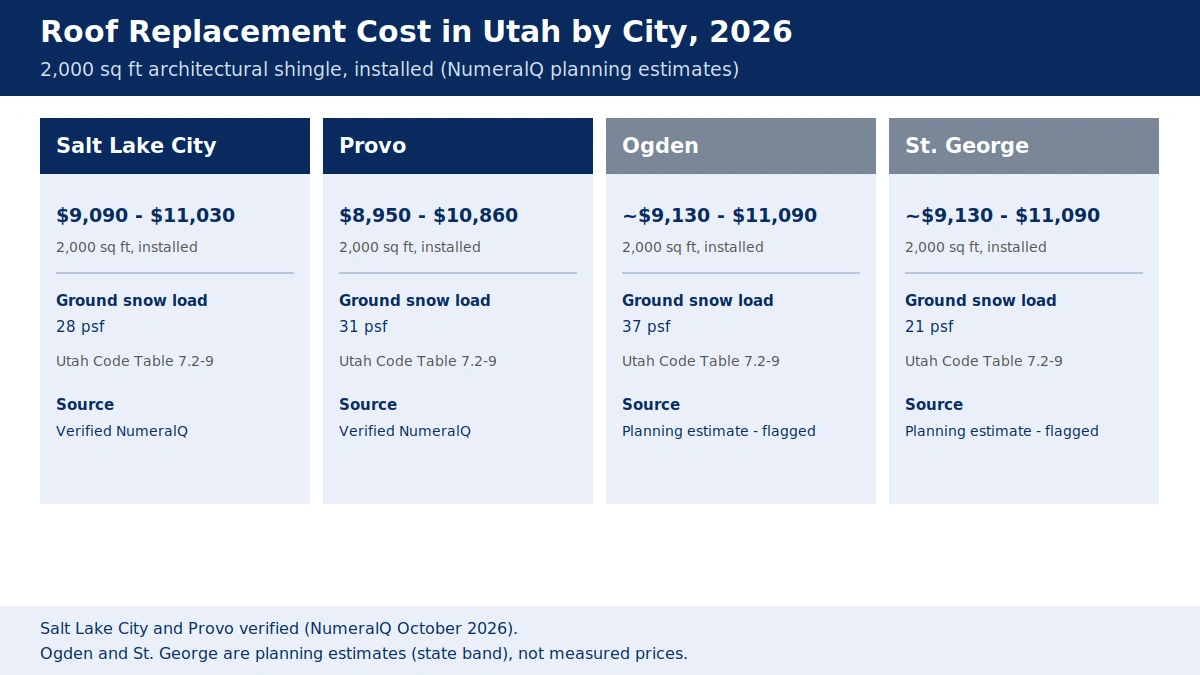
NumeralQ publishes verified city figures for Salt Lake City and Provo only. The Ogden and St. George figures below carry a planning-estimate flag, because no NumeralQ city page exists for either one.
| City | 2,000 sq ft architectural | Status | Ground snow load | Roofer median pay |
|---|---|---|---|---|
| Salt Lake City | $9,090–$11,030 | NumeralQ verified | 28 psf | $23.18/hr |
| Provo | $8,950–$10,860 | NumeralQ verified | 31 psf | $22.41/hr |
| Ogden | ~$9,130–$11,090 | Planning estimate (state band) | 37 psf | Not published |
| St. George | ~$9,130–$11,090 | Planning estimate (state band) | 21 psf | Not published |
Salt Lake City is the largest market, the oldest housing stock, and the most crowded field of roofers. The median home dates to 1965, about 65 percent of homes were built before 1980, and 134 roofing contractors work Salt Lake County, about 3.0 per 10,000 homes.
That density helps on price and timing, and it also means the license check matters more, not less. The city’s historic districts add a review step for re-roofs on contributing houses, covered in the permits section.
Provo is the cheapest verified market by a small margin, at $8,950–$10,860. The median home dates to 1983, about 46 percent of homes were built before 1980, and 66 roofing contractors work Utah County.
Provo’s snow load runs higher than Salt Lake City’s at 31 psf, and the city sits under the same canyon-wind exposure as the rest of Utah Valley. The $140 gap at the bottom of the band between Provo and Salt Lake City is noise, not a reason to shop across county lines.
Ogden carries the highest snow load of the four cities at 37 psf, and the hail record to match its bench position: 10 hail days since 2010 within 15 miles of the city center, with stones to 2 inches, against 3 hail days near Provo. A modeled HomeCostLens figure puts the Ogden average near $11,030 for a 2,200 sq ft home, inside a $9,030–$18,050 range.
Treat that figure as a model, not a measured price. The planning figure for an Ogden budget is the state band, $9,130–$11,090, with the snow-load and wind detailing priced on the bid.
St. George is the other Utah. The ground snow load drops to 21 psf, the July average high hits 102 degrees, and the state heat record of 117 degrees was set here in 1985. Tile dominates the new subdivisions, re-felt is a live option on older tile roofs, and a St. George contractor guide prices the average asphalt home at $7,000–$14,000 with whole-roof architectural ranges of $9,000–$16,000.
One regional guide puts St. George 3 to 6 percent under Wasatch Front pricing. Treat the state band as the planning figure and the contractor ranges as the cross-check, and get the tile-versus-shingle decision made before the first bid, since it changes the crew, the underlayment, and the permit.
Park City and the Wasatch Back sit outside the four-city table, and outside the state snow-load table too. One regional guide puts Park City and the high country 12 to 25 percent above Wasatch Front pricing, a single-source claim flagged here as such.
What is certain is the mechanism: site-specific snow loads, steeper pitches, cold-weather install rules, and resort-town labor all push the same roof higher. A Park City buyer should treat any valley-floor figure as a floor, not a budget.
Snow Load in Utah: What the Wasatch Front Roof Must Carry
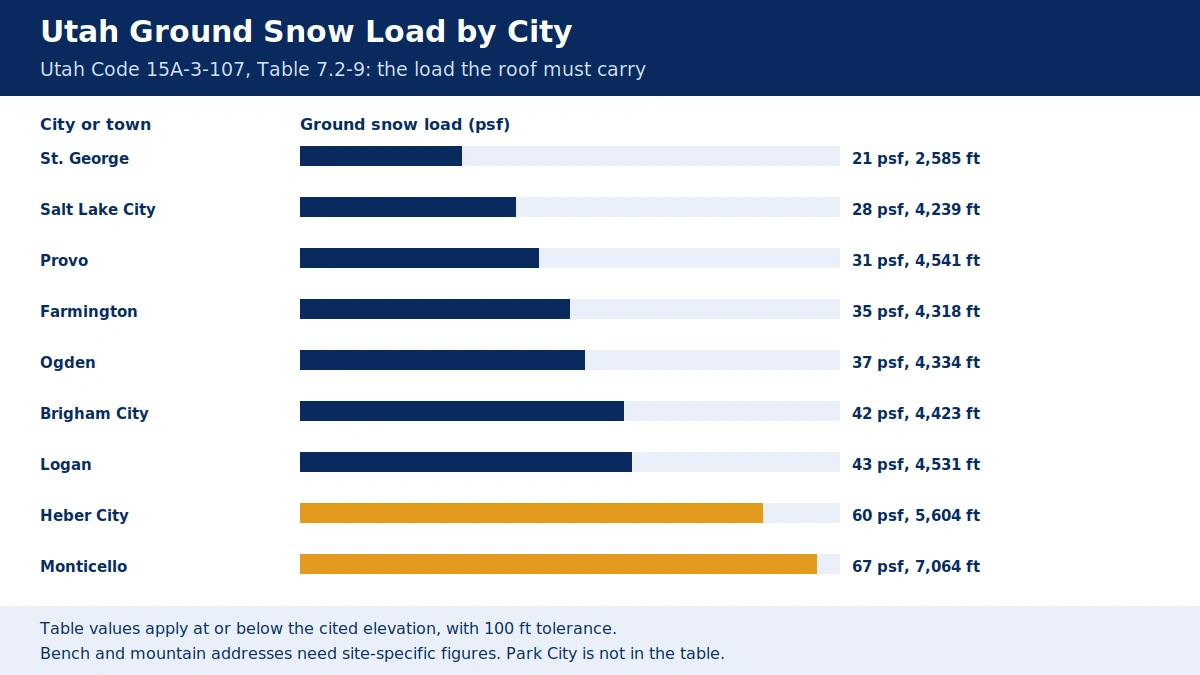
Snow load is the weight of snow a roof must be built to carry, measured in pounds per square foot, or psf. Utah writes its snow loads into state law: Table 7.2-9 of the state building code amendments lists a ground snow load for selected cities and towns, and the design roof load is derived from it.
Ground snow load is the weight of snow on flat ground. The roof load is smaller on a pitched roof, since some snow slides and some melts, but the ground figure is the number the code starts from.
| City or town | Ground snow load | Elevation |
|---|---|---|
| St. George | 21 psf | 2,585 ft |
| Salt Lake City | 28 psf | 4,239 ft |
| Provo | 31 psf | 4,541 ft |
| Farmington | 35 psf | 4,318 ft |
| Ogden | 37 psf | 4,334 ft |
| Brigham City | 42 psf | 4,423 ft |
| Logan | 43 psf | 4,531 ft |
| Heber City | 60 psf | 5,604 ft |
| Monticello | 67 psf | 7,064 ft |
The table makes the Utah split plain. St. George designs for 21 psf while Heber City designs for 60, and the Wasatch Front cities sit between 28 and 43.
Elevation drives the number, but not alone: Logan at 4,531 ft carries 43 psf while Provo at 4,541 ft carries 31, because Cache Valley holds colder air and deeper snow. The table value applies at and below the cited elevation, with a 100 ft tolerance, so a bench home hundreds of feet above the valley floor needs its own figure.
For a reroof, the snow load question is rarely about the frame, which was built to a load when the house went up. The question is what the new covering adds on top of the snow the frame already carries. A like-for-like shingle swap adds almost nothing.
A swap from shingles to tile adds roughly 6 to 8 psf of permanent dead load, which is why Salt Lake City demands an engineer report past 3 psf of added weight. A second layer of shingles adds weight too, and it hides the deck condition the snow load depends on.
Where ground snow loads pass 75 psf, the code adds an eave rule: overhangs must carry twice the flat roof snow load, and exits under down-slope eaves must be protected from sliding snow and ice. Few valley-floor homes hit that threshold, but bench and mountain homes can. Metal roofs shed snow in sheets, which makes the exit-protection rule a practical matter, not a paperwork one: snow guards and clear exit paths belong in the bid for any metal roof over a walkway or doorway in snow country.
Park City, the benches above the valley floor, and every town missing from the state table get their loads from the Utah Snow Load Study, published by Utah State University researchers and hosted at the Utah snow load site. The study, not the table, is the authority for those addresses.
A bid for a bench or mountain home should name the snow load it was designed to, and a bid that never mentions snow load on a bench address has skipped the question the address asks first. The full state table is published in Utah Code 15A-3-107.
Freeze-Thaw, Ice Dams & the Attic Above the Roof
An ice dam is a ridge of ice along the eaves that traps meltwater behind it and pushes the water back under the shingles. It forms when snow sits on the roof, heat escaping the house warms the deck above freezing, and the meltwater refreezes at the cold eave.
The Wasatch Front delivers that combination most winters. Daytime sun melts snow on the upper roof, freezing nights refreeze the runoff at the eaves, and the cycle repeats until the ridge grows thick enough to leak.
Bench homes and north-facing eaves suffer first. Davis County’s valley floor sees roughly 60 inches of snow in a winter, with up to 90 inches on the high benches, and lake-effect storms off the Great Salt Lake add to both.
North-facing eaves never see winter sun, so the meltwater refreezes there while the south side drains clean. Older homes suffer most of all, since their attics leak the most heat through unsealed gaps around lights, fans, hatches, and plumbing stacks.
The fix runs in an order, and the order matters more than any single step:
- Seal the air leaks into the attic first, since warm air leaking upward is the main heat source melting the snow
- Insulate second, on top of the seal, to slow the heat that remains
- Ventilate third, with balanced soffit intake and ridge exhaust, so outside air carries the leftover heat away and the deck stays near outdoor temperature
Heat cable along the eaves keeps a drain path open, and it manages the symptom well, but it never fixes the cause. A roofer who sells cable without looking in the attic is selling the second step first.
The code’s answer to ice dams is the ice barrier: a self-adhered membrane, often called ice and water shield, laid under the shingles at the eaves and in the valleys. The residential code requires an ice barrier where ice dams are a known problem, and Utah guides state the membrane must run from the eave edge to at least 24 inches inside the exterior wall line, with full valley coverage. The barrier limits damage when a dam forms anyway.
It does not stop the dam. Covering the whole roof in ice barrier instead of the eaves only costs $0.82–$1.33 per sq ft in Salt Lake City, and it suits low-slope roofs and chronic dam addresses, not every roof.
A reroof is the one moment when the attic and the roof can be fixed together, while the deck is bare and the crew is already there. Air sealing, insulation, and venting priced into the same job cost less than the same work as a separate visit, and the new roof’s warranty often assumes the ventilation it was designed with.
Pricing for the insulation half of the combined job is in our attic insulation cost guide. Ask the roofer to state the venting plan, the intake and exhaust areas, and whether any soffit vents are blocked by insulation, in writing, before the shingles go on.
Cold weather changes how shingles go on. At or below 40 degrees, the sealant strip on a shingle may not bond until warmer weather, so the manufacturer asks roofers to hand-seal shingles along the roof edges with dabs of roof cement.
Salt Lake City’s average high stays under 40 degrees in December and January, and Provo’s nights drop below 40 from November through April. A winter install is possible in Utah, and it needs those steps, a slower pace, and a crew that says so upfront instead of discovering it at the ridge.
Hail, Canyon Wind & the Class 4 Question in Utah
Utah hail is real, and it is rare. The two facts have to stay together, because the roofing market often states only the first. NOAA storm records for 2016–2025 list 14 reports of hail 1 inch or larger in Salt Lake County and 7 in Utah County, with zero reports of hail 2 inches or larger in either county.
Across the state, severe hail falls on about 4.9 days a year, and August carries the largest share. The largest hailstone ever documented in Utah measured 2 inches. FEMA rates hail risk Relatively Low in Salt Lake County and Very Low in Utah County.
Hail days near the cities tell the same story at street level. Since 2010, within 15 miles of the city center, Salt Lake City counts 23 hail days with stones to 1.75 inches, Ogden counts 10 with stones to 2 inches, and Provo counts 3 with stones to 1.75 inches. The August 13, 2024 storm dropped 1 to 1.75 inch hail across Orem, Lindon, and Lehi, with $50,000 in property damage listed at Lehi and $25,000 at Orem and Lindon.
Those are real losses on real roofs. They are also the exception in a state that ranks 44th of 50 for hail events.
Wind is the bigger Utah threat, and the record shows it plainly. Salt Lake County counts 150 damaging-wind reports in the same ten years that produced 14 large-hail reports, and Utah County counts 77 wind reports against 7 hail reports.
The September 8, 2020 downslope windstorm gusted to 99 mph on the northern Wasatch Front and 89 mph at the University of Utah, damaged roofs along the Front, heavily damaged at least 20 manufactured homes in Box Elder County, and killed one person. Downslope winds off the Wasatch come most often in winter, and canyon mouths in Sandy, Bountiful, and Ogden catch the worst of them.
Class 4 is the highest impact rating in the UL 2218 test, the standard that grades how well a roofing product resists hail. A shingle earns Class 4 by surviving repeated hits from a 2-inch steel ball dropped from 20 feet without cracking on the front or back. The rating measures impact only.
It says nothing about wind, and a Class 4 shingle with a weak wind warranty is still a weak shingle on a canyon-mouth roof. Read both ratings on every product, and read them as separate numbers.
The Class 4 upgrade costs $1,500–$4,000 over a standard architectural roof on a 25-square Utah County home, about 10 to 25 percent more, on one Utah contractor’s 2026 pricing. The same contractor prices the standard roof at $12,500–$18,000 and the Class 4 roof at $14,000–$22,000.
The payback runs through insurance: carriers commonly discount the wind and hail portion of the premium for a certified Class 4 roof, with contractor-reported discounts of 5 to 28 percent depending on the carrier. The discount applies to the wind and hail portion only, never to the whole premium.
Work the discount before believing it. On a $1,800 annual premium with roughly half attributable to wind and hail, a 20 percent discount saves about $180 a year, or about $3,600 over a 20-year roof life. Against a $1,500 premium, the discount alone pays back in about 8 years.
Against a $4,000 premium, it takes about 22 years. Those payback figures are arithmetic from the contractor’s example, not a promise from any carrier. Get the discount confirmed by the carrier in writing, with the Class 4 product certificate in hand, before signing for the upgrade, since carriers do not apply it automatically.
NumeralQ reaches the opposite verdict from the contractors: for most Utah homes, impact-resistant shingles are not worth it, because hail big enough to crack shingles is rare here. Both verdicts can be right. The hail record supports NumeralQ.
The discount math supports the upgrade for a buyer who stays 10 years or more, whose carrier confirms the discount, and whose shingle also carries the wind warranty the address needs. What the record does not support is buying Class 4 out of fear of Utah hail alone. Buy it for the discount and the tougher shingle, with the carrier’s confirmation in hand, or skip it and put the money into the wind warranty and the ice barrier.
On wind, Utah contractor guidance calls for shingles with a wind warranty of at least 130 mph along the Wasatch Front, and reinforced systems with 160 mph warranties at canyon mouths, installed with matching starter and ridge products. That guidance comes from contractors, not from the code, and it is flagged as such.
The code’s wind rules live in the local amendments and the manufacturer’s install instructions, which the permit desk and the inspector enforce. Six nails per shingle and sealed starter strips at eaves and rakes are the details inspectors check after the 2020 storm, so the bid should name the nailing pattern instead of leaving it to habit.
Wildfire & the WUI: Class A Roofs, HB 48 & the 2027 Code Change
The wildland-urban interface, or WUI, is the zone where homes meet wildland vegetation, and Utah’s 2025 fire season showed what that zone costs. The state counted 1,159 fires and 164,874 burned acres. The Forsyth Fire north of St. George burned 15,675 acres and destroyed 19 structures, 13 of them homes, in Pine Valley.
The Monroe Canyon Fire burned 73,721 acres and destroyed 19 structures, mostly cabins. The Deer Creek Fire burned 17,724 acres and destroyed 13 structures. FEMA rates wildfire risk Relatively High in both Salt Lake County and Utah County.
Embers ignite most homes in wildfires, not the flame front. That finding, from the National Fire Protection Association, is what makes the roof a fire decision. Embers land on the roof, lodge under loose shingles, enter through unscreened vents, and ignite debris in gutters.
A new roof is the moment to fix all of them: tight shingles, eave and attic vents screened with 1/8-inch metal mesh, and gutters that are easy to clear. The roof covering matters, and the vents and gutters matter as much.
House Bill 48, passed in 2025 and effective January 1, 2026, mapped the risk house by house. The state scored about 60,000 homes inside a high-risk WUI boundary, gave each lot a Structure Exposure Score, and opened free lot assessments. An annual per-structure fee starts in January 2027, running $20–$100 by square footage and moving to a triage-based structure in 2028.
Documented mitigation lowers the score and the fee, while refusing the free assessment lands the home in the highest tier. Insurers must use the high-risk boundary to identify properties, but the law does not require them to cut premiums for mitigation. Check any Utah address on the state’s wildfire risk portal before choosing a roof.
House Bill 41, passed in the 2026 session, adopts the 2024 International Wildland-Urban Interface Code from January 1, 2027, replacing the 2006 Utah WUI code. The new code sets roof rules by ignition-resistant construction class, and the roof rules bite at re-roof, not before: no existing sound roof must be torn off on January 1. Class 1 and Class 2 construction require a Class A roof assembly, tested to ASTM E108 or UL 790, with Class 2 also allowing an approved noncombustible covering.
Class 3 requires at least a Class B assembly or an approved noncombustible covering. The code applies only inside WUI areas a city or county designates, and local governments get two years from state adoption to adopt it locally.
Class A is a rating for the roof assembly, not for a shingle alone. The test burns the assembly as installed, with its underlayment and deck, and grades how far fire spreads and whether burning brands penetrate. Most architectural shingles, metal roofs, and tile roofs carry Class A assemblies when installed to the manufacturer’s instructions.
Untreated wood shakes do not. A product sheet that claims Class A for the shingle without naming the assembly should be read twice, and the installer should confirm the assembly rating in writing.
Two more Utah rules shape the WUI roof decision. An HOA may not prohibit, unreasonably restrict, deny, or delay a plan for including a fire-resistant material, including Class A roofing and metal roofing, in an area with heightened wildfire risk, under Utah Code 57-8a-109. And Salt Lake City flags WUI parcels at the permit desk, with about 917 parcels in areas like Capitol Hill, the Avenues transition area, the University and upper East Bench, and the Red Butte and Emigration Creek corridors covered by its draft ordinance.
Centerville has already adopted the 2024 code by ordinance. Ask the permit desk whether the address sits in a designated WUI area before the material decision is final, since the answer changes what the roof must be.
Asphalt vs Metal vs Tile in Utah: The Lifetime Math
The cheapest roof to buy is rarely the cheapest roof to own, and Utah’s weather stretches the gap. Asphalt wears faster under high-altitude sun and freeze-thaw. Metal sheds snow and carries a Class A assembly, but costs twice as much upfront.
Tile lasts the longest and weighs the most. The table below prices all three over time, using Salt Lake City midpoints and stated life assumptions, so the comparison is arithmetic, not advertising.
| Material | SLC midpoint, 2,000 sq ft | Assumed life | Cost per year | Roofs in 50 years |
|---|---|---|---|---|
| Architectural asphalt | ~$10,060 | 22 years | ~$457 | 3 (2 replacements) |
| Standing-seam metal | ~$25,285 | 45 years | ~$562 | 2 (1 replacement) |
| Concrete tile | ~$21,595 | 50 years | ~$432 | 1 |
| Exposed-fastener metal | ~$16,035 | 30 years | ~$535 | 2 (1 replacement) |
| 3-tab asphalt | ~$8,330 | 17 years | ~$490 | 3 (2 replacements) |
The assumed lives need their sources stated. Architectural asphalt at 22 years sits at the middle of the 18 to 25 year Salt Lake City contractor range. Standing seam at 45 years sits at the middle of the 40 to 55 year contractor range.
Concrete tile at 50 years uses the 50-plus figure the same guide states. Exposed-fastener metal at 30 years and 3-tab at 17 years are planning assumptions, flagged here as such, since no published Utah source gives lives for those two. Midpoints are the middle of the NumeralQ Salt Lake City bands, and the per-year figures divide the midpoint by the assumed life.
At today’s prices, tile wins the per-year comparison, asphalt comes second, and standing seam costs the most per year despite lasting twice as long. Two architectural roofs at today’s prices cost about $20,120 across 44 years, against $25,285 for one standing-seam roof across 45 years.
The metal roof costs about $5,165 more over that span, and it buys snow shedding, a Class A assembly, and no second tear-off. Whether that premium is worth it depends on the address: a WUI bench home values the fire rating, a St. George home values the tile life, and a valley-floor home with a 10-year hold values the lower upfront cost.
Inflation changes the answer, and it changes it in metal’s favor. If roofing prices rise 3 percent a year, the second architectural roof in 22 years costs about $19,275 instead of $10,060, and the two-roof total reaches about $29,335, past the standing-seam midpoint.
That figure is arithmetic on a stated assumption, not a forecast, and the assumption should be argued with, not accepted. What it shows is the shape of the decision: the longer the buyer stays, and the faster prices rise, the stronger the case for buying the long-lived roof once.
Tile’s case has a condition the table cannot show: the frame must already carry it, or be checked and strengthened first. On a house built for tile, the re-felt option makes tile cheaper still, since the tile itself is reused and only the underlayment is replaced. On a house built for shingles, the engineer report and any strengthening sit on top of the tile midpoint, and the per-year figure rises.
Metal’s case has a condition too: snow guards over entries and walkways, and a crew that details valleys and penetrations for a roof that moves with temperature. Our metal roof vs shingles comparison takes the two materials apart feature by feature for buyers still weighing them.
Permits & Code in Utah: The Reroof Permit, the 3-Pound Rule & the Two-Layer Limit
Utah permits the job locally and licenses the roofer at the state level, and the buyer has to check both. The permit proves the work was inspected.
The license proves the contractor is allowed to do it. A job with one and not the other is half done, and the missing half surfaces at resale, at an insurance claim, or at the first leak after a storm.
Salt Lake City Building Services requires a permit to reroof a structure. The rule comes from the city’s Re-Roofing Questionnaire, posted April 23, 2026. If the added roofing weight passes 3 pounds per sq ft, the city requires an evaluation report from a licensed Utah engineer.
That threshold is the tile-conversion rule in practice: a shingle-to-tile swap adds roughly 6 to 8 psf, so it always triggers the report, while a like-for-like shingle swap never does. The questionnaire also asks about layers, decking, and the roofing type, so the permit application itself forces the questions a good bid should already answer.
Other jurisdictions run their own desks, and the rules vary by city. The Greater Salt Lake Municipal Services District, which covers unincorporated Salt Lake County, requires a building permit for a reroof or reshingle. South Jordan requires a residential building permit for full tear-off replacements, pulled by the contractor, posted on site, with a final inspection to close it.
Ogden requires a roofing permit, typically $150–$350 on a modeled figure, usually pulled by the contractor. St. George requires a city permit for full replacements, pulled by the contractor, with no verified fee found. Salt Lake City and Provo publish no priceable permit fee for a $15,000 job, so no fee is stated for either city here.
The two-layer limit is the rule that decides tear-off. The residential code bans a third layer of roofing, so a house carrying two layers already must have both stripped to the deck before the new roof goes on. The median Salt Lake City home has likely been roofed twice, which makes the layer count a real question on most city bids.
Extra-layer removal costs $1.15–$1.51 per sq ft in Salt Lake City, and decking replacement runs $55.55–$81.24 per sheet. Chimney and wall flashing runs $296–$429 each, re-flashing a skylight runs $449–$579 each, and seamless aluminum gutters run $7.49–$10.84 per linear ft. All five figures belong in the bid as unit prices, so the final count is measured, not argued.
Historic districts add a review step in Salt Lake City. Within a local historic district or on a landmark site, owners must contact Planning before applying for a building permit, and a Certificate of Appropriateness is required. Re-roofing can get walk-in staff approval as a minor alteration, while major alterations go to the Historic Landmark Commission with a public hearing.
Nine local landmark districts exist, including the Avenues, Capitol Hill, South Temple, Central City, University, and Yalecrest. A contributing house in one of those districts should have its material and color checked with Planning before the bid is final.
The inspection closes the permit, and the closed permit protects the resale. A final inspection by the city confirms the work meets the code, and the record follows the house.
Carriers commonly expect a permit number before releasing final replacement-cost payment on an insurance job, a practice reported by storm-damage guides rather than a statute, flagged here as such. Confirm the permit number before the crew leaves, keep the closed permit with the house papers, and treat a contractor who suggests skipping the permit as a contractor to walk away from.
Hiring a Roofer in Utah: The DOPL S280 License & the Lien Fund Warning
Utah licenses roofers at the state level through the Division of Occupational and Professional Licensing, known as DOPL, inside the Department of Commerce. The specialty classification is S280 Roofing Contractor, covering asphalt, tile, slate, shakes, shingles, metal systems, and membrane work above the deck. A B100 General Building license or an R100 Residential and Small Commercial license also covers roofing.
The governing law is the Utah Construction Trades Licensing Act, Title 58 Chapter 55, with the implementing rules in R156-55a. Look any contractor up on the state’s license lookup before signing anything.
The specialty path centers on a 25-hour pre-licensure course from an approved provider, plus a passing score on the Utah Contractor Business and Law exam, with a 70 percent pass mark. No division-administered trade exam is required for S280 under current guidance, and the statute states that no employment experience is required for specialty licensure, a point older guides dispute by claiming two years. The statute version is stated here, and the conflict is flagged in the QC log.
The contractor must carry general liability insurance of at least $1,000,000 per occurrence, with DOPL as certificate holder, and workers compensation coverage where employees are involved. No universal license bond exists; a bond is conditional, required only when financial-responsibility triggers are present.
The license threshold catches nearly every full replacement. Work valued at $7,000 or more, labor and materials combined, requires a licensed contractor. Work from $3,000 to under $7,000 requires a filed handyman affirmation with DOPL, and work under $3,000 is exempt.
A full roof replacement at Utah prices always passes $7,000, so an unlicensed crew offering a full reroof is offering illegal work, however good the price looks. The threshold comes from a 2024 amendment effective May 7, 2025, and it is the simplest test in this section: if the job costs $7,000 or more, the crew must be licensed.
Storm-chaser crews follow hail the way adjusters follow claims, and Utah’s August hail peak brings them north every year. The test is short, and every item can be checked before money moves:
- Active DOPL license in S280, B100, or R100, verified on the state lookup, with the business name matching the contract exactly
- A Utah business address and a local phone number that answers, not a hotel room and a temporary number
- No offer to rebate, waive, or absorb any part of the insurance deductible, which state law bars
- A written contract with the full scope, the material names, the unit prices for decking and extra layers, and the permit responsibility stated
- No demand for full payment upfront, and no pressure to sign on the doorstep the day after a storm
- Proof of liability insurance and workers compensation, with certificates in hand before the crew climbs the ladder
Utah runs a Residence Lien Recovery Fund, and the fund carries a warning. DOPL’s own FAQ states the fund is at or near depletion and claims will likely not be paid. The protection that survives is procedural: a homeowner who signed a written contract with a licensed contractor and paid in full can get a Certificate of Compliance that blocks liens, under Utah Code 38-11-107 and 38-11-204.
Subs and suppliers file preliminary notices through the State Construction Registry, and on a roof job the shingle distributor and any subcontracted crew are the parties most likely to send one. Pay by check or card, never cash, so every payment can be proved later. Bring the interview list in our questions to ask a roofer guide to the first meeting.
Insurance in Utah: Deductibles, ACV vs RCV & the Five-Day Cancel Right
Utah law protects the homeowner after a storm in Title 13 Chapter 50, the Residential Construction Contracts Act. The deductible rule. Since 2020, a residential contractor may not rebate or offer to rebate any portion of an insurance deductible as an inducement to a sale, under Section 13-50-302. Every contract, estimate, or work order paid from insurance proceeds must carry the violation notice in capitalized 14-point type, stating that the policyholder is personally responsible for the deductible.
A roofer who offers to “cover” or “waive” the deductible is offering to break Utah law, and the discount comes out of the job, not out of the roofer’s pocket. The full statute text is published in the Utah Code.
The cancel right. If the contractor knew or should have known that insurance would pay for some or all of the work, and the insurer denies any part of the claim, the homeowner may cancel the contract within five business days after receiving the written denial notice. The contractor must return all payments within 10 business days, except the reasonable value of work actually performed where the owner expressly told the contractor to proceed before the coverage decision.
The contract must carry the cancel notice and a detachable cancellation form, with the contractor’s mailing address stated. That five-day clock is the reason to open every insurer letter the day it arrives.
Assignment of benefits. A post-loss assignment to a contractor must include an itemized description of the work, the total agreed amount, a statement that the contractor has made no assurance the insurer will fully cover the loss, and a capitalized 14-point notice that the homeowner is giving up certain policy rights. An assignment that violates the part is void.
Since May 2026, a property policy may prohibit assignment to a contractor outright, under Section 31A-26-403.1. Read the policy’s assignment language before signing any assignment form, and never sign one at the door.
ACV and RCV decide what the insurer pays, and the difference is the depreciation. ACV, or actual cash value, pays the replacement cost minus depreciation for the roof’s age and wear. RCV, or replacement cost value, pays the full cost to replace with like kind and quality, usually in two checks: the ACV amount first, then the recoverable depreciation after the work is done and documented.
A 15-year-old shingle roof on an ACV policy may recover only a fraction of the replacement cost, while the same roof on an RCV policy recovers the full cost minus the deductible. The declarations page states which basis applies, and it should be read before the adjuster visit, not after.
Matching is the question with no Utah answer. No Utah statute governing shingle matching was found, so no matching rule is stated here. The policy’s own language, and the adjuster’s position on it, decide whether undamaged slopes are replaced to match the damaged ones.
Get the adjuster’s matching position in writing, with the policy language cited, and get the contractor’s scope matched to the adjuster’s scope line by line. Supplements for decking, ice barrier, and code upgrades are common on Utah claims, and each one needs photos and a written basis before the carrier pays it.
The deductible itself is the one number this section cannot state. No verified Utah-typical wind or hail deductible figure was found, and policies vary between flat amounts and percentages of the insured value.
Read the declarations page for the wind and hail deductible specifically, since it often differs from the standard deductible. Budget the deductible as cash out of pocket, since the law bars the contractor from absorbing it, and since the insurer deducts it from the first check either way.
Paying for a Utah Roof in 2026: $0 Federal Credit, HEAR on Hold & Getting Quotes
The federal picture for a 2026 Utah roof is short. Both federal credits for roof work ended under the One Big Beautiful Bill Act, Public Law 119-21: the Section 25C energy efficient home improvement credit and the Section 25D residential clean energy credit stop for property placed in service after December 31, 2025, as the IRS confirmed in Fact Sheet FS-2025-05. For a roof installed in Utah in 2026, the federal tax credit is $0.
The federal government contributes $0, and no roof covering qualified as a credit measure in any case. A quote that subtracts a federal credit from a 2026 roof is built on rules that no longer exist. The lease pass-through and every other surviving federal provision are detailed in our federal energy tax credits guide.
The federal home energy rebates have not launched in Utah. The HEAR and HOMES programs, funded by the Inflation Reduction Act and run state by state, sit on hold until further notice at the Utah Office of Energy Development, because the Energy Department has not approved Utah’s application. About $101 million is allocated to the state, and none of it buys a rebate a homeowner can claim today, with no launch date posted.
The status was re-checked November 9, 2026, and it had not changed. Work completed before any launch will not qualify retroactively.
Even after launch, the rebates would not pay for a roof. HEAR, renamed the High-Efficiency Electric Home Rebate program in May 2026, pays for efficient electric appliances, insulation, air sealing, wiring, and panel work, not for roof coverings.
HOMES pays on modeled whole-home energy savings of 20 percent or more, so insulation and air sealing done alongside a reroof could count inside a HOMES package once the program exists, while the roof itself would not. No quote should subtract HEAR or HOMES money from a roof price in 2026, and no buyer should wait for either program to fund a roof that leaks now.
Utah adds no statewide roof grant on top. NumeralQ checked in October 2026 and found none, and no FORTIFIED-style state roof grant program was found for Utah.
What survives is carrier-specific: discounts for Class 4 roofs and wildfire mitigation, claimed from the insurer with certificates in hand, and the HB 48 fee reduction for documented mitigation in mapped areas. Price the job on cash, financing, and insurance proceeds, and treat every discount as unconfirmed until the carrier confirms it in writing.
Financing fills the gap for buyers who cannot pay cash, and the options are the standard ones: contractor financing, a home equity line or loan, and a personal loan. No Utah-specific rates were verified, so no rate is stated here.
Compare the total cost of the loan, not the monthly payment alone, and never let a financing offer rush the material decision or the license check. Our roof financing guide works through the options and the traps in each one.
Timing helps the budget more than any discount. July and August are the driest months in Salt Lake City and Provo, with the fewest rain delays, while December and January bring the cold-weather install rules and a slower pace.
Shoulder-season bookings in spring and fall often find crews with more room in the schedule. A planned replacement booked ahead costs less in stress than an emergency replacement booked after a leak, even at the same price.
Get three licensed contractors to price the same scope on one identical spec sheet, with every item below in writing, before signing anything:
- Measured roof area, slope, square count, and included planes, with the measurement sheet attached
- Material named by brand, line, color, and ratings (Class 4 impact rating and wind warranty where claimed; Class A assembly rating in a WUI area)
- Tear-off layers, disposal, and the unit price for extra-layer removal and decking sheets
- Ice barrier coverage stated (eaves and valleys at minimum, with the 24-inch rule named), underlayment named, flashing and venting itemized
- Snow load and WUI status confirmed with the permit desk, and the engineer report priced where the added weight passes 3 psf
- Permit responsibility named, with the permit number confirmed before the crew leaves and the final inspection scheduled
- License verified on the DOPL lookup (S280, B100, or R100), insurance certificates in hand, and no deductible rebate offered or accepted
- Cash price in writing for the same scope ($9,130–$11,090 statewide anchor for 2,000 sq ft architectural; $11,270–$13,650 for the 25-square planning roof)
- No line for a federal credit, no line for a HEAR or HOMES rebate, and no line for a state roof grant ($0 federal; HEAR and HOMES on hold; no statewide grant)
- Insurance scope matched line by line where a claim pays for the work (ACV vs RCV basis, deductible amount, cancel notice and assignment terms in the contract)
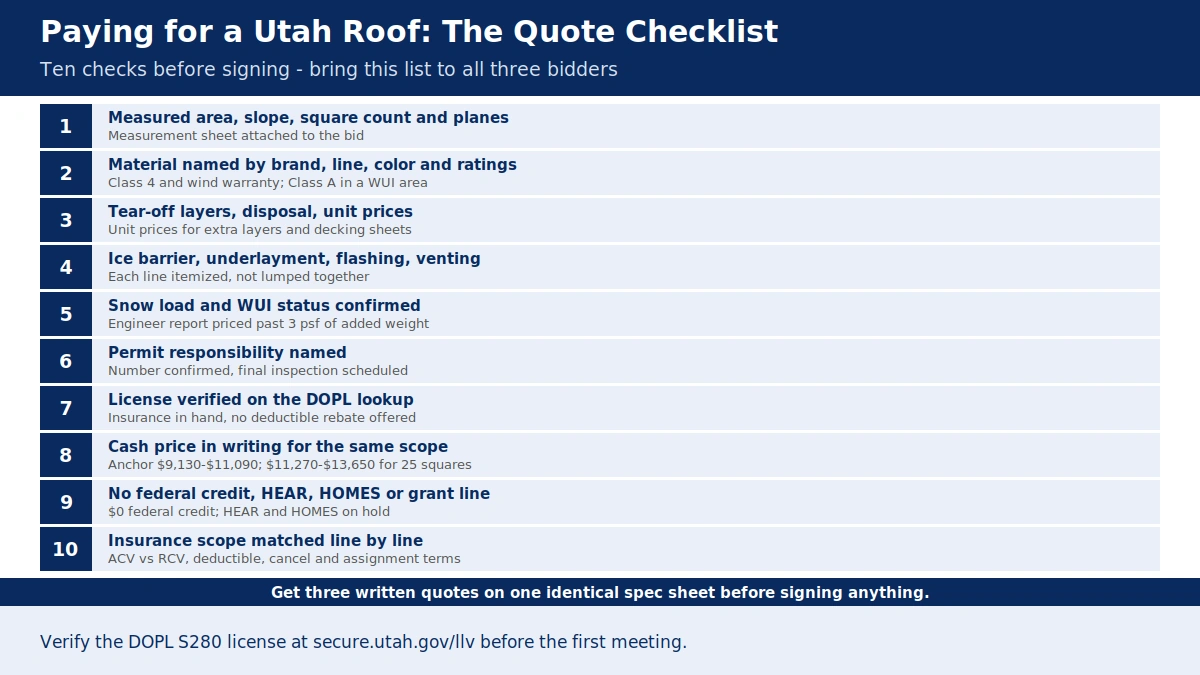
Get three written quotes on one identical spec sheet before signing anything. A low bid that leaves the ice barrier or the decking out costs more once the roof is open. The best quote names the material, shows the measurement, itemizes the extras, proves the license, and prices the roof the address actually needs, from the snow load on the bench to the ember screen on the vent.
Sources & methodology Installed costs:
- NumeralQ, Roof Replacement Cost in Utah (2026), estimator pricing as of Oct 26, 2026 (planning estimates, not contractor bids): statewide architectural by size 1,000 sq ft $4,840–$5,950, 1,500 sq ft $6,980–$8,520, 2,000 sq ft $9,130–$11,090, 2,500 sq ft $11,270–$13,650, 3,000 sq ft $13,420–$16,220; 3-tab $7,680–$9,050; natural slate $30,760–$60,860; national 2,000 sq ft $9,710–$11,840
- NumeralQ, Roof Replacement Cost in Salt Lake City, UT (2026), pricing Oct 26, 2026: by size 1,000 sq ft $4,820–$5,930 to 3,000 sq ft $13,360–$16,140; full material table for a 2,000 sq ft job (3-tab $7,650–$9,010 through natural slate $30,620–$60,670); add-ons (extra layer $1.15–$1.51/sq ft, decking $55.55–$81.24/sheet, whole-roof ice barrier $0.82–$1.33/sq ft, gutters $7.49–$10.84/linear ft, flashing $296–$429, skylight re-flash $449–$579)
- NumeralQ, Roof Replacement Cost in Provo, UT (2026), pricing Oct 26, 2026: by size 1,000 sq ft $4,750–$5,840 to 3,000 sq ft $13,160–$15,880; full material table for a 2,000 sq ft job (3-tab $7,560–$8,890 through natural slate $30,120–$60,020); add-ons about 2% under Salt Lake City
- 360 Roofing, Roof Replacement Cost in Utah: 2026 Prices (updated Oct 9, 2026, contractor installed prices): architectural $9,500–$15,500 for 2,000 sq ft ($475–$775/square); designer $13,000–$21,000 ($650–$1,050/square); standing seam $18,000–$32,000 ($900–$1,600/square)
- Red Rock Roofing, Roof Replacement Cost in St. George, UT (Aug 2026): architectural $450–$750/square, $9,000–$16,000 whole roof; tile re-felt $550–$900/square, $11,000–$20,000; new concrete tile $900–$1,500/square, $18,000–$30,000+; standing seam $900–$1,600/square; average asphalt home $7,000–$14,000; decking $80–$150/sheet; typical home 20–30 squares
- SmartRoofingCalculator, Utah Roof Replacement Cost (Apr 24, 2026, planning estimates): architectural $430–$620/square, standing seam $850–$1,330/square, tile $1,140–$1,710/square; 25-square roof $10,750–$15,500; permit planning average ~$220
- MyRoofData, Roof Replacement Cost in Utah (2026 model): typical home $12,500–$21,750; architectural $441–$735/square before tear-off; tear-off $100–$200/square/layer; crews $52–$88/hr
- Instant Roofer, Utah Roof Statistics (2026, contractor pricing in app): average $14,916, average roof 2,620 sq ft (26 squares), $5.69/sq ft; Ogden $14,961, Provo $14,528, St. George $14,528
- HomeCostLens (cost data reviewed Sept 2026, modeled): Salt Lake City 2,200 sq ft home ~$11,100 average, $9,080–$18,160 range; Ogden ~$11,030 average, $9,030–$18,050 range; Ogden permit typically $150–$350
- Phoenix Exteriors, Class 4 Shingles in Utah (Apr 12, 2026): 25-square home standard architectural $12,500–$18,000, Class 4 $14,000–$22,000, premium $1,500–$4,000 (10–25%); carrier discount ranges contractor-reported
- Heaton Bros Roofing, Utah Roof Replacement Cost (2026): most homes $8,000–$25,000, statewide average ~$10,008; asphalt life as little as 20 years in northern Utah; wind warranty guidance 130 mph Wasatch Front, 160 mph canyon mouths (contractor guidance)
- bestroofingestimates, Utah guide: St. George 3–6% under Wasatch Front, Park City / Wasatch Back +12–25% (single source, flagged in draft)
- utahbusinessesnearme, Salt Lake City guide (Oct 13, 2026): architectural $425–$575/square, standing seam $950–$1,500/square, concrete tile $800–$1,200/square; lifespans architectural 18–25 years, standing seam 40–55, concrete tile 50+
Labor and housing:
- BLS OEWS May 2025 via NumeralQ: Utah roofers median $23.40/hr, billed $47–$61/worker-hour; Salt Lake City-Murray median $23.18/hr, billed $46–$60 (13% below US median); Provo-Orem-Lehi median $22.41/hr, billed $45–$58 (16% below US median)
- Census ACS 2020–2024 via NumeralQ: Salt Lake City median home built 1965, 65% built before 1980, median value $539,500, 47% one-unit houses; Provo median home built 1983, 46% built before 1980, median value $467,200, 48% houses; Census County Business Patterns 2023: 134 roofing contractors Salt Lake County (3.0 per 10,000 homes), 66 Utah County (3.1 per 10,000 homes)
Snow, climate, and code:
- Utah Code 15A-3-107, Table 7.2-9 (ground snow loads): Salt Lake City 28 psf at 4,239 ft, Ogden 37 psf at 4,334 ft, Provo 31 psf at 4,541 ft, St. George 21 psf at 2,585 ft, Farmington 35, Brigham City 42, Logan 43, Heber City 60, Monticello 67; eave rule above 75 psf (2x flat roof snow load); Bean, Maguire, Sun (2018) Utah Snow Load Study for other locations
- NOAA normals via NumeralQ: Salt Lake City ~51.9 in snow/year, 15.5 in precipitation; Provo ~44.9 in snow, 17.2 in precipitation; Davis County ~60 in valley floor, up to 90 in benches (Denali Roofing, citing county figures)
- 2021 IRC R905.1.2 (ice barriers) and R908.3 (roof recover limits, two-layer maximum); ice barrier 24 inches inside the exterior wall line per Utah contractor and city guides (Heaton; South Jordan)
- Owens Corning Technical Bulletin TB-10022497-A (cold weather install, hand-seal at or below 40F); Salt Lake City average high under 40F in December–January, Provo nights below 40F November–April (NOAA normals via NumeralQ)
- Manual J design temperatures via art 93 research: Salt Lake City 14F winter / 95F summer; St. George July average high 102F, state record 117F July 5, 1985 (WeatherSpark / city-data.com via art 93 research)
- Eagle Roofing specifications via SimplyWise: Capistrano concrete tile 900 lb/square standard, 570 lightweight; standard concrete tile 900–1,200 lb/square; architectural asphalt roughly 250–400 lb/square
Storms, hail, and wind:
- NOAA Storm Events Database 2016–2025 via NumeralQ: Salt Lake County 14 reports of 1 in+ hail, 0 of 2 in+, 150 damaging-wind reports; Utah County 7 reports of 1 in+, 0 of 2 in+, 77 wind reports; 0 tornado reports in either county
- NOAA SPC 1996–2025 counted by mywild.report: 148 severe hail days, 258 reports, 4.9 days/year; August peak (50 days); June–August 76% of 1 in+ reports since 2016 (NumeralQ); Mapscaping / NOAA SPC 1955–2024: 576 events, largest 2 in, rank 44 of 50
- Cloudbreak / NOAA SPC hail history through Nov 11, 2026: hail days within 15 miles since 2010, Salt Lake City 23 (max 1.75 in), Ogden 10 (max 2 in), Provo 3 (max 1.75 in); 2024 Utah hazard mitigation plan: 30 hail events with recorded damage 1955–2022
- NOAA Storm Events via Cloudbreak: Sept 8, 2020 downslope windstorm, gusts 99 mph northern Wasatch Front, 89 mph University of Utah, $4.3M property damage per area; Aug 13, 2024 hail, $50,000 Lehi, $25,000 Orem and Lindon
- FEMA National Risk Index: Salt Lake County hail Relatively Low, wildfire Relatively High; Utah County hail Very Low, wildfire Relatively High
Wildfire and WUI:
- 2025 Utah wildfires: 1,159 fires, 164,874 acres (season summary via Wikipedia); USU Extension (Jan 2026): Forsyth Fire 15,675 acres, 19 structures, 13 residences; Monroe Canyon Fire 73,721 acres, 19 structures, mostly cabins; Deer Creek Fire 17,724 acres, 13 structures
- HB 48 (2025, effective Jan 1, 2026): ~60,000 homes in high-risk WUI boundary, Structure Exposure Score, free assessments, fee $20–$100 by square footage from Jan 2027 (Salt Lake Tribune Aug 3, 2026, via liveinsurancenews, secondary); map at wildfirerisk.utah.gov (Utah Wildfire Risk Assessment Portal)
- HB 41 (2026): adopts 2024 IWUIC effective Jan 1, 2027; Class A assembly for Classes 1–2 (IWUIC 504.2/505.2), Class B minimum for Class 3 (506.2), re-roof trigger (507.1), 2-year local adoption window (thenewroofguys analysis of enrolled bill, secondary); Centerville Ordinance 2026-09; Salt Lake City draft ordinance ~917 parcels
- Utah Code 57-8a-109 (Ch. 226, 2025): HOA may not bar fire-resistant materials including Class A roofing in heightened wildfire risk areas
- NFPA, Preparing Homes for Wildfire: embers ignite most homes; 1/8-inch metal mesh on vents; UL 2218 Class 4 test (2-inch steel ball, 20 ft drop); ASTM E108 / UL 790 assembly fire tests
Licensing, permits, liens, and insurance law:
- Utah Construction Trades Licensing Act, Title 58 Chapter 55; R156-55a; S280 Roofing Contractor (B100/R100 also cover roofing); 25-hour pre-licensure course; Business and Law exam 70% pass; liability insurance $1,000,000 per occurrence, DOPL as certificate holder; conditional bond under R156-55a-602; $7,000 license threshold (HB 483, effective May 7, 2025); lookup at secure.utah.gov/llv
- Salt Lake City Building Services, Re-Roofing Questionnaire (posted Apr 23, 2026): permit required to reroof; added weight over 3 psf requires a licensed Utah engineer evaluation report; permit fees for Salt Lake City and Provo not published (NumeralQ, Oct 2026)
- Greater Salt Lake Municipal Services District FAQ: reroof/reshingle requires a building permit; South Jordan city guide: permit for full tear-off replacements; Salt Lake City Historic Preservation: Certificate of Appropriateness, 9 landmark districts, walk-in staff approval for re-roofing
- Utah Code 38-11-107 and 38-11-204 (Residence Lien Recovery Fund, Certificate of Compliance); 38-1a-501 (State Construction Registry); DOPL fund FAQ (fund at or near depletion, checked Nov 10, 2026, via NumeralQ)
- Utah Code Title 13 Chapter 50 (Residential Construction Contracts Act; HB 199, 2020): 13-50-202 (5-business-day cancel right, 10-day refund), 13-50-203 (required cancel notice), 13-50-301 (post-loss assignment), 13-50-302 (deductible rebate ban), 13-50-303 (capitalized 14-point notice), 13-50-304 (violating assignment void); Utah Code 31A-26-403.1 (Ch. 45, 2026; policies may prohibit assignment)
Federal and state programs:
- OBBBA P.L. 119-21; IRS FS-2025-05 (§25C/§25D $0 after Dec 31, 2025)
- HEAR/HOMES: ~$101M combined allocation (DOE dataset: HEEHR $50,403,030, HOMES $50,595,872); Utah Office of Energy Development program on hold until further notice, DOE approval pending, no launch date (checked Nov 9, 2026); DOE Program Notice 26-2 (May 29, 2026, HEAR renamed HEEHR, electric-to-electric only, no fuel switching)
- NumeralQ: no statewide roof grant in Utah (checked Oct 2026); InterNACHI life expectancy chart (asphalt shingles 20–30 years, national)
Lifetime and payback arithmetic (NestPriced arithmetic on stated assumptions):
- Salt Lake City midpoints: architectural ~$10,060, standing seam ~$25,285, concrete tile ~$21,595, exposed-fastener metal ~$16,035, 3-tab ~$8,330; assumed lives 22 / 45 / 50 / 30 / 17 years; cost per year ~$457 / ~$562 / ~$432 / ~$535 / ~$490; two architectural roofs at today’s prices ~$20,120 over ~44 years; second roof at 3% annual price growth ~$19,275, two-roof total ~$29,335
- Class 4 discount example (Phoenix Exteriors example): $1,800 premium, ~$900 wind/hail portion, 20% discount = ~$180/year; premium $1,500–$4,000 pays back in ~8–22 years on the discount alone
- 25-square products from contractor per-square rates: 360 Roofing architectural $475–$775/square = $11,875–$19,375; standing seam $900–$1,600/square = $22,500–$40,000
EXCLUDED:
- Ogden and St. George NumeralQ prices: no NumeralQ city pages exist; city figures are planning estimates plus contractor/model ranges, flagged in the draft
- Park City prices: no verified price found; the 12–25% premium is a single-source claim, flagged
- Salt Lake City, Provo, and St. George permit fees: not published or not found; no fee stated
- Utah-typical wind/hail deductible amounts: none verified; no figure stated
- Utah matching statute: none found; no matching rule stated
- Utah statewide roof grant / FORTIFIED grant: none found
- DOPL insurance aggregate ($2,000,000 per DOPL form vs $3,000,000 per R156-55a-302d amendment): conflicting sources; draft states the per-occurrence figure and the form aggregate, flagged in the QC log
- S280 experience requirement (statute: none required for specialty, vs older guides: 2 years): conflicting sources; draft states the statute version, flagged in the QC log
- Snow guard prices, heat cable prices, tile engineer-report fees, Utah sales tax treatment of roofing jobs: no Utah-verified figures found; no figures stated
- Forsyth Fire structure count: USU Extension (19 structures, 13 residences) used; Wikipedia incident page (14 residential + 4 outbuildings) conflicts, noted here only
- Heaton claim of a 10–15% Salt Lake City labor premium: conflicts with the BLS flat-pay finding; not used
- Any federal credit, HEAR rebate, HOMES rebate, or state grant subtracted from a 2026 roof price: $0 federal, HEAR/HOMES on hold, no grant found, and roof coverings are not a HEAR measure
Disclaimer: The prices here are 2026 Utah planning figures. What you end up paying moves with the city, the roof size and slope, the material, the snow load, the layers under the old roof, and the contractor. Get written quotes from three licensed Utah roofers before settling on a budget, and check the license yourself on the DOPL lookup before anyone climbs the ladder.
Nothing here is tax advice for your own return. Program rules change, so confirm current terms with the Utah Office of Energy Development and your insurer before signing, and note that Utah’s HEAR and HOMES programs are on hold with no launch date posted.
How much does a roof replacement cost in Utah in 2026?
A 2,000 sq ft architectural shingle roof costs $9,130–$11,090 installed in Utah in 2026, on NumeralQ planning estimates priced in October 2026. Salt Lake City runs $9,090–$11,030 and Provo runs $8,950–$10,860 for the same job, while a 25-square roof runs $11,270–$13,650 statewide. Real contractor bids often land above the model band, so collect three written quotes on one identical scope before budgeting.
How much does a roof replacement cost per square in Utah?
One square covers 100 sq ft of roof surface, and Utah contractor rates for architectural shingles run $430–$775 per square installed, depending on the source and the job. Standing-seam metal runs $850–$1,600 per square and new concrete tile runs $900–$1,710 per square on the same contractor and model figures. Multiply the per-square rate by the measured square count to get the job price, and never compare per-square rates without the measurement sheet behind them.
Do I need a permit to replace a roof in Utah?
In Salt Lake City, yes: Building Services requires a permit to reroof a structure, and added roofing weight over 3 pounds per sq ft triggers an engineer evaluation report. Most other Utah cities require a permit for a full replacement too, including South Jordan and Ogden, while unincorporated Salt Lake County permits through the Municipal Services District. Ask the local building desk before work starts, and confirm the permit number and the final inspection in writing.
What license should a Utah roofer hold?
A Utah roofer should hold an active DOPL S280 Roofing Contractor license, or a B100 General Building or R100 Residential and Small Commercial license that also covers roofing. Any job worth $7,000 or more, labor and materials combined, requires a licensed contractor, which covers nearly every full replacement in the state. Verify the license and the business name on the state’s license lookup before signing, and walk away from any crew that cannot be found there.
Are Class 4 shingles worth it in Utah?
They pay only when the insurance discount is confirmed, because hail big enough to crack shingles is rare in Utah: neither Salt Lake County nor Utah County recorded hail of 2 inches or larger from 2016 to 2025. The upgrade adds $1,500–$4,000 on a 25-square Utah County home, and a 20 percent discount on a $900 wind and hail premium portion saves about $180 a year. Ask the carrier to confirm the discount in writing with the Class 4 certificate in hand, and weigh the wind warranty beside the impact rating before deciding.
Will my new roof meet Utah’s wildfire rules?
It depends on whether the address sits inside a locally designated wildland-urban interface area, which the permit desk and the state’s wildfire risk portal can confirm. From January 1, 2027, the 2024 wildland-urban interface code requires a Class A roof assembly for the two higher construction classes and at least a Class B assembly for the third, with the rule biting at re-roof. Most architectural shingle, metal, and tile assemblies carry a Class A rating, while untreated wood shakes do not, so confirm the assembly rating in writing.
Does insurance pay for a new roof in Utah?
Insurance pays for sudden damage from a covered peril, such as wind or hail, and it does not pay for age, wear, or a roof that simply reached the end of its life. Replacement cost policies pay the full replacement cost minus the deductible, usually in two checks, while actual cash value policies subtract depreciation for the roof’s age. Utah law bars any contractor from rebating the deductible, and it gives the homeowner five business days to cancel after a claim denial, so read the declarations page and keep the deductible as cash out of pocket.
Is there a tax credit or rebate for a new roof in Utah in 2026?
No, the federal tax credit is $0 for a 2026 install, Utah’s HEAR and HOMES rebates are on hold with no launch date, and no statewide roof grant exists in Utah. Even after the rebate programs launch, HEAR money does not pay for roof coverings, though insulation and air sealing done with a reroof could count inside a HOMES package. Price the roof on cash, financing, or insurance proceeds, and strike any quote that subtracts a credit or rebate the home cannot collect.