

Hail writes the roofing budget in Oklahoma. A roof here does not age out quietly the way a roof ages out in a mild climate. It takes hits, spring after spring, until one storm strips enough granules or cracks enough shingles that patching stops making sense.
Oklahoma County alone logged 297 reports of hail at least an inch across in the ten years from 2016 to 2025, and 24 of those reports were hail at least two inches across. Any price quoted without hail in mind is a price for a different state.
The second fact that shapes every Oklahoma roof job is that the state will help pay for a stronger roof and will punish a weak claim process. Strengthen Oklahoma Homes pays up to $10,000 toward a roof built to the FORTIFIED standard, with the money going straight to the contractor.
At the same time, most Oklahoma policies now carry a wind and hail deductible set as a percentage of the home value, so one storm can leave $6,000 to $15,000 in the homeowner’s hands before insurance pays anything. The roof decision and the insurance decision are the same decision in Oklahoma, and they should be made together, before signing anything.
The third fact is simpler and better news. Oklahoma is one of the cheapest states in the country to reroof. Labor runs well below the national average, materials run a little below it, and the two big metros have roughly twice the national rate of roofing contractors per home, which keeps bidding honest.
A buyer who gets three written quotes on one identical spec sheet, checks the roofer’s state registration, and prices the Class 4 upgrade both ways will usually land near the low half of every range in this article. Our national roof replacement guide sets the country-wide baseline, and the Oklahoma figures below sit against it.
Table of Contents
What a Roof Replacement Costs in Oklahoma in 2026
Two independent cost models price the Oklahoma market in 2026, and they agree closely enough that the agreement itself is useful information. SmartRoofingCalculator puts architectural shingles at $400–$580 per square installed with tear-off, which is $10,000–$14,500 for a 25-square roof.
NumeralQ puts a 2,000 sq ft architectural shingle roof at $8,700–$10,530 statewide, and scaling that band to 25 squares gives $10,875–$13,163, which sits inside the SmartRoofingCalculator band. Both are planning estimates built from labor and material models, not surveys of paid invoices, and both are labeled that way wherever they appear below.
A square is the roofing trade’s unit: 100 sq ft of roof surface, measured along the slope, not across the floor plan. A 2,000 sq ft one-story house usually carries about 25 squares of roof once the pitch and waste are counted, which is why the 25-square roof is the planning roof used through this article.
Quotes priced per square foot and quotes priced per square are the same quote in different units, and dividing any per-square figure by 100 gives the per-square-foot figure. Always compare quotes on the same measured area, because a quote built on 22 squares and a quote built on 26 squares will differ by thousands of dollars before any material choice enters the picture.
Both headline bands buy the same core job: tear-off of the old roof down to the deck, disposal, underlayment, drip edge, flashing, ridge vents, ice and water shield in the spots that need it, the shingles, and the labor. Oklahoma law leaves no choice on the tear-off part, since laying new shingles over old ones is not code compliant here, a rule the permits section covers in full. What the bands do not buy is the work found after tear-off: rotted decking priced per sheet, extra flashing, skylight work, gutters, and the permit fee.
Those lines are priced separately below. One lump sum swallows those lines whole, and the buyer never sees which part of the job can still grow.
Contractor price lists from the two big metros sit in the same territory as the models. OKC Roofers prices most Oklahoma City homes at $8,000–$15,000 for a full reroof, with architectural shingles at $450–$600 per square. Tier-One Roofing prices Tulsa architectural shingle jobs at $4.50–$6.50 per sq ft installed, which is $9,000–$13,000 for a 2,000 sq ft roof and $11,250–$16,250 for a 2,500 sq ft roof.
HomeCostLens models Tulsa at about $9,810 on average for a 2,200 sq ft home, inside a range of $8,030–$16,060. The models and the contractor lists point the same way: Oklahoma reroofs run below the national average, and the spread inside each band comes from the house.
| Source | Stated job | Price | Basis |
|---|---|---|---|
| SmartRoofingCalculator (Apr 2026) | 25-square architectural shingle roof | $10,000–$14,500 | Model: $400–$580/sq with tear-off |
| NumeralQ (Oct 26, 2026) | 2,000 sq ft architectural shingle roof | $8,700–$10,530 | Planning estimate, statewide |
| NumeralQ scaled (arithmetic) | 25-square roof | $10,875–$13,163 | 2,000 sq ft band x 1.25 |
| OKC Roofers (2026 price list) | Typical Oklahoma City home | $8,000–$15,000 | Contractor list, $450–$600/sq |
| Tier-One Roofing (2026, Tulsa) | 2,000 sq ft architectural roof | $9,000–$13,000 | Contractor list, $4.50–$6.50/sq ft |
| HomeCostLens (Sept 2026, Tulsa) | 2,200 sq ft home, average | ~$9,810 ($8,030–$16,060) | Modeled from local rates |
One pricing habit deserves a warning before the material table. Some online estimators publish Oklahoma totals far above the bands above, including one modeled range of $12,888–$23,252 for a 2,000 sq ft roof. Those figures come from national models with wider scopes and heavier assumptions, not from Oklahoma bids, and they are excluded from the headline bands for that reason.
Any bid above $16,000 for a straightforward 25-square architectural shingle roof should explain itself line by line: steep pitch, complex valleys, a second tear-off layer, and heavy decking repair are all fair reasons, and each one should appear as its own line. A bid with no explanation is an unexamined bid.
Roof Replacement Cost in Oklahoma by Material
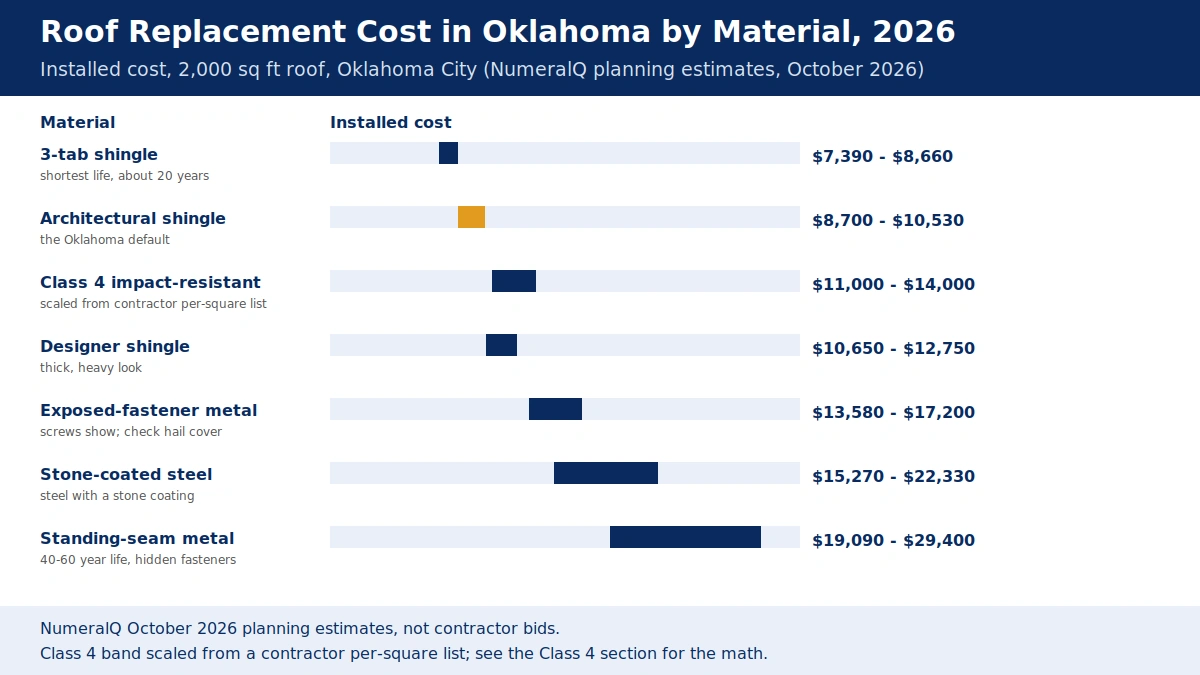
Material moves the price more than any other single choice, by a factor of four from the cheapest shingle to natural slate. The table below prices a 2,000 sq ft roof in Oklahoma City from NumeralQ’s October 2026 estimator, because that table is the only published Oklahoma source that prices every material on one identical job.
The Class 4 row comes from an Oklahoma City contractor’s per-square list, scaled to the same 2,000 sq ft job, and it is flagged as arithmetic. Lifespans come from the InterNACHI life-expectancy chart and the NAHB component study, and hail country shortens every one of them when storms hit hard.
| Material | 2,000 sq ft job (OKC) | Installed per sq ft | Planning life |
|---|---|---|---|
| 3-tab asphalt shingles | $7,390–$8,660 | $3.43–$3.93 | 20 years |
| Architectural asphalt shingles | $8,700–$10,530 | $4.08–$4.86 | 20–30 years |
| Class 4 impact-resistant shingles | $11,000–$14,000 (arithmetic) | $5.50–$7.00 | 25–30 years |
| Designer / luxury asphalt shingles | $10,650–$12,750 | $5.06–$5.97 | 25–30 years |
| Flat roof: modified bitumen | $9,410–$12,110 | $4.44–$5.65 | 20 years |
| Flat roof: EPDM rubber | $9,690–$15,410 | $4.58–$7.30 | 25 years |
| Flat roof: TPO membrane | $11,430–$15,290 | $5.45–$7.24 | 20–25 years |
| Exposed-fastener metal panels | $13,580–$17,200 | $6.52–$8.19 | 30–45 years |
| Stone-coated steel | $15,270–$22,330 | $7.37–$10.76 | 40–50 years |
| Synthetic slate or shake | $15,980–$23,290 | $7.72–$11.24 | 40–50 years |
| Cedar shakes | $15,880–$28,750 | $7.67–$13.97 | 30 years |
| Concrete tile | $16,590–$23,950 | $8.03–$11.57 | 50+ years |
| Standing-seam metal | $19,090–$29,400 | $9.28–$14.30 | 40–60 years |
| Clay tile | $22,180–$36,030 | $10.82–$17.61 | 50+ years |
| Natural slate | $29,210–$58,840 | $14.34–$29.01 | 50+ years |
Architectural shingles are the default Oklahoma roof, and the default is a good roof. They cost $8,700–$10,530 for the 2,000 sq ft job, they come in thicker, layered profiles that read as dimension from the street, and they carry wind ratings of 110–130 mph on most lines. Three-tab shingles trim about 17 percent off that price, at $7,390–$8,660, and they give up thickness, wind performance, and years of life in return.
On a rental house with a short hold, or a house about to sell, the saving can make sense. On a house the buyer plans to keep through several hail seasons, the architectural shingle is the cheaper roof over time, because it survives the storm the three-tab shingle does not.
Designer shingles buy looks, not storm performance. At $10,650–$12,750 they sit just above the architectural band and mimic slate or shake profiles in asphalt. The upgrade is cosmetic, and a buyer paying for it should know that the insurance discount follows the impact rating, not the profile.
A designer shingle without a Class 4 rating earns no more discount than a standard architectural shingle, and a Class 4 architectural shingle earns the discount without the designer price. Price the two upgrades separately and choose the one that pays.
The metal family splits into three prices and three jobs. Exposed-fastener panels, the corrugated and 5V profiles seen on barns and porches, run $13,580–$17,200, and their screws sit in the weather with washers that age. Stone-coated steel, stamped panels with a stone-granule coating that mimic shingles or tile, runs $15,270–$22,330. Standing seam, with raised seams that lock together and hide every fastener, runs $19,090–$29,400.
All three last far longer than asphalt, all three shed hail differently than shingles do, and the lifetime math section prices the comparison over 50 years. Our metal roof cost guide covers gauges, finishes, and what each metal system costs on its own.
Tile and slate are rare on Oklahoma homes, and the price is only part of the reason. Concrete tile at $16,590–$23,950 and clay tile at $22,180–$36,030 both weigh far more than asphalt, and many Oklahoma frames were never built to carry them, so an engineer’s check and possible reinforcement join the bill. Natural slate at $29,210–$58,840 is the dearest roof in the table by a wide margin, and it needs a crew that specializes in it.
Hail cracks tile and slate rather than denting them, so a tile roof in hail country trades a long quiet life for an expensive bad day. Few Oklahoma buyers make that trade, and the small number who do should price the structure check before the tile.
Flat and low-slope sections take membranes, not shingles. Modified bitumen at $9,410–$12,110, EPDM rubber at $9,690–$15,410, and TPO at $11,430–$15,290 cover the porch roofs, additions, and low-slope sections where shingles cannot shed water. Shingles need slope to work, and a low-slope section shingled anyway will leak at the seams no matter how well it is laid. Our flat roof replacement guide prices each membrane system and explains where each one fits.
Cedar and synthetic shake sit in the middle of the table and at the edge of the Oklahoma market. Cedar shakes run $15,880–$28,750 with a planning life near 30 years, and synthetic slate or shake runs $15,980–$23,290 with a longer rated life. Cedar is uncommon on Oklahoma homes, and any buyer considering wood should confirm with the insurer first that the policy covers it at full replacement value on the same terms as asphalt. Synthetic products vary widely by maker, so the warranty terms and the impact rating on the exact product matter more than the category average.
Roof Replacement Cost by Roof Size in Oklahoma
Size moves the price more than anything else in Oklahoma, and the table below shows why measuring first matters. NumeralQ’s statewide by-size table prices architectural shingles on roofs from 1,000 to 3,000 sq ft of roof surface, and the job nearly triples across that span.
The 2,500 sq ft row is the 25-square planning roof in different units, and its band of $10,740–$12,960 sits close to the SmartRoofingCalculator 25-square band, which is the second time the two models have agreed. Ask every bidder to quote the same measured size, and ask how the size was measured: satellite measurement, a tape on the roof, or a guess from the floor plan give three different answers.
| Roof surface | Squares | Architectural shingles (statewide) |
|---|---|---|
| 1,000 sq ft | 10 | $4,620–$5,670 |
| 1,500 sq ft | 15 | $6,660–$8,100 |
| 2,000 sq ft | 20 | $8,700–$10,530 |
| 2,500 sq ft | 25 | $10,740–$12,960 |
| 3,000 sq ft | 30 | $12,780–$15,390 |
Floor area and roof area are different numbers, and confusing them is the most common budgeting error in roofing. A one-story 2,000 sq ft house has a roof footprint near 2,000 sq ft before pitch is counted, and at a 6/12 pitch with 10 percent waste allowance it carries about 25 squares of roof. A two-story house with the same 2,000 sq ft of floor area has roughly half the footprint, so it carries about 12 squares.
The pitch factor for a 6/12 roof is 1.118, which means the sloped surface runs about 12 percent larger than the flat footprint it covers. Steeper roofs multiply further, and a 12/12 roof carries about 41 percent more surface than its footprint.
Pitch and complexity push quotes toward the top of every band. A steep pitch makes the crew move slower, wear more fall protection, and throw away more cut-off pieces at every valley and hip. Dormers, valleys, hips, and skylights each add flashing work and cutting time, and each valley is a place where water concentrates and where the ice barrier rules bite hardest.
A simple gable roof on a ranch is the cheapest roof per square in Oklahoma. A cut-up roof with four gables, two valleys, and a chimney costs more per square for the same shingle, and the difference shows up in labor hours rather than in the shingle price.
One more size factor hides under the shingles. About 49 percent of Oklahoma homes were built before 1980, and older roofs often hide soft or rotted decking that only shows at tear-off. A sheet of 4×8 OSB decking costs $51.69–$76.23 installed in Oklahoma City and $56.50–$82.48 in Tulsa, and a roof that needs ten sheets needs $500–$800 more than the headline band.
Every quote should state the per-sheet decking price and how concealed damage gets documented and approved before the crew fixes it. Without a decking line, the price grows by change order.
Roof Replacement Cost by City: Oklahoma City vs Tulsa vs Norman vs Lawton
Oklahoma’s city map is flat on price and sharp on everything else. The two verified city bands differ by about $550 at the midpoint, roughly 6 percent, which is small against the spread inside each band.
What sets the cities apart is the permit desk, the housing stock, the storm record, and the crew market. Norman and Lawton carry planning estimates rather than verified city prices, because no estimator publishes a city page for either one, and the table flags them as such.
| City | 2,000 sq ft architectural roof | Roofer median pay | Permit | Hail record |
|---|---|---|---|---|
| Oklahoma City | $8,700–$10,530 (NumeralQ) | $21.00/hr | $94.50, over 500 sq ft | 297 large-hail reports, Oklahoma County, 2016–2025 |
| Tulsa | $9,180–$11,160 (NumeralQ) | $23.72/hr | Ask the Permit Center | 190 large-hail reports, Tulsa County, 2016–2025 |
| Norman | ~$8,700–$10,530 (planning est.) | State band | $50–$175 (single source) | 110 hail days since 2010, 15-mile radius |
| Lawton | ~$8,700–$10,530 (planning est.) | State band | Ask the city | Comanche County ranks 4th in state hail magnitude |
Oklahoma City is the cheapest verified market and the most hail-beaten. The 2,000 sq ft band of $8,700–$10,530 matches the statewide band exactly, roofer pay runs 21 percent below the national median, and the permit costs $94.50 for work over 500 sq ft. The median Oklahoma City home dates to 1982 and is worth $231,300, so the typical roof job runs about 4.2 percent of the home value. Oklahoma County’s 297 large-hail reports in ten years, with 24 of them at two inches or larger, make the Class 4 question a live one on nearly every Oklahoma City quote, and the county carries a Very High hail rating on the FEMA National Risk Index.
Tulsa costs a little more and its houses are older. The 2,000 sq ft band of $9,180–$11,160 runs about $550 above Oklahoma City at the midpoint, roofer pay runs 11 percent below the national median, and contractors bill $47–$62 per worker-hour. The median Tulsa home dates to 1973 and is worth $205,300, so the typical job runs about 5.0 percent of the home value, one of the higher shares in the country.
Tulsa County logged 190 large-hail reports in the same ten years, with 10 at two inches or larger, and 278 damaging-wind reports, the highest wind count of the two big counties. The permit picture in Tulsa is murkier than in Oklahoma City, and the permits section states the conflict plainly rather than smoothing it over.
Norman sits between the two metros on price and at the top on hail days. The planning estimate applies the state band, $8,700–$10,530, because no city-specific price was published. Norman is a college town in Cleveland County, home to the University of Oklahoma, and 110 hail days have been recorded within 15 miles of the city center since 2010, with stones up to 4.6 inches.
A modeled cross-check from Shingle Geek prices a 26-square Norman retail job at $19,475–$21,097, but that figure covers a larger roof on a wholesale-cost model, so it is not comparable to the 2,000 sq ft band and is noted here only to explain why a Norman search turns up bigger numbers. Three local quotes matter more in Norman than any statewide average.
Lawton is the smallest of the four markets and the thinnest on published pricing. The planning estimate again applies the state band, flagged as such. Lawton is a military town beside Fort Sill in Comanche County, which ranked fourth in the state for reported hail magnitude in a 2016–2026 analysis of NOAA county records.
Shingle Geek’s Lawton model prices a 22-square GAF Timberline HDZ retail job at $11,732–$12,710, which lands near the top of the state band for a slightly larger roof and supports using the state band as the planning figure. Fewer crews serve Lawton than the two big metros, so booking early matters more after a storm, when every crew in southwest Oklahoma is working the same hail swath.
Buyers near a state line should know that Oklahoma’s per-square prices sit in the middle of the neighbor pack. Architectural shingles run $400–$580 per square in Oklahoma, against $420–$610 in Kansas, $450–$650 in Missouri, $390–$560 in Arkansas, and $410–$590 in Texas.
A contractor based across the line prices from a different labor market, so a job near the border is worth one quote from each side, with the CIB registration checked on any contractor working in Oklahoma. Readers comparing border markets can check our Texas roof replacement guide and our Missouri roof replacement guide for the same breakdowns across the line.

Why Oklahoma Roofs Cost What They Do: Hail, Wind, Ice and Heat
Hail is the first cost driver, and it works through the insurance market as much as through the roof itself. Oklahoma recorded 30,254 hail events from 1950 to 2025, and the state averages about 50 severe hail days a year, with 16 of them carrying stones at least two inches across. In 2025 alone the state logged 369 large-hail events, the third most of any state.
Most large hail falls between March and May, about 72 percent of reports over the last ten years, which compresses the damage season into a few spring months and then compresses the repair season into the months right after. A roof bought in February faces its first test within weeks, and a roof bought in August has months to settle before the next spring.
Wind is the second driver, and tornadoes are only the loudest part of it. Oklahoma has recorded 4,856 confirmed tornadoes since 1950, the third-highest total in the country, averaging roughly 65 to 71 a year depending on the window counted. Straight-line wind does more total roof damage than tornadoes do: Oklahoma County logged 229 damaging-wind reports and Tulsa County 278 in the same ten years as the hail counts above.
Wind lifts shingles from the edges and ridges first, which is why edge sealing, six-nail patterns in high-wind zones, and sealed deck seams matter more here than in calm states. No shingle survives a direct hit from a violent tornado, and no honest quote claims otherwise. The wind work that pays is the work that keeps the roof on through the 70 mph gust that arrives ten times a year.
Ice is the third driver, and it surprises buyers who think of Oklahoma as a warm state. Both big counties carry a Very High ice-storm rating on the FEMA National Risk Index, and freezing rain glazes roofs, loads gutters, and backs water up under shingles at the eaves. The code answers with an ice barrier membrane at the eaves, running from the edge to at least 24 inches inside the wall line, plus wider ice barrier in valleys.
Oklahoma City averages about 6.7 inches of snow a year and Tulsa about 8.7 inches, which is light by northern standards, but the freeze-thaw cycle does the damage: water freezes in a crack, widens it, thaws, and refreezes deeper. A roof that sheds spring rain fine can still leak at the eaves in February, and the ice barrier is the line that stops it.
Heat is the fourth driver, and it works slowly. July in Oklahoma City averages a high of 94 degrees, and a dark shingle roof in that sun runs far hotter than the air. Heat bakes the asphalt, dries the sealant strips, and shortens the life of every shingle, which is one reason Oklahoma asphalt roofs trend toward the short end of their rated lives.
Attic ventilation matters here: a vented attic that moves hot air out keeps the shingle temperature down and the cooling bill with it. Cold weather cuts the other way at install time, since shingles laid at or below 40 degrees need hand-sealing at the edges with roof cement, because the sealant strip needs warmth and sun to bond. January and February are the driest months in both metros, which makes them the calmest months to reroof, as long as the crew hand-seals on cold mornings.
The storm calendar sets the buying calendar. Late winter and early spring lock in lower seasonal rates, before the March to May hail season fills every crew’s book. After a big hailstorm, quotes climb and stay high for months, because every crew in the county is working the same damage swath and materials run short.
A planned replacement in January costs less than an emergency replacement in June, and the calendar explains the gap. The cheapest roof in Oklahoma is the one bought before the storm.
Class 4 Impact-Resistant Shingles in Oklahoma: What the Upgrade Costs and What It Pays Back
Class 4 is the name of a test result. Underwriters Laboratories standard UL 2218 drops steel balls onto shingles to simulate hail, and Class 4 is the highest rating a shingle can earn: it survives a two-inch steel ball dropped from 20 feet without cracking. The shingles earn that result with SBS-modified asphalt, a rubberized blend that bends on impact instead of cracking.
Standard architectural shingles start taking damage from hail around 1.25 inches across, while Class 4 shingles are built to hold up against two-inch hail. In a state that averages 16 days a year with stones at least two inches across, that gap is the whole point of the upgrade.
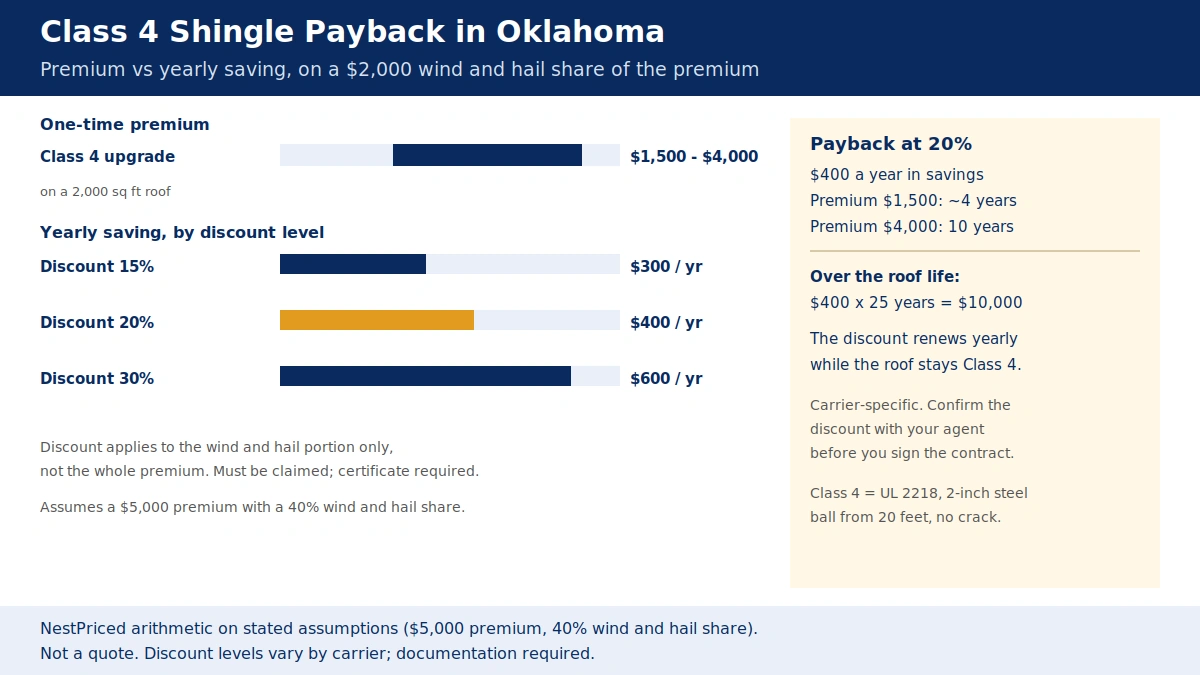
The upgrade premium is real but bounded. OKC Roofers lists Class 4 shingles at $550–$700 per square installed, against $450–$600 for standard architectural shingles, which scales to $11,000–$14,000 for a 2,000 sq ft roof. Two Oklahoma contractor sources price the premium directly: TaylorMade Exteriors puts it at $1,800–$4,000 on a typical 2,000 sq ft roof in the Oklahoma City metro, and TulsaProTech puts it at $1,500–$3,500 against standard architectural shingles.
Tier-One Roofing prices it as $1–$2 more per sq ft in Tulsa. The combined range for the premium on a 2,000 sq ft roof is $1,500–$4,000, and any quote charging far more than that for the Class 4 step alone should be asked what else changed.
The payback comes from the insurance premium, and the discount math needs care. Most carriers offer 15–30 percent off the wind and hail portion of the premium for a verified Class 4 roof, with published Oklahoma figures ranging from 10 percent at the low end to 28 percent at the high end depending on the carrier and the source. The discount applies to the wind and hail portion only, and that portion often makes up 30–50 percent of the total premium in Oklahoma.
A 20 percent discount on the wind and hail portion of a $5,000 premium with a 40 percent wind and hail share saves $400 a year. Budgeting $1,000 of saving from that discount would overstate it by $600. The discount is not automatic: the homeowner must claim it with documentation, usually a manufacturer certificate proving the installed shingle carries the Class 4 rating, and it renews every year the roof stays on the house.
| Discount on wind/hail portion | Yearly saving (on a $2,000 wind/hail share) | Payback on a $1,500 premium | Payback on a $4,000 premium |
|---|---|---|---|
| 15% | $300 | 5.0 years | 13.3 years |
| 20% | $400 | 3.8 years | 10.0 years |
| 30% | $600 | 2.5 years | 6.7 years |
The table above is NestPriced arithmetic on stated assumptions: a $5,000 annual premium, a 40 percent wind and hail share worth $2,000, and a Class 4 premium of $1,500–$4,000. At the middle case, a 20 percent discount saving $400 a year, the premium pays back in about 4 to 10 years. Over a 25-year roof life, that $400 a year totals $10,000, which is two to six times the premium paid.
The discount is only half the case, though: the other half is the claim that never happens, because a Class 4 roof that survives a two-inch hailstorm saves the deductible and the disruption of a second roof job. One avoided claim at a $6,000 deductible pays the premium outright.
Two cautions belong beside the payback. First, the discount varies by carrier and by ZIP code, and some carriers offer little or nothing, so the discount must be confirmed with the agent in writing before the premium is paid, with the exact percentage and the exact portion of the premium it applies to. Second, the rating must be documented: a claim of a Class 4 install without the manufacturer certificate and the product name on the contract earns no discount and may not survive an adjuster’s check.
A bid naming the shingle line, showing the UL 2218 Class 4 rating, and listing the certificate as a closeout document is built for the discount. A bid saying only “impact resistant,” with no product name, is not built for the discount.
Asphalt vs Metal in Oklahoma: The Hail Belt Lifetime Math
The metal question in Oklahoma turns on lifetime cost, and the sticker price alone settles nothing. Standing-seam metal costs $800–$1,240 per square installed, which is $20,000–$31,000 for a 25-square roof, roughly double the $10,000–$14,500 architectural shingle band.
That sticker gap scares buyers off before the math is done, and the math is the part that matters: a metal roof lasts 40–60 years, while an asphalt roof lasts 20–30 years, so the comparison is one metal roof against two asphalt roofs. Run over 50 years at today’s prices, with no inflation counted, the two options land close together, and the buyer’s time horizon decides which one wins.
| Option | 25-square installed | Planning life | Roofs in 50 years | 50-year purchase cost |
|---|---|---|---|---|
| Architectural shingles | $10,000–$14,500 | 25 years | 2 | $20,000–$29,000 |
| Class 4 shingles | $13,750–$17,500 (arithmetic) | 25–30 years | 2 | $27,500–$35,000 |
| Standing-seam metal | $20,000–$31,000 (arithmetic) | 50 years | 1 | $20,000–$31,000 |
The table uses midpoint planning lives and today’s prices with no inflation, so it understates the metal advantage: the second asphalt roof will be bought at future prices, while the metal roof is bought once. At the midpoints, asphalt costs $12,250 per roof, or $490 a year over 25 years, and standing-seam metal costs $25,500, or $510 a year over 50 years. The yearly cost is nearly identical, and the metal roof adds the years 26 to 50 without a second tear-off, a second round of disposal, and a second disruption to the household.
A buyer who plans to stay 30 years or more buys metal on the math alone. A buyer who plans to move within 15 years buys asphalt, because the second roof is someone else’s problem and the resale market rarely repays the full metal premium.
Hail finds a different weakness in each material, so neither one wins the hail argument outright. Metal sheds hail that would crack shingles, and many standing-seam products carry a Class 4 impact rating that earns an insurance discount of 10–25 percent on the dwelling premium with most carriers, according to one Oklahoma metal roofing guide. But hail dents metal, and many Oklahoma policies now carry a cosmetic damage exclusion that pays nothing for dents that mar the look of the roof without stopping it from keeping water out.
A dented metal roof can be fully functional and fully uninsured for the dents at the same time, and Oklahoma has no statute or rule requiring disclosure of that exclusion. The policy wording governs, and it must be read before the metal is ordered. Reading it after the first hailstorm is too late.
Wind and weight favor metal with fewer caveats. Standing-seam panels lock together at raised seams with hidden fasteners, which gives them strong wind performance and no exposed screw heads to work loose. Metal weighs about 1–1.5 pounds per sq ft installed, lighter than architectural shingles at 2.5–4 pounds per sq ft, so most frames carry it without reinforcement.
Exposed-fastener metal costs less up front, at $13,580–$17,200 for a 2,000 sq ft job, but its screws sit in the weather and their washers age, which makes it a shorter-lived metal roof at a lower price. Stone-coated steel at $15,270–$22,330 splits the difference in looks and price, mimicking shingles or tile in stamped steel. Our metal vs shingles comparison works through the same choice material by material for the national picture.
The verdict by buyer is short. Staying put for decades in hail country with a carrier that discounts Class 4 metal and no cosmetic exclusion in the policy: metal wins. Moving within 15 years, or carrying a policy with a cosmetic exclusion that guts the metal hail case: Class 4 shingles win, with the discount claimed in writing.
Tight budget with no room for the premium either way: standard architectural shingles, bought well and installed well, still beat a cheap metal job installed badly. The installer matters more than the material on every option, and the hiring section below is where that choice gets made.
Strengthen Oklahoma Homes: The $10,000 FORTIFIED Roof Grant
Oklahoma runs the most generous roof grant in the country for a homeowner replacing a roof anyway. Strengthen Oklahoma Homes, run by the Oklahoma Insurance Department, pays up to $10,000 toward upgrading a roof to the FORTIFIED Home Roof standard, High Wind designation with the Hail Supplement. FORTIFIED is a building standard from the Insurance Institute for Business and Home Safety, built from decades of research into how homes fail in storms.
The Oklahoma standard fixes the weak points of a normal roof: stronger deck attachment, sealed deck seams, impact-resistant shingles, and wind-resistant attic vents. The grant money comes from the Oklahoma insurance industry, not from the state general budget.
The grant mechanics have one rule that overrides all the others: the award letter must arrive before the work begins. A homeowner who hires a contractor and starts work before acceptance into the program is not eligible for the grant, with no exceptions stated. The money is paid directly to the contractor after the work is complete and the FORTIFIED certificate is issued, and no funds are ever issued to the homeowner.
Costs above the grant amount are the homeowner’s, and the evaluation fee is the homeowner’s too, typically $600–$800 according to NumeralQ, with the exact fee set by the evaluator. The grant does not cover the insurance deductible, but it can be used together with an insurance claim, including paying the gap between the claim payment and the FORTIFIED upgrade cost.
Eligibility is narrow and document-driven. The home must be an owner-occupied, single-family primary residence in Oklahoma, in good repair, with a homestead exemption verified by documentation filed with the county assessor. The homeowner must hold an in-force homeowners policy with wind coverage, plus flood insurance if the home sits in a special flood hazard area.
Apartments, duplexes, condos, manufactured homes, and mobile homes are not eligible. The home must qualify for a FORTIFIED designation under the 2025 standard, as determined by a certified FORTIFIED evaluator and the Institute. The program runs two income tiers, with Tier 1 covering households at $62,138 or less, and applications open in funding rounds on a first-come, first-served basis, so checking the program page before signing a roofing contract is part of the job.
The application runs in a fixed order, and skipping a step costs the grant:
- Check that applications are open on the Oklahoma Insurance Department OKReady page and confirm at least one approved FORTIFIED contractor can do the work before paying for an evaluation.
- Apply through the grant portal with the homestead exemption proof and the insurance declaration pages.
- Pick a certified FORTIFIED evaluator from the program list and pay the evaluation fee; the evaluator inspects the home and confirms it can meet the standard.
- Select three contractors from the program’s qualified and trained list; all three bid the specific work the evaluator specifies.
- Wait for the grant award letter. No contract and no work before it arrives.
- The chosen contractor does the work while the evaluator documents materials and methods for Institute review and certification, and the grant pays the contractor directly on completion.
The grant pays twice: once at install, and every year after through the insurance premium. Homes with a FORTIFIED designation receive discounts on the wind portion of the homeowners premium, with the amount set by each carrier, and the Insurance Department says pilot participants save about $750 a year on average. One contractor source reports carrier discounts as high as 42 percent on the wind premium for FORTIFIED homes, but that figure is single-source and carrier-specific, so the agent’s written quote is the only number to budget on.
The designation lasts five years, renews by re-inspection, and transfers to a new owner on a home sale. There is no minimum live-in period after receiving the grant. Two routes reach the same roof without the grant: self-funding through a certified evaluator, or asking the agent to add a FORTIFIED endorsement so the insurer rebuilds the roof to the FORTIFIED standard after a covered event.
Timing matters because rounds fill. The program went statewide on January 12, 2026, covering all 77 counties after pilot phases in selected ZIP codes, and 2026 rounds opened in January, July, and October. As of November 14, 2026, the program page states that applications are open to all Oklahoma ZIP codes.
A homeowner planning a 2027 reroof should apply at the next open round and hold the roofing contract until the award letter arrives, because the grant cannot be claimed retroactively. Buyers weighing solar panels should sequence the roof first: a FORTIFIED roof under new panels beats panels on a roof that will need tearing off, and our Oklahoma solar guide covers the same storm exposure from the panel side.
Permits and Code in Oklahoma: The No-Overlay Rule and the 2024 Code Change
Oklahoma’s most important roofing rule is the one most national websites get wrong. The base national code allows a new roof layer over one existing layer in some cases, and many estimator pages repeat that rule for Oklahoma. Oklahoma amended it away.
The state amendment to the roof recover rules states that where the existing roof has one or more applications of asphalt shingles, additional applications of asphalt shingles are not permitted. A single existing layer already closes the door on a layover. Every shingle reroof in Oklahoma is a tear-off down to the deck, and every quote should be built that way, with the tear-off and disposal as visible lines rather than hidden assumptions.
The code edition changed under buyers’ feet in 2026. Oklahoma’s statewide minimum was the 2018 International Residential Code, and the Oklahoma Uniform Building Code Commission adopted the 2024 editions of the residential, building, and related codes effective September 14, 2026. The roofing rules live in Chapter 9 of the residential code, adopted with Oklahoma amendments.
Cities adopt their own editions with local amendments on top, and Tulsa’s position on the 2024 edition is not settled in the sources checked: Tulsa adopted the 2018 codes by ordinance in 2022, and whether the 2024 edition now applies there by incorporation is a question for the Tulsa Permit Center. Confirm the edition in force with the local building department on the date the work is done, and get the answer in the permit paperwork rather than from a contractor’s memory.
Two code details change the job on the roof itself. The ice barrier rule requires a membrane from the eave edge to at least 24 inches inside the wall line in areas with a history of ice dams, which covers the Oklahoma metros. Tulsa’s rules add a 36-inch ice barrier in all valleys, run the full length of the valley and centered on it, plus a 36-inch barrier at changes in roof pitch where the lower roof has the lower pitch, according to one Tulsa roofing guide citing the city ordinance and the state rule.
Tulsa’s adopted wind figure is 115 mph with exposure set site by site, according to the same guide. Both Tulsa details come from a single source and are flagged as such in the Sources list, so a Tulsa buyer should confirm them with the Permit Center rather than treating them as settled.
Permit rules split by city, and the split is wide enough to check every time:
| City | Permit for a full reroof | Fee | Notes |
|---|---|---|---|
| Oklahoma City | Yes, over 500 sq ft | $94.50 | One- and two-family homes and duplexes; work of 500 sq ft or less exempt; issued to owner or registered roofer only |
| Tulsa | Confirm with the Permit Center | No verified fee found | Contractor sources say a permit is required; the city’s forms page lists no roofing form |
| Norman | Yes | $50–$175 (single source) | Confirm the current fee with Building Inspections |
| Lawton | Ask the city | No verified fee found | No published fee was found |
| Edmond | No permit for residential reroof covering | None | City does not inspect residential reroofs (single source) |
Oklahoma City’s permit rule began in 2025, with the city’s announcement dating the start to August 1, 2025, and the fee of $94.50 covers a re-roof over 500 sq ft, usually issued the same day. One NumeralQ page says June 2025 instead of August, and that conflict is flagged in the Sources list rather than resolved here. At $94.50, the fee runs under 1 percent of a typical job, which makes skipping it pure risk for no saving: the permit creates the inspection record that follows the house, and a future buyer’s inspector will ask for it.
Edmond is the exception that proves the local rule: the city states that no permit is required to replace or repair the roof covering on a residential structure, and it does not inspect residential reroofs. A buyer in Edmond should still keep the contract, the product names, and photos of the work, because the paper trail is the inspection record when no city inspection exists.
Two overlay rules protect historic and conservation districts, and they catch buyers who assume a reroof needs no approval. Within Oklahoma City’s Neighborhood Conservation District Tracts 1 through 4, rolled roofing is not allowed on pitched roofs, and material and appearance rules apply. Within a Tulsa historic preservation zoning district, an HP permit is required before exterior changes, although replacing roof covering with like material is exempt.
Neither rule affects most Oklahoma homes, but a home inside one of those districts should clear the material choice with the city before ordering. The full text of the Oklahoma no-overlay amendment is published in the Oklahoma Administrative Code, and it is worth reading before believing any page that says two layers are allowed here.
Hiring a Roofer in Oklahoma: CIB Registration, the 2028 Endorsement and the Storm-Chaser Test
Oklahoma registers roofing contractors. It does not license them the way it licenses electricians, and the difference matters because it decides what to check. Under the Roofing Contractor Registration Act, Title 59, Sections 1151.1 through 1151.30, it is unlawful for any person to act as a roofing contractor without a current registration from the Construction Industries Board.
Registration is mandatory, insurance-backed, and enforceable as a misdemeanor, and there is no statewide general contractor license in Oklahoma behind it. A contractor who claims a state general license is claiming a credential that does not exist.
Registration requires more than a form. The qualifying party must be 18 or older, an owner or officer actively engaged in the work, with the business name registered with the Secretary of State. The roofer must carry at least $500,000 in general liability insurance for residential work and $1,000,000 for commercial work, on a policy that specifically covers roofing, with the Construction Industries Board listed as a certificate holder so the Board learns of any cancellation.
Workers compensation proof is required, with only a narrow exemption affidavit allowed on residential work, and that affidavit must be attached to the contract. Registration costs $75 a year and renews on the last day of the qualifying party’s birth month. The registration number, carrying an OK prefix, must appear on every business sign, card, piece of correspondence, and contract, and on both sides of every vehicle in lettering at least two inches high.
Checking a registration takes about a minute and should happen before any estimate is taken seriously. Ask the roofer for the registration number, then search it on the Construction Industries Board’s “Are They Licensed?” page, under Search Registered Roofing Contractors, or call the Board at 405-521-6550. Search the business name exactly as it appears on the contract, not the name on the door hanger, and confirm the status is current and the name matches.
The Board’s verification system also carries complaints received against a contractor, by law. Permit offices must refuse roofing permits to unregistered contractors, so a roofer who cannot get the permit pulled is a roofer who failed the check the state already built.
The rules tighten on a fixed timetable, and the timetable has been widely misreported. House Bill 1628, passed in 2025 and effective July 1, 2026, created a Residential Roofing Endorsement. Senate Bill 1873 set the grandfathering window as calendar year 2027 and the hard deadline as January 1, 2028.
Roofers registered and in good standing by January 1, 2027 can be grandfathered by applying and completing 10 hours of approved continuing education or passing the exam. From January 1, 2028, the endorsement is required for all residential roofing work, labor-only crews must work directly for an endorsement holder and carry proof on site, and from January 1, 2027 it is unlawful to subcontract with an unregistered labor-only crew. House Bill 3800 adds 4 hours of continuing education a year, for commercial endorsees from 2027 and residential endorsees from 2028.
Some contractor pages claim the endorsement was required from July 2026, which contradicts the statute timeline in the careful sources; the 2027/2028 timeline above is the one to plan on, and the endorsement should be confirmed in the Board search. The commercial endorsement is separate and exam-based through PSI, with a 70 percent pass mark, for commercial work only.
The storm-chaser test is the practical half of hiring, and it matters most in the weeks after a hailstorm. Traveling crews follow hail swaths, knock on doors, and sign homeowners fast, and while following storms is legal, several things some crews do next are not. A roofer who offers to pay, waive, or absorb any part of the insurance deductible is breaking Oklahoma law, as the insurance section covers.
A roofer who cannot show a current CIB registration, who works from an out-of-state address with no local base, who demands a large cash deposit, who pressures for a signature on the spot, or who asks the homeowner to sign an assignment of benefits form should be turned away. Assignment of benefits is restricted by law in Oklahoma, and signing claim rights over to a contractor removes the homeowner’s control of the claim. Our questions to ask a roofer guide carries the full interview list, and the checklist at the end of this article turns it into a sign-off sheet.
Oklahoma law adds one more guard for the homeowner after the crew packs up and leaves. On an owner-occupied Oklahoma home, a subcontractor or supplier who is not paid may file a mechanic’s lien against the house, but only if they send the homeowner a pre-lien notice within 75 days of last supplying work, and the homeowner’s liability is capped at the contract price with the contractor. The notice usually comes from two places: the supplier who delivered the shingles, or a subcontracted crew the roofer never paid.
Keep a running tally of every payment and every notice, pay by the contract schedule rather than ahead of it, and ask for lien waivers as the job completes. The Construction Industries Board website carries the registration search, the forms, and the Board’s contact details, and it is the only lookup that counts.
Insurance in Oklahoma: Percentage Deductibles, ACV vs RCV and the Deductible Law
The deductible is the first number on any Oklahoma hail claim, and it is bigger than most buyers expect. A flat $1,000 or $2,500 wind and hail deductible was common in Oklahoma a decade ago, but in 2026 the standard structure for most carriers is a percentage deductible of 1–5 percent of the dwelling coverage limit, known as Coverage A.
On a $300,000 dwelling, a 1 percent deductible is $3,000, a 2 percent deductible is $6,000, and a 5 percent deductible is $15,000, all payable by the homeowner before insurance pays anything toward the roof. A single storm can leave $6,000–$15,000 out of pocket, which is why the deductible amount belongs on the roofing budget from the start, not discovered after the adjuster leaves.
| Dwelling coverage (Coverage A) | 1% deductible | 2% deductible | 3% deductible | 5% deductible |
|---|---|---|---|---|
| $200,000 | $2,000 | $4,000 | $6,000 | $10,000 |
| $300,000 | $3,000 | $6,000 | $9,000 | $15,000 |
| $400,000 | $4,000 | $8,000 | $12,000 | $20,000 |
The second number on a claim is the settlement basis, and it decides whether the check covers a new roof or a fraction of one. Replacement cost value, RCV, pays what a new roof costs today, minus the deductible. Actual cash value, ACV, pays the replacement cost minus depreciation for the roof’s age and condition, and roof payment schedules depreciate the payout by age and material on a fixed table.
The table below shows the gap on an $18,000 roof with a $1,000 deductible, using straight-line depreciation over a 20-year life, as illustrative arithmetic rather than any carrier’s schedule. At 15 years old, the ACV check is about $3,500 against $17,000 at replacement cost, and the remaining $13,500 is the homeowner’s to fund.
| Roof age | RCV payout ($18,000 roof, $1,000 deductible) | ACV payout (20-year life, illustrative) |
|---|---|---|
| 2 years | $17,000 | $15,200 |
| 8 years | $17,000 | $9,800 |
| 15 years | $17,000 | $3,500 |
| 18 years | $17,000 | $800 |
Carriers have been moving older roofs to ACV settlement precisely because repeat hail losses made full replacement uneconomic to write in Oklahoma. Several carriers shift roofs over 10 years old to depreciated settlement, a 20-year-old roof approaches the point where many standard carriers decline replacement cost coverage, and a roof of 25 or 30 years may be uninsurable with standard carriers at all, pushing the homeowner toward surplus lines or the Oklahoma FAIR Plan at higher premiums.
The declarations page shows which basis the roof is on, and it should be checked before storm season, not after. A new Class 4 or FORTIFIED roof resets the clock on both the settlement basis and the premium, which is part of the return on the upgrade that never appears on the roofing quote.
Oklahoma premiums reflect the storm record, and published averages disagree because each study prices a different hypothetical home. Bankrate puts the Oklahoma average at $4,695 a year for a $300,000 dwelling, LendingTree at $5,533 statewide, Insurify at $5,736 for a $300,000 dwelling with a $1,000 deductible, and MoneyGeek at $7,683 statewide. Insurify projects about $5,858 by the end of 2026, making Oklahoma the second most expensive state in the country for home insurance, after a 24 percent rise in 2025.
Oklahoma City runs higher than the state in every study. Roof age, roof material, the wind and hail deductible, and the hail history of the specific ZIP code move the individual premium more than any statewide average does, and comparing carriers with a new impact-rated roof is the most reliable way to pay less.
The deductible law is the sharpest consumer protection in Oklahoma roofing, and every homeowner should know it before a crew knocks. House Bill 1940, effective November 1, 2022 and codified at Title 59, Section 1151.30, makes it unlawful for a roofing contractor to advertise or promise to pay any part of the homeowner’s insurance deductible as an inducement to the sale. The contractor must give written notice of the prohibition with the first estimate, and the insurer or adjuster must give the same notice with the first estimate on the claim side.
If a contractor violates the rule, the insurer is not obligated to consider that contractor’s estimate, which removes the contractor from the claim entirely. Any offer of a “free roof” or “no out of pocket” deal is an unlawful offer, and violations can be reported to the Construction Industries Board at 405-521-6550 or the Attorney General’s Consumer Protection Unit at 833-681-1895.
One widely repeated claim about Oklahoma insurance law is wrong, and it should be corrected wherever it appears. Some claim guides state that Oklahoma has a matching law requiring the insurer to replace a whole roof when damaged shingles cannot be matched, citing Title 36, Section 1250.5. A search of the statute text and the Insurance Department’s claim rules found no matching rule: Oklahoma has no statute or rule requiring uniform appearance, and whether matching is owed is governed by the wording of the policy.
What Section 1250.5 does contain is a real filing protection: a policy time limit on wind or hail roof damage must allow claims to be filed after the first anniversary but no later than 24 months after the date of loss, if the damage is not evident without inspection. Hail damage often hides until an inspection finds it, so that 24-month window matters, and it should not be confused with a matching right that does not exist in Oklahoma law.
The claim record itself made news days before this article was written. On November 13, 2026, the Oklahoma Insurance Department announced a regulatory settlement valued at more than $45 million with State Farm, after a market conduct examination found the insurer improperly denied or underpaid Oklahoma wind and hail roof claims. Examiners reviewed 4,674 claims closed without payment, and independent engineering evaluations found storm damage warranting repair or replacement in 27 of 58 inspected properties.
The settlement sets up a reopening and independent re-evaluation process for eligible homeowners whose wind or hail claims were closed without payment between January 1, 2021 and December 31, 2025. It resolves the Department’s regulatory investigation only, not homeowner lawsuits. The lesson for any claimant is practical: document the damage with dated photos, get an independent inspection when a claim is denied, and escalate to the Insurance Department when the adjuster’s answer does not match the roof.
Paying for an Oklahoma Roof in 2026: No Federal Credit, HEAR Not Launched and Financing
The federal picture for a 2026 Oklahoma roof is short. For property placed in service after December 31, 2025, neither the Section 25C energy efficient home improvement credit nor the Section 25D residential clean energy credit survives: the One Big Beautiful Bill Act, Public Law 119-21, ended both, and the Internal Revenue Service confirmed the cutoff in Fact Sheet FS-2025-05. The federal government contributes $0 toward a homeowner-owned roof installed in Oklahoma in 2026.
No credit, no deduction, and no carryforward applies to the roof, and any quote showing a federal credit line on a 2026 install is built on expired rules. Our federal energy tax credits guide walks through each expired credit and each program that still pays.
The federal home energy rebates do not fill the gap, for two separate reasons. Oklahoma’s HEAR and HOMES allocation totals $129,152,880, administered by the Oklahoma Department of Commerce through its State Energy Office, and the programs had not launched as of November 4, 2026, with no launch date posted and a November 9, 2026 check still showing both as not yet open.
Even after launch, the rebates would not pay for a roof covering: HEAR covers efficient electric equipment, insulation, air sealing, and related electrical work, and HOMES pays for modeled whole-home energy savings of at least 20 percent, neither of which a roof alone earns. A roof quote subtracting HEAR or HOMES money is a quote subtracting money that does not exist for this job in this year.
Oklahoma adds no state tax credit for roofs and no sales-tax break for roofing work. Sales tax still applies to the job: Oklahoma charges 4.5 percent state sales tax plus city and county tax, with combined rates commonly published near 8.625 percent in Oklahoma City and 8.517 percent in Tulsa, figures that should be verified at purchase because local rates move. On a $12,250 midpoint 25-square roof, the Oklahoma City combined rate adds about $1,057, and the Tulsa rate adds about $1,043.
Some quotes show tax as its own line and some bury it in the total, and either way it is owed. A bid with no tax line runs roughly $1,000 short of the real price, and the tax line belongs in the comparison.
The real Oklahoma funding stack is three layers, and none of them is federal. The first layer is the insurance claim, minus the percentage deductible, on the settlement basis the policy states. The second layer is the Strengthen Oklahoma Homes grant of up to $10,000 toward the FORTIFIED upgrade, applied for before the contract is signed.
The third layer is the yearly premium saving from a Class 4 or FORTIFIED roof, which repays part of the upgrade every year the roof is on the house. For the balance, contractor financing, home equity borrowing, and personal loans are the usual routes, and our roof financing guide compares them without naming rates that change weekly.
No Oklahoma-specific roof financing program was verified, and no rate is stated here because none was verified for this job. Price the job gross first, subtract only the money the home can actually collect, and the budget will hold.
Repair or Replace and Getting Quotes in Oklahoma: The Decision Rules and the Checklist
Repair wins when the damage is local and the roof is young. A few missing shingles after a wind gust, a flashing leak at a chimney, or damage confined to one slope on a roof under 12–15 years old usually repairs well, with small shingle and flashing repairs running $300–$1,500 in Oklahoma City. Replacement wins when the damage crosses slopes, when granule loss is widespread, when the roof is past 20 years old, or when a second storm claim lands on a roof already depreciated to ACV settlement.
Age alone does not decide it: a 12-year-old roof with hail damage across every slope is a replacement, and a 22-year-old roof with one clean wind scar can still be a repair. An inspection settles the question better than either age or appearance, and our roof inspection cost guide prices the inspection itself.
The no-overlay rule shapes the repair decision in Oklahoma more than in most states. Because new shingles cannot go over old ones here, a partial reroof still means tear-off to the deck on the repaired section, and the repaired section must tie into the old roof cleanly at every valley and ridge. A repair quote should name the tie-in method and the flashing work at the joints, because a repair that leaks at the tie-in costs more than the replacement it deferred.
Matching matters at the repair too, with no state matching rule behind it: if the shingle line is discontinued, the repair may show, and the policy wording decides whether the insurer owes more than the patch. Get the repair-versus-replace call in writing from the inspector, with photos, before the claim is filed, so the claim and the repair tell the same story.
Hold every signature until three registered Oklahoma contractors have priced the same written spec, line by line, with nothing left to a verbal promise. A bid missing an item is an incomplete bid, and the missing item arrives later as a change order, at a price the buyer can no longer negotiate.
- Grant and claim status first (Strengthen Oklahoma Homes award letter before signing if applying; deductible amount and RCV or ACV basis confirmed with the agent; no deductible-waiver offer accepted)
- Measured size in writing (squares, pitch, planes included, and how the size was measured; all three bids on the same measurement)
- Material named both ways (shingle maker and line, UL 2218 Class 4 rating if claimed, standard and Class 4 prices shown as separate lines)
- Tear-off to the deck priced (one layer removal and disposal included; per-sheet decking price stated; concealed damage documented and approved before fixing)
- System lines itemized (underlayment, ice barrier at eaves and valleys, drip edge, flashing, ridge vent, pipe boots; gutters as a separate line if included)
- Registration verified (CIB number checked on the Board search; $500,000 liability certificate; workers compensation proof; number on the contract and the trucks)
- Permit and inspection named (city permit fee and who pulls it; inspection scheduled; code edition confirmed with the building department)
- Cash price complete (one total for one identical job; sales tax as its own line; no federal credit line, no HEAR line, no rebate the home cannot collect)
- Warranties in writing (maker warranty terms with the product name; workmanship warranty length and who honors it; certificate paperwork listed as a closeout item)
- Money and schedule in writing (payment schedule tied to milestones, not paid ahead; start and finish dates; lien waivers on completion; cleanup and magnet sweep included)
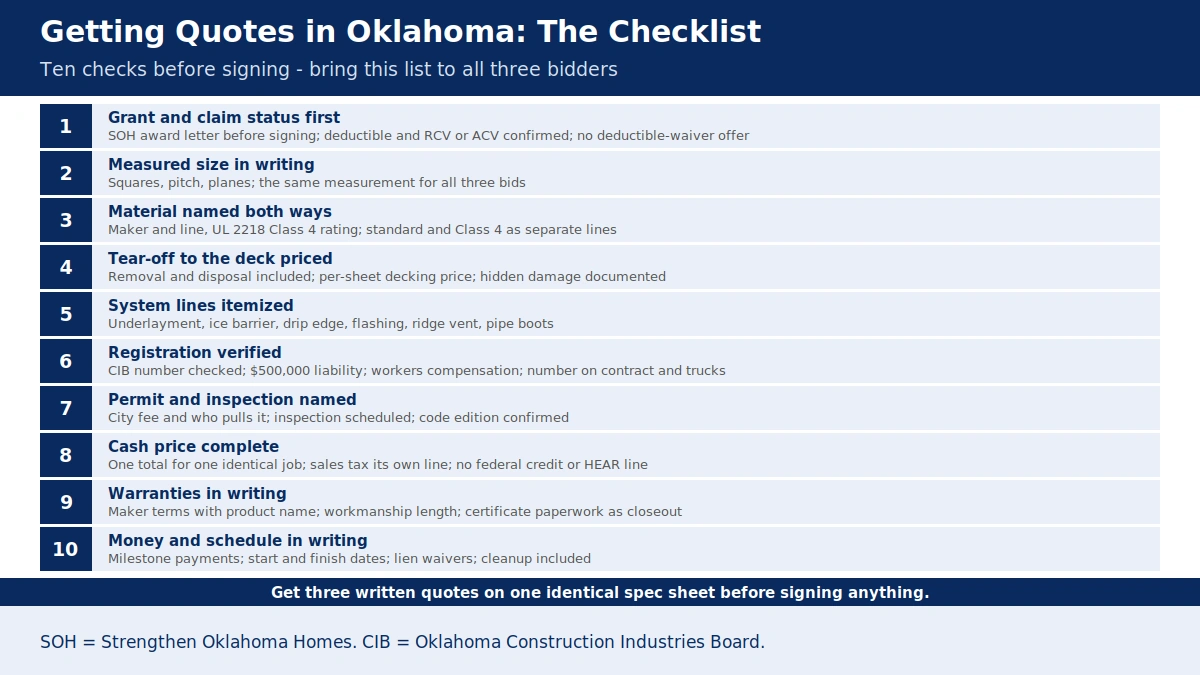
Get three written quotes on one identical spec sheet before signing anything. Judge them on completeness. The total alone hides missing scope.
The strongest bid names the material, shows the measurement, itemizes the system, proves the registration, prices the Class 4 step both ways, and leaves the grant and the claim in their proper places. In Oklahoma, the strongest bid is also the one that has thought about May, because May is when the roof earns its keep.
Sources & methodology Installed costs:
- SmartRoofingCalculator, Roof Replacement Cost in Oklahoma 2026 (Apr 24, 2026; updated Nov 9, 2026): architectural $400–$580/sq installed with tear-off; 25-square roof $10,000–$14,500; standing-seam metal $800–$1,240/sq; tile $1,070–$1,600/sq; state factor 0.888 from BLS May 2024 wages + BEA 2024 price parity; planning estimates
- NumeralQ, Roof Replacement Cost in Oklahoma 2026 (pricing Oct 26, 2026): 2,000 sq ft $8,700–$10,530; by size 1,000 sq ft $4,620–$5,670, 1,500 $6,660–$8,100, 2,500 $10,740–$12,960, 3,000 $12,780–$15,390; planning estimates, not contractor bids
- NumeralQ, Roof Replacement Cost in Oklahoma City 2026 (Oct 26, 2026): same by-size table; full material table for 2,000 sq ft job (3-tab through natural slate); add-on prices; permit $94.50; labor billed $42–$55/hr, median pay $21.00/hr
- NumeralQ, Roof Replacement Cost in Tulsa 2026 (Oct 26, 2026): 2,000 sq ft $9,180–$11,160; by size 1,000 $4,860–$5,990 to 3,000 $13,500–$16,330; full material table; add-on prices; labor billed $47–$62/hr, median pay $23.72/hr
- OKC Roofers, Roof Replacement Cost Oklahoma City 2026 (updated Jun 29, 2026): most OKC homes $8,000–$15,000; architectural $450–$600/sq; Class 4 $550–$700/sq; standing seam $900–$1,400/sq; metal shingles $700–$1,000/sq; repairs $300–$1,500
- Tier-One Roofing, Tulsa Roof Replacement Cost 2026 (May 2026): architectural $4.50–$6.50/sq ft installed; 2,000 sq ft $9,000–$13,000; 2,500 sq ft $11,250–$16,250; Class 4 adds ~$1–$2/sq ft; standing seam $8–$10/sq ft; Tulsa labor ~$53/hr
- HomeCostLens, Roof Replacement Cost in Tulsa (cost data reviewed Sept 2026, modeled): ~$9,810 average, $8,030–$16,060 range, 2,200 sq ft home; OKC average $9,940
- Shingle Geek, Lawton 2026 (Jun 2, 2026): 22-square GAF Timberline HDZ retail $11,732–$12,710; wholesale hard cost $8,555; Norman 26-square retail $19,475–$21,097 (different size + wholesale model, cross-check only)
Class 4 + discounts:
- TaylorMade Exteriors, Do Class 4 Shingles Save Oklahoma Homeowners Money (2026): premium $1,800–$4,000 on 2,000 sq ft roof; discounts 15–30% off wind/hail portion; wind/hail share 30–50% of total premium
- TulsaProTech, Class 4 / Storm-Resistant Roofing guides (2026): premium $1,500–$3,500; discounts 15–28% (one page to 35%, flagged outlier); UL 2218 2-inch ball from 20 feet; standard shingles damaged from ~1.25-inch hail
- HomeFortifyROI, Class 4 table 2026: Oklahoma discount 18–26%; AmazingFlash 2026: KS/NE/OK 10–20%, $150–$400/yr; RoofQuoteHQ metal guide: Class 4 metal discount 10–25% (single source, flagged)
Cities, labor, housing:
- BLS OEWS May 2025 via NumeralQ: OKC roofer median $21.00/hr (21% below US median); Tulsa $23.72/hr (11% below US); statewide median $21.00/hr; SmartRoofingCalculator BLS May 2024: roofer median $22.60/hr, ~940 roofers statewide
- Census ACS 2020–2024 via NumeralQ: 49% of Oklahoma homes built before 1980; OKC median home 1982, $231,300, 71% single-family, 59% owner-occupied; Tulsa median home 1973, $205,300, 65% one-unit, 52% owner-occupied; Oklahoma County 121 roofing contractors (2023), Tulsa County 90
- SmartRoofingCalculator neighbor per-square bands: Kansas $420–$610, Missouri $450–$650, Arkansas $390–$560, Texas $410–$590, New Mexico $390–$560, Colorado $450–$650
Storms + climate:
- NOAA Storm Events Database 1950–2025 via Mapscaping: 4,856 tornadoes, 30,254 hail events, 21,278 wind events; largest hailstone 8.00 in, Garfield County, Apr 26, 1971; avg 64.7 tornadoes/yr
- MyWild/SPC 1996–2025: ~50 severe hail days/yr, 16 with 2-inch+ stones; Insurance Information Institute via Mercury: 369 large hail events in 2025, 3rd most of any state
- Cloudbreak/SPC through Nov 11, 2026: hail days since 2010 within 15 miles: OKC 143 (max 4.6 in), Tulsa 116 (4.25 in), Norman 110 (4.6 in); Moore 127 hail days since 2006 via hailhistory.org/NOAA
- NOAA 2016–2025 via NumeralQ: Oklahoma County 297 large-hail reports incl. 24 of 2 in+, 229 damaging wind, 27 tornado reports; Tulsa County 190 large-hail incl. 10 of 2 in+, 278 damaging wind, 23 tornado reports; hail season March to May, ~72% of reports
- FEMA National Risk Index via NumeralQ: Oklahoma County hail/tornado/ice storm all Very High; Tulsa County hail Relatively High, tornado/ice storm Very High; NOAA 1991–2020 normals: OKC snow 6.7 in/yr, Tulsa 8.7 in/yr; Owens Corning TB-10022497-A: hand-seal at or below 40 F
Strengthen Oklahoma Homes:
- Oklahoma Insurance Department, OKReady / Strengthen Oklahoma Homes page (fetched Nov 14, 2026): applications open to all Oklahoma ZIP codes; up to $10,000; paid directly to contractor; award letter before work; evaluator fee paid by homeowner; homestead exemption required; Tier 1 income $62,138 or less; designation 5 years, transferable; grant may combine with a claim, does not cover the deductible
- OID news release via GovDelivery: final pilot reopening, statewide rollout 2026, all 77 counties; FORTIFIED Home Roof, High Wind + Hail Supplement; statewide launch Jan 12, 2026 (Tier-One); 2026 rounds January, July 13, October 12 (McCray, 4homeownersinsurance)
- HB 3089 (2024) created the program, effective Nov 1, 2024 (Kin); pilot average saving ~$750/yr attributed to OID (Tier-One, okinspro); 42% wind premium discount maximum is single-source contractor reporting (Tier-One, flagged); evaluator fee typically $600–$800 (NumeralQ)
Registration + licensing:
- Roofing Contractor Registration Act, 59 O.S. §§ 1151.1–1151.30; OAC 158:85; CIB application form (May 2022): $500,000 residential / $1,000,000 commercial liability, CIB as certificate holder; workers compensation; $75/yr registration, birth-month renewal (ReadyDocs Oct 2026, RoofingLicenseCheck Oct 22, 2026, Arrowhead Aug 2026)
- HB 1628 (2025), SB 1873 (2026), HB 3800 (2026): Residential Roofing Endorsement, grandfathering window calendar 2027, mandatory Jan 1, 2028, 10 hours CE or exam for grandfathering, 4 hours CE/yr (McCray Nov 10, 2026; ReadyDocs; Arrowhead); commercial endorsement exam via PSI, 70% pass; fines to $5,000 per violation + misdemeanor (Jobber)
- Lien law: 42 O.S. § 142.6 (75-day pre-lien notice), § 143 (liability capped at contract price), via NumeralQ/Levelset; assignment of benefits: 36 O.S. § 1230(B)(1) (getverticalos, verified Nov 1, 2026, single source)
Permits + code:
- OAC 748:20-2-20 (Justia, current through Jun 16, 2025): IBC 1511.3.1.1 exception (4), no additional asphalt shingle application where one or more exist; OAC 748:20-6-14 IRC amendment (Arrowhead); 2018 IRC statewide minimum to Sept 14, 2026, 2024 editions effective Sept 14, 2026 (OUBCC via Arrowhead)
- OKC Municipal Code Ch. 12 Art. XIV; city news release Jul 30, 2025; permit $94.50, over 500 sq ft, one- and two-family + duplexes (NumeralQ, fee schedule Oct 26, 2026); start-date conflict flagged: Aug 1, 2025 (city announcement via BlackCrown) vs June 2025 (one NumeralQ page)
- Tulsa: Title 51 Sec. 201, IRC 2018 amendments R905.2.1/R908.3.1.1 (NumeralQ, checked Oct 11, 2026); 36-inch valley ice barrier + 115 mph wind figure single source (RoofExperts, flagged); permit conflict: contractor sources say required, city forms page lists no roofing form (BlackCrown); Norman $50–$175 single source (RoofQuoteHQ, flagged); Edmond no permit / no inspection single source (McCray citing City of Edmond, flagged)
- IRC R905.1.2 ice barrier 24 inches inside wall line (ICC 2021 via NumeralQ); OKC conservation districts Sec. 59-7300; Tulsa HP permits Zoning Code Sec. 70.070
Insurance + claims:
- Percentage deductibles 1–5% of Coverage A standard in 2026 (RoofingStormDamage; OKC Insurance Brokers: 3–5% typical OKC metro); HB 1940 (2022), 59 O.S. § 1151.30, effective Nov 1, 2022, deductible-waiver ban + first-estimate notice + insurer need not consider estimate (OK Legislature bill text; Frontera; Jim Holmes Insurance Nov 11, 2026)
- ACV vs RCV illustration: teamzlab 2026 ($18,000 roof, 20-year life, $1,000 deductible); roof-age underwriting: Miner Family Insurance Oct 27, 2026 (carriers move roofs over 10 years to depreciated settlement); LiveInsuranceNews/Insurify: 20-year roof approaches loss of RCV, 25–30-year roof may be uninsurable with standard carriers
- Premiums: Bankrate $4,695 ($300K dwelling); LendingTree $5,533; Insurify $5,736, projected $5,858 end of 2026, #2 most expensive state, +24% in 2025; MoneyGeek $7,683 (all via Miner Oct 27, 2026 / LiveInsuranceNews May 2026)
- No matching rule: getverticalos searched 36 O.S. § 1250.5 + OAC 365:15 (Nov 1, 2026); Arrowhead (Aug 2026); 24-month filing rule § 1250.5(7) (vLex statute text); cosmetic damage exclusion filed for Oklahoma, covers metal sheeting, no state disclosure rule (Arrowhead)
- State Farm $45M+ OID settlement, Nov 13, 2026 (The Oklahoman): 4,674 claims closed without payment reviewed; 27 of 58 inspected properties had warranting damage; re-evaluation for claims closed without payment Jan 1, 2021–Dec 31, 2025
Federal + HEAR:
- OBBBA P.L. 119-21; IRS FS-2025-05 (§ 25C/§ 25D $0 after Dec 31, 2025); HEAR/HOMES $129,152,880 allocation, Oklahoma Department of Commerce State Energy Office, not launched as of Nov 4, 2026 (NASEO tracker via heatpumppricing), not yet open Nov 9, 2026 (betterpowered); DOE Program Notice 26-2 (May 29, 2026) HEAR scope; sales tax 4.5% state + local, OKC/Tulsa combined figures published, not re-verified
Add-ons + repairs:
- NumeralQ OKC add-ons: extra layer $1.05–$1.39/sq ft; decking $51.69–$76.23/sheet; whole-roof ice/water barrier $0.79–$1.29/sq ft; seamless aluminum gutters $6.96–$10.16/lin ft; flashing $273–$398 each; skylight re-flash $420–$541 each; Tulsa equivalents $1.17–$1.54, $56.50–$82.48, $0.83–$1.34, $7.62–$11.01, $302–$437, $457–$588
- Lifespans: InterNACHI life-expectancy chart (asphalt 20–30 years) via NumeralQ; NAHB component study (asphalt ~20 years, wood ~30, tile/slate 50+) via SmartRoofingCalculator; metal 40–70 years (OKC Roofers), realistic 40–60 years (Tier-One)
Arithmetic + planning assumptions (NestPriced, labeled in prose):
- NumeralQ 2,000 sq ft band x 1.25 = 25-square $10,875–$13,163; Class 4 2,000 sq ft $11,000–$14,000 from $550–$700/sq x 20; Class 4 25-square $13,750–$17,500 from $550–$700/sq x 25; standing-seam 25-square $20,000–$31,000 from $800–$1,240/sq x 25; tile 25-square $26,750–$40,000 from $1,070–$1,600/sq x 25
- Deductible table: Coverage A x percentage; sales tax: $12,250 x 8.625% = ~$1,057, x 8.517% = ~$1,043; Class 4 payback: $5,000 premium x 40% wind/hail share = $2,000, discounts 15/20/30% = $300/$400/$600 per year, payback = premium / yearly saving; lifetime table: 50-year cost = roofs needed x installed band at today’s prices, no inflation; per-year cost = midpoint / planning life
- Norman and Lawton city bands are the state band applied as planning estimates, flagged; Tulsa is ~$550 (about 6%) above OKC at the band midpoint ($10,170 vs $9,615)
EXCLUDED:
- RoofingEstimatorPros $12,888–$23,252 and MyRoofData $11,250–$19,500 headline bands (modeled outliers, wider scope)
- SquareDash Norman $12,300 average (single vendor, self-contradictory FAQ figures)
- BestRoofingEstimates permit fees and city bands (Dec 2025, contradicted by fee schedules)
- Any matching-law claim under § 1250.5 (contradicted by statute text; no Oklahoma matching rule exists)
- SmartRoofingCalculator two-layer recover statement (base IRC rule; Oklahoma amendment bans any shingle-over-shingle recover)
- HB 3796 extension of Strengthen Oklahoma Homes (single source, not stated)
- Tulsa permit fee as a verified figure (conflicting evidence); Lawton permit fee (none found)
- Any specific carrier Class 4 or FORTIFIED discount percentage as a promise (carrier-specific; ranges only)
- FORTIFIED upgrade cost beyond the $10,000 grant cap (no verified figure); tie-down / hurricane-strap pricing (no verified Oklahoma price)
- 2027 SOH round dates or funding levels (not published); any Oklahoma roof financing rate (none verified)
Disclaimer: The prices here are 2026 Oklahoma planning figures. What you end up paying moves with the city, the house, the roof size and pitch, the storm exposure, and the contractor. Get written quotes from three registered Oklahoma roofers before settling on a budget, and check the registration yourself on the Construction Industries Board search before anyone touches the roof.
Nothing here is tax or insurance advice for your own policy or return. Program rules change, including Strengthen Oklahoma Homes rounds and the CIB endorsement timetable, so confirm current terms with the Insurance Department and the Board before signing. Insurance settlement depends on the wording of your own policy, so read the declarations page and the endorsements before storm season.
What does a roof replacement cost in Oklahoma in 2026?
A 25-square architectural shingle roof costs $10,000–$14,500 installed in Oklahoma in 2026, at $400–$580 per square with tear-off. A 2,000 sq ft roof costs $8,700–$10,530 statewide, with Oklahoma City at $8,700–$10,530 and Tulsa at $9,180–$11,160. Standing-seam metal runs $20,000–$31,000 for the 25-square roof, and Class 4 shingles add roughly $1,500–$4,000 on a 2,000 sq ft roof.
Are Class 4 shingles worth the extra cost in Oklahoma?
For most Oklahoma homeowners, yes, when the carrier confirms the discount in writing first. Class 4 shingles add roughly $1,500–$4,000 on a 2,000 sq ft roof and commonly earn 15–30% off the wind and hail portion of the premium, which pays the premium back in about 4 to 10 years at the middle case. The rating must be documented with a manufacturer certificate, and the discount applies to the wind and hail portion only.
Can I get the $10,000 Strengthen Oklahoma Homes grant for my roof?
You can apply if the home is an owner-occupied, single-family primary residence in Oklahoma with a homestead exemption, an in-force policy with wind coverage, and a roof that can meet the FORTIFIED Home Roof standard. The grant pays up to $10,000 directly to the contractor, the award letter must arrive before any work begins, and the homeowner pays the evaluator fee of typically $600–$800 plus any cost above the grant. Applications open in rounds on a first-come, first-served basis, and the program page stated in November 2026 that applications were open to all Oklahoma ZIP codes.
Can new shingles go over the old roof in Oklahoma?
No. Oklahoma amended the national code so that where the existing roof has one or more applications of asphalt shingles, additional applications of asphalt shingles are not permitted. Every shingle reroof in Oklahoma is a tear-off down to the deck, and any quote proposing a layover over existing shingles is proposing work that is not code compliant. The tear-off also exposes the decking, which is when rotted sheets are found and priced per sheet.
Do I need a permit to replace a roof in Oklahoma City or Tulsa?
In Oklahoma City, yes for work over 500 sq ft on a one- or two-family home or duplex, at a fee of $94.50, with work of 500 sq ft or less exempt. In Tulsa the picture is mixed: contractor sources say a permit is required for a full replacement, while the city’s permit forms page lists no roofing form, so the Tulsa Permit Center should be asked directly before the job starts. Permit offices must refuse roofing permits to unregistered contractors anywhere in Oklahoma.
How do I check whether an Oklahoma roofer is registered?
Ask the roofer for the CIB registration number, then search it on the Construction Industries Board’s “Are They Licensed?” page under Search Registered Roofing Contractors, or call the Board at 405-521-6550. Confirm the status is current and the business name matches the name on the contract exactly. Registration requires at least $500,000 in liability insurance for residential work, and the number must appear on the contract, the cards, and both sides of the trucks.
What will I pay out of pocket on an Oklahoma hail claim?
At least the wind and hail deductible, which is usually 1–5% of the dwelling coverage limit, so $3,000–$15,000 on a $300,000 home. The settlement basis decides the rest: replacement cost pays a new roof minus the deductible, while actual cash value subtracts depreciation, which can leave most of the bill with the homeowner on an older roof. No roofer may lawfully offer to pay any part of the deductible in Oklahoma.
Is there a federal tax credit for a new roof in Oklahoma in 2026?
No. The One Big Beautiful Bill Act ended the Section 25C and Section 25D credits for property placed in service after December 31, 2025, so the federal government contributes $0 toward a 2026 roof install. Oklahoma’s HEAR and HOMES rebates had not launched as of November 2026, and a roof covering would not earn them even after launch. The funding that does exist is the insurance claim, the Strengthen Oklahoma Homes grant of up to $10,000, and the yearly premium saving from a Class 4 or FORTIFIED roof.