

California is the most expensive roofing state in the continental United States, and the reason is not the shingles. A bundle of architectural shingles costs roughly the same in Fresno as it does in Phoenix. What costs more in California is everything around the bundle: the labor to install it, the permit to approve it, the cool-roof rating the energy code demands, and the fire rating the wildfire code demands. SmartRoofingCalculator’s state factor puts California 12.3 percent above the national average on installed price, and the Bureau of Labor Statistics puts the median California roofer wage 15 percent above the national median. Those two numbers are the whole story in miniature. Materials travel. Labor does not.
The second thing to understand is that California is not one market. A roof in San Francisco costs more than the same roof in Fresno by a margin large enough to buy a used car, and the gap is almost entirely labor and permitting. The same 25-square architectural roof that SmartRoofingCalculator prices at $17,213–$24,638 in Los Angeles is priced at $14,663–$20,987 in Fresno. San Jose runs higher still, at $19,763–$28,288. The shingles are identical. The crews, the wages, the permit counters, and the fire zones are not.
Our national roof replacement cost guide sets the baseline; the sections below show where California departs from it.
Table of Contents
What a Roof Replacement Costs in California in 2026
Two anchors describe the California market in 2026, and they disagree by enough to matter, so this guide prints both and explains the gap instead of hiding it. According to SmartRoofingCalculator’s California page, updated November 2, 2026, architectural shingles install at $510–$730 per square with tear-off — $12,750–$18,250 on a typical 25-square roof. NumeralQ, pricing October 26, 2026, prices a 2,000 square foot roof at $10,410–$12,750 statewide, or about $520–$638 a square for a 20-square roof. The two anchors overlap at the low end and diverge at the high end, and the divergence is a methods difference, not an error: SmartRoofingCalculator scales a national price band by California’s wage index and regional price parity, while NumeralQ runs a modeled estimator off local wage and cost data. A homeowner should carry both numbers into the first contractor meeting and let the quotes arbitrate between them.
The remaining anchors sit further apart, and the gap between them says more about method and market than any single average could. MyRoofData’s 2026 California model puts a typical single-family architectural asphalt roof at $16,000–$27,750, about 25 percent above the national average, on per-square installed prices of $563–$938 before tear-off, with tear-off at $100–$200 a square per layer and crew rates of $70–$120 an hour. RoofingEstimatorPros, updated August 26, 2026, puts a typical 2,000 square foot architectural roof at $18,961–$33,448, averaging $25,400, or about $12.70 per square foot installed including tear-off, permits and waste, on a 1.30-times state multiplier. Modernize, updated August 27, 2026, puts most California replacements at $18,000–$32,000, averaging about $26,600 for a 2,000 square foot roof. ProjectBudgeter, published June 1, 2026, puts the typical home at $10,500–$24,000, with most homeowners spending about $14,500 for a standard 2,000 square foot roof.
What the anchors agree on is the direction: California is the most expensive roofing state in the continental United States. SmartRoofingCalculator’s state factor is 1.123, built from a roofer wage index of 1.193 and a goods price parity of 1.066, and it ranks California 46th of 50 from cheapest to most expensive. RoofingEstimatorPros applies a 1.30-times multiplier. MyRoofData applies a 1.25-times cost index. The reason is labor first and code second: shingles cost roughly 7 percent more in California than the national average, according to the Bureau of Economic Analysis, but roofers cost far more. The Bureau of Labor Statistics, in its May 2025 Occupational Employment and Wage Statistics, puts the median roofer wage in California at $30.58 an hour, or $63,600 a year, about 15 percent above the national median of $55,440, with most California roofers earning between $48,620 and $89,010. The state counts about 21,190 roofers.
Roofers count in squares: one square covers 100 square feet of finished roof surface. So a 25-square roof means 2,500 square feet of surface — the size a typical 2,000 square foot single-story home ends up with after pitch, overhangs, and waste are counted. Unless a figure says otherwise, it covers tearing off one old layer, new underlayment, and standard installation. Expect no federal tax-credit line on any 2026 quote: the credit does not exist for roofs installed this year, as the financing section sets out.
| Source | Typical job | Price | Dated |
|---|---|---|---|
| SmartRoofingCalculator | 25-square architectural roof | $12,750–$18,250 ($510–$730/sq) | Nov 2, 2026 |
| NumeralQ | 2,000 sq ft roof, statewide | $10,410–$12,750 | Oct 26, 2026 |
| MyRoofData | Typical single-family arch roof | $16,000–$27,750 | 2026 model |
| RoofingEstimatorPros | 2,000 sq ft arch roof | $18,961–$33,448 (avg $25,400) | Aug 26, 2026 |
| Modernize | 2,000 sq ft roof | $18,000–$32,000 (avg $26,600) | Aug 27, 2026 |
| ProjectBudgeter | Typical 2,000 sq ft home | $10,500–$24,000 (most ~$14,500) | Jun 1, 2026 |
| CostOnce | Per sq ft, all materials | $7–$22/sq ft | Mar 2026 |
Read the footnotes under that table before trusting any headline figure in it. RoofingEstimatorPros and Modernize are the high anchors: their $25,400 and $26,600 averages sit roughly 60 percent above the SmartRoofingCalculator midpoint, and they are best read as what a large, complex, or coastal-metro job costs rather than what a standard Fresno ranch costs. NumeralQ is the low anchor: its $10,410–$12,750 for a 2,000 square foot roof is a modeled estimator figure that understates what Bay Area and Los Angeles crews actually charge. Neither is wrong. They are measuring different jobs in different places with different methods. The headline band of $12,750–$18,250 for a 25-square roof, cross-checked against $10,410–$12,750 for a 2,000 square foot roof, is the figure a homeowner should carry into the first contractor meeting — and the city section below is where the band gets local.
When the weather holds, the work itself is quick — RoofingEstimatorPros puts a standard-pitch asphalt install at one to three days, with tile and metal running longer. The slow part is everything around the install — getting three quotes in a market where the good crews book out weeks ahead, and scheduling around the two California seasons that stop roofing work: the Santa Ana wind events of fall and the atmospheric-river rains of winter.
Roof Replacement Cost in California by Material
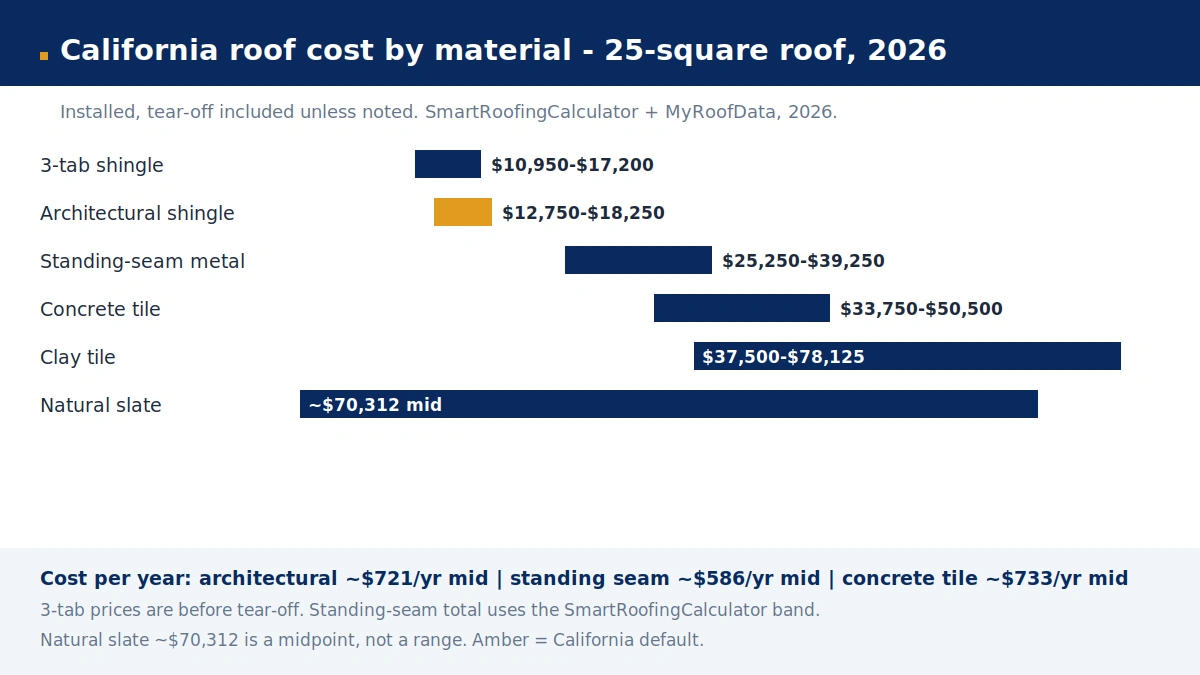
Material is the first decision, and in California it is a legal decision before it is a budget decision. The cheapest shingle on the shelf may not be buyable at all if its color fails the Title 24 reflectance minimum in your climate zone, and the cheapest wood shake on the shelf may be banned outright if your address falls inside a Fire Hazard Severity Zone. The table covers a typical 25-square roof — 2,500 square feet of surface — for each material with a verified California figure. Prices are installed, including tear-off of one layer, unless a footnote says otherwise. The per-square figures come from two sources that measure differently, so the table shows both: SmartRoofingCalculator’s tear-off-included bands and MyRoofData’s before-tear-off bands, with the 25-square totals worked from each.
| Material | Per square installed | 25-square total | CA-realistic life |
|---|---|---|---|
| 3-tab asphalt shingle | $438–$688 (before tear-off) | $10,950–$17,200 | 12–18 yrs |
| Architectural asphalt shingle | $510–$730 | $12,750–$18,250 | 18–25 yrs |
| Ribbed metal (exposed fastener) | $688–$1,188 (before tear-off) | $17,200–$29,700 | 30–40 yrs |
| Standing-seam metal | $1,010–$1,570 | $25,250–$39,250 | 40–70 yrs |
| Flat TPO / EPDM membrane | $688–$1,188 (before tear-off) | $17,200–$29,700 | 20–30 yrs |
| Concrete tile | $1,350–$2,020 | $33,750–$50,500 | 40–75 yrs |
| Clay tile | $1,500–$3,125 (before tear-off) | $37,500–$78,125 | 50–100 yrs |
| Cedar shake / shingle | $1,125–$1,875 (before tear-off) | $28,125–$46,875 | 25–35 yrs |
| Natural slate | $1,875–$3,750 (before tear-off) | $46,875–$93,750 | 75–150 yrs |
The 3-tab row carries a warning label. MyRoofData’s $438–$688 a square is the installed price before tear-off, so the true job total runs higher once the old layer comes off, and 3-tab is the material with the thinnest margin against California weather: a single flat layer with the lowest wind rating in the table and the shortest life. Many insurers and builders have moved away from it, and in a state where ultraviolet light and Santa Ana wind do the damage, buying 3-tab to save a few thousand dollars on the install is buying the next roof sooner. It fits a rental, a shed, or a house going on the market soon — not a home the owner intends to live in for decades.
Architectural shingles sit on roughly three in four American homes, and they are the usual choice across California too. They are thicker, dimensional shingles with wind ratings of 110 to 130 miles per hour, and they carry the $510–$730 a square band that anchors the headline price. The California-realistic life is 18 to 25 years, not the 22 to 30 that MyRoofData publishes nationally, because Southern California’s sun does the aging: a Los Angeles-area contractor with fifteen years in the San Fernando Valley and Ventura County puts heat aging on south and west slopes at 20 to 30 years, with granule loss in the gutters and curling tabs as the usual signs, while a Southern California tile-versus-shingle analysis puts asphalt at 18 to 22 years inland and 15 to 18 years on the coast, where salt air accelerates granule loss. A roof that looks sound at year twelve may be halfway through its California life. The head-to-head numbers are in our metal roof cost guide and our metal vs shingles comparison.
Standing-seam metal is the long-life answer, at $1,010–$1,570 a square on SmartRoofingCalculator’s tear-off-included band, or $25,250–$39,250 for a 25-square roof. MyRoofData runs higher, $1,188–$2,000 a square before tear-off, which works out to $29,700–$50,000 before the old roof comes off — the two sources disagree, and the disagreement is a tear-off and scope difference, not a typo. Metal lasts 40 to 70 years, it carries a Class A fire rating inherently, and its factory coatings routinely post solar reflectance of 0.60 to 0.75, which clears the Title 24 steep-slope minimum with room to spare. The cost-per-year arithmetic is the surprise in this table: at the midpoints, standing seam costs about $586 a year of service, against about $721 a year for architectural shingles. Metal stings on the quote and repays itself over the decades. Ribbed exposed-fastener metal is the budget metal, at $688–$1,188 a square before tear-off, but the screws go through the face of the panel and the washers are a maintenance item, which is why its realistic life stops at 30 to 40 years.
Tile is the look of Southern California, and it is also the material where the quote most often hides a second number. Concrete tile runs $1,350–$2,020 a square on SmartRoofingCalculator’s tear-off-included band, or $33,750–$50,500 for 25 squares, and clay tile runs $1,500–$3,125 a square before tear-off on MyRoofData, or $37,500–$78,125. A Los Angeles-area contractor prices concrete tile at about $1,100–$1,900 a square and clay at about $1,800–$3,500 or more a square, installed. Tile itself lasts 40 to 75 years for concrete and 50 to 100 years or more for clay, and both carry Class A fire ratings, which is why tile dominates the hillside neighborhoods of Encino, Calabasas, and Ventura County. The hidden number is the underlayment: the tile outlives the felt beneath it, and the underlayment typically needs replacement at around the 30-year mark, at about $8,000–$12,000, reusing the existing tiles. Tile is also heavy — 900 to 1,200 pounds a square for concrete, 850 to 1,100 for clay, against 200 to 350 for asphalt — and a home built for shingles may need $2,000–$5,000 of structural reinforcement before the first tile goes on. Get the engineering check in writing before the tile quote is signed. Tile pricing gets the full treatment in our tile roof cost guide.
Cedar shakes deserve a paragraph even though the price comes with a legal asterisk. Cedar runs $1,125–$1,875 a square before tear-off on MyRoofData, or $28,125–$46,875 for 25 squares, and it lasts 25 to 35 realistic years. It is beautiful on a coastal cottage and a Sierra cabin, and it is the worst material in the state for wildfire exposure. The sources disagree on exactly how banned it is: one roofing-code summary states that wood shingles and shakes are banned in any Fire Hazard Severity Zone regardless of fire-retardant treatment, under Title 24 Part 7, while MyRoofData describes cedar as restricted in some wildfire-prone areas unless treated to Class A or B fire ratings. Confirm the rule with your own building department, in writing, before cedar appears on any quote.
Flat and low-slope sections are the quiet California specialty. Mid-century homes, additions, and porches across the state carry flat sections that take a single-ply membrane — TPO or EPDM — at $688–$1,188 a square before tear-off, with a realistic life of 20 to 30 years. White 60-mil TPO typically posts solar reflectance of 0.70 to 0.80, comfortably above the Title 24 low-slope minimum of 0.63, while standard black EPDM does not comply without a coating. For flat roofs in detail, see our flat roof replacement cost guide.
Natural slate is the lifetime roof at a lifetime price: $1,875–$3,750 a square before tear-off, or $46,875–$93,750 for 25 squares, lasting 75 to 150 years. Very few California crews lay slate, and a slate roof installed by a crew that does not do slate every week is a leak waiting for the first atmospheric river.
One last point on cost per year, since it reframes the whole table. Per year of service, the cheapest California roof is not the one with the lowest quote. At the midpoints, 3-tab costs about $938 a year, architectural about $721, standing seam about $586, concrete tile about $733, clay tile about $771, cedar about $1,250, slate about $625, and flat membrane about $938. Those figures are NestPriced arithmetic — midpoint total divided by midpoint California-realistic life — and they ignore the insurance question, which is where metal and tile actually win: a Class A roof in a Fire Hazard Severity Zone is not a luxury, it is a condition of coverage, and a roof the insurer will not cover has no cost per year at all, because the house cannot be financed or sold without insurance. The material table only makes sense beside the insurance section. Neither one alone tells the truth.
Roof Replacement Cost by Roof Size
After material, size decides the quote — and contractors most often mis-measure it, pricing the living area instead of the roof surface. What the contractor measures is roof surface — never the living area on the listing. Take a 2,000 square foot single-story ranch: its footprint is about 2,000 square feet, and pitch, overhangs, and waste lift the roof surface to roughly 20 to 25 squares. A two-story home of the same 2,000 square feet has a footprint near 1,000 square feet, so its roof surface runs about half the ranch’s — same listing size, very different roof. Demand the roof surface in squares on every quote. Any bid priced off living area is a bid for a different house.
This table applies the SmartRoofingCalculator band — $510–$730 a square, tear-off included — to the roof sizes California homeowners actually own. The 25-square row is the headline row, and the 20-square row is the NumeralQ cross-check: $10,200–$14,600 from the per-square band against $10,410–$12,750 for a 2,000 square foot roof — the two methods agree at the low end and diverge by about $2,000 at the top, which is the same methods gap the first section flagged.
| Roof surface | Typical home | Architectural total | Concrete tile total |
|---|---|---|---|
| 15 squares | Small ranch / condo | $7,650–$10,950 | $20,250–$30,300 |
| 20 squares | 2,000 sq ft ranch | $10,200–$14,600 | $27,000–$40,400 |
| 25 squares | Typical CA home | $12,750–$18,250 | $33,750–$50,500 |
| 30 squares | Large two-story | $15,300–$21,900 | $40,500–$60,600 |
| 35 squares | Large home, complex roof | $17,850–$25,550 | $47,250–$70,700 |
| 40 squares | Very large / steep | $20,400–$29,200 | $54,000–$80,800 |
Three things push a job off this table. Pitch comes first. On a steep 10/12 or 12/12, the crew moves slower, stages material differently, and sometimes ropes in, so the per-square price climbs above a walkable 4/12. The per-square bands in this guide assume a standard pitch, and a steep hillside home in the Hollywood Hills or the Oakland hills can run well above them. Complexity comes second. Valleys, dormers, skylights, and chimneys are all flashing work, and flashing done in a hurry is where a roof leaks first. Two roofs with identical square counts can carry very different prices when one is a plain gable and the other is cut up with dormers and valleys. Decking is third. Rotted or delaminated sheathing stays hidden until tear-off, and the crew prices it per sheet on the day. Agree the per-sheet deck rate in writing before tear-off, so a bad deck arrives as a known figure rather than a surprise invoice.
Budget off the roof’s measurements, never the home’s floor area. Measure the footprint, multiply by the pitch factor — about 1.15 for a 6/12 pitch, about 1.25 for an 8/12 — add 10 percent for waste on a simple gable and 15 percent on a hip roof, and divide by 100 to get squares. Ask each bidder to print the measurement on the quote, then compare square counts first and prices second.
Roof Replacement Cost by City: Los Angeles vs San Diego vs San Francisco Bay Area vs Sacramento vs Fresno
California is a state of five roofing markets, and the price of the same roof can move by ten thousand dollars between them. The driver is labor, not materials: shingles cost roughly the same in every California city, while the people who install them earn very different wages, and the permit counters charge very different fees. The table below gives two figures per city, because the two published methods disagree and the disagreement is itself useful information. The first column is SmartRoofingCalculator’s 25-square architectural figure, scaled by each metro’s wage and price multiplier — a modeled figure, not a surveyed quote. The second column is NumeralQ’s 2,000 square foot figure, from its modeled estimator. Read them as a band, not a price.
| City | 25-square arch (SRC, modeled) | 2,000 sq ft roof (NumeralQ) | Roofer median wage |
|---|---|---|---|
| Los Angeles | $17,213–$24,638 | $10,410–$12,750 | $30.56/hr |
| San Diego | $16,830–$24,090 | $10,290–$12,590 | Not published |
| San Francisco (Bay Area) | $19,763–$28,288 (San Jose) | $11,330–$13,950 | $35.74/hr |
| Sacramento | $15,555–$22,265 | $10,380–$12,720 | $30.44/hr |
| Fresno | $14,663–$20,987 | No verified figure pulled | Not published |
Los Angeles is the biggest market in the state, and the most expensive large market outside the Bay Area. SmartRoofingCalculator prices a 25-square architectural roof at $17,213–$24,638, or $689–$986 a square, about 35 percent above the California baseline, on a roofer median wage of $30.56 an hour in the Los Angeles–Long Beach–Anaheim metro. NumeralQ prices the same city’s 2,000 square foot roof far lower, at $10,410–$12,750, and the gap between the two methods is the widest in the state — which is itself a warning that Los Angeles quotes vary enormously by neighborhood, pitch, and fire zone. A flat-roofed bungalow in the Valley and a steep hillside home in Pacific Palisades are different jobs that happen to share a city name, and the January 2025 fires made the distinction sharper: rebuilding demand in the Palisades and Altadena has kept hillside crews booked out.
San Diego runs a touch below Los Angeles on both methods: $16,830–$24,090 for 25 squares on SmartRoofingCalculator, and $10,290–$12,590 for 2,000 square feet on NumeralQ. The city’s roofing character is split in two. The coastal neighborhoods are tile country — Mediterranean and Spanish-style homes where concrete and clay tile are the default and the salt air shortens asphalt life to 15 to 18 years. The inland valleys are shingle country, where the heat is harder and the wildfire zones start at the edge of the suburbs. No Bureau of Labor Statistics metro median roofer wage was verified for San Diego in this pass, so none is given, but the city’s prices sit close enough to Los Angeles that the labor story is the same one: expensive crews, competitive bidding, and fire-zone premiums in the inland hills.
The San Francisco Bay Area is the most expensive roofing market in the state, and the wage data explains why. SmartRoofingCalculator prices San Jose — the Bay Area proxy it publishes — at $19,763–$28,288 for a 25-square architectural roof, and NumeralQ prices San Francisco itself at $11,330–$13,950 for a 2,000 square foot roof, the highest NumeralQ figure of the five cities. The Bureau of Labor Statistics puts the median roofer wage in the San Francisco–Oakland–Fremont metro at $35.74 an hour, about 17 percent above the state median, and in San Jose at about $36.85 an hour. Steep hillside lots, tight access, slow permit offices, and seismic detailing all add cost on top of the wage.
Sacramento is the most affordable major market in the state, and the reason is the same labor story in reverse. SmartRoofingCalculator prices a 25-square roof at $15,555–$22,265, and NumeralQ prices a 2,000 square foot roof at $10,380–$12,720, on a roofer median wage of $30.44 an hour in the Sacramento–Roseville–Folsom metro. The Central Valley’s roofing problem is not price. It is heat. Sacramento sits in climate zone 12 and Fresno in zone 13, where summer temperatures regularly pass 100 degrees, and the cool-roof rule applies to every steep-slope re-roof in both zones. A Sacramento roof has to reflect the sun and survive it, and the shingle color that looks best on the sample board may not be the one the energy code allows.
Fresno is the cheapest of the five cities, at $14,663–$20,987 for a 25-square roof on SmartRoofingCalculator, and it carries a warning label rather than a second anchor: no NumeralQ city figure was pulled for Fresno in this pass, and this guide does not invent one. A secondary aggregator prices Fresno replacement projects at $8,500–$17,000, and CostOnce prices Fresno at $6–$18 per square foot, 15 percent above the national average. What can be said honestly is the shape of the market: Fresno is the Central Valley’s affordable end, with lower wages and faster permits than the coast, and the hottest roofing climate in the five-city set. Get three quotes in Fresno, and make at least one of them from a company with a permanent shop in the county, because warranty service from a crew based two counties away is a promise that gets expensive to keep.
Compare cities by the per-square price, not the job total. The real city difference is not price. It is exposure: the Bay Area pays for labor and access, Los Angeles pays for fire zones and rebuild demand, San Diego pays for tile and salt air, and the Central Valley pays for heat — and the roof spec should reflect the exposure, even when the quote does not.
Title 24 Cool Roofs: What California Law Requires on a Re-Roof
Title 24 is the rule that surprises California homeowners most, because it reaches into a decision that feels private: what color should the new roof be? The answer, in most of the state, is partly a legal one. Title 24, Part 6 — the Building Energy Efficiency Standards, written by the California Energy Commission — sets minimum solar reflectance for roof coverings, and the rule applies to re-roofs, not just new construction. If you are replacing more than half of your roof, the cool-roof rule almost certainly applies to you.
The two numbers that decide compliance. A cool roof is defined by two measurements. Solar reflectance is the fraction of sunlight the roof bounces away, on a scale of 0 to 1: a roof with a reflectance of 0.63 reflects 63 percent of solar energy. Thermal emittance is how efficiently the surface radiates absorbed heat back into the atmosphere. Together they produce the Solar Reflectance Index, a single number the code accepts as an alternative compliance path. The values that matter are the aged values — measured after three years of outdoor weathering under the Cool Roof Rating Council protocol — not the fresh-out-of-the-box numbers on the brochure. Only products tested and labeled by the Cool Roof Rating Council count, and the council publishes the ratings in its online product directory. A contractor who cannot show the CRRC label for the product on your quote is a contractor who cannot prove the roof complies.
The thresholds for a single-family re-roof. For a steep-slope roof — anything steeper than 2:12 pitch — in climate zones 4 and 8 through 15, the minimum is an aged solar reflectance of 0.20 with thermal emittance of 0.75, or an SRI of 16. For a low-slope roof — 2:12 pitch or flatter — in climate zones 4 and 6 through 15, the minimum is an aged solar reflectance of 0.63 with thermal emittance of 0.75, or an SRI of 75. The low-slope threshold is three times the steep-slope one, which is why flat and low-slope sections are where the rule bites hardest: a white 60-mil TPO membrane typically posts reflectance of 0.70 to 0.80 and clears the bar comfortably, while standard black EPDM does not comply without a coating. For new construction the steep-slope rule is narrower — zones 10 through 15 only, at the same 0.20 threshold — and the low-slope rule applies in zones 13 and 15.
Which zone is your address in? California is divided into 16 climate zones, and the zone decides whether the rule reaches your roof at all. San Francisco sits in zone 3, which is outside the steep-slope re-roof zones and outside the low-slope re-roof zones, so a steep-slope re-roof in San Francisco carries no prescriptive cool-roof requirement under the state rule — though the city may add its own. Los Angeles sits in zone 9, San Diego’s coast in zone 7 with its inland valleys in zone 10, Sacramento in zone 12, Fresno in zone 13, the Inland Empire in zone 10, and the High Desert in zones 14 and 15. In practice that means the rule reaches almost every re-roof in Southern California, the Central Valley, and the Inland Empire, and reaches almost none on the foggy coast. The California Energy Commission publishes a climate zone map; look up the address before the material is ordered, not after it is delivered.
What changed in 2026, and what did not. The 2025 Energy Code took effect on January 1, 2026, for every permit application filed on or after that date; permits filed before that date stay under the 2022 code. The single-family prescriptive values did not change between the 2022 and 2025 cycles — the 0.20 steep-slope and 0.63 low-slope thresholds are the same in both. What changed is elsewhere: multifamily steep-slope requirements tightened to 0.25 aged reflectance in zones 10, 11, 13, and 15. One secondary roofing source claims the 0.25 threshold now applies to single-family re-roofs in the hot inland zones. That claim conflicts with the primary code summaries, which place 0.25 on multifamily work only. This guide uses 0.20 for single-family re-roofs and flags the conflict, because a homeowner who buys to the wrong threshold either overpays for a product the code does not require or fails inspection on a product the code does not accept. Confirm the threshold with your own building department, in writing, before ordering.
The exemptions, and the Los Angeles rule. Two exemptions matter. The roof area under building-integrated solar panels is exempt, and so are very heavy roofs — at least 25 pounds per square foot — which is why many concrete and clay tile roofs escape the reflectance rule on weight alone. Removing and resetting the same tiles with new underlayment is also exempt from the cool-roof requirement in Los Angeles, because no new covering is installed. Los Angeles adds its own layer on top of the state rule: city ordinance 187208 and the Department of Building and Safety require a CRRC-labeled and certified cool roof product for any residential roof replacement covering more than 50 percent of the total roof area. The compliance form is the CF1R-ALT-01-E prescriptive alterations form, and the contractor files it with the permit. Ask for a copy. It is the document that proves the roof you paid for is the roof the code allows.
Wildfire, WUI Zones & Class A Fire Ratings
If Title 24 is the rule that surprises California homeowners, the wildfire code is the rule that decides whether they keep their house. The roof is the most vulnerable part of a home in a wildfire, because it is the largest horizontal surface embers can land on, and California is the only state that has rebuilt its building code around that fact. On January 1, 2026, the wildfire construction rules that lived in Chapter 7A of the California Building Code moved into a standalone code of their own — Title 24, Part 7, the California Wildland-Urban Interface Code. The chapter number changed. The requirements did not get weaker.
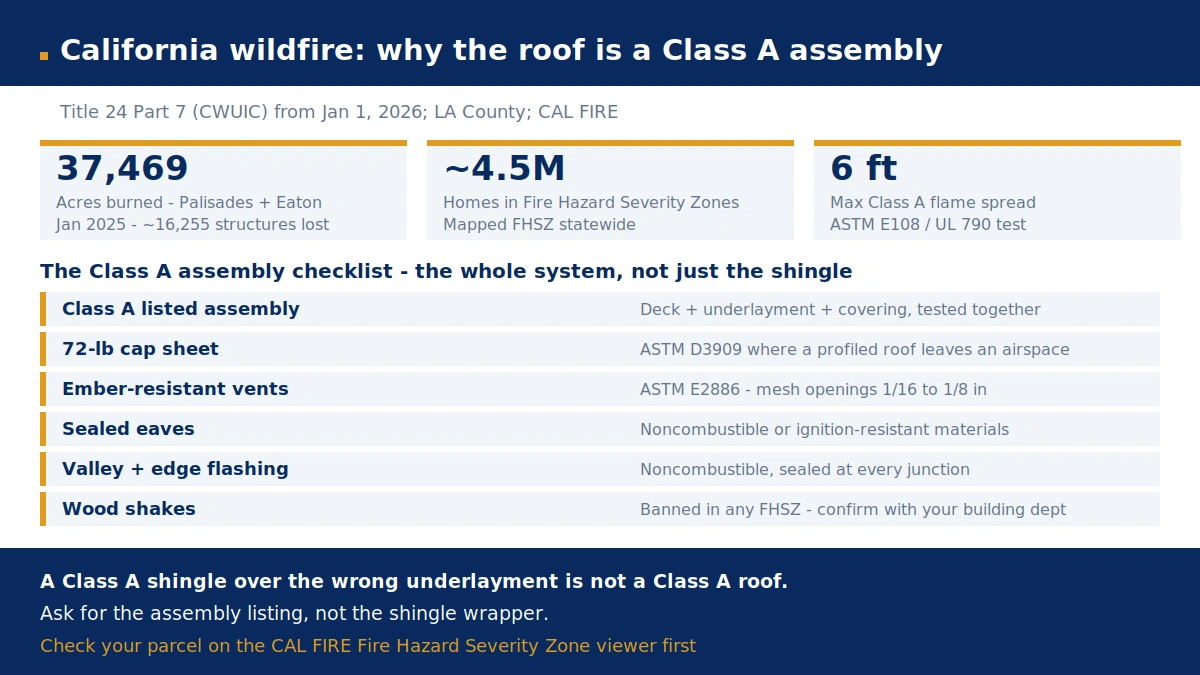
Where the code applies. The wildfire code does not apply statewide. It applies in designated Wildland-Urban Interface fire areas, where development meets or intermixes with wildland vegetation, and within State Responsibility Areas — land where CAL FIRE holds fire protection duty — it applies in all three Fire Hazard Severity Zones: moderate, high, and very high. In Local Responsibility Areas, it applies in very high zones. About 4.5 million California homes fall within mapped Fire Hazard Severity Zones, according to one roofing-code summary, which means roughly a third of the state’s housing stock is touched by the rule in some form. CAL FIRE’s Office of the State Fire Marshal publishes the zone maps in an online viewer; look up the parcel before the estimate, because the zone decides the spec and the spec decides the price.
Class A means the assembly, not the shingle. In any Fire Hazard Severity Zone, the roof must carry a Class A fire rating when tested to ASTM E108 or UL 790, the highest classification for fire resistance. Class A means the assembly survived the burning-brand test — a flaming wood block placed on the roof surface — plus wind-driven flame spread and intermittent flame application, with flame spread of no more than six feet. The word that matters is assembly. The rating applies to the complete system — deck, underlayment, and surface — tested and listed together, not to the surface material alone. A Class A shingle installed over the wrong underlayment on the wrong deck is not a Class A roof, and an inspector who asks for the listing will not be satisfied with a shingle wrapper. Most architectural asphalt shingles, concrete and clay tile, and metal roofing qualify as Class A assemblies when installed as listed. Wood shake shingles generally do not, and the code summary cited in the research file states that wood shingles and shakes are banned in any Fire Hazard Severity Zone regardless of fire-retardant treatment, under Title 24 Part 7.
The details that make the rating real. Where the roof profile creates an airspace between the covering and a combustible deck — common with tile and metal — a 72-pound mineral-surfaced cap sheet meeting ASTM D3909 must be installed over the deck to stop embers reaching the wood underneath, or at least one inch of mineral wool board, or a Class A fire-rated underlayment tested to ASTM E108. Attic, eave, and underfloor vents must resist ember intrusion under ASTM E2886; the simple compliance path is corrosion-resistant metal mesh with openings between one-sixteenth and one-eighth of an inch. Eaves must be enclosed with noncombustible or ignition-resistant materials. Valleys, edges, and penetrations must be flashed and sealed with noncombustible materials. None of this shows up in a photograph of the finished roof, which is why it has to be named on the quote: a bid that says “Class A shingles” and nothing about the cap sheet, the vents, and the eaves is a bid that has priced half the job.
January 2025 is why the code exists. On January 7, 2025, the Palisades and Eaton fires erupted hours apart on opposite sides of the Los Angeles basin, driven by Santa Ana gusts of 80 to 100 miles an hour. Together they burned about 37,469 acres, destroyed about 16,255 structures, and killed 31 people. Insurers paid more than $22.4 billion on 42,121 claims, and modelers put total insured losses at $28–$35 billion. By late 2026, only 0.47 percent of the destroyed homes had completed reconstruction and received occupancy approval, though 26.7 percent had rebuild permits. Every one of those rebuilds is being built under the wildfire code, with a Class A roof assembly, ember-resistant vents, and defensible space.
Why California Roofs Cost What They Do: Heat, Fire, Labor & Code
Five forces set the price of a California roof, and only one of them is the material. Heat is the first. Fire is the second. Wind is the third. Labor is the fourth. And the code — two codes, actually — is the fifth, because it converts the first three into line items on the quote.
Heat. Southern California sees about 284 sunny days a year, against a national average of 205, and the ultraviolet load is the slow killer of asphalt. The sun cooks the asphalt mat, drives off the volatile oils, and leaves a shingle that is brittle before it is old. South and west slopes take the worst of it, and a Los Angeles-area contractor puts visible heat aging on those slopes at 20 to 30 years, with granule loss in the gutters and curling tabs as the early signs. On the coast the same sun works with salt air, and a Southern California analysis puts coastal asphalt life at 15 to 18 years. Inland, the heat is drier and harder: Fresno and the Central Valley regularly pass 100 degrees in summer, and the attic under a dark roof can run hot enough to age the shingle from below as well as from above. The defense is not exotic. It is a cool-rated shingle in a light color, adequate attic ventilation so the deck does not bake, and a material choice that respects the exposure — tile or metal on the slopes that take the afternoon sun, rather than the cheapest shingle in the darkest color.
Fire. Wildfire is the force that turns a roofing decision into an insurance decision. The January 2025 fires destroyed more than 16,000 structures in a single month, and the ember storm that did it is the same ember storm the wildfire code is built to resist. A Class A assembly, ember-resistant vents, and a sealed eave do not guarantee survival — the code itself is a minimum standard, not a promise — but they are the difference between a roof that sheds embers and a roof that invites them into the attic. The fire premium on a quote is real: the cap sheet, the vents, the noncombustible flashing, and the listed assembly all cost money, and in a Fire Hazard Severity Zone they are not optional. A homeowner who prices a non-compliant roof to save money has priced a roof the building department will not approve and the insurer will not cover.
Wind. The Santa Ana winds are California’s version of the hurricane season: dry, hot winds that regularly reach 50 to 70 miles an hour in the inland valleys and mountain passes, and that drove the January 2025 fires at gusts of 80 to 100 miles an hour. Santa Ana events are a leading cause of shingle lift, flashing separation, and debris impact, and most repair calls after a Santa Ana event involve flashing work and shingle replacement in the $400–$1,200 range. The defense is the same as in any wind state: a six-nail pattern instead of four, a high-wind starter course, and a shingle with a 110 to 130 mile-per-hour wind rating installed the way the manufacturer specifies.
Labor. California roofers earn more than roofers almost anywhere else, and the gap shows up directly in the quote. The state median of $30.58 an hour is 15 percent above the national median, the San Francisco metro median of $35.74 is 34 percent above it, and the billed rate — what the contractor charges per worker-hour once insurance, payroll taxes, overhead, and profit are added — runs $61–$79 an hour on NumeralQ’s 2.0 to 2.6 multiplier, and $70–$120 an hour on MyRoofData’s crew-rate model. Labor is roughly 45 percent of an asphalt job on SmartRoofingCalculator’s model, which means the wage gap alone explains most of the gap between a California quote and a quote from a cheaper state.
Code. The fifth force is the one that converts the other four into paperwork. The cool-roof rule limits the product list. The wildfire code limits the assembly list. The permit adds $275–$725 on the state planning average, and $400–$1,200 in the big cities with plan check. The C-39 license, the bond, and the mandatory workers’ compensation coverage all cost the contractor money, and that money is in the quote.
Tile vs Asphalt in the California Heat
No material choice in California is argued about as much as tile versus asphalt, and the argument is usually framed wrong. It is framed as a price question — tile costs roughly double — when it is really a time question: how long will you own the house, and how many roofs do you want to buy in that time? The numbers below are the same ones from the material table, rearranged so the time question is visible.
Up front. On a typical 1,500 square foot ranch in Southern California, architectural shingles run about $13,500–$18,000 installed, concrete tile about $26,000–$35,000, and clay tile about $30,000–$40,000, according to a Southern California tile-versus-shingle analysis. On a 2,000 square foot home, asphalt runs $17,000–$26,000 against tile at $25,000–$40,000 for concrete and $35,000–$55,000 for clay on another contractor’s figures. Tile costs roughly double, and it weighs three to four times as much — 900 to 1,100 pounds a square against 200 to 350 for asphalt — which is why some homes need $2,000–$5,000 of structural reinforcement before the first tile goes on.
Over twenty years. Asphalt in Southern California lasts 18 to 22 years inland, 15 to 18 on the coast. That means the asphalt roof bought in 2026 is bought again in about 2046, and the second purchase lands at whatever 2046 prices are, not 2026 prices. Concrete and clay tile installed properly in Southern California regularly exceed 40 to 50 years, with many clay tile roofs lasting 75 years or more, and the mild coastal climate with minimal freeze-thaw cycling is close to ideal for tile. The tile roof bought in 2026 is still on the house in 2046, and in 2066, with one intervention in between: the underlayment, which typically needs replacement at around the 30-year mark for about $8,000–$12,000, reusing the existing tiles.
Heat, fire, and energy. Tile wins the heat argument outright. Clay and concrete tiles hold their shape in extreme heat where asphalt cracks and curls, and tile’s thermal mass and the air gap beneath the tiles cut cooling costs — one tile guide puts the energy saving at 10 to 25 percent on cooling. Tile is Class A fire-rated, which matters in every Fire Hazard Severity Zone in the state. Asphalt wins the repair argument: a cracked tile needs a tile-experienced crew and a matching tile, while a damaged shingle is a $300–$700 repair any roofer can do.
Who should buy which. Buy asphalt if you plan to stay in the home ten to twenty years, if the house was built for shingles and the structure cannot carry tile without reinforcement, or if the budget has to cover the roof and nothing else. Buy tile if you plan to stay thirty years or more, if the home is Spanish or Mediterranean in style and the tile is part of its value, or if the address is in a Fire Hazard Severity Zone and the Class A rating is doing insurance work as well as roofing work.
Permits & Code: Statewide Rules, Local Fees & the Two-Layer Limit
California’s permit and code picture is the opposite of the local patchwork in most states in this series, because California has a real statewide code — and then every city amends it. The state sets the floor. The city sets the fee, the inspection schedule, and the local amendments. A homeowner in Los Angeles and a homeowner in Fresno live under the same Title 24, but they pull permits from different counters at different prices on different timelines, and both need to know which counter applies before the first shingle comes off.
The statewide picture. The 2025 California Building Standards Code, Title 24, took effect statewide on January 1, 2026. The residential provisions live in the California Residential Code, Title 24 Part 2.5, the energy provisions in Part 6, and the wildfire provisions in Part 7, the standalone Wildland-Urban Interface Code that took over from Chapter 7A. Local jurisdictions adopt the state code with amendments — Los Angeles applies it through its own amended city codes, and every other city does the same in its own way. Codes are adopted and amended locally, so the rule that matters is the one in force at the building department on the day the permit is pulled, not the one in a guide written months earlier.
Permits are mandatory, and the fee is local. A building permit is required for a roof replacement anywhere in California. The planning figures run from about $275 to $725 statewide on SmartRoofingCalculator, with a planning average of about $450, and $400 to $1,200 in the big cities including plan check on MyRoofData. Los Angeles runs re-roofs on an express permit with no plan check when the covering is Class A or B and under six pounds per square foot over solid sheathing — Class A is required in a Very High Fire Hazard Severity Zone — and the city’s own records show a $12,000 re-roof express permit billed at $283.95 in 2026. Riverside County charges a fixed $335.50 for a residential replace-roof permit. The contractor normally pulls the permit and passes the fee through, so check whether the quote includes it.
The two-layer limit. California follows the International Residential Code limit of two roof layers: if the house already carries two layers of shingles, the job is a full tear-off, not a recover. A recover saves the tear-off cost, about $100–$200 a square per layer on MyRoofData’s figures, but it hides the deck, it adds weight the structure may not want, and it voids most manufacturer warranties. If the quote proposes a recover, ask how many layers are already on the roof, and ask the building department whether a recover is allowed for the address at all.
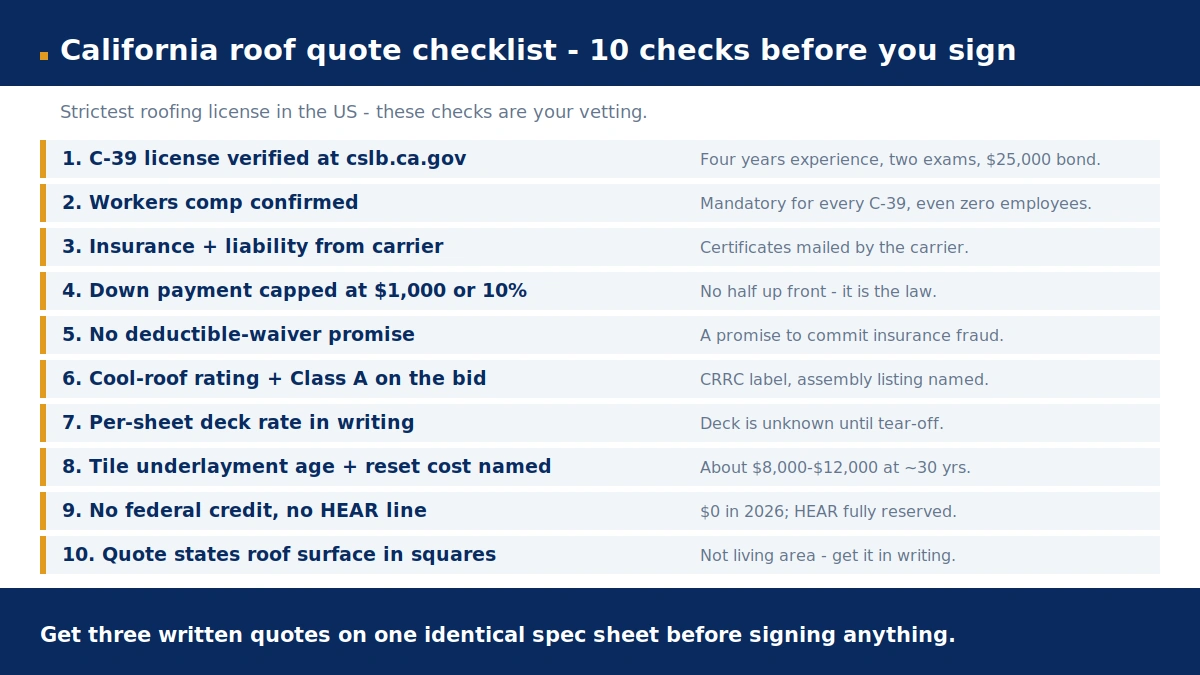
The code details that change the quote. Every California bid should carry three code-driven items, and a bid missing any of them is a warning sign. The cool-roof product, with its CRRC rating named, wherever the climate zone requires it. The Class A assembly listing, with the cap sheet or underlayment named, wherever the fire zone requires it. And the ventilation scope, because a California attic that cannot breathe will cook the shingle from below and void the warranty from above. A bid that omits the cool-roof rating is a bid that will fail the energy inspection. A bid that omits the fire assembly is a bid that will fail the building inspection. A bid that omits ventilation is a bid that will fail in five years, quietly, in August.
Hiring a Roofer in California: The C-39 License & the $1,000 Deposit Cap
California has the strictest roofing license in the country, and that fact changes the hiring job completely. Where a state issues no roofing license, homeowners must invent their own vetting from nothing. In California, the filter already exists, it is enforced by a state board with real teeth, and the homeowner’s job is to use it — which starts with knowing that the license is called C-39 and that a contractor who does not hold it cannot legally do your roof.
What the license is. Roofing in California is C-39 work, licensed by the Contractors State License Board. A C-39 license is required when the combined value of labor and materials reaches $1,000, under Business and Professions Code section 7048 — a threshold raised from $500 by Assembly Bill 2622, effective January 1, 2025, so older guides that still cite $500 are out of date. The license is also required at any price when a building permit is required or employee labor is used, which covers every real re-roof in the state. To qualify, the license holder must document four years of journey-level roofing experience within the last ten years, pass two exams — the Law and Business exam and the C-39 trade exam, each 3.5 hours, open-book, administered by PSI at $51.43 per exam — plus an open-book asbestos awareness exam, submit fingerprints for a background check, and post a $25,000 contractor bond before the license is issued. The application fee is $450 and the initial license fee is $200. Renewal is every two years at $450.
The workers’ compensation rule with no exception. Every C-39 licensee must carry workers’ compensation insurance, even with zero employees. Roofing is one of the few classifications that cannot file the no-employees exemption, and a lapse in coverage triggers automatic license suspension. Limited liability companies must also file a separate $100,000 employee and worker bond. The board sets no general-liability minimum for licensure, which means a contractor can hold a valid C-39 and still carry no liability coverage at all — ask for the liability certificate anyway, and ask for it mailed to you straight from the carrier, not handed to you by the contractor, with a business name that matches the contract exactly.
How to verify a bidder. Look the license up on the Contractors State License Board website, cslb.ca.gov, or call (800) 321-CSLB. Check three things: that the license is active and classified C-39, that the business name and the qualifier’s name match the contract, and that there is no disciplinary history. Then check the rest of the file: workers’ compensation coverage, general liability insurance, a permanent California address and a local phone number, references from jobs done in your own county — at least three, with addresses you can drive past — and manufacturer certification where it matters, because the extended warranty only applies when a credentialed crew does the install. Get three written quotes on one identical spec sheet from all three bidders, so the prices compare the same roof: same material, same CRRC rating, same Class A assembly, same underlayment, same ventilation, same tear-off, same deck rate, same cleanup.
The deposit cap is the law, and it is low. California caps the down payment on a home improvement contract at $1,000 or 10 percent of the contract price, whichever is less, under Business and Professions Code section 7159.5. On a $15,000 roof, 10 percent would be $1,500, but the cap kicks in at $1,000 because that is the lesser amount. On a $7,000 repair, the cap is $700. Progress payments after work starts must not exceed the value of work actually performed. The contract itself must include a boldface notice stating the limit, and violating it is a misdemeanor carrying a fine of $100–$5,000, up to one year in county jail, or both. The one exception is a contractor who furnishes a performance and payment bond covering full performance — that contractor is exempt from the cap. A contractor who asks for half up front is not asking for a deposit. He is asking you to break the law with him, and the answer is no.
The cancellation right and the storm-chaser warning. A home improvement contract signed at your home carries a three-business-day right to cancel under California’s home solicitation law, and the contract must include the cancellation notice. Use it whenever a sale feels rushed. California is storm-chaser territory after every Santa Ana wind event and every fire, and the crews arrive within days, knocking on doors in the damaged neighborhoods. Watch for the pattern: a door knock with pressure to sign on the spot, an out-of-state phone number and no permanent local office, no C-39 license, a promise to waive or absorb your deductible, and a demand for a large payment up front. A deductible waiver is a promise to commit insurance fraud on your behalf. Our questions to ask a roofer guide carries the complete list.
Insurance: FAIR Plan, Non-Renewals & the Roof That Gets You Covered
In California, insurance is where a new roof either earns its keep or exposes a nasty surprise: a policy that, when claimed on, pays far less than its owner assumed. California has the strangest homeowners insurance market in the country: the statewide average premium is below the national average, and the wildfire-zone premium is five to twenty times that average, and the gap between the two is where the FAIR Plan lives. Check every figure here against your own policy — it, and nothing else, decides what a claim pays.
The premium, and the spread behind it. California homeowners pay less than the national average on a standard profile, and the studies agree on the direction even though they measure different coverage levels. Insurance.com puts the state average at about $1,653 a year for $300,000 of dwelling coverage. MoneyGeek’s figure is $1,543 a year on $250,000 of dwelling coverage. Insuranceopedia puts it at $1,324 a year. Insure.com puts it near $1,386 a year for a $300,000 dwelling. The same studies put the countrywide average at roughly $2,015. The reason is Proposition 103, the 1988 voter-approved law that makes insurers get regulatory sign-off before raising rates. But the statewide average hides a spread of ten to twenty times by ZIP code: a standard home in a non-wildfire ZIP runs roughly $1,400–$2,400 a year, while a brush-adjacent home in the Sierra foothills, Malibu, Topanga, Altadena, or hillside Sonoma and Napa routinely quotes $5,000–$25,000 or more a year, usually as a FAIR Plan fire policy plus a Difference in Conditions wrap.
The non-renewal wave. Insurers non-renewed more than 2.8 million California homeowner policies between 2020 and 2025 in fire-prone ZIP codes. State Farm, the largest homeowners insurer in the state, stopped writing new policies in May 2023 and issued roughly 72,000 non-renewals in early 2024. Allstate and Farmers restricted or paused new business in high-risk ZIP codes. California law requires at least 75 days’ written notice before a non-renewal, under Insurance Code section 678, and after a declared wildfire emergency the Insurance Commissioner can bar insurers from non-renewing homes in and next to the fire perimeter for one year — the moratoriums for the January 2025 Palisades, Eaton, and Hurst fires expired one year after their declarations, so check the Department of Insurance moratorium page for your ZIP before assuming you are exposed. The 2024 Sustainable Insurance Strategy lets admitted carriers use catastrophe modeling and pass through net reinsurance cost in exchange for writing 85 percent of statewide market share in wildfire-distressed ZIPs, and the early signs are mixed: State Farm’s 17 percent homeowners rate was confirmed in a March 2026 settlement with a halt on block non-renewals through 2026, while Allstate was approved for a 34 percent average homeowners increase in May 2026.
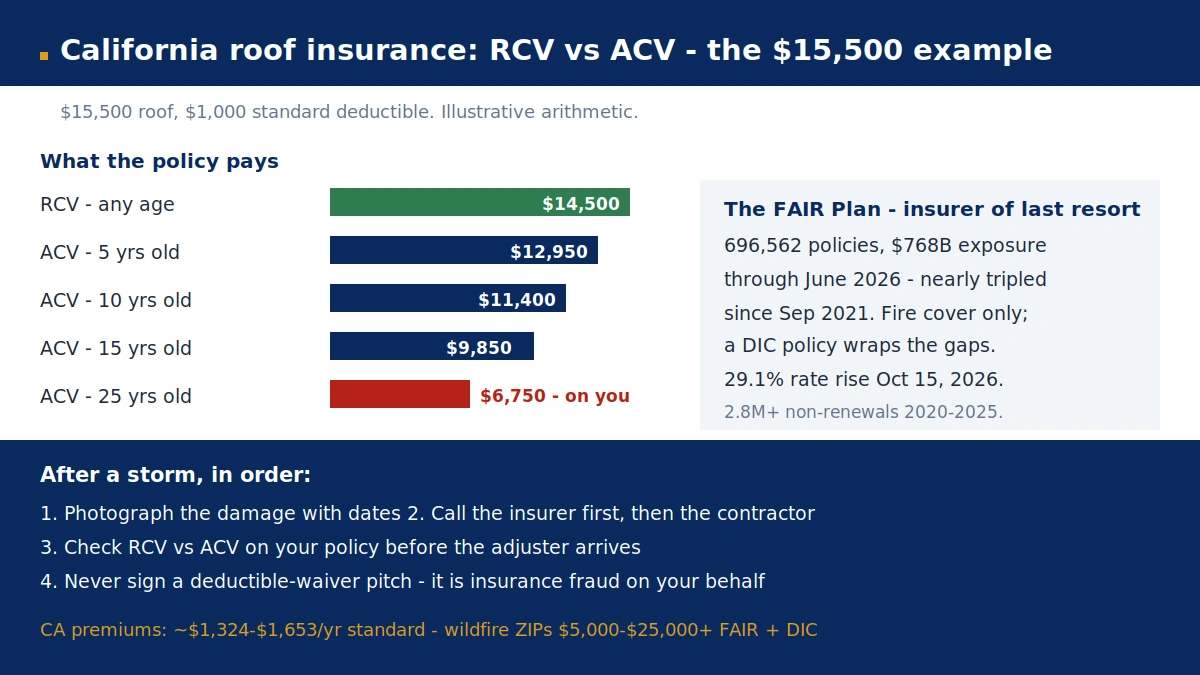
The FAIR Plan. The California FAIR Plan is the state’s insurer of last resort, and it has never been bigger. It held 696,562 policies and $768 billion of exposure through June 2026, up from 242,440 policies in September 2021 — nearly tripled in five years. Orange County policies grew 74 percent in one year, Riverside 70 percent, Ventura 60 percent, and San Diego 58 percent. The plan covers fire, lightning, and internal explosion only, up to $3 million for residential properties. It does not cover theft, liability, water damage, or loss of use. Most homeowners in fire zones pair it with a separate Difference in Conditions policy that covers the gaps — two premiums, two deductibles, two claims processes. The state approved a 29.1 percent average dwelling rate increase for the plan, effective October 15, 2026, after the plan asked for 35.8 percent, and approved a $1 billion assessment — the first in more than 30 years — with insurers allowed to recoup up to half of it from policyholders.
RCV vs ACV. After the deductible, the next number that matters is whether the policy pays replacement cost or actual cash value. Under replacement cost, the insurer pays the price of a new roof minus the deductible, however old the damaged roof was. With actual cash value, the carrier pays what the old roof was worth when the damage happened — new-roof price less depreciation — and shingles lose value fast. The table below is NestPriced illustrative arithmetic, not a regulator’s published example: a $15,500 roof, a $1,000 standard deductible, linear depreciation of 2 percent a year over a 25-year shingle life.
| Roof age | RCV payout | ACV payout |
|---|---|---|
| Any age | $14,500 | — |
| 5 years | — | $12,950 |
| 10 years | — | $11,400 |
| 15 years | — | $9,850 |
| 25 years | — | $6,750 |
The pattern is the warning. Five years in, the ACV payout trails replacement cost by $1,550. At fifteen years, it is $4,650 less. By twenty-five years the payout is $6,750 against a $15,500 roof — barely two-fifths — leaving the homeowner to fund the rest. On an ACV policy, an older roof is largely self-insured, whether the homeowner realizes it or not. Check the policy type before the storm. On an ACV policy with a roof past ten years, the replacement call changes, because the insurer funds little of either option.
The roof as an insurance credential. In California in 2026, the roof is not just a building component. It is a credential the insurer reads before deciding whether to write the policy at all. Some carriers require a Class A roof as a condition of coverage in fire zones. A new roof with a documented Class A assembly, ember-resistant vents, and defensible space is the strongest evidence a homeowner can offer that the house belongs in the admitted market rather than on the FAIR Plan. No named carrier’s California discount percentage for a Class A or fire-hardened roof was verified for this guide, so none is given — confirm the figure with your own carrier, in writing, before the install.
Paying for It: No Federal Credit in 2026, No State Roof Rebate
One short paragraph holds the whole 2026 money picture for a California roof, and none of it is good news — a fact roofing quotes keep getting wrong. In 2026, the federal government contributes nothing to a California homeowner who replaces a roof, the state contributes nothing to the roof itself, and the federal rebate programs that help homeowners in other states are, in California, fully reserved on one half and not yet launched on the other.
The federal tax credit is $0. IRS fact sheet FS-2025-05 confirms the position: the One Big Beautiful Bill Act (Public Law 119-21, signed July 4, 2025) withdraws the Residential Clean Energy Credit (§25D, 30 percent) and the Energy Efficient Home Improvement Credit (§25C) from any property placed in service after December 31, 2025. A roof never counted as solar equipment, so §25D never applied to it; the §25C efficiency credit was occasionally claimed for qualifying roofing materials, and that route is closed as well. A 2026 quote that still shows a tax-credit line is priced under a repealed law — have the contractor remove it and re-price the job. The §48E commercial clean-electricity credit covers property like solar arrays, but this guide found no lease or pass-through arrangement that delivers federal dollars to a California roof. None is claimed here. Our federal energy tax credits guide lays out the full 2026 federal position. One California roofing guide published in 2026 still claims an Inflation Reduction Act credit may apply to energy-efficient roofing upgrades. It may not. Do not let that claim onto your quote.
HEAR: launched, then fully reserved. HOMES: not yet launched. The federal home energy rebate programs work differently in California than in most states, because California actually launched one of them — and then ran out of money. The Home Electrification and Appliance Rebates program, HEAR, launched in October 2024, administered by the California Energy Commission through TECH Clean California, with about $290 million allocated. Single-family rebates were fully reserved statewide on February 24, 2026, and multifamily rebates on September 1, 2026. Unapproved reservation requests went onto a waitlist, and no new income verification requests are being accepted. The Home Efficiency Rebates program, HOMES, with about $291 million allocated, has not yet launched to consumers at all — its application is conditionally approved, with a direct-install program for low-income residents and a pay-for-performance pathway planned. And even in a state where HEAR had money left, it would never pay for a roof: HEAR funds electrification — heat pumps, heat-pump water heaters, electrical panels, and insulation-related wiring — and never roofing, and under the Energy Department’s 2026 program notices it pays only for electric-to-electric upgrades. Where an efficiency program has launched, pairing a reroof with insulation work can qualify the insulation half. In California, there is no launched efficiency program to pair it with, and no new HEAR reservation to claim.
No state money for the roof itself. This pass turned up no state grant, rebate, or tax credit for a California roof, and no utility rebate for one either. TECH Clean California and utility incentives exist for heat pumps, not for roofs. What does pay is the insurer, through the coverage a Class A roof protects and the FAIR Plan a fire-hardened home may avoid, and the energy bill, through the cool roof and the ventilation work done alongside the reroof. For help paying in 2026, a California homeowner’s realistic routes are a home-equity loan or contractor financing — and the annual percentage rate matters more than the monthly payment, since a small payment on a long, high-rate term is the priciest roof in this guide. Financing gets the full treatment in our how to finance a new roof guide.
Repair vs Replace: The California Decision Rules
A damaged roof in California does not always need a full replacement, and an old roof does not always deserve only a repair. The decision turns on age, damage, and the deductible — and in this state, on the insurance question as well, because a repaired roof that the carrier will not renew is a repair paid for twice.
Patch it while the roof is young and the damage stays local. A roof under ten with a few missing shingles, a chimney flashing leak, or a small patch of wind-lifted tabs calls for a repair, not a replacement. California repair figures from NumeralQ, pricing October 26, 2026, put replacing up to ten shingles at $229–$461, flashing repair at $249–$530, finding and fixing a leak at $333–$930, chimney flashing reflash at $344–$760, and a skylight leak at $351–$700. Modernize, updated August 26, 2026, puts the California repair average at about $1,400, with a typical range of $450–$3,200: minor repairs at $300–$800 and moderate repairs at $800–$2,000, with shingle replacement at $300–$700, flashing at $400–$1,200, and leak repair at $400–$1,500. A Southern California contractor guide puts the regional average at $900–$1,200, with a minor shingle patch at $300–$600, flashing at $400–$900, and a leak at $400–$1,800. A repair also fits when the damage traces to a single wind event and the adjuster agrees the rest of the roof has life left — accept the payment for the damaged section, fix it properly, and keep the roof.
Replace it once age, widespread damage, or the arithmetic points to a new roof. Replace when the roof is past fifteen years on architectural shingles and the sun has curled the tabs on the south and west slopes, because patching a heat-aged mat is cosmetic work on a roof that will fail at the next Santa Ana event. Replace when the deck is soft or the sheathing delaminated — no repair fixes structure. Replace when the tile underlayment has reached its thirty-year mark and the leaks keep coming back in different valleys, because the underlayment is telling you the system has failed, not the tile — budget $8,000–$12,000 for the underlayment job and reuse the tiles. Replace when the insurer has already paid a claim and the roof has aged into ACV territory, where the next claim pays about two-fifths of the cost — take the replacement money while it still buys a replacement. Replace when the address is in a Fire Hazard Severity Zone and the old roof is not a listed Class A assembly, because the replacement is the moment the house gets insurable again. And replace when the repair costs more than about a third of a full replacement on a roof with under five years left — the repair is just a down payment on the roof that is coming anyway.
The inspection rhythm. Schedule one inspection in late fall, after Santa Ana season, and a second in late spring, before it starts. The fall inspection catches the summer’s heat damage and the autumn’s wind damage while the adjuster’s window is still open and the crew can still work before the winter rains. The spring inspection catches the winter’s atmospheric-river damage before the heat season adds a second layer of problems. A licensed-company roof inspection runs about $200 in California. Inspection pricing and coverage are in our roof inspection cost guide, and repair pricing in our roof repair cost guide. Gutters face the same wind as the roof, and the seams fail first — our gutter installation cost guide covers them if they are part of the job.
Sources & methodology
Cost anchors: SmartRoofingCalculator — California state page (updated Nov 2, 2026; CA arch $510–$730/sq; 25-square roof $12,750–$18,250; standing-seam metal $1,010–$1,570/sq; tile $1,350–$2,020/sq; permit ~$450, $275–$725; state factor 1.123; tear-off $125/sq/layer; 2,000 sq ft home 20 sq arch $10,200–$14,600); NumeralQ — California roof replacement cost (pricing Oct 26, 2026: statewide 2,000 sq ft roof $10,410–$12,750; LA $10,410–$12,750; San Diego $10,290–$12,590; Sacramento $10,380–$12,720; San Francisco $11,330–$13,950; BLS May 2025 roofer median Sacramento $30.44/hr, billed $61–$79/hr); MyRoofData — California (2026 model: typical arch roof $16,000–$27,750, ~25% above national; arch $563–$938/sq, 3-tab $438–$688/sq, ribbed metal $688–$1,188/sq, standing seam $1,188–$2,000/sq, cedar $1,125–$1,875/sq, concrete tile $1,250–$2,250/sq, clay tile $1,500–$3,125/sq, slate $1,875–$3,750/sq, TPO/EPDM $688–$1,188/sq, all before tear-off; tear-off $100–$200/sq/layer; crews $70–$120/hr; permits $400–$1,200 big-city; LA $17,250–$30,000, San Diego $16,750–$29,250, San Jose $18,000–$31,000, Sacramento $15,750–$27,250); RoofingEstimatorPros — California (updated Aug 26, 2026: 2,000 sq ft arch $18,961–$33,448, avg $25,400, $12.70/sq ft, 1.30x multiplier, 1–3 day install); Modernize (updated Aug 27, 2026: $18,000–$32,000, avg ~$26,600; LA $18,000–$30,000, SF-Oakland-San Jose $20,000–$35,000, Sacramento-Stockton-Modesto $17,000–$28,000, San Diego $18,000–$29,000); ProjectBudgeter (Jun 1, 2026: typical home $10,500–$24,000, most ~$14,500); CostOnce (prices updated Mar 2026: $7–$22/sq ft; CA +35% above national); SmartRoofingCalculator city pages (updated Nov 2, 2026: LA 25-sq $17,213–$24,638, $689–$986/sq, 1.35x; San Diego ~$16,830–$24,090; San Jose ~$19,763–$28,288; Fresno ~$14,663–$20,987; Sacramento ~$15,555–$22,265); RemodelYourHome (Aug 2026: Fresno $8,500–$17,000, LA $11,500–$24,000, Sacramento $10,500–$21,000, San Diego $10,500–$21,000, SF $12,500–$25,000). The material totals for a 25-square roof, the size table, and the annual-cost figures are our own math, built from the cited per-square price bands and service lives.
Title 24 cool roofs: US Made Supply — Title 24 cool roof requirements (updated May 23, 2026: 2025 Energy Code effective Jan 1, 2026; single-family values unchanged 2022 vs 2025; re-roof steep zones 4, 8–15 at 0.20/0.75/SRI 16; re-roof low zones 4, 6–15 at 0.63/0.75/SRI 75; new steep zones 10–15 at 0.20; new low zones 13, 15 at 0.63; multifamily steep Option B 0.25 in zones 10, 11, 13, 15); Integrity Roofing — cool roof rules for reroofs (Oct 2026: applies when more than 50% replaced; CRRC ratings; exemptions for solar-covered area and roofs of at least 25 lb/sq ft; CF1R-ALT-01-E); LegalClarity — California cool roof requirements (2025 code effective Jan 1, 2026; aged values after 3 years weathering); LA Ordinance No. 187208; LADBS Information Bulletin P/GI 2026-003 (express permits, revised 2026).
Wildfire + WUI + Class A: LegalClarity — Chapter 7A (Chapter 7A moved to Title 24 Part 7 CWUIC Jan 1, 2026; Class A per ASTM E108/UL 790 in FHSZ; 72-lb cap sheet ASTM D3909; SRA moderate/high/very high, LRA very high); RoofingStuffs — California roofing guide (2025 CBC effective Jan 1, 2026; ~4.5M homes in FHSZ; wood shakes banned in any FHSZ regardless of treatment, Part 7 §R902.1.3; vents ASTM E2886, mesh 1/16–1/8 in; metal SR 0.60–0.75); KTN Roofing — Class A fire-rated roofing (Class A assembly, ember-resistant vents, sealed eaves); LA County CEO dashboard (Jan 2025 fires: 37,469 acres, ~16,255 structures, 205,000 evacuated); Verisk insured losses $28–$35B; CDI insurers paid $22.4B+ on 42,121 claims; rebuild 0.47% complete, 26.7% permitted (LA County economic update, late 2026).
Insurance: MoneyGeek (CA avg $1,543/yr on $250K dwelling); Insurance.com (CA avg $1,653/yr on $300K dwelling; FAIR Plan 30% rate increase Oct 2026); Insuranceopedia (CA avg $1,324/yr); Insure.com (~$1,386/yr on $300K dwelling); Latent Insurance 2026 guides (standard HO-3 $1,400–$2,400/yr; wildfire ZIPs $5,000–$25,000+ FAIR + DIC; Sustainable Insurance Strategy Dec 2024; Allstate +34% May 2026; State Farm 17% Mar 2026 settlement); Broadway Insurance (FAIR Plan 696,562 policies, $768B exposure through Jun 2026; 29.1% increase effective Oct 15, 2026; Orange County +74%, Riverside +70%, Ventura +60%, San Diego +58% in one year; surplus lines 50,000 in 2023 to 320,000 in 2025); InsuranceExit (FAIR Plan 668,609 policies end 2025; $1B assessment Order 2025-1; State Farm 72,000 non-renewals early 2024); Reverse Mortgage Coach (2.8M+ non-renewals 2020–2025; FAIR covers fire only to $3M residential); CA Insurance Code §678 (75-day non-renewal notice).
Permits + licensing: SmartRoofingCalculator CA page (permit ~$450; two-layer limit IRC R908.3.1.1; 2025 CBC; CRC Title 24 Part 2.5); PermitCalculator (LADBS $12,000 re-roof express permit $283.95, 2026 PRISM cards); NumeralQ LA page (LADBS P/GI 2026-003; Class A required in VHFHSZ; CRRC cool roof over 50%); Riverside County TLMA fee schedule (residential replace-roof $335.50); CSLB via RoofingLicenseCheck (checked Oct 22, 2026: C-39, $1,000 threshold per AB 2622 / Bulletin 24-07, 4 years experience, two PSI exams $51.43 each, $25,000 bond, workers comp mandatory for all C-39, application $450, initial $200, renewal $450/2 yrs, LLC $100,000 bond); B&P §7159/7159.5 via leginfo (down payment cap $1,000 or 10%, whichever less; contract threshold raised $500 to $1,000 by AB 2622 Jan 1, 2025; violation misdemeanor $100–$5,000, up to 1 yr jail).
Labor: BLS OEWS May 2025 (CA roofers 47-2181: median $30.58/hr, mean $32.41/hr, $63,600/yr median, 21,190 roofers, rank #7 of 51, 10th–90th $23.38–$42.79/hr; LA-Long Beach-Anaheim median $30.56/hr; Sacramento-Roseville-Folsom $30.44/hr; San Francisco-Oakland-Fremont median $35.74/hr, mean $35.68/hr; San Jose-Sunnyvale-Santa Clara median ~$36.85/hr); SmartRoofingCalculator citing BLS May 2024 (~21,110 roofers, mean $32.73/hr; laborers $31.80/hr; 4-person crew ~$120.04/hr pay).
Tile vs asphalt: RAA Construction Group (Nov 2026: LA arch ~$550–$950/sq; concrete tile ~$1,100–$1,900/sq; clay ~$1,800–$3,500+/sq; shingle heat aging 20–30 yrs on south/west slopes); RoofReplacementCA tile-vs-shingle analysis (1,500 sq ft ranch arch $13,500–$18,000; concrete tile $26,000–$35,000; clay $30,000–$40,000; asphalt 18–22 yrs inland, 15–18 yrs coastal; tile 40–50+ yrs, clay 75+ yrs; underlayment replacement ~$8,000–$12,000 at ~30 yrs; reinforcement $2,000–$5,000; tile 900–1,100 lb/sq vs asphalt 200–350 lb/sq); Southern California 284 sunny days/yr (RoofReplacementCA tile guide).
Climate + wind: Santa Ana winds 50–70 mph (RoofReplacementCA repair guide); Jan 2025 windstorm gusts 80–100 mph (LA County).
HEAR / HOMES + federal: ECW heat pump rebates by state (checked Oct 27, 2026: CA HEEHR launched, single-family fully reserved Feb 24, 2026, multifamily Sep 1, 2026; HOMES not yet launched; allocations $290,252,580 HEAR / $291,366,906 HOMES; up to $8,000 below 80% AMI, $4,000 at 80–150% AMI); BetterHouse (Sep 2026: CA closed to new applicants, waitlisted since Feb 24, 2026); National Housing Trust tracker (Apr 30, 2026: CA total allocation $582M; HEAR Phase I launched Oct 2024); RetrofitRelay (DOE notices 26-1/26-2, 2026: HEAR electric-to-electric only). OBBBA (P.L. 119-21), confirmed by IRS FS-2025-05, withdrew §25C and §25D from installs placed in service after Dec 31, 2025.
Repair costs: Modernize (Aug 26, 2026: CA repair avg ~$1,400, range $450–$3,200; minor $300–$800; moderate $800–$2,000; shingle area $300–$700; flashing $400–$1,200; leak $400–$1,500); NumeralQ — California roof repair cost (Oct 26, 2026: up to 10 shingles $229–$461; flashing $249–$530; leak $333–$930; chimney reflash $344–$760; skylight leak $351–$700); RoofReplacementCA SoCal repair guide (Oct 17, 2026: $300–$3,500; regional avg $900–$1,200; minor patch $300–$600; flashing $400–$900; leak $400–$1,800; Santa Ana repairs $400–$1,200); CallTheLocal (inspection ~$200, NBC 7 San Diego).
How we worked: the material totals for a 25-square roof, the size table, the annual-cost figures, and the RCV/ACV table all come from our own math on the cited per-square price bands and service lives, and each is flagged as such. We flagged the headline-cost disagreement, the standing-seam disagreement, the cool-roof 0.25 conflict (multifamily only), the wood-shake ban conflict, the $500-vs-$1,000 threshold change (AB 2622, Jan 1, 2025), and the city-pricing gap (no verified NumeralQ figure for Fresno; no BLS metro medians for San Diego or Fresno). No San Diego or Fresno BLS roofer medians, no named-carrier California Class A discount percentage, no verified cool-roof product price premium, no CA snow-load psf figures, and no verified Fresno NumeralQ price were given (none verified). The California-realistic lifespans here are contractor-consensus estimates that fit the heat, UV, and salt-air climate. One 2026 California roofing guide’s claim that an IRA tax credit may apply to energy-efficient roofing is wrong under OBBBA and is not repeated here.
What does a roof replacement cost in California in 2026?
SmartRoofingCalculator, updated November 2, 2026, puts a typical 25-square architectural shingle roof in California at $12,750–$18,250 in 2026 — $510–$730 a square with tear-off included. NumeralQ prices a 2,000 square foot roof lower, at $10,410–$12,750, and MyRoofData prices a typical single-family architectural roof at $16,000–$27,750 — the sources disagree on method, so carry the range, not one number, into your first contractor meeting. On a 25-square roof: 3-tab shingles $10,950–$17,200 before tear-off, standing-seam metal $25,250–$39,250, concrete tile $33,750–$50,500, and clay tile $37,500–$78,125.
What is a Title 24 cool roof, and does my re-roof need one?
Probably, if you are replacing more than half of your roof. Title 24, Part 6 requires cool-rated roofing products on re-roofs: for steep-slope roofs in climate zones 4 and 8–15, an aged solar reflectance of at least 0.20 with thermal emittance of 0.75, or an SRI of 16; for low-slope roofs in zones 4 and 6–15, an aged reflectance of at least 0.63 with thermal emittance of 0.75, or an SRI of 75. Only products rated and labeled by the Cool Roof Rating Council count. The 2025 Energy Code, effective January 1, 2026, kept the single-family values unchanged from the 2022 code. Exemptions cover the area under building-integrated solar panels and roofs of at least 25 pounds per square foot.
Does my California roof need a Class A fire rating?
If your home is in a Fire Hazard Severity Zone, yes — and the rating applies to the whole assembly, not just the shingle. Since January 1, 2026, the wildfire rules live in Title 24, Part 7, the California Wildland-Urban Interface Code, which took over from Chapter 7A. In any Fire Hazard Severity Zone, the roof assembly must be listed Class A under ASTM E108 or UL 790, with ember-resistant vents, sealed eaves, and a 72-pound mineral-surfaced cap sheet or equivalent where a profiled roof leaves an airspace over a combustible deck. Most architectural shingles, tile, and metal qualify as Class A assemblies when installed as listed. Wood shakes are banned in Fire Hazard Severity Zones regardless of treatment, according to the code summary cited in this guide — confirm the rule with your own building department, because one industry source describes cedar as restricted unless treated instead.
How much does a roof replacement cost in Los Angeles vs Fresno?
The same 25-square architectural roof runs $17,213–$24,638 in Los Angeles and $14,663–$20,987 in Fresno on SmartRoofingCalculator’s modeled city figures, updated November 2, 2026 — about a $3,000 gap driven by labor, not materials. San Diego runs $16,830–$24,090, Sacramento $15,555–$22,265, and the Bay Area (San Jose proxy) $19,763–$28,288, the highest in the state. NumeralQ’s modeled 2,000 square foot figures run lower everywhere — Los Angeles $10,410–$12,750, San Diego $10,290–$12,590, Sacramento $10,380–$12,720, San Francisco $11,330–$13,950 — and no NumeralQ figure was verified for Fresno. The roofer median wage explains the ranking: $35.74 an hour in the San Francisco metro, $30.56 in Los Angeles, $30.44 in Sacramento, and $30.58 statewide.
Does my California roofer need a license?
Yes — a C-39 Roofing license from the Contractors State License Board, required when the job reaches $1,000 in combined labor and materials, at any price when a permit is required, and whenever employee labor is used. The qualifier must document four years of journey-level roofing experience, pass the Law and Business exam and the C-39 trade exam, pass an asbestos awareness exam, submit fingerprints, and post a $25,000 bond. Every C-39 licensee must carry workers’ compensation insurance, even with no employees. Verify the license at cslb.ca.gov before signing, and check that the business name matches the contract exactly. The down payment on your contract is capped by law at $1,000 or 10 percent of the contract price, whichever is less.
What is the California FAIR Plan, and do I need it?
The FAIR Plan is California’s insurer of last resort, for homeowners who have been declined or non-renewed by admitted carriers — more than 2.8 million policies were non-renewed in fire-prone ZIP codes between 2020 and 2025. It held 696,562 policies and $768 billion of exposure through June 2026, nearly triple its September 2021 size. It covers fire only, up to $3 million for residential properties, and does not cover theft, liability, water damage, or loss of use — most homeowners pair it with a separate Difference in Conditions policy. A 29.1 percent average dwelling rate increase took effect October 15, 2026. A new Class A roof with ember-resistant vents and defensible space is the strongest evidence you can offer an admitted carrier. Start shopping 90 days before renewal even if nothing has gone wrong.
Can I claim a federal tax credit on a California roof in 2026?
No — $0. For anything placed in service after December 31, 2025, the One Big Beautiful Bill Act removed both §25C and §25D, and a roof never qualified for the solar credit to begin with. California’s federal home energy rebates do not help either: the HEAR electrification program launched in October 2024 but single-family rebates were fully reserved statewide on February 24, 2026, with multifamily fully reserved September 1, 2026, and the HOMES efficiency program has not launched to consumers at all. HEAR and HOMES never cover roofing in any case. No California state roof grant, rebate, or tax credit was found. What pays is the insurer, through the coverage a Class A roof protects, and the energy bill, through the cool roof and ventilation work done with the reroof.
How long does a roof last in California?
California roofs fall short of brochure lifespans in mild climates, while tile and metal run well past them. California-realistic lifespans: 3-tab shingles 12–18 years, architectural shingles 18–25 years (15–18 years on the coast, where salt air accelerates granule loss), standing-seam metal 40–70 years, concrete tile 40–75 years, clay tile 50–100 years, cedar shakes 25–35 years, flat TPO or EPDM membranes 20–30 years, natural slate 75–150 years. The killers are ultraviolet light and heat that age asphalt from above and below, Santa Ana winds that lift tabs and separate flashing, and embers that test the fire rating. The tile outlives its underlayment, which typically needs replacement at around 30 years for about $8,000–$12,000, reusing the existing tiles.