

A heat pump buyer in California is buying a different machine, for a different reason, than a buyer in almost any other state in this series. In North Dakota the heat pump is a heating machine that has to survive minus 18 degrees. In California the heating is the easy half: Los Angeles is designed for 43 degrees, San Diego for 44, San Francisco for 38, and even Sacramento, the coldest of the big cities, for 32. The heating season is short, the loads are small, and a standard high-efficiency unit covers them with capacity to spare. What the heat pump really is in California is an air conditioner that also heats — and in the Central Valley, where Sacramento and Fresno summers are designed for 98 and 100 degrees, the air conditioning is the part of the purchase that gets used every day for five months a year.
That mild climate does two things to the purchase. First, it takes the cold-climate premium off the table for most of the state. The $2,000 to $4,000 that a North Dakota buyer pays for enhanced vapor injection and low-temperature controls buys nothing in Los Angeles or San Diego, where the outdoor unit will never see a temperature below freezing in a normal year. It buys something only in the Sierra foothills, the far north coast, and the high desert — climate zones 1, 2, and 16 — where a winter night can still drop into the teens. Second, it flips the sizing rule. In a cold state the heating load sets the size, and a system sized for the summer is far too small for January. In California the cooling load sets the size, and the heating load is satisfied almost as a side effect. A 3-ton system that cools a 2,000-square-foot Sacramento house in July has far more heating capacity than that house needs in January, which means the backup heat question that dominates the cold-state guides barely exists here: there is no resistance strip running for a month every winter, because there is no month that cold.
The second difference is the price of the electricity that runs the machine. California homes paid about 32.3 cents a kilowatt-hour on average over the 12 months to August 2026, against a national average of 18.0 cents — the highest of any state in the continental US. The CPUC Public Advocates Office put June 2026 residential averages at 33.7 cents for PG&E, 34.4 cents for SCE, and 45.5 cents for SDG&E. Against gas at about $2.10 a therm, that price makes the fuel math run backwards: a heat pump costs more to run than the gas furnace on the three biggest utilities in the state. The exceptions are the municipal utilities — SMUD in Sacramento at 13.71 cents in the heating season, and LADWP in Los Angeles at about 23.84 cents on the latest verified figure — and on SMUD the heat pump wins outright.
The third difference is the incentive landscape, which changed twice in the last year. A 2026 install carries a federal tax credit of $0. California also had the two biggest state-level programs in the country — TECH Clean California and the federal HEAR rebates — and both are now closed to new applicants: TECH’s statewide incentives have been fully reserved since November 14, 2025, and HEAR was fully reserved for single-family homes on February 24, 2026 and for multifamily homes on September 1, 2026, with the $152 million Phase II undated. A 2026 quote that still deducts either program is priced under a program with no money left. What remains is local: LADWP in Los Angeles, SMUD in Sacramento, a new TECH campaign for eleven San Fernando Valley communities that opened November 2, 2026, and the SGIP heat pump water heater program — which pays for water heaters, not space heating.
That is the whole guide in one paragraph: a cheap-to-buy, easy-to-run machine in a state where the electricity to run it is the most expensive in the continental US, the gas it replaces is cheap, and the big rebates have just closed. The sections below price the machine, compare the cities, work the running-cost sums utility by utility, and name the homes where the purchase still makes sense — which, in California, are more specific than the brochures admit.
Start with the national picture in our national heat pump cost guide, then weigh California’s figures against it.
Table of Contents
How Much Does a Heat Pump Cost in California in 2026?
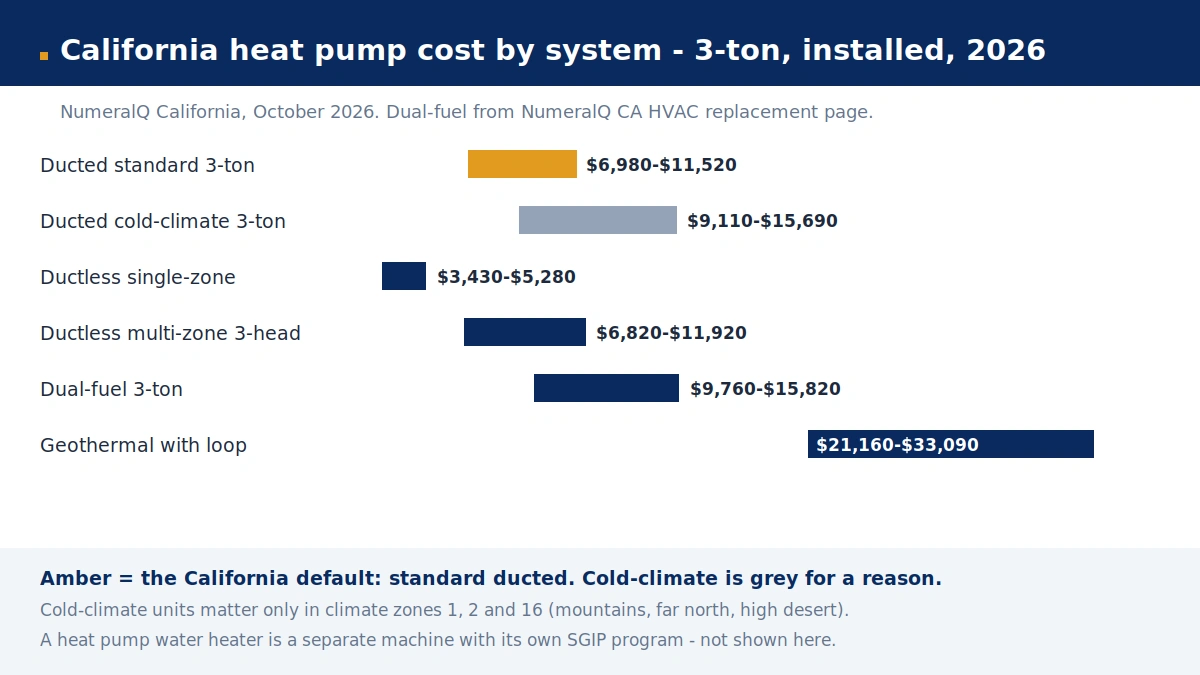
Two anchors describe the California market in 2026, and the gap between them is the cold-climate premium that most California buyers should not pay. NumeralQ’s California estimator, priced as of October 26, 2026, puts a standard ducted 3-ton air-source system at $6,980-$11,520 installed — the planning range for a whole-home ducted replacement in a typical California house. That same 3-ton job in a cold-climate ducted version costs $9,110-$15,690. That $2,130 to $4,170 step up buys the inverter compressor, enhanced vapor injection, and low-temperature controls that let the unit keep heating at 5 degrees and below — and in Los Angeles, San Diego, San Francisco, and Sacramento, it is money spent on weather that does not happen.
The national cross-checks land above the California figures. A May 2026 national pricing survey is the source for the brand-level cold-climate figures. It puts a standard 3-ton system at $9,500-$15,000, then prices cold-climate 3-ton models by brand: Mitsubishi Hyper-Heat $14,000-$18,000, Bosch IDS 2.0 $13,000-$17,000, Daikin Fit $11,500-$15,000, Carrier Greenspeed $14,500-$18,500. California’s NumeralQ ranges sit below those figures, which fits how NumeralQ builds its estimates — a planning estimator from a national baseline with a local adjustment, not a survey of signed contracts. A second national source puts central ducted systems at $4,500-$20,000 with an average near $8,350, and cold-climate systems at $15,000-$22,000 — the top of the California cold-climate range touches the bottom of that national band, which is where a competitive California quote should land.
Everything the crew installs and connects sits inside that per-ton range — outdoor unit and indoor coil or air handler, the refrigerant lineset, the pad or wall bracket, the electrical disconnect and wiring, the thermostat, the labor, the permits, and the startup. A panel upgrade, ductwork repairs, and a Title 24 compliance check are all extra, and in California the compliance paperwork is not a cosmetic add-on: a replacement system needs a registered compliance certificate, and since January 1, 2026 the field verification behind that certificate runs through the ECC Program rather than the old HERS program — a change reported by contractor guides this year and flagged as reported in this guide. Every one of those extras appears as a separate line on the quote.
One incentive does sit inside the arithmetic, and it is smaller and more local than the advertising suggests. LADWP pays $1,000 to $1,250 a ton for a ducted system — $3,000 to $3,750 on a 3-ton job — and $1,500 to $2,500 a ton for a ductless system. SMUD pays $3,000 for a variable-speed gas-to-electric conversion. The TECH San Fernando Valley campaign pays $2,000 to $5,000 for a heat pump in its eleven communities. None of those is available statewide, and none of them is the $8,000 HEAR rebate that closed in February or the TECH statewide incentive that closed in November 2025. A 2026 install earns no state rebate, no state tax credit, and no federal credit — $0 across the board. The price is the price, minus whatever your own utility pays — and for most of the state’s homeowners, that is either LADWP’s per-ton rebate, SMUD’s conversion rebate, or nothing at all.
| Source | 3-ton ducted | 3-ton cold-climate | Single-zone mini-split | Geothermal |
|---|---|---|---|---|
| NumeralQ CA (Oct 2026) | $6,980-$11,520 | $9,110-$15,690 | $3,430-$5,280 | $21,160-$33,090 |
| National survey (May 2026) | $9,500-$15,000 | $14,000-$18,500 (brand models) | $2,000-$7,000 | $20,000-$50,000+ |
| National avg (2026) | ~$8,350 | $15,000-$22,000 | ~$4,000 | ~$30,000 |
Two entries in that table deserve a footnote rather than a headline. The national survey’s cold-climate column lists brand-model prices that run above California’s NumeralQ range — those are premium-brand installed prices in larger metro markets, included here as a ceiling, not as the California price. And the geothermal column’s national range runs to $50,000 and beyond because ground-loop drilling costs vary enormously with soil, rock, and lot size; NumeralQ’s $21,160-$33,090 is the California planning range for a typical residential loop. The dual-fuel row is priced from NumeralQ’s California HVAC replacement page at $9,760-$15,820.
Heat Pump Cost in California by System Type
Five different machines all answer to the name “heat pump” in California, and the cheapest costs less than a sixth of the most expensive. The right one depends on the house — whether it has ducts, what heats it now, and whether the purchase is really about heating at all, or about replacing an air conditioner that has died in July.
| System type | Installed cost (CA) | Best for in California |
|---|---|---|
| Ducted air-source, standard (3-ton) | $6,980-$11,520 | Whole-home heat + cooling; the default CA buy |
| Ducted cold-climate (3-ton) | $9,110-$15,690 | Mountains, far north, high desert — zones 1, 2, 16 only |
| Ductless mini-split, single zone | $3,430-$5,280 | One room, addition, ADU, or a house with no ducts |
| Ductless multi-zone (3 heads) | $6,820-$11,920 | Whole-home without ducts; zone-by-zone control |
| Dual-fuel (heat pump + gas furnace) | $9,760-$15,820 | Gas-heated home that wants a heat pump for cooling + shoulder seasons |
| Geothermal, ground-source with loop | $21,160-$33,090 | Long-term owner, big lot; steadiest efficiency, hardest payback in CA |
Ducted standard is the default California buy. It uses the house’s existing ductwork, heats and cools the whole home from one system, and — at a SEER2 of 15.2 or better and an HSPF2 of 8.5 or better — it is efficient enough for a climate where the heating season is short and the cooling season is long. A 3-ton job is what the $6,980-$11,520 range prices; inside it, the spread comes from brand, efficiency tier, and how much existing ductwork survives inspection. Once sealing and insulation get added, a home whose ducts leak and run uninsulated through a hot attic lands at the top of that range. Our ductless vs ducted guide covers the ducted-versus-ductless decision from start to finish.
A cold-climate unit is the wrong buy as primary heat in most of California. The $9,110-$15,690 range looks like a $2,000-plus step up from the standard unit, and on a mild January day in Los Angeles the two machines are hard to tell apart — because neither one is working hard. A cold-climate unit holds at least 70 percent of its rated capacity at 5 degrees with a COP of at least 1.75, under the ENERGY STAR cold-climate criteria and the NEEP cold-climate specification — numbers that matter in Truckee, in the Sierra foothills, in the far north coast, and in the high desert, where the design temperature can drop into the teens. In Los Angeles, San Diego, and San Francisco, paying for that rating is paying for a feature the weather will never call on. The one place the label earns its keep is the mountain or high-desert home that heats with propane or electric resistance, where the winter is real and the alternative fuel is expensive. A standard unit is the primary system in the overwhelming majority of California homes — the opposite of the cold-state guides in this series.
The retrofit for California’s older housing stock is a ductless mini-split. One room or one open-plan area is what a single-zone system at $3,430-$5,280 heats and cools, with no ducts at all — the outdoor unit on a wall bracket or a pad, the indoor head on the wall, one small hole for the lineset. That makes it the right machine for a house with no ductwork at all, which describes a large share of California’s pre-war bungalows, the stucco homes heated by a wall furnace, and the additions and ADUs that never got a duct run. A three-head multi-zone system at $6,820-$11,920 covers a whole small home, with a separate thermostat in each zone — and in a California summer, zoning is worth real money, because the rooms nobody uses can sit warmer still. The limitation matches everywhere else: a mini-split heats and cools only the rooms it serves. Mini-splits also earn the best LADWP rebate in the state — $1,500 to $2,500 a ton, against $1,000 to $1,250 for a ducted system. Our mini-split installation guide covers sizing and pricing by zone.
Dual-fuel is the honest answer for the 61 percent of California homes that heat with piped gas. A dual-fuel system pairs a heat pump with a gas furnace, and a control switches between them at a switchover temperature the installer sets. In California that switchover sits high, which means the furnace carries most of the short winter and the heat pump earns its keep in the shoulder seasons and, above all, as the air conditioner in summer. NumeralQ’s California dual-fuel figure is $9,760-$15,820 installed for a 3-ton job, against $6,980-$11,520 for the heat pump alone — a premium of roughly $2,800 to $4,300 for the furnace half and the controls. That premium buys the cheapest winter heat in the state on PG&E, SCE, or SDG&E power, without giving up the heat pump’s summer cooling. Our dual-fuel heat pump guide covers the dual-fuel configuration in detail.
Geothermal is the hardest sale in California. A ground-source heat pump draws heat from earth that sits near 55 to 60 degrees year-round a few feet below a California lawn, so its COP holds at 3.0 to 5.0 through a Sacramento cold snap when an air-source unit is working at 2.5. NumeralQ puts the California range at $21,160-$33,090 including the loop, while the national range runs $20,000-$50,000 or more. The loop itself creates that spread: horizontal trenching where the lot allows it, vertical bores where it does not. The problem in California is not the technology but the arithmetic: the heating load is small, so the operating saving is small, and a $21,000-plus system needs decades of small savings to pay back. The federal credit that used to cut 30 percent off a geothermal install is $0 for a 2026 homeowner-owned system — the same OBBBA change that ended the air-source credit — so the case has to stand on operating savings alone, and in California those savings are the smallest in this series. Our geothermal heat pump guide walks through geothermal’s full California case.
One more type worth naming: the heat pump water heater, which is a different machine from everything above. It heats water, not rooms, and it has its own programs — SGIP pays up to $3,800 for a general-market unit and $4,885 for a low-income one, plus a $1,500 low-GWP kicker, and LADWP pays up to $2,500 a unit. It is the single most confused item in California heat pump shopping, because buyers keep reading SGIP’s water-heater money as space-heating money. It is not: a heat pump water heater will not heat a house, and no SGIP dollar pays for a space-heating heat pump.
Heat Pump Cost by Home Size
Size is the first decision after system type, and in California it is the decision most often got wrong — in one direction only. An undersized heat pump in Sacramento cannot hold 74 degrees on a 100-degree July afternoon, which is the afternoon the system exists for. An oversized one short-cycles, never reaches steady efficiency, never dehumidifies properly, and costs thousands more for capacity the house never uses. The only correct size comes from a Manual J load calculation — a room-by-room accounting of the house’s heat loss and heat gain at the design temperatures, 32 degrees in winter and 98 in summer for Sacramento, 43 and 80 for Los Angeles. Square footage alone is a guess at the one number everything else depends on — no contractor should size from it. Ask for the Manual J in writing before anything is signed.
Ducted air-source systems are priced by tonnage in the table below, from the NumeralQ California anchors, with the cold-climate premium shown alongside so the step up shows at every size. One ton equals 12,000 BTU an hour — that is how heat pump capacity is rated. A typical California home needs less heating capacity per square foot than a home in almost any other state in this series, because the design temperature is 30 to 60 degrees warmer — which is why a 2,000-square-foot Sacramento house commonly takes a 3-ton system where the same house in North Dakota would take a 3-ton or 3.5-ton system for heating alone, and why the same 3-ton system in California is chosen for its cooling capacity, not its heating capacity.
| System size | Home size (approx.) | Ducted standard (CA) | Ducted cold-climate (CA) |
|---|---|---|---|
| 1.5 ton | 600-1,000 sq ft | $4,770-$7,550 | $6,700-$10,400 (planning est.) |
| 2 ton | 1,000-1,400 sq ft | $5,500-$8,870 | $7,500-$11,700 (planning est.) |
| 2.5 ton | 1,400-1,700 sq ft | $6,240-$10,190 | $8,400-$13,300 (planning est.) |
| 3 ton | 1,700-2,100 sq ft | $6,980-$11,520 | $9,110-$15,690 |
| 3.5 ton | 2,100-2,400 sq ft | $7,710-$12,840 | $10,100-$16,900 (planning est.) |
| 4 ton | 2,100-2,700 sq ft | $8,450-$14,160 | $10,900-$18,300 (planning est.) |
| 5 ton | 2,700-3,500 sq ft | $9,930-$16,810 | $12,300-$20,900 (planning est.) |
Everywhere except the 3-ton row, the cold-climate column wears a warning label. Only the 3-ton job has a published cold-climate figure from NumeralQ ($9,110-$15,690); every other row is a planning estimate, built by applying the national cold-climate premium of $2,000-$4,000 to the standard range at each size and labeled as such. Do not quote them as measured California prices, because they are not. What they show honestly is the shape of the decision: at every size, the cold-climate unit costs roughly $2,000-$4,000 more than the standard unit, and in most of California that premium buys capacity for weather that does not happen.
This table holds three details worth pausing over. First, the home-size column is approximate: a tight, well-insulated 2,000-square-foot house built in 2020 needs far less cooling than a drafty 2,000-square-foot stucco ranch from 1955 with single-pane windows, a dark roof, and no attic insulation, and the two houses can be a full ton apart. Age, insulation, windows, air leakage, roof color, and west-facing glass move the size more than the floor area does. Second, the tonnage a heat pump needs in California is set by the cooling load, not the heating load — in Sacramento the cooling load is roughly double the heating load, so a system sized for January will be far too small for July. Third, the ductwork is sized with the system, not after it: the ducts must move the full cooling airflow on the hottest afternoon. A quote that prices the heat pump and leaves the ductwork as a line to be decided later has left out the part of the system that delivers the cooling to the rooms.
The 3-ton row deserves an extra moment: it is the only row with a measured cold-climate price, and the size most California homes land on. At $6,980-$11,520, the spread inside the range is brand and efficiency tier: a value-tier unit with a SEER2 near 15.2 at the bottom, a premium variable-speed unit with a SEER2 above 18 at the top. In a Sacramento summer, the premium tier earns its keep — a higher SEER2 means less electricity at 34 cents a kilowatt-hour across five months of cooling. On a tight budget, the value-tier unit still beats a straight air conditioner plus furnace on the combined purchase; the mistake is buying a cold-climate unit for a coastal house that never drops below freezing.
Heat Pump Cost by City: Los Angeles, San Diego, Sacramento, San Francisco & San Jose
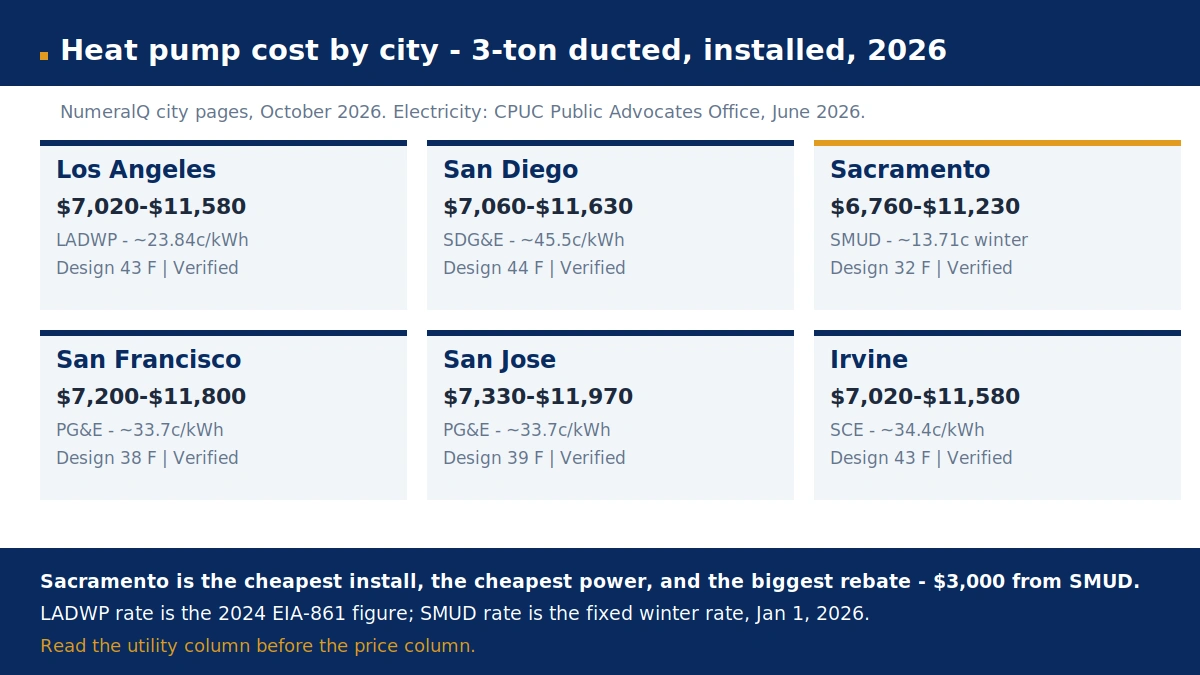
California is a spread-out state with five real HVAC markets — Los Angeles in the south, San Diego on the border, Sacramento in the valley, San Francisco on the bay, San Jose in Silicon Valley — and the verified figures run from $6,760 to $11,970 for the same 3-ton ducted job. What sets the cities apart is not just the install price but the utility behind the meter and the rebate behind the utility — and in California those two gaps are the widest in the series, because the utility decides both whether the heat pump beats gas and whether anyone helps pay for it.
| City | 3-ton ducted (verified) | Utility | Residential electricity |
|---|---|---|---|
| Los Angeles | $7,020-$11,580 | LADWP | ~23.84 cents/kWh (2024) |
| San Diego | $7,060-$11,630 | SDG&E | ~45.5 cents/kWh (Jun 2026) |
| Sacramento | $6,760-$11,230 | SMUD | ~13.71 cents/kWh (winter fixed) |
| San Francisco | $7,200-$11,800 | PG&E | ~33.7 cents/kWh (Jun 2026) |
| San Jose | $7,330-$11,970 | PG&E | ~33.7 cents/kWh (Jun 2026) |
| Irvine | $7,020-$11,580 | SCE | ~34.4 cents/kWh (Jun 2026) |
Los Angeles is the biggest market in the state and the best rebate market in the state, at $7,020-$11,580 for a 3-ton ducted system. Most of the city buys power from LADWP, a municipal utility, at about 23.84 cents a kilowatt-hour on the latest verified utility figure (2024, EIA-861), against 33 to 45 cents on the investor-owned systems. A Los Angeles buyer pays a middle-of-the-road install price and collects the biggest rebate in California: LADWP pays $1,000 to $1,250 a ton for a ducted system, $3,000 to $3,750 on a 3-ton job, and $1,500 to $2,500 a ton for a ductless system, up to $7,500 on a 3-ton mini-split. The catch is the boundary: homes in the parts of Los Angeles County served by SCE do not get LADWP money at all, and SCE’s own heat pump incentive ran through TECH and closed with it. Check the name on the electric bill before counting any rebate.
San Diego is the most expensive electricity market in the continental United States. The install price, $7,060-$11,630, is unremarkable. The electricity is not: SDG&E’s residential average was 45.5 cents a kilowatt-hour in June 2026, and the utility’s own April 2026 alert put the bundled residential average at 46.4 cents. At that price a heat pump costs roughly double what a gas furnace costs to run, and no San Diego rebate exists to soften the install price — SDG&E’s heat pump money, like SCE’s, ran through TECH and closed with it. A San Diego buyer buys a heat pump for the air conditioning, for the zoning, or because the furnace is dying anyway — never for the fuel bill.
At $6,760-$11,230, Sacramento is the cheapest verified city — and by a wide margin the best running-cost market in the state. SMUD, the municipal utility, charges $27.00 a month plus 13.71 cents a kilowatt-hour in the heating season on its fixed-rate plan — less than half the state average, and less than a third of SDG&E’s rate. At that price a heat pump beats a gas furnace on fuel outright, the only big-city market in California where that is true. Sacramento also has the second-best rebate in the state: SMUD pays $3,000 for a variable-speed gas-to-electric conversion, $2,000 for a two-stage system, and $1,000 for an electric-to-electric upgrade, plus up to $2,000 for a panel upgrade. SMUD publishes its own median gas-to-electric install price — $18,804, refreshed quarterly from real customer projects — which sits above the NumeralQ planning range: the real projects SMUD sees, with ductwork and panel work included, cost more than the planning range for the equipment alone.
San Francisco is the mildest big city in the state and the strangest heat pump market in it. The install price, $7,200-$11,800, is the second-highest of the five verified cities. The climate barely needs heating at all — San Francisco is designed for 38 degrees, but the summer design temperature is 77 degrees, which means many San Francisco homes have never had air conditioning and have never missed it. A heat pump in San Francisco is often bought as a heater first and an air conditioner second, which reverses the rest of the state. PG&E’s 33.7-cent power makes the fuel math lose to gas, and there is no PG&E heat pump rebate to collect. A San Francisco buyer should ask the hardest question in this guide: whether the house needs cooling at all.
San Jose is the most expensive verified city, at $7,330-$11,970, and the most expensive labor market in the state. San Jose HVAC technicians earn about 34 percent above the national median (BLS, May 2025), the highest premium of any California metro in the NumeralQ data, and that wage shows up in the install price. San Jose sits on PG&E power at 33.7 cents, so the running-cost answer matches San Francisco’s, and the rebate answer matches it too: nothing from PG&E, nothing statewide, and no TECH money left. What San Jose does have is the Silicon Valley community-choice ecosystem — Silicon Valley Clean Energy serves much of Santa Clara County — and while no SVCE heat pump HVAC amount was verified in this pass, a San Jose buyer should check SVCE’s current offers before signing.
Two more cities deserve a line each. Fresno, in the Central Valley on PG&E power, is the hottest big city in the state — designed for 100 degrees in summer and 30 in winter — which makes it the city where the cooling value of a heat pump is greatest and where an undersized system fails hardest. Irvine, in Orange County on SCE power, shares Los Angeles’s $7,020-$11,580 install price and SCE’s 34.4-cent power, with no SCE rebate to collect. Compare the cities on price per ton, not on the total, and read the utility column before you read the price column. A Sacramento system that costs slightly less to install, far less to run, and collects a $3,000 rebate is not a close call against a San Diego system on the same equipment.
California’s Mild Climate: Design Temps, HDD & Why Cooling Sizes the System
Measured in numbers, California’s climate explains why this guide takes the shape it does — so it pays to look at those numbers before choosing any equipment. The state is the mildest heat pump market in this series by every measure that matters to a heating system — and one of the hottest by every measure that matters to a cooling system.
The design temperatures. The starting point for sizing is the 97.5 percent winter design temperature — the outdoor temperature that the weather stays above for 97.5 percent of the hours in a typical winter. Manual J load calculations are built around that number. In Los Angeles that number is 43 degrees. In San Diego it is 44. In San Francisco it is 38. In Sacramento it is 32. In Fresno it is 30. Those are design conditions, not records. By comparison, the North Dakota guide in this series designs around minus 18. The heating degree days tell the same story — Los Angeles logs 2,061 a year against Fargo’s 9,226, San Diego 1,458, San Francisco 3,015, Sacramento 2,502, Fresno 2,611. A California heating season is short, mild, and cheap to serve.
What the mild winter does to a heat pump. An air-source heat pump pulls heat out of outdoor air and moves it inside — and colder outdoor air holds less heat to pull. In a cold state both capacity and efficiency fall far enough to matter. In California neither falls far enough to notice, because the outdoor air almost never gets cold. A standard heat pump rated at 36,000 BTU an hour at 47 degrees still delivers close to its full rating at 43 degrees in Los Angeles and at 32 degrees in Sacramento, with a COP near 3.0 or better — and it never needs the resistance backup heat that a cold-state system carries for weeks every winter. The cold-climate features are engineered for 5 degrees and below, and a California outdoor unit will see 5 degrees roughly never. That is why the standard unit is the default here and the cold-climate unit is a specialty purchase for the mountains.
The summer is the design season. Turn the table around and California is a cooling state. The summer design temperatures are 80 degrees in Los Angeles and San Diego, 77 in San Francisco, 98 in Sacramento, and 100 in Fresno — and Fresno’s record high is 111. Sacramento’s cooling season runs from May to October, and a July afternoon at 100 degrees with a west-facing wall of glass is the load the system is sized for. That is why the Manual J in California is a cooling calculation first: the heating load is satisfied almost as a side effect of a system sized to cool the house. It is also why SEER2 matters more than HSPF2 in a California quote — SEER2 measures the cooling efficiency across five months of afternoons at 34 cents a kilowatt-hour, and a quote that leads with HSPF2 is selling the wrong number.
Sixteen climate zones, one state. Title 24 divides California into 16 climate zones, each with its own requirements — which is why a heat pump is prescriptively required in a new single-family home in climate zones 3, 4, 13, and 14 and still optional on the prescriptive path in zones 10, 15, and 16. The zone also decides the details: duct insulation levels, the verification scope, and whether the performance approach or the prescriptive approach is the cheaper way to comply. A buyer does not need to memorize the zone map, but does need to know which zone the house sits in before the quote is compared.
The house decides as much as the machine does. Warm air from a heat pump runs 90 to 110 degrees; a gas furnace delivers 120 to 140. In a tight, well-insulated house you will never feel that difference. In a drafty stucco ranch with single-pane windows, uninsulated walls, and a dark roof, it is the difference between a house that feels warm and one that feels like the heat pump is always behind — and in July, the same leaky envelope is the difference between a house that holds 74 degrees and one that never gets below 78. Air sealing, attic insulation, and shade on west-facing glass are the cheapest capacity a California homeowner can buy. Before the heat pump quote, get an insulation quote and a duct-leakage test — and if the house needs both, do the envelope first and size the heat pump after, because the right size may drop a full ton.
Heat Pump vs Gas Furnace in California: The Running-Cost Math
This is the section the whole guide turns on, and it is also the section where most California heat pump advertising goes wrong — because the honest answer is that a heat pump usually loses to a gas furnace on fuel in this state, and the exceptions are specific enough to name. The figures below come from NestPriced arithmetic built on published prices. Each assumption is stated openly, so any reader can redo the sums using their own utility’s rate and their own house.
The planning home. Start with a 2,000-square-foot Sacramento home needing about 25 million BTU of delivered heat a year — a planning assumption built from Sacramento’s 2,502 heating degree days, not a measured bill. Twenty-five million BTU is 7,326 kilowatt-hours of heat. Below, that heat is divided by the delivering machine’s efficiency and multiplied by the fuel’s price — every line. Note the scale: the average California home uses about 12.5 million BTU a year for heating on the EIA figures behind NumeralQ’s modeled costs — so this planning home is a larger Central Valley house, not the state average, and its absolute dollar figures run roughly double NumeralQ’s average-home figures. The direction of the answer is the same either way.
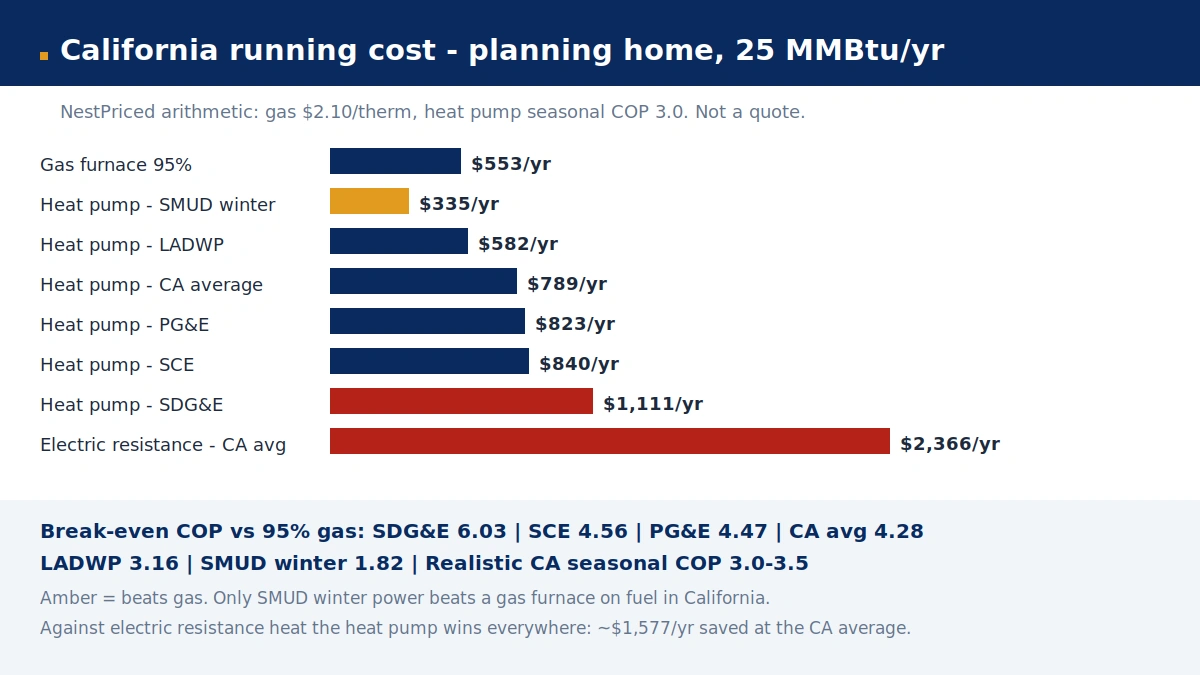
The gas furnace. Delivering 25 million BTU of heat through a 95 percent AFUE furnace takes roughly 26.3 million BTU of gas input, or 263 therms. At California’s planning gas price of about $2.10 a therm (EIA statewide average about $2.14, SoCalGas bundled average $1.98 to $2.08 in 2026, SDG&E $2.74), that is about $553 a year in fuel. On top sits the gas basic charge — but since that charge applies whether the furnace runs or not, it leaves the comparison unchanged. A modeled estimate from NumeralQ puts a 95 percent furnace at $281 a year for the average California home — smaller because the average home heats less — and the two figures agree on the shape of the answer.
The heat pump. A standard high-efficiency heat pump running at a seasonal COP of 3.0 — a realistic California seasonal figure — needs 2,442 kilowatt-hours of electricity to deliver the same 25 million BTU. What it costs comes down entirely to the utility:
| Utility | Price per kWh | Heat pump at COP 3.0 | Heat pump at COP 3.5 | Electric resistance |
|---|---|---|---|---|
| SDG&E (San Diego) | ~45.5 cents | ~$1,111/yr | ~$952/yr | ~$3,333/yr |
| SCE (Irvine, much of LA County) | ~34.4 cents | ~$840/yr | ~$720/yr | ~$2,520/yr |
| PG&E (SF, San Jose, Fresno) | ~33.7 cents | ~$823/yr | ~$705/yr | ~$2,469/yr |
| CA average | ~32.3 cents | ~$789/yr | ~$676/yr | ~$2,366/yr |
| LADWP (Los Angeles city) | ~23.84 cents | ~$582/yr | ~$499/yr | ~$1,747/yr |
| SMUD fixed winter (Sacramento) | ~13.71 cents | ~$335/yr | ~$287/yr | ~$1,004/yr |
That table deserves a second read: the entire guide sits inside it. On SDG&E power the heat pump runs about $1,111 a year — double the gas furnace’s $553 — and even at a generous seasonal COP of 3.5 it still costs $952, far above gas. On SCE it costs $840, on PG&E $823, on the state average $789 — all above gas. On LADWP it costs $582, just above gas at COP 3.0 and just below it at COP 3.5 — about a tie. Only on SMUD, where the fixed winter rate is 13.71 cents, does the heat pump win clearly: $335 a year against gas at $553, a saving of about $218 a year. The SMUD time-of-day rate tells a similar story in winter, with off-peak power at 12.85 cents — but the summer peak of 37.65 cents is a warning that the same cheap utility charges a very different price in July.
The break-even COP. The same sums answer the reverse question too: how efficient must the heat pump be to tie the gas furnace? At the state-average electricity price of 32.3 cents a kilowatt-hour — $94.66 a million BTU — against gas at $21.00 a million BTU, $22.11 after the furnace’s 5 percent loss, the break-even COP is 4.28. By utility: SDG&E 6.03, SCE 4.56, PG&E 4.47, LADWP 3.16, SMUD fixed winter 1.82. A standard California heat pump’s realistic seasonal COP is 3.0 to 3.5 — below break-even on SDG&E, SCE, PG&E, and the state average, about at break-even on LADWP, and above it only on SMUD. No heat pump on sale today holds a seasonal COP of 4.28 through a California winter.
The time-of-use twist. California’s investor-owned utilities bill most homes on time-of-use rates, and the heat pump’s heating hours do not all cost the same. Winter heating runs mostly in the morning and evening — the hours when the sun is down and the rate is highest — while the cheapest hours, midday, are the hours the house needs the least heat. A heat pump on SCE’s TOU-D-4-9PM plan pays about 58 cents a kilowatt-hour on a summer evening. The planning arithmetic above uses average rates, which understates the cost of heating in the evening peak. A buyer on a time-of-use plan should ask the installer to model the running cost by time band, not by average.
What the heat pump beats, clearly. Across the whole state, the heat pump beats electric resistance heat — baseboards, electric furnaces, wall heaters, space heaters — by a wide margin. Producing that same 25 million BTU with resistance heat runs about $2,366 a year at the state-average price, versus $789 for the heat pump. That is a saving of about $1,577 a year, every year. Roughly 30 percent of California homes already heat with electricity. For them, no purchase in this guide pays back better than a heat pump. Against propane, the heat pump wins too. Against a 95 percent gas furnace on PG&E, SCE, or SDG&E power it loses — so buy it there for the air conditioning, the comfort, the zoning, or the plan to replace a furnace already at the end of its life, not for the fuel bill.
Cooling, counted honestly. A heat pump is also the air conditioner, and a Sacramento July reaches 100 degrees. Nationally, a standalone central air conditioner costs several thousand dollars on its own — so some of what a heat pump costs is cooling money the buyer would have spent regardless. Judge the heat pump on its premium over the furnace-plus-AC combination it replaces, not on its full sticker — in California, often the heat pump is cheaper than the pair it replaces, which is a sentence no cold-state guide in this series can write. As a planning illustration, cooling a Sacramento home needs about 15 million BTU of heat removal a year; at a cooling COP near 3.8 (SEER2 16), that is about 1,157 kilowatt-hours, or about $374 a year at the state-average rate — an illustration, not a bill. The complete running-cost picture sits in our heat pump running cost guide.
Utility Rebates & What You Can Actually Collect in 2026
Once the federal credit is gone, most states still keep something in reserve. California kept two of the biggest programs in the country — and both have run out of money for new applicants. The incentives picture in California in 2026 is smaller, more local, and more confusing than the advertising suggests, because most heat pump advertising in California still quotes programs that closed months ago.
TECH Clean California’s statewide incentives are fully reserved. TECH was California’s flagship heat pump program, funded through the California Public Utilities Commission. Its statewide single-family incentives for heat pump HVAC and heat pump water heaters have been fully reserved since November 14, 2025, and no statewide Phase II has launched as of November 2026. When the program was open, it paid $1,000 to $1,500 for a market-rate heat pump installation, up to $4,000 a unit with the income-qualified equity adder — and it paid the contractor, not the homeowner, which is why the money showed up as a line on the quote rather than a check in the mail. That line is gone now. SCE’s residential heat pump incentive — $1,000 a system, up to two systems for $2,000 — was delivered through TECH, and it closed with TECH. Any 2026 quote that still deducts a TECH statewide incentive is priced under a program with no money left.
The one TECH door still open is eleven San Fernando Valley communities. On November 2, 2026, TECH opened a new set of incentives just for the Valley communities affected by the Aliso Canyon gas storage facility — Porter Ranch, Granada Hills, Northridge, Chatsworth, North Hills, Canoga Park, Reseda, Winnetka, West Hills, Van Nuys, and Lake Balboa — with a $20 million single-family budget split evenly between general-market and income-qualified households. General-market households get $2,000 to $5,000 for a heat pump HVAC system and $2,000 to $3,500 for a heat pump water heater. Households earning under 80 percent of Los Angeles County area median income get $4,500 to $17,000 for a heat pump with weatherization and $3,500 to $5,000 for a water heater. A panel replacement adds up to $2,000 and a load management device $500, when paired with a heat pump. The dates are strict: invoices, installation start dates, and permit dates must all be on or after November 2, 2026. The rest of the San Fernando Valley is planned for 2027, depending on funding. If the house is in one of the eleven communities, this is the best rebate in California right now.
LADWP pays the best rebate in the state. The Los Angeles Department of Water and Power’s Consumer Rebate Program lists heat pump HVAC rebates of up to $2,500 a ton for equipment purchased and installed on or after November 1, 2025. The tiers run by system type and efficiency: a central ducted, split, or packaged heat pump earns $1,000 to $1,250 a ton, and a ductless mini-split or multi-split earns $1,500 to $2,500 a ton, with the top tier requiring above 20.5 SEER2 and 9.1 HSPF2. The minimum is 15.2 SEER2 and 7.7 HSPF2. A 3-ton ducted system at the entry tier earns $3,000; a 3-ton ductless system at the top tier earns $7,500. The conditions matter: the applicant must be an LADWP residential customer with active electric service — homes billed by SCE do not qualify — new construction and ADUs are excluded, a final approved Building and Safety permit is required, and the application must be postmarked within 12 months of purchase. Funding is first-come, first-served. LADWP also pays up to $2,500 a unit for a qualifying heat pump water heater.
SMUD pays the second-best rebate in the state, and it rewards the conversion California wants most. The Sacramento Municipal Utility District’s Heating and Cooling rebate pays $3,000 for a variable-speed gas-to-electric heat pump conversion, $2,000 for a two-stage system, and $1,000 for an electric-to-electric upgrade, with a Go Electric panel bonus of up to $2,000 on top. The minimum is 15.2 SEER2, and the program requires HERS verification, R8 duct insulation on any new ductwork, a connected WiFi thermostat, and a participating contractor to submit the application. Mini-splits qualify only if they serve the whole home. The program counted 3,798 gas-to-electric conversions in 2025 with a target of 4,870 in 2026. SMUD’s own published median for a gas-to-electric install is $18,804, which is above the NumeralQ planning range and a better guide to what a real Sacramento project costs once ductwork and panel work are included. SMUD also runs heat pump water heater rebates, reported at up to $3,000 for a 50-gallon tank, $3,500 for 65 gallons, and $4,000 for 80 gallons or more — but those figures come from contractor pages, so confirm them on smud.org before planning around them.
PG&E and SCE pay nothing directly for a heat pump in 2026. No standalone PG&E heat pump HVAC rebate was found in this pass, and SCE’s incentive closed with TECH. That is the irony of the California market: the two utilities that serve most of the state are the utilities that pay nothing toward the purchase, while the municipal utilities with the cheapest power pay the most. PG&E and SCE customers can still use the TECH San Fernando Valley campaign if their home sits in one of the eleven communities, and they can still claim the SGIP heat pump water heater money for a water heater — but for a space-heating heat pump on PG&E or SCE power in 2026, the rebate column is empty. The smaller municipal utilities run their own programs, and a buyer served by one of them should check that utility’s page before signing, because no figure for those programs was verified in this pass.
SGIP pays for water heaters, not for space heating — read the label. The Self-Generation Incentive Program’s heat pump water heater budget, set by a CPUC decision in April 2022, totals $84.7 million, with single-family caps of $3,800 for a general-market unit and $4,885 for a low-income one, plus a $1,500 kicker for systems using a refrigerant with a global warming potential under 150. What it does not do is pay for a space-heating heat pump — not a dollar, not under any tier, not in any territory. Buyers keep reading SGIP’s water-heater money as space-heating money, and some quotes blur the two. SGIP also requires enrollment in a demand response program and a system designed to shift load off-peak. Whether SGIP water-heater funds remain available in late 2026 was not verified in this pass — confirm on selfgenca.com before planning around it.
| Source | Amount | Who can collect it |
|---|---|---|
| LADWP, ducted heat pump HVAC | $1,000-$1,250/ton ($3,000-$3,750 on 3-ton) | LADWP residential customers, min 15.2 SEER2 / 7.7 HSPF2 |
| LADWP, ductless heat pump HVAC | $1,500-$2,500/ton (up to $7,500 on 3-ton) | LADWP residential customers, top tier over 20.5 SEER2 / 9.1 HSPF2 |
| LADWP, heat pump water heater | Up to $2,500/unit | LADWP residential customers |
| SMUD, variable-speed gas-to-electric | $3,000 | SMUD customers, min 15.2 SEER2, participating contractor |
| SMUD, two-stage gas-to-electric | $2,000 | SMUD customers, min 15.2 SEER2 |
| SMUD, electric-to-electric | $1,000 | SMUD customers, min 15.2 SEER2 |
| SMUD, Go Electric panel bonus | Up to $2,000 | SMUD customers, with a heat pump project |
| TECH San Fernando Valley (general) | $2,000-$5,000 HVAC; $2,000-$3,500 HPWH | 11 Aliso Canyon communities, projects on/after Nov 2, 2026 |
| TECH San Fernando Valley (income-qualified) | $4,500-$17,000 HVAC w/ weatherization | 11 communities, under 80% LA County AMI |
| TECH Clean California statewide | $0 — fully reserved since Nov 14, 2025 | — |
| SCE heat pump HVAC | $0 — closed with TECH | — |
| PG&E heat pump HVAC | $0 — none found | — |
| SGIP heat pump water heater | Up to $3,800 general / $4,885 low-income | IOU customers, water heaters only — not space heating |
| State of California | $0 — no credit, no rebate | — |
| Federal tax credit (§25C) | $0 for 2026 installs | — |
| HEAR / HEEHRA | Fully reserved Feb 24, 2026 (single-family) | Waitlist only |
Federal Help in 2026: $0 Tax Credit, HEEHRA Fully Reserved & the Lease Question
One paragraph holds the whole 2026 federal story. That brevity is precisely why so much heat pump advertising still gets it wrong. In California the paragraph has a second half that other states do not get, because the federal rebates that would matter most here launched early, ran out fast, and are now closed.
A homeowner-owned heat pump installed in 2026 gets nothing back from the federal tax credit. Public Law 119-21 — the One Big Beautiful Bill Act, signed July 4, 2025 — removed the Energy Efficient Home Improvement Credit (§25C, up to $2,000 a year for air-source heat pumps) from equipment placed in service after December 31, 2025. Under IRS fact sheet FS-2025-05, the finish date decides everything: a deposit paid in 2025 counts for nothing when the crew finished the job in January 2026. Geothermal loses its 30 percent credit too: the Residential Clean Energy Credit (§25D, 30 percent) closed on that same date. A 2026 quote that still deducts a federal credit was priced under a law that has already expired. The 2026 federal picture in full is in our federal tax credits guide.
California’s HEAR rebates launched first and ran out first. California was one of the earliest states to launch its federal Home Energy Rebates: the program, called HEEHRA in California and run by the California Energy Commission through TECH Clean California, opened in October 2024 with an allocation of $290,252,580 for HEAR and $291,366,906 for HOMES. It paid up to $8,000 for a heat pump for households under 80 percent of area median income and $4,000 for households between 80 and 150 percent, plus $1,750 for a heat pump water heater, $4,000 for a panel upgrade, and $2,500 for wiring, up to $14,000 a household. Demand exhausted it: single-family money was fully reserved statewide on February 24, 2026, multifamily money on September 1, 2026, and new requests go on a waitlist. The Energy Commission holds $152 million for a HEEHRA Phase II, which is not yet available and has no announced date. HOMES has not launched in California at all. Do not plan a purchase around this money, and do not let a quote include it.
A gas-heated home gets nothing from HEAR even after it launches — the program will not pay for a switch. The Home Electrification and Appliance Rebates program offers up to $8,000 for a heat pump, but the Energy Department’s Program Notice 26-2 of May 29, 2026 restricts the money to electric-to-electric upgrades — old electric equipment replaced by more efficient electric equipment — and to new construction. Swapping a gas furnace for a heat pump is fuel-switching, and fuel-switching no longer qualifies for the money. That matters more in California than in most states, because about 61 percent of the state’s homes heat with piped gas. The homes that could use it, once it launches, are the 30 percent that already heat with electricity. One tension worth naming plainly: SMUD’s $3,000 rebate and the TECH San Fernando Valley campaign both still pay for gas-to-electric conversions — and they can, because they are state and utility money, not HEAR money. A quote that mixes the two up is confusing a live utility rebate with a closed federal one.
The lease route is unverified in California. The commercial clean-electricity credit (§48E, 30 percent) still applies to a company-owned heat pump, provided construction began by July 4, 2026 and the system enters service by December 31, 2027 — those are the cutoffs IRS Notice 2025-42 lays down. In a state where residential third-party ownership is clearly legal, that credit reaches homeowners through a lease or a power purchase agreement. California allows third-party solar PPAs, but no California heat pump lease or PPA provider passing §48E through to homeowners was verified in this pass. Until a lease offer’s terms sit in writing, treat the offer as unverified — and get a lawyer to read it before you sign. In 2026 the federal government contributes nothing to a California homeowner who buys a heat pump outright, and it cannot be counted on to contribute indirectly through a lease either. On a cash quote, the price is the price.
Wildfire, PSPS & Backup Power: Keeping an All-Electric Home Running
California is the only state in this series where the buyer has to think about what happens when the power goes out — not as a rare storm event, but as a planned, announced, recurring fact of life. A heat pump is an electric machine, and in a state that de-energizes its own power lines to prevent wildfires, the question of what heats and cools the house during a shutoff is part of the purchase, not an afterthought.
A Public Safety Power Shutoff is a planned outage, not an accident. When wind, low humidity, and dry fuel make a utility’s own lines a fire risk, the utility deliberately switches them off. Six California utilities run PSPS programs — PG&E, SCE, SDG&E, Liberty Utilities, Bear Valley Electric Service, and PacifiCorp. A homeowner typically gets 48 to 24 hours of warning, the outage is targeted at specific circuits, and PG&E’s stated goal is to restore power within 24 hours after the weather passes. The October 2026 event shows the scale: PG&E’s shutoff covered about 88,000 customers in 29 counties, peaking at 85,905 customers without power, including about 5,500 Medical Baseline customers who rely on powered medical equipment. By the evening of Saturday, October 17, virtually all customers had been restored. Four days without power in October, with a heat pump that cannot run, is the scenario to plan for.
A heat pump cannot run on a portable battery. A heat pump is a 240-volt load that draws several thousand watts on startup. A portable power station — the kind PG&E, SCE, and SDG&E rebate — cannot run it. PG&E pays $300, plus $200 more for CARE or FERA customers, but only on portable batteries between 290 and 1,000 watt-hours. SCE offers up to $200 on qualifying portable stations in shutoff-affected areas. SDG&E pays $150, plus $50 for CARE or FERA customers, from its 2026 Qualified Product List. Those rebates buy a night of lights, phones, WiFi, and a refrigerator — about 1,000 watt-hours covers one night of essentials. They do not buy heat or cooling. Whole-home backup needs a home battery with island mode, or a generator with a transfer switch, and either one is a separate purchase priced in the thousands, not part of the heat pump quote. Grid-tied solar shuts off automatically during an outage by law — only a battery in island mode lets the panels keep generating while the grid is down.
The all-electric home needs a backup plan in writing. Three things belong in that plan before the heat pump is ordered. First, the battery or generator decision: a home battery that can carry the heat pump through a 24-hour shutoff is a 10-kilowatt-hour-plus system with island-mode capability, and its price belongs in the same budget conversation as the heat pump. Second, the medical baseline enrollment: a household with powered medical equipment should be on the utility’s Medical Baseline program before wildfire season, because those customers get extra notice and priority in a PSPS event. Third, the gas question: a dual-fuel home keeps its gas furnace, which needs only a small amount of electricity to run its fan and controls, and that furnace can heat the house on a small generator where a heat pump cannot. In a high fire-threat district, that is a real argument for dual-fuel that has nothing to do with the fuel bill.
Permits & Licensing: CSLB C-20, Title 24 & Verification
California’s licensing picture is the strictest in this series in one respect that helps a buyer who knows where to look — and hurts one who does not: the state licenses the HVAC contractor, the electrician, and the compliance verifier separately, and a job that skips any one of them cannot close its permit.
The C-20 license is the credential that matters. A California heat pump install is done by a C-20 Warm-Air Heating, Ventilating and Air-Conditioning contractor, licensed by the Contractors State License Board. Under Title 16, Section 832.20, a C-20 contractor fabricates, installs, maintains, services, and repairs warm-air heating systems, water-heating heat pumps, ventilating systems, and air-conditioning systems, together with the ducts, registers, flues, and controls that make them work. The license requires at least four years of full-time journey-level HVAC experience within the ten years before applying, two exams — the C-20 trade exam and the Law and Business exam — and a $25,000 license surety bond. A contractor license is required for any job of $500 or more, which is every heat pump install. Ask for the license number and verify it on the CSLB website before signing. A C-20 contractor cannot run gas piping from the meter to the structure.
Electrical work needs its own license, whatever the price. The heat pump’s electrical work — the disconnect, the circuit, the panel work — is done by a C-10 Electrical contractor or under one, and the name on the electrical permit should be the electrician’s, not the HVAC company’s. Anyone handling refrigerants must also hold EPA Section 608 certification — name it explicitly when you ask. The CSLB has required proof of Section 608 certification (Type II or Universal) for C-20 applicants since January 1, 2025, according to contractor licensing guides this year. Workers’ compensation insurance is mandatory for licensees with employees, and contractor guides report that all C-20 licensees must carry it even with no employees from January 1, 2026 — a change this draft flags as reported rather than verified against the CSLB directly.
Title 24 compliance is a permit gate, not paperwork after the fact. A heat pump install in California needs a mechanical permit and an electrical permit from the city or county building department, and the job must comply with Title 24, Part 6 — the California Energy Code. For a replacement system that means a registered compliance certificate, produced by an independent verifier the contractor does not employ, and the permit cannot close out until that certificate is registered. Contractor guides report that the field verification program moved from HERS to the ECC Program on January 1, 2026 — this draft flags that change as reported, because it was not verified against the CEC directly in this pass. The edition of the code that governs the job is fixed by the permit application date, not the install date, and the certificate gates closeout.
The 2025 Energy Code is now in force. The 2022 Energy Code ran until January 1, 2026, when the 2025 Energy Code took effect. Under the 2022 code, a heat pump space heater was prescriptively required for new single-family homes, townhomes, and detached ADUs in climate zones 3, 4, 13, and 14, and gas remained an option on the prescriptive path in zones 10, 15, and 16. Every new home with gas appliances had to be electric-ready. Electric resistance space heating was banned as the primary heat source in additions and alterations. The practical point for a replacement buyer is narrower: the replacement system must meet the minimum efficiency standards — 14.3 SEER2 for a split-system heat pump under the DOE 2023 regional standards, 7.5 HSPF2 federal minimum — and the load calculation must follow an approved method, including ACCA Manual J.
The local electrification rules have a hole in them now. Berkeley’s 2019 ordinance banning natural gas piping in new buildings — the first in the nation — was struck down by the Ninth Circuit on April 17, 2023, in California Restaurant Association v. City of Berkeley, on the ground that the federal Energy Policy and Conservation Act preempts local regulation of the energy use of gas appliances. As many as 74 California jurisdictions had adopted similar ordinances, and the ruling put them at risk. What survived is the efficiency route: cities may still adopt building codes that set overall energy-efficiency standards favoring electric appliances, and the Bay Area Air Quality Management District’s zero-emission standards for newly sold appliances, taking effect from 2027, proceed under air-quality authority. For a buyer replacing a furnace in an existing home, the practical effect is simple: no city can force the house off gas, and no city can stop the homeowner from choosing a heat pump either.
What Pushes Your California Quote Up or Down
The per-ton anchor sets the budget’s direction; it never prices the job. A California quote can shift by thousands of dollars on seven factors. Three of those trace back to this state’s climate, its power market, and its code.
Labor is expensive in California — and the gap between metros is the story. California HVAC mechanics earn a median $34.88 an hour (BLS May 2025), above the national median of $29.33, with electricians at a median $36.62 an hour. What contractors actually bill runs an estimated $70-$91 an hour for HVAC work, and $73-$95 an hour for electrical work. But the statewide median hides the metro spread: San Jose technicians earn about 34 percent above the national median, Sacramento technicians about 9 percent above it. That spread is why the same 3-ton job costs $7,330-$11,970 in San Jose and $6,760-$11,230 in Sacramento. What moves a California quote is the crew’s Title 24 experience: ask how many heat pumps the crew has installed under the current Energy Code in your climate zone, not just how many years the company has existed.
The ductwork, and whether it survives. Because a heat pump moves a larger volume of cooler air than a furnace, ductwork that coped with a 140-degree furnace airstream may not cope with a 100-degree heat pump airstream: undersized runs, leaks, or thin insulation can all fail it. New or extended ductwork costs $4,690-$7,750 a job in California (NumeralQ), and sealing and insulating the ducts already in place can add thousands more. In California the attic makes it worse: ducts in a 130-degree Sacramento attic lose cooling before it reaches the rooms. When a quote prices the heat pump and simply assumes the ducts are sound, the priciest part of the job has been priced out of sight. Ask for a written duct inspection and a written static-pressure reading, together with the cost of repairing whatever they uncover.
The electrical panel. Many California homes still run on 100-amp service — especially pre-war bungalows and post-war ranches — and a heat pump can force the question. A 200-amp panel upgrade runs $2,490-$3,830 installed in California (NumeralQ), and it is the most common surprise add-on in California quotes. Confirm the quote includes it before you sign, rather than discovering the gap with the electrician already parked in your driveway. One California wrinkle: a panel upgrade is electrification work, the kind the old HEAR program was designed to pay up to $4,000 for — and HEAR is fully reserved, so that money is not coming. SMUD’s Go Electric bonus pays up to $2,000 toward the panel with a heat pump project, and the TECH San Fernando Valley campaign pays up to $2,000 for a panel replacement paired with a heat pump — but both are local. Our electrical panel upgrade guide lays out the national picture.
Equipment tier. Top-tier variable-speed units run 10-20 percent more than value-tier units. In California that premium buys better cooling efficiency on the hottest afternoons, and a higher SEER2 that pays back across five months of cooling at 34 cents a kilowatt-hour. On a tight budget, a value-tier standard unit still beats a straight air conditioner plus furnace on the combined purchase; on a house the buyer plans to keep for 20 years, the premium tier’s higher SEER2 is worth real money every summer.
The refrigerant, and the 2026 cutoff. New residential split systems must use refrigerants with a global warming potential under 700 from January 1, 2025, under the EPA’s Technology Transitions rule — R-454B or R-32, not R-410A — and California’s own rules carry the same 700 cutoff for new systems from January 1, 2026, according to contractor guides this year. A quote that still lists R-410A equipment is selling old stock under a dead standard. Ask which refrigerant each quote uses, and ask for it in writing: the refrigerant decides what the system can be serviced with for the next 15 years.
Financing terms. Counted over the system’s life, paying cash is still the cheapest way to buy. A $0-down loan folds dealer fees of 10-30 percent of the cash price — sometimes over 50 percent — into what you finance. That figure is drawn from the Consumer Financial Protection Bureau’s August 2024 market spotlight. It is a national figure, and California quotes carry it in exactly the same way. A lease or PPA is the third path, and it is thin here: no provider was verified passing §48E through to California homeowners in this pass, so a lease quote should be read by a lawyer before it is compared on its monthly payment at all. There is no California state energy loan for heat pumps to fall back on. The sales tax: California’s statewide base rate is 7.25 percent plus local district taxes, and the equipment is taxable — get the tax shown as its own line on the quote, because on a $9,250 system the tax alone is roughly $670 before local add-ons.
Maintenance and lifespan. A heat pump in California works harder in summer than in winter — five months of cooling, an outdoor unit that lives in dust and wildfire smoke, and coils that need cleaning after every fire season. Expect an annual service visit: coil cleaning, refrigerant check, and a check that the thermostat and the time-of-use schedule are actually shifting load into the cheap hours. Filters need changing monthly in the cooling season, and the outdoor unit needs its coil washed after a smoky summer. No California-specific figures on lifespan, degradation, or maintenance exist, so this paragraph uses national figures throughout: with good maintenance, equipment typically lasts 15-20 years; the compressor determines that lifespan; and a unit oversized into short-cycling will die years before one sized correctly. Running costs get the detailed treatment in our heat pump maintenance guide and heat pump repair guide.
Payback: When Does a California Heat Pump Pay for Itself?
Whether a California heat pump earns its keep is a payback question, and the answer turns on what it replaces and which utility sends the bill — more sharply than in any other state in this series. The worked examples that follow take their inputs from the NumeralQ anchors and the running-cost arithmetic above — every input is checkable, and this guide flags each place where the two part ways.
A worked example. Take a typical standard ducted 3-ton system at the middle of the California range, about $9,250 installed, heating and cooling the planning home — 2,000 square feet in Sacramento, about 25 million BTU of delivered heat a year. The federal credit is $0. The state pays nothing. The rebate depends on the utility: LADWP pays $3,000 to $3,750 for a 3-ton ducted system, SMUD pays $3,000 for a variable-speed gas-to-electric conversion, the TECH San Fernando Valley campaign pays $2,000 to $5,000, and PG&E and SCE pay nothing. The table below runs the four cases that actually occur in California.
| What it replaces | Utility | Annual fuel saving | Payback on $9,250 |
|---|---|---|---|
| Electric resistance heat | State average (32.3 cents) | ~$1,577/yr | ~5.9 yrs (~4.0 yrs with LADWP rebate) |
| Electric resistance heat | SMUD (13.71 cents winter) | ~$2,031/yr | ~4.6 yrs (~3.1 yrs with SMUD rebate) |
| 95% gas furnace | PG&E (33.7 cents) | Negative — costs ~$270/yr MORE | Never on fuel |
| 95% gas furnace | SMUD (13.71 cents winter) | ~$218/yr | ~42 yrs (~28 yrs with SMUD rebate) |
| 95% gas furnace | LADWP (23.84 cents) | About break-even (~$29/yr more at COP 3.0) | About break-even on fuel |
Give that table the same careful read as the running-cost table — the whole verdict sits inside it. Against electric resistance heat on average-priced power, a heat pump saves about $1,577 a year and pays back in about 5.9 years — about 4 years once LADWP’s $3,000 rebate is applied, and about 3.1 years on SMUD power with SMUD’s $3,000 rebate. The strongest payback anywhere in the state goes to the 30 percent of California homes already heating with electricity. Running on PG&E power, the heat pump costs roughly $270 a year MORE than a 95 percent gas furnace — which means fuel payback never arrives, at any point. On SMUD’s cheap winter power it saves about $218 a year against gas, a payback of about 42 years. On LADWP power it is about break-even on fuel, and the rebate is what makes the purchase work.
Framing it as an incremental cost changes the answer. A home that needs a new furnace and a new air conditioner anyway should not be judged that way: the table above sets the whole heat pump against the whole fuel bill, and that comparison misjudges the purchase. One machine does the work of both. If the furnace-plus-AC combination would have cost $8,790 to $14,700 — NumeralQ’s California HVAC replacement range for a central AC plus gas furnace, 3-ton — and the heat pump costs $6,980 to $11,520, the premium is zero or negative: the heat pump is often cheaper than the pair it replaces. That is a sentence no cold-state guide in this series can write. When the premium is zero, there is no payback period to calculate — the heat pump pays for itself on the day it is installed, because it cost less than the two machines it replaced. The premium framing rescues the payback for gas homes on PG&E power, where the fuel saving is negative but the install saving is real.
What moves the payback most. The fuel being replaced is the biggest lever, by far — resistance heat first, gas last, and gas on PG&E, SCE, or SDG&E power never on fuel alone. The utility rate is the second lever: the same heat pump on SMUD’s 13.71-cent winter power saves $218 a year against gas where on PG&E’s 33.7-cent power it loses $270, a swing of $488 a year on the same equipment in the same state. The rebate is the third lever, and only LADWP’s and SMUD’s are large enough to matter: $3,000 takes about two years off the resistance-heat payback. The SEER2 tier is the fourth lever for cooling-heavy homes, and the envelope is the fifth: every dollar spent on air sealing, attic insulation, and shade on west-facing glass shrinks the cooling load, shrinks the heat pump, and shrinks the electric bill.
Who still comes out ahead. Four kinds of California household clear it. The electric-heat home, where the published saving is about $1,577 a year and the payback is about 6 years — 3 to 4 years with a LADWP or SMUD rebate. The SMUD customer, where the 13.71-cent winter kilowatt-hour makes the heat pump cheaper than gas on fuel, and where the $3,000 rebate and the cheapest install in the state stack on the same purchase. The household whose furnace and air conditioner are both dying: when the pair has to be replaced anyway, the heat pump is often cheaper than the two machines it replaces. And the Los Angeles household inside LADWP territory, where the $3,000 to $7,500 rebate and the 23.84-cent power together make the purchase work even though the fuel saving alone is about break-even. Walk away when your home heats with a 95 percent gas furnace on PG&E, SCE, or SDG&E power, your air conditioner still has years left, and you are counting on a fuel saving to justify the purchase — the saving does not exist.
Getting Quotes in California: The Checklist
California is the most confusing state in this series to buy a heat pump in — the mildest climate, the most expensive electricity, and an incentive map that changed twice in a year — but only for a homeowner who checks the utility terms and the rebate status before the sales pitch. Give this checklist to every bidder. Sign nothing until every line carries its answer in writing.
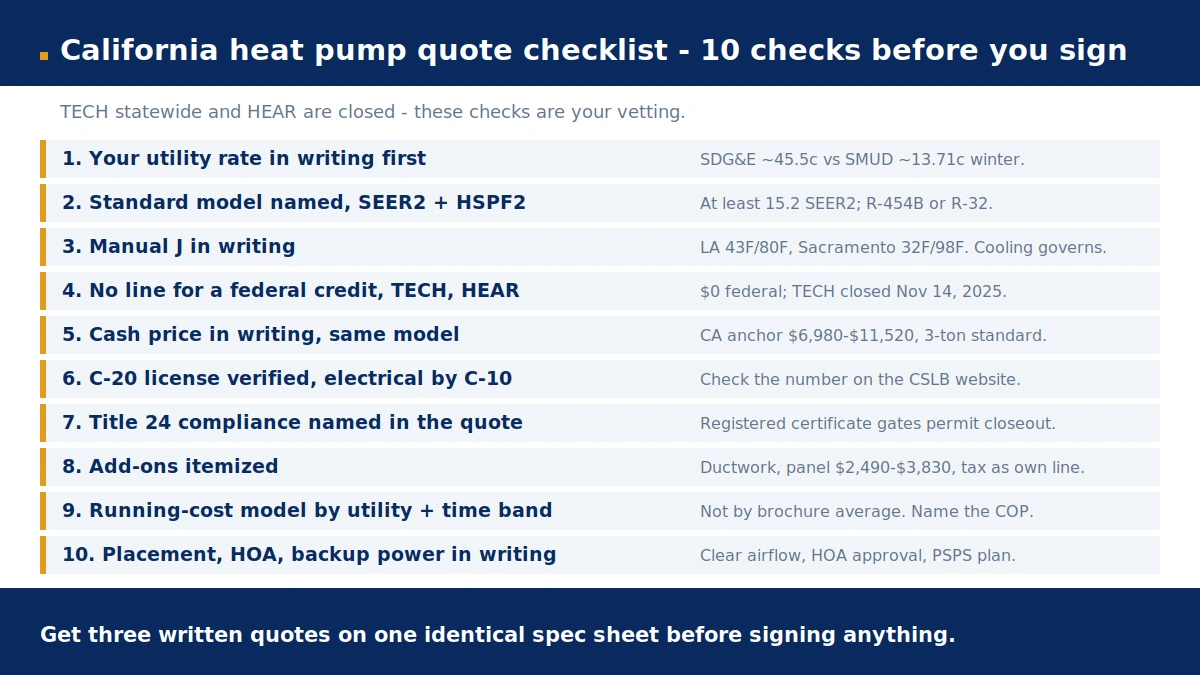
The ten-item quote checklist:
- Your utility’s rate, in writing, first — PG&E’s ~33.7 cents, SCE’s ~34.4 cents, SDG&E’s ~45.5 cents, LADWP’s ~23.84 cents, or SMUD’s ~13.71-cent winter fixed rate. Before anything else, the rate decides whether the heat pump beats gas — and SMUD’s winter rate is worth about $488 a year against PG&E’s on the same system.
- Standard high-efficiency model named, with its SEER2 and HSPF2 — the model number, its SEER2 (at least 15.2) and HSPF2 (at least 7.7 for a LADWP rebate), and the refrigerant (R-454B or R-32, not R-410A). A quote that names no model has priced a machine that may not exist — and a quote that prices a cold-climate unit for a coastal house has priced $2,000 of capacity the weather will never use.
- Manual J load calculation, in writing — room by room, at your city’s design temperatures (Los Angeles 43F winter / 80F summer, Sacramento 32F / 98F, San Francisco 38F / 77F). A contractor who sizes by square footage alone is guessing at the number that decides everything else — and in California, the cooling load governs.
- No line for a federal tax credit, no line for TECH statewide, no line for HEAR — a 2026 owner purchase gets $0 federal, TECH statewide has been fully reserved since November 14, 2025, and HEAR has been fully reserved since February 24, 2026. The only money is local: LADWP up to $2,500 a ton, SMUD $3,000, TECH San Fernando Valley $2,000-$5,000 in its eleven communities.
- The cash price, in writing, for the same standard model — identical kit, identical house, all three bidders. The California anchor is $6,980-$11,520 for a 3-ton standard ducted system; a quote far above it calls for an explanation, and a quote far below it calls for a closer look at what was left out.
- C-20 license verified, electrical by a C-10 — the CSLB C-20 number checked on the board’s website, the electrical work by or under a C-10 licensee, EPA Section 608 certification named. The license is required for any job of $500 or more, which is every heat pump install.
- Title 24 compliance named in the quote — the registered compliance certificate, the field verification, and the permit closeout. A quote that never mentions Title 24 has not priced the compliance work that gates the permit.
- Add-ons itemized — ductwork, panel upgrade ($2,490-$3,830), refrigerant type, and thermostat, each as its own line, not folded into the per-ton price. Sales tax shown as its own line too — 7.25 percent statewide base plus local district taxes.
- Running-cost model by utility and by time band, not by brochure — the seasonal COP and SEER2 assumed, the rate applied, and the time-of-use bands, shown against your own utility’s tariff. A quote that models savings at the state-average rate for an SDG&E home is wrong by about $322 a year on the planning home.
- Placement, HOA approval, and backup power in writing, first — the outdoor unit sited with clear airflow and shade where possible, HOA approval for the placement before the unit is ordered, and a plan for the next PSPS outage. Put the unit where it is convenient and against the sun, and it will cost more to run and more to service.
Buy, dual-fuel, or geothermal? Buying a standard ducted system wins for homeowners with electric heat, SMUD power, or LADWP power — and for anyone whose furnace and air conditioner are both dying anyway, because the heat pump is often cheaper than the pair it replaces. Dual-fuel wins for gas-heated homes on PG&E, SCE, or SDG&E power, where the furnace carries the short winter and the heat pump carries the shoulder seasons and the summer — and in a high fire-threat district, where the furnace keeps heating on a small generator when the heat pump cannot run at all. Geothermal wins for almost no one in California on the numbers: at $21,160-$33,090, with the smallest heating load in this series and no federal credit to soften it in 2026, the payback needs decades of small savings. A cold-climate unit wins only in the mountains, the far north, and the high desert.
Sources & methodology
Cost anchors:
- NumeralQ California heat pump cost page, estimator pricing 2026-10-26: ducted 3-ton $6,980-$11,520; cold-climate $9,110-$15,690; single-zone $3,430-$5,280; multi-zone 3-head $6,820-$11,920; geothermal $21,160-$33,090; by size 1.5t $4,770-$7,550 to 5t $9,930-$16,810; ductwork $4,690-$7,750; panel upgrade $2,490-$3,830; permits typically $70-$166; BLS May 2025 HVAC median $34.88/hr, electricians $36.62/hr; heating cost/yr gas 95% $281, heat pump HSPF2 7.5 $558, HSPF2 9 $465; 30% electric heat, 61% gas heat, ~3% heat pump main heat
- NumeralQ city pages (Oct 2026): Los Angeles $7,020-$11,580; San Diego $7,060-$11,630; Sacramento $6,760-$11,230; San Francisco $7,200-$11,800; San Jose $7,330-$11,970; Irvine $7,020-$11,580; cold-climate LA $9,170-$15,760, San Diego $9,210-$15,820, Sacramento $8,860-$15,360, SF $9,370-$16,020, San Jose $9,520-$16,220
- NumeralQ CA HVAC replacement page: dual-fuel $9,760-$15,820 (3-ton); furnace + AC $8,790-$14,700; LA dual-fuel $9,820-$15,890; Sacramento $9,490-$15,470; San Diego $9,870-$15,950; San Jose $10,190-$16,380
- nearbyhunt (May 2026): 3-ton standard $9,500-$15,000; Mitsubishi Hyper-Heat $14,000-$18,000; Bosch IDS 2.0 $13,000-$17,000; Daikin Fit $11,500-$15,000; Carrier Greenspeed $14,500-$18,500; cold-climate premium $2,000-$4,000; jouleio: central ducted $4,500-$20,000 avg ~$8,350, geothermal $20,000-$50,000+
Rates:
- EIA via kadoa (updated 2026-11-07): CA residential 12 months to Aug 2026 32.3 cents/kWh vs US 18.0 cents; average bill ~$164/mo; Aug 2026 monthly 29.75 cents; Jan-Jul 2026 33.25 cents (Table 5.6.B); 2024 full-year 31.97 cents, 503 kWh/mo, $160.86 bill
- CPUC Public Advocates Office Q2 2026: PG&E 33.7 cents, SCE 34.4 cents, SDG&E 45.5 cents (June 2026, excl. Climate Credit); SCE 34.5 cents from Oct 1, 2026, typical bill $188.64 (500 kWh); PG&E $203.54 (500 kWh, Mar 1, 2026), bundled non-CARE ~40.60 cents; SDG&E 46.4 cents (Apr 2026), 45.6 cents (Aug 2026), $191 (400 kWh)
- EIA-861 via kadoa: PG&E 34.7 cents, SDG&E 47.6 cents (12-mo to Aug 2026); 2024: SDG&E 43.63 cents, PG&E 39.62 cents, SCE 32.43 cents, LADWP 23.84 cents
- SMUD rate schedules R and R-TOD eff. Jan 1, 2026: Fixed $27.00/mo + 13.71 cents/kWh Oct-May / 21.89 cents Jun-Sep; TOD non-summer peak 17.76 cents / off-peak 12.85 cents, summer peak 37.65 cents / mid-peak 21.39 cents / off-peak 15.50 cents; +3% approved Jan 1, 2027; Base Services Charge ~$24/mo at all three IOUs
- EIA CA residential gas: July 2026 $21.35/Mcf (~$2.14/therm); 12-mo to July 2026 $22.21/Mcf; SoCalGas $2.08/therm Jan 2026, $1.98/therm Sep 2026; SDG&E gas $2.74/therm Jan 2026
Climate:
- ICC Appendix D / ACCA Manual J: Los Angeles 43F winter / 80F summer, 2,061 HDD; San Diego 44F / 80F, 1,458 HDD; San Francisco 38F / 77F, 3,015 HDD; Sacramento 32F / 98F, 2,502 HDD; Fresno 30F / 100F, 2,611 HDD; Bakersfield 35F; Oakland 36F; CEC 16 climate zones; Title 24 prescriptive heat pump requirement for new single-family in zones 3, 4, 13, 14
Rebates and incentives:
- TECH statewide single-family incentives fully reserved since Nov 14, 2025, no statewide Phase II (heatpumppricing.com, verified Nov 4, 2026); when open market $1,000-$1,500, equity up to $4,000/unit; SCE incentive $1,000/system up to 2 closed with TECH
- TECH San Fernando Valley campaign opened Nov 2, 2026: $20M, 11 Aliso Canyon communities (Porter Ranch, Granada Hills, Northridge, Chatsworth, North Hills, Canoga Park, Reseda, Winnetka, West Hills, Van Nuys, Lake Balboa); general HVAC $2,000-$5,000, HPWH $2,000-$3,500; income-qualified HVAC $4,500-$17,000 with weatherization, HPWH $3,500-$5,000; panel $2,000 / load management $500; projects on/after Nov 2, 2026
- LADWP Consumer Rebate Program (checked Oct 24, 2026): ducted $1,000-$1,250/ton, ductless $1,500-$2,500/ton, min 15.2 SEER2 / 7.7 HSPF2, top tier over 20.5 SEER2 / 9.1 HSPF2; installed on/after Nov 1, 2025; final approved permit; apply within 12 months; new construction and ADUs excluded; HPWH up to $2,500/unit
- SMUD Heating & Cooling Rebates (verified Aug-Oct 2026): variable-speed gas-to-electric $3,000, two-stage $2,000, electric-to-electric $1,000, Go Electric panel bonus up to $2,000; min 15.2 SEER2; HERS verification, R8 duct insulation, WiFi thermostat; 3,798 conversions in 2025, 2026 target 4,870; median gas-to-electric install $18,804; SMUD HPWH tiers $3,000/$3,500/$4,000 (secondary — flagged)
- SGIP HPWH: CPUC Apr 7, 2022, $84.7M budget; caps $3,800 general / $4,885 low-income; +$1,500 low-GWP kicker; water heaters only, not space heating; 2026 availability not verified
- HEEHRA / CA HEAR: launched Oct 2024; single-family fully reserved Feb 24, 2026; multifamily fully reserved Sep 1, 2026; Phase II $152M held, no date (fixfirsthome.com, Sep 24, 2026; ECW Oct 27, 2026); allocations HEEHR $290,252,580 + HOMES $291,366,906; HOMES not launched in CA (DOE Feb 6, 2026 map); caps $8,000 / $4,000, HPWH $1,750, panel $4,000, wiring $2,500, $14,000 household cap
- DOE Program Notice 26-2 (May 29, 2026): HEAR electric-to-electric only, no fuel-switching; OBBBA P.L. 119-21 and IRS FS-2025-05: §25C and §25D $0 for post-Dec-31-2025 installs; IRS Notice 2025-42 (§48E, in service by Dec 31, 2027, construction begun by Jul 4, 2026)
- AB 2313 Home Energy Choice Act (2026): cash-instead-of-gas-line choice; CPUC framework; utility programs due for approval by Jan 1, 2028; capped at 1% of customers; expires Jan 1, 2035; CA sales tax statewide base 7.25% + local district taxes
Title 24, licensing, electrification law:
- CEC 2022 Energy Code (Title 24, Part 6) eff. Jan 1, 2023; 2025 Energy Code eff. Jan 1, 2026 (I-REN); heat pump prescriptive zones 3, 4, 13, 14; electric-ready requirements; electric resistance banned as primary heat in additions/alterations; loads by ACCA Manual J; DOE 2023 regional standards 14.3 SEER2 / 7.5 HSPF2
- EPA AIM Act Technology Transitions rule: new residential split systems GWP under 700 from Jan 1, 2025 (R-454B / R-32); CA Jan 1, 2026 GWP 700 or lower (secondary — flagged)
- CSLB C-20: 16 CCR §832.20; 4 years journey-level experience; two exams; $25,000 bond (B&P §7071.6); license required $500+ (B&P §§7028, 7048); EPA 608 proof for C-20 applicants from Jan 1, 2025 (secondary); workers’ comp for no-employee licensees from Jan 1, 2026 (secondary — flagged); HERS-to-ECC field verification Jan 1, 2026 (secondary — flagged); C-10 for electrical work; C-20 cannot run gas piping (16 CCR §832.36(d))
- California Restaurant Assn v. City of Berkeley, 9th Cir. Apr 17, 2023 (EPCA preemption; 74 jurisdictions at risk); Bay Area AQMD zero-emission appliance standards from 2027 (secondary)
Wildfire / PSPS:
- CPUC PSPS description; six utilities run PSPS programs; PG&E goal restore within 24h; PG&E Oct 14-17, 2026 event ~88,000 customers, 29 counties, peak 85,905, ~5,500 Medical Baseline (charjin.com, Oct 18, 2026); portable backup rebates (checked Oct 31, 2026, secondary): PG&E $300 (+$200 CARE/FERA), 290-1,000 Wh; SCE up to $200; SDG&E $150 (+$50 CARE/FERA)
Running-cost and payback arithmetic:
- Planning home ~25 MMBtu delivered heat/yr (NestPriced planning assumption from Sacramento 2,502 HDD; EIA RECS average CA home ~12.5 MMBtu) = 7,326 kWh of heat; gas 95% AFUE at $2.10/therm = 263 therms = ~$553/yr; heat pump COP 3.0 = 2,442 kWh/yr (SDG&E $1,111, SCE $840, PG&E $823, CA avg $789, LADWP $582, SMUD winter $335); COP 3.5 = 2,093 kWh; resistance = 7,326 kWh (CA avg $2,366); break-even COP vs 95% gas = 4.28 CA avg (SDG&E 6.03, SCE 4.56, PG&E 4.47, LADWP 3.16, SMUD winter 1.82); cooling illustration ~15 MMBtu, ~$374/yr at CA avg
- Standard 3-ton at ~$9,250 (midpoint of $6,980-$11,520): vs resistance saves ~$1,577/yr CA avg -> ~5.9 yrs, ~4.0 yrs with $3,000 LADWP rebate; vs resistance on SMUD saves ~$2,031/yr -> ~4.6 yrs, ~3.1 yrs with rebate; vs gas on PG&E costs ~$270/yr more -> never; vs gas on SMUD saves ~$218/yr -> ~42 yrs, ~28 yrs with rebate; vs gas on LADWP about break-even; furnace+AC pair $8,790-$14,700 vs heat pump $6,980-$11,520 — premium often zero or negative
- CFPB Solar Financing Market Issue Spotlight, Aug 2024: dealer fees 10-30%, sometimes over 50% (national figure)
EXCLUDED:
- Any “after 30% credit” or “after $2,000 credit” prices: §25C/§25D are $0 for 2026 installs
- Any TECH statewide incentive or HEEHRA/HEAR rebate in a 2026 California quote: both fully reserved (TECH Nov 14, 2025; HEAR Feb 24 / Sep 1, 2026); Phase II has no date
- Any HOMES rebate amount for CA: HOMES not launched in CA
- Any SGIP incentive for a space-heating heat pump: SGIP HPWH is water heaters only; any 2026 SGIP battery $/kWh figure: not verified
- Any PG&E standalone heat pump HVAC rebate: none found in this pass
- SMUD HPWH tier figures: secondary only, flagged; LADWP 2026 average rate: only the 2024 EIA-861 figure (23.84 cents) verified
- CA-specific permit fee schedule: not verified (NumeralQ $70-$166 typical only); city install prices beyond the six NumeralQ cities: planning estimates only, flagged
- Cold-climate prices by size other than 3-ton: planning estimates from the national $2,000-$4,000 premium, flagged
- A CA heat pump lease/PPA provider passing §48E through: none verified; workers’ comp for no-employee licensees from Jan 1, 2026 and the HERS-to-ECC Jan 1, 2026 change: secondary only, flagged
- CA sales-tax rate by city: not verified beyond the 7.25% statewide base; propane / heating-oil retail prices in CA: not verified, not used
- Installer names / counts in CA beyond BLS: not verified; none named; field-measured seasonal COP for a specific CA installation: none found; COP 3.0-3.5 seasonal is a planning range, labeled as such
*Disclaimer: Treat every price in this guide as a 2026 planning figure for California. Your price depends on the city, the house, the utility territory, and the contractor. Collect written quotes from three California installers before settling on a budget. Nothing in the tax notes below should be read as personal tax advice — they are background information only. Talk to a California tax professional before you file. Program rules change — LADWP, SMUD, TECH Clean California, and SGIP terms — so confirm current terms with your own utility before signing. TECH statewide and HEEHRA figures in this guide are closed-program figures, dated to their sources; do not plan a purchase around them.*
What does a heat pump cost in California in 2026?
A typical whole-home ducted 3-ton air-source heat pump costs $6,980-$11,520 installed in California in 2026, and the cold-climate ducted version runs $9,110-$15,690 — though most California homes do not need a cold-climate unit (NumeralQ, October 2026). Plan on $3,430-$5,280 for a single-zone ductless mini-split, $6,820-$11,920 for a three-head multi-zone system, and $21,160-$33,090 for geothermal with a ground loop. Los Angeles runs $7,020-$11,580 for a 3-ton ducted system, San Diego $7,060-$11,630, Sacramento $6,760-$11,230, San Francisco $7,200-$11,800, and San Jose $7,330-$11,970. The federal tax credit is $0 for a 2026 install, and the two big state programs are closed — only local utility rebates remain, led by LADWP at up to $2,500 a ton and SMUD at $3,000 for a gas-to-electric conversion.
Do heat pumps work in California’s mild climate?
Yes — California is one of the easiest climates in the country for a heat pump. Los Angeles is designed for 43 degrees, San Diego for 44, San Francisco for 38, and Sacramento for 32, so a standard high-efficiency unit covers the heating load with capacity to spare and never needs the resistance backup heat that cold-state systems carry for weeks every winter. The cooling load sets the size here, not the heating load: a system sized for a Sacramento January is far too small for a Sacramento July, when the design temperature is 98 degrees. Cold-climate units matter only in the mountains, the far north, and the high desert — climate zones 1, 2, and 16 — where winter nights can drop into the teens.
Does a heat pump cost less to run than a gas furnace in California?
Usually not — it depends on the utility. At about 32.3 cents a kilowatt-hour — the state-average electricity price — a heat pump needs a seasonal COP of roughly 4.28 just to match a 95 percent gas furnace. Real California systems run a seasonal COP of 3.0 to 3.5, so they fall short of that mark. On SDG&E at about 45.5 cents, a heat pump costs about $1,111 a year to heat the planning home against about $553 for gas; on PG&E at about 33.7 cents it costs about $823. The exceptions are SMUD in Sacramento, where the fixed winter rate of 13.71 cents makes the heat pump cost about $335 a year and beat gas, and LADWP in Los Angeles, where it is about break-even. The heat pump beats electric resistance heat everywhere in the state, saving about $1,577 a year at the average rate.
Which heat pump rebates are still open in California in 2026?
LADWP pays the best rebate: $1,000 to $1,250 a ton for a ducted system and $1,500 to $2,500 a ton for a ductless system, up to $7,500 on a 3-ton mini-split, for Los Angeles city customers. SMUD pays $3,000 for a variable-speed gas-to-electric conversion in Sacramento, $2,000 for a two-stage system, and $1,000 for an electric-to-electric upgrade, plus up to $2,000 for a panel upgrade. A new TECH campaign opened November 2, 2026 for eleven San Fernando Valley communities, paying $2,000 to $5,000 for a heat pump, and up to $17,000 with weatherization for income-qualified households. PG&E and SCE pay nothing directly for a heat pump in 2026.
Can I get the $8,000 HEAR rebate for a heat pump in California?
Not in 2026. California’s HEAR rebates, called HEEHRA and run by the California Energy Commission, launched in October 2024 and were fully reserved for single-family homes on February 24, 2026 and for multifamily homes on September 1, 2026. New requests go on a waitlist, and the $152 million Phase II has no announced date. California was allocated about $290 million for HEAR, but an allocation is not a rebate you can claim. Even after a future phase opens, HEAR money stays barred for fuel-switching under the Energy Department’s Program Notice 26-2, so a gas-heated home cannot use it to switch to a heat pump; only electric-to-electric upgrades and new construction qualify. HOMES, the whole-home efficiency program, has not launched in California at all.
What does Title 24 mean for my heat pump installation?
Title 24, Part 6 is California’s Energy Code, and a heat pump install must comply with it: the system must meet minimum efficiency standards (14.3 SEER2 for a split-system heat pump), the load calculation must follow an approved method such as ACCA Manual J, and the job needs a registered compliance certificate from an independent verifier before the permit can close out. The 2025 Energy Code took effect January 1, 2026. For new homes, a heat pump space heater is prescriptively required in climate zones 3, 4, 13, and 14, and every new home with gas appliances must be electric-ready. For a replacement in an existing home, the practical effect is the certificate and the verification — a quote that never mentions Title 24 has not priced the compliance work that gates the permit.
Do I need a license or permit to install a heat pump in California?
You need a mechanical permit and an electrical permit from your city or county, and your contractor needs a CSLB C-20 Warm-Air Heating, Ventilating and Air-Conditioning license — four years of journey-level experience, two exams, and a $25,000 bond — for any job of $500 or more, which is every heat pump install. Electrical work needs its own C-10 Electrical licensee, and the installer needs EPA Section 608 certification to handle refrigerants. Typical permit costs run $70-$166. Verify the C-20 number on the CSLB website before signing.
When does a California heat pump pay for itself?
Against electric resistance heat, about 6 years at the state-average rate — about 4 years with LADWP’s rebate, and about 3 years on SMUD power with SMUD’s rebate — because it saves about $1,577 a year. Against a 95 percent gas furnace on PG&E power, never on fuel, because the heat pump costs about $270 a year more to run; buy it there for the air conditioning, the zoning, or because the furnace and air conditioner are both dying anyway. Against gas on SMUD’s cheap winter power, the saving is about $218 a year, a payback of about 42 years on fuel alone. Judge the premium over the furnace-plus-AC pair you would buy anyway, not the full sticker — in California the heat pump is often cheaper than the two machines it replaces, which makes the purchase work even where the fuel saving does not.