

A heat pump buyer in New York is really buying in one of two states that happen to share a border. Downstate, New York City designs its heating systems for 15 degrees, the winters are damp and short by upstate standards, and the electricity costs more than almost anywhere in America — Con Edison’s residential customers averaged about 38.5 cents a kilowatt-hour over the twelve months to August 2026. Upstate, Albany designs for minus 1 degree, Buffalo for 6, Syracuse for 2, and the snow comes off Lake Erie and Lake Ontario in feet rather than inches. About one home in five upstate still heats with oil or propane, and the oil price rose 68 percent in a single year in the fall of 2026, to about $6.23 a gallon. The same machine, bought for the same money, answers a different question in each half of the state.
What the two halves share is the rebate. No other state in this series pays anything close to what New York pays. NYS Clean Heat — run jointly by NYSERDA and the utilities under one program manual — pays a flat $7,000 for a whole-home air-source system that takes the old heating system out, and $12,000 if the house meets the Weatherized Tier that took effect on September 1, 2026. Long Island is the exception: PSEG Long Island is not a Clean Heat sponsor and runs its own Home Comfort program, $4,000 at market rate and up to $7,500 for a low-income household. A New York quote that shows no Clean Heat or Home Comfort line is either from a contractor who is not in the program or from a job that does not qualify — ask why before signing anything.
What the two halves also share is the electricity bill, and it is the reason this guide is blunt where other states’ guides can afford to be encouraging. New York’s residential electricity averaged 28.65 cents a kilowatt-hour in August 2026, the sixth-highest in the country and nearly 58 percent above the national average. A heat pump that would tie a gas furnace at a seasonal COP of 2.0 in a cheap-power state needs a COP near 5.0 to tie one in New York at the state-average rate, and near 6.7 on Con Edison power. The machine still wins — decisively — against the fuels it actually replaces in much of the state: heating oil at $6.23 a gallon, propane at $3.79, and electric resistance heat at 29 cents a kilowatt-hour. It loses to piped gas, which heats 59 percent of New York homes. That split, not the sticker price, is the decision.
Start with our national heat pump cost guide for the countrywide numbers, then hold New York’s prices up against them.
Table of Contents
How Much Does a Heat Pump Cost in New York in 2026?
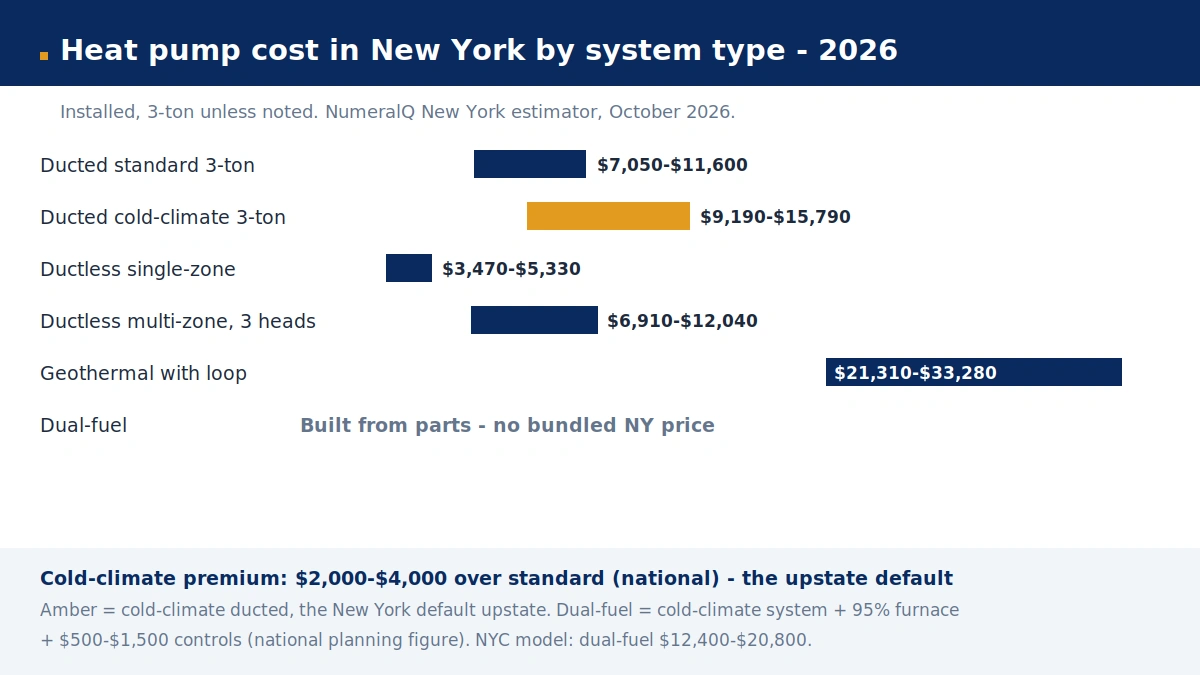
New York’s 2026 market hangs on two price points, and the distance between them is what cold-climate engineering costs. NumeralQ priced its New York estimator on October 26, 2026, and for a standard ducted 3-ton air-source system it gives $7,050-$11,600 installed — the planning range for replacing a whole-home ducted system in a typical New York house. That same 3-ton job in its cold-climate ducted form costs $9,190-$15,790. The $2,140-to-$4,190 step up buys the inverter compressor, enhanced vapor injection, a larger coil, and low-temperature controls that keep the unit heating at 5 degrees and below — upstate, that is the cost of a system that actually works, not an optional upgrade to weigh later.
The national cross-checks land in the same place, with New York running above the national average as expected. A New York City pricing model puts a ducted install at $7,800-$18,200 with most homeowners paying around $11,700, cold-climate at $10,400-$18,200, and dual-fuel at $12,400-$20,800 — and it prices New York at about 130 percent of the national cost level. A BLS-based state comparison puts a ducted system in New York at $8,200-$15,100. A Rochester contractor’s published 2026 pricing runs $4,865-$6,400 for a single zone and $8,400-$15,840 for a dual-fuel or entry ducted system, all before incentives. New York HVAC mechanics earn a median $35.78 an hour (BLS, May 2025), above the national median of $29.33, and electricians earn $37.86 — and the billed rates run $72-$93 an hour for HVAC work and $76-$98 for electrical work.
That per-ton range has to cover the whole installed job — thermostat, labor, permits and startup included, plus the outdoor unit, the indoor coil or air handler, the refrigerant lineset, the pad or wall bracket, and the electrical disconnect and wiring. A new gas furnace for a dual-fuel setup, a panel upgrade, ductwork repairs, and an oil tank decommissioning are all extra, and in New York the oil tank is not a footnote: a house converting from oil has a tank in the basement or buried in the yard that has to be emptied, cleaned, and removed or filled, and that work is a separate line on the quote.
One incentive sits inside the arithmetic, and in New York it is large enough to change the answer. A whole-home system that removes the old fossil-fuel heating earns $7,000 from NYS Clean Heat at the standard rate, $12,000 in the Weatherized Tier — but the rebate is capped at 70 percent of the project cost, or 85 percent in a disadvantaged community, in Central Hudson territory, or in the Weatherized Tier. On a $12,500 cold-climate job, that cap binds: 70 percent is $8,750, so the most the buyer can actually collect is $8,750, not $12,000, and at the 85 percent cap it is $10,625. Read the cap before the headline number. The rebate section below works through the caps utility by utility, because the cap is where New York quotes most often mislead.
One warning before the tables: the lowest quote in New York is not always the cheapest system once it is running. No bargain hides in a quote that puts a standard unit where a cold-climate unit belongs. A standard unit quoted there will call for resistance heat on the first single-digit night — and stay on it. When bidders are compared side by side, only one figure lines up cleanly: the installed price for the same cold-climate model, on the same house, with the same backup heat, in writing, with the Clean Heat rebate shown as its own line. Get that figure from at least three installers, and drop any bidder who will not put the model number and its 5-degree capacity and COP in writing. In New York, add one more condition: the bidder must be a NYS Clean Heat Participating Contractor, or the rebate does not exist at all.
| Source | 3-ton ducted | 3-ton cold-climate | Single-zone mini-split | Geothermal |
|---|---|---|---|---|
| NumeralQ NY (Oct 2026) | $7,050-$11,600 | $9,190-$15,790 | $3,470-$5,330 | $21,310-$33,280 |
| NYC model (2026) | $7,800-$13,700 | $10,400-$18,200 | — | — |
| BLS-based NY (Aug 2026) | $8,200-$15,100 | — | — | — |
| Rochester contractor (Oct 2026) | $8,400-$15,840 (entry ducted) | — | $4,865-$6,400 | — |
That table has two rows that deserve a footnote, not a headline. The New York City model’s cold-climate column runs to $18,200 — premium-brand installed prices, included here as a ceiling, not as the upstate price. And the geothermal column’s national range runs to $50,000 and beyond because ground-loop drilling costs vary enormously with soil, rock, and lot size; NumeralQ’s $21,310-$33,280 is the New York planning range for a typical residential loop. No installed price for a New York dual-fuel package was published in this pass, so the dual-fuel row below is assembled from its parts in the system-type section instead of invented.
Heat Pump Cost in New York by System Type
In New York, “heat pump” means five different machines, and the cheapest costs less than a sixth of the most expensive. Which one fits depends on the house — its ducts, its current heat source, and how much of the winter the heat pump is meant to carry on its own. The table below prices each type from the NumeralQ New York anchors.
| System type | Installed cost (NY) | Best for in New York |
|---|---|---|
| Ducted air-source, standard (3-ton) | $7,050-$11,600 | NYC / Long Island primary heat; upstate shoulder seasons + cooling only |
| Ducted cold-climate (3-ton) | $9,190-$15,790 | Whole-home primary heat with ducts; the default upstate buy |
| Ductless mini-split, single zone | $3,470-$5,330 | One room, addition, or a house with no ducts |
| Ductless multi-zone (3 heads) | $6,910-$12,040 | Whole-home without ducts; zone-by-zone control |
| Dual-fuel (cold-climate + gas furnace) | Built from parts — see text | Gas-heated home that wants a heat pump for shoulder seasons + AC |
| Geothermal, ground-source with loop | $21,310-$33,280 | Long-term owner, big lot; steadiest winter COP + state tax credit |
Ducted cold-climate is the default upstate buy, and the safe buy downstate too. It works through the house’s existing ducts, heats and cools the whole home from a single system, and — when the model sits on the NEEP cold-climate list — keeps at least 70 percent of its rated capacity at 5 degrees with a COP of at least 1.75. That $9,190-$15,790 covers a 3-ton job, and the spread comes from brand, efficiency tier, and how much of the existing ductwork passes inspection. A house whose ducts leak in an unconditioned attic will land at the top of the range once sealing and insulation are added, and in New York that work pays twice over: a heat pump pushes more air at lower temperatures than a furnace, so duct losses a 140-degree furnace airstream could hide turn into cold rooms under a heat pump. Our ductless vs ducted guide has the full comparison.
A standard ducted unit is a downstate machine, not an upstate one. The $7,050-$11,600 standard range looks like $2,000 or more saved against the cold-climate unit. A mild October day in Queens makes the two machines hard to tell apart. Upstate, the difference arrives in January. A standard unit keeps 40 to 60 percent of its capacity at 5 degrees and its COP slides toward 1.0, which means the resistance strips take over for weeks at a time — and resistance heat at New York’s average 28.6 cents a kilowatt-hour costs about $84 a million BTU, more than five times the gas furnace it replaced. In New York City, where the design temperature is 15 degrees, a standard unit can serve as primary heat more honestly — but it still earns a smaller Clean Heat rebate. In New York a standard unit only makes sense as a cooling-first machine where a gas furnace stays the primary heat — which is really a dual-fuel purchase with the furnace doing the work, and it should be priced as one.
New York’s oldest housing stock has its retrofit answer in ductless mini-splits. A single-zone system at $3,470-$5,330 heats and cools one room or one open-plan area with no ducts at all. The outdoor unit sits on a wall bracket, the indoor head on the wall, one small hole for the lineset. That makes it the right machine for a house with no ductwork at all, which describes a large share of New York’s pre-war homes: the brownstones and row houses of Brooklyn and Queens, the farmhouses of the Finger Lakes, the Colonials of Westchester that were built around a boiler and radiators and never saw a duct. A whole small home is covered by a three-head multi-zone system at $6,910-$12,040, with a separate thermostat in each zone. The catch never changes: a mini-split heats only the rooms it serves, and no others. The cold-climate mini-split models — Mitsubishi Hyper-Heat, Fujitsu, Daikin Aurora — keep full rated capacity down to 5 degrees and 70 percent or more at minus 13. That is why they dominate the mini-split market from Buffalo to the Bronx. Our mini-split installation guide works through zone-by-zone sizing and pricing.
For the 59 percent of New York homes heated by piped gas, dual-fuel is the honest answer. A dual-fuel system pairs a cold-climate heat pump with a gas furnace, and a control switches between them at a switchover temperature the installer sets — often somewhere between 30 and 40 degrees in New York. Above the switchover point the heat pump runs; below it the furnace takes over, because the heat pump’s COP has fallen below the point where it beats gas. No installed price for a New York dual-fuel package was published in this pass, so this guide invents none: build it from the cold-climate ducted system ($9,190-$15,790) plus a 95 percent gas furnace — see our furnace replacement guide for the furnace half — plus roughly $500-$1,500 in dual-fuel controls, wiring, and commissioning, a national planning figure. A New York City pricing model puts dual-fuel at $12,400-$20,800, which is consistent with that build. For the dual-fuel setup in detail, see our dual-fuel heat pump guide.
Geothermal is the only system in this state whose winter efficiency barely notices the weather — and the only one with a state tax credit. A ground-source heat pump draws heat from earth that sits near 50 degrees year-round, a few feet below a Rochester lawn, so its COP holds at 3.0 to 5.0 through a minus 1 night in Albany when an air-source unit is working at 1.75. The NumeralQ New York range is $21,310-$33,280 with the loop, against a national range of $20,000-$50,000 or more — the spread is the loop itself, horizontal trenching where the lot allows it, vertical bores where it does not. New York adds two things no other state in this series offers together: a NYS Clean Heat geothermal rebate of up to $20,000 in the Weatherized Tier (up to $30,000 at Con Edison for a whole building, up to $40,000 reported at the top end), and a state income-tax credit worth 25 percent of the geothermal system’s cost. The credit’s cap is disputed — the law enacted in 2022 capped it at $5,000, and secondary trackers report $10,000 for systems placed in service on or after July 1, 2025, citing bills that were introduced but whose enactment could not be confirmed in this pass — so this guide prints both figures and tells the reader to confirm the cap on the Tax Department’s Form IT-267 page before claiming either one. Geothermal is the right buy for a long-term owner on a big lot who plans to stay put for 20 years, and the wrong buy for anyone who might move in five. The federal credit that used to cut 30 percent off a geothermal install is $0 for a 2026 homeowner-owned system, so the geothermal case in 2026 has to stand on the state credit, the Clean Heat rebate, and operating savings alone. See our geothermal heat pump guide.
One more configuration deserves a name of its own: the cold-climate mini-split used as a partial-home heater. A growing number of New York homes keep their boiler or furnace and add one or two mini-split heads in the rooms people actually live in. The heads carry the shoulder seasons, the old system handles the deep cold, and the household gets air conditioning in July for the first time. At $3,470-$5,330 for the first zone, it is the cheapest way into a heat pump in this state — and the configuration most likely to disappoint if sold as a whole-home solution: one head cannot heat a house. It also earns a smaller Clean Heat amount, and in Con Edison territory the difference is $7,000 against $2,500.
Heat Pump Cost by Home Size
After system type, size is the first decision — and in New York it is also the one most often got wrong, in both directions. An undersized heat pump in Buffalo is far more than a minor inconvenience. It is a machine running on resistance heat for a month of every winter, at 23 cents a kilowatt-hour or more. Go too big and the unit short-cycles its way through the winter, never settling into steady efficiency, while you pay thousands more for capacity the house never uses. The only correct size comes from a Manual J load calculation — a room-by-room accounting of the house’s heat loss at the design temperature, minus 1 in Albany, 6 in Buffalo, 2 in Syracuse, 15 in New York City. Get the Manual J in writing before you sign — and in New York, the rebate depends on it: NYS Clean Heat requires the system to be sized to 90 to 120 percent of the design heating load, and a system outside that band can lose the rebate entirely.
The table below prices ducted air-source systems by tonnage from the NumeralQ New York anchors. The cold-climate premium sits alongside, so the step up shows at every size. A ton is the trade’s unit: 12,000 BTU an hour of heating or cooling capacity. A typical upstate home needs more heating capacity per square foot than a home in almost any other state in this series, because the design temperature is far colder — which is why a 2,000-square-foot Albany house commonly takes a 3-ton or 3.5-ton system where the same house in New York City would take 2.5 or 3 tons. The city is the size decision as much as the house is.
| System size | Home size (approx.) | Ducted standard (NY) | Ducted cold-climate (NY) |
|---|---|---|---|
| 1.5 ton | 600-1,000 sq ft | $4,830-$7,620 | $6,800-$10,600 (planning est.) |
| 2 ton | 1,000-1,400 sq ft | $5,570-$8,950 | $7,600-$11,900 (planning est.) |
| 2.5 ton | 1,400-1,700 sq ft | $6,310-$10,280 | $8,400-$13,400 (planning est.) |
| 3 ton | 1,700-2,100 sq ft | $7,050-$11,600 | $9,190-$15,790 |
| 3.5 ton | 2,100-2,400 sq ft | $7,790-$12,930 | $10,100-$17,200 (planning est.) |
| 4 ton | 2,100-2,700 sq ft | $8,530-$14,260 | $11,000-$18,700 (planning est.) |
| 5 ton | 2,700-3,500 sq ft | $10,010-$16,920 | $12,500-$21,000 (planning est.) |
Only the 3-ton row escapes the warning label on the cold-climate column. NumeralQ published a cold-climate figure only for the 3-ton job ($9,190-$15,790). The other rows are planning estimates: the national cold-climate premium of $2,000-$4,000 added to the standard range at each size, and labeled as such. Do not quote them as measured New York prices — they are not.
Look closer at three things in this table. Start with the home-size column: it is approximate, and nowhere does that approximation matter more than in New York. A tight, well-insulated 2,000-square-foot house built in 2020 needs far less heat than a drafty 1940 farmhouse of the same size, single-pane windows and bare walls included — and those two houses can sit a full ton apart. Age, insulation, windows, air leakage, and ceiling height move the size more than the floor area does — and in New York, the insulation work that shrinks the size also unlocks the $5,000 Weatherized Tier uplift on the rebate. Second, the heating load sets the tonnage, not the cooling load — upstate the heating load runs three to four times the cooling load, so a system sized for the summer will be far too small for January. Third, the backup heat is sized with the system, not after it: the resistance strips or the furnace must cover the whole design load on the coldest night.
The 3-ton row deserves an extra moment. It is the only row with a measured cold-climate price, and the size most New York homes land on. Inside the $9,190-$15,790 range, the spread is brand and efficiency tier: a value-tier cold-climate unit with an HSPF2 near 8.5 at the bottom, a premium variable-speed unit with an HSPF2 above 10 at the top. Through an Albany winter the premium tier earns its keep. A higher HSPF2 means a higher seasonal COP, and every tenth of a COP point is worth real money across 6,875 heating degree days. On a tight budget, the value-tier cold-climate unit still beats a standard unit by a wide margin. And remember the cap: on a $9,190 job at the bottom of the range, the 70 percent Clean Heat cap is $6,433, so the $7,000 headline rebate does not fully fit.
Heat Pump Cost by City: New York City, Buffalo, Rochester & Albany
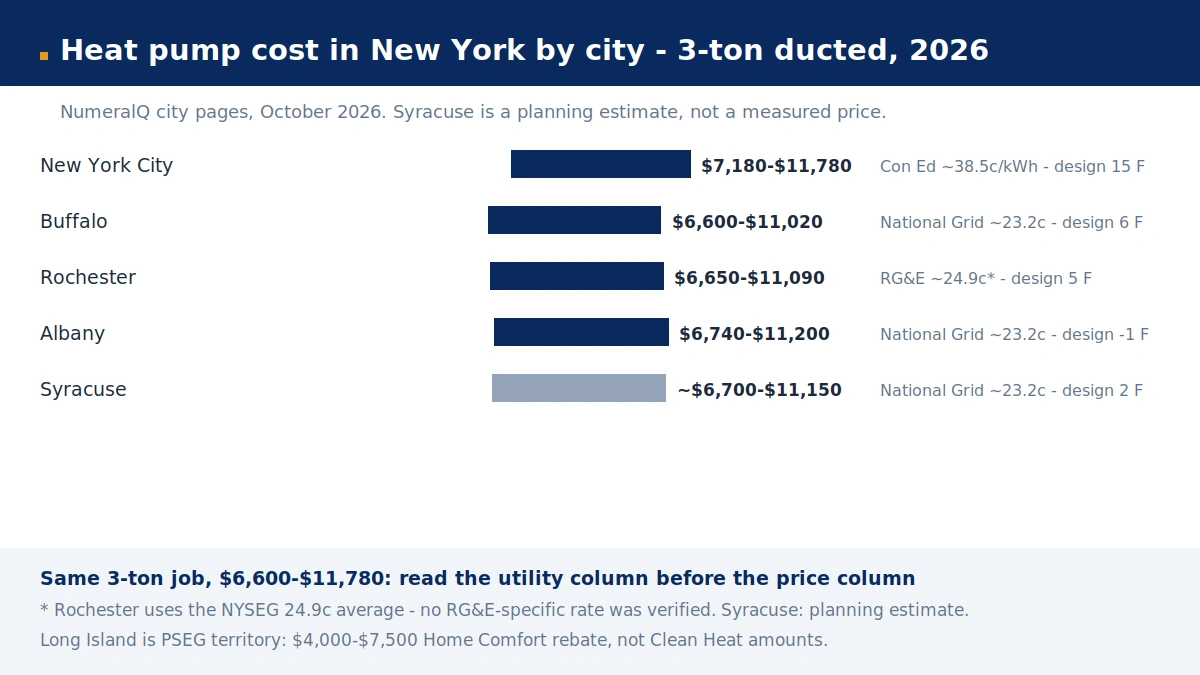
New York is a spread-out state with two real HVAC markets at opposite ends — New York City in the southeast, Buffalo in the west — and smaller ones scattered across the Hudson Valley and the Finger Lakes, and the verified figures run from $6,600 to $11,780 for the same 3-ton ducted job. What sets the cities apart is not just the install price but the utility behind the meter — and in New York that gap is among the widest in the series, because the utility decides both the rebate and whether the heat pump beats gas at all.
| City | 3-ton ducted (verified) | Utility | Residential kWh (12-mo avg) |
|---|---|---|---|
| New York City | $7,180-$11,780 | Con Edison | ~38.5 cents |
| Buffalo | $6,600-$11,020 | National Grid | ~23.2 cents |
| Rochester | $6,650-$11,090 | RG&E | ~24.9 cents (NYSEG avg; RG&E not separately verified) |
| Albany | $6,740-$11,200 | National Grid | ~23.2 cents |
| Syracuse | ~$6,700-$11,150 (planning est.) | National Grid | ~23.2 cents |
New York City is the state’s biggest market and the most expensive of the verified cities, at $7,180-$11,780 for a 3-ton ducted system. The city is also where the running-cost answer is the worst: Con Edison’s residential customers averaged about 38.5 cents a kilowatt-hour over the twelve months to August 2026, so a city heat pump at a seasonal COP of 2.8 costs about $2,015 a year to heat the planning home, against about $842 for a 95 percent gas furnace. A New York City buyer pays the most for the install and the most to run it. That is not a reason to skip the heat pump in the city — it is a reason to buy it for the right reason: replacing an oil boiler, adding air conditioning to a brownstone that never had it, or pairing it with a gas furnace in a dual-fuel setup. It is also the reason to check the building type before the equipment: most city apartments are co-ops or condos, the exterior wall is common area, and the board’s approval is the whole decision.
Buffalo is the cheapest verified city at $6,600-$11,020, and by a wide margin the best running-cost market in the state. National Grid’s upstate residential customers averaged about 23.2 cents a kilowatt-hour over the same twelve months, so a Buffalo heat pump at a seasonal COP of 2.5 heats the planning home for about $1,360 a year — still above gas at $842, but the gap is $518 rather than the $1,415 it is on Con Edison power. Buffalo is also the snowiest of the four cities, with lake-effect snow off Lake Erie measured in feet, so the outdoor unit’s placement matters more there than in any other city in this guide.
Rochester sits in the middle on price, at $6,650-$11,090, on RG&E power. No RG&E-specific per-kilowatt-hour average was verified in this pass, so the table uses the NYSEG average of about 24.9 cents as the nearest published figure for the same utility family and flags it as such — do not quote 24.9 cents as an RG&E rate. Rochester is also where the oil-to-heat-pump conversion is most common in the state, because the city’s older neighborhoods still run on oil boilers.
Albany, at $6,740-$11,200, is the capital city on National Grid power, with the same 23.2-cent average as Buffalo and a design temperature of minus 1 degree — the coldest of the four verified cities. Albany’s heating degree days run about 6,875 a year, and the city sits in climate zone 5A, which means the cold-climate rating is not optional there even though the install price is close to Buffalo’s. The Hudson Valley south of Albany — Poughkeepsie, Kingston, Newburgh — runs on Central Hudson, which is the one Clean Heat utility where the 85 percent cost cap applies to every customer regardless of disadvantaged-community status.
Syracuse carries a warning label rather than a verified price. The figure in the table is a planning estimate built from the state range and the nearest verified cities, not a measured market price, and the same source that published the other four cities did not publish a city figure for Syracuse. Syracuse sits in National Grid territory like Buffalo and Albany, so its running-cost math matches theirs. Treat the Syracuse install figure as indicative only, and do not quote it as a NumeralQ figure, because it is not.
Compare quotes on price per ton, not on the total — and read the utility column ahead of the price column. New York City’s $11,780 top end looks alarming beside Buffalo’s $6,600 bottom end, but most of that gap is the range itself — the same 3-ton job can land anywhere inside either city’s band, depending on brand and ductwork.
New York’s Two Climates: Design Temps, HDD & What the Cold Does to a Heat Pump
New York’s climate is the reason this guide is written in two voices, and it is worth understanding in numbers before any equipment is chosen. The state spans four heating design temperatures and more than 2,000 heating degree days from end to end — the widest spread of any state in this series.
The design temperatures. Sizing a heating system starts from the 97.5 percent winter design temperature. That is the outdoor temperature the weather stays above for 97.5 percent of the hours in a typical winter — the number the Manual J load calculation is built around. In New York City that number is 15 degrees. In Buffalo it is 6 degrees. In Syracuse it is 2 degrees. In Albany it is minus 1 degree. Those are not records. They are design conditions — temperatures the system is built to handle as a matter of routine. The heating degree days tell the same story: New York City logs about 4,871 a year, Albany about 6,875, Syracuse about 6,756, Buffalo about 7,062, Rochester about 6,748. An Albany house needs roughly 40 percent more heat over the season than the same house in Queens.
What the cold does to a heat pump. An air-source heat pump pulls heat out of outdoor air and into the house, and as that air gets colder there is less heat in it to pull. Capacity and efficiency fall at once. At 5 degrees, a standard heat pump rated at 36,000 BTU an hour at 47 degrees may put out only 14,000 to 22,000 BTU an hour — 40 to 60 percent of its rating — and its COP drops from above 3.0 toward 1.0. In Department of Energy field testing, a cold-climate unit with enhanced vapor injection kept 70 to 80 percent of its capacity at 5 degrees, at a COP of 2.2 to 2.8. At minus 5 it still held 60 to 70 percent, with a COP of 1.8 to 2.4. Even the best air-source unit loses ground below zero. Albany’s design temperature is minus 1, and at minus 1 every air-source heat pump on the market runs at reduced capacity with a COP not far above 1.75. That is why the backup heat is not a footnote upstate. It is half the system. Downstate, where the design temperature is 15 degrees, the same unit keeps far more of its capacity, and the backup heat is insurance rather than a second heating system.
The defrost cycle is a New York line item, and the snow is a bigger one. When the outdoor coil drops below freezing, moisture in the air freezes onto it. To melt the frost, the unit must reverse itself from time to time — blowing cold air indoors for a few minutes while it does. In New York City’s damp winters that happens often; in the dry cold of the Adirondacks it happens less often. But the snow is the larger problem: Buffalo and Syracuse are among the snowiest large cities in the country, with lake-effect bands that can drop a foot of snow overnight, and an outdoor unit at grade level in a Buffalo yard will end up buried in a drift. The fix is a stand or wall bracket that lifts the unit well off the ground, and a pad that drains away from the house — a few hundred dollars on the quote. Site the unit on the leeward wall, with clear space on all sides for airflow and for a technician to reach it in a storm. No catalog price shows any of this. February’s service bill is where it all shows up.
The house matters as much as the machine — and in New York, the rebate pays for the house. Warm air from a heat pump arrives at 90 to 110 degrees, against 120 to 140 from a gas furnace. In a tight, well-insulated house, that difference never shows. In a drafty brownstone with single-pane windows, uninsulated walls, and a 1910 attic, it decides whether the house feels warm or the heat pump always feels behind. Air sealing and insulation are the cheapest capacity a New York homeowner can buy. Get the blower-door test and the insulation quote done before the heat pump quote. When the house needs both jobs, fix the envelope first, then size the heat pump — the right size may drop a full ton. In New York it saves money a third time: a house that has finished a qualifying insulation package earns the Weatherized Tier, $12,000 instead of $7,000. From March 1, 2028, weatherization becomes a condition of any Clean Heat incentive at all.
Heat Pump vs Gas Furnace in New York: The Running-Cost Math
Everything in this guide turns on this section. It is also where most New York heat pump advertising goes wrong: the honest answer is that a heat pump usually loses to a gas furnace on fuel in this state, and the exceptions are specific enough to name one by one. The sums below are NestPriced arithmetic: published prices, assumptions stated in full, ready for any reader to re-run against their own utility’s rate and their own house.
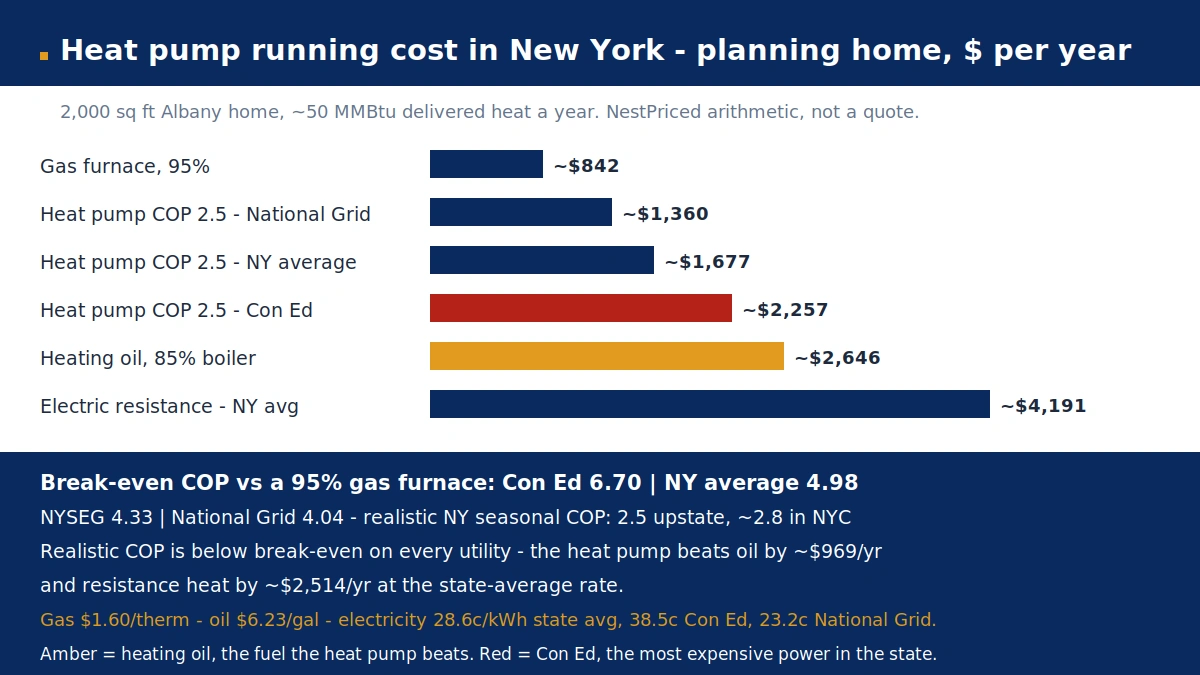
The planning home. The planning home is a 2,000-square-foot Albany house. It needs about 50 million BTU of delivered heat a year — a planning assumption built from Albany’s 6,875 heating degree days, not a measured bill. That 50 million BTU equals 14,654 kilowatt-hours of heat. Everything below divides that heat by the delivering machine’s efficiency and multiplies by the fuel’s price.
The gas furnace. To deliver 50 million BTU of heat, a 95 percent AFUE furnace needs about 52.6 million BTU of gas input — 526 therms. At New York’s winter residential gas price of about $1.60 a therm — the average of the November-to-March EIA monthly prices for 2025, about $15.80 per thousand cubic feet — that is about $842 a year in fuel. A modeled figure from a second source puts a 95 percent furnace at $652 a year for the average New York home, which is a smaller and milder home than the planning home. An 80 percent furnace on the same planning home burns 625 therms and costs about $1,000 a year.
The heat pump. A cold-climate heat pump running at a seasonal COP of 2.5 — a realistic upstate seasonal figure — needs 5,862 kilowatt-hours of electricity to deliver the same 50 million BTU. The utility decides what that costs, entirely:
| Utility | Price per kWh | Heat pump at COP 2.5 | Heat pump at COP 2.8 (NYC) | Electric resistance |
|---|---|---|---|---|
| Con Edison (NYC, Westchester) | ~38.5 cents | ~$2,257/yr | ~$2,015/yr | ~$5,642/yr |
| National Grid (Buffalo, Albany, Syracuse) | ~23.2 cents | ~$1,360/yr | ~$1,214/yr | ~$3,400/yr |
| NYSEG (Southern Tier) | ~24.9 cents | ~$1,460/yr | ~$1,303/yr | ~$3,649/yr |
| PSEG Long Island | ~26 cents (planning est.) | ~$1,524/yr | ~$1,361/yr | ~$3,810/yr |
| NY average | ~28.6 cents | ~$1,677/yr | ~$1,497/yr | ~$4,191/yr |
Go through that table twice — the whole guide is in there. On Con Edison power, the heat pump costs about $2,257 a year — nearly triple the gas furnace’s $842 — and at a generous seasonal COP of 2.8 it costs $2,015. On National Grid it costs $1,360. On the state average it costs $1,677. There is no utility in this table where the heat pump beats a 95 percent gas furnace on fuel. The PSEG Long Island row carries a warning: no PSEG residential per-kilowatt-hour rate was verified for 2026 in this pass, so the 26-cent figure is a planning estimate built from a 2025 average. PSEG’s Rate 580 discounts the delivery charge by 40 percent on usage above 400 kilowatt-hours a month for electric-heating homes, so the real figure would be lower — this guide does not model by how much.
The break-even COP. Run the arithmetic in reverse: what efficiency would the heat pump need to tie the gas furnace? At the state-average electricity price of 28.6 cents a kilowatt-hour — $83.82 a million BTU — against gas at $16.84 a million BTU delivered, the break-even COP is 4.98. By utility: Con Edison 6.70, National Grid 4.04, NYSEG 4.33, PSEG Long Island about 4.52. Against an older 80 percent furnace the break-even COP at the state average falls to about 4.19, and on National Grid power to about 3.40. A cold-climate heat pump’s realistic New York seasonal COP is 2.5 upstate and about 2.8 in the city — below break-even on every utility in the table against a 95 percent furnace. Through an Albany winter, no heat pump sold today sustains a seasonal COP of 5.0. That is the blunt fact, and any quote that claims a New York heat pump beats a 95 percent gas furnace on fuel is modeling a different state’s prices.
The backup-heat adder. The figures above assume the heat pump delivers all 50 million BTU at its seasonal COP — no backup heat in the mix. In practice the backup system covers part of the season’s heat, and that slice costs more than the rest. If 15 percent of the season’s heat comes from electric resistance strips — a plausible share for a standard unit, or for a cold-climate unit on the coldest nights — that slice costs the resistance price: 15 percent of 14,654 kilowatt-hours is 2,198 kilowatt-hours, which at the state-average 28.6 cents is about $629 extra a year, an illustration, not a bill. The backup share is where a dual-fuel system earns its keep in Con Edison territory: below the switchover temperature, the gas furnace delivers that 15 percent at gas prices instead of resistance prices.
The switchover temperature. A dual-fuel home hands over at a set outdoor temperature: the point where the heat pump’s COP has fallen to the break-even COP. On Con Edison power, with a break-even COP near 6.7, that point sits above the temperatures where a heat pump does most of its work — the furnace carries most of the winter and the heat pump earns its keep in the shoulder seasons. On National Grid power, with a break-even COP near 4.0, the heat pump stays cheaper than gas down to the low 20s. Ask what switchover temperature was chosen and why, and ask for it in writing.
What the heat pump beats, clearly. Resistance heat is the heat pump’s easiest win in New York: baseboard panels, electric furnaces, space heaters — the heat pump beats them everywhere in the state, by a wide margin. At the state-average price, resistance heat delivers the same 50 million BTU for about $4,191 a year. Against the heat pump’s $1,677, that is a saving of about $2,514 a year, every year. Roughly 15 percent of New York homes heat with electricity. For those homes, no money in this guide is better spent than on a heat pump. Against heating oil, the heat pump wins too — about $969 a year at the state-average rate, as the oil section below works out in full. Against propane, the heat pump wins by about $503 a year at the state-average rate. Against a 95 percent gas furnace on any New York utility, it loses — and the right reason to buy it there is the air conditioning, the comfort, the zoning, or the plan to replace a furnace that is already at the end of its life, not the fuel bill.
Oil to Heat Pump in New York: The Conversion That Pays
If there is one New York household for whom this guide is written first, it is the one with an oil boiler in the basement and an oil tank in the yard. About one home in five in New York heats with oil or propane, and the oil share is concentrated exactly where the winters are longest: the farmhouses of the Finger Lakes, the Colonials of the Hudson Valley, the pre-war homes of Rochester and Syracuse and Buffalo that were built around a boiler and radiators and never saw a duct. For those homes, the heat pump is not a green choice or a comfort upgrade. It is the cheapest heat in the state, and the fall of 2026 made the case unanswerable.
The oil price did something unprecedented. NYSERDA’s statewide survey put residential heating oil at about $6.23 a gallon on October 13, 2026, up from $3.71 a year earlier — a rise of about 68 percent in twelve months. The EIA’s New York survey showed $6.44 for the week of October 26, and $6.32 for the week of November 2. The EIA’s Winter Fuels Outlook projected that American households heating with oil would spend about 21 percent more this winter, around $2,115 for November through March. Oil is also the most volatile fuel a New York household can buy: it is delivered by truck, priced on a world market, and bought in fills of a few hundred gallons at a time. A household that filled a 275-gallon tank at $3.71 in the fall of 2025 paid about $1,020; the same fill at $6.23 costs about $1,713. That $693 difference is a single delivery, and a cold winter takes three or four of them.
The oil math, worked out. An 85 percent oil boiler turns a gallon of heating oil — 138,500 BTU — into about 117,700 BTU of delivered heat, so a gallon costs about $52.91 per million BTU of delivered heat at $6.23 a gallon. The planning home needs 50 million BTU a year, which is about $2,646 a year of oil. A cold-climate heat pump at a seasonal COP of 2.5 delivers the same heat for about $1,677 a year at the state-average electricity price, $1,360 on National Grid power, and $2,015 on Con Edison power at a COP of 2.8. The saving is about $969 a year at the state-average rate, about $1,286 a year on National Grid power, and about $631 a year even on Con Edison power.
What the conversion actually involves. An oil-to-heat-pump conversion is more than an equipment swap, and the quote should show every piece of it. The oil boiler comes out, or is decommissioned and left in place. The oil tank — in the basement, or buried in the yard — has to be emptied, cleaned, and removed or filled in place, and that work is a separate line item that no New York figure was verified for in this pass, so get it priced rather than assumed. If the house has radiators, the heat pump has two paths: a ducted system with new ductwork, at $4,770-$7,860 a job, or ductless mini-split heads in the main rooms, which need no ducts at all and are the more common choice in radiator houses. The electrical panel usually needs attention too: an oil boiler asked almost nothing of the panel, and a heat pump with backup strips asks a great deal — a 200-amp upgrade runs $2,550-$3,910 in New York. And the house needs a Manual J, because the boiler was almost certainly oversized — oil boilers usually are.
The rebate is built for this conversion. A whole-home system that removes the old fossil-fuel heating earns the full Clean Heat amount — $7,000 at the standard rate, $12,000 in the Weatherized Tier — while a system that keeps the oil boiler as backup earns less. The numbers show it: a $12,500 cold-climate system, less the $7,000 standard rebate, costs $5,500 out of pocket, and against oil at the state-average rate it saves about $969 a year, a payback of about 5.7 years. With the Weatherized Tier, the rebate is capped at 70 percent of the cost — $8,750 on a $12,500 job — so the out-of-pocket cost is $3,750 and the payback against oil is about 3.9 years. In Central Hudson territory or a disadvantaged community, where the cap is 85 percent, the rebate reaches $10,625, the out-of-pocket cost is $1,875, and the payback against oil is under two years. One warning: HEAR money does not help the oil home switch. The federal Home Electrification and Appliance Rebates program, under the Energy Department’s Program Notice 26-2, pays only for electric-to-electric upgrades, and an oil boiler replaced by a heat pump is fuel-switching, which no longer qualifies.
Utility Rebates & What You Can Actually Collect in 2026
With the federal credit gone, most states still keep a reserve of their own: a state credit, a rebate, an exemption. New York keeps the largest utility rebate program in the country — and also the most complicated one, because the amount depends on the utility, the house, and whether the old heating system is removed.
NYS Clean Heat is the flagship, and it pays by the project, not by the ton. The program is administered jointly by NYSERDA and the utilities under one program manual, reauthorized for 2026 through 2030 with about $5.36 billion. A whole-home air-source system that removes the old fossil-fuel heating earns a flat $7,000 at the standard rate. If the house qualifies for the Weatherized Tier — built after 2010, or finished a qualifying insulation and air-sealing package, or shown by the load calculation to have a low heating load per square foot — the amount rises to $12,000 at National Grid, NYSEG, RG&E, Central Hudson, and Orange & Rockland, and $10,000 at Con Edison. In a disadvantaged community, a weatherized home earns $14,000 at National Grid and Orange & Rockland, $13,000 at NYSEG and RG&E, and $11,000 at Con Edison. The money is an instant invoice discount: the participating contractor takes it off the bill. The conditions matter: the equipment must be on the NEEP cold-climate list, sized to 90 to 120 percent of the design heating load by Manual J, installed by a NYS Clean Heat Participating Contractor, in a one-to-four-unit home, and gas-only customers are ineligible as of January 1, 2026.
The cap is the number most quotes get wrong. Clean Heat incentives are capped at 70 percent of the project cost — or 85 percent in a disadvantaged community, anywhere in Central Hudson territory, or in the Weatherized Tier. On a $12,500 cold-climate job, 70 percent is $8,750, so the $12,000 Weatherized Tier figure does not fully fit: the buyer collects $8,750, not $12,000. At the 85 percent cap the most the buyer can collect on that job is $10,625. A quote that deducts $12,000 from a $12,500 job has overstated the rebate by $3,250, and the buyer finds out when the invoice arrives. Ask for the cap arithmetic in writing, on the quote, before signing.
Keeping the old system as backup pays less — much less in the city. The $7,000 and $12,000 figures are for a whole-home system that removes the old fossil-fuel heating. A system that keeps the furnace or boiler as backup earns a smaller amount, and the exact figure varies by utility and by manual version. In Con Edison territory, keeping the old system drops the rebate to $2,500 — a $4,500 penalty for keeping the furnace. In the pre-September manual, National Grid paid $6,000 for a full-load system with the fossil system retained against $10,000 with it removed. The post-September Weatherized Tier schedule changed those numbers, and the utility pages have not all caught up: NYSEG’s heat pump page still says up to $10,000 for an air-source system, which was the pre-September figure. Confirm the current amount on your own utility’s Clean Heat page and on the contractor’s invoice. What does not change between versions is the direction: removing the old system pays more, keeping it pays less, and a dual-fuel buyer should price the job on the smaller figure.
Con Edison pays the same headline, less in the Weatherized Tier, and more for geothermal. Con Edison’s whole-home air-source rebate is $7,000 at the standard rate, $10,000 in the Weatherized Tier, and $8,000 or $11,000 in a disadvantaged community — $2,000 less than the upstate utilities in the Weatherized Tier. Con Edison’s geothermal rebate runs the other way: up to $30,000 for a whole building in the Weatherized Tier, and up to $40,000 at the top end reported by secondary trackers. Con Edison also pays $1,500 for a heat pump water heater on applications submitted through November 30, 2026.
Central Hudson is the quiet best deal in the state. Central Hudson’s headline amounts match the other upstate utilities — $7,000 standard, $12,000 Weatherized Tier, $20,000 geothermal weatherized — but its cap is different: the 85 percent cost cap applies to every customer in its territory, regardless of disadvantaged-community status. On a $12,500 job that is the difference between an $8,750 maximum rebate and a $10,625 maximum, or $1,875 that no other upstate utility offers to a non-DAC household.
PSEG Long Island runs its own program, and it pays less. PSEG Long Island is not a Clean Heat sponsor. Its Home Comfort program pays a whole-house cold-climate air-source system $4,000 at market rate, $5,000 in a disadvantaged community or for a moderate-income household below 80 percent of area median income, and $7,500 for a low-income household below 60 percent of area median income — with 2026 thresholds of $131,900 and $98,925 for a family of four. Geothermal pays far more: $12,000 for a new system at market rate, $15,000 in a disadvantaged community or at moderate income, and $24,000 at low income, with retrofits at half those amounts. A heat pump water heater earns up to $1,200, and the contractor gets $250 a project. Pre-approval is required before work begins, and the equipment must come from a participating Home Comfort Partner. An older Cornell Cooperative Extension page still quotes $500 to $1,000 a ton with a $5,000 cap — that is the superseded schedule, and this guide uses the flat $4,000-to-$7,500 schedule from PSEG’s own 2026 material.
The income-qualified route runs through EmPower+. NYSERDA’s EmPower+ program serves income-eligible households with base caps reported at $12,000 upstate and $14,000 downstate, plus Sustainable Futures add-ons of $10,000 per heat pump and $5,000 per heat pump water heater, according to secondary trackers. EmPower+ generally does not offer heat pumps to homes heated with natural gas outside limited utility pilots, which is the program’s own rule, not this guide’s. The federal HEAR money that flows through EmPower+ is dealt with in the next section, because its status in 2026 is genuinely contested.
There is also a state geothermal credit, with a disputed cap. New York’s own income-tax credit for geothermal systems pays 25 percent of qualified expenditures, claimed on Form IT-267, non-refundable, with unused amounts carried forward up to five years. The cap is where the sources part ways: the law enacted in 2022 capped it at $5,000, and secondary trackers report $10,000 for systems placed in service on or after July 1, 2025, citing bills S4882 and A1591 — but those bills were introduced in 2025, and their enactment could not be confirmed in this pass. This guide prints both figures and tells the reader to confirm the cap on the Tax Department’s Form IT-267 page before claiming either one. The state also exempts residential solar, wind, and geothermal systems from property-tax assessment increases for 15 years under Real Property Tax Law §487, according to secondary sources. There is no verified New York sales-tax exemption for air-source heat pump equipment: the state charges 4 percent plus local tax, 8.875 percent combined in New York City, so get the tax shown as its own line on the quote.
| Source | Amount | Who can collect it |
|---|---|---|
| NYS Clean Heat, whole-home ASHP, fossil removed | $7,000 standard; $12,000 Weatherized Tier ($10,000 Con Ed) | 1-4 unit homes, NEEP-listed, Manual J 90-120%, participating contractor |
| NYS Clean Heat, DAC weatherized | $11,000 Con Ed; $13,000 NYSEG/RG&E; $14,000 National Grid/O&R | Disadvantaged community, weatherized |
| NYS Clean Heat, geothermal | Up to $20,000 weatherized; $30,000 Con Ed whole building; up to $40,000 reported | Qualifying GSHP, participating contractor |
| NYS Clean Heat, fossil retained as backup | Less — Con Ed $2,500; others vary by utility | Confirm on the utility’s page |
| PSEG LI Home Comfort, ASHP | $4,000 market; $5,000 DAC/moderate; $7,500 low income | Long Island, participating partner, pre-approval |
| PSEG LI Home Comfort, geothermal | $12,000-$24,000 new; $6,000-$12,000 retrofit | Long Island, by income tier |
| EmPower+ (income-eligible) | $12,000 upstate / $14,000 downstate reported, + $10,000 heat pump add-on reported | Income-eligible households |
| NY geothermal tax credit (Form IT-267) | 25% of cost; cap $5,000 enacted vs $10,000 reported — confirm | Primary residence, geothermal |
| Federal tax credit (§25C/§25D) | $0 for 2026 installs | — |
| HEAR | See next section — contested | Income-eligible, via EmPower+ |
Federal Help in 2026: $0 Tax Credit, HEAR Through EmPower+ & the Lease Question
The entire 2026 federal picture fits in a single paragraph. That brevity is exactly why heat pump advertising gets it so wrong, so often. In New York the paragraph has a second half that other states do not get, because the federal rebates that would matter most here are routed through a state program whose own manual has changed what they pay for.
A heat pump bought and installed by its owner in 2026 earns no federal tax credit at all. The One Big Beautiful Bill Act — Public Law 119-21, signed July 4, 2025 — ended the Energy Efficient Home Improvement Credit. That credit, §25C, was worth up to $2,000 a year for air-source heat pumps, and it no longer applies to equipment placed in service after December 31, 2025. The IRS fact sheet FS-2025-05 makes the finish date decisive. Money put down in 2025 counts for nothing if the crew completed the job in January 2026. That same date also ended the Residential Clean Energy Credit (§25D, 30%) — the 30 percent credit geothermal used to carry. Spot a federal credit deducted on a 2026 quote and you are looking at a price built under a law that no longer exists. If that credit still appears on a New York quote, tell the installer to strip it out and reprice the job on the Clean Heat rebate alone. See our federal tax credits guide for the full 2026 picture.
New York’s HEAR money is live, but it is not a $8,000 heat-pump rebate in 2026 — and the sources disagree about what it is. New York was allocated about $317.4 million in federal Home Energy Rebates money — $158,415,850 for HEAR and $159,021,883 for HOMES — and the state’s program opened in May 2024, one of the earliest in the country. The money is routed through NYSERDA’s EmPower+ program for income-eligible households. That much is agreed. What it pays for in the fall of 2026 is where the trackers part ways, and this guide prints both positions rather than choosing between them. One tracker, checking state pages on October 27, 2026, lists New York as launched with a heat pump rebate, and describes EmPower+ as paying $10,000 for an air-source heat pump plus HEAR. Two other trackers, verified in September and November 2026, say the opposite: that the EmPower+ manual now allows HEAR money only for insulation, air sealing, and ventilation — up to $1,600, on projects without a heat pump. Do not plan a purchase around an $8,000 HEAR heat-pump rebate in New York in 2026. Do not let a quote include it. Confirm on the EmPower+ page what HEAR currently pays for, and price the job on the Clean Heat rebate and the EmPower+ base amounts instead.
Even where HEAR does pay, it will not pay a gas-heated or oil-heated home to switch. The Home Electrification and Appliance Rebates program will pay up to $8,000 toward a heat pump. Program Notice 26-2 from the Energy Department restricts that money to electric-to-electric upgrades — new, more efficient electric equipment replacing old electric equipment — plus new construction. A gas furnace replaced by a heat pump is fuel-switching, and fuel-switching no longer qualifies; so is an oil boiler replaced by a heat pump. That matters more in New York than in most states, because 59 percent of the state’s homes heat with piped gas and about one in five heats with oil or propane — exactly the homes that cannot use HEAR to switch. The homes that could use it are the 15 percent that already heat with electricity. One date needs a flag: published sources date Program Notice 26-2 to both May 29, 2026 and September 1, 2026; the substance — electric-to-electric only, no fuel-switching — is the same either way, and this guide uses the September 1, 2026 date with the May 29 date noted. HOMES, the whole-home efficiency program, pays up to $8,000 on measured or modeled energy savings; secondary trackers list New York’s HOMES program as open, but no HOMES heat-pump rebate amount was verified on a NYSERDA page in this pass, so no amount is claimed here.
The lease route is unverified in New York. The commercial clean-electricity credit is still open to a company-owned heat pump: §48E, 30 percent. The system must enter service by December 31, 2027, and construction must have started by July 4, 2026 — the cutoff IRS Notice 2025-42 sets out. Where the law clearly allows residential third-party ownership, a homeowner can still reach that credit through a lease or a power purchase agreement, with the company passing part of the value on as a lower monthly payment. New York is not a state where that route was verified in this pass. No New York residential air-source heat-pump lease or PPA provider was found selling one to New York homes, and the state’s third-party-ownership status for residential heat pumps was not verified. No lease offer counts as verified until its terms are in writing — and a lawyer should read those terms before anything is signed. Put honestly: a New York homeowner buying a heat pump outright gets nothing from the federal government in 2026 — and a lease cannot be counted on to bring anything in indirectly either. On a cash quote, the price is the price, minus Clean Heat or Home Comfort money.
Permits & Licensing: No State HVAC License, NYC DOB Rules & Co-op Boards
New York’s licensing picture is unusual in one respect that helps a buyer who knows where to look — and hurts one who does not: the state issues no HVAC license at all, which means the credential that matters is the city’s or the county’s.
There is no state HVAC license in New York. Heating and air conditioning contractors and technicians hold no state license in New York. Licensing sits with the counties and municipalities, and it varies enormously. A license valid in Nassau County does not automatically cover a job in New York City. A New York City credential does not transfer to Westchester. Ask which local license the installer holds, and check it with that locality’s licensing or building department — a company licensed in Buffalo is not automatically licensed in Rochester, and a company with no local license at all can still be working legally in a small town that requires none. The one exception is federal: EPA Section 608 certification is required for anyone who handles refrigerants, which is every heat pump installer — ask for it by name, everywhere in the state.
New York City has its own structure, run by two agencies. The Department of Buildings issues no HVAC-specific license, but the work still needs credentials that depend on what is being done. Any contractor doing residential work in the city with a total cost over $200 must hold a Home Improvement Contractor license from the Department of Consumer and Worker Protection — which covers every residential heat pump install in the five boroughs. Installing or servicing oil-burning equipment needs an Oil Burner Equipment Installer license from the Department of Buildings: Class A requires four years of practical experience, Class B requires three, and both require a written exam and a practical exam. Gas piping must be done by a city-licensed Master Plumber; no HVAC credential covers it. New panel connections, new circuits, and disconnect wiring must be done by a city-licensed Master or Special Electrician. All applications go through DOB NOW, the city’s online portal — no walk-ins, no paper applications. A permit for the install goes through DOB NOW too, and the outdoor unit’s placement, the refrigerant lines, and the electrical disconnect are all inspected.
Upstate, the rules are local and thinner. Buffalo has a Division of Fuel Devices. Syracuse and the other upstate cities have their own requirements, and the towns and villages in between often have none beyond a building permit and an electrical inspection. In a town with no licensing requirement, the only checks on an installer are the EPA 608 certificate, the manufacturer’s training, and the references. Ask for all three, and call the references.
The co-op and condo question is the New York question. Most New York City apartments — and a large share of Westchester’s — are co-operatives or condominiums, and the exterior wall is usually common area. The board’s approval process is the whole decision for a heat pump: where the outdoor unit can sit, whether it can be seen from the street, how much noise it can make, whether the facade can be penetrated at all. Some boards have adopted heat-pump policies as Local Law 97 pushes large buildings toward electrification; others have not, and a board that has not decided can take months to do so. Get written approval for the placement before ordering the unit, and bring the installer into that conversation early. A unit sited to please the board, against the wind, will cost more to run and more to service. For a single-family homeowner the hurdle is smaller but not absent: a homeowners association can restrict where the outdoor unit sits and how it looks. New York City’s heat season — October 1 to May 31, with landlords required to keep 68 degrees during the day and 62 at night — is a landlord rule, not a heat-pump rule, but it is a reminder that the city’s housing law treats heat as a right.
What Pushes Your New York Quote Up or Down
The per-ton anchor gives the budget its shape; it does not price the job. Seven factors can move a New York quote by thousands of dollars. Three of them come from this state’s climate, its power market, and its rebate rules.
Labor costs a lot in New York — and that is itself the point. New York HVAC mechanics earn a median $35.78 an hour (BLS May 2025), above the national median of $29.33, with billed rates running an estimated $72-$93 an hour for HVAC work and $76-$98 for electrical work, at roughly two to two-and-a-half times the wage once insurance, payroll taxes, overhead, and profit are loaded in. New York City’s technicians earn about 28 percent above the national median, and Buffalo’s run about 2 percent above it. What moves a New York quote is not cheap labor but the crew’s cold-climate experience and its Clean Heat participation: a contractor who is not in the program cannot deduct the rebate, and a crew that has never sized a system for a minus 1 design temperature will size it wrong. Ask the crew how many cold-climate installs it has done in your utility’s territory, not just how long the company has existed.
The ductwork, and whether it survives. Compared with a furnace, a heat pump moves a bigger volume of air — and cooler air. Ductwork that served a 140-degree furnace airstream can therefore starve a 100-degree heat pump airstream — too small, too leaky, or too poorly insulated. NumeralQ puts new or extended ductwork at $4,770-$7,860 a job in New York, and sealing and insulating the ducts already there can add thousands more. Price the heat pump, take the ducts on trust, and the quote has wished the most expensive part of the job away. Ask for a duct inspection in writing, and for the cost of fixing what it finds.
The electrical panel. Plenty of New York homes still run on 100-amp service — pre-war city houses, farmhouses, and post-war ranches especially. A heat pump fitted with electric backup strips is what forces the panel question. A 200-amp panel upgrade runs $2,550-$3,910 installed in New York (NumeralQ), and it is the most common surprise add-on in New York quotes. Get the panel upgrade into the quote before you sign — not when the electrician is already standing in your driveway. For the national picture, turn to our electrical panel upgrade guide.
Equipment tier. A top-tier cold-climate unit should price 10-20 percent above a value-tier one. Upstate, the premium buys two things that matter. It buys stronger low-temperature performance on the coldest nights, and a higher HSPF2 that pays back across 6,875 heating degree days. On a tight budget, a value-tier cold-climate unit still beats a standard unit by a wide margin.
Financing terms. Paying cash still wins when the cost is counted over the system’s life. Take a $0-down loan and the dealer fees — 10-30 percent of the cash price, sometimes over 50 percent — fold into the amount financed. The Consumer Financial Protection Bureau’s August 2024 market spotlight is where that figure comes from. It is a national figure, and New York quotes carry it exactly the same way. A lease or PPA is the third path, and it is thin here: no provider was found actually selling one to New York homes, and the legal status is unverified, so a lease quote should be read by a lawyer before it is compared on its monthly payment at all. NYSERDA’s Green Jobs-Green New York program offers low-interest financing for energy upgrades — confirm the terms on NYSERDA’s own pages rather than taking a contractor’s word for the rate.
Maintenance and lifespan. Upstate, a heat pump works harder than one in a mild climate. Upstate, the heating season runs seven months, the defrost cycle fires with every cold snap, and the outdoor unit spends its life in snow and wind. Plan on an annual service visit. On that visit the technician cleans the coils, checks the refrigerant, checks the defrost cycle, and tests that the backup heat actually engages when it should. Change the filters every month of the heating season, and clear snow off the outdoor unit after every storm. That work belongs to the homeowner, not the technician. No New York-specific versions of the lifespan, degradation, and maintenance figures exist — they are national only — so every figure in this paragraph carries a national flag. Equipment typically lasts 15-20 years with good maintenance, and an oversized unit that short-cycles dies years before one that was sized right. Our heat pump maintenance guide and our heat pump repair guide take running costs in full.
Payback: When Does a New York Heat Pump Pay for Itself?
Payback is where a New York heat pump either earns its keep or does not, and the answer turns on what it replaces and which utility sends the bill — and, more than in any other state in this series, on the size of the rebate. The NumeralQ anchors and the running-cost arithmetic from the section above are what the worked examples below are built on. Every input in those examples is checkable, and wherever the two sources part ways, this guide flags it.
A worked example. Work the example on a typical cold-climate ducted 3-ton system priced near the middle of the New York range, about $12,500 installed. It heats the planning home — 2,000 square feet in Albany, about 50 million BTU of delivered heat a year. The federal credit is $0. The state pays nothing for an air-source system beyond the Clean Heat rebate: $7,000 at the standard rate, $12,000 in the Weatherized Tier — but capped at 70 percent of the project cost, or 85 percent in a disadvantaged community, in Central Hudson territory, or in the Weatherized Tier. On a $12,500 job the caps bind: the most the buyer can collect is $8,750 at the 70 percent cap and $10,625 at the 85 percent cap. The table below runs the cases that actually occur in New York.
| What it replaces | Utility | Annual fuel saving | Payback on $12,500 (after $7,000 rebate) |
|---|---|---|---|
| Electric resistance heat | State average (28.6 cents) | ~$2,514/yr | ~2.2 yrs |
| Heating oil | State average (28.6 cents) | ~$969/yr | ~5.7 yrs |
| Heating oil | National Grid (23.2 cents) | ~$1,286/yr | ~4.3 yrs |
| Heating oil | Con Edison (38.5 cents, COP 2.8) | ~$631/yr | ~8.7 yrs |
| Propane | State average (28.6 cents) | ~$503/yr | ~10.9 yrs |
| 95% gas furnace | National Grid (23.2 cents) | Negative — costs ~$518/yr MORE | Never on fuel |
| 95% gas furnace | Con Edison (38.5 cents) | Negative — costs ~$1,415/yr MORE | Never on fuel |
Read that table as carefully as the running-cost table. The whole verdict is in it. Against electric resistance heat on average-priced power, a heat pump saves about $2,514 a year and pays back in about 2.2 years after the standard rebate — the fastest payback in this series. Against heating oil it saves about $969 a year at the state-average rate and pays back in about 5.7 years after the standard rebate, or about 3.9 years if the Weatherized Tier cap of $8,750 applies. Against propane it saves about $503 a year, a payback of about 10.9 years after the standard rebate. On National Grid power the heat pump runs about $518 a year MORE than a 95 percent gas furnace, so a fuel payback never arrives.
What moves the payback most. No lever comes close to the fuel being replaced: resistance heat first, then oil, then propane, then gas last — and gas never. The rebate is the second lever, and in New York it is the largest in the series: $7,000 at the standard rate takes about seven years off the oil payback. The utility rate is the third lever: the same heat pump on National Grid’s 23.2-cent power saves $1,286 a year against oil where on Con Edison’s 38.5-cent power it saves $631. Dual-fuel homes get a fourth lever of their own: the switchover temperature. And the envelope is the fifth lever: every dollar spent on air sealing and insulation shrinks the heating load, shrinks the heat pump, and shrinks the backup heat — and in New York it is the only lever that also raises the rebate, by $5,000, and will soon be a condition of the rebate at all.
Who still comes out ahead. Four kinds of New York household clear it. The electric-heat home, where the saving is about $2,514 a year and the payback is about two years after the rebate. The oil-heated home, where the saving is about $969 a year at the state-average rate and the payback is about six years after the standard rebate — faster on National Grid power, faster still with the Weatherized Tier. Then the propane-heated rural home, where the heat pump wins on fuel: air conditioning the house never had, and no more propane tank or delivery schedule. And the household whose furnace or boiler is already dying: when the old system has to be replaced anyway, the premium for a heat pump over a furnace-plus-AC is small enough — and the rebate large enough — that the cooling, the zoning, and the shoulder-season savings carry it. A 95 percent gas furnace plus a purchase that only a fuel saving can justify means one thing: walk away.
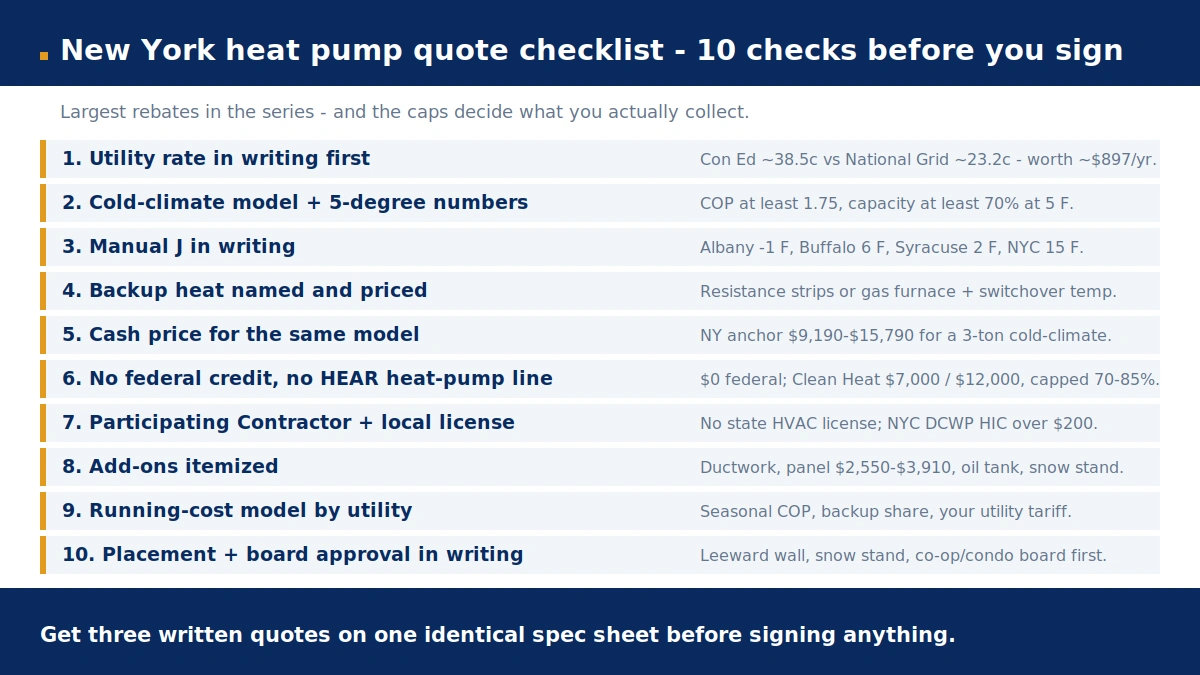
Getting Quotes in New York: The Checklist
New York is the most rewarding state in this series to buy a heat pump in — the largest rebates, the clearest oil-conversion case — but only for a homeowner who checks the utility terms, the rebate cap, and the equipment ratings before the sales pitch. Give every bidder this checklist, and sign nothing until each line has its answer in writing.
The ten-item quote checklist:
- Your utility’s rate, in writing, first — Con Edison’s ~38.5 cents, National Grid’s ~23.2 cents, NYSEG’s ~24.9 cents, or PSEG Long Island’s Rate 580 terms. The rate decides whether the heat pump beats gas before anything else — and National Grid’s rate is worth about $897 a year against Con Edison’s on the same system.
- Cold-climate model, named, with its 5-degree ratings — the model number and NEEP listing, plus COP at 5 degrees (at least 1.75) and capacity at 5 degrees (at least 70 percent of rated). No model named in the quote, and the machine being priced may not exist at all.
- Manual J load calculation, in writing — room by room, at your city’s design temperature (Albany minus 1, Buffalo 6, Syracuse 2, New York City 15). A contractor who sizes by square footage alone is guessing at the number that decides everything else — and the rebate requires sizing to 90 to 120 percent of the design load.
- Backup heat spelled out — resistance strips or a gas furnace, how much capacity, and the switchover temperature it is set to. Upstate, backup heat is half the system. A quote that leaves it out has left out the part that keeps the pipes from freezing.
- One cash price, in writing, for the same model — same kit, same house, all three bidders. The New York anchor is $9,190-$15,790 for a 3-ton cold-climate ducted system. A quote far above that anchor needs an explanation; a quote far below it needs a closer look at what was left out.
- No line for a federal tax credit, no line for a HEAR heat-pump rebate — a 2026 owner purchase gets $0 federal, and no standalone $8,000 HEAR heat-pump rebate is established as claimable in New York in 2026. The money is Clean Heat ($7,000 standard, $12,000 Weatherized Tier, capped at 70 or 85 percent of cost) or PSEG Home Comfort ($4,000-$7,500), shown as its own line with the cap arithmetic. If a federal credit still sits in the quote, the pricing comes from a dead law.
- Participating Contractor status verified, and the local license checked — the bidder must be a NYS Clean Heat Participating Contractor (or a PSEG Home Comfort Partner on Long Island), or the rebate does not exist. New York issues no state HVAC license; in the city, check the DCWP Home Improvement Contractor license, and the DOB Oil Burner Equipment Installer license where oil equipment is involved. The electrical work must be done by a licensed electrician — a city-licensed Master or Special Electrician in New York City.
- Add-ons on their own lines — ductwork, panel upgrade ($2,550-$3,910), oil tank decommissioning, snow stand, wind baffle, and thermostat, each priced separately, not folded into the per-ton price. Sales tax shown as its own line too — 4 percent state plus local, 8.875 percent combined in New York City.
- Running-cost numbers by utility, not by brochure — seasonal COP, backup-heat share, and rate, each measured against your own utility’s tariff. Model the savings at the state-average rate for a Con Edison home and the quote is off by about $580 a year on the planning home. A quote that models savings against a gas furnace without naming the switchover temperature is not a model at all.
- Placement and board approval, in writing, first — the outdoor unit sited on the leeward wall, lifted on a snow stand, clear of roof valleys and lake-effect drifts, with co-op or condo board approval (or HOA approval) for the placement before the unit is ordered. Choose the spot for convenience, against the wind, and the unit will cost more to run and more to service.
Buy, dual-fuel, or geothermal? Homeowners on electric heat, oil heat, or propane heat come out ahead buying a cold-climate ducted system — as does anyone whose boiler or furnace is dying anyway. Gas-heated homes win with dual-fuel on any New York utility: furnace in January, heat pump in the shoulder seasons and the summer. Geothermal wins for long-term owners on big lots who plan to stay 20 years and want the steadiest winter COP in the state — at $21,310-$33,280, with the Clean Heat geothermal rebate and the state geothermal tax credit to soften it, and no federal credit in 2026. A standard non-cold-climate unit wins for almost no one upstate as primary heat.
Sources & methodology
Cost anchors:
- NumeralQ New York heat pump cost page, estimator pricing as of 2026-10-26: ducted 3-ton $7,050-$11,600; cold-climate ducted $9,190-$15,790; single-zone mini-split $3,470-$5,330; multi-zone 3-head $6,910-$12,040; geothermal $21,310-$33,280; by size 1.5t $4,830-$7,620 to 5t $10,010-$16,920; ductwork $4,770-$7,860; panel upgrade $2,550-$3,910; Albany $6,740-$11,200; Buffalo $6,600-$11,020; NYC $7,180-$11,780; Rochester $6,650-$11,090; permits $70-$166; BLS May 2025 HVAC median $35.78/hr, electricians $37.86/hr; heating cost/yr gas 95% $652, heat pump HSPF2 7.5 $1,432, HSPF2 9 $1,193
- coolheatcosts NYC (2026): $7,800-$18,200, most ~$11,700; standard ducted 2-3 ton $7,800-$13,700; cold-climate $10,400-$18,200; dual-fuel $12,400-$20,800; NY ~130% of US cost level, zone 4A
- trydun (Aug 2026, BLS-based): NY ducted $8,200-$15,100
- Wise Home Energy, Rochester (Oct 2026): single-zone $4,865-$6,400; dual-fuel/entry ducted $8,400-$15,840; full ducted or 5+ zone $16,000-$23,800+
- nearbyhunt Heat Pump Cost 2026 (May 2026, as used in art. 109): cold-climate premium $2,000-$4,000; Mitsubishi Hyper-Heat full capacity to 5 F, ~76% at -13 F
Rates:
- EIA Electric Power Monthly Table 5.6.A, Oct 2026 release: NY residential 28.65 cents/kWh Aug 2026; US 18.16 cents; #6 highest of 51; avg bill $212.44 at 742 kWh; 12-mo avg to Aug 2026 28.6 cents (kadoa, updated 2026-11-07)
- EIA-861 utility figures, 12 mo to Aug 2026 (kadoa): Con Edison 38.5 cents, 2,987,741 customers; National Grid (Niagara Mohawk) 23.2 cents, 1,481,492 customers; NYSEG 24.9 cents, 771,460 customers; Orange & Rockland 28.0 cents, 202,541 customers; 2025 averages: Con Ed 36.7 cents, NY 26.4 cents
- Tariff-based all-in estimates (flagged, not used as primary): solaramerica Aug 2026 — Con Ed ~33.8 cents, National Grid ~20.0 cents, NYSEG ~18.3 cents; priceofelectricity — Con Ed standard tariff all-in 41.87 cents/kWh at 900 kWh
- EIA NY residential gas $/Mcf 2025: Jan 14.45, Feb 14.50, Mar 16.10, Nov 17.95, Dec 16.06 (release 10/30/2026); winter-month avg ~$15.80/Mcf = ~$1.58/therm; checkoutreceipt Oct 2026: NY gas $1.71/ccf, one winter $773.18 for 453 ccf
- Heating oil: NYSERDA statewide survey Oct 13, 2026 $6.23/gal (up from $3.71, +68%); EIA NY week of Oct 26, 2026 $6.44/gal; week of Nov 2, 2026 $6.324/gal; EIA Winter Fuels Outlook Oct 2026: US oil-heated households ~21% more this winter (~$2,115 Nov-Mar)
- Propane: EIA NY week of Oct 26, 2026 $3.79/gal (+12% YoY)
Climate and performance:
- ICC Appendix D design temps/HDD: Albany -1 F, 6,875 HDD; Buffalo 6 F, 7,062 HDD; Syracuse 2 F, 6,756 HDD; NYC Central Park 15 F, 4,871 HDD; Rochester 5 F, 6,748 HDD; Binghamton 1 F, 7,286 HDD; ACCA Manual J 99%: Albany -2 F, Buffalo 5 F, Syracuse 2 F; ASHRAE 2021 JFK 99.6% 13.5 F, 4,761 HDD65
- PNNL DOE climate zone guide: NYC/Long Island zone 4A; Hudson Valley/Capital Region zone 5A; Adirondacks/North Country zone 6A; colder 30% of counties zone 6+ (NumeralQ)
- ENERGY STAR CAC/ASHP V6.2 (rev. Mar 2025): SEER2 15.2+; HSPF2 8.1+ ducted / 8.5+ ductless; at 5 F, COP of 1.75 or better with at least 70% of the 47 F capacity; NEEP ccASHP Spec v4.0 (eff. Jan 1, 2023)
- DOE Cold Climate Heat Pump Challenge field data: 5 F capacity 70-80%, COP 2.2-2.8; -5 F capacity 60-70%, COP 1.8-2.4; standard unit at 5 F 40-60% capacity, COP 1.0-1.5; Mitsubishi Hyper-Heat full capacity to 5 F, ~76% at -13 F
Rebates and incentives:
- NYS Clean Heat Program Manual v2/v3, Weatherized Tier eff. Sep 1, 2026 (fixfirsthome verified Sep 26, 2026; heatpumppricing verified Nov 4, 2026; heatpumpnetwork verified Nov 2, 2026): whole-home ASHP fossil removed $7,000 standard all utilities; $12,000 Weatherized Tier (National Grid, NYSEG, RG&E, Central Hudson, Orange & Rockland); $10,000 Con Ed Weatherized; DAC weatherized $14,000 National Grid/O&R, $13,000 NYSEG/RG&E, $11,000 Con Ed; geothermal weatherized $20,000 NYSEG/RG&E/Central Hudson, $30,000 Con Ed whole building, up to $40,000 reported; caps 70% of project cost, 85% in DAC / Central Hudson territory / Weatherized Tier; NEEP list, Manual J 90-120%, participating contractor, 1-4 unit homes, gas-only customers ineligible (Jan 1, 2026); weatherization prerequisite Mar 1, 2028; reauthorized 2026-2030, ~$5.36 billion; HPWH $1,250-$1,300, $1,500 Con Ed through Nov 30, 2026
- Pre-Sep-1 manual tables (homeenergybasics Sep 8, 2026, flagged as superseded): National Grid Cat 2b $10,000, Cat 2 $6,000; Central Hudson Cat 2b $8,000; NYSEG page still shows up to $10,000 ASHP / $18,000 geothermal
- Con Ed fossil-retained $2,500 (heatpumppricing, Nov 4, 2026)
- PSEG Long Island Home Comfort (psegliny.com via heatpumppricing verified Nov 4, 2026; maisonpawli): whole-house cold-climate ASHP $4,000 market, $5,000 DAC/moderate income (below 80% AMI), $7,500 low income (below 60% AMI); 2026 thresholds $131,900 / $98,925 family of four; geothermal new $12,000/$15,000/$24,000, retrofit $6,000/$7,500/$12,000; HPWH up to $1,200; pre-approval required; Rate 580 40% delivery discount above 400 kWh/mo
- EmPower+ (reported): $12,000 upstate / $14,000 downstate caps, + $10,000 heat pump Sustainable Futures add-on, + $5,000 HPWH; no heat pumps for gas-heated homes outside limited pilots
- NY allocation (DOE dataset via ECW Oct 27, 2026): HEAR $158,415,850 + HOMES $159,021,883 = ~$317.4M; NY program opened May 2024 (NASEO); ECW Oct 27, 2026 lists NY launched with heat pump rebate (EmPower+ ASHP $10,000 plus HEAR); heatpumppricing Nov 4, 2026 and fixfirsthome Sep 26, 2026 report HEAR dollars currently shown only for envelope measures (up to $1,600) — CONFLICT printed in draft
- DOE Program Notice 26-2: HEAR electric-to-electric only, no fuel-switching; HEAR cap $8,000, HOMES up to $8,000; date May 29, 2026 (art. 109) vs Sep 1, 2026 (task brief) — CONFLICT printed in draft
- OBBBA P.L. 119-21 and IRS FS-2025-05: §25C and §25D $0 for post-Dec-31-2025 installs, completion date counts; IRS Notice 2025-42 (§48E, in service by Dec 31, 2027, construction begun by Jul 4, 2026)
- NY geothermal tax credit (Form IT-267): 25% of qualified expenditures; cap $5,000 enacted 2022 vs $10,000 for systems placed in service on/after Jul 1, 2025 reported by secondary trackers citing introduced bills S4882/A1591 (enactment unconfirmed) — CONFLICT printed in draft; non-refundable, carry-forward up to 5 years
- NY Real Property Tax Law §487: solar/wind/geothermal exempt from assessment increases for 15 years (reported, secondary — flagged)
- Tax: NY state sales tax 4% + local; NYC combined 8.875%; no verified air-source equipment exemption
Heating fuel and running-cost models:
- ACS 2020-2024 (via NumeralQ): NY homes heated with piped gas 59%, electricity 15%, propane or oil 21%; RECS 2020: ~3% heat pump main heat
- CFPB Solar Financing Market Issue Spotlight, Aug 2024: dealer fees 10-30%, sometimes over 50% (national figure)
Licensing:
- No state HVAC license in NY (cinderblock Oct 28, 2026; servicetitan; workiz; getply): licensing at county/municipal level; EPA Section 608 required everywhere for refrigerants
- NYC: DCWP Home Improvement Contractor license for residential work over $200; DOB Oil Burner Equipment Installer Class A (4 yrs) / Class B (3 yrs); gas piping by NYC-licensed Master Plumber; electrical by NYC-licensed Master or Special Electrician; FDNY Q-01 for covered large systems; all via DOB NOW
- NYC heat season Oct 1-May 31, 68 F day / 62 F night (context only)
Running-cost and payback arithmetic:
- Planning home ~50 MMBtu delivered heat/yr (NestPriced planning assumption from Albany 6,875 HDD) = 14,654 kWh of heat; gas 95% at $1.60/therm = 526 therms = ~$842/yr; gas 80% = 625 therms = ~$1,000/yr; heat pump COP 2.5 = 5,862 kWh/yr (state avg $1,677, Con Ed $2,257, National Grid $1,360, NYSEG $1,460, PSEG ~$1,524 planning est.); COP 2.8 = 5,234 kWh (Con Ed $2,015, state avg $1,497); resistance = 14,654 kWh (state avg $4,191, Con Ed $5,642, National Grid $3,400); oil 85% at $6.23/gal = $52.91/MMBtu = ~$2,646/yr; propane 95% at $3.79/gal = $43.60/MMBtu = ~$2,180/yr; break-even COP vs 95% gas = 4.98 state avg (Con Ed 6.70, National Grid 4.04, NYSEG 4.33, PSEG ~4.52), vs 80% furnace ~4.19 state avg; backup-resistance illustration (15% of heat at state-avg rate) ~$629/yr; PSEG LI rate ~26 cents is a planning estimate, not verified for 2026
- Cold-climate 3-ton at ~$12,500 (midpoint of $9,190-$15,790): vs resistance saves ~$2,514/yr state avg -> ~2.2 yrs after $7,000 rebate; vs oil saves ~$969/yr state avg -> ~5.7 yrs after $7,000 rebate (~3.9 yrs at 70% cap $8,750; ~1.9 yrs at 85% cap $10,625); vs oil on National Grid saves ~$1,286/yr -> ~4.3 yrs; vs oil on Con Ed saves ~$631/yr -> ~8.7 yrs; vs propane saves ~$503/yr -> ~10.9 yrs; vs gas on National Grid costs ~$518/yr more -> never; vs gas on Con Ed costs ~$1,415/yr more (COP 2.5) -> never
EXCLUDED:
- Any “after 30% credit” or “after $2,000 credit” prices: §25C/§25D are $0 for 2026 installs
- Any standalone $8,000 HEAR heat-pump rebate in NY for 2026: contested, not established as claimable
- Pre-Sep-1 Clean Heat amounts as current: superseded by the Weatherized Tier schedule
- Con Ed 41.87 cents or 33.8 cents as the Con Ed rate: EIA-861 38.5 cents used, spread flagged
- Syracuse city install price as a NumeralQ figure: planning estimate only, flagged in the draft
- Cold-climate prices by size other than 3-ton: planning estimates from the national $2,000-$4,000 premium, flagged in the draft
- Dual-fuel bundled installed price: none published for NY; built from components, flagged (NYC modeled $12,400-$20,800 is a modeled range)
- PSEG Long Island per-kWh rate: not verified; ~26 cents is a planning estimate, flagged
- NY lease/PPA heat-pump offer: none verified, authorization unverified
- Geothermal credit $10,000 cap as enacted law: unconfirmed, both figures printed
- LL97 fines / LL154 phase-in dates: not verified, mentioned qualitatively only
- Oil tank removal/decommissioning cost: no NY figure verified, no figure claimed
- RG&E per-kWh rate: not verified separately; NYSEG 24.9 cents used as nearest published figure for the same utility family, flagged
- Installer names / counts beyond BLS metro employment: not verified; none named
- Monthly COP or field-measured seasonal COP for a specific NY installation: none found; COP 2.5 upstate / 2.8 NYC is a planning range
*Disclaimer: The prices here are 2026 New York planning figures. Your final price turns on your city, your house, your utility territory, and your contractor. Settle nothing until three New York installers have put their prices in writing. Treat the tax notes in this guide as general information only. They are not advice about your own return. Before you file, run the numbers past a New York tax professional. Program rules change, so confirm current terms with your own utility before signing. Con Edison’s per-kilowatt-hour rate varies by tariff, and the Clean Heat amounts on some utility pages still show pre-September 2026 figures — rate and rebate figures in this guide are dated to their sources.*
What will a heat pump cost me in New York in 2026?
NumeralQ (October 2026) puts a typical whole-home ducted 3-ton air-source heat pump at $7,050-$11,600 installed in New York in 2026. The cold-climate ducted system the upstate winter actually demands runs $9,190-$15,790. Mini-splits run $3,470-$5,330 for a single zone and $6,910-$12,040 for three heads; geothermal with a ground loop runs $21,310-$33,280. New York City runs $7,180-$11,780 for a 3-ton ducted system and Buffalo $6,600-$11,020. For a homeowner-owned system installed in 2026, the federal tax credit is $0 — but NYS Clean Heat pays $7,000 for a whole-home system that replaces the old heating, $12,000 if the house qualifies for the Weatherized Tier, capped at 70 to 85 percent of the project cost.
Do heat pumps work in New York winters?
Yes, upstate — but only with a cold-climate model and backup heat. Albany designs for minus 1 degree, Buffalo for 6, Syracuse for 2, and New York City for 15, and a standard heat pump keeps only 40 to 60 percent of its capacity at 5 degrees. Look for a variable-speed inverter compressor with enhanced vapor injection, a place on the NEEP list or ENERGY STAR cold-climate criteria, and a unit that holds at least 70 percent of its capacity at 5 degrees with a COP of at least 1.75. In Department of Energy field testing, cold-climate units kept 70 to 80 percent of capacity at 5 degrees, running at a COP of 2.2 to 2.8. Even the best air-source unit needs backup heat — resistance strips or a gas furnace in a dual-fuel setup — for the coldest nights upstate, and the outdoor unit needs a stand so lake-effect snow cannot bury it.
Does a heat pump cost less to run than a gas furnace in New York?
No — not on fuel, on any New York utility. At the state-average electricity price of about 28.6 cents a kilowatt-hour, a heat pump would need a seasonal COP of about 5.0 to tie a 95 percent gas furnace, and a realistic New York seasonal COP is 2.5 upstate and about 2.8 in the city. On Con Edison power at about 38.5 cents, a heat pump costs about $2,257 a year to heat the planning home against about $842 for gas. On National Grid power at about 23.2 cents it costs about $1,360 — still above gas. Against heating oil, the heat pump wins everywhere in the state, saving about $969 a year at the average rate, and against electric resistance heat it saves about $2,514 a year.
Which rebates can I collect for a heat pump in New York in 2026?
NYS Clean Heat pays $7,000 for a whole-home air-source system that removes the old fossil-fuel heating, $12,000 if the house qualifies for the Weatherized Tier ($10,000 at Con Edison), and up to $14,000 in a disadvantaged community — capped at 70 percent of the project cost, or 85 percent in a disadvantaged community, in Central Hudson territory, or in the Weatherized Tier. Keeping the old system as backup pays less; in Con Edison territory it drops to $2,500. PSEG Long Island runs its own program instead: $4,000 at market rate, $5,000 in a disadvantaged community or at moderate income, $7,500 at low income. Income-eligible households can also use NYSERDA’s EmPower+ program. For a 2026 install, the federal tax credit is $0.
Is the $8,000 HEAR rebate available for a heat pump in New York?
Not as a standalone heat-pump rebate in 2026, as far as this guide could establish. New York was allocated about $317.4 million in federal Home Energy Rebates money and routes it through NYSERDA’s EmPower+ program for income-eligible households, but the trackers disagree about what it currently pays for: one lists New York as launched with a heat-pump rebate, while two others report that HEAR money in EmPower+ is now shown only for insulation, air sealing, and ventilation, up to $1,600, on projects without a heat pump. Even where HEAR does pay, the Energy Department’s Program Notice 26-2 bars it for fuel-switching, so a gas-heated or oil-heated home cannot use it to switch to a heat pump; only electric-to-electric upgrades and new construction qualify.
Should I switch from oil to a heat pump in New York?
For most oil-heated homes, yes — it is the strongest conversion case in this guide. Heating oil reached about $6.23 a gallon in New York in October 2026, up 68 percent in a year, and an 85 percent oil boiler costs about $2,646 a year to heat the planning home against about $1,677 for a heat pump at the state-average electricity price — a saving of about $969 a year, or about $1,286 a year on National Grid power. With the $7,000 Clean Heat rebate, a $12,500 cold-climate system pays back in about 5.7 years against oil at the state-average rate, and faster with the Weatherized Tier. The conversion also means removing or decommissioning the oil tank, and the house usually needs new ductwork or ductless heads, because most oil-heated homes have radiators, not ducts.
What license or permit do I need to install a heat pump in New York?
You need a mechanical permit and an electrical permit from your city, town, or county, and the work goes through the local building department — in New York City, through DOB NOW. New York issues no state HVAC license; licensing is set by counties and municipalities. In New York City, the contractor needs a Home Improvement Contractor license from the Department of Consumer and Worker Protection for residential work over $200, an Oil Burner Equipment Installer license where oil equipment is involved, a Master Plumber for gas piping, and a Master or Special Electrician for the electrical work. The installer also needs EPA Section 608 certification to handle refrigerants, and the contractor must be a NYS Clean Heat Participating Contractor for the rebate to apply. Co-op and condo boards must approve outdoor-unit placement before the unit is ordered.
When does a New York heat pump pay for itself?
Against electric resistance heat, about 2 years after the standard $7,000 rebate, because it saves about $2,514 a year. Against heating oil, about 5.7 years after the standard rebate at the state-average rate — about 4.3 years on National Grid power, about 3.9 years with the Weatherized Tier cap, and under two years at the 85 percent cap. Against propane, about 10.9 years after the standard rebate, at about $503 a year saved. Against a 95 percent gas furnace, never on fuel, because the heat pump costs about $518 a year more to run on National Grid power and about $1,415 a year more on Con Edison power; buy it there for the air conditioning, the zoning, or because the furnace is dying anyway. The purchase works when you judge the premium over the furnace-plus-AC you would buy anyway, not the full sticker — that framing is what makes it work for most New York homes.