


Maine looks like a hard place to make solar pay. The state sits at the cold top of the map, Portland gets about 69 inches of snow in a normal winter, and December gives a rooftop array less than half the sun July gives it. A buyer who stops at the weather misses the two facts that actually decide the answer, and both of them favor the panels.
The first is the price on the electric bill. Maine homes paid an average of 32.11 cents for each kilowatt-hour in August 2026, the second highest average in the country and about 77 percent above the national average of 18.16 cents. Every kilowatt-hour a rooftop array makes replaces power at that price, or banks as a credit worth that price, which is why solar math that looks weak in a cheap-power state can look strong here.
The second fact cuts the other way, and it is the one most solar guides for Maine leave out. The average Maine home uses only about 550 kilowatt-hours a month, among the lowest use in the country, because so many Maine homes heat with oil, propane, or wood instead of electricity. A big array on a low-use home makes more power than the home can spend in 12 months, and Maine pays nothing for the extra credits when they expire.
That tension shapes this whole guide. The installed price is fair, the credit rule is generous, and the sun is better than Maine’s reputation suggests, yet the right system for the average Maine home is smaller than the systems installers most often quote. The average system EnergySage recorded in Maine in November 2026 was 10.52 kW, nearly twice the size the average home’s bills would justify, which tells you the buyers going solar in Maine are mostly homes with heat pumps, electric vehicles, or larger-than-average use.
Two more Maine facts belong before the prices. The first is that the state pays nothing toward the panels themselves: no rebate, no state income tax credit, and no sales tax break, whatever some websites claim. The second is that a 2025 law, LD 1777, ended new net energy billing deals for large projects on the utility side of the meter while leaving rooftop systems untouched, and a buyer who confuses the two may wrongly believe rooftop credits are gone.
For the United States as a whole, including the federal rules that reach every state, read our national solar panel cost guide. What follows prices Maine on its own terms: the state cost model, four cities, the credit rule at each utility, and payback math that counts only the credits a home can actually spend.
Table of Contents
How Much Do Solar Panels Cost in Maine in 2026?
NumeralQ’s estimator pricing, dated October 26, 2026, puts a Maine 8 kW rooftop install at $22,240–$29,050. Dividing by watts gives $2.78–$3.63 per watt, and the payback math later in this guide works from the middle of the band, near $25,645. NumeralQ prices one Maine market, Portland, and applies the same band statewide, and it labels its figures planning estimates built from a national cost model adjusted for local materials and labor, not records of what Maine homeowners paid.
No invoice-based Maine average exists in print. The band above is a planning yardstick for judging quotes, not a promise: no installer has pledged to hit it.
A quote inside the band for an ordinary asphalt-shingle roof with clear access and a sound electrical panel is a fair quote. A quote far above $3.63 a watt needs a clear reason in writing, such as a steep or slate roof, a long wire run to a ground mount, or a panel upgrade folded into the job.
Three other price trackers land inside the NumeralQ band from different directions, which is reassuring. EnergySage’s marketplace quote data, updated November 6, 2026, puts Maine at $2.91 per watt, with its average 10.52 kW system at $30,616 before incentives and a range of $26,024 to $35,208, which works out to about $2.47 to $3.35 a watt. EcoGen’s Solar Cost Index, September 2026 edition with prices as of September 25, 2026, puts Maine at $3.05 per watt, with its typical 8.89 kW system at $27,115 in cash before incentives.
SolarReviews, in a November 2026 analysis built from National Renewable Energy Laboratory, Energy Information Administration, and Bureau of Labor Statistics data, puts Maine at $3.10 per watt, with its average 7.7 kW system at $25,348 before incentives. A fourth tracker, RenewEstimator, puts Maine at $3.06 a watt with an 8 kW system at $24,000, but its Maine figure rests on only three ZIP-code samples, so it counts as weak corroboration rather than a pillar of the case. Four methods inside a 19-cent spread around $2.91 to $3.10 a watt: Maine installs cost a little more than the national average, and the NumeralQ band around them is wide enough to hold most real quotes.
The neighbors bracket Maine closely on the EcoGen index. Vermont sits at $2.91, New Hampshire at $2.92, New York and Massachusetts at $3.02, and the national figure at $2.89 a watt, against Maine’s $3.05.
Maine is the priciest of its northern New England neighbors on that index, by 13 to 14 cents a watt over Vermont and New Hampshire, which fits a rural state where crews drive long distances and installer competition thins out beyond the Portland area. For the Massachusetts figures, see our Massachusetts solar panel cost guide, and for Rhode Island, our Rhode Island solar panel cost guide.
One high outlier needs naming so it does not confuse the comparison. Berkeley Lab’s Tracking the Sun 2025 Data Update measured a national median of $4.00 a watt for home systems installed in 2024, with cash purchases at a $3.50 median and loan-financed systems at $4.70, mostly because of dealer fees baked into solar loans.
A Maine page built on that national range prices an 8 kW system at $24,000 to $41,600. That is a different year, a national range rather than a Maine one, and a loan-fee-inflated median, so it is not the headline here, but it is a useful warning: a loan quote that prices near $4 a watt is usually carrying a large dealer fee, and the buyer should always compare the cash price.
That installed price buys a system that runs on day one. The crew supplies the labor, the permit and inspection fees, and the startup visit, plus the hardware itself: panels, racking with flashing, wiring and disconnects, and inverter hardware, either one string inverter for the array or a microinverter fitted to each panel. Costs outside that price are where Maine buyers get surprised, because the work around the system is billed on its own lines.
- Roof repairs or a roof replacement before the panels go on, priced on their own
- An electrical panel upgrade, if the existing service cannot take the solar backfeed
- A battery, priced separately and covered in its own section below
- Tree removal or trimming where pines shade the roof, a common Maine cost
- Sales tax on the equipment at the 5.5 percent state rate, unless the quote states it is included, because Maine has no sales tax exemption for solar equipment
- The utility interconnection fees, which at Central Maine Power run $100 for a Level 1 application plus a $40 ombudsman fee, so the quote must state them or state that they are included
One warning belongs before any quote is compared. Maine labor is not cheap, but it is not the reason a quote runs far above the band either: Portland solar installers earn a median $29.43 an hour (Bureau of Labor Statistics, May 2025, via NumeralQ), billed at roughly $59 to $77 per worker-hour, and Portland electricians earn a median $34.45 an hour, billed at roughly $69 to $90.
A quote far above the band usually traces to one of four things: the equipment chosen, a complex roof, long crew travel, or the installer’s margin. The installer should be able to name the one that applies in a single sentence.
| Source | Price per watt | 8 kW total | Basis |
|---|---|---|---|
| NumeralQ (Oct 2026) | $2.78–$3.63 | $22,240–$29,050 | Planning estimate, Portland model applied statewide |
| EnergySage (Nov 2026) | $2.91 average | $23,280 (scaled) | Marketplace quote data, 10.52 kW average system |
| EcoGen Index (Sept 2026) | $3.05 | $24,400 (scaled) | Cost index, cash, before incentives |
| SolarReviews (Nov 2026) | $3.10 | $24,800 (scaled) | NREL/EIA/BLS analysis, 7.7 kW average system |
| RenewEstimator (2026) | $3.06 | $24,000 | Weak sample, 3 ZIP codes only |
In that table, the 8 kW totals for EnergySage, EcoGen, and SolarReviews are NestPriced scalings of each source’s per-watt average. None of the three publishes an 8 kW total, and the table marks the scaled figures as scaled.
EnergySage’s own published total is $30,616 for its 10.52 kW average system, EcoGen’s is $27,115 for its 8.89 kW typical system, and SolarReviews’ is $25,348 for its 7.7 kW average system. The agreement across sources is the point: Maine installs cost about $2.91 to $3.10 a watt at the center of the range.
Get competing written quotes from three licensed installers, all bidding the same job on paper. Drop any bidder who will not name the panel model, the inverter type, the year-one production estimate, and the credit value the savings math assumes, because a Maine savings estimate that prices every kilowatt-hour at the all-in Energy Information Administration average of 32.11 cents is pricing in fixed charges that credits can never cancel.
Solar Panel Cost in Maine by System Size
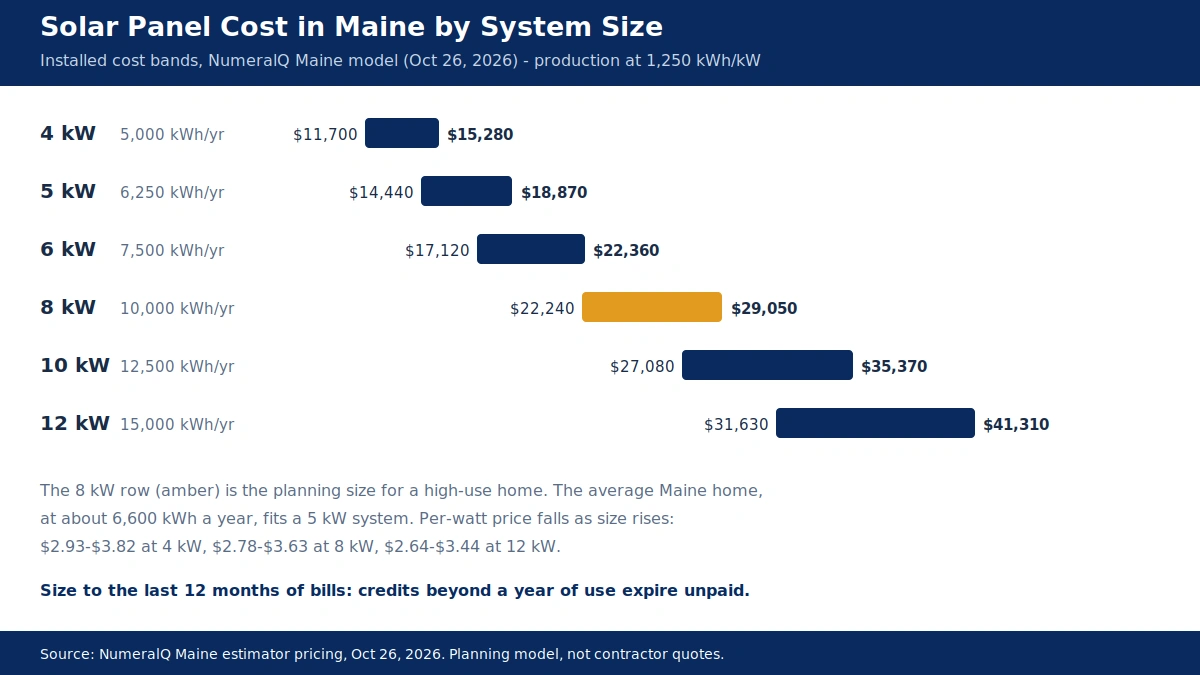
Kilowatts, written kW, measure the peak power panels can make under full sun, and that rating is how system size is stated. Going bigger raises the total bill while cutting the per-watt price, since the visit, the permit, and the inverter are fixed costs spread over more panels. The table that follows runs the whole NumeralQ Maine range at 1,250 kilowatt-hours per kilowatt a year, the NestPriced planning figure, and sets the output against the 6,600 kilowatt-hours a year the average Maine home uses.
| System size | Installed cost | Cost per watt | Yearly production | Share of average use |
|---|---|---|---|---|
| 4 kW | $11,700–$15,280 | $2.93–$3.82 | 5,000 kWh | 76% |
| 5 kW | $14,440–$18,870 | $2.89–$3.77 | 6,250 kWh | 95% |
| 6 kW | $17,120–$22,360 | $2.85–$3.73 | 7,500 kWh | 114% |
| 7 kW | $19,710–$25,750 | $2.82–$3.68 | 8,750 kWh | 133% |
| 8 kW | $22,240–$29,050 | $2.78–$3.63 | 10,000 kWh | 152% |
| 9 kW | $24,700–$32,260 | $2.74–$3.58 | 11,250 kWh | 170% |
| 10 kW | $27,080–$35,370 | $2.71–$3.54 | 12,500 kWh | 189% |
| 11 kW | $29,390–$38,390 | $2.67–$3.49 | 13,750 kWh | 208% |
| 12 kW | $31,630–$41,310 | $2.64–$3.44 | 15,000 kWh | 227% |
Price source: NumeralQ’s Maine estimator model, October 26, 2026. Cost per watt: NestPriced division from the published totals.
Output and home coverage come from NestPriced math: 1,250 kWh per kW each year, measured against average yearly use of 6,600 kWh, or 550 kWh a month. Panel counts assume 400-watt panels: a 5 kW system needs 13 panels (rounding up from 12.5), an 8 kW system needs 20, and a 10 kW system needs 25, before roof setbacks and shade are taken out.
The per-watt price falls as the system grows, from $2.93 to $3.82 at 4 kW to $2.64 to $3.44 at 12 kW. Falling per-watt prices pull buyers toward the largest array the roof can carry, and that pull is normal.
In Maine that temptation needs a hard check, because credits expire after 12 months with no payment, so generation beyond a full year of use earns nothing at all. A 6 kW system making 114 percent of average use already strands about 900 kilowatt-hours a year in expiring credits, and a 10 kW system making 189 percent strands about 5,900.
The right size follows the home’s bills, not the roof’s capacity and not the installer’s standard package. A home at the Maine average of 550 kilowatt-hours a month is well served by a 5 kW system, which covers about 95 percent of annual use with almost nothing wasted. NumeralQ’s own Portland planning box reaches the same answer: a 5.2 kW system covers the average home.
A home at 875 kilowatt-hours a month, the national average, fits an 8 kW system. A home with a heat pump, an electric vehicle, or electric heat may use 1,000 kilowatt-hours a month or more and justify 10 kW, but the extra panels should be justified by the extra load on the bills, or by a heat pump or vehicle already planned and priced, not by the lower per-watt price alone.
Roof space rarely binds first in Maine, but trees often do. A 20-panel array of 400-watt panels takes about 350 to 400 square feet of usable roof. The typical Maine single-family roof has far more usable area than that when its south, east, and west faces are added together.
Pine shade, roof age, and the direction the roof faces bind sooner: a roof shaded by tall white pines for much of the day, or a roof that needs replacing within five years, should be dealt with before panels are priced at all. Roof age and roof condition decide this part of the job, and our Maine roof replacement cost guide prices that work.
How the same three sizes price across the whole country is covered in our 6 kW, 8 kW, and 10 kW solar system cost guide. The national guide prices the same three sizes across the country; the table above is the Maine-specific version, and the two agree that the planning size must follow the home’s use. In Maine that advice matters more than usual, because the average home’s use is so low that the national default size overshoots it by half.
Solar Panel Cost by City: Portland, Bangor, Lewiston, and Auburn
Three of the four cities have a published EnergySage city figure, and the fourth does not, which says something useful on its own about how thin Maine’s city-level data runs. EnergySage publishes November 2026 marketplace averages for Portland, Bangor, and Lewiston, each with its own average system size, and those sizes differ enough that the city totals cannot be compared directly. Auburn has no EnergySage city page, so its figure below is a planning estimate drawn from the state band, labeled as such, and a local quote is the only real price in Auburn.
| City | Utility | EnergySage $/W | Average system | Published total | 8 kW scaled |
|---|---|---|---|---|---|
| Portland | CMP | $2.87 | 9.89 kW | $28,385 | $22,960 |
| Lewiston | CMP | $2.86 | 11.51 kW | $32,920 | $22,880 |
| Bangor | Versant (Bangor Hydro) | $3.08 | 11.97 kW | $36,842 | $24,640 |
| Auburn | CMP | State band (estimate) | n/a | n/a | $22,240–$29,050 |
EnergySage city pages, November 2026. The 8 kW scaled column multiplies each city’s average $/W by 8,000 watts; it is NestPriced arithmetic, not a total EnergySage publishes. Auburn: NestPriced planning estimate from the NumeralQ state band; no published Auburn city model exists.
Portland is the state’s biggest solar market and the only Maine city NumeralQ models separately, though its band matches the state band exactly. The EnergySage Portland average of $2.87 a watt sits 4 cents under the state average of $2.91, which fits a metro area with the most installers competing and the shortest crew travel. NumeralQ puts the median Portland home at $489,600 (American Community Survey 2020-2024).
Set against that, an 8 kW system at the band midpoint equals roughly 5.2 percent of a median home. Portland also has the thinnest owner-occupier base of any Maine city in this guide: only 47 percent of homes are owner-occupied and only 41 percent of units are houses, so many Portland residents need an owner’s or an association’s approval before panels can go on at all.
Bangor is the price outlier of the four, and the outlier runs in an interesting direction. At $3.08 a watt, Bangor installs cost 21 cents more per watt than Portland installs on EnergySage data, and its average system is the largest of the four at 11.97 kW, for a published total of $36,842.
Yet Bangor’s EnergySage payback is the fastest of the four at 9.44 years, because Bangor sits in Versant Power’s Bangor Hydro District, where each kilowatt-hour credit is worth 30.35 cents against Portland’s 24.68 cents on Central Maine Power. The higher install price is more than repaid by the higher credit value, which is why a Bangor buyer should never judge a quote on price alone without the utility rate beside it.
Lewiston matches Portland on price and differs on system size. At $2.86 a watt, Lewiston is the cheapest of the three measured cities by a single cent, but its average system runs 11.51 kW for $32,920, well above Portland’s 9.89 kW average.
Lewiston is Central Maine Power territory, like Portland, so the credit value is the same 24.68 cents, and its EnergySage payback of 10.38 years sits between Portland’s 11.58 and Bangor’s 9.44. The larger average system in Lewiston likely reflects larger homes and more electric heating in the Lewiston-Auburn mill-city housing stock, though no source states that directly, so it is offered as a plausible reading rather than a verified fact.
Auburn sits across the Androscoggin River from Lewiston, shares its Central Maine Power territory, and has about 24,000 residents, yet no city price model could be found for it. One secondary guide prices Auburn at $2.90 to $3.30 a watt, but the same guide asserts a sales tax exemption for solar equipment that Maine law does not contain, so its price is not relied on here.
The planning estimate in the table uses the NumeralQ state band, and three local quotes will tell an Auburn buyer more than any model. An Auburn buyer should also confirm the permit fee with the city before signing, since no verified Auburn solar permit fee was found, unlike Portland’s $75 electrical permit.
The add-on costs that surprise buyers are published for Portland and worth stating plainly, since they are the only Maine-specific add-on figures found. A battery of 10 to 13 kilowatt-hours costs $10,650 to $16,370 installed in Portland, on NumeralQ’s model. A main panel upgrade costs $2,380 to $3,690 in Portland.
Treat both numbers as planning estimates. Any quote that includes either one should list it on its own line, never folded into the per-watt price. What panel work costs across the country, and what drives it, is in our electrical panel upgrade cost guide.
A final city-level fact cuts across all four cities. Maine’s housing stock is old, with a median year built of 1977 statewide and about 23 percent of homes built before 1940, on Census data cited in the Maine roof research.
Older homes are more likely to need panel work, roof work, or both before panels go on, and a Portland triple-decker, a Bangor bungalow, and a Lewiston mill-era duplex can carry the same panel price and very different total job costs. Keep the system price and the preparation work on separate quote lines, or the comparison stops being honest.

Maine Sun, Snow, and Short Winter Days: What Your Panels Will Produce
Maine gets more sun than its winter reputation suggests, and less than a buyer who only looks at July would assume. The state averages about 4.55 peak sun hours a day on National Renewable Energy Laboratory PVWatts version 8 data for Portland, ranking 41st of 51 states and the District of Columbia for solar resource. Think of a peak sun hour as one hour of sun at peak intensity, a thousand watts per square meter, rather than one hour of daylight.
It is the measuring unit that converts a panel’s wattage into energy over a year. Other compilations put Portland between 4.0 and 4.6 peak sun hours a day, so the planning figure should be read as “about four and a half,” not as a precise promise.
This guide plans around 1,250 kilowatt-hours per kilowatt each year, a NestPriced figure picked because it lands inside the published range once snow is allowed for, instead of at either end. An 8 kW system at that figure makes about 10,000 kilowatt-hours a year, against average Maine home use of about 6,600 kilowatt-hours a year, or about 152 percent coverage on an annual basis, which is exactly why the sizing section warns against defaulting to 8 kW.
Published models bracket the planning figure: the low end sits near 1,150 and the high end near 1,372 kilowatt-hours per kilowatt each year. The PVGIS model, quoted through NumeralQ at a 20-degree tilt facing south with 14 percent losses, gives Portland 1,264. The National Renewable Energy Laboratory’s PVWatts calculator, version 8, gives Portland 1,319 at 14 percent system losses.
EcoGen’s model gives 1,372. Working backward from RenewEstimator’s 9,200 kilowatt-hours for an 8 kW system gives roughly 1,150 per kilowatt. The two physics models agree closely; the index models bracket them on either side.
The seasonal swing is what Maine buyers most often get wrong. PVWatts numbers for Portland show the gap plainly: about 62 kilowatt-hours per kilowatt in the darkest month, December, against about 141 in July, a summer-to-winter ratio near 2.3 to 1.
Seasonal data for South Portland, from NASA POWER records, puts daily output per kilowatt at 5.79 kilowatt-hours in summer, 5.37 in spring, 3.30 in autumn, and 1.96 in winter. Between 70 and 80 percent of a Maine system’s annual production falls between March and October, and winter days in Portland average just under 9 hours of daylight against more than 15 at the summer solstice.
That seasonal swing is affordable only because of the 12-month credit window. Summer surplus banks as kilowatt-hour credits and pays winter bills, month after month, for up to a year.
Without that banking rule, a Maine system would waste most of its summer output and starve in winter. With it, the annual total is what matters, not the monthly shape, as long as the annual total does not exceed a year of use by more than the home can spend before credits expire.
Maine’s cold is a real asset for panels, not a drawback. Ratings assume the cell sits at 25 degrees Celsius, near 77 degrees Fahrenheit, in full sun. Past that cell temperature, every added degree trims output by a fixed percentage.
That percentage is the temperature coefficient. A current panel gives up 0.30 to 0.35 percent of output for each degree Celsius past 25. A standard monocrystalline panel gives up 0.38 to 0.45 percent.
On a Maine roof in July, the cell temperature runs 20 to 25 degrees Celsius above the air temperature, so a hot afternoon can push cells well past their rated temperature and cost a tenth or more of output. On a bright January day with the air near freezing, the cells stay close to their rated temperature and the panels run close to their nameplate power, helped by light bouncing off snow on the ground.
Do not let that advantage get oversold: a claim that cold doubles output mixes up cell temperature and air temperature. Even so, a bright, freezing Maine day is excellent solar weather, and the state gets plenty of them.
Snow is the honest caveat, and the honest answer is a range rather than a single number. Snow sitting on panels blocks the sun until it slides or melts off, and Maine snowfall is heavy: Portland averages about 68.7 inches a year and Bangor about 66.1 inches on 1991-2020 climate normals, with January the snowiest month in both cities. Dark, tilted panels warm in sunlight, so the snow on them usually slides or melts within a day or two after a storm.
The steep pitch of a typical Maine roof speeds that clearing. Most Maine residential installs use angles between 30 and 45 degrees, which balances snow shedding against annual output.
How much energy snow costs over a year depends on whom you ask and what roof you mean. A model built on the National Renewable Energy Laboratory’s Marion 2013 snow-loss work puts Portland’s annual loss at 3.0 to 4.5 percent for a 30-degree tilt. Palmetto’s design criteria allow 7 percent snow loss for Maine.
A 2018 Department of Energy handbook, citing Ryberg and Freeman, gives 10 to 16 percent as the regional estimate for heavy-snow states including Maine. The spread reflects different roofs, tilts, and methods, not a disagreement about physics. The planning figure of 1,250 already carries a snow allowance: it sits below the PVWatts figure of 1,319, which counts snow losses as zero, by about 5 percent, inside the Portland-specific range.
How the roof points, and how steeply it rises, swings output more than buyers tend to think. Every model quoted above assumes panels facing south at roughly the roof’s own pitch. A west-facing array gives up some total energy in exchange for stronger late-afternoon output.
East-facing panels give up more again, and a north-facing roof section almost never earns its panels. In Maine, shade from tall pines often matters more than direction: a south-facing roof under a pine canopy can produce less than an east-facing roof in the clear, and the quote should state the expected production for the actual roof, with a shade assessment, not the textbook south-facing figure.
Bangor’s 1991-2020 normals show January averaging a high of 27.4 degrees and a low of 6.7 degrees Fahrenheit, and July averaging a high of 79.4 and a low of 57.7, and Portland sees about 144 nights a year at or below freezing. That is the climate the system lives in: cold, bright winters that favor panel efficiency, short winter days that limit total output, heavy snow that clears fast off a tilted dark panel, and long summer days that bank credits for the dark months. The production estimate on a quote should show monthly figures, not just an annual total, because the monthly shape is what the 12-month credit window has to carry.
Net Energy Billing in Maine: The kWh Credit Rule Behind Every Solar Bill
Maine’s name for net metering is net energy billing, often shortened to NEB, and the rule behind it is set by state law and one statewide regulator. The statute is 35-A M.R.S. section 3209-A, and the Maine Public Utilities Commission, the state’s utility regulator, writes the detailed rule in Chapter 313, Customer Net Energy Billing, as amended effective February 23, 2026. The same rule covers Central Maine Power and Versant Power customers alike, so a buyer moving from Portland to Bangor keeps the same credit mechanics and gains a more valuable credit.
The core rule is simple to state and generous in effect. Each kilowatt-hour a home system sends to the grid becomes one kilowatt-hour credit on the bill.
That credit cancels one kilowatt-hour the home buys later, on both parts of the per-kilowatt-hour price: the supply charge for the power itself and the delivery charge for the poles and wires. A credit is therefore always worth whatever a kilowatt-hour costs in the month it is spent, not a fixed wholesale value set when it was earned.
Credits roll forward month to month for up to 12 months. Summer surplus pays winter bills, which is the only reason a Maine system with its 2.3-to-1 July-to-December production swing can work financially at all.
The limit is absolute, though: any credit still unused after 12 months expires, and the utility pays nothing for it. Credits never turn into money, never appear as a check, and never offset the fixed monthly charge, which stays on every bill no matter how much the panels make.
That expiry rule is the single most important sizing fact in Maine. A system that makes 10,000 kilowatt-hours a year for a home that uses 6,600 strands about 3,400 kilowatt-hours a year in credits that will die unspent, unless the home’s use grows with a heat pump or an electric vehicle.
The stranded credits cost real money to produce: at the NumeralQ midpoint, the extra panels that make them cost thousands of dollars and earn nothing. Size the system to the last 12 months of bills, plus only the new load already planned, and the expiry rule never bites.
The law also sets the shape of the deal. A distributed generation resource used for net energy billing must have a nameplate capacity under 5 megawatts, far above any home system.
The utilities’ standard agreements let the customer pick a term of up to 20 years. One claim found in secondary sources, that credits are locked at the retail rate for 20 years from interconnection, could not be verified against the rule or an agreement, so it is not asserted here: the buyer should read the agreement’s own words on what happens if rates or rules change, and should not treat a salesperson’s promise of a 20-year lock as a substitute for the document.
Enrollment runs on two parallel tracks, and the installer normally handles both, but the buyer should confirm each step happened. The first track is the interconnection application under Chapter 324, Small Generator Interconnection Procedures, which asks for a description of the facility, its nameplate capacity, a site plan, and a one-line electrical diagram, and requires compliance with the IEEE 1547 standard for connecting distributed resources.
The second track is the Chapter 313 net energy billing agreement application, which the customer signs with the utility. Credits start only after the utility approves the system and it is switched on, with a Certificate of Completion issued.
General liability insurance is part of the interconnection picture, though the utility can waive the requirement for systems of 20 kilowatts or less. A home system of 5 to 12 kW sits inside that waiver range, but the buyer should still confirm with the insurer that the panels are covered under the home policy, since the waiver removes a utility paperwork requirement rather than removing the risk. The insurance questions are covered in the weather section below.
One more caution belongs here, and it is unresolved rather than settled. Maine lets customers buy their electricity supply from a Competitive Electricity Provider, a separate company from the delivery utility, and one secondary guide warns that customers billed separately by such a provider may not get their supply charges credited under net energy billing. A Versant standard-offer document, by contrast, describes net energy billing as a kilowatt-hour reduction to billed usage passed through to the supply provider.
The two descriptions point in different directions, and no utility tariff text was read that settles the question for separately billed supply customers. A buyer who uses a competitive supplier should get the credit treatment in writing from the delivery utility before signing, and should not assume the full per-kilowatt-hour value applies until that letter arrives.
The full text of the statute is public, and the buyer who wants to read the rule rather than a summary of it can find 35-A M.R.S. section 3209-A through the Maine Legislature’s website. The Public Utilities Commission’s net energy billing pages carry the current rule and the rate tables. Either source beats a sales brochure, and both are free.
What CMP and Versant Pay for Extra Power: Credits, Fixed Charges, and LD 1777
The statute sets the frame; each utility fills in the price. The table below states the per-kilowatt-hour price a credit cancels at each utility, from the Public Utilities Commission’s residential rate table dated July 1, 2026, with the fixed charge that credits can never touch beside it. Rates reset when supply prices reset, so every figure below carries a “confirm the current rate” instruction, and a quote that uses a higher rate than the current tariff is overstating the savings.
| Utility | Territory | Price a kWh credit cancels | Fixed charge credits cannot touch |
|---|---|---|---|
| Central Maine Power | Southern and central Maine | 24.68 cents | $27.37 a month |
| Versant, Bangor Hydro District | Bangor and Down East | 30.35 cents | $22.41 a month |
| Versant, Maine Public District | Aroostook County | 29.66 cents | $22.76 a month |
Rates: Maine Public Utilities Commission residential rate table, July 1, 2026, via EcoGen checks of September 30, 2026. CMP price: 11.96 cents delivery plus 12.72 cents standard-offer supply. Versant fixed charges cover the first 100 kWh.
Central Maine Power serves about 79 percent of Maine homes, across southern and central Maine, including Portland, Lewiston, Auburn, Augusta, Biddeford, and Saco. Its credit is worth 24.68 cents: 11.96 cents of delivery plus 12.72 cents of standard-offer supply, at the July 1, 2026 table. A hundred kilowatt-hours of credits cancels about $24.68 of charges on a CMP bill.
The $27.37 monthly fixed charge stays, which costs $328.44 a year before a single kilowatt-hour is counted, and no amount of generation removes it. CMP’s interconnection page lays out the Chapter 324 process, with Level 1 covering inverter-based generators of 25 kW or less under the simplest screening, and CMP charges a $100 Level 1 application fee plus a $40 Interconnection Ombudsman fee per application.
Versant Power serves northern and eastern Maine, including Bangor, Presque Isle, and most of Aroostook, Hancock, and Washington counties, with about 159,000 customers. Its Bangor Hydro District credit is worth 30.35 cents, about 23 percent more than a CMP credit, so the same rooftop array earns about 23 percent more bill value in Bangor than in Portland, before the higher Bangor install price is counted. A hundred kilowatt-hours of credits cancels about $30.35 on a Bangor Hydro bill.
The Maine Public District, covering Aroostook County, pays 29.66 cents, with a $22.76 fixed charge. Both Versant fixed charges cover the first 100 kilowatt-hours, a detail that matters when reading the bill but does not change the credit value.
Smaller utilities need a separate check. Maine also has consumer-owned utilities, such as Kennebunk Light and Power, which EcoGen reports charging 16.50 cents a kilowatt-hour, and Eastern Maine Electric Cooperative, which Palmetto names among the utilities it works with on interconnection. At 16.50 cents, a kilowatt-hour credit is worth a third less than a CMP credit, and payback stretches accordingly.
EcoGen also reports a 100 kW system limit for consumer-owned utilities unless the utility allows more, a single-source figure the buyer should confirm with the utility. A buyer served by any small utility should get the per-kilowatt-hour price, the fixed charges, and the interconnection steps in writing from that utility, because no statewide table covers them.
LD 1777 is the law most likely to confuse a Maine buyer in 2026, so it deserves a plain statement. The law, P.L. 2025 chapter 430, signed June 27, 2025 and effective September 24, 2025, bars utilities from entering new net energy billing agreements after December 31, 2025 for renewable generators connected on the utility side of the meter.
Those are front-of-meter projects: community solar farms and large commercial arrays that sell power into the grid rather than serving a home behind its own meter. Rooftop and backyard systems on the customer’s side of the meter are not affected, and they keep earning one kilowatt-hour credit per kilowatt-hour sent out, for up to 12 months, under the same Chapter 313 rule.
The same law imposed monthly charges on many existing larger projects from January 1, 2026, reported as $2.80 per kilowatt-month for projects from 1 megawatt to under 3 megawatts and $6.00 for projects from 3 megawatts to under 5 megawatts, with projects under 1 megawatt set at zero. Those tiers come from weak secondary sourcing and are stated here as reported figures, not as verified tariff text.
What matters for a homeowner is the zero tier: a home system sits far under 1 megawatt and faces none of these charges. Developers challenged the charges in federal court, a judge denied a preliminary injunction in February 2026, and the litigation continues, but none of it touches a rooftop agreement.
LD 1777 also ordered a successor program for front-of-meter projects. The Department of Energy Resources, formerly the Governor’s Energy Office, was directed to propose a new distributed energy resource program to the Public Utilities Commission by September 30, 2026, with the Commission given up to 120 days to approve or deny it. A draft proposal existed by September 2026: ReVision Energy filed comments on it on September 11, 2026, warning that the sales pipeline gap could run through 2027 and into 2028.
Whether the Commission approved a successor, and on what terms, could not be confirmed as of November 15, 2026, and this guide states that gap plainly rather than guessing. The successor concerns front-of-meter projects; it does not change the rooftop credit rule, and a buyer should not wait for it before deciding on a roof system.
Community solar is the fallback for a home whose roof, shade, or ownership situation makes rooftop panels a poor fit, and LD 1777 reshaped it. Existing community solar projects continue under their original terms, with dual billing: the utility bill shows the credits, and the solar company sends a separate bill that costs less than the credits received. New projects cannot form net energy billing agreements after December 31, 2025, so new community solar supply is limited until a successor program opens.
There is no separate income-qualified discount in the program. Community solar across the country, and what it costs, is covered in our community solar cost guide.
How Long Until Solar Panels Pay for Themselves in Maine?
Maine pays back faster than most states for one reason: the power coming off the roof replaces some of the priciest power in the country. In August 2026 the statewide residential average reached 32.11 cents a kilowatt-hour, against 18.16 cents across the country (Energy Information Administration, Electric Power Monthly, Table 5.6.A). The 12-month average to August 2026 sat near 29.6 cents.
Those figures come from the EIA table, the most authoritative rate source there is. It puts Maine power about 77 percent above the national average. Roof power displaces grid power at that high price, so every kilowatt-hour the array makes earns at the top of the national range.
The published payback estimates agree that payback is measured in single digits to low teens, and differ on the details because they value different amounts of power. EcoGen’s September 2026 index puts simple payback at about 8.9 years statewide, 9.2 years at Central Maine Power, and 7.9 years at Versant Bangor Hydro, on its typical 8.89 kW system at $27,115 making 12,197 kilowatt-hours a year.
EnergySage puts payback at 11.36 years statewide, 11.58 in Portland, 10.38 in Lewiston, and 9.44 in Bangor. NumeralQ’s Portland planning box puts it at 8.4 years, and RenewEstimator at 8.1 years.
The spread has a clear cause, and naming it is more useful than averaging the estimates. EcoGen, NumeralQ, and RenewEstimator value every kilowatt-hour the system makes, as if the home could spend 10,000 to 12,000 kilowatt-hours a year. The average Maine home uses about 6,600.
A model that values power the home cannot spend, in a state where unused credits expire after 12 months with no payment, will always show a faster payback than the home actually gets. EnergySage’s slower figures, built from larger systems on real quote data with its own savings model, sit closer to what a right-sized system delivers, though EnergySage does not publish its full method.
The arithmetic below is NestPriced arithmetic, built on credits the home can actually spend, and its assumptions are stated so any reader can redo it. The model uses the 1,250 kilowatt-hour planning figure, NumeralQ midpoint costs, the Public Utilities Commission’s July 1, 2026 per-kilowatt-hour prices of 24.68 cents at CMP and 30.35 cents at Versant Bangor Hydro, and a hard rule: generation beyond the home’s 12-month use earns $0, because the credits expire.
Fixed monthly charges are excluded from savings, because they are owed regardless. Upkeep, degradation, and rate rises are left out, as they are in every simple-payback figure.
| System and home | Cost (midpoint) | Yearly value, CMP | Payback, CMP | Yearly value, Versant BHD | Payback, Versant BHD |
|---|---|---|---|---|---|
| 5 kW, home uses 6,600 kWh | $16,655 | $1,543 | 10.8 years | $1,897 | 8.8 years |
| 8 kW, home uses 6,600 kWh | $25,645 | $1,629 | 15.7 years | $2,003 | 12.8 years |
| 8 kW, home uses 10,500 kWh | $25,645 | $2,468 | 10.4 years | $3,035 | 8.4 years |
| 10 kW, home uses 12,500 kWh | $31,225 | $3,085 | 10.1 years | $3,794 | 8.2 years |
Costs: NumeralQ Maine midpoints, October 2026. Value and payback: NestPriced credit-expiry arithmetic at PUC July 1, 2026 per-kWh prices, before incentives, upkeep, degradation, and rate rises. In the second row, only 6,600 of the 10,000 kWh produced earns value; the remaining 3,400 kWh expires.
Read the table against the usual sales pitch and it teaches the opposite lesson. The 8 kW system on an average-use CMP home costs $8,990 more than the 5 kW system and earns only $86 more a year, because most of its extra generation lands as expiring credits. Its payback is about five years longer, not shorter.
The 5 kW system, earning full value on nearly every kilowatt-hour, pays back in 10.8 years on CMP rates for the least money. The 8 kW system earns its keep only when the home’s use justifies it: on a 10,500 kilowatt-hour home, it pays back in 10.4 years on CMP and 8.4 years on Versant. Size to the 12 months of bills, not to the roof.
Incentives do not move the Maine answer, because there are none for the panels. No rebate, no state credit, and a $0 federal credit mean the sticker price is the full price, and the payback figures above already reflect that. The property tax exemption saves roughly $135 a year on a $9,000 standard valuation at an example rate of $15 per $1,000, which would shorten payback by roughly a year if counted, but it is left out of the table because the valuation and the local rate vary by town and the filing must actually be made.
Three things the simple model leaves out pull the real answer in different directions. Electricity rates rise: the statewide average rose 14.1 percent in the year to August 2026, and every future rise shortens payback, since each credit becomes worth more in the month it is spent. Slow panel aging, near 0.5 percent a year, stretches payback a little.
Upkeep adds cost the simple model skips, above all a possible inverter swap in the second decade. For inverter costs, see our solar inverter replacement cost guide. A buyer who treats 8 to 11 years as the planning case for a right-sized system, with rate rises as the upside, is reading the Maine numbers honestly.
The 25-year view strengthens the picture without changing the sizing lesson. At the modeled $2,468 a year, an 8 kW system on a 10,500 kilowatt-hour CMP home returns about $61,700 in bill value over 25 years at flat rates against a $25,645 cost, before degradation and upkeep. Allowing for slow degradation at about 0.5 percent a year brings the undiscounted total to roughly $58,000, still more than double the cost.
Let rates climb 2 percent a year and the 25-year margin grows wider still. Solar in Maine is a strong long return for a right-sized system, and a mediocre one for an oversized system on an average-use home, and the difference is decided at the sizing step, not by the panels.

Should You Add a Battery to Solar Panels in Maine?
A home battery holds extra solar power until after sunset. In many states it pays for itself by moving cheap midday solar into pricey evening hours. Maine’s credit rule undercuts that money-making case.
Net energy billing already acts as a free battery, and a better one than any box on the wall: power sent out in July cancels power bought in January at full per-kilowatt-hour value, for up to 12 months. A physical battery can only improve on that deal for power the home cannot spend within the year, and on a right-sized system there is almost none of that power to shift.
The arithmetic makes the point. A right-sized 5 kW system on an average-use home makes about 6,250 kilowatt-hours against 6,600 kilowatt-hours of use, so the home spends every credit it banks and still buys about 350 kilowatt-hours from the grid over the year. There is no spare seasonal surplus for a battery to rescue, because the 12-month window already carries the summer surplus into the winter bills.
Even on an oversized 8 kW system with 3,400 kilowatt-hours of expiring surplus, a battery cannot rescue most of it: the surplus arrives in summer, when the home’s evening use is small, and a 10 to 13 kilowatt-hour battery holds about one day of average use, not a season of surplus. A battery bought to save expiring credits will spend most of the summer full by noon and idle, and most of the winter empty.
That does not make a battery pointless. It makes it a resilience purchase with a small yearly income attached, and Maine gives a buyer real reasons to want one.
Ice storms and nor’easters knock out Maine power, sometimes for days, and a battery with islanding capability, the ability to disconnect from the grid and power the home on its own, keeps the refrigerator, the furnace fan, the well pump, and the phones running through an outage. A buyer who has lived through a multi-day outage in a Maine winter understands that value without a spreadsheet, and a buyer on a rural feeder where restoration runs last understands it best of all.
The yearly income comes from Efficiency Maine’s Small Battery Incentives, and the structure matters. Efficiency Maine gives no upfront rebate for a home battery. Instead, it funds yearly payments through participating battery makers: the homeowner lets the battery maker send some stored power to the grid when demand is high, and the maker pays once a year for what was shared.
Most of the 15 listed makers pay $180 per average kilowatt a year, Tesla and FranklinWH pay $160, and Enphase pays $126 to $180. A battery that averages 3 kilowatts across the year’s events earns $480 to $540 a year. Efficiency Maine’s own example puts a 15 kilowatt-hour battery at about $5,000 over 10 years if it joins every event, and 229 Maine customers were enrolled as of October 20, 2026.
Battery prices run as follows. NumeralQ’s Portland planning estimate puts a 10 to 13 kilowatt-hour battery add-on at $10,650 to $16,370 installed. Across the country, a kilowatt-hour of installed battery cost $700 to $1,300 in EnergySage marketplace data reported in September 2026.
The typical first-half 2026 install cost $15,647 for 13.5 kilowatt-hours, which works out to $1,159 per kilowatt-hour. EnergySage data puts the Tesla Powerwall 3, the home battery quoted most often, at $13,473 installed on average, typically $13,000 to $16,500. It stores 13.5 kilowatt-hours, delivers 11.5 kW continuously, and carries its inverter built in.
Both sets of numbers describe the products across the country, not Maine pricing in particular. Battery sizes, chemistries, and installed prices nationwide get the full treatment in our solar battery cost guide.
Its warranty holds 70 percent of capacity for 10 years. Round-trip efficiency, the share of stored energy returned on discharge, sits near 89 to 90 percent. No Maine battery rebate was found beyond the yearly sharing payments, and the federal credit for a homeowner-owned battery placed in service in 2026 is $0, the same as for the panels.
Buying the battery with the panels saves one site visit and one permit, and some labor with them. No incentive is shared: the battery earns nothing extra for arriving with the array. Sharing payments alone, at $480 to $540 a year, would take about 25 to 28 years to repay a $13,473 battery, which is another way of saying the payments help but do not pay for the battery.
Deciding on a battery means answering three questions first. Start with outage history. A home that went dark for days in an ice storm, or sits at the far end of a rural feeder where crews arrive last, has a far stronger battery case than a home on a city circuit that almost never blinks.
Next comes medical or work need. Refrigerated medication, a home office, a well pump, or a sump pump that has to keep running through a storm each argue for a battery. The third is whether the battery is sized to the need and wired to the right circuits: a single 13.5 kilowatt-hour battery runs essentials for most of a day with solar refilling it, while whole-home backup through a multi-day outage needs more capacity than most buyers budget for, and the quote must name the backed-up circuits in writing.
One cheaper way to buy resilience deserves a line of its own. A portable generator covers the same essentials for a fraction of battery money, burning gasoline or propane. It needs refueling, it makes noise, and it never starts itself.
If surviving the next ice storm is the whole goal, price the generator first and the battery second. A buyer who wants quiet, automatic, solar-fed backup, values the yearly sharing payments, and can treat the purchase as comfort and safety spending rather than an investment should go in knowing the payback is weak.
Solar Incentives, Credits, and Loans in Maine in 2026
Start with the federal picture, because it is the simplest part of the Maine story and the part most likely to be misstated. For a system a homeowner owns and puts into service in 2026, the federal tax credit comes to $0. Public Law 119-21, the One Big Beautiful Bill Act, closed both credits for systems installed after December 31, 2025: the residential clean energy credit of section 25D and the energy efficient home improvement credit of section 25C.
Fact Sheet FS-2025-05 from the Internal Revenue Service confirms that cutoff date. A homeowner-owned install finished in 2026 draws $0 from the federal government. Any quote, advertisement, or savings sheet that still subtracts 30 percent for a federal credit is using expired law, and several national solar websites still do, including in worked examples that show Maine paybacks under five years.
Maine adds no state income tax credit for home solar: the state’s 2025 Form 1040ME Schedule A lists every state income tax credit, and none is for home solar. The state has no market for solar renewable energy certificates, the tradable credits that pay solar owners in some other states. There is no state check coming to fill the federal gap, and the rest of this section is about the short list of things Maine actually offers, plus the false claims a buyer is likely to meet.
The most important correction in this guide concerns a rebate that does not exist. Several pages on one solar website assert that Efficiency Maine pays a $450 per kilowatt cash rebate for home solar, up to $2,000, with $800 per kilowatt up to $3,500 for income-qualified households, through registered trade allies. That claim is false.
Efficiency Maine, which runs the state’s energy rebates, lists no rebate for solar electric projects, a position confirmed by three independent sources that read Efficiency Maine’s own pages in September and October 2026, and the old solar rebate law was repealed more than a decade ago. The same website contradicts itself, claiming up to $4,500 in another passage, and its worked examples still subtract the expired federal credit. A seller who repeats the $450 figure should be asked to produce the Efficiency Maine program page in writing; there is none to produce.
What Maine does offer on tax is one real exemption with paperwork attached, and one absence that sellers often misstate. The real exemption is on property tax: 36 M.R.S. sections 655(1)(V) and 656(1)(L) exempt solar energy equipment from local property tax for tax years beginning on or after April 1, 2025, where all the energy is used on the site, which covers an ordinary home rooftop system. The exemption has no end date in the current law, but it is not automatic: the homeowner must file the Application for Renewable Energy Equipment Exemption, a Maine Revenue Services form, with the town assessor by April 1 of the first year claimed, and the system must be running on April 1 to be exempt for that tax year.
Maine Revenue Services accepts three standard values for home systems, $4,000, $9,000, or $15,000, by how much of the home’s power the system covers. At an example local rate of $15 per $1,000 of value, a $9,000 valuation saves $135 a year.
The absence is on sales tax, and it costs real money. Maine has no sales tax exemption for solar equipment; the old exemption was repealed, and the general 5.5 percent rate applies. On a $25,645 system, 5.5 percent is about $1,410, so the buyer must know whether the quote includes it.
Three secondary sources assert a sales tax exemption, one of them pricing the supposed saving at $1,100 to $1,800, and all three are wrong against the statute list in 36 M.R.S. section 1760. The same correction applies to a claim of a 20-year automatic property tax exemption under a different paragraph letter: the current law has no 20-year limit, is not automatic, and sits at different paragraphs than the claim cites. The statute text for the property exemption is public through 36 M.R.S. section 656, and the buyer who wants certainty should read it or ask the town assessor.
The federal home energy rebate programs, HEAR and HOMES, do not change the solar budget, for two separate reasons. The first is eligibility: Maine’s HEAR program is open only by a narrow route, for new affordable multifamily housing and single-family manufactured homes for income-eligible households, and standard single-family homeowners are not eligible, on checks from September and October 2026. A second phase for moderate-income households is planned with no launch date announced.
The HOMES program is not launched at all: its application remains pending with the Department of Energy. The second reason is scope: neither program pays for solar panels. HEAR pays for electrification measures such as heat pumps, up to $8,000 for a heat pump in the federal design, and HOMES pays for measured or modeled whole-home energy savings.
A salesperson who counts either program toward a solar system is counting money that does not exist for that purpose. Our federal energy tax credits guide covers the whole federal story: the credits that ended and the help that survives.
Maine’s Solar for All program, which would have helped lower-income households, is closed in practice. The federal Environmental Protection Agency ended Maine’s $62 million award in August 2025, before any household program opened.
Federal courts ruled the termination unlawful in September 2026, but as of October 5, 2026 the state’s page showed only the termination statement and no application. A buyer who hears about Solar for All from an older article should treat it as closed, and a buyer who sees an advertisement promising free panels should know the Maine Attorney General has stated in writing that the state has selected no county, town, or neighborhood for free panels and nobody is required to switch to solar.
Borrowing needs the same care as incentives, because the best-known Maine loan does not cover panels. Efficiency Maine’s Home Energy Loans run 0 percent to 7.99 percent APR up to $25,000, unsecured with no property lien, with a 1-year 0 percent option carrying a $500 origination fee, a 5-year option at 5.99 percent, and a 10-year option at 7.99 percent. Those loans fund heat pumps, insulation, and air sealing, with health and safety work up to 25 percent of the financed amount.
They do not fund solar panels. An older national article that describes them as PACE loans for solar conflates two different programs and misstates eligibility, and a buyer who budgets a solar system around a 0 percent Efficiency Maine loan will find the application refused. The borrowing routes for panels are a home equity loan or line, a solar loan from a lender or the installer, or cash, and any loan quote must be compared on its cash price, because dealer fees can add a large hidden premium to the financed price.
One narrow federal route survives, and it belongs to the lease section: the commercial credit under section 48E, which a leasing or power purchase company can claim for a system it owns and pass through as lower payments. That is the only federal help left for a 2026 residential solar install of any kind, and it reaches the homeowner only through a third-party contract, never through a purchase. The next section weighs that route honestly.
Lease vs Own: What Third-Party Solar Really Costs in Maine
Maine homeowners face three routes to solar: an outright or loan-funded purchase, a lease from a solar company, or a power purchase agreement under which they buy the power the system makes. All three routes exist here, unlike in some states where third-party ownership is restricted.
Maine law counts a lease or a power purchase agreement as a financial interest in the system, so the net energy billing credits land on the customer’s utility account either way. The choice is financial, not legal, and it deserves a colder look than the advertisements give it.
Ownership is the straightforward route, and it is what the payback math in this guide assumes. The buyer pays the installed price, owns the equipment, files the property tax exemption, keeps every kilowatt-hour credit, and keeps whatever bill value the system produces for its full life. Ownership also loads the buyer with upkeep, inverter replacement risk, and roof responsibility.
The roof must outlast the panels, or the budget must carry removing and reinstalling them at roof replacement time. Detach and reset pricing lives in our solar panel removal and reinstall cost guide.
This guide states no Maine detach and reset price, because none could be verified. A roof near the end of its life needs that line in the quote.
A lease charges a fixed monthly payment, usually with nothing upfront, and the company owns the equipment, maintains it, and keeps any tax benefits. A power purchase agreement charges a set price for each kilowatt-hour the system produces, so the monthly bill varies with the seasons: higher in the bright months, lower in the dark ones. In Maine, Palmetto offers its LightReach product, described on its own pages as both a lease and a power purchase agreement, to eligible Central Maine Power and Versant customers, with no upfront cost, company ownership and maintenance, and a 90 percent production guarantee that credits the homeowner if production falls short.
ReVision Energy offers a 25-year lease as another Maine example. No verified Maine lease payment or power purchase price was found, and none is named in this guide, because the only published figures come from a page that misstates Maine’s utility rate by nearly half.
The federal lease route deserves an accurate statement, because it is the main reason third-party offers look attractive in 2026. A company that owns a system and leases it, or sells its power, may claim the commercial clean electricity credit under section 48E and pass the value through as lower payments. Palmetto states plainly that it owns its LightReach systems, qualifies for the commercial credit, and passes the savings through in lower monthly payments.
The deadline claims for that credit conflict: one secondary source limits it to projects that began construction before July 4, 2026, while installer guides describe it as still active with no deadline stated, and the standing program framing in this guide’s research base uses a placed-in-service date of December 31, 2027. This guide does not resolve that conflict by picking one date. A buyer considering any lease or power purchase agreement should get the pass-through value in writing from the provider, stated as a dollar figure or a rate reduction, and confirm the tax position with a tax professional, because the buyer does not claim the credit and cannot verify it from the contract paperwork alone.
Maine law gives the buyer one protection that must not be skipped. State law requires a completed ownership or leasing disclosure form from anyone selling or leasing home solar, and the seller must hand over Maine’s Solar Leasing Disclosure Form before signing. The form exists so the buyer can see the full deal on one document before committing.
A seller who will not produce it, or who asks for a signature first and promises the form later, should not get the signature. The forms sit with the Department of Energy Resources, and the buyer can ask for the current version by name.
The comparison method matters more than any single price, because lease and power purchase offers hide their cost in the escalator and the term. A 25-year lease at a low opening payment with, as an illustration, a 3 percent annual escalator roughly doubles the payment by the end of the term, and the buyer must add up all 300 payments, not the first one. The buyer should demand five items in writing before signing any third-party contract: the full payment schedule including every escalator, the buyout price at each stage of the term, the transfer terms if the home is sold and whether the buyer must qualify, the production guarantee and what the company pays if the system underproduces, and who keeps the net energy billing credits and whether the property tax exemption still applies when the homeowner does not own the equipment.
The decision rule is short. Buy, with cash or a fairly priced loan, if the home will be kept for at least 10 years, the roof has at least 15 years of life, and the system is sized to the home’s bills, because ownership keeps every credit and every dollar of bill value in a state where credits are worth the full retail price.
Consider a lease or power purchase agreement only if the upfront cost is genuinely out of reach, and only with the disclosure form, the full payment schedule, the buyout and transfer terms, and the written pass-through statement in hand. And do not let a promise of free panels substitute for the ownership math in the payback section, because no Maine or federal program installs free panels on homes today, and “free” in an advertisement means zero down, not zero cost.
Snow Loads, Ice, Salt Air, and Wind: Will Maine Weather Damage Solar Panels?
Maine weather tests a rooftop system in four different ways, and a buyer here should choose equipment and racking with all four in front of them. Snow load is the first and the heaviest. Ground snow load design values run 25 to 60 pounds per square foot statewide on ASCE 7-22 hazard mapping, while Maine roofer sources put design loads higher by region: 50 to 60 pounds per square foot in southern Maine, 60 to 70 in central Maine, and 80 to 90 in northern and mountain regions.
The Town of Hampden’s ordinance, amended in June 2024, sets a ground snow load of 70 pounds per square foot, a frost line of 5 feet, and an ice barrier requirement. Roof snow load runs roughly 70 percent of ground load after exposure, thermal, and slope factors are applied.
Panels load the roof and reshape how snow drifts and slides across it, so the structural check on an older roof must cover the combined load. A roof that has carried Maine winters for 40 years without panels has not necessarily been tested with an extra 3 to 4 pounds per square foot of panels and racking plus drifted snow piling against the array’s edges.
The installer should confirm the roof structure can carry the combined load for the exact address, using the ASCE hazard tool values the state’s building code guide points to, and the buyer should get that confirmation in writing. A roof near the end of its life should be replaced before panels are mounted, not after, and the roof discussion in our Maine roof replacement cost guide covers the structural and decking questions in more detail.
Ice is the second test, and it works in two directions. Ice dams form when heat escaping through the roof melts snow that refreezes at the colder eaves, and panels can change the melt pattern by shading parts of the roof and warming others. An ice barrier under the roofing at the eaves, required in Hampden’s ordinance and standard practice in Maine roofing, is the first defense, and the installer should confirm the barrier and the flashing at every penetration before the racking goes on.
Ice storms are the other direction: freezing rain coats everything, loads lines and trees until they fail, and causes the multi-day outages that make batteries attractive in Maine. Panels themselves shed ice as they warm in sun, but a buyer should never climb onto an icy roof to clear them; the production lost to a few days of ice cover is small, and the fall risk is not.
Wind is the third test. The baseline design wind speed runs about 115 miles per hour, measured as a 3-second gust, statewide, with coastal exposure higher. Cumberland County logged 128 thunderstorm wind reports of 58 miles per hour or more in the ten years from 2016 to 2025, on National Oceanic and Atmospheric Administration records quoted through NumeralQ.
Nor’easters bring sustained coastal winds and driving rain that test flashing and mounts over hours rather than minutes. A 140-mile-per-hour panel test from a Tier 1 maker says nothing by itself. The racking and its attachment to the roof structure count equally: a panel that rides out the wind while tearing its mount from rotted decking has still failed.
Three written answers should come from the installer: which racking system, which attachment method, and what design wind speed the job is engineered to withstand. Then confirm the decking under it all is sound before the racking goes on.
Salt air is the fourth test, and it is the quiet one. Coastal homes from Kittery to Bar Harbor sit in salt-laden air that corrodes ordinary steel fasteners and racking faster than the same hardware would corrode inland.
The buyer of a coastal system should require marine-grade or coastal-rated racking and fasteners, ask how the warranty treats corrosion, and confirm the installer has coastal experience rather than only inland jobs to show. No Maine corrosion-rate figure was verified for this guide, so none is stated, but the specification question costs nothing and the wrong fasteners cost a reinstallation.
Hail, by contrast, is a minor Maine risk, and the testing evidence is reassuring. UL 61730 and IEC 61215 set the baseline test: 1-inch ice balls fired at about 50 mph into 11 points on the panel. The panel must finish with no visible cracking or delamination and no more than 5 percent of its power gone.
A second UL check drops a 2-inch steel sphere from 51 inches onto the glass. One 2017 hailstorm studied by the National Renewable Energy Laboratory put 3,168 panels to the test: 1 was damaged, a 99.97 percent survival rate, against hailstones up to 2.75 inches. Glass thickness belongs on the buying checklist for the same reason: in a 45 mm ice-ball test, 97 percent of panels with 2 mm glass failed, against 13 percent of panels with 3.2 mm glass.
Ask for the glass thickness and the hail rating in writing. For the underlying test reports, see the August 10, 2026 update of EnergySage’s hail durability guide.
Snow sliding off panels deserves its own warning, because it surprises Maine homeowners. A steep array sheds its snow load in slabs that can land on walkways, entries, decks, and shrubs below, and the slide can carry ice with it.
The installer should show where snow will shed, keep slide zones clear of entries and walkways in the design, and consider snow guards where the array sits above a door. The question belongs in the design conversation, not after the first February thaw drops a slab on the front steps.
Insurance is where Maine buyers most often get caught, because the coverage questions are easy to postpone until after a storm. This guide gives no Maine number for the premium effect of adding solar, because none was verified. Get four answers from the insurer in writing before installation day: are the panels covered under the dwelling policy, is the coverage replacement cost or actual cash value, what is the wind and hail deductible in dollars, and does the policy exclude cosmetic damage.
The last question matters because a cosmetically marked panel can still produce power. Confirm the coverage before winter, not after the first nor’easter.
Permits, Licenses, and Installer Rules in Maine
Maine has no statewide general-contractor license and no solar-specific license, which means the license that matters is the electrical license. The Electricians’ Examining Board, part of the Office of Professional and Occupational Regulation, licenses electricians at defined levels, and Maine licenses the individual rather than issuing a separate statewide electrical-contractor business license, so a solar company operates by employing an appropriately licensed master electrician. The levels run from apprentice and helper through journeyman-in-training and journeyman to master electrician, under 32 M.R.S. section 1202-B, rewritten by Public Law 2023 chapter 327.
A master electrician may make electrical installations without limitation and is responsible for the installations of those they supervise. The published path to a journeyman license runs through 8,000 hours of electrical experience plus 576 hours of classroom training and an exam, and the path to a master license runs through 4,000 hours as a licensed journeyman, or 12,000 hours of total electrical experience, plus 576 hours of classroom training and an exam. Those hour figures come from a secondary summary of Maine requirements rather than the statute text, so they are stated here as the published path, and the operative check for a buyer is simpler: verify the named individual’s license status and level through the Board’s lookup, and match the name on the license to the name on the contract.
NABCEP certification, from the North American Board of Certified Energy Practitioners, is a credential worth preferring, not a legal requirement. The old rebate law once required a master electrician certified by NABCEP, or working with a person so certified, for rebate eligibility, but with no rebate running, that requirement has nothing to attach to. A buyer should still favor installers whose lead electrician holds NABCEP certification, because it signals solar-specific training beyond the general electrical license, and should treat any claim that NABCEP is legally required in Maine as stale.
The building code is the Maine Uniform Building and Energy Code, known as MUBEC, based on the International Residential Code and International Building Code, and municipalities with more than 4,000 residents must enforce it. Maine adopted the 2026 National Electrical Code through the Electricians’ Examining Board’s Chapter 120 rule, and electrical work starting on or after July 1, 2026 must follow the 2026 edition with Maine amendments.
The buyer should still confirm the code of record with the town or city, since the edition that governs a job turns on when the work starts. The permit path runs through the town or city and the utility, in that order of dependence: a building or electrical permit comes from the municipality, and the utility’s interconnection approval must arrive before the system is switched on.
Portland is the only city with a verified solar permit figure. Home solar arrays up to 25 kW need only a $75 electrical permit in Portland, and solar panels require a building permit from Permitting and Inspections, applied for through the city’s online Citizen Self Service portal. The two statements sit side by side in the same source, and this guide states both rather than resolving which fees apply to a given job: the buyer should confirm the exact fees with Permitting and Inspections before signing.
Portland also has a historic-district rule worth knowing: within a historic district or on a designated landmark, roof-mounted solar is exempt from historic preservation review if it meets other city requirements, can be removed without damaging historic roofing, is not on a street-facing roof plane of a landmark or contributing building, and has its electrical equipment off any street-facing facade, under Land Use Code section 16.5.1(H), effective August 24, 2026. Solar that misses any of those conditions needs historic preservation approval.
No verified solar permit fee was found for Bangor, Lewiston, or Auburn, and roofing permit ranges are not transferred to solar here. The quote must state the permit fees for the exact town, or state that they are included, and the buyer should confirm the figure with the town office.
Unorganized territories fall under state review for building work, which matters for Maine’s large unorganized areas, and a buyer there should confirm the review path before the crew arrives. Work must not start before the paper is in hand: starting without a permit risks stop-work orders and rework, and connecting without the utility’s permission to operate risks the interconnection itself.
The installer landscape is led by one large Maine company and filled out by regional and national firms. ReVision Energy, founded in 2003 and based in South Portland, is employee-owned, employs about 420 people, and has been ranked the number one solar installer in Maine and New Hampshire on Solar Power World’s Top Solar Contractors lists for six straight years through 2024, and the number one solar-plus-storage installer in New England on the 2026 lists, with 41,030 kilowatts installed in 2025. Suncovia, a Bangor-area residential installer, installed about 6,806 kilowatts in 2025.
Sundog Solar of Searsport is a long-standing Maine installer. Palmetto serves Maine with its LightReach product, and Sunergy Solutions serves Maine from a regional base covering northern New England.
Maine has more than 1,700 megawatts of total solar capacity and more than 700 solar workers on one secondary compilation, which gives a sense of scale without pretending to a precise count. No verified count of Maine solar installers was found, so none is stated, and a buyer in rural Maine should expect fewer bidders and longer travel times than a Portland buyer.
Maine buyers carry two contract protections into every solar negotiation. The first is the solar seller disclosure form, covered in the lease section: state law requires a completed ownership or leasing disclosure form from anyone selling or leasing home solar, and the buyer should receive it before signing, whatever the financing route.
The second is Maine’s home construction and repair law, 10 M.R.S. chapter 219-A, which governs home construction contracts. The practical advice follows from both: never pay in full before the system is inspected and running, keep every payment tied to a written milestone, take the contract home before signing rather than signing at the door, and keep the contract, the permit, the inspection sign-off, the net energy billing agreement, and the warranties in one file.
Checking the installer takes four steps and no shortcuts. Confirm the master electrician’s license and active status through the Board, confirm the liability and workers’ compensation certificates are current, confirm the installer will handle the interconnection and net energy billing applications and name who submits each one, and confirm three recent Maine installs with addresses the buyer can drive past, including at least one coastal job if the home is near the coast. Miss any of the four and the installer stays off the roof, no matter how polished the sales pitch.
Getting Solar Quotes in Maine: Checklist and Decision Rules
Quotes only compare when every bidder prices one identical job on one set of assumptions. The checklist below exists to force exactly that.
Insist that three licensed installers quote one identical job, with the size, the panel class, and the roof scope held constant, and every checklist item answered in writing. Verbal answers, or one bundled monthly payment figure in place of answers, hide the comparison a buyer needs to make.
- Panel make, model, wattage, efficiency, temperature coefficient, glass thickness, and hail rating, in writing
- Inverter type, string or microinverters, make and model, warranty length, and whether the warranty covers labor
- Year-one production estimate in kilowatt-hours, shown month by month, with the weather data source named and the snow allowance stated
- Shade assessment for the actual roof, with pine shade and roof direction accounted for, not a textbook south-facing figure
- Total installed price with sales tax stated as included or excluded at the 5.5 percent rate, and every add-on as a separate line: panel upgrade, roof work, battery, tree work, permit fees, interconnection fees
- The credit value and the per-kilowatt-hour rates the savings math assumes, with the utility name and the rate table date cited, and fixed charges excluded from savings
- The 12-month credit expiry applied in the savings math, with the home’s last 12 months of bills attached and surplus generation valued at $0
- No line subtracting a federal credit, a state rebate, or a sales tax exemption, because none of the three exists for a 2026 Maine purchase
- The interconnection and net energy billing steps and who handles each one, including the Chapter 324 application, the Chapter 313 agreement, and the permission to operate
- The workmanship warranty length and what it covers, the roof penetration warranty, the snow slide design, and the process if a leak appears under the array
- The production guarantee, if any, and what the installer pays or does if the system underproduces
- The payment schedule tied to milestones, with no full payment before inspection and utility permission to operate
- The removal and reinstallation price if the roof needs replacing during the panel warranty period, quoted now, not later
- The solar seller disclosure form, completed, received before signing
The decision rules follow from everything above, and they are stated as rules because Maine punishes vague intentions. Rule one: size to the 12 months of bills. A 5 kW system fits the average Maine home; an 8 kW system fits a home using about 10,500 kilowatt-hours a year; a 10 kW system needs a load to justify it, such as a heat pump or an electric vehicle, and the extra panels should not be bought for the lower per-watt price alone, because the extra credits expire.
Rule two: hold a signed utility agreement before signing an install contract. The per-kilowatt-hour price, the fixed charges, the interconnection steps, and the credit treatment for competitive-supply customers are the four facts that decide payback, and all four come from the utility, not the installer.
Rule three: leave every phantom incentive out of the budget. There is no rebate, no state credit, no sales tax exemption, and no federal credit for a 2026 purchase, and a budget built on any of them is a budget built on a sales pitch.
Rule four: fix the roof first. With panels good for 25 years or more, a roof holding only five years of life guarantees a removal and reinstallation bill halfway through payback.
If the roof needs replacing, price the roof and the panels together, sequence the roof first, and confirm the installer warranties the penetrations and the structural check covers snow load plus panel weight. Price that roof work with our national roof replacement cost guide, read next to the Maine guide linked above.
Rule five: buy the battery for blackout cover, never as an investment. In Maine’s 12-month credit market, a battery earns almost nothing in extra bill value, and it should be bought for outage protection plus the yearly sharing payments, with open eyes, or not bought at all. Rule six: buy, do not lease, unless a lease or power purchase offer arrives with the disclosure form, the full payment schedule, the buyout and transfer terms, and the written federal pass-through statement, because ownership keeps every credit in a state where credits are worth the full retail price.
Rule seven: stack solar against what the same dollars buy elsewhere. A heat pump, insulation, and air sealing can cut the bill for less money and with a shorter payback, and a home that has not yet done the cheap efficiency work should price it before pricing panels, especially since Efficiency Maine’s loans and rebates cover heat pumps and efficiency work but not panels. Which dollar does more work, one spent on panels or one spent on a heat pump, is the question our heat pump versus solar guide answers directly.
A sound roof, a workable roof direction with shade under control, a confirmed utility deal, and a 10-year horizon together make solar the right call for a home. Missing any one of those, a home is better served by efficiency first and panels later. That is a sound outcome, not a failed sale.

Sources & methodology
Cost sources: NumeralQ Maine and Portland solar cost pages, estimator pricing October 26, 2026 (planning estimates, not bids; EnergySage and SolarReviews data retrieved October 26, 2026; model v2); EnergySage Maine, Portland, Bangor, and Lewiston solar cost pages, November 2026 (marketplace quote data, updated November 6, 2026); EcoGen Solar Cost Index, September 2026 edition, prices September 25, 2026, and EcoGen Maine cost, incentives, worth-it, companies, and free-solar pages, checked September 29 to October 19, 2026; SolarReviews solar panel cost page, November 2026; RenewEstimator Maine pages, 2026 (three-ZIP sample, weak); Berkeley Lab Tracking the Sun 2025 Data Update (2024 installs) via roofpayback Maine page, updated October 23, 2026 (national range, different basis, noted not followed); SolarClarity Auburn page, October 4, 2026 (price not followed; tax claim rejected).
Production sources: NREL PVWatts version 8 via roofpayback, retrieved October 11, 2026; PVGIS via NumeralQ (20-degree tilt, south-facing, 14 percent losses); EcoGen; RenewEstimator; thegreenwatt peak sun hours (PVWatts v8, fetched April 2026); Profile Solar South Portland seasonal output (NASA POWER); NOAA National Centers for Environmental Information 1991-2020 climate normals, Portland Jetport and Bangor AP stations; temperature coefficient ranges from published panel specifications and PVWatts defaults; snow-loss estimates from the DOE/NREL 2018 operations and maintenance handbook via UMA Technology, the Marion 2013 NREL snow-loss model via Solar Calculator HQ, Palmetto design criteria (October 8, 2026), ProFusion, and Gittelson winter reporting (March 2026).
Rate and utility sources: US Energy Information Administration, Electric Power Monthly, Table 5.6.A, August 2026, and Form EIA-861 2024 data; Maine Public Utilities Commission residential electricity rates table, July 1, 2026, via EcoGen checks of September 30, 2026; CMP interconnection page (Chapter 324 levels, $100 Level 1 fee, $40 ombudsman fee); Versant standard-offer exhibit (maine.gov); LegalClarity Maine net energy billing guide (Chapter 313 and 324 summary); Community Solar Reps Maine pages, reviewed October 2026; Venture Home Help Maine utility guide (competitive-supplier caution, single source, unresolved).
Law and program sources: 35-A M.R.S. sections 3209-A and 3209-I; LD 1777 (P.L. 2025 c. 430, signed June 27, 2025); PUC Chapter 313 as amended effective February 23, 2026, and Chapter 324; ReVision Energy comments on the successor program proposal, September 11, 2026; 36 M.R.S. sections 655, 656 (Justia 2025 statutes), 1760, and 1811; Maine Revenue Services Property Tax Bulletin No. 29, December 30, 2024; 32 M.R.S. section 1202-B; 10 M.R.S. chapter 219-A and sections 9721-9725 (MUBEC); Portland Land Use Code section 16.5.1(H), effective August 24, 2026; One Big Beautiful Bill Act, Public Law 119-21, and IRS Fact Sheet FS-2025-05; US Department of Energy HEAR/HOMES Program Notices 26-1 and 26-2, effective May 29, 2026; Efficiency Maine Small Battery Incentives and manufacturer list, updated October 20, 2026, via EcoGen; Efficiency Maine Home Energy Loans via Retrofit Relay (verified July 15, 2026) and Mattra (October 2026); HEAR/HOMES status via betterhouse.io (September 2026), HYRE census (September 6, 2026), homeenergybasics (August 23, 2026), and Retrofit Relay (October 12, 2026); Solar for All status via EcoGen (rechecked October 5, 2026); Palmetto Maine LightReach page; Maine solar seller disclosure form requirement via EcoGen.
Weather, licensing, and installer sources: ASCE 7-22 snow-load mapping and Maine roofer regional loads via art 104 research; Town of Hampden ordinance (amended June 2024); Maine DPS/FMO MUBEC snow-load guide (November 2025); NOAA thunderstorm wind reports via NumeralQ Portland page; EnergySage hail durability guide, updated August 10, 2026; National Renewable Energy Laboratory 2017 hailstorm study; FM 4473 and UL 61730/IEC 61215 test standards; Electricians’ Examining Board license levels via 32 M.R.S. section 1202-B and GetJobber summary; Solar Power World 2026 Top Solar Contractors list and ReVision Energy release, August 27, 2026; EnergyScout Maine page (September 2026); ContractorsRanked Maine page (November 3, 2026).
Battery sources: NumeralQ Portland battery add-on estimate, October 2026; EnergySage marketplace data via art 178 research (September 2026); Tesla Powerwall 3 specifications and EnergySage and SolarReviews pricing; Efficiency Maine Small Battery Incentives via EcoGen.
Methodology: production at the NestPriced planning figure of 1,250 kilowatt-hours per kilowatt per year, chosen inside the published range of about 1,150 to 1,372 after a snow allowance below the PVWatts figure of 1,319. Payback arithmetic is NestPriced credit-expiry arithmetic at PUC July 1, 2026 per-kilowatt-hour prices, stated in the payback section, valuing only generation up to the home’s 12-month use. All planning estimates, secondary compilations, and unresolved conflicts are flagged in the text where they appear. Figures that could not be verified are listed in the QC log and are not asserted in the body.
Disclaimer: Prices, rates, credits, and program rules change, and utility per-kilowatt-hour prices, interconnection steps, and permit fees must be confirmed in writing with the utility or town before signing. This guide states planning estimates and published figures with their sources and dates, and it is not a quote, a tax opinion, or legal advice. Get three written quotes from licensed installers, confirm the roof condition and the utility terms, file the property tax exemption by April 1, and confirm insurance coverage before the panels go on.
How much do solar panels cost in Maine in 2026?
An 8 kW rooftop system costs $22,240–$29,050 installed in Maine in 2026, or $2.78–$3.63 per watt, on NumeralQ planning estimates dated October 26, 2026. EnergySage marketplace data puts Maine at $2.91 per watt in November 2026, and EcoGen’s September 2026 index puts it at $3.05 per watt, both inside the NumeralQ band. The final price depends on roof complexity, pine shade, equipment choice, and any panel or roof work the job needs.
How does net energy billing work in Maine?
Each kilowatt-hour a home system sends to the grid becomes one kilowatt-hour credit that cancels a kilowatt-hour bought later, on both the supply and delivery parts of the bill, at the price in the month the credit is spent. Credits roll forward for up to 12 months and then expire with no payment, and they never offset the fixed monthly charge. A credit is worth 24.68 cents on Central Maine Power and 30.35 cents on Versant Power’s Bangor Hydro District at July 1, 2026 tariff prices.
Did LD 1777 end net energy billing for Maine rooftops?
No. LD 1777 ended new net energy billing agreements after December 31, 2025 only for generators connected on the utility side of the meter, such as community solar farms. Rooftop and backyard systems on the customer’s side of the meter keep earning kilowatt-hour credits under the same statewide rule. A successor program for front-of-meter projects was due to be proposed by September 30, 2026, and its outcome was not confirmed as of November 15, 2026.
How long is the solar payback in Maine?
Simple payback runs about 8 to 11 years for a system sized to the home’s real use: about 10.4 years for an 8 kW system on a 10,500 kilowatt-hour home at Central Maine Power rates, and about 8.4 years on Versant Bangor Hydro rates, on NestPriced credit-expiry arithmetic. An 8 kW system on an average-use home stretches to about 15.7 years on Central Maine Power rates, because generation beyond a year of use expires as unused credits. EnergySage’s statewide estimate is 11.36 years.
Is there a solar rebate in Maine in 2026?
No. Efficiency Maine lists no rebate for solar electric projects, Maine has no state income tax credit for home solar, and the federal credit for a homeowner-owned 2026 install is $0. Maine also has no sales tax exemption for solar equipment, so the 5.5 percent rate applies and the quote must state whether it is included. The real tax help is a property tax exemption that must be claimed by filing with the town assessor by April 1.
Do solar panels work in Maine winters and snow?
Yes, with a strong seasonal swing. A kilowatt of south-facing panels in Portland makes about 141 kilowatt-hours in July and about 62 in December on PVWatts modeling, and cold air keeps panels near their rated temperature so bright winter days produce well. Snow usually slides or melts off a tilted dark panel within a day or two, and Portland snow-loss estimates run about 3 to 7 percent of annual production on typical roofs. The 12-month credit window banks summer surplus for winter bills.
Can I lease solar panels in Maine?
Yes. Leases and power purchase agreements are available in Maine, including Palmetto’s LightReach product for Central Maine Power and Versant customers and a 25-year lease from ReVision Energy, and Maine law counts either arrangement as a financial interest so the billing credits land on the customer’s account. No verified Maine lease payment or power purchase price was found, so compare any offer on its full 25-year payment total, escalator, buyout, and transfer terms. State law requires the seller to hand over a solar leasing disclosure form before signing.
Should I add a battery to solar panels in Maine?
Buy a battery for outage protection and the yearly sharing payments, not for bill savings. Net energy billing already banks power for up to 12 months at full value, so a battery earns almost no extra bill value on a right-sized system. A 10 to 13 kilowatt-hour battery costs $10,650–$16,370 installed on Portland planning estimates, with no upfront rebate, and Efficiency Maine’s sharing payments run $126–$180 per average kilowatt a year through participating battery makers.