

Table of Contents
The 2026 Reality Check (Read This First — Most Sizing Guides Are Outdated)
Three things changed the sizing game, and most still-ranking articles haven’t caught up.
First, the 30% federal credit is gone — and it’s the sizing mistake buffer that’s gone with it. When §25D was live, oversizing by 2 kW cost you the net-of-credit price: an extra $5,600 became $3,920 after the credit. In 2026, an extra 2 kW costs the full $5,000–$7,000 with no credit against it. Every wasted kilowatt-hour of capacity is now full-price. (The full credit picture: our 2026 federal energy tax credits guide.)
Second, the median install got bigger. The typical residential system in 2026 is 8 kW — up from 6 kW five years ago — and the average buyer now installs 8.4 kW for ~$24,000 pre-incentive (SEIA Q1 2026 data). Panels got more powerful (400–460W is standard now), homes got more electric, and 8–10 kW became the sweet spot that leaves headroom for an EV or heat pump later without a second install.
Third, competitor pages are still showing 2024 math. A “2026 Solar Panel Cost” guide crawled this month still prices a 6 kW system at “$10,500–$14,000 after the 30% federal credit” — a credit that doesn’t exist for 2026 installs. Another still tells readers the Residential Clean Energy Credit “can reduce your net price by up to 30%.” And one popular solar cost calculator still auto-applies the 30% credit in its estimate. If a sizing tool or guide subtracts 30%, close the tab.
What this page does differently: all three sizes compared head-to-head, the bill-to-kW sizing method with the actual math shown, production by city, roof-space requirements with setback margins, payback by size at $0 credit — and the EV/heat-pump adders that tell you whether to buy the bigger system now.
6kW vs 8kW vs 10kW: Cost Compared
The head-to-head numbers, before incentives:
| 6 kW | 8 kW | 10 kW | |
|---|---|---|---|
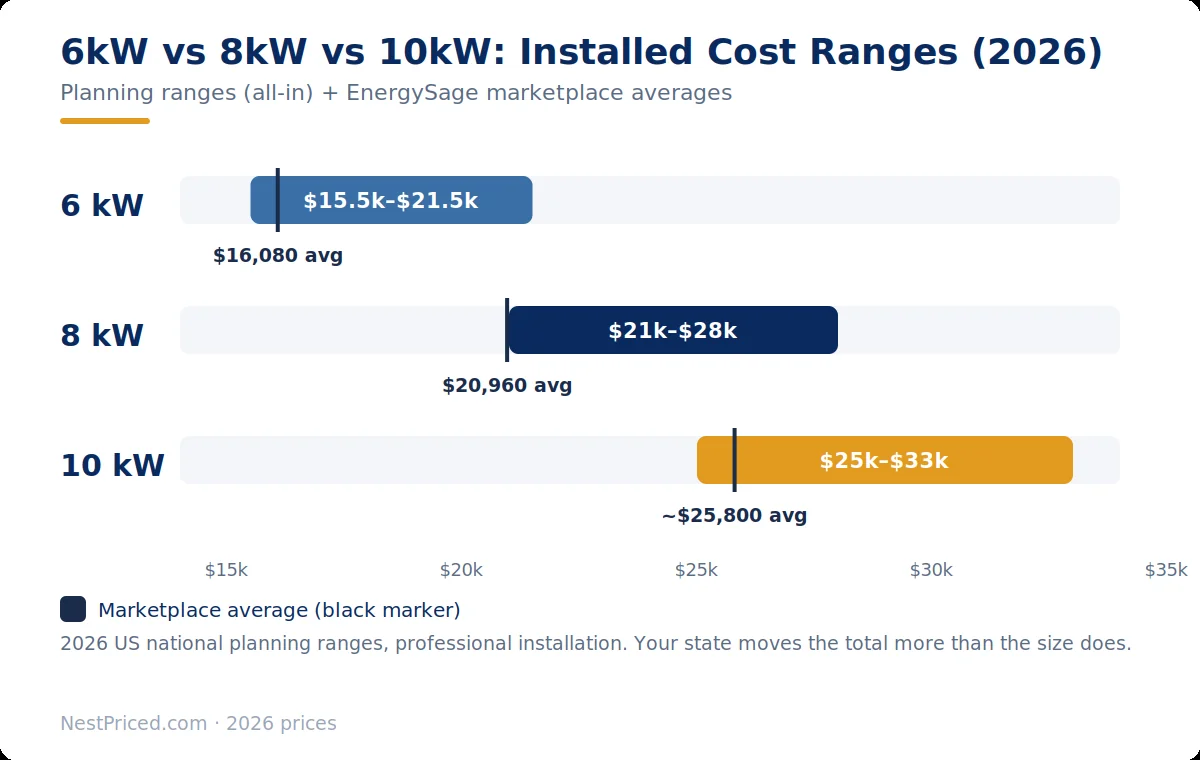
| Installed cost range (2026) | $15,500–$21,500 | $21,000–$28,000 | $25,000–$33,000 |
| Marketplace average | $16,080 ($2.68/W) | $20,960 ($2.62/W) | ~$25,800 (~$2.58/W) |
| Typical $/W | $2.60–$3.10 | $2.50–$3.50 | $2.50–$3.30 |
| Annual production (US avg) | ~8,700 kWh | ~11,600 kWh | ~14,500 kWh |
| Covers a bill of… | ~$110–$130/mo | ~$130–$175/mo | ~$175–$230/mo |
| Best for | Low-use homes, small roofs | The average US home | High-use homes, electrification plans |
2026 US national planning ranges for professional installation. Averages: EnergySage marketplace (Jul 2026); EcoFlow (2026).
Three things in that table deserve a second look, because they’re where sizing decisions go wrong.
First, $/W barely moves between sizes — the total is what matters. An 8 kW system doesn’t cost 33% more per watt than a 6 kW system; it costs roughly the same per watt and 33% more in total. That’s the entire decision: you’re choosing a total, not a rate. Anyone fixating on $/W across sizes is optimizing the wrong number. (For the full $/W story — state spreads, the cost stack — see our solar panel cost 2026 pillar; we won’t re-litigate it here.)
Second, the national range is wide because states are wide. Florida installs run ~$2.12/W; EnergySage’s marketplace data puts Alabama at the top of their rankings at $3.75–$3.82/W in late 2026 (their Decatur, AL market page showed $3.82/W for a 13.5 kW average system). One caveat: other cost models rank Alabama lower — EcoGen’s September 2026 index had it at $3.44/W, and modeled national indices put it around $2.70/W. The “most expensive state” crown depends on whose dataset you use. The honest takeaway: your state moves the total more than the size does. A 10 kW system in Florida (~$20,400 at Texas-adjacent rates) can cost less than an 8 kW system in a high-cost market.
Third, that “$21,000–$28,000” 8 kW range is a planning range, not a quote spread. The low end is a competitive market with standard equipment; the high end is premium panels, a complex roof, or a microinverter/optimizer system. One modeling calculator (ProjectCostPro, Nov 2026) puts the 8 kW planning band at $17,016–$29,781, explicitly labeled “planning estimate, not a bid” — and we use their numbers the same way. Your quote will land somewhere inside the band. Three itemized quotes tell you where.
The Sizing Method: Your Bill → Your kW in Five Minutes
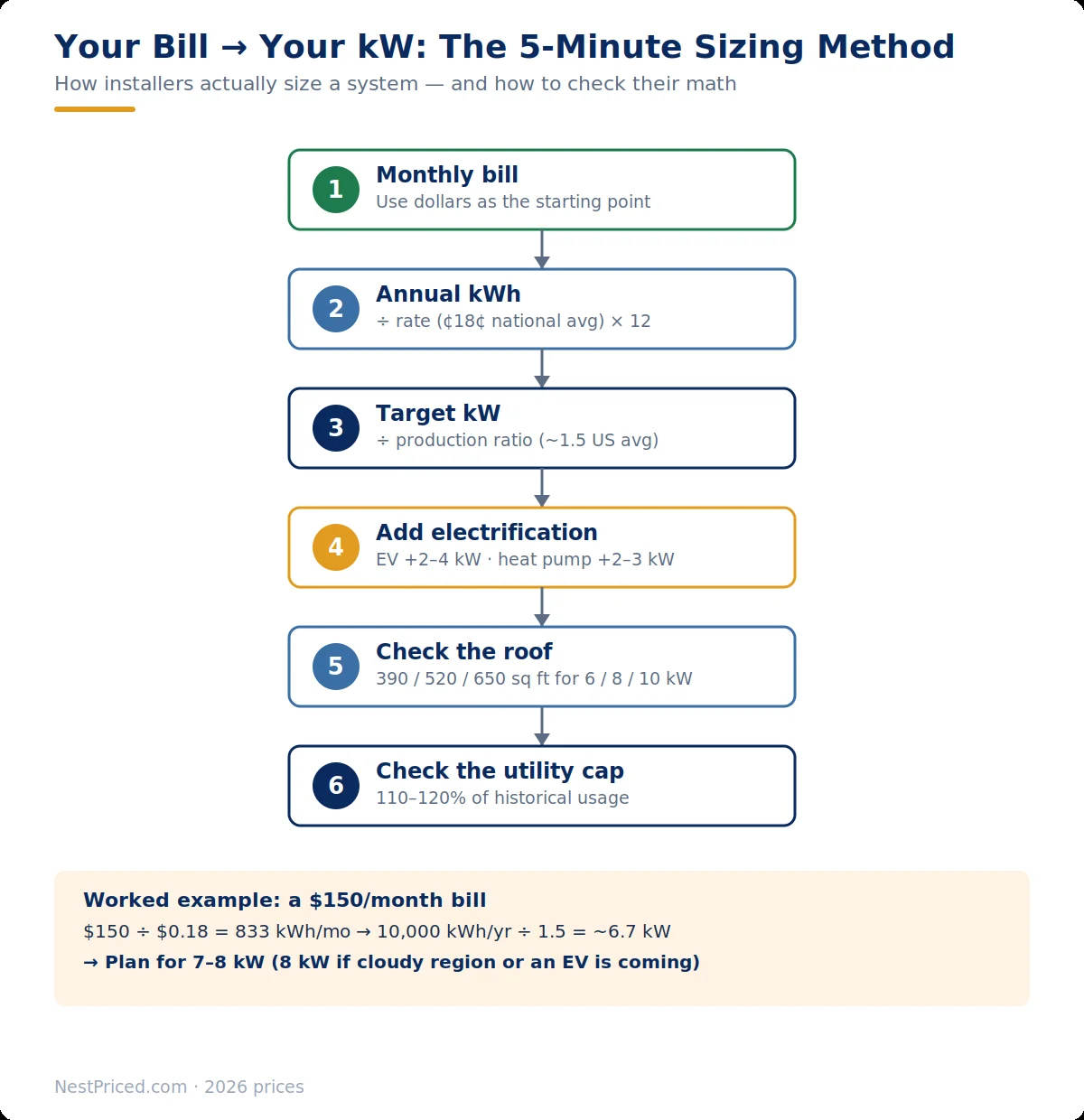
Forget the averages for a minute. Here’s how installers actually size a system — and how you can check their math.
Step 1: Annual kWh from your bill
Pull 12 months of electric bills and add up the kWh, not the dollars. (Dollars include fixed fees that solar can’t erase.) If you only have a monthly average: multiply by 12.
- The average US home: ~10,500 kWh/year (~875 kWh/month) per EIA data.
- The extremes are extreme: California averages ~6,000 kWh/year; Louisiana ~14,300 kWh/year. “Average” is a starting point, not an answer.
Step 2: Divide by your production ratio
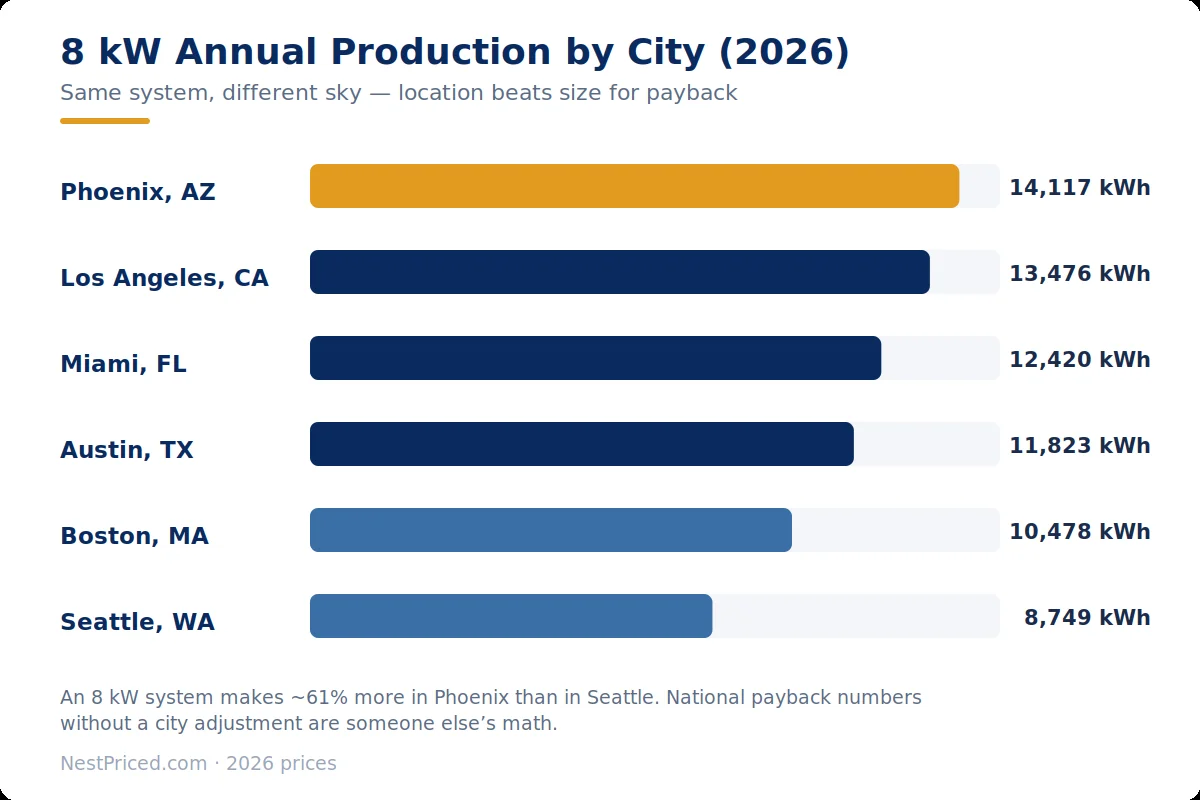
A useful rule: each watt of DC solar capacity produces roughly 1.5 kWh per year in average US conditions. Sunny Phoenix: ~1.75. Cloudy Seattle: ~1.1. Your region’s number is the single biggest variable in sizing — the same 8 kW system makes 14,117 kWh in Phoenix and 8,749 kWh in Seattle.
System kW = Annual kWh ÷ production ratio
Worked example — a $150/month bill at the 2026 national average of ~18¢/kWh:
- $150 ÷ $0.18 = 833 kWh/month
- 833 × 12 = 10,000 kWh/year
- 10,000 ÷ 1.5 = 6,667 W → ~6.7 kW
So a $150/month bill points to roughly a 7 kW system — 8 kW if you’re in a cloudier state or planning to add an EV. That math takes five minutes and beats any online calculator’s guess, because it’s built from your usage.
The rule-of-thumb table (planning estimates)
At ~18¢/kWh and a 1.5 production ratio:
| Monthly bill | Annual usage | System size (precise) | Plan for |
|---|---|---|---|
| $100 | ~6,700 kWh | ~4.5 kW | 5–6 kW |
| $150 | ~10,000 kWh | ~6.7 kW | 6–8 kW |
| $200 | ~13,300 kWh | ~8.9 kW | 9–10 kW |
| $250 | ~16,700 kWh | ~11.1 kW | 10–12 kW |
Planning estimates — show this table to your installer and let them refine with your roof’s actual sun hours. Adjust the ratio down (~1.2) for the Northeast/Pacific Northwest, up (~1.7) for the Southwest.
**Size for the home you’ll have in 5 years, not just today’s bill.** Adding 2 kW later costs disproportionately more than buying it now — a second project means second permits, second design, second mobilization. If an EV or heat pump is in your 5-year plan, the adder tables below tell you exactly how much to buy today.
How Much Power Each Size Actually Makes
“8 kW” is capacity. What you buy with it is kilowatt-hours. Here’s the 2026 production picture (PVWatts-based, EnergySage 2026):
| City | 6 kW (kWh/yr) | 8 kW (kWh/yr) | 10 kW (kWh/yr) |
|---|---|---|---|
| Phoenix, AZ | ~10,600 | 14,117 | ~17,600 |
| Los Angeles, CA | ~10,100 | 13,476 | ~16,800 |
| Miami, FL | ~9,300 | 12,420 | ~15,500 |
| Austin, TX | ~8,900 | 11,823 | ~14,800 |
| Boston, MA | ~7,900 | 10,478 | ~13,100 |
| Seattle, WA | ~6,600 | 8,749 | ~10,900 |
| US average | ~8,700 | ~11,600 | ~14,500 |
6 kW and 10 kW figures scaled from the published 8 kW PVWatts city data (linear by DC capacity); 10 kW range cross-checked against EcoFlow’s 10,900–17,600 kWh/yr band.
The Phoenix–Seattle gap is the whole story in one row: the same 8 kW system produces ~35% more in Phoenix than in Boston, and ~61% more than in Seattle. An 8 kW system in Seattle makes about what a 5 kW system makes in Phoenix. Anyone quoting you a national payback number without adjusting for your city is selling you someone else’s math.
How Many Panels, and How Much Roof?
2026 panels are bigger than the ones in most still-ranking guides. The 250–350W panels those guides assume need 25–32 panels for 8 kW. In 2026, residential panels run 400–460W (Tier 1 typical), which changes the arithmetic completely:
| System | @400W panels | @440W panels | @460W panels |
|---|---|---|---|
| 6 kW | 15 | 14 | 13–14 |
| 8 kW | 20 | 19 | 18 |
| 10 kW | 25 | 23 | 22 |
So: an 8 kW system is 19–20 panels in 2026, not 25+. If a quote or guide shows 28 panels for 8 kW, it’s either using obsolete hardware or padding the count.
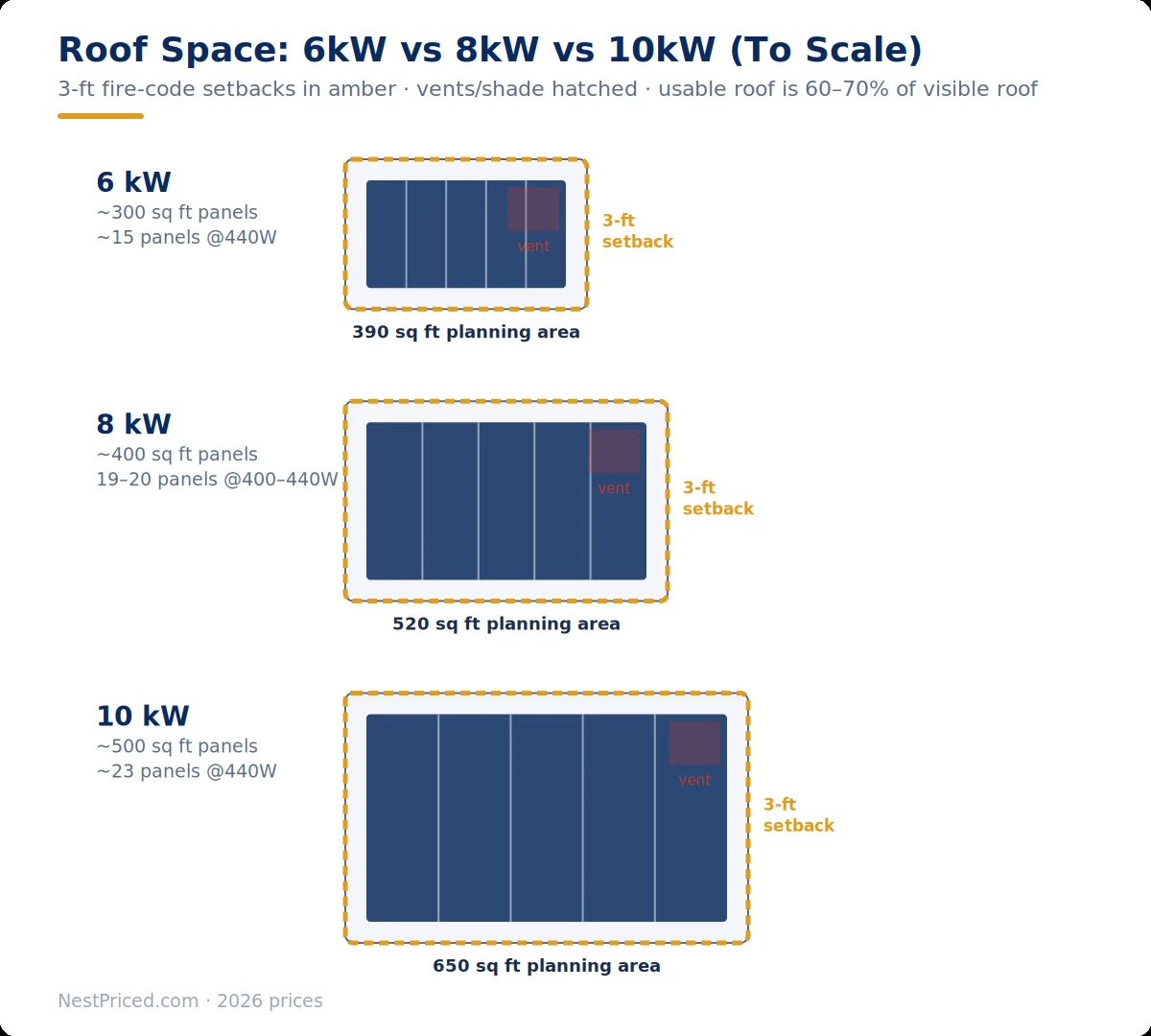
Roof space per size (each panel ~68″ × 40″, roughly 20 sq ft):
| System | Panels-only footprint | + setbacks/obstructions (~30%) | Total planning area |
|---|---|---|---|
| 6 kW | ~300 sq ft | ~90 sq ft | ~390 sq ft |
| 8 kW | ~400 sq ft | ~120 sq ft | ~520 sq ft |
| 10 kW | ~500 sq ft | ~150 sq ft | ~650 sq ft |
Two things installers know that shoppers don’t:
Fire code eats your roof edges. Most jurisdictions require 3-foot setbacks from roof edges and ridges (California’s Title 24 is the strictest). After setbacks, vents, and shaded areas, the usable roof is roughly 60–70% of what you see from the street. A 1,000 sq ft south-facing roof plane yields maybe 600–700 sq ft of panel-able area — enough for 8 kW, tight for 10 kW.
Installers round DOWN to fit, not up to hit the kW target. If your roof fits 22 panels at 440W, you’re getting 9.68 kW, not 10. The roof is the final arbiter of size — which is why the sizing method starts with your bill but ends with a site survey.
Inverter Cost by Size: The Line Item Nobody Prices First
The inverter is 10–15% of your system cost and the part most likely to fail first — but quotes bury it in the total. Here’s the 2026 cost-by-architecture picture (light touch; our inverter replacement guide goes deep later):
| Architecture | Hardware $/W | 8 kW hardware | 8 kW premium over string | Warranty |
|---|---|---|---|---|
| String inverter (SMA, Fronius) | $0.08–$0.15 | ~$640–$1,200 (installed $1,000–$2,000) | — (baseline) | 10–12 yrs |
| String + optimizers | +$0.15–$0.25/W | — | +$800–$1,500 | 25 yrs (optimizers) |
| Microinverters (Enphase) | $0.35–$0.55 | ~$2,800–$4,400 | +$1,500–$3,000 | 25 yrs |
What that table is really telling you:
The string inverter needs one replacement in a 25-year system life. Budget $1,500–$3,000 around year 12–15. Microinverters and optimizers carry 25-year warranties — they should outlive the panels’ prime. Over 25 years, the “cheap” string option and the “expensive” microinverter option are closer in lifetime cost than the quote suggests.
The retail numbers check out: Enphase’s IQ8AC runs $227.29 retail (349 VA — sized for 440–460W panels) with a 25-year warranty. Twenty of those is ~$4,550 in hardware before the installer discount and the system controller. When a microinverter quote runs $2,000–$3,000 over string, that’s the number behind it.
Enphase owns the US residential microinverter market. If your quote says “microinverters” without a brand, it’s almost certainly Enphase IQ8 series — ask which model, and confirm the panel pairing (IQ8AC matches 440–460W panels; older micros on new panels can clip output).
Payback by Size at $0 Federal Credit
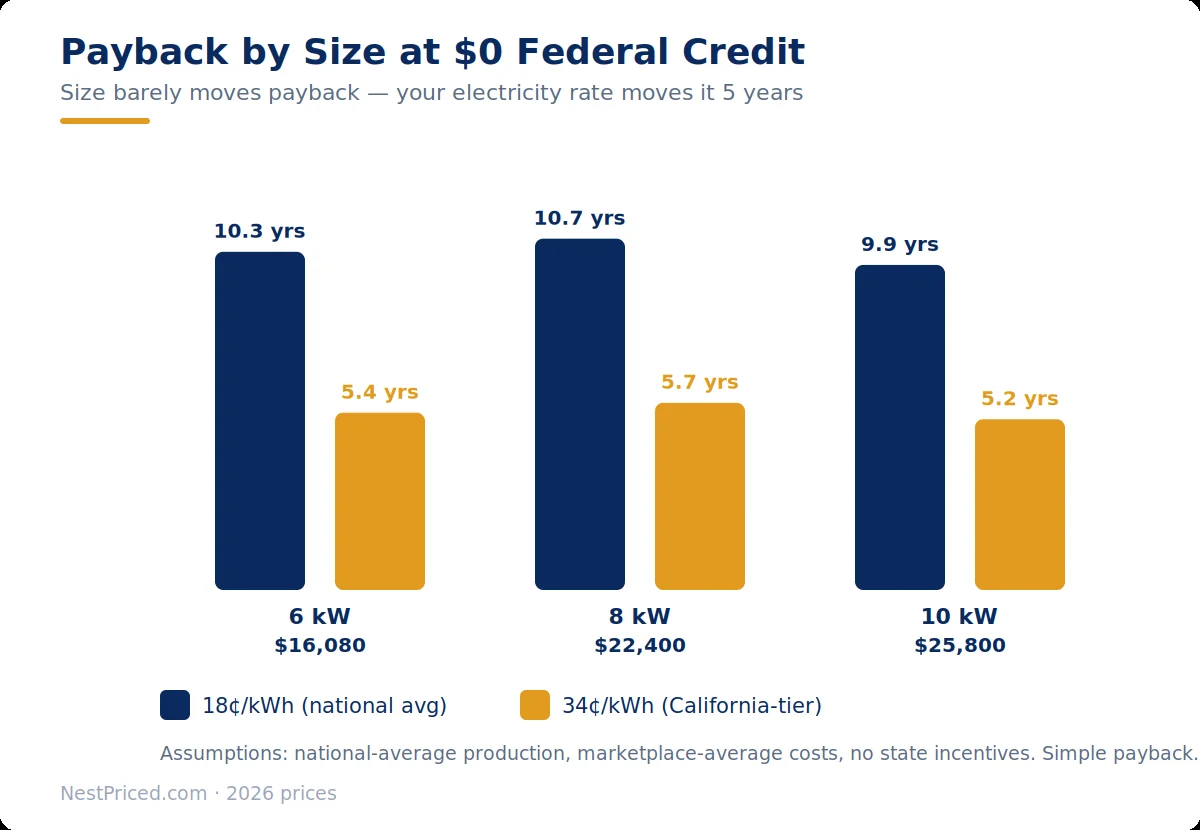
The number everyone actually wants. Assumptions: national-average production, 18¢/kWh, no state incentives (treat those as upside), costs at published 2026 planning figures ($16,080 / $22,400 / $25,800):
| System | Cost | Annual savings (18¢/kWh) | Simple payback |
|---|---|---|---|
| 6 kW | $16,080 | ~$1,566 | ~10.3 yrs |
| 8 kW | $22,400 | ~$2,088 | ~10.7 yrs |
| 10 kW | $25,800 | ~$2,610 | ~9.9 yrs |
Now the same systems in a high-rate state (~34¢/kWh, California-tier):
| System | Annual savings (34¢/kWh) | Simple payback |
|---|---|---|
| 6 kW | ~$2,958 | ~5.4 yrs |
| 8 kW | ~$3,944 | ~5.7 yrs |
| 10 kW | ~$4,930 | ~5.2 yrs |
Three takeaways:
Payback barely differs by size — it differs by rate. The 6 vs 8 vs 10 kW payback spread is under a year at any given rate, because $/W is roughly flat. Your electricity rate moves payback by five years. (In cheap-power states — Louisiana ~12.7¢, parts of Texas ~14¢ — expect 13–15 years; in New England at 25–30¢, 6–8.)
The credit’s death added roughly $7,000 to the net cost of an 8 kW system vs 2024 — and about 3 years to every payback in America. Anyone quoting pre-2026 payback math is selling you 2024. (Also: the 9–12 year 8 kW band you’ll see quoted elsewhere, vs the 13.5-year figure from one 2026 guide at $3.10/W and 16.5¢/kWh — that spread is just rate sensitivity wearing a costume. Run the math at your rate.)
Loans quietly add 15–25% to lifetime cost through dealer fees and interest. A $22,400 system financed at a typical solar-loan structure can cost $26,000–$28,000 all-in. If you’re comparing cash vs financed quotes, compare the financed totals — and ask the installer to itemize the dealer fee. It’s often the single biggest line item nobody mentions.
When to Size UP: EV and Heat Pump Adders
This is the section that saves you from buying twice. If either of these is in your 5-year plan, add the capacity now.
Electric vehicle
A typical EV driven 12,000 miles/year adds 2,500–5,800 kWh/year — that’s +2–4 kW of solar, or 6–8 extra panels on an 8 kW system:
| Annual miles | Extra kWh/yr | Add to system size |
|---|---|---|
| 7,500 | ~1,900–3,600 | +1.5–2 kW |
| 10,000 | ~2,500–4,800 | +2–2.5 kW |
| 15,000 | ~3,750–7,200 | +3–3.5 kW |
| 20,000 | ~5,000–9,600 | +4–5 kW |
The pattern: a two-EV household at 15,000 miles each needs roughly +6–7 kW over the baseline. That’s the difference between an 8 kW system and a 14 kW system — a different quote, a different roof requirement, possibly a different electrical panel. (And note: Level 2 EV charging at 40–48A continuous often triggers a 200A panel upgrade — see our electrical panel upgrade cost guide before you size the solar.)
Heat pump conversion
Switching from oil or gas heat to a heat pump electrifies your biggest load. The adder: oil → heat pump typically adds +2–3 kW (5–7 panels), and the full range runs 3,000–20,000 kWh/year depending on climate and home size. A heat-pump water heater adds a smaller +0.5–1 kW (~800–1,500 kWh/year). Planning a heat pump? Our heat pump cost guide has the equipment side; add the solar capacity here.
The future-proofing rule
8–10 kW is the 2026 sweet spot precisely because it leaves headroom. A 6 kW system sized perfectly for today’s bill has nowhere to grow. An 8 kW system absorbs an EV. A 10 kW system absorbs an EV and a heat pump. The premium for buying the headroom now (~$5,000–$7,000) is a fraction of a second install later.
The Oversizing Traps (Why Bigger Isn’t Always Better)
**Your utility can reject an oversized system — check before you sign.** Most utilities cap residential systems at **110–120% of your historical annual usage**. Size a 14 kW system for a 9,000 kWh/year home and the interconnection application can come back denied. Confirm your utility’s cap with the installer *before* the design is finalized, not after.
Three more ways “go big” goes wrong:
Export credits are worth less than self-consumed kWh. Under NEM 3.0-style net billing (California and spreading), exported surplus earns ~5–8¢/kWh while self-consumed power offsets 30–40¢/kWh. An oversized system that exports half its production earns pennies on the surplus. The fix for oversizing isn’t a bigger system — it’s a battery that stores the midday surplus for the evening peak. (The standard pairing: 8 kW of solar + a 10–13.5 kWh battery — see our solar battery cost guide for the full NEM 3.0 math.)
The roof is a hard ceiling. As the roof-space section showed: setbacks, vents, shade. If your usable roof fits 8 kW, the 10 kW conversation is over — no matter what the bill math says. This is the most common reason real installs come in under the “ideal” size.
Solar shingles are sized in kW too. If you’re weighing shingles against panels, the sizing method is identical — only the footprint changes (shingles need ~30–60% more roof area per kW). See our solar shingles vs panels cost comparison.
When Each Size Wins
6 kW wins when: your bill is under ~$120/month; you’re in a low-usage state (California’s ~6,000 kWh/year average homes); your roof fits 14–15 panels and nothing more; or you’re budget-constrained and plan to add later (knowing the second-install premium).
8 kW wins when: your bill is $130–$175/month; you want the system that matches the average American home; you’re planning one EV within 5 years; or you want the 2026 sweet spot with headroom. This is the default answer, and defaults exist for a reason.
10 kW wins when: your bill is $175+/month; you’re in a high-usage state (Texas ~13,000 kWh/year, Louisiana ~14,300); you’re electrifying (EV + heat pump); your roof has 650+ sq ft of usable space; or your utility’s 110–120% cap still leaves room above 10.
3 Ways to Save in 2026 (Without the Federal Credit)
1. Get 3 itemized quotes at your target size — and make them compete on $/W, not totals. Totals differ because sizes differ; $/W is the comparable number. A $2.62/W quote and a $3.10/W quote for the same 8 kW system is a $3,840 gap hiding in plain sight.
2. Price the loan honestly. Solar-loan dealer fees plus interest add 15–25% to lifetime cost. If you can pay cash or use a HELOC at a lower all-in cost, the “0.99% APR solar loan” is usually the most expensive option on the table. Get the cash price first, always.
3. Time it with roof work. If your roof is due within 5 years, doing it with the solar install saves a second round of labor, permitting, and — critically — avoids paying to remove and reinstall panels for a re-roof later ($1,500–$3,000 for a typical R&R). A roof + 8 kW panels beats shingles on pure cost; shingles win on looks.
What a Good Quote Itemizes (2026 Checklist)
A lump-sum number is not a quote. Demand all seven, in writing:
- System size in kW (DC) and the panel count + wattage behind it (e.g., “8.0 kW DC — 20 × 400W”)
- Cost per watt — the number you compare across quotes
- Equipment model numbers — panel model, inverter model (not just “microinverters”)
- Electrical scope — panel upgrade? disconnects? trenching? (anything missing here becomes a change order)
- Permits and interconnection fees — itemized, not “included”
- Warranty terms — product, power output, workmanship — including the inverter/electronics
- Production estimate in kWh/year with the assumptions — your address, your roof’s azimuth and tilt, the derate factor. Then sanity-check it against the city table above.
The 2026 Buyer’s Decision Framework
- Pull 12 months of bills. Total the kWh (not dollars). This is your sizing anchor.
- Divide by your production ratio. 1.5 national; ~1.2 for the Northeast/PNW; ~1.7 for the Southwest. That gives your target kW.
- Add 5-year electrification plans. EV: +2–4 kW. Heat pump: +2–3 kW. HP water heater: +0.5–1 kW.
- Check the roof. 390 / 520 / 650 sq ft planning area for 6 / 8 / 10 kW. Setbacks and shade decide the ceiling.
- Check the utility cap. 110–120% of historical usage at most utilities. Confirm before design.
- Get 3 quotes at your target size. Compare on $/W, equipment models, and warranty terms — then check DSIRE for state/utility incentives, the only free money left in 2026.
Sources & methodology
Cost figures compiled November 2026 from published 2026 cost guides and marketplace data: EnergySage marketplace ($16,080 6 kW / $20,960 8 kW, Jul 2026; Alabama $3.75/W state page Nov 2026; Decatur AL $3.82/W Oct 2026 — marketplace sample, methodology-dependent); simplesolarguide.com ($22.4–28k 8 kW, $2.80–$3.50/W); earthenergylog.com (Nov 2026, EnergySage + SEIA); solarpanelinstallcost.com (Oct 2026, $2.60/W avg; state $/W); thegreenwatt.com (2026 $/W guide, median $3.10/W; 8–10 kW sweet spot; $7,000 credit-loss figure); solarsavingshub.org (Oct 2026); EcoFlow 10 kW guide (~$25,800 via EnergySage; TX $20.4k vs MA $29.7k); iamhome.app (premium 10 kW $31–35k; loan dealer fees 15–25%); ProjectCostPro calculator ($17,016–$29,781 planning range, explicitly “planning estimate, not a bid”); ecoenergycalc.com (Nov 2026); calcavera.com; us.solarpanelsnetwork.com (Sep 2026, panel wattages/counts); surgepv.com (inverter $/W 2026); pyrasolar.com (IQ8AC $227.29 retail, Jul 2026); solarreviews.com (Jul 2026, EV/heat-pump adders); elevatehomeguide.space (mileage table); EcoGen America Solar Cost Index (Sep 2026, AL $3.44/W highest-of-51 in their index — included to show methodology dependence); SEIA Q1 2026 (8.4 kW / ~$24,000 avg buyer). Production: EnergySage PVWatts city table (Jul 2026). Usage/rates: EIA (10,500 kWh/yr avg home; ~18¢/kWh 2026 national; state extremes TX 1,096 / LA 1,192 / CA 503 kWh/mo). Tax: IRS FS-2025-05, OBBBA P.L. 119-21. Competitor staleness notes verified by crawl, November 2026 (corebyteblog.com, learn.simple-living-today.com, freeprojectestimator.com calculator).
Disclaimer: Prices are 2026 US national averages and vary by region, roof complexity, system size, and installer — get 3 written, itemized local quotes. Tax information is general and not tax advice — confirm with a tax professional. Solar installation involves roofing and electrical work: use licensed contractors and pull permits. This article covers cost information only, not installation instructions.
How much does an 8kW solar system cost in 2026?
An 8 kW system costs $21,000–$28,000 installed before incentives in 2026, with the EnergySage marketplace average at $20,960 (~$2.62/W). The 30% federal credit is $0 for homeowner-owned 2026 installs, so budget the full amount minus any state or utility incentives.
What size solar system do I need for a $150/month electric bill?
Roughly 7–8 kW. At ~18¢/kWh, $150/month = ~10,000 kWh/year; dividing by the 1.5 production ratio gives ~6.7 kW. Size 8 kW if you’re in a cloudier region or adding an EV within 5 years.
How many solar panels do I need for 8kW?
19–20 panels with 2026 hardware (400–440W panels). Guides claiming 25–32 panels are using obsolete 250–350W panel specs. At 440W: 19 panels. At 400W: 20 panels.
How many kWh does an 8kW solar system produce per year?
About 11,600 kWh/year on US average — but location dominates: ~14,117 kWh in Phoenix vs ~8,749 kWh in Seattle for the same system. Always size from your region’s production, not the national average.
Is a 10kW solar system overkill for a house?
Not if your usage justifies it. The average US home (~10,500 kWh/year) needs ~7–8 kW. A 10 kW system fits high-usage homes (Texas, Louisiana), households adding an EV or heat pump, or anyone whose utility cap allows it. Oversizing beyond your usage plus electrification plans is where it becomes waste — especially with $0 federal credit.
How much roof space do I need for a 10kW system?
About 650 sq ft of planning area (500 sq ft of panels plus ~30% for setbacks and obstructions). After 3-foot fire-code edge setbacks, vents, and shade, usable roof is roughly 60–70% of the visible roof plane.
Does the 30% solar tax credit apply in 2026?
No — for homeowner-owned systems placed in service in 2026, the federal credit (§25D) is $0 under OBBBA. It survives only via lease/PPA structures (§48E commercial credit, in service by Dec 31, 2027). State and utility incentives are the remaining free money — check DSIRE.
Should I get a bigger system if I’m buying an EV next year?
Yes — add +2–4 kW now for a typical EV (12,000 miles/year). Adding capacity later means a second project with second permits and mobilization costs. Note that Level 2 EV charging often also triggers a 200A electrical panel upgrade.