

Solar inverter replacement cost in 2026 runs $1,050-$3,400 for a like-for-like string swap (national average about $2,000). Upgrading architectures costs more: $2,100-$5,800 to retrofit optimizers, $2,100-$6,000 for a hybrid inverter, and $2,800-$8,200 for a full string-to-microinverter upgrade. Repairs run $238-$1,496 (average $866) — and the 40% rule settles repair vs replace: repair quotes above 40% of replacement cost mean replace.
Table of Contents
Your panels will outlive your inverter — almost guaranteed. Solar panels are warrantied for 25 years and routinely produce for 30. String inverters, the box that converts your panels’ DC power into grid-ready AC, last 10-15 years. That math means most string-inverter owners get one replacement bill during their system’s life, and it usually arrives as a surprise: the system quietly stops producing, or starts erroring out on hot afternoons, sometime around year 12.
This guide covers what the surprise actually costs in 2026: the four replacement paths with real installed ranges, the labor anatomy of a swap vs an upgrade, the repair ladder and the two rules that settle repair vs replace, the warranty-labor gap nobody prices, 2026 brand reliability data, and the one tax fact that changes every quote (there is no federal credit on the job). If you only need system sizing, see our [solar sizing guide](https://nestpriced.com/solar-energy/6kw-8kw-10kw-solar-system-cost-2026/) — this one is for the day the inverter dies.
Solar inverter replacement cost: the four paths, priced
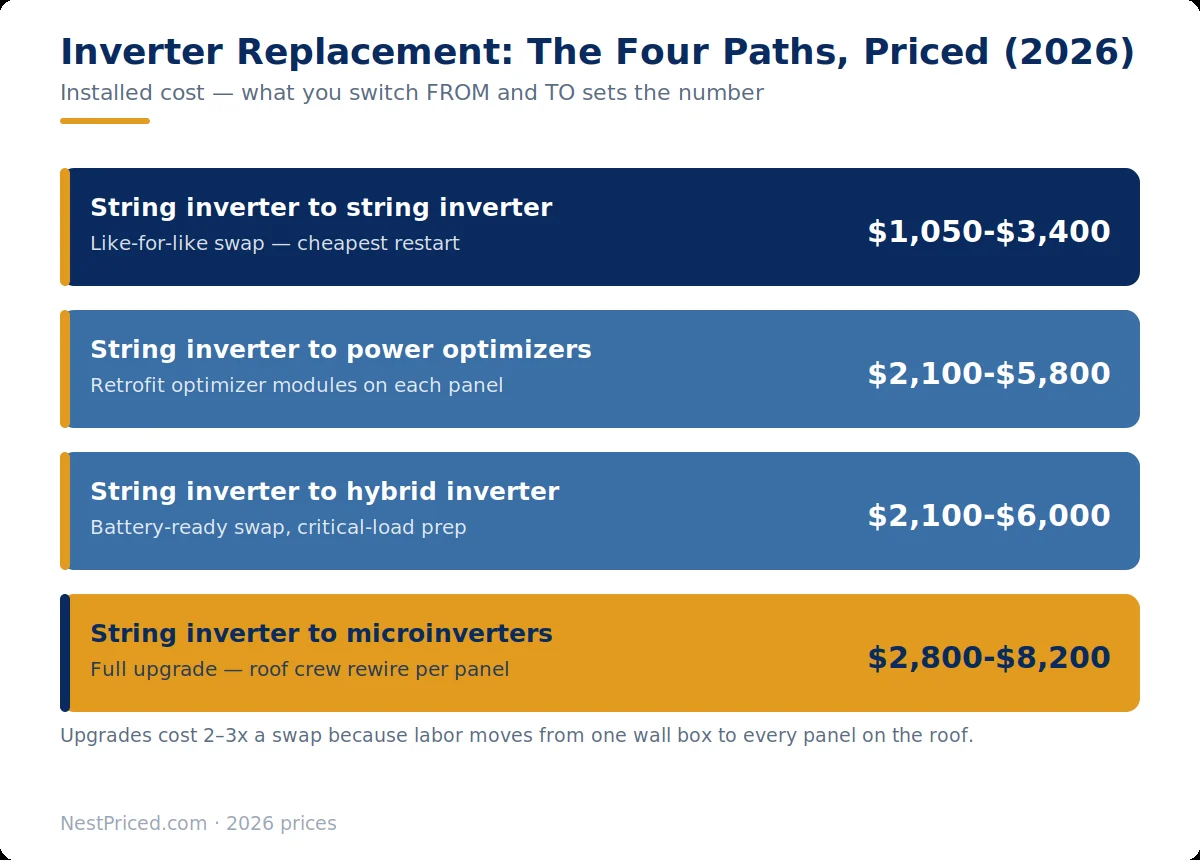
The keyword’s real answer is not one number. Cost is set by what you switch FROM and TO. A 2026 industry guide (solarpricelist.com) splits the market into four transitions:
| Transition | Installed range | When it makes sense |
|---|---|---|
| String → string (like-for-like) | $1,050-$3,400 | The default. Your panels have 8+ years left, the roof is fine, and you want the cheapest reliable restart. |
| String → power optimizer | $2,100-$5,800 | Shade or panel mismatch is hurting production; you want per-panel monitoring without full rewiring. |
| String → hybrid (battery-ready) | $2,100-$6,000 | A battery is in your 1-3 year plan — see our [solar battery cost guide](https://nestpriced.com/solar-energy/solar-battery-cost-2026/). |
| String → microinverter (full upgrade) | $2,800-$8,200 | Panels have 15+ years left, roof is solid, and you want the last inverter purchase of the system’s life. |
The spread is roughly 8x from cheapest to most expensive — which is why one-number answers from Angi ($2,000 average) or solarreviews ($1,500-$3,000) mislead. The average is the answer to a question nobody asks; your transition is the answer to yours.
String inverter replacement cost: what the $1,050-$3,400 swap covers
Most residential replacements are simple swaps and land in a tighter band: $1,500-$3,000 installed for the typical 6-10 kW system. Size sets the number (solarpricelist.com, 2026):
| System size | Equipment share | Labor share | Installed total |
|---|---|---|---|
| 4-5 kW | $700-$1,100 | $350-$600 | $1,050-$1,700 |
| 6-8 kW | $900-$1,500 | $400-$700 | $1,300-$2,200 |
| 9-12 kW | $1,200-$2,000 | $500-$800 | $1,700-$2,800 |
| 13-15 kW | $1,500-$2,500 | $600-$900 | $2,100-$3,400 |
A swap is a 2-4 hour job: disconnect, unmount the old unit, mount and wire the new one, commission, and update monitoring. Permits add $50-$250 in most jurisdictions. Bigger systems need bigger inverters (a 13-15 kW system typically needs a 10-11.4 kW inverter, which is why the price climbs).
Part prices behind the equipment share, observed at US retailers in 2026: a SolarEdge Home Hub listed $687-$813 (Oct 2026, three US online retailers), a Fronius Primo 7.6 kW string inverter $2,154, and a Fronius GEN24 7.7 kW hybrid $2,525 (solar-electric.com, current listing). The 2026 replacement-market string lineup is SMA Sunny Boy (10-year standard, 12-year extended warranty), Fronius Primo (10-year), with Sungrow SG and Growatt MIN as the budget tier (5-year warranties).
New-install context: in a brand-new 8 kW install, a string inverter runs about $1,000-$2,000 installed — the panel-plus-racking work is already paid for there. For full new-install architecture math, see our [solar sizing guide](https://nestpriced.com/solar-energy/6kw-8kw-10kw-solar-system-cost-2026/). Everything below is replacement-specific.
Why an upgrade costs 2-3x a swap: the labor anatomy
The $2,800-$8,200 string→microinverter range surprises people because the equipment isn’t the story — the labor is. A swap touches one wall-mounted box. An upgrade touches every panel on the roof.
String→microinverter: $2,800-$8,200. Equipment runs $1,800-$4,000 on a small (4-5 kW) system and climbs with panel count — larger arrays push installed totals toward $8,200 (microinverters cost $150-$350 per unit; a 20-panel system needs 20 of them, though dual units like the APsystems DS3 serve two panels each). Labor runs $1,000-$1,800+ because every panel gets roof-level work: mount microinverter, re-run AC trunk cable, re-commission. Monitoring gets rebuilt from scratch. This is a half-to-full day of roof crew time, not a 3-hour swap.
String→optimizer retrofit: $2,100-$5,800. The wall box gets replaced AND each panel gets an optimizer module — roof work again, but the AC wiring is simpler than a microinverter conversion, so labor lands below the micro path.
String→hybrid: $2,100-$6,000 (3-6 kW at the low end, 10-15 kW at the high). This is mostly a box swap with extra wiring for the battery connection and critical-loads panel prep — the cheapest upgrade path, and the sensible one if storage is on your horizon.
Partial microinverter failure: $250-$500 installed per unit. The hidden advantage of microinverters — when one dies, only one panel goes dark and the fix is a single unit, not a system outage. Part prices: Enphase IQ8M $150-$200/unit, APsystems EZ1-M $120-$160, Hoymiles HMS-800W $110-$140 (solarpricelist.com, 2026).
Repair vs replace: the ladder, the 40% rule, the 10-year rule
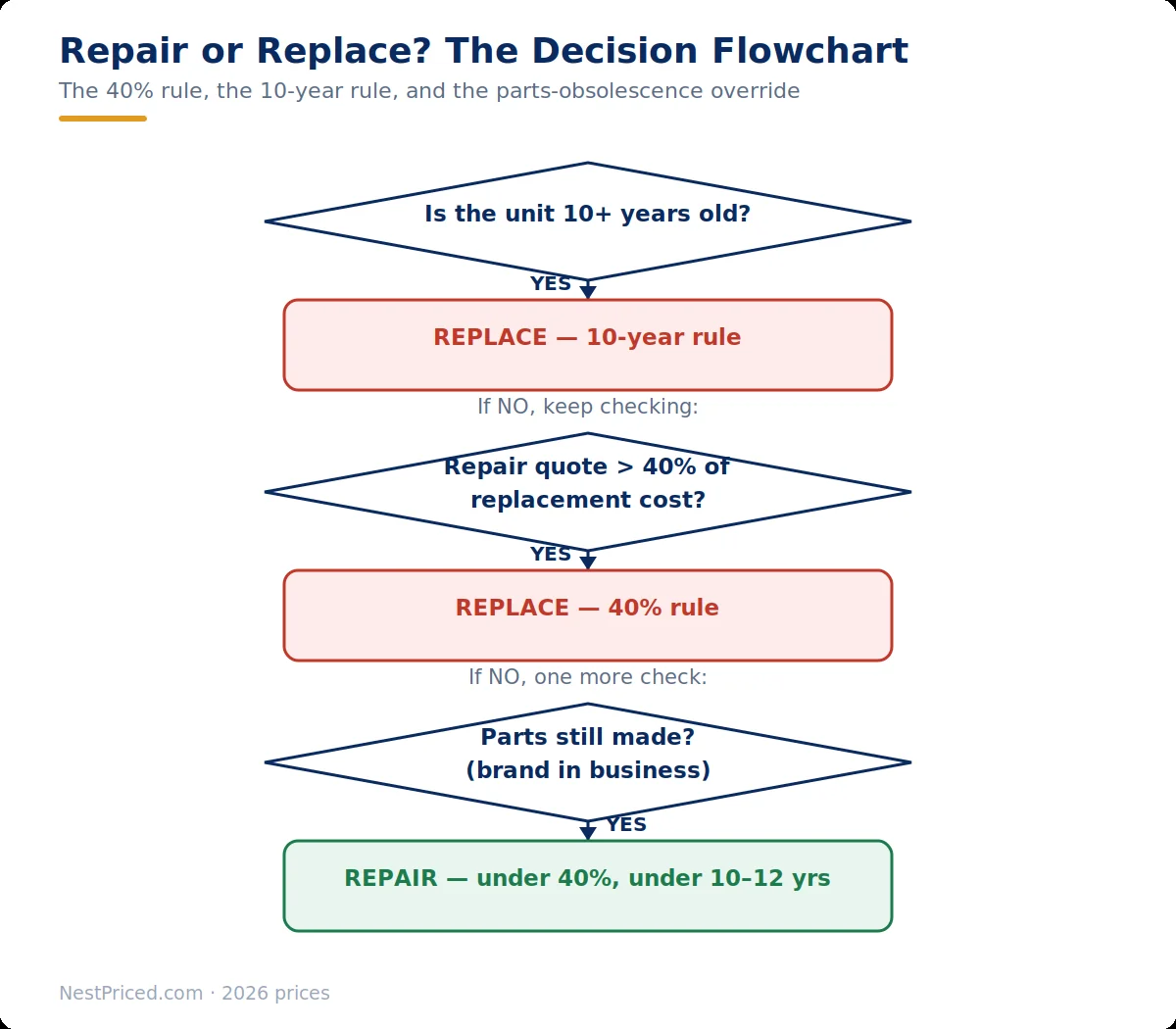
Before pricing a replacement, price the repair — most failures are fixable, and the repair ladder is short:
| Repair tier | What it covers | Typical cost |
|---|---|---|
| Diagnostic | Truck roll, testing, error-code read | $250-$500 |
| Component | Fans, fuses, relays, minor boards | $400-$800 |
| Major | Power stage / IGBT modules, multi-board | $800-$1,500 |
National repair average: $866 (Angi, Nov 2026), with a typical range of $238-$1,496. Two rules settle the decision:
The 40% rule: if the repair quote exceeds 40% of a replacement, replace. Industry standard from 2026 installer guides (solarpricelist.com; corroborated by a UK installer rule for units past 8 years). A $1,200 repair against a $2,200 replacement = 55% — replace.
The 10-year rule: a string inverter past year 10 with an $800-$1,200 repair quote gets replaced, not repaired. That repair is 50-80% of a brand-new unit with a fresh 10-12 year warranty. Repairing a 12-year-old inverter is buying 2-3 more years at nearly the price of 10-12.
The parts-obsolescence killer overrides both rules. Manufacturers support spare parts for roughly a decade after a model is discontinued. If the brand has left the market — and 2026 saw real exits, like GivEnergy entering administration in April — some units are unrepairable at any price. A 2012 inverter from a dead brand isn’t a repair decision; it’s a replacement forced by the calendar.
One math check before deciding anything: at typical 2026 residential rates ($0.14-$0.26/kWh), every 1,000 kWh/year your system recovers is worth $140-$260/year. A $2,000 replacement on a healthy 7 kW system pays back in under a decade just in recovered production — repair-or-replace is rarely about whether to fix, only about which fix.
How inverters actually die (the three killers)
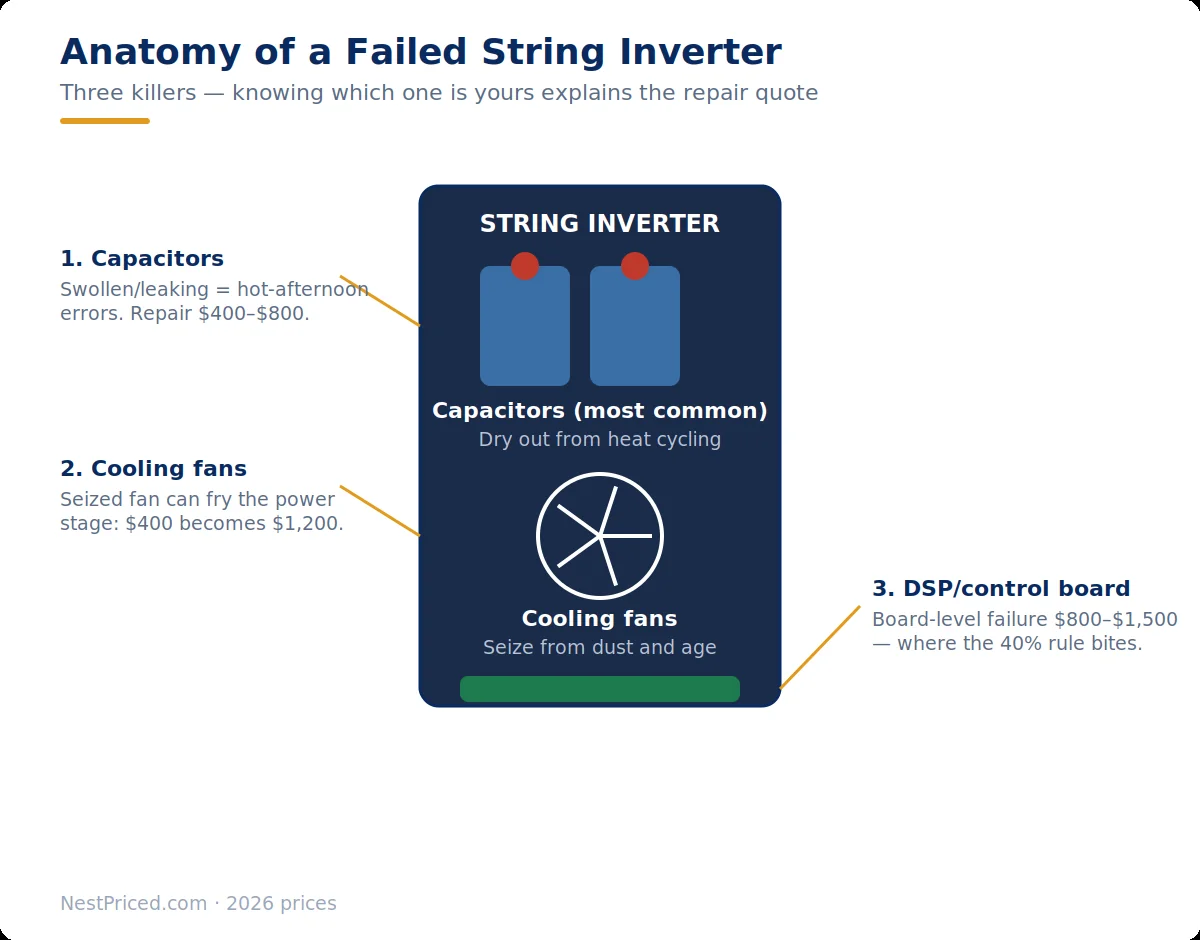
String inverters fail in three predictable ways, and knowing which one is yours explains the repair quote:
Capacitors (most common). Electrolytic capacitors dry out from heat cycling. Swollen or leaking capacitors are the classic “inverter errors out on hot afternoons, works in the morning” pattern. Repair is component-level ($400-$800) if the board is otherwise healthy.
Cooling fans. Fans seize from dust and age; the inverter then overheats and derates or shuts down. Cheap part, cheap fix — but a seized fan that ran for months can take the power stage with it, turning a $400 repair into a $1,200 one.
DSP/control board. The digital signal processing board is the inverter’s brain. Board-level failure ($800-$1,500) is where the 40% rule usually triggers replacement.
Warning signs before failure: production dropping on hot days, error codes about temperature or “isolation fault,” the inverter restarting repeatedly, or a fan that went from audible to silent. Catch the fan early and you buy years; ignore it and you buy an inverter.
Lifespans: why the inverter dies before the panels
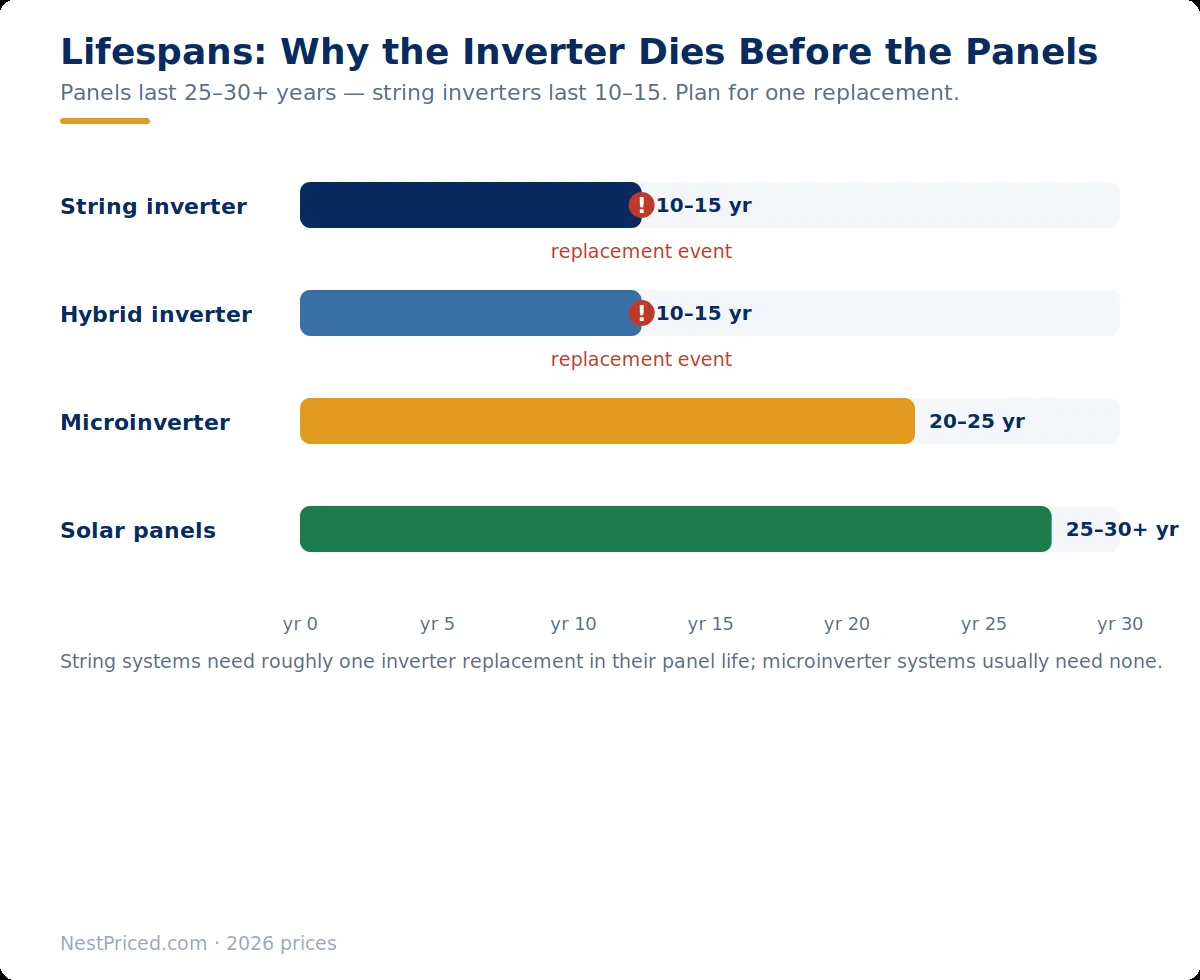
| Component | Typical lifespan | Warranty (typical) |
|---|---|---|
| String inverter | 10-15 years | 10-12 years |
| Hybrid inverter (inverter portion) | 10-15 years | 10-12 years |
| Microinverter | 20-25 years | 25 years |
| Solar panels | 25-30+ years | 25 years (power) |
The asymmetry is the whole story: panels last 25-30+ years, string inverters last 10-15. A string-inverter system needs roughly one replacement in its panel life; a microinverter system usually needs none. The second asymmetry is the warranty: string warranties run 10-12 years, microinverter/optimizer warranties 25. A 12-year-old failed string inverter is a homeowner expense. A 12-year-old failed microinverter is a warranty claim — though, as the next section shows, “warranty claim” and “free” are different words.
The warranty-labor gap: a covered claim is not a free replacement
Read your warranty before you need it. Inverter warranties cover manufacturing defects and the replacement hardware. They typically exclude labor, shipping, and damage from external causes (surge, water, installer error). The hardware may be free while you still pay the diagnostic visit, the install labor, and the permit — typically $200-$500+ out of pocket on a “covered” claim.
Three 2026 specifics to know:
Enphase extended to 25 years. In late 2025 Enphase moved its microinverter warranty from 15 to 25 years — matching the panel warranty and eliminating the mid-life replacement risk for its (roughly 70% of the North American residential microinverter market) customer base.
Labor programs pay installers, not you. Enphase runs a labor reimbursement program (2026) that pays the installer per truck roll and per microinverter — it defrays the contractor’s cost of warranty service, not the homeowner’s. Installers can also purchase extended labor coverage. None of this writes you a check; it makes your installer more willing to do warranty work promptly.
A 25-year warranty is only as good as the company behind it. GivEnergy, a battery-and-inverter maker with 25-year-style warranty promises, went into administration in April 2026. When the manufacturer dies, the warranty dies with it — another reason brand reliability (below) matters more than the warranty number on the box.
2026 brand reliability: what changed this year
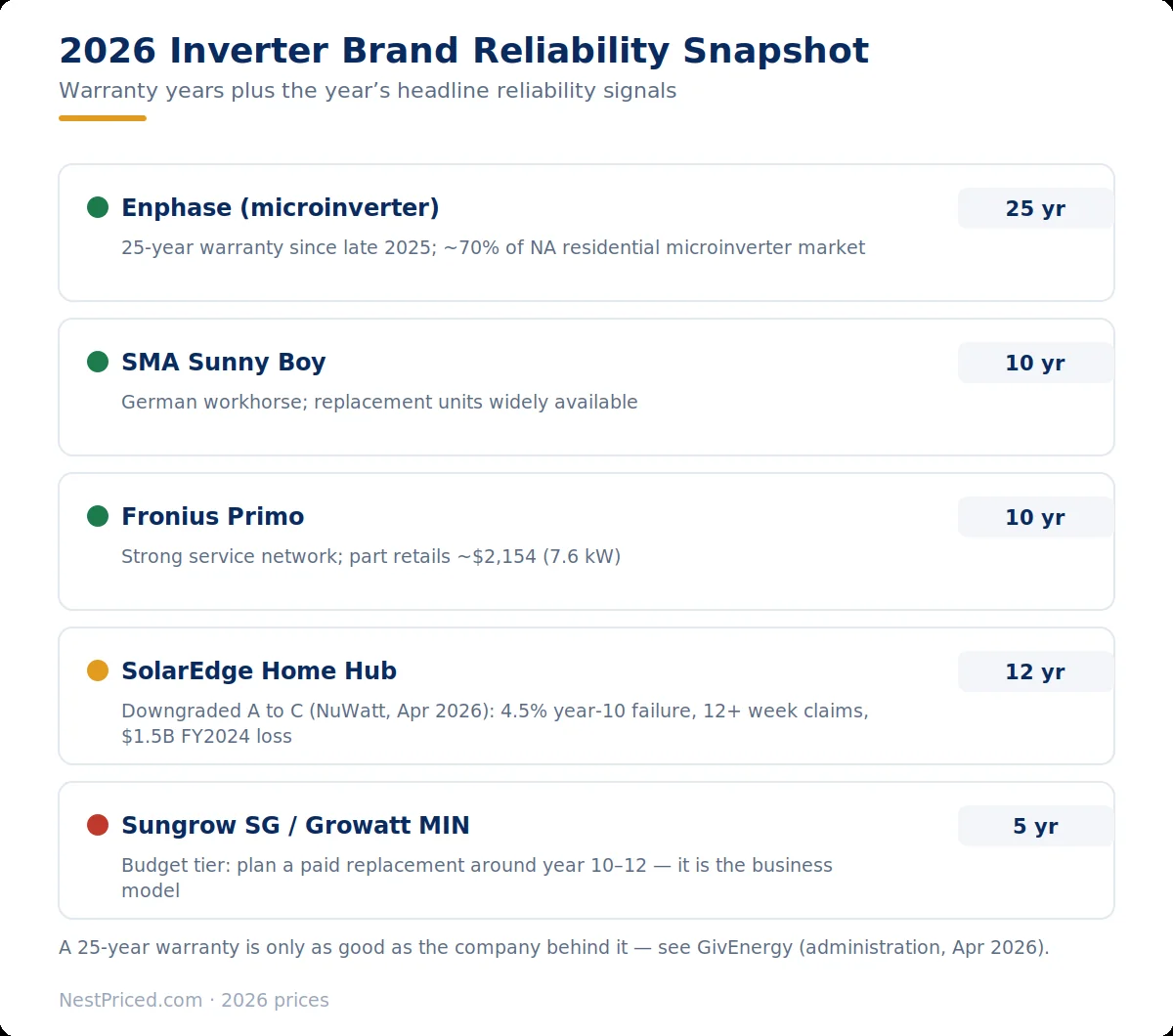
This section is the freshness edge. Most competing replacement-cost pages predate three 2026 developments:
SolarEdge: downgraded A to C. The April 2026 NuWatt reliability report (16-brand table) downgraded SolarEdge from A to C, citing a 4.5% year-10 field failure rate, 12+ week warranty claim turnaround, and a parent company that lost over $1.5 billion in FY2024. Installers have reported higher-than-expected HD-Wave replacement rates, sometimes within the first few years (reinnovations.org, Jan 2026). If you own a SolarEdge system approaching year 10-12, budget for replacement on the warranty timeline, not after failure — and know the standard Home Hub warranty is 12 years vs 25 on microinverters.
Enphase: warranty up, market position strong. The late-2025 extension to 25 years plus roughly 70% North American microinverter share makes Enphase the low-drama ownership choice. One caution on published claims: an installer-comparison article cites a 0.05% failure rate, but that number comes from an affiliate-style piece, not Enphase-published field data — treat it as marketing until a manufacturer source confirms it.
Budget brands carry 5-year warranties. Sungrow SG and Growatt MIN compete on price with 5-year standard warranties — meaning the expected ownership includes a replacement at homeowner expense around year 10-12. That is not a defect; it is the business model. Budget part prices were not captured at 2026 US retail in this research; if a quote offers these brands, ask what the replacement-unit price will be at year 10, not just today.
FCC, July 2026: the FCC added certain foreign-produced power inverters to its Covered List, restricting new covered models from receiving equipment authorization (rules modified August 2026). Practical effect: possible brand and price shifts in the budget-inverter segment. Zero competing replacement-cost pages cover this.
Brand-by-brand: what a replacement costs per maker
The brand on your wall sets the part price and the warranty you’re working with. Every string-brand swap below sits inside the $1,050-$3,400 installed band — what moves you within it is the part price and whether roof-level modules are part of the job. 2026 figures:
| Brand | Typical replacement setup | Standard warranty | What to know in 2026 |
|---|---|---|---|
| SMA Sunny Boy | String swap — mid-band | 10 yr (12 yr extended) | German workhorse; replacement units widely available, labor straightforward |
| Fronius Primo | String swap — mid-band; part retails ~$2,154 (7.6 kW) | 10 yr | Strong service network; hybrid GEN24 7.7 kW retails ~$2,525 |
| SolarEdge Home Hub | String swap — typically higher in the band (roof optimizer modules add diagnosis and replacement time); part retails $687-$813 | 12 yr (extendable to 25) | Optimizer modules on the roof add failure points; 2026 reliability downgrade (see above) |
| Enphase (microinverter) | $250-$500 per failed unit, installed | 25 yr | Rarely a full replacement — single-unit failures don’t take the system down |
| Sungrow SG / Growatt MIN | String swap — low end of the band (2026 US part prices not captured) | 5 yr | Budget tier; plan a paid replacement around year 10-12 and price that in |
Two things the table hides: first, switching brands on a like-for-like swap is routine (an SMA can replace a dead Fronius — the electrician re-terminates the same DC inputs), so you are not locked to the brand on your wall. Second, SolarEdge’s optimizer architecture means a “failed inverter” diagnosis sometimes turns out to be failed optimizers on the roof — a competent diagnostic distinguishes the $250-$500 fix from the $2,000 replacement before you authorize anything.
Your original installer is gone — now what?
Installer turnover in residential solar is common enough that this is a routine scenario: the company that put your system up in 2015 may not exist in 2026. If yours is gone:
Your warranty is with the manufacturer, not the installer. SMA, Fronius, Enphase, and SolarEdge warranties run with the hardware. You can file a claim directly with the manufacturer — you just need a different electrician or solar service company to do the physical work.
Find a service company, not a sales company. Look for local solar service/repair outfits rather than companies that only sell new systems. Tell them the brand, model, age, and error codes upfront — a shop that services your brand will quote the diagnostic flat ($250-$500) and credit it toward the job.
Monitoring access matters. If your system’s monitoring runs through the installer’s dealer account, get the system transferred to your own account or to the new service company. Without production data, diagnosing is guesswork.
Orphaned battery systems need extra care. If your inverter is paired with a battery (Powerwall, Enphase IQ Battery), the replacement must be commissioned with the battery system — not every electrician does this. Ask specifically about battery-integration experience before hiring.
How long will the system be down?
The downtime question has two clocks. Parts lead time is the real one: a common SMA or Fronius unit ships in days; a warranty replacement for a brand with 12+ week claim turnaround (SolarEdge, per NuWatt’s 2026 report) means weeks of lost production. At $140-$260/year per 1,000 kWh recovered, a month of summer downtime on a 7 kW system costs roughly $140-$300 in lost production — noticeable, not catastrophic, but worth asking about when you get the quote.
Install time is the short clock: 2-4 hours for a like-for-like swap, a full day for a string-to-microinverter upgrade. If the replacement is a warranty claim, ask the service company whether they will install a loaner or temporary unit — some do, most don’t, and the answer tells you how they treat warranty customers.
The tax fact: $0 federal credit on the replacement job
Say it plainly because competitor pages still get it wrong: there is no 30% credit on inverter replacement in 2026. Two reasons, both firm. First, the residential clean energy credit (Section 25D) ended for property placed in service after December 31, 2025 under OBBBA (P.L. 119-21; IRS FS-2025-05) — 2026 homeowner installs get $0. Second, standalone inverter replacements never qualified for the credit the way new systems did, even before the repeal.
For the deep version of this story, see our [2026 energy tax credits guide](https://nestpriced.com/solar-energy/federal-energy-tax-credits-2026/). One exception worth knowing: a new battery added in the same project changes the picture — storage has its own credit pathways. If a dead inverter coincides with battery plans, see our [solar battery cost guide](https://nestpriced.com/solar-energy/solar-battery-cost-2026/) and quote the combined job; it is usually the best value per dollar in the solar silo this year.
HEAR rebates (up to $8,000, income-qualified) cover heat pumps, appliances, and electrical work — not solar inverters. State and utility rebates for inverters are rare. Budget the replacement at full price.
Should you add panels while the inverter is being replaced?
Tempting — the crew is already there. Three checks first:
Net metering rules. Under California’s NEM 1.0/2.0 programs, SCE customers can expand only up to the greater of 1 kW or 10% of original capacity and keep their NEM status. Other utilities have their own caps; expanding blindly can reclassify your whole system.
Panel age. New panels on a 12-year-old string won’t match electrically; mixing generations is routine but needs the installer’s sign-off on string sizing.
The inverter is the cheap part of expansion. A like-for-like swap is $1,050-$3,400; adding 2 kW of panels means more racking, wiring, and permits — typically several thousand dollars on top (see our [solar panel cost guide](https://nestpriced.com/solar-energy/solar-panel-cost-2026/) for current per-watt pricing). Quote them as separate line items and judge each on its own payback.
What a good replacement quote itemizes
A lump sum is not a quote. Demand all eight in writing:
- Equipment: exact model + wattage — “SMA Sunny Boy 7.7” not “string inverter”
- Labor hours and rate — a swap is 2-4 hours; an upgrade is a full roof-crew day
- Permit fee — $50-$250, listed separately
- Monitoring re-setup — included or not (upgrades need a full recommission)
- Old unit disposal — who removes it
- Warranty terms — new unit warranty years AND what labor coverage exists
- Diagnostic already paid — the $250-$500 diagnostic should be credited toward the job if the same company does the work
- Production guarantee — what the installer commits to in the first 30 days post-install
Get three quotes. And get the diagnostic in writing before authorizing the repair — “needs a new inverter” from a tech holding a $2,800 quote deserves a second opinion against the 40% rule.
Key takeaways
– Like-for-like string swap: $1,050-$3,400 installed (~$2,000 average). Upgrades: optimizers $2,100-$5,800, hybrid $2,100-$6,000, full microinverter $2,800-$8,200.
– Repair vs replace: the 40% rule and the 10-year rule. Parts obsolescence overrides both.
– Warranty covers hardware, not labor — a “covered” claim still costs $200-$500+ out of pocket.
– 2026 reliability: SolarEdge downgraded to C (4.5% year-10 failure, 12+ week claims); Enphase warranty now 25 years.
– $0 federal credit on replacement jobs in 2026. No HEAR for inverters. Budget full price.
– String inverters die at 10-15 years; panels live 25-30+. One replacement per system life is normal — plan it on the warranty timeline, not as a surprise.
Sources & methodology
Cost figures compiled November 2026 from published 2026 cost guides: solarpricelist.com (2026 inverter replacement guide — architecture-transition ranges, size bands, swap labor, repair rules, part prices); angi.com (Oct 29, 2026 replacement averages; Nov 2026 repair averages); solarreviews.com (Sep 2026 — 6-9% of system cost, lifespan bands, FCC Covered List action); heliosenergyglobal.com (Aug 2026 — string swap ranges, lifespan); a1solarstore.com (2026 — repair ladder, warranty exclusions, Enphase warranty extension); solarbriton.co.uk (Sep 2026 — 40% rule on 8+ year units, obsolescence, GivEnergy administration); linkedin.com (Oct 2026, Kostas Kontogiannis — repair/replace age thresholds); nuwattenergy.com (Apr 2026 reliability report — SolarEdge downgrade); reinnovations.org (Jan 2026 — HD-Wave field reports); solar-electric.com (current listings — Fronius part prices); pyrasolar.com (Jul 2026 — microinverter retail); mytech.appynstore.com (Oct 2026 — SolarEdge/Enphase part-price survey, warranty labor-gap framing); aussiesolartech.com.au, idealsolar.com.au (warranty terms, used as illustrative only — AU market). Tax: IRS FS-2025-05, OBBBA P.L. 119-21. Retail part prices observed October-November 2026 and will move; installer quotes are the operative number.
Disclaimer: Prices are 2026 US national averages and vary by region, system size, brand, and installer — get 3 written, itemized local quotes. Tax and rebate information is general and not tax advice — confirm with a tax professional. Inverter electrical work (disconnects, panel wiring, commissioning) is licensed-electrician territory — this article covers cost information only, never DIY electrical instructions. Do not open, bypass, or service an inverter yourself.
How much does it cost to replace a solar inverter in 2026?
A like-for-like string inverter swap costs $1,050-$3,400 installed, depending on system size ($1,050-$1,700 for 4-5 kW; $2,100-$3,400 for 13-15 kW). Upgrading architectures costs more: string to optimizers $2,100-$5,800, string to hybrid $2,100-$6,000, and a full string-to-microinverter upgrade $2,800-$8,200. The national average for a standard replacement is about $2,000.
Is it cheaper to repair or replace a solar inverter?
Follow two rules. The 40% rule: if the repair quote is more than 40% of a replacement, replace. The 10-year rule: a string inverter over 10 years old with an $800-$1,200 repair quote is usually better replaced, since a new unit costs only a little more and restarts the 10-12 year warranty clock. Repairs make sense under 10-12 years of age and under about 20-30% of replacement cost.
How long do solar inverters last?
String inverters last 10-15 years; hybrid inverters 10-15 years for the inverter portion; microinverters last 20-25 years. Panels outlive all of them (25-30+ years), so a string-inverter system will almost always need one inverter replacement during its panel life, while microinverter systems usually need none.
Does the solar tax credit apply to inverter replacement in 2026?
No. The residential clean energy credit (Section 25D) ended for property placed in service after December 31, 2025 (OBBBA, IRS FS-2025-05) — $0 for 2026 homeowner installs. And even before that, standalone inverter replacements never qualified for the credit the way new systems did. Adding a new battery in the same project could change the picture, but the inverter swap alone gets no federal credit.
How much does a SolarEdge inverter replacement cost?
A SolarEdge Home Hub unit retails around $687-$813 for the part alone (October 2026 US online prices). Installed, a like-for-like SolarEdge swap typically lands in the $1,500-$3,000 residential band depending on size — the optimizer architecture adds panel-level parts to check. SolarEdge owners should also know the warranty math: the standard Home Hub warranty is 12 years vs 25 years on most microinverters, and 2026 reliability data shows higher-than-average failure rates.
Will my inverter warranty cover the full replacement cost?
Almost never. Warranties cover the replacement hardware for manufacturing defects but typically exclude labor, shipping, and the diagnostic visit — expect $200-$500+ out of pocket even on a covered claim. Also note warranties that expire before failure: a 12-year-old string inverter on a 10-year warranty is replaced at your expense. Check your install date and warranty terms before budgeting.
Should I upgrade to microinverters when my string inverter dies?
It can be worth it — microinverters last 20-25 years (vs 10-15 for string), handle shade per panel, and come with 25-year warranties — but the upgrade costs $2,800-$8,200 because every panel needs roof-level wiring work. If your panels are 10+ years old and the roof has 15+ years left, the upgrade pays for itself in avoided future replacements. If panels are nearly paid off or nearing end of life, do the cheap swap and run the system to the end.