


Table of Contents
| If you want… | Pick in 2026 | Why |
|---|---|---|
| Best all-around value | Tesla Powerwall 3 | 13.5 kWh, 11.5 kW continuous, $998/kWh avg quoted — the benchmark everything else is priced against |
| Start small, expand later | Enphase IQ Battery 5P | 5 kWh modules you can stack; 15-year/6,000-cycle warranty, the best in class |
| Most kWh per dollar | FranklinWH aPower 2 | 15 kWh usable at $1,100–$1,200/kWh — the capacity-per-dollar pick |
| Modest backup, simple install | Generac PWRcell 2 | 9–18 kWh modular; a known brand with a deep dealer network |
| Premium whole-home/long-life | Sonnen eco | 10,000-cycle rating; premium pricing ($10,000–$25,000) |
| Cheapest $/kWh, no frills | Budget brands (e.g., MidNite Solar ~$342/kWh quoted) | Rock-bottom $/kWh on paper — but check warranty, bankability, and installer support |
The 2026 Reality Check (Read This First — Most Battery Articles Are Outdated)
If you Googled “solar battery cost” a year ago, the answer came with a built-in assumption: knock 30% off whatever number you see, because the federal credit covers it. That math is now wrong, and plenty of still-ranking articles haven’t caught up. One “2026 Guide” to California incentives — updated November 3, 2026 — still describes the 30% credit as live. It is not. Here’s the actual 2026 landscape.
The 30% federal credit is gone — including for standalone batteries. The Residential Clean Energy Credit (§25D) ended for property placed in service after December 31, 2025, under OBBBA (P.L. 119-21). This is the detail most articles miss: the credit covered battery storage too, not just panels. Buy a battery outright in 2026 and your federal credit is $0 — even with no solar on the roof. (The surviving path is §48E: lease or PPA structures where the provider claims the ~30% commercial credit and passes part of it through as a lower rate. New-start systems must be in service by December 31, 2027.) HEAR rebates do not apply to batteries either — heat pumps and electrical only. We cover the full credit picture in our 2026 federal energy tax credits guide.
California’s NEM 3.0 is why batteries are suddenly essential. Since April 2023, net-billing cut export credits roughly 75% — from 30–40¢/kWh down to about 5–8¢/kWh. Selling your surplus to the grid stopped being a strategy. The new strategy is not selling: store the midday surplus, use it during the 4–9 PM peak when rates are highest. Solar-only payback in California runs 9–13 years now; solar-plus-battery runs 7–9 years. A court upheld NEM 3.0 in March 2026, so plan on these rules sticking. This dynamic is spreading: anywhere with time-of-use rates and low export values, the battery earns its keep.
The rebate landscape got narrower — the live programs are the story. California’s general-market SGIP budgets are closed to new 2026 reservations — yet articles still list “$150–$500/kWh for everyone” as if you can sign up tomorrow. The live California path is the income-qualified RSSE (Residential Solar & Storage Equity): $280M authorized, accepting applications, paying $1,100/kWh on the battery plus $3,100/kW on paired solar. Oregon’s ODOE rebate is fully reserved and closed; the live path there is Energy Trust of Oregon. Colorado’s 10% battery tax credit expires December 31, 2026 unless extended — if you’re in Colorado, this year is the window. The table in the incentives section has the verified live list.
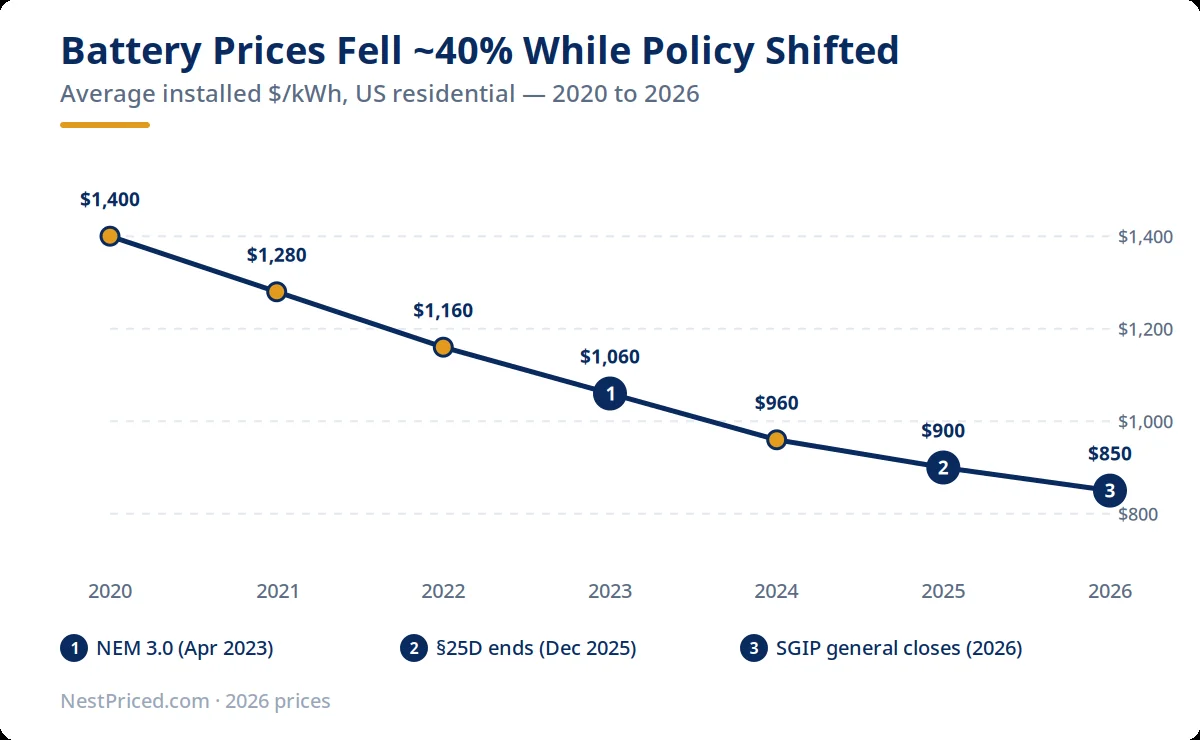
Battery prices fell ~40% since 2020 — from roughly $1,400/kWh to around $850/kWh on average, per 2026 market data. The sticker shock is real, but it’s less real than it was five years ago. Combined with LFP chemistry (longer life, safer, no cobalt) becoming the standard across the big three brands, 2026 is arguably the best year ever to buy a battery — as long as you price it with $0 federal credit and the right rate plan, not with 2024’s assumptions.
Solar Battery Cost in 2026: The Numbers
Let’s anchor on national benchmarks before brand names, because the market is wider than the three brands installers talk about.
National benchmarks (2026, before incentives):
– Typical single-battery install: ~$15,647 for ~13.5 kWh (EnergySage Marketplace, H1 2026).
– Essentials-only backup (1 battery, 10–13.5 kWh): $5,000–$18,000.
– Whole-home backup (2–3 batteries): $24,000–$40,000.
– Off-grid setups: $115,000+.
– A quality battery typically adds $8,000–$15,000 to a solar project.
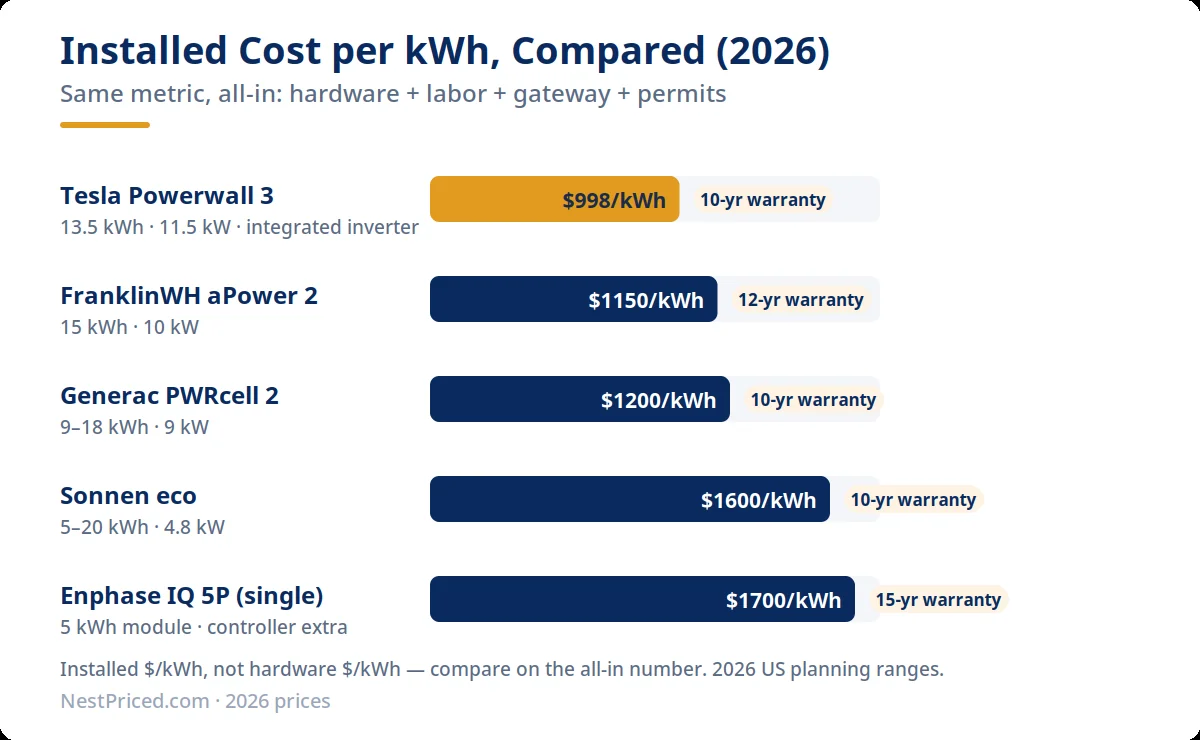
The $/kWh spread is enormous. EnergySage’s H1 2026 quoted data shows Tesla at $967/kWh on average, budget brands like MidNite Solar around $342/kWh, and premium small-batch brands up to $3,505/kWh (Fortress Power). Under $500/kWh exists; over $3,000/kWh exists. The headline number tells you almost nothing without knowing the brand, warranty, and what’s in the install. That said, the four brands below cover roughly 85% of California home battery installs — and California is the battery market in America.
| Battery | Usable capacity | Continuous power | Round-trip efficiency | Installed cost (2026) | $/kWh | Warranty |
|---|---|---|---|---|---|---|
| Tesla Powerwall 3 | 13.5 kWh | 11.5 kW | 89% | $12,000–$16,200 | ~$890–$1,200 | 10 yr / 70% retention / unlimited cycles* |
| Enphase IQ Battery 5P | 5 kWh (per module) | 3.84 kW | 96% | ~$8,500 (single) | ~$1,700 | 15 yr / 6,000 cycles |
| FranklinWH aPower 2 | 15 kWh | 10 kW | 96% | $14,000–$19,000 | ~$1,100–$1,200 | 12 yr |
| Generac PWRcell 2 | 9–18 kWh (modular) | 9 kW | ~96% | $12,000–$20,000 | ~$1,100–$1,300 | 10 yr |
| Sonnen eco | 5–20 kWh (modular) | 4.8 kW | ~90% | $10,000–$25,000 | ~$1,250–$2,000 | 10 yr / 10,000 cycles |
*2026 US national planning ranges for professional installation. Tesla’s unlimited-cycles warranty applies to solar self-consumption, time-based control, and backup use.
Three things in that table need unpacking, because this is where quotes go sideways.
First, $/kWh is the only honest way to compare batteries — but installed $/kWh, not hardware $/kWh. A $9,000 battery that needs $4,500 of install labor and a $1,100 gateway is a $14,600 battery. Compare on the all-in installed $/kWh and the games stop working. Note the asymmetry: the Powerwall 3 has the lowest $/kWh of the mainstream brands despite being a “premium” name, because the integrated inverter means one box does the work of two. Enphase looks expensive per kWh at $1,700 — but that single-module figure includes the $1,500–$2,000 IQ System Controller 2 that every first install needs; the second module costs far less per kWh.
Second, continuous power (kW) matters as much as capacity (kWh) — and most shoppers only look at kWh. Capacity is how long the battery lasts; power is what it can run at once. A 13.5 kWh battery at 5 kW continuous (the old Powerwall 2) can’t start a 4-ton AC. The Powerwall 3’s 11.5 kW continuous with 15.4 kW surge / 185 LRA motor-start is the spec that made whole-home backup from a single battery realistic. When an installer says “one battery covers your essentials,” ask for the kW number and match it against your big loads (AC, well pump, EV charger).
Third, the efficiency number wars. You’ll see “97.5%” attached to the Powerwall 3 on some sites and “89%” on others — both come from Tesla’s own datasheet, and neither site is lying, exactly. Tesla’s datasheet lists 89% round-trip efficiency (solar → battery → home) and separately 97.5% CEC-weighted inverter efficiency (solar → straight to home, no battery detour). Round-trip is the battery number that matters: for every 1 kWh you get back out, roughly 1.12 kWh went in. Enphase (96%) and FranklinWH (96%) measure the same thing, so compare apples to apples. A few third-party sites quote the Powerwall 3 as “97.5% round-trip” — that’s the datasheet misread; the battery’s round-trip is 89%.
Tesla Powerwall 3 — the benchmark
The battery every other battery is priced against. 13.5 kWh usable, 11.5 kW continuous, 22 kW peak (185 LRA motor start — enough for most central ACs), integrated 20 kW solar inverter with 6 MPPTs, stackable to 54 kWh across 4 units. The chemistry switched from NMC to LFP (lithium iron phosphate) — longer life, better heat tolerance, no cobalt. If a 2026 guide still lists Powerwall 3 specs as NMC, it’s recycling 2024 content.
2026 installed pricing: $12,000–$16,200, national average around $13,473 (~$998/kWh). Hardware-only runs $8,200–$10,000 online; the rest is install labor (~$6,100 typical, per multiple quote datasets), the Backup Gateway 3 ($900–$1,100 — required), and permits. The expansion pack — another 13.5 kWh unit added to an existing PW3 — runs $5,900–$6,200, which is why the “buy one now, add later” plan pencils out with Tesla.
Warranty: 10 years, 70% capacity retention, unlimited cycles for solar self-consumption, time-based control, and backup use. Note the guardrail: that unlimited-cycles term covers normal residential use patterns — read the exclusions before assuming it means commercial-scale cycling.
The Tesla-specific gotchas: it requires a Tesla-certified installer for the warranty to hold — no handy electrician special. And Tesla’s “Next Million” rebate ($500/unit, max $1,000 per address) closed to new orders June 30, 2026; only existing orders installed by December 31, 2026 still qualify. If a salesperson mentions it, check the order date. Can be installed standalone without solar (needs the Gateway 3), which matters for outage-only buyers.
Best for: most buyers. The lowest mainstream $/kWh, the highest continuous power in its class, and the only brand with a national certified-installer footprint.
Enphase IQ Battery 5P — the modular pick
The LEGO approach: 5 kWh per module, 3.84 kW continuous / 7.68 kW peak each, 96% round-trip, LFP, stack up to 4 modules (20 kWh). Need 10 kWh? Two modules. 20 kWh? Four. It’s the only mainstream battery that lets you buy exactly the capacity you need.
2026 installed pricing: ~$8,500 for the first module — which includes the IQ System Controller 2 ($1,500–$2,000) that every first install needs. That’s why single-module $/kWh looks brutal (~$1,700/kWh): you’re amortizing the controller over 5 kWh. Adding a module later: $6,000–$9,000 installed (each addition needs its own branch circuit and commissioning). The larger IQ 10C runs $12,000–$14,500 installed. Installer variance is wide here — one dataset lists $8,000–$12,000 per module — so get the itemized number.
Warranty: 15 years / 6,000 cycles — the best in the class. On a product you hope to own for 10–15 years, that 5-year edge over Tesla’s 10 is worth real money in the comparison. Enphase’s microinverter ecosystem also means the battery speaks the same language as the solar on your roof — one app, one monitoring view, no integration seams.
Best for: buyers who want to start small and expand, and anyone pairing with an existing Enphase solar system.
FranklinWH aPower 2 — the capacity-per-dollar pick
15 kWh usable — the most capacity of the mainstream three — with 10 kW continuous and 15 kW surge, 96% round-trip, LFP. The aGate energy-management hub is inverter-agnostic, so it plays well with any solar you already have. Outdoor-rated from −4°F to 122°F, which matters in the Mountain West and the South.
2026 installed pricing: $14,000–$19,000 ($1,100–$1,200/kWh) — the best mainstream $/kWh after Tesla, and the most absolute kWh per dollar. Adding a second aPower 2 cabinet later: $14,000–$22,000 installed.
Warranty: 12 years. Middle of the pack — better than Tesla’s 10, short of Enphase’s 15.
The catch: installer network is thinner than Tesla’s or Enphase’s, and it’s the newest brand of the three — less long-term reliability data. The Tesla Solar Roof obituary is the relevant cautionary tale: warranties are only as good as the company behind them in year 12.
Best for: maximum backup hours per dollar, especially in hot or cold climates (that temperature range) and with non-Tesla solar.
Generac PWRcell 2 and Sonnen eco — the specialists
Generac PWRcell 2: 9–18 kWh modular, 9 kW, $12,000–$20,000 installed; the larger M6 configurations run $23,000–$30,000 in Southern California. Generac’s advantage is the dealer network — it’s the generator company, so the “we’ll be here in 15 years” argument is credible, and generator+battery hybrid setups are their specialty.
Sonnen eco: 5–20 kWh modular, 4.8 kW, $10,000–$25,000, with a 10,000-cycle rating — the longevity play. Lower continuous power than the Powerwall 3, so it’s an essentials-backup battery, not a whole-home one. Premium pricing for a premium lifespan claim.
What Actually Drives Your Battery Price
Brand choice is maybe half the quote. The rest:
1. Capacity and the power/capacity pairing. More kWh = more money, roughly linearly — but the ratio matters. Two 13.5 kWh batteries ($24,000–$32,000 installed) don’t just double runtime; they double continuous power too, which is what lets you run the AC and the well pump. Size to your loads, not just your outage anxiety — the sizing table below shows how.
2. Chemistry — LFP won. All three mainstream brands now ship lithium iron phosphate. It’s safer (far lower thermal-runaway risk than the old NMC Powerwall 2), lasts longer, and uses no cobalt. If you’re quoted a battery with NMC chemistry in 2026, you’re being quoted old stock or an old datasheet — ask why.
3. New install vs. retrofit. Adding a battery to existing solar costs more per kWh than bundling it with a new solar install — one truck roll, one permit set, one electrical design instead of two. Typical retrofit premium: $1,000–$3,000 over the bundled price, depending on how much the electrical scope changes.
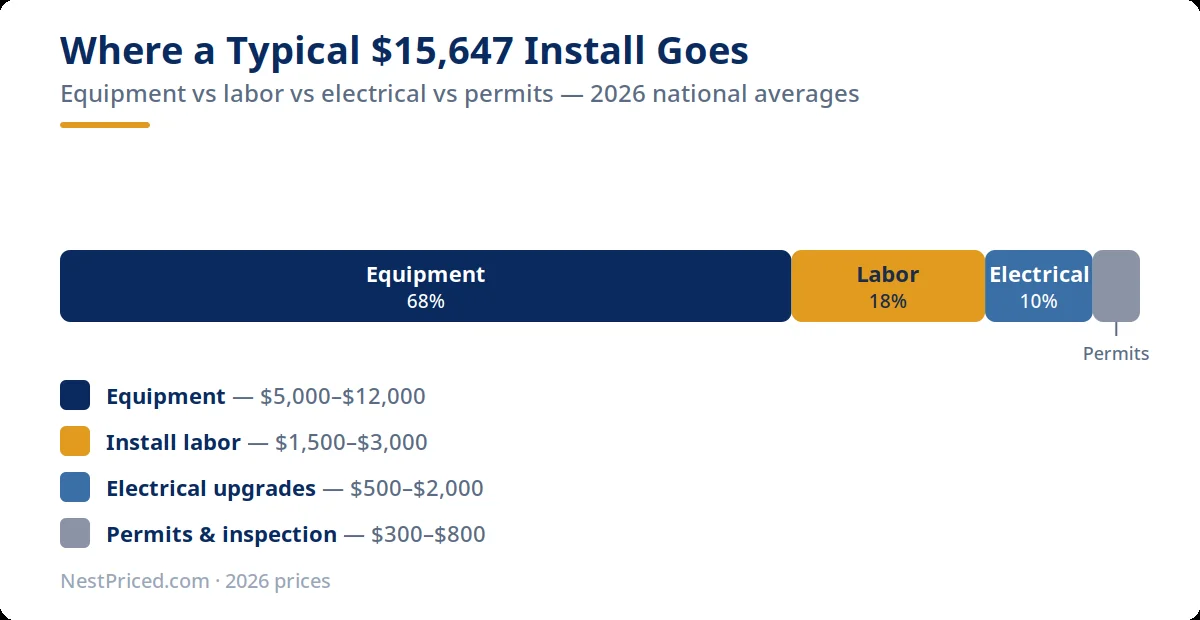
4. Electrical work — the quiet budget-killer. The standard cost breakdown: equipment $5,000–$12,000; install labor $1,500–$3,000; electrical upgrades $500–$2,000; permits/inspection $300–$800. The electrical line is where quotes diverge: a battery often needs a panel that can handle the backfeed, a critical-loads subpanel, or a full panel upgrade ($1,500–$4,000 — see our electrical panel upgrade cost guide). An old 100-amp panel plus a battery is a very common $2,000 surprise. Get the electrical scope itemized, not lumped.
5. Region and labor. EnergySage’s local 2026 data for ~13 kWh systems: California $1,037/kWh (~$13,482); Minneapolis $1,100/kWh; Kansas and Maine $1,200/kWh; Georgia $1,261/kWh; Philadelphia $1,350/kWh (~$17,550). Same battery, $4,000 spread by market — labor rates, permitting friction, and installer competition drive it.
2026 Incentives: The Real, Verified List
The federal picture is simple and brutal: $0 for homeowner-owned batteries placed in service in 2026 (§25D, OBBBA). What follows is everything that is still live — verified against program sources, not recycled 2024 roundups.
**Programs open and close without notice — verify before you budget.** SGIP general-market budgets closed mid-cycle. Oregon’s ODOE rebate filled in weeks. Treat every figure below as “verified November 2026, re-check before signing” — and never let a salesperson’s incentive math be the only source. DSIRE (dsireusa.org) is the neutral registry.
| Program | What it pays (2026) | Who qualifies | Status |
|---|---|---|---|
| Colorado: 10% battery tax credit | 10% of equipment + sales tax + shipping (min 3 kWh), via Form DR-1307 | CO homeowners | ✅ Live — expires Dec 31, 2026 unless extended |
| NYSERDA (NY): storage incentive | $200/kWh upstate · $250/kWh ConEd/PSEG-LI · $450/kWh income-qualified (ISI), capped at 25 kWh/home ($5,000–$11,250 max) | NY homeowners | ✅ Live — point-of-sale price reduction, rate locks at application |
| NY utilities: demand response | ConEd BYOB ~$100/kW-yr summer · NYSEG/RG&E ~$50/kW · National Grid ConnectedSolutions | Varies by utility | ✅ Live — BYOB enrollment required for NYSERDA since Apr 2026 |
| Connecticut: Energy Storage Solutions | $30/kWh enrollment ($130/kWh on grid-edge circuits) + $300–$550/kW-yr performance for 10 yrs; up to $16,000/installation | CT residential | ✅ Live |
| Massachusetts: ConnectedSolutions | Annual demand-response payments (Eversource/National Grid) + SMART program storage adder | MA (+CT/RI/NH for ConnectedSolutions) | ✅ Live |
| California: SGIP RSSE | $1,100/kWh battery + $3,100/kW paired solar | Income-qualified households | ✅ Live — $280M authorized; waitlist in SDG&E territory |
| California: SGIP Equity Resiliency | $1,000/kWh (standalone battery eligible, no solar required) | High-fire-threat areas, PSPS-affected, medical baseline | ✅ Live |
| California: property tax exclusion | Battery + solar excluded from property tax assessment | CA homeowners | ✅ Through systems qualifying before Jan 1, 2027 |
| Oregon: Energy Trust | $2,500 solar + $400/kWh storage (capped $5,000) | PGE/Pacific Power customers | ✅ Live (ODOE’s separate rebate: ❌ fully reserved/closed) |
| Xcel CO: Renewable Battery Connect | Up to $5,000 rebate | Xcel customers | ✅ Reopened — Xcel’s Oct 2026 dashboard shows 2026 budget funds available; re-verify funding before budgeting |
| Xcel CO: wildfire-zone battery rebate | Up to $10,000 | Tier 2/3 wildfire zones + medical equipment | ✅ Live (PSPS program) |
| §48E commercial credit | ~30% — claimed by provider, passed through as lower payments | Lease/PPA customers | ✅ Through Dec 31, 2027 (new-start systems) |
| Federal §25D | $0 for 2026 owned installs | — | ❌ Ended Dec 31, 2025 |
| CA SGIP general market | Was $150–$500/kWh | — | ❌ Closed to new 2026 reservations |
| Tesla “Next Million” rebate | $500/unit, max $1,000/address | — | ❌ Closed to new orders Jun 30, 2026 |
Three incentive traps to avoid:
- “Stack HEAR on your battery.” No. HEAR/HEEHR covers heat pumps, heat pump water heaters, and electrical upgrades — not batteries, not solar. Anyone stacking it onto a battery quote is wrong or worse.
- “The 30% credit, just file it.” Also no — and this is where the IRS timing rule bites: the expenditure counts when installation is completed, not when you paid. A deposit in 2025 with a March 2026 install = $0 credit. (Full credit breakdown.)
- “SGIP $150–$500/kWh for everyone.” That was the general-market rate, and the general market is closed. The live California money is income-qualified (RSSE) or resilience-targeted (Equity Resiliency) — both excellent if you qualify, both $0 if you don’t.
The honest best-case states in 2026: New York (NYSERDA + BYOB is the only full stack left — upfront money and annual payments), Colorado (10% credit + utility rebates, but the clock expires December 31, 2026), Connecticut ($16,000/installation cap is the richest per-home number in the country), and California for income-qualified or fire-zone households (RSSE/Equity Resiliency pay the most per kWh of any program).
The Payback Math: Three Scenarios, No Credit
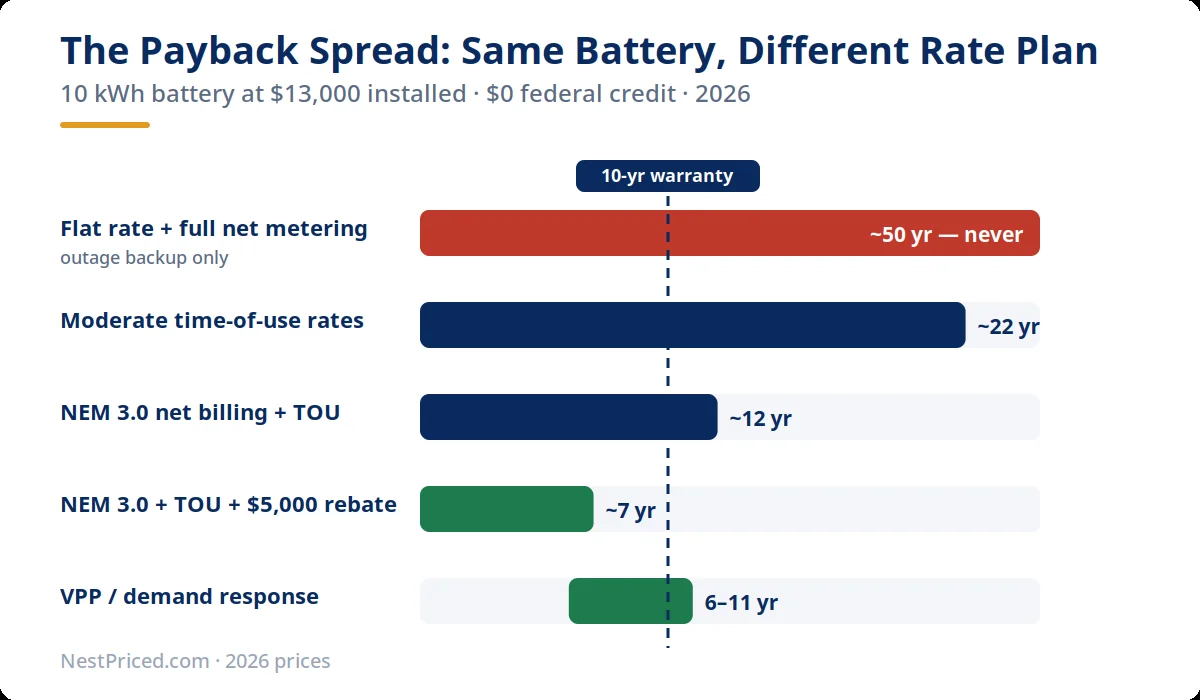
This is the section almost nobody has re-run since the credit died. All scenarios: 10 kWh battery at $13,000 installed, $0 federal credit, 2026 rates.
| Scenario | How it earns | Annual value | Simple payback |
|---|---|---|---|
| A. Flat rate + full net metering | Outage backup only (no rate arbitrage) | ~$260/yr (avoided outage costs, estimated) | ~50 years — never |
| B. Moderate time-of-use rates | TOU arbitrage (~$0.27/kWh spread in high-spread markets) | ~$590/yr | ~22 years |
| C. NEM 3.0-style net billing + TOU | Store midday solar, discharge at peak; export worth only 5–8¢/kWh | ~$1,080/yr | ~12 years |
| C + $5,000 state rebate | Same as C, minus rebate off the top | ~$1,080/yr on $8,000 net | ~7 years |
| VPP-enrolled, peak-demand rates | Utility dispatches your battery; $1,100–$1,600/yr total savings | ~$1,100–$1,600/yr | 6–11 years (only beats the 10-yr warranty on cheaper installs) |
The pattern is unmistakable: the rate plan is the payback. Scenario A vs. Scenario C is the same battery, same price — and the difference between “never” and “12 years” is entirely the utility’s rate design. Before you price a battery, pull your actual rate schedule: flat-rate customers should buy a battery only for outage protection (and price it honestly as insurance, not an investment); TOU and net-billing customers can treat it as a financial product.
The California special case: NEM 3.0 flipped the entire state into Scenario C. Solar-only payback: 9–13 years. Solar + battery: 7–9 years. The battery doesn’t just pay for itself — it shortens the solar payback, because every kWh you store and self-consume is a kWh you’re not exporting for 5–8¢ and re-buying at 30–40¢. If you have California solar and no battery, the battery quote deserves a real look.
One more lever: NEM 2.0 grandfathering. Existing NEM 2.0 customers (20-year protection from activation) can add a battery without losing grandfathered status. That’s a meaningful planning point: you keep the old generous export rates and get backup.
How Many kWh Do You Actually Need? (Sizing Guide)
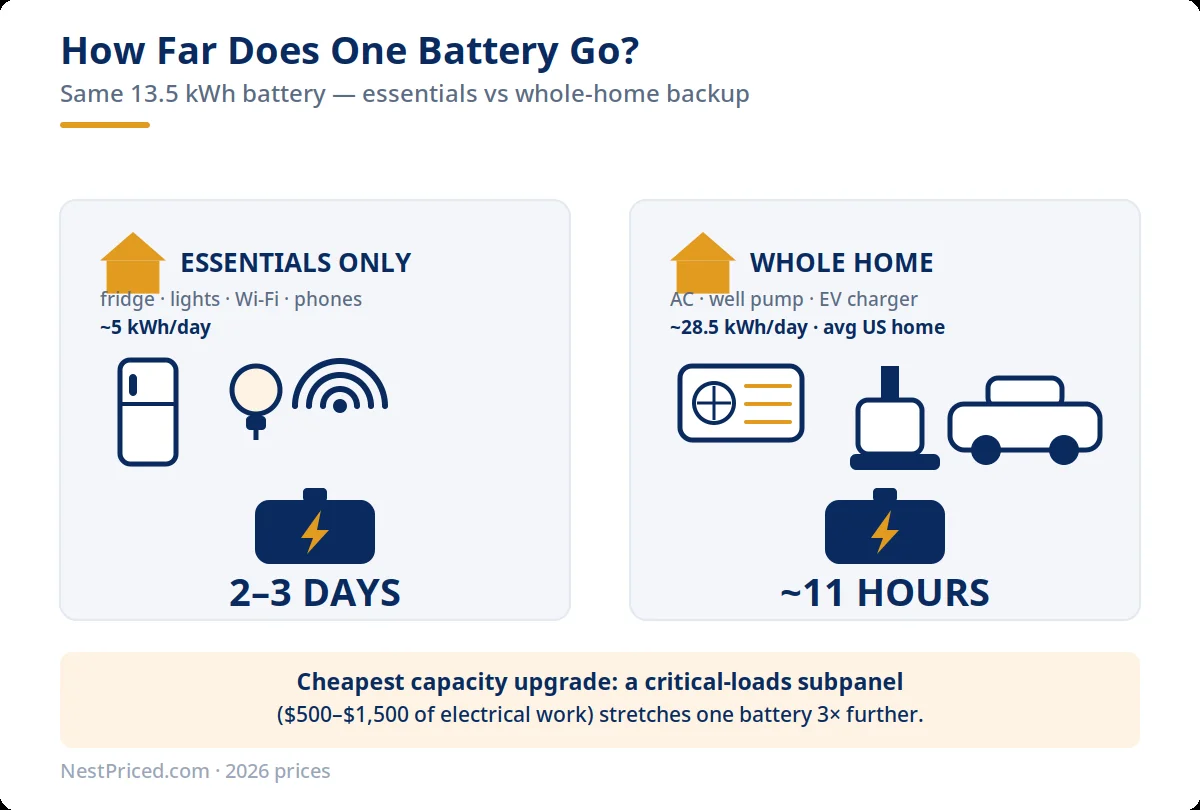
The average US home uses ~28.5 kWh per day. A single 13.5 kWh battery (Powerwall 3) powers that average home for about 11 hours 25 minutes — roughly one evening and night. But “average” isn’t a sizing method. Size to your goal:
| Your goal | What it means | Battery size | Typical cost (2026) |
|---|---|---|---|
| Ride through short outages (2–6 hrs) | Fridge, lights, Wi-Fi, phones — ~210W continuous, ~5 kWh/day | 1 battery, 10–13.5 kWh | $5,000–$18,000 |
| Overnight self-consumption (TOU arbitrage) | Shift evening peak usage off-grid daily | 1 battery, 13.5–15 kWh | $12,000–$19,000 |
| Whole-home backup (1 day) | Everything including AC for ~24 hrs | 2–3 batteries, 27–40 kWh | $24,000–$40,000 |
| Multi-day resilience (storms, PSPS) | Essentials for 2–3 days; indefinitely with modest solar | 2+ batteries + existing solar | $24,000–$40,000+ |
| Off-grid | No utility at all | Large stack + oversized solar | $115,000+ |
Two sizing rules installers won’t volunteer:
- Essential loads stretch a battery 3× further than whole-home. That 210W essentials bundle (fridge + LEDs + Wi-Fi) draws ~5 kWh/day — one 13.5 kWh battery covers it for 2–3 days, and indefinitely with even modest daytime solar. Whole-home including AC burns the same battery in under half a day. The critical-loads subpanel ($500–$1,500 of electrical work) is the cheapest capacity upgrade you can buy.
- kW gates kWh. If your goal includes the AC, well pump, or EV charger, check continuous power first. Two 5 kWh Enphase modules (7.68 kW combined) may outlast your needs in hours but stall on the AC’s startup surge — while one Powerwall 3 (11.5 kW / 185 LRA) starts it. Match the kW to your biggest motor, then the kWh to your hours.
**Adding solar later? Size the battery for the future system, not today’s roof.** A battery bought for outage-only use today becomes a daily-cycling TOU asset the day panels go up. Buying the slightly larger battery now is cheaper than adding a second cabinet later (second installs carry their own labor, circuit, and commissioning costs).
When a Battery Wins — and When It Loses
Buy the battery when most of these are true:
– You’re on time-of-use rates with a big peak/off-peak spread, or on NEM 3.0-style net billing with 5–8¢ export credits. The rate plan is the business case.
– A live state rebate cuts your net cost — NY, CO (before Dec 31, 2026), CT, MA, or CA’s RSSE/Equity Resiliency.
– You have frequent or long outages (PSPS zones, hurricane corridors, rural feeders) and you’d otherwise buy a generator. Price the battery against a $10,000–$15,000 whole-home generator, not against $0.
– You’re bundling with new solar — one install, one permit, one electrical design, and the battery shortens the solar payback itself.
– You can join a VPP or demand-response program (ConnectedSolutions, BYOB) that pays you annually for the battery you were buying anyway.
Skip it (for now) when:
– You’re on a flat rate with full net metering — Scenario A payback is ~50 years. The battery is a very expensive UPS.
– Your panel is 100 amps and maxed out — the $1,500–$4,000 panel upgrade (cost guide) plus the battery can push the project past what the savings support. Do the electrical math first.
– You’re selling within 5 years — owned batteries add some resale value, but rarely the full installed cost. (Leased batteries can actively complicate a sale.)
– The quote is single-bidder with no itemization — battery quotes vary more than solar quotes. One number with no breakdown is a price tag on a mystery box.
How to Compare Battery Quotes (What “Good” Looks Like)
Every quote must itemize: battery model and quantity, usable kWh (not nameplate), continuous kW, all-in installed $/kWh, Gateway/controller model and cost, electrical scope (subpanel? panel upgrade? trenching?), permits and interconnection fees, warranty terms (years, capacity retention %, cycle terms), and the production/dispatch assumptions behind any savings claim.
Battery-quote traps:
– Nameplate vs. usable kWh. “15 kWh” with 90% usable depth is a 13.5 kWh battery. Compare on usable kWh — it’s what the NYSERDA incentive pays on, too.
– The savings math uses 2024 assumptions. Any payback table that subtracts a 30% credit or uses 30–40¢ export credits is fiction. Ask for the math at $0 credit with your rate schedule.
– “Free battery with solar!” — it’s a lease or PPA with an escalator clause, and the provider is keeping the §48E credit. Compare the 25-year total, not month one.
– Missing Gateway/controller. The $900–$1,100 Gateway 3 (Tesla) or $1,500–$2,000 System Controller 2 (Enphase) “appearing” later is a classic. Demand it in the first quote.
– Installer pushes one brand. Neutral ground: get one quote from a Tesla-certified installer, one from an Enphase shop, and compare installed $/kWh with warranties side by side. The table at the top of this article is your cheat sheet.
The question that ends confusion: “Show me this same quote with the battery removed — what’s the battery’s marginal cost, and what’s its payback on my rate plan alone?” The honest installers answer in numbers. The others change the subject.
Sources & methodology
Cost figures compiled November 2026 from published 2026 cost guides and installer-published pricing: EnergySage Marketplace H1 2026 battery data (~$15,647 typical 13.5 kWh install; $967/kWh Tesla avg quoted; regional $/kWh for CA/Philadelphia/Minneapolis/Georgia/Kansas/Maine; backup-goal cost bands; 28.5 kWh/day average home; 11h25m runtime; essentials-load math) — energysage.com, updated Jul–Nov 2026. Tesla Powerwall 3 installed pricing ($12,000–$16,200; ~$13,473 national avg; hardware $8,200–$10,000; labor ~$6,100; Gateway 3 $900–$1,100; expansion $5,900–$6,200) — nuwattenergy.com (Jun 2026), ecoflow.com (Oct 2026), a1solarstore.com. Powerwall 3 specs (13.5 kWh usable, 11.5 kW continuous, 22 kW peak/185 LRA, 20 kW inverter w/ 6 MPPTs, LFP, 54 kWh stackable, 10-yr/70%/unlimited-cycles warranty) — nuwattenergy.com, heliosenergyglobal.com, gosolarindex.com. Round-trip efficiency 89% / inverter 97.5% CEC verified against Tesla’s official Powerwall 3 datasheet (energylibrary.tesla.com, US edition, checked Nov 2026) — this resolves the 89%-vs-97.5% conflict: 89% is battery round-trip, 97.5% is solar-to-grid inverter efficiency. Enphase 5P specs/pricing ($8,500 single incl. System Controller 2; $1,700/kWh; 15-yr/6,000-cycle warranty; $6,000–$9,000 per add-on module; IQ 10C $12,000–$14,500) — nuwattenergy.com (Apr 2026), theword360.com, elevatehomeguide.space (Oct 2026). FranklinWH aPower 2 (15 kWh, 10 kW, 96%, $14,000–$19,000, $1,100–$1,200/kWh, 12-yr warranty, −4°F–122°F) — ohmsnap.com, temeculasolarsavings.com, theword360.com. Generac PWRcell 2 / Sonnen eco pricing — simplesolarguide.com, temeculasolarsavings.com. CA 4-brand/85% concentration — temeculasolarsavings.com (early 2026). Federal: OBBBA P.L. 119-21 (§25D $0 for 2026, incl. standalone batteries; IRS completion-timing rule) — nuwattenergy.com, theword360.com, energybs.com; §48E lease/PPA path through Dec 31, 2027 — ocsolar.com, truesolarpayback.com; HEAR exclusion for batteries — retrofitrelay.com. State programs: CA SGIP general closed / RSSE $1,100/kWh + $3,100/kW ($280M, SDG&E waitlist) / Equity Resiliency $1,000/kWh / property-tax exclusion — ocsolar.com, energyscout.org, franklinwh.com, cainitiative.com. Colorado 10% battery tax credit (Form DR-1307, min 3 kWh, non-refundable, equipment+tax+shipping; expires Dec 31, 2026 per 2026 guides) verified via CO Dept of Revenue DR-1307 materials and CRS 39-22-546 citations — legalclarity.org, surgepv.com, harnessoursun.com, lunexpower.com (one source cites repeal Jan 1, 2028 — treat Dec 31, 2026 as the planning deadline and re-verify on DSIRE). NYSERDA residential storage ($200/kWh upstate, $250/kWh ConEd/PSEG-LI, $450/kWh ISI, 25 kWh cap; point-of-sale reduction; BYOB required since Apr 1, 2026) verified via NYSERDA program manual citations — kasselmansolar.com (Jul–Oct 2026, citing NYSERDA dashboard + Apr 2026 program manual), profusion.solutions, nyseg.com, rge.com. CT Energy Storage Solutions ($30/kWh, $130 grid-edge, $300–$550/kW-yr, $16k cap) — ecogenamerica.com (Oct 2026), energysage.com. MA ConnectedSolutions + SMART adder — energysage.com (Feb 2026). OR: ODOE closed/fully reserved (Jun 2026) — oregon.gov; Energy Trust $2,500 + $400/kWh cap $5,000 — earthlighttech.com. Xcel Renewable Battery Connect ($250/kW up to $5,000; funding closed Feb 2026, reopened — Xcel’s Oct 2026 budget dashboard shows 2026 funds available) / Safe-for-Colorado PSPS wildfire rebate up to $10,000 — harnessoursun.com, co.my.xcelenergy.com, solcountry.com. NEM 3.0 (export 5–8¢/kWh, ~75% cut; solar-only 9–13 yr / solar+battery 7–9 yr payback; upheld Mar 2026) — elecguys.net, allyelectricandsolar.com. Battery-only payback scenarios (10 kWh @ $13,000: flat-rate ~50 yr, TOU ~22 yr, NEM 3.0+TOU ~12 yr, +$5,000 rebate ~7 yr) — truesolarpayback.com (Jun 2026). TOU arbitrage $0.27/kWh — energy-solutions.co. VPP $1,100–$1,600/yr → 6–11 yr payback — energybs.com. Cost decline ~40% 2020–2026 (~$1,400 → ~$850/kWh) — energy-solutions.co. NEM 2.0 grandfathering preserved when adding battery — allyelectricandsolar.com (Oct 2026). Competitor staleness examples (30% credit still listed Nov 2026; Powerwall 2 specs as current; general SGIP as live; ODOE as live; 97.5% quoted as round-trip) documented from live SERP pages, Nov 2026. All figures are 2026 US national planning ranges, not quotes.
Disclaimer: Prices are 2026 US national averages and vary by region, installer, system size, and electrical scope. Always get 3 written, itemized local quotes. Tax and incentive information is general and not tax advice — confirm eligibility with a tax professional and verify program status on DSIRE before budgeting, as programs open and close without notice. Battery installation involves high-voltage electrical work: use licensed contractors and pull permits. This article covers cost information only, not installation instructions.
How much does a Tesla Powerwall 3 cost in 2026?
$12,000–$16,200 installed is the typical range, with a national average around $13,473 (~$998/kWh). Hardware alone runs $8,200–$10,000; the rest is install labor (~$6,100 typical), the required Backup Gateway 3 ($900–$1,100), and permits. An expansion pack (another 13.5 kWh on an existing PW3) costs $5,900–$6,200 — notably cheaper per kWh than the first unit.
Can I get the 30% federal tax credit for a battery in 2026?
No — not on a homeowner-owned purchase. §25D covered standalone batteries too, and it ended for property placed in service after December 31, 2025. The surviving path is a lease or PPA, where the provider claims the ~30% commercial §48E credit and passes part of it through as lower payments (new-start systems must be in service by December 31, 2027). Note the IRS timing rule: what matters is when installation is completed, not when you paid.
Is a solar battery worth it without solar panels?
Sometimes — for outage protection, yes; as an investment, rarely. Without solar, the battery can only do TOU arbitrage (charge cheap overnight, discharge at peak), which pays back slowly on most rate plans. The exceptions: California’s SGIP Equity Resiliency program explicitly covers standalone batteries ($1,000/kWh for fire-zone/PSPS/medical-baseline households), and Xcel’s wildfire-zone rebate (up to $10,000) doesn’t require solar either. Everywhere else, pair it with solar or price it as insurance.
How many kWh of battery do I need?
For essentials (fridge, lights, Wi-Fi — ~5 kWh/day), one 10–13.5 kWh battery covers 2–3 days. For overnight TOU shifting, 13.5–15 kWh. For whole-home backup including AC, 27–40 kWh (2–3 batteries, $24,000–$40,000). Check continuous kW against your biggest motor (AC, well pump) before finalizing — power gates capacity.
What’s the difference between the Powerwall 3’s 89% and 97.5% efficiency figures?
Both are from Tesla’s datasheet and they measure different things. 89% is the battery round-trip efficiency (solar → battery → home): about 11% is lost in the charge/discharge cycle. 97.5% is the CEC-weighted inverter efficiency (solar → straight to home, bypassing the battery). When comparing batteries, use round-trip to round-trip: Enphase 5P and FranklinWH aPower 2 are both 96%.
How long does a solar battery last?
10–15 years of useful life, matching the warranties: Tesla 10 years (70% retention, unlimited cycles for normal residential use), FranklinWH 12 years, Enphase 15 years / 6,000 cycles, Sonnen a 10,000-cycle rating. Budget for the possibility of one replacement inside a 25-year solar system’s life — and note that the inverter/electronics are the parts most likely to need attention first.
Can I add a battery to my existing solar system?
Yes — and if you’re a California NEM 2.0 customer, you can do it without losing your grandfathered export rates (20-year protection from activation). Expect a retrofit premium of roughly $1,000–$3,000 over bundling: separate truck roll, permits, and electrical design. Tesla requires a certified installer for warranty coverage; Enphase and FranklinWH are more installer-flexible.
Do solar batteries work during a power outage?
Yes — that’s their core job — but with caveats. The battery must be installed with backup capability (islanding equipment like Tesla’s Gateway 3 or Enphase’s System Controller 2), which is standard on backup quotes but not on every “storage-only” install. Without solar, the battery can’t recharge during a multi-day outage. And a battery sized for overnight TOU shifting may only run your whole home for a few hours — size to your outage goal, not your bill goal.