


Colorado is the state where the sales pitch and the spreadsheet disagree in both directions at once. The pitch says the sun does the work, and on that point the pitch understates its case: a kilowatt of panels on a Colorado roof makes about 1,656 kilowatt-hours a year, a yield most of the country cannot touch, because the air is thin, dry, and cold, and the sky stays open for long stretches of the year. The pitch also says solar is cheap here, and that part is wrong. At $3.02 a watt, Colorado installs cost more than the national average, and the bill the panels have to beat is among the smallest in the country — about $113 to $116 a month for the average home, on roughly 660 to 700 kilowatt-hours of use. A small bill is a slow payback, however bright the roof. The honest Colorado story is a strong resource meeting a modest bill, with the export rule doing most of the heavy lifting in between.
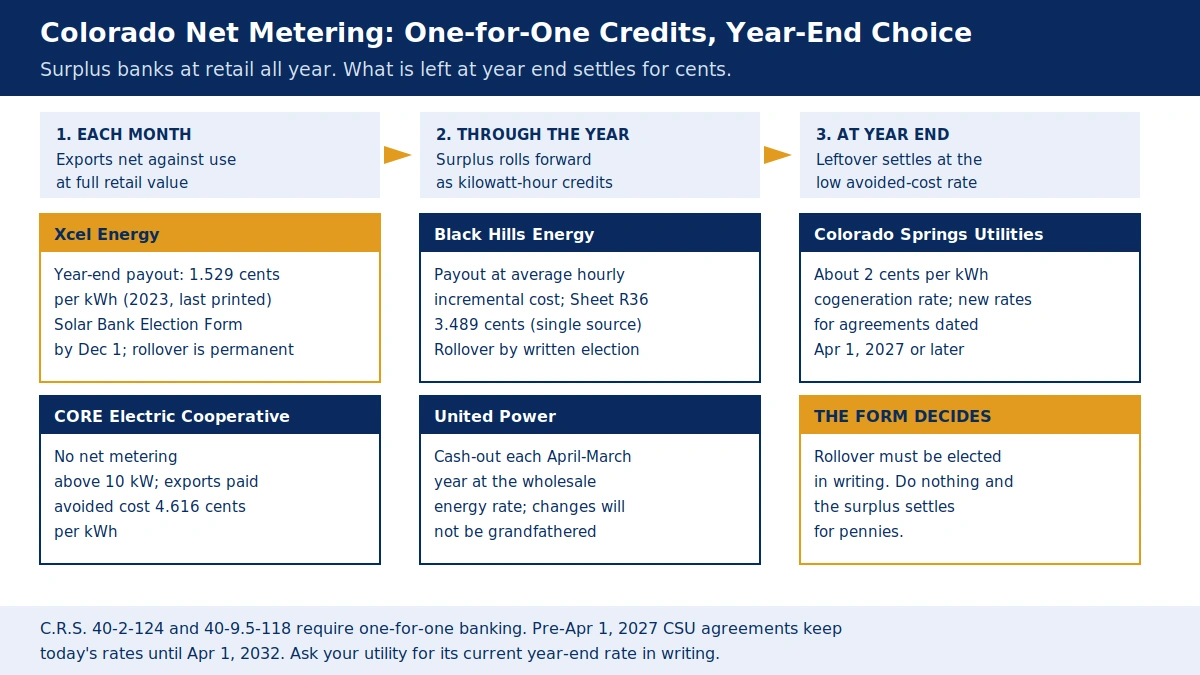
That export rule is the best in the region and the most misunderstood. Colorado law still requires Xcel, Black Hills, the co-ops, and the larger city utilities to credit every exported kilowatt-hour against a kilowatt-hour the house later uses, at full retail value, month after month. No other Mountain West state pairs that rule with this much sun. But the rule has a year-end edge that swallows the unwary: whatever credit is still sitting in the bank when the year closes settles at an avoided-cost rate worth a few cents, unless the homeowner filed a rollover election in writing. Xcel’s last printed settlement figure is 1.529 cents. Colorado Springs pays about 2 cents. A system sized past the home’s own annual use spends its extra kilowatts earning those pennies, and the sizing section below shows exactly where that line falls for the average Colorado home.
The state is also a patchwork of utilities that price the same sunlight four different ways, and the patchwork is about to shift. Xcel, serving about 55% of Colorado homes, moved every residential customer onto a time-of-use rate in November 2025 whose expensive window — 5 p.m. to 9 p.m. on weekdays — opens just as the panels are finishing for the day. Colorado Springs Utilities, serving the state’s second city, has already voted in new solar rates that take effect for agreements dated April 1, 2027, and add roughly $38 a month to a solar home’s bill. The co-ops write their own year-end rules, one of them stops net metering altogether above 10 kW, and the mountain co-op that pays a rebate caps it at $100 a kilowatt. A statewide average hides all of that. This guide prices the state utility by utility, city by city, and flags every figure that rests on a single source or a stale page, starting with the most famous sunshine claim in American tourism.
Table of Contents
How Much Do Solar Panels Cost in Colorado in 2026?
Three measures describe the Colorado market in 2026, and the spread between them is itself useful information, because each one counts a different kind of buyer. The headline number in this guide comes from the EcoGen Solar Cost Index for September 2026: $3.02 for each watt, before any incentive, which puts the typical 7.00 kW Colorado installation at $21,140. That is 4.5% above the national average of $2.89 a watt, tied for 37th lowest of 51 jurisdictions, and dearer than every neighboring state except Wyoming: New Mexico runs $2.71, Kansas $2.87, Nebraska $2.91, Utah $3.01, and Wyoming $3.14. Colorado is not an expensive state for solar in absolute terms, but it is the expensive end of its own neighborhood, and the reasons — altitude labor, hail-rated equipment, smaller typical systems — show up in the quote drivers near the end of this guide.
A second, independent reading comes from live marketplace quotes. EnergySage, as of November 2026, puts Colorado at $2.63 a watt — thirty-nine cents below the EcoGen anchor — but on a much bigger system: its average Colorado system is 11.36 kW, priced at about $29,886, with quotes ranging from $25,403 to $34,369. Read the size gap before the price gap. What flows through EnergySage’s marketplace is an average of real quotes, and the Colorado shoppers behind them skew toward big systems: larger Front Range homes, a driveway EV, a heat pump replacing gas heat, a household planning for more load than it has today. The 7.00 kW typical size is Berkeley Lab’s median across 6,702 Colorado systems installed in 2025 — the size Coloradans actually chose — and EcoGen builds its typical-system price around that median. Whenever this guide says ‘typical system,’ it means that 7.00 kW median. EnergySage still serves as a useful check on the per-watt price: $2.63 against $3.02, two independent measures thirty-nine cents apart, both describing the same market from different angles. A June 2026 EnergySage marketplace reading put competitive Colorado quotes at about $2.67 a watt, which sits comfortably inside that picture.
A third set of figures completes the frame, and each one needs a label before it is leaned on. NumeralQ’s planning estimates, built from EnergySage and SolarReviews data retrieved in October 2026, price an 8 kW Colorado system at $19,710 to $25,760, or $2.46 to $3.22 a watt — a planning range, not a record of quotes, and labeled as one wherever it appears here. SolarReviews, published November 2026, puts Colorado at $3.41 a watt on a 4.9 kW average system, about $17,799 — a national-model estimate built from NREL, EIA, and Bureau of Labor Statistics data rather than Colorado quotes, on a system far smaller than the state median, and its “after tax credit” figure still subtracts a 30% federal credit that ended on December 31, 2025, which is why it is excluded from the headline entirely. SolarSpecHub’s state table prices Colorado at $3.00 a watt — a February 2026 planning estimate, close to the anchor but not a quote record. Put the anchors together and Colorado sits a little above the national average on price, with the honest quote range running from the mid-$2.60s for competitive marketplace bids to just over $3.00 for the median installed job.
One per-watt figure has to absorb the whole installation: modules, inverter or microinverters, racking, wiring, labor, permits, inspection, and the utility interconnection paperwork. A new roof, a panel upgrade, tree work, a battery, and hail-rated module upgrades are all priced separately, outside that number. Nothing in that arithmetic assumes an incentive, because for most Colorado buyers no 2026 program cuts the purchase price of the panels at all — the federal credit has ended, no general state rebate exists, and the state has no income-tax credit for panels. Colorado’s 2.9% state sales-tax exemption on equipment is already reflected in the quoted price, because the tax never gets charged at the point of sale — deducting it again from the quote would count the same saving twice. The one large panel rebate in the state, Xcel’s Solar*Rewards, reaches only income-qualified homes, and the incentives section below prices it separately, so the headline stays honest for everyone else. For most Colorado buyers, the quoted price is the price they actually pay. Any quote that subtracts a further credit from that price is still using the tax law that expired on December 31, 2025.
One more caution before the tables: the cheapest quote in Colorado is rarely the cheapest system once the job is done, and the financing structure is where the difference hides. Berkeley Lab’s 2026 update puts the 2025 national median at about $3.60 a watt for homeowner-owned systems, with loan-financed systems running about $4.50 — higher in part because loan fees are rolled into the contract price. Colorado guides that track door-to-door and finance-loaded quotes put them far above the competitive range. With quotes from Denver, Colorado Springs, Boulder, and Fort Collins installers spread across the table, the cash price per watt for the same panels on the same Colorado roof is the one number that lets you judge bidder against bidder. Get the cash price per watt in writing from three installers, and stop considering any bidder who will only quote a monthly payment. In a state where the year-end settlement and the rate schedule decide what the power is worth, that third quote is also the check that the company you are talking to understands your utility’s tariff — and still answers the phone after the install.
| Source | $ per watt | System | Cash total | Payback |
|---|---|---|---|---|
| EcoGen Index (Sep 2026) | $3.02 | 7.00 kW | ~$21,140 | ~12.2 yrs statewide |
| EnergySage (Nov 2026) | $2.63 | 11.36 kW avg | ~$29,886 | 15.66 yrs — flagged, modeled |
| EnergySage (Jun 2026) | $2.67 | Marketplace avg | Not published | Not published |
| NumeralQ planning (Oct 2026) | $2.46-$3.22 | 8 kW | ~$19,710-$25,760 | Not published |
| SolarReviews (Nov 2026) | $3.41 | 4.9 kW avg | ~$17,799 | Not published |
| SolarSpecHub planning (Feb 2026) | $3.00 | Not stated | Not published | 11 yrs — flagged, modeled |
| National range (article 4) | $2.25-$3.30 | 8.2 kW | ~$24,600 at $3.00/W | 6-12 yrs |
Before trusting the table, read the footnotes on two of its rows — they change what the numbers mean. EnergySage’s 15.66-year payback is a modeled estimate built on its own marketplace averages — an 11.36 kW system on a home using roughly 7,920 kilowatt-hours a year — and it runs longer than EcoGen’s per-utility figures of 10.3 to 14.6 years, because the surplus power in that model settles at the low year-end rate. SolarReviews’ $3.41 and SolarSpecHub’s $3.00 are a national model and a planning estimate, not Colorado quotes, and they are excluded from the headline for that reason. EcoGen supplies the headline figures throughout this guide; EnergySage figures appear only as a cross-check, never as the headline.
Solar Panel Cost in Colorado by System Size
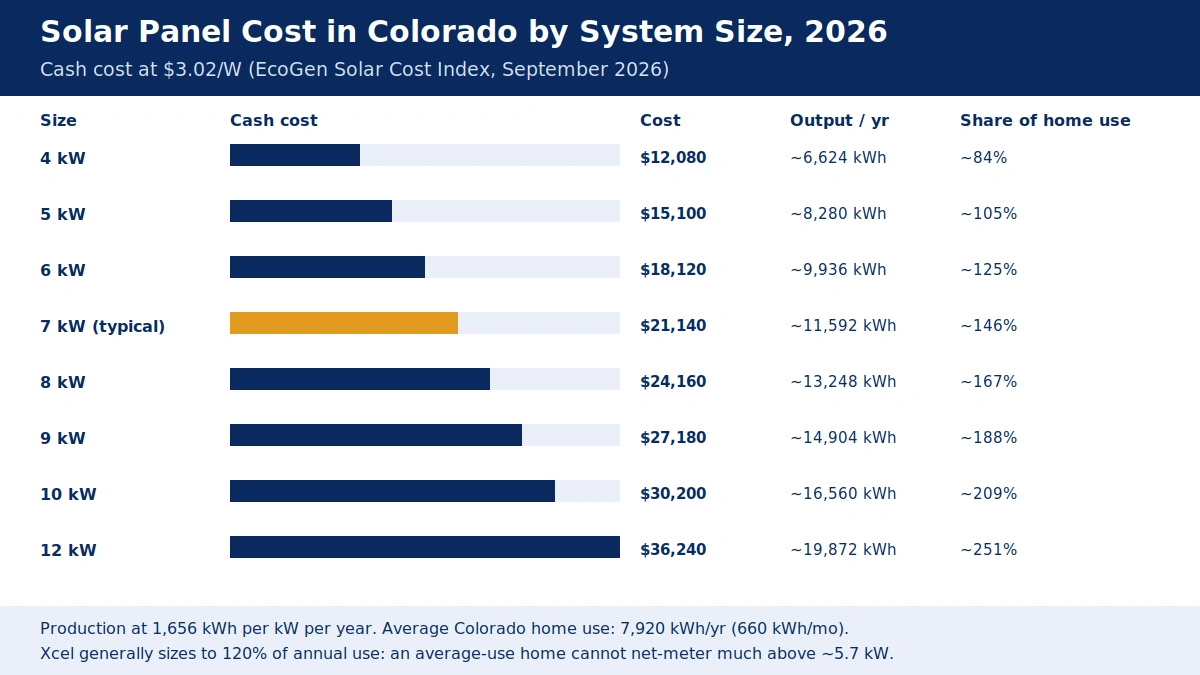
Start with size, because Colorado turns the usual sizing question around: the typical installation already produces far more than the average home consumes, so the real question is how much of that surplus the house can ever absorb. Billing data puts the average Colorado home near 660 kilowatt-hours a month, or roughly 7,920 a year — the EIA average EcoGen cites, sitting inside a 658 to 701 kilowatt-hour spread across 12-month tabulations to August 2026. At roughly 1,656 kilowatt-hours per installed kilowatt each year, a 5 kW array makes about 8,280 kilowatt-hours — around 105% of what an average Colorado home uses in a year. A typical 7.00 kW system generates about 11,592 kilowatt-hours a year, which is roughly 146% of average household consumption. Since 5 kW already covers average consumption in full, this guide treats 5 kW as the average-home size and 7.00 kW as the average-buyer size, for households whose consumption runs well above the state average. The paper is the problem: demand swings unevenly through the year, and output does the same, and the year-end settlement pays pennies for whatever is left.
Oversizing pays off worse here than the one-for-one headline suggests — surplus kilowatt-hours earn full retail credit and roll forward through the year, yet whatever remains at the settlement earns the low avoided-cost rate, and several utilities cap the system size outright. While credits roll forward, a kilowatt-hour exported in June and drawn back in January still offsets a full retail kilowatt-hour — the generous half of Colorado’s arrangement. A kilowatt-hour that is still sitting in the bank at the settlement earns 1.529 cents at Xcel on the last printed figure, which is the part that punishes oversizing. Past that crossover, an additional kilowatt no longer feeds the house directly; it banks electricity the household may never use. Two EcoGen anchors run through the whole table: $3.02 per watt for price, and 1,656 kilowatt-hours per installed kilowatt per year for output. The final column gives each size’s output as a share of average home use, so the crossover from self-consumption to banking is visible in one glance.
| Size | Cash cost at $3.02/W | Annual output | Share of a typical Colorado home’s use (7,920 kWh/yr) |
|---|---|---|---|
| 4 kW | $12,080 | ~6,624 kWh | ~84% |
| 5 kW | $15,100 | ~8,280 kWh | ~105% |
| 6 kW | $18,120 | ~9,936 kWh | ~125% |
| 7 kW (state typical) | ~$21,140 | ~11,592 kWh | ~146% |
| 8 kW | $24,160 | ~13,248 kWh | ~167% |
| 9 kW | $27,180 | ~14,904 kWh | ~188% |
| 10 kW | $30,200 | ~16,560 kWh | ~209% |
| 12 kW | $36,240 | ~19,872 kWh | ~251% |
Two rows deserve a closer look. First, a 5 kW system on its own already reaches about 105% of average annual use, which means every kilowatt beyond 5 kW on an average-use home produces power the house cannot consume directly — it banks at retail through the year, and any remainder settles at the avoided-cost rate. Second, the sizing caps put a ceiling on the table that the numbers alone do not show: Xcel generally sizes residential systems to 120% of annual use, which for an average-use home means about 5.7 kW, and CORE Electric does not net meter systems above 10 kW at all. Those caps are stated as secondary-source readings of utility practice, not as tariff text verified for this guide, so confirm your own utility’s limit in writing — but the direction is clear, and the 10 kW and 12 kW rows belong to homes that use far more than average: electric heat, a pool, an EV charged at home, a heat pump replacing gas, a home office running all day. The utility wants the use documented before it approves the size.
Base the size on twelve months of electric bills rather than on empty roof area — and in Colorado, base it on consumption you can document, since the sizing caps are written against documented use. Total twelve months of kilowatt-hours, divide by about 1,656 to find the size that covers the year, and then check June, July, and August on their own — if a surplus shows up at 5 kW, hold there, since further kilowatts only bank power the house may never draw down. Add 1-2 kW for a planned EV or heat pump, more for electric heat, and less for a shaded or north-facing roof — then measure the result against the utility’s size cap before signing, because a system the utility refuses to net meter earns only the avoided-cost rate on all it generates. A planned EV or heat pump means sizing for the household the house is about to become, not the one on last year’s bills — put the new load in the plan before the panels go up, or the array will fit a smaller home than the one that arrives. For the full comparison of those three sizes, see our 6 kW vs 8 kW vs 10 kW guide.
Solar Panel Cost by City: Denver, Colorado Springs, Boulder & Fort Collins
Colorado is a big state with four Front Range solar markets inside it, and the city prices show a split that has almost nothing to do with the price of panels. Colorado’s city-level pricing is documented better than most states’, with an EnergySage page for each of the four big cities — and the pattern across them is worth a close read. Cheapest to dearest, the per-watt spread is only seven cents, yet average system size swings from 10.13 kW in Denver up to 11.64 kW in Fort Collins, and modeled payback swings from 13.01 years to 17.59 years. Panel pricing barely varies from one corner of the Front Range to another. What varies is the utility on the bill, the size of the system the shoppers buy, and the rate the power is worth — and those three move the total far more than seven cents a watt.
| City | $ per watt | Avg. system | Cash total | Utility |
|---|---|---|---|---|
| Denver | $2.70 | 10.13 kW | ~$27,366 | Xcel |
| Colorado Springs | $2.65 | 11.5 kW | ~$30,511 | Colorado Springs Utilities |
| Boulder | $2.72 | 11.25 kW | ~$30,645 | Xcel |
| Fort Collins | $2.66 | 11.64 kW | ~$31,002 | Fort Collins Utilities |
Denver is the biggest city in the state, served by Xcel, and the smallest-system city of the four. Denver, per EnergySage’s November 2026 Denver County city page, averages $2.70 a watt on a 10.13 kW system — about $27,366 before incentives, a modeled 13.01-year payback, and $31,770 in 25-year savings. That savings figure is the highest of the four cities, and the payback the shortest, because the system is the smallest and Xcel’s one-for-one credits carry it. One flag belongs on the Denver row: EnergySage publishes three Denver pages by county, and they disagree — Jefferson County averages $2.62 a watt on an 11.37 kW system with a modeled 14.76-year payback, and Adams County $2.56 on a 12.25 kW system with a modeled 17.17-year payback. The Denver County page is the one used here, and the spread across the three is a reminder that a “Denver price” depends on which side of a county line the roof sits on. Treat the Denver total as the price of the average Denver County quote, not the price of the typical Denver system — and do not quote either end of its $23,261 to $31,471 range as the Denver price, because it is not one.
Colorado Springs is the second city, served by its own city-owned utility, and the city where the calendar matters most. EnergySage puts Colorado Springs at $2.65 a watt on an 11.5 kW average system, about $30,511, with a modeled payback of 16.62 years and 25-year savings of $20,071. The per-watt price is the second-cheapest of the four, yet the payback is the second-longest, because Colorado Springs Utilities pays the lowest year-end settlement in the state at about 2 cents and has already voted in new solar rates for agreements dated April 1, 2027. An agreement dated before that line keeps today’s rates until April 1, 2032; an agreement dated after it takes a daily grid access charge or a demand charge from the start, adding roughly $38 a month. A Colorado Springs quote that does not name the agreement date is missing the most expensive line in the deal.
Boulder is the dearest per watt of the four and the city with the most help available. EnergySage puts Boulder at $2.72 a watt on an 11.25 kW average system, about $30,645, with a modeled payback of 17.59 years and 25-year savings of $19,441 — the longest payback and the smallest savings of the four, on the same Xcel tariff Denver enjoys. The gap is the system: Boulder shoppers buy bigger arrays against a university town’s housing stock, and the surplus in that model settles cheap. What the table does not show is the city stack underneath it: Boulder pays a $1-per-watt grant up to $8,000 for income-qualified owners and refunds roughly 15% of the city sales and use tax on solar and battery projects, on top of Xcel’s framework. A Boulder quote at $2.72 a watt is a fair price on an Xcel roof. It is not a cheap system, and the grant is what shortens it for the households that qualify.
Fort Collins is the biggest system in the state and the only city of the four on a municipal utility with its own rebate. EnergySage puts Fort Collins at $2.66 a watt on an 11.64 kW average system, about $31,002, with a modeled payback of 16.22 years and 25-year savings of $21,418. Fort Collins Utilities, serving homes inside city limits, pays $300 per kilowatt of solar up to $1,500 and $300 per kilowatt-hour of battery up to $6,000, through participating contractors — the only city rebate of its kind on the Front Range, and the reason a Fort Collins total should always be quoted twice, once before the rebate and once after it. Homes outside city limits may sit on Xcel or Poudre Valley REA instead, so the name at the top of the bill, not the mailing address, decides which deal applies.
Group the city table by utility before ranking anything by price. Rank incoming quotes by their price per watt — the big total printed at the top of the page is the least informative number on it. A Boulder quote at the top of its range and a Colorado Springs quote at the statewide anchor are not a close call once the rate schedules are in: the Boulder array banks credits on Xcel’s tariff, and the Colorado Springs array faces a rate change with a fixed date. The payback section later in this guide runs each utility’s numbers separately.
One more city-level note: the installer field is deep everywhere along the Front Range and thin nowhere, which is the one advantage of living between two big metros. Denver, Colorado Springs, Boulder, and Fort Collins each have many installers bidding for the same jobs, which is what pulls quotes toward $2.65 on the Springs. What varies is not the competition but the roof and the weather: a foothills roof under ponderosa shade, a flat commercial-style roof on a Denver loft conversion, a south-metro roof in the hail belt, and a mountain-view roof at 7,000 feet each need different equipment. Wherever in Colorado you live, gather three quotes, including at least one from a company already working in your utility’s territory — then check the registration yourself. Colorado has a new one, and it is named in the licensing section further down.
Colorado’s Sun: The 300-Day Claim, Altitude, and What the Meters Say
Colorado’s sunshine is the most marketed weather in America, and the marketing has done solar buyers a real disservice, because it replaced a measurable number with a slogan. An honest production estimate tells both halves of that story — the resource is genuinely among the best in the country, and the famous day-count is not how it should be measured. The seasonal shape matters more than any annual total, and it is the shape that decides whether the system pays.
The 300-day claim, checked. The slogan dates to the 1870s, when a railroad publicist needed a reason for people to move west, and it has survived 150 years without ever being a measurement. The Colorado Climate Center studied sunshine-switch data from Denver, Colorado Springs, and Pueblo in the 1990s and found that counting every day on which the sun appeared for at least one hour does give roughly 300 days a year. That is the whole foundation of the claim: one hour of sun makes a “day of sunshine.” Under the National Weather Service’s own definitions — clear means 30% cloud cover or less, cloudy means 80% or more — Denver averages 115 clear days, 130 partly cloudy days, and 120 cloudy days a year. NOAA records about 3,107 sunshine hours a year at Denver International Airport, roughly 69% of the possible sunshine. Various “sunny day” counts land between 245 and 254. None of that makes Colorado a cloudy state. It makes the slogan a slogan. The number that decides a solar purchase is peak sun hours — the equivalent hours of full-strength sunlight per day — and Colorado’s runs 5.5 to 5.66 across the published state tables, good for sixth in the country. A salesperson who quotes 300 days instead of peak sun hours is selling weather, not watts.
The sun, by the numbers. One kilowatt of Colorado panels is credited with roughly 1,656 kilowatt-hours a year in EcoGen’s figures, at 5.5 to 5.66 peak sun hours a day. That is a top-tier resource — far above the Mid-Atlantic, above the Midwest, and within reach of the desert Southwest. Cross-checks run lower, and the spread is worth knowing: NREL PVWatts runs for Denver put a kilowatt at about 1,595 kilowatt-hours a year, SolarSpecHub’s NSRDB-based figure is 1,566, and a PVGIS run for Fort Collins lands at 1,476. The gap comes from the model, the weather file, and the assumed losses, not from the weather itself — EcoGen’s figure anchors this guide, and the lower cross-checks are why any single production number should be treated as an estimate, not a promise. The number that matters more than the annual total is the winter one, and Colorado’s is kind by northern standards: the winters are cold but bright, the days never get as dark as they do in the upper Midwest, and a January rooftop here runs cold enough to help the panels and bright enough to keep them working. Summer peaks near 7.2 peak sun hours a day; winter lows run near 3.3.
Altitude helps, but nobody honest will give you a percentage. Denver sits at 5,280 feet, and much of the Front Range sits higher. At that height the air is thinner, so less sunlight is scattered and absorbed on the way down, and the air is cooler, so the cells run closer to their rated temperature. The physics points one way: for every degree Celsius a cell runs above 25, it sheds roughly 0.3-0.5% of its efficiency, which is why a Colorado rooftop in January converts sunlight more efficiently than a Phoenix roof in July. What no verified Colorado source gives is a single altitude bonus percentage, and this guide states none — the installer guides that quote 10% or 20% gains are extrapolating from clear-sky physics, not from Colorado meter data. A February 2026 study in Solar Energy, simulating sites across four countries, found high-altitude arrays had higher performance ratios but low-altitude sites had up to 17.2% more annual irradiation overall, because cloud and weather swamp the altitude effect. The honest reading is that altitude is a tailwind already baked into the 1,656 figure, not a bonus to add on top of it. If a quote adds an altitude uplift to a PVWatts estimate, it is counting the same sunlight twice. One genuine altitude cost: ultraviolet intensity rises with elevation, which is one more reason to buy modules from manufacturers with long track records at altitude, and to read the warranty’s fine print on degradation.
Snow is a season, not a disaster. A Colorado array spends part of every winter under snow, and snow on the glass means no production until it slides or melts. Steeper tilts shed snow faster, which is one argument for mounting the array at the roof’s natural pitch rather than flattening it, and dark glass facing a bright winter sky clears faster than most buyers expect — but no Colorado-specific snow-loss percentage was verified for this guide, so none is stated, and any installer who quotes one without a site-specific model is guessing. The roof has to carry the snow load and the array together, and the load is heaviest in the mountains, where the winters run long and the snow stays. No Colorado-specific design snow-load figure appears in this guide, because none could be verified — so the roof’s snow-load rating should come from the local permitting office, and that office’s number should govern rather than an installer’s guess. Ground-mounted arrays in the mountains face deeper drifts and a different permitting conversation; check the county’s rules before planning one.
Shade is the quiet production killer in the foothills. The Front Range suburbs are open and bright, but the foothill neighborhoods west of Denver, Boulder, and Colorado Springs sit under mature ponderosa pine and aspen canopy that can cut output sharply, and the math can fail even at $3.02 a watt. Shade reduces a panel’s output, and with a string inverter one shaded panel pulls the entire string’s output down with it. That is the case for microinverters or optimizers on a foothills roof: a pine, a ridge line, and the neighbor’s roof take turns crossing the array as the day moves on. A north-facing roof is worse still: it never meets the sun squarely, and no inverter choice can repair the orientation. No verified Colorado shade-loss percentage exists to quote here, so put the question to the installer instead: what shade loss does the production estimate assume, and was it modeled from a shade study of your roof or borrowed from a statewide average? On a foothills roof, the shade study is what the estimate is worth.
Putting it together. No exotic equipment is needed — but standard equipment must be arranged for Colorado’s conditions. Point the array south where the roof allows, set the tilt for the low winter sun and for snow shedding, use microinverters or optimizers so one shaded or snow-covered string cannot pull the whole array down, and require a PVWatts estimate that prints its shade and snow assumptions on the page rather than burying them. Under a utility that banks credits forward, the most valuable kilowatt-hours are the ones the house uses the moment they are generated, in the month they are generated. A westward tilt that shifts production into the evening — when the house is drawing power and Xcel’s expensive window is open — is worth discussing with the installer, even if it costs a little total annual output. The time-of-use section in the payback analysis below prices that trade.
Net Metering in Colorado: One-for-One Credits and the Year-End Choice
Colorado is one of the few states where the export rule still works the way buyers assume it works, and the correction matters more here than almost anywhere else, because the state kept the rule other states gave up — and the rule has a year-end edge that the assumption misses. One claim heard often is that Colorado pays full retail on every kilowatt-hour sent back, forever, with no catch attached. That is wrong. The opposite claim is that the utilities buy surplus power at wholesale and the panels only pay when the house is using power. That is wrong too. What Colorado has is a statewide one-for-one banking rule with a low year-end settlement, a written rollover election, a rate change already voted in for Colorado Springs, and a time-of-use schedule at Xcel that reprices exports by the hour. The difference between those two wrong claims and the real rule is the difference between a system that pays in twelve years and one that never does.
The rule as it stands. Under C.R.S. §40-2-124, Xcel Energy and Black Hills Energy must net meter: when the panels make more than the house uses, the surplus rolls forward month to month as kilowatt-hour credits, so a June surplus can cancel a January kilowatt-hour at full value. Under C.R.S. §40-9.5-118, electric co-operatives must carry excess kilowatt-hours forward one for one each month, and city utilities with 5,000 or more customers must net meter home systems up to at least 10 kW. Net metering covers the energy charges, not the fixed monthly customer charge — about $7.10 a month on Xcel’s service and facility charge — which keeps arriving even in a month when the panels cover everything. There is no statewide end date on the rule itself, and no pending proceeding to cut the one-for-one credit was in evidence when this guide was written. What is changing is the rate design around it, and that is where the money moves.
The year-end choice, and why doing nothing costs money. During the year, each extra kilowatt-hour covers one the house uses later. Value is lost at year end, when some kilowatt-hours are still unused. For Xcel and Black Hills, the statute’s text makes rollover the standard path, but the utilities’ tariffs make the payout the default: send no form, and the leftover credits are paid out at the utility’s average hourly cost of power. Xcel’s last printed payout figure is 1.529 cents a kilowatt-hour, from 2023 — a thousand leftover kilowatt-hours pay $15.29. Rollover takes a one-time written election on Xcel’s Solar Bank Election Form, and it is permanent: no cash-out ever, the credits are forfeited if you leave the premises, and they cannot offset the monthly service charge. To switch to rollover for the current year, the form must be sent by December 1. Black Hills works the same way — payout by default, rollover by written election — at its average hourly incremental cost, with a tariff rate of 3.489 cents a kilowatt-hour effective January 1, 2026, reported by one secondary source and not verified against the tariff itself, so ask Black Hills for the current rate in writing. The lesson is the same on every utility: the form is worth more than the hardware, and the homeowner who never sends it donates the surplus to the utility at a few cents on the dollar.
Colorado Springs is changing its terms, on a fixed date. Colorado Springs Utilities credits exports one for one at retail today, banks the surplus month to month, and settles the year-end leftover at a cogeneration rate of about 2 cents a kilowatt-hour, credited on the January bill — unless the customer elects rollover, a one-time choice that cannot be undone. On September 22, 2026, the City Council approved new solar rates for agreements dated April 1, 2027 or later. From that date, solar homes pick one of two plans: Plan 1 adds a grid access charge of $1.00 a day and prices power by time of day, with a peak from 5 to 9 p.m. on weekdays; Plan 2 adds a demand charge based on the highest 15 minutes of use in peak hours. The utility estimates either plan adds about $38 a month to a solar home’s bill. Agreements dated before April 1, 2027 keep today’s rates until April 1, 2032, and then move to the new rates — the utility states plainly that rate structures are not guaranteed under a net-metering agreement. Joining costs a $100 application fee. Size to annual use, and get the agreement dated before the change takes effect, because the date on the agreement is worth roughly $38 a month for five years.
The co-ops and the small utilities. CORE Electric Cooperative net meters systems up to 10 kW; a bigger system is not net metered at all, and its exports are paid CORE’s avoided cost of 4.616 cents a kilowatt-hour. Leftover credits are paid or credited within 60 days after the April billing cycle, at CORE’s average avoided cost. United Power caps systems at 200% of yearly use, cashes out leftover credits each April-to-March year at its wholesale energy rate, and states that rate or net-metering changes will not be grandfathered — ask for the year-end rate in writing, and do not assume today’s terms survive a tariff change. Holy Cross Energy, the mountain co-op serving Vail, Aspen, and Glenwood Springs, nets solar against use each month, caps systems at 200% of the past year’s use, and still charges a customer charge and a demand charge that solar cannot erase. No separate retail value is stated for them, because none was verified for this guide — ask the co-op for its current tariff in writing and confirm the same year-end date, since the settlement treats a small utility exactly like a large one.
What net metering does not do. It does not pay you for renewable energy credits — Xcel’s Solar*Rewards production payments are a separate, older structure, priced in the incentives section, and the two are often confused. It does not erase the fixed customer charge, the delivery charges, or the demand charge where one applies. It does not cover a system bigger than the utility’s size cap, and it does not survive a move: Xcel’s rollover credits are forfeited when you leave the premises. And at Xcel it does not treat all hours equally — the time-of-use schedule banks credits by the period they were made in, which is why the payback section prices Xcel’s evening peak separately. The rule is generous, and it is the single biggest reason Colorado solar works. It is also a form, a date, and a rate schedule, and all three have to be read before signing.
Hail, Snow & the Roof Under the Panels
Hail is the first question every Front Range buyer asks, and it is the question with the best evidence behind it. Colorado sits in the middle of Hail Alley, the Front Range and the Eastern Plains see some of the most damaging hail in the country, and a roof-mounted panel is the most exposed thing a homeowner owns. The evidence from the worst storm on record is reassuring in a way that sales talk never is — and the equipment ratings behind it are worth understanding, because the baseline test does not cover the worst Colorado weather.
The storm that tested the theory. In May 2017, a hailstorm dropped stones up to 2.75 inches across the Denver area and the foothills, shattering car windows and damaging thousands of roofs in one of the most expensive hail events in state history. On the National Renewable Energy Laboratory campus in Golden, in the direct path of the storm, about 3,000 solar panels took the same beating. One broke — struck repeatedly in the same spot by multiple large stones. That is a survival rate above 99.9% against hail nearly three inches across, on standard commercial modules, and it is the single most cited hail data point in American solar for good reason. It does not mean panels are indestructible. It means the glass and the mounting are far tougher than the roof underneath them, and the roof is usually the thing that fails first.
What the ratings actually promise. Every panel sold in the United States must pass an industry-standard hail test, which fires ice balls at multiple points on the panel and requires no visible cracking, no delamination, and no more than a 5% drop in power output afterward. The baseline certification — UL 61730 or IEC 61215 — tests against 1-inch ice balls traveling around 50 mph. That covers the great majority of Colorado hail, which runs pea- to marble-sized in most storms. It does not cover the 2-inch-plus events that the Front Range sees in bad years, and installers who work the south metro report 2-inch-plus hail somewhere in the state in most recent years. For a stricter benchmark, look for FM 4473 or FM 4476 Class 4 ratings, the Factory Mutual impact classification designed to hold up against hail approaching 2 inches. Some manufacturers now test against 40 to 45 mm stones. Glass thickness matters too: in one 45 mm ice-ball test reported by EnergySage, 97% of panels with 2 mm glass failed, against 13% of panels with 3.2 mm glass. Name the hail rating in the spec, ask whether the warranty names hail damage explicitly, and confirm with the insurer in writing that the policy covers the array — a warranty that covers defects is not a warranty that covers hail.
The premium question. Hail-rated modules cost more than standard ones — one Colorado installer puts the Class 4 premium at 8% to 18% depending on the module, a single-source figure stated here as installer-reported, not as a verified market price. On a $21,140 system, that framing puts the upgrade in the hundreds to low thousands, against a roof replacement that runs far more. For a Front Range or Eastern Plains ZIP code with documented 2-inch-plus hail in the last decade — most of the I-25 corridor and the south metro — the upgrade is the cheapest insurance in the project. For a mountain home above the hail belt, the standard rating is usually enough. Either way, get the rating in writing on the quote, not in a conversation. Hail season in Colorado runs roughly mid-April through mid-September, which means a spring install faces its first test within weeks — one more reason to confirm the insurance position before the panels go on, not after the first storm.
The roof, and the weight it has to hold. In Colorado, a rooftop array adds its weight to a snow load that racking and roof must carry together, and that load runs heaviest in the mountains, where winter is long and snow lingers. No verified Colorado design snow-load number exists in the sources behind this guide, so the permitting office’s figure for the roof is the one to build to, not any number an installer offers from memory. A roof with fewer than eight to ten years of life remaining should be replaced before panels go anywhere near it. Reroofing later means a detach-and-reset that adds a second labor bill to the roofing job — no Colorado-specific detach-and-reset figure was verified for this guide, so none is stated, and the quote should price it in writing rather than leaving it as a footnote. Many insurers will not cover an array at all unless the roof is under a stated age, so ask the carrier how it treats an older roof under panels before signing. When the roof is near the end of its life, the sequence reverses: get a replacement price from our Colorado roof replacement guide first, and only then sign for panels — panels installed over a dying roof end up paid for twice, once as an array and once as the roof beneath it. Put UL 61730 / IEC 61730 ratings in the panel specification, and get the insurer to confirm in writing that the policy covers the array against storm damage.
Wildfire smoke and ash. Colorado’s fire seasons add a production factor the coastal guides never mention: smoke dims the sky for days at a time, and ash settles on the glass. Smoke losses are real but short-lived, and the rain that usually follows a fire season clears the glass — no Colorado-specific smoke-loss figure was verified, so none is stated. The longer-term question is the outage risk that comes with fire weather, which is a battery question, and the battery section below takes it up. What smoke does not do is change the annual arithmetic by enough to matter: a few dim weeks against 5.5 peak sun hours a day is noise, not a reason to resize.
Payback: How Long Until Colorado Solar Pays for Itself?
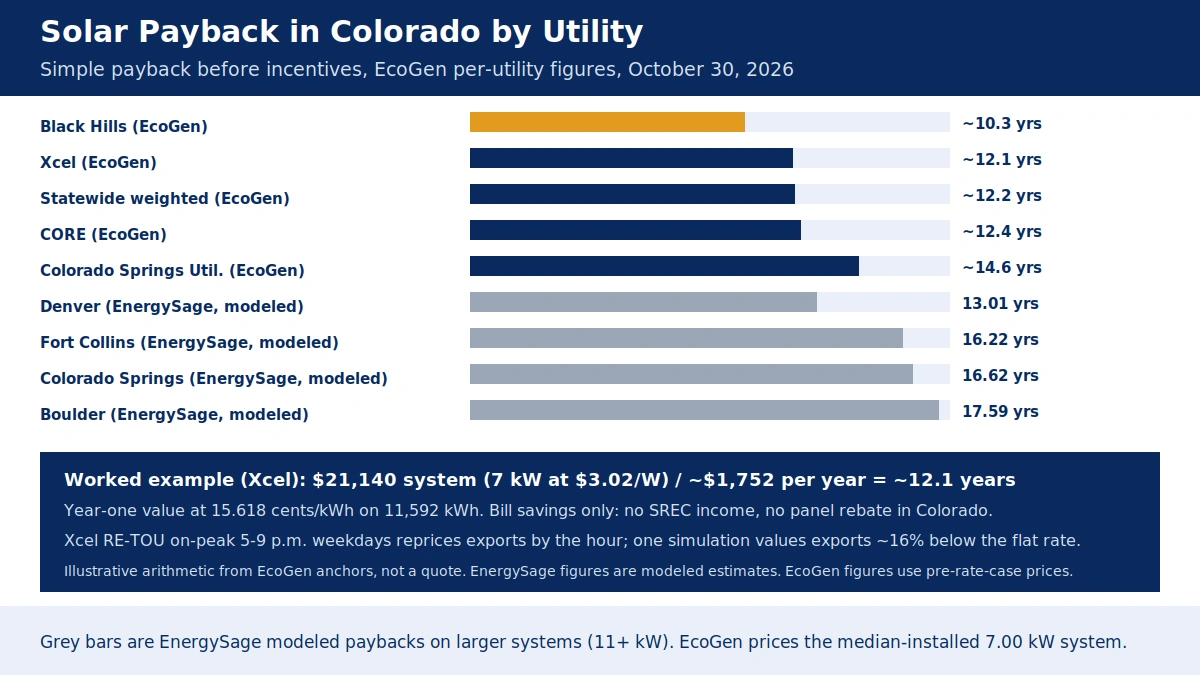
Payback is what every Colorado buyer really wants to know, and the honest answer turns more on the utility named on the bill than on the panels on the roof. Published October 30, 2026, EcoGen’s per-utility figures price the same $21,140 system four ways — and the gap between the fastest and slowest is more than four years. The method is simple payback before incentives: system cost divided by the first year’s value of the power generated, counting no upkeep, no rate growth, and no financing cost. The power’s value is the utility’s rate minus its fixed monthly charges, applied to the 11,592 kilowatt-hours a typical system generates in a year.
Black Hills pays back fastest. The typical system’s power, valued at Black Hills’ rate less its fixed charge, gives a payback of about 10.3 years — the shortest in the state, on a utility serving Pueblo and southern Colorado, where the rates run higher and the sun runs strong. Black Hills customers get the same one-for-one banking as Xcel customers, with the same year-end trap, so the 10.3-year figure assumes the rollover election is filed and the system is sized to annual use. A Black Hills quote that prices the surplus at the year-end rate instead of the banking rate understates the return by years.
Xcel is the Colorado most people live in. At 15.618 cents a kilowatt-hour — Xcel’s EIA price of 16.816 cents less its $7.10 monthly service and facility charge, less 3.25% in riders — the typical system’s power is worth about $1,752 in year one, and $21,140 divided by $1,752 is about 12.1 years. Xcel covers about 55% of Colorado homes — Denver, Boulder, much of the Front Range — so 12.1 years is the figure most Colorado buyers should carry. Weighted across Xcel, Colorado Springs Utilities, CORE, and Black Hills, which together serve about 74% of Colorado homes, the statewide figure is about 12.2 years. Both figures use EIA prices for September 2025 to August 2026, before the PUC’s August 2026 rate decision took effect — new Xcel rates from August 29, 2026 raised the average home bill about 4.77%, which shortens the real payback a little, because the export credit and the avoided purchase both rise with retail rates. The EcoGen figures count no rate growth at all, which makes them conservative, and conservatism is the right stance for a number this big.
CORE and Colorado Springs run longer. CORE Electric, at its own rate less its fixed charge, pays back in about 12.4 years — close to Xcel, on a co-op serving the southern suburbs and the exurbs, where the January 2026 rate rise of 6.7% on average made each solar kilowatt-hour worth more. Colorado Springs Utilities is the outlier at about 14.6 years: the lowest year-end settlement in the state, a rate change already voted in, and a system that has to earn its keep before the new charges arrive. A 14.6-year payback is not a bad investment — the panels still work for twenty-five years — but it is a different decision than a 10.3-year one, and it deserves harder thought if the homeowner may move within five years, or if the agreement date falls after April 1, 2027.
| Utility | Simple payback (EcoGen) | Year-one value basis |
|---|---|---|
| Black Hills Energy | ~10.3 yrs | Own EIA price less fixed charge |
| Xcel Energy | ~12.1 yrs | 15.618 cents/kWh, ~$1,752/yr |
| CORE Electric Cooperative | ~12.4 yrs | Own EIA price less fixed charge |
| Colorado statewide weighted | ~12.2 yrs | Four utilities, 74% of homes |
| Colorado Springs Utilities | ~14.6 yrs | Own EIA price less fixed charge |
The worked example, on Xcel. Take the typical system: $21,140, making 11,592 kilowatt-hours a year, worth about $1,752 in year-one bill value at Xcel’s 15.618-cent figure. Bill savings alone give about 12.1 years. There is no SREC income to add, no state panel rebate to subtract, and no federal credit to count — the bill savings are the whole case, which is why the rate and the banking rule matter more than any other input. That is an illustration built from the EcoGen anchors, not a quote, and it counts no upkeep, no rate growth, and no financing cost. The honest reading is that Colorado solar pays on the strength of the sun and the banking rule, slowly, over a dozen years — and that a buyer who needs rising rates or falling equipment prices to make the case work is a buyer who should think twice.
Xcel’s evening peak reprices the export. Since November 1, 2025, Xcel’s default residential rate has been time-of-use: on-peak from 5 p.m. to 9 p.m. on non-holiday weekdays, year-round, at roughly 2.7 times the off-peak rate. The expensive window opens just as the panels are finishing for the day, and the banking rule follows the clock: credits bank by the period the power was made in, so off-peak exports cannot offset on-peak use. One site’s PVWatts simulation of a south-facing Denver array found only 3.24% of annual production lands in the 5 to 9 p.m. window — none at all from November through February, when the sun is down before the window opens — while a west-facing array captures about 7.25%. Priced period by period, that simulation values a kilowatt-hour at $0.1357 under the time-of-use schedule against $0.1622 on the flat rate, about 16% less for the same roof. Treat those as one simulation’s numbers, not as Xcel’s: the window, the rates, and the banking rule are verified, and the simulation is labeled as such wherever it appears. The practical consequences are concrete. A west tilt is worth discussing. A battery that shifts evening grid use out of the on-peak window earns its keep under time-of-use in a way it never does under a flat rate. And any Xcel customer may opt out of time-of-use onto a seasonal flat rate free of charge — a choice worth modeling against your own usage pattern before signing, because the flat rate values every exported kilowatt-hour the same, and the time-of-use rate does not.
What the modeled figures contribute — and where they stop. EnergySage’s city paybacks — 13.01 years in Denver, 16.62 in Colorado Springs, 17.59 in Boulder, 16.22 in Fort Collins — are modeled estimates built on its own marketplace averages, and they run longer than EcoGen’s per-utility figures in every city. The gap is the system size: EnergySage prices an 11.64 kW system in Fort Collins and an 11.25 kW system in Boulder against houses that use roughly 7,920 kilowatt-hours a year, and the surplus power in that model earns the low year-end rate. All four EcoGen payback figures rest on the same median-installed 7.00 kW system. The two sets of figures disagree because they describe different households, not because either is wrong. A payback worth trusting is built from your own bills, your own utility’s tariff, and your own roof’s production — and a quote that hides that arithmetic is a quote to set aside.
Every rate increase shortens each of these paybacks. Colorado’s residential rate was 17.17 cents in August 2026, up 5.9% from a year earlier, and Xcel’s August 2026 rate case added about 4.77% more. A payback worked out at today’s rate understates the return when rates keep climbing, since each kilowatt-hour the panels generate is worth more next year than this year. EcoGen’s figures assume no rate growth at all, which makes them conservative — the right stance for a purchase this size — and a buyer who needs rising rates for the case to work should think twice before signing.
Batteries in Colorado: The State Pays for Storage, Not Panels
A battery in Colorado is the one piece of equipment the state actually pays for, and the numbers say so plainly. Colorado has no income-tax credit for panels, no general rebate for panels, and a net-metering rule that already banks surplus power at full retail value — yet it offers a 10% state tax credit for a home battery, Xcel pays hundreds of dollars per kilowatt of battery power, and the mountain co-op pays up to $12,500. That is a deliberate policy shape: the state wants storage on the grid, and it is willing to pay for it. Whether a battery pays for the homeowner is a separate question, and the answer depends on the rate schedule, the outage risk, and the credit’s end date.
What a battery costs. EcoGen’s storage figure is $13,500 installed for 13.5 kWh — $1,000 per kilowatt-hour — on top of the solar system. At that adder, a 6 kW system with a battery runs $31,620, an 8 kW system $37,660, a 10 kW system $43,700, and a 12 kW system $49,740. The battery adds roughly two-thirds the cost of the typical 7 kW system itself, and it does not add two-thirds of the savings. Our solar battery cost guide prices the national battery market in full; the Colorado stack below is what changes the local math.
The state credit, and a conflict about its end date. Colorado law, C.R.S. §39-22-546, gives an income-tax credit of 10% of the battery’s purchase price — the equipment, the sales tax, and the freight, not the labor or the permit fees — claimed on Form DR-1307. On a $10,000 purchase price, that is $1,000. The credit may be assigned to the seller at purchase, in which case the seller must pay the full value; if the taxpayer claims it directly, it is not refundable, and the leftover is gone if it exceeds the tax owed. The end date is genuinely contested in the sources, and this guide flags it rather than picking a side: a 2025 law extended the credit through tax years 2025 and 2026, with repeal on January 1, 2027, according to the State Auditor’s December 2025 evaluation, while a 2026 bill amendment proposes extending it through tax year 2029, and EcoGen’s October 2026 pages state “through tax year 2029” as fact. Enactment of that extension was not verified for this guide. What is certain is 2026 eligibility. Do not count on the credit for a 2027 battery until the Department of Revenue confirms the extension. A battery bought on a lease earns no credit at all — the credit goes to the buyer, not the renter. Home batteries also carry their own state sales-tax exemption, C.R.S. §39-26-733, set to end on January 1, 2033.
Xcel’s battery payments. Xcel’s Renewable Battery Connect program paid $350 per kilowatt, up to $5,000, in 2025, and enrollment closed on February 20, 2026. A recommended PUC decision of January 28, 2026 approves a settlement for 2026 and 2027 with $250 per kilowatt for standard customers, $500 per kilowatt for customers in disproportionately impacted communities, and $1,000 per kilowatt for income-qualified customers. The program covers Tesla Powerwall and Enphase batteries only, and Xcel may then use up to 80% of the battery, up to 60 times a year, for five years. Whether 2026–2027 enrollment is actually open was not verified when this guide was written — EcoGen reports that Xcel’s battery page did not load when checked — so ask Xcel directly, and get the rate and the capacity in writing before counting the payment. A secondary source also cites about $100 a year for five years in participation payments; that figure is flagged here rather than relied on.
The co-op and city battery money. Holy Cross Energy pays up to $12,500 for a battery — the lower of $250 per kilowatt of battery power or $100 per kilowatt-hour of storage, on its time-of-use rate — or, through its Power+FLEX program, $500 per kilowatt upfront plus $10.60 per kilowatt each month for five years. Only one battery offer may be taken, and no payment may exceed 40% of the installed cost. Fort Collins Utilities pays $300 per kilowatt-hour of battery capacity up to $6,000, through participating contractors, with a combined solar-plus-battery maximum of $7,500. La Plata Electric pays $1,000 to $2,000 for a home battery. Eagle County offers up to $1,000. Golden’s battery rebate, up to $3,000, closed in 2026 when the budget ran out. Stack the state credit on top of the utility payment where both apply, and the battery’s net cost falls by thousands — but stack only what is confirmed open, in writing, for your address.
Why the savings case is thin, and where it is not. With one-for-one net metering, the grid already behaves as a free battery: surplus kilowatt-hours bank at full retail value and return whenever the house calls on them. A physical battery adds no bill saving beyond what the net-metering bank already delivers, and it introduces its own losses — the round trip through the battery consumes a few percent of each kilowatt-hour. The battery pays on the bill in two cases. The first is Xcel’s time-of-use schedule, where a battery shifts evening grid use out of the 5 to 9 p.m. window priced at 2.7 times the off-peak rate — the one place in Colorado where stored power is worth more than banked power. The second is the Colorado Springs rate change, where a demand charge or a daily grid access charge from April 2027 makes self-consumption worth more than export. Outside those two cases, the battery is a backup purchase, not a savings purchase, and the quote should not pretend otherwise.
What the battery is actually for. Colorado’s grid goes down in summer thunderstorms, in winter ice, in high winds, and during fire-weather shutoffs in the foothills and mountains, and a battery keeps the lights, the refrigerator, the well pump, and the medical equipment running through it. A 13.5 kWh unit carries the essentials through a night; a bigger unit carries more. The battery’s value is the outage avoided, not the kilowatt-hours moved between hours. Price it that way: if the battery costs $13,500 and the house loses power several times a year, the question is whether those nights of power are worth $13,500 less the credit and the utility payment, not whether the battery pays for itself in bill savings, because on a flat rate it will not. No Colorado outage-frequency figure was verified for this guide, so none is stated — ask neighbors on your own feeder, not a statewide average.
Colorado Incentives in 2026: What Exists and What Does Not
Colorado’s incentive stack is the most lopsided in the region: generous to batteries, generous to income-qualified Xcel homes, and nearly empty for a typical homeowner buying panels. That shape is the point of this section. Every program below is labeled open, closed, or narrow, with the amount and the catch, so the quote can be checked against the real stack instead of the advertised one.
The one large panel rebate. Xcel’s Solar*Rewards program pays $3 per watt upfront to income-qualified homes, on systems up to 10 kW AC — $21,000 on the typical 7 kW system, $30,000 at the cap. Homes that qualify only by address, in a disproportionately impacted community on the state’s list, get $0.50 per watt. The $3 rate was set in the PUC’s written decision of April 7, 2026 on Xcel’s 2026–2027 Renewable Energy Plan, raised from a proposed $2 in a settlement that redirected $1.5 million toward equity programs. The 2026 budget is $1,000,000, first come, first served, and Xcel posts the remaining balance on its Solar*Rewards page. The check goes to the system owner within 60 days of permission to operate — under a lease or a power purchase agreement, that is the company, not the homeowner. Two warnings belong on this rebate. First, one paragraph on Xcel’s own page still shows the old $1-per-watt rate, and older guides cite $1 a watt up to $7,000 or a per-kilowatt-hour production payment from the program’s earlier structure; get the reserved rate in writing before work starts. Second, Xcel posted notices in September 2026 of possible rule changes, so the terms may move. Income tests are checked through Xcel’s qualification form — secondary sources cite 80% of area median income, 200% of the federal poverty level, or participation in programs such as LEAP, but the form itself is the authority, and this guide does not state a limit it did not verify.
The tax exemptions, which are real and modest. Colorado charges no 2.9% state sales tax on the parts that make solar power — panels, inverters, racking, and wiring — under C.R.S. §39-26-724. On $10,000 of equipment, that is $290. Labor is not covered, and city and county sales taxes still apply unless the locality has adopted the exemption, so ask the installer to show the tax lines on the quote. Home solar equipment is also exempt from Colorado property tax under C.R.S. §39-3-102, so the install should not raise the home’s assessed value — and the exemption holds for lease and PPA systems up to 100 kW as well. If a notice of valuation lists home solar equipment, contact the county assessor. Boulder adds a refund of roughly 15% of the city sales and use tax on solar and battery projects, on top of the state exemption.
The utility and local rebates, narrow but real. Holy Cross Energy pays a $100-per-kilowatt solar rebate, up to 25 kW, effective April 1, 2026 — $700 on a typical system — with an approval letter required before building starts and completion within 120 days. Fort Collins Utilities pays $300 per kilowatt up to $1,500 for solar, through participating contractors. The City of Boulder pays a $1-per-watt grant up to $8,000 for income-qualified owners. Eagle County offers up to $1,000 for solar, never more than the utility’s rebate. Three small co-ops pay token amounts: Mountain Parks Electric $500 per system for members who pay into its Clean Power Program, San Miguel Power $0.10 per watt up to $300. Golden offered up to $3,000 for panels, but its 2026 rebates are closed because the budget ran out. No program pays for panels on a typical Xcel, Black Hills, Colorado Springs, CORE, or United Power home. That sentence is the whole incentive story for most buyers, and any quote that implies otherwise is selling a program that does not exist.
Community solar, for homes that cannot host panels. Colorado invented the modern community solar garden in 2010, and the program is still the strongest route for renters, shaded roofs, and homes whose roofs cannot carry an array. A new inclusive community solar program under SB 24-207 began on January 1, 2026, opening with 50 MW of capacity for Xcel and 3.5 MW for Black Hills, allocated first come, first served. Subscribers earn bill credits worth about 79% of retail on Xcel and about 96% on Black Hills, and typical non-low-income subscribers save 5% to 10% on annual electricity costs, with income-qualified subscribers promised a discount of at least 25%. Residential termination fees are banned from 2026, and consolidated billing is available on request. No panels, no roof, no $21,140 check — and no payback calculation either, because the savings are a discount on the bill, not a return on an asset. Our community solar guide prices the national market; the Colorado program is the one to ask Xcel or Black Hills about first.
What does not exist, or is closed. There is no statewide solar income-tax credit — the state’s credit schedule lists none, and the old state solar credit ended in 2013. There is no SREC market in Colorado; no certificate income appears in any payback figure in this guide. Colorado’s single-family HEAR rebates are closed statewide — the Front Range region closed on April 28, 2026, and the rest of the state on August 1, 2026 — and the HOMES single-family program has not launched; in any case, HEAR does not cover solar panels or batteries, only electric-to-electric appliance and efficiency upgrades under DOE Program Notice 26-2. Colorado Solar for All, the plan built to give qualifying homes panels at no cost, is on hold: the Colorado Energy Office’s page said so on October 5, 2026, after the EPA terminated all 60 national grants in August 2025 and federal courts ruled the termination unlawful in September 2026, with the funds still frozen and no restart announced. Anyone enrolling a homeowner in Solar for All today is not part of it. Do not let a quote price any of these as open money.
| Program | Amount | Who qualifies | Status |
|---|---|---|---|
| Xcel Solar*Rewards | $3/W up to 10 kW AC | Income-qualified Xcel homes | Open, $1M 2026 budget |
| Xcel Solar*Rewards (address-only) | $0.50/W | Disproportionately impacted community | Open, same budget |
| State battery tax credit | 10% of purchase price | Battery buyers (owners) | Open for 2026; extension disputed |
| Xcel Renewable Battery Connect | $250-$1,000/kW | Xcel, Tesla/Enphase only | Enrollment unverified |
| Holy Cross WE CARE solar | $100/kW up to 25 kW | Holy Cross members | Open, funds first come |
| Fort Collins Utilities solar | $300/kW up to $1,500 | City-limits customers | Open, via contractors |
| Boulder solar grant | $1/W up to $8,000 | Income-qualified owners | Open |
| Golden solar rebate | Up to $3,000 | Golden homeowners | CLOSED, budget out |
| Sales-tax exemption (2.9%) | ~$290 per $10,000 equipment | Every home | In force |
| Property-tax exemption | No assessed-value rise | Every home | In force |
| Community solar | 5-10% bill discount | Xcel/Black Hills customers | Open, SB 24-207 |
| HEAR single-family | Up to $8,000 (not solar) | Income-qualified | CLOSED statewide |
| Colorado Solar for All | No-cost solar | Qualifying homes | ON HOLD |
Federal Help in 2026: No Tax Credit Remains — but Leasing Still Has a Path
The federal picture for a Colorado homeowner in 2026 is short, and every word of it matters, because the most common error in Colorado quotes this year is a line that should not be there. The One Big Beautiful Bill Act, Public Law 119-21, ended the Residential Clean Energy Credit — §25D, the 30% credit — for property placed in service after December 31, 2025, and the IRS confirmed in Fact Sheet FS-2025-05 that the installation’s completion date is what decides it. A system you buy yourself and finish in 2026 earns a $0 federal credit. The companion credit for efficiency work, §25C, ended on the same date. Against a 2025 install, that is a swing of $5,400 to $9,100 on a 6 to 10 kW system, and it is gone. Any quote that subtracts a 30% credit for a 2026 owned install is wrong — say so, in writing, and ask for a corrected quote. Our federal credits guide works through what ended and what survived in full.
A second door stays open, and it is the only route left to a federal credit. Leasing and power purchase agreements are legal in Colorado, and under those structures the company that owns the system can still claim the commercial credit, §48E at 30%, on systems placed in service by December 31, 2027, passing part of that value through as a lower monthly payment or a lower per-kilowatt-hour price. Palmetto’s LightReach is the most visible lease offer in Colorado. The trade-offs travel with it, and they are larger here than in most states: under a lease the company keeps the Solar*Rewards check, the company keeps the battery credit, the net-metering value usually follows the owner, and a PPA escalator of commonly about 2.9% a year roughly doubles the payment by year 25. A lease with a 2.9% escalator can end the term costing more than the utility rate it was meant to beat. Price the escalator across the full term, in dollars, before comparing it with a purchase — and check who keeps the credits, in the contract, not in the sales conversation.
Financing sits between the two. A solar loan keeps ownership, keeps the state exemptions, and keeps the battery credit, but the dealer fee rolled into the contract price on a $0-down loan can add thousands that never appear as a line item — which is why the cash price per watt, next to the financed price, is the comparison that matters. A home equity line, where available, usually works out cheaper than a solar loan with a dealer fee, though the rate and the risk profile are different, and this guide does not advise on borrowing. Cash gives the shortest payback and the cleanest paperwork: $21,140, no monthly payment, about $1,752 a year in Xcel bill value, and a 12.1-year payback before any rate growth. The right structure is the one whose total cost over the full term is lowest for the household’s own horizon — and the wrong structure is the one whose monthly payment was the only number ever discussed.
Permits & Licensing: What Colorado Requires
Colorado regulates solar lightly at the state level and firmly at the local level, and the combination is mostly good news for a homeowner: a capped permit fee, fast approvals in the jurisdictions that use automated review, and a new installer registration that finally gives buyers a credential to check. The bad news is the gap between the state floor and the local reality — the permit office, the utility, and the HOA each have a veto, and none of them coordinates with the others.
The permit-fee cap. State law, C.R.S. §24-48.5-113, caps the aggregate of all state and local charges to install an active solar energy system at the lesser of the actual costs of issuing the permit or $500 for a residential application, for systems producing under 2 MW of direct current. The cap is repealed effective December 31, 2029, but it is in force for every 2026 install. In practice many jurisdictions charge far less — a planning source puts Fort Collins’ standard solar permit at about $65 — and any quote that carries a permit line above $500 for a residential rooftop system should be questioned in writing. Five jurisdictions — Denver, Bennett, Wheat Ridge, Alamosa County, and Gilpin County — use SolarAPP+, the federal automated permitting tool, for near-instant approval on standard rooftop jobs, which trims the soft costs that slower states carry. Elsewhere, ask the installer how long the permit takes in your jurisdiction, and get the answer in writing, because the permit wait is the first delay in a chain that ends at permission to operate. In El Paso County, the Pikes Peak Regional Building Department handles plan review, permits, and inspections for Colorado Springs and the surrounding towns.
Who may do the work. Colorado has no general contractor license, which surprises buyers from states that have one. What it has is electrical regulation: solar electrical work must be performed by a DORA-registered electrical contractor or, under SB25-165, a registered photovoltaic installer. That 2025 law, signed on June 3, 2025, requires contractors operating as of September 1, 2025, who perform photovoltaic installer work with at least one NABCEP-certified employee, to register with the State Electrical Board on or before December 31, 2026, with a 60-day grace period. Photovoltaic electrical work on systems under 300 kW must be supervised on site by a certified photovoltaic energy practitioner, and the work is subject to electrical permitting and compliance checks. One date conflict is worth flagging: the bill’s introduced fiscal note said December 31, 2025, but the enacted text says December 31, 2026, and the enacted text governs. Ask which registration the company holds, check it against DORA’s lookup, and ask whether the crew includes a NABCEP-certified installer — the strongest individual credential in the trade, though the state does not require it of every worker. Membership in the Colorado Solar and Storage Association is a signal, not a license, and no trade affiliation at all is a signal of a different kind.
The HOA question. Colorado law, C.R.S. §38-30-168, voids any covenant, restriction, or condition that effectively prohibits or restricts the installation or use of a renewable energy generation device. An association may still impose reasonable aesthetic provisions on the dimensions, placement, or external appearance of the device — but only if they do not increase the cost by more than 10%, decrease performance or efficiency by more than 10%, or require a review period longer than 60 days. If an application is not denied or returned for modifications within 60 days, it is deemed approved. Those numbers come from HB 21-1229, effective September 2021; one secondary source cites a 45-day review period, but the statute text says 60 days, and the statute governs. The law does not cover bona fide safety requirements, property owned by another person, leased property without the lessor’s permission, loan collateral without the secured party’s permission, or common elements of a common-interest community — and timeshare associations sit outside the amended aesthetic provision. Get the architectural-review approval in writing before ordering panels, even when the law is on your side, because a deemed approval is a weaker shield than a signed one.
The sales contract itself. Colorado added a consumer-protection layer in 2025 that every buyer should know about. SB25-299, now C.R.S. §6-1-1801 et seq., requires solar sales companies to give written disclosures, allows at least 3 business days to cancel a sale without financial penalty besides nonrefundable deposits, requires a welcome call — the cancellation period does not begin to run until the call happens — and bars implying an affiliation with a utility. Violations are deceptive trade practices. The requirements apply to agreements entered on or after July 1, 2026. A salesperson who claims to work with Xcel, who pressures for a same-day signature, or who will not leave the disclosures behind is describing a company to avoid. The cancellation right is real, and it is the buyer’s last check on a bad decision — use the three days to get the second and third quotes.
The electrical panel. Many older Colorado homes run on 100-amp service, and a solar install on an undersized panel needs an upgrade before the array can connect. No Colorado-specific panel-upgrade price was verified for this guide beyond a Fort Collins planning estimate of $2,140 to $3,380 per job, which is labeled as a planning estimate wherever it appears. Ask the installer to state the service size, the upgrade requirement, and the upgrade price as separate line items, and read our electrical panel upgrade guide before accepting a bundled number. An upgrade that appears for the first time on the day of the install is a quote defect, not a surprise.
What Pushes Your Colorado Quote Up or Down
The statewide anchor is $3.02 a watt, but no homeowner buys the statewide anchor. What moves an individual quote is a short list of site and equipment facts, and most of them are knowable before the first salesperson arrives. Work through them in order, because the first three decide whether the quote is even in the right range.
Roof pitch, material, and age. A simple asphalt-shingle roof at a walkable pitch is the cheapest surface to work on. Tile, metal, and flat membrane roofs need specialty mounting and slower labor, and they raise the quote for reasons that have nothing to do with the panels. A steep mountain roof adds staging and safety time. A roof with under eight to ten years of life left should be replaced first, as the hail section explains, and the replacement cost belongs in the project budget, not in a later surprise. Get a written roof assessment with a remaining-life estimate from every bidder, and a separate detach-and-reset quote if the roof will need replacing during the panels’ life.
Hail rating and equipment tier. Standard modules carry the baseline 1-inch hail certification. Class 4 modules, rated near 2-inch hail, cost more — one installer puts the premium at 8% to 18% — and premium panels with thicker glass cost more again. Microinverters or optimizers add cost per panel against a string inverter, and earn it back on shaded, multi-plane, or snow-prone roofs. A battery adds $13,500 at the EcoGen figure, less the credit and the utility payment. Each of these is a real choice with a real price, and each should appear as a line item, not as a footnote. A quote that bundles premium equipment into a single per-watt number without naming the module is hiding the most important comparison in the job.
Shade, orientation, and snow. A south-facing, unshaded roof at a good tilt is the reference case, and every deviation from it costs production. East-west roofs, dormers, chimneys, pine canopy, and ridge shadows all cut output, and the production estimate should show the loss month by month, not as a single annual number. A ground mount avoids the roof entirely and adds trenching, racking, and a separate permit conversation. Snow country adds tilt and structural considerations. The estimate that matters is the one modeled from a shade study of your roof, with the assumptions printed on the page.
Utility territory and rate schedule. The same panels on the same roof pay back in 10.3 years on Black Hills and 14.6 years on Colorado Springs Utilities, and Xcel’s time-of-use schedule reprices every export by the hour. The utility’s size cap, year-end settlement, and application fee all belong in the quote comparison, because they move the return more than the equipment brand. A bidder who cannot name your utility’s tariff is a bidder who has not done this work in your territory.
Permit jurisdiction and interconnection queue. SolarAPP+ jurisdictions approve standard jobs near-instantly; other jurisdictions take weeks. The interconnection application and the permission-to-operate wait are the long pole in the schedule, and no Colorado-specific PTO timeline was verified for this guide — ask each bidder for its recent PTO waits in your utility’s territory, in writing. A Colorado Springs buyer racing the April 1, 2027 agreement date needs the timeline more than the price.
Financing structure. Cash, a solar loan with a dealer fee, a home equity line, and a lease are four different prices for the same hardware. The cash price per watt is the only number that compares bidders fairly. A $0-down loan that never states the cash price is not a quote; it is a payment plan with panels attached.
What holds Colorado prices down. The $500 permit-fee cap, SolarAPP+ in five jurisdictions, the 2.9% sales-tax exemption on equipment, the property-tax exemption, and a deep installer field along the Front Range all pull the anchor down. Colorado’s $3.02 sits only 13 cents above the national average despite the altitude, the hail, and the small typical system — and that gap is the measure of how much the soft-cost advantages are worth. A quote far above $3.02 needs a site-specific reason, stated in writing, not a market story.
Getting Quotes in Colorado: The Checklist
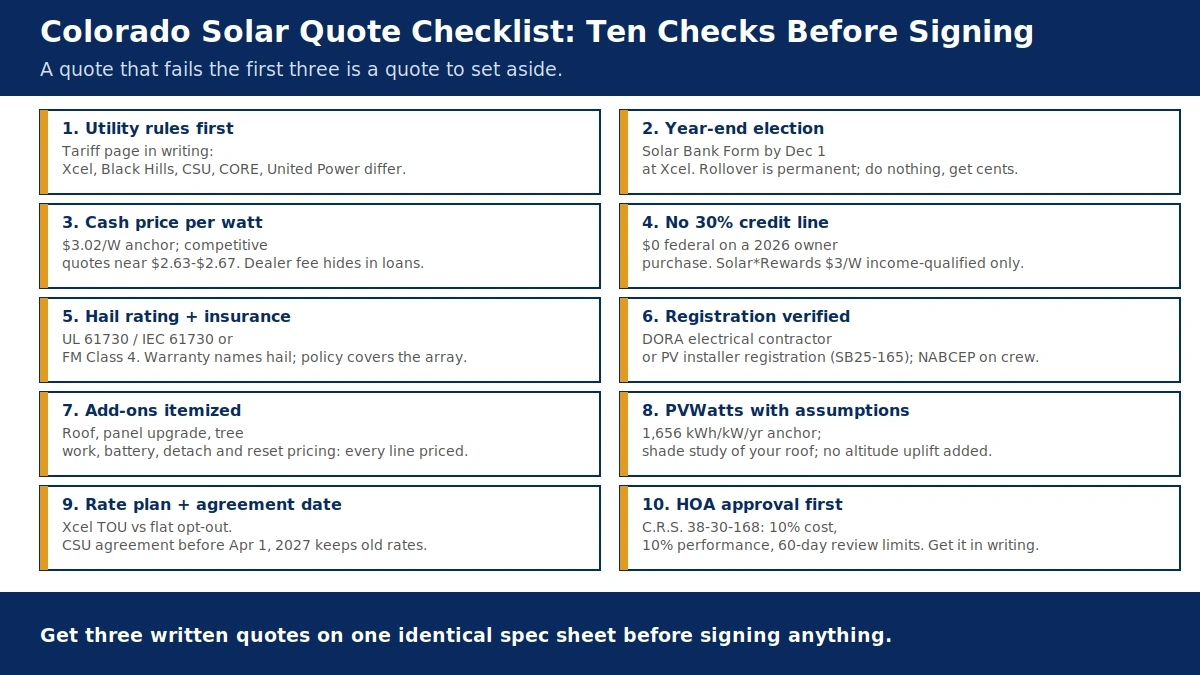
Run the ten checks below in order, starting with the ones that protect the most money. A quote that clears all ten checks is one worth signing. A quote failing any of the first three should be set aside, no matter what the monthly payment promises.
- Your utility’s rules in writing first. Xcel banks credits one for one with a 1.529-cent year-end payout on the last printed figure; Black Hills pays its incremental cost; Colorado Springs pays about 2 cents and rewrites its rates for agreements dated April 1, 2027; CORE stops net metering above 10 kW; United Power will not grandfather changes. Obtain your utility’s tariff page before comparing quotes, and check that each quote prices the rate your utility actually pays rather than a state average.
- The year-end election in writing. The Solar Bank Election Form at Xcel, the rollover election at Black Hills and Colorado Springs — the form, the deadline, and the consequence of doing nothing, all in writing, before the install. At Xcel the form must be sent by December 1 to switch for the current year, and rollover is permanent and forfeited on moving.
- Cash price per watt on paper. The anchor is $3.02 a watt, and competitive marketplace quotes run near $2.63 to $2.67. Place the cash price beside any financed price, because the dealer fee on a $0-down loan hides inside the financed amount and stays invisible until both numbers sit side by side.
- Strike any line claiming a 30% federal credit or a general state rebate. A homeowner-owned 2026 purchase earns a $0 federal credit; Colorado has no general state rebate and no state income-tax credit for panels, and the sales-tax exemption is already reflected in the quote. The only large panel rebate is Xcel’s Solar*Rewards, $3 a watt up to 10 kW, for income-qualified homes only, from a $1,000,000 2026 budget — count it only once reserved, in writing.
- Hail rating, warranty, and insurance in writing. The module’s hail rating by name — baseline UL 61730 / IEC 61215 or FM Class 4 — a warranty that names hail damage, and written confirmation that the homeowners policy covers the array for storm damage and states how it treats the roof’s remaining life.
- The registration verified. DORA electrical contractor registration or State Electrical Board photovoltaic installer registration under SB25-165, checked against DORA’s lookup, with a NABCEP-certified practitioner supervising the work. A company that cannot produce a registration number has not done this work legally.
- Add-ons itemized. Roof work, panel upgrade (Fort Collins planning estimate $2,140-$3,380 — get your own number), tree work, critter guard, hail-rated module upgrade, snow and wind engineering, battery, detach-and-reset pricing for a future reroof. Each add-on needs its own priced line item, not a footnote.
- A PVWatts production estimate that shows its assumptions. The production anchor is 1,656 kilowatt-hours per kilowatt per year, with PVWatts cross-checks at 1,476 to 1,595 — so the estimate must name its model and state the shade and snow loss it assumes, month by month, June against December, from a shade study of your own roof rather than a statewide average. No altitude uplift on top of the model, and no 300-days-of-sunshine arithmetic.
- Rate schedule and agreement date confirmed. At Xcel, the time-of-use schedule or the flat-rate opt-out, modeled against your usage pattern, with the 5 to 9 p.m. window priced in. In Colorado Springs, the agreement date — before April 1, 2027 keeps today’s rates until April 1, 2032. At a co-op, the size cap and the year-end rate, in writing.
- HOA approval in writing first. C.R.S. §38-30-168 voids restrictions that effectively prohibit solar, and aesthetic rules may not raise cost by more than 10%, cut performance by more than 10%, or require review longer than 60 days — but the law does not cover common elements, leased property, or safety requirements. Even with the statute behind you, hold a written architectural-review approval in hand before any panels are ordered.
Before signing anything, hold three written quotes built on one identical specification sheet, each from an installer already active in your utility’s territory. In a state where the year-end election decides whether the surplus is worth retail or pennies, the cheapest quote is the one that files the paperwork on time and names the rating on the module.
Sources & methodology
Headline price and production:
- EcoGen Solar Cost Index, September 2026 edition: $3.02/W Colorado, 7.00 kW typical system, $21,140, 4.5% above the $2.89 national figure, tied 37th lowest of 51; neighbors New Mexico $2.71, Kansas $2.87, Nebraska $2.91, Utah $3.01, Wyoming $3.14; Berkeley Lab 2025 median 7.00 kW from 6,702 Colorado systems; production 1,656 kWh/kW/yr, 11,592 kWh/yr
- EnergySage Colorado cost data Nov 2026: $2.63/W, 11.36 kW avg, $29,886, range $25,403-$34,369, modeled payback 15.66 yrs, $24,135 25-yr savings; June 2026 competitive-quote average $2.67/W via Solar Sanity Check; city pages Nov 2026 — Denver (Denver County) $2.70/W, 10.13 kW, $27,366, 13.01-yr modeled payback, $31,770; Colorado Springs $2.65/W, 11.5 kW, $30,511, 16.62-yr modeled, $20,071; Boulder $2.72/W, 11.25 kW, $30,645, 17.59-yr modeled, $19,441; Fort Collins $2.66/W, 11.64 kW, $31,002, 16.22-yr modeled, $21,418; Denver county-page conflict flagged (Jefferson $2.62/11.37 kW/14.76 yrs; Adams $2.56/12.25 kW/17.17 yrs)
- SolarReviews Nov 2026: $3.41/W, 4.9 kW avg, $17,799 (national model — not headline; after-credit figure stale, excluded); NumeralQ planning, data retrieved Oct 26, 2026: 8 kW $19,710-$25,760 ($2.46-$3.22/W), Denver 8 kW $20,460-$26,740; SolarSpecHub planning Feb 2026: $3.00/W; Berkeley Lab 2026 update: 2025 national median ~$3.60/W owned, ~$4.50/W loan-financed
- Production cross-checks: PVWatts Denver 1,595 kWh/kW/yr (MySolarFY 6 kW 9,570 kWh; DecodeMySolar simulation); SolarSpecHub 1,566 (5.5 peak sun hours, 78% performance); NumeralQ/PVGIS Fort Collins 1,476 (8 kW 11,808 kWh); peak sun hours 5.5-5.66/day across state tables
- EIA: ~660 kWh/mo average use (EcoGen citing EIA); 12 months to Aug 2026 ~16.61¢/kWh, ~679-701 kWh/mo, ~$113-$116/mo (tabulation spread flagged); Aug 2026 17.17¢/kWh (+5.9% YoY), US 18.16¢; Xcel EIA price 16.816¢ Sep 2025-Aug 2026
Net metering and rates:
- C.R.S. §40-2-124 (investor-owned net metering); C.R.S. §40-9.5-118 (co-op net metering; city utilities 5,000+ customers, home systems to at least 10 kW)
- Year-end settlement: Xcel 1.529¢/kWh (2023, last printed), Solar Bank Election Form, Dec 1 deadline, rollover permanent and forfeited on moving, cannot offset $7.10/mo service charge; Black Hills average hourly incremental cost, Sheet R36 3.489¢/kWh eff. Jan 1, 2026 (single secondary source, flagged); CSU ~2¢/kWh cogeneration rate, January-bill credit, one-time rollover election, $100 application fee; CORE avoided cost 4.616¢/kWh above 10 kW, settlement within 60 days after April billing cycle; United Power wholesale-rate cash-out each April-March year, no grandfathering
- Sizing caps (secondary sources, flagged): Xcel generally 120% of annual use; Holy Cross 200% of past year’s use; United Power 200% of yearly use; CORE 10 kW net-metering cap
- Xcel RE-TOU: default since Nov 1, 2025 (PUC Proceeding 24AL-0377E); on-peak 5-9 p.m. non-holiday weekdays year-round; base rates summer 21.277¢/7.884¢, non-summer 18.331¢/6.792¢, on-peak ~2.7x off-peak; free opt-out to seasonal flat rate (PUC); DecodeMySolar simulation Sep 2026: 3.24% south-facing / 7.25% west-facing production in peak window, $0.1357 vs $0.1622/kWh (~16% less) — labeled simulation; three-period banking language in that source flagged as pre-Nov-2025 structure, not relied on
- Xcel rate case: PUC Proceeding 25AL-0494E decided Aug 20, 2026, ~$157M/yr, ~4.77% (~$5/mo), new rates Aug 29, 2026; CORE rates up 6.7% avg from Jan 2026
- CSU rate change: City Council approved Sep 22, 2026; agreements dated Apr 1, 2027+ choose Plan 1 ($1.00/day grid access + TOU 5-9 p.m. peak) or Plan 2 (demand charge, highest 15 min in peak hours); ~$38/mo added; pre-Apr 1, 2027 agreements move to new rates Apr 1, 2032
Payback arithmetic:
- EcoGen per-utility figures, Oct 30, 2026: Black Hills ~10.3 yrs; Xcel ~12.1 yrs (15.618¢/kWh, $1,752/yr); CORE ~12.4 yrs; CSU ~14.6 yrs; statewide weighted ~12.2 yrs (Xcel 55% of homes; four utilities 74%); derivation of 15.618¢ quoted as EcoGen’s, not re-derived
- NestPriced illustration (labeled as such): $21,140 / $1,752 = ~12.1 yrs on Xcel bill savings alone
- EnergySage modeled city paybacks flagged as modeled estimates, not verified paybacks; cheap-power edge cases Moon Lake ~9.7¢ and Fort Morgan ~7.3¢ (EcoGen, EIA)
Sun, altitude, hail:
- 300-day claim: 1870s railroad publicist origin (Denver Post via KOQL); Colorado Climate Center 1990s sunshine-switch study (~300 days with at least 1 hour of sun); NWS definitions: Denver 115 clear / 130 partly cloudy / 120 cloudy days; NOAA ~3,107 sunshine hours/yr at Denver International Airport, ~69% of possible; sunny-day counts 245-254
- Altitude: no verified Colorado bonus percentage, none stated; temperature coefficient 0.3-0.5%/°C above 25°C cell temperature (national figure); Solar Energy Feb 2026 study (PVGIS, four countries): higher performance ratios at altitude, up to 17.2% higher annual irradiation at low altitude
- Hail: May 2017 Denver/Golden storm, hail to 2.75 in, 1 of ~3,000 NREL panels broken (panel count varies 3,000 vs 3,168 across sources); baseline UL 61730 / IEC 61215 test 1-in ice balls ~50 mph, 5% power-loss limit; FM 4473 / FM 4476 Class 4 near 2-in hail; EnergySage Aug 2026: 45 mm test, 97% of 2 mm-glass vs 13% of 3.2 mm-glass panels failed; hail season mid-April to mid-September (installer source); Class 4 premium 8-18% (single installer source, flagged); 2018/2024 storm sizes single-source, flagged
- Lifespan 25-30 years; NREL median degradation ~0.5%/yr, ~88% at year 25; product warranty typically 10-25 years; performance warranty typically 25-30 years, 80-92% at year 25; string inverter 10-15 years; microinverters ~25 years (national figures)
Batteries:
- EcoGen: 13.5 kWh add-on $13,500 installed ($1,000/kWh); with-battery totals 6 kW $31,620, 8 kW $37,660, 10 kW $43,700, 12 kW $49,740
- State battery credit: C.R.S. §39-22-546, 10% of purchase price (equipment + sales tax + freight, not labor/permits), Form DR-1307, assignable to seller (refundable if assigned, non-refundable if claimed); end-date CONFLICT flagged: SB 25-026 through tax years 2025-2026, repeal Jan 1, 2027 (State Auditor evaluation Dec 2025) vs HB26-1289 amendment proposing through 2029 vs EcoGen “through tax year 2029” — enactment unverified; battery sales-tax exemption §39-26-733 ends Jan 1, 2033
- Xcel Renewable Battery Connect: 2025 $350/kW up to $5,000, enrollment closed Feb 20, 2026; recommended PUC decision Jan 28, 2026: 2026-2027 $250/kW standard, $500/kW DIC, $1,000/kW income-qualified; Tesla/Enphase only; up to 80% use, 60x/yr, 5 years; 2026-2027 enrollment open status unverified; ~$100/yr participation payment flagged (single secondary source)
- Holy Cross: up to $12,500 (lower of $250/kW or $100/kWh, TOU rate); Power+FLEX $500/kW + $10.60/kW/mo 5 yrs; one offer only; 40% cost cap; Fort Collins Utilities battery $300/kWh up to $6,000, combined max $7,500; La Plata $1,000-$2,000; Eagle County up to $1,000; Golden up to $3,000 CLOSED
Incentives:
- Xcel Solar*Rewards: $3/W up to 10 kW AC income-qualified, $0.50/W address-only (disproportionately impacted community); PUC written decision Apr 7, 2026 on 2026-2027 Renewable Energy Plan (settlement, $1.5M redirected); 2026 budget $1,000,000; check to owner within 60 days of PTO; old $1/W paragraph on Xcel page + Sep 2026 rule-change notices flagged; older $1/W-up-to-$7,000 and per-kWh structures flagged as superseded; income tests via Xcel form (secondary 80% AMI / 200% FPL / LEAP, flagged)
- Sales tax: C.R.S. §39-26-724 exempts 2.9% state tax on solar equipment; labor not exempt; local taxes may apply; property tax: C.R.S. §39-3-102 exempts home solar equipment, incl. lease/PPA to 100 kW; no state solar income-tax credit (DR 0104CR lists none; old credit ended 2013); no SREC market found
- Holy Cross WE CARE: $100/kW up to 25 kW, eff. Apr 1, 2026, approval letter first, finish within 120 days; Fort Collins Utilities solar $300/kW up to $1,500, participating contractors; Boulder $1/W up to $8,000 income-qualified ($121,800 household of four) + ~15% city sales/use tax refund; Eagle County up to $1,000 solar + $1,000 battery; Mountain Parks $500/system; San Miguel $0.10/W up to $300; Golden up to $3,000 solar CLOSED 2026 (budget out)
- Community solar: 2010 Community Solar Gardens Act; SB 24-207 inclusive program from Jan 1, 2026, 50 MW Xcel + 3.5 MW Black Hills opening capacity; bill credits ~79% retail Xcel, ~96% Black Hills (ILSR Oct 2026); 5-10% typical savings, 25%+ income-qualified; no residential termination fees from 2026; consolidated billing on request
- HEAR: single-family closed statewide (Region 1 Apr 28, 2026; Region 2 Aug 1, 2026); HOMES single-family not launched; HEAR does not cover solar/batteries (DOE Program Notice 26-2, May 29, 2026, electric-to-electric only); Solar for All on hold (CEO page Oct 5, 2026; EPA termination Aug 7, 2025; court rulings Sep 18/22, 2026; funds frozen)
Federal and financing:
- OBBBA P.L. 119-21 and IRS FS-2025-05: §25D and §25C $0 for post-Dec-31-2025 installs, completion date counts; $5,400-$9,100 swing on 6-10 kW vs 2025 install (EcoGen)
- §48E 30% for third-party-owned systems, in service by Dec 31, 2027, construction begun by Jul 4, 2026 per IRS Notice 2025-42; leases and PPAs legal in Colorado; Palmetto LightReach most visible (EcoGen); PPA escalator ~2.9%/yr, about doubles payment by year 25 (EcoGen); dealer fees rolled into financed prices (EcoGen; Berkeley Lab loan median ~$4.50/W vs ~$3.60/W cash)
HOA, licensing, permits, consumer protection:
- C.R.S. §38-30-168: restrictions effectively prohibiting renewable energy generation devices void; aesthetic provisions allowed only within 10% cost / 10% performance / 60-day review limits, deemed approved if not denied/returned in 60 days (HB 21-1229, eff. Sep 7, 2021); exceptions: safety, others’ property, leased/collateral, common elements, timeshare associations; 45-day figure in one secondary source flagged, statute’s 60 days used
- No general contractor license; DORA electrical contractor registration or SB25-165 photovoltaic installer registration (signed Jun 3, 2025; register by Dec 31, 2026, 60-day grace; NABCEP-certified practitioner supervision under 300 kW; electrical permitting/compliance checks); introduced fiscal note’s Dec 31, 2025 date flagged, enacted text used; NABCEP strongest credential, not generally state-required; COSSA membership a signal only
- Permit-fee cap C.R.S. §24-48.5-113: lesser of actual costs or $500 residential under 2 MW DC, repeal Dec 31, 2029; SolarAPP+ in Denver, Bennett, Wheat Ridge, Alamosa County, Gilpin County; PPRBD for El Paso County; Fort Collins permit ~$65 (NumeralQ planning); panel upgrade $2,140-$3,380 Fort Collins planning estimate (NumeralQ); detach-and-reset price unverified, none stated
- SB25-299 (C.R.S. §6-1-1801 et seq.): disclosures, 3-business-day cancellation (tolled until welcome call), no implied utility affiliation, deceptive trade practice violations; applies to agreements on/after Jul 1, 2026 (enacted summary; introduced Dec 31, 2025 date flagged)
EXCLUDED:
- Any “after 30% credit” prices
- Any HEAR-for-solar claim: HEAR does not cover solar, batteries, EV chargers, or windows; electric-to-electric only since DOE Program Notice 26-2, May 29, 2026; Colorado single-family HEAR is closed statewide in any case
- Any state rebate or state tax credit for Colorado panels: none exists beyond income-limited Xcel Solar*Rewards and narrow local programs
- SolarReviews’ $3.41/W as a headline price: national model on a 4.9 kW system, with a stale after-credit figure
- The “300 days of sunshine” claim as a measurement: it counts days with at least one hour of sun; NWS definitions give 115 clear days in Denver
- Any altitude bonus percentage: no verified Colorado figure exists; the production anchor already reflects location
- The battery-credit extension through 2029 as settled law: proposed in HB26-1289, enactment unverified; 2026 eligibility is certain
- Xcel Renewable Battery Connect 2026-2027 enrollment as open: unverified; ask Xcel
- The old $1/W Solar*Rewards rate as current: superseded by the PUC’s April 2026 decision setting $3/W
- Golden’s solar rebate as open: 2026 rebates closed, budget ran out
- Colorado Solar for All as open: on hold, funds frozen, no restart announced
- SREC income for Colorado: no SREC market exists in the state
- A battery rebate for Black Hills, CSU, CORE, or United Power customers: none verified; ask the utility in writing
- EnergySage’s city paybacks as verified: modeled, EcoGen’s per-utility figures are the anchor
- The claim that Colorado net metering pays retail forever with no catch: WRONG against the year-end settlement rule; leftover credits settle at avoided cost unless rollover is elected
- The claim that an HOA may ban solar in Colorado: WRONG against C.R.S. §38-30-168, within the statute’s 10%/10%/60-day limits
- Colorado-specific monthly PVWatts table, shade-loss percentage, snow-loss percentage, design snow-load figure, interconnection timeline, PTO wait figures, detach-and-reset price, outage-frequency figures, county solar grant programs beyond those named, co-op retail values beyond EcoGen’s figures, wildfire smoke-loss figures — none verified, none stated
*Disclaimer: The prices here are 2026 Colorado planning figures. Your utility, your roof, your shade, your hail exposure, and the installer you pick all move the final price, and the year-end settlement moves the return more than any of them — a system sized to your own annual use, with the rollover election filed, keeps full retail value on its surplus, and one sized past it settles the leftover for pennies. Before settling on a budget, line up three written quotes from installers working in Colorado, on one identical spec sheet, and ask each one for the cash price per watt, the module hail rating, and your utility’s year-end rule in writing. Treat every tax point in this guide as background reading, not advice about your own filing — have a Colorado tax professional look over your own return before you file it, and confirm the battery credit’s end date with the Department of Revenue. Program rules change, Xcel’s Solar*Rewards budget moves as homes apply, and Colorado Springs rewrites its solar rates for agreements dated April 1, 2027, so confirm current terms with the Colorado Energy Office, the Public Utilities Commission, and your own utility before signing.*
What do solar panels cost in Colorado in 2026?
A Colorado install in 2026 runs $3.02 a watt on EcoGen’s September 2026 index — about $21,140 for the typical 7.00 kW system — with competitive marketplace quotes averaging $2.63 a watt on larger systems through EnergySage. At the EcoGen rate, a 5 kW home system typically runs about $15,100 and already covers the average Colorado home’s annual use, while an 8 kW system runs about $24,160. A homeowner-owned system installed in 2026 earns a $0 federal credit, Colorado offers no general state rebate and no state income-tax credit for panels, and the return rests on one-for-one retail net metering plus a 2.9% sales-tax exemption that is already inside the quote.
Is the 300 days of sunshine claim true, and does altitude really boost production?
The slogan is 150-year-old railroad marketing, not a measurement. Counting every day the sun appears for at least one hour gives roughly 300 days in Denver, but under National Weather Service definitions Denver averages 115 clear days, 130 partly cloudy days, and 120 cloudy days a year, with about 3,107 sunshine hours. The number that matters is peak sun hours — 5.5 to 5.66 a day, sixth in the country — and each installed kilowatt makes about 1,656 kilowatt-hours a year. Altitude helps through thinner air and cooler cells, but no verified Colorado bonus percentage exists, so none is claimed here; the production anchor already reflects the location, and a quote that adds an altitude uplift on top of a PVWatts estimate is counting the same sunlight twice.
How does net metering work in Colorado — and what happens to my credits at year end?
State law requires Xcel, Black Hills, the co-ops, and larger city utilities to credit exported power one-for-one against power the house later uses, month after month, at full retail value. The catch is the year-end settlement: surplus credits still banked when the year closes are paid out at an avoided-cost rate — 1.529 cents a kilowatt-hour at Xcel on the last printed figure, about 2 cents at Colorado Springs Utilities — unless the homeowner elects rollover in writing. At Xcel that election goes on the Solar Bank Election Form, must be sent by December 1 to switch for the current year, is permanent, and is forfeited on moving. Sizing the system to your own annual use keeps nearly all of its value at retail; sizing past it donates the surplus at pennies.
Will hail damage my solar panels in Colorado?
Almost certainly not, on the evidence of the worst storm on record. In May 2017, hail up to 2.75 inches hammered the Denver area, and of about 3,000 panels on the National Renewable Energy Laboratory campus in Golden, one broke. Every panel sold in the United States must pass a hail test firing 1-inch ice balls at about 50 mph, and panels rated FM Class 4 are tested against hail approaching 2 inches — the right spec for a Front Range or Eastern Plains roof with documented 2-inch-plus hail history. Name the hail rating in the quote, ask whether the warranty names hail damage, and confirm with your insurer in writing that the policy covers the array, because a defects warranty is not a hail warranty.
Why is solar payback about 12 years in Colorado when the sun is so good?
Three forces pull in different directions, and the bill usually decides it. The sun is superb at about 1,656 kilowatt-hours a year per installed kilowatt, and the export rule banks surplus power at full retail — but the hardware costs $3.02 a watt, above the national average, and the average Colorado electric bill is only about $113 to $116 a month, among the smallest in the country, so there is less bill for the panels to erase. EcoGen’s simple payback comes to about 12.2 years statewide, 12.1 years on Xcel, 10.3 years on Black Hills, and 14.6 years on Colorado Springs Utilities. Xcel’s evening peak rate, from 5 to 9 p.m., trims the value of exports further, because most production lands outside that window; a west tilt or a battery shifts some of it back.
Can my HOA stop me from installing solar panels in Colorado?
Usually not — Colorado law voids restrictions that effectively prohibit solar, and the limits on what an association may do have numbers attached. Under C.R.S. §38-30-168, a covenant or association rule may not effectively prohibit or restrict a renewable energy generation device, and aesthetic provisions are allowed only if they do not raise the cost by more than 10%, cut performance or efficiency by more than 10%, or require review longer than 60 days — an application not denied or returned within 60 days is deemed approved. The law does not cover bona fide safety requirements, common elements, leased property, or property owned by someone else. Get architectural-review approval in writing before you order panels, even when the law is on your side.
Is the 30% federal solar tax credit still available to Colorado homeowners in 2026?
No. A Colorado homeowner who buys the system outright faces a hard cutoff: anything placed in service after December 31, 2025 earns no Residential Clean Energy Credit (§25D, 30%) at all — Public Law 119-21, the One Big Beautiful Bill Act, closed the credit, and the IRS reads the installation’s finish date as the date that controls. There is a second door in Colorado that some states lack: leasing and power purchase agreements are legal, so the company owning the system can still claim the commercial credit (§48E, 30%) on systems in service by December 31, 2027 and pass part of that value through as a lower monthly payment. The trade-offs travel with it, though — under a lease the company keeps the Solar*Rewards check and the battery credit, and a PPA escalator of commonly about 2.9% a year roughly doubles the payment by year 25.
What changes for Colorado Springs solar homes on April 1, 2027?
The rate structure changes, and the agreement date decides which one you get. City Council approved new solar rates on September 22, 2026, for agreements dated April 1, 2027 or later: solar homes will choose between a plan adding a $1.00-a-day grid access charge with time-of-use pricing and a 5 to 9 p.m. weekday peak, or a plan adding a demand charge based on the highest 15 minutes of use in peak hours, with the utility estimating about $38 a month added to a solar home’s bill either way. Agreements dated before April 1, 2027 keep today’s one-for-one rates until April 1, 2032. The year-end settlement stays cheap under either structure — about 2 cents a kilowatt-hour unless rollover is elected — so sizing to annual use matters in Colorado Springs under both the old and the new rates.