

A Colorado heat pump buyer faces a purchase no buyer in the mild states faces, and it starts before the first quote. The house sits a mile above sea level, where the air holds about 82 percent of the mass it holds at the coast. January asks the machine to heat against a design temperature near zero in Denver and below zero in Fort Collins. And the fuel it competes against — piped gas at about $1.12 a therm — is among the cheapest residential gas in the country. Two-thirds of Colorado homes heat with that gas. A heat pump in Colorado is not the easy fuel-saving purchase it is in Virginia or Florida. It is a cold-climate machine bought for air conditioning, for rebates, for a furnace already dying, or for a home off the gas mains.
The second fact cuts the other way. The rebate stack in the Denver region is one of the strongest left in America after the federal credit ended: Xcel Energy pays $1,500 per heating ton for a cold-climate system to gas-heated homes, Power Ahead Colorado adds a flat $1,500 with no income limit, and the state credit puts at least $333 and sometimes the full $1,000 on the invoice. On a 3-ton cold-climate system that is roughly $6,333 to $7,000 before a dollar of financing — provided the buyer understands which layer pays what, and that the federal HEAR money that once added up to $8,000 is gone, closed statewide in August 2026.
The third fact is altitude, and it is the one most national cost guides ignore entirely. A heat pump moves heat by moving air, and thin air carries less heat per cubic foot. Ratings are lab numbers measured at sea level. At 5,280 feet in Denver, at 6,012 feet in Colorado Springs, at 8,000 feet and above in the mountain towns, the same unit delivers less capacity than its nameplate promises — by a margin the manufacturer’s altitude tables state and no national guide can. A system sized from sea-level numbers is undersized in Colorado, and an undersized system in a 6,000-heating-degree-day winter leans on resistance backup heat at 17.17 cents a kilowatt-hour. This guide insists on the one document that settles sizing at elevation: a Manual J load calculation run with altitude-corrected capacity figures for the exact model being quoted.
The national numbers come first in our national heat pump cost guide — then weigh Colorado’s figures against them, because in this state the national average misleads in both directions at once.
Table of Contents
How Much Does a Heat Pump Cost in Colorado in 2026?
Three kinds of evidence anchor the 2026 Colorado market, and they disagree by more than any other state in this series. NumeralQ publishes modeled planning estimates for the whole state. Denver contractors publish installed price lists for premium cold-climate equipment. And one installer publishes its own completed-install records across three states. The planning estimate says a 3-ton ducted system costs $6,710-$11,160. A Denver contractor’s cold-climate system with a new furnace costs $20,850-$27,650 before rebates. Both numbers are honest. They describe different machines, different scopes, and different tiers.
This guide headlines the NumeralQ 3-ton band, $6,710-$11,160, because it is the only figure tied to a specific system size statewide, labeled as a planning estimate, and refreshed in October 2026. It is a modeled figure built from a national baseline with a Colorado adjustment — not a survey of contractor bids, and NumeralQ says so. Treat it as the planning floor for a standard ducted system, not as the price of the cold-climate machine most Colorado homes need. The cold-climate band, $8,800-$15,280, is the more realistic planning figure for a Front Range home.
The contractor evidence sits above the planning band for reasons that show up in the equipment, not just the labor. UniColorado, a Denver installer, prices a cold-climate heat pump added to a furnace the homeowner keeps at $17,500-$23,850 before rebates, and a cold-climate heat pump with a new gas furnace at $20,850-$27,650. Jetson Home’s completed-install records — real prices across Colorado, Massachusetts, and New York, published September 2026 — put a 3-ton system at $16,503-$20,960 before rebates, and quote Denver market tiers of $15,309-$20,728 for a standard heat pump and $20,752-$28,031 for a unit genuinely rated to minus 15 degrees. The gap between the two bands is the gap between a value-tier standard unit on paper and a premium cold-climate unit with a furnace, installed, in Denver.
A third dataset sits between the two and earns its place as a cross-check. Angi’s Denver figures, updated July 2026, put the average Denver heat pump cost at $10,039, with most jobs landing between $5,607 and $14,472, for a typical Denver home needing about 2.5 tons. Denver Heat Pump Pros, a local guide, prices Denver installs at $8,000-$18,000 before rebates, with a 3-ton ducted system at $11,000-$15,000 and a single-zone mini-split at $3,500-$6,500. A quote far below $6,710 for a whole-home ducted install should raise the question of what was left out. A quote far above $15,000 for a standard ducted system with no furnace and no ductwork should raise the question of what was added.
What the quoted price buys is the whole installation in one figure: the outdoor unit, the indoor coil or air handler, the lineset, the pad or bracket, the disconnect and wiring, the thermostat — and the labor, permits and startup to put it all in. What it does not buy is the rest of the job — a gas furnace, a panel upgrade, ductwork, a snow stand, a media filter cabinet, or a high-altitude kit.
One number sits inside the arithmetic, and in Colorado it is large enough to change the decision. The Denver-region rebate stack — Xcel, Power Ahead, and the state credit — reaches roughly $6,333 to $7,000 on a 3-ton cold-climate system, and it is applied by the contractor on the invoice. Judge every quote on both figures: gross, and net after the rebates your home actually qualifies for. A quote that subtracts a rebate your utility does not pay, or the full $1,000 state credit when your contractor passes through only the $333 minimum, or an $8,000 HEAR rebate from a program closed statewide, needs to be rewritten before it is compared.
A warning before the tables: the cheapest Colorado quote is rarely the cheapest system once it is running, and in this state the reason is altitude as much as efficiency. The spread between bidders on identical equipment can run several thousand dollars, and in Colorado the spread is widest between a value-tier standard unit sized from sea-level tables and a premium cold-climate unit sized from altitude-corrected tables for the same house. Fair comparison needs the same job from each bidder — one model, one house, one backup-heat arrangement, altitude-corrected capacity figures, everything in writing, and the rebate your home actually qualifies for already taken off. Three quotes from locally licensed contractors is the minimum.
| Source | 3-ton ducted | Single-zone mini-split | Cold-climate ducted | Geothermal |
|---|---|---|---|---|
| NumeralQ (Oct 2026, planning est.) | $6,710-$11,160 | $3,250-$5,040 | $8,800-$15,280 | $20,590-$32,350 |
| UniColorado Denver (Oct 2026, contractor) | $17,500-$23,850 (added to kept furnace) | Not published | $20,850-$27,650 (with new furnace) | Not published |
| Jetson completed installs (Sep 2026, CO+MA+NY) | $16,503-$20,960 (3-ton, all tiers) | Not published | $20,752-$28,031 (Denver tier, to -15 F) | Not published |
| Angi Denver (Jul 2026, marketplace) | $5,607-$14,472, avg $10,039 | Not published | Not published | Not published |
| Denver Heat Pump Pros (2026 guide) | $11,000-$15,000 | $3,500-$6,500 | Not separated | Not published |
Read that table as three different measurements, not five answers to one question. The NumeralQ row is a modeled planning estimate for a standard system. The UniColorado and Jetson rows are installed prices for premium cold-climate equipment, Jetson’s spanning three states and UniColorado’s including a furnace in the higher band. The overlap — roughly $11,000 to $15,000 — is where a competitive Denver quote for a mid-tier 3-ton system should start.
Heat Pump Cost in Colorado by System Type
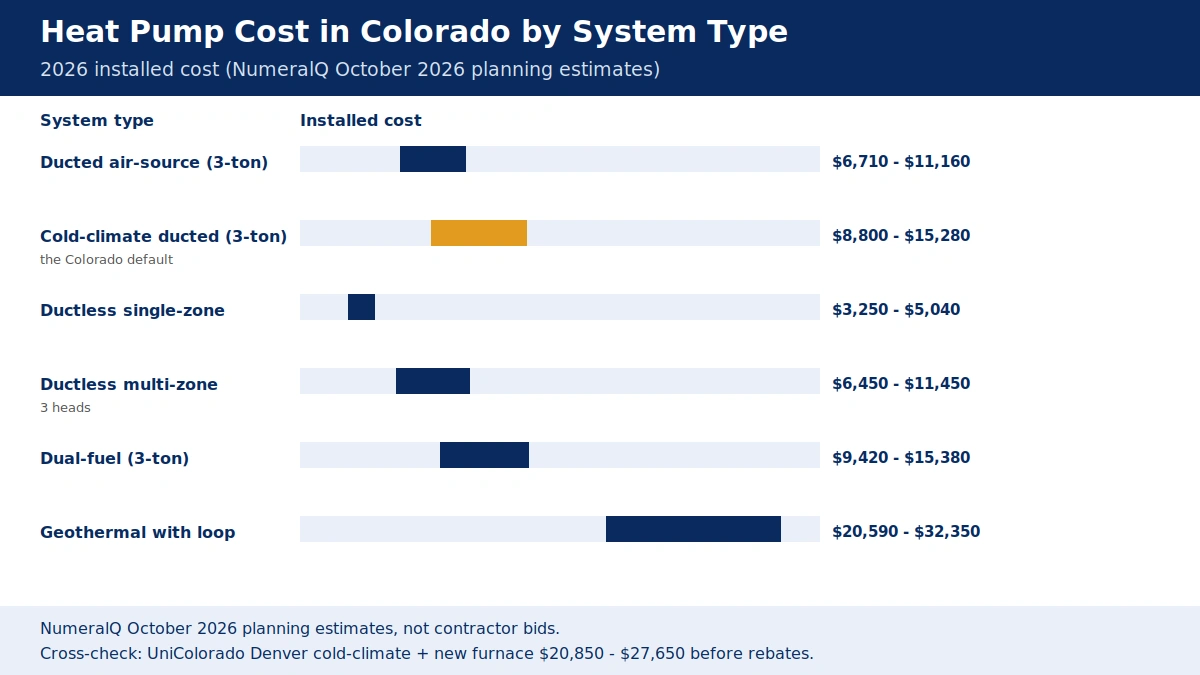
In Colorado the words “heat pump” can mean six machines at very different prices — more than six to one from the cheapest to the dearest — and the altitude and the gas mains decide which one fits before the buyer’s preference gets a vote. A Denver ranch with ducts, a Boulder townhouse on baseboards, a Fort Collins bungalow with no ducts at all, a mountain cabin at 8,000 feet off the gas mains: each one wants a different machine.
| System type | Installed cost (CO) | Best for in Colorado |
|---|---|---|
| Ducted air-source (3-ton) | $6,710-$11,160 | Whole-home primary heat with ducts; mildest Front Range sites |
| Ducted cold-climate (3-ton) | $8,800-$15,280 | The Colorado default; Front Range and foothills winters |
| Ductless mini-split, single zone | $3,250-$5,040 | One room, addition, or a house with no ducts |
| Ductless multi-zone (3 heads) | $6,450-$11,450 | Whole-home without ducts; zone-by-zone control |
| Dual-fuel (heat pump + gas furnace) | $9,420-$15,380 | Gas-heated home that wants a heat pump for mild hours + AC |
| Geothermal, ground-source with loop | $20,590-$32,350 | Long-term owner, big lot; steadiest winter COP at altitude |
Ducted air-source is the budget buy, and in Colorado it is a compromise the buyer should name. A standard ducted heat pump at $6,710-$11,160 for a 3-ton job reuses the existing ductwork, heats and cools from a single system, and costs the least of any whole-home option. Across most of Colorado it is not the right machine. Denver designs near zero, Fort Collins below zero, and a standard unit at 5 degrees keeps only 40 to 60 percent of its rated capacity while its COP falls toward 1.0 — before altitude trims it further. A standard unit in Colorado spends more of its season on backup heat than the same unit in a mild state, and backup heat at 17.17 cents a kilowatt-hour is the most expensive heat in the house. The standard unit is the right buy only where a gas furnace is kept as backup. Whether a Colorado house keeps its ducts or goes ductless is a decision our ductless vs ducted guide works through in full.
Cold-climate is the Colorado default, not the upgrade. The cold-climate premium — $8,800-$15,280 against $6,710-$11,160 for the standard ducted 3-ton — buys capacity at 5 degrees and below, vapor-injection hardware, and a unit rated to keep heating toward minus 15 degrees. A cold-climate unit keeps at least 70 percent of rated capacity at 5 degrees with a COP of at least 1.75 — at sea level, on the lab test. At altitude the numbers come down, which is why the manufacturer’s altitude-corrected tables matter more here than the headline rating. The rebate rules also force the choice: Xcel pays $1,500 per heating ton for a cold-climate unit against $600 per cooling ton for a standard one, Power Ahead pays only for cold-climate certified equipment, and Colorado Springs Utilities reserves its $3,000 tier for NEEP-listed cold-climate systems. A Denver buyer who buys standard to save $2,000 on the sticker gives up roughly $2,700 in Xcel rebate alone on a 3-ton system.
Colorado’s older housing stock without ducts is exactly what ductless mini-splits were built to retrofit. Mini-splits are how Colorado retrofits houses that never had ducts — Boulder bungalows on baseboard heat, Denver brick foursquares with boiler radiators, mountain cabins where a duct chase would eat the only closet, additions and finished basements no duct ever reached. A single zone costs $3,250-$5,040 statewide and heats and cools one room or open-plan area. Three heads at $6,450-$11,450 cover a whole small home, each zone on its own thermostat. Coverage is the limit: a head warms only its own room. At altitude the same derating question applies to mini-splits as to ducted units, and a cold-climate mini-split — the ccMSHP tier Xcel rebates at $1,500 per heating ton — is the mountain choice, not the standard head. Per-zone costs for that retrofit are worked out in our mini-split installation guide.
For the two Colorado homes in three on piped gas, dual-fuel is the honest answer. The heat pump and a gas furnace share the house, and a control hands the load to the furnace below a switchover temperature the installer sets. The heat pump owns the mild weather, where its COP is highest; the furnace owns the deep cold, because gas at $1.12 a therm beats a heat pump at a COP of 2.0 by a wide margin. NumeralQ puts the dual-fuel band at $9,420-$15,380 for a 3-ton system — a modeled figure, flagged as such. Denver contractors price the premium cold-climate version far higher: UniColorado’s cold-climate heat pump with a new gas furnace runs $20,850-$27,650 before rebates, and $17,500-$23,850 when the heat pump is added to a furnace the homeowner keeps. The running-cost section works out the switchover logic at Colorado prices, where the break-even COP against gas sits near 4.27 at average rates. Our dual-fuel heat pump guide sets out how the two machines share a house.
No other system in this state shrugs off weather and altitude the way geothermal does — and no other system’s 2026 math lost a third of its value overnight. A ground-source unit draws heat from earth that holds a steady temperature all year beneath a Colorado lawn, keeping a COP of 3.0 to 5.0 through a zero-degree Denver night while an air-source unit works at 2.0 and thin air trims it further. NumeralQ puts the Colorado installed range at $20,590-$32,350 with the loop. The loop is the swing: horizontal trenching where the lot allows, vertical bores where it does not, and rocky Front Range soils that can push boring costs past any planning estimate — no Colorado-specific loop cost was verified in this pass, so get the loop priced by a driller who has worked the local ground. Geothermal fits a long-term owner on a big lot who stays 20 years; anyone likely to move in five is the wrong buyer, because the payback needs a decade of winters. The 30 percent federal credit that once softened the price is $0 for a 2026 homeowner-owned install, so the 2026 geothermal case stands on operating savings alone — plus Xcel’s ground-source rebate, $2,200 per heating ton at the bonus tier. Our geothermal heat pump guide takes up loop types and tight-lot bores, and runs the 20-year arithmetic with the credit gone.
A final setup: a cold-climate mini-split in a home that keeps its furnace or boiler. Put one or two heads in the rooms people actually live in. Shoulder seasons and mild winter days belong to the heads, deep cold stays with the old system, and July brings air conditioning the house never had. The first zone at $3,250-$5,040 is the cheapest entry to a heat pump in Colorado, and in Xcel territory a cold-climate head earns the $1,500-per-heating-ton rebate on top. As a whole-home solution, it disappoints: a single head cannot heat a house through a zero-degree night.
Heat Pump Cost by Home Size
After system type comes size, and Colorado gets it wrong in one direction more than any other: too small. An undersized machine in Denver leans on resistance heat for the coldest weeks, and every one of those kilowatt-hours bills at 17.17 cents. Too big, and it short-cycles through a dry July and costs thousands extra for capacity the house never calls on. The right size comes from one document only: a Manual J load calculation, room by room, at the design temperature — near zero in Denver, below zero in Fort Collins — with the capacity figures corrected for the home’s elevation. Insist on the Manual J in writing before signing, and insist that it shows altitude-corrected capacity for the exact model quoted.
Ducted air-source prices by tonnage, from the NumeralQ anchors, are in the table below. Heat pump capacity is rated in tons, 12,000 BTU an hour to the ton, and in Colorado the heating load governs everywhere — Denver logs 5,874 heating degree days against 827 cooling degree days, a ratio near seven to one. A 2,000-square-foot Denver house commonly needs a 3-ton system, and the same house at 7,000 feet needs more capacity than the same house at 5,000 feet, because the air is thinner and the winter is colder.
| System size | Home size (approx.) | Ducted air-source (CO) |
|---|---|---|
| 1.5 ton | 600-1,000 sq ft | $4,540-$7,250 |
| 2 ton | 1,000-1,400 sq ft | $5,260-$8,550 |
| 2.5 ton | 1,400-1,700 sq ft | $5,980-$9,860 |
| 3 ton | 1,700-2,100 sq ft | $6,710-$11,160 |
| 3.5 ton | 2,100-2,400 sq ft | $7,430-$12,470 |
| 4 ton | 2,100-2,700 sq ft | $8,160-$13,780 |
| 5 ton | 2,700-3,500 sq ft | $9,600-$16,390 |
Every row in that table is a NumeralQ planning estimate, published October 2026. A planning estimate is still not a contractor bid, and the cold-climate version of each row costs more. The cold-climate 3-ton band, $8,800-$15,280, is the row most Colorado buyers should budget from, and no cold-climate price by size was published — do not scale one from this table and call it a quote. What the table shows honestly is the shape: moving up one tonnage costs roughly $700-$1,500 at the standard tier, and the 3-ton row is the size most Colorado homes land on — about half of Jetson’s Colorado installs were 3-ton systems.
Three cautions sit behind that table. To begin with, the home-size column is only a rough guide — rougher in Colorado than most places, because elevation and exposure move the answer as much as floor area does. A tight, well-insulated 2,000-square-foot house built in 2020 in Denver can need a full ton less than a drafty 2,000-square-foot 1920s bungalow — and the same tight house moved to 7,500 feet needs more capacity than it needed in Denver. Next, the governing load is heating everywhere in Colorado. A system chosen for a Denver July will be far too small for a Denver January, and sizing from the old air conditioner’s tonnage is sizing for the wrong season. Lastly, the backup heat gets sized in the same calculation as the heat pump, never afterwards. Strips or a furnace must cover the full design load on the coldest night, when the heat pump gives the least — and at altitude, when it gives less than its rating says.
The 3-ton row deserves the closest look: it is the size most Colorado homes land on, and the row where the planning estimate and the contractor price diverge most sharply. Inside the $6,710-$11,160 planning band, brand and efficiency tier decide where a quote lands — value-tier standard at the bottom, premium variable-speed at the top. The contractor band for a premium cold-climate 3-ton system runs $16,503-$20,960 on Jetson’s completed-install records and higher with a new furnace. Across a Denver winter at 5,874 heating degree days, the premium tier’s real value in Colorado is capacity at 5 degrees and below, not just efficiency.
Heat Pump Cost by City: Denver, Colorado Springs, Boulder & Fort Collins
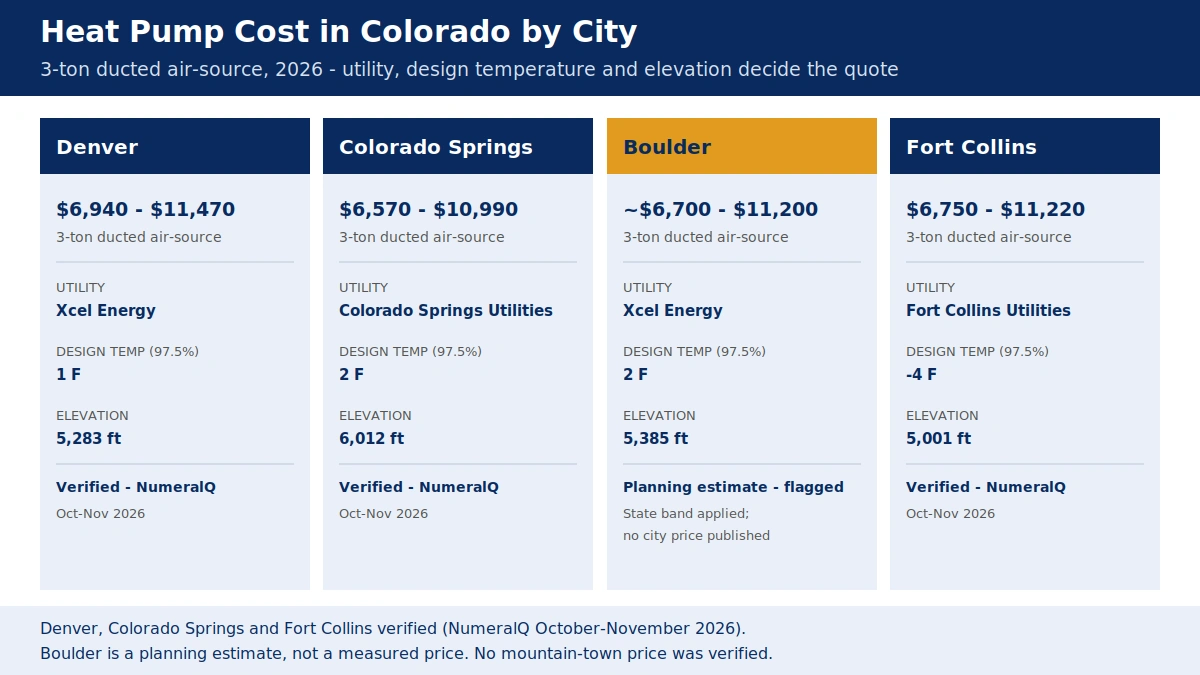
Colorado is a large state with four distinct Front Range markets and a mountain market that plays by different rules. What sets the cities apart is labor, elevation, and the rebate territory — the equipment is the same everywhere, and the electricity price is nearly identical statewide. NumeralQ’s city figures are the only verified city bands in this pass; the Boulder figure carries a warning label rather than a verified price, and the mountain towns carry no price at all.
| City | 3-ton ducted air-source | Utility | Design temp / Elevation |
|---|---|---|---|
| Denver | $6,940-$11,470 (NumeralQ) | Xcel Energy | 1 F (97.5%) / 5,283 ft |
| Colorado Springs | $6,570-$10,990 (NumeralQ) | Colorado Springs Utilities | 2 F (97.5%) / 6,012 ft |
| Boulder | ~$6,700-$11,200 (planning est.) | Xcel Energy | 2 F (97.5%) / 5,385 ft |
| Fort Collins | $6,750-$11,220 (NumeralQ) | Fort Collins Utilities | -4 F (97.5%) / 5,001 ft |
Denver is the capital, the largest market, and the most expensive on labor, at $6,940-$11,470 for a 3-ton ducted system on planning estimates. Denver is also where the contractor evidence runs highest: UniColorado’s cold-climate systems at $17,500-$27,650, Jetson’s Denver cold-climate tier at $20,752-$28,031, and Angi’s Denver average of $10,039 across all tiers. The labor figure explains part of it: Denver-Aurora-Centennial HVAC mechanics earn a median $34.41 an hour, about 17 percent above the national median, with 4,360 technicians. Denver is also where the rebate stack is tallest — Xcel’s $1,500-per-ton cold-climate rebate plus Power Ahead’s $1,500 plus the state credit — so the net price a Denver buyer pays can be the lowest in the state even though the gross price is the highest. Denver’s housing stock fights the installer in its own way: brick bungalows with ducts sized for a furnace, basement air handlers in tight mechanical rooms, and foothills suburbs at 6,000 feet and above.
Colorado Springs, the state’s second city, prices lowest of the four on planning estimates at $6,570-$10,990. The Springs sits 700 feet higher than Denver, at 6,012 feet, with a colder heating season — 6,415 heating degree days against Denver’s 6,020 on the state table — so the same house needs more capacity there. The labor figure runs the other way: Colorado Springs HVAC pay sits about 1 percent above the national median, the lowest of the covered cities. And the utility is different entirely: Colorado Springs Utilities pays $1,500 for a qualifying heat pump under 3 tons and $3,000 for a NEEP-listed cold-climate system 3 tons and over, with under-3-ton rebates credited to the electric bill. No Xcel rebate, no Power Ahead rebate — a Colorado Springs buyer collects a smaller stack on a cheaper gross price. The Springs is also where gas is cheapest of all: a local contractor reports residential gas near 50 to 60 cents per hundred cubic feet, which makes the fuel math against a heat pump harsher here than anywhere else on the Front Range. That figure is contractor-reported and flagged as such — check the current CSU tariff before modeling anything.
Boulder carries a planning estimate of about $6,700-$11,200 — the state band, applied to the city, because no Boulder-specific 3-ton price was published in this pass. The Boulder figure is not a NumeralQ figure, and must not be quoted as one. What is certain is the labor behind it: Boulder metro HVAC mechanics earn a median $34.17 an hour, within cents of Denver’s, and Boulder’s housing stock — older bungalows, hillside homes, strict local codes — pushes installs toward the top of any band. HVAC Visit’s Boulder figure, $8,700-$22,450, covers all system types and sizes; use it as a market check, not a 3-ton price. Boulder buyers sit in Xcel territory for the $1,500-per-ton rebate and inside the DRCOG region for Power Ahead’s $1,500, so the Denver stack applies — plus Boulder’s EnergySmart program, income-qualified, reported at up to $2,000 a year, a figure this guide could not verify against a primary source and flags as such. Boulder’s design temperature carries its own flag: the state table lists 2 degrees per local data, against 8 degrees in the 1985 ASHRAE source.
Fort Collins prices at $6,750-$11,220 on planning estimates — and carries the coldest design temperature of the four cities at minus 4 degrees, with 6,368 heating degree days. Fort Collins is the city where the cold-climate machine is least optional: a standard unit sized for a Denver winter is undersized for a Fort Collins winter, and the backup system carries more of the season. The rebate picture flips here too: Fort Collins Utilities customers do not get Xcel rebates at all. They get Efficiency Works — $1,500 to $2,000 per ducted unit by tier, $500 per ton for non-ducted systems ($1,000 per ton replacing electric baseboard), $3,000 for ground-source, plus a $2,000 heat-pump-and-envelope bundle bonus — through a listed service provider, with applications due within 45 days of completion. Fort Collins is also the one covered city with a priceable permit fee online: about $65 for the standard job, per the city’s own schedule.
Beyond the four cities, the mountain towns — Aspen, Vail, Breckenridge, Steamboat Springs, Leadville — play by rules no Front Range table captures. Design temperatures run to minus 14, minus 16, minus 22 degrees. Elevations run 7,500 to 10,152 feet. Heating degree days run 9,000 to 11,500. Gas mains thin out and propane takes over. No mountain-town install price was verified in this pass, and this guide prints none. A mountain buyer should get quotes from installers who work that elevation routinely and ask for altitude-corrected capacity at the home’s exact elevation.
Compare cities on price per ton, not on the total — and settle the rebate before comparing anything. The rebate gap is the real one: a Denver buyer collects up to $7,000 that a Colorado Springs buyer cannot, and a Fort Collins buyer collects a bundle bonus no one else gets.
Altitude, Cold & Thin Air: What 5,280 Feet Does to a Heat Pump
Colorado holds three climates inside one state line, and the heat pump that suits one can be the wrong machine for the others. The Front Range is high plains — cold winters, dry air, intense sun, and a heating season that dominates the year. The mountains are alpine — design temperatures below zero, elevations past 8,000 feet, and winters that ask for the most capable machine sold. The Western Slope is high desert — milder winters, hotter summers, and a cooling load that matters more than it does in Denver. The state spans IECC climate zones 4 through 7, with about 40 percent of counties in zone 6 or colder. Denver sits in zone 5B. The machine, the size, and the backup system all change with elevation and exposure.
The design temperatures. Manual J sizing starts with the winter design temperature — the outdoor temperature the weather stays above for nearly all of a typical winter’s hours. Denver’s is 1 degree on the state’s 97.5 percent table and minus 0.2 degrees on the ASHRAE 2021 99.6 percent table for Denver International Airport — two bases, about a degree apart, both near zero. Colorado Springs designs for 2 degrees, Boulder for 2 degrees on local data, Fort Collins for minus 4 degrees. Denver logs 5,874 heating degree days a year on the ASHRAE 2021 table, 6,020 on the state table; Colorado Springs 6,415; Fort Collins 6,368; Boulder 5,554. A Denver January averages a high near 47 and a low near 18, so the heat pump spends much of its season in the 20s and 30s — exactly where a cold-climate unit earns its premium and a standard unit starts handing over to backup heat.
What thin air does to a heat pump. An air-source machine draws heat from the outdoor air, and the thinner that air, the less heat each cubic foot carries. At 5,280 feet, Denver’s air holds about 82 percent of the density it holds at sea level. At 8,000 feet it holds about 75 percent. The fan still moves the same volume of air, but the volume carries less mass, and heat rides on mass. Contractor and manufacturer guidance puts the capacity loss at roughly 10 to 18 percent at Front Range elevations — a commonly cited manufacturer derating factor runs about 3 percent per 1,000 feet — and one Denver contractor’s tables put a 3-ton unit’s output near 30,000 BTU an hour at 6,000 feet instead of its rated 36,000. This guide prints that range as attributed guidance, not as a verified standard: no single authoritative derating table was located in this pass, and the number that governs a purchase is the manufacturer’s altitude-corrected capacity table for the exact model, at the home’s exact elevation.
What a cold Colorado winter does to a heat pump. Capacity and efficiency fall together as the outdoor temperature falls — and in Colorado they fall a long way, because the winter is long and the design temperature is near zero. Take the familiar rating as the starting point: a standard 3-ton unit delivers 36,000 BTU an hour at 47 degrees. At 5 degrees, a temperature Denver sees most winters, a standard unit keeps 40 to 60 percent of its rated capacity while its COP falls toward 1.0. A cold-climate unit at 5 degrees keeps 70 to 80 percent of its capacity with a COP between 2.2 and 2.8, on Department of Energy field-test data — sea-level data, which altitude trims further by an amount only the manufacturer’s tables state. Below zero, even the best air-source unit fades, and on a Fort Collins January night at minus 4 degrees it cannot heat the house alone. Backup heat is not a footnote in Colorado. It is half the system. This guide plans on a seasonal COP of 2.0 to 2.5 for Colorado — a planning range.
Dry air changes the defrost and comfort story. Below freezing, the outdoor coil ices up, and the unit must reverse itself now and then to melt the frost away. Colorado’s dry air is a genuine advantage — less moisture means less frost, fewer defrost cycles, and less cold-blast discomfort. Meltwater needs somewhere to go: an outdoor unit sitting at grade grows an ice mound beneath itself until the coil blocks. Lifting the unit on a wall bracket or raised snow stand, with a pad that drains away from the house, adds a few hundred dollars to the quote.
Snow, wind, and the blizzard. A Colorado blizzard can bury an outdoor unit and drift snow against the windward wall. Where the house allows it, site the unit on the leeward wall under an eave that throws snow clear, with open space on every side for airflow and for a technician to reach it in a storm. On exposed sites, a wind baffle keeps driven snow out of the coil, and a raised stand keeps the unit above the drift line. In the mountains, an outdoor unit below a roof valley that sheds avalanching snow needs a deflector or a different wall.
Smoke season is a filtration purchase, and a ducted heat pump is the tool for it. Wildfire season in Colorado typically runs May through September, and smoke from fires on the Western Slope, in neighboring states, and on the Front Range itself can settle over the cities for days. Smoke particles are fine — mostly under 2.5 microns — and a standard fiberglass filter does nothing against them. The EPA and the CDC both recommend a MERV 13 filter or higher when the system can use one, and Colorado’s health department advises the highest-efficiency filter the system allows. A ducted heat pump with a deep-pleat 4-inch or 5-inch media cabinet can carry a MERV 11 to 13 filter with far less pressure penalty than a 1-inch filter slot. The Energy Trust’s guidance for ducted heat pumps runs MERV 8 for daily use, MERV 11 for allergies, and MERV 13 as a temporary measure during smoke — because the dense media strains the blower, and the static pressure should stay at or below the manufacturer’s ceiling, typically around 0.4 to 0.5 inches of water column. Two warnings belong here. A ductless mini-split head filters only its own room’s air through a small filter, and no verified smoke-filtration claim for mini-split heads was found in this pass — a ductless home needs a portable HEPA cleaner for smoke season. And an evaporative cooler pulls outdoor air directly inside, which is the opposite of what a smoke event wants.
Start with the house, not the machine. Register air from a heat pump runs 90 to 110 degrees, where a gas furnace delivers 120 to 140. With tight construction and good insulation, the cooler register air goes unnoticed. A drafty 1920s bungalow with single-pane windows and bare walls notices it every evening, and the backup heat runs longer to cover the gap. The cheapest capacity a Colorado homeowner can buy is air sealing and insulation — every BTU kept inside is one the heat pump need not make at zero degrees. When the house needs both, do the envelope first and size the heat pump second: a tightened house may need a full ton less, and at altitude a ton less is worth more than at sea level. In Fort Collins, Efficiency Works pays a $2,000 bundle bonus for doing exactly that.
Heat Pump vs Gas Furnace in Colorado: The Running-Cost Math
Every number in this guide comes back to this section, and it is also where Colorado differs most sharply from every mild state in this series — because here the heat pump loses to the gas furnace on fuel, clearly, at every realistic efficiency. All the figures below are NestPriced arithmetic built from published prices, and every assumption is printed in the open.
The planning home. The planning home is a 2,000-square-foot Denver-area house needing about 52 million BTU of delivered heat a year — a planning assumption built from Denver’s 5,874 heating degree days, scaled from this series’ 50 million BTU Boston planning home. In kilowatt-hours, the planning home’s heat load is 15,240.
The gas furnace. At 95 percent AFUE, 52 million BTU of heat from the registers needs about 54.7 million BTU of gas in — 547 therms. Colorado’s residential gas price — about $1.12 a therm on the EIA 12-month average to July 2026 — puts the fuel bill near $613 a year. That gas price is the central fact of Colorado heat pump economics: it is among the cheapest residential gas in the country, and it is why two-thirds of Colorado homes heat with gas. A second check makes the furnace’s case stronger: Xcel’s tariff charges a $15 monthly service fee plus about $0.45 a therm in usage charges plus a gas cost adjustment near $0.38 a therm, putting the marginal therm near $0.83 before other riders. The $1.12 figure is generous to the heat pump.
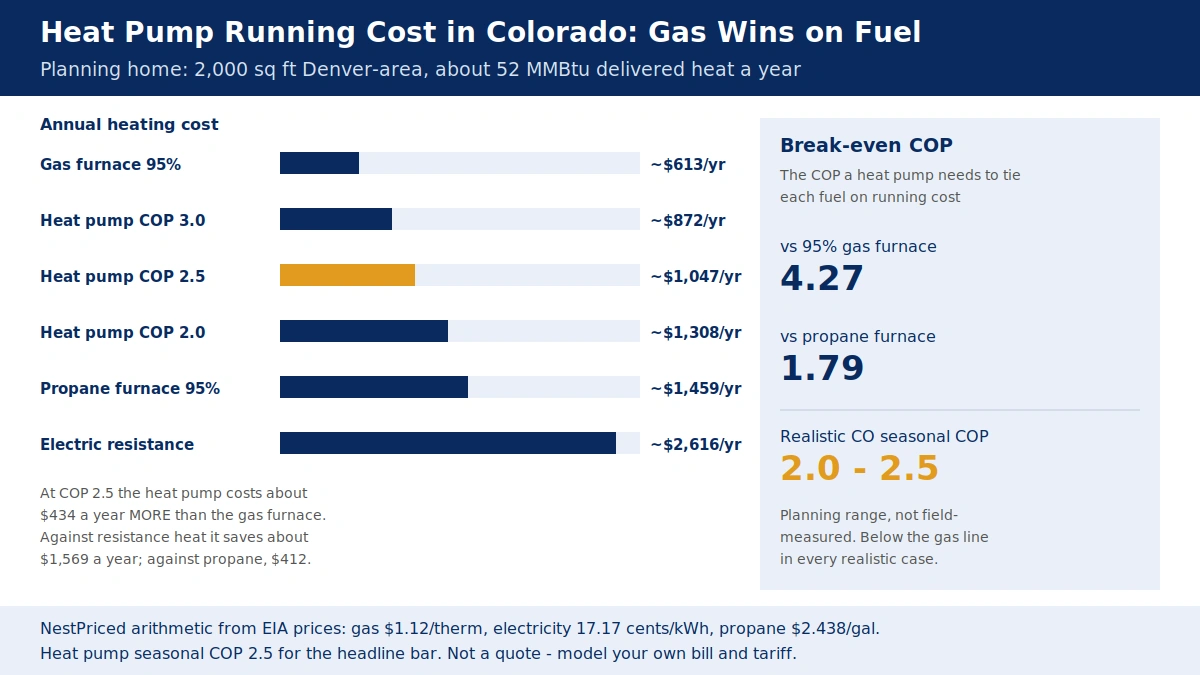
The heat pump. A heat pump at a seasonal COP of 2.5 — the top of this guide’s Colorado planning range — draws 6,096 kilowatt-hours to deliver the same 52 million BTU. At 17.17 cents a kilowatt-hour, the state-average all-in price for August 2026 from the EIA, that comes to about $1,047 a year. Drop the seasonal COP to 2.0 and the bill runs about $1,308 a year; lift it to 3.0 and it falls to about $872. Set those beside the gas furnace’s $613: at COP 2.5 the heat pump costs about $434 a year more than gas; at COP 3.0 it costs about $259 a year more; at no realistic Colorado seasonal COP does it match gas at all. A separate cross-check points the same way: NumeralQ’s RECS-based estimate for an average Colorado home puts a 95 percent gas furnace at $445 a year against $730 for a high-efficiency heat pump and $875 for a minimum-efficiency one.
The break-even COP. Ask it the other way round: what efficiency would a heat pump need to match the gas furnace? Work out the break-even COP by setting the two delivered-energy prices against each other: electricity per million BTU on top, gas per million BTU at 95 percent efficiency underneath. Electricity at 17.17 cents a kilowatt-hour is $50.32 a million BTU; gas at $11.20 a million BTU is $11.79 once the furnace’s 5 percent loss is counted — and $50.32 divided by $11.79 gives a break-even COP of 4.27. A Colorado heat pump holds a seasonal COP of 2.0 to 2.5 through a Denver winter, which means the machine sits far below the line in every realistic case. One qualification counts, and it cuts toward the heat pump: the all-in average folds in fixed charges and on-peak hours, and Xcel’s default time-of-use rate charges a winter off-peak base rate of 6.79 cents a kilowatt-hour against an on-peak base rate of 18.33 cents. A home that heats mostly off-peak sees a lower effective rate than 17.17 cents. The exact marginal rate comes from the bill, riders included, and this guide does not invent one.
The backup-heat adder. All 52 million BTU sit on the heat pump’s side of those figures, at its seasonal COP. A real Colorado winter hands part of the season’s heat to the backup system, and that slice is the expensive one. Say 15 percent of the season’s heat comes from electric resistance strips. That slice, delivered at a COP of 1.0 instead of 2.5, adds roughly $236 a year at 17.17 cents — an illustration, not a bill. Dual-fuel pays for itself right there, in gas territory: under the switchover temperature the gas furnace covers that 15 percent at gas prices rather than resistance prices.
The switchover temperature. A dual-fuel control switches at one outdoor temperature: the point where the heat pump’s COP drops to the break-even figure. In Colorado, with a break-even COP near 4.27 at average rates, that handover sits high: the heat pump beats gas on fuel only in mild weather, where its COP climbs past 4. No verified Colorado switchover figure was published in this pass, and this guide prints none. Ask which temperature was picked, which rates it was calculated from, and why — and get it in writing.
What the heat pump beats, clearly. Against electric resistance heat the heat pump wins outright: the resistance bill for the same 52 million BTU comes to about $2,616 a year — $1,569 a year more than the heat pump’s $1,047. Propane loses by less: a 95 percent propane furnace at $2.438 a gallon costs about $1,459 a year, against the heat pump’s $1,047 — a saving near $412 a year, worked in full in the next section. Against a 95 percent gas furnace at the average electric rate, the race runs the wrong way.
Cooling, counted honestly. A heat pump doubles as the air conditioner, and a Denver July in the low 90s with smoke in the air is where that pays off — especially for the many Colorado homes still cooling with an evaporative cooler that pulls outdoor air inside. Cooling alone would cost several thousand dollars as a separate purchase. In Colorado the premium framing is strong: a furnace-plus-AC 3-ton system runs $8,510-$14,330 on the planning figures, against $6,710-$11,160 for the ducted heat pump and $8,800-$15,280 for the cold-climate version — the standard heat pump is typically cheaper than the pair it replaces, and the cold-climate premium is only about $620 at the midpoints before rebates. Our heat pump running cost guide runs the same fuel-by-fuel comparison nationally; the figures above are Colorado’s version.
The Propane & Electric-Heat Question: Where a Heat Pump Actually Saves Money
If the gas comparison is where Colorado heat pump advertising goes wrong, the propane and electric-heat comparisons are where it goes right. About a quarter of Colorado homes heat with electricity, and a smaller share — concentrated off the gas mains, in the mountains, on the plains, and in the foothills — heats with propane. For those homes the heat pump is a genuine fuel-saving purchase.
Propane at $2.438 a gallon. Dealer prices come from the Energy Information Administration’s weekly survey, published through the heating season. For the week of November 2, 2026, the Colorado residential average was $2.438 a gallon, against a national average of $2.820 and a Rocky Mountain regional average of $2.554. Delivering the planning home’s 52 million BTU a year takes roughly 598 gallons through a 95 percent propane furnace. At $2.438 a gallon, the annual propane bill is about $1,459. Run the heat pump at a seasonal COP of 2.5 and the year’s heating costs about $1,047. The heat pump saves about $412 a year against propane — real money, but thin enough that the rebate stack and the premium framing carry the purchase, not the fuel saving alone. The break-even COP tells the same story: against propane at $2.438 a gallon, a heat pump ties the propane furnace at a COP of about 1.79 — below the realistic Colorado seasonal range. At a seasonal COP of 2.0 the saving shrinks to about $151 a year, and a cold winter at altitude can erase it. Propane prices move week to week, so check the current EIA weekly survey before you decide — and check your own delivered price, which runs either side of the state average by the size of the tank and the delivery route.
Why the propane case is strongest off the gas mains. Three facts steady it. First, the propane home has no cheap alternative: piped gas does not reach the street, and extending a main costs more than any heat pump. Second, a propane home that switches removes a tank, a delivery schedule, and the midwinter worry about running dry during a storm that closes the roads. Third, the propane furnace is often the oldest equipment in the house, and when a 20-year-old furnace is due for replacement anyway, the premium for a heat pump over a new furnace is small enough for the cooling, the zoning, and the fuel saving to carry it even at a thin margin.
Electric resistance heat is the clearest win in the state. A home on baseboards or an electric furnace pays about $2,616 a year to heat the planning home at the state-average rate — more than four times the gas bill and two and a half times the heat pump bill. The heat pump saves about $1,569 a year at a seasonal COP of 2.5, and about $1,308 a year even at a COP of 2.0. About 26 percent of Colorado homes heat with electricity statewide, 36 percent in Denver, 31 percent in Fort Collins, 27 percent in Colorado Springs — and those shares include the baseboard-heated apartments, condos, and older rentals where a mini-split is the practical retrofit.
The partial-home propane play. More and more Colorado propane homes skip the full switch — they add one or two cold-climate mini-split heads and keep the furnace. Shoulder seasons and mild winter days are the heads’ work. Deep cold stays with the furnace, and the house gets filtered air conditioning in July for the first time. The propane burn drops by the share of the season the heads carry. No lower-risk way into a heat pump exists in this state, and no cheaper entry than $3,250-$5,040 for the first zone. Whole-home it is not: furnace and tank both stay, and the propane bill shrinks by a fraction rather than disappearing. Have the fraction modeled on paper before signing — and in Xcel territory, ask whether the cold-climate head earns the $1,500-per-heating-ton rebate.
Heating oil does not belong in this section. In the eastern states in this series, oil is a major fuel and a major section. In Colorado it is neither: the EIA publishes no meaningful Colorado residential heating-oil series, oil-heated homes are a negligible share of the housing stock, and no oil price is stated in this guide. The fuels that decide a Colorado purchase are gas, propane, and electricity — in that order of prevalence, and in the reverse order of heat pump advantage.
Utility Rebates in 2026: Xcel, Colorado Springs Utilities, Black Hills & Efficiency Works
Colorado’s rebate picture is the richest in this series and the most fragmented. There is no single statewide program. What exists is a stack of layers — a utility rebate that differs by territory and by fuel, a regional rebate that covers only the Denver metro, a state credit claimed by the contractor rather than the homeowner, and a federal rebate that closed statewide — and in each territory a different combination applies. A buyer who assumes the Denver headline applies to every Colorado home will be disappointed.
Xcel Energy pays the most — and cut the rate on October 1, 2026. Xcel Energy, Colorado’s largest utility, pays its heat pump rebate per ton of capacity, and it pays two different rates depending on how the home heats today. Since October 1, 2026, a cold-climate heat pump earns $1,500 per heating ton at 5 degrees at the bonus tier — for homes with Xcel gas service, or an existing fuel-burning heating system — and $750 per heating ton at the standard tier for electric-only homes. A standard air-source unit earns $600 per cooling ton at the bonus tier and $300 at the standard tier. Ground-source earns $2,200 per heating ton at the bonus tier and $1,100 at the standard tier. A typical 3-ton cold-climate system at the bonus tier earns about $4,500. The October 1 cut matters: before that date the bonus rates were $2,250, $900, and $3,300, and Xcel cut the bonus multiplier from three times to two times the standard rebate to stay within its approved program budget. Any guide, quote, or contractor page still showing $2,250 a ton is showing the pre-October rate. Three conditions matter beyond the rate. Xcel pays on certified heating capacity at 5 degrees from the AHRI rating in the NEEP database — capacity divided by 12,000, times the rate, rounded to the nearest $5 — not on the tonnage printed on the box. The cold-climate tier requires 15.2 SEER2, 10 EER2, a COP of at least 1.75 at 5 degrees, and at least 70 percent capacity retention at 5 degrees. And installs must be invoiced by December 31, 2026, with applications accepted through September 30, 2027. One timing flag: Xcel paused heat pump and heat pump water heater payments on October 19, 2026, when its 2026 budget ran out, and a Denver contractor reports payments have since resumed. That resumption is single-sourced and flagged — confirm the payment timing with Xcel before counting on it.
The state credit reaches the buyer as a discount — and the discount is not always $1,000. Colorado’s own heat pump tax credit, House Bill 23-1272, is claimed by the installing contractor, not the homeowner. For 2026 the credit is $1,000 for an air-source heat pump, $2,000 for a ground-source or water-source system, and $250 for a heat pump water heater — down from $1,500 for air-source in 2024 and 2025, and stepping down again in 2029. The contractor must pass at least 33 percent to the customer as an invoice discount labeled “State of Colorado Heat Pump Discount”: a minimum of $333 on an air-source system, $667 on ground-source, $83 on a water heater. Many contractors pass more — UniColorado passes the full $1,000 — and the buyer should ask before signing how much of the credit reaches the invoice. The credit has no income limit, the customer files no paperwork, and the contractor must be registered with the Colorado Energy Office. One condition is flagged rather than stated flat: program summaries report the system must meet at least 80 percent of the home’s annual heating need, a rule this guide could not verify against a primary source.
Power Ahead Colorado adds $1,500 in the Denver region — with preapproval before work begins. The Denver Regional Council of Governments runs Power Ahead Colorado, a $273 million program backed by federal climate funds and a local match, covering 58 member governments across the Denver metro. It pays a flat $1,500 for an ENERGY STAR cold-climate heat pump, ducted or ductless, in an existing building — no income limit, no utility requirement, once per address ever. It opened June 29, 2026. It stacks with Xcel and the state credit, and it does not stack with HEAR or HER. The condition that catches buyers is timing: the approved contractor must submit the project for preapproval before work begins. A system installed before preapproval does not qualify.
Colorado Springs Utilities pays $1,500 to $3,000 — on its own schedule, in its own territory. Colorado Springs Utilities, the municipal utility, pays $1,500 for a qualifying ENERGY STAR heat pump or a cold-climate unit under 3 tons, and $3,000 for a NEEP-listed cold-climate system 3 tons and over or an air-to-water heat pump, plus $750 for a heat pump water heater. The $3,000 tier is for CSU natural gas customers with a qualifying cold-climate system. Since January 1, 2026, approved under-3-ton rebates are credited to the electric bill — the wording differs between sources, so confirm with CSU whether the payment arrives as a rebate or a bill credit and when. Applications must be postmarked by January 31 of the following year. No Xcel money and no Power Ahead money reaches a CSU customer. The stack in the Springs is CSU plus the state credit discount — $1,833 to $4,000 on a 3-ton cold-climate system.
Black Hills Energy covers Pueblo and the south — with figures this guide could not verify against the utility. Black Hills Energy serves Pueblo and southern Colorado electric customers and gas customers across parts of the state. A secondary source reports its 2026 residential electric program at $1,500 for qualifying air-source and ductless heat pumps, $2,500 for cold-climate air-source systems, and $1,700 for geothermal, with applications due January 31, 2027 — and a separate beneficial-electrification catalog at $3,648 for air-source, $3,280 for ductless, and $9,860 for geothermal when replacing gas space heating. Both figures come from a single secondary source, and Black Hills’ own published catalog located in this pass covers commercial customers only, at $250 a unit. This guide prints the residential figures as reported and unverified: confirm them with Black Hills before counting on a dollar. The gas-side rebates are smaller and furnace-side only: $260 to $375 for high-efficiency furnaces.
Efficiency Works covers Fort Collins and the northern municipal utilities. Efficiency Works serves residential electric customers of Fort Collins Utilities, Loveland, Longmont, and Estes Park. Its 2026 heat pump rebates run $1,500 per ducted unit at Tier 1 and $2,000 at Tier 2, $500 per ton for non-ducted systems — $1,000 per ton when replacing electric baseboard heat — $3,000 for ground-source, and $400 to $600 for heat pump water heaters. A $2,000 bundle bonus applies when a qualifying heat pump is combined with an eligible envelope improvement. The work must be done by a listed Efficiency Works service provider, and applications are due within 45 days of completion.
The smaller utilities and co-ops pay real money too — check yours before assuming nothing. Holy Cross Energy, serving the Roaring Fork Valley and the mountains around Aspen, pays a reported $3,500 toward a cold-climate heat pump, $7,000 income-qualified, with a $5,000 cap per account per year. Tri-State’s Electrify and Save program, through member co-ops, pays a reported $500 for systems up to 1.5 tons and $1,500 above that, never more than half the equipment cost. Individual co-ops add their own layers — Mountain View Electric Association, Gunnison County Electric Association, San Luis Valley REC among them. Every figure in this paragraph is single-sourced and flagged. A co-op or municipal customer who assumes only Xcel pays rebates may leave thousands unclaimed, and the check costs one phone call to the utility named on the bill.
The honest summary. Denver region, Xcel gas customer, 3-ton cold-climate system: about $4,500 from Xcel, $1,500 from Power Ahead, $333 to $1,000 from the state credit — roughly $6,333 to $7,000. Colorado Springs, CSU customer, 3-ton cold-climate system: $3,000 from CSU plus $333 to $1,000 from the state credit — roughly $3,333 to $4,000. Fort Collins, Efficiency Works Tier 2 with the bundle bonus: $2,000 plus $2,000 plus $333 to $1,000 — roughly $4,333 to $5,000. Pueblo and the south, Black Hills territory: $1,500 to $2,500 reported, unverified, plus the state credit discount. Electric-only Xcel customers collect the standard tier — about $2,250 on a 3-ton system — plus Power Ahead and the state credit where they apply. And everywhere in Colorado, the federal contribution to a 2026 homeowner-owned install is $0, and the HEAR rebate is closed.
Federal Help in 2026: $0 Tax Credit, HEAR Closed & the Lease Route
One paragraph holds the whole 2026 federal picture — and the brevity is exactly why so much heat pump advertising still gets it wrong. In Colorado the paragraph has a second half other states do not get: the federal rebates that would matter most here did launch, did pay out, and then ran out of money and closed.
July 4, 2025, is the date the Energy Efficient Home Improvement Credit ended: the One Big Beautiful Bill Act (Public Law 119-21) was signed that day. Through Section 25C, air-source heat pump buyers once collected up to $2,000 a year. That door closed on December 31, 2025: equipment entering service after that date collects nothing. IRS fact sheet FS-2025-05 makes the finish date the one that counts — not the date payment changed hands. The Residential Clean Energy Credit at 30 percent, Section 25D, closed the same day — taking the geothermal credit with it. Any 2026 quote still carrying a federal-credit line rests on repealed law — have the contractor reissue it without that line. What ended on July 4, 2025, and why the completion date counts, is explained in our federal tax credits guide. Install a system you own yourself in 2026 and the federal tax credit on it is $0.
Colorado’s HEAR rebates launched, paid out, and closed — and no new single-family round has been announced. Colorado was one of the first states to launch its Home Electrification and Appliance Rebates, opening the first phase in October 2024 and statewide single-family rebates in November 2025, paying up to $8,000 for a cold-climate heat pump to income-qualified households. The Front Range region closed April 28, 2026. The rest of the state closed August 1, 2026. The Colorado Energy Office’s funding dashboard shows $0 remaining, verified against state pages as recently as November 4, 2026. Do not count on this money when you buy. Do not let a quote count it. Rebates for small multifamily buildings were staged for 2026, and the whole-home HOMES rebates were staged for manufactured homes and large multifamily buildings — neither is a single-family program a homeowner can apply to today.
Even if a federal round reopened, it would not pay the fuel switch most Colorado homes need. The Energy Department’s Program Notice 26-2, dated May 29, 2026, confines HEAR money to electric-to-electric upgrades and new construction — efficient electric equipment replacing electric equipment. A heat pump that takes over from a gas or oil furnace is a fuel switch, and the notice takes fuel switches out of HEAR. That bites harder in Colorado than in almost any other state: about 66 percent of homes heat with piped gas, so the households that would most want the rebate are the ones the rule excludes. HOMES, the whole-home efficiency program, pays on measured or modeled energy savings — as much as $8,000 — instead of on the equipment list, and Colorado has not opened it to single-family homes either.
The lease route exists as an offer in Colorado — with terms this guide could not verify. Company-owned heat pumps can still earn the federal clean-electricity credit — 30 percent under Section 48E — where the Colorado homeowner owns nothing. IRS Notice 2025-42 sets the timing trap: construction must have begun by July 4, 2026, and the system must enter service by December 31, 2027. At least one national company markets heat pump leasing in Colorado cities, including Pueblo, Colorado Springs, and Fort Collins. But no lease price, no monthly payment, no term, and no Section 48E pass-through amount was verified in this pass, and this guide states none. Have a lawyer read any lease offer before signing. The honest summary: in 2026 Washington pays nothing toward a Colorado homeowner’s own heat pump purchase, the state’s own federal rebate program is closed, and the lease route is an unverified offer, not a priced alternative.
Permits & Licensing: No State HVAC License, Local Rules & the Jurisdiction That Matters
Colorado’s licensing picture is the opposite of what a buyer from a licensed state expects. Colorado issues no statewide HVAC or mechanical license at all. There is no state credential to ask for, no state lookup to check, and no state board to complain to. Licensing lives city by city and county by county, and a contractor licensed in Aurora is not automatically licensed in Denver.
Colorado licenses the trades around the HVAC work at the state level, and the HVAC work itself locally. The Department of Regulatory Agencies, through its Division of Professions and Occupations, licenses electricians and plumbers statewide. Heating, air conditioning, and mechanical work are not among the occupational credentials the Division lists. The cities fill the gap, each with its own program. Denver’s Community Planning and Development issues Heating and Ventilating certificates: the Journeyman certificate requires four years of field experience, at least 7,000 hours, plus the ICC F31 National Standard Journeyman Mechanical exam, and its holder may do the work only while employed by a licensed Heating and Ventilating Contractor. Denver charges $40 for the certificate, renews it every three years, and does not reciprocate licenses or certificates from other counties or states. Colorado Springs licenses through the Pikes Peak Regional Building Department. Aurora, Fort Collins, Lakewood, and Littleton each run their own mechanical contractor licensing and permitting programs. The question is never “are you licensed,” because in Colorado the answer is a jurisdiction, not a yes. The question is which city or county licensed this crew, for this address, and whether the license can be verified with that building department.
The trade licenses around the edges matter too, and in Colorado two of them are state-level. The electrical connections need a state-licensed electrician under the DORA system, and the gas piping for a dual-fuel job needs the appropriate plumbing or gas credentials. Federal EPA Section 608 certification is required for everyone who handles refrigerant; ask to see the card, by name. A heat pump crew without an electrician’s license cannot do the wiring — a licensed electrician must, and the electrical permit should carry that electrician’s name, not the HVAC firm’s. The rebate adds a credential of its own: Xcel, Power Ahead, Efficiency Works, and the state credit each require a participating or registered contractor, or the money does not apply. A contractor can be perfectly licensed in Denver and still unable to file a Power Ahead rebate if it is not an approved Power Ahead contractor.
Permits and inspection run on the city’s timetable, not the contractor’s. The city or county building department is the permit issuer for both trades — mechanical and electrical — and its inspectors check the outdoor unit’s placement, the refrigerant lines and the electrical disconnect. No Colorado-wide permit fee schedule exists; fees vary by jurisdiction and usually follow the job cost. Two figures were verified in this pass, and only two: Fort Collins charges about $65 for the standard job on its own schedule, and Denver’s schedule, as summarized by Angi, starts at $35 plus $8 per $1,000 of project value above $2,000. Do not borrow another city’s schedule. Denver requires a contractor license for any work requiring a permit, so an unlicensed crew cannot legally pull a Denver permit at all. What slows a Colorado install is the calendar, not the price tag: the best crews book weeks out in the shoulder seasons.
Condos and HOAs are where placement fights happen, and no Colorado law was found granting heat pump owners the solar-style protection some states give. Unlike a furnace, an outdoor unit shows itself — so an association can limit its position, its appearance, and its visibility from the street, and in a Denver condo, where the exterior wall is usually common area, the board’s approval decides everything. Settle the placement in writing before ordering the unit. In wildfire-prone foothills communities, the same conversation happens with defensible space: an outdoor unit beside a wood pile, under a juniper, or against a wooden fence sits inside the zone the fire district wants clear, and the district’s rules decide where the unit goes.
What Pushes Your Colorado Quote Up or Down
A budget gets its bearings from the per-ton anchor, but the anchor alone never prices the job. Eight things can move a Colorado heat-pump quote by thousands of dollars either way; four are set by the state’s geography and its power market rather than by the equipment.
Labor is expensive in Colorado — and most expensive where the rebates are tallest. HVAC mechanics earn a median $31.35 an hour statewide ($65,200 a year, BLS May 2025), against $29.33 nationally, and the Denver metro median runs higher still at $34.41 an hour, about 17 percent above the national median, with 4,360 technicians. Boulder matches Denver at $34.17. Fort Collins runs about 9 percent above the national median, Colorado Springs about 1 percent. What swings a Colorado quote is not the wage alone but a difficult house at a difficult elevation: a Denver bungalow with no ducts, a Boulder hillside home with no level pad, a mountain cabin at 8,000 feet where the crew drives an hour each way.
The ductwork, and whether it survives. Compared with a furnace, a heat pump moves a larger volume of cooler air through the ducts. Ducts sized for a 140-degree furnace airstream can fall short on a 100-degree heat pump airstream — undersized, leaking, or uninsulated. NumeralQ puts new or extended ductwork at $4,350-$7,320 for the job, the costliest add-on line in the state. Get a duct inspection and a static-pressure reading in writing — with the price of fixing whatever they reveal alongside. The static-pressure reading matters twice in Colorado: once for heating performance at altitude, where thin air already taxes the blower, and once for smoke season, where a MERV 13 filter adds resistance the ducts must be able to carry.
The electrical panel. 100-amp service still runs many Colorado homes — post-war ranches, Boulder bungalows and mountain cabins above all — and a heat pump with electric backup strips can force the upgrade question. NumeralQ prices a 200-amp panel upgrade in Colorado at $2,160-$3,400 for the job. A Denver contractor prices the same work higher: $1,950-$3,350 for a subpanel, $4,400-$6,400 for a full 200-amp service upgrade. The gap is scope — a subpanel against a full service replacement, and Denver labor against a modeled statewide figure. Get the upgrade as its own line on the quote, before signing. A panel upgrade is priced nationally in our electrical panel upgrade guide.
Equipment tier. Premium cold-climate and variable-speed units cost 10-20 percent more than value-tier units at the standard tier, and far more at the top of the Denver contractor band — Jetson’s cold-climate Denver tier runs $20,752-$28,031 against $15,309-$20,728 for a standard unit. In Colorado the premium buys stronger low-temperature performance on the coldest nights, a higher seasonal COP that pays back across 5,874 heating degree days, and the rebate tier that pays $1,500 a ton instead of $600. In a mild Front Range microclimate with a gas furnace kept as backup, the value tier is a defensible buy. Everywhere else the premium buys capacity at 5 degrees and below, where the season lives, and the rebate that erases much of the premium itself.
The snow stand, the baffle, and the media cabinet. A Denver outdoor unit sitting at grade ends up under drifted snow, and a unit that cannot breathe cannot defrost. A wall bracket or raised snow stand, a wind baffle on an exposed site, and a deep-pleat media filter cabinet for smoke season cost a few hundred dollars each on the quote. Ask for them by name. The media cabinet deserves its own line: a 4-inch or 5-inch cabinet with a deep-pleat MERV 11 to 13 filter is the smoke-season upgrade that a 1-inch filter slot cannot match, and the time to install it is during the heat pump install, when the air handler is already open.
The altitude kit on the furnace side. A dual-fuel job has a second altitude problem, on the gas side. Gas furnaces burn less completely in thin air: less oxygen per cubic foot means incomplete combustion and less heat output, a risk the fuel gas code addresses directly. The International Fuel Gas Code requires derating gas appliances above 2,000 feet, and the common rule of thumb runs 4 percent of input per 1,000 feet — about 20 percent in Denver — with a high-altitude kit to match the gas flow to the thinner air. That guidance comes from a Denver contractor’s published account, and this guide flags it as such. The buyer’s question is simpler than the code: does this quote include the high-altitude adjustment for the furnace, and has the furnace been sized on its derated output, not its sea-level rating?
Financing terms. Cash is the cheapest way to pay over the system’s life. Dealer $0-down financing is the trap to avoid: dealer fees of 10-30 percent of the cash price — sometimes over 50 percent — get rolled into the loan itself. The CFPB’s August 2024 market spotlight is the source, and the figure is a national one. Two Colorado-specific financing paths deserve a mention, both flagged: Tri-State’s Electrify and Save on-bill repayment program, offered through member co-ops with $0 upfront, and Xcel’s financing offers tied to rebate-eligible installs. Neither was priced in this pass, and neither should be judged on its monthly payment without the total cost of the loan beside it. A lease or PPA is the third path: at least one company markets one here, no price or term was verified, and a lease quote belongs in front of a lawyer.
Maintenance and lifespan. A Colorado heat pump works a double shift — seven months of heating, a defrost cycle every cold snap, an outdoor unit living in snow, wind, dust, and summer smoke, and a filter loading up with ash for weeks at a time. Service the system once a year — coils cleaned, refrigerant checked, defrost cycle verified, backup heat tested to prove it engages when it should. Change the filters monthly through the heating season and weekly during a heavy smoke event, and clear snow off the outdoor unit after every storm. Every lifespan, degradation, and maintenance figure here is a national one — no Colorado version exists. Well-maintained equipment usually lasts 15-20 years, with the compressor setting the limit; an oversized unit that short-cycles dies years before a correctly sized one. Running costs after installation — servicing and repairs — are priced in our heat pump maintenance guide and our heat pump repair guide.
Payback: When Does a Colorado Heat Pump Pay for Itself?
Payback turns on what the heat pump replaces and which rebate territory the house sits in — more sharply than in any other state in this series, because in Colorado the heat pump is cheaper to buy than the system it replaces, dearer to run than the gas furnace, and subsidized more heavily than in almost any other state.
A worked example. Start from the midpoint of the Colorado cold-climate range: a ducted 3-ton system at about $12,040 installed, heating the 2,000-square-foot Denver-area planning home and its 52 million BTU of delivered heat a year. The federal credit is $0. The HEAR rebate is $0 — closed. The rebate depends on the territory: a Denver-region Xcel gas customer collects roughly $6,333 to $7,000, a Colorado Springs customer roughly $3,333 to $4,000, a Fort Collins customer roughly $4,333 to $5,000 with the bundle bonus. The table below runs the three cases that actually occur in Colorado, on the gross price and on the Denver net price.
| What it replaces | Annual fuel saving | Payback on $12,040 gross | Payback on ~$5,370 Denver net |
|---|---|---|---|
| Electric resistance heat | ~$1,569/yr | ~7.7 yrs | ~3.4 yrs |
| Propane furnace | ~$412/yr | ~29.2 yrs | ~13.0 yrs |
| 95% gas furnace | Negative — costs ~$434/yr MORE | Never on fuel | Never on fuel |
Read alongside the running-cost table, that payback table is the whole verdict in one place. Against electric resistance heat, a heat pump saves about $1,569 a year and pays back in about 8 years gross, about 3 years net in Denver. Against propane it saves about $412 a year, a payback of about 29 years gross — beyond the equipment’s life — and about 13 years net in Denver, inside the equipment’s life, because the rebate stack does the work the fuel saving cannot. Against a 95 percent gas furnace it costs about $434 a year more to run than the furnace, so there is no fuel payback at all at a seasonal COP of 2.5 — at COP 3.0 it still costs about $259 a year more. The Denver net column uses the midpoint of the $6,333-$7,000 stack.
Count the premium only, not the whole machine. The table above charges the full heat pump price against fuel savings alone — a misleading frame for any home that must replace both furnace and air conditioner. One machine does the work of both. If the furnace-plus-AC combination would have cost $8,510-$14,330 and the cold-climate heat pump costs $8,800-$15,280, the premium is about $620 at the midpoints — and the rebate stack erases it several times over in every territory in this guide. Under the premium framing, the payback works for every fuel in Colorado, including gas, because there is no premium left to pay back once the rebates land.
What moves the payback most. The payback moves on five factors of wildly different sizes. Nothing else comes close to the fuel being replaced: resistance heat first, propane second, and gas last — gas never pays back on fuel alone, at any realistic COP. The rebate territory comes second: the same heat pump against the same propane furnace pays back in about 13 years net in Denver and about 20 years net in Colorado Springs, because the stack differs by $3,000. Third comes the state-credit pass-through: $333 against $1,000 is $667, which moves the Denver resistance-heat payback by about five months. Fourth comes the seasonal COP the machine actually achieves at altitude: at COP 2.0 the propane saving shrinks to about $151 a year, and the net payback stretches past 30 years. Fifth, the envelope: air sealing and insulation shrink the heating load, which shrinks the heat pump and the backup heat alike — the one lever that improves every row at once.
Who still comes out ahead. Four kinds of Colorado household come out ahead. The electric-heat home, where the published saving is about $1,569 a year and the net payback is about 3 years in Denver — and that is a quarter of the state. The propane home in a rebate territory, where the saving is about $412 a year and the net payback is about 13 years in Denver — shorter still if the furnace is dying anyway and the premium framing applies. The household whose furnace and air conditioner are both dying: when replacement is unavoidable anyway, the heat pump with rebates is cheaper than the pair it replaces. And the household buying for cooling and smoke filtration first — the swamp-cooler home, the home with no air conditioning, the foothills home that spent last August breathing smoke — where the heat pump’s value is comfort and clean air, and the fuel math is not the deciding factor. Walk away when your home heats with a 95 percent gas furnace, your air conditioner is new, you sit outside every rebate territory, and you are counting on a fuel saving to justify the purchase — the saving is not there at any realistic COP.
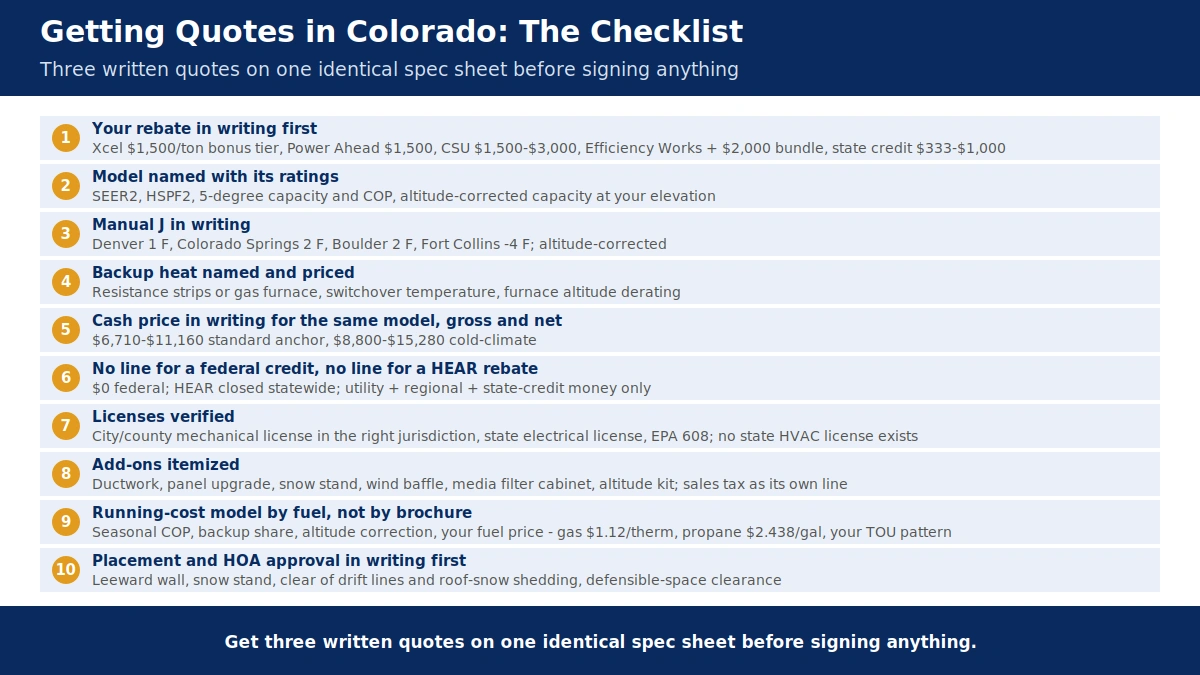
Getting Quotes in Colorado: The Checklist
Colorado is the most paperwork-heavy state in this series to buy a heat pump in — the tallest rebate stack, the most territories, the most conditions on each layer, the thinnest air, and the coldest design temperatures. Bring the list to all three bidders.
The ten-item quote checklist:
- Your rebate, in writing, first — Xcel $1,500 per heating ton for cold-climate systems at the bonus tier ($750 standard tier) in Xcel territory, Power Ahead $1,500 flat in the Denver region with preapproval before work begins, Colorado Springs Utilities $1,500-$3,000 in the Springs, Efficiency Works $1,500-$2,000 plus a $2,000 bundle bonus in Fort Collins, Black Hills figures reported but unverified in the south, and the state credit discount of $333 to $1,000 depending on your contractor’s pass-through. A quote that subtracts a rebate your utility does not pay is a quote that needs rewriting.
- Model named, with its ratings — the model number, its SEER2 and HSPF2, its 5-degree capacity and COP, and its altitude-corrected capacity at your home’s elevation from the manufacturer’s tables. A quote that names no model has priced a machine that may not exist, and a quote naming a standard unit for a Colorado winter, or a sea-level capacity for a house a mile up, has priced the wrong machine.
- Manual J load calculation, in writing — room by room, at your city’s design temperature (Denver 1 F, Colorado Springs 2 F, Boulder 2 F, Fort Collins -4 F on the state table), with altitude-corrected capacity figures. Sizing by square footage alone guesses at the figure every other decision rests on.
- Backup heat specified in full — strips or furnace, with capacity and switchover temperature both stated on the quote, and the furnace’s high-altitude derating named where a gas furnace is kept or installed.
- Cash price on paper for one identical model — the same kit, the same house, from all three bidders, gross and net of rebates shown separately. The Colorado anchor runs $6,710-$11,160 for a standard 3-ton ducted system and $8,800-$15,280 for cold-climate; a quote well above it needs an explanation in equipment tier or scope, and one well below it needs a closer look at what was left out.
- No federal credit line, no HEAR line — a 2026 owner purchase gets $0 federal, and Colorado’s HEAR program is closed statewide with $0 remaining. The only money is your utility’s, your region’s, and your contractor’s state-credit discount.
- Licenses verified — the city or county mechanical license for the crew and firm in the jurisdiction where the house sits (Denver Heating and Ventilating certificates, Pikes Peak Regional Building Department in the Springs, Fort Collins and Aurora programs), the state electrical license for panel and circuit work, and EPA Section 608 for refrigerants. Colorado has no state HVAC license and no statewide lookup — verify with the city or county building department, and never accept “licensed” with no jurisdiction named.
- Add-ons itemized — ductwork ($4,350-$7,320), panel upgrade ($2,160-$3,400 modeled, $1,950-$6,400 contractor scope), snow stand or wall bracket, wind baffle, media filter cabinet, high-altitude furnace kit, and thermostat, each priced on its own line rather than folded into the per-ton figure. Sales tax gets its own line too — ask whether the quote’s tax line matches your combined local rate, because no Colorado installed-system tax treatment was verified for this guide.
- Model the running cost by fuel, not by brochure — seasonal COP assumed, backup-heat share, altitude correction, and the rate applied, worked out against your own fuel: gas at $1.12 a therm (or your marginal rate), propane at $2.438 a gallon (or your delivered price), or your own electric rate and time-of-use pattern.
- Placement and HOA approval settled first, in writing — the outdoor unit on the leeward wall, lifted on a snow stand or bracket, clear of drift lines and roof-snow shedding, with HOA or condo board approval and defensible-space clearance before the unit is ordered.
Buy, dual-fuel, or geothermal? Homeowners on electric or propane heat win with a cold-climate ducted system — as does anyone whose furnace and air conditioner are both dying anyway. Dual-fuel suits gas-heated homes, where the furnace owns the deep cold, the heat pump owns the mild hours and the summer, and Xcel pays $1,500 a ton toward the heat pump half. Geothermal fits long-term owners on big lots who will stay 20 years and want the steadiest winter COP in Colorado — at $20,590-$32,350, with no federal credit to soften it in 2026, and Xcel’s $2,200-per-ton ground-source rebate at the bonus tier. A standard unit wins almost nowhere in Colorado except the mildest microclimates with a furnace kept as backup. If the roof is part of the same project, our Colorado roof replacement guide prices that job by material and region, and our national roof guide covers the materials themselves.
Sources & methodology
Cost anchors:
- NumeralQ Heat Pump Cost in Colorado 2026 (updated Oct 5, 2026; city pages Oct 15-Nov 6, 2026) — planning estimates, not contractor bids: statewide 3-ton ducted $6,710-$11,160; cold-climate ducted $8,800-$15,280; single-zone $3,250-$5,040; multi-zone 3-head $6,450-$11,450; geothermal $20,590-$32,350; sizes 1.5-ton $4,540-$7,250 through 5-ton $9,600-$16,390; ductwork $4,350-$7,320; panel upgrade (200 A) $2,160-$3,400; Denver $6,940-$11,470; Colorado Springs $6,570-$10,990; Fort Collins $6,750-$11,220
- NumeralQ HVAC Replacement Cost in Colorado 2026 (updated Oct 18, 2026): dual-fuel 3-ton $9,420-$15,380; central AC + gas furnace 3-ton $8,510-$14,330; Denver HVAC replacement $8,750-$14,650; Denver dual-fuel $9,710-$15,760; Colorado Springs $8,360-$14,140; Fort Collins $8,550-$14,380
- UniColorado Heat Pump Installation Cost Denver (updated Oct 15, 2026, contractor price list): cold-climate + coil on kept furnace $17,500-$23,850; cold-climate + new gas furnace $20,850-$27,650; ducted cold-climate + air handler $20,850-$27,650; out of pocket $14,800-$18,200 (new furnace) and $10,500-$13,850 (kept furnace) after ~$7,000 stack; subpanel $1,950-$3,350; full 200 A service $4,400-$6,400; “at Xcel’s October 2026 rates, gas heat costs the same or less than heat pump heat”
- Jetson Home Heat Pump Cost & Installation Prices (Sept 1, 2026, completed-install records CO+MA+NY): 2-ton $14,074-$18,000; 3-ton $16,503-$20,960; 4-ton $16,995-$22,090; 5-ton $16,995-$22,840; Denver tiers standard $15,309-$20,728, cold-rated to -15 F $20,752-$28,031; ~50% of Colorado installs 3-ton
- Angi Heat Pump Cost in Denver (updated Jul 8, 2026): average $10,039, range $5,607-$14,472; typical home ~2.5 tons; labor ~$150/hr/worker; permits from $35 + $8 per $1,000 above $2,000
- Denver Heat Pump Pros 2026 guide: Denver installs $8,000-$18,000; 2-ton $8,000-$12,000; 3-ton $11,000-$15,000; 4-ton $14,000-$18,000; single-zone $3,500-$6,500 (Xcel $2,250/ton figure on this page is pre-Oct 1, 2026 and stale — not used)
- HomeCostLens Denver (reviewed Sept 2026): ~$6,880 average for 2,000 sq ft, range $4,760-$13,750; HVAC Visit (Oct/Nov 2026): Colorado heat pumps $7,150-$22,550, Boulder $8,700-$22,450 (all types/sizes)
Rates:
- EIA Electric Power Monthly Table 5.6.A, Oct 28, 2026 release: CO residential 17.17 cents/kWh Aug 2026; US 18.16 cents; 12-month to Aug 2026 16.6 cents; Xcel Energy Colorado residential average 15.90 cents/kWh (EIA Form 861, 2025 annual)
- Xcel Energy Colorado residential TOU (default since Nov 1, 2025; PUC base rates): on-peak 5-9 p.m. non-holiday weekdays; summer on-peak 21.277 cents / off-peak 7.884 cents; non-summer on-peak 18.331 cents / off-peak 6.792 cents; $7.10/mo service charge; ECA rider ~2.52 cents/kWh Q4 2026; flat-rate opt-out exists; PUC-approved +4.77% (~$5/mo) from Aug 29, 2026 (case 25AL-0494E)
- EIA Natural Gas Monthly Table 20 (Oct 2026): CO residential 2026 YTD $11.76/Mcf; 12-month avg to July 2026 $11.62/Mcf (~$1.12/therm, wheredmymoney Oct 29, 2026; ballparklab $1.13/therm); Xcel gas tariff (Colo. PUC No. 6, eff. Jan 29, 2026): $15.00/mo + $0.45/therm usage + GCA $0.3797/therm Q4 2026 (marginal ~$0.83/therm)
- EIA Weekly Heating Oil and Propane Survey, week ending Nov 2, 2026: Colorado propane $2.438/gal; US $2.820; PADD 4 Rocky Mountain $2.554
- Colorado Springs Utilities rates (Strong Heating & Cooling, Sept 2026, contractor-reported, flagged): winter electricity ~11-13 cents all-in; residential gas ~50-60 cents/Ccf — direction only, no CSU tariff verified
Climate, elevation and performance:
- Colorado state table 8 CCR 1302-14-B (97.5% winter design temp / HDD / elevation; HDD from DOE Rescheck 4.4.2 / Rocky Mountain ASHRAE 1976/1985): Denver 1 F / 6,020 / 5,283 ft; Boulder 2 F per local (8 F per 1985 ASHRAE — flagged) / 5,554 / 5,385 ft; Colorado Springs 2 F / 6,415 / 6,012 ft; Fort Collins -4 F / 6,368 / 5,001 ft; Aspen 1 F / 9,922 / 7,928 ft; Leadville -14 F / 11,500 / 10,152 ft; Dillon -16 F / 11,218 / 9,065 ft; Grand Junction 7 F / 5,548 / 4,586 ft; Pueblo 0 F / 5,413 / 4,695 ft
- ASHRAE Handbook 2021, Denver Intl (WMO 725650, elev 5,414 ft, 1994-2019): 99.6% heating design temp -0.2 F, 99% 5.8 F; HDD65 5,874; CDD65 827; CDD50 3,009. Older Stapleton (2017 Handbook): 99.6% -1.4 F, HDD65 5,667. IECC zone 5B Denver; ~40% of CO counties zone 6+ (NumeralQ, citing PNNL-33270)
- Air density: ~82% of sea level at 5,280 ft (servicebyveteran); 17.7% below sea level at Denver (CoolSim/ASHRAE ideal-gas calc, Nov 2026); ~75% at 8,000 ft. Capacity derating guidance (attributed, not a verified standard): ~3% per 1,000 ft manufacturer factor (hvaclaboratory); 10-15% capacity loss at Denver altitude, 3-ton unit ~30,000 BTU at 6,000 ft (servicebyveteran); NEEP/AHRI 210/240 ratings are sea-level tests (14.7 psi)
- ENERGY STAR CAC/ASHP V6.2 cold-climate bar — COP at least 1.75 at 5 F, capacity at 5 F at least 70% of the 47 F rating — alongside NEEP ccASHP Spec v4.0; DOE Cold Climate Heat Pump Challenge field data: 5 F capacity 70-80%, COP 2.2-2.8; -5 F capacity 60-70%, COP 1.8-2.4; standard unit at 5 F 40-60% capacity, COP 1.0-1.5 (sea-level field data)
- Gas furnace derating: IFGC requires derating above 2,000 ft; rule of thumb 4% input per 1,000 ft (~20% in Denver); high-altitude kits (servicebyveteran, contractor guidance, flagged)
- Wildfire filtration: EPA + CDC recommend MERV 13 or higher if the system can use it; CDPHE advises the highest-efficiency filter possible, MERV 13+ best when it fits (CDPHE fire page also cites MERV 11+ — flagged variant); Energy Trust: MERV 8+ daily, MERV 11 allergies, MERV 13 temporary during smoke for ducted heat pumps; static pressure ceiling ~0.4-0.5 in. w.c. (Building America Solution Center); wildfire season typically May-Sept (compassheat)
Rebates and incentives:
- Xcel Energy Colorado 2026 rebate summary (effective Oct 1, 2026, via UniColorado + Zero Homes + A&O): bonus tier cold-climate $1,500/heating ton at 5 F, standard $600/cooling ton, ground-source $2,200/heating ton; standard tier $750 / $300 / $1,100; pre-Oct 1 bonus rates $2,250 / $900 / $3,300 (3x multiplier cut to 2x); paid on certified 5 F capacity (AHRI/NEEP), rounded to nearest $5; cold-climate spec 15.2 SEER2, 10 EER2, 1.75 COP at 5 F, 70% capacity at 5 F; invoiced by Dec 31, 2026, applications through Sept 30, 2027; 10,640 rebates / $57M in 2025; Oct 19, 2026 payment pause + reported resumption (UniColorado, single-source, flagged)
- Colorado state heat pump tax credit (HB23-1272, CEO): 2026 $1,000 air-source / $2,000 ground- or water-source / $250 HPWH; was $1,500 air-source 2024-2025; steps down again 2029; contractor-claimed, minimum 33% pass-through as “State of Colorado Heat Pump Discount” ($333 / $667 / $83); no income limit; registered contractor required; 80% annual heating-need rule reported (heatpumpeconomics, flagged)
- Power Ahead Colorado (DRCOG, $273M: $199.7M EPA CPRG + $73.3M local match): $1,500 flat for ENERGY STAR cold-climate heat pumps, existing buildings, once per address ever; 58 member governments; opened June 29, 2026 (Zero Homes says July 15 — flagged); preapproval before work begins; stacks with Xcel + state credit, not with HEAR/HER
- Colorado Springs Utilities 2026 rebate schedule (Version 1.2026): ENERGY STAR heat pump $1,500; cold-climate under 3 tons $1,500; cold-climate 3 tons and over $3,000; air-to-water $3,000; HPWH $750; under-3-ton rebates credited to the electric bill from Jan 1, 2026 (bill-credit wording conflict flagged); apply by Jan 31 of the following year
- Black Hills Energy 2026 residential (Palmetto, single secondary source, unverified): electric program $1,500 air-source/ductless, $2,500 cold-climate, $1,700 geothermal, due Jan 31, 2027; beneficial-electrification catalog $3,648 / $3,280 / $9,860; gas furnace rebates $260-$375; BHE C&I catalog (Jan 2026) $250/unit is commercial only
- Efficiency Works 2026 (Fort Collins / Loveland / Longmont / Estes Park, via A&O + Palmetto): ducted Tier 1 $1,500/unit, Tier 2 $2,000/unit; non-ducted $500/ton ($1,000/ton replacing electric baseboard); ground-source $3,000/unit; HPWH $400-$600; $2,000 bundle bonus; listed provider required; apply within 45 days
- Other utilities (single-source each, flagged): Holy Cross Energy $3,500 cold-climate ($7,000 income-qualified), $5,000 cap/account/year; Tri-State Electrify and Save $500 (up to 1.5 ton) / $1,500 (above), max 50% of equipment cost; Boulder EnergySmart up to $2,000/year income-qualified; Xcel Aurora F-3 up to $15,000, central Aurora only, through Dec 31, 2026
- CO HEAR/HOMES: HEAR launched Oct 30, 2024 (first phase), statewide single-family Nov 13, 2025; Region 1 closed April 28, 2026; Region 2 closed Aug 1, 2026; CEO dashboard $0 remaining; verified Nov 4, 2026 (heatpumppricing); allocations HEAR $69,985,890 + HOMES $70,256,845 (DOE Jan 2025 dataset via ECW); HER/HOMES not open for single-family homes (CEO; AuditYourHome Oct 12, 2026)
- DOE Program Notice 26-2 (May 29, 2026): HEAR electric-to-electric only, no fuel-switching; HEAR cap $8,000, HOMES up to $8,000
- OBBBA P.L. 119-21 and IRS FS-2025-05: §25C and §25D $0 for post-Dec-31-2025 installs, completion date counts; IRS Notice 2025-42 (§48E, in service by Dec 31, 2027, construction begun by Jul 4, 2026); Palmetto markets heat pump leasing in Colorado (no price/term verified)
- CFPB Aug 2024 market spotlight: dealer $0-down financing fees 10-30% of cash price, sometimes over 50% (national figure)
- EPA AIM Act Technology Transitions rule: new residential split systems GWP under 700 from Jan 1, 2025 (R-454B or R-32)
Heating fuel mix:
- ACS 2020-2024 5-year (Census, via NumeralQ, checked Oct 2026): CO piped gas 66%, electricity 26%; Denver electricity 36%, gas 61%; Colorado Springs electricity 27%; Fort Collins electricity 31%
Licensing:
- Colorado has no statewide HVAC/mechanical license (DORA Division of Professions and Occupations lists no HVAC credential; electricians and plumbers are state-licensed). Local licensing: Denver Community Planning and Development Heating and Ventilating certificates (Journeyman: 4 years / 7,000 hours + ICC F31 exam; works only for a licensed contractor; $40 fee; 3-year renewal; no reciprocity); Pikes Peak Regional Building Department (Colorado Springs); Aurora, Fort Collins, Lakewood, Littleton programs; Denver Building Code §121.2; EPA Section 608 required for refrigerants; no statewide lookup exists
- Permits: mechanical + electrical from the city/county building department; Fort Collins ~$65 standard job (city schedule via NumeralQ); Denver from $35 + $8 per $1,000 above $2,000 (Angi summary, flagged secondary); no statewide fee schedule
Labor:
- BLS OEWS May 2025, SOC 49-9021: CO median $31.35/hr ($65,200/yr; mean $34.29; employment 8,940); national median $29.33 (mean $31.14); Denver-Aurora-Centennial median $34.41/hr ($71,580/yr; mean $35.72; employment 4,360); Boulder median $34.17/hr; NumeralQ city table: Denver +17%, Fort Collins +9%, Colorado Springs +1% vs US median
Running-cost and payback arithmetic:
- Planning home ~52 MMBtu delivered heat/yr (NestPriced planning assumption, scaled from the series’ 50 MMBtu Boston home at 5,634 HDD: 50 x 5,874/5,634 = 52.1, ASHRAE 2021 Denver HDD65) = 15,240 kWh of heat; gas 95% AFUE at $1.12/therm = 547 therms = ~$613/yr; heat pump COP 2.5 = 6,096 kWh (17.17 cents) = ~$1,047/yr; COP 2.0 = 7,620 kWh = ~$1,308/yr; COP 3.0 = 5,080 kWh = ~$872/yr; resistance = 15,240 kWh = ~$2,616/yr; propane 95% (91,452 BTU/gal) at $2.438 = 598 gal = ~$1,459/yr; break-even COP vs 95% gas = 4.27, vs propane = 1.79, vs resistance = 1.00; at Xcel marginal gas ~$0.83/therm the gas break-even COP is ~5.8; backup-resistance illustration (15% of heat at COP 1.0 instead of 2.5) ~$236/yr; cross-check NumeralQ RECS average home: gas 95% $445/yr, heat pump HSPF2 7.5 $875/yr, HSPF2 9 $730/yr
- Cold-climate ducted 3-ton at ~$12,040 (midpoint of $8,800-$15,280): vs resistance saves ~$1,569/yr -> ~7.7 yrs gross, ~3.4 yrs on ~$5,370 Denver net (midpoint of $6,333-$7,000 stack); vs propane saves ~$412/yr -> ~29.2 yrs gross, ~13.0 yrs net; vs gas 95% loses ~$434/yr -> never on fuel; at COP 3.0 vs gas loses ~$259/yr; at COP 2.0 vs propane saves ~$151/yr; premium framing: furnace-plus-AC 3-ton midpoint ~$11,420 vs cold-climate heat pump midpoint $12,040 -> premium ~$620 before rebates; standard ducted midpoint $8,935 is below the furnace-plus-AC midpoint
EXCLUDED:
- Any “after 30% credit” or “after $2,000 credit” prices: §25C/§25D are $0 for 2026 installs
- Any HEAR rebate in a 2026 Colorado quote: closed statewide, $0 remaining, no new round announced — and no fuel-switching even if a round reopened
- Xcel $2,250/ton as current: pre-Oct 1, 2026 rate; current bonus rate is $1,500/ton
- The full $1,000 state credit as a guaranteed invoice discount: only $333 is the required minimum pass-through; $334-$1,000 depends on the contractor
- Black Hills residential rebate amounts as verified: single secondary source, flagged
- Boulder city install price: planning estimate only, flagged in the draft
- Any single altitude derating percentage as fact: 10-18% range is attributed guidance only; manufacturer tables govern per model
- Seasonal COP 2.0-2.5: planning range, not field-measured for a specific CO installation
- Any Colorado dual-fuel switchover temperature: none verified, not printed
- CSU tariff rates and the bill-credit wording: contractor-reported / conflicting phrasing, flagged
- Heating oil prices or oil payback math: not a Colorado fuel, excluded
- Colorado sales-tax rate or treatment for installed systems: not verified, omitted
- Any lease/PPA price, term, or §48E pass-through amount: no terms verified
- HER/HOMES launch dates or amounts for single-family homes: not open, not projected
- Mountain-town install prices: none verified, not printed
- Geothermal loop-type pricing specific to Colorado: not verified
- 2027 utility rebate levels: none published, not projected
- Snowfall figures by city: omitted; billed hourly labor rates: not published, omitted (BLS wages only; Angi $150/hr flagged as a marketplace estimate)
*Disclaimer: The prices here are 2026 Colorado planning figures. What you end up paying moves with the city, the elevation, the house, the utility territory, and the contractor. Get written quotes from three locally licensed Colorado installers before settling on a budget, and ask each one for altitude-corrected capacity figures for the exact model quoted. Nothing here is tax advice for your own return — these are general notes only. A Colorado tax professional can confirm how these notes apply to your return — ask before you file. Program rules change — Xcel rebate amounts, Power Ahead preapproval terms, and the state credit pass-through — so confirm current terms with your utility and contractor before signing. This guide dates its propane price to its source — $2.438 a gallon from the week of November 2, 2026 — and its gas price to the 12-month EIA average to July 2026. Check the current EIA weekly survey before you decide.*
What does a heat pump cost in Colorado in 2026?
A typical 3-ton ducted heat pump costs $6,710-$11,160 installed in Colorado in 2026 (NumeralQ planning estimates, October 2026), with a cold-climate ducted system — the machine most Colorado homes need — at $8,800-$15,280. A single-zone ductless mini-split runs $3,250-$5,040, a dual-fuel system $9,420-$15,380, and geothermal with a ground loop $20,590-$32,350. Denver contractors price premium cold-climate installs far higher before rebates: $20,850-$27,650 with a new gas furnace. The Denver-region rebate stack reaches roughly $6,333 to $7,000, while the federal tax credit is $0 for a 2026 install and Colorado’s HEAR rebates are closed statewide.
Do heat pumps work in Colorado winters and at high altitude?
Yes, with the right machine and the right sizing. Denver designs near zero degrees and Fort Collins below zero, so a cold-climate unit with backup heat is the default across the Front Range. A cold-climate unit keeps at least 70 percent of its rated capacity at 5 degrees with a COP of at least 1.75, while a standard unit keeps only 40 to 60 percent. Altitude trims those sea-level ratings further — the air at 5,280 feet holds about 82 percent of its sea-level density, and attributed guidance puts the capacity loss at roughly 10 to 18 percent at Front Range elevations. No single derating number is verified, so the manufacturer’s altitude-corrected tables for the exact model, at the home’s exact elevation, are the authority.
Is a heat pump cheaper to run than a gas furnace in Colorado?
No, not at average rates — and the gap is wide. Colorado gas costs about $1.12 a therm, and tying a 95 percent gas furnace at that price takes a seasonal COP of about 4.27, while a realistic Colorado seasonal COP is 2.0 to 2.5. At COP 2.5 a heat pump costs about $1,047 a year to heat the planning home against about $613 for gas; at COP 3.0 it still costs about $872. Xcel’s time-of-use rate can soften the picture for a home heating mostly off-peak, where the winter base rate is 6.79 cents a kilowatt-hour plus riders — but the exact marginal rate comes from the bill. Buy a heat pump in gas territory for the air conditioning, the rebates, and the filtration, not for the fuel bill.
Does a heat pump save money against propane or electric heat in Colorado?
Yes, clearly against electric heat and moderately against propane. Against electric resistance heat, a heat pump at a seasonal COP of 2.5 saves about $1,569 a year — the resistance bill for the planning home is about $2,616 a year — and about a quarter of Colorado homes heat with electricity. Against a 95 percent propane furnace at $2.438 a gallon, the November 2026 Colorado average, it saves about $412 a year, because the break-even COP against propane is only about 1.79. At a seasonal COP of 2.0 the propane saving shrinks to about $151 a year. Check the current EIA weekly propane survey before you decide, because propane moves week to week.
What rebates can I get for a heat pump in Colorado in 2026?
It depends entirely on your utility territory. Xcel Energy pays $1,500 per heating ton for a cold-climate heat pump at the bonus tier for gas-heated homes — about $4,500 on a 3-ton system — and $750 per ton at the standard tier for electric-only homes, since the October 1, 2026 cut from $2,250. Power Ahead Colorado adds a flat $1,500 in the Denver region with no income limit, but preapproval is required before work begins. The state credit puts $333 to $1,000 on the invoice through a registered contractor, depending on the pass-through. Colorado Springs Utilities pays $1,500 to $3,000, and Efficiency Works pays $1,500 to $2,000 plus a $2,000 bundle bonus in Fort Collins.
Can I get the $8,000 HEAR rebate for a heat pump in Colorado?
Not in 2026. Colorado’s HEAR program launched early, paid out, and closed: the Front Range region closed April 28, 2026, and the rest of the state closed August 1, 2026, with the Colorado Energy Office’s dashboard showing $0 remaining and no new single-family round announced. When it was open, it paid up to $8,000 for a cold-climate heat pump to income-qualified households. Even if a round reopened, Program Notice 26-2 from the Energy Department bars HEAR money for fuel-switching, which would shut out the 66 percent of Colorado homes that heat with piped gas. The whole-home HOMES rebates have not opened to single-family homes either.
What license or permit do I need to install a heat pump in Colorado?
You need a mechanical permit and an electrical permit from your city or county, and your contractor needs a local license — because Colorado has no statewide HVAC license at all. Denver issues Heating and Ventilating certificates through Community Planning and Development, Colorado Springs licenses through the Pikes Peak Regional Building Department, and Aurora, Fort Collins, and other cities run their own programs, with no reciprocity between them. The electrician’s license is state-level through the Department of Regulatory Agencies, and federal EPA Section 608 certification covers refrigerants. Verify the crew’s license with the building department of the jurisdiction where the house sits.
When does a Colorado heat pump pay for itself?
Against electric resistance heat, about 8 years gross and about 3 years net in the Denver region, because it saves about $1,569 a year. Against propane, about 29 years gross — beyond the equipment’s life — and about 13 years net in Denver, because the rebate stack does the work the $412-a-year fuel saving cannot. Versus a 95 percent gas furnace, fuel savings never arrive at any realistic COP — the heat pump runs about $434 a year dearer at COP 2.5. But compare the heat pump against the furnace-plus-air-conditioner you would buy anyway, and the premium is only about $620 at the midpoints before rebates, which the rebate stack erases several times over.