

A roof over a Tennessee house earns its keep in four seasons that refuse to agree with each other. Summer arrives humid off the Mississippi and stays that way from Memphis to the Smokies, baking shingle binder by day and holding moisture against the granules by night; autumn thunderstorms drive rain sideways into any lifted tab; spring brings the hail that does the real damage, three quarters of it packed into March, April and May; and winter, which a newcomer might assume is the quiet season, has twice in four years delivered the state’s worst tornado nights — the March 3, 2020 outbreak that cut an EF3 through Germantown and East Nashville and an EF4 through Cookeville, and the December 9, 2023 outbreak that stripped roofs across Clarksville. Twenty-five people died in the first of those nights, and close to a thousand Clarksville homes were damaged or destroyed in the second, which is why this guide treats the roof as a storm system first and a price list second. The headline numbers are straightforward enough: a typical 25-square architectural roof runs $10,000–$14,500 in 2026, and a 2,000 square foot roof runs $8,870–$10,750 statewide. What those numbers leave out is the specification — the shingle, the nailing, the underlayment, the ventilation — and in Tennessee the specification is where the roof either survives the next decade or quietly gives up during it.
Two things about this state change the buying decision before a single quote is read. The first is that a cheap 3-tab roof bought to save two thousand dollars on installation day can easily cost a second deductible and an early replacement inside fifteen years, once a percentage wind deductible and an insurer’s switch to actual cash value are counted against it. The second is that Tennessee, unlike its neighbor to the southeast, actually licenses this work: cross $25,000 on a project and the contractor needs a Board license, while smaller residential jobs in the nine counties that hold Nashville, Memphis, Knoxville and Chattanooga need a Home Improvement license instead — so the cheapest bid on a large roof can turn out to be a bid the state would not allow the bidder to perform. Everything that follows is built around those two facts, with every dollar figure traced to a named source and every disagreement between sources printed rather than smoothed over.
The countrywide guide to roof replacement cost is the baseline this state is measured against, and the Tennessee numbers below show how far below that baseline this market sits.
Table of Contents
What a Roof Replacement Costs in Tennessee in 2026
Two separate trackers price this market in two different units, and the useful thing is that they land in the same place. SmartRoofingCalculator’s Tennessee page, updated April 24, 2026, lists architectural shingles installed with tear-off at $400–$580 per square, which multiplies out to $10,000–$14,500 on a typical 25-square roof. NumeralQ works from the house instead of the roof square: its October 26, 2026 pricing gives $8,870–$10,750 for a 2,000 square foot roof statewide, $9,080–$11,030 in Nashville and $8,940–$10,840 in Memphis. The two approaches reconcile once pitch and waste enter the arithmetic — a 2,000 square foot single-story house generally carries 20 to 25 squares of finished roof, and at $400–$580 a square the first 20 squares alone come to $8,000–$11,600, which sits inside NumeralQ’s statewide band rather than outside it.
Above that band sit two more trackers, and the gap between them is informative rather than confusing, because each one is measuring a different kind of job. MyRoofData’s 2026 Tennessee model prices a typical single-family architectural asphalt roof at $11,750–$20,500, roughly 8 percent under the national average, from $414–$690 a square installed before tear-off. RoofingEstimatorPros, updated August 26, 2026, goes higher still: $13,100–$23,575 for a 2,000 square foot architectural roof, $17,755 on average, close to $8.88 a square foot once tear-off, permits and waste are folded in. Modernize’s update of August 27, 2026 puts the state average at $12,500, with a span of $8,500–$21,000 for homes of 1,800 to 2,200 square feet. TriumphBuilt, a Middle Tennessee contractor writing in June 2026, quotes $12,000–$20,000 for architectural shingles on a 1,800 to 3,000 square foot home, or $450–$700 a square. The honest way to read that spread is geographic and architectural at once: a plain ranch in Jackson prices near the bottom, while a steep, valley-cut roof in Franklin with two old layers to strip and a skylight to re-flash prices near the top, and any average that lumps those two houses together will sit above what the plain ranch actually costs.
Every one of those trackers agrees on the direction, even while they disagree on the size of the gap. Tennessee comes in under the national average on all three of the models that publish a state factor: SmartRoofingCalculator marks the state down with a 0.892 factor, RoofingEstimatorPros with a 0.94 multiplier, MyRoofData with a 0.92 cost index. The reason is labor, and the wage data backs it up. The Bureau of Labor Statistics, in its May 2025 Occupational Employment and Wage Statistics, records a median Tennessee roofer wage of $21.97 an hour, around 15 percent below the national median, with contractors billing $44–$57 an hour. SmartRoofingCalculator’s older May 2024 vintage records the median at $21.53 an hour instead — a small disagreement between the two vintages, noted here and left open rather than resolved in favor of either one. A Tennessee roof costs what it costs because the crews who install it are paid a mid-South wage rather than a coastal one, and that single fact does more to explain the state’s prices than any other.
Before any quote can be read sensibly, the unit it is priced in has to be understood, because Tennessee bids are written in squares and a square is 100 square feet of finished roof surface. A 25-square roof is therefore 2,500 square feet of surface, which is roughly what a typical 2,000-square-foot single-story Tennessee home carries once pitch, overhangs and waste are added. Unless this guide says otherwise, each per-square price quoted here already covers stripping one old layer, the underlayment and ordinary fitting. The bill grows from there whenever the crew has to strip a second layer, cut out rotted decking, work a steep pitch or flash a roof cut up by valleys and dormers. One line should never appear on a 2026 quote at all: a federal tax credit, because a roof installed in 2026 earns none to list.
| Source | Typical job | Price | Dated |
|---|---|---|---|
| SmartRoofingCalculator | 25-square architectural roof | $10,000–$14,500 ($400–$580/sq) | Apr 24, 2026 |
| NumeralQ | 2,000 sq ft roof, statewide | $8,870–$10,750 | Oct 26, 2026 |
| NumeralQ | 2,000 sq ft roof, Nashville | $9,080–$11,030 | Oct 26, 2026 |
| NumeralQ | 2,000 sq ft roof, Memphis | $8,940–$10,840 | Oct 26, 2026 |
| MyRoofData | Typical single-family arch roof | $11,750–$20,500 | 2026 model |
| Modernize | Average replacement | $12,500 (range $8,500–$21,000) | Aug 27, 2026 |
| TriumphBuilt | Architectural roof, Middle TN | $12,000–$20,000 ($450–$700/sq) | Jun 19, 2026 |
| RoofingEstimatorPros | 2,000 sq ft arch roof | $13,100–$23,575 (avg $17,755) | Aug 26, 2026 |
| SquareDash | 2,000 sq ft home, fixed price | ~$12,700 | Apr 2026 |
| CLG / Roof Cost Index | 2,000 sq ft arch, Nashville | $11,900–$22,400 (typical $17,100) | Sep 25, 2026 |
| BestRoofingEstimates | 2,000 sq ft arch roof | $13,500–$20,800 | 2026 |
The table needs two footnotes, and both of them matter more than the rows they qualify. RoofingEstimatorPros is the high outlier in it: its $17,755 average runs about 44 percent above the SmartRoofingCalculator midpoint, and the CLG Roof Cost Index’s $17,100 typical for Nashville sits higher still — both are best understood as the price of a large, complex or steep job, not the price of a standard Knoxville ranch, and neither tracker is wrong for measuring the job it measured. Take the $10,000–$14,500 band for a 25-square roof into the first contractor meeting, with NumeralQ’s $8,870–$10,750 for a 2,000 square foot roof statewide as the cross-check behind it.
When the weather cooperates, RoofingEstimatorPros reckons on one to three days for a standard-pitch asphalt install; metal needs noticeably longer. The calendar around the install is what actually consumes the weeks: gathering three quotes, waiting out the March-to-May hail peak when the old roof can hold a few more weeks, and arranging the permit and the inspection. Tennessee’s install season runs nearly all year, which is the one concession the heat makes: no frozen winter closes the schedule in the west, only the afternoon thunderstorm that can leave a stripped roof open at noon and the deck soaked by three o’clock. A competent contractor reads the radar the way a farmer reads the sky, because in Tennessee the forecast is the schedule.
Roof Replacement Cost in Tennessee by Material
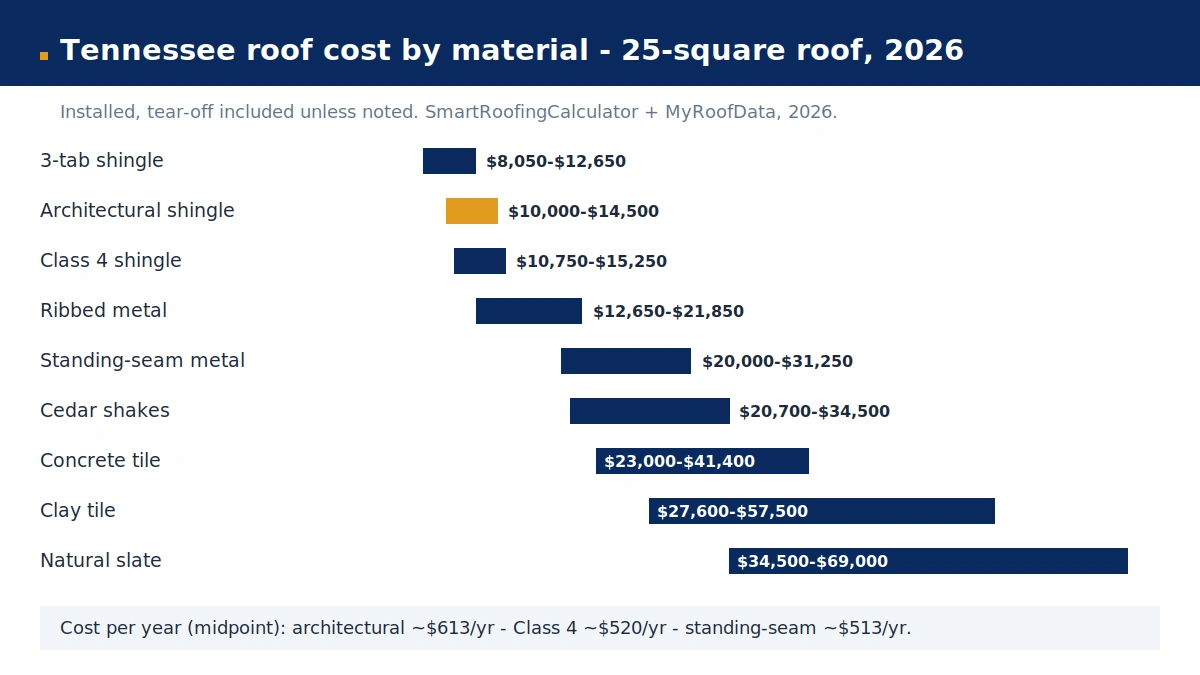
Material comes before budget in this state, because the climate punishes the wrong material far harder than it rewards the cheap one. A thin shingle that cannot take a humid summer followed by a hail spring will fail years before its warranty suggests, while a metal roof that looks extravagant on the quote can still be standing when the mortgage is paid off — throwing heat back into the sky instead of absorbing it, and letting a hailstone glance off instead of bruising the mat underneath. The section below prices one material at a time on a typical 25-square roof, 2,500 square feet of surface, from Tennessee-verified fitted figures that already cover tearing off one layer unless a footnote says otherwise.
| Material | Per square installed | 25-square total | Realistic TN life |
|---|---|---|---|
| 3-tab asphalt shingle | $322–$506 (before tear-off) | $8,050–$12,650 | 12–18 yrs |
| Architectural asphalt shingle | $400–$580 | $10,000–$14,500 | 18–22 yrs |
| Class 4 impact-resistant shingle | $430–$610 | $10,750–$15,250 | 22–28 yrs |
| Ribbed metal (exposed fastener) | $506–$874 (before tear-off) | $12,650–$21,850 | 30–40 yrs |
| Standing-seam metal | $800–$1,250 | $20,000–$31,250 | 40–60 yrs |
| Cedar shakes and shingles | $828–$1,380 (before tear-off) | $20,700–$34,500 | 25–35 yrs |
| Concrete tile | $920–$1,656 (before tear-off) | $23,000–$41,400 | 40–75 yrs |
| Clay tile | $1,104–$2,300 (before tear-off) | $27,600–$57,500 | 50–100 yrs |
| Natural slate | $1,380–$2,760 (before tear-off) | $34,500–$69,000 | 75–150 yrs |
Start with the row that carries a warning. MyRoofData’s 3-tab band of $322–$506 a square is an installed price that stops short of tear-off, so the finished job costs more once the old layer is hauled away — and the finished job is the only price that matters. It is also the thinnest shingle on the shelf: a single flat layer, the weakest wind rating in the table, and no impact rating worth naming. Insurers and builders across the state have been walking away from it for years, and in a climate where summer humidity feeds the algae that loosens granules and spring hail knocks them off a few summers early, saving roughly $2,000 on installation day by choosing 3-tab is effectively prepaying the next deductible. It has its places — a rental, a shed roof, a house that will change hands within a few years — but as the default on a home the owner intends to keep through ten Tennessee summers, it is the wrong purchase.
Architectural shingles are what most Tennessee roofs actually wear, in roughly the same proportion as the rest of the country, where about three in four homes carry them. With the manufacturer’s high-wind nailing pattern they are rated for 110 to 130 miles per hour, and they are the $400–$580-a-square material behind the headline price of this guide. The brochure life of 25 to 30 years does not survive contact with a Tennessee summer: heat dries the binder, humidity feeds the algae, hail knocks granules off a few summers early, and the realistic life here is 18 to 22 years. A roof can look sound from the curb at year twelve and still be a single March hailstorm from a leak — and the granules collecting in the gutter are the early evidence, not the final one.
Storm season is where Class 4 impact-resistant shingles earn their keep, and they get a full section of their own later in this guide. On the published agent figure used across this series, a 25-square Class 4 roof lands at $10,750–$15,250 — standard architectural plus about $30 a square, or $750 across the whole roof. No Tennessee-specific premium for the upgrade was verified anywhere in the research for this guide, and that gap is flagged rather than papered over. The shingles themselves use SBS-modified asphalt, rubberized so the mat bends instead of cracking when a hailstone lands on a roof that has been baking all July, and the rating behind them is UL 2218 Class 4, earned when a two-inch steel ball falls twenty feet onto the shingle and the shingle comes through uncracked. They are not hail-proof — a baseball-sized stone can still do them harm — but most of the hail that damages Tennessee roofs falls in the one to two inch band, which is exactly the band Class 4 is built for, and whatever insurance discount the carrier offers sits on top as a bonus.
Metal divides Tennessee into two markets at the same time. Exposed-fastener ribbed panels run $506–$874 a square, or $12,650–$21,850 across 25 squares, and last 30 to 40 years; standing-seam metal costs $800–$1,250 a square, or $20,000–$31,250, and holds for 40 to 60 years, with some Tennessee models stretching toward 70. Metal takes heat by reflecting it rather than soaking it up, it never bruises the way a shingle mat does, and there is no granular wear cycle for the humidity to attack. Spread over years of service the table turns upside down: standing seam works out near $513 a year at the midpoints, against near $613 for architectural shingles and near $520 for Class 4. Metal reads as expensive on the quote and inexpensive on the calendar — and across rural East Tennessee, where metal already has a strong hold on homes and barns alike, its share keeps growing. The metal choice is priced in full in our metal roof cost guide. The head-to-head with shingles is in our metal vs shingles comparison.
Cedar stays a niche choice here: $828–$1,380 a square, $20,700–$34,500 across 25 squares, with a realistic 25 to 35 years. It looks right on a historic home in Franklin or Jonesborough, it demands maintenance, and it holds moisture in its gaps — a poor combination on a roof that has to dry out between humid afternoons, and worse still in the Smoky Mountain foothills where winter moisture lingers. Only one Tennessee cedar band was pulled in the research, so treat the MyRoofData range as a starting point and test it against a local quote before budgeting around it.
Tile and slate sit at the luxury end of the table, and Tennessee sees little of either, because the structure usually rules them out before the price gets a chance to. Concrete tile runs $920–$1,656 a square, or $23,000–$41,400 for 25 squares; clay tile runs $1,104–$2,300 a square, or $27,600–$57,500; slate runs $1,380–$2,760 a square, or $34,500–$69,000. Tile weighs 850 to 1,100 pounds a square, so swapping a shingle roof for tile often needs an engineering check first, and both tile and slate need a crew that lays them regularly rather than occasionally. Clay tile has a genuine Tennessee strength: it handles heat and ultraviolet light superbly, which is why it lasts 50 to 100 years here — but it is brittle underfoot, so repairs need tile-experienced crews. Slate’s constraint is the same everywhere: few Tennessee roofers lay slate often, and a slate roof fitted by a crew that rarely touches the material is a spring-storm leak waiting to happen. The tile decision in full is in our tile roof cost guide.
Two materials outside the table still deserve a line. Stone-coated steel runs $7.51–$10.94 a square foot installed in Tennessee, or $15,560–$22,700 for a 2,000 square foot roof, and synthetic slate or shake runs $7.87–$11.44 a square foot, or $16,290–$23,690 — both from NumeralQ’s October 2026 Tennessee pricing, and both worth a quote when the house needs the look of tile or slate without the weight. For low-slope sections — porches, additions, mid-century homes — the MyRoofData model prices flat roof membrane at $506–$874 a square before tear-off; our flat roof replacement cost guide goes into that option in depth.
Cost per year of service puts the whole table in a different light, and it is the last lens worth applying before moving on. Worked out per year of service at the midpoints, slate comes in cheapest at near $460, then ribbed metal near $493, standing seam near $513, Class 4 near $520, concrete tile near $560, clay tile near $567, architectural near $613, 3-tab near $690, and cedar dearest at near $920. Those are NestPriced’s own figures — midpoint total divided by midpoint realistic life — and they leave out the two factors that move the answer most: the deductibles Class 4 avoids, and the heat metal reflects. The material table and the insurance section belong together; either one read on its own gives a misleading answer.
Roof Replacement Cost by Roof Size
Size is where a quote can quietly price the wrong house, because every bid in this state is written against roof surface and the living area on the listing never enters into it. A 2,000-square-foot single-story ranch covers about 2,000 square feet of ground under the roof, and pitch, overhangs and waste usually push the finished surface to 20–25 squares. Give the same 2,000 square feet a second story and the footprint shrinks toward 1,000 square feet, so the roof surface comes out near half the ranch’s — a difference the listing number never reveals. Every bid should spell out its square count in print, and that figure should be treated as the one number that cannot be left vague. A bid priced off living area is a bid priced off the wrong house.
The table below runs the SmartRoofingCalculator architectural band — $400–$580 a square with tear-off included — across the roof sizes Tennessee homeowners actually have. The 25-square row is the anchor, and the 20-square row lets NumeralQ check the arithmetic: the band gives $8,000–$11,600 there, while NumeralQ gives $8,870–$10,750 for a 2,000 square foot roof statewide.
| Roof surface | Typical home | Architectural total | Class 4 total |
|---|---|---|---|
| 15 squares | Small ranch / cottage | $6,000–$8,700 | $6,450–$9,150 |
| 20 squares | 2,000 sq ft ranch | $8,000–$11,600 | $8,600–$12,200 |
| 25 squares | Typical TN home | $10,000–$14,500 | $10,750–$15,250 |
| 30 squares | Large two-story | $12,000–$17,400 | $12,900–$18,300 |
| 35 squares | Large home, complex roof | $14,000–$20,300 | $15,050–$21,350 |
| 40 squares | Very large / steep | $16,000–$23,200 | $17,200–$24,400 |
Three factors push a job off this table, and a fourth and fifth belong to Tennessee alone. Pitch leads the way: on a steep 10/12 or 12/12 roof the crew works slower and stages differently than on a walkable 4/12, so the price per square climbs — and in Tennessee the steep roof also takes hail harder, since the stones strike it more directly. Complexity follows: every valley, dormer, skylight and chimney needs its own flashing detail, which takes time to fit and is the first thing to leak when hurried, so a plain gable and a cut-up roof can share a square count and still be two different jobs at two different prices. Decking is the third: rotted sheathing only shows once the old shingles are off, and the crew bills it per sheet that day — $53–$78 installed for a 4-by-8 OSB sheet on NumeralQ’s Tennessee figures — so agree the per-sheet rate in writing before tear-off starts. Tennessee adds a fourth: the second layer. Older homes in Memphis and Knoxville often carry two layers of shingles, and stripping the extra layer runs $100–$200 a square per layer in the MyRoofData model, or $2,500–$5,000 on a 25-square roof that the first quote may not have counted. And there is a fifth cost that belongs to this state alone: the license line. Once a roof totals $25,000 or more it needs a Board-licensed contractor, and the licensed crew’s price reflects the exams, the bond and the financial statement behind it — a cost, and also a protection.
Work out the budget from what the roof itself measures, not from the figure on the house listing. The square count comes from the footprint times the pitch factor (about 1.15 at 6/12, about 1.25 at 8/12), plus 10 percent for waste, all divided by 100. That measured figure should appear in print on every bid, and the square counts should be set side by side before a single price is compared.
Roof Replacement Cost by City: Nashville vs Memphis vs Knoxville vs Chattanooga
One state border holds four roofing markets that behave differently, and the price follows the storm track and the river rather than the skyline. Nashville, in the middle, is the biggest city and the tornado capital. Memphis, in the far west on the Mississippi, comes in lowest on the verified figures and runs hottest. Knoxville, in the east at the foot of the Smokies, is the mountain market, where ice dams join the hail. Chattanooga, in the southeast on the Tennessee River, sits between the others on price and highest on the hail-risk map. The verified city figures run close together across the state, and the pattern underneath them is that labor drives the price in Nashville while storm exposure drives it in Chattanooga.
| City | 2,000 sq ft roof (arch) | Re-roof permit | Market note |
|---|---|---|---|
| Nashville | $9,080–$11,030 (NumeralQ) | Not verified | Largest market, highest tornado risk in the state |
| Memphis | $8,940–$10,840 (NumeralQ) | $100–$275 | Cheapest of the four, hottest and most humid |
| Knoxville | $8,820–$10,680 (NumeralQ) | $75–$225 | Mountain market, ice dams in the foothills |
| Chattanooga | $8,860–$10,740 (NumeralQ) | Not verified | Highest FEMA hail rating of the four |
Nashville’s two published figures for a 2,000 square foot roof describe the same city from two angles: $9,080–$11,030 on NumeralQ’s planning estimate, and $11,000–$19,000 on TriumphBuilt’s city table. One is a planning estimate and the other is a contractor’s market range, and this guide prints both instead of averaging them into a number neither source published. A 25-square roof in Nashville runs $9,800–$14,210 on SmartRoofingCalculator’s city page, or $392–$568 a square, about 2 percent under the Tennessee baseline, while RoofingEstimatorPros stands apart as the high outlier at $13,100–$23,575, averaging $17,755. A permit is required from Nashville’s building department before a roof is replaced, though the city’s own fee schedule yielded no Nashville permit fee in the research for this guide, so no figure is printed. Competition among the metro’s many crews holds Nashville prices in check, yet demand is genuine: the March 3, 2020 EF3 through Germantown and East Nashville and the December 9, 2023 EF2 through Madison, Hendersonville and Gallatin left every crew in the metro booked for weeks afterward, and Middle Tennessee’s hail map shows the March-to-May season arriving like clockwork. TriumphBuilt’s own figures put most Nashville-area replacements at $12,000–$20,000, with architectural shingles at $450–$700 a square — in line with the NumeralQ band once the larger and steeper roofs are counted in.
On the verified figures Memphis is the lowest-priced of the four, at $8,940–$10,840 for the same 2,000 square foot roof, and its permit range is the widest in the state at $100–$275. Low price should not be mistaken for an easy roof to own. Memphis is the Delta market, with the hottest summers in Tennessee, humidity that rarely breaks, and the Mississippi River’s storm track driving straight-line wind across flat ground with nothing in its way. What the quote saves comes from cheaper labor, not from a roof facing less risk — and the insurance market prices that risk accordingly, with one Memphis ZIP code carrying the highest homeowners premium in the state at about $4,510 a year. Heat ages a Memphis roof’s shingles faster than anywhere else in Tennessee, so the specification should reflect that even when the quote does not: algae-resistant shingles as the minimum, six nails where the wind map calls for it, and ventilation sized for an attic that never gets a cool night in July. Collect three quotes before signing anything in Memphis, and make sure one comes from a roofer whose shop actually sits in Shelby County — after a storm, chasing warranty work from a crew two counties away turns into an expensive promise.
Knoxville’s NumeralQ figure is the lowest of the four by a small margin, $8,820–$10,680 for a 2,000 square foot roof, with a permit at $75–$225. The city sits at the foot of the Great Smoky Mountains, and its roof problem is the one the other three cities barely have: winter. Cold air pools in the foothills, ice dams form at the eaves, and the ice-and-water barrier that is optional elsewhere in Tennessee becomes the detail that decides whether a Knoxville roof leaks in February. Labor is the cheapest in the state here — Knoxville roofers earn 19 percent below the national median, the lowest of the four cities — which holds the price down, while the mountain pitches push it back up, since steep, cut-up roofs on the ridges above the city cost more per square than the walkable ranches on the valley floor. The research for this guide pulled no verified Knoxville contractor range beyond NumeralQ and Modernize, and the Modernize metro figure of $8,500–$15,000 is printed as the market cross-check.
Chattanooga’s hail rating is the highest of the four, and its price follows, at $8,860–$10,740 for the same 2,000 square foot roof. The city sits on the Tennessee River at the state’s southeastern corner, in the same March-to-May hail belt as Nashville, and FEMA rates Hamilton County’s hail risk Relatively Moderate — tied with Davidson for the highest of the four counties. The research pulled no verified Chattanooga permit fee, so none is given. The tables that do cover the market show its shape: Modernize puts the metro at $8,500–$15,000, and SquareDash’s fixed price for the 37402 ZIP code is $11,500 for a 2,000 square foot home. An older housing stock and a smaller crew base than the Nashville metro mean Chattanooga quotes deserve the closest reading of all — and the hail rating means the Class 4 question deserves a serious answer here, not a shrug.
Franklin, the fifth name in the Middle Tennessee market, sits above Nashville at $14,000–$22,000 on the TriumphBuilt figures — the same hail belt, a wealthier housing stock, and larger, steeper roofs. The honest comparison between cities is price per square, with headline totals set aside: Nashville at $11,030 looks more expensive than Knoxville at $10,680, but the gap disappears once pitch, deck condition and material are held equal. Price is not the real difference between these cities. Exposure is: Nashville gets the tornadoes, Memphis gets the heat and the humidity, Knoxville gets the ice dams, and Chattanooga gets the hail — and the rural counties get neither the competition nor the fast scheduling, which is why their quotes deserve the closest reading of all.
Why Tennessee Roofs Cost What They Do: Heat, Humidity & Storms
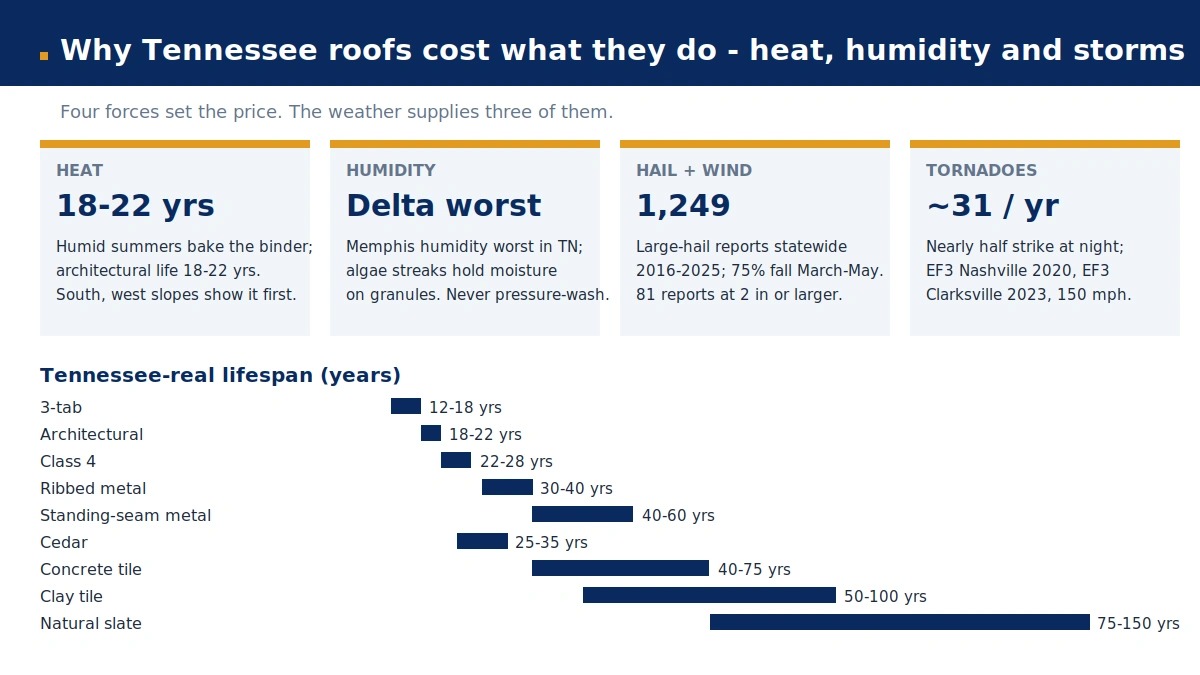
Four forces decide what a Tennessee roof costs, and the weather supplies three of them. Heat comes first, and it never lets up. Humidity comes second, and it works quietly enough that most homeowners notice it only when the streaks appear. Hail, wind and tornadoes come third, and they are the most expensive to repair. The fourth is the market itself — a labor market that pays mid-South wages in Nashville and a licensing line that switches on at $25,000 statewide — and it decides how fast any of the other three gets fixed, and by whom.
Heat. Tennessee is a heat state, and the summers leave no room for doubt about it. July and August bring weeks of high temperatures with humidity that keeps the roof wet long after the rain stops, and the asphalt binder in every shingle slowly dries out and turns brittle under that cycle — the same failure that takes thirty years in a cool climate takes eighteen to twenty-two here. Sunlight attacks the petroleum compounds in the asphalt, wearing the protective granules thin, and the slopes facing south and west are where it shows first. A shingle built for this heat is the one that survives it, and the ventilation that keeps the attic from cooking the deck from underneath matters as much as the shingle itself. When an attic runs hot and poorly vented, the roof is being cooked from inside, and the remedy belongs in the reroof scope rather than in a later project.
Humidity. Tennessee’s summers run humid from the Mississippi River to the Smokies, and Memphis — the Delta city — stays the most humid of all, with air that rarely dries out between storms. That damp is what Gloeocapsa magma lives on — the algae responsible for the black streaks striping half the state’s roofs. Those streaks are a cosmetic matter, in the plain words of the Asphalt Roofing Manufacturers Association — yet the damp trapped against the granule surface by them loosens granule adhesion, and moss does worse: it roots into the shingle mat, lifts the edges and opens gaps for water. Tree debris piles up in the valleys and behind the chimneys, holds moisture there, and that is where the leaks start. Nothing exotic is needed: shingles with copper or zinc granules that resist algae, valleys kept clean, and a roof given the chance to dry out between rains. Pressure-washing the streaks away is the one thing not to do — the ARMA warning is blunt, because a pressure washer strips the granules and harms the shingles more than the algae ever will.
Hail and wind. Hail in Tennessee has a season, and three quarters of the state’s large-hail reports fall between March and May. The state logged 1,249 of them between 2016 and 2025 — sixteenth in the nation — with 81 of them two inches or larger. Around Nashville the rate runs high enough that FEMA rates Davidson County’s hail risk Relatively Moderate, and Hamilton County matches it; Shelby County, by contrast, rates Very Low, which is the number that matters for the Class 4 decision below. Wind is the constant companion: 5,644 reports of 58-mile-per-hour-plus wind in the same decade, twelfth in the nation. Tornadoes make the news — the EF3 that tracked through Germantown and East Nashville on March 3, 2020, the EF4 that struck Cookeville the same night, the EF3 that tore through Clarksville on December 9, 2023 — but in an average Tennessee year straight-line thunderstorm wind damages more roofs. A tornado’s direct hit defeats any shingle rating, and the roof underneath is a total loss. Far more common is the 60-mile-per-hour gust that lifts a poorly nailed tab, breaks its seal and lets the next rain slip under the course above. The remedy is straightforward: six nails rather than four, a high-wind starter course, and a shingle rated 110 to 130 miles per hour, fitted exactly as the manufacturer specifies. Get the nailing pattern in writing.
Tornadoes. Tennessee’s tornado exposure is real, and December proved it twice over. About 31 tornadoes a year strike the state on average, and nearly half of them arrive at night — the heart of the Dixie Alley nighttime corridor, where a tornado that strikes while the household sleeps does its worst damage before anyone is awake to react. March 3, 2020 brought the EF3 through Nashville and the EF4 at Cookeville, with 25 dead across the region. December 9, 2023 brought 18 tornadoes in a single outbreak: the Clarksville EF3 at 150 miles per hour, on the ground for 11.33 miles, damaging or destroying nearly 1,000 homes, 114 of them destroyed outright, and a second EF2 that ran from north Nashville through Madison, Hendersonville and Gallatin with a tornado emergency for Hendersonville. The roofs that came through those nights intact shared the same features: a sealed deck, a high-wind nailing pattern and flashing that had been fitted rather than rushed. The 115-mile-per-hour design wind speed in the code is the state’s answer — and the reroof is the moment to build to it.
The market. About as many roofers work in Tennessee as the state can count, on a median wage of $21.97 an hour — and in Nashville the billed rate runs $44–$57 an hour per worker. In a quiet month that is enough. A March hailstorm leaves the crews short-handed, and that shortage cuts both ways: quotes go up while the calendar fills for weeks. Tennessee adds a twist no other state in this series carries in quite the same form: the license switches on at $25,000, so after a storm the crews that arrive include licensed contractors and unlicensed ones working the same streets — and the homeowner who cannot tell them apart has thrown away the only filter the state provides. Roofing work in Tennessee runs across almost the whole calendar — the heat’s one repayment is a winter that never freezes the schedule shut in the west, only the afternoon thunderstorm that can tear a roof open before lunch and soak the deck by three.
Heat, Humidity & Algae: The Slow Tennessee Roof Killers
Heat is the patient killer of a Tennessee roof. Day after day through July, the shingles bake under a humid sun and then cool sharply overnight, and each round of that swelling and shrinking loosens the assembly a fraction further. Binder in the asphalt dries and turns brittle. Granules — the ceramic-coated grit that shields the asphalt from the sun — thin out and wash down into the gutters. Edges curl upward. Nails creep out a hair at a time. From the street, nothing looks wrong at all, until around year fifteen, when the roof sold as a thirty-year roof begins leaking at the valleys and the flashing.
The reroof is the moment to fit all three layers of defense, not some later job. The shingle itself is the first layer: an architectural shingle that resists algae, its copper or zinc granules stopping the black streaks from taking hold and keeping moisture off the surface. Second comes ventilation — soffit intake and ridge exhaust, balanced under the code’s ventilation rules, keeping attic air moving and the deck temperature even, because a hot attic cooks the deck from underneath and only a reroof opens up the ventilation to fix it. The third layer is the underlayment: synthetic underlayment properly fastened, or number 30 felt, on steep-slope roofs under the 2018 code, with self-adhering peel-and-stick underlayment as the best-practice upgrade where the budget allows — because once the shingles give way, the underlayment is all that stands between the rain and the deck.
The algae problem is worth a paragraph of its own, because no Tennessee roof issue is both so visible and so widely misunderstood. The dark stripes running down so many roofs in Middle Tennessee are usually Gloeocapsa magma, an airborne algae that turns a light-colored roof brown to black over time. The Asphalt Roofing Manufacturers Association is clear that the algae is a cosmetic problem, not structural damage — yet cosmetic does not mean harmless. Left alone, algae traps damp against the granule surface until granule adhesion gives way, and moss — trailing the algae onto shaded, north-facing slopes — roots into the shingle mat, lifts the edges and lets water in. Streaks on their own do not mean the roof needs replacing; streaks together with moss, soft spots and missing granules are a different story, and that story ends with a replacement.
There is a quieter heat risk alongside the obvious one: thermal cycling. Through every summer day a Tennessee shingle roof heats up and then cools right down overnight, and that daily swelling and shrinking loosens nails, curls edges and strains the flashing around chimneys, vents and skylights. The harm accumulates slowly yet steadily, and after fifteen or twenty years it becomes impossible to miss. Low-slope and flat areas face a different hazard: they hold water instead of shedding it, so a low-slope porch roof or a flat garage section collects standing water and algae at the same time. Metal sheds heat better than anything else on the shelf, and steep pitches beat shallow ones at the same job — but a metal roof in Tennessee needs its own care, because the exposed-fastener panels expand and contract with the same heat, and the fasteners need checking as the roof ages.
Storms, not contractors, set the install calendar in Tennessee. March through May is the hail peak — the months when the old roof is most likely to be damaged and the crews are most likely to be booked — so the smart booking is a shoulder month: late fall, once the storm season eases, or early spring, before the hail season starts. A summer install can work, and warm weather even helps the sealant strips bond, yet a crew that strips a roof in the morning and races a three o’clock thunderstorm is working under pressure, and the flashing is where that pressure shows first. If the roof has to go on in summer, find out how the crew stages the tear-off and what the plan is when a storm arrives mid-job.
One cold-weather note belongs to the east alone: around Knoxville, the Smoky Mountain foothills bring ice dams that the rest of Tennessee barely sees. Cold air settles in the valleys, snow melts on the warm upper roof and freezes again at the cold eaves, and the dam that forms pushes water back under the shingles. A Knoxville quote should spell out the ice-and-water barrier coverage in so many words, and an east Tennessee roof should be looked at after the first hard freeze of the season, before the first leak rather than after it.
Class 4 Impact-Resistant Shingles in Tennessee: What the Upgrade Costs and What It Pays Back
One recommendation in this guide matters more than any other: get a Class 4 price on every asphalt quote, and accept it unless the arithmetic points the other way. Tennessee’s hail is genuine without being Plains-scale — two-inch stones are the exception rather than the rule — yet the upgrade still earns its keep, because debris carried by the wind strikes alongside the hail, and the premium discount plus the deductible that never gets paid do the same work here as anywhere else. No other single choice changes a Tennessee asphalt roof as much.
Class 4 sits at the top of UL 2218, the Underwriters Laboratories impact scale. The laboratory test drops a two-inch steel ball from twenty feet onto the shingle, which reproduces a golf-ball hailstone arriving at terminal velocity, and the shingle has to emerge from that impact uncracked and unfractured. SBS-modified asphalt gives the shingle its give: the mix is rubberized, so it stays pliable through summer heat and soaks up a strike rather than splitting under it. GAF Timberline AS II, CertainTeed Landmark IR and Owens Corning Duration STORM are among the Class 4 lines Tennessee suppliers stock. None of that makes the roof hail-proof, and a baseball-sized stone can still dent or crack it — but the stones that do most of the damage in Tennessee measure one to two inches, and that is exactly the range Class 4 is designed for.
What it costs. No premium for the upgrade could be verified for Tennessee alone, so the number below is flagged and provisional. Across this series the published agent figure puts the step up from standard architectural shingles at roughly $30 more per square, or $750 on a typical 25-square roof, which moves the band from $10,000–$14,500 for standard architectural to $10,750–$15,250 for Class 4. The national guides put the premium higher than the agent figure — anywhere from 10 to 25 percent, or 10 to 30 percent, or $1,000 to $2,500 on a typical house. This guide builds its headline band on the $30-a-square figure because it is the lowest published number and the only one traced to a named agent’s price, with the warning attached that a Tennessee quote may come in higher, and the quote is the number that counts.
What it pays back. Two streams of money come back, and the second is worth far more than the first. The first is the insurance discount. Most big Tennessee carriers offer a Class 4 discount on the wind and hail portion, but what they offer is scattered widely enough to be worth stating plainly: one agent quotes 15–20 percent, one national guide quotes 20–30 percent off the wind and hail portion, another quotes 5–20 percent, and a fourth quotes 10–25 percent where hail is heavy. Only the wind-and-hail slice of the premium is affected, never the whole premium, and the size varies from carrier to carrier. Get your own insurer to confirm the figure in writing, with the qualifying product list and the paperwork it requires, before anything is signed — a discount a contractor mentions is not a discount until the carrier has put it on paper.
The second stream is the deductible that never has to be paid, and in Tennessee it is the one that carries the decision. Standard perils on a typical Tennessee policy carry a deductible of $500 to $2,000, and many policies add a separate, higher wind and hail deductible on top — commonly a percentage of the dwelling value, 1 to 5 percent. Two hail or debris strikes that a Class 4 roof rides out mean two deductibles kept in the homeowner’s pocket: $1,000 to $4,000 at standard deductibles, and far more where a percentage wind and hail deductible applies, against an upgrade priced near $750. One claim that never has to be filed can cover the whole upgrade cost by itself. Treat the premium discount as the bonus; the money the upgrade really saves is the deductible that is never paid.
When it is not worth it. The case weakens in three situations. Thick tree cover is the first, because limbs and shade wear a roof down harder than hail ever will. A sale within a few years is the second, since the buyer may not return the upgrade in the price — though a transferable warranty and a documented discount can still make the listing stronger. Unusually low storm exposure is the third, although Tennessee has few such pockets outside Shelby County, where FEMA rates the hail risk Very Low and the argument for the upgrade is genuinely thinner. Let the county settle it: Hamilton County’s heavy hail makes the upgrade a straightforward yes, while Shelby County’s Very Low rating makes it a harder case to argue.
Buying Class 4 right. Identify the product on the quote by manufacturer and exact shingle line, and file the UL 2218 Class 4 marking from the shingle’s back alongside the job records. Sort out the insurer’s discount confirmation and paperwork list in writing ahead of the install rather than after it; some carriers want photographs, a certificate or an inspection. The warranty deserves a question too, since the extended cover applies only when a credentialed crew does the work — one more reason the lowest bid is not always the cheapest roof.
Permits & Code: The 2018 IRC, 115 mph Wind & the $25,000 License Line
Tennessee runs roofing rules from the state level down, which sets it apart from the states in this series that leave everything to the city. Two statewide facts frame the whole section: the residential code is modeled on the 2018 International Residential Code, with some jurisdictions on newer editions, and a contractor license switches on at $25,000 of project value. The roof is therefore governed by the state’s rules first and the city’s rules second — and the hiring screen that Georgia does not have at all is one Tennessee homeowners can actually use.
A code modeled on the 2018 IRC. Across Tennessee, roof construction and replacement fall under the Tennessee Residential Building Code, modeled on the International Residential Code, 2018 edition in most jurisdictions, while local governments adopt their own editions and amendments on top of it. The number that shapes the build is the design wind speed, read off the code’s maps as the local building department applies them: 115 miles per hour as a 3-second gust in the completed Table R301.2(1), alongside a 10-pound ground snow load in the same table. If a bidder quotes a different wind figure, the building department’s figure is the one that rules.
Wind rating first. Tennessee has no hurricane coast, yet the 115-mile-per-hour baseline still sets the floor for every roof in the state. Fit a shingle rated at least 110 miles per hour anywhere in Tennessee, and step up to the 130-mile-per-hour product where the budget allows. Past 115 miles per hour the six-nail high-wind pattern comes into play, and the warranty turns on the manufacturer’s high-wind nailing pattern being followed to the letter. Three items driven by the code should appear on every Tennessee bid, and a bid missing any of them is a warning sign: a drip edge at the eaves and gables, required on asphalt shingle roofs, running at least a quarter inch below the sheathing and two inches up the deck with two-inch overlaps; synthetic underlayment properly fastened, or number 30 felt, on steep-slope roofs; and the six-nail pattern wherever the wind map calls for it. Skip the drip edge and the fascia is left to rot. Nail four where the manufacturer calls for six and the shingles lift in July.
Permits for a full replacement. Most Tennessee metro jurisdictions require a permit for a full replacement, and Nashville’s building department counts roofs among the work it commonly permits. The fee runs about $75–$300 in the MyRoofData model, with NumeralQ putting the typical range at $94–$200 across the cities it checked; BestRoofingEstimates reads the local schedules at $100–$275 in Memphis and $75–$225 in Knoxville. One local carve-out is worth knowing: Murfreesboro’s code exempts a roof-covering replacement that leaves the deck and the framing untouched, which makes the permit question a city-by-city matter and the deck the thing that decides it. A few shingles swapped or a flashing fixed usually needs no permit at all; substantial work is a different matter. This guide prints no Nashville or Chattanooga permit fee, because none was pulled from a city fee schedule.
A license line at $25,000. Tennessee licenses by project value rather than by a stand-alone roofing license. At $25,000 or more a Board for Licensing Contractors contractor license is required — with a roofing classification and a monetary limit — and that includes roofing subcontractors whose portion alone reaches $25,000. Smaller residential roofing in the nine counties that adopted the Home Improvement law needs a Home Improvement license from $3,000 to $24,999 instead. The $25,000 line cuts straight through the middle of this guide’s Tennessee price bands: a standard 25-square architectural roof at $10,000–$14,500 sits below it, a standing-seam metal roof at $20,000–$31,250 can land on either side of it, and a tile or slate roof almost always sits above it. That is why the license question belongs on every bid rather than only on the big ones — the same house can need a licensed contractor or not depending on the material chosen.
Hiring a Roofer in Tennessee: The License Check That Actually Exists
A license worth checking changes the whole hiring job. Where no license exists, the homeowner starts with nothing to verify. In Tennessee the homeowner starts with a threshold the state itself built — an exam, a financial statement, a monetary limit, and a license naming the trade. The check costs nothing, takes minutes, and belongs first on the list, because a roofer bidding a $26,000 roof without a Board license is not cutting a corner; that roofer is working outside the law.
Check the license rather than taking their word for it. The Board for Licensing Contractors runs a lookup at verify.tn.gov, and it confirms the license, the classification and the monetary limit in one search. A contractor license has to be held before bidding, not merely before the work starts, so a bidder who says the license is on its way is a bidder to walk away from. Where the job is smaller, the Home Improvement license is the one to look for: in Bradley, Davidson, Hamilton, Haywood, Knox, Marion, Robertson, Rutherford and Shelby counties, residential roofing from $3,000 to $24,999 needs one, backed by a $10,000 surety bond. All four big cities sit inside those nine counties, so a Nashville, Memphis, Knoxville or Chattanooga roofer doing a $15,000 roof needs a Home Improvement license at minimum. The city or county business license is the third check, verifiable through the city that issued it. A contractor who claims a $30,000 roof needs no license at all is either confused or lying, and either answer is a reason to walk away.
The license is not a substitute for the insurance check. A license filters for competence; it guarantees nothing about cover. General liability should be confirmed by a certificate the carrier mails to the homeowner directly — never a copy handed over by the contractor — naming exactly the business that appears on the contract. Workers’ compensation cover for the crew should be proved the same way; the law requires it of most employers, and it is worth demanding whatever the crew size. Look too for a Tennessee address that has been in place for a while, and a local phone number older than the latest storm. Ask for three references from local jobs in the homeowner’s own county, each with a street address that can be driven past. Manufacturer certification protects the warranty — GAF, Owens Corning or CertainTeed credentialed installer status — because only a credentialed crew can switch on the extended cover. Finally, collect a written quote from each of the three bidders, every one priced against a single identical spec sheet so the roofs being compared are the same roof.
Watch for the storm chasers. Hail or a tornado brings traveling crews into Tennessee within days, working the damaged streets door by door. Some of them are legitimate traveling crews. Many are not, and the signs never change: a knock at the door with a free-inspection agreement pushed across the threshold, an out-of-state number, no office anywhere nearby, no license of either kind, a promise to make the deductible vanish, and a demand for a large payment before a single shingle moves. A promise to waive the deductible is a promise to commit insurance fraud on the homeowner’s behalf, and a contract built on that promise is one to walk away from. Sign no contingency agreement in the driveway before the adjuster has looked at the roof. Never hand the insurance claim to a roofer to negotiate — Tennessee requires a public-adjuster license for that, and a roofer offering to do it is offering to work outside the law.
The lien trap nobody mentions. Tennessee lien law holds a surprise for roof jobs: anyone who works on the replacement or supplies material for it and goes unpaid may be able to file a mechanic’s lien against the house — except that on an owner-occupied home of one to four units, only someone who contracted directly with the owner can lien it, under Tennessee Code 66-11-146(a)(2). The prime contractor has to include a notice to owner in the contract before work starts, and liens fall due within 90 days after completion. On a roof replacement the parties most likely to send a lien notice are the shingle distributor and any crew the roofer subcontracts. Before the final payment goes out, collect lien waivers from the contractor and the supplier, and confirm the supplier has actually been paid.
Read the quote itself. A Tennessee quote should set out the manufacturer and the exact shingle line, the underlayment type, the ventilation scope and the nailing pattern. It should also cover the drip edge, the tear-off depth, the per-sheet deck replacement rate, the disposal and the cleanup. It should state the roof surface in squares beside a total price for that surface, so two bids can be set against each other square for square. The warranty terms belong there as well, with manufacturer and workmanship cover stated as separate year counts and the party honoring each one named. The permit cost and the party that pulls the permit should be spelled out, along with which license the bidder holds, contractor or Home Improvement, with the license number printed on the bid. It should carry no federal tax-credit line at all, since none exists in 2026. Our questions to ask a roofer guide is worth taking to the first contractor meeting, and working through in full while there.
Insurance: Deductibles, ACV vs RCV, the Percentage Wind Deductible & the Class 4 Discount
Picture a $12,000 hail claim on a Tennessee roof, and then picture three different checks arriving for it: $11,000, $4,000, or nothing at all. All three are possible on the same roof, on the same day, under policies that looked identical at signing — which is why this section comes before any quote is signed. Premiums here have climbed into the above-average tier nationally, the wind and hail share of claims runs high, and a percentage wind deductible can quietly turn that $12,000 claim into a $4,000 check. Hold every figure below up against the homeowner’s own policy, because the policy is the only document that governs the claim.

The premium, three trackers, three answers. Tennessee sits above the national average on most trackers, and the studies agree on that direction even though each one measures a different coverage level — the size of the gap is where they part company. Insurify’s November 1, 2026 update gives about $3,060 a year for $300,000 of dwelling coverage with a $1,000 deductible. InsuranceQuotes, on rates as of September 30, 2026, gives about $2,856 a year for the same benchmark. Insurance.com’s Quadrant-based comparison gives $2,958 a year, although a second Insurance.com-derived table shows $3,198 instead — a conflict noted here rather than settled. A standard Tennessee policy therefore runs about $2,856–$3,060 a year for $300,000 of dwelling coverage depending on the tracker and the coverage, and the direction of travel is up: Tennessee ranks 17th most expensive in the country for home insurance, in a state that averages about 31 tornadoes a year. Nashville runs $2,904 a year on the Insurify figures, while Memphis holds the extremes — one ZIP code there, 38127, carries the highest premium in the state at about $4,510 a year, nearly 50 percent above the state average.
The deductible, and the percentage version hiding inside it. A flat deductible of $500 to $2,000 applies to most perils on a Tennessee policy, and a growing share of policies add a separate, higher wind and hail deductible above it. Raising the deductible from $500 to $1,000 saves 10 to 25 percent of the premium, in the Insurance Information Institute’s reckoning. Most homeowners never notice the percentage wind and hail deductible until the adjuster is standing in the driveway — 1 to 5 percent of the dwelling value, not of the loss. On a $300,000 dwelling, 2 percent means $6,000 out of pocket before the insurer pays anything on a wind claim — more than twice the $2,856 a year that house averages in premium — and on a $400,000 dwelling at 5 percent it means $20,000. Back to that $12,000 hail claim: a $1,000 flat deductible leaves $11,000 paid, a 2 percent deductible leaves $4,000, and a 5 percent deductible leaves nothing at all, because the deductible is larger than the loss. The declarations page should be read now, while the sky is clear; after the storm is too late to learn it.
RCV or ACV decides what the check is worth. Settlement method is the other figure that counts: does the policy pay replacement cost value, or actual cash value? Under replacement cost, the payout is a new roof’s price minus the deductible, whatever the age of the old roof. Actual cash value works the other way, valuing the roof as it stood on the day of the damage — what a new roof would cost, minus depreciation — and Tennessee heat strips that value fast. The table below is illustrative arithmetic of our own, worked from a $12,250 roof — the midpoint of Tennessee’s architectural band — with a $2,000 flat deductible and depreciation at 2 percent a year across a 25-year shingle life. It is not a regulator’s published example.
| Roof age | RCV payout | ACV payout |
|---|---|---|
| Any age | $10,250 | — |
| 5 years | — | $9,025 |
| 10 years | — | $7,800 |
| 15 years | — | $6,575 |
| 25 years | — | $4,125 |
Read the pattern as a warning. Five years into the roof’s life, what ACV pays sits $1,225 below the price of a new roof. At fifteen years the gap is $3,675. By twenty-five years the check covers $4,125 of a $12,250 roof — barely a third — and the homeowner finds the rest. On ACV cover, the homeowner is effectively insuring an ageing roof out of pocket, often without realising it, so the policy type should be checked before the storm rather than after it. Once a roof passes ten years under ACV cover, the insurer funds little of the Class 4 upgrade or the replacement, and both decisions change shape.
Filing the claim. Photograph the damage before anything is touched — every slope, every gutter, every dented vent cap — and put a date on each photo. Call the insurer before the contractor: the adjuster inspects first, and only then does the contractor estimate, because reversing that order weakens the claim. Any contingency or assignment-of-benefits agreement offered at the door should be refused. Get the adjuster’s report in writing and itemised, then sit with it beside the contractor’s estimate and go through both line for line. Keep cash ready for the deductible — no legitimate contractor waives it, and it is not something any insurer covers. And keep the paperwork: the Class 4 product name, the UL 2218 marking, photographs of the install, since next year’s discount turns on proving what is actually on the roof.
The Class 4 discount, once more. It is genuine, it varies by carrier, and it touches only the wind and hail portion of the premium. Depending on the source, the published ranges run from 5–20 percent to 20–30 percent, and this guide verified no Tennessee figure from a named carrier. Get the figure from your own carrier in writing before the install, along with the qualifying product list and the paperwork it requires. A contractor’s word alone never makes a discount real; the carrier’s written confirmation does.
Paying for It: No Federal Credit in 2026, HEAR Not Launched & TVA EnergyRight
One line sums up the 2026 money story for a Tennessee roof: the homeowner and the insurer pay, and nobody else does. A tax-credit line still showing up on a quote is therefore pricing a law that no longer exists. Washington puts nothing toward a Tennessee homeowner who replaces a roof in 2026, the state puts nothing toward the roof either, and the federal rebate programs running elsewhere in the country have not even opened in Tennessee — and when they eventually do, roofing will still be outside what they pay for.
The federal tax credit stands at $0. The authority for that figure is IRS fact sheet FS-2025-05. Anything placed in service after December 31, 2025 earns nothing from the Residential Clean Energy Credit (§25D, 30 percent) or from the Energy Efficient Home Improvement Credit (§25C), because the One Big Beautiful Bill Act — Public Law 119-21, signed July 4, 2025 — ended both of them. A roof was never solar equipment, so §25D was never open to it in the first place; §25C did sometimes cover qualifying roofing materials, but that route has closed as well. A 2026 quote that still carries a tax-credit line is pricing a dead law, and the contractor should be told to strip the line out and re-quote the job. The commercial clean-electricity credit, Section 48E, covers solar arrays and similar clean-electricity equipment, and a home roof is not among the things it covers. No lease or pass-through arrangement on record brings federal dollars to a Tennessee roof. None is claimed here. Our guide to federal energy tax credits covers the federal picture for 2026 in full.
One rebate is live today: TVA EnergyRight. The Tennessee Valley Authority’s EnergyRight program is operating now, and it is the one rebate a Tennessee homeowner can actually collect in 2026 — ducted heat-pump rebates of $500 for systems rated 15 to 16.99 SEER2 and $800 for 17 SEER2 or higher, plus Home Uplift for income-qualified households. Heat pumps and insulation work are what it pays for, not roofing — but a reroof is the moment the attic stands open and the insulation is within reach, so the insulation half of the job is where the money sits.
HEAR and HOMES have not launched, and roofing is outside them regardless. Tennessee is among the states where the federal home energy rebates have not launched at all. The Tennessee Department of Environment and Conservation’s July 23, 2026 update says the state has to receive full DOE approval and an executed agreement, then finish its implementer contracting, before anything launches — and a revised plan filed in October 2026 was still awaiting final DOE approval when this guide was written. The allocations are large, $83,390,060 for HEAR and $83,708,676 for HOMES, but no Tennessee household can claim a dollar of either yet, and the state warns that any current offer claiming to provide these rebates is not affiliated with the program. HEAR at full strength still funds electrification only — heat pumps, heat-pump water heaters, panels, wiring — and nothing that resembles a roof; under the Energy Department’s Notice 26-2 of May 29, 2026, payment comes only when the upgrade stays electric to electric. That notice is dated May 29, 2026, which predates the October 2026 revised-plan filing, because the notice governs the program’s design rather than Tennessee’s launch timing — a back-catalog date, flagged here so nobody mistakes it for a launch date. Pairing the reroof with an insulation upgrade may let the insulation half qualify once HOMES opens; the roof itself never qualifies. Check the TDEC program page for the current status before planning any project around it, since any future opening will be first-come, first-served while limited funds last.
A Tennessee homeowner who needs help paying for a roof in 2026 should look at a home-equity loan or a contractor financing plan, and read the annual percentage rate before the monthly payment rather than after it. For the full run-through of loans, contractor plans and what to watch for, see our how to finance a new roof guide.
Repair vs Replace: The Tennessee Decision Rules
In Tennessee, damage alone does not settle the question, and neither does age. The call turns on age, damage and the deductible together — with one Tennessee addition, the hail outlook for the next five springs, because a patch that meets another March storm is money spent twice. The research for this guide verified a single Tennessee repair figure, a typical repair call-out of $575, and no repair-price table is printed here; the rules below are qualitative, and the repair quote is the number that governs.
Repair fits small damage on a young roof. At ten years or younger, with a few shingles gone, a single chimney flashing leaking, or a few tabs lifted by wind, the roof should be repaired rather than replaced. Repair is also the right call when one storm plainly caused the damage and the adjuster agrees the rest of the roof still has life in it. The granules tell the other half of the story: on an older roof, granules piling up in the gutters or at the bottom of the downspouts mean the protective layer is going, and repairing a roof that is shedding its armor is a repair on borrowed time.
Replacement fits an old roof, wide damage, or arithmetic that favours starting new. Architectural shingles past fifteen years in Tennessee heat, with wind having lifted more than a quarter of the slopes, are beyond patching — the lifted mat can only be dressed up cosmetically, and the next storm will finish it, so replace it. A soft deck or delaminated sheathing leaves no choice at all: structure cannot be patched, only rebuilt. Two hail seasons in a row that bruise the mat across several slopes point the same way, because the bruise stays hidden until the shingle cracks, and the crack announces itself as a leak. If the insurer has paid once already and the roof has aged until the next claim settles at a third of the cost under ACV, take the replacement money while it still counts as replacement money. A roof nearing the carrier’s age trigger, with the policy about to flip to ACV, points the same way. A repair quote above about a third of the replacement figure, on a roof with under five years left in it, is another reason to replace.
Twice a year, on a rhythm. Climb up in late fall, once the storm season eases, and again in late spring, after the March-to-May hail season. The fall visit finds the summer’s wind and hail damage while the adjuster can still act on it; the spring visit finds the hail season’s bruising before the summer heat bakes it in. A roof can look sound from the curb while sitting close to failure after several Tennessee summers, because hail bruises the mat from the inside and nothing shows until the shingle cracks. Our roof inspection cost guide prices inspection cost and coverage, and our roof repair cost guide prices repairs. Gutters take the same wind and hail as the roof, and their seams are usually the first thing to fail — if they form part of the job, our gutter installation cost guide prices them.
Getting Quotes in Tennessee: The Checklist
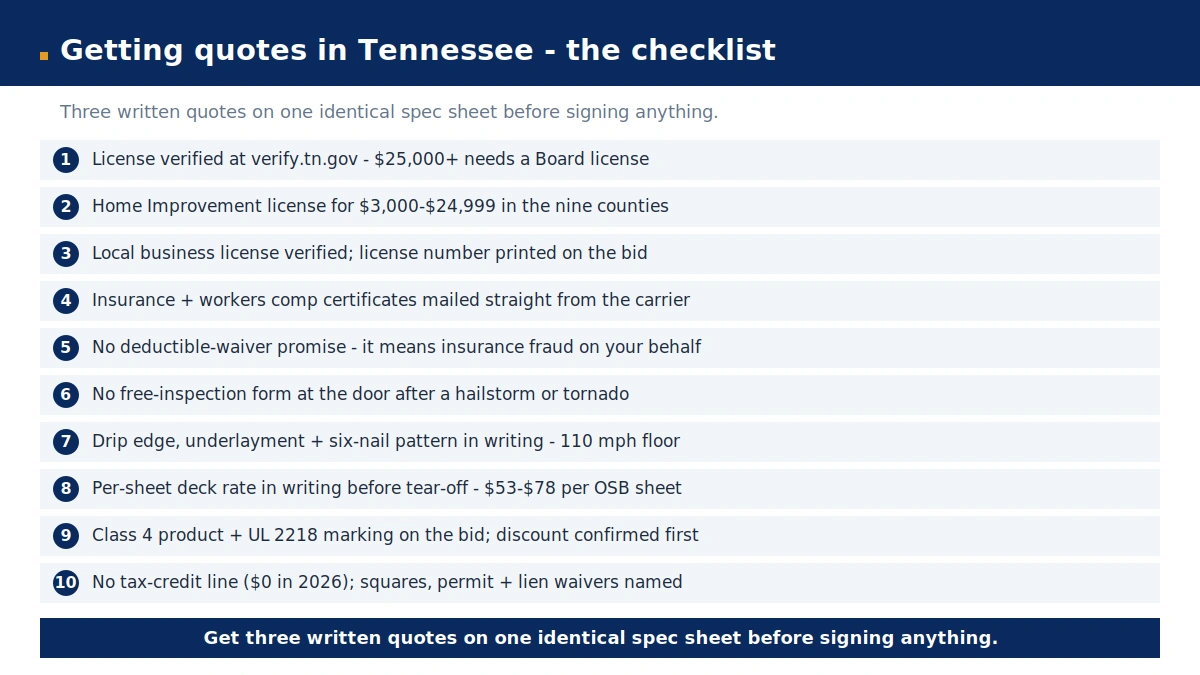
Three written quotes on one identical spec sheet, from three Tennessee contractors with verifiable licenses, before signing anything. That single sentence is the whole checklist — and the ten checks below are what makes it real.
- Contractor license checked at verify.tn.gov for any job at $25,000 or more — or a Home Improvement license for $3,000–$24,999 jobs in the nine counties (Bradley, Davidson, Hamilton, Haywood, Knox, Marion, Robertson, Rutherford, Shelby); a claimed exemption on a $26,000 roof is a walk-away.
- Local business license checked with the city or county, with the license number printed on the bid.
- Insurance and workers’ comp certificates that come to you direct from the carrier, under the same business name the contract carries.
- No promise to waive the deductible — an offer to do so is an offer to commit insurance fraud on the homeowner’s behalf.
- No free-inspection form signed at the door after a hailstorm or tornado — and no contingency agreement signed before the adjuster has looked at the roof.
- Drip edge, underlayment type, and six-nail high-wind pattern set down in writing — 110-mile-per-hour shingles as the floor, 130-mile-per-hour where the budget allows, ice-and-water barrier named on Knoxville and foothills jobs.
- Per-sheet deck rate agreed in writing before tear-off — $53–$78 per 4-by-8 OSB sheet installed.
- Class 4 product and its UL 2218 marking identified on the bid, with the insurer’s discount confirmed in writing beforehand.
- No federal tax-credit line ($0 in 2026) and no HEAR or HOMES rebate line for the roof — Tennessee’s programs have not launched, and they never cover roofing.
- Roof surface stated in squares rather than living area, with the permit cost and the party pulling it named, and lien waivers from the contractor and the shingle supplier in hand before final payment.
Sources & methodology
Cost anchors: SmartRoofingCalculator — Tennessee state page (updated Apr 24, 2026; TN arch $400–$580/sq; 25-square roof $10,000–$14,500; standing-seam metal $800–$1,250/sq; tile $1,070–$1,610/sq; permit ~$175; roofer median wage $21.53/hr May 2024 vintage; RPP 91.9; state factor 0.892); SmartRoofingCalculator Nashville city page (25-square arch $9,800–$14,210, $392–$568/sq, Nashville factor 0.98); SmartRoofingCalculator Memphis city page (25-square arch $9,000–$13,050, $360–$522/sq, Memphis factor 0.90); NumeralQ — Tennessee roof replacement cost (last updated Oct 13, 2026; pricing Oct 26, 2026: statewide 2,000 sq ft roof $8,870–$10,750; 1,000 sq ft $4,710–$5,780; 1,500 sq ft $6,790–$8,270; 2,500 sq ft $10,960–$13,240; 3,000 sq ft $13,040–$15,720; cities Nashville $9,080–$11,030, Memphis $8,940–$10,840, Knoxville $8,820–$10,680, Chattanooga $8,860–$10,740; deck sheet $53.41–$78.46; BLS May 2025 roofer median TN $21.97/hr; billed rates $44–$57/hr; permits $94–$200; 1,249 large-hail reports 2016–2025, 75% Mar–May; 81 reports at 2 in+; 395 tornado reports; 5,644 wind reports 58 mph+; 41% of homes built before 1980; FEMA hail Hamilton Relatively Moderate, Davidson Relatively Moderate, Shelby Very Low, Knox Relatively Low; roofer pay Nashville -13% vs US median, Knoxville -19%); MyRoofData — Tennessee (2026 model: typical arch roof $11,750–$20,500, 8% below national; 3-tab $322–$506/sq, arch $414–$690/sq before tear-off, ribbed metal $506–$874, standing seam $874–$1,472, cedar $828–$1,380, concrete tile $920–$1,656, clay $1,104–$2,300, slate $1,380–$2,760; example 2,338 sq ft, 23.4 squares, $11,800–$20,400; crews $46–$80/hr; tear-off $100–$200/sq/layer; permits $75–$300); Modernize (published Mar 10, 2026, updated Aug 27, 2026: average $12,500, range $8,500–$21,000; Memphis $9,000–$15,500; Knoxville $8,500–$15,000; Chattanooga $8,500–$15,000; asphalt $5–$10.50/sq ft); RoofingEstimatorPros — Tennessee (updated Aug 26, 2026: 2,000 sq ft arch $13,100–$23,575, avg $17,755, $8.88/sq ft, 0.94x multiplier; permit $150–$500); TriumphBuilt (Jun 19, 2026: arch $12,000–$20,000, $450–$700/sq; Nashville $11,000–$19,000; Franklin $14,000–$22,000); SquareDash (Apr 2026: TN average $12,700 for 2,000 sq ft home; Chattanooga 37402 $11,500); CLG Construction Nashville (Roof Cost Index Q3 2026, published Sep 25, 2026: arch $367–$562/sq before tear-off; typical full cost $11,900–$22,400, typical $17,100); BestRoofingEstimates (2,000 sq ft arch $13,500–$20,800; standing seam $24,700–$44,200; asphalt life 18–22 yrs under TN humidity and storms; 115 mph ultimate design wind speed; repair call-out $575; Memphis permit $100–$275; Knoxville $75–$225); CostFlowAI (Nashville ZIP 37201 arch typical $10,746, $481/sq, factor 0.93x — cross-check only). The 25-square material totals, the size-table figures, the Class 4 totals and the cost-per-year numbers were all worked out by us from the per-square ranges and lifespans cited above.
Climate + heat + humidity + hail + wind + tornadoes: humid subtropical statewide; Memphis hottest and most humid (Mississippi Delta edge); East Tennessee / Smoky Mountain foothills ice-dam concerns and ice-and-water shield (SquareDash); asphalt life 18–22 yrs (BestRoofingEstimates); Gloeocapsa magma algae, ARMA guidance, never pressure-wash (series sources); NOAA Storm Events Database 2016–2025 via NumeralQ: 1,249 large-hail reports, 75% Mar–May, 81 at 2 in+, 395 tornado reports, 5,644 wind reports 58 mph+ (12th nationally); FEMA National Risk Index county hail ratings (Hamilton Relatively Moderate, Davidson Relatively Moderate, Shelby Very Low, Knox Relatively Low); TEMA: ~31 tornadoes/yr average 1995–2024; nearly half of Tennessee tornadoes at night (Dixie Alley nighttime corridor); March 3, 2020 EF3 Nashville (Germantown/East Nashville) + EF4 Cookeville, 25 dead; December 9–10, 2023 outbreak: 18 tornadoes, EF3 Clarksville 150 mph peak, 11.33-mile path, ~1,000 homes impacted, 114 destroyed, 268 major damage, 3 killed in Clarksville (7 outbreak total), $62.375M tornado damage (NWS Nashville survey); EF2 Nashville–Madison–Hendersonville–Gallatin same day, 3 dead, 22 injured; no verified 2026 statewide tornado count; no Tennessee-specific attic-temperature measurement verified.
Class 4 + insurance discounts: UL 2218 Class 4 test (2-inch steel ball from 20 feet); upgrade cost ~$30 more per square (agent figure used across this series — NO Tennessee-specific premium verified); discount ranges 15–20% (agent), 20–30% off wind/hail portion, 5–20%, 10–25% (national guides — NO named carrier’s Tennessee figure verified). Three Class 4 products are cited in this guide: GAF Timberline AS II, CertainTeed Landmark IR and Owens Corning Duration STORM.
Insurance: Insurify (updated Nov 1, 2026: $3,060/yr on $300,000 dwelling, $1,000 deductible); InsuranceQuotes (rates Sep 30, 2026: $2,856/yr, $238/mo, same benchmark); Insurance.com / Quadrant ($2,958/yr; a second Insurance.com-derived table shows $3,198 — conflict flagged); Nashville $2,904/yr (Insurify); Memphis ZIP 38127 ~$4,510/yr (Insure.com via Live Insurance News); Tennessee 17th most expensive state; percentage wind/hail deductibles 1–5% of dwelling value; standard deductibles $500–$2,000; III via series sources (raising deductible $500 to $1,000 cuts premium 10–25%).
Permits + licensing + code: Tennessee residential code modeled on the IRC 2018 (some jurisdictions newer editions); Table R301.2(1) wind design speed 115 mph, ground snow load 10 psf (MTAS Manchester code; Murfreesboro code; Tellico Reservoir Development Agency 2018 IRC adoption); Murfreesboro R105.2 exemption: roof-covering replacement without deck/framing replacement exempt from permit; contractor license at $25,000+ (T.C.A. 62-6-102), roofing subcontractors at $25,000+ portion; Home Improvement license $3,000–$24,999 in nine counties (Bradley, Davidson, Hamilton, Haywood, Knox, Marion, Robertson, Rutherford, Shelby), $10,000 bond, $250 application, no trade exam; exams Business & Law + trade, 73% pass; monetary limit ~10x lesser of working capital or net worth; renewal $200 every 2 years; verify at verify.tn.gov; unlicensed contracting a Class A misdemeanor under Title 62, Chapter 6; exam provider PSI-to-Prov move July 1, 2026 (Housecall Pro — secondary, not verified against Board pages); lien law Tenn. Code 66-11-146(a)(2) and 66-11-112 (NumeralQ / Levelset, checked Nov 10, 2026). Permits: SRC ~$175; MyRoofData $75–$300; NumeralQ $94–$200; REP $150–$500; BestRoofingEstimates Memphis $100–$275, Knoxville $75–$225.
Labor: BLS OEWS May 2025 via NumeralQ: Tennessee roofer median $21.97/hr, billed $44–$57/hr; SRC May 2024 vintage $21.53/hr (small conflict, flagged); MyRoofData crews $46–$80/hr. NumeralQ: roofer pay Nashville -13% vs US median, Knoxville -19%.
HEAR / HOMES + federal + TVA: TDEC July 23, 2026 update (full DOE approval + executed agreement + implementer contracting still required before launch); revised plan filed Oct 2026 awaiting final DOE approval (heatpumppricing.com, verified Nov 4, 2026); allocations HEAR $83,390,060, HOMES $83,708,676; DOE Feb 6, 2026 map: Tennessee not among 13 launched jurisdictions; state warns offers claiming these rebates are scams; TVA EnergyRight ducted heat-pump rebates $500 (15–16.99 SEER2) / $800 (17+ SEER2), Home Uplift income-qualified; DOE Program Notice 26-2 (May 29, 2026: HEAR electric-to-electric only — back-catalog date flagged in draft). OBBBA (Public Law 119-21) and IRS FS-2025-05 together end both §25C and §25D for anything placed in service after Dec 31, 2025.
Repair costs: only one Tennessee-specific repair figure verified — typical repair call-out $575 (BestRoofingEstimates). No Tennessee repair-price table verified — none is given. No quantified repair rules are offered; the draft’s decision rules are qualitative.
How we worked: every 25-square material total, size-table figure, Class 4 total, cost-per-year number and RCV/ACV figure was calculated by us from the cited per-square ranges and lifespans, and each such figure is labeled as our own. We flagged the headline-cost disagreement, the SRC roofer-wage conflict ($21.53 vs $21.97/hr), the premium spread ($2,856–$3,198 by tracker and table), the Insurance.com $2,958 vs $3,198 conflict, the Class 4 discount disagreement, the city-pricing gaps (no verified Nashville/Chattanooga permit fee), and the Notice 26-2 back-catalog date. No Nashville/Chattanooga permit fee, no Tennessee-specific Class 4 premium or named-carrier discount, no 2026 statewide tornado count, no Tennessee-specific attic-temperature measurement, and no Tennessee-specific repair-price table were verified, so none are given. Lifespans in this guide are contractor-consensus estimates shaped to Tennessee’s heat, humidity and hail — realistic figures rather than numbers lifted from a single published table.
Prices in this guide are 2026 planning figures for Tennessee, not quotes. Get three written local quotes on one identical spec sheet before signing anything. Tax information here is general information, not tax advice. Roofing is safety-critical work for licensed professionals only.
How much should a Tennessee homeowner budget for a roof replacement in 2026?
SmartRoofingCalculator’s Tennessee page, updated April 24, 2026, lists architectural shingles at $400–$580 a square with tear-off included, which puts the typical 25-square roof at $10,000–$14,500. NumeralQ’s October 26, 2026 pricing gives $8,870–$10,750 for a 2,000 square foot roof statewide, $9,080–$11,030 in Nashville and $8,940–$10,840 in Memphis. On a 25-square roof the material spread runs from 3-tab at $8,050–$12,650 before tear-off through Class 4 at $10,750–$15,250 and ribbed metal at $12,650–$21,850 to standing-seam metal at $20,000–$31,250, with concrete tile at $23,000–$41,400.
How long does a roof last in Tennessee’s heat and humidity?
Less time than the brochure promises in a mild climate, and much longer for metal and slate. In Tennessee the lifespans that hold up start with 3-tab shingles at 12–18 years, architectural at 18–22 and Class 4 at 22–28. Metal runs longer — ribbed at 30–40 and standing-seam at 40–60 — as do cedar shakes at 25–35, concrete tile at 40–75, clay tile at 50–100, and natural slate at 75–150 years. Summer heat bakes the binder out of the asphalt, humidity feeds algae and moss, and spring hail knocks the granules off. The two best windows for the work are late fall, once the storm season eases, and late spring, after the hail season.
Does my Tennessee roofer need a license?
Yes, and the price of the job decides which one. Tennessee licenses by project value: a Board for Licensing Contractors contractor license is required at $25,000 or more, including for roofing subcontractors whose portion alone reaches $25,000. Smaller residential roofing, from $3,000 to $24,999, takes a Home Improvement license in nine counties — Bradley, Davidson, Hamilton, Haywood, Knox, Marion, Robertson, Rutherford, and Shelby — which covers Nashville, Memphis, Knoxville, and Chattanooga. Any license can be verified at verify.tn.gov, and the bidder’s monetary limit should cover the job. A contractor bidding a $26,000 roof without a Board license is working outside the law.
Is a permit required for a roof replacement in Tennessee?
Yes, for a full replacement in most metro jurisdictions, and Nashville’s building department counts roofs among the work it commonly permits. Across the state the fee runs about $75–$300: $100–$275 in Memphis and $75–$225 in Knoxville from the local schedules, with NumeralQ putting the typical range at $94–$200. One local carve-out matters: Murfreesboro exempts a roof-covering replacement that leaves the deck and the framing untouched. No Nashville or Chattanooga permit fee is given in this guide, because none was pulled from a city fee schedule. The permit and the inspection are the contractor’s to arrange.
Can I claim a federal tax credit on a Tennessee roof in 2026?
Nothing at all — the 2026 figure is $0. Anything placed in service after December 31, 2025 earns nothing under the One Big Beautiful Bill Act, which leaves both credits at zero, and roofing never counted as solar equipment, so the solar credit was never open to a roof in the first place. Tennessee’s HEAR and HOMES rebates have not launched at all: the state is still awaiting final federal approval of a revised plan filed in October 2026, and the programs never pay for a roof in any case. The insurer is what pays: a Class 4 roof may earn a discount on the wind-and-hail portion, and each claim that never needs filing saves a deductible.
Are impact-resistant shingles worth it in Tennessee?
Usually yes around Nashville and Chattanooga, and the county decides everywhere else. Tennessee logged 1,249 large-hail reports in a decade, with 75 percent of them falling between March and May, and the hail that does most of the damage falls in the one to two inch band where Class 4 earns its keep. On the published agent figure the upgrade costs about $30 more per square, or about $750 on a typical 25-square roof. Shelby County is the exception: FEMA rates its hail risk Very Low, so the upgrade case there is genuinely weaker, while Hamilton County’s high hail rate argues for it — the homeowner’s own county is the tiebreaker.
How do I spot a storm-chaser roofer working my Tennessee neighborhood after a hailstorm?
Tennessee draws storm chasers after a hailstorm or a tornado, and the crews turn up within days of the damage. Look for a door knock carrying a free-inspection agreement to sign on the spot, out-of-state phone numbers, no permanent local office, no Board or Home Improvement license, an offer to waive or absorb the deductible, and a demand for a big payment before work starts. Waiving a deductible means committing insurance fraud, and a Tennessee roofer who offers to negotiate a claim is offering to work outside the law, since that takes a public-adjuster license. Before anything is signed, run the license check at verify.tn.gov, get the insurance certificates mailed direct from the carrier, and collect three written quotes on one identical spec sheet.
What wind rating does my Tennessee roof need?
The floor is the same statewide, though the right choice depends on where the house sits. The code’s design wind speed is 115 miles per hour, so fit at least a 110-mile-per-hour-rated shingle anywhere in Tennessee, with 130-mile-per-hour products the better pick. Where wind speeds pass 115 miles per hour the six-nail high-wind pattern applies. In the Smoky Mountain foothills around Knoxville, add the ice-and-water barrier to the spec, because the cold-air pooling there makes ice dams a real February risk. The building department’s wind figure is the one that rules; a contractor’s estimate of it counts for nothing.