

On August 29, 2005, the eye of Hurricane Katrina came ashore near the Louisiana line and walked straight up the state of Mississippi. Coastal Mississippi took the worst of it first. A surge close to 28 feet pushed six to twelve miles inland, water stood over Highway 90 in Biloxi and Gulfport, and houses that had stood for generations along the beachfront were gone by noon.
The wind did not stop at the beach. Katrina held hurricane force all the way to Meridian, tore roofs in Hattiesburg and Laurel, and kept going into Tennessee as a tropical storm. Thirty-six years earlier, Camille had done the same trip with even stronger winds, 175 miles per hour at landfall near Waveland, and a 24.6-foot surge at Pass Christian that stood as the American record until Katrina beat it.
That is the roof market this guide prices. A Mississippi roof is storm gear on the Coast and storm gear inland too, just for different storms. The Coast buys against surge wind and salt air. Jackson buys against hail that FEMA rates Very High and tornadoes that arrive at night. Hattiesburg buys against all of it at once, in a Pine Belt town that took an EF4 through its university campus in February 2013.
The price itself is the kindest part of the story. Roofer pay runs 19 percent under the national median in Mississippi, so even the top of the planning band for a 2,000 sq ft shingle roof stays under $10,700, which makes this one of the least expensive states in the country to put a new roof on. The expensive parts hide around the price: the wind rating the Coast demands, the license the roofer must hold, the permit desk that differs by city, the hurricane deductible that can swallow $5,000 before the insurer pays a dollar, and the grant that pays up to $10,000 for the strongest roof but only for a narrow group of homeowners so far.
Our national roof replacement cost guide carries the countrywide numbers, and Mississippi lands about 9 percent below them on the same cost model. Labor explains nearly all of that gap.
Table of Contents
How Much Does a Roof Replacement Cost in Mississippi in 2026?
Five sources price the Mississippi market in 2026, and each one prices a different roof, so their numbers spread and the spread needs unpacking before any two quotes can be compared. NumeralQ’s figures are planning estimates from a model that adds local labor to materials, priced October 26, 2026, and they name the material, the size, and the scope outright: architectural shingles, 2,000 sq ft of roof, installed. SmartRoofingCalculator works the other way round: it takes national per-square bands and adjusts them for Mississippi roofer wages and goods prices, landing near the same answer.
MyRoofData works from a typical single-family home, includes tear-off of one layer, and lists every material per square before that tear-off is added. Instant Roofer pools real contractor pricing entered into its app from 154,200 measured Mississippi roofs, but its average roof is bigger at 2,648 sq ft, so its average price sits higher for the plain reason that there is more roof to cover. RoofingEstimatorPros, the high outlier, runs well above the other four and is recorded here rather than followed.
This guide leads with the NumeralQ band because the size, the material, and the pricing date are all stated, and because the source calls its figures planning estimates rather than dressing them up as a survey of what Mississippians actually paid. Its midpoint, about $9,740, is the working number for the lifetime math later in this guide. Once the bigger roof is allowed for, SmartRoofingCalculator’s 25-square figure of $9,750–$14,250 lands close to the NumeralQ size table, and the $390–$570 per-square band for architectural shingles sits near the $441–$534 rate the NumeralQ band implies.
The wider scope behind MyRoofData’s $11,000–$19,000, tear-off included for a typical home, is what pushes its top end higher. For Jackson, HomeCostLens models an average near $9,790 for a 2,200 sq ft home, with a range of $8,010–$16,020 that fits comfortably against the NumeralQ band. HomeQuoteHQ puts Jackson at $9,200 on average with a typical range of $6,700–$13,600 for a standard 2,000 sq ft home.
One model runs far above the rest and is recorded rather than adopted. RoofingEstimatorPros prices a 2,000 sq ft architectural roof at $12,156–$21,962, near $8.26 per sq ft installed, which is roughly twice the NumeralQ rate at the top end. That model carries no scope note that would explain the gap, so it stays in this guide only as the high outlier and out of every band that follows.
A Gulf Coast market guide prices a FORTIFIED-ready architectural roof in Gulfport at $9,800–$15,200, which describes a wind-code scope with a sealed deck and six-nail fastening rather than the standard planning roof. That scope costs more because it builds more, and the FORTIFIED section prices the upgrade separately so the two scopes are never confused.
| Source | Roof priced | 2026 figure |
|---|---|---|
| NumeralQ (Oct 26, 2026, planning estimate) | Architectural shingles, 2,000 sq ft of roof, installed | $8,810–$10,670 |
| SmartRoofingCalculator (modeled, Nov 9, 2026) | Architectural shingles, 25 squares, tear-off included | $9,750–$14,250 |
| MyRoofData (2026 cost model) | Architectural shingles, typical home, one-layer tear-off included | $11,000–$19,000 |
| Instant Roofer (154,200 roofs, contractor pricing) | Asphalt shingle, average Mississippi roof of 2,648 sq ft | $12,140 average |
| HomeCostLens, Jackson (modeled, Sept 2026) | Architectural shingles, 2,200 sq ft home | ~$9,790 average |
| HomeQuoteHQ, Jackson (2026 figures) | Asphalt shingle, 2,000 sq ft home | $9,200 average |
| RoofingEstimatorPros (modeled, Aug 2026) | Architectural shingles, 2,000 sq ft of roof | $12,156–$21,962 (high outlier) |
A standard job needs nothing beyond the headline band: the shingles, the underlayment, the starter course, the ridge cap, the flashing, and the ventilation pieces are all in it. The tear-off, the disposal, the labor, and the contractor’s markup are in it too. What it does not pay for is the list that catches buyers out: a second tear-off layer at $1.08–$1.42 per sq ft, decking sheets at $52.77–$77.63 each installed, a full ice-and-water barrier at $0.80–$1.30 per sq ft, new gutters at $7.11–$10.35 per linear ft, and flashing work at $279–$407 for a chimney or wall and $428–$551 to re-flash a skylight.
The NumeralQ Gulfport page is the source for those add-on figures, and a quote should carry each one on its own line. A quote that folds them into one lump sum hides the part of the job that grows after tear-off, and on the Coast the decking line grows more often than inland because salt air and storm water find the soft spots first.
On the same NumeralQ model, the national band for a 2,000 sq ft roof is $9,710–$11,840, which leaves Mississippi about 9 percent below the country. Pay is the whole explanation: the median Mississippi roofer earns $21.61 an hour, and contractors bill $43–$56 per worker-hour once insurance, payroll taxes, overhead, and profit are added. Shingles and underlayment ship at national prices, so the crew is where the saving lives.
The saving narrows on any roof where the crew’s hours go to tear-off, decking, and steep-slope work instead of laying shingles. It narrows further on the Coast, where the wind-code scope adds fastening labor and inspection time that an inland roof never sees. The cheapest roof in the country is still a five-figure job, and the crew’s hours decide how far past five figures it goes.
Roof Replacement Cost in Mississippi by Material
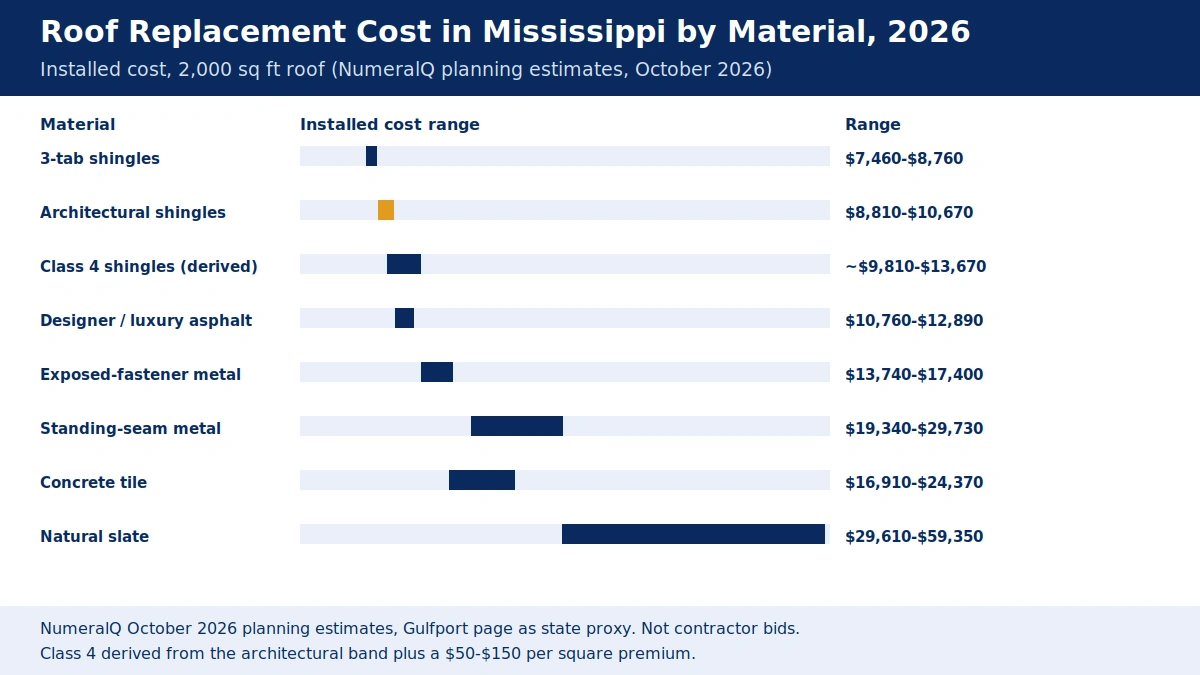
After size, material moves the price more than anything else, and in Mississippi it is also a wind decision. Every common material for a 2,000 sq ft roof is priced in the table below from the NumeralQ Gulfport page, which serves as the state proxy because the state and Gulfport bands match to the dollar. The MyRoofData model supplies the rated life figures, and the Mississippi read column describes what each material faces in this climate.
Nobody publishes the Class 4 row: it is derived by adding a $50–$150 per square material premium to the architectural band, with labor unchanged, and the Class 4 section spells out the derivation. The flat-roof rows cover porches, additions, and low-slope sections, which are common on Gulf Coast raised cottages and mid-century homes around Jackson.
| Material | 2,000 sq ft roof, installed | Rated life | Mississippi read |
|---|---|---|---|
| 3-tab asphalt shingles | $7,460–$8,760 | 15–20 years | Cheapest buy; lowest wind ratings; a poor fit for the Coast |
| Architectural asphalt shingles | $8,810–$10,670 | 22–30 years | The default Mississippi roof; 110–130 mph wind ratings |
| Class 4 impact-resistant shingles | ~$9,810–$13,670 (derived) | 25–35 years | Top hail rating; the discount roof; see the Class 4 section |
| Designer / luxury asphalt shingles | $10,760–$12,890 | 25–30 years | Thicker look; same hail exposure as standard architectural |
| Exposed-fastener metal (corrugated, 5V) | $13,740–$17,400 | 30–40 years | Common on rural homes; screws and salt air need watching |
| Stone-coated steel | $15,450–$22,560 | 40–50 years | Shingle look in steel; hail dents show less than on flat panels |
| Cedar shakes | $16,110–$29,040 | 25–35 years | Needs upkeep in humidity; rare on Mississippi production homes |
| Synthetic slate or shake (composite) | $16,170–$23,540 | 40–50 years | Slate look at half the weight; Class 4 options exist |
| Concrete tile | $16,910–$24,370 | 40–75 years | Heavy at 850–1,100 lb per square; structure check first |
| Standing-seam metal | $19,340–$29,730 | 40–70 years | Concealed fasteners; the long-life coastal metal roof |
| Clay tile | $22,520–$36,470 | 50–100 years | Brittle underfoot; tile-experienced crews only |
| Natural slate | $29,610–$59,350 | 75–150 years | A lifetime roof at 3–6 times the shingle price; specialist labor |
| Flat: modified bitumen / EPDM / TPO | $9,550–$12,280 / $9,830–$15,600 / $11,620–$15,540 | 20–30 years | Low-slope sections, porches, additions, raised cottages |
3-tab shingles are the budget buy, and the budget buy is the wrong roof for most of Mississippi. On a 2,000 sq ft roof, 3-tab undercuts architectural shingles by roughly $1,350–$1,910, about 17 percent at $7,460–$8,760. The trade is a thinner single-layer shingle with lower wind ratings and a shorter rated life, on a roof that will face the same hail in Jackson and the same Gulf wind on the Coast as its thicker neighbor.
Gulfport’s re-roofing guide effectively rules 3-tab out on the Coast anyway, since it demands Class H wind-rated shingles with six nails each, a standard thin 3-tab lines rarely meet. Many insurers and builders have moved away from 3-tab across the state. For most Mississippi homes, 3-tab belongs in the comparison table, not on the house.
Architectural shingles are the Mississippi default, and the default earns its place inland. The shingle is dimensional and two layers thick, carries 110–130 mph wind ratings and a 22–30 year rated life, and every crew in the state has installed it a hundred times. MyRoofData’s per-square figures run $383–$638 installed before tear-off, and tear-off adds $100–$200 per square per layer.
Every other material in this table is measured against the $8,810–$10,670 installed band for a 2,000 sq ft roof. The Mississippi caveat on life is plain: one state guide reports Jackson and Hattiesburg roofs showing curled tabs and bare granule patches around year 15 to 18, and Gulfport and Biloxi shingle life at 15 to 20 years, because heat, humidity, salt air, and storm cycles wear the roof faster than the lab test assumes. Treat those figures as one guide’s report, not a survey, and budget from the 15–20 year planning life rather than the full rated span.
What designer and luxury asphalt adds is depth and shadow, not strength. The $10,760–$12,890 price buys depth, shadow lines, and curb appeal on a front-facing slope over standard architectural. A higher impact rating does not come with it on its own.
Anyone who wants the look together with the hail rating should get a price on a Class 4 designer line by name and confirm the UL 2218 rating in writing, instead of assuming that thickness means toughness. On the Coast, the wind rating on the wrapper matters more than the shadow line, and the Class H question comes before the color question.
Two roofs share the name metal and little else. Corrugated or 5V exposed-fastener panels cost $13,740–$17,400, screw through the panel face, and go up fast, which is why rural Mississippi homes, barns, and budget metal conversions carry them. The screws and their gaskets are the upkeep item: gaskets age in Mississippi heat and UV, and salt air on the Coast speeds the corrosion of any fastener that is not rated for it.
At $19,340–$29,730, standing-seam metal tucks its fasteners under raised seams that let the panels move with temperature, and that hidden fastening is what earns the 40–70 year rated life and the premium price. Before tear-off, MyRoofData prices standing seam at $808–$1,360 per square against $468–$808 for ribbed panels, while SmartRoofingCalculator prices standing seam at $790–$1,230 per square installed with tear-off. Gulfport requires metal roofing to be 26 gauge or heavier, and coastal buyers should ask for aluminum or coated steel rated for salt air rather than bare steel.
For the gauge, finish, and trim breakdown, see our metal roof cost guide. Weighing metal against shingles? Our metal roof vs shingles cost comparison walks through the trade-offs.
Tile, slate, cedar, and synthetic sit in the special-case corner in Mississippi, and each one needs a reason stronger than looks. At $16,910–$24,370 for concrete tile and $22,520–$36,470 for clay tile, the weight is heavy enough that the structure often needs an engineering check before a switch from shingles, and clay is brittle underfoot, so repairs need tile-experienced crews. Tile handles heat and UV well, which suits the Mississippi sun, but a tile that cracks under a repairman’s boot costs more to fix than a shingle ever will.
At $29,610–$59,350, natural slate is the roof that outlives the mortgage, and weight plus specialist labor set the price. Cedar shakes at $16,110–$29,040 ask for upkeep in a humid climate and are rare on Mississippi production homes. Some synthetic slate and shake lines carry Class 4 ratings, and the material delivers the slate look at about half the weight for $16,170–$23,540. Before any tile quote is signed, the weight and structure questions are covered in our tile roof cost guide.
A different scale prices flat and low-slope sections, and they often hide inside a shingle quote. Modified bitumen at $9,550–$12,280, EPDM rubber at $9,830–$15,600, and TPO membrane at $11,620–$15,540 cover porches, additions, and the flat sections of raised Gulf Coast cottages where shingles cannot shed water. A house with a flat porch roof and a pitched main roof needs both prices on the quote, on separate lines, because the flat section fails first when it is treated as an afterthought, and on the Coast it fails in the first tropical downpour.
Roof Replacement Cost by Roof Size in Mississippi
What the roofer prices is the sloped surface underfoot, not the floor area the family lives in. Count pitch, overhangs, gables, and waste, and a 2,000 sq ft single-story house carries about 25 squares of roof surface. A two-story house with the same living area carries far less, because its footprint is half the size. Instant Roofer’s measured Mississippi average roof runs 2,648 sq ft at a 5/12 average pitch, which shows how quickly the roof outgrows the floor plan.
Roof area, not floor area, is the measuring stick for every figure in this section, and comparable quotes state that area in squares. Roofers quote in squares, and a square means 100 sq ft of roof surface. A quote that talks only about the size of the house, without a measured roof area, cannot be compared with anything.
| Roof size | Squares | Architectural shingles, installed |
|---|---|---|
| 1,000 sq ft of roof | 10 | $4,670–$5,740 |
| 1,500 sq ft of roof | 15 | $6,740–$8,210 |
| 2,000 sq ft of roof | 20 | $8,810–$10,670 |
| 2,500 sq ft of roof | 25 | $10,880–$13,140 |
| 3,000 sq ft of roof | 30 | $12,940–$15,600 |
For a typical single-story Mississippi home, the 25-square planning roof is the figure to budget from. In architectural shingles it runs $435–$526 per square installed at $10,880–$13,140, which lines up with the 20-square rate and with SmartRoofingCalculator’s independent 25-square figure of $9,750–$14,250. The 25-square row, not the 20-square row, is the budget row for a 2,000 sq ft ranch, and a two-story home needs the footprint and the pitch measured before either row is assumed.
About $2,070–$2,470 separates the two rows, and that gap is the cost of guessing the roof size from the living area. On the Coast the guess costs more, because a raised cottage carries staging and access time that a slab ranch never sees, and the quote has to carry it whether the buyer guessed the size right or not.
Two things shift the price inside any one row: how steep the roof is, and how cut up it is. More safety gear, a slower crew, and more material wasted at the cuts all come with a steep roof. Every joint on a cut-up roof, each valley, dormer, hip, and wall intersection, adds flashing labor, and one cost model puts the labor adder for that shape at about 15 percent. Per square in Mississippi, nothing beats a simple gable roof on a single story for cheapness.
At the dear end sits the steep, cut-up, two-story roof with three dormers, where the same square count can cost thousands more than the cheapest shape. The Gulf Coast version of the same problem is a raised house, where the crew works a full story higher and every bundle of shingles travels further up the ladder.
Only tear-off settles the two unknowns: layers and decking. Two layers already on the roof means a tear-off, since a third layer is not allowed, and the extra layer costs $1.08–$1.42 per sq ft to remove. Under the old shingles hides the decking damage, and the fix is priced per 4-by-8 sheet at $52.77–$77.63 installed.
About 42 percent of Mississippi homes were built before 1980, so soft or plank decking turns up often enough that every quote should state the per-sheet decking price before the roof is opened. Gulfport bans overlays outright, so a Coast buyer with two layers is paying for a full tear-off whatever the quote says, and a quote with no decking line is a quote with a change order waiting in it.
Roof Replacement Cost by City: Jackson, Gulfport, Hattiesburg & Biloxi
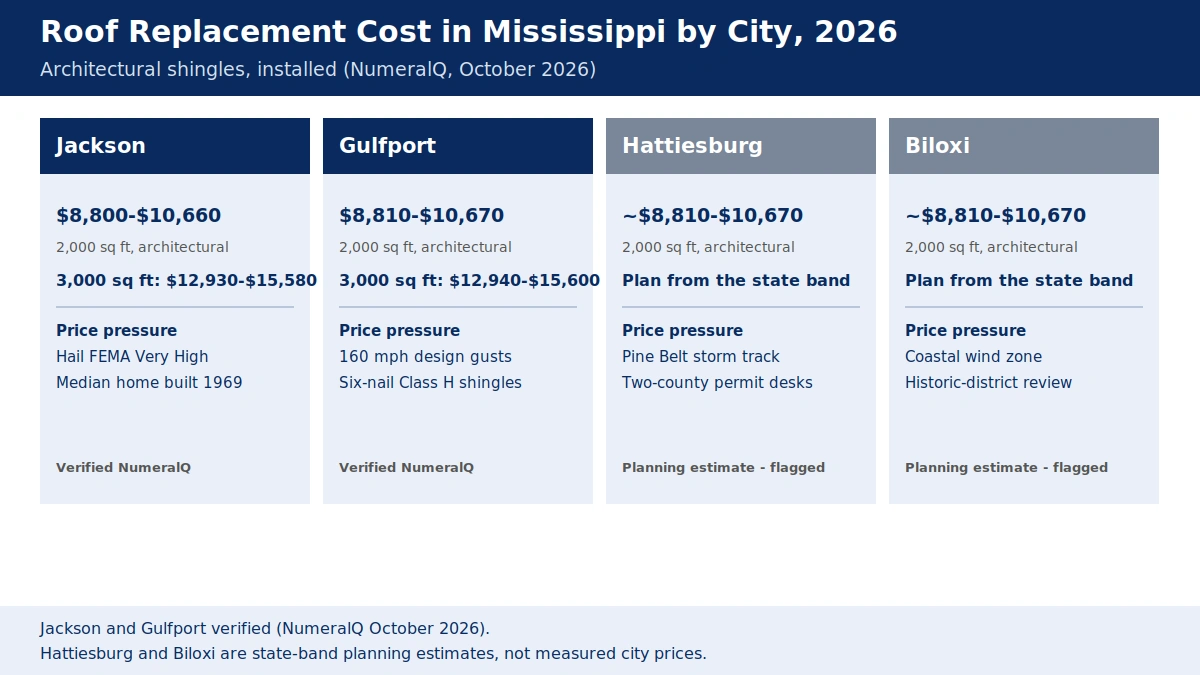
Only two of the four cities carry a published cost model. Jackson and Gulfport have NumeralQ pages priced October 26, 2026, with the same material, size, and scope as the state page. Hattiesburg and Biloxi have none: no published cost model was located for either city, and a local contractor’s price list is not a cost model. The figures below keep the two verified cities and the two planning estimates in separate columns so the difference stays visible.
| City | 2,000 sq ft roof, architectural shingles | Status | The local price pressure |
|---|---|---|---|
| Jackson | $8,800–$10,660 | NumeralQ verified, Oct 26, 2026 | Hail FEMA Very High; older stock, median built 1969; thin crew supply |
| Gulfport | $8,810–$10,670 | NumeralQ verified, Oct 26, 2026 | 160 mph design gusts; six-nail Class H; inspection at every stage |
| Hattiesburg | ~$8,810–$10,670 | State-band planning estimate, flagged | Pine Belt storms; EF4 history; two-county permit desks |
| Biloxi | ~$8,810–$10,670 | State-band planning estimate, flagged | Coastal wind zone; historic-district review; Casino Row crews busy |
The state band and the two city bands sit within a few dollars of each other because Mississippi labor prices are flat across the state. That flatness is useful: it means a Hattiesburg or Biloxi quote far outside the band needs an explanation in scope, not in geography. A Biloxi quote at $14,000 for a standard architectural roof is either a FORTIFIED scope, a steep or cut-up roof, or a quote that needs a second bid. A Hattiesburg quote at $6,500 for the same roof is either a 3-tab roof, an overlay where one is not allowed, or a crew without the license the job needs.
Jackson is the cheapest verified market in the state, by ten dollars. At $8,800–$10,660 for a 2,000 sq ft roof, and $12,930–$15,580 at 3,000 sq ft, the capital runs within $10 of the Gulfport band on the headline row and within about $30 a row across the material table. HomeCostLens models the Jackson average at about $9,790 and HomeQuoteHQ at $9,200, both inside the verified band.
Jackson’s housing stock is old: the median home was built in 1969, and the median home value of $111,700 means a new roof costs about 8.7 percent of the home’s value, the seventh-highest share among the 147 markets NumeralQ tracks. The crew supply is thin, with 12 roofing contractors in Hinds County in 2023, about 1.1 per 10,000 homes against a national 1.7, which is 34 percent below the country. Thin supply and old houses make the decking line the number to watch in a Jackson quote, and the hail record makes the Class 4 question worth asking on every Jackson roof.
Gulfport prices identically to the state band and builds a different roof for the money. The $8,810–$10,670 band buys a roof that meets the city’s 160 mph design-gust standard, with Class H wind-rated shingles, six nails per shingle, drip edge on every edge, and a deck nailing pattern of 4 inches on edges and 6 inches in the field. The median Gulfport home was built in 1986 and is worth $174,600, so the same roof is about 5.6 percent of the home’s value.
Harrison County has 8 roofing contractors, about 0.8 per 10,000 homes, 51 percent below the national rate, and the coastal crew market tightens after every storm. A Gulf Coast market guide prices a FORTIFIED-ready architectural roof in Gulfport at $9,800–$15,200, and coastal re-roofing there generally runs 8–15 percent above inland prices once wind-rated materials, heavier fastening, and inspection time are counted. Those two figures come from one unrated market guide and are flagged as such rather than treated as a survey.
Hattiesburg has no published cost model, so the state band is the planning figure and nothing more. Budget from $8,810–$10,670 for a 2,000 sq ft architectural roof, and treat a contractor’s own price list as a quote, not a market rate. A Hattiesburg contractor’s October 2026 list prices standard shingle roofs at $8,500–$14,000 for a 1,200–1,800 sq ft home, Class 4 at $13,000–$20,000, and metal at $18,000–$38,000, which overlaps the state band at the bottom and runs well past it at the top.
The ranges are wide because the home sizes are wide, and the list is one firm’s pricing, flagged as such. Hattiesburg sits where the Pine Belt meets the Coast’s storm track, took an EF4 through its campus in 2013, and splits its permits across two counties, which is why the permit section tells Hattiesburg buyers to call before they assume anything.
Biloxi has no published cost model either, and the same planning estimate applies with the same flag. Budget from $8,810–$10,670, then add the coastal scope: the wind zone, the six-nail pattern, the city license card, and the inspection schedule. Biloxi’s housing stock mixes beachfront condos, Casino Row service housing, and older neighborhoods that predate the modern wind code, and the city’s six historic districts can add a design review step for a material change.
No Biloxi-specific contractor price list was located that could be quoted as a market rate. Any Biloxi figure that appears in a quote should be read against the Gulfport verified band, since the two cities share the same county, the same wind zone, and the same crew pool, and a Biloxi quote that departs far from Gulfport needs a scope reason, not a geography reason.
A quote is comparable only when the scope matches, and the scope differs by city in ways that have nothing to do with price gouging. Gulfport and Biloxi quotes carry wind-code fastening, drip edge, and inspection time that Jackson and Hattiesburg quotes do not. Jackson quotes carry decking risk that Gulfport quotes carry less of, because the stock is older. The checklist in the last section lists the scope lines that must match before two numbers can be compared, and the city table above is the place to start the comparison.
Hurricane Country: What Camille, Katrina, and the Wind Codes Mean for Your Roof
Mississippi’s roof history is written in hurricanes. Two of them define the state’s building rules, its insurance market, and the reason a Coast roof costs what it costs. The first, Camille, arrived before the modern wind code existed. The second, Katrina, arrived after the code existed and showed how much of the old housing stock had never been built to it.
Camille struck on August 17 and 18, 1969, as a Category 5 hurricane at landfall near Waveland and Bay St. Louis. The 2014 reanalysis put sustained winds at 175 miles per hour and central pressure at 900 millibars, and the surge reached 24.6 feet at Pass Christian. The storm killed 172 people in Mississippi. No wind instrument survived the landfall, so the wind figure is an estimate, and it is stated here as one.
Camille’s damage pushed the country toward a wind scale that could describe what it had done. The Saffir-Simpson scale followed, and the storm became the benchmark Mississippi builders measured against for a generation. Roofs that survived Camille were mostly low, heavy, and well tied down. Roofs that failed were mostly the opposite, and the lesson was written into the codes that came later.
Katrina struck on August 29, 2005, as a strong Category 3 at its final landfall near the Louisiana-Mississippi border, with sustained winds near 125 miles per hour and central pressure of 920 millibars. The category number understates what Mississippi felt. Hurricane-force winds arrived around 2 a.m. and lasted more than 17 hours, the surge reached close to 28 feet and pushed six to twelve miles inland, and the eye carried hurricane winds as far as Meridian, where it arrived around 7 p.m.
The National Weather Service reported a 28-foot surge at the Hancock County emergency operations center and 26 feet on the Biloxi River at Wortham, with near-total destruction along the Hancock and Harrison county coasts inland nearly to Interstate 10. The storm killed 238 people in Mississippi and put all 82 counties under disaster declarations. The highest official gust was 98 miles per hour at Keesler Air Force Base, and an unofficial 135 miles per hour was recorded at Poplarville, which shows how much of the wind field went unmeasured.
Katrina rewrote the Coast’s roof rules because it exposed what the old rules had missed. Roofs failed at the deck, at the edge, and at the attachment, in that order: sheathing lifted where nails were spaced too wide, shingles peeled from the eaves where no drip edge held them, and whole roof systems came off houses whose wall-to-roof connections had never been strapped. The code answers that followed are the ones this guide prices: tighter deck nailing, drip edge on every edge, six nails per shingle, and Class H wind-rated shingles on the Coast.
Isaac in 2012, Zeta in 2020, and Ida in 2021 continued the sequence, and each one tested the newer roofs. This guide names them as the sequence only and asserts no damage total for any of them, because the totals were not verified to a citable source. The point of the sequence is not the damage figure. It is the frequency: a Gulf Coast roof in Mississippi should expect to be tested by a named storm more than once in its rated life, and the wind code assumes it will be.
The wind design speeds that follow from that history are set by the ASCE 7 standard, which divides the state into wind-speed zones. Hancock, Harrison, and Jackson counties sit in the hurricane-prone region, with design speeds of 130–140 miles per hour on the coastal mainland and 140–160 miles per hour on the barrier islands. The wind-borne debris region runs one mile inland from the Gulf’s mean high-water line, and it carries its own opening-protection rules for windows and doors.
Gulfport goes further than the standard. The city’s guide states that the whole city sits in a high-wind zone, with residential design at 160 miles per hour in 3-second gusts, and it requires Class H shingles, six nails each, and a notarized affidavit that the work meets the 2018 International Residential Code. Inland Mississippi typically designs at 105–115 miles per hour, though that figure comes from one weak source and is flagged as such.
The code zone decides the shingle before the buyer picks a color. A shingle rated for 110 miles per hour cannot be sold as a Coast roof, and a bundle wrapper that does not carry the Class H mark cannot pass a Gulfport inspection. The wind rating is printed on the wrapper, the inspector reads the wrapper, and the buyer should read it too before the first bundle goes up the ladder.
Tornadoes are the inland version of the same problem, and Mississippi is one of the busiest tornado states in the country. The Storm Prediction Center’s 30-year tornado record, 1996–2025, counts 1,799 Mississippi tornadoes on 444 days, about 60 a year and 15 tornado days a year. Of those, 287 were EF2 or stronger, about 9.6 a year, and 14 reached EF4 or EF5, including two EF5s. The state ranks tenth in the country by tornado days per year.
The tornado calendar in Mississippi has two peaks, which is why the state is called part of Dixie Alley rather than Tornado Alley. April is the busiest month, with 448 tornadoes and 16.4 percent of tornado days, and November and December carry a second peak. The middle 80 percent of tornado days fall between February 5 and November 29, which means the tornado season covers most of the year. The busiest single day was December 28, 2024, with 45 tornadoes.
About 26.7 percent of Mississippi tornadoes arrive at night, between 9 p.m. and 6 a.m., which is the share that matters for a roof. A night tornado gives no warning to a homeowner who is asleep, and the roof is the part of the house that meets the wind first. The longest track in the 30-year record ran 136.62 miles from Warren County on April 24, 2010. The strongest tornado started in Neshoba County on April 27, 2011, as an EF5 with gusts over 200 miles per hour on a 28.28-mile path.
Two named tornadoes carry the roof lesson for the cities in this guide. The Rolling Fork to Silver City EF4 of March 24, 2023, was rated at 195 miles per hour in the final National Weather Service survey of June 6, 2023, after an upgrade from 170. It cut a 59.4-mile path three-quarters of a mile wide, killed 16 people along its track, and was part of an outbreak that killed 26 people across the state. It was the strongest Mississippi tornado since the Smithville EF5 of 2011, rated at 205 miles per hour.
The Hattiesburg EF4 of February 10, 2013, was rated at 170 miles per hour on a 22.5-mile path three-quarters of a mile wide. It injured 71 people, caused $38.525 million in damage, damaged or destroyed about 300 structures in Forrest County, and hit the University of Southern Mississippi, where six buildings were damaged and two destroyed. A Hattiesburg buyer who asks whether tornadoes matter for a roof is asking a question the campus already answered.
The county table below shows where the tornadoes land. Hinds County, which holds Jackson, leads the state with 79 tornadoes in the 30-year record, including 11 at EF3 strength or above, and 52 tornado days. Harrison County, which holds Gulfport and Biloxi, counts 45 tornadoes and 31 tornado days. No part of the state is outside the record.
| County | Tornadoes, 1996–2025 | EF3+ | Tornado days |
|---|---|---|---|
| Hinds (Jackson) | 79 | 11 | 52 |
| Rankin | 77 | 12 | 48 |
| Smith | 67 | 14 | 47 |
| Leake | 56 | 6 | 36 |
| Jackson | 52 | 2 | 36 |
| Jones | 52 | 13 | 43 |
| Madison | 48 | 3 | 34 |
| Scott | 48 | 9 | 29 |
| Yazoo | 47 | 10 | 35 |
| Harrison (Gulfport, Biloxi) | 45 | 1 | 31 |
The wind code and the tornado record together set the Mississippi roof brief. On the Coast, buy the wind rating the code demands and the sealed deck the FORTIFIED standard adds. Inland, buy the wind rating the storm record earns and the impact rating the hail record earns, which is the subject of the next two sections. A roof that meets neither record is a roof that pays for itself in the next storm, at the worst possible time.
Humidity, Heat & Algae: The Slow Mississippi Roof Killers
Storms break roofs in a night. Humidity, heat, and algae break them over fifteen years, quietly, and the damage shows up as a roof that looks tired at year twelve and leaks at year fifteen while the warranty still has a decade to run. Mississippi’s climate is humid subtropical, which is a polite way of saying the air stays wet and the sun stays strong, and both wear on a shingle roof from the day it goes on.
Jackson averages 54.14 inches of rain a year on the 1991–2020 normals, with an average high of 76 degrees and an average low of 54. March is the wettest month at about 5.6–5.8 inches, and September and October are the driest. Gulfport runs wetter at about 64.7 inches a year, with the driest months in October and November. The statewide average sits near 58.5 inches. A Mississippi roof sheds roughly five feet of water a year, and the flashing, valleys, and penetrations are where that water finds the path inside.
Humidity compounds the rain. Jackson’s average humidity runs near 75 percent, and July runs near 77 percent, though that figure comes from one secondary source and is flagged as such. Wet air keeps the roof surface damp long after the rain stops, and damp shingles on a shaded slope grow the organisms that stain and eat at them. The north-facing slope on a house under pine trees is the classic Mississippi problem slope, and it shows the first black streaks years before the south slope shows anything.
Algae is the stain, and moss is the damage. The black streaks that run down Mississippi roofs are mostly Gloeocapsa magma, a blue-green algae that feeds on the limestone filler in asphalt shingles. It stains before it damages, and the stain alone costs curb appeal. Moss and lichen hold water against the shingle surface, lift the edges, and speed the loss of the granules that protect the asphalt from the sun.
Algae-resistant shingles carry copper granules that slow the growth, and they are worth asking about on any shaded Mississippi roof. No verified Mississippi price for the algae-resistant upgrade was located, so this guide prices it as its own line on the quote rather than folding it into the band. A buyer who wants it should ask for the upgrade price in writing, on a separate line, and confirm that the granules are copper-bearing rather than taking the label on trust.
Heat ages shingles from above while humidity ages them from below. Mississippi summers bake the roof surface well past the air temperature, and the daily heating and cooling cycle flexes the shingle and works the sealant strip loose. Attic heat is the other half of the problem: a poorly ventilated attic traps hot, damp air under the deck, cooks the shingles from beneath, and voids the warranty on some lines.
Ventilation is a cost item with a payoff, and it belongs on the quote as its own line. Ridge vents, soffit intake, and the balance between the two decide whether the attic breathes. The attic insulation cost guide prices the insulation side of the same job, since a roof replacement is the cheapest moment to fix an attic that has been cooking the old roof.
Salt air is the coastal version of the slow killers, and it attacks the metal parts of the roof. Fasteners, flashing, drip edge, and any uncoated metal rust faster within a few miles of the Gulf, and a roof whose metal parts corrode fails at the fastener long before the shingle wears out. Coastal buyers should ask for aluminum or coated steel, such as Galvalume or Kynar-coated steel, and for fasteners rated for salt air.
That guidance is qualitative, drawn from a weak source, and it is flagged as such rather than presented as a code requirement. The code requirement is the wind rating. The salt-air guidance is the buying judgment that keeps the wind-rated roof attached for its full life.
Ice is the surprise entry on the Mississippi list, and it belongs here because the code says so. FEMA rates ice-storm risk Very High in Hinds County, and the International Residential Code requires an ice barrier that extends 24 inches inside the exterior wall line on roofs in ice-dam regions. A full ice-and-water barrier runs $0.80–$1.30 per sq ft, and on a Mississippi roof it doubles as the sealed-deck layer that the FORTIFIED standard requires.
Cold weather also changes the install. Owens Corning’s technical bulletin directs hand-sealing of shingles when the temperature is at or below 40 degrees, because the sealant strip will not activate on its own in cold air. Mississippi winters are short, but a January install in Jackson can hit that threshold, and a crew that does not hand-seal in cold weather leaves a roof whose shingles lift in the first spring wind.
The planning life of a Mississippi shingle roof is shorter than the rated life, and the budget should use the shorter number. The rated life of an architectural shingle is 22–30 years. One state guide reports Jackson and Hattiesburg roofs showing curled tabs and bare granule patches around year 15 to 18, and Gulfport and Biloxi shingle life at 15 to 20 years. Those figures come from one secondary source and are flagged as such.
The lifetime section works the cost per year on a 17.5-year Mississippi planning life as well as on the rated life, so the buyer sees both numbers. The honest budget for a Mississippi shingle roof is a roof that lasts 15–20 years in the weather it actually faces, and a replacement fund that starts the year the roof goes on.
Asphalt vs Metal on the Gulf Coast: The Lifetime Math
The price tag favors shingles. The calendar favors metal. The honest comparison prices both roofs over the years the buyer will actually own the house, and it counts the replacements the shingle roof needs while the metal roof is still on its first install. This section works that math in the open, with every assumption stated, so the buyer can change any assumption and rework the answer.
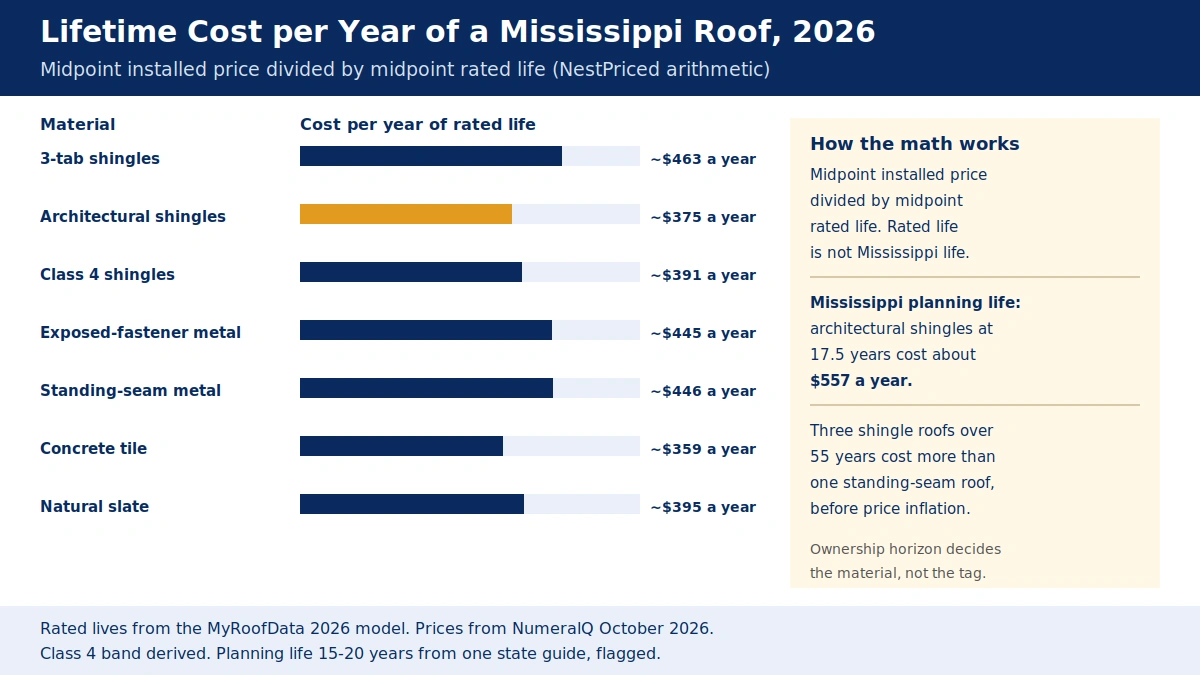
The midpoint is the working number. Architectural shingles at $8,810–$10,670 have a midpoint of about $9,740. Exposed-fastener metal at $13,740–$17,400 has a midpoint of about $15,570. Standing-seam metal at $19,340–$29,730 has a midpoint of about $24,535. The table divides each midpoint by the midpoint of its rated life to give the cost per year of rated life, which is NestPriced arithmetic, labeled as such.
| Material | Midpoint price, 2,000 sq ft | Midpoint rated life | Cost per year of rated life |
|---|---|---|---|
| 3-tab shingles | $8,110 | 17.5 years | ~$463 |
| Architectural shingles | $9,740 | 26 years | ~$375 |
| Class 4 shingles | $11,740 | 30 years | ~$391 |
| Exposed-fastener metal | $15,570 | 35 years | ~$445 |
| Standing-seam metal | $24,535 | 55 years | ~$446 |
| Concrete tile | $20,640 | 57.5 years | ~$359 |
| Natural slate | $44,480 | 112.5 years | ~$395 |
On rated life alone, architectural shingles are the cheapest roof per year at about $375, and concrete tile is close behind at about $359. Standing-seam metal at about $446 and exposed-fastener metal at about $445 cost more per year of rated life than shingles, because the metal premium is large enough to outweigh the longer life on a straight division. Slate at about $395 and Class 4 shingles at about $391 sit between the two.
The rated-life division flatters shingles, because it assumes the shingle roof reaches its rated life. In Mississippi weather it often does not, and the second division shows what happens when it does not. At a 17.5-year Mississippi planning life, the architectural roof costs about $557 a year, which is more than either metal roof costs per year of rated life. The shingle roof that dies at 17 years costs more per year than the metal roof that lives to 40, even though the metal roof cost two and a half times as much on the day it went on.
The replacement count is the number that settles the argument for a buyer who plans to stay. Over 55 years, a standing-seam roof is one install. An architectural roof at a 26-year rated life is about two installs, and at a 17.5-year Mississippi planning life it is about three. Three shingle roofs at $9,740 each cost $29,220 in today’s dollars, before any price inflation, which is more than the standing-seam midpoint of $24,535 and more than the standing-seam top of $29,730 only by a small margin.
Inflation makes the shingle side worse, because the second and third roofs are bought at future prices while the metal roof is bought once at today’s price. The metal roof also avoids two tear-offs, two disposal bills, and two rounds of decking surprises. The shingle roof avoids the upfront outlay, which matters more to a buyer who will sell in five years than to a buyer who will die in the house.
The break-even question is a time question, not a price question. A buyer who will own the house for 10 years or less should buy shingles and bank the difference, because the metal roof’s extra life is a gift to the next owner. A buyer who will own the house for 20 years or more should price metal seriously, because the second shingle roof falls inside the ownership window and the metal roof’s single install starts to pay.
A buyer who will own the house for 30 years should buy standing-seam metal or concrete tile and never think about the roof again, because the second shingle roof and the start of the third fall inside the window. The ownership horizon decides the material before the price tag does, and any quote comparison that ignores the horizon is comparing the wrong numbers.
Metal’s Mississippi advantages run past the calendar. Metal sheds rain faster than shingles, which matters on a roof that sees 55–65 inches a year. Metal does not grow algae the way asphalt does, which matters on a shaded Pine Belt slope. Metal carries the highest wind ratings of any common roofing material when it is installed to the coastal standard, which matters on the Gulf.
The Mississippi disadvantages are real too. Metal is louder in a hailstorm, and the hail section below shows how much hail Mississippi gets. Exposed-fastener metal needs its screws and gaskets watched in salt air. Standing-seam metal needs a crew that knows concealed-fastener work, and the thin contractor supply in Harrison County means the wait for that crew can be longer than the wait for a shingle crew.
The resale question has no verified Mississippi answer, and this guide does not invent one. No Mississippi-specific study of the resale premium for a metal roof was located, so no percentage is asserted. The honest statement is that a new roof of any material helps a sale, a metal roof helps a buyer who plans to stay, and a FORTIFIED certification helps a buyer who wants the insurance discount to transfer with the house. The discount and the grant are priced in the sections that follow, and they are the numbers that move the metal decision on the Coast.
Class 4 Impact-Resistant Shingles in Mississippi: Cost, Discounts & Payback
Hail is the Mississippi hazard that breaks roofs without making the national news. A hurricane gets a name and a landfall graphic. A hailstorm gets a claims adjuster and a roof that looks fine from the street and leaks six months later. Mississippi’s hail record earns the Class 4 section its own heading, because the impact rating is the one roof feature that answers hail directly.
The 30-year hail record, 1996–2025, counts 829 severe hail days and 3,738 hail reports in Mississippi, about 28 hail days a year. Severe means hail of one inch or larger, the National Weather Service criterion since January 5, 2010, and the full hail season record shows the season peaking in April. About 4.2 days a year reach two inches or larger, 127 days in 30 years. The largest stone in the record measured 4.88 inches, in Noxubee County on June 14, 2023.
The middle 80 percent of hail days fall between February 23 and September 4. April is the busiest month, with 18.6 percent of hail days and 5.1 days a year, and the busiest week centers on April 1. The busiest single day was April 15, 2011, with 56 reports. About eight in ten hail reports arrive between noon and 9 p.m., and the busiest hour is 3 p.m., which is when the afternoon heating peaks and the storms fire.
The county record sharpens the picture. Hinds County, which holds Jackson, counts 31 large-hail reports in the decade 2016–2025, three of them at two inches or larger, and 236 damaging-wind reports. Hinds County and its seven neighbors together count 184 hail reports, or 32.1 per 1,000 square miles against 24.5 statewide and 20.1 nationally. FEMA rates hail risk Very High in Hinds County.
Harrison County, which holds Gulfport and Biloxi, counts 27 large-hail reports in the same decade, one at two inches or larger, and 53 damaging-wind reports. Harrison County and its five neighbors count 79 reports, or 23.2 per 1,000 square miles. FEMA rates hail risk Relatively Moderate on the Coast and hurricane risk Very High, which is the right way round: the Coast buys against wind, and Jackson buys against hail.
A separate hail-tracking service counts 81 hail days within 15 miles of Jackson since 2010, with the largest stone at 2.75 inches, and 18 hail days within 15 miles of Gulfport, with the largest at 2.0 inches. About 61 percent of large hail falls in March, April, and May. The hail season and the tornado season are the same season, and a spring afternoon in Jackson is the riskiest hour of the year for a standard shingle roof.
Class 4 is the top impact rating in the UL 2218 test, and the test is specific enough to quote. A two-inch steel ball is dropped from 20 feet onto the shingle, twice in the same spot, and the shingle mat must not crack or tear. The rating has four classes, and Class 4 is the highest. The rating covers impact only: wind is a separate test, ASTM D3161 or D7158, and fire is a separate test, ASTM E108.
A Class 4 shingle is not automatically a Class H wind shingle, and a Class H wind shingle is not automatically Class 4. On the Coast, the buyer needs both ratings on the same wrapper, and the inspector checks the wind rating while the insurer checks the impact rating. GAF, Owens Corning, CertainTeed, and Atlas all sell Class 4 lines: Timberline AS II and ArmorShield II, Duration Storm and Duration FLEX, NorthGate and Landmark IR, and StormMaster. Malarkey Legacy and Vista, IKO Nordic, and Tamko StormFighter FLEX complete the list.
The Class 4 price is derived from the architectural band plus a published premium, and the derivation is shown in full. The architectural band is $8,810–$10,670 for a 2,000 sq ft roof. The material premium for Class 4 runs $50–$150 per square, from a November 2026 roofing-price source, with labor unchanged. On a 20-square roof the premium adds $1,000–$3,000, which puts the Class 4 band at about $9,810–$13,670.
A second source prices the premium at $150–$200 per square, which would put the top of the band higher. A national pricing source puts Class 4 at $650–$1,100 per square installed against $550–$850 for architectural shingles, which implies a premium of about $100–$250 per square. The band in this guide uses the lower premium source and labels the result as derived, and the buyer should treat the Class 4 line on a real quote as the number that settles the question.
The derived band overlaps the designer-shingle band of $10,760–$12,890, which is a useful comparison: Class 4 costs about what a luxury look costs, and it buys a test result instead of a shadow line. The Hattiesburg contractor list prices Class 4 at $13,000–$20,000 for a 1,200–1,800 sq ft home, which sits above the derived band because the home sizes and the scope are wider, and it is flagged as one firm’s pricing.
The insurance discount is real, it is carrier-specific, and no Mississippi statute sets its size. Discounts of 10–25 percent are commonly cited for Class 4 roofs, and one hail-belt pricing source cites 10–35 percent of the wind and hail portion of the premium. One agency example cites 15–20 percent. The discount usually applies to the wind and hail portion of the premium only, not to the whole policy, which is why the payback math below shows both versions.
The draft uses the 10–25 percent band and requires the buyer’s own agent to put the dollar figure in writing before the roof is bought. A discount that exists only in a contractor’s sales pitch does not exist. A discount that the agent confirms in writing, with the dollar amount and the portion of the premium it applies to, is a number the payback math can use.
The payback math is illustration, and it is labeled as such. The premium used is $4,445 a year, the NerdWallet 2026 average for Mississippi homeowners insurance at a $400,000 dwelling limit, cited by an October 2026 insurance-cost source. A second source in the same series puts the same limit at $3,092, and a third puts a $300,000 sample home at $3,987 a year. The $4,445 figure is used with its basis stated, and the buyer should rerun the math on their own premium.
| Discount scenario | Saving per year on $4,445 premium | Payback on $1,000–$3,000 premium |
|---|---|---|
| 10% on full premium | ~$445 | 2.2–6.7 years |
| 15% on full premium | ~$667 | 1.5–4.5 years |
| 25% on full premium | ~$1,111 | 0.9–2.7 years |
| 15% on half the premium | ~$333 | 3.0–9.0 years |
The table shows the range honestly. At the optimistic end, a 25 percent discount on the full premium pays the Class 4 premium back in under a year at the low premium and under three years at the high premium. At the cautious end, a 15 percent discount on half the premium takes three to nine years. The truth for any given buyer sits between the two rows, and the agent’s written figure is the only way to know which row applies.
The payback math also ignores the claim the Class 4 roof prevents. A roof that survives a hailstorm the standard roof does not is a roof that avoids a deductible, a claim on the record, and a partial repair that never matches the old shingles. That avoided claim is worth more than any single year of discount, and it is the reason the hail record in this section comes before the discount table rather than after it.
Permits & Code in Mississippi: Local Rules, Coastal Wind Zones & the 160 mph Line
Mississippi has no single statewide reroof permit. The state sets the floor, and the city or county sets the permit, the fee, and the inspection schedule. The floor is Senate Bill 2378 of 2014, which requires every jurisdiction to adopt one of the last three editions of the International Building Code and the International Residential Code, administered by the Mississippi Building Codes Council. What a jurisdiction adopts, and how it enforces it, varies by city, and the variation is large enough that a buyer in Jackson and a buyer in Gulfport face different permit desks, different fees, and different inspection steps for the same roof.
Gulfport runs the strictest re-roof permit in the state, and it is the model for the Coast. A permit is required for every re-roof and for any repair over one square, which is 100 sq ft. The permit card must be posted where it is visible from the street before work starts. A decking repair needs a nailing inspection, and every roof gets a final inspection. The fee is not published online, which means the buyer or the contractor has to ask the city desk for the figure before the quote is finalized.
The construction rules behind the permit are the 160 mph line. Gulfport designs residential roofs for 160 miles per hour in 3-second gusts, requires Class H shingles with at least six nails each, metal of 26 gauge or heavier, drip edge on every edge, and decking nailed at 4 inches on edges and 6 inches in the field. Overlays are banned: a single layer only, no second layer on top of the old roof. The contractor files a notarized affidavit that the work meets the 2018 International Residential Code, and the inspectors check the work against the instructions printed on the shingle bundle wrapper.
Gulfport also requires a city contractor license on top of the state license: a Mississippi State Board of Contractors license, liability insurance of at least $100,000 per occurrence and $300,000 aggregate naming the city, and a business privilege license. A contractor who holds the state license but not the city card cannot pull a Gulfport permit, and a buyer who hires one will find out at the permit desk rather than at the signing table.
Biloxi requires a permit and a city license card, and it doubles the fee for work started without one. The city states that the contractor must obtain a building permit before work begins, and it advises the homeowner not to pay until the inspectors approve the work. Fees are set by project cost, and the fee doubles if work starts before the permit is issued. The city license card requires the state license, $300,000 in general liability insurance naming the city, and a $5,000 license and permitting bond.
Biloxi’s Building Division can be reached at (228) 435-6270, and the buyer should confirm the fee schedule and the inspection steps with the division before signing a contract. The city adopted the 2024 International Building Code and ICC 600-2020 on June 10, 2025, which puts Biloxi ahead of most of the state on the code edition. Six historic districts in Biloxi may require a design review for a material change, which adds a step that a like-for-like replacement avoids. Biloxi holds a Community Rating System Class 6 rating, which earns a 20 percent discount on flood insurance for policyholders in the city.
Jackson runs its permits through a portal, and the reroof fee is not published online. The city requires permits for most structural and repair work beyond routine non-structural maintenance, and the fee schedule is not posted on the city’s site, which means the figure has to be confirmed with the Building Permit Division. Jackson has adopted the 2018 International Building Code and International Residential Code, and it runs permits through the ViewPoint Cloud portal.
A Jackson buyer should plan on a permit for a full replacement and confirm the fee and the inspection steps before the contract is signed. Historic properties carry an extra step: a like-for-like replacement needs a Compliance Agreement, and a change of type, style, material, or design needs a Certificate of Appropriateness from the city’s historic preservation process. A buyer in a Jackson historic district who changes from shingles to metal without the certificate is buying a stop-work order along with the roof.
Hattiesburg requires a permit for most repairs and alterations to an existing residence, with some routine repairs exempt, and the city tells unsure homeowners to call. The number is 601-554-1003, and the call is the verification step for any Hattiesburg roof. A full replacement should be treated as a permit job until the city says otherwise, and the fee and inspection schedule should be confirmed with the city desk rather than assumed from another city’s schedule.
Hattiesburg has adopted the 2018 International Residential Code. In historic districts, a same-material re-roof needs a Letter of Compliance, and a change of material or design needs a Certificate of Appropriateness. Hattiesburg sits in two counties, Forrest and Lamar, and the county permit desk can differ from the city desk, which is why the call matters more in Hattiesburg than in a single-county city.
Southaven, the state’s second-largest city, is the permit background for the Memphis suburbs. Roofing counts as a renovation or alteration under the city’s fee schedule, a permit is required before work starts, and the fee doubles if work starts without one. Contractors must register with the city, holding a $10,000 surety bond and an active state license. Southaven has adopted the 2024 International Residential Code for new-construction plans, which is the newest edition in the state.
The code rules that apply everywhere in Mississippi are the layer limit and the ice barrier. The International Residential Code section R908.3 bars a third layer of roofing, which means a roof with two layers already on it must be torn off rather than overlaid. The code section R905.1.2 requires an ice barrier that extends 24 inches inside the exterior wall line on roofs in ice-dam regions, which includes the northern part of the state.
The coastal overlay adds its own rules within one mile of the Gulf’s mean high-water line in Hancock, Harrison, and Jackson counties: ASTM D7158 wind-rated shingles, reinforced synthetic underlayment, six-nail fastening patterns, and opening protection for windows and doors. The overlay is the reason a Coast quote and an inland quote for the same shingle are not the same job, and the permit desk is where the overlay gets enforced.
Flood rules can reach a roof replacement in a Special Flood Hazard Area, and the reach depends on local administration. Gulfport and Jackson both apply the 50-percent-of-market-value substantial-improvement rule over ten years in flood hazard areas, which means that improvements totaling half the structure’s market value in a decade trigger flood-code compliance for the whole structure. Whether a routine re-roofing counts toward that total depends on how the local floodplain administrator counts it, and the buyer should check with that office before assuming a re-roof is exempt.
The permit question to ask in every Mississippi city is the same, and it has four parts: does this job need a permit, what is the fee, what inspections does it need, and who pulls the permit. The contractor should pull the permit in the contractor’s name, because a permit pulled in the homeowner’s name can shift the liability for the work onto the homeowner. A contractor who asks the homeowner to pull the permit is a contractor who cannot pull one, and the hiring section explains why that matters.
Hiring a Roofer in Mississippi: The $10,000 License Line & the Storm-Chaser Test
Mississippi draws a bright line at $10,000, and the line decides who can legally roof a house. The Mississippi State Board of Contractors requires a Residential Roofer license for residential roofing work over $10,000, under the remodeler definition in Mississippi Code 73-59-1(c) and the Residential Rule 1.1(1)(g), which creates the Roofer subclassification with its own exam. A Residential Remodeler or Residential Builder license also covers roofing. At or under $10,000, no state license is required, though local permits still apply, and a job priced at exactly $10,000 sits under the line.
The $10,000 line cuts straight through the Mississippi price band. A 2,000 sq ft architectural roof at $8,810–$10,670 straddles the line, which means the same roof can be a licensed job or an unlicensed job depending on where the quote lands. A quote at $9,500 needs no state license. A quote at $10,500 needs one. A quote that starts at $9,800 and grows past $10,000 on decking change orders crosses the line mid-job, and the contractor who was legal at signing is unlicensed at completion.
The license itself is a real credential, not a registration fee. The applicant passes two exams through PSI, Business and Law and the trade exam, with a 70 percent pass mark. The application fee is $50, plus $100 for each additional classification. The license runs for one year and renews annually. A $10,000 minimum net worth is reported by one secondary source and is flagged as such. The license can be verified on the Board’s lookup at search.msboc.us, and the Board’s phone number is 800-880-6161.
Commercial work has a higher line. A Certificate of Responsibility with a Roofing, Sheet Metal, and Siding specialty, plus a trade exam, is required for commercial roofing work at $50,000 or more. Residential Builder licensing applies to new construction at $50,000 or more. Electrical, plumbing, mechanical, and HVAC work is licensed at any amount, which matters when a roof job touches a vent, a flue, or a solar connection.
Local enforcement backs the state line. Building officials must refuse a permit to a contractor who holds neither the license nor an exemption, and they must report violations to the Board. A contractor without a permanent place of business in Mississippi needs a Department of Revenue permit under Mississippi Code 27-65-27 before a building permit can issue, which is the rule that catches out-of-state storm crews who arrive after a hurricane with a truck, a ladder, and no Mississippi address.
The contract carries its own disclosure rule. Mississippi Code 73-59-11 and 31-3-13, with Residential Rule 1.3, require the contract to state, in bold type larger than the rest of the contract and just above the buyer’s signature, whether the licensee carries general liability insurance. A contract without that statement, in that place, in that size, is a contract that has not met the law, and a buyer should not sign it.
House Bill 1408, the Insurance Benefits Roofing Repair Consumer Protection Act, rewrote the rules for insurance-funded roofing in 2024, and every Mississippi buyer with a claim should know what it says. The act, Mississippi Code 75-24-301 to 75-24-311, took effect July 1, 2024, after being signed on May 8, 2024. Its provisions are stated here from the bill text, which was verified against the Legislature’s published version.
Before signing, the contractor must give the homeowner a written statement in at least 12-point boldface, with a detachable duplicate Notice of Cancellation. The homeowner may cancel within three business days after receiving written notice from the insurer that all or part of the claim is not covered, and the contractor must refund within ten business days, except for approved emergency services already performed. No payment is due until the three-day cancellation period expires where insurance proceeds may pay for the work.
The deductible rebate is banned by statute, and the ban is absolute. The contractor shall not advertise, promise, offer, pay, or rebate any portion of the deductible as an inducement to sign. That is Mississippi Code 75-24-307(4)(b), and it is a statutory ban, unlike some neighboring states where the practice sits in a gray area. A contractor who offers to absorb, waive, or rebate the deductible is offering to break the law, and a buyer who accepts is party to a transaction the law forbids.
The contractor may not represent or negotiate the claim until the insured has filed it, though the contractor may be included in communications and may confer with the insurer about the damage. The contractor may not pay for attorney referrals or obligate the insured to hire a specified attorney. A post-loss assignment of benefits must name the contractor as co-payee only, must include an itemized list of the work, an itemized list of materials, labor, and fees, the total, a statement that the assignment does not assure coverage, and a capitalized 14-point notice of the homeowner’s rights, and a copy must go to the insurer within five business days.
The contractor must comply with all building codes. Violations are unfair or deceptive acts under the Mississippi Consumer Protection Law, with civil and criminal penalties and a private right of action. A 2025 bill that would have licensed every insurance-funded roofer died in committee, so the $10,000 line remains the licensing test and House Bill 1408 remains the consumer-protection test.
Liens are the risk that survives a paid invoice. An unpaid worker or supplier may place a lien on the property, and on a single-family home a subcontractor or supplier without a direct contract with the owner is limited to the amount the owner still owes the contractor when the pre-lien notice arrives. Earlier payments are a defense. The statute provides waiver forms, and payment on a proper waiver dissolves the lien. An unlicensed contractor cannot place a lien at all.
The most likely lien senders on a Mississippi roof are the shingle distributor and the subcontracted crew. The defense is a lien waiver from every supplier and subcontractor, collected at each payment, and a final waiver before the last check clears. A buyer who pays in full without waivers has paid for the roof and kept the lien risk.
The storm-chaser test is five questions, and any contractor who fails one should not get the job. First, is the Mississippi State Board of Contractors license current, and does the lookup at search.msboc.us confirm it. Second, does the contractor hold the city license card for Gulfport or Biloxi where one is required. Third, does the contract carry the bold insurance statement above the signature line. Fourth, does the contractor have a permanent Mississippi address and a Department of Revenue permit if the business is based out of state. Fifth, does the contractor offer to absorb the deductible, which is the instant disqualifier under House Bill 1408.
A sixth question belongs on the list after a storm: how many roofs has this crew completed in this county, and can the buyer see one. Storm crews arrive with out-of-state plates, a local phone number that forwards out of state, and a promise to handle the insurance claim. The crews that stay are the ones with a Mississippi address, a Mississippi license, and a roof the buyer can drive past. Our questions to ask a roofer guide carries the full interview list, and it should be read before any contractor walks the roof.
Insurance in Mississippi: Hurricane Deductibles, the Wind Pool & What a Claim Really Pays
Insurance is where the Mississippi roof story turns from construction into arithmetic, and the arithmetic surprises most homeowners the first time a claim is filed. The surprise has three parts: the deductible is a percentage, not a flat figure; the settlement may be depreciated, not replacement cost; and the wind policy on the Coast may come from a different insurer than the policy that covers the rest of the house.
The deductible on a Mississippi homeowners policy is usually a separate percentage of the dwelling coverage, typically 1–5 percent, and it applies to wind and hail or to hurricanes specifically. It is not the flat $1,000 deductible that covers a burst pipe. The table below shows what the percentage means in dollars, because the percentage hides the size of the check the homeowner writes first.
| Dwelling coverage | 1% deductible | 2% deductible | 5% deductible |
|---|---|---|---|
| $250,000 | $2,500 | $5,000 | $12,500 |
| $300,000 | $3,000 | $6,000 | $15,000 |
| $350,000 | $3,500 | $7,000 | $17,500 |
A $300,000 home with a 2 percent hurricane deductible puts $6,000 of the roof on the homeowner before the insurer pays a dollar. A $250,000 home with a 5 percent deductible puts $12,500 on the homeowner, which is more than the entire architectural roof band for a 2,000 sq ft roof. The deductible is the first number to check on the declarations page, and it is the number that decides whether a claim is worth filing at all.
The settlement method decides the second number. Replacement cost value, or RCV, pays the cost to replace the roof, usually in two checks: the first for the actual cash value, and the second for the recoverable depreciation after the work is completed and documented. Under actual cash value, or ACV, the payment is the replacement cost less depreciation for the roof’s age and condition, and that depreciation generally stays unrecovered. Under a roof payment schedule, the payment is a filed percentage of the replacement cost set by the roof’s age and material, and the percentage drops as the roof gets older.
A new roof can move a policy from ACV settlement back to RCV settlement, which is one of the quiet payoffs of replacing an old roof before it fails. No Mississippi rule setting a roof-age schedule was located, and this guide does not invent one: the buyer should read the roof endorsement on their own policy, because the endorsement is where the settlement method and any age schedule live.
Senate Bill 2130, passed in 2024, prohibits insurers from canceling a policy based on the age of the roof. That statement comes from a secondary summary and is flagged as such. The bill does not stop non-renewal, and it does not stop an insurer from writing ACV terms or a roof payment schedule into the policy. The cancellation protection and the settlement terms are different things, and the buyer should not confuse them.
No Mississippi matching statute was located. A matching law would require the insurer to pay for undamaged shingles so the repair matches the rest of the roof, and no such statute was found in the research for this guide. The buyer should not assume matching coverage exists, and should ask the agent whether the policy includes it before a partial repair is authorized.
The Mississippi Windstorm Underwriting Association, the wind pool, is the insurer of last resort for wind and hail on the Coast. It covers six coastal counties: Harrison, Hancock, Jackson, Stone, George, and Pearl River. It covers wind and hail only, not the rest of the homeowners policy, and it costs more than the standard market. A separate wind and hail policy for a coastal resident runs $800–$2,000 a year according to one 2026 source, flagged as a single source.
The wind pool raised rates on January 1, 2026, by 16 percent according to one source, described as the largest increase in more than ten years. A second source reports a 17.2 percent average increase, and the two figures conflict. This guide uses the 16 percent figure with attribution and does not assert the 17.2 percent figure. The direction of both figures is the same: coastal wind cover is getting dearer, and the mitigation discounts in the next section are worth more every year.
The wind pool rewards the strong roof, and the reward is the FORTIFIED discount. The wind pool’s FORTIFIED credits are reported as 20 percent for a FORTIFIED Roof, 25 percent for Silver, and 30 percent for Gold, attributed to IBHS reporting. A second source reports 17 percent for the Roof level under a different label, and the two figures conflict. This guide uses the 20 percent figure with attribution and tells the reader to confirm the current credit with the wind pool or the agent before relying on it.
The wind pool also offers a free FORTIFIED Roof endorsement on eligible renewing policies: when a covered claim replaces 50 percent or more of the roof, the policyholder can re-roof to the FORTIFIED standard at no extra cost. That endorsement turns a storm claim into a stronger roof, and it is the cheapest FORTIFIED upgrade in the state for a policyholder who qualifies.
Flood is never covered by a standard homeowners policy, and the sentence bears repeating because the confusion costs Mississippians their houses. Flood cover is a separate policy, through the National Flood Insurance Program or a private flood insurer. A roof claim and a flood claim are different claims with different policies, different adjusters, and different deductibles, and a hurricane brings both at once. A Coast homeowner without flood cover who loses a roof to wind and a ground floor to surge has cover for the first loss and none for the second.
The claims clock runs faster than most homeowners expect. Most Mississippi homeowners policies carry a one-year contractual suit-limitation clause, against a three-year statutory catch-all in Mississippi Code 15-1-49. That statement comes from a secondary source and is flagged as such, and it is mentioned briefly because the practical point is simple: file promptly, document everything, and do not let a disputed claim drift. The one-year clause, where it exists, is the clock that matters, and the buyer should read the policy to confirm whether theirs carries it.
Paying for a Mississippi Roof in 2026: $0 Federal Credit, the $10,000 FORTIFIED Grant & Financing
The money for a Mississippi roof in 2026 comes from four places: the homeowner’s pocket, the insurer’s check, the state grant that pays for the strongest roof, and a loan. The federal government is not one of the four. The section that follows prices each source honestly, starting with the one that pays nothing, because the nothing is the fact most buyers get wrong.
The federal tax credit for a 2026 roof is $0. The One Big Beautiful Bill Act, Public Law 119-21, with IRS Fact Sheet FS-2025-05, ended the Section 25C and Section 25D credits for property placed in service after December 31, 2025. A roof installed in 2026 earns no federal energy credit, and a contractor who promises one is promising a credit that no longer exists. The federal government contributes $0 to a 2026 Mississippi roof, and the quote should show no federal credit line. Our federal energy tax credits guide carries the full post-OBBBA picture for the measures that still qualify and the ones that do not.
The state home energy rebates have no posted launch status in Mississippi. The HEAR and HOMES rebate programs, funded under the Inflation Reduction Act, show no status posted for Mississippi on the program trackers checked in November 2026, and the state energy office describes a utility-run program with no way to apply. One tracker calls the status not confirmed, another calls it pending, and a third calls it unconfirmed. No launch date has been posted, and no verified Mississippi allocation figure was located, so none is stated here.
The roof itself would not qualify even if the programs launched tomorrow. HEAR covers appliances, insulation, air sealing, ventilation, wiring, and electrical panels, and a roof is not a HEAR measure. A buyer who is replacing a roof and upgrading the attic in the same job should ask whether the insulation and ventilation pieces qualify under whatever program eventually launches, but the roof line itself should be budgeted with no rebate. No HEAR or HOMES money belongs in a 2026 Mississippi roof quote.
The FORTIFIED standard is the strongest roof Mississippi money buys, and the standard is specific. FORTIFIED is a voluntary building standard from the Insurance Institute for Business and Home Safety, in three levels: Roof, Silver, and Gold. The Roof level requires a sealed deck, either a peel-and-stick membrane or a taped-seam underlayment, ring-shank nails holding the deck, enhanced edges with drip edge, and an inspection and certification by an IBHS-certified evaluator. The designation lasts five years, and it must be renewed.
The FORTIFIED increment over a standard re-roof runs about $1,000–$3,000, from a March 2026 roofing-policy source and a 2026 contractor source, and the evaluator fee runs $500–$800, which the state grant does not cover. The increment buys the sealed deck that keeps water out when the shingles come off, which is the failure mode Katrina exposed: a roof that loses its shingles but keeps its deck stays dry inside, and a roof that loses its deck loses the house.
The Strengthen Mississippi Homes Act, Senate Bill 2409, created the grant that pays for the FORTIFIED Roof. The act, effective July 1, 2026, renamed the Comprehensive Hurricane Damage Mitigation Program as the Strengthen Mississippi Homes Program inside the Mississippi Insurance Department, under Mississippi Code 83-1-191. The bill text was verified against the Legislature’s published version. Grants run up to $10,000 per home for retrofits that meet or exceed the IBHS FORTIFIED Roof standard, covering hurricane, tornado, hail, and catastrophic windstorm mitigation.
Eligibility is narrow and specific. The home must be a single-family primary residence, not a condo or a manufactured home, and it must be in good repair apart from the roof. It must be insured for windstorm, and for flood if it sits in a Special Flood Hazard Area. It must not have been previously retrofitted to the FORTIFIED standard. No grant issues without an IBHS evaluator inspection and certificate, and grants are subject to appropriation, which means the money must be funded before it can be paid.
Phase 1 of the grant program opened in 2026 for a narrow group, and the narrow group is the wind-pool homeowner on the Coast. The Mississippi Insurance Department’s press release of June 10, 2026 states that the Mississippi Windstorm Underwriting Association is providing $2 million, administered by the department, for grants up to $10,000. The homeowner must be a primary single-family owner-occupier, currently insured through the wind pool, and insured through the wind pool for three consecutive policy years. Only Hancock, Harrison, and Jackson counties qualify in Phase 1.
Rounds open periodically, and one secondary source reports that selection runs by lottery rather than first-come-first-served, which is flagged as a secondary report. Three contractor bids are required, and the grant is paid directly to the contractor after completion and certification. Some program pages have described interest registration as temporarily paused, so the buyer should check the current status with the Mississippi Insurance Department before assuming a round is open. The Senate Bill 2409 text and the Smart Home America Mississippi page carry the program detail and the current status.
The statewide expansion waits on a funding fix, and the fix is expected in early 2027. House Bill 1911, the fiscal year 2027 funding bill, allowed up to $15 million in statewide funding, but a drafting error referenced Senate Bill 2406, a State Aid Road bill that died on February 3, 2026, instead of Senate Bill 2409. The error means no spending authority exists until the Legislature reconvenes, which is expected in early 2027. The funding comes from insurer fees, not taxpayer money, with fees running from July 1, 2026, and full funding anticipated in spring 2027.
One advocacy source cites about $16 million a year once the program is fully funded. The $15,000 figure that appears in some coverage belongs to the House Bill 1714 proposal, which was not enacted, and it does not belong in a 2026 quote. The enacted grant is up to $10,000, and the statewide rollout is a 2027 story, not a 2026 one.
The insurance discount for a FORTIFIED home is required by Mississippi law, and the discount is large. Mississippi law requires insurers to offer discounts for homes mitigated to the IBHS standard, and the Insurance Department reports filed discounts of 15–30 percent. One advocacy source cites 12–55 percent off the wind portion of the premium. Senate Bill 2709 of 2020 created a statewide discount and rate reduction for FORTIFIED construction, rebuilding, and re-roofing, according to a secondary summary. Mississippi Code 83-75-3 requires mitigation discount offers in the five coastal counties.
The discount and the grant together change the FORTIFIED math. A $1,000–$3,000 increment, a $10,000 grant that covers it several times over, and a 15–30 percent discount on the wind premium every year after, is the best return on any roof dollar in Mississippi for a homeowner who qualifies. The qualification is the catch, and the catch is the wind-pool history and the coastal county.
Two smaller funding sources round out the picture. The Federal Home Loan Bank of Dallas FORTIFIED Fund offers up to $17,000 for income-qualified homeowners, through a member bank, with limited funding. Small Business Administration disaster loans allow up to 20 percent over the verified damage for mitigation work. Catastrophe savings accounts allow deposits to be deducted from gross income, according to a secondary source citing the Insurance Department, and the mention here is brief because the source is secondary.
Financing fills the gap the grant does not cover, and no Mississippi-specific contractor financing terms were verified. No specific annual percentage rate or monthly payment figure is stated in this guide, because none was verified to a citable source. The options in the background are the Fannie Mae HomeStyle Renovation and HomeStyle Energy loans, which roll the roof into the mortgage, and the USDA Single Family Housing Repair loans and grants for very-low-income homeowners in rural areas. Our roof financing guide works the loan types, the rate questions, and the payment math in full, and it should be read before any financing offer is signed.
Repair or Replace & Getting Quotes in Mississippi: The Decision Rules and the Checklist
The repair-or-replace decision is the last question in this guide and the first question most buyers ask. The answer depends on the roof’s age, the damage’s extent, and the storm that caused it, and the rules below are decision rules, not guesses. A roof that meets any one of the replace rules is a roof that should be priced as a replacement, whatever the repair quote says.
Replace when the roof is past its Mississippi planning life. An architectural shingle roof at 17–20 years in Mississippi weather, showing curled tabs, bare granule patches, and soft decking, is a roof that has given its service. A repair buys a year or two at the cost of a repair, and the replacement follows anyway. The planning life in this guide is 15–20 years, and a roof past it with visible wear should be replaced.
Replace when the damage covers more than a third of the roof. A leak in one valley is a repair. Leaks in three valleys, soft decking in two slopes, and missing shingles across the ridge is a replacement wearing a repair quote. The third-of-the-roof rule is a planning rule, not a code rule, and it is stated as one.
Replace when the deck is soft or the roof has two layers. Soft decking means the structure under the shingles has failed, and no new shingle fixes a soft deck. Two layers means the code bars a third, so any re-roofing is a tear-off, and a tear-off is most of the cost of a replacement. A roof with two layers and a leak is a replacement, not a repair.
Replace when the storm took the roof’s wind rating with it. A roof that lost shingles in a hurricane or a tornado has lost more than the missing shingles: the surviving shingles have been flexed, the sealant strips have been worked, and the wind rating of the whole slope is suspect. An adjuster and a roofer should walk it together, and a partial repair that leaves a weakened slope is a repair that fails in the next storm.
Repair when the damage is local, the roof is young, and the deck is sound. A single leak at a flashing, a handful of missing shingles after a wind gust, and a roof under ten years old with a solid deck is a repair job. Our roof repair cost guide prices the repair side, and HomeQuoteHQ puts the average Jackson repair at $765, which is the scale of a local fix.
The quote checklist is the last section because it is the one to take to the signing table. Every line below should appear on every quote, in writing, before the contract is signed. A quote missing a line is a quote with a change order in it.
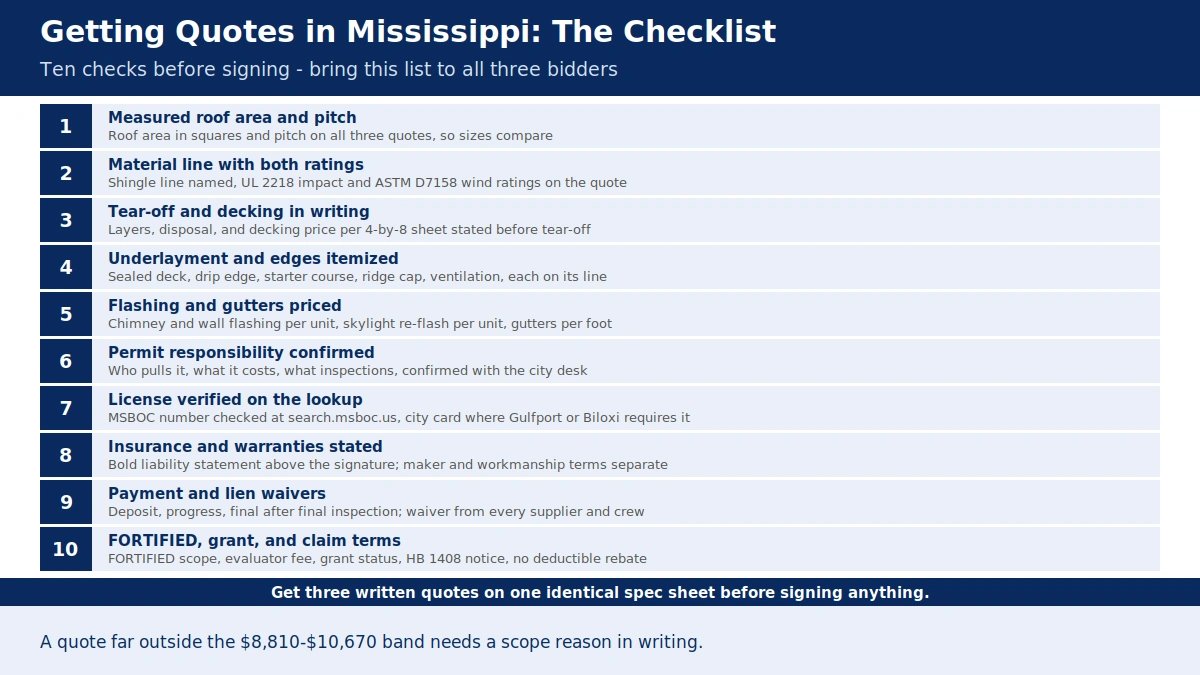
- Measured roof area in squares, with the pitch stated, so the size row in this guide can be checked against the quote.
- Material, line, and color, with the UL 2218 impact rating and the ASTM D7158 wind rating printed on the quote, not promised verbally.
- Tear-off scope: how many layers, disposal included, and the per-square price for an extra layer.
- Decking price per 4-by-8 sheet, installed, stated before tear-off, so the change order has a price cap.
- Underlayment type, and whether the sealed-deck layer is included or priced separately.
- Drip edge, starter course, ridge cap, and ventilation pieces, each on its own line.
- Flashing: chimney and wall flashing per unit, skylight re-flashing per unit, and valley flashing by type.
- Gutter work, if any, priced per linear foot, with the gutter removal and reinstallation stated.
- Permit: who pulls it, what it costs, and what inspections it needs, confirmed with the city desk.
- License: the Mississippi State Board of Contractors license number, verified on the Board lookup, and the city license card where one is required.
- Insurance: the bold general-liability statement above the signature line, as the law requires.
- Warranty: the manufacturer warranty term and the workmanship warranty term, stated separately, in years.
- Payment schedule: deposit, progress, and final payment, with the final payment after the final inspection passes.
- Lien waivers: from every supplier and subcontractor, at each payment, with a final waiver before the last check.
- FORTIFIED: whether the scope meets the FORTIFIED Roof standard, the evaluator fee, and whether the grant applies.
- Insurance claim: the House Bill 1408 cancellation notice, the three-business-day period, and no deductible rebate, in writing.
The last rule is the simplest, and it is the one that saves the most money. Get three quotes, on the same scope, with the same lines, from three licensed contractors, and compare them line by line. A quote that is far below the band in this guide is not a bargain. It is a scope that is missing something, a license that is missing something, or a crew that will not be in Mississippi when the roof leaks. The band in this guide is the market. A quote far outside it needs an explanation, and the explanation should be in writing before the signature is.
Sources & methodology
State cost models and contractor pricing: NumeralQ Mississippi, Gulfport, and Jackson roof replacement cost pages (planning estimates, pricing October 26, 2026; labor from BLS May 2025; housing data from Census); SmartRoofingCalculator Mississippi roof replacement cost page (updated November 9, 2026); MyRoofData Mississippi roof replacement cost page (2026 model, per-square figures before tear-off); Instant Roofer Mississippi averages (154,200 measured roofs, average 2,648 sq ft); HomeCostLens Jackson roof replacement cost page (September 2026, modeled); HomeQuoteHQ Jackson roof replacement cost page (2026); RoofingEstimatorPros Mississippi page (August 26, 2026, high outlier, noted not adopted); B and A Roofing Hattiesburg price list (October 2026, single contractor, flagged); bestroofingestimates Gulfport and Mississippi guides (unrated, flagged); mississippibusinessesnearme Mississippi roofing guide (October 20, 2026, single secondary source, flagged).
Storms, hail, and climate: NOAA Storm Prediction Center 1996-2025 tornado and hail records via MyWild Mississippi tornado and hail season pages (snapshot September 2, 2026); National Weather Service Jackson surveys of the Rolling Fork-Silver City EF4 (June 6, 2023) and the Hattiesburg EF4 (February 10, 2013); NOAA Atlantic Oceanographic and Meteorological Laboratory and National Hurricane Center reanalysis of Hurricane Camille (2014 reanalysis, 175 mph, 900 mb, 24.6 ft surge, 172 deaths in Mississippi); NOAA National Centers for Environmental Information and National Weather Service New Orleans reports on Hurricane Katrina (December 2005; 125 mph, 920 mb, 28 ft surge, 238 deaths in Mississippi); NOAA 2016-2025 county storm data via NumeralQ (Hinds and Harrison counties); Cloudbreak hail-day counts (through November 8, 2026); NOAA 1991-2020 climate normals via usclimatedata.com (Jackson) and extremeweatherwatch.com (Gulfport); chaseday.com humidity figures (secondary, flagged); Owens Corning technical bulletin TB-10022497-A (hand-seal at or below 40 degrees); ASCE 7 wind-speed zones via roofingstormdamage.com and Gulfport re-roofing guide (160 mph design gusts).
Licensing, permits, and code: Mississippi State Board of Contractors residential licensing rules (Mississippi Code 73-59-1, 73-59-11, 73-59-17, 73-59-18; Residential Rule 1.1, 1.3; ReadyDocs verification October 2026); House Bill 1408, Insurance Benefits Roofing Repair Consumer Protection Act (Mississippi Code 75-24-301 to 75-24-311, effective July 1, 2024, bill text verified); Senate Bill 2378 of 2014 (Mississippi Code 17-2-1, code adoption floor); Gulfport re-roofing guide and Armor Roofing Gulfport guide (October 2026); Biloxi building permit guidance and Armor Roofing Biloxi guide (October 2026); City of Jackson permit and historic preservation pages; City of Hattiesburg renovations page; City of Southaven fee schedule and contractor registration guide; International Residential Code sections R905.1.2 and R908.3; Levelset Mississippi lien guidance via NumeralQ (checked November 10, 2026).
Insurance, FORTIFIED, and grants: Senate Bill 2409, Strengthen Mississippi Homes Act (2026, effective July 1, 2026, bill text verified); Mississippi Insurance Department press release of June 10, 2026 (Phase 1, $2 million, wind-pool eligibility); Smart Home America Mississippi page (DontGoof.org); IBHS FORTIFIED standards and designation terms; House Bill 1911 funding-bill drafting error and Senate Bill 2406 history (2026); Senate Bill 2709 of 2020 (secondary summary, flagged); Mississippi Code 83-75-3 and 83-1-191; NerdWallet 2026 Mississippi premium average via insurancecostcalc.com (October 2026); InsuranceQuotes.com Mississippi premium figure (September 30, 2026); WinChoice and HomeQuoteHQ Class 4 discount ranges (2026); roofingstormdamage.com and insuranceopedia wind-pool rate figures (conflict flagged); Kin, GCF Roofs, and Bridgeway Mississippi insurance guides (2026, flagged where single-source).
Federal and state money: One Big Beautiful Bill Act, Public Law 119-21, and IRS Fact Sheet FS-2025-05 (Section 25C and 25D ended for post-2025 installs); betterpowered.com, 1-800deals.com, renewestimator, audityourhome, and chargehomesolutions HEAR and HOMES Mississippi status pages (checked July-November 2026, no launch status posted); Mississippi Development Authority program description (August 2026); DOE Program Notices 26-1 and 26-2 (effective May 29, 2026); roofleads.pro Class 4 premium figures (November 2, 2026); K1 and Clean Invoice Class 4 pricing (2026); Federal Home Loan Bank of Dallas FORTIFIED Fund; Small Business Administration disaster-loan mitigation allowance.
Methodology: NumeralQ planning estimates lead because they state material, size, scope, and date. Hattiesburg and Biloxi figures are state-band planning estimates, flagged as such, because no published cost model was located for either city. The Class 4 band, the cost-per-year figures, the payback scenarios, and the deductible dollar figures are NestPriced arithmetic from the cited inputs and are labeled as derived or illustration in the text. Single-source and secondary-source figures are flagged in the text and in this list. No figure in this guide was invented, and no unverified figure is presented as verified.
Disclaimer: Prices are planning estimates from published cost models and contractor pricing, not quotes, and your price depends on roof size, pitch, layers, decking condition, material, and local code scope. Verify the current permit fee, license status, grant round status, and insurance discount with the city desk, the Mississippi State Board of Contractors, the Mississippi Insurance Department, and your own agent before signing a contract. This guide is general information, not legal, tax, or insurance advice.
How much does a roof replacement cost in Mississippi in 2026?
A 2,000 sq ft architectural shingle roof costs $8,810–$10,670 installed in Mississippi in 2026, from NumeralQ planning estimates priced October 26, 2026. A 25-square roof, the typical single-story home, runs $10,880–$13,140. Metal, tile, and slate cost more, and the material table in this guide prices each one.
What does a roof replacement cost in Jackson versus Gulfport?
Jackson costs $8,800–$10,660 and Gulfport costs $8,810–$10,670 for a 2,000 sq ft architectural shingle roof, both verified by NumeralQ in October 2026. The two cities price within ten dollars of each other, but Gulfport builds a different roof for the money, with 160 mph design gusts, Class H shingles, and six nails each. Hattiesburg and Biloxi have no published cost model, so the state band is the planning figure for both.
Does Mississippi require a license to replace a roof?
Mississippi requires a Mississippi State Board of Contractors Residential Roofer license for residential roofing work over $10,000, and a Residential Remodeler or Builder license also covers roofing. At or under $10,000, no state license is required, though local permits still apply. Verify the license on the Board lookup at search.msboc.us before signing.
What is the FORTIFIED Roof grant in Mississippi, and who qualifies?
The Strengthen Mississippi Homes Program pays up to $10,000 per home for a retrofit meeting the IBHS FORTIFIED Roof standard, under Senate Bill 2409, effective July 1, 2026. Phase 1 in 2026 covers only primary single-family owner-occupiers insured through the wind pool for three consecutive policy years in Hancock, Harrison, and Jackson counties. Statewide expansion waits on a funding fix expected in early 2027, so check the current round status with the Mississippi Insurance Department.
How much do Class 4 shingles cost in Mississippi, and do they earn an insurance discount?
Class 4 impact-resistant shingles cost about $9,810–$13,670 for a 2,000 sq ft roof, derived from the architectural band plus a $50–$150 per square premium. Discounts of 10–25 percent are commonly cited, usually on the wind and hail portion of the premium only, and no Mississippi statute sets the size. Get the dollar figure from your own agent in writing before buying the roof.
What wind speed must a Gulf Coast Mississippi roof be built for?
Gulfport designs residential roofs for 160 mph in 3-second gusts, with Class H wind-rated shingles, six nails each, drip edge on every edge, and decking nailed at 4 inches on edges and 6 inches in the field. The ASCE 7 hurricane-prone region covers Hancock, Harrison, and Jackson counties at 130–140 mph on the coastal mainland and 140–160 mph on the barrier islands. Inland Mississippi typically designs at 105–115 mph, from one weak source.
Is there a federal tax credit for a new roof in Mississippi in 2026?
No. The One Big Beautiful Bill Act ended the Section 25C and Section 25D credits for property placed in service after December 31, 2025, so the federal credit for a 2026 roof is $0. Mississippi’s HEAR and HOMES rebate programs have no posted launch status, and a roof is not a HEAR measure in any case. The state FORTIFIED grant and the insurance discount are the money that survives for a Mississippi roof.
Should I repair or replace my roof in Mississippi?
Replace when the roof is past its 15–20 year Mississippi planning life, when damage covers more than a third of the roof, when the deck is soft, when two layers are already on the roof, or when a storm took the wind rating with the missing shingles. Repair when the damage is local, the roof is under ten years old, and the deck is sound. Get three quotes on the same scope from three licensed contractors before deciding.