

Table of Contents
Wisconsin does not forgive a heating mistake. A furnace that is a size too small in Tennessee leaves a house chilly for a weekend. A heat pump that is a size too small in Wisconsin leaves a house cold for a month, with the backup strips running around the clock and the January electric bill to prove it. The state is the coldest in this series where the heat pump question is still a live one: Madison logs 7,138 heating degree days a year, Green Bay is designed to minus 13 degrees, Eau Claire to minus 18, and 58 percent of the state’s counties sit in climate Zone 6 or colder, where the standard advice is to insist on a cold-climate machine. A heat pump bought here faces a different winter from one bought anywhere south of Chicago, a different utility landscape from one bought in Minnesota, and a rebate stack no other Midwestern state can match.
That is why this guide prices Wisconsin the way a Fox Valley estimator would: by system type, by home size, and by city — Milwaukee, Madison, Green Bay, and Appleton — with the rebate each program actually pays in 2026, the state licensing rules that are stricter than most homeowners expect, and the running-cost math done at Wisconsin’s own electricity and gas prices, not national averages. The headline number is $7,000–$13,500 for the standard whole-home job. Everything after it is the detail that decides whether your job lands at the bottom of that band or the top — and whether a heat pump is the right machine for your house at all.
Before the Wisconsin numbers, the US-wide picture is worth ten minutes: our national heat pump cost guide sets the baseline every state figure below is measured against.
How Much Does a Heat Pump Cost in Wisconsin in 2026?
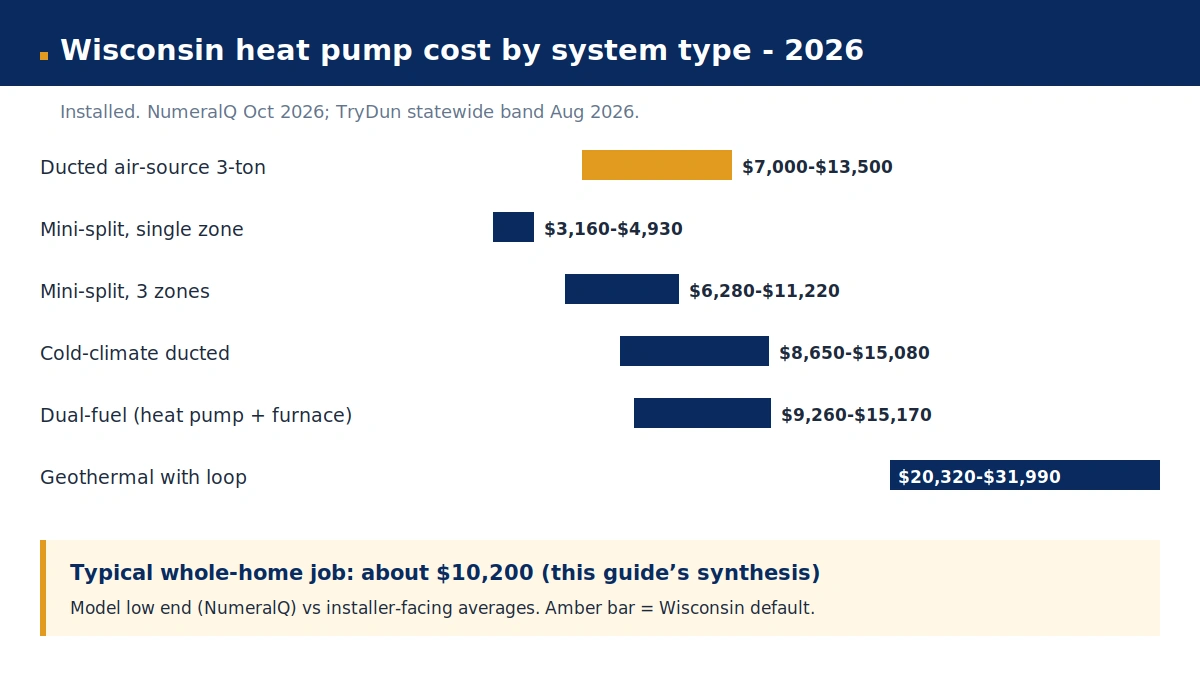
A typical Wisconsin home of 1,500–2,500 square feet needs a 3-ton whole-home ducted air-source heat pump. In 2026 that job costs $7,000–$13,500 installed in Wisconsin. The typical job lands near $10,200. That range is the number to budget on. That figure covers the full job: outdoor unit, indoor air handler, refrigerant lines, a dedicated circuit, the permit, and the commissioning visit — a working system in a lived-in Wisconsin house, not a box on a pallet.
Three published anchors sit underneath that range, and they disagree in a way worth understanding. NumeralQ’s Wisconsin estimator (pricing as of October 26, 2026, built from Fixr, This Old House, Home Depot prices, and Bureau of Labor Statistics wages) puts a 3-ton ducted system at $6,580–$11,000. That is a planning model — parts plus local wages, with nothing in it for sales time, warranty reserve, or the surprises a real Wisconsin house always holds, from a 100-amp panel to ducts in a freezing basement — so it lands below what installers actually charge. TryDun’s statewide band, built the same way from BLS labor and equipment pricing, runs $7,150–$13,200. At the other end, Modernize puts the average Wisconsin heat pump installation at $12,150 — a figure that runs well above both models and that this guide flags rather than adopts, because Modernize’s per-type figures (a single-zone mini-split at $6,710, against NumeralQ’s $3,160–$4,930) look like a national lead-generation average with Wisconsin labor applied, not a Wisconsin installer average. The honest headline sits where the model and the statewide band overlap, stretched upward by the higher installer-facing average: $7,000–$13,500 for the standard whole-home job, with the top of the band reserved for cold-climate variable-speed equipment, difficult installs, and Milwaukee addresses. The $10,200 typical figure is this guide’s synthesis of the three — no single published Wisconsin statewide installer average was found, and the guide says so rather than inventing one.
One warning before you budget on any number here: a whole-home quote near $5,000 is almost never a complete quote in Wisconsin. A bid thousands below the other two is usually equipment plus a thin slice of labour, with the air handler, electrical work, permit, duct work, or commissioning left out — or waiting to appear as separate line items later. When one bid lands far below the rest, ask which pieces are missing before you sign, not after the crew is already on site in January.
Wisconsin sits a touch above the national middle on price. Across the US as a whole, our national guide puts a ducted heat pump at $7,500–$15,000 in 2026. Wisconsin labor is cheaper than the coasts but dearer than the Deep South, and the climate in most of the state pushes buyers toward the cold-climate tier that costs roughly $2,000 more than a standard system — a premium that is optional in Missouri and close to compulsory here. Compare that with Missouri, where the same system runs $7,000–$13,000 and the cold-climate premium is a northern-counties question, or New Jersey, where the statewide average is about $13,600. Wisconsin is a middle-priced state to buy a heat pump in, with a cold-climate surcharge built into most honest quotes. The catch is that the price of getting it wrong is higher here than anywhere south of Minnesota, because a wrongly sized system gets punished for four months, not four nights.
| System | Typical Wisconsin installed cost (2026) |
|---|---|
| Ducted air-source heat pump, 3-ton (typical home) | $7,000–$13,500 (typical ~$10,200) |
| Ductless mini-split, single zone | $3,160–$4,930 |
| Ductless mini-split, 3 zones | $6,280–$11,220 |
| Cold-climate ducted heat pump, 3-ton | $8,650–$15,080 |
| Dual-fuel (heat pump + gas furnace) | $9,260–$15,170 |
| Geothermal (ground-source) with loop | $20,320–$31,990 |
| Add heat pump to existing gas furnace (replacing AC) | $5,500–$10,000 |
Sources: NumeralQ Wisconsin estimator (Oct 26, 2026); NumeralQ HVAC replacement page (dual-fuel model); TryDun statewide band (Aug 2026); nestpriced national guide (art. 1). The add-heat-pump figure is the national guide’s band, carried over because no Wisconsin-specific figure was published.
Heat Pump Cost in Wisconsin by System Type
No other choice moves the invoice as far as the system type does: one mini-split head costs roughly a third of a whole-home ducted job, while geothermal costs roughly three times as much. Price alone is the wrong way to compare them in a state this cold, though. What matters is the price measured against the house you already own — whether it has ducts, whether gas reaches it, how cold your county gets, and whether the furnace in the basement has years left or is on its last legs.
Ducted air-source heat pumps are the Wisconsin default where ducts exist. They run on the home’s existing ductwork, heating and cooling the whole house from a single system, and they retire the furnace and the air conditioner in one job. A 3-ton system runs $6,580–$11,000 on NumeralQ’s model and $7,000–$13,500 on the installer-facing synthesis — the difference is mostly margin, warranty, and job conditions. If your ducts are sound and your furnace and AC are both ageing out together, price this system first. Our ductless-versus-ducted comparison sets out the trade-offs in full.
Ductless mini-splits are the answer for homes without ducts — a finished lower level in Wauwatosa, an addition in Appleton, a bonus room over the garage in Eau Claire, older homes in Milwaukee where ducts were never run, and cabins and lake homes in the Northwoods. A single 12,000 BTU head runs about $3,160–$4,930 installed (NumeralQ), and three zones for an addition or a finished basement run $6,280–$11,220. A whole-home multi-zone setup with five or more heads can reach $15,000–$24,000 on national figures — at which point a ducted system usually wins on price, if ducts exist or can be added. Every mini-split is a heat pump, so the same box that cools the bonus room in July warms it through a Wisconsin January. Our mini-split installation cost guide carries the per-zone pricing.
Cold-climate heat pumps cost more and matter in Wisconsin in a way they do not in most of the states in this series. A cold-climate ducted system runs $8,650–$15,080 (NumeralQ), roughly $2,000 above a standard system. The premium buys inverter-driven capacity that holds its output down to minus 13 or lower. In Milwaukee, where the design temperature is -7F, a standard variable-speed system with electric backup strips can still carry the house — but in Madison (-11F), Green Bay (-13F), and Eau Claire (-18F), and across the 58 percent of counties in Zone 6 or colder, the cold-climate premium is the recommendation, not the upsell. A standard unit in Green Bay lives on backup heat for much of the winter, which is the dearest heat a Wisconsin home can buy. For most of the state, price the cold-climate tier first and the standard tier second. Our cold-climate mini-split guide explains where that premium pays off and where it does not.
Dual-fuel systems — a heat pump paired with a gas furnace — are the Wisconsin compromise, and in a state where gas beats a heat pump on fuel, they may be the most sensible premium choice of all. The heat pump does the work through the long shoulder seasons, when Wisconsin weather is mild and the heat pump’s efficiency is at its best. The gas furnace takes over only on the coldest nights, when the heat pump’s efficiency falls away and the strips would otherwise take over. A full dual-fuel system runs $9,260–$15,170 on NumeralQ’s model. The cheapest dual-fuel route is adding a heat pump in place of a dying air conditioner while keeping a gas furnace under about ten years old — $5,500–$10,000 on national figures. If your furnace is young and your AC is dying, price this first — and note that since September 1, 2026, this add-on route is also the only fuel-switching shape that still qualifies for the federal HEAR rebate, because the existing furnace stays. Our dual-fuel cost guide carries the full breakdown.
Geothermal is the outlier: $20,320–$31,990 with the ground loop (NumeralQ), and the national guide puts it at $25,000–$40,000+ for larger or more complex loop fields. It is the most efficient system you can buy and the longest-lived, and in Wisconsin it has one advantage no air-source machine can match: the ground loop does not care that it is minus 13 outside. But the payback math is hard — cheap gas shrinks the annual savings that are supposed to repay a $10,000+ premium over air-source. It makes sense on new construction with land for a horizontal loop, or for a homeowner planning to stay twenty years or more. For almost everyone else, the air-source money is better spent on a higher-efficiency cold-climate air-source unit plus duct sealing. See our geothermal heat pump cost guide.
Heat Pump Cost by Home Size
Heat pumps are sized in tons, and one ton covers roughly 500–600 square feet of Wisconsin home — but only roughly. The right tonnage shifts with the house itself — its insulation, its glass, its ceiling heights, its shade, and how much air its ducts lose. Only a Manual J load calculation — $200–$500, usually credited back against the install — pins the size down properly for a Wisconsin winter. Anybody who picks a size from floor area alone, or who simply matches the nameplate on the unit coming out, is spending your money on a guess that January will expose. In Wisconsin that guess is more expensive than in a mild state, because the load calculation has to cover a design temperature of minus 7 to minus 18, not a January average.
| Home size | Typical system | Installed cost (ducted air-source) |
|---|---|---|
| 1,000–1,200 sq ft | 1.5–2 ton | $4,430–$8,400 |
| 1,200–1,500 sq ft | 2–2.5 ton | $5,150–$9,700 |
| 1,500–2,000 sq ft | 2.5–3 ton | $5,860–$11,000 |
| 2,000–2,500 sq ft | 3–3.5 ton | $6,580–$12,290 |
| 2,500–3,000 sq ft | 3.5–4 ton | $7,300–$13,590 |
| 3,000+ sq ft | 4–5 ton | $8,010–$16,190 |
Source: NumeralQ Wisconsin estimator by size (Oct 26, 2026), ducted air-source. These are model-derived bands — installer quotes for the same sizes run toward the top of each band, and Milwaukee quotes run higher still. Use the table to find your ballpark, not to fix your budget.
The sizing mistake that costs Wisconsin homeowners the most is undersizing. An undersized heat pump never rests — it runs around the clock and still calls on the strip heaters on January nights, the dearest heat a Wisconsin home can buy, and the house still feels cold at minus 10. Go too big and the unit short-cycles in summer: it blasts cold air for a few minutes, shuts off before it has dehumidified anything, and leaves the house cool and clammy. Either error costs more across a decade than the load calculation ever costs. Insist on the calculation on paper, and insist on it before anybody orders equipment — and ask what design temperature the calculation used, because a load calculation run at a Madison average instead of a Madison design temperature is a load calculation that will fail on the coldest week of the year.
Two-story Wisconsin homes deserve a special note. One system trying to serve two storeys will leave one of them unhappy in practice — bedrooms baking in July while the ground floor shivers in January. The workable answers are two separate systems, one ducted system with zoning dampers, or a ducted unit downstairs with a mini-split head or two upstairs to carry the bedrooms. Every one of those costs more than a single-system bid. When a bid covers a two-storey house with a single system and says nothing about zoning, ask how the upstairs will feel in July — and get the answer in writing before you sign.
Heat Pump Cost by City: Milwaukee, Madison, Green Bay & Appleton
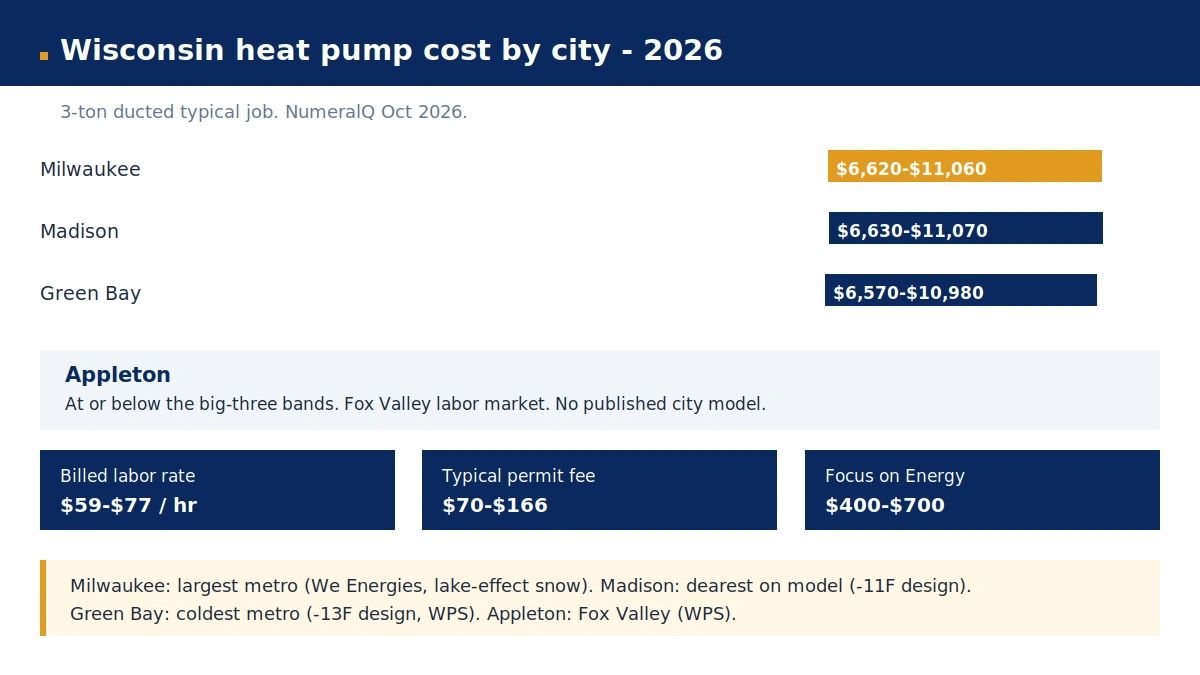
Wisconsin’s three big metros price the same 3-ton system almost identically on the model — about sixty dollars separates the dearest from the cheapest — but the reasons behind the prices are different in each city, and the installer-quoted reality spreads wider than the model suggests.
| City | Typical 3-ton ducted job (model) | What drives the price |
|---|---|---|
| Milwaukee | $6,620–$11,060 | Largest metro; We Energies power; older housing stock, lake-effect snow |
| Madison | $6,630–$11,070 | Dearest on the model; MGE + Alliant; state-capital labor market |
| Green Bay | $6,570–$10,980 | WPS power; coldest of the three metros; softer labor market |
| Appleton | At or below the big-three bands | WPS power; Fox Valley labor market; no published city model |
Source: NumeralQ Wisconsin city pages (Oct 26, 2026), 3-ton ducted system. Appleton has no published NumeralQ city model — this guide gives no invented price band for it, only the direction of travel.
Milwaukee is the state’s biggest heat pump market and its most complicated. The metro sits on Lake Michigan, which means lake-effect snow that buries the eastern counties and a damp cold that finds every gap in a house. The housing stock is the local complication: century-old homes on the near south and north sides with no ductwork and 100-amp panels, postwar ranches in the suburbs with ducts in unconditioned attics, and new builds in the exurbs that price like a different state. We Energies delivers the power, and the design temperature is -7F — the mildest of the big three, which is why a standard variable-speed system can still be a defensible choice here. A single-zone mini-split in the Milwaukee area typically runs inside the statewide $3,160–$4,930 band. The outdoor unit’s siting matters more here than in most cities: lake-effect snow drifts against the house, and a unit set at grade can spend January buried.
Madison prices a hair above Milwaukee on the model, and the difference is mostly labor. The state capital’s HVAC technician median pay runs about 3 percent above the national median (BLS, May 2025), and the university and state-government economy keeps skilled trades busy. Madison Gas and Electric serves the city core and Alliant Energy serves much of the surrounding area, and both territories feed into the same Focus on Energy program — the utility name on the bill does not change the rebate. The design temperature is -11F, four degrees colder than Milwaukee, which is enough to tip the recommendation toward cold-climate equipment. The housing stock mixes older homes near the Capitol with newer builds on the edges, and the rental-heavy market near the University of Wisconsin means a lot of small systems and a lot of landlords pricing the cheapest compliant option.
Green Bay is the coldest of the three metros and the cheapest on the model — a combination that tells its own story. Wisconsin Public Service delivers the power, the labor market is softer than Milwaukee or Madison, and the design temperature is -13F, which makes the cold-climate question non-negotiable: a standard unit here lives on backup heat for much of the winter. The housing stock is newer on average than Milwaukee’s, with more homes that have usable ducts, and the Fox River valley’s snow is the local wrinkle — a Green Bay outdoor unit needs a raised pad and clearance above the snow line, not a slab at grade. No published installer average exists for Green Bay, so the model band is the anchor and quotes will run toward its top.
Appleton is the Fox Valley market: smaller, cheaper on labor, and served by Wisconsin Public Service. Appleton logs 7,693 heating degree days — between Madison and Green Bay — and the housing stock mixes older homes near downtown with newer builds on the edges. No published city price model exists for Appleton, so this guide does not invent one: expect quotes at or below the Milwaukee, Madison, and Green Bay bands, with the spread decided by the house, not the city.
Smaller Wisconsin cities — Eau Claire, La Crosse, Kenosha, Racine, Janesville, Wausau, Oshkosh — generally price at or below the big-three bands on softer labor markets. Eau Claire and the northwest run colder still (design temperature -18F), so the cold-climate question matters more there; Kenosha and Racine sit in Milwaukee’s lake-effect shadow, with Milwaukee pricing as the nearest anchor.
Wisconsin’s Deep-Winter Climate: Why Cold-Climate Equipment Is Not Optional
Wisconsin’s climate is the reason a cold-climate heat pump is a sensible purchase across most of the state — and the reason a standard unit bought on price alone is a mistake that takes a whole winter to reveal itself. The state spans three IECC climate zones: Zone 5A in the far south, Zone 6A across most of the state, and Zone 7 in the far north. NumeralQ puts it plainly: in the colder 58 percent of counties — Zone 6 and above — insist on a cold-climate heat pump and a sizing calculation that covers the coldest nights.
The numbers make the split concrete. Madison records about 7,138 heating degree days and only 627 cooling degree days a year (Wisconsin State Climatology Office, 1991–2020 normals). Milwaukee runs about 7,324 heating degree days. Green Bay runs 8,089. Appleton runs 7,693. Eau Claire runs 8,330. Ashland, in the far north, runs 8,960. Design temperatures tell the same story in a form a contractor actually uses: Milwaukee is designed to -7F in winter and 86F in summer, Madison to -11F and 87F, Green Bay to -13F and 85F, Eau Claire to -18F and 87F, La Crosse to -14F and 88F. A heat pump sized to those numbers, with a Manual J behind it, is sized for real Wisconsin weather, not for an average.
A standard heat pump covers a Wisconsin winter only with help. As the thermometer falls, a heat pump’s output falls with it, and somewhere near 30–35F most units begin borrowing heat from the electric strips just to stay even. In Milwaukee that happens on a large share of winter nights, not for weeks at a time. In Madison, Green Bay, and points north, it happens for most of the heating season — which is what makes the cold-climate premium close to compulsory across the state. The premium buys inverter-driven capacity that holds output down to -13F or lower, and in a state where the design temperature is minus 11 or worse in every metro except Milwaukee, that capacity is the difference between a heat pump and a very expensive electric furnace with a heat pump attached. The strip heat is expensive — it is the most expensive heat in the house — and in Wisconsin it runs often enough to move the annual bill by hundreds of dollars.
The summer side of the climate is the part newcomers overestimate. Wisconsin summers are short and mild by Midwest standards — Madison’s July mean temperature is 71.9F, and the state logs only 627 cooling degree days against 7,138 heating degree days. A heat pump that cools without dehumidifying is a smaller problem here than in Missouri, because the sticky season is measured in weeks, not months. Where variable-speed kit earns its extra money in Wisconsin is not the stickiest afternoon but the coldest night — its long, gentle cycles hold capacity where a single-stage unit’s output has already fallen away. Choosing between single-stage and variable-speed, judge the upgrade on how it handles January, not on the SEER2 figure printed in the brochure.
Then there is the weather Wisconsin is famous for, and it touches a heat pump in ways no brochure mentions. Lake-effect snow off Lake Michigan buries the eastern counties, and deep snow drifts against the house can bury an outdoor unit set at grade — a unit that cannot move air cannot move heat, and a unit that cannot defrost properly will struggle for the rest of the storm. Ice storms coat the outdoor coil in freezing rain. None of that is a reason not to buy a heat pump. It is a reason to site the outdoor unit thoughtfully — on a raised pad, clear of flood-prone spots and drifting snow, above the snow line, away from the drip line where ice falls off the roof — and to price a surge protector into the job. A good installer sites for all of this. A cheap one does not mention it.
Wisconsin homes also carry a structural quirk that shapes heat pump jobs: basements. A large share of the state’s housing stock sits over full basements, and ductwork running through a cold basement loses heat through leaks and uninsulated runs before it reaches a room. On a basement house, a heat pump install is frequently a double job: the machine itself, and then the ductwork underneath it. Of all the companion work in this guide, sealing the ducts — and insulating them too, if the budget stretches — returns the most per dollar. It is also the work a suspiciously cheap quote is most likely to have left out of the price.
None of this is theory. About 18 percent of Wisconsin homes already heat with electricity in some form against 65 percent with piped gas and 13 percent with propane or oil, according to the Census Bureau’s American Community Survey — and it is the propane and oil homes, and the electric-resistance homes, where a heat pump saves the most. The technology is proven here. The question is never whether a heat pump works in Wisconsin. It is whether the quote in front of you is complete, the size is right, the equipment is cold-climate rated, and the running-cost math was done at Wisconsin prices.
Heat Pump vs Gas Furnace in Wisconsin: The Running-Cost Math
This is the section most Wisconsin heat pump guides get wrong, because they import national math into a state where the two fuels are priced very differently from the national picture — and because they are afraid to say the honest thing. Here is the math at Wisconsin’s own prices, and here is the honest thing: in Wisconsin, a heat pump costs more to run than a gas furnace.
Wisconsin residential electricity averages 18.8 cents per kilowatt-hour (12-month average to August 2026, EIA) — the 17th highest in the country, against 18.0 cents nationally. August 2026 alone was 19.4 cents. The average Wisconsin home pays about $148 a month for electricity. Wisconsin residential natural gas averages $1.30 a therm (12-month average to July 2026, EIA) — cheaper than the $1.57 national figure. We Energies delivers the power in Milwaukee, Wisconsin Public Service in Green Bay and Appleton, Madison Gas and Electric in the Madison core, and Alliant Energy across much of southern Wisconsin. Electricity is dear here. Gas is cheap.
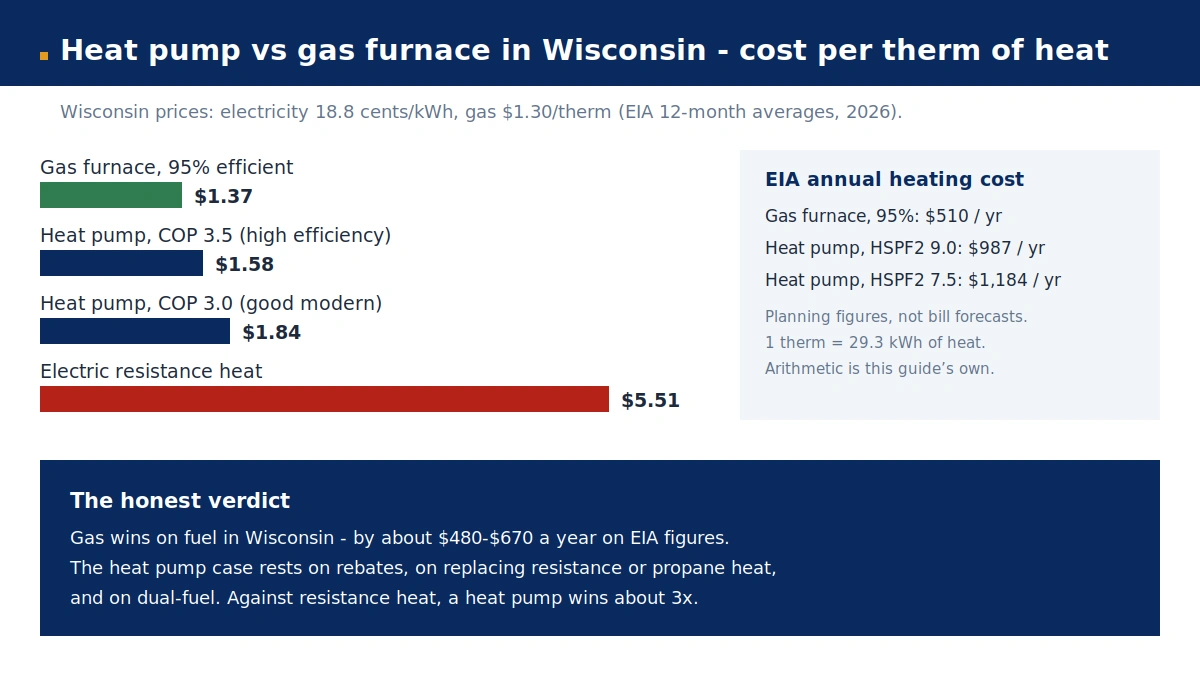
Run the heat math. A therm of heat equals 29.3 kWh of heat — the conversion the sums below run on. A heat pump with a seasonal COP of 3.0 — a fair figure for a good modern system in a mild climate, and optimistic for a Wisconsin winter — delivers that therm for 29.3 x $0.188 / 3.0 = about $1.84. A 95%-efficient gas furnace delivers it for $1.30 / 0.95 = about $1.37. A high-efficiency heat pump at COP 3.5 delivers it for about $1.58 and still loses. A bare-minimum heat pump at HSPF2 7.5 comes out far behind. The EIA’s own household heating estimates tell the same story from the other direction: a 95% gas furnace costs about $510 a year to heat the average Wisconsin home; a minimum-efficiency heat pump (HSPF2 7.5) costs about $1,184 a year; a high-efficiency heat pump (HSPF2 9.0) costs about $987 a year. Those are planning figures, not bill forecasts — but here, unlike in Missouri, the two views agree. The per-therm arithmetic and the EIA annual figures both say gas wins on fuel in Wisconsin, by roughly $480–$670 a year against a heat pump, depending on the efficiency tier.
That verdict is the opposite of Missouri’s, where cheap electricity makes the fuel comparison a modest heat pump win, and it is the single most important difference between the two states’ guides. In Wisconsin the heat pump does not win on fuel against gas — and any guide or contractor that tells you otherwise has not done the math at Wisconsin prices. The heat pump wins decisively in two other Wisconsin situations. First, in any home still heated by resistance — baseboards, wall heaters, an ageing electric furnace — where a heat pump delivers the same warmth on roughly a third of the electricity, the win is enormous. Second, against propane or heating oil, which 13 percent of Wisconsin homes still burn: a heat pump at $1.84 a therm beats propane at roughly $2.50–$3.00 a therm by a wide margin, and it beats resistance heat at $5.51 a therm by nearly three to one. Weigh the heat pump’s $7,000–$13,500 against a furnace and an air conditioner bought together, not against a furnace on its own — our heat pump vs furnace comparison argues that case in full, and our furnace replacement guide puts a number on the gas side.
One more flag on the gas price itself, because the sources do not agree: the $1.30 a therm figure above is the EIA 12-month average to July 2026, as republished by Where’d My Money Go? in October 2026. Ballpark Lab’s EIA trailing average through April 2026 gives $1.14 a therm instead. The draft uses $1.30 — the more recent average — and notes the conflict rather than hiding it. Even at $1.14 a therm, gas at 95 percent efficiency costs about $1.20 a therm of heat, still below a heat pump at COP 3.0 — so the verdict does not change on the cheaper gas figure. It only gets wider.
| Heating system | Cost per therm of heat delivered | EIA estimated annual heating cost (WI) |
|---|---|---|
| Gas furnace, 95% efficient | ~$1.37 | ~$510/yr |
| Heat pump, COP 3.0 (good modern system) | ~$1.84 | — |
| Heat pump, COP 3.5 (high efficiency) | ~$1.58 | — |
| Heat pump, HSPF2 7.5 (federal minimum) | — | ~$1,184/yr |
| Heat pump, HSPF2 9.0 (high efficiency) | — | ~$987/yr |
| Electric resistance heat | ~$5.51 | — |
Assumptions: electricity 18.8 cents/kWh, gas $1.30/therm (EIA 12-month averages, 2026). 1 therm = 29.3 kWh. The COP figures are seasonal planning values, not laboratory ratings from a test bench. The EIA annual figures are planning numbers built from household heating use and today’s Wisconsin prices.
Focus on Energy Rebates You Can Collect in 2026
Forget the federal money for a moment. In Wisconsin in 2026, the live utility money has one name, and it covers the whole state: Focus on Energy, Wisconsin utilities’ statewide program for energy efficiency, run with We Energies, Wisconsin Public Service, Madison Gas and Electric, Alliant Energy, Xcel Energy Wisconsin, and the other participating utilities. There is no separate utility heat pump rebate to stack on top in the major territories — the Focus on Energy discount is the utility money, and it is the same whether your bill comes from Milwaukee or Madison.
| Program | What it pays (heat pump) | Key condition |
|---|---|---|
| Focus on Energy instant discount (standard) | $400–$700 air-source heat pump, tiered by efficiency | Installed Jan 1–Dec 31, 2026; no income test |
| Focus on Energy instant discount (income-qualified) | $600–$900 air-source heat pump | Income-qualified tier |
| Focus on Energy geothermal | $1,000 with gas service; $750 without gas service | ENERGY STAR certified |
| Focus on Energy smart thermostat | $50 | Purchased at a retail store |
| HEAR (federal, via Focus on Energy) | Up to $8,000 heat pump | Below 150% AMI; IRA Registered Contractor — see next section |
Sources: Focus on Energy 2026 Heating and Cooling Rebate Application (TAS-7383781-0726); Alliant Energy Focus on Energy heating/cooling page (2026); Van’s Heating (Aug 2026).
The instant discount is the money most Wisconsin buyers will actually collect, and it works differently from a mail-in rebate: Focus on Energy buys the cost down at the distributor level, so the discount appears automatically at the point of purchase when the contractor buys from a participating distributor. The amount is tiered by efficiency. Tier 3 — SEER2 16.0 and HSPF2 9.0 — pays $600 standard, $800 income-qualified. Tier 4 — SEER2 16.0 and HSPF2 10.0 — pays $700 standard, $900 income-qualified. Lower tiers pay $400–$500 standard, $600–$700 income-qualified. Heat pumps replacing propane pay less — $100–$150 standard, $300–$350 income-qualified — a quirk worth knowing before you budget, because propane homes are exactly the homes where a heat pump saves the most. The rebates apply to equipment installed on or before December 31, 2026, and applications must be submitted within 60 days of installation and no later than January 31, 2027. There is no income requirement for the standard tier. One installer page also quotes a geothermal incentive of “up to $1,500” — that higher figure does not appear in Focus on Energy’s own 2026 application, which lists $1,000 with gas service and $750 without, so the guide sticks to the application’s figures and flags the discrepancy rather than repeating the bigger number.
Stack the numbers honestly: a $700 Focus on Energy discount off a $10,200 job is helpful — roughly a twentieth — but it is not the five-figure stack New Jersey homeowners collect, and on its own it does not close the fuel-cost gap with gas. Budget as if the Focus on Energy discount is the only rebate, unless your household is income-qualified for HEAR. In 2026, for most Wisconsin buyers, it is — and the next section is about the households for whom it is not.
Federal Help in 2026: $0 Tax Credit — but HEAR and HOMES Are Actually Open
This section is the reason Wisconsin is different from almost every state in this series, and it is worth reading twice.
The tax credit is $0. The One Big Beautiful Bill Act (P.L. 119-21, signed July 4, 2025) ended the Energy Efficient Home Improvement Credit — §25C, 30% up to $2,000 a year for heat pumps — and the Residential Clean Energy Credit, §25D, for property placed in service after December 31, 2025. The IRS confirmed it in FS-2025-05. A heat pump installed in a Wisconsin home in 2026 gets no federal tax credit whatsoever. If a quote subtracts a $2,000 federal credit from a 2026 install, that quote is outdated — or the contractor is hoping you will not check. Ask them to remove it. Our federal energy tax credits guide carries the full legal picture.
The HEAR rebate is open in Wisconsin — and Wisconsin was first. The Home Electrification and Appliance Rebates program (HEAR, IRA §50122) pays up to $8,000 for a heat pump, income-qualified (up to 150% of area median income, with larger rebates under 80%), as a point-of-sale discount. Wisconsin’s allocation is about $149 million ($74.47 million HEAR + $74.76 million HOMES). The program is run by the Wisconsin Office of Energy Innovation through Focus on Energy, and Wisconsin launched before anyone else: the HOMES program opened August 1, 2024, the first state in the country to launch it, and the HEAR contractor-installed route opened December 18, 2024. A retail route for store-bought ENERGY STAR products followed on September 30, 2025. By August 2026 the program had paid over $17 million in rebates — $6.9 million through HOMES and $10.2 million through HEAR. As of November 2026, Wisconsin is one of only a handful of states where a homeowner can actually collect this money. Compare Missouri, where the same program has not launched at all and may not arrive until 2027 or 2028 — our Missouri heat pump cost guide covers a state where the $8,000 is still a promise, not a payment.
The income bands decide what you collect. Households below 80 percent of area median income can receive up to 100 percent of project costs, up to the $14,000 household cap. Households between 80 and 150 percent of area median income can receive up to 50 percent of project costs, up to the same cap. Above 150 percent of area median income, there is no HEAR rebate at all. The work must be done by an IRA Registered Contractor, income verification is required, and the HEAR rebate stacks with the Focus on Energy discount — an eligible household can collect both.
And the rules changed while Wisconsin’s program was running. DOE Program Notice 26-2, issued May 29, 2026, removed the fuel-switching allowance from HEAR: from September 1, 2026, rebates cover electric-to-electric replacements only. In Wisconsin that means a heat pump in a gas-, oil-, or propane-heated home now qualifies only if the existing system stays — a dual-fuel or add-on heat pump, with the furnace kept in place — and weatherization is required first. Retail and instant-discount requests for equipment replacing fossil-fuel appliances stopped on September 1, 2026. The practical consequence is sharp for the most common Wisconsin scenario — a gas-furnace home considering a straight heat pump swap — because that household will not collect the $8,000 anymore. The households HEAR will still help are the ones already heating with electricity — resistance heat, old electric furnaces, and aging heat pumps — and gas-heated homes that add a heat pump alongside the furnace instead of replacing it.
The HOMES rebate is open too, and it works differently. The Home Efficiency Rebates program (IRA §50121) pays on modeled or measured whole-home energy savings rather than fixed equipment amounts, and it is open to a wider range of incomes than HEAR. It runs through the same IRA Registered Contractors. No verified Wisconsin HOMES dollar amount for a single heat pump job was found, so this guide gives none — a marketing figure of “up to $18,900” for a combined Wisconsin stack circulates online, and it is a combined total across all three programs, not a collectable number for one job. Do not build a budget around it.
Check the Focus on Energy IRA page before you sign, and get the rebate written on the quote. Program terms and funding change, and the September 1, 2026 rule change is exactly the kind of detail a contractor working from last year’s playbook will get wrong.
Permits & Licensing: Wisconsin’s DSPS HVAC Credential
Wisconsin licenses HVAC contractors differently from most states in this series, and the difference cuts the other way from Missouri’s: where Missouri has no statewide license at all, Wisconsin has a real one, run by the state, and a homeowner can actually look a contractor up. That is a protection worth using.
The statewide credential has two halves. The Department of Safety and Professional Services (DSPS) runs the program under SPS 305.70 and Wis. Stat. §101.178. The Registered HVAC Contractor credential belongs to the business: the applicant must be the owner, a partner, or a corporate officer, and no examination is required for the business registration itself. The HVAC Qualifier credential belongs to the individual: it requires four years of eligible HVAC experience, four years of eligible education, or a recognized combination of the two, plus an open-book DSPS examination with a 70 percent pass mark. Except for narrow owner-occupier and own-property exceptions, no person, entity, or business may offer to install or service heating, ventilating, or air conditioning equipment in Wisconsin without the registration. Verify both halves through the DSPS LicensE portal before you sign — the state keeps the register, and a contractor who cannot be found on it is a contractor to walk away from. (Fee figures for the credentials conflict between sources, so this guide gives none — the credential itself is what matters, not its price.)
The permit is a state code matter, not a local favour. A Uniform Building Permit under the Uniform Dwelling Code (SPS 320.08) is required for HVAC installation in one- and two-family dwellings, issued by the municipality or a Uniform Dwelling Code inspection agency where the municipality does not administer the code. A registered HVAC contractor may not start work until the permit is issued. Commercial plan review runs through DSPS or delegated municipalities. Typical permit fees run $70–$166 (NumeralQ 35-city check, October 2026). Wisconsin issues no statewide general contractor license — building permits and inspections are handled by local building departments under state-adopted codes — but the HVAC credential is statewide, and that is the one that matters for this job.
Two more requirements sit underneath the state credential. Anyone handling refrigerant needs EPA Section 608 certification — universal, required by federal law, no exceptions. And if the job needs electrical panel work, the electrician’s credential is a separate DSPS matter — ask for it too. Our electrical panel upgrade guide prices that piece separately.
What to verify before you sign: the DSPS Registered HVAC Contractor registration for the business, the HVAC Qualifier credential for the individual running the job, EPA 608 certification for the technician handling refrigerant, general liability insurance, and workers’ compensation coverage. Get the permit number in writing and confirm the installer pulls it — a contractor who asks you to pull the permit yourself is shifting the liability onto you. If a job goes wrong, the complaint route runs through DSPS and the Wisconsin Department of Agriculture, Trade and Consumer Protection, not a local board.
What Pushes Your Wisconsin Quote Up or Down
Two bids for the same house can sit $3,000 apart, and the equipment is almost never the reason. It is everything around the equipment. These are the line items that move a Wisconsin quote, in the order they usually appear.
Cold-climate equipment is the biggest Wisconsin swing. The cold-climate tier runs about $2,000 above a standard system — $8,650–$15,080 against $6,580–$11,000 on the model — and in most of the state it is not optional. A standard unit in Madison or Green Bay lives on backup heat for much of the winter, and the strips cost more across a decade than the premium ever will. Price the cold-climate tier first. If a quote prices a standard unit for a Green Bay house and says nothing about backup heat, the quote has not priced the whole job.
Ductwork is the second swing. New or extended ductwork runs $4,190–$7,110 per job (NumeralQ). Many Wisconsin homes have ducts in cold basements or unconditioned attics, and leaky ducts can waste a fifth or more of the conditioned air before it reaches a room. A contractor who quotes the heat pump without inspecting the ducts has quoted half the job. Duct sealing is the companion work worth paying for — and the work most likely to be missing from the cheapest Wisconsin bid. If the ducts are undersized, collapsed, or disconnected in the basement, the new heat pump will be blamed for a duct problem.
The electrical panel is the third swing. A heat pump needs its own dedicated 240V circuit. If the panel is full, still 100-amp, or has no spare breaker space, a 200-amp upgrade runs $2,500–$3,840 (NumeralQ; the national guide puts it at $1,500–$4,000). Older Milwaukee homes with 100-amp panels hit this regularly. Get the panel itemised separately in the quote, so you can see whether that $3,000 is panel or profit.
Sizing and the load calculation decide whether the system works properly or merely runs. A Manual J calculation costs $200–$500 and is often credited against the install. It is the only honest way to size a system in a climate with a design temperature of minus 7 to minus 18, where undersizing leans on strip heat all winter and oversizing leaves the house clammy in the short summer. A contractor who sizes from the old unit’s nameplate, or from square footage alone, is guessing — and in Wisconsin a guess fails in January.
The refrigerant matters in 2026. New home systems now use R-454B or R-32, because R-410A was phased out in new home systems starting in 2025 under EPA rules. Ask which refrigerant each quote uses, and do not accept a new R-410A system at a 2026 price — that is last year’s equipment at this year’s money.
The efficiency tier is a genuine choice, not a sales ladder. A 16.0 SEER2 / 9.0 HSPF2 system collects the $600 Tier 3 Focus on Energy discount; a 16.0 SEER2 / 10.0 HSPF2 system collects the $700 Tier 4 discount; a variable-speed system holds its output on the coldest nights and dehumidifies properly on the most humid afternoons. The premium for variable-speed equipment is real money — typically $1,500–$3,000 over a single-stage system — and in Wisconsin it pays back through surviving deep cold and cutting strip-heat hours, not through summer dehumidification. Price the tiers side by side with the rebates applied, and judge the premium against ten winters of minus-10 nights, not against the brochure’s SEER2 number.
Snow and ice protection is a Wisconsin line item other states do not have. A raised pad above the snow line, a wind baffle, a surge protector, and sensible siting against drifting snow and roof ice cost a few hundred dollars and protect a $10,000 machine in a state where lake-effect snow buries the eastern counties. Ask whether the quote includes them. If it does not, ask what they cost as an add-on item.
Labor and timing round out the list. HVAC technician median pay in Wisconsin is $29.67 an hour (BLS, May 2025), and contractors bill $59–$77 per worker-hour once insurance, payroll taxes, overhead, and profit are included — Madison runs a touch higher at $30.36 an hour, billed $61–$79. Shoulder-season installs in spring and fall are cheaper and faster than peak-summer work. A reputable Wisconsin installer will be booked out. That is a good sign, not a problem.
Payback: When Does a Wisconsin Heat Pump Pay for Itself?
Payback in Wisconsin depends entirely on what the heat pump replaces, because Wisconsin’s dear electricity and cheap gas make the fuel math a loss against gas and a rout against everything else. There is no single payback number. The answer splits three ways, and the three answers barely resemble one another.
Replacing electric resistance heat gives payback in roughly three to five years. This is the best case in Wisconsin and the most common one in all-electric homes, older apartments, and houses with baseboard heat. A heat pump delivers the same heat for about a third of the electricity — $1.84 a therm against $5.51 for resistance at Wisconsin prices. On a $10,200 system with a $700 Focus on Energy discount, or up to $8,000 in HEAR money for an income-qualified household, the annual savings against resistance heat run into four figures, and the system pays for itself faster than in almost any other state. If your home heats with baseboards or an old electric furnace, stop reading payback tables and start getting quotes.
Replacing propane or heating oil: payback in roughly 4–7 years. Thirteen percent of Wisconsin homes still burn propane or oil, and both fuels cost far more per therm of heat than either Wisconsin power or Wisconsin gas. A heat pump at $1.84 a therm undercuts propane by a wide margin, and the HEAR rebate — where the household qualifies — shortens the payback further. The one quirk to know: Focus on Energy pays a smaller instant discount ($100–$150 standard) on heat pumps replacing propane, so do not budget the full $700 on a propane-replacement job.
Replacing a working gas furnace with a heat pump: payback in 12–20 years, possibly never on fuel alone. That is the honest answer the sales pitch skips. At $1.30 a therm against 18.8-cent electricity, a heat pump costs $480–$670 a year MORE to run than a 95 percent gas furnace, on the EIA’s own annual figures — $987–$1,184 a year for the heat pump against $510 for the furnace. The case for switching has to rest on something else: the air conditioner is dying anyway, the furnace is at end of life, you want one system instead of two, or you value the cooling. Dual-fuel is the compromise that keeps the gas furnace for the coldest nights and lets the heat pump do the shoulder seasons — and it is the right answer for a large share of Wisconsin homes with gas service and a furnace under ten years old. And since September 1, 2026, dual-fuel is also the only shape of gas-home heat pump job that still qualifies for HEAR.
Two more payback facts. First, the rebates shorten every payback above — $400–$700 from Focus on Energy for every buyer, and up to $8,000 in HEAR money for an income-qualified household, which can turn a 12-year payback into a 5-year one. Second, maintenance is not free and it is not optional: annual professional service runs $150–$300, filters need monthly attention in summer, and a neglected Wisconsin heat pump in a climate where the outdoor unit spends months under snow and ice loses efficiency faster than the brochure admits. Looked after properly, a Wisconsin system runs 15–20 years. Skip the servicing and the payback sums fall apart without anyone noticing it happen. The ownership years are priced in our heat pump maintenance guide and our heat pump repair guide, and the month-by-month sums sit in our running-cost guide.
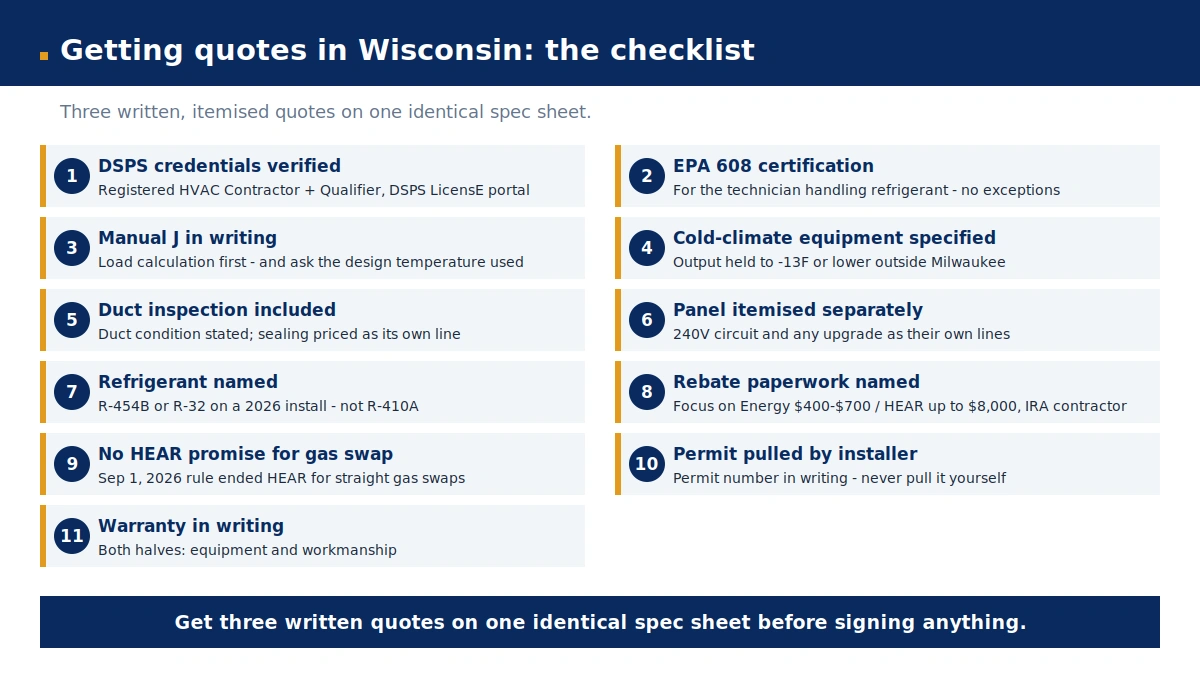
Getting Quotes in Wisconsin: The Checklist
Collect three written, itemised quotes, all built to one identical specification. Identical tonnage, identical SEER2 and HSPF2, identical duct scope, identical electrical scope, identical permit — hold everything constant except the price. Bids that cannot be laid side by side, line for line, cannot be compared at all — and the cheapest of them is usually the one with the most lines missing.
- DSPS credentials verified. Registered HVAC Contractor registration for the business and HVAC Qualifier credential for the individual, checked on the DSPS LicensE portal. No registration is a walk-away.
- EPA 608 certification for the technician who handles the refrigerant. No exceptions, by federal law.
- Manual J load calculation in writing before equipment is ordered — and ask what design temperature it used. Square-footage sizing is a guess, and a guess fails in January.
- Cold-climate equipment specified. The quote names the low-temperature capacity (output held to -13F or lower) for any home outside Milwaukee. A standard unit quoted for Green Bay or Madison without a word about backup heat is an incomplete quote.
- Duct inspection included. The quote states the duct condition and prices any sealing or replacement as a separate line. A bid that says nothing about the ducts has not priced the whole job at all.
- Panel itemized separately. The 240V circuit and any panel upgrade appear as separate lines, not buried in the total.
- Refrigerant named. R-454B or R-32 on a 2026 install. R-410A is last year’s equipment.
- Rebate paperwork named. Focus on Energy instant discount tier ($400–$700, or $600–$900 income-qualified) and, where the household qualifies, HEAR up to $8,000 through an IRA Registered Contractor — with the September 1, 2026 fuel-switching rule checked. No federal credit anywhere on the bid — that figure stands at $0 for a 2026 install.
- No HEAR promise for a straight gas swap. Any contractor promising the $8,000 federal HEAR rebate for a gas-furnace-to-heat-pump replacement in 2026 is promising money the September 1, 2026 rule took away. Drop the promise, not necessarily the contractor — but remember that the promise was made.
- Permit pulled by the installer, and the permit number given in writing. Never pull it yourself.
- Warranty in writing, both halves. Manufacturer warranty on the equipment (typically ten years on parts, longer on compressors for premium brands) and a workmanship warranty from the contractor (one to ten years — the second one matters more). Get both before signing.
Red flags specific to Wisconsin: a “federal tax credit” line on a 2026 bid; a HEAR rebate promised for a straight gas-furnace swap after the September 1, 2026 rule change; a Focus on Energy discount quoted at the Tier 4 $700 for equipment that does not meet Tier 4 efficiency; a whole-home quote near $5,000 with no duct or electrical lines; a standard (non-cold-climate) unit quoted for Madison, Green Bay, or Eau Claire with no mention of backup heat; an outdoor unit quoted on a slab at grade with no raised pad or snow clearance; and any contractor who sizes the system from the old unit’s nameplate without a load calculation. The best Wisconsin installers are booked two to three weeks out in peak season. A crew free to start tomorrow deserves a sceptical look, not your signature.
Sources & methodology
Cost anchors: NumeralQ — “Heat Pump Cost in Wisconsin (2026)” (estimator, pricing as of Oct 26, 2026; model built from Fixr, This Old House, Home Depot prices, BLS May 2025 wages) — primary WI anchor: 3-ton ducted $6,580–$11,000; size table; type table (cold-climate $8,650–$15,080; single-zone mini-split $3,160–$4,930; 3-head $6,280–$11,220; geothermal $20,320–$31,990); city table (Milwaukee $6,620–$11,060; Madison $6,630–$11,070; Green Bay $6,570–$10,980); ductwork $4,190–$7,110; panel $2,500–$3,840; permits $70–$166; HVAC median pay $29.67/hr, billed $59–$77/hr; Madison median $30.36/hr, billed $61–$79/hr; EIA heating-cost table (gas furnace $510/yr; HP HSPF2 7.5 $1,184/yr; HSPF2 9.0 $987/yr); fuel mix 18% electric / 65% gas / 13% propane-oil. NumeralQ — “HVAC Replacement Cost in Wisconsin (2026)” (dual-fuel $9,260–$15,170). TryDun — heat pump cost (Aug 2026; Wisconsin statewide $7,150–$13,200). Modernize — Milwaukee and Green Bay heat pump pages (2026; Wisconsin average $12,150; single-zone mini-split $6,710 — flagged as a conflicting higher figure). Nestpriced art. 1 gives the national heat pump cost at $7,500–$15,000 (baseline); the add-heat-pump band of $5,500–$10,000 and the whole-home multi-zone range of $15,000–$24,000 are national-guide figures. The headline $7,000–$13,500 band and the ~$10,200 typical job are this guide’s synthesis of the NumeralQ model band, TryDun’s statewide band, and Modernize’s higher average; no published Wisconsin statewide installer average was found.
Electricity and gas prices: EIA Electric Power Monthly, October 23, 2026 release, via Where’d My Money Go? (updated Oct 29, 2026) — WI residential electricity 18.8 cents/kWh (12-mo avg to Aug 2026; Aug 2026 alone 19.4 cents), 17th highest US vs 18.0 cents national; avg bill ~$148/mo. EIA Natural Gas Monthly — WI residential gas $1.30/therm (12-mo avg to Jul 2026; $13.43/Mcf). Ballpark Lab (Jul 18, 2026) gives $1.14/therm on an EIA trailing average through April 2026 — flagged as a conflict; the draft uses $1.30. Alliant Energy 2026 residential rates (PSCW Docket 6680-UR-125, effective Jan 1, 2026): electric energy charge ~17.0 cents/kWh; gas distribution $0.3666/therm + supply base $0.6137/therm. The per-therm running-cost arithmetic ($1.84 heat pump at COP 3.0 vs $1.37 gas furnace at 95%) is our own calculation from those EIA prices at 29.3 kWh per therm. Propane at roughly $2.50–$3.00 a therm is a planning range, not a quoted price — no Wisconsin propane price was verified for this guide.
Climate: IECC 2021 zones (PNNL-33270) — Wisconsin mostly 6A, Zone 7 far north, 5A far south; 58% of counties Zone 6+ (NumeralQ). ASHRAE 90.1-2013 Table D-1 design temperatures (Milwaukee -7F/86F; Madison -11F/87F; Green Bay -13F/85F; Eau Claire -18F/87F; La Crosse -14F/88F) and heating degree days (Madison 7,138; Milwaukee 7,324; Green Bay 8,089; Appleton 7,693; Eau Claire 8,330; Ashland 8,960). Wisconsin State Climatology Office Madison climate normals 1991–2020 (HDD65 7,138; CDD65 627; January mean 19.4F; July mean 71.9F).
Rebates: Focus on Energy 2026 Heating and Cooling Rebate Application (TAS-7383781-0726) — ASHP instant discounts $400–$700 standard / $600–$900 income-qualified (Tier 3 SEER2 16.0 + HSPF2 9.0: $600/$800; Tier 4 SEER2 16.0 + HSPF2 10.0: $700/$900; propane replacement $100–$150 standard / $300–$350 income-qualified); geothermal $1,000 with gas service / $750 without; smart thermostat $50; installed Jan 1–Dec 31, 2026, apply within 60 days, by Jan 31, 2027. Alliant Energy Focus on Energy heating/cooling page (2026) and Van’s Heating (Aug 2026, “$400 to $900”). GeothermalFinder “up to $1,500” flagged — not used.
Federal: OBBBA, Public Law 119-21, plus IRS fact sheet FS-2025-05 — §25C and §25D ended December 31, 2025. HEAR/HOMES WI status via Wisconsin Office of Energy Innovation August 2026 newsletter (govdelivery — HOMES launched Aug 1, 2024, first in the country; HEAR contractor route Dec 18, 2024; retail Sep 30, 2025; $17M+ paid — HOMES $6.9M, HEAR $10.2M), HYRE state rebate census (Sep 6, 2026 — WI one of 4 jurisdictions open to any eligible household; $149,375,030 allocation), HeatPumpPricing (verified Nov 4, 2026 — WI open with limits; since Sep 1, 2026 a gas-home heat pump qualifies only if the existing system stays and weatherization comes first), GridShift (Oct 21, 2026), HVAC Brief (Oct 2026), ECW (Oct 27, 2026 — HEAR $74,470,200 + HOMES $74,756,512), NASEO (Sep 30, 2026), BetterHouse (Sep 2026). DOE Program Notice 26-2, dated May 29, 2026 — its fuel-switching removal took effect September 1, 2026, so HEAR is electric-to-electric only. Federal minimums for the northern region stand at 14.3 SEER2 and 7.5 HSPF2 (10 CFR 430.32).
Licensing & permits: Wisconsin DSPS Registered HVAC Contractor + HVAC Qualifier under SPS 305.70 and Wis. Stat. §101.178 (ContractorLicenseRequirements, verified Sep 4, 2026; ContractorTests, 2026; Wisconsin Legislature SPS 305.71). Uniform Dwelling Code permit SPS 320.08 for one- and two-family dwellings. EPA 608 federal. Permit fees run $70–$166 in NumeralQ’s 35-city check (Oct 2026). No statewide general contractor license in Wisconsin.
Method note: where a model estimate and installer-facing averages disagreed, this guide reports both and headlines the synthesis. Where no Wisconsin-specific figure was verified (e.g. maintenance $150–$300/yr; lifespan 15–20 years; add-heat-pump band; propane price range), the figure is the national guide’s or a labeled planning range. Appleton has no published city price model — this guide gives no invented band for it. Prices are 2026 planning figures, not quotes — get three written local quotes before you budget.
Disclaimer: Prices are 2026 Wisconsin planning figures and change by city, home, and contractor. Get three written local quotes before you spend a dollar. Tax and rebate information is general, not tax advice — confirm with a tax professional and with Focus on Energy before counting on any incentive.
How much does a heat pump cost in Wisconsin in 2026?
A typical whole-home ducted air-source heat pump (3-ton) costs $7,000–$13,500 installed in Wisconsin in 2026, with a typical job near $10,200. A single ductless mini-split zone runs $3,160–$4,930, a 3-zone system $6,280–$11,220, a cold-climate ducted system $8,650–$15,080, and geothermal $20,320–$31,990. Milwaukee, Madison, and Green Bay price almost identically on the model; Appleton generally runs at or below the big-three bands. The federal tax credit is $0, but Focus on Energy pays $400–$700 with no income test, and the federal HEAR rebate of up to $8,000 is actually open in Wisconsin for income-qualified households.
Is a heat pump worth it in Wisconsin when gas is so cheap?
It depends on what you heat with now. Wisconsin electricity averages 18.8 cents a kilowatt-hour while gas averages $1.30 a therm, so a heat pump costs more to run than a 95 percent gas furnace — about $1.84 a therm of heat at COP 3.0 against about $1.37 for gas, and the EIA’s annual figures agree, putting a high-efficiency heat pump at $987 a year against a gas furnace at $510. Against a gas furnace, the case for a heat pump rests on the rebates, on the air conditioner dying anyway, and on dual-fuel. Against electric resistance heat or propane, the case is overwhelming: a heat pump delivers the same warmth for about a third of the electricity of resistance heat and far less than propane. If your home heats with baseboards, propane, or oil, get quotes now.
Do I need a cold-climate heat pump in Wisconsin?
Across most of the state, yes. Wisconsin is mostly IECC Zone 6A, with Zone 7 in the far north, and 58 percent of counties sit in Zone 6 or colder. Madison is designed to minus 11 degrees, Green Bay to minus 13, and Eau Claire to minus 18. A cold-climate ducted system costs $8,650–$15,080 — roughly $2,000 more than a standard system — and holds its output down to minus 13 or lower, where a standard unit leans on expensive electric backup heat for much of the winter. Milwaukee, designed to minus 7, is the one metro where a standard variable-speed system can still be a defensible choice. Everywhere else in Wisconsin, price the cold-climate tier first.
What rebates can I get for a heat pump in Wisconsin in 2026?
Focus on Energy pays an instant discount of $400–$700 for a qualifying air-source heat pump, tiered by efficiency — $600 for Tier 3 (SEER2 16.0, HSPF2 9.0) and $700 for Tier 4 (SEER2 16.0, HSPF2 10.0) — or $600–$900 if your household is income-qualified, with no income test on the standard tier. Geothermal pays $1,000 with gas service or $750 without. On top of that, the federal HEAR rebate pays up to $8,000 for a heat pump for households below 150 percent of area median income, through an IRA Registered Contractor — and it stacks with Focus on Energy. There is no statewide rebate beyond Focus on Energy, and no federal tax credit for a 2026 install.
Will Wisconsin’s HEAR rebate of up to $8,000 work for my home?
If your household is below 150 percent of area median income and you use an IRA Registered Contractor, probably yes — Wisconsin is one of only a handful of states where the program is genuinely open, having launched in December 2024 and paid over $17 million by August 2026. Households below 80 percent of area median income can receive up to 100 percent of project costs, and those between 80 and 150 percent up to 50 percent, with a $14,000 household cap. But since September 1, 2026, DOE Program Notice 26-2 restricts HEAR to electric-to-electric replacements: a gas-, oil-, or propane-heated home now qualifies only if the existing system stays — a dual-fuel or add-on heat pump — and weatherization comes first. A straight gas-furnace-to-heat-pump swap no longer collects it.
Do heat pumps work in Wisconsin winters?
Yes — if they are cold-climate rated and sized to the design temperature. Madison logs 7,138 heating degree days a year and January averages 19 degrees; Green Bay is designed to minus 13. A cold-climate unit holds its output down to minus 13 or lower, while a standard unit leans on electric backup strips for much of the winter. The bigger Wisconsin risks are snow and ice: lake-effect snow can bury an outdoor unit set at grade, so the unit needs a raised pad above the snow line, clearance from drifting snow, and a defrost cycle that can shed ice. Get the Manual J load calculation in writing and ask what design temperature it used.
Do I need a permit or a licensed contractor for a heat pump in Wisconsin?
Yes to both — and Wisconsin is one of the states where the license is real and checkable. The Department of Safety and Professional Services runs a statewide Registered HVAC Contractor credential for the business and an HVAC Qualifier credential for the individual, under SPS 305.70. Verify both on the DSPS LicensE portal before you sign. A Uniform Building Permit under the Uniform Dwelling Code is required for one- and two-family dwellings, and the contractor may not start work until it is issued. Typical permit fees run $70–$166. The technician who touches the refrigerant must hold EPA Section 608 certification.
Is there a federal tax credit for a heat pump in Wisconsin in 2026?
No — $0. Under the One Big Beautiful Bill Act, the §25C credit — 30%, up to $2,000 a year on a heat pump — ended for property placed in service after December 31, 2025, as the IRS confirmed in FS-2025-05. If a quote subtracts a $2,000 federal credit from a 2026 Wisconsin install, the quote is outdated — ask the contractor to remove it. The live money is Focus on Energy ($400–$700, no income test) and, for income-qualified households, the federal HEAR rebate of up to $8,000, which Wisconsin — unlike most states — actually has open.