

Table of Contents
A Louisiana roof lives a harder storm season than a roof almost anywhere else in the country. The coast faces design winds of 120 to 170 miles per hour, and the state has taken two hurricanes weeks apart — Laura and Delta in 2020 — and a Category 4 landfall, Ida in 2021, inside a single decade of memory. Summer air sits above 75 percent humidity for months, New Orleans takes more than 60 inches of rain in a typical year, and black algae streaks creep down shingle slopes that never fully dry. Then the insurance bill arrives, and it is the highest-stakes number in the whole job: a 5 percent hurricane deductible on a $300,000 home is $15,000 out of pocket before the carrier pays a dollar, and a roof the carrier calls too old can cost a homeowner the policy itself.
This guide prices Louisiana the way a Baton Rouge estimator would: by material, by roof size, and by region — New Orleans, Baton Rouge, Shreveport, Lafayette, and the Northshore — with the wind ratings, FORTIFIED standard, permit, licensing, and insurance rules that actually move the number. It also covers the fact most homeowners moving here from out of state get backwards: Louisiana now requires a statewide roofing license and a permit for every reroof, and the grant that pays up to $10,000 toward a FORTIFIED roof is handed out by lottery — and the lottery is closed right now.
To see how Louisiana stacks up against the rest of the country, start with our roof replacement cost guide.
How Much Does a Roof Replacement Cost in Louisiana in 2026?
The strongest Louisiana anchor is SmartRoofingCalculator’s 2026 state guide: a full architectural asphalt replacement on a typical 25-square roof — about 2,500 sq ft of roof surface — runs $10,000–$14,500, at $400–$580 per square installed with tear-off. On the smaller measure most homeowners actually picture, a 2,000 sq ft home at about 20 squares, the same source prices architectural shingles at $8,000–$11,600. The gap between the two figures is the measuring-stick problem this guide keeps coming back to: the home-size table prices a 2,000 sq ft home, while the per-square table prices a square of roof surface, and a real Louisiana roof surface runs larger than the living-area footprint underneath it. The practical lesson is the same one New Orleans estimators repeat on every walk-through: make the roofer measure the roof, and make every quote state which area it priced.
Cross-checks from other 2026 sources land in the same territory, with one honest disagreement to flag. NumeralQ’s Louisiana guide (pricing as of October 26, 2026) puts architectural shingles at $4.30–$5.14 per sq ft, or $9,140–$11,090 for a 2,000 sq ft roof — inside the SmartRoofingCalculator band. Roof Observations, quoted by MoneyMagpie in October 2026, puts architectural shingles at $5.15 per sq ft, about $8,755 on a typical 1,700 sq ft roof. SquareDash’s 2026 index, built from more than 8,900 completed replacements, puts the Louisiana average at $14,000 for a standard 2,000 sq ft home with Owens Corning Duration shingles. The outlier is Epic Roofing’s Northshore calculator, which prices a 2,000 sq ft home at $13,000–$18,500 for a standard install — well above SmartRoofingCalculator’s $8,000–$11,600 for the same home size. The gap is not an error on either side: Epic counts 22–27 squares of roof surface where SmartRoofingCalculator counts about 20, and Epic prices Mandeville and Covington labor with FORTIFIED-grade scope baked in. This guide uses SmartRoofingCalculator as its primary anchor and flags the Northshore figure wherever it appears.
Put together, the honest headline is this: most Louisiana homeowners pay $8,000–$18,500 for a full asphalt replacement in 2026, and architectural shingles on a typical 25-square roof sit at $10,000–$14,500. From here on, every figure is a turn-key installed total with tear-off folded in, unless the passage says otherwise.
| Material | $/sq ft installed (roof surface) | 2,000 sq ft home total | Louisiana realistic lifespan |
|---|---|---|---|
| 3-tab shingle | $3.57–$4.70 | $7,100–$9,400 | 12–15 yrs |
| Architectural shingle | $4.00–$5.80 | $8,000–$11,600 | 15–22 yrs |
| Class 4 impact shingle | $5.00–$7.20 (derived) | $10,000–$14,400 | 20–25 yrs |
| Exposed-fastener metal (5V) | $6.83–$8.60 | $13,700–$17,200 | 30–45 yrs |
| Standing-seam metal | $8.00–$12.40 | $16,000–$24,800 | 40–70 yrs |
| Concrete tile | $8.66–$12.40 | $17,300–$24,800 | 40–50+ yrs |
| Clay tile | $11.49–$18.48 | $23,000–$37,000 | 50+ yrs |
Sources: SmartRoofingCalculator Louisiana guide (updated Nov 2, 2026); NumeralQ Louisiana (pricing Oct 26, 2026); Roof Observations via MoneyMagpie (Oct 22, 2026); Epic Roofing Northshore calculator (2026); SquareDash 2026 index. The 2,000 sq ft home totals are our arithmetic from the per-square-foot ranges on a 2,000 sq ft roof surface. The Class 4 row is derived arithmetic (see the material section), not a surveyed figure.
Where the money goes on a typical Louisiana job: labor runs about 50–60% of the total — a Louisiana contractor guide puts labor at up to 60 percent, about $2.00–$6.00 per sq ft. Materials take roughly 40 percent, and overhead and profit take most of what remains. A second tear-off layer adds $1.16–$1.53 per sq ft (NumeralQ). Decking is the unknown until tear-off: replacement runs $80–$120 per 4×8 sheet installed on the Northshore (Epic Roofing), and Louisiana’s humidity rots sheathing at valleys and around penetrations on older homes — about 46 percent of Louisiana homes were built before 1980. Ventilation upgrades during replacement, which in Louisiana are a moisture and heat fix rather than an ice fix, run $500–$2,500.
Roof Replacement Cost in Louisiana by Material
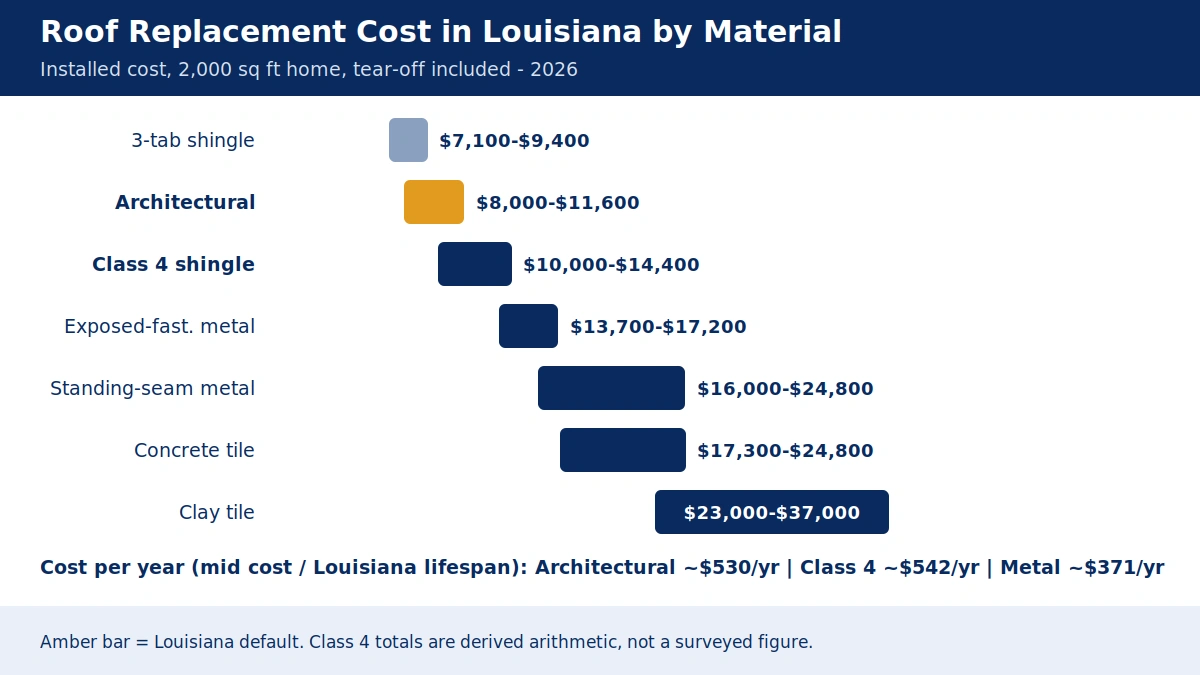
Material is the biggest single line on any Louisiana invoice — standing-seam metal costs roughly double what architectural shingles cost to install. But the sticker price tells only half the Louisiana story, because hurricane wind, driving rain, and year-round humidity cut shingle life short while metal and tile mostly outlast the mortgage. The table below pairs 2026 installed prices with Louisiana lifespans and cost per year of service, so the expensive option can be judged on what it costs per year, not per invoice.
| Material | $/sq ft installed | 2,000 sq ft home total | Louisiana lifespan | Cost per year* |
|---|---|---|---|---|
| 3-tab shingle | $3.57–$4.70 | $7,100–$9,400 | 12–15 yrs | ~$473–$783/yr (mid ~$611/yr) |
| Architectural shingle | $4.00–$5.80 | $8,000–$11,600 | 15–22 yrs | ~$364–$773/yr (mid ~$530/yr) |
| Class 4 impact shingle | $5.00–$7.20 (derived) | $10,000–$14,400 | 20–25 yrs | ~$400–$720/yr (mid ~$542/yr) |
| Exposed-fastener metal (5V) | $6.83–$8.60 | $13,700–$17,200 | 30–45 yrs | ~$304–$573/yr (mid ~$413/yr) |
| Standing-seam metal | $8.00–$12.40 | $16,000–$24,800 | 40–70 yrs | ~$229–$620/yr (mid ~$371/yr) |
| Concrete tile | $8.66–$12.40 | $17,300–$24,800 | 40–50+ yrs | ~$346–$620/yr (mid ~$459/yr) |
| Clay tile | $11.49–$18.48 | $23,000–$37,000 | 50+ yrs | ~$460–$740/yr (mid ~$600/yr) |
*Cost per year = installed cost divided by Louisiana realistic lifespan. Class 4 totals are derived arithmetic (see below). Lifespan and price figures: SmartRoofingCalculator Louisiana (2026); NumeralQ Louisiana (Oct 2026); Roof Observations via MoneyMagpie (Oct 2026).
Architectural shingles are what most Louisiana roofs already are: the lowest bid, the most crews who install them, and the simplest product to patch after a storm. In Louisiana they last 15–22 years — shorter than the same shingle lasts in a cooler climate, because heat and humidity age asphalt faster and algae eats at the granule surface. The weak point is not cold but wind: a standard architectural shingle must be rated to the wind speed the code assigns to the parish, and in the coastal parishes that means ASTM D7158 Class G or H. High-wind nailing — six nails per shingle in a high-wind pattern — is not an upgrade here, it is the job.
3-tab shingles are the budget option, and in Louisiana they are a false economy on most houses. At $3.57–$4.70 per sq ft they save roughly $900 against architectural shingles on a 2,000 sq ft home, then give back the savings by lasting only 12–15 years in Louisiana heat — and by offering the lowest wind resistance of any asphalt product in a state where wind is the whole game. On a house you intend to hold onto, the bargain shingle is the shingle you end up buying twice.
Class 4 impact-rated shingles get a whole section below, because in Louisiana they are the upgrade that pays for itself in insurance discounts — but the reason they pay is different from what most Louisiana roofing pages say, and the difference matters. They run about $5.00–$7.20 per sq ft installed ($10,000–$14,400 on a 2,000 sq ft home), roughly $1,500–$3,500 more than standard architectural shingles on a typical job, and they stretch service life to 20–25 years. One honest caveat: no standalone Louisiana per-square figure for Class 4 was verified in the sources for this guide. The range here is derived arithmetic — SmartRoofingCalculator’s architectural base plus Epic Roofing’s published FORTIFIED-plus-Class-4 premium — and it is labeled as derived, not surveyed.
Exposed-fastener metal (5V crimp and corrugated) is the Gulf Coast workhorse: $6.83–$8.60 per sq ft installed, 30–45 years of service, and a profile that has covered Louisiana homes, camps, and barns for generations. It costs roughly half what standing seam costs and sheds wind-driven rain well. The tradeoff is the fasteners themselves: hundreds of exposed screws with rubber washers that need checking and re-tightening over the decades, and a roof that can look tired long before it leaks.
Standing-seam metal is the premium Louisiana roof, and it earns the title here more honestly than in most states. At $8.00–$12.40 per sq ft, a 2,000 sq ft home runs $16,000–$24,800 — roughly double architectural shingle upfront. What you buy is 40–70 years, a surface that sheds wind-driven rain instead of holding it, concealed fasteners that never back out in a storm, and a material that does not care about humidity or algae. One flagged conflict: NumeralQ prices standing seam higher, at $9.78–$14.95 per sq ft. This guide uses SmartRoofingCalculator’s band as primary and notes NumeralQ’s higher band rather than resolving it. If the choice is still open, our metal roof vs shingles cost comparison lays the two side by side, while our metal roof cost guide holds the national numbers.
Concrete and clay tile are the historic Louisiana roof, and they still cover much of New Orleans and the older river-parish towns: concrete tile at $8.66–$12.40 per sq ft, clay tile at $11.49–$18.48. Tile buys 40–50-plus years and shrugs off humidity, algae, and wind when it is nailed to the current code — the 2021 code changes specifically tightened nailing patterns to stop tiles blowing off in high wind. The tradeoff, beyond price, is weight: tile needs framing that was designed for it, and a retrofit onto a shingle-framed house needs an engineer’s sign-off. For what tile costs across the country, our tile roof cost guide has the national picture.
Flat and low-slope roofs deserve a mention because they are everywhere in New Orleans — shotgun and camelback additions, rear sheds, and commercial buildings all carry them. No Louisiana-specific 2026 installed figure for TPO or modified bitumen was verified in the sources for this guide, so none is quoted here; our flat roof replacement cost guide carries the national figures, and a Louisiana flat-roof bid should be judged on its seam and drainage scope, not on a statewide average that does not exist.
The takeaway: metal asks for roughly double the shingle money on day one, then hands most of it back over the decades — because a Louisiana shingle roof comes off when wind, rain, and humidity say so, not when the warranty says so.
Roof Replacement Cost by Roof Size
The table below uses SmartRoofingCalculator’s 2026 per-square bands, priced by home size (living area) at the state baseline, typical pitch 4:12–7:12, single-layer tear-off. Read it with the measuring-stick warning from the first section in mind: roof surface runs larger than living area, so a 2,000 sq ft home here usually carries a 2,000–2,700 sq ft roof — and these totals are the ones SmartRoofingCalculator published for that home size.
| Home size | Squares | Architectural | Class 4 (derived) | Standing-seam metal |
|---|---|---|---|---|
| 1,000 sq ft | ~10 | $4,000–$5,800 | $5,000–$7,200 | $8,000–$12,400 |
| 1,500 sq ft | ~15 | $6,000–$8,700 | $7,500–$10,800 | $12,000–$18,600 |
| 2,000 sq ft | ~20 | $8,000–$11,600 | $10,000–$14,400 | $16,000–$24,800 |
| 2,500 sq ft | ~25 | $10,000–$14,500 | $12,500–$18,000 | $20,000–$31,000 |
| 3,000 sq ft | ~30 | $12,000–$17,400 | $15,000–$21,600 | $24,000–$37,200 |
Cross-checks: NumeralQ’s Louisiana model puts architectural shingles on a 2,000 sq ft roof at about $9,140–$11,090 — inside the band above, toward the middle. SquareDash’s Louisiana average of $14,000 sits just above the table’s 2,000 sq ft architectural band, consistent with its Owens Corning Duration specification and post-storm demand pricing. A smaller house pays a steeper rate per square foot, because the fixed costs — permits, dumpsters, crew mobilization — get split across fewer squares. Big or steeply pitched roofs cost more for their shape, not just their size: steep pitches and complex cut-up roofs can push costs up by as much as 30 percent (Roof Observations).
Roof Replacement Cost by Region: New Orleans vs Baton Rouge vs Shreveport vs Lafayette
Louisiana roofing labor varies noticeably by region, but the spread is smaller than the wind spread. New Orleans sets the statewide high with the highest labor rates, the strictest code enforcement, and the deepest hurricane exposure. Baton Rouge runs just under it. Shreveport, in the lowest wind zone in the state, runs cheapest. Lafayette sits at the state baseline — with one caveat flagged below.
| Region / Metro | Architectural asphalt (25-square roof) | Variance vs state mean |
|---|---|---|
| New Orleans metro | $11,000–$15,950 | +10% — highest labor, permits, code costs |
| Baton Rouge metro | $10,500–$15,225 | +5% |
| Northshore (Mandeville/Covington) | $13,000–$18,500 (2,000 sq ft home) | Local framework — see note below |
| Lafayette / Acadiana | $10,000–$14,500 | Baseline — estimate, no city figure verified |
| Shreveport / Northwest LA | $9,000–$13,050 | −10% — lowest wind zone, lowest labor |
Source: SmartRoofingCalculator Louisiana and city pages (updated Nov 2, 2026); Epic Roofing Northshore calculator (2026); NumeralQ Louisiana (Oct 26, 2026).
New Orleans metro is the benchmark for cost and for code: the deepest bench of crews, the most hurricane claims, and the most competitive bidding in the state — and also the strictest enforcement. SmartRoofingCalculator’s New Orleans page puts the city at $440–$638 per square, or $11,000–$15,950 for a 25-square roof, about 10 percent above the state baseline. A local New Orleans contractor guide (October 2026) puts a typical full shingle replacement at $5,500–$12,000, averaging about $9,000, on the smaller homes that dominate the city’s older housing stock. Repairs in New Orleans run 10–25 percent more than the same work inland. The pre-war shotgun, Creole cottage, and camelback stock in the French Quarter, Bywater, Uptown, and Gentilly carries the state’s worst hidden-decking exposure: decades of small leaks in 75-percent humidity rot plywood and boards under shingles that look fine from the street.
Baton Rouge metro runs about 5 percent above the state baseline: $420–$609 per square, or $10,500–$15,225 for a 25-square roof (SmartRoofingCalculator). The capital sits inland of the worst surge zone but still inside the hurricane wind field — Ida’s winds reached Baton Rouge as a Category 1 — and its permitting runs through East Baton Rouge Parish’s MGO Connect system with the staged geotagged-photo inspection the whole state now uses.
Northshore (Mandeville / Covington / Slidell) is the one region where the sources disagree enough to say so plainly. Epic Roofing’s local framework prices a 2,000 sq ft home at $13,000–$18,500 for a standard install — well above SmartRoofingCalculator’s $8,000–$11,600 for the same home size — because Epic counts 22–27 squares of roof surface and prices Northshore labor with FORTIFIED-grade scope. Add 5–10 percent for Slidell and the eastern Northshore, and 10–20 percent for Orleans Parish proper. Treat the Northshore row as a local-contractor framework, not a surveyed average, and get three written quotes before trusting either number.
Lafayette / Acadiana is the one region where no standalone surveyed average was found. No 2026 city-specific figure was verified for Lafayette, so the draft prices it at the state baseline — $10,000–$14,500 for a 25-square roof — and labels it an estimate. What is not in doubt is the climate: Lafayette sits in the heart of the FORTIFIED grant’s eligible parishes, in the hurricane wind field, with the same humidity and algae pressure as Baton Rouge, and its homeowners are among the most likely in the state to qualify for a Fortify Homes grant when the lottery reopens.
Shreveport / Northwest Louisiana runs cheapest, about 10 percent below the state baseline on NumeralQ’s 0.90x local factor — $9,000–$13,050 for a 25-square roof. The reason is geography: Shreveport sits in the lowest wind zone in Louisiana, far from the surge, with the lowest labor rates in the state and no coastal code premium. A Shreveport roof still needs a permit and a licensed roofer under the same statewide rules, but it does not need the wind package a New Orleans roof needs.
Why Louisiana Roofs Cost What They Do: Hurricanes, Wind Ratings & Humidity
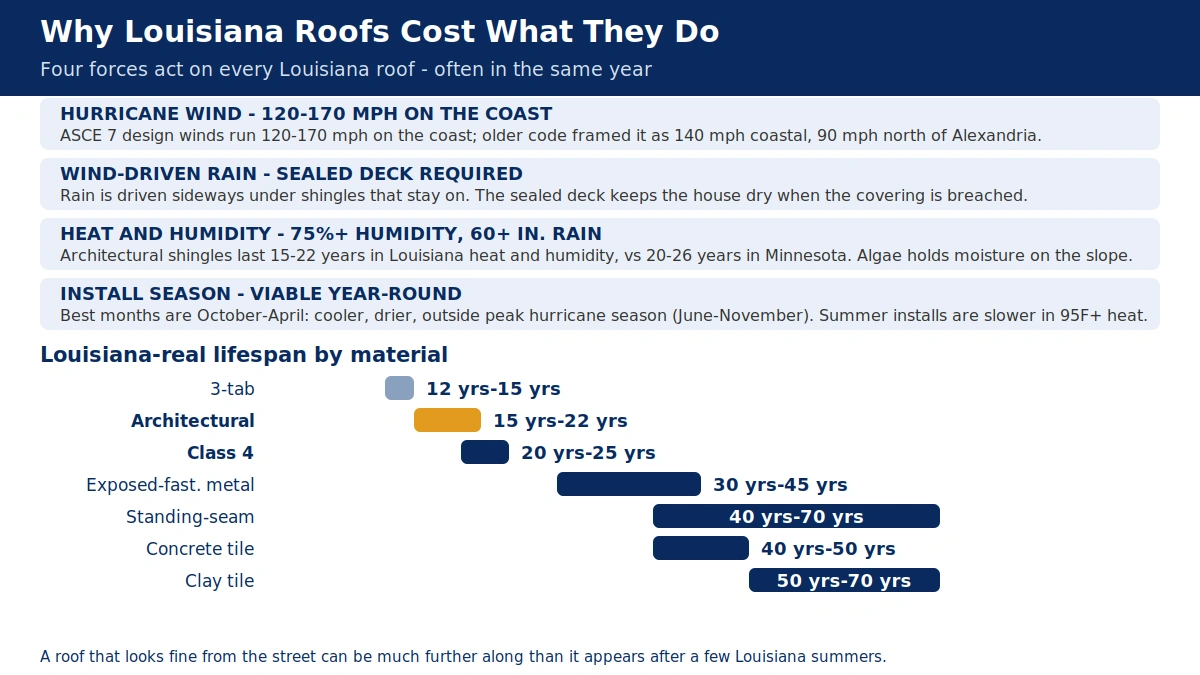
Louisiana is one of the most demanding climates in the country for roofing systems because four distinct forces act on every roof in the state, often in the same year. Hurricane wind lifts shingles and tiles off the deck. Wind-driven rain finds every gap the wind opens. Heat and humidity age asphalt faster than any brochure admits. And the insurance market — the highest-stakes roofing market in the Gulf — prices every one of those risks into the premium and the deductible. All four compound: wind-lifted shingles let rain into the deck, humidity rots the deck from below, and a roof that survived August can still fail the adjuster’s inspection in September.
Hurricane wind is the force that sets Louisiana’s material rules. Design wind speeds on the Louisiana coast run about 120–170 mph under ASCE 7 (WindLoad.solutions), and Louisiana is one of only ten states that legally require PE-sealed wind-load calculations for building permits. The post-Katrina code originally framed the standard as 140 mph in the coastal portions of the state down to 90 mph north of Alexandria — the older framing, still quoted in contractor guides — while the current ASCE 7 maps give the wider 120–170 mph coastal band. Either way, the practical consequence is the same: a Louisiana roof is engineered for wind first, and the shingle on it must be rated for the parish it sits in. In hurricane-prone and high-wind areas the IRC requires shingles rated to ASTM D7158 Classes G or H or ASTM D3161 Class F; Class H covers up to Category 4 wind speeds. Six nails per shingle in a high-wind pattern, ring-shank nails into the deck, and a sealed deck are not upgrades in Louisiana — they are the job.
Wind-driven rain is the failure wind causes. A Louisiana hurricane does not just blow shingles off; it drives rain sideways under the shingles that stay on, through the underlayment, and into the deck. That is why the 2021 code changes required secondary barriers — a sealed roof deck — to protect against leaks when the covering itself is breached. A sealed deck is a layer of self-adhering membrane or taped seams over the decking, so that even if the shingles go, the house stays dry. It is also the first requirement of the FORTIFIED Roof standard, covered in the next section but one.
Heat and humidity age asphalt from the inside out. New Orleans averages roughly 75 percent relative humidity and more than 60 inches of rain a year in the south, and the summer heat index regularly tops 100 degrees. Asphalt shingles in that climate lose granules faster, dry out and curl sooner, and grow algae — Gloeocapsa magma, the black streaking on north-facing slopes — that holds moisture against the shingle surface. The Louisiana-realistic lifespan for architectural shingles is 15–22 years, against 20–26 years for the same product in Minnesota. Algae-resistant shingles, made with copper granules, are the standard local answer to the streaking, and they cost little more than standard architectural shingles. Attic ventilation matters here year-round, not for ice but for heat and moisture: a hot, damp attic rots decking from below and grows mold in insulation that never dries.
The install season never really closes — and that cuts both ways. Roofing is viable year-round in Louisiana, unlike in northern states, and shingles seal well in the heat. The best months are roughly October through April: cooler, drier, and outside peak hurricane season. Summer installs are common but slower in 95-degree-plus heat, when crews work shorter days and shingles scuff underfoot. Scheduling inside hurricane season, June through November, carries storm-delay risk — and after every named storm, demand surges and prices spike. SquareDash attributes Louisiana’s 6.8 percent year-over-year cost increase in 2026 to post-hurricane demand surges and stricter wind-resistance code.
Humidity, Algae & Mold: The Slow Louisiana Roof Killers
If one failure defines Louisiana roofing, it is not the hurricane — it is the slow rot that happens between hurricanes, in air that never dries out. A Louisiana roof can look intact from the street while the deck underneath it is soft, the attic insulation is damp, and mold is growing in the dark.
The mechanism is simple and repeats on thousands of Louisiana houses. Humid air finds its way into the attic through soffit vents, gaps, and penetrations, and meets a roof deck that is cooler than the air outside on a summer night. Moisture condenses on the underside of the deck. Day after day, year after year, the decking stays damp, fasteners rust, and the wood fiber softens. A small leak that would dry out in a week in a dry climate stays wet for months in Louisiana — and a leak that has been dripping into the attic for three months can run $5,000–$8,000 by the time the damaged section is stripped, the structural wood is replaced, mold is treated, and the roof goes back on (Big Easy Roofing, New Orleans).
Algae is the visible symptom. Gloeocapsa magma, the blue-green algae that causes black streaks on Louisiana roofs, feeds on the limestone filler in asphalt shingles and holds moisture against the surface. It does not eat through a shingle overnight, but it shortens shingle life, stains the roof, and tells a buyer — and an insurance inspector — that the roof is aging. Algae-resistant shingles with copper granules are the standard local answer, and they are worth specifying on any Louisiana bid. Zinc or copper strips at the ridge are the older, cheaper answer, and they work by washing metal ions down the slope every time it rains.
Mold is the expensive symptom. Once moisture gets into the attic, mold follows, and mold remediation is where a $400 leak repair becomes a $5,000 job. The durable fix is in the attic, and a reroof is the cheapest moment in a house’s life to do it: replace soft decking sheet by sheet at the $80–$120 per-sheet rate, seal the deck, bring attic ventilation into balance so humid air moves through instead of condensing, and consider a radiant barrier or upgraded underlayment while the deck is exposed. Done together, a sealed deck plus balanced ventilation is what keeps a Louisiana roof dry from below as well as from above.
What humidity costs when it wins. Decking replacement at $80–$120 a sheet adds up fast on an older home — a dozen soft sheets is $960–$1,440 before the first new shingle goes on, and a house with a long leak history can need far more. The insurance picture is mixed and worth knowing before the next storm: sudden storm damage is covered, but slow deterioration from humidity and deferred maintenance is not, and a carrier that finds rot and mold on inspection can use it to deny a claim or non-renew the policy. And if your roof predates the current wind and sealed-deck rules, a replacement brings the whole assembly up to the code your insurer now expects.
The inspection habit that pays for itself: have the roof inspected in late fall after hurricane season, and again in late spring before it starts. A fall inspection catches the lifted shingles, dead pipe boots, and failing flashing that the next storm will exploit. Small, cheap fixes caught in time keep a minor leak from becoming a full deck-and-mold remediation that costs five to ten times as much.
FORTIFIED Roofs in Louisiana: What the Upgrade Costs and What It Pays Back
In Louisiana, the FORTIFIED Roof is not a marketing term. It is a building standard from the Insurance Institute for Business & Home Safety (IBHS), and it is the single most valuable upgrade a Louisiana homeowner can buy — because the state has now put a grant, a tax credit, and a mandatory insurance discount behind it.
What FORTIFIED Roof means. The standard has three requirements that matter on the roof itself: a sealed roof deck (self-adhering membrane or taped seams so the house stays dry even if the covering blows off), ring-shank nails in a 6-nail high-wind fastening pattern holding the deck and the shingles down, and enhanced edge and flashing details at the eaves, rakes, and valleys where wind gets its first grip. FORTIFIED Roof is the roof-level designation; FORTIFIED Silver and Gold cover the whole home — windows, doors, and continuous load path — and earn larger insurance discounts. A FORTIFIED designation is issued by an IBHS-certified evaluator after inspection, not by the roofer who installed it.
What it costs. A baseline FORTIFIED Roof upgrade adds about $1,000–$2,000 above a standard install on a typical Louisiana home (Epic Roofing). Adding Class 4 impact-rated shingles on top — required only for the FORTIFIED Roof Hail Supplement designation, but demanded by most Louisiana carriers for the discount regardless — brings the combined premium to about $1,500–$3,500 above standard. On a $12,500 standard roof, that puts a FORTIFIED-plus-Class-4 roof at roughly $14,000–$16,000.
What it pays back. Three separate Louisiana programs pay for a FORTIFIED roof, and they are easy to confuse — so here they are, separated. First, the Louisiana Fortify Homes Program grant: up to $10,000 toward qualifying FORTIFIED Roof construction costs, awarded by lottery — and the lottery is closed right now (see the paying-for-it section for the full status). Second, the FORTIFIED Roof Tax Credit (Act 404): a nonrefundable Louisiana income tax credit of up to $10,000 for FORTIFIED Roof expenses — the alternative to the grant, not an addition to it. Third, the insurance discount under LDI Regulation 136: mandatory benchmarks, implemented by insurers no later than January 1, 2027, of 16% (North), 27% (Central), and 29% (South) off the hurricane portion of the premium for a FORTIFIED Roof — rising to 24%, 42%, and 49% for FORTIFIED Gold. The discount applies to the hurricane portion only, not the whole bill — a 29 percent benchmark is 29 percent of the wind portion, not 29 percent off everything you pay.
The dollar math. A FORTIFIED upgrade at $1,500–$3,500 above standard, against a hurricane-portion discount of 16–29 percent, pays back in roughly three to seven years on a typical south Louisiana premium — and then keeps paying for the life of the roof. With a $10,000 grant or a $10,000 tax credit behind it, the upgrade can cost the homeowner nothing at all out of pocket. The deciding factor is where your house sits and whether you can get into the grant lottery: in the 25 eligible parishes, the grant is the best deal in Louisiana roofing when a round opens. Outside them, the tax credit and the insurance discount are the payback. Get the FORTIFIED designation certificate from your evaluator, file it with your agent the same week the crew finishes, and confirm the discount in writing before you order — because the discount only exists once the designation does.
Bottom line: in Louisiana, FORTIFIED is the default specification that happens to pay for itself — and unlike a Class 4 shingle alone, it is the one the state actually requires insurers to discount.
Permits & Code: Act 239, the Uniform Construction Code & Parish Rules
Louisiana runs one statewide construction code, and in 2025 it added a permit rule that changed every reroof in the state. The Louisiana Uniform Construction Code (LSUCC) applies in every parish and city, and the current residential chapter is based on the 2021 International Residential Code, adopted effective January 1, 2023. Your parish still issues the permit and sets the fee — but the rules on the roof itself are the state’s, and they do not change when you cross a parish line. The 2024 ICC editions were approved in July 2026 and take effect January 1, 2027.
A full replacement needs a permit in essentially every Louisiana parish and city — and since August 1, 2025, that is state law, not local habit. Act 239 requires permits and inspections for roof construction and reroofing of residential and commercial structures statewide, for jobs beginning on or after August 1, 2025. Starting work without a permit, beginning before the permit is issued, misrepresenting the value or scope of the work, or failing to obtain required inspections is now a violation of state law, with fines, stop-work orders, and cease-and-desist orders enforced by the LSLBC Enforcement Division.
| Parish / Jurisdiction | Typical fee | What to know |
|---|---|---|
| New Orleans (OneStop) | $200–$500 | Separate reroof permit at 50%+ of covering; geotagged photos per phase; HDLC review in historic districts |
| East Baton Rouge (MGO Connect) | $200–$500 | 16 geotagged photos across 4 stages; certificate of completion after review |
| Jefferson Parish | $150–$400 | Geotagged photo inspections accepted; coastal wind zone |
| Lafayette Parish | $150–$400 | FORTIFIED-grant heartland; confirm fee locally |
| Shreveport / Caddo Parish | $100–$300 | Lowest wind zone; same statewide permit rule |
| Rural parishes | $100–$300 | Parish permit office; travel premiums common |
Source: SmartRoofingCalculator Louisiana model (~$260 permit, 2026); East Baton Rouge Parish roof permit page; City of New Orleans re-roofing checklist; Southern Home Improvement permit guide (2026). No single statewide fee schedule exists — fees are set by the parish or city, so confirm yours before budgeting.
What the permit process actually looks like now. Louisiana law allows a code enforcement officer to accept location-verified, geotagged photographs or video for required roofing inspections instead of an in-person visit (HB393, 2023). East Baton Rouge Parish implements this as sixteen geotagged photographs across four stages — existing roof, decking, underlayment, and materials or accessory assemblies — submitted as one PDF through MGO Connect, with a certificate of completion issued after review. New Orleans requires a separate reroof permit through its OneStop portal for work affecting 50 percent or more of the roof covering on a one- or two-family home, with geotagged exterior photos before work and a minimum of four photos per phase — removal, underlayment, drip edge and flashing, completion — in place of physical inspection. Keep the issued permit, the inspection record, and the completion document with the roof file: your insurer will ask for them.
What the code actually demands on the roof itself. The sealed deck is the headline rule: the 2021 code changes required secondary barriers so the house stays dry when the covering is breached. Nailing patterns were tightened to stop tiles blowing off in high wind. Low-slope rules bite on the state’s many low-pitch additions: asphalt shingles are not allowed below a 2:12 pitch, and pitches from 2:12 to 4:12 require double underlayment. Louisiana code allows at most two roofing layers, so a house already carrying two has to come all the way off. Ventilation is part of the same package: balanced ridge-to-soffit airflow keeps the attic from cooking and condensing, and baffles keep the soffit vents open where the insulation pinches down at the eave.
One more Louisiana rule to know before you put pen to paper. In historic districts — particularly the French Quarter, Garden District, and other New Orleans historic districts — the Historic District Landmarks Commission (HDLC) requires a Certificate of Appropriateness before you change roofing materials or alter the roof profile. A permit without the HDLC sign-off can still stop the job. Check your local historic-district guidelines and any HOA rules before ordering materials.
Hiring a Roofer in Louisiana: The LSLBC Residential Roofing License
Louisiana has one fact that surprises almost every homeowner who moves here from a state with no roofer license: there is a statewide roofing license, and since 2026 it is the first thing to check. The Louisiana State Licensing Board for Contractors (LSLBC), based in Baton Rouge, licenses contractors by project value — and roofing now has its own classification.
The license that matters is the Residential Roofing classification. LSLBC licenses commercial work at $50,000 and up, new residential construction over $75,000, and home improvement registration for residential remodel work from $7,500. Under Act 422, residential roofing at $7,500 or more specifically requires the new Residential Roofing classification — a subclassification of Residential Construction — with a residential roofing trade exam, or a Residential Construction license. Contractors who already hold residential construction, building construction, or commercial roofing licenses are exempt from taking the new roofing trade exam. One flagged conflict in the sources: Housecall Pro states Act 422 took effect August 1, 2025 and eliminated threshold exemptions so all roofing contractors need a separate license regardless of project value, while RoofingLicenseCheck, Ryson Roofing, and TechBullion state the Residential Roofing classification applies in full from January 1, 2026 for work at $7,500 or more. This guide states the practical 2026 rule — any residential roofing job at $7,500 or more needs the Residential Roofing classification or a Residential Construction license — and flags the date disagreement rather than resolving it.
What it takes to hold one. The applicant designates a qualifying party who passes the trade exam and the Louisiana Business & Law exam (administered through PSI; NASCLA is accepted for the trade portion). The application requires a financial statement showing a minimum $10,000 net worth — or a $10,000 surety bond in lieu of the financial statement — plus proof of general liability insurance of at least $100,000 and workers’ compensation, with certificates naming LSLBC, 600 North Street, Baton Rouge, LA 70802 as certificate holder. The LSLBC FAQ is blunt about workers’ comp: “absolutely no exceptions.” Home Improvement Registration costs $75 initially and $75 on renewal, with no trade exam — which is exactly why it no longer covers roofing work at $7,500 or more. Residential licensees must complete 6 hours of continuing education per year.
How to use the license to vet a bidder. Look the contractor up on the LSLBC online license lookup before anyone climbs on your roof — an unlicensed contractor cannot legally pull your permit, and work done without the proper license can draw fines and cease-and-desist orders. Confirm the business name on the license matches the business name on the contract exactly, because a mismatched business name is the single biggest red flag after a hurricane. Ask that the general liability and workers’ comp certificates come to you straight from the carrier, not as photocopies handed over by the contractor. And confirm the contractor operates under the licensed business name registered with the board — Act 422 made that a legal requirement too.
The six-step vetting process:
- Verify the LSLBC Residential Roofing (or Residential Construction) license on the LSLBC lookup, and confirm it is current — not just that a number exists on the proposal.
- Confirm insurance — $100,000 general liability and an active workers’ comp certificate mailed directly from the carrier — and the $10,000 net worth or bond behind the license.
- Make sure the business name printed on the license is letter-for-letter the business name printed on the contract.
- Require a written, itemized proposal with tear-off, underlayment grade, sealed-deck scope, shingle model and wind rating, flashing scope, ridge vent, disposal, permit, and final cleanup as separate line items, with the FORTIFIED scope and Class 4 product name specified where quoted.
- Reject layover-only bids on a roof that already carries two layers — Louisiana code caps roofs at two, and a layover traps moisture under a humid climate and typically voids the manufacturer warranty.
- Check manufacturer certification (GAF Master Elite, Owens Corning Platinum Preferred, CertainTeed SELECT ShingleMaster, Atlas Pro Plus); and pay in milestones, never in full upfront — the typical draw is 10% deposit, 40% on material delivery, 40% at dry-in, 10% at final inspection. A contractor who wants the whole job paid before the crew shows up is a contractor to walk away from.
The storm-chaser problem is Louisiana-scale after every hurricane. After Ida in 2021 and every storm like it, out-of-state crews knock on doors and offer to “handle the insurance claim.” Use an LSLBC-licensed contractor with a verifiable physical address inside Louisiana. Never sign an assignment of benefits that signs your insurance claim rights over to the contractor. Before anything gets signed, run every bidder through our questions to ask a roofer — the vetting checklist written to go with this guide.
Insurance: Hurricane Deductibles, Citizens, ACV vs RCV & the FORTIFIED Discount
Louisiana homeowner policies typically cover roof damage from sudden events — hurricane wind, hail, and wind-driven rain. Slow wear, skipped maintenance, humidity rot, and a roof that simply aged out all fall outside coverage. Three lines on your declarations page matter more to a roof claim than the storm itself: how the policy values the roof, how the deductible is written, and whether the roof is FORTIFIED.
What is covered, and what is not. A sudden storm hit is covered. A roof that simply wore out after fifteen Louisiana summers gets no payout at all. A large share of Louisiana roofs are replaced through homeowner insurance claims following a hurricane or tropical storm, not age-driven replacement — and most policies require you to file promptly, with photo documentation before repairs begin, because wind damage signatures fade and mold spreads within weeks. Ask your contractor to photo-document damage before filing, with date-stamped photos, and keep every tarping receipt.
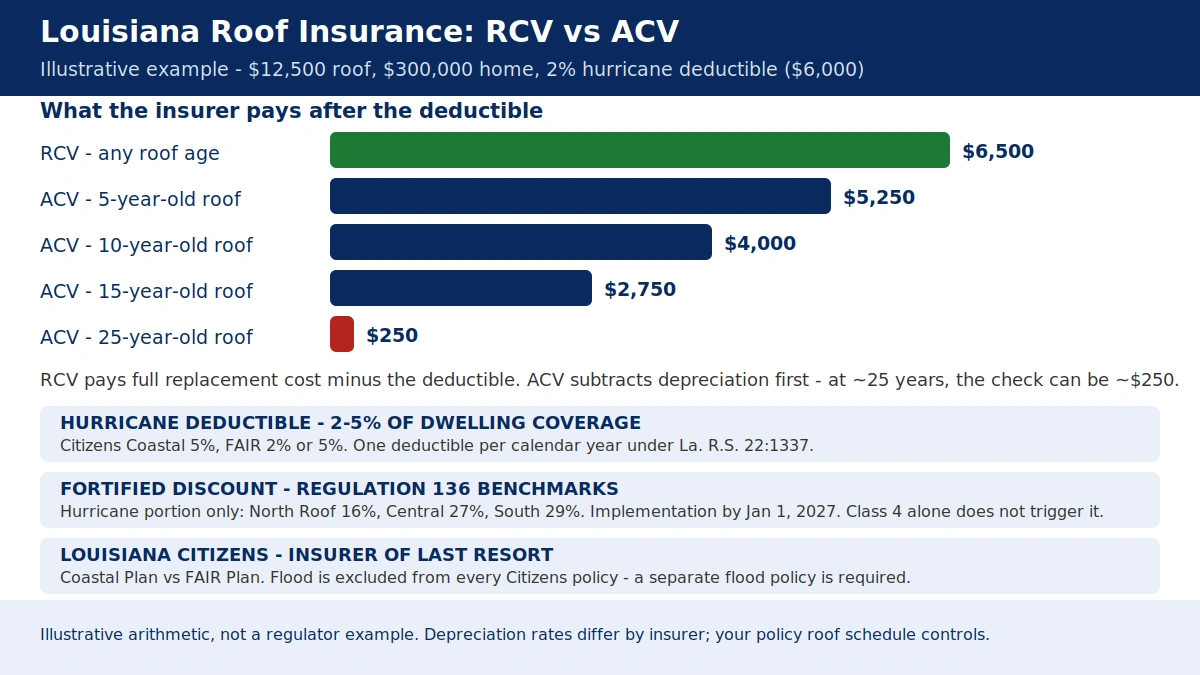
The hurricane deductible is the number that shocks people. Louisiana policies carry a separate hurricane or named-storm deductible, calculated as a percentage of dwelling coverage, not a flat dollar figure. Private carriers typically offer 2%, 3%, or 5%; Louisiana Citizens charges 5% on its Coastal Plan and 2% or 5% on its FAIR Plan. On a $300,000 home, a 2% deductible is $6,000 and a 5% deductible is $15,000 — the number that surprises owners who assumed a flat $1,000 deductible. And Louisiana Citizens is not a small player: it is the state-created nonprofit insurer of last resort (La. R.S. 22:2293) for homeowners who cannot find private coverage, with a Coastal Plan for properties between the Gulf and the Intracoastal Waterway and a FAIR Plan for properties above it. Flood is excluded from every Citizens policy — a separate flood policy is required, and wind-versus-flood disputes are the most common Louisiana claim fight. Louisiana law bars an insurer from relying on the floodwater mark alone without considering other evidence (La. R.S. 22:1893(A)(1)).
The one-deductible rule is a Louisiana advantage worth knowing. Under La. R.S. 22:1337, a separate hurricane or named-storm deductible applies once per calendar year, not once per storm. If Laura hits in August and Delta follows in October — as they did in 2020 — the second storm draws only on the unused balance of the deductible, or your all-perils deductible, whichever is greater. And since July 1, 2026, Act 182 of 2025 requires insurers to give at least 60 days’ written notice with a stated reason before cancelling or non-renewing a policy. The old three-year rule, which once barred non-renewal of a policy in force for three years, was repealed in 2024 for new policies — so a roof the carrier calls too old can now cost you the renewal, with only the 60-day notice as protection.
Replacement cost or actual cash value — your policy’s choice decides the size of the check. Under Replacement Cost Value, the carrier pays what a brand-new roof costs today, less your deductible. Under Actual Cash Value, depreciation shrinks the check — the older and more worn the roof, the smaller the payout. The example below is illustrative arithmetic, not a regulator’s published example — no Louisiana regulator example was found for this guide. Take a $12,500 replacement on a $300,000 home with a 2% hurricane deductible ($6,000), depreciating linearly at 2% a year over a 25-year life: an RCV policy pays $6,500 after the deductible at any roof age, once the work is done and proven. An ACV policy on the same roof at 15 years old pays $2,750 — and at 25 years, about $250.
| Roof age | RCV payout (illustrative) | ACV payout (illustrative) |
|---|---|---|
| New (0–2 years) | $6,500 | ~$6,250–$6,500 |
| 5 years | $6,500 | ~$5,250 |
| 10 years | $6,500 | ~$4,000 |
| 15 years | $6,500 | ~$2,750 |
| 20 years | $6,500 | ~$1,500 |
| 25 years | $6,500 | ~$250 |
*Illustrative arithmetic: $12,500 roof, $6,000 deductible (2% of a $300,000 home). Straight-line depreciation at 2 percent a year over a 25-year life. How fast a roof depreciates varies from carrier to carrier, so the roof schedule printed on your own policy is the one that decides.*
The roof-surface payment schedule is the clause Louisiana owners miss. Many Louisiana carriers now write endorsements that step coverage down by roof age — 100% for the first few years, then 80%, 60%, or 40% as the roof gets older. A 12-year-old roof can pay only 60% of replacement cost even on a policy that is nominally RCV. Read the roof schedule and endorsements before the next hurricane season, not after it.
The FORTIFIED discount is now mandatory — but only for FORTIFIED homes. LDI Regulation 136, promulgated April 29, 2026, requires every admitted property insurer in Louisiana to discount the hurricane portion of the premium for homes with an IBHS FORTIFIED designation, with implementation no later than January 1, 2027. The published benchmarks, by zone and designation level, are: North — Roof 16%, Silver 20%, Gold 24%; Central — 27%, 35%, 42%; South — 29%, 43%, 49%. One flagged conflict: the Regulation 136 notice text describes the mandatory discount as “in the range of twenty to thirty percent,” while the published benchmark table runs 16–49%. This guide uses the benchmark table — the operative framework insurers must implement — and flags the 20–30% wording. Either way, the discount applies to the hurricane portion of the premium, not the whole bill, and it only exists once the FORTIFIED designation does. A Class 4 shingle alone does not trigger it.
Claim timing and complaints. Photograph everything with dates on the pictures, file fast, and hang on to every tarping receipt — wind damage is hard to prove months later, and a late claim on stale damage is one of the easiest ways for a carrier to say no. If a claim is denied, get the denial in writing with the provision it relies on, and file a complaint with the Louisiana Department of Insurance if the carrier will not explain itself.
Paying for It: Fortify Grants, the FORTIFIED Tax Credit & No Federal Credit in 2026
Federal help for a 2026 roof: zero. For any roof installed after December 31, 2025, the OBBBA law (P.L. 119-21) ended both §25C and §25D. So for a 2026 roof on the home you live in, the federal credit comes to zero — not one dollar. A few Louisiana roofing pages still pitch a federal energy credit for insulation bundled with a reroof — that pitch relies on law that no longer exists, because the insulation and air-sealing credit ended with §25C. Plan as though that credit never existed — unless a tax professional gives you the opposite in writing.
The Louisiana Fortify Homes Program grant is real — and the lottery is closed. The Louisiana Fortify Homes Program (LFHP), run by the Louisiana Department of Insurance, provides grants of up to $10,000 toward the construction cost of upgrading an eligible home to the IBHS FORTIFIED Roof standard. The grant covers materials and labor to bring the roof up to standard; it does not cover evaluator fees, permit costs, or engineering. It is awarded by lottery, not first-come-first-served, because demand regularly exceeds funding. Current status, verified in September–October 2026: lottery registration is closed. The most recent round opened June 1 and closed June 19, 2026, drawing 3,000 winners, and LDI says additional grant rounds will be announced later. Create a profile at FortifyHomes.La.Gov so you are ready when the next round opens — and do not begin a FORTIFIED roof project expecting to apply for the grant afterward, because homeowners who begin work before acceptance are not eligible.
Who qualifies for the grant. The home must be your primary residence with a homestead exemption, in one of 25 eligible parishes (Acadia, Ascension, Assumption, Calcasieu, Cameron, Iberia, Iberville, Jefferson, Jefferson Davis, Lafayette, Lafourche, Livingston, Orleans, Plaquemines, St. Bernard, St. Charles, St. James, St. John the Baptist, St. Martin, St. Mary, St. Tammany, Tangipahoa, Terrebonne, Vermilion, Washington), with an active residential insurance policy that includes wind coverage — plus flood coverage where the home sits in a FEMA Special Flood Hazard Area. The home must be in good enough repair to earn a FORTIFIED designation. Excluded: condominiums, mobile homes, new construction, second homes, and rentals. Income is not a factor. Funding has grown: $30 million was budgeted for 2026–27, legislation signed in May 2026 added another $50 million, and on September 21, 2026, Governor Landry and Commissioner Temple announced a combined $100 million toward fortified-roof efforts. One caveat: the $80 million and $100 million figures come from different announcements and may overlap rather than add — this guide reports both rather than adding them.
The alternative to the grant: the FORTIFIED Roof Tax Credit. Act 404 (R.S. 47:6044) created a nonrefundable Louisiana individual income tax credit for 100% of qualified FORTIFIED Roof expenses incurred on or after July 1, 2025, up to $10,000 per residence, subject to a $10 million annual statewide cap on a first-come-first-served basis. Unused credit carries forward up to three years. Roofs certified in 2026 are applied for through LaTAP (Form R-90157) from January 1 through June 30, 2027. The credit sunsets December 31, 2031. You cannot claim the credit and receive the grant for the same roof — they are alternative pathways, not stackable ones. A third benefit can stack with the grant: the Construction Code Retrofitting Deduction (Act 473) lets you deduct 50% of qualifying voluntary retrofit costs, up to $10,000, for taxable periods beginning January 1, 2026 — on the portion of the cost the grant did not cover, but not on the same expenses as the tax credit. Confirm all of this with a tax professional before you count on a number; LDR’s Revenue Information Bulletin 25-020 (revised March 19, 2026) is the source.
HEAR and HOMES: funded but not launched — do not count on them. Louisiana was allocated over $200 million in federal IRA funding for the Home Electrification and Appliance Rebates (HEAR, $105,972,960) and Home Efficiency Rebates (HOMES, $106,383,841) programs, administered by the Louisiana Department of Energy and Natural Resources. As of November 2026, neither program has launched for homeowners and no launch date has been announced. HEAR would cover insulation, air sealing, and ventilation for income-qualified households — not roofing itself. Entergy Louisiana’s Entergy Solutions program, which historically offered attic insulation and air-sealing incentives, is paused while the utility transitions to a new administrator. Income-qualified households can get insulation and air sealing at no cost today through the Louisiana Weatherization Assistance Program.
How Louisianans actually pay for a roof: the insurance claim path, where storm damage qualifies — deductible applies, the once-per-year hurricane deductible matters, and ACV vs RCV decides the check; the LFHP grant (lottery, currently closed) or the FORTIFIED tax credit (one or the other, not both); the construction code retrofitting deduction; a HELOC or home-equity loan, usually the cheapest rate you will find, though closing takes weeks; contractor financing through lenders like GreenSky, Service Finance, and Hearth — fast decision, 0% promo periods common, read the reset-rate fine print; and FHA Title I or 203(k) programs for owner-occupied homes, which are slower to close.
No Louisiana-specific contractor APR figures were verified in 2026 sources, so this guide gives none. The same borrowing rules apply here as anywhere: compare APRs instead of monthly payments, stay clear of the deferred-interest trap — a balance still sitting there when a 0% promo ends can pull retroactive interest at 20% or more — and never let the loan outlast the roof, because eighteen years out of a shingle roof should never come with a twenty-five-year loan attached. Our roof financing guide lays every payment route side by side so the comparison is direct.
If you own solar, one more line belongs in the scope: the panels come off and go back on around a reroof, so the detach-and-reset cost should be written in as its own line. No verified Louisiana dollar figure for detach-and-reset was found, so get it quoted as its own line item.
Repair vs Replace: The Louisiana Decision Rules
Repair costs (New Orleans contractor guide, October 2026; NumeralQ Louisiana, October 2026):
| Repair | Typical range |
|---|---|
| Most small repairs (leak, missing shingles, pipe boot, flashing) | $300–$1,500 |
| Find and fix a roof leak | $268–$750 |
| Flashing repair | $199–$427 (NumeralQ) / $300–$1,200 (New Orleans) |
| Replace missing/damaged shingles (up to 10) | $186–$381 |
| Chimney flashing reflash | $279–$620 |
| Skylight leak | $300–$580 |
| Rotted decking (2 sheets) with shingles | $314–$660 |
| Decking / structural repair | $2,000–$8,000+ |
| Leak left dripping for months (rot + mold) | $5,000–$8,000 |
Cross-check (Modernize, 2026): Louisiana minor repairs $300–$800; major repairs $1,000–$1,500. A $12,500 replacement that lasts 18 years costs about $694 a year — the number to hold next to any repair quote. New Orleans repairs run 10–25% more than the same work inland.
Missing and lifted shingles are common after every tropical storm and summer thunderstorm across south Louisiana. Flashing — chimney, skylight, and wall-step — is a common failure point, and wind-driven rain is the reason it fails: water pushed sideways under a lifted flashing finds the deck in minutes. Pipe boots deserve a repeat mention: the rubber gaskets bake and crack in Louisiana heat, and a $300–$1,500 boot-and-flashing fix is one of the cheapest leaks to catch. Algae streaking is cosmetic until it is not — the moisture it holds accelerates granule loss on the same slope.
A replacement wins out once two or more of these ring true:
- Architectural shingle roof age 15+ in Louisiana — surrounding materials are already heat-aged and wind-lifted, so patching has diminishing returns
- Three or more leaks in a year — coming back for repairs that often points to the underlayment or flashing failing as a system, not one bad spot
- Interior staining, soft decking, or heavy granule loss — when gutters and driveways fill with granules after summer storms, the asphalt binders have already broken down
- Recurring mold or damp attic despite a clear gutter — the ventilation, not the shingle, is the problem, and a reroof is the cheapest moment to fix the attic
- Wind damage spread across the whole field — that kind of spread usually points to a full claim instead of a repair
- A roof already carrying two layers — Louisiana code caps roofs at two, so the next job is a full tear-off whether you want it or not
- Age past the Louisiana lifespan for the material, especially in the coastal wind zone
A repair is the right call when: one leak you can trace on a roof still early in its life, a few shingles lifted by a single storm, a dead pipe boot, or a flashing detail that gave way. If what you need today is a repair quote, our roof repair cost guide carries those prices.
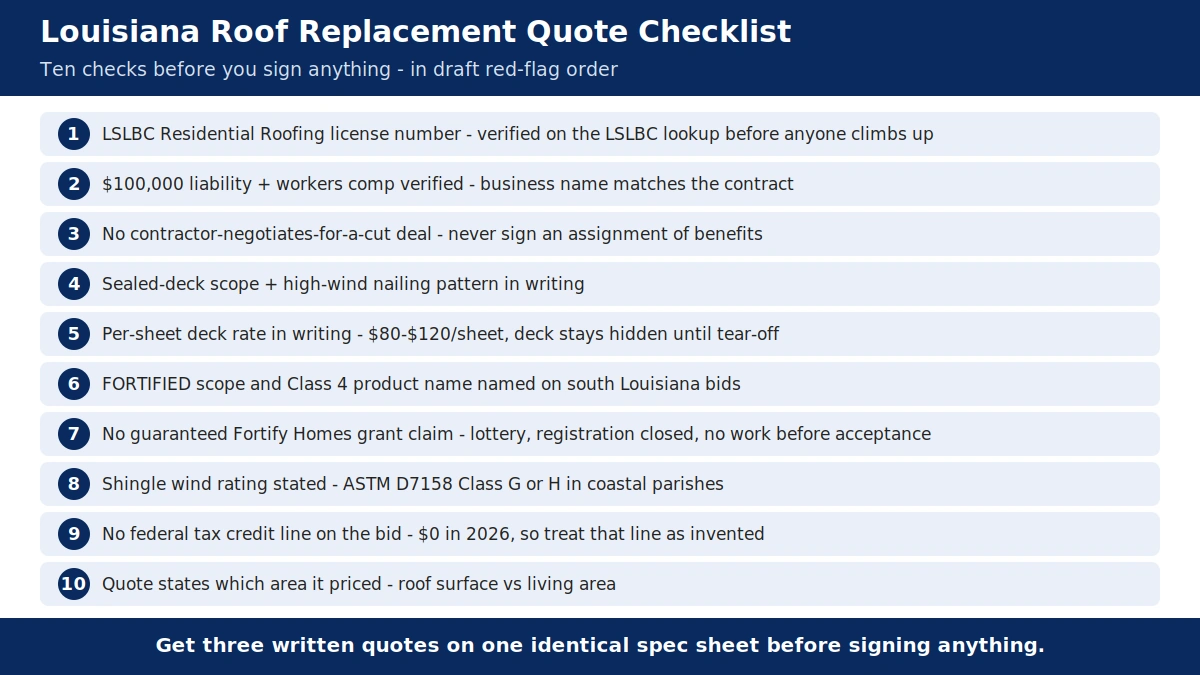
Quote red flags, Louisiana-specific:
- No LSLBC Residential Roofing license number on the proposal — Louisiana licenses roofers statewide through LSLBC, and any residential roofing job at $7,500 or more needs the Residential Roofing classification or a Residential Construction license. Look the number up on the LSLBC lookup before anyone climbs on your roof.
- No $100,000 liability or no workers’ comp certificate — these are verifiable, not optional, and the business name on the license must match the contract exactly.
- A contractor who offers to bargain with your insurer for a cut — file the claim yourself, keep the contractor’s work to the roof, and never sign an assignment of benefits.
- No sealed-deck scope, or no high-wind nailing pattern — the code and the FORTIFIED standard both start with the deck, and a bid without them is a pre-2021 roof.
- No per-sheet deck rate — no one can see the deck’s condition until the tear-off lays it bare. Leave the decking allowance out and the total jumps the moment the old shingles come off and the true deck is revealed.
- No FORTIFIED scope or Class 4 product name on a south Louisiana bid — if the bid just says “architectural shingle,” the upgrade that pays for itself was never quoted.
- A claim that the Fortify Homes grant is guaranteed, or that work can start before the lottery — the grant is a lottery, registration is closed, and starting work before acceptance disqualifies the project.
- No wind-rating on the shingle — ASTM D7158 Class G or H in the coastal parishes is a code matter, not a preference.
- A tax-credit line on the bid — the federal credit is gone for 2026 owner-occupied roofs, so any bid still showing one is padding its numbers with a fiction.
- One bare $/sq ft number with no area behind it — a Louisiana roof surface runs larger than the living area, so that lone figure tells you nothing on its own.
Before you put pen to paper, run every bidder through our questions to ask a roofer — the vetting checklist written to go with this guide. And if your gutters are part of the job, our gutter installation cost guide prices them — remember that in a hurricane climate the gutter’s job is to carry wind-driven rain away before it backs up under the eaves.
Sources & methodology
Cost anchors: SmartRoofingCalculator — “Louisiana Roof Replacement Cost: $10,000–$14,500 (2026)” (updated Nov 2, 2026) — primary Louisiana anchor: $400–$580/sq architectural, $800–$1,240 metal, $1,070–$1,600 tile, permit ~$260, 25-square roof $10,000–$14,500, 2,000 sq ft home $8,000–$11,600; SmartRoofingCalculator New Orleans city page (2026: $440–$638/sq, 25-square roof $11,000–$15,950, 1.10x baseline) and Baton Rouge city page (2026: $420–$609/sq, $10,500–$15,225, 1.05x baseline); NumeralQ — Louisiana (pricing Oct 26, 2026: arch $4.30–$5.14/sq ft; 2,000 sq ft roof $9,140–$11,090; 3-tab $3.57–$4.12; standing seam $9.78–$14.95; concrete tile $8.66–$12.40; clay $11.49–$18.48; extra layer $1.16–$1.53/sq ft; decking $56–$82/sheet; repair table; cities NOLA $9,140–$11,090, Baton Rouge $9,180–$11,160, Shreveport $9,120–$11,070); Roof Observations via MoneyMagpie (Oct 22, 2026: arch $5.15/sq ft; 3-tab ~$4.70; 1,700 sq ft roof ~$8,755 arch; exposed-fastener steel ~$6.90; concrete tile ~$9.85; standing seam ~$10.70; clay $12.35–$15.50; steep/complex +30%); Epic Roofing — Northshore calculator (2026: 2,000 sq ft home $13,000–$18,500 standard, $16,000–$22,500 FORTIFIED; decking $80–$120/sheet; FORTIFIED +$1,000–$2,000; FORTIFIED + Class 4 $1,500–$3,500; standing seam $10–$16/sq ft); SquareDash — 2026 Roof Replacement Cost Index (Louisiana avg $14,000; +6.8% YoY; 8,900+ completed replacements, data through Mar 31, 2026); ProRoofCalc (2026: Louisiana $8,500–$13,000, avg $10,700); FreeRoofPros (2026: Louisiana $9,500–$17,500). The home-size totals, Class 4 totals, and cost-per-year figures are our arithmetic from the per-square-foot ranges and lifespans.
Climate + wind: WindLoad.solutions — wind load requirements by state (Louisiana 120–170 mph coast; one of ten mandatory PE-seal states); Finance-Commerce (2005: post-Katrina 140 mph coastal / 90 mph north of Alexandria); JD Supra / Adams & Reese — Louisiana construction code changes effective Jan 1, 2023 (2021 IRC/IBC adoption; nailing patterns; secondary barriers); East Baton Rouge Title 17 (2024 ICC editions approved Jul 7, 2026; effective Jan 1, 2027; council renamed Louisiana Uniform Construction Code Council Aug 1, 2026); MyPDH Engineer — IRC high-wind shingle ratings (ASTM D7158 Classes G/H, ASTM D3161 Class F).
FORTIFIED + LFHP + tax credit: Southern Home Improvement — “Louisiana Fortify Homes Program: Current 2026 Status” and “FORTIFIED Roof Tax Credit: 2026–2027” (Aug 2026: lottery closed; Reg 136 benchmarks; credit filing Jan 1–Jun 30, 2027); LegalClarity — LFHP grants, rules and eligibility (2026: $10,000 cap; 25 parishes; Regulation 126; $100 surcharge funding); 337.news (Sept 27, 2026: June 1–19, 2026 lottery, 3,000 winners; $100M announcement); RoofGrantFinder (reviewed Aug 28, 2026: $80M funding; Reg 136); Louisiana Department of Revenue — Revenue Information Bulletin 25-020 (revised Mar 19, 2026: Act 404 R.S. 47:6044 tax credit; Act 473 retrofitting deduction); LDI — Regulation 136 Notice of Intent (Oct 9, 2025: mandatory 20–30% wording) and Insurance Journal (Mar 10, 2026: benchmark table 16–49%; implementation by Jan 1, 2027); Smart Home America — Louisiana page (Reg 136 promulgated Apr 29, 2026; Act 404 sunsets Dec 31, 2031; Act 473 effective Jan 1, 2026); Kin — “How Home Hardening Works in Louisiana” (2026: grant vs credit stacking rules).
Permits + licensing: City of Monroe — Inspections & Permitting (Act 239 Aug 1, 2025; Act 422; Jan 1, 2026 roofing license); East Baton Rouge Parish — Roof Permit page (16 geotagged photos, 4 stages; MGO Connect); City of New Orleans — Re-Roofing Checklist (OneStop; 50% threshold; 4 photos per phase; HDLC); Southern Home Improvement — “Louisiana Roof Replacement Permit Guide 2026”; RoofingLicenseCheck — Louisiana roofing license (checked Oct 22, 2026: Residential Roofing classification from Jan 1, 2026; $100,000 GL; workers’ comp no exceptions); Housecall Pro — Louisiana handyman/licensing guide (Act 422 effective Aug 1, 2025; $10,000 net worth/bond; 6 hrs CE); The Contractor Matrix (May 2026); Ryson Roofing (Baton Rouge: R.S. 37:3737; Act 239 staged photos); ServiceTitan (2026).
Insurance: LegalClarity — Louisiana Citizens (2026: Coastal 5%, FAIR 2%/5% hurricane deductibles; Jan 1, 2026 rate change; La. R.S. 22:2293); Chabert (Baton Rouge) — Louisiana homeowners insurance laws (2026: Act 182 60-day notice from Jul 1, 2026; three-year rule repeal 2024; R.S. 22:1337 one-deductible rule; Reg 136); Big Easy Roofing — roof insurance deductibles (2026: 2–5% deductibles; roof-surface schedules; Act 239) and New Orleans repair costs (2026: repairs 10–25% above inland; leak + mold $5,000–$8,000; decking/structural $2,000–$8,000+); Lavis Law — hurricane wind and roof damage claims (Oct 7, 2026: 2–5% deductibles; R.S. 22:1337; R.S. 22:1893(A)(1)).
HEAR / HOMES: BetterHouse — heat pump rebates by state (Sept 2026: Louisiana HEAR/HOMES not launched); HeatPumpPricing (verified Nov 4, 2026: Louisiana over $200M allocated, implementation in progress, no launch date); HomeEnergyBasics (June 10, 2026: HEAR $105,972,960 / HOMES $106,383,841 allocations; not launched); Koala Insulation — Baton Rouge insulation rebates (2026: Entergy Solutions paused; Weatherization Assistance Program).
Repair costs: Big Easy Roofing — New Orleans repair breakdown (2026: small repairs $300–$1,500; leak $400–$1,500; flashing $300–$1,200); NumeralQ — Louisiana roof repair cost (Oct 26, 2026: leak $268–$750; flashing $199–$427; decking 2 sheets $314–$660); Anything & Everything NOLA (Oct 29, 2026: typical full shingle replacement $5,500–$12,000, avg ~$9,000; small repairs $300–$1,500); Modernize — roof repair cost (2026: Louisiana minor $300–$800, major $1,000–$1,500).
Federal credit: OBBBA (P.L. 119-21); IRS FS-2025-05 — §25C and §25D came to an end for installs after Dec 31, 2025.
Method notes: RCV vs ACV table and the $12,500-roof example are illustrative arithmetic (linear 2%/yr depreciation over a 25-year life), not a regulator’s published example; no Louisiana regulator example was found. Carrier discount percentages are reported benchmarks, not promises, and apply to the hurricane portion of the premium only. The headline-cost conflict (SRC vs Epic Northshore vs NumeralQ), the standing-seam conflict, the decking conflict, the city-pricing conflict, the Act 422 effective-date conflict, the Regulation 136 wording conflict, and the LFHP funding-figure overlap are flagged in the text rather than resolved. No Louisiana-specific contractor APR figures or flat-roof installed figures were verified, so none are given. Lafayette has no standalone surveyed average; the figure given is a state-baseline estimate. Class 4 pricing is derived arithmetic, labeled as such. Louisiana lifespans are realistic contractor-consensus estimates for the humid subtropical climate, not a single published table.
How much does a roof replacement cost in Louisiana in 2026?
Most Louisiana asphalt replacements run $8,000–$18,500 in 2026. Architectural shingles on a typical 25-square roof cost $10,000–$14,500 (SmartRoofingCalculator; $400–$580 per square installed with tear-off), or $8,000–$11,600 on a 2,000 sq ft home. On a 2,000 sq ft home: 3-tab shingles $7,100–$9,400, Class 4 shingles $10,000–$14,400, standing-seam metal $16,000–$24,800. New Orleans runs about 10% above the state baseline; Baton Rouge about 5% above it; Shreveport about 10% below it; Lafayette at the baseline. One honest disagreement: a Northshore contractor framework prices the same 2,000 sq ft home at $13,000–$18,500, because it counts 22–27 squares of roof surface where the state model counts about 20.
Is the Louisiana Fortify Homes Program grant still available in 2026?
Not right now. The Louisiana Fortify Homes Program offers grants of up to $10,000 toward upgrading a roof to the IBHS FORTIFIED Roof standard, but lottery registration is closed as of September–October 2026. The most recent round opened June 1 and closed June 19, 2026, drawing 3,000 winners, and the Louisiana Department of Insurance says additional rounds will be announced later. To qualify when a round opens, the home must be your primary residence with a homestead exemption, in one of 25 eligible parishes, with active wind coverage (plus flood coverage where required). Do not start work before acceptance — homeowners who begin before program approval are not eligible. Create a profile at FortifyHomes.La.Gov so you are ready when the next round opens.
What is a FORTIFIED roof, and is it worth it in Louisiana?
A FORTIFIED Roof meets the IBHS standard: a sealed roof deck, ring-shank nails in a 6-nail high-wind pattern, and enhanced edge and flashing details. The upgrade costs about $1,000–$2,000 above a standard install, or $1,500–$3,500 with Class 4 impact shingles. It pays back three ways: the Fortify Homes grant (up to $10,000, lottery, currently closed), the FORTIFIED Roof Tax Credit (up to $10,000 in Louisiana income tax credit — the alternative to the grant, not an addition), and a mandatory insurance discount under Regulation 136 of 16% (North), 27% (Central), or 29% (South) off the hurricane portion of the premium, rising higher for Silver and Gold, implemented by insurers no later than January 1, 2027. In Louisiana, FORTIFIED is the default specification that happens to pay for itself.
How much is the hurricane deductible on a Louisiana roof claim?
Louisiana hurricane deductibles are percentage-based, calculated on dwelling coverage — typically 2%, 3%, or 5% with private carriers, 5% on the Louisiana Citizens Coastal Plan, and 2% or 5% on its FAIR Plan. On a $300,000 home, that is $6,000 at 2% and $15,000 at 5%, paid out of pocket before the carrier pays anything. Under Louisiana law (R.S. 22:1337), the hurricane deductible applies once per calendar year, not once per storm — if two named storms hit in one year, the second storm draws only on the unused balance. Since July 1, 2026, insurers must also give at least 60 days’ written notice with a stated reason before cancelling or non-renewing a policy.
Does my Louisiana roofer need a license?
Yes — Louisiana requires a statewide license, issued by the Louisiana State Licensing Board for Contractors (LSLBC). Any residential roofing job valued at $7,500 or more needs the Residential Roofing classification (a subclassification of Residential Construction, with a roofing trade exam) or a Residential Construction license. The contractor must designate a qualifying party who passes the trade and Business & Law exams, show at least $10,000 net worth (or a $10,000 surety bond in lieu), and carry $100,000 general liability insurance plus workers’ compensation. Verify every bidder on the LSLBC online license lookup before anyone climbs on your roof — an unlicensed contractor cannot legally pull your permit. One note: sources disagree on whether the new roofing rule took full effect August 1, 2025 or January 1, 2026, but the 2026 rule itself is not in doubt.
Do I need a permit to replace my roof in Louisiana?
Yes — since August 1, 2025, Act 239 requires permits and inspections for all roof construction and reroofing statewide, residential and commercial. Your parish or city issues the permit: New Orleans requires a separate reroof permit through OneStop for work affecting 50% or more of the roof covering, and East Baton Rouge Parish requires sixteen geotagged photographs across four stages through MGO Connect. Geotagged photos or video may be accepted in place of an in-person inspection. Typical fees run $100–$500 depending on the parish. In New Orleans historic districts, the Historic District Landmarks Commission must also approve a material or profile change before work starts.
Is there a federal tax credit for a new roof in Louisiana in 2026?
No — $0. OBBBA shut §25C and §25D down for anything placed in service after December 31, 2025. Louisiana has no federal replacement for it, but it does have state help for FORTIFIED roofs: the Fortify Homes grant (up to $10,000, lottery, currently closed) or the FORTIFIED Roof Tax Credit (up to $10,000 in Louisiana income tax credit, one or the other, not both), plus the Construction Code Retrofitting Deduction (50% of qualifying costs, up to $10,000, for taxable periods from January 1, 2026). The federal HEAR rebate (up to $8,000) and HOMES rebate have not launched in Louisiana despite over $200 million in allocated funding, so do not count on them. The real recurring payback is the insurance discount — 16–29% off the hurricane portion of the premium for a FORTIFIED Roof.
How long does a roof last in Louisiana?
Shorter than the brochure promises in cooler states, longer for metal and tile. Realistic Louisiana lifespans: 3-tab shingles 12–15 years, architectural shingles 15–22 years, Class 4 shingles 20–25 years, exposed-fastener metal 30–45 years, standing-seam metal 40–70 years, concrete tile 40–50+ years, clay tile 50+ years. The killers are hurricane wind and wind-driven rain, heat and humidity that age asphalt faster, algae that holds moisture against the shingle surface, and slow deck rot from damp attics. A roof that “looks fine” from the street can be much further along than it appears after a few Louisiana summers — get it inspected in late fall after hurricane season and again in late spring before it starts.