

Table of Contents
Indiana makes a heat pump buyer do two kinds of math at once, and the two kinds point in opposite directions. On the purchase side, Indiana is the best rebate state in this whole series: the federal HEAR and HOMES programs opened here in May 2025, months before most states had even filed their paperwork, and an income-qualified household can collect up to $8,000 toward the heat pump itself, plus up to $4,000 toward the electrical panel, on top of $400–$1,000 from the local utility. On the running-cost side, Indiana is one of the toughest states for a heat pump to win: electricity averages 17 cents a kilowatt-hour — only about 6% below the national average — while natural gas averages about $1.18 a therm, far below the national figure. Gas heat costs roughly $1.24 per therm of delivered heat. A good heat pump delivers the same therm for about $1.66. A minimum-efficiency heat pump runs about double the annual heating cost of a gas furnace. No other state in this series combines a rebate this generous with fuel math this unfavorable, and that combination is the whole story of this guide.
The climate does the heat pump no favors either. Most of Indiana sits in Climate Zone 5A, Cool-Humid, with a winter design temperature near 2F in Indianapolis and 1F in Fort Wayne and South Bend, and more than 5,600 heating degree days a year. January in Indianapolis averages a high of 36F and a low of 21F. A standard heat pump in that climate spends real weeks leaning on backup heat, not a handful of nights. The cold-climate premium and the dual-fuel setup are not upsells here. They are the two honest answers to an Indiana winter, and this guide prices both.
What follows is priced the way an Indianapolis estimator would price it: by system type, by home size, and by city — Indianapolis, Fort Wayne, Evansville, and South Bend — with the rebate tiers from each utility, the licensing gap that leaves vetting to the homeowner, and the running-cost math done at Indiana’s own electricity and gas prices.
For the national picture before the Indiana numbers, our national heat pump cost guide sets the baseline.
How Much Does a Heat Pump Cost in Indiana in 2026?
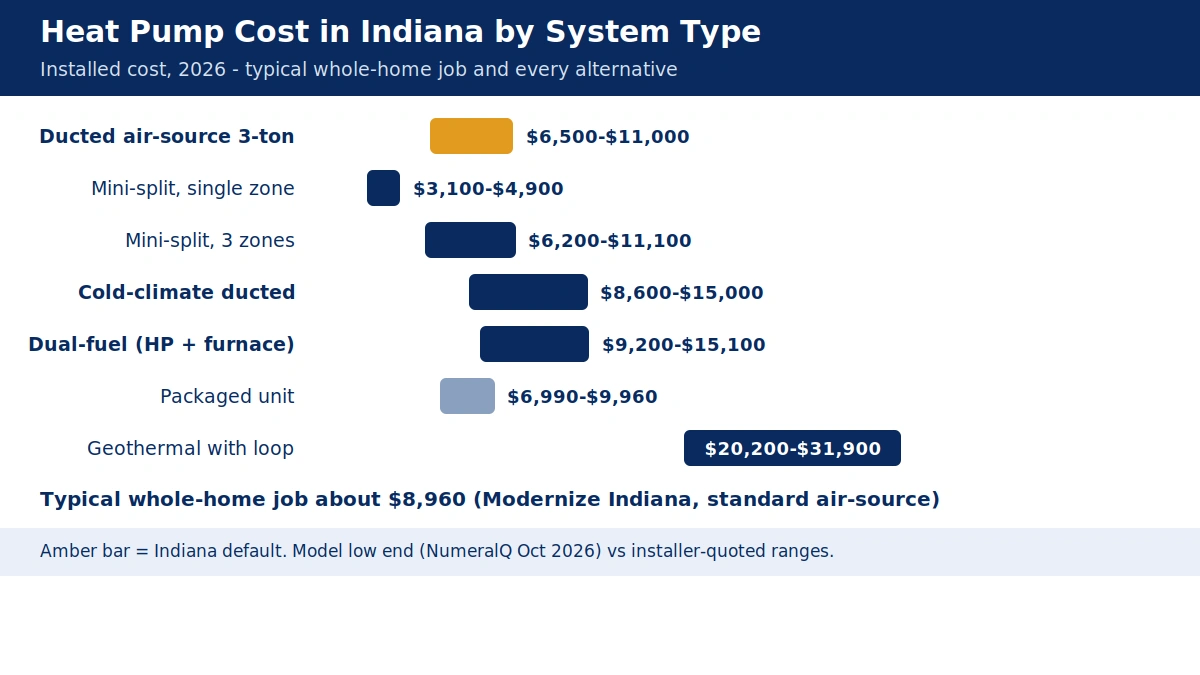
A typical Indiana home of 1,500–2,500 square feet needs a 3-ton whole-home ducted air-source heat pump. In 2026 that job costs $6,500–$11,000 installed in Indiana. The typical standard system lands near $8,960 — the figure Modernize reports for a standard air-source heat pump in Indiana, against an all-types Indiana average of $11,200. That range is the number to budget on. That figure buys the whole job — outdoor unit, indoor air handler, refrigerant lines, a dedicated circuit, the permit, and commissioning — not the box alone.
Two published anchors sit underneath that range, and they point in different directions. NumeralQ’s Indiana estimator (pricing as of October 26, 2026, built from Fixr, This Old House, Home Depot prices, and Bureau of Labor Statistics wages) puts a 3-ton ducted system at $6,530–$10,940. NumeralQ’s figure is a model — materials plus Indiana labor, with no allowance for sales, warranty overhead, or the surprises a real house always holds — so it reads low next to installer quotes. Modernize’s Indiana figures run higher: a standard air-source system at $8,960, a high-efficiency air-source system at $13,440. TryDun’s BLS-wage model lands in between at $6,450–$11,900 for the state. The honest headline sits where those views overlap: $6,500–$11,000 for the standard whole-home job, with the top of the band reserved for high-efficiency variable-speed equipment, difficult installs, and Indianapolis addresses.
One warning before you use any number in this guide: a quote near $5,000 for a whole-home system is almost never a complete quote. Angi’s Indianapolis page shows an average of $5,433, with a range of $3,970–$6,970 for parts and labor — a figure that sits thousands below every installer-quoted range in this guide. A bid in that territory is usually equipment plus a thin slice of labor, with the air handler, electrical work, permit, duct modifications, or commissioning left out, or priced as separate line items that appear later. When one bid comes in thousands below the other two, ask what it left out before you sign — not while the crew is already in your basement.
Indiana sits almost exactly on the national middle on price. The national guide puts a ducted heat pump at $7,500–$15,000 across the US in 2026, and NumeralQ rates Indiana at -0% against the national figure. Labor is close to the national median — HVAC technician pay runs from 3% below the national median in Evansville to 2% above in Indianapolis (BLS May 2025) — and the state has no coastal labor premium and no mild-climate equipment discount. Compare that with New Jersey, where the statewide average is about $13,600, or Tennessee, where the same system runs $7,000–$13,000 on cheaper labor. Indiana is a median-priced state to buy a heat pump in. What is not median is everything around the purchase: the rebate that can cut the net cost in half, and the fuel bill that can run double the gas alternative.
| System | Typical Indiana installed cost (2026) |
|---|---|
| Ducted air-source heat pump, 3-ton (typical home) | $6,500–$11,000 (typical ~$8,960) |
| Ductless mini-split, single zone | $3,100–$4,900 |
| Ductless mini-split, 3 zones | $6,200–$11,100 |
| Cold-climate ducted heat pump, 3-ton | $8,600–$15,000 |
| Dual-fuel (heat pump + gas furnace) | $9,200–$15,100 |
| Packaged unit (all-in-one) | $6,990–$9,960 |
| Geothermal (ground-source) with loop | $20,200–$31,900 |
Sources: NumeralQ Indiana estimator (Oct 26, 2026); Modernize Indiana (2026; standard air-source $8,960, high-efficiency $13,440, all-types average $11,200); TryDun Indiana (Aug 2026, $6,450–$11,900); nestpriced national guide (art. 1). The headline $6,500–$11,000 band and the ~$8,960 typical job are this guide’s synthesis of the installer ranges anchored on Modernize’s standard-system figure; NumeralQ’s model band is reported alongside it as the low end.
Heat Pump Cost in Indiana by System Type
The system type is the biggest single decision on the invoice — a single-zone mini-split costs a third of a whole-home ducted system, and geothermal costs three times as much. But in Indiana the right comparison is not price alone. It is price against the winter the system has to survive, and against what the house already heats with: gas in 59% of Indiana homes, electricity in 31%, and a heat pump as the main heat in only about 7%.
Ducted air-source heat pumps are the Indiana default. They run on the ducts the house already has, heat and cool every room from a single system, and take out the furnace and the air conditioner together. A 3-ton system runs $6,530–$10,940 on NumeralQ’s model and $6,500–$11,000 on installer-quoted ranges, with Modernize’s standard-system figure of $8,960 sitting near the middle. When the ducts are sound and the furnace and the AC are both near the end, price this system before anything else. The Indiana caveat is the backup heat: a standard ducted system in Zone 5A will call on electric strip heat on the coldest stretches, and strip heat at 17 cents a kilowatt-hour is the most expensive heat in the house. Price the system with its backup strategy stated, not assumed. The full ducted-versus-ductless trade-off is in our ductless vs ducted comparison.
Ductless mini-splits are the answer for homes without ducts — bonus rooms over the garage, additions, finished basements, older homes in Indianapolis neighborhoods like Fountain Square or Irvington where ducts were never run, and the lake cottages up north. A single zone runs about $3,130–$4,890 on NumeralQ’s model, though Modernize puts the Indiana single-zone figure higher, at $6,160 — the gap is the usual model-versus-installer spread, and real quotes land between the two. Two or three zones for an addition or a finished basement run $6,220–$11,140 on the model, against Modernize’s $13,440 for a 3-zone system. A whole-home multi-zone setup with five or more heads can push past $15,000, at which point a ducted system is usually cheaper if ducts exist or can be added. Every mini-split is a heat pump, so the same box that cools the bonus room in July warms it in January — and in northern Indiana, a cold-climate mini-split head is worth pricing for rooms that sit far from the main system. Per-zone mini-split pricing lives in our mini-split installation cost guide.
Cold-climate heat pumps cost more and matter more in Indiana than in most states in this series. A cold-climate ducted system runs $8,590–$15,010 (NumeralQ), roughly $2,000 above a standard system, and the premium buys inverter-driven capacity that holds output down to -13F or lower. In Evansville, where winter nights rarely test a standard unit, that money is mostly wasted. In Fort Wayne and South Bend, where the design temperature is 1F and lake-effect cold snaps arrive off Lake Michigan, it is money well spent. For most of central Indiana, the honest choice is between a cold-climate system and a dual-fuel system — and the dual-fuel route usually wins for homes that already have gas. Where the cold-climate premium pays — and where it does not — is covered in our cold-climate mini-split guide.
Dual-fuel systems — a heat pump paired with a gas furnace — are the Indiana answer for the 59% of homes that already heat with gas. The heat pump does the work through the long shoulder seasons, when Indiana weather is mild and the heat pump’s efficiency is at its best. The gas furnace takes over only when the temperature drops past the point where the heat pump still beats $1.18-a-therm gas — which in Indiana happens sooner than in most states. A full dual-fuel system runs $9,200–$15,090 (NumeralQ). The cheapest dual-fuel route is adding a heat pump in place of a dying air conditioner while keeping a gas furnace under about 10 years old. If your furnace is young and your AC is dying, price this first — it is the only setup in this guide that lets a gas-heated Indiana home collect heat pump comfort without paying heat pump fuel prices all winter. The complete dual-fuel breakdown is in our dual-fuel cost guide.
Geothermal is the outlier: $20,220–$31,860 with the ground loop (NumeralQ), and Modernize puts the Indiana geothermal figure at $31,360. It is the most efficient system you can buy and the longest-lived, and Indiana’s flat farmland and big suburban lots make horizontal loops more feasible here than in dense coastal metros. But the payback math is still brutal — cheap gas shrinks the annual savings that are supposed to repay a $10,000+ premium over air-source. It fits new construction with room for a horizontal loop, or a homeowner who plans to stay put for 20 years or more. Nearly everyone else gets more from a higher-efficiency air-source unit and sealed ducts than from a ground loop. Geothermal pricing in detail is in our geothermal heat pump cost guide.
Packaged units — the all-in-one box that sits outside or on the roof — run $6,990–$9,960 (NumeralQ) and suit homes with limited indoor space, including the slab-on-grade ranches common across central Indiana subdivisions. They are cheaper to install than a split system and easier to service, but they give up some efficiency and some quiet.
Heat Pump Cost by Home Size
Heat pumps are sized in tons, and one ton covers roughly 500–600 square feet of Indiana home — but only roughly. Insulation, window area, ceiling height, shade, and leaky ducts all push the right size up or down. Only a Manual J load calculation ($200–$500, often credited toward the install) sizes the system correctly. A contractor who sizes from square footage alone, or copies the size off the old unit’s nameplate, is guessing — with your money.
| Home size | Typical system | Installed cost (ducted air-source) |
|---|---|---|
| 1,000–1,200 sq ft | 1.5–2 ton | $4,390–$8,350 |
| 1,200–1,500 sq ft | 2–2.5 ton | $5,100–$9,640 |
| 1,500–2,000 sq ft | 2.5–3 ton | $5,820–$10,940 |
| 2,000–2,500 sq ft | 3–3.5 ton | $6,530–$12,230 |
| 2,500–3,000 sq ft | 3.5–4 ton | $7,250–$13,520 |
| 3,000+ sq ft | 4–5 ton | $7,960–$16,110 |
Source: NumeralQ Indiana estimator by size (Oct 26, 2026), ducted air-source. These are model-derived bands — installer quotes for the same sizes run toward the top of each band, and Indianapolis quotes run higher still. Use the table as a sizing map. It is not a bid.
The sizing mistake that costs Indiana homeowners the most is oversizing in the name of winter. A contractor who bumps the size up to cover the coldest January night without a load calculation leaves you with a system that short-cycles all summer: it blasts cold air for a few minutes, shuts off before it has dehumidified anything, and leaves the house cool and clammy through the muggy stretch from late May to late September. An undersized unit has the opposite problem: it runs constantly and leans on electric strip heat through January, which is the most expensive heat in the house at Indiana’s electricity prices. Either mistake costs more over ten years than the load calculation ever will. Get that calculation in writing before anyone orders equipment.
Two-story Indiana homes deserve a special note. One system across two floors almost always leaves a floor unhappy — the upstairs in July, the downstairs in January. The straight answers are two systems, a zoned ducted system with dampers, or a ducted system downstairs with a mini-split head or two upstairs. Every one of those costs more than a single-system quote. If a bid covers a two-story home with one system and never mentions zoning, ask what July will feel like before you sign.
Heat Pump Cost by City: Indianapolis, Fort Wayne, Evansville & South Bend
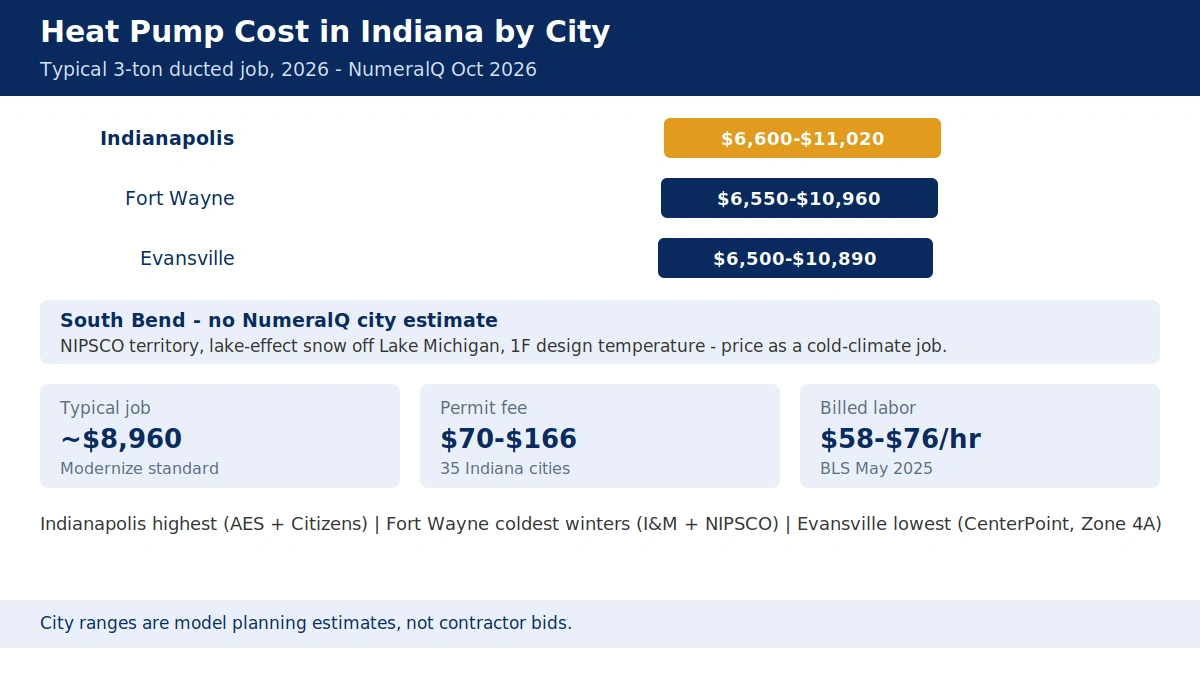
Indiana’s big metros price the same 3-ton system inside a narrow band — about $100 separates the cheapest from the most expensive on the model — but the reasons behind the prices are different in each city, and the installer-quoted reality spreads wider than the model suggests.
| City | Typical 3-ton ducted job (model) | What drives the price |
|---|---|---|
| Indianapolis | $6,600–$11,020 | Highest in the state — biggest metro, AES power, Citizens gas |
| Fort Wayne | $6,550–$10,960 | I&M power + NIPSCO gas; coldest big-city winters |
| Evansville | $6,500–$10,890 | Lowest model band; CenterPoint power + gas; warmest corner |
| South Bend | No NumeralQ city estimate | NIPSCO territory; lake-effect snow off Lake Michigan |
Source: NumeralQ Indiana city pages (Oct 26, 2026), 3-ton ducted system. South Bend has no NumeralQ city page; HVAC Visit (2026) puts all heat-pump types in South Bend at $7,350–$19,050 installed — a wider, all-types methodology that should not be compared directly with the NumeralQ bands.
Indianapolis is the most expensive heat pump market in Indiana. The metro is the state’s biggest, installer schedules run tightest here, and labor tracks a hotter market than the rest of the state — HVAC technician pay runs about 2% above the national median in Indianapolis, against 3% below in Evansville (BLS May 2025, via NumeralQ). The city’s utility split is unusual: AES Indiana (formerly IPL) delivers the electricity, and Citizens Energy Group — a public charitable trust, not an investor-owned utility — delivers the gas and water. Indianapolis homeowners also carry two local complications: older homes in Fountain Square, Irvington, and the near-east side with undersized systems and no ductwork, and the city’s clay-heavy soils, which shift with seasonal moisture and crack ductwork in crawlspaces. A single-zone mini-split in the Indianapolis area typically runs toward the top of the statewide band.
Fort Wayne is the coldest big-city market in the state. The design temperature is 1F, heating degree days run about 6,205 a year, and the winter is long enough that the cold-climate question is not theoretical — it is the first question. Indiana Michigan Power delivers the electricity and NIPSCO delivers the gas, which means a Fort Wayne homeowner can collect NIPSCO’s $800–$1,000 heat pump rebate and, if income-qualified, the Indiana Energy Saver money on the same job. Dual-fuel is the default premium choice here for homes with gas service, and a standard heat pump without a cold-climate or dual-fuel plan is a quote worth challenging.
Evansville posts the lowest model band in the state, $6,500–$10,890 for a 3-ton system, and CenterPoint Energy delivers both the electricity and the gas on one account. Evansville is also the warmest corner of Indiana — design temperature 9F, about 4,435 heating degree days — and the only part of the state in Climate Zone 4A rather than 5A. A standard heat pump covers more of the Evansville winter without help than anywhere else in Indiana, which makes the cold-climate premium the hardest sell in the state here. The local wrinkle is humidity off the Ohio River: a system that cannot dehumidify properly will leave an Evansville home clammy all summer, so sizing and variable-speed equipment matter more here than raw tonnage.
South Bend is the market the model does not cover, and the one where the weather argues loudest. The city sits in NIPSCO territory, takes lake-effect snow and wind off Lake Michigan, and shares Fort Wayne’s 1F design temperature with about 6,439 heating degree days — the highest of the four metros. A South Bend heat pump job should be priced as a cold-climate job first and a standard job second, and any quote that does not discuss backup heat or a dual-fuel switchover point is incomplete.
Smaller cities — Lafayette, Bloomington, Carmel, Fishers, Terre Haute, Muncie, Gary, Hammond — generally price at or below the big-four bands on softer labor markets. Carmel and Fishers are the exceptions that prove the rule: their bonus-room mini-split jobs price like Indianapolis’s, because they are Indianapolis’s most expensive suburbs and their installers know it.
Why Indiana Winters Change the Heat Pump Math
Most of Indiana sits in IECC Climate Zone 5A, Cool-Humid — a real heating climate, in plain language. Indianapolis averages about 5,699 heating degree days a year against about 1,160 cooling degree days, January averages a high near 36F and a low near 21F, and July averages a high near 85F. The ASHRAE design conditions for Indianapolis International Airport are 2F on the cold side and 90F on the hot side. Fort Wayne runs colder still at 6,205 heating degree days with a 1F design temperature; South Bend colder again at 6,439. Only Evansville, at 4,435 heating degree days and a 9F design temperature, escapes into Zone 4A. That is a climate that asks a heating system to work hard for four months and a cooling system to work hard for three — and a heat pump is the only single machine that does both, which is exactly why the winter side of the machine matters so much here.
A standard heat pump covers an Indiana winter only with help. As the outdoor temperature falls, capacity falls with it, and near 30–35F most systems start calling on supplemental electric resistance heat to keep up. In Tennessee that happens on a handful of nights. In Indianapolis it happens across weeks of January and February, and in Fort Wayne and South Bend it happens more. The strip heat is expensive — it is the most expensive heat in the house — and in Indiana it runs often enough to move the annual bill. This is the opposite of the southern states, where a standard heat pump spends almost the whole winter on its own and the cold-climate premium is optional. In Indiana the cold-climate premium is a live choice for most homes and close to mandatory in the north.
Humidity is the part people new to Indiana underestimate. An Indiana summer is not just hot; it is sticky from late May to late September, and a heat pump that cools without dehumidifying leaves a house at 72F and clammy. Variable-speed equipment earns its premium in Indiana not on the coldest night but on the stickiest afternoon, running long, slow cycles that pull moisture out of the air where short blasts leave it behind. Choosing between single-stage and variable-speed, pay for the dehumidification difference — not for the SEER2 number on the brochure.
Indiana homes also carry a structural quirk that shapes heat pump jobs: basements and crawlspaces. A large share of the state’s housing stock sits over basements or vented crawlspaces, and ductwork running through a cold basement or a damp crawlspace loses conditioned air through leaks and, in the worst cases, sweats in summer and grows mold on saturated insulation. A heat pump job in a basement or crawlspace home is often two jobs — the equipment, and the ducts. Sealing the ducts and, where the budget allows, sealing and insulating the rim joist, is the highest-return companion work in this guide. It is also the work the cheapest quote is most likely to skip.
None of this is theory. Only about 7% of Indiana homes use a heat pump as their main heat, according to the EIA’s home energy survey — against 59% on piped gas and 31% on electric heat of some kind. The technology is proven in colder states than Indiana, but it is not yet proven to Indiana homeowners at scale. The question is never whether a heat pump works in Indiana. It is whether the quote in front of you is complete, the size is right, the backup-heat plan is stated, and the running-cost math was done at Indiana prices.
Heat Pump vs Gas Furnace in Indiana: The Honest Running-Cost Math
This is the section most Indiana heat pump guides get wrong, because they import national math into a state where gas is cheap and electricity is not. Here is the math at Indiana’s own prices.
Indiana residential electricity averages 17.0 cents per kilowatt-hour (Jan–Aug 2026 average 17.04 cents; August 2026 alone 17.02 cents, EIA) — only about 6% below the 18.16-cent national figure. The average Indiana home pays about $189 a month for electricity and uses about 1,110 kWh. Indiana residential natural gas averages $1.18 a therm (12-month average to July 2026, EIA) — well below the $1.57 national figure. AES Indiana’s own average sits near 13.76 cents and Duke Energy Indiana’s near 14.31 cents, while NIPSCO’s runs near 17.89 cents — so your utility matters, but the statewide picture is the same: electricity is ordinary-priced, gas is cheap. That is the whole story.
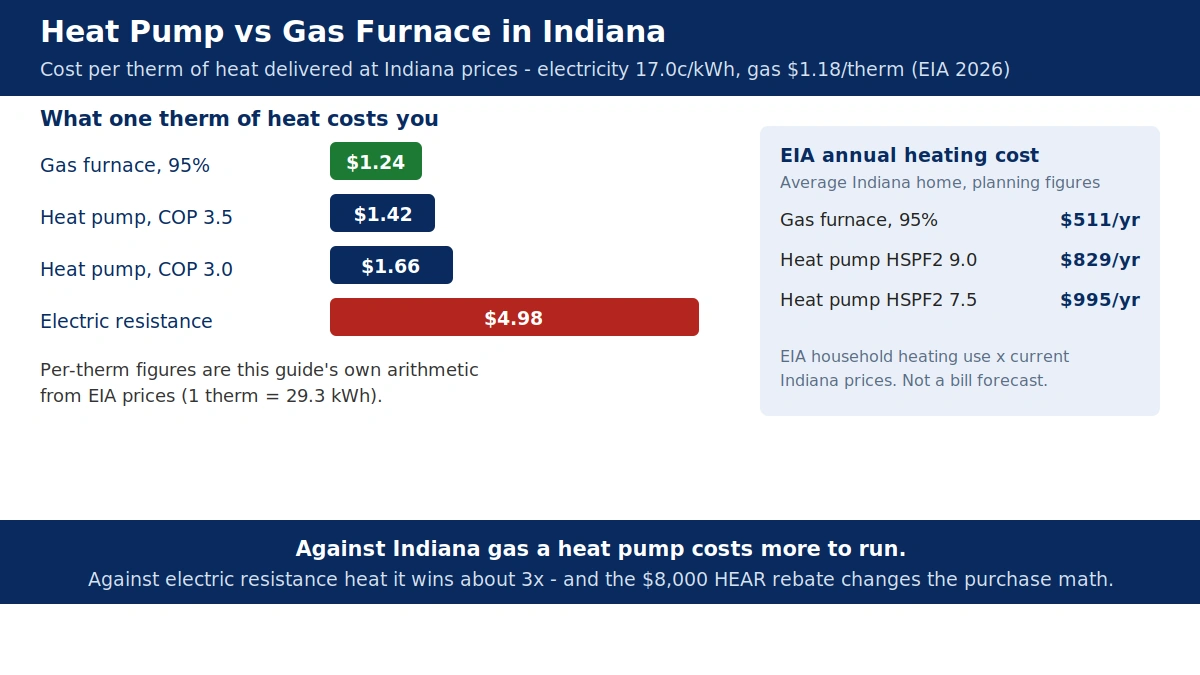
Run the heat math. One therm of heat is 29.3 kWh of heat. A heat pump with a seasonal COP of 3.0 — a fair figure for a good modern system in Indiana’s climate — delivers that therm for 29.3 x $0.170 / 3.0 = about $1.66. A 95%-efficient gas furnace delivers it for $1.18 / 0.95 = about $1.24. A high-efficiency heat pump at COP 3.5 delivers it for about $1.42 — still more than gas. A minimum-efficiency heat pump loses by a wide margin. The EIA’s own household heating estimates tell the same story from the other direction: a 95% gas furnace costs about $511 a year to heat the average Indiana home; a minimum-efficiency heat pump (HSPF2 7.5) costs about $995 a year; a high-efficiency heat pump (HSPF2 9.0) costs about $829 a year. Those are planning figures, not bill forecasts — but which way they point is not in doubt. Against Indiana gas, a heat pump is not a fuel-saving machine. It costs roughly 60% more to run than gas at high efficiency, and nearly double at minimum efficiency.
None of that makes the heat pump a bad purchase. It makes the sales pitch honest. A heat pump wins decisively in three Indiana situations. First, against electric resistance heat — baseboards, wall heaters, an old electric furnace — where it produces the same heat on about a third of the electricity. Second, against propane or heating oil, where the fuel is far more expensive than either Indiana power or Indiana gas. Third, against any home that needs air conditioning anyway: the heat pump replaces furnace and AC in one box, while the gas route means buying a furnace and a separate AC system. Compare the heat pump’s $6,500–$11,000 against furnace-plus-AC, not against the furnace alone — our heat pump vs furnace comparison makes that case in full, and our furnace replacement guide prices the gas side.
The fourth Indiana situation is the one no other state in this series has: the rebate. An income-qualified household that collects the $8,000 HEAR rebate plus a utility rebate can cut the net cost of a $9,000 system to under $1,000 — and at that net price, the fuel math stops mattering. The rebate is the Indiana heat pump story. The fuel math is the Indiana heat pump warning. Both belong in the same decision.
The other honest point: the heat pump’s real Indiana advantage is cooling. A gas furnace does nothing in July. A heat pump cools and dehumidifies for three to four months a year, and in a state with a muggy season running late May to late September, that is a large share of the value of the machine. Judge the purchase across the full year, not on the January fuel bill by itself.
| Heating system | Cost per therm of heat delivered | EIA estimated annual heating cost (IN) |
|---|---|---|
| Gas furnace, 95% efficient | ~$1.24 | ~$511/yr |
| Heat pump, COP 3.0 (good modern system) | ~$1.66 | — |
| Heat pump, COP 3.5 (high efficiency) | ~$1.42 | — |
| Heat pump, HSPF2 7.5 (federal minimum) | — | ~$995/yr |
| Heat pump, HSPF2 9.0 (high efficiency) | — | ~$829/yr |
| Electric resistance heat | ~$4.98 | — |
Assumptions: electricity 17.0 cents/kWh, gas $1.18/therm (EIA 2026). 1 therm = 29.3 kWh. COP figures here are seasonal planning values. EIA annual costs are planning figures built from household heating use and current Indiana prices.
Indiana Energy Saver: The $8,000 HEAR Rebate That Is Actually Open
Forget the federal money for a moment — then remember it, because in Indiana in 2026 the federal money is real. Indiana is one of only two states in the country where the federal HEAR rebate is fully open, and the program that pays it has been running since May 2025.
The Indiana Energy Saver Program, run by the Indiana Office of Energy Development, launched on May 14, 2025, combining the two federal IRA rebate programs — HEAR and HOMES — into a single application. Indiana’s combined federal allocation is about $182 million (roughly $90.77 million HEAR and $91.12 million HOMES). As of November 2026, applications are open statewide. That puts Indiana ahead of nearly every state in the country: Tennessee has not opened at all, Georgia launched and then paused, and Colorado’s single-family program closed on August 1, 2026. Do not let anyone tell you the federal rebates do not exist yet. In Indiana, they do — and they have for eighteen months.
| Program | What it pays for a heat pump | Who qualifies |
|---|---|---|
| HEAR (Home Electrification and Appliance Rebates) | Up to $8,000 for an ENERGY STAR heat pump; household cap $14,000 | Households under 150% of area median income |
| HOMES (Home Efficiency Rebates) | $2,000–$4,000 for most households at 20–35%+ modeled savings; up to $12,000 for households under 80% AMI | All incomes |
| HEAR add-ons | Electrical panel up to $4,000; heat pump water heater $1,750; insulation/air sealing $1,600; wiring $2,500 | Same HEAR income rules |
Sources: Indiana Energy Saver Program FAQ (indianaenergysaver.com); NASEO IRA rebate status (Sep 30, 2026); heatpumppricing HEAR status map (verified Nov 4, 2026).
Three conditions decide whether you collect the $8,000. First, income: HEAR is for households under 150% of area median income. Households at or below 80% of AMI can collect up to 100% of the project cost within the caps; households at 80–150% of AMI collect up to 50%. Above 150% of AMI, HEAR does not apply at all — you are limited to HOMES and the utility rebates. In the Indianapolis-Carmel-Anderson metro, 80% of AMI for a four-person household is about $72,000. Second, the equipment must be an ENERGY STAR-certified electric heat pump, installed by an Indiana Energy Saver Qualified Contractor, with the rebate applied as a point-of-sale discount on the invoice — not a tax credit, not a check months later. Third, and most important for Indiana’s gas-heated majority, the replacement must be electric-to-electric. DOE Program Notice 26-2 (September 1, 2026) removed the fuel-switching allowance from HEAR: a gas furnace to heat pump conversion does not qualify. The households HEAR will help are the ones already heating with electricity — resistance heat, old electric furnaces, and aging heat pumps. If your home heats with gas, the $8,000 is not yours, however often a contractor implies otherwise.
HOMES works differently and covers more households. It pays on modeled whole-home energy savings rather than fixed equipment amounts, and it is open to all incomes: $2,000 at 20–34% modeled savings and $4,000 at 35%+ for most households, rising to up to $12,000 for households under 80% of AMI at 20–34% savings. A heat pump can sit inside a HOMES project as part of a retrofit that hits the savings tier. Two more rules to know: HEAR rebates cannot be claimed retroactively — the work must go through the program’s application first — while HOMES does allow retroactive rebates, and new construction is not eligible for either program. Google added $3 million in September 2026 for pre-upgrade home repairs — the roof leak or wiring fix that has to happen before a rebate project can proceed at all.
Stack the numbers honestly: an income-qualified household replacing an old electric furnace with a $9,000 heat pump can collect $8,000 from HEAR plus $800–$1,000 from its utility, cutting the net cost to nearly nothing, while a household above 150% of AMI collects only the utility rebate and a gas-heated household collects no HEAR money at all, whatever its income. Check your income band and your current heating fuel against the program rules at indianaenergysaver.com before you sign, and apply only through the official program website — Indiana Energy Saver Qualified Contractors do not go door-to-door, and anyone who knocks on yours claiming to be one is not.
The tax credit is $0. The One Big Beautiful Bill Act (P.L. 119-21, signed July 4, 2025) ended both the Energy Efficient Home Improvement Credit (§25C, 30% up to $2,000 a year for heat pumps) and the Residential Clean Energy Credit (§25D) for property placed in service after December 31, 2025. The IRS confirmed it in FS-2025-05. A heat pump installed in an Indiana home in 2026 gets no federal tax credit whatsoever. If a quote takes a $2,000 federal credit off a 2026 install, the quote is out of date — or the contractor is counting on you not to check. Ask them to remove it. The full legal picture is in our federal energy tax credits guide — published under the solar category, but covering both credits.
Utility Rebates: Duke, NIPSCO, AES, CenterPoint & I&M
Indiana has five investor-owned electric utilities, and each one runs its own efficiency program with its own amounts, deadlines, and paperwork. Your address decides which one you get. Check the amount with your own utility before you sign, not with a statewide article — and note the NIPSCO deadline below, because it is the one that bites.
| Utility (territory) | Heat pump rebate (2026) |
|---|---|
| Duke Energy Indiana (central, southern, northern IN — not Indianapolis metro) | $400 (15.2 SEER2) / $500 (≥16 SEER2) replace-on-failure; $600 / $700 early replacement; mini/multi-split $500 / $700; geothermal $500 / $700; electric-heat conversion to heat pump $800 |
| NIPSCO (northern IN: South Bend, Gary, Hammond, Fort Wayne gas) | $800 (15.2–16.1 SEER2) / $900 (16.2–17.0) / $1,000 (17.1+ SEER2); heat pump water heater $750 |
| AES Indiana (Indianapolis + central IN) | Mini-split self-installed $100–$725 by efficiency tier; heat pump water heater $600 |
| CenterPoint Energy (Evansville / southern IN) | Instant discounts via participating contractors, amount varies by efficiency; heat pump water heater $500; tune-up $50 |
| Indiana Michigan Power (Fort Wayne / northeast IN) | Savings program exists — amount not verified for this guide; check I&M’s savings page |
Sources: UpgradeRebates Indiana guide (2026); nipsco.com midstream channel and rebate pages; AES Indiana home improvement rebates page; CenterPoint Energy Indiana 2026 rebate applications; Palmetto Indiana heat pump guide (2026).
Duke Energy Indiana’s Smart $aver program pays the most nuanced tiers in the state. A straight air-source heat pump replacement pays $400 at 15.2 SEER2 or $500 at 16 SEER2 and above when the old system failed, and $600 or $700 when you replace early — Duke is paying extra to get inefficient equipment out before it dies. A mini-split or multi-split system (18 SEER2 or better, 9.0 HSPF2, conditioning at least 1,000 square feet) pays $500 on failure or $700 early. Geothermal pays $500 or $700. The biggest Duke number is the conversion payment: $800 for converting an electric furnace, baseboard, or radiant system to an air-source heat pump or a mini-split. Program-specific duct sealing is required with the HVAC replacements, and the published values apply to projects completed after July 31, 2025. Duke also pays $350 for an ENERGY STAR heat pump water heater. Duke does not serve Indianapolis metro electric — that is AES territory — so check your bill before you assume Duke is yours.
NIPSCO’s residential program is the simplest to read and the easiest to miss. Ducted air-source heat pumps earn $800 at 15.2–16.1 SEER2, $900 at 16.2–17.0 SEER2, and $1,000 at 17.1 SEER2 and above; a heat pump water heater earns $750 and a high-efficiency AC $550–$650. The catch is the calendar: equipment must be installed between January 1 and November 30, 2026, the application must be postmarked within 60 days of installation with an AHRI certificate attached, and funds are first-come, first-served. NIPSCO also runs a midstream channel that gives the same $800/$900/$1,000 as an instant discount at the distributor — but equipment bought through midstream cannot also claim the post-purchase rebate. Pick one route, and make sure your contractor tells you which one they used. A December install collects nothing from NIPSCO, whatever the equipment costs.
AES Indiana pays differently from the other four: its published heat pump money is mostly for mini-splits installed as self-installed projects — $100 at 15.2 SEER2, $225 at 17.1 SEER2, $300 at 19 SEER, $525 at 21 SEER, and $725 at 23+ SEER — plus $600 for an ENERGY STAR heat pump water heater, with the application due within 90 days of purchase. AES also offers contractor-applied instant discounts for qualifying air-source heat pumps, but the amount was not verified from AES’s own page for this guide, so confirm it at aesindiana.com before counting on it. AES serves Indianapolis and parts of central Indiana, and its average electricity price runs below the state average, which softens the running-cost math a little for its customers.
CenterPoint Energy in Evansville and southern Indiana offers instant discounts on qualifying air-source and ductless heat pumps through participating contractors or distributors, with the amount varying by equipment efficiency — no single published figure was verified for this guide, so get the number from your contractor’s CenterPoint paperwork before signing. What is published: $500 for an electric heat pump water heater, $50 for a heat pump tune-up (once every 24 months, within calendar 2026), and up to $2,000 for Aeroseal duct sealing, new for 2026. CenterPoint also pays $200–$250 for high-efficiency gas furnaces, which matters for the dual-fuel math in its territory.
Indiana Michigan Power runs a savings program for its Fort Wayne and northeast Indiana customers, but no specific heat pump rebate amount was verified from I&M’s own page for this guide. Check indianamichiganpower.com/savings before you budget. The electric cooperatives and REMCs are the same story in miniature — Henry County REMC, for example, offers 2026 rebates for heat pumps, mini-splits, and geothermal — so check your local co-op’s page too.
Stack the numbers honestly: a Duke or NIPSCO rebate of $400–$1,000 off a $9,000 job is meaningful — roughly 5–11% — but it is not the five-figure stack New Jersey homeowners collect, and it is not the $8,000 federal rebate that only income-qualified, electrically heated households collect. Budget as if the utility rebate is the only money, and treat anything above it as upside.
Permits & Licensing: Indiana Has No Statewide HVAC License
Indiana licenses contractors differently from most states in this series, and the difference matters because it creates a gap most homeowners never notice. Indiana has no statewide HVAC license at all. There is no state board, no state exam, and no state license number to look up for the person installing your heat pump. The Indiana Professional Licensing Agency has no jurisdiction over HVAC. Plumbing is the only construction trade Indiana licenses statewide. Everything else is local — and the local rules range from a full licensing board with an exam down to no requirement at all.
Indianapolis and Marion County run the strictest regime in the state. The Board of Heating and Cooling Examiners, inside the Department of Business and Neighborhood Services, licenses HVAC contractors in classes: Air Conditioning A (unrestricted), B (25 tons cooling / 500,000 BTU heating), D (5 tons / 300,000 BTU), Refrigeration, and High Pressure Steam. The license holder each business must employ needs five years in the trade (education can combine with experience), must pass the Prov heating and cooling exam at 70%, and the business needs a $5,000 surety bond, general liability insurance, and workers’ compensation coverage. The license-holder fee is prorated by application date — $377 from January to June 2026, $283 from July to December 2026 — with renewal at $247. Fort Wayne, Evansville, South Bend, and Terre Haute run their own licensing-board-and-exam or registration regimes, and many accept an Indianapolis license or its equivalent. Many smaller towns require only a permit and an EPA 608-certified technician, with no separate local license.
Two more requirements sit underneath the local license. Anyone handling refrigerant needs EPA Section 608 certification — universal, by federal law, no exceptions. And a mechanical permit is required for a system replacement in Indiana cities; Indianapolis charges about $185 for a system covering up to 2,500 square feet, plus $23 for each additional 1,000 square feet, while the typical fee across 35 cities checked runs $70–$166. Electrical work on the job needs a licensed electrician where applicable. Indiana’s Home Improvement Contracts Act (IC 24-5-11) adds one more protection: home improvement work must be in a written contract, so get the scope, the price, and the warranty in writing before anyone starts.
What to verify before you sign: the contractor’s local license or registration in the city or county where the work happens (ask for the number and check it with that building department — there is no statewide lookup to use), EPA 608 certification for the technician handling refrigerant, general liability insurance, and workers’ compensation coverage. Get the permit number in writing and confirm the installer pulls it. A contractor who asks you to pull the permit is handing you the liability. Panel work is priced on its own in our electrical panel upgrade guide. And because Indiana has no state license to fall back on, the reference check matters more here than in any other state in this series: ask for three recent local jobs and call them.
What Pushes Your Indiana Quote Up or Down
Two quotes for the same house can differ by $3,000 or more, and the difference is rarely the equipment. It is everything around the equipment. These are the line items that move an Indiana quote, in the order they usually appear.
Ductwork is the biggest swing. New or extended ductwork runs $4,140–$7,030 per job (NumeralQ). Many Indiana homes have ducts in cold basements or vented crawlspaces, and leaky ducts can waste a fifth or more of the conditioned air before it reaches a room. A contractor who prices the heat pump without looking at the ducts has priced half the job. Duct sealing is the companion work worth paying for, and the line most often missing from the cheapest bid. Undersized, collapsed, or disconnected ducts in a crawlspace will get blamed on the new heat pump — even though the ducts were the problem all along.
The electrical panel is the second swing. A heat pump needs a dedicated 240V circuit. If the panel is full, still 100-amp, or has no spare breaker space, a 200-amp upgrade runs $2,310–$3,600 (NumeralQ; the national guide puts it at $1,500–$4,000). Older Indianapolis and Fort Wayne homes with 100-amp panels hit this regularly. Have the panel listed as its own line in the quote, so you can tell whether that $3,000 is panel or profit. The good news is that HEAR will pay up to $4,000 toward a panel upgrade for income-qualified households — the only rebate in this guide that pays for the panel itself.
Sizing and the load calculation decide whether the system works or merely runs. A Manual J runs $200–$500 and is often credited toward the install. It is the only honest way to size a system in a cold climate, where oversizing leaves the house clammy in summer and undersizing leans on strip heat all winter. Sizing from the old unit’s nameplate, or from square footage alone, is guessing.
The refrigerant matters in 2026. New home systems now use R-454B or R-32; R-410A was phased out in new home systems starting in 2025 under EPA rules. Ask every quote which refrigerant it uses, and do not pay a 2026 price for a new R-410A system — that is last year’s equipment at this year’s money.
The efficiency tier is a real choice, not a sales ladder. A 15.2 SEER2 system collects the bottom utility rebate; a 17+ SEER2 system collects the top one; a cold-climate variable-speed system holds output on the coldest Indiana nights and dehumidifies on the most humid summer afternoons. The premium for variable-speed equipment is real money — typically $1,500–$3,000 over a single-stage system — and in Indiana it pays back through dehumidification and shoulder-season efficiency, not through surviving deep cold alone. Price the tiers side by side with the rebates applied, and judge the premium against ten years of Indiana weather, not against the brochure’s SEER2 number.
Labor and timing round out the list. HVAC technician median pay in Indiana is $29.05 an hour (BLS, May 2025), and contractors bill $58–$76 per worker-hour once insurance, payroll taxes, overhead, and profit are included. Indianapolis books two to three weeks out in peak season; spring and fall shoulder-season installs are cheaper and faster. A good installer will be booked out. That is a good sign, not a problem. And remember the NIPSCO calendar: in northern Indiana, an install after November 30 collects no NIPSCO rebate at all, so a late-year job in South Bend or Gary is a job that pays full price.
Payback: When Does an Indiana Heat Pump Pay for Itself?
Payback in Indiana depends entirely on what the heat pump replaces and whether the rebate applies, because Indiana’s cheap gas makes the fuel math unfavorable and the $8,000 rebate makes the purchase math extraordinary. There is no single payback number. There are four cases, and they are very different.
Replacing electric resistance heat with HEAR money: payback in roughly 1–3 years. This is the best case in the state and the one the program was built for. A heat pump delivers the same heat for about a third of the electricity, and an income-qualified household collecting the $8,000 HEAR rebate plus $800–$1,000 from its utility can cut a $9,000 system to nearly nothing out of pocket. The annual savings against resistance heat run into four figures, and the system pays for itself faster than in almost any other state. If your home heats with baseboards or an old electric furnace and your income is under 150% of AMI, stop reading payback tables and get quotes from an Indiana Energy Saver Qualified Contractor.
Replacing electric resistance heat without HEAR money: payback in roughly 3–5 years. Same fuel savings, no $8,000. On a $9,000 system with a $400–$1,000 utility rebate, the annual savings against resistance heat still run into four figures, and the system pays for itself in a few years. The case holds even without the federal money, because resistance heat at 17 cents a kilowatt-hour is the most expensive heat in the house.
Replacing an old heat pump or a furnace-plus-AC pair: payback in roughly 7–12 years. The savings here come from efficiency — a modern variable-speed system against a 15-year-old single-stage one — and from replacing two aging machines with one. The utility rebate helps. The air conditioner you would otherwise have bought is the quiet part of the math — price the heat pump against furnace-plus-AC and the gap closes fast.
Replacing a working gas furnace with a heat pump: payback in 12 years or more, possibly never on fuel alone. This is the honest answer the sales pitch skips. At $1.18 a therm against 17-cent electricity, a high-efficiency heat pump costs more to run than the gas furnace it replaces — about $829 a year against $511 by the EIA’s planning figures. The case for switching has to rest on something else: a dying air conditioner, a furnace at end of life, the appeal of one system instead of two, or the cooling and dehumidification. Dual-fuel is the compromise that keeps the gas furnace for the coldest nights and lets the heat pump do the shoulder seasons — and it is the right answer for a large share of Indiana homes with gas service and a furnace under ten years old. And remember: a gas-to-heat-pump switch does not qualify for HEAR under Notice 26-2, so do not count the $8,000 in this case.
Two more payback facts. First, the utility rebate shortens every payback above by roughly a year — $400–$1,000 off the front is real money on a $9,000 job, and the HEAR rebate rewrites the table entirely for households that qualify. Second, maintenance is not free and it is not optional: annual professional service runs $150–$300, filters need monthly attention in summer, and a neglected Indiana heat pump in a humid climate loses efficiency faster than the brochure admits. A well-maintained system runs 15–20 years. Skip the service budget and the payback math quietly falls apart. The ownership years are priced in our heat pump maintenance guide and heat pump repair guide, and the monthly math is in our running-cost guide.
Getting Quotes in Indiana: The Checklist
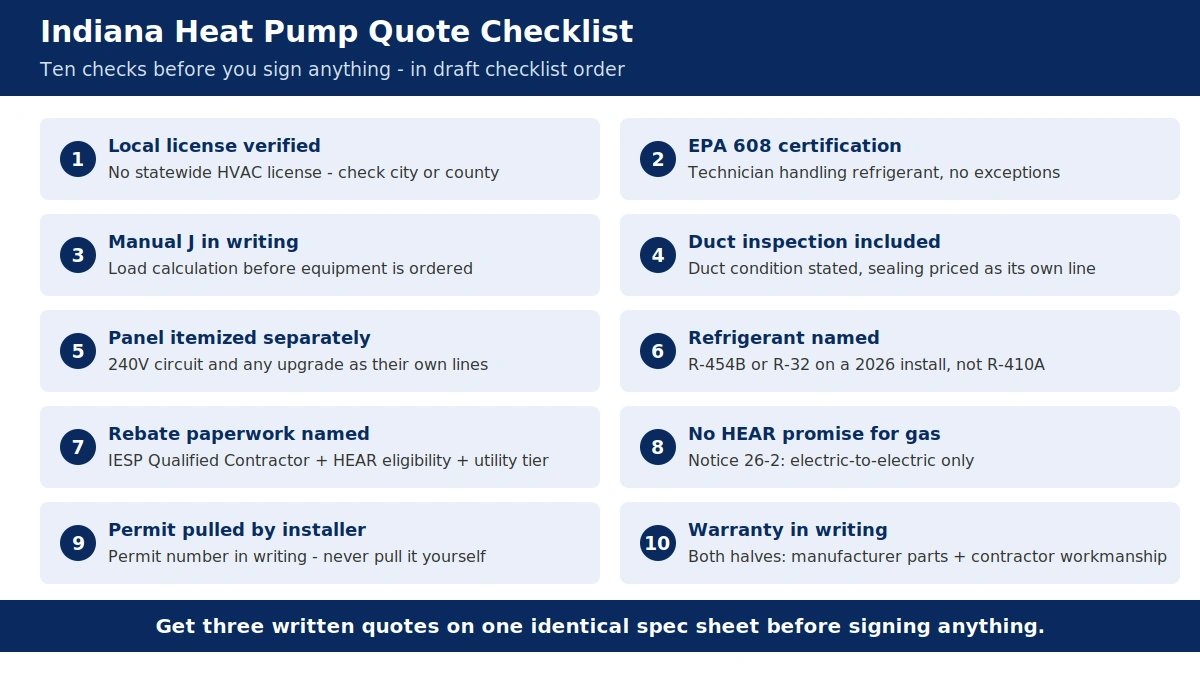
Get three written, itemized quotes on one identical spec sheet. Same tonnage, same SEER2 and HSPF2, same duct scope, same electrical scope, same permit on every quote. Quotes you cannot compare line by line cannot be compared at all — and the cheapest is usually the one that left the most lines out.
- Local license verified. Indiana has no statewide HVAC license, so the check is with the city or county building department — Indianapolis Board of Heating and Cooling Examiners, or the equivalent in Fort Wayne, Evansville, or South Bend. A proposal with no license number on it is a walk-away.
- EPA 608 certification for the technician handling refrigerant. No exceptions, by federal law.
- Manual J load calculation in writing before equipment is ordered. Square-footage sizing is a guess.
- Duct inspection included. The quote states the duct condition and prices any sealing or replacement as its own line. A quote that never mentions ducts is incomplete.
- Panel itemized separately. The 240V circuit and any panel upgrade appear as their own lines, not buried in the total.
- Refrigerant named. R-454B or R-32 on a 2026 install. R-410A is last year’s equipment.
- Rebate paperwork named. Indiana Energy Saver Qualified Contractor status confirmed, HEAR income band and electric-to-electric condition checked, utility rebate tier (Duke / NIPSCO / AES / CenterPoint) and deadline stated. No federal credit line on the quote — that credit is $0 in 2026.
- No HEAR promise for a gas home. Any contractor promising the $8,000 federal HEAR rebate for a gas-furnace-to-heat-pump conversion is promising money that does not qualify under Notice 26-2. Walk away from the promise — not necessarily from the contractor, but note it down.
- Permit pulled by the installer, with the permit number in writing. Never pull it yourself.
- Warranty in writing, both halves. Manufacturer warranty on equipment (typically 10 years on parts, longer on compressors for premium brands) and workmanship warranty from the contractor (1–10 years — the second one matters more). Get both before signing.
Red flags specific to Indiana: a “federal tax credit” line on a 2026 bid; an $8,000 HEAR rebate promised to a gas-heated home or to a household above 150% of AMI; a NIPSCO rebate promised for a December install (the program closes November 30); a whole-home quote near $5,000 with no duct or electrical lines; any contractor who sizes the system from the old unit’s nameplate without a load calculation; and any contractor who cannot name the local license that covers your city, in a state where the local license is the only license there is. The best Indiana installers are booked two to three weeks out in peak season. A crew that can start tomorrow deserves your suspicion.
Sources & methodology
Cost anchors: NumeralQ — “Heat Pump Cost in Indiana (2026)” (estimator, pricing as of Oct 26, 2026; model built from Fixr, This Old House, Home Depot prices, BLS May 2025 wages) — primary IN anchor: 3-ton ducted $6,530–$10,940; size table; type table; city table (Indianapolis $6,600–$11,020; Fort Wayne $6,550–$10,960; Evansville $6,500–$10,890); ductwork $4,140–$7,030; panel $2,310–$3,600; permits $70–$166; HVAC billed rate $58–$76/hr; EIA heating-cost table (gas furnace $511/yr; HP HSPF2 7.5 $995/yr; HSPF2 9.0 $829/yr); 7% of IN homes heat mainly with heat pumps; 59% gas, 31% electric. NumeralQ Indiana HVAC replacement page — dual-fuel $9,200–$15,090; packaged unit $6,990–$9,960. Modernize — Indianapolis heat pump installation page (2026; Indiana average $11,200; standard air-source $8,960; high-efficiency $13,440; single-zone mini-split $6,160; multi-zone $13,440; geothermal $31,360; labor $84–$179/hr). TryDun — Indiana $6,450–$11,900 (Aug 2026). Angi — Indianapolis heat pump cost (updated Aug 4, 2026; average $5,433, range $3,970–$6,970; permit ~$185 up to 2,500 sq ft + $23 per extra 1,000 sq ft; install labor $75–$125/hr). HVAC Visit — South Bend all-types heat pump $7,350–$19,050 (2026). Nestpriced art. 1 — the national heat pump cost baseline of $7,500–$15,000. The headline $6,500–$11,000 band and the ~$8,960 typical job are this guide’s synthesis of the installer ranges anchored on the Modernize Indiana standard-system figure; NumeralQ’s model band is reported alongside it as the low end.
Rates: EIA Electric Power Monthly (Oct 23, 2026 release, Tables 5.6.A/B) via PriceOfElectricity / hvacbase / Energy Factbook — IN residential electricity 17.02 cents/kWh (Aug 2026; Jan–Aug 2026 avg 17.04 cents), vs 18.16 cents national; avg bill ~$189/mo at ~1,110 kWh/mo. EIA natural gas — IN residential $1.18/therm (12-mo avg to Jul 2026; $12.20/Mcf) vs $1.57 national; 2025 annual average $11.49/Mcf. Utility-average electricity figures (Duke ~14.31 cents, AES ~13.76 cents, I&M ~16.08 cents, CenterPoint ~17.24 cents, NIPSCO ~17.89 cents) via Palmetto (2026), directional only. The per-therm running-cost arithmetic ($1.66 heat pump at COP 3.0 vs $1.24 gas furnace at 95%) is our own calculation from those EIA prices at 29.3 kWh per therm.
Climate: IECC Zone 5A Cool-Humid (most of IN), Zone 4A southern tip (Evansville) — DOE/PNNL climate-zone guide (PNNL-33270); ASHRAE 2021 Handbook Indianapolis design conditions (winter ~2F / summer 90F; HDD65 ~5,224); ICC Appendix D degree days/design temps (Indianapolis 5,699 HDD, 2F/90F; Fort Wayne 6,205 HDD, 1F/89F; South Bend 6,439 HDD, 1F/89F; Evansville 4,435 HDD, 9F/93F); NOAA 1991–2020 normals (Indianapolis Jan high 36.1F, low 20.9F; July high 85.2F; muggy season late May to late September).
Rebates: Indiana Energy Saver Program FAQ (indianaenergysaver.com) — launched May 14, 2025, OED-administered; HEAR up to $8,000 heat pump, $14,000 household cap, panel $4,000, HPWH $1,750, insulation/air sealing $1,600, wiring $2,500; HOMES $2,000/$4,000 general, up to $12,000 under 80% AMI; no retroactive HEAR; no new construction; Qualified Contractor point-of-sale. NASEO IRA rebate status (Sep 30, 2026). DOE allocation ~$90.77M HEAR + ~$91.12M HOMES (ECW Oct 27, 2026). Google $3M pre-upgrade repairs (Sep 2026) via heatpumppricing (verified Nov 4, 2026). Duke Smart $aver tiers, NIPSCO tiers + Nov 30 deadline + 60-day application rule, AES mini-split tiers + HPWH $600, CenterPoint HPWH $500 / tune-up $50 / Aeroseal up to $2,000 — via UpgradeRebates Indiana guide (2026), nipsco.com, AES Indiana, CenterPoint 2026 rebate applications, Palmetto Indiana guide (2026). FLAG: AES air-source heat pump instant-discount amount, CenterPoint air-source heat pump discount amount, and I&M heat pump rebate amount were NOT verified from the utilities’ own pages for this guide — confirm each at the utility’s program page before quoting a number. FLAG: the HOMES 35%+ savings tier cap for the under-80% AMI band was not fully visible in the IESP FAQ table read for this guide (one tracker reports up to $16,000 for income-qualified households) — confirm at indianaenergysaver.com before quoting a 35%+ figure.
Federal: OBBBA P.L. 119-21 + IRS FS-2025-05 — §25C and §25D ended Dec 31, 2025. DOE Program Notice 26-2 (Sep 1, 2026) — HEAR no longer allows fuel-switching; electric-to-electric only. Retrofit Relay HEAR/HOMES guide (verified Jul 11–15, 2026); BetterHouse rebates by state (Sep 2026); heatpumppricing HEAR status map (verified Nov 4, 2026 — Indiana + New Mexico the only fully open states).
Licensing & permits: Indiana PHCC HVAC licensure guide (compiled May 28, 2026) — no statewide HVAC license; IPLA has no jurisdiction; plumbing state-licensed (IC 25-28.5); Indianapolis Board of Heating and Cooling Examiners classes A/B/D, 5 years experience, Prov exam 70%, $5,000 bond, fees $377/$283, renewal $247; Fort Wayne / Evansville / South Bend / Terre Haute local regimes. Indiana Home Improvement Contracts Act (IC 24-5-11) written-contract rule. EPA 608. Permit fees $70–$166 via NumeralQ 35-city check (Oct 2026); Indianapolis ~$185 via Angi.
Utilities by city: Indianapolis — AES Indiana electric, Citizens Energy Group gas (Citizens Action Coalition utility background; utilitiesformyhome Indianapolis guide). Fort Wayne — I&M electric, NIPSCO gas. Evansville — CenterPoint electric + gas. South Bend/Gary/Hammond — NIPSCO electric + gas. Lafayette — Duke electric, NIPSCO gas.
Method note: where a model estimate and installer quotes disagreed, this guide reports both and headlines the installer range. Where no Indiana-specific figure was verified (e.g. maintenance $150–$300/yr; lifespan 15–20 years; Manual J $200–$500), the figure is the national guide’s and is labeled as such. All prices are 2026 planning figures, not quotes — get three written local quotes before you budget.
*Disclaimer: Prices are 2026 Indiana planning figures and change by city, home, and contractor. Always get three written local quotes before you budget. Tax and rebate information is general, not tax advice — confirm with a tax professional and with the Indiana Office of Energy Development / your utility before counting on any incentive.*
How much does a heat pump cost in Indiana in 2026?
A typical whole-home ducted air-source heat pump (3-ton) costs $6,500–$11,000 installed in Indiana in 2026, with a typical standard system near $8,960 (Modernize Indiana). A single ductless mini-split zone runs $3,100–$4,900, a 3-zone system $6,200–$11,100, a cold-climate ducted system $8,600–$15,000, a dual-fuel system $9,200–$15,100, and geothermal $20,200–$31,900. Indianapolis is the priciest metro; Evansville posts the lowest model band. The federal tax credit is $0, but the Indiana Energy Saver program pays up to $8,000 for income-qualified households, plus $400–$1,000 from the local utility.
Is the $8,000 HEAR rebate really open in Indiana?
Yes — Indiana is one of only two states where HEAR is fully open. The Indiana Energy Saver Program, run by the Indiana Office of Energy Development, launched on May 14, 2025, and pays up to $8,000 for an ENERGY STAR heat pump to households under 150% of area median income, inside a $14,000 household cap, as a point-of-sale discount through a Qualified Contractor. But two catches decide everything: households above 150% of AMI get nothing from HEAR, and since DOE Program Notice 26-2 (September 1, 2026), HEAR covers electric-to-electric replacements only — a gas furnace to heat pump conversion does not qualify. HOMES rebates, which pay $2,000–$4,000 for most households and up to $12,000 for households under 80% of AMI on modeled savings, are open to all incomes.
Is a heat pump worth it in Indiana when natural gas is so cheap?
It depends on what you are replacing and whether the rebate applies. Against electric resistance heat, a heat pump wins by about 3x and pays back in roughly 3–5 years — or 1–3 years with the $8,000 HEAR rebate. Against propane or oil heat, the margin is wide. Against Indiana gas at $1.18 a therm, it loses on fuel: a good heat pump at COP 3.0 delivers a therm of heat for about $1.66, a 95% gas furnace for about $1.24, and the EIA puts annual heating at $511 for gas against $829 for a high-efficiency heat pump and $995 for a minimum-efficiency one. The heat pump’s real Indiana advantage is that it also cools and dehumidifies for three to four months a year, and it replaces the furnace and the air conditioner in one box. For gas homes, dual-fuel — heat pump plus gas furnace — is the straight compromise.
Do heat pumps work in Indiana winters?
Yes, with a plan for the cold. Most of Indiana sits in Climate Zone 5A with a winter design temperature near 2F in Indianapolis and 1F in Fort Wayne and South Bend, and more than 5,600 heating degree days a year. A standard heat pump covers the shoulder seasons well but leans on backup electric strip heat across weeks of January and February, which is expensive at 17 cents a kilowatt-hour. Cold-climate models that hold output down to -13F, or a dual-fuel setup that hands the coldest nights to the gas furnace, are the two honest answers. Only Evansville, in Zone 4A with a 9F design temperature, lets a standard system carry most of the winter alone.
What rebates can I get for a heat pump in Indiana in 2026?
Three layers, and your address and income decide which ones you collect. Federal: the Indiana Energy Saver program pays up to $8,000 (HEAR, under 150% AMI, electric-to-electric only) plus HOMES whole-home rebates of $2,000–$4,000 for most households and up to $12,000 under 80% AMI. Utility: Duke Energy Indiana pays $400–$800 depending on tier and timing, NIPSCO pays $800–$1,000 by SEER2 tier for installs by November 30, 2026, AES Indiana pays $100–$725 for mini-splits plus $600 for a heat pump water heater, and CenterPoint offers instant discounts through participating contractors. The federal tax credit is $0 for 2026 installs. Verify every amount with the program or utility before signing.
Do I need a permit or a licensed contractor for a heat pump in Indiana?
Yes to the permit, and the license question is the Indiana trap: the state has no statewide HVAC license at all. A mechanical permit is required for a system replacement in Indiana cities — about $185 in Indianapolis for a system up to 2,500 square feet, typically $70–$166 across 35 cities checked. Licensing is entirely local: Indianapolis runs a Board of Heating and Cooling Examiners with an exam, five years of experience, a $5,000 bond, and insurance, and Fort Wayne, Evansville, South Bend, and Terre Haute run their own regimes. Anyone who handles refrigerant needs EPA Section 608 certification. Verify the local license with the city or county building department before signing, and make sure the installer pulls the permit.
Ducted or ductless mini-split — which fits an Indiana home?
If your home has ductwork in good shape, a ducted system is usually the better buy: one system heats and cools the whole house for $6,500–$11,000. If the home has no ducts — a bonus room over the garage, an addition, a finished basement, or an older home where ducts were never run — a ductless mini-split is the answer: $3,100–$4,900 for a single zone, $6,200–$11,100 for two or three zones. A whole-home multi-zone ductless setup can push past $15,000, at which point a ducted system is usually cheaper if ducts exist or can be added. Two-story homes often need two systems or zoning, whichever route you take, and northern Indiana homes should price cold-climate mini-split heads for rooms far from the main system.
Is there a federal tax credit for a heat pump in Indiana in 2026?
No — $0. The One Big Beautiful Bill Act ended the §25C credit (30%, up to $2,000 a year for heat pumps) for property placed in service after December 31, 2025 — the IRS confirmed it in FS-2025-05. If a quote subtracts a $2,000 federal credit from a 2026 Indiana install, the quote is outdated — ask the contractor to remove it. The live federal money is the Indiana Energy Saver program: up to $8,000 through HEAR for income-qualified, electrically heated households, plus HOMES whole-home rebates — on top of $400–$1,000 from your utility.