

Vermont gives a solar buyer the most expensive electricity in New England to replace and one of the weakest suns in the country to replace it with, and then charges the buyer for the privilege of making power at home. The price side of that bargain is genuinely strong. Vermont homes paid 23.84 cents per kilowatt-hour in August 2026, the twelfth highest rate in the country and 31 percent above the national average, and the rate had risen almost 8 percent in a year. Every kilowatt-hour the panels make is a kilowatt-hour the home does not buy at that price, which is why solar keeps selling in a state where winter days are short and snow sits on roofs for months.
The sun side is thin. A kilowatt of panels in Vermont makes about 1,200 kilowatt-hours a year on the planning figure this guide uses, against roughly 1,500 or more in the sunny South. Winter production falls to about a third of summer production per kilowatt. Snow covers the array for stretches of the season, and the panels spend December and January under a low sun that barely clears the Green Mountains. Cold helps, since panels run more efficiently when they are cold, but cold cannot make up for short days.
The charge side is the part most guides get wrong, and it is the part that decides whether the numbers work. Vermont does not credit exported power at the full retail rate. The Public Utility Commission sets a statewide blended rate, 20.71 cents per kilowatt-hour for applications filed on or after August 1, 2026, and then subtracts a siting charge of 5 cents on every kilowatt-hour the system makes, whether the home uses that power or sends it out. A buyer who sizes a system from a guide that still promises retail-rate credits will overstate the value of every exported kilowatt-hour by about a third, and will not discover the error until the first bill arrives.
The application date matters as much as the install date. The May 29, 2026 order that set the new numbers raised the blended rate and raised the siting charge at the same time, and the second change outweighed the first. A system whose paperwork was filed before August 1, 2026 keeps the older, more generous adjustors. A system filed after that date lives under the new math for years. Two neighbors with identical roofs and identical panels can earn different money from the same sunshine because one filed in July and the other in August.
One last Vermont fact shapes the whole price discussion. The average Vermont home uses only 574 kilowatt-hours a month, the lowest household use in the country in effect, yet the average system installed in Vermont is 11.73 kilowatts, one of the largest average systems anywhere. That gap has a reason: Vermont solar homes often heat with heat pumps and charge cars at home, so their bills are far above the state average. A home with ordinary bills that copies the state average system size will buy far more panels than it needs, and the extra power will earn the reduced export credit instead of replacing expensive retail power. Size follows the home’s own bills, never the state average.
The national solar panel cost guide puts these Vermont figures beside the country as a whole.
Table of Contents
How Much Do Solar Panels Cost in Vermont in 2026?
No published average built from finished Vermont invoices turned up in this research. The headline price below is therefore assembled from three independent 2026 models set beside each other, keeping the range they agree on and naming the outliers. Taken together, the three models point to $2.78–$2.91 for each installed watt, before incentives of any kind. At that range, 8 kW of panels runs $22,240–$23,280. The payback math later in this guide works from the middle of that range, about $22,760. Use that range to judge quotes. It is a planning yardstick, not a price any installer has offered.
EnergySage gives the low end. EnergySage’s Vermont page, refreshed in November 2026 with marketplace quote data, averages the state at $2.78 per watt with installation included. The average Vermont system quoted through its marketplace is large, 11.73 kW at $32,635, with prices ranging from $27,740 to $37,530, which works out to about $2.36–$3.20 per watt across that range. EnergySage prices every size at that same per-watt rate, which puts its 8 kW system at $22,240. EnergySage also puts the national average at $2.60 per watt, which makes Vermont about 7 percent dearer than the country as a whole to install in.
SolarReviews lands almost on top of EnergySage. SolarReviews, whose November 2026 model draws on National Renewable Energy Laboratory, Energy Information Administration, and Bureau of Labor Statistics data, lands Vermont at $2.79 per watt, or $33,301 for an 11.2 kW system before incentives, beside a $3.03 national average. Its column showing prices after the tax credit still takes off the 30 percent federal credit that expired, so this guide sets that column aside. The underlying cost model holds up. Only the tax column is out of date, and the two deserve to be kept apart.
EcoGen gives the high end. EcoGen’s Solar Cost Index, September 2026 edition, priced September 25, 2026, lists Vermont at $2.91 per watt in cash before incentives. That ties for 28th lowest of 51 jurisdictions, against $2.89 nationally. Its typical Vermont system is 11.29 kW, the median size Vermont homeowners installed in 2025 on Berkeley Lab data covering 1,127 systems, at $32,854. A written quote at $2.91 a watt sits at the top edge of Vermont pricing. It is neither a deal nor a warning sign on its own.
Two weaker trackers land above the band from thinner evidence. Renewestimator, working from a small ZIP sample compiled July 25, 2026, puts Vermont at $3.06 per watt with an 8 kW system at $24,000, though the same site states $3.30 per watt elsewhere, so it counts as weak corroboration only. A February 2026 price guide puts the range at $3.20 per watt. Neither source sets the headline band, and neither contradicts it by much once their thin methods are allowed for.
One planning model sits below the band and is named as a cross-check. NumeralQ prices Vermont at $2.46–$3.21 per watt, or $19,650–$25,690 for an 8 kW system, on EnergySage data retrieved October 26, 2026. The bottom of its range runs well below the three-model band, which is what a wide planning range does: it holds the cheapest plausible quotes as well as the dearest. A quote at $2.46 a watt for an ordinary roof should be read with the same care as a quote at $3.21, and the quote should name the equipment and the scope that explain it.
Vermont’s neighbors sit close by on that same EcoGen index. New Hampshire sits at $2.92, New York at $3.02, Maine at $3.05, and Massachusetts at $3.02 per watt. Vermont is the cheapest of its neighbors to install in, which is a small comfort when the power being replaced is also among the dearest in the region. For the New Hampshire figures, see our New Hampshire solar panel cost guide, and for Maine, our Maine solar panel cost guide.
That installed price covers a system that runs, not a stack of components. It includes the panels, the inverter hardware (either one string inverter or a microinverter on each panel), racking and flashing, wiring with disconnects, permit and inspection fees, labor, and the startup visit. Vermont adds one saving other states lack in part and one cost other states lack entirely. The saving is the sales tax exemption on net-metering equipment, covered in the incentives section. The cost is the siting charge, which is not in the install price at all: it arrives month by month on the electric bill for as long as the system runs.
Surprises still hide outside the headline price, because the work around the panels is billed on its own lines.
- Roof repairs or a roof replacement before the panels go on, priced on their own
- An electrical panel upgrade, if the existing service cannot take the solar backfeed
- A battery, priced separately and covered in its own section below
- Tree removal or trimming where maples, pines, or oaks shade the roof
- Snow guards or extra racking on a steep metal roof, where the installer specifies them
- The certificate of public good filing and the utility interconnection paperwork, which the contract should name as included or excluded
Ask three installers for written quotes on an identical scope of work. Walk away from any bidder who will not put four things in writing: the panel model, the inverter type, the year-one production estimate for the real roof direction, and the net-metering application date behind the savings math. A Vermont savings estimate that values every generated kilowatt-hour at the retail rate and never mentions the siting charge is built on a rule Vermont no longer uses.
| Source | Price per watt | 8 kW total | Basis |
|---|---|---|---|
| EnergySage (Nov 2026) | $2.78 average | $22,240 | Marketplace quote data |
| SolarReviews (Nov 2026) | $2.79 average | $22,320 | NREL/EIA/BLS cost model |
| EcoGen Index (Sept 2026) | $2.91 | $23,280 (scaled) | Cost index, cash, before incentives |
| NumeralQ (Oct 2026) | $2.46–$3.21 | $19,650–$25,690 | Planning estimates |
| renewestimator (July 2026) | $3.06 | $24,000 | Small ZIP sample, weak basis |
Read the table’s 8 kW column as scaled arithmetic where marked: the EcoGen total comes from multiplying its per-watt average by 8,000 watts, because EcoGen publishes no 8 kW total of its own. The headline band of $2.78–$2.91 per watt is the range from the EnergySage average to the EcoGen average, with SolarReviews at its low end. Three different methods landing inside a 13-cent spread is the real finding here. Vermont installs cluster near $2.85 a watt at the center, and the band is broad enough to hold most genuine quotes.
Solar Panel Cost in Vermont by System Size
A kilowatt, written kW, is the peak power panels can make under full sun. Every size below is priced in those units. A bigger array costs more in total but usually less per watt. The crew’s visit, the permit, and the inverter cost almost the same for 10 panels as for 30. The table applies the headline band with a gentle taper, letting the per-watt price ease down as systems grow. It also shows yearly output at the 1,200 planning yield, set against the 6,888 kilowatt-hours an average Vermont home uses in a year.
| System size | Installed cost | Cost per watt | Yearly production | Share of average use |
|---|---|---|---|---|
| 4 kW | $11,680–$12,200 | $2.92–$3.05 | 4,800 kWh | 70% |
| 5 kW | $14,400–$15,050 | $2.88–$3.01 | 6,000 kWh | 87% |
| 6 kW | $17,040–$17,820 | $2.84–$2.97 | 7,200 kWh | 105% |
| 7 kW | $19,670–$20,580 | $2.81–$2.94 | 8,400 kWh | 122% |
| 8 kW | $22,240–$23,280 | $2.78–$2.91 | 9,600 kWh | 139% |
| 9 kW | $24,840–$26,010 | $2.76–$2.89 | 10,800 kWh | 157% |
| 10 kW | $27,400–$28,700 | $2.74–$2.87 | 12,000 kWh | 174% |
| 11 kW | $29,920–$31,350 | $2.72–$2.85 | 13,200 kWh | 192% |
| 12 kW | $32,400–$33,960 | $2.70–$2.83 | 14,400 kWh | 209% |
Costs: NestPriced planning arithmetic on the $2.78–$2.91 headline band, tapered a little for small sizes. No Vermont model that prices by size was published anywhere this research could find. Production and coverage: NestPriced arithmetic at 1,200 kWh per kW each year, against 6,888 kWh of average yearly use (574 kWh a month, EIA Form 861, 2024). At 400 watts a panel, 8 kW takes 20 panels, 6 kW takes 15, and 10 kW takes 25, before setbacks, vents, and shade eat into the available roof.
The taper is gentle on purpose. The taper stays gentle because the dear parts of a Vermont install do not shrink with the array: driving the crew over rural roads, racking a steep roof, and filing the certificate cost nearly the same for 4 kW as for 12 kW. That is why a 4 kW system at $2.92–$3.05 per watt runs only a little dearer per watt than a 12 kW system at $2.70–$2.83. If a quote loads a heavy premium onto a small system, or prices 12 kW at the same per-watt rate as 4 kW, ask for the reason in writing.
In Vermont the size decision carries a penalty the table makes visible. Power made above what the home uses in a year earns the reduced export credit, about 15.71 cents a kilowatt-hour, while power the home uses itself is worth the full 22.639 cents of Green Mountain Power’s energy price. Every kilowatt-hour made also carries the 5-cent siting charge. A 10 kW system making 174 percent of average use sends more than 5,100 kilowatt-hours a year out at the reduced credit, and a 12 kW system sends out more than 7,500. Cheaper watts on a big system do not repay power that only earns the reduced credit.
The home’s own bills from the last 12 months set the right size. Neither the roof’s capacity nor the sales pitch should. At 574 kilowatt-hours a month, the state average, a 6 kW system matches the home’s use almost exactly, and even that system makes a small surplus in summer. A home at 900 kilowatt-hours a month, about 10,800 a year, fits a 9 kW system. A house heated by a heat pump, or charging two electric cars, can pass 1,200 kilowatt-hours in a month. That sort of load can justify 11 or 12 kW. Only the bills prove it exists, though, and a cheaper per-watt price on the bigger system proves nothing.
Roof space almost never limits the size. Take a 20-panel array at 400 watts a panel. It asks for only around 350 to 400 square feet of roof, while a normal Vermont house offers far more usable slope than that across its south, east, and west faces. What limits the job sooner is the roof’s condition: how old it is, how steep it runs, and whether it is metal or asphalt. Metal at a steep pitch sheds snow well, but it needs different mounts from a low-pitch asphalt roof. And a roof with less than five years left in it should be replaced before anyone prices panels for it. Whether the roof should be renewed first is a pricing question of its own, answered in our national roof replacement cost guide.
Our 6 kW, 8 kW, and 10 kW solar system cost guide runs the same three sizes with national numbers instead of Vermont ones. The table above is the Vermont version of that comparison. Both guides point to 8 kW as the sensible planning size for a home with above-average use, and the Vermont siting charge is the reason not to overshoot it.

Solar Panel Cost by City: Burlington, Montpelier, Rutland, and Brattleboro
EnergySage publishes city pages for three of Vermont’s four cities in this section, which is more coverage than most states in this series get. Burlington, Montpelier, and Brattleboro each carry a verified city average from November 2026 marketplace data, and Rutland carries the state band as a planning estimate because no city page was found for it. Printing four matching bands would mean inventing the Rutland one, so this guide does not do that.
Burlington is the cheapest verified city in the state on the per-watt figure, and the reasons are visible in the market. The EnergySage Burlington page prices the city average at $2.76 per watt, with the average system at 9.79 kW and $27,039, ranging from $22,983 to $31,095. An 8 kW system scales to about $22,080. Burlington is Vermont’s largest city and sits in Chittenden County, where installer competition is strongest and crews travel shortest. The average Burlington system is smaller than the state average, 9.79 kW against 11.73 kW statewide, which fits a city of smaller lots and more renters, and a city where many homes heat with gas rather than with a heat pump. EnergySage puts Burlington payback at 13.43 years with 25-year savings of $29,220, a model output that values exports more generously than this guide’s arithmetic does, as the payback section explains.
Montpelier runs a touch cheaper per watt and a good deal larger per system. The EnergySage Montpelier page prices the city average at $2.75 per watt, with the average system at 11.93 kW and $32,774, ranging from $27,858 to $37,690. An 8 kW system scales to about $22,000. Montpelier is the smallest state capital in the country, a city of old houses on steep streets under heavy snow, and its larger average system fits homes that heat electrically and drive farther. EnergySage puts Montpelier payback at 12.8 years with 25-year savings of $38,957, the best city payback in the state on its model, which reflects the larger system and the higher savings it books rather than a cheaper install.
Brattleboro sits at the state average. The EnergySage Brattleboro page prices the city average at $2.78 per watt, with the average system at 11.44 kW and $31,793, ranging from $27,024 to $36,562. An 8 kW system scales to about $22,240. Brattleboro is the southern gateway city on the Connecticut River, warmer and a little sunnier than the north, and its system sizes run close to the state average. EnergySage puts Brattleboro payback at 13.61 years with 25-year savings of $30,805.
White River Junction, the fourth EnergySage city in Vermont, is worth naming even though it is not in the section heading, because it carries the longest payback in the state on the same model. The EnergySage page prices it at $2.78 per watt, with the average system at 12.44 kW and $34,524, ranging from $29,345 to $39,703, and payback at 14.92 years with 25-year savings of $28,849. The per-watt price matches Brattleboro exactly, yet the payback runs more than a year longer, which shows how much of the published payback is driven by the model’s savings assumptions rather than by the install price.
Rutland carries a planning estimate in this guide, not a verified band. No EnergySage city page was found for Rutland in targeted searches, and no other source in this research names a Rutland band with the same size and date discipline. The state band of $22,240–$23,280 for an 8 kW system is the planning figure, used because no better number exists. Rutland sits in the southern half of the state, takes about 74 inches of snow a year, and has a smaller installer bench than Burlington, so a Rutland buyer should budget the full state band and treat any quote at the bottom of it with suspicion about scope. The honest statement is that a Rutland buyer should get three written quotes and let the quotes set the city price, because no published model sets it.
Smaller Vermont communities have no verified bands at all in this research, and the honest guidance is to start from the state band and adjust by distance and crew travel. Stowe, Bennington, Middlebury, and the Northeast Kingdom towns all appear in installer claims of premiums for rural travel, but those claims come from marketing pages whose figures run far above every verified band in this guide, and they are not adopted here. A rural quote that runs 5 to 15 percent above the state band is plausible on travel and crew time alone, and the buyer should ask the installer to name which of the two drives the premium rather than accepting a single lump sum.
| City | Price per watt | 8 kW total | Basis |
|---|---|---|---|
| Burlington | $2.76 | $22,080 (scaled) | EnergySage, Nov 2026 |
| Montpelier | $2.75 | $22,000 (scaled) | EnergySage, Nov 2026 |
| Brattleboro | $2.78 | $22,240 (scaled) | EnergySage, Nov 2026 |
| White River Junction | $2.78 | $22,240 (scaled) | EnergySage, Nov 2026 |
| Rutland | $2.78–$2.91 | $22,240–$23,280 | State band as planning estimate |

Vermont Sun, Snow, and Cold: What Panels Actually Produce Here
Vermont is not one solar climate. Burlington, open to Lake Champlain on the west, makes more power per kilowatt than Montpelier, tucked in a central valley where winter inversions sit, and the southern towns along the Connecticut River run a little warmer and brighter than the north. A statewide average hides all of that, so this section gives each city its own season and its own snow, and states plainly where the models disagree.
The production models disagree by more than a fifth, and the disagreement is the first thing a buyer has to understand, because the payback math is built on the production figure. EcoGen puts Vermont at about 1,269 kilowatt-hours per kilowatt each year. Two PVWatts-based models put it at 1,173 and 1,180. A state output table puts Burlington at 1,000 to 1,150, and a June 2026 Vermont guide puts the statewide figure at about 1,025. The spread runs from 1,025 to 1,269, and no single figure commands all the evidence. This guide uses 1,200 kilowatt-hours per kilowatt per year as its planning figure, inside the published range and disclosed as NestPriced, and every payback number that follows can be reworked from that figure. A quote that promises 1,300 or more should show the PVWatts run for the actual roof that supports it.
The seasons split the year into two different systems. In Montpelier, each kilowatt of panels makes about 5.64 kilowatt-hours a day in summer and about 1.60 in winter, on NASA POWER hourly data. In Burlington the split is 5.62 in summer and 1.78 in winter. Winter makes about a third of summer per kilowatt, because the days are short, the sun stays low, and snow covers the array for stretches. Spring is the surprise season: Montpelier makes 4.93 kilowatt-hours per kilowatt a day in spring, close to summer, because the days lengthen while the air stays cold and the panels run efficiently. A buyer who looks only at the annual total misses the shape that matters, which is that the system earns most of its money from April through September and coasts through the dark months on banked credits.
Snow is the Vermont production tax, and it is paid in inches on the glass. Burlington averages 85.9 inches of snow a year on NOAA records at the airport over the 1990–91 to 2019–20 seasons, though one installer guide states 73 inches from an older normal, and the draft uses the NOAA-based figure. Montpelier averages about 95 inches on the 1991–2020 normals, though another reading of the same normals gives 109 inches from a different station, and the draft uses about 95 and notes the higher reading. Rutland averages about 74 inches, though one climate site states 78, and the draft uses about 74 and notes the higher figure. Mountain towns above the valley floors take more, and the Northeast Kingdom takes more still, which is why a buyer in Stowe or Burke should not budget from a Burlington production figure.
What snow does on the glass is specific, and one Vermont installer states it plainly. Panels still produce under 2 to 3 inches of snow, reduced, and production goes near zero above about 4 inches. The same installer gives a household example: 70 kilowatt-hours on a summer day against 10 to 20 on a sunny winter day at one home. The panels shed snow on their own when the sun warms the glass and the pitch is steep enough, and a steeper tilt helps, but a flat or shallow array after a wet March storm can sit covered for days. No Vermont-specific snow-loss percentage was verified in this research, so none is asserted here, and the standard production models count snow losses as zero, which means they overstate winter output on every Vermont roof to some degree. A quote that shows no snow allowance at all in its year-one estimate is a quote that has not been written for Vermont.
Cold is the one Vermont weather fact that helps. Panels are rated at a cell temperature of 25 degrees Celsius, about 77 Fahrenheit, and their output falls as they heat up, at a rate of about 0.30 to 0.45 percent for each degree above that rating, depending on the panel. A bright February day at 20 degrees Fahrenheit lets the panels run near their nameplate power, while a humid July afternoon costs output to heat. The effect is real but small next to the seasonal swing: cold cannot make up for a sun that sets at 4 in the afternoon. The honest statement is that Vermont’s cold is a small bonus on a weak resource, not a reason to expect southern output.
Shade is the Vermont production killer, and it is worse here than in sunnier states because there is less sun to spare. A maple that shades the array from 3 in the afternoon takes a bigger share of the year’s production in Vermont than the same tree takes in Arizona, because the afternoon hours are a bigger share of a short solar day. Microinverters, one small inverter per panel instead of one big inverter for the whole array, limit the damage to the shaded panels instead of dragging the whole string down, and one Vermont installer says it uses them for exactly that reason, so snow has a lower impact on the system as a whole. A buyer with trees should ask for a shade analysis with the quote and should price microinverters as part of the system, not as an add-on discovered later.
The roof direction and tilt deserve their own sentence, because Vermont’s low sun punishes a bad direction more than a high sun does. South-facing at a tilt near the latitude, about 44 degrees in Burlington, catches the most sun over the year, but a steeper tilt also sheds snow faster, which is a second reason to favor it. East and west roofs still work, making less in total and shifting production toward morning or evening, and a north-facing roof in Vermont is a poor investment that no installer should sell without saying so in writing. The quote should state the tilt and direction it assumed, because a production estimate without them is a number without a roof.
Net Metering in Vermont: The Blended Rate, the Siting Charge, and the REC Choice
Vermont’s net metering is the most misunderstood rule in this guide, because the words sound generous and the arithmetic is not. The state requires every utility to offer net metering, and the credits roll from month to month, but the credit is not the retail rate. It is a statewide blended rate set by the Public Utility Commission, minus adjustors, and one of those adjustors is charged on every kilowatt-hour the system makes, including the power the home uses itself. A buyer who understands the three numbers in this section understands the whole Vermont solar decision.
The blended rate is the starting point. For complete certificate of public good applications filed on or after August 1, 2026, the rate is 20.71 cents per kilowatt-hour, set in the Commission’s May 29, 2026 order in Case 26-0291-INV. The rule is that the credit is the utility’s own residential rate or the statewide rate, whichever is lower. For Green Mountain Power and Vermont Electric Cooperative, whose residential rates sit above the statewide figure, the credit is the statewide 20.71 cents. For Burlington Electric, whose residential rate sits below it, the credit is lower, about 16.59 cents. The rate is reviewed every two years, so the 20.71-cent figure runs from August 1, 2026 to July 31, 2028, and then the Commission sets it again.
The siting charge is the number that surprises buyers, and it is charged on all production. A new system of 15 kilowatts or less, called Category I, pays a siting adjustor of minus 5 cents per kilowatt-hour, and the Commission applies it to every kilowatt-hour the panels make, not only to the power sent out to the grid. On an 8 kW system making 9,600 kilowatt-hours a year, the siting charge is $480 a year, every year, for as long as the system runs. The charge is the reason the credit for exported power is not 20.71 cents but about 15.71 cents, and it is also a charge on the power the home uses itself, which no other adjustor in this guide touches. The previous siting charge, for applications filed from August 1, 2024 to July 31, 2026, was 4 cents, so the May 2026 order raised it by a cent at the same time it raised the blended rate.
The renewable energy credit choice is the third number, and it is the buyer’s to make. A renewable energy credit, called a REC, is the right to claim that a kilowatt-hour of power is renewable. Give the RECs to the utility and the adjustor is zero. Keep them and the adjustor is minus 4 cents per kilowatt-hour. On the same 8 kW system, keeping the RECs costs about $384 a year in lost credit value, and the export credit falls from about 15.71 cents to about 11.71 cents. Most buyers have no use for the RECs themselves, since the utility is the party that needs them to meet its renewable obligations, and the draft’s payback math assumes the RECs go to the utility. A buyer who wants to keep them for a personal claim should know the price of that claim before choosing, because it adds roughly six years to payback on the arithmetic in the payback section.
The May 2026 order made new systems worse off, and the draft says so plainly because no other guide in this research does. Under the old numbers, the blended rate was 18.398 cents, the REC adjustor added 3 cents for a transfer, and the siting charge was 4 cents, so exported power earned about 21.40 cents. Under the new numbers, the blended rate is 20.71 cents, the REC adjustor adds nothing for a transfer, and the siting charge is 5 cents, so exported power earns about 15.71 cents. The blended rate rose by about 2.3 cents and the net credit fell by about 5.7 cents. A system whose application was filed before August 1, 2026 keeps the older adjustors, which is why the filing date is worth more than the install date in Vermont. The Commission also opened a new rulemaking on September 9, 2026 to redesign the credits, with a promise that any new framework should give existing systems a transition, and nothing is decided yet. A buyer should confirm the current tariff with the utility before signing, because the rules have now changed twice in two years.
Older systems live under older rules, which is why a neighbor’s bill is not a guide to a new buyer’s bill. Systems with applications filed by January 1, 2017 fall under the old Green Mountain Power tariff, which credits near the old retail rates for 10 years from the system’s last commissioning date, and guides describe those systems as earning near 22 to 25 cents. That grandfathering ends, and when it does the system moves to the current rules. A buyer who hears a neighbor quote a 24-cent credit is hearing a grandfathered number, not a 2026 number, and a seller who quotes it for a new system is quoting a rule that no longer applies.
Credits roll forward month to month and expire after 12 months, and they cannot pay the fixed charges on the bill. The customer charge, the energy efficiency charge, and the assistance-program charges stay payable in cash every month, whatever the panels made. Green Mountain Power’s fixed charges run about $19.05 a month before the first kilowatt-hour on its standard tariff, on a secondary computation that the draft flags rather than presenting as a tariff read. The practical meaning is that no Vermont solar home reaches a zero bill, and a quote that shows one is a quote that has forgotten the fixed charges.
Group net metering lets one array serve several accounts, and Vermont’s version has a new limit that matters. Under 30 V.S.A. section 219a, a single installation can share its credits among multiple accounts, which suits a shaded roof, a renter, or a home whose roof cannot take panels. For systems whose certificate was filed on or after January 1, 2025, the plant must sit on the same parcel or an adjacent parcel, under a 2024 change to state law. Earlier filings were broader, and an exception covers multi-family low-income tenants on non-adjacent parcels where the certificate was filed on or before December 31, 2025. One guide states that group net metering can cover up to 50 accounts, a single-source claim this guide does not assert as settled. The contract should name who files the certificate, who the group members are, and who tracks the paperwork if the Commission asks a question.
Green Mountain Power, Vermont Electric Co-op, and Burlington Electric: Who Sets Your Rules
The name on the electric bill decides the credit, the fixed charges, and the battery programs, and Vermont has three main names. Green Mountain Power serves about 7 in 10 Vermont homes, Vermont Electric Cooperative serves the north, and Burlington Electric Department serves the city of Burlington. Washington Electric Cooperative and the municipal utilities in the Vermont Public Power Supply Authority cover the rest. The net-metering rules are statewide, but the numbers are not, and a quote that does not name the utility has not been written for the home it is meant to serve.
Green Mountain Power is the utility most Vermont solar buyers will deal with. It serves about 7 in 10 homes on EIA data, though other guides say about 75 percent, and the draft uses the lower figure and notes the spread. Its territory covers most of central, southern, and Champlain Valley Vermont, including Burlington’s suburbs, Montpelier, Rutland, and Brattleboro. A new GMP home system that transfers its RECs earns the statewide credit of 20.71 cents on exports, minus the 5-cent siting charge on all production, for a net export credit of about 15.71 cents. Power the home uses itself is worth GMP’s Rate 1 energy price, 22.639 cents per kilowatt-hour since October 1, 2026. GMP’s old tariff for pre-2017 systems, Self Generation and Net Metering 1.0, runs for 10 years from the system’s last commissioning date and then stops applying. GMP’s Distributed Resources team can be reached at 802-770-3399, and its interconnection page states that for systems up to 15 kW it emails about issues by the 15th day after a complete application.
Vermont Electric Cooperative serves the northern tier, and its numbers track Green Mountain Power closely. Its net-metering tariff, issued June 3, 2026 and effective August 1, 2026, states a blended residential rate of $0.20761, a fraction above the statewide 20.71 cents, so a new VEC home system that transfers its RECs also nets about 15.71 cents on exports after the siting charge. VEC’s residential price runs about 25.4 cents per kilowatt-hour on EIA 2024 data, above GMP’s, which makes power used at home slightly more valuable on VEC than on GMP. The co-op’s tariff also carries solar energy credit lines for older systems, at rates that read as small per-kilowatt-hour adders in the tariff text, and the draft does not present those lines as a headline credit because their meaning depends on the system’s commissioning date. A VEC member should get the written policy from the co-op before sizing a system, because co-op tariffs change by board decision rather than by Commission order.
Burlington Electric Department is the outlier, and it is the outlier that costs its customers the most. BED is a municipal utility serving Burlington, and its residential rate sits below the statewide blended rate, so its export credit is its own lower rate: about 16.59 cents before the siting charge, or about 11.59 cents after it, on EcoGen’s secondary compilation. A Burlington home on BED earns about 4 cents less per exported kilowatt-hour than the same home would earn a mile outside the city line on GMP, and the payback section prices that gap at roughly three extra years. BED’s exact current residential energy rate was not verified from BED’s own tariff in this research, so the draft uses EcoGen’s figure as a secondary compilation and tells BED customers to get the number from BED. A Burlington quote that prices savings at GMP’s credit has priced the wrong utility.
Washington Electric Cooperative and the municipal members of the Vermont Public Power Supply Authority, which include Stowe, Hyde Park, Lyndonville, and other small town utilities, are named here only to direct their customers to get terms in writing. No net-metering cents rate, standby fee, or size cap was verified for any of them in this research, and none is asserted here. Town utilities set their own rates, and a quote for a home on one of them that uses GMP’s numbers is a quote built on another utility’s tariff.
The fixed charges deserve their own paragraph, because they are the part of the bill solar cannot touch. Every Vermont utility lists a customer charge, an energy efficiency charge, and assistance-program charges that stay payable in cash. Credits cannot offset them, and a system sized to cover 100 percent of the home’s kilowatt-hours still leaves a monthly bill of roughly $20 to $30, depending on the utility. The draft does not assert a fixed-charge figure for any utility except as flagged secondary material, because the tariff sheets were not read directly for every utility, and the buyer should read the fixed charges off the actual bill before sizing anything.
How Long Until Solar Panels Pay for Themselves in Vermont?
Published payback figures for Vermont disagree by years, and the disagreement is the story. EnergySage puts payback at 13.31 years for its 11.73 kW average system, with 25-year savings of $36,108, and its city models run from 12.8 years in Montpelier to 14.92 years in White River Junction. EcoGen, the source with the deepest Vermont net-metering research in this series, gives no current Vermont payback figure at all. Renewestimator claims 9.6 years, and a February 2026 guide claims 10. The draft does not adopt any of those figures as its planning payback, because none of them shows the 5-cent siting charge as a separate drag on every kilowatt-hour made, and the EnergySage figures appear to value exports near retail. A payback that ignores the siting charge is a payback for a different state.
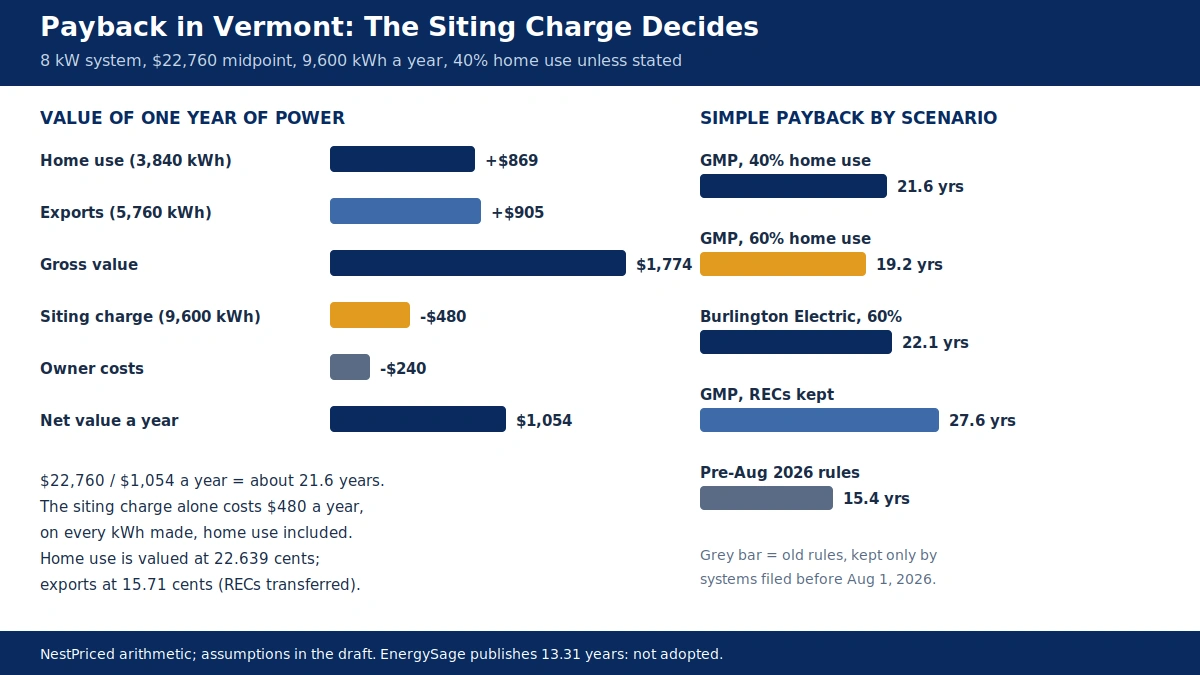
The draft’s own arithmetic is laid out in full, so any reader can rework it. It prices an 8 kW system at the midpoint cost of $22,760, producing 9,600 kilowatt-hours a year at the 1,200 planning yield, against average home use of 6,888 kilowatt-hours a year. Power the home uses as it is made is valued at Green Mountain Power’s Rate 1 energy price, 22.639 cents. Exported power is valued at 15.71 cents, the post-August 2026 credit for a system that transfers its RECs. The siting charge of 5 cents is subtracted on every kilowatt-hour made, and owner costs of $30 per kilowatt per year, $240 for 8 kW, cover cleaning, monitoring, and a reserve for a replacement inverter. No rate rises, no degradation, and no upkeep beyond that reserve are assumed in the simple payback, and the 25-year figure below adds a rough degradation allowance.
At 40 percent home use, the common planning assumption for a home where nobody is home during the day, the system is worth about $1,054 a year and pays back in about 21.6 years. The home uses 3,840 kilowatt-hours worth $869 at the energy price, exports 5,760 kilowatt-hours worth $905 at the export credit, and pays $480 in siting charges plus $240 in owner costs. At 60 percent home use, the case for a home with daytime loads like a heat pump, an electric car charging at midday, or someone working from home, the system is worth about $1,187 a year and pays back in about 19.2 years. The home uses 5,760 kilowatt-hours worth $1,304, exports 3,840 worth $603, and pays the same $720 in charges and costs. The honest headline is about 19 to 22 years on Green Mountain Power for a right-sized owned system that transfers its RECs.
Two variations show how much the choices matter. On Burlington Electric, at 60 percent home use, the system is worth about $1,029 a year and pays back in about 22.1 years, because the export credit is 11.59 cents instead of 15.71. Keeping the RECs, at 40 percent home use on Green Mountain Power, the system is worth about $824 a year and pays back in about 27.6 years, because the export credit falls to 11.71 cents. The REC choice alone adds roughly six years to payback, and the utility alone adds roughly three. Both numbers should be in the quote before the buyer signs, because both are set by choices the buyer makes once and lives with for decades.
The old rules would have paid back far faster, and the comparison is worth printing because it shows what the May 2026 order cost new applicants. Under the pre-August 2026 numbers, with the home-use value held at the same October 2026 energy rate for both periods as a labeled approximation, the same 8 kW system at 40 percent home use would have been worth about $1,478 a year and paid back in about 15.4 years. The new rules cut about $424 a year from the same system, entirely through the lower net export credit and the higher siting charge. A buyer whose application was filed in July 2026 owns a materially better deal than a buyer whose identical application was filed in August, and no installer should present the old payback for a new filing.
The 25-year picture is thin before rate rises and better after them. At about $1,100 a year for 25 years with a rough 6 percent degradation allowance, the system returns about $25,850 in gross bill value against a $22,760 cost, a margin of about $3,000 over the life of the panels. That margin is the whole profit on a cash purchase before rate rises, and it is why the rate trend matters so much: Vermont’s average residential rate rose 7.9 percent in the year to August 2026, and every cent the rate rises adds about $96 a year to an 8 kW system’s value at the planning yield. A buyer who believes rates will keep rising buys a hedge as much as a power plant. A buyer who believes rates will stay flat buys a 20-year wait for a small return, and should know that before signing.
Oversizing is the fastest way to wreck the math. A 12 kW system at the planning yield makes 14,400 kilowatt-hours a year, more than double the average home’s use, and sends over 7,500 kilowatt-hours out at the reduced export credit while paying the siting charge on every one of the 14,400. Its payback runs longer than the 8 kW system’s, not shorter, even though its per-watt price is lower. The only homes that should buy 11 or 12 kW are homes whose bills prove the load: a heat pump heating the whole house, two electric cars, or electric resistance heat through a Vermont winter. The bills decide, and the installer who sizes from the roof instead of the bills is sizing for the installer’s revenue, not the buyer’s return.
| Payback scenario (NestPriced arithmetic, assumptions stated) | Annual value | Simple payback on $22,760 |
|---|---|---|
| GMP, 40% home use, RECs transferred | ~$1,054 | ~21.6 years |
| GMP, 60% home use, RECs transferred | ~$1,187 | ~19.2 years |
| Burlington Electric, 60% home use, RECs transferred | ~$1,029 | ~22.1 years |
| GMP, 40% home use, RECs kept | ~$824 | ~27.6 years |
| GMP, 40% home use, pre-Aug 2026 rules (approximation) | ~$1,478 | ~15.4 years |
Should You Add a Battery in Vermont?
A battery in Vermont is a resilience purchase with a rebate attached, not a money purchase, and the draft says so first because the sales pitch usually says the opposite. Under Vermont net metering, exported power banks as bill credits for 12 months at about 15.71 cents, so storing power in a battery to use later earns almost nothing over sending it out and buying it back as a credit. The battery’s value is keeping the lights, the heat pump, and the well pump running when the grid goes down, and in a state where ice storms and heavy snow take lines down every winter, that value is real. It is just not a payback.
The national battery prices set the scale. Installed storage runs $700 to $1,300 per kilowatt-hour, and a typical 13.5 kilowatt-hour install averaged $15,647 in the first half of 2026. A Tesla Powerwall 3, 13.5 kilowatt-hours with 11.5 kW of continuous power and a built-in inverter, averaged $13,473 installed, typically $13,000 to $16,500, with a 10-year warranty at 70 percent capacity and round-trip efficiency near 89 to 90 percent. No Vermont-specific battery install price was verified in this research, so the draft uses the national figures and says so. A Vermont quote above the national range should explain itself in travel, panel work, or a complex install.
Vermont pays for batteries in two ways, and the two ways may or may not stack. Efficiency Vermont pays $0.40 per watt-hour of battery capacity for solar-paired storage, on a program verified in April 2026, so a 13.5 kilowatt-hour Powerwall earns $5,400. Green Mountain Power’s Bring Your Own Device program pays $850 per kilowatt of battery power for a battery enrolled at a three-hour discharge, or $950 per kilowatt at a four-hour discharge, up to $10,500 in total, plus a $100 per kilowatt bonus in high-need grid areas on one source’s account. A 5 kW battery earns $4,250 to $4,750 from GMP before any bonus. The BYOD program was renewed from October 1, 2026 to September 30, 2028. Whether the Efficiency Vermont payment and the GMP payment stack on the same battery was not verified in this research, and the draft tells buyers to confirm stacking with the installer and with GMP before counting both. Efficiency Vermont’s annual funding pot has historically run out in late November or early December in most years, on a single source’s account, so a buyer who waits until winter to decide may find the pot empty.
The bill-saving arithmetic for a battery is short, because there is almost nothing to save. A battery that cycles 900 surplus kilowatt-hours a year through storage instead of export earns the difference between the retail energy price and the export credit on those hours, about 7 cents, or about $63 a year, before the round-trip losses take their tenth. At that rate a $13,473 battery never pays for itself on bill savings alone, even after the Efficiency Vermont payment. The arithmetic changes only if the home is on a time-of-use rate or faces demand charges, neither of which applies to most Vermont residential customers, and the draft does not invent a time-of-use case that was not verified.
The resilience case is where the battery earns its keep, and it should be priced as insurance. A Powerwall keeps a heat pump, a refrigerator, lights, and a well pump running through an outage, and GMP dispatches enrolled batteries during peak events, about 5 to 8 events a month at 3 to 6 hours each on one program summary’s account, which is real participation rather than a nominal enrollment. A home on a rural feeder at the end of a long line, a home with a well and no municipal water, and a home where someone depends on powered medical equipment all have a stronger battery case than a home on a short urban feeder in Burlington. The buyer should ask the installer for the backed-up loads list in writing, because a battery that backs up the whole house for an hour is a different purchase from a battery that backs up the heat pump and the fridge for a day.
Green Mountain Power also leases Powerwall units to its customers, a program several guides describe. The lease price is not stated in this guide because the guides conflict, with one stating $15 a month and another stating a far higher figure, and neither was verified from GMP’s own materials. A leased battery does not earn the homeowner-owned incentives in the same way, and the draft tells buyers to get the lease terms, the dispatch terms, and who owns the battery at the end of the lease in writing before comparing a lease with a purchase. The solar battery cost guide prices the national battery market in full.
Solar Incentives, Tax Breaks, and Loans in Vermont in 2026
Vermont gives a solar buyer bill credits and taxes it never pays, not a check for the panels, and the stack is thinner than the neighbors’. There is no state income tax credit for home solar, no open statewide rebate for the panels themselves, and no federal credit for a homeowner-owned system installed in 2026. What survives is net metering, a sales tax exemption on the equipment, a property tax exemption on the added value, and two battery payments. A guide that lists a state solar rebate in 2026 is listing a program that does not exist, and a seller who promises one is promising money that will not arrive.
The federal government contributes $0 to a 2026 Vermont system the buyer owns outright. The One Big Beautiful Bill Act, Public Law 119-21, together with Internal Revenue Service Fact Sheet 2025-05, ended the residential clean energy credit under section 25D for expenditures after December 31, 2025. The lease pass-through under section 48E covers clean-electricity property through about 2027, and one single-source claim holds that section 48E(i) denies the credit for solar leased to a home, with a July 4, 2026 construction deadline; that claim is unresolved in this research and is not asserted here. For everything Washington changed for 2026, read our federal energy tax credits guide. A contractor who promises a 30 percent federal credit on a 2026 owned system is promising money Congress repealed.
The federal home energy rebates are not open in Vermont, and the buyer should not budget for them. The state advises not to plan on the electrification rebate funds for now, and no launch of the whole-home rebate program has been announced, with delivery planned through weatherization. The federal allocations were about $29.19 million for the electrification rebates and about $29.30 million for the whole-home rebates, on Department of Energy figures from January 2025, and Vermont appears on no launched-state map from February 2026. A solar system is not a rebate measure in any case: the programs cover insulation, air sealing, wiring, panel upgrades, and appliances, so at most the panel upgrade and wiring in a whole-home project could have qualified. No rebate line belongs in a 2026 Vermont solar quote.
The sales tax exemption is real, and one widely read guide gets it wrong. Equipment in a net-metering system is exempt from Vermont sales and use tax under 32 V.S.A. section 9741(46), and the buyer gives the seller Form S-3E. Three sources agree on the exemption, and one of them notes that a claim the exemption expired on June 30, 2026 is false. A different guide states flatly that Vermont offers no sales tax exemption and that the 6 percent tax adds $1,500 to $3,000 to a typical system. That guide is not followed here, and the conflict is stated so a reader who finds it first understands why the two guides disagree. At 6 percent on a $22,760 system, the exemption is worth about $1,366 by NestPriced arithmetic, and the buyer should check that the quote does not charge the tax anyway.
The property tax exemption is real too, and simpler. Vermont law under 32 V.S.A. section 3845 exempts residential solar installations from property tax assessment, so the panels do not raise the home’s assessed value. One guide also mentions a uniform capacity tax of $4 per kilowatt for solar property owners, and whether that tax reaches a home net-metering system or only larger plants was not verified in this research, so the draft does not assert it for a home roof and flags it. A buyer should ask the town lister whether the exemption needs a filing after install, because the statute and the town’s paperwork are not the same thing.
The battery payments are the only cash in the stack, and they are covered in the battery section: Efficiency Vermont pays $0.40 per watt-hour of battery capacity, and Green Mountain Power’s Bring Your Own Device program pays $850 to $950 per kilowatt of battery power up to $10,500. Neither payment touches the panels. A buyer who is told the battery incentive lowers the panel price is being told something the programs do not do.
Financing for the balance follows the general routes, because no Vermont-specific solar loan rate or term was verified in this research. Contractor payment plans exist, home equity lines of credit and home equity loans exist, and personal loans exist, and each carries a different rate, term, and risk. A home equity line puts the house behind the loan, which is the cheapest money and the riskiest. A contractor plan is the most convenient and often the most expensive once the promotional period ends. A personal loan is unsecured and priced accordingly. No Vermont solar loan program matching Montana’s state revolving loan was found, and the draft discloses that gap rather than inventing a program. The solar system cost guide for 6, 8, and 10 kW systems compares the routes in general terms. Whatever the route, the payment schedule in the contract follows the same rule: a deposit, a progress payment at a named milestone such as the certificate filing, and the balance on completion and interconnection, with the system not switched on before the net meter is installed.
Lease vs Own in Vermont: Why Buying Still Wins
Leasing looks attractive in Vermont for one reason and fails for three, and the one reason is the cash. A lease or power purchase agreement puts panels on the roof with little or no money down, and the homeowner pays a monthly lease fee or a per-kilowatt-hour rate to the leasing company instead of buying the system. For a buyer who cannot fund $22,760 in cash or a loan, that is a real door into solar. The draft does not pretend the door is closed. It says the door leads to a smaller return, and prices why.
The first failure is the credit. The net-metering credits, the siting charge, and the REC choice all attach to the system owner, and on a leased system the owner is the leasing company, not the homeowner. The homeowner’s bill still falls, because the lease replaces grid power with leased solar power, but the homeowner does not bank the export credits and does not choose what happens to the RECs. The company keeps the valuable parts of the deal and sells the homeowner the power. On an owned system, every one of those parts belongs to the homeowner, including the choice to transfer the RECs for the full 15.71-cent credit.
The second failure is the federal money. A homeowner-owned 2026 system earns a $0 federal credit, which narrows the gap, but a leased system can still pass through the commercial credit under section 48E, and that pass-through is the leasing company’s pitch. The pitch has a clock on it: one single-source claim holds that the credit is denied for solar leased to a home unless construction began before July 4, 2026, and that claim is unresolved in this research, so the draft does not assert it as settled law. What is settled is that the pass-through, if it applies at all, goes to the lessor, and the homeowner’s share of it arrives only as a lower lease payment, if the lessor chooses to pass it on. A buyer should ask the lessor to state in writing how much of the credit is reflected in the lease price, because a pass-through the lessor keeps is not a saving for the homeowner.
The third failure is the house itself. A leased system sits on the roof under a 20- or 25-year contract, and selling the house means transferring the lease, buying it out, or removing the system, each of which costs money or loses a buyer. An owned system is an asset that stays with the house, exempt from property tax under Vermont law, and a buyer who pays cash or a loan owns it outright from the day it is switched on. Vermont’s small market makes the lease problem sharper: fewer installers offer leases here than in the big solar states, and a lease from a company with no Vermont presence is a contract with a distant counterparty on a roof in a snow state.
The math favors owning by a wide margin on the draft’s own numbers. An owned 8 kW system at 60 percent home use returns about $1,187 a year against a $22,760 cost, and the system is the homeowner’s after about 19 years, with five or more years of nearly free power inside the panel warranty. A leased system returns a smaller annual saving, because the lease payment takes a share of it, and the homeowner owns nothing at the end. No Vermont lease price was verified in this research, so the draft does not print a lease-versus-own table with invented lease payments, and a buyer who is offered a lease should demand the same arithmetic the draft prints for owning: the annual bill saving, the annual lease cost, and the net, in writing, before signing. If the lessor will not print it, the lease is not a deal the buyer can check, and a deal the buyer cannot check is not a deal to sign.
Group Net Metering and Community Solar: Solar Without Your Own Roof
Not every Vermont home can take panels, and the state has two answers for those homes. The first is group net metering, covered in the net-metering section: one array shares its credits among several accounts, which suits a shaded roof, a renter, or a home whose roof faces north. The second is community solar, where a subscriber buys a share of a larger array elsewhere and receives credits on the bill. The draft covers both briefly, because neither replaces the owned-roof decision for a home that can take panels, and both carry their own paperwork.
Group net metering is the more Vermont of the two, because the state’s law was written for it. A group array can sit on a barn, a field, or a neighbor’s roof and serve several accounts, and the credits flow to the members’ bills under the same blended rate and adjustors as an individual system. The new limit is the parcel rule: for certificates filed on or after January 1, 2025, the plant must sit on the same parcel or an adjacent parcel, which keeps group arrays local and stops a distant array from serving accounts across the state. A buyer joining a group should ask for the certificate filing date, because that date sets the adjustors, and should ask how the credits are divided, because the division is a contract term, not a law. Shared solar in general terms is priced in our community solar cost guide.
Community solar subscriptions were not priced for Vermont in this research, and the draft does not invent a Vermont subscription price. No Vermont community solar cents-per-kilowatt-hour figure, subscription fee, or savings percentage was verified, and a buyer who is offered one should ask for the same three numbers the draft demands of a lease: the annual bill saving, the annual subscription cost, and the net, in writing, plus the term, the exit fee, and who owns the RECs. A subscription with no exit fee and a clear net saving is a reasonable way into solar for a renter. A subscription with a long term, a high exit fee, and a saving that depends on rate rises is a contract to read twice.
The decision rule is simple. A home with a sound south-facing roof should own its own system, because owning captures the credits, the REC choice, and the property tax exemption, and the payback, long as it is, is the homeowner’s. A home with a shaded roof, a rented roof, or a roof that cannot take the weight should look at group net metering first, because the credits are the same and the array sits where the sun is. A home that cannot join a group should look at community solar last, because the saving is thinner and the contract is longer. In every case the buyer should get the numbers in writing before signing, because a shared-solar saving that exists only in a sales script is not a saving at all.
Permits, the Certificate of Public Good, and Installer Rules in Vermont
Vermont adds a state filing on top of the town permits, and the filing is the step most out-of-state guides miss. Every net-metering system needs a Certificate of Public Good, called a CPG, registered through the Commission’s ePUC system under Rule 5.100, whose current version took effect March 1, 2024. Roof-mounted systems up to 500 kW use a registration form. Ground-mounted systems over 15 kW use a full application, as do other technologies up to 500 kW. Since March 1, 2024 the interconnection process under Rule 5.500 and the CPG process are separate, with a partial crossover for systems of 15 kW or less, which means the installer files two tracks, not one, and the contract should name who files each.
The sequence matters, and Green Mountain Power states it plainly. For systems up to 15 kW, the homeowner or installer applies through ePUC using the net-metering registration, and GMP emails about any issues by the 15th day after a complete application. The Commission then issues or denies the CPG, and the CPG is conditioned on meeting GMP’s interconnection requirements. For larger systems the installer sends the interconnection application to GMP first and attaches the approval letter to the CPG filing. The system must not be switched on before the net meter is installed, and the buyer should not make the final payment until the interconnection is complete and the meter is in place. A contract that does not name who files the CPG, who answers the Commission’s questions, and who tracks the interconnection is a contract that leaves the buyer holding the paperwork.
Town permits sit on top of the CPG, and they vary by town. Zoning approval, a building permit, and an electrical inspection apply under the town’s own rules, and no statewide solar permit fee schedule was verified in this research. No Burlington, Montpelier, or Rutland permit fee figure for rooftop solar was found, and none is stated here. The buyer gets the fee from the town desk before budgeting it, and the installer should name the permit responsibility in the contract, because a permit the installer assumed the town would waive is a permit the buyer pays for twice.
Installer licensing is the gap in this section, and the draft discloses it rather than filling it with a guess. No statewide solar-license authority was verified in this research, and one Vermont solar guide states the same finding directly. That does not mean anyone can wire a roof: electrical work in Vermont is done by licensed electricians under the state’s licensing rules, and the buyer should confirm the installer’s credentials and the town’s requirements before signing. The practical vetting is the same as in every state in this series: three recent jobs in the same county, references called, insurance certificates confirmed with the insurer, and a contract that names the panel model, the inverter type, the production estimate, the CPG filing responsibility, and the payment schedule. A Vermont installer with a track record of filed CPGs is worth more than a cheap quote from a company that has never used ePUC, because the paperwork is where Vermont installs stall.
A sale of the house with panels on it has one Vermont wrinkle worth knowing. Since March 1, 2024, a sale of land hosting a net-metering system, when the system is sold with it, requires notice to the utility but no Commission filing. The buyer should still tell the utility, transfer the CPG if one is needed, and confirm with the utility that the net-metering credits follow the account, because a credit that stays with the seller is a credit the buyer never sees. The contract for the house sale should name the system, the warranty, and the monitoring login, so the new owner inherits the system rather than discovering it.
Getting Solar Quotes in Vermont: Checklist and Decision Rules
Timing a Vermont install is a weather decision as much as a price decision. The best window is late spring through early fall, when the roof is dry, the days are long, and the crew can work without snow. A spring install faces the mud season on rural roads and a roof that may still hold snow in the valleys. A fall install faces the short days and the first snow, and a winter install faces a roof the crew cannot safely work on at all. The certificate filing should go in as early as the decision allows, because the filing date sets the net-metering numbers, and a filing that slips past a rate change can cost more than a month of waiting for a crew. A buyer who can wait until the backlog clears after the summer rush gets a better price and a calmer crew than a buyer who signs in the week after a storm takes the lines down.
Getting quotes that compare is a discipline, and the checklist below is the discipline. Three bids, same scope, same lines, same product names, from installers whose references check out in the same county. Every bid names the panel by brand and model, the inverter type, the year-one production estimate for the actual roof direction and tilt, the snow allowance in that estimate, the certificate filing responsibility, the interconnection responsibility, the permit responsibility and fee, the payment schedule, and the two warranties. The buyer rejects any bid that prices a lump sum without the lines, any bid that promises retail-rate credits, any bid that shows no siting charge, any bid that demands full payment upfront, and any bid that sizes the system from the roof instead of the bills.
For the Vermont heating side of the same house, see the heat pump cost in Vermont guide. For neighboring-state comparisons, see the New Hampshire solar panel cost guide, the Maine solar panel cost guide, and the Massachusetts solar panel cost guide.
| Quote line | What a good bid names |
|---|---|
| Panel and inverter | Brand, model, wattage, string or microinverters |
| Production estimate | Year-one kWh for the actual roof direction and tilt, snow allowance stated |
| Net-metering math | Application date assumed, export credit, siting charge, REC choice |
| Certificate and interconnection | Who files the CPG, who handles GMP or VEC interconnection |
| Permits | Town permit responsibility and fee |
| Roof and electrical | Roof age sign-off, panel upgrade if needed, snow guards if specified |
| Warranties | Panel, inverter, and workmanship terms in writing |
| Payment | Deposit, progress at a named milestone, balance on interconnection |

Sources & methodology
This guide prices an 8 kW rooftop system in Vermont, installed, as its headline job, and every band states its source, its date, and its scope. The lead band comes from EnergySage marketplace quote data (November 2026), EcoGen Solar Cost Index (September 2026 edition, prices as of September 25, 2026), and SolarReviews (November 2026 cost model), with NumeralQ planning estimates (October 2026) and renewestimator (July 2026) as cross-checks. City figures come from EnergySage city pages for Burlington, Montpelier, Brattleboro, and White River Junction (November 2026). Electricity rates and household use come from the Energy Information Administration Electric Power Monthly Table 5.6.A (August 2026) and Form 861 (2024). Production figures come from EcoGen and PVWatts-based models, with seasonal splits from NASA POWER hourly data. Net-metering figures come from the Vermont Public Utility Commission order in Case 26-0291-INV (May 29, 2026), the 2024 biennial update order in Case 24-0248-INV, Rule 5.100, and utility tariffs from Green Mountain Power and Vermont Electric Cooperative. Snowfall figures come from NOAA normals as reported by secondary climate pages. Battery prices come from EnergySage marketplace data (September 2026) via the research file. Tax framing follows the One Big Beautiful Bill Act (Public Law 119-21) and Internal Revenue Service Fact Sheet 2025-05. Rebate status follows the Vermont Department of Public Service position as reported in November 2026 and concordant trackers. Derived figures, including the size-table taper, the per-kilowatt production planning figure, the payback scenarios, and the 25-year rough value, are NestPriced arithmetic on the cited sources and are labeled as such in the text. Figures that could not be verified, including any Rutland city band, the Burlington Electric residential rate from BED’s own tariff, any Vermont-specific battery install price, any Vermont solar loan terms, any Vermont community solar price, any town permit fee, the $4 per kW capacity tax as applied to a home system, and any carrier-verified lease price, are disclosed as unverified or as planning estimates in the sections where they arise, and no figure in this guide is presented as verified when it is not.
Disclaimer: Prices in this guide are planning estimates from the cited cost models and guides, not quotes, and the actual price of a system depends on the roof direction and tilt, the shading, the snow load for the exact address, the electrical service, the distance the crew travels, and the installer’s current material and labor costs. Net-metering rates, adjustors, and certificate rules change, and the buyer should confirm the current tariff with the utility before signing a contract. Tax and rebate information is general information, not tax advice, and the buyer should consult a licensed professional for advice on a specific property. Solar work involves roofing and electrical work, and the buyer should hire licensed professionals for the installation.
How much do solar panels cost in Vermont in 2026?
An 8 kW rooftop system costs $22,240–$23,280 installed in Vermont in 2026, or $2.78–$2.91 per watt, on a cross-checked band from EnergySage, EcoGen, and SolarReviews 2026 models. The midpoint is about $22,760. Burlington runs $2.76 per watt, Montpelier $2.75, and Brattleboro $2.78 on EnergySage city data from November 2026, while Rutland carries the state band as a planning estimate because no verified city band was found for it.
How much electricity do solar panels make in Vermont?
About 1,200 kilowatt-hours per kilowatt each year on this guide’s planning figure, so an 8 kW system makes about 9,600 kilowatt-hours a year. Published models span 1,025 to 1,269 kilowatt-hours per kilowatt, and the planning figure sits inside that range. Winter makes about a third of summer per kilowatt: in Montpelier each kilowatt makes about 5.64 kilowatt-hours a day in summer and about 1.60 in winter. Snow cuts production under 2 to 3 inches of cover and brings it near zero above about 4 inches.
How does net metering work in Vermont in 2026?
For applications filed on or after August 1, 2026, exported power earns the statewide blended rate of 20.71 cents per kilowatt-hour, and a new system up to 15 kW also pays a siting charge of 5 cents on every kilowatt-hour it makes, so the net export credit is about 15.71 cents if the homeowner transfers the renewable energy credits to the utility, or about 11.71 cents if the credits are kept. Credits roll forward month to month and expire after 12 months, and they cannot pay the fixed charges on the bill. Systems filed before August 1, 2026 keep the older adjustors.
What is the siting charge on Vermont solar?
The siting charge is 5 cents per kilowatt-hour for a new home system up to 15 kW, set in the Public Utility Commission’s May 29, 2026 order, and it applies to every kilowatt-hour the system makes, including power the home uses itself. On an 8 kW system making 9,600 kilowatt-hours a year, the charge is $480 a year. The previous charge was 4 cents for applications filed from August 1, 2024 to July 31, 2026. The charge is the main reason Vermont payback runs longer than the published 13-year figures suggest.
How long until solar panels pay for themselves in Vermont?
About 19 to 22 years for a right-sized owned 8 kW system on Green Mountain Power that transfers its renewable energy credits, on NestPriced arithmetic using the post-August 2026 rules: about 21.6 years at 40 percent home use and about 19.2 years at 60 percent home use. The same system on Burlington Electric pays back in about 22.1 years, and keeping the credits stretches payback to about 27.6 years. EnergySage publishes 13.31 years, a model that appears to value exports near retail without the siting charge, and this guide does not adopt it.
Is there a tax credit or rebate for solar panels in Vermont in 2026?
No federal credit for a homeowner-owned system installed in 2026: the residential clean energy credit ended for expenditures after December 31, 2025. Vermont has no state income tax credit for home solar and no open statewide rebate for the panels themselves, and the federal home energy rebates have not launched in Vermont. What survives is net metering, a sales tax exemption on net-metering equipment under 32 V.S.A. section 9741(46), a property tax exemption under 32 V.S.A. section 3845, and battery payments from Efficiency Vermont and Green Mountain Power.
Should I add a battery to my Vermont solar system?
A battery is a resilience purchase, not a money purchase, in Vermont. With 12-month bill credits at about 15.71 cents, storing power earns almost nothing over exporting it, and a 13.5 kilowatt-hour battery costing about $13,473 installed never pays for itself on bill savings alone. The case for one is keeping the heat pump, fridge, and well pump running through winter outages. Efficiency Vermont pays $0.40 per watt-hour of battery capacity, and Green Mountain Power’s Bring Your Own Device program pays $850 to $950 per kilowatt of battery power up to $10,500, though whether the two stack was not verified.
Do I need a certificate of public good for solar panels in Vermont?
Yes. Every net-metering system needs a Certificate of Public Good registered through the Public Utility Commission’s ePUC system under Rule 5.100. Roof-mounted systems up to 500 kW use a registration form, and ground-mounted systems over 15 kW use a full application. The interconnection process and the certificate process have been separate since March 1, 2024, and the contract should name who files each. Town zoning and building permits apply on top of the certificate.