

A Vermont heat pump buyer starts from a different place than a buyer in almost any other state in this series, because the fuel in the basement is usually delivered by truck. Fifty-eight percent of Vermont homes heat with propane or oil, and only 18 percent with piped gas. There is one gas line in the state, and it reaches only the northwest corner. For most Vermonters there is no gas main to fall back on, no gas furnace to pair with in a dual-fuel setup, and no gas bill to compare against. The comparison that matters is the oil truck against the electric meter — and that comparison moves every week, because the oil price moves every week. In the last week of October 2026, Vermont heating oil averaged $6.09 a gallon, up from $3.91 the previous winter. At $6.09, a heat pump beats an oil furnace by a wide margin. At $3.91, it loses. No other state in this series has a running-cost verdict that can flip on a single winter’s fuel price, and this guide is built around that fact.
The second thing that sets Vermont apart is the price of the electricity itself. Vermont residential power averaged 23.84 cents a kilowatt-hour in August 2026, the 12th-highest in the country and 31 percent above the national average. A heat pump that would be an easy win in a cheap-power state has to clear a much higher bar here: at 23.9 cents, it needs a seasonal efficiency near 3.8 to tie a 95 percent gas furnace, and no heat pump sold today sustains that through a Burlington winter. Against oil and propane, the bar is far lower — a break-even efficiency near 1.4 against oil at today’s price — and a good cold-climate unit clears it with room to spare. So the honest Vermont answer is split down the middle: a heat pump is the best buy in the state for an oil- or propane-heated home, and a money-loser on fuel for the small minority of homes on piped gas. Which side of that line a house falls on is decided before any equipment is chosen, by the fuel already in the basement.
The third thing is the rebate stack, and it is the best in this series by a clear margin. Efficiency Vermont pays up to $2,200 on a ducted system and up to $475 on a ductless one. Green Mountain Power, which serves roughly three-quarters of Vermont homes, adds up to $2,000 more for households at or below 80 percent of area median income, processed together in one step. Burlington Electric runs its own program that can reach $7,950 for an income-qualified ducted install, and Efficiency Vermont pays up to 90 percent cash back on weatherization through the end of 2026. The catch is that every rebate has its own rules and paperwork — and the federal money that would have mattered most, the $8,000 HEAR rebate, has never launched in Vermont at all.
Start with our national heat pump cost guide for the national numbers, then set Vermont’s figures beside them.
Table of Contents
How Much Does a Heat Pump Cost in Vermont in 2026?
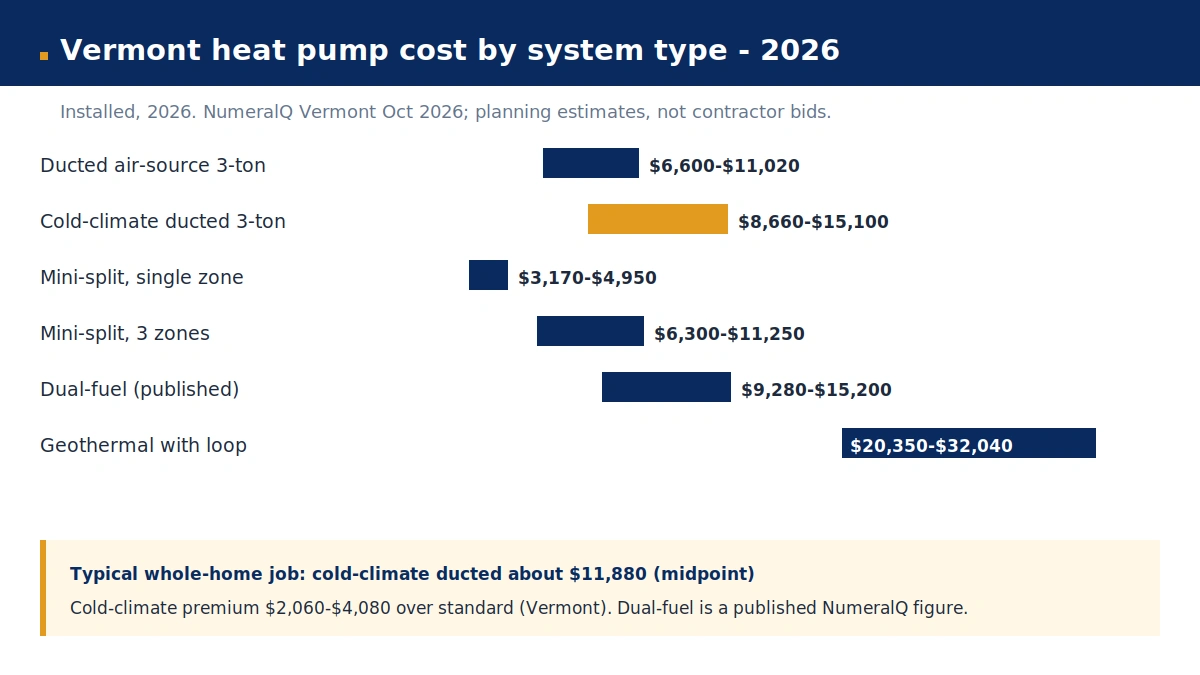
Vermont pricing in 2026 rests on two anchors, and the space between them is what cold-climate hardware costs. NumeralQ’s Vermont estimator, priced October 26, 2026, sets a standard ducted 3-ton air-source install at $6,600-$11,020 — the planning band for replacing a whole home’s ducted system in a typical Vermont house. Choose the cold-climate ducted version of that same 3-ton job, and the band moves to $8,660-$15,100. That $2,060 to $4,080 step up is the inverter compressor, the enhanced vapor injection, the larger coil, and the low-temperature controls that let the unit keep heating at 5 degrees and below — and in Vermont it is the price of the system that actually works here, not an upgrade to consider later.
The disagreement comes from EnergySage’s 2026 marketplace data, which averages $15,393 for an air-source install before incentives and $14,529 for ducted systems — well above Vermont’s NumeralQ top end. The two figures describe different samples: EnergySage’s average is drawn mostly from Massachusetts quotes and includes premium whole-home ductless jobs, while NumeralQ is a modeled planning estimate for Vermont. Treat EnergySage as a ceiling for a premium-brand job, and NumeralQ as the Vermont planning range. A second modeled source puts Vermont ducted at $4,050-$14,170 with a typical $10,700, which brackets the NumeralQ range on both sides.
Inside that per-ton range sits the complete installed job: the outdoor unit, the indoor coil or air handler, the refrigerant lineset, the pad or wall bracket, the electrical disconnect and wiring, the thermostat, labor, permits, and startup. A panel upgrade, ductwork repairs, a snow stand for the outdoor unit, and the removal of an old oil tank are all extra, and in Vermont the oil tank is the add-on no other state in this series has to price: a decommissioned tank in the basement does not remove itself, and an abandoned underground tank can become a liability that outlives the house. Each extra shows up as its own line on the quote, and this guide prices each one where it comes up.
Two rebates sit inside the arithmetic, and both are large enough to matter. Efficiency Vermont pays up to $2,200 on a ducted system, which takes the cold-climate midpoint of $11,880 down to about $9,680. For an income-eligible Green Mountain Power household, the GMP bonus of up to $2,000 takes it to about $7,680. For an income-qualified Burlington Electric household, the BED program can reach $7,950 in total. Those are the biggest rebates in this series — but they are also the most conditional: the EVT rebate is tiered by system size, the GMP bonus needs the household at or below 80 percent of area median income, and the BED program caps at 75 percent of the project cost. The rebate section below works through each one with its conditions attached.
Before the tables, one warning: the cheapest Vermont quote is not always the cheapest system once winter arrives. Vermont’s installer bench is thin outside Chittenden County, and a quote that prices a standard unit where a cold-climate unit belongs is not a bargain — it is a system that will call for resistance heat on the first minus 5 night and stay on it. Set the bids side by side and only one number compares cleanly: the installed price for the same cold-climate model, on the same house, with the same backup heat, in writing. Get that number from three installers at least, and drop any bidder who will not put the model number and its 5-degree capacity and COP on paper. In a rural state like Vermont, that third quote is harder to get — and more important for exactly that reason.
| Source | 3-ton ducted | 3-ton cold-climate | Single-zone mini-split | Geothermal |
|---|---|---|---|---|
| NumeralQ VT (Oct 2026) | $6,600-$11,020 | $8,660-$15,100 | $3,170-$4,950 | $20,350-$32,040 |
| National survey (May 2026) | $9,500-$15,000 | $14,000-$18,500 (brand models) | $2,000-$7,000 | $20,000-$50,000+ |
| EnergySage marketplace (2026) | $14,529 avg (ducted) | — | ~$25,957 avg (whole-home ductless) | $15,000-$40,000+ |
| BetterHouse VT model (2026) | $4,050-$14,170 (typical $10,700) | — | — | — |
Two rows in that table need a footnote, not a headline. Brand-model prices in the national survey’s cold-climate column sit above Vermont’s NumeralQ range — premium-brand installed prices from bigger metro markets, shown here as a ceiling rather than the Vermont price. And the EnergySage ducted average of $14,529 sits above Vermont’s top end because it is a marketplace average drawn mostly from Massachusetts quotes, not a Vermont planning figure. The geothermal column’s national range runs to $50,000 and beyond because ground-loop drilling costs vary enormously with soil, ledge, and lot size; NumeralQ’s $20,350-$32,040 is the Vermont planning range for a typical residential loop, and a tight in-town lot or a vertical borefield in Vermont ledge can push past it. The dual-fuel row is different in Vermont than in most states in this series: a published figure exists, $9,280-$15,200, and it is priced in the system-type section below rather than invented here.
Heat Pump Cost in Vermont by System Type
In Vermont, “heat pump” means five different machines, and the dearest costs more than six times the cheapest. Which one fits comes down to the house: whether it has ducts, what heats it now, and how much of the winter the heat pump is expected to carry on its own. Each type below is priced from the NumeralQ Vermont anchors, cross-checked nationally wherever the state figure needs backing.
| System type | Installed cost (VT) | Best for in Vermont |
|---|---|---|
| Ducted air-source, standard (3-ton) | $6,600-$11,020 | Mild-shoulder heating + cooling only — not the primary heat in VT |
| Ducted cold-climate (3-ton) | $8,660-$15,100 | Whole-home primary heat with ducts; the default VT buy |
| Ductless mini-split, single zone | $3,170-$4,950 | One room, addition, camp, or a house with no ducts |
| Ductless multi-zone (3 heads) | $6,300-$11,250 | Whole-home without ducts; zone-by-zone control |
| Dual-fuel (cold-climate + gas furnace) | $9,280-$15,200 (published) | Gas-heated home in the northwest corner that wants a heat pump for shoulder seasons + AC |
| Geothermal, ground-source with loop | $20,350-$32,040 | Long-term owner, big lot, coldest sites; steadiest winter COP |
Ducted cold-climate is the default Vermont buy. It runs on the house’s existing ducts, heats and cools the whole home from a single system, and — once the model is on the NEEP cold-climate list or meets the ENERGY STAR cold-climate criteria — still delivers at least 70 percent of rated capacity at 5 degrees at a COP of 1.75 or better. That $8,660-$15,100 band is the 3-ton job, and where a quote lands inside it comes down to brand, efficiency tier, and how much existing ductwork passes inspection. Leaky, uninsulated ducts in an unconditioned attic push a quote to the top of the band once sealing and insulation join the job — money well spent, because a heat pump pushes more air at lower temperatures than a furnace, so losses a 140-degree oil-furnace airstream could hide turn into cold rooms under a heat pump. Vermont makes that work cheaper than any other state in this series — Efficiency Vermont pays up to 90 percent cash back on weatherization through the end of 2026 — so the envelope work and the heat pump belong in the same conversation, not in separate years. The full ducted-versus-ductless comparison lives in our ductless vs ducted guide.
A standard ducted unit should not be the primary heat in Vermont. Set beside the cold-climate unit, the $6,600-$11,020 standard range reads as $2,000 or more saved. On a mild October day, the two machines are hard to tell apart. The difference arrives in January. At 5 degrees a standard unit keeps 40 to 60 percent of capacity while its COP slides toward 1.0, so the resistance strips run for weeks at a stretch — and at Vermont’s 23.9 cents a kilowatt-hour, resistance heat runs about $70 a million BTU, over three times the oil furnace it replaced. That $2,000 saved at install can return as $500 or more of extra winter electricity in one cold season alone — and then again every season the system runs. A standard unit makes sense in Vermont only as a cooling-first machine in a home where an oil or gas furnace stays the primary heat.
Vermont’s older homes find their retrofit answer in ductless mini-splits. One zone at $3,170-$4,950 heats and cools a single room or one open-plan area, with no ducts anywhere — the outdoor unit on a wall bracket or a snow stand, the indoor head on the wall, one small hole for the lineset. That makes it the right machine for a house with no ductwork at all, which describes a large share of Vermont’s pre-war farmhouses, the Cape Cods and ranches heated by an oil boiler and radiators, and the additions and finished basements that never got a duct run. Three heads at $6,300-$11,250 cover a whole small home, each zone on its own thermostat — and zoning pays real money through a Vermont winter, with bedrooms at 62 overnight while the living room holds 70. The catch never changes: a mini-split heats only the rooms it serves, so a four-bedroom farmhouse with a single head in the living room still needs heat in the bedrooms. Mitsubishi Hyper-Heat, Fujitsu, and Daikin Aurora — the cold-climate mini-split models — keep full rated capacity down to 5 degrees and hold 70 percent or more at minus 13. That performance is why they lead the mini-split market from Burlington to Brattleboro. Vermont’s rebate structure favors them too: Efficiency Vermont pays up to $475 per ductless outdoor unit, and the income bonuses stack on top. Zone-by-zone sizing and pricing live in our mini-split installation guide.
Dual-fuel is the honest answer for the 18 percent of Vermont homes that heat with piped gas — and for them only. A dual-fuel system pairs a cold-climate heat pump with a gas furnace, and a control switches between them at a switchover temperature the installer sets — often somewhere between 30 and 40 degrees in Vermont, depending on the gas and electric prices. Above the switchover point the heat pump runs; below it the furnace takes over. Vermont is one of the few states in this series with a published dual-fuel figure: NumeralQ puts the package at $9,280-$15,200 for a 3-ton job, $9,570-$15,570 in Burlington. That figure is a planning estimate, not a contractor bid, but it is a published one, and it is the number to anchor on. For most Vermont homes, dual-fuel means a propane furnace, not a gas one: there is no gas main to connect to, and a propane furnace paired with a heat pump is a legitimate dual-fuel setup priced from the same components. Our dual-fuel heat pump guide walks through the dual-fuel configuration in detail.
No other system in this state keeps its winter efficiency so steady when the weather turns. A ground-source heat pump draws heat from earth that sits near 45 to 50 degrees year-round, a few feet below a Burlington lawn, so its COP holds at 3.0 to 5.0 through a minus 10 night when an air-source unit is working at 1.75. The NumeralQ Vermont range is $20,350-$32,040 with the loop, against a national range of $20,000-$50,000 or more — the spread is the loop itself, horizontal trenching where the lot allows it, vertical bores where it does not, and the drilling conditions under a Vermont yard, where ledge rock can turn a straightforward bore into an expensive one. Geothermal suits a long-term owner on a big lot who plans to stay put for 20 years. Anyone who might move in five should skip it: the loop is in the ground, it does not move with you, and the payback needs a decade or more of winters to arrive. The federal credit that used to cut 30 percent off a geothermal install is $0 for a 2026 homeowner-owned system, so the geothermal case in 2026 has to stand on operating savings alone. Geothermal’s complete Vermont story is told in our geothermal heat pump guide.
One more configuration is worth a mention: a cold-climate mini-split heating only part of the home. More and more Vermont homes keep their oil boiler and add one or two mini-split heads in the rooms people actually live in — the living room, the home office, the main bedroom. The heads carry the shoulder seasons and the mild winter days; the boiler handles the deep cold. The household gets air conditioning in July for the first time. At $3,170-$4,950 for the first zone, it is the cheapest way into a heat pump in this state. It is also the configuration most likely to disappoint when sold as a whole-home solution: one head will not heat a farmhouse, and any quote suggesting otherwise is selling a smaller system than the house needs.
Heat Pump Cost by Home Size
Once the system type is settled, sizing comes next. Vermont gets that call wrong more often than any other — too big just as often as too small. In Burlington, an undersized heat pump is no minor inconvenience. It is a machine that falls back on resistance heat for a month of every winter — at 23.9 cents a kilowatt-hour. Go too big and the system short-cycles. It never settles into steady efficiency, and it costs thousands more for capacity the house will never use. Only a Manual J load calculation gives the right size — a room-by-room accounting of the house’s heat loss at the design temperature, minus 11 in Burlington, minus 6 in Montpelier, minus 8 in Rutland. Size by square footage alone, or by the size of the furnace being replaced, and the contractor is guessing at the number that decides everything else. Insist on the written Manual J before signing anything.
The table that follows prices ducted air-source systems by tonnage, using NumeralQ’s Vermont anchors, and shows the cold-climate premium beside the standard price so the step up is visible at every size. A ton means 12,000 BTU of heating or cooling in an hour. Heating a Vermont home takes more capacity per square foot than in almost any other state in this series, because the design temperature runs 20 to 30 degrees colder — a 2,000-square-foot Burlington house commonly needs a 3-ton or 3.5-ton system where the same house in a mild climate would get by on 2.5 tons.
| System size | Home size (approx.) | Ducted standard (VT) | Ducted cold-climate (VT) |
|---|---|---|---|
| 1.5 ton | 600-1,000 sq ft | $4,440-$7,120 | $6,500-$11,200 (planning est.) |
| 2 ton | 1,000-1,400 sq ft | $5,160-$8,420 | $7,220-$12,500 (planning est.) |
| 2.5 ton | 1,400-1,700 sq ft | $5,880-$9,720 | $7,940-$13,800 (planning est.) |
| 3 ton | 1,700-2,100 sq ft | $6,600-$11,020 | $8,660-$15,100 |
| 3.5 ton | 2,100-2,400 sq ft | $7,310-$12,320 | $9,370-$16,400 (planning est.) |
| 4 ton | 2,100-2,700 sq ft | $8,030-$13,620 | $10,090-$17,700 (planning est.) |
| 5 ton | 2,700-3,500 sq ft | $9,470-$16,210 | $11,530-$20,290 (planning est.) |
Every row except the 3-ton one in the cold-climate column is an estimate, and it says so. NumeralQ published a cold-climate figure for the 3-ton job alone ($8,660-$15,100); the rest of the column is built by adding Vermont’s $2,060-$4,080 cold-climate premium to the standard range at each size. Treat those rows as planning numbers, not measured Vermont prices — they are not. Their honest value is the shape they show: at any size, the cold-climate unit runs roughly $2,000-$4,000 above the standard unit, and that gap buys a system that still heats at 5 degrees.
Look closer at three points in that table. First, treat the home-size column as rough — rougher in Vermont than most places: a tight, well-insulated 2,000-square-foot house built in 2020 needs far less heat than a drafty 2,000-square-foot farmhouse from 1920 with single-pane windows and bare walls, and the two can sit a full ton apart. Floor area is not what sets the size; age, insulation, windows, air leakage, and ceiling height are — and with Vermont’s housing stock among the oldest in the country, most quotes here land at the farmhouse end of the range. Second, heating load sets the tonnage, not cooling load — Vermont’s heating load runs three to four times its cooling load, so a system sized for summer will be far too small come January. Third, size the backup heat together with the system, not after it: on the coldest night the resistance strips or the boiler must carry the whole design load, because that is when the heat pump contributes least.
The 3-ton row deserves one more minute, because it is the only row carrying a measured cold-climate price, and the size most Vermont homes settle on. Within $8,660-$15,100, brand and efficiency tier set the spread. A value-tier cold-climate unit with HSPF2 near 8.5 sits at the bottom; a premium variable-speed unit above HSPF2 10 sits at the top. Across a Burlington winter the premium tier pays for itself: higher HSPF2 means higher seasonal COP, and every tenth of a COP point is worth real money over 7,771 heating degree days. Money tight? Even at the value tier, a cold-climate unit outclasses a standard one by a wide margin. One more link between size and money: Efficiency Vermont’s ducted rebate tops out at $2,200 on systems of 4 tons or more, so sizing and rebates are one conversation, not two.
Heat Pump Cost by City: Burlington, South Burlington, Rutland & Montpelier
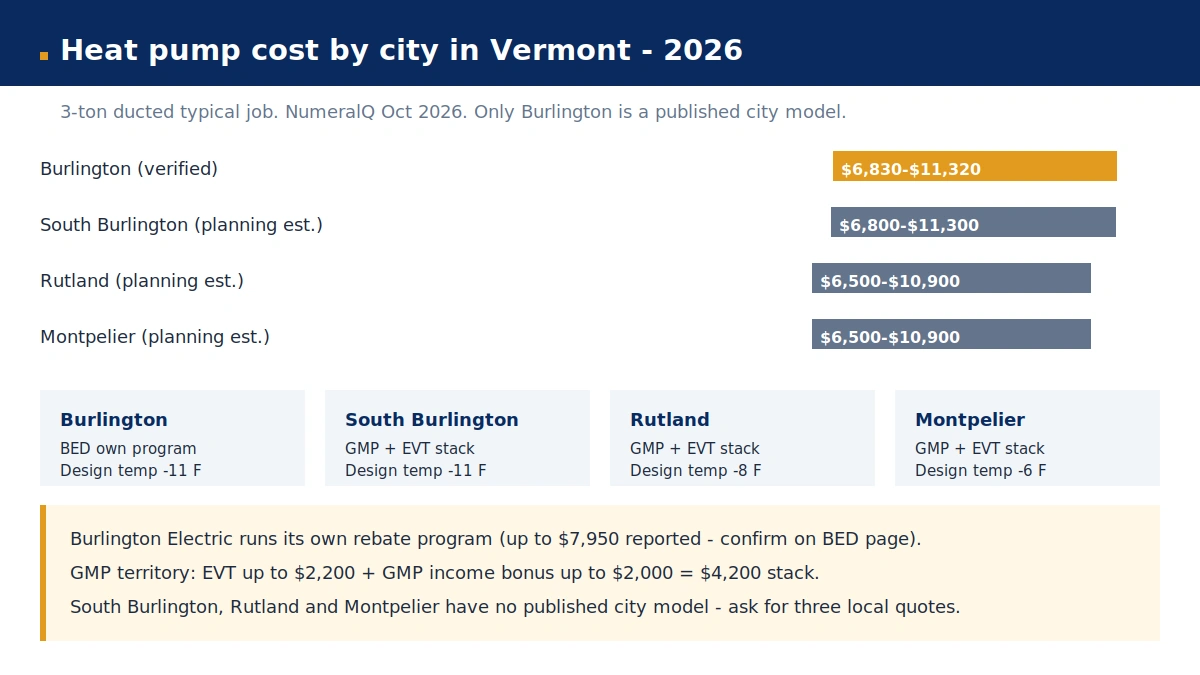
Vermont’s HVAC map has one real market — the Burlington metro in the northwest — with smaller ones strung down the Connecticut River valley and through the Green Mountains, and the verified numbers for the same 3-ton ducted job span $6,830 to $11,320. The cities differ on more than install price: the utility behind the meter decides which rebate program comes with the house — and in Vermont that gap is the widest in the series, because Burlington Electric’s rebate can be worth three times Efficiency Vermont’s. NumeralQ’s October 2026 city pages publish a verified figure for one city only; the other three are labeled estimates, not measured prices.
| City | 3-ton ducted (verified) | Utility | Rebate program |
|---|---|---|---|
| Burlington | $6,830-$11,320 | Burlington Electric (BED) | BED own program, up to $7,950 |
| South Burlington | ~$6,800-$11,300 (planning est.) | Green Mountain Power | EVT + GMP, up to $4,200 stack |
| Rutland | ~$6,500-$10,900 (planning est.) | Green Mountain Power | EVT + GMP, up to $4,200 stack |
| Montpelier | ~$6,500-$10,900 (planning est.) | Green Mountain Power | EVT + GMP, up to $4,200 stack |
Burlington is the biggest market in the state and the only verified city, at $6,830-$11,320 for a 3-ton ducted system, with the cold-climate version at $8,940-$15,460. Burlington is also where the installer bench is deepest and where the rebate is richest: Burlington Electric runs its own heat pump program, independent of Efficiency Vermont, that a secondary tracker puts at $2,450-$2,550 for systems of 2 tons or less and $2,850-$2,950 above 2 tons, with income bonuses on top and a total that can reach $7,950 for an income-qualified ducted install. That figure is flagged, not verified on BED’s own page in this pass — and Efficiency Vermont’s own page says BED customers are eligible for a $1,000-$2,000 EVT discount instead, which is a different number from a different program. Both figures are printed in the rebate section below with the conflict flagged. Confirm the current BED figures on burlingtonelectric.com before quoting either one.
South Burlington sits across the city line from Burlington on Green Mountain Power, and its planning estimate of about $6,800-$11,300 is built from the state range and the Burlington figure, not a measured market price. What is real about South Burlington is the rebate stack: EVT up to $2,200 plus the GMP income bonus of up to $2,000 for households at or below 80 percent of area median income, processed together through one portal, for a combined $4,200 on a ducted system. The same stack applies in Rutland and Montpelier, the other two planning-estimate cities, which share GMP territory and the same EVT-plus-GMP math. Rutland is the commercial center of the southwest, Montpelier the capital, and both are served by a thinner installer bench than Chittenden County — expect longer lead times and fewer competing bids, and treat the install figures as indicative only.
Two more places get a line each, even without a price. St. Albans, north of Burlington on the lake, sits in GMP territory with the same $4,200 stack and the same cold Champlain Valley wind. Brattleboro, in the southeast corner on the Connecticut River, is the warmest corner of the state and the farthest from the Burlington installer bench — a buyer there should expect the longest wait for a crew and should ask how many cold-climate installs that crew has done in Windham County, not just how many years the company has existed. The Vermont Electric Cooperative serves much of the rural Northeast Kingdom, where the rebate stack is EVT plus a $1,000 VPPSA income bonus rather than GMP’s $2,000 — a smaller stack for the part of the state where the houses are oldest and the winters coldest.
Compare cities by price per ton, never by the total, and read the rebate column before the price column. Burlington’s $11,320 top end looks alarming next to Rutland’s $6,500 bottom end, but most of that gap is the range itself: the same 3-ton job can land anywhere inside either city’s band depending on brand and ductwork. A Burlington system that costs slightly more to install and collects the richest rebate in the state is not a close call against a Rutland system on the same equipment. Those numbers per utility are worked through in the payback section below.
Vermont’s Cold Climate: Design Temps, HDD & What -11°F Does to a Heat Pump
This guide reads the way it does because of Vermont’s climate, so the numbers come first, before any equipment choice. By every measure that matters to a heating system, Vermont is one of the coldest heat-pump markets in this series.
The design temperatures. The winter design temperature is the outdoor temperature the weather stays above for nearly all the hours of a typical winter — the anchor number for a Manual J load calculation, and the temperature a heating system is sized to hold against. Burlington’s is minus 11 degrees on the ASHRAE 99.6 percent basis, with 7,771 heating degree days a year. Montpelier’s is minus 6 degrees, Rutland’s minus 8 degrees, both on the ACCA Manual J 99 percent basis. Records, these are not; they are design conditions, temperatures the system must handle as routine. One honest flag: Burlington’s number and the other two come from different bases — 99.6 percent against 99 percent — so they do not compare strictly, and a contractor working from the Manual J table uses the 99 percent value for the town in question. The coldest nights go far lower — the state record is minus 50 degrees, set at Bloomfield in December 1933 — and Burlington’s January daily mean sits at 16 degrees, with July averaging 71. IECC climate zone 6 or colder covers every county in Vermont.
What the cold does to a heat pump. An air-source heat pump moves heat from outdoor air into the house, and colder outdoor air holds less heat to move. Capacity and efficiency fall together. Consider a standard unit rated at 36,000 BTU an hour at 47 degrees. At 5 degrees it may put out only 14,000 to 22,000 BTU an hour — 40 to 60 percent of its rating — as its COP slides from above 3.0 toward 1.0. A cold-climate unit with enhanced vapor injection keeps 70 to 80 percent of capacity at 5 degrees, at a COP of 2.2 to 2.8 in Department of Energy field testing. At minus 5 it keeps 60 to 70 percent, at a COP of 1.8 to 2.4. Full rated capacity down to 5 degrees, about 76 percent at minus 13 — that is what Mitsubishi’s Hyper-Heat line holds. Yet even the best air-source unit loses ground below minus 10, and at minus 11 — Burlington’s design temperature — every air-source heat pump on the market runs at reduced capacity with a COP not far above 1.75. That is why the backup heat is not a footnote in Vermont. It is half the system.
The defrost cycle is a Vermont line item. Once temperatures drop below freezing, moisture in the air freezes onto the outdoor coil. The unit has to reverse itself periodically to melt that frost off, blowing cold air indoors for a few minutes while it does. Damp winter air off Lake Champlain and the river valleys makes frost build faster here than in a dry prairie winter, and the meltwater has to go somewhere. A unit sitting at grade level in a Burlington yard will grow an ice mound underneath itself until the mound blocks the coil. Lift the unit 18 to 24 inches off the ground on a snow stand or wall bracket, set it on a pad that drains away from the house, and the problem mostly disappears — a few hundred dollars on the quote, and the difference between a unit that defrosts cleanly and one that ices itself into a February service call.
Snow and wind load on the outdoor unit. Heavy snow is a Vermont given, and nor’easter wind drives it sideways into drifts. On the windward side of the house, under a roof valley that dumps snow, or beside a driveway the plow buries, an outdoor unit spends the winter fighting for air. Put it on the leeward wall, beneath an eave that sheds snow away from the unit, with open space on every side — for airflow, and for a technician to reach it in a storm. A wind baffle — a simple shield on the intake side — keeps blowing snow out of the coil on exposed rural sites in the Northeast Kingdom and the Green Mountains.
The house counts just as much as the machine. Warm air from a heat pump arrives at 90 to 110 degrees; an oil furnace sends it out at 120 to 140. In a tight, well-insulated house, nobody notices the difference. A drafty farmhouse — single-pane windows, bare walls, a 1920s attic — notices it constantly: the house feels like the heat pump is always a step behind. The cheapest capacity a Vermont homeowner can buy is air sealing and insulation, because every BTU that stops leaking out is a BTU the heat pump never has to make at minus 5 degrees. No state makes that work cheaper than Vermont — Efficiency Vermont pays up to 90 percent cash back on weatherization through the end of 2026 — so get a blower-door test and an insulation quote before the heat pump quote, and where the house needs both, do the envelope first and size the heat pump after: the right size may drop a full ton.
Cooling is the quiet half of the value. Burlington summers reach the 90s, July averages a high near 80, and the days run long and bright. Come July the heat pump is an air conditioner, and for a Vermont home that has never had cooling — a large share of the older stock — that counts for more than the heating arithmetic alone suggests. It is also why cooling load must never set the size: a system built for a Burlington July is far too small for a Burlington January, and the heating load governs.
What Happens on the Coldest Night: Backup Heat & the -11°F Test
Every Vermont heat pump needs a plan for the night it cannot carry the house alone. That plan is the backup heat. On a minus 11 night in Burlington, even the best cold-climate unit runs at reduced capacity with a COP near 1.75, and the house still needs its full design load. Something has to cover the gap — and the three ways of covering it cost very different amounts to run.
Electric resistance strips are the default backup, and the expensive one. Most ducted cold-climate installs include resistance strips in the air handler, sized to cover the whole design load if the heat pump fails outright. They heat at a COP of exactly 1.0 — one kilowatt-hour of electricity in, one kilowatt-hour of heat out — and at Vermont’s 23.9 cents a kilowatt-hour that works out to about $70 a million BTU, the dearest heat in this guide. A cold-climate unit sized right calls on the strips only on the coldest nights, a small share of the season’s heat. A standard unit, or a cold-climate unit sized a ton too small, calls on them for weeks. The backup share decides the winter bill, and no brochure prints it: ask the installer what share of the season’s heat the strips are expected to deliver, in writing, at your town’s design temperature.
Keeping the oil boiler is the Vermont backup. In most Vermont homes the backup already sits in the basement: the oil boiler or furnace heating the house today. Add a heat pump alongside it — heads carrying the shoulder seasons and the mild winter days, boiler handling the deep cold — and you have the most common Vermont configuration, the one the state’s rebate programs were built around. The boiler stays as insurance, the oil tank stays full, and the household buys oil only for the coldest weeks instead of the whole season. What this backup costs is a serviced boiler, a tank that never runs dry in January, and the discipline to set the switchover point where the heat pump stops being cheaper than oil — at October 2026 prices, a break-even COP near 1.4, so the heat pump stays cheaper than oil almost all winter. Remove the boiler entirely and the tank has to be decommissioned — pumped out, cleaned, and either removed or filled in place — and an abandoned underground tank is a liability that can follow the property through a sale. Get the tank work priced as its own line.
Heat Pump vs Oil, Propane & Gas in Vermont: The Running-Cost Math
Everything in this guide turns on this section, and it is also where most Vermont heat pump advertising goes wrong — because the honest answer splits in two: at today’s prices a heat pump beats oil and propane by a wide margin, and loses to piped gas by a wide margin, and both answers sit side by side in the same small state. What follows is NestPriced arithmetic. Prices are published, every assumption is stated, and any reader can re-run the sums with their own utility’s rate and their own house.
The planning home. Start with a 2,000-square-foot Burlington home needing about 45 million BTU of delivered heat a year — a planning assumption built from Burlington’s 7,771 heating degree days and cross-checked against NumeralQ’s own Vermont heating-cost figures, which imply about 44 million BTU. Forty-five million BTU equals 13,190 kilowatt-hours of heat. Below, that heat is divided by the efficiency of the machine delivering it, then multiplied by the price of the fuel.
The piped-gas furnace. To put 45 million BTU of heat into the house, a 95 percent AFUE furnace burns roughly 47.4 million BTU of gas input — 474 therms. At Vermont’s 2025 residential gas price of about $1.74 a therm (EIA, $18.00 per thousand cubic feet), that works out to about $824 a year in fuel. A second published figure puts the 12-month average to July 2026 at $1.77 a therm, which would make it about $839 — both figures are printed here because they differ, and which one is used does not change the shape of the answer. NumeralQ’s own modeled figure for a Vermont gas furnace is $812 a year, $12 from the NestPriced figure — rounding and price vintage showing. A modeled estimate from a second source puts a Vermont gas furnace at $1,180 a year for a standardized home — a larger home on a different price vintage — noted here as a cross-check, not as the planning-home figure.
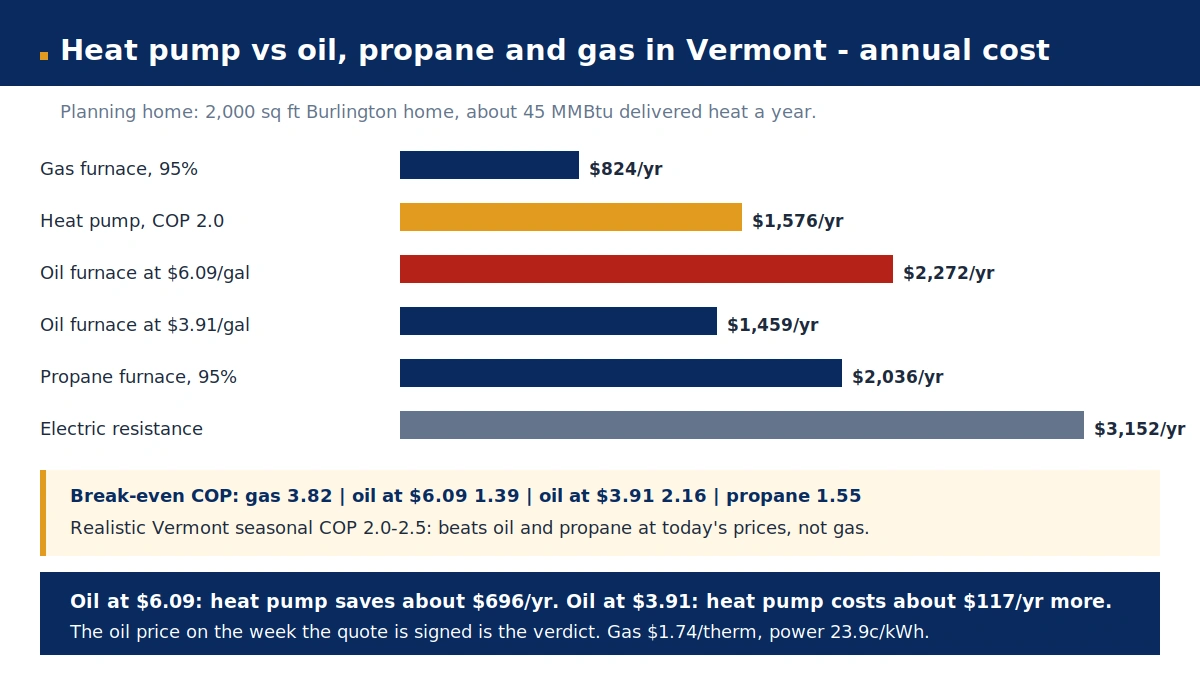
The heat pump. A cold-climate heat pump at a seasonal COP of 2.0 — a realistic Vermont seasonal figure, between the 2.2 to 2.8 it manages at 5 degrees and the 1.75 it falls to on the coldest nights — needs 6,595 kilowatt-hours of electricity to deliver the same 45 million BTU. At Vermont’s 12-month average electricity price of about 23.9 cents a kilowatt-hour, that comes to about $1,576 a year. At a generous seasonal COP of 2.5 it costs about $1,261, and at 3.0 about $1,051. The table below runs the whole comparison on the same planning home.
| Fuel and machine | Price | Annual cost (planning home) |
|---|---|---|
| Gas furnace, 95% AFUE | $1.74/therm | ~$824/yr |
| Heat pump, seasonal COP 2.0 | 23.9 cents/kWh | ~$1,576/yr |
| Heat pump, seasonal COP 2.5 | 23.9 cents/kWh | ~$1,261/yr |
| Heat pump, seasonal COP 3.0 | 23.9 cents/kWh | ~$1,051/yr |
| Oil furnace, 87% (Oct 2026 oil) | $6.09/gal | ~$2,272/yr |
| Oil furnace, 87% (last winter oil) | $3.91/gal | ~$1,459/yr |
| Propane furnace, 95% | $3.93/gal | ~$2,036/yr |
| Electric resistance heat | 23.9 cents/kWh | ~$3,152/yr |
Study that table twice over. The whole guide sits inside it. Against piped gas, the heat pump runs about $1,576 a year against the furnace’s $824 — about $752 a year more — and even at a generous seasonal COP of 2.5 it runs $1,261, still far above gas. Against heating oil at October 2026’s $6.09 a gallon, the heat pump runs $1,576 against the oil furnace’s $2,272 — about $696 a year saved. Against propane at $3.93 a gallon, it runs $1,576 against $2,036 — about $460 a year saved. Against electric resistance heat, it runs $1,576 against $3,152 — about $1,576 a year saved, every year.
The oil price is the swing vote, and it swings hard. Run the same table at last winter’s oil price and the story changes: at $3.91 a gallon, the oil furnace runs about $1,459 a year — about $117 a year LESS than the heat pump. Heating oil averaged $6.09 in the last week of October 2026, up 79 percent from $3.41 a year earlier, and the Energy Information Administration expects heating oil to average about a third more than last winter. Oil has spiked and fallen before, though, and a buyer who justifies a heat pump on $6.09 oil should know what the purchase looks like at $3.91: the fuel saving disappears, and the payback stretches past the life of the equipment. At $3.91 oil the heat pump still earns its keep — for the air conditioning, the zoning, and the hedge against the next spike — but not on the fuel bill. Any quote that models the saving at one oil price without naming it is modeling a price, not a house.
The break-even COP. Ask the same arithmetic the other way: how efficient would the heat pump have to be to tie each fuel? Divide the electricity price per million BTU by the fuel’s price per million BTU of delivered heat. At 23.9 cents a kilowatt-hour — $70.05 a million BTU — break-even COP comes out at 3.82 against a 95 percent gas furnace, 1.39 against oil at $6.09 a gallon, 2.16 against oil at $3.91, and 1.55 against propane at $3.93. A cold-climate heat pump’s realistic Vermont seasonal COP runs 2.0 to 2.5 — far below break-even against gas, comfortably above it against oil and propane at today’s prices, and just below it against oil at last winter’s price. That is the blunt fact, and any quote claiming a Vermont heat pump beats a 95 percent gas furnace on fuel at Green Mountain Power rates is modeling a different state’s prices.
The backup-heat adder. Above, the figures assume the heat pump delivers all 45 million BTU at its seasonal COP. In practice, part of the season’s heat comes from the backup system. That part costs more. Say 15 percent of the season’s heat comes from electric resistance strips — a plausible share for a standard unit, or for a cold-climate unit on the coldest nights — and that slice is priced at the resistance rate: 15 percent of 13,190 kilowatt-hours is 1,979 kilowatt-hours, which at 23.9 cents runs about $473 extra a year, an illustration, not a bill. On a home that keeps its oil boiler as backup, the same 15 percent slice is priced at the oil rate instead — about $341 at $6.09 a gallon — one more reason the oil boiler is the better Vermont backup. The backup share is where a dual-fuel system earns its keep in gas territory. Below the switchover temperature, the gas furnace delivers that 15 percent at gas prices instead of resistance prices, and the heat pump never has to run at a COP near 1.0 at all.
The switchover temperature. In a dual-fuel home, the control changes over from heat pump to furnace at one outdoor temperature. That temperature is the point where the heat pump’s COP falls to the break-even COP. Against piped gas, where break-even COP sits near 3.8, that point lies above the temperatures where a heat pump does most of its work — so the furnace carries most of the deep winter and the heat pump earns its keep in the shoulder seasons, roughly October through November and March through April, plus the cooling season. Against oil at $6.09, where break-even COP sits near 1.4, the heat pump stays cheaper than oil down to temperatures where it can barely run at all — so the heat pump carries nearly the whole season and the boiler is there only for the coldest nights and as insurance. The installer sets the switchover point during commissioning; ask what temperature was chosen and why, and get it in writing — a switchover set 10 degrees too high hands the furnace months of work the heat pump could have done cheaper, and one set 10 degrees too low hands the resistance strips a January they cannot afford.
What the heat pump beats, clearly. Everywhere in Vermont, resistance heat comes off worse than the heat pump — baseboard panels, electric furnaces, space heaters, all of them, and not by a little. The saving runs about $1,576 a year. Roughly 9 percent of Vermont homes heat with electricity. For those households, a heat pump is the best money this guide recommends spending. Against propane it wins by about $460 a year at today’s price, and propane prices swing far less than oil — the propane saving is the steadier of the two. Against oil it wins by about $696 a year at October 2026 prices and loses by about $117 at last winter’s price, which is why the oil price on the week the quote is signed belongs in the quote itself. Against a 95 percent gas furnace it loses by about $752 a year — and there the right reason to buy is the air conditioning, the comfort, or the plan to replace a furnace already at the end of its life, not the fuel bill.
Cooling, counted honestly. A heat pump doubles as the air conditioner, and a Burlington July reaches the 90s. A new central air conditioner alone runs several thousand dollars nationally — our national heat pump cost guide has the national picture — so part of the heat pump’s price is money the buyer would have spent on cooling anyway. Measure the heat pump against the premium it carries over the furnace-plus-AC combination it replaces. Its full sticker price is the wrong yardstick. Running-cost detail lives in our heat pump running cost guide.
Efficiency Vermont Rebates & What You Can Actually Collect in 2026
Now that Washington’s credit is gone, most states still hold back something of their own — a state credit, a rebate, an exemption. Vermont keeps the strongest utility rebate stack in this series — and the most conditional one, since every rebate in it has its own rules, its own income bands, and its own paperwork. Vermont’s incentives picture is generous and complicated in equal measure, and it deserves a line-by-line walk-through, because a rebate that reads $7,950 on a flyer and $0 on your application is worse than no rebate at all.
Efficiency Vermont pays the base rebate, and it is tiered by size. Efficiency Vermont’s 2026 heat pump program, announced in January 2026, pays up to $475 for a ductless mini-split and up to $2,200 for a ducted system. The ductless figure splits by size: $375 for a system of 2 tons or smaller, $475 above 2 tons, per outdoor unit. The ducted figure is tiered by size too, reaching $2,200 on a system of 4 tons or more — the full tier table was not captured from Efficiency Vermont’s page in this pass, so this guide states the ceiling and instructs the reader to confirm the tier for their own system size on Efficiency Vermont’s ducted heat pump page before planning around it. The equipment must be new, installed in Vermont, and on the Qualifying Products List at the time of purchase. Used, rebuilt, or refurbished equipment is not eligible. The rebates are offered as a joint program with the electric utility, and the utility may offer additional incentives on top — which is where the stack begins.
Green Mountain Power adds the income bonus, and the two are processed together. Green Mountain Power, which serves roughly three-quarters of Vermont homes, pays an additional rebate for households at or below 80 percent of area median income — $2,000 on Green Mountain Power’s own heat pump page, applied for online or by form and combined with Efficiency Vermont’s rebate in one simple step through the Efficiency Vermont portal. One conflict to print plainly: a secondary source puts the GMP bonus at $2,200 per condenser, which would make the GMP half $200 richer. This guide uses Green Mountain Power’s own $2,000 figure and flags the $2,200 as a secondary-source figure to confirm on GMP’s page. The income bands are published by county and household size — for a family of four, the 80 percent threshold is $99,750 in Chittenden, Franklin, and Grand Isle counties, $92,150 in Addison County, and $89,200 in all other counties. Two exclusions matter: heat pumps bought or leased from Vermont Gas Systems are not eligible for the GMP bonus, and rental property owners are not eligible for the income bonus at all.
The other utilities pay smaller bonuses, and the co-op stack is the smallest. Vermont Electric Cooperative customers, through the Vermont Public Power Supply Authority, qualify for a $1,000 income bonus rather than GMP’s $2,000. All other moderate- and low-income customers — those on the smaller municipal and co-op utilities — qualify for $200. A separate $200-per-condenser weatherization bonus is available with documented insulation work. The bonuses are alternatives, not stackable: a household takes the single highest bonus it qualifies for, on top of the equipment discount, not all of them at once.
Burlington Electric runs its own program, and the figures conflict. Burlington Electric Department, the municipal utility for the City of Burlington, runs its own heat pump program rather than the Green Mountain Power bonus — and the two sources for its figures disagree. A secondary tracker puts the BED air-source rebate at $2,450-$2,550 for systems of 2 tons or less and $2,850-$2,950 above 2 tons, plus a $400 or $500 income bonus, with income-qualified ducted installs reaching up to $7,950 in total, capped at 75 percent of the project cost, valid through December 31, 2026. Efficiency Vermont’s own ducted heat pump page says something different: that Burlington Electric customers are eligible for a $1,000-$2,000 discount. Both figures are printed here because both are published, and they cannot both be the number a Burlington buyer collects. Confirm the current BED figures on burlingtonelectric.com before quoting either one — and note that BED customers are excluded from the Efficiency Vermont income bonuses, so the BED program is the only stack a Burlington household gets.
Weatherization is the rebate that pays the most, and it ends in 2026. Efficiency Vermont is paying up to 90 percent cash back on weatherization — insulation and air sealing — through the end of 2026, or while funding lasts, for projects completed by November 2026. That is the most generous envelope program anywhere in New England, and in Vermont it matters more than the heat pump rebate itself: a house that leaks less heat needs a smaller heat pump, runs it at a higher seasonal COP, and calls on the backup heat less often. The weatherization rebate and the heat pump rebate belong in the same application conversation, not in separate years, because the right size of the heat pump depends on the envelope work being done first.
| Source | Amount | Who can collect it |
|---|---|---|
| Efficiency Vermont, ducted | Up to $2,200 (tiered by size; $2,200 at 4+ tons) | All VT customers, qualifying equipment on the QPL |
| Efficiency Vermont, ductless | $375 (2 tons or less) / $475 (over 2 tons) per outdoor unit | All VT customers, qualifying equipment on the QPL |
| Green Mountain Power income bonus | Up to $2,000 (GMP page; $2,200 reported by a secondary source) | GMP customers at or below 80% AMI |
| VPPSA member utilities income bonus | Up to $1,000 | VEC and VPPSA member customers, income-eligible |
| All other utilities income bonus | Up to $200 | Other utility customers, income-eligible |
| Burlington Electric (own program) | Up to $7,950 income-qualified ducted (reported, not verified); EVT page says $1,000-$2,000 discount for BED customers | BED customers — confirm on BED’s page |
| Efficiency Vermont weatherization | Up to 90% cash back, through end of 2026 | All VT customers, projects completed by Nov 2026 |
| State of Vermont | $0 — no state tax credit, no state rebate beyond EVT/utility programs | — |
| Federal tax credit (§25C) | $0 for 2026 installs | — |
| HEAR / HOMES | Not launched for heat pumps | — |
Washington in 2026: the Tax Credit Is $0, HEAR/HOMES Haven’t Launched, and Leases Stay Unverified
Washington’s 2026 position can be summed up in a single paragraph. That brevity is precisely what lets so much heat pump advertising keep getting it wrong. In Vermont the paragraph has a second half other states do not get: the federal rebates that would matter most here have never launched at all, and the state’s own energy department advises Vermonters not to plan on them.
Buying the unit yourself and having it installed in 2026 brings no federal tax credit at all. The One Big Beautiful Bill Act — Public Law 119-21, signed July 4, 2025 — ended the Energy Efficient Home Improvement Credit (§25C, up to $2,000 a year for air-source heat pumps). It no longer applies to equipment placed in service after December 31, 2025. The finish date is decisive, per FS-2025-05, the IRS fact sheet: money put down in 2025 counts for nothing if the crew finished the job in January 2026. The Residential Clean Energy Credit (§25D, 30%) closed on the same date. The 30 percent credit that used to apply to geothermal went with it. A federal credit still deducted on a 2026 quote means it was priced under a law that no longer exists. Tell the installer to take it off the quote and price the job again. Our federal tax credits guide carries the full 2026 federal picture — what ended on July 4, 2025, and why the completion date is the date that decides it.
Vermont’s HEAR rebate has never launched, and the state says not to plan on it. About $29.2 million was allocated to the state for HEAR, per the federal dataset — but the Vermont Public Service Department advises Vermonters not to plan on HEAR funds, and the state’s program page says plainly that rebates are not available before launch and cannot be issued retroactively. That status was checked against state program pages on November 4, 2026, and again on October 6, 2026. Never plan a purchase around this money. Do not let a quote include it. Do not let a salesperson tell you it is coming soon. The state itself gives no date.
Even once it launches, HEAR will not pay an oil- or propane-heated home to switch. Under the Home Electrification and Appliance Rebates program, a heat pump can draw up to $8,000. But Program Notice 26-2 from the Energy Department, dated May 29, 2026, restricts the money to electric-to-electric upgrades — swapping electric equipment for more efficient electric equipment — and to new construction. Swapping a gas, oil, or propane furnace for a heat pump is fuel-switching, and fuel-switching no longer qualifies. That matters more in Vermont than in almost any other state, because 58 percent of the state’s homes heat with oil or propane — exactly the homes that cannot use HEAR to switch. The 9 percent of Vermont homes already on electric heat are the ones that could use it, once it launches: a baseboard-heated house switching to a cold-climate heat pump makes an electric-to-electric upgrade, the configuration HEAR was designed for. HOMES, the whole-home efficiency program, pays up to $8,000 on measured or modeled energy savings rather than on the equipment list, and it too has not launched a consumer heat-pump rebate in Vermont.
The HOMES picture has a conflict to print. A March 2026 Joint Fiscal Office packet records a $29,303,666 HOMES grant to the Public Service Department and the Office of Economic Opportunity, for weatherizing low-income homes through the Home Weatherization Assistance Program, with an expected launch date of April 1, 2026. That grant is for low-income weatherization, not a consumer heat-pump rebate — and the November 2026 status checks still list Vermont as not launched. This guide reports both and instructs the reader to confirm the current status on the Public Service Department’s program page.
The lease route is unverified in Vermont. A company-owned heat pump can still claim the commercial clean-electricity credit — §48E, at 30 percent. It applies so long as the system enters service by December 31, 2027 and construction started by July 4, 2026, the cutoff IRS Notice 2025-42 sets out. Where the law clearly allows residential third-party ownership, the credit reaches homeowners through a lease or a power purchase agreement. The company passes part of the value on as a lower monthly payment. Vermont is not clearly such a state — at least, no verification was found in this pass. Vermont Gas Systems does sell heat pumps on lease-like terms, but a heat pump bought or leased from VGS is explicitly excluded from the Green Mountain Power income bonus, which is a warning in itself. Until a lease offer’s terms sit in writing in front of you, treat the offer as unverified — and let a lawyer read it before you sign anything. A lease that looks cheap month to month can carry a lien, a buyout clause, or a term that outlives the equipment. Here is the honest summary: in 2026 a Vermont homeowner who buys a heat pump outright gets nothing from the federal government, and a lease cannot be counted on to contribute indirectly either, because no clear legal route and no verified provider exist for one. On a cash quote, the price is the price.
Permits & Licensing: No State HVAC License, the $10,000 Registration Rule & Town Permits
Vermont’s licensing picture is unusual in one respect that helps a buyer who knows where to look — and hurts one who does not: the state issues no HVAC license and no general contractor license at all, so the credential that matters is a registration most buyers have never heard of, and across much of rural Vermont there is no local license to check either.
There is no state HVAC license in Vermont. The state licenses neither heating and air conditioning contractors nor technicians. There is no state general contractor license either — no state contractor exam, no state bond. What Vermont has instead is one of the newest consumer protection systems in the country: a Residential Contractor Registration administered by the Office of Professional Regulation inside the Secretary of State’s office. It applies the moment a contractor contracts directly with a homeowner for $10,000 or more including labor and materials — and every cold-climate heat pump install in this guide costs more than $10,000 once the backup heat and the panel work are counted. Registration costs $75 for a self-employed individual or $250 for a business with employees, requires liability insurance of $1,000,000 per occurrence and $2,000,000 aggregate, and requires the contractor to attest that it uses a written contract. Ask for the registration number and check it with the Office of Professional Regulation — and understand what it is and is not: registration is a consumer-protection registry focused on fraud and deception, not a license, and it does not certify workmanship. A registered contractor can still do bad work. The registration is the floor, not the credential.
Electrical and plumbing work needs separate licenses. The heat pump’s electrical work — the disconnect, the circuit, the panel work — requires a license from the Vermont Division of Fire Safety in the Department of Public Safety, which licenses electricians and plumbers in this state rather than a professional-regulation agency. A heat pump installer without a licensed electrician on staff must subcontract the electrical work to one who has it, and the electrical permit should carry the electrician’s name, not the HVAC company’s. Vermont also offers an optional Electrical Specialist license for HVAC technicians who want to work in specialty areas, administered by the same Division of Fire Safety. Anyone who handles refrigerants needs EPA Section 608 certification — which is every heat pump installer — so ask for it by name. Fuel gas and oil work runs through the Division of Fire Safety’s propane and natural gas technician program, which matters in Vermont because the backup heat in most homes is an oil boiler or a propane furnace.
Permits come from the town, and the town sets the pace. In Vermont, installing a heat pump takes a mechanical permit and an electrical permit from the town or city building department. Inspectors check the outdoor unit’s placement, the refrigerant lines, and the electrical disconnect. For this guide no Vermont-specific permit fee schedule was verified; a national estimator puts typical permit costs at $70-$166 in the cities it checked, and the town building department sets the actual figure. Burlington, South Burlington, and Essex do not require HVAC licensing to work locally, but they do require permits. The calendar, not the price tag, is what slows a Vermont install down: the best installers book weeks out in the shoulder seasons, and a crew offering a next-day install in October is either very lucky or very quiet.
One Vermont-only piece of paper: the energy code certificate. Under 30 V.S.A. section 51, the installer must sign an energy code certificate, permanently affix it near the panel or the heating and cooling equipment, send a copy to the Department of Public Service, and record it in the town land record. It is a small administrative step that most buyers never see, and it is worth asking whether it was done: a job with no certificate on the panel is a job whose paperwork was not finished, and the certificate is the document a future buyer will look for.
No good statute stands behind the HOA question. No Vermont law was found giving heat pump owners the kind of protection some states give solar owners, and an outdoor unit is visible in a way a boiler is not. A homeowners association can restrict where the outdoor unit sits, how it looks, and whether it can be seen from the street — and in a Burlington condo development, that can be the difference between the leeward wall the unit needs and the front wall the HOA prefers. Get the placement approved in writing before the unit is ordered. Condo owners face the same question twice over: the exterior wall is usually common area, and the board’s approval process is the whole decision.
What Pushes Your Vermont Quote Up or Down
A per-ton anchor orients the budget; it never prices the job. Seven factors can move a Vermont quote by thousands of dollars, and three of them come from this state’s climate, its fuel mix, and its power market.
Labor is ordinary in Vermont — and that is itself the point. Vermont HVAC mechanics earn a median $29.88 an hour ($62,150 a year, BLS May 2025), almost exactly the national median of $29.33, and electricians a median $30.49 an hour. What customers actually get billed runs an estimated $60-$78 an hour for HVAC work, and $61-$79 for electrical work. That is roughly two to two-and-a-half times the wage once insurance, payroll taxes, overhead, and profit are loaded in. What moves a Vermont quote is not expensive labor but thin competition: with only a handful of installers serving much of the state, the crew’s cold-climate experience matters more than the headline rate.
The ductwork, and whether it survives. A heat pump pushes more air at lower temperatures than a furnace does. Ducts that handled a 140-degree oil-furnace airstream can therefore fail a 100-degree heat pump airstream — undersized, leaky, or poorly insulated. New or extended ductwork runs $4,210-$7,140 a job in Vermont (NumeralQ). Sealing and insulating the existing ducts can add thousands more. Price the heat pump while assuming the ducts are fine, and a quote has assumed the most expensive part of the job away. Ask for a duct inspection and a static-pressure reading in writing. And remember the weatherization rebate: Efficiency Vermont pays up to 90 percent cash back on the insulation and air sealing the ductwork needs, through the end of 2026.
The electrical panel. Plenty of Vermont homes still run on 100-amp service, especially farmhouses and post-war ranches. Electric backup strips on a heat pump can force that question onto the table. A 200-amp panel upgrade runs $2,190-$3,440 installed in Vermont (NumeralQ), the most common surprise add-on in Vermont quotes. Confirm the quote covers it before signing. Waiting until the electrician is already standing in your driveway is too late. No Vermont-specific panel-upgrade figure beyond the NumeralQ range was verified, so that range is the one that stands. One Vermont wrinkle: a panel upgrade is electrification work, the kind HEAR is designed to pay for — once Vermont’s HEAR program launches. It has not. The country-wide figures live in our electrical panel upgrade guide.
Equipment tier. A top-tier cold-climate unit runs 10 to 20 percent dearer than a value-tier one. That premium buys two things that matter in Vermont: better low-temperature performance on the coldest nights, and a higher HSPF2 that pays back across 7,771 heating degree days. Money tight? A value-tier cold-climate unit still leaves a standard unit well behind. On a house the buyer plans to keep for 20 years, the premium tier’s higher seasonal COP is worth real money every winter. Premium units also degrade more slowly and hold their capacity ratings longer — which counts for more in a state where the heating season runs seven months, because every lost point of capacity is a point the backup heat has to cover.
The snow stand, the wind baffle, and the oil tank. An outdoor unit at grade level in Burlington ends up buried in a drift. A unit that cannot breathe cannot defrost. A snow stand or wall bracket, a wind baffle on an exposed rural site, and a lineset routed clear of the roof valley that dumps snow each add a few hundred dollars to the quote. They are also what separates a unit that runs clean all winter from one that ices itself into a February service call. Ask for them by name. Leave them out of a quote and it prices a southern installation for a northern state. And if the job removes the oil boiler, the tank is its own line: pump-out, cleaning, removal or fill-in-place, with the cost depending on whether the tank sits in the basement or is buried in the yard. No Vermont-specific tank decommissioning price was verified in this pass, so get it as a written line rather than a verbal assurance.
Financing terms. Nothing beats paying cash when the cost is counted over the system’s life. Dealer fees of 10-30 percent of the cash price — sometimes over 50 percent — get folded into the amount financed on a $0-down loan. The figure comes from the Consumer Financial Protection Bureau’s August 2024 market spotlight, a national number Vermont quotes carry exactly the same way. A lease or PPA is the third path, and it is thin here: Vermont Gas Systems sells heat pumps on lease-like terms, but a VGS-leased unit is excluded from the Green Mountain Power income bonus, and the legal status of third-party ownership for a residential heat pump in Vermont was not verified in this pass — so a lease quote should be read by a lawyer before it is compared on its monthly payment at all.
Maintenance and lifespan. A Vermont heat pump works harder than one in a mild climate. Seven months of heating every year. A defrost cycle at every cold snap. An outdoor unit that spends its life in snow and wind. Plan on a service visit every year. The visit covers cleaning the coil, checking the refrigerant, verifying the defrost cycle, and confirming the backup heat actually engages when it should. Through the heating season, change the filters every month. After every storm, clear the snow off the outdoor unit. Both jobs belong to the homeowner, not the technician. Lifespan, degradation, and maintenance figures are national only, with no Vermont-specific versions in existence, so every figure in this paragraph carries a national flag: equipment typically lasts 15-20 years with good maintenance, the compressor is the part that decides it, and a unit that short-cycles because it was oversized will die years before a correctly sized one. For running costs, turn to our heat pump maintenance guide and our heat pump repair guide.
Payback: When Does a Vermont Heat Pump Pay for Itself?
Payback is where a Vermont heat pump either earns its keep or does not, and the answer turns on what it replaces and on the price of heating oil in the week the quote is signed — more sharply than in any other state in this series. The worked examples below build on the NumeralQ anchors and the running-cost arithmetic from the section above. Every input is checkable, and wherever the two sources part ways, this guide says so.
A worked example. Start with a typical cold-climate ducted 3-ton system at the middle of the Vermont range — about $11,880 installed — heating the planning home: 2,000 square feet in Burlington, about 45 million BTU of delivered heat a year. Federal credit: $0. State money beyond the utility programs: none. The rebate depends on utility and household income — Efficiency Vermont up to $2,200, Green Mountain Power up to $2,000 more for income-eligible households, and Burlington Electric’s own program reported to reach $7,950 for income-qualified ducted installs. The fuel saving depends on what the heat pump replaces and on the price of oil. The table below runs the five cases that actually occur in Vermont.
| What it replaces | Fuel price | Annual fuel saving | Payback on $11,880 |
|---|---|---|---|
| Electric resistance heat | 23.9 cents/kWh | ~$1,576/yr | ~7.5 yrs (~6 yrs with EVT rebate) |
| Heating oil furnace | $6.09/gal (Oct 2026) | ~$696/yr | ~17 yrs (~14 yrs with EVT rebate) |
| Heating oil furnace | $3.91/gal (last winter) | Negative — costs ~$117/yr MORE | Never on fuel |
| Propane furnace | $3.93/gal | ~$460/yr | ~26 yrs (~21 yrs with EVT rebate) |
| 95% gas furnace | $1.74/therm | Negative — costs ~$752/yr MORE | Never on fuel |
Read that table with the same care as the running-cost table. It holds the whole verdict. Against electric resistance heat, a heat pump saves about $1,576 a year and pays back in about 7.5 years — about 6 years once Efficiency Vermont’s $2,200 rebate is applied, and under 5 years with the full $4,200 GMP-plus-EVT stack. That is the best payback in the state. It belongs to the 9 percent of Vermont homes already heating with electricity. Against oil at October 2026 prices it saves about $696 a year, a payback of about 17 years — about 14 with the EVT rebate, about 11 with the full GMP stack, and about 6 with Burlington Electric’s reported $7,950, if that figure is confirmed. Against oil at last winter’s price it costs about $117 a year more to run, so there is no fuel payback at all, ever. Against propane it saves about $460 a year on the modeled figures, a payback measured in decades. Buy it for the cooling and the comfort, not the fuel. Against a 95 percent gas furnace, the heat pump costs about $752 a year MORE to run than the furnace. There is no fuel payback at all, ever.
Framing the cost incrementally changes the answer. The table above prices the whole heat pump against the whole fuel bill. That is the wrong comparison for a home that needs a new furnace and a new air conditioner anyway. Both machines are replaced at once by one heat pump. If the furnace alone would have cost about $7,050 — the midpoint of NumeralQ’s Burlington furnace range of $5,350-$8,750 — then the premium for the cold-climate heat pump over the furnace is about $4,830, not $11,880, and that premium pays back in about 3 years against resistance heat, about 7 years against oil at $6.09, and about 11 years against propane. The premium framing rescues the payback for electric-heat, oil-heat, and propane homes; it does not rescue it for gas homes, because the fuel saving there is negative. Note the framing is conservative: it credits the heat pump with nothing for the air conditioning it adds, worth several thousand dollars on its own.
What moves the payback most. By far the biggest lever is the fuel being replaced. Resistance heat leads the list, then oil, then propane, then gas — and gas never pays back at all. The price of heating oil is the second lever: the same heat pump on the same house saves $696 a year at $6.09 oil and loses $117 a year at $3.91, a swing of $813 a year decided by a commodity price that moves every week. The rebate is the third lever, and only Vermont’s is large enough to matter this much: $2,200 from Efficiency Vermont takes about three years off the oil payback, $4,200 from the GMP stack takes about six, and Burlington Electric’s reported $7,950 would take about eleven — if it is confirmed. For dual-fuel homes, the fourth lever is the switchover temperature. And the envelope is the fifth: every dollar spent on air sealing and insulation shrinks the heating load, shrinks the heat pump, and shrinks the backup heat — and with Efficiency Vermont paying up to 90 percent cash back on weatherization through the end of 2026, it is the only lever that helps every case in the table at once and pays for itself first.
Who still comes out ahead. Four kinds of Vermont household clear it. The electric-heat home, where the published saving runs about $1,576 a year and the payback about 7 years — 6 with an Efficiency Vermont rebate, under 5 with the full GMP stack. The oil-heated rural home, where the heat pump wins on fuel at today’s oil price, adds air conditioning the house never had, and cuts the household’s exposure to the next oil spike. The propane-heated home, where the heat pump wins on fuel and adds air conditioning, also removes the propane tank and its delivery schedule. And the household whose oil boiler is already dying: when the boiler has to be replaced anyway, the premium for a heat pump over a new boiler is small enough that the cooling, the zoning, and the shoulder-season savings carry it. If a 95 percent gas furnace heats your home and a fuel saving is what would justify the purchase, walk away. The saving does not exist, and no rebate in this state is large enough to create it.
Getting Quotes in Vermont: The Checklist
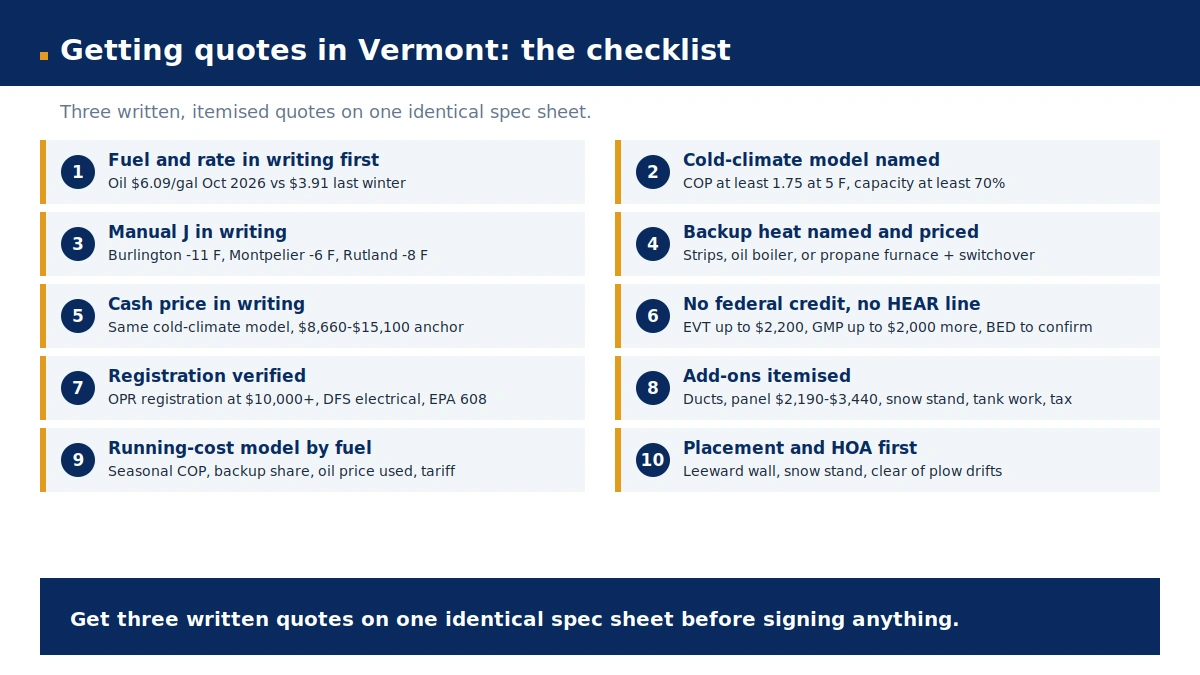
Vermont is one of the hardest states in this series to buy a heat pump in — the coldest design temperatures in New England, the most expensive electricity, the widest fuel split, and the thinnest installer bench outside Chittenden County — but only for a homeowner who has not checked the fuel math and the rebate terms before the sales pitch. Work through this checklist with every bidder. Leave the contract unsigned until each line has its answer in writing.
- Your fuel and your utility’s rate, in writing, first — oil at the price on the week the quote is signed ($6.09 a gallon in late October 2026, $3.91 last winter), propane at $3.93, gas at $1.74 a therm, electricity at 23.9 cents. The fuel decides whether the heat pump beats the boiler before anything else — and the oil price alone is worth about $813 a year on the same system.
- Cold-climate model named, with its 5-degree numbers — ask for the model number, the NEEP listing or ENERGY STAR cold-climate status, and the 5-degree figures: COP at least 1.75, capacity at least 70 percent of rated. A quote naming no model has priced a machine that might not exist.
- Manual J load calculation, in writing — room by room, at your town’s design temperature (Burlington minus 11, Montpelier minus 6, Rutland minus 8). A contractor sizing by square footage alone is guessing at the number everything else depends on.
- Backup heat named and priced — resistance strips, the existing oil boiler, or a propane furnace, its capacity, and the switchover temperature it is set to. Backup heat is half the system in Vermont. A quote that omits it has omitted the part that keeps the pipes from freezing.
- Cash price, in writing, for the same cold-climate model — same kit, same house, three bidders. Vermont’s anchor is $8,660-$15,100 for a 3-ton cold-climate ducted system. A quote far above that anchor needs explaining. One far below it deserves a closer look at what the bidder left out.
- No line for a federal tax credit, no line for a HEAR rebate — a 2026 owner purchase gets $0 federal, and Vermont’s HEAR program has never launched. The only money is Efficiency Vermont and the utility: up to $2,200 from EVT, up to $2,000 more from GMP for income-eligible households, and Burlington Electric’s own program — confirm the BED figure before planning around it. Any quote still deducting a federal credit was priced under a law that is dead.
- Registration verified — the Residential Contractor Registration with the Office of Professional Regulation (required at $10,000 or more, which is every cold-climate install), plus the Division of Fire Safety license for the electrical work and EPA Section 608 for the refrigerant work. Vermont issues no state HVAC license, so a contractor who claims one is claiming something that does not exist.
- Add-ons itemized — ductwork, panel upgrade ($2,190-$3,440), snow stand, wind baffle, oil tank decommissioning, and thermostat, each on its own line, not folded into the per-ton price. Sales tax shown as its own line too — 6 percent state, 7 percent in Burlington and other local-option towns.
- Running-cost model by fuel, not by brochure — the seasonal COP assumed, the backup-heat share, the oil price used, and the rate applied, shown against your own fuel and your own utility’s tariff. A quote that models savings at the national-average electricity price for a Vermont home is wrong by about $600 a year on the planning home — and a quote that models savings against an oil furnace without naming the oil price is not a model at all.
- Placement and HOA approval, in writing, first. Where the outdoor unit sits — leeward wall, lifted on a snow stand, clear of roof valleys and plow drifts — needs HOA approval for the placement before the unit is ordered. Put a unit where it is convenient but facing into the wind, and running it will cost more — and servicing it will too.
Buy, dual-fuel, or geothermal? Homeowners on electric heat, oil heat, or propane heat come out ahead with a cold-climate ducted system. So does anyone whose boiler is dying anyway. Dual-fuel wins for gas-heated homes in the northwest corner: the furnace carries January and the heat pump carries the shoulder seasons and the summer. Geothermal wins for long-term owners on big lots who plan to stay 20 years and want the steadiest winter COP in the state. At $20,350-$32,040, no federal credit softens it in 2026. A standard non-cold-climate unit wins for almost no one in Vermont as primary heat, and a lease wins for almost no one either, because no provider was verified selling one here and a VGS-leased unit loses the GMP bonus.
Sources & methodology
Cost anchors:
- NumeralQ Vermont heat pump cost page, estimator pricing as of 2026-10-26: ducted 3-ton $6,600-$11,020; cold-climate ducted $8,660-$15,100; single-zone mini-split $3,170-$4,950; multi-zone 3-head $6,300-$11,250; geothermal $20,350-$32,040; by size 1.5t $4,440-$7,120 to 5t $9,470-$16,210; ductwork $4,210-$7,140; panel upgrade $2,190-$3,440; Burlington $6,830-$11,320; Burlington cold-climate $8,940-$15,460; permits typically $70-$166; BLS May 2025 HVAC median $29.88/hr, electricians $30.49/hr; heating cost/yr gas 95% $812, heat pump HSPF2 7.5 $1,420, HSPF2 9 $1,183; “100% of counties are zone 6 or colder”; fuel mix electric 9%, gas 18%, propane or oil 58%
- NumeralQ Vermont HVAC replacement page: dual-fuel (heat pump + gas furnace) $9,280-$15,200 state, $9,570-$15,570 Burlington; NumeralQ Burlington furnace replacement: 80,000 BTU furnace $5,350-$8,750
- nearbyhunt Heat Pump Cost 2026 (May 2026): 3-ton standard $9,500-$15,000; Mitsubishi Hyper-Heat $14,000-$18,000; Bosch IDS 2.0 $13,000-$17,000; Daikin Fit $11,500-$15,000; Carrier Greenspeed $14,500-$18,500; cold-climate premium $2,000-$4,000
- EnergySage 2026 marketplace: air-source average $15,393 before incentives; ducted $14,529; whole-home ductless ~$25,957; hybrid ~$14,353 (marketplace average, mostly Massachusetts quotes — not a VT price)
- BetterHouse (2026): Vermont ducted $4,050-$14,170, typical $10,700; Dun (Aug 2026): Vermont ducted $6,350-$11,750
- jouleio Heat Pump Cost 2026: mini-split single zone $2,000-$7,000; central ducted $4,500-$20,000, avg ~$8,350; geothermal $20,000-$50,000+, avg ~$30,000
Rates:
- EIA Electric Power Monthly Table 5.6.A, Oct 2026 release: VT residential 23.84 cents/kWh Aug 2026; US 18.16 cents; 12th-highest of 51; 31% above US average; 12-mo avg to Aug 2026 ~23.9 cents; 2025 final 591 kWh/mo, 22.79 cents, $134.78 bill; Aug 2026 avg bill $142.06, 596 kWh
- Green Mountain Power standard residential tariff: $19.05/mo fixed charge + 1.07 cents/kWh riders, all-in ~24.65 cents/kWh at 900 kWh (priceofelectricity.com, EIA-based)
- EIA natural gas: VT 2025 $18.00/Mcf (~$1.74/therm); 12-mo to Jul 2026 $18.35/Mcf (~$1.77/therm) — both printed, $1.74 used
- EIA Heating Oil and Propane Update: VT heating oil $6.09/gal week of Oct 26, 2026 (last winter avg $3.91; week of Nov 2 $6.071 vs $3.491 a year earlier); VT propane $3.93/gal week of Oct 26, 2026 (last winter $3.69; week of Nov 2 $3.941 vs $3.492 a year earlier)
- blueridgeheatingair standardized-home model (2024 EIA prices): VT gas $1,180/yr, heat pump $1,900/yr, electric resistance $4,340/yr, propane $2,350/yr, heating oil $2,060/yr
Climate and performance:
- ASHRAE 90.1-2013 Table D-1: Burlington 7,771 HDD, heating design temp -11 F (99.6%); ACCA Manual J Table 1A (99%): Montpelier/Barre -6 F, Rutland -8 F; Burlington Jan daily mean 16 F, Jul 71 F (city-data); state record low -50 F, Bloomfield, Dec 30, 1933
- ENERGY STAR CAC/ASHP V6.2 (rev. Mar 2025) sets the cold-climate bar at a 5-degree COP of 1.75 or better and at least 70% of 47-degree capacity when it is 5 outside, with HSPF2 minimums of 8.1 ducted and 8.5 ductless and SEER2 of 15.2 or better — alongside NEEP ccASHP Spec v4.0, effective Jan 1, 2023
- DOE Cold Climate Heat Pump Challenge field data: 5 F capacity 70-80%, COP 2.2-2.8; -5 F capacity 60-70%, COP 1.8-2.4; standard unit at 5 F 40-60% capacity, COP 1.0-1.5; Mitsubishi Hyper-Heat full capacity to 5 F, ~76% at -13 F
Rebates and incentives:
- Efficiency Vermont press release Jan 14, 2026: ductless up to $475, ducted up to $2,200, heat pump water heater up to $1,000, weatherization up to 90% cash back through end of 2026, projects completed by Nov 2026
- Efficiency Vermont ducted heat pump page: >= 4 ton $2,200 discount; BED customers eligible for a $1,000-$2,000 discount; income bonus $200-$2,200 by utility and income (GMP low-income $2,200; VPPSA $1,000; all other $200); rental owners and BED customers not eligible for the income bonus; VGS-purchased/leased units not eligible for the GMP bonus
- Efficiency Vermont ductless (scoophvac, updated 2026-09-15): $375 (2 tons or smaller) or $475 (over 2 tons) per outdoor unit
- Green Mountain Power heat pump page: customers at or below 80% AMI qualify for the $2,000 rebate, combined with EVT’s rebate in one step; 80% AMI family of four: $99,750 Chittenden/Franklin/Grand Isle, $92,150 Addison, $89,200 all other counties
- ProFusion (secondary): GMP income bonus $2,200/condenser; combined GMP+EVT stack $4,200 ducted, $5,400 with HPWH; BED 2 tons or less $2,450-$2,550 + $400 income, over 2 tons $2,850-$2,950 + $500 income, income-qualified ducted up to $7,950 total, 75% project ceiling, valid through Dec 31, 2026; GMP serves ~75% of VT homes
- homeenergybasics tracker (June 2026): Vermont EVT $1,200-$2,200 ducted, ductless $375-$475 per system
- VT Dept of Taxes, Local Option Tax page: state sales tax 6%, +1% local option in adopting towns (Burlington, South Burlington, Rutland, Montpelier, Brattleboro, Stowe) = 7% combined
- Geothermal: no Vermont state-level geothermal tax credit (geothermalfinder, secondary)
HEAR / HOMES:
- heatpumppricing (status verified Nov 4, 2026): Vermont’s $29.2M HEAR program has never launched; PSD advises not to plan on HEAR funds; startbusinessbystate (Oct 6, 2026): “Not open yet; rebates cannot be paid retroactively”; state page via HYRE (Sep 6, 2026): “rebates are NOT available prior to program launch and rebates cannot be issued retroactively”
- VT Joint Fiscal Office JFO #3273 (Mar 10, 2026): $29,303,666 HOMES grant to PSD / Office of Economic Opportunity for low-income weatherization via WAP, expected launch April 1, 2026 — conflicts with Nov 2026 “not launched” status; flagged in the draft
- DOE Program Notice 26-2 (May 29, 2026): HEAR electric-to-electric only, no fuel-switching; HEAR cap $8,000, HOMES up to $8,000
- OBBBA P.L. 119-21 and IRS FS-2025-05: §25C and §25D $0 for post-Dec-31-2025 installs, completion date counts; IRS Notice 2025-42 (§48E, in service by Dec 31, 2027, construction begun by Jul 4, 2026)
Heating fuel:
- NumeralQ/ACS 2020-2024 5-yr: electric 9%, piped gas 18%, propane or oil 58%; remainder ~15% wood/other (derived); older blog claim of 73% oil/propane conflicts — NumeralQ/ACS used
Licensing:
- Housecall Pro / ServiceTitan / contractorlicensecheck: no state general contractor license; Residential Contractor Registration with OPR required at $10,000+ incl. labor and materials (26 V.S.A. ch. 106, Act 182 of 2022; registrations from Apr 1, 2023; enforcement from Apr 1, 2024); $75 individual / $250 business; liability insurance $1,000,000/$2,000,000; written contract attestation; registration is not a license and does not certify workmanship
- No state HVAC license; electricians and plumbers licensed by the Division of Fire Safety (Dept of Public Safety); optional Electrical Specialist license for HVAC techs; EPA Section 608 required for refrigerants; fuel gas/oil work via DFS technician programs; 30 V.S.A. § 51 energy code certificate; Burlington, South Burlington and Essex require no local HVAC license but require permits
- CFPB Solar Financing Market Issue Spotlight, Aug 2024: dealer fees 10-30%, sometimes over 50% (national figure)
Running-cost and payback arithmetic:
- Planning home ~45 MMBtu delivered heat/yr (NestPriced planning assumption from Burlington 7,771 HDD, cross-checked against NumeralQ’s gas 95% $812/yr implying ~44 MMBtu) = 13,190 kWh of heat; gas 95% AFUE at $1.74/therm = 474 therms = ~$824/yr (NumeralQ $812 — $12 apart, price vintage/rounding); heat pump COP 2.0 = 6,595 kWh/yr (~$1,576 at 23.9 cents), COP 2.5 = 5,276 kWh (~$1,261), COP 3.0 = 4,397 kWh (~$1,051); resistance = 13,190 kWh (~$3,152); oil 87% = 373 gal/yr ($6.09 = ~$2,272; $3.91 = ~$1,459); propane 95% = 518 gal/yr ($3.93 = ~$2,036); break-even COP vs 95% gas = 3.82, vs oil at $6.09 = 1.39, vs oil at $3.91 = 2.16, vs propane = 1.55; backup-resistance illustration (15% of heat at 23.9 cents) ~$473/yr
- Cold-climate 3-ton at ~$11,880 (midpoint of $8,660-$15,100): vs resistance saves ~$1,576/yr -> ~7.5 yrs, ~6.1 yrs with $2,200 EVT rebate, ~4.9 yrs with $4,200 GMP+EVT stack; vs oil at $6.09 saves ~$696/yr -> ~17 yrs, ~14 yrs with $2,200, ~11 yrs with $4,200, ~5.6 yrs with reported $7,950 BED figure; vs oil at $3.91 costs ~$117/yr more -> never; vs propane saves ~$460/yr -> ~26 yrs, ~21 yrs with $2,200; vs gas costs ~$752/yr more -> never; premium over Burlington furnace midpoint $7,050 = ~$4,830 -> ~3.1 yrs vs resistance, ~6.9 yrs vs oil at $6.09, ~10.5 yrs vs propane
EXCLUDED:
- Any “after 30% credit” or “after $2,000 credit” prices: §25C/§25D are $0 for 2026 installs
- Any HEAR rebate in a 2026 Vermont quote: not launched; PSD advises not to plan on it
- GMP income bonus $2,200/condenser (secondary) vs GMP’s own page $2,000 — conflict printed
- BED up to $7,950 (secondary) vs EVT page $1,000-$2,000 for BED customers — conflict printed
- EVT ducted rebate tiers below 4 tons — only >= 4 ton $2,200 verified from EVT page
- HOMES April 1, 2026 launch target vs Nov 2026 “not launched” status — conflict printed
- South Burlington / Rutland / Montpelier city install prices — planning estimates only, flagged
- Cold-climate prices by size other than 3-ton — planning estimates from the VT $2,060-$4,080 premium, flagged
- VT-specific permit fee schedule — not verified (NumeralQ $70-$166 typical only)
- VT lease/PPA provider and third-party PPA authorization — none verified; VGS-leased units excluded from the GMP bonus
- Oil tank decommissioning price in VT — not verified; get it as a written line
- Burlington snowfall totals — not verified; no figure used
- Monthly COP or field-measured seasonal COP for a specific VT installation — none found; COP 2.0-2.5 seasonal is a planning range, labeled as such
- Gas price $1.77/therm (12-mo to Jul 2026) vs $1.74/therm (2025 annual) — both printed
- Installer names / counts in VT beyond BLS wage data — not verified; none named
- HOA protection statute for heat pumps in VT — none verified
- Fuel mix 73% oil/propane (older blog) vs NumeralQ/ACS 58% — NumeralQ/ACS used, conflict noted
*Disclaimer: The prices here are 2026 Vermont planning figures. Your final price will vary with the town, the house, the utility territory, and the contractor you hire. Before you settle on a budget, collect written quotes from three Vermont installers. The tax notes in this guide are general information, not advice about your own return. Talk to a Vermont tax professional before you file. Program rules change — Efficiency Vermont, Green Mountain Power, Burlington Electric, and co-op rebate terms — so confirm current terms with your own utility before signing. Heating oil and propane prices move weekly; the oil price on the week your quote is signed belongs in the quote. Burlington Electric’s rebate figures in this guide are reported, not verified on BED’s own page — confirm them on burlingtonelectric.com before planning around them.*
What does a heat pump cost in Vermont in 2026?
A typical whole-home ducted 3-ton air-source heat pump costs $6,600-$11,020 installed in Vermont in 2026, and the cold-climate ducted system this state actually needs runs $8,660-$15,100 (NumeralQ, October 2026). A single-zone ductless mini-split comes in at $3,170-$4,950; a three-head multi-zone system at $6,300-$11,250; geothermal with a ground loop at $20,350-$32,040. Burlington runs $6,830-$11,320 for a 3-ton ducted system. For a homeowner-owned system installed in 2026, the federal tax credit is $0, and Vermont has no state rebate beyond Efficiency Vermont and the utilities — led by Efficiency Vermont at up to $2,200 on a ducted system, with Green Mountain Power adding up to $2,000 more for income-eligible households.
Do heat pumps work in Vermont winters?
Yes, with a condition: only cold-climate models with backup heat. Vermont designs for minus 11 degrees in Burlington, minus 6 in Montpelier, and minus 8 in Rutland, and a standard heat pump keeps only 40 to 60 percent of its capacity at 5 degrees. A cold-climate unit pairs a variable-speed inverter compressor with enhanced vapor injection, sits on the NEEP list or meets ENERGY STAR cold-climate criteria, and keeps at least 70 percent of its capacity at 5 degrees at a COP of 1.75 or better. In Department of Energy field testing, units held 70 to 80 percent of capacity at 5 degrees, with COPs of 2.2 to 2.8. Even the best air-source unit needs backup heat for the coldest nights — resistance strips, the existing oil boiler, or a propane furnace in a dual-fuel setup — and the outdoor unit needs a snow stand so it can defrost.
Is a heat pump cheaper to run than oil heat in Vermont?
At today’s oil price, yes — but the oil price decides, and it moves weekly. Against heating oil at $6.09 a gallon (late October 2026), a heat pump at a seasonal COP of 2.0 costs about $1,576 a year to heat the planning home against about $2,272 for an 87 percent oil furnace, a saving of about $696 a year. Against oil at last winter’s $3.91 a gallon, the oil furnace costs about $1,459 a year — about $117 a year less than the heat pump. Against propane at $3.93 a gallon, the heat pump saves about $460 a year. Against piped gas at $1.74 a therm, it loses by about $752 a year. Check the oil price on the week your quote is signed, because that price is the verdict.
What rebates can I get for a heat pump in Vermont in 2026?
Efficiency Vermont pays up to $2,200 on a ducted system and $375-$475 on a ductless system, tiered by size. Green Mountain Power adds up to $2,000 more for households at or below 80 percent of area median income, processed together with the Efficiency Vermont rebate in one step. Vermont Electric Cooperative customers qualify for a $1,000 income bonus instead. Burlington Electric runs its own program, reported to reach up to $7,950 for an income-qualified ducted install — but that figure could not be confirmed on BED’s own page, and Efficiency Vermont’s page says BED customers get a $1,000-$2,000 discount instead, so confirm it on burlingtonelectric.com before planning around it. Efficiency Vermont also pays up to 90 percent cash back on weatherization through the end of 2026.
Can I get the $8,000 HEAR rebate for a heat pump in Vermont?
Not in 2026. Vermont’s $29.2 million HEAR program has never launched — the Public Service Department advises Vermonters not to plan on HEAR funds, and the state’s program page says rebates are not available before launch and cannot be issued retroactively. Even once it launches, the Energy Department’s Program Notice 26-2 bars HEAR money for fuel-switching, so an oil- or propane-heated home — 58 percent of Vermont homes — cannot use it to switch to a heat pump; only electric-to-electric upgrades and new construction qualify.
Do I need a license or permit to install a heat pump in Vermont?
You need a mechanical permit and an electrical permit from your town or city, and your contractor needs a Residential Contractor Registration with the Office of Professional Regulation for any job of $10,000 or more — which is every cold-climate heat pump install — plus the Division of Fire Safety license for the electrical work. Vermont issues no state HVAC license and no state general contractor license. The installer needs EPA Section 608 certification to handle refrigerants, and the job needs an energy code certificate signed, affixed near the equipment, and recorded in the town land record. Typical permit costs run $70-$166.
Should I get a dual-fuel heat pump in Vermont?
For a gas-heated home in the northwest corner, yes — dual-fuel is the honest answer. The heat pump carries the shoulder seasons and the summer cooling. Below a switchover temperature the installer sets — usually between 30 and 40 degrees — the gas furnace takes over, where the heat pump’s COP falls below the point where it beats gas. Vermont has a published dual-fuel figure: $9,280-$15,200 for a 3-ton job. For most Vermont homes, dual-fuel means a propane furnace, not a gas one, because there is no gas main — and the same logic applies at a break-even COP near 1.55. Against oil at $6.09 a gallon, the heat pump stays cheaper than the boiler almost all winter, so the boiler is mostly insurance.
When does a Vermont heat pump pay for itself?
Against electric resistance heat, about 7 years — about 6 years with Efficiency Vermont’s $2,200 rebate, under 5 with the full Green Mountain Power stack — because it saves about $1,576 a year. Against oil at $6.09 a gallon, about 17 years, or about 14 with the rebate and about 11 with the full GMP stack. Against oil at last winter’s $3.91, never on fuel, because the heat pump costs about $117 a year more to run. Against propane, about 26 years on the modeled figures, or about 21 with the rebate. Against a 95 percent gas furnace, never on fuel: the heat pump costs about $752 a year more to run. Buy it there for the air conditioning, the zoning, or because the boiler is dying anyway. Judge the premium over the furnace you would buy anyway, not the full sticker. That framing is what makes the purchase work for most Vermont homes.