

A heat pump costs $6,380–$10,740 installed in Idaho in 2026 for a typical 3-ton ducted system, based on published state cost modeling priced in October 2026. A single-zone ductless mini-split runs $3,030–$4,760, a dual-fuel system runs $9,010–$14,850, and a geothermal system with a ground loop runs $19,970–$31,540 in the Boise market. Idaho Power pays $800 toward a ducted heat pump and $3,000 toward a ground-source system, while the federal government contributes $0 toward a 2026 homeowner-owned install.
Idaho is the one state where the running-cost story cuts against heat pumps. Electricity is the fifth cheapest in the country, but natural gas is cheaper still, so a heat pump in a gas-heated Boise home costs about $332 more per year to run than a new gas furnace. The same heat pump saves about $1,031 a year over electric baseboard heat and about $815 a year over propane. Your current fuel decides whether a heat pump saves you money, and this guide shows the math for each one.
Boise sits in a wide valley at the foot of dry hills, and its winters are the gentlest in Idaho. Drive east across the Snake River Plain to Idaho Falls and the same January week runs 10 to 15 degrees colder, with about 70 more freezing nights a year. A heat pump that hums along in Meridian can struggle in Idaho Falls unless it is sized and rated for the colder side of the state, and that difference is the whole story of heat pump cost in Idaho.
This guide prices heat pumps for both Idahos. The headline band comes from published cost modeling for the state, and the city sections separate what is actually modeled (Boise) from planning estimates for Meridian, Nampa, and Idaho Falls, where no published cost model exists. Every rebate figure was checked against the utility’s own current program page or application form in November 2026, and every running-cost figure shows its inputs so you can redo the math with your own bills.
One more Idaho fact shapes everything that follows. The state declined about $81 million in federal home energy rebate money in 2025, and the state energy office still says rebates are not currently available. There is no federal rebate check coming for an Idaho heat pump, no federal tax credit for a 2026 install, and no state tax credit for an air-source system. What does exist is real but smaller: utility incentives, a state tax deduction that only covers ground-source systems, and the cheapest electricity in the western United States.
Table of Contents
How Much Does a Heat Pump Cost in Idaho in 2026?
A 3-ton ducted heat pump, the size that fits most Idaho homes between 1,500 and 2,100 square feet, costs $6,380–$10,740 installed in Idaho in 2026. That band comes from NumeralQ’s published state cost model, priced as of October 26, 2026, and it covers the outdoor unit, the indoor air handler, the refrigerant lines, the thermostat, and the labor to install them. It does not cover new ductwork, an electrical panel upgrade, or a permit, and those three extras are where Idaho quotes most often grow past the headline band.
The national heat pump cost band for the same 3-ton system is $6,550–$10,960, so Idaho sits just below the national middle. Boise’s own band is $6,420–$10,780, only $40 higher than the state band at each end, because Boise’s cost factor runs 0.99 times the national average. In plain terms, Idaho is not an expensive place to install a heat pump. Labor is part of the reason: Boise heating and cooling installers earn a median $27.53 an hour, about 6% below the national median, and Idaho installers statewide earn a median $27.04 an hour, according to Bureau of Labor Statistics data from May 2025.
Three published sources bracket the Idaho market, and they agree more than they disagree. NumeralQ’s modeled band is the tightest and the most detailed, with separate figures by size and system type. A Treasure Valley contractor guide puts a full heat pump install at $6,000–$15,000, which covers NumeralQ’s band and extends higher to include cold-climate and multi-zone jobs. BetterHouse, an aggregator that adjusts a national baseline for Idaho wages, gives a much wider $3,900–$13,640 with a typical figure of $10,300. The wide BetterHouse band is less useful for budgeting because it mixes single-zone mini-splits with full ducted systems, but its typical figure sits near the top of NumeralQ’s band, which is where most real quotes for a good cold-climate system land.
| Source | Idaho 3-ton ducted cost | Basis | Date |
|---|---|---|---|
| NumeralQ state model | $6,380–$10,740 | Modeled installed cost, state list | Priced Oct 26, 2026 |
| NumeralQ Boise model | $6,420–$10,780 | Modeled installed cost, Boise market | Updated Oct 30, 2026 |
| Treasure Valley contractor guide | $6,000–$15,000 | Contractor guide, full install | 2026 |
| BetterHouse | $3,900–$13,640, typical $10,300 | Aggregator model, wage-adjusted | 2026 |
The band is wide because the equipment inside it varies more than the price suggests. At the low end sits a basic single-stage system that meets the federal minimum efficiency and heats well down to about 30°F. At the high end sits a variable-speed cold-climate system that holds most of its heating power at 5°F, runs quieter, and keeps rooms at a steadier temperature. Both are called heat pumps. Only the second one is built for an Idaho Falls January, and the price gap between them is the most important choice in this guide.
What the band leaves out matters as much as what it includes. New or extended ductwork in Boise runs $3,990–$6,850 per job, and a 200-amp panel upgrade runs $2,140–$3,390 per job, both from the same NumeralQ pricing. A home with old ducts and a 100-amp panel can easily add $6,000–$10,000 to the headline band before the heat pump itself is priced. Ask for each extra as a separate line on the quote, because Idaho sales tax treats separately stated installation labor differently from a lump-sum bill, a detail covered in the permits section.
Timing your purchase can move the price by hundreds of dollars. NumeralQ’s Boise data names June and September as the mildest install months, when crews are between the summer cooling rush and the fall heating rush. A heat pump installed in September in Boise is the same machine as one installed in January, but the January install is more likely to be an emergency replacement at emergency pricing, with less time to compare bids or wait for a rebate-qualified model.
Heat Pump Cost in Idaho by System Type
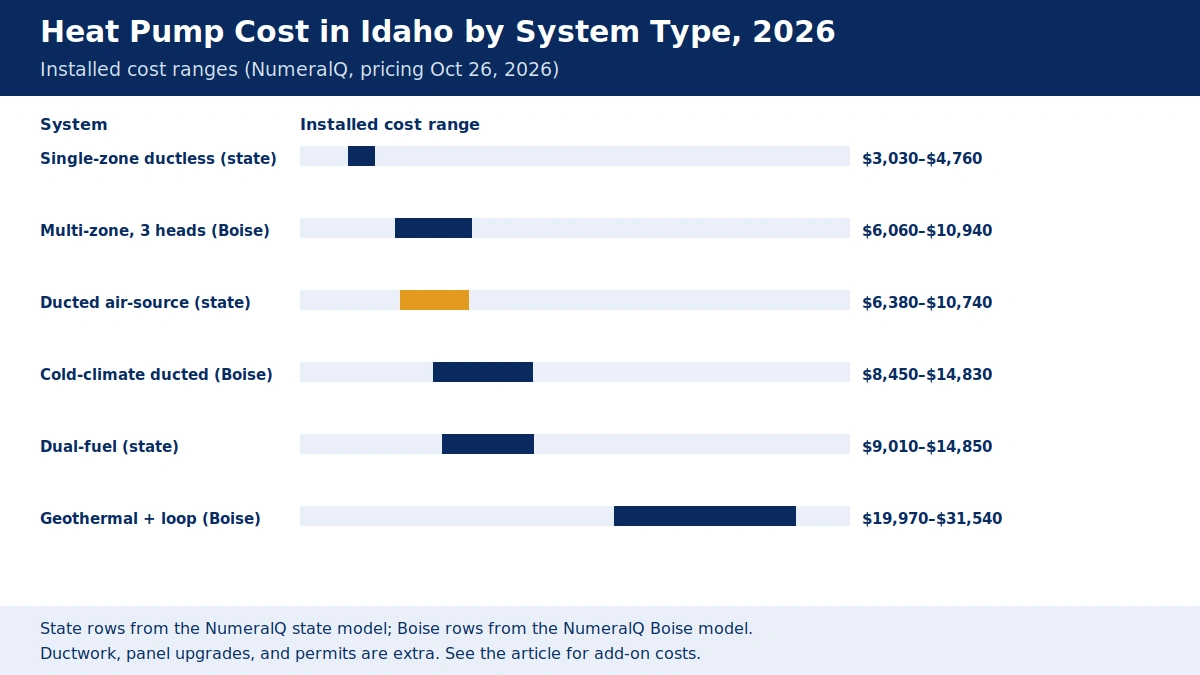
The system type you choose sets the price band before any contractor visits your home. A single-zone mini-split that heats one room costs less than a third of a geothermal system that heats the whole house from the ground up. The table below uses the published state rows where they exist and Boise figures, labeled as Boise, where the state model does not publish a row. All figures are installed costs for a 3-ton equivalent unless noted.
| System type | Idaho installed cost | Best for |
|---|---|---|
| Single-zone ductless mini-split | $3,030–$4,760 (state) | One room, addition, or garage |
| Multi-zone ductless, 3 heads | $6,060–$10,940 (Boise) | Homes without ducts, zoned comfort |
| Ducted air-source heat pump | $6,380–$10,740 (state) | Homes with good ducts |
| Cold-climate ducted heat pump | $8,450–$14,830 (Boise) | Idaho Falls, Pocatello, high valleys |
| Dual-fuel (heat pump plus gas furnace) | $9,010–$14,850 (state) | Gas-heated homes that want both |
| Geothermal with ground loop | $19,970–$31,540 (Boise) | Long-term owners, large lots |
A single-zone ductless mini-split is the cheapest way into heat pump heating in Idaho, and it is the right answer for a specific set of homes. It heats and cools one zone, usually a single room or an open-plan living area, through a wall-mounted indoor head connected to a small outdoor unit. The state band of $3,030–$4,760 makes it the go-to fix for a Boise home with electric baseboard heat in a converted garage, a Nampa addition that never got ductwork, or a rental where the owner wants cooling in the main living space without touching the rest of the house. It is not a whole-home system, and a contractor who prices one head as a whole-home solution is selling you a cold bedroom in January.
Multi-zone ductless systems extend the same idea to three or more rooms, each with its own indoor head and its own thermostat. The Boise band of $6,060–$10,940 for a three-head system overlaps the ducted band, which surprises homeowners who assume ductless is always cheaper. It is cheaper when the alternative is building ductwork from scratch, and it is more expensive when good ducts already exist. Multi-zone systems shine in older Idaho homes with no ducts at all, which describes many pre-1960 houses in Boise’s North End, Pocatello’s older neighborhoods, and small towns across the Magic Valley. The ductless vs ducted comparison prices both approaches side by side for a home that could go either way.
A ducted air-source heat pump is the standard replacement for a home that already has a furnace and ductwork. It uses the same ducts, the same vents, and often the same air handler cabinet, which keeps the install simple and the price in the state band. The catch is that the ducts must be in good shape. Leaky or undersized ducts waste the efficiency you paid for, and Idaho Power’s $200 duct sealing incentive exists precisely because so many Idaho ducts leak. If your ducts run through an unconditioned attic or crawl space, budget for sealing and insulation on top of the equipment price.
Cold-climate ducted systems cost about $3,000 more than standard ducted systems in Boise, and in eastern Idaho that premium buys the difference between comfort and a cold house. A cold-climate system uses a variable-speed compressor and a larger outdoor coil to keep producing heat at outdoor temperatures where a standard system gives up and switches to backup resistance heat. The Boise band of $8,450–$14,830 reflects that bigger coil, the inverter drive, and the more careful installation these systems need. For a home in Idaho Falls, where the design temperature is minus 6°F, a cold-climate rating is not an upgrade. It is the baseline.
A dual-fuel system pairs a heat pump with a gas furnace and lets a control switch between them based on outdoor temperature. The state band of $9,010–$14,850 buys two heating systems in one install, and it makes the most sense for a Treasure Valley home that already has a gas line and a gas furnace near the end of its life. The heat pump handles the mild shoulder seasons, the furnace takes over on the coldest nights, and the homeowner never pays for electric resistance backup heat. The running-cost section shows why dual-fuel rarely saves money on fuel in Idaho, but the comfort and redundancy case is strong.
Geothermal, also called a ground-source heat pump, is the most expensive system on the list and the only one that qualifies for Idaho’s state tax deduction. It buries a loop of pipe in the yard or in a well and pulls heat from the ground, which stays near 50°F year-round at depth. The Boise band of $19,970–$31,540 covers the loop and the indoor unit, and the final price depends on whether the loop goes in horizontal trenches, which need a large yard, or vertical boreholes, which cost more but fit a small lot. Boise has heated buildings with geothermal water since 1892, when the Warm Springs Water District began pumping hot water to homes, the oldest geothermal heating district in the country. That history is a different technology from a ground-source heat pump, which uses a heat pump and a closed loop rather than hot spring water, but it means Idaho drillers and installers know the ground here better than in most states.
One cost that hides inside every system type is the refrigerant, the gas that carries heat through the loop. The gas changed in 2025, when the EPA phased R-410A out of new home systems. A system bought in Idaho in 2026 runs on R-454B or R-32 instead, and neither new gas can top off an old R-410A system. Both new gases are mildly flammable, which adds handling requirements and a small cost to the install. If a contractor offers to recharge an old system cheaply, ask which refrigerant is in it and whether the repair makes sense against replacement.
Heat Pump Cost in Idaho by Home Size and Tonnage
Heat pumps are sized in tons, and one ton means the system can move 12,000 Btu of heat in an hour. A Btu, or British thermal unit, is the amount of heat needed to warm one pound of water by one degree Fahrenheit. The ton label has nothing to do with how much the outdoor box weighs, and a 3-ton system is the middle of the residential range, not a heavy-duty commercial unit.
The table below gives Boise installed costs by size from NumeralQ’s October 2026 pricing. No published state-level by-size table exists, so Boise figures stand in for the state, and they are labeled as Boise. The home-size column is a planning guide only. Two homes of the same square footage can need different sizes because insulation, windows, ceiling height, and air leakage matter as much as floor area.
| System size | Boise installed cost | Rough home size | Typical Idaho home |
|---|---|---|---|
| 1.5 ton | $4,290–$6,920 | 600–900 sq ft | Small condo, apartment |
| 2 ton | $5,000–$8,210 | 900–1,200 sq ft | Starter home, small ranch |
| 2.5 ton | $5,710–$9,500 | 1,200–1,500 sq ft | Older Boise bungalow |
| 3 ton | $6,420–$10,780 | 1,500–2,100 sq ft | Typical Treasure Valley home |
| 3.5 ton | $7,130–$12,070 | 2,100–2,400 sq ft | Two-story Meridian home |
| 4 ton | $7,830–$13,360 | 2,400–3,000 sq ft | Large Nampa home |
| 5 ton | $9,250–$15,930 | 3,000–3,700 sq ft | Large Idaho Falls home |
Each half-ton step adds about $700 at the low end and about $1,290 at the high end, except the jump from 4 tons to 5 tons, which adds $1,420 at the low end and $2,570 at the high end. The jump from 3 tons to 4 tons is about $1,410 at the low end and $2,580 at the high end, which is why oversizing is an expensive mistake. A system that is too big short-cycles, turning on and off in short bursts that wear out parts, leave humidity behind in summer, and never reach steady efficiency. A system that is too small runs constantly on the coldest days and leans on backup resistance heat, which costs roughly three times as much per unit of heat as the heat pump itself.
The correct size comes from a Manual J load calculation, a room-by-room heat loss and heat gain worksheet that the residential code requires for sizing. Manual J is a method published by the Air Conditioning Contractors of America, and it accounts for your walls, windows, insulation, air leakage, and the local design temperature. Any contractor who sizes your system from square footage alone, or who proposes the same size as the unit being replaced without running the numbers, is guessing. In Idaho the guess is especially risky because the design temperature swings from 11°F in Boise to minus 6°F in Idaho Falls, and a size that is right in one city is wrong in the other.
Idaho homes add three sizing wrinkles that a good Manual J catches. First, many Treasure Valley homes have vaulted ceilings and large west-facing windows that add summer cooling load without adding winter heating load, which can push the cooling size above the heating size. Second, older homes in Boise, Pocatello, and Idaho Falls often have little wall insulation and leaky ducts, which inflate the heating load well past what the square footage suggests.
Third, homes at higher elevations, from the Boise foothills to the Wood River Valley, face colder nights and thinner air, which reduces the capacity of the outdoor unit itself. A contractor who has worked your neighborhood will know these patterns. Ask how many systems they have installed within a few miles of your address.
The furnace-plus-air-conditioner comparison belongs in this section because it is the quote most Idaho homeowners actually compare against. A 3-ton split furnace and air conditioner costs $8,160–$13,870 installed at the state level, which is $1,780–$3,130 more than the 3-ton heat pump band. The pair costs more because it is two machines doing the jobs one heat pump does. If your furnace and air conditioner are both near the end of their lives, a heat pump is the cheaper replacement, not the expensive alternative. If only the furnace is failing and the air conditioner has years left, the math is closer, and the payback section works through that case.
Heat Pump Cost by City: Boise, Meridian, Nampa, and Idaho Falls
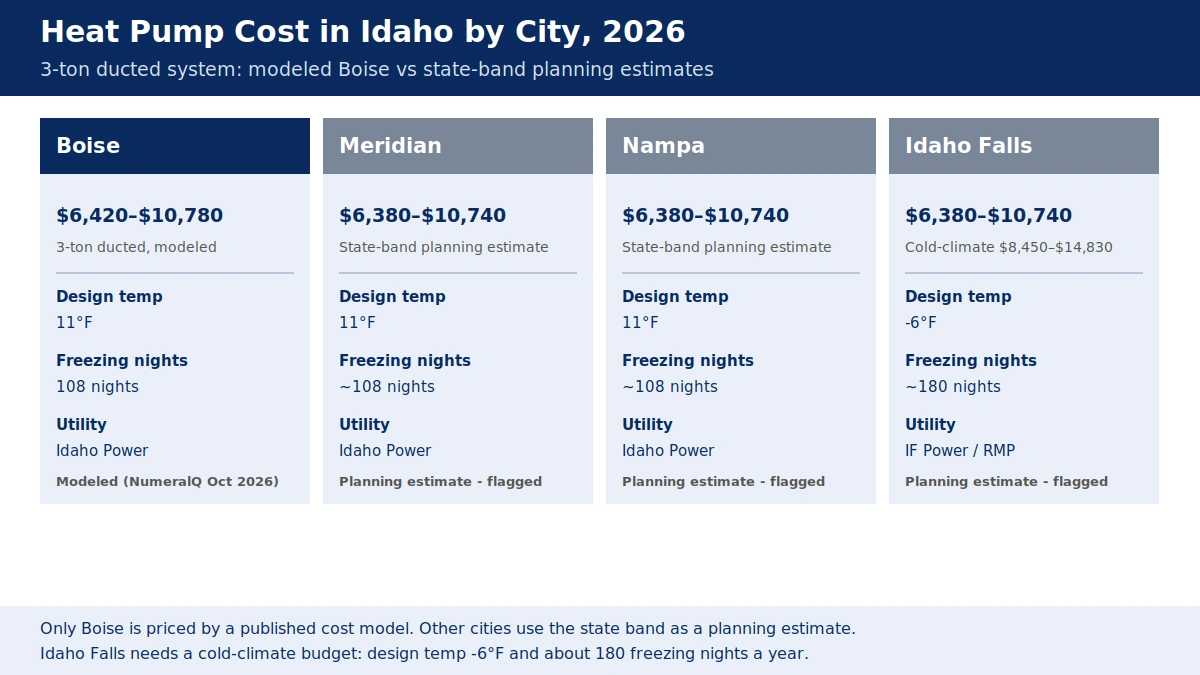
Boise is the only Idaho city with a published cost model. NumeralQ prices Boise in detail, with figures by size, by system type, by add-on, and by labor rate. No published cost model prices Meridian, Nampa, or Idaho Falls, and this section is honest about that gap. The Boise figures below are modeled costs. The Meridian, Nampa, and Idaho Falls figures are planning estimates built from the state band, and they are labeled as estimates wherever they appear.
| City | 3-ton ducted cost | Basis | What moves the price |
|---|---|---|---|
| Boise | $6,420–$10,780 | NumeralQ model, Oct 2026 | Standard reference market |
| Meridian | $6,380–$10,740 | State-band planning estimate | Newer homes, good ducts |
| Nampa | $6,380–$10,740 | State-band planning estimate | Older stock, more duct work |
| Idaho Falls | $6,380–$10,740, cold-climate $8,450–$14,830 | State-band planning estimate | Colder design temp, cold-climate rating |
Boise is the reference market, and its numbers are the firmest in this guide. The city has 212 plumbing and HVAC contractors in Ada County, about 10 per 10,000 homes, which is a competitive market by Idaho standards. The median Boise home is worth $484,800, 71% of homes are one-unit houses, and 63% heat with piped gas while 33% heat with electricity. That fuel split matters for quotes: a Boise contractor who works mostly in gas-heated subdivisions may price a heat pump as an add-on to a furnace, while a contractor who works the older neighborhoods near the foothills is more likely to price a full electric replacement. Get bids from both kinds of contractor.
Meridian is the fastest-growing city in the state, and its housing stock is the newest of the four cities here. Newer homes usually have better insulation, tighter ducts, and 200-amp panels already in place, which means a Meridian install is more likely to land near the low end of the band with no add-ons. The planning estimate for Meridian uses the state band of $6,380–$10,740 for a 3-ton ducted system. The main Meridian price risk is size: two-story homes with a bonus room over the garage often need zoning or a second head, and that pushes the job toward the multi-zone band of $6,060–$10,940.
Nampa shares the Treasure Valley climate with Boise and Meridian, but its housing stock is older on average, and older stock means more ductwork and electrical surprises. The planning estimate for Nampa also uses the state band, but Nampa homeowners should budget more carefully for the add-ons: ductwork at $3,990–$6,850 and a panel upgrade at $2,140–$3,390, using Boise add-on pricing as the planning reference. A Nampa home with a 100-amp panel and original 1970s ducts can need both. Ask the contractor to inspect the panel and the ducts before quoting, not after the contract is signed.
Idaho Falls is a different heating climate wearing the same state name. The design temperature is minus 6°F, about 17 degrees below Boise’s, and the city sees about 180 freezing nights a year against Boise’s 108. A standard heat pump sized for Boise will not hold an Idaho Falls home at 70°F on a minus 10°F night without heavy backup heat. The planning estimate for Idaho Falls uses the state band for a standard system, but the realistic budget for a system that actually works there is the cold-climate Boise band of $8,450–$14,830, and the efficiency section explains why the cold-climate rating matters more than the brand name. Idaho Falls homeowners should also check which utility serves their address before pricing rebates, because the city and the surrounding area split between Idaho Falls Power and Rocky Mountain Power, and their incentive programs are completely different.
Coeur d’Alene deserves a mention even though it is not one of the four priced cities. The northern panhandle city has a design temperature of 10°F, close to Boise’s, but longer cold spells, heavier snow, and a different utility in Avista. Snow matters for heat pumps because the outdoor unit needs clearance above the snow line and a defrost cycle that can handle wet snow. If you live in Coeur d’Alene, Post Falls, or Sandpoint, ask the contractor where the outdoor unit will sit, how high it will be raised, and how the defrost drain will be routed so it does not freeze into a sheet of ice under the unit.
Travel and access can move a quote in rural Idaho in ways the city bands do not capture. A home outside the four cities, in places like Twin Falls, Caldwell, Rexburg, or the Wood River Valley, may face a trip charge, a smaller pool of certified installers, or a longer wait for a cold-climate model that the local distributor does not stock. None of that changes the equipment price, but it can add days to the timeline and a few hundred dollars to the labor line. If you live outside the Treasure Valley and the Snake River Plain corridor, get one bid from a contractor based in your county and one from the nearest city, and compare the full installed price rather than the equipment price alone.
If you live near a state line, costs in neighboring states run close to Idaho’s. See the guides for Montana, Utah, Oregon, Washington, and Nevada for the figures on the other side of the border.
Cold-Climate Performance: What Idaho Winters Really Ask of a Heat Pump
A heat pump does not burn fuel to make heat. It moves heat from the outdoor air into your home, using a refrigerant loop and a compressor, the same basic process as a refrigerator running in reverse. That is why a heat pump can deliver two to three units of heat for every unit of electricity it uses: it is hauling heat that already exists rather than creating it from scratch. It is also why outdoor temperature matters so much. As the air outside gets colder, there is less heat to haul, the machine works harder, and both its output and its efficiency fall.
The number that captures this is COP, the coefficient of performance. COP is the ratio of heat delivered to electricity used. A COP of 3.0 means three units of heat for one unit of electricity. Electric resistance heat, the baseboards and wall heaters in many older Idaho homes, has a COP of 1.0 by definition: one unit of electricity becomes one unit of heat. A heat pump beats resistance heat whenever its COP is above 1.0, which is almost always, but the margin shrinks as the temperature drops, and at some point the machine cannot keep up with the house at all.
That point is called the balance point, the outdoor temperature where the heat pump’s maximum output exactly matches the home’s heat loss. Above the balance point, the heat pump carries the whole load. Below it, a second heat source must make up the difference.
In a Boise home with a well-sized cold-climate system, the balance point may sit near 10°F or lower, which means backup heat runs only a handful of nights a year. In an Idaho Falls home with a standard system, the balance point may sit near 25°F or 30°F, which means backup heat runs for weeks. The balance point is a property of the pairing between one machine and one house, not a specification on a brochure, and a good contractor can estimate it from the Manual J load and the manufacturer’s capacity tables.
Capacity tables are where the honest shopping happens. Every manufacturer publishes how much heat a given model delivers at 47°F, 17°F, and 5°F outdoors. A standard system that delivers its full rated heat at 47°F may deliver only 40–60% of that amount at 5°F.
A cold-climate system is built to hold far more of its capacity at 5°F, and the ENERGY STAR cold-climate designation requires at least 70% of the 47°F capacity at 5°F, with a COP of at least 1.75 at that temperature. Ask the contractor to show you the capacity table for the exact model quoted, at 17°F and at 5°F, and compare those numbers with your home’s heating load at the local design temperature. If the contractor cannot produce the table, the quote is not finished.
Defrost cycles are the part of cold-climate operation that surprises new owners. When the outdoor coil ices up, the system briefly reverses to melt the ice, and during those minutes it blows cool air indoors unless backup heat tempers it. Defrost is normal and necessary. It becomes a problem only when the system defrosts constantly because it is undersized, poorly placed, or fighting wet snow and ice buildup around the base.
In Coeur d’Alene and the higher valleys, the outdoor unit should sit on a raised stand above the typical snow line, with the drain routed so meltwater does not refreeze under the unit. In the Treasure Valley, the bigger issue is winter inversions, when cold air pools in the valley floor and temperatures stay below freezing for days. An inversion week is when a marginal system shows its limits, and it is the week your backup heat earns its keep.
Backup heat in Idaho takes three forms, and each has a different cost. Electric resistance strips inside the air handler are the default in all-electric homes. They are cheap to install and expensive to run, at a COP of 1.0, and they are the reason an undersized heat pump produces shocking January bills.
A gas furnace in a dual-fuel setup is the second form, and it takes over cleanly on the coldest nights at Idaho’s low gas price. A wood or pellet stove is the third form, common in rural Idaho homes, and it can carry the coldest nights well, though it adds indoor particulates during inversion season, when the state health department already recommends better filtration. Whichever backup you have, the thermostat settings matter: the switchover temperature, sometimes called the lockout, decides when backup takes over, and setting it too high wastes money by running backup heat on nights the heat pump could have handled.
The mountain-valley contrast is the single most important climate fact for an Idaho buyer. Boise, at about 2,700 feet in the Treasure Valley, has 5,320 heating degree days, a measure of how much heating a climate demands over a year. Idaho Falls, at 4,729 feet on the upper Snake River Plain, has 7,792, about 47% more. Boise sees about 108 nights at or below freezing and about 1 night at or below zero.
Idaho Falls sees about 180 freezing nights and about 15 nights at or below zero, with a record low of minus 38°F. Coeur d’Alene sits between them in temperature but adds heavier snow and a longer cold season that runs from mid-November to late February. A contractor who sizes from Boise rules and installs in Idaho Falls will undersize the system by nearly half the heating load. Make sure the Manual J uses your city’s design temperature, not a statewide default.
One more cold-climate honesty check: the efficiency ratings on the yellow label are measured in a milder test climate than eastern Idaho. The HSPF2 rating, explained in the efficiency section, reflects a test region with winters far gentler than Idaho Falls. A system rated HSPF2 9.5 will not deliver its rated seasonal efficiency in a climate with 7,792 heating degree days. It will deliver less, and the gap grows with every degree the design temperature drops. Budget your running costs from the COP range in the next section, not from the label alone, and treat any contractor promise of label efficiency in an Idaho Falls winter as a sales claim rather than a fact.
Running Costs: Heat Pump vs Gas, Propane, and Electric Resistance Heat
Running cost is where Idaho breaks the usual heat pump sales pitch. In most states, a heat pump beats a gas furnace on fuel cost. In Idaho, it does not, because Idaho natural gas is among the cheapest in the country and Idaho electricity, while cheap by national standards, is not cheap enough to close the gap. This section shows the math with every input stated, so you can check it against your own utility bills.
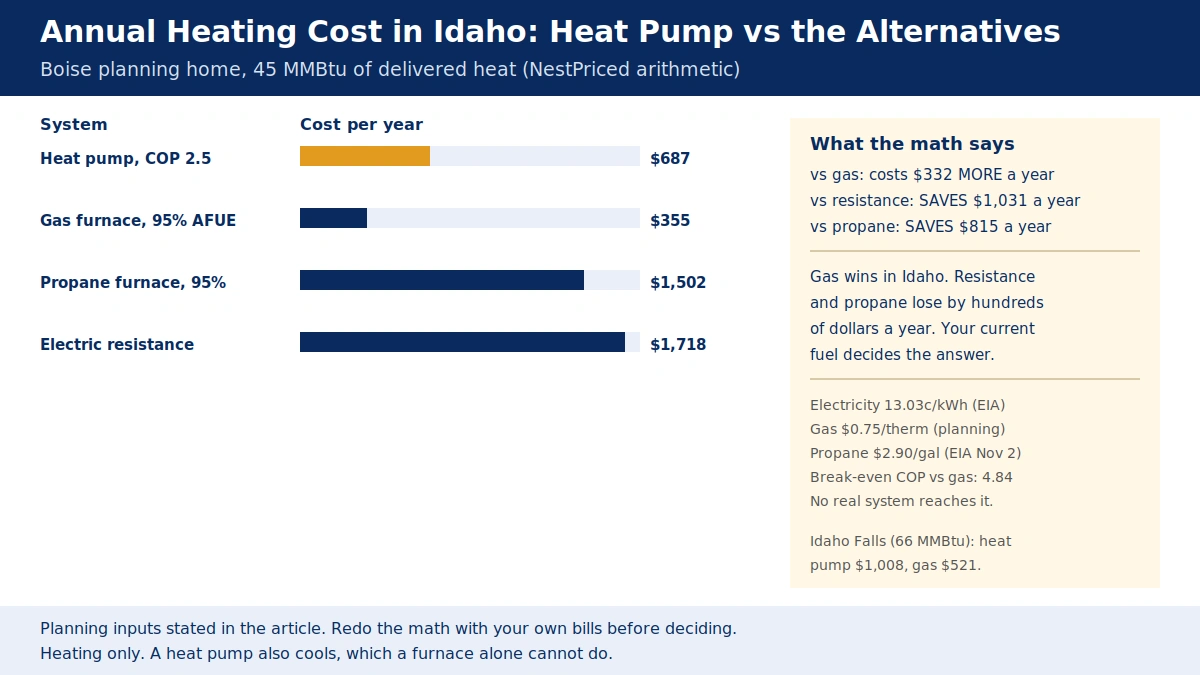
The planning home in this section needs 45 million Btu of delivered heat per year, a figure built from federal survey data. The Energy Information Administration’s Residential Energy Consumption Survey puts Idaho gas space heating at 51.10 million Btu of fuel input per household. A furnace turns 80–95% of that fuel into heat inside the home, which puts delivered heat at 41–49 million Btu, and 45 million Btu sits in the middle. An Idaho Falls sensitivity scales that load by the heating degree day ratio, 7,792 divided by 5,320, or 1.465 times, giving 66 million Btu. These are planning figures, not measurements of your home, and the method is labeled NestPriced arithmetic wherever the results appear.
The energy prices are current. Electricity is 13.03 cents per kilowatt-hour, the EIA average for Idaho residential customers over January through August 2026, the fifth cheapest in the country against a national average of 18.19 cents. Natural gas is $0.75 per therm, a planning price between the 2025 annual average of about $0.74 per therm and the 2026 year-to-date average of about $0.81 per therm, both from EIA monthly gas price data. Propane is $2.90 per gallon, the EIA weekly price for Idaho in the week ending November 2, 2026. The furnace in the comparison is a new condensing model at 95% AFUE, the efficiency rating for furnaces, with an 80% sensitivity for older equipment.
| Heating system | Annual heating cost, Boise planning home | Notes |
|---|---|---|
| Heat pump, seasonal COP 2.2 | $781 | Low-efficiency system or harsh winter |
| Heat pump, seasonal COP 2.5 | $687 | Central planning case |
| Heat pump, seasonal COP 2.8 | $614 | Good cold-climate system |
| Heat pump, seasonal COP 3.5 | $491 | Mild winter, high-efficiency system |
| Gas furnace, 95% AFUE, $0.75/therm | $355 | New condensing furnace |
| Gas furnace, 80% AFUE, $0.75/therm | $422 | Older furnace |
| Electric resistance heat | $1,718 | Baseboards, wall heaters |
| Propane furnace, 95% AFUE, $2.90/gal | $1,502 | Rural homes off the gas grid |
Read the table from the gas row outward. A heat pump at the central COP of 2.5 costs $687 a year to heat the planning home, which is $332 more than the $355 a new gas furnace costs. Even a very good system at COP 3.5 costs $491, still $136 more than gas. The break-even point, the COP at which the heat pump ties the gas furnace, is 4.84, far above any seasonal COP a real air-source system achieves in Idaho. If your home heats with gas today, a heat pump will raise your heating bill, not lower it, and any contractor who tells you otherwise has not run the Idaho numbers.
The picture reverses completely for the other two fuels. Against electric resistance heat at $1,718 a year, the same heat pump saves about $1,031 a year. Against propane at $1,502 a year, it saves about $815 a year. About a third of Idaho homes heat with electricity and about 5% heat with propane, and for those homes a heat pump is the single biggest heating-bill cut available. The savings grow in colder parts of the state because a bigger heating load multiplies the per-unit saving: in the Idaho Falls sensitivity, the heat pump costs $1,008 a year at COP 2.5 against $2,520 for resistance heat, a saving of $1,512 a year, and against $2,203 for propane, a saving of $1,195 a year.
The gas comparison gets worse, not better, when you account for how gas billing actually works. A dual-fuel home that keeps gas service pays Intermountain Gas an $11 monthly customer charge whether the furnace runs or not, and the gas it does burn costs about $0.53 per therm at the margin under the current tariff. Against that marginal gas price, the heat pump’s break-even COP rises to 6.85, which no air-source system reaches. The honest conclusion is that keeping a gas connection as backup is worth it for comfort and redundancy, but it does not make the heat pump cheaper to run. Do not let a quote claim fuel savings from a dual-fuel system in Idaho without showing this marginal-rate math.
An independent calculator model reaches the same direction. GreenCalculus, using EIA inputs from early 2026, estimated that an Idaho heat pump costs about $198 more per year than gas heat and saves about $754 per year against propane. The dollar figures differ from the planning math above because the model uses different home assumptions, but the ranking is identical: gas wins, propane loses, and the gap is hundreds of dollars a year either way. When two independent methods agree on the ranking, trust the ranking.
Cooling changes the comparison in the heat pump’s favor, and it is the reason many gas-heated Idaho homes still choose one. A heat pump is also an air conditioner, and a gas furnace is not. The planning math above covers heating only.
A Boise home that needs cooling through a hot July, when temperatures regularly top 100°F, either buys an air conditioner alongside the furnace or buys a heat pump that does both jobs. The furnace-plus-air-conditioner pair costs $8,160–$13,870 installed, against $6,380–$10,740 for the heat pump, so the heat pump starts about $2,455 ahead on equipment before a single kilowatt-hour is counted. The full payback math, including cooling, is in the payback section.
Your own bills are the final check. Take your last 12 months of electricity and gas use, not the dollar totals, because rates changed during 2026. Idaho residential electricity rose about 11% over the first eight months of 2026 compared with the same period in 2025, and gas prices rose too. Divide your annual heating fuel use by the efficiency of your current system to estimate your delivered heat, then price that heat at the COP range in the table above. If your delivered heat is far above 45 million Btu, your home is larger, leakier, or colder than the planning home, and your savings against resistance or propane will be larger too.
Efficiency Ratings That Matter: SEER2, HSPF2, and Cold-Climate Labels
Heat pump efficiency comes with two ratings, and Idaho buyers should weight the heating rating far more heavily than the cooling rating. SEER2, the Seasonal Energy Efficiency Ratio 2, measures cooling efficiency over a summer season. HSPF2, the Heating Seasonal Performance Factor 2, measures heating efficiency over a winter season. Both use the 2 suffix because the test procedure was updated in 2023 to use more realistic duct pressures, and the new numbers run lower than the old SEER and HSPF numbers for the same machine. A 16 SEER system from an old quote is not the same as a 16 SEER2 system, and comparing across the two scales will mislead you.
The federal minimum for a split-system heat pump is 14.3 SEER2 and 7.5 HSPF2 nationwide, effective January 1, 2023. Any new system you buy in Idaho must meet at least those numbers. The minimum is a floor, not a recommendation. A system at the federal minimum will heat a Boise home adequately and an Idaho Falls home marginally, with heavy backup heat use in the coldest weeks. The rebate programs in Idaho all require efficiency above the minimum, which is a useful signal: the utilities will not pay you to install the cheapest legal system, because they know it will not perform.
HSPF2 converts to seasonal COP by dividing by 3.412, the number of Btu in a watt-hour. An HSPF2 of 7.5 implies a seasonal COP of about 2.2. An HSPF2 of 9.5 implies about 2.8.
An HSPF2 of 10.5 implies about 3.1. That conversion is approximate, and it carries the caveat from the cold-climate section: HSPF2 is measured in a test climate milder than eastern Idaho, so the realized seasonal COP in Idaho Falls will run below the converted figure. Even with that caveat, the conversion is the fastest way to compare two quotes on heating cost, and the table below prices the tiers for the Boise planning home.
| Efficiency tier | HSPF2 | Implied seasonal COP | Annual heating cost, Boise | Who it suits |
|---|---|---|---|---|
| Federal minimum | 7.5 | About 2.2 | $781 | Tight budgets, Boise only |
| Mid-tier | 8.5 | About 2.5 | $690 | Most Treasure Valley homes |
| High-tier | 9.5 | About 2.8 | $617 | Idaho Falls, colder valleys |
| Top-tier cold-climate | 10.5 | About 3.1 | $558 | Eastern Idaho, high elevation |
The jump from the federal minimum to the high tier saves about $164 a year in Boise, and more in Idaho Falls where the heating load is 47% larger. Whether that saving justifies the equipment premium depends on the premium, which varies by brand and by how much of the upgrade cost is the cold-climate coil rather than the efficiency rating itself. In Boise, where the cold-climate premium is about $3,040 over a standard system, the efficiency saving alone does not pay it back quickly. In Idaho Falls, where the premium also buys capacity at 5°F and far less backup heat, the payback is faster and the comfort gain is larger. Price the tier jump and the cold-climate capability as separate decisions, and ask the contractor to quote them separately.
Two labels cut through the rating confusion for cold climates. The ENERGY STAR cold-climate designation requires a COP of at least 1.75 at 5°F outdoors, at least 70% of the 47°F heating capacity at 5°F, and a controls verification procedure that proves the system behaves as rated in the field. It also requires 15.2 SEER2 and 8.1 HSPF2 for ducted systems or 8.5 HSPF2 for ductless systems.
The NEEP cold-climate specification, maintained by the Northeast Energy Efficiency Partnerships and used by Rocky Mountain Power’s rebate program, requires a variable-capacity compressor and a COP of at least 1.75 at 5°F at maximum capacity. Both labels exist because the standard HSPF test has no test points below 17°F, so a system can earn a good HSPF2 rating and still fade badly at 5°F. In Idaho, a cold-climate label is worth more than a half-point of HSPF2.
SEER2 still matters in the Treasure Valley, where summer cooling is a real load. Boise sees summer highs above 100°F, and a system at 14.3 SEER2 will cost noticeably more to cool with than one at 16 SEER2 or higher. The cooling saving is smaller than the heating saving in absolute dollars, because Idaho’s cooling season is short, but it is real, and the higher SEER2 tiers usually come bundled with the variable-speed compressors that also improve heating performance. In Idaho Falls and Coeur d’Alene, where summers are milder, weight SEER2 less and HSPF2 and the cold-climate labels more.
One rating trap to avoid: EER2, the Energy Efficiency Ratio 2, measures cooling efficiency at a single hot outdoor temperature rather than over a season. Some quotes highlight a high EER2 to distract from a mediocre HSPF2. For an Idaho buyer, EER2 is a secondary number. Ask for HSPF2, the 5°F capacity, and the cold-climate labels first. If the quote leads with EER2 and buries the heating numbers, ask why.
Dual-Fuel Systems and Backup Heat in Idaho
A dual-fuel system pairs an electric heat pump with a gas furnace and uses a control to switch between them. The heat pump runs when outdoor temperatures are mild, the furnace takes over when it gets cold, and the homeowner gets cooling in summer from the heat pump. The state band for a dual-fuel install is $9,010–$14,850, which is $2,630–$4,110 more than a standard ducted heat pump and $850–$980 more than a furnace-plus-air-conditioner pair across the band. The premium buys redundancy: two heat sources, two fuels, and no dependence on electric resistance strips.
The switchover temperature is the setting that decides when the furnace takes over, and it is the most consequential number in a dual-fuel install. Set it too high, say 40°F, and the furnace does most of the winter’s work while the expensive heat pump sits idle. Set it too low, say 10°F, and the heat pump strains through weather it cannot handle, with comfort dropping before the furnace rescues it.
The right setting depends on the heat pump’s capacity curve, the home’s heat loss, and the relative price of gas and electricity. In Idaho, where gas is cheap, the economic switchover point sits higher than in most states, because the heat pump stops being cheaper than gas at a relatively mild temperature. A contractor who sets the switchover from a national default rather than from Idaho fuel prices will set it too low.
The fuel math for dual-fuel in Idaho is blunt. Take the planning home and let the heat pump carry 60% of the load at a COP of 2.8, with the gas furnace carrying the other 40% at 95% efficiency. The heat pump portion costs $368 a year and the gas portion costs $142, for a total of $510. The same home heated entirely by the gas furnace costs $355.
Dual-fuel costs about $155 more per year on fuel than gas alone, on top of a $915 equipment premium over the furnace-plus-air-conditioner pair. Dual-fuel never pays for itself on fuel in Idaho at current prices. It pays for itself in other ways: cooling included, a backup heat source if either system fails, lower carbon emissions during the shoulder seasons, and a furnace that runs fewer hours and lasts longer.
All-electric homes face a different backup question. Without a gas line, the backup is almost always electric resistance strips inside the air handler, and those strips cost three times as much per unit of heat as the heat pump at a COP of 3.0. The strips are cheap to install, often a few hundred dollars, and they are essential safety equipment on the coldest nights. The cost control is not the strips themselves but how often they run.
A well-sized cold-climate system with a low balance point may run its strips only a few dozen hours a year. An undersized standard system may run them for weeks. The difference shows up as a January electric bill that is double or triple the December bill, and it is the most common complaint from Idaho homeowners who bought a heat pump on price alone.
Thermostat behavior matters more with a heat pump than with a furnace, and Idaho’s cold mornings expose the difference. A furnace recovers from a nighttime setback quickly by blasting hot air. A heat pump recovers slowly, and an aggressive morning warm-up can trigger the resistance strips, wiping out the overnight saving. The practical fix is a smaller setback, two or three degrees rather than eight, or a smart thermostat with a heat pump mode that ramps the temperature gradually and locks out the strips above a set outdoor temperature. Idaho Power offers a $50 smart thermostat incentive, and the thermostat is worth more than $50 in avoided strip heat over a single winter.
Homes with a wood or pellet stove have a third backup option that many rural Idaho households already use. A stove can carry the coldest nights and let the heat pump handle the milder weather, which is the same division of labor as dual-fuel with a different second fuel. The trade-off is air quality.
Idaho ranks high nationally in per-capita wood stove pollution, and winter inversions trap smoke in the valley air for days. The state health department recommends MERV 13 filters, a filter rating that captures fine smoke particles, during wildfire smoke and inversion events. If you burn wood as backup, pair it with good filtration and keep the stove maintained, and do not count the stove as your only backup if you travel in winter.
Sizing the backup is part of sizing the system. The resistance strips should be large enough to hold the home at a safe temperature if the heat pump fails on a cold night, which usually means sizing them to a large fraction of the design load. The gas furnace in a dual-fuel setup should be sized to carry the full load on its own, because the night the heat pump fails will be the coldest night of the year. Ask the contractor what happens on a minus 10°F night if the heat pump stops. The answer should be a specific backup capacity, not a reassurance.
Ducted vs Ductless Heat Pumps in Older Idaho Homes
Idaho’s older homes divide cleanly into two groups, and the right heat pump depends on which group yours falls into. Homes built with a furnace have ducts, and a ducted heat pump slots into the existing system. Homes built with electric baseboards, ceiling cable heat, or wall units have no ducts, and a ductless system avoids the cost and disruption of building ductwork from scratch. The housing stock in Boise’s North End, the older streets of Pocatello and Idaho Falls, and the small towns of the Magic Valley holds plenty of both kinds, and the wrong choice costs thousands.
Ducted systems win when the ducts are already there and in good condition. The install is faster, the indoor unit hides in a closet or attic, and every room gets heat through the vents it already has. The risk is invisible: ducts leak. A duct system in an unconditioned attic or crawl space can lose a fifth or more of the heated air before it reaches a room, and undersized return ducts can starve the system of airflow.
Before you price a ducted system, have the contractor inspect the ducts and, if the home is older than 30 years, test them for leakage. Idaho Power’s $200 duct sealing incentive and Rocky Mountain Power’s program both recognize that sealing is often the highest-value dollar in the whole project. A $200 sealing incentive that saves $100 a year in wasted heat pays for itself in two winters.
Ductless mini-splits win when there are no ducts, when the ducts are beyond saving, or when different rooms need different temperatures. Each indoor head has its own thermostat, so a bedroom can stay cool while the living room stays warm, and a rarely used guest room can be set back without affecting the rest of the house. The heads mount high on a wall or recessed in a ceiling, and the refrigerant lines run through a small hole in the wall to the outdoor unit. The install is far less disruptive than cutting duct chases through plaster walls and finished ceilings. For a Boise bungalow with baseboard heat and no attic access, ductless is often the only practical option that does not involve opening walls.
The cost crossover is specific. Building new ductwork in Boise costs $3,990–$6,850 per job. A three-head ductless system costs $6,060–$10,940. A ducted system costs $6,420–$10,780 plus the ductwork if the ducts do not exist.
For a home with no ducts, ductless at $6,060–$10,940 beats ducted-plus-new-ducts at roughly $10,410–$17,630, and the gap is large enough that the decision is usually obvious. For a home with good ducts, ducted wins on price and on aesthetics, because no wall heads are visible in the rooms. For a home with bad ducts, price both options with the duct repair included, and do not accept a ducted quote that assumes the existing ducts are fine without an inspection.
Older Idaho homes add electrical constraints that affect both options. Many pre-1980 homes still have 100-amp panels, and a ducted heat pump with resistance backup strips can need a 200-amp service. A panel upgrade in Boise runs $2,140–$3,390 per job.
Ductless systems draw less current per head, and a single-zone system may run on the existing panel where a ducted system cannot. The panel question should be answered during the estimate, by looking at the panel and counting the available breaker spaces, not discovered on install day. If the panel needs upgrading, the electrical panel upgrade cost guide covers what that job involves and what it should cost.
A hybrid approach suits some older homes better than either pure option. A ducted heat pump can serve the main floor through existing ducts while a single ductless head covers an addition, a converted garage, or a bonus room the ducts never reached. A ductless system can cover the rooms that matter most while baseboard heaters stay as backup in rarely used rooms. These hybrids are common in Idaho remodels, and they let a homeowner phase the investment: the main system now, the extra head later, each with its own rebate application where the program allows it. Idaho Power allows up to two ducted incentives per home, which fits a phased approach.
Filtration is the hidden difference between ducted and ductless in inversion country. A ducted system filters all the air through one central filter, and upgrading to a MERV 13 filter during smoke and inversion season protects the whole house. A ductless head filters only the air in its own room, through a small washable filter that catches dust but not fine smoke particles. If anyone in the home has asthma or smoke sensitivity, the ducted system’s central filtration is a real health advantage during the weeks when Treasure Valley air stagnates. Ductless owners in smoke country should budget for a standalone HEPA air purifier in the bedroom, which costs far less than the filtration gap it closes.
Rebates, Tax Deductions, and Credits You Can Actually Collect in 2026
Idaho’s incentive picture is a mix of solid utility programs, one narrow state tax deduction, and a conspicuous absence where federal money used to be. This section covers each source in the order you should check them: your electric utility first, because that is where the money is, then the state deduction, then the federal situation, which is zero for 2026 installs. Every figure below was checked against the utility’s own program page or application form in November 2026, and figures that could not be verified against a primary source are flagged as reported.
Idaho Power: $800 ducted, $400 ductless, $3,000 ground-source
Idaho Power serves about 63% of Idaho homes, including Boise, Meridian, and Nampa, and its Heating and Cooling Efficiency Program is the largest single source of heat pump money in the state. The current incentive application, form CRR 211 dated December 2025, pays $800 for a new ducted air-source heat pump, up to two per home, and $400 for a ductless heat pump, one per home. Ground-source systems earn $3,000 when replacing electric forced air, baseboards, propane, or oil heat, and $1,000 when replacing an existing ducted air-source heat pump. Open-loop water-source systems earn $1,000 new or $500 as a replacement. A heat pump water heater earns $300, and duct sealing earns $200.
The eligibility rules are where Idaho Power applications succeed or fail. The ducted incentive covers homes replacing electric forced air, oil or propane forced air, electric baseboards, ceiling cable, or wall units. A natural gas furnace is not a qualifying previous system, so a gas-heated home earns no Idaho Power heat pump incentive.
The ductless incentive covers only homes replacing electric baseboards, ceiling cable, or wall units. Both heat pump incentives require a Participating Contractor, and the incentive is not retroactive: it must be part of your decision before you buy, and the paperwork must be submitted within 90 days after the project is finished. Idaho Power pays by check, not as a bill credit, and incentives are processed first-come, first-served, with amounts subject to change or termination at any time.
Two details catch applicants out. First, if the system being replaced is an oil or propane furnace, natural gas must not be available at the home, a rule aimed at homes that could have chosen gas. Second, if an electric system is being replaced, any supplemental heat in the new heat pump must be electric, which rules out adding a gas backup to an electric conversion.
Minimum efficiency ratings apply and are set in the program worksheet, so confirm the exact model’s ratings qualify before the install, not after. The ductless amount was cut from $500 to $400 effective January 1, 2026, and older web pages still showing $500 are stale. The current figures are on the Idaho Power incentive application.
Avista: $300–$600 through the contractor, with a 2027 cutoff for gas homes
Avista serves northern Idaho, including Coeur d’Alene, Post Falls, and Sandpoint, and its program works differently from Idaho Power’s. Avista runs a midstream model: the contractor buys qualifying equipment through a participating distributor, receives a discount, and may pass it on to you. There is no rebate form for the homeowner to file, and do-it-yourself installs are not eligible.
The discount for an air-source heat pump under 65,000 Btu per hour is $300 at Tier 1 (15.2 SEER2 and 8.1 HSPF2), $400 at Tier 2 (15.2 and 8.5), and $600 at Tier 3 (16.0 and 9.5), with the same amounts in Idaho and Washington. Mini-split and multi-split systems earn the same $300–$600 tiers on residential retrofits. A heat pump water heater earns $500 on a retrofit.
Because the discount passes through the contractor, the price you see should already reflect it, and you should ask the contractor to show the discount as a line on the quote. If the quote does not mention Avista, the discount may not be reaching you. One rebate tracker also lists a $500 Avista rebate for switching from baseboard heat to a ductless system, but Avista’s own incentives page does not list it, so do not count on that $500 unless Avista confirms it in writing. The verified tiers are on the Avista HVAC incentives page.
Avista has posted an expiration notice that northern Idaho homeowners must read carefully. Effective January 1, 2027, offerings for Idaho gas-powered homes end, eligible projects must be completed by December 31, 2026, and applications must arrive by January 15, 2027. Avista says Idaho rules require its efficiency programs to deliver enough savings to justify their cost, and at current gas prices the gas programs no longer meet that standard. If your Avista-served home heats with gas, confirm in writing whether your heat pump project is affected before counting on the discount. The same notice is a useful reminder of the economics in this guide: at Idaho gas prices, even the utility cannot make the efficiency math work for gas homes.
Avista also pays homeowners to switch in the other direction, and the comparison is striking. The utility’s conversion program pays $2,100 to switch from electric resistance heat to a natural gas furnace, and $2,850 for a furnace-plus-water-heater combination. Avista pays more than three times as much to move a home onto gas as it pays for the best heat pump tier. That is not a recommendation to switch to gas. It is evidence of how cheap gas is in Avista territory, and it explains why the heat pump discount is modest.
Rocky Mountain Power: $450–$650 air-source, $2,000 dual-fuel
Rocky Mountain Power serves eastern Idaho, including the area around Idaho Falls outside the city power boundary, under its Wattsmart Homes program. The current Idaho rebates pay $450 for an air-source heat pump upgrade, meaning a cold-climate system at 8.5 HSPF2 and 16 SEER2 on the NEEP qualified products list, and $650 for converting from electric resistance heat to an air-source heat pump at 7.5 HSPF2 and 14.3 SEER2. Dual-fuel systems earn $2,000 when AHRI-rated and $1,000 when not, with a minimum furnace efficiency that depends on the configuration. Ground-source systems earn $1,500 for an upgrade and $2,000 for a conversion. A tune-up earns $30 and a window heat pump earns $80.
The qualifications are strict, and the strictest one is the fuel rule. Conversions from gas, oil, wood, pellet, or propane heat do not qualify for air-source measures. The program pays only for replacing electric heat or upgrading an existing electric heat pump, and the new system must serve at least 80% of the home’s conditioned space, be listed in the AHRI directory, and be installed by a participating contractor. Only existing single-family homes qualify, manufactured homes are excluded for air-source measures, and the application must be submitted within 90 days of completion. The current amounts and qualifications are on the Wattsmart Homes Idaho air-source page.
Ductless figures for Rocky Mountain Power need a flag. A 2025 rebate chart lists single-head ductless at $1,000, multi-head at $1,500, and supplemental ductless at $600, but the current program page was not separately confirmed for those amounts. Treat the ductless figures as reported from the 2025 chart and confirm the current amounts with the program before budgeting. The same caution applies to any contractor quote that bundles a ductless rebate without naming the program’s current figure.
Idaho Falls Power and Kootenai Electric: reported figures, confirm first
Idaho Falls Power, the city-owned utility, is reported to pay $1,600 for a ductless system, $2,000 for a standard split system, and $2,400 for a variable-speed system, plus a 0% interest loan of up to $10,000 over 60 months for customers with at least 12 months of payment history. Those figures come from a 2025 article and a contractor page, and no official city page confirming them was found. If you are an Idaho Falls Power customer, call the utility and confirm the current amounts and the loan terms before counting a dollar of it. The distinction matters because Idaho Falls addresses split between the city utility and Rocky Mountain Power, and the two programs pay very different amounts for the same equipment. Your bill header tells you which utility serves you.
Kootenai Electric Cooperative, serving parts of the northern panhandle, is listed in a January 2026 regional incentives roundup with $1,250 for an air-source heat pump conversion, $1,560 for a variable-speed conversion, and $600 for an upgrade, with higher amounts possible for income-qualified customers. That roundup is a single source, so confirm the current amounts with the cooperative. Conversion in the cooperative’s terms means replacing an electric furnace where no heat pump exists today.
The state tax deduction: ground-source only, worth up to about $1,060
Idaho has no state tax credit for air-source heat pumps, and no rebate program run by the state. What it has is a state income tax deduction, in Idaho Code §63-3022C, that covers ground-source systems and only ground-source systems. The statute lets an individual taxpayer deduct 40% of the cost of an alternative energy device in the install year and 20% per year for three more years, capped at $5,000 per year and $20,000 total.
An alternative energy device includes, in the statute’s words, a fluid-to-air heat pump operating on a fluid reservoir heated by solar radiation or a geothermal resource. That describes a ground-source heat pump. An air-source heat pump pulls heat from outdoor air, which is not a geothermal resource, so it does not qualify.
The deduction is worth less than it sounds because a deduction reduces taxable income, not tax owed. Idaho’s flat income tax rate is 5.3% for 2025 and 2026, so the maximum $20,000 deduction is worth about $1,060 spread over four years. A ground-source system at the low end of the Boise band, $19,970, generates a $16,982 deduction after the annual caps, worth about $900. A system at the $25,755 midpoint hits the $20,000 cap and is worth the full $1,060.
Those are NestPriced arithmetic examples, and the state energy office recommends confirming the treatment with a licensed tax professional. The same deduction covers solar devices, and the solar panel cost guide for Idaho prices a rooftop system for a home pairing solar with a heat pump. The statute text is on the Idaho Legislature’s site.
The state energy office also runs a low-interest loan program for single-family energy efficiency projects, with loan applications currently being accepted, and the Weatherization Assistance Program serves low-income households year-round through the Department of Health and Welfare. Neither is a rebate, but the loan program can finance a heat pump at below-market rates for a homeowner who qualifies, and weatherization work often cuts the heating load enough to downsize the heat pump itself.
Federal money: $0 for 2026 installs, and no Idaho rebate program
The federal government contributes $0 toward a heat pump installed in 2026 in a home the owner lives in. The One Big Beautiful Bill Act, P.L. 119-21, ended the §25C energy efficient home improvement credit and the §25D residential clean energy credit for property placed in service after December 31, 2025, and the IRS confirmed the termination in Fact Sheet FS-2025-05. Any web page, contractor flyer, or quote still promising a 30% federal credit or a $2,000 federal credit for a 2026 heat pump install is wrong. The state energy office’s own incentives page still displays the old federal credit table, which is stale, and that staleness is a warning about how slowly incentive information updates. Check the IRS fact sheet, not a program page’s credit table.
The federal rebate programs tell a similar story with an Idaho-specific ending. The High-Efficiency Electric Home Rebate program, known as HEAR, offered up to $8,000 for a heat pump, income-qualified and paid at the point of sale, for electric-to-electric replacements only, with no fuel-switching allowed. The Home Efficiency Rebates program, known as HOMES, offered up to $8,000 for whole-home retrofits. Idaho was allocated about $81 million across the two programs. In March 2025, the legislature’s budget committee twice refused the governor’s $24.6 million request to run the programs, and the amended request failed on a 9–10–1 vote.
The money went to other states. The state energy office’s page still says rebates are not currently available and advises against basing a purchase on the hope of receiving one. There is no launch path, no waiting list, and no Idaho HEAR or HOMES money to count in a quote. The current status is on the OEMR incentives page.
A lease route exists in federal law but not in the Idaho market. The §48E clean electricity investment credit allows a leasing company to claim a credit and pass the value through to the homeowner, through December 31, 2027. No provider was found offering a heat pump lease or power purchase agreement to Idaho homes, so the route is theoretical here. Do not let a quote assume lease savings that no Idaho company currently offers. The federal energy tax credits guide covers the national picture, and the Idaho picture is simpler: utility money, the ground-source deduction, and nothing else.
| Incentive source | Amount | Who qualifies | Status, Nov 2026 |
|---|---|---|---|
| Idaho Power, ducted | $800, max 2/home | Electric, oil, or propane heat replaced | Current, form CRR 211 (12/25) |
| Idaho Power, ductless | $400, max 1/home | Electric baseboard, cable, or wall heat | Current, cut from $500 Jan 1, 2026 |
| Idaho Power, ground-source | $3,000 or $1,000 | Per previous system | Current |
| Avista, air-source | $300–$600 | Tiered by efficiency, via contractor | Current; gas-home offerings end Jan 1, 2027 |
| Rocky Mountain Power, air-source | $450–$650 | Electric heat replaced or upgraded | Current |
| Rocky Mountain Power, dual-fuel | $1,000–$2,000 | AHRI-rated or not | Current |
| Idaho Falls Power | $1,600–$2,400 reported | City utility customers | UNVERIFIED, confirm first |
| Kootenai Electric | $600–$1,560 reported | Cooperative members | Single source, confirm first |
| Idaho tax deduction | Up to ~$1,060 value | Ground-source only | Current statute |
| Federal credit §25C/§25D | $0 | 2026 installs | Ended Dec 31, 2025 |
| HEAR/HOMES rebates | $0 | Idaho homeowners | Declined by legislature |
Permits, Licensing, and Installation Rules in Idaho
Idaho regulates heating and cooling work at the state level, and the state-level rule is unusually clear. The Idaho HVAC Board, under the Division of Occupational and Professional Licenses, issues the certificates that allow a person or company to install a heat pump. No city or county in Idaho may add its own certification, registration, or fee on top of the state certificate. That single rule simplifies hiring: one state lookup tells you whether an installer is legal, and no local license exists to check.
A contractor who installs heat pumps in Idaho must hold a certificate of competency from the HVAC Board. The individual path requires 24 months working as a licensed journeyman, plus a Board exam and a $2,000 compliance bond. A company qualifies by employing an active journeyman. The journeyman path requires 8,000 apprentice hours plus 576 hours of classroom instruction, or 16,000 hours plus the exam.
Working without a certificate or registration is a misdemeanor under Idaho Code §54-5022. Certificate holders are exempt from the separate contractor registration, so a valid HVAC certificate is the credential to ask for, and the Division’s free online license lookup lets you verify it before the contractor visits. Anyone who handles refrigerant must also hold EPA Section 608 certification, a federal requirement that covers the safe handling of the gases in the system.
The fee schedule is modest. A contractor certificate costs $225 for three years plus a $35 application fee, with a $150 renewal. A journeyman certificate costs $150 plus $35.
Idaho requires no continuing education for HVAC certificate holders, which means the credential proves the installer passed the exam and met the experience requirement, but it does not prove recent training on cold-climate inverter systems. Ask how many variable-speed cold-climate systems the installer has put in during the last year, and ask for the addresses of two recent jobs in your area. The Division is moving the HVAC Board to biennial licensure in late 2026, which changes the renewal cycle but not the qualifications.
Permits are a city matter, and the only verified fee in this guide is Boise’s. A mechanical permit for a $12,000 install in Boise costs about $55, under the Boise City Building Code Fee Schedule effective October 1, 2023. Electrical work, including a panel upgrade or a new circuit for the outdoor unit, is typically permitted separately.
Permit fees for Meridian, Nampa, and Idaho Falls were not verified, and this guide does not guess them. Ask your contractor which permits the job needs, who pulls them, and what they cost, and get the permit numbers before work starts. A contractor who offers to skip the permit to save $55 is offering to skip the inspection that catches a dangerous install.
The residential code requires the system to be sized from a Manual J load calculation, and the equipment selected under Manual S, the companion method that matches equipment capacity to the calculated load. The code adoptions reported for Idaho are the 2018 International Mechanical Code, the 2018 International Fuel Gas Code, and Parts V and VI of the 2018 International Residential Code, though those adoptions come from a secondary compilation and should be confirmed with the local building department. The practical point does not depend on the code year: a load calculation is required, and a quote without one is incomplete. Keep a copy of the Manual J with your quote paperwork. It is the document that proves the size is right, and it is the first thing a second contractor will ask to see if you seek a competing bid.
Idaho lien law gives homeowners two specific protections on jobs over $2,000, and every heat pump install qualifies. Under Idaho Code §45-525(2), the contractor must give you a written disclosure before you sign, explaining lien rights and your protections. Under §45-525(3), the contractor must give you a list of subcontractors and suppliers owed more than $500 before you make the final payment.
The supplier is the lien risk on an HVAC job: if the contractor does not pay the supply house for your equipment, the supply house can file a lien against your home even though you paid the contractor in full. Unregistered contractors have no lien rights under §54-5208, which is another reason to hire only certificate holders. Do not make the final payment until you have the supplier list and, ideally, a lien waiver or proof that the equipment has been paid for.
Sales tax is the last cost rule that belongs in a quote conversation. Idaho’s state sales tax rate is 6%, with no statewide city or county tax, though some resort cities add a local-option tax of up to 3%. Installation labor and repair labor are not taxable if they are separately stated on the invoice. Parts and materials are taxable.
A lump-sum bill that bundles labor and materials can make the whole charge taxable, which on a $10,000 job is a $600 difference. Ask for an itemized invoice that separates equipment, materials, and labor. The itemization also helps with rebate paperwork, warranty claims, and the tax deduction for ground-source systems, so it is worth requesting even when the tax saving is small.
Installation timing and access deserve a paragraph of their own. A standard ducted replacement takes one to two days. A ductless multi-zone install takes two to three days. A geothermal loop takes a week or more, depending on drilling conditions and weather.
Winter installs in Idaho Falls and the higher valleys can be delayed by snow, frozen ground, and the simple fact that the outdoor unit cannot be properly tested when the temperature is far below zero. If your system fails in January, ask the contractor what temporary heat they provide during the wait, and get the timeline in writing. A September install avoids all of this, which is why September is one of the mildest install months in Boise.
Payback: When a Heat Pump Pays for Itself in Idaho (and When It Does Not)
Payback is the number of years of energy savings needed to repay the extra cost of the heat pump over the alternative. The alternative matters as much as the heat pump, and in Idaho the alternative changes the answer from a few years to never. This section works through four cases with the same planning numbers used in the running-cost section, so the arithmetic is consistent and checkable.
Case one: replacing electric resistance heat. The heat pump costs $8,560 at the midpoint of the state band, and it saves about $1,031 a year against baseboard heat in the Boise planning home. The simple payback is 8.3 years, before rebates.
Idaho Power’s $800 incentive cuts the net cost to $7,760 and the payback to 7.5 years. In Idaho Falls, where the heating load is 47% larger, the saving rises to $1,512 a year and the payback falls to 5.7 years before rebates. A heat pump that lasts 15 to 20 years pays for itself well within its life against resistance heat in every part of the state, and the case only strengthens if electricity prices keep rising at the 11% pace seen in early 2026.
Case two: replacing propane heat. The same $8,560 heat pump saves about $815 a year against a propane furnace in Boise, for a payback of 10.5 years before rebates. Rocky Mountain Power’s $650 conversion rebate, where it applies, cuts the net cost to $7,910 and the payback to 9.7 years. In Idaho Falls the saving rises to $1,195 a year and the payback falls to 7.2 years.
Propane prices are volatile, and the $2.90 per gallon planning price is a November snapshot. A winter spike in propane prices shortens the payback, and a price collapse lengthens it. The propane case is solid but not spectacular, and it is strongest for rural homes that also want air conditioning, which a propane furnace cannot provide.
Case three: replacing a gas furnace that still works. The heat pump costs $8,560 and costs $332 more per year to run than the gas furnace it replaces. There is no payback, because there are no savings to repay the cost. The heat pump is a more expensive way to heat the same home, and the honest advice is to keep the gas furnace until it fails, then compare a heat pump against a furnace-plus-air-conditioner pair.
The exception is a gas-heated home that needs air conditioning and does not have it. In that case the heat pump is not competing with the furnace alone. It is competing with the furnace plus a new air conditioner, and the comparison flips to case four.
Case four: replacing a gas furnace and an air conditioner together. The furnace-plus-air-conditioner pair costs $11,015 at the state midpoint. The heat pump costs $8,560. The heat pump is $2,455 cheaper on day one, before any energy saving is counted, and it then costs $332 more per year to run.
The day-one saving covers about 7.4 years of higher running costs, and over a 15-year equipment life the heat pump costs about $2,525 more in total than the pair. That is close enough that the decision turns on non-fuel factors: the heat pump’s steadier temperatures, its quieter variable-speed operation, its lower carbon emissions, and the value of a single system with a single maintenance contract. For a gas-heated home replacing both machines, the heat pump is a reasonable choice that costs a little more over its life. For a gas-heated home replacing only the furnace, it is not.
The cold-climate premium deserves its own payback line. A cold-climate ducted system in Boise costs about $3,040 more than a standard system at the midpoints. In Idaho Falls, if the cold-climate system lifts the seasonal COP from 2.2 to 2.8, the annual saving is about $246, and the premium pays back in about 12.4 years on efficiency alone.
That is a long payback, but efficiency is not the only return. The cold-climate system also holds capacity at 5°F, which means fewer hours on resistance backup, steadier indoor temperatures, and less risk of a cold house during a minus 10°F week. In eastern Idaho, buy the cold-climate system for comfort and reliability, and treat the efficiency saving as a bonus.
Geothermal payback runs longer and depends on incentives that only geothermal can claim. The Boise geothermal midpoint is $25,755, which is $17,155 more than a ducted air-source system at $8,600. Against resistance heat, geothermal at a COP of 4.0 saves about $1,288 a year, for a payback of 13.3 years before incentives.
Idaho Power’s $3,000 ground-source incentive and the state tax deduction worth up to about $1,060 cut the net premium to about $13,095, and the payback to about 10.2 years. Geothermal loops last decades longer than air-source outdoor units, and the ground loop itself can serve two generations of indoor equipment. The payback is long, but the asset is longer-lived, and the ground-source deduction and the utility incentive are the only Idaho incentives that reward the most efficient option the most.
Two ownership costs that lengthen every payback are easy to miss. First, maintenance: a heat pump needs annual service, and the heat pump maintenance cost guide covers what that runs. Second, repairs: a heat pump that also cools runs more hours per year than a furnace alone, and the heat pump repair cost guide covers the common failures. The national heat pump running cost guide covers the same fuel comparison for the country as a whole. None of these costs is large enough to change the payback ranking, but all of them belong in a 15-year ownership budget alongside the energy figures.
Getting Quotes: A Checklist for Idaho Homeowners
Three quotes are the minimum for a job this size, and the quotes must be comparable to be useful. A quote that lists only a total price cannot be compared with a quote that itemizes equipment, labor, ductwork, electrical work, permits, and disposal of the old system. Ask every contractor for the same itemized format, and reject any bid that will not provide it. The checklist below covers the questions that matter most in Idaho, in the order to ask them.
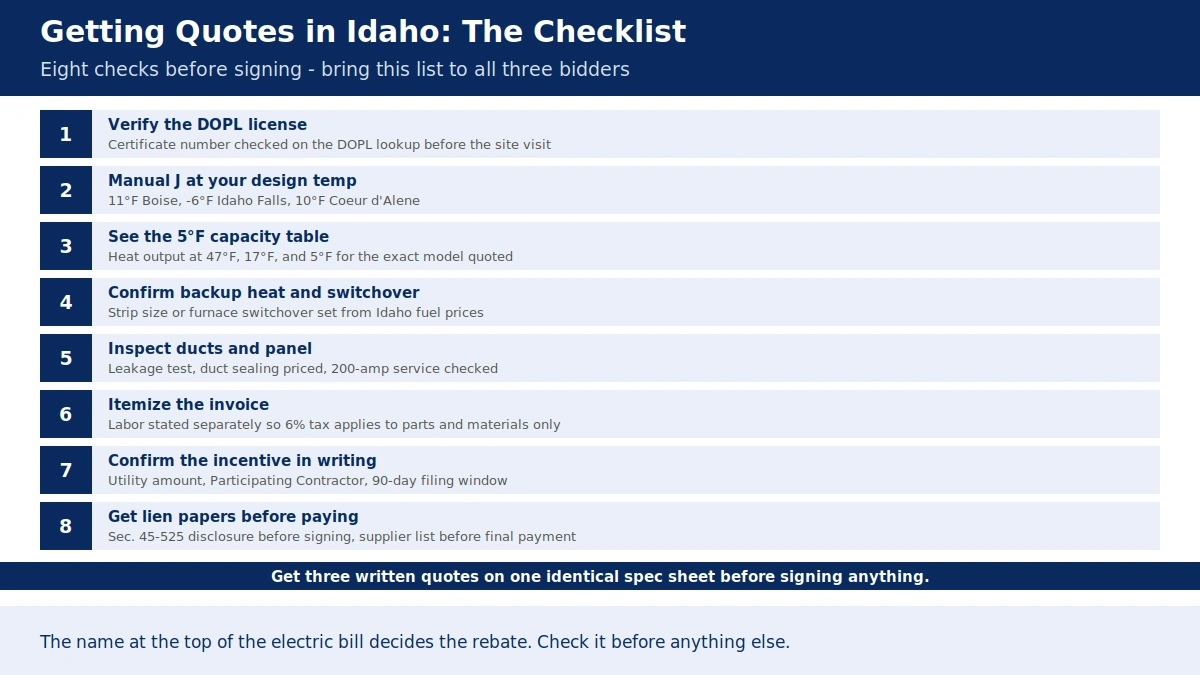
Start with the license and the load calculation. Ask for the contractor’s Idaho HVAC certificate number and verify it on the Division of Occupational and Professional Licenses lookup before the site visit. Ask whether the quote includes a Manual J load calculation and a Manual S equipment selection, and ask to see both. Ask for the design temperature used in the calculation, and confirm it matches your city: 11°F in Boise, minus 6°F in Idaho Falls, 10°F in Coeur d’Alene. A contractor who sizes from the existing equipment’s label or from square footage is not doing the calculation the code requires.
Move to the equipment. Ask for the exact model numbers of the outdoor unit, the indoor unit, and the thermostat, and for the AHRI certificate that proves the combination is rated as a matched system. For how brands compare on price and cold-climate performance, see the best heat pump brands cost guide. Ask for the capacity table showing heat output at 47°F, 17°F, and 5°F, and for the HSPF2 and SEER2 ratings.
Ask whether the system carries the ENERGY STAR cold-climate designation or appears on the NEEP cold-climate list, and ask what the balance point is for your home. In Idaho Falls and the higher valleys, the 5°F capacity is the number that decides whether the house stays warm. In Boise, the HSPF2 rating and the variable-speed capability matter more than the 5°F number.
Ask about backup heat explicitly. What is the backup heat source, how large is it, and at what outdoor temperature does it take over? If the backup is resistance strips, how many kilowatts, and what does the thermostat do to limit strip use during morning recovery? If the backup is a gas furnace in a dual-fuel setup, what is the switchover temperature, and was it set from Idaho fuel prices or from a national default? Get the switchover setting in writing, and ask the contractor to show you how to adjust it.
Ask about the parts of the job that are not the heat pump. What is the condition of the ducts, and is a leakage test included? Is duct sealing or repair priced, and does the Idaho Power $200 duct sealing incentive apply? What is the panel size, and is an upgrade needed?
Who pulls the mechanical and electrical permits, and what do they cost? Where will the outdoor unit sit, how high above the snow line, and where will the defrost drain go? What happens to the old equipment, and is disposal included? Each of these questions has caught an Idaho homeowner with a surprise charge after signing.
Ask about money in the right order. What is the total installed price, itemized into equipment, materials, labor, permits, and disposal? Is the labor separately stated, so the 6% sales tax applies only to parts and materials? Which utility incentive applies to this equipment, what is the amount, and who files the paperwork?
Is the contractor a Participating Contractor for Idaho Power, a participating contractor for Rocky Mountain Power, or a participant in Avista’s midstream program, as applicable? Will the contractor provide the §45-525 disclosure before signing and the supplier list before final payment? What are the payment terms, and what portion is due only after the inspection passes?
Ask about the warranty and the service behind it. What is the manufacturer’s parts warranty, and is it registered to extend it? What is the contractor’s labor warranty, and for how long?
Who services the system if it fails on a January night, and what is the emergency response time? A 10-year parts warranty with a one-year labor warranty is common, and the labor warranty is the one that matters when a board fails in year three. Get both warranties in writing, with the registration confirmation for the parts warranty.
Finally, ask for time. A contractor who pressures you to sign on the first visit, who offers a discount that expires tonight, or who will not leave the quote for you to compare is selling urgency, not equipment. Idaho’s install market is competitive, with 212 contractors in Ada County alone, and a second opinion costs you a phone call.
Take the best two quotes, compare them line by line, and call the utility program to confirm the incentive amount before you sign. The heat pump will serve your home for 15 to 20 years. A week of comparison shopping is a small price for a decision that long.
The decision rules below summarize this guide in five lines. If you heat with electric resistance or propane, a heat pump saves hundreds of dollars a year and pays for itself well within its life. If you heat with gas and your furnace and air conditioner both need replacing, a heat pump costs less up front and a little more over its life, and the comfort case is strong.
If you heat with gas and only the furnace is failing, keep the furnace and wait. If you live in Idaho Falls or the higher valleys, buy a cold-climate rated system or do not buy at all. And whatever your fuel, size from a Manual J, verify the license, itemize the invoice, and confirm the rebate before you sign.
Sources & methodology
Cost figures: NumeralQ heat pump cost models for Idaho (state list) and Boise (city page), pricing as of October 26, 2026, Boise page updated October 30, 2026; NumeralQ Idaho HVAC state page for state dual-fuel, furnace-plus-AC, and single-zone rows; Perfect Heating & Cooling Connection Treasure Valley contractor guide (2026); BetterHouse Idaho cost model (2026); Bureau of Labor Statistics May 2025 wage data via NumeralQ; GreenCalculus calculator model (EIA inputs, January–July 2026) as a directional cross-check only.
Energy prices: U.S. Energy Information Administration, Electric Power Monthly Tables 5.6.A and 5.6.B, August 2026 edition (released October 2026); EIA Natural Gas Monthly, October 2026 edition (released October 30, 2026); EIA Weekly Heating Oil and Propane Prices, weeks ending November 2 and November 9, 2026; EIA State Energy Data System 2024 (released June 26, 2026); Intermountain Gas tariff sheets and IPUC Case INT-G-25-02 settlement (October–November 2025); EIA Residential Energy Consumption Survey 2020 (released June 2023); EcoGen Idaho utility data (October 30, 2026) and EIA Form 861 (2024).
Climate: NOAA 1991–2020 climate normals via NumeralQ (Boise) and the National Centers for Environmental Information (Idaho Falls, generated November 13, 2026); ASHRAE design temperatures (2021) and RESNET Appendix A (ASHRAE 2013 plus Manual J 8th); ACCA Manual J 8th Table 1A via a secondary copy for the Idaho Falls design temperature (flagged); IECC climate zone definitions; USDA plant hardiness zones; WeatherSpark and weather-atlas for Coeur d’Alene (weaker sources, qualitative use); National Weather Service Boise forecast discussions (January 2023 and January 2026) for inversion advisories; Idaho Department of Health and Welfare filter guidance.
Incentives and tax: Idaho Power Heating and Cooling Efficiency Program incentive application, form CRR 211 (12/25), read November 15, 2026; Avista HVAC and water heating incentives page, read November 15, 2026; Rocky Mountain Power Wattsmart Homes Idaho program pages and 2025 rebate chart Rev. 7/2025; Idaho Governor’s Office of Energy and Mineral Resources incentives page (updated February 9, 2026), read November 15, 2026; Idaho Code §63-3022C, read at legislature.idaho.gov November 15, 2026; Idaho Code §63-3024 and HB 40 (2025) for the 5.3% flat rate; One Big Beautiful Bill Act, P.L. 119-21, and IRS Fact Sheet FS-2025-05; Idaho Capital Sun reporting and Citizen Portal JFAC transcripts (March 2025) for the HEAR/HOMES refusal; DOE program allocations via art 100 research; Comfort Ready Home regional incentives roundup (January 2, 2026) for Kootenai Electric (single source, flagged); 2025 article and contractor page for Idaho Falls Power figures (unverified, flagged); Heat Pump Network tracker for the reported Avista $500 figure (unverified, flagged).
Efficiency and standards: U.S. Department of Energy, 10 CFR 430.32 (effective January 1, 2023); ENERGY STAR Central Air Conditioner and Heat Pump Specification V6.2 (revised 2025–2026); Northeast Energy Efficiency Partnerships cold-climate air-source heat pump Specification v4.0 (effective January 1, 2023); EPA refrigerant rules via NumeralQ.
Licensing, permits, and tax: Idaho Code Title 54, Chapter 50 (HVAC licensing) and §45-525 and §54-5208 (lien law) via secondary compilations (ReadyDocs compliance file verified October 2026; contractortests.com; idahoclc.com; servicetitan.com) with consistent statute citations; Boise City Building Code Fee Schedule (October 1, 2023); Idaho State Tax Commission sales tax guides (updated March–April 2026); Air Conditioning Contractors of America Manual J and Manual S via NumeralQ.
Methodology: state and Boise cost bands are published modeled estimates, not contractor quotes, and are labeled as such. Meridian, Nampa, and Idaho Falls city figures are planning estimates built from the state band, because no published cost model prices those cities. Running-cost, payback, and tax-value figures are NestPriced arithmetic: the planning home needs 45 MMBtu of delivered heat per year (Boise) or 66 MMBtu (Idaho Falls sensitivity), electricity is priced at 13.03 cents per kWh, gas at $0.75 per therm with a $0.53 marginal-rate sensitivity, propane at $2.90 per gallon, and furnaces at 95% AFUE with an 80% sensitivity. Inputs are stated in the running-cost section so readers can redo the math. Figures that could not be verified against a primary source are flagged in the text and in this list.
Disclaimer: Cost figures in this guide are planning estimates based on published cost models priced in October 2026, not quotes for your home. Your installed price depends on the equipment chosen, the condition of your ducts and electrical panel, local permit fees, and the contractor you hire. Rebate amounts and qualifications change, and the figures here were current as of November 2026. Confirm the current amount with your utility before signing a contract, and confirm any tax treatment with a licensed tax professional. This guide does not provide tax, legal, or installation advice.
How much does a heat pump cost in Idaho in 2026?
A 3-ton ducted heat pump costs $6,380–$10,740 installed in Idaho in 2026, based on published state cost modeling priced in October 2026. A single-zone ductless mini-split costs $3,030–$4,760, a dual-fuel system costs $9,010–$14,850, and a geothermal system costs $19,970–$31,540 in the Boise market. Ductwork, panel upgrades, and permits are extra.
Will a heat pump work in an Idaho Falls winter?
Yes, if it is rated for cold climates and sized for the minus 6°F design temperature. Look for the ENERGY STAR cold-climate designation or the NEEP cold-climate listing, check the capacity table at 5°F, and make sure backup heat is sized to carry the home on the coldest nights. A standard system sized for Boise will not hold an Idaho Falls home without heavy backup heat.
Is a heat pump cheaper to run than a gas furnace in Idaho?
No. A heat pump costs about $687 a year to heat a Boise planning home at a seasonal COP of 2.5, against $355 for a new 95% efficient gas furnace, because Idaho natural gas is very cheap. The same heat pump saves about $1,031 a year over electric resistance heat and about $815 a year over propane, so your current fuel decides the answer.
What rebates are available for heat pumps in Idaho?
Idaho Power pays $800 for a ducted heat pump, $400 for ductless, and $3,000 for ground-source systems, with a Participating Contractor required. Avista pays $300–$600 through its contractor discount program, and Rocky Mountain Power pays $450–$650 for air-source systems and up to $2,000 for dual-fuel. Idaho Falls Power and Kootenai Electric figures are reported but unverified, so confirm them with the utility first.
Can I get a federal tax credit for a heat pump installed in 2026?
No. The federal government contributes $0 toward a 2026 homeowner-owned install, because the One Big Beautiful Bill Act ended the §25C and §25D credits for property placed in service after December 31, 2025. Idaho also declined the federal HEAR and HOMES rebate money, so there is no federal rebate check either.
Does Idaho have a state tax credit for heat pumps?
Idaho has no state tax credit for air-source heat pumps. The state does have an income tax deduction, in Idaho Code §63-3022C, that covers ground-source heat pumps only, worth up to about $1,060 over four years at the 5.3% flat tax rate. Confirm the treatment with a tax professional before counting it.
Should I choose a ducted or ductless heat pump for an older Idaho home?
Choose ducted if the home has ducts in good condition, and ductless if it has no ducts or ducts that are beyond repair. Building new ductwork costs $3,990–$6,850 in Boise, which makes a three-head ductless system at $6,060–$10,940 cheaper than a ducted system plus new ducts. Have the ducts inspected and tested for leaks before deciding.
What size heat pump do I need for my Idaho home?
The correct size comes from a Manual J load calculation, not from square footage alone, and a 3-ton system fits most homes between 1,500 and 2,100 square feet as a rough guide. The calculation must use your city’s design temperature, 11°F in Boise or minus 6°F in Idaho Falls, because the same house needs a larger system in the colder city. Ask the contractor to show you the load calculation and the equipment selection.