


Table of Contents
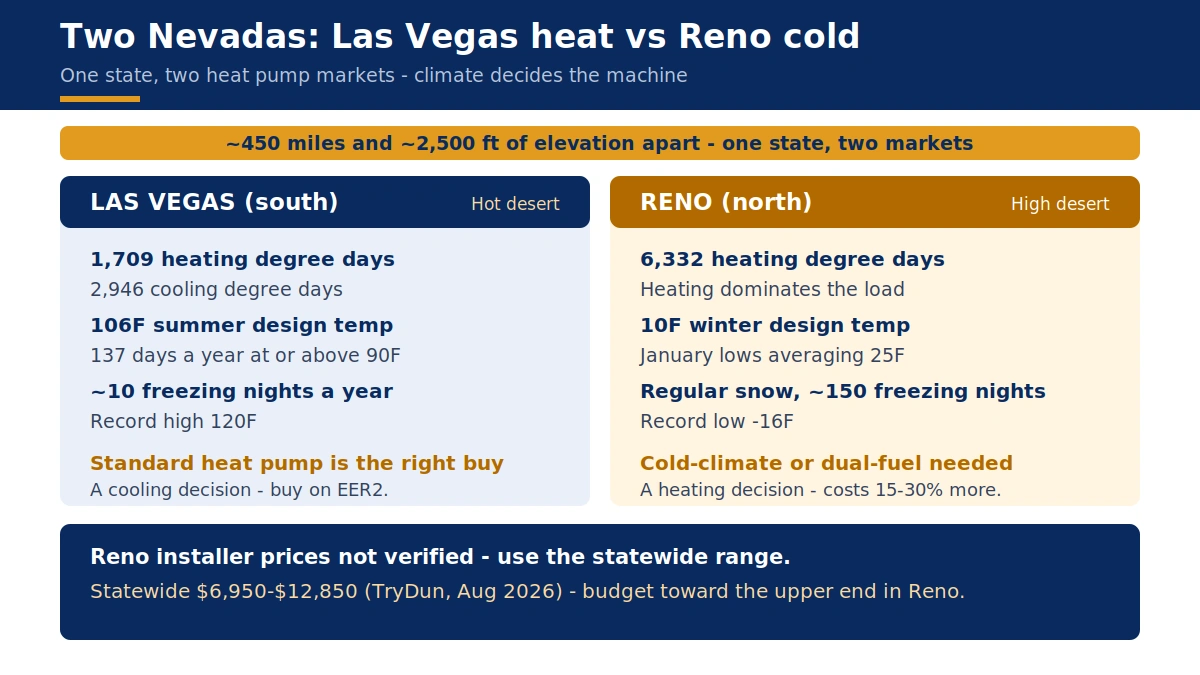
Nevada is the hardest state in America to price a heat pump honestly, and the reason is not the equipment. It is the map. Las Vegas and Reno sit about 450 miles apart, separated by roughly 2,500 feet of elevation, and they need opposite machines. Las Vegas is a cooling market: 2,946 cooling degree days against 1,709 heating degree days, 137 days a year at or above 90°F, and about 10 freezing nights. Reno is a heating market: 6,332 heating degree days, a 10°F winter design temperature, and regular snow. One statewide price range cannot describe both cities, and no top-ranking page tries to split them. This guide does.
Two more Nevada facts shape every number below. Nevada has the cheapest residential electricity in America — 12.72 cents per kilowatt-hour (EIA, August 2026) — which shrinks the running-cost savings a heat pump can deliver and stretches payback. And Nevada’s $96 million HEAR program, which would pay up to $8,000 toward a heat pump, has not launched. Any 2026 quote that subtracts either a federal credit or an $8,000 HEAR rebate is counting money that does not exist.
For the US baseline, start with the national heat pump cost guide. If you are weighing a heat pump against rooftop solar, our Nevada solar cost guide runs both options on the same NV Energy rate structures.
How much does a heat pump cost in Nevada in 2026?
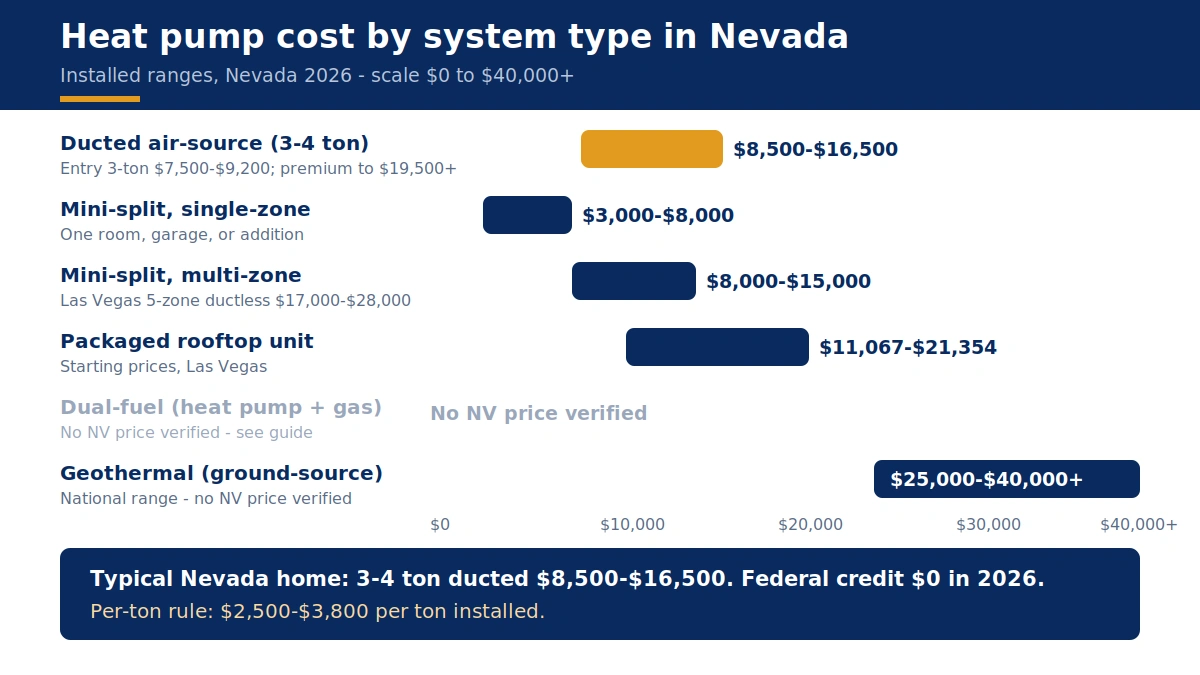
The defensible 2026 Nevada answer: $8,500–$16,500 installed for a typical whole-home ducted air-source heat pump (3–4 ton). That range is anchored on Las Vegas installer pricing published in 2026 — the tier table in The Cooling Company’s Spring 2026 Las Vegas guide puts a 3-ton system at $7,500–$16,000 and a 4-ton at $9,500–$19,500, and its Lennox, Trane, and Carrier 3-ton model ranges run $7,800–$19,500.
A labor-adjusted statewide model reads lower: TryDun puts Nevada at $6,950–$12,850 (August 2026, modeled from Bureau of Labor Statistics wage data). The gap between the two is real and worth understanding. TryDun models the whole state, including smaller northern and rural markets. The Las Vegas installer ranges describe actual quoted jobs in the Valley, where premium variable-speed systems push the top end far above the statewide model. Present the Las Vegas ranges as primary and TryDun as the statewide cross-check. Nationally, NumeralQ puts a 3-ton ducted system at $6,550–$10,960 (November 2026), and Costimated puts the national average at $9,400 for a 3-ton system, range $6,000–$14,800.
Budget single-stage 3-ton jobs land at $7,500–$9,200. Variable-speed premium jobs reach $14,500–$19,500+ — the Lennox XP25 variable-speed 3-ton runs $14,500–$19,500+, and the 5-ton premium tier tops $22,000. The spread is the story: the same 3-ton system spans $7,500 to $16,000 depending on efficiency tier alone. Three written quotes are not optional.
The Reno gap. No Reno-specific installer price range was found in 2026 sources. Every Nevada installer figure in this guide is Las Vegas or Southern Nevada. Reno pricing must not be invented. Use the statewide TryDun range ($6,950–$12,850) plus the Las Vegas ranges, and budget toward the upper end: Reno jobs need cold-climate or dual-fuel capability, and the national cold-climate 3-ton range runs $8,610–$15,040 (NumeralQ, November 2026).
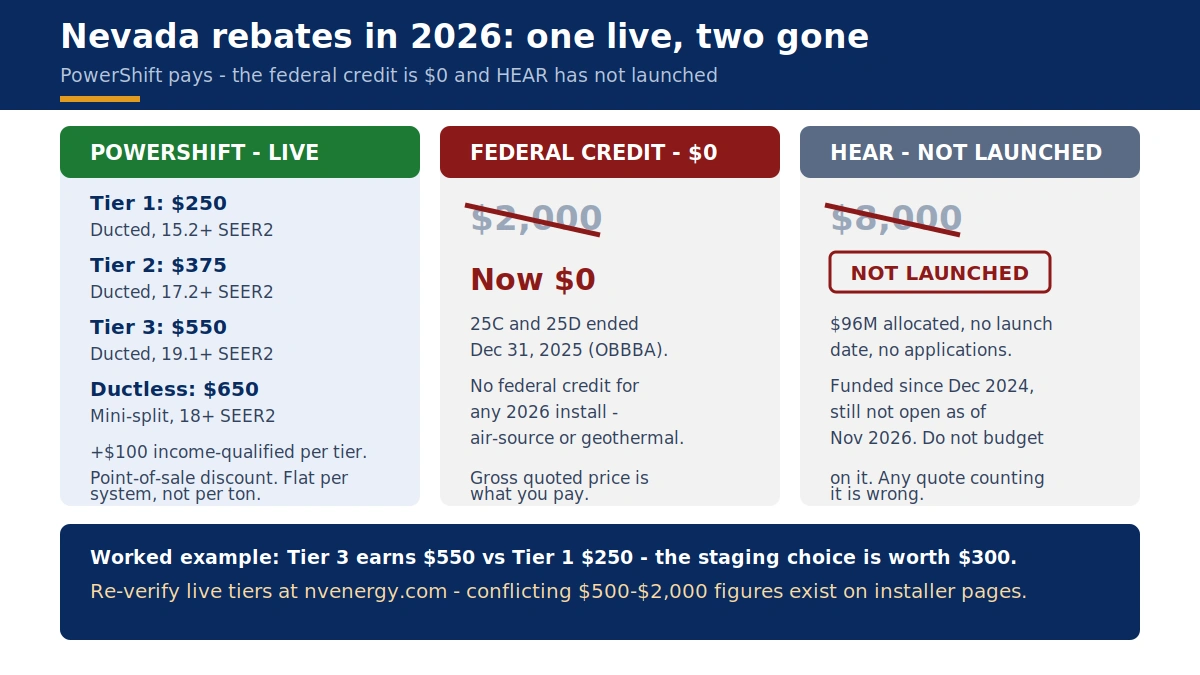
The number-one rule of 2026 Nevada pricing: there is no federal credit to subtract. The §25C credit (up to $2,000 a year for air-source heat pumps) ended for property placed in service after December 31, 2025. Geothermal lost its 30% §25D credit on the same date. Every figure in this guide is the price you actually pay, minus only the PowerShift rebate in the incentives section that you actually qualify for.
Heat pump cost by system type in Nevada
The system type decides your price more than anything else. A ducted system pushes air through the ducts your home already has. A mini-split skips ducts entirely. Geothermal drills into the ground. Dual-fuel keeps your furnace.
| System type | Installed cost (Nevada 2026) | Best for |
|---|---|---|
| Ducted air-source heat pump (whole home) | $8,500–$16,500 (3–4 ton typical); entry 3-ton $7,500–$9,200; premium to $19,500+ | Most Las Vegas homes with existing ducts |
| Ductless mini-split, single zone | $3,000–$8,000 | One room, garage, or addition |
| Ductless mini-split, multi-zone (3–4 heads) | $8,000–$15,000 national; Las Vegas 5-zone ductless $17,000–$28,000 | Whole home without ducts |
| Dual-fuel (heat pump + gas furnace) | No NV-specific figure verified | Reno homes; keeping gas heat |
| Geothermal (ground-source) | No NV-specific figure verified; national $25,000–$40,000+ | Long-term owners; new builds with land |
| Packaged rooftop / package unit | Heat pump package starting $11,067–$21,354 (Las Vegas) | Valley homes with packaged rooftop units |
Ducted air-source is the default Las Vegas choice: one outdoor unit, one indoor air handler or coil, your existing ducts. One install takes the place of both your air conditioner and your furnace — and that single-install fact is what the payback section turns on.
Mini-splits fit homes that have no ducts, plus additions and rooms that never cool evenly. Every extra zone adds roughly $1,500–$3,500. The per-zone breakdown lives in our mini-split installation cost guide, and our ductless vs ducted comparison helps you choose between the two. Note the Las Vegas 5-zone ductless figure — $17,000–$28,000 — costs more than a ducted system for the same home ($12,000–$16,500), so ductless is a fit decision, not a savings decision, at whole-home scale.
Dual-fuel pairs a heat pump with the gas furnace you already own: the heat pump carries mild weather, the furnace steps in on the coldest nights. In Las Vegas the furnace would sit idle most of the year, so dual-fuel is mainly a Reno play. No Nevada-specific dual-fuel installed price was verified, so none is given here; the national 3-ton range is $9,230–$15,130 (NumeralQ, November 2026). Our dual-fuel heat pump cost guide covers national pricing depth.
Geothermal has no verified Nevada residential price. It gets its own section below. Our geothermal heat pump cost guide carries the full national breakdown.
Packaged units deserve a line of their own in Nevada. Many Las Vegas homes use packaged rooftop units rather than split systems. Confirm whether a quote is for a split system or a package unit — they price differently. The only Nevada packaged-unit figures found are 32 Degrees’ Las Vegas starting prices: $11,067–$21,354 for heat pump packages (October 2026, site visit required for final pricing).
Cost by size: the Las Vegas tonnage table
Heat pumps are sized in tons. One ton means 12,000 BTU of cooling per hour. A 3-ton system cools roughly 1,400–1,900 square feet in Las Vegas — but square footage is only a rough guide. Insulation, window area, ceiling height, and shade all shift the real number, which is why a Manual J load calculation is the step that matters.
| Size | Las Vegas home size (per source) | Entry tier (15–17 SEER2) | Mid tier (18–21 SEER2) | Premium tier (22+ SEER2) |
|---|---|---|---|---|
| 2 ton | 800–1,100 sq ft | $6,000–$7,800 | $7,800–$9,800 | $9,800–$12,500 |
| 2.5 ton | 1,100–1,400 sq ft | $6,400–$8,200 | $8,200–$10,500 | $10,500–$13,500 |
| 3 ton | 1,400–1,900 sq ft | $7,500–$9,200 | $9,200–$12,000 | $12,000–$16,000 |
| 3.5 ton | 1,900–2,300 sq ft | $8,200–$10,500 | $10,500–$13,500 | $13,500–$17,500 |
| 4 ton | 2,300–2,800 sq ft | $9,500–$12,000 | $12,000–$15,500 | $15,500–$19,500 |
| 5 ton | 2,800–3,500+ sq ft | $11,000–$14,000 | $14,000–$18,000 | $18,000–$22,000+ |
Source: The Cooling Company, Spring 2026 AC Replacement Las Vegas guide. Cross-check (national): NumeralQ 1.5-ton $4,410–$7,080; 3-ton $6,550–$10,960 (November 2026). Note the table prices by efficiency tier, not just size — the same 3-ton system spans $7,500–$16,000 depending on tier. That spread is real, not an error.
The per-ton rule: plan on $2,500–$3,800 per ton installed for an air-source heat pump (Costimated, November 2026 — national average $9,400 for a 3-ton system, range $6,000–$14,800). The Las Vegas tier table implies roughly $2,500–$4,000 per ton at entry and mid tiers, higher at premium. The per-ton rate drops as tonnage climbs — a 5-ton system costs more overall but less per ton than a 2-ton one.
Do not size by this table alone. A Manual J load calculation runs $200–$500, and installers often credit it toward the job. Oversizing wastes money upfront and short-cycles — the system blasts cold air in short bursts, never runs long enough to dehumidify, and wears out faster. Undersizing leaves the house hot on a 106°F afternoon. A contractor who sizes from square footage alone, skipping the load calculation, is one to pass on. Las Vegas’s summer design temperature is 106°F — the system must hold your setpoint at that outdoor temperature, not at 95°F.
A note on the source. The Cooling Company’s own Las Vegas pages disagree with each other in places: one page prices a standard-tier 3-ton heat pump at $14,000–$17,000 while its premium tier on the same site runs $9,400–$12,650 — premium cheaper than standard, which is impossible and reads as a transposed table. This guide anchors on the tier table above plus the Lennox, Trane, and Carrier model ranges, and flags the conflicting pages wherever they appear. A guide that hides the disagreement would be less honest than one that shows it.
What drives your price per ton in Nevada
Staging — single-stage, two-stage, or variable-speed. After size, staging moves the price more than anything else. A single-stage compressor has two states: on or off. A two-stage unit has two gears. A variable-speed (inverter) unit ramps continuously, holding a steady temperature all day instead of cycling. Variable-speed costs the most upfront, earns the top PowerShift tier ($550), and is the right buy for a house that runs its system April through October. In Las Vegas, that is every house. The Lennox 3-ton lineup shows the staging ladder plainly: XP14 single-stage $8,500–$11,500; XP17 two-stage $10,500–$14,000; XP21 variable-speed $12,500–$16,500+; XP25 variable-speed $14,500–$19,500+ (2026). Trane 3-ton runs $8,000–$11,500 and Carrier 3-ton $7,800–$11,200.
Ductwork. Have good ducts? A ducted swap is straightforward. Need new ducts? Add $5,000–$10,000 — a national planning range; no Nevada-specific ductwork figure was verified. Leaky ducts in a superheated Las Vegas attic lose more than ducts in milder climates, so a duct test before you sign is money well spent.
Electrical panel. A heat pump runs on its own dedicated 240V circuit. If your panel is full or still 100-amp, budget $1,500–$4,000 for a full upgrade (national planning range); a sub-panel alone runs $500–$1,500. Ask for it as its own line — panel work is the surprise add-on that shows up most. Our electrical panel upgrade cost guide covers the panel side of the job.
Refrigerant and matched equipment. New systems run on R-454B or R-32 refrigerant, and they need a matched indoor coil to work with it. Replacing only the outdoor unit is often not possible when the indoor coil is old — a quote that promises a condenser-only swap on an old system deserves a second opinion.
Sales tax. Clark County (Las Vegas) charges a combined 8.375%; Washoe County (Reno) charges 8.265% (Taxually, updated November 2, 2026; Stripe 2026; Kintsugi, September 2026 — all agree). Quotes may or may not include it. On a $12,000 system, Clark County tax is roughly $1,005. Put the same question to every bidder: does the quote include tax?
Permits and inspections. Expect $100–$500 depending on municipality (national planning range; NumeralQ found $70–$166 across 35 cities checked, November 2026). No Nevada-city permit figure was verified. Legitimate installers pull permits. An installer who offers to skip the permit is offering to skip the inspection that protects you.
Equipment share. On a typical full replacement, equipment (outdoor unit plus matched indoor coil or air handler) is about 45–60% of the installed price — a national pattern; no Nevada-specific split was verified. Labor, materials, permits, overhead, and margin make up the rest — which is why the same equipment can be quoted 30% apart by two contractors.
Lifespan. A ducted heat pump typically lasts 12–15 years (NumeralQ, November 2026); TryDun gives 10–16 years (August 2026). Year-round use shortens life versus an AC-only unit, which rests all winter. Budget for a shorter life than a furnace, and for annual maintenance.
The $0 federal credit: 2026’s hard tax reality
Here is the sentence a Las Vegas installer puts in every 2026 guide, quoted plainly because it is the cleanest version of the law: “The federal 25C tax credit expired December 31, 2025. There is no federal tax credit for HVAC equipment in 2026.” (The Cooling Company, 2026.)
The §25C Energy Efficient Home Improvement Credit paid up to $2,000 a year for a qualifying air-source heat pump. The §25D Residential Clean Energy Credit covered 30% of a geothermal install. Both credits stopped for property placed in service after December 31, 2025, when the One Big Beautiful Bill Act (OBBBA, P.L. 119-21, signed July 4, 2025) ended them — a cutoff the IRS confirmed in FS-2025-05 (August 21, 2025).
For a heat pump installed in Nevada in 2026 — air-source or geothermal, cash or loan — the federal credit is $0. Gross quoted price is the real out-of-pocket price, minus only the PowerShift rebate in the next section.
Watch for stale math. It is everywhere in 2026. Some national pages still show prices “after the $2,000 IRA credit” — a dead column. At least one national guide claims the 30% geothermal credit “continues through 2032.” It does not. §25D ended on the same December 31, 2025 date as §25C. If a quote subtracts either credit from a 2026 install, have the contractor strike it and re-issue the quote. Our federal energy tax credits guide walks through the post-OBBBA rules in full.
Two Nevada-specific notes. First, there is no state tax credit to fall back on: Nevada has no state income tax, so there is no state tax return for a credit to lower. Second, do not let anyone import the §48E lease route from solar: §48E is a solar and battery mechanism for the business that owns the system, not a residential heat pump route. One nuance: a §25C credit left unused from a 2025 install can still go on a 2025 return (IRS Form 5695). That covers a 2025 install on a 2025 return — it is not a credit for 2026 work.
Rebates that still work: NV Energy PowerShift — and the $8,000 that does not exist yet
One rebate survives in Nevada in 2026. One much bigger one does not exist yet. Confusing the two is the most expensive mistake a Nevada buyer can make this year.
NV Energy PowerShift: the only live Nevada money
| System | Minimum efficiency | Rebate |
|---|---|---|
| Ducted heat pump, Tier 1 | 15.2+ SEER2 / 7.8+ HSPF2 | $250 |
| Ducted heat pump, Tier 2 | 17.2+ SEER2 / 8.0+ HSPF2 | $375 |
| Ducted heat pump, Tier 3 | 19.1+ SEER2 / 9.0+ HSPF2 | $550 |
| Ductless mini-split heat pump | 18.0+ SEER2 / 9.0+ HSPF2 | $650 |
| Income-qualified (any tier) | Same thresholds | +$100 per tier ($350 / $475 / $650 ducted; $750 ductless) |
PowerShift runs statewide, in both NV Energy territories — Nevada Power in the south (Las Vegas and Henderson) and Sierra Pacific Power in the north (Reno, Sparks, and Carson City). It is point-of-sale: NV Energy pays the equipment distributor and the contractor shows the rebate as a line-item discount on the proposal. No tax filing, no waiting. Qualifying equipment must be on NV Energy’s qualified product list — confirm the exact model before install. Income-qualified amounts apply to Nevada Energy Assistance Program households and affordable-housing residents. For comparison, a central AC earns $250 / $375 / $475 by tier under the same program.
Worked examples. A 3-ton Tier 2 heat pump (17.2+ SEER2) earns $375 back. A 3-ton Tier 3 system (19.1+ SEER2) earns $550 back. A 3-ton Tier 1 system (15.2+ SEER2) earns $250 back. The staging choice is worth $300 on a 3-ton system ($550 versus $250). A 4-ton Tier 3 system earns the same $550 as a 3-ton Tier 3 system — the rebate is flat per system, not per ton. That is different from Arizona’s SRP Cool Cash, which pays per ton up to $1,125. A ductless mini-split at 18+ SEER2 earns $650 (income-qualified $750) — the single largest PowerShift rebate. And $550 on a $12,000 system is about 4.6% — a rounding error next to the $8,000 HEAR rebate that does not exist yet. That gap is the Nevada rebate story.
The conflict you must know about. The same installer site that publishes the tier table above also publishes incompatible PowerShift figures elsewhere: heat pump rebates of $500–$2,000 on several pages, tier tables of $500–$750 / $750–$1,500 / $1,500–$2,000, and $500–$1,000 / $1,500–$3,200 on another page. A third source, the HomeEnergyBasics tracker (June 3, 2026), lists “$510–$3,400 for heat pumps.” The $2,000-scale figures look like older or legacy program tiers, or bundled-system totals mislabeled as single-system rebates. This guide headlines the $250–$550 tier table only — it is the detailed table, internally consistent across three pages, and described as verified against nvenergy.com in August 2026. Rebate tiers and funding can change during the year, and PowerShift runs on annual funding cycles, first come first served — so re-verify the live tiers at nvenergy.com before signing, and apply early in the year. If the live schedule differs from this guide, the live schedule wins.
HEAR: funded, hired, and still not open
HEAR (Home Electrification and Appliance Rebates) is federally funded and state-administered. Nevada’s share is $96 million — $47,920,160 for HEAR plus $48,103,711 for the companion HER (Home Efficiency Rebates) program (DOE allocation data, via the ECW tracker, October 27, 2026). An implementer was hired in December 2024 (Everblue, APTIM, and VEIC, on a $96 million contract), and launch was “expected in early 2025.” As of November 5, 2026, the program still has no launch date and accepts no applications. Multiple 2026 sources repeat the same line: funded but not yet launched. The Governor’s Office of Energy has since issued a Request for Proposals through the State Purchasing Division, with no launch date attached.
When and if HEAR launches, the federal design would pay up to $8,000 toward a heat pump — households below 80% of Area Median Income up to 100% of cost, households at 80–150% of AMI up to 50% — inside a $14,000 per-household HEAR total. Those are federal-design figures, not Nevada-published figures: Nevada has published no program-specific rebate schedule because the program has not launched. One tracker quotes a Governor’s Office of Energy page saying HEAR coupons “will be available beginning fall 2026” — that is a secondhand aspiration, confirmed by no source checked in November 2026, and it is not presented here as a launch date. Watch the Governor’s Office of Energy page for the real announcement.
One more rule for the future: when HEAR does launch, DOE Program Notice 26-2 (May 29, 2026) will govern it. No gas-to-electric fuel-switching for reservations made after August 31, 2026 — only electric-to-electric upgrades or new construction. Nevada is the mirror image of Arizona, where HEAR is open, and of Georgia, where HEAR paid out more than $50 million and then paused. Nevada never opened at all.
The bottom line for your budget: do not budget on HEAR. Any quote counting an $8,000 HEAR rebate in 2026 is counting money that does not exist yet.
Southwest Gas runs a 2026 Nevada residential rebate program (purchases January 1–December 31, 2026; applications due January 31, 2027), but no heat-pump or furnace dollar figure was verified in our research, so none is given here. NV Energy pays no solar or battery rebate in 2026 — do not confuse PowerShift HVAC rebates with solar incentives.
Two Nevadas: Las Vegas desert heat vs Reno high-desert cold
Nevada is not one heat pump market. It is two, split by about 450 miles and roughly 2,500 feet of elevation.
| Metric | Las Vegas (south) | Reno (north) | Source |
|---|---|---|---|
| Heating degree days, base 65°F | 1,709 | 6,332 | ICC Appendix D |
| Cooling degree days, base 65°F | 2,946 | Not verified to a single figure | ICC Appendix D (Las Vegas) |
| Summer design temp (2.5% dry bulb) | 106°F | 92°F | ICC Appendix D |
| Winter design temp (97.5%) | 28°F | 10°F | ICC Appendix D |
| July normal high / low | 105°F / 82°F | 90°F / 56°F | NOAA 1991–2020 normals |
| January normal high / low | 59°F / 41°F | 45°F / 25°F | NOAA 1991–2020 normals |
| Annual mean temp | 70.1°F | Not verified to a single figure | NOAA 1991–2020 (Las Vegas) |
| Days at or above 90°F per year | 137 days | Not verified to a single figure | NOAA 1991–2020 (Las Vegas) |
| Freezing nights per year | ~10 | ~150 (estimate — see below) | NOAA 1991–2020 |
| Record high / low | 120°F / 8°F | 108°F / −16°F | NOAA 1991–2020 |
| Annual precipitation | 4.18 in | 7.3 in (19.8 in snow) | NOAA 1991–2020 |
| Climate class | Hot desert (BWh) | High desert / cold semi-arid | Koppen |
Las Vegas is a cooling-dominated market. 2,946 cooling degree days against 1,709 heating degree days, 137 days a year at or above 90°F, a 106°F design temperature, and only about 10 freezing nights a year. A standard (non-cold-climate) heat pump is the right buy in the Valley. The buying decision is a cooling decision, and EER2 matters more than SEER2 (next section but one).
Reno is a heating-dominated market. 6,332 heating degree days, a 10°F winter design temperature, January lows averaging 25°F, and regular snow. In Reno a standard heat pump leans on expensive backup resistance heat for much of the winter. Cold-climate (hyper-heat or inverter) models or dual-fuel are the honest recommendation there, and they cost 15–30% more nationally. High-elevation buying is covered in our cold-climate mini-split guide, and the furnace pairing in our dual-fuel guide.
One transcription note: one copy of the ICC Appendix D table lists Las Vegas at 2,709 heating degree days. The climatological table lists 1,709 heating degree days with 2,946 cooling degree days and design temperatures of 106°F and 28°F, consistent with the Appendix D design temperatures. This guide uses 1,709; the 2,709 figure is treated as a transcription error and is not used. Reno detail is thinner: the freezing-night figure (~150) is an estimate from monthly below-freezing day counts, not a published annual figure, and Reno cooling degree days, days at or above 90°F, and annual mean temperature were not verified to single citable figures — so this guide keeps them qualitative rather than inventing numbers.
The Las Vegas cooling-hours figures come from one installer’s modeling, not metered data: about 2,800 cooling hours a year (April–October) and about 900 heating hours a year (November–March) for a 2,000-square-foot Valley home, with 3,000–3,500 cooling hours and 400–700 heating hours in the same site’s buyer’s guide. The two figures differ. Treat both as modeled, not measured.
Desert buying guide: why EER2 matters more than SEER2 in the south (and HSPF2 in the north)
SEER2 is seasonal cooling efficiency over a whole summer. EER2 is efficiency at exactly 95°F — peak-heat performance. HSPF2 is seasonal heating efficiency.
In Las Vegas, EER2 is the more important number. Valley equipment spends months operating at or above 95°F; SEER2 averages in mild days that barely exist in a Las Vegas cooling season. A unit with a strong SEER2 and a weak EER2 looks efficient on paper and under-delivers in August. Our Arizona heat pump cost guide makes the same desert-climate case — the logic transfers directly, and the buying targets below are desert-climate guidance from the Arizona research, flagged as such, since no Nevada-specific target source was found.
The legal minimums (federal law since January 1, 2023). Nevada sits in the DOE’s Southwest region. A new split-system AC under 45,000 BTU must hit at least 14.3 SEER2; larger split systems must reach at least 13.8 SEER2; heat pumps must meet 14.3 SEER2 plus 7.5 HSPF2. Anything below those levels cannot legally go into a Nevada home.
The buying targets. Target 16–18 SEER2 as the value sweet spot and EER2 of 12.5 or higher to keep August bills under control. For HSPF2, aim for 8.0–9.0 (the minimum is 7.5) — but a Las Vegas winter barely tests the heating side, so paying extra for top-end HSPF2 buys capacity the Valley almost never calls on. Las Vegas heating happens at 40–70°F outdoor temperatures, where heat pumps run at their efficient best.
The PowerShift threshold is a buying reason to step up. Ducted heat pumps earn rebates only at 15.2+ SEER2 (Tier 1, $250), $375 at 17.2+, and $550 at 19.1+. A 14.3 SEER2 minimum system earns $0. The step from 14.3 to 15.2 SEER2 often pays for itself in rebate alone.
Variable-speed is the desert pick. A variable-speed system runs continuously at low speed, holding a steady temperature all day instead of cycling on and off. It also earns the top $550 PowerShift tier. Two-stage is the mid-tier compromise. Single-stage is cheapest upfront and earns only $250 — and in a house that runs its system five months straight, the comfort gap is real.
Reno and northern Nevada flip the priority. There, HSPF2 and cold-climate capacity retention matter as much as SEER2. Cold-climate models (Mitsubishi Hyper-Heat class) hold heating capacity well below freezing but cost 15–30% more nationally — NumeralQ puts a cold-climate 3-ton ducted system at $8,610–$15,040 against $6,550–$10,960 for a standard 3-ton (November 2026). ENERGY STAR cold-climate certification requires 8.1+ HSPF2.
One caution on a commonly quoted claim: Lennox’s Las Vegas guide claims a 23.5 SEER2 system saves $500–$1,100 a year in electricity versus a conventional AC, and a Trane-versus-Carrier guide claims a 2.5-point SEER2 advantage is worth about $150–$300 a year. Both are installer and manufacturer claims, not measured benchmarks. Use them as planning figures, not promises.
Nevada’s cheapest electricity in America: what a heat pump costs to run
Nevada’s residential electricity rate is 12.72 cents per kilowatt-hour — the lowest of all 51 jurisdictions (EIA Electric Power Monthly, Table 5.6.A, August 2026, released October 28, 2026). The US residential average is 18.16 cents. Nevada’s August average bill was $207.45 at 1,631 kWh. The 12-month average to August 2026 was 13.4 cents (US 18.0 cents), with an average bill near $122 a month. The rate rose 1.4% year over year (August 2025: 12.53 cents).
NV Energy is one utility with two companies: Nevada Power (Southern Nevada: Las Vegas and Henderson) and Sierra Pacific Power (Northern Nevada: Reno, Sparks, and Carson City), both doing business as NV Energy and regulated by the PUCN. Standard residential tariffs (effective July 1, 2026): south (Nevada Power RS single-family) total effective rate about 10.56 cents per kWh (July 1, 2026 schedule) with an $18.00-a-month basic service charge (January 2026 schedule); north (Sierra Pacific D-1 domestic) about 11.53 cents per kWh with an $18.50-a-month basic service charge (July 1, 2026 schedule). The EIA all-in average (12.72 cents) sits above the tariff energy rates because it includes fixed charges spread across usage. One model puts the all-in rate at 14.38 cents at 900 kWh — higher still, because it models a low-usage home.
Time-of-use changes the picture in the north. On Sierra Pacific’s optional residential TOU plan (OD-1-TOU, July 1, 2026 tariff), summer on-peak power costs 49.517 cents per kWh against 8.713 cents off-peak and 8.708 cents in all winter hours. The summer on-peak window is June 1–September 30, 6:01–9:00 PM daily. The on-peak rate is about 5.7 times the off-peak rate — a variable-speed heat pump that pre-cools off-peak wins here; a single-stage unit blasting at 7 PM loses. The south TOU window is the same (June 1–September 30, 6:01–9:00 PM daily), but the south on-peak and off-peak cent-per-kilowatt-hour figures were not cleanly extracted from the July 2026 tariff PDF in our research — so no south TOU dollar figure is stated here. NV Energy compares the first year of TOU bills against the standard rate in both territories, a safety net worth knowing about.
A demand charge is coming to Southern Nevada — but the date is unsettled. PUCN approved a new daily demand charge for Southern Nevada residential customers, based on the highest 15-minute usage spike each day. One source, reporting the September 16, 2025 PUCN approval, says it starts April 16, 2026; a second source, checked October 1, 2026, says southern Nevada bills get a new line for highest daily use in January 2027. Northern Nevada customers do not face the demand charge yet, but from October 1, 2025 new northern solar owners are netted every 15 minutes instead of monthly. Verify the current demand-charge status at nvenergy.com before you plan around it — do not treat any start date or per-kilowatt figure as settled fact.
Why cheap electricity changes the heat pump math. At 12.72 cents per kilowatt-hour, every kilowatt-hour a heat pump saves is worth about 30% less than the national average. That compresses running-cost savings against gas and stretches energy-only payback — the honest Nevada story is the opposite of Arizona’s: cheap power helps the monthly bill but weakens the payback case.
The heating numbers, Las Vegas. One installer’s modeled analysis (The Cooling Company, March 2026 — a 2,000-square-foot single-story home; electricity $0.12 per kWh; Southwest Gas $1.15 per therm; about 2,800 cooling hours and 900 heating hours a year) puts heat pump heating electricity at $280–$360 a year against gas furnace heating at $350–$420 a year. The state-average gas price is higher: ElectricChoice puts Nevada residential gas at $1.38 per therm on average (November 2026, $48 a month, 348 therms a year) — above the $1.15 per therm in the model, which would widen the heat pump’s heating advantage slightly.
The break-even rule. A heat pump at 8.5 HSPF2 delivers about 8,500 BTU per kilowatt-hour; an 80% AFUE furnace delivers about 80,000 BTU per therm. The same heat takes 1 therm or about 9.4 kWh. Divide your all-in price per therm by 9.4 — if your all-in electric price per kilowatt-hour is below that, the heat pump is cheaper to run. At Nevada prices ($1.15–$1.38 per therm divided by 9.4 = 12.2–14.7 cents per kilowatt-hour break-even, against electricity at 12.72 cents all-in): the heat pump is cheaper to run at the $1.38 gas price and roughly break-even at $1.15. Run the rule on your own bills, not on a state average — gas and electric prices move, and the fixed gas charge matters.
One honest warning: your electric bill will rise in winter when a heat pump replaces a gas furnace. The heating load moves onto the electric account while the gas bill falls. The household total is what matters, not one bill. And summer is where the money is: the August average bill of $207.45 at 1,631 kWh shows it. A heat pump’s cooling efficiency (SEER2 and EER2) decides the summer bill more than its heating rating does — in Las Vegas.
Our heat pump running cost guide carries the full monthly math. And if you are weighing a heat pump against rooftop solar, our Nevada solar cost guide runs both options on the same NV Energy rates.
Heat pump vs furnace vs AC in Nevada
The wrong way to compare is heat pump versus furnace. The right way is heat pump versus (air conditioner + furnace) — because in Las Vegas, a heat pump replaces both.
Upfront. The same Las Vegas installer site gives two incompatible bundle pictures, and this guide shows both rather than picking the friendlier one. Its bundle page prices an AC plus furnace combination at $9,500–$14,500 for a 3-ton system (separate: $10,325–$17,275), with the heat pump alternative at $7,500–$12,650. Its comparison page prices the same combination at $16,500–$22,000 ($13,000–$15,000 for the AC plus $3,500–$7,000 for the furnace) against a standard-tier heat pump at $14,000–$17,000 — a saving of $2,500–$5,000 on the combined purchase. A separate gas furnace alone costs $3,500–$7,000. The two bundle figures conflict; no single bundle number is headlined here. What both pages agree on is the structure: one install instead of two, one outdoor unit, one maintenance visit, one system to replace in 12–15 years instead of two systems on two different schedules.
Running costs (modeled). The Cooling Company’s March 2026 model for a 2,000-square-foot Las Vegas home: AC (16 SEER2) plus gas furnace (96% AFUE) costs $1,744–$2,114 a year — cooling $1,050–$1,250, gas heating $350–$420, Southwest Gas fixed charges about $144 a year, two tune-ups $200–$300. The heat pump (16 SEER2 / 9.0 HSPF2) costs $1,480–$1,860 a year — cooling $1,050–$1,250 (the same as AC at the same SEER2), heating electricity $280–$360, two tune-ups $150–$250, no gas bill. Annual saving with the heat pump: $254–$264 a year — if heating is the home’s only gas use, so dropping gas service entirely saves the roughly $12-a-month fixed charge. If the home keeps gas for water heating or cooking, the saving narrows to about $70–$120 a year. Heating-season only, another guide on the same site puts the heat pump at about $100–$250 a season in electricity against a gas furnace at about $150–$350 a season. All of it is one installer’s model with stated assumptions — none of it is metered data.
Why the heat pump wins on heating in Las Vegas. A heat pump delivers 2.5–3.5 units of heat per unit of electricity at Valley winter temperatures, against 0.96 for a 96% AFUE furnace; the DOE’s general range is 1.5–3 times. Las Vegas heating happens at 40–70°F outdoor temperatures, where heat pumps run at their efficient best — no cold-climate penalty, no backup-resistance-heat hours to speak of. The winter design temperature is 28°F and the average January low is 41°F (NOAA 1991–2020 normals).
A premium-tier cooling saving, flagged. A 20 SEER2 heat pump against a 16 SEER2 central AC saves an additional $200–$400 a year in cooling costs alone over about 2,800 cooling hours, per the same installer’s model (March 2026) — installer-modeled, not metered.
Reno is different. With 6,332 heating degree days and a 10°F design temperature, heating is the dominant load and the dominant bill. A standard heat pump in Reno leans on backup resistance heat on the coldest nights. The honest Reno options are a cold-climate heat pump (NumeralQ 3-ton $8,610–$15,040, November 2026) or dual-fuel (heat pump plus gas furnace, national 3-ton $9,230–$15,130, NumeralQ). No Reno-specific running-cost comparison was verified — so none is published here. Our heat pump vs furnace cost comparison runs the full head-to-head, and the Texas state guide (heat pump cost in Texas 2026) offers a hot-climate parallel with different rebate rules. Georgia’s guide (heat pump cost in Georgia 2026) shows the other HEAR story — a program that paid out and paused, against Nevada’s program that never opened.
Geothermal in Nevada: no residential price verified
No Nevada-specific residential geothermal installed price was found in 2026 sources. None is presented here. Use the national planning range: $25,000–$40,000+, with NumeralQ putting a 3-ton geothermal system at $20,260–$31,920 (November 2026).
The credit that vanished. The 30% federal §25D credit for geothermal ended December 31, 2025. A $30,000 system that cost $21,000 after the credit in 2025 now costs the full $30,000. No equipment price move changed geothermal math as much as that one law. Geothermal payback ran long even with incentives — often a decade or more — and it runs longer now.
Do not confuse Nevada’s utility geothermal with a residential ground loop. NV Energy’s 2026 resource-plan filing received geothermal power offers at $105–$107 per MWh, below the roughly $114 per MWh capacity-weighted average for solar-plus-storage (October 2026, citing the filing; Google backing up to 150 MW via Ormat, Amazon 100 MW via Zanskar). That is wholesale power-plant pricing, not a residential ground-loop price. A writer who quotes $105 per MWh as a homeowner cost would be wrong by orders of magnitude.
A modeled heating-cost note, flagged. An academic study (MDPI, March 9, 2026) modeling geothermal against fossil heating in four cities puts Las Vegas seasonal geothermal heating cost at $142.88 (against a natural-gas boiler higher, and diesel at $1,307.77), with geothermal input of about 1,815 kWh. That is a thermodynamic model with stated COP 2–5 assumptions, not a measured Nevada bill and not an installed price. It is useful only as color: geothermal heating is cheap to run in Las Vegas because the heating load is tiny.
A desert ground-loop caution. Shallow horizontal loops in hot, dry soil can heat-soak across a desert summer — one Southern Arizona homeowner reported a 5-ton horizontal loop running nearly 24 hours a day with loop temperatures above 100°F (The Cooldown, October 2026, anecdote). No Nevada loop-performance report was found. Present it as a design caution — get a proper loop design sized for the cooling load — not a Nevada benchmark. Soil testing runs about $1,300 on average nationally, not Nevada-verified. Our geothermal heat pump cost guide has the full national breakdown.
Payback math: when a Nevada heat pump pays for itself
The honest frame first: in Nevada a heat pump rarely “pays back” on energy savings alone. Nevada has the cheapest electricity in America (12.72 cents per kilowatt-hour), so each saved kilowatt-hour is worth less, and gas is cheap too ($1.15–$1.38 per therm). The economic case is the avoided second system — one install instead of two — plus cooling-efficiency gains. The model below is our own arithmetic, with its assumptions stated — it is not a published benchmark.
Worked model: 3-ton mid-tier ducted heat pump, Las Vegas, replacing a 15-year-old AC + gas furnace.
| Line | Math | Result |
|---|---|---|
| Installed cost (mid Cooling Co tier table, 3-ton mid-tier) | 3-ton, 18–21 SEER2 | $12,000 (top of mid-tier band $9,200–$12,000) |
| Less NV Energy PowerShift (Tier 2, 17.2+ SEER2) | Flat per-system rebate | −$375 |
| Net cost | ~$11,625 | |
| Annual saving vs AC + gas furnace (Cooling Co model) | $254–$264/yr if gas service dropped; $70–$120/yr if gas kept | ~$260/yr (gas-dropped case) |
| Simple payback (net cost, energy only) | $11,625 ÷ $260 | ~45 years |
| Upfront comparison vs replacing both systems | AC + furnace bundle $9,500–$14,500 (Cooling Co bundle page) — but see the conflict in the comparison section ($16,500–$22,000 on the same site’s comparison page) | Heat pump at $12,000 gross is inside or below the two-system range on the bundle-page figures, below it on the comparison-page figures |
| Premium-tier cooling saving (modeled) | 20 SEER2 vs 16 SEER2 AC: +$200–$400/yr cooling saving (Cooling Co) | At $260 + $300 = ~$560/yr, payback falls to ~21 years — still beyond the 12–15 yr equipment life |
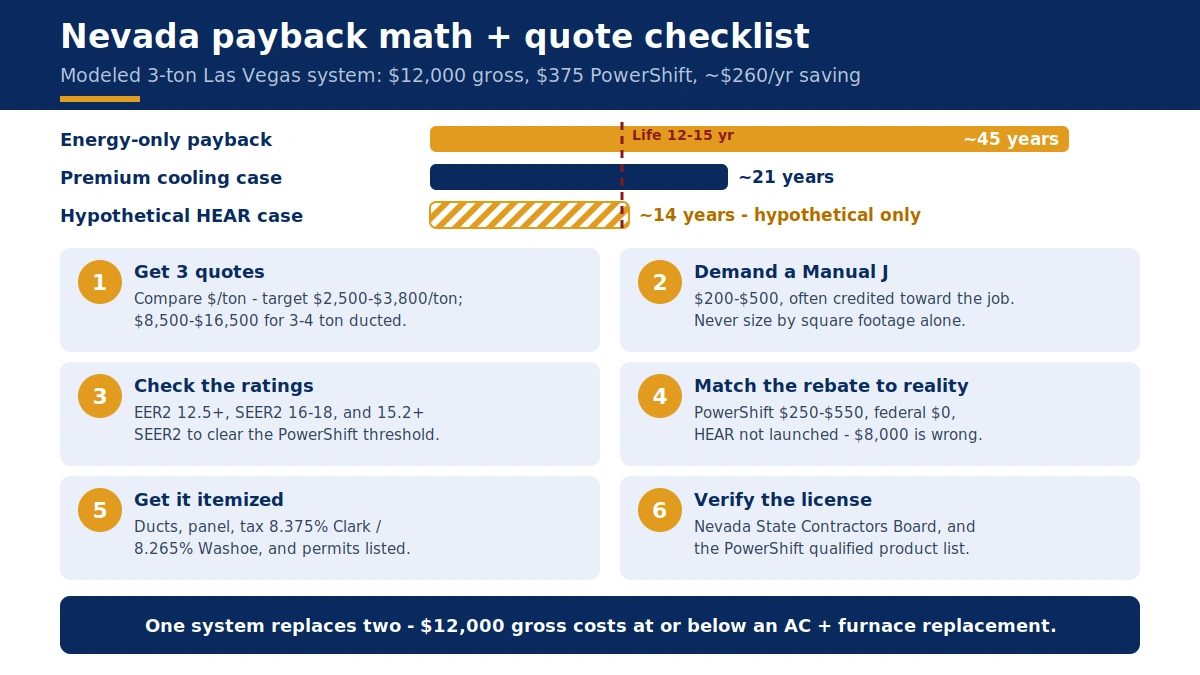
Assumptions, stated plainly. The $260-a-year saving is one installer’s Las Vegas model (2,000-square-foot home, $0.12 per kWh, $1.15 per therm, 2,800 cooling hours, 900 heating hours — none metered). Electricity-price escalation is not modeled here. The equipment life is 12–15 years — which means the simple energy payback exceeds the unit’s life on energy savings alone in every scenario modeled. PowerShift alone ($375) moves payback by about 1.5 years.
With HEAR the math would transform — but HEAR has not launched. With an $8,000 HEAR rebate, the same system would net to about $3,625 and the modeled payback would fall to about 14 years. That scenario is hypothetical and is labeled as such. Do not present it as available money. Do not present 45 years (or 21 years) as a published benchmark either. It is our arithmetic from one installer’s model. The defensible headline: *”In Nevada, a heat pump usually costs about the same or less upfront than replacing an AC and a furnace separately — and with the cheapest electricity in America, the energy savings alone take decades to repay the system. The case is the avoided second system, not the monthly saving.”*
Reno payback: no Reno running-cost model was verified, so no Reno payback figure is published here. Qualitatively: Reno’s 6,332 heating degree days mean heating dominates, so a cold-climate heat pump or dual-fuel system displaces far more gas therms than in Las Vegas — the energy case is stronger in Reno even though the equipment costs more. That is a directional statement only.
Before you sign — the Nevada quote checklist. Get at least three written quotes and ask every installer the same questions: (1) What is my dollars-per-ton, before any incentives? The Nevada benchmark is $2,500–$3,800 per ton installed, $8,500–$16,500 for a typical 3–4 ton ducted system. (2) Did you do a Manual J load calculation? If the size came from square footage alone, the quote is guesswork. (3) What are the SEER2, EER2, and HSPF2 ratings — and does the system clear the 15.2 SEER2 PowerShift threshold? (4) Does the quote subtract a federal credit or an $8,000 HEAR rebate? If yes, it is counting dead or nonexistent money. (5) Is the quote itemized — ducts, panel, sales tax (8.375% in Clark County, 8.265% in Washoe County), permits? (6) Is the installer licensed? Nevada requires a licensed contractor for HVAC work of this size — verify the license with the Nevada State Contractors Board before you sign. (7) Is it a split system or a packaged rooftop unit, and is the model on NV Energy’s PowerShift qualified product list?
Timing and HOA. Spring and fall shoulder seasons are the discount window; a summer emergency replacement in Las Vegas carries premium pricing and wait times — no Nevada-specific premium percentage was verified, so none is given. No Nevada heat-pump HOA statute was verified. Nevada has solar-access protections, but do not assume they cover heat pumps. An HOA can generally regulate outdoor-unit placement, screening, and appearance through architectural rules — check the HOA’s architectural guidelines before install and budget for a screen if required. A contractor who offers to skip the permit, sizes by square footage with no load calculation, or promises an $8,000 HEAR rebate in 2026 is a contractor to skip.
Sources & methodology
Cost anchors: TryDun heat pump cost by state (August 2026: Nevada $6,950–$12,850, BLS labor-adjusted model); NumeralQ HVAC replacement cost (November 2026: 3-ton ducted $6,550–$10,960; cold-climate ducted 3-ton $8,610–$15,040; dual-fuel 3-ton $9,230–$15,130; geothermal 3-ton $20,260–$31,920; §25C/§25D ended); Costimated HVAC replacement cost (November 2026: $2,500–$3,800/ton heat pump, 3-ton average $9,400, range $6,000–$14,800); The Cooling Company Spring 2026 AC replacement Las Vegas guide (tier table by size 2–5 ton, entry 15–17 / mid 18–21 / premium 22+ SEER2); The Cooling Company Best heat pumps Las Vegas 2026 (Lennox 3-ton XP14 $8,500–$11,500, XP17 $10,500–$14,000, XP21 $12,500–$16,500+, XP25 $14,500–$19,500+; Trane $8,000–$11,500; Carrier $7,800–$11,200; 5-zone ductless $17,000–$28,000 vs ducted $12,000–$16,500); 32 Degrees Las Vegas system replacement cost (October 2026: heat pump split starting $11,490–$17,442; package $11,067–$21,354; “Nevada’s state heat pump rebate program has not opened”).
Efficiency ratings: DOE Southwest regional minimums (in force since January 1, 2023): 14.3 SEER2 under 45,000 BTU, 13.8 SEER2 for larger systems, heat pumps 14.3 SEER2 + 7.5 HSPF2 — via the NumeralQ minimums table (November 2026); EER2-at-95°F definition and desert buying targets (16–18 SEER2 sweet spot, EER2 12.5+, HSPF2 8.0–9.0) via art. 61 Arizona research (desert-climate guidance, flagged as such); ENERGY STAR cold-climate certification 8.1+ HSPF2 (jouleio, 2026, via art. 63); Lennox 23.5 SEER2 saving claim $500–$1,100/yr and Trane-vs-Carrier 2.5-point SEER2 claim ~$150–$300/yr (The Cooling Company, 2026 — installer/manufacturer claims, flagged).
Climate: ICC Appendix D degree-day/design-temperature table (Las Vegas HDD 1,709, CDD 2,946, summer design 106°F, winter design 28°F; Reno HDD 6,332, summer design 92°F, winter design 10°F); NOAA 1991–2020 normals via PlainClimate / WeatherSpark (Las Vegas July 105°F/82°F, January 59°F/41°F, annual mean 70.1°F, 137 days ≥90°F, ~10 freezing nights, record 120°F/8°F, 4.18 in precipitation; Reno July 90°F/56°F, January 45°F/25°F, record 108°F/−16°F, 7.3 in precipitation, 19.8 in snow); Las Vegas cooling-hours modeling ~2,800 cooling / ~900 heating hours (The Cooling Company, 2026 — single-installer modeling, flagged).
Electricity rates: EIA Electric Power Monthly, Table 5.6.A (August 2026, released October 28, 2026: Nevada residential 12.72¢/kWh — lowest of all 51 jurisdictions; US 18.16¢/kWh; NV August average bill $207.45 at 1,631 kWh; NV rate +1.4% year over year; 12-month average 13.4¢/kWh via Kadoa); NV Energy rate schedules effective July 1, 2026 — southern residential schedule (Nevada Power RS total effective ~10.56¢/kWh, basic service $18.00/mo, TOU window June 1–September 30, 6:01–9:00 PM) and northern residential schedule (Sierra Pacific D-1 total effective ~11.53¢/kWh, basic service $18.50/mo; OD-1-TOU summer on-peak 49.517¢, off-peak 8.713¢, winter 8.708¢); Price of Electricity all-in model 14.38¢/kWh at 900 kWh (October 28, 2026 refresh); demand-charge reporting — Nevada News & Views (September 2025 PUCN approval, April 16, 2026 start) vs EcoGen America (checked October 1, 2026, January 2027 start) — conflicting, flagged; ElectricChoice (November 2026: Nevada residential gas $1.38/therm average, $48/mo, 348 therms/yr).
Rebates: The Cooling Company NV Energy PowerShift rebate 2026 (tier table $250/$375/$550 ducted at 15.2+/17.2+/19.1+ SEER2, $650 ductless at 18+ SEER2, +$100 income-qualified, “verified against nvenergy.com August 2026”; conflicting $500–$2,000 figures on the same site flagged); National Housing Trust DOE Home Energy Rebates state tracker (updated April 30, 2026: Nevada HEAR/HER conditionally approved, $96M, no expected launch date); ECW heat pump rebates by state (checked October 27, 2026: Nevada funds awarded, not launched; HEAR $47,920,160 + HOMES $48,103,711); Everblue $96M Nevada Home Energy Rebate contract (GOE award December 20, 2024; launch “expected early 2025”); DOE Program Notice 26-2 (May 29, 2026: no gas-to-electric fuel-switching for reservations after August 31, 2026); Southwest Gas 2026 NV Residential Rebate Application User Guide (November 2025 — program exists, amounts not verified); HomeEnergyBasics tracker (June 3, 2026: Nevada “Limited / Region-Dependent,” PowerShift “$510–$3,400” — third incompatible scale, flagged); 32 Degrees (October 2026: Nevada’s state heat pump rebate program has not opened).
Running costs / comparisons: The Cooling Company heat pump vs central AC Las Vegas (March 2026: 3-ton pricing; running-cost model AC+furnace $1,744–$2,114/yr vs heat pump $1,480–$1,860/yr; saving $254–$264/yr gas-dropped, ~$70–$120/yr gas-kept; heat pump delivers 2.5–3.5 units of heat per unit of electricity at Valley winter temperatures; premium-tier cooling saving $200–$400/yr — single-installer model, flagged); Tucson break-even rule (8.5 HSPF2 ~8,500 BTU/kWh; 80% AFUE ~80,000 BTU/therm; 9.4 kWh = 1 therm) via art. 61; DOE 1.5–3× heat delivery range via art. 61.
Geothermal: NumeralQ (November 2026: 3-ton geothermal $20,260–$31,920); art. 11 national planning range $25,000–$40,000+; NV Energy 2026 resource-plan filing geothermal power offers $105–$107/MWh vs solar-plus-storage ~$114/MWh (Survivalnomics/ZeroHedge, October 19–20, 2026 — wholesale power pricing, not residential cost); MDPI study (March 9, 2026: modeled Las Vegas seasonal geothermal heating cost $142.88, ~1,815 kWh input, COP 2–5 assumptions — model, not a bill); The Cooldown (October 2026: Southern Arizona 5-ton horizontal-loop homeowner anecdote, loop temperatures above 100°F); soil testing ~$1,300 national average (HomeAdvisor via Angi, July 2026).
Payback model: our arithmetic with stated assumptions (3-ton mid-tier $12,000; PowerShift Tier 2 $375; saving ~$260/yr from the Cooling Company model; AC $13,000–$18,000 / AC+furnace bundle $9,500–$14,500 vs $16,500–$22,000 comparison-page figure, all from The Cooling Company, March 2026 — conflicting figures shown, not reconciled). Not a published benchmark. HEAR hypothetical net ~$3,625 and ~14-year payback labeled hypothetical only.
Tax and sales tax: OBBBA P.L. 119-21 (signed July 4, 2025); IRS FS-2025-05 (August 21, 2025); §25C and §25D both ended for property placed in service after December 31, 2025 — confirmed by NumeralQ (November 2026), Costimated (November 2026), and The Cooling Company 2026 guides; Clark County 8.375% / Washoe County 8.265% combined sales tax (Taxually, updated November 2, 2026; Stripe 2026; Kintsugi, September 2026).
EXCLUDED: Angi’s national heat pump average $6,087 (range $4,236–$7,942, August 2026) as a Nevada headline (equipment-lean vs Las Vegas installer quotes); the $500–$2,000 PowerShift figures as heat pump rebate amounts (legacy or bundled-system totals, per brief §12-1); the HomeEnergyBasics “$510–$3,400” PowerShift scale as a rebate amount; the 2,709 Las Vegas HDD transcription; the “fall 2026” HEAR coupon claim as a launch date; any south Nevada TOU cent-per-kilowatt-hour figure (not verified); any demand-charge start date or per-kilowatt figure as settled fact; any Reno-specific installer price, Nevada dual-fuel price, Nevada geothermal price, or Nevada-specific ductwork/panel/permit figure (all unverified — national planning ranges used and labeled); Southwest Gas rebate dollar amounts (unverified); any extension of solar HOA protections to heat pumps (unverified); any Nevada summer emergency-replacement premium percentage (unverified); the Las Vegas January low of 33°F as a normals figure (NOAA 41°F used); the “after $2,000 IRA credit” and “30% geothermal credit through 2032” claims (stale law); utility-scale geothermal $105–$107/MWh as a homeowner cost (wholesale pricing).
*Disclaimer: Prices are 2026 Nevada planning figures and change by city, home, and installer. Always get 3 written local quotes before you budget. Tax information here is general, not tax advice — check with a tax professional. PowerShift tiers and HEAR status change fast — re-verify live tiers at nvenergy.com and HEAR status at the Nevada Governor’s Office of Energy before signing.*
—
How much does a heat pump cost in Nevada in 2026?
$8,500–$16,500 installed for a typical whole-home ducted system (3–4 ton). In Las Vegas, a 3-ton system runs $7,500–$16,000 depending on efficiency tier — entry $7,500–$9,200, mid $9,200–$12,000, premium $12,000–$16,000. A single-zone mini-split runs $3,000–$8,000. The statewide labor-adjusted range is $6,950–$12,850 (TryDun, August 2026).
Is there a federal tax credit for a heat pump in Nevada in 2026?
No — $0 for 2026 installs. The §25C credit (up to $2,000 a year for air-source heat pumps) and the 30% §25D credit for geothermal both ended for property placed in service after December 31, 2025, under the One Big Beautiful Bill Act (P.L. 119-21), confirmed by the IRS in FS-2025-05. Any quote that subtracts either credit from a 2026 install is using dead law.
Does NV Energy offer a heat pump rebate in 2026?
Yes — PowerShift pays $250 / $375 / $550 for a ducted heat pump by efficiency tier (15.2+ / 17.2+ / 19.1+ SEER2), $650 for a ductless mini-split at 18+ SEER2, plus $100 per tier for income-qualified households. It is a point-of-sale discount shown as a line item on the proposal. Re-verify the live tiers at nvenergy.com before signing — conflicting $500–$2,000 figures appear on installer pages.
Is Nevada’s HEAR rebate ($8,000) available in 2026?
No. Nevada’s $96 million HEAR program is funded and an implementer was hired in December 2024, but as of November 2026 it has not launched — no applications accepted, no launch date. Do not budget on it, and do not accept a quote that counts an $8,000 HEAR rebate. When it does launch, the federal design would pay up to $8,000 toward a heat pump for income-qualified households.
Do heat pumps work in Las Vegas heat?
Yes — cooling is what they do best. Las Vegas logs 2,946 cooling degree days against 1,709 heating degree days, with 137 days a year at or above 90°F and a 106°F summer design temperature. Buy on EER2 (12.5 or higher) and 16–18 SEER2, since the system spends months running at or above 95°F. The heating load is tiny — about 10 freezing nights a year.
Do heat pumps work in Reno winters?
A standard heat pump struggles. Reno logs 6,332 heating degree days with a 10°F winter design temperature and January lows averaging 25°F, so a standard system leans on expensive backup resistance heat on the coldest nights. Reno needs a cold-climate (hyper-heat/inverter) model or dual-fuel — budget toward the upper end of the range and get both quoted. No Reno-specific installer price was verified, so no Reno price figure is given here.
Heat pump or furnace in Nevada?
In Las Vegas, a heat pump for most homes — one system replaces both the AC and the furnace, and the modeled saving is about $260 a year if gas service is dropped entirely ($70–$120 a year if gas is kept for water heating or cooking). In Reno, a dual-fuel system or a cold-climate heat pump deserves a quote, since heating dominates the load there.
How long do heat pumps last in Nevada?
12–15 years is typical for a ducted heat pump (NumeralQ, November 2026; TryDun gives 10–16 years). Year-round use shortens life compared with an AC-only unit, which rests all winter. Budget for a shorter life than a furnace, and plan on annual maintenance.