


Nebraska is a strange solar market, and the strangeness is the story. The state gets more sun than most buyers expect, panels run well in its cold winters, and a 2009 state law gives every homeowner a monthly netting deal that buyers in many states lost years ago. The power those panels replace is some of the cheapest in the country, and the federal credit that used to cut a third off the price is gone for 2026 homeowner installs.
Those two facts frame every number in this guide. A system here costs about the national average to install and earns its keep against electricity that costs about a quarter less than the national average. The math still works for many homes, but it works slowly, and it works best for homes whose usage lines up with the monthly netting rule.
The name at the top of the electric bill matters more here than the brand on the roof. Nebraska has no investor-owned electric utility at all, which makes it the only state in the country run entirely on public power. Omaha Public Power District, Lincoln Electric System, Nebraska Public Power District, and dozens of smaller public power districts and city utilities each set their own surplus credit, their own fixed charges, and their own interconnection steps, and no state commission sets retail rates to overrule them.
Two more Nebraska facts belong up front. The first is hail: Nebraska recorded 4,698 reports of hail an inch or wider in the ten years to 2025, the third-highest count in the country, so panel durability is a buying question here, not a footnote. The second is that solar leases and power purchase agreements, the no-money-down route in many states, are generally not available here, because only public utilities may sell electricity directly.
Our national solar panel cost guide sets the countrywide price and the federal rules that apply everywhere. What follows prices Nebraska on its own terms: the state cost model, four cities, and each utility’s surplus credit, with a source and date on every figure.
Table of Contents
How Much Do Solar Panels Cost in Nebraska in 2026?
NumeralQ’s estimator pricing, dated October 26, 2026, puts a Nebraska 8 kW rooftop install at $19,960–$26,080. Per watt, that range is $2.50–$3.26, and the payback section uses the band’s midpoint, about $23,020, as its working cost. NumeralQ labels its figures planning estimates built from a national cost model adjusted for Nebraska materials and labor, not records of what Nebraska homeowners paid.
No published average drawn from completed Nebraska invoices was found, and no EnergySage Nebraska-specific per-watt page exists. The band is presented as what it is: a planning range to hold quotes against, not a price any installer has promised. A quote inside the band for an ordinary asphalt-shingle roof with straightforward access is a fair quote; a quote far above $3.26 a watt needs a clear reason, such as a steep roof, a long wire run, or a panel upgrade folded into the job.
Two other price trackers land close to the NumeralQ band from different directions. EcoGen’s Solar Cost Index, September 2026 edition with prices as of September 25, 2026, puts Nebraska at $2.91 per watt, tied for 28th lowest of 51 jurisdictions, against a $2.89 national average. Its typical Nebraska system is 7.57 kW at $22,029 before incentives, a size modeled from neighboring states because Nebraska has too few recorded installs for a local median, and that modeling caveat is stated on its page.
A second tracker, solarenergyprices.com, puts the typical Nebraska cash price at $2.80 a watt inside a $2.55–$3.05 range, with an 8 kW system at $20,400–$24,400. ElectricChoice, updated October 25, 2026, also lands at $2.80 a watt, with $19,600 for a 7 kW system. Three methods inside a 40-cent spread around $2.80–$2.91 a watt: the Nebraska price sits almost exactly on the national average, neither a bargain state nor an expensive one.
The neighbors bracket Nebraska closely. EcoGen’s September 2026 index prices South Dakota at $2.85, Kansas at $2.87, Iowa at $3.07, Missouri at $2.74, and Wyoming at $3.14 a watt. A Nebraskan comparing notes with a cousin across the Missouri River in Iowa will hear a slightly higher price, and one comparing with a cousin in Missouri will hear a slightly lower one, and neither comparison changes what a Nebraska installer charges. For the Iowa figures, see our Iowa solar panel cost guide, and for Missouri, our Missouri solar panel cost guide.
For that money, the installer delivers a system that runs: the panels themselves, inverter hardware (a single string inverter, or one microinverter per panel), racking and flashing, wiring with disconnects, permit and inspection fees, labor, and the startup and commissioning visit. Costs outside that price are where Nebraska buyers get surprised, because the work around the system is billed separately.
- Roof repairs or a roof replacement before the panels go on, priced on their own
- An electrical panel upgrade, if the existing service cannot take the solar backfeed
- A battery, priced separately and covered in its own section below
- Tree removal or trimming where shade falls on the roof
- Sales tax on the equipment, at the 5.5 percent state rate plus local tax, unless the quote states otherwise
- Any utility interconnection fee, which OPPD does not publish as a fixed figure, so the quote must state it or state that there is none
One warning belongs before any quote is compared. Nebraska labor is not the reason a quote runs high: solar installers here earn a median $24.45 an hour (Bureau of Labor Statistics, May 2025, via NumeralQ), billed at roughly $49–$64 per worker-hour, and Omaha and Lincoln electricians earn 1 percent and 4 percent below the national median. When a quote lands far above the band, the cause is usually equipment choice, roof complexity, or margin, and the installer should be able to say which one in one sentence.
| Source | Price per watt | 8 kW total | Basis |
|---|---|---|---|
| NumeralQ (Oct 2026) | $2.50–$3.26 | $19,960–$26,080 | Planning estimate, state model |
| EcoGen Index (Sept 2026) | $2.91 | $23,280 (scaled) | Cost index, cash, before incentives |
| solarenergyprices.com (Aug 2026) | $2.80 typical | $20,400–$24,400 | Planning range $2.55–$3.05/W |
| ElectricChoice (Oct 2026) | $2.80 | $22,400 (scaled) | $19,600 published for 7 kW |
The EcoGen and ElectricChoice 8 kW figures in that table are scaled from their per-watt averages, not totals those sources publish for an 8 kW system, and they are labeled as such. EcoGen’s own published total is $22,029 for its modeled 7.57 kW typical system. The agreement across sources is the point: Nebraska installs cost about $2.80–$2.91 a watt at the center of the range, and the NumeralQ band around it is wide enough to hold most real quotes.
Ask three licensed installers for written quotes on an identical scope of work. Drop any bidder who will not name the panel model, the inverter type, the year-one production estimate, and the surplus credit the savings math assumes, because a Nebraska savings estimate that prices every exported kilowatt-hour at retail is pricing a rule that does not exist.
Solar Panel Cost in Nebraska by System Size
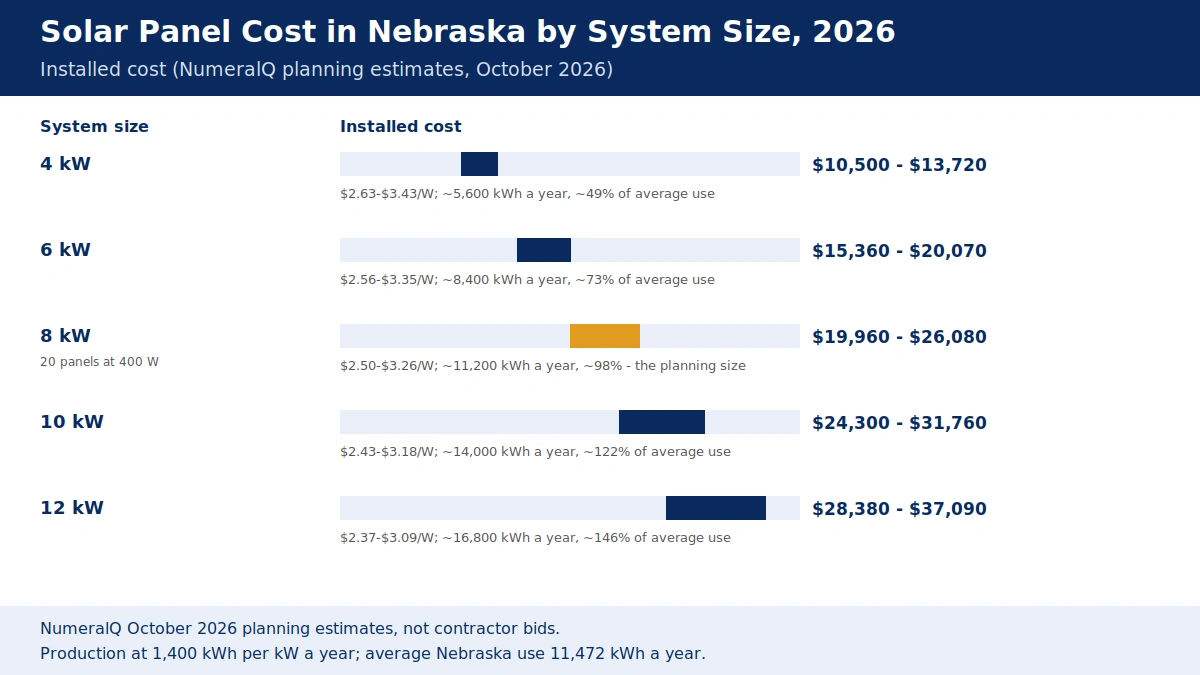
System size is measured in kilowatts, written kW, and it means the peak power the panels can produce in full sun. A bigger system costs more in total and usually less per watt, because the fixed costs of the visit, the permit, and the inverter spread across more panels. The table below prices the full NumeralQ Nebraska range, with production at the NestPriced planning figure of 1,400 kilowatt-hours per kilowatt each year and coverage against the average Nebraska home’s 11,472 kilowatt-hours a year.
| System size | Installed cost | Cost per watt | Yearly production | Share of average use |
|---|---|---|---|---|
| 4 kW | $10,500–$13,720 | $2.63–$3.43 | 5,600 kWh | 49% |
| 5 kW | $12,960–$16,940 | $2.59–$3.39 | 7,000 kWh | 61% |
| 6 kW | $15,360–$20,070 | $2.56–$3.35 | 8,400 kWh | 73% |
| 7 kW | $17,690–$23,120 | $2.53–$3.30 | 9,800 kWh | 85% |
| 8 kW | $19,960–$26,080 | $2.50–$3.26 | 11,200 kWh | 98% |
| 9 kW | $22,160–$28,960 | $2.46–$3.22 | 12,600 kWh | 110% |
| 10 kW | $24,300–$31,760 | $2.43–$3.18 | 14,000 kWh | 122% |
| 11 kW | $26,370–$34,470 | $2.40–$3.13 | 15,400 kWh | 134% |
| 12 kW | $28,380–$37,090 | $2.37–$3.09 | 16,800 kWh | 146% |
Costs: NumeralQ Nebraska estimator pricing, October 26, 2026. Production and coverage: NestPriced arithmetic at 1,400 kWh per kW per year against 11,472 kWh average annual use (956 kWh a month). Panel counts assume 400-watt panels: an 8 kW system needs 20 panels, a 6 kW system 15, and a 10 kW system 25, before roof setbacks and shade are taken out.
The per-watt price falls as the system grows, from $2.63–$3.43 at 4 kW to $2.37–$3.09 at 12 kW. That pattern is normal, and it tempts buyers toward the biggest system the roof will hold. In Nebraska that temptation needs a check, because the monthly netting rule pays full retail value only for generation that cancels usage inside the same month, and the surplus beyond the month earns only 3 to 9 cents.
A 6 kW system making 8,400 kilowatt-hours a year rarely produces more than the home uses in any single month, so almost every kilowatt-hour it makes earns retail value. An 8 kW system at 98 percent of average annual use still leaves about 900 surplus kilowatt-hours a year, mostly in the bright months of late spring and summer. A 10 kW system making 122 percent of average use leaves more than 3,000 surplus kilowatt-hours a year, and those kilowatt-hours earn the surplus credit, not the retail rate.
The right size follows the home’s bills, not the roof’s capacity. A home that uses 700 kilowatt-hours a month, about 8,400 a year, is well served by a 6 kW system. A home at the state average of 956 a month fits an 8 kW system. A home with an electric vehicle, a heat pump, or electric resistance heat may use 1,200 kilowatt-hours a month or more and justify 10 kW, but the extra panels should be justified by the extra load, not by the lower per-watt price.
Roof space rarely binds first. Twenty 400-watt panels need roughly 350 to 400 square feet of usable roof, and the typical Nebraska single-family roof offers far more than that on its south, east, and west faces combined. Shade, roof age, and the direction the roof faces bind sooner: a heavily shaded roof or a roof that needs replacing within five years should be dealt with before panels are priced at all. For the roof side of that decision, see our Nebraska roof replacement cost guide.
For a national view of how the common sizes compare, see our 6 kW, 8 kW, and 10 kW solar system cost guide. The national guide prices the same three sizes across the country; the table above is the Nebraska-specific version, and the two agree that 8 kW is the sensible planning size for the average home.
Solar Panel Cost by City: Omaha, Lincoln, Bellevue, and Grand Island
Only two Nebraska cities have a published cost model. NumeralQ publishes estimator pages for Omaha and Lincoln, and the two pages carry identical price bands, which says something useful on its own: installer labor, electrician pay, and material costs in the state’s two big cities are close enough that the model does not separate them. Bellevue and Grand Island have no published model, so their figures below are planning estimates drawn from the state and city bands, labeled as such, and a local quote is the only real price in either city.
| System size | Omaha | Lincoln | Bellevue (estimate) | Grand Island (estimate) |
|---|---|---|---|---|
| 4 kW | $10,760–$14,060 | $10,760–$14,060 | $10,500–$14,000 | $10,500–$14,000 |
| 6 kW | $15,750–$20,580 | $15,750–$20,580 | $15,400–$20,600 | $15,400–$20,600 |
| 8 kW | $20,460–$26,740 | $20,460–$26,740 | $20,000–$26,700 | $20,000–$26,700 |
| 10 kW | $24,910–$32,550 | $24,910–$32,550 | $24,300–$32,600 | $24,300–$32,600 |
Omaha and Lincoln: NumeralQ estimator pricing, October 26, 2026. Bellevue and Grand Island: NestPriced planning estimates from the state and Omaha/Lincoln bands; no published city model exists for either city. The city bands sit about $500 above the statewide band at 8 kW, which reflects city labor and permit costs rather than any difference in equipment.
Omaha is the state’s biggest solar market and the seat of Omaha Public Power District, which serves about 48 percent of Nebraska households across 13 counties and 5,000 square miles of southeast Nebraska. The city bands above are the price to hold an Omaha quote against, and the OPPD $2,000 rebate and the Rate 483 surplus credit, both covered in the utility section, are what separate an Omaha payback from a Lincoln one. Omaha’s median home costs $245,500 (American Community Survey 2020–2024, via NumeralQ), so an 8 kW system at the city midpoint costs about 9.6 percent of the median home’s value.
Lincoln matches Omaha on price and differs on everything that determines value. Lincoln Electric System serves the capital and its surroundings, about 18 percent of Nebraska households, in Lancaster County only, and it pays a different surplus credit, offers a different capacity payment, and runs a different interconnection sequence. Lincoln’s median home costs $264,000, so the same 8 kW system at the city midpoint costs about 8.9 percent of the median home’s value. The price is the same; the payback is not, and the utility section explains why.
Bellevue sits in Sarpy County, south of Omaha, and it is OPPD territory, which means a Bellevue buyer gets the Omaha price band, the OPPD rebate, and the OPPD surplus credit. Bellevue is also an Offutt Air Force Base community, and its subdivisions commonly require architectural review before exterior changes, so a Bellevue buyer should get any homeowners association approval in writing before signing, as the lease section explains. No published Bellevue price model exists; the estimate above uses the state and Omaha bands, and three local quotes will tell a Bellevue buyer more than any model.
Grand Island is the fourth city and the odd one out. The city runs its own municipal electric utility, separate from Southern Public Power District, which is headquartered in Grand Island but serves the surrounding rural counties. Grand Island’s residential rate is set by city ordinance: a $14 monthly customer charge, 9.9 cents for the first 300 kilowatt-hours, and 7.9 cents in winter or 6.1 cents in summer for the rest, plus a power cost adjustment and the Electric City Dividend (Ordinance 9978, rates effective October 1, 2025). Those are low energy charges, and low energy charges lengthen payback, because each kilowatt-hour from the roof replaces a cheap kilowatt-hour from the city.
The add-on costs that surprise buyers are published for Omaha and Lincoln and worth stating plainly. A battery of 10 to 13 kilowatt-hours costs $10,170–$15,740 installed in Omaha and $10,070–$15,620 in Lincoln, on NumeralQ’s model. A main panel upgrade costs $2,160–$3,410 in Omaha and $2,120–$3,360 in Lincoln. Both figures are planning estimates, and both should appear as separate lines on any quote that includes them, never buried in the per-watt price. For the national picture on panel work, see our electrical panel upgrade cost guide.
One more city-level fact shapes the decision. About 57 percent of Nebraska homes were built before 1980, and older homes are more likely to need panel work, roof work, or both before panels go on. An Omaha bungalow from 1955 and a Lincoln new build from 2021 can carry the same panel price and very different total job costs, and the quote must separate the system price from the preparation work so the comparison stays honest.

Nebraska Sun, Cold Winters, and Snow: What Your Panels Will Produce
Nebraska is sunnier than its winters suggest. Omaha averages about 2,727 hours of sunshine a year on the older 1961–1990 normals, and the solar resource, measured in peak sun hours, runs about 4.8 to 4.9 hours a day across the eastern cities. Lincoln averages 4.79 peak sun hours a day and North Omaha 4.90 on one published insolation table. A peak sun hour is not an hour of daylight; it is an hour’s worth of full-strength sun, 1,000 watts per square meter, and it is the unit that turns panel wattage into yearly energy.
The planning figure this guide uses is 1,400 kilowatt-hours per kilowatt each year. That is a NestPriced planning figure, chosen because it sits inside the published range rather than at either end of it. An 8 kW system at that figure makes about 11,200 kilowatt-hours a year, against average Nebraska home use of 11,472 kilowatt-hours a year, or about 98 percent coverage on an annual basis.
The published range runs from about 1,295 to 1,482 kilowatt-hours per kilowatt each year, depending on the model and the city. The National Renewable Energy Laboratory’s PVWatts calculator, version 8, gives Omaha 1,423 and Lincoln 1,463 at 14 percent system losses, with Lincoln about 3 percent above Omaha. The European PVGIS model, quoted through NumeralQ at a 20-degree tilt facing south with 14 percent losses, gives Omaha 1,390 and Lincoln 1,418. EcoGen’s model gives Omaha 1,482, and solarenergyprices.com implies 1,295 from its 10,361 kilowatt-hours for an 8 kW system.
Seasonality is the part buyers underestimate. PVWatts output for Omaha runs from about 79 kilowatt-hours per kilowatt in December to 158 in July, so a summer month makes about twice what a winter month makes. The system earns its keep in the long days from May to September and coasts through the short days from November to February, and the monthly netting rule means that seasonal swing shows up directly on the bill: surplus months in summer, deficit months in winter, settled month by month.
Cold helps panels, and this is one of Nebraska’s genuine advantages. A solar panel is rated at a cell temperature of 25 degrees Celsius, about 77 degrees Fahrenheit, under full sun. As the cell heats up past that point, output falls by a fixed percentage per degree, called the temperature coefficient. A typical modern panel loses 0.30 to 0.35 percent of its output for each degree Celsius above 25, and a standard monocrystalline panel loses 0.38 to 0.45 percent.
On a Nebraska roof in July, the cell temperature runs 20 to 25 degrees Celsius above the air temperature, so a 95-degree afternoon can push cells toward 65 degrees Celsius and cost 12 to 18 percent of output. On a bright January day at 20 degrees Fahrenheit, the cells stay near their rated temperature and the panels run close to their nameplate power. One worked example in the published literature puts a panel at 10 degrees below zero Celsius ambient, in full sun, at about 1.3 percent above its nameplate output. Cold does not double output, and any claim that it does confuses cell temperature with air temperature, but a cold sunny winter day is genuinely good solar weather.
Snow is the honest caveat. Snow sitting on panels blocks the sun until it slides or melts off, and Nebraska averages 27.1 inches of snow a year at Omaha’s Eppley Airfield station (NOAA 1991–2020 normals), with 7.2 inches in January, 7.8 in February, and 5.8 in December. Panels are dark, tilted, and warm in sun, so snow usually clears within a day or two of a storm, and the steep tilt of a typical Nebraska roof helps. No Nebraska-specific snow-loss percentage was verified for this guide, so none is asserted: the production figures above already carry 14 percent system losses in the PVWatts and PVGIS models, but those models count snow losses as zero, and a buyer should treat the winter months as the uncertain part of the estimate.
Which way the roof faces, and how steeply it tilts, shapes production more than buyers usually realize. South-facing panels at a tilt near the roof’s natural pitch are the standard case in every model above. West-facing panels make less total energy but make more of it in the late afternoon, which is why Lincoln Electric System pays its higher capacity payment, $475 per kilowatt, for west-facing and tracking systems against $375 for south-facing fixed systems. East-facing panels make less still, and a north-facing roof section is rarely worth paneling at all. The quote should state the expected production for the actual roof direction, not the textbook south-facing figure.
January in Omaha averages a high of 33.6 degrees and a low of 15.2 degrees Fahrenheit, and July averages a high of 88.1 and a low of 68.0, on the 1991–2020 normals. That 55-degree seasonal swing is the climate the system lives in: cold, bright winters that favor panel efficiency, hot summers that cost output to heat, and a spring hail season that tests durability. The production estimate on a quote should show monthly figures, not just an annual total, because the monthly shape is what the netting rule pays on.
Net Metering in Nebraska: The State Law Behind Every Solar Bill
Nebraska’s net metering law is older than most of the panels on its roofs. The Legislature passed LB 436 in 2009, codified at Nebraska Revised Statutes sections 70-2001 to 70-2005, and it applies to every local distribution utility in the state. No 2026 change to the statute was found, and two older bills that would have changed it, LB506 to raise the participation cap to 3 percent and LB573 to measure the 25 kW limit in alternating current, were heard and never advanced.
The law covers a qualified facility of 25 kW or less using solar, wind, methane, biomass, hydro, or geothermal energy. The core rule is monthly netting: within a billing month, each kilowatt-hour the home sends to the grid cancels one kilowatt-hour it draws from the grid, at full retail value. The meter, or the billing calculation, nets the two directions over the month, and the home pays only for the net amount it consumed.
Only the leftover at month end is treated differently. If the home sent more than it drew over the whole month, the net excess is credited in dollars at the utility’s avoided cost, which is roughly what the utility would have paid for that power elsewhere, and the credit carries forward to later bills. Any credit still unused is paid out with the last bill of each yearly period, or within 60 days of ending service. That payout rule matters: at least one national roundup claims unused credits are forfeited at year end in Nebraska, and the statute says the opposite.
The law also limits what the utility may charge. A net metering customer pays the same minimum monthly fee as others in the same rate class, and the utility may not add a standby, capacity, demand, or interconnection fee on top of the standard charges for the class. The customer keeps the renewable energy certificates, the paper credits that prove the power came from a renewable source. The utility may offer terms better than the statute requires, and may take systems larger than 25 kW on other terms, but it may not offer worse than the statute for a qualifying system.
One limit deserves attention because a Nebraska utility has now reached it. The statute says a utility need not take new net metering customers once the total capacity of its customer generators reaches 1 percent of the capacity needed to serve its average aggregate monthly peak demand forecast for the calendar year. Norris Public Power District, serving the Beatrice area, hit that cap, and since January 1, 2026 its new home systems go on net billing instead, where every exported kilowatt-hour earns a fixed credit and no monthly swap applies. Existing Norris net metering customers keep their terms.
The 1 percent cap is the reason to ask about headroom before signing, not after. A utility approaching the cap can close net metering to new customers, and the replacement terms, as Norris shows, pay materially less for exported power. The question costs nothing: ask the utility, in writing, whether net metering is open to new customers at the address, and what happens if the cap is reached while the system is being installed.
The statute also sets a process. The customer must give the utility 60 days’ notice before installing, and must request an inspection from the State Electrical Division before connecting. In practice the installer handles both steps, but the buyer should confirm they happened, because connecting without the utility’s approval can mean the system sits idle, or the utility refuses the interconnection. The full text is public: Nebraska Revised Statutes section 70-2003 carries the net metering terms, and sections 70-2001, 70-2002, 70-2004, and 70-2005 carry the definitions, the notice rule, and the remaining terms.
Nebraska’s structure makes this law unusual in a second way. Because every electric utility in the state is publicly owned, there is no state commission setting retail rates, and disputes go to the utility’s own board, which is often elected. That local control cuts both ways: a buyer can attend the board meeting where the surplus credit is set, and a buyer cannot appeal to a regulator in Lincoln when the board sets it low. Knowing the utility’s current rules, in writing, is the only protection, and the next section states each major utility’s rules as verified in November 2026.
What OPPD, LES, NPPD, and Smaller Utilities Pay for Extra Power
The statute sets the frame; each utility fills in the numbers. The table below states the surplus credit each major utility pays for month-end excess power, with the reliability of each figure stated plainly. Surplus credits change, and a credit quoted on a web page in October may not be the credit on a bill in March, so every figure below carries a “confirm in writing” instruction where the source is a secondary compilation rather than the utility’s own tariff text.
| Utility | Territory | Surplus credit for month-end excess | Source and status |
|---|---|---|---|
| OPPD | Omaha, Bellevue, SE Nebraska | Rate 483 rider; exact cents not published on the web page | Ask OPPD in writing; seasonal structure |
| LES | Lincoln and surroundings | About 3.9 cents summer, 2.8 cents rest of year (Tier 2) | Secondary compilation; confirm in writing |
| NPPD | Kearney, Norfolk, Scottsbluff, York, other retail towns | 9.07 cents summer, 5.06 cents rest of year | Secondary compilation; confirm in writing |
| Norris PPD | Beatrice area | 6.25 cents summer, 4.41 cents winter, all exports (net billing) | Service Regulation 800 via EcoGen |
| Southern PPD | Rural counties around Grand Island | 2.61 cents all year | Schedule DG via EcoGen |
| Grand Island city utility | Grand Island | Current month cost of energy per kWh | Ordinance; no fixed cents published; ask the city |
OPPD serves about 48 percent of Nebraska households, so its rules are the default Nebraska experience. Net metering runs under Rider Schedule No. 483: the monthly swap at retail, then month-end excess compensated at the Rate 483 rate. OPPD replaces the standard meter with a free bidirectional meter as part of the interconnection process, and the meter records imports and exports separately. Customers on the Level Payment Plan are removed from that plan, because level billing is not available with net metering, and a buyer who relies on level bills should budget for that change.
The exact Rate 483 cent values could not be verified from OPPD’s published pages in November 2026. The OPPD rate manual PDF link returned an error when checked, and even the newest competitor guide states only that buyers should ask OPPD for the current rate. EcoGen’s secondary compilation describes a seasonal structure, one summer rate and a lower rest-of-year rate, with the rest-of-year rate applying since October 1, 2026, but no cent values from that compilation are asserted here. Ask OPPD for the current Rate 483 values in writing before signing, and make the installer show the savings math using those values, not the retail rate.
OPPD’s retail rates are verified and worth stating, because they are the value of every kilowatt-hour the system offsets within the month. Standard Residential Service, Rate 110, effective January 1, 2026, charges a $30.00 monthly service charge, 11.937 cents a kilowatt-hour in summer (June 1 to September 30), and 9.503 cents in the non-summer months (October 1 to May 31), plus a fuel and purchased power adjustment of 0.521 cents on every kilowatt-hour. Blended with that adjustment, the effective energy price is 12.458 cents in summer and 10.024 cents the rest of the year, and the $30.00 minimum bill is not offset by solar: the service charge is owed whether the panels cover the month’s usage or not, which costs $360 a year before a single kilowatt-hour is counted. OPPD’s own net metering page states the monthly netting rule and the Rate 483 reference, and its residential rates page carries the current Rate 110 and Rate 115 figures.
Lincoln Electric System serves about 18 percent of Nebraska households and runs the most detailed solar program in the state. Its Renewable Net Metering Rider covers systems up to 25 kW of alternating-current output per meter, and its surplus payment runs in tiers. Tier 1 paid 100 percent of the residential energy charge; Tier 2, the current level, pays 50 percent of the residential energy charge, locked for 10 years, with a floor at the utility’s avoided cost. EcoGen’s compilation of the LES 2026 schedules puts Tier 2 at about 3.9 cents in summer and 2.8 cents the rest of the year, but that is a secondary compilation, not LES tariff text, and the draft states it as such: confirm the current Tier 2 values with LES in writing.
LES also pays a one-time capacity payment that no other Nebraska utility matches. The payment is $375 per kilowatt of direct-current capacity for a south-facing fixed system and $475 per kilowatt for a west-facing or tracking system, with other layouts earning nothing. An 8 kW south-facing system earns $3,000 and an 8 kW west-facing system earns $3,800, but only when installed by an installer in the LES Solar Trade Ally Network. Funds are limited: $889,267 remained as of July 1, 2025, on a DSIRE-mirror figure that is now dated, so the buyer must ask LES whether money remains before budgeting the payment. LES revised its solar rules on May 15, 2026, keeping the current payment level open longer, and Tier 2 ends when customer systems reach 10,000 kW or 15 years after December 31, 2017, whichever comes first.
The LES interconnection sequence is strict and must be followed in order. The buyer or installer starts with the building permit and the electric service application, then files the Application for Review of Interconnection, and installs only after receiving the notice to proceed. After installation, the interconnection agreement goes back to LES, and LES inspects before the system is switched on. Installing before the notice to proceed risks the interconnection, and a buyer should confirm the notice arrived before the crew arrives.
Nebraska Public Power District serves about 10 percent of Nebraska households directly, in retail towns including Kearney, Norfolk, Scottsbluff, and York, and it wholesales power to many more communities whose local utilities set their own retail rules. Its Net Metering Service Rider, effective January 1, 2026, pays a surplus credit of 9.07 cents in summer and 5.06 cents the rest of the year on EcoGen’s compilation, checked October 1, 2026, which is the highest published surplus credit among the big three. That figure is a secondary compilation and must be confirmed with NPPD in writing. NPPD offers no solar rebate, closes net metering to new customers at 1 percent of peak retail demand, and its rider covers only homes billed by NPPD itself: a home in a town that buys NPPD power at wholesale and resells it follows the local utility’s rules, not NPPD’s.
The smaller utilities show how wide the range runs. Norris Public Power District, having hit the 1 percent cap, puts new home systems on net billing: all exports earn 6.25 cents in summer and 4.41 cents in winter, with no monthly swap, plus a Facility Recovery Charge of $1.00 per kilowatt of billing demand a month. Southern Public Power District pays 2.61 cents all year under its Schedule DG, effective January 1, 2026. Grand Island’s city utility credits net excess at the current month cost of energy per kilowatt-hour, a figure that moves monthly and is not published as a fixed rate, so a Grand Island buyer must ask the city what that figure has run recently. A buyer served by any small public power district or city utility should get the surplus credit, the fixed charges, and the interconnection steps in writing from that utility, because no statewide table covers them.
Community solar is the fallback for a home whose roof, shade, or utility rules make rooftop panels a poor fit. OPPD’s community solar shares are sold out with a waitlist, at a 2026 rate of a 15-cent credit per share per month effective April 1, 2026, with each share equal to 100 kilowatt-hours and a $100 refundable deposit. LES sells virtual net metering panels at $450 for a full panel in 2026 before tax, with estimated savings of $32.48 a year and credits through 2036. NPPD’s SunWise fields are full with waitlists in most towns. For the national picture, see our community solar cost guide.
How Long Until Solar Panels Pay for Themselves in Nebraska?
Payback in Nebraska is slower than in most states, and the reason is the price of the power being replaced. The statewide residential average was 13.54 cents a kilowatt-hour in August 2026 (U.S. Energy Information Administration, Electric Power Monthly, Table 5.6.A), against 18.16 cents nationally, and the 12-month average to August 2026 was 12.74 cents. The EIA table behind those figures is the most authoritative rate source available, and it shows Nebraska power about a quarter cheaper than the national average. Every kilowatt-hour from the roof replaces a cheap kilowatt-hour from the grid, so each one earns less.
The published payback estimates agree on the shape of the answer and differ on the details. EcoGen’s September 2026 index puts simple payback at about 20.6 years statewide, weighted across OPPD, LES, and NPPD, with OPPD at 18.5 years and the full range running 18.5 to 28.1 years, before incentives and without counting future rate rises. NumeralQ’s city planning boxes put simple payback at 16.4 years in Omaha and 16.1 years in Lincoln, but those boxes price exported power at the full retail rate, which Nebraska’s monthly netting rule does not do for month-end surplus, so they are optimistic and are labeled as such here.
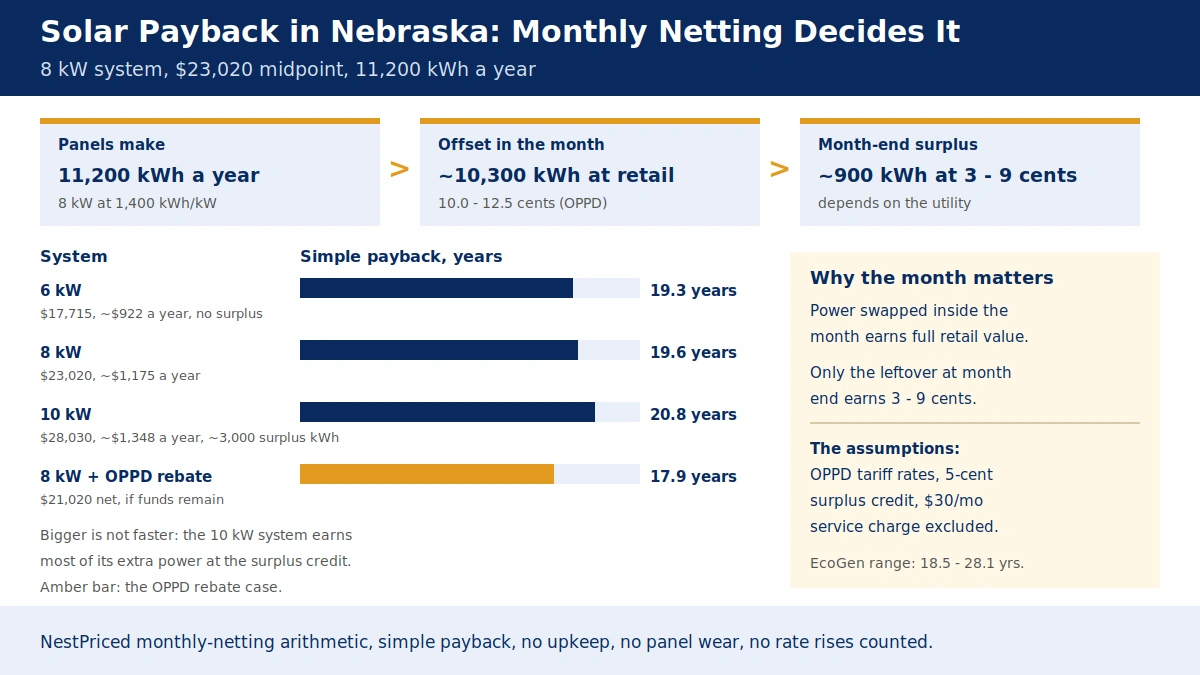
The arithmetic below is NestPriced arithmetic, built month by month at OPPD’s tariff rates, and its assumptions are stated so any reader can redo it. The model uses the 1,400 kilowatt-hour planning figure with a monthly shape taken from PVWatts output for Omaha, monthly home use averaging 956 kilowatt-hours with a winter and summer peak, OPPD’s blended energy prices of 12.458 cents in summer and 10.024 cents the rest of the year including the fuel adjustment, and a surplus credit of 5 cents for month-end excess. The $30 monthly service charge is excluded from savings, because it is owed regardless.
| System | Cost (midpoint) | Yearly value | Simple payback | Month-end surplus |
|---|---|---|---|---|
| 6 kW | $17,715 | $922 | 19.3 years | ~0 kWh |
| 8 kW | $23,020 | $1,175 | 19.6 years | ~900 kWh |
| 10 kW | $28,030 | $1,348 | 20.8 years | ~3,000 kWh |
Costs: NumeralQ Nebraska midpoints, October 2026. Value and payback: NestPriced monthly-netting arithmetic at OPPD tariff rates, 5-cent surplus credit, before incentives, upkeep, degradation, and rate rises. The 6 kW system earns nothing at the surplus rate in this model because its monthly generation never exceeds monthly use, which is the point: a smaller system wastes nothing.
The table carries a lesson that runs against the usual sales pitch. The 10 kW system costs $5,010 more than the 8 kW system and earns only $173 more a year, because most of its extra generation lands as month-end surplus at 5 cents instead of retail offsets at 10 to 12 cents. Its payback is longer, not shorter. The 6 kW system, earning retail value on nearly every kilowatt-hour, pays back in about the same time as the 8 kW system for $5,305 less money. Size to the monthly load, not to the roof.
Incentives move the answer, but only where they exist. The OPPD $2,000 rebate, if funds remain and the installer is a Trade Ally participant, cuts the 8 kW net cost to $21,020 and the modeled payback to about 17.9 years. The LES capacity payment, at $3,000 for an 8 kW south-facing system, cuts the same cost basis to $20,020 and the modeled payback to about 17.0 years, though LES energy charges are lower than OPPD’s, so a Lincoln payback computed at LES rates would run longer than the OPPD-basis model suggests. The EcoGen range, which runs to 28.1 years for the least favorable utility and rate combination, is the honest outer bound.
Three forces push the real payback in different directions, and none of them is in the simple model. Electricity rates rise: the statewide average rose 5.8 percent in the year to August 2026, OPPD raised home rates about 6 percent for 2026, and LES added 3 percent for 2026, and every future rise shortens payback. Panels degrade slowly, typically about 0.5 percent a year, which lengthens it slightly. And upkeep, chiefly a possible inverter replacement in the second decade, adds cost that the simple model omits. A buyer who treats 19 to 21 years as the planning case, with rate rises as the upside, is reading the Nebraska numbers honestly.
The 25-year view softens the picture without changing it. At the modeled $1,175 a year, adjusted for slow degradation, an 8 kW system returns roughly $27,600 in bill value over 25 years against a $23,020 cost, before incentives and before any rate rises. With the OPPD rebate, the return clears the cost by a wider margin. With rate rises at even 2 percent a year, the margin widens further. Solar in Nebraska is a long, steady return, not a quick one, and a buyer who needs the money back in ten years should not buy panels on financial grounds alone.
Should You Add a Battery to Solar Panels in Nebraska?
A home battery stores extra solar power for use after sunset, and in many states it earns its keep by shifting cheap solar power into expensive evening hours. In Nebraska that money-making case is weak, and the honest reason is the monthly netting rule. The grid already acts as a free battery inside each billing month: power sent out at noon cancels power drawn at midnight at full retail value, as long as the swap happens inside the same month. A physical battery can only improve on that deal for the kilowatt-hours left over at month end, and there are not many of those on a right-sized system.
The arithmetic makes the point. The monthly-netting model in the payback section leaves an 8 kW system with about 900 surplus kilowatt-hours a year. A battery that shifted all of them from a 5-cent surplus credit to retail value at roughly 10 to 12 cents would earn a spread of about 6 cents on each, or about $54 a year. Even a generous version of the math, with more surplus and a wider spread, struggles to reach $150 a year. Against a battery costing $10,000 or more, the bill-saving payback runs to many decades, which is another way of saying the battery does not pay for itself on bill savings in Nebraska.
That does not make a battery pointless. It makes it a resilience purchase, and Nebraska gives a buyer real reasons to want one. The storm of July 31 to August 1, 2024, knocked out about 220,000 OPPD customers, about 30,000 of them in Sarpy County alone, and the hardest-hit areas waited days for power. A battery with islanding capability, the ability to disconnect from the grid and power the home on its own, keeps the refrigerator, the furnace fan, the well pump, and the phones running through an outage. A buyer who has lived through a multi-day outage in a Nebraska summer or winter understands that value without a spreadsheet.
Battery prices run as follows. Nationally, installed battery costs ran $700–$1,300 per kilowatt-hour in EnergySage marketplace data reported in September 2026, and the typical install in the first half of 2026 cost $15,647 for 13.5 kilowatt-hours, or $1,159 per kilowatt-hour. The Tesla Powerwall 3, the most commonly quoted home battery at 13.5 kilowatt-hours with 11.5 kW of continuous output and an integrated inverter, averaged $13,473 installed on EnergySage data, with a typical range of $13,000–$16,500. Nebraska-specific planning estimates from NumeralQ put a 10 to 13 kilowatt-hour battery add-on at $10,170–$15,740 installed in Omaha and $10,070–$15,620 in Lincoln.
The Powerwall 3 carries a 10-year warranty holding 70 percent of its capacity, and its round-trip efficiency, the share of stored energy that comes back out, runs about 89 to 90 percent. Those figures are national and apply to the product, not to Nebraska specifically, and no Nebraska battery rebate was found: no utility or state program pays toward a home battery here, and the federal credit for a homeowner-owned battery placed in service in 2026 is $0, the same as for the panels. A battery bought with the panels shares one installation visit and one permit, which saves some labor, but it does not share any incentive.
Three questions decide the battery choice. The first is outage history: a home that lost power for days in 2024, or sits at the end of a rural feeder where restoration runs last, has a stronger case than a home on a city circuit that rarely blinks. The second is medical or work need: refrigerated medication, a home office, or a sump pump that must run through a storm all strengthen the case. The third is whether the battery is sized to the need: a single 13.5 kilowatt-hour battery runs essentials for most of a day with solar refilling it, while whole-home backup through a multi-day outage needs more capacity than most buyers budget for.
A cheaper resilience option deserves a mention. A portable generator costs a fraction of a battery, runs on gasoline or propane, and covers the same essentials during an outage, though it needs fuel, makes noise, and cannot run automatically. A buyer whose only goal is surviving the next storm should price a generator before a battery. A buyer who wants silent, automatic, solar-fed backup, and can afford it as a comfort and safety purchase rather than an investment, should buy the battery with open eyes about the payback.
Solar Incentives, Credits, and Loans in Nebraska in 2026
The federal picture is simple, and it is the first thing a Nebraska buyer must absorb. A homeowner-owned solar system placed in service in 2026 earns a $0 federal tax credit. The One Big Beautiful Bill Act, Public Law 119-21, ended the residential clean energy credit under section 25D and the energy efficient home improvement credit under section 25C for systems installed after December 31, 2025, as the Internal Revenue Service confirmed in Fact Sheet FS-2025-05. The federal government contributes $0 to a 2026 homeowner-owned install. Any quote, advertisement, or savings sheet that still subtracts 30 percent for a federal credit is using expired law, and several national solar websites still do.
Nebraska adds no state income tax credit for home solar, and the state has no market for solar renewable energy certificates, the tradable credits that pay solar owners in some eastern states. There is no state check coming to fill the federal gap. What Nebraska does offer is a short list of utility payments and one long-running state loan program, and each item on the list needs its live status checked before it is budgeted.
The OPPD solar rebate is the largest single payment available to the most Nebraskans. OPPD pays a flat $2,000 per rebate for a system of at least 3 kW of alternating-current maximum export, installed or sold by a current participant in its Customer-Owned Generation Trade Ally program, on a first-come, first-served basis, capped at 50 percent of the total material and equipment cost. The Trade Ally installer submits the application, and an itemized invoice must reach OPPD within 30 days of completion. The terms are published in OPPD’s solar rebate program terms and conditions (March 2026). Whether funds remain was not confirmed in November 2026: one secondary source reported the OPPD site would not load for a final check in October 2026, so the buyer must ask OPPD whether money remains before treating the $2,000 as certain.
Two more terms from the March 2026 conditions deserve a read before budgeting. A pre-approved rebate is reserved for 120 days; if the project is not complete in that time, the funds are released and the project must be resubmitted. If the system is removed from OPPD territory or disconnected within 10 years, OPPD may claw back a prorated share of the rebate, and the recipient agrees either to keep sole ownership of the renewable energy credits or to transfer them to OPPD.
The LES capacity payment is the second utility payment, and it is the more generous one for a Lincoln buyer. At $375 per kilowatt for a south-facing fixed system and $475 for a west-facing or tracking system, an 8 kW system earns $3,000 or $3,800, but only through an installer in the LES Solar Trade Ally Network, and only while funds last. The dated fund balance of $889,267 as of July 1, 2025, is the most recent figure found, and it is now more than a year old. Ask LES for the current balance in writing.
NPPD offers no solar rebate, and no rebate was found from any smaller Nebraska utility. The Nebraska Solar for All program, which would have helped lower-income households, is paused: its federal grant ended on August 7, 2025, and there is nothing to apply for. A buyer who hears about Solar for All from an older article should treat it as closed.
Two tax questions come up on every Nebraska quote, and both have the same answer: no exemption. Home solar equipment is not exempt from Nebraska sales tax, by the consensus of every reliable source checked, and the state rate is 5.5 percent plus local tax, reaching about 7.5 percent in some cities. The quote must state whether sales tax is included in the headline price.
On property tax, the verified statute exempts solar, biomass, and landfill-gas equipment only when the nameplate capacity is 100 kW or more, under section 77-202(1)(9), which covers commercial arrays, not a home roof. A claim of a six-year property tax exemption for home solar appears only on one unreliable website and is contradicted by the statute text. Whether the county assessor adds value for the panels varies by county, and the buyer should ask the assessor before assuming the tax bill stays flat.
The Dollar and Energy Saving Loan program, run by the Nebraska Department of Water, Energy, and Environment, is the state’s long-running answer to the upfront cost. It lends through more than 200 participating lenders at simple interest rates that vary by utility partnership: 5 percent, 3.5 percent, or less as the general statement, 3 percent or less for OPPD customers, and about 1.5 percent through NPPD on one verified report, with the department’s fiscal year 2025 annual report showing rates from 1 percent to 5 percent across 2024 and 2025. The program has funded 31,530 projects and more than $418 million since March 1990.
The loan caps for systems of 10 kW or less are $14,000 for the first kilowatt plus $4,000 for each added kilowatt: $30,000 for a 5 kW system, $34,000 for 6 kW, $38,000 for 7 kW, and $42,000 for 8 kW. The borrower files Form 20 with an itemized bid through a participating lender, and must not sign, buy, or start work before the department confirms the loan commitment, because starting early can cost the loan. Work must be completed within five months. One conflict is flagged honestly: program summaries from EcoGen and EcoWatch state terms up to 10 years for solar, while OPPD’s page states pre-qualified projects, including solar, may run up to 15 years. The buyer must confirm the term with the lender in writing, and this guide does not resolve the conflict by picking one figure.
The federal home energy rebate programs, HEAR and HOMES, are not launched in Nebraska. The department lists both as preparing an application, and checks in September, October, and November 2026 all show neither open.
HEAR, when it launches, will pay up to $8,000 at the point of sale for income-qualified households, but it does not cover solar panels: federal program notices effective May 29, 2026, limit it to electric-to-electric appliance replacements. HOMES will pay up to $8,000 for measured energy savings. Neither program should appear in a 2026 solar budget, and a salesperson who counts either one is counting money that does not exist yet. Our federal energy tax credits guide walks through the federal rules in full, including what ended and what survives.
One narrow federal route survives, and it belongs to the lease section: the commercial credit under section 48E, which a leasing company can claim for a system it owns and pass through as lower payments, for systems placed in service by December 31, 2027. In Nebraska that route runs into the state’s restriction on third-party electricity sales, which is why the next section treats leasing as a rarity rather than a standard option.
Lease vs Own: Why Nebraska Homeowners Almost Always Buy
In most states a homeowner can choose among three ways to get solar: buy the system outright or with a loan, lease it from a solar company, or sign a power purchase agreement and buy the power it makes. In Nebraska the second and third options are generally not available, and the reason is the state’s public power structure. Only publicly owned utilities may sell electricity directly to Nebraska customers, so a private solar company generally cannot sell a homeowner the power from panels on the homeowner’s own roof. The Nebraska Solar Energy Society states the position plainly: most Nebraska homeowners must buy outright or use loan financing.
No verified residential lease or power purchase provider, price, or annual escalator was found for Nebraska, and none is named in this guide. The national lease companies that dominate advertising in other states do not operate a standard Nebraska residential lease product, and a buyer who is offered one should treat it as exceptional and demand written proof on three points before signing anything: that the arrangement is lawful in that utility’s territory, that the federal section 48E credit is genuinely being passed through in the payments, and the full payment schedule including every escalator, buyout price, transfer term, and end-of-term condition.
The federal lease route, narrow as it is, deserves an accurate statement. A company that owns a system and leases it to a homeowner may claim the commercial clean electricity credit under section 48E and pass the value through as lower lease payments, for systems placed in service by December 31, 2027. That is the standing federal framing, and it is the only federal help left for a 2026 residential solar install of any kind. One single-source claim that section 48E(i) denies the credit for solar leased to a home, with a construction deadline in July 2026, was found and could not be corroborated; it is recorded as unresolved and is not asserted here. A buyer considering any lease should get the pass-through in writing from the leasing company and confirm the tax position with a tax professional, because the buyer does not claim the credit and cannot verify it from the lease paperwork alone.
Ownership, by contrast, is straightforward and is what nearly every Nebraska solar home does. The buyer pays the installed price, less any utility rebate or capacity payment, owns the equipment and the renewable energy certificates, claims the monthly netting benefit on the utility bill, and keeps whatever surplus credits accumulate. The buyer also carries the upkeep, the inverter replacement risk, and the roof responsibility, and the buyer needs the roof to outlast the panels or to budget for removing and reinstalling them when the roof is replaced. No Nebraska-specific detach and reset price was verified for this guide, so none is stated; the quote for a roof near the end of its life should include that line.
A loan splits the difference between paying cash and leasing without the legal complications. The Dollar and Energy Saving Loan program, covered in the incentives section, lends at low simple interest through local banks, and a home equity line or a solar loan from the installer are alternatives. A loan keeps ownership, net metering, and the utility payments with the homeowner, and the monthly loan payment can be compared directly against the monthly bill saving. The comparison must be honest about the loan term: a 10-year loan at low interest against a 19-year payback means the household pays more than it saves for the first decade and banks the benefit later.
Homeowners association rules are a separate Nebraska trap. State law at sections 66-901 to 66-914 allows solar access agreements and easements by recorded agreement, and authorizes variances, but it does not void a homeowners association covenant that bans solar panels. A buyer in a covenanted subdivision, common in Sarpy County around Bellevue and in newer Lincoln and Omaha developments, should get the association’s written approval before signing an installer contract. An installer who says the state law overrides the association is wrong, and the buyer, not the installer, bears the cost of removing panels the association rejects.
The decision rule is short. Buy, with cash or a low-interest loan, if the home will be kept for at least 15 years, the roof has at least 15 years of life, and the utility’s net metering is open. Do not sign a lease or power purchase agreement without written proof of legality in that territory and written proof of the federal pass-through. And do not let a lease salesperson’s promise of free panels substitute for the ownership math in the payback section, because the ownership math is the only math verified for Nebraska.
Hail, Snow, and High Wind: Will Nebraska Weather Damage Solar Panels?
Nebraska weather is the hardest test a residential solar panel faces in the United States, and a buyer here should choose equipment with that fact in front of them. The state recorded 4,698 reports of hail an inch or wider in the ten years from 2016 to 2025, the third-highest count in the country, including 679 reports of hail two inches or wider, and 67 percent of the large-hail reports fell in May, June, and July. The same decade brought 484 tornado reports and 4,479 damaging-wind reports. Douglas County recorded 143 thunderstorm wind reports at 58 mph or higher and Lancaster County 149, and the twelve months to October 2026 brought 867 severe wind and hail reports statewide, with June 2026 the busiest month at 258.
The named events are recent enough that most Omaha and Lincoln buyers remember them. Hail the size of baseballs fell on Omaha on June 12 to 14, 2024, in a $1.2 billion disaster event counted by NOAA’s National Centers for Environmental Information. Hail the size of softballs struck Cozad on June 29, 2024, causing about $100 million in damage. An EF-3 tornado hit Whitman on June 25, 2024. A buyer who lived through the June 2024 hail season has already seen what the sky can do to a roof, and the question is whether panels survive the same sky.
The testing evidence is reassuring, with one important qualification about glass thickness. The baseline certification, UL 61730 and IEC 61215, fires 1-inch ice balls at about 50 mph at 11 points on the panel, and the panel must show no visible cracking or delamination and lose no more than 5 percent of its power. A separate UL test drops a 2-inch steel sphere from 51 inches. The most cited field evidence comes from a 2017 hailstorm studied by the National Renewable Energy Laboratory, in which 1 panel out of 3,168 was damaged, a 99.97 percent survival rate, with stones up to 2.75 inches. The U.S. Department of Energy’s summary is that hail generally does not damage panels unless it reaches about 1.75 inches, golf-ball size.
The qualification is the glass. In a 45 mm ice-ball test, 97 percent of panels with 2 mm glass failed, against 13 percent of panels with 3.2 mm glass. That is a large difference, and it means the buyer should ask for the glass thickness and the hail rating in writing, and prefer panels tested to the FM 4473 standard up to Class 4, which covers hail approaching 2 inches, or panels from manufacturers that publish testing beyond the 1-inch baseline. EnergySage’s hail durability guide, updated August 10, 2026, carries the test details and the field evidence, and it notes that hail accounts for more than half of insured solar losses according to some installers, which is why the insurance question below matters as much as the panel choice.
Wind ratings are the second durability question. Tier 1 manufacturers test to 140 mph, and Nebraska’s design wind speeds run about 114 mph ultimate in Grand Island at Exposure C and 115 mph in Columbus, against an ASCE 7 interior baseline near 115 mph. The racking and the attachment to the roof structure matter as much as the panel rating: a panel that survives the wind but tears its mount out of rotted decking has still failed. The installer should state the racking system, the attachment method, and the design wind speed the installation is engineered for, and the buyer should confirm the roof decking is sound before the racking goes on.
Snow loads are the third. Grand Island’s design values run 25 pounds per square foot of ground snow and 30 pounds per square foot of roof snow with no reductions, and drifting snow in the Panhandle can reach 50 to 70 pounds per square foot. Panels add weight and change how snow drifts and slides, and the structural check on an older roof should account for the combined load. The roof discussion in our Nebraska roof replacement cost guide covers the structural and decking questions in more detail, and a roof near the end of its life should be replaced before panels are mounted, not after.
Insurance is where Nebraska buyers most often get caught. The average Nebraska homeowners premium ran nearly $6,400 a year on Bankrate data reported in November 2025, and the University of Nebraska Omaha put the average near $4,800 a year for a $300,000 dwelling in August 2025, about 1.8 times the national $2,601 and the second-highest true cost in the country at 8.61 percent of income. Wind and hail deductibles often run 1 to 2 percent of the dwelling value and up to 5 percent, and the difference between replacement cost value and actual cash value coverage decides whether a hail claim pays for a new panel or a depreciated one. No Nebraska-specific figure for the premium effect of adding solar was verified, so none is stated.
Before the panels go on, the buyer should confirm with the insurer, in writing, that the panels are covered under the dwelling policy, whether the coverage is replacement cost or actual cash value, what the wind and hail deductible is in dollars, and whether the policy excludes cosmetic damage, which matters because a panel can be cosmetically marked by hail yet still produce power. Nebraska’s Insured Homeowners Protection Act also bars a contractor from rebating any part of an insurance deductible, and a contract that does so is void, so a roofer or installer who offers to absorb the deductible is offering an illegal deal. Confirm the coverage before storm season, not after the first hailstorm.
Permits, Licenses, and Installer Rules in Nebraska
Nebraska has no solar-specific license, which means the license that matters is the electrical license. The State Electrical Act, sections 81-2101 to 81-2144, requires an electrical contractor license, or a legacy Class B or Class A master license, to plan, lay out, and supervise electrical work, and wiring may be done only by licensees or by a journeyman, residential journeyman, or fire alarm installer employed by a licensed contractor. A contractor qualifies with one year as a licensed journeyman or a four-year electrical degree plus the exam, under one statement of the rule, with a variant in another source requiring a four-year program plus one year as a journeyman or five years of experience. A journeyman needs four years or 8,000 hours, and a residential journeyman three years.
Licenses expire on December 31 of even-numbered years, require 12 hours of continuing education including 6 on the National Electrical Code, and the 2023 National Electrical Code has applied since August 1, 2024. A 2026 law, LB889, sets the renewal window at October 1 to November 30, with late renewal through December 31 at a 10 percent surcharge. No more than three apprentices may work under one licensee. An inspection request goes to the State Electrical Division at or before work starts, and a late request draws a $250 fee. Cities and counties with certified inspection programs replace the state inspection, which covers Omaha and Lincoln.
Separately, the Contractor Registration Act, sections 48-2101 to 48-2117, requires any contractor doing $5,000 or more of work a year to register with the Department of Labor, at a $40 annual fee from August 1, 2026, with a registration number in a five-digit plus two-digit-year format. Registration requires a workers’ compensation certificate when the contractor has employees, but general liability insurance is not required for state registration, so the buyer must ask for the liability certificate separately and confirm it is current. Omaha adds a city contractor license, Class E, with a bond and a $150 annual fee; the bond figure is stated as $25,000 in the source this guide follows, with one other source stating $10,000, and the conflict is noted here rather than resolved. Lincoln requires city contractor registration plus an insurance certificate.
The permit path runs through the city or county and the utility, in that order of dependence. A building or electrical permit comes from the city or county, and the utility’s interconnection approval must arrive before the system is switched on. NumeralQ lists the solar permit fee as not published for Omaha and Lincoln, and no separate solar electrical-permit fee schedule was verified, so the quote must state the permit fees or state that they are included. For context, Omaha’s roofing permit runs on valuation fees with a $41 minimum and quadruples if work starts without a permit, which is a warning against starting any roof or solar work before the paper is in hand. Grand Island has adopted the 2021 International Building and Residential Codes, and the statewide code base is the 2018 International Residential Code.
Two consumer protections deserve a place in every Nebraska solar contract conversation. The first is the three-day right to cancel a door-to-door contract, which matters because solar is heavily sold door to door in the Omaha and Lincoln suburbs. The second is the lien law: under section 52-136, an owner-occupied home of one to four units is protected so that a subcontractor’s lien is limited to the amount still owed when the owner receives notice, and good-faith payments made before notice are protected. The practical advice follows from both: never pay in full before the system is inspected and running, keep every payment tied to a written milestone, and keep the contract, the permit, the inspection sign-off, and the utility approval in one file.
The installer check is short and non-negotiable. Confirm the Nebraska electrical contractor license and the Department of Labor registration number, confirm the liability and workers’ compensation certificates are current, confirm the installer is a Trade Ally participant with OPPD or LES if a rebate or capacity payment is part of the math, and confirm three recent Nebraska installs with addresses the buyer can drive past. An installer who cannot produce any of those four should not be on the roof, however polished the sales presentation.
Getting Solar Quotes in Nebraska: Checklist and Decision Rules
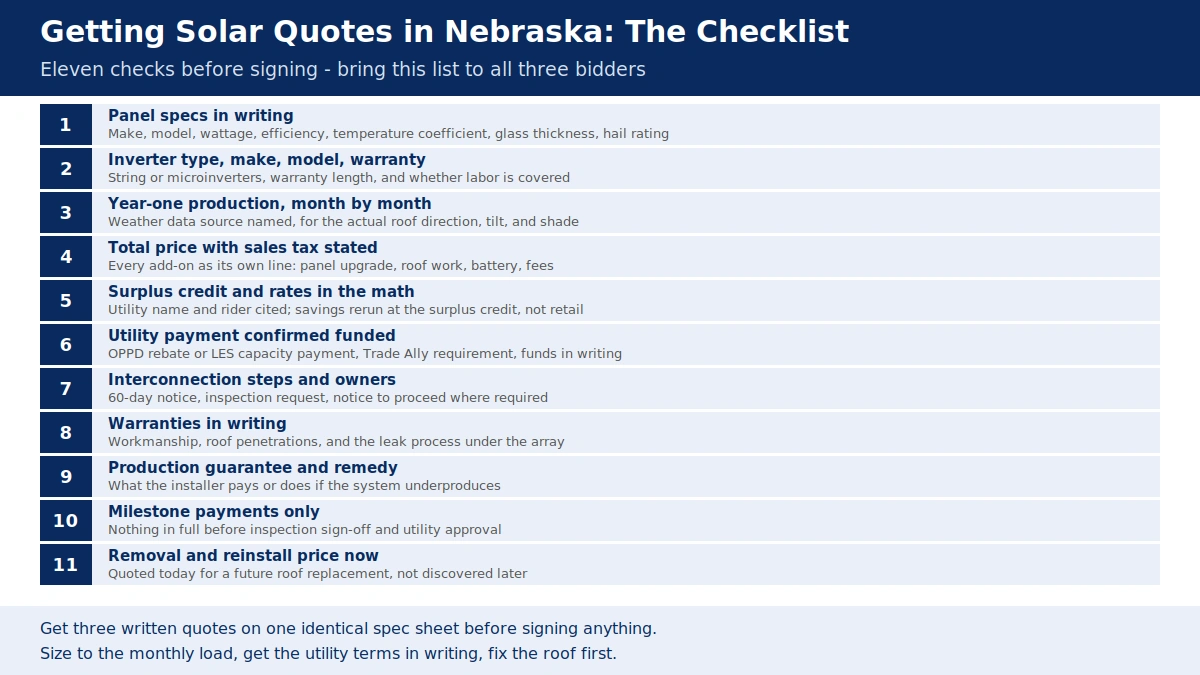
A Nebraska solar quote is only comparable when every bidder prices the same job on the same assumptions, and the checklist below is written to force that comparison. Get three written quotes from licensed installers, all for the same system size, the same panel model class, and the same roof scope, and require each bidder to answer every item in writing. A bidder who answers verbally, or who bundles the answers into a single monthly payment figure, is hiding the comparison the buyer needs.
- Panel make, model, wattage, efficiency, temperature coefficient, glass thickness, and hail rating, in writing
- Inverter type, string or microinverters, make and model, warranty length, and whether the warranty covers labor
- Year-one production estimate in kilowatt-hours, shown month by month, with the weather data source named
- Total installed price with sales tax stated as included or excluded, and every add-on as a separate line: panel upgrade, roof work, battery, tree work, permit fees, interconnection fee
- The surplus credit and the retail rates the savings math assumes, with the utility name and the rider or schedule cited
- The utility rebate or capacity payment counted in the math, with the Trade Ally requirement and the fund status confirmed in writing
- The interconnection steps and who handles each one, including the 60-day notice, the inspection request, and the notice to proceed where the utility requires one
- The workmanship warranty length and what it covers, the roof penetration warranty, and the process if a leak appears under the array
- The production guarantee, if any, and what the installer pays or does if the system underproduces
- The payment schedule tied to milestones, with no full payment before inspection and utility approval
- The removal and reinstallation price if the roof needs replacing during the panel warranty period, quoted now, not later
The decision rules follow from everything above, and they are stated as rules because Nebraska punishes vague intentions. Rule one: size to the monthly load. An 8 kW system fits the average Nebraska home; a 6 kW system fits a smaller home and wastes nothing to the surplus rate; a 10 kW system needs a load to justify it, such as an electric vehicle or a heat pump, and the extra panels should not be bought for the lower per-watt price alone.
Rule two: get the utility terms in writing before signing. The surplus credit, the fixed charges, the interconnection steps, and whether net metering is open to new customers at the address are the four facts that decide payback, and all four come from the utility, not the installer. Rule three: never budget an incentive that has not been confirmed as funded. The OPPD rebate, the LES capacity payment, and the loan program all have fund limits or status conditions, and a budget built on an unconfirmed incentive is a budget built on hope.
Rule four: fix the roof first. Panels last 25 years or more, and a roof with five years left guarantees a removal and reinstallation bill in the middle of the payback period. If the roof needs replacing, price the roof and the panels together, sequence the roof first, and confirm the installer warranties the penetrations. For the roof costs, see our national roof replacement cost guide alongside the Nebraska guide linked above.
Rule five: treat the battery as a resilience purchase, not an investment. In Nebraska’s monthly netting market, a battery earns roughly $54 a year in bill savings on the modeled 8 kW system, and it should be bought for outage protection with open eyes, or not bought at all. Rule six: buy, do not lease, unless a lease offer arrives with written proof of legality in the utility’s territory and written proof of the federal pass-through, because Nebraska’s public power law makes the standard lease a rarity and the burden of proof sits with the seller.
Rule seven: compare the solar investment against the alternatives for the same money. A heat pump, insulation, and air sealing can cut the bill for less money and with a shorter payback, and a home that has not yet done the cheap efficiency work should price it before pricing panels. Our heat pump versus solar guide compares the two investments directly. Solar is the right answer for a home with a sound roof, a suitable roof direction, a confirmed utility deal, and a 15-year horizon. For a home missing any one of those, the right answer may be efficiency first and panels later, and that is a good outcome, not a failed sale.
Sources & methodology
Cost sources: NumeralQ Nebraska, Omaha, and Lincoln solar cost pages, estimator pricing October 26, 2026 (planning estimates, not bids; EnergySage and SolarReviews data retrieved October 26, 2026; model v2); EcoGen America Solar Cost Index, September 2026 edition, prices September 25, 2026, Nebraska page updated October 19, 2026; solarenergyprices.com, August 2026; ElectricChoice, updated October 25, 2026; renewestimator (two-ZIP sample, weak); thegreenwatt (NREL Q1 2024 benchmarks, dated); sunmetriclab, September 10, 2026 (gross figures only; net column uses expired 30 percent credit); Berkeley Lab national range via roofpayback (2024 installs, different basis, noted not followed).
Production sources: NREL PVWatts version 8 via roofpayback, retrieved October 11, 2026; PVGIS via NumeralQ (20-degree tilt, south-facing, 14 percent losses); EcoGen; solarenergyprices.com; sunmetriclab; renewestimator; nooutage insolation table; NOAA National Centers for Environmental Information 1991–2020 climate normals, Omaha station USW00014942; temperature coefficient ranges from published panel specifications and PVWatts defaults; solarcalculatorhq cold-weather worked example.
Rate and utility sources: U.S. Energy Information Administration, Electric Power Monthly, Table 5.6.A, August 2026, and Form EIA-861 2024 and 2025 final data; OPPD Rate 110 and Rate 115, effective January 1, 2026, Resolution 6743, and OPPD residential rates and net metering pages, checked November 2026; LES 2025 tariff Schedule RS, Resolution 2024-6, 2026 increase adopted November 18, 2025, and 2027 proposal, October 2026; EcoGen Nebraska cost and incentives pages, checked October 2026 (secondary compilation for LES Tier 2, NPPD surplus, Norris, and Southern PPD figures; confirm in writing); Grand Island Ordinance 9978 (rates effective October 1, 2025) and Ordinance 9840 (net metering, August 24, 2021); OPPD solar rebate Terms and Conditions, March 2026; LES capacity payment and Trade Ally Network via DSIRE mirror, fund balance July 1, 2025 (dated).
Law and program sources: Nebraska Revised Statutes sections 70-2001 to 70-2005 (LB 436 of 2009); sections 66-901 to 66-914 (solar access); sections 81-2101 to 81-2144 (State Electrical Act) and LB889 (2026); sections 48-2101 to 48-2117 (Contractor Registration Act); section 52-136 (lien law); section 77-202(1)(9) (property tax, 100 kW threshold, text via CaseMine); sections 44-8604 and 44-8608 (Insured Homeowners Protection Act); One Big Beautiful Bill Act, Public Law 119-21, and IRS Fact Sheet FS-2025-05; U.S. Department of Energy HEAR/HOMES Program Notices 26-1 and 26-2, effective May 29, 2026; Nebraska Department of Water, Energy, and Environment Dollar and Energy Saving Loans program and fiscal year 2025 annual report; Nebraska Solar Energy Society (third-party ownership restriction); Nebraska Solar for All status via EcoGen and the Center for Rural Affairs.
Hail, weather, and insurance sources: NOAA storm reports via NumeralQ, checked October 2026; NOAA National Centers for Environmental Information billion-dollar disasters; Nebraska Public Media, November 13, 2025; Harbilo, October 10, 2026; EnergySage hail durability guide, updated August 10, 2026; National Renewable Energy Laboratory 2017 hailstorm study; U.S. Department of Energy hail guidance; FM 4473 and UL 61730/IEC 61215 test standards; ASCE 7 design wind speeds and Grand Island snow loads via art 98 research; Bankrate via Nebraska Public Media and University of Nebraska Omaha, August 2025 (insurance premiums); City of Bellevue outage update, August 1, 2024.
Battery sources: EnergySage marketplace data via jouleio, September 17, 2026, and via list.solar and renewestimator, July 13, 2026; Tesla Powerwall 3 specifications and EnergySage and SolarReviews pricing; NumeralQ Omaha and Lincoln battery add-on estimates, October 2026.
Methodology: production at the NestPriced planning figure of 1,400 kilowatt-hours per kilowatt per year, chosen inside the published range of about 1,295 to 1,482. Payback arithmetic is NestPriced monthly-netting arithmetic at OPPD tariff rates with a 5-cent surplus credit, stated in the payback section. Battery arbitrage arithmetic is NestPriced arithmetic at a 6-cent spread on modeled surplus. All planning estimates, secondary compilations, and unresolved conflicts are flagged in the text where they appear. Figures that could not be verified are listed in the QC log and are not asserted in the body.
Disclaimer: Prices, rates, credits, and program rules change, and utility surplus credits, rebate funds, and loan terms must be confirmed in writing with the utility or lender before signing. This guide states planning estimates and published figures with their sources and dates, and it is not a quote, a tax opinion, or legal advice. Get three written quotes from licensed installers, confirm the roof condition and the utility terms, and confirm insurance coverage before the panels go on.
How much do solar panels cost in Nebraska in 2026?
An 8 kW rooftop system costs $19,960–$26,080 installed in Nebraska in 2026, or $2.50–$3.26 per watt, on NumeralQ planning estimates dated October 26, 2026. EcoGen’s September 2026 index puts Nebraska at $2.91 per watt, near the national average of $2.89. The final price depends on roof complexity, equipment choice, and any panel or roof work the job needs.
Does Nebraska have net metering in 2026?
Yes. State law at sections 70-2001 to 70-2005 has required every Nebraska utility to offer net metering for systems of 25 kW or less since 2009, with monthly netting at retail value and month-end surplus credited at the utility’s avoided cost. One utility, Norris Public Power District, has reached the 1 percent participation cap and puts new systems on net billing instead, so confirm net metering is open at the address before signing.
What does OPPD pay for extra solar power?
OPPD compensates month-end excess power at the rate in its Rate 483 Net Metering Service Rider, after the monthly swap at retail value. The exact Rate 483 cent values are not published on OPPD’s net metering page and could not be verified in November 2026, so ask OPPD for the current values in writing before signing. OPPD also installs a free bidirectional meter and removes net metering customers from the Level Payment Plan.
How long is the solar payback in Nebraska?
Simple payback runs about 18 to 21 years for a right-sized system at OPPD and LES rates, on EcoGen’s published range of 18.5 to 28.1 years and NestPriced monthly-netting arithmetic at OPPD tariff rates. The OPPD $2,000 rebate or the LES capacity payment shortens payback by roughly two to three years where funds remain. Nebraska’s cheap electricity is the reason payback is slow: each kilowatt-hour from the roof replaces power that costs about a quarter less than the national average.
Is there a federal tax credit for solar panels in Nebraska in 2026?
No. A homeowner-owned system placed in service in 2026 earns a $0 federal credit, because the One Big Beautiful Bill Act ended the residential clean energy credit for installs after December 31, 2025. Nebraska has no state income tax credit for home solar either. The surviving help is utility-level: the OPPD $2,000 rebate, the LES capacity payment, and the state’s low-interest Dollar and Energy Saving Loans.
Will hail damage solar panels in Nebraska?
Panels certified to UL 61730 and IEC 61215 survive 1-inch ice balls at about 50 mph, and a National Renewable Energy Laboratory study of a 2017 hailstorm found 1 damaged panel out of 3,168. Nebraska’s hail risk is real, with 679 reports of 2-inch or wider hail in the ten years to 2025, so ask for the glass thickness and the hail rating in writing and prefer panels tested beyond the 1-inch baseline. Confirm with the insurer, in writing, that the panels are covered and what the wind and hail deductible is in dollars.
Can I lease solar panels in Nebraska?
Generally no. Only publicly owned utilities may sell electricity directly in Nebraska, so solar leases and power purchase agreements are generally not available, and most homeowners buy outright or with a loan. No verified residential lease provider, price, or escalator was found for Nebraska. Any lease offer needs written proof of legality in that utility’s territory and written proof of the federal section 48E pass-through.
Should I add a battery to solar panels in Nebraska?
Buy a battery for outage protection, not for bill savings. Monthly netting already gives the home full retail value for power swapped inside the month, so a battery on a right-sized 8 kW system earns only about $54 a year in extra bill value on NestPriced arithmetic. A 10 to 13 kilowatt-hour battery costs $10,070–$15,740 installed on Nebraska planning estimates, with no state or utility battery rebate found.