

Washington makes a mockery of the idea that one state has one roofing market. Cross the Cascades and the roof changes its job entirely. West of the mountains, in Seattle and Tacoma, the roof spends six months a year wet — not soaked by downpours, but kept damp by a drizzle that never quite stops, on 156 days a year, until the north slope turns green with moss and the granules start washing into the gutters. East of the mountains, in Spokane and the Tri-Cities, the same roof spends its winter under 44 inches of snow in a dry cold, and its summer under a sun that bakes the shingles harder than any Seattle summer ever could. One state, two roof killers, and the price follows the labor market rather than either of them: the most expensive roof in Washington sits in the city with the mildest weather, because Seattle crews bill the highest rates in the state and the permit costs the most, while the cheapest roof sits in the city with the heaviest snow.
That split is the whole guide. Take the headline number — $14,750–$25,500 for a typical single-family architectural roof — as a statewide figure, and remember what a statewide figure means in Washington: an average across two climates that barely touch. The per-square table, the city table, the moss section, and the hiring section all exist to pull that average apart again, so the reader in Spokane does not budget like a reader in Seattle, and the reader in Seattle does not expect a Spokane price. The other surprise sits underneath the pricing: Washington, unlike New York, runs its contractor screening from the capital, through the Department of Labor and Industries — but what it runs is a registration, not a license, and the roofing endorsement that matters most is the one most homeowners have never heard of.
Start with the country-wide picture in our roof replacement cost guide, then read the Washington figures below against it — the gap between the two is hundreds of miles and a whole mountain range.
Table of Contents
What a Roof Replacement Costs in Washington in 2026
Three separate pricing models cover Washington in 2026, and none of them hands over a single number. What they hand over is a band, and the shape of the band matters as much as its edges. The headline anchor comes from MyRoofData’s 2026 model. It prices a typical single-family architectural asphalt roof at $14,750 to $25,500, with the old layer stripped as part of the job. That sits about 15 percent over the national average. Underneath it sit installed per-square prices of $518 to $862 before tear-off. SmartRoofingCalculator, updated November 9, 2026, models a 25-square roof of the same kind at $12,500 to $18,000 across the state. That works out to $500 to $720 a square with tear-off already counted. RoofingEstimatorPros, updated August 26, 2026, prices a 2,000 square foot architectural roof statewide at $16,056 to $28,536, averaging $21,603. That is close to $10.80 a square foot once tear-off, permits, and waste are all in, on a state multiplier of 1.12.
Two more sources frame the same market from above and below. Modernize, updated August 27, 2026, puts the state average near $18,500. Most homeowners pay $11,000 to $28,000 for a typical home of 1,800 to 2,200 square feet. InstantRoofer, working from contractor-entered jobs, averages Washington at $16,028 for a 24-square asphalt roof at about $657 a square. RoofSmart, working from its own Seattle proposals, puts the median Seattle asphalt base price near $10.59 a square foot plus tax, with the median Seattle roof at about $17,800. Read that last figure as a floor, not a middle. It is a base price before add-ons and before tax, on a median Seattle roof of only 1,686 square feet. Small roofs always cost more per foot than big ones.
Nobody who reads all six sources comes away doubting the direction. Washington sits above the national average, and the premium is a western premium. MyRoofData applies a state cost index about 15 percent above the national figure. RoofingEstimatorPros applies a 1.12 multiplier statewide, but its Seattle multiplier runs to 1.29, with a labor multiplier of 1.36. Labor is the reason, and the labor gap is wide. MyRoofData puts Washington roofing crews at $65 to $105 an hour. SmartRoofingCalculator puts the median Washington roofer wage at $29.01 an hour against a construction laborer median of $27.52. The space between the billed crew rate and the wage is the crew, the truck, the insurance, and the overhead. It is widest where the rain is heaviest. A crew billed at that rate never produces a national-average roof, and no material choice closes the gap.
A square is 100 square feet of finished roof surface, and Washington bids are written in squares. Without a squares-to-square-feet conversion, two bids cannot be compared at all. A 25-square roof is 2,500 square feet of surface. That is what a typical 2,000 square foot single-story Washington home carries once pitch, overhangs, and the waste factor are added in. Every per-square price in this guide is the MyRoofData figure before tear-off unless the text says otherwise. Every installed total says so when it is one. A second layer coming off, decking rotted through under a moss mat, a steep pitch, or a roof cut up with valleys and dormers each push the total higher. A roof installed in 2026 earns no federal credit to put on a 2026 quote, so no quote should carry a federal tax-credit line at all.
| Source | Job priced | Cost | As of |
|---|---|---|---|
| MyRoofData | Typical single-family arch roof, tear-off incl. | $14,750–$25,500 (~15% above national avg) | 2026 model |
| SmartRoofingCalculator | 25-square arch roof, statewide | $12,500–$18,000 ($500–$720/sq) | Nov 9, 2026 |
| RoofingEstimatorPros | 2,000 sq ft arch roof, statewide | $16,056–$28,536 (avg $21,603) | Aug 26, 2026 |
| RoofingEstimatorPros | 2,000 sq ft arch roof, Seattle | $18,695–$33,048 (avg $25,074) | Aug 26, 2026 |
| Modernize | Average replacement, 1,800–2,200 sq ft home | ~$18,500 (range $11,000–$28,000) | Aug 27, 2026 |
| InstantRoofer | Average asphalt roof, 24 squares | Avg $16,028 (~$657/sq) | 2026 snapshot |
| RoofSmart | Median Seattle base price (before add-ons + tax) | ~$10.59/sq ft, median roof $17,800 | 2026 |
Two rows of that table deserve to be read as footnotes rather than headlines. RoofingEstimatorPros is the high anchor. Its $21,603 statewide average and $25,074 Seattle average sit well above the MyRoofData midpoint, and both describe what a large, steep, or moss-damaged job costs rather than what a standard Spokane ranch costs. SmartRoofingCalculator is the low anchor. Its $12,500 to $18,000 band is a modeled figure built from national per-square prices scaled by a state factor of 1.100, and it understates what a Seattle crew actually bills once moss, permit, and tax are counted. Neither source is wrong. They are measuring different jobs. Carry the headline band into the first contractor meeting: $14,750 to $25,500 for a typical single-family roof, with the $16,056 to $28,536 range for a 2,000 square foot roof statewide as the cross-check.
Weather cooperating, RoofingEstimatorPros gives a standard-pitch asphalt roof one to three days. Metal takes longer. The calendar is eaten by everything around the install: collecting three quotes, waiting out the wet season when the old roof can last a few more weeks, and lining up the permit and the inspection. West of the Cascades, add the dry window to the list of costs. The install season runs roughly June through September, when the rain stops, and a roof booked for July is a roof booked while every other homeowner in King County is booking one too. East of the Cascades, add the snow instead. The season runs spring through fall, and a roof going on in October is a roof going on while the crew watches the first cold front come down from Canada. A winter install is possible. SBS-modified shingles made it more practical than it once was. Sealant strips still need warmth to bond, and a January crew that skips hand-sealing the tabs leaves a roof that lifts in the first March wind. A winter install calls for two questions: how the crew seals the tabs, and what happens when the bond does not take.
Roof Replacement Cost in Washington by Material
Material is the first decision, and in Washington it is two decisions wearing one name. West of the mountains, the question is which material survives a moss mat it was never built to resist. East of the mountains, the question is which material sheds snow instead of holding it all winter. The cheapest shingle in the table gives up first under moss. Pay the most for metal and it is still up there when the mortgage is paid off, shedding rain instead of holding it. What follows prices a typical 25-square roof, 2,500 square feet of surface, material by material from Washington-verified figures. The per-square prices come from MyRoofData, before tear-off. The totals are NestPriced arithmetic worked from those ranges.
| Material | Per square (before tear-off) | 25-square total | Realistic WA life |
|---|---|---|---|
| 3-tab asphalt shingle | $402–$633 | $10,050–$15,825 | 15–20 yrs |
| Architectural asphalt shingle | $518–$862 | $12,950–$21,550 | 22–30 yrs |
| Ribbed metal (exposed fastener) | $633–$1,093 | $15,825–$27,325 | 30–40 yrs |
| Standing-seam metal | $1,093–$1,840 | $27,325–$46,000 | 40–70 yrs |
| Cedar shakes and shingles | $1,035–$1,725 | $25,875–$43,125 | 25–35 yrs |
| Concrete tile | $1,150–$2,070 | $28,750–$51,750 | 40–75 yrs |
| Clay tile | $1,380–$2,875 | $34,500–$71,875 | 50–100 yrs |
| Natural slate | $1,725–$3,450 | $43,125–$86,250 | 75–150 yrs |
| Flat membrane (TPO/EPDM) | $633–$1,093 | $15,825–$27,325 | 20–30 yrs |
The 3-tab row warns more than it tempts. At MyRoofData’s $402 to $633 a square before tear-off, the finished job always costs more than the table suggests once the old layer is stripped. Of every material listed, 3-tab leaves the least room for Washington weather to go wrong. One flat layer. The weakest wind rating here. No algae resistance worth citing. Where a north slope can stay damp from October to May, buying 3-tab to save a few thousand dollars on the install is buying the next moss treatment and the next deductible payment in advance. It still has a place. A rental, a shed, a house that will change hands within a few years. But it is the wrong default for a home the owner means to keep through ten Washington winters.
Architectural shingles cover roughly three of every four American homes, and Washington follows the national pattern. These thicker dimensional shingles carry a 110 to 130 mile per hour wind rating when nailed to the manufacturer’s high-wind pattern, and they sit in the $518 to $862 a square band behind the headline figure. Count on 22 to 30 real years in Washington, not the 25 to 30 the brochure prints. Moss holds moisture against the mat, algae stains the granules, and the freeze-thaw cycling east of the Cascades works the flashing open. A roof that looks fine at year twelve can be a single wet winter away from a leak. Mind the gap between this table and the headline band. The headline $14,750 to $25,500 includes tear-off, while this table’s $12,950 to $21,550 does not. The difference is the tear-off, the permits, and the disposal, and a quote that hides them inside the per-square price is a quote that cannot be compared with anything. SmartRoofingCalculator’s fitted cross-check runs $500 to $720 a square with tear-off included, which lands a 25-square roof at $12,500 to $18,000 and sits squarely inside the MyRoofData band once tear-off is added back.
Metal is where the Washington market splits in two. Ribbed panels with exposed fasteners come in at $633 to $1,093 a square, $15,825 to $27,325 across 25 squares, for a 30 to 40 year service life. Standing seam runs $1,093 to $1,840 a square, or $27,325 to $46,000, and lasts 40 to 70 years. SmartRoofingCalculator’s fitted cross-check puts standing seam at $990 to $1,540 a square, which would price the same roof at $24,750 to $38,500 with tear-off. That sits lower than the MyRoofData band because the fitted figure already includes the tear-off while the MyRoofData band does not. No asphalt sheds rain as fast as metal. Moss does not root on a metal panel the way it roots on a shingle mat, and there is no granular surface for eight months of drizzle to wear away. Divide by years of service and the table tells a Washington-specific story. At the midpoints, standing seam runs about $667 a year, against about $663 for architectural shingles and about $616 for ribbed metal. Metal reads as dear on the quote and no cheaper on the calendar. That is the honest Washington answer, because the metal premium here is wide and the architectural shingle lasts a full 22 to 30 years. The metal case in this state rests on what the calendar does not count: the moss that never takes hold, the snow that slides off east of the Cascades, and the deductible that never gets paid. Metal gets the deep treatment — Puget Sound rain, coastal wind, and the standing-seam premium — in our metal roofing guide. For metal measured against shingles on the same 25-square basis, the numbers sit in our metal vs shingles comparison, beside the material table above.
Cedar is the Washington material, and it prices like one. Western red cedar grows in this state, and cedar shakes and shingles run $1,035 to $1,725 a square before tear-off, or $25,875 to $43,125 for 25 squares, lasting 25 to 35 realistic years. Cedar is beautiful on a Craftsman in Tacoma or a lake house on the Kitsap Peninsula, but it is also the material moss loves most. The rough, absorbent surface holds moisture the way a shingle never does, and a cedar roof west of the Cascades needs regular cleaning and treatment to reach the upper end of its life. MyRoofData notes cedar is restricted in some wildfire-prone areas unless treated to Class A or B fire ratings. That constraint matters on the dry east side, where the fire season is real. Get cedar priced by local quote, and get the maintenance plan priced with it, because a cedar roof without a cleaning schedule is a roof bought twice.
Tile and slate occupy the luxury end, and Washington keeps both rare for structural reasons as much as for price. Concrete tile runs $1,150 to $2,070 a square before tear-off, or $28,750 to $51,750 across 25 squares, serving 40 to 75 years. Clay tile runs $1,380 to $2,875 a square, or $34,500 to $71,875, serving 50 to 100 years. SmartRoofingCalculator’s fitted cross-check puts tile at $1,320 to $1,980 a square. Either tile weighs far more than asphalt. Concrete tile alone runs 850 to 1,100 pounds per square, and either one needs a structure verified to carry it. On a 1920s Seattle bungalow, that is a question for an engineer, not a roofer. Slate is the dearest row in the table: $1,725 to $3,450 a square before tear-off, $43,125 to $86,250 for 25 squares, and a 75 to 150 year service life. The slate bottleneck is the crew. Few Washington roofers lay slate often, so a crew without steady slate work is the real bottleneck. Hand the job to occasional hands and the first wet winter will find the leaks. Tile — concrete, clay, and the structural questions they raise on a Washington frame — gets its own full treatment in our tile roof cost guide.
Flat membrane earns a row here because so much of Washington’s housing stock is flat-roofed in part, and the membrane is the only material in the table that a pitched-roof guide never prices. TPO and EPDM come in at $633 to $1,093 a square, or $15,825 to $27,325 for a 25-square roof, lasting 20 to 30 realistic years. Standing water, not moss, is the membrane’s enemy. A flat roof that ponds for more than 48 hours after rain is a roof whose seams are being tested on every storm, and the tapered insulation that fixes the ponding belongs in the quote, not in a later project. West of the Cascades, where the rain arrives 156 days a year, a flat section that cannot drain is a flat section that will leak. The mid-century ranches and porch additions across the Puget Sound region are full of them.
Read the table a second way and it says something different. Per year of service, the smallest quote is not the cheapest roof in Washington. At the midpoints, 3-tab costs about $739 a year, architectural about $663, ribbed metal about $616, standing seam about $667, cedar about $1,150, concrete tile about $700, and flat membrane about $863. That is NestPriced arithmetic, midpoint total over midpoint realistic life, and it leaves out the deductibles, where the avoided claim is the real saving, and the moss, where metal earns its keep. The material table and the insurance section correct each other. Neither alone tells the truth.

Roof Replacement Cost by Roof Size
Every bid prices roof surface. None of them prices living area. That distinction is where quotes most often measure the wrong thing, and it is the second decision in this guide. Picture a 2,000 square foot single-story ranch. Under it sits about 2,000 square feet of footprint, and pitch, overhangs, and waste usually turn that into 20 to 25 squares of surface. A two-story home with the same 2,000 square feet sits on a footprint near 1,000 square feet, so the roof surface runs about half the ranch’s. The listing describes both houses the same way. Make every bid state its square count. A bid without one is not finished. A bid priced from living area prices the wrong house.
The table that follows prices the roof sizes Washington homeowners actually own, using the MyRoofData architectural band of $518 to $862 a square, before tear-off. The 25-square row is the headline row, and the 20-square row is the cross-check. From the per-square band before tear-off, the 20-square row comes to $10,360 to $17,240. RoofingEstimatorPros puts a 2,000 square foot roof installed at $16,056 to $28,536. The space between the two is the tear-off, the permits, the waste, and the labor, and it is widest in Seattle, where the labor multiplier runs to 1.36.
| Roof surface | Typical home | Architectural total (before tear-off) | Standing-seam total (before tear-off) |
|---|---|---|---|
| 15 squares | Small ranch / cottage | $7,770–$12,930 | $16,395–$27,600 |
| 20 squares | 2,000 sq ft ranch | $10,360–$17,240 | $21,860–$36,800 |
| 25 squares | Typical WA home | $12,950–$21,550 | $27,325–$46,000 |
| 30 squares | Large two-story | $15,540–$25,860 | $32,790–$55,200 |
| 35 squares | Large home, complex roof | $18,130–$30,170 | $38,255–$64,400 |
| 40 squares | Very large / steep | $20,720–$34,480 | $43,720–$73,600 |
Three things push a job off this table. Pitch comes first. A steep 10/12 or 12/12 roof costs more per square than a walkable 4/12. The crew works slower and stages differently. West of the Cascades, a steep roof also means a bigger safety bill on a slope that stays slick for months. Complexity comes second, but in Washington it is the roof’s shape that does the damage to the budget. A valley, a dormer, a skylight, a chimney. Each one means a flashing detail, and flashing details are where rushed work leaks first. A plain gable and a roof cut to pieces may share a square count, but they are two different jobs at two different prices. Decking is the third. Nobody knows the sheathing has rotted until the old shingles are off, and in Washington the rot often hides under a moss mat that looked harmless from the ground. It is billed per sheet on the day. Get the per-sheet deck rate in writing before the tear-off starts, because a Seattle deck repair discovered mid-job, with the crew already on the roof and the rain coming back on Thursday, is priced at whatever the contractor says it is.
Start from the roof’s own measurements instead of the listing. The square count comes from the footprint. Take the ground area, multiply by the pitch factor, add a tenth for waste, and divide by 100. At 6/12 the factor is 1.15, at 8/12 it is 1.25. Better still, ask each bidder to print the measured square count on the bid, and compare counts before comparing prices. The prices only mean something once the counts agree. And in Seattle, ask whether the quote includes sales tax. RoofSmart notes its prices are plus tax, added at the rate for the city where the job is, and a quote that folds the tax in silently cannot be compared with one that leaves it out.
Roof Replacement Cost by City: Seattle vs Tacoma vs Spokane vs Bellevue vs Vancouver
Washington is one state with two roofing markets, and the price follows the labor and the rain, not the snow. Seattle, with the mildest winters in the state, is the most expensive market in Washington. Tacoma sits a step below Seattle on price and a step above it on lot size. Bellevue, across the lake from Seattle, pays King County wages without the city’s access problems. Vancouver, on the Columbia River, is the southern hinge, Portland-adjacent labor under Washington rain. Spokane, east of the Cascades, is the cheapest verified market in the state and the snowiest. The price falls as you drive east, and the snow rises as you drive east, until by the time you reach Spokane the two lines have crossed completely. The roof that costs the least to install is the one that has to carry the most snow.
| City | 25-square arch roof | 2,000 sq ft arch roof | Market note |
|---|---|---|---|
| Seattle | $16,250–$23,400 (SRC) | $18,695–$33,048, avg $25,074 (REP) | Highest labor, SDCI permits, moss capital |
| Tacoma | $15,000–$21,600 (SRC) | No verified figure pulled | Puget Sound wages, 20% above state baseline |
| Spokane | $13,750–$19,800 (SRC) | No verified figure pulled | Cheapest verified city, heaviest snow |
| Bellevue | No verified SRC figure pulled | $15,000–$26,000 (Modernize metro) | King County wages, InstantRoofer avg $15,868 |
| Vancouver WA | No verified SRC figure pulled | $13,500–$24,000 (Modernize) | Portland-adjacent, InstantRoofer avg $15,916 |
Seattle is the most expensive market in the state, served by the most crews, at $16,250 to $23,400 for a 25-square architectural roof on SmartRoofingCalculator’s figures, and $18,695 to $33,048 for a 2,000 square foot roof on RoofingEstimatorPros’ figures, averaging $25,074. Seattle’s labor multiplier reaches 1.36 times the national figure, and its local cost multiplier 1.29 times. It is also the wettest corner of the state by the measure that matters: roughly 156 days a year with measurable precipitation, about 39.3 inches of it, most of it falling between October and March. The permit comes from the Seattle Department of Construction and Inspections, and RoofingEstimatorPros puts the Seattle permit range at $400 to $1,500, against $150 to $500 in metro areas statewide. A Seattle roof is a moss roof first and a weather roof second. The city’s roofing pages all name moss and algae as the local condition, and the algae-resistant shingle is the default here rather than the upgrade. RoofSmart’s Seattle jobs put the median base price at about $10.59 per square foot plus tax, with the median Seattle roof at only 1,686 square feet. Smaller roofs cost more per foot, and Seattle roofs are smaller than the state average.
Tacoma runs a step below the city, $15,000 to $21,600 for the same 25-square roof, with SmartRoofingCalculator putting Tacoma about 20 percent above the Washington baseline. The saving comes from labor, not from risk. The lots are bigger, the truck parks in the driveway, and the crew does not pay Seattle parking. But the rain is the same rain, the moss is the same moss, and the permit still runs through a metro building department. InstantRoofer puts the Tacoma average at $15,499, the lowest of the Puget Sound cities it tracks. A Tacoma quote should name the moss scope explicitly, and a Tacoma roof should be inspected after the first wet winter, not after the first leak.
Spokane is the cheapest verified market in the state and the one where the roof works hardest in winter. SmartRoofingCalculator puts a 25-square architectural roof at $13,750 to $19,800, about 10 percent above the Washington baseline. That is the lowest local factor of the three verified cities. The saving is real, and so is the spec it has to buy. Spokane takes about 44 inches of snow a year against Seattle’s five, on a ground snow load of 30 to 40 pounds per square foot, and the ice barrier that is merely recommended in the Puget Sound valleys is mandatory in the east. The dry summers help the roof in one way and hurt it in another. The shingles dry out instead of staying damp, and the temperature swings across freezing more often than anywhere west of the Cascades. A Spokane quote should name the ice-barrier scope in feet from the eave, and a Spokane roof should be inspected after the first big December snow, not after the first thaw.
Bellevue carries a warning label rather than a verified price at the 25-square size. This pass pulled no verified SmartRoofingCalculator figure for Bellevue. The city page does not exist, and the guide invents none. What can be said honestly is the shape of the market. King County wages without Seattle access problems, InstantRoofer’s average at $15,868, and Modernize’s Seattle-Tacoma-Bellevue metro band of $15,000 to $26,000 for a 2,000 square foot roof. Bellevue is also where the state’s most expensive homes sit, and the roof over a $1.5 million house is judged by a different standard than the roof over a $400,000 one. The standing-seam upgrade and the cedar option both sell better here than anywhere else in the state, and the quote should be judged on the material spec, not just the total.
Vancouver, on the Columbia River across from Portland, is the southern hinge, and it carries the same warning label as Bellevue. No verified SmartRoofingCalculator city figure was pulled, and none is invented. InstantRoofer puts the Vancouver average at $15,916, and Modernize puts a 2,000 square foot roof at $13,500 to $24,000. The price is a Portland-adjacent labor figure, and the weather is a Columbia Gorge figure. Wind funnels down the gorge and drives rain sideways into flashing that a sheltered Puget Sound roof never tests, and Clark County’s ultimate design wind speed runs to 135 miles per hour. Make a Vancouver quote spell out the flashing scope, and inspect a Vancouver roof after the first big November windstorm rather than after the first leak.

Why Washington Roofs Cost What They Do: Rain, Moss & Two Climates in One State
Four forces decide what a Washington roof costs. The weather supplies two of them, and the market supplies the other two. Rain is the first and the most constant. Moss is the second force, and the priciest one to fix after the fact. Snow is the third, and it only applies east of the mountains. That is exactly why it surprises the homeowner who moves from Seattle to Spokane and discovers the roof has a different job. The fourth is the market itself, a labor market that pays Puget Sound wages in the west and a short-season logistics market in the east, and it decides how fast any of the other three gets fixed.
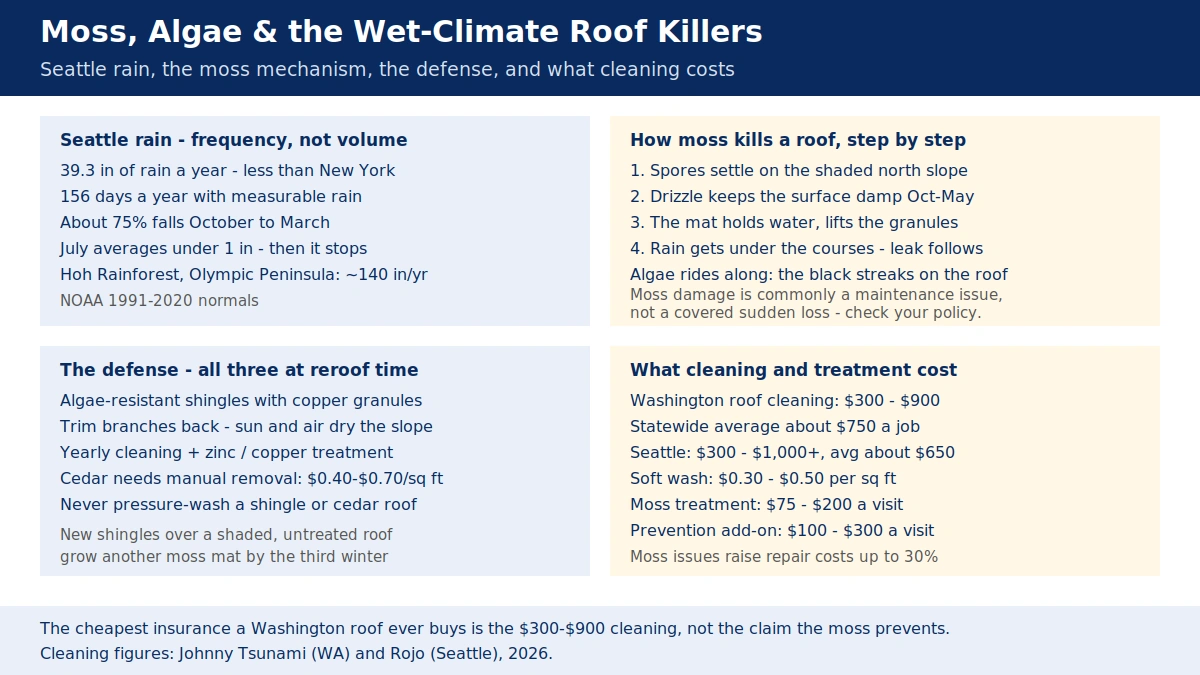
Rain. Washington’s reputation for rain is half right, and the half that is wrong is the one that matters for a roof. Seattle averages 39.3 inches of precipitation a year on the 1991–2020 normals. That is less than New York, Atlanta, or Houston. What Seattle has instead is frequency: 156 days a year with measurable precipitation, more than any of those cities, most of it light drizzle spread across a long grey season from October to May. Then summer arrives and the rain simply stops. July averages under an inch. The roof’s problem is not the volume of water but the duration of wetness. A shingle that never fully dries between October and May is a shingle that grows things, and the things it grows are the subject of the next section. The Olympic Mountains make the pattern worse on the coast and better in the city. The Hoh Rainforest on the western slopes takes about 140 inches a year, while Seattle sits in the rain shadow behind the range. Roof drainage is designed for 2 inches of rain an hour in the Puget Sound counties. That design value assumes the roof can shed water fast when the rare heavy rain does arrive, even though most of the year’s rain arrives at a tenth of that rate.
Moss. No slow failure costs a Washington homeowner more than moss, and none is easier to head off. A February emergency call for a leaking, moss-lifted roof costs several times what a yearly cleaning and treatment would have. How it works, the mat holding moisture against the shingle, the roots lifting the granules, the trapped water freezing and thawing under the courses, gets its full treatment in the next section. Moss-related roof issues raise repair costs by up to 30 percent, by one local cleaner’s estimate, and most standard HO-3 policies treat moss damage as a maintenance problem rather than a covered sudden loss. That distinction is one the insurance section takes up in turn.
Snow. East of the Cascades the roof’s enemy changes completely. Spokane averages about 44 inches of snow a year, and the ground snow load runs 30 to 40 pounds per square foot. At Snoqualmie and Stevens passes the ground snow load reaches 100 to 250 pounds per square foot and beyond, and no single statewide number exists, because the load is set county by county. The building department sets the figure, not the contractor. Snow is weight first and weather second. A deck, underlayment, and ventilation package has to be sized for a load that sits on the roof all winter, builds an ice dam at the eave, and freezes and thaws at every joint. Looks come last. A roof in Seattle carries about five inches of snow in an average year. A roof in Spokane carries about four feet. The load is more than today’s snowfall. Snow laid down in December gets packed in January, iced over in February, and is still sitting there in March when the next storm adds another foot.
The market. What remains is the labor market and the logistics around it. Washington roofing crews bill $65 to $105 an hour statewide, and Seattle crews bill at the top of that band. In a dry month that is enough. In the weeks after a Pacific windstorm, it is not. The shortage shows up in two ways: prices rise, and wait times stretch. West of the Cascades the constraint changes shape: a short dry season, long wait lists, and a crew that bills for the summer premium. One secondary source puts peak-season prices 10 to 15 percent higher, and this guide flags that as a single-source report, not a settled fact, because no second source was pulled to confirm it. The install season runs roughly June through September in the west and spring through fall in the east, with the best installs in the shoulder months, May and June before the summer rush, September and October after it ends.
Moss, Algae & the Wet-Climate Roof Killers
Moss is the Washington roof killer, and it does its damage so slowly that the homeowner usually notices it only when the repair bill arrives. Every wet season the same sequence repeats on the north slope. Spores settle on the shaded side, the drizzle keeps the surface damp, and the moss takes hold in the granules. The mat thickens, holds water against the shingle like a sponge, and lifts the edges of the courses just enough for the next rain to get underneath. By the time the moss is visible from the street, it has already been working on the roof for a season or two. Algae rides along with it. The black streaks on a Puget Sound roof are algae, not dirt. Together they shorten a shingle’s life by years, not months.
The reroof is the moment to build in all three defenses, not some later project. Start with the shingle itself. Algae-resistant architectural shingles carry copper granules that slow the growth, and they are the default in the Puget Sound market rather than the upgrade. Ask for them by name on the quote, because a standard shingle on a shaded north slope is a moss farm waiting for its first winter. The second layer is the roof’s shape and shade. Overhanging branches keep a slope damp and drop debris that feeds the moss, so the trees that make a Washington lot beautiful are also the ones that make its roof expensive. Trim them back before the reroof, not after. The third layer is maintenance: a yearly cleaning and a zinc or copper treatment that stops regrowth before it starts. A reroof is the only moment the first layer is open at all. New shingles over a shaded, untrimmed, untreated roof all but promise another moss mat by the third winter.
The cleaning itself is a real line item in the Washington ownership budget, and it is the one most national cost guides never price. Professional roof cleaning in Washington runs $300 to $900 statewide, averaging about $750, and in Seattle $300 to $1,000 or more, averaging about $650. The method matters more than the total. Soft washing runs $0.30 to $0.50 a square foot and is the method most Seattle companies recommend, because high-pressure washing strips granules off a shingle and shortens the roof it was meant to save. A basic moss removal runs $300 to $550, a complete cleaning $500 to $800, and a cleaning plus preventative treatment $700 to $1,200. The treatment is the cheap part. A moss treatment runs $75 to $200, and a prevention add-on runs $100 to $300. Pay for the treatment every year and the cleaning stays cheap. Skip it for three years and the cleaning becomes a repair.
Cedar deserves its own warning inside this section, because it is the material moss loves most. A cedar shake roof west of the Cascades needs manual removal on the worst slopes, $0.40 to $0.70 a square foot, against $0.30 to $0.50 for soft washing a shingle roof, and the rough, absorbent surface holds moisture the way a shingle never does. Cedar that is never cleaned rots from the outside in, and the rot shows up as a soft deck, not a stained shingle. If the house has cedar, the cleaning schedule belongs in the same contract as the roof, and the quote should name the cleaning method, because pressure washing a cedar roof is a good way to buy a new one.
One more wet-climate note, for the coast only. Wind off the Pacific drives rain sideways, and a west-facing slope on the Long Beach Peninsula or the Olympic coast takes weather a sheltered Puget Sound roof never meets. Make a coastal quote spell out the flashing scope and the wind rating, and inspect a coastal roof after the first big November windstorm rather than after the first leak. The same rule holds on the east side of the state for a different reason. A Spokane roof that holds snow all winter should be inspected after the first big December storm, because the damage that starts under snow stays hidden until the thaw.
Metal vs Asphalt in the Rain: What the Upgrade Costs
If this guide had to keep a single piece of advice for the homeowner west of the Cascades, it would be this: get the standing-seam upgrade priced on every asphalt quote, and take it unless the numbers say no. The case is different here than in the snow states. The roof is not shedding ten feet of snow, it is shedding eight months of drizzle. But the upgrade earns its keep in a way no asphalt can match, because the metal does the two things asphalt cannot do at all: it lets the rain leave, and it gives moss nothing to root in.
What it is. Long panels, raised seams, concealed clips: that is the whole system. The seams stand above the water line, the clips hide under the panels, and no screw head ever sits in the weather. Water runs off the raised seams instead of pooling on them. The panels grow and shrink with temperature swings without loosening a fastener. With nothing exposed, there is no screw head to work its way out over twenty wet winters. Every major metal manufacturer sells a standing-seam line in Washington. The gauge is what separates them. For wet-climate work, 24-gauge steel is the standard, thicker and stiffer than 26-gauge panels, which dent under a falling branch. Get the gauge on the quote, not just the brand name.
What it costs. MyRoofData’s standing-seam band runs $1,093 to $1,840 a square, or $27,325 to $46,000 for a 25-square roof, against $12,950 to $21,550 for architectural shingles on the same roof. SmartRoofingCalculator’s fitted cross-check puts standing seam at $990 to $1,540 a square, or $24,750 to $38,500 for the same roof with tear-off included. The premium over architectural shingles runs roughly $12,000 to $24,000 on a typical roof, and the gap narrows on the east side of the state, where metal is the standard choice rather than the upgrade. Put an expiry date on the metal price and get it in writing. Of every line on the quote, the material line moves first between quote and install.
What it pays back. Two streams of payback exist, and the second one is the bigger of the two. Life is the first stream. A standing-seam roof serves 40 to 70 realistic years, while architectural shingles give 22 to 30. Buy metal once and the house may never need another roof. At the midpoints, standing seam works out near $667 per year of service, against near $663 for architectural shingles. The metal roof costs no less per year even though it lasts twice as long, because the Washington metal premium is wide. The second stream is the damage that never happens. A roof that sheds rain does not grow moss, a roof without moss does not lift granules, and a roof that does not lift granules does not leak in February. One avoided moss-driven claim can cover a meaningful share of the upgrade outright. The insurance discount, where the carrier offers one for metal, is the bonus on top. Get it confirmed in writing by your own insurer before signing anything. A contractor-quoted discount is worth nothing until the carrier puts it in writing.
When it is not worth it. Three situations take the case away from standing seam. A flat or nearly flat roof, where the seams cannot shed what has nowhere to go. The membrane row in the material table is the right answer there, not metal. Selling within a few years is the second. The buyer is unlikely to pay extra for the upgrade, though a transferable warranty and a documented service life can still make the listing stronger. Heavy tree cover is the third. Branches drop and dent the panels, and the shade holds moisture on the surface longer than sun and metal can dry it. For everyone else, the long-term owner, the house that has already had one moss-driven repair, the Spokane home with 44 inches of snow a year, standing seam is the default, not the upgrade.
How to buy it. Get the product named on the quote in full: manufacturer, exact panel line, and gauge. Then file the warranty paperwork with the job records. Ask about the snow guards east of the Cascades. Metal sheds snow in slabs, and a slab off a steep slope can tear a gutter away or bury a walkway. Guards above entries and walkways belong in the quote, not added afterward. West of the Cascades, ask instead about the moss warranty. Some metal manufacturers warrant the finish against algae staining, and the warranty is only as good as the crew that installs it. And ask about the crew. Standing seam is specialist work. A crew that lays asphalt all week and metal once a quarter will take twice as long and leave twice the callbacks. A credentialed crew is what keeps the extended warranty in force. So the cheapest bid is not always the cheapest roof.
Permits & Code: the Washington State Building Code, Ice Barrier & the L&I Rule
Washington’s permit and code picture is a state one, which sets it apart from the states in this series that run everything from the county. The state has a uniform building code, the Washington State Building Code, based on the 2021 International Residential Code with state amendments. But the permits, the inspections, and the contractor registration all sit in different places, and the homeowner has to know which door to knock on for each one. A roof answers to the state code first and the local building department second, and both need checking before the first shingle comes off.
Statewide code, local permit. Roof construction and replacements across Washington are regulated under the Washington State Building Code, which adopts the 2021 International Residential Code’s roofing provisions, effective March 15, 2024. The two design values that matter most, wind speed and snow load, come out of the code’s tables and maps, as read by the local building department. Ground snow loads run from about 15 pounds per square foot in the Puget Sound lowlands to 30 to 40 in eastern Washington and 100 or more at the Cascade passes, and no single statewide number exists, because the load is set county by county. The design wind speed runs 110 miles per hour in Snohomish County and Bremerton, and 135 miles per hour ultimate in Clark County. Go by the building department’s figure, not the installer’s guess. Roof drainage is designed for 2 inches of rain an hour in the Puget Sound counties, a value that assumes the roof can shed water fast when the rare heavy rain arrives.
The ice barrier is mandatory in the east, and a good idea in the west. The code’s ice-barrier rule requires an ice barrier in areas with a history of ice forming along the eaves, which covers eastern Washington and the mountain zones outright. In the Puget Sound valleys, where the winters are milder, the barrier is highly recommended rather than mandatory, by the secondary code guide this pass relied on. That split is flagged here because no primary Washington code text was pulled to confirm it. Two forms pass code: two layers of underlayment cemented together, or a self-adhering polymer-modified bitumen sheet. Whichever form it takes, it must reach from the lowest edges of every roof surface to at least 24 inches inside the exterior wall line. Steeper slopes get more barrier: at 8 in 12 or above, it must run 36 inches up the slope from the eave edge. Three code-driven items belong on every Washington bid, and a bid missing any of them is a red flag. Every bid should show ice and water shield at the eaves, in the valleys, and around penetrations. It should run at least 24 inches inside the exterior wall line. Drip edge at the eaves and rakes. In the windiest corners of the state, the six-nail high-wind pattern is the fastening to ask for. Skip the ice barrier and the roof leaks in February. Skip the drip edge and the fascia rots. Four nails where the manufacturer calls for six is a bid that comes apart in the next big blow.
No permit in hand, no replacement. A complete roof replacement needs a permit, and the fee turns on the jurisdiction and the job’s valuation. Metro permits run $150 to $500 for a typical job, on MyRoofData’s figures. RoofingEstimatorPros puts the Seattle permit range at $400 to $1,500, and SmartRoofingCalculator plans on about $320 statewide. In Seattle the permit comes from the Department of Construction and Inspections, and the filing, with the inspection, is the part of the bill that surprises first-timers most. Small work rarely needs a permit in Washington. Patch a handful of shingles, reseal a flashing joint, and the building department does not need to hear about it. Anything structural is different: decking, a full tear-off, a change of material. All of those need a permit, every time. Permit and inspection are the contractor’s job to arrange. One who hands that job to the homeowner does not do this work often enough.
Registration, not licensing, and statewide. Here is the rule that catches every newcomer, and it gets its own section below. Washington has no statewide roofer license. What it has instead is a contractor registration that every contractor in the state must hold before bidding, advertising, or working, and a roofing endorsement on top of it for roofing jobs over $1,000. The permit section and the hiring section belong together. The permit is the building department’s check on the roof, and the registration is the Department of Labor and Industries’ check on the contractor. In Washington, unlike New York, the second one exists everywhere in the state.
Hiring a Roofer in Washington: Registration, Endorsement & the L&I Lookup
With no statewide roofing license in Washington, the hiring job falls to the homeowner in part. But only in part, because the state hands the homeowner a tool New York never built: a single statewide lookup, run by the Department of Labor and Industries, where every contractor’s registration, bond, and insurance can be checked in one place. The homeowner’s job is to use it, and to know what it proves and what it does not.
What exists, statewide. Under the Contractor Registration Act, Revised Code of Washington chapter 18.27, every construction contractor must register with the Department of Labor and Industries before bidding, advertising, or performing construction work. The registration comes in two forms: general contractor, bonded at $30,000, for work across multiple trades, and specialty contractor, bonded at $15,000, for a single trade. Roofing is specialty category 12 of the 63 the state recognizes. A roofing contractor working over $1,000 must also hold a roofing endorsement, with an additional $6,000 roofing bond on top of the standard bond. The Washington contractor guide this pass relied on reports that requirement. It is flagged here because no primary L&I page was pulled to confirm the endorsement figure. The contractor must also carry liability insurance of $200,000 public plus $50,000 property damage, or $250,000 combined, and the registration number must appear in advertising, bids, estimates, business cards, and online ads. The registration fee runs $150.20. Verify every bidder at verify.lni.wa.gov. That lookup shows registration status, bond, and insurance, and it is the single most useful page in the whole hiring process.
What the registration proves, and what it does not. A registration proves the holder filed the bond, carries the insurance, and sits on the state’s books, where the registration can be looked up and revoked. It proves no exam was passed, because there is no exam. It says nothing about whether the crew has ever fitted the material on the quote, or whether the contractor has ever worked a moss roof in the Puget Sound or a snow roof in Spokane. The registration is the first filter, not the only one. In a state where the registration is the only official check, the insurance certificates and the references carry the weight an exam would carry elsewhere. An unregistered contractor cannot sue for payment under Washington law, and a contractor who uses a false or expired registration number to buy an advertisement commits a gross misdemeanor. Both facts are worth knowing before the first handshake.
Put all three bidders through the same five-point screen, wherever in the state they work. General liability insurance, with a certificate sent to you by the carrier itself, never one handed over by the contractor, and the business name exactly as written on the contract. Workers’ compensation proof for the crew, which the bidder must hold whenever anyone is employed. In Washington, the penalties for an uninsured crew land on the homeowner’s property as often as on the contractor. A permanent local address and a local phone number, both older than the last windstorm. Three local references inside your own county, with street addresses worth driving past yourself. Manufacturer certification where it counts, GAF, Owens Corning, or CertainTeed credentialed installer status, belongs on the screen. The extended warranty only stands for a credentialed crew’s work. And a written quote from every bidder on one shared spec sheet, so all three prices cover the same roof.
The contract is the protection the registration is not. Washington law requires the contractor’s registration number on the contract, and the contract should name the start and completion dates, the scope of work, and the payment schedule. Read the whole thing before signing, and read the payment schedule twice. A contractor asking for a big payment before the crew arrives is asking the homeowner to bankroll the job. The door-to-door rule still applies as well. Under the federal Cooling-Off Rule, a contract signed at the door can be canceled within three days. It exists for exactly the moment a stranger knocks after a windstorm with a free-inspection agreement in hand. Use it. Hold off on any contingency agreement in the driveway until the adjuster has visited.
The storm-chaser warning. Washington is storm-chaser territory after a Pacific windstorm, and the crews arrive within days of the event, knocking on doors in the damaged neighborhoods. Some are legitimate traveling crews. Many are not. The tells never change. A knock on the door with a free-inspection agreement to sign on the spot, an out-of-state number and no office anywhere nearby, no L&I registration number on the truck or the card, a promise that the deductible will somehow vanish, and a demand for a large payment before a single shingle comes off. A deductible waiver is insurance fraud the contractor offers to do for you. Walk away from any contract built on one. Check the number at verify.lni.wa.gov before the crew leaves the driveway. The lookup takes two minutes, and it is the fastest screen in the whole process.
The quote itself. A Washington quote should name the manufacturer and the exact shingle line, the underlayment type, the ice and water shield coverage in feet from the eave, the drip edge, the ventilation scope, the nailing pattern, the tear-off depth, the per-sheet deck replacement rate, the disposal, and the cleanup, and west of the Cascades, the algae-resistant shingle by name and the moss-treatment plan. State the roof surface in squares on every quote, and price that surface as a total, so two bids line up square to square. Put warranty terms on the quote too: manufacturer and workmanship as separate year counts, with the party honoring each one named. The permit cost and the party pulling it belong on the quote too. No federal tax-credit line belongs on it either, because none exists in 2026. Print the questions to ask a roofer guide and bring it to the first sit-down with a bidder — then go through the complete list out loud, one question at a time, before anyone talks price.
Insurance: Moss Exclusions, ACV vs RCV & the 15-Year Roof Rule
Insurance is the part of a Washington roof that either earns its keep or springs a nasty surprise. A policy that seemed solid at signing can pay far less than the homeowner counted on. The state’s exposure is split the same way its pricing is: the west faces wind and water from Pacific storms, the east faces snow load and ice dams, and the carrier prices both. The homeowner’s own policy is the only measure for the figures in this section. Nothing else governs the claim. One honest number sits at the top of this section. NerdWallet’s May 2026 analysis of more than 100 insurers puts the average Washington homeowners premium at $1,880 a year for $400,000 of dwelling coverage, $300,000 of liability, and a $1,000 deductible, well below the national average of $2,490. Washington is one of the more affordable states to insure a home in, and the roof is part of the reason: no hurricane coast, no hail alley, and a claims history written in wind and water rather than catastrophe.
The deductible. Most Washington policies carry a standard deductible of $500 to $5,000, and many now stack a separate, higher deductible on wind and hail. The Insurance Information Institute puts the saving from a $500 to $1,000 deductible at 10 to 25 percent of the premium. Most homeowners never learn the percentage wind and hail deductible until the adjuster is standing in the driveway. A 2 percent deductible on a $600,000 dwelling leaves $12,000 out of pocket before the insurer pays anything on a wind claim. West of the Cascades, where dwelling values run higher, the percentage deductible climbs with them. Read the declarations page on a clear day, not after the storm arrives.
The moss exclusion. This is the twist that changes the replacement decision in Washington, and it is the one most homeowners discover too late. Moss and algae damage is commonly treated by carriers as a maintenance issue, not a sudden covered loss. A roof that fails because moss held moisture against the mat for three winters is a roof that failed for lack of maintenance, and the policy does not pay for maintenance. No Washington-specific carrier rule was verified for this guide, so none is given. The rule is stated here as general carrier practice, and the homeowner should confirm it against their own policy in writing before the next wet season. The practical consequence is the same either way. The $300 to $900 a year spent on cleaning and treatment is the cheapest insurance a Washington roof ever buys, because the claim the moss prevents is the claim the carrier would have denied.
The 15-year roof rule. The replacement decision turns on that twist. Fifteen years is where several major carriers now draw the line. Past that line, expect depreciated actual-cash-value coverage, or a declined renewal. The arithmetic is brutal. Take a $17,250 roof at 15 years, half depreciated, with a $2,000 deductible. The payout nets only about $6,625, and more than $10,000 comes out of the homeowner’s pocket. Ask your carrier in writing, before the next windstorm, whether your roof still settles at replacement cost, and at what age that stops. Past fifteen on an ACV policy, the replacement decision changes shape. The insurer will fund little of the repair or the replacement, while a new roof resets the clock to replacement cost. No Washington-specific 15-year trigger was verified for this guide. The rule is stated as carrier practice across the states in this series, not as Washington law.
RCV vs ACV. The settlement basis is another key number: replacement cost value or actual cash value. Replacement cost means the payout covers a new roof less the deductible, whatever age the old roof had reached. Actual cash value works the other way. Actual cash value prices the roof as it stood on the day of the damage: a new roof’s cost minus depreciation, and shingles lose value fast. Built on a $17,250 roof, the midpoint of the Washington architectural band, a $2,000 flat deductible, and straight-line depreciation of 2 percent a year across a 26-year shingle life, the table below is NestPriced’s own illustrative arithmetic, not an example any regulator published.
| Age at claim | RCV payout | ACV payout |
|---|---|---|
| Any age | $15,250 | — |
| 5 years | — | $13,525 |
| 10 years | — | $11,800 |
| 15 years | — | $10,075 |
| 25 years | — | $6,625 |
Treat that slide as the warning it is. Five years in, the ACV payout comes in $1,725 short of replacement cost. At fifteen years the shortfall is $5,175. At twenty-five years the payout is $6,625 on a $17,250 roof, barely two-fifths of the cost, leaving the homeowner to cover the rest. With ACV coverage, an older roof sits mostly on the homeowner’s own risk, whether they know it or not. Find out the policy type before the storm. Past ten years on ACV, the insurer will pay little toward the metal upgrade or the replacement, and both calls change.
The claim, step by step. Photograph everything before anyone touches the damage. Every slope, every gutter, every dented vent cap, and date the photos. The insurer should hear about the damage before any contractor does. The adjuster comes first and the estimate comes second, and reversing that order costs money. No contingency or assignment-of-benefits agreement gets signed in the driveway. Ask for the adjuster’s written report with line items, then hold it against the contractor’s estimate line by line. Keep the deductible ready in cash. A legitimate contractor never waives the deductible, and an insurer never covers it. Keep the paperwork too: product name, install photos, permit, because the next renewal needs proof of what is on the roof.
The metal discount, one more time. It is a real discount, but each carrier sets its own, and it touches only the wind and hail portion of the premium, where it exists at all. This guide prints no named carrier’s Washington metal or Class 4 discount figure, because none was verified. Ask your own carrier for that figure in writing, qualifying product list and paperwork included, before the install begins. A discount is only real once the carrier puts it in writing, whatever the contractor promised.
Paying for It: No Federal Credit in 2026 & Financing
Here is the whole 2026 money story for a Washington roof in short. The homeowner and the insurer are the only ones paying for it. That is how so many quotes end up carrying a tax-credit line that does not exist. In 2026, the federal government contributes nothing to a Washington homeowner who replaces a roof, the state contributes nothing to the roof, and the federal rebate programs that do exist in Washington have not launched at all.
The federal tax credit is $0. IRS fact sheet FS-2025-05 explains it plainly. The One Big Beautiful Bill Act, Public Law 119-21, signed July 4, 2025, ended both credits for property placed in service after December 31, 2025. Neither the Residential Clean Energy Credit (§25D, 30 percent) nor the Energy Efficient Home Improvement Credit (§25C) pays anything on a 2026 roof. Roofing never counted as solar equipment, so §25D was never available for a roof in the first place. Some homeowners claimed §25C for qualifying roofing materials. That door has closed too. If a 2026 quote still carries a tax-credit line, it is priced under a law that no longer exists. Have the contractor take the line out and re-price the job. The commercial credit, §48E, is the one that covers solar arrays and similar clean-electricity equipment. No documented lease or pass-through arrangement directs federal dollars at a Washington roof. Nothing is claimed here. Our federal energy tax credits guide lays out the federal rules as they stand in 2026. Pairing the roof with solar makes it a different job. Our solar panel cost in Washington guide prices that pairing. The solar credit is gone as well, and the roof half never had one.
HEAR and HOMES: not launched in Washington, and never for a roof. The federal Home Electrification and Appliance Rebates (HEAR, which Washington calls HARP) and the HOMES whole-home rebates have not launched in Washington as of November 2026. The Department of Commerce and its administrator, Guidehouse, are still setting up delivery and weighing the Energy Department’s program notices, DOE launch approval is pending, no applications are being taken, and the rebates will not be retroactive. The state-funded HEAR program is a different pot of money, and it is open. Run through local administrators on Climate Commitment Act funds, it pays up to $8,000 for a heat pump, $1,600 for weatherization, and $4,000 for an electrical panel, with a $14,000 combined cap per household, for households at or under 150 percent of area median income. Commerce awarded about $39.3 million to 40 administrators. Our heat pump cost in Washington guide prices the heat pump half of that stack. And since the Energy Department’s Notice 26-2, federal HEAR pays only for electric-to-electric upgrades. A date discrepancy this guide flags rather than resolves: the standing program framing dates Notice 26-2 to May 29, 2026, while the Commerce-tracked sources cite the Energy Department’s June 2026 notices, and no single date is asserted here. Pair the reroof with an insulation upgrade and the state weatherization half may apply. The roof itself never qualifies under any version of the program, in any county.
No state money for the roof either. This pass found no Washington grant, rebate, or tax credit that pays for a roof, across state programs and utility offerings alike. The money that does arrive comes from two places: the avoided deductible, paid by the insurer, and the energy bill, through insulation and ventilation work done with the reroof. Puget Sound Energy offers heat pump rebates of $500 to $1,500 for customers in its territory, heat pumps only, never roofing. Help paying for a roof in 2026, for a Washington homeowner, means a home-equity loan or a contractor financing plan. The annual percentage rate matters more than the monthly payment. Read it first. Financing gets its own full treatment — Washington lenders, contractor plans, and the home-equity math — in our how to finance a new roof guide.
Repair vs Replace: The Washington Decision Rules
A damaged Washington roof is not always a replacement, and an old roof is not always a repair. Age, damage, and the deductible make the call. In this state, the moss forecast for the next five years decides it too, because a repaired roof that grows moss again by the third winter is a repair paid for twice.
A young roof with only a small damaged area calls for a repair. A roof ten years or younger that has lost a few shingles gets repaired. So does one with a chimney flashing leaking, or a few tabs lifted by wind. Small repairs in Seattle run $300 to $1,500, and a moss cleaning runs $300 to $1,000 or more, but the cleaning is maintenance, not repair, and it belongs in the yearly budget either way. A repair is also right when the damage plainly dates to one windstorm, and the adjuster agrees the rest of the roof has years left. The national repair figures in our roof repair cost guide are the planning reference for anything beyond the Seattle small-repair band, and a local quote sets the real number.
Once the roof is old, the damage is widespread, or the arithmetic favors starting over, the call is replacement. Once architectural shingles pass fifteen years and wind has lifted more than a quarter of the slopes, replace. Patching a lifted mat is cosmetic work. The roof will fail at the next storm. Replace when the deck feels soft underfoot or the sheathing has come apart under a moss mat. Structure gets replaced, never repaired. Replace when moss returns each wet season after cleaning and treatment have already been done. The moss is saying the system has failed, not the shingle. Replace once the insurer has paid a claim and the roof has aged to the point where the next claim pays ACV at two-fifths of the cost. Collect the replacement money before it turns into ACV money. Replace as the roof nears the carrier’s 15-year trigger, before the policy switches to ACV. And replace once the repair quote passes a third of the replacement quote, with under five years left on the roof.
The inspection rhythm. Inspect in late fall, once the wet season has set in, and again in late spring, before the dry install window opens. Inspect in the fall and the summer’s wind damage is caught while the adjuster’s window is still open. The spring visit covers the winter’s damage: moss growth and freeze-thaw, caught before the next wet season piles a second layer of trouble on top. A roof that looks sound from the curb can be far closer to failure than it appears after several Washington wet seasons. The mat rots from the inside, and the rot stays hidden until the shingle cracks. Our roof inspection cost guide and our roof repair cost guide carry the numbers on inspections and coverage. Where the job includes gutters — and in the Puget Sound rain, it usually does — the gutter installation cost guide prices that part on its own, guards and downspouts included.
Getting Quotes in Washington: The Checklist
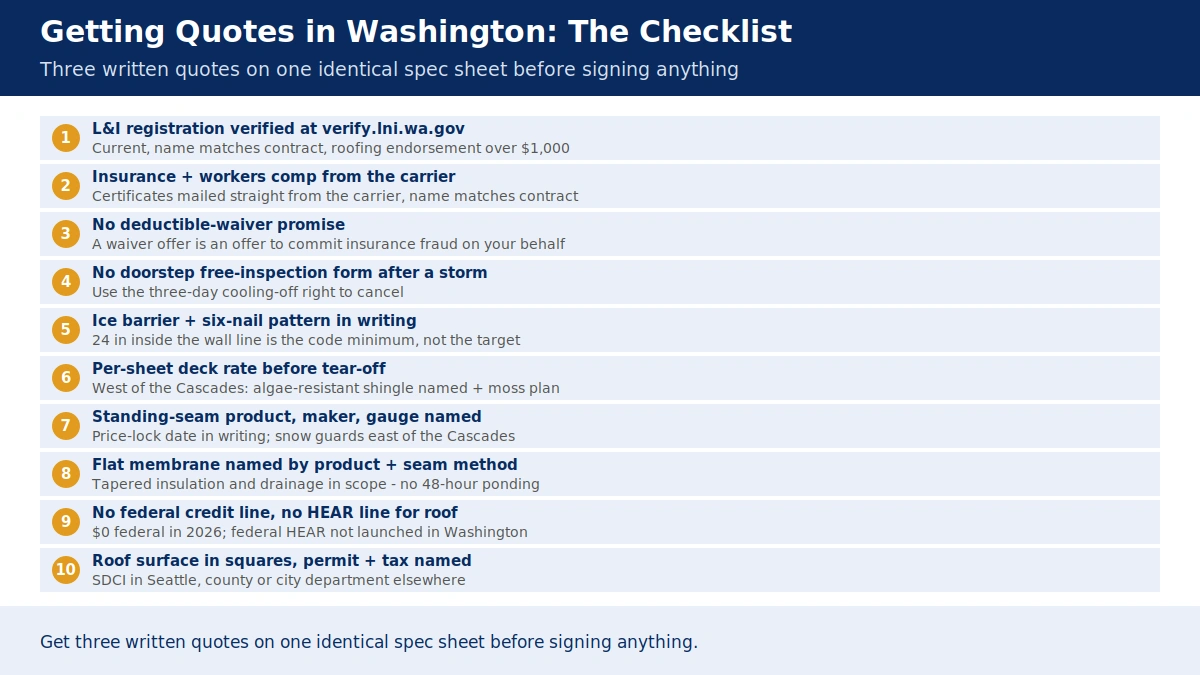
Three written quotes on one identical spec sheet, from three contractors whose L&I registration checks out on the state lookup, before signing anything. That is the checklist, summed up in a single sentence. The ten checks below make that sentence concrete.
- L&I contractor registration verified at verify.lni.wa.gov, current, business name matching the contract exactly, roofing endorsement confirmed for any job over $1,000, registration number on the truck matching the lookup. 2. Insurance and workers’ compensation certificates that arrive by mail from the carrier, showing the same business name as the contract. 3. No deductible-waiver promise, anyone offering one is offering insurance fraud carried out on your behalf. 4. Turn down any free-inspection form pushed at you at the door after a windstorm. Exactly that moment is what the federal three-day cooling-off right is for. 5. In writing: the ice barrier’s run from the eave, in feet, plus the six-nail high-wind pattern. The code treats 24 inches inside the wall line as a floor, not a goal. 6. Per-sheet deck rate in writing before tear-off, and west of the Cascades, the algae-resistant shingle named by product line plus the moss-treatment plan. 7. Standing-seam product name, manufacturer, and gauge named on the bid where metal is quoted, with the price-lock date in writing; east of the Cascades, snow guards above entries and walkways in the scope. 8. Flat-roof membrane named by product and seam method, with tapered insulation and drainage in the scope, a flat section that ponds for more than 48 hours after rain is a leak in waiting. 9. No federal tax-credit line ($0 in 2026) and no HEAR rebate line for the roof (federal HEAR has not launched in Washington; it never covers roofing). 10. Quote states the roof surface in squares, not the living area, with the permit cost and who pulls it named, SDCI in Seattle, the county or city building department elsewhere, and the sales tax shown as its own line.
Sources & methodology
Cost anchors: MyRoofData — Washington (2026 model: typical single-family arch roof $14,750–$25,500, tear-off of one layer included, ~15% above national average; 3-tab $402–$633/sq, arch $518–$862/sq before tear-off, ribbed metal $633–$1,093, standing seam $1,093–$1,840, cedar $1,035–$1,725, concrete tile $1,150–$2,070, clay tile $1,380–$2,875, natural slate $1,725–$3,450, flat membrane $633–$1,093; crews $65–$105/hr; permits $150–$500 in metro areas; tear-off $100–$200/sq per layer); MyRoofData — Seattle ($15,750–$27,000, state index 1.15, local adjustment 1.06); SmartRoofingCalculator — Washington (updated Nov 9, 2026: 25-square arch $12,500–$18,000 at $500–$720/sq fitted w/ tear-off; standing seam $990–$1,540/sq; tile $1,320–$1,980/sq; roofer median wage $29.01/hr; state factor 1.100); SmartRoofingCalculator — Seattle (25-square $16,250–$23,400 at $650–$936/sq, factor 1.30; standing seam $1,287–$2,002/sq), Tacoma (25-square $15,000–$21,600 at $600–$864/sq, factor 1.20; standing seam $1,188–$1,848/sq), Spokane (25-square $13,750–$19,800 at $550–$792/sq, factor 1.10); RoofingEstimatorPros — Washington (updated Aug 26, 2026: 2,000 sq ft arch $16,056–$28,536, avg $21,603, ~$10.80/sq ft, state multiplier 1.12x; 1–3 day install) and Seattle ($18,695–$33,048, avg $25,074, ~$12.54/sq ft, local multiplier 1.29x, labor 1.36x; permit $400–$1,500); Modernize — Washington (updated Aug 27, 2026: avg ~$18,500, most $11,000–$28,000 for 1,800–2,200 sq ft; $6–$12/sq ft; Seattle-Tacoma-Bellevue 2,000 sq ft $15,000–$26,000, Vancouver WA $13,500–$24,000); InstantRoofer — Washington (2026 snapshot: avg $16,028 for 24-square asphalt roof at ~$657/sq; Bellevue $15,868, Vancouver $15,916, Tacoma $15,499, Everett $16,910, Kennewick $16,942, Kent $15,098); RoofSmart — Seattle (median base ~$10.59/sq ft plus tax, median roof $17,800, half of jobs $9.28–$11.93/sq ft, median roof 1,686 sq ft). We calculated the 25-square material totals, the size table, and the cost-per-year figures ourselves, from the per-square ranges and lifespans.
Climate + rain + snow: Seattle 39.3 in precip/yr, 156 days measurable precipitation (NOAA 1991–2020 normals); ~75% of rain Oct–Mar; July under 1 in; Seattle snow ~5 in/yr; Spokane ~44–45 in snow/yr, ~17 in precip/yr; Hoh Rainforest ~140 in/yr; ground snow load Puget Sound lowlands 15–25 psf, eastern WA 30–40 psf, Cascade passes 100–250+ psf (secondary guide — flagged); Pierce County IRC minimum 30 psf, >70 psf needs WA-registered engineer calcs (2021 IRC R301.2.3); roof drainage design 2 in/hr rainfall; design wind Snohomish County 110 mph, Clark County Vult 135 mph Exposure B, Bremerton 110 mph Exposure B.
Moss + cleaning: WA roof cleaning $300–$900, avg ~$750 (Johnny Tsunami); Seattle $300–$1,000+, avg ~$650 (Rojo); basic moss removal $300–$550; complete cleaning $500–$800; cleaning + preventative $700–$1,200; moss treatment $75–$200; prevention add-on $100–$300; soft wash $0.30–$0.50/sq ft; manual removal for cedar $0.40–$0.70/sq ft; moss-related issues raise repair costs up to 30% (Johnny Tsunami, single source — flagged); Seattle small repairs $300–$1,500 (HomeServicesPros).
Permits + licensing: Washington State Building Code based on 2021 IRC/IBC, effective March 15, 2024 (WAC 51-51); permits required statewide; metro permits $150–$500 (MyRoofData); Seattle $400–$1,500 (RoofingEstimatorPros); SRC planning average ~$320; Seattle permits via SDCI. No statewide roofer license; L&I contractor registration under RCW 18.27 required before bidding, advertising, or working; general bond $30,000, specialty bond $15,000 (raised July 1, 2024); roofing is specialty category 12 of 63; roofing endorsement for work over $1,000 + additional $6,000 roofing bond (WA contractor guide — secondary, flagged); liability insurance $200,000 public + $50,000 property damage or $250,000 combined; registration fee $150.20; registration number required in advertising and bids; unregistered contractors cannot sue for payment (RCW 18.27.080); verify at verify.lni.wa.gov. Ice barrier 24 inches inside the wall line, 36 inches on 8/12 or steeper (IRC rule); mandatory in eastern WA and mountain zones, highly recommended in western WA valleys (secondary guide — flagged).
Insurance: WA average premium $1,880/yr for $400,000 dwelling coverage, $1,000 deductible (NerdWallet, May 2026); national avg $2,490; III (raising deductible $500 to $1,000 cuts premium 10–25%); 15-year roof-age ACV trigger (carrier practice, as in other states in this series — no WA-specific trigger verified); RCV/ACV table is labeled illustrative arithmetic on a $17,250 roof, the midpoint of the WA architectural band; moss-as-maintenance-exclusion stated as general carrier practice, no WA rule verified.
HEAR / HOMES + federal: Federal HEAR (HARP) and HOMES not launched in WA as of Nov 2026 (Commerce + Guidehouse preparing, DOE approval pending, no applications, not retroactive — GridShift Nov 9, 2026; heatpumppricing Nov 4, 2026); state-funded HEAR open through local administrators (up to $8,000 heat pump, $1,600 weatherization, $4,000 panel, $14,000 combined cap, ≤150% AMI; ~$39.3M to 40 administrators); DOE Program Notice 26-2 (electric-to-electric only) dated May 29, 2026 per standing framing vs “June 2026 notices” per Commerce-tracked sources — both noted, no single date asserted; PSE heat pump rebates $500–$1,500 (utility, heat pumps only). OBBBA (P.L. 119-21) and IRS FS-2025-05 leave neither §25C nor §25D standing for any install placed in service after Dec 31, 2025.
Repair costs: Seattle small repairs $300–$1,500 (HomeServicesPros); no verified WA-specific repair price table beyond that — national figures in art. 39 are the planning reference.
How we worked: we calculated every 25-square material total, size-table figure, and cost-per-year number ourselves from the cited per-square ranges and lifespans, and labeled each one as such. We flagged the headline-cost disagreement, the peak-season price report as single-source, the Bellevue and Vancouver city-price gaps (no verified SRC city figure; InstantRoofer averages and Modernize metro bands used instead), the roofing-endorsement figure as secondary, the snow-load pass figures and the ice-barrier east/west split as secondary, the moss-exclusion rule as general practice, and the DOE Notice 26-2 date discrepancy. No Bellevue or Vancouver SRC price, no WA-specific Class 4 premium or discount, no WA 15-year ACV trigger, no named carrier’s WA metal discount, no WA hail-event count, and no verified bomb-cyclone gust figures were given, because none were verified. The lifespans given for Washington here are contractor-consensus estimates, fitted to a climate of rain, moss, and two kinds of winter — realistic figures, not numbers taken from a single published table.
*Disclaimer: The prices here are 2026 Washington planning figures. The numbers move with the city, the roof, and the contractor. Before you settle on a budget, collect three written quotes from Washington roofers. Tax talk here is general information only, not advice for your own return. Run your own return past a Washington tax professional before filing. Program rules change — HEAR terms and Commerce program rules move with federal notices — so confirm current terms with the Department of Commerce and your own county before signing.*
How much should a Washington homeowner budget for a roof replacement in 2026?
Budget $14,750 to $25,500 for a typical single-family architectural shingle roof, tear-off of one layer included. That is MyRoofData’s 2026 model, about 15 percent above the national average. SmartRoofingCalculator, updated November 9, 2026, puts a 25-square roof at $12,500 to $18,000 statewide. RoofingEstimatorPros prices a 2,000 square foot architectural roof at $16,056 to $28,536 statewide, averaging $21,603, and $18,695 to $33,048 in Seattle, averaging $25,074. On a 25-square roof, before tear-off: 3-tab $10,050 to $15,825, architectural $12,950 to $21,550, ribbed metal $15,825 to $27,325, standing seam $27,325 to $46,000, cedar $25,875 to $43,125, flat membrane $15,825 to $27,325.
Why does moss grow on Washington roofs, and does it really shorten a roof’s life?
The north slope stays damp for months, and moss needs little more than that. Seattle sees 156 days of rain a year, most of it light drizzle between October and May, and a shaded slope never fully dries. The moss mat holds water against the shingle like a sponge, lifts the granules, and lets the next rain get underneath the courses. Yes, it shortens the roof’s life. One local cleaner estimates moss-related issues raise repair costs by up to 30 percent, and insurers commonly treat moss damage as a maintenance problem, not a covered sudden loss. The fix is threefold: algae-resistant shingles with copper granules, trimmed branches so the slope gets sun and air, and a yearly cleaning plus zinc or copper treatment. The treatment runs $75 to $200, and a full cleaning $300 to $900 statewide.
How much snow does a Washington roof have to carry — Seattle vs Spokane?
Almost nothing in Seattle, and a real load in Spokane. Seattle averages about five inches of snow a year, on a ground snow load of 15 to 25 pounds per square foot in the Puget Sound lowlands. Spokane, by contrast, takes roughly 44 inches a year, with the ground snow load set at 30 to 40 pounds per square foot. At the Cascade passes the ground snow load reaches 100 to 250 pounds per square foot and beyond. The building department’s number governs, not the contractor’s guess, and east of the Cascades the ice barrier is mandatory, not optional, because the snow sits on the roof all winter and the thaw comes from below.
Metal or asphalt — which roof lasts longer in Washington rain?
Metal lasts longer, but in Washington it does not cost less per year. Standing-seam metal serves 40 to 70 years against 22 to 30 for architectural shingles, yet at the midpoints it works out near $667 per year of service against near $663 for architectural. The Washington metal premium is wide enough to erase the calendar advantage. Metal’s case here rests on what the calendar does not count: moss never takes root on a metal panel, rain sheds instead of sitting, and snow slides off east of the Cascades instead of loading the roof all winter. Ribbed metal is the middle path at about $616 a year. If the budget forces one choice, algae-resistant architectural shingles plus a yearly moss treatment is the honest default; if the owner plans to stay thirty years, standing seam is the last roof the house will ever need.
Does my Washington roofer need a license?
Washington issues no roofer license. Every roofer must register with the Department of Labor and Industries before bidding, advertising, or working, and that registration is the check that matters. Under the Contractor Registration Act, chapter 18.27 of the Revised Code of Washington, a general contractor is bonded at $30,000 and a specialty contractor at $15,000, and roofing is specialty category 12. Roofing work over $1,000 also needs a roofing endorsement, with an additional $6,000 roofing bond. Verify every bidder at verify.lni.wa.gov, where the lookup shows the registration status, the bond, and the insurance. Check that the registration number on the truck matches the lookup, because using a false or expired number to advertise is a gross misdemeanor.
Is a permit required for a roof replacement in Washington?
Yes, for a full replacement. The Washington State Building Code governs the work statewide. It is based on the 2021 International Residential Code and effective March 15, 2024, and the permit comes from the city or county building department. In Seattle, that is the Department of Construction and Inspections. Metro permits run $150 to $500 for a typical job, and Seattle’s run $400 to $1,500. A minor repair usually needs no permit. The contractor should pull the permit and book the inspection. One who asks the homeowner to pull it does not do this work often enough.
Can I claim a federal tax credit on a Washington roof in 2026?
No — $0. Both credits ended for installs after December 31, 2025, under the One Big Beautiful Bill Act. Roofing never counted as solar equipment, so the solar credit was never available for a roof at all. The federal HEAR rebates have not launched in Washington at all, and they would never pay for a roof anyway. The real state money is the state-funded HEAR program, open through local administrators: up to $8,000 for a heat pump and $1,600 for weatherization, for households at or under 150 percent of area median income. An insulation upgrade paired with the reroof may qualify for the weatherization half. The roof itself never qualifies. The insurer is what pays for the roof: a roof that sheds rain, resists moss, and avoids the claim saves a deductible every time it does.
What does a storm-chaser roofer look like after a Washington windstorm?
Within days of a Pacific windstorm, the crews arrive, knocking on doors in the damaged neighborhoods. Judge the crew at your door by what it cannot show you: no L&I registration number on the truck or the card, no permanent Washington office, only an out-of-state phone number. And by what it asks of you: a free-inspection agreement signed on the spot, a promise to waive or absorb your deductible, and a large payment up front. A deductible waiver means the contractor is offering to commit insurance fraud with you. A federal three-day cooling-off right covers door-to-door sales. Use it. Before signing anything, check the registration at verify.lni.wa.gov, get the insurance certificates the carrier mails to you directly, and get three written quotes on one identical spec sheet.