

New York is the only state in this series where the cheapest roof and the snowiest roof sit at opposite ends of the map. Drive west from Manhattan and the price falls with every mile while the snow rises with every mile, until by the time you reach Syracuse the two lines have crossed completely: the roof that costs the least to install is the one that has to carry the most snow. A homeowner in Queens pays for scaffolding, a Department of Buildings filing, a crew that earns city wages, and a truck that cannot park within a block of the house. A homeowner in Buffalo pays for an ice and water shield that runs further up the slope, a steeper pitch, and a roof that has to shed ten feet of lake-effect snow before the next band arrives. Both of them are buying the same shingles. Neither of them is buying the same job.
That split is the whole guide. The headline number — $15,750–$27,000 for a typical single-family architectural roof — is a statewide figure, and a statewide figure in New York is an average of two markets that barely touch. The per-square table, the city table, the permit section, and the hiring section all exist to pull that average apart again, so the reader in Rochester does not budget like a reader in Brooklyn, and the reader in Brooklyn does not expect a Rochester price. The other surprise sits underneath the pricing: New York, unlike Michigan, licenses no roofer at the state level. There is no LARA equivalent, no state exam, no state lookup. What exists instead is a patchwork — a Home Improvement Contractor license in the city and in Nassau, Suffolk, Westchester, Putnam, and Rockland counties and the city of Buffalo, and nothing at all in most of upstate — which means the license check that Michigan hands to the homeowner on a plate has to be assembled county by county here, and in much of the state it does not exist to be checked.
Our roof replacement cost guide gives the national baseline; the New York numbers below show where this state lands against it — and why the landing spot moves by hundreds of miles.
Table of Contents
What a Roof Replacement Costs in New York in 2026
Three sources price the New York market in 2026, and they agree on the shape of the answer even though they measure it in different units. MyRoofData’s 2026 model puts a typical single-family architectural asphalt roof, tear-off of one layer included, at $15,750–$27,000 — about 22 percent above the national average, on per-square installed prices of $549–$915 before tear-off. RoofingEstimatorPros, updated August 26, 2026, prices a 2,000 square foot architectural roof statewide at $18,329–$32,259, averaging $24,520, or about $12.26 per square foot installed including tear-off, permits, and waste, on a state multiplier of 1.25 times the national figure. CostKit, refreshed November 10, 2026, prices an 1,800–2,200 square foot asphalt roof, tear-off included, at $15,300–$33,900, or about $7.64–$17.94 per square foot. The three bands overlap across the middle: a standard suburban roof lands somewhere in the high teens to the mid-twenties, and the exact figure turns on the borough, the pitch, and the deck underneath.
Two more sources bracket that band from above and below, and the gap between them is the two-markets story in miniature. RoofVista prices architectural shingles at $5.30–$7.95 per square foot, with the average project at $10,000–$18,750 — a figure that reads like an upstate price because it mostly is one. Modernize, updated August 28, 2026, prices a 2,000 square foot roof in New York City at $14,500–$25,500 and on Long Island at $14,000–$24,500. Angi, updated July 31, 2026, puts the New York City average at $8,690, with most jobs at $5,491–$11,926 and about $5.40 per square foot. The Angi figure is the low anchor, and it needs the same warning label this series puts on survey averages everywhere: it mixes small city roofs, partial jobs, and repairs with full replacements, and a Manhattan row house with a 1,000 square foot flat roof is not a 2,000 square foot suburban ranch. Read it as the floor of the city market, not its center.
What the anchors agree on is the direction: New York sits well above the national average, and the premium is a downstate premium. MyRoofData applies a state cost index about 22 percent above the national figure, and RoofingEstimatorPros applies a 1.25 times multiplier statewide — but its New York City multiplier runs to 1.56 times, with a labor multiplier of 1.78 times. The reason is labor, and the labor gap is wide: MyRoofData puts New York roofing crews at $68–$120 an hour, and RoofVista puts New York City labor at $60–$95 an hour. A crew that costs nearly twice the national rate to field does not produce a national-average roof, and no material choice erases that gap. The state counts no published roofer wage from the Bureau of Labor Statistics that this pass could verify for New York, so none is given — but the billed crew rates from the cost models tell the same story the wage tables would.
Bids in New York are written by the square — 100 square feet of finished roof surface per square — and a homeowner who cannot translate squares into square feet cannot compare two bids at all. A 25-square roof is 2,500 square feet of surface, which is what a typical 2,000-square-foot single-story New York home carries once you add pitch, overhangs, and the waste factor. Unless this guide says otherwise, every per-square price quoted here is the MyRoofData figure before tear-off, and every installed total says so. Tear-off of a second layer, decking that has rotted through, a steep pitch, or a roof chopped up with valleys and dormers each push the total higher. No 2026 quote should carry a federal tax-credit line at all, because a roof installed in 2026 earns no federal credit to put on it.
| Source | Typical job | Price | Dated |
|---|---|---|---|
| MyRoofData | Typical single-family arch roof, tear-off incl. | $15,750–$27,000 (~22% above national avg) | 2026 model |
| RoofingEstimatorPros | 2,000 sq ft arch roof, statewide | $18,329–$32,259 (avg $24,520) | Aug 26, 2026 |
| RoofingEstimatorPros | 2,000 sq ft arch roof, NYC | $24,017–$41,428 (avg $31,755) | Aug 26, 2026 |
| CostKit | 1,800–2,200 sq ft asphalt roof, tear-off incl. | $15,300–$33,900 | Nov 10, 2026 |
| RoofVista | Architectural shingles | $5.30–$7.95/sq ft, avg project $10,000–$18,750 | 2026 |
| Modernize | 2,000 sq ft roof, NYC / Long Island | NYC $14,500–$25,500; LI $14,000–$24,500 | Aug 28, 2026 |
| Angi | NYC average (small-roof mix — low anchor) | Avg $8,690, most $5,491–$11,926 | Jul 31, 2026 |
Treat two rows of that table as footnotes rather than headlines. RoofingEstimatorPros is the high anchor: its $24,520 statewide average and $31,755 city average sit well above the MyRoofData midpoint, and both are best read as what a large, complex, or city job costs rather than what a standard upstate ranch costs. Angi is the low anchor: its $8,690 average mixes small and partial jobs with full replacements, and its $5.40 per square foot understates the installed price of a full tear-off. Neither is wrong. They are measuring different jobs. The headline band of $15,750–$27,000 for a typical single-family roof, cross-checked against $18,329–$32,259 for a 2,000 square foot roof statewide, is the figure a homeowner should carry into the first contractor meeting.
RoofingEstimatorPros notes that a standard-pitch asphalt roof goes up in one to three days when the weather cooperates, and a metal job takes longer. Everything around the install is what eats the calendar: collecting three quotes, waiting out the lake-effect season when the old roof can last a few more weeks, and lining up the permit and the inspection. In the North Country, add the calendar to the list of costs: the season is short, the drive is long, and a roof going on in October is a roof going on while the crew watches the first lake-effect band form over Lake Ontario. In the city, add the logistics instead: the scaffolding permit, the sidewalk shed, the material hoist, and the crew’s parking — all of which appear on the invoice whether or not they appear on the quote.
Roof Replacement Cost in New York by Material
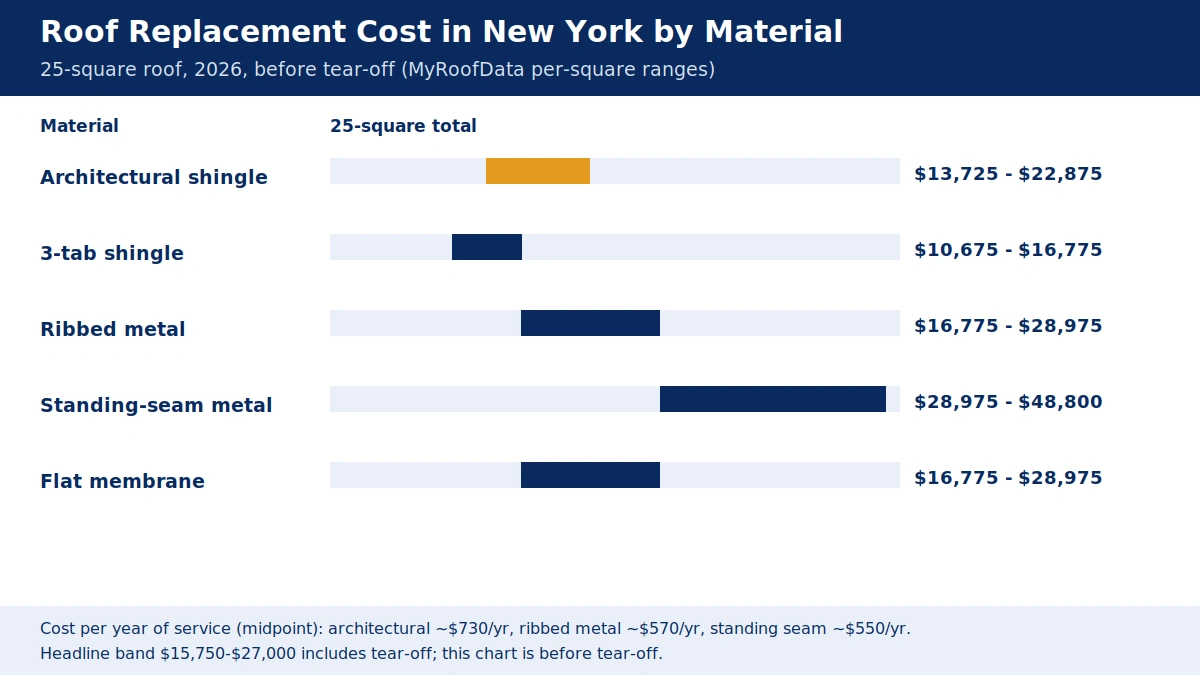
Material is the first decision, and in New York it is two decisions wearing one name: the snow decision upstate and the flat-roof decision in the city. Upstate, the bargain shingle is the one that gives up first under a snow load it was never built for, while the priciest metal is the one still sitting on the roof when the mortgage is paid off, letting snow slide instead of holding it. In the city, the decision is different again: most of the roof is flat, shingles do not belong on it at all, and the membrane choice matters more than the shingle brand. Below, a typical 25-square roof — 2,500 square feet of surface — is priced material by material from New York-verified figures. The per-square prices are MyRoofData’s, before tear-off; the totals are NestPriced arithmetic from those ranges.
| Material | Per square (before tear-off) | 25-square total | Realistic NY life |
|---|---|---|---|
| 3-tab asphalt shingle | $427–$671 | $10,675–$16,775 | 12–18 yrs |
| Architectural asphalt shingle | $549–$915 | $13,725–$22,875 | 18–25 yrs |
| Ribbed metal (exposed fastener) | $671–$1,159 | $16,775–$28,975 | 30–40 yrs |
| Standing-seam metal | $1,159–$1,952 | $28,975–$48,800 | 40–70 yrs |
| Flat membrane (TPO/EPDM) | $671–$1,159 | $16,775–$28,975 | 20–30 yrs |
The 3-tab row carries a warning label. MyRoofData’s $427–$671 a square is the price before tear-off, so the true job total runs higher once the old layer comes off, and 3-tab is the material with the thinnest margin against New York weather: a single layer of flat shingle with the lowest wind rating in the table and no impact rating worth naming. In a state where freeze-thaw cycling works every sealant strip and flashing lap a little looser each winter, buying 3-tab to save a few thousand dollars on the install is buying the next deductible payment in advance. It still fits somewhere — a rental, a shed, a house that will change hands within a few years — but it is the wrong default for a home the owner means to keep through ten New York winters.
Architectural shingles sit on roughly three of every four American homes, and New York is no exception to that share. These thicker dimensional shingles are rated for 110 to 130 miles per hour when nailed to the manufacturer’s high-wind pattern, and they price in the $549–$915-a-square band that sits behind the headline figure. Expect 18 to 25 real years in New York, not the 25 to 30 the brochure prints: ice dams push water back under the courses, and freeze-thaw cycling works the flashing open. A roof that looks fine at year twelve can be a single February thaw away from a leak. Note the gap between this table and the headline band: the headline $15,750–$27,000 includes tear-off, while this table’s $13,725–$22,875 does not — the difference is the tear-off, the permits, and the disposal, and a quote that hides them inside the per-square price is a quote that cannot be compared with anything.
Metal is where the upstate market splits from the city market. Ribbed metal with exposed fasteners prices at $671–$1,159 a square — $16,775–$28,975 across 25 squares — for a 30- to 40-year service life. Standing-seam metal runs $1,159–$1,952 a square, or $28,975–$48,800, and lasts 40 to 70 years. RoofVista cross-checks metal at $10.50–$17.85 per square foot installed, or $20,000–$42,500 for the average project, with standing seam at $10–$17 per square foot; Modernize puts metal at $10–$20 per square foot, or $20,000–$40,000 for a 2,000 square foot roof. No asphalt sheds snow as fast as metal, hail does not bruise a metal panel the way it bruises a shingle mat, and there is no granular surface for freeze-thaw to wear away. Divide by years of service and the table turns upside down: at the midpoints, standing seam runs about $550 a year, against about $730 for architectural shingles and about $570 for ribbed metal. Metal reads as dear on the quote and cheap on the calendar — and across the lake-effect belt, which one cost model calls metal-roof country outright, it is the standard choice rather than the upgrade. The metal choice gets its own full treatment in our metal roof cost guide and our metal vs shingles comparison.
Flat membrane belongs in this table because so much of New York’s housing stock is flat-roofed, and the membrane is the only material in the table that a pitched-roof guide never prices. TPO and EPDM run $671–$1,159 a square, or $16,775–$28,975 for a 25-square roof, lasting 20 to 30 realistic years. The membrane’s enemy is not snow load but standing water: a flat roof that ponds for more than 48 hours after rain is a roof whose seams are being tested on every storm, and the tapered insulation that fixes the ponding belongs in the quote, not in a later project. The flat-roof section below prices the city membrane job in full, borough by borough.
Cedar, tile, and slate sit outside the verified table, and this guide invents no prices for them. Cedar appears on Adirondack and Hudson Valley homes and carries long lead times; tile and slate appear on historic homes in the city and the Hudson Valley, where the Landmarks Preservation Commission can dictate the replacement material on a designated building — a constraint no price table captures. Get those three priced by local quote, and in a landmark district, get the material approved before the quote, because a slate roof the commission rejects is a roof bought twice.
One more way of reading the table changes what it says. Counted per year of service, the cheapest roof in New York is not the one with the smallest quote. At the midpoints, 3-tab costs about $770 a year, architectural about $730, ribbed metal about $570, standing seam about $550, and flat membrane about $760. Those are NestPriced calculations — midpoint total over midpoint realistic life — and they leave out the deductibles, where the avoided claim is the real saving, and the snow-shedding, where metal earns its keep. Read the material table next to the insurance section; each one corrects the other, and neither alone tells the truth.
Roof Replacement Cost by Roof Size
Size is the second decision, and it is the one where quotes most often measure the wrong thing. Every bid prices roof surface. None of them prices living area. Take a 2,000-square-foot single-story ranch: about 2,000 square feet of footprint sits under the roof, and once pitch, overhangs, and waste are counted it usually becomes 20–25 squares of surface. A two-story home of the same 2,000 square feet has a footprint near 1,000 square feet, so its roof surface is roughly half the ranch’s — although the listing describes both houses the same way. Insist that every bid state the square count; treat a bid without it as incomplete. A bid built on living area is a bid built on the wrong house.
The size table below uses the MyRoofData architectural band of $549–$915 a square, before tear-off, applied to the roof sizes New York homeowners actually own. The 25-square row is the headline row, and the 20-square row is the cross-check: $10,980–$18,300 from the per-square band before tear-off, against RoofingEstimatorPros’ $18,329–$32,259 for a 2,000 square foot roof installed — the gap between the two is the tear-off, the permits, the waste, and the labor, and it is widest in the city, where the labor multiplier runs to 1.78 times.
| Roof surface | Typical home | Architectural total (before tear-off) | Standing-seam total (before tear-off) |
|---|---|---|---|
| 15 squares | Small ranch / cottage | $8,235–$13,725 | $17,385–$29,280 |
| 20 squares | 2,000 sq ft ranch | $10,980–$18,300 | $23,180–$39,040 |
| 25 squares | Typical NY home | $13,725–$22,875 | $28,975–$48,800 |
| 30 squares | Large two-story | $16,470–$27,450 | $34,770–$58,560 |
| 35 squares | Large home, complex roof | $19,215–$32,025 | $40,565–$68,320 |
| 40 squares | Very large / steep | $21,960–$36,600 | $46,360–$78,080 |
Three things push a job off this table. Pitch is the first: a steep 10/12 or 12/12 roof costs more per square than a walkable 4/12, because the crew works slower and stages differently — and in the city, a steep roof also means a bigger scaffolding bill. Then there is complexity: a valley, a dormer, a skylight, a chimney — each one means a flashing detail, and flashing details are where rushed work leaks first. Two roofs of the same square count — one plain gable, one cut to pieces — are two different jobs at two different prices. Decking is the third: nobody knows the sheathing has rotted until the old shingles are off, and it is billed per sheet on the day. Get the per-sheet deck rate in writing before the tear-off starts, because a New York City deck repair discovered mid-job, with the crew already on the scaffold, is priced at whatever the contractor says it is.
Build the budget from the roof’s own measurements. Start with the footprint, apply the pitch factor — about 1.15 at 6/12, about 1.25 at 8/12 — add 10 percent for waste, then divide by 100 to get squares. Ask for the measured figure printed on every bid, and compare square counts before comparing prices — the prices only mean something once the counts agree. And in the city, ask for the access line itemized separately: scaffolding, sidewalk shed, and hoist are real costs that belong on the quote as their own lines, not buried inside the per-square price where they cannot be questioned.
Roof Replacement Cost by City: NYC vs Buffalo vs Rochester vs Syracuse vs Albany
New York is one state with two roofing markets, and the price follows the labor and the access, not the skyline. New York City, with five boroughs and eight million people, is the most expensive market in the state and the mildest climate. Long Island sits a step below the city on price and a step above it on lot size. Westchester and the Hudson Valley sit in the middle, close enough to the city to pay city wages and far enough to park a truck. Albany, the Capital Region, is the hinge: upstate prices with downstate building departments. Buffalo, Rochester, and Syracuse are the lake-effect belt, where the snow is the heaviest and the prices are the lowest. The North Country and the Adirondacks are the cheapest market and the hardest to schedule, because the crew may drive an hour and the season is measured in weeks.
| City / region | 1,500 sq ft arch roof (RoofVista) | 2,000 sq ft arch roof | Market note |
|---|---|---|---|
| New York City | $18,000–$35,000 | $24,017–$41,428 (avg $31,755) | Highest labor, DOB permits, scaffolding, access |
| Long Island | $13,000–$25,000 | $14,000–$24,500 (Modernize) | HIC license in both counties, suburban lots |
| Hudson Valley / Westchester | $12,000–$22,000 | No verified figure pulled | City wages, Westchester HIC license |
| Capital Region / Albany | $9,500–$17,000 | No verified figure pulled | Hinge market, design temp minus 1 |
| Buffalo / Rochester / Syracuse | $9,000–$18,000 | No verified figure pulled | Lake-effect belt, heaviest snow, lowest prices |
| North Country / Adirondacks | $9,000–$16,000 | No verified figure pulled | Shortest season, longest drives |
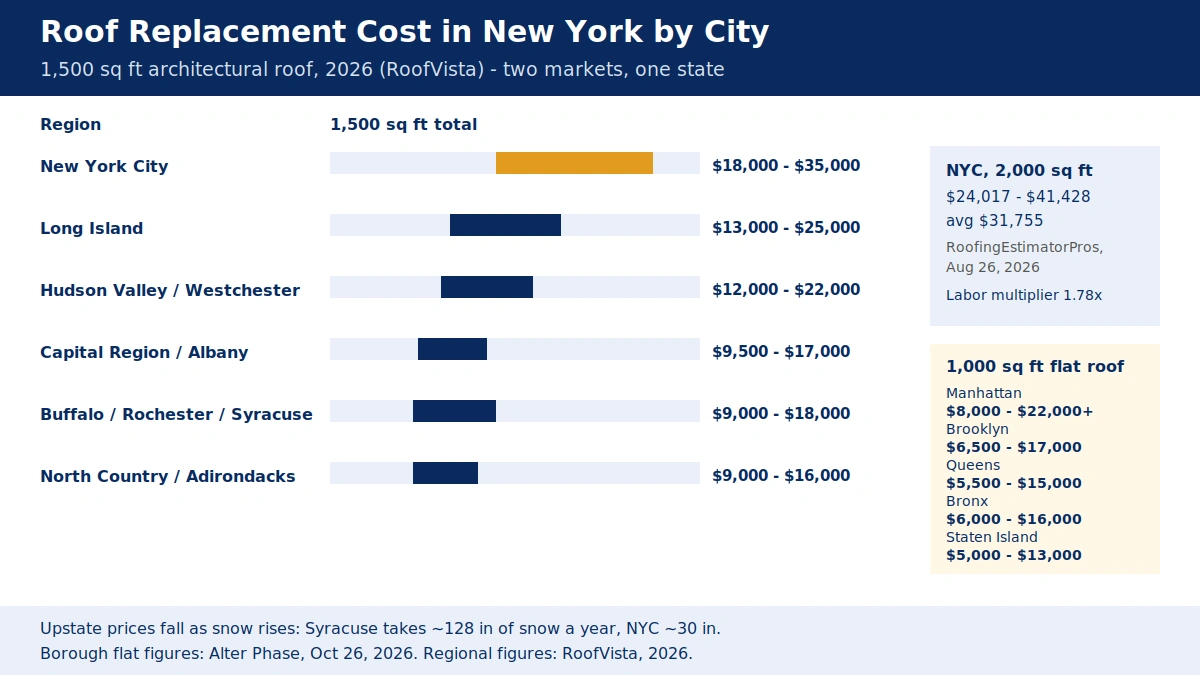
New York City is the most expensive market in the state, served by the most crews, at $18,000–$35,000 for a 1,500 square foot architectural roof on RoofVista’s figures, and $24,017–$41,428 for a 2,000 square foot roof on RoofingEstimatorPros’ figures, averaging $31,755. The labor multiplier runs to 1.78 times the national figure, and the local cost multiplier to 1.56 times. It is also the mildest corner of the state: roughly 30 inches of snow a year, the lowest figure in the table, and the warmest winters anywhere in New York. The city’s building department requires a permit before a roof is replaced, and the filing, with professional fees, can exceed $1,000 — before the scaffolding, the sidewalk shed, and the hoist are counted. A New York City contractor’s own figures, via Alter Phase, put shingle work at $3–$10 per square foot and flat work at $5–$14, with a 1,000 square foot flat roof at $8,000–$22,000 or more in Manhattan, $6,500–$17,000 in Brooklyn, $5,500–$15,000 in Queens, $6,000–$16,000 in the Bronx, and $5,000–$13,000 on Staten Island. The borough spread inside the city is itself a second city table, and the flat-roof section below works through it.
Long Island runs a step below the city, $13,000–$25,000 for the same 1,500 square foot roof, with Modernize putting a 2,000 square foot roof at $14,000–$24,500. The saving is an access figure, not a risk figure: the lots are bigger, the truck parks in the driveway, and the scaffold is smaller — but the licensing is just as strict, with a Home Improvement Contractor license required in both Nassau and Suffolk counties, and the wind off the Atlantic and the Sound drives rain sideways into flashing that a sheltered inland roof never tests. A Long Island quote should name the flashing scope explicitly, and a Long Island roof should be inspected after the first big November nor’easter, not after the first leak.
Westchester and the Hudson Valley carry the middle band, $12,000–$22,000 for a 1,500 square foot roof. Westchester pays city wages without city access problems, and its Home Improvement Contractor license runs through the county Department of Consumer Protection — $750 for two years since January 1, 2026 — with the city of Yonkers running its own additional requirements on top. The Hudson Valley adds the freeze-thaw cycle to the bill: the river valley traps cold air, the temperature swings across freezing more often than anywhere else in the state, and a shingle seal that survives a Buffalo winter can still fail in a Hudson Valley spring.
Albany and the Capital Region are the hinge, $9,500–$17,000 for a 1,500 square foot roof. The design temperature is minus 1 degree, which makes Albany a cold-climate market by the code’s own numbers, and the snow runs about 59 inches a year — double the city’s, half of Syracuse’s. The permit is a town permit, not a DOB filing, and the price reflects it. Albany is also where the state’s heat-pump program is most visible, and a homeowner replacing a roof and a heating system in the same year should read our heat pump cost in New York guide before either quote is signed, because the insulation work that belongs under the new roof is the same work the heat pump needs to heat the house.
Buffalo, Rochester, and Syracuse are the lake-effect belt, $9,000–$18,000 for a 1,500 square foot roof — the lowest prices in the state and the heaviest snow in the country. Syracuse averages about 127.8 inches of snow a year on the 1991–2020 normals, Rochester about 102.0, and Buffalo about 95.4, and the Tug Hill Plateau east of Lake Ontario regularly exceeds 200 inches. That lower price should not be read as an easier roof to own. It is a labor figure, not a risk figure. A Syracuse roof faces four times the snow a city roof faces, more freeze-thaw cycling, and a storm record written in lake-effect bands that can drop three feet overnight on one neighborhood while the next street over gets flurries. The saving is real, and so is the spec it has to buy: the ice barrier, the ventilation, and the pitch that the city roof never needs.
The North Country and the Adirondacks carry a warning label rather than a verified price at the 2,000 square foot size. This pass pulled no verified figure for that size, and the guide invents none. What can be said honestly is the shape of the market: the cheapest band in the table at $9,000–$16,000 for a 1,500 square foot roof, the shortest install season, the longest drives, and a cost model that puts the whole region in metal-roof country. Collect three quotes in the North Country, with at least one from a company that keeps a permanent shop within an hour’s drive — warranty service from a crew two counties away is a promise that turns expensive to keep.
Judge cities by price per square, never by the headline total. New York City at $31,755 looks more expensive than Buffalo at $18,000, but the gap disappears once pitch, deck condition, and material are held equal — and what remains is the access bill and the labor bill, not the shingle bill. The real city difference is not price. It is exposure: Syracuse gets four times the snow the city gets, Buffalo gets the lake-effect bands, the Hudson Valley gets the freeze-thaw swings, and the northern towns get neither the competition nor the fast scheduling, which is why their quotes deserve the closest reading of all.
Why New York Roofs Cost What They Do: Two Markets, One State
Four forces decide what a New York roof costs; the weather supplies two of them, and the city supplies the other two. Snow is the first and the heaviest. Ice dams are the second force, and the priciest one to fix. Access is the third and the most persistent — the scaffolding, the shed, the hoist, and the truck that cannot park. The fourth is the market itself — a labor market that pays city wages in the five boroughs and a short-season logistics market in the North Country — and it decides how fast any of the other three gets fixed.
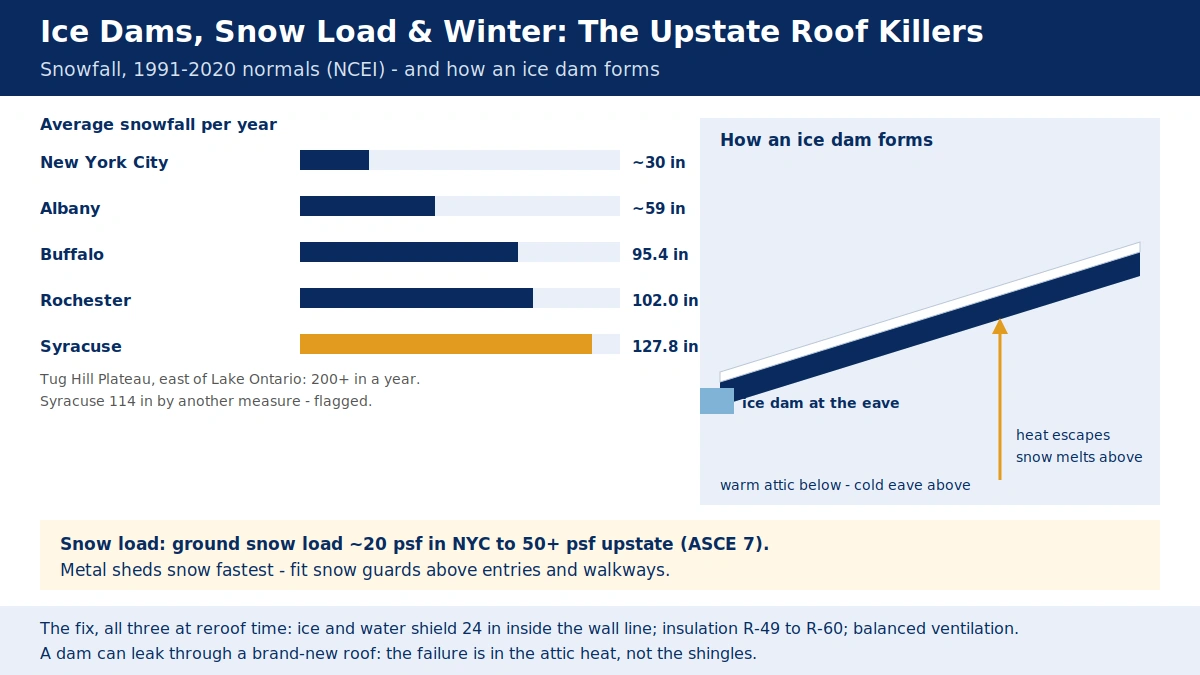
Snow. New York is a snow state, and the numbers leave no room for doubt. On the 1991–2020 normals, New York City averages about 30 inches of snow a year, Albany about 59, Buffalo about 95.4, Rochester about 102.0, and Syracuse about 127.8 — and another measure puts Syracuse near 114 inches, which still leaves it the snowiest big city in the country. The Tug Hill Plateau, east of Lake Ontario, regularly exceeds 200 inches. What makes the snow so heavy here is the lakes themselves: Arctic air crossing Lake Ontario picks up moisture and drops it as snow on the leeward shore, and since the lake almost never freezes solid, Syracuse and Watertown keep getting buried straight through February. Snow is weight, and weight is structure: a roof that holds a snow load all winter, grows an ice dam at the eave, and takes freeze-thaw at every joint needs its deck, underlayment, and ventilation sized for the load rather than picked for looks. Ground snow loads in New York run from about 20 pounds per square foot in the city to 50 or more upstate under ASCE 7, and no single statewide number exists, because the load is set county by county — the building department’s figure governs, not the contractor’s guess. The ice-dam section further down works through the detail.
Ice dams. No winter failure costs a New York homeowner more than an ice dam — and none is easier to head off: a February emergency call for a leaking dam costs several times what October air-sealing and attic ventilation would have. How it works — heat escaping into the attic, meltwater refreezing at the cold eave, water backing up under the shingles — gets its full treatment in the next section. Water damage from frozen pipes and ice dams is the claim type that distinguishes New York from milder markets, and most standard HO-3 policies cover the sudden interior water damage, minus the deductible.
Access. In the city, the roof is not the hard part. Getting to it is. A row house roof sits five stories up behind a sidewalk shed, the materials arrive by hoist, the crew parks a mile away, and the debris leaves by chute into a container that needs its own permit. Scaffolding, sidewalk sheds, and hoists are priced by the day, and a city job that runs a day long on access alone can add a thousand dollars before a single shingle is nailed. Upstate, the access bill is the drive: a crew that has to travel two hours to reach a North Country job charges for the travel, and a job that needs a second trip for a missed flashing detail costs a second travel day. Access is the line item that never appears in a national cost guide and always appears on a New York invoice.
Tariffs. The 2026 cost pressure that no quote can ignore is the tariff. RoofVista reports that 2026 tariffs added 12–20 percent to imported standing-seam metal, 8–12 percent to flashing and fasteners, and 5–10 percent to asphalt — and this guide flags that as a single-source report, not a settled fact, because no second source was pulled to confirm it. The direction is plausible and the size is material: a 12–20 percent rise on a $28,975–$48,800 standing-seam roof is $3,500–$9,800, and a 5–10 percent rise on asphalt is $700–$2,300 on the headline band. Get the material price locked in writing with an expiry date, and ask what happens if the supplier raises it between the quote and the install. A quote without a price-lock date is a quote that can move.
The market. The fourth force is the labor market and the logistics around it. New York roofing crews bill $68–$120 an hour statewide, and $60–$95 an hour in the city alone. In a quiet month that is enough. In the weeks after a lake-effect blizzard or a nor’easter, it is not, and the shortage shows up in two ways: prices rise, and wait times stretch. In the North Country the constraint changes shape: a short season, long drives, and a crew that bills for the two-hour trip to reach the job. The install season runs roughly April through October in the south and May through September in the north, with the best installs in the shoulder months — April and May before the storm peak, September and October after it ends.
Ice Dams, Snow Load & Winter: The Upstate Roof Killers
Winter does the slow damage in New York. Every winter the same sequence makes an ice dam: heat drifts from the living space into the attic, the underside of the deck warms, and the bottom layer of snow on the upper slope starts to melt. That meltwater runs down to the eave, past the warm wall to the stretch of deck that has gone cold again, and freezes into a ridge of ice. The next melt has nowhere to go. Water ponds behind the ridge, works back under the shingles, and gets into the house — through the sheathing, down the wall, into the ceiling — and shows up as a brown March stain, or worse. An ice dam can leak through a roof that was installed last month, because the failure sits nowhere near the shingles. The shingles did nothing wrong — the heat and stale air in the attic did it.
Three layers of defense exist, and the reroof is where all three belong — not in some later project. Start with the ice and water shield: a self-adhering membrane along the eaves, in valleys, and around penetrations, running from the edge past the inside face of the exterior wall — at least 24 inches inside the wall line under the New York State Uniform Fire Prevention and Building Code, which adopts the International Residential Code’s ice-barrier rule. Where a winter drops ninety-five to nearly a hundred and thirty inches, the membrane should run past the minimum on a low-slope roof, and the quote should name the distance. One 36-inch roll is often too narrow on a deep-overhang or low-pitch roof: upstate crews actually lay two or three courses, six to nine feet of membrane. The second layer is insulation: the aim is a cold attic, and the attic only stays cold when the ceiling is insulated well enough to hold the roof deck near the outdoor temperature — R-49 to R-60 across New York’s climate zones, about 16 to 22 inches of blown-in fiberglass or cellulose. The third layer is ventilation — soffit intake matched to ridge exhaust — which keeps attic air moving and the deck temperature even. A reroof is the only moment all three layers are open at once. New shingles over a hot, unventilated attic all but promise another dam by February.
Snow load is the quieter winter risk. A roof in Buffalo carries roughly eight feet of snow in an average winter, and in a record winter the load is far higher — Buffalo has seen seasons over 130 inches, and Syracuse has seen seasons near 140. A roof in the city carries about two and a half feet in an average year. The load is more than today’s snowfall. December lays it down, January packs it, February ices it over, and it is still sitting there in March when the next storm adds another foot. Flat and low-slope stretches are the danger zones: they hold snow instead of shedding it, so a low-slope porch roof or a flat garage section can end up carrying twice the main slope’s load. Metal sheds snow better than anything else, and a steep pitch beats a shallow one at the same work. Shedding has a downside, though: a slab of snow sliding off metal can tear a gutter away or bury a walkway, which is why snow guards above entries and walkways should be quoted up front, not bolted on later.
From Buffalo’s lake-effect bands to the city’s nor’easters, New York weather writes the install calendar — the contractor only reads it. April through October is the working season in the south, May through September in the north, with the best installs in the shoulder months — April and May before the storm season, September and October after it ends. November brings the lake-effect machine back to life: a crew can strip a roof in the morning and race a band off Lake Erie by afternoon, so a good contractor watches the forecast like a farmer. A winter install is possible — SBS-modified shingles made it more practical than it once was — but sealant strips still need warmth to bond, and a January crew that skips hand-sealing the tabs is fitting a roof that will lift in the first March wind. When a roof has to go on in winter, ask how the crew seals the tabs, and what happens when the bond does not take.
One more winter note, for the lakeshore only: wind off the lakes drives snow and rain sideways, and a west-facing slope on the Lake Erie shore takes weather a sheltered inland roof never meets. A lakeshore quote should spell out the flashing scope, and a lakeshore roof should be inspected after the first big November storm rather than after the first leak.
Flat Roofs in New York City: Membrane Costs, DOB Permits & Access
Most of New York City’s housing stock does not have a pitched roof at all. It has a flat one — row houses, tenements, brownstones, and small apartment buildings, mile after mile of membrane broken only by bulkheads, parapets, and the occasional pitched dormer. A cost guide that prices only shingles misses most of the city’s roofs, and a homeowner who buys a shingle quote for a flat roof has bought the wrong material for the wrong slope. This section prices the flat roof on its own terms, borough by borough.
What a city flat roof costs. Alter Phase, updated October 26, 2026, puts shingle work in the city at $3–$10 per square foot and flat work at $5–$14 per square foot, with a 1,000 square foot flat roof at $8,000–$22,000 or more in Manhattan, $6,500–$17,000 in Brooklyn, $5,500–$15,000 in Queens, $6,000–$16,000 in the Bronx, and $5,000–$13,000 on Staten Island. Gold GCP cross-checks the metro at $9,150–$18,350 for a 2,000 square foot asphalt roof and $3,950–$14,400 for a 1,000 square foot flat roof. The Manhattan premium is an access premium: the tightest streets, the tallest scaffolds, the longest hoists, and the highest labor. The Staten Island discount is the same fact read the other way: driveways, parking, and a crew that can stage materials on the ground.
The membrane choice. Three membranes cover nearly every city flat roof, and the choice turns on the roof’s use as much as its price. TPO — thermoplastic polyolefin, the white single-ply membrane — runs in the $671–$1,159-a-square band from the material table, reflects summer heat, and suits a roof that bakes in July. EPDM — the black rubber membrane — sits in the same band, flexes through a freeze without cracking, and suits a roof that has to survive January. Modified bitumen — the torch-down or cold-applied layered system — is the old city standard, heavier, thicker, and the one most likely to already be on the roof being torn off. The membrane’s enemy is ponding: a flat roof that holds water for more than 48 hours after rain is a roof whose seams are being tested on every storm, and the tapered insulation that fixes the ponding belongs in the quote. Ask for the membrane by name, the seam method, and the tapered insulation scope in writing — and ask whether the quote includes the parapet flashing, because a membrane that stops short of the parapet cap is a leak waiting for the next nor’easter.
The DOB permit. A flat-roof replacement in the city is a Department of Buildings job, and the filing is the part of the bill that surprises first-timers most. The permit and the professional fees around it can exceed $1,000, and RoofingEstimatorPros puts the New York City permit range at $800–$3,500, against $400–$1,800 statewide. The filing needs a licensed professional — an architect or engineer — on jobs the department classes as more than a simple repair, and the professional’s fee sits on top of the filing fee. Let the contractor pull the permit and book the inspection; one who hands that job to the homeowner does not do this work often enough. And the sidewalk shed is a separate permit, with its own clock: a shed that goes up late delays the job, and a shed that stays up after the job is a fine waiting to happen.
Access is the line item. Scaffolding, sidewalk sheds, hoists, and debris chutes are priced by the day, and on a five-story row house they can run into the thousands before a single square of membrane is laid. Get them itemized on the quote as their own lines. A quote that buries access inside the per-square price cannot be compared with anything, and a quote that omits access entirely is a quote that will grow by change order. Ask, too, about the neighbors: a row house roof shares parapets and party walls, and the flashing detail at the shared wall belongs to both houses. The contractor who has done this block before will know which neighbor’s flashing to tie into, and which one to leave alone.
Standing-Seam Metal in Snow Country: What the Upgrade Costs
If this guide had to keep a single piece of advice for the upstate homeowner, it would be this: get the standing-seam upgrade priced on every asphalt quote, and take it unless the numbers say no. The case is different here than in the city — the city’s roof is flat, and metal belongs on a slope — but upstate, where the snow runs eight to ten feet a year, the upgrade earns its keep in a way no asphalt can match, because the metal does the one thing asphalt cannot do at all: it lets the snow leave.
What it is. Standing-seam metal is a system of long panels joined by raised seams that stand above the water line, fastened with concealed clips so no screw head ever sits in the weather. The seams shed water and snow instead of holding them, the panels expand and contract with the temperature without working fasteners loose, and the concealed fastening means there is no exposed screw to back out after twenty freeze-thaw cycles. The products sold in New York include the standing-seam lines from the major metal manufacturers, and the gauge matters: 24-gauge steel is the upstate standard, thicker and stiffer than the 26-gauge panels that dent under a falling branch. Ask for the gauge on the quote, not just the brand.
What it costs. MyRoofData puts standing-seam metal at $1,159–$1,952 a square, or $28,975–$48,800 for a 25-square roof — against $13,725–$22,875 for architectural shingles on the same roof. RoofVista cross-checks standing seam at $10–$17 per square foot installed, and Modernize at $10–$20 per square foot, or $20,000–$40,000 for a 2,000 square foot roof. The premium over architectural shingles runs roughly $15,000–$26,000 on a typical roof, and the 2026 tariffs widen it: RoofVista reports 12–20 percent on imported standing-seam metal, a single-source figure flagged in the cost section above, which would add $3,500–$9,800 to the metal job alone. Get the metal price locked in writing with an expiry date, because the tariff line is the one most likely to move between the quote and the install.
What it pays back. The payback runs in two streams, and the second one is the bigger of the two. First comes the life: 40 to 70 realistic years for standing seam, against 18 to 25 for architectural shingles, which means the metal roof is very likely the last roof the house will ever need. At the midpoints, standing seam works out near $550 per year of service, against near $730 for architectural shingles — the metal roof costs less per year even though it costs twice as much on the quote. Second comes the avoided damage: a roof that sheds snow does not grow ice dams, a roof without dams does not leak in February, and a roof that does not leak does not generate the deductible payment or the interior repair that follows. A single avoided ice-dam claim can cover a meaningful share of the upgrade outright. The insurance discount, where the carrier offers one for metal, is the bonus on top — get it confirmed in writing by your own insurer before signing anything, because a contractor-quoted discount is fiction until the carrier puts it in writing.
When it is not worth it. Standing seam loses its case in three situations. A flat or nearly flat roof, where the seams cannot shed what has nowhere to go — the membrane section above is the right answer there, not metal. A home that will be sold within a few years, where the buyer is unlikely to pay extra for the upgrade — even so, a transferable warranty and a documented service life can still make the listing stronger. And a home under heavy tree cover, where falling branches dent panels and shade keeps snow on the roof longer than the metal can shed it. For everyone else — the long-term owner, the house that has already had one ice-dam claim, the North Country home with a hundred inches a year — standing seam is the default, not the upgrade.
How to buy it. Put the product on the quote — manufacturer, exact panel line, and gauge — and file the warranty paperwork with the job records. Ask about the snow guards: metal sheds snow in slabs, and a slab sliding off a steep slope can rip off a gutter or bury a walkway, so guards above entries and walkways belong in the quote, not tacked on afterward. And ask about the crew: standing seam is a specialist install, and a crew that lays asphalt all week and metal once a quarter is a crew that will take twice as long and leave twice the callbacks. The extended warranty, which only holds when a credentialed crew does the install, is one more reason the cheapest bidder is not always the cheapest roof.
Permits & Code: NYC DOB, Ice Barrier & Contractor Registration
New York’s permit and code picture is a local one, which sets it apart from the states in this series that run everything from the capital. The state has a uniform building code, the New York State Uniform Fire Prevention and Building Code, modeled on the International Residential Code — but the permits, the inspections, and the contractor licensing all sit with the city, the town, or the county. A roof answers to the local rules first and the state code second — and both need checking before the first shingle comes off.
The code is statewide, the permit is local. Roof construction and replacements across New York are regulated under the Uniform Code, which adopts the International Residential Code’s roofing provisions, with local amendments adopted city by city. Wind speed and snow load — the two design values that matter most — are read out of the code’s tables and maps by the local building department. Ground snow loads run from about 20 pounds per square foot in the city to 50 or more upstate under ASCE 7, and no single statewide number exists, because the load is set county by county. No New York-specific design wind speed was verified for this guide beyond the general ASCE 7 figure — let the building department’s figure govern, not the installer’s guess.
The ice barrier is mandatory. The code’s ice-barrier rule requires an ice barrier in areas with a history of ice forming along the eaves — which covers all of upstate New York and the Hudson Valley. The barrier is two layers of underlayment cemented together, or a self-adhering polymer-modified bitumen sheet, and it has to run from the lowest edges of every roof surface to at least 24 inches inside the exterior wall line. Where the slope is 8 in 12 or steeper, the barrier must also reach 36 inches up the slope from the eave edge. Three code-driven items should appear on every New York bid, and a bid missing any of them is a red flag. Look for ice and water shield on every bid — eaves, valleys, penetrations — reaching at least 24 inches inside the exterior wall line. Drip edge at the eaves and rakes. Where the wind hits hardest in New York, shingles should be fastened with the six-nail high-wind pattern. Leave the ice barrier off the bid and the roof leaks in February. Leave the drip edge off the bid and the fascia rots. A bid nailing four where the manufacturer calls for six is a bid that lifts in the next nor’easter.
Permits are required for a full replacement. A permit is required for a complete roof replacement, and the fee turns on the jurisdiction and the job’s valuation. Upstate towns charge $75–$300 for a typical job, on MyRoofData’s figures. RoofingEstimatorPros puts the statewide permit range at $400–$1,800, and the New York City range at $800–$3,500 — the city’s filing, with the professional fees around it, can exceed $1,000 before the work starts. Patching a handful of shingles or resealing a flashing joint rarely needs a permit in New York, but anything structural — decking, a full tear-off, a change of material — always does. The contractor should pull the permit and schedule the inspection; a contractor who asks the homeowner to pull it is a contractor who does not do this work often enough.
Registration, not licensing — and only in some places. This is the rule that surprises every newcomer, and it gets its own section below. New York has no statewide roofer license. What it has instead is Home Improvement Contractor registration in the city and in six downstate jurisdictions, and nothing at all in most of upstate. The permit section and the hiring section belong together: the permit is the building department’s check on the roof, and the registration is the consumer agency’s check on the contractor — and in much of the state, only the first one exists.
Hiring a Roofer in New York: What to Check Without a State License
With no statewide roofing license in New York, the hiring job falls to the homeowner in full. Michigan’s state government did the screening in advance, with 60 hours of education, an exam, and a trade-named license. New York’s state government did nothing of the kind. The homeowner’s job is to assemble the screening the state never built — from the county license where one exists, from the insurance certificates, from the references, and from the contract itself.
What exists, jurisdiction by jurisdiction. The New York Attorney General lists the places where a Home Improvement Contractor license is mandatory: New York City, and Nassau, Suffolk, Westchester, Putnam, and Rockland counties, plus the city of Buffalo. In the city, the license comes from the Department of Consumer and Worker Protection (DCWP) — not the Department of Buildings — and it covers residential home improvement work costing more than $200. Getting it takes a 30-question exam, with 21 correct to pass, a $20,000 surety bond or a $200 payment into the Home Improvement Business Trust Fund, workers’ compensation proof, and a sales tax ID; the license runs two years and expires February 28 of odd years. The Department of Buildings issues a separate General Contractor Registration, which is what lets a contractor pull permits for building one-to-three-family homes — a reroof needs the DCWP license and a DOB permit, and a contractor who holds only one of the two is a contractor who cannot finish the job legally. Nassau County licenses through its Department of Consumer Affairs, and the license must be in hand before any work, advertising, or solicitation — filing the application is not permission to operate. Suffolk County licenses through its Department of Labor, Licensing and Consumer Affairs under Chapter 563 of the county code, which names roofing explicitly, requires a written exam, and demands the license number on every advertisement and contract. Westchester County licenses through its Department of Consumer Protection, at $750 for two years since January 1, 2026, with the city of Yonkers running its own additional requirements on top — and a license in one county is valid in no other. A Long Island contractor who works on both sides of the county line needs both licenses.
What the license proves — and what it does not. A Home Improvement Contractor license proves the holder passed the local exam, filed the bond or trust-fund payment, and is on the county’s books, where the license can be looked up and revoked. It does not prove the contractor is insured, bonded beyond the minimum, or good at the work. It says nothing about whether the crew carries workers’ compensation, or whether the contractor has ever fitted the material on the quote. The license is the first filter, not the only one — and in most of upstate, where no license exists at all, it is not even the first filter. There, the insurance certificates and the references are the whole screen.
The same five checks apply to every bidder in every county. General liability insurance, shown by a certificate the carrier mails to you directly — never one the contractor hands over — with the business name exactly as written on the contract. Proof of workers’ compensation for the crew — required whenever the bidder employs anyone, and in New York the penalties for an uninsured crew fall on the homeowner’s property as often as on the contractor. A permanent local address and a local phone number that predate the last storm. Three local references from inside your county, with street addresses you can drive past on your own. Manufacturer certification where it counts: GAF, Owens Corning, or CertainTeed credentialed installer status, since the extended warranty only holds for a credentialed crew’s work. And a written quote from all three bidders on one identical spec sheet, so the prices are prices for the same roof.
The contract is the protection the license is not. New York General Business Law Article 36-A governs every home improvement contract of $500 or more, anywhere in the state, licensed county or not: the contract must be in writing and must include the start and completion dates, a description of the work, the license number where one applies, and a payment schedule, among other requirements. Read it before signing, and read the payment schedule twice. A contractor who wants a large payment before any work starts is a contractor whose cash flow is the homeowner’s risk. And the door-to-door rule still applies: the federal Cooling-Off Rule gives three days to cancel a contract signed at the door, and it exists for exactly the moment a stranger knocks after a storm with a free-inspection agreement in hand. Use it. Never sign a contingency agreement in the driveway ahead of the adjuster’s visit.
The storm-chaser warning. New York is storm-chaser territory after a nor’easter or a lake-effect blizzard, and the crews arrive within days of the event, knocking on doors in the damaged neighborhoods. Some are legitimate traveling crews. Many are not. Storm chasers give themselves away in the same ways every time: they knock and push a free-inspection agreement across the threshold, they answer an out-of-state number and keep no office in town, they carry no local license where one is required, they promise to make the deductible disappear, and they want a big payment before any work starts. A deductible waiver is a promise of insurance fraud carried out on your behalf, and a contract built on it is one to walk away from.
The quote itself. A New York quote should name the manufacturer and the exact shingle line, the underlayment type, the ice and water shield coverage in feet from the eave, the drip edge, the ventilation scope, the nailing pattern, the tear-off depth, the per-sheet deck replacement rate, the disposal, and the cleanup — and in the city, the scaffolding, the sidewalk shed, and the hoist as their own lines. A quote must state the roof surface in squares and price that surface as a total, so two bids line up square to square. Warranty terms belong on the quote as well — manufacturer and workmanship as separate year counts, each with the party that honors it named. It should name the permit cost and the party pulling the permit. And no line for a federal tax credit should appear on it, because none exists in 2026. Bring our questions to ask a roofer guide — the complete question list — to the first contractor meeting and work through it there.
Insurance: Deductibles, ACV vs RCV & the 15-Year Roof Rule
Insurance is the part of a New York roof that either earns its keep or springs a nasty surprise — a policy that looked solid at signing can turn out to pay far less than the homeowner counted on. The state’s exposure is split the same way its pricing is: the city faces wind and water from nor’easters and hurricanes, upstate faces snow load and ice dams, and the carrier prices both. Measure every figure in this section against the homeowner’s own policy; nothing else governs the claim. One honest gap sits at the top of this section: no verified New York average home insurance premium was pulled for this guide, so none is given. The mechanics below are the part that can be stated without one.
The deductible. A standard deductible of $500 to $5,000 covers most perils on most New York policies, and many policies now stack a separate, higher deductible on wind and hail. The Insurance Information Institute puts the saving from raising the deductible from $500 to $1,000 at 10 to 25 percent of the premium. A percentage wind and hail deductible is the number most homeowners do not know until the adjuster is standing in the driveway: 2 percent of a $600,000 dwelling is $12,000 out of pocket before the insurer pays anything on a wind claim — and in the city, where dwelling values run higher, the percentage deductible runs higher with them. Learn the declarations page before the storm arrives, not after it.
The 15-year roof rule. This is the twist that changes the replacement decision. Several major carriers now draw the line at 15 years: past it, the roof may move to depreciated actual-cash-value coverage, or the renewal may be declined. The arithmetic is brutal. Take a $24,000 roof at 15 years, half depreciated, with a $2,000 deductible: the payout nets only about $10,000, and $14,000 or more comes out of the homeowner’s pocket. Before the next nor’easter, ask your carrier in writing whether your roof still settles at replacement cost — and at what age that changes. Once the roof is past fifteen and the policy has gone ACV, the replacement decision changes shape, because the insurer will fund little of either the repair or the replacement — while a new roof resets the clock to replacement cost.
RCV vs ACV. The second key number is the settlement basis: replacement cost value or actual cash value. Replacement cost pays what a new roof costs, less the deductible, whatever age the old roof had reached. Actual cash value works the other way. Under actual cash value, the roof is priced as it stood on the day of the damage — the cost of a new roof minus depreciation — and shingles depreciate fast. The table below is NestPriced illustrative arithmetic, not a regulator’s published example: an $18,300 roof, the midpoint of the New York architectural band, on a $2,000 flat deductible, linear depreciation of 2 percent a year over a 25-year shingle life.
| Roof age | RCV payout | ACV payout |
|---|---|---|
| Any age | $16,300 | — |
| 5 years | — | $14,470 |
| 10 years | — | $12,640 |
| 15 years | — | $10,810 |
| 25 years | — | $7,150 |
The pattern is the warning. Five years in, the ACV payout lands $1,830 short of replacement cost. At fifteen years, it is $5,490 less. At twenty-five years the payout is $7,150 on an $18,300 roof — barely two-fifths of the cost — and the homeowner makes up the rest. On an ACV policy, an older roof is mostly the homeowner’s own risk, whether they know it or not. Check the policy type before the storm. Past ten years on ACV, the metal upgrade and the replacement call both change, because the insurer will fund little of either.
The claim, step by step. Photograph all of it before anyone touches the damage: every slope, every gutter, every dented vent cap, with dates. Let the insurer hear about the damage before any contractor does: the adjuster comes first and the estimate comes second, and reversing that order costs money. Never put your name on a contingency or assignment-of-benefits agreement in the driveway. Ask for the adjuster’s report in writing, line items included, and check it against the contractor’s estimate line by line. Keep the deductible ready in cash: no legitimate contractor waives it, and no insurer covers it. And file the paperwork — product name, install photos, permit — because next year’s renewal depends on proving what sits on the roof.
The metal discount, one more time. Real, carrier-specific, and limited to the wind and hail portion of the premium where it exists at all. No named carrier’s New York metal or Class 4 discount figure was verified for this guide, so none is given. Get the figure from your own carrier in writing — qualifying product list and paperwork included — ahead of the install. A discount a contractor promises is not a discount until the carrier puts it in writing.
Paying for It: No Federal Credit in 2026 & Financing
Here is the whole 2026 money story for a New York roof, in short: the homeowner and the insurer are the only ones paying for it — which is why so many quotes still carry a tax-credit line that does not exist. In 2026, the federal government contributes nothing to a New York homeowner who replaces a roof, the state contributes nothing to the roof, and the federal rebate programs that do exist in New York pay for heat pumps and insulation, never for roofing.
The federal tax credit is $0. IRS fact sheet FS-2025-05 says property placed in service after December 31, 2025 gets nothing from the Residential Clean Energy Credit (§25D, 30 percent) or the Energy Efficient Home Improvement Credit (§25C) — the One Big Beautiful Bill Act, Public Law 119-21, signed July 4, 2025, closed both. Roofing never counted as solar equipment, so §25D was never available for a roof; §25C was sometimes claimed for qualifying roofing materials, and that door has closed as well. When a 2026 quote still shows a tax-credit line, it is priced under a law that no longer exists — get the contractor to take the line out and re-price the job. Solar arrays and similar clean-electricity equipment fall under a different credit, the commercial one, §48E. No documented lease or pass-through arrangement sends federal dollars toward a New York roof. None is claimed here — see our federal energy tax credits guide for the federal rules as they stand in 2026. A roof paired with solar is a different job — our solar panel cost in New York guide prices that pairing — but the solar credit is gone too, and the roof half never had one.
HEAR and HOMES: launched in part, and never for a roof. New York was the first state in the country to launch the federal home energy rebates, in June 2024, through NYSERDA’s EmPower+ program. But the money that reaches a homeowner in 2026 is narrower than the rebate sites still advertise. The EmPower+ manual in use now allows HEAR money only for insulation, air sealing, and ventilation, up to $1,600, on projects without a heat pump — the $8,000 heat pump and $14,000 totals on rebate sites come from a 2025 FAQ, and heat pumps in EmPower+ are now paid from state funds instead. HOMES has not launched in New York, and no New York HOMES figure has been verified, so none is given. And since the Energy Department’s Notice 26-2 of May 29, 2026, HEAR pays only for electric-to-electric upgrades. A reroof paired with an insulation upgrade may qualify for the insulation half. The roof itself never qualifies, in any county, under any version of the program.
No state money for the roof either. No New York state roof grant, rebate, or tax credit was found in this pass, and no utility roof rebate was found. The money that does arrive comes from the insurer, through the avoided deductible, and from the energy bill, through insulation and ventilation work done with the reroof. A New York homeowner who needs help paying for a roof in 2026 should look at a home-equity loan or a contractor financing plan — and read the annual percentage rate before looking at the monthly payment. Our how to finance a new roof guide walks through the financing options.
Repair vs Replace: The New York Decision Rules
A damaged New York roof is not always a replacement, and an old roof is not always a repair. Age, damage, and the deductible decide it — and in this state, the ice-dam forecast for the next five years decides it too, because a repaired roof that dams again in February is a repair paid for twice.
A young roof with small damage is a repair, not a replacement. A roof ten years or younger, missing a few shingles, with one chimney flashing leaking or a few tabs lifted by wind, gets repaired — it does not get replaced. No verified New York repair price was pulled for this guide, so none is given here; the national repair figures in our roof repair cost guide are the planning reference, and a local quote sets the real number. A repair is also the answer when the damage plainly dates to one storm and the insurance adjuster agrees the rest of the roof has years left.
An old roof, wide damage, or math that favors new is a replacement. Once architectural shingles pass fifteen years and wind has lifted more than a quarter of the slopes, replace: patching a lifted mat is cosmetic work on a roof that will give way at the next storm. Replace when the deck feels soft underfoot or the sheathing has come apart: structure is replaced, never repaired. Replace when ice dams return each winter after insulation and ventilation work has already been done — the dam is saying the system has failed, not the shingle. Replace once the insurer has paid a claim and the roof has aged to the point where the next claim pays ACV at two-fifths of the cost — collect the replacement money while it is still replacement money. Replace when the roof is nearing the carrier’s 15-year trigger and the policy is about to switch to ACV. And replace when the repair quote runs past a third of the replacement quote on a roof with under five years of life left.
The inspection rhythm. Inspect in late fall, once the storm season has ended, and again in late spring, before it starts. Inspect in the fall and you catch the summer’s wind and hail damage while the adjuster’s window is still open. The spring visit is for the winter’s damage — ice dams and freeze-thaw — caught before the next storm season piles a second layer of problems on top. A roof that looks sound from the curb can be far closer to failure than it appears after several New York winters — the mat bruises from the inside, and the bruise stays hidden until the shingle cracks. Our roof inspection cost guide and our roof repair cost guide set out inspection costs and coverage in detail. If the gutters are part of the job, our gutter installation cost guide covers them.
Getting Quotes in New York: The Checklist
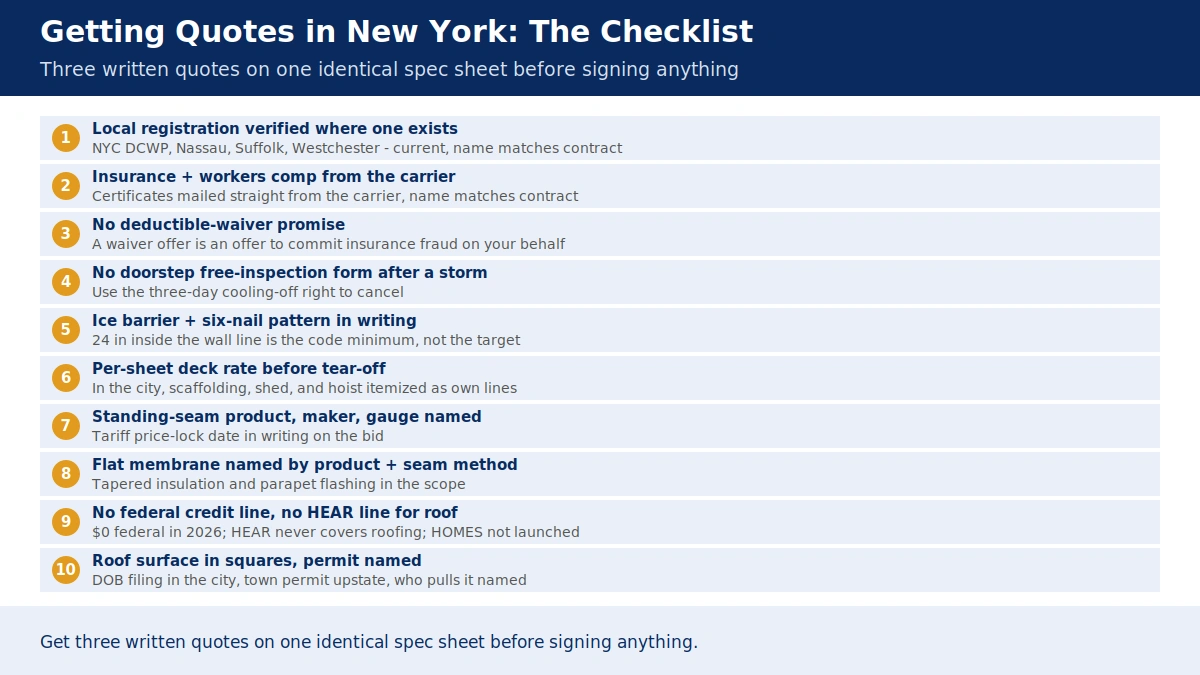
Three written quotes on one identical spec sheet, from three contractors whose local registration checks out where one exists, before signing anything. That sums up the whole checklist in a single sentence. The ten checks below turn that sentence into practice.
- Local registration verified where one exists — NYC DCWP Home Improvement Contractor license, Nassau County Department of Consumer Affairs, Suffolk County Department of Labor, Licensing and Consumer Affairs, Westchester County Department of Consumer Protection — current, business name matching the contract exactly; upstate, where no license exists, the insurance certificates and references carry the whole screen.
- Insurance and workers’ compensation certificates sent straight from the carrier by mail, showing the same business name as the contract.
- No deductible-waiver promise — anyone offering one is offering to commit insurance fraud for you.
- Walk away from any free-inspection form pushed on you at the door after a storm — the federal three-day cooling-off right exists for exactly that moment.
- In writing: how far the ice barrier runs from the eave, in feet, and the six-nail high-wind pattern — the code asks for 24 inches inside the wall line as a floor, not a goal.
- Per-sheet deck rate in writing before tear-off, and in the city, scaffolding, sidewalk shed, and hoist itemized as their own lines.
- Standing-seam product name, manufacturer, and gauge named on the bid where metal is quoted, with the tariff price-lock date in writing.
- Flat-roof membrane named by product and seam method, with tapered insulation and parapet flashing in the scope.
- No federal tax-credit line ($0 in 2026) and no HEAR rebate line for the roof (HEAR never covers roofing; HOMES has not launched in New York).
- Quote states the roof surface in squares, not the living area, with the permit cost and who pulls it named — DOB filing in the city, town permit upstate.
Sources & methodology
Cost anchors: MyRoofData — New York (2026 model: typical single-family arch roof $15,750–$27,000, tear-off of one layer included, ~22% above national average; 3-tab $427–$671/sq, arch $549–$915/sq before tear-off, ribbed metal $671–$1,159, standing seam $1,159–$1,952, flat membrane $671–$1,159; crews $68–$120/hr; permits upstate $75–$300); RoofingEstimatorPros — New York (updated Aug 26, 2026: 2,000 sq ft arch $18,329–$32,259, avg $24,520, ~$12.26/sq ft, state multiplier 1.25x; NYC 2,000 sq ft $24,017–$41,428, avg $31,755, ~$15.88/sq ft, local multiplier 1.56x, labor 1.78x; permits NY state $400–$1,800, NYC $800–$3,500; 1–3 day install); CostKit — New York (refreshed Nov 10, 2026: 1,800–2,200 sq ft asphalt roof $15,300–$33,900, ~$7.64–$17.94/sq ft); RoofVista — New York (2026: arch $5.30–$7.95/sq ft, avg project $10,000–$18,750; metal $10.50–$17.85/sq ft installed, $20,000–$42,500 avg project; standing seam $10–$17/sq ft; NYC labor $60–$95/hr; 1,500 sq ft arch — NYC $18,000–$35,000, Long Island $13,000–$25,000, Hudson Valley/Westchester $12,000–$22,000, Capital Region/Albany $9,500–$17,000, Buffalo/Rochester/Syracuse $9,000–$18,000, North Country/Adirondacks $9,000–$16,000; tariff report +12–20% imported standing-seam metal, +8–12% flashing/fasteners, +5–10% asphalt — single source, flagged); Modernize — New York (updated Aug 28, 2026: 2,000 sq ft roof NYC $14,500–$25,500, Long Island $14,000–$24,500; metal $10–$20/sq ft, $20,000–$40,000 for 2,000 sq ft); Angi — NYC (updated Jul 31, 2026: avg $8,690, most $5,491–$11,926, ~$5.40/sq ft — low anchor, small-roof mix); Alter Phase — NYC flat roofs (updated Oct 26, 2026: shingle $3–$10/sq ft, flat $5–$14/sq ft; 1,000 sq ft flat — Manhattan $8,000–$22,000+, Brooklyn $6,500–$17,000, Queens $5,500–$15,000, Bronx $6,000–$16,000, Staten Island $5,000–$13,000); Gold GCP — NY metro (2,000 sq ft asphalt $9,150–$18,350; 1,000 sq ft flat $3,950–$14,400); New England Metal Roof table (NYC asphalt $8–$12/sq ft vs upstate $5–$7.50; NYC metal $15–$22/sq ft vs Western NY $10–$15). The 25-square material totals, the size table, and the cost-per-year figures are calculations of ours, built from the per-square ranges and lifespans.
Climate + snow + ice: snowfall 1991–2020 normals, NCEI (Syracuse 127.8 in/yr; Rochester 102.0 in/yr; Buffalo 95.4 in/yr; Albany ~59 in/yr; New York City ~30 in/yr); Syracuse ~114 in/yr by another measure — conflicts with the 127.8 in NCEI figure; both printed; Tug Hill Plateau regularly exceeds 200 in/yr; Buffalo record seasons over 130 in; lake effect (Great Lakes); ground snow load ~20 psf NYC to 50+ psf upstate per ASCE 7; ice barrier 24 inches inside the wall line, 36 inches on 8/12 or steeper (IRC rule adopted in the NY Uniform Code); insulation R-49 to R-60; design temperature Albany minus 1 degree (from art. 115).
Permits + licensing: New York State Uniform Fire Prevention and Building Code (modeled on IRC); NYC DOB permit required for replacement, filing plus professional fees can exceed $1,000; NYC permit range $800–$3,500, statewide $400–$1,800 (RoofingEstimatorPros); upstate town permits $75–$300 (MyRoofData). No statewide roofer license (NY Department of State; NY Attorney General list: NYC, Nassau, Suffolk, Westchester, Putnam, Rockland, City of Buffalo); NYC DCWP HIC license for residential work over $200 — 30-question exam, 21 to pass, $20,000 surety bond or $200 Trust Fund, 2 years, expires February 28 of odd years; NYC DOB General Contractor Registration to pull permits for 1–3 family homes; Nassau County Department of Consumer Affairs (license before any work, advertising, or solicitation); Suffolk County Code Chapter 563 (roofing named, written exam, license number on advertising and contracts); Westchester County Department of Consumer Protection ($750 for two years since January 1, 2026; Yonkers additional requirements); licenses do not transfer between jurisdictions; General Business Law Article 36-A (contracts $500+ in writing); federal Cooling-Off Rule (three days to cancel a door-to-door contract).
Insurance: no verified New York average home insurance premium was pulled, so none is given; III (raising deductible $500 to $1,000 cuts premium 10–25%); 15-year roof-age ACV trigger (carrier practice, as in other states in this series); RCV/ACV table is labeled illustrative arithmetic on an $18,300 roof, the midpoint of the NY architectural band.
HEAR / HOMES + federal: New York first state to launch IRA home energy rebates, June 2024, via NYSERDA EmPower+; EmPower+ manual now allows HEAR money only for insulation, air sealing, and ventilation, up to $1,600, on projects without a heat pump (FixFirstHome, verified Sep 26, 2026); heat pumps in EmPower+ paid from state funds; HOMES not launched in New York, no NY HOMES figure verified; DOE Program Notice 26-2 (May 29, 2026: HEAR electric-to-electric only). OBBBA (P.L. 119-21) and IRS FS-2025-05: for any install with a placed-in-service date after Dec 31, 2025, neither §25C nor §25D stands.
Repair costs: no verified New York repair price was pulled, so none is given; see our roof repair cost guide for national planning figures.
How we worked: every 25-square material total, size-table figure, and cost-per-year number is arithmetic of ours, worked from the cited per-square ranges and lifespans and labeled as such. We flagged the headline-cost disagreement, the tariff report as single-source, the Syracuse snowfall conflict (127.8 vs ~114 in), the snow-load range (20–50+ psf by county), and the city-pricing gaps (no verified 2,000 sq ft figure for Hudson Valley/Westchester, Albany, Buffalo/Rochester/Syracuse, or the North Country; no verified New York premium average; no verified New York repair prices; no named carrier’s New York metal discount; no cedar, tile, or slate prices). No North Country 2,000 sq ft price, no NY metro roofer wage, no New York-specific design wind speed, and no statewide hail-event count were verified, so none are given. The lifespans given for New York here are contractor-consensus estimates, fitted to a climate of snow, ice dams, and freeze-thaw — realistic figures, not numbers taken from a single published table.
*Disclaimer: The prices here are 2026 New York planning figures. City, borough, roof, and contractor each shift the numbers. Before you fix a budget, collect three written quotes from New York roofers. Everything here about taxes is general information, not guidance for your own return. Run your own return past a New York tax professional before filing. Program rules change — HEAR terms and NYSERDA program rules move with federal notices — so confirm current terms with NYSERDA and your own county before signing.*
How much should a New York homeowner budget for a roof replacement in 2026?
MyRoofData’s 2026 model is the anchor: $15,750–$27,000 for a typical single-family architectural shingle roof, tear-off of one layer included — about 22 percent above the national average. RoofingEstimatorPros prices a 2,000 square foot architectural roof at $18,329–$32,259 statewide, averaging $24,520, and $24,017–$41,428 in New York City, averaging $31,755. On a 25-square roof: 3-tab shingles $10,675–$16,775 before tear-off, architectural shingles $13,725–$22,875, ribbed metal $16,775–$28,975, standing-seam metal $28,975–$48,800, and flat membrane $16,775–$28,975.
Why does a roof cost so much more in New York City than upstate?
Labor, permits, and access — not snow. The city’s labor multiplier runs to 1.78 times the national figure, crews bill $60–$95 an hour, and the Department of Buildings filing with professional fees can exceed $1,000, against $75–$300 for an upstate town permit. Then comes the access bill: scaffolding, sidewalk sheds, and hoists on a five-story row house, priced by the day. Upstate roofs cost less to install and more to own: Syracuse takes nearly 128 inches of snow a year against the city’s 30, so the upstate spec — ice barrier, ventilation, pitch — carries the cost the city spends on access.
What is an ice dam, and how do I stop one on a New York roof?
An ice dam begins in the attic: escaping heat melts the snow on the upper roof, and the water runs down and freezes again where the eave turns cold, building a ridge of ice. The melt after that ponds behind the ridge, works back under the shingles, and leaks into the house. The fix is three layers deep: an ice and water shield membrane running at least 24 inches inside the exterior wall line under the New York Uniform Code (two or three courses, six to nine feet, on deep-overhang or low-pitch roofs), attic insulation of R-49 to R-60, and balanced soffit-to-ridge ventilation. A reroof is the one moment when all three can be fixed together.
Does my New York roofer need a license?
It depends on the county, because New York has no statewide roofer license. A Home Improvement Contractor license is mandatory in New York City — from the Department of Consumer and Worker Protection, for residential work over $200, with a 30-question exam, a $20,000 surety bond or a $200 trust-fund payment, running two years — and in Nassau, Suffolk, Westchester, Putnam, and Rockland counties and the city of Buffalo. In most of upstate New York, no license exists at all: the permit is the only official check, and the homeowner’s screen is the insurance certificates, the references, and the written contract under General Business Law Article 36-A. A license in one county is valid in no other.
Is a permit required for a roof replacement in New York?
Yes, for a full replacement. Upstate town permits run $75–$300 for a typical job; RoofingEstimatorPros puts the statewide range at $400–$1,800 and the New York City range at $800–$3,500, with the city’s filing and professional fees able to exceed $1,000. In the city the permit comes from the Department of Buildings, and the contractor should pull it and schedule the inspection. A minor repair usually needs no permit at all. The licensed contractor should pull the permit — a contractor who asks the homeowner to pull it is a contractor who does not do this work often enough.
Can I claim a federal tax credit on a New York roof in 2026?
No — $0. The One Big Beautiful Bill Act retired both credits for installs after December 31, 2025 — and roofing never counted as solar equipment, so the solar credit was never available for a roof. New York did launch the federal HEAR rebates first in the country, but they never pay for a roof: the current EmPower+ manual allows HEAR money only for insulation, air sealing, and ventilation, up to $1,600, on projects without a heat pump, and HOMES has not launched in New York. The insurer is what pays: a roof that sheds snow and avoids the ice-dam claim saves a deductible every time it does.
How long does a roof last in New York?
Brochure lifespans assume mild states; metal is the exception that lasts longer. Lifespans that hold up in New York: 3-tab shingles 12–18 years, architectural shingles 18–25 years, ribbed metal 30–40 years, standing-seam metal 40–70 years, flat membrane 20–30 years. What kills a New York roof is snow load, ice dams, freeze-thaw cycling, and wind lifting poorly nailed tabs. The two inspection windows are late fall, once storm season is over, and late spring, before it begins.
How do I spot a storm-chaser roofer working my neighborhood after a storm?
New York is storm-chaser territory after a nor’easter or a lake-effect blizzard, and the crews arrive within days. Look for a door knock pushing a free-inspection agreement signed on the spot, out-of-state phone numbers, no permanent local office, no local license where one is required, a promise to waive or absorb your deductible, and a demand for a large payment up front. Waiving a deductible is insurance fraud — and a contractor who offers it is volunteering to commit it with you. The federal Cooling-Off Rule gives you three days to cancel a contract signed at the door — use it. Before you sign, check the local license where one exists, get the carrier to mail you the insurance certificates directly, and line up three written quotes on one identical spec sheet.