

Table of Contents
Texas does not have one roofing market. It has at least three, and they barely talk to each other. In Dallas-Fort Worth, hail decides when your roof gets replaced — often every 12 to 16 years, whether the shingles are worn out or not. In Houston, humidity and hurricane wind detailing set the price, and a flat roof section can fail from ponding water long before the shingles age out. On the Gulf Coast, a certificate called a WPI-8 stands between your new roof and your windstorm insurance. And in West Texas, the sun and the wind do the damage slowly, year after year, until the granules are gone and the ridge caps start lifting.
This guide prices the whole state the way a Texas roofer would: by material, by home size, and by metro — Houston, Dallas-Fort Worth, Austin, and San Antonio — with the hail, insurance, and coastal rules that actually move the number. It also covers the one upgrade that pays for itself in Texas: Class 4 impact-resistant shingles, which Texas law requires insurers to discount.
Start with the national numbers in our roof replacement cost guide if you want the country-wide baseline.
How Much Does a Roof Replacement Cost in Texas in 2026?
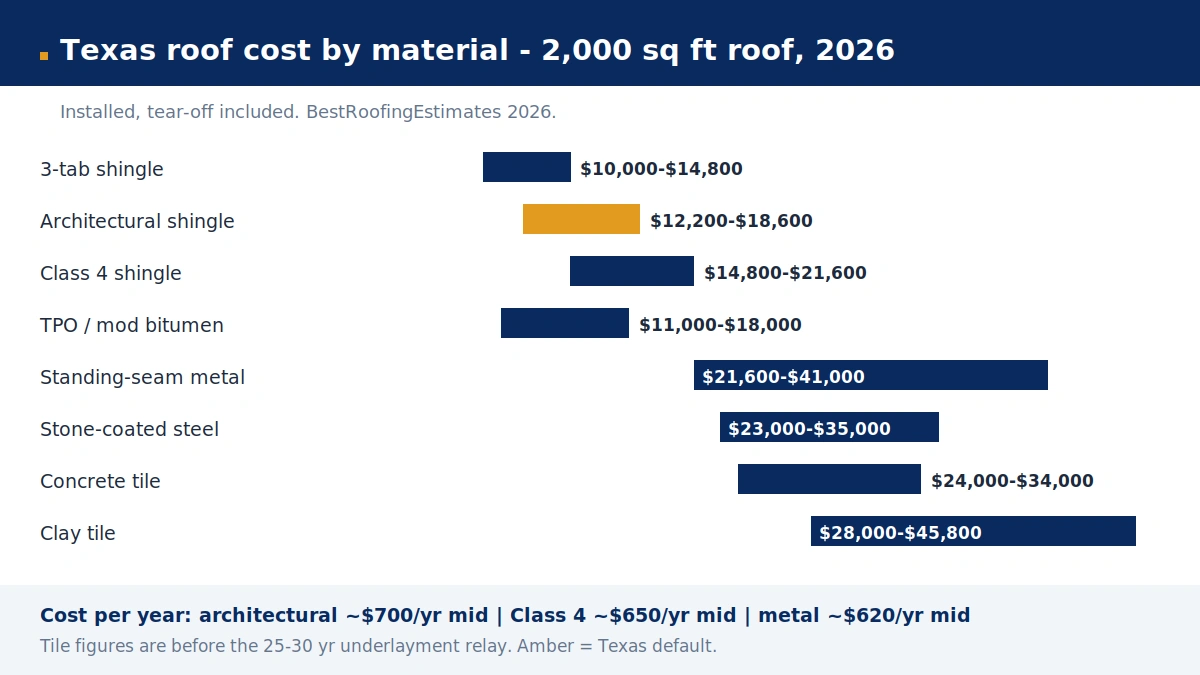
The strongest single Texas anchor is BestRoofingEstimates’ 2026 Texas guide: a full architectural asphalt replacement on a typical 2,000 sq ft Texas home runs roughly $12,300–$18,500, with standing-seam metal at $21,600–$41,000 and clay or concrete tile at $24,000–$45,800. SatelliteQuotes’ 2026 model lands in the same band from below: architectural shingles at $8,500–$16,000 on a 1,500–2,500 sq ft house, about $11,945 on a 2,000 sq ft one. This Old House’s 2026 survey puts the Texas average lower, at $8,634, with a range of $6,777–$20,531 — treat that as the low-end cross-check, not the headline, because survey averages pull in smaller and older jobs.
Put together, the honest headline is this: most Texas homeowners pay $8,500–$22,000 for a full replacement in 2026, and architectural shingles on a typical 2,000 sq ft home sit at $11,000–$18,500. Every figure in this guide is installed, tear-off included, unless the text says otherwise.
| Material | $/sq ft installed (roof surface) | 2,000 sq ft roof total | Texas realistic lifespan |
|---|---|---|---|
| 3-tab shingle | $5.00–$7.40 | $10,000–$14,800 | 12–17 yrs |
| Architectural shingle | $6.10–$9.30 | $12,200–$18,600 | 18–22 yrs |
| Class 4 impact shingle | $7.40–$10.80 | $14,800–$21,600 | 22–28 yrs |
| Standing-seam metal | $10.80–$20.50 | $21,600–$41,000 | 40–60 yrs |
| Stone-coated steel | $11.50–$17.50 | $23,000–$35,000 | 40–50 yrs |
| Concrete tile | $12.00–$17.00 | $24,000–$34,000 | 40–50 yrs (tile); underlayment 25–30 yrs |
| Clay tile | $14.00–$22.90 | $28,000–$45,800 | 50–75 yrs (tile); underlayment 25–30 yrs |
| TPO / modified bitumen (low-slope) | $5.50–$9.00 | $11,000–$18,000 | 15–25 yrs |
Sources: BestRoofingEstimates Texas guide (2026); ARP Roofing Texas pricing (updated September 2026); SatelliteQuotes Texas 2026 model; This Old House Texas guide (2026).
One Texas contractor’s numbers run higher and are worth naming so the gap does not confuse you. ARP Roofing prices shingles at $4.95–$10.50 per sq ft of roof area and puts a shingle replacement on a 2,000 sq ft home at $17,600–$28,800. That is not a contradiction — it is a different measuring stick. ARP’s calculator treats a 2,000 sq ft home as having a 3,200 sq ft roof (1.6 times the living area, counting garage, overhangs, and pitch), while BestRoofingEstimates uses about 1.3 times. The lesson is the same one Texas roofers repeat on every estimate: never compare two quotes until you know which area each one priced. Roof surface runs roughly 1.3 to 1.7 times living area in Texas, and a quote that does not say which area it used cannot be compared to one that does.
Where the money goes on a typical Texas job: labor runs 40–60% of the total in Dallas-Fort Worth and Houston, with a small premium in Austin, where the residential labor market is tighter (BestRoofingEstimates). Materials take about 40%, and overhead and profit the rest. Tear-off and disposal, the permit, and mobilization typically add $300–$1,000 combined (BestRoofingEstimates). A second tear-off layer adds $1.00–$1.80 per sq ft, and older housing stock in 1970s–1990s Dallas and Houston suburbs commonly carries two layers. Decking is the unknown until tear-off: replacement OSB runs $55–$95 per 4×8 sheet installed, and honest quotes carry a per-sheet allowance instead of a lump sum.
Roof Replacement Cost in Texas by Material
Material moves the invoice more than anything else — metal and tile run two to three times what shingles cost to install. The sticker price still tells only half the Texas story, because hail and heat cut shingle life short while metal and tile mostly shrug them off. The table below pairs 2026 installed prices with Texas lifespans and cost per year of service, so the expensive option can be judged on what it costs per year, not per invoice.
| Material | $/sq ft installed | 2,000 sq ft roof total | Texas lifespan | Cost per year* |
|---|---|---|---|---|
| 3-tab shingle | $5.00–$7.40 | $10,000–$14,800 | 12–17 yrs | ~$590–$1,230/yr |
| Architectural shingle | $6.10–$9.30 | $12,200–$18,600 | 18–22 yrs | ~$555–$1,030/yr (mid ~$700/yr) |
| Class 4 impact shingle | $7.40–$10.80 | $14,800–$21,600 | 22–28 yrs | ~$530–$980/yr (mid ~$650/yr) |
| Standing-seam metal | $10.80–$20.50 | $21,600–$41,000 | 40–60 yrs | ~$360–$1,025/yr (mid ~$620/yr) |
| Stone-coated steel | $11.50–$17.50 | $23,000–$35,000 | 40–50 yrs | ~$460–$875/yr |
| Concrete tile | $12.00–$17.00 | $24,000–$34,000 | 40–50 yrs tile; relay at ~25–30 yrs | ~$480–$850/yr before relay |
| Clay tile | $14.00–$22.90 | $28,000–$45,800 | 50–75 yrs tile; relay at ~25–30 yrs | ~$375–$915/yr before relay |
| TPO / modified bitumen | $5.50–$9.00 | $11,000–$18,000 | 15–25 yrs | ~$440–$1,200/yr |
*Cost per year = installed cost divided by Texas realistic lifespan. Tile figures are before the mid-life underlayment relay — never quote tile’s 50-year life without the relay next to it. Lifespan and price sources: BestRoofingEstimates (2026); ARP Roofing (September 2026).
Architectural shingles are what most Texas roofs already are: the lowest bid, the most crews who install them, and the simplest product to patch after a storm. Hail is what limits them — a Dallas roof typically comes off every 12–16 years, not because the shingle wore out at 18–22, but because hail got to it first (BestRoofingEstimates). BestRoofingEstimates’ own worked example makes the point: a $15,000 architectural job with a 17-year expected life (factoring in one likely hail-claim replacement in that window) costs roughly $880 per year in material amortization.
Class 4 impact-resistant shingles are the upgrade this guide spends a whole section on below, because in Texas they are not a luxury — they are the highest-leverage purchase on the market. They run $7.40–$10.80 per sq ft installed, only 12–18% more than standard architectural shingles, and they stretch service life to 22–28 years while earning an insurance discount that usually pays the upgrade back in 3–4 years (BestRoofingEstimates).
Standing-seam metal is the fastest-growing roof category in Texas (BestRoofingEstimates). At $10.80–$20.50 per sq ft, a 2,000 sq ft roof runs $21,600–$41,000 — roughly double architectural shingle upfront. What you buy is 40–60 years, Class 4 impact resistance as standard, wind ratings of 140–180 mph with mechanical clipping, and a cool-rated finish that reflects up to 70% of solar radiation (BestRoofingEstimates). On BestRoofingEstimates’ example math, a $28,000 metal roof over 45 years costs about $620 per year — cheaper per year than shingles. One Texas-specific installation detail: long panel runs can expand and contract close to half an inch between a 30°F January morning and a 110°F July afternoon, so floating clip systems are strongly preferred over fixed fastening (BestRoofingEstimates). If you are torn between the two, our metal roof vs shingles cost comparison runs the head-to-head.
Stone-coated steel delivers the shingle or tile look with metal durability at $11.50–$17.50 per sq ft ($23,000–$35,000 on 2,000 sq ft), with Class 4 impact ratings standard and a 40–50 year life. A common Dallas-Fort Worth strategy after a total-loss hail claim on an aging architectural roof: apply the insurance payout toward a stone-coated steel upgrade and pay only the material-cost difference out of pocket, ending up with a roof that typically survives the next hailstorms without another claim (BestRoofingEstimates).
Concrete and clay tile are common on South Texas, Rio Grande Valley, Austin, and Hill Country homes with Spanish, Mediterranean, or mission styling. Concrete runs $12.00–$17.00 per sq ft; clay barrel tile $14.00–$22.90. The tile itself lasts 40–75 years, but the underlayment beneath it — typically a synthetic or SBS-modified bitumen sheet — has to be replaced every 25–30 years (BestRoofingEstimates). That re-lay job runs about 55–70% of a full new tile roof, because the crew carefully removes the tile, stacks it, and resets it on fresh underlayment. If you are buying a 1990s home with original tile, budget for a re-lay within the next five to ten years. And tile is heavy: a house not framed for it needs a structural review before anyone talks about color (ARP Roofing).
TPO and modified bitumen cover the flat and low-slope sections that show up on Houston mid-century ranch homes and Texas commercial buildings, at $5.50–$9.00 per sq ft (BestRoofingEstimates). The full flat-roof picture is in the dedicated section below.
The takeaway: metal and tile ask for two to three times the shingle money on day one, then hand most of it back over the decades — because a Texas shingle roof comes off when hail says so, not when the warranty says so. The national material-by-material numbers live in our metal roof cost guide and tile roof cost guide.
Roof Replacement Cost by Roof Size
The table below uses BestRoofingEstimates’ 2026 home-size table, priced by home size (living area), with roof surface assumed at about 1.3 times living area. Read it that way: a 2,000 sq ft home here carries roughly a 2,600 sq ft roof, which is why these totals run a little higher than the per-roof-sq-ft table in the first section.
| Home size | 3-tab asphalt | Architectural | Standing-seam metal | Concrete / clay tile |
|---|---|---|---|---|
| 1,000 sq ft | $5,000–$7,400 | $6,100–$9,300 | $10,800–$20,500 | $12,000–$22,900 |
| 1,500 sq ft | $7,400–$11,100 | $9,200–$13,900 | $16,200–$30,700 | $18,000–$34,300 |
| 2,000 sq ft | $9,900–$14,800 | $12,300–$18,500 | $21,600–$41,000 | $24,000–$45,800 |
| 2,500 sq ft | $12,400–$18,500 | $15,400–$23,200 | $27,000–$51,300 | $30,000–$57,200 |
| 3,000 sq ft | $14,900–$22,200 | $18,500–$27,800 | $32,400–$61,500 | $36,000–$68,700 |
Cross-checks: SatelliteQuotes’ model puts architectural shingles on a 2,000 sq ft house at about $11,945 — inside the band above, toward the low end. RoofQuoteCalc’s 2026 city table puts architectural shingles at $9,000–$16,000 in Dallas-Fort Worth, $9,500–$16,000 in Houston, and $9,500–$16,500 in Austin on a typical home. Small homes pay more per sq ft because the fixed costs — permits, dumpsters, mobilization — spread over fewer squares. Big or heavily cut-up roofs cost more for their shape, not just their size: steep pitch above 6:12 adds 15–25% to labor, and Hill Country and Austin custom homes with dormers and two-story covered patios push the roof-area multiplier higher (BestRoofingEstimates).
Why Texas Roofs Cost What They Do: Hail, Heat & Hurricanes
Texas packs four distinct climate zones into one state, and the stress that kills roofs changes completely from Houston to Amarillo (BestRoofingEstimates). A roofer who specifies the same roof for all four is not saving you money — they are selling you the wrong roof.
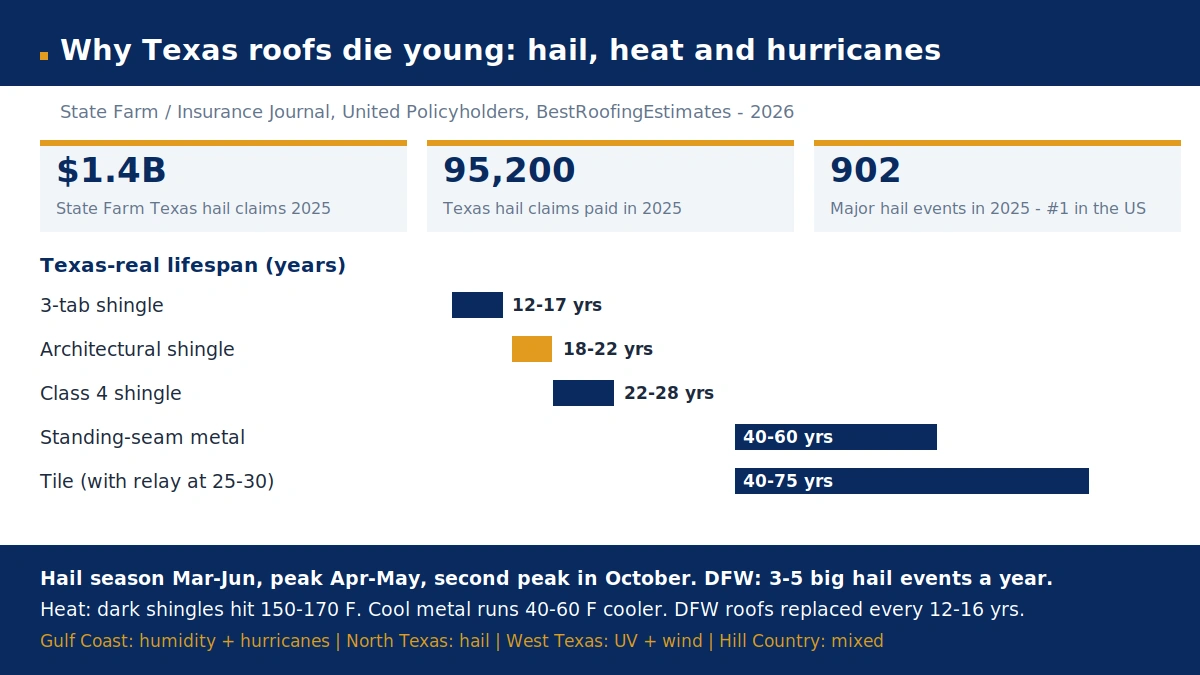
Hail is the headline. Texas led the nation in hail losses again in 2025: State Farm paid about $1.4 billion on roughly 95,200 Texas hail claims, averaging near $15,000 each — up more than 27% year over year, and more than any other state (Insurance Journal / State Farm, via Latent Insurance and Live Insurance News, 2026). Texas recorded 902 major hail events in 2025, the most of any state for the eleventh straight year (United Policyholders analysis, May 2026). One week of storms in June 2023 generated an estimated $6.1 billion in insured wind and hail losses in Texas, and hail of at least one inch struck about two million Texas homes that year (Cotality).
Hail season runs March through June, with the worst storms in April and May, plus a secondary severe-weather peak in October (Dent Mechanic Group, 2026). Dallas-Fort Worth averages 3–5 significant hail events per year; the northern suburbs take the worst of it — Frisco, McKinney, and Plano average 4.8 hail days a year (Quality Home Improvement, May 2026, from NOAA data 2020–2026). One contractor’s 2026 storm archive counted 1-inch-plus hail on 18 separate days between April and September across Dallas-Fort Worth counties, with 481,083 homes under that hail — a single-source archive, not NOAA, but it captures the pattern: a Texas roof does not fail in one storm, it fails from eighteen (Texas Roof Rescue, computed October 6, 2026).
Heat and UV do the slow damage. Texas asphalt lives a shorter life than the brochure promises: 3-tab shingles last 12–17 years, architectural shingles 18–22 years (BestRoofingEstimates). Dark shingles hit 150–170°F at the surface on a summer afternoon, while cool-coated metal stays 40–60°F cooler (BestRoofingEstimates). In West Texas and the Panhandle, the highest sustained UV in the state plus persistent straight-line wind and sandy dust push granule loss more than 20% faster than the US average, and ridge-cap lift is the recurring repair call (BestRoofingEstimates). The two forces interact: granule loss from repeated small hail exposes asphalt to UV, the UV embrittles it, and the next stone cracks a shingle that a flexible one would have shrugged off.
Hurricanes and humidity rule the Gulf Coast. Hurricane season runs June through November (BestRoofingEstimates). Houston combines year-round humidity, named-storm threats, and heavy rain; algae staining on asphalt is common, so algae-resistant shingles are worth specifying. On flat and low-slope sections, ponding water plus Gulf Coast humidity is the fastest path to premature membrane failure — a low-slope section needs a minimum quarter-inch-per-foot slope, tapered insulation where the slope is inadequate, and overflow scuppers or secondary drains (BestRoofingEstimates).
The four zones, in short (BestRoofingEstimates): the Gulf Coast fights humidity and hurricanes; North Texas fights hail and tornadoes; West Texas and the Panhandle fight UV, heat, and straight-line wind; the Hill Country and Central Texas mix all of it — hail risk, high summer UV, occasional hard freezes, and complex custom-home roof shapes. Most of Central Texas benefits from impact-rated architectural asphalt at minimum; high-end custom homes increasingly specify standing-seam metal or clay tile.
Class 4 Impact-Resistant Shingles: The Texas Sweet Spot
For any home north of Waco, along the I-35 corridor from Austin to Dallas-Fort Worth, and most homes west through Abilene and San Angelo, Class 4 impact-rated shingles are the highest-leverage upgrade on the Texas market (BestRoofingEstimates). Here is why the math works.
What Class 4 means. UL 2218 is the impact test, and Class 4 is its top rating: the shingle must survive a 2-inch steel ball dropped from 20 feet without cracking (Latent Insurance; The Agent’s Office, April 2026; Coker General Contractors, May 2026). Named products in 2026 Texas sources include GAF Timberline AS II and HDZ, Owens Corning Duration Storm, CertainTeed Landmark IR, Atlas StormMaster Shake, and Malarkey Legacy.
The discount is required by Texas law. Texas law requires carriers to offer premium credits for UL 2218-certified impact-resistant roofing, and most North Texas carriers discount the dwelling premium by 20–35% for a documented Class 4 roof (The Agent’s Office; Coker; Latent Insurance). BestRoofingEstimates puts the typical carrier discount a little lower, at 15–28%. The honest working range is 15–35%, most-cited 20–35% in Dallas-Fort Worth. One detail that matters for the math: the discount applies to the dwelling coverage portion of the premium, not the whole bill — a 25% dwelling discount works out to roughly a 12–20% cut to the total annual premium (The Agent’s Office).
The dollar math. On a $500,000 home, the discount typically saves $700–$1,500 a year (The Agent’s Office); on a $350,000 home, $400–$900 a year (Coker). The upgrade itself costs $1,500–$4,000 more than standard shingles (The Agent’s Office), or about 12–25% more upfront (BestRoofingEstimates; Coker). At those numbers, most North Texas homeowners break even in 2–4 years and come out $8,000–$15,000 ahead over the life of the roof (The Agent’s Office). BestRoofingEstimates’ own example: a $15,000 architectural job at ~$880 a year over 17 years, versus an $18,000 Class 4 job at ~$820 a year over 22 years — plus a typical 20% insurance discount clipping another $300–$500 a year off total carrying cost.
The paperwork is the part people skip. The roofer must complete TDI Form PC068 (the Impact-Resistant Roofing Installation Form) and submit it to your agent, and the product must sit on the Texas Department of Insurance’s qualifying list (Latent Insurance; Coker; The Agent’s Office). No form, no discount — get it filed the week the roof goes on, not at renewal.
The trap: the cosmetic exclusion. Many carriers require you to accept Endorsement HO-145 — the exclusion of cosmetic damage to roof coverings caused by hail — to grant the full discount (The Agent’s Office). Under HO-145, hail that dents your shingles without cracking them or causing a leak pays nothing. Functional damage — cracking, leaking — is still covered normally. Read the endorsement before you sign, and decide with your eyes open: you are trading cosmetic coverage for a real annual discount.
Bottom line: in the hail corridor, Class 4 is not an upsell. It is the default specification that happens to pay for itself. Outside the corridor — deep South Texas, the Valley — standard architectural shingles are a reasonable choice, and the discount is smaller because the hail risk is smaller.
Flat & Low-Slope Roofs: TPO, Modified Bitumen & Metal
Much of Houston’s housing stock — especially mid-century ranch homes — carries flat or low-slope sections, and Texas commercial buildings run on them almost entirely. These roofs are a different product with a different failure mode: they do not shed water, they manage it, and when the drainage fails, the membrane follows.
TPO (thermoplastic polyolefin) is the dominant single-ply membrane in Texas. Installed cost runs $5.00–$10.00 per sq ft (Trivan Roofing, October 2026), with Houston commercial work at $5.50–$9.00 and residential flat roofs at $7.00–$11.00 (RJT Construction, 2026). On a 2,000 sq ft flat section, that is roughly $11,000–$18,000 at the BestRoofingEstimates $5.50–$9.00 band. TPO is white and reflective, heat-welded at the seams into a near-waterproof bond, and Energy Star rated. Lifespan runs 15–25 years (RJT), with some 2026 sources stretching to 20–30 years — use 15–25 as the working figure.
Modified bitumen runs in the same band, $5.50–$9.00 per sq ft (BestRoofingEstimates), and is the older workhorse for low-slope Texas roofs. PVC runs a little higher at $5.00–$9.00 per sq ft in Austin commercial work, and earns its premium on restaurants and kitchens where grease and chemicals attack the membrane (Jamar Roofing, 2026; ARP Roofing). EPDM rubber runs $4.00–$7.00 per sq ft in Austin (Jamar Roofing).
The insulation underneath matters more than most owners realize. Board insulation normally goes in as part of a low-slope system at about $1–$1.50 per sq ft per inch installed, delivering roughly R-4 to R-6 per inch, and most of Texas needs R-25 of above-deck insulation (Roof Observations, 2026). A ballasted TPO overlay with no insulation can run as low as $3.55 per sq ft, but the same 60-mil membrane with R-25 insulation runs $7.70 — the insulation is not a rounding error, it is a third of the job (Roof Observations).
The Houston humidity warning, stated plainly: any low-slope section needs pronounced slope to drain — a quarter-inch per foot minimum — plus tapered insulation where the slope is inadequate and overflow scuppers or secondary drains (BestRoofingEstimates). Ponding water plus Gulf Coast humidity is the fastest path to premature membrane failure. A flat-roof patch runs $500–$1,800 (BestRoofingEstimates), and ponding-water areas often need a tapered-insulation fix, not another patch. For the full membrane comparison, see our flat roof replacement cost guide.
What Drives Your Quote Up or Down
Nine factors explain almost every dollar of difference between two Texas bids on the same house (BestRoofingEstimates). Understand them before you review any proposal.
- Material. See the material table — metal and tile run two to three times shingle upfront, and Class 4 adds 12–25% over standard architectural shingles.
- Roof area, not home area. Roof surface runs roughly 1.3 times the living-area footprint in Texas, and steeper pitches, dormers, and two-story covered patios push that multiplier higher (BestRoofingEstimates). Make the roofer measure; do not price off your living area.
- Pitch. Most Texas tract homes sit at 4:12 or 5:12. Anything above 6:12 — common on Hill Country, Fredericksburg, and Austin custom homes and Dallas tear-down rebuilds — slows the crew, requires fall protection, and bumps labor 15–25% (BestRoofingEstimates).
- Tear-off layers. One layer is standard. A second layer adds $1.00–$1.80 per sq ft plus disposal, and older Texas housing stock commonly carries two (BestRoofingEstimates).
- Decking condition. North Texas hail regularly damages not just shingles but OSB decking and vent flashings. Replacement OSB runs $55–$95 per 4×8 sheet installed, and repeat hail claims often mean the third or fourth claim in fifteen years (BestRoofingEstimates).
- Underlayment grade. The spread between bargain felt and premium synthetic is $500–$1,100 per 2,000 sq ft home. Gulf Coast hurricane zones require self-adhered, wind-rated underlayment for TWIA compliance (BestRoofingEstimates).
- Wind and hail rating. Class 4 shingles are strongly recommended across North Texas and the I-35 corridor, and the insurance discount usually covers the upgrade within three to four years (BestRoofingEstimates).
- Flashing and ventilation. New flashing at valleys, sidewalls, chimneys, skylights, and pipe penetrations is cheap insurance. Reusing old flashing saves $400–$900 upfront and is one of the most common reasons Texas roofs leak within five years — especially in Houston’s humidity (BestRoofingEstimates). Gutters usually go on alongside a reroof; see our gutter installation cost guide for those numbers. Adding ridge vents, upgrading box vents, or installing a solar-powered attic fan costs $400–$1,800 during a replacement and pays back in cooling savings and longer shingle life.
- Permit, haul-off, and mobilization. Typically $300–$1,000 combined depending on metro, plus $150–$300 for a WPI-8 inspection on Gulf Coast coastal counties (BestRoofingEstimates). Reject any bid that does not itemize the permit and disposal — they are the easiest line items to hide and reintroduce as change orders.
Two more Texas-specific movers sit outside that list. Season and storm timing: prices rise 10–25% after hurricane or hail events as labor and materials tighten, with some sources reporting labor surges up to 40% (New England Metal Roof; LocalBizzInfo). HOA approval: many Plano, Frisco, Southlake, The Woodlands, Katy, Round Rock, Cedar Park, and Alamo Heights neighborhoods enforce strict roof color and material rules, and tile-to-asphalt and asphalt-to-metal changes often require approval before the roofer pulls a permit (BestRoofingEstimates). ARP Roofing puts it more bluntly: the HOA sign-off, not the roofing, is often what sets the calendar — file it before you sign, not after.
Permits & Code: Houston, Dallas, Austin & San Antonio
A permit is required for a full re-roof in Texas’s major cities, and the fees and rules change at every city line. The table below is BestRoofingEstimates’ 2026 metro table.
| City / Jurisdiction | Typical permit fee | Notable requirement |
|---|---|---|
| Houston | $150–$400 | Online issuance; wind-zone fastening for replacements |
| Dallas | $100–$300 | Contractor must hold current Dallas roofer registration |
| San Antonio | $80–$250 | Building permit plus contractor general endorsement |
| Austin | $200–$500 | Highest metro fees; sometimes requires inspection for re-roofs |
| Fort Worth / Arlington | $100–$300 | Standard residential roofing permit; same-day online |
| El Paso | $75–$200 | Desert wind-zone fastening; low-slope requires slope confirmation |
| Corpus Christi & coastal counties | $100–$300 + $150–$300 WPI-8 | Mandatory WPI-8 inspection for TWIA windstorm eligibility |
| Lubbock / Amarillo | $80–$220 | Straight-line wind zone; fastener schedule inspection |
Cross-checks: HomeGuide (via This Old House) puts a Texas roofing permit at $150–$500, and LocalBizzInfo puts major-city permits at $200–$600. A fee-schedule calculator (PermitCalculator) lists a Dallas roof permit at $196.00 and Houston at $353.15 — inside the table above — but lists San Antonio at $26.50, which conflicts sharply with the $80–$250 band and looks like a partial fee. Use the table above; treat the $26.50 figure as a calculator output, not a city-published price.
Metro price differences follow the permit pattern but are driven mostly by labor. Against the Dallas-Fort Worth baseline (architectural asphalt on a 2,000 sq ft home, $12,300–$18,500), Houston runs 3–6% higher for humidity detailing and hurricane-wind fastening ($12,800–$19,400), Austin runs 5–10% higher on a tighter residential labor market ($13,000–$20,200), San Antonio tracks Dallas-Fort Worth or falls 2–4% below ($12,000–$18,200), El Paso and the Panhandle run 5–8% below on softer labor markets, and the Corpus Christi and Gulf Coast metros add 8–15% for WPI-8 inspection and enhanced wind fastening ($13,400–$21,300) (BestRoofingEstimates).
There is no state roofing license in Texas. That single fact makes contractor vetting harder here than in Arizona, California, or Florida, and it is the reason this section exists. Texas layers three protections instead (BestRoofingEstimates):
- City-level contractor registration. Most major metros require roofers to register with the city or obtain a general contractor endorsement before pulling a permit. Houston, Dallas, San Antonio, Austin, Fort Worth, and El Paso all have local rules that vary.
- Texas Department of Insurance (TDI) registration. Required for contractors who handle insurance claims or act as public insurance adjusters. Verify it at tdi.texas.gov before letting a contractor negotiate with your adjuster on your behalf.
- Roofing Contractors Association of Texas (RCAT) voluntary certification. Not a license, but a respected third-party credential — RCAT-certified roofers commit to an industry code of conduct and continuing education.
Because Texas has no statewide license, the burden of vetting falls on you. Never sign with a roofer who cannot show current general liability insurance (minimum $1M), active workers’ comp, local permit-pulling privileges in your city, and verifiable references from the last twelve months (BestRoofingEstimates).
One more Texas rule worth knowing before you sign: House Bill 2102 made it a deceptive trade practice for a Texas roofing contractor to also act as a public insurance adjuster on the same claim (BestRoofingEstimates). If a salesperson offers to “handle the insurance company for you” in exchange for a contingency percentage of your claim proceeds, that is a red flag — and possibly illegal. A legitimate contractor will help with documentation and attend the adjuster inspection, but will not negotiate the settlement amount on your behalf.
Sales tax, briefly: Texas applies sales tax to residential roof *repair* — labor and materials are taxable. A full replacement under a lump-sum contract on owner-occupied residential property is typically structured so the contractor pays tax on materials at wholesale and does not charge it separately on the invoice (BestRoofingEstimates). Ask any prospective roofer to explain how sales tax applies to your quote in writing — discrepancies here are a common source of surprise on final invoices.
The Gulf Coast Rules: TWIA, WPI-8 & Windstorm Certification
If your home sits on the Texas Gulf Coast, your roof replacement has a second approval track that has nothing to do with your city permit — and skipping it can void your windstorm coverage.
TWIA — the Texas Windstorm Insurance Association — is the insurer of last resort for wind and hail, and it writes wind and hail coverage only, in only 14 coastal counties (Aransas, Brazoria, Calhoun, Cameron, Chambers, Galveston, Jefferson, Kenedy, Kleberg, Matagorda, Nueces, Refugio, San Patricio, and Willacy) plus part of Harris County east of Highway 146 (Statewise Finance, 2026; TWIA, checked October 2026). Standard homeowners policies typically exclude windstorm damage in those counties, so TWIA is the only source for it. Its sibling, the Texas FAIR Plan Association (TFPA), writes basic property insurance statewide — but it cannot legally write wind or hail coverage for a property eligible for TWIA, so a TFPA policy in that zone carries a windstorm and hail exclusion attached by law.
The WPI-8 is the certificate that decides whether TWIA will insure you. A WPI-8 — a Windstorm Certificate of Compliance — proves the structure was built or repaired to coastal wind-resistance code. TWIA generally requires one before it will issue a policy, and the requirement applies to any construction, addition, remodel, or repair from 1988 onward. Replacing a roof, or repairing a significant portion of one, usually needs a certificate; roof repairs under 100 square feet that do not involve decking or framing usually do not (TWIA via Coverage Clock, October 2026; Diamond Certified Roofers, 2026).
Three details that catch Gulf Coast homeowners out:
- The code year changed in 2026. Starting April 1, 2026, new certifications must meet the 2024 building code rather than the 2018 version (Statewise Finance; Diamond Certified Roofers). A roofer quoting 2018-code work in 2026 is quoting the wrong standard.
- The inspection happens during the work. To keep TWIA coverage after a roof replacement in a designated county, the work must be inspected *during installation* by a TDI-appointed qualified inspector, who issues the WPI-8. Budget $150–$300 for the inspection and verify the contractor knows the documentation requirements before signing (BestRoofingEstimates). Without a WPI-8, your windstorm coverage is void on the new roof.
- The Harris County line is narrower than people think. Only cities east of State Highway 146 are in the zone — La Porte, Morgan’s Point, Pasadena, Seabrook, and Shore Acres (Diamond Certified Roofers). Most of Houston, Katy, Sugar Land, and The Woodlands sit outside it and keep wind and hail coverage inside a standard homeowners policy.
Exceptions exist but cost money. Uncertified homes built from 1988 to June 18, 2009 may still qualify with a 15% premium surcharge, and some homes dropped by a private insurer may qualify too (TWIA via Coverage Clock). And one timing rule: you cannot get a TWIA policy while a hurricane is in the Gulf (TWIA via Diamond Certified Roofers).
What does the coastal scope actually add to the roof? Wind-rated sheathing fastener schedules (8d ring-shank nails at 6-inch on-center minimum), self-adhered underlayment at eaves and valleys, WPI-8 inspection during installation, and wind-rated starter courses — metal systems must meet higher uplift ratings. That labor premium plus the certification and documentation explains the 8–15% coastal pricing spread (BestRoofingEstimates). One upside worth pricing in: upgrading an aging roof to metal or impact-resistant shingles can cut TWIA premiums by roughly $500–$1,500 a year depending on the property (Statewise Finance — single source, so confirm with your own agent before budgeting it).
Insurance: Hail Claims, Roof Age & the Deductible Law
Texas homeowners policies usually cover wind and hail — but only if the policy carries that coverage, and what gets paid depends on your policy, how it values the roof, and your deductible (Roof Shepherd, updated November 3, 2026). Three things on your declarations page decide more about a roof claim than the storm does: how the policy values the roof, how the deductible is written, and which endorsements are attached (Roof Shepherd, November 1, 2026).
What insurance covers — and what it does not. Sudden storm damage — hail, wind, a fallen limb — is covered. Wear and tear, gradual deterioration, and a roof that simply reached the end of its life are not (ARP Roofing; AZ Texas Insurance Agency, August 2026). Whether the insurer pays for a full replacement or only the damaged portion depends on the policy type and the roof’s age.
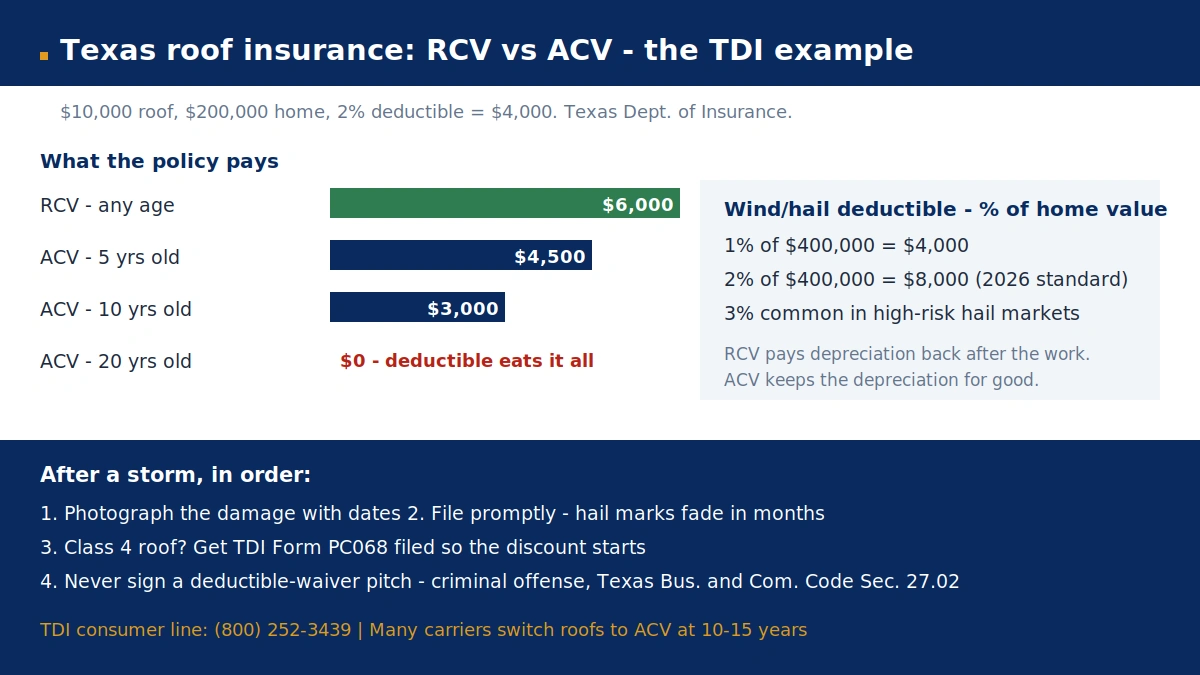
RCV vs ACV is where the check gets decided. Under Replacement Cost Value, the insurer pays what a new roof costs today. Under Actual Cash Value, it pays that same figure minus depreciation for the roof’s age and wear. The Texas Department of Insurance publishes its own example, and it is worth reading in full (via Money Stretching, 2026): a house insured for $200,000 with a 2% deductible ($4,000) and a roof that costs $10,000 to replace. The RCV policy pays $6,000 at any roof age. The ACV policy pays about $4,500 when the roof is 5 years old, about $3,000 at 10 years, and $0 at 20 years — the depreciation plus the deductible eats the whole check.
| Roof age | RCV payout (TDI example) | ACV payout (approx.) |
|---|---|---|
| New (0–2 years) | $6,000 | ~$5,700–$6,000 |
| 5 years | $6,000 | ~$4,500 |
| 10 years | $6,000 | ~$3,000 |
| 15 years | $6,000 | ~$1,500–$2,400 |
| 20+ years | $6,000 | $0 |
*Texas Department of Insurance example: $10,000 roof, $4,000 deductible (2% of a $200,000 dwelling limit). Depreciation rates differ by insurer.*
A second worked example shows the same gap on a bigger job (Roof Shepherd, November 2026): a $20,000 replacement, an 8-year-old roof, $8,000 of depreciation withheld, and a 2% wind/hail deductible on a $400,000 home ($8,000). The RCV policy pays $12,000 in total; the ACV policy pays $4,000. Under RCV, the withheld depreciation comes back after the work is done and proven; under ACV, it is gone for good.
The 2026 shift is toward the homeowner paying more. Wind-and-hail deductibles are moving toward 2% (the Texas FAIR Plan dropped its 1% option on July 1, 2026), more carriers are converting older roofs to Actual Cash Value, and cosmetic-damage exclusions are growing, especially on metal (Roof Shepherd, November 3, 2026). Many carriers shift a roof to ACV at just 10–15 years and begin non-renewing at 20 years (RoofVista, 2026). TDI says the company should tell you when coverage changes — so if your roof is 10–15 years old, read the renewal packet for a roof schedule or a roof endorsement (Roof Shepherd).
The deductible is a percentage, not a flat figure. Wind and hail deductibles are usually written as a percentage of dwelling coverage (Coverage A): 1% of $400,000 is $4,000 and 2% is $8,000 (Roof Shepherd). Two percent has become the dominant standard across most of the state in 2026, with 3% common in high-risk hail markets (United Policyholders, via EIN Presswire, May 13, 2026). The average Texas wind/hail deductible now runs about $8,000 on a $400,000 home. The same United Policyholders analysis reports that 47% of Texas homeowner insurance claims were closed without payment in 2024, up from 35% in 2016 — a single-source figure, but a useful warning about how tight the market has become.
The deductible law — do not soften this. A contractor who offers to cover, waive, or absorb your deductible is committing a criminal offense under Texas Business & Commerce Code §27.02, and Texas Insurance Code §707.002 requires you to pay your deductible (ARP Roofing, citing TDI). It is a reliable signal to close the door, and it is common after a hailstorm. Recoverable depreciation is released only after the work is completed and you provide proof the deductible was paid (TDI, via EIN Presswire, May 2026).
Claim timing matters. Inspect — or have inspected — your roof after every severe weather event: hail greater than three-quarter inch, sustained wind above 50 mph, or any named tropical system (BestRoofingEstimates). Document with dated photos. Most Texas policies require claim notification within a reasonable window after the event, and hail damage signatures fade within months; delayed claims on old damage are one of the most common reasons Texas carriers deny coverage (BestRoofingEstimates).
One 2026 change that helps some owners: on March 18, 2026, the Federal Housing Finance Agency announced that Fannie Mae and Freddie Mac will accept Actual Cash Value coverage on roofs for single-family homes and condos, while the rest of the house still has to be insured at replacement cost (FHFA, via Money Stretching, 2026). An ACV roof no longer automatically blocks a conforming mortgage — but it still leaves you paying the depreciation gap out of pocket.
Where to complain: the Texas Department of Insurance consumer line is (800) 252-3439 (RoofVista, 2026), and TDI’s roof insurance tips page is at tdi.texas.gov.
Financing, Rebates & No Federal Credit in 2026
The federal credit is zero — no hedging. OBBBA (P.L. 119-21) shut down §25C and §25D for anything installed after December 31, 2025. That leaves a 2026 roof on an owner-occupied home with no federal credit at all. A few Texas roofing pages still pitch a federal energy credit for ENERGY STAR metal roofs — that pitch relies on law that no longer exists. Leave it out of your budget entirely unless a tax professional confirms otherwise in writing.
There is no Texas statewide roof rebate to replace it. No 2026 source verified a Texas equivalent of Florida’s My Safe Florida Home grant program, and no current residential cool-roof rebate figure was verified for Austin Energy or any other Texas municipal utility. Do not count on a grant that does not exist.
The real Texas “rebate” is the Class 4 insurance discount. A documented Class 4 roof earns 15–35% off the dwelling premium — most-cited 20–35% in Dallas-Fort Worth — every year, for the life of the roof (see the Class 4 section above). Unlike a one-time grant, it compounds: $700–$1,500 a year on a $500,000 home adds up to $8,000–$15,000 over the roof’s life (The Agent’s Office).
How Texans actually pay for a roof (BestRoofingEstimates): the insurance claim path covers a much higher share of total statewide replacement volume than in most other states, because hail and hurricanes do so much of the replacing. The other channels are a TWIA windstorm claim on the coast (which requires the WPI-8 certificate on the replacement work), a HELOC or home-equity loan (usually the cheapest rate you will find, though closing takes weeks and the house itself secures the loan), and contractor financing through lenders like GreenSky, Service Finance, and Hearth (fast decision, no-equity situations, 0% promo periods common — read the reset-rate fine print).
No Texas-specific contractor APR figures were verified in 2026 sources, so this guide gives none. The general rules still apply: compare APR, not monthly payment; watch the deferred-interest trap, where an unpaid balance after a 0% promo triggers retroactive interest at 20% or more; and keep the loan shorter than the roof will last — a shingle roof that serves 20 years should not carry a 25-year loan. Our roof financing guide compares every way to pay, side by side.
One more cost to budget if you have solar: panels have to come off and go back on around a reroof, and the detach-and-reset cost belongs in the claim scope. No verified Texas dollar figure for detach-and-reset was found, so get it quoted as its own line item. Our Texas solar guide covers the solar side.
Repair vs Replace: The Texas Decision Rules
Repair costs (BestRoofingEstimates, Dallas-Fort Worth and Houston pricing; Austin adds 5–10%, coastal counties add a WPI-related premium):
| Repair | Typical range |
|---|---|
| Most repair calls | $300–$1,400 |
| Missing / lifted shingles | $250–$650 |
| Hail-damaged shingle field (inspection) | $0–$450 (inspection often free; damage usually triggers a full claim) |
| Cracked / slipped tile | $350–$1,000 |
| Flashing replacement | $400–$1,200 |
| Active leak diagnosis & patch | $450–$1,500 |
| Heat-cracked vent boot | $200–$450 |
| Ridge-cap wind peel-up | $350–$900 |
| Low-slope / flat-roof patch | $500–$1,800 |
| Emergency tarp (post-hurricane or hail) | $300–$1,000 |
BestRoofingEstimates’ headline figure for a typical Texas roof repair call-out is $585. Rubber vent boots deserve a special mention: the gaskets fail fast in Texas sun, and a $200–$450 boot replacement is one of the cheapest leaks to fix — and one of the most common to ignore until the ceiling stains.
A replacement beats a repair once two or more of these are true (ARP Roofing; BestRoofingEstimates):
- Shingle roof age 15+ in Texas — surrounding materials are already UV-brittle and hail-pitted, so patching has diminishing returns
- Tile underlayment nearing 25–30 years — the tile can look perfect while the layer that actually keeps water out is finished
- Granule loss, curling, or buckling showing up on slope after slope, not in one spot
- Leaks appearing in more than one place instead of a single traceable drip
- Hail damage across the field — a hail-damaged shingle field usually triggers a full claim, not a repair
- Age past the Texas lifespan for the material, especially in the hail corridor
Repair when: one leak you can trace on a roof still in its early years, a handful of shingles lifted by one wind event, a dead pipe boot, or a flashing detail that gave way. If the repair numbers matter more than replacement prices right now, our roof repair cost guide has them.
Timelines, for planning: most shingle roofs go on in one to two days; metal and tile take longer, typically two to four days, because the panels and the underlayment detail take more time (ARP Roofing). Weather moves the schedule more than anything else — in Texas that mostly means summer heat and spring storms.
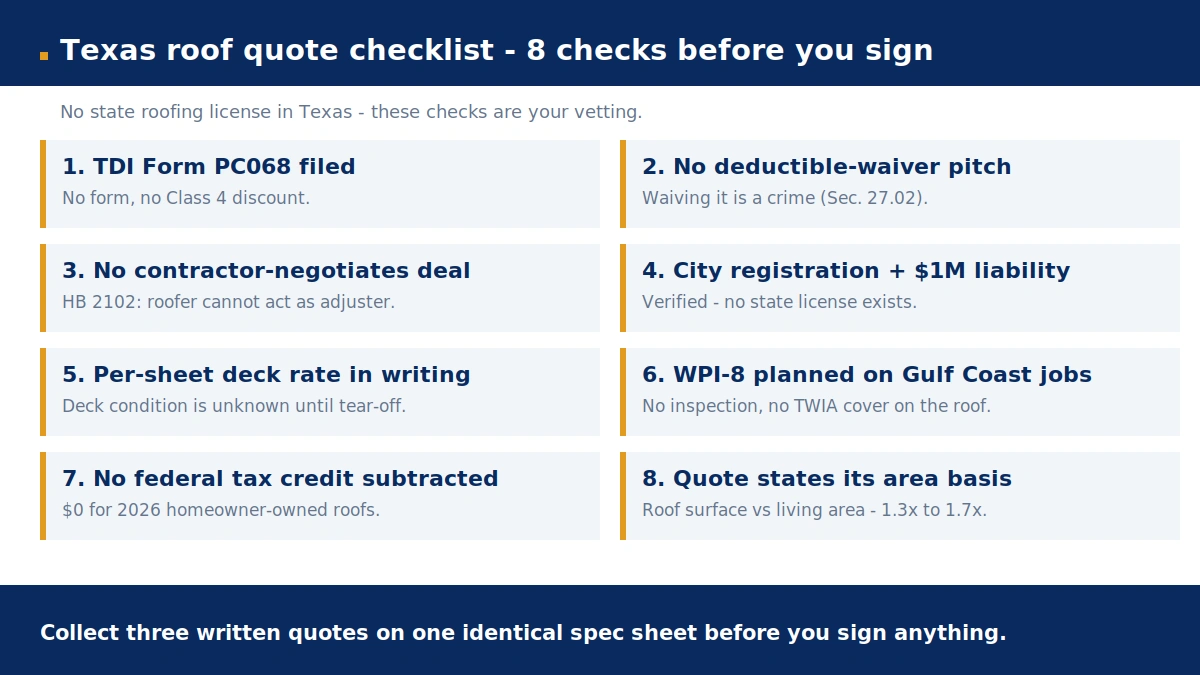
Quote red flags, Texas-specific:
- No TDI Form PC068 offered for a Class 4 roof — without the form, the insurance discount you were promised does not exist.
- A “free roof” deductible pitch — a criminal offense under Texas Business & Commerce Code §27.02. Walk away.
- A contractor who offers to negotiate with your insurer for a cut — a deceptive trade practice under HB 2102.
- No city registration or $1M liability insurance — Texas has no state roofing license, so these are your only vetting tools. Verify them.
- No decking rate per sheet — nobody knows what the deck looks like until the old roof comes off. A bid that skips the decking allowance is a bid that will grow once the tear-off starts.
- No WPI-8 plan on a Gulf Coast job — without the inspection during installation, your TWIA coverage is void on the new roof.
- A line item for a federal tax credit — there is none for a 2026 homeowner-owned roof, so any credit on the bid is fiction.
- A single $/sq ft figure with no area basis — roof surface runs 1.3–1.7 times living area. If the quote does not say which area it priced, it is not comparable.
Before you sign anything, run through our questions to ask a roofer — it is the vetting checklist built to go with this guide. And get an independent roof inspection if repair-vs-replace is genuinely close: it is the cheapest way to settle the question before calling contractors.
Sources & methodology
Cost anchors: BestRoofingEstimates — “Roofing Cost in Texas” (2026, crawled Nov 5, 2026) — primary Texas anchor: material table, home-size table, metro table, permit table, TWIA, repair table, financing, climate zones, cost-per-year examples; ARP Roofing — “Roof Replacement in Texas” (pricing updated Sep 2026, crawled Nov 5, 2026: $4.95–$15.00/sq ft roof area; shingle $17,600–$28,800 on a 2,000 sq ft home; lifespans shingle 15–22 yrs, metal 40–70, tile 30–50; timelines shingle 1–2 days, metal/tile 2–4 days; deductible law §§27.02/707.002); This Old House — “The Cost of a Roof Replacement in Texas” (2026: Texas avg $8,634; range $6,777–$20,531; permit $150–$500 per HomeGuide); SatelliteQuotes — “Roof Replacement Cost in Texas (2026)”: arch. $8,500–$16,000 on 1,500–2,500 sq ft house, ~$11,945 on 2,000 sq ft, ~$5.33/sq ft; tile ~$34,870 on 2,000 sq ft house; RoofQuoteCalc — “How Much Does a New Roof Cost in Texas?” (2026): city table, material totals; RoofCostCalculatorTexas (model reviewed Jun 2026): arch. $4.50–$7.50/sq ft, 3-tab $3.50–$5.50, Class 4 $6–$10, metal $5–$16, tile $10–$20; LocalBizzInfo — Texas 2026 guide (updated ~Sep 2026, cross-check only): Dallas avg $9,200, Austin $8,750, Houston $9,500; labor $150–$275/square; Roof Observations — “Texas Roof Replacement Cost Guide (2026 Update)”: TPO 60-mil ballasted with R-25 $7.70/sq ft, without insulation $3.55; board insulation $1–$1.50/sq ft per inch; RJT Construction — Houston commercial 2026 guide (TPO $5.50–$9.00 commercial, $7.00–$11.00 residential flat, 15–25 yr life); Trivan Roofing — “Flat Roof Replacement Cost in 2026” (updated ~Oct 2026: TPO $5.00–$10.00/sq ft, 20–30 yr life); Jamar Roofing — Austin commercial 2026 (TPO $4.25–$8.50, PVC $5.00–$9.00, EPDM $4.00–$7.00). Size and cost-per-year tables are our arithmetic from the BestRoofingEstimates per-sq-ft ranges.
Climate + hail: State Farm / Insurance Journal via Latent Insurance + Live Insurance News (2026: $1.4B / ~95,200 Texas hail claims 2025, avg ~$15,000, +27% YoY); United Policyholders analysis (May 2026, via Colin Wilson World: 902 major hail events 2025, 11th straight year #1; 878 in 2024 per Roofing Contractor); Cotality (June 2023 storm week $6.1B; ~2M Texas homes hit by 1-inch-plus hail in 2023); Dent Mechanic Group (2026: hail season Mar–Jun, peak Apr–May, secondary Oct peak); Quality Home Improvement (May 6, 2026, NOAA 2020–2026: Frisco/McKinney/Plano 4.8 hail days/yr; DFW 3–5 significant events/yr); Texas Roof Rescue (computed Oct 6, 2026: 18 days of 1-inch-plus hail Apr–Sep 2026, 481,083 homes — single-source archive).
Class 4: The Agent’s Office — “Class 4 Roof Insurance Discount Texas (2026)” (Apr 14, 2026: 20–35% dwelling discount, $700–$1,500/yr on $500,000 home, $1,500–$4,000 upgrade, break-even 2–4 yrs, PC068, HO-145); Coker General Contractors (updated May 2026: $5.25–$6.75/sq ft DFW, 20–35%, $400–$900/yr on $350,000 home); Latent Insurance — “DFW Home Insurance 2026” (2026: 20–35% filed credits, TDI Form PC068, TDI qualifying list); BestRoofingEstimates (15–28% discount, 12–18% upgrade premium, $1,500–$2,500 material upgrade); UL 2218 (2-inch steel ball, 20 ft — majority figure; BestRoofingEstimates’ 12-ft figure not used, see research brief).
Permits + licensing + tax: BestRoofingEstimates permit table + metro variance + sales-tax note + HB 2102 + RCAT + $1M liability vetting minimums (2026); PermitCalculator (Dallas $196.00, Houston $353.15, San Antonio $26.50 — San Antonio figure flagged as a partial-fee calculator output); HomeGuide via This Old House ($150–$500); LocalBizzInfo ($200–$600, cross-check only).
TWIA + WPI-8: Statewise Finance — “TFPA vs TWIA (2026)” (Aug 2026: 14 counties + Harris east of Hwy 146; WPI-8; 2024 code from Apr 1, 2026; 15% surcharge; $500–$1,500/yr premium lever — single source); TWIA via Coverage Clock (checked Oct 9, 2026: WPI-8/WPI-8-E/WPI-8-C, 100-sq-ft repair rule, TDI issues all WPI-8s since Jun 1, 2020); Diamond Certified Roofers (2026: Harris east-of-146 cities, no state license note); BestRoofingEstimates (WPI-8 $150–$300; 8d ring-shank 6-inch on-center; coastal +8–15%).
Insurance + law: Roof Shepherd — “Hail Hit Your Roof? Texas Claim Guide” (updated Nov 3, 2026) + “Roof Age, ACV and Deductibles in Texas” (updated Nov 1, 2026: 2% deductible shift, TFPA 1% option dropped Jul 1, 2026, RCV $12,000 vs ACV $4,000 worked example, TDI notice duty); Money Stretching — “Roof Claims in 2026” (2026: TDI $10,000-roof example, FHFA Mar 18, 2026 ACV acceptance); AZ Texas Insurance Agency (Aug 26, 2026: ACV-by-age table); ARP Roofing (Business & Commerce Code §27.02, Insurance Code §707.002); United Policyholders via EIN Presswire (May 13, 2026: 47% claims closed without payment in 2024, 2% deductible dominant, 3% in high-risk markets, avg deductible ~$8,000 on $400,000 home — single source); RoofVista (2026: ACV at 10–15 yrs, non-renewal at 20 yrs, TDI (800) 252-3439).
Financing + rebates: OBBBA P.L. 119-21 / IRS FS-2025-05 ($0 federal credit for post-2025 installs); BestRoofingEstimates financing table (insurance claim, TWIA claim, HELOC, contractor financing via GreenSky/Service Finance/Hearth).
Repair + lifespans: BestRoofingEstimates repair table (2026: typical call $300–$1,400; call-out headline $585); ARP Roofing (replace signals; timelines 1–2 days shingle, 2–4 days metal/tile).
EXCLUDED: any “after 30% credit” prices; Florida programs (My Safe Florida Home, wind-mitigation OIR-B1-1802) — Texas has no equivalent verified; APS-style residential cool-roof $/sq ft (unverified); any Texas tile re-lay $/sq ft, structural-reinforcement dollar figure, solar detach-and-reset cost, or Texas contractor APR (all unverified — see research brief §12); LocalBizzInfo city averages as primary anchors; the PermitCalculator San Antonio $26.50 figure as a permit price; the BestRoofingEstimates 12-foot UL 2218 drop figure; the 2026 DFW hail archive as NOAA data.
*Disclaimer: Prices are 2026 Texas planning figures and change by city, roof, and contractor. Get three written quotes from local roofers before you set a budget. Tax notes here are general information, not advice for your return — check with a Texas CPA or tax pro before you file.*
How much does a roof replacement cost in Texas in 2026?
Most Texas replacements run $8,500–$22,000 in 2026. Architectural shingles on a typical 2,000 sq ft home cost $11,000–$18,500 (BestRoofingEstimates $12,300–$18,500; SatelliteQuotes ~$11,945 average). On a 2,000 sq ft roof surface: Class 4 shingles $14,800–$21,600, standing-seam metal $21,600–$41,000, concrete tile $24,000–$34,000, clay tile $28,000–$45,800.
Why is my Texas roof quote so different from my neighbor’s?
Roof surface runs 1.3–1.7 times living area, and quotes price different areas — ARP’s calculator uses a 3,200 sq ft roof for a 2,000 sq ft home, BestRoofingEstimates about 2,600 sq ft. Material, pitch above 6:12 (+15–25% labor), tear-off layers, decking condition, and city all move the number. Never compare two quotes until you know which area each one priced.
Are Class 4 impact-resistant shingles worth it in Texas?
Usually yes in the hail corridor. They cost 12–25% more than standard architectural shingles ($7.40–$10.80 per sq ft installed) and last 22–28 years instead of 18–22. Texas law requires carriers to offer credits for them, and most North Texas carriers discount the dwelling premium 20–35% — typically $700–$1,500 a year on a $500,000 home, paying the upgrade back in 2–4 years. Your roofer must file TDI Form PC068 to activate the discount.
What is a WPI-8 and do I need one for a new roof in Texas?
A WPI-8 is a Windstorm Certificate of Compliance proving your home meets coastal wind-resistance code. If your home is in one of the 14 TWIA coastal counties or the part of Harris County east of Highway 146, TWIA generally requires one before insuring wind and hail — and replacing a roof usually triggers a fresh inspection during installation ($150–$300). Without it, TWIA coverage is void on the new roof. From April 1, 2026, new certifications must meet the 2024 building code.
Will insurance pay for my hail-damaged roof in Texas?
It depends on your policy type and roof age. A Replacement Cost Value policy pays today’s replacement cost minus your deductible at any roof age — the Texas Department of Insurance example: a $10,000 roof with a $4,000 deductible pays $6,000. An Actual Cash Value policy subtracts depreciation first, so the same roof pays about $3,000 at 10 years old and $0 at 20 years. Many carriers now switch roofs to ACV at 10–15 years, so read your renewal packet.
Can a roofer waive my deductible in Texas?
No. A contractor who offers to cover, waive, or absorb your deductible is committing a criminal offense under Texas Business & Commerce Code §27.02, and Texas Insurance Code §707.002 requires you to pay it. Any “free roof” pitch after a hailstorm is a reason to close the door. A contractor also cannot act as your public insurance adjuster on the same claim (HB 2102).
Is there a federal tax credit for a new roof in Texas in 2026?
No — $0. OBBBA ended §25C/§25D for property placed in service after December 31, 2025. Texas has no statewide roof rebate to replace it. The real recurring payback is the Class 4 insurance discount (20–35% off dwelling premium in Dallas-Fort Worth) and, on the Gulf Coast, a possible TWIA premium reduction for metal or impact-resistant roofing.
Do I need a permit to replace my roof in Texas?
Yes, in the major cities. Typical fees: Houston $150–$400, Dallas $100–$300, San Antonio $80–$250, Austin $200–$500, Fort Worth/Arlington $100–$300. Texas has no state roofing license — instead, roofers register with the city, and contractors handling insurance claims must register with the Texas Department of Insurance. Verify city registration, $1M liability insurance, and workers’ comp before anyone climbs on your roof.