

New Jersey packs three roofing markets into one small state, and a quote that makes sense in one of them can look like a misprint in another. Along the Hudson, in Jersey City and Hoboken, a crew works on a brownstone rowhouse with no driveway, no staging area, and a permit fee set by a city that charges like Manhattan because it practically is Manhattan. In Newark, the same crew works on a 1910 three-story with plank decking under two layers of old shingles and a chimney that has been flashed three times by three different roofers. Down the Shore, in Atlantic City and Toms River, the crew works under a coastal wind code, on a roof that has already survived one storm that damaged 346,000 homes, and the homeowner’s deductible for the next named storm may be a percentage, not a dollar figure. The material is the same. The shingle is the same. Almost nothing else is.
That spread is why this guide refuses to give one number and stop. The statewide band is real — $13,000–$19,000 for the standard roof — but the useful numbers live in the tables that follow it: the material table that shows what the upgrade to metal or slate actually buys, the size table that stops a bid priced off living area instead of roof surface, and the city table where Jersey City runs 40 percent above the state baseline while Trenton runs near it. And then there are the three New Jersey traps that cost more than any material choice: the nor’easter that damages a roof without triggering the hurricane deductible, the permit exemption that convinces a homeowner no inspection is needed when the town still wants one, and the word “licensed” on a contractor’s truck that the state itself calls deceptive, because New Jersey registers its roofers and licenses almost none of them.
Our roof replacement cost guide gives the national baseline; the New Jersey numbers below show where the most expensive roofing state in the country lands against it.
Table of Contents
What a Roof Replacement Costs in New Jersey in 2026
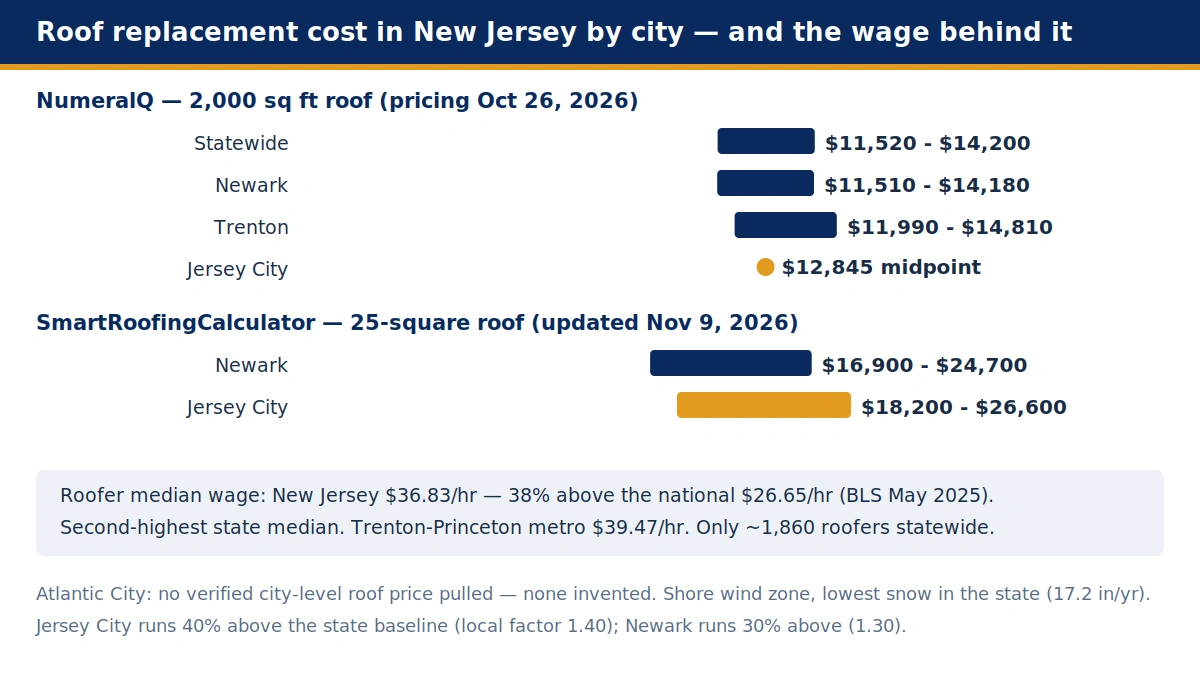
Two independent sources price the New Jersey market in 2026, and they disagree in the way that tells a homeowner the most. SmartRoofingCalculator’s New Jersey page, updated November 9, 2026, lists architectural shingles at $520–$760 per square fitted with tear-off, putting a typical 25-square roof at $13,000–$19,000. NumeralQ, pricing October 26, 2026, prices a 2,000 sq ft roof at $11,520–$14,200 statewide, with Newark at $11,510–$14,180 and Trenton at $11,990–$14,810. The two anchors overlap at the low end and diverge at the high end, and the divergence is honest: NumeralQ prices a 2,000 sq ft roof surface, while the SmartRoofingCalculator 25-square roof is 2,500 sq ft of surface — the size a typical 2,000-square-foot single-story New Jersey home carries once pitch and waste are counted. Scale NumeralQ’s $5.46–$6.65 a square foot up to 2,500 sq ft and you get $13,650–$16,625, sitting squarely inside the $13,000–$19,000 band.
MyRoofData’s 2026 New Jersey model puts a typical single-family architectural roof at $15,250–$26,250, about 18 percent above the national average, on per-square installed prices of $531–$885 before tear-off — higher than SmartRoofingCalculator because the tear-off is excluded from those per-square figures and added back in the total. Modernize, updated August 27, 2026, puts the state average at about $16,800, with most homeowners spending $11,000–$30,000. Herts Roofing, a New Jersey contractor writing in September 2026, puts most full replacements at $8,000–$22,000, with most homeowners landing at $10,000–$16,000 for a complete tear-off and architectural shingle roof — the low anchor.
The high outlier needs a footnote attached, not a headline built on it. RoofingEstimatorPros, updated August 26, 2026, puts a typical 2,000 sq ft architectural roof at $17,222–$30,594, averaging $23,165, or about $11.58 per square foot installed including tear-off, permits and waste, on a 1.20x state multiplier. That average sits about 40 percent above the SmartRoofingCalculator midpoint, and it is best read as what a large, steep, or coastal job costs rather than what a standard Trenton ranch costs. The honest reading of the whole table is that New Jersey’s market is wide because the state is dense and uneven: a simple ranch in Burlington County lands near the low end, while a steep, cut-up brownstone roof in Jersey City with two layers to tear off, no staging, and a coastal wind spec lands near the high end.
What the anchors agree on is the direction, and the direction is unambiguous: New Jersey is the most expensive state in the country to replace a roof. SmartRoofingCalculator’s 2026 roofing cost index ranks New Jersey first of all fifty states at 116, ahead of New York at 115. MyRoofData applies a 1.18 state cost index. RoofingEstimatorPros prices New Jersey at 1.20 times the national figure. The reason is labor, and the labor figure is stark: the Bureau of Labor Statistics, in its May 2025 Occupational Employment and Wage Statistics released May 15, 2026, puts the median roofer wage in New Jersey at $36.83 an hour, or $76,600 a year — 38 percent above the national median of $26.65 an hour, the second-highest state median in the country behind only Illinois at $77,900. The state counts only about 1,860 roofers, and in the Trenton-Princeton metro the median is $39.47 an hour. New Jersey roofs cost what they cost because the people who install them earn a New York metro wage, not a national one — and there are fewer than two thousand of them to go around.
Every New Jersey bid is priced by the square, and the square is the first unit a first-time buyer should learn: one square equals 100 square feet of finished roof surface. A 25-square roof is therefore 2,500 square feet of surface, which is what a typical 2,000-square-foot single-story New Jersey home presents once pitch, overhangs, and waste are counted in. Every per-square figure in this guide covers tear-off of a single old layer, underlayment, and standard fitting, unless the text says otherwise — the MyRoofData per-square figures are the exception, quoted before tear-off and flagged wherever they appear. Anything beyond that baseline costs extra: a second layer coming off, rotted decking, a steep pitch, or a roof cut up with valleys and dormers.
| Source | Typical job | Price | Dated |
|---|---|---|---|
| SmartRoofingCalculator | 25-square architectural roof | $13,000–$19,000 ($520–$760/sq) | Nov 9, 2026 |
| NumeralQ | 2,000 sq ft roof, statewide | $11,520–$14,200 | Oct 26, 2026 |
| NumeralQ | 2,000 sq ft roof, Newark | $11,510–$14,180 | Oct 26, 2026 |
| NumeralQ | 2,000 sq ft roof, Trenton | $11,990–$14,810 | Oct 26, 2026 |
| MyRoofData | Typical single-family arch roof | $15,250–$26,250 | 2026 model |
| Modernize | Average replacement | ~$16,800 (range $11,000–$30,000) | Aug 27, 2026 |
| SquareDash | 2,000 sq ft home, statewide avg | ~$18,500 | Apr 2026 |
| Herts Roofing | Typical tear-off + arch shingles | $10,000–$16,000 (range $8,000–$22,000) | Sep 2026 |
| RoofingEstimatorPros | 2,000 sq ft arch roof | $17,222–$30,594 (avg $23,165) | Aug 26, 2026 |
| BestRoofingEstimates | 2,000 sq ft arch roof | $12,200–$19,800 | 2026 |
Roof Replacement Cost in New Jersey by Material
Material is the first decision, and in New Jersey it is a wind decision before it is a budget decision. The cheapest shingle on the shelf is the one most likely to fail early under a nor’easter that drives rain sideways for eighteen hours, and the most expensive metal on the shelf is the one most likely to still be on the roof when the mortgage is paid off — shedding wind-driven rain instead of holding it. Below, a typical 25-square roof — 2,500 square feet of surface — is priced material by material from New Jersey-verified figures, with tear-off noted separately because the two main sources treat it differently.
| Material | Per square installed | 25-square total | Realistic NJ life |
|---|---|---|---|
| 3-tab asphalt shingle | $413–$649 (before tear-off) | $10,325–$16,225 | 12–18 yrs |
| Architectural asphalt shingle | $531–$885 (before tear-off) | $13,275–$22,125 | 18–25 yrs |
| Class 4 impact-resistant shingle | $572–$950 (derived, see text) | $14,300–$23,750 | 25–35 yrs |
| Ribbed metal (exposed fastener) | $649–$1,121 (before tear-off) | $16,225–$28,025 | 30–40 yrs |
| Standing-seam metal | $1,050–$1,630 (fitted, SRC) | $26,250–$40,750 | 40–70 yrs |
| Cedar shakes and shingles | $1,062–$1,770 (before tear-off) | $26,550–$44,250 | 25–35 yrs |
| Tile (concrete/clay) | $1,400–$2,090 (fitted, SRC) | $35,000–$52,250 | 50+ yrs |
| Natural slate | $1,770–$3,540 (before tear-off) | $44,250–$88,500 | 75–150 yrs |
| Flat membrane (TPO/EPDM) | $649–$1,121 (before tear-off) | $16,225–$28,025 | 20–30 yrs |
Treat the 3-tab row as a warning, not a bargain. The $413–$649 a square that MyRoofData publishes is an installed price that excludes tear-off, so the finished job costs more once the old layer is stripped — budget another $100–$200 a square for each layer removed. Among the materials in this table, 3-tab carries the weakest wind rating and no impact rating worth citing, and insurers and builders across the state have largely walked away from it. One nor’easter can hold 60-mile-per-hour gusts for a full day, and a New Jersey winter works every sealant strip and flashing lap looser with each freeze-thaw swing. The few thousand saved by choosing 3-tab is the next deductible, paid in advance. The material still fits somewhere: a rental, a shed roof, a house changing hands within a few years. As the default on a home the owner intends to keep through a decade of New Jersey storms, it does not.
Architectural shingles are the default on roughly three of every four American homes, and New Jersey follows the national pattern. The thicker, dimensional shingle carries a 110-to-130-mile-per-hour wind rating when fitted with the manufacturer’s high-wind nailing pattern, and two independent measures put it behind the headline price: SmartRoofingCalculator at $520–$760 a square fitted with tear-off, MyRoofData at $531–$885 a square before tear-off. Expect 18 to 25 realistic years from it in New Jersey, rather than the 22 to 30 in MyRoofData’s published table: freeze-thaw cycling, Shore salt air, and wind-driven rain all shorten the service life a mild-climate brochure assumes.
The Class 4 row is the one storm-season upgrade that repays its price, and it gets a section of its own further down. This pass verified no New Jersey-specific Class 4 premium, so the row is derived rather than quoted: take the published national premium — 10 to 25 percent, or $1,000 to $2,500 on a typical house — and apply it to SmartRoofingCalculator’s fitted $520–$760-a-square band, and you land at $572–$950 a square, or $14,300–$23,750 across 25 squares. The shingle’s asphalt is SBS-modified, rubberized so it stays pliable through a New Jersey freeze and absorbs a hailstone strike instead of splitting. Behind the rating sits the UL 2218 Class 4 test, which drops a two-inch steel ball from twenty feet and requires the shingle to come through uncracked. Hail-proof it is not — a baseball-size stone will still damage it. New Jersey’s hail barely registers, though: NOAA counted 215 large-hail reports statewide across 2016–2025, via NumeralQ. The Class 4 case in this state therefore rests on wind-driven debris, the deductible a surviving roof never pays, and the insurance discount, all of which the Class 4 section takes up in turn.
Along the Shore, metal is where the state splits in two. Ribbed panels with exposed fasteners cost $649–$1,121 a square before tear-off — $16,225–$28,025 across 25 squares — and serve 30 to 40 years. Standing seam costs $1,050–$1,630 a square fitted, or $26,250–$40,750, and serves 40 to 70 years. MyRoofData’s before-tear-off standing-seam band of $1,121–$1,888 a square would price the same roof at $28,025–$47,200; the distance between the two figures is the tear-off plus the coastal detailing, not a dispute about the metal itself. Read the table by the year instead of by the quote and the order reverses: at the midpoints, standing seam runs near $609 per year of service, against near $823 for architectural shingles and near $634 for Class 4. The quote makes metal look expensive and the calendar makes it look cheap — and on the Shore, where post-Sandy towns enforce coastal wind zones and homeowners choose between 130-mile-per-hour-rated shingles and metal, it is the default. Our metal roof cost guide takes metal apart in full, and our metal vs shingles comparison has the head-to-head numbers.
Cedar shakes are a niche choice in New Jersey: $1,062–$1,770 a square before tear-off, or $26,550–$44,250 for 25 squares, lasting 25 to 35 realistic years. Cedar is beautiful on a historic Shore cottage, but it holds wind-driven rain and debris in its gaps, which makes it a poor fit for a roof that has to shed a nor’easter — and no second New Jersey cedar price was pulled, so check the single MyRoofData band against a local quote.
At the luxury end sit tile and slate, and New Jersey keeps both rare for structural reasons as much as for price. SmartRoofingCalculator prices tile fitted at $1,400–$2,090 a square — $35,000–$52,250 across 25 squares — while MyRoofData prices concrete tile at $1,180–$2,124 a square and clay at $1,416–$2,950 before tear-off; concrete serves 40 to 75 years, clay 50 to 100. Either tile weighs far more than asphalt — concrete tile alone runs 850 to 1,100 pounds per square — and either one needs a structure verified to carry it, which on a 1910 Newark frame house is a question for an engineer, not a roofer. Slate costs $1,770–$3,540 a square before tear-off, or $44,250–$88,500, and serves 75 to 150 years. The slate bottleneck is the crew: few New Jersey roofers lay slate often, and a slate roof fitted by a crew that seldom handles the material is a nor’easter leak waiting to happen. Our tile roof cost guide takes tile apart in full.
Flat membrane earns a row here that it does not earn in most states in this series, because New Jersey is full of flat and low-slope roofs: the porches and additions on Cape Cods, the mid-century ranches, and above all the flat roofs of the attached rowhouses in Newark, Jersey City, and Hoboken. TPO or EPDM runs $649–$1,121 a square before tear-off, or $16,225–$28,025 for 25 squares, lasting 20 to 30 years. A flat section holds wind-driven rain and snowmelt instead of shedding it, so the membrane, the seams, and the drainage decide whether it lasts twenty years or five.
Divide each midpoint total by its midpoint realistic life and the cheapest New Jersey roof is not the one with the lowest price: 3-tab runs about $759 a year, architectural about $823, Class 4 about $634, ribbed metal about $632, standing seam about $609, cedar about $1,180, tile about $727, slate about $590, and flat membrane about $885. That is NestPriced arithmetic, and it leaves out the two things that change the answer — the deductibles, where Class 4 wins, and the wind-shedding, where metal wins.

Roof Replacement Cost by Roof Size
After material, size is where a quote most often goes wrong — by measuring the wrong thing. What a bid prices is roof surface, never living area. A ranch of 2,000 square feet covers about 2,000 square feet of ground, and once pitch, overhangs, and waste are counted, its roof surface usually runs 20–25 squares. A two-story house listed at the same 2,000 square feet has a footprint near 1,000 square feet, so its roof surface runs roughly half the ranch’s. In New Jersey the confusion runs deeper than elsewhere, because so much of the housing stock is attached: a rowhouse shares walls with its neighbors, so the footprint the roofer measures is the one the deed describes, and a bid priced off the listing’s living area has priced the wrong house twice over. Insist that every bid print its square count as a line of its own.
The table below prices the roof sizes New Jersey homeowners actually own, using SmartRoofingCalculator’s architectural band of $520–$760 a square with tear-off included. The 25-square row is the headline row, and the 20-square row is the NumeralQ cross-check: the per-square band gives $10,400–$15,200, against NumeralQ’s $11,520–$14,200 for a 2,000 sq ft roof statewide.
| Roof surface | Typical home | Architectural total | Class 4 total |
|---|---|---|---|
| 15 squares | Small ranch / Cape Cod | $7,800–$11,400 | $8,580–$14,250 |
| 20 squares | 2,000 sq ft ranch | $10,400–$15,200 | $11,440–$19,000 |
| 25 squares | Typical NJ home | $13,000–$19,000 | $14,300–$23,750 |
| 30 squares | Large two-story | $15,600–$22,800 | $17,160–$28,500 |
| 35 squares | Large home, complex roof | $18,200–$26,600 | $20,020–$33,250 |
| 40 squares | Very large / steep | $20,800–$30,400 | $22,880–$38,000 |
Three things lift a job above this table. Pitch comes first: a steep 10/12 or 12/12 roof costs more per square than a walkable 4/12, because the crew works slower and stages differently — and on a narrow Jersey City lot there may be nowhere to stage at all. Complexity comes second, but in New Jersey it is the roof’s shape that does the damage to the budget: a Cape Cod in Montclair or a Victorian in Cape May is cut up with valleys, dormers, skylights, and chimneys, and every one of those interruptions needs its own hand-built flashing — slow work, and the first place a nor’easter finds its way in when the crew hurries it. Decking is the third: sheathing rot only shows itself when the old shingles come off, and the crew prices it per sheet on the day — NumeralQ puts a 4-by-8 sheet of OSB at $80–$112 installed in Newark. On a century-old house the decking is often plank rather than plywood, and plank that has spent a hundred winters under a slow leak can run to several sheets before the crew is done. Have the per-sheet deck rate written into the contract before anyone lifts a shingle.
Work from the roof’s own measurements instead. The square count comes from the footprint: take the ground area, multiply by the pitch factor (1.15 at 6/12, 1.25 at 8/12), add a tenth for waste, and divide by 100. Even better, have each bidder print the measured square count on the bid, and judge square counts before judging prices.
Roof Replacement Cost by City: Newark vs Jersey City vs Trenton vs Atlantic City
New Jersey is one small state with four different roofing markets, and the price follows the labor market and the coastline, not the skyline. Newark, in the northeast, is the biggest city and the oldest housing stock. Jersey City, across the Hudson from Manhattan, is the most expensive roof in the state. Trenton, the capital, is the cheapest of the four verified cities on the numbers — and the city where a roof costs the biggest share of the home it sits on. Atlantic City, on the Shore, is the city this guide cannot price, because no verified Atlantic City figure was pulled in this pass and the guide invents none. The verified city figures run close together in the middle of the state and spread apart at the Hudson.
| City | 2,000 sq ft roof (arch) | 25-square roof (arch) | Market note |
|---|---|---|---|
| Newark | $11,510–$14,180 (NumeralQ) | $16,900–$24,700 (SRC) | Oldest stock, attached rowhouses, NYC-metro wages |
| Jersey City | $12,845 midpoint (NumeralQ) | $18,200–$26,600 (SRC) | Highest in NJ, 40% above state baseline |
| Trenton | $11,990–$14,810 (NumeralQ) | No verified figure pulled | Cheapest verified city; roof is 8.3% of median home value |
| Atlantic City | No verified figure pulled | No verified figure pulled | Shore wind zone, lowest snow, highest insurance |
Newark is the biggest market in the state, served by the most crews, at $11,510–$14,180 for a 2,000 sq ft roof from NumeralQ, while SmartRoofingCalculator’s city page puts a 25-square roof at $16,900–$24,700 on $676–$988 a square — 30 percent above the state baseline. The two figures describe different roof sizes, and the gap between them is the pitch and waste a 25-square roof carries over a 2,000 sq ft one. Modernize puts a Newark 2,000 sq ft roof higher still, at $14,500–$25,000. Newark’s price is a housing-stock price as much as a labor price: the median year built on whole Newark streets is 1910 to 1928, Essex County’s median is 1958 with 29.1 percent of homes built in 1939 or earlier, and a roof over a century-old frame house hides plank decking, two old layers, and chimney flashing that has been patched by three generations of roofers. The roofer wage behind the price is a metro wage: the New York-Newark-Jersey City metro median is $36.73 an hour. Newark homeowners also pay above the statewide average, Modernize notes, because of older housing stock, urban labor rates, and the extra setup and disposal planning that dense lots demand.
Jersey City is the most expensive roof in New Jersey, and the margin is not close. SmartRoofingCalculator puts a 25-square architectural roof at $18,200–$26,600 on $728–$1,064 a square — 40 percent above the state baseline, the highest local factor in the state. NumeralQ’s 2,000 sq ft midpoint of $12,845 looks far lower, but it is a midpoint of a smaller roof on a per-square-foot model, and the two sources agree on the direction: Jersey City costs more than Newark, and Newark costs more than the state. The reasons are all visible from the street: brownstones and attached rowhouses with no driveway and no staging area, Hudson County’s 29.8 percent of homes built in 1939 or earlier, Manhattan-adjacent labor rates, and a building department that charges like the city across the river because its crews come from the same labor pool. Collect three Jersey City quotes, and make one of them from a company with a permanent shop in Hudson County — warranty service from a crew based two counties away is a promise that gets expensive to keep.
Trenton is the cheapest verified city and the most sobering one. NumeralQ prices a 2,000 sq ft roof at $11,990–$14,810, the highest of its three New Jersey cities on the low end and the lowest on the high end — a narrow, middle-of-the-road band. Modernize puts Trenton and Princeton together at $14,000–$24,500 for the same size. What makes Trenton different is not the price but the ratio: NumeralQ’s comparison table shows a Trenton roof taking 8.3 percent of the median home’s value, against 3.4 percent in Newark and 2.3 percent in Jersey City. Trenton also has the oldest housing stock in the state by the Census Bureau’s measure — 74 percent of its homes were built before 1960 — which means the cheapest quote in the state is also the quote most likely to find plank decking, a second layer, and a chimney that needs reflashing once the shingles come off. The permit is its own story: NumeralQ cites a Trenton permit of $810 for a typical job under the city’s 2025 ordinance amending Chapter 42-12, while BestRoofingEstimates lists Trenton at $65–$275. Both figures are printed here and flagged, because they cannot both describe the same job.
Atlantic City carries a warning label rather than a verified price. No verified Atlantic City city-level roof price turned up in this pass, and this guide invents none. What can be said honestly is the shape of the market: the mildest winters in the state at 17.2 inches of snow a year, the harshest wind exposure, the strictest coastal detailing, and the highest insurance in the state — Shore properties run $3,000–$6,000 or more a year. A Shore roof is priced as a wind roof first and a snow roof second, which is the reverse of the north of the state, and the quote should say so.
Compare cities by price per square, not by total. The real difference between them is not price but exposure: Jersey City gets the Manhattan labor market, Newark gets the century-old decking, Trenton gets the oldest housing stock in the state, and Atlantic City gets the wind that the other three only read about.
Why New Jersey Roofs Cost What They Do: Nor’easters, Coastal Wind & the Priciest Roofer in the Northeast
Four forces decide what a New Jersey roof costs; the weather supplies two of them, and the labor market supplies the other two. The nor’easter is the first and the most persistent. Coastal wind is the second and the most expensive to build against. Labor is the third and the largest single line on the quote. The fourth is the housing stock itself — the oldest in the region — and it decides how much of the job is discovered only after the tear-off begins.
The nor’easter. New Jersey’s defining storm is not a hurricane. It is the nor’easter: a low-pressure system that stalls off the coast, drives rain sideways for twelve to eighteen hours, and peels shingles one course at a time without ever earning a name from the National Weather Service. That last detail matters more than the wind speed, because the hurricane deductible — the percentage deductible that can put $8,000 of a claim back on the homeowner — only applies to a named hurricane. A nor’easter leaves the policy on its ordinary deductible, which sounds like good news until the next paragraph explains why the damage is still expensive. The defense is not exotic. The answer is six nails instead of four, a high-wind starter course, and a 110-to-130-mile-per-hour-rated shingle fitted exactly as the manufacturer specifies, with the ice and water shield run past the minimum at the eaves. Ask for the nailing pattern in writing.
Coastal wind. The design wind speed across much of New Jersey is a 115-mile-per-hour baseline, a three-second gust under the code’s tables, and in the Ocean and Monmouth coastal zones the ultimate wind speed reaches 120 miles per hour. Those are design numbers, not storm reports, and they govern what the roof must be built to survive. Hurricane Sandy is the storm that proved the numbers matter: it came ashore near Brigantine on October 29, 2012, as a post-tropical cyclone, with gusts to 91 miles per hour in Atlantic City, and damaged or destroyed an estimated 346,000 New Jersey housing units. A catastrophe-modeling survey found that about 25 percent of homes along portions of the New Jersey coast suffered at least minor roof damage, and a significant share had enough damage to warrant a complete replacement. Sandy also proved the deductible point in reverse: because it was post-tropical at landfall, Executive Order No. 107 of 2012 barred insurers from applying hurricane deductibles to Sandy claims. The next named hurricane that does meet the trigger will not come with that protection.
Labor. The third force is the wage, and the wage is the story of this guide. About 1,860 roofers work in the whole state, on a median wage of $36.83 an hour — and in Trenton-Princeton, $39.47. In a quiet month that is enough. After a nor’easter it is not, and the shortage shows itself twice over: prices climb, and the wait for a crew stretches. The billed rate a homeowner actually pays runs 2.0 to 2.6 times the wage, according to NumeralQ’s model — which is how a $36.83-an-hour roofer becomes a $68–$110-an-hour crew rate in MyRoofData’s model.
The housing stock. The fourth force is the house itself. Passaic County’s median year built is 1956, Essex County’s is 1958, Bergen County’s is 1959, and Trenton’s housing stock is 74 percent pre-1960. A roof over a house built in 1910 is a roof over plank decking, possibly two layers of old covering, a chimney that has settled independently of the frame, and flashing details that predate every code the crew works under. None of that shows on a satellite measurement. All of it shows on the tear-off.
Snow, Ice Dams & the Freeze-Thaw Cycle: The North Jersey Winter Problem
Winter does the slow damage in New Jersey, and it does it unevenly. The state spans two winters: a northern one, where Newark averages 31.7 inches of snow a year on the 1991–2020 normals and Sussex County takes the most in the state, and a southern one, where Atlantic City averages 17.2 inches and Trenton 26.7. Newark’s 2010–2019 average ran higher still, at 37.7 inches, and the record season of 1995–96 dropped 78.4 inches on the city. A roof in Newark carries nearly twice the snow a roof in Atlantic City carries, and the ice-dam risk follows the same gradient — which is why the code’s ice-barrier rule, of all things, turns out to be a Sussex County rule, as the permits section explains.
Every winter, an ice dam forms by the same sequence: warmth escaping from the living space into the attic heats the underside of the roof deck and melts the bottom layer of snow on the upper roof. The meltwater flows down to the eave, crosses the warm wall, and meets the cold stretch of deck — where it freezes into a ridge of ice. The next round of melt has nowhere to go, so water ponds behind the ridge, creeps back under the shingles, and enters the house — through sheathing, down the wall, into the ceiling — until it surfaces as a brown March stain and worse. Even a brand-new roof can leak from a dam, because the shingles are not what failed. The attic’s heat and stale air are.
The reroof should carry all three defenses at once — not in a later project, when the shingles are already on. The first is the ice and water shield: a self-adhering membrane along the eaves, in valleys, and around penetrations, running from the edge past the inside face of the exterior wall — at least 24 inches inside the wall line under the Residential Code’s section R905.1.2, and at least 36 inches up the slope on roofs of 8 in 12 or steeper. On a low-slope roof in a thirty-inch snow town, the membrane should go past the code minimum, and the quote should say how far. On a deep-overhang or low-pitch roof, a single 36-inch roll usually falls short: New Jersey contractors lay two or three courses, six to nine feet of membrane. The second defense is insulation: the attic must stay cold, and it stays cold when the ceiling is insulated well enough that the roof deck holds near the outdoor temperature — R-49 for New Jersey’s climate zones under the 2024 energy code, in both the 5A counties of Bergen and Passaic and the 4A counties of Essex and Hudson. Ventilation is the third defense: soffit intake and ridge exhaust, balanced under section R806, moving attic air and evening out the deck temperature. Only a reroof lets all three be fixed together. Fresh shingles over a hot, unventilated attic guarantee another dam by February — and in New Jersey, the insulation half of that fix is the half the state’s Whole Home program will actually help pay for, as the incentives section explains.
Snow load is the quieter winter risk. ASCE 7 puts ground snow loads across New Jersey at 25 to 60 pounds per square foot, and no county-by-county table was verified for this guide, so none is given — the building department’s figure governs, not the contractor’s guess. The load is more than today’s snowfall: December’s snow, compacted in January, iced in February, still sitting there in March when the next storm drops another foot. The load concentrates on flat and low-slope areas, which hold snow instead of shedding it, so a low-slope porch roof or flat rowhouse section can carry double the main slope’s load. For shedding snow, metal beats every other material, and a steep pitch beats a shallow one.
The freeze-thaw cycle is the third winter mechanism, and the one that most quietly shortens a New Jersey roof’s life. A January day that warms above freezing and a January night that drops below it will flex every sealant strip, every flashing lap, and every nail hole — and New Jersey gets dozens of those crossings a winter. That cycling is why this guide’s realistic architectural life is 18 to 25 years rather than the 22 to 30 that MyRoofData’s table prints: the brochure life assumes a roof that freezes once and thaws once, and a New Jersey roof does it weekly.
The weather sets New Jersey’s install calendar, not the contractor. March through November is the working season, with the best installs in the shoulder months — April and May before the summer thunderstorm peak, September and October after it ends. A winter install is possible — SBS-modified shingles make it more practical than it used to be — but sealant strips need warmth to bond, and a January crew that skips hand-sealing the tabs is fitting a roof that lifts in the first March wind. If the job lands in winter, ask the crew how it seals the tabs and what it does if the bond fails to take.
Class 4 Impact-Resistant Shingles in New Jersey: What the Upgrade Costs and What It Pays Back
What it is. Under UL 2218, the Underwriters Laboratories impact standard, Class 4 sits at the top. For the test, the lab releases a two-inch steel ball from twenty feet above the shingle — the equivalent of a golf-ball hailstone at terminal velocity — and the shingle must come through uncracked. Class 4 gets its flex from SBS-modified asphalt: a rubberized mix that stays bendable in a freeze and takes a strike instead of splitting. New Jersey suppliers stock GAF Timberline AS II, CertainTeed Landmark IR, and Owens Corning Duration STORM among Class 4 products. Hail-proof is not the same as Class 4. A baseball-size stone can still damage even a Class 4 shingle. But the damage that does most of the harm in New Jersey falls in the range Class 4 is built for — wind-thrown branches, roof gravel, and the one-to-two-inch hail that the state’s 215 large-hail reports over the last decade actually describe — and that is exactly the band where Class 4 distinguishes itself.
What it costs. This pass verified no New Jersey-specific Class 4 premium, so the figure here is derived and labeled as such: the published national premium of 10 to 25 percent, or $1,000 to $2,500 on a typical house, applied to the SmartRoofingCalculator fitted band of $520–$760 a square, gives $572–$950 a square, or $14,300–$23,750 for a 25-square roof, versus $13,000–$19,000 for standard architectural. A Michigan insurance agent’s 2026 figures put the upgrade lower, at roughly $30 more per square, or $1,200–$1,500 on a typical 2,400 square foot home — a useful lower bound, but a Michigan figure, not a New Jersey one, and this guide does not present it as the New Jersey price. Get the upgrade priced on the actual quote, in dollars per square, and compare it against the derived band before deciding.
What it pays back. Two streams of payback exist, and the second is the larger one. The first is the insurance discount. Most major carriers offer a Class 4 discount on the wind and hail portion of the premium, but the published ranges disagree and the disagreement is worth stating plainly: one national guide puts it at 20–30 percent off the wind and hail portion; another puts it at 5–20 percent; a third puts it at 10–25 percent in hail-heavy states; a Michigan agent puts it at 15–20 percent. Only the wind and hail portion of the premium is discounted — never the whole premium — and the exact figure is set carrier by carrier. No named carrier’s New Jersey figure was verified for this guide, and none is given. Ask your own insurer to put the figure in writing, qualifying product list and paperwork included, before signing anything. A discount quoted by the contractor is not real until the carrier confirms it in writing.
The deductible a surviving roof never pays is the second stream, and in New Jersey it matters most — because the deductible here can be a percentage. A typical New Jersey standard deductible runs $500 to $2,500 for ordinary perils, but a coastal policy’s named-storm deductible runs 1 to 5 percent of the dwelling coverage: 2 percent of a $400,000 dwelling is $8,000 out of pocket before the insurer pays anything on a named-storm wind claim. If a Class 4 roof rides out one nor’easter debris event without needing replacement, the homeowner never pays that ordinary deductible — $500 to $2,500 at standard deductibles. If it rides out a named-storm event, the avoided out-of-pocket can be $8,000 on a single claim. One claim the roof survives can pay for the upgrade outright. The deductible never paid is what makes the upgrade pay.
When it is not worth it. Three situations argue against Class 4. Heavy tree cover — falling branches and shade do more damage there than hail ever will. A home likely to change hands within a few years, where the buyer may not pay back the upgrade in the price — although a transferable warranty and a documented discount can strengthen the listing. For everyone else — the long-term owner, the house that has already had one wind claim — Class 4 should be the starting point, not the add-on.
How to buy it. The quote should name the product — manufacturer and exact shingle line — and the job records should hold the UL 2218 Class 4 marking, printed on the shingle’s back. Get the insurer’s discount confirmation in writing before the install, not after. Ask what paperwork the carrier wants — some demand photos, a certificate, or an inspection. And ask about the warranty — the extended warranty that only a credentialed crew can trigger is one more reason the cheapest bid is not always the cheapest roof.
Permits & Code: The Uniform Construction Code, the Ordinary-Maintenance Exemption & the Ice-Barrier Surprise
New Jersey’s permit picture is the most surprising in this series, because the state exempts the very job most homeowners assume needs a permit — and then half the towns in the state ask for one anyway. The rules that govern a roof are the state’s rules first and the town’s rules second — and both need to be checked before the first shingle comes off, because the town’s answer is the one that governs the job.
The code is statewide. Roof construction and replacements across New Jersey are regulated under the New Jersey Residential Code, modeled on the International Residential Code, and administered through the Uniform Construction Code. New Jersey adopted the 2024 International Residential Code as its one- and two-family dwelling subcode effective August 17, 2026. The wind speed and snow load the roof must be built for come from the code’s tables and maps, as the local building department applies them. Across the state, ASCE 7 puts ground snow loads at 25 to 60 pounds per square foot. The baseline design wind speed is about 115 miles per hour for much of the state, a three-second gust, rising to 120 miles per hour ultimate in the Ocean and Monmouth coastal zones. No county-by-county snow-load table was verified for this guide, and none is given — let the building department’s figure govern, not the installer’s guess.
The permit exemption that surprises everyone. New Jersey Administrative Code 5:23-2.7 classifies certain work as “ordinary maintenance,” exempt from the permit process entirely — and for roofing, the relevant provision is straightforward: “the repair or replacement of existing roof covering on detached one- and two-family dwellings” qualifies. A like-for-like covering swap on a detached one- or two-family home generally needs no building permit in New Jersey. The word “detached” matters: a townhome, a duplex that shares a wall, or any attached dwelling may not qualify, and for commercial buildings, multi-family buildings, and attached residential buildings the exemption does not apply at all. The exemption also disappears the moment the project touches the roof’s structure: replacing sheathing or decking, modifying rafters or trusses, changing the pitch, adding a dormer or a skylight, or switching to a heavier material such as tile all require a permit and plan review. A re-cover is not permitted when the roof already has two or more layers of any covering, when the existing covering is deteriorated or water-soaked, or when the existing material is slate, clay, cement, or asbestos-cement tile.
The conflict you have to live with. The exemption is real, and so is the opposite claim. MyRoofData says permits are required statewide under the Uniform Construction Code at $150–$500. SmartRoofingCalculator budgets about $380. RoofingEstimatorPros budgets $350–$1,100. BestRoofingEstimates lists $65–$600 by municipality. Trenton’s own figures conflict with each other: $810 for a typical job under the city’s 2025 ordinance, against $65–$275 in another guide. The honest reading is that the state exemption exists and many municipalities still require a permit and a fee for a full replacement — and the town building department’s answer is the one that governs, whatever a statewide guide says. Call the town before the crew arrives. A contractor who tells you no permit is ever needed in New Jersey is quoting the state code and ignoring your town, and a contractor who tells you a permit is always needed is quoting the town and ignoring the state code. Both are half right, and the half that matters is the town’s.
The ice barrier is required — except where it is not. The Residential Code’s section R905.1.2 requires an ice barrier in areas with a history of ice forming along the eaves: either two layers of underlayment cemented together or a self-adhering polymer-modified bitumen sheet, extending from the lowest edges of all roof surfaces to a point not less than 24 inches inside the exterior wall line of the building, and on roofs of 8 in 12 or steeper, not less than 36 inches measured along the roof slope from the eave edge. Here is the New Jersey twist: the state’s adopting rule, N.J.A.C. 5:23-3.21(c)8ii, replaces the “history of ice” test with areas where the average daily January temperature is 25 degrees Fahrenheit or less, and the Department of Community Affairs’ Bulletin 07-3 says that area is Sussex County. In Bergen, Passaic, Essex, and Hudson counties, the membrane is a choice under the code, even though manufacturers recommend a leak barrier wherever ice damming threatens — and Newark, at 31.7 inches of snow a year, plainly threatens. Every New Jersey bid should carry the membrane anyway, and a bid without it is a bid that leaks in February. The bid should also carry drip edge at the eaves and rakes, and in the wind-exposed parts of the state the six-nail high-wind fastening pattern. Skip the drip edge and the fascia rots; nail four where the manufacturer calls for six and the next nor’easter lifts the course.
Hiring a Roofer in New Jersey: Registration, Not a License — and Why the Distinction Matters
New Jersey has no roofer license. That sentence surprises almost every homeowner who reads it, because the trucks say “licensed” and the websites say “licensed and insured” — and the state itself says the word is deceptive. New Jersey registers its home improvement contractors and licenses almost none of them, and the distinction is not a technicality. It changes what the homeowner has to check, because the check the state does for you in other states does not exist here.
What the registration is. Anyone doing roofing or other home improvement work on an existing home must register as a Home Improvement Contractor business with the Division of Consumer Affairs, under the Contractors’ Registration Act of 2004, N.J.S.A. 56:8-136 and following, renamed the Contractors’ Business Registration Act by P.L. 2023, c.237, approved January 8, 2024. The registration number begins with 13VH and must appear on contracts, ads, vehicles, and business documents. To register, a business files proof of commercial general liability insurance of at least $500,000 per occurrence — $1,000,000 for home elevation work — plus workers’ compensation insurance unless statutorily exempt, posts tiered compliance security, and passes a criminal background check. The certificate must name the Division of Consumer Affairs as certificate holder and stay continuously in force. The application fee is $110, the annual renewal is $90 if paid on time by March 31 — $115 if renewed April 1–30, $140 for reinstatement after April 30 — and the registration period runs April 1 to March 31. Subcontractors must register too. And a contractor without the 13VH number cannot obtain a building permit at all.
What the registration is not. It is not a license, and the Division says so in terms that leave no room for doubt: the Division registers home improvement contractors and does not license them, and the use of the word “license” to describe the status is deceptive and misleading to consumers. A contractor must not use the word “license” in advertisements, business documents, invoices, contracts, or correspondence, or when displaying the 13VH number on a commercial vehicle. There is no exam behind the registration, no training requirement, and no trade test — the background check and the insurance are the filter, not a demonstration of roofing skill. A contractor who advertises as “licensed” in New Jersey is either careless or deliberately overstating the credential, and either way it is a reason to look harder at everything else on the quote.
The license that is coming. The 2024 law also created the New Jersey State Board of Home Improvement and Home Elevation Contractors and an individual license for the people who do the work: applicants must be 18, show a registered apprenticeship or accredited trade-school program or two years of supervised experience, meet the board’s education requirements, pass an exam, and file a disclosure statement, with renewal every two years and at least six hours of continuing education. The law names roofing as a limited specialty license. But as of October 22, 2026, the training program and the exam had not been rolled out, and registration remains the operative requirement while the new Board finishes its rules. A registered business doing contracts under $120,000 will eventually have to employ at least one licensed home improvement contractor; for contracts of $120,000 or more that need plans under more than one subcode, a licensed principal contractor. None of that is in force yet. Until it is, the registration is the whole state check, and the homeowner’s own checks carry the rest of the weight.
What to verify before anyone climbs a ladder. Verify the 13VH registration through the Division of Consumer Affairs’ free online lookup, searching by the registration number or the company’s legal business name — and check three things: that the registration is current, that the business name on the registration matches the business name on the contract exactly, and that the number on the truck matches the number on the lookup. The name on the truck and the website is often slightly different from the legal company name, and the legal name is the one that counts. Then apply the same checks that apply to every bidder in every county: general liability insurance, proven by a certificate the carrier mails to you directly — never one the contractor hands over — with a business name identical to the contract’s; proof of workers’ comp for the crew; a permanent New Jersey address and a local phone number older than the last storm; three local references, all from your county, with street addresses you can drive by yourself; and manufacturer certification where it matters, because the extended warranty only applies when a credentialed crew does the install. The state actively prosecutes unregistered contractors, which makes the check easy to justify and hard to skip.
The storm-chaser warning. After a nor’easter, New Jersey becomes storm-chaser territory, and the crews arrive within days, knocking on doors in the damaged neighborhoods. The chasers betray themselves the same way every time: a knock and a free-inspection agreement pushed across the threshold, an out-of-state number, no office in town, no 13VH registration, a promise to make the deductible disappear, and a demand for a large payment before any work starts. A deductible waiver is an offer to commit insurance fraud on your behalf, and a contract built on that offer is one to walk away from. Door-to-door sales carry a federal three-day cooling-off right — the window this series notes in other states too — and it exists for exactly this moment. Use it. Never put your name on a contingency agreement in the driveway before the adjuster has inspected the roof. And remember that a home improvement job over $500 needs a written contract under the Division’s rules — a full roof replacement is well past that threshold, so a handshake quote is not a quote at all.
The quote itself. A New Jersey quote should name the manufacturer and the exact shingle line, the underlayment type, the ice and water shield coverage in feet from the eave, the drip edge, the ventilation scope, the nailing pattern, the tear-off depth, the per-sheet deck replacement rate, the disposal, and the cleanup. Roof surface must be listed in squares with a total price for that surface, so two bids compare square to square. Put the warranty terms on the quote as well — manufacturer years and workmanship years counted separately, with the honoring party named for each. It should state the permit position and who pulls the permit — and which answer the town gave, in writing. And it should show no federal tax-credit line — no such credit exists in 2026. Work through the complete question list in our questions to ask a roofer guide at the first contractor meeting.
Insurance: Hurricane Deductibles, ACV vs RCV, the Flood Exclusion & the Class 4 Discount
Insurance is the part of a New Jersey roof that either earns its keep or delivers a nasty surprise — the policy that looked solid at signing can turn out to pay far less than the homeowner assumed, and the surprise usually arrives in the form of a percentage. The state sits in the middle of the national pack on premiums and at the sharp end on deductibles, because the storm that damages the roof and the storm that triggers the deductible are two different storms. The homeowner’s own policy is the check for every figure in this section — nothing else governs the claim.
The premium. New Jersey homeowners pay roughly in line with the national average, and the studies agree on the direction even though they measure different coverage levels — and they disagree on the size of the gap, which is worth stating plainly. Insurance.com, updated October 5, 2026, puts the state average at $1,449 a year for $300,000 of dwelling coverage with a $1,000 deductible and a 2 percent hurricane deductible. InsuranceQuotes, on rates as of September 30, 2026, puts it at $1,517 a year, or $126 a month, for a 2,000 sq ft wood-frame home built in 1997 — up 3.6 percent over the prior ten months. LendingTree puts it at $1,606 a year on $400,000 of coverage, up 33 percent over five years. Insuranceopedia puts it at $1,130 a year for a standard HO-3 policy — the low end. AskDoss puts the range at $1,200–$1,800 a year, with Shore properties at $3,000–$6,000 or more. The honest range for a standard New Jersey policy is about $1,130–$1,606 a year depending on coverage, and the direction of travel is up. The drivers are coastal hurricane exposure, nor’easter flooding risk, dense population, and high property values — and on the Shore, the premium is a different number altogether.
The deductible — and the one that is a percentage. Most New Jersey policies carry a standard deductible of $500 to $2,500 for most perils. Many coastal policies carry a separate, higher deductible for hurricane wind damage, and that deductible is a percentage of the dwelling coverage, not a dollar figure: typically 1 to 5 percent. A 2 percent hurricane deductible on a $400,000 dwelling is $8,000 out of pocket before the insurer pays anything on a wind claim; on a $500,000 coastal home it is $10,000. Raising the standard deductible from $500 to $1,000 typically cuts the premium by 10 to 25 percent, according to the Insurance Information Institute — but it does nothing to the hurricane deductible, which is set by the policy’s wind provisions. Familiarize yourself with the declarations page before the storm arrives, not after it.
The trigger that decides which deductible applies. A New Jersey homeowners hurricane deductible applies only to a hurricane named by the National Weather Service from which sustained winds of 74 miles per hour or more are measured somewhere in New Jersey, whether or not those winds reach the homeowner’s house — beginning twelve hours before such winds are first measured, under N.J.A.C. 11:2-42.7. That trigger is the most important sentence in this whole section, because it decides which deductible the homeowner pays. A nor’easter, however violent, never meets it — it is not a hurricane, it is not named, and the policy stays on its ordinary all-peril deductible, or on a separate optional windstorm deductible if the policy carries one. A named hurricane that does meet the trigger puts the percentage deductible in play. Sandy met neither test: post-tropical at landfall, it fell outside the trigger entirely, and Executive Order No. 107 of 2012 kept hurricane deductibles off Sandy claims. The next named hurricane that does meet the trigger will not come with that protection, and the homeowner who has never read the wind provisions will learn the percentage from the adjuster.
The flood exclusion. Standard homeowners policies cover wind damage from hurricanes — wind-driven rain, structural damage from wind — but they do not cover water damage caused by flooding, and New Jersey insurers must tell the homeowner so in writing when the policy is issued and with every renewal, under N.J.S.A. 17:36-5.31. Storm surge, tidal flooding, and river flooding are flood, not wind, and they need a separate NFIP or private flood policy — which generally takes effect only 30 days after purchase. The dividing line is the cause of the damage, not the storm: rain propelled indoors by wind is wind-driven rain, which the flood policy does not cover, while rising water is flood, which the homeowners policy does not cover. A single storm becomes two claims, and the roof claim is the wind half. The average New Jersey flood premium runs about $1,096 a year, according to LendingTree — a real cost, and one that Shore homeowners cannot skip.
RCV vs ACV. The other number that decides a claim is the settlement basis: replacement cost value or actual cash value. Under replacement cost, the payout equals a new roof’s cost, less the deductible, at any age of the old roof. With actual cash value, the insurer prices the roof as it stood when the damage happened — new-roof cost minus depreciation — and shingles depreciate fast. The table below is NestPriced illustrative arithmetic, not a regulator’s published example: a $16,000 roof, the midpoint of the New Jersey architectural band, on a $1,000 flat deductible, with straight-line depreciation of 2 percent a year over a 25-year shingle life.
| Roof age | RCV payout | ACV payout |
|---|---|---|
| Any age | $15,000 | — |
| 5 years | — | $13,400 |
| 10 years | — | $11,800 |
| 15 years | — | $10,200 |
| 25 years | — | $7,000 |
The pattern is the warning. At five years, actual cash value leaves the payout $1,600 short of replacement cost. At fifteen years, the gap is $4,800. At twenty-five years the policy pays $7,000 on a $16,000 roof — barely more than two-fifths of the cost — and the homeowner covers the rest. An older roof on an ACV policy is mostly self-insured in practice, whether the homeowner knows it or not. Read the policy type before the storm. Once a roof passes ten years on ACV, the Class 4 upgrade and the replacement decision both shift, because the insurer will fund little of either. No New Jersey-specific roof-age trigger — the kind of 15-year rule other states in this series have documented — was verified for this guide, and none is claimed here. The age still matters through depreciation alone.
The claim, step by step. Photograph everything before anyone touches it, ring the insurer before the contractor, refuse any contingency agreement offered in the driveway, and get the adjuster’s report in writing to compare against the contractor’s estimate line by line. Have the deductible ready in cash — and know which deductible it is, the flat one or the percentage one, before the adjuster names it.
The Class 4 discount, one more time. The discount is real and it varies by carrier, but it covers only the wind and hail portion of the premium. Published ranges run 5–20 percent to 20–30 percent depending on the source, and no named carrier’s New Jersey figure was verified for this guide. Before the install, get the figure from your own carrier in writing, with the qualifying product list and the paperwork the carrier requires. A discount a contractor promises is not a discount until the carrier confirms it.

Paying for It: No Federal Credit in 2026, No HEAR Rebate Yet & the Whole Home Money That Is Real
Here is the whole 2026 money story for a New Jersey roof, in short: nobody pays for the roof except the homeowner and the insurer — and that is why so many quotes still carry a tax-credit line that does not exist. In 2026, the federal government contributes nothing to a New Jersey homeowner who replaces a roof, the state has not launched the federal rebates at all, and the one real pot of state money pays for the insulation a reroof opens up, never for the roof itself.
The federal tax credit is $0. IRS fact sheet FS-2025-05 closes the door: for property placed in service after December 31, 2025, neither the Residential Clean Energy Credit (§25D, 30 percent) nor the Energy Efficient Home Improvement Credit (§25C) pays anything, because the One Big Beautiful Bill Act, Public Law 119-21, signed July 4, 2025, ended both. Roofing was never solar equipment, so §25D was never available for a roof; §25C sometimes covered qualifying roofing materials, and that door has closed too. A tax-credit line on a 2026 quote means the bid was priced under a law that no longer exists — have the contractor strip it out and quote again. The clean-electricity credit for commercial projects, §48E, covers solar arrays and similar equipment. No lease or pass-through arrangement on record directs federal money to a New Jersey roof. None is claimed here. For the complete 2026 federal picture, read our federal energy tax credits guide.
HEAR and HOMES: not launched in New Jersey. New Jersey is one of the states that has not launched the federal home energy rebates to consumers at all. The Department of Energy allocated $91,307,380 to New Jersey, but as of October 27, 2026, no New Jersey household can file a general HEAR application — the state’s program page says the rebates are under development. One census of state program pages, dated September 6, 2026, lists New Jersey as open by a narrower route, with the federal money attached as an electrification adder on an existing low-income program. That conflicts with the not-launched finding, and both are printed here rather than settled, because the safe statement is the same either way: no general HEAR application is available to a New Jersey household today. Once it launches, HEAR pays up to $8,000 per heat pump, for low- and moderate-income households at or below 150 percent of area median income only, and since the Energy Department’s Notice 26-2 of May 29, 2026, only for electric-to-electric upgrades. A reroof paired with a heat pump may qualify for the heat-pump half. The roof half never qualifies, in any state, under any version of the rules.
The Whole Home money is real — and it pays for the insulation, not the roof. New Jersey’s statewide home energy improvement program, Whole Home Energy Solutions, runs through all seven of the state’s utilities — PSE&G, JCP&L, Atlantic City Electric, Rockland Electric, New Jersey Natural Gas, South Jersey Gas, and Elizabethtown Gas — and it is the money a reroof should be paired with. The program pays up to $7,500 in cash-back rebates, starting from a $2,000 base at 5 percent projected energy savings plus $200 for each additional percentage point, capped at 50 percent of eligible project costs, plus up to $25,000 at zero percent interest through on-bill repayment over seven or ten years. Current program terms run through June 30, 2027. Every project starts with a home energy audit — about $99, credited toward the project — and every project starts with air sealing and insulation where the audit identifies a need, verified by blower-door testing before and after the work. A separate, narrower path, Home Performance with ENERGY STAR, pays 50 percent off insulation and air sealing up to $4,000. Neither program pays a dollar toward shingles, underlayment, or labor on the roof itself. But a reroof is the one moment the attic is open, the insulation is reachable, and the air sealing is cheap — and the Whole Home rebate is the money that pays for exactly that work, on exactly that day. Schedule the audit before the reroof, not after it.
No state money for the roof either. This pass found no New Jersey state roof grant, rebate, or tax credit — NumeralQ’s October 2026 check records the same finding — and no utility roof rebate was found. What money does arrive comes from two places: the insurer, through the Class 4 discount and the avoided deductible, and the energy bill, through insulation work done with the reroof. A homeowner who needs help paying for a roof in New Jersey in 2026 should consider a home-equity loan or contractor financing — and should read the annual percentage rate before the monthly payment. For the financing options, see our how to finance a new roof guide.
Repair vs Replace: The New Jersey Decision Rules
A storm-damaged roof can often be repaired, and a roof near the end of its life can sometimes be patched for another season — the decision turns on age, extent, and math, not on the damage alone. The decision turns on age, damage, and the deductible — and in this state, on the nor’easter forecast for the next five years, because a repaired roof that lifts again in the next storm is a repair paid for twice.
Small damage on a young roof calls for a repair, not a replacement. A decade or younger, missing a few shingles, with a chimney flashing leaking or a few tabs lifted by wind — that roof gets repaired, not replaced. New Jersey repair figures from NumeralQ, pricing October 26, 2026, put replacing up to ten shingles at $267–$530, flashing repair at $292–$620, finding and fixing a leak at $389–$1,080, chimney reflash at $400–$880, and a skylight leak at $394–$800 in Jersey City. Trenton runs higher on every line: shingles $283–$570, flashing $311–$660, leak $413–$1,150. Repair is also right when one storm clearly caused the damage and the insurance adjuster agrees the rest of the roof still has years in it.
An old roof, wide damage, or math that favors new means it is time to replace. Once architectural shingles pass fifteen years and wind has lifted more than a quarter of the slopes, replacement is the call: patching a lifted mat is cosmetic work on a roof that fails at the next nor’easter. Replace when the deck is soft or the sheathing delaminated: structure cannot be repaired, only replaced — and on a century-old Newark house, soft decking is the rule, not the exception. Ice dams returning every winter despite insulation and ventilation work mean replace — the dam is saying the system has failed, not the shingle. Replace when the insurer has paid a claim and the roof now sits at the age where the next claim pays ACV at a little over a third of the cost — collect the replacement money before it turns into ACV money. And replace when fixing it would cost more than about a third of a new roof, and the old one has under five years left in it. And replace when the roof already carries two layers: the code bars a third, so the next reroof is a full tear-off whenever it comes, and doing it now means doing it once.
The inspection rhythm. Walk the roof in late fall, once the summer thunderstorm season ends, and again in late spring, before it begins. Do the fall inspection while the adjuster’s window is still open, to catch the summer’s wind and hail damage. Return in spring to look for the winter’s ice-dam and freeze-thaw damage before tornado season adds a second layer of problems. For inspection pricing and coverage, see our roof inspection cost guide and our roof repair cost guide.
Getting Quotes in New Jersey: The Checklist
Three 13VH-registered contractors, three written quotes, one identical spec sheet — before signing anything. That is the checklist in a single sentence.
- 13VH registration verified on the Division of Consumer Affairs lookup — current, business name matching the contract exactly, number on the truck matching the lookup.
- Registration, not a license — no exam or training sits behind the 13VH number, so the homeowner’s own checks carry the weight the state does not.
- Insurance and workers’ compensation certificates that the carrier mails straight to you, business name matching the contract.
- No deductible-waiver promise — an offer to commit insurance fraud on your behalf.
- Refuse to sign any free-inspection form pushed on you at the door after a storm. The federal three-day cooling-off right exists for exactly that moment.
- Ice-barrier scope in feet from the eave, plus six-nail high-wind pattern, in writing — 24 inches inside the wall line is the code minimum where it applies, not the target, and the membrane belongs on the bid even where the code only requires it in Sussex County.
- Per-sheet deck rate in writing before tear-off — NumeralQ puts a 4-by-8 sheet of OSB at $80–$112 installed in Newark, and a century-old house can need several.
- Class 4 product name and UL 2218 marking on the bid; insurer’s discount confirmed in writing before the install.
- No federal tax-credit line ($0 in 2026); no HEAR rebate line for the roof — HEAR/HOMES have not launched in New Jersey, and roofing is never covered.
- Quote states the roof surface in squares, not the living area, with the town’s permit answer — in writing — and who pulls it named.

Sources & methodology
Cost anchors: SmartRoofingCalculator — New Jersey state page (updated Nov 9, 2026; arch $520–$760/sq; 25-square roof $13,000–$19,000; standing-seam metal $1,050–$1,630/sq; tile $1,400–$2,090/sq; permit ~$380; roofer median wage $35.29/hr, May 2024 vintage; RPP 108.8; state factor 1.163; cost index 116, most expensive state); SmartRoofingCalculator Newark city page (25-square arch $16,900–$24,700, $676–$988/sq, local factor 1.30); SmartRoofingCalculator Jersey City city page (25-square arch $18,200–$26,600, $728–$1,064/sq, local factor 1.40); NumeralQ — New Jersey roof replacement cost (pricing Oct 26, 2026: statewide 2,000 sq ft roof $11,520–$14,200; Newark $11,510–$14,180; Trenton $11,990–$14,810; Jersey City midpoint $12,845; arch $5.46–$6.65/sq ft; 3-tab $4.37–$5.15; designer $6.39–$7.71; deck sheet $80–$112 Newark; whole-roof ice and water barrier $1.03–$1.60/sq ft; extra-layer removal $1.75–$2.30/sq ft; chimney/wall flashing $444–$621; skylight re-flash $633–$818; large-hail reports 215 statewide 2016–2025; no statewide roof grant, checked October 2026); MyRoofData — New Jersey (2026 model: typical arch roof $15,250–$26,250, 18% above national; per-square before tear-off: 3-tab $413–$649, arch $531–$885, ribbed metal $649–$1,121, standing seam $1,121–$1,888, cedar $1,062–$1,770, concrete tile $1,180–$2,124, clay tile $1,416–$2,950, slate $1,770–$3,540, flat TPO/EPDM $649–$1,121; crews $68–$110/hr; tear-off $100–$200/sq/layer; permits $150–$500); Modernize (updated Aug 27, 2026: average ~$16,800, range $11,000–$30,000; Newark 2,000 sq ft $14,500–$25,000; Trenton/Princeton $14,000–$24,500; asphalt $6–$13/sq ft); Herts Roofing NJ (Sep 2026: most replacements $8,000–$22,000, typical $10,000–$16,000; 3-tab $400–$600/sq, arch $500–$900/sq, flat $500–$1,200/sq, metal $1,000–$1,800/sq); SquareDash (Apr 2026: state average $18,500 for 2,000 sq ft; Newark ZIPs $16,700–$18,600; Trenton $16,700–$16,800); BestRoofingEstimates (2,000 sq ft arch $12,200–$19,800; standing seam $23,400–$40,600; permits $65–$600; 120 mph ultimate wind in Ocean and Monmouth coastal zones; Trenton permit $65–$275); RoofingEstimatorPros — New Jersey (updated Aug 26, 2026: 2,000 sq ft arch $17,222–$30,594, avg $23,165, $11.58/sq ft, 1.20x multiplier, permit $350–$1,100 — flagged high outlier). From the per-square ranges and lifespans above, this guide derives the 25-square material totals, the size table, the Class 4 totals, and the cost-per-year figures.
Climate + snow + wind + storms: snowfall 1991–2020 normals, NOAA via ExtremeWeatherWatch (Newark 31.7 in/yr; Trenton 26.7 in/yr; Atlantic City 17.2 in/yr); Newark 2010–2019 average 37.7 in; record season 78.4 in (1995–96). Ground snow load 25–60 psf per ASCE 7-22. Design wind speed 115 mph baseline; 120 mph ultimate in Ocean and Monmouth coastal zones. Hurricane Sandy: landfall near Brigantine Oct 29, 2012 as a post-tropical cyclone; highest gust 91 mph in Atlantic City; 346,000 NJ homes damaged or destroyed; 38 deaths (12 direct); losses up to $30 billion; about 25% of coastal homes suffered at least minor roof damage (Karen Clark and Co.); Executive Order No. 107 (2012) barred hurricane deductibles on Sandy claims. Large-hail reports 215 statewide 2016–2025 (NOAA via NumeralQ).
Housing stock: Census Bureau 2023 5-year estimates via Stacker (Passaic County median year built 1956, 28.1% pre-1939; Essex County median 1958, 29.1% pre-1939; Hudson County 29.8% pre-1939; Bergen County median 1959); Trenton 74% pre-1960 (2021 ACS via 247wallst); Newark assessor data (TopHap: 11th Ave median year built 1910; Meeker Ave median 1928).
Class 4 + insurance discounts: UL 2218 Class 4 test (2-inch steel ball from 20 feet); upgrade premium: national guides 10–25% or $1,000–$2,500 on a typical house (BooBoone, Nov 5, 2026); Michigan agent $30/sq, $1,200–$1,500 on a 2,400 sq ft home (lower bound, Michigan figure, not used as the NJ price); discount ranges 5–20%, 10–25%, 15–20%, 20–30% off the wind/hail portion by source. Shingles named in this guide: GAF Timberline AS II, CertainTeed Landmark IR, Owens Corning Duration STORM.
Insurance: Insurance.com (updated Oct 5, 2026: $1,449/yr on $300,000 dwelling, $1,000 deductible, 2% hurricane deductible); InsuranceQuotes (rates Sep 30, 2026: $1,517/yr, +3.6% over 10 months); LendingTree ($1,606/yr on $400,000 coverage, +33% over five years; flood average $1,096/yr); Insuranceopedia ($1,130/yr HO-3 — low end); AskDoss ($1,200–$1,800/yr; Shore $3,000–$6,000+/yr). Hurricane deductible trigger N.J.A.C. 11:2-42.7 (named hurricane, sustained winds 74 mph or more measured somewhere in NJ); flood exclusion disclosure N.J.S.A. 17:36-5.31; NFIP 30-day waiting period; III via LendingTree (raising deductible $500 to $1,000 cuts premium 10–25%).
Permits + code: NJ Uniform Construction Code, N.J.A.C. 5:23-2.7 (ordinary maintenance — roof covering replacement on detached one- and two-family dwellings); 2024 IRC adopted effective Aug 17, 2026; ice barrier R905.1.2 (24 inches inside the wall line; 36 inches on 8/12 or steeper); NJ amendment N.J.A.C. 5:23-3.21(c)8ii + DCA Bulletin 07-3 (barrier code-required only where average daily January temperature is 25 F or less — Sussex County); attic insulation R-49 (2024 energy code); ventilation R806; two-layer maximum on re-covers. Permit fee conflict flagged: $150–$500 (MyRoofData), ~$380 (SRC), $350–$1,100 (RoofingEstimatorPros), $65–$600 (BestRoofingEstimates); Trenton $810 (NumeralQ, 2025 ordinance) vs $65–$275 (BestRoofingEstimates).
Licensing: Home Improvement Contractor business registration, NJ Division of Consumer Affairs (N.J.S.A. 56:8-136 et seq.; P.L. 2023, c.237, Jan 8, 2024); 13VH number; $500,000 liability minimum ($1,000,000 home elevation); workers’ comp unless exempt; tiered compliance security; $110 initial fee; $90 annual renewal due Mar 31 ($115 Apr 1–30; $140 reinstatement after Apr 30); registration period Apr 1–Mar 31; written contract required over $500; subcontractors must register; no permit without the 13VH number; Division position that calling it a “license” is deceptive (via George J. Keller and Sons); individual licensing board created by P.L. 2023, c.237, training program and exam not rolled out as of Oct 22, 2026 (RoofingLicenseCheck; Tailgate Office, Nov 1, 2026).
Labor: BLS OEWS May 2025, released May 15, 2026: New Jersey roofers 47-2181 median $36.83/hr, $76,600/yr, mean $35.76/hr, 1,860 roofers; national median $26.65/hr, $55,440/yr; Trenton-Princeton metro median $39.47/hr; New York-Newark-Jersey City metro median $36.73/hr; Illinois highest state median $77,900. SRC (May 2024 vintage) $35.29/hr — superseded. NumeralQ billed rates 2.0–2.6x pay.
HEAR / HOMES + federal + state programs: New Jersey HEAR/HOMES not launched to consumers as of Oct 27, 2026 (ECW census; Retrofit Relay verified Jul 2026); DOE allocation $91,307,380; HYRE (Sep 6, 2026) lists NJ as open by a narrower route — conflict flagged. DOE Program Notice 26-2 (May 29, 2026: HEAR electric-to-electric only). For installs placed in service after Dec 31, 2025, both §25C and §25D are gone under OBBBA — Public Law 119-21 — and IRS FS-2025-05. NJ Whole Home Energy Solutions: up to $7,500 cash-back ($2,000 base at 5% savings + $200 per point, capped at 50% of eligible costs) plus up to $25,000 at 0% on-bill repayment; terms through Jun 30, 2027; audit about $99; all seven NJ utilities participate (Ciel Power; ProFusion). Home Performance with ENERGY STAR: 50% off insulation/air sealing up to $4,000. No New Jersey state roof grant right now (NumeralQ, checked October 2026).
Repair costs: NumeralQ — New Jersey roof repair cost (Oct 26, 2026: up to 10 shingles $267–$530; flashing $292–$620; leak $389–$1,080; chimney reflash $400–$880; Jersey City skylight leak $394–$800; Trenton shingles $283–$570, flashing $311–$660, leak $413–$1,150).
How we worked: All 25-square material totals, size-table figures, Class 4 totals, cost-per-year numbers, and RCV/ACV figures are NestPriced arithmetic from the cited per-square ranges and lifespans, labeled as such wherever they appear. We flagged the headline-cost disagreement, the premium spread, the Class 4 discount disagreement, the permit conflict, the Trenton permit conflict, the HEAR status conflict, the SRC wage vintage conflict, and the city-pricing gaps. No Atlantic City city-level roof price, no New Jersey-specific Class 4 premium or discount, no New Jersey-specific 15-year roof-age ACV trigger, and no named carrier’s New Jersey Class 4 discount were verified, so none are given. The New Jersey lifespans are contractor-consensus estimates shaped to the nor’easter, freeze-thaw, and salt-air climate.
How much should a New Jersey homeowner budget for a full roof replacement in 2026?
A typical 25-square New Jersey roof runs $13,000–$19,000 in architectural shingles. That is SmartRoofingCalculator’s New Jersey figure, updated November 9, 2026, for architectural shingles at $520–$760 a square with tear-off included. NumeralQ prices a 2,000 sq ft roof at $11,520–$14,200 statewide, $11,510–$14,180 in Newark and $11,990–$14,810 in Trenton. Across 25 squares: 3-tab $10,325–$16,225 before tear-off, Class 4 $14,300–$23,750, ribbed metal $16,225–$28,025, standing-seam metal $26,250–$40,750, and tile $35,000–$52,250.
How much snow does a New Jersey roof have to carry?
Much less than a Michigan roof carries, and roughly twice as much in the north as on the Shore. On the 1991–2020 normals, Newark averages about 31.7 inches of snow a year, Trenton about 26.7, and Atlantic City about 17.2. Newark’s 2010–2019 average ran 37.7 inches, and its record season dropped 78.4 inches. Ground snow loads run 25 to 60 pounds per square foot across the state, and the building department’s figure governs, not the contractor’s guess. In New Jersey the bigger winter threat is not the weight of the snow but the freeze-thaw cycle that follows it.
How do ice dams form on a New Jersey roof, and how do I stop one?
On a New Jersey roof the cycle starts in the attic: warmth leaking out of the living space thaws the snowpack high on the slope, and the runoff turns back to ice where the eave hangs past the warm wall — a ridge that traps the next thaw behind it until water works its way beneath the shingles and into the house. Three things have to be fitted while the roof is open. First, a self-adhering ice-and-water membrane carried at least 24 inches inside the exterior wall line — two or three courses, six to nine feet, on a deep overhang or a low-pitch slope — as Residential Code section R905.1.2 requires. Second, R-49 of attic insulation, so the deck stays cold enough that the snowpack stops melting from below. Third, soffit-to-ridge ventilation in balance, so the attic breathes evenly. A reroof is the one chance to fix all three at once — and in New Jersey, the insulation half is the half the Whole Home program will help pay for.
Does my New Jersey roofer need a license?
No — New Jersey issues no roofer license, and the word itself is the trap. Roofing on an existing home requires a Home Improvement Contractor business registration with the Division of Consumer Affairs, and the registration number begins with 13VH. The business must carry at least $500,000 in liability insurance, plus workers’ compensation unless exempt, and post compliance security. Registration costs $110 initially and $90 a year to renew. A 2024 law creates a true individual license with training and an exam, but as of October 2026 the training program and exam had not been rolled out. Verify every bidder on the Division’s lookup, and treat any contractor advertising as “licensed” with suspicion — the Division calls that wording deceptive.
Is a permit required for a roof replacement in New Jersey?
It depends on the town, because the state code and the towns disagree. Under the Uniform Construction Code, replacing the roof covering on a detached one- or two-family home is ordinary maintenance and generally needs no permit — but the exemption disappears the moment the work touches the decking or framing, changes the pitch, adds a third layer, switches to a heavier material, or the building is attached or multi-family. Many municipalities still require a permit and a fee for a full replacement, with fees ranging from $65 to $1,100 depending on the town. Call the town building department before work starts and get its answer in writing.
Can I claim a federal tax credit on a New Jersey roof in 2026?
No — $0. The One Big Beautiful Bill Act closed both credits for property placed in service after December 31, 2025 — and since roofing never counted as solar equipment, the solar credit was never on the table for a roof. New Jersey has not launched the federal HEAR rebates at all, and they would never pay for a roof anyway. The real state money is Whole Home Energy Solutions: up to $7,500 in cash-back plus up to $25,000 at zero percent interest for the insulation and air sealing a reroof opens up — never for the roof itself. The insurer is what pays for the roof: a Class 4 roof can earn a discount on the wind and hail portion of the premium, and every claim the roof avoids saves a deductible.
How long does a roof last in New Jersey?
Below what the brochure promises in mild states; above it for metal and slate. Lifespans that hold up under New Jersey conditions: 3-tab shingles 12–18 years, architectural shingles 18–25 years, Class 4 shingles 25–35 years, ribbed metal 30–40 years, standing-seam metal 40–70 years, cedar shakes 25–35 years, tile 50 years or more, natural slate 75–150 years, flat membrane 20–30 years. The killers are nor’easters, freeze-thaw cycling, wind-driven rain, and salt air along the Shore. Inspect the roof in late fall, after the summer thunderstorm season ends, and again in late spring, before it starts.
What does a storm-chaser roofer look like after a nor’easter hits my town?
After a nor’easter, the crews arrive within days, knocking on doors in the damaged neighborhoods. After a nor’easter, judge the crew at your door by what it cannot show you — no 13VH registration, no permanent New Jersey office, only an out-of-state phone number — and by what it asks of you: a free-inspection agreement signed on the spot, a promise to waive or absorb your deductible, and a large payment up front. A deductible waiver is an offer to commit insurance fraud — and the offer is the contractor volunteering to do it with you. Door-to-door sales carry a federal three-day cooling-off right — use it. Before signing anything, verify the 13VH registration, check the insurance certificates the carrier mails to you directly, and get three written quotes on one identical spec sheet.