

On the morning of August 11, 2026, a line of thunderstorms crossed from Illinois into northwest Indiana and tore roofs off houses from Gary to South Bend. The Storm Prediction Center preliminarily called it a derecho. The state opened a disaster page. Thousands of homeowners called the 211 helpline asking for roof repair and replacement, and within weeks the Attorney General’s office had filed six complaints against contractors. That morning is the reason this guide starts with the storm instead of the price: in Indiana, the roof is a storm product first and a construction product second, and 2026 made that point harder than any year on record. By September 10 the state had confirmed 88 tornadoes — more than in any full year on record, against a previous record of 72 set in 2011. June alone produced 57 of them, a monthly record. A roof bought in Indiana in 2026 has to survive that, and then a winter that drops 65 inches of snow on South Bend and 11 on Evansville, 250 miles apart.
So the numbers below are built the way a homeowner who lived through that August would build them: the statewide price anchors first, then each material priced against the weather it has to survive, then the roof measured properly, then the five cities compared, then the four forces that move the number — tornado wind and hail, lake-effect snow, freeze-thaw, and a labor market where the highest-paid roofers in the state work in the snowiest city — and finally the two sections that save real money: the license check that does not exist in Indiana, and the rebate programs that do exist here and still do not pay for roofing. Nothing in here is a guess. Every figure carries a source and a date, and every gap is flagged where the source does not exist.
Our roof replacement cost guide holds the national baseline, and what follows measures Indiana against it. And where the roof meets a heat pump — insulation and air sealing done with the reroof, or a heat pump going in under the new roof — our heat pump cost in Indiana guide prices the other half of that decision, in the one state in this series where the federal rebates for it are actually open.
Table of Contents
What a Roof Replacement Costs in Indiana in 2026
Start with the job most Indiana homeowners actually buy: a 2,000 square foot roof. NumeralQ, pricing October 26, 2026, puts it at $9,930–$12,120 statewide — $9,380–$11,410 in Indianapolis, $9,140–$11,100 in Fort Wayne, and $10,100–$12,350 in Evansville. SmartRoofingCalculator measures the same market in squares rather than square feet: architectural shingles at $440–$630 per square fitted with tear-off, which works out to $11,000–$15,750 for a typical 25-square roof. Convert the units and the two sources land on top of each other. A 2,000 square foot house usually carries 20 to 25 squares of roof surface once pitch and waste are counted, and the per-square band across 20 squares gives $8,800–$12,600 — squarely inside NumeralQ’s range.
Around that center, the other published models fan out, and the spread tells its own story. MyRoofData’s 2026 Indiana model comes in higher, at $11,750–$20,500 for a typical single-family architectural roof — about 8 percent under the national average. It is built from $414–$690 a square before tear-off and crew rates of $48–$80 an hour. Modernize comes in lower, updated August 27, 2026, at an average of about $11,400, with most projects falling between $8,500 and $15,500. RoofingEstimatorPros comes in higher still, updated August 26, 2026: $13,286–$23,873 for a 2,000 square foot architectural roof, averaging $17,991, or about $9.00 per square foot with tear-off, permits, and waste included. Angi’s Indianapolis figures, updated May 21, 2026, put a shingle roof in the capital at an average of $10,049, ranging from $7,178 to $22,968. Two app-based sources run higher than all of them: Instant Roofer, working from prices contractors enter into its app across 372,400 measured Indiana roofs, puts the state average at $15,991 for asphalt, while SquareDash, quoting fixed prices from satellite measurements, puts it at $13,300 for a 2,000 square foot home.
Put the models side by side and Indiana sits just under the national average. SmartRoofingCalculator applies a state factor of 0.969 and ranks Indiana 31st of 50 from cheapest to most expensive; MyRoofData applies a 0.92 state cost index. The same page prices the neighbours for comparison: Illinois at $510–$740 a square, Michigan at $450–$650, Ohio at $440–$640, and Kentucky at $410–$600 — Indiana in the middle of its own border, cheaper than Illinois and Michigan, about even with Ohio, dearer than Kentucky. The wage line explains why the state is not cheaper still. The Bureau of Labor Statistics, in its May 2025 Occupational Employment and Wage Statistics, puts the median Indiana roofer at $27.88 an hour, with a mean of $28.75 and about 2,980 roofers working statewide. One conflict belongs in the open: SmartRoofingCalculator, on a May 2024 BLS vintage, lists the Indiana roofer median at $26.75 an hour. This guide uses the May 2025 number.
Contractors price in squares — 100 square feet of finished roof surface — and the whole guide is written in that unit. A 25-square roof is 2,500 square feet of finished surface, which is what a typical single-story Indiana house of 2,000 square feet carries once pitch, overhangs and waste are added in. Each per-square price in this guide covers tearing off one old layer, the underlayment and standard fitting, unless a footnote says otherwise. A second layer to tear off, rotted decking, a steep pitch, or a roof broken up by valleys and dormers all cost extra. And a 2026 quote should show no line for a federal tax credit, because there is no credit left to claim on a roof installed this year.
| Source | Typical job | Price | Dated |
|---|---|---|---|
| NumeralQ | 2,000 sq ft roof, statewide | $9,930–$12,120 | Oct 26, 2026 |
| NumeralQ | 2,000 sq ft roof, Indianapolis | $9,380–$11,410 | Oct 26, 2026 |
| NumeralQ | 2,000 sq ft roof, Fort Wayne | $9,140–$11,100 | Oct 26, 2026 |
| NumeralQ | 2,000 sq ft roof, Evansville | $10,100–$12,350 | Oct 26, 2026 |
| SmartRoofingCalculator | 25-square architectural roof | $11,000–$15,750 ($440–$630/sq) | Nov 9, 2026 |
| MyRoofData | Typical single-family arch roof | $11,750–$20,500 | 2026 model |
| Modernize | Average replacement | ~$11,400 (range $9,500–$14,000) | Aug 27, 2026 |
| RoofingEstimatorPros | 2,000 sq ft arch roof | $13,286–$23,873 (avg $17,991) | Aug 26, 2026 |
| Angi | Shingle roof, Indianapolis | $10,049 avg (range $7,178–$22,968) | May 21, 2026 |
| Instant Roofer | Average asphalt replacement | $15,991 | 2026 snapshot |
| SquareDash | 2,000 sq ft home, fixed price | $13,300 avg | Apr 2026 |
RoofingEstimatorPros deserves a caution flag as the high outlier: its $17,991 average runs roughly 35 percent above the SmartRoofingCalculator midpoint, and reads as the price of a large, complex, or northern job rather than a standard Indianapolis two-story. Instant Roofer deserves the same flag from the other direction: its $15,991 average is built from prices contractors enter into an app, and it runs high against every planning model in the table. Neither source is wrong; each is measuring a different slice of the market. Walk into the first contractor meeting with $11,000–$15,750 for a 25-square roof as your band, and $9,930–$12,120 for a 2,000 square foot roof as your cross-check.
A standard-pitch asphalt roof goes on in one to three days in good weather; metal takes longer. The calendar around the install is what eats the time — collecting three quotes, waiting out the June tornado peak if the old roof can hold a few more weeks, and getting the permit and inspection booked where one is needed. In the northwest, add the season itself: the lake-effect snow arrives in November, and a roof going on in October is a roof going on while the crew watches the first band form over Lake Michigan.
Roof Replacement Cost in Indiana by Material
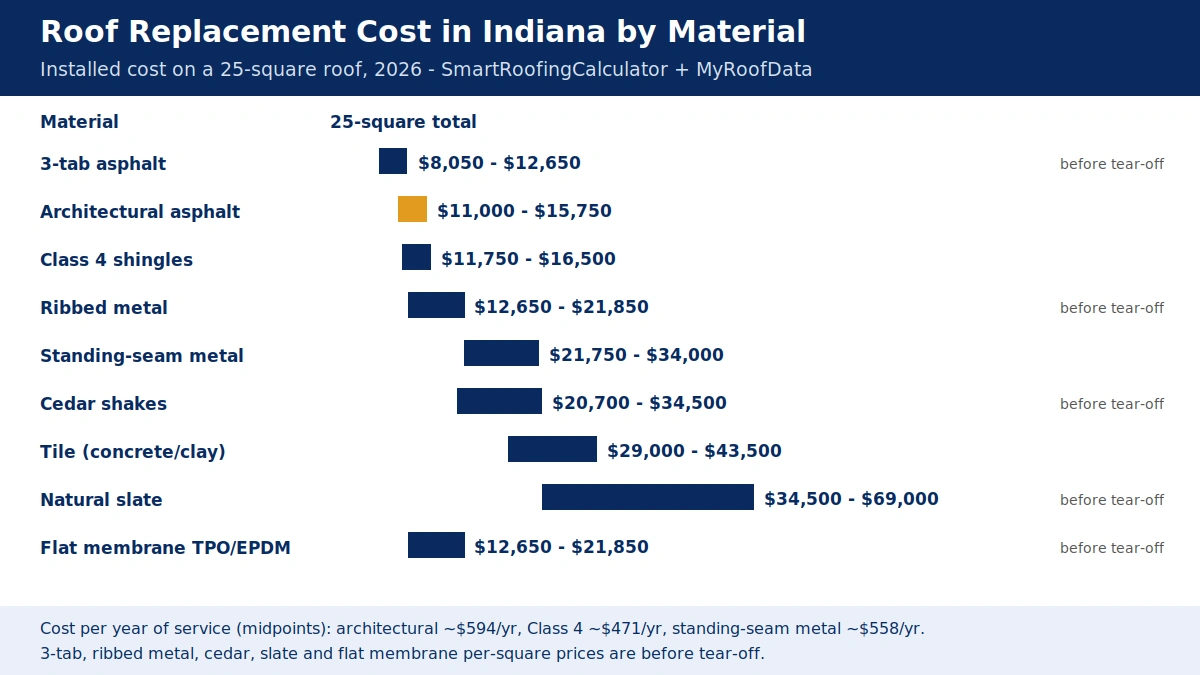
Indiana has a twist on the metal story that no other state in this series carries, and it belongs at the top of this section. In the rural counties, Amish crews price exposed-fastener metal aggressively, and a central Indiana metal roofer’s 2026 figures put mid-range exposed-fastener metal at about $370 a square installed — about $80 less per square than mid-range architectural asphalt at about $450. On a 25-square roof that is roughly $2,000 less up front, for a roof that outlasts asphalt by decades. The table below prices a typical 25-square roof — 2,500 square feet of surface — material by material from Indiana-verified figures, fitted. One layer’s tear-off is included, except where a footnote says otherwise. Read it with the weather in mind, not the sticker: the cheapest shingle on the shelf is the one most likely to fail early under a hailstone it was never built to take, and the most expensive metal on the shelf is the one most likely to still be on the roof when the mortgage is paid off.
| Material | Installed cost per square | Total for 25 squares | Realistic life in Indiana |
|---|---|---|---|
| 3-tab asphalt shingle | $322–$506 (before tear-off) | $8,050–$12,650 | 12–18 yrs |
| Architectural asphalt shingle | $440–$630 | $11,000–$15,750 | 20–25 yrs |
| Class 4 impact-resistant shingle | $470–$660 (modeled) | $11,750–$16,500 | 25–35 yrs |
| Ribbed metal (exposed fastener) | $506–$874 (before tear-off) | $12,650–$21,850 | 30–40 yrs |
| Standing-seam metal | $870–$1,360 | $21,750–$34,000 | 40–60 yrs |
| Cedar shakes and shingles | $828–$1,380 (before tear-off) | $20,700–$34,500 | 25–35 yrs |
| Tile (concrete/clay) | $1,160–$1,740 | $29,000–$43,500 | 50+ yrs |
| Natural slate | $1,380–$2,760 (before tear-off) | $34,500–$69,000 | 75–150 yrs |
| Flat membrane (TPO/EPDM) | $506–$874 (before tear-off) | $12,650–$21,850 | 20–30 yrs |
The 3-tab row is a warning, not a real option for most homes. MyRoofData prices 3-tab at $322–$506 a square installed before tear-off. The real job total climbs once the old layer comes off. Of everything in the table, 3-tab has the least room for Indiana weather. One flat layer, the lowest wind rating, no impact rating worth naming. Insurers and builders have largely moved past it. Each winter, the freeze-thaw cycle works every sealant strip and flashing lap a little looser, so the $2,500 saved on 3-tab often only pre-pays the next deductible. The material still has a place: a rental, a shed roof, a house going on the market within a few years. But it should not be the default on a home the owner plans to keep through a decade of Indiana storms.
Roughly three in four American homes wear architectural shingles, and Indiana follows that pattern. The thicker, dimensional shingle is rated for 110 to 130 miles per hour of wind with the manufacturer’s high-wind nailing pattern. It is the $440–$630-a-square band behind the headline price. Plan on 20 to 25 realistic years from it here, not the 25 to 30 the brochure prints: hail bruises the mat, ice dams push water back under the courses, and freeze-thaw opens the flashing. A central Indiana metal roofer’s own 2026 figures say the same thing from the other side of the trade — architectural shingles rated 25 to 30 years, performing closer to 20 to 25 in Indiana’s climate. A roof that looks sound at year twelve can be a single June hailstorm away from a claim.
The Class 4 upgrade gets its own section below, and it deserves one. No other decision does as much for an Indiana asphalt roof. The upgrade runs about $30 more per square than standard architectural shingles, on a Michigan insurance agent’s 2026 figures — the only state-specific premium figure this series has verified, applied here as modeled arithmetic because no Indiana-specific Class 4 premium was verified. That prices a 25-square Class 4 roof at $11,750–$16,500. SBS-modified and rubberized, the asphalt stays flexible through an Indiana freeze and absorbs a hailstone hit instead of splitting. UL 2218 Class 4 is the test behind it: a two-inch steel ball dropped twenty feet, and the shingle has to come through without cracking or fracturing. Class 4 is not hail-proof — the four-inch stone that fell in Tippecanoe County in May 2019 would have damaged anything on a roof. The one to two inch band is where most damaging Indiana hail falls, and Class 4 earns its keep right there. The insurance discount is the bonus on top.
Metal is where the per-year math flips the table. Ribbed panels with exposed fasteners run $506–$874 a square on MyRoofData’s Indiana model before tear-off — or $12,650–$21,850 for a 25-square roof, lasting 30 to 40 years — and the central Indiana roofer’s figures run lower still, at $275–$470 a square installed. Standing-seam metal runs $870–$1,360 a square on SmartRoofingCalculator’s Indiana figures, or $21,750–$34,000, lasting 40 to 60 years. Snow slides off metal faster than off any asphalt. Hail does not bruise it the way it bruises a shingle mat, and it has no granular wear cycle for freeze-thaw to attack. Run the per-year math and the table flips. Per year of service at the midpoints: standing seam near $558, architectural shingles near $594, Class 4 near $471. On the quote metal looks expensive, and cheap on the calendar. On a lake-effect roof that has already survived one hail claim, it makes a second claim least likely. The metal choice comes apart piece by piece in our metal roof cost guide and metal vs shingles comparison.
Cedar shakes are a niche choice in Indiana: $828–$1,380 a square on MyRoofData’s figures, or $20,700–$34,500 for 25 squares, with 25 to 35 realistic years. Cedar looks beautiful on a wooded lot in Brown County and needs real maintenance, and it holds snow and debris in its gaps — a poor combination on a roof that has to shed sixty-five inches of snow a winter and then take a hailstorm in June. Only one Indiana cedar price was pulled. Check the MyRoofData band against a local quote before budgeting around it.
Tile and slate sit at the luxury end. Structural reasons keep them rare in Indiana as much as price does. Tile runs $1,160–$1,740 a square on SmartRoofingCalculator’s figures, or $29,000–$43,500 for 25 squares, and slate runs $1,380–$2,760 a square on MyRoofData’s, or $34,500–$69,000. Both weigh far more than asphalt and both need a structure verified to carry them plus a snow load — and both last half a century or more. Tile’s Indiana problem is freeze-thaw. A porous tile that soaks up autumn rain and freezes in January can spall. Slate’s problem is the crew. Few Indiana roofers lay slate regularly. A slate roof fitted by a crew that rarely touches the material is a leak waiting for the first thaw. For tile, start with our tile roof cost guide — concrete and clay both need a structure check on an Indiana frame before price even enters the conversation.
Judge the table by annual cost, not by the quote total. At the midpoints, 3-tab works out near $690 a year, architectural near $594, Class 4 near $471, ribbed metal near $493, standing seam near $558, cedar near $920, tile near $725, and slate near $460. NestPriced worked those out by dividing each midpoint total by its midpoint realistic life. They leave out the deductibles, where Class 4 actually wins, and the hail resistance, where metal actually wins. When you decide, keep the material table and the insurance section side by side. Neither one alone tells the truth.
Roof Replacement Cost by Roof Size
A two-story house and a ranch can carry the same number on the listing — 2,000 square feet — and need roofs of wildly different sizes. The ranch has about 2,000 square feet of footprint under its roof. The two-story has a footprint near 1,000 square feet, so its roof surface is roughly half the ranch’s. Pitch, overhangs, and waste usually lift the ranch’s 2,000 square feet of footprint to 20–25 squares of surface. That is the most common pricing mistake in Indiana: reading the living area off the listing and assuming it is the roof. It is not. Insist that every bid print the square count as its own line. A quote built on living area is a quote for the wrong house.
The table below runs on the SmartRoofingCalculator architectural band of $440–$630 a square, tear-off included. The headline row is the 25-square one. The NumeralQ cross-check sits in the 20-square row: $8,800–$12,600 from the per-square band against $9,930–$12,120 for a 2,000 square foot roof statewide.
| Roof size | Typical Indiana home | Architectural shingle total | Class 4 shingle total |
|---|---|---|---|
| 15 squares | Small ranch / cottage | $6,600–$9,450 | $7,050–$9,900 |
| 20 squares | 2,000 sq ft ranch | $8,800–$12,600 | $9,400–$13,200 |
| 25 squares | Typical IN home | $11,000–$15,750 | $11,750–$16,500 |
| 30 squares | Large two-story | $13,200–$18,900 | $14,100–$19,800 |
| 35 squares | Large home, complex roof | $15,400–$22,050 | $16,450–$23,100 |
| 40 squares | Very large / steep | $17,600–$25,200 | $18,800–$26,400 |
Pitch moves a job off this table before anything else does. A steep 10/12 or 12/12 roof slows the crew and changes the staging versus a walkable 4/12, so the per-square price climbs. After pitch comes complexity. Valleys, dormers, skylights, and chimneys each add a flashing detail that eats time and leaks first when rushed. The same square count on two roofs — one plain gable, one cut up — still prices out as two different jobs. Third comes decking. Rotted sheathing only shows itself once the old shingles come off, and it is priced per sheet on the day. No Indiana-specific deck-sheet price was verified in this pass. Get the per-sheet rate in writing before the tear-off starts, rather than trusting a number from another state. The housing stock makes this more than a formality: the median Indianapolis home dates to 1973, and in Evansville and Fort Wayne to 1966, so older roofs hide soft decking and extra layers more often than the quote assumes.
Build the budget from the roof’s own figures. Footprint times the pitch factor — near 1.15 at 6/12, near 1.25 at 8/12 — plus 10 percent for waste, divided by 100 for squares. Compare bids first on square count, and on price only once the counts match.
Roof Replacement Cost by City: Indianapolis vs Fort Wayne vs Evansville vs South Bend vs Gary
Evansville is the puzzle in this table, so start there. It is the dearest of the three verified cities at $10,100–$12,350 for a 2,000 square foot roof, and the mildest, with about 11 inches of snow a year — about a sixth of South Bend’s. The price is set by the wage line, not the weather: Evansville roofers earn a median of $28.84 an hour, about 8 percent above the national median, the highest of the three verified cities. Modernize puts the city average lower, at $10,400, which reads as the plain-ranch end of the market rather than the whole of it. Evansville’s permit is the cheapest verified in the state — $30 for a $15,000 job — and its housing stock is the oldest of the three, with a median home dating to 1966. A roof here costs more to install and less to insure against snow, and the quote should be read with that trade in mind.
| City | 2,000 sq ft roof (arch) | Roofer median wage | Market note |
|---|---|---|---|
| Indianapolis | $9,380–$11,410 | $24.80/hr | Largest market, growth suburbs, median home 1973 |
| Fort Wayne | $9,140–$11,100 | $23.48/hr | Cheapest verified market, median home 1966 |
| Evansville | $10,100–$12,350 | $28.84/hr | Dearest verified market, mildest winters, median home 1966 |
| South Bend | No verified NumeralQ figure | $30.00/hr | Snowiest city, highest roofer pay, lake-effect snowbelt |
| Gary | No verified NumeralQ figure | Not published | Lake-effect northwest corner, ~33 in snow a year |
Indianapolis is the biggest market in the state, served by the most crews, at $9,380–$11,410 for a 2,000 square foot roof. The roofer median wage there is $24.80 an hour — about 7 percent under the national median, per the Bureau of Labor Statistics’ May 2025 figures. Modernize puts the city average higher, at $11,800 for a standard 2,000 square foot home, and Angi’s Indianapolis shingle average of $10,049 sits between the two. Dozens of established crews bid for the same jobs in the capital, and that competition is what holds the city’s prices down. The city also carries the permit quirk no other city in this guide shares, taken up in the permits section below: a one- or two-family re-roof by a listed contractor needs no building permit at all in Indianapolis-Marion County.
Fort Wayne runs cheapest on the verified figures, $9,140–$11,100 for the same 2,000 square foot roof, and its roofers earn the least of the covered Indiana cities — $23.48 an hour, about 12 percent under the national median. Modernize puts the city average at $10,900. A lower quote does not mean a lighter roof to own. Fort Wayne takes about 34 inches of snow a year — a third more than Indianapolis — and its housing stock is older than the capital’s, with a median home dating to 1966, which means more deck work found at tear-off and more reason to get the per-sheet rate in writing first. The city’s position in the northeast also puts it on the storm track that runs down from Michigan every spring, and the spec should reflect that even when the quote does not.
South Bend gets a warning label, not a verified NumeralQ price. No NumeralQ city figure for South Bend came out of this pass, and none is made up here. What can be said honestly is the shape of the market: Modernize puts the city average at $11,200 for a standard 2,000 square foot home, and South Bend pays its roofers a median of $30.00 an hour — the highest of the five cities, about 13 percent above the national median. South Bend is the snowiest city in the state at about 65 inches a year, more than double Indianapolis, arriving in bands off Lake Michigan that can bury a roof overnight. Anyone getting quotes in South Bend should make at least one of them from a company with a permanent shop within an hour’s drive. A warranty promise from a crew based two counties away gets expensive fast.
Gary carries the same warning label. No NumeralQ city figure was pulled for Gary, and none is invented. Instant Roofer, working from contractor-entered pricing, puts Gary at $15,559 on average — the same figure it gives Indianapolis, and well above the planning anchors, which is why it is printed here as a contractor-entered snapshot rather than a planning band. What can be said honestly is the shape of the market: Gary takes about 33 inches of snow a year on the 1991–2020 normals — one source puts it at 36, printed here alongside the 33 rather than settled — and sits on the lake’s southern shore, where the wind off the water drives snow and rain sideways across a west-facing slope. The city’s housing stock is the oldest industrial stock in the state, which means more deck work found at tear-off than the quote assumes.
Judge cities on price per square, never on the total: Evansville at $12,350 looks more expensive than Fort Wayne at $11,100, but the gap disappears once pitch, deck condition, and material are held equal. What actually differs between cities is exposure — South Bend gets nearly six times the snow Evansville gets, Gary takes lake-effect wind off the water, Fort Wayne’s older homes hide more deck work, and the northern towns get neither the competition nor the fast scheduling — which is why their quotes deserve the closest reading of all.
Why Indiana Roofs Cost What They Do: Lake-Effect Snow, Freeze-Thaw & Tornado Wind
Four forces set what an Indiana roof costs, and three of them arrive with the seasons. The first is tornado wind, which is the most expensive to repair after the fact. The second is lake-effect snow, which prices the northwest at a different level from the rest of the state. The third is freeze-thaw, which shortens every shingle’s life a little at a time and is the hardest to see from the curb. The fourth is the labor market, which sets the floor in every county. What follows takes them in that order — wind first, because 2026 rewrote the record, and the other three after, because they decide how long whatever survives the storm will last.
The 2026 tornado season is the headline, and it is worth stating the numbers exactly. The National Weather Service in Indianapolis counted 88 tornadoes in the state through September 10, 2026, already a new annual record, passing the previous mark of 72 in 2011, with the long-run average running at 22 a year. June alone set the monthly record at 57. June 11, 2026, produced 20 tornadoes in a single day. MoneyGeek, counting differently, logged 73 tornadoes in 2024 and 59 in 2025, with frequency up 269 percent between 2022 and 2025. Two counts of June’s monthly total appear in the record — 57 from the National Weather Service’s June 30 public information statement, 58 from weather.com’s tally of the Weather Service’s statistics — and both are printed here rather than one of them silently chosen. A tornado is a total-loss event for a roof, and no shingle rating protects against it. What the rating does protect against is everything below it: the straight-line winds and the debris that arrive with the same storm system. Against those, the defense is six nails instead of four, a high-wind starter course, and a shingle rated 110 to 130 miles per hour fitted exactly as the manufacturer specifies, written into the quote as the nailing pattern. In the first half of 2026 the storms did not stop with tornadoes. The August 11 derecho that crossed from Illinois into northwest Indiana was preliminarily rated a derecho by the Storm Prediction Center, and brought extreme straight-line winds, at least two tornadoes, large hail, and flash flooding across the state’s northwest and north-central counties — which is why the insurance and hiring sections below both start from the August storm.
The snow map is a slope, not a flat number, and it runs the whole length of the state. South Bend takes about 65 inches a year and La Porte about 65, Goshen 45, Indiana Dunes 40, Valparaiso 40, Angola 39, Fort Wayne 34, Kokomo 34, Indianapolis 26, Lafayette 21, Bloomington 18, and Evansville 11. The 1991–2020 climate normals put the state’s annual snowfall at 10 to 65 inches, and the gradient runs northwest to southeast. The lake does the work: cold air crossing the relatively warm water of Lake Michigan picks up moisture and drops it as heavy snow downwind, especially on the southern and eastern shores, and because the lake rarely freezes over completely before late January, the snow around South Bend and Gary keeps coming all winter. In the four counties that bear the worst of it — Lake, LaPorte, Porter, and St. Joseph — the ground snow load is 30 pounds per square foot. The rest of the state designs for 20, though the code warns that the load varies widely even within those numbers and that a design professional should investigate where it is not clear. A roof that must hold snow all winter, carry an ice dam at the eave, and absorb freeze-thaw at every joint needs its deck, underlayment, and ventilation sized to that load. Appearance comes second.
Freeze-thaw works on a roof the way a slow wedge works on a stone. Water finds a hairline gap in November, freezes it wider in January, and thaws it in March. By April the gap is a leak. The process is slow, invisible from the curb, and indifferent to the shingle brand on the roof. It attacks the sealant strips, the flashing laps, and the granular surface of the shingle itself, a little more with each winter. From the street, a roof can look perfectly sound while the mat underneath is bruised and close to cracking. The damage stays hidden until the shingle finally splits. Nothing glamorous counters it: a well-nailed shingle, a properly lapped flashing, and an attic that stays cold. The cold attic gets its own section next.
Hail is the fourth force, and the record is thinner than the damage. No statewide count of large hail over 2016–2025 was verified in this pass, and none is invented here. What the record does hold is strong: Indianapolis has seen about 220 roof-damaging hailstorms since 2015, and Marion County has logged 256 reports since 2006, with 51 days of hail an inch or larger and a largest stone of three inches, on May 22, 2011. Hamilton County, north of the capital, logged 52 reports in the decade to 2025, with 30 of them an inch or larger — and Carmel, on March 14, 2024, took 1.75-inch hail in a hail-heavy year for the county, with 12 reports of an inch or larger that year. Tippecanoe County holds the state’s largest verified stone in this pass, four inches on May 27, 2019. Boone County took 2.5 inches on June 25, 2023. The hail that does most of the damage falls in the one to two inch band, and that is exactly the band where Class 4 shingles distinguish themselves. That is why the Class 4 case in this state rests on the hail record, the wind-driven debris, and the insurance discount together, not on any single one of them.
The labor market sets the floor under everything else. Indiana roofers earn a median of $27.88 an hour, and the spread across the metros is wide: South Bend at $30.00, Evansville at $28.84, Elkhart at $28.03, Indianapolis at $24.80, Terre Haute at $23.89, and Fort Wayne at $23.48. The snowiest city pays its roofers the most, which is the opposite of what a homeowner pricing a roof would hope for, and it is one more reason South Bend’s quotes deserve the closest reading. The state’s design wind speed, 115 miles per hour statewide, sets the ceiling the nailing pattern has to meet. And the season sets the calendar. April through October is the working season statewide. The best installs land in the shoulder months — April and May ahead of the tornado peak, September and October after it.
Ice Dams, Snow Load & Winter: The Cold Indiana Roof Killers
Start from the ceiling stain. It appears in March, a brown mark on the paint, and by the time the homeowner notices it the ice dam has been building since January. The dam is not a shingle failure. It is an attic failure. Heat escapes from the living space into the attic and warms the underside of the roof deck. The snow on the upper roof melts from below while the eave stays frozen. Meltwater runs down to the eave, past the warm wall, and freezes again where the deck is cold, into a ridge of ice. The next melt has nowhere to go, so it backs up behind the ridge, slips beneath the shingles, and works its way into the house — through the sheathing, down the wall, into the ceiling. The first sign is the brown March stain, or worse. A dam can leak through a brand-new roof — the shingles were never the failure.
The ground snow load behind that risk is set in the 2020 Indiana Residential Code, which adopts the 2018 International Residential Code. The code sets the ground snow load at 20 pounds per square foot for most of the state, rising to 30 in the four lake counties — Lake, LaPorte, Porter, and St. Joseph — where the lake-effect snow falls hardest. The code adds a warning that the load varies widely even inside a single county, and that a design professional should investigate where the local number is not clear. On a low-slope porch roof the danger doubles: flat and low-slope areas hold snow rather than shedding it, so a low-slope porch roof can carry double the main slope’s load. And the load builds through the season. December’s snow compacts in January, ices in February, and is still there in March when the next storm adds another foot.
Three layers keep a dam from forming, and the reroof is the one job that opens up all three at once. The first is an ice and water shield: a self-adhering membrane along the eaves, in valleys, and around penetrations. It runs from the edge past the inside face of the exterior wall — at least 24 inches inside the wall line under IRC section R905.1.2. The code requires the membrane statewide in the 2020 Indiana Residential Code, so every Indiana bid should carry it. Where the eave runs deep or the slope runs shallow, one 36-inch roll rarely spans the distance, so crews stack two or three overlapping runs to build six to nine feet of coverage. On a roof that has dammed before and will dam again, the full-roof option exists: NumeralQ prices a whole-roof ice and water barrier at $0.89–$1.43 a square foot installed in Indiana. In the northwest, where snow runs sixty-five inches a year, the membrane should run past the minimum on a low-slope roof, and the quote should state the distance in feet. The second layer is attic insulation of R-49 to R-60, with the attic floor air-sealed so the heat cannot escape into the attic in the first place. The third is balanced soffit-to-ridge ventilation, which keeps the deck cold so the snow on it does not melt from below. A hot, unventilated attic under new shingles means another dam by February, whatever the shingle brand. That is why the reroof scope should carry all three layers, and not leave any of them for a later project.
Winter work is possible, and it carries its own rules. A winter install can work — SBS-modified shingles made cold-weather work more practical than it once was — but the sealant strips need warmth to bond. A January crew that skips hand-sealing the tabs fits a roof that lifts in the first June wind. A roof going on in winter should have hand-sealing in the scope, and the quote should say so. Snow sheds fastest off metal, and steep pitches beat shallow ones. Snow sliding off metal in one slab can rip off a gutter, though, so snow guards above entries belong in the quote, not tacked on afterward. One last winter note for the lakeshore. The wind off Lake Michigan drives snow and rain sideways, and a west-facing slope on the Gary or South Bend shore takes weather a sheltered inland roof never sees. Spell out the flashing scope on a lakeshore quote in full. And check a lakeshore roof after the first big November storm, not after the first leak.

Class 4 Impact-Resistant Shingles in Indiana: What the Upgrade Costs and What It Pays Back
Start with the money, because the money is what settles this question. A typical Indiana deductible runs $500 to $5,000 for standard perils. Many policies now carry a separate, higher wind and hail deductible on top of that — sometimes a percentage of the dwelling value. On a $300,000 home at 2 percent, that works out to $6,000 out of pocket before the insurer pays anything on a wind claim. Against that, the Class 4 upgrade on a 25-square roof costs about $750, at the modeled $30-a-square premium. A Class 4 roof that survives two hail or debris events without needing replacement saves the homeowner that deductible twice over. That is $1,000 to $10,000 at standard deductibles, far more under a percentage wind and hail deductible, against an upgrade that cost about $750. A single claim the roof rides out can pay for the upgrade by itself. The upgrade pays because of the deductible that never gets paid.
Here is the one piece of advice that survives every cut in this guide: get the Class 4 upgrade priced on every asphalt quote, and take it unless the numbers say no. Class 4 sits at the top of the UL 2218 impact-resistance scale from Underwriters Laboratories. The test drops a two-inch steel ball from twenty feet onto the shingle, roughly the size of a golf-ball hailstone at terminal velocity. The shingle has to come through the test without cracking or fracturing. Class 4’s flex comes from SBS-modified asphalt, a rubberized mix that stays bendable in a freeze and absorbs a strike instead of cracking. Indiana shelves carry the usual Class 4 lines — GAF Timberline AS II, CertainTeed Landmark IR, and Owens Corning Duration STORM. No Class 4 shingle is hail-proof: the four-inch stone that fell in Tippecanoe County in May 2019 would have damaged any roof on the market. Most damaging hail in Indiana falls in the one to two inch band, and that is exactly where Class 4 distinguishes itself. Hamilton County alone logged 30 reports of hail an inch or larger in the decade to 2025.
The price is modeled, and the model is honest about it. This pass verified no Indiana-specific Class 4 premium, and this guide invents none. A Michigan insurance agent’s 2026 figures supply the number it uses, putting the upgrade at roughly $30 more per square than standard architectural shingles. Applied to the Indiana architectural band of $440–$630 a square, that gives a modeled Class 4 band of $470–$660 a square, or $11,750–$16,500 for a 25-square roof. The national guides put the premium higher, at 10 to 25 percent or $1,000 to $2,500 on a typical house. The Michigan agent’s $30-a-square figure is the lowest published number. Treat the Indiana band as planning arithmetic, not as a verified Indiana price. Get the real premium written on the quote.
The discount is real, carrier-specific, and smaller than the upgrade’s real value. A Class 4 discount on the wind and hail portion of the premium is on offer from most major carriers in Indiana. The published ranges disagree, and the disagreement deserves stating plainly. One national guide says 20–30 percent off the wind and hail portion, a Michigan agent says 15–20 percent, a fourth source says 10–25 percent in hail-heavy states, and another says 5–20 percent. Only the wind and hail portion carries the discount, never the whole premium, and the exact figure differs by carrier. No carrier has published a figure specific to Indiana. Have your own insurer confirm it in writing — qualifying product list and paperwork included — before signing anything. Treat any contractor-quoted discount as fiction until the carrier confirms it. In Indiana, the bigger payback is the deductible that never gets paid, and in Indiana that stream matters most, because the state’s hail record and its record tornado year keep the deductible within reach of every homeowner.
Three rules close the section. First, put the product on the quote by name — manufacturer and exact shingle line. Second, file the UL 2218 Class 4 marking, printed on the shingle’s back, with the job records. Third, before the install, get the insurer’s discount confirmation and paperwork requirements in writing. Some carriers want photos, a certificate, or an inspection, and none of them takes a contractor’s word. And a warranty rule that matters here: only a credentialed crew can trigger the extended warranty — one more reason the cheapest bidder is not always the cheapest roof. Everyone else should treat Class 4 as the default, not the upgrade — the long-term owner, the house that has already had one hail claim.
Permits & Code: The 2020 Indiana Residential Code, the Indianapolis Permit Quirk & No State License
The most surprising sentence in this section belongs first, because it catches the most homeowners off guard: in Indianapolis, a one- or two-family re-roof needs no building permit at all, as long as a listed contractor or the owner-occupant does the work and the roof’s configuration and covering weight do not change. Indianapolis-Marion County Code section 536-201 says so, plainly. The same rule means the reverse, too: change the roof’s configuration or put on a heavier covering, and the exemption falls away. The Indianapolis rule is not the state rule, and it is not the rule in Fort Wayne, Evansville, South Bend, or Gary. The building department sets the number that governs, not the contractor.
The statewide code is the 2020 Indiana Residential Code, which adopts the 2018 International Residential Code with state amendments. It sets the design wind speed at 115 miles per hour statewide, the ground snow load at 20 pounds per square foot for most of the state and 30 in the four lake counties — Lake, LaPorte, Porter, and St. Joseph — and it requires an ice and water shield under IRC section R905.1.2. The snow-load table comes from 675 IAC 13-2.6-18, which adopts ASCE 7 Table 1608.2, and it carries a warning that the load varies widely even inside a single county and that a design professional should investigate where the local number is not clear. The code also sets the attic insulation at R-49 to R-60, which matters for the ice-dam defense in the section above.
Permit fees vary widely by county, and the published numbers disagree by an order of magnitude, which is itself worth knowing. SmartRoofingCalculator puts the Indiana permit at about $180, typically $100–$300. MyRoofData puts it at $50–$250. RoofingEstimatorPros puts it at $150–$500. NumeralQ, working from a verified Evansville job, puts it at $30 on a $15,000 job. All four figures are printed here, and none of them is the number that matters for a specific house — the building department’s number is. What matters is the pattern: the permit is a small line on a large job, and it is the line that protects the homeowner, because a permitted job gets an inspection and an inspected job gets a record.
Minor repairs usually need no permit anywhere in the state, and that is the one permit rule that holds from Gary to Evansville. A full re-roof needs one in most places, with Indianapolis as the notable exception above. The inspection that follows is the quiet protection: it checks the nailing pattern, the ice barrier, the flashing, and the ventilation, and it produces a record that the next buyer’s inspector and the next insurer’s underwriter will both ask to see.
The licensing picture is the other half of this section, and it is the fact that should change how every Indiana homeowner hires. Indiana is one of twelve states that licenses no roofers at all. The Indiana Professional Licensing Agency regulates accountants, engineers, and other professions, and does not regulate roofers. Anyone can legally call themselves a roofing contractor in Indiana without formal credentials. What exists instead is a patchwork: Indianapolis runs a general contractor license under Chapter 875: a $10,000 surety bond and registration, applying to roofers doing general contracting work in the city, with no roofing test in it. Other cities and counties run their own registration schemes. A license in Indianapolis is not a license in Fort Wayne, and a registration in one county proves nothing in the next. It does not prove the business has a permanent local address, and it does not prove it has local references. The hiring section below builds the screening by hand, including the pieces no license covers.
Hiring a Roofer in Indiana: No State License, the Indianapolis General Contractor License & What to Check
The state’s hiring problem can be stated in one sentence: Indiana licenses no roofers, so the homeowner is the inspector, the verifier, and the safety net. The Indianapolis Star, reporting on the state’s licensing gap on October 27, 2026, confirmed that Indiana is one of twelve states with no statewide roofing license and that the Indiana Professional Licensing Agency does not regulate roofers. The same reporting confirmed that the Attorney General’s office had filed six complaints against contractors in the weeks after the August 11 derecho. The pattern is familiar from earlier storms: a homeowner hires a crew that arrived after the hail, the work leaks, and by the time the problem shows the company has already moved on. In a state with no license to revoke, the only protection is the screening the homeowner does before signing.
Because Indiana licenses no roofers, the screening has to be built by hand. Run the same five vetting steps on every bidder, whichever county the job is in. The first is general liability insurance. Prove it with a certificate the carrier mails to you directly — never one the contractor hands over — with the business name matching the contract. The second is workers’ compensation for the crew, which the bidder must carry whenever it employs anyone. The third is a permanent Indiana address and a local number that has been in service since before the last storm. Fourth: three local references from your own county, with street addresses you can go and see. Fifth, a manufacturer certification where it counts — GAF, Owens Corning, or CertainTeed credentialed installer status. Only a credentialed crew triggers the extended warranty. Three written quotes close the process — one identical spec sheet, three bidders — so the prices compare the same roof.
Two Indiana consumer protections sit behind those five steps, and both are worth knowing by number. The Home Improvement Contracts Act, Indiana Code 24-5-11, bans a contractor from waiving or absorbing a homeowner’s insurance deductible, and it gives the homeowner three business days to cancel the contract when the job is insurance-related. The Attorney General’s Consumer Protection Division, at 1-800-382-5516, takes the complaints when a contractor breaks those rules, and its complaint history is how the six post-derecho complaints came to light. The deductible ban matters twice: it makes a contractor’s offer to “make the deductible disappear” illegal, and it makes the offer itself a red flag.
After a hail outbreak or a derecho, Indiana turns into storm-chaser territory, and the crews arrive within days, knocking on doors across the damaged neighborhoods. Some are legitimate traveling crews. Many are not. You can spot a storm chaser the same way every time. A knock and a free-inspection agreement pushed across the threshold, an out-of-state number, no office in town, no local registration, a promise to make the deductible disappear, and a demand for a large payment before any work starts. Watch for a door knock pushing a free-inspection agreement to sign on the spot. Out-of-state phone numbers, no permanent local office, no local registration, a promise to waive or absorb your deductible, and a demand for a large payment before work starts.
A proper Indiana quote names the manufacturer and the exact shingle line, plus the underlayment type. It also names the ice and water shield coverage in feet from the eave. The drip edge, the ventilation scope, the nailing pattern, the tear-off depth, the per-sheet deck replacement rate, the disposal, and the cleanup all belong on it too. Every bid carries a total price for its surface, so two bids can be compared square for square. The manufacturer year count and the workmanship year count are separate, each with its honoring party named. Three code-driven items belong on every bid. A bid missing any of them is a red flag. Ice and water shield along eaves, valleys, and penetrations, at least 24 inches inside the exterior wall line; drip edge at the eaves and rakes; and the six-nail high-wind fastening pattern where the wind runs hardest in the state. A bid with no ice barrier means a leak in February. And one last check before the work starts: ask for insurance and workers’ compensation certificates mailed straight from the carrier, with the business name matching the contract — and confirm that the Indianapolis contractor license, where one applies, is current.
Insurance: Deductibles, ACV vs RCV, the Roof-Age Rule & the Class 4 Discount
An Indiana homeowner’s insurance policy is the part of the roof that either earns its keep or delivers a nasty surprise. What looked like solid cover at signing can pay out far less than the homeowner counted on, and the gap is bigger in Indiana than in most states. The numbers in this section come from two national studies that measure the state from different angles, and they disagree on the size of the gap — which is worth stating plainly. NerdWallet, on May 6, 2026, prices Indiana homeowners insurance at $2,985 a year for a $400,000 dwelling, against a national average of $2,490 — the state is about 20 percent dearer than the country. MoneyGeek, on June 19, 2026, prices the same state at $3,094 a year, ranking it 35th of 51 jurisdictions and about 13 percent below its national average of $3,548, with the figure at $3,136 a year on a $250,000 dwelling. The two studies agree on the direction even though they measure different coverage levels, and they disagree on the size of the gap. Against the homeowner’s own policy, check every figure in this section. MoneyGeek’s own finding explains why the gap matters: Indiana’s premiums are built for a risk profile the state has outgrown, with wind and hail claims running high and a record tornado year pushing the exposure further.
A $500-to-$5,000 standard deductible for most perils is what most Indiana policies carry. A separate, higher deductible for wind and hail damage now appears on many policies. Most homeowners first hear about the percentage wind and hail deductible from the adjuster standing in the driveway. On a $300,000 dwelling, 2 percent is $6,000 out of pocket before the insurer pays anything on a wind claim. Raising the deductible from $500 to $1,000 typically cuts the premium by 10 to 25 percent, per the Insurance Information Institute, which is a real saving — and a real gamble on the next storm. The declarations page deserves a read before the storm, not after it.
The roof-age rule is what makes the call different in Indiana. The best rates generally go to roofs under ten years old. Between ten and twenty years, roofs typically pay the standard rates. Roofs over twenty years often face surcharges, higher wind and hail deductibles, or carriers refusing to quote at all. Some carriers now turn down new business entirely on homes with a twenty-year-old or older roof. Older roofs also get settled by many carriers at depreciated actual cash value or on a roof payment schedule, instead of at replacement cost. At fifteen years, a $20,000 roof has lost half its value to depreciation. With a $2,000 deductible, the payout nets only about $8,000. Twelve thousand dollars or more comes out of the homeowner’s pocket. Before the storm, confirm the policy type and the roof-age trigger. At renewal, documenting a replacement — permits and receipts — is one of the most impactful things a homeowner can do.
Replacement cost value or actual cash value: that settlement basis is the second key number. Under replacement cost, the insurer pays for a new roof, whatever the old roof’s age, less the deductible. Actual cash value values the roof the other way: as it stood when the damage happened, at new-roof cost less depreciation, with shingles losing value fast. The worked example below is one this guide calculated itself; no regulator published it. It is built on a $13,375 roof, the midpoint of the Indiana architectural band, a $2,000 flat deductible, and straight-line depreciation of 2 percent a year across a 25-year shingle life.
| Roof age | RCV payout | ACV payout |
|---|---|---|
| 5 years | $11,375 | $10,038 |
| 10 years | $11,375 | $8,700 |
| 15 years | $11,375 | $7,363 |
| 25 years | $11,375 | $4,688 |
Five years in, the ACV payout runs $1,337 below replacement cost. At ten years the gap is $2,675, at fifteen it is $4,012, and at twenty-five the policy pays $4,688 on a $13,375 roof — barely more than a third of the cost. An ACV policy leaves the homeowner mostly self-insuring an older roof, whether they know it or not. Check the policy type before the storm. Past ten years on ACV, the insurer funds little of either the Class 4 upgrade or the replacement. Both decisions look different. Once the roof is past twenty and the policy has gone ACV, the replacement decision changes. The insurer will not be paying for much of either the repair or the replacement, and a new roof resets the clock.
A hail or wind claim has an order to it, and the order matters. Photograph the damage before anyone touches it: every slope, every gutter, every dented vent cap, and date every shot. Then the adjuster inspects, and the contractor estimates, and that order matters: an estimate before the inspection is a number without a claim. A contingency or assignment-of-benefits agreement offered in the driveway is one to refuse outright. Get the adjuster’s written report with its line items, and compare it against the contractor’s estimate, line by line. File the paperwork: Class 4 product name, UL 2218 marking, install photos. Proving what is on the roof is what next year’s discount depends on.
The Class 4 discount is real, carrier-specific, and limited to the wind and hail portion of the premium. Published ranges run from 5–20 percent up to 20–30 percent depending on the source. Before the install, get your own carrier’s figure in writing, with the qualifying product list and paperwork required. A promised discount stays a promise until the carrier confirms it.

Paying for It: No Federal Credit in 2026, HEAR/HOMES Launched in Indiana & No Roof Rebate
Indiana is the one state in this series where the federal home-energy rebate programs have actually launched — and that distinction changes nothing about a roofing quote, which is the point of this section. The Indiana Energy Saver program, run by the Indiana Office of Energy Development with the Indiana Housing and Community Development Authority, has been taking applications since May 2025. On the Energy Department’s February 6, 2026 map, Indiana sits among the thirteen jurisdictions where the programs have launched. A check of the program on October 27, 2026 showed Indiana among the seven jurisdictions with open heat-pump rebates, and no pause notice on the program. When the programs do pay, HEAR pays up to $8,000 per heat pump for low- and moderate-income households, at or below 150 percent of area median income. And since the Energy Department’s Notice 26-2 of May 29, 2026, it covers electric-to-electric upgrades only. HOMES pays up to $4,000 generally, and up to $8,000 for low-income households at or below 80 percent of area median income. But HEAR never pays for a roof. No documented lease or pass-through arrangement channels federal dollars toward an Indiana roof, and no Indiana state roof grant, rebate, or tax credit turned up in this pass, and no utility roof rebate turned up either. A homeowner who pairs a reroof with a heat pump should price the two jobs separately: the roof comes out of the homeowner’s pocket, and the heat pump may qualify for HEAR. Our heat pump cost in Indiana guide prices the rebate side of that decision.
The federal tax credit is gone, and the dates matter. Neither federal credit pays anything on property placed in service after December 31, 2025 — not the Residential Clean Energy Credit (§25D, 30 percent), not the Energy Efficient Home Improvement Credit (§25C). Signed on July 4, 2025, the One Big Beautiful Bill Act (Public Law 119-21) ended both credits, and IRS Fact Sheet FS-2025-05 confirms the cutoff. Both federal credits ended for installs placed in service after December 31, 2025, under the One Big Beautiful Bill Act. Roofing never counted as solar equipment. The solar credit was never on the table for a roof at all. Roofing never qualified for §25D, which covers solar equipment. §25C was sometimes claimed for qualifying roofing materials. That door is closed too. A tax-credit line still sitting on a 2026 quote means the contractor priced the job by a law that no longer exists. Have the contractor strip it out and price the job again. No 2026 quote should carry a federal tax-credit line. There is no credit left to claim on a roof installed in 2026. One flag belongs on the dates: the Energy Department’s Notices 26-1 and 26-2 are dated May 29, 2026, but were announced June 1, 2026 — a back-catalog date discrepancy that shows up in the program record and is printed here rather than smoothed over. Indiana’s program launched in May 2025 under the pre-26-2 rules.
Solar arrays and similar clean-electricity equipment are what the §48E commercial clean-electricity credit covers — and nothing on a roof. For a homeowner who needs help paying for a roof in Indiana in 2026, the honest options are a home-equity loan or a contractor financing plan. The annual percentage rate comes before the monthly payment. The money comes from the insurer. A Class 4 roof can earn a discount on the wind and hail portion of the premium, and every claim the roof rides out saves a deductible. The insurer is what pays toward a roof, through the Class 4 discount and the avoided deductible. A homeowner weighing a solar array under the new roof should read our solar panel cost in Indiana guide before signing either contract, because the §48E pass-through only reaches a leased solar array, never the roof underneath it.
Repair vs Replace: The Indiana Decision Rules
When the roof is still early in its life and the damage stays local, patching it beats tearing the whole thing off. Picture a roof no older than ten years that has lost a handful of shingles, sprung a leak at one chimney flashing, or had wind lift a few tabs. The right call there is a targeted fix, not a whole new roof. The repair prices from NumeralQ, pricing October 26, 2026, set the scale: flashing repair $230–$491, finding and fixing a leak $308–$860, a chimney reflash $320–$700, and a skylight leak $332–$660. A central Indiana roofer’s sold jobs from 2024–2026 run higher, with most repairs at $950–$2,300 and a typical repair near $1,500, and Modernize puts minor repairs at $300–$750 and major repairs at $950–$1,400. The spread between the two sets of numbers is the difference between a price list and a ledger: NumeralQ prices the part, SPG prices the job. Repairs get priced on their own terms in our roof repair cost guide — patching, partial replacement, and the point where repair stops making sense for an Indiana roof.
Age, spread, or arithmetic can each point to a new roof. Once architectural shingles pass fifteen years and wind has lifted more than a quarter of the slopes, the answer is replacement rather than repair. Patching a lifted mat is cosmetic work: the roof fails at the next storm regardless. A soft deck or delaminated sheathing means replacement too — structure gets replaced, never repaired. If ice dams come back every winter despite insulation and ventilation work, the system has failed, not the shingle. An insurer-paid claim on a roof now old enough that the next claim pays ACV at a third of the cost points the same way: take the replacement money while it is still there. A roof about to cross the carrier’s twenty-year trigger is a replacement too — the policy about to go ACV, the carrier about to decline renewal. A repair quote above about a third of the replacement quote, on a roof with under five years of life left, is a replacement too.
Two checks a year keep the decision from being made in a panic. While the adjuster’s window is still open, check in fall for the summer’s wind and hail damage. Spring is for checking what winter did: ice-dam and freeze-thaw damage, caught before tornado season stacks a second round of trouble on top. From the curb a roof can look sound while sitting far closer to failure than it seems, after several Indiana winters. The mat bruises from the inside, and the bruise stays hidden until the shingle splits.
Getting Quotes in Indiana: The Checklist
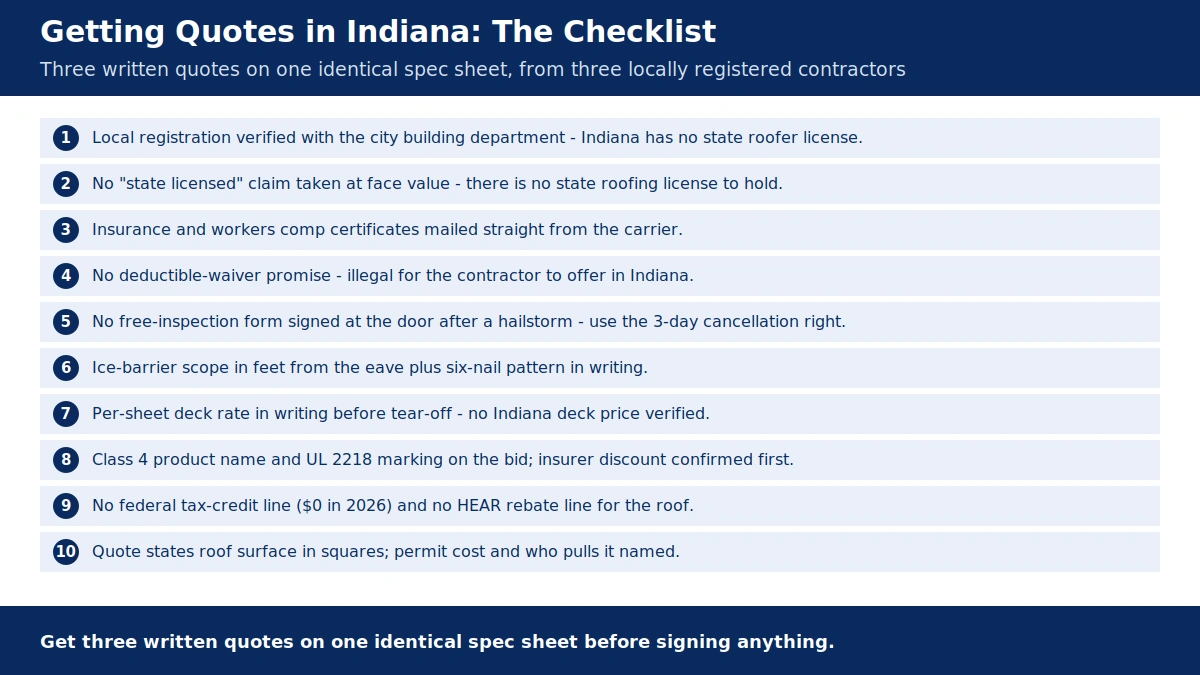
Ten items, in the order to use them. Skip one and the quote you sign is a quote you have not really read.
- Roof measurements in writing. Square count, pitch, and waste allowance, printed on the bid — never priced from the listing’s living area.
- Material named by manufacturer and line. GAF, CertainTeed, or Owens Corning, with the exact shingle line and the Class 4 UL 2218 marking where the upgrade is priced.
- Tear-off depth stated. One layer or two, and the per-sheet deck replacement rate agreed before the old shingles come off — no Indiana deck price was verified in this pass, so the rate on the quote is the only number that counts.
- Ice and water shield coverage in feet from the eave. At least 24 inches inside the exterior wall line under IRC R905.1.2, further where the eave runs deep or the slope runs shallow, and six to nine feet on a low-slope northwest roof.
- Drip edge, ventilation, and nailing pattern in the scope. Drip edge at eaves and rakes, balanced soffit-to-ridge ventilation with R-49 to R-60 insulation, and the six-nail high-wind pattern in the wind-exposed parts of the state.
- Insurance and workers’ compensation certificates mailed straight from the carrier. Business name matching the contract, never a certificate the contractor hands over.
- Local registration and references checked. The Indianapolis general contractor license where it applies, three local references from your own county with street addresses to visit, and a permanent Indiana address and local number in service since before the last storm.
- Three written quotes against one shared spec sheet. One spec, three bidders, so the prices compare the same roof.
- No federal tax-credit line, no HEAR rebate line. $0 in 2026 for the credit, and HEAR has launched in Indiana but never covers roofing.
- Insurer’s Class 4 discount confirmed in writing first. Qualifying product list and paperwork included, before the install — a promised discount is not a discount until the carrier confirms it.
Sources & methodology
Every price in this guide carries its source and its date, and every number this guide worked out itself is labeled as its own arithmetic. The 25-square material totals, the size-table figures, the Class 4 totals, and the cost-per-year figures are NestPriced’s own calculations from the cited per-square ranges and lifespans, worked out by dividing each midpoint total by its midpoint realistic life. The RCV/ACV worked example in the insurance section is our own calculation too, built on a $13,375 roof, a $2,000 flat deductible, and straight-line depreciation of 2 percent a year over a 25-year shingle life. They are realistic figures worked from the climate, not numbers lifted from one published table. Where two sources disagree, both are printed and the disagreement is flagged rather than settled silently.
- Headline prices: SmartRoofingCalculator Indiana state page (page dated Apr 24, 2026; index updated Nov 9, 2026): architectural shingles $440–$630/sq fitted with tear-off; 25-square roof $11,000–$15,750; standing seam $870–$1,360/sq; tile $1,160–$1,740/sq; permit ~$180 ($100–$300); roofer median $26.75/hr (May 2024 BLS vintage); state factor 0.969; Indiana ranks 31 of 50 cheapest-to-most-expensive; neighbours Illinois $510–$740, Michigan $450–$650, Ohio $440–$640, Kentucky $410–$600 per square.
- NumeralQ Indiana (pricing Oct 26, 2026): 2,000 sq ft roof statewide $9,930–$12,120; Indianapolis $9,380–$11,410; Fort Wayne $9,140–$11,100; Evansville $10,100–$12,350; whole-roof ice and water barrier $0.89–$1.43/sq ft installed; median home age Indianapolis 1973, Evansville and Fort Wayne 1966; roofer pay vs US median Evansville +8%, Indianapolis −7%, Fort Wayne −12%; Evansville permit $30 on a $15,000 job; repair prices — flashing $230–$491, find and fix a leak $308–$860, chimney reflash $320–$700, skylight leak $332–$660.
- MyRoofData Indiana (2026 model): typical single-family architectural roof $11,750–$20,500, about 8% below the national average; crews $48–$80/hr; state cost index 0.92; tear-off $100–$200/sq/layer; permits $50–$250 in most cities; material table per square before tear-off — 3-tab $322–$506, architectural $414–$690, ribbed metal $506–$874, standing seam $874–$1,472, cedar $828–$1,380, concrete tile $920–$1,656, clay tile $1,104–$2,300, natural slate $1,380–$2,760, flat membrane $506–$874.
- Modernize (updated Aug 27, 2026): Indiana average ~$11,400, most projects $8,500–$15,500, range $9,500–$14,000; city averages for 2,000 sq ft — Indianapolis $11,800, Fort Wayne $10,900, South Bend $11,200, Evansville $10,400; minor repairs $300–$750, major repairs $950–$1,400.
- RoofingEstimatorPros (updated Aug 26, 2026): 2,000 sq ft architectural roof $13,286–$23,873, average $17,991, about $9/sq ft including tear-off, permits and waste; permit range $150–$500 — flagged as the high outlier.
- Angi Indianapolis (updated May 21, 2026): shingle roof average $10,049, range $7,178–$22,968.
- Instant Roofer (2026 snapshot; contractor-entered pricing): Indiana average $15,991 for asphalt; Gary $15,559, Indianapolis $15,559, Fort Wayne $16,934 — flagged as contractor-entered and running high against the planning anchors.
- SquareDash (Apr 2026): Indiana average $13,300 for a 2,000 sq ft home; Indianapolis, South Bend and Fort Wayne ZIPs $12,000–$12,200.
- Indiana Metal (central Indiana, May 19, 2026): exposed-fastener metal $275–$470/sq installed, mid ~$370; architectural asphalt $225–$550/sq, mid ~$450; architectural shingles rated 25–30 yrs but performing closer to 20–25 yrs in Indiana’s climate; Amish crews price metal aggressively in rural counties.
- SPG Roofing, Central Indiana (sold jobs 2024–2026): most residential repairs $950–$2,300, typical ~$1,500.
- Snowfall, 1991–2020 normals (NCEI via Current Results): South Bend 64.5 in/yr; La Porte 65.2; Goshen 45.2; Indiana Dunes Lakeshore 40.3; Valparaiso 40.0; Angola 38.9; Fort Wayne 33.6; Kokomo 34.1; Indianapolis 25.5; Lafayette 20.5; Bloomington 17.5; Evansville 10.8; Gary ~33 in/yr (myperfectweather, NCEI 1991–2020) vs 36 in/yr (BestPlaces) — conflict, both printed.
- Ground snow load (675 IAC 13-2.6-18, Table 1608.2): most counties 20 psf; Lake, LaPorte, Porter and St. Joseph counties 30 psf, with extreme variation requiring a design-professional investigation at each site.
- Design wind: 115 mph statewide (2020 IRC Table R301.2(1)).
- Tornadoes: NWS Indianapolis — 88 tornadoes through Sep 10, 2026, a new annual record (previous record 72 in 2011); June 2026 monthly record 57 (NWS PNS, Jun 30) vs 58 (weather.com / NWS stats page) — conflict, both printed; June 11, 2026 produced 20 tornadoes in one day; long-run average ~22/yr (NWS) vs ~31/yr (SPC) — conflict; MoneyGeek: 73 confirmed in 2024, 59 in 2025, frequency +269% (2022–2025).
- August 11, 2026 derecho: preliminarily classified by SPC as a derecho; crossed from Illinois into northwest and north-central Indiana; extreme straight-line winds, at least two tornadoes, large hail, flash flooding (Indiana DHS disaster page); Indiana 211 disaster dashboard logged thousands of reports; AG’s office filed six complaints against contractors since the August 2026 storms (IndyStar, Oct 27, 2026).
- Hail: no statewide 2016–2025 large-hail count was verified — none is given. Marion County 256 hail reports since 2006, 51 days with 1 in+ hail, largest 3 in (May 22, 2011); Hamilton County 52 reports 2016–2025, 30 of 1 in or larger; Indianapolis metro ~220 roof-damaging hailstorms since 2015; Tippecanoe County largest 4 in (May 27, 2019); Boone County 2.5 in (Jun 25, 2023); 1.75 in near Carmel Mar 14, 2024.
- Code and licensing: 2020 Indiana Residential Code (675 IAC 14-4.4, adopts 2018 IRC); ice-shield underlayment required statewide (IRC R905.1.2, 24 in inside the wall line); attic insulation R-49 to R-60; no statewide roofer license — Indiana is one of 12 states without one, and the Indiana Professional Licensing Agency does not regulate roofers (IndyStar, Oct 27, 2026); Indianapolis general contractor license under Chapter 875 ($10,000 surety bond, no roofing test); Indianapolis-Marion County Code Sec. 536-201 — no building permit for a 1–2 family re-roof by a listed contractor or owner-occupant unless the configuration changes or a heavier covering is used; Home Improvement Contracts Act IC 24-5-11 — deductible rebate ban (10.5), three-business-day cancellation right when insurance is involved (10.6); AG Consumer Protection 1-800-382-5516.
- Labor (BLS OEWS May 2025): Indiana roofer median $27.88/hr, mean $28.75, 2,980 employed, 10th $19.15, 90th $42.91; national median $26.65. Metro medians: South Bend $30.00, Evansville $28.84, Elkhart $28.03, Indianapolis $24.80, Fort Wayne $23.48, Terre Haute $23.89. Conflict: SmartRoofingCalculator’s May 2024 vintage lists the Indiana median at $26.75/hr — this guide uses May 2025.
- Insurance: NerdWallet (May 6, 2026) Indiana $2,985/yr at $400,000 dwelling (national $2,490); MoneyGeek (Jun 19, 2026) $3,094/yr, rank 35 of 51, −13% vs national $3,548; $3,136/yr at $250,000 dwelling; MoneyGeek notes Indiana tornado frequency has outgrown its premium level. Deductibles $500–$5,000; percentage wind/hail deductibles 1–5%; raising the deductible from $500 to $1,000 typically cuts the premium 10–25% (Insurance Information Institute).
- Class 4 + insurance discounts: UL 2218 Class 4 test (2-inch steel ball from 20 feet); upgrade cost: Lifelong Insurance Agency, Michigan (May 4, 2026: ~$30 more per square — applied here as modeled arithmetic, no Indiana-specific premium verified); national guides (10–25% premium, $1,000–$2,500 on a typical house); discount ranges 5–20% / 10–25% / 15–20% / 20–30% off the wind/hail portion by source, conflict flagged; products named — GAF Timberline AS II, CertainTeed Landmark IR, Owens Corning Duration STORM.
- Federal help: OBBBA (P.L. 119-21; IRS FS-2025-05) ended §25C/§25D for post-Dec-31-2025 installs — $0 federal credit for a 2026 owned install. HEAR/HOMES launched in Indiana (Indiana Energy Saver, applications open since May 2025; on the DOE Feb 6, 2026 map among 13 launched jurisdictions; ECW check Oct 27, 2026 lists Indiana among 7 with open heat-pump rebates, no pause notice): HEAR up to $8,000 per heat pump, at or below 150% AMI; HOMES up to $4,000 general, up to $8,000 low-income (at or below 80% AMI); HEAR electric-to-electric only per DOE Program Notice 26-2 dated May 29, 2026 (announced June 1, 2026 — date discrepancy flagged); HEAR never pays for a roof. No Indiana state roof grant, rebate or tax credit verified; no utility roof rebate verified.
- Lifespans: the Indiana lifespans here are contractor-consensus estimates, fitted to a climate of snow, ice dams, freeze-thaw, tornadoes, and hail. The lifespans are realistic figures, not numbers lifted from a single published table.
Prices change, and a quote from last month is not a quote from today. Verify every figure against a current written bid before signing.
*Disclaimer: This guide is general information, not professional advice. Prices are 2026 estimates for Indiana based on the sources cited and will vary with roof size, pitch, condition, material, and contractor. Permits, codes, and licensing rules vary by city and county — confirm them with the local building department. Insurance terms, deductibles, and discounts vary by carrier and policy — confirm them with your own insurer before signing. Always obtain multiple written quotes from licensed local contractors before making a decision.*
What does a roof replacement cost in Indiana in 2026?
A typical 25-square architectural shingle roof costs $11,000–$15,750 in 2026, per SmartRoofingCalculator, and a 2,000 square foot roof costs $9,930–$12,120 statewide, per NumeralQ (pricing October 26, 2026). On that 25-square roof, 3-tab shingles run $8,050–$12,650 before tear-off. Class 4 impact-rated shingles run $11,750–$16,500, and standing-seam metal runs $21,750–$34,000. Indianapolis runs $9,380–$11,410 for a 2,000 square foot roof, Fort Wayne $9,140–$11,100, and Evansville $10,100–$12,350.
How much does a roof cost per square in Indiana?
Architectural shingles run $440–$630 per square fitted with tear-off, per SmartRoofingCalculator. MyRoofData prices the same material at $414–$690 a square before tear-off. Class 4 impact-rated shingles run $470–$660 a square as modeled arithmetic — a Michigan agent’s $30-a-square premium applied to the Indiana architectural band, because no Indiana-specific Class 4 premium was verified. Standing-seam metal runs $870–$1,360 a square fitted, and 3-tab $322–$506 before tear-off. A square is 100 square feet of finished roof surface, and every bid in Indiana is written in squares.
Do I need a permit to replace a roof in Indiana?
In most Indiana cities and counties, yes, a full re-roof needs a building permit, and minor repairs usually do not. Indianapolis is the exception: Indianapolis-Marion County Code Sec. 536-201 says a one- or two-family re-roof needs no building permit when a listed contractor or the owner-occupant does the work, unless the roof’s configuration changes or a heavier covering goes on. Permit fees vary widely by county — about $180 (range $100–$300) per SmartRoofingCalculator, $50–$250 per MyRoofData, $150–$500 per RoofingEstimatorPros, and $30 on a $15,000 job in Evansville per NumeralQ. The number that counts is the building department’s, not the contractor’s guess.
Does Indiana license roofers?
No. Indiana is one of twelve states with no statewide roofing license, and the Indiana Professional Licensing Agency does not regulate roofers. Indianapolis runs a general contractor license under Chapter 875, which requires a $10,000 surety bond and registration, and applies to roofers doing general contracting work in the city — and it includes no roofing test. Other cities and counties run registration schemes of their own. An Indianapolis license means nothing in Fort Wayne, and a registration in one county proves nothing in the next. No credential is required to call yourself a roofing contractor in Indiana. That makes manufacturer certifications, insurance documentation, and a verifiable local track record the homeowner’s most important screening tools.
Do ice dams damage roofs in Indiana, and how do I stop them on an Indiana roof?
Yes — ice dams are one of the most expensive winter problems in Indiana, and they damage a roof from the inside rather than the outside. Heat escaping into the attic melts snow on the upper roof. The meltwater refreezes at the cold eave as a ridge of ice. Water ponds behind that ridge and backs up under the shingles. It leaks into the house at the next melt. Fixing it takes three layers: an ice and water shield membrane running at least 24 inches inside the exterior wall line under IRC section R905.1.2. Where the eave is deep or the pitch is shallow, crews stack runs to reach six to nine feet of coverage. Add attic insulation of R-49 to R-60, and balanced soffit-to-ridge ventilation with the attic floor air-sealed. Only a reroof fixes all three at once.
How long does a roof last in Indiana?
The weather cuts shingle life short and leaves metal and slate standing longer than the brochure claims. Snow, ice, and hail cut shingle life short in Indiana, and metal and slate outlast the brochure. Natural slate lasts 75–150 years and tile 50 years or more; standing-seam metal 40–60 and ribbed metal 30–40; cedar shakes 25–35; Class 4 shingles 25–35, architectural shingles 20–25, and 3-tab 12–18. Those lives get cut short by hail, ice dams, freeze-thaw, and wind lifting poorly nailed tabs. Check the roof twice a year: late fall, once tornado season has wound down, and late spring, before it starts up.
Does homeowners insurance cover a roof replacement in Indiana?
It depends on the policy, and the gap between the two policy types is the most expensive surprise in Indiana insurance. Replacement cost value means the insurer pays the new roof’s cost, less the deductible, whatever the old roof’s age. Under actual cash value, the insurer pays new-roof cost less depreciation — and shingles lose value fast. On a $13,375 roof with a $2,000 deductible and 2 percent a year depreciation, ACV pays $10,038 at five years, $8,700 at ten, $7,363 at fifteen, and $4,688 at twenty-five, against $11,375 under RCV at any age. Many Indiana carriers also move older roofs to ACV, or to a roof payment schedule, once the roof passes fifteen or twenty years — and some decline new business entirely on homes with a twenty-year-old or older roof. Check the policy type before the storm.
Can I get a rebate or tax credit for a new roof in Indiana in 2026?
No. Property placed in service after December 31, 2025 gets nothing from either federal credit. That means no Residential Clean Energy Credit (§25D, 30 percent) and no Energy Efficient Home Improvement Credit (§25C). The One Big Beautiful Bill Act (Public Law 119-21), signed on July 4, 2025, ended both credits. Indiana is the one state in this series where the federal HEAR and HOMES rebates have actually launched — Indiana Energy Saver has taken applications since May 2025 — but HEAR never pays for a roof. This pass turned up no Indiana state roof grant, rebate, or tax credit, and no utility roof rebate either. The insurer is the one that pays: a Class 4 roof can earn a discount on the wind and hail portion of the premium, and each claim avoided is a deductible the homeowner keeps.