

Maryland is the state where the deadline matters more than the discount. The hardware costs less here than the national average — $2.80 a watt against $2.89 countrywide — and the sun is better than the Mid-Atlantic reputation suggests, about five peak hours a day, enough for each kilowatt to make roughly 1,432 kilowatt-hours a year. The bill the panels have to beat is the second-highest in the country, about $202 a month for the average home, and it rose 7.6% in a single year. None of that is the reason to hurry. The reason to hurry is a law passed in the spring of 2026 that puts an end date on the best term in the deal: full-retail net metering, the rule that credits every exported kilowatt-hour at the full retail rate, closes to new customers on July 1, 2027 at the latest, and sooner if Maryland’s 3,000-megawatt cap fills first. A system connected before the cutoff keeps the full-retail rule for the life of the system. A system connected after it gets whatever the Public Service Commission designs instead, and the law says the replacement will pay less.
The state is also a patchwork in a way that makes a single statewide number misleading. Four big utilities and two co-ops split Maryland into territories whose retail values run from about 16 cents a kilowatt-hour in the west to more than 22 cents in the Washington suburbs, and the payback on the same panels stretches from 8.8 years to 12.2 years across that gap. The housing stock splits the same way: Baltimore rowhomes with flat roofs and no room to spare, Montgomery County subdivisions where the lots are small and the maples are tall, Annapolis houses a few streets from the Bay where the wind rating on the racking matters, and Eastern Shore homes with wide roofs and the cheapest land in the state. A quote that ignores which of those houses it is for is not a quote.
This guide prices the state the way the market actually prices it. The headline comes from the EcoGen Solar Cost Index for September 2026, cross-checked against EnergySage’s November 2026 marketplace data, and every city figure comes from EnergySage’s own city pages for Baltimore, Columbia, Germantown, and Annapolis. The net-metering section works through the HB 1532 deadline to the day, the SREC section prices the certificates at what they actually trade for, and the incentives section says plainly which programs are open, which closed, and which never launched. The national guide above gives the countrywide baseline; the sections below test Maryland against it, one utility and one city at a time.
Table of Contents
How Much Do Solar Panels Cost in Maryland in 2026?
Two measures describe the Maryland market in 2026, and they agree once you know what each one counts. This guide anchors on EcoGen’s September 2026 Solar Cost Index, which values a Maryland installation at $2.80 per watt before incentives — $30,128 on the typical 10.76 kW system. That is 3.1% below the national average of $2.89 a watt, and cheaper than every state Maryland touches except Virginia, which runs $2.79: Delaware is $2.83, Pennsylvania $2.87, and West Virginia $2.93. In 2026, Maryland quotes landed roughly between $2.46 and $3.14 per watt — the Index’s 12% band on either side of the anchor. A 6 kW system runs $14,800 to $18,800 inside that band, an 8 kW system $19,700 to $25,100, a 10 kW system $24,600 to $31,400, and a 12 kW system $29,600 to $37,600.
A second measure comes from the marketplace itself. EnergySage, as of October 2026, puts Maryland at $2.55 a watt — twenty-five cents below the EcoGen anchor — but on a much bigger system: its average Maryland system is 13.3 kW, priced at about $33,915, with a range of $28,870 to $39,060. A September update from the same source puts the state at $2.60 a watt on a 13.34 kW system, about $34,623. Read the size gap first: the two measures describe different houses, not different prices. What flows through EnergySage’s marketplace is an average of real quotes, and the Maryland shoppers behind them skew toward oversized systems: all-electric houses, a driveway EV, a heat pump standing in for gas heat, a home bought with growth in mind. Berkeley Lab’s figure, the 10.76 kW median from 5,618 Maryland systems actually installed in 2025, describes what Marylanders really put on their roofs, and EcoGen calibrates its typical size from it. The median is the typical size in this guide, because it is what Marylanders actually put on their roofs. EnergySage still serves as a useful check on the per-watt price: $2.55 against $2.80, two independent measures twenty-five cents apart, both under the national average.
Two more figures complete the picture, and both need a label before you lean on them. SolarReviews, published November 2026, puts Maryland at $2.91 a watt on an 8.2 kW average system, about $25,372 — a national-model estimate built from NREL, EIA, and Bureau of Labor Statistics data rather than Maryland quotes, and labeled as one. SolarSpechub’s Maryland page prices an 8 kW system at $25,200, or $3.15 a watt — a planning estimate, wider and higher than the EcoGen anchor. Put the anchors together and Maryland sits a little under the national average on price, with the quote spread — $2.46 to $3.14 — carrying more information than any one figure.
One caution about the typical size before the tables start: it colors every number that follows. That 10.76 kW figure is a median of systems actually installed, not a modeled number — and it overshoots what the average Maryland household uses in a year by a wide margin. Each kilowatt yields about 1,432 kilowatt-hours annually, so 10.76 kW produces roughly 15,408 kilowatt-hours a year, against roughly 11,460 a year (about 955 a month) for the average Maryland home. That typical system turns out about 134% of an average home’s yearly use. On an average-use home, that is plainly more system than the house needs. Still, the typical buyer and the average home are different households: quote-seekers in Maryland draw considerably more power than the state average, and the sizing section further down unpacks what that gap means for a home that doesn’t.
That per-watt price has to carry the entire job — the panels, the inverter or microinverters, the racking and wiring, the crew, the permits, the inspection, and the interconnection paperwork, all of it. A new roof, a panel upgrade, tree work, a battery, and rapid-shutdown equipment are all priced separately, outside that number. Nothing in that arithmetic assumes an incentive, because for most Maryland buyers no 2026 program cuts the purchase price at all — the federal credit has ended, no general state rebate exists, and Maryland levies no state tax credit to claim. The 6% sales-tax exemption is already inside the quote rather than added on top — it comes off at the point of sale, so a second deduction for it is counting the same money twice. The one exception is the Maryland Solar Access Program, and it reaches only income-eligible households — the incentives section below prices it separately, so the headline stays honest for everyone else. So for most buyers the sticker is the final price. A quote that subtracts anything else from it is still doing arithmetic under a law that ended on December 31, 2025.
A caution before the tables: the cheapest quote in Maryland is rarely the cheapest system once the job is done, and with a deep installer field across the Baltimore–Washington corridor the second and third quotes are easy to get — and worth getting. Dealer fees of 20-30% of the cash price are often folded into the amount a $0-down loan finances, since overhead and margin are most of what an installer charges. With quotes from Baltimore, Columbia, Germantown, and Annapolis installers spread across the table, the cash price per watt for the same panels on the same Maryland roof is the one number that lets you judge bidder against bidder. Ask three installers to put that number in writing, and set aside any bidder who will not. In a state where the interconnection date now decides whether a system keeps full-retail net metering for its whole life, that third quote is also the check that the company you are talking to knows how to file the paperwork on time — and still answers the phone.
| Source | $ per watt | System | Cash total | Payback |
|---|---|---|---|---|
| EcoGen Index (Sep 2026) | $2.80 | 10.76 kW | ~$30,128 | ~9.4 yrs statewide |
| EnergySage (Oct 2026) | $2.55 | 13.3 kW avg | ~$33,915 | Not published |
| EnergySage (Sep 2026) | $2.60 | 13.34 kW avg | ~$34,623 | Not published |
| SolarReviews (Nov 2026) | $2.91 | 8.2 kW avg | ~$25,372 | Not published |
| NumeralQ planning (Oct 2026) | $2.34-$3.07 | 8 kW | ~$18,760-$24,530 | Not published |
| EnergySage Baltimore (Nov 2026) | $2.70 | 11.54 kW avg | ~$31,214 | 11.08 yrs — flagged, modeled |
| EnergySage Columbia (Nov 2026) | $2.52 | 14.68 kW avg | ~$37,031 | 10.47 yrs — flagged, modeled |
| EnergySage Germantown (Nov 2026) | $2.56 | 11.87 kW avg | ~$30,437 | 8.31 yrs — flagged, modeled |
| EnergySage Annapolis (Nov 2026) | $2.48 | 15.09 kW avg | ~$37,350 | 10.18 yrs — flagged, modeled |
| National range (article 4) | $2.25-$3.30 | 8.2 kW | ~$24,600 at $3.00/W | 6-12 yrs |
Four rows in that table need their footnotes read before the numbers are trusted. EnergySage’s payback figures — 11.08 years in Baltimore, 10.47 in Columbia, 8.31 in Germantown, 10.18 in Annapolis — are modeled estimates built on its own marketplace averages, and they run longer than EcoGen’s per-utility figures of 8.8 to 12.2 years on bill savings alone in three of the four cities. System size and SREC income explain the gap: a payback built on a 14.68 kW system for a house using 11,460 kilowatt-hours a year describes a different Maryland than the tariffs do. SolarReviews’ $2.91 and SolarSpechub’s $3.15 are national-model and planning figures, not Maryland quotes, and they are excluded from the headline for that reason. The EcoGen figures carry this guide; the EnergySage figures check them, and stay in the supporting role.
Solar Panel Cost in Maryland by System Size
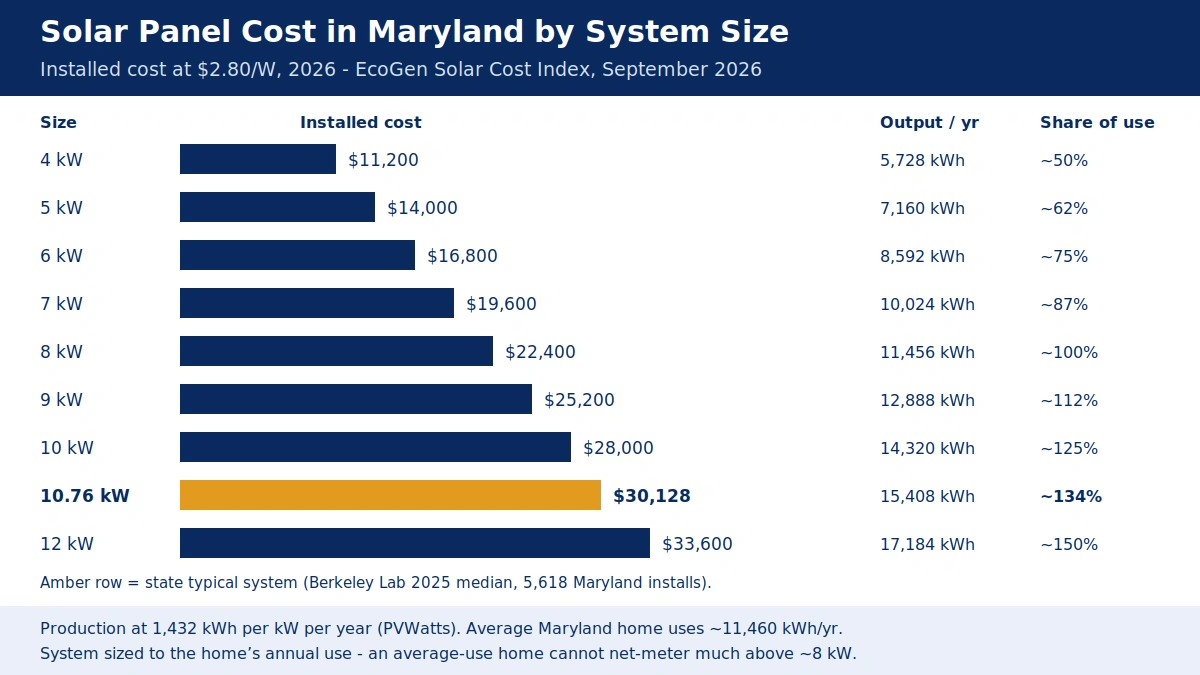
Sizing comes first, and in Maryland the question works in reverse: the typical system is already larger than the average home, so the issue is not whether the surplus has value but how much of it the house can ever use. Billing data from EIA through August 2026 puts the average Maryland home near 955 kilowatt-hours a month, or roughly 11,460 a year, with a bill near $202 a month to match. With each installed kilowatt making about 1,432 kilowatt-hours a year, an 8 kW array produces about 11,456 kilowatt-hours — essentially 100% of an average home’s yearly use. The 10.76 kW typical system turns out about 15,408 kilowatt-hours, or roughly 134% of what the average home uses. Eight kilowatts already covers the average home in full, so this guide calls 8 kW the size for the average home — and 10.76 kW the size for the average buyer, whose use runs well above the state average. In the arithmetic, 8 kW already meets the whole house’s annual use. The paper is the problem: demand swings unevenly through the year, and output does the same.
Oversizing pays off better here than where export rules are stingy — surplus kilowatt-hours earn full retail credit and roll forward — yet it still loses to consuming the power at home: whatever surplus remains at year-end settles at the lower commodity rate, and Maryland ties system size to the home’s own annual consumption. Power sent out in June and drawn back in January still earns full retail value while the rollover lasts — that is the generous half of the deal. A kilowatt-hour that is still sitting in the bank at the settlement earns the commodity price instead, which is the part that punishes oversizing. Below that point, each added kilowatt stops feeding the house and starts banking power the house may never draw down. Prices in the table use EcoGen’s $2.80 a watt; output uses 1,432 kilowatt-hours per installed kilowatt each year. The last column shows what share of an average home’s use each size covers, so the crossover — where the array stops feeding the house and starts banking — is visible at a glance.
| Size | Cash cost at $2.80/W | Annual output | Share of a typical Maryland home’s use (11,460 kWh/yr) |
|---|---|---|---|
| 4 kW | $11,200 | ~5,728 kWh | ~50% |
| 5 kW | $14,000 | ~7,160 kWh | ~62% |
| 6 kW | $16,800 | ~8,592 kWh | ~75% |
| 7 kW | $19,600 | ~10,024 kWh | ~87% |
| 8 kW | $22,400 | ~11,456 kWh | ~100% |
| 9 kW | $25,200 | ~12,888 kWh | ~112% |
| 10 kW | $28,000 | ~14,320 kWh | ~125% |
| 10.76 kW (state typical) | ~$30,128 | ~15,408 kWh | ~134% |
| 12 kW | $33,600 | ~17,184 kWh | ~150% |
Two rows deserve a closer look. First, even the 8 kW system already covers about 100% of average annual use, so every kilowatt past 8 kW on an average-use home is power the house cannot use itself — it banks at retail for the year, and whatever is left at the settlement earns the commodity price. Second, the sizing rule puts a ceiling on the table that the numbers alone do not show: the system is sized to the home’s yearly electricity needs, so an average-use home cannot install a 10 kW or 12 kW system at all under the net-metering rule — one Annapolis installer source cites Public Service Commission guidance allowing up to 200% of yearly baseline use, which would soften that ceiling, but that reading comes from a single installer page and was not verified against the Commission’s own text, so this guide does not rely on it. Those rows belong to homes that use far more than average — electric heat, a pool, an EV charged at home, a heat pump replacing gas — and the utility wants the use documented before it approves the size.
Size from twelve months of electric bills, not from how much roof sits empty — and in Maryland, size from use you can document, because documented use is what the rule counts. Add up twelve months of kilowatt-hours, divide by roughly 1,432 to find the covering size, then look at June, July, and August separately — if a surplus already appears at 8 kW, stop there, because every kilowatt past that line banks power the house may never draw down. Allow 1-2 kW more for a planned EV or heat pump, more again for electric heat, less for a shaded or north-facing roof — then test the result against the annual-use rule before signing, because a system the utility will not net-meter earns the commodity rate on everything it makes. A planned EV or heat pump means sizing for the house you will have, not the one you have today — put the new load on the plan before the panels go up, or the array will be sized for a smaller home than the one that shows up. That sizing trade-off gets its own full treatment in our 6 kW vs 8 kW vs 10 kW guide.
Solar Panel Cost by City: Baltimore, Columbia, Germantown & Annapolis
Maryland is a small state with four different solar markets inside it, and the city prices show the split before anything else does. City-level pricing is unusually well documented in Maryland — EnergySage maintains a page for each of the big four cities — and the pattern repays a close look. Cheapest to dearest, the per-watt spread is only twenty-two cents, yet average system size swings from 11.54 kW in Baltimore up to 15.09 kW in Annapolis. Panel pricing barely varies from one corner of Maryland to another. System sizes vary widely from city to city, and size is what moves the total.
| City | $ per watt | Avg. system | Cash total | Utility |
|---|---|---|---|---|
| Baltimore | $2.70 | 11.54 kW | ~$31,214 | BGE |
| Columbia | $2.52 | 14.68 kW | ~$37,031 | BGE |
| Germantown | $2.56 | 11.87 kW | ~$30,437 | Pepco |
| Annapolis | $2.48 | 15.09 kW | ~$37,350 | BGE |
Baltimore is the biggest city in the state, served by BGE, and the dearest per watt of the four. Baltimore, per EnergySage’s November 2026 city page, averages $2.70 a watt on an 11.54 kW system — about $31,214 before incentives, a modeled 11.08-year payback, and $51,106 in 25-year savings. That savings figure is the lowest of the four cities: Baltimore’s average system is the smallest of the group, and its per-watt price sits near the top of the statewide band. That average system is close to the statewide typical size of 10.76 kW, and the reason is visible in the housing stock: Baltimore’s rowhomes are older, smaller, and closer together, with flat or low-slope roofs that need ballasted or tilt-up racking instead of a standard pitched mount, and less room for a big array. Treat the Baltimore total as the price of the average Baltimore quote, not the price of the typical Baltimore system — and do not quote either end of its $26,532 to $35,896 range as the Baltimore price, because it is not one.
Columbia is the cheapest per watt on BGE and the second-biggest system in the state, which is the same fact read two ways. EnergySage puts Columbia at $2.52 a watt — the lowest of the three BGE cities — but on a 14.68 kW average system, about $37,031, with a modeled payback of 10.47 years and 25-year savings of $64,423. In Columbia the same forces behind the statewide average push further still. Howard County’s homes skew larger and detached, with roofs to match, and every additional kilowatt earns the same reward — BGE’s retail rate, the one Baltimore pays too, about 21.1 cents once the fixed charge is stripped out. A Columbia quote at $2.52 a watt is a good price on a big system. It is not a cheap system.
Germantown is the only Pepco city of the four, and its numbers are the ones that show what the utility is worth. EnergySage puts Germantown at $2.56 a watt on an 11.87 kW average system, about $30,437, with a modeled payback of 8.31 years and 25-year savings of $77,047 — the fastest payback and the biggest savings of the four, because Pepco pays the highest retail value in the state at about 22.3 cents a kilowatt-hour and its customers build systems sized to heavy use. Germantown’s marketplace shoppers average about $317 a month on electricity and 1,447 kilowatt-hours a month — far above the state average — which is why the systems here are sized the way they are: these are households that already use a lot of power, and the panels have a big bill to work against. A Germantown quote at $2.56 a watt is a fair price on a Pepco roof. It is not a cheap system.
Annapolis is the cheapest per watt in the state and the biggest system, which is the Bay talking. EnergySage puts Annapolis at $2.48 a watt on a 15.09 kW average system, about $37,350, with a modeled payback of 10.18 years and 25-year savings of $67,370. Annapolis homes sit in the state capital on the Chesapeake, and the price shows it: detached houses with wide roofs, an installer field along the Bay that competes hard, and the same BGE rate that Baltimore pays. The Bay brings a second cost the table does not show — Shore and Bay-front installs sit in higher design-wind zones, which calls for a structural letter stamped by a professional engineer and racking specified for salt air, not for a generic inland job. A low per-watt price on a big system is still a big check, and the modeled 10.18-year payback is the most optimistic figure in this guide after Germantown’s — it assumes the big system keeps earning BGE’s rate for 25 years.
Sort the city table by utility before you sort it by price. Weigh each incoming quote by its price per watt, not by the total printed at the top of the page. A Columbia quote at the low end of its range and a Baltimore quote at the statewide anchor are not a close call once the install conditions are in: the Baltimore array costs more to put up on a crowded rowhome roof, and its system is smaller because its roofs are smaller. The payback section below works through each utility’s numbers in turn.
One more city-level note: the installer field is deep everywhere in the Baltimore–Washington corridor and thin nowhere, which is the one advantage of living between two big cities. Baltimore, Columbia, Germantown, and Annapolis each have many installers bidding for the same jobs, which is what pulls quotes toward $2.48 on the Bay. What varies is not the competition but the roof: a flat Baltimore rowhome roof needs ballasted racking and a structural check, a slate roof in an older Baltimore neighborhood needs specialty mounting, and a Bay-front roof needs wind engineering. Wherever you live, collect three quotes, with at least one from a company already operating inside your utility’s territory — then verify the license numbers yourself. Maryland has two of them, and both are named in the licensing section further down.
Maryland’s Sun: Dense Suburbs, Short Winters & the Bay
In Maryland the sun is a suburban resource: it has to thread between rooflines, oak canopies, and rowhouse chimneys, so the buyer who maps the shade hour by hour gets more from it than the buyer who counts only the bright July afternoons. An honest production estimate tells both halves of that story — the seasonal shape matters more than the annual total, and it is the shape that decides whether the system pays.
The sun, by the numbers. One kilowatt of Maryland panels is credited with roughly 1,432 kilowatt-hours a year in EcoGen’s PVWatts-based figures, at 5.01 peak sun hours a day. That is a solid middle-of-the-pack resource for the Mid-Atlantic — better than New York’s, better than Michigan’s, close to Pennsylvania’s, and a little better than the national figure would suggest for a state this far north. A second measure runs lower: NumeralQ’s PVGIS figures put Maryland at 1,333 to 1,345 kilowatt-hours a year per kilowatt, barely varying across the state’s cities. The gap is the model, not the weather — EcoGen’s figure is the anchor this guide uses, and the lower range is the reason to treat any single production number as an estimate, not a promise. The number that matters more than the annual total is the winter one, and Maryland’s is kind by Northeast standards: the winters are short and mild, the days never get as dark as they do in New England, and a January rooftop here runs cold enough to help the panels and bright enough to keep them working.
The density is the story in the suburbs. Maryland is one of the most densely settled states in the country, and the density writes the shading map for the whole Baltimore–Washington corridor. Roofs stand close together with tall trees between them, and a neighbor’s maple can shade a south-facing array for half an afternoon. Montgomery County and Howard County add a second layer: subdivisions of detached houses on small lots, where the lots are generous enough for a big system and the trees are mature enough to shade it. Lean on a statewide average for a production estimate and you will overshoot a shaded Columbia roof and undershoot an open one on the Eastern Shore. An installer who hands you one statewide number is handing you a guess.
The Bay is the story on the water. Annapolis and the Bay counties get a little more sun than the inland west, and the difference shows in the city table: Annapolis builds the biggest systems in the state at the lowest price per watt. The same coast brings the wind that the racking has to survive — Bay-front and Eastern Shore installs sit in higher design-wind zones, which calls for sturdier racking and a structural review. Salt air adds a second Bay cost: it eats exposed metal faster than inland air, so the racking and fasteners must be specified for coastal conditions, not a generic inland job. Flood-zone and Critical Area rules can also limit ground-mounted systems near the water, though no Maryland-specific flood figure was verified for this guide, so none is stated — check the county’s rules before planning a ground mount anywhere near the Bay.
Cold is a genuine help. For every degree Celsius a cell runs above 25, it sheds roughly 0.3-0.5% of its efficiency — which is why a Maryland rooftop in January, running cool, converts sunlight more efficiently than a Phoenix roof in July. A Germantown rooftop in July almost never bakes the way a Phoenix roof does, so an hour of Maryland sunshine delivers more than the same hour on a hot southern roof. Cold, clear winter air genuinely helps solar output, and it explains much of why Maryland gets as much as it does from each kilowatt despite the cloud. The same physics cuts the other way: the panels can only use the sun while it is up. In December the sun is up for about nine hours, and cloud hides it for much of that window.
No other factor cuts both ways the way shade does. Shade cuts a panel’s output, and under a string inverter a single shaded panel drags the whole string down with it. That is the case for microinverters or optimizers on a crowded Maryland roof: a dormer, a chimney, and the neighbor’s oak take turns crossing the array as the day moves on. A north-facing roof is harder still: it never faces the sun squarely, and no inverter can fix the orientation. No Maryland shade-loss percentage appears in this guide, because none was verified — so when an installer hands over a production estimate, ask what shade loss it assumes and whether it was modeled from a shade study of your own roof or from a statewide average. On a dense-suburb roof, the shade study is what the estimate is worth.
The roof, and the weight it has to hold. A rooftop array in Maryland sits under a snow load the racking and the roof must carry together, and the load is heaviest in the western counties, where the winters run colder and the snow stays longer. This guide states no Maryland-specific design snow-load figure, because none was verified — so get the roof’s snow-load rating from the local permitting office and let that office’s number govern, rather than the installer’s guess. A roof with under eight to ten years of life left should be replaced before any panels go on it. Reroofing later means a detach-and-reset that adds $1,500 to $5,000 to the roofing job — and many Maryland insurers will not cover an array at all unless the roof is under 15 to 20 years old. A roof on its last legs flips the sequence: get the replacement quoted through our roof replacement guide before you sign for panels, because panels over a dying roof get paid for twice — once for the panels, once for the roof underneath. Slate roofs, common in older Baltimore neighborhoods, need specialty mounting and slower labor, and they raise the quote for reasons that have nothing to do with the panels. Name UL 61730 / IEC 61730 ratings in the spec for the panels, and ask the insurer to confirm in writing that the policy covers the array against storm damage.
Putting it together. Nothing exotic is required — but the ordinary equipment has to be arranged for Maryland conditions. Face the array south where the roof allows, tilt it for the low winter sun, fit microinverters or optimizers so one shaded or snow-covered string cannot drag the whole array down, and insist on a PVWatts estimate that prints its shade assumption on the page instead of burying it. Where the utility banks credits forward, the kilowatt-hours that pay best are the ones the house consumes the moment they are made, in the month they are made. Tilting west to move production into the evening — when the house is actually drawing power — is a trade worth discussing with the installer, even at the cost of a little total annual output.
Net Metering in Maryland: Full-Retail Credit With a Closing Date
Maryland is one of the few states that people still get right in both directions, and the correction matters more here than almost anywhere else, because the state kept the rule other states gave up — and the rule now has an end date printed on it. One claim heard often is that Maryland’s net metering has ended, or been swapped for a wholesale rate. That is wrong. The opposite claim is that Maryland pays full retail on every kilowatt-hour sent back, forever, with no catch attached. That is wrong too. What Maryland has is a statewide rule with a 3,000-megawatt cap, a July 1, 2027 backstop, and a grandfather clause that protects the systems already connected — and the difference between those two wrong claims and the real rule is the difference between a system that pays in nine years and one that never does.
The rule as it stands. Under Public Utilities Article §7-306, customers of every electric utility in the state — BGE, Pepco, Delmarva Power, Potomac Edison, SMECO, and the Choptank Electric Cooperative — net their consumption kilowatt-hour for kilowatt-hour at the full retail rate. When the panels make more than the house uses, the surplus rolls forward month to month as kilowatt-hour credits, so a June surplus can cancel a January kilowatt-hour at full value. The system may reach 2 MW, and a residential system is sized to the customer’s annual use. Net metering covers the energy charges, not the fixed monthly customer charge — about $9 on Pepco and about $10 on BGE — which keeps arriving even in a month when the panels cover everything.
The rollover, and a conflict worth flagging. Since October 1, 2023, Maryland law has let net-metered customers carry unused credits forward indefinitely rather than cashing them out — that is the rule as EnergySage and installer guides describe it in 2026. But EcoGen’s November 2026 Maryland page still describes leftover credit being cashed out each April at the lower commodity rate, and that April language shows up in older guides too. The two descriptions cannot both be the current rule. This guide states the indefinite carryforward as the current rule, because it matches the 2023 law change and the most recent utility-facing sources — but the April language is still in circulation, so check your own utility’s current tariff before you sign, and do not let an installer promise you an April payout or an indefinite bank without showing you the tariff page it comes from.
The closing date. House Bill 1532, the Utility RELIEF Act, took effect on enactment in 2026 as an emergency measure, and it ends full-retail net metering for new customers at the earlier of two limits: the statewide cap of 3,000 megawatts of rooftop net metering plus community solar, or July 1, 2027. The cap was already 51.23% filled by June 30, 2025, with a 2,911-megawatt community-solar pipeline behind it, according to the Public Service Commission’s net energy metering report — which means the cap could fill well before the July date, and the date that actually applies is the one that arrives first. The Commission must approve a successor program by February 1, 2027, and the law directs that the successor pay less than today’s net metering. A working-group draft framework was due by October 27, 2026, and the final details were not set when this guide was written.
The grandfather clause is the whole ballgame. A system under a net metering contract on July 1, 2027 keeps full-retail net metering for the life of the system — until it is expanded, repowered, decommissioned, or enters a new interconnection agreement. That single sentence is worth more than any rebate in this guide, because it locks in the retail rate on every exported kilowatt-hour for twenty-five years. The practical consequence is a calendar, not a sales pitch: the interconnection date is the date that matters, and the permission-to-operate wait is the risk. A January 2026 review by the Sierra Club and the Chesapeake Solar and Storage Association found permit waits of about ten days but weeks-long delays for permission to operate from BGE and Pepco — long enough that a homeowner can end up paying a loan and a full utility bill at once, and long enough that a system ordered in the spring of 2027 could miss the cutoff. Start the paperwork early, and get the interconnection application filed before the panels go on the roof.
What the credit is worth, utility by utility. The retail value of an exported kilowatt-hour is the utility’s rate less its fixed monthly charges, and the four big utilities disagree by more than six cents. Pepco pays the most at about 22.305 cents, Delmarva Power next at about 21.736 cents, BGE at about 21.107 cents, and Potomac Edison the least at about 16.064 cents. BGE covers about half of Maryland homes, so its 21.107 cents is the figure most Marylanders should carry in their heads. The gap between Pepco and Potomac Edison is worth more than three years of payback on the same system, which is why the payback section below prices each utility separately instead of averaging them into a number nobody actually pays.
| Utility | Credit value per exported kWh | Share of Maryland homes | Simple payback (EcoGen) |
|---|---|---|---|
| Pepco | ~22.305 cents | Washington suburbs | ~8.8 yrs |
| Delmarva Power | ~21.736 cents | Eastern Shore | ~9.0 yrs |
| BGE | ~21.107 cents | ~50% of homes | ~9.3 yrs |
| Potomac Edison | ~16.064 cents | Western Maryland | ~12.2 yrs |
The co-ops and the small utilities. SMECO in Southern Maryland and the Choptank Electric Cooperative on the Eastern Shore participate in the same statewide net-metering program under the same 1-to-1 rules, and the HB 1532 deadline applies to them too. Their retail values were not verified separately for this guide, so none is stated — ask your co-op for its current tariff in writing, and check the same grandfather date, because the cutoff does not care how small the utility is.
What net metering does not do. It does not pay you for SRECs — those are a separate certificate, priced in the next section, and the two are often confused. It does not erase the fixed customer charge, the delivery charges, or the taxes on the bill. It does not cover a system bigger than the home’s annual use, and it does not survive an expansion: add panels after July 1, 2027 and the expanded system falls under the new rules. And it does not wait. The cap is more than half full, the pipeline behind it is nearly as big as the cap itself, and the successor program is required by law to pay less. A Maryland homeowner who wants the full-retail rule has until the cap fills or July 1, 2027, whichever comes first — and the cap, not the calendar, is the one to watch.

SRECs in Maryland: The $40 Certificate and the Brighter Tomorrow Multiplier
Maryland’s SRECs are the part of the return that most guides get wrong, because they describe a market as if it were a fixed payment. It is not. A Maryland SREC is a certificate for one megawatt-hour of solar electricity, tracked in PJM-GATS, sold on an open market to utilities that must meet the state’s Renewable Portfolio Standard — 50% renewable by 2030, with a 14.5% solar carve-out. The price moves. It has been moving down. And the price a system earns depends on which kind of certificate it generates, which is a distinction worth understanding before you count the income.
The standard certificate. The 2026 vintage standard Maryland SREC trades at $40.00 — the sell-now and settlement price listed by Flett Exchange, the exchange that publishes Maryland SREC prices. A broker quoted early in 2026 offered $42.50 per SREC on a variable brokerage basis, or $29.50 locked in for three years. Other 2026 guides cite a $40–$75 range, which is the spread between vintages and contract types rather than a single price. The typical 10.76 kW system makes about 15,408 kilowatt-hours a year, or about 15.4 SRECs — worth roughly $616 a year at $40 each. A 5 kW system makes about 7,160 kilowatt-hours at the EcoGen production anchor, or about 7.2 SRECs, worth roughly $286 a year; EnergySage’s own example puts a 5 kW system at about 6 megawatt-hours a year and about $240, which uses a lower production assumption than this guide’s anchor and is flagged here rather than hidden.
The Brighter Tomorrow multiplier. Systems eligible under the Brighter Tomorrow Act of 2024 generate BT SRECs, and each one carries 1.5 times the compliance value of a standard SREC. They are currently listed at $60 — one and a half times the standard $40. On the typical system, that is about $925 a year instead of $616, or about $309 a year more for the same panels. Whether a given system qualifies depends on its eligibility under the Act, so ask the installer to confirm in writing whether the system will generate standard or BT SRECs, and do not let a quote price BT income for a system that will not earn it.
The ceiling is falling. The alternative compliance payment — the penalty utilities pay for falling short of their solar requirement — effectively caps SREC prices, and that cap is scheduled to decline from $45 per megawatt-hour in 2026 to $22.50 in 2030. Prices are likely to keep falling as the market saturates: more Maryland roofs are generating certificates every year, and the supply grows faster than the compliance demand. A payback that prices fifteen years of SREC income at today’s $40 is modeling a market that the law has already scheduled to shrink. This guide counts SREC income at $40 for the illustration below, and says plainly that the number will not stay there.
How the money reaches you. Your installer typically registers the system and arranges the sale through an SREC aggregator rather than you selling certificates one at a time. Only the system owner collects the income — under a lease or a power purchase agreement, the company keeps it, which is one more reason the lease math in the federal section below runs the way it does. The income is federally taxable. And one edge case is worth a sentence: some Maryland homes connected to a Pepco distribution line that runs into DC may qualify for the DC SREC market, where 2026 certificates trade near $380 — nearly ten times the Maryland price. That is a quirk of the grid, not a plan; do not buy a system expecting DC prices unless the eligibility is confirmed in writing.
| SREC type | 2026 price | Typical system (15.4 MWh/yr) | 5 kW system (~7.2 MWh/yr) |
|---|---|---|---|
| Standard Maryland SREC | ~$40 | ~$616/yr | ~$286/yr |
| Brighter Tomorrow (BT) SREC | ~$60 | ~$925/yr | ~$432/yr |
| DC SREC (edge case only) | ~$380 | Not modeled | Not modeled |
The honest way to count it. SREC income is real money — about $616 a year on the typical system, about $925 if the system earns BT certificates — but it is market income, not a rebate, and it shrinks over time by law. Count it at today’s price, expect it to fall, and never let it carry the payback on its own. The bill savings are the foundation. The SRECs are the bonus. A system that only pays because of the certificates is a system that stops paying when the market moves.
Payback: How Long Until Maryland Solar Pays for Itself?
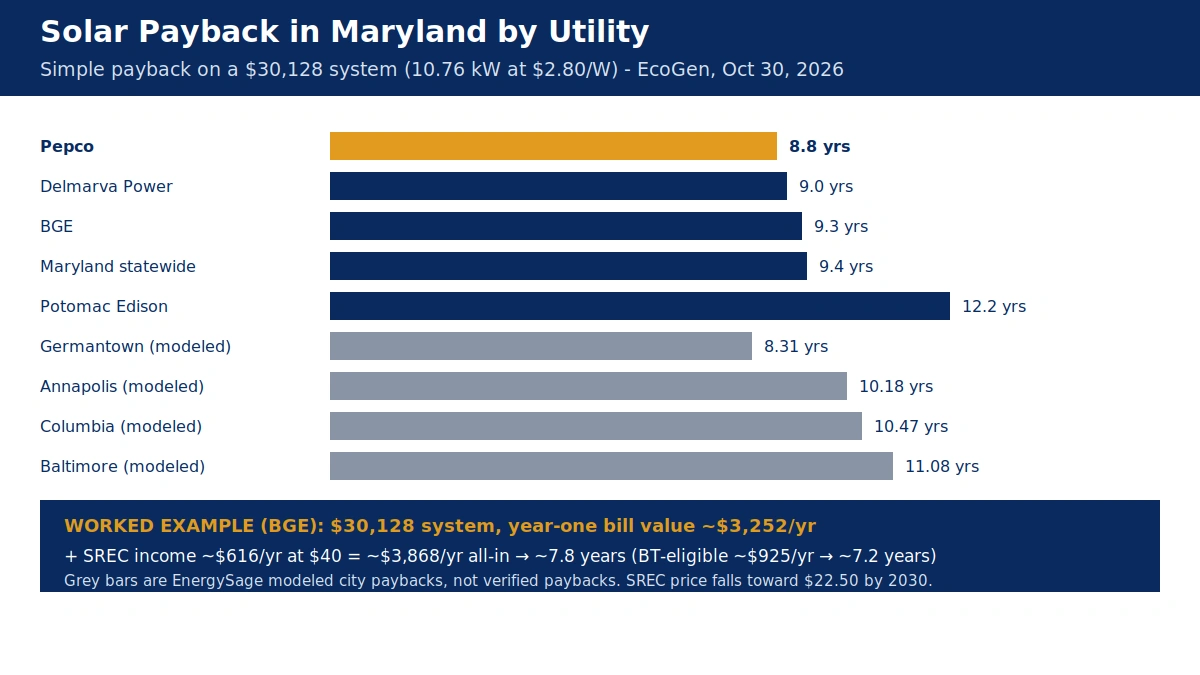
Payback is the question every Maryland buyer actually asks, and the honest answer is that it depends on the utility on the bill more than on the panels on the roof. EcoGen’s per-utility figures, published October 30, 2026, price the same $30,128 system four different ways — and the spread between them is more than three years. The arithmetic is simple payback before incentives: the system cost divided by the year-one value of the power it makes, with no upkeep, no rate growth, and no financing counted. The value of the power is the utility’s rate less its fixed monthly charges, applied to the 15,408 kilowatt-hours the typical system makes in a year.
Pepco pays back fastest. At 22.305 cents a kilowatt-hour, the typical system’s power is worth about $3,437 in year one, and $30,128 divided by $3,437 is about 8.8 years. Pepco serves Montgomery County and Prince George’s County, the Washington suburbs, where the rates are the highest in the state and the houses use the most power. A Germantown system on Pepco is the fastest-paying combination in Maryland, which is why Germantown’s modeled 8.31-year payback in the city table is the shortest of the four cities — though that figure is EnergySage’s model, not EcoGen’s, and the two should not be mixed.
Delmarva Power is next. At 21.736 cents, the year-one value is about $3,349, and the payback is about 9.0 years. Delmarva serves the Eastern Shore, where the roofs are wide, the sun is good, and the installer field is thinner — the per-watt price can run higher on the Shore even while the retail value stays strong, so the 9.0-year figure assumes a competitively shopped quote at the statewide anchor.
BGE is the Maryland most people live in. At 21.107 cents, the year-one value is about $3,252, and the payback is about 9.3 years. BGE covers about half of Maryland homes — Baltimore City and Baltimore County, Howard, Anne Arundel, Carroll, and Harford — so 9.3 years is the figure most Maryland buyers should carry. Weighted across all four big utilities by customers, the statewide figure is about 9.4 years.
Potomac Edison is the outlier. At 16.064 cents, the year-one value is only about $2,475, and the payback stretches to about 12.2 years. Potomac Edison serves Frederick County and the western counties, where the rates are the lowest in the state and the winters are the coldest. A 12.2-year payback is not a bad investment — the panels still work for twenty-five years — but it is a different decision than an 8.8-year one, and it deserves harder thought if the homeowner may move within five years.
| Utility | Rate less fixed charges | Year-one value (15,408 kWh) | Simple payback |
|---|---|---|---|
| Pepco | ~22.305 cents | ~$3,437 | ~8.8 yrs |
| Delmarva Power | ~21.736 cents | ~$3,349 | ~9.0 yrs |
| BGE | ~21.107 cents | ~$3,252 | ~9.3 yrs |
| Maryland weighted | — | — | ~9.4 yrs |
| Potomac Edison | ~16.064 cents | ~$2,475 | ~12.2 yrs |
The worked example, with the SRECs counted. Take the typical system on BGE: $30,128, making 15,408 kilowatt-hours a year, worth about $3,252 in year-one bill savings. Bill savings alone give about 9.3 years. Add the SREC income — about $616 a year at the standard $40 certificate — and the all-in value is about $3,868 a year, which gives about 7.8 years. If the system earns Brighter Tomorrow certificates at $60, the SREC income is about $925 a year, the all-in value is about $4,177, and the payback is about 7.2 years. That is an illustration built from the EcoGen anchors, not a quote, and it counts the SRECs at today’s price even though the law schedules that price to fall. The honest reading is that the bill savings carry the case and the SRECs shorten it by about a year and a half.
What the modeled figures add — and what they do not. EnergySage’s city paybacks — 11.08 years in Baltimore, 10.47 in Columbia, 8.31 in Germantown, 10.18 in Annapolis — are modeled estimates built on its own marketplace averages, and they run longer than EcoGen’s per-utility figures in three of the four cities. The gap is the system size: EnergySage prices a 14.68 kW system in Columbia and a 15.09 kW system in Annapolis against houses that use 11,460 kilowatt-hours a year, and the surplus power in that model earns less than the power the house uses itself. EcoGen’s figures price the median-installed 10.76 kW system. Neither is wrong; they describe different houses. Your own payback is the one built from your own bills, your own utility, and your own roof — and the quote that does not show that arithmetic is a quote to set aside.
The rate is rising, and that shortens everything. Maryland’s residential rate rose 7.6% in the year to August 2026, and 66.0% over five years. A payback calculated at today’s rate understates the return if the rate keeps rising, because every kilowatt-hour the panels make is worth more next year than this year. The EcoGen figures count no rate growth at all, which makes them conservative — but conservatism is the right stance for a number this big, and a buyer who needs rising rates to make the case work is a buyer who should think twice.
Batteries in Maryland: Backup Value, Not Bill Savings
A battery in Maryland is a backup purchase, not a savings purchase, and the numbers say so plainly. The state has no battery rebate open to the general public in 2026, the net-metering rule already banks surplus power at the full retail rate, and a battery earns its keep only when the grid goes down. That is a real reason to buy one — Maryland’s summer storms and winter ice take the power out often enough that the question comes up in every quote — but it is not a financial reason, and the quote should not pretend otherwise.
What a battery costs. EcoGen prices 13.5 kWh of storage at $15,525 installed, or $1,150 per kilowatt-hour, added to the solar system. At that adder, a 6 kW system with a battery runs $30,325 to $34,325, an 8 kW system $35,225 to $40,625, a 10 kW system $40,125 to $46,925, and a 12 kW system $45,125 to $53,125. A second measure runs higher: Maryland battery installations averaged $1,341 per kilowatt-hour in the first half of 2026, or roughly $18,104 for a 13.5 kWh unit, before incentives. Either way, the battery adds about half the cost of the panels themselves, and it does not add half the savings.
Why the savings case is thin. Under full-retail net metering, the grid is already a free battery: every surplus kilowatt-hour banks at the full retail rate and comes back when the house needs it. A physical battery saves nothing on the bill that the net-metering bank does not already save, and it adds its own losses — the round trip through the battery costs a few percent of every kilowatt-hour. The battery pays only if the net-metering rule changes: under the lower-paying successor program that HB 1532 requires by February 2027, storing power at home instead of exporting it at a lower rate could start to make financial sense. That is a reason to leave room for a battery in the design, not a reason to buy one today.
What the battery is actually for. Maryland’s grid goes down in summer thunderstorms, in winter ice, and in the high winds that cross the Bay, and a battery keeps the lights, the refrigerator, and the medical equipment running through it. A 13.5 kWh unit covers the essentials for a night; a larger one covers more. The value is the outage you do not sit through, not the kilowatt-hours you shift. Price it that way: if the battery costs $15,525 and the house loses power three times a year, the question is whether three nights of power are worth $15,525, not whether the battery pays for itself in bill savings, because it will not.
The programs that are not open. There is no open Maryland battery rebate for the general public in 2026. The Garden State-style statewide home battery payment that other states have debated does not exist here, and the BGE DRIVE Act vehicle-to-grid pilot — $150 to $300 per kW annually — is a pilot, not a program a homeowner can join today. Delmarva Power runs a small pilot for homes in Elk Neck, in Cecil County. Do not let a quote price a battery rebate that is not open, and do not let a salesperson describe a pilot as a program.
The tax picture, briefly. A battery installed with solar was covered by the same federal credit as the panels, and that credit is gone for 2026 installs — the battery gets $0 federal help on an owned system, just like the panels. Under a lease, the company that owns the system can still claim the commercial credit on the battery too, which is one of the few places the lease route still has an edge. The sales-tax exemption covers a battery that stores solar power, and the property-tax exemption covers the value it adds. Neither changes the conclusion: buy the battery for backup, size it to the loads that matter in an outage, and leave the savings claim out of the decision.
Maryland Incentives in 2026: What Exists and What Does Not
Maryland’s incentive stack in 2026 is a short list with a long list of closed programs behind it, and the closed ones are the trap: older guides still name them, installer brochures still quote them, and a buyer who counts them will find the money is not there. This section names every program, open or closed, so the quote can be checked against it line by line.
The one grant that is open. The Maryland Solar Access Program, run by the Maryland Energy Administration, pays $750 per kilowatt of panels (DC), up to $7,500, to income-eligible homeowners who use a participating contractor. The FY27 round opened July 29, 2026, and applications close at 3:00 PM Eastern on May 31, 2027, or sooner if the money runs out. Eligibility is income-based — at or below 150% of the state median income, about $195,000 for a family of four — and the grant must be reserved before the install, not claimed after it. On the typical 10.76 kW system the formula gives $8,070, which the $7,500 cap cuts to $7,500, so an eligible household’s net cost is about $22,628 instead of $30,128. The FY26 round closed on April 17, 2026, before its end date, after requests exceeded the budget — which is the reason to apply early rather than late. As of late September 2026 only about 2.35% of the FY27 budget had been reserved, according to a secondary source, so the money was still there when this guide was written — but that figure comes from a single secondary report and was not verified against the Administration’s own portal.
The grants that closed. The Maryland Solar Access Bridge Fund was a one-time FY26 program that paid up to $15,000, or $1,000 per kilowatt, to lower-income households to fill the gap the federal credit left behind. Its portal closed to new applications on June 1, 2026, and the Administration is now working through the existing queue. The old $1,000 Residential Clean Energy Rebate — the flat grant that older guides still list — closed in December 2024. Neither program takes new applications, and any quote that prices either one is pricing money that does not exist.
The two tax exemptions that are automatic. Maryland’s sales-tax exemption, Tax-General §11-230, takes solar equipment out of the state’s 6% sales tax, and the installer applies it at purchase — the buyer never sees the charge. The property-tax exemption, Tax-Property §7-242, takes the added home value out of real property tax, automatically, for the life of the system. Both apply on their own, for owner-occupants, and both are already in the quote rather than on top of it. There is no state income-tax credit for solar in Maryland, and no general state rebate beyond the income-limited Solar Access Program.
| Incentive | Status in 2026 | Value |
|---|---|---|
| Maryland Solar Access Program (FY27) | Open — apply by May 31, 2027 | $750/kW, up to $7,500, income-eligible |
| Solar Access Bridge Fund | Closed June 1, 2026 | Up to $15,000 — no new applications |
| Residential Clean Energy Grant ($1,000) | Closed December 2024 | $0 — do not count it |
| Sales-tax exemption (Tax-General §11-230) | Active, automatic | 6% off equipment, at purchase |
| Property-tax exemption (Tax-Property §7-242) | Active, automatic | Added value exempt, life of system |
| State income-tax credit | Does not exist | $0 |
| SRECs (traded market) | Active, ongoing | ~$40 standard, ~$60 BT per certificate |
| Net metering (full retail) | Active — closes to new customers July 1, 2027 | Full retail rate on exports |
Community solar, for the households that cannot put panels on their own roof. Maryland’s community solar program became permanent under a 2023 law (HB 908), after the seven-year pilot ended on December 31, 2024, and consolidated billing arrived on January 1, 2026 — the utility bill now lists all the credits and discounts on a single bill instead of two. A subscriber takes a share of a local solar farm and gets bill credits for the power it makes: standard subscribers typically save about 10% on their electricity supply, and low- and moderate-income subscribers save 20% to 25%. At least 40% of each project must go to income-qualified subscribers, and the law caps what they can be charged at 90% of their bill credit value. No installation, no equipment, no roof required — and it is open to renters, condo owners, and anyone whose roof is shaded or too small. The full comparison is in our community solar guide.
The county layer. Some Maryland counties run their own programs on top of the state stack, and Montgomery County’s Electrify MC pilot is the one most often cited — a $500 incentive for an ENERGY STAR heat pump water heater, with a larger bonus when a furnace sharing the same flue is replaced at the same time. Those are water-heater and electrification incentives, not solar incentives, and no county-level solar grant was verified for this guide. Ask the county energy office what is open before you sign, and do not let a quote price a county program that the county itself has not confirmed.
EmPOWER Maryland, and the confusion it causes. Pepco and BGE run EmPOWER Maryland efficiency rebates — Pepco lists a $1,600 post-purchase rebate on an ENERGY STAR hybrid water heater, with 2026 purchases due by November 30 and applications by December 7, and BGE advertises rebates up to $1,600 on select models, one per address, with 2026 purchases and applications due by December 31. Those are water-heater rebates, not solar rebates, and Pepco says it is waiting on the Public Service Commission to decide whether its efficiency programs continue into 2027. They belong in this section only so a buyer does not mistake them for solar money.
Federal Help in 2026: No Tax Credit Remains — but Leasing Still Has a Path
The federal picture for a Maryland homeowner who buys a system in 2026 is short and final: there is no credit. Under the One Big Beautiful Bill Act (Public Law 119-21), the Residential Clean Energy Credit (§25D, 30%) no longer applies to systems placed in service after December 31, 2025 — and per the IRS, the deciding date is when the installation is finished. The same law ended the Energy Efficient Home Improvement Credit (§25C) on the same date. A homeowner-owned system installed in 2026 earns a $0 federal credit, and the gross price is the net price. Any quote that shows a 30% line, a “net after credit” total, or a tax-credit savings figure for a 2026 owner purchase is pricing a law that ended on December 31, 2025. Cross it out and ask for the quote again.
The lease route is the only federal door still open. Leases and power purchase agreements are legal in Maryland, and the company that owns the system can still claim the commercial clean-energy credit (§48E, 30%) for systems in service by December 31, 2027, passing some of the value along as a lower monthly payment or a lower per-kilowatt-hour rate. That is the only 2026 path to any federal benefit, and it comes at a price: the company keeps the SREC income, the company keeps the net-metering value under most contracts, and the PPA payments typically rise about 2.9% a year. Over a twenty-five-year term, the escalator alone can erase the discount the credit bought. A lease also means the system is not yours — it complicates a home sale, it does not add the same value to the property, and the property-tax exemption does not apply the same way to equipment someone else owns. The lease route is worth pricing, and worth comparing line by line against the cash purchase, but it is the smallest long-term return of the three ways to pay.
Cash, loan, or lease — the 2026 math. Pay cash and the full price is about $30,128 for the typical system, with nothing monthly after it and every net-metering credit and every SREC yours to keep. Take a $0-down loan and the monthly payment replaces the electric bill — confirm it is lower than the bill it replaces — but the dealer fee, 20% to 30% of the system cost, is folded into the amount financed, so the loan costs more than the cash price for the same panels. Take a lease or a PPA and the upfront cost is $0, the monthly fee is lower than the bill, and the federal benefit reaches the system through the company — but the company keeps the certificates and the escalator compounds for twenty-five years. The best long-term return is still the cash purchase, thanks to the high rates and the full-retail net metering that a system connected before the cutoff keeps for life. What the 2025 tax law left in place, and what it took away, is laid out in our federal energy tax credits guide.
HEAR: the rebate that has not launched. The federal Home Electrification and Appliance Rebates — HEAR, also called HEEHR — would pay up to $8,000 toward a heat pump and up to $14,000 across appliances for income-qualified households, but Maryland’s program has not launched. The Maryland Energy Administration resubmitted the state’s HEAR and HOMES applications to the U.S. Department of Energy on September 30, 2026, under the Department’s updated guidance, and no launch date is set; applications are not open. Two things about the program have changed since the state first applied. First, DOE Program Notice 26-2, dated May 29, 2026, limits HEAR to electric-to-electric upgrades — it no longer pays to replace gas, oil, or propane equipment, and insulation and air sealing come before heating and cooling upgrades. Second, and more important for this guide: HEAR does not cover solar panels, batteries, EV chargers, or windows in any case, so even a launched HEAR program would not lower the price of a Maryland solar system. One flag on the dates: some sources cite September 1, 2026 as the date the fuel-switching cutoff took effect, reading the notice’s reservations rule — reservations made after August 31, 2026 are limited to electric-to-electric upgrades — while the notice itself is dated May 29, 2026. This guide uses the May 29, 2026 notice date, and notes the September reading as the reservations cutoff. The back-catalog entries in this series that cite a September 1, 2026 notice date should be read against the May 29, 2026 original.
Permits & Licensing: What Maryland Requires
Maryland’s licensing and permitting rules are specific, and the two numbers to check are the ones a careless installer hopes you never ask for. The state has no single statewide solar permit and no statewide permit-fee schedule — permits run county by county and city by city — but the licenses are statewide, and they are not optional.
The two licenses. Solar panels on a Maryland home must be mounted by a contractor licensed by the Maryland Home Improvement Commission — the MHIC license, required under Business Regulation §8-301 — and the person who connects the panels to the electric system must hold a licensed master electrician’s credential. The MHIC license covers the mounting and the home-improvement work; it does not authorize electrical work, and the electrical work must be done by the master electrician. The MHIC’s own FAQ states the rule plainly: a home improvement contractor license is required to install solar panels for a homeowner, whether the panels go on the home, on an outbuilding, or on the land next to the residence. Ask for both numbers, and check both against the Maryland Department of Labor’s license lookup before you sign. A 2025 bill, HB 1170, would have written the MHIC requirement into the statute expressly; it was withdrawn by its sponsor after the fiscal note recorded that the Commission already requires the license — the requirement existed in practice before the bill and it exists after it.
What the MHIC license takes. The contractor must document at least two years of relevant experience, pass a state examination administered by PSI, demonstrate financial solvency, and carry liability insurance — the Commission’s roadmap cites $50,000 in liability coverage, while a licensing guide cites $500,000 in general liability, and the two figures could not be reconciled from the sources checked, so this guide states the conflict rather than picking one. NABCEP certification is the credential to ask for on the crew: it is the industry standard, and it is required for grant-program work. The installer should also be able to show the wildlife-barrier term in the contract: since June 1, 2024, a rooftop solar contract must include an industry-standard wildlife barrier unless the customer waives it after being told the cost and the risks, under Business Regulation §8-501. Birds and squirrels nesting under panels are a real Maryland problem, and the barrier is cheap insurance against chewed wiring.
Permits and the fee cap. Permits are issued by the county or the city — Anne Arundel County handles Glen Burnie, the City of Annapolis handles its own, Baltimore City handles its own — and the process is the same shape everywhere: a permit application with the system design, an inspection after the install, and an interconnection application with the utility. House Bill 1532 caps residential solar permit fees at $500, which keeps the county from pricing the permit out of reach, and a BGE interconnection costs $100 to $150. The slow part is not the permit: the January 2026 Sierra Club and CHESSA review found permit waits of about ten days, but weeks-long waits for permission to operate from BGE and Pepco. That gap is the one that matters in 2027, when the interconnection date decides whether the system keeps full-retail net metering — so ask the installer for its recent permission-to-operate track record with your utility, in writing, and treat a company that cannot answer as a company that has not done this before.
The HOA question, answered by statute. Maryland Real Property Code §2-119 bars a recorded covenant or a homeowners association rule from imposing unreasonable limitations on a solar collector system installed on the roof or exterior walls of a home, where the owner owns the roof or has the exclusive right to use it. A 2025 amendment, Chapter 517, effective October 1, 2025, gave the word “unreasonable” numbers: a restriction is unreasonable if it raises the installation cost by at least 5% above the proposed installation, or cuts the energy the system generates by at least 10% below what the proposed installation would have produced. The owner must provide documentation showing the restriction is unreasonable. The law does not cover everything: it does not apply to historic property listed on or eligible for the Maryland Register of Historic Properties, it does not cover ground-mounted panels — only roof and exterior-wall systems — and it does not cover common areas, where the association may prohibit or restrict systems. Condominium roofs designated as common property sit outside the statute. The association may still set reasonable aesthetic standards that stay inside the 5% and 10% thresholds. Get the architectural-review approval in writing before you order panels, even when the law is on your side — a written approval is cheaper than a dispute.
The panel upgrade, priced. Homes with under 200-amp service may need an electrical panel upgrade before the system can connect, and it rarely shows in a per-watt quote. EcoGen prices the upgrade at $1,200 to $2,500, and it should be itemized in the quote or confirmed as unnecessary in writing. The full comparison is in our electrical panel upgrade guide.
What Pushes Your Maryland Quote Up or Down
A Maryland quote is a stack of small decisions, and the per-watt price is the sum of them. The panels are the smallest part of the story. The roof, the panel, the shade, the utility, and the financing move the total more than the hardware ever will, and each one is worth pricing separately before the contract is signed.
Baltimore rowhome roofs push the price up. Many rowhomes have flat or low-slope roofs that need ballasted or tilt-up racking instead of a standard pitched mount, and the crew works on a street with no parking and no staging room. Slate roofs in older Baltimore neighborhoods need specialty mounting and slower labor. Both raise the quote for reasons that have nothing to do with the panels, and both are visible in the city table: Baltimore is the dearest per watt of the four cities at $2.70, and its systems are the smallest.
Coastal and Bay-front wind pushes the price up. Higher wind uplift on the Eastern Shore and the Bay calls for a structural letter stamped by a professional engineer, sturdier racking, and fasteners specified for salt air. The engineering is a line item, not a rounding error, and a quote that prices a Bay-front roof like an inland one has either missed the wind zone or priced the wrong racking.
An undersized electrical panel pushes the price up. Homes with under 200-amp service may need a $1,200 to $2,500 upgrade before the system can connect, and it rarely shows in the per-watt quote. Ask whether it is included or added later, and get the answer in writing.
Shade and roof complexity push the price up. A cut-up roof with dormers and chimneys, a north-facing slope, or a neighbor’s oak across the array all push the quote up — more racking, more labor, microinverters or optimizers instead of a string inverter, and a smaller system than the roof could theoretically hold. The shade study is the estimate, and a quote without one is a guess.
Waiting for permission to operate pushes the price up. A weeks-long PTO delay from BGE or Pepco means the loan payment starts before the bill savings do, and the homeowner pays both at once. That is a cash-flow cost, not a line item, and it is the reason to ask about the installer’s PTO track record before signing.
The permit-fee cap keeps the price down. House Bill 1532 caps residential solar permit fees at $500, which puts a ceiling on one cost the county controls. The sales-tax exemption keeps another 6% off the equipment at purchase. Larger rural roofs and cash purchases both keep the per-watt number low — a big open roof is faster to work on than a cut-up rowhome roof, and a cash purchase carries no dealer fee. The dealer fee is the quietest price driver in the stack: 20% to 30% of the system cost, folded into the amount a $0-down loan finances, invisible until the cash price is written next to the financed price.
The utility is the biggest price driver of all, and it is not in the quote. Pepco’s 22.305 cents against Potomac Edison’s 16.064 cents is worth more than three years of payback on the same system, and no installer can change which utility serves the house. The quote can only respond to it: size the system to the rate, count the SRECs at the price they trade for, and do not let a low per-watt price on a Potomac Edison roof distract from a 12.2-year payback.
Getting Quotes in Maryland: The Checklist
Ten checks, in the order that saves the most money. A quote that passes all ten is a quote worth signing. A quote that fails the first three is a quote to set aside, whatever the monthly payment promises.
- Your utility’s rules in writing first. Pepco pays about 22.305 cents a kilowatt-hour, Delmarva Power about 21.736, BGE about 21.107, and Potomac Edison about 16.064 — and that gap is worth more than three years of payback on the same system. Get the tariff page for your utility before you compare quotes, and check whether the quote prices the rate your utility actually pays, not the state average.
- The interconnection date in writing. The HB 1532 deadline closes full-retail net metering to new customers at the earlier of the 3,000 MW cap or July 1, 2027, and a system under contract by then keeps full retail for the life of the system. Ask the installer for the filing date, the expected permission-to-operate date, and what happens to the price if the date slips past the cutoff.
- Cash price per watt on paper. The anchor is $2.80 a watt, and 2026 quotes run roughly $2.46 to $3.14. Get the cash price next to any financed price, because the dealer fee — 20% to 30% of the system cost on a $0-down loan — is folded into the financed amount and invisible until the two numbers sit side by side.
- No line for a 30% federal credit, no line for a state rebate. A 2026 owner purchase earns a $0 federal credit, Maryland offers no general state rebate and no state income-tax credit, and the sales-tax exemption is already in the quote. The only grant in the stack is the Solar Access Program, and it reaches only income-eligible households — $750 per kilowatt up to $7,500, reserved before the install, applications close May 31, 2027.
- SREC type and price in writing. Standard certificates trade near $40, Brighter Tomorrow certificates near $60, and the cap that sets the ceiling falls from $45 in 2026 to $22.50 by 2030. Ask whether the system will earn standard or BT certificates, who sells them, and what the quote assumes they will be worth in year ten — not just year one.
- Both Maryland license numbers verified. The MHIC license for the mounting, under Business Regulation §8-301, and a licensed master electrician for the grid connection. Check both against the Maryland Department of Labor’s lookup, and ask whether the crew is NABCEP-certified. A company that cannot produce both numbers has not done this work before.
- Add-ons itemized. Roof work, panel upgrade ($1,200-$2,500 when service is under 200 amps), tree work, wildlife barrier (required in the contract since June 1, 2024 unless waived), wind engineering for a Bay-front roof, ballasted racking for a flat rowhome roof, battery. Every add-on should be a line item with a price, not a footnote.
- Production estimate from PVWatts with the shade assumption shown. The anchor is 1,432 kilowatt-hours per kilowatt per year, and a second model runs 1,333 to 1,345 — so the estimate should say which model it uses and what shade loss it assumes, month by month, June against December, from a shade study of your roof rather than a statewide average.
- Wind load, snow load, and insurance confirmed. The roof’s snow-load rating from the local permitting office, the racking’s wind rating for a Bay-front or Eastern Shore roof, UL 61730 / IEC 61730 on the panels by name, and written confirmation that the homeowners policy covers the array for storm damage.
- HOA approval in writing first. Maryland Real Property Code §2-119 bars unreasonable restrictions — one that raises the cost by at least 5% or cuts generation by at least 10% — but it does not cover historic property, ground-mounted panels, or common-area roofs, and the owner must document that a restriction is unreasonable. Get the architectural-review approval in writing before you order panels, even when the law is on your side.
Three written quotes on one identical spec sheet, from installers who already work in your utility’s territory, before anything is signed. In a state where the interconnection date decides whether the system keeps full-retail net metering for twenty-five years, the cheapest quote is the one that files the paperwork on time.

Sources & methodology
Headline price and production:
- EcoGen Solar Cost Index, September 2026 edition: $2.80/W Maryland, 10.76 kW typical system, $30,128, ±12% quote band $2.46-$3.14/W; 5.01 peak sun hours/day, 1,432 kWh/kW/yr, 15,408 kWh/yr; Berkeley Lab 2025 median 10.76 kW from 5,618 Maryland systems
- EnergySage Maryland cost data: $2.55/W Oct 2026 (13.3 kW avg, $28,870-$39,060 range); $2.60/W Sep 11, 2026 (13.34 kW avg, $34,623); city pages Nov 2026 — Baltimore $2.70/W, 11.54 kW, $31,214, 11.08-yr modeled payback, $51,106 25-yr savings; Columbia $2.52/W, 14.68 kW, $37,031, 10.47-yr modeled, $64,423; Germantown $2.56/W, 11.87 kW, $30,437, 8.31-yr modeled, $77,047; Annapolis $2.48/W, 15.09 kW, $37,350, 10.18-yr modeled, $67,370
- SolarReviews Nov 2026: $2.91/W, 8.2 kW avg, $25,372 (national model — not headline); NumeralQ planning, EnergySage data retrieved Oct 26, 2026: 8 kW $18,760-$24,530 ($2.34-$3.07/W); PVGIS production 1,333-1,345 kWh/kW/yr (conflict with EcoGen 1,432, flagged)
- EIA Electric Power Monthly, 12 months to Aug 2026: Maryland residential 21.40¢/kWh Aug 2026 (+7.6% YoY), ~955 kWh/mo, ~$202/mo bill (~11,460 kWh/yr); 5-yr rate change +66.0%
Net metering and HB 1532:
- Public Utilities Article §7-306 (full-retail 1-to-1 net metering, 2 MW system cap); HB 1532 Utility RELIEF Act 2026: closes to new customers at earlier of 3,000 MW cap or Jul 1, 2027; PSC successor program due Feb 1, 2027, pays less; grandfathering for systems under contract Jul 1, 2027 (until expanded, repowered, decommissioned, or new interconnection agreement)
- PSC net energy metering report via EcoGen: cap 51.23% installed by Jun 30, 2025; 2,911 MW community-solar pipeline
- Rollover conflict flagged: indefinite carryforward since Oct 1, 2023 (EnergySage; Aduu Solar) vs April cash-out at commodity rate (EcoGen Nov 2026 page)
- Fixed customer charges ~$9 Pepco, ~$10 BGE (Aduu Solar); Sierra Club / CHESSA Jan 2026 review: ~10-day permit waits, weeks-long BGE and Pepco PTO delays
- 200%-of-baseline sizing claim: single installer source (Lumina Solar, Annapolis) citing PSC — unverified, flagged, not relied on
Payback arithmetic:
- EcoGen per-utility figures, Oct 30, 2026: Pepco 22.305¢, $3,437/yr, ~8.8 yrs; Delmarva 21.736¢, $3,349/yr, ~9.0 yrs; BGE 21.107¢, $3,252/yr, ~9.3 yrs; statewide weighted ~9.4 yrs; Potomac Edison 16.064¢, $2,475/yr, ~12.2 yrs; BGE ~50% of homes
- NestPriced illustration (labeled as such): $30,128 / $3,252 = ~9.3 yrs on BGE bill savings alone; plus SREC ~$616/yr at $40 → ~$3,868/yr → ~7.8 yrs; BT ~$925/yr at $60 → ~$4,177/yr → ~7.2 yrs
- EnergySage modeled city paybacks flagged as modeled estimates, not verified paybacks
SRECs:
- Flett Exchange Maryland prices: 2026 vintage standard SREC $40.00 sell-now/settlement; DC SREC 2026 $380.00 (edge case)
- EnergySage: broker $42.50 variable / $29.50 3-yr lock early 2026; BT SRECs $60 (1.5x compliance value); ACP cap $45/MWh 2026 falling to $22.50 in 2030; 5 kW ~6 MWh/yr → ~$240/yr standard, ~$360/yr BT (lower production assumption than EcoGen anchor, flagged)
- Venture Home Oct 2026: SRECs trading $40-$75 range; RPS 50% renewable by 2030, 14.5% solar carve-out; PJM-GATS tracking; SREC income federally taxable
Incentives:
- MEA Maryland Solar Access Program FY27: $750/kW DC up to $7,500, income-eligible (≤150% state median income, ~$195,000 family of four); opened Jul 29, 2026; apply by 3:00 PM ET May 31, 2027 or sooner if funds run out; reserve before install; FY26 closed Apr 17, 2026 after budget exceeded; ~2.35% of FY27 budget reserved as of Sep 25, 2026 (secondary source, flagged)
- MEA Solar Access Bridge Fund: closed to new applications Jun 1, 2026 (one-time, up to $15,000 / $1,000/kW)
- Residential Clean Energy Grant $1,000: closed Dec 2024
- Sales tax: Tax-General §11-230 exempts solar equipment from 6% sales tax; property tax: Tax-Property §7-242 exempts added home value, automatic, life of system
- Community solar: permanent program HB 908 (2023); pilot ended Dec 31, 2024; consolidated billing Jan 1, 2026; standard ~10% discount, LMI 20-25%; ≥40% of each project to income-qualified subscribers; income-qualified charged ≤90% of bill credit value (§7-306.2)
- EmPOWER Maryland: Pepco $1,600 hybrid water heater rebate (purchase by Nov 30, 2026, apply by Dec 7, 2026); BGE up to $1,600 (2026 purchases/applications due Dec 31, 2026); water heaters only, not solar
Federal and financing:
- OBBBA P.L. 119-21 and IRS FS-2025-05: §25D and §25C $0 for post-Dec-31-2025 installs, completion date counts
- §48E 30% for third-party-owned systems, in service by Dec 31, 2027, construction begun by Jul 4, 2026 per IRS Notice 2025-42; leases and PPAs legal in Maryland; PPA escalator ~2.9%/yr; dealer fees 20-30% on $0-down loans (EcoGen Maryland page)
- HEAR (HEEHR) Maryland: NOT launched; MEA resubmitted HEAR/HOMES applications to DOE Sep 30, 2026; no launch date, applications not open (verified Nov 4, 2026 heatpumppricing; Nov 9, 2026 GridShift); state allocation ~$137M (DOE tracker, Mar 2026)
- DOE Program Notice 26-2 dated May 29, 2026: HEAR electric-to-electric upgrades only, no fuel-switching; solar, batteries, EV chargers, windows outside HEAR; FLAG: some sources cite Sep 1, 2026 as the effective date (reservations after Aug 31, 2026, per NASEO FAQ Aug 2026) — May 29, 2026 notice date used here
- Solar for All: EPA terminated all 60 grants Aug 7, 2025; courts ruled the termination unlawful Sep 18 and Sep 22, 2026; funds frozen, no household route
- Battery cost: 13.5 kWh add-on $15,525 installed ($1,150/kWh) (EcoGen Maryland page); Maryland H1 2026 average $1,341/kWh, ~$18,104 for 13.5 kWh
HOA, licensing, permits:
- Real Property Code §2-119: no unreasonable limitations on solar collector systems on roof/exterior walls where owner owns or has exclusive use; Chapter 517 of 2025 session, effective Oct 1, 2025: “unreasonable” = cost +≥5% or generation −≥10%; historic property exception; common areas and ground mounts not covered; owner must document unreasonableness
- MHIC license required to install solar panels on a home (Business Regulation §8-301; MHIC FAQ); licensed master electrician for grid/panel connection; MHIC: 2+ years experience, PSI exam, financial solvency, liability insurance — $50,000 vs $500,000 figures conflict, flagged; HB 1170 (2025) withdrawn, requirement already existed in practice
- Wildlife barrier in rooftop solar contracts since Jun 1, 2024 unless waived after disclosure (Business Regulation §8-501); NABCEP credential to ask for, required for grant-program work
- HB 1532 caps residential solar permit fees at $500; BGE interconnection $100-$150; panel upgrade $1,200-$2,500 when service under 200 amps (EcoGen)
- Detach-and-reset for a later reroof $1,500-$5,000 (EcoGen Maryland page)
Production and climate:
- EcoGen: 1,432 kWh/kW/yr PVWatts-based; 5.01 peak sun hours/day; heat penalty 0.3-0.5% per degree C above 25 C cell temperature, national figure
- Lifespan 25-30 years productive service; NREL median degradation ~0.5%/yr, ~88% of rated output at year 25; product warranty typically 10-25 years; performance warranty typically 25-30 years, guaranteeing 80-92% of rated output at year 25 depending on tier; string inverter 10-15 years, one replacement expected; microinverters ~25 years (national figures)
EXCLUDED:
- Any “after 30% credit” prices
- Any HEAR-for-solar claim: HEAR does not cover solar, batteries, EV chargers, or windows; electric-to-electric only since DOE Program Notice 26-2, May 29, 2026
- Any state rebate or state tax credit for Maryland solar: none exists beyond income-limited MSAP
- The $1,000 Residential Clean Energy Rebate as an open program: closed December 2024
- The Solar Access Bridge Fund as an open program: closed June 1, 2026
- SREC income at a fixed rate: SRECs trade on an open market near $40, falling by law toward $22.50 by 2030
- The April true-up as the current rollover rule: indefinite carryforward since October 1, 2023 is stated as current, April language flagged as persisting in some 2026 guides
- The 200%-of-baseline sizing claim as verified: single installer source, flagged
- A battery rebate for Maryland homeowners: no open program
- EnergySage’s city paybacks as verified: modeled, EcoGen’s per-utility figures are the anchor
- SolarReviews’ $2.91/W and SolarSpechub’s $3.15/W as headline prices: national model / planning estimate, not Maryland quotes
- The claim that Maryland net metering is gone: WRONG against Public Utilities Article §7-306; it closes to new customers July 1, 2027 at the latest, not before
- The claim that Maryland has no solar-access law: WRONG against Real Property Code §2-119, as amended effective October 1, 2025
- Maryland-specific monthly PVWatts table, shade-loss percentage, design snow-load figure, interconnection timeline, permit-fee schedule beyond the $500 cap, BLS electrician wage, county solar grant programs, Delmarva/SMECO per-utility retail values beyond EcoGen’s Delmarva figure, flood-zone / Critical Area rules for Bay-front ground mounts — none verified, none stated
*Disclaimer: The prices here are 2026 Maryland planning figures. Your utility, your roof, your shade, and the installer you pick all move the final price, and the net-metering deadline moves it more than any of them — a system connected before the cap fills or July 1, 2027 keeps full-retail net metering for its life, and one connected after it does not. Before settling on a budget, line up three written quotes from installers working in Maryland, on one identical spec sheet, and ask each one for the interconnection date in writing. Treat every tax point in this guide as background reading, not advice about your own filing — have a Maryland tax professional look over your own return before you file it. Program rules change, and the SREC price moves with the market, so confirm current terms with the Maryland Energy Administration, the Public Service Commission, and your own utility before signing.*
What do solar panels cost in Maryland in 2026?
A Maryland install in 2026 runs $2.80 a watt on EcoGen’s September 2026 index — about $30,128 for the typical 10.76 kW system — with quotes through the year generally spanning $2.46-$3.14 a watt. At the EcoGen rate, an 8 kW home system typically runs about $22,400; EnergySage, meanwhile, puts the state average at $2.55 a watt on a larger 13.3 kW system. A homeowner-owned system installed in 2026 earns a $0 federal credit, Maryland offers no general state rebate and no state income-tax credit, and the return rests on full-retail net metering plus SREC certificates trading near $40 each.
Is solar worth it in Maryland with so much shade and so little roof space?
Given how densely settled Maryland is, the payback spread is tighter than you would expect — and it is the utility on the bill, not the roof, that decides where a house lands in it. A kilowatt of panels here makes about 1,432 kilowatt-hours a year — a solid Mid-Atlantic resource — and the power it replaces costs about 21.4 cents a kilowatt-hour on the state average, with Pepco customers paying about 22.3 cents after the fixed charge. On bill savings alone, EcoGen’s simple payback comes to about 9.4 years statewide and about 9.3 years on BGE, with 8.8 to 12.2 years across the big utilities; count the SREC income and the figure drops to roughly 7.8 years. Potomac Edison territory, at about 16.1 cents, is the slowest of the four; Germantown, on Pepco’s top rate, is the fastest. The shade is real — dense suburbs, mature trees, cut-up roofs — which is why the production estimate has to come from a shade study of your roof, not a statewide average.
How does net metering work in Maryland — and when does it end?
It is full retail, banked forward, with a closing date. Under Public Utilities Article §7-306, customers of every utility in the state net their consumption kilowatt-hour for kilowatt-hour at the full retail rate, and the month’s surplus rolls forward as kilowatt-hour credits — since October 1, 2023 the credits carry forward indefinitely rather than cashing out. House Bill 1532, the Utility RELIEF Act, closes that deal to new customers at the earlier of a 3,000-megawatt statewide cap or July 1, 2027. The cap was already 51.23% filled by June 30, 2025, with a 2,911-megawatt community-solar pipeline behind it, so the cap could fill well before the July date. A system under a net metering contract on July 1, 2027 keeps full-retail net metering for the life of the system. The Public Service Commission must approve a lower-paying successor program by February 1, 2027.
What are Maryland SRECs worth in 2026?
About $616 a year on the typical system, more if it earns the Brighter Tomorrow multiplier. A Maryland SREC is a certificate for one megawatt-hour of solar electricity, sold on an open market to utilities meeting the state’s Renewable Portfolio Standard. The 2026 standard certificate trades at about $40 — Flett Exchange lists the 2026 vintage at $40.00 — so the typical 10.76 kW system making about 15,408 kilowatt-hours a year earns about 15.4 certificates, or about $616 a year. Systems eligible under the Brighter Tomorrow Act earn BT certificates at about $60 each, or about $925 a year, because each one carries 1.5 times the compliance value. The price is scheduled to fall: the penalty that caps SREC prices drops from $45 per megawatt-hour in 2026 to $22.50 in 2030. The income goes only to the system owner — under a lease or a PPA the company keeps it — and it counts as federally taxable income.
Can my HOA stop me from installing solar panels in Maryland?
Usually not — Maryland law bars unreasonable restrictions, and since October 1, 2025 the word “unreasonable” has numbers attached. Under Real Property Code §2-119, a covenant or association rule may not impose unreasonable limitations on a solar collector system on the roof or exterior walls of a home, where the owner owns the roof or has the exclusive right to use it. A restriction is unreasonable if it raises the installation cost by at least 5% above the proposed installation, or cuts the energy the system generates by at least 10% below what the proposed installation would have produced. The law does not cover historic property, ground-mounted panels, or common-area roofs, and the owner must document that the restriction is unreasonable. The association may still set reasonable aesthetic standards that stay inside the 5% and 10% thresholds, so get architectural-review approval in writing before you order panels.
Is the 30% federal solar tax credit still available to Maryland homeowners in 2026?
No. For a system you buy yourself and place in service after December 31, 2025, the Residential Clean Energy Credit (§25D, 30%) is gone — the One Big Beautiful Bill Act, Public Law 119-21, ended it, and the IRS has made clear that the installation’s finish date is what decides it. There is a second door in Maryland that some states lack: leasing and power purchase agreements are legal, so the company owning the system can still claim the commercial credit (§48E, 30%) on systems in service by December 31, 2027 and pass part of that value through as a lower monthly payment. The trade-offs travel with it, though — under a lease the company keeps the SREC income, the net-metering value usually follows it, and a PPA escalator of commonly about 2.9% a year has to be priced across the full term.
Why is solar payback about 9 years in Maryland?
Three forces push the same way, and the middle one usually decides it. The price is a little below the national average at $2.80 a watt, and the sun is generous for the Mid-Atlantic at about 1,432 kilowatt-hours a year per installed kilowatt — but the surplus is banked forward at the full retail rate instead of settling at wholesale every month, so the bright summer months earn the same twenty-one cents the dark winter months bill at. What saves the case is the price of the power: 21.4 cents a kilowatt-hour on average, 22.3 cents on Pepco, and rising — the state average rose 7.6% in the year to August 2026 and 66% over five years. Add the SREC income of about $616 a year for the typical system, and the all-in payback lands near eight years. On Potomac Edison’s 16.1-cent value, the payback drifts toward the slow end of the range under any plausible assumptions.
What happens if I wait until after July 1, 2027 to go solar in Maryland?
You get a different deal, and by law a worse one. After the earlier of the 3,000-megawatt cap or July 1, 2027, new Maryland systems fall under the successor program the Public Service Commission must approve by February 1, 2027, and the law directs that program to pay less than today’s full-retail net metering. The exact successor rate was not set when this guide was written, so no payback can be modeled for it — but the direction is certain, and the grandfather clause is the reason to move: a system under a net metering contract by the cutoff keeps full retail for the life of the system. Waiting also risks the permission-to-operate queue, which already runs weeks long at BGE and Pepco. The one reason to wait is a roof with under eight to ten years left, or a house you plan to leave within a few years — in those cases the panels are the wrong purchase at any rate.