


**
Table of Contents
Texas leads the country in heat pump installations — and it’s easy to see why. Cheap electricity, mild winters, and some of the highest annual cooling hours in America make heat pumps a natural fit. But Texas quotes look nothing like national averages: labor rates, humidity-driven equipment choices, utility rebates, and metro-by-metro cost gaps all move the numbers. This guide puts the 2026 Texas data in one place — the real heat pump cost Texas 2026 numbers: what you’ll pay, what rebates knock off the top, and what to buy for your part of the state.
How much does a heat pump cost in Texas in 2026?
The honest Texas band for a standard central ducted heat pump, installed: $5,500–$15,000. Budget installs start lower in Houston; premium variable-speed systems climb past $20,000. Here’s the metro-level data (Angi city pages, updated 2026):
| Metro | Average installed | Most projects fall in |
|---|---|---|
| Austin | $7,057 | $5,424–$8,691 |
| Houston | $5,367 | $3,813–$6,921 |
| Dallas | $6,341 | $4,566–$8,709 |
Houston is the most affordable of the three metros for installed cost — a $3,800–$7,100 budget-tier range is common there (HomeAdvisor, June 2026). Dallas’s HomeGuide band runs $6,500–$14,500 installed. Texas-wide installer quotes stretch $9,000–$18,000 (texasacguide.com, checked November 2026), reflecting quotes that bundle ductwork upgrades, refrigerant changeover, or cold-snap backup heat.
Two broader bands matter for budgeting. A 3-ton 16 SEER2 system runs $8,500–$18,000 installed, from value brand through premium with commissioning (Climate Home, updated October 2026) — roughly $2,800–$6,000 per ton. And Texas installed costs generally run 8–12% below the national average for equipment plus install, thanks to contractor labor rates of $80–$120/hour (hvacpricingguide.com, March 2026).
For the full national picture and year-over-year trends, see our heat pump cost guide for 2026.
The $0 federal tax credit: what changed in 2026
This is the section several ranking Texas pages get wrong, so here it is plainly: there is no federal heat pump tax credit for 2026.
OBBBA (P.L. 119-21, signed July 4, 2025; IRS FS-2025-05) ended both the §25C energy-efficient home improvement credit and the §25D residential clean energy credit for property placed in service after December 31, 2025. For a homeowner-owned install completed in 2026, the federal credit is $0 — not $2,000, not phased down, not “through 2032.” Multiple competitor pages still claim the old credit is alive. It isn’t. Subtract nothing from your quote on the assumption a federal credit will return it.
What still exists in 2026:
- Utility rebates — the best real-money discounts for most Texans (see the full table below).
- HEAR rebates — up to $8,000 for a heat pump, up to $14,000 per household — but income-qualified only (≤150% of area median income, largest rebates under 80% AMI) and Texas’s program hasn’t launched yet (details below).
- Weatherization Assistance Program (WAP) — free upgrades up to ~$12,000 per dwelling for income-qualified households (≤200% federal poverty level), covering all 254 Texas counties.
- §48E lease pass-through — a commercial credit the leasing company claims on leased systems; if you’re considering a lease, ask whether that savings is already baked into the monthly price.
One more Texas-specific note: the Texas property-tax exemption (Tax Code §11.27) covers solar and wind devices only. Heat pumps do not qualify. Don’t let any quote sheet imply a property-tax break — there isn’t one.
Heat pump cost by system type in Texas
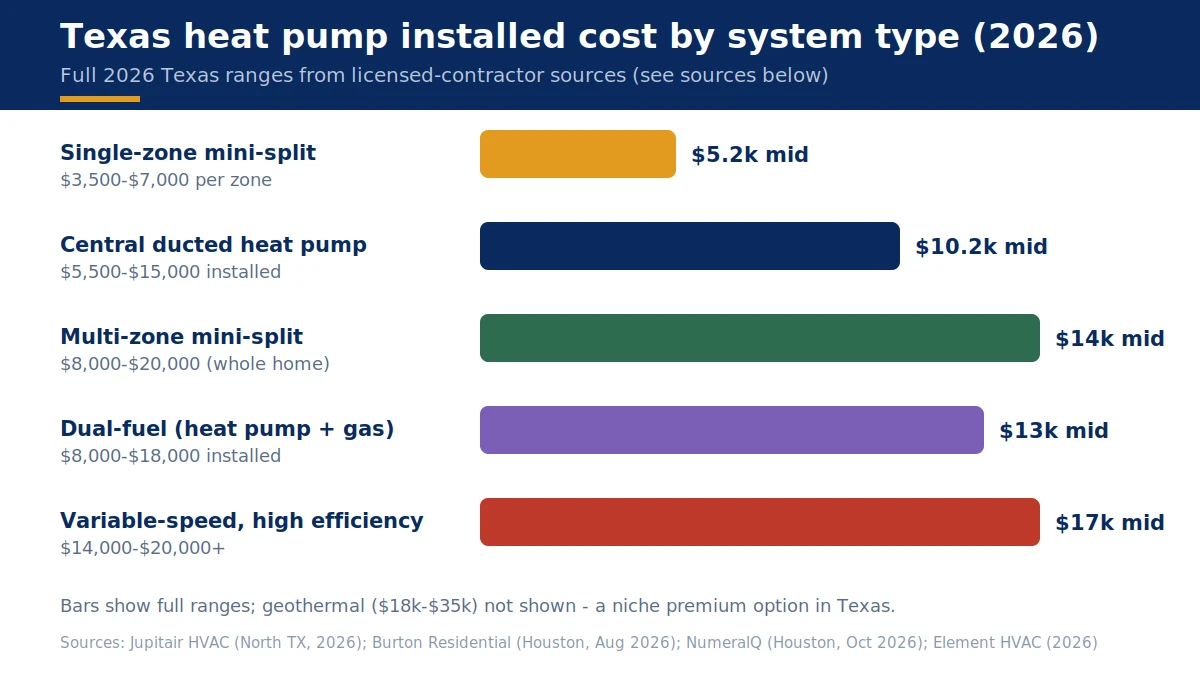
Your biggest cost variable isn’t your city — it’s the system type. Texas pricing by configuration (2026 sources):
| System type | Typical Texas installed range |
|---|---|
| Budget ducted (Houston tier) | $3,800–$7,100 (HomeAdvisor, Jun 2026) |
| Standard central ducted air-source | $6,500–$14,000 (minihomehub.online 2026; NumeralQ Houston: $6,480–$10,870) |
| High-efficiency variable-speed | $14,000–$20,000+ (Burton, Aug 2026) |
| Dual-fuel (heat pump + gas furnace) | $9,140–$15,010 (NumeralQ Houston; North TX: $8,000–$18,000, Jupitair) |
| Single-zone ductless mini-split | $3,500–$7,000/zone (Jupitair, North TX 2026) |
| Multi-zone ductless mini-split | $8,000–$20,000 (Jupitair, North TX 2026) |
| Geothermal | $18,000–$35,000 (Jupitair, North TX 2026) |
A few adders to know: a heat pump runs $500–$2,000 more upfront than an AC-only system of equivalent size (Burton, August 2026) — which is exactly the comparison most Texas buyers make when their old air conditioner dies. See our central AC replacement cost guide for the AC-only side of that math. Adding a gas furnace for a hybrid setup costs +$2,000–$4,000 over standard (minihomehub.online, 2026).
Brand anchors help calibrate quotes: Carrier installed runs $9,500–$17,500 and Trane $10,000–$18,000 in North Texas (Jupitair, 2026). Budget brands (Goodman-class) run roughly $3,000–$5,000 less. Our best heat pump brands cost guide breaks every tier down side by side.
Cost by size and SEER2 tier
Two numbers drive every heat pump quote: capacity (tons) and efficiency (SEER2). Texas sizing starts around 400 square feet per ton — a median DFW home of ~1,800 sq ft typically lands at 2.5–3 tons (Angi, February 2026). But that’s a starting point, not a prescription: the correct answer is a Manual J load calculation from your contractor, especially on the Gulf Coast where oversizing destroys dehumidification.
San Antonio contractor pricing (Element HVAC Services, 2026 pricing page) shows how SEER2 tiers step up:
| Tier | SEER2 | Installed range |
|---|---|---|
| Good | 14 SEER2 | $5,200–$7,200 |
| Better | 16 SEER2 | $7,500–$10,000 |
| Best | 18–20 SEER2 variable-speed | $11,000–$16,000 |
Going from SEER2 16 to 18+ adds $1,500–$3,500 (Climate Home, October 2026) — and in Texas that upgrade pays back faster than it would up north, because systems here accumulate roughly twice the annual run hours of northern equipment (texasacguide.com, 2026).
Two regulatory floors matter. The federal minimum for Texas is 14.3 SEER2 (8.1 HSPF2 for split heat pumps). But 16 SEER2 is the practical floor for rebates — most Texas utility programs (Austin Energy, Oncor, CenterPoint) require 15.2–16+ SEER2, and ENERGY STAR equipment sits at 15.2 SEER2 / 11.0 EER2 / 7.8 HSPF2. Buying below 16 SEER2 in 2026 often means leaving rebate money on the table.
Every Texas utility heat pump rebate, in one table
This is the section no other cost guide has assembled: the 2026 heat pump rebates from every major Texas utility, with the amounts *and* how the money actually reaches you.
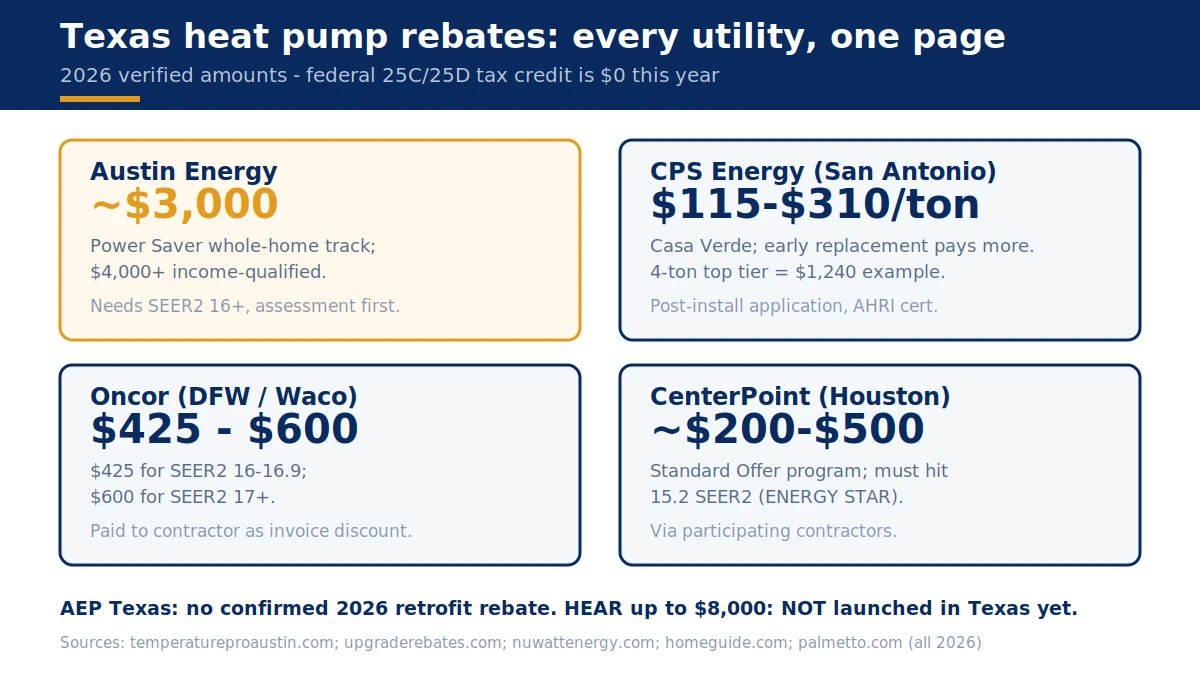
| Utility / program | 2026 heat pump rebate | How it works | Catch |
|---|---|---|---|
| Austin Energy — Power Saver | ~$3,000 avg whole-home; $4,000+ income-qualified | Post-install rebate; Home Energy Savings track adds 0% financing | Requires SEER2 16+, HSPF2 8.5+, ENERGY STAR, participating contractor; home assessment must come FIRST for the whole-home track |
| CPS Energy (San Antonio) — Casa Verde | $115–$310/ton early replacement; $90–$275/ton burnout | Post-install application with AHRI certificate + licensed contractor | Early replacement pays more — a 4-ton top-tier early replacement = $1,240 |
| Oncor (DFW/Waco) — Take a Load Off Texas | $425 (16.0–16.9 SEER2) / $600 (SEER2 17+) | Paid to the PARTICIPATING CONTRACTOR as an invoice discount | 2026 program opened Jan 14, runs to November, first-come first-served |
| CenterPoint (Houston) — Standard Offer | $200+; up to $500/unit qualifying ENERGY STAR heat pumps | Applied to invoice by participating contractors; some tracks accept direct post-install applications within 60 days | Equipment must hit 15.2 SEER2 |
| AEP Texas | No central-heat-pump retrofit rebate for existing homes | N/A | 2026 programs are new-construction/builder oriented only |
| Co-ops (spot examples) | Tri-County: up to $200 bill credit; Guadalupe Valley: $650 all-electric heat pump | Varies by co-op | Funding limited; TNMP’s rebate covers heat pump *water heaters* only ($400–$500) |
| Oncor Low-Income Weatherization (SOP) | Insulation/system adders; requires SEER2 ≥ 14.3 / EER2 ≥ 11.7 / HSPF2 ≥ 7.5 | Income ≤200% FPL | 2026 program closes November 15 for single-family |
| Texas WAP (TDHCA) | FREE upgrades up to ~$12,000/dwelling | 21 subgrantees covering all 254 counties | Income ≤200% FPL; ~$7.6M in 2025–26 contracts |
The single most important mechanic: in Oncor and CenterPoint territory, the rebate is paid to the contractor, not to you. It appears as a discount on your invoice. That means choosing a participating contractor IS the rebate decision — a non-participating installer simply can’t access it. Verify the contractor is enrolled *before* you sign (upgraderebates.com, 2026).
Stack order for 2026: utility rebate (invoice or post-install) → HEAR when it launches (income-qualified) → finance the remainder. No federal credit in the stack. And check funding before signing: Oncor and CenterPoint run until the money runs out, typically February through November.
HEAR & HOMES in Texas: what to actually expect
HEAR — the Home Electrification rebates — offers up to $8,000 for a heat pump (up to $14,000 per household), which makes it the single largest potential discount in this guide. Here’s the honest Texas reality:
- Texas’s programs have NOT launched. SECO (the Texas State Energy Conservation Office) reported status as “planning and design” as of August 21, 2026, with launch expected late 2026 or 2027. Texas’s share is ~$689M.
- Income-qualified only. Households at ≤150% of area median income qualify; the largest rebates go to households under 80% AMI.
- Fuel switching is out. DOE Program Notice 26-2 (May 29, 2026) ended HEAR eligibility for replacing a gas furnace with a heat pump — HEAR now pays to upgrade *existing electric equipment* to more efficient electric.
- You cannot stack it with a 2026 federal credit. That credit is $0.
So treat HEAR as a watch-list item, not a budget line: if you’re income-qualified and can time a replacement for late 2026 or 2027, it may be worth waiting for. If you need the system now, utility rebates are the real money.
What drives heat pump quotes in Texas
Texas-specific cost drivers that explain why your quote doesn’t look like the national average:
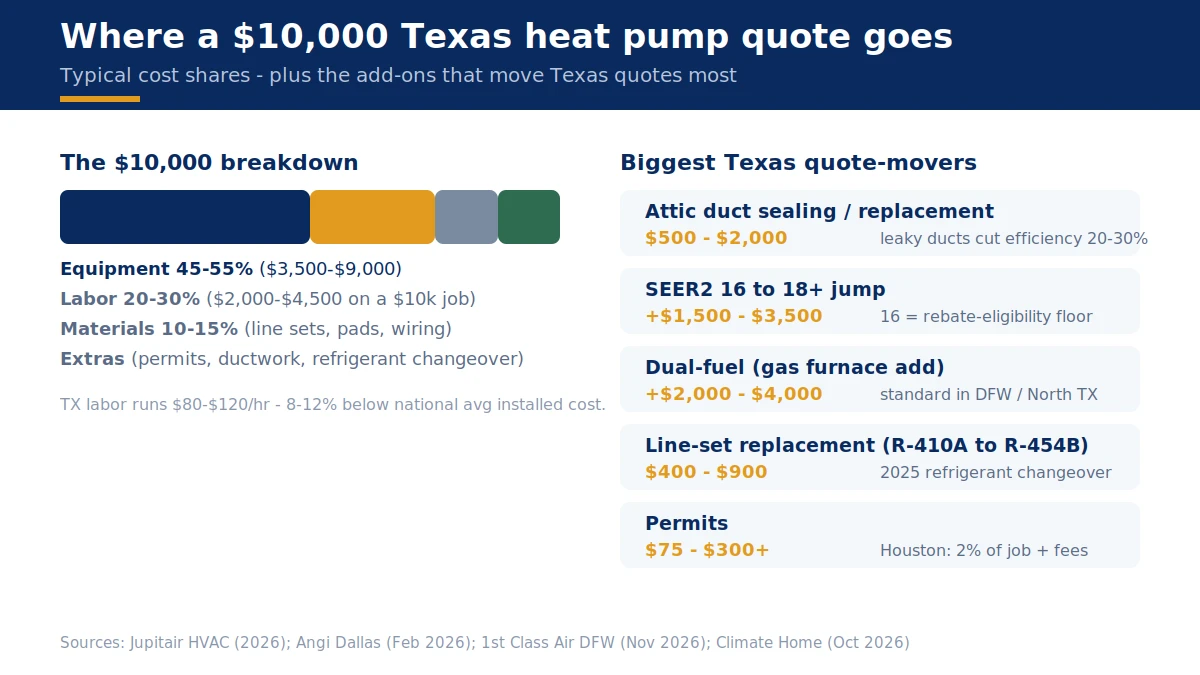
- Attic ductwork in 140°F+ heat. Slab foundations put ducts in the attic, where Texas summer heat punishes them. Leaky, poorly insulated ducts cut efficiency 20–30% — duct sealing ($500–$2,000) is often the highest-ROI line item on a quote. Full duct replacement runs $658–$2,496 in Austin and $462–$1,687 in Dallas (Angi, 2026).
- Run hours roughly 2× a northern system. High SEER2 equipment pays back faster here. Houston systems run roughly 10 months a year — double to triple the annual hours of Midwest systems (Valderrama, 2026).
- Refrigerant changeover. Manufacturers moved to R-454B/R-32 in 2025. Converting an old R-410A line set adds $400–$900 (1st Class Air, DFW, November 2026).
- Gulf Coast wind anchoring. Outdoor units must meet local wind-load anchoring code — a real line item on Houston-area quotes. (No verified 2026 dollar figure found; your contractor’s bid will show it.)
- Crane/lift for equipment placement. Relocating an air handler or outdoor unit on slab-foundation homes can require a crane: $300–$800 (1stclassairservice.com, November 2026).
- Sun exposure. West-wall condenser placement degrades efficiency; shading and clearance engineering are genuine quote variables.
- Cold-snap backup heat. DFW and North Texas quotes commonly bundle backup heat — dual-fuel (heat pump + gas furnace) or electric strips. Post-Uri, Texas buyers ask about this; expect +$2,000–$4,000 for a gas-furnace hybrid. Our heat pump vs furnace cost guide
- Labor share. Labor is 20–30% of total (Angi, Dallas) — or 25–35%, $2,000–$4,500 on a $10,000 job (Jupitair). Equipment itself is 45–55% of the total ($3,500–$9,000 of a $10,000 job).
Texas climate zones: what SEER2 to buy where
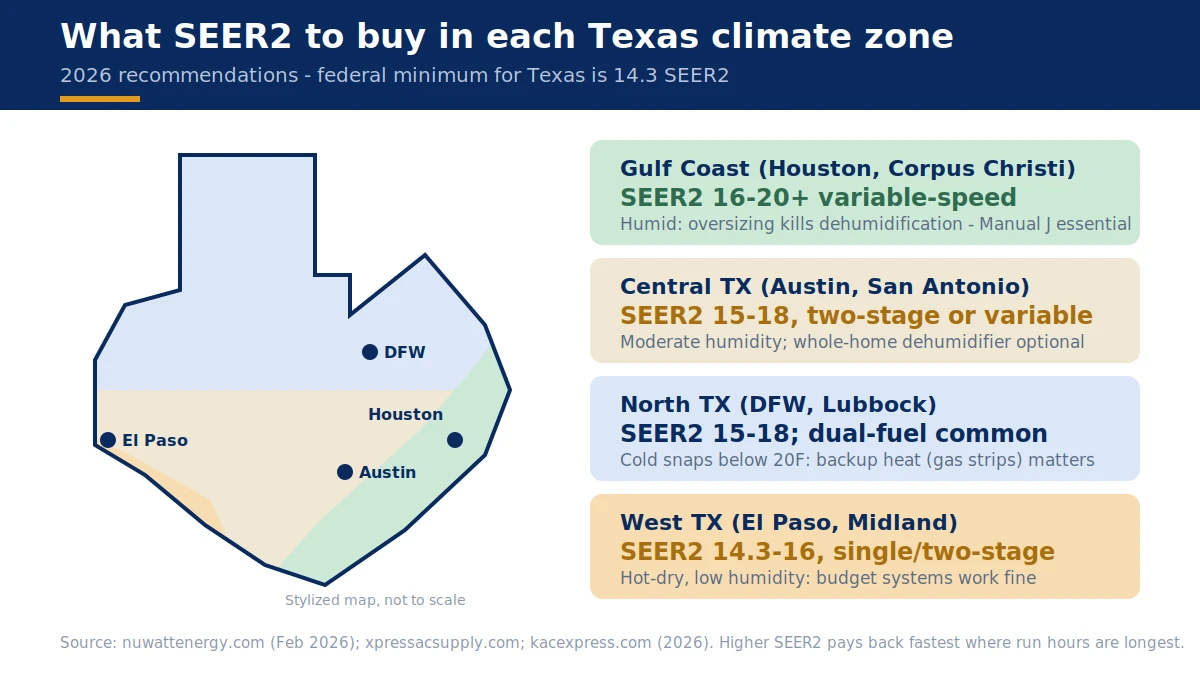
Texas spans four distinct climate realities, and the right equipment differs by zone:
| Region | Climate | Recommended SEER2 | The key insight |
|---|---|---|---|
| Gulf Coast (Houston, Corpus Christi, Beaumont) | Hot-humid, 75–90% RH summer | 16–20+ variable-speed | Oversizing is the #1 enemy — short-cycling kills dehumidification. Insist on a Manual J load calc. |
| Central TX (Austin, San Antonio, Waco) | Hot, moderate humidity | 15–18, two-stage or variable-speed | Moderate humidity; a whole-home dehumidifier is optional here. |
| North TX (DFW, Lubbock) | Hot summers + hard cold snaps (below 20°F possible) | 15–18; dual-fuel common | Backup heat — gas furnace or electric strips — is the critical question for February-style freezes. |
| West TX (El Paso, Midland) | Hot-dry, 20–40% RH | 14.3–16, single/two-stage | Dehumidification rarely needed; budget-tier systems work fine. |
The Gulf Coast humidity point deserves emphasis: summer relative humidity of 75–90% (NuWatt, February 2026) means a heat pump here is a dehumidifier first and a cooler second. Variable-speed equipment runs longer, slower cycles that wring moisture out of the air — single-stage oversized systems short-cycle, leave you clammy, and still run up the bill. That’s why the Gulf Coast is the one Texas region where the premium SEER2 tier genuinely earns its keep.
Permits by Texas metro
Yes, you need a permit — and no, your contractor should pull it. Typical 2026 costs:
- Houston: 2% of job cost + $47, plus a $33.56 admin fee (HomeAdvisor, June 2026). Angi separately lists a city base of $46.35 + $11.25 per ton.
- Dallas: ~$120 residential mechanical permit (1st Class Air, November 2026). Angi cites a broader building-permit range of $410–$2,600.
- Plano: ~$95 mechanical permit (1st Class Air, November 2026).
- Austin / San Antonio: no verified 2026 figure found — check the city portal; nationally, HVAC permits typically run $75–$300.
A permit is also your paper trail: it’s part of what keeps manufacturer warranties and utility rebate eligibility clean. If a contractor proposes skipping the permit to save money, that’s a reason to find another contractor.
Operating costs: what a Texas heat pump costs to run
The 2026 Texas numbers make a strong running-cost case. Average residential electricity: 15.91¢/kWh (August 2026, EIA) — about 12% below the US average of 18.16¢. In deregulated markets (Oncor, CenterPoint, AEP territory), shopping retail plans can cut all-in effective rates to roughly 9–13¢/kWh. The average Texas household uses about 1,094 kWh per month — among the highest in the country — or roughly $174/month at average rates.
That combination (cheap electricity + mild winters + high usage) is exactly the heat-pump sweet spot: in Texas, heat pumps are cheaper to run than gas furnaces per state-level modeling (searchright.io, 2026). Heat pumps also add an estimated $10,000–$17,000 to home value and cut heating/cooling costs 30–50% (Angi, Dallas, February 2026).
What does that mean for payback? At Texas rates and run hours, a 16 SEER2 upgrade over a 14.3 minimum-efficiency system typically earns back its premium faster than the national average — which is why the rebate math favors 16+ SEER2 so heavily. See the DOE’s heat pump systems guide for how HSPF2 and SEER2 translate to real savings, and our heat pump maintenance cost guide Getting quotes in Texas has utility-program steps most national guides skip: If your system still has life left, our heat pump repair cost guide can help you weigh repair vs. replacement. Metro averages: Angi city pages (Austin updated Aug 4, 2026: $7,057 avg / $5,424–$8,691; Houston updated Aug 3, 2026: $5,367 avg / $3,813–$6,921; Dallas updated Feb 25, 2026: $6,341 avg / $4,566–$8,709). Budget tier Houston $3,800–$7,100: HomeAdvisor, Jun 2026 (via homerepairdispatch, Oct 18, 2026). Houston central ducted $6,500–$15,000, variable-speed $14,000–$20,000+, $500–$2,000 AC premium: Burton Residential Services, Aug 10, 2026. Ducted $6,480–$10,870, dual-fuel $9,140–$15,010, 3-ton $8,270–$14,010: NumeralQ, checked Oct 2026. 3-ton 16 SEER2 $8,500–$18,000, $2,800–$6,000/ton, duct sealing $500–$2,000, SEER2 16→18+ +$1,500–$3,500: Climate Home editorial, updated Oct 2026. San Antonio tier pricing $5,200–$16,000: Element HVAC Services, 2026 pricing page. North TX: $5,500–$14,000, dual-fuel $8,000–$18,000, mini-split $3,500–$7,000/zone, multi-zone $8,000–$20,000, geothermal $18,000–$35,000, labor 25–35% / $2,000–$4,500 on $10k, equipment 45–55%, Carrier $9,500–$17,500, Trane $10,000–$18,000: Jupitair HVAC, 2026. Ducted statewide $6,500–$14,000, TX labor $80–$120/hr, hybrid gas add +$2,000–$4,000, budget brands $3,000–$5,000 less: minihomehub.online 2026 guides. Texas installs $9,000–$18,000, run hours ~2× northern: texasacguide.com, checked Nov 2026. Dallas $6,500–$14,500: HomeGuide, 2026. Mini-split single-zone $4,000–$8,000: minihomehub.online 2026. Houston 3-ton budget $3,400–$5,450: Angi Houston, Aug 2026. Duct replacement Austin $658–$2,496, Dallas $462–$1,687: Angi, Aug 2026 / Feb 2026. Line-set R-410A→R-454B $400–$900, crane/lift $300–$800, Dallas mechanical permit ~$120, Plano ~$95: 1st Class Air (DFW), Nov 2026. Federal minimum 14.3 SEER2 (8.1 HSPF2): xpressacsupply.com / texasacsupply.com, 2026. ENERGY STAR 15.2 SEER2 / 11.0 EER2 / 7.8 HSPF2: jupitairhvac.com, 2026. Rebates: Austin Energy ~$3,000 avg, $4,000+ income-qualified (temperatureproaustin.com 2026; upgraderebates.com 2026; nuwattenergy.com Apr 2026). CPS Energy $115–$310/ton early, $90–$275/ton burnout (upgraderebates.com 2026; palmetto.com 2026; nuwattenergy.com Apr 2026). Oncor $425/$600 tiers, opened Jan 14, 2026 (homeguide.com 2026; upgraderebates.com 2026; 1stclassairservice.com Nov 2026). CenterPoint $200+, up to $500/unit (upgraderebates.com 2026; nuwattenergy.com Apr 2026; clearesult.com 2026 flyer). AEP Texas: no central retrofit rebate 2026 (southtxsaves.com, checked Nov 2026; nuwattenergy.com Apr 2026). Co-ops: Tri-County $200, Guadalupe Valley $650, TNMP water heaters only (palmetto.com 2026; nuwattenergy.com Apr 2026). Oncor LIW: closes Nov 15, 2026 (quickelectricity.com 2026). WAP ~$7.6M, 21 subgrantees, 254 counties: TDHCA 2025–26 contracts. Tax: §25C/§25D $0 for 2026 installs — OBBBA P.L. 119-21, IRS FS-2025-05 (standing project rule). HEAR: ≤150% AMI, up to $8,000 heat pump / $14,000 per household, TX ~$689M not launched (SECO, Aug 21, 2026); fuel-switching exclusion — DOE Program Notice 26-2, May 29, 2026. Property tax §11.27 solar/wind only: legalclarity.org, 2026. Operating: 15.91¢/kWh Aug 2026 (EIA via chooseenergy.com Nov 2026); 9–13¢/kWh deregulated plans (truebillenergy.com Nov 2026); 1,094 kWh/mo avg household (electricitybillcalc.com 2026); heat pumps cheaper to run than gas furnaces in TX (searchright.io 2026); $10,000–$17,000 added home value, 30–50% heating/cooling cost cut: Angi Dallas, Feb 2026. Climate: Houston systems ~10 mo/yr (Valderrama 2026); Houston summer RH 75–90% (NuWatt, Feb 2026). TX labor 8–12% below national average: hvacpricingguide.com, Mar 2026. — $5,500–$15,000 installed for a standard central ducted system. By metro: Austin averages $7,057, Houston $5,367, and Dallas $6,341 (Angi, 2026). Budget Houston installs start around $3,800; premium variable-speed systems run $14,000–$20,000+. No — $0. The §25C energy-efficient home improvement credit ended for property placed in service after December 31, 2025 (OBBBA, P.L. 119-21; IRS FS-2025-05). Several ranking Texas pages still claim the old $2,000 credit is alive; it isn’t. Don’t subtract it from any 2026 quote. For Austin Energy customers: Power Saver averages ~$3,000 (~$4,000+ income-qualified) — the largest flat rebate. San Antonio’s CPS pays up to $310/ton for early replacement ($1,240 on a 4-ton top-tier system). Oncor pays $425–$600 and CenterPoint $200–$500, both as contractor invoice discounts. Not yet. Texas’s ~$689M share of IRA HOMES/HEAR funding is in “planning and design” (SECO, August 2026) with launch expected late 2026 or 2027. HEAR is also income-qualified only (≤150% AMI) and since May 2026 no longer covers switching from a gas furnace to a heat pump. A starting point is ~400 square feet per ton — so a 1,800 sq ft DFW home typically lands at 2.5–3 tons. But the correct answer is a Manual J load calculation from your contractor, not square footage alone. On the Gulf Coast, oversizing is the #1 enemy: short-cycling destroys humidity control. Yes — cheap electricity actually helps the heat-pump case. Texas residential rates average 15.91¢/kWh vs. 18.16¢ nationally (EIA, August 2026), and heat pumps cost less to run than gas furnaces in Texas per state modeling. The roughly 2× annual run hours also mean higher-SEER2 upgrades pay back faster here than up north. Yes. Houston: 2% of job cost + $47 plus a $33.56 admin fee. Dallas: roughly $120 for a residential mechanical permit (Plano: ~$95). Your contractor should pull it — permits keep manufacturer warranties and utility rebate eligibility clean, and a contractor who proposes skipping the permit is a red flag. All-electric for the Gulf Coast and Central Texas (mild winters, no real freeze load). Dual-fuel (heat pump + gas furnace) for DFW and North Texas, where sub-20°F cold snaps make backup heat a real concern — it adds $2,000–$4,000 over a standard system.How to get 3 smart quotes in Texas
Sources & methodology
How much does a heat pump cost in Texas in 2026?
Is there still a federal tax credit for heat pumps in 2026?
Which Texas utility has the best heat pump rebate in 2026?
Can I get the $8,000 HEAR rebate for a heat pump in Texas?
What size heat pump do I need in Texas?
Is a heat pump worth it in Texas with cheap electricity?
Do I need a permit to install a heat pump in Houston or Dallas?
Dual-fuel or all-electric heat pump in Texas?
5 thoughts on “Heat Pump Cost in Texas 2026 (With Rebate Guide)”