


Table of Contents
Georgia is one of the best states in America to own a heat pump, and one of the most confusing to price one in. The climate is nearly perfect for the technology: winters are mild enough that a standard heat pump runs at a COP above 3.0 most of the season, and summers are long enough that the same system earns its keep as an air conditioner for five months a year. Electricity is cheaper than the national average — 15.90 cents per kilowatt-hour against 18.16 cents nationally (EIA, August 2026) — so running costs stay reasonable.
The confusion comes from the incentives. The federal credit is gone. The state’s headline HEAR rebate closed to new applications in August 2026 after paying out more than $50 million. What is left is a patchwork: a Georgia Power conversion rebate, two EMC rebates of $400 each, a City of Decatur program, and a modeled-savings program that pays different amounts to different homes. This guide maps all of it, with every figure sourced from 2026 data and the federal credit correctly shown as $0.
Compare with the national heat pump cost guide for the US baseline, and with our Texas heat pump cost guide and Florida heat pump cost guide for the other big Southern markets.
How much does a heat pump cost in Georgia in 2026?
The defensible 2026 Georgia answer: $8,500–$15,000 installed for a typical whole-home ducted air-source heat pump (3-ton). That range comes from Georgia installers, not national averages. Coastline Heating & Air (coastal Georgia: Savannah and Richmond Hill, October 2026) quotes a complete heat pump system — indoor unit, outdoor unit, and air handler — at $8,500–$13,500. Keep Smiling (Loganville, Gwinnett County, 2026) quotes $9,500–$18,000 depending on size, efficiency rating, and ductwork. Modernize’s Georgia market data (2026) puts the average Georgia installation at $10,950, with a standard air-source system at $8,800 and a high-efficiency system at $13,200. E. Smith Heating & Air (Marietta and North Metro Atlanta, 2026) quotes full systems from $10,982 to $28,388 — the top end is premium variable-speed equipment with ductwork and electrical work, not a typical price.
Georgia sits about 2% below the national average for this job (NumeralQ, 2026: Georgia typical job $6,380–$10,740). The national guide range of $7,500–$15,000 for a ducted air-source system still holds as a cross-check — Georgia sits toward the upper end of it.
One number you will see elsewhere is wrong. Angi’s Atlanta page (updated July 8, 2026) reports “a heat pump costs around $4,257 in Atlanta,” with a range of $3,080–$5,492 and a 3-ton system for a 2,000 sq ft home at $3,080–$5,490. That conflicts with every Georgia installer quote we found. Angi’s figures appear to reflect equipment-only or partial-scope pricing, not a complete installed system. Do not budget on $4,257. If a contractor quotes near that number, ask what is excluded — ductwork, the air handler, the panel, permits, or the install labor are the usual missing pieces.
The number-one rule of 2026 Georgia pricing: gross is net, minus Georgia rebates only. The §25C federal credit (30%, up to $2,000 a year for heat pumps) ended for property placed in service after December 31, 2025. Several top-ranking pages still show “after the tax credit” heat pump prices. Treat those as outdated. Every figure in this guide is the price you actually pay, minus only the Georgia rebates in the incentives section below.
Heat pump cost by system type in Georgia
| System type | Georgia installed range | Best for |
|---|---|---|
| Ducted air-source heat pump (whole home) | $8,500–$15,000 (typical 3-ton; high-end variable-speed to ~$18,000) | Most Georgia homes with existing ducts |
| Ductless mini-split, single zone | $3,000–$8,000 (Modernize GA: $6,050) | One room, addition, garage |
| Ductless mini-split, multi-zone (3–4 zones) | $8,000–$15,000 (Modernize GA 3-zone: $13,200) | Whole home without ducts |
| Dual-fuel (heat pump + gas furnace) | $10,000–$18,000 (national range — no GA-specific figure verified) | Homes with cheap gas + cold snaps; north Georgia mountains |
| Geothermal (ground-source) | $25,000–$40,000+ (One Hour Atlanta: $25,000+) | Maximum efficiency, new builds, large lots |
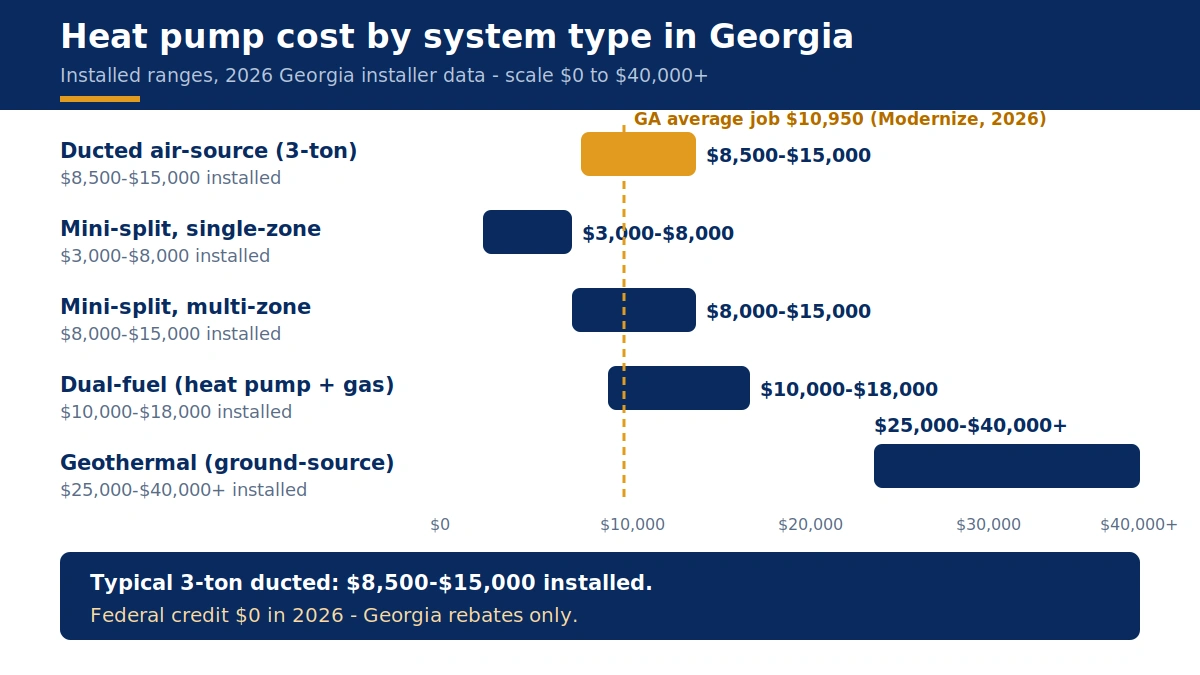
Ducted air-source is the default Georgia system. If your home already has ductwork in decent shape, this is the quote to get first. The $8,800 standard tier (Modernize) is a system at the 14.3 SEER2 minimum. The $13,200 high-efficiency tier is a variable-speed/inverter system — and in Georgia, that upgrade buys something real: longer, slower run cycles that pull more humidity out of the air (see the climate section below). It is the one efficiency upgrade that is worth more in Georgia than in a dry state.
Mini-splits are the answer for homes without ducts. A single-zone system at $3,000–$8,000 covers one room, an addition, or a garage conversion. A 3–4 zone whole-home system runs $8,000–$15,000 — at which point a ducted system is usually the better value if ducts exist or can be added cheaply. Our mini-split installation cost guide breaks down per-zone pricing in detail.
Geothermal is the best system you can buy and the hardest to justify on payback in Georgia. At $25,000–$40,000+ installed, with a COP of 4.0–5.0 that never drops with the air temperature, it is superb engineering. But Georgia’s mild winters mean the efficiency premium over a good air-source system is smaller here than in a cold state, so the payback stretches long. Georgia Power’s HEIP program pays only $300 for a ground-source conversion — a telling signal about where the value sits.
Heat pump cost by size in Georgia
No single published Georgia tonnage table exists, so the table below is built from the Georgia installer ranges above (3-ton anchor: $8,500–$15,000) and the national tonnage pattern. Treat it as planning ranges, not quotes.
| Tonnage | Home size served | Georgia installed range (planning) |
|---|---|---|
| 2 ton | 1,000–1,200 sq ft | $7,000–$10,000 |
| 2.5 ton | 1,200–1,500 sq ft | $8,000–$12,000 |
| 3 ton | 1,500–1,800 sq ft | $8,500–$15,000 |
| 4 ton | 1,800–2,200 sq ft | $10,000–$18,000 |
| 5 ton | 2,200–3,000 sq ft | $12,000–$20,000 |
The average Atlanta home needs about a 3-ton heat pump (Angi, July 2026). Higher SEER2/HSPF2 ratings push each band upward, and a variable-speed system sits at the top of its band.
Never size by square footage alone. The “one ton per 500–600 square feet” rule is a starting guess, not a sizing method. Proper sizing comes from a Manual J load calculation ($200–$500, often credited toward the install), which accounts for insulation, windows, ceiling height, and — critically in Georgia — the humidity load. An oversized system is not a safety margin. In Georgia it is the single most common sizing mistake, and it leaves you with a clammy house (see the climate section below).
What drives your price up or down in Georgia
Ductwork. Have good ducts? A ducted swap is straightforward. Need new ducts? Add $5,000–$10,000 (national planning range). Leaky ducts in a hot Georgia attic are also the quietest energy waste in the house — a duct-sealing line item is worth asking about.
Electrical panel. Heat pumps need a dedicated 240V circuit. If your panel is full or still 100-amp, budget $1,500–$4,000 for a 200-amp upgrade, or $500–$1,500 for a sub-panel if capacity is fine but breaker slots are not. Our electrical panel upgrade cost guide covers the details.
Efficiency tier. A standard 14.3 SEER2 / 7.5 HSPF2 system is the legal minimum in the Southeast. A mid-tier 15–17 SEER2 / 8.5+ HSPF2 system is the sweet spot for most Georgia homes. An 18+ SEER2 variable-speed system costs more and pays mainly in heavy-AC homes or on time-of-use plans. Cold-climate (inverter-driven) models cost 15–30% more than standard — overkill for most of Georgia, worth pricing only in the north Georgia mountains.
Labor market. Georgia HVAC labor runs $82–$175 an hour (Modernize, 2026), and labor is 20–30% of an Atlanta install (Angi, July 2026). The same system costs noticeably more in metro Atlanta than in smaller markets — and identical equipment quotes can vary widely between contractors, which is why three quotes are non-negotiable.
Permits. Atlanta mechanical permits start around $100 (Angi, July 2026). A legitimate installer pulls the permit; a quote with no permit line is a red flag.
Georgia’s climate: why heat pumps work here — and the humidity catch
Georgia is humid subtropical (Cfa): humid summers, mild to cool winters. Atlanta’s 1991–2020 normals (NOAA) tell the story in numbers: January averages 44.8°F (high 54°F, low 36°F); July averages 80.9°F (high 90°F, low 72°F). The coldest nights of the year typically fall into the teens — the mean January minimum is 17.3°F, and the record low is −9°F. Annual rainfall is 50.43 inches.
The load is nearly balanced. Atlanta accumulates about 2,531 heating degree-days and 2,051 cooling degree-days a year (base 65°F, NOAA 1991–2020). Slightly heating-tilted on paper — but summer cooling dominates the electric bill, because the AC runs hardest in July and August, when the average August bill hits $233.87 on 1,471 kWh (EIA, August 2026) against a 12-month average bill of $163.85. A heat pump is the only single system that serves both loads. That is why it is the default HVAC choice across the state.
Winter performance is not the worry. In climate zones 3–4 (Atlanta, Charlotte, Nashville), a standard heat pump’s COP stays above 3.0 most of the winter (ohmsnap zone analysis, March 2026) — it delivers three units of heat for every unit of electricity. Backup electric resistance heat, the expensive part of heat pump ownership, rarely runs in metro Atlanta. It runs more often in the north Georgia mountains, where design temperatures run roughly 10°F colder than Atlanta and nights below freezing are common. Coastal Georgia (Savannah, Brunswick, Richmond Hill) is warmer still, with a shorter heating season — “for most homes here, a heat pump” is the local installer’s verdict (Coastline, October 2026). One coastal caveat: salt air shortens outdoor-unit life, so ask about coated coils.
Humidity is the real Georgia sizing story. Atlanta averages 68.3% relative humidity across the year and 74–75% in July and August, with dew points near 68°F (NOAA 1991–2020). Indoor comfort needs relative humidity held near 30–50%. Sustained indoor humidity above ~60% is where mold risk rises.
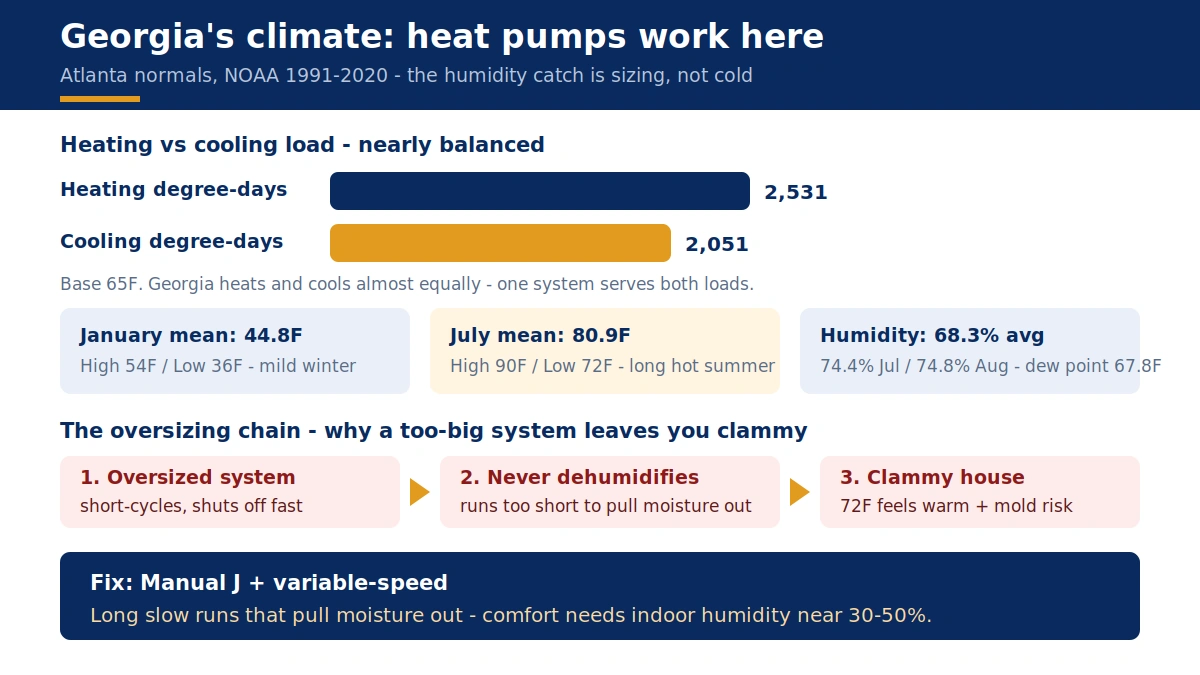
That is where oversizing bites. An oversized heat pump cools the air fast, satisfies the thermostat, and shuts off — without ever running long enough to pull moisture out of the air. The result is a clammy 72°F house that feels warmer than the thermostat says. The fix is threefold: a Manual J load calculation instead of a square-footage rule; a variable-speed/inverter compressor that runs long and slow, dehumidifying while it cools; and, in the most humid homes, a whole-home dehumidifier quoted as a separate line item (ask for it as a quoted option).
Efficiency ratings that matter in Georgia. The federal minimums for split-system heat pumps in the Southeast are 14.3 SEER2 (cooling) and 7.5 HSPF2 (heating), set by the DOE’s 2023 standards. SEER2 replaced SEER in 2023 testing — do not compare SEER2 numbers to old SEER numbers directly. To convert HSPF2 to a seasonal COP, divide by 3.412: the 7.5 HSPF2 minimum is a seasonal COP of about 2.2, and ENERGY STAR cold-climate certification requires 8.1+ HSPF2. For most Georgia homes, 15–17 SEER2 with 8.5+ HSPF2 is the sweet spot — above the minimum, below the premium tier. Compare with Florida’s heat pump climate, where the humidity story is the same but the heating season is shorter still.
The federal tax credit is $0 in 2026 — what that means
The §25C Energy Efficient Home Improvement Credit — 30%, up to $2,000 a year for heat pumps — was terminated by the One Big Beautiful Bill Act (OBBBA, P.L. 119-21, signed July 4, 2025) for property placed in service after December 31, 2025. The IRS confirmed the rule in FS-2025-05 (August 21, 2025). For a heat pump installed in Georgia in 2026, the federal credit is $0.
One nuance: a system installed in 2025 can still be claimed on the 2025 return (IRS Form 5695). That is a claim for 2025 work, not a credit for 2026 work. Paying in 2025 does not help if installation finished in 2026.
There is no lease workaround for heat pumps. The §48E commercial credit that survives for leased solar systems does not apply to heat pumps — it is a clean-electricity credit, and a heat pump is not a generator. Do not let anyone sell you a heat pump lease on the promise of a federal credit flowing through. Our federal energy tax credits guide covers the full post-OBBBA landscape.
Watch for quotes still subtracting a $2,000 federal credit. It is the most common stale-math trap in 2026 heat pump pricing, and it is exactly the trap this guide exists to warn you about.
Georgia rebates that are still alive in 2026
Georgia’s rebate map is small, scattered, and dominated by one big pause. Here is the whole picture in one dated table.
| Program | 2026 status | Value |
|---|---|---|
| Federal §25C credit | Expired Dec 31, 2025 — $0 | $0 |
| Georgia Power HEIP (Home Energy Improvement Program) | Open — valid Jan 1, 2026–Dec 31, 2028 | 50% of cost, up to $1,500 for conversion to an air-source heat pump (from an electric furnace); up to $300 ground-source conversion; up to $500 ductless mini-split (combined); up to $500 combination heat pump water/space heating; up to $800 heat pump water heater; apply within 60 days of the paid invoice |
| HEAR (Home Electrification & Appliance Rebates, GEFA) | PAUSED — closed to new applications August 2026; relaunch with new eligibility rules pending; final amounts unpublished | Was up to $8,000 for a heat pump, up to 100% of cost for households at/below 80% of area median income, $14,000 household cap |
| HER / HOMES (Home Efficiency Rebates, GEFA) | Open at all income levels — performance-based on modeled energy savings | Up to $4,000 (all incomes); up to $16,000 for more than 35% savings at/below 80% AMI (Georgia’s DOE-approved cap) |
| Jackson EMC | Open in 2026 (or until funds run out) | Up to $400 electric heat pump replacement rebate; ENERGY STAR, minimum 16 SEER / 15.2 SEER2 |
| Central Georgia EMC | Open through Dec 31, 2026 (subject to cancellation) | $400 air-source heat pump (14.3 SEER2+, load-management switch required; dual-fuel not eligible); mini-split $400 with switch / $200 without; one rebate per member; +$20 November bill credit |
| City of Decatur Community Energy Rebate Program | Open — launched May 27, 2026 | Heat pump 50% up to $1,000; household cap $3,000/yr for households at/below 80% AMI |
| Georgia state tax credit for heat pumps | None verified | — |
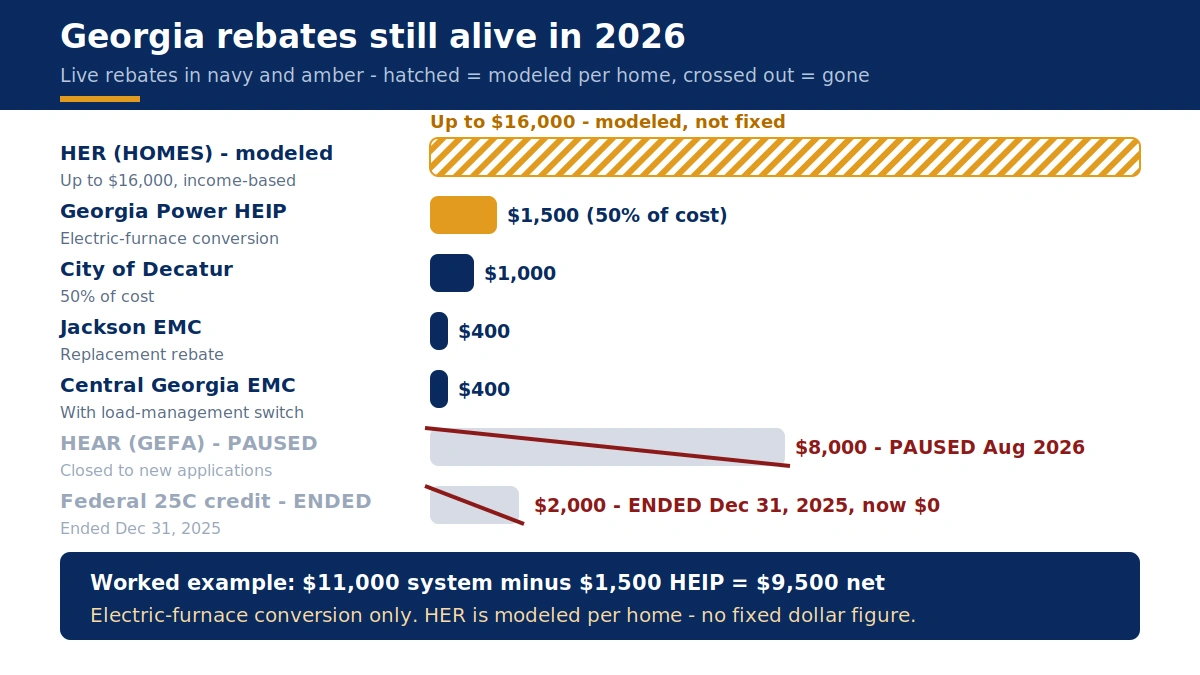
The HEAR story is the most important Georgia rebate fact of 2026. Georgia was one of the earliest and biggest HEAR states. Before it closed to new applications in August 2026, it had paid out more than $50 million to over 3,500 households — an average of about $12,104 each (citing GEFA figures, October 2026). An earlier GEFA milestone (April 9, 2026) reported $25 million+ to 1,900+ households, averaging $10,160 — the program kept paying through the summer before pausing.
Why did it pause? Two reasons. First, the money was going fast. Second, the US Department of Energy rewrote the rules on May 29, 2026 (Program Notice 26-2): rebates no longer cover fuel-switching — replacing a gas, oil, or propane appliance with an electric one — for reservations made after August 31, 2026. Only electric-to-electric upgrades and new construction qualify now. Georgia paused HEAR to relaunch it under the new eligibility rules, and the relaunched amounts have not been published yet.
What to do about HEAR: do not budget on it. Do pre-qualify with a GEFA-approved contractor (only GEFA-approved contractors can participate) so your application is ready the day the program reopens, and check the current status at energyrebates.georgia.gov before counting on any number. Any quote that counts an $8,000 HEAR rebate in 2026 is counting paused money.
The rebate most Georgia Power customers can actually get is HEIP — with a catch. The $1,500 is for converting an electric furnace to an air-source heat pump — a conversion rebate, not a like-for-like replacement rebate. A straight heat-pump-for-heat-pump swap does not qualify for the $1,500. The older figures some installer blogs still cite — $550 for a gas-furnace conversion, $250 for replacing an existing heat pump — are superseded by the current HEIP page. Use the current numbers. One more honest caveat: sources disagree on HEIP’s overall annual cap (one tracker says $2,500 per customer per year; a Georgia Power press release from October 15, 2026 says up to $1,850 for single-family homes). Headline the per-measure $1,500, which is confirmed on Georgia Power’s own HEIP page, and confirm the cap with Georgia Power when you apply.
The EMC rebates are small but real. If your electricity comes from Jackson EMC, the $400 replacement rebate is straightforward — ENERGY STAR equipment at 16 SEER / 15.2 SEER2 or better. Central Georgia EMC pays $400 for an air-source heat pump at 14.3 SEER2 or higher, but only with a load-management switch installed, and dual-fuel systems are explicitly excluded. Walton EMC also offers heat pump rebates, but no amount was verified — ask them directly rather than trusting a round number from a blog.
Worked rebate example — 3-ton ducted, $11,000 installed, Georgia Power customer converting from an electric furnace: $11,000 minus $1,500 HEIP = $9,500 net. If the same household also qualifies for HER (modeled savings, income-dependent), the net falls further — but HER amounts are modeled per home, so no HER dollar figure is hardcoded into this example.
Compare with Texas, where the state rebate picture is thinner — Georgia’s paused-but-real HEAR program is still the better position.
Georgia electricity rates and what a heat pump costs to run
Georgia’s residential electricity averages 15.90 cents per kilowatt-hour (EIA Electric Power Monthly, Table 5.6.A, August 2026, released October 28, 2026) — about 12% below the US average of 18.16 cents, and the 21st lowest of 51 jurisdictions. The January–August 2026 average was 15.48 cents. Rates rose 2.3% year over year (August 2025 was 15.55 cents). The average August bill was $233.87 on 1,471 kWh; the 12-month average bill was $163.85.
Georgia Power, the state’s largest utility, runs about 15.4 cents per kWh on its standard residential tariff, with a $14.01 monthly base charge and riders and taxes that bring the all-in rate to about 16.31 cents at 900 kWh (October 2026). That mid-range price is the single biggest reason heat pumps pencil well in Georgia: electricity is cheap enough to run on, and expensive enough that efficiency pays.
Time-of-use plans change the math — in both directions. Georgia Power offers three residential TOU options (tariffs effective June 2026; energy charges shown before riders, taxes, and the basic service charge):
| Plan | Energy charges | The catch |
|---|---|---|
| Standard residential | Flat rate, ~15.4 cents + $14.01/mo base | Default; no surprises |
| Smart Usage (TOU-RD-12) | Off-peak 1.56 cents; on-peak 14.56 cents (2–7 PM weekdays, Jun–Sep); demand charge $12.44/kW on your highest 60-minute hour each month | One hot afternoon hour with the heat pump, dryer, and oven running together can set a demand charge — Georgia Power’s own example: 4.5 kW of max demand = $55.98 for the cycle |
| TOU Energy Only (TOU-REO-19) | On-peak 30.35 cents; off-peak 7.77 cents (peak 2–7 PM weekdays Jun–Sep only; flat Oct–May) | Summer peak is ~4x off-peak; a variable-speed heat pump that pre-cools off-peak wins here |
| Overnight Advantage (TOU-OA-15) | On-peak 30.35 cents; off-peak 10.36 cents; super off-peak 2.23 cents overnight | Rewards shifting load overnight |
A heat pump is the biggest electric load in most Georgia homes, so the rate plan matters. On Smart Usage, the demand charge is the thing to watch: it is measured on your single highest-usage hour in the month, and a heat pump working hard on a July afternoon is exactly the kind of load that sets it. On the energy-only TOU plan, the opposite is true — a variable-speed heat pump that pre-cools the house before 2 PM and coasts through the peak window can cut cooling costs sharply. Either way, ask your installer to model the quote against your actual rate plan, not the statewide average. Smart Usage requires a 12-month commitment.
What does it cost to run? Georgia Power itself says a heat pump can save you up to $300 a year on heating and cooling costs. That is the conservative, utility-claimed floor. Modeled comparisons for climate zones 3–4 (Atlanta, Charlotte, Nashville) put a gas furnace at $1,200–$1,800 a year to run against a heat pump at $600–$1,000 a year — a saving of roughly $600–$800 a year — with the heat pump’s COP staying above 3.0 most of the winter (ohmsnap, March 2026). Those modeled figures use $0.13/kWh, below Georgia’s actual 15.90 cents, so treat the dollar figures as directional rather than exact. The honest headline: savings depend entirely on what you replace. Replacing electric resistance heat is the biggest win (heating electricity falls by roughly two-thirds at COP 3.0). Replacing a gas furnace is a moderate win. Replacing a working heat pump with a newer one is an efficiency-only win.
Heat pump vs furnace in Georgia: the honest comparison
This is the comparison most articles get wrong. A heat pump replaces both heating and cooling. Compare it to a furnace plus an air conditioner — not to a furnace alone. Coastal Georgia installer Coastline (October 2026) gives the cleanest Georgia numbers:
| Option | Installed (coastal GA) | Notes |
|---|---|---|
| Heat pump (complete system) | $8,500–$13,500 | Heats AND cools — one system |
| Gas furnace alone | $3,500–$6,500 | Needs a separate AC |
| Outdoor AC alone | $4,500–$8,500 | Needs a separate furnace |
| Furnace + AC combined | $8,000–$15,000 | The true comparison — roughly a wash with the heat pump upfront |
Upfront, it is roughly a wash in Georgia. The heat pump then wins on running costs in most cases: at a COP near 3.0, it delivers three units of heat per unit of electricity, against 80–98% efficiency (AFUE) for a gas furnace that burns fuel. The modeled zone 3–4 running costs above ($600–$1,000 a year for the heat pump vs $1,200–$1,800 for the furnace) are the shape of that win.
When does the furnace win in Georgia? Two cases. First, the north Georgia mountains, where winters are colder, backup heat runs more often, and the heat pump’s efficiency edge narrows. Second, homes where natural gas is very cheap and electricity is on the high side — run the numbers with the rule of thumb from our national comparison: divide your electricity price ($/kWh) by 3, and compare the result to your gas price per therm-equivalent. At Georgia’s 15.90 cents, that is about 5.3 cents — comfortably below typical gas pricing, which is why the heat pump usually wins here. Our full heat pump vs furnace cost comparison works through the 10-year math in detail. And if the choice is heat pump versus solar for the same dollars, our heat pump vs solar guide compares the two directly.
One more Georgia-specific point in the heat pump’s favor: it has no combustion, so it cannot make carbon monoxide — a real consideration for families replacing an old gas furnace.
Dual-fuel and geothermal: when they make sense in Georgia
Dual-fuel pairs a heat pump with a gas furnace. The heat pump handles mild weather; the furnace takes over below a switchover temperature, typically around 35–40°F. Installed cost runs $10,000–$18,000 (national range — no Georgia-specific figure was verified). In most of Georgia the furnace rarely runs, so dual-fuel is usually overkill — the extra equipment buys insurance against a handful of cold nights a year. The exceptions are the north Georgia mountains, where the furnace earns its keep, and homes with very cheap natural gas. One real cost of choosing dual-fuel on EMC territory: Central Georgia EMC’s $400 rebate explicitly excludes dual-fuel systems. Price both options before deciding.
Geothermal (ground-source) is the efficiency champion: COP 4.0–5.0, unaffected by air temperature, with a ground loop that lasts 25+ years. It is also $25,000–$40,000+ installed — two to three times an air-source system — and in Georgia’s mild climate the efficiency premium over a good air-source system is smaller than in a cold state. Georgia Power’s HEIP program pays only $300 for a ground-source conversion. Honest framing: geothermal is the best system you can buy and the hardest to justify on payback alone in Georgia. It makes sense for new builds and large lots where the loop field is cheap to install, less sense as a retrofit on a typical Atlanta lot.
Cold-climate mini-splits deserve a footnote, not a section. Inverter-driven cold-climate models work down to −15°F and cost 15–30% more than standard models. In Atlanta and coastal Georgia, that capability is wasted money. In the Blue Ridge foothills, it is worth a quote. Our cold-climate mini-split guide covers the technology; just do not assume Georgia needs it.
Payback math: when a Georgia heat pump pays for itself
Worked example: 3-ton ducted air-source, $11,000 installed — the midpoint of Georgia’s $8,500–$13,500 installer range, and close to Modernize’s $10,950 Georgia average.
| Line | Math | Result |
|---|---|---|
| Installed cost | Midpoint of GA installer range | $11,000 |
| Less Georgia Power HEIP (electric-furnace conversion) | 50% up to $1,500 | −$1,500 |
| Net cost | $9,500 | |
| Annual savings vs gas furnace + old AC (modeled) | Zone 3–4 model: $600–$800/yr | $600–$800/yr |
| Simple payback at $600/yr | $9,500 ÷ $600 | ~16 years |
| Simple payback at $800/yr | $9,500 ÷ $800 | ~12 years |
| Payback at Georgia Power’s $300/yr claim | $9,500 ÷ $300 | ~32 years (conservative floor — Georgia Power’s “up to” figure vs an unspecified baseline) |
| 10-year net position at $700/yr (midpoint) | $7,000 − $9,500 | −$2,500 |
| 15-year net position at $700/yr | $10,500 − $9,500 | +$1,000 |
| 15-year net position at $800/yr | $12,000 − $9,500 | +$2,500 |
Assumptions, stated plainly: $11,000 installed (midpoint); the $1,500 HEIP applies only to electric-furnace conversions — a like-for-like replacement nets $11,000 and pays back roughly 2–3 years longer; savings are energy-only (maintenance is excluded and roughly similar for a heat pump vs a furnace + AC); no HER stacking in the base case, because HER amounts are modeled per home and income-dependent. This model is ours, not a published Georgia benchmark — no published Georgia heat pump payback benchmark was found. The spread between Georgia Power’s $300 a year and the modeled $600–$800 a year is itself the honest story: payback depends on what you replace.
Payback by scenario:
- Replacing electric resistance heat (baseboard heaters or an electric furnace): fastest payback. Heating electricity falls by roughly two-thirds at COP 3.0, and the HEIP $1,500 applies to exactly this conversion.
- Replacing a gas furnace + old AC: about 12–16 years on the modeled range above. HER stacking (up to a $16,000 cap for the deepest savings at the lowest incomes) can shorten this substantially — verify with GEFA.
- Like-for-like heat pump replacement: longest payback. Savings come only from efficiency gains (14.3 to 17 SEER2, 7.5 to 9 HSPF2), roughly 15–25% on HVAC energy. Replace on age and reliability, not on payback alone.
- North Georgia mountains: colder winters and more backup-heat hours stretch payback; get a dual-fuel quote alongside the heat pump quote.
- Coastal Georgia: the shortest heating season in the state — payback is driven more by cooling efficiency than heating savings, which favors the higher-SEER2 tier.
A heat pump lasts 15–20 years with annual maintenance (average about 14 years, per HomeAdvisor). A 12–16 year payback on a 15–20 year system is a fair deal, not a windfall — and the comfort and humidity-control gains are part of the return, even though they never show up in the payback table.
How to get quotes in Georgia + red flags
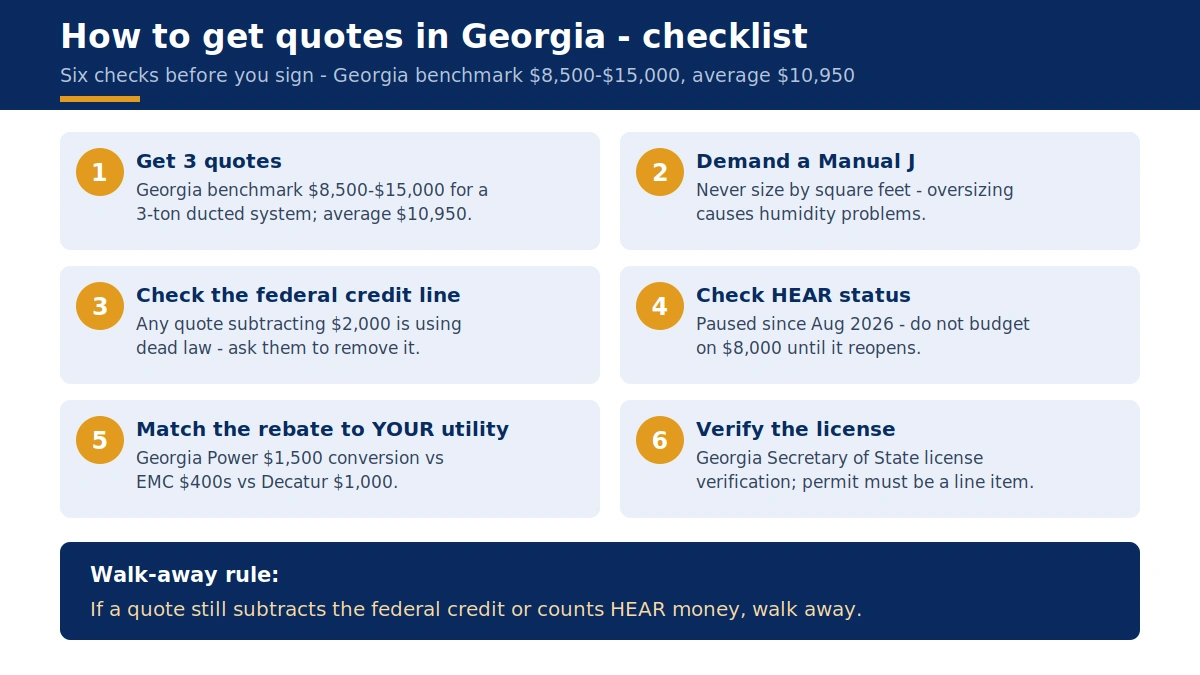
Get three or more installer quotes, and use the same question list every time so the answers compare:
- What is my cost before any rebates? The Georgia benchmark is $8,500–$15,000 for a typical 3-ton ducted system, with a $10,950 average. Anything far above $18,000 needs a justification (complex ductwork, premium variable-speed equipment, panel work).
- Did you do a Manual J load calculation? If the sizing came from square footage alone, the quote is a guess — and in Georgia, an oversized guess leaves you with a clammy house.
- Does the quote subtract the $2,000 federal credit? If yes, it is using dead law. Ask them to remove it.
- Is HEAR in this quote? If a quote counts an $8,000 HEAR rebate, it is counting paused money. HEAR closed to new applications in August 2026; the relaunch date and amounts are unpublished.
- Which rebate applies to MY utility? Georgia Power’s $1,500 is a conversion rebate (electric furnace to heat pump). Jackson EMC pays $400, Central Georgia EMC pays $400 with a load-management switch. A quote using another utility’s rebate is the wrong quote.
- What SEER2 and HSPF2 is this equipment, and what is the warranty? In Georgia, 15–17 SEER2 with 8.5+ HSPF2 is the sweet spot. Ask about the compressor warranty specifically — longer coverage is a sign of better equipment.
- Is the installer licensed, and is the permit included? Verify licensing through the Georgia Secretary of State’s license verification, and confirm the permit is a line item, not an afterthought.
Red flags. A quote far below the $8,500–$15,000 installer range with no explanation of what is excluded. A contractor who sizes by square footage and skips the Manual J. Any “free heat pump” or “government program” door-to-door pitch — no government program gives away heat pumps. A furnace-only quote presented as the alternative to a heat pump, with the cost of the air conditioner left out. And any pressure to “sign now to lock in the credit” — the credit is gone, so the urgency is manufactured. Door-to-door sales carry a 3-day right to cancel under the FTC Cooling-Off Rule (16 CFR Part 429) for sales of $25 or more.
Sources & methodology
Cost anchors: Modernize Georgia market data (2026: average install $10,950; standard air-source $8,800; high-efficiency $13,200; single-zone mini-split $6,050; multi-zone 3-zone $13,200; labor $82–$175/hr); Coastline Heating & Air (published Oct 16, 2026: complete heat pump system $8,500–$13,500; furnace $3,500–$6,500; AC alone $4,500–$8,500; 25C ended for 2026 installs); Keep Smiling (Loganville, 2026: $9,500–$18,000); E. Smith Heating & Air (Marietta, 2026: $10,982–$28,388 full system); One Hour Heating & Air North Atlanta (published Jan 6, 2026: basic ASHP $4,000–$10,000 with existing ducts; GSHP $25,000+); NumeralQ (2026: Georgia typical job $6,380–$10,740, −2% vs national; 3-ton ducted national $6,550–$10,960; permits $70–$166 across 35 cities); Angi Atlanta page (updated Jul 8, 2026: $4,257 average, $3,080–$5,492 range — disputed as equipment/partial-scope pricing, see research brief §1a); art. 1 national heat pump guide (Nov 2026: ducted $7,500–$15,000; mini-split single $3,000–$8,000, multi-zone $8,000–$15,000; geothermal $25,000–$40,000+; ductwork $5,000–$10,000; panel upgrade $1,500–$4,000; Manual J $200–$500; dual-fuel $10,000–$18,000 via art. 3). Tonnage table interpolated from the 3-ton Georgia anchor + national tonnage pattern (research brief §1c).
Electricity rates: EIA Electric Power Monthly Table 5.6.A (August 2026, released Oct 28, 2026: Georgia residential 15.90¢/kWh, US 18.16¢/kWh, 21st lowest of 51 jurisdictions; Aug bill $233.87 on 1,471 kWh; 12-month avg bill $163.85; Aug 2025 15.55¢, +2.3%); EIA via hvacbase.org (Oct 23, 2026 release: GA Jan–Aug 2026 avg 15.48¢/kWh); Georgia Power standard tariff via priceofelectricity.com (Oct 2026: ~15.4¢/kWh; $14.01/mo base charge; all-in 16.31¢/kWh at 900 kWh); Georgia Power tariffs TOU-RD-12 / TOU-REO-19 / TOU-OA-15 (effective with bills rendered June 2026: Smart Usage off-peak 1.56¢, on-peak 14.56¢, demand $12.44/kW, basic service $0.4603/day; TOU-REO-19 on-peak 30.35¢, off-peak 7.77¢; TOU-OA-15 super off-peak 2.23¢; on-peak window 2–7 PM weekdays Jun–Sep; 12-month commitment).
Climate: NOAA 1991–2020 normals, Atlanta Hartsfield (Jan mean 44.8°F, high 54.0 / low 35.6; Jul mean 80.9°F, high 90.1 / low 71.8; annual mean 63.6°F; precip 50.43 in; HDD65 2,531; CDD65 2,051; avg RH 68.3%, Jul 74.4% / Aug 74.8%; dew point Jul 67.8°F; mean January minimum 17.3°F; record low −9°F); humid subtropical classification (Cfa); ohmsnap zone 3–4 analysis (Mar 2026: COP above 3.0 most of the winter in Atlanta/Charlotte/Nashville); Coastline (Oct 2026: coastal Georgia guidance, salt air).
Efficiency standards: DOE 2023 minimums, Southeast region — split-system heat pumps 14.3 SEER2 / 7.5 HSPF2 (verified via Central Georgia EMC rebate terms and Jackson Electric: “DOE standard in 2026 is 7.5 HSPF2”); HSPF2 ÷ 3.412 = seasonal COP; ENERGY STAR cold-climate 8.1+ HSPF2 (jouleio, 2026); SEER2 replaced SEER in 2023 (art. 7).
Incentives: OBBBA P.L. 119-21 (signed July 4, 2025), IRS FS-2025-05 (Aug 21, 2025) — §25C $0 for 2026 installs (was 30% up to $2,000/yr for heat pumps). Georgia Power HEIP page (accessed Nov 2026: 50% up to $1,500 air-source conversion, $300 ground-source, $500 mini-split, $500 combo, $800 heat pump water heater; apply within 60 days; valid Jan 1, 2026–Dec 31, 2028); betterhouse.io heat pump rebates by state (Sep 2026: Georgia HEAR paused, HER open, $16,000 combined cap; Georgia Power HEIP details incl. $2,500/yr cap figure); Palmetto Georgia heat pump guide (Oct 2026: HEIP + Jackson EMC + Central Georgia EMC + HEAR/HER summary); pvhvac.com (Aug 2026 program update: HEAR closed to new applications Aug 10, 2026, relaunch pending; HER open at all incomes); homeenergybasics.com heat pump rebate tracker (Aug 23, 2026: Georgia HEAR “paused all new applications Aug 14, 2026,” HER open up to $4,000 all incomes / $16,000); for.you.com (Oct 2026: Georgia paid $50M+ to 3,500+ households, avg $12,104, before closing; DOE Program Notice 26-2, May 29, 2026, ended fuel-switching rebates for reservations after Aug 31, 2026); retrofitrelay.com (Jul 2026: Georgia HOMES cap $16,000; GEFA press release $25M+ to 1,900+ households as of Apr 9, 2026, avg $10,160); Jackson EMC rebates (up to $400, ENERGY STAR, min 16 SEER / 15.2 SEER2; 2026 or until funds depleted); Central Georgia EMC residential rebates ($400 air-source 14.3 SEER2+ with load-management switch, dual-fuel excluded; mini-split $400 with switch / $200 without; through Dec 31, 2026; +$20 November bill credit); City of Decatur Community Energy Rebate Program (launched May 27, 2026: heat pump 50% up to $1,000; $3,000/yr household cap at/below 80% AMI); Georgia Power press release via Morningstar (Oct 15, 2026: HEIP up to $1,850 single-family — conflicts with the $2,500/yr cap figure; see research brief flag 3). DSIRE directory (programs.dsireusa.org, NC State University) — verify all Georgia items there at publish time.
Running costs: Georgia Power claim “save up to $300 annually on heating and cooling costs” (via Coolray and Ragsdale, Atlanta installers, 2026); ohmsnap heat pump vs gas furnace (Mar 2026: zone 3–4 furnace $1,200–$1,800/yr vs heat pump $600–$1,000/yr; Southeast monthly heating $65 vs $120 at $0.13/kWh, $1.20/therm; COP above 3.0 most of winter); minihomehub (2026: Southeast heat pump $850/yr vs gas furnace $1,200/yr at $0.13/kWh, $1.30/therm); jouleio (2026: HSPF2/COP conversions; NEEP cold-climate COP 1.75 at 5°F).
Payback model: our arithmetic with stated assumptions ($11,000 midpoint install; $1,500 HEIP; $600–$800/yr modeled savings; energy-only; no HER stacking). No published Georgia heat pump payback benchmark was found. Lifespan 15–20 years (art. 1); average ~14 years (HomeAdvisor via Angi, Jul 2026).
Red flags / consumer protection: FTC Cooling-Off Rule (16 CFR Part 429 — 3-day right to cancel door-to-door sales of $25+); Georgia HVAC licensing verification via the Georgia Secretary of State (search the license verification portal — no URL guessed).
EXCLUDED: Angi’s $4,257 Atlanta average as a headline figure (conflicts with every Georgia installer quote; likely equipment/partial-scope pricing); Coolray’s older $550/$250 Georgia Power rebate figures (superseded by the current HEIP page); any relaunched HEAR amount (unpublished); any hardcoded HER dollar figure in the worked example (modeled per-home); the $2,500/yr vs $1,850 HEIP total-cap figures as settled fact (sources conflict); any Georgia state heat pump tax credit (none verified); any Georgia-specific dehumidifier cost (unverified); any north Georgia design temperature (unverified — qualitative only); the startbusinessbystate “Georgia Open” HEAR status (Oct 6, 2026 — contradicts the August closure reports).
*Disclaimer: Prices are 2026 Georgia planning figures and change by utility territory, home, and installer. Always get 3 written local quotes before budgeting. Tax information is general, not tax advice — confirm with a tax professional. Rebate programs change fast: HEAR is paused, HER amounts are modeled per home, and utility rebates are subject to funding — verify current status with GEFA and your utility before signing.*
—
How much does a heat pump cost in Georgia in 2026?
$8,500–$15,000 installed for a typical whole-home ducted system (3-ton), with the Georgia average job at about $10,950 (Modernize, 2026). Single-zone mini-splits run $3,000–$8,000, multi-zone systems $8,000–$15,000, and geothermal $25,000–$40,000+. The federal credit is $0 for 2026 installs.
Is there a federal tax credit for heat pumps in Georgia in 2026?
No — $0. The §25C credit (30%, up to $2,000 a year for heat pumps) ended for property placed in service after December 31, 2025 (OBBBA, P.L. 119-21; IRS FS-2025-05). A system installed in 2025 can still be claimed on the 2025 return, but 2026 installs get nothing. There is no lease workaround for heat pumps — the §48E pass-through applies to leased solar, not heat pumps.
What rebates are available for heat pumps in Georgia in 2026?
Georgia Power’s HEIP program pays 50% up to $1,500 for converting an electric furnace to an air-source heat pump. Jackson EMC pays up to $400, Central Georgia EMC pays $400 (with a load-management switch), and the City of Decatur pays 50% up to $1,000. The state’s HER program (modeled energy savings) is open at all incomes (up to $4,000); the cap rises to $16,000 for deeper savings at or below 80% of area median income. Georgia has no state heat pump tax credit.
Is Georgia’s HEAR rebate program still open?
No — HEAR closed to new applications in August 2026 and is preparing a relaunch with new eligibility rules; the relaunched amounts have not been published. Before pausing, Georgia paid out more than $50 million to over 3,500 households, averaging about $12,104 each. Do not budget on HEAR money until it reopens — pre-qualify with a GEFA-approved contractor instead.
Do heat pumps work well in Georgia’s humid climate?
Yes — Georgia is nearly ideal for heat pumps. A standard system runs at a COP above 3.0 most of the winter, and Atlanta’s heating load (2,531 degree-days) is nearly balanced with its cooling load (2,051). The risk is oversizing: an oversized system short-cycles and never runs long enough to pull moisture out, leaving a clammy house in Atlanta’s 74% summer humidity. Get a Manual J load calculation and consider a variable-speed system for dehumidification.
Heat pump vs gas furnace in Georgia — which is cheaper?
Upfront it is roughly a wash: a heat pump runs $8,500–$13,500 installed in coastal Georgia, against $8,000–$15,000 for a gas furnace plus a separate air conditioner. The heat pump usually wins on running costs — about $600–$1,000 a year modeled against $1,200–$1,800 for a gas furnace in climate zones 3–4. The furnace wins mainly in the north Georgia mountains or where natural gas is very cheap.
What size heat pump do I need in Georgia?
The average Atlanta home needs about a 3-ton system. Never size by square footage alone — a Manual J load calculation ($200–$500, often credited toward the install) accounts for insulation, windows, ceiling height, and the humidity load. Oversizing is the most common Georgia sizing mistake.
How long does a heat pump last in Georgia?
15–20 years with annual maintenance (average about 14 years). Coastal homes should ask about coated coils, because salt air shortens outdoor-unit life. At a modeled payback of 12–16 years against a gas furnace, a heat pump pays for itself inside its service life in most Georgia homes.