

Three roofing markets fit inside Delaware’s small borders, and a single statewide average papers over all of them. Wilmington and the north belong to the Philadelphia metro, with the oldest houses in this guide and the highest roofer pay in the state. Dover and Kent County sit on flat farmland in the middle, where wind crosses open fields without a break. The Sussex County beach towns sit on the Atlantic edge, where salt air, nor’easters, and hurricane remnants test every fastener and every seal. This guide prices each market from its own evidence and says plainly where the evidence stops.
Two facts frame everything else. The wind number stays the same across the state while the permit answer changes at the county line, so the same re-roof can need a permit in Wilmington, skip one in unincorporated New Castle County, and answer to a town building department in Rehoboth Beach. And Delaware has never taken a direct hurricane landfall at hurricane strength, a piece of luck that has shaped the insurance market in ways a homeowner only finds out about after a storm. Add the damp, salty air that shortens an asphalt roof’s working life, and the cheapest quote can turn into the dearest roof to own.
NumeralQ supplies the lead number because it is the only source here that names the roof size, the material, and the pricing date together. Its middle value, close to $11,170, anchors the rest of this guide. Treat it as a planning figure, not a quote. The distance between the two is what the sections below are for.
Delaware numbers sit inside a bigger national picture, covered in the national roof replacement cost guide.
Table of Contents
How Much Does a Roof Replacement Cost in Delaware in 2026?
Delaware homeowners shopping for a roof in 2026 will meet five different kinds of price evidence, and each kind describes a different job. The figures run from roughly $8,000 to roughly $26,000 for what sounds like the same roof. Learning what each figure actually measures comes first, because setting a planning model next to a contractor average as though they were the same number leads straight to a bad decision.
NumeralQ builds its number from material prices plus local labor, dated October 26, 2026, and states all three inputs at once: architectural shingles, a 2,000 sq ft roof, installed. You can read the whole method on the NumeralQ Delaware page. SmartRoofingCalculator begins with national per-square bands and scales them by Delaware roofer pay and Delaware goods prices, working from older wage data. MyRoofData models a typical single-family home, tears off one layer of old roofing, prices every material per square before tear-off, and bills tear-off on its own. Instant Roofer draws on prices that contractors entered in its estimating app for 62,400 measured Delaware roofs, and its average roof measures 2,402 sq ft, a fifth bigger than the planning size. RoofingEstimatorPros prices that same 2,000 sq ft roof far above every other source in this guide.
NumeralQ leads here. It is the only source in this guide that pins down size, material, and date in one figure, and it says openly that the figure is a planning estimate rather than a count of invoices Delaware homeowners paid. Its middle value sits near $11,170, and that value anchors the rest of the guide.
SmartRoofingCalculator comes out close once the bigger roof is taken into account. Its $10,750–$15,500 covers a 25-square roof, or 2,500 sq ft of roof surface, with tear-off included. Per square, architectural shingles run $430–$620, which overlaps the NumeralQ implied rate of $503–$615 per square. Roofers price by the square, and a square means 100 sq ft of roof surface, so a 2,000 sq ft roof counts as 20 squares before waste. Once the scope is matched, the two models sit within a few dozen dollars per square of each other, which is about as close as two independent models ever get.
MyRoofData’s range stretches wider and higher, because the job it prices is bigger. One layer of tear-off sits inside its typical-home figure of $13,500–$23,250, and the worked example prices 23.4 squares at $13,500–$23,300, or $5.77–$9.97 per sq ft of roof. Bigger, steeper, more cut-up roofs than the flat planning case explain the high end, along with premium materials folded into the model. The low end sits just past the NumeralQ high end, which makes sense once the extra 3.4 squares and the tear-off are counted. MyRoofData places Delaware about 5 percent above the national average, with crews at $55–$90 per hour.
Instant Roofer’s $12,553 average belongs in a different category and should never be averaged into the models. It comes from contractor-entered pricing on roofs averaging 2,402 sq ft at $5.23 per sq ft, or $523 per square, and it mixes metal and designer jobs in with asphalt. A bigger roof at a higher rate, with premium materials in the mix, accounts for the whole gap against the planning band. Treat the figure as a warning that real invoices on larger homes with premium materials run past the planning band; it fails as a planning number for a 2,000 sq ft shingle roof. Its labor figure, $200–$340 per square, lands in the same area as the other models once material is added back in.
RoofingEstimatorPros sits far above the rest and earns a warning marker here. It prices the same 2,000 sq ft architectural roof at $14,726–$26,426, an average of $19,926, or $9.96 per sq ft. Its own state multiplier of 1.05 cannot explain a band that starts above the top of every other model. This guide leaves it out of every band that follows and flags it so a reader who meets it first does not anchor on it.
A second cross-check runs low instead of high. This Old House puts the Delaware average at $7,967, inside a range of $6,166–$20,478, from its 2026 roofing survey. A survey average mixes small repair-sized jobs, partial roofs, and different materials, so it reads far below the planning models, and this guide does not use it as a band. Modernize lands between the models and the survey, with a Delaware average near $10,200 and a range of $7,500–$13,000, but its city figures price a 2,000 sq ft home rather than a 2,000 sq ft roof, so they serve as cross-checks, not bands.
Against the country as a whole, Delaware looks unusually ordinary. NumeralQ’s national band for the same job, $9,710–$11,840, puts Delaware roughly 3.5 percent above the country. MyRoofData says about 5 percent above the national average. Its 0.961 factor sits roughly 4 percent below the national baseline it starts from. Two models say above, one says below, and all three land within a few percent of the national middle. The fair reading is that Delaware sits within a few percent of the national middle on every model, and which side of the line it falls on depends on whose wage and price data is freshest. Of the three models, NumeralQ works from the freshest wage data, May 2025, which is one more reason it leads.
Pay explains most of the disagreement between the models. From Bureau of Labor Statistics data of May 2025, NumeralQ puts Delaware roofer median pay at $28.58 per hour, with crews billed at $57–$74 per worker-hour. SmartRoofingCalculator works from the older May 2024 vintage: a $28.50 median, a $26.20 mean, and about 230 roofers counted statewide. The two medians nearly agree, and the draft names both vintages so a reader comparing guides does not mistake a calendar gap for a contradiction. MyRoofData’s $55–$90 per hour crew rates cover the billing ranges of both models.
One line never appears on a Delaware quote: sales tax. The state has no general sales tax, and NumeralQ checked the Delaware Division of Revenue position on November 10, 2026, where the state page says so plainly. A Delaware roof quote should show no sales-tax line, and a quote that adds one deserves a question.
Age shows up in roof quotes as decking. About 42 percent of Delaware homes were built before 1980, according to Census data cited by NumeralQ, and a roof torn off a 1950s house can reveal plank decking, soft spots, or a second layer of shingles the seller never mentioned. Each discovery adds a line the planning band leaves out. Wilmington’s median home dates to 1946, which makes the decking question sharper there than anywhere else in the state. Budgeting for that discovery starts with the add-on prices in the material section.
| Cost source | Job priced | Delaware 2026 figure |
|---|---|---|
| NumeralQ, Oct 26, 2026 (planning estimate) | 2,000 sq ft roof, architectural shingles, installed | $10,050–$12,290 |
| SmartRoofingCalculator, Apr 24, 2026 (modeled) | 25-square roof, architectural shingles, tear-off included | $10,750–$15,500 |
| MyRoofData, 2026 model | Typical home, architectural shingles, one-layer tear-off included | $13,500–$23,250 |
| Modernize, Aug 18, 2026 (guide average) | 2,000 sq ft home, architectural shingles | $7,500–$13,000 (avg ~$10,200) |
| Instant Roofer (contractor pricing, 62,400 roofs) | Average roof 2,402 sq ft, asphalt shingle | $12,553 average |
| RoofingEstimatorPros, Aug 26, 2026 (modeled) | 2,000 sq ft roof, architectural shingles | $14,726–$26,426 (high outlier, excluded) |
| This Old House, 2026 survey | Survey average, mixed jobs | $7,967 average (low outlier, excluded) |
Roof Replacement Cost in Delaware by Material
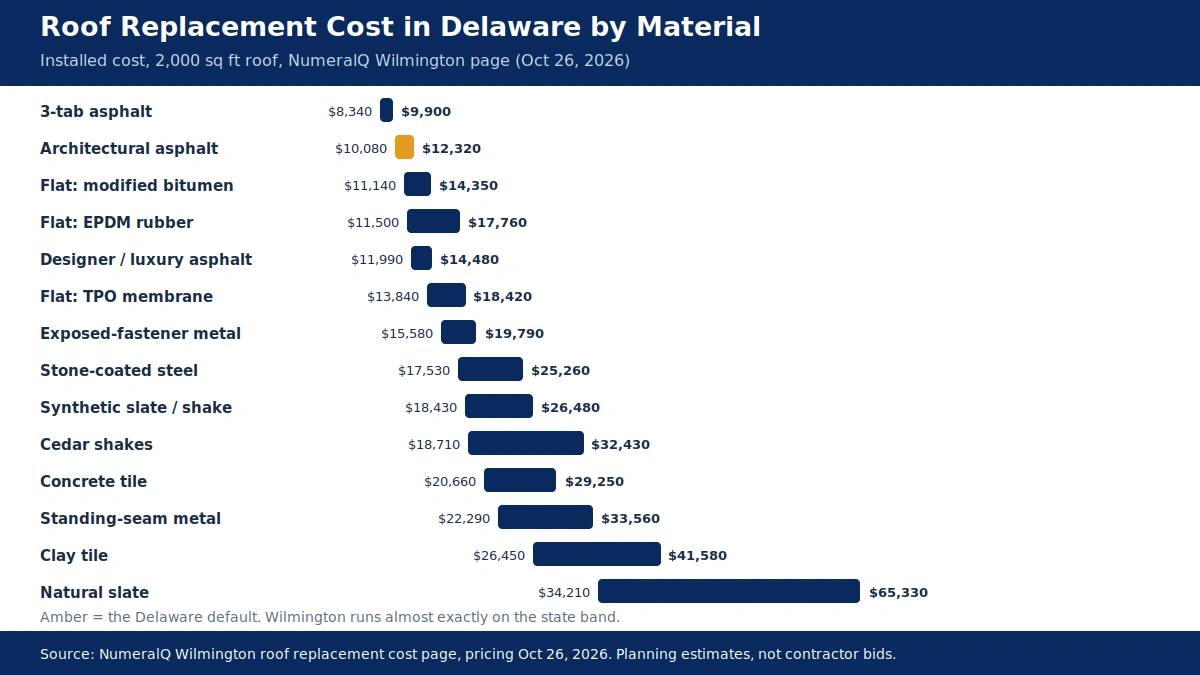
Wilmington supplies the material table, from the NumeralQ Wilmington page, priced October 26, 2026, for a 2,000 sq ft roof installed, waste and markup included. Wilmington sits almost exactly on the state band for the architectural row, so the table reads as the Delaware price with only a few dozen dollars of difference. That closeness is unusual: in most sibling-state guides the city runs well above or below the state. Use the state band from the first section as the planning number for Delaware as a whole, and use this table to compare materials against each other on one city’s consistent basis.
The MyRoofData Delaware page supplies the rated lives, publishing nine material rows for the state. The Delaware page gives no rated life for three rows below, designer shingles, stone-coated steel, and synthetic slate or shake, so their lives follow the spans used across the same model family in sibling states: 25–30 years, 40–50 years, and 40–50 years. This guide discloses those three spans as model-family spans, not Delaware-published figures. A rated life describes the manufacturer’s design expectation under normal conditions, not a promise, and Delaware’s humidity, salt air, and wind-driven rain cut the real life of asphalt below the rating, as the ageing section explains.
The cheapest Delaware roof is also the weakest buy in the state. One flat layer of asphalt with cut tabs makes a 3-tab shingle, rated 15–20 years, and it holds the lowest wind and impact resistance of any shingle. With a design wind of 115 miles per hour everywhere in the state and higher on the Sussex coast, the cheapest shingle is the one most likely to lift first. The Wilmington table shows $1,740–$2,420 saved against architectural shingles, and that saving buys the shortest life and the worst wind performance. Most Delaware roofers steer buyers past it. Near the coast, one contractor guide puts 3-tab life at 12–17 years, and that claim is single-sourced and reported as the guide’s claim, not adopted as fact.
Architectural shingles, also called dimensional or laminated shingles, form the default Delaware roof, and every band in this guide prices them. Two layers of asphalt laminate into a thicker shingle with a shadowed profile, and the better lines carry wind ratings of 110–130 miles per hour, over a rated life of 22–30 years. In Wilmington the band runs $10,080–$12,320, the figure to beat in any quote comparison, while the state band of $10,050–$12,290 is the figure to plan against. A third layer and a heavier profile that mimics slate or shake define designer or luxury shingles, at $11,990–$14,480 in Wilmington, with a 25–30 year model-family life. The extra money buys curb appeal and heft, not extra years: a designer shingle is rated no longer than a good architectural line.
Metal names two very different roofs, and choosing between them is the biggest single decision in this table. Exposed-fastener panels, corrugated or 5V profile, run $15,580–$19,790 in Wilmington, rated 30–40 years, with screws driven through the panel face that need checking and re-tightening as the roof moves through humid summers and cold snaps. Raised seams hide the fasteners on standing-seam metal, $22,290–$33,560, letting the panels expand and contract freely, rated 40–70 years. MyRoofData names architectural asphalt, standing seam, and ribbed metal as the most-installed systems in Delaware, in that order. Standing seam costs roughly double the architectural band, which is why it shows up on beach houses and high-end homes and rarely on a first roof.
A steel panel pressed into a shingle, shake, or tile profile and coated with stone granules makes stone-coated steel, $17,530–$25,260. Stone-coated steel looks like a traditional roof and hits like steel. The model-family life, 40–50 years, lands between the two other metal systems. Composite panels molded to imitate the natural materials at a fraction of the weight make synthetic slate and shake, $18,430–$26,480, with a 40–50 year model-family life and no quarry price. Both stay niche in Delaware, and either one needs a roofer who has installed that exact system before, since the flashing details change by brand. Near the coast, the coating on any steel product matters more than the profile, because salt air attacks an uncoated edge first.
Cedar shakes, $18,710–$32,430, fight Delaware’s humidity more than any other material here. Cedar is a wood roof, rated 25–35 years, and it needs airflow under and around it to dry between rains, which Delaware’s humid summers do not always allow. Moss and algae grow on shaded cedar faster than on any other material here, and upkeep, cleaning, treatment renewal, and splitting in the damp, runs higher than for anything else in the table. The look is unmatched on a historic or wooded home, and the upkeep is the price of it.
The heavy end of the table turns on weight. Concrete tile prices at $20,660–$29,250 with a 40–75 year rating; clay tile at $26,450–$41,580 with a 50–100 year rating; natural slate at $34,210–$65,330 with a 75–150 year rating. All three weigh far more than asphalt or metal, most Delaware homes were framed for a light roof, and a tile or slate quote without a structural check leaves the job half priced. MyRoofData puts concrete tile at 850–1,100 pounds per square, and the framing upgrade, if needed, sits outside these bands. At the top end, slate costs roughly five times the architectural band, which is why it appears on historic homes in Wilmington and almost nowhere else in the state.
Membranes, not shingles, cover flat and low-slope roofs, and three appear on the Wilmington table. Modified bitumen, a torch- or adhesive-applied asphalt sheet, prices at $11,140–$14,350. EPDM rubber, a single-ply black membrane seamed on site, prices at $11,500–$17,760. TPO, a white heat-welded membrane that reflects summer sun, prices at $13,840–$18,420. MyRoofData groups flat membranes at a 20–30 year rating. They matter for the flat sections, porch roofs, and additions that many Delaware homes carry, and for the low-slope rowhouses of Wilmington, and a quote that prices a low-slope section in shingles instead of membrane deserves a challenge, because shingles shed water by slope and fail on flat runs.
Every material comparison hides tear-off inside it, and the two models price it differently. Tear-off is a separate line in MyRoofData’s pricing: $100–$200 per square per layer. That works out to $2,000–$4,000 on a 20-square roof with one layer to remove. For an extra layer of tear-off, NumeralQ’s Wilmington add-on table charges $1.39–$1.83 per sq ft, or $2,780–$3,660 on 2,000 sq ft, while its material bands already include waste and markup. Both routes land in the same area. Either way, two layers cost more to replace than one. The building code forbids a third layer, so the old roofing has to come off.
Real quotes leave the planning bands behind at the add-on table. The figures below are all installed prices, from the NumeralQ Wilmington page. A 4-by-8 OSB sheet, the plywood-like board under the shingles, runs $65.34–$93.98 installed, and a 1940s Wilmington roof can need a dozen sheets once the old covering is off. A full ice-and-water barrier, the self-sealing membrane that stops wind-driven rain and ice-dam leaks, runs $0.91–$1.44 per sq ft, or $1,820–$2,880 across a 2,000 sq ft roof, where the code minimum is only a strip at the eaves. Seamless aluminum gutters price at $8.81–$12.57 per linear foot. Chimney or wall flashing, the metal that seals where the roof meets a wall, runs $356–$507 each, and a skylight reflash runs $524–$676 each. The headline band holds none of these lines, and a quote that leaves out the decking allowance entirely is the quote most likely to grow mid-job.
| Material (2,000 sq ft, Wilmington, installed) | Cost | Rated life |
|---|---|---|
| 3-tab asphalt shingles | $8,340–$9,900 | 15–20 years |
| Architectural asphalt shingles | $10,080–$12,320 | 22–30 years |
| Flat: modified bitumen | $11,140–$14,350 | 20–30 years (flat membranes) |
| Flat: EPDM rubber | $11,500–$17,760 | 20–30 years (flat membranes) |
| Designer / luxury asphalt shingles | $11,990–$14,480 | 25–30 years (model-family span) |
| Flat: TPO membrane | $13,840–$18,420 | 20–30 years (flat membranes) |
| Exposed-fastener metal panels | $15,580–$19,790 | 30–40 years |
| Stone-coated steel | $17,530–$25,260 | 40–50 years (model-family span) |
| Synthetic slate or shake | $18,430–$26,480 | 40–50 years (model-family span) |
| Cedar shakes | $18,710–$32,430 | 25–35 years |
| Concrete tile | $20,660–$29,250 | 40–75 years |
| Standing-seam metal | $22,290–$33,560 | 40–70 years |
| Clay tile | $26,450–$41,580 | 50–100 years |
| Natural slate | $34,210–$65,330 | 75–150 years |
Roof Replacement Cost in Delaware by Roof Size
The square drives roofer pricing, and the size table scales the headline band to the actual house fastest. Four sizes of architectural shingles, installed, are what NumeralQ’s state table prices. The implied per-square rate drops as the roof grows, from $531–$657 for a 1,000 sq ft roof down to $493–$600 for 3,000 sq ft. Fixed job costs explain the drop. The dumpster, the delivery, the crew’s travel, and the permit spread across more squares, while the variable costs, shingles and labor per square, stay roughly flat. Fixed costs do not shrink with the roof, so a small roof pays more per square than a big one.
House size and roof size are different numbers, and mixing them up is the most common budgeting error in roofing. House size and roof size are different numbers. Roof surface beats house size: a 2,000 sq ft house under a pitched roof has more than 2,000 sq ft of roof, because pitch and overhangs add area. A steep-pitched 1,500 sq ft ranch can carry a 2,000 sq ft roof, and so can a shallow-pitched 2,500 sq ft two-story. Only the measured roof surface prices a roof, and a roofer takes it from a tape, a satellite measurement, or a drone flight. A quote built on the house footprint instead of the roof surface is a guess, not a price. Modernize’s city figures price a 2,000 sq ft home, which is why they read lower than the NumeralQ bands, and the two should never be compared directly.
Buyers also miss waste. Cutting shingles at valleys, hips, ridges, and penetrations leaves pieces for the bin, so the roofer orders 10–15 percent more material than the bare surface. A roof with many valleys, dormers, and direction changes is a cut-up roof, and MyRoofData adds about 15 percent to labor for one, with the waste factor climbing alongside. A simple gable roof wastes the least. Four valleys, two dormers, and a chimney waste the most, and the waste shows up as extra squares on the material order, not as its own line.
No single feature moves labor price like pitch, the steepness of the roof. A walkable 4-in-12 pitch is the baseline, rising 4 inches for every 12 inches of run. Roof jacks, staging, and slower crew movement come with a steep 10-in-12 or 12-in-12 pitch, and Delaware roofers charge for it. This research verified no Delaware-specific steep-pitch surcharge, so no percentage appears here, but a buyer with a steep roof should expect the per-square rate to sit at or above the top of the size-table band, and should ask the roofer to name the pitch charge as its own line rather than burying it in the rate.
Access explains why stories matter. A single-story ranch keeps the work at eave height: the crew stages material there and tears off straight into the dumpster. A three-story Wilmington rowhouse cannot be worked from a ladder: the tear-off and the delivery need a conveyor or a crane lift. Moving material eats more of the day than installing it. Stories get no price in the size table, so a tall home belongs at the top of its size band, with the access method named in the contract. Rowhouse access can also add a parking and staging problem on a narrow Wilmington street, a line a suburban quote never carries.
The NumeralQ state size table below prices architectural shingles, installed, as of October 26, 2026. NestPriced arithmetic fills the implied per-square column: the band divided by the number of squares, so a buyer can compare a quote’s per-square rate against the model at the same size. A quote far above the implied rate at the same size has to explain itself in pitch, complexity, layers, or decking. A quote far below it has to account for itself in scope: something has been left out.
| Roof size | Cost (architectural shingles) | Implied $/square |
|---|---|---|
| 1,000 sq ft (10 squares) | $5,310–$6,570 | $531–$657 |
| 1,500 sq ft (15 squares) | $7,680–$9,430 | $512–$629 |
| 2,000 sq ft (20 squares) | $10,050–$12,290 | $503–$615 |
| 2,500 sq ft (25 squares) | $12,420–$15,150 | $497–$606 |
| 3,000 sq ft (30 squares) | $14,800–$18,010 | $493–$600 |
The table yields a rough scaling rule, and it counts as a rule of thumb, not a quote. At the architectural rate, 500 more sq ft of roof surface runs about $2,370–$2,860. Simple roofs at walkable pitches are where that rule holds. Steep, cut-up, or multi-layer roofs break it, where the add-ons and the complexity charge take over, and so does metal, where the material rate runs roughly double and the per-square math must be redone from the material table. Instant Roofer’s own scaling figure, about $2,615 per added 500 sq ft, lands inside the same range, which gives a useful cross-check.
Roof Replacement Cost by City: Wilmington, Dover, Newark, and the Beach Towns
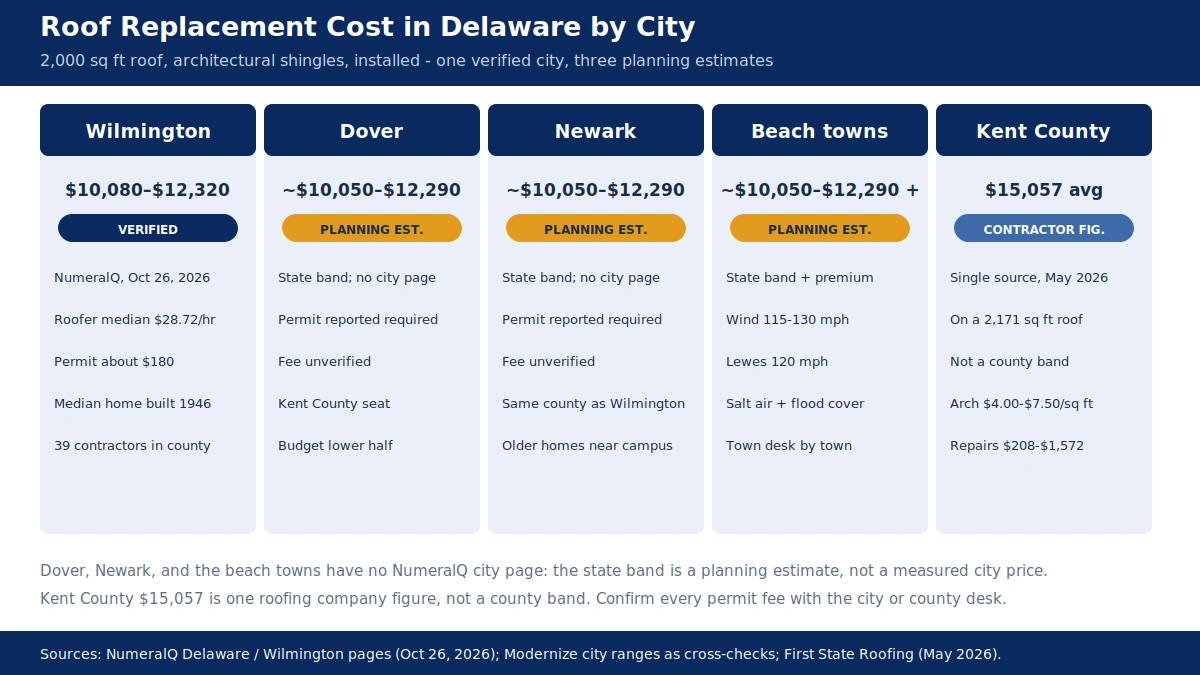
Only one Delaware city has a NumeralQ page: Wilmington. Targeted searches found no NumeralQ page for Dover or Newark, and no other source in this research names a Dover or Newark band with the same size, material, and date discipline. This section gives a verified band for Wilmington and clearly labeled planning estimates for Dover, Newark, and the beach towns, with every cross-check that exists. Printing four identical-looking bands would mean inventing three of them, and this guide will not do that.
Wilmington costs the most of any verified market in the state, and the labor data explains why. NumeralQ’s Wilmington page prices a 2,000 sq ft architectural roof at $10,080–$12,320, a touch above the state band. In the Wilmington metro, roofer median pay runs $28.72 per hour, 8 percent above the national median, with crews billed at $57–$75 per worker-hour. New Castle County counts 39 roofing contractors, 1.6 per 10,000 homes against a national rate of 1.7, a middle-of-the-pack field that should let a homeowner collect two or three bids without a long wait outside the busy season. The median Wilmington home is worth $231,400 and dates to 1946, and a typical roof job runs about 4.8 percent of the median home value, the highest share among the markets NumeralQ prices at this level, because the homes are old and worth less than the national middle.
Wilmington weather shapes the Wilmington roof. The city gets about 20.2 inches of snow a year at the nearby station, against 15.9 inches at the median United States station that measures snow, and its driest months are February and October, the best windows for a re-roof with the fewest rain delays. Days usually warm past 40 degrees Fahrenheit all year, but nights fall below it from November through March, so shingles laid late in the day may not seal until a warm spell, and the Owens Corning technical bulletin sets the hand-sealing threshold at 40 degrees and below. A Wilmington quote should spell out the ice-barrier scope, the shingle’s wind rating, and the winter installation method if the job runs into the cold months. Cross-checks on Wilmington read lower than the NumeralQ band: Modernize lists $8,500–$13,000 for a 2,000 sq ft home, but that figure prices the home, not the roof, and the two scopes should not be compared as though they were the same job.
Dover gets a planning estimate here, not a verified band, and the evidence points to the estimate landing about right rather than low. The state band of $10,050–$12,290 serves as the planning figure, since no source names a Dover band with size, material, and date together. Modernize lists Dover at $7,800–$12,000 for a 2,000 sq ft home, which reads lower for the same home-size reason as Wilmington, and the top of that range sits just below the top of the state band. Dover is the state capital and the Kent County seat, a smaller and slower market than Wilmington, with lower land and labor pressure, and a buyer should budget the state band and expect the quote to land in its lower half on a simple roof. This research verified no Dover-specific roofer pay figure, and none appears here. A Dover quote should name the permit fee from the city desk, because the permit evidence for Dover runs thinner than for Wilmington, as the permit section discloses.
Newark carries the same planning estimate, the state band of $10,050–$12,290, on thinner evidence than Dover. No verified city band turned up, and the cross-checks are sparse: Modernize lists Newark at $8,000–$12,500 for a 2,000 sq ft home, again a home-size figure that reads lower than a roof-size band. Newark sits in the same New Castle County market as Wilmington, close enough that crews and suppliers overlap, and the university town’s older housing near the campus carries the same decking risk as Wilmington’s 1946 median. A Newark buyer should budget the state band, ask for the wind rating of the shingle by name, and get the permit answer from the city’s Code Enforcement Division in writing, because the permit evidence for Newark runs weakest of the three northern cities, as the permit section discloses.
No verified band exists at all for the beach towns, and the honest guidance starts from the state band and adds for wind, salt, and access. Rehoboth Beach, Lewes, Bethany Beach, Dewey Beach, and Fenwick Island all sit in Sussex County, where the design wind runs 115 miles per hour up to just under 130 for residential work, and Lewes sets its own figure at 120 miles per hour. Modernize lists Sussex County coastal at $9,000–$14,500 for a 2,000 sq ft home, with the top end above every other city range, which fits a coastal premium even on a home-size basis. A beach-town quote that runs 10–20 percent above the state band is plausible on wind detailing, corrosion-resistant fasteners, and crew travel alone, and the buyer should ask the roofer to name which of the three drives the premium rather than accepting a single lump sum. The flood-insurance question, which never arises in Wilmington, decides part of the beach-town roof budget too, because a roof that fails in a storm surge zone is a flood claim, not a wind claim, and the two pay very differently.
No verified bands exist at all for smaller Delaware communities in this research, and the honest guidance starts from the state band and adjusts by distance and crew travel. Middletown, Smyrna, Milford, Seaford, and Millsboro all appear in contractor claims of coastal premiums, but those claims come from single contractor sources whose figures run far above every verified band in this guide, and they are not adopted here. Kent County’s one contractor-published average, $15,057 on a 2,171 sq ft roof, runs well above the state band on a per-square basis, but it comes from a single roofing company and is reported here as that company’s figure, not as a county band. A quote in a small town that runs above the state band is plausible on travel and crew size alone, and the buyer should ask the roofer to name the driver.
| City | 2,000 sq ft architectural roof | Basis |
|---|---|---|
| Wilmington | $10,080–$12,320 | NumeralQ Wilmington, Oct 26, 2026 |
| Dover | ~$10,050–$12,290 | State band as planning estimate |
| Newark | ~$10,050–$12,290 | State band as planning estimate |
| Beach towns (Sussex coast) | ~$10,050–$12,290 plus wind/salt premium | State band as planning estimate; no verified band |
| Kent County (contractor figure) | $15,057 average on 2,171 sq ft | Single contractor source, May 2026 |
Coastal Storms, Wind, and Hurricanes: What Delaware Weather Does to a Roof
Delaware’s storm history reads like a run of near misses, and the near misses explain the roof rules. Since reliable records began, no tropical cyclone has hit Delaware while still at hurricane strength, and only two storms since 1851 have brought hurricane-force winds to the state. At least 111 tropical cyclones have affected Delaware since 1749, and 21 of them passed directly over the state, so the state gets hit often, just rarely at full hurricane force. The luck is real, and it is fragile: the Delmarva coast tucks in behind the Outer Banks and southern New England, which take the direct hits, but a storm steered straight at the Delmarva coast would meet a building stock that has never been tested by one.
The storms that did hurt Delaware are the ones worth remembering. The Gale of 1878, which made landfall in North Carolina, brought hurricane-force winds to the entire state, unroofed buildings statewide, flooded South Wilmington to midway up the first floor, and pushed a 7-foot storm surge onto the beach at Lewes. Four people drowned in Leipsic when the tide rose too fast to escape. Eighteen people died across Delaware, and the storm stands as one of only three to bring hurricane-force winds to the state. Hurricane Sandy in October 2012 made landfall near Atlantic City, about 60 miles north of the Delaware beaches, yet still produced the highest flood tide on record at the Route 1 bridge over the Indian River Inlet, and stripped dunes and volume from the beach between Bethany Beach and Dewey Beach. Hurricane Isabel in September 2003 brought heavy rain, high winds, widespread power outages, and flooding to Delaware, though no deaths were reported in the state from that storm. The Ash Wednesday Storm of 1962, a nor’easter rather than a hurricane, flooded and damaged coastal Delaware so badly that researchers still use it as the benchmark for extratropical storm damage on this coast. All four point the same way: in Delaware, the storm that damages roofs is as often a nor’easter or a tropical remnant as a hurricane, and the roof must be built for wind and water together.
Wind dominates the modern storm record, not hail. Over the last ten years, NOAA logged 464 damaging-wind reports in Delaware against 30 large-hail reports, so wind reports outnumber hail reports by more than fifteen to one. About 60 percent of the state’s severe-weather reports fall in June, July, and August, and hail season runs April through June, when 70 percent of the large-hail reports occur. In New Castle County alone, the ten-year record holds 202 damaging-wind reports against 12 large-hail reports, and not one of those hail reports reached 2 inches. The county also logged 4 tornado reports in the same decade. A Delaware roof is a wind roof first and a hail roof second, and the buying decisions in this guide follow that order.
The code designs for wind, and the figures are the most consistent numbers in the whole code picture. Delaware has no single statewide structural code, so each county adopts its own edition, and the wind figures line up closely. New Castle County adopted the 2021 International Building and Residential Codes effective January 1, 2024, with a design wind speed of 115 miles per hour. Kent County still runs the 2018 editions, effective October 5, 2020, also at 115 miles per hour. Sussex County adopted the 2021 editions effective January 1, 2023, with residential wind from 115 miles per hour up to just under 130, and commercial wind up to 140 miles per hour by risk category. Lewes, which enforces its own code, sets 120 miles per hour. The county table comes from a secondary source that cites the county ordinances by number, and this guide reports it on that basis, not as a re-reading of the county code text. No Delaware county designs below 115 miles per hour, so no low-wind pocket exists in the state where a cheap shingle could hide.
What holds a roof down in that wind is the shingle rating plus the nailing pattern. Wind ratings on architectural shingles run 110–130 miles per hour, and the better lines carry a Class H rating of 150 miles per hour. A six-nail pattern, six nails per shingle instead of the standard four, is described by Delaware guides as standard practice in high-wind detailing, along with enhanced starter strips and ring-shank nails, and that claim is attributed to the guides rather than stated as code. Ask for the wind rating by product name and the nailing pattern in writing, because a 130 mph shingle fixed with four nails on a Sussex beach house is a 130 mph shingle in name only. In the wind-borne debris sense, the code treats areas above 110 miles per hour as debris regions for glazing, which is why beach-town windows and roofs get specified together.
Rain forms the quieter half of the wind problem. Delaware storms drive rain sideways under lifted tabs and through failed flashing, and the damage shows up as a ceiling stain months after the storm, long after the wind is forgotten. Installation quality defends against it more than material does: sealed shingle tabs, proper step flashing at walls and chimneys, and an ice-and-water barrier in the valleys and at the eaves where wind-driven rain collects. Cold-weather installs need hand-sealing. The crew applies roofing cement under each shingle tab, because the factory adhesive strip will not activate in the cold, and the Owens Corning technical bulletin sets the threshold at 40 degrees Fahrenheit and below. Wilmington nights fall below 40 degrees from November through March, so a winter install anywhere in the state must name hand-sealing in the contract or wait for spring.
Snow is the smallest of Delaware’s roof loads, and the numbers show it. The ground snow load is 25 pounds per square foot in New Castle and Kent counties, and 20 pounds per square foot in Lewes, against the 30 to 400 pound figures that govern mountain states. Wilmington gets about 20.2 inches of snow a year, and the state’s ice-storm risk in New Castle County is rated Relatively High by FEMA, so the winter risk is ice, not weight. Section R905.1.2 of the residential code covers the ice barrier. It calls for a self-adhering barrier from the lowest eave edge to at least 24 inches inside the exterior wall line, in places where ice dams form according to the jurisdiction’s design table. New Castle County’s Relatively High ice-storm rating is why a Delaware quote should name the ice-barrier scope even though the snow load is small. This research verified no Delaware-specific design roof snow load figure, and none appears here.
Flood is the risk a roof quote cannot fix and a buyer still has to understand. A standard homeowners policy does not cover flood, and in Sussex County and along the Delaware Bay, flood cover through the National Flood Insurance Program or a private flood insurer is a separate purchase. The National Flood Insurance Program has recorded 6,332 Delaware flood-insurance claims since 1978, totaling $89.5 million in payouts, on a single secondary source that this guide reports as its claim. The number matters for the roof because storm surge and rising water count as flood losses, while wind-torn shingles count as wind losses, and the two are paid by different policies with different deductibles. A beach-town buyer who budgets for the roof without budgeting for the flood policy has budgeted for half the storm.
Humidity, Salt Air, and Heat: Why Delaware Asphalt Ages Faster
Delaware’s climate is humid subtropical, and the roof lives in that humidity every day of its life. The state sits between the Delaware Bay and the Atlantic, and fog, salt-laden breezes, and year-round dampness reach far inland, not just the beach towns. A contractor guide for Middletown, a town several miles inland, describes fog lingering over rooftops for hours in fall and spring, keeping shingles damp and letting salt and moisture settle into the surface, and fine salt crystals remaining after the fog clears, slowly wearing the protective granules on asphalt shingles. The mechanism is plain, and the guide’s claim is reported here as the guide’s claim, not as a laboratory finding.
Salt corrodes, and it draws moisture from the air and holds it against the roof. It attacks metal first: flashing, nails, and gutters corrode where salt film sits, and a fastener that rusts through lets a shingle lift in the next wind. Asphalt shingles look immune to corrosion, and they are not spared, because the constant dampness lets salt embed in the shingle granules and break them down early, causing fading, cracking, and granule loss. Granule loss is the slow failure that matters most, because the granules shield the asphalt base from ultraviolet light, and once they are gone the asphalt ages fast. Algae and moss grow in the same dampness, staining shingles and trapping more moisture against the surface, and the black streaks on a Delaware roof are usually algae, not dirt.
The life penalty is real but hard to pin to a single number, and this guide reports the range rather than picking one. One Delaware contractor guide puts architectural shingles at 17–25 years near the coast, against a 22–30 year rated life, and 3-tab shingles at 12–17 years near the coast, against a 15–20 year rating. A second contractor guide for Millsboro, in Sussex County, puts architectural shingles at 18–28 years locally, with 20–25 years as the usual outcome, and 3-tab at 12–18 years. Both are single-source contractor claims, and both point the same way: the coast takes several years off an asphalt roof, and the penalty is worst on the thinnest shingle. This Old House reaches the same conclusion from its survey work, saying Delaware’s coastal climate reduces asphalt shingle lifespan through salt air exposure, high humidity, and frequent storms. No statewide study of Delaware roof life turned up, and this guide asserts none.
Heat adds a second ageing force that the humidity hides. Delaware summers are hot and humid, and a dark asphalt roof on a south-facing slope runs hot enough to age the asphalt faster than the same shingle would age in a cool climate. Tree cover is patchy in the newer Sussex County subdivisions, so shingles there run hotter with little shade, while older streets with mature trees drop needles and leaves that hold moisture and invite algae. The two forces work together: heat ages the asphalt, and dampness feeds the growth that traps moisture against it. Ventilation is the countermeasure, and it is the cheapest one on the roof. An attic that vents properly stays cooler in summer and drier in winter, and a re-roof that reuses blocked soffit vents or a failed ridge vent is a re-roof that will age fast. The attic insulation guide carries the ventilation and insulation half of this fix.
The buyer has three practical defenses, and all three belong in the quote. First, choose an algae-resistant shingle, which carries copper or zinc granules that slow the black streaks, and ask for the algae warranty in years, not just the word resistant. Second, fit zinc or copper strips near the ridge, which wash a small amount of metal down the roof with every rain and suppress growth, a cheap addition at re-roof time and an expensive retrofit later. Third, specify corrosion-resistant fasteners and flashing, stainless or coated, on any roof within a few miles of the bay or the ocean, and ask the roofer to name the fastener material in the contract. None of these lines appears in the headline band, and all three cost less than replacing a roof five years early.
Metal behaves differently in the same air, and the difference cuts both ways. Standing-seam metal with a coastal-rated coating sheds salt spray and resists algae, and it holds up well on the coast provided the coating is the right one for marine air. Exposed-fastener metal is more exposed to the same salt, because every screw is a penetration where corrosion can start, and the screws need checking and re-tightening as the roof moves through the seasons. A metal quote for a beach house should name the coating system and the fastener material, and a quote that prices inland-grade fasteners for a beach roof deserves a challenge.
Asphalt Shingles vs Metal Roofing in Delaware
No other decision in a Delaware roof moves as much money as asphalt against metal, and the state’s weather argues hardest against the default here. Architectural asphalt runs $10,080–$12,320 in Wilmington for a 2,000 sq ft roof. Standing-seam metal runs $22,290–$33,560. Metal costs roughly double to triple the asphalt roof on day one, lasts roughly double the rated life, and changes how the house handles wind, salt, and hail. The comparison below prices that trade openly, including the lifetime math that turns the first impression upside down.
Wind gives metal its strongest case in Delaware. A standing-seam panel locks to its neighbor along a raised seam, and the concealed clips let the panel move with temperature without working the fasteners loose, which matters on a roof that faces 115 mph design wind and gusts higher on the Sussex coast. Asphalt holds by adhesive strips and nails, and both weaken with age, heat, and salt, so an old asphalt roof is a wind roof with its grip half gone. The counterweight is the installer: a standing-seam roof is only as good as the crew that puts it on, and the seaming tools and flashing details belong to that profile alone. A crew that has only ever laid shingles is not a standing-seam crew, and the hiring section covers how to verify metal experience, with references for standing-seam jobs in the same county, not a general claim of metal experience.
Salt air gives metal its second case, and also its biggest risk. A standing-seam roof with a coastal-rated coating sheds salt spray, resists the algae that streaks asphalt, and does not feed moss, so it ages more slowly in the same air that shortens an asphalt roof by several years. Exposed-fastener metal tells the other side of the story: every screw through the panel face is a place where salt and water meet bare steel, and the screws need inspection and replacement on a schedule the owner must actually keep. Ask for the coating system by name, the fastener material by name, and the maintenance schedule in writing, because a coastal metal roof with inland fasteners is a roof that will leak at the screws before it wears out anywhere else.
Hail breaks the two materials in opposite ways, and each break carries its own insurance consequence. Those consequences are the subject of the Class 4 section later in this guide. Hail does not treat the two materials the same. A stone that cracks an asphalt shingle only dents a metal panel. Cosmetic is how the dent reads, and cosmetic-only damage is excluded by some policies, so a roof that looks battered but still sheds water gets nothing from the insurer. Asphalt fails differently: it cracks, granule loss exposes the mat, and the damage counts as functional, which is what insurers pay for. The insurance side gets its full treatment in the Class 4 section. The practical point is that a metal roof in New Castle County, where the ten-year hail record is thin but the wind record is heavy, should come with a hail-dent conversation with the insurer before installation, and the buyer should know whether the policy pays for cosmetic denting or only for functional damage.
Delaware asphalt lives shorter than its rating, and that gap argues hardest against it. Architectural asphalt carries a 22–30 year rating in MyRoofData’s tables. Two Delaware contractor guides put coastal architectural life at 17–25 years and 18–28 years, and both are single-source claims reported as such. The mechanism behind them holds up, though: salt embeds in granules, humidity feeds algae and moss, heat ages the asphalt, and wind-driven rain works at every lifted tab, and all four act faster in Delaware than in a dry inland climate. Stay 30 years and the house needs two asphalt roofs or one metal roof; the lifetime math below prices that choice.
That lifetime math turns the sticker-price verdict around, and the label on it is NestPriced arithmetic on Wilmington midpoints divided by rated-life midpoints. Take architectural asphalt at $11,200 across 26 years: about $431 a year. Standing-seam metal at $27,925 across 55 years: about $508 a year. Exposed-fastener metal at $17,685 across 35 years: about $505 a year. Three-tab shingles, the cheapest roof to buy, run about $521 a year, the dearest roof to own, because the short life dominates. Concrete tile, at $24,955 across 57.5 years, runs about $434 a year, before the structural check. Natural slate, at $49,770 across 112.5 years, runs about $442 a year. The cheapest and dearest lifetime costs sit under $100 a year apart, which means wind, salt, and how long the buyer stays drive the material choice, not the annual cost alone.
The sensitivity check counts for more than the point estimate. If coastal architectural asphalt lives 21 years instead of 26, its annual cost climbs to about $533, the dearest figure in the table. A full 30-year life drops the annual cost to about $373, the cheapest in the table. Midpoint math is not the real question. The real question is which life the roof will actually live in that microclimate, on that pitch, under that salt exposure. A shaded, low-slope asphalt roof in inland Kent County may live its full rating. A south-facing asphalt roof steps from the Atlantic in Sussex County may not. The roofer who has worked the neighborhood for a decade knows which, so ask.
Forget the noise myth. Rain noise is the usual worry, and it does not hold up. Over a solid deck with insulation and an attic, a metal roof runs no meaningfully louder than asphalt in rain. What is real is the resale question: a standing-seam roof is a selling point on a beach house and a curiosity on a modest inland ranch, and the buyer who plans to sell in five years should weigh that before doubling the roof budget. What is also real is the insurance question, because a metal roof that dents cosmetically can leave the owner arguing with an adjuster over a roof that still works, and that argument should happen before the roof goes on, not after the first storm.
The metal roof vs shingles cost guide, the metal roof cost guide, and the tile roof cost guide carry the full national comparison of the two materials, including the heavy-material end of the table.
| Lifetime cost (Wilmington midpoints) | Installed cost | Rated life | Cost per year |
|---|---|---|---|
| 3-tab asphalt | $9,120 | 17.5 years | ~$521 |
| Architectural asphalt | $11,200 | 26 years | ~$431 |
| Class 4 shingles (derived band) | $12,370 | 30 years | ~$412 |
| Designer / luxury asphalt | $13,235 | 27.5 years | ~$481 |
| Exposed-fastener metal | $17,685 | 35 years | ~$505 |
| Standing-seam metal | $27,925 | 55 years | ~$508 |
| Concrete tile | $24,955 | 57.5 years | ~$434 |
| Natural slate | $49,770 | 112.5 years | ~$442 |

Class 4 Impact-Resistant Shingles: Cost, Hail Protection, and Insurance Discounts
Delaware’s hail record makes Class 4 shingles a harder sell here than in the hail-belt states, and the numbers explain why. A ten-year NOAA record, reported by NumeralQ, counts 30 large-hail reports statewide from 2016 through 2025, against 464 damaging-wind reports in the same decade. Hail season runs April through June, when 70 percent of the large-hail reports occur, and about 60 percent of all severe-weather reports fall in June, July, and August. The middle of the hail season is short, the stones are mostly small, and the wind does far more damage than the ice. NumeralQ states the conclusion bluntly on its Delaware page: for most Delaware homes, Class 4 shingles are not worth it, because hail big enough to crack shingles is rare here.
The county gap is narrow, and it runs the other way from the wind gap. New Castle County logged 12 large-hail reports from 2016 through 2025, and not one of them reached 2 inches, the size that starts to crack a standard shingle. The county plus its seven neighbors recorded 67 reports, 20.8 per 1,000 square miles against 15.4 statewide and 20.1 nationally, so the Wilmington area sees hail reports slightly above the national rate, but the stones stay small. New Castle County’s hail risk rates Very Low with the Federal Emergency Management Agency. No hail count for Kent or Sussex County turned up in this research, and none appears here. A Delaware buyer who chooses Class 4 for hail protection alone is buying cover against a risk the record says is small.
The Class 4 test is specific, and the rating is the highest impact rating a shingle can carry. The impact test is UL 2218, from Underwriters Laboratories. It drops a 2-inch steel ball from 20 feet onto the same spot twice, and the shingle mat must not crack or tear. The rating covers impact only. Wind and fire are tested separately, each with its own rating. A Class 4 shingle can still be an ordinary-wind, ordinary-fire shingle. Timberline AS II and ArmorShield II are GAF’s two Class 4 lines; Duration Storm and Duration FLEX are Owens Corning’s two. NorthGate and Landmark IR come from CertainTeed, StormMaster from Atlas, Legacy and Vista from Malarkey, Nordic from IKO, and StormFighter FLEX from Tamko. GAF’s Timberline ArmorShield II also carries a Class H wind rating of 150 miles per hour, which counts for more in Delaware than the impact rating, because the wind is the risk the record actually shows.
No Delaware figure exists for the upgrade cost, and this guide reports that gap rather than filling it. No Delaware-specific Class 4 premium turned up in this research, so no Delaware figure is asserted. Adding a $600–$1,800 increment to the state architectural band gives the derived band here, about $10,650–$14,090 for a 2,000 sq ft Class 4 roof, labeled NestPriced arithmetic. The increment is borrowed from sibling-state research, where one contractor guide priced the Class 4 upgrade at $600–$1,800, and a second guide priced it at $3,000–$5,000. The two claims differ by a factor of three at the top end, and this research found no Delaware roofer quote stating a per-square Class 4 premium. The quote should break out the Class 4 premium on its own line. With the two published claims so far apart, no guide can budget it for the buyer. The lifetime math uses a 25–35 year rated life, single-sourced from the research file of a sibling article and disclosed here as such.
The insurance discount is where Delaware buyers should be most careful, because no Delaware figure exists to lean on. No Delaware statute sets a Class 4 discount percentage, and no carrier-verified Delaware percentage turned up. National guides claim discounts from 5 percent to 35 percent, and that span is the whole story: the discount, if the buyer’s carrier offers one, is carrier-specific, may apply only to the wind and hail portion of the premium rather than the whole premium, and must be confirmed in writing with the portion named and the Class 4 certificate filed with the insurer before the roof goes on. In Delaware the math is also less forgiving than in expensive-premium states, because the average premium is low, and a percentage of a low premium is a small number.
Four payback scenarios below use the Delaware average premium of $1,365 a year, from the NerdWallet analysis of May 6, 2026, and every scenario counts as an assumption, not a promise. A 10 percent saving on the full premium runs about $137 a year, which pays the $600–$1,800 upgrade back in about 4.4–13.1 years. A 15 percent saving on the full premium runs about $205 a year, which pays the upgrade back in about 2.9–8.8 years. A 25 percent saving on the full premium runs about $341 a year, which pays the upgrade back in about 1.8–5.3 years. A 15 percent saving on half the premium, the wind-and-hail-portion case, runs about $102 a year, which pays the upgrade back in about 5.9–17.6 years. Budget from the portion-only case: for many policies it is the realistic one, until the agent confirms otherwise in writing. If the upgrade costs $3,000–$5,000 instead, every payback in the table roughly triples, so the premium line in the quote counts for more than the discount percentage in a guide.
The decision rule follows the storm record, not the sales pitch. In Delaware, Class 4 is not the default recommendation of this guide, because the hail record is thin and the stones stay small. The case for Class 4 rests on three narrower grounds: the buyer wants the 150 mph wind rating that some Class 4 lines carry, the insurer offers a written discount that pays the upgrade back inside the buyer’s stay, or the buyer values the thicker shingle and the longer warranty for their own sake. Three questions go to the agent before choosing, everywhere in the state: the discount percentage, the portion of the premium it applies to, and the certificate the insurer needs on file. A roofer who sells Class 4 as hail protection in Delaware without showing the hail record is selling a solution to a problem the state barely has.
| Payback scenario (assumptions, not promises) | Annual saving | Payback on $600–$1,800 upgrade |
|---|---|---|
| 10% of full $1,365 premium | ~$137 | ~4.4–13.1 years |
| 15% of full $1,365 premium | ~$205 | ~2.9–8.8 years |
| 25% of full $1,365 premium | ~$341 | ~1.8–5.3 years |
| 15% of half the premium (wind/hail portion) | ~$102 | ~5.9–17.6 years |
Delaware Roof Permits, Building Codes, and Wind Rules
Ask which desk governs the address before asking anything else about a Delaware permit. The state has no statewide structural code, so each of the three counties adopts its own edition of the International Building and Residential Codes, and each town with its own building department can layer its own rules on top. A re-roof permit may go through a county office, a city office in Wilmington, Dover, or Newark, or a beach-town building department in Rehoboth Beach, Lewes, or Bethany Beach, depending on the property. A roofer who cannot name the desk for the address has not pulled a permit there recently.
Pin down the code edition first, because the edition decides the wind, snow, and fastening rules that apply to the job. New Castle County adopted the 2021 International Building and Residential Codes effective January 1, 2024, with a ground snow load of 25 pounds per square foot and a design wind speed of 115 miles per hour. Kent County still runs the 2018 editions, effective October 5, 2020, also at 25 pounds per square foot and 115 miles per hour. Sussex County runs the 2021 editions from January 1, 2023, with residential wind from 115 miles per hour up to just under 130, and commercial wind up to 140 miles per hour by risk category. Lewes enforces its own code, the 2021 residential code, with 20 pounds per square foot of snow and 120 miles per hour of wind. The county table comes from a secondary source that cites the county ordinances by number, and this guide reports it on that basis. Dover is the conflict in the picture: a secondary permit guide says Dover adopts the 2015 building code with Delaware amendments, which does not match the county-level 2021 narrative, and no city primary document turned up to settle it, so no Dover edition is stated as verified here. Confirm which edition the local desk reviews against before the roofer orders material.
Wilmington requires a permit for re-roofing, and the requirement is stated by the city’s own materials and by the NumeralQ Wilmington page. The city’s Licenses and Inspections office runs the process, and the fee is $12 for every $1,000 of construction cost, so a $15,000 roof replacement pays about $180. Minor roof repairs may be exempt, but a tear-off, new shingles, or a new roofing system needs a permit, and in a historic district, new gutters and downspouts need one too. A historic-district wrinkle applies in Wilmington: inside a designated city historic district, the building code official may not issue a permit for construction, alteration, restoration, or demolition without a recommendation from the Design Review and Preservation Commission. The commission must act within 60 days of a complete filing or the application is treated as approved, and after approval the applicant has 180 days to apply for and obtain all permits. In-kind replacement, such as white asphalt shingles replaced with yellow ones, needs no commission approval, but the planning department still reviews the application and any required permits must still be obtained. Changing the design or material goes to the commission before a building permit is issued.
New Castle County holds the exception that surprises most buyers, and it comes from the county’s own roofing FAQ, reported through MyRoofData. A building permit is not required for replacement roof covering when the work does not involve repair or replacement of more than 25 percent of the sheathing. Once the decking scope grows past that line, the permit answer can change, and structural or broader renovation work follows a different permit path. The practical rule is simple: a clean re-roof over sound decking in unincorporated New Castle County needs no permit, and a re-roof that replaces a quarter of the deck or more does. Confirm the decking scope in writing before relying on the exemption, because the roofer discovers the true decking condition only when the old covering comes off.
Dover’s permit position is less verified than Wilmington’s, and this guide says so. Contractor sources state that Dover requires a residential building permit for roof replacements, with the application asking for contractor information, material specifications, and estimated costs. A secondary permit guide says roof replacement over 100 sq ft requires a building permit and plan review, with 1–2 weeks for review, and that the city does not currently run a fully online permit portal, so the filing goes in person at City Hall or by mail. No city primary document confirming the requirement or the fee turned up in targeted searches. One secondary source puts the Dover fee at $80–$200, and that figure is reported here as a secondary claim, not adopted as verified. Get the requirement and the fee in writing from the city desk, and treat any contractor claim about Dover permits as unverified until the desk confirms it.
Newark has the thinnest permit evidence of the three northern cities, and the gap is disclosed rather than papered over. A contractor source states that Newark homeowners must apply for a permit through the Code Enforcement Division before replacing a roof, and that all roofing work must comply with the International Residential Code. Targeted searches found no city primary document confirming the requirement, and no fee figure was verified. One secondary source puts the Newark fee at $75–$225, and that figure is reported here as a secondary claim. SmartRoofingCalculator’s planning figure for the state, $150–$375 with an average of about $240, is the only permit range with a stated method, and it counts as a planning average, not a city fee. Call the Code Enforcement Division before budgeting a Newark fee.
The layer limit is the one permit-adjacent rule that stays the same everywhere. Section R908.3 of the International Residential Code sets the layer limit. No new covering goes over two or more existing layers, so a roof with two layers already on it must be torn off to the deck first. The guides in Delaware restate it as a ban on a third overlay, consistent with the code. An overlay priced over two existing layers is an illegal job, and a tear-off priced without stating how many layers it assumes is a quote that can grow when the second layer is discovered. Wilmington’s median home dates to 1946, so two-layer roofs are common there, and the tear-off assumption deserves its own line in every Wilmington quote.
| Jurisdiction | Permit for re-roof | Fee evidence |
|---|---|---|
| Wilmington (city) | Required, via Licenses and Inspections | ~$180 on a $15,000 job ($12 per $1,000) |
| New Castle County (unincorporated) | Not required for covering only, if sheathing work is 25% or less | No fee when exempt |
| Dover (city) | Reported required | $80–$200 secondary claim, unverified |
| Newark (city) | Reported required, via Code Enforcement | $75–$225 secondary claim, unverified |
| Sussex beach towns | County or town desk, by town | No verified figure found |
| State planning average | Varies by desk | ~$240 (SmartRoofingCalculator planning figure) |
Hiring a Roofer in Delaware: Registration, Business License, and How to Vet Bids
Delaware has no roofing license to check, and that fact shapes the whole hiring process. The state keeps no statewide residential roofing contractor license. Instead, every roofer working in the state must hold a current Delaware business license issued by the Division of Revenue, under 30 Delaware Code section 2502, and construction-service businesses must register with the Department of Labor before beginning work. The Division of Revenue license costs $75 a year, renewed each January 1, and a secondary compliance source adds a gross receipts license fee of 0.6472 percent after a $100,000 monthly deduction. The license confirms that the business is registered and paying its taxes; it is not a competency test, and it does not prove the holder can roof. With no roofing trade-specific state license or exam in Delaware, the business license and the registration are the credentials, and the buyer’s own vetting is the quality check.
Start with the registration lookup, which takes two minutes. The Delaware Office of Contractor Registration runs a free public lookup, and the buyer searches the contractor’s name or business name and confirms an active registration before the first site visit. A contractor who cannot be found in the lookup, or whose registration shows inactive, stays unhired until the office confirms the status. Free to run, the lookup catches the two most common hiring failures: the unregistered operator and the operator working under someone else’s number. Separately, contractors who pull permits in Wilmington, Newark, Dover, or any other municipality may need to register with that jurisdiction’s licensing office, and insurance requirements are set at the municipal level, so ask the permit desk what the local registration asks for.
Out-of-state roofers carry an extra rule that matters after every coastal storm. Under 30 Delaware Code section 375, a nonresident contractor must file a surety bond of 6 percent of any contract, or yearly aggregate, of $20,000 or more before starting work. The bond is a secondary-source claim reported here with its statute cited, and the buyer asks an out-of-state crew for the bond before signing. Storm chasers are the hiring risk that follows every Delaware nor’easter and tropical remnant. A big wind event brings out-of-state crews who knock on doors, offer free inspections, and press for a signed contract and an insurance assignment before the adjuster visits. The defenses repeat the vetting steps: active registration in the lookup, a current Delaware business license, a local address and local references, no signature before the adjuster, no assignment of the insurance claim, and no payment before work starts. Pressure to sign today, before the adjuster, says the roofer wants the buyer’s claim more than the buyer’s roof.
Delaware’s home improvement fraud statute is the sharpest tool a buyer has, and it names roofing by trade. Under 11 Delaware Code section 916, roofs, gutters, downspouts, and siding are named in the home improvement fraud statute, which reaches a class B felony for large losses. The statute does not make a bad roof a crime, but it does make a fraudulent home improvement job one, and a buyer who is defrauded should report it rather than absorb it. Get the scope in writing, keep every payment receipt, and do not pay in cash without a paper trail.
Insurance comes next, in two parts. If a crew member is injured on the property, workers’ compensation coverage protects the buyer, and if the crew damages the property, general liability coverage protects the buyer. Most Delaware building-official offices require contractors to show general liability coverage, often $500,000 to $1 million minimum, and active workers’ compensation before issuing a permit, and that requirement is reported here from a contractor guide rather than from a city schedule. Ask for certificates of both, naming the buyer as certificate holder. Then call the insurer or agent to confirm the policies are current, since a printed certificate can outlive a lapsed policy. No certificates, no hire, whatever the price.
Lien law favors the Delaware homeowner who pays properly. Delaware caps liens at the unpaid contract balance, and on an owner-occupied home there is no lien at all if the buyer paid in full in good faith and got a notarized paid-in-full certification or release from the contractor, under 25 Delaware Code section 2707. Advance waivers signed before work is done are void in Delaware, under section 2706. This paragraph reaches the guide through NumeralQ citing a lien-law guide, and it is attributed here as such. The practical meaning is plain: ask for that notarized certification at final payment, and do not sign a waiver before the work is done, because the law will not honor it. The shingle distributor and any subcontracted crew are the parties most likely to send a lien notice, so collect the certification before the final payment, not after.
No registration can test quality, so references have to do it. Three recent jobs in the same county and the same material: ask for them, and call all three. For standing seam, the references must be standing-seam jobs, since the seaming tools and flashing details belong to that system. For a beach-town roof, the references should include a coastal address, because the fasteners and coatings are the job. Put the same questions to each reference: did the crew show up when promised, did the price change mid-job and why, did the roof leak in the first winter, and would the reference hire the contractor again. No same-county, same-material references means the buyer funds the learning curve.
Totals, not scopes, are what most buyers compare, and that is where the bid comparison trips them up. Three bids on the same roof can run thousands of dollars apart and still all be honest, when one includes tear-off and decking allowance and another leaves them out. Every bid must name the same lines: warranty terms for material and workmanship, permit responsibility and fee, cleanup standard, disposal method, tear-off layers assumed, decking allowance in sheets with the per-sheet price beyond it, ventilation scope, flashing scope by penetration, ice-barrier scope in feet or full coverage, underlayment type, and shingle or panel by brand and product name. The questions to ask a roofer guide collects every vetting question worth asking. Without those lines, a bid is only a number. In Delaware, the bid should also name the wind rating, the nailing pattern, and the fastener material, because the wind is the load and the salt is the corrosion, and a bid that hides both is hiding the two numbers that decide whether the roof survives its first decade.
- Confirm an active contractor registration in the Delaware Office of Contractor Registration lookup.
- Confirm a current Delaware business license from the Division of Revenue, $75 a year.
- Current workers’ compensation and general liability certificates go in the file first, confirmed with the insurer.
- Each of three same-county, same-material references gets a call, and the questions cover price changes and first-winter leaks.
- Every bid must name the permit responsibility, wind rating, nailing pattern, decking allowance, ventilation, flashing, ice-barrier scope, underlayment, and product.
- The contract sets the payment schedule: deposit, progress at a named milestone, balance on completion and final inspection.
- Collect the notarized paid-in-full certification before the final payment.
- Sign nothing before the insurance adjuster visits, and assign the claim to no contractor.
Roof Insurance in Delaware: Premiums, Hurricane Deductibles, and Flood
Delaware homeowners pay the third-cheapest insurance in the country, and the cheap premium frames every roof decision that touches insurance. NerdWallet’s May 6, 2026 analysis covers more than 100 companies. It puts the Delaware average homeowners premium at $1,365 a year, or $114 a month, against a national average of $2,490. NerdWallet’s sample is a 40-year-old with good credit, a $400,000 dwelling, $300,000 in liability coverage, and a $1,000 deductible. Treat it as a benchmark, not a quote: a different home, credit, or deductible means a different number. The direction is what matters: Delaware premiums run about 45 percent below the national average on the same sample, because the state has never taken a direct hurricane landfall and the hail record is thin. That gap is a discount the state’s luck has bought, and it is not guaranteed to last.
The premium climbs toward the coast, and the climb is steep. A secondary guide puts a $350,000 dwelling in Sussex County coastal towns at $1,500–$2,600 a year, against the $1,365 state average on a $400,000 dwelling, and a $200,000 dwelling at $1,050–$1,700. The same guide puts a home a mile from the bay in Sussex County at $2,100–$3,000 or more, with a 1–2 percent hurricane deductible. Coastal wind exposure, storm surge risk, and stricter building requirements push the rate up, and some coastal homeowners need a carrier comfortable with wind exposure or a separate wind policy from a specialty insurer. A buyer who moves from Wilmington to Rehoboth Beach should expect the premium to roughly double, and should price that into the house, not just the roof.
Most Delaware policies carry two deductibles. A flat deductible, often $1,000, is what most losses fall under. The hurricane or windstorm deductible, usually a percentage of the dwelling coverage, applies to storm losses. A deductible is the amount the homeowner pays before the insurer pays anything, and the percentage deductible is the one that surprises people. Delaware is one of nineteen states plus the District of Columbia that allow hurricane deductibles, and the percentage typically runs 1–5 percent of the insured value. A 2 percent hurricane deductible on a $350,000 dwelling is $7,000, seven times the flat deductible, and it applies to exactly the loss a Delaware roof is most likely to suffer. The declarations page is the authority, the summary page at the front of the policy. Read it before the storm, not after, to know which deductible applies.
Delaware law sets a notice rule on those deductibles, and it is unusually specific. Under 18 Delaware Code section 4140, every insurer writing residential property insurance in Delaware must give clear and prominent notice of any wind, hail, or hurricane deductible, including the trigger, whether it is stated as a percentage or a dollar amount, and, for a percentage deductible, a worked example of how it applies. The statute’s own example is a 2 percent deductible on a $300,000 house, which means the policyholder pays $6,000 of the wind, hail, or hurricane loss. The notice must go out at first issuance and at the first renewal after any insurer-initiated change. The practical meaning is plain: the insurer must show the buyer the deductible math in writing, and the buyer who never reads the notice can still discover a $7,000 gap on the worst day of the year.
The FAIR Plan is the backstop for homeowners who cannot find cover elsewhere, and its deductible is fixed in a way ordinary policies are not. The Insurance Placement Facility of Delaware insures homeowners who have not been able to find coverage elsewhere for windstorm and hail damage. The facility uses a $2,000 hurricane deductible that is mandatory in certain zip codes along the coast and optional in other zip codes. The deductible is triggered when the National Hurricane Center declares a hurricane watch or warning for any part of the state, and it ends 72 hours after the National Weather Service ends the last hurricane watch or warning for any part of the state. A coastal buyer who cannot get an ordinary policy should ask whether the FAIR Plan is the route, and should know the $2,000 figure before the storm, not after.
Insurers pay in two ways, and the difference is the depreciation. Under replacement cost value, RCV, the insurer pays today’s replacement cost, in two checks: the first for the depreciated value, the second for the withheld depreciation once the work is done and invoiced. Actual cash value, ACV, pays replacement cost minus depreciation for age and wear, and the difference stays with the homeowner. On an $11,000 roof with a $1,000 flat deductible, RCV pays $10,000 across the two checks, by NestPriced arithmetic. Take the same roof at 12 years old with 50 percent depreciation. ACV pays $5,500 before the deductible and $4,500 after it, so the homeowner stays $6,500 short of the replacement cost. Those numbers are arithmetic on assumed figures. The real depreciation schedule belongs to the insurer, so the buyer asks for it before the claim. No Delaware statute setting a roof-age settlement rule or a matching rule turned up, so the policy governs both.
After a storm, the order of steps protects the payment. Before moving anything, photograph the damage from the ground and, if safe, from a ladder. Tarp first, receipt kept: the homeowner owes mitigation, and the tarp is a reimbursable cost. A Delaware emergency tarp runs $240–$495 on the NumeralQ repair table, and the receipt belongs in the claim file. Get the claim filed with the insurer before a contractor gets a signature. Get the scope in writing from the adjuster on the roof, with the contractor present if possible. Lay the adjuster’s scope beside the contractor’s bid and go line by line. Anything missing, ridge cap, flashing, ventilation, ice barrier, gets disputed before the work starts, not after. Three refusals: no assignment of the claim to the contractor, no offer to absorb the deductible accepted, and no work beyond the approved scope without a supplement in writing.
| Insurance term | What it means for a Delaware roof |
|---|---|
| Flat deductible | Fixed amount, often $1,000, paid before the insurer pays on most losses |
| Hurricane deductible | Often 1–5% of dwelling coverage, for example 2% of $350,000 = $7,000 |
| Wind/hail deductible | Percentage or flat amount for any wind or hail loss, not only hurricanes |
| Replacement cost value (RCV) | Pays today’s replacement cost, usually in two checks |
| Actual cash value (ACV) | Pays replacement cost minus depreciation; the homeowner keeps the gap |
| Flood cover | Separate policy (NFIP or private); standard homeowners cover excludes flood |
| 18 Del. C. 4140 notice | Insurer must disclose deductible trigger and a worked example in writing |
Paying for a New Roof in Delaware: Financing, $0 Federal Credit, and Assistance
Washington sends nothing toward a 2026 Delaware roof, stated plainly and without softening. Sections 25C and 25D, the residential energy credits, ended for installations after December 31, 2025, under the One Big Beautiful Bill Act, Public Law 119-21, together with Internal Revenue Service Fact Sheet 2025-05. No federal credit ever attached to a roof covering alone. What the change removes for roof buyers is the credit on the energy work that often accompanies a re-roof, such as insulation and air sealing done in the same project. Section 48E’s lease pass-through covers clean-electricity property, solar panels and similar equipment. A roof is not among them. For the credits in detail, including the lease pass-through, the federal energy tax credits guide is the companion read. A federal tax credit promised on a 2026 roof is money Congress repealed, whoever promises it.
Delaware’s home energy rebate programs are not open, and the roof buyer should not budget for them. The federal HEAR and HOMES rebates, which the state energy office runs, are not launched in Delaware as of October and November 2026, on the checks of several independent trackers against the official state page. The federal allocations were $32,837,400 for HEAR and $32,964,663 for HOMES, on Department of Energy figures from January 2025. The program rules changed while the state waited: Department of Energy Program Notice 26-2, effective May 29, 2026, renamed HEAR as HEEHR and limited rebates to replacing electric equipment with more efficient electric equipment for reservations made after August 31, 2026. No launch date exists and no public application exists, and the state page says it expects to launch once funding arrives. The programs cover insulation, air sealing, ventilation, wiring, panels, and appliances, and a roof covering is not a rebate measure in any case, so at most the insulation and ventilation in a whole-home project could have qualified. No rebate line belongs in a 2026 Delaware roof quote.
Energize Delaware is the live program in the state, and it pays for energy work, not for roofs. The utility-run program offers Home Performance with ENERGY STAR rebates, including up to $2,500 for heat pump installations, with Tier 2 heat pumps at $1,600 standard or $2,200 for income-qualified households, and mini-split caps of $4,000 standard or $5,500 income-qualified, with a temporary bonus raised from 20 percent to 25 percent from July 1, 2026. The figures come from a secondary tracker citing the program pages, fetched October 14, 2026. The roof covering is not a rebate measure under Energize Delaware either, but the attic insulation and air sealing that keep a Delaware roof dry and cool are, and a buyer who qualifies should price the attic work in the same season as the roof, so the attic and the roof are fixed together.
One assistance program is real, open, and relevant to part of the job, the Weatherization Assistance Program, and it does not pay for a roof. The program is free to income-qualified households, and an energy auditor decides which measures are most cost-effective for the home. Blower-door testing, heating-system repair or replacement, insulation, and air sealing are the kind of work it covers. The roof covering is not a weatherization measure, but the attic insulation and air sealing that prevent ice dams and slow heat ageing are, and a buyer who qualifies should apply for the weatherization work in the same season as the roof. The Delaware delivery agencies for the program were not verified in this research pass, and none are named here.
Delaware offers no state roof grant, no state roof tax credit, and no verified utility roof rebate, as far as this research could find. No statewide grant exists as of October 2026, NumeralQ states. One guide mentions Delmarva Power and Delaware Electric Cooperative efficiency programs in a financing context, but no specific rebate amount or term was verified, and no detail is asserted here. Federal disaster loans from the Small Business Administration can run up to 20 percent above the verified loss for mitigation work. They exist only after a declared disaster, and they appear here only for completeness. Promised a state grant, a utility rebate, or a disaster loan for an ordinary re-roof? Ask for the program name, the agency, and the application form, and expect the promise to evaporate.
The balance follows the general financing routes, because this research verified no Delaware-specific contractor financing offer, rate, or term. Three routes exist for the balance: contractor payment plans, home equity lines of credit and home equity loans, and personal loans, each with a different rate, term, and risk. With a home equity line, the house stands behind the loan: the cheapest money and the riskiest. Convenience is the contractor plan’s selling point, and the price for it comes once the promotional period ends. A personal loan carries no collateral, so its price reflects that. All three routes, compared side by side, are in the roof financing guide. Whatever the route, the contract’s payment schedule follows the same rule: a deposit, a progress payment at a named milestone such as dry-in, and the balance on completion and final inspection, with the notarized paid-in-full certification collected before the final payment. Full payment before the work starts is something no reputable Delaware roofer needs, and a contractor who demands it is signaling a cash problem the buyer should not fund.
Budget the band plus the contingencies, and name the contingencies instead of guessing them. For a 2,000 sq ft architectural roof, the planning band runs $10,050–$12,290. The decking allowance should cover a realistic number of sheets at $65.34–$93.98 installed in Wilmington. The ice-barrier scope goes in the quote by name: eave strip or full coverage at $1,820–$2,880. The permit fee should be confirmed with the desk, not assumed, because the fee runs from $0 in unincorporated New Castle County to about $180 in Wilmington. The hurricane deductible should be budgeted if the roof follows a storm, because a 2 percent deductible on a $350,000 home is $7,000, more than half the cost of the roof itself. Add the named contingencies to the band, and the number survives contact with the quote. Budgeting the band alone gets a surprise.
Roof Repair vs Replacement in Delaware, and Getting Quotes That Compare
Not every Delaware roof needs replacing, and the repair table below prices the decision honestly. NumeralQ’s Delaware repair page supplies the figures, priced October 26, 2026, on the same labor basis as the Wilmington replacement bands, with roofer median pay of $28.58 per hour and crews billed at $57–$74 per worker-hour. The rubber collar that seals where a vent pipe passes through the roof, a vent or pipe boot, prices at $172–$366. Up to 10 missing or damaged shingles price at $217–$438. A flashing repair runs $235–$500. An emergency tarp runs $240–$495. A ridge cap repair of about 20 feet prices at $258–$500. Ten feet of soffit or fascia, the boards under and at the edge of the eave, price at $303–$660. Finding and fixing a leak prices at $315–$880. Reflashing a chimney runs $326–$720. A skylight leak runs $337–$670. Two sheets of rotted decking with shingles price at $361–$760. A valley repair runs $406–$990. Replacing a 100 sq ft section prices at $520–$1,050. Hail or wind damage to one slope prices at $890–$2,810. A Delaware contractor guide puts Kent County repairs at $208–$1,572, consistent with the table, and Modernize puts Delaware minor repairs at $350–$850 and major repairs at $1,100–$1,600.
Four facts decide repair against replacement, and the buyer should know all four before choosing. Age comes first: a shingle roof past 20 years with widespread granule loss is near the end of its rated life, and patching it buys months, not years, especially on the coast where the rated life already runs short. Layers are the second fact: two layers already on the roof means no third, so any repair that adds covering is limited, and a full replacement means a tear-off. Third, decking: soft or rotted decking shows only when the old covering comes off, so a repair quote on an old Wilmington roof carries an unknown that a replacement quote prices as an allowance. Scope is the fourth fact. Damage confined to one slope, one valley, or one penetration is a repair; damage spread across the whole roof is a replacement, and curling, cracking, and granule loss everywhere are the signs. Contractor guidance offers a 50 percent rule of thumb, that a repair costing more than half of a replacement argues for replacement, and it is unsourced and labeled here as such. It works as a tiebreaker, not a law.
A repair can trigger code and permit requirements that a small patch does not, and the trigger is local. In New Castle County, the 25 percent sheathing rule decides the permit: a repair that replaces more than 25 percent of the sheathing needs a permit where a covering-only replacement does not. In Wilmington, minor repairs may be exempt, but a re-roof needs a permit, and the buyer confirms the line with the Licenses and Inspections office before assuming a repair escapes it. No Delaware statewide repair trigger figure was verified in this research, and none is asserted here: a percentage figure from another state’s guide does not transfer to Delaware. Adjacent work that often accompanies a repair is priced in the roof repair cost guide and the gutter installation cost guide, because gutters and flashing fail together in Delaware’s wind-driven rain, and a repair that fixes the shingles without the flashing is half a repair.
Getting quotes that compare is the last step, and it is the step that saves the most money. Three bids can differ by thousands of dollars and all be honest, when one includes tear-off and a decking allowance and another leaves them out. Write one spec sheet and give the identical sheet to every roofer: the material by brand and product name, the underlayment type, the ice-barrier scope, the flashing scope by penetration, the ventilation scope, the decking allowance in sheets and the per-sheet price beyond it, the tear-off layers assumed, the wind rating, the nailing pattern, the fastener material, the permit responsibility and fee, the cleanup standard, and the warranty terms for both the material and the workmanship. Compare the bids line by line, not total by total, and ask the low bidder what is missing before asking the high bidder why it costs more. A bid that names none of these lines is not a bid; it is a number, and a number without a scope is the dearest quote in the pile.
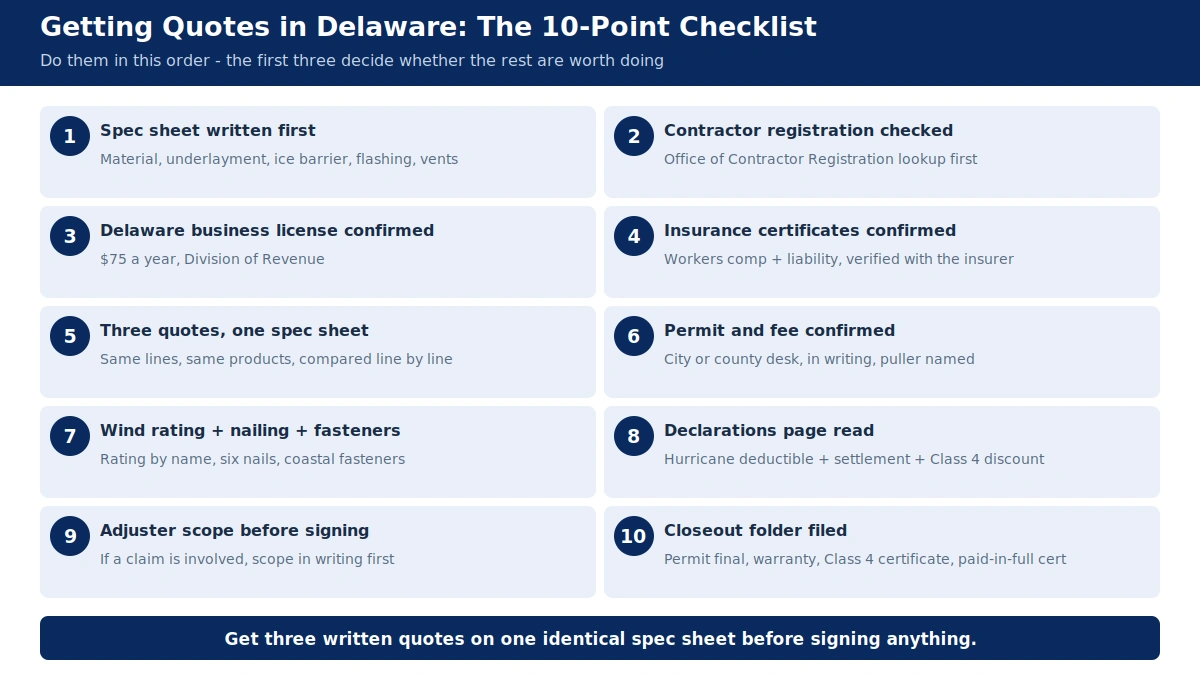
How much does a roof replacement cost in Delaware in 2026?
NumeralQ priced these planning estimates on October 26, 2026. A 2,000 sq ft roof in architectural asphalt shingles costs $10,050–$12,290 installed in Delaware in 2026. The midpoint is about $11,170. Wilmington runs a touch higher at $10,080–$12,320, and Dover, Newark, and the beach towns carry the state band as planning estimates because no verified city band was found for them.
What is the cost per square for a new roof in Delaware?
Delaware’s implied rate for architectural shingles runs $503–$615 per square, from the 2,000 sq ft band divided by 20 squares. SmartRoofingCalculator prices architectural shingles at $430–$620 per square installed with tear-off. MyRoofData prices them at $473–$788 per square before tear-off, with tear-off adding $100–$200 per square per layer. A square is 100 sq ft of roof surface. Per-square cost falls as the roof grows, because fixed job costs spread across more squares.
How much does a metal roof cost in Delaware in 2026?
Exposed-fastener metal panels cost $15,580–$19,790 for a 2,000 sq ft roof in Wilmington, on NumeralQ figures priced October 26, 2026. Standing-seam metal costs $22,290–$33,560 on the same figures. Standing seam is the premium choice for beach houses because it sheds salt spray, resists algae, and locks against 115 mph design wind, but it needs a coastal-rated coating and corrosion-resistant fasteners, and hail dents may be excluded as cosmetic-only by some insurance policies.
Do I need a permit to replace a roof in Delaware?
It depends on the address. Wilmington requires a permit for re-roofing through Licenses and Inspections, at about $180 on a $15,000 job. New Castle County needs no permit for a covering-only replacement when sheathing work is 25 percent or less. Dover and Newark are reported to require permits, but no city primary document was located for either, so the buyer confirms with the city desk. Beach towns follow the county or the town building department, by town.
Does Delaware require a contractor license for roofing?
No trade license exists. Delaware requires a business license from the Division of Revenue, $75 a year under 30 Delaware Code section 2502, and construction-service businesses must register with the Department of Labor. The buyer checks the registration in the Delaware Office of Contractor Registration lookup before hiring. The license and registration confirm tax and registration compliance, not roofing skill, so the buyer still checks insurance certificates and references.
What wind speed must a Delaware roof be designed for?
The design wind speed is 115 miles per hour in New Castle and Kent counties, and 115 miles per hour up to just under 130 for residential work in Sussex County, with Lewes setting 120 miles per hour. Architectural shingles rate 110–130 miles per hour for wind, and the better lines carry a Class H rating of 150 miles per hour. The buyer asks for the wind rating by product name and the six-nail pattern in writing, because the rating means little without the fastening to hold it.
Are Class 4 shingles worth it in Delaware?
Usually not for hail alone. Delaware logged 30 large-hail reports in ten years against 464 damaging-wind reports, and New Castle County logged none at 2 inches or larger, so hail big enough to crack shingles is rare. The derived Class 4 band is about $10,650–$14,090 for a 2,000 sq ft roof, using a borrowed $600–$1,800 upgrade increment because no Delaware-specific premium was found. The case for Class 4 rests on the wind rating some Class 4 lines carry and on a written insurance discount, not on the hail record.
Is there a tax credit or grant for a new roof in Delaware in 2026?
No. The federal government contributes $0 to a 2026 roof. Installations after December 31, 2025 lost the residential energy credits, and roof coverings never had a federal credit to lose. Delaware’s home energy rebates are not open yet and would not pay for a roof covering in any case. No statewide roof grant exists. Energize Delaware pays for heat pumps and home performance work, and the Weatherization Assistance Program is free to income-qualified households, but both pay for insulation, air sealing, and heating work, not for the roof covering itself.