


Iowa already runs on clean power more than any other state. Wind made 58.48 percent of the electricity generated inside Iowa in 2025, the highest share in the country, and the turbines standing over corn and soybean fields are part of the view on every highway between Des Moines and Sioux City.
A homeowner asking about solar panels here is not asking whether Iowa believes in renewable power. The question is narrower and more personal: what does a set of panels on one roof cost, what does the power company pay for the extra power, and how many years pass before the panels pay for themselves.
The answer starts with the name at the top of the electric bill, because Iowa has two different solar deals living side by side. MidAmerican Energy serves about 51 percent of Iowa homes, including Des Moines, Davenport, and Sioux City, and its homes paid an average of 11.579 cents per kWh over the 12 months to August 2026.
Alliant Energy, billing for Interstate Power and Light, serves about 34 percent, including Cedar Rapids and Dubuque, and its homes paid 18.367 cents over the same 12 months. The same panels on the same roof earn their keep far faster on the higher bill, and any savings estimate that uses a statewide average rate is wrong for both houses.
The credit picture is short, and the shortness saves buyers from the most common quote trick in 2026. The 30 percent federal credit for owned home systems ended for installs completed after December 31, 2025, and the Iowa state solar tax credit closed to home systems switched on after December 31, 2021.
Two tax breaks survive for every Iowa home: no state sales tax on panels and inverters, and no property tax rise for five full assessment years. Everything else a salesperson calls an Iowa incentive needs checking against the utility bill and the statute before it is believed.
Our national solar panel cost guide sets the countrywide baseline. Read Iowa’s numbers against it.
Table of Contents
How Much Do Solar Panels Cost in Iowa in 2026?
Several kinds of evidence price the Iowa market in 2026, and they measure different things, which is why the headline numbers disagree. EcoGen America’s Solar Cost Index, September 2026 edition, puts Iowa at $3.07 per watt in cash before incentives, $0.18 above the national average and 42nd lowest of 51 jurisdictions. EnergySage, working from real quotes on its marketplace, puts Iowa at $3.26 per watt as of November 2026.
ConsumerAffairs lands a touch higher, at $3.28 per watt. The three figures sit within 21 cents of each other, and the spread says more about method than about the market: a modeled benchmark, a marketplace average, and a modeled average each see the same installers from a different angle.
The typical system size is where the sources part company, and the gap matters more than the per-watt spread. Berkeley Lab’s database of systems actually installed in Iowa in 2025 gives a median size of 7.34 kW, from 619 systems, and at the EcoGen benchmark that system costs about $22,534. EnergySage’s average quoted system is far larger at 13.35 kW, costing about $43,552, inside a range of $37,019–$50,085.
A median of installed systems and an average of marketplace quotes describe different buyers: the installed median reflects the Iowa homes that went ahead, while the marketplace average skews toward larger homes and higher-use buyers who shop for quotes online. An average Iowa home uses about 10,176 kWh a year, and the 7.34 kW system makes about 10,401 kWh a year at Iowa’s production rate, so the installed median roughly matches average use. Size the system to the home’s own 12 months of bills, not to either average.
A watt is a unit of power, the size of the system at full sun. A kilowatt, written kW, is 1,000 watts. A kilowatt-hour, written kWh, is the energy one kilowatt makes in one hour, and it is the unit on the electric bill.
Cost per watt lets a buyer compare quotes of different sizes on equal terms: divide the cash price by the system size in watts, and a $22,534 system at 7,340 watts works out to $3.07 per watt. Quotes that hide the per-watt figure behind a monthly payment or a 25-year savings claim cannot be compared with anything until that one number is pulled out into the open. Panels make direct current, written DC, and the inverter turns it into alternating current, written AC, the form the house uses. System sizes are quoted in kW-DC, the panels’ rated output, so a 7.34 kW system means 7,340 watts of panels, with the inverter usually sized a little smaller than the array. Cash price means the full amount paid at install, with no loan, no lease, and no credit subtracted, which is the only price that compares cleanly across bidders. Inside the benchmark price sit the panels, the inverter that turns panel power into house power, the racking that holds the array to the roof, the wiring and disconnects, the labor, the permits, and the startup checks. What it does not buy is a battery, a new roof, a panel upgrade, a ground mount instead of a roof mount, tree work, or critter guards.
No Iowa-specific price was found for any of those add-ons, so each one needs its own line on the quote, priced by the bidder who will do the work. Rolling an add-on into the per-watt figure hides the most useful comparison a buyer has.
One warning belongs before the tables, because it decides whether the numbers that follow mean anything at all. Any quote that subtracts a 30 percent federal credit, an Iowa state tax credit, or a HEAR rebate from a 2026 owned system is built on rules that no longer exist. The federal government contributes $0 to a 2026 homeowner-owned install, Iowa’s state credit closed to homes at the end of 2021, and the HEAR rebate program does not cover solar panels and has not launched in Iowa.
Read every quote gross first. The only subtractions that belong on an Iowa quote in 2026 are the sales tax exemption on qualifying equipment, the Ames city rebate for Ames homes, and the utility bill credits the system earns after it is switched on.
| Source | Cost per watt | Typical system | Price |
|---|---|---|---|
| EcoGen Solar Cost Index, Sept 2026 (modeled cash) | $3.07 | 7.34 kW (Berkeley Lab 2025 median) | $22,534 |
| EnergySage, Nov 2026 (marketplace quotes) | $3.26 | 13.35 kW (marketplace average) | $43,552 (range $37,019–$50,085) |
| ConsumerAffairs, 2026 (modeled) | $3.28 | 13.19 kW (average) | $26,240 for 8 kW |
The EcoGen benchmark leads the sections below because it pins down the size with installed-system data instead of quote data, and because its method is published in full. EnergySage’s figures join it wherever quote data sharpens the picture, especially in the city section. Where the two disagree, the gap is stated rather than smoothed over, and the payback section works from both.
Solar Panel Cost in Iowa by System Size
System size follows the home’s yearly use, not the roof’s size and not the largest array a salesperson can fit. A home that uses about 10,000 kWh a year needs about 7 kW of panels at Iowa’s production rate of 1,417 kWh per kW a year. A home with an electric vehicle, a heat pump, or electric heat uses far more, and a small home with gas heat and careful habits uses far less.
The 110 percent cap in the billing law sets the ceiling at the two big utilities: the system may make no more than 110 percent of the home’s yearly use, so an oversized array is not just wasteful, it is outside the rule. Pull 12 months of bills before choosing a size, and treat any size recommendation that never asked for them as a guess.
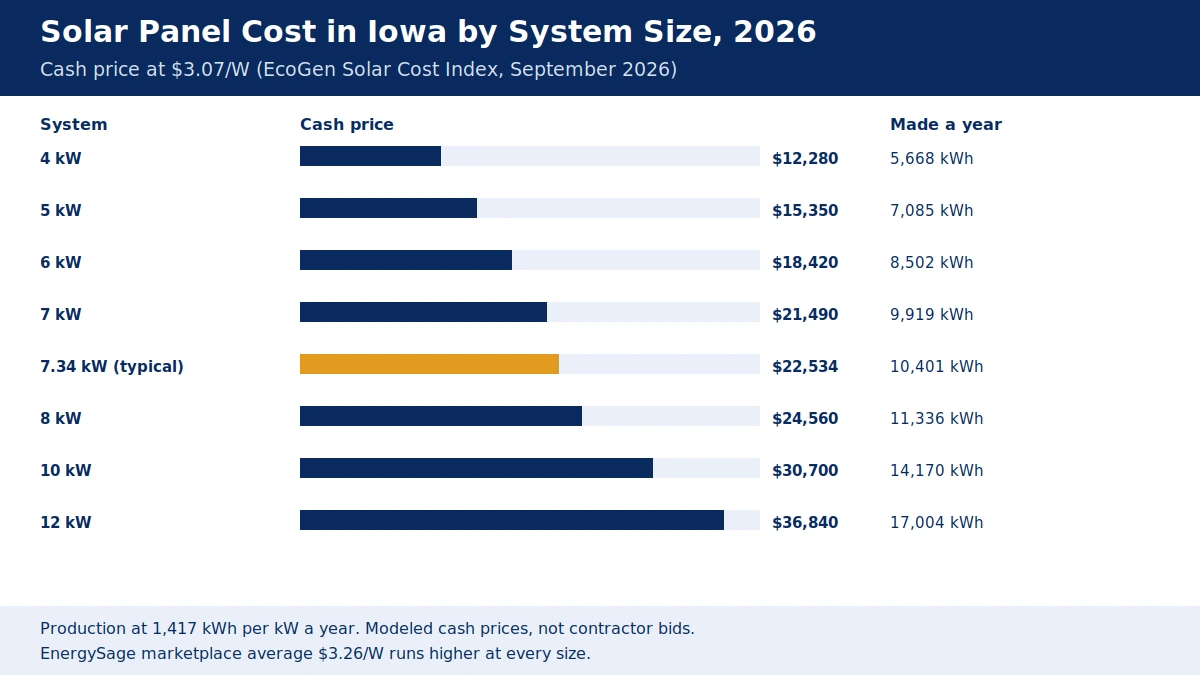
The table below prices each size at the $3.07 benchmark and shows what it makes in a year at 1,417 kWh per kW. Production assumes a south-facing array with little shade. Trees, an east-west roof, or a low tilt cut the figure, Roof direction and shade are covered below, and they matter in Iowa’s tree-heavy older neighborhoods.
| System size | Cash price at $3.07/W | Power made a year |
|---|---|---|
| 4 kW | $12,280 | 5,668 kWh |
| 5 kW | $15,350 | 7,085 kWh |
| 6 kW | $18,420 | 8,502 kWh |
| 7 kW | $21,490 | 9,919 kWh |
| 7.34 kW (typical) | $22,534 | 10,401 kWh |
| 8 kW | $24,560 | 11,336 kWh |
| 10 kW | $30,700 | 14,170 kWh |
| 12 kW | $36,840 | 17,004 kWh |
EnergySage’s size table, built from its $3.26 marketplace average, runs a little higher at every size: 5 kW at $16,315, 7 kW at $22,841, 8 kW at $26,104, and 10 kW at $32,630. The gap between the two tables at 8 kW is $1,544, which is the difference between a modeled benchmark and collected quotes, not a disagreement about what installers charge.
A real quote that lands between the two tables is in the expected band. A quote far above both needs a reason, such as a ground mount, a complex roof, or a long wire run, stated on the quote itself.
Small systems suit small loads. A 4 kW or 5 kW array fits a small home, a condo, or a house where gas handles heat and hot water and the electric bill stays low.
The per-watt price runs higher on small jobs because fixed costs, such as design, permits, and the utility application, spread over fewer watts. A 5 kW system making 7,085 kWh covers about 70 percent of an average home’s use, which can still be the right buy for a home that plans to add an electric vehicle later and wants the billing rule locked in now.
Large systems suit large loads and large roofs. A 10 kW or 12 kW array fits a big home, a home with an electric vehicle and a heat pump, or a farmhouse with a shop. The per-watt price usually falls as size rises, because the fixed costs spread further.
The cap still applies: a 12 kW system making 17,004 kWh needs a home using at least about 15,458 kWh a year to stay inside the 110 percent rule at MidAmerican or Alliant. A bidder who sizes past the cap without explaining the rule has not read the tariff the system will be billed under.
Our 6 kW vs 8 kW vs 10 kW comparison works through the size decision for the national picture, with roof space and panel counts. For an Iowa home, the short version is this: match the array to 12 months of use, stay under the 110 percent cap, and leave room on the roof and in the electrical panel for a later addition if an electric vehicle or a heat pump is in the plan.
Solar Panel Cost by City: Des Moines, Cedar Rapids, Davenport & Sioux City
Iowa’s city prices sit close together, and the utility territory matters more than the city line. EnergySage’s November 2026 marketplace data puts Des Moines at $3.06 per watt, Davenport at $3.26, and Cedar Rapids at $3.38, a spread of 32 cents from cheapest to dearest.
Labor and permitting move a little between cities, but equipment is priced nationally and installers cross city lines freely. What sets the cities apart is the bill: Des Moines and Davenport sit on MidAmerican’s low rates, Cedar Rapids sits on Alliant’s high rates, and Sioux City sits on MidAmerican’s low rates at the far western edge of the state.
| City | Cost per watt | Average system | Average price | 8 kW at city rate | Utility | EnergySage payback |
|---|---|---|---|---|---|---|
| Des Moines | $3.06 | 11.68 kW | $35,678 | $24,480 | MidAmerican | 18.42 years |
| Cedar Rapids | $3.38 | 12.83 kW | $43,308 | $27,040 | Alliant | 18.65 years |
| Davenport | $3.26 | 13.16 kW | $42,949 | $26,080 | MidAmerican | 24.15 years |
| Sioux City | ~$3.07 (planning est.) | 7.34 kW (state typical) | ~$22,534 | ~$24,560 | MidAmerican | Not published |
Des Moines is the capital, the largest metro, and the cheapest verified city price at $3.06 per watt. The EnergySage average system there is 11.68 kW at $35,678, inside a range of $30,326–$41,030, with a modeled payback of 18.42 years and 25-year savings of $14,223. MidAmerican serves the metro, so the export credit follows the inflow-outflow rule at the home’s own energy rate, held for 20 years.
The housing stock runs from older homes near downtown with mature trees and shaded roofs to new subdivisions in Ankeny, Waukee, and West Des Moines with wide, open, south-facing roofs. Shade is the Des Moines variable that moves production most: a 1920s home under a full oak canopy makes far less than the table figures, and a bidder who never checks shade has not priced the roof in front of them.
Cedar Rapids is the second city, the dearest verified price at $3.38 per watt, and the city where the bill most favors solar. The EnergySage average system is 12.83 kW at $43,308, inside a range of $36,812–$49,804, with a modeled payback of 18.65 years and 25-year savings of $18,483, the highest of the three verified cities. Alliant serves Cedar Rapids, so the home’s energy rate, and the credit for exported power, sit far above MidAmerican’s.
Cedar Rapids also carries the freshest storm memory in the state: the August 2020 derecho hit the city hardest, with estimated winds to 140 mph and a blackout that lasted weeks in some areas. A Cedar Rapids quote needs the mount engineering, the panel wind rating, and the insurance position stated plainly, because the roof that holds the panels has already seen what Iowa wind can do.
Davenport anchors the Iowa side of the Quad Cities, and its price sits in the middle at $3.26 per watt. The EnergySage average system is 13.16 kW at $42,949, inside a range of $36,507–$49,391, with a modeled payback of 24.15 years and 25-year savings of $3,988, the longest payback and the smallest savings of the three verified cities. MidAmerican serves Davenport from its headquarters city, so the low rate that makes the bill cheap also makes each solar kWh worth less.
A Davenport buyer needs the payback math done on the home’s own bills, not on a statewide average, because the statewide average overstates what a MidAmerican home saves. The river bluffs and older homes on the east side add roof complexity that a flat quote may miss.
Sioux City carries a planning estimate, not a verified city price, because no EnergySage city page and no other verified city price was found for it. The state benchmark of $3.07 per watt puts a typical 7.34 kW system at about $22,534, and an 8 kW system at about $24,560. Treat neither figure as a measured Sioux City price, because neither one is.
What is certain is the context: MidAmerican serves the city, so the billing rule and the low rate match Des Moines, and the housing stock of mid-century ranches and newer subdivisions on the loess hills gives installers straightforward roofs. A Sioux City buyer should treat the state band as a starting point and get three local quotes before budgeting anything, because the house variables move the price more than the city average ever could.
Two more Iowa cities deserve a mention even though they sit outside the four-city table. Ames runs its own municipal electric utility, pays a bulk power price near 3.5 cents for exported power, and offers the only verified utility rebate in the state at $500 per kW.
Cedar Falls runs its own municipal utility too, pays 3.913 cents in 2026 under its Energy Exchange Rate, and offers a free technical review of installer estimates. Both cities show the same lesson from opposite sides: the utility on the bill, not the city on the map, decides what solar earns.

Iowa Sun: Snow, Clouds & What Panels Actually Produce
Iowa sits at about 41.6 degrees north latitude in Des Moines, far enough north that winter days run short and the sun rides low from November to February. The state averages roughly 4.4 peak sun hours a day, with NREL-based tables putting the figure between 4.3 and 4.75 depending on the dataset and the reference city. A peak sun hour is one hour of sunlight at full strength, 1,000 watts per square meter, and it is the unit that turns panel size into yearly energy.
Iowa’s figure sits below the national average near 5.0, above the Pacific Northwest, and close to its Midwest neighbors. The sun is adequate, not generous, and the production math below treats it that way.
Seasonal swing is the defining feature of Iowa production. NASA data for Des Moines gives about 6.85 kWh a day per kW in summer, 5.34 in spring, 3.75 in autumn, and 2.64 in winter. Winter output runs about 39 percent of summer output, so a system that covers the bill in June covers less than half of it in January.
The yearly total already averages the swing in: 1,417 kWh per kW a year on the EcoGen figure, or about 1,370 on PVWatts-based tables. A yearly total alone hides the monthly shape, and the monthly shape is what the bill shows. Ask for month-by-month production next to month-by-month use before signing.
Snow is the question every Iowa buyer asks first, and the answer is less dramatic than the winters feel. Des Moines averages 36.5 inches of snow a year over the 1991–2020 normals, spread across about 25 snowy days, with 2,690 hours of sunshine a year at 60 percent of possible sunshine. Snow covers panels after a storm and production drops to near zero until the snow clears, but panels face the sky, shed snow as they warm, and sit at a tilt that helps the snow slide.
A steeper tilt sheds snow faster than a low-slope roof, which is one reason the ideal fixed tilt in Des Moines is about 36 degrees facing south. No verified Iowa figure puts a yearly percentage on snow loss, and none is stated here. The yearly production figures already reflect real Iowa winters, snow included.
Cloud is the steadier drag. Iowa’s humid continental climate brings Gulf moisture all summer and long gray spells in late autumn and winter, and Des Moines sees about 202 sunny days a year against a national average of 205. Panels still make power under cloud, at a reduced rate, and the production tables reflect average cloud cover rather than clear-sky hope.
What cloud does to the buying decision is subtler: it widens the gap between a good roof and a shaded roof, because a shaded array loses the direct sun it needs most on the days when direct sun is scarce. East-west roofs, dormers, chimneys, and neighbor trees all cost more output in Iowa than they would in a sunnier state, and a shade study is worth more here than a brochure promise.
Heat helps Iowa less than buyers expect and hurts less than desert buyers fear. Panels lose a little efficiency as they heat up, and an Iowa July afternoon at 90 degrees with full sun pushes panel temperatures well above the 77-degree test rating. The loss is real but small next to the winter and cloud effects, and Iowa’s cold, bright winter days partly offset it: cold air raises panel voltage, and snow on the ground bounces extra light onto the array.
The net effect is already inside the 1,417 kWh per kW figure. A buyer comparing Iowa with Arizona should compare yearly totals, not July afternoons, because the yearly total is what the bill pays on.
Roof direction and tilt decide how much of the statewide average a given home keeps. South-facing at about 36 degrees is the ideal in Des Moines, and it is the orientation the production tables assume. East-west roofs lose output against south-facing, flat roofs need tilted racking, and steep roofs shed snow well but cost more in labor.
Ground-mounted arrays, common on Iowa farms and acreages, can be set at the ideal tilt and direction with no roof in the way, and they are covered in the farm section below. Whatever the roof, the production estimate on the quote should name the orientation, the tilt, the shade loss, and the yearly total in writing, because a single yearly number with no assumptions behind it cannot be checked.
Inflow-Outflow Billing: The Rule That Decides Your Return
Iowa’s version of net metering has its own name and its own law, and the name describes exactly how the bill works. Inflow is the power the home takes from the grid, billed at the normal price. Outflow is the power the panels send to the grid, credited in dollars at the outflow purchase rate.
The law behind it is Iowa Code 476.49, passed as Senate File 583 in 2020, and it covers only the two utilities whose prices the state sets: MidAmerican Energy and Interstate Power and Light, which bills as Alliant Energy. Every other Iowa provider, city utilities and rural co-ops alike, writes its own rule, and the 20-year protection in the law does not reach them.
Both big utilities chose inflow-outflow billing, and both set the outflow credit equal to the retail volumetric rate, including the per-kWh riders. The volumetric rate is the per-kWh part of the bill, as opposed to the fixed monthly charge. MidAmerican’s Rate IO tariff was approved on November 24, 2020, and Alliant’s Rate Code IO tariff on December 30, 2020.
The Iowa Utilities Commission publishes both tariffs, the penetration figures, and the value-of-solar trigger on its distributed generation page. MidAmerican explains the 15-minute counting and the annual reset choice on its interconnection page. A buyer who reads those two pages knows more about the Iowa deal than most sales presentations contain.
Counting happens every 15 minutes, and the interval is the detail that most changes the return. Only the power left over inside each 15-minute block becomes a credit; power the home uses in the same block never reaches the meter and simply lowers what the home buys. A home that runs the dishwasher, the laundry, and the electric vehicle charger in the middle of a sunny afternoon uses more of its own power directly and banks fewer credits.
A home empty all day sends most of its power out and buys it back at night. The credit rate equals the energy rate either way, so the timing matters less in Iowa than in states where exports earn a fraction of retail, but the fixed monthly charge is never covered by credits, and credits are never paid out as cash.
More rules shape the decision, and they reward sizing the system to the home’s real use. The system may make no more than 110 percent of the home’s yearly use at the two big utilities, which caps the array for an average-use home at about 7.9 kW. Credits left at the end of the annual credit year are wiped, and the home picks a January or April reset date at connection, a choice best made from 12 months of bills with the installer.
The billing method and the outflow rate terms in place at connection hold for 20 years per system, and the hold stays with the system if the home is sold. A system connected under the older pre-2020 rules keeps those rules for the rest of its term after a sale, so a buyer of a home with panels already on the roof should ask the seller which billing rule the system sits on and how many years are left.
The law also names the older alternative, net billing, for completeness. Under net billing the meter nets over a monthly billing period, exports earn credits counted in kWh, and any kWh left at the end of 12 months are cashed out at the utility’s avoided cost rate, with the funds split evenly between the customer and the utility’s low-income home energy assistance program. Avoided cost is the price the utility would have paid for power from another source.
Neither big utility bills new home systems this way today, since both filed inflow-outflow tariffs, but the statute keeps the method on the books and a buyer may hear the term from an installer. The January or April date choice applies to net billing cash-outs too.
City utilities and co-ops sit outside the law, and their export prices run far lower. Cedar Falls Utilities pays an avoided-cost credit under its Energy Exchange Rate, reported at 3.913 cents per kWh in 2026 and reset each January, for home systems up to 25 kW. Ames Electric Services pays a bulk power price estimated near 3.5 cents for systems connected from September 1, 2025, and pairs it with a $500 per kW rebate covered in the incentives section. Muscatine Power and Water keeps excess power as kWh and pays leftovers each February at a rate based on its own power cost.
Rural co-ops each set their own terms, and no co-op credit was found in writing. A savings estimate built on the 20-year energy-rate credit is wrong for any home on a city utility or a co-op, and the installer should name the utility and the credit in cents on the quote.
One date hangs over the whole arrangement, and it rewards connecting sooner rather than later without justifying a rushed signature. The law tells the Iowa Utilities Commission to start work on a value-of-solar rate, a new price for exported power based on a study of what exports are worth to the grid, when customer-owned power reaches 5 percent statewide or when a utility petitions after July 1, 2027, whichever comes first. Statewide penetration reached 3.90 percent in 2025, up from 3.30 percent in 2024, while Alliant alone reached 8.65 percent and MidAmerican sat at 1.47 percent.
Nothing changes on July 1, 2027 by itself, since a formal case must come first, and yearly changes in any new rate are capped at 5 percent up or down. Systems connected before a new rate is approved keep the current credit rule for their 20 years, which is the strongest timing reason in the Iowa market.
Payback: How Long Until Iowa Solar Pays for Itself?
Payback is the purchase price divided by the yearly savings, and in Iowa the yearly savings depend on the utility more than on the panels. Every kWh the system makes is worth one of two amounts: the home’s own price when the power is used as it is made, or the export credit when the power is sent out. At MidAmerican the two amounts sit close together, because the credit equals the energy rate.
At Alliant both amounts sit higher, because the rate itself is higher. At a city utility the two amounts sit far apart, because the export price is a bulk power price while the purchase price is the retail rate. The payback figures below keep those cases separate, because blending them into one statewide number would mislead every reader.
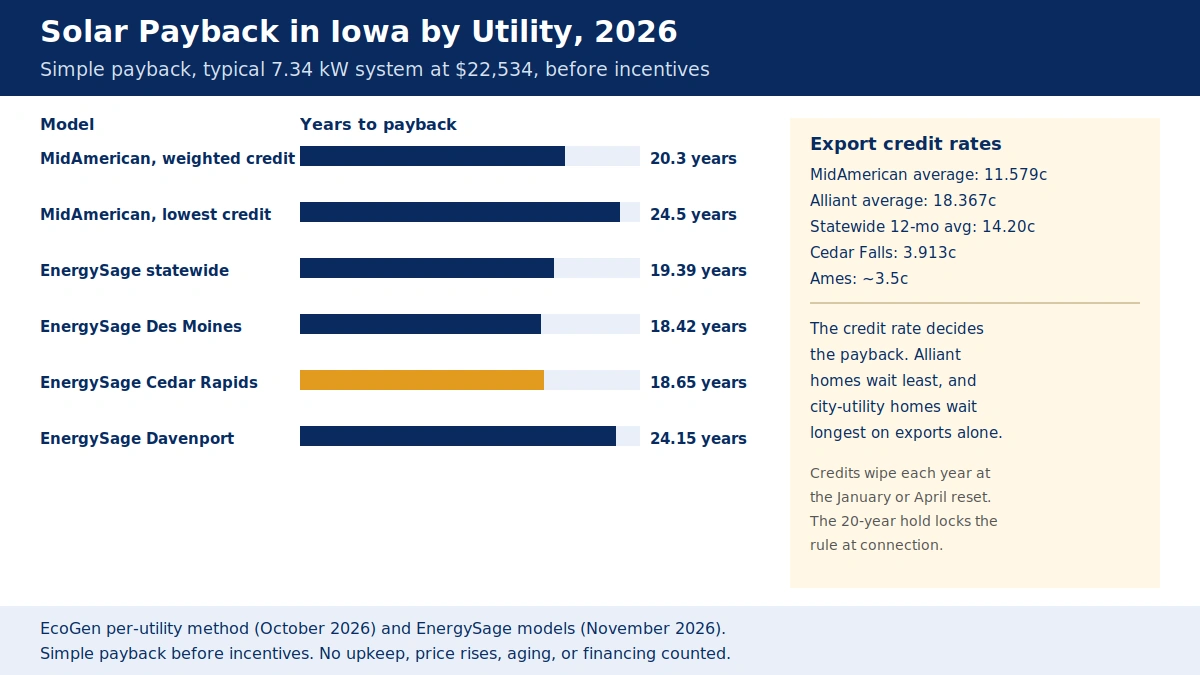
EcoGen’s per-utility figures give the MidAmerican case in full, with the method shown. A typical 7.34 kW system at $22,534 saves $1,109 a year and pays back in 20.3 years when exports are valued at the season-weighted credit of 10.847 cents, and saves $921 a year and pays back in 24.5 years when every export is valued at the lowest part of the MidAmerican rate, 6.311 cents. The method values the 60.2 percent of output used at home at 10.538 cents, which is MidAmerican’s 11.579-cent average with the $8.50 monthly fixed charge removed, and the 39.8 percent sent out at the export credit.
The 39.8 percent export share comes from what MidAmerican solar homes reported to the EIA, not from a meter on any one roof. No upkeep, price rises, panel aging, or financing is counted, so a financed system pays back slower and a system on a rising rate pays back faster.
A flat-rate illustration shows what the rate alone does to the wait, with every kWh valued at one price. At 10.538 cents, the typical system saves $1,096 a year and pays back in 20.6 years. At the statewide 12-month average of 14.20 cents, it saves $1,477 a year and pays back in 15.3 years.
At Alliant’s 18.367-cent average, it saves $1,910 a year and pays back in 11.8 years. These are illustrations, not quotes, and no home should budget from them: real bills split self-use and exports, the credit equals the energy rate rather than the all-in average, and the fixed monthly charge never goes away. The illustration earns its place by showing the size of the utility effect, which is larger than the effect of any panel brand or installer discount.
EnergySage’s models, built from larger average systems and its own savings assumptions, land in the same long-payback territory. Statewide payback is 19.39 years on the 13.35 kW average system, with $17,036 of savings over 25 years after the upfront cost. Des Moines models at 18.42 years, Cedar Rapids at 18.65 years with the highest 25-year savings of the three verified cities at $18,483, and Davenport at 24.15 years with $3,988 of 25-year savings.
The Davenport figure is the warning case: a big system on a low rate, modeled over 25 years, barely clears its cost. A Davenport buyer who sizes to the home’s real use, rather than to the marketplace average system, faces a shorter wait than the city model suggests, because the oversized array is what stretches the payback.
The payback moves more on four factors than on the panel brand:
- Rate path: Iowa’s average residential price rose 10.2 percent in the year to August 2026, and every cent of future rate rise shortens the payback on power used at home.
- Export share: a home that uses power while the sun shines keeps more value than a home that sends most of its power out, even where the credit equals the energy rate, because credits cannot pay the fixed charge and wipe each year.
- Financing: a loan adds interest to the purchase price, and EnergySage’s loan model shows much lower lifetime savings than cash for the same system.
- Time in the home: a payback past 20 years only works for an owner who plans to stay, or who values the system at resale, because the 20-year billing hold stays with the system and transfers to the buyer.
The verdict splits by utility, and it should be stated that plainly. Alliant homes, paying the highest rates in the state, see the shortest waits and the strongest case for buying, especially at Cedar Rapids where the rate and the credit both run high. MidAmerican homes face a 20-year wait on the published method, which suits a long-term owner who values price certainty and a locked-in billing rule more than a fast return.
City-utility and co-op homes face the longest waits on exports alone, and the case there rests on using power at home, on the Ames rebate where it applies, and on backup value from a battery. A fast payback promised without naming the utility, the rate, and the export share has skipped the three inputs that decide the answer.
Batteries in Iowa: Backup First, Savings Second
A home battery stores extra solar power for use after sunset or during an outage, and its value in Iowa comes mostly from the outage half of that sentence. EnergySage puts storage in Sioux City at $1,089 per kWh, with a 13 kWh system averaging $14,156 installed, inside a range of $12,033–$16,279. Nationally, EnergySage’s July 2026 figures put a typical installed 13.5 kWh system at about $15,647, and the marketplace median at $1,130 per kWh.
A battery costs more than half as much as the typical Iowa solar array, it is taxed at 6 percent while panels and inverters are exempt, and it adds a second payback question on top of the first. The battery decision deserves its own math, not a line buried in the solar quote.
The savings math is weak at the two big utilities, for a reason built into the billing rule. Where exports earn the home’s own energy rate, storing a kWh and using it later saves little more than sending it out and buying power back at night, because the credit and the purchase price are close. The battery still helps at the edges: it covers the fixed-charge gap that credits cannot pay, it shifts power past the yearly credit wipe, and it keeps power flowing when the grid drops.
None of those edge gains pays $14,000 back on its own. A MidAmerican or Alliant home buying a battery for bill savings alone is buying the wrong device for that job.
The savings math is stronger at city utilities, where exports earn a bulk power price and purchases cost the retail rate. At Cedar Falls, a stored kWh used at home avoids a purchase near 9 cents, counting the 6.48-cent base rate plus the 2.5-cent energy cost adjustment in November 2026, while the same kWh sent out earns 3.913 cents. The gap is about 5 cents per kWh shifted.
Shifting about 10 kWh a day on 250 days a year moves 2,500 kWh and gains about $125 a year at that gap, on stated assumptions that any buyer should replace with their own bill. Even at the wider city-utility gap, bill savings alone need decades to repay a battery. Backup value is the reason to buy one.
Backup value is real in Iowa, and the derecho wrote the case for it in 2020. Cedar Rapids lost power for weeks in some areas after the August 10 storm, and a battery with islanding, the ability to run the home cut off from the grid, keeps lights, refrigeration, phones, and medical devices running through an outage that solar panels alone cannot ride out.
Panels without a battery shut down during an outage for line-worker safety, unless the system includes islanding equipment. A buyer weighing a battery should list the loads that must stay on, size the battery to those loads rather than to the whole house, and get the islanding behavior in writing, because a battery that cannot island is a bill device, not a backup device.
Alliant adds one payment that MidAmerican does not. Smart Hours, Alliant’s residential battery program, pays a one-time enrollment incentive of $100 per kWh of battery capacity, up to $1,500, plus an annual performance payment of $100 per average kW discharged when the battery is called on to support the grid. A 13.5 kWh battery earns $1,350 at enrollment, and the program runs year-round with a 20 percent reserve kept for outages by default.
FranklinWH systems joined the program in October 2026, and other listed battery brands take part through the program’s enrollment partners. The payment helps, but $1,350 against a $14,000 battery is a discount, not a payback. No home battery payment was found at MidAmerican.
The battery verdict follows the same utility split as the panels. Alliant homes get the Smart Hours payment on top of backup value, which makes the battery easiest to justify in Cedar Rapids and the rest of Alliant territory. City-utility homes get the widest bill-savings gap and should still buy for backup first.
MidAmerican homes get backup value only, and should price the battery as insurance against the next long outage rather than as an investment. Any home can add a battery later, so a buyer unsure about storage can buy the panels now, lock in the 20-year billing rule, and revisit the battery with a year of bills in hand.
Iowa Incentives in 2026: Two Tax Breaks, One City Rebate, No State Credit
Iowa pays no statewide rebate and no state tax credit for a home solar system in 2026, and that sentence is the whole incentive picture for most of the state. The help that exists comes in three smaller forms: two tax breaks that apply to every Iowa home, and one city rebate that applies only inside Ames.
The billing credit covered in the section above is worth more than all three put together for most homes, because it pays every month for 20 years. A buyer who understands the billing credit and the two tax breaks understands the full Iowa incentive stack, and anything else added to the stack needs proof.
The first tax break removes the 6 percent state sales tax from solar energy equipment. Iowa Code 423.3(90) exempts panels, inverters, solar roof tiles or shingles, and equipment used to transmit converted solar energy, claimed with the exemption certificate Form 31-014. The exemption covers equipment only: batteries, mounting and racking, foundations, fencing, and install materials are taxed at 6 percent.
On $10,000 of qualifying equipment the saving is about $600, which is real money but a small share of a $22,534 system, because labor, racking, and wiring make up much of the price. A quote should show the sales tax on the right lines, with no tax on panels and inverters and 6 percent on the taxed lines, so the buyer can see the exemption working.
The second tax break holds the property tax bill still for five full assessment years. Iowa Code 441.21(8) says a qualifying solar system cannot raise the property’s actual, assessed, or taxable value for five full assessment years after installation, and any increase in the building’s market value caused by the system is disregarded permanently. After the five years, the equipment itself is counted in the assessment, while the added building value stays disregarded.
The county assessor applies the rule, and the buyer should confirm the exemption is recorded rather than assuming it. The value of the break depends on the local levy and the assessed value of the system, so no single dollar figure fits every Iowa county, and none is claimed here.
The Iowa Solar Energy System Tax Credit is closed, and any quote that subtracts it is wrong. The credit closed to home systems placed in service after December 31, 2021, according to the Iowa Department of Revenue. Only business installations that began construction before January 1, 2022 may still qualify, and their applications can sit on a waitlist.
The credit’s old terms do not matter for a 2026 buyer, because no 2026 home install can claim it under any terms. Salespeople who still name the credit are working from old material or hoping the buyer does not check, and the check takes one search of the Department of Revenue’s credit page.
Ames Electric Services offers the one verified utility rebate in the state, and it is open only to Ames homes. The rebate pays $500 per kW-DC installed, capped at 50 percent of the installation cost, with apartments excluded from the residential program. A typical 7.34 kW system earns $3,670, which brings a $22,534 system down to $18,864 before any other consideration, and the 50 percent cap does not bind at that size.
The city raised the rebate from $100 per kW and raised the program cap from 2,000 kW to 4,000 kW in 2025, while moving new systems to the bulk power buyback near 3.5 cents. Both figures come from city council papers and the DSIRE listing, and both should be confirmed with Ames Electric Services before signing, because the city’s site blocked re-checking and program funds are capped.
No other rebate was found. Cedar Falls pays no rebate, only the avoided-cost export credit and a free technical review. MidAmerican and Alliant pay no solar rebate, only the billing credit and, at Alliant, the battery payment.
No SREC market exists in Iowa, so panels earn no certificate income. The HEAR and HOMES rebate programs, covered in the federal section below, do not pay for solar panels and have not launched in Iowa. A buyer in any Iowa city besides Ames should budget with $0 of rebate money and treat the billing credit as the incentive.
Federal Help in 2026: $0 Tax Credit for Owned Systems, and the Lease Route
The federal picture for a 2026 Iowa install is short, and the shortness is the point. The tax credit for owned systems is gone. The rebate programs have not launched and would not pay for panels anyway.
The one route still open runs through a lease or a power purchase agreement, and no Iowa provider for it was found. Any quote showing federal money on a 2026 owned install is built on 2025 rules, and it needs rewriting before it is compared with anything.
For property placed in service after December 31, 2025, the One Big Beautiful Bill Act, Public Law 119-21, ended two credits: the Section 25C energy efficient home improvement credit and the Section 25D residential clean energy credit. The IRS confirmed the end date in Fact Sheet FS-2025-05. A system the homeowner owns and installs in Iowa in 2026 earns no federal tax credit at all.
Not reduced, not capped, not delayed: zero. The 30 percent credit that once cut a $22,534 system by about $6,760 is gone for 2026 work, and a 2025 install is the last one that can be claimed, on a 2025 return through IRS Form 5695. What ended, what survived, and which routes are still open are all set out in our federal energy tax credits guide.
The HEAR and HOMES rebates do not change the solar math in Iowa, for two separate reasons. The programs are funded by the Inflation Reduction Act and run state by state, and Iowa’s combined allocation is about $121.2 million, about $60.47 million for HEAR and about $60.70 million for HOMES, administered through the Iowa Energy Office. As of November 2026 the programs had not launched, and the state’s page says the rebates are not yet available.
Even after launch, HEAR money cannot fund solar panels: the program pays for efficient electric appliances, insulation, wiring, and panel upgrades, not for power generation, and the Energy Department’s Program Notice 26-2, effective May 29, 2026, limits the program further to electric-to-electric upgrades and new construction. Subtracting an $8,000 HEAR rebate from a solar quote is wrong twice over.
The lease route is the only federal money left for 2026, and it runs through the company that owns the panels rather than the homeowner. Section 48E, the clean electricity investment credit, still supports leased systems placed in service by December 31, 2027, with the credit passing through from the leasing company to the homeowner as a lower payment. Projects that began construction before July 4, 2026 may qualify under a longer safe-harbor window running to 2030.
The leasing company claims the credit, not the homeowner, so the value to the homeowner depends entirely on how much of the credit the company passes through in the monthly payment or the power price. A lease or power purchase agreement, called a PPA, is a contract where a company owns the panels on the roof and the homeowner pays a fixed monthly lease payment or buys the power by the kWh.
Iowa law allows those contracts. In 2014 the Iowa Supreme Court held, in the Eagle Point Solar case, that a solar company selling power by the kWh from panels on a customer’s building was not a public utility, which settled third-party PPA legality in the state. DSIRE cites that ruling as the reason Iowa allows PPAs.
Offers are harder to find: EnergySage showed no installers offering a lease or PPA on its Iowa marketplace in November 2026, and no Iowa lease or PPA provider was found. A homeowner who finds a lease offer should get three items in writing before signing: the Section 48E pass-through and how it lowers the payment, who keeps the billing credits under the inflow-outflow rule, and what happens to the contract on a home sale. A lease signed without the pass-through in writing costs more than the purchase it replaced, and a lease that keeps the billing credits with the company while the homeowner pays the fixed charge gives away the most valuable part of the Iowa deal.
Farm & Rural Solar: REAP Grants and Ground-Mounted Systems
Iowa farms buy solar under different rules and with different help than Iowa homes, and the farm case is stronger. A hog confinement building, a grain drying setup, a machine shop, or a dairy barn draws power all day, often on a rural electric cooperative or a municipal system, and the load lines up with sunshine better than a home’s evening-heavy load does. Ground-mounted arrays sit on open land beside the buildings, face due south at the ideal tilt, and never touch a roof.
The federal help for farms is also larger: a USDA grant program built for rural energy, plus the commercial tax credit that home systems lost. A farm buyer who prices solar as a home buyer misses the two programs that change the answer.
The Rural Energy for America Program, known as REAP, is the main farm program, run by USDA Rural Development. It awards grants on a competitive basis to agricultural producers and rural small businesses for renewable energy systems, including solar, in rural areas of 50,000 residents or fewer. Grant funding covers up to 25 percent of total project costs, with renewable energy grants from $1,500 to $500,000, and total REAP funding including a guaranteed loan cannot exceed 75 percent of project costs.
An agricultural producer is a business that earns at least 50 percent of gross income from farming or holds at least 50 percent of its assets in farm production. The USDA’s REAP page for Iowa lists the current terms, and the state Rural Development energy coordinator answers project questions.
Several current restrictions shape farm applications, and they are recent enough that older guides miss them. Ground-mounted solar and wind projects cannot be installed on cropland, and ground-mounted projects on other land must show energy use matching past use, so the system must be sized to the farm’s real load. From October 16, 2026, solar and wind projects cannot include components made in countries designated as foreign adversaries.
The USDA Iowa page also states that the project must have been installed and operated for at least 12 straight months before an application is submitted, which means a farm buyer should confirm the current application timing with the state coordinator before counting on grant money at signing. Grants reimburse costs rather than paying upfront, awards are competitive and scored, and only one application per business per federal fiscal year is allowed.
An illustration shows the scale of the help, with the competitive caveat attached. A 50 kW farm system at the $3.07 benchmark costs $153,500, and a 25 percent grant would pay $38,375, well under the $500,000 cap. The farm also keeps the commercial tax credit route: business systems placed in service by December 31, 2027 can still qualify for the Section 48E credit, and REAP guides state that the grant does not reduce the credit basis, a point worth confirming with a tax professional before relying on it.
Iowa farm installs in the news include a 27.72 kW ground-mounted array at Kerns Farm in Mallard and a 51 kW array at a hog confinement building in Algona that won a REAP grant. Those are examples of system types and sizes, not promises of any one farm’s award.
Rural homes that are not farm businesses sit in a gap worth naming. A rural home on a cooperative’s lines gets the cooperative’s export terms, not the 476.49 billing rule, and a rural homeowner who is not an agricultural producer cannot claim a REAP grant. The home still gets the sales tax exemption, the five-year property tax break, and whatever export credit the cooperative writes.
Some cooperatives pay an avoided-cost credit near the city-utility level, and some offer their own solar programs, so the cooperative’s written terms decide the case. A rural buyer should ask the cooperative for the export credit, the size limit, and the interconnection steps before getting quotes, because the cooperative’s answers set the ceiling on the system’s value.
Community solar offers a no-roof path for homes that cannot host panels, including renters and shaded homes. Ames runs the 2 MW SunSmart solar farm, where customers buy Power Packs at $210 each, worth 175 watts of capacity, earning bill credits near $1 a month over a 20-year term. Cedar Falls Utilities runs Simple Solar, where units cost $94 each, worth about 170 watts and about 300 kWh a year, earning about $1.20 a month in bill credits.
Neither program makes money in the way a rooftop array can, and both say so openly: the credits roughly track output value, and the buyer joins to use solar power rather than to profit. Our community solar cost guide compares the model nationally for buyers weighing it against a rooftop array.
Permits & Licensing: What Iowa Requires
Iowa licenses the electrical work at the state level, registers the contractor at the state level, and permits the job at the local level, and the buyer has to check all three. The state license proves the business is allowed to do the wiring. The contractor registration proves the business is registered to do construction work.
And the local permit means an inspector signed off on the finished job. A job with one and not the others is a job half done, and the missing half costs money later, at resale, at an insurance claim, or at the first service call after a storm.
Iowa issues no separate solar installer license. The wiring, grounding, overcurrent protection, service work, and interconnection of a solar array fall under state electrical licensing, in Iowa Code chapter 103, run by the Electrical Examining Board under the Department of Inspections, Appeals, and Licensing, known as DIAL. New electrical installations are work for a licensed electrical contractor only, and wiring done for another person needs a master, journeyman, or other board license.
An electrical contractor must be, or employ, a Class A or Class B master electrician. The license classes run from apprentice through Class B and Class A journeyman to Class B and Class A master, plus a residential master class for home work.
The renewal cycle and the insurance rule are the two checks a buyer can verify without knowing the trade. Licenses run on a three-year statewide cycle, with the current cycle running 2026–2028, and masters and journeymen complete 18 contact hours of continuing education per cycle, at least 6 hours on the National Electrical Code. Apprentices hold annual licenses and work under direct supervision, at most three apprentices per licensee.
Contracting licensees must carry at least $1 million in general and complete-operations liability insurance. The licensing rules sit in 481 IAC chapters 400–404. A buyer should look the contractor’s license up in the Board’s license search, ask for the insurance certificate in writing, and confirm the name on the license matches the name on the contract.
Contractor registration is a separate requirement, and it is not a trade license. Under Iowa Code chapter 91C, construction contractors earning at least $2,000 a year from construction work must register with DIAL, for a $50 fee, and out-of-state contractors file a $25,000 bond. An electrical contractor must hold both the electrical contractor license and the contractor registration.
A business that shows registration alone has shown the lesser credential, and a business that shows neither has shown nothing. NABCEP certification, from the North American Board of Certified Energy Practitioners, is voluntary in Iowa and signals solar-specific training, but it does not replace the state electrical license.
Permits and interconnection approval come before switch-on, in that order. The city or county issues the electrical and building permits for the install, and the utility reviews the interconnection application under the Iowa Utilities Commission’s rules: 199 IAC chapter 15 for interconnection standards applying to all utilities, and 199 IAC chapter 45 for distributed generation interconnection at the rate-regulated utilities. Small home systems use the Level 1 interconnection forms, and the utility must approve the connection before the system is switched on.
Cedar Falls shows the local pattern plainly: the installer applies, the utility’s engineering team reviews, the install is completed with permits and inspections, and the utility swaps the meter and changes the rate after a disconnect test. No verified statewide timeline for interconnection approval was found, so the buyer should ask the utility for its current queue time in writing and build the wait into the schedule.
What Pushes Your Iowa Quote Up or Down
A typical Iowa system costs about $22,534, and the spread between bidders on the same house can run several thousand dollars. The spread is not noise.
It is the roof, the equipment, the wiring, and the weather exposure, priced line by line. A buyer who knows which lines move the number can read a quote the way the installer wrote it, and can tell a fair quote from a padded one without a second opinion.
The roof is the first lever, and in Iowa it is often the biggest one. A new, simple, south-facing asphalt shingle roof with easy access is the cheapest install in the state. An old roof, a steep roof, a tile or metal roof, a roof cut up by dormers and valleys, or a roof shaded by mature oaks all add labor, racking, or lost production. A roof near the end of its life should be replaced before panels go on, because removing and reinstalling panels later costs a second job, and no Iowa price for that second job was found.
Our Iowa roof replacement guide prices the roof job itself, and our national roof guide compares materials. Pricing the array without inspecting the roof skips the part of the job that decides the install cost.
The electrical panel is the second lever. A solar array needs a dedicated circuit and a panel with room for it, and a home still on a 100-amp panel, common in older Des Moines, Cedar Rapids, and Davenport neighborhoods, may need an upgrade before the array can connect. No Iowa-specific panel upgrade price was found, so the upgrade needs its own line on the quote, priced by the electrician who will do the work.
Our electrical panel upgrade guide prices the job nationally. Burying panel work inside the per-watt figure hides the most predictable add-on in the book, and a quote written without a look inside the panel has not priced the job at all.
The equipment tier is the third lever. Panels, inverters, and racking come in value, mid-range, and premium tiers, and the tier moves the price more than the brand name does. A string inverter, one box serving the whole array, costs less than microinverters, small boxes under each panel, or power optimizers, and the right choice depends on shade: shaded or multi-direction roofs gain more from panel-level electronics than open south-facing roofs do. Premium panels with higher efficiency suit small roofs where every square foot counts, while standard panels suit big open roofs where space is free.
Our solar inverter replacement guide explains the inverter types and their replacement costs, because the inverter is the part most likely to be replaced during the array’s life. Ask for the panel wattage, the inverter type, and the warranty terms in writing, and compare bids on identical equipment.
Storm exposure is the fourth lever, and Iowa buyers should price it rather than assume it. The August 2020 derecho produced a measured gust of 126 mph at Atkins and estimated winds to 140 mph in Cedar Rapids, caused $11.2 billion in damage, and left parts of Cedar Rapids without power for weeks. Panels and mounts carry hail and wind ratings, and the mount engineering should match the exposure of the site, especially on open acreages and ridge-top homes where wind runs free. Hail dents panels, debris cracks them, and a mount that fails in a storm takes the roof with it.
Ask for the panel hail and wind rating sheet, the mount engineering for the site, and the insurance position in writing: whether the array is covered, how the roof warranty treats penetrations, and what the deductible is after a storm. No verified Iowa price was found for upgraded mounts or storm hardening, so each item needs its own quote line.
Ground mounts, tree work, and long wire runs are the fifth lever. A ground-mounted array costs more in racking, trenching, and foundations than a roof array, and it earns the extra cost back in ideal tilt, easy snow clearing, and no roof penetrations. Tree removal or trimming restores production on shaded lots and costs money of its own. A detached garage, a shop, or a ground array far from the panel adds wire, trenching, and voltage-drop calculations.
Each of these is a site cost, not an equipment cost, and each should appear as its own line with its own reason. A lump-sum quote that hides site costs inside the per-watt figure cannot be compared with a lump-sum quote from a bidder who priced a different site.
Financing is the sixth lever, and it is the one that most quietly changes the total. Cash pays the benchmark price and keeps every dollar of savings. A loan adds interest, and EnergySage’s loan model shows much lower lifetime savings than cash for the same Iowa system. A lease or PPA adds no upfront cost but gives the billing credits and the tax credit to the company, and the monthly payment or power price decides whether the home saves anything at all.
Dealer fees, sometimes called loan fees, can add thousands to a financed price while the monthly payment looks small. Ask for the cash price, the financed total, the interest rate, the term, and any dealer fee in writing, on one identical system, before comparing payment options. The cheapest monthly payment is rarely the cheapest system.
The calendar is the last lever. Installers book up in spring and summer, when the sun sells the idea, and quiet down in winter, when snow and short days slow roof work. A planned install booked in the quieter months can cost less and move faster through the utility queue, while a rushed summer install competes for crews and inspectors.
The billing rule rewards connecting before any value-of-solar case changes the terms for new systems, which argues against waiting years, but it does not argue for signing the first quote in the door. Book the install in the season that suits the roof, the crew, and the utility queue, and use the wait to collect three written quotes.
Getting Quotes in Iowa: The Checklist
Nothing gets signed until three licensed contractors have answered every item below in writing, on one identical spec sheet. A quote missing an item is incomplete, and the missing item will arrive later as a change order, at a price the buyer can no longer negotiate.
- Your utility and its rule in writing first (MidAmerican or Alliant inflow-outflow Rate IO with the export credit in cents; city utility or co-op export credit in cents; January or April credit-year reset date)
- Cash price and cost per watt for one identical system (benchmark $3.07/W; typical 7.34 kW about $22,534; financed total, rate, term, and dealer fee shown separately)
- System size against 12 months of use (year-one kWh next to yearly use, under the 110 percent cap; month-by-month production with orientation, tilt, and shade loss stated)
- No line for a federal credit, no line for an Iowa state credit, no line for a HEAR rebate ($0 federal for 2026 owned installs; state credit closed to homes after 2021; HEAR does not cover solar)
- Sales tax on the right lines (no 6 percent tax on panels and inverters, Form 31-014; 6 percent on battery, racking, and foundations) and the property tax exemption confirmed with the assessor
- Equipment named with its ratings (panel wattage and warranty, inverter type and warranty, racking, hail and wind rating sheet, monitoring included or priced)
- Licenses verified (Iowa electrical contractor license with a Class A or Class B master, $1 million liability insurance, contractor registration under chapter 91C; NABCEP noted where held)
- Add-ons itemized (panel upgrade, roof work, ground mount, tree work, trenching, battery, critter guards, monitoring; remove-and-reinstall price in writing if the roof is old)
- Storm and insurance position in writing (mount engineering for the site, panel ratings, array coverage, roof warranty treatment of penetrations, deductible after a storm)
- Permits, interconnection, and switch-on in writing (city/county permits, utility interconnection approval under 199 IAC chapters 15 and 45, utility queue time, who handles the application and the meter swap)
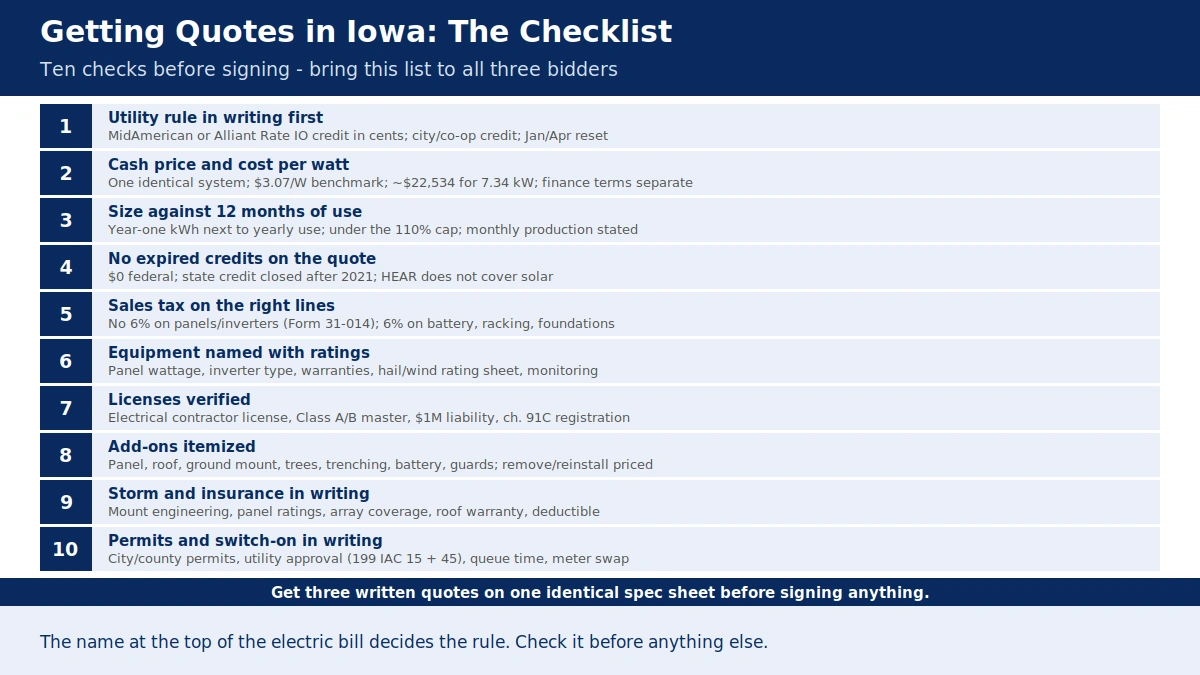
Get three written quotes on one identical spec sheet before signing anything. Price alone does not pick the winner. The best quote is the one that names the utility rule, shows the production math, itemizes the add-ons, proves the license, and carries no expired credit, and in Iowa the best quote is also the one that has read the bill before pricing the roof.
Sources & methodology Installed costs:
- EcoGen America, Solar Cost Index, September 2026 Edition (prices as of Sept 25, 2026): Iowa $3.07/W cash before incentives, $0.18 above the US average, 42nd lowest of 51; modeled cash prices, not collected quotes; size prices 5 kW $15,350, 7.34 kW $22,534, 8 kW $24,560, 10 kW $30,700
- Berkeley Lab distributed solar database, 2025: Iowa median installed size 7.34 kW, 619 single-family systems (via EcoGen)
- EnergySage, Iowa solar cost page, November 2026 (marketplace quote data): $3.26/W; average system 13.35 kW, $43,552, range $37,019–$50,085; size table 3 kW $9,789 to 10 kW $32,630; payback 19.39 years; 25-year savings $17,036; 0 lease/PPA installers, 6 ownership installers, 1 rent-to-own on the Iowa marketplace
- EnergySage city pages, November 2026: Des Moines $3.06/W, 11.68 kW, $35,678 (range $30,326–$41,030), payback 18.42 years, savings $14,223; Cedar Rapids $3.38/W, 12.83 kW, $43,308 (range $36,812–$49,804), payback 18.65 years, savings $18,483; Davenport $3.26/W, 13.16 kW, $42,949 (range $36,507–$49,391), payback 24.15 years, savings $3,988
- ConsumerAffairs, Iowa solar cost page, 2026: $3.28/W; average size 13.19 kW; 8 kW $26,240; Des Moines table implies $3.11/W
- Sioux City price: no verified city price found; planning estimate at the state benchmark, flagged in the draft
Production and climate:
- EcoGen Solar Cost Index: 1,417 kWh per kW per year; 7.34 kW = 10,401 kWh/year
- NREL PVWatts / NSRDB via GreenWatt (PVWatts v8): 1,367 kWh/kW; via roofpayback: 1,370 kWh/kW; via sparkpowered: 1,364 kWh/kW
- Peak sun hours: 4.4/day (Unbound Solar, NREL NSRDB); 4.75/day (GreenWatt, PVWatts v8); 4.5/day (solarpricelist); 4.3/day (sunmetriclab)
- Profile Solar / NASA POWER, Des Moines: seasonal kWh/day/kW summer 6.85, spring 5.34, autumn 3.75, winter 2.64; ideal tilt 36 degrees south; latitude 41.60
- NOAA 1991–2020 normals, Des Moines airport: snowfall 36.5 inches/year, 25.3 snowy days, 2,690 sunshine hours, 60% possible sunshine, precipitation 36.55 inches
Electricity rates, use, and utilities:
- EIA Electric Power Monthly, Table 5.6.A, August 2026: Iowa residential 17.06 cents/kWh, up 10.2% from 15.48 cents; US 18.16 cents; average bill $148.72; average use 872 kWh
- EIA Form 861M, 12 months to August 2026: Iowa 14.20 cents/kWh, about 848 kWh/month, about $120/month; MidAmerican 11.579 cents; Alliant (IPL) 18.367 cents; MidAmerican homes average 9,795 kWh/year (via EcoGen)
- EIA Form 861, 2024: Iowa 832 kWh/month, $111.54/month, 13.40 cents/kWh; MidAmerican about 51% of Iowa homes, Alliant about 34%
- CEDI analysis of 2025 IUC utility filings (Nov 2026): Alliant bundled residential 17.77 cents, MidAmerican 11.21 cents
- MidAmerican seasonal energy rates (EcoGen tariff reading, single source, flagged): summer about 12.35 cents, winter 9.82 cents, 6.311 cents on winter use above 1,000 kWh/month; $8.50/month basic service charge
- IUC Electric Profile 2025 (EIA Forms 860/923): wind 58.48% of in-state generation, 13,411 MW nameplate, 43,572,980 MWh; 6,514 turbines (Berkeley Lab)
Billing rules:
- Iowa Code 476.49 (SF 583, 2020), statute text: inflow-outflow and net billing methods; net billing year-end cash-out at avoided cost split with the low-income home energy assistance program; January/April date choice; forfeiture of outflow credits; value-of-solar trigger at 5% or utility petition after July 1, 2027
- Iowa Utilities Commission, On-site (Distributed) Generation page: approved tariffs (MidAmerican Rate IO, TF-2020-0235, Nov 24, 2020; IPL Rate Code IO, TF-2020-0237, Dec 30, 2020; IPL Net Metering Pilot, TF-2020-0238); 2025 penetration statewide 3.90%, MidAmerican 1.47% (79.14 MW), IPL 8.65% (238.57 MW); 199 IAC chapters 15 and 45
- MidAmerican Energy, interconnection page: Rate IO mechanics, 15-minute intervals, January/April reset election, Rate QF
- EcoGen Iowa pages: 20-year hold per system; 110% size limit; 39.8% export share reported by MidAmerican solar homes to EIA; MidAmerican payback $1,109/year and 20.3 years (10.847-cent weighted credit), $921/year and 24.5 years (6.311-cent credit); 10.538-cent ex-fixed-charge value
- Cedar Falls Utilities: Energy Exchange Rate, up to 25 kW residential (50 kW business), avoided-cost credit reset each January, 3.913 cents in 2026 (EcoGen, from CFU schedule); residential $23.75/month service charge, base 6.48 cents first 800 kWh, 5.90 cents winter / 6.48 cents summer over 800 kWh; Net Energy Cost Adjustment 2.5 cents (Nov 2026); Simple Solar $94/unit
- City of Ames council papers (May 27 and July 22, 2025) + DSIRE via ConsumerAffairs: buyback about 3.5 cents (3-year bulk power average) for systems from Sept 1, 2025; rebate $500/kW-DC capped at 50% of cost, apartments excluded; program cap 4,000 kW; SunSmart 2 MW farm, Power Packs $210
- Muscatine Power and Water: kWh kept, leftover paid each February (EcoGen utility table, single source)
Batteries:
- EnergySage storage, Sioux City, Nov 2026: $1,089/kWh; 13 kWh $14,156 (range $12,033–$16,279)
- EnergySage national, July 2026: 13.5 kWh about $15,647; H1 2026 median $1,130/kWh
- Alliant Smart Hours: $100/kWh enrollment up to $1,500, $100 per average kW annual performance payment, year-round, 20% reserve default (FranklinWH / PR Newswire, Oct 13–15, 2026)
- MidAmerican home battery payment: none found (EcoGen)
Incentives, tax breaks, and federal:
- Iowa Department of Revenue, Solar Energy System Tax Credits: closed to home systems placed in service after Dec 31, 2021; business installs begun before Jan 1, 2022 may still qualify, waitlisted
- Iowa Code 423.3(90) + Dept. of Revenue Sales and Use Tax Guide: 6% sales tax exemption for panels, inverters, solar roof tiles/shingles, transmission equipment; batteries, racking, foundations taxed; Form 31-014
- Iowa Code 441.21(8) + Dept. of Revenue memo to assessors (May 18, 2016): no rise in actual/assessed/taxable value for five full assessment years; added building market value disregarded permanently; equipment counted after five years
- OBBBA P.L. 119-21; IRS FS-2025-05 (25C/25D $0 after Dec 31, 2025); Section 48E lease route, in service by Dec 31, 2027; safe harbor for pre-July 4, 2026 construction starts
- HEAR/HOMES: about $60.47M + $60.70M allocations (DOE, May 2024); Iowa Energy Office page says not yet available (checked Nov 9, 2026); DOE Program Notice 26-2 (May 29, 2026)
- Iowa Supreme Court, Eagle Point Solar v. IUB, No. 13-0642, July 11, 2014 (third-party PPA legality; via DSIRE)
Farm and rural:
- USDA Rural Development, REAP Iowa page (updated Nov 5, 2026): grants up to 25% of project costs, $1,500–$500,000 for renewable energy systems; total REAP funding max 75%; rural areas 50,000 or fewer; competitive; 7 CFR 4280 Subpart B; ground-mount cropland ban; Oct 16, 2026 foreign-adversary component ban; 12-month operation statement; 1:1 current ratio; one application per year
- Farm examples: Kerns Farm, Mallard, 27.72 kW ground-mounted; hog building, Algona, 51 kW with REAP award (1 Source Solar)
Licensing, permits, and storms:
- Iowa Code chapter 103; Electrical Examining Board under DIAL; 481 IAC chapters 400–404; 3-year cycle 2026–2028; 18 CE hours (6 NEC); $1M liability (481 IAC 401.7); apprentice supervision max 3 per licensee; contractor registration chapter 91C ($50, $2,000 threshold, $25,000 out-of-state bond); NABCEP voluntary
- NWS Quad Cities + NASA + NOAA: derecho Aug 10, 2020; measured gust 126 mph (Atkins); estimated 140 mph (Cedar Rapids); $11.2B damage; Cedar Rapids blackout lasting weeks in some areas; 59 counties damaged; 25% of state forests lost; 1.97M acres corn + 1.40M acres soybeans damaged
NestPriced arithmetic (labeled as such in the draft):
- Size prices at $3.07/W: 4 kW $12,280; 6 kW $18,420; 7 kW $21,490; 12 kW $36,840; production at 1,417 kWh/kW
- 8 kW at city rates: Des Moines $24,480; Cedar Rapids $27,040; Davenport $26,080; Sioux City about $24,560
- Flat-rate payback illustration: 10,401 kWh at 10.538 cents = $1,096/year, 20.6 years; at 14.20 cents = $1,477/year, 15.3 years; at 18.367 cents = $1,910/year, 11.8 years
- 110% cap: 10,176 kWh x 110% = 11,194 kWh = about 7.9 kW at 1,417 kWh/kW
- Ames rebate: $500 x 7.34 kW = $3,670; $22,534 − $3,670 = $18,864
- Battery arbitrage at CFU: 10 kWh/day x 250 days = 2,500 kWh x about 5 cents = about $125/year
- REAP illustration: 50 kW x $3.07 = $153,500; 25% = $38,375
- Sales tax saving: 6% x $10,000 = $600
- Winter share of summer output: 2.64 / 6.85 = about 39%
EXCLUDED:
- Any “after 30% credit” prices; any Iowa state credit, statewide rebate, HEAR rebate, or SREC income for 2026 home installs
- REAP grants at 50% (stale IRA-era terms); REAP 50 kW cap claim (not on the USDA page)
- City prices from solarcostbyzip / smartenergyusa ($2.57–$2.95/W with the dead credit subtracted)
- solarpricelist claims: state credit expired 2012; no sales tax exemption; 427B.26 citation; pre-2020 retail net metering; 500 kW cap
- Ames $600/kW slide figure (adopted motion and DSIRE say $500/kW)
- Interconnection timelines, panel upgrade prices, ground-mount prices, remove-and-reinstall prices, snow-loss percentages, hail-event counts: no verified Iowa figures found
- Installer rankings, company license numbers, lease/PPA providers: none verified
- MidAmerican seasonal energy rates as tariff fact: single-sourced from EcoGen, attributed and flagged
Disclaimer: The prices here are 2026 Iowa planning figures from the sources named above. What you end up paying moves with the city, the house, the roof, the utility territory, and the contractor. Get written quotes from three licensed Iowa installers before settling on a budget, and check the electrical contractor license yourself through the Electrical Examining Board before anyone touches the house. Nothing here is tax advice for your own return. Program rules change, so confirm current terms with your utility, your assessor, and the Department of Revenue before signing, and confirm the Ames rebate and buyback with Ames Electric Services if the home sits in Ames.
What do solar panels cost in Iowa in 2026?
About $3.07 per watt installed, or about $22,534 for the typical 7.34 kW home system, on the EcoGen September 2026 benchmark. EnergySage’s November 2026 marketplace average runs higher at $3.26 per watt, with its larger 13.35 kW average system costing about $43,552. City prices run from $3.06 per watt in Des Moines to $3.38 in Cedar Rapids.
Does Iowa still have a solar tax credit?
No, not for homes. The Iowa Solar Energy System Tax Credit closed to home systems placed in service after December 31, 2021, and the 30 percent federal credit ended for systems installed after December 31, 2025. What survives is a sales tax exemption on panels and inverters, a five-year property tax break, and the billing credit for exported power.
What does MidAmerican pay for extra solar power?
MidAmerican credits exported power at the home’s retail volumetric energy rate, including per-kWh riders, counted in 15-minute blocks under its Rate IO tariff. The credit offsets volumetric charges only, never the fixed monthly charge, and leftover credits are wiped at the January or April reset date the home picks. The rule holds for 20 years per system under Iowa Code 476.49.
Why is solar payback shorter on Alliant than on MidAmerican?
Alliant homes pay far more for power, an average of 18.367 cents per kWh over the 12 months to August 2026 against 11.579 cents at MidAmerican, so each solar kWh is worth more. Both utilities credit exports at the home’s own energy rate under the same 20-year rule, which means the higher Alliant rate lifts both the value of power used at home and the value of power sent out. EnergySage models Cedar Rapids payback at 18.65 years against 24.15 years in Davenport, on larger average systems.
How much power do solar panels make in an Iowa winter?
About 2.64 kWh a day per kW in winter, against 6.85 in summer, on NASA data for Des Moines, so winter output runs about 39 percent of summer output. Snow covers panels after storms and cuts output until it clears, but yearly production figures already include real Iowa winters. A typical 7.34 kW system makes about 10,401 kWh over a full year at 1,417 kWh per kW.
Is a battery worth it with solar in Iowa?
Buy a battery for backup power, not for bill savings. Storage averages $1,089 per kWh in Sioux City, about $14,156 for a 13 kWh system, and the bill savings from shifting power are small where exports already earn the home’s energy rate. Alliant’s Smart Hours program pays $100 per kWh at enrollment up to $1,500, which helps, while MidAmerican pays no battery incentive.
Can an Iowa farm get a REAP grant for solar?
Yes, if the farm qualifies as an agricultural producer or rural small business in an area of 50,000 residents or fewer, and the award is competitive rather than guaranteed. Grants cover up to 25 percent of project costs, from $1,500 to $500,000 for renewable energy systems, and ground-mounted arrays cannot sit on cropland. Confirm the current application timing with the USDA state coordinator, since the Iowa program page states a 12-month operation requirement before applying.
What license must an Iowa solar installer hold?
The business must hold an Iowa electrical contractor license, backed by a Class A or Class B master electrician, plus contractor registration under chapter 91C. Iowa issues no separate solar installer license, and every person doing the wiring must hold a board license. Check the license in the Electrical Examining Board’s search and ask for the $1 million liability insurance certificate before signing.