

A Massachusetts roof is priced by the calendar as much as by the material. The state gets its weather in two acts that punish a roof in opposite ways: the nor’easter, which arrives off the Atlantic with heavy wet snow and wind-driven rain, and the freeze-thaw cycle, which spends the next three months prying open every seam the storm left behind. Boston takes about 49 inches of snow a year, Worcester about 73, and the western hills more still — and every inch of it sits on a roof that was very likely built before 1940. Nearly a third of the state’s housing stock predates the Second World War, against about a tenth nationally, and in Somerville the share reaches 59 percent. Those are steep, cut-up Colonial, Cape, and Victorian rooflines with board sheathing underneath, dormers and chimneys breaking every slope, and flashing details that a flat suburban ranch never has to carry. The quote reflects all of it.
The second thing the quote reflects is the crew. Massachusetts roofing crews bill $70–$115 an hour in the MyRoofData model, and the state’s roofer median wage of $34.79 an hour sits far above the national figure. That labor bill is why the same architectural roof that costs $12,750–$18,500 across the line in Illinois costs $15,500–$26,750 here, and why Boston — with a labor multiplier of 1.60 times the national mean — costs more again. The third thing is the code. Massachusetts is one of the few states in this series that runs a single statewide building code, 780 CMR, and that code makes the ice barrier mandatory on every roof in the state. There is no town in Massachusetts where a roofer can legally skip it, and no quote that can honestly leave it off.
Our roof replacement cost guide sets the national baseline; the Massachusetts numbers below show where this state lands against it — and why the landing spot moves by hundreds of dollars a square between Boston and the Berkshires.
Table of Contents
What a Roof Replacement Costs in Massachusetts in 2026
Four sources price the Massachusetts market in 2026, and they point the same way even though they count in different units. MyRoofData’s 2026 model puts a typical single-family architectural asphalt roof, tear-off of one layer included, at $15,500–$26,750 — about 20 percent above the national average, on a state cost index of 1.20 times. SmartRoofingCalculator, updated November 9, 2026, prices architectural shingles at $500–$720 a square installed with tear-off, which works out to $12,500–$18,000 for a typical 25-square roof. RoofingEstimatorPros, updated August 26, 2026, prices a 2,000 square foot architectural roof statewide at $17,520–$31,115, averaging $23,562, or about $11.78 per square foot installed including tear-off, permits, and waste, on a state multiplier of 1.22 times and a labor multiplier of 1.28 times. Modernize, updated August 27, 2026, puts most Massachusetts homeowners at $11,000–$28,000 for a full replacement, at $6–$12 per square foot installed for asphalt. The bands cross in the middle: a standard suburban roof lands somewhere in the mid-teens to the mid-twenties, and the city, the pitch, and the deck underneath set the exact figure.
Golden Group and TallySquare sit at the edges of that band, and the distance between them is the labor-and-access story told small. Golden Group Roofing, a MetroWest and Greater Boston contractor writing from its own 2026 quotes, puts a 2,000 square foot architectural replacement at $15,000–$22,000, averaging about $17,000 — a figure that reads like a suburban price because it mostly is one. TallySquare, with August 2026 data, prices a typical single-story home at $15,900–$22,000 and calls Massachusetts the highest-labor state in its whole dataset — a labor multiplier of 1.18 times, higher even than California’s. At the other end sit the low anchors. Instant Roofer’s contractor-entered pricing averages $12,476 for an asphalt roof at $5.26 a square foot, and the This Old House 2026 survey averages $7,361, with most homeowners at $5,748–$17,575. Both understate what an installed roof actually costs: Instant Roofer’s figure is a materials-led average across 316,200 measured roofs, and the This Old House survey mixes small and partial jobs with full replacements. Treat both as the market’s floor, not its middle.
What the anchors agree on is the direction: Massachusetts sits near the top of the country, and the premium is a labor premium first and a code premium second. MyRoofData applies a state cost index of 1.20 times, RoofingEstimatorPros a 1.22 times multiplier statewide, and SmartRoofingCalculator a state factor of 1.115 — but its Boston factor runs to 1.40 times. The reason is labor, and the labor gap is wide: MyRoofData puts Massachusetts roofing crews at $70–$115 an hour, and the Bureau of Labor Statistics puts the state roofer median at $34.79 an hour in its May 2024 estimates. A crew that expensive to field does not turn out a national-average roof, and no material choice closes that gap. The state counts no published roofer headcount that this pass could verify, so none is given — but the billed crew rates from the cost models tell the same story the headcount would.
Bids in Massachusetts are written by the square: 100 square feet of finished roof surface per square. A homeowner who cannot translate squares into square feet cannot compare two bids at all. A typical 2,000-square-foot single-story Massachusetts home carries 25 squares — 2,500 square feet of surface — once pitch, overhangs, and the waste factor are counted. Every per-square price quoted here is the MyRoofData figure before tear-off unless the guide says otherwise, and every installed total says so. MyRoofData allows $100–$200 a square per layer for tear-off. A second layer to strip, decking rotted through, a steep pitch, or a roof cut up by valleys and dormers each push the total higher. No 2026 quote should show a federal tax-credit line: a roof installed in 2026 earns no federal credit to put on it.
| Source | Typical job | Price | Dated |
|---|---|---|---|
| MyRoofData | Typical single-family arch roof, tear-off included | $15,500–$26,750 (~20% above national avg) | 2026 model |
| SmartRoofingCalculator | 25-square architectural roof | $12,500–$18,000 ($500–$720/sq) | Nov 9, 2026 |
| RoofingEstimatorPros | 2,000 sq ft arch roof, MA statewide | $17,520–$31,115 (avg $23,562) | Aug 26, 2026 |
| Modernize | Most homeowners, full replacement | $11,000–$28,000 | Aug 27, 2026 |
| Golden Group Roofing | 2,000 sq ft arch roof, MetroWest/Boston | $15,000–$22,000 (avg ~$17,000) | 2026 |
| TallySquare | Typical single-story home | $15,900–$22,000 | Aug 2026 |
| Massachusetts Roof Pros | Architectural asphalt replacement | $14,000–$35,000 ($600–$1,000/sq) | 2026 |
| Instant Roofer | Average asphalt roof (low anchor) | Avg $12,476 ($5.26/sq ft) | 2026 |
| This Old House | Survey average (low anchor) | Avg $7,361, most $5,748–$17,575 | Jun 17, 2026 |
Two rows of that table work as footnotes, not headlines. RoofingEstimatorPros is the high anchor: its $23,562 statewide average sits well above the SmartRoofingCalculator midpoint, and both are best read as what a large, complex, or Boston job costs rather than what a standard Worcester ranch costs. This Old House is the low anchor: its $7,361 average mixes small and partial jobs with full replacements, and its $5.03 per square foot for asphalt is a materials-led figure, not an installed price. Neither is wrong. They are measuring different jobs. The headline band of $15,500–$26,750 for a typical single-family roof, cross-checked against $12,500–$18,000 for a 25-square roof and $17,520–$31,115 for a 2,000 square foot roof statewide, is the figure a homeowner should carry into the first contractor meeting.
RoofingEstimatorPros puts a standard-pitch asphalt install at one to three days in good weather, with metal taking longer. The calendar gets eaten by everything around the install: gathering three quotes, waiting out the nor’easter season while the old roof holds a few more weeks, and getting the permit and inspection lined up. In the Berkshires, add the calendar to the list of costs: the season is short, the drive is long, and a roof going on in October is a roof going on while the crew watches the first wet snow form over the hills. In Boston, add the logistics instead: the permit, the narrow street, the triple-decker access, and the crew’s parking — all of which appear on the invoice whether or not they appear on the quote.
Roof Replacement Cost in Massachusetts by Material
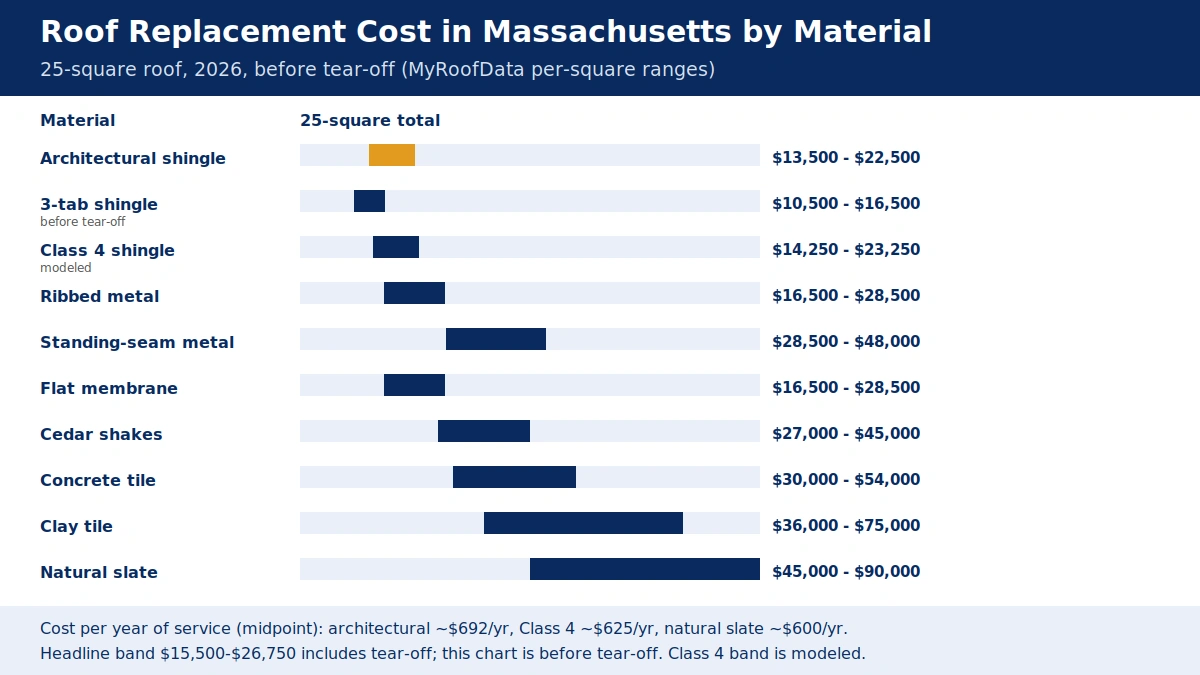
Material is the first decision, and in Massachusetts it is two decisions wearing one name: the snow decision in the hills and the historic-district decision in the old cities. In the west, the bargain shingle is the one that gives up first under a snow load it was never built for. The priciest metal is the one still sitting on the roof when the mortgage is paid off, letting snow slide instead of holding it. In Boston, Cambridge, and the South Coast, the decision is different again: a historic district can dictate the replacement material, and a slate or cedar roof the commission rejects is a roof bought twice. Below, a typical 25-square roof — 2,500 square feet of surface — is priced material by material, using figures verified for Massachusetts. The per-square figures come from MyRoofData, quoted before tear-off, and every 25-square total in the table is our own multiplication from them.
| Material | Per square, before tear-off | 25-square total | Realistic life in MA |
|---|---|---|---|
| 3-tab asphalt shingle | $420–$660 | $10,500–$16,500 | 15–20 yrs |
| Architectural asphalt shingle | $540–$900 | $13,500–$22,500 | 22–30 yrs |
| Class 4 impact-resistant shingle | $570–$930 a square (modeled) | $14,250–$23,250 | 25–35 yrs |
| Ribbed metal (exposed fastener) | $660–$1,140 | $16,500–$28,500 | 30–40 yrs |
| Standing-seam metal | $1,140–$1,920 a square | $28,500–$48,000 | 40–70 yrs |
| Flat membrane (TPO/EPDM) | $660–$1,140 | $16,500–$28,500 | 20–30 yrs |
| Cedar shakes and shingles | $1,080–$1,800 | $27,000–$45,000 | 25–35 yrs |
| Concrete tile | $1,200–$2,160 | $30,000–$54,000 | 40–75 yrs |
| Clay tile | $1,440–$3,000 | $36,000–$75,000 | 50–100 yrs |
| Natural slate | $1,800–$3,600 | $45,000–$90,000 | 75–150 yrs |
The 3-tab row carries a warning label. At MyRoofData’s $420–$660 a square before tear-off, the finished job always runs past the table once the old layer comes off — and of everything listed, 3-tab leaves the least room for Massachusetts weather to go wrong: one flat layer, the weakest wind rating here, and no impact rating worth naming. In a state where the freeze-thaw cycle loosens every sealant strip and flashing lap a little more each winter, the few thousand dollars saved by choosing 3-tab just pre-pays the next deductible. It still fits somewhere — a rental, a shed, a house changing hands within a few years. For a home the owner means to keep through ten Massachusetts winters, it is the wrong default.
Roughly three of every four American homes wear architectural shingles, and Massachusetts follows the same pattern. These thicker dimensional shingles carry a 110-to-130-mile-per-hour wind rating when the crew follows the maker’s high-wind nailing pattern, and the $540–$900-a-square band is the one the headline figure is built on. Plan on 22 to 30 real years from it here, not the 30 the brochure prints. Ice dams push water back under the courses, and the freeze-thaw cycle works the flashing open. At year twelve, a roof that looks sound can be one February thaw from a leak. Do not set this table straight against the headline band: $15,500–$26,750 covers tear-off, while $13,500–$22,500 leaves it out — tear-off, permits, and disposal make up the gap, and any bid that folds those costs into the per-square price cannot be set beside another bid at all.
The Class 4 row is modeled, and this guide says so plainly. No Massachusetts-specific Class 4 premium was verified in this pass, so the band is built the way art. 124 built Illinois’s: a Michigan insurance agent’s 2026 figure of roughly $30 more per square than standard architectural shingles, applied to the Massachusetts architectural band to give $570–$930 a square, or $14,250–$23,250 for 25 squares. The asphalt is SBS-modified, rubberized so it stays flexible through a Massachusetts freeze and absorbs a strike instead of splitting. UL 2218 Class 4 is the test: a two-inch steel ball drops twenty feet onto the shingle, which must come through without cracking or fracturing. Class 4 is not hail-proof, and in Massachusetts the hail case is weaker than in the Midwest anyway — RoofingEstimatorPros rates the state’s hail risk low. What Class 4 buys here is different: flex through the freeze-thaw cycle, resistance to wind-driven debris off a nor’easter, and the insurance discount on the wind and hail portion of the premium. Get the discount confirmed in writing by your own insurer before signing anything, because a contractor-quoted discount is fiction until the carrier puts it in writing. The Class 4 section below works through the full case.
Metal is where the western Massachusetts market splits from the Boston market. Ribbed metal, fastened through the panel face, comes in at $660–$1,140 a square in Massachusetts — $16,500–$28,500 over 25 squares — with a service life of 30 to 40 years. Standing-seam metal, the concealed-fastener system, runs $1,140–$1,920 a square in this state — $28,500–$48,000 for the same 25 squares — and keeps going for 40 to 70 years. SmartRoofingCalculator cross-checks standing seam at $1,000–$1,560 a square in Massachusetts. Metal sheds snow the way no asphalt does, hail cannot bruise a metal panel the way it bruises a shingle mat, and there is no granular surface for freeze-thaw to wear away. Work it out per year of service and the table flips: standing seam runs about $695 a year at the midpoints, against about $692 for architectural shingles and about $643 for ribbed metal. Metal looks dear on the quote and cheap on the calendar — and across the Berkshires, which one cost model calls snow country outright, it is the standard choice, not the upgrade. Our metal roof cost guide prices the metal choice in full. Our metal vs shingles comparison takes the comparison further.
Flat membrane belongs in this table because so much of Massachusetts’s housing stock is flat-roofed at the edges — the low-slope sections over porches, additions, and mid-century homes, and the flat roofs of Boston’s triple-deckers. TPO and EPDM both sit in the $660–$1,140-a-square band — $16,500–$28,500 across 25 squares — with 20 to 30 realistic years in them. Standing water, not snow load, is what kills a membrane: a flat roof still ponding two days after rain puts its seams to the test on every storm, and the tapered insulation that cures the ponding has to be priced into this quote, not left for a later job. The flat-roof section below prices the Boston triple-decker job in full.
Cedar, tile, and slate are the Massachusetts luxury rows, and here they are priced from verified figures rather than left to local quote. Cedar shakes and shingles run $1,080–$1,800 a square, or $27,000–$45,000 for 25 squares, with 25 to 35 realistic years — beautiful on a Cape Cod or South Coast home, and demanding real maintenance, since cedar holds snow and debris in its gaps. Concrete tile runs $1,200–$2,160 a square, or $30,000–$54,000, and clay tile $1,440–$3,000 a square, or $36,000–$75,000 — both heavy enough that the structure often needs an engineering check before a switch from shingles, and both rare in Massachusetts for that reason as much as for price. Natural slate runs $1,800–$3,600 a square, or $45,000–$90,000 for 25 squares, lasting 75 to 150 years — a lifetime roof, and the most expensive common material, where weight and specialist labor drive the price. Slate is also the material a historic district is most likely to demand: in Boston, Cambridge, and the South Coast, the district can dictate slate or cedar, so get the material approved before the quote, because a roof the commission rejects is a roof bought twice. Tile pricing, materials, and lifespans are covered in our tile roof cost guide.
Read the table a different way and it says something else. Measured per year of service, the smallest quote in Massachusetts is not the cheapest roof. At the midpoints, 3-tab costs about $771 a year, architectural about $692, Class 4 about $625, ribbed metal about $643, standing seam about $695, flat membrane about $900, cedar about $1,200, concrete tile about $675, clay tile about $740, and natural slate about $600. All of those are our own arithmetic — each midpoint total divided by its midpoint realistic life — and they leave out two things: the deductibles an avoided claim never triggers, and the snow-shedding that is metal’s real payoff. Set the material table beside the insurance section when you read it — each one corrects the other, and neither tells the truth on its own.
Roof Replacement Cost by Roof Size
Size is the second decision, and the one where quotes measure the wrong thing most often. Every bid prices roof surface. None of them prices living area. Take a 2,000-square-foot single-story ranch: about 2,000 square feet of footprint sits under its roof, and pitch, overhangs, and waste usually lift that to 20–25 squares of surface. Two stories of the same 2,000 square feet stand on a footprint near 1,000 square feet. The roof surface is roughly half the ranch’s — although the listing describes both houses the same way. Insist that every bid print the square count as its own line; treat a bid without it as incomplete. A bid built on living area has priced the wrong house.
The size table below uses the SmartRoofingCalculator architectural band of $500–$720 a square, installed with tear-off, applied to the roof sizes Massachusetts homeowners actually own. The headline lives in the 25-square row, and the 20-square row is the check on it: $10,000–$14,400 straight from the per-square band, set against RoofingEstimatorPros’ $17,520–$31,115 for a 2,000 square foot roof installed — tear-off, permits, waste, and labor make up the gap between them, and the gap is widest in Boston, where labor runs at 1.60 times the national mean.
| Roof surface | Typical home | Architectural, tear-off included | Standing seam, before tear-off |
|---|---|---|---|
| 15 squares | Small ranch / cottage | $7,500–$10,800 | $17,100–$28,800 |
| 20 squares | 2,000 sq ft single-story ranch | $10,000–$14,400 | $22,800–$38,400 |
| 25 squares | Typical MA home | $12,500–$18,000 | $28,500–$48,000 |
| 30 squares | Large two-story Colonial | $15,000–$21,600 | $34,200–$57,600 |
| 35 squares | Large home, cut-up roof | $17,500–$25,200 | $39,900–$67,200 |
| 40 squares | Very large / steep | $20,000–$28,800 | $45,600–$76,800 |
Three things push a job off this table. Pitch is the first: a steep 10/12 or 12/12 roof costs more per square than a walkable 4/12, because the crew works slower and stages differently — and in Massachusetts, a steep roof is the norm rather than the exception, since the old Colonial and Cape rooflines were drawn steep to shed snow. After pitch comes complexity: every valley, dormer, skylight, and chimney means another flashing detail, and flashing details are where rushed work leaks first. One square count, two roofs — one plain gable, one cut to pieces — and still two different jobs at two different prices. Decking is third in line: the rot in the sheathing only shows itself when the old shingles come off, and the price is per sheet on the day. No Massachusetts-specific deck-sheet price was verified in this pass, so get the per-sheet deck rate in writing before the tear-off starts, because a Boston deck repair discovered mid-job, with the crew already on the scaffold, is priced at whatever the contractor says it is.
The budget starts from the roof’s own measurements. Start with the footprint. The pitch factor comes next — near 1.15 at 6/12, near 1.25 at 8/12 — then 10 percent for waste, then divide by 100 for squares. Every bid should print the measured figure. Compare square counts before prices — the prices only mean something once the counts agree. And in Boston, ask for the access line itemized separately: the permit, the narrow-street staging, and the triple-decker access are real costs that belong on the quote as their own lines, not buried inside the per-square price where they cannot be questioned.
Roof Replacement Cost by City: Boston vs Worcester vs Springfield vs Cambridge vs Lowell
Massachusetts holds two roofing markets inside one state line, and the price follows the labor and the access, not the skyline. Boston, with its triple-deckers and narrow streets, is the most expensive market in the state and the mildest climate. Cambridge sits a step below Boston on price and a step above it on historic-district rules. Worcester, in the center of the state, is the snowiest big city and a middle market. Springfield, in the Connecticut River valley, is the cheapest of the big five. Lowell, the old mill city, sits in the middle — old housing, moderate prices, and a roofline shaped by nineteenth-century mills.
| City / region | 2,000 sq ft arch roof | Market note |
|---|---|---|
| Boston | $21,192–$37,234 (avg $28,322) | Highest labor, permits $500–$1,800, triple-decker access |
| Cambridge (metro) | $14,000–$24,000 (Modernize metro band) | Historic districts, slate/cedar rules, Boston wages |
| Worcester | No verified figure pulled | Snowiest big city, ~73 in/yr, middle market |
| Springfield | No verified figure pulled | Connecticut River valley, cheapest of the big five |
| Lowell | No verified figure pulled | Old mill-city housing, moderate prices |
| Cape Cod / South Coast | No verified figure pulled | Coastal wind zones, cedar/slate districts, access premiums |
Boston is the most expensive market in the state, served by the most crews, at $21,192–$37,234 for a 2,000 square foot architectural roof on RoofingEstimatorPros’ figures, averaging $28,322. Labor in Boston runs at 1.60 times the national mean, and the local cost multiplier at 1.44 times. SmartRoofingCalculator cross-checks Boston at $17,500–$25,200 for a 25-square roof, or $700–$1,008 a square — about 40 percent above the state baseline. The two sources disagree on the size of the Boston premium — RoofingEstimatorPros puts Boston about 18 percent above the state average, SmartRoofingCalculator about 40 percent above the state baseline — and both are printed here rather than settled, because they measure different baselines. It is also the mildest corner of the state: roughly 49 inches of snow a year, the lowest figure among the big five, and the warmest winters anywhere in Massachusetts. The permit runs $500–$1,800, and the access bill — narrow streets, triple-decker staging, no driveway to park the truck in — is the line item that never appears in a national cost guide and always appears on a Boston invoice.
Cambridge prices inside the Boston-Cambridge-Newton metro band: Modernize puts a 2,000 square foot roof there at $14,000–$24,000, with a 1,500 square foot roof at $11,000–$18,000 and a 2,500 square foot roof at $18,000–$30,000. The saving against Boston proper is an access figure, not a risk figure: the lots are bigger, the truck parks in the driveway, and the scaffold is smaller — but the historic-district rules are just as strict, with Cambridge among the cities where a district can dictate slate or cedar, and the wind off the Charles drives rain sideways into flashing that a sheltered inland roof never tests. A Cambridge quote has to name the flashing scope explicitly, and a Cambridge roof wants an inspection after the first big November nor’easter, not after the first leak.
Worcester carries a warning label rather than a verified price at the 2,000 square foot size. No verified figure for that size turned up in this pass, and the guide invents none. What can be said honestly is the shape of the market: the snowiest big city in the state at about 73 inches a year on the 1991–2020 normals, a middle market on price, and a housing stock old enough that deck work is found at tear-off more often than not. In Worcester, collect three quotes, with at least one from a company that keeps a permanent shop within an hour’s drive. When the crew is two counties away, warranty service is a promise that gets expensive to keep.
Springfield is the cheapest of the big five by the shape of the market, though no verified city figure was pulled for it either. The Connecticut River valley traps less snow than the Worcester hills, the labor market runs cooler than Boston’s, and the housing stock — while old — sits on wider lots with easier access. The same caveat applies as in Worcester: get three quotes, and make at least one of them local.
Lowell sits in the middle, and its story is the mill story. The old mill-city housing — dense, nineteenth-century, steep-roofed — means more flashing details per square than a suburban ranch, and more deck work found at tear-off. No verified Lowell figure was pulled in this pass. Price it like Worcester: middle market, old housing, three quotes, one of them local.
Cape Cod and the South Coast carry a different premium again: coastal wind-zone requirements, cedar and slate districts, and access that gets harder the further down the Cape the house sits. Massachusetts Roof Pros flags Boston and Cape access as a setup-cost driver, and MyRoofData flags Cape and coastal homes for wind-zone requirements. No verified Cape Cod city figure was pulled, and none is invented here.
Price per square is the way to judge cities, never the headline total. Boston at $28,322 looks more expensive than a Worcester roof at the state average, but the gap disappears once pitch, deck condition, and material are held equal — and what remains is the access bill and the labor bill, not the shingle bill. The real city difference is not price. It is exposure: Worcester gets half again as much snow as Boston, the Cape gets the coastal wind, Cambridge gets the historic-district rules, and the western towns get neither the competition nor the fast scheduling, which is why their quotes deserve the closest reading of all.
Why Massachusetts Roofs Cost What They Do: Snow, Ice Dams & Coastal Wind
Four forces decide what a Massachusetts roof costs; the weather supplies three of them, and the code supplies the fourth. Snow is the first and the heaviest. Ice dams come second as a force, and fixing them costs the most. Coastal wind off the Atlantic is the third, and the one that only the Cape and the South Coast feel in full. The last force is the market itself — Boston wages in the east, a short season and long drives in the Berkshires — and it decides how quickly any of the other three gets fixed.
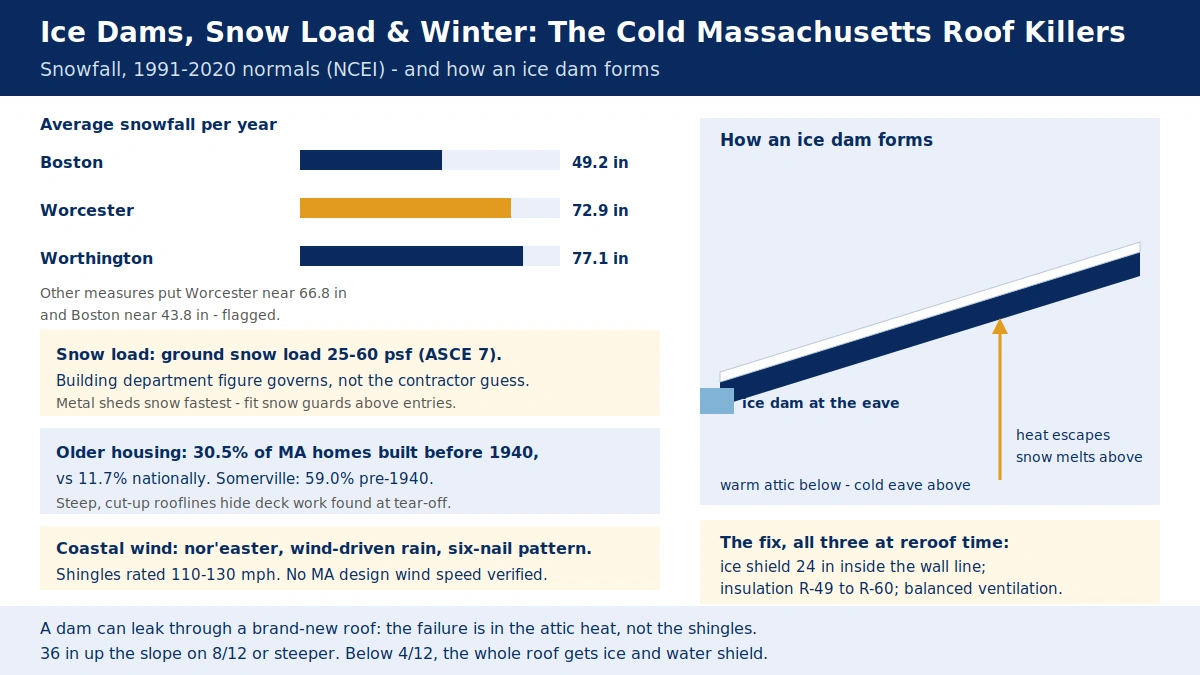
Snow. Massachusetts is a snow-gradient state, and the numbers leave no room for doubt. On the 1991–2020 normals, Boston averages about 49.2 inches of snow a year, Worcester about 72.9, and Worthington in the western hills about 77.1 — and another measure puts Worcester’s full-season average near 66.8 inches and Boston’s near 43.8, which still leaves Worcester the snowiest big city in the state by a wide margin. What makes the snow so heavy here is the nor’easter: a storm that forms off the mid-Atlantic, rides up the coast, and drops heavy wet snow across the whole state at once, with the heaviest totals inland where the cold air holds. Snow is weight, and weight is structure. Snow load all winter, an ice dam at the eave, freeze-thaw at every joint — a roof that takes all three needs deck, underlayment, and ventilation chosen for the load, not for looks. Ground snow loads in Massachusetts run from about 25 to over 50 pounds per square foot under ASCE 7, and no single statewide number exists, because the load is set town by town — the building department’s figure governs, not the contractor’s guess. That detail gets taken apart in the ice-dam section further down.
Ice dams. An ice dam is the most expensive winter failure a Massachusetts homeowner faces — and the easiest to head off. A February emergency call for a leaking dam runs several times the cost of October air-sealing and attic ventilation. In the next section, how it works gets the full treatment: heat escaping into the attic, meltwater refreezing at the cold eave, water backing up under the shingles. Water damage from frozen pipes and ice dams is the claim type that sets Massachusetts apart from milder markets. Most standard HO-3 policies cover the sudden interior water damage, minus the deductible.
Coastal wind. The Cape and the South Coast face a wind the inland cities never meet. A nor’easter drives rain sideways into flashing, lifts tabs that a sheltered inland roof would hold, and tests every seam on a house that faces open water. MyRoofData flags Cape and coastal homes for wind-zone requirements, and the defense is the same as anywhere the wind runs hard: the six-nail high-wind pattern, a high-wind starter course, and a shingle rated 110 to 130 miles per hour fitted exactly as the manufacturer specifies. This guide gives no Massachusetts-specific design wind speed of its own — none was verified — so the building department’s figure governs, not the installer’s guess. On the Cape, the quote has to spell out the flashing scope, and the roof wants an inspection after the first big November nor’easter, not after the first leak shows up inside.
The old housing stock. The fourth force is not weather at all. It is age. About 30.5 percent of Massachusetts housing units were built before 1940, against 11.7 percent nationally, and in Greater Boston the share is 34.5 percent — Somerville 59.0 percent, Belmont 57.1 percent, Winthrop 55.1 percent, Newton 48.8 percent, Cambridge 47.0 percent, Boston 46.7 percent. Those houses carry steep, cut-up rooflines, board sheathing instead of plywood, chimneys and dormers on every slope, and flashing details that a flat suburban ranch never has. A reroof on a 1920s Colonial is a different job from a reroof on a 1990s ranch at the same square count, and the quote knows it even when the homeowner does not. The deck work the old roof hides — rotted boards, sistered rafters, a chimney flashing tarred over three times — is found at tear-off, and it is billed per sheet on the day.
The market. The final force is labor and logistics. Massachusetts roofing crews bill $70–$115 an hour, and Boston’s labor multiplier runs to 1.60 times the national mean. That is plenty in a quiet month. In the weeks after a nor’easter it is not, and the shortage shows up twice over: prices climb, and the wait gets longer. The Berkshires change the shape of the constraint: a short season, long drives, and a crew that bills for the two-hour trip to reach the job. The install season runs roughly April through October statewide, with the best installs in the shoulder months — April and May before the storm peak, September and October after it ends.
Ice Dams, Snow Load & Winter: The Cold Massachusetts Roof Killers
Winter does the slow damage in Massachusetts. Every winter, the same sequence builds an ice dam. Warmth drifting from the living space into the attic heats the underside of the deck, and the bottom layer of snow on the upper slope starts to melt. The meltwater runs down to the eave, past the warm wall, until it reaches deck that has gone cold again — and there it freezes into a ridge of ice. The next melt has nowhere to go. Behind the ridge, water ponds, works back under the shingles, and gets inside — through the sheathing, down the wall, into the ceiling — showing up as a brown March stain, or worse. A roof installed last month can still leak from an ice dam, because the failure sits nowhere near the shingles. Blame the heat and stale air in the attic, not the shingles — they did nothing wrong.
Three layers of defense exist. All three belong on the reroof, not in a later project. The first layer is the ice and water shield — a self-adhering membrane laid along the eaves, in the valleys, and around every penetration, running from the edge past the inside face of the exterior wall. The Massachusetts Residential Code adopts the International Residential Code’s ice-barrier rule, so the shield must reach at least 24 inches inside the wall line. Where a winter drops seventy-odd inches, the membrane should run past the minimum on a low-slope roof, and the quote should name the distance. One 36-inch roll is often too narrow on a deep-overhang or low-pitch roof: a 6/12 roof with a 12-inch overhang needs about 47 inches up the slope from the drip edge to reach the code line, so Worcester crews actually lay two courses, six feet of membrane. On roofs below 4/12 but above 2/12, the code answer is stricter still — the whole roof gets covered with ice and water shield before any shingle goes on. Insulation is the second layer, and the aim is a cold attic: the ceiling must be insulated well enough to hold the roof deck near the outdoor temperature — R-49 to R-60 across Massachusetts’s climate zones, about 16 to 22 inches of blown-in fiberglass or cellulose — or the attic never stays cold. Ventilation is the third layer: soffit intake matched to ridge exhaust, keeping attic air moving and the deck temperature even. No other moment leaves all three layers open at once — only a reroof does. Lay new shingles over a hot, unventilated attic and another dam by February is all but guaranteed.
Snow load is the quieter winter risk. A roof in Worcester carries roughly six feet of snow in an average winter, and in a record winter the load is far higher — Boston’s record season ran past 100 inches in 2015, and Worcester’s snowiest season on record reached 131.9 inches. A roof in Boston carries about four feet in an average year. The load is more than today’s snowfall. The pile grows month by month — December drops it, January compresses it, February glazes it — and by March the roof is still carrying it when the next nor’easter adds another foot. The danger zones are the flat and low-slope stretches: they hold snow instead of shedding it, so a low-slope porch roof or a flat garage section can end up carrying twice what the main slope carries. For shedding snow, nothing beats metal, and a steep pitch beats a shallow one at the same job. Shedding has a downside, though: a slab of snow sliding off metal can tear a gutter away or bury a walkway. Snow guards above entries and walkways belong in the quote up front, not bolted on later.
From Worcester’s hills to the Cape’s coast, Massachusetts weather writes the install calendar — the contractor only reads it. The working season statewide runs April through October. The best installs land in the shoulder months — April and May before the storm season, September and October after it ends. November brings the nor’easter machine back to life: a crew can strip a roof in the morning and race a storm off the Atlantic by afternoon, so a good contractor watches the forecast like a farmer. January installs can work. SBS-modified shingles made them more practical than they used to be, but sealant strips need warmth to bond, and a crew that skips hand-sealing the tabs fits a roof that lifts in the first March wind. A roof that has to go on in winter raises two questions: how the crew seals the tabs, and what happens when the bond does not take.
One more winter note, for the coast only: wind off the Atlantic drives snow and rain sideways, and a south-facing slope on the Cape takes weather a sheltered inland roof never meets. A coastal quote has to spell out the flashing scope, and a coastal roof wants an inspection after the first big November storm, not after the first leak shows up.
Class 4 Impact-Resistant Shingles in Massachusetts: What the Upgrade Costs and What It Pays Back
If this guide kept one piece of advice for the Massachusetts homeowner, it would be this: get the Class 4 upgrade priced on every asphalt quote, and take it unless the numbers say no. The case is different here than in the hail states — the hail risk is low, and the upgrade earns its keep another way — but it earns its keep all the same, because the freeze-thaw cycle and the nor’easter do the work in Massachusetts that hail does in Illinois.
What it is. On the Underwriters Laboratories UL 2218 impact-resistance scale, Class 4 is the top grade. The test itself is simple: a two-inch steel ball is dropped twenty feet onto the shingle. That is about what a golf-ball hailstone does at terminal velocity. The shingle has to come through it whole — no cracking, no fracturing. The flex comes from SBS-modified asphalt, a rubberized mix that stays bendable in a freeze and swallows a strike instead of splitting. GAF Timberline AS II, CertainTeed Landmark IR, and Owens Corning Duration STORM are the Class 4 lines Massachusetts shelves carry. Class 4 does not mean hail-proof. But most of the damage a Massachusetts roof takes is not hail at all — it is wind-driven debris off a nor’easter, and freeze-thaw working a stiff shingle mat until it cracks — and that is exactly where the rubberized mat distinguishes itself.
What it costs. No Massachusetts-specific Class 4 premium turned up in this pass, and this guide invents none. The figure it uses is modeled, not measured: a Michigan insurance agent’s 2026 figures put the upgrade at roughly $30 more per square than standard architectural shingles. Apply that to the Massachusetts architectural band of $540–$900 a square and the modeled Class 4 band is $570–$930 a square, or $14,250–$23,250 for a 25-square roof. The national guides quote a bigger premium — 10 to 25 percent, or $1,000 to $2,500 on a typical house — so the Michigan agent’s $30-a-square figure is the lowest published number there is. Treat the Massachusetts band as planning arithmetic, not a verified Massachusetts price, and get the real premium on the quote.
What it pays back. The payback comes in two streams, and the second outweighs the first. First comes the life: 25 to 35 realistic years for Class 4, against 22 to 30 for standard architectural shingles, which means the upgrade buys three to five extra years on the roof. At the midpoints, Class 4 works out near $625 per year of service, against near $692 for architectural shingles — the upgrade costs less per year even though it costs more on the quote. Second comes the avoided damage: a roof that stays flexible through the freeze-thaw cycle does not crack in February, a roof that does not crack does not leak in March, and a roof that does not leak does not generate the deductible payment or the interior repair that follows. A single avoided ice-dam claim can pay for a meaningful share of the upgrade by itself. The insurance discount, where the carrier offers one for Class 4, is the bonus on top — published ranges run from 5–20 percent to 20–30 percent off the wind and hail portion depending on the source, and no named carrier’s Massachusetts figure was verified, so get it confirmed in writing by your own insurer before signing anything, because a contractor-quoted discount is fiction until the carrier puts it in writing.
When it is not worth it. Three situations take the case away from Class 4. A flat or nearly flat roof, where the impact rating cannot help a membrane that has nowhere to shed — the flat-roof section below is the right answer there, not Class 4. A house heading for the market within a few years rarely earns the upgrade back from the buyer — even so, a transferable warranty and a documented service life can still strengthen the listing. And a home under heavy tree cover, where branches fall and shade holds snow on the roof longer than the shingles can shed it. For everyone else — the long-term owner, the house that has already had one ice-dam claim, the Worcester home with seventy inches a year — Class 4 is the default, not the upgrade.
How to buy it. Put the product on the quote — manufacturer, exact shingle line, and the UL 2218 Class 4 marking — and file the warranty paperwork with the job records. Ask about the snow guards too: even a Class 4 roof sheds snow in slabs off a steep slope, and a slab coming down can rip off a gutter or bury a walkway, so the guards above entries and walkways go in the quote, not on afterwards. And ask about the crew: Class 4 is a specialist install in the sense that the nailing pattern and the starter course matter more, not less, and a crew that lays asphalt all week and Class 4 once a quarter is a crew that will take twice as long and leave twice the callbacks. The extended warranty holds only when a credentialed crew does the install. That is one more reason to doubt that the cheapest bidder is the cheapest roof.
Flat Roofs & Historic Roofs: Boston Triple-Deckers, Cape Cod & Slate Districts
Massachusetts keeps two roof worlds that a pitched-roof guide never prices, and both of them live in this state in unusual numbers. The first is the flat roof of the Boston triple-decker. The second is the slate or cedar roof of the historic district. A cost guide that prices only shingles misses both, and a homeowner who buys a shingle quote for either has bought the wrong material for the wrong roof.
What a Boston flat roof costs. No verified Boston flat-roof total was pulled in this pass, so this section prices the membrane from the statewide table and says so plainly: TPO and EPDM run $660–$1,140 a square on MyRoofData’s Massachusetts figures, or $16,500–$28,500 for a 25-square roof, lasting 20 to 30 realistic years. The triple-decker changes the arithmetic in two ways. First, the roof is small — a three-story building with a footprint of 1,000 square feet carries only about 10 to 12 squares of roof — so the per-square price matters more than the total. Second, the access is the job: a flat roof three stories up behind a narrow Boston street, with materials arriving by hoist and debris leaving by chute, costs more to stage than a suburban ranch with a driveway. Get the access itemized on the quote as its own line. Access buried inside the per-square price makes the quote impossible to compare with anything, and access left out entirely is a quote that grows by change order.
The membrane choice. Three membranes cover nearly every Boston flat roof, and what the roof is used for matters as much as its price. TPO — thermoplastic polyolefin, the white single-ply membrane — falls in the $660–$1,140-a-square band from the material table. It reflects summer heat, so it suits a roof that bakes in July. EPDM — the black rubber membrane — sits in the same band and flexes through a freeze without cracking. It suits a roof that has to get through January. Modified bitumen — the torch-down or cold-applied layered system — is the old Boston standard. It is heavier and thicker than the single-ply membranes, and the one most likely to already be on the roof being torn off. Ponding is the membrane’s enemy. A flat roof that holds water for more than 48 hours after rain has seams being tested on every storm, and the tapered insulation that fixes the ponding belongs in the quote. Get the membrane by name, the seam method, and the tapered insulation scope in writing — and check whether the quote includes the parapet flashing. A membrane that stops short of the parapet cap is a leak waiting for the next storm.
The historic-district roof. The second world is the slate and cedar roof, and it is the one that surprises first-timers most. In Boston, Cambridge, and the South Coast, a historic district can dictate the replacement material — slate or cedar, not architectural shingles — and the district’s say comes before the contractor’s quote, not after it. Natural slate runs $1,800–$3,600 a square, or $45,000–$90,000 for a 25-square roof, and cedar $1,080–$1,800 a square, or $27,000–$45,000. Both need a structure verified to carry them plus a snow load, and both need a crew that lays the material regularly: few Massachusetts roofers lay slate every week, and a slate roof fitted by a crew that rarely touches the material is a thaw-season leak waiting to happen. The old housing stock makes the point sharper: with 30.5 percent of the state’s homes built before 1940, and Somerville at 59.0 percent, a Massachusetts reroof is more likely than anywhere else in the series to sit on a house old enough for the district to care about. Check the district rules before the quote, not after the deposit — the one-third deposit cap in Chapter 142A does not protect a deposit paid on a roof the district then rejects.
When the flat roof is not a flat roof. A pitched main roof over the house and a flat or low-slope section over the porch, the addition, or the garage — many Massachusetts homes carry both. That junction — where shingle meets membrane — is where the first spring rain finds a leak. It belongs in the quote as a named flashing detail, not as a line buried under miscellaneous. The same applies to the roof over a triple-decker’s rear porch. The flat section carries its own square footage, its own membrane, and its own inspection schedule — the same schedule as the pitched roof.
Permits & Code: 780 CMR, Ice Barrier & HIC Registration
Massachusetts runs its permits and codes from the capital, which sets it apart from the states in this series that leave everything to the town. The state has a single statewide building code, 780 CMR, modeled on the International Residential Code — but the permits, the inspections, and the contractor credentials all sit in different offices, and a roof answers to all of them at once. A roof that satisfies the code but not the registration rules is still an illegal job.
The code comes from the state; the permit comes from the town. Roof construction and replacements across Massachusetts are regulated under 780 CMR, the Massachusetts State Building Code, which adopts the International Residential Code’s roofing provisions, with the state’s own amendments. Wind speed and snow load matter most of all the design values, and both come out of the code’s tables and maps, as read by the local building department. Ground snow loads run from about 25 to over 50 pounds per square foot under ASCE 7, and no single statewide number exists, because the load is set town by town. Beyond the general code figure, this guide verified no Massachusetts-specific design wind speed. The building department’s figure is the one that governs, not the installer’s guess.
The ice barrier is mandatory. The code’s ice-barrier rule requires an ice barrier in areas with a history of ice forming along the eaves — which covers all of Massachusetts. Two layers of underlayment cemented together, or a self-adhering polymer-modified bitumen sheet — that is the barrier itself. It runs from the lowest edges of every roof surface to at least 24 inches inside the exterior wall line. Steep slopes get a second measurement: once the pitch hits 8 in 12, the membrane has to climb 36 inches up from the eave edge. On roofs below 4/12 but above 2/12, the whole roof must be covered with ice and water shield before shingles go on. Every Massachusetts bid should carry three code-driven items, and a bid without any of them is one to walk away from. Every bid should show ice and water shield — on the eaves, in the valleys, around the penetrations — reaching at least 24 inches inside the exterior wall line. Drip edge at the eaves and rakes. Where the wind hits hardest in this state, the shingles want the six-nail high-wind fastening pattern. Skip the ice barrier on the bid and the roof leaks come February. Skip the drip edge on the bid and the fascia rots. Four nails where the manufacturer calls for six is a roof that lifts in the next nor’easter.
No full replacement starts without a permit in hand. A permit is required for a complete roof replacement everywhere in Massachusetts, and the fee turns on the town and the job’s valuation. MyRoofData puts the statewide permit range at $150–$600. RoofingEstimatorPros puts it at $350–$1,100 statewide, and $500–$1,800 in Boston. SmartRoofingCalculator’s calculator starts from about $380, and TallySquare from a $265 baseline. Swapping a handful of shingles or resealing a flashing joint rarely needs a permit here. Anything structural — decking, a full tear-off, a change of material — always does. Pulling the permit and booking the inspection is the contractor’s job; one who hands it to the homeowner does not do this work often enough.
Registration and license — two credentials, not one. This is the rule that catches every newcomer by surprise, and it gets its own section below. Massachusetts requires every roofer to hold two separate credentials: a Home Improvement Contractor registration with the Office of Consumer Affairs and Business Regulation, and a Construction Supervisor License for the roofing work itself. The permit section and the hiring section belong together: the permit is the building department’s check on the roof, and the registration and license are the state’s check on the contractor — and in Massachusetts, unlike New York, both of them exist.
Hiring a Roofer in Massachusetts: HIC, CSL & the One-Third Deposit Rule
Massachusetts licenses its roofers twice over, and that fact changes the hiring job completely. Where no such license exists, the homeowner assembles the screening alone, from nothing. In Massachusetts, the state built the filter first: a registration, a supervisor license, a deposit cap, and an advertising rule behind every legal bid. The homeowner’s job is using that filter; checking what it misses is the rest.
What exists, credential by credential. The Home Improvement Contractor registration comes first. Under Massachusetts General Laws Chapter 142A, every contractor performing home improvement work valued at more than $1,000 must register with the Office of Consumer Affairs and Business Regulation as a Home Improvement Contractor. Roofing work, by its nature, almost always exceeds that threshold, which means any roofer working on the property must hold a valid, current HIC registration. Verify it at mass.gov/hic before signing anything, and check three things: that the registration is current, that the business name on the registration matches the contract’s exactly, and that the registration number appears on the quote — Chapter 142A, Section 17 makes it a violation to publish any advertisement for home improvement work that leaves the number out. A contractor performing work over $1,000 without a valid HIC registration is operating illegally. (One secondary source cites a $500 exemption floor rather than $1,000; the $1,000 threshold is the one used here, and the conflict is flagged rather than settled.)
The Construction Supervisor License comes second, and it is the one that actually covers the roofing. Under Chapter 143, Section 94, the Board of Building Regulations and Standards issues CSLs, and the state’s own contractor chart lists new or replacement roofing as needing a CSL, an HIC registration, and a building permit, with a roofing CSL as the minimum. The Specialty CSL for Roof Covering covers construction, reconstruction, alteration, repair, and removal of roof coverings, including replacing up to 25 percent of the sheathing and sistering up to 25 percent of the roof rafters, and it applies to buildings of any use containing less than 35,000 cubic feet, to one- and two-family dwellings with their accessory structures, and to agricultural buildings. HIC and CSL are two different credentials, not two names for one: the HIC registration is the business registration for the contract, and the CSL is the supervisor’s license for the work. For most residential roof replacements, the contractor should hold both — the HIC registration directly, and either hold a CSL directly or have a CSL-licensed supervisor on staff for any structural work the tear-off uncovers.
What the credentials prove — and what they do not. An HIC registration proves the business is on the state’s books, where the registration can be looked up and revoked. A CSL proves the supervisor passed the state’s examination and carries at least three years of experience in the field. Neither proves the contractor is insured beyond the minimum, bonded beyond the minimum, or good at the work. Neither says anything about workers’ compensation, or whether the contractor has ever fitted the material on the quote. The credentials are the first filter, not the only one — and the deposit cap is the second. Chapter 142A bars a home improvement contractor from demanding or receiving more than one-third of the total contract price as a deposit before work begins. A contractor who wants half up front is a contractor whose cash flow is the homeowner’s risk, and the law says so.
Run the same five-point screen on all three bidders, wherever in the state they work. General liability insurance comes with proof: a certificate the carrier mails to you directly — never one the contractor hands over — with the business name the same as the contract’s. Workers’ compensation proof for the crew — the bidder has to carry it whenever it employs anyone, and in Massachusetts the penalties for an uninsured crew land on the homeowner’s property as often as on the contractor. A permanent local address and a local phone number in service since before the last storm. Three local references, all from your own county, with street addresses worth a drive past. Where it matters, manufacturer certification: GAF, Owens Corning, or CertainTeed credentialed installer status. Only a credentialed crew’s work carries the extended warranty. And all three bidders quote in writing on one identical spec sheet, so every price is for the same roof.
The contract is the protection the credentials are not. Chapter 142A governs every home improvement contract in Massachusetts: the contract must be in writing and must include the start and completion dates, a description of the work, the HIC registration number, and a payment schedule that respects the one-third deposit cap, among other requirements. Read the contract before signing, and go over the payment schedule twice. The door-to-door rule still applies on top of all that: three days to cancel a contract signed at the door, under the federal Cooling-Off Rule — which exists for exactly the moment a stranger knocks after a storm carrying a free-inspection agreement. Use it. Hold off on any contingency agreement until the adjuster has seen the roof — never sign one in the driveway.
The storm-chaser warning. Massachusetts is storm-chaser territory after a nor’easter, and the crews arrive within days of the event, knocking on doors in the damaged neighborhoods. Some are legitimate traveling crews. Many are not. The tells are always the same: a knock with a free-inspection agreement to sign on the spot, an out-of-state number and no office anywhere nearby, no HIC registration and no CSL, a promise that the deductible will somehow vanish, and a demand for a big payment before a single shingle comes off. A deductible waiver is a promise of insurance fraud carried out on your behalf. A contract built on it is one to leave unsigned.
The quote itself. A Massachusetts quote names each line: the manufacturer and the exact shingle line, the underlayment type, the ice and water shield coverage in feet from the eave, the drip edge, the ventilation scope, and the nailing pattern. It names the tear-off depth, the per-sheet deck replacement rate, the disposal, and the cleanup too — and in Boston, the access and the permit as their own lines. The roof surface goes on the quote in squares, priced as a total, so two bids compare square to square. Warranty terms belong on the quote too. Year counts for manufacturer and workmanship are separate, and each names the party that honors it. It should name the permit cost and the party pulling the permit, and it should show the HIC registration number on its face. And the quote should show no federal tax-credit line, because none exists in 2026. Work through our questions to ask a roofer guide — the complete question list — at the first contractor meeting.
Insurance: Deductibles, ACV vs RCV, the Roof-Age Rule & the Class 4 Discount
Insurance is the part of a Massachusetts roof that either earns its keep or delivers the nasty surprise — a policy that looked solid at signing can pay out far less than the homeowner counted on. The state’s exposure splits the same way its pricing does: the coast takes wind and water from nor’easters, the hills take snow load and ice dams, and the carrier prices both halves. The homeowner’s own policy is the standard every figure in this section gets held up against. Only the policy governs the claim. One honest fact sits at the top of this section, and it is good news for once: Massachusetts home insurance is cheap by national standards, because the state bans insurers from using credit scores to set home insurance prices.
The premium. Massachusetts homeowners pay less than the national average, and the studies agree on the direction even though they measure different coverage levels. NerdWallet, updated May 6, 2026, puts Massachusetts at $1,645 a year for $400,000 of dwelling coverage, against a national average of $2,490. InsuranceQuotes, with rates as of September 30, 2026, puts Massachusetts at $1,779 a year ($148 a month) for $300,000 of dwelling coverage, on a 2,000 square foot wood-frame house built in 1997 with a $1,000 deductible — up 2.0 percent since November 2025. The same source prices the three insurers it compared at $1,528 a year (Andover Companies), $1,608 (Commerce Insurance), and $2,201 (Amica) for the identical house — a $673-a-year gap for identical coverage, which is itself the argument for shopping the policy the way you shop the roof. The honest range for a standard Massachusetts policy is about $1,645–$1,779 a year, with the coverage level driving the gap — and the direction of travel is up, even from this low base.
The deductible. Most Massachusetts policies carry a $500-to-$5,000 standard deductible for most perils. A separate, higher wind-and-hail deductible now sits on top of that in many policies. The Insurance Information Institute puts the saving at 10 to 25 percent: raising the deductible from $500 to $1,000 typically cuts the premium by that much. The adjuster standing in the driveway is usually the first person to mention the percentage wind and hail deductible. Two percent of a $600,000 dwelling is $12,000 out of pocket before the insurer pays anything on a wind claim — and on the Cape, where dwelling values run higher, the percentage deductible runs higher with them. No Massachusetts-specific percentage-deductible figure was verified for this guide, so none is given. Study the declarations page while the weather is calm, not after the storm.
The 15-year roof rule. That twist changes the replacement decision. Several major carriers now draw the line at fifteen years. Past it, the roof may move to depreciated actual-cash-value coverage, or the renewal may be declined. The arithmetic is brutal. Fifteen years in, an $18,000 roof has lost 30 percent of its value. With a $2,000 deductible, only about $10,600 reaches the homeowner — and $7,400 or more comes out of pocket. Before the next nor’easter arrives, get it from your carrier in writing: does your roof still settle at replacement cost, and at what age does that change? Past fifteen, with the policy gone ACV, the replacement decision looks different: the insurer will fund little of either the repair or the replacement, while a new roof resets the clock to replacement cost.
RCV vs ACV. Key number two is how the policy settles the roof: replacement cost value or actual cash value. Replacement cost means the insurer pays for a new roof, minus the deductible, whatever the old roof’s age. Actual cash value prices the roof the other way: what it was worth on the day of the damage, which is the new-roof cost minus depreciation — and shingles lose value fast. What follows is our own worked example — no regulator published it — built on an $18,000 roof (the midpoint of the Massachusetts architectural band), a $2,000 flat deductible, and straight-line depreciation of 2 percent a year across a 25-year shingle life.
| Age of roof | What RCV pays | What ACV pays |
|---|---|---|
| Any age | $16,000 | — |
| 5 years | — | $14,200 |
| 10 years | — | $12,400 |
| 15 years | — | $10,600 |
| 20 years | — | $8,800 |
| 25 years | — | $7,000 |
The pattern is the warning. Five years in, actual cash value pays $1,800 less than replacement cost. At fifteen years, it is $5,400 less. Year twenty-five pays $7,000 on an $18,000 roof — barely two-fifths of the cost — and the rest comes out of the homeowner’s pocket. With an ACV policy, the homeowner mostly carries the risk on an older roof, whether they realize it or not. Check the policy type before the storm. A roof past ten years on an ACV policy changes both the Class 4 upgrade and the replacement call, because the insurer will fund little of either one.
The claim, step by step. Before anyone touches the damage, photograph it — every slope, every gutter, every dented vent cap — and date every shot. Call the insurer before the contractor. The adjuster goes first, the contractor second — and reversing that order costs money. A driveway pitch for a contingency or assignment-of-benefits agreement gets a no. Ask for the adjuster’s report in writing, line items included. Then go over it against the contractor’s estimate, line by line. Keep the deductible ready in cash. No legitimate contractor waives it. No insurer covers it — ever. And keep the paperwork filed: product name, install photos, permit. Next year’s renewal depends on proving what sits on the roof.
The Class 4 discount, one more time. The discount is real and carrier-specific, and it applies only to the wind and hail portion of the premium where it exists at all. Published ranges run from 5–20 percent to 20–30 percent depending on the source, and no named carrier’s Massachusetts figure was verified for this guide, so none is given. Your own carrier gives the figure, in writing, with the qualifying product list and paperwork included — ahead of the install. A contractor-promised discount is not a discount until the carrier puts it in writing.

Paying for It: No Federal Credit in 2026 & Financing
Short version of the whole 2026 money story: the roof gets paid for by the homeowner and the insurer, and by nobody else. That is why a tax-credit line that does not exist still shows up on so many quotes. In 2026, a Massachusetts homeowner who replaces a roof gets nothing from the federal government and nothing from the state for the roof itself, and the federal rebate programs that do exist in Massachusetts pay for heat pumps and insulation — never for roofing.
The federal tax credit is $0. The One Big Beautiful Bill Act — Public Law 119-21, signed July 4, 2025 — shut down both credits for any property placed in service after December 31, 2025, per IRS fact sheet FS-2025-05, so a 2026 roof earns nothing from either the Residential Clean Energy Credit (§25D, 30 percent) or the Energy Efficient Home Improvement Credit (§25C). §25D never covered a roof, because roofing never counted as solar equipment; §25C was sometimes claimed for qualifying roofing materials, and that door has closed as well. When a 2026 quote still shows a tax-credit line, the contractor priced the job by a dead law — get the line taken out and the job re-priced. A different credit covers solar arrays and similar clean-electricity equipment — the commercial one, §48E. No lease or pass-through arrangement on record channels federal dollars toward a Massachusetts roof. None is claimed here. The federal rules as they stand in 2026 are set out in our federal energy tax credits guide. A roof paired with solar is a different job. Our solar panel cost in Massachusetts guide prices that pairing — but the solar credit is gone too, and the roof half never had one to lose.
HEAR and HOMES: not launched in Massachusetts, and never for a roof. Massachusetts was allocated about $72.8 million in HEAR funding and about $73.2 million in HOMES funding — roughly $145.9 million in total — and the Department of Energy Resources plans to deliver the federal HEAR rebates through Mass Save’s income-eligible and moderate-income offers. But as of November 9, 2026, the state’s federal funding page reports no launch, and Massachusetts is not among the 13 jurisdictions on the Department of Energy’s February 6, 2026 launched map. There is no application to file today, and the programs will not pay rebates retroactively, so a homeowner cannot install now and claim a rebate later. When HEAR does launch, it will pay up to $8,000 per heat pump for income-qualified households — and since the Energy Department’s Notice 26-2 of May 29, 2026, it pays only for electric-to-electric upgrades. Pair the reroof with an insulation upgrade and the insulation half may qualify. The roof itself never qualifies, in any town in the state, under any version of the program.
Mass Save is live — and it is the money that actually touches a reroof. Mass Save, the state’s utility-run efficiency program, is separate from HEAR and open today. Its 2026 whole-home heat pump rebate is $2,650 a ton, capped at $8,500 per home, and its partial-home rebate is $1,125 a ton, capped at $8,500. What matters for a roofer’s customer is the weatherization side: Mass Save covers insulation and air sealing at 75 percent off for most homeowners, and free for income-eligible households, and its 0 percent HEAT Loan finances up to $25,000 over seven years. A 2026 install has to be finished by December 31, 2026, with the rebate form received by February 28, 2027. The sequence that saves real money is the reroof plus the insulation job done together: the roof comes off, the attic gets air-sealed and insulated to R-49 or better at 75 percent off, the ventilation gets balanced, and the ice dams that would have formed in February never form. A Massachusetts homeowner who needs help paying for a roof in 2026 should look at a home-equity loan, the HEAT Loan, or a contractor financing plan. The annual percentage rate comes first in the reading; the monthly payment comes second. Our how to finance a new roof guide lays out the financing options — loans, contractor plans, and the annual percentage rate behind the monthly payment. A homeowner replacing a roof and a heating system in the same year should read our heat pump cost in Massachusetts guide before either quote is signed, because the insulation work that belongs under the new roof is the same work the heat pump needs to heat the house.
Repair vs Replace & Getting Quotes in Massachusetts: The Decision Rules and the Checklist
In Massachusetts, damage does not always mean replacement, and age does not always mean a repair will do. Age, damage, and the deductible decide it. In this state, so does the ice-dam forecast for the next five years, because a repaired roof that dams again in February is a repair paid for twice.
When the roof is young and the damage stays in one place, the right call is a repair, not a reroof. A roof no older than ten years that has lost a few shingles, sprung a leak at one chimney flashing, or had a few tabs lifted by wind gets a repair, not a replacement. The Massachusetts repair figures that were pulled put the scale in view: Angi prices Boston roof repair at an average of $1,229, with most homeowners paying $415–$2,058, and NumeralQ prices a Massachusetts flashing repair at $279–$590, a find-and-fix leak at $372–$1,040, a chimney flashing reflash at $384–$840, and a skylight leak at $382–$780. A Massachusetts contractor’s own figures put minor sealant work at about $200–$400, vent boots at $175–$500, and a full chimney flashing replacement at $800–$2,200. One storm, plainly dated, with the adjuster agreeing the rest of the roof has years left — a repair answers that case too.
Any one of the three — age, spread, or arithmetic — can settle it in favor of a new roof. Architectural shingles past fifteen years, with wind having lifted more than a quarter of the slopes, call for replacement, not repair. Patching a lifted mat only dresses up a roof that fails at the next storm anyway. A soft deck or sheathing that has come apart means replacement too — structure cannot be repaired, only replaced. Ice dams that return every winter, insulation and ventilation work notwithstanding, mean the system has failed, not the shingle. An insurer-paid claim does the same on a roof now old enough that the next claim pays ACV at two-fifths of the cost. Collect the replacement money while it is still replacement money. A roof about to cross the carrier’s fifteen-year trigger, with the policy about to go ACV, is a replacement too. A repair quote above about a third of the replacement quote settles it too, when the roof has less than five years of life left.
The inspection rhythm. Check the roof twice a year: once in late fall, when storm season ends, and once in late spring, before it begins. The fall check looks for what the summer’s wind and hail did, while the adjuster’s window is still open. Spring’s check is for what winter did — ice-dam and freeze-thaw damage — caught before the next storm season stacks a second round of problems on top. From the curb, a roof can look sound and still be far closer to failure than it seems after several Massachusetts winters. Bruising starts inside the mat, and it stays hidden until the shingle cracks. Our roof inspection cost guide covers what an inspection runs and what it finds, and our roof repair cost guide covers what the repair costs after it. Gutters that are part of the job are covered in our gutter installation cost guide.
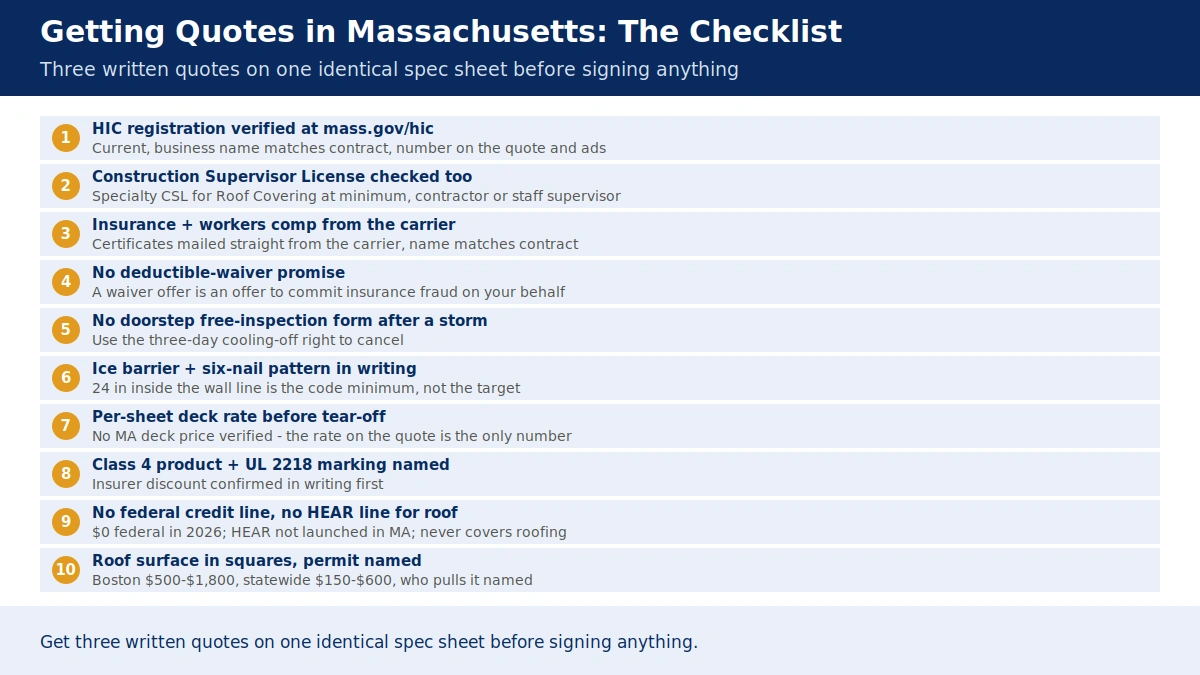
Three written quotes on one identical spec sheet, from three contractors whose HIC registration and CSL both check out, before signing anything. One sentence carries the entire checklist. The ten checks below put it to work.
- HIC registration verified at mass.gov/hic — current, business name matching the contract exactly, number printed on the quote and on every advertisement.
- Construction Supervisor License checked too — a Specialty CSL for Roof Covering at minimum, held by the contractor or by a supervisor on staff.
- Insurance and workers’ compensation certificates, mailed by the carrier itself, with the business name the same as the contract’s.
- No deductible-waiver promise. Anyone offering one is offering insurance fraud on your behalf.
- Walk away from any free-inspection form pushed on you at the door after a storm. That moment is exactly what the federal three-day cooling-off right exists for, so use it.
- In writing: the ice-barrier distance in feet from the eave, plus the six-nail high-wind pattern — the code asks for 24 inches inside the wall line as a floor, not a goal.
- Per-sheet deck rate in writing before tear-off. No Massachusetts-specific deck price was verified, so the rate on the quote is the only number that counts.
- Class 4 product name and UL 2218 marking named on the bid where Class 4 is quoted, with the insurer discount confirmed in writing first.
- No federal tax-credit line — $0 in 2026 — and no HEAR rebate line for the roof, since HEAR has not launched in Massachusetts and never covers roofing.
- Quote states the roof surface in squares, not the living area, with the permit cost and who pulls it named — Boston $500–$1,800, statewide $150–$600 on MyRoofData’s figures.
Sources & methodology
Cost anchors: MyRoofData — Massachusetts (2026 model: typical single-family arch roof $15,500–$26,750, tear-off of one layer included, ~20% above national average, state cost index x1.20; 3-tab $420–$660/sq, arch $540–$900/sq before tear-off, ribbed metal $660–$1,140, standing seam $1,140–$1,920, cedar $1,080–$1,800, concrete tile $1,200–$2,160, clay tile $1,440–$3,000, natural slate $1,800–$3,600, flat membrane $660–$1,140; crews $70–$115/hr; tear-off $100–$200/sq/layer; permits $150–$600; example 2,338 sq ft, 23.4 squares, $15,400–$26,600); SmartRoofingCalculator — Massachusetts (updated Nov 9, 2026: arch $500–$720/sq installed with tear-off; 25-square roof $12,500–$18,000; standing seam $1,000–$1,560/sq; tile $1,340–$2,010/sq; roofer median wage $34.79/hr, BLS OEWS May 2024; permit ~$380; state factor 1.115); SmartRoofingCalculator — Boston (25-square arch $17,500–$25,200, $700–$1,008/sq, local factor 1.40); RoofingEstimatorPros — Massachusetts (updated Aug 26, 2026: 2,000 sq ft arch $17,520–$31,115, avg $23,562, ~$11.78/sq ft, state multiplier 1.22x, labor 1.28x; permits $350–$1,100; storm risk high, hail risk low; 1–3 day install) and Boston (2,000 sq ft arch $21,192–$37,234, avg $28,322, ~$14.16/sq ft; local multiplier 1.44x, labor 1.60x; permits $500–$1,800; Boston ~18% above state average); Modernize — Massachusetts (updated Aug 27, 2026: most homeowners $11,000–$28,000; asphalt $6–$12/sq ft; Boston-Cambridge-Newton 1,500 sq ft $11,000–$18,000, 2,000 sq ft $14,000–$24,000, 2,500 sq ft $18,000–$30,000); Golden Group Roofing — MetroWest/Greater Boston (2026: 2,000 sq ft arch $15,000–$22,000, avg ~$17,000; ice and water shield adds ~$300–$600; 3-tab $350–$500/sq, arch $400–$850/sq, luxury asphalt $1,000–$1,600/sq); Massachusetts Roof Pros (arch asphalt $14,000–$35,000, $600–$1,000/sq; minor repair $350–$850; Boston/Cape access raises setup costs); TallySquare — Massachusetts (Aug 2026: typical single-story home $15,900–$22,000; labor multiplier 1.18x, highest in dataset; baseline permit $265; ice barrier 24 inches inside wall line, 36 inches on 8/12 or steeper, per MA Residential Code R905.1.2); Instant Roofer (avg $12,476, $5.26/sq ft — low anchor, flagged); This Old House 2026 survey (avg $7,361, most $5,748–$17,575 — low anchor, flagged). Our calculations produced the 25-square material totals, the size table, and the cost-per-year figures, built from the cited per-square ranges and lifespans. The Class 4 band is modeled arithmetic from a Michigan agent’s $30/sq premium — no Massachusetts-specific Class 4 premium was verified.
Climate + snow + ice + wind: snowfall 1991–2020 normals, NCEI via Current Results (Boston 49.2 in/yr; Worcester 72.9 in/yr; Worthington 77.1 in/yr); Worcester full-season average 66.8 in and Boston ~43.8 in by another measure (weathertotals/WROR) — flagged; Boston record season past 100 inches in 2015 (NWS seasonal report: 51.9 inches by Mar 1, 2022 vs 37.7 normal — the 2014–15 season total is cited from the record, flagged as a single-source figure); Worcester snowiest season 131.9 in (1995–96, weathertotals). Ground snow load 25–60 psf (ASCE 7-22). Ice barrier IRC R905.1.2 (24 inches inside the exterior wall line; 36 inches on 8/12 or steeper); low-slope rule (below 4/12, above 2/12: whole roof covered with ice and water shield — Beantown Home Inspection); 47-inch slope distance on a 6/12 roof with a 12-inch overhang (Fine Homebuilding). Insulation R-49 to R-60; ventilation 1:300. Shingle wind ratings 110–130 mph. No Massachusetts-specific design wind speed verified — none given.
Older housing stock: ACS 2020–2024, Census table B25034, via Art Slate Roofing review (Nov 8, 2026): 30.5% of MA units built before 1940 vs 11.7% nationally; Greater Boston 34.5%; Somerville 59.0%, Belmont 57.1%, Winthrop 55.1%, Newton 48.8%, Cambridge 47.0%, Boston 46.7%.
Permits + licensing: 780 CMR Massachusetts State Building Code (modeled on IRC); permits mandatory statewide (MyRoofData $150–$600; REP $350–$1,100 statewide, $500–$1,800 Boston; SRC ~$380; TallySquare $265 baseline). HIC registration: MGL c. 142A, OCABR (work over $1,000; verify at mass.gov/hic; number on all advertising per §17; one-third deposit cap); $500 exemption floor cited by one secondary source — conflict flagged. CSL: MGL c. 143 §94, BBRS/OPSI; mass.gov chart lists new/replacement roofing as CSL + HIC + permit required, roofing CSL minimum; Specialty CSL for Roof Covering covers up to 25% sheathing replacement and sistering up to 25% of rafters, buildings under 35,000 cubic feet; HIC fee $150 new / $100 renewal per one secondary source — unverified. Federal Cooling-Off Rule (3 days).
Labor: BLS OEWS May 2024 via SRC: MA roofer median $34.79/hr; MyRoofData crews $70–$115/hr; REP Boston labor multiplier 1.60x. No MA roofer headcount verified.
Insurance: NerdWallet (May 6, 2026: MA $1,645/yr at $400,000 dwelling; US avg $2,490; credit scoring banned in MA home insurance pricing); InsuranceQuotes (rates Sept 30, 2026, page updated Nov 2, 2026: MA $1,779/yr, $148/mo, at $300,000 dwelling, 2,000 sq ft wood-frame house built 1997, $1,000 deductible; Andover $1,528, Commerce $1,608, Amica $2,201; up 2.0% since Nov 2025); III (raising deductible $500 to $1,000 cuts premium 10–25%); 15-year roof-age ACV trigger (carrier practice, as in other states in this series); RCV/ACV table is labeled illustrative arithmetic on an $18,000 roof, the midpoint of the MA architectural band; Class 4 discount ranges 5–20% / 10–25% / 15–20% / 20–30% off the wind/hail portion by source, conflict flagged.
Class 4: UL 2218 Class 4 test (2-inch steel ball from 20 feet); upgrade cost modeled from Lifelong Insurance Agency, Michigan (May 4, 2026: ~$30 more per square — applied here as modeled arithmetic, no Massachusetts-specific premium verified); national guides (10–25% premium, $1,000–$2,500 on a typical house); products GAF Timberline AS II, CertainTeed Landmark IR, Owens Corning Duration STORM.
HEAR / HOMES + federal + Mass Save: MA HEAR/HOMES NOT launched: DOER plans delivery through Mass Save income-eligible/moderate-income offers; DOE federal funding page reports no launch (GridShift, read Nov 9, 2026); allocation ~$72.8M HEAR + ~$73.2M HOMES (~$145.9M total); 13 jurisdictions launched per DOE Feb 6, 2026 map, MA not among them; will not pay retroactively; HEAR up to $8,000 per heat pump, income-qualified, electric-to-electric only (DOE Notice 26-2, May 29, 2026 — some secondary catalogs list the notice under other dates; the DOE date is used here). Mass Save live (verified against Mass Save Sep 19, 2026): whole-home heat pump $2,650/ton up to $8,500; partial-home $1,125/ton up to $8,500; insulation/weatherization 75% off (100% income-eligible); HEAT Loan 0% up to $25,000; 2026 installs finish by Dec 31, 2026, rebate forms received by Feb 28, 2027. Both §25C and §25D ended for installs placed in service after Dec 31, 2025, under OBBBA (P.L. 119-21) and IRS FS-2025-05.
Repair costs: Angi Boston (updated Jul 31, 2026: avg $1,229, most $415–$2,058); NumeralQ MA (pricing Oct 26, 2026: flashing $279–$590; find-and-fix leak $372–$1,040; chimney reflash $384–$840; skylight leak $382–$780); MasterRoof MA (minor sealant ~$200–$400; vent boots $175–$500; full chimney flashing $800–$2,200). No Massachusetts-specific deck-sheet price verified — none given.
How we worked: the 25-square material totals, the size-table figures, the Class 4 totals, the cost-per-year numbers, and the RCV/ACV figures are all arithmetic of ours. Each one is worked from the cited per-square ranges and lifespans, and labeled as such. This guide flags the headline-cost disagreement, the Boston premium disagreement (REP ~18% vs SRC 40%), the snowfall measure spread (Boston 49.2 vs ~43.8; Worcester 72.9 vs 66.8), the HIC $1,000 vs $500 threshold conflict, the Class 4 discount disagreement, the modeled Class 4 band, and the city-pricing gaps (no verified Worcester, Springfield, Cambridge, Lowell, or Cape Cod city figure; no verified Massachusetts design wind speed; no verified Massachusetts repair or deck-sheet prices beyond the figures cited; no named carrier’s Massachusetts Class 4 discount; no Massachusetts roofer headcount). No Massachusetts-specific Class 4 premium, no Massachusetts-specific design wind speed, no Massachusetts-specific percentage wind/hail deductible figure, and no Massachusetts-specific deck-sheet price were verified, so none are given. The Massachusetts lifespans in this guide are contractor-consensus estimates, shaped by the snow, ice-dam, freeze-thaw, nor’easter, and coastal-wind climate. They are realistic figures, fitted to the Massachusetts climate — not numbers lifted from one published table.
*Disclaimer: The prices here are 2026 Massachusetts planning figures. The town, the roof, and the contractor each shift the numbers. Before you fix a budget, get three written quotes from Massachusetts roofers. Everything here about taxes is general information. It is not advice for your own return. Run your own return past a Massachusetts tax professional before filing. Program rules change — HEAR terms and Mass Save program rules move with federal notices — so confirm current terms with Mass Save and your own town before signing.*
How much should a Massachusetts homeowner budget for a roof replacement in 2026?
MyRoofData’s 2026 model is the guide’s anchor. It prices a typical single-family architectural shingle roof at $15,500–$26,750, tear-off of one layer included — about 20 percent above the national average. SmartRoofingCalculator prices a 25-square architectural roof at $12,500–$18,000, and RoofingEstimatorPros prices a 2,000 square foot architectural roof at $17,520–$31,115 statewide, averaging $23,562. On a 25-square roof: 3-tab shingles $10,500–$16,500 before tear-off, architectural shingles $13,500–$22,500, Class 4 shingles $14,250–$23,250, standing-seam metal $28,500–$48,000, and natural slate $45,000–$90,000.
Why does a roof cost so much more in Boston than in the rest of Massachusetts?
Labor, permits, and access — not snow. Boston’s labor multiplier runs to 1.60 times the national figure, crews bill $70–$115 an hour, and the permit runs $500–$1,800 against $150–$600 statewide. Then comes the access bill: narrow streets, triple-decker staging, and no driveway to park the truck in. Worcester roofs cost less to install and more to own: Worcester takes about 73 inches of snow a year against Boston’s 49, so the Worcester spec — ice barrier, ventilation, pitch — carries the cost Boston spends on access. The two sources disagree on the size of the Boston premium: RoofingEstimatorPros puts it near 18 percent above the state average, SmartRoofingCalculator near 40 percent above the state baseline.
What is an ice dam, and how do I stop one on a Massachusetts roof?
The attic is where an ice dam starts: heat escaping upward melts the snow on the upper roof, and the water runs down and freezes again where the eave turns cold, building a ridge of ice. Behind the ridge, the next melt ponds, works back under the shingles, and leaks into the house. All three defenses have to work at once to stop one: a self-adhering ice and water shield carried at least 24 inches inside the exterior wall line per the Massachusetts Residential Code — two courses, six feet, where the overhang is deep or the pitch is low — plus attic insulation of R-49 to R-60 and soffit-to-ridge ventilation kept in balance. A reroof is the only chance to fix all three together.
Does my Massachusetts roofer need a license?
Yes — two credentials, not one. Every contractor doing home improvement work over $1,000 must hold a Home Improvement Contractor registration with the Office of Consumer Affairs and Business Regulation, verified at mass.gov/hic, with the registration number on the quote and on every advertisement. A new or replacement roof also needs a Construction Supervisor License — a Specialty CSL for Roof Covering at minimum — held by the contractor or by a supervisor on staff. The two credentials are separate and not interchangeable: the HIC registration is the business registration for the contract, and the CSL is the supervisor’s license for the work. Chapter 142A also caps the deposit at one-third of the contract price before work begins.
Is a permit required for a roof replacement in Massachusetts?
Yes, for a full replacement, everywhere in the state. Massachusetts runs a single statewide building code, 780 CMR, and the permit comes from the local building department. MyRoofData puts the statewide permit range at $150–$600; RoofingEstimatorPros puts it at $350–$1,100 statewide and $500–$1,800 in Boston. A minor repair, in most towns, needs no permit at all. The licensed contractor should pull the permit — one who asks the homeowner to pull it does not do this work often enough.
Can I claim a federal tax credit or rebate on a Massachusetts roof in 2026?
No — $0, and no rebate is coming to wait for. Both federal credits ended for installs after December 31, 2025, when the One Big Beautiful Bill Act took them away. A roof never counted as solar equipment, so the solar credit never applied to one in the first place. Massachusetts has not launched its federal HEAR or HOMES rebates at all: the Department of Energy Resources plans to deliver HEAR through Mass Save’s income-eligible and moderate-income offers, no launch date has been announced, and the programs will not pay rebates retroactively. Even once HEAR launches, a roof is never something it pays for. What is live today is Mass Save: insulation and air sealing at 75 percent off, free for income-eligible households, and a 0 percent HEAT Loan up to $25,000 — money that touches the reroof through the attic, never through the roof itself.
How long does a roof last in Massachusetts?
In Massachusetts, brochure lifespans run long for shingles and about right for metal and slate. Lifespans that hold up in Massachusetts: 3-tab shingles 15–20 years, architectural shingles 22–30 years, Class 4 shingles 25–35 years, ribbed metal 30–40 years, standing-seam metal 40–70 years, flat membrane 20–30 years, cedar shakes 25–35 years, concrete tile 40–75 years, clay tile 50–100 years, natural slate 75–150 years. What cuts life short here is snow load, ice dams, freeze-thaw cycling, nor’easters, and wind that lifts poorly nailed tabs. Inspect twice a year: late fall, once the storm season has ended, and late spring, before it starts.
How do I spot a storm-chaser roofer working my neighborhood after a nor’easter?
Massachusetts is storm-chaser territory after a nor’easter, and the crews arrive within days. Red flags: a door knock pushing a free-inspection agreement to sign on the spot, out-of-state phone numbers, no permanent local office, no HIC registration and no CSL, a promise to waive or absorb the deductible, and a demand for a large payment up front. Offering a deductible waiver is offering insurance fraud, and the contractor making the offer is volunteering to commit it with you. Massachusetts law caps the deposit at one-third of the contract price, and the federal Cooling-Off Rule gives you three days to cancel a contract signed at the door — use it. Before signing, verify the HIC registration at mass.gov/hic and check the CSL. Get the insurance certificates the carrier mailed to you directly, and line up three written quotes on one identical spec sheet.