

Table of Contents
Mississippi is the state where the solar sales pitch falls apart fastest, and that is exactly why the numbers here matter more than the pitch. The install price is genuinely cheap — the fifth-cheapest in the country on one respected index, the cheapest in the South on another. The sun is strong, the roofs are big, and the air conditioning runs hard for seven months a year. Then the bill arrives, and the other half of the story shows up: power in Mississippi costs about 14.43 cents a kilowatt-hour, the 11th-cheapest in the nation, and the utility pays only about 6 cents for the power you send back. A panel here makes plenty of electricity and sells the surplus for very little.
That does not make solar a bad buy in Mississippi. It makes the sizing, the utility territory, and the household income the whole decision. Mississippi has a net-billing rule, written by the Public Service Commission, that pays exports at avoided cost plus a fixed 2.5-cent adder — and it is the only state in this series where the export price changes four ways depending on whose wires reach your house. Use the power while the sun is up and the panels earn the full retail price. Send it out in Tupelo, where TVA pays 3.112 cents, and the same kilowatt-hour earns a fifth of what it saves at home. The math below runs separately for Entergy Mississippi, for Mississippi Power, for the co-ops, and for TVA territory, so jump to your own provider and skip the rest.
For the national picture first, see our solar panel cost guide — the Mississippi numbers below sit against that baseline.
How Much Do Solar Panels Cost in Mississippi in 2026?
Two strong anchors describe the Mississippi market in 2026, and the gap between them is itself useful information. EnergySage’s November 2026 state page, built from live marketplace quotes, puts the state average at $2.29 per watt installed. On the 15.18 kW average system size behind that figure, the bill comes to about $34,819 before incentives, with most quotes landing between $29,596 and $40,042. EnergySage prices the same average system at an 18.18-year payback with $16,661 of savings expected across 25 years.
The other anchor comes from EcoGen’s September 2026 Solar Cost Index, built on a very different system size. EcoGen puts Mississippi at $2.59 per watt, which makes its typical 9.12 kW system about $23,621 in cash. EcoGen is open about how that 9.12 kW figure was reached: it is modeled from neighboring states, because Mississippi has too few home installs to measure a local median from. A third snapshot lands between the two on price per watt but higher than both: SolarReviews’ November 2026 cost page puts Mississippi at $2.86 per watt, with a 7.2 kW average system. SolarReviews’ own national table, on the same site, says $3.14 a watt for Mississippi on a 5.2 kW system — an internal inconsistency this guide flags rather than resolves.
Read together, the two strongest anchors put Mississippi at $2.29-$2.59 a watt, near the cheap end of the national table. EcoGen ranks the state the 5th cheapest of all 51 jurisdictions, under the $2.89 national average and cheaper than every neighbor except Arkansas at $2.56 — Louisiana runs $2.69, Tennessee $3.18, and Alabama $3.44. The same panels, the same inverter, and the same crew would cost roughly $7,700 more on an Alabama roof than on a Mississippi one for an identical 9.12 kW system, and the hardware is not what explains it. Mississippi electricians earn a median of $29.26 an hour, $60,860 a year, per the Bureau of Labor Statistics for May 2025, and that cheap labor is one reason installs stay cheap. The other reason the price does not fall further is the thin installer bench: EnergySage lists only two companies on its Mississippi marketplace, and the state ranks 49th nationally for residential solar adoption, so competition stays local rather than national.
System size, not price per watt, explains nearly all of the gap between the two headline totals, because each source simply assumes a different system. EnergySage’s 15.18 kW number is a marketplace-quote average, pulled upward by very large systems on the heaviest-use homes. Mississippi houses burn about 1,156 kilowatt-hours a month, the third-most in the country, and the quote average reflects the heaviest users among them. EcoGen’s 9.12 kW is the size a typical Mississippi home would need to cover nearly all of its own use. A 15.18 kW array would make about 21,647 kilowatt-hours a year, roughly 156% of what the average Mississippi home uses, which is why Entergy’s cap at 110% of last year’s use matters so much here, and why exports priced near 6 cents punish oversizing.
Panels, inverter or microinverters, racking, wiring, labor, permits, inspection, and the interconnection itself are all inside that per-watt figure — it is the whole installed job, not just the hardware. A new roof, a panel upgrade, tree work, and a battery all sit outside it, and on the Gulf Coast the hurricane detailing a coastal roof needs usually sits outside it too. This guide prices each of those extras where it comes up, as its own line item. No incentive sits inside the price either, because Mississippi has almost none to put there: no state credit to subtract, no rebate confirmed open, and no federal credit on a 2026 owner purchase. One more thing to watch: Mississippi levies its 7% state sales tax on solar equipment, with local tax on top, so a quote that leaves sales tax out understates the cash price. Make the installer show sales tax as its own line on the quote.
One warning before the tables: the cheapest quote in Mississippi is not always the cheapest system once the job is done. Overhead and margin make up a large slice of what an installer charges, and dealer fees of 10-30% of the cash price — sometimes more — routinely hide inside the amount financed on loan quotes. Only one number compares cleanly across bidders: cash price per watt for identical equipment on the identical roof. Ask at least three installers to put that number in writing, and walk away from any bidder who will not show it. With a bench as thin as Mississippi’s, that third quote may come from a company based in Memphis or New Orleans, so check its Mississippi State Board of Contractors license before it sets foot on your roof.
| Source | $ per watt | System | Cash total | Payback |
|---|---|---|---|---|
| EnergySage (Nov 2026) | $2.29 | 15.18 kW | ~$34,819 ($29,596-$40,042) | 18.18 yrs |
| EcoGen Index (Sep 2026) | $2.59 | 9.12 kW | ~$23,621 | 20.7 yrs (Entergy) |
| SolarReviews (Nov 2026) | $2.86 | 7.2 kW | ~$20,592 gross | Not published |
| HomeSolarAtlas (Aug 2026) | $2.29 | 10 kW | ~$22,900 | Not published |
| RenewEstimator (Jul 2026) | $2.60 | 8 kW | ~$20,400 | 9.3 yrs |
| ConsumerAffairs (2026) | $2.29 | 14.31 kW | ~$32,770 | 10.1 yrs |
| TheGreenWatt (2026) | $2.70 | 5 kW | ~$13,500 | Not published |
| National range (article 4) | $2.25-$3.30 | 8.2 kW | ~$24,600 at $3.00/W | 6-12 yrs |
Three rows in the table need a footnote instead of a headline. SolarReviews’ cost page still prints a $14,414 “after tax credit” total for its 7.2 kW system — that is the dead 30% federal credit, and the after-credit column is stale and must not be used. ConsumerAffairs prices a typical Mississippi install at $32,770 and reports a 10.1-year payback with $34,539 in 25-year savings, but that is a modeled estimate that does not seem to price the roughly 6-cent export rate or Entergy’s $31.82-a-month customer charge, so it sits far outside the EcoGen and EnergySage band and is flagged here rather than headlined. RenewEstimator’s 9.3-year payback belongs in the same modeled-outlier bucket for the same reason. And one high single-source site, poweroutage.us, claims $3.57 a watt — above every other 2026 source, on an older methodology — and none of its figures appears anywhere in this guide.
Solar Panel Cost in Mississippi by System Size
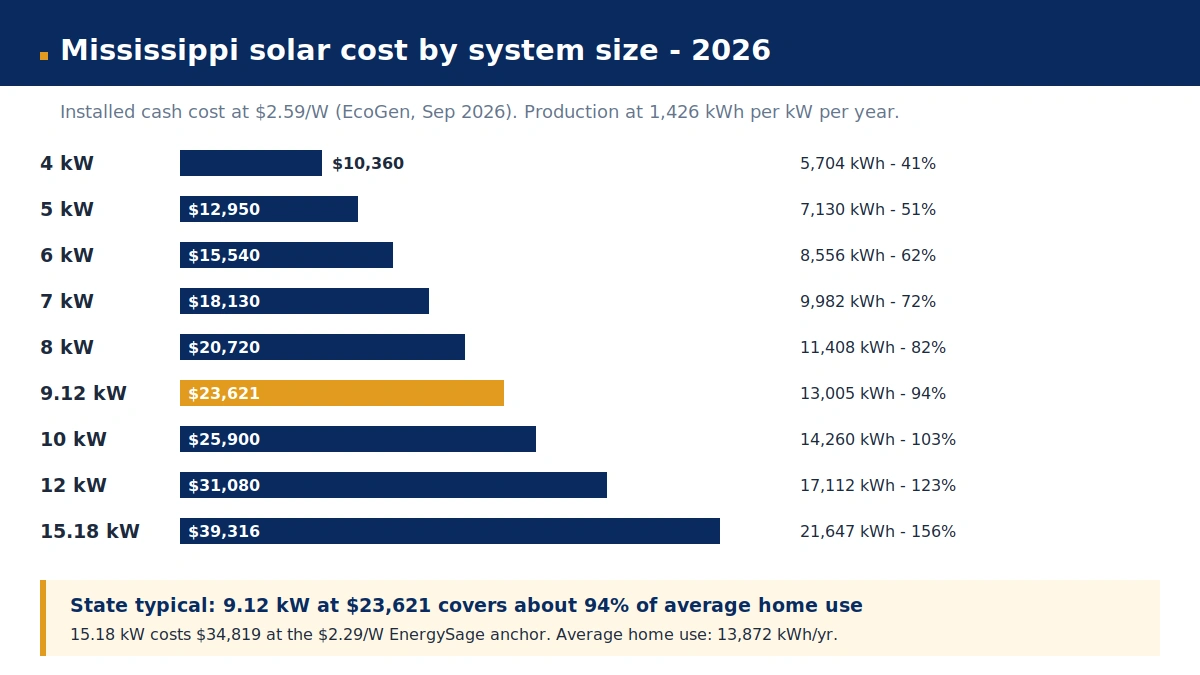
Size comes first, and in Mississippi the export rules reward a right-sized array more than they do in most states — and punish an oversized one harder. The average Mississippi home burns about 1,156 kilowatt-hours a month, or roughly 13,872 a year, heavy by national standards, driven by long cooling seasons, electric heat in winter, and big houses. One installed kilowatt in Mississippi yields about 1,426 kilowatt-hours a year, which puts a 9.12 kW array near 13,005 kilowatt-hours — about 94% of a typical Mississippi home’s annual use. A 9.12 kW array earns its place as the state typical size because it covers nearly the whole house while exporting little at six cents.
Oversizing hurts more in Mississippi than in a state with full retail net metering, because Mississippi never pays retail for surplus. Every kilowatt-hour beyond the home’s own use goes out at the avoided-cost-plus-adder price — about 6 cents on Entergy, about 3 cents in TVA territory — while every kilowatt-hour used at home saves the full retail price of around 13-16 cents. That gap is why the table below turns unattractive past 10 kW for most Mississippi homes. Each common size in the table is priced from the EcoGen anchor of $2.59 a watt, with output at 1,426 kilowatt-hours per installed kilowatt per year, and the table also carries the share of average home use, so you can see at a glance where the system stops covering the house and starts exporting.
| Size | Cost at $2.59/W | Yearly output | Share of avg. MS home use (13,872 kWh/yr) |
|---|---|---|---|
| 4 kW | $10,360 | ~5,704 kWh | ~41% |
| 5 kW | $12,950 | ~7,130 kWh | ~51% |
| 6 kW | $15,540 | ~8,556 kWh | ~62% |
| 7 kW | $18,130 | ~9,982 kWh | ~72% |
| 8 kW | $20,720 | ~11,408 kWh | ~82% |
| 9.12 kW (state typical) | ~$23,621 | ~13,005 kWh | ~94% |
| 10 kW | $25,900 | ~14,260 kWh | ~103% |
| 12 kW | $31,080 | ~17,112 kWh | ~123% |
| 15.18 kW (state avg) | ~$39,316 at $2.59/W ($34,819 at $2.29/W) | ~21,647 kWh | ~156% |
Look twice at two rows in that table. The 15.18 kW state-average system generates about 156% of what the average home uses, which tells you who buys the average system: households with electric vehicles, heat pumps, pools, or all-electric everything, plus the oversizing that a quote average rarely talks anyone out of. A home on gas heat with no EV usually lands at 8-9 kW, not 15. And Entergy’s 110% rule caps how large a system can be — the array may not exceed 110% of the home’s electricity use in the previous year — so a system sized to 156% of annual use would not even qualify for Entergy’s net-billing credit as designed. For most Entergy homes that rule is the binding constraint, and it is why the sizing conversation has to start with the bills, not the roof.
Start from a full year of electric bills, not from whatever roof area happens to be available. Add up the kilowatt-hours, divide by roughly 1,426 to find the kilowatt size that covers them, then adjust: add 1-2 kW for a planned EV, add more for a heat pump or a pool pump, subtract for a shaded or north-facing roof — and then check the result against Entergy’s 110% ceiling, which the past 12 months of bills set. An EV or a heat pump that is coming should have its load added first, with the solar designed second, or the cap locks you into a smaller array than the bigger house will need. The same sizing logic for the country as a whole is laid out step by step in our 6 kW vs 8 kW vs 10 kW guide.
Solar Panel Cost by City: Jackson, Gulfport, Vicksburg, Hattiesburg & Tupelo
Mississippi is a long, narrow state holding four different solar economies, and the price spread between its cities runs wider than Oklahoma’s — the five cities below span $2.33-$2.66 a watt. The install price is only part of what differs between them; the utility behind the meter differs too, and in Tupelo that difference is the largest in the state. EnergySage’s November 2026 city pages show the spread most clearly for the three cities it prices directly.
| City | $ per watt | Avg. system | Cash total | Payback | 25-yr savings |
|---|---|---|---|---|---|
| Jackson | $2.36 | 15.31 kW | ~$36,193 ($30,764-$41,622) | 18.24 yrs | $16,310 |
| Gulfport | $2.66 | 15.11 kW | ~$40,182 ($34,155-$46,209) | 19.79 yrs | $13,557 |
| Vicksburg | $2.33 | 17.04 kW | ~$39,626 ($33,682-$45,570) | 21.47 yrs | $7,388 |
| Hattiesburg | $2.44 | 7 kW ~$19,500 | Not published | Not published | Not published |
| Tupelo | $2.44 | Not published | $9,700-$29,200 range | Not published | Not published |
Jackson is the biggest market in the state, served by Entergy Mississippi, at $2.36 a watt — with a 15.31 kW average system at about $36,193. Gulfport, served by Mississippi Power on the coast, runs $2.66 a watt on a 15.11 kW average system at about $40,182, and its published payback of 19.79 years is the longest of the three EnergySage cities. The coastal premium is the plausible driver — hurricane-rated racking, salt-air hardware, and wind detailing all cost more on a Gulf Coast roof — but the data does not prove it, and this guide says so rather than asserting it. Vicksburg, also Entergy territory, runs $2.33 a watt on the largest average system of the three, 17.04 kW at about $39,626, with the longest published payback of the three at 21.47 years and the smallest 25-year savings at $7,388.
Hattiesburg and Tupelo come from a secondary source, and the guide says so plainly. Solarcostbyzip’s September 2026 pages put both cities at $2.44 a watt — Hattiesburg with a 7 kW system at about $19,500, Tupelo with a $9,700-$29,200 range across sizes. Those pages still subtract a stale 30% federal credit from their totals, so only the per-watt figure is used here and no payback is quoted from them. Tupelo is the city to read carefully for a different reason: it sits in TVA territory, where exports earn 3.112 cents — half of Entergy’s 6.1 cents — so a Tupelo system at the same price per watt as a Jackson system earns back far more slowly. No Biloxi, Southaven, or Meridian city price was verified on an EnergySage city page in this pass, so no figure for those cities appears here.
Rank the cities on price per watt, never on the payback column. Vicksburg shows 21.47 years and $7,388 in 25-year savings while Jackson, about 40 miles away on the same utility, shows 18.24 years and $16,310, at nearly identical prices per watt. EnergySage model variance explains those swings: the system sizes, the rate assumptions, and the savings models inside each city’s page all differ. They are not a real signal that one river city is three years better for solar than the next. When cities are compared, price per watt is the column that means something. Your own utility’s export credit is what gives a payback number meaning, and the section below works that number out for each utility in turn.
One last city-level note: EnergySage’s October 2026 Mississippi pages name Griffin Electric LLC and Solar Alternatives Inc. of Jackson as the top installers. The thin bench is part of why Mississippi prices stay uneven, so get three quotes, and make at least one of them from a company that holds a Mississippi State Board of Contractors license with Solar and Wind Construction on it. An out-of-state crew with no Mississippi license record has already been found in this market, and the interconnection paperwork differs by utility.
Mississippi’s Sun: Production, Heat, Humidity & Hurricanes
Mississippi’s sunshine is strong, and it arrives with a climate that tests the equipment hard. Any honest production estimate has to carry both halves of that story.
The sun. EcoGen’s figures put Mississippi at roughly 1,426 kilowatt-hours a year from one installed kilowatt, so a 9.12 kW array makes about 13,005 kilowatt-hours, around 94% of the average home’s yearly use. Cross-checks land close: SparkPowered’s EIA and NASA-based figure gives 1,399 kilowatt-hours per kilowatt a year. Take 1,399-1,426 as the range, with EcoGen’s 1,426 as the anchor. Peak sun hours average about 5.4 a day (RenewEstimator), a gross resource figure before the derate that turns sunshine into metered output. Summer is the best season; winter is the worst.
Across the year, production rises and falls like a proper hill, not a gentle slope. NASA POWER data for Bay Saint Louis on the Gulf Coast gives about 5.99 kilowatt-hours a day per installed kilowatt in summer, 5.77 in spring, 4.78 in autumn, and 3.27 in winter — roughly an 83% summer-to-winter swing, wider than Oklahoma’s and wider than most northern states’ in the other direction. Late spring through early fall is when the array earns its keep; the winter months are when it leans on the grid. At the coast the ideal fixed tilt is about 27 degrees facing south. This guide pulled no verified Mississippi monthly PVWatts table, so the seasonal shape is described here in words rather than as a month-by-month table — and if an installer shows you one, ask to see the PVWatts run behind it.
Heat takes back some of what the sun gives. Panel efficiency falls as cell temperature rises, by roughly 0.3-0.5% for every degree Celsius the cell runs above 25 degrees. A Mississippi rooftop in July runs far hotter than 25 degrees, under air that is itself past 90 degrees Fahrenheit, so a system here makes less per hour of sunshine than the same panels would on a cool spring day. The long days still win out over the year, which is why the annual figure holds near 1,426 kilowatt-hours per kilowatt. Even so, a production estimate built on nameplate wattage with no temperature derate in it overstates summer output, so ask the installer to show the derate inside the production model it hands you. Panels with a low temperature coefficient lose less in the heat — one vendor quotes -0.24% per degree Celsius for its premium heterojunction panel — but that is a manufacturer figure, not a Mississippi measurement, and it is cited here as such.
Humidity and afternoon storms shape the day. Humidity does not block sunlight, but the thick, wet air feeds the afternoon thunderstorms that roll across Mississippi most summer days, and cloud cover cuts output while the storm passes. Panels still produce on cloudy days at reduced output, and the rain usually does the cleaning — but pollen and dust accumulate in the humid climate, and a Gulf Coast array also collects salt air. A rinse from the ground now and then is enough; nobody should be up on a hot July roof washing panels.
Hurricanes are the defining Mississippi risk. The Gulf Coast — Gulfport, Biloxi, Pascagoula — sits in hurricane country, and Hurricane Katrina made landfall on the Mississippi Gulf Coast in 2005, the storm every coastal homeowner still measures against. Panels are tested for wind uplift and debris impact, and quality equipment is rated for coastal wind, salt mist, and humidity, so a well-installed array often fares as well as the roofing around it. But no panel survives a direct hit from a major hurricane, and this guide verified no Mississippi-specific design-wind figure, so none is stated here. What protects the array is the racking and its wind-uplift rating, the condition of the roof, and the insurance — not the panel brand. Inland, the risk shifts rather than disappears: tornadoes and severe thunderstorms run statewide, concentrated in spring, and the same racking and insurance logic applies.
The roof itself. Mississippi roofs age fast in heat and humidity. If the roof has under ten years of life left, put the new roof on before the panels — pulling panels off and putting them back for a reroof runs to thousands on its own. Our roof replacement guide lays out what a reroof costs before the panels go on. Standing-seam metal is one of the best solar roofs there is, because the clamps grip the seams without a single hole in the roof. There is also a program worth knowing about before the panels go up: the Mississippi Insurance Department’s Strengthen Mississippi Homes program offers grants up to $10,000 for IBHS FORTIFIED Roof upgrades, with applications open in October 2026 for Mississippi Windstorm Underwriting Association policyholders who have held Wind Pool coverage for three consecutive years, selection by lottery, and a statewide rollout for other homeowners expected in early 2027. It is a grant for hardening a roof, not a solar rebate — but a hardened roof is exactly what a Gulf Coast array sits on.
Living with the climate. Nothing unusual is called for. Face the panels south where the roof allows it, tilt them to shed the summer cloudbursts, fit microinverters or optimizers so one shaded string cannot pull the whole array down, and insist on a production estimate built on PVWatts data with the temperature derate out in the open rather than hidden. The most valuable kilowatt-hours are the ones the house eats the moment they are made — and in Mississippi, where exports earn six cents or less, that is worth more than anywhere else in this series.
Net Metering in Mississippi: The Rules That Decide Your Return
Mississippi does have a net-billing rule — anyone who says the state has no solar buyback at all is describing a rule that does not exist here. What the state offers is not one-for-one net metering, and the difference between those two things is the difference between a 10-year payback and a 21-year one.
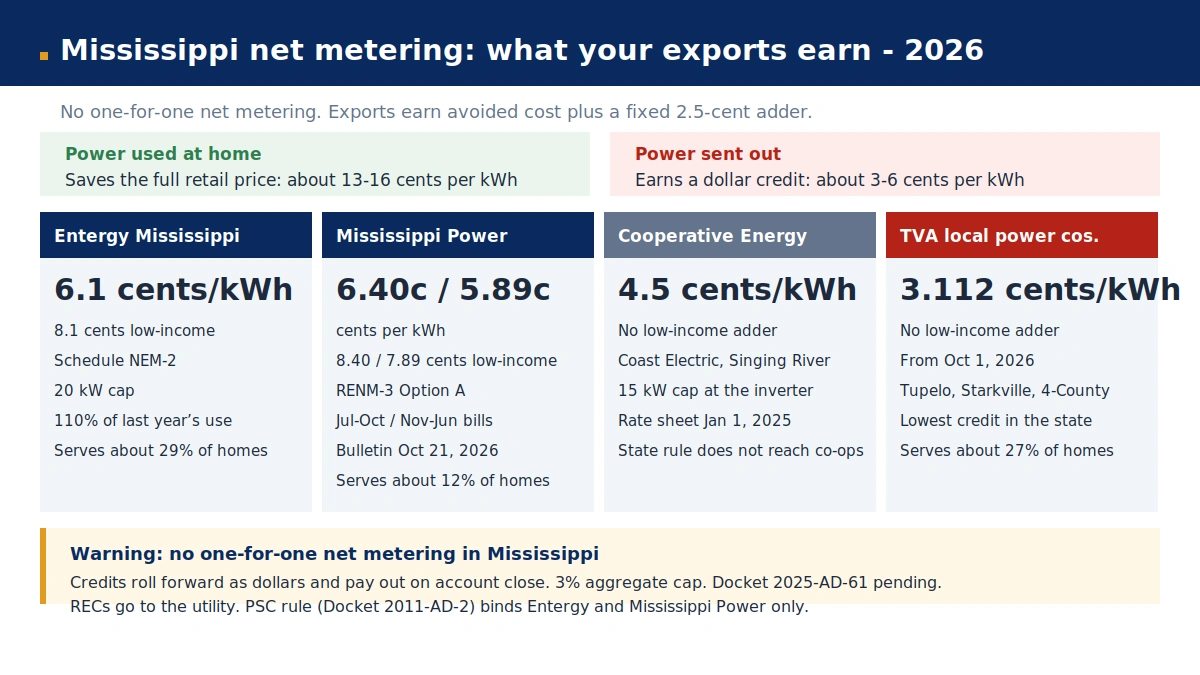
The law. The framework sits in a Mississippi Public Service Commission Final Rule and Order under Docket 2011-AD-2, adopted December 3, 2015, after nearly five years of study. Mississippi became the 45th or 46th state to adopt a net-metering rule, depending on how the count is done — but the Commission did not adopt the true definition of net metering. It found that a consumer has a right to self-supply and generate power for their own use, along with the right to connect to the grid, and it set the export price at avoided cost plus a fixed 2.5-cent adder. A later order renamed the program “net renewable generation.” A compromise revision approved in late 2022, effective January 1, 2023, narrowed low-income eligibility from 250% to 225% of the federal poverty level, cut the low-income rebate from $3,500 to $3,000, added a $2,000 battery payment, and brought the participation cap back from 4% to 3% of peak demand. That framework binds the two investor-owned utilities — Entergy Mississippi and Mississippi Power — and it does not bind co-ops or TVA local power companies, which set their own terms. That split is the most important thing in this section, and it is why Tupelo looks so different from Jackson.
How it works. Power a home uses as it is made saves the full retail price — it is power the house does not buy. Each kilowatt-hour that leaves the home earns a dollar credit, not a kilowatt-hour credit: the utility’s avoided cost plus a fixed 2.5 cents, with 2 cents more for income-qualified households, for 25 years. The credit comes off the bill in dollars and rolls forward; a balance left at year end keeps rolling and is paid out when the account closes. The renewable energy certificates — the proof the power came from solar — go to the utility at Entergy, Mississippi Power, and the Cooperative Energy co-ops, so a quote that counts REC income is wrong for those customers. Programs are first come, first served up to 3% of the utility’s peak demand, and once the cap is met the Commission can revise the rule.
The sizing caps. Entergy and Mississippi Power cap home systems at 20 kW, and Entergy adds a second ceiling: the array may not exceed 110% of the home’s electricity use in the previous year. Cooperative Energy co-ops cap systems at 15 kW, measured at the inverter. A system larger than the cap may not qualify for the export credit as designed. For most homes that ceiling is the binding constraint, because 12 months of bills set it — so add an EV or a heat pump before designing the array, not after. A future electric car does not count yet at Entergy.
The case that could change the credit. On June 17, 2025, the Commission opened Docket 2025-AD-61 to amend its distributed generation rule — the rule behind the 2.5-cent and 2-cent adders. It was still listed as pending on the Commission’s docket list for October 2026, and the agenda for the October 6, 2026 open meeting listed no action on it. No decision was found. Every export figure in this guide is therefore dated, and a homeowner should confirm the current credit with their utility before signing.
Entergy Mississippi — about 29% of Mississippi homes, roughly 460,000 customers, Jackson plus central and western Mississippi. Entergy’s tariff is Schedule NEM-2, and on bills from February 2026 the standard credit is 6.1 cents a kilowatt-hour: 3.6 cents of avoided cost plus the fixed 2.5 cents. The avoided-cost part is refiled with the Commission by November 15 each year, and any change needs Commission approval, so the 3.6-cent part can move. The lower-income credit is 8.1 cents, for households at or below 225% of the federal poverty level — $74,250 for a household of four in 2026 — lasting 25 years on a primary residence. Entergy’s 6.1 cents is about 46% of the 13.21 cents its homes paid on average in 2024. To prove income, the household signs a statement of household income with the solar application, and Entergy can audit it — but its posted form still printed the 2024 income table when it was last read, so ask for the current one. Entergy charges an application fee of $95 or $135. Entergy’s 12-month average residential rate runs about 15.40 cents, with a $31.82-a-month customer charge that solar cannot lower — the charge is why EcoGen’s worked payback values self-used power at 12.74 cents rather than the full 15.40.
Mississippi Power — about 12% of Mississippi homes, roughly 195,000 customers, Hattiesburg plus the Gulf Coast. Mississippi Power runs Rate RENM-3, and its current figures come from a bulletin issued October 21, 2026. Under Option A, the standard credit is 6.40 cents a kilowatt-hour on July-to-October bills (3.90 cents avoided plus 2.5 cents) and 5.89 cents on November-to-June bills (3.39 cents avoided plus 2.5 cents). The lower-income credit runs 8.40 cents in the summer months and 7.89 cents in the rest of the year. Option B changes the credit with the hour of day: 5.82-7.21 cents a kilowatt-hour for solar, with the avoided-cost part from a bulletin dated January 20, 2026 — the next bulletin can change it, while the 2.5-cent adder stays for 25 years. Ask which option the quote uses, A or B, because the two price the same roof differently. Mississippi Power’s 12-month average residential rate runs about 16.3 cents. Income proof at Mississippi Power runs through Catholic Charities, which certifies the household’s income.
The co-ops write their own rules too. Co-ops such as Coast Electric and Singing River buy extra power through Cooperative Energy at 4.5 cents a kilowatt-hour, with no low-income adder — the state rule does not reach them. The rate sheet is dated January 1, 2025, and Cooperative Energy can change the rate with 30 days’ written notice. No individual figure was verified for Coast Electric or Southern Pine in this pass, so the 4.5-cent Cooperative Energy figure is the one to use, and co-op customers must get their own rate sheet in writing before signing.
TVA territory pays the least in the state. TVA-supplied local power companies — 4-County Electric, Tupelo, Starkville, and the rest of the north — sell extra power to TVA at its standard price, 3.112 cents a kilowatt-hour from October 1, 2026, with no low-income adder. About 27% of Mississippi homes sit in TVA territory. A kilowatt-hour exported in Tupelo earns half what the same kilowatt-hour earns in Jackson, and a fifth of what it saves when used at home. That single number is the reason north-Mississippi payback runs the longest in the state, and it is why a Tupelo homeowner should size strictly to daytime self-use.
Payback: How Long Until Mississippi Solar Pays for Itself?
Payback is where a Mississippi system either earns its keep or does not. The answer turns on which utility sends the bill and whether the household qualifies for the low-income adder. EcoGen’s anchors underpin every worked example below, so each input can be checked; EnergySage is the cross-check, and where the two disagree, this guide says so.
The worked example. Take a typical 9.12 kW system at $2.59 a watt, priced at $23,621 before incentives. It puts out about 13,005 kilowatt-hours a year. No state credit and no confirmed rebate sit between gross and net here, so the net cost is the gross cost: $23,621. From here on, yearly savings — and with them the payback — rest entirely on the utility and on how much of the power the house uses while the sun is up.
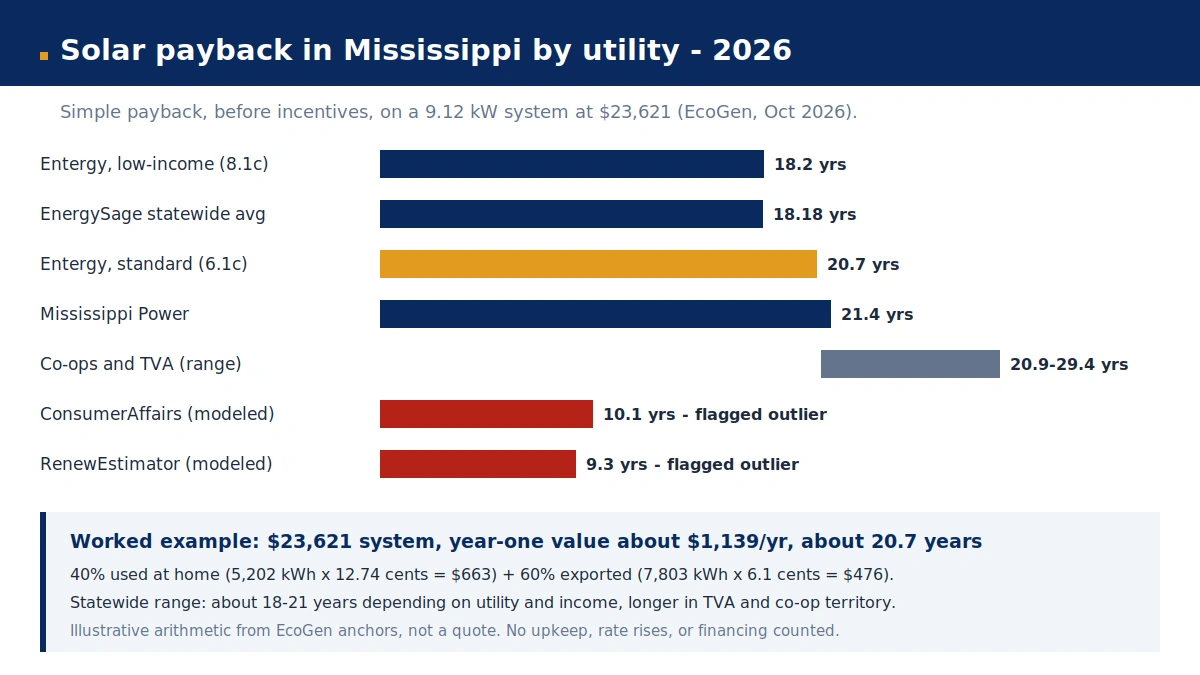
Entergy is the worked case, and it is slow. EcoGen’s per-utility worked example for Entergy territory puts the year-one value at about $1,139 a year at the standard 6.1-cent credit: 40% of the output used at home as it is made — 5,202 kilowatt-hours at an effective 12.74 cents, after Entergy’s $31.82-a-month customer charge — is worth $663, and 60% sent out — 7,803 kilowatt-hours at 6.1 cents — is worth $476. Divide the $23,621 system price by $1,139 a year and simple payback lands near 20.7 years, on the assumption of no incentives, no upkeep, no rate rises, and no financing. The 40% home-use share is the central case of a modeled 28-55% range, not a measured Mississippi figure; across that range the standard-credit payback runs 18.6-22.8 years. That figure covers Entergy only, about 29% of Mississippi homes.
The low-income adder takes about two and a half years off. At the 8.1-cent credit, the same 7,803 exported kilowatt-hours are worth $632 instead of $476, the year-one value rises to about $1,295, and payback falls to about 18.2 years, with a modeled range of 17.1-19.3 years. The adder is worth about $156 a year on this system. A home that uses more of its solar power as it is made gains more than either credit can add — daytime self-use is still the biggest lever in the state.
Mississippi Power runs a little longer. EcoGen puts the same system at 21.4 years in Mississippi Power territory (19.3-23.4 range), or 18.9 years with its lower-income credit. The implied year-one value is about $1,104 a year — NestPriced arithmetic from $23,621 divided by 21.4, labeled here as derived rather than as EcoGen’s own figure. The Gulf Coast’s higher install price and the seasonal 5.89-6.40-cent credit both push the same direction.
Co-ops and TVA run the longest in the state. EcoGen puts co-op and TVA territory at 20.9-29.4 years at the central case, with no per-utility figure verified for Coast Electric or Southern Pine. The 4.5-cent co-op credit and the 3.112-cent TVA credit are the reason: at 3.112 cents, the 7,803 exported kilowatt-hours in the worked example would be worth about $243 a year instead of $476, and the payback stretches past 25 years on the same roof. No worked TVA payback was verified for this guide, so no number is stated — but the direction is clear, and it is the worst in the state.
The statewide figure sits below the Entergy figure. EnergySage puts it at 18.18 years on the 15.18 kW average system, with $16,661 in 25-year savings. It is shorter than EcoGen’s Entergy figure mostly because the system is nearly two-thirds larger and the model offsets more usage at retail. For the state as a whole, a defensible line is about 18-21 years, depending on utility and income, and longer in TVA and co-op territory.
| Case | Simple payback | Source |
|---|---|---|
| EcoGen Entergy, standard 6.1-cent credit (9.12 kW) | ~20.7 yrs | EcoGen, Oct 2026 |
| EcoGen Entergy, low-income 8.1-cent credit (9.12 kW) | ~18.2 yrs | EcoGen, Oct 2026 |
| EcoGen Mississippi Power (9.12 kW) | ~21.4 yrs | EcoGen, Oct 2026 |
| EcoGen Mississippi Power, low-income (9.12 kW) | ~18.9 yrs | EcoGen, Oct 2026 |
| EcoGen co-ops and TVA (9.12 kW) | 20.9-29.4 yrs | EcoGen, Oct 2026 |
| EnergySage statewide avg (15.18 kW) | 18.18 yrs | EnergySage, Nov 2026 |
| ConsumerAffairs modeled (14.31 kW) | 10.1 yrs | ConsumerAffairs, 2026 — flagged outlier |
| RenewEstimator (8 kW) | 9.3 yrs | RenewEstimator, Jul 2026 — flagged outlier |
The flagged conflict. ConsumerAffairs reports a 10.1-year payback with $34,539 in 25-year savings on a $32,770 typical install, and RenewEstimator reports 9.3 years on an 8 kW system. Both are modeled estimates that do not appear to price the roughly 6-cent export rate or Entergy’s $31.82-a-month customer charge, and both sit far outside the EcoGen and EnergySage band. Do not present 10 years as a verified Mississippi payback, and do not let a quote cite it for an Entergy, Mississippi Power, co-op, or TVA home.
What moves the payback most. The biggest lever is daytime self-use. Daylight hours are the time to run the dishwasher, the laundry, the pool pump, and the EV charger: those kilowatt-hours move out of the 3-to-6-cent export bucket and into the 13-to-16-cent self-use bucket, and no other change pays as well. Income is the second lever, and it is unique to Mississippi: the 2-cent adder is worth about $156 a year and about two and a half years of payback, for households that qualify. Rate escalation is the third lever: Mississippi rates rose 6.0% year-on-year to August 2026 and 25.9% over five years per EIA, with EcoGen’s figures putting Entergy’s 12-month average at 15.40 cents against 13.21 cents in 2024. At roughly 5% a year, 25-year savings grow materially over a flat-rate model, but no Mississippi system pays back quickly on flat rates alone given roughly 14-cent power and 6-cent exports. Size comes fourth: oversizing past household usage pushes the marginal kilowatt-hours into exported credits worth a third of consumed power, while Entergy’s 110% ceiling may push the system out of the net-billing credit altogether. Fifth comes financing: dealer fees on a solar loan can add 10-30% to the effective price, which is why the cash price per watt is the number to compare, not the monthly payment.
Who still comes out ahead. Four kinds of Mississippi household clear that bar. A home that is busy all day — home offices, pool pumps, daytime cooling on smart schedules — keeps most of its production at full retail value. A low-income household on Entergy or Mississippi Power, where the 8.1-cent or 8.40-cent credit shortens payback by about two and a half years. Pairing solar with a heat pump or an EV and sizing the array to the new daytime load, while staying under the 110% cap, is the third. And the buyer whose main reason is backup power, who buys for outage protection through hurricane season and treats savings as secondary — for that household the payback math is context, not verdict. Walk away when your home sits empty on weekdays, when you live in TVA territory and are counting on export income, or when the installer projects savings without naming your utility’s export credit.
Mississippi Incentives in 2026: Almost None
Most states, once the federal credit is gone, still keep something in reserve: a state credit, a rebate, an exemption. Mississippi keeps almost nothing. That is the whole incentives section in one sentence, and it deserves to be said plainly, because most solar advertising in Mississippi skips it.
Mississippi has no state income tax credit for solar. The Department of Revenue’s tax credit list, Form 80-401, carries no credit for a home solar system. A quote that subtracts a state credit is wrong on its face.
No Mississippi law exempts solar equipment from the state’s sales tax. Mississippi levies its 7% state sales tax on home solar equipment — the Department of Revenue’s list carries no exemption for it — and city and county tax sits on top. Sales tax belongs on its own line — ask for it itemized, and do not let a quote quietly subtract an exemption that does not exist.
No property-tax exemption was verified for a home system. This pass found no Mississippi property-tax exemption for a home solar system. The renewable-energy exemption the Department of Revenue lists applies to projects of at least $100 million, not to a home system. Before signing, ask the county tax assessor how solar is valued — never assume the added home value escapes tax.
No Mississippi utility pays a confirmed rebate for panels or batteries. Not Entergy, not Mississippi Power, not any co-op or TVA local power company. The two payments that older guides still mention are not money to count on: Mississippi Power’s $3,000 low-income payment and $2,000 battery payment in Rate RENM-I are marked suspended on its rates page, and Entergy’s $3,000 and $2,000 payments are still printed in its rate sheet as of October 19, 2026 but do not appear on its net-metering page or its application form — EcoGen could not confirm either is open. Both rate sheets say no payment is available beyond the end of 2027. An installer who promises a Mississippi utility rebate should be asked to show it in writing from the utility, not from a sales sheet.
The one real targeted incentive is the low-income export adder. Households at or below 225% of the federal poverty level — $74,250 for a household of four in 2026 — earn 2 cents more per exported kilowatt-hour for 25 years, at Entergy and Mississippi Power only. It is a credit on power sent out, not a payment toward buying panels, and it is worth about $156 a year on a typical 9.12 kW system at Entergy. It is the only Mississippi incentive that lowers the payback by a measurable amount, and it reaches only the households that need it most.
Mississippi has no Solar for All program open for households. The state’s Solar for All lease program never opened. The EPA brought the Solar for All grants to an end in August 2025, federal courts ruled that termination unlawful in September 2026, and still no sign-up was open as of October 5, 2026. A Mississippi household has no way to apply for it.
Federal home energy rebates have not launched in Mississippi at all. The Mississippi Development Authority holds a total allocation of $105 million, per the National Housing Trust tracker of July 25, 2025, with HEAR and HER applications approved and no launch date in sight. Mississippi is not among the 13 jurisdictions on the Energy Department’s February 6, 2026 launched map. And even once it does launch, HEAR will not pay for solar: it pays for electrification — heat pumps, heat-pump water heaters, electrical panels, and insulation-related wiring — and never for panels, batteries, EV chargers, or windows.
| Item | Value | Notes |
|---|---|---|
| MS income tax credit | $0 — none exists | Form 80-401 lists no credit for home solar |
| MS sales-tax exemption | None — 7% state tax applies | Dept. of Revenue lists no exemption; local tax on top |
| MS property-tax exemption | None verified for home systems | The listed renewable-energy exemption is for projects of at least $100M; ask the county assessor |
| Rebate for panels or batteries | $0 confirmed open | MS Power $3,000/$2,000 suspended; Entergy $3,000/$2,000 unconfirmed; none beyond end of 2027 |
| Low-income export adder | +2.0 cents/kWh for 25 years | At/below 225% FPL; Entergy and MS Power only; ~$156/yr on a typical system |
| Solar for All | $0 — no program open for MS households | Grants ended Aug 2025; no sign-up open Oct 5, 2026 |
| HEAR / HOMES rebates | Not launched | MDA; $105M allocation; no launch date; HEAR never covers solar |
Federal Help in 2026: $0 Tax Credit — but the Lease Route Is Legal
The federal story for 2026 fits in a single paragraph — and that is exactly why so much solar advertising still gets it wrong. In Mississippi that paragraph has a second half Alabama does not get: the lease route that saves other states is open here, while the PPA route is not.
Own the array yourself, have it installed in 2026, and the federal tax credit on it is zero — the credit is simply gone for a Mississippi homeowner who buys outright. The One Big Beautiful Bill Act — Public Law 119-21, signed July 4, 2025 — ended the Residential Clean Energy Credit, 30% under §25D, for systems placed in service after December 31, 2025. Completion is the date that counts, per IRS fact sheet FS-2025-05: a deposit paid in 2025 buys nothing if the crew finished the job in January 2026. Efficient home improvements lost their §25C credit on that same date. A cash or loan quote dated 2026 that still deducts 30% is built on a law that no longer exists — get it repriced without the credit. SolarReviews’ own Mississippi cost page still shows a $14,414 “after tax credit” total — that is the stale 30% figure, and it is excluded from every number in this guide. The city pages at solarcostbyzip still show 30% savings on Hattiesburg and Tupelo totals for the same reason.
Leases are open in Mississippi — PPAs are not. The 30% commercial clean-electricity credit under §48E is still alive — but only where a company, not the homeowner, owns the array, only for systems in service by December 31, 2027, and only where construction began by July 4, 2026, under IRS Notice 2025-42. Under a Mississippi lease, the company claims that credit and passes part of the value on as a lower monthly payment. DSIRE’s third-party PPA map (May 2026) lists Mississippi among the states where residential PPAs are restricted but solar leases are explicitly allowed: any entity selling electricity is subject to public-utility regulation under Mississippi Code Section 77-3-3, but the state’s net-metering rules explicitly allow leasing of solar equipment. The Public Service Commission’s consumer guide names just two options — buy or lease — and the Commission’s rule credits only a system the customer owns or leases. An offer priced per kilowatt-hour does not fit Mississippi’s rules. That is the mirror image of Oklahoma, where leases and PPAs are both open, and of Alabama, where neither works in practice. Our Oklahoma solar cost guide and our Alabama solar cost guide show both contrasts.
Two caveats before you sign a lease. First, this pass verified only one named lease product — Solar Alternatives of Jackson offers an “Impact Prepaid Lease” — and no other national lease provider’s current Mississippi availability was verified, so no other provider is named here. Second, judge a lease quote on its monthly payment and its escalator, not on a headline price, because the homeowner never owns the system and the renewable energy certificates go to the utility in any case. Our federal tax credits guide covers the full 2026 federal picture in one place, and lease-versus-buy is worked through in detail in our national solar cost guide.
HEAR never pays for solar. Households that qualify by income may still draw up to $8,000 from the Home Electrification and Appliance Rebates program in 2026 — but that money pays for electrification work, and panels are outside what it covers. HEAR directs its money toward heat pumps, heat pump water heaters, electrical panels, and insulation-related wiring work. Panels, batteries, EV chargers, and windows are all outside what it pays for. The Energy Department’s Notice 26-2, dated September 1, 2026, limits the program to electric-to-electric upgrades, with no fuel-switching allowed. Mississippi’s own HOMES and HEAR programs have not launched at all, and no launch date exists. Any quote that prices in a HEAR rebate is describing a program that works differently. HEAR can still matter to a Mississippi homeowner: a heat pump paired with new solar panels is a common combination, and the heat pump half may qualify once the state launches, while the solar half never does.
Put honestly, the federal government contributes nothing in 2026 to a Mississippi homeowner who buys solar panels outright. Unlike in Alabama, it can still contribute indirectly through a lease, because the surviving 30% commercial credit reaches homeowners through a company that owns the system — but not through a PPA, which Mississippi’s rules do not allow for homes. On a cash quote, the price is the price. On a lease quote, subtract whatever the third-party owner passes through — and get that pass-through number in writing before signing.
Permits & Licensing: What Mississippi Requires
Mississippi’s licensing picture is stricter than most states’ — the state licenses solar contractors by name — and the strictness is itself a protection, because the license is checkable in a public registry before a dollar changes hands.
The solar work needs a State Board of Contractors license. The Mississippi State Board of Contractors (MSBOC) requires a license for any person acting in the capacity as a residential solar contractor, under Mississippi Code Section 73-59-3 — and “residential solar contractor” is defined in the statute as a person that installs, modifies, maintains, and repairs thermal and photovoltaic solar energy systems. Commercial work uses the Solar and Wind Construction classification, under a Certificate of Responsibility that covers commercial jobs over $50,000. Residential work uses the Residential Solar classification. Licenses run for one year and renew annually. The residential application lists $50 for one classification and $100 for each additional classification; the commercial rules list a $400 application and annual fee plus up to $100 for each additional classification. Applicants take Mississippi Law and Business plus a Solar exam through PSI, and residential qualifying parties must complete two hours of board-approved continuing education for licenses issued on or after July 1, 2015. Ask for the installer’s MSBOC license number and verify it on the board’s registry at search.msboc.us; the contract company’s name must match. Mississippi Power tells its customers to confirm the installer holds a Solar and Wind Construction license — take that advice even if you are on Entergy.
The electrical work needs its own licensed trade. The Solar and Wind Construction and Residential Solar classifications do not by themselves cover electrical connections. Piping, hookups, grounding, and wiring belong to the appropriate licensed classification, and electrical subcontractors must be licensed in their own trade on any residential job, no matter the dollar amount. Ask who does the electrical work and check that company’s license too. NABCEP certification is the leading industry credential for solar installers, and it is worth asking about even though Mississippi does not require it. Two Mississippi companies were checked against the registry in October 2026: Mississippi Solar of Eupora holds commercial certificate 18200-MC including Solar and Wind Construction, shown as Licensed, while its separate residential license 16229 was shown as Expired — and Midsouth Solar Pros of Memphis showed no Mississippi license record at all. That is the kind of check that takes two minutes and saves a homeowner from an installer who cannot legally do the work.
HOAs can restrict solar in Mississippi — read the documents before you sign. The 2026 surveys agree on Mississippi’s position: the state has no residential solar-access law, so the HOA’s covenants, conditions, and restrictions decide the question, and an HOA may restrict rooftop solar or ban it outright. Two low-quality sources claim that a “Mississippi Solar Energy Systems Law” enacted in 2009 prohibits HOAs from banning solar. That claim appears nowhere in this guide: neither source cites a statute number, and the surveys above contradict it. Mississippi’s Homeowners Association Act governs HOA procedure, not solar access. Start with the CC&Rs, and get architectural-review approval in writing before ordering panels. Condo owners face a doubled hurdle, because the roof is usually common area and the board’s approval process is the whole decision.
Permits and interconnection take time. Before panels go on a Mississippi roof, three approvals line up in sequence — a building permit, an electrical permit, and the utility’s interconnection agreement — and the utility step is the one that usually drags. Entergy charges an application fee of $95 or $135 under Schedule NEM-2. This guide verified no Mississippi-specific permit fee schedule, so no fee figure appears here; the town or county building department sets it. Entergy and Mississippi Power both require an application and approval before install, and no interconnection timeline figure was verified for either utility — that is flagged here as unverified rather than assumed to be fast. Nationally, residential interconnection typically runs 2-4 weeks per Palmetto (April 2025), cited here as a national figure only. In Mississippi, time is the certain bottleneck, not money. Two weeks to permission to operate is a promise no installer can keep, because the utility decides that timeline, not them.
What Pushes Your Mississippi Quote Up or Down
The per-watt anchor is a starting point for pricing, not a quote. A Mississippi quote can move by thousands of dollars on seven things, three of which belong to this state’s climate and power market.
Labor is why Mississippi is cheap — and why the crew is worth checking. Mississippi electrician pay runs below the national median, $29.26 an hour against $30.38 nationally per BLS May 2025, and labor is the largest soft-cost component of an install, which is part of why Mississippi lands at $2.59 a watt against a $2.89 national average. Mississippi ranks 41st of 51 for electrician pay, with 6,610 electricians employed in the state and a 10th-to-90th percentile range of $18.36-$36.80 an hour. Cheap wages hold prices down, but they also make the crew’s experience matter more than the headline rate: ask how many installs the crew has done in your utility’s territory, not just how many years the company has existed. This pass found no Mississippi-specific BLS figure for solar PV installers — BLS publishes state-level solar-installer wages for only 32 states, and Mississippi was not among the ones located — so the national figure is used here and flagged as national: a median of $53,140 a year, about $26 an hour, with 31,100-31,350 jobs nationally and BLS projecting 37% growth from 2025 to 2035.
The roof itself. Hot summers and UV dry out asphalt binders faster than the manufacturer rating assumes, and the Gulf Coast’s salt air works on flashing and fasteners. If the roof has under ten years of life left, replace it first — detaching the panels and resetting them for a reroof costs thousands on its own. Our roof replacement guide has the reroof numbers. Standing-seam metal, common on Mississippi farmhouses and newer builds, is one of the best solar roofs there is, because its seams take clamps without a single roof penetration. Before the panels go up, check the Strengthen Mississippi Homes grant in the climate section above: up to $10,000 for a FORTIFIED roof is worth pursuing first, because a hardened roof is what the array sits on for 25 years — though only Wind Pool policyholders can apply in the current round.
Hurricane detailing. On the Gulf Coast, the wind specification is a line item, not a footnote. Racking rated for local wind uplift, salt-air-rated hardware, and panels tested for wind and salt mist all cost more than the cheapest bid. A quote that matches an inland state dollar for dollar is probably missing the coastal work. Ask where it is. After a storm, get the array inspected before it is re-energized if there is any visible damage, and tell the homeowner’s insurance the system exists — most policies cover it once declared, with wind as a covered peril on the coast where the policy allows it.
Panel tier. Value-tier panels run 10-20% cheaper per watt than premium ones. That premium buys two things that matter in Mississippi: high-temperature performance that holds up better, and low-light performance on cloudy, humid afternoons. A small roof is where the efficiency premium earns its keep. Out in the Delta, a big unshaded roof usually makes the cheaper value-tier panel the better buy. Premium n-type panels degrade more slowly as well, losing 0.25-0.5% a year and holding 91-93% of rated output at year 25. The fleet median runs about 0.5% a year and about 88% at year 25 per NREL — and that gap matters more where panels bake every summer for a quarter century.
Inverter choice. Upfront, a string inverter costs less. Microinverters or optimizers cost more but make more power on roofs with partial shade — and Mississippi roofs, with their live oaks, magnolias, and dormers, carry shade more often than installers admit. Each panel gets tracked on its own by a microinverter, so one shaded panel cannot pull the whole string down with it. Expect one replacement inside the life of the system from a string inverter, which usually lasts 10-15 years; microinverters typically carry about 25 years. Our inverter replacement guide prices both types across a full lifetime — though remember its dollar figures come from national data, not from Mississippi jobs.
The electrical panel. On 100-amp service, plenty of Mississippi homes still run — the brick ranches and split-levels built from the 1960s to the 1980s especially — and a solar install often forces the question. Upgrading a panel to 200 amps runs $1,500-$4,000 nationally, per our electrical panel upgrade guide, and it is the most common surprise add-on in Mississippi quotes. Confirm the quote covers it while you can still walk away — not after the electrician is already in your driveway. This guide verified no Mississippi-specific panel-upgrade dollar figure, so the national figure is cited as such.
Financing terms. The best long-term return comes from paying cash. Dealer fees of 10-30% of the cash price, sometimes over 50%, hide inside the amount financed on a $0-down loan, per the Consumer Financial Protection Bureau’s August 2024 market spotlight — a national figure, but one that applies to Mississippi quotes exactly the same way. A lease is the third path in Mississippi, and it is legal here in a way a PPA is not, as the federal section above explains — but judge a lease quote on its monthly payment and its escalator, not on a headline price, because the homeowner never owns the system. Community solar is the fourth path, and it is thin here: this guide verified no general community-solar subscription for Mississippi homeowners.
Maintenance and lifespan. Panels keep producing at reduced output for 25-30 years of productive service, past the warranty. Materials and workmanship are typically covered for 10-25 years, while performance warranties typically run 25-30 years and guarantee 80-92% of rated output at year 25 depending on tier. Maintenance is minimal — an occasional cleaning, which matters more on the humid Gulf Coast, plus an annual production check — because there are no moving parts. This paragraph’s figures are all national, and flagged as such, because Mississippi-specific lifespan, degradation, or maintenance figures do not exist.
Batteries in Mississippi: Worth It?
A battery is the most consequential add-on in a Mississippi solar project. It can add $15,000 or more to the job, and whether it earns that money back turns on a question Mississippi answers differently from the states around it — because here the export credit already pays something for surplus, and the battery has to beat that.
Battery cost. About $15,647 installed buys 13.5 kWh of storage (EnergySage, July 2026, a national figure — this guide verified no Mississippi-specific battery price), and model-by-model prices sit in our solar battery cost guide. Storage gets no federal credit either for an owner-installed battery in 2026 — §25D covered it too, and it closed on the same day.
No battery program stacks on top. No Mississippi utility runs a battery incentive, and the two payments older guides still mention are not open: Mississippi Power’s $2,000 battery payment is suspended, and Entergy’s $2,000 battery payment sits in the rate sheet but is unconfirmed, with neither available beyond the end of 2027. The grid pays the battery nothing. What the battery makes is the spread between what an exported kilowatt-hour earns and what a consumed one saves. On Entergy that gap runs roughly 7-9 cents a kilowatt-hour — real, but narrower than in a state with no export credit at all, because the 6.1-cent credit already pays something for surplus. Storing 10 kilowatt-hours a day and releasing them after dark saves about $0.70-$0.90 a day, roughly $260-$330 a year, which is a decades-long return on a $15,647 battery before degradation. The arbitrage is real, but it is too small on its own to carry the cost. In TVA territory the gap is wider, about 10-13 cents, but the battery is still expensive, and the same decades-long arithmetic applies.
Backup is the real case in Mississippi. Hurricane season runs June through November, tornadoes and severe thunderstorms take down lines in spring, and the whole Gulf Coast loses power when a major storm comes ashore — Katrina kept some Mississippi homes dark for weeks. Through an outage that can stretch for days on the coast, a battery keeps the refrigerator, the well pump, medical equipment, and a window unit running. Value it for keeping the lights on through a hurricane, not for the dollars it returns. For a household that cannot afford to lose cooling in August or heat in January, a battery that never earns back its cost in arbitrage can still be worth buying. For most Mississippi houses, a portable generator still delivers backup power for far less cash. A battery answers differently: silent power that switches on by itself, nothing to refuel, and no carbon monoxide risk filling a garage while a hurricane knocks the lines down.
The payback verdict. In Mississippi, a battery does not pay for itself on arbitrage alone. The daily spread is real but the battery is expensive, the export credit already pays something for surplus, and no program payment closes the gap. As backup is how to buy the battery: size it to the loads that matter in an outage rather than to the whole house, and treat the spend as resilience, not as an investment.
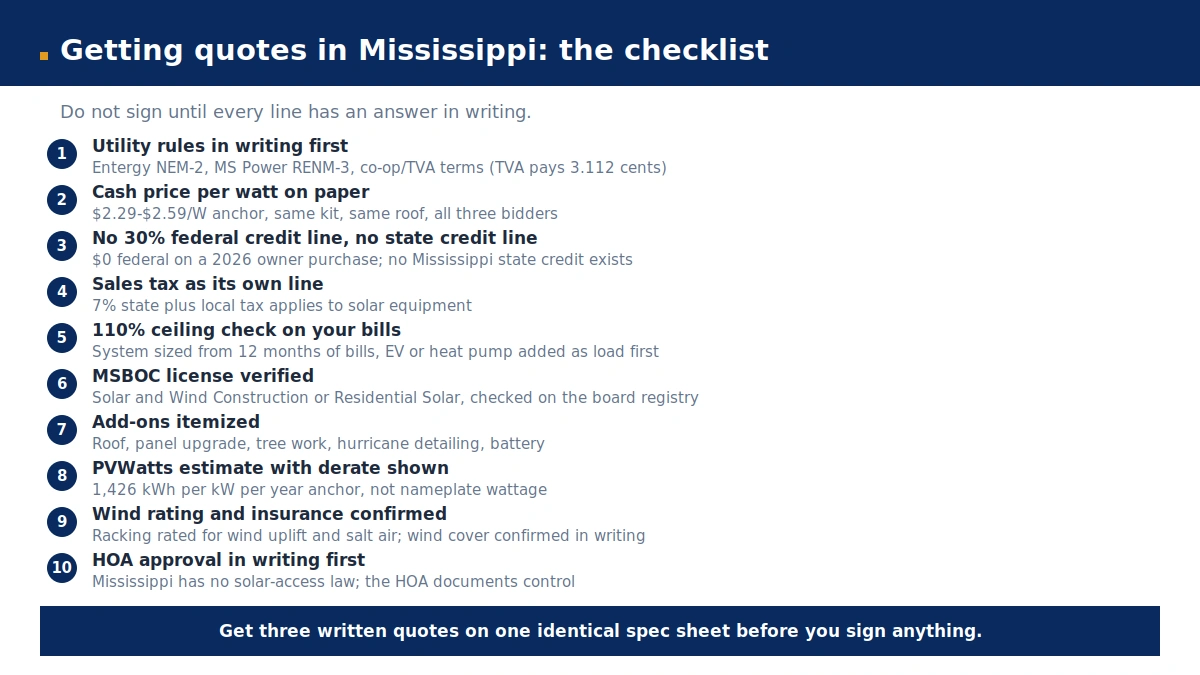
Getting Quotes in Mississippi: The Checklist
Mississippi is a hard state to buy solar in — cheap installs, strong sun, and an export credit that pays a third of retail — and it rewards only the homeowner who checks the utility terms before the sales pitch. Run this checklist on every bidder, and sign nothing until every line has an answer in writing.
The ten-item quote checklist:
- Your utility’s rules, in writing, first — Entergy’s NEM-2 credit, Mississippi Power’s RENM-3 option, or your co-op or TVA local power company’s own solar rate sheet. Export price decides the payback before anything else — and TVA pays 3.112 cents.
- Cash price per watt in writing — the same kit on the same roof from all three bidders. A quote far above the $2.29-$2.59-a-watt Mississippi anchor needs an explanation, and a quote far below it needs a closer look at what was left out.
- No 30% federal credit line, no state credit line — a 2026 owner purchase gets $0 federal, and Mississippi has no state credit, no sales-tax exemption, and no confirmed rebate. A quote still deducting one of them is priced under a dead law or an imaginary one, so ask for it to be removed.
- Sales tax shown as its own line — 7% state tax plus local tax applies to solar equipment in Mississippi, and a quote that omits it understates the cash price.
- The 110% ceiling check done on your bills — the system sized from 12 months of your bills, capped at 110% of last year’s use at Entergy and 20 kW at the two investor-owned utilities, with any planned EV or heat pump added as load first. Sizing from roof area alone is guessing.
- The MSBOC license verified — the installer’s Mississippi State Board of Contractors license number, with Solar and Wind Construction or Residential Solar on it, checked on the board’s registry, with names matched to the contract. NABCEP certification is a plus.
- Add-ons on their own lines — roof work, panel upgrade, tree work, hurricane detailing, and battery, each itemized separately instead of buried in the per-watt price.
- Production estimate from PVWatts, temperature derate included — about 1,426 kilowatt-hours per kilowatt a year is the anchor, and a figure built on nameplate wattage or an annual average that hides the summer heat loss is not a real estimate.
- Wind rating and insurance confirmed — racking and panels rated for local wind uplift and salt air specified by name, and homeowners insurance confirmed in writing to cover wind and hurricane damage on the array before signing.
- HOA approval in writing before anything is ordered — Mississippi has no solar-access law, so the HOA’s documents control.
Buy, lease, or community solar? Buying wins over 25 years for homeowners with high daytime use, Entergy territory terms, or a backup-power reason to buy, because it keeps the system, the resale value, and every kilowatt-hour of self-use at full retail. Leasing wins for homeowners who want no upfront cost and no maintenance, because the §48E route is legal in Mississippi and the third-party owner can claim the surviving credit — but only as a lease, never as a PPA, and only with the escalator and the buyout terms read in full. Renters, condo owners, and homes with shaded or unsuitable roofs are the ones community solar serves best. In Mississippi that mostly means waiting: this guide verified no general community-solar subscription, so a renter’s best move is to ask the utility directly rather than sign a third-party subscription on a sales call.
Sources & methodology
Cost anchors (per watt, system size, totals):
- EnergySage state page, Nov 2026, updated Oct 30: $2.29/W; 15.18 kW average; $34,819 total; $29,596-$40,042 range; 18.18-yr payback; $16,661 25-yr savings; Sep 2026 figure was 14.3 kW / $32,773
- EnergySage city pages, Nov 2026: Jackson $2.36/W, 15.31 kW, $36,193, $30,764-$41,622 range, 18.24 yrs, $16,310, updated Oct 23 (companies page says 15.74 kW / $36,663 at $2.33/W, minor internal variance, cost page used); Gulfport $2.66/W, 15.11 kW, $40,182, $34,155-$46,209 range, 19.79 yrs, $13,557; Vicksburg $2.33/W, 17.04 kW, $39,626, $33,682-$45,570 range, 21.47 yrs, $7,388
- EnergySage top installers, Oct 2026: Griffin Electric LLC; Solar Alternatives Inc. (Jackson, est. 2007)
- EcoGen Solar Cost Index, Sep 2026, prices as of Sep 25: $2.59/W; 9.12 kW typical modeled from neighboring states, too few MS installs for a local median; $23,621 total; 1,426 kWh/kW/yr; 13,005 kWh/yr; 5th lowest of 51; Entergy payback 20.7 yrs standard / 18.2 yrs low-income; MS Power 21.4 yrs / 18.9 yrs low-income; co-ops and TVA 20.9-29.4 yrs; neighbors AR $2.56, LA $2.69, US $2.89, TN $3.18, AL $3.44; average use ~1,156 kWh/mo (EIA 2024)
- SolarReviews cost page, Nov 2026: $2.86/W; 7.2 kW average; ~$20,592 gross; its $14,414 “after tax credit” total is stale and excluded; its national table says $3.14/W for MS (5.2 kW, $17,284) — internal inconsistency, flagged
- HomeSolarAtlas, updated Aug 27, 2026: $2.29/W benchmark; 10 kW $22,900; uses EnergySage marketplace average updated Sep 11, 2026; explicitly does not subtract a 30% credit
- RenewEstimator, data compiled Jul 25, 2026: $2.60/W; 8 kW $20,400; payback 9.3 yrs; rate 16.2 cents; 5.4 sun hrs; “Yes” verdict — modeled outlier, flagged
- ConsumerAffairs, 2026: $2.29/W; $32,770 typical install; 14.31 kW; payback 10.1 yrs; 25-yr savings $34,539 — modeled outlier, flagged, not headlined
- TheGreenWatt, 2026: $2.70/W; 5 kW $13,500; EIA 2024 rates and NREL Q1 2024 benchmarks, older inputs, corroboration only
- SolarEnergyPrices, 2026: $2.75/W; 5 kW $12,500-$15,000; 10 kW $25,000-$30,000; EIA May 2026 rates; planning ranges
- poweroutage.us, updated Apr 12, 2026: $3.57/W; 5 kW ~$16,700; older methodology, excluded from the headline band
- solarcostbyzip city pages, Sep 2026: Hattiesburg $2.44/W, 7 kW ~$19,500; Tupelo $2.44/W, $9,700-$29,200 range — secondary source, pages still subtract a stale 30% credit, $/W only
- EcoGen installer checks, Oct 2026: Mississippi Solar (Eupora) commercial certificate 18200-MC incl. Solar and Wind Construction, Licensed Oct 28, 2026, residential license 16229 Expired; Solar Alternatives (Jackson) 21453-MC, active; Midsouth Solar Pros (Memphis) no Mississippi license record Oct 28, 2026
Rates:
- EIA Electric Power Monthly Table 5.6.A, Oct 2026 release: MS 14.43 cents/kWh Aug 2026; US 18.16 cents; 11th-lowest of 51; 20.5% below US average; +6.0% YoY to Aug 2026; Aug bill $238.78 at 1,655 kWh; via priceofelectricity.com and Energy Factbook, updated Oct 28-Nov 5, 2026
- EIA 12-month average to Aug 2026: 14.8 cents/kWh; avg use 1,170 kWh/mo; avg bill $174/mo; via wheredmymoney.com (updated Oct 29, 2026) and kadoa.com (updated Nov 7, 2026)
- EIA-861 final 2025 data, released Oct 7, 2026: MS 14.03 cents; use 1,184 kWh/mo; bill $166.05; via myhomecosts.com
- EIA via Energy Factbook: +25.9% over five years to Aug 2026
- Entergy Mississippi: 15.40 cents/kWh 12-mo avg, $184/mo avg bill, ~386,000 residential customers, 2024 avg 13.21 cents (EcoGen Oct 2026; kadoa.com EIA 12-mo; verdictsout.com EIA-861 2024); $31.82/mo customer charge, 8.76 cents/kWh in riders, all-in 16.97 cents/kWh at 900 kWh (priceofelectricity.com; Entergy Nov 2026 bill example RS-40C)
- Mississippi Power: 16.3 cents/kWh 12-mo avg, $181/mo avg bill, ~159,000-195,000 customers, 2024 avg 14.47 cents (kadoa.com EIA 12-mo; electricchoice.com; verdictsout.com EIA-861 2024)
- Entergy Mississippi serves ~460,000 customers, central and western MS; Mississippi Power serves ~195,000 customers, southeastern MS (electricchoice.com, Nov 2026)
Net metering and buyback:
- Mississippi PSC Docket 2011-AD-2, Final Rule and Order adopted Dec 3, 2015: export credit at avoided cost plus a fixed 2.5-cent adder; low-income adder 2.0 cents; residential cap 20 kW; aggregate cap 3% of peak demand; program renamed “net renewable generation” in a later order
- Compromise revision approved late 2022, effective Jan 1, 2023: low-income eligibility narrowed 250% to 225% FPL; low-income rebate cut $3,500 to $3,000; $2,000 battery payment added; cap brought back 4% to 3% (Star-Herald)
- Docket 2025-AD-61 opened Jun 17, 2025 to amend the distributed generation rule; still pending on the PSC docket list for Oct 2026; Oct 6, 2026 open-meeting agenda listed no action; no decision found (EcoGen, Oct 2026)
- Entergy Schedule NEM-2 (from Feb 2026 bills): 6.1 cents/kWh standard (3.6 cents avoided + 2.5 cents); 8.1 cents low-income; 20 kW cap; 110% of last year’s use; application fee $95 or $135; avoided cost refiled by Nov 15 each year with PSC approval; 6.1 cents is about 46% of the 13.21 cents Entergy homes paid on average in 2024; income statement signed with the application, Entergy can audit, posted form still printed the 2024 income table; $3,000/$2,000 payments in the rate sheet Oct 19, 2026 but not on the net-metering page or form, not confirmed open; no payment beyond end of 2027 (EcoGen MS solar page and incentives page, Oct 2026)
- Mississippi Power Rate RENM-3 Option A (bulletin Oct 21, 2026): 6.40 cents/kWh Jul-Oct bills (3.90 cents avoided + 2.5 cents); 5.89 cents Nov-Jun (3.39 cents avoided + 2.5 cents); low-income 8.40 / 7.89 cents; Option B time-of-day 5.82-7.21 cents (avoided-cost bulletin Jan 20, 2026); income certified by Catholic Charities; Rate RENM-I $3,000/$2,000 payments marked suspended (EcoGen MS solar page, Oct 2026 — supersedes the older 6.01/5.59-cent and 5.53-6.87-cent figures on the incentives page)
- Cooperative Energy co-ops: 4.5 cents/kWh through Cooperative Energy (Coast Electric, Singing River); no low-income adder; rate sheet dated Jan 1, 2025, changeable with 30 days’ written notice; cap 15 kW at the inverter; no individual figure for Coast Electric or Southern Pine (EcoGen, Oct 2026)
- TVA local power companies: 3.112 cents/kWh from Oct 1, 2026 (TVA guidelines effective Oct 1, 2026); ~27% of MS homes; 4-County Electric, Tupelo, Starkville (EcoGen, Oct 2026)
- RECs go to the utility at Entergy, Mississippi Power, and Cooperative Energy co-ops (EcoGen, Oct 2026)
- Low-income line: at or below 225% of the federal poverty level; $74,250 for a household of four in 2026; adder lasts 25 years, primary residence only (EcoGen, Oct 2026)
Incentives:
- EcoGen MS incentives page (Oct 2026): no state credit, Form 80-401 lists none for home solar; sales tax 7% state rate, Dept. of Revenue lists no exemption for solar equipment; property-tax renewable-energy exemption is for projects of at least $100M, not a home system; MS Power $3,000/$2,000 suspended; Entergy $3,000/$2,000 not confirmed open
- Solar for All: MS lease program never opened; EPA ended grants Aug 2025; federal courts ruled the termination unlawful Sep 2026; no sign-up open Oct 5, 2026 (EcoGen free-solar page, Oct 2026)
- HEAR / HOMES: Mississippi Development Authority administers; $105M allocation (National Housing Trust tracker Jul 25, 2025); HEAR and HER applications approved/conditionally approved; no launch date; NOT among the 13 jurisdictions on DOE’s Feb 6, 2026 launched map (DOE presentation Feb 6, 2026; BPA Jun 2026 factsheet; electricalcontractorsandwiring.com Oct 27, 2026 check)
Federal and financing:
- OBBBA P.L. 119-21 and IRS FS-2025-05: §25D and §25C $0 for post-Dec-31-2025 installs, completion date counts
- §48E 30% for third-party-owned systems, in service by Dec 31, 2027, construction begun by Jul 4, 2026 per IRS Notice 2025-42
- DSIRE Third-Party Solar PV PPA Policies, May 2026: Mississippi among states where residential PPAs are restricted but solar leases are explicitly allowed; any entity selling electricity is subject to public-utility regulation (MS Code §77-3-3); MS net-metering rules explicitly allow leasing; PSC consumer guide names buy or lease only (EcoGen free-solar page, Oct 2026)
- Solar Alternatives “Impact Prepaid Lease” (EcoGen installer profile, Oct 2026) — the one named lease product verified in this pass
- DOE Notice 26-2, Sep 1, 2026 (notices dated May 29, 2026, announced Jun 1, 2026): HEAR electric-to-electric upgrades only, no fuel-switching; solar, batteries, EV chargers, windows outside HEAR
- CFPB Solar Financing Market Issue Spotlight, Aug 2024: dealer fees 10-30%, sometimes over 50%
Production and climate:
- EcoGen: 1,426 kWh/kW/yr; 9.12 kW makes ~13,005 kWh/yr; 5th lowest of 51 for $/W
- SparkPowered (EIA/NASA data, 2026): 1,399 kWh/kW/yr; avg use 1,156 kWh/mo; 25 panels for the average home
- RenewEstimator: 5.4 peak sun hours/day (gross resource figure, before derate)
- Profile Solar, Bay Saint Louis (NASA POWER): summer 5.99 kWh/day per kW, spring 5.77, autumn 4.78, winter 3.27; ideal fixed tilt 27 degrees facing south
- Heat penalty 0.3-0.5% per degree C above 25 C cell temperature, national figure; REC Alpha Pure low temperature coefficient -0.24%/C, vendor figure
- Hurricane Katrina made landfall on the Mississippi Gulf Coast in 2005; panels tested for wind uplift, debris impact, salt mist (Golden Solar, REC vendor pages, 2026)
- Strengthen Mississippi Homes program, Mississippi Insurance Department (SB 2409): grants up to $10,000 for IBHS FORTIFIED Roof upgrades; applications open Oct 2026 for MWUA/Wind Pool policyholders with three consecutive years of coverage, selection by lottery; statewide rollout for non-Wind-Pool homeowners expected early 2027; verified Nov 3, 2026 (Southern Home Improvement / PropertyCasualty360, Jun-Oct 2026); roof grant, not a solar rebate
Payback arithmetic:
- The worked examples in the payback section are NestPriced arithmetic from EcoGen anchors: 9.12 kW x $2.59/W = $23,621; production ~13,005 kWh/yr; Entergy year-one value ~$1,139/yr at the standard credit (40% home use 5,202 kWh x 12.74 cents = $663; 60% exported 7,803 kWh x 6.1 cents = $476); $23,621 divided by $1,139 ~ 20.7 yrs; low-income year-one value ~$1,295/yr (7,803 x 8.1 cents = $632); $23,621 divided by $1,295 ~ 18.2 yrs; MS Power implied year-one value ~$1,104/yr derived from EcoGen’s 21.4-year figure, labeled as derived; battery daily-savings illustration (~$0.70-$0.90/day on 10 kWh stored) is NestPriced arithmetic from the 7-9 cent spread, labeled as an illustration in the section
- EnergySage’s 18.18-year statewide figure is presented alongside with the system-size difference flagged; ConsumerAffairs’ 10.1-year and RenewEstimator’s 9.3-year paybacks are flagged as modeled outliers that do not appear to price the ~6-cent export rate or Entergy’s $31.82/mo customer charge
HOA and licensing:
- Palmetto solar-access survey, SolarPermitSolutions 2026, PluggedIn Solar, EnergySage HOA guide Jun 2026, AllEnergySolar: Mississippi among states with no residential solar-access law, HOA CC&Rs control
- Landifyr and StateRegsToday claim a 2009 “Mississippi Solar Energy Systems Law” barring HOA bans — no statute cited, contradicted by the surveys above, excluded
- Mississippi Homeowners Association Act, Miss. Code Ann. §89-9-1 et seq.: governs HOA procedure, not solar access
- Mississippi State Board of Contractors: residential solar contractor must be licensed, Miss. Code §73-59-3(1)(e); “residential solar contractor” defined in §73-59-1; commercial Solar and Wind Construction classification (Certificate of Responsibility, commercial jobs over $50,000); Residential Solar classification; licenses annual; residential initial fee $50 (max $100); commercial application/annual fee $400 plus up to $100 per additional classification; exams via PSI (Mississippi Law and Business plus Solar exam); residential qualifying parties need 2 hours of MSBOC-approved continuing education for licenses issued on/after Jul 1, 2015; electrical subcontractors must be licensed regardless of dollar amount (§73-59-3(1)(d)); verify at search.msboc.us (MSBOC classifications and FAQ; ContractorLicenseRequirements.com roadmap verified Sep 4, 2026; FindLaw MS Code §73-59-3)
Labor:
- BLS Occupational Employment and Wage Statistics May 2025: electricians 47-2111 Mississippi, median $29.26/hr, $60,860/yr; mean $27.88/hr; 10th-90th percentile $18.36-$36.80/hr; 6,610 employed; national median $30.38/hr, $63,190/yr; MS ranks #41 of 51 (BLS OEWS May 2025 via searchright.io, servbuilder.com, CareerOneStop, electricalcontractorsandwiring.com, Oct-Nov 2026)
- Solar PV installers 47-2231: no Mississippi-specific BLS figure found, BLS publishes state-level wages for only 32 states; national median $53,140/yr, ~$26/hr, 31,100-31,350 jobs nationally, BLS projects +37% growth 2025-35, BLS Occupational Outlook Handbook May 2025
Maintenance, lifespan, warranty (national figures):
- Lifespan 25-30 years productive service; NREL median degradation ~0.5%/yr, ~88% of rated output at year 25; premium n-type 0.25-0.5%/yr, 91-93% at year 25, NREL Jordan et al. 2022 fleet analysis
- Product warranty typically 10-25 years; performance warranty typically 25-30 years, guaranteeing 80-92% of rated output at year 25 depending on tier; string inverter 10-15 years, one replacement expected; microinverters ~25 years
EXCLUDED:
- Any “after 30% credit” prices, including SolarReviews’ $14,414 “after tax credit” total and solarcostbyzip’s 30% savings on Hattiesburg and Tupelo totals
- Any HEAR-for-solar claim: HEAR does not cover solar, batteries, EV chargers, or windows; electric-to-electric only since DOE Notice 26-2, Sep 1, 2026
- Any state tax credit, sales-tax exemption, property-tax exemption, or confirmed utility rebate for Mississippi solar: none verified / none confirmed open
- Landifyr / StateRegsToday claim of a 2009 “Mississippi Solar Energy Systems Law” barring HOA bans: no statute cited, contradicted by multiple 2026 surveys
- ConsumerAffairs’ 10.1-year payback and RenewEstimator’s 9.3-year payback: modeled outliers, flagged, not used as the headline payback
- poweroutage.us $3.57/W: higher than every other 2026 source, older methodology, excluded from the headline band
- SolarReviews national table $3.14/W for MS: conflicts with its own cost page ($2.86/W), flagged, not used
- Mississippi Power export credits: use the Oct 21, 2026 bulletin figures (6.40 Jul-Oct, 5.89 Nov-Jun; Option B 5.82-7.21 cents); the older 6.01/5.59-cent and 5.53-6.87-cent figures on the incentives page are superseded
- Biloxi, Southaven, and Meridian city prices: no EnergySage city-page figures verified, not stated
- Coast Electric and Southern Pine individual export rates: not verified, 4.5-cent Cooperative Energy figure used instead
- MS-specific battery price: national ($15,647) figure used instead
- MS-specific monthly PVWatts production table: seasonal shape described qualitatively, Bay Saint Louis NASA POWER seasonal figures used
- MS-specific design-wind figure: not verified, hurricane risk described from exposure and program context, not a code figure
- BLS solar-PV-installer wage for Mississippi: not published/found, national figures used, flagged as national
- MS-specific interconnection timeline and permit fee schedule: not verified, described qualitatively (Entergy $95/$135 application fee verified via EcoGen)
- MS-specific annual tornado count: not verified, described qualitatively
- Mississippi Solar for All: no household application route open as of Oct 5, 2026, not presented as available
- HEAR/HOMES launch date for Mississippi: none exists, not stated
*Disclaimer: The prices here are 2026 Mississippi planning figures. They change by city, roof, utility territory, and contractor, so get three written quotes from local installers before you lock in a budget. Nothing here is tax advice: the tax notes are general information only, and your own return needs a professional’s eye. Talk to a Mississippi tax professional before you file. Program rules change — Entergy Schedule NEM-2, Mississippi Power Rate RENM-3, co-op and TVA terms — so confirm current terms with Entergy Mississippi, Mississippi Power, or your own utility before signing. The PSC’s Docket 2025-AD-61 was pending as of October 2026 and could change the export credit, so every export figure in this guide is dated to its source.*
What do solar panels cost in Mississippi in 2026?
Solar panels run $2.29-$2.59 a watt installed in Mississippi in 2026 — about $23,621 for the typical 9.12 kW system (EcoGen, September 2026), or about $34,819 for the 15.18 kW marketplace average (EnergySage, November 2026). An 8 kW home system comes to about $20,720 at the EcoGen rate. Jackson runs $2.36 a watt, Gulfport $2.66, and Vicksburg $2.33. A homeowner-owned system installed in 2026 gets a 30% federal credit of $0, and Mississippi has no state credit, no sales-tax exemption, and no confirmed utility rebate to take its place.
How long does it take for solar panels to pay for themselves in Mississippi?
About 21 years on Entergy Mississippi and about 18 years statewide on the larger marketplace average system — so roughly 18-21 years depending on your utility and income, and longer in TVA and co-op territory. EcoGen’s worked example for Entergy puts a 9.12 kW system at $23,621 paying back in about 20.7 years at the standard 6.1-cent export credit, or about 18.2 years with the low-income 8.1-cent credit. Mississippi Power runs about 21.4 years. Cheap power is the drag: Mississippi electricity costs about 14.43 cents a kilowatt-hour, and exports earn only about 6 cents.
Does Mississippi have net metering?
Not the one-for-one kind. Mississippi has a Public Service Commission net-billing rule under Docket 2011-AD-2, adopted in 2015, that pays exports at avoided cost plus a fixed 2.5-cent adder. Power a home uses as it is made saves the full retail price, but each kilowatt-hour sent out earns only a dollar credit: 6.1 cents at Entergy Mississippi, 5.89-6.40 cents at Mississippi Power depending on the season, 4.5 cents at Cooperative Energy co-ops, and 3.112 cents in TVA territory. Households at or below 225% of the federal poverty level earn 2 cents more per kilowatt-hour for 25 years, at Entergy and Mississippi Power only. The rule binds only the two investor-owned utilities; co-ops and TVA set their own terms.
What is the difference between Entergy Mississippi and Mississippi Power for solar?
Both pay exports at avoided cost plus the same 2.5-cent adder, but the numbers differ. Entergy, with about 29% of Mississippi homes, credits 6.1 cents a kilowatt-hour year-round under Schedule NEM-2, caps home systems at 20 kW and 110% of last year’s use, and charges a $95 or $135 application fee. Mississippi Power, with about 12% of homes, credits 6.40 cents on July-to-October bills and 5.89 cents on November-to-June bills under Rate RENM-3 Option A, with a time-of-day Option B at 5.82-7.21 cents. Mississippi Power’s published payback is about 21.4 years against Entergy’s 20.7, and its $3,000 and $2,000 payments are suspended while Entergy’s are unconfirmed. No per-kilowatt solar capacity charge was found in either utility’s published tariffs.
Why is solar a bad deal in TVA territory?
TVA-supplied local power companies in northern Mississippi — Tupelo, Starkville, 4-County Electric, and the rest — sell extra power to TVA at its standard price of 3.112 cents a kilowatt-hour from October 1, 2026, with no low-income adder. That is half of Entergy’s 6.1 cents and about a fifth of the retail price a kilowatt-hour saves when used at home. About 27% of Mississippi homes sit in TVA territory, and EcoGen puts co-op and TVA payback at 20.9-29.4 years — the longest in the state. A Tupelo homeowner should size strictly to daytime self-use, because every exported kilowatt-hour earns so little.
Can I still get the 30% federal tax credit for solar in Mississippi in 2026?
No — not on a system you own. The One Big Beautiful Bill Act ended the Residential Clean Energy Credit, 30% under §25D, for homeowner-owned systems placed in service after December 31, 2025, and the IRS confirmed that completion is the date that counts. Mississippi still keeps one door open that Alabama does not: the commercial credit (§48E, 30%) survives for third-party-owned systems in service by December 31, 2027, and solar leases are explicitly allowed in Mississippi under the state’s net-metering rules. Under a lease, the third-party owner claims the credit and passes part of the value on as a lower monthly payment. A PPA, priced per kilowatt-hour, does not fit Mississippi’s rules and is not offered to homes.
Is a hurricane a real risk for solar panels in Mississippi?
Yes — the Gulf Coast sits in hurricane country, and Hurricane Katrina made landfall on the Mississippi Gulf Coast in 2005. Panels are tested for wind uplift and debris impact, and quality equipment is rated for coastal wind, salt mist, and humidity, so a well-installed array often fares as well as the roofing around it. But no panel survives a direct hit from a major hurricane, and no Mississippi-specific design-wind figure was verified for this guide. What protects the array in a hurricane is the racking and its wind-uplift rating, the condition of the roof, and the insurance — not the panel brand. Before the panels go up, check the Strengthen Mississippi Homes program: grants up to $10,000 for a FORTIFIED roof, with applications open in October 2026 for Wind Pool policyholders.
Can a Mississippi HOA block rooftop solar?
Yes. With no residential solar-access law in Mississippi, an HOA can restrict or ban rooftop solar unless its own governing documents say otherwise. Before ordering panels, secure architectural-review approval in writing — and read the CC&Rs first. Ignore any claim that a 2009 “Mississippi Solar Energy Systems Law” protects you: no statute was cited for that claim, and several 2026 surveys list Mississippi among the states with no solar-access law. Condo owners face a doubled hurdle, because the roof is usually common area and the board’s approval process is the whole decision.