

Table of Contents
Alabama is the state where the solar pitch and the solar bill tell two different stories. Drive across the state in July and the pitch writes itself: long bright days, big roofs, air conditioners running from April to October, and a sun that stays up late enough to matter. Then the numbers arrive, and the second story shows up. Alabama installs cost more per watt than anywhere else in the country. Alabama Power charges you every month for the privilege of owning panels. The power you send to the grid earns three to five cents a kilowatt-hour while the power you buy costs about sixteen. And there is no state credit, no rebate, and no lease company to soften any of it.
None of that means solar never works here. It means the answer depends on details other states let you ignore: which utility sends your bill, how much of your power you use while the sun is up, and whether your roof can carry a system sized to your daytime load rather than your annual total. A Huntsville home on TVA power, a household that runs its life in daylight hours, and a buyer who wants backup power through hurricane season can all come out ahead. A Birmingham home on Alabama Power, empty on weekdays, sized to cover the whole annual bill, almost certainly will not. This guide works the math separately for each utility, so you can find yours and ignore the rest.
To see how Alabama compares with the rest of the country, open our solar panel cost guide first.
How Much Do Solar Panels Cost in Alabama in 2026?
Two solid anchors describe the Alabama market in 2026, and they disagree in a way that tells you something useful. EnergySage’s November 2026 state page, built from real marketplace quotes, puts the average at $3.75 per watt installed, and for the 14.55 kW average system size in the state that comes to about $54,621 before incentives, with most quotes landing between $46,428 and $62,814. EnergySage’s own payback estimate for that average system is 23.89 years, with just $4,252 in expected savings over 25 years — the thinnest 25-year return of any state in its table, and a number that should stop any Alabama homeowner cold before signing anything.
EcoGen’s September 2026 Solar Cost Index gives the second anchor, and it is built around a very different system. EcoGen puts Alabama at $3.44 per watt, with the typical system at 9.16 kW costing about $31,510 in cash. That 9.16 kW figure is not a measured Alabama median — EcoGen says so openly. Too few Alabama systems get installed to measure a local median at all, so the size is modeled from neighboring states. Most of the distance between the two anchors comes from the size of the system each one assumes, not from the price per watt. EnergySage’s 14.55 kW is a marketplace-quote average, pulled upward by very large systems on very large, heavy-use homes — Alabama houses use more electricity than almost any in the country, and the quote average reflects them. EcoGen’s 9.16 kW is the size a typical Alabama home actually needs. A third snapshot lands nearby: EnergySage’s June 2026 data showed Alabama at $3.82 per watt, about $54,701 for the same average system.
Read together, the three sources agree within about 11% on price per watt, which is a workable consensus — and every one of them puts Alabama at or near the top of the national price table. EcoGen ranks Alabama the most expensive of all 51 jurisdictions in its index, above Tennessee at $3.18, above the national average of $2.89, and far above its neighbors: Florida runs $2.46, Mississippi $2.59, Georgia $2.78. The same panels, the same inverter, the same crew would cost roughly $10,000 less on a Florida roof than on an Alabama one, and the reason is not the hardware. Alabama has a thin installer field, little competition, and no volume to spread fixed costs across — the market is small because the rules make it small, and the prices stay high because the market stays small.
That per-watt price covers the complete installed job — panels, inverter or microinverters, racking, wiring, labor, permits, inspection, and the interconnection itself. It does not buy a new roof, a panel upgrade, tree work, or a battery, and on the Gulf Coast it often does not buy the wind detailing a coastal roof needs either. Each of those is a separate line item, and this guide puts a price on each one where it comes up. It also does not include incentives, because in Alabama there are none to include — no state credit to subtract, no rebate to wait for, no federal credit for a 2026 owner purchase.
One warning before the tables: the cheapest quote in Alabama is not always the cheapest system. A big slice of the total is installer overhead and margin, and loan quotes routinely bury dealer fees of 10–30% of the cash price — sometimes more — inside the amount you finance. Across bidders, only one number is truly comparable: the cash price per watt for identical equipment on the identical roof. Collect it in writing from at least three installers, and walk away from any quote that refuses to show it.
| Source | $/W | Typical system | Total before incentives | Payback |
|---|---|---|---|---|
| EnergySage (Nov 2026) | $3.75 | 14.55 kW | ~$54,621 ($46,428–$62,814) | 23.89 yrs |
| EcoGen Index (Sep 2026) | $3.44 | 9.16 kW | ~$31,510 | 29.3–30.6 yrs by utility |
| EnergySage (Jun 2026 data) | $3.82 | 14.55 kW | ~$54,701 | Not published |
| National range (art. 4) | $2.25–$3.30 | 8.2 kW | ~$24,600 at $3.00/W | 6–12 yrs |
Solar Panel Cost in Alabama by System Size
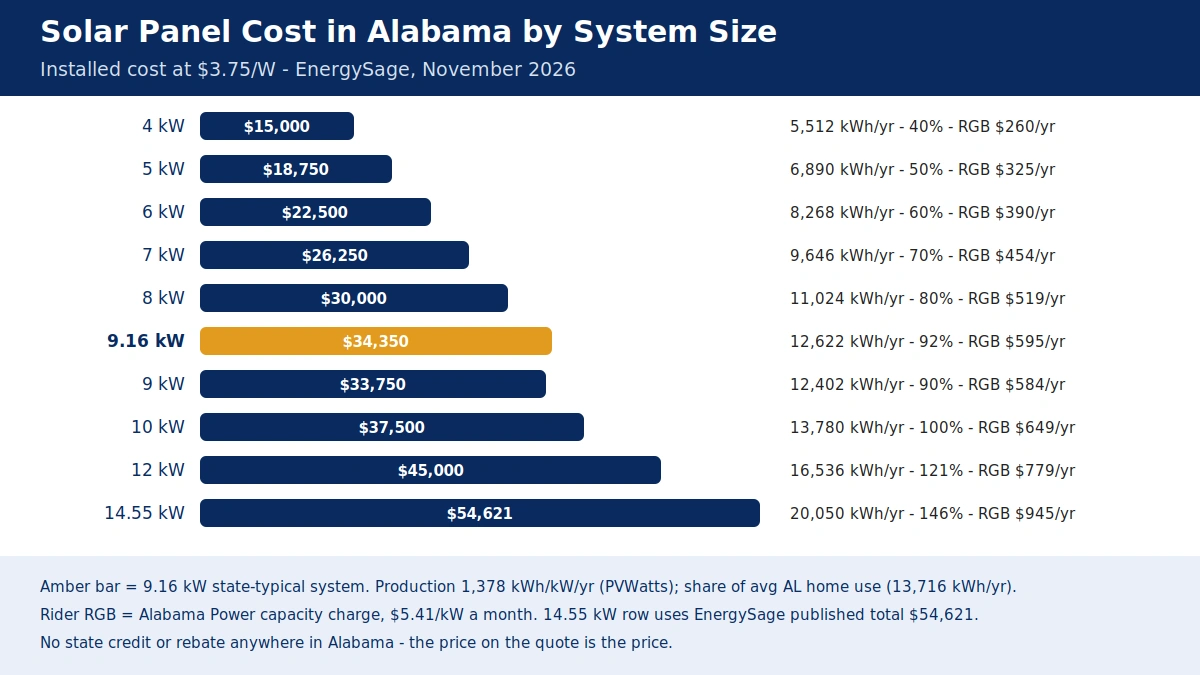
Size is the first decision, and in Alabama it is a decision the utility rules punish you for getting wrong. The average Alabama home uses about 1,143 kilowatt-hours a month, or roughly 13,716 a year — among the heaviest in the country, driven by long cooling seasons and electric everything. A kilowatt of panels here makes about 1,378 kilowatt-hours a year, so a 9.16 kW system makes about 12,622 kilowatt-hours — roughly 92% of the average home’s annual use. That is why 9.16 kW is the modeled typical size: it covers nearly the whole house without flooding the grid with power that earns three to five cents.
Oversizing past what the house uses is a worse deal here than anywhere else in the South. Every kilowatt-hour past your own consumption goes out at the buyback rate — 3.45 to 5.47 cents on Alabama Power, 6.427 cents on Huntsville Utilities — while a kilowatt-hour used at home saves the full retail price, around 16 cents. That spread between the two values is why the size table below turns unattractive past 10 kW for most Alabama homes. The table prices every common size at the EnergySage $3.75-per-watt anchor, with production at 1,378 kilowatt-hours per installed kilowatt per year. It also carries the Rider RGB charge, the one line no other state’s size table needs: Alabama Power bills $5.41 a month for every kilowatt on the roof, so a bigger system costs more every month before it makes a single extra dollar.
| System size | Cost at $3.75/W | Approx. annual production | Share of avg. AL home use (13,716 kWh/yr) | Rider RGB per year |
|---|---|---|---|---|
| 4 kW | $15,000 | ~5,512 kWh | ~40% | ~$260 |
| 5 kW | $18,750 | ~6,890 kWh | ~50% | ~$325 |
| 6 kW | $22,500 | ~8,268 kWh | ~60% | ~$390 |
| 7 kW | $26,250 | ~9,646 kWh | ~70% | ~$454 |
| 8 kW | $30,000 | ~11,024 kWh | ~80% | ~$519 |
| 9.16 kW (state typical) | ~$34,350 | ~12,622 kWh | ~92% | ~$595 |
| 9 kW | $33,750 | ~12,402 kWh | ~90% | ~$584 |
| 10 kW | $37,500 | ~13,780 kWh | ~100% | ~$649 |
| 12 kW | $45,000 | ~16,536 kWh | ~121% | ~$779 |
| 14.55 kW (state avg) | ~$54,621 | ~20,050 kWh | ~146% | ~$945 |
Two things in that table are worth a second look. First, the state-average 14.55 kW system makes about 146% of what the average home uses, which tells you who is buying the average system: households with electric vehicles, heat pumps, pools, or all-electric everything, plus the oversizing that Alabama’s thin installer field rarely talks anyone out of. A home with gas heat and no EV usually needs 7–9 kW, not 15. Second, the Rider RGB column is the quiet tax on size: the 14.55 kW system pays about $945 a year in capacity charges alone, every year, before a single kilowatt-hour is valued. Every extra kilowatt you add past your daytime load costs $64.92 a year in charges and earns back only the buyback rate on the power it exports.
Size the system from a full year of electric bills, not from how much roof you happen to have. Add up the kilowatt-hours, divide by roughly 1,378 to get the system size in kilowatts that covers it, then adjust: add 1–2 kW for a planned EV, add more for a heat pump or a pool pump, subtract for a shaded or north-facing roof — and then subtract again for the power you will never use in daylight, because that is the power Alabama Power buys for a nickel. If the roof can only fit 5 kW but the house uses 13,716 kilowatt-hours a year, the honest answer is a 5 kW system that covers part of the bill — not a ground mount the budget never contemplated. Our 6 kW vs 8 kW vs 10 kW guide walks through that sizing logic for the country at large.
Solar Panel Cost by City: Birmingham, Huntsville, Mobile & Montgomery
Alabama is a long state with three different solar markets inside it, and the price spread between them is the widest of any state in this series. Birmingham sits on Alabama Power in the middle of the state, with the highest prices in the country. Huntsville sits on TVA power in the north, with the best export terms in the state. Mobile and the Gulf Coast sit on Alabama Power too, but with cheaper installs and a hurricane wind bill attached. Montgomery, the capital, is the priciest market after Birmingham. EnergySage’s November 2026 city pages give the clearest view of that spread.
| City / area | $/W | Avg. system | Total before incentives | Payback |
|---|---|---|---|---|
| Birmingham | $4.48 | 15.28 kW | ~$68,508 ($58,232–$78,784) | Not stated on the page fetched |
| Montgomery | $4.03 | 16.08 kW | ~$64,801 ($55,081–$74,521) | Not stated on the page fetched |
| Huntsville | $3.54 | 16.72 kW | ~$59,162 ($50,288–$68,036) | 21.71 yrs |
| Mobile | $3.12 | 13.02 kW | ~$40,596 ($34,507–$46,685) | 19.32 yrs |
| Enterprise | $3.30 | 14 kW | ~$46,155 ($39,232–$53,078) | 19.02 yrs |
| Northport | $3.26 | 17.86 kW | ~$58,238 ($49,502–$66,974) | 13.27 yrs |
| Grand Bay | $3.10 | 13.87 kW | ~$42,945 ($36,503–$49,387) | 20.88 yrs |
Birmingham is the priciest major market in the country at $4.48 per watt — more than double the Florida average — and the reason is not the roof. Birmingham has a thin installer bench, long travel distances for crews, and an Alabama Power territory where the capacity charge makes every quote harder to sell, so fewer installers compete and the ones who do price in the risk. Mobile is the cheapest of the big four at $3.12, with a deeper Gulf Coast installer field and big, simple roofs. Huntsville sits in the middle on price but carries the best economics in the state, because its utility pays more for exports and charges no capacity fee. Montgomery is the second-priciest at $4.03, with the second-largest average system in the table — 16.08 kW — because capital-city homes run the air conditioning hardest and the systems are sized to match.
Never rank these cities on the payback column. Northport shows 13.27 years and $68,004 in 25-year savings while Huntsville, twenty minutes away, shows 21.71 years and $10,967 — at nearly identical prices per watt and with Northport on the same TVA power. Those swings are EnergySage model variance — different system sizes, different rate assumptions, different savings models inside each city’s page — not a real signal that one suburb is twice as good for solar as the next. Price per watt is the column you can actually compare. Payback only means something when it is worked out from your own utility’s tariff, which is what the payback section below does.
One more city-level caution: EnergySage publishes no payback figure at all for Birmingham or Montgomery on the pages fetched for this guide, even though both cities carry the highest prices in the state. That gap is itself a signal. A city page that will quote you $68,508 for a Birmingham system but will not publish a payback number for it is a page that knows what the number would look like. The utility-specific payback in this guide — 30.6 years on Alabama Power — fills that gap, and it is not a number any installer should be hiding from a Birmingham homeowner.
What Moves Your Quote: Roof, Heat, Humidity & Gulf Wind
The per-watt anchor is a starting point, not a quote. In Alabama, six things move a quote by thousands of dollars, and three of them are specific to this state’s climate and coastline.
The Gulf Coast wind. Baldwin and Mobile counties sit in a hurricane wind zone, and the code answers with design wind speeds that inland Alabama never sees: Gulf Shores uses a 160 mph 3-second-gust design criterion throughout the city, and Orange Beach sets 160 mph for ordinary single-family homes (Risk Category II), with wind-borne-debris requirements on top. A coastal array needs wind-rated racking, a structural review, roof-access setbacks, and fastening patterns that an inland quote never carries. A Mobile quote that matches a Huntsville quote dollar for dollar is probably missing the wind work — ask where it is.
The roof itself. Alabama roofs age fast in the heat. UV and humid-subtropical summers dry out asphalt binders faster than the manufacturer rating assumes, algae streaks untreated shingles within a decade, and the spring hail line bruises anything that is not Class 4 rated. If the roof has less than ten years of life left, replace it first — taking panels off and putting them back for a reroof costs thousands all by itself. Our roof replacement guide puts a price on the reroof, and our detach-and-reset guide puts a price on taking the panels off and putting them back. Standing-seam metal — common on Gulf Coast homes — is one of the best solar roofs in the country, because clamps grip the seams without a single roof penetration.
The heat. A panel’s efficiency drops as it gets hotter, by roughly 0.3–0.5% for every degree Celsius the cell runs above 25 degrees. An Alabama rooftop in August runs far hotter than that, so a system here produces less per hour of sunshine than the same panels would on a cool spring day. The long days more than make up for it over the year — that is why production still lands near 1,378 kilowatt-hours per kilowatt — but any production estimate built on nameplate wattage without a temperature derate is overstating summer output. Make the installer show you the derate inside the production model.
Panel tier. Premium panels cost 10–20% more per watt than value-tier panels, and in Alabama the premium buys two things that matter: better high-temperature performance and better low-light performance on cloudy, humid afternoons. Where roof space is tight, paying for efficiency is worth it. On a large, unshaded roof inland, cheaper value-tier panels usually come out ahead.
Inverter choice. A string inverter is cheaper upfront; microinverters or optimizers cost more but produce more on roofs with partial shade — and Alabama roofs, with their live oaks, pines, and dormers, are shaded more often than installers admit. Microinverters also let you monitor every panel separately, so a single shaded panel cannot drag the whole string down with it. Our inverter replacement guide costs out each type over its full life, including the string-inverter replacement at year 10–15 that microinverter systems mostly avoid.
The electrical panel. Many Alabama homes, especially the brick ranches and split-levels built from the 1960s to the 1980s, still run on 100-amp service, and a solar install often forces the question. A panel upgrade to 200 amps runs $1,500–$4,000 nationally per our electrical panel upgrade guide, and it is the most common surprise add-on in Alabama quotes. Find out whether the quote covers it before you sign — not after the electrician is already standing in your driveway.
Alabama Electricity Rates: Cheap Power, Slow Payback
Everything about Alabama solar comes back to one uncomfortable number: what the power costs. The U.S. Energy Information Administration puts the Alabama residential average at 16.33 cents per kilowatt-hour in August 2026, against a national average of 18.16 cents — roughly 10% cheaper. The January-to-August 2026 average is 16.51 cents, and the 12-month average to August 2026 is about 16.4 cents. The average Alabama home uses about 1,143 kilowatt-hours a month, so the typical bill runs about $187 a month — and in the summer, when the air conditioning is doing the heavy lifting, the EIA’s derived August bill reaches $253.96 at 1,555 kilowatt-hours.
That cheap power is the entire payback problem, compressed into one number. Every kilowatt-hour a rooftop system generates is a kilowatt-hour the homeowner never buys — but in Alabama that kilowatt-hour was only worth about 16 cents, where in Massachusetts it is worth about 30. A system in Mobile makes more electricity than a system in Boston and saves less money doing it. The sun is not the constraint here. The price of the power is.
Rates have been rising, which helps the case a little at a time. Alabama residential rates rose 3.91% a year over the five years to 2026, per EcoGen, though the year to August 2026 was nearly flat — up just 0.4%. That climb counts for payback: a system bought at today’s rates keeps getting more valuable with every rate rise, because the savings keep growing while the price you paid stays put. Most payback models build in 2–3% a year of rate escalation. If rates stay flat, payback stretches by a year or two; if they keep climbing at the recent five-year pace, it shortens.
Which utility you have matters as much as the state average does. Alabama Power’s own residential rate ran about 16.8 cents all-in in 2024, per EcoGen’s reading of the company’s filings. Huntsville Utilities, a TVA distributor, runs cheaper wholesale-backed power. Baldwin EMC, on the Gulf Coast, runs its own time-of-use rate for solar homes with a 32-cent peak hour. A statewide average of 16.33 cents describes no single household’s bill; the utility’s own tariff does, and the next section is built on those tariffs.
Alabama Power’s Rider RGB & Rate PAE: The Rules That Decide Your Return
Alabama has no statewide net metering law, and anyone who tells you otherwise is describing a rule that does not exist here. What Alabama Power offers instead is two tariffs that work together, and together they are the reason Alabama payback is the longest in the South.
Power you use as it is made saves the full retail price. Run the air conditioning, the pool pump, or the EV charger while the sun is up, and every kilowatt-hour your panels make replaces one you would have bought at about 16 cents. That is the valuable kilowatt-hour in Alabama.
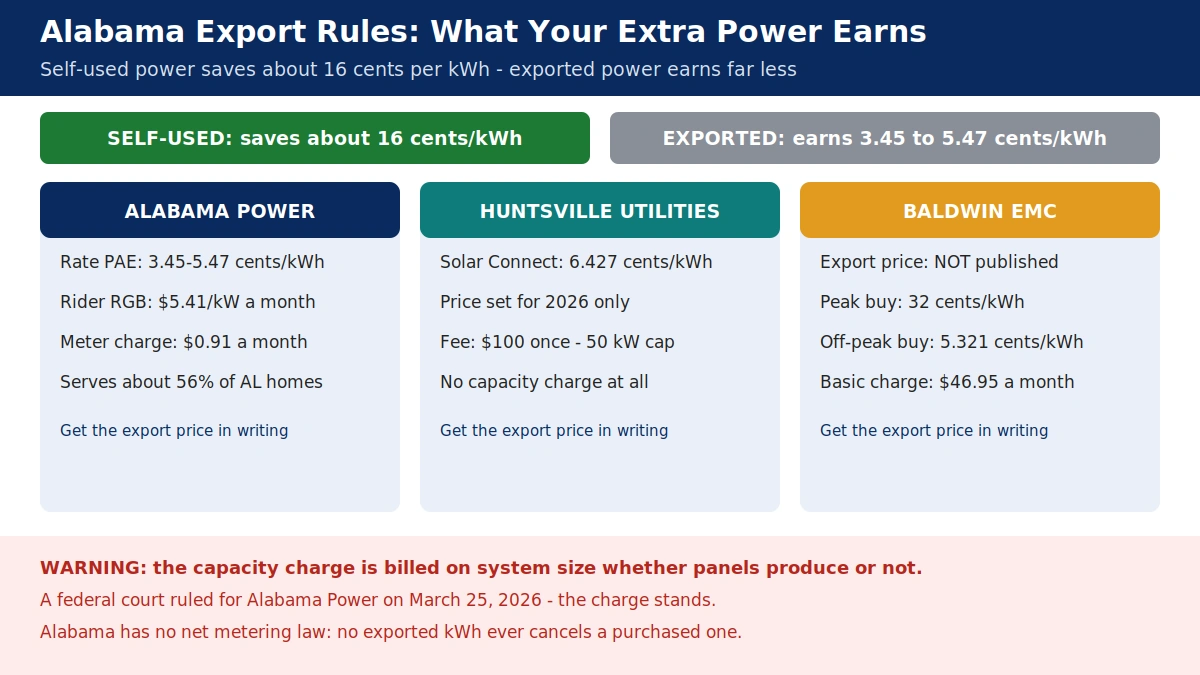
Power you send out earns the buyback rate, not the retail rate. Alabama Power buys exported power under Rate PAE (Purchase of Alternate Energy), its tariff for home systems up to 100 kW. The price is 3.45 to 5.47 cents per kilowatt-hour, depending on the season, the hour, and which of three Rate PAE options your rate plan puts you on. The Time of Day option pays up to 5.17 cents on summer weekday daytime hours and as little as 3.66 cents in the winter months. The Time Advantage option pays up to 5.47 cents on summer weekday afternoons and as little as 3.45 cents in October, April, and May. The Residential Demand option pays up to 4.64 cents on summer weekday afternoons and 3.83 cents at other hours. The current prices come from the 47th revision of the tariff, effective with April 2026 bills — and the service runs one year at a time, so the price is not fixed for the life of your system. Export credits carry forward on your account, and any credit left at year end stays on the account or is paid by check if you ask or leave the rate.
The capacity charge is billed on system size, not on production. Rider RGB adds a Capacity Reservation Charge of $5.41 per kilowatt of nameplate system size every month — $49.56 a month, about $595 a year, on the typical 9.16 kW system — plus a $0.91 monthly meter charge under Rate PAE. The charge has applied since April 2022 bills. It does not look at how much power you send out, so a cloudy January costs the same as a bright July. A typical system must export about 906 kilowatt-hours in a month at the highest Rate PAE price just to cover one month’s charge. The charge was challenged in federal court, and on March 25, 2026 the court ruled for Alabama Power and the Alabama Public Service Commission. It is not going away on appeal, and any quote that leaves it out is not a real quote.
There is one escape hatch, and it is expensive in a different way. Qualifying customers can swap the capacity charge for Rate RTA, a time-of-use rate under which power you buy costs 71 cents per kilowatt-hour from 3 p.m. to 5 p.m. on weekdays, June through September. For a household that runs its air conditioning hard in those hours, RTA can cost more than the charge it replaces. Do the arithmetic on your own bills before choosing it — and get Alabama Power to confirm in writing that you qualify.
Huntsville plays by different rules. Huntsville Utilities, a TVA distributor serving about 8% of Alabama homes, runs Solar Connect: exported power earns 6.427 cents per kilowatt-hour in 2026 only — better than Alabama Power’s best hour, and set for one year, so ask for the 2027 price before you sign. There is a $100 one-time application fee, a 50 kW size limit, and systems over 10 kW must carry at least $1,000,000 in liability insurance. The program has a participation cap, and the room left is not published — Huntsville Utilities advises applying early. And if you connect panels without joining Solar Connect or TVA’s own purchase program, you are paid nothing at all for extra power.
Baldwin EMC is the third rulebook. The Gulf Coast co-op publishes no price for extra power at all — the co-op or its supplier PowerSouth may buy it under a purchase contract, and the price has to be asked for in writing. What Baldwin EMC does publish is the rate solar homes move to: a time-of-use rate where power you buy costs 32 cents per kilowatt-hour at peak and 5.321 cents off-peak, with a $46.95 basic service charge every month whatever your panels make. Peak hours are 3–6 p.m. April through October and 6–8 a.m. November through March. Systems over 10 kW need a facilities study, and the member pays all connection and upgrade costs. A quote that shows income from exported power on Baldwin EMC without a confirmed price is guessing.
Every other co-op and city utility writes its own rules. Much of north Alabama buys power through TVA, and each distributor sets its own solar program. Rate PAE and Rider RGB are Alabama Power’s alone; Solar Connect belongs to Huntsville Utilities only. Before you sign anything, get five answers in writing from your own utility: the price per kilowatt-hour for extra power, any monthly charge for solar homes, any rate change when you add solar, the application fee, and the size limit.
Alabama Has No State Solar Incentives — What That Means
With the federal credit gone, most states still have something left — a state credit, a rebate, an exemption. Alabama has nothing. That sentence is the whole incentives section, and it is worth saying plainly, because most solar advertising in Alabama does not say it.
There is no Alabama state income tax credit for solar. The Alabama Department of Revenue’s Schedule OC for 2025, its list of other credits, contains no credit for home solar. Not a small one, not a capped one — none. A quote that subtracts a state credit is wrong.
There is no state sales-tax exemption verified for solar equipment. No verified exemption was found in this pass, so do not let a quote quietly subtract one. Have the installer list sales tax as its own separate line.
There is no verified property-tax treatment for solar. No Alabama property-tax exemption for solar was verified in this pass, so do not assume the added home value is untaxed. Ask the county revenue office how it values a home with solar panels before you count on anything.
No Alabama utility pays a rebate for installing panels. Not Alabama Power, not Huntsville Utilities, not Baldwin EMC, not any co-op. There is no check at purchase anywhere in the state. Any installer who promises a utility rebate in Alabama is either confused or selling something else.
Alabama has no Solar for All program for homes. The one federal grant in the neighborhood, Southeast Rural Power — run by the nonprofit Groundswell — lists Huntsville Utilities and Lanett Utilities as partners, and it delivers community-solar bill credits to low-income customers through the utility, not panels on a roof. The EPA ended the Solar for All grants in August 2025; federal courts ruled that termination unlawful in September 2026, and the EPA was weighing an appeal as of October 1, 2026. There is no way for an Alabama household to apply for it, and it was checked as recently as October 5, 2026.
The federal home energy rebates have not launched in Alabama at all. The Alabama Department of Economic and Community Affairs (ADECA) says its Home Energy Rebates program — both the HEAR electrification half and the HOMES efficiency half, about $146 million in federal allocation — is still under development, with no launch date as of November 2026. Residents can email rebates@adeca.alabama.gov for updates. And even when it does launch, HEAR will not pay for solar: it pays for heat pumps, heat pump water heaters, electrical panels, and insulation-related wiring — never for panels, batteries, EV chargers, or windows.
| Incentive | Value | Who pays / how | Notes |
|---|---|---|---|
| AL state income tax credit | $0 — none exists | — | Schedule OC for 2025 lists no solar credit |
| AL sales-tax exemption | Not verified | — | Do not let a quote subtract one |
| AL property-tax exemption | Not verified | — | Ask the county revenue office |
| Utility rebate (any utility) | $0 — none exists | — | No Alabama utility pays one |
| Solar for All | $0 — no statewide program | — | Groundswell community credits via Huntsville / Lanett only, low-income, no household application |
| HEAR / HOMES rebates | Not launched | ADECA | Under development, no launch date as of Nov 2026; HEAR does not cover solar in any case |
Federal Credits in 2026: What Alabama Owners Actually Get
The federal story in 2026 fits in one paragraph, which is exactly why so much solar advertising still gets it wrong — and in Alabama the paragraph is shorter than anywhere else, because the one escape route other states keep is closed here too.
A system you own and install in 2026 earns no federal tax credit at all. The Residential Clean Energy Credit (§25D, 30%) was ended by Congress in the One Big Beautiful Bill Act (P.L. 119-21, signed July 4, 2025), which shut the credit off for systems placed in service after December 31, 2025. The IRS confirmed in FS-2025-05 that completion is the date that counts — a deposit paid in 2025 buys nothing if the crew finished the job in January 2026. §25C, the credit for efficient home improvements, ended on the same date. A 2026 cash or loan quote that still takes off 30% is priced under a law that no longer exists. Have the installer remove it and quote again.
The lease route that saves other states is closed in Alabama. The commercial clean-electricity credit (§48E, 30%) is still alive for systems a company owns instead of the homeowner, and in other states a lease lets the company claim it and pass part of the value on as a lower monthly payment. In Alabama that door is shut twice over. Residential power purchase agreements are prohibited — DSIRE’s May 2026 map marks third-party PPAs in Alabama as apparently disallowed, citing Ala. Code §37-14-32. And no residential lease provider operates in the state at all: EcoGen’s October 5, 2026 check found no lease or PPA company serving Alabama homes, and Sunrun, the national lease company, did not list Alabama. A homeowner who buys in Alabama in 2026 pays the full sticker price with no federal help of any kind, directly or through a third party. One caution: EnergySage’s Birmingham city page shows generic lease and PPA estimates — about $146 a month for a PPA, $164 for a lease — but those are labeled as based on U.S. national quote data, with zero installers near Birmingham actually offering them. They are a national template, not an Alabama offer, and they should not be quoted as one.
HEAR never pays for solar. The Home Electrification and Appliance Rebates program still offers up to $8,000 to income-qualified households in 2026 — but the money is for electrification, not for panels. What HEAR pays for is heat pumps, heat pump water heaters, electrical panels, and insulation-related wiring work. Panels, batteries, EV chargers, and windows all sit outside it, and since the Energy Department’s Notice 26-2 of September 1, 2026, the program covers electric-to-electric upgrades only — no fuel-switching. Alabama’s own HOMES and HEAR programs have not launched at all. Any quote that folds a HEAR rebate into the solar price is describing a program that simply does not work that way. HEAR can still matter to an Alabama homeowner — a heat pump paired with new solar panels is a common combination, and the heat pump half may qualify once ADECA launches — but the solar half never does.
The honest summary: in 2026, the federal government contributes nothing to an Alabama homeowner who buys solar panels, and — unlike in South Carolina or Massachusetts — contributes nothing indirectly either, because there is no lease company here to claim the surviving credit. The price on the quote is the price. Our federal tax credits guide lays out the full 2026 federal picture, and our national solar cost guide walks through lease-versus-buy in detail.
Payback in Alabama: The Real Math by Utility
Payback is where Alabama solar either earns its keep or does not, and the answer depends on which utility sends the bill. The worked examples below use the EcoGen anchors so every input can be checked; the cross-checks come from EnergySage — and where the two disagree, the draft says so.
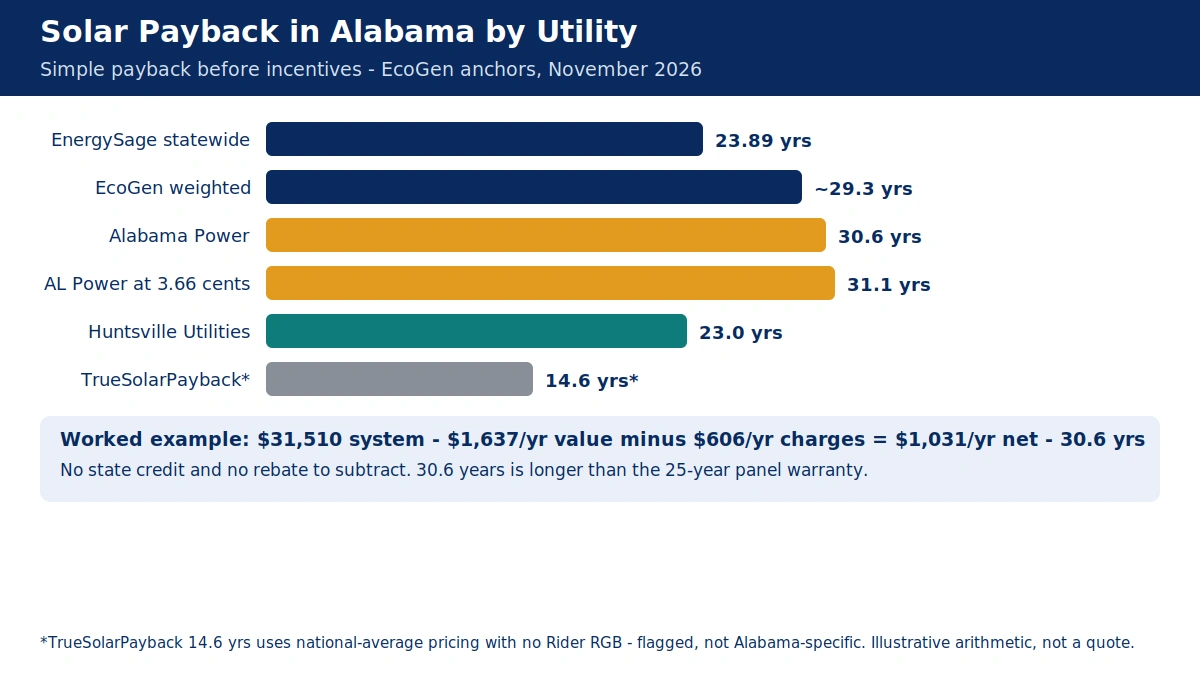
The worked example. A typical 9.16 kW system at $3.44 per watt costs $31,510 before incentives. It makes about 12,622 kilowatt-hours a year. There is no state credit and no rebate to subtract, so the net cost is the gross cost: $31,510. The yearly savings — and with them the payback — then rest entirely on the utility.
Alabama Power is the slowest payback in the South. The typical system is worth about $1,637 a year in power, but the Rider RGB capacity charge and the meter charge take about $606 a year back, leaving net savings of about $1,031 a year. Simple payback: $31,510 ÷ $1,031 ≈ 30.6 years. If every exported kilowatt-hour earned only 3.66 cents, the low end of the Rate PAE range, payback stretches to 31.1 years. No upkeep, no rate rises, and no financing costs are counted in either figure — add a loan with dealer fees and the number gets worse, not better. Thirty years is longer than the 25-year production warranty on the panels themselves. That is the number a Birmingham or Mobile homeowner needs to see before signing, and it is the number most Alabama quotes do not show.
Huntsville Utilities is the fastest payback in the state — and still slow. The typical system on Solar Connect pays back in about 23.0 years (EcoGen). The 6.427-cent export price and the absence of any capacity charge are worth more than seven years against Alabama Power. Twenty-three years is still longer than most homeowners plan to stay in one house, and still longer than the 14–16 years the same money buys in the Carolinas — but it is inside the panel warranty, which the Alabama Power figure is not.
The statewide figure splits the difference. EcoGen’s Alabama figure, weighted by homes across Alabama Power and Huntsville Utilities (about 66% of Alabama homes), is about 29.3 years before incentives. EnergySage’s statewide figure is shorter — 23.89 years on the 14.55 kW average system, with just $4,252 in 25-year savings. The gap between the two is a flag, not a typo: EnergySage’s model does not appear to count Rider RGB the way EcoGen’s does, and its 25-year savings figure — $4,252 on a $54,621 system — quietly admits the same thing EcoGen says loudly, that the system barely pays for itself inside a quarter century. This guide presents both and treats EcoGen’s utility-specific figure as the one to trust for Alabama Power territory, because it is the only one that names the charge.
| Scenario | Simple payback | Source |
|---|---|---|
| EnergySage statewide avg (14.55 kW) | 23.89 yrs | EnergySage, Nov 2026 |
| EcoGen statewide weighted | ~29.3 yrs | EcoGen Index, Sep 2026 |
| Alabama Power (before incentives) | 30.6 yrs | EcoGen |
| Alabama Power, every export at 3.66 cents | 31.1 yrs | EcoGen |
| Huntsville Utilities (before incentives) | 23.0 yrs | EcoGen |
| TrueSolarPayback 8 kW (national pricing, no RGB) | 14.6 yrs | TrueSolarPayback, Apr 2026 — flagged, not Alabama-specific |
The flagged conflict. TrueSolarPayback (April 2026) prices an 8 kW Alabama system at $3.50 a watt and reports a 14.6-year payback with $31,620 in 25-year net savings. That model uses national-average pricing, a 14.6-cent electricity rate, and no Rider RGB charge — none of which describes an Alabama Power bill. It is not wrong as arithmetic; it is wrong as Alabama. Do not let a quote cite 14.6 years for an Alabama Power home. The same caution applies to any national payback calculator that does not ask for your utility first.
What changes the payback most. Daytime self-use is the biggest lever: shifting the dishwasher, the laundry, the pool pump, and the EV charger into daylight hours moves kilowatt-hours from the 3-to-5-cent export bucket into the 16-cent self-use bucket, and no other change pays as well. Rate escalation is the second lever: at 3% a year, 25-year savings grow by tens of thousands of dollars compared with a flat-rate model. System size is the third: oversizing past household usage pushes the marginal kilowatt-hours into exported credits worth a quarter of consumed power, while Rider RGB charges $5.41 a month for every extra kilowatt whether it earns anything or not. Financing is the fourth: a solar loan carrying dealer fees can add 10–30% to the effective price, which is why the cash price per watt — not the monthly payment — is the figure to compare.
Who still comes out ahead. Four Alabama households clear the bar. The all-day home with big daytime load — home offices, pool pumps, daytime cooling on smart schedules — keeps most production at full retail value. The battery-first buyer, for whom storage turns nickel exports into full-retail offset, which matters more here than nearly anywhere. The TVA-distributor customer with good local terms, in Huntsville or a north Alabama co-op, where the export price is higher and the capacity charge does not exist. And the backup-power buyer, for whom outage protection is the main purchase and savings come second — in that case the payback math is context, not verdict. Walk away if your home is empty on weekdays, if you are counting on tax credits, or if the installer projects savings without naming Rate PAE and Rider RGB.
Sun, Heat & Storms: What Production Really Looks Like in Alabama
Alabama’s sun is the best in the eastern United States outside Florida, and it comes with a climate that asks real questions of the equipment. An honest production estimate has to carry both halves.
The sun. A kilowatt of panels in Alabama makes roughly 1,378 kilowatt-hours a year (EcoGen, PVWatts-based), and a 9.16 kW system makes about 12,622 kilowatt-hours. Cross-checks land close: xplosole’s PVGIS modeling gives 1,373 kilowatt-hours per kilowatt a year, and TrueSolarPayback gives 1,314 for an 8 kW system. Summer is when production peaks — long days, high sun, and the air conditioning working hardest in the very hours the panels make the most. Winter output drops but stays mild: the days get shorter, yet there is no snow season to model and no month when production falls off a cliff the way it does in the Northeast. A 10 kW system makes about 13,780 kilowatt-hours in a year, and the monthly shape is a gentle hill, not a cliff.
The heat trims what the sun gives. Panel efficiency falls as cell temperature rises, and an Alabama rooftop in August runs far hotter than the 25 degrees Celsius the nameplate assumes. The long days more than compensate over the year — that is why the annual figure still lands near 1,378 kilowatt-hours per kilowatt — but a production estimate built on nameplate wattage without a temperature derate is overstating summer output. Heat hits the roof itself too: UV and humid summers dry out asphalt binders faster than the manufacturer rating allows for, which is why the roof’s remaining life has to be part of the solar conversation, not an afterthought.
The storm season is a design question, not a production question. The Gulf Coast sees tropical systems most years, and the code answers with design wind speeds of 160 mph in Gulf Shores and Orange Beach, with wind-borne-debris requirements on top. North Alabama sits in tornado country, and the whole state gets the severe thunderstorms that roll through every summer. With racking rated for the local wind speed and a proper install, panels stay put through storms that strip shingles off — but “proper install” is doing a lot of work in that sentence. The wind detailing, the structural review, and the fastening pattern are not line items to hunt for the cheapest version of. After a storm, the array should be inspected before it is re-energized if there is any visible damage, and the homeowner’s insurance should be told the system exists — most policies cover it once declared.
What to actually do about the climate. Nothing out of the ordinary. Keep the panels clean of the pollen and dust that coat Alabama roofs in spring — rain usually does it, and a rinse from the ground is enough when it does not. Never climb onto a hot roof in July to wash panels; the fall risk is worth far more than the production you would recover. The design calls that count are made at install time: a south-facing orientation where the roof allows it, a tilt that sheds the summer cloudbursts, microinverters or optimizers so a shaded string cannot drag the whole array down, and a production estimate built on PVWatts data with the temperature derate out in the open, not hidden. Rate PAE is what makes the summer work financially: the air conditioning runs hardest in the same hours the panels produce most, so the most valuable kilowatt-hours are the ones the house eats the moment they are made.
Should You Add a Battery? Backup in a No-Arbitrage State
A battery is the most consequential add-on in an Alabama solar project — it can add $15,000 or more to the job, and whether it earns that money back depends on a question Alabama answers differently from every state around it.
What a battery costs. Adding 13.5 kWh of storage costs about $15,647 installed (EnergySage, July 2026, national figure — no Alabama-specific battery price was verified for this guide). A battery you own and install in 2026 gets no federal credit either — §25D covered storage as well, and it closed on the same day. Our solar battery cost guide lists national prices for the main battery models.
There is no battery program to stack on top. No Alabama utility runs a battery incentive comparable to Duke Energy’s PowerPair in the Carolinas, and no Alabama utility pays a monthly battery-control credit. The battery earns nothing from the grid. What it earns is the difference between the export rate and the retail rate on every kilowatt-hour it stores and releases later: on Alabama Power, that spread is roughly 11–13 cents a kilowatt-hour, the widest in the South, because the export price is so low. A battery that stores 10 kilowatt-hours a day and releases them after dark saves about $1.20 a day, about $440 a year — a thirty-five-year return on a $15,647 battery, before degradation. The arbitrage exists, but it is too small to carry the cost on its own.
The backup case is the real case in Alabama. The Gulf Coast loses power to hurricanes and tropical storms, north Alabama loses it to tornadoes, and the whole state loses it to the thunderstorms that roll through every summer. A battery keeps the air conditioning, the fridge, the well pump, and the medical equipment going through an outage that can stretch a day or more on the coast. That is a resilience value, not a financial return, and it should be weighed as one: a battery that never earns back its cost in arbitrage can still be worth buying for a household that cannot afford to lose cooling in August. For most households a generator still covers the house for less money; a battery offers something different instead — quiet, automatic power with nothing to refuel.
The payback verdict. On Alabama Power, a battery does not pay for itself on arbitrage alone — the daily spread is real but the battery is expensive, and there is no program payment to close the gap. On Huntsville Utilities the spread is narrower still, because the export price is higher. Buy the battery for backup, size it to the loads that matter in an outage rather than to the whole house, and budget it as resilience, not as an investment.
HOAs, Permits & Picking an Installer in Alabama
Alabama law is blunt on the question most solar states settled years ago: your HOA can say no. Everything else in this section comes out of that one fact.
HOAs can ban solar in Alabama. The state has no solar-access law — no statute that stops a homeowners association from restricting or prohibiting rooftop solar. An HOA here can ban panels outright — and some of them do. What constrains an HOA instead is the general law of architectural review and the association’s own documents: the board’s discretion is limited by reasonableness and good faith, and the governing documents must be recorded to be enforceable at all. A blanket ban adopted without proper procedure, or used to punish one owner while others keep their panels, can be challenged on those grounds — but the HOA’s documents are still the starting point. Read them before you sign a single thing with an installer, and get the architectural review approval in writing before any panels are ordered.
Condos and townhomes are harder still. In a condominium the roof is usually common area, so the unit owner does not own the surface the panels would sit on. The board’s approval process — plans, engineering, insurance, licensed installation, a maintenance plan — is the entire decision, and no state solar-rights law lets you appeal past it. Community solar is the realistic alternative for renters, condo owners, and homes with shaded or unsuitable roofs, but no general community-solar subscription for Alabama homeowners was verified for this guide — the only verified program is Groundswell’s low-income community-solar credits through Huntsville Utilities and Lanett Utilities. Our community solar guide prices that option in general terms.
Permits and interconnection take time. An Alabama rooftop system needs a building permit, an electrical permit, and a utility interconnection agreement, in that order — and the interconnection step is usually the slowest, running weeks to a few months depending on the utility and whether the local transformer needs an upgrade. Alabama Power takes applications in PowerClerk and asks for approval before you buy or install, with no study fee for systems up to 25 kW. No statewide permit fee schedule was verified for this guide, so no fee figure appears here; the town or county building department is the one that sets it. What is certain is that time, not money, is the bottleneck — and an installer who promises permission to operate in two weeks is promising something the utility decides, not them.
Installer credentials to verify. Alabama has no solar-only license, and the two licenses that matter are not interchangeable. The electrical work needs a contractor licensed by the Alabama Board of Electrical Contractors (AECB), and a roof-mounted system over $2,500 needs an unlimited home builder license from the Home Builders Licensure Board (HBLB), under Advisory Opinion 22-06. Ask for both numbers and verify them on the boards’ websites — and check that the name on each license matches the name on your contract. NABCEP certification is the leading industry credential. And check the company’s history: Alabama’s thin market has seen installers come and go, and a warranty is only as good as the company still around to honor it.
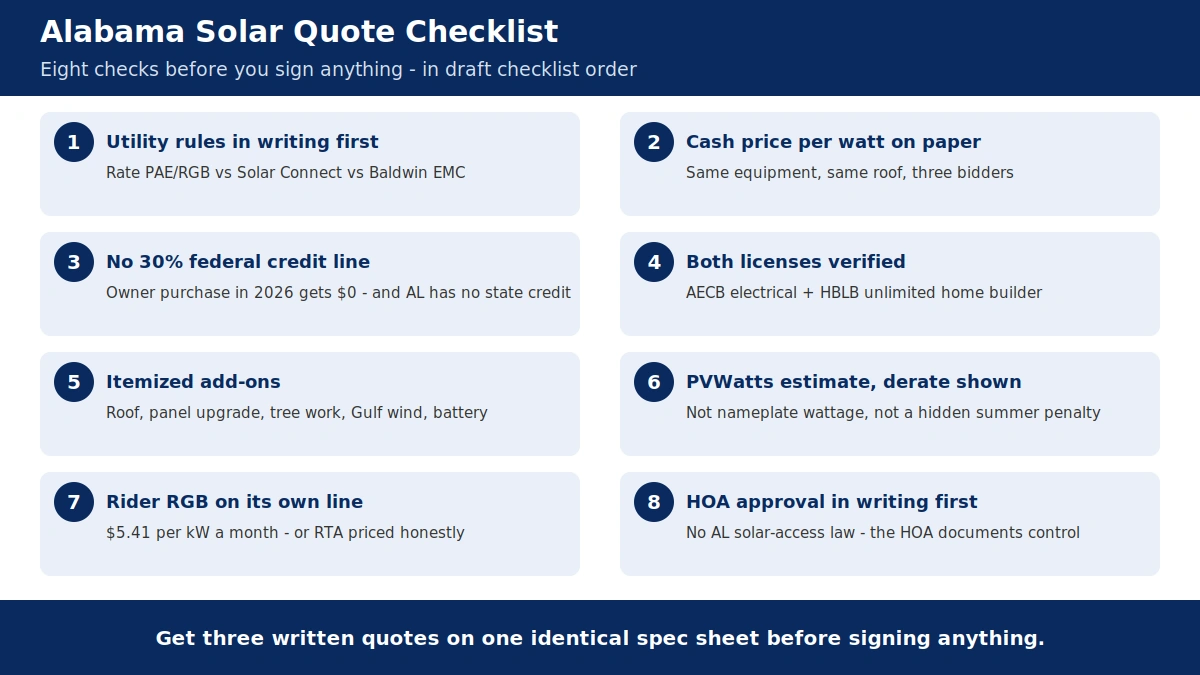
The eight-item quote checklist:
- Your utility’s rules in writing first — Rate PAE and Rider RGB, Solar Connect, or Baldwin EMC’s time-of-use rate; the export price and the monthly charge decide the payback before anything else.
- Cash price per watt, on paper — the same equipment on the same roof, from all three bidders. No cash price, no comparison.
- No line for a 30% federal credit and no line for a state credit — an owner purchase in 2026 gets $0 federal, and Alabama has no state credit at all. A quote that still deducts either is priced under a dead law or an imaginary one.
- Both license numbers verified — AECB electrical contractor license and HBLB unlimited home builder license, checked on the boards’ websites, names matched to the contract.
- Itemized add-ons — roof work, panel upgrade, tree work, Gulf Coast wind detailing, and battery shown as separate lines, not buried in the per-watt price.
- Production estimate from PVWatts, temperature derate shown — not nameplate wattage, and not an annual average that hides what the summer heat takes away.
- Rider RGB shown as its own line — $5.41 per kilowatt a month on Alabama Power, or the Rate RTA alternative priced honestly for your bills. A quote without it is not a real quote.
- HOA approval in writing first — Alabama has no solar-access law; the HOA’s documents control, and approval must come before panels are ordered.
Buy, lease, or community solar? Buying is the only third-party-free path that exists in Alabama, and it wins over 25 years only for homeowners with high daytime use, TVA-distributor terms, or a backup-power reason to buy — it keeps the system, the resale value, and every kilowatt-hour of self-use. Leasing wins nowhere in Alabama, because no lease provider operates here and the PPA route is prohibited. Community solar wins for everyone else only where it exists: renters, condo owners, and homes with shaded or unsuitable roofs should ask Huntsville Utilities or Lanett Utilities about the Groundswell low-income credits, and everyone else should treat community solar as an option that has not arrived in Alabama yet. It asks for no roof at all — you subscribe to a nearby solar farm, the bill credits trim your electric bill, and there is no install and no 20-year lock-in — but in Alabama that subscription is still mostly a promise, not a product.
Sources & methodology
Cost anchors: EnergySage — “Alabama Solar Panel Cost: 2026 Prices and Savings” (Nov 2026, updated Oct 30, 2026: $3.75/W, 14.55 kW avg, ~$54,621, range $46,428–$62,814, payback 23.89 yrs, 25-yr savings $4,252, 78% offset) and city pages Birmingham ($4.48/W, 15.28 kW, $68,508, range $58,232–$78,784; 5 kW $22,421, 10 kW $44,842), Montgomery ($4.03/W, 16.08 kW, $64,801, range $55,081–$74,521), Huntsville ($3.54/W, 16.72 kW, $59,162, 21.71 yrs, $10,967), Mobile ($3.12/W, 13.02 kW, $40,596, 19.32 yrs, $17,053), Enterprise ($3.30/W, 14 kW, $46,155, 19.02 yrs, $20,085), Northport ($3.26/W, 17.86 kW, $58,238, 13.27 yrs, $68,004), Grand Bay ($3.10/W, 13.87 kW, $42,945, 20.88 yrs, $9,149); EcoGen America — “Solar Panel Cost in Alabama (2026)” (Sep 2026 Cost Index: $3.44/W, 9.16 kW typical modeled from neighboring states, ~$31,510, 1,378 kWh/kW/yr, 12,622 kWh/yr, payback AL Power 30.6 / Huntsville 23.0 / weighted 29.3 yrs, value of solar $1,637/yr, charges $606/yr; neighbors FL $2.46, MS $2.59, GA $2.78, US $2.89, TN $3.18) and “Alabama Solar Incentives (2026)” (Rate PAE 3.45–5.47 cents, 47th revision, April 2026 bills; Rider RGB $5.41/kW-mo, $0.91/mo meter, court ruling Mar 25, 2026; Huntsville Solar Connect 6.427 cents 2026 only, $100 fee, 50 kW cap, $1M insurance over 10 kW; Baldwin EMC 32 cents peak / 5.321 cents off-peak, $46.95 basic charge; no state credit on Schedule OC 2025; no lease/PPA provider, checked Oct 5, 2026; Solar for All / Groundswell status checked Oct 5, 2026); EnergySage national cost page (Jun 2026 data: AL $3.82/W, ~$54,701).
Rates: EIA Electric Power Monthly Table 5.6.A (Aug 2026: AL 16.33 cents/kWh, US 18.16 cents; AL +0.4% YoY; Aug bill $253.96 at 1,555 kWh) and Table 5.6.B (Jan–Aug 2026 avg AL 16.51 cents); EIA via wheredmymoney.com (AL 12-mo avg ~16.4 cents, avg bill ~$187/mo); EIA-861 via EcoGen (AL avg use ~1,143 kWh/mo, 2024; AL Power homes ~16.8 cents all-in, 2024); EcoGen (AL rates +3.91%/yr over five years).
Rider RGB + Rate PAE + other utilities: EcoGen AL cost and incentives pages (Rate PAE options: Time of Day high 5.17 cents / low 3.66 cents; Time Advantage high 5.47 / low 3.45 cents; Residential Demand high 4.64 / low 3.83 cents; one-year service; 906 kWh to cover one month’s charge; Rate RTA 71 cents/kWh 3–5 p.m. weekdays Jun–Sep; Alabama Power ~56–57% of homes; PowerClerk application, no study fee up to 25 kW, $500 above); legalclarity.org (Rate PAE Oct–May weekday 10 a.m.–9 p.m. 4.69 cents, other hours 3.35 cents — older revision figures, superseded by the April 2026 47th revision used in this guide; RGB $5.41/kW, PSC approval 2020, up from $5.00).
Incentives: EcoGen AL incentives page (no state credit — Schedule OC 2025; no utility rebate; no sales-tax exemption verified); ADECA IRA Rebates page via heatpumppricing.com (Nov 4, 2026 verification) and referencesource.org (Sep 30, 2026 verification) and National Housing Trust tracker (Apr 30, 2026: HEAR/HER applications conditionally approved, ~$146M allocation, no expected launch date); NASEO Sep 2026 status list (Alabama HEAR not launched).
Federal + financing: OBBBA P.L. 119-21 / IRS FS-2025-05 (§25D and §25C $0 for post-Dec-31-2025 installs); §48E 30% for third-party-owned systems, placed in service by Dec 31, 2027; DSIRE Third-Party Solar PV PPA Policies (May 2026: Alabama PPAs apparently disallowed, citing Ala. Code §37-14-32); EcoGen free-solar Alabama page (no residential lease or PPA provider, checked Oct 5, 2026; Sunrun does not list Alabama); CFPB Solar Financing Market Issue Spotlight (Aug 2024: dealer fees 10–30%, sometimes over 50%); EnergySage Birmingham city page (generic lease/PPA estimates labeled “based on U.S. national quote data,” 0 installers offering — flagged as a national template, not an Alabama offer).
Production + climate: EcoGen (1,378 kWh/kW/yr; 12,622 kWh/yr for 9.16 kW); xplosole PVGIS modeling (1,373 kWh/kW/yr); TrueSolarPayback (Apr 2026: 8 kW → 10,512 kWh/yr, 1,314 kWh/kW/yr, 14.6-yr payback at $3.50/W and a 14.6-cent rate — flagged as not Alabama-specific, no Rider RGB counted); hausrmfl.com Alabama coastal codes (Gulf Shores 160 mph 3-second-gust design criterion; Orange Beach Risk Category II 160 mph, Category I 145 mph, Category III 174 mph; wind-borne-debris region).
Payback arithmetic: the worked examples in the payback section are NestPriced arithmetic from EcoGen anchors (9.16 kW x $3.44/W = $31,510; value of solar $1,637/yr minus charges $606/yr = $1,031/yr net; $31,510 ÷ $1,031 ≈ 30.6 yrs; at 3.66 cents export, 31.1 yrs; Huntsville 23.0 yrs and weighted 29.3 yrs are EcoGen’s published figures). Labeled illustrative in the draft. EnergySage’s 23.89-year statewide figure is presented alongside with the Rider RGB counting difference flagged.
HOA + licensing: Palmetto solar-access survey, EnergySage HOA guide, CityRuleLookup 2026 HOA survey, EnergyScout HOA rules (Alabama has no solar-access or easement law; HOA CC&Rs control); EcoGen AL solar companies page (no solar-only license; AECB electrical contractor license required; roof-mounted system over $2,500 needs HBLB unlimited home builder license, Advisory Opinion 22-06; license numbers verified on the boards’ websites); ContractorLicenseRequirements.com Alabama solar roadmap (verified Sep 4, 2026: HBLB unlimited over $10,000 generally, over $2,500 for roof mounts; AECB 8,000-hour qualification).
EXCLUDED: any “after 30% credit” prices; any HEAR-for-solar claim (HEAR does not cover solar, batteries, EV chargers, or windows; electric-to-electric only since DOE Notice 26-2, Sep 1, 2026); any state tax credit, sales-tax exemption, property-tax exemption, or utility rebate for Alabama solar (none verified / none exists); EnergySage’s generic lease/PPA estimates on Alabama city pages (national template, 0 installers offering — treated as misleading for Alabama); TrueSolarPayback 14.6-year and xplosole 10.6-year Alabama paybacks (built on national-average $/W without Rider RGB — flagged as conflicts, not used as Alabama Power paybacks); Birmingham and Montgomery payback figures (not stated on the EnergySage city pages fetched — left blank rather than invented); Alabama-specific monthly PVWatts production splits (not pulled — seasonal shape described qualitatively); Alabama-specific permit fees or interconnection timelines (not verified — described qualitatively only); Alabama-specific panel-upgrade or roof dollar figures (national guide figures cited as such); the Alabama-specific battery price (national EnergySage figure $15,647 cited as national); Gulf Coast design-wind figures are Gulf Shores / Orange Beach local code provisions (160 mph), not a statewide figure — cited as coastal examples only.
*Disclaimer: Prices are 2026 Alabama planning figures and change by city, roof, utility territory, and contractor. Get three written quotes from local installers before you lock in a budget. Tax notes here are general information, not advice for your return — check with an Alabama tax professional before you file. Program rules (Rate PAE, Rider RGB, Solar Connect) change — confirm current terms with Alabama Power, Huntsville Utilities, Baldwin EMC, or your own utility before signing. Huntsville’s Solar Connect price of 6.427 cents per kilowatt-hour is set for 2026 only.*
How much do solar panels cost in Alabama in 2026?
The average Alabama system costs $3.75 per watt installed (EnergySage, November 2026) — about $54,621 for the 14.55 kW average system, with most quotes landing between $46,428 and $62,814. The size Alabama homes actually need is smaller: a 9.16 kW system at $3.44 per watt runs about $31,510 (EcoGen, September 2026). A typical 8 kW home system runs about $30,000 at the EnergySage rate. Birmingham is the priciest major market at $4.48 per watt, while Mobile runs cheaper at $3.12 per watt. The 30% federal credit is $0 for homeowner-owned systems installed in 2026, and Alabama has no state credit or rebate to take its place.
Is solar worth it in Alabama in 2026 without the federal tax credit?
For most Alabama Power customers buying purely on savings, no — not yet. Payback runs about 30.6 years on Alabama Power, longer than the 25-year panel warranty, because the installed price is the highest in the country, the export rate is only 3.45 to 5.47 cents, and Rider RGB charges $5.41 a month for every kilowatt on the roof. Huntsville Utilities customers do better at about 23.0 years, because Solar Connect pays 6.427 cents for exports and charges no capacity fee. The households that still come out ahead are the ones that use most of their power in daylight, the ones on TVA-distributor terms, battery-first buyers, and buyers who want backup power through storm season. If your home is empty on weekdays and you are on Alabama Power, the honest answer is usually to wait.
What is Alabama Power’s Rider RGB charge?
Rider RGB adds a Capacity Reservation Charge of $5.41 per kilowatt of system size every month to Alabama Power customers who generate some of their own power — $49.56 a month, about $595 a year, on the typical 9.16 kW system — plus a $0.91 monthly meter charge. The charge is set by the system’s nameplate size, not by how much power you send out, so a cloudy January costs the same as a bright July, and it has applied since April 2022 bills. It was challenged in federal court, and on March 25, 2026 the court ruled for Alabama Power and the Alabama Public Service Commission. Qualifying customers can swap it for Rate RTA instead, but then power bought from 3 p.m. to 5 p.m. on summer weekdays costs 71 cents per kilowatt-hour.
What does Alabama Power pay for extra solar power?
Alabama Power buys exported power under Rate PAE at 3.45 to 5.47 cents per kilowatt-hour, depending on the season, the hour, and your rate plan — against about 16 cents for power you buy. The current prices come from the 47th revision of the tariff, effective with April 2026 bills, and the service runs one year at a time, so the price is not fixed for the life of your system. Power you use as it is made saves the full retail price, which is why sizing to your daytime load matters more in Alabama than anywhere else in the South. Alabama has no net metering law, so no exported kilowatt-hour ever cancels a purchased one dollar for dollar.
Does Alabama have a state solar tax credit or rebate?
No. Alabama has no state income tax credit for home solar — the Department of Revenue’s Schedule OC for 2025 lists none — no verified sales-tax exemption, no verified property-tax exemption, and no utility rebate from any Alabama utility. The federal home energy rebates (HEAR and HOMES, about $146 million in federal allocation) have not launched in Alabama either: ADECA says the program is still under development with no launch date as of November 2026. And even when HEAR launches, it will not pay for solar panels — it covers heat pumps, heat pump water heaters, electrical panels, and wiring, never solar. A quote that subtracts any of these is wrong.
Can I lease solar panels or sign a PPA in Alabama?
Effectively, no. Residential power purchase agreements are prohibited in Alabama — DSIRE’s May 2026 map marks them as apparently disallowed, citing Ala. Code §37-14-32. And no residential lease provider operates in the state: EcoGen’s October 5, 2026 check found no lease or PPA company serving Alabama homes, and Sunrun, the national lease company, does not list Alabama. That also closes the last federal route, because the surviving 30% commercial credit (§48E) only reaches homeowners through a company that owns the system. EnergySage’s Birmingham page shows generic lease and PPA estimates, but those are labeled as based on national quote data with zero installers near Birmingham offering them. In Alabama in 2026, buying outright or with a loan is the only real path.
Can my HOA stop me from installing solar panels in Alabama?
Yes — Alabama has no solar-access law, so an HOA can restrict or prohibit rooftop solar unless the association’s own governing documents say otherwise. The board’s discretion is still limited by reasonableness and good faith, and governing documents must be recorded to be enforceable, but the starting point is that the HOA’s documents control. Read them and get architectural review approval in writing before ordering panels. Condo owners face a second hurdle: the roof is usually common area, so the board’s approval process is the whole decision, and there is no state solar-rights law to appeal past it.
Do I need a battery with solar panels in Alabama?
Not for the money. A 13.5 kWh battery adds about $15,647 installed (EnergySage, July 2026, national figure), and no Alabama utility runs a battery incentive to stack on top of it. The battery earns the spread between the export rate and the retail rate — about 11 to 13 cents a kilowatt-hour on Alabama Power, the widest in the South — but storing 10 kilowatt-hours a day saves only about $440 a year, a thirty-five-year return on the battery alone. Buy the battery for backup instead: the Gulf Coast loses power to hurricanes, north Alabama to tornadoes, and the whole state to summer thunderstorms, and a battery keeps air conditioning, refrigeration, and medical equipment running through an outage that can last a day or more. Size it to the loads that matter in an outage, and budget it as resilience, not as an investment.