


Table of Contents
South Carolina is the state where solar looks obvious from the road and complicated from the bill. Drive from Greenville to Charleston in July and the case writes itself: long bright days, big roofs, air conditioners running from April to October, and a sun that does not quit until well after dinner. Then the electric bill arrives, and the second half of the case shows up. South Carolina power costs about 16 cents a kilowatt-hour, roughly 13% below the national average. A panel in Columbia makes more electricity than a panel in Boston. A panel in Boston saves more money, because the electricity it replaces costs nearly twice as much.
That tension runs through every number in this guide. The sunshine is real — about 5.37 peak sun hours a day, around 1,469 kilowatt-hours a year from each installed kilowatt. The prices are real too — South Carolina installs are cheaper per watt than the national average, held down by low labor costs and a competitive installer field. What makes the payback slow is not the cost of the system or the strength of the sun. It is the price of the power being replaced, and the export rules that pay about 4 cents for a kilowatt-hour you send to the grid while charging you about 16 cents for one you buy back.
One more thing decides your return before any of that: which utility sends your bill. Dominion Energy South Carolina, Duke Energy Carolinas, Duke Energy Progress, Santee Cooper, and the electric cooperatives all run different export rules, different fixed charges, and different minimum bills. A system that pays back in 12 years in Columbia can take 24 years in Santee Cooper territory. This guide works the math separately for each of them, so you can find your utility and ignore the rest.
For the national baseline, start with our solar panel cost guide.
How Much Do Solar Panels Cost in South Carolina in 2026?
Two solid anchors describe the South Carolina market in 2026, and they disagree in a way that tells you something useful. EnergySage’s November 2026 state page, built from real marketplace quotes, puts the average at $2.57 per watt installed, and for the 13.88 kW average system size in the state that comes to about $35,620 before incentives, with most quotes landing between $30,277 and $40,963. EnergySage’s own payback estimate for that average system is 15.6 years, with $29,573 in expected savings over 25 years after the upfront cost.
The second anchor comes from EcoGen’s September 2026 Solar Cost Index, and it prices a different system. EcoGen puts South Carolina at $2.85 per watt, with the typical system at 8.45 kW costing about $24,083 in cash. The gap between the two anchors is mostly about system size, not about price per watt. EnergySage’s 13.88 kW is a marketplace-quote average, pulled upward by big systems on big homes — South Carolina has a lot of large, air-conditioned houses, and the quote average reflects them. EcoGen’s 8.45 kW is the median size South Carolinians actually installed in 2025, from Berkeley Lab data on 129 systems. A third benchmark lands between them: Home Solar Atlas (August 2026) uses $2.59 per watt as its South Carolina marketplace average, with a 10 kW system at $25,900.
Read together, the three sources agree within about 11% on price per watt, which is a workable consensus. South Carolina sits below the national average of about $2.89 per watt on EcoGen’s index, and below the national range in our own guide. Among its neighbours it is the priciest except Tennessee: Florida runs $2.46, North Carolina $2.76, Georgia $2.78, South Carolina $2.85, Tennessee $3.18. Low labor costs hold the South Carolina number down, and a crowded installer field keeps it honest — but the state is not the cheapest place in the Southeast to buy panels, even if it is one of the sunniest.
The per-watt figure buys the whole installed system: panels, inverter or microinverters, racking, wiring, labor, permitting, inspection, and interconnection. It does not buy a new roof, a panel upgrade, tree work, or a battery, and in South Carolina it often does not buy the wind detailing a coastal roof needs either. Those are separate lines, and this guide prices them where they belong. It also does not include incentives, because South Carolina’s main incentive — the 25% state tax credit — arrives over two or more tax years, not as a discount at signing.
One warning before the tables: the cheapest quote in South Carolina is not always the cheapest system. Installer overhead and margin make up a large share of the total, and financed quotes routinely hide dealer fees of 10–30% of the cash price, sometimes more, inside the amount financed. The only number that compares across bidders is the cash price per watt for the same equipment on the same roof. Get it in writing from at least three installers, and treat any quote that will not show it as a quote to decline.
| Source | $/W | Typical system | Total before incentives | Payback |
|---|---|---|---|---|
| EnergySage (Nov 2026) | $2.57 | 13.88 kW | ~$35,620 ($30,277–$40,963) | 15.6 yrs |
| EcoGen Index (Sep 2026) | $2.85 | 8.45 kW | ~$24,083 | 12.2–24.6 yrs by utility |
| Home Solar Atlas (Aug 2026) | $2.59 | 10 kW | ~$25,900 | Not published |
| National range (art. 4) | $2.25–$3.30 | 8.2 kW | ~$24,600 at $3.00/W | 6–12 yrs |
Solar Panel Cost in South Carolina by System Size
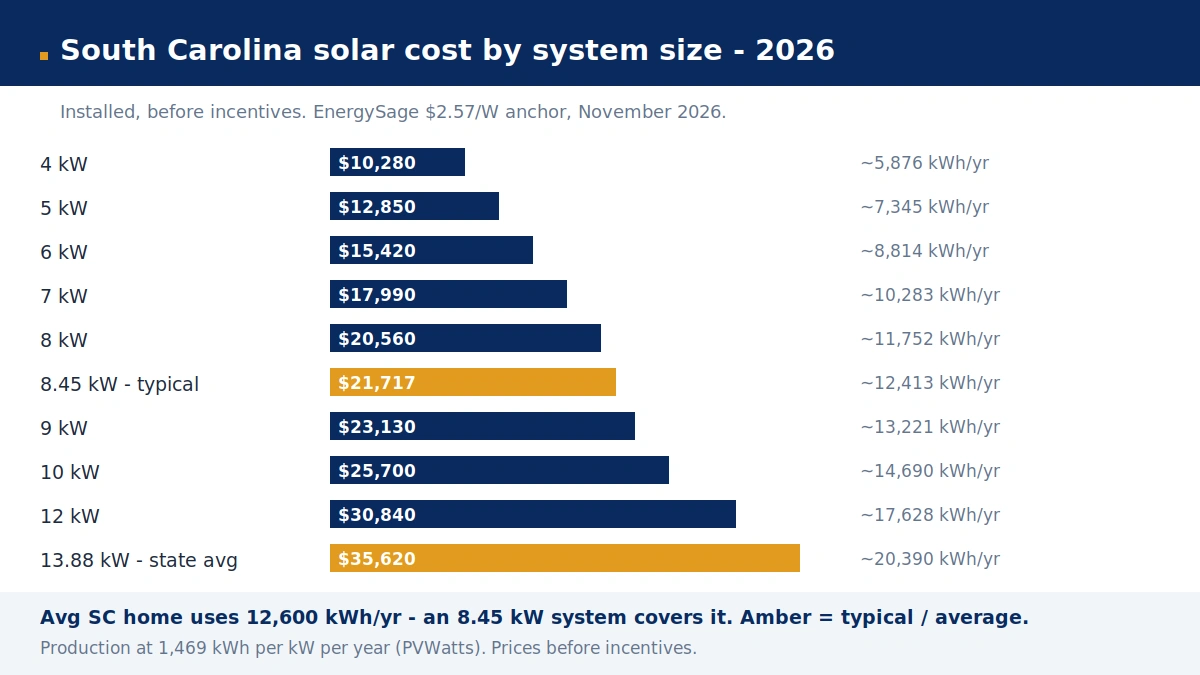
Size is the first decision, and in South Carolina it is a decision the export rules punish you for getting wrong. The average South Carolina home uses about 1,050 kilowatt-hours a month, or roughly 12,600 a year — heavy air-conditioning load, electric water heating in many homes, and long cooling seasons. A kilowatt of panels here makes about 1,469 kilowatt-hours a year, so an 8.45 kW system makes about 12,413 kilowatt-hours — almost exactly the average home’s annual use. That is why 8.45 kW is the median install: it covers the house without flooding the grid with power that earns only 4 cents.
Oversizing past what the house uses is a worse deal here than in most states. Every kilowatt-hour past your own consumption goes out at the export rate — about 4 cents on Duke and Santee Cooper, or banked at Dominion until a November payout at 3.5–4.6 cents. A kilowatt-hour used at home saves the full retail price, around 13–16 cents depending on the utility and the time of day. The gap between those two values is the reason the size table below stops being attractive past 10 kW for most homes. The table prices every common size at the EnergySage $2.57-per-watt anchor, with production at 1,469 kilowatt-hours per installed kilowatt per year.
| System size | Cost at $2.57/W | Approx. annual production | Share of avg. SC home use (12,600 kWh/yr) |
|---|---|---|---|
| 4 kW | $10,280 | ~5,876 kWh | ~47% |
| 5 kW | $12,850 | ~7,345 kWh | ~58% |
| 6 kW | $15,420 | ~8,814 kWh | ~70% |
| 7 kW | $17,990 | ~10,283 kWh | ~82% |
| 8 kW | $20,560 | ~11,752 kWh | ~93% |
| 8.45 kW (state typical) | ~$21,717 | ~12,413 kWh | ~99% |
| 9 kW | $23,130 | ~13,221 kWh | ~105% |
| 10 kW | $25,700 | ~14,690 kWh | ~117% |
| 12 kW | $30,840 | ~17,628 kWh | ~140% |
| 13.88 kW (state avg) | ~$35,620 | ~20,390 kWh | ~162% |
Two things in that table are worth a second look. First, bigger systems cost less per watt, because the fixed work — permits, interconnection, the inverter, the crew’s trip and setup — gets divided across more watts. A 4 kW system from a small installer can easily price above $2.85 per watt, while a 12 kW system from the same installer can come in under $2.60. Second, the state-average 13.88 kW system makes about 162% of what the average home uses, which tells you who is buying the average system: households with electric vehicles, heat pumps, pools, or all-electric everything. A home with gas heat and no EV usually needs 7–9 kW, not 14.
Start sizing from twelve months of electric bills, not from the size of the roof. Add up the kilowatt-hours, divide by roughly 1,469 to get the system size in kilowatts that covers it, then adjust: add 1–2 kW for a planned EV, add more for a heat pump or a pool pump, subtract for a shaded or north-facing roof. If the roof can only fit 5 kW but the house uses 12,600 kilowatt-hours a year, the honest answer is a 5 kW system that covers part of the bill — not a ground mount the budget never contemplated. Our 6 kW vs 8 kW vs 10 kW guide runs through that sizing logic for the country as a whole.
Solar Panel Cost by City: Charleston, Columbia, Greenville & the Lowcountry
South Carolina is a long state with three different solar markets inside it. The Upstate around Greenville and Spartanburg is Duke Energy Carolinas country, with inland roofs and lower wind detailing. The Midlands around Columbia is Dominion country, with the state’s hottest summers and the biggest air-conditioning loads. The Lowcountry around Charleston is a patchwork — Dominion, Santee Cooper, and Berkeley Electric Cooperative all serve streets within a few miles of each other, and the coastal wind rules add engineering that inland quotes never carry. EnergySage’s November 2026 city pages are the best window into that spread.
| City / area | $/W | Avg. system | Total before incentives | Payback |
|---|---|---|---|---|
| Charleston | $2.81 | 11.74 kW | ~$33,033 | 10.3 yrs |
| Columbia | $2.59 | 14.79 kW | ~$38,254 | 11.74 yrs |
| Greenville | $2.53 | 12.37 kW | ~$31,289 | 11.64 yrs |
| North Charleston | $2.70 | 13.82 kW | ~$37,340 | 9.85 yrs |
| Summerville | $2.70 | 13.62 kW | ~$36,786 | 17.83 yrs |
| Mount Pleasant | $2.80 | 13.18 kW | ~$36,893 | 18.56 yrs |
| Piedmont | $2.44 | 13.1 kW | ~$31,907 | 10.78 yrs |
| Inman | $2.52 | 14.25 kW | ~$35,915 | 22.1 yrs |
| Moncks Corner | $2.77 | 16.09 kW | ~$44,586 | 21.67 yrs |
| West Columbia | $2.49 | 16.8 kW | ~$41,815 | 20.91 yrs |
Charleston is the priciest major market in the state at $2.81 per watt, and the reason is the coast: high-wind engineering, structural review, roof-access setbacks, and installers who price in the salt air and the storm season. Greenville is the cheapest of the big three at $2.53, with big inland roofs and a deep installer bench. Columbia sits in the middle on price but carries the largest average system in the table — 14.79 kW — because Midlands homes run the air conditioning hardest and longest, and the systems are sized to match.
Do not rank these cities by the payback column. North Charleston shows 9.85 years and Mount Pleasant 18.56 years at nearly identical prices per watt, and Summerville sits at 17.83 years next door to both of them. Those swings are EnergySage model variance — different utility mixes, different assumed system sizes, different rate assumptions inside each city’s model — not a real signal that one suburb is twice as good for solar as the next. The price-per-watt column is the comparable number. The payback column only becomes meaningful when it is worked from your own utility’s tariff, which the payback section below does.
One more city-level caution: EnergySage publishes two different Charleston pages with different figures — the Charleston County page used here ($2.81 per watt, 11.74 kW) and a Berkeley County page ($2.52 per watt, 14.74 kW, $37,108, 11.08 years). Same city name, different county slices of the metro. If a quote or a guide cites a Charleston price that does not match this table, check which county’s data it used before arguing about it.
What Moves Your Quote: Roof, Heat, Humidity & Coastal Wind
The per-watt anchor is a starting point, not a quote. In South Carolina, six things move a quote by thousands of dollars, and three of them are specific to this state’s climate and coastline.
The coast. Charleston, Horry, and Beaufort counties sit in high-wind zones, with design wind speeds running up to roughly 150 miles per hour and much of the coastal zone designated a wind-borne-debris region. The code requires roof-access setbacks and a structural review, and added framing for wind loads brings in a separate licensed trade. Inland, around York County and the Upstate, the design speed is closer to 115 miles per hour and the detailing is lighter. A Charleston quote that matches a Greenville quote dollar for dollar is probably missing the wind work — ask where it is.
The roof itself. South Carolina roofs age fast in the heat. UV and humid-subtropical summers dry out asphalt binders faster than the manufacturer rating assumes, algae streaks untreated shingles within a decade, and the May-to-August hail line bruises anything that is not Class 4 rated. If the roof has under a decade of life in it, replace it first — pulling panels off and putting them back for a reroof runs into the thousands by itself. Our roof replacement guide prices the reroof, and our detach-and-reset guide prices pulling the panels off and putting them back. Standing-seam metal — common on Lowcountry homes — is one of the best solar roofs in the country, because clamps grip the seams without a single roof penetration.
The heat. Panels lose efficiency as they get hotter, roughly 0.3–0.5% for every degree Celsius above 25 degrees at the cell. A South Carolina rooftop in August runs far hotter than that, so a system here produces less per hour of sunshine than the same panels would on a cool spring day. The long days more than make up for it over the year — that is why production still lands near 1,469 kilowatt-hours per kilowatt — but any production estimate built on nameplate wattage without a temperature derate is overstating summer output. Ask the installer to show the derate in the model.
Panel tier. Premium panels cost 10–20% more per watt than value-tier panels, and in South Carolina the premium buys two things that matter: better high-temperature performance and better low-light performance on cloudy, humid afternoons. On a roof with limited space, efficiency is worth paying for. On a big unshaded inland roof, value panels at a lower per-watt price usually win.
Inverter choice. A string inverter is cheaper upfront; microinverters or optimizers cost more but produce more on roofs with partial shade — and South Carolina roofs, with their live oaks, pines, and dormers, are shaded more often than installers admit. Microinverters also let you watch each panel on its own, so one shaded panel cannot pull the whole string down with it. Our inverter replacement guide prices each type over its life, including the string-inverter swap at year 10–15 that microinverter systems largely skip.
The electrical panel. Many South Carolina homes, especially the brick ranches and split-levels built from the 1960s to the 1980s, still run on 100-amp service, and a solar install often forces the question. A panel upgrade to 200 amps runs $1,500–$4,000 nationally per our electrical panel upgrade guide, and it is the most common surprise add-on in South Carolina quotes. Find out whether the quote includes it before you sign — not once the electrician is already on site.
South Carolina Electricity Rates: Cheap Power, Slow Payback
Everything about South Carolina solar comes back to one uncomfortable number: what the power costs. The U.S. Energy Information Administration puts the South Carolina residential average at 15.76 cents per kilowatt-hour in August 2026, against a national average of 18.16 cents — roughly 13% cheaper. The 12-month average to August 2026 is 15.77 cents. The average South Carolina home uses about 1,050 kilowatt-hours a month, so the typical bill runs about $165 a month — more in the summer, when the air conditioning is doing the heavy lifting and the EIA’s derived August bill reaches $226 at 1,436 kilowatt-hours.
That cheap power is the whole payback problem in one number. Every kilowatt-hour a rooftop system generates is a kilowatt-hour the homeowner never buys — but in South Carolina that kilowatt-hour was only worth about 16 cents, where in Massachusetts it is worth about 30. A system in Columbia makes more electricity than a system in Boston and saves less money doing it. The sun is not the constraint here. The price of the power is.
Rates have been climbing, which helps the case slowly. South Carolina residential rates rose 4.0% in the year to August 2026, 17.5% over three years, and 22.8% over five years, per EIA data. That climb matters for payback: a system priced at today’s rates grows more valuable with every rate rise, because the savings keep growing while the cost stays where it was. Most payback models assume 2–3% annual rate escalation. If rates stay flat, payback stretches by a year or two; if they keep climbing at the recent pace, it shortens.
The utility split matters as much as the state average. Dominion Energy South Carolina’s standard tariff carries a $12.01 monthly fixed charge before the first kilowatt-hour, with riders on top, for an all-in rate near 17.24 cents at 900 kilowatt-hours of use. Santee Cooper’s 2023 utility-average rate was just 11.4 cents — the cheapest power in the state, and the slowest solar payback, which is why Santee Cooper territory needs its rebate to make the math work at all. Berkeley Electric Cooperative sat at 14.1 cents in the same 2023 data. A statewide average of 15.77 cents describes no single household’s bill; the utility’s own tariff does, and the next section is built on those tariffs.
Solar Choice Net Billing: The Export Rules That Decide Your Return
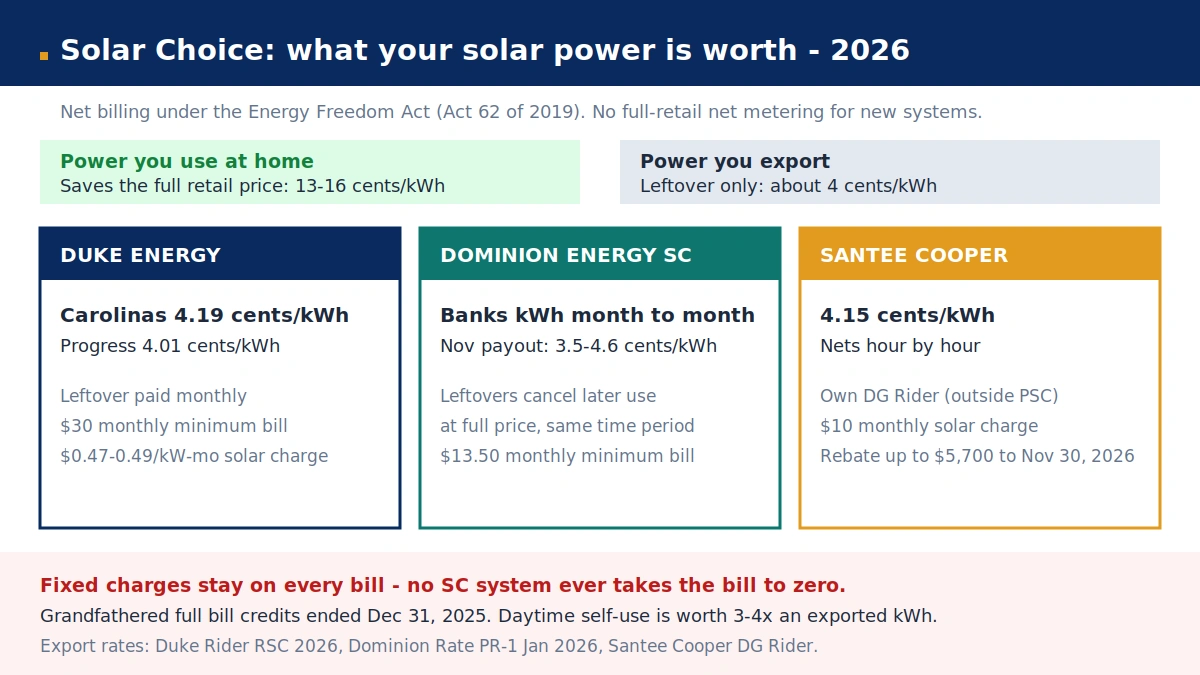
South Carolina does not have full-retail net metering for new systems, and anyone who tells you otherwise is describing the old rules. The Energy Freedom Act of 2019 (Act 62) replaced it with Solar Choice, a net-billing tariff that the investor-owned utilities all use. The mechanics are simple to state and expensive to misunderstand.
Power you use as it is made saves the full retail price. Run the air conditioning, the pool pump, or the EV charger while the sun is up, and every kilowatt-hour your panels make replaces one you would have bought at 13–16 cents. That is the valuable kilowatt-hour in South Carolina.
Power you send out first cancels power you buy in the same time-of-use period. Duke and Dominion both put solar customers on time-of-use plans, so an exported kilowatt-hour in the off-peak period cancels an off-peak purchase at the full off-peak price. Only the month’s leftover — power exported beyond what you bought back in that same period — earns the low export rate.
The leftover earns about 4 cents. Duke Energy Carolinas pays 4.19 cents per kilowatt-hour for each month’s leftover (Rider RSC, 2026). Duke Energy Progress pays 4.01 cents. Santee Cooper pays 4.15 cents, netting hour by hour under its own DG Rider. Dominion banks leftover kilowatt-hours month to month and pays out whatever is left on the November bill at its avoided cost — 3.5 to 4.6 cents — then resets the bank to zero.
Fixed charges stay on the bill no matter what. Duke tops a solar customer’s bill up to a $30 monthly minimum, which export credits cannot erase, and charges a solar fee of $0.47 per kilowatt a month on Duke Energy Carolinas and $0.49 on Duke Energy Progress — about $4.70–$4.90 a month on a 10 kW system. Dominion’s minimum bill is $13.50, with about $14 a month in basic and DER charges. Santee Cooper adds a $10 monthly solar charge. No South Carolina system ever takes the bill to zero, and a low-usage home on Duke’s $30 minimum has very little room to save at all — EcoGen puts the line at roughly 500 kilowatt-hours a month, below which rooftop solar rarely pays on Duke.
The old full-credit deal is gone. The oldest Duke and Dominion solar homes, the ones that applied under the pre-2019 rules, lost their full bill credits on December 31, 2025. A system installed in 2026 gets Solar Choice from day one. Any quote that values exports at the retail rate is pricing your system under rules that no longer exist for new customers.
Cooperatives write their own rules. Berkeley Electric Cooperative credits exported power at $0.0592 per kilowatt-hour, with credits carried forward — better than the big utilities’ leftover rates, worse than full retail. Every co-op and municipal utility sets its own terms, so a co-op customer should get the export policy in writing from the co-op itself, not from an installer’s brochure.
The 25% State Tax Credit — and Every Other South Carolina Incentive
With the federal credit gone, one state credit now does the heavy lifting in South Carolina, and it is a good one — with a catch that changes how you budget for it.
The 25% state income tax credit is in force for 2026. Under S.C. Code §12-6-3587, a homeowner who buys and installs solar on a South Carolina property they own can claim 25% of the system cost against state income tax. The law has no end date for solar. On EcoGen’s typical $24,083 system, the credit is worth $6,021.
The catch is the pace. In any one year you can use at most $3,500, and never more than 50% of the state income tax you owe that year. Unused credit carries forward for up to 10 years. On that typical system, the credit arrives as $3,500 in year one and $2,521 in year two — and only if you owe at least $7,000 in state tax each year. A smaller tax bill stretches it further. The credit is claimed on Form TC-38 for the year the installation is complete, and the interconnection agreement serves as the system’s certification. It is not a check at closing, and it is not a discount on the quote. You pay the full price first and claim the credit back over tax years.
A utility rebate shrinks the credit. The Department of Revenue says a utility rebate lowers the cost that qualifies: a $15,000 system with a $1,000 rebate earns the credit on $14,000. That matters for Santee Cooper customers, who are the only ones with a rebate to subtract.
The property tax exemption is quieter but permanent. Under §12-37-220(B)(53), the home value a residential solar system adds is exempt from property tax, for systems up to 20 kW AC. Solar consistently adds home value in resale studies, and in South Carolina that added value does not raise the tax bill.
The Santee Cooper rebate is real, and it is about to close. Santee Cooper’s EmpowerSolar Solar Home rebate pays $0.95 per watt AC, up to $5,700 on up to 6 kW AC — a 5 kW system gets $4,750. It is the only upfront cash rebate for solar in South Carolina. The window closes November 30, 2026, at 5 p.m., or sooner if the money runs out, and no extension had been announced when this guide was researched. The conditions are strict: you must own the system, your installer must be a Santee Cooper Trade Ally with a sign-off letter from a NABCEP-certified professional, you must install within 90 days of the approval to connect, and you must apply within 90 days of installing. A leased system gets nothing, and the cap drops lower if your home’s highest power use in the past 12 months was below 6 kW. Santee Cooper also offers a Smart Energy Loan of up to $40,000 at 4.75% over up to 120 months — but it must be paid off before or when the home sells.
| Incentive | Value | Who pays / how | Notes |
|---|---|---|---|
| SC state income tax credit (§12-6-3587) | 25% of cost; $6,021 on a typical system | State income tax, Form TC-38 | Max $3,500/yr, max 50% of liability/yr, 10-yr carryforward; owner only |
| Property tax exemption (§12-37-220(B)(53)) | Added home value untaxed | Local assessor | Residential systems up to 20 kW AC |
| Santee Cooper Solar Home rebate | $0.95/W AC, up to $5,700 | One payment after install + approval | Closes Nov 30, 2026, 5 p.m., or when funds run out; Trade Ally + NABCEP required |
| Santee Cooper Smart Energy Loan | Up to $40,000 at 4.75%, up to 120 months | On-bill financing | Must be paid off on sale of the home |
| Duke PowerPair (solar + battery) | Up to $9,000 one-time | Duke, new solar + battery | Progress closed late 2025; Carolinas nearly at capacity — verify before counting on it |
| Duke Battery Control | $6.50/kW per month | Monthly bill credit | Powerwall 3 ≈ $26/mo; max ~$91/mo |
| Duke / Dominion solar rebate | $0 — none exists | — | Outside Santee Cooper territory there is no check at purchase |
| SC Solar for All | $0 — terminated | — | $124.44M federal grant terminated Aug 7, 2025; no SC restart as of Oct 2026 |
There is no South Carolina sales-tax exemption for solar equipment verified in this pass, so do not let a quote quietly subtract one. Ask the installer to show sales tax as its own line. And there is no upfront state rebate outside Santee Cooper territory — any installer who promises a state check at signing is either confused or selling something else.
Federal Credits in 2026: What South Carolina Owners Actually Get
The federal story in 2026 fits in one paragraph, which is exactly why so much solar advertising still gets it wrong.
A system you own and install in 2026 earns $0 of federal tax credit. Congress ended the Residential Clean Energy Credit (§25D, 30%) in the One Big Beautiful Bill Act (P.L. 119-21, signed July 4, 2025), which cut off the credit for systems placed in service after December 31, 2025. The IRS confirmed in FS-2025-05 that the date that counts is completion — a deposit paid in 2025 buys nothing if the crew finished the job in January 2026. §25C, the credit for efficient home improvements, closed on the same day. A 2026 cash or loan quote that still deducts 30% is priced under a law that no longer exists. Tell the installer to take it off and quote again.
One route still reaches a federal credit: someone else owns the system. The commercial clean-electricity credit (§48E, 30%) is still alive for systems a company owns instead of the homeowner. In a lease, the company owns the panels, claims §48E, and passes part of the value to the homeowner as a lower monthly payment. The homeowner personally gets no credit — but a lease can still beat buying outright in 2026, because the company holds a credit the homeowner no longer can. To qualify, those projects have to be in service by December 31, 2027. The trade-off is ownership: the leasing company also keeps the 25% state credit, and a leased system adds little or nothing to resale value, where an owned system consistently does. Our federal tax credits guide covers the full 2026 federal picture, and our national solar cost guide works through lease-versus-buy in detail.
A South Carolina twist: leases are legal, PPAs are not. Leases are allowed under S.C. Code §58-27-2610, with the bill credits directed to the host customer, and the leasing company needs a certificate from the Office of Regulatory Staff. Power purchase agreements — where you pay per kilowatt-hour instead of a flat lease payment — are prohibited statewide. A lease is the only third-party option here. If a company offers you a PPA in South Carolina, it is offering a product the state does not allow.
HEAR does not pay for solar. The Home Electrification and Appliance Rebates program still offers up to $8,000 to income-qualified households in 2026 — but it pays for electrification, not for solar. HEAR pays for heat pumps, heat pump water heaters, electrical panels, and insulation-related wiring work. Solar panels, batteries, EV chargers, and windows are all outside it, and since the Energy Department’s Notice 26-2 of September 1, 2026, it covers electric-to-electric upgrades only — no fuel-switching. South Carolina’s own HOMES and HEAR programs were still listed as coming soon, with rebates not yet available, as of July 2026. Any quote that tucks a HEAR rebate into the solar price is describing a program that does not work that way. HEAR can still matter to a South Carolina homeowner — a heat pump paired with new solar panels is a common combination, and the heat pump half may qualify — but the solar half never does.
The honest summary: in 2026, the federal government contributes nothing to a South Carolina homeowner who buys solar panels, and contributes indirectly — through the leasing company’s credit — to a homeowner who leases them. The 25% state credit is doing all the incentive work now, and it is the reason the payback still lands in the low teens on Dominion and Duke instead of the twenties.
Payback in South Carolina: The Real Math by Utility
Payback is where South Carolina solar either earns its keep or does not, and the answer depends on which utility sends the bill. The worked examples below use the EcoGen anchors so every input can be checked; the cross-checks come from EnergySage.
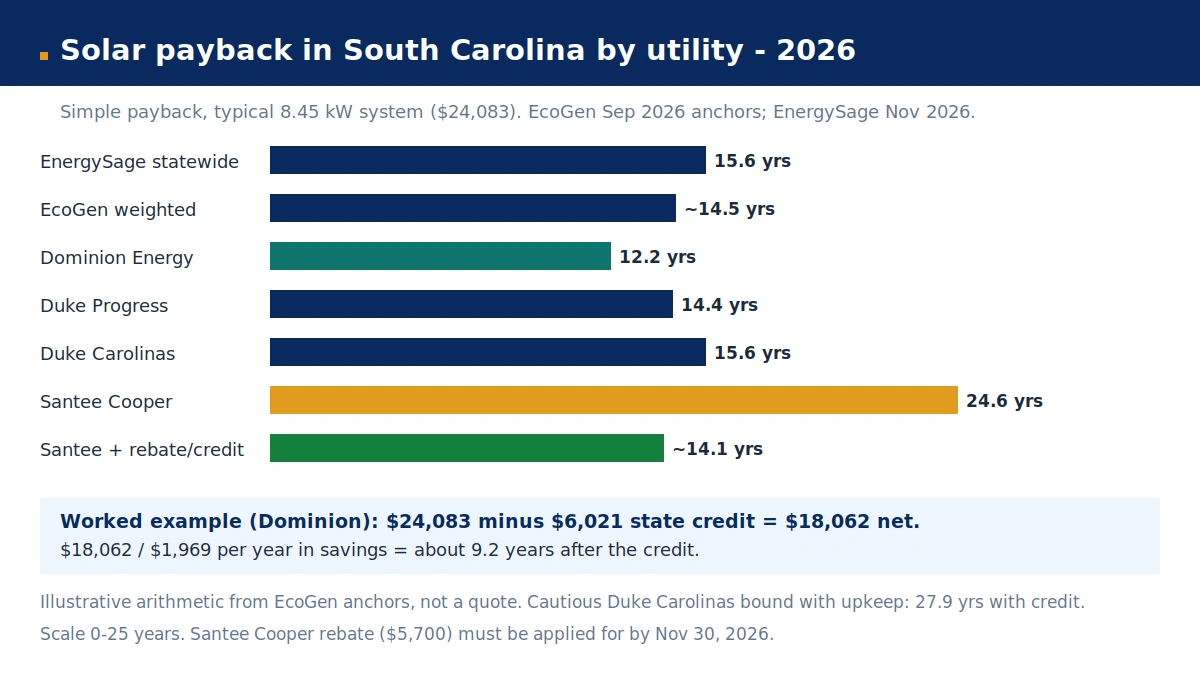
The worked example. A typical 8.45 kW system at $2.85 per watt costs $24,083 before incentives. It makes about 12,413 kilowatt-hours a year. The 25% state credit is worth $6,021 on that system, spread over two or more tax years, leaving a net cost of $18,062 once the credit has fully arrived. The yearly savings — and therefore the payback — then depend entirely on the utility.
Dominion Energy South Carolina is the fastest payback in the state. Dominion banks exported kilowatt-hours and lets them cancel later purchases in the same time-of-use period at full price, so the typical system saves about $1,969 a year. Simple payback before incentives: $24,083 ÷ $1,969 ≈ 12.2 years. After the state credit: $18,062 ÷ $1,969 ≈ 9.2 years.
Duke Energy Progress comes next. The typical system saves about $1,668 a year after the $0.49-per-kilowatt monthly solar charge and the $30 minimum-bill effects. Simple payback before incentives: 14.4 years. After the state credit: ~10.8 years.
Duke Energy Carolinas is slower. The typical system saves about $1,545 a year, after the $0.47-per-kilowatt monthly charge. Simple payback before incentives: 15.6 years. After the state credit: ~11.7 years. EnergySage’s statewide figure of 15.6 years matches this one, because Duke Energy Carolinas is the territory its model weights most heavily.
Santee Cooper is the slowest by a wide margin. The typical system saves only about $978 a year — the cheapest power in the state, the 4.15-cent export rate, and the $10 monthly solar charge all working against it. Simple payback before incentives: 24.6 years. After the state credit alone: ~18.5 years. But Santee Cooper is also the only utility with a rebate, and the rebate changes the answer: subtract the $5,700 rebate first, take the state credit on the reduced $18,383 (25% = $4,596), and the net cost is $13,787 — payback ~14.1 years. That is why the November 30, 2026 rebate deadline matters so much: a Santee Cooper customer who misses it loses more than five years of payback in a single day.
| Scenario | Simple payback | Source |
|---|---|---|
| EnergySage statewide avg (13.88 kW) | 15.6 yrs | EnergySage, Nov 2026 |
| EcoGen statewide weighted | ~14.5 yrs | EcoGen Index, Sep 2026 |
| Dominion Energy SC (before incentives) | 12.2 yrs | EcoGen |
| Dominion Energy SC (after 25% state credit) | ~9.2 yrs | NestPriced arithmetic from EcoGen anchors |
| Duke Energy Progress (before incentives) | 14.4 yrs | EcoGen |
| Duke Energy Progress (after state credit) | ~10.8 yrs | NestPriced arithmetic from EcoGen anchors |
| Duke Energy Carolinas (before incentives) | 15.6 yrs | EcoGen |
| Duke Energy Carolinas (after state credit) | ~11.7 yrs | NestPriced arithmetic from EcoGen anchors |
| Santee Cooper (before incentives) | 24.6 yrs | EcoGen |
| Santee Cooper (after credit + $5,700 rebate) | ~14.1 yrs | NestPriced arithmetic from EcoGen anchors |
The pessimistic bound. EcoGen’s cautious Duke Energy Carolinas example, which counts upkeep costs and the full effect of the $30 minimum bill, stretches payback to 27.9 years with the full state credit and 37.2 years without it. That is not the central case — it assumes the household’s daytime self-use is low and the upkeep is real — but it is the honest outer bound, and it shows what happens when a system is oversized for a home that uses most of its power after dark. The lesson is the same one Solar Choice teaches everywhere in this state: the cheapest kilowatt-hour is the one you use yourself while the sun is up.
What changes the payback most. Daytime self-use is the biggest lever: shifting the dishwasher, the laundry, the pool pump, and the EV charger into daylight hours moves kilowatt-hours from the 4-cent export bucket into the 13–16-cent self-use bucket, and no other change pays as well. Rate escalation is the second: at 3% annual increases, the 25-year savings grow by tens of thousands of dollars over a flat-rate model. System size is the third: oversizing past household usage pushes the marginal kilowatt-hours into exported credits worth a quarter of consumed power. And financing is the fourth: a solar loan with dealer fees can add 10–30% to the effective price, which is why the cash price per watt — not the monthly payment — is the number to compare.
The lease comparison. A lease has no payback period in the usual sense, because there is no upfront cost to recover. The homeowner starts saving (or not) from the first bill: the lease payment is set below the utility bill it replaces, and the gap is the saving. In 2026, with §48E still available to the leasing company, lease rates in South Carolina can genuinely beat the utility bill from day one. The catch is the long term: the homeowner never owns the system, never collects the 25% state credit, never gets the Santee Cooper rebate, and the escalator clause in many lease contracts — typically 2–3% a year — can erase the gap over a 20–25 year term if utility rates rise more slowly than the escalator. Buying wins over 25 years in most South Carolina modeling; leasing wins for homeowners who cannot use the state credit, cannot pay upfront, or plan to move within a few years.
Sun, Heat & Hurricanes: What Production Really Looks Like in the Palmetto State
South Carolina’s sun is the best in the eastern United States outside Florida, and it comes with a climate that asks real questions of the equipment. Both halves belong in any honest production estimate.
The sun. South Carolina averages about 5.37 peak sun hours a day over the year (EcoGen, PVWatts), and a kilowatt of panels makes roughly 1,469 kilowatt-hours a year. Columbia runs about 4.7–4.9 peak sun hours a day; Charleston 4.5–5.0. Summer is the production peak — long days, high sun, the air conditioning running hardest exactly when the panels are making the most. Winter output is lower but mild: the days shorten, but there is no snow season to model and no month where production collapses the way it does in the Northeast. A 10 kW system makes about 14,690 kilowatt-hours in a year, and the monthly shape is a gentle hill, not a cliff.
The heat trims what the sun gives. Panel efficiency falls as cell temperature rises, and a South Carolina rooftop in August runs far hotter than the 25 degrees Celsius the nameplate assumes. The long days more than compensate over the year — that is why the annual figure still lands near 1,469 kilowatt-hours per kilowatt — but a production estimate built on nameplate wattage without a temperature derate is overstating summer output. The other heat effect is on the roof itself: UV and humid summers dry out asphalt binders faster than the manufacturer rating assumes, which is why the roof’s remaining life belongs in the solar conversation, not after it.
The hurricane season is a design question, not a production question. The coast sees tropical systems most years, and the code answers with design wind speeds up to roughly 150 miles per hour in Horry, Charleston, and Beaufort counties, with wind-borne-debris requirements on top. Inland the design speed is closer to 115 miles per hour. Properly installed, racking rated for the local wind speed, panels hold through storms that take shingles off — but “properly installed” is doing real work in that sentence. The installer’s wind detailing, the structural review, and the fastening pattern are not line items to shop for the cheapest version of. After a storm, the array should be inspected before it is re-energized if there is any visible damage, and the homeowner’s insurance should be told the system exists — most policies cover it once declared, and the SC Safe Home program offers grants (up to $7,500, per a secondary source) for resilient roof and opening work that pairs naturally with a solar install.
What to actually do about the climate. Nothing exotic. Keep the panels clean of the pollen and dust that coat Lowcountry roofs in spring — rain usually does it, and a rinse from the ground is enough when it does not. Do not climb on a hot roof in July to wash panels; the fall risk dwarfs the value of the lost production. The design decisions that matter are made at install time: south-facing orientation where the roof allows, a tilt that sheds the summer cloudbursts, microinverters or optimizers so that a shaded string does not drag down the whole array, and a production estimate built on PVWatts data with the temperature derate shown, not hidden. Solar Choice is what makes the summer work financially: the air conditioning runs hardest in the same hours the panels produce most, so the most valuable kilowatt-hours are the ones the house eats the moment they are made.
Should You Add a Battery? PowerPair, Battery Control & Hurricane Backup
A battery is the most consequential add-on in a South Carolina solar project — it can add $15,000 or more to the job, and whether it earns that money back depends on two Duke programs and one storm season.
What a battery costs. Adding 13.5 kWh of storage costs about $15,525 installed ($1,150 per kWh, EcoGen). An 8 kW system with a battery runs $35,600–$41,100; a 10 kW system with a battery runs $40,600–$47,400. There is no federal credit for a battery you own and install in 2026 either — §25D covered storage as well, and it closed on the same date. Our solar battery cost guide has national prices for the main battery models.
PowerPair is the big Duke incentive — and it is nearly gone. Duke Energy’s PowerPair program pays up to $9,000 for a new solar-plus-battery system. Duke Energy Progress territory closed to new applications in late 2025, and Duke Energy Carolinas was nearly at capacity in installer reports from July 2026. Status changes week to week. If PowerPair is the reason the battery pencils out, confirm with Duke that the money is still there for your address before you sign — and do not build a budget around a program that may already be full.
Battery Control is the steady earner. Duke’s Battery Control program (Power Manager in Carolinas territory, Energy Wise in Progress territory) pays $6.50 per kilowatt a month for letting Duke manage the battery — a Tesla Powerwall 3 at 5 kW of continuous discharge earns about $26 a month, $312 a year, and the maximum is about $91 a month at the 20 kW residential interconnection limit. The minimum term is one year, the maximum ten. It is real money, but it is not a payback engine on its own: $312 a year against a $15,525 battery is a fifty-year return without PowerPair or a backup value attached.
The backup case is the real case in South Carolina. The coast loses power to hurricanes and tropical storms, and the whole state loses it to the thunderstorms that roll through every summer. A battery keeps the air conditioning, the fridge, the well pump, and the medical equipment running through an outage that can last a day or more on the coast. That is a resilience value, not a financial return, and it should be weighed as one: a battery that never earns back its cost in program payments can still be worth buying for a household that cannot afford to lose cooling in August. For most households a generator still backs up the house for less money; what a battery offers instead is quiet, automatic power with nothing to refuel.
The payback verdict. Without PowerPair, a South Carolina battery does not pay for itself on program payments alone — there is no time-of-use arbitrage to harvest, because the export rate is low and the rate spread is narrow. With PowerPair’s $9,000, the net battery cost falls to roughly $6,500, and the Battery Control payments plus the backup value start to make a genuine case. Dominion and Santee Cooper customers face this directly: neither runs a PowerPair equivalent, so for them the battery is a backup purchase, and it should be budgeted as one.
HOAs, Permits & Picking an Installer in South Carolina
South Carolina law is blunt on the question most solar states settled years ago: your HOA can say no. Everything else in this section follows from that.
HOAs can ban solar in South Carolina. The state has no solar-access law — no statute that stops a homeowners association from restricting or prohibiting rooftop solar. An HOA here can ban panels outright, and some do. Bills that would change that have been introduced — Bill 4460 in the 2025–2026 session, and H4579 on balcony solar panels, introduced January 13, 2026 — but neither had become law when this guide was researched. What constrains an HOA instead is the general law of architectural review: the board’s discretion is limited by reasonableness and good faith, purely aesthetic denials must bear a real relation to the community’s general plan, and the governing documents must be recorded in the county land records to be enforceable at all (§27-30-130, since May 2018). A blanket ban adopted without proper procedure, or applied to punish one owner while others have panels, is vulnerable on those grounds — but the starting point is that the HOA’s documents control. Read them before you sign anything with an installer, and get the architectural review approval in writing before the panels are ordered.
Condos and townhomes are harder still. In a condominium the roof is typically common area, so the unit owner does not own the surface the panels would sit on. The board’s approval process — plans, engineering, insurance, licensed installation, a maintenance plan — is the whole decision, and there is no state solar-rights law to appeal past it. Community solar is the realistic alternative for renters, condo owners, and homes with shaded or unsuitable roofs: Dominion’s Community Solar Select offers a no-cost subscription to qualifying customers who recently received bill assistance, with a $0.01-per-kilowatt-hour bill credit, and Santee Cooper runs a community solar program of its own. Our community solar guide prices that option.
Permits and interconnection take time. A South Carolina rooftop system needs a building permit, an electrical permit, and a utility interconnection agreement, in that order — and the interconnection step is usually the slowest, running weeks to a few months depending on the utility and whether the local transformer needs an upgrade. No statewide permit fee schedule was verified for this guide, so no fee figure is given here; the town or county building department sets it. What is certain is that time, not money, is the bottleneck — and an installer who promises permission to operate in two weeks is promising something the utility decides, not the installer.
Installer credentials to verify. South Carolina solar work sits at the intersection of licenses that are not interchangeable: a residential builder’s license or a specialty registration with an electrical classification under §40-11-410, plus a roofing classification for roof mounts. Ask for the number and verify it with the Department of Labor, Licensing and Regulation. NABCEP certification is the leading industry credential, and Santee Cooper rebate work requires a NABCEP sign-off. And check the company’s history: the Pink Energy collapse of 2022 left tens of thousands of South Carolina customers owing on systems, some of which underperformed or were never finished. A legitimate installer has clear terms, a readable escalator on any lease, and a company likely to be around to honor the warranty.
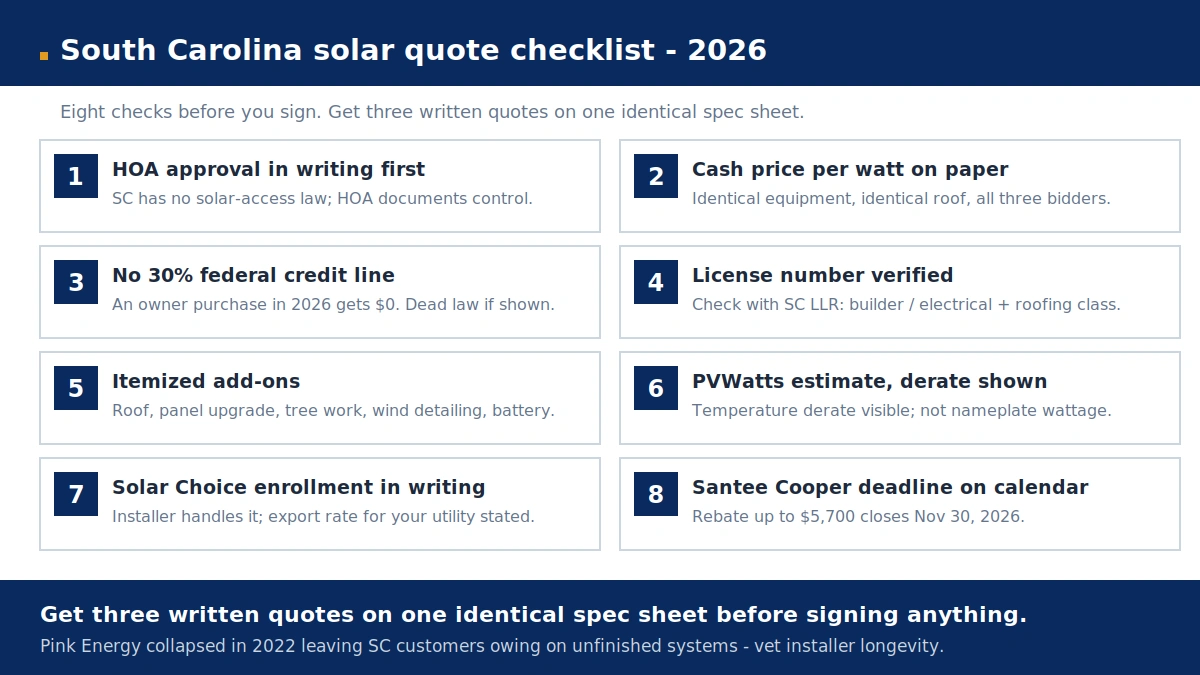
The eight-item quote checklist:
- HOA approval in writing first — South Carolina has no solar-access law; the HOA’s documents control, and approval must come before panels are ordered.
- Cash price per watt on paper — identical equipment, identical roof, from all three bidders. No cash price, no comparison.
- No line for a 30% federal credit — an owner purchase in 2026 gets $0. A quote that still deducts it is priced under a dead law.
- License number verified with LLR — residential builder or specialty registration with electrical classification, plus roofing classification for roof mounts.
- Itemized add-ons — roof work, panel upgrade, tree work, coastal wind detailing, and battery shown as separate lines, not buried in the per-watt price.
- Production estimate from PVWatts with the temperature derate shown — not nameplate wattage, and not an annual average that hides the summer heat penalty.
- Solar Choice enrollment handled by the installer — in writing, with the application dates, and the export rate for your utility stated on the quote.
- Santee Cooper rebate deadline on the calendar — if you are a Santee Cooper customer, the $5,700 rebate closes November 30, 2026; the quote should show whether it is included and whether the Trade Ally and NABCEP conditions are met.
Buy, lease, or community solar? Buying wins over 25 years for most South Carolina homeowners who can use the 25% state credit and plan to stay — it keeps the credit, the property-tax exemption, and the resale value. Leasing wins for homeowners who want $0 upfront and a lower bill from month one, and who accept that the company keeps the incentives and the system — remembering that a PPA is not on the menu here at all. Community solar wins for everyone else: renters, condo owners, and homes with shaded or unsuitable roofs. It asks for no roof at all — you subscribe to a nearby solar farm, the bill credits trim your electric bill, and there is no install and no 20-year lock-in.
Sources & methodology
Cost anchors: EnergySage — “South Carolina Solar Panel Cost: 2026 Prices and Savings” (Nov 2026: $2.57/W, 13.88 kW avg, ~$35,620, range $30,277–$40,963, payback 15.6 yrs, 25-yr savings $29,573, 81% offset) and city pages Charleston ($2.81/W, 11.74 kW, $33,033, 10.3 yrs), Columbia ($2.59/W, 14.79 kW, $38,254, 11.74 yrs), Greenville ($2.53/W, 12.37 kW, $31,289, 11.64 yrs), North Charleston ($2.70/W, 13.82 kW, $37,340, 9.85 yrs), Summerville ($2.70/W, 13.62 kW, $36,786, 17.83 yrs), Mount Pleasant ($2.80/W, 13.18 kW, $36,893, 18.56 yrs), Piedmont ($2.44/W, 13.1 kW, $31,907, 10.78 yrs), Inman ($2.52/W, 14.25 kW, $35,915, 22.1 yrs), Moncks Corner ($2.77/W, 16.09 kW, $44,586, 21.67 yrs), West Columbia ($2.49/W, 16.8 kW, $41,815, 20.91 yrs); EcoGen America — “Solar Panel Cost in South Carolina (2026)” (Sep 2026 Cost Index: $2.85/W, 8.45 kW typical, ~$24,083, state credit $6,021, payback Dominion 12.2 / Duke Progress 14.4 / Duke Carolinas 15.6 / Santee Cooper 24.6 yrs, statewide weighted ~14.5 yrs; 1,469 kWh/kW/yr; 5.37 peak sun hours/day; battery +$15,525 for 13.5 kWh) and “South Carolina Solar Incentives (2026)” (Santee Cooper rebate $0.95/W up to $5,700, closes Nov 30, 2026; grandfathered full credits ended Dec 31, 2025; Solar for All $124.44M terminated Aug 7, 2025); Home Solar Atlas — “Home Solar in South Carolina” (Aug 27, 2026: $2.59/W benchmark, 10 kW $25,900, no 30% federal credit for 2026).
Rates: EIA Electric Power Monthly Table 5.6.A (Aug 2026: SC 15.76 cents/kWh, US 18.16 cents) and Table 5.6.B (Jan–Aug 2026 avg SC 15.90 cents); EIA via EcoGen (12-mo Sep 2025–Aug 2026 SC avg 15.77 cents); EIA-861 via statecalc (SC avg use ~1,050 kWh/mo, 2024); EIA via Energy Factbook (SC +4.0% YoY, +17.5% over 3 yrs, +22.8% over 5 yrs to Aug 2026); Palmetto Charleston page (2023 utility rates: Dominion 14.4 cents, Santee Cooper 11.4 cents, Berkeley Electric 14.1 cents; Berkeley export credit $0.0592/kWh); priceofelectricity.com (Dominion standard tariff $12.01/mo fixed charge, all-in ~17.24 cents at 900 kWh).
Solar Choice + export rules: EcoGen SC cost + incentives pages (Duke Carolinas leftover 4.19 cents, Duke Progress 4.01 cents, Santee Cooper 4.15 cents, Dominion November avoided-cost payout 3.5–4.6 cents; Duke $30 minimum bill, $0.47/$0.49 per kW-mo solar charge; Dominion $13.50 minimum bill, Rate 5 TOU, lowest PR-1 credit 3.511 cents; Santee Cooper $10/mo solar charge, hour-by-hour netting; 20 kW AC residential cap; Act 62 of 2019, S.C. Code §58-40-20); electricalcontractorsandwiring.com net-metering survey (SC classified net billing / successor tariff, Oct 27, 2026); Palmetto Bluffton page (Dominion Rate 5 TOU, $14/mo charge, November settlement).
State credit + incentives: S.C. Code §12-6-3587 (25% credit, $3,500/yr max, 50% of liability/yr, 10-yr carryforward, Form TC-38, no end date — checked Sep 30, 2026, EcoGen); S.C. Code §12-37-220(B)(53) (property tax exemption, up to 20 kW AC); Santee Cooper Solar Home program manual via EcoGen ($0.95/W AC, 6 kW cap, Nov 30, 2026 5 p.m. deadline, 90-day limits, Trade Ally + NABCEP rule); Santee Cooper Smart Energy Loan (up to $40,000 at 4.75%, up to 120 months, EcoGen); Duke PowerPair / Battery Control via Southern Energy Management + whygreenenergy.com (PowerPair up to $9,000; Progress closed late 2025, Carolinas nearly at capacity, Jul 2026; Battery Control $6.50/kW/mo, Powerwall 3 ~$26/mo, max ~$91/mo); theenergygrid.com (state credit $3,500/yr, $35,000 total listing — secondary, not used as a statutory cap).
Federal + financing: OBBBA P.L. 119-21 / IRS FS-2025-05 (§25D and §25C $0 for post-Dec-31-2025 installs); §48E 30% for third-party-owned systems, placed in service by Dec 31, 2027; S.C. Code §58-27-2610 (leases legal with ORS certificate; PPAs prohibited); CFPB Solar Financing Market Issue Spotlight (Aug 2024: dealer fees 10–30%, sometimes over 50%); SC HOMES & HEAR status via whygreenenergy.com (coming soon, rebates not yet available, Jul 24, 2026).
Production + climate: EcoGen (5.37 peak sun hours/day; 1,469 kWh/kW/yr; 12,413 kWh/yr for 8.45 kW); GreenWatt PVWatts v8 (5.33 PSH/day, 1,454 kWh/kW/yr); CovertItAll NSRDB (Columbia 4.7 PSH/day); 8msolar (Charleston 4.5–5.0 PSH/day); TrueSolarPayback (Apr 2026: 4.6 PSH/day, 8 kW → 10,746 kWh/yr, 14.6-yr payback); DOE Zero Energy Ready Home case study, Johns Island SC (IECC Climate Zone 3A, hot-humid); barndominium.org SC building guide (2021 SC Residential Code in effect Jan 1, 2023; 2020 NEC; 2009 IECC energy code; coastal design wind up to ~150 mph, inland ~115 mph; SC Safe Home grants up to $7,500 — secondary source); Rock Hill roofing data (115 mph ASCE 7 design speed, York County; algae, hail, heat effects on asphalt).
HOA + licensing: Palmetto solar-access survey + Grihak SC HOA guide + Traywick Law (SC has no solar-access law; HOA may ban solar; Bill 4460 in committee mid-2025; H4579 balcony solar introduced Jan 13, 2026; ARC discretion constrained by reasonableness and good faith — Palmetto Dunes Resort v. Brown, River Hills POA v. Amato; §27-30-130 recording requirement); EcoGen (licensing under §40-11-410 — residential builder license or specialty registration with electrical classification, plus roofing classification; NABCEP required for Santee Cooper rebate; Pink Energy 2022 collapse warning); Palmetto Charleston/Bluffton pages (Dominion Community Solar Select, $0.01/kWh credit, qualifying bill-assistance customers).
Payback arithmetic: the worked examples in the payback section are NestPriced arithmetic from EcoGen anchors (8.45 kW x $2.85/W = $24,083; minus $6,021 state credit = $18,062; Dominion $1,969/yr → 12.2 yrs before / ~9.2 yrs after; Duke Progress $1,668/yr → 14.4 / ~10.8; Duke Carolinas $1,545/yr → 15.6 / ~11.7; Santee Cooper $978/yr → 24.6 / ~18.5, or with $5,700 rebate: $24,083 − $5,700 = $18,383, credit 25% of $18,383 = $4,596, net $13,787 → ~14.1 yrs). Labeled illustrative in the draft. Cautious Duke Carolinas bound (27.9 yrs with credit, 37.2 without) is EcoGen’s upkeep-inclusive example, not NestPriced arithmetic.
EXCLUDED: any “after 30% credit” prices; any HEAR-for-solar claim (HEAR does not cover solar, batteries, EV chargers, or windows; electric-to-electric only since DOE Notice 26-2, Sep 1, 2026); any Duke or Dominion solar rebate (none exists); any SC sales-tax exemption for solar (not verified); the Duke “Smart $aver $0.50/W” rebate listing on one installer directory (conflicts with EcoGen’s no-rebate finding — treated as stale); the $35,000 lifetime total on the state credit (one secondary listing only); SC-specific monthly PVWatts production splits (not pulled — seasonal shape described qualitatively); SC-specific permit fees or interconnection timelines (not verified — described qualitatively only); SC-specific panel-upgrade or roof dollar figures (national guide figures cited as such); the SC Safe Home $7,500 figure (secondary source, mentioned only as a pointer).
*Disclaimer: Prices are 2026 South Carolina planning figures and change by city, roof, utility territory, and contractor. Get three written quotes from local installers before you settle a budget. Tax notes here are general information, not advice for your return — check with a South Carolina tax professional before you file. Program rules (the state credit, Solar Choice tariffs, the Santee Cooper rebate window) change — confirm current terms with the SC Department of Revenue, the Public Service Commission, and your utility before signing. The Santee Cooper rebate window closes November 30, 2026, and may close sooner if funds run out.*
How much do solar panels cost in South Carolina in 2026?
The average South Carolina system costs $2.57 per watt installed (EnergySage, November 2026) — about $35,620 for the 13.88 kW average system, with most quotes landing between $30,277 and $40,963. The size South Carolinians actually install is smaller: an 8.45 kW system at $2.85 per watt runs about $24,083 (EcoGen, September 2026). A typical 8 kW home system runs about $20,560 at the EnergySage rate. Charleston is the priciest major market at $2.81 per watt, while Greenville runs cheaper at $2.53 per watt. The 30% federal credit is $0 for homeowner-owned systems installed in 2026.
Is solar worth it in South Carolina in 2026 without the federal tax credit?
It depends on your utility, more than on your roof. South Carolina has strong sun — about 5.37 peak sun hours a day — but cheap electricity at roughly 16 cents per kilowatt-hour, so the power your panels replace is worth less than in most states. Payback runs about 12.2 years on Dominion Energy, 14.4–15.6 years on Duke Energy, and 24.6 years on Santee Cooper before incentives; the 25% state tax credit (about $6,021 on a typical system, spread over two or more tax years) shortens each of those by roughly three years. Santee Cooper customers who catch the $5,700 rebate before it closes on November 30, 2026, land near 14 years instead. Homes that use most of their power in daylight do best, because exported power earns only about 4 cents.
What is Solar Choice and how does it pay for exported solar power?
Solar Choice is South Carolina’s net-billing tariff under the Energy Freedom Act of 2019, and it replaced full-retail net metering for new systems. Power you use as it is made saves the full retail price, around 13–16 cents per kilowatt-hour. Power you send out first cancels power you buy in the same time-of-use period at full price. Only the month’s leftover earns the low export rate: 4.19 cents at Duke Energy Carolinas, 4.01 cents at Duke Energy Progress, 4.15 cents at Santee Cooper, and Dominion banks leftovers until a November payout at 3.5–4.6 cents. Fixed charges stay on the bill — Duke’s $30 monthly minimum, Dominion’s $13.50 minimum, Santee Cooper’s $10 monthly solar charge — so no bill ever reaches zero.
Is the South Carolina 25% solar tax credit still available in 2026?
Yes. Under S.C. Code §12-6-3587, you can claim 25% of the cost of a system you own against your South Carolina income tax, and the law has no end date for solar. On a typical $24,083 system that is $6,021. The catch is the pace: you can use at most $3,500 a year, and never more than 50% of the state tax you owe that year, with unused credit carried forward up to 10 years — so the typical credit arrives as $3,500 in year one and $2,521 in year two. Claim it on Form TC-38 for the year the installation is complete. A utility rebate lowers the qualifying cost, and leased systems do not earn it at all.
Can my HOA stop me from installing solar panels in South Carolina?
Yes — South Carolina has no solar-access law, so an HOA can restrict or prohibit rooftop solar unless the association’s own governing documents say otherwise. Bills that would change that (Bill 4460 and H4579 on balcony solar) were introduced in the 2025–2026 session but had not become law when this guide was researched. The board’s discretion is still limited by reasonableness and good faith, and governing documents must be recorded to be enforceable — but the starting point is that the HOA’s documents control. Read them and get architectural review approval in writing before ordering panels. Condo owners face a second hurdle: the roof is usually common area, so the board’s approval process is the whole decision.
Do I need a battery with solar panels in South Carolina?
Not for the money, unless you can still get Duke’s PowerPair incentive. A 13.5 kWh battery adds about $15,525 installed. Duke’s PowerPair pays up to $9,000 for new solar-plus-battery systems, but Progress territory closed in late 2025 and Carolinas territory was nearly at capacity in mid-2026 — verify before counting on it. Duke’s Battery Control program pays a steadier $6.50 per kilowatt a month, about $312 a year for a Powerwall 3. Without PowerPair there is no rate arbitrage to harvest, so the battery is a backup purchase: it keeps air conditioning, refrigeration, and medical equipment running through hurricane and thunderstorm outages, which is a real value on the coast, but it should be budgeted as resilience, not as an investment.
Should I buy, lease, or join community solar in South Carolina?
Buying wins over 25 years for most homeowners who can use the 25% state credit and plan to stay: you keep the credit, the property-tax exemption, and the resale value. A lease wins if you want $0 upfront and a lower bill from month one — the company claims the surviving 30% commercial credit (§48E) and passes part of it on, but it also keeps the state credit and the system. Power purchase agreements are prohibited in South Carolina, so a lease is the only third-party option. Community solar wins if you rent, own a condo, or have a shaded or unsuitable roof: Dominion’s Community Solar Select offers a no-cost subscription to qualifying customers, and Santee Cooper runs a community solar program, with no installation and no 20-year commitment.
What is the Santee Cooper solar rebate and when does it end?
Santee Cooper’s EmpowerSolar Solar Home rebate pays $0.95 per watt AC, up to $5,700 on up to 6 kW AC — a 5 kW system gets $4,750. It is the only upfront cash rebate for solar in South Carolina, and the window closes November 30, 2026, at 5 p.m., or sooner if the money runs out; no extension had been announced when this guide was researched. You must own the system, your installer must be a Santee Cooper Trade Ally with a NABCEP-certified sign-off, you must install within 90 days of the approval to connect, and you must apply within 90 days of installing. A leased system gets nothing. For a Santee Cooper customer the rebate is worth more than five years of payback, so the deadline belongs on the calendar before the installer is chosen.