

Wisconsin asks a solar buyer a question most states never ask: whose name is on your electric bill? The hardware costs a little more here than the national average — $3.01 a watt against $2.89 countrywide — and the winter is the longest argument against the purchase, with fifty inches of snow, short grey days, and a December sun that barely clears the rooftops. Yet the panels work. A kilowatt of them makes about 1,398 kilowatt-hours a year in Wisconsin, which is less than Arizona and more than most buyers expect from a state at this latitude. The cold itself helps: a cell running cool converts sunlight more efficiently than the same cell baking on a Phoenix roof in July. Snow is the real variable, and it is a manageable one — a tilted south-facing array sheds most storms within a day or two, and the year’s snow loss on a Madison roof runs in the low single digits.
What decides whether the purchase pays is not the weather. It is the tariff. Wisconsin has no statewide net-metering price. Five large utilities split the state, and each one files its own rule for the power you send back. In Madison, an exported kilowatt-hour earns about 18.433 cents, roughly what you paid for it. In Milwaukee, the same kilowatt-hour earns 3.636 cents. In Green Bay, 3.584 cents. That gap — five to one on the same electrons — is worth more than any discount an installer can offer, and it changes the right size of the system, the right time to run the dishwasher, and whether a battery earns its keep. A quote that never names your utility’s buyback rate is not a quote. It is a guess with a price attached.
What follows prices Wisconsin the way a buyer actually experiences it: by utility, by city, and by winter. The headline comes from the EcoGen Solar Cost Index for September 2026, cross-checked against EnergySage’s November 2026 marketplace data and one Wisconsin installer’s own signed contracts from the summer and fall of 2026. The city figures come from EnergySage’s own city pages for Milwaukee, Madison, Green Bay, and Appleton. The buyback section works through all five large utilities in cents, the snow section uses the field study NREL ran in Madison itself, and the incentives section says plainly which programs are open, which never launched a household route, and which deadline on the rebate form contradicts the program page. For the countrywide baseline, see the national guide linked above; the rest of this guide measures Wisconsin against it, one tariff and one snow season at a time.
Table of Contents
How Much Do Solar Panels Cost in Wisconsin in 2026?
Two measures describe the Wisconsin market in 2026, and they land within two cents of each other once you read the size each one sits on. The anchor figure comes from EcoGen’s September 2026 Solar Cost Index — $3.01 per watt before incentives for a Wisconsin installation, or $23,809 on the typical 7.91 kW system. That is 4.2% above the national average of $2.89 a watt, and dearer than every state Wisconsin touches except Minnesota, which runs $3.11: Illinois is $3.05, Michigan $3.09, and Iowa $3.07. In 2026, Wisconsin quotes landed roughly between $2.74 and $3.48 per watt — the Index’s quote band around the anchor. Inside that band, the spread works out at $16,400 to $20,900 for 6 kW, $21,900 to $27,800 for 8 kW, $27,400 to $34,800 for 10 kW, and $32,900 to $41,800 for 12 kW.
The marketplace tells a second story, on bigger systems. EnergySage, as of November 2026, puts Wisconsin at $3.03 a watt — two cents above the EcoGen anchor — but on a far bigger system: its average Wisconsin system is 13.42 kW, priced at about $40,638, with a range of $34,542 to $46,734. An October update from the same source puts the state at $3.04 a watt on a 13.45 kW system, about $34,763 to $47,033. The size gap is the first thing to read: two different kinds of household sit behind those two averages, not two different prices for the same roof. What flows through EnergySage’s marketplace is an average of real quotes, and the Wisconsin shoppers behind them skew toward oversized systems: big suburban houses, a driveway EV, electric heat, a home bought with growth in mind. Berkeley Lab’s median — 7.91 kW, drawn from 1,837 Wisconsin systems actually installed in 2025 — describes what Wisconsin roofs really carry, and EcoGen builds its typical size on it. This guide uses the median as the typical size, because the median is what Wisconsin homeowners actually install. As a cross-check on the per-watt price, EnergySage’s $3.03 sits two cents from EcoGen’s $3.01 — two independent measures, both above the national average, agreeing closely.
A third measure comes from signed paper rather than a model. Wolf River Electric, an installer with an office in Oshkosh, published the prices on its own Wisconsin home contracts signed from June through October 2026 — roof-mounted systems only, no battery, no ground mount, no trenching, no panel upgrade. The middle half of those contracts paid $3.00 to $3.30 a watt, with a median near $3.09, and the median job cost about $24,300. Most of its Wisconsin systems ran 6.5 to 10.5 kW. That is one company’s book, not a statewide census, and it is labeled as one. It still matters, because it is the only 2026 Wisconsin figure built from contracts rather than quotes or models, and it sits right on top of the other two measures.
Two more published figures round out the range, and each one needs its provenance stated before it carries any weight. SolarReviews, published November 2026, puts Wisconsin at $3.01 a watt on a 7.0 kW average system, about $22,401 — the same $3.01 as the EcoGen anchor, reached by a different road: a national model built from NREL, EIA, and Bureau of Labor Statistics data rather than Wisconsin quotes, and labeled as one. The coincidence of the two $3.01 figures is just that — a coincidence of method, not a second Wisconsin measurement. SolarEnergyPrices, a planning site, prices Wisconsin at a typical $2.85 a watt, range $2.60 to $3.15, or about $28,500 for 10 kW — a planning estimate, wider and lower than the EcoGen anchor. Taken together, the anchors put Wisconsin a little above the national average on price — and the quote spread, $2.74 to $3.48, says more than any single figure in it.
Before the tables, one warning about that typical size — it tints every figure that comes after it. The 7.91 kW figure is a median of real installs, not a model output, and it lands well above what the average Wisconsin household uses in a year. At about 1,398 kilowatt-hours a year per kilowatt, 7.91 kW makes roughly 11,058 kilowatt-hours a year — set against roughly 7,980 a year, about 665 a month, for the average Wisconsin home. The typical system, in other words, makes about 139% of what an average home uses in a year. For a home that uses the state average, that array is plainly oversized. But the household that buys and the household that averages are not the same: Wisconsin shoppers seeking quotes draw considerably more power than the state average, and the sizing section below spells out what that gap means for a home that doesn’t. Wisconsin homes use less electricity than the national average — about 665 kilowatt-hours a month against 875 nationally — because gas heat carries most Wisconsin winters, so the electric bill a solar array has to beat starts smaller here than in most states.
Everything in that per-watt number is the installed job: the modules themselves, the inverter or microinverters, racking and wiring, the crew’s labor, the permits, the inspection, and the utility paperwork. Nothing else hides inside it, and nothing in it is optional. A new roof, a panel upgrade, tree work, a battery, and snow guards are all priced separately, outside that number. Nothing in that arithmetic assumes an incentive, because the one cash rebate in Wisconsin arrives after the install as a check, not as a discount on the quote — the $2,400 Focus on Energy rebate is priced separately in the incentives section below, so the headline stays honest for every buyer including the ones whose utility does not take part. Wisconsin’s 5% sales-tax exemption is already baked into the quote — the installer claims it when buying the equipment — so any quote that deducts it again as a separate line is counting the same money twice. So for most buyers the sticker is the final price before the rebate check arrives. A quote that subtracts a 30% federal credit from it is still doing arithmetic under a law that ended on December 31, 2025.
A caution before the tables: the cheapest quote in Wisconsin is rarely the cheapest system once the job is done, and with a deep installer field from Milwaukee to the Fox Valley the second and third quotes are easy to get — and worth getting. Dealer fees of 20-30% of the cash price are often folded into the amount a $0-down loan finances in national reporting — no Wisconsin-specific dealer-fee figure was verified for this guide, so that range is stated as national, not local. With quotes from Milwaukee, Madison, Green Bay, and Appleton installers spread across the table, the cash price per watt for the same panels on the same Wisconsin roof is the one number that lets you judge bidder against bidder. Three written quotes, each stating the cash price per watt, is the minimum — and a bidder who will not state it plainly is a bidder to skip. In a state where the buyback rate now decides whether a system pays in twelve years or sixteen, that third quote is also the check that the company you are talking to has sized the array for your utility’s tariff — and still answers the phone in February.
| Source | $ per watt | System | Cash total | Payback |
|---|---|---|---|---|
| EcoGen Index (Sep 2026) | $3.01 | 7.91 kW | ~$23,809 | ~13.7 yrs statewide |
| EnergySage (Nov 2026) | $3.03 | 13.42 kW avg | ~$40,638 | 12.8 yrs — flagged, modeled |
| EnergySage (Oct 2026) | $3.04 | 13.45 kW avg | ~$34,763-$47,033 | ~13 yrs — flagged, modeled |
| Wolf River contracts (Jun-Oct 2026) | ~$3.09 median | 6.5-10.5 kW typical | ~$24,300 median job | Not published |
| SolarReviews (Nov 2026) | $3.01 | 7.0 kW avg | ~$22,401 | Not published |
| SolarEnergyPrices planning | $2.85 typical | 10 kW | ~$28,500 | Not published |
| NumeralQ planning (Oct 2026) | $2.46-$3.22 | 8 kW | ~$19,720-$25,770 | 11.8 yrs Green Bay — flagged, modeled |
| EnergySage Milwaukee (Nov 2026) | $2.96 | 12.28 kW avg | ~$36,355 | 11.6 yrs — flagged, modeled |
| EnergySage Madison (Nov 2026) | $3.05 | 13.11 kW avg | ~$39,986 | 14.06 yrs — flagged, modeled |
| EnergySage Green Bay (Nov 2026) | $3.11 | 13.38 kW avg | ~$41,553 | 12.44 yrs — flagged, modeled |
| EnergySage Appleton (Nov 2026) | $3.14 | 13.0 kW avg | ~$40,861 | 15.29 yrs — flagged, modeled |
| National range (article 4) | $2.25-$3.30 | 8.2 kW | ~$24,600 at $3.00/W | 6-12 yrs |
Read the footnotes on five rows of that table before trusting the numbers in them. EnergySage’s payback figures — 11.6 years in Milwaukee, 14.06 in Madison, 12.44 in Green Bay, 15.29 in Appleton — are modeled estimates built on its own marketplace averages, and they run both shorter and longer than EcoGen’s per-utility figures of 12.0 to 16.2 years in ways that track system size more than sunshine. System size and the buyback rule explain the gap: a payback built on a 13.42 kW system for a house using 7,980 kilowatt-hours a year describes a different Wisconsin than the tariffs do. SolarReviews’ $3.01 and SolarEnergyPrices’ $2.85 are national-model and planning figures, not Wisconsin quotes, and they are excluded from the headline for that reason. Throughout what follows, EcoGen’s index does the heavy lifting and EnergySage’s marketplace data does the cross-checking — the roles are not interchangeable.
Solar Panel Cost in Wisconsin by System Size
Start with size. In Wisconsin the sizing question runs backwards from most states: the array the typical buyer installs already outgrows the average home, so the live question is how much of the surplus the house can actually use — not whether the surplus has value at all. The EIA’s billing data through August 2026 has the average Wisconsin home at near 665 kilowatt-hours a month — roughly 7,980 a year — and a bill near $125 a month. Six kilowatts at Wisconsin’s yield — about 1,398 kilowatt-hours a year per installed kilowatt — makes about 8,388 kilowatt-hours, already about 105% of an average home’s yearly use. Scale up to the typical 7.91 kW system and the output is about 11,058 kilowatt-hours — roughly 139% of the average home’s use. That is why this guide names two sizes: 6 kW for the average home, which it already covers in full, and 7.91 kW for the average buyer, whose use runs well above the state average. The arithmetic says 6 kW covers the house’s full annual use. The paper is the problem: demand swings unevenly through the year, and output does the same, and on three of the five big utilities the surplus earns pennies.
Oversizing pays off worst here on the low-buyback utilities — surplus kilowatt-hours earn 3.584 to 4.254 cents while the power they replace costs 15 to 20 cents — yet it still loses to consuming the power at home even where the buyback is generous: whatever surplus remains at year-end settles at a lower price, and MGE drops a net seller to its 5.374-cent buyback after the first year. Power sent out in June and drawn back in January earns full value only where the tariff banks credits forward as kilowatt-hours, which is Xcel’s rule and, in bill-credit form, MGE’s. Beyond the crossover, each further kilowatt buys power the house cannot use itself — power that sits as a credit the household may never draw down. Two anchors sit behind the table: EcoGen’s $3.01 a watt for price, and 1,398 kilowatt-hours per installed kilowatt each year for output. Read the final column as the crossover map: it shows how much of an average home’s yearly use each size covers, so the point where the array outgrows the house is visible without doing the math. The rebate column shows the Focus on Energy check each size earns: $600 per kilowatt, capped at $2,400 once the system reaches 4 kW, so every size from 4 kW up earns the same $2,400.
| Size | Cash cost at $3.01/W | Annual output | Share of a typical Wisconsin home’s use (7,980 kWh/yr) | Focus on Energy rebate |
|---|---|---|---|---|
| 3 kW | $9,030 | ~4,194 kWh | ~53% | $1,800 |
| 4 kW | $12,040 | ~5,592 kWh | ~70% | $2,400 (cap) |
| 5 kW | $15,050 | ~6,990 kWh | ~88% | $2,400 (cap) |
| 6 kW | $18,060 | ~8,388 kWh | ~105% | $2,400 (cap) |
| 7 kW | $21,070 | ~9,786 kWh | ~123% | $2,400 (cap) |
| 7.91 kW (state typical) | ~$23,809 | ~11,058 kWh | ~139% | $2,400 (cap) |
| 8 kW | $24,080 | ~11,184 kWh | ~140% | $2,400 (cap) |
| 10 kW | $30,100 | ~13,980 kWh | ~175% | $2,400 (cap) |
| 12 kW | $36,120 | ~16,776 kWh | ~210% | $2,400 (cap) |
Two rows deserve a closer look. First, even the 6 kW system already covers about 105% of average annual use, so every kilowatt past 6 kW on an average-use home is power the house cannot use itself — it banks at retail for the month on MGE and Xcel, and earns 3.6 to 4.3 cents on We Energies, WPS, and Alliant. Second, the rebate cap flattens the incentive to go big: a 4 kW system and a 12 kW system earn the identical $2,400 check, so the rebate covers 20% of a 4 kW job and under 7% of a 12 kW job. Those bigger rows belong to homes that use far more than average — electric heat, a pool, an EV charged at home, a heat pump replacing gas — and on WPS the utility wants the size matched to expected use before it approves the tariff. A home that heats with gas and drives a gas car rarely needs more than 6 kW in Wisconsin, whatever the marketplace averages suggest.
Size from twelve months of electric bills, not from how much roof sits empty — and in Wisconsin, size from use you can document month by month, because the buyback is settled monthly on three utilities and the monthly shape is what decides the return. Add up twelve months of kilowatt-hours, divide by roughly 1,398 to find the covering size, then look at June, July, and August separately — if a surplus already appears at 6 kW, stop there on a low-buyback utility, because every kilowatt past that line banks power at pennies. Allow 1-2 kW more for a planned EV or heat pump, more again for electric heat, less for a shaded or north-facing roof — then test the result against your utility’s size limit before signing, because a system above 20 kW on Alliant or WPS moves to a different rate entirely. If an EV or a heat pump is coming, size the array for the home you are about to have. Put that future load on the plan before the panels go up — an array sized from today’s bills alone will be too small for the household that shows up next year. For the full workings on choosing between the three common sizes, see our 6 kW vs 8 kW vs 10 kW guide. And if the heat pump is the reason for the bigger array, price the heat pump itself through our Wisconsin heat pump guide before you size anything — the two purchases belong on one plan, not two.

Solar Panel Cost by City: Milwaukee, Madison, Green Bay & Appleton
Wisconsin is a long state with four different solar markets inside it, and the city prices show the split before anything else does. Few states document city-level pricing as well as Wisconsin does — EnergySage keeps a page for each of the big four cities — and the pattern across the four repays a close look. Cheapest to dearest, the per-watt spread is eighteen cents, yet average system size swings from 12.28 kW in Milwaukee up to 13.38 kW in Green Bay. Panel pricing barely varies from one corner of Wisconsin to another. System sizes vary widely from city to city, and size is what moves the total — and the utility behind each city is what moves the payback, which is why the cheapest city per watt is not the fastest to pay back.
| City | $ per watt | Avg. system | Cash total | Utility |
|---|---|---|---|---|
| Milwaukee | $2.96 | 12.28 kW | ~$36,355 | We Energies |
| Madison | $3.05 | 13.11 kW | ~$39,986 | MGE (core) / Alliant (edges) |
| Green Bay | $3.11 | 13.38 kW | ~$41,553 | WPS |
| Appleton | $3.14 | 13.0 kW | ~$40,861 | WPS |
Milwaukee is the biggest city in the state, served by We Energies, and the cheapest per watt of the four. Milwaukee, per EnergySage’s November 2026 city page, averages $2.96 a watt on a 12.28 kW system — about $36,355 before incentives, a modeled 11.6-year payback, and $51,974 in 25-year savings. That savings figure is the second-highest of the four cities despite the lowest buyback in the state, because Milwaukee’s average system is the smallest of the group and its per-watt price sits at the bottom of the statewide band. That average system is well above the statewide typical size of 7.91 kW, and the reason is visible in the housing stock: Milwaukee’s suburbs are full of large detached houses with wide roofs, while the city core holds century-old homes with 100-amp panels and odd framing that need upgrade work before any panels go on. Treat the Milwaukee total as the price of the average Milwaukee quote, not the price of the typical Milwaukee system — and do not quote either end of its $30,902 to $41,808 range as the Milwaukee price, because it is not one. The lake writes a second line on every Milwaukee quote: lake-effect snow buries the eastern counties, so the racking and the roof have to carry snow that piles deeper and drifts harder than the snowfall totals suggest.
Madison is the state capital, served by MGE in the city core and Alliant around the edges, and the only city of the four where the buyback pays full value. EnergySage puts Madison at $3.05 a watt on a 13.11 kW average system, about $39,986, with a modeled payback of 14.06 years and 25-year savings of $39,400 — the lowest savings of the four, which looks backwards until you read the system size: a 13.11 kW array on an MGE bill that credits exports at retail should pay faster than a Milwaukee array on a 3.6-cent buyback, and the modeled figure says otherwise because it is built on the marketplace average system, not on a right-sized one. Madison takes the forces behind the statewide average one step further. The university and state-government economy keeps skilled trades busy, which shows up in the per-watt price, and the lots around the lakes are small while the oaks are mature, which shows up in the shade. A Madison quote at $3.05 a watt is a fair price on an MGE roof. It is not a cheap system — and on an Alliant edge-of-town address, the same panels earn 4.254 cents for their surplus instead of 18.433, so the street address matters more than the city name.
Green Bay is the coldest of the big four, served by WPS, and the dearest total of the group. EnergySage puts Green Bay at $3.11 a watt on a 13.38 kW average system, about $41,553, with a modeled payback of 12.44 years and 25-year savings of $53,202 — the biggest savings of the four, because the system is the biggest and the modeled arithmetic counts every kilowatt-hour it makes. Green Bay’s marketplace shoppers build big, and the snow explains part of it: the city averages 55.6 inches a season, the most of the four, and a roof that will sit under that load needs racking rated for the northern snow zone. WPS pays 3.584 cents for the monthly surplus and wants the system sized to expected use, so a 13.38 kW array on an average-use Green Bay home banks most of its summer output at pennies. A Green Bay quote at $3.11 a watt is a fair price on a big northern system. It is not a cheap system, and the modeled 12.44-year payback is the figure in this guide most likely to flatter the real return on a low-buyback tariff.
Appleton is the dearest per watt in the state and the smallest average system of the Fox Valley group, which is the installer field talking. EnergySage puts Appleton at $3.14 a watt on a 13.0 kW average system, about $40,861, with a modeled payback of 15.29 years and 25-year savings of $36,700 — the slowest payback and the lowest savings of the four. Appleton sits in WPS territory, so the same 3.584-cent surplus price applies as in Green Bay, and the per-watt premium reflects a thinner local installer field than Milwaukee’s rather than worse sun. The $207-a-month average electricity spend of Appleton’s marketplace shoppers — far above the state average — explains why systems here are sized as they are: households that already use this much power give the panels a big bill to work against. A second EnergySage page for Appleton shows slightly different figures — 12.99 kW, $40,766, a 15.22-year payback, $37,148 in savings — and this guide uses the cost page’s numbers while noting the variant, because two pages from one source should not be averaged into a third number neither one published. A low per-watt price on a big system is still a big check, and the modeled 15.29-year payback is the most pessimistic figure in this guide — it assumes the big system keeps earning the WPS surplus price on power the house never uses.
Read the city table utility-first, price second. When quotes land, compare the price per watt across bidders and ignore the headline totals — totals reward whoever sized the biggest system. A Milwaukee quote at the low end of its range and an Appleton quote at the statewide anchor are not a close call once the install conditions are in: the Milwaukee array earns 3.636 cents on its surplus and the Appleton array earns 3.584, a difference of almost nothing, while a Madison array on MGE earns five times either. Each utility’s payback arithmetic gets worked through, tariff by tariff, in the payback section.
One more city-level note: the installer field is deep in Milwaukee and Madison, thinner as you go north, which is the one advantage of living in the southeast corner. Milwaukee, Madison, Green Bay, and Appleton each have installers bidding for the same jobs, which is what pulls quotes toward $2.96 in Milwaukee. What varies is not the competition but the roof and the winter: a flat-roofed Milwaukee duplex needs ballasted racking and a structural check, a century-old Madison home near the Capitol needs a panel upgrade, and a Green Bay roof needs snow-load engineering for the northern zone. Three quotes is the rule wherever you live in the state, and one of them should come from a company already operating inside your utility’s territory; then check the license numbers yourself, in the state’s lookup, before anything is signed. Wisconsin has two credentials that matter, and both are named in the licensing section further down.
Wisconsin Winters: Snow, Short Days & What Panels Actually Produce
In Wisconsin the sun is a seasonal resource: it has to work through lake cloud, bare-tree shade, and snow that sits on the glass for days at a time, so the buyer who reads the monthly shape gets more from it than the buyer who counts only the bright June afternoons. An honest production estimate tells both halves of that story — the annual total is respectable, and the winter trough is deep, and it is the trough that decides whether the system pays on a monthly-settled tariff.
The sun, by the numbers. One kilowatt of Wisconsin panels is credited with roughly 1,398 kilowatt-hours a year in EcoGen’s PVWatts-based figures, at 4.84 peak sun hours a day in Madison. That is a middling resource for the northern tier — better than the Upper Peninsula’s, worse than Iowa’s, and a long way from the Southwest — and it is enough, because the power it replaces costs 18.8 cents a kilowatt-hour. A second measure runs lower: NumeralQ’s PVGIS figures put Green Bay at about 1,268 kilowatt-hours a year per kilowatt, and a planning site’s Wisconsin figures imply about 1,270. The disagreement is between models, not between weather stations. EcoGen’s figure anchors this guide; the lower figures are the reason every production number here is an estimate with a range around it, never a promise. The number that matters more than the annual total is the winter one, and Wisconsin’s is stark: December in Madison averages 3.08 peak sun hours a day against 4.84 for the year, and the days are short, grey, and frequently snow-covered. A January rooftop here runs cold enough to help the panels and dark enough to starve them.
The snow is the story, and Madison measured it. The reference study on snow loss was run partly in Wisconsin itself: NREL’s Marion study instrumented arrays at the University of Wisconsin-Madison and in Boulder, Colorado, across the winters of 2010-11 and 2011-12, and found monthly production losses from snow as high as 90%, with annual losses across the six systems running from 1% to 12%. For a Madison roof at a 30-degree tilt, the benchmark annual snow loss runs 2.5% to 3.5%. A Madison installer with twenty Wisconsin winters behind it plans for 3% to 6% a year in its proposals. A federal handbook’s regional estimate runs higher still — 10% to 16% a year for heavy-snow states including Wisconsin — but that is a regional figure covering the snowiest roofs in the snowiest counties, not a measurement on a Madison rooftop, and this guide does not present it as one. The honest range for a tilted south-facing Wisconsin roof is the low single digits. The honest range for a flat, low, drift-prone roof is wider, and the installer should say which roof yours is.
The tilt is the story inside the snow story. The EPRI and Alliant demonstration in Madison — more than 40 arrays, 291 kW combined, running since April 2016 — watched snow cut generation by 30% to 80% on some arrays, and watched the difference tilt makes: steeply tilted ground-mounted systems were clear the day after a storm, while roof-mounted arrays at low angles stayed under drifts for several days. The demonstration’s answer for Madison was south-facing at a 35-degree tilt for the best annual capture. A south-facing array tilted at 30 degrees or steeper sheds snow within a day or two of most storms, which is why the Focus on Energy rebate requires a tilt between 5 and 50 degrees and the good installers push toward the steep end of that range on Wisconsin roofs. Snow guards belong in the same conversation: sliding snow leaves the array in sheets, and where it lands — a walkway, a gas meter, a lower roof — is a design question, not an afterthought. Nobody should climb onto a snowy Wisconsin roof to clear panels by hand. The federal guidance says the same, and the production at stake in any one storm is a few days’ worth of the year’s weakest sunshine.
The snowfall totals behind the engineering. Madison averages 51.8 inches of snow a season on the 1991-2020 normals, Milwaukee 48.7 inches, and Green Bay 55.6 inches — and Madison’s record calendar year, 2008, delivered 111.1 inches. Lake-effect snow adds to the eastern counties’ totals in bursts that the seasonal averages smooth away. Those totals are why the state’s building code, SPS 321, requires roofs to handle ground snow loads of 30 to 40-plus pounds per square foot depending on the zone, and why the racking on a northern Wisconsin roof costs more than the racking on a southern one. The panels themselves are rated for far more — at least 5,400 pascals, about 113 pounds per square foot, under the IEC standard — so the weak point is never the glass. It is the roof underneath and the fasteners holding the racking to it. Get the roof’s snow-load rating from the local permitting office and let that office’s number govern, rather than the installer’s guess.
Cold is a genuine help. Cell efficiency falls roughly 0.3-0.5% for each degree Celsius above 25, so a Wisconsin rooftop in January, running cold, squeezes more from its sunlight than a Phoenix roof baking in July. Milwaukee rooftops almost never bake the way Phoenix roofs do in July, so a Wisconsin hour of sunshine is worth more than the same hour on a hot southern roof. That cold, clear winter air is a real asset: it explains much of why Wisconsin gets as much from each installed kilowatt as it does, cloud and all. The same physics cuts the other way: the panels can only use the sun while it is up, and in December the sun is up for a short span and hidden by cloud for much of it. About 30% of Madison’s sunlight arrives as diffuse light scattered by the atmosphere, the ground, and the clouds, which is why a Wisconsin array keeps producing on overcast days at a reduced rate instead of going dark.
Shade punishes in both directions at once. A shaded panel makes less power, and on a string inverter that one panel throttles every panel wired after it. That is the case for microinverters or optimizers on a Wisconsin roof ringed by mature oaks: a dormer, a chimney, and the neighbor’s maple take turns crossing the array as the day moves on, and in winter the sun’s low arc stretches every shadow longer. North-facing is harder again — the array never meets the sun head-on, and inverter choice cannot repair a bad aspect. No shade-loss percentage for Wisconsin appears anywhere in this guide, because none could be verified. When an installer hands over a production estimate, ask what shade loss it assumes — and whether the assumption came from a shade study of your own roof or a statewide average. On a tree-ringed Wisconsin roof, the shade study is what the estimate is worth. Focus on Energy draws its own line: more than 15% shading disqualifies the system from the rebate entirely.
The roof, and the weight it has to hold. On a Wisconsin roof, the array’s snow load is carried jointly by the racking and the roof structure, and northern counties carry the heaviest of it — colder winters, snow that stays longer. If the roof has under ten years of life left in it, replace the roof first and put the panels on the new one. A reroof after the install means paying for a detach-and-reset — $2,000 to $4,000 of extra labor on top of the roofing job — and many Wisconsin insurers refuse to cover an array at all on a roof older than 15 to 20 years. When the roof is near the end of its life, the order of work flips: price the replacement through our roof replacement guide before you sign for panels, because an array over a dying roof gets paid for twice — once as panels, once as the roof underneath. Slate and clay tile roofs, common on older Milwaukee and Madison homes, need specialty mounting and slower labor, and they raise the quote for reasons that have nothing to do with the panels. The written spec should name UL 61730 / IEC 61730 ratings for the panels, and the insurer should confirm in writing — before the install — that storm damage to the array is covered.
Putting it together. The kit is ordinary; the arrangement is what has to suit Wisconsin. Face the array south where the roof allows, tilt it toward 35 degrees so the snow slides and the low winter sun strikes it squarely, fit microinverters or optimizers so one shaded or snow-covered string cannot drag the whole array down, and insist on a PVWatts estimate that prints its snow-loss and shade assumptions on the page instead of burying them. Banked credits help, but they never beat using the power at home: on any Wisconsin tariff, the most valuable kilowatt-hour is the one the house consumes in the same month it is made. Tilting west to move production into the late afternoon — when Wisconsin demand spikes between 3 and 5 p.m. and the house is actually drawing power — is a trade worth discussing with the installer, even at the cost of a little total annual output.
Buyback Rules in Wisconsin: Five Utilities, Five Different Prices for Your Extra Power
Wisconsin never wrote one net-metering law. The Public Service Commission lets each utility file its own tariff for customer-owned generation, and the five large utilities filed five different answers to the same question: what is an exported kilowatt-hour worth? All five let your panels offset the power you use inside the billing month. They part company on the leftover. Two of them — MGE and Xcel — credit it at or near the full price of power. Three of them — We Energies, WPS, and Alliant — pay a few cents, close to the wholesale price utilities pay for power in bulk. There is no statewide cap, no statewide size limit, and no statewide guarantee that today’s rate survives the next rate case. Your address decides your deal, and the deal decides your system size.
We Energies — 3.636 cents, and a daily charge on top. We Energies serves Milwaukee and much of southeast Wisconsin, about 39% of Wisconsin homes, and its rule is the one most Wisconsin solar buyers will live under. Under Rate CGS-NM, for systems under 300 kW, the utility counts in whole billing months: solar power first covers what you use that month, kilowatt-hour for kilowatt-hour, and only the leftover is paid, at the avoided energy cost rate of 3.636 cents per kilowatt-hour for flat-rate residential customers in 2026. Against a retail price near 19.6 cents, about 16 cents is lost on every exported kilowatt-hour. Solar homes also pay an extra generation customer charge of $0.05951 per day, about $1.81 a month, on top of the regular fixed charge. The credit builds on the bill rather than resetting at year-end, and We Energies mails a check once it passes $100. The rate is reset every January 1, and it has been falling through recent tariff updates — no law guarantees the current rate to customers who already own systems. The older CGS tariffs (1, 2, 3, 4, 5, 6, 8, and CGS-PV) are closed to new accounts and added generation, and the grandfathering for customers operating or applied by October 7, 2014 ran through December 31, 2024. Do not price your system off a neighbor’s old tariff. Get the current CGS-NM sheet for your own address.
Madison Gas and Electric — about retail, until you become a net seller. MGE serves Madison and nearby communities, and its rule is the best in the state for a right-sized system. For systems of 100 kW or less, under Schedule Pg-2, MGE credits the power you send to the grid at the same per-kilowatt-hour energy prices you pay: 18.433 cents per kilowatt-hour on the standard home rate, before any fuel cost adjustment, so 100 kilowatt-hours sent out earn $18.43. The fixed daily charges stay in place no matter how much you export. The catch is the net-seller rule: a customer who sent out more power than it bought over the past 12 months drops to the buyback price of 5.374 cents per kilowatt-hour for its extra power, and no customer can be a net seller in its first 12 months. Size to your yearly use or a little under it, and every exported kilowatt-hour keeps full value. Size well past it, and the surplus falls off a cliff to a third of its value. Credits above $100 can be requested as a check, at most once every 12 months. MGE’s rule rewards the disciplined sizer and punishes the oversizer more sharply than any other tariff in the state.
Xcel Energy — kilowatt-hours banked forward, year-end leftovers at wholesale. Xcel, as Northern States Power, serves Eau Claire, La Crosse, and western Wisconsin, and its rule is the closest thing in the state to classic net metering. For systems of 100 kW or less, the bill counts only the difference between the power you take and the power you send, and extra kilowatt-hours are saved as kilowatt-hour credits for later months — 100 extra kilowatt-hours in June cover 100 kilowatt-hours you buy in January. At year-end, kilowatt-hours still saved are paid out at wholesale energy prices, updated each year, and Xcel should be asked for this year’s price in writing before any payback is modeled on it. One conflict in the sources needs flagging: an older installer page says year-end credits pay at the retail rate, while the 2026 sources say wholesale or a lower parallel-generation rate. This guide follows the 2026 sources and flags the older reading, because a payback built on a retail year-end payout would flatter every Xcel system in the state. A system that makes more than the house uses in a full year leaves kilowatt-hours over at year-end either way, and those earn the low price.
Alliant Energy — 4.254 cents, and a hard line at 20 kW. Alliant, as Wisconsin Power and Light, serves many towns in southern and central Wisconsin, including the edges of Madison. For systems of 20 kW or less, the meter runs forward when you take power and backward when you send it, and each billing month Alliant bills or credits the difference, with extra power cashed out at an average of 4.254 cents per kilowatt-hour, listed as of January 1, 2026. Above 20 kW, a different rate applies: the meter no longer runs backward, and all the power you send out is paid at a buyback price. Alliant’s retail price rose about 3.5% in 2026, which widens the gap between what exported power earns and what bought power costs. For an Alliant home, the sizing rule is the same as for We Energies: size tightly to monthly use, shift the flexible loads to midday, and treat every kilowatt past the house’s own needs as power sold at wholesale.
Wisconsin Public Service — 3.584 cents, the lowest surplus price in the state. WPS serves Green Bay and northeast Wisconsin under Schedule PG-4, for systems of 20 kW or less. The meter runs backward when the panels make more than the house uses, so solar offsets what you buy inside the month, and any net monthly excess is credited at the avoided energy cost rate of 3.584 cents per kilowatt-hour, effective January 1, 2026 and updated every January 1. WPS pays once the credit exceeds $100. WPS also requires a system sized to the power the home expects to use, and a bigger one can be moved to a different rate — the only large utility in the state that says so this plainly. Against a WPS retail price near 14.8 cents, the surplus earns under a quarter of the price of bought power, which is why EcoGen’s payback range bottoms out at WPS: 16.2 years, the slowest of the five. Customers on PG-4 before March 31, 2011 kept full retail only until December 31, 2021. That grandfathering is gone.
Co-ops and municipal utilities — ask, and get it in writing. Wisconsin has 81 municipal utilities and 24 cooperatives, most of them outside PSC regulation, and each sets its own buyback terms. Many pay wholesale rates of 2 to 4 cents for exported power. The PSC’s net-metering rule covers investor-owned utilities; it does not set a co-op’s or a city’s price. If one of them serves your home, ask three questions before you sign: how it counts extra solar power, what it pays per kilowatt-hour, and how large a system it allows. Get the rate sheet in writing. Do not use the MGE or We Energies numbers for your home, because neither one applies to it. The Focus on Energy rebate, too, reaches only homes served by a participating utility — the five large utilities take part, and not every co-op or city utility does.
What is coming, and what is only proposed. The PSC opened a statewide investigation into net metering and parallel-generation buyback rates in 2023, and has been reviewing the alternatives since 2025. The direction of recent decisions has not favored solar owners: the We Energies buyback has been cut through successive tariff updates, and no statute locks in today’s rates. Separately, a bill introduced in January 2026 — Assembly Bill 901 and its Senate companion — would require every provider to credit exported power at 100% of the retail rate, with credits expiring each March 31 and a 30 kW residential cap. It was referred to committee and is not law. Do not size a system, sign a loan, or model a payback on a bill that has not passed. The tariff in force on your interconnection date is the only one that pays you.
| Utility | Surplus price (2026) | Size limit for this rate | How the surplus is settled | Retail price for comparison |
|---|---|---|---|---|
| MGE | 18.433 cents/kWh; net sellers 5.374 cents | 100 kW or less | Bill credit at energy rate; check over $100, once per 12 months | ~18.4-19.9 cents |
| Xcel | kWh carried forward; year-end at wholesale | 100 kW or less | kWh credits banked month to month | Not published in sources checked |
| Alliant | 4.254 cents/kWh average | 20 kW or less | Monthly cash-out; above 20 kW all exports at buyback | Rising ~3.5% in 2026 |
| We Energies | 3.636 cents/kWh | Under 300 kW | Monthly netting; check once credit passes $100; $0.05951/day charge | ~19.6 cents |
| WPS | 3.584 cents/kWh | 20 kW or less | Monthly netting; paid once credit exceeds $100; sized to use | ~14.8 cents |
| Co-op / municipal | Varies, often 2-4 cents | Set by each utility | Set by each utility | Varies |

Payback: How Long Until Wisconsin Solar Pays for Itself?
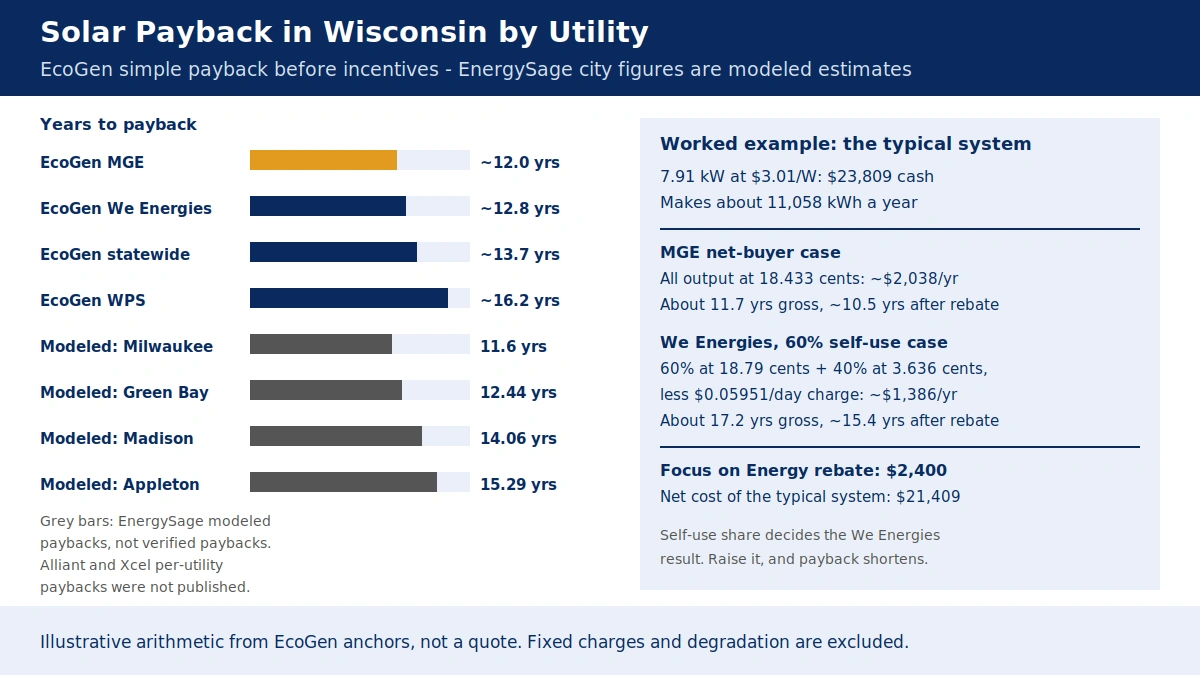
Payback in Wisconsin is a utility question wearing a solar question’s clothes. The same panels, the same roof, and the same price pay back in twelve years in Madison and sixteen in Green Bay, because the tariff values the surplus differently. EcoGen’s simple payback figures — before incentives, weighted across the five large utilities covering 85% of Wisconsin homes — put the statewide figure at about 13.7 years, We Energies at 12.8 years, MGE at 12.0 years, and the full range at 12.0 to 16.2 years, with WPS the slowest. No per-utility payback was published for Alliant or Xcel in the sources checked, so none is stated for them here. EnergySage’s modeled figures run in the same neighborhood — 12.8 years statewide, 11.6 in Milwaukee, 14.06 in Madison, 12.44 in Green Bay, 15.29 in Appleton — but they are modeled on marketplace-average systems of 12 to 13 kW, and they are flagged as modeled wherever they appear in this guide. The EcoGen figures carry the section. The modeled figures check them.
Three forces set the figure, and the middle one usually decides it. The first is the price: $3.01 a watt is above the national average, which lengthens every payback in the state by roughly a year against a cheaper market. The second is the buyback: on We Energies, WPS, and Alliant, every kilowatt-hour the house does not use itself earns 3.6 to 4.3 cents instead of the 15 to 20 cents it would have cost to buy, so the share of output the house consumes as it is made — the self-use share — is worth more than the system’s size. The third is the rebate: $2,400 off a $23,809 system shortens the payback by roughly a year and a half at any plausible savings rate. Rate growth helps too — the state average price rose about 5.3% in the year to August 2026 — but no payback in this guide assumes future rate growth, because a payback that needs rising rates to work is a forecast, not a fact.
A worked example, with the assumptions on the page. Take the typical system: 7.91 kW, $23,809 cash, making about 11,058 kilowatt-hours a year. On MGE, in the net-buyer case where every kilowatt-hour is credited at the 18.433-cent energy rate, the year’s output is worth about $2,038 — a simple payback near 11.7 years before the rebate, near 10.5 years after it. That illustration sits close to EcoGen’s published 12.0-year MGE figure, and the gap is the fixed daily charges, the fuel cost adjustment, and the degradation the illustration leaves out. On We Energies, the same system at a 60% self-use share earns about $1,247 on the power the house uses itself at the 18.79-cent state average, plus about $161 on the 40% exported at 3.636 cents, less about $22 a year for the daily generation charge — about $1,386 a year, a simple payback near 17.2 years before the rebate and near 15.4 years after it. That illustration runs longer than EcoGen’s published 12.8-year We Energies figure, and the gap is the point: EcoGen’s figure assumes a higher self-use share and rising rates, while the illustration assumes neither. Raise the self-use share to 80% — dishwasher, laundry, and EV charging moved to midday — and the We Energies illustration shortens by years. The buyback punishes export. Self-use is the workaround, and it is free.
What the rebate does to the arithmetic. The Focus on Energy check is $2,400 on every system from 4 kW up, so its effect is largest on the smallest systems: on a 4 kW job at $12,040 it covers a fifth of the price, and on the typical 7.91 kW system it takes the net cost to $21,409. Wolf River Electric’s worked example makes the same point from contract prices: an 8 kW system at about $24,700 saving about $1,720 a year pays back in about 14.4 years without the rebate, and the return rises from about 7.0% a year to about 7.7% with it. The rebate is a check that arrives 8 to 10 weeks after the application, not a discount at signing — budget the full price upfront, and treat the check as a refund. A loan changes the picture again: at 7% to 8% interest with no federal credit lump sum to pay down in year one, the monthly payment can exceed the monthly saving for years, and the payback stretches past the cash figures in this section. Compare the loan payment to the bill saving month by month, not the headline payback to the loan term.
The cases where the payback stretches past twenty years. A system oversized on a low-buyback utility. A shaded roof that makes 20% less than the estimate. A home with a $60 to $70 monthly bill, where the fixed charges of $15 to $18 a month stay in place and the dollar savings are small. A co-op or municipal territory paying 2 to 4 cents for exports. A house the owner plans to leave within five to seven years — a 2025 Wisconsin-specific study found little measurable sale-price difference between solar and non-solar homes, so selling before breakeven loses money that the resale market does not reliably return. None of these is a reason to dismiss solar statewide. Each is a reason to run the arithmetic for one address, one roof, and one tariff before signing anything.
The long view. A system that pays back in thirteen years and produces for twenty-five to thirty earns twelve-plus years of nearly free power after breakeven, at whatever rates the 2030s charge. Panels degrade slowly — a national median near 0.5% a year, leaving about 88% of rated output at year 25 — and the inverter, not the panels, is the part most owners replace once. The panels do not care that the buyback fell. The buyback cares, and it is the one variable in the arithmetic that the owner cannot control and the installer cannot promise. Size for self-use, claim the rebate, and let the tariff be the tiebreaker between two otherwise equal quotes.
Batteries in Wisconsin: Self-Use Storage on a Low Buyback
A battery in Wisconsin is a self-use machine first and a backup machine second. On a low-buyback utility, every kilowatt-hour the battery holds for the evening is a kilowatt-hour that earns the full retail rate instead of 3.6 cents — the battery converts exported power into consumed power, which is the most valuable conversion in Wisconsin solar. On MGE or Xcel, where exports already earn near retail, the battery’s bill-saving job mostly disappears, and only the backup job remains. Price the battery against the tariff, not against the brochure.
What a battery costs here. EnergySage’s Wisconsin figures from the first half of 2026 put installed storage at $1,309 per kilowatt-hour, or about $17,672 for a 13.5 kWh unit — the size of a Tesla Powerwall 3, the unit most Wisconsin quotes are built around. A second measure runs lower: EcoGen’s Wisconsin size ranges imply a battery adder near $15,200 for the same 13.5 kWh. An Appleton storage page from August 2026 splits the difference at $1,283 per kilowatt-hour, $16,683 for 13 kWh. The conflict is the sample, not the market — marketplace quotes against a national pricing model — and this guide anchors on the Wisconsin-specific EnergySage figure while flagging the lower one. Either way, a battery adds roughly two-thirds of the typical system’s price again. The sales-tax exemption does not cover batteries, and no Wisconsin battery rebate was verified for this guide, so the full installed price is the price. A battery bought with the panels shares one installation visit and one permit; a battery added later pays a second visit and, sometimes, a second round of paperwork.
What a battery earns on each tariff. On We Energies, WPS, or Alliant, a 13.5 kWh battery cycled daily through the bright months shifts several thousand kilowatt-hours a year from the 3.6-to-4.3-cent export price to the 15-to-20-cent retail price it displaces in the evening. The arithmetic is attractive and the payback is still long: at a 15-cent spread, shifting 3,000 kilowatt-hours a year earns about $450 a year, which repays a $17,672 battery in decades, not years — unless the battery also carries the home through outages the owner values highly. On MGE, the spread is near zero, because the export already earns retail, so the battery earns almost nothing on bill savings at all. The honest statement is that a Wisconsin battery rarely pays for itself on bill savings alone under any 2026 tariff. It pays where the owner prices backup, or where the household’s evening load is large and the export price is small. Our solar battery cost guide works through the national arithmetic; the Wisconsin version of it starts with the buyback table in the previous section.
Backup, sized honestly. One 13.5 kWh pack is overnight essentials, not two days of electric heat: the furnace fan, the refrigerator, the lights, the phones, the well pump if there is one. Whole-home backup usually takes two or three batteries, in the $24,000 to $40,000 band nationally, and a Wisconsin winter outage that outlasts the battery still needs a plan for heat. Grid outages are less frequent here than in hurricane or wildfire states, so the backup case rests on the owner’s own outage history, not on a statewide average. Ask the installer which circuits stay live on battery power, how the system behaves when the battery is empty and the sun is down, and whether the battery can charge from the grid during an outage warning — then ask the assessor whether the battery counts as part of the property-tax-exempt solar system, because the exemption’s treatment of storage is a question for the local assessor, not the installer. A battery also has its own warranty clock — typically 10 years — which is shorter than the panels’ 25, so a battery bought in 2026 will likely need a decision, if not a replacement, before the panels retire.
The case against buying one now. Battery prices have fallen for a decade, and a battery added in three years will likely cost less and store more than one bought today. A homeowner on MGE or Xcel, with a right-sized system and no outage anxiety, gains little by buying storage in 2026. A homeowner on We Energies with a large evening load gains more, but should still price the battery as a separate line, with its own payback, rather than letting it hide inside a bundled quote. And a homeowner whose roof, panel, or budget is already stretched should buy the panels first and the battery later — the panels earn from day one, while the battery earns only when the sun has already done its work.
Wisconsin Incentives in 2026: The $2,400 Rebate and Two Tax Exemptions
Wisconsin’s incentive picture in 2026 is one rebate, two tax exemptions, and a list of programs that do not exist. The rebate is real money — $2,400 on most systems — and it is the only cash incentive most Wisconsin homes can get. The exemptions are worth more over the life of the system than the rebate, and they arrive automatically. Everything else a salesperson mentions needs checking against this section before it is believed.
Focus on Energy: $600 per kilowatt, capped at $2,400. Focus on Energy, the statewide program of Wisconsin’s utilities, pays single-family homes $600 per kilowatt DC installed, up to $2,400 per residence, for systems purchased and placed in operation between January 1 and December 31, 2026. The cap is reached at 4 kW: a 3 kW system earns $1,800, a 4 kW system earns $2,400, and a 7.91 kW system earns $2,400 too, because $4,746 by formula is cut back to the cap. On the typical $23,809 system, the rebate takes the net cost to $21,409. The 2026 rate is double the 2025 level, when the rebate was $300 per system — and some 2026 guides still show the old $300 figure, including EnergySage’s own incentives table, which is stale on this point and should not be relied on. The rebate comes as a check, to the homeowner or to a company named on the application, about 8 to 10 weeks after applying. If the installer takes it off the price instead, the contract should say so in writing.
The deadline problem — read this before you rely on any date. The program page and the 2026 application say applications are due within 60 days of switch-on and no later than January 31, 2027. The online form page still showed August 31, 2026 as the last day when it was checked in late September and early October 2026, and the original application document says the same August date. Both dates cannot be right, and this guide cannot resolve the contradiction from the published pages alone. The safe course is the one that satisfies either reading: complete the online reservation before the install, apply within 60 days of switch-on, and confirm the final date with Focus on Energy directly — by phone at 800-762-7077 — before the install date is set. Funding is first-come, first-served, and the rebate closes when the annual allocation is exhausted, so a reservation is worth more than a promise. Get the switch-on date in writing from the installer if the quote counts on the rebate, because a system switched on after December 31, 2026 falls outside this round entirely, and no 2027 terms were posted when this guide was written.
Who qualifies, and who does not. The system must be owned, bought new, and installed in 2026 — leased, rented, and used equipment does not qualify. The home must be served by a participating electric utility: the five large utilities take part, and not every co-op or city utility does, so check Focus on Energy’s participating list for your address. The installer must be a registered Focus on Energy Trade Ally — an unregistered installer cannot file the application, and the rebate is lost. The roof must fit: panels within 135 degrees of due south, tilt between 5 and 50 degrees, shading at 15% or less measured with an industry-accepted tool, system at least 0.5 kW DC, modules from the qualified product list, and a minimum five-year warranty. One rebate per site per calendar year. The application carries an attestation about the federal credit — the rebate would be limited to $300 for a system claiming it — which is moot for 2026, because no owned system installed in 2026 can claim the federal credit at all.
The sales-tax exemption: 5% that never leaves the quote. Solar equipment of 200 watts AC or larger — panels, inverters, and the mounting hardware — is exempt from Wisconsin’s 5% sales and use tax. The installer claims the exemption when buying the equipment, so there is no form for the homeowner and nothing to file. On a $31,000 system, the exemption is about $1,550 the buyer never pays. It is already inside every honest quote, so a quote that deducts it again as a separate line is double-counting. The exemption does not cover batteries. A battery bought with the system is taxed; a battery bought later is taxed too.
The property-tax exemption: one form, by March 1. Under Wis. Stat. section 70.111(18), the value a solar energy system adds to a home is exempt from general property tax — the assessor leaves the system out of the home’s taxed value, so the yearly tax bill does not rise because of the panels. The law sets no deadline, but the Department of Revenue has a form: Form PR-303, the Energy System Exemption Request, which says to send it to the local assessor by March 1 with the equipment details. File it. Do not assume the assessor knows the system is exempt. If a battery is part of the job, ask the assessor whether it counts as part of the exempt system, because that answer varies by assessor and the installer cannot give it.
What does not exist. Wisconsin has no state income-tax credit for home solar, and no general state rebate beyond Focus on Energy. Wisconsin has no SREC market and no solar carve-out in its renewable standard, so no certificate income exists to count — a salesperson quoting SREC revenue for a Wisconsin roof is quoting another state’s program. Solar for All, the federal program that would have funded low-income solar, had its $62.4 million Wisconsin award terminated by the EPA in August 2025; courts ruled the termination unlawful in September 2026, but the funds stayed frozen and no household application route exists. Two smaller programs are real but narrow: the Milwaukee Shines solar loan, through Summit Credit Union for approved City of Milwaukee projects, lends $1,000 to $25,000 at an interest rate it does not post, so ask; and MadiSUN, the Madison-area group buy, negotiates installer pricing through competing bids but pays no rebate of its own. Neither is cash in hand.
The renter’s and the shaded roof’s alternative. MGE’s Shared Solar program lets MGE customers, renters included, buy shares in a local solar array — Strix Solar in Fitchburg — for a one-time $15 or $7.50 per share, covering up to half of yearly use. It costs about 1 to 1.5 cents per kilowatt-hour more than the normal home rate, so it is a premium product for buyers who want local solar without a roof, not a saving. Wisconsin has no statewide community-solar program with a subscriber bill discount of the kind some eastern states run, and no such program was verified for this guide. The national picture, and the questions to ask any community-solar provider, are in our community solar guide.
Federal Help in 2026: No Tax Credit — and the Lease Route Is Unsettled Law
The federal picture for a Wisconsin homeowner in 2026 has a clean half and a murky half. The clean half: the 30% Residential Clean Energy Credit is gone for any system you buy yourself and place in service after December 31, 2025. The murky half: the lease route that still carries a federal credit in other states sits in unresolved legal territory in Wisconsin, and the companies that would offer it have mostly stayed away. Both halves need understanding before any financing decision, because the second one is where Wisconsin buyers get sold a product the state’s own courts never finished ruling on.
The credit that ended. The One Big Beautiful Bill Act, Public Law 119-21, ended the Residential Clean Energy Credit (section 25D, 30%) and the Energy Efficient Home Improvement Credit (section 25C) for property placed in service after December 31, 2025, and the IRS confirmed the treatment in Fact Sheet FS-2025-05. The finish date decides: a system paid for in 2025 but installed in 2026 earns nothing. For a 2026 Wisconsin install you own, the federal credit is $0, the state has no income-tax credit to replace it, and the Focus on Energy rebate is the only cash that comes back. Any quote that subtracts a 30% credit from a 2026 owned install is wrong on its face — ask for a corrected quote, and treat the error as information about the company that wrote it. What survived nationally for other equipment — heat pumps, insulation, windows — is set out in our federal tax credits guide.
The lease route Wisconsin never settled. The commercial credit (section 48E, 30%) survives for third-party-owned systems placed in service by December 31, 2027, and in most states a leasing company claims it and passes part of the value through as a lower monthly payment. In Wisconsin, whether a third-party company may sell a homeowner power from panels it owns on that homeowner’s roof was never finally decided. The Public Service Commission ruled 2-1 in December 2022, in Docket 9300-DR-106, that one Stevens Point family’s arrangement with the North Wind Renewable Energy Cooperative — an 8 kW system, one project, one set of facts — did not make the co-op a public utility. The Wisconsin Utilities Association sued, a trial court sent the issue back to the Commission for more information, the family moved before installing anything, the Commission withdrew its decision, and the appeals court dismissed the case as moot in January 2025. The ruling covered one project. The withdrawal left the law exactly where it was: untested. Utilities have since refused interconnection for third-party-owned arrays, and developers have been reluctant to build a business on an unanswered question.
What that means at the kitchen table. Leases and power purchase agreements exist in Wisconsin the way a road exists before the bridge is built: a few providers operate — Palmetto’s LightReach is the name most often cited — but Palmetto’s own Wisconsin page lists its product as prohibited at We Energies, Alliant, and MGE, which between them serve most of the state’s homes, and Sunrun and Tesla have limited presence here. A prepaid-lease example from one Wisconsin installer claims about 30% off the list price, about $20,500 on a $29,300 system — installer marketing, labeled as such, not a verified market price. No Wisconsin PPA escalator figure was verified for this guide, so none is stated. Leased systems do not qualify for the Focus on Energy rebate, which removes $2,400 from the lease side of the comparison before anything else is counted. A lease offered in Wisconsin in 2026 should be read with three questions: will the serving utility interconnect a third-party-owned system at this address, in writing; who keeps the buyback credits and the tax exemptions; and what happens to the contract if the home is sold. If the salesperson cannot answer the first question with the utility’s own letter, the product is not ready for that address.
The loan route, priced honestly. A solar loan at 7% to 8% for well-qualified borrowers, from national lenders and some local credit unions, is the route most Wisconsin buyers without cash will actually use. With no federal credit lump sum arriving in year one, the payment runs higher than older projections assumed, and the honest comparison is monthly: if the loan payment exceeds what the panels save each month, the household pays more every month until the loan is gone, however good the 25-year arithmetic looks. A $0-down loan also commonly carries dealer fees folded into the financed amount — 20% to 30% of the cash price in national reporting, with no Wisconsin-specific figure verified — which is why the cash price per watt, in writing, is the number to compare across bidders even when the plan is to borrow. The Milwaukee Shines loan, for approved City of Milwaukee projects through Summit Credit Union, is the one local lending program found; its rate is not posted, so ask before counting on it.
HEAR and HOMES: open in Wisconsin, and irrelevant to solar. Wisconsin is one of the few states where both federal home energy rebate programs actually run: HEAR and HOMES, together allocated $149 million, administered by Focus on Energy, with HOMES launched in August 2024 and HEAR open with restrictions. HEAR pays up to $8,000 for a heat pump for income-qualified households, and HOMES pays up to $8,000 on measured or modeled energy savings. Neither pays for solar panels, batteries, EV chargers, or windows in any case. DOE Program Notice 26-2, dated May 29, 2026, limits HEAR to electric-to-electric upgrades — no replacing a gas, oil, or propane appliance with an electric one — and since September 1, 2026, Focus on Energy has applied that rule to its retail pathway, with income under 150% of area median income verified and weatherization required first. A Wisconsin household planning both a heat pump and solar should sequence the two: the heat pump can draw HEAR or HOMES money and the Focus on Energy heating rebates, the panels draw the solar rebate, and the array should be sized for the house after the heat pump arrives. Do not let a solar quote claim HEAR money for panels. It does not exist.
Permits & Licensing: What Wisconsin Requires
Wisconsin licenses the electrician, not the solar installer. There is no standalone state solar-installer license, and no state credential with the word solar in it. What the state does require is that the electrical work be done by properly licensed people working for a properly credentialed business, that the building permit be pulled by a credentialed dwelling contractor, and that the utility approve the interconnection under the PSC’s rules. A buyer who checks two credential numbers and one permit has done most of the diligence Wisconsin law makes possible.
The electrical credential: DSPS Electrical Contractor. Under Wis. Stat. section 101.862, all photovoltaic wiring must be done by DSPS-licensed electrical contractors — the business holds a Department of Safety and Professional Services Electrical Contractor credential, and the people doing the wiring hold Master, Journeyman, or Registered electrician credentials. Ask for the Electrical Contractor number — credential numbers end in EC — and check it in the DSPS online license lookup at license.wi.gov, under the exact business name on the contract, because the credential belongs to the business and a subcontractor’s number does not cover the company that sold the job. Wisconsin uses the 2023 National Electrical Code, with statewide adoption effective September 1, 2026, according to a secondary source flagged in the research brief; the installer should be working to the current edition either way. NABCEP certification — the North American Board of Certified Energy Practitioners credential — is voluntary in Wisconsin, and it is the credential to ask for on top of the state license, not instead of it. A company with NABCEP-certified designers and a DSPS Electrical Contractor credential has cleared both bars. A company with neither has cleared none.
The building credential: Dwelling Contractor plus Qualifier. Whoever pulls the building permit for a one- or two-family home needs the DSPS Dwelling Contractor credential for the business, plus a Dwelling Contractor Qualifier — a named person who has passed a 12-hour approved course and completes 12 hours of continuing education every two years. The business must also carry a surety bond or general liability insurance of at least $250,000 per occurrence, under Wis. Stat. section 101.654. On a solar job, the Dwelling Contractor credential matters because the racking is structural work on a dwelling: the permit, the roof penetrations, and the inspection all run through it. Ask for both numbers — Electrical Contractor and Dwelling Contractor — and check both in the same lookup. A roofing subcontractor doing the flashing work needs the dwelling credential too, if that subcontractor is the one pulling the permit.
Permits and inspection: local, and before the work starts. Solar permits in Wisconsin are local. The Uniform Dwelling Code permit comes from the municipality or an authorized UDC inspection agency, and for electrical installations requiring a UDC permit, the responsible Master or Electrical Contractor may not begin the electrical installation until the permit is issued. No statewide solar permit-fee cap or fee schedule was verified for this guide, so none is stated — the fee is whatever the municipality charges, and it should appear as a line on the quote rather than surfacing later as an extra. The inspection follows the local authority’s process, and the utility’s interconnection approval is a separate step that no permit replaces. December through March is largely a dead zone for Wisconsin roof work, so a permit filed in November may not see a crew until April; the installer’s schedule should say so plainly rather than promising a winter install the weather will not allow.
Interconnection: PSC Chapter 119, one utility at a time. Interconnection for distributed generation of 15 MW or less follows Chapter PSC 119 of the Wisconsin Administrative Code, through standardized PSC interconnection forms, and each utility runs its own process, timeline, and paperwork on top of that framework. No Wisconsin-specific interconnection timeline was verified for this guide — no average wait, no permission-to-operate figure — so none is stated, and any installer promising a specific switch-on date should be asked what the utility has committed to in writing. The interconnection date matters more than usual in Wisconsin in 2026, because the Focus on Energy rebate requires switch-on by December 31, 2026, and a system that misses the date misses the rebate. Get the utility’s place in the queue confirmed before the contract is signed, not after the panels are on the roof.
HOA and local rules: the law limits restrictions, within bounds. Wisconsin law limits what can stand between a homeowner and a solar system. Wis. Stat. section 236.292(2) voids plat restrictions that prevent or unduly restrict solar systems, and Wis. Stat. section 66.0401 bars cities, villages, towns, and counties from imposing rules that significantly increase system cost or decrease efficiency, unless the rule protects health or safety, adds little cost or cuts little output, or allows a similar system. No Wisconsin percentage thresholds were verified — nothing like the numbered tests some other states write into their solar-rights laws — so this guide states the standard in the statute’s own general terms and no further. Condominiums with common-element roofs have more discretion than single-family subdivisions, because the roof is not the owner’s to use exclusively. An association may still set reasonable aesthetic standards, and the practical advice is the same everywhere: get architectural-review approval in writing before ordering panels, with the array layout attached, and keep the approval with the contract. A restriction challenged after the install is a dispute. A restriction cleared before it is paperwork.
Insurance and the roof, before the crew arrives. Tell the homeowners insurer before the install, not after, and get written confirmation that the policy covers the array against storm damage — hail and wind are Wisconsin risks, and an array added without notice can complicate a claim. Confirm the roof’s age and the snow-load rating with the permitting office, and confirm that the racking is rated for the zone’s ground snow load under SPS 321. A 100-amp service, common in pre-1960 Milwaukee and Madison homes, usually needs a 200-amp upgrade before the array can connect; that upgrade runs $1,500 to $4,000 in Wisconsin, and it should be quoted through our electrical panel upgrade guide as its own line, not buried in the per-watt price.
What Pushes Your Wisconsin Quote Up or Down
Equipment costs track the national market. What sets a Wisconsin quote apart is the local friction before the panels reach the roof: the snow the racking must carry, the short season the crew must work in, the licensed hands the law requires, and the old houses the panels must sit on. Each factor below moves real quotes by real money, and each one should appear as its own line or its own explanation — a quote that hides them inside a single per-watt number is hiding the comparison too.
Snow-load engineering. SPS 321 requires roofs to handle ground snow loads of 30 to 40-plus pounds per square foot depending on the zone, and the racking must be rated for the zone the house sits in. Rated racking costs more than generic hardware, and northern homes may need an engineer’s stamp on the structural letter. A Green Bay roof and a Kenosha roof do not carry the same requirement, and a quote that prices them identically has priced one of them wrong. Ask for the racking’s snow-load rating in writing, matched to the zone.
A short install season. December through March is largely a dead zone for Wisconsin roof work. Demand crowds into April through November, which stretches lead times and firms up prices in the busy months. A quote signed in February may carry a spring install date, and the Focus on Energy rebate’s December 31 switch-on deadline makes a late-fall install a race against both the weather and the calendar. Book the crew early, and treat a promised winter install date as a hope, not a plan.
Licensed electricians only. Under Wis. Stat. section 101.862, all photovoltaic wiring must be done by DSPS-licensed electrical contractors, a higher labor bar than in many states. Licensed labor costs more than unlicensed labor, and it is worth more: the wiring is the part of the job that can burn a house down, and the license is the state’s check that the person doing it knows the code. A quote far below the $2.74-to-$3.48 band should raise the question of whose hands are doing the wiring, and the answer should be checkable in the DSPS lookup.
Older homes. Milwaukee and Madison have many pre-1960 homes: odd roof framing, slate or clay tile, and 100-amp panels that need a 200-amp upgrade at $1,500 to $4,000. Slate and tile need specialty mounting and slower labor. Old framing sometimes needs reinforcement before it can carry an array plus a snow load. None of this is a reason to avoid solar on an old house. All of it is a reason to get the roof and the panel inspected before the solar quote is treated as final.
Roof pitch, orientation, and shade. A steep south-facing roof sheds snow, catches the low winter sun, and needs standard racking. A low-slope roof holds snow, needs tilt-up racking to reach a useful angle, and costs more to mount. A north-facing roof may not be worth paneling at all. Shade from mature oaks — the state tree in all but name — can cut output enough to change the payback, and shade over 15% kills the rebate. Microinverters or optimizers add cost and earn it back on a partially shaded roof; on an open south-facing roof, a string inverter is cheaper and just as good. The production estimate should name the shade assumption. If it doesn’t, it is not an estimate.
Ground mounts and trenching. A ground-mounted array avoids the roof entirely, tilts to the ideal 35 degrees, and sheds snow the day after a storm — and it costs more, needs trenching for the wiring run, needs its own structural work, and faces local rules that rooftop systems do not. Wolf River Electric’s contract figures exclude ground mounts and trenching for exactly this reason: they are a different job with a different price. Price a ground mount as its own quote, not as a rooftop quote with a different racking line.
What brings the price down. Every honest quote already has the 5% sales-tax exemption baked in. The Focus on Energy rebate takes $2,400 off the net cost. The property-tax exemption keeps the yearly tax bill flat. Competition helps most in Milwaukee and Madison, where the installer field is deepest. And the simplest saving in Wisconsin costs nothing: sizing the system to the house’s own monthly use on a low-buyback utility, so fewer kilowatt-hours are sold at 3.6 cents. A smaller right-sized system beats a bigger wrong-sized one on payback, on roof load, and on the check that has to be written.
| Factor | Direction | Typical size of the effect |
|---|---|---|
| Snow-load racking + engineering (northern zones) | Up | Engineer stamp + rated hardware; varies by zone |
| Panel upgrade (100-amp to 200-amp) | Up | $1,500-$4,000 |
| Slate / clay tile mounting | Up | Specialty labor; quote-specific |
| Ground mount + trenching | Up | Separate job; quote-specific |
| Microinverters / optimizers (shaded roof) | Up | Worth it on shade; skip on open roofs |
| Battery (13.5 kWh) | Up | ~$17,672 (EnergySage WI) |
| Detach-and-reset for a later reroof | Up | $2,000-$4,000 |
| Focus on Energy rebate | Down | $2,400 on systems 4 kW and up |
| Sales-tax exemption | Down | ~5% of equipment, already in quote |
| Right-sizing to monthly use (low-buyback utility) | Down | Avoids power sold at 3.6-4.3 cents |
| Three competing quotes | Down | Deepest field in Milwaukee / Madison |
Selling or Buying a Wisconsin Home With Panels: What Transfers and What Does Not
Panels stay with the house. The tariff stays with the address. The rebate does not travel at all. A Wisconsin home sale with solar on the roof needs all three facts understood before the price is negotiated, because the buyer inherits the utility’s rule, not the seller’s enthusiasm.
The interconnection agreement transfers. When a Wisconsin home with panels is sold, the panels and the inverter stay with the house, and the interconnection agreement transfers to the new owner — the new owner steps into the same utility, the same tariff, and the same buyback price the seller had. A move across utility territories changes the deal: a buyer moving from an MGE address to a We Energies address goes from an 18.433-cent export credit to a 3.636-cent buyback on the same kind of system, and the savings change accordingly. A buyer should ask for the last twelve months of electric bills, the interconnection agreement, the production records, and the warranty documents before offering a premium for the panels — and should price the system on the tariff at that address, not on the seller’s description of it.
The resale premium is unproven in Wisconsin. A 2025 Wisconsin-specific study found little measurable sale-price difference between solar and non-solar homes, against a national study’s 6.9% premium for homes with solar. The national figure is national, not Wisconsin, and this guide does not present it as a Wisconsin expectation. The property-tax exemption protects the owner while living there — the added value is not taxed — but it does not guarantee a buyer will pay for it. Do not count on a resale bump when calculating the return. A system that has not yet paid for itself when the house sells is a loss the seller absorbs, which is why the five-to-seven-year horizon is the honest cutoff: a household that may move within that window should think hard before buying, however good the panels look on the roof.
Leased systems complicate the sale. A leased or third-party-owned system does not transfer the way an owned system does: the buyer must qualify for, and agree to assume, the lease or PPA, or the seller must buy the system out — and in Wisconsin, where third-party ownership itself sits in unresolved legal territory, a buyer’s lender may ask questions a seller cannot answer. An owned system with clean paperwork — interconnection agreement, production history, warranties, the Focus on Energy rebate already collected by the seller — is the simplest solar asset to sell. A leased system is a negotiation. Price the difference into the decision to lease, years before the sale.
What the buyer should verify. The age and condition of the roof under the panels, and whether a reroof in the next ten years means a $2,000-to-$4,000 detach-and-reset. The inverter’s age and warranty — a string inverter near the end of a 10-to-15-year life is a replacement the buyer will pay for. The production history against the original estimate, including the winter months, because a system that underperforms in January underperforms every January. And the utility’s current tariff sheet for the address, because the buyback price that made the seller’s arithmetic work may have been reset on the last January 1. A home inspection covers the house. None of these four items is reliably in it. Ask for them separately.
Getting Quotes in Wisconsin: The Checklist
Ten checks follow, ordered by how much money each one saves. Do them in this order, on one identical spec sheet, from three installers — and do not sign anything until all ten are answered in writing.
- Your utility’s rules in writing first. We Energies 3.636 cents, WPS 3.584 cents, Alliant 4.254 cents, MGE 18.433 cents (5.374 for net sellers), Xcel kilowatt-hours banked forward. The gap between the best and the worst is worth years of payback. Get the current tariff sheet for your address from the utility itself, not from the installer.
- The size matched to your tariff and your bills. Twelve months of kilowatt-hours, divided by roughly 1,398, tested month by month against the buyback. On We Energies, WPS, or Alliant, size tightly to monthly use. On MGE or Xcel, covering the full year makes sense. Above 20 kW on Alliant or WPS, the rate changes entirely.
- The cash price per watt on paper. The $3.01 anchor, the $2.74-to-$3.48 quote band, and your three quotes on one spec sheet. A bidder who will not state the cash price per watt is hiding the comparison.
- No line for a 30% federal credit, and the rebate handled honestly. $0 federal on a 2026 owned install. The Focus on Energy rebate is a $2,400 check after switch-on, not a discount at signing — the contract should say who files, when, and what happens if the December 31 switch-on date slips. Confirm the application deadline directly with Focus on Energy, because the program page and the form page disagree.
- Both Wisconsin credential numbers verified. The DSPS Electrical Contractor credential (numbers end in EC) and the Dwelling Contractor credential plus Qualifier, checked at license.wi.gov under the exact contract name. NABCEP certification on top is a plus, not a substitute.
- Add-ons itemized. Roof work, panel upgrade $1,500-$4,000, tree work, snow guards, ground-mount trenching, battery $17,672 for 13.5 kWh, and the detach-and-reset cost if the roof is replaced later. Each on its own line, each priced before signing.
- A PVWatts production estimate, with every assumption printed on it. The 1,398 kilowatt-hours-per-kilowatt anchor, the monthly shape with June against December, the snow-loss assumption (3% to 6% is the Madison installer’s planning range), and the shade assumption from a study of your roof — not a statewide average. Ask what the estimate assumes about snow, and whether the tilt is steep enough to shed it.
- Snow load, wind load, and insurance confirmed. The roof’s snow-load rating from the local permitting office, racking rated for the SPS 321 zone, UL 61730 / IEC 61730 panel ratings in the spec, and the homeowners policy confirmed in writing to cover the array against storm damage.
- HOA approval in writing first. Wis. Stat. section 236.292(2) and section 66.0401 limit restrictions, but an association may still set reasonable standards — get architectural-review approval with the layout attached before ordering panels. Condominium common-element roofs are a separate case.
- The interconnection path and the switch-on date. The PSC Chapter 119 process, the utility’s queue, and the date the system will actually be switched on — in writing, because the rebate depends on December 31, 2026, and the winter install season ends long before it.
Get three written quotes on one identical spec sheet before signing anything. In Wisconsin, the cheapest quote is rarely the cheapest system, and the right-sized system on the right tariff beats the biggest system on the wrong one every time.

Sources & methodology
Headline price and production:
- EcoGen Solar Cost Index, September 2026 edition: $3.01/W Wisconsin, 7.91 kW typical system, $23,809, quote band $2.74-$3.48/W; 11,058 kWh/yr typical production (~1,398 kWh/kW/yr, PVWatts-based); Berkeley Lab 2025 median 7.91 kW from 1,837 Wisconsin systems; Madison 4.84 peak sun hours/day annual, 3.08 December; Wisconsin page updated Oct 22, 2026
- EnergySage Wisconsin cost data: $3.03/W Nov 2026 (13.42 kW avg, $34,542-$46,734 range, 12.8-yr modeled payback, $50,889 25-yr savings); $3.04/W Oct 2026 (13.45 kW avg, $34,763-$47,033); city pages Nov 2026 — Milwaukee $2.96/W, 12.28 kW, $36,355, 11.6-yr modeled, $51,974; Madison $3.05/W, 13.11 kW, $39,986, 14.06-yr modeled, $39,400; Green Bay $3.11/W, 13.38 kW, $41,553, 12.44-yr modeled, $53,202; Appleton $3.14/W, 13.0 kW, $40,861, 15.29-yr modeled, $36,700 (installer-page variant 12.99 kW, $40,766, 15.22 yrs, $37,148 flagged)
- Wolf River Electric contract data, Jun-Oct 2026: middle half $3.00-$3.30/W, median ~$3.09/W, median job ~$24,300, most systems 6.5-10.5 kW (roof-mount only, no battery/ground mount/trenching/panel upgrade)
- SolarReviews Nov 2026: $3.01/W, 7.0 kW avg, $22,401 (national model — not headline); SolarEnergyPrices planning $2.85/W typical, $2.60-$3.15 range; NumeralQ planning, EnergySage data retrieved Oct 26, 2026: 8 kW $19,720-$25,770 ($2.46-$3.22/W); PVGIS production ~1,268-1,270 kWh/kW/yr (conflict with EcoGen 1,398, flagged); ConsumerAffairs $3.06/W Wisconsin
- EIA Electric Power Monthly, 12 months to Aug 2026: Wisconsin residential 18.79-18.8¢/kWh, ~665 kWh/mo, ~$125/mo bill (~7,980 kWh/yr); Aug 2026 alone 19.41¢/kWh (+5.3% YoY from 18.44¢; +4.8% variant flagged), $147.68-$148 bill; 2024 EIA-861: 645 kWh/mo, $110.87/mo; EcoGen 658 kWh/mo figure flagged
Buyback and net metering:
- EcoGen Wisconsin incentives page, checked Sep 30-Oct 5, 2026: MGE 18.433¢/kWh, net sellers 5.374¢, 100 kW cap, Schedule Pg-2; Xcel kWh carryforward, 100 kW cap, year-end at wholesale; Alliant 4.254¢ average, 20 kW cap; We Energies 3.636¢, under 300 kW, CGS-NM, $0.05951/day generation charge, check over $100; WPS 3.584¢, 20 kW cap, Schedule PG-4
- WPS Schedule PG-4 tariff: avoided energy cost $0.03584/kWh, effective Jan 1, 2026, PSCW Order 6690-TE-2026, updated each Jan 1; pre-Mar 31, 2011 full-retail grandfathering ended Dec 31, 2021
- We Energies CGS-NM: legacy CGS tariffs closed, pre-Oct 7, 2014 grandfathering through Dec 31, 2024 (Solar Learning Lab, PSC guidance); retail ~19.6¢ We Energies, ~18.4-19.9¢ MGE, 14.8¢ WPS (EcoGen); Alliant retail +3.5% in 2026 (EcoGen); 81 municipal utilities + 24 cooperatives, most not PSC-regulated, many paying 2-4¢ (EcoGen)
- Xcel year-end conflict flagged: 2026 sources say wholesale/lower parallel-generation rate; older All Energy Solar page says retail-rate check
- PSC net-metering investigation opened 2023 (EcoGen); review since 2025 (solarpanelscost); AB901/SB892 introduced Jan 23, 2026, referred to committee — pending, not law; no SREC market in Wisconsin
Payback arithmetic:
- EcoGen simple payback before incentives: statewide ~13.7 yrs, We Energies ~12.8, MGE ~12.0, range 12.0-16.2 (MGE to WPS), weighted across five utilities covering 85% of homes (EIA-861, 2024); Alliant/Xcel per-utility figures not published, not stated
- NestPriced illustrations (labeled): MGE net-buyer 11,058 kWh x 18.433¢ = ~$2,038/yr → ~11.7 yrs gross, ~10.5 yrs after $2,400 rebate; We Energies 60% self-use 6,635 kWh x 18.79¢ + 4,423 kWh x 3.636¢ less $21.72/yr generation charge = ~$1,386/yr → ~17.2 yrs gross, ~15.4 yrs after rebate; gap vs EcoGen’s 12.8-yr We Energies figure flagged as self-use/rate-growth assumptions
- Wolf River worked example: 8 kW ~$24,700, ~$1,720/yr savings, ~14.4 yrs without rebate, ~7.7% return with rebate
Incentives and federal:
- Focus on Energy Solar for Homes 2026: $600/kW DC up to $2,400, systems placed in operation Jan 1-Dec 31, 2026, apply within 60 days, no later than Jan 31, 2027 (program page/application) — online form page showing Aug 31, 2026 flagged as a conflict; Trade Ally required; 0.5 kW minimum; within 135° of south; tilt 5-50°; shading 15% or less; CEC module list; 5-year warranty; one rebate per site per year; processing 8-10 weeks; first-come, first-served; 2025 level $300/system (OEI newsletters Dec 2025/Jan 2026); EnergySage incentives table $300 figure flagged stale
- Sales tax: solar equipment 200 W AC or larger exempt from 5% sales/use tax, installer claims at purchase, batteries excluded (WI Dept. of Revenue Publication 200, via EcoGen); property tax: Wis. Stat. § 70.111(18), Form PR-303 to assessor by Mar 1
- §25D/§25C $0 to OBBBA P.L. 119-21 / IRS FS-2025-05; §48E lease route unsettled: PSC Docket 9300-DR-106 Dec 1, 2022 (2-1, one Stevens Point project, North Wind Co-op), utilities association suit, trial-court remand, family moved, PSC withdrew decision, appeals court dismissed as moot Jan 3, 2025; Palmetto LightReach prohibited at We Energies/Alliant/MGE per Palmetto page (checked Oct 5, 2026, EcoGen); Sunrun/Tesla limited presence (EcoGen); no verified Wisconsin PPA escalator
- HEAR/HOMES: $149M allocation, run by Focus on Energy, HOMES launched Aug 1, 2024, HEAR open with restrictions (verified Nov 4, 2026, heatpumppricing); DOE Program Notice 26-2 dated May 29, 2026, electric-to-electric only; Sep 1, 2026 retail fossil-replacement cutoff; HEAR up to $8,000, lifetime cap $14,000/household; $13.7M for 1,932 households (DOE Feb 2026 slides, combined); neither covers solar/batteries/EV chargers/windows
- Solar for All: EPA terminated $62.4M Wisconsin award Aug 7, 2025; courts ruled termination unlawful Sep 18 and Sep 22, 2026; funds frozen, no household route (EcoGen, checked Oct 5, 2026)
- Milwaukee Shines loan $1,000-$25,000 via Summit Credit Union, rate not posted; MadiSUN group buy, no rebate; MGE Shared Solar-Strix $15/$7.50 per share, ~1-1.5¢/kWh premium, up to half yearly use (MGE via Badger Homeowner, Oct 2026)
- Loans ~7-8% for well-qualified borrowers (EcoGen); dealer fees 20-30% national reporting, no Wisconsin-specific figure verified — flagged
Permits, licensing, HOA:
- No standalone solar license; DSPS Electrical Contractor credential (business, numbers end in EC) + licensed Master/Journeyman/Registered electricians, Wis. Stat. § 101.862; Dwelling Contractor + Qualifier (SPS 305.31; Wis. Stat. § 101.654; 12-hour course, 12 hrs CE/2 yrs, $250,000 liability or bond); verify at license.wi.gov; UDC permit from municipality/authorized agency before electrical work begins; PSC Chapter 119 interconnection, 15 MW or less; 2023 NEC adoption effective Sep 1, 2026 (secondary, flagged); NABCEP voluntary
- HOA: Wis. Stat. § 236.292(2) voids plat restrictions preventing/unduly restricting solar; § 66.0401 bars local rules significantly increasing cost or decreasing efficiency (health/safety and similar-system exceptions); condo common-element roofs more discretion (EcoGen); no verified percentage thresholds
- SPS 321 ground snow loads 30 to 40+ psf by zone (EcoGen); panels rated 5,400 Pa (~113 psf) under IEC 61215; panel upgrade $1,500-$4,000, detach-and-reset $2,000-$4,000, Dec-Mar install dead zone (EcoGen WI)
Production and climate:
- Snowfall normals 1991-2020 (WI State Climatology Office / NOAA): Milwaukee 48.7″, Madison 51.8″, Green Bay 55.6″; Madison record 111.1″ (2008); lake-effect snow eastern counties (art 85)
- Marion 2013 NREL study (UW-Madison + Boulder, winters 2010-11, 2011-12): monthly snow losses up to 90%, annual 1-12% across six systems; Madison benchmark 2.5-3.5%/yr at 30° tilt; Arch Electric plans 3-6%/yr; DOE/NREL 2018 handbook regional 10-16% for heavy-snow states (flagged as regional, not Madison-specific); EcoGen: south-facing 30°+ array sheds snow within a day or two of most storms
- EPRI/Alliant Madison demonstration (291 kW, 40+ arrays, since Apr 2016): snow cut generation 30-80% on some arrays; steep ground mounts cleared next day, low roof mounts drifted for days; optimal Madison orientation south at 35°; 30% diffuse light; demand spike 3-5 p.m.
- Heat penalty 0.3-0.5% per °C above 25°C cell temperature (national figure); lifespan/degradation/warranty national figures per art 129 QC notes (0.5%/yr, ~88% at yr 25, string inverter 10-15 yrs, microinverters ~25 yrs)
- Battery: EnergySage Wisconsin H1 2026 $1,309/kWh, 13.5 kWh $17,672; EcoGen adder ~$15,200 (conflict flagged); Appleton Aug 2026 $1,283/kWh, 13 kWh $16,683; whole-home 2-3 batteries $24,000-$40,000 (EnergySage national)
- Home value: 2025 Wisconsin-specific study, little measurable sale-price difference (EcoGen, citing national study) vs national 6.9% premium (flagged as national, not Wisconsin); fixed charges $15-$18/mo (EcoGen), $15-$20 (SunMetricLab); Xcel 2026 bill +$13.47/mo (EcoGen)
EXCLUDED:
- Any “after 30% credit” prices for a 2026 owned install
- Any HEAR-for-solar claim: HEAR does not cover solar, batteries, EV chargers, or windows; electric-to-electric only since DOE Program Notice 26-2, May 29, 2026
- Any state rebate or state tax credit for Wisconsin solar beyond Focus on Energy: none exists
- Any SREC income for Wisconsin: no SREC market exists in the state
- The $300 Focus on Energy rebate as the 2026 rate: that was the 2025 level; the 2026 rate is $600/kW up to $2,400
- The August 31, 2026 rebate deadline as settled: the program page says January 31, 2027; the conflict is flagged and readers are told to confirm
- Any statewide net-metering rate for Wisconsin: each utility sets its own tariff
- The retail-rate Xcel year-end payout as current: 2026 sources say wholesale; the older reading is flagged
- Any PPA escalator or dealer-fee figure stated as Wisconsin-specific: none verified
- The AB901/SB892 retail-credit bill as law: introduced January 2026, referred to committee, not passed
- The national 6.9% solar resale premium as a Wisconsin figure: the Wisconsin-specific study found little measurable difference
- Any Wisconsin monthly PVWatts table, shade-loss percentage, interconnection timeline, or permit-fee schedule: none verified
*Disclaimer: The prices here are 2026 Wisconsin planning figures. Your utility, your roof, your shade, and the installer you pick all move the final price, and the buyback rate moves it more than any of them — an exported kilowatt-hour earns about 18.4 cents in Madison and about 3.6 cents in Milwaukee, and that gap is worth years of payback. Before settling on a budget, line up three written quotes from installers working in Wisconsin, on one identical spec sheet, and ask each one for the current tariff sheet for your address and the switch-on date in writing. Treat every tax point in this guide as background reading, not advice about your own filing — have a Wisconsin tax professional look over your own return before you file it. Program rules change, the buyback rates reset every January 1, and the rebate deadline on the form page contradicts the program page, so confirm current terms with Focus on Energy, the Public Service Commission, and your own utility before signing.*
What do solar panels cost in Wisconsin in 2026?
A Wisconsin install in 2026 runs $3.01 a watt on EcoGen’s September 2026 index — about $23,809 for the typical 7.91 kW system — with quotes through the year generally spanning $2.74-$3.48 a watt. EnergySage, meanwhile, puts the state average at $3.03 a watt on a larger 13.42 kW system, about $40,638. A homeowner-owned system installed in 2026 earns a $0 federal credit, Focus on Energy pays a rebate of $600 per kilowatt up to $2,400 for systems switched on by December 31, 2026, and solar equipment is exempt from Wisconsin sales tax and property tax. The return then depends on your utility’s buyback rule, which runs from 3.584 cents at Wisconsin Public Service to about the retail rate at Madison Gas and Electric.
Do solar panels work in Wisconsin winters?
They do, with a deep seasonal trough that honest estimates show rather than hide. A kilowatt of panels here makes about 1,398 kilowatt-hours a year, but December in Madison averages only 3.08 peak sun hours a day against 4.84 for the year. Cold helps — cells convert sunlight more efficiently when they run cool — and snow is a smaller annual loss than most buyers fear: the NREL field study run in Madison itself found annual snow losses of 1% to 12% across its test systems, with a Madison benchmark of 2.5% to 3.5% a year at a 30-degree tilt, and a Madison installer plans for 3% to 6% a year. A south-facing array tilted at 30 degrees or steeper sheds most storms within a day or two. The winter production shape matters most on utilities that settle the buyback monthly, because summer surplus cannot be banked into January at full value there.
How does net metering work in Wisconsin — and what does my utility pay for extra power?
There is no single statewide rule; each utility files its own tariff with the Public Service Commission. All five large utilities let panels offset use inside the billing month. On the leftover, Madison Gas and Electric credits power at the energy rate of 18.433 cents a kilowatt-hour for systems up to 100 kW, dropping net sellers to 5.374 cents after the first year; Xcel banks extra kilowatt-hours forward month to month and pays wholesale for year-end leftovers; Alliant pays 4.254 cents on average for systems up to 20 kW; We Energies pays 3.636 cents under Rate CGS-NM for systems under 300 kW, plus a $0.05951 daily generation charge; and Wisconsin Public Service pays 3.584 cents for systems up to 20 kW. Co-ops and municipal utilities set their own terms, often 2 to 4 cents. Get your utility’s current tariff sheet in writing before sizing anything.
What is the Focus on Energy solar rebate in 2026, and when does it end?
Focus on Energy pays $600 per kilowatt of panels installed, up to $2,400 per home, for owned systems bought new and switched on between January 1 and December 31, 2026. The cap is reached at 4 kW, so the typical 7.91 kW system earns the full $2,400 and lands at $21,409 net. The installer must be a registered Focus on Energy Trade Ally, the panels must face within 135 degrees of due south at a 5-to-50-degree tilt with no more than 15% shading, and the home must be served by a participating utility. Applications are due within 60 days of switch-on — but the deadline itself is disputed: the program page says January 31, 2027, while the online form page showed August 31, 2026 when checked in the fall of 2026. Reserve the rebate before the install and confirm the date with Focus on Energy directly. Leased systems do not qualify.
Can my HOA stop me from installing solar panels in Wisconsin?
Usually not outright, but the law gives general standards rather than numbered tests. Wis. Stat. section 236.292(2) voids plat restrictions that prevent or unduly restrict solar systems, and Wis. Stat. section 66.0401 bars local governments from imposing rules that significantly increase system cost or decrease efficiency, unless the rule protects health or safety, adds little cost or cuts little output, or allows a similar system. No Wisconsin percentage thresholds were verified for this guide, so the standard is stated in the statute’s own terms. Condominiums with common-element roofs have more discretion, because the roof is shared. An association may still set reasonable aesthetic standards, so get architectural-review approval in writing, with the array layout attached, before you order panels.
Is the 30% federal solar tax credit still available to Wisconsin homeowners in 2026?
No. For a system you buy yourself and place in service after December 31, 2025, the Residential Clean Energy Credit (section 25D, 30%) is gone — the One Big Beautiful Bill Act, Public Law 119-21, ended it, and the IRS has made clear that the installation’s finish date is what decides it. The lease route that carries a federal credit in other states is unsettled law in Wisconsin: the Public Service Commission’s 2022 ruling covered one Stevens Point project only, the case was dismissed as moot in January 2025 after the family moved, and utilities have refused interconnection for third-party-owned arrays since. Palmetto’s lease product lists itself as prohibited at We Energies, Alliant, and MGE. Leased systems also miss the $2,400 Focus on Energy rebate. A Wisconsin quote in 2026 should show $0 federal credit on an owned install and no lease savings the utility has not confirmed in writing.
Why is solar payback about 14 years in Wisconsin?
Three pulls act together here, and the middle one — the sun — is the one that usually settles it. The price is a little above the national average at $3.01 a watt, and the sun is middling at about 1,398 kilowatt-hours a year per installed kilowatt — but the surplus is settled monthly at 3.6 to 4.3 cents on three of the five big utilities instead of banking forward at retail, so the bright summer months earn pennies on the power the house does not use itself. What saves the case is the price of the power and the rebate: 18.8 cents a kilowatt-hour on average, rising about 5.3% in the year to August 2026, plus a $2,400 Focus on Energy check. EcoGen’s simple payback runs about 13.7 years statewide before incentives, 12.0 years at MGE, 12.8 at We Energies, and up to 16.2 at WPS. Raise the share of power the house uses as it is made, and the payback shortens by years on any tariff.
Should I add a battery to my Wisconsin solar system?
Only if the backup or the self-use arithmetic justifies it on your tariff. A 13.5 kWh battery costs about $17,672 installed in Wisconsin on EnergySage’s first-half 2026 figures, the sales-tax exemption does not cover it, and no Wisconsin battery rebate was verified. On We Energies, WPS, or Alliant, a battery shifts evening power from the 3.6-to-4.3-cent export price to the retail price it displaces — valuable, but rarely enough to repay the battery on bill savings alone. On MGE or Xcel, where exports already earn near retail, the bill-saving case mostly disappears and only backup remains. One 13.5 kWh pack covers overnight essentials, not two days of electric heat, and its warranty typically runs 10 years against the panels’ 25. Price the battery as a separate line with its own payback, and consider buying the panels first and the battery later.