

Table of Contents
Roof repair cost in 2026 runs $150–$8,000+, with a national average of $1,174. Angi’s dataset (updated Oct 14, 2026, 32,999 verified projects) puts the typical range at $395–$1,968. The damage type drives the spread: a resealed flashing joint can run $150, a sagging structural section can top $8,000. And there is no federal tax credit for roof repairs in 2026 — repairs were never §25C/§25D property, and OBBBA ended those credits for 2026 homeowner installs regardless.
A roof repair is the most quote-to-quote variable job in home services. Two roofers can look at the same leak and bid $600 and $2,400 — and both can be honest. The reason: a “roof repair” is not one job. It is a dozen different jobs hiding under one label, from a 30-minute sealant touch-up to a multi-day structural rebuild. Until you know which job yours is, no number means anything.
Three facts cut through the noise. First, most roof leaks start at flashing, not shingles — roofing trade sources citing NRCA put the share at 80–90%. The most common cause has the cheapest fix. Second, labor is 60%+ of any repair bill (martinandsons, 2026) — access conditions (pitch, stories, complexity) move the price more than materials on small jobs. Third, the ignored leak is the expensive one: a $150 sealant fix left alone can escalate to $5,000–$15,000 in structural damage within two years (lifetimexteriors.com).
This guide prices every damage type, tables cost by material, runs the repair-vs-replace math against a $9,500 average replacement, prices emergency and after-hours work, and explains the reported 2026 insurance shift that may shrink payouts on older roofs.
Roof repair cost in 2026: the national answer
Start with the anchors. Angi (Oct 14, 2026): national average $1,174; typical range $395–$1,968; 32,999 verified projects. A second independent aggregator (bestroofingestimates.com, updated April 2026) lands at $1,150 average, most homeowners $386–$1,875 — the two datasets agree within $25, which is unusually tight for this category. A St. Louis roofer’s 2026 estimator puts most repairs at $400–$1,800 with a typical homeowner near $950 (martinandsons-stl.com).
The full spread: $150 (a few missing shingles) to $8,000+ (structural damage with extensive water intrusion). Minor repairs — small leaks, a handful of shingles — run $150–$1,500 (homebuddy.com, 2026). Standard repairs run $400–$1,500; extensive damage runs $3,000+ (newenglandmetalroof.com, 2026).
Two things shape every quote before the roofer even looks at your roof. Minimum service fees of $150–$300 mean tiny jobs have a price floor (HomeGuide) — a $60 sealant fix still costs $150+ because the truck rolled. And always get 3+ quotes: prices vary 25–40% between contractors for identical scopes (bestroofingestimates.com).
Roof repair cost by damage type
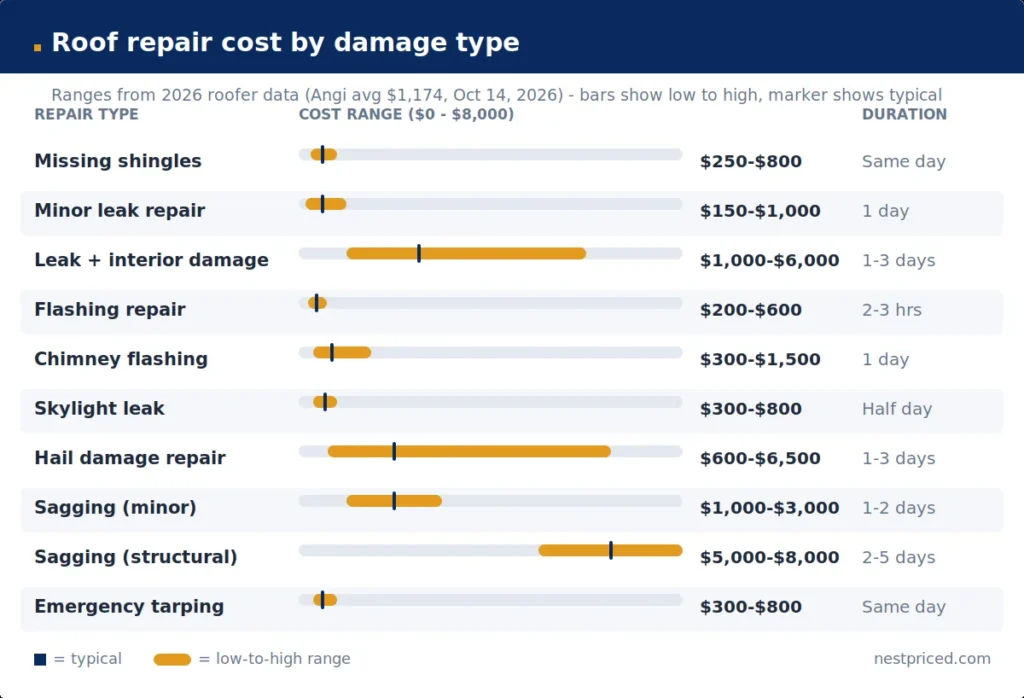
This is the lookup table. Find your damage type, read your band, then read the section that explains what the money buys.
| Damage type | Low | Typical | High |
|---|---|---|---|
| Missing shingles (spot repair) | $100 | $250–$600 | $700 |
| Minor leak, no interior damage | $150 | $350–$850 | $1,000 |
| Leak with interior water damage | $1,000 | $1,500–$3,000 | $6,000+ |
| Flashing repair (reseal/replace) | $150 | $300–$600 | $1,500 |
| Chimney flashing | $300 | $500–$900 | $1,500 |
| Skylight leak / curb repair | $300 | $350–$800 | $800 |
| Hail damage | $600 | $1,500–$3,000 | $6,500+ |
| Sagging, minor (sistering) | $1,000 | $1,500–$2,500 | $3,000 |
| Sagging, major (structural) | $5,000 | $6,000–$8,000 | $10,000+ |
| Emergency tarping | $300 | $300–$600 | $800 |
Sources: bestroofingestimates.com (Apr 2026); Angi (Oct 14, 2026); martinandsons-stl.com (2026); homeprochoice.com (Nov 3, 2026); HomeGuide; Modernize (2026); newenglandmetalroof.com (2026).
Two footnotes on the table. The “minor leak” row’s typical band includes one publisher’s figure of ~$850 for an average single-leak repair (homeprochoice.com, Nov 3, 2026) — one source, directionally consistent with the Angi band. And the tarping row: emergency tarping to stop active water intrusion is typically covered by homeowners insurance (bestroofingestimates.com), which changes its economics entirely.
Roof leak repair cost: minor vs water-damage jobs
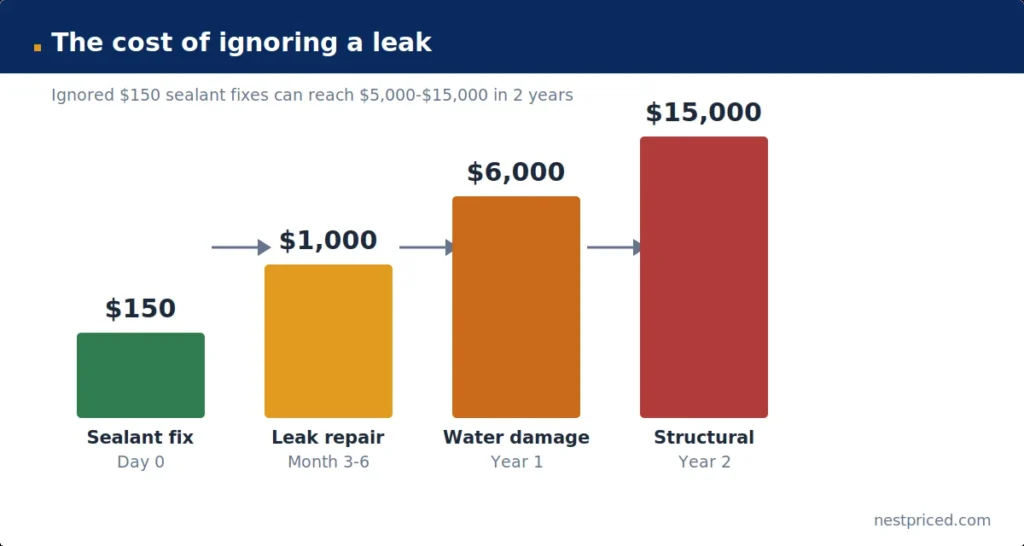
A leak is not one price. It is three jobs depending on how far the water got before you noticed.
Minor leak, no interior damage: $150–$1,000. Single-spot patches run $150–$600 (homeprochoice.com). This is the resealed flashing joint, the replaced pipe boot, the few shingles over the entry point. One publisher averages the single-leak repair near $850 (homeprochoice.com, Nov 3, 2026).
Leak with interior damage: $1,000–$6,000+. Once water reaches attic insulation, drywall, or framing, you’re paying for two jobs: the roof fix and the interior restoration. A St. Louis roofer prices this tier at $1,000–$6,000+ (martinandsons-stl.com); HomeGuide’s bands run minor $150–$1,000, with water damage $1,000–$3,000, structural $3,000–$6,000+.
The escalation math is the section’s point: a $150 sealant fix ignored can become $5,000–$15,000 in structural damage within two years (lifetimexteriors.com — cost data from a roofer blog; the direction is well-supported even if the exact band is one source’s). Denver roofers report that freeze-thaw can turn a moderate leak into a major one within 24 hours during snowmelt (nyapioresort.com, Denver, 2026). Speed is the cheapest line item on any leak repair.
Before you authorize leak work, get an inspection. Our roof inspection cost guide prices what a proper leak-source inspection runs — it pays for itself when it stops a roofer from re-shingling a flashing problem.
Flashing repair cost: the $300 fix behind 80–90% of leaks
Roofing trade sources citing NRCA report that 80–90% of all roof leaks originate at flashing details, not shingle damage (via lifetimexteriors.com, reviewed April 2026). Flashing is the metal (or membrane) at every penetration and transition: chimneys, vents, skylights, valleys, wall intersections. It moves, it corrodes, its sealant ages — and when it fails, water walks in.
Flashing repair: $150–$1,500; typical $300–$600. Angi (2026): $200–$500. Modernize (2026): $200–$600 average, most homeowners paying $300–$450, high end $600–$1,000+. A St. Louis roofer: $200–$600 (martinandsons-stl.com). A full flashing replacement (tear out and rebuild with new metal) runs $500–$1,500+ (HomeGuide).
Professional flashing repair at $300–$450 typically includes a full roof inspection and a warranty (Modernize/HomeGuide 2026) — that’s the professional tier, not the sealant-tube tier. The DIY-tier equivalent is a $150–$300 reseal, but the failure mode repeats: sealant over failed flashing is a 1–2 season patch, not a repair. This is licensed-roofer work, not a DIY guide — working at heights on compromised roofing is how falls happen, and a mis-sealed flashing leak is the $150→$5,000 escalation in miniature.
Chimney flashing deserves its own line: $300–$1,500 (bestroofingestimates.com). Step and counter-flashing at a chimney is the most labor-intensive flashing detail on a typical roof — resetting or rebuilding it with new metal plus sealant is a half-day job, which is why it prices above a simple vent-boot reseal ($200–$500+, HomeGuide).
If your leak traces to a skylight curb or flashing kit, see our skylight installation cost guide — curb and flashing details are a top leak source, and the VELUX 2026 bundle change affects replacement pricing too.
Shingle, tile, metal & slate: repair cost by material
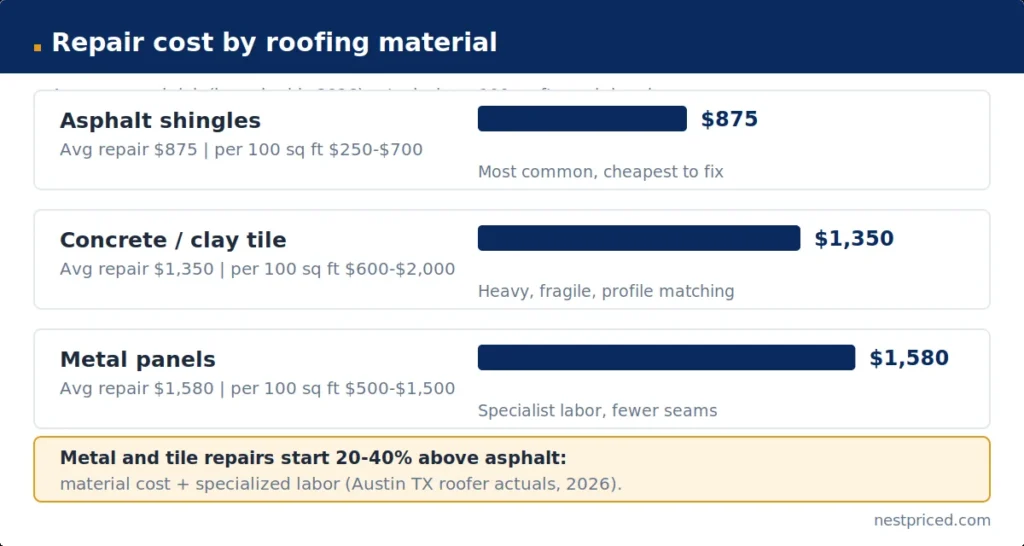
Material changes the repair price because it changes the labor: weight, breakage risk, profile matching, and specialized fasteners.
Average repair by material (homebuddy.com, 2026): asphalt shingles $875; tile $1,350; metal $1,580. Roofer labor runs $35–$90/hr nationally (homebuddy) — $40–$100/hr on the broader 2026 market (HomeGuide/martinandsons). Materials are roughly 40% of total repair expense (newenglandmetalroof.com).
Per 100 sq ft of repair area (statewideroofingspecialist, 2026): asphalt (3-tab/architectural) $75–$700; metal (standing seam/corrugated) $200–$1,500; tile (concrete/clay) $300–$1,350+; slate $350–$1,550+. Per square (100 sq ft): asphalt $100–$350 / wood $350–$500 / metal $300–$700 / tile $500–$1,000 / slate $600–$1,500 (newenglandmetalroof.com).
The practical deltas:
– Metal repairs start 20–40% higher than asphalt — material cost plus specialized labor (jamarroofing, Austin TX actuals, 2026). Standing-seam metal repairs: $750–$3,500+ at $8–$12/sq ft project pricing.
– Tile runs 15–25% more than shingle — weight, breakage risk, profile matching (Pembroke Pines FL, 2026). Individual tile replacement: $10–$50 per tile plus labor. Tile repairs in Austin: $1,000–$4,000+ at $12–$20/sq ft (Austin, TX actuals).
– Slate is the premium tier: $1,500–$3,000 per 100 sq ft, $600–$1,500 per square — a specialist trade, priced like one.
One honest lifespan note from a single source (newenglandmetalroof.com, 2026): repairs buy lifespan extensions, not resets — shingle repairs ~5–10 years, metal ~10–15, tile ~15–20, slate 20+ — treat that as one publisher’s read.
For metal specifically, our metal roof cost guide covers when repair premiums tip into replacement territory — metal’s long life makes the repair-vs-replace math unusually favorable to repair.
Sagging roof repair cost: when it’s structural
A sag is not a leak. It’s a structural event — and it prices like one.
Sagging repair: $1,000–$8,000+ nationally (bestroofingestimates.com; HomeGuide: $1,000–$5,000+; newenglandmetalroof.com: $1,000–$10,000, most homeowners $2,500–$5,000, major structural $6,000–$10,000+).
The tiers:
– Minor sagging: $1,000–$3,000, 1–2 days. Rafter ties or sistering new lumber alongside compromised rafters: $1,000–$2,500 (bestroofingestimates.com).
– Moderate (multiple rafters): $2,000–$5,000.
– Severe (truss replacement, major framing): $5,000–$8,000+, 2–5 days. Roof truss or rafter repairs: $500–$5,000 per the HomeGuide band; a broken truss alone: $500–$5,000.
Sagging always starts with a structural engineer inspection: $300–$1,000 (bestroofingestimates.com). Do not let a roofer price structural work without one — the engineer’s report is what separates a $2,000 sistering job from an $8,000 truss replacement, and it’s the document your insurer will ask for. Severe sagging is a potential safety emergency: this is the one repair tier where “get three quotes” yields to “get the engineer first.”
Chimney, skylight & vent repairs: the penetration price list
Every hole in the roof is a future leak with a price tag. The penetration price list:
- Chimney flashing repair: $300–$1,500 (bestroofingestimates.com). Reset or rebuild step and counter-flashing with new metal plus sealant: $300–$700 per one publisher’s 2026 guide (homeprochoice.com).
- Skylight leak / curb repair: $300–$800 (Angi, 2026). Leaks at skylight curbs and flashing kits are a top leak source — distinct from skylight installation, which our skylight guide prices separately.
- Vent pipe flashing: $200–$500+ (HomeGuide). A vent boot repair can be as low as $75 as a minimum-service add-on (HomeGuide) — but as a standalone call it’s the $150–$300 minimum fee floor.
- Drip edge: $150–$1,800 (HomeGuide) — the wide band reflects linear footage; a short eave section vs a full perimeter replacement.
Flashing-adjacent leaks at walls and sidewalls: $300–$700 (homeprochoice.com, Nov 3, 2026). These are the step-flashing runs where a roof meets a second-story wall — a common miss on quotes that price “the roof” but not the wall intersection.
Hail damage repair cost
Hail damage repair: $600–$6,500+ (bestroofingestimates.com). Hail is the #1 roof insurance claim type, and it prices in a band because hail damage is assessed per-slope, not per-leak: a soft-ball-sized hailstorm can total a shingle roof’s granule layer without a single visible puncture.
Denver 2026 figures illustrate the storm tiers: tarping $300–$800; moderate storm damage $2,000–$5,000; extensive structural $10,000+ (nyapioresort.com, Denver, 2026). Wind/hail deductibles are typically 1–2% of dwelling coverage — on a $400,000 home that’s a $4,000–$8,000 deductible (arithmetic from the stated range, presented as illustrative). That deductible math is why the repair-vs-claim decision matters: a $2,500 hail repair on a $6,000 deductible is a cash job, not a claim.
Get the damage documented before the adjuster arrives: photos, a contractor assessment, and tarping receipts. Documentation is what turns a denied claim into a paid one (Denver guide).
Emergency roof repair cost: tarping, after-hours & storm premiums
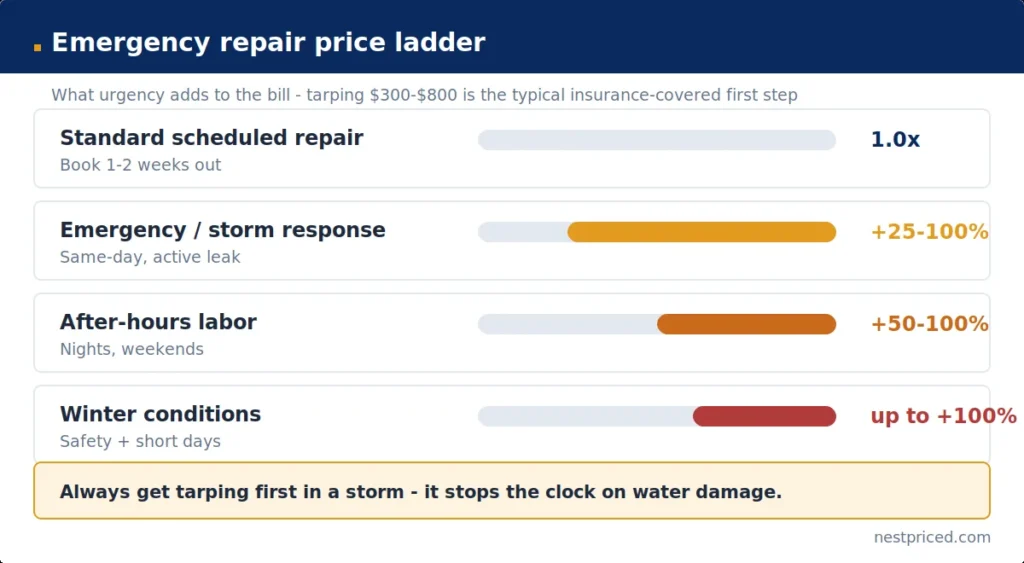
When water is coming in at 2 a.m., the price list changes. The emergency premium is real and roughly quantified:
- Emergency repairs cost 25–100% more than standard (bestroofingestimates.com). Denver roofers report a 25–50% emergency response surcharge vs next-business-day (nyapioresort.com, 2026).
- After-hours/weekend: +50–100% on labor (bestroofingestimates.com). HomeGuide: time-and-a-half for 24-hour emergency service; unscheduled repairs add $200–$300.
- Emergency tarping: $300–$800 (bestroofingestimates.com; Denver guide). A St. Louis roofer: $200–$600 standard tarping, with after-hours callout adding 20–50% (martinandsons-stl.com). HomeGuide’s after-hours tarping math: $1.00–$2.80/sq ft, including damage evaluation, debris removal, insurance photos, the tarp, and a repair estimate.
- Winter repairs: up to +100% (bestroofingestimates.com) — safety equipment, shorter days, material handling in cold.
Access multipliers stack on top: steep roofs (7:12+ pitch) or 2-story homes add 20–40% (bestroofingestimates.com). Chicago runs 10–15% above national averages on a shorter working season (lifetimexteriors.com).
The money move: tarping to stop active water intrusion is typically covered by homeowners insurance (bestroofingestimates.com). A $500 tarp that preserves a $5,000 interior is the highest-ROI spend in roofing — and the receipts are claim documentation. Never skip the tarp to “save money” while waiting for the repair quote.
Repair vs replace: the 30% rule and the $9,500 anchor
The industry rule of thumb (attribute as industry guidance, not a single source): repair when the roof is under ~15–20 years old and the damage is localized (under ~30% of the surface); price replacement when the roof is past ~20 years, repairs are recurring, or a single repair exceeds ~30–40% of replacement cost.
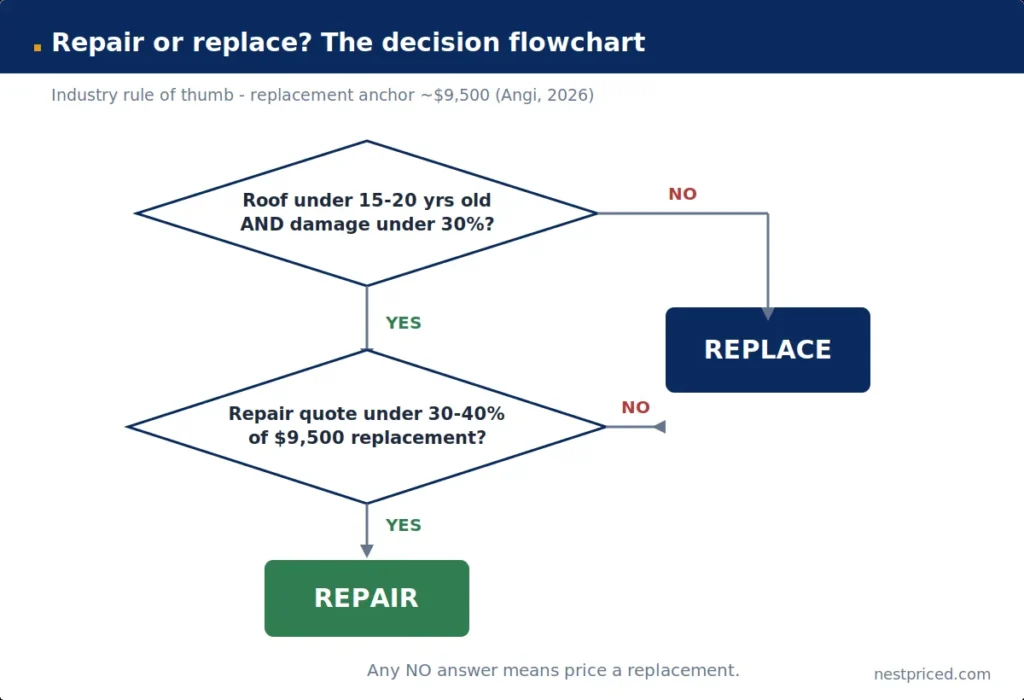
The anchor: average roof replacement ~$9,500; typical asphalt jobs $6,000–$15,000 (thecivilstudies.com, 2026, citing Angi — our own roof replacement cost guide is the primary source). The math:
- A $2,000 repair on a 12-year-old roof with localized damage: repair. The roof has a decade of life left; the repair buys it.
- A $4,000 repair on a 23-year-old roof: price replacement. $4,000 is 42% of the $9,500 replacement — past the 30–40% threshold — and the roof is past its design life. The repair buys 2–3 years; the replacement buys 25.
- Recurring leaks (a repair every 18 months): replace. Three $1,200 repairs is $3,600 of patchwork on a dying roof — 38% of replacement, with zero warranty extension.
One publisher’s directional bands (roomgic.com, AI-spam source — use directionally only): repairs $350–$2,500 vs replacement $8,500–$18,000. The wrong call costs thousands; the Angi-anchored math above is the version to quote.
Flat roofs get their own version of this decision — patch vs membrane replacement follows different economics. Our flat roof replacement cost guide runs the flat-specific numbers.
Will insurance pay? The 2026 ACV shift
Standard homeowners insurance covers sudden/accidental damage — storm, hail, fallen trees — but NOT wear, age, neglect, or maintenance issues. Flood-driven roof damage needs separate flood insurance. That sentence settles 90% of “will insurance pay?” questions.
The 2026 development, handled carefully: a reported March 2026 FHFA policy change now lets Fannie Mae and Freddie Mac accept Actual Cash Value (ACV) roof coverage for single-family homes (reported by roomgic.com — single source, an AI-spam farm; treat as a reported 2026 shift, not an established fact). What ACV means in dollars: the insurer pays depreciated value, not replacement cost. A 15-year-old architectural shingle roof (30-year design life) is roughly half-depreciated — a $12,000 replacement nets ~$6,000 minus your deductible. Confirm your policy’s valuation basis with your insurer before you need it — this is the line in the policy that decides whether a claim is worth filing.
The claim mechanics that actually get paid:
1. Tarp first, document everything. Emergency tarping to stop active water intrusion is typically covered; photos, contractor assessments, and receipts are the claim file.
2. Know your deductible before the storm. Wind/hail deductibles at 1–2% of dwelling coverage mean a $4,000–$8,000 out-of-pocket on a $400,000 home — a $2,500 repair may be a cash job.
3. File storm damage, not wear. A 22-year-old roof with granular loss is maintenance; the same roof with hail bruising is a claim. The adjuster’s photos decide.
How to get an accurate repair quote
Repairs are quoted, not menu-priced — and the 25–40% contractor spread means the quoting process IS the price control. Four rules:
- Get 3+ quotes, in writing, with identical scope. “Fix the leak” is not a scope. “Reseal chimney step flashing, replace 12 sq ft of shingles, 5-year workmanship warranty” is a scope. The 25–40% spread collapses when the scope is fixed.
- Respect the minimum fee. $150–$300 minimums (HomeGuide) mean the $75 vent boot is a $175 job. Batch small repairs into one visit.
- Ask who does the interior. Roofers fix roofs; drywall, paint, and insulation are often separate. The leak-with-interior-damage tier ($1,000–$6,000+) splits across trades — get it in writing.
- Demand the warranty in writing. Professional flashing work at $300–$450 typically includes an inspection and warranty (Modernize/HomeGuide 2026). A quote without a workmanship warranty is a price, not a repair.
And the credit question, one line for readers arriving from our energy guides: no federal tax credit exists for roof repairs in 2026 — repairs were never §25C/§25D property.
Sources & methodology
National benchmarks: Angi, “How Much Does It Cost to Repair a Roof? [2026 Data]” (updated Oct 14, 2026; 32,999 verified projects) and repair-type tables (roof leak $360–$1,550; skylight $300–$800; flashing $200–$500). bestroofingestimates.com, “Roof Repair Cost” (updated April 2026 — thin affiliate source; tables cross-checked against Angi where they overlap: $1,150 vs $1,174 average). martinandsons-stl.com (St. Louis roofer estimator, ~Sep 2026). homeprochoice.com, “Roof Leak Repair Cost: 2026 Pricing Guide” (updated Nov 3, 2026 — single-publisher figures labeled). HomeGuide roof repair cost page (stale ~268 days; bands used directionally). Modernize flashing repair page (2026). lifetimexteriors.com (roofer blog; cost data only — DIY how-to excluded; NRCA 80–90% figure attributed as roofing trade sources citing NRCA). newenglandmetalroof.com (2026; lifespan-ext
ension figures labeled single-source). homebuddy.com (2026; by-material averages; labor $35–$90/hr). statewideroofingspecialist.com (Feb 18, 2026; per-100-sq-ft bands; state spread directional). jamarroofing.com (Austin TX, 2026 — labeled “Austin, TX actuals”). nyapioresort.com (Denver, 2026; storm tiers; deductible math illustrative). thecivilstudies.com (2026, citing Angi — secondary; our article 6 is the primary replacement-cost anchor). roomgic.com (AI-spam farm — FHFA ACV report single-sourced, phrased as “reported”; repair-vs-replace bands directional only). Tax-credit status: standing project rule per IRS FS-2025-05 (OBBBA, P.L. 119-21).
How much does roof repair cost in 2026?
$150–$8,000+, averaging $1,174 — from Angi’s Oct 14, 2026 dataset of 32,999 verified projects (typical range $395–$1,968). A second aggregator lands at $1,150 average (bestroofingestimates.com, April 2026). The damage type drives the spread: a flashing reseal is $150–$600; structural sagging is $5,000–$8,000+.
How much does it cost to fix a roof leak?
Minor leaks with no interior damage: $150–$1,000 (single-spot patches $150–$600; one publisher averages ~$850 per single-leak repair). Leaks with interior water damage: $1,000–$6,000+, because you’re paying for the roof fix plus drywall, insulation, and possibly mold remediation. The cheapest leak is the fast one — a $150 sealant fix ignored can escalate to $5,000–$15,000 in structural damage.
How much does flashing repair cost?
$150–$1,500, with most homeowners paying $300–$600 (Angi: $200–$500; Modernize: most pay $300–$450). Roofing trade sources citing NRCA report 80–90% of roof leaks start at flashing details, not shingles — so the most common leak has the cheapest fix. Professional flashing repair typically includes a full roof inspection and warranty.
How much does it cost to fix a sagging roof?
$1,000–$8,000+ nationally. Minor sagging (rafter ties/sistering): $1,000–$3,000 over 1–2 days. Moderate (multiple rafters): $2,000–$5,000. Severe (truss replacement, major framing): $5,000–$8,000+ over 2–5 days. Always start with a structural engineer inspection ($300–$1,000) before a roofer prices structural work.
How much does emergency roof repair cost?
25–100% more than standard repairs. Emergency tarping: $300–$800 (typically covered by homeowners insurance). After-hours/weekend labor: +50–100%. Winter repairs: up to +100%. Steep roofs (7:12+ pitch) or two-story homes add another 20–40% on top.
Should I repair or replace my roof?
Repair when the roof is under ~15–20 years old and damage is localized (under ~30% of the surface). Price replacement when the roof is past ~20 years, repairs are recurring, or a single repair exceeds ~30–40% of replacement cost (average replacement ~$9,500). A $4,000 repair on a 23-year-old roof is 42% of replacement — that’s a replacement.
Does homeowners insurance cover roof repair?
Sudden/accidental damage (storm, hail, fallen tree): yes. Wear, age, neglect: no. A reported March 2026 FHFA policy change may let Fannie/Freddie accept Actual Cash Value roof coverage — which pays depreciated value, not replacement cost — so confirm your policy’s valuation basis with your insurer. Emergency tarping is typically covered.
2 thoughts on “Roof Repair Cost in 2026 (Leaks, Flashing & Sagging)”