

Table of Contents
You never really pay “the hourly rate.” You pay the hourly rate plus a service call fee, plus a minimum, plus trip charges, plus a premium if it’s after 5 p.m. The $50–$130/hr figure everyone quotes is the middle of the invoice — not the total. Understand the anatomy of the bill and you stop overpaying. Ignore it and a 15-minute outlet fix costs you $150 with no idea why.
This guide is the homeowner-first synthesis the SERP doesn’t have: Angi’s 101,757-project consumer dataset, HouseCall Pro’s 636,022-entry contractor dataset, and the Bureau of Labor Statistics’ wage data in one place. You’ll get the license-level ladder, why the wage isn’t the rate, the service-call anatomy, flat-rate vs hourly rules, 12 common jobs priced, emergency multipliers, and how to quote-shop like a pro.
Electrician cost per hour in 2026: the national answer
Start with the anchors. Angi (updated October 21, 2026): national average $351 per job across 101,757 verified projects, with most homeowners paying $163–$538 per visit and hourly rates of $50–$130/hr. HouseCall Pro’s contractor dataset — 636,022 electrical service entries across 67 categories, 12 months ending September 2026, guide updated October 27, 2026 — independently lands on $50–$130/hr plus a $100–$200 service call fee. Two datasets, one homeowner-facing and one contractor-facing, agreeing on the same band. That’s a solid anchor.
The geography spread is wide. Angi: urban electricians typically $100+/hr; rural markets around $50/hr. Coastal metros and both coasts run 20–40% above the national average; rural markets run 10–20% lower, though trip fees eat part of the savings (5estimates.com, directional). A San Francisco shop quotes $100–$150/hr with a $150–$250 service call — the coastal premium in one example (roomgic.com, AI-spam content farm; directional only, but consistent with Angi’s coastal guidance). A self-employed journeyman in a mid-size market: $75–$105/hr; a licensed shop with vans and techs: $100–$175/hr (fastestimatemaker.com, September 2026, Atlanta-anchored).
One number to file away before the rest of the guide: Angi says the first hour of labor averages ~$150. That single figure explains almost every “why did that cost so much?” story in electrical work — because the first hour isn’t priced like the second hour. That’s the service call, and it deserves its own section.
The license-level ladder: apprentice vs journeyman vs master
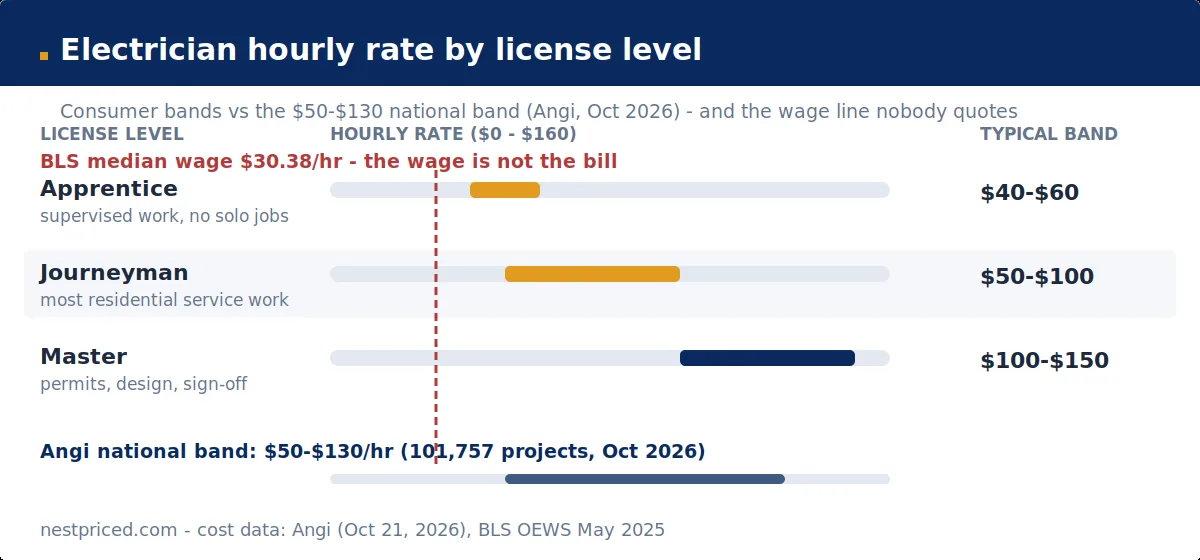
Electricians aren’t one trade with one rate — they’re a license ladder, and you should know which rung you’re paying for.
Apprentice: $40–$60/hr (Angi). Apprentices do helper work under supervision — pulling wire, holding fixtures, cleanup. They can’t legally work unsupervised in most states. If a shop bills apprentice hours on your invoice, the journeyman supervising should be billed too.
Journeyperson: $60–$90/hr (Angi); $75–$105/hr self-employed (fastestimatemaker). This is the workhorse rate — a licensed journeyman handles most residential jobs: outlets, fixtures, fans, troubleshooting. The contractor-side benchmarks run a touch lower (snapscopeai.com, contractor-facing: journeyman $50–$80/hr) — that’s the shop’s cost basis, not your quote; frame it as shop economics.
Master electrician: $90–$120/hr (Angi); $100–$150/hr for masters and specialists like solar or EV installers (snapscopeai, contractor-side). Masters design systems, pull permits, and sign off on complex work. You pay master rates for panel upgrades, service changes, and anything involving the utility — not for swapping a light switch.
The wage line underneath: BLS OEWS May 2025 (released May 15, 2026) puts the median electrician wage at $63,190/year = $30.38/hr, with 757,220 employed nationally. State medians run from Oregon at $101,310 (top) down to Arkansas at $49,070 (bottom). Use the median, not the mean ($71,490/yr = $34.37/hr) — the median is the typical electrician.
If $30.38/hr in wages becomes $50–$130/hr on your invoice, you’re about to ask the obvious question. Good — it’s the most honest section in this guide.
Why the hourly rate isn’t the wage
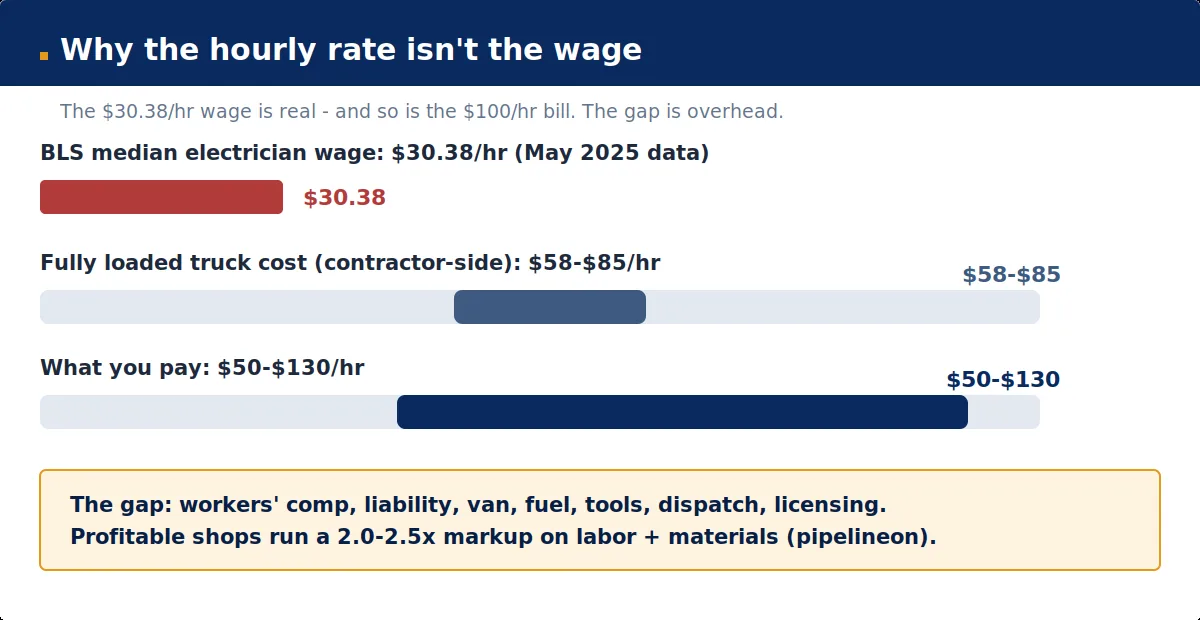
The $30/hr wage and the $100/hr bill are both real. The gap is overhead, and the contractor-side data tells the story plainly. ServiceTitan’s 2026 margin analysis (via pipelineon.com, contractor-facing): a fully loaded single-tech truck costs $58–$85/hr before profit in a mid-size US market. That’s the wage plus workers’ comp, liability insurance, the van, fuel, tools, dispatch, licensing, and training — before the company makes a dollar. Profitable shops then apply a 2.0–2.5× markup on (labor + materials) to net 10–20% after everything (pipelineon). And flat-rate price-book shops post 20–35% higher average tickets than time-and-materials shops on equivalent work (ServiceTitan via pipelineon) — because the price book prices certainty, not hours.
Label this correctly: these are contractor-side benchmarks — “what it costs the shop” vs “what you pay.” Never read them as consumer quotes. But they explain why the journeyman earning $30/hr arrives in a truck that costs $70/hr to roll, on a job billed at $110/hr. The margin isn’t theft; it’s the van, the insurance, and the dispatcher. Knowing the anatomy is what lets you negotiate on the right line items — the scope and the materials, not the existence of overhead.
The service call fee: what the first hour actually costs
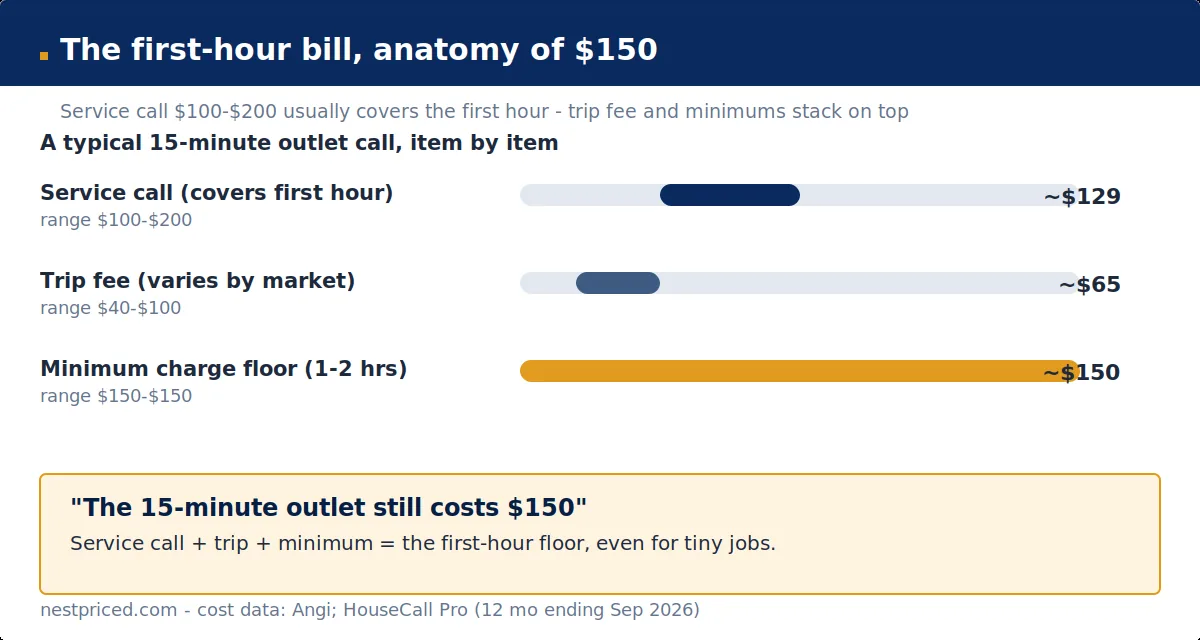
The service call fee is the #1 source of reader confusion: “is the first hour free?” No. The service call is the first hour — priced separately and higher than subsequent hours.
The numbers: $100–$200 is the standard service call fee (Angi; HouseCall Pro). Pipelineon (contractor-facing) puts the dispatch fee at $79–$179, most commonly $99–$129. fastestimatemaker: $75–$200 covering the trip plus the first 30–60 minutes. estimatekit.com’s October 2026 price book (45 repairs; explicit disclaimer: “No electrician has reviewed it yet” — attribute that, it’s an unreviewed price book) uses a $129 service call with standard labor at $110/hr.
On top of the service call, expect these line items:
– 1–2 hour minimums. Most electricians charge a 1–2 hour minimum or a service call covering the first hour (5estimates). The 15-minute outlet fix still bills the full first hour — the “first-hour floor.”
– Trip fees: $40–$100 billed separately from labor on some invoices (5estimates; ypages.us thin affiliate — directional). Not every shop itemizes this; many bury it in the service call.
– The diagnostic-waiver pattern: many shops apply the service call fee toward the job if you approve the recommended work (snapscopeai, contractor-facing). Always ask: “Does the service call apply to the repair if I say yes?” It’s the single highest-value question in this guide.
Why does a 15-minute job cost $150? The minimum-job economics (research point 53): dispatch, drive time, diagnosis, and the truck roll are fixed costs whether the fix takes 15 minutes or 55. The service call prices the visit, not the minutes.
Flat rate vs hourly: which jobs get which
The industry’s own rule of thumb (fastestimatemaker): flat rate for repeatable, scope-able jobs; hourly (time & materials) for troubleshooting, old wiring, and anything un-scopeable until the panel is open. housefly.com (October 26, 2026) agrees: flat rate is better for defined jobs like fans and outlets; hourly is better when the cause is unknown.
Flat rate is the price book: the shop quotes a fixed number for a defined job (outlet swap: $X). You pay for certainty. The shop’s incentive is speed and efficiency — which is why flat-rate shops run 20–35% higher tickets (ServiceTitan via pipelineon): the book bakes in the risk of a difficult box or buried junction.
Hourly/T&M is the open book: you pay for actual time plus materials, marked up 2.0–2.5× (labor + materials) per pipelineon. Your risk is a slow or unlucky tech; the shop’s risk is an estimate that scares you off. For troubleshooting — “the breaker keeps tripping and I don’t know why” — T&M is fairer to both sides, because nobody can price a mystery.
The red flag version: a shop that insists on flat rate for open-ended diagnostic work is pricing your uncertainty at a premium. A shop that insists on T&M for a 200A panel swap — a job with a published range of $2,250–$5,100 (HouseCall Pro) — is dodging accountability. Match the pricing model to the job’s knowability.
12 common jobs, priced
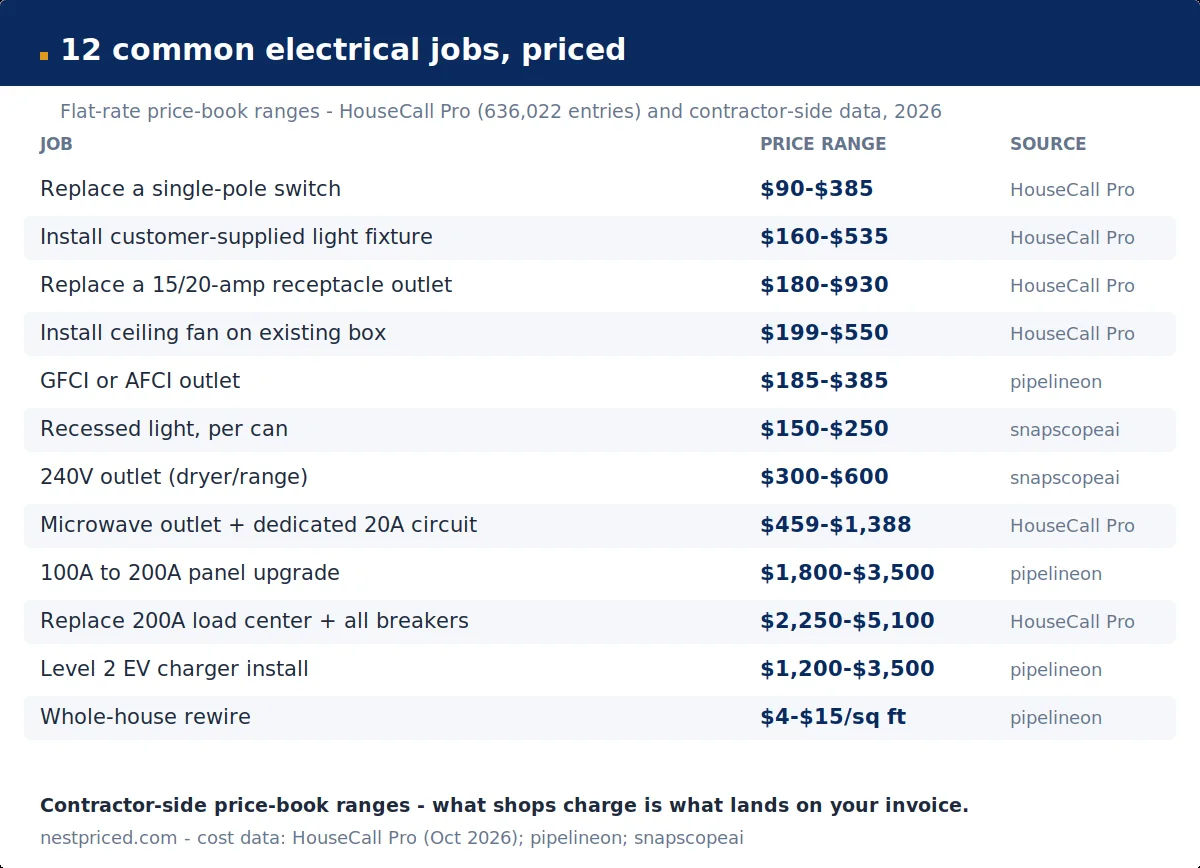
HouseCall Pro’s 636,022-entry dataset gives the cleanest flat-rate table available. These are contractor-side price-book ranges — read them as “what shops charge,” which is exactly what lands on your invoice.
| Job | Price range | Source |
|---|---|---|
| Replace a single-pole switch | $90–$385 | HouseCall Pro |
| Install customer-supplied light fixture | $160–$535 | HouseCall Pro |
| Replace a 15/20-amp receptacle outlet | $180–$930 | HouseCall Pro |
| Install ceiling fan on existing box | $199–$550 | HouseCall Pro |
| Microwave outlet + dedicated 20-amp circuit | $459–$1,388 | HouseCall Pro |
| Replace 200A load center + all breakers | $2,250–$5,100 | HouseCall Pro |
| GFCI or AFCI outlet | $185–$385 | pipelineon (contractor-side) |
| 240V outlet (dryer/range) | $300–$600 | snapscopeai (contractor-side) |
| Recessed light, per can | $150–$250 | snapscopeai (contractor-side) |
| 100A→200A panel upgrade | $1,800–$3,500 | pipelineon (contractor-side) |
| Level 2 EV charger install | $1,200–$3,500 | pipelineon (contractor-side) |
| Whole-house rewire | $4–$15/sq ft | pipelineon (contractor-side) |
Cross-checks from the consumer side: fastestimatemaker’s 2026 benchmarks (materials included) put outlet/switch installs at $120–$300, ceiling fans at $150–$350, and fixture replacements at $100–$300 — adjust +20–40% for coastal metros, −10–20% for rural. Thumbtack (April 9, 2026): lighting installation averages $336 nationally, range $191–$631; recessed lights $175–$225 per fixture. estimatekit’s unreviewed book prices a GFCI replacement at $119 (0.5 hr, $63.05 parts, $110/hr) and a 200A same-location panel replacement at $2,379 (8 hrs, $1,494.50 parts) — useful as worked examples of the labor-math, not as quotes.
The big-ticket context: a panel upgrade is the flagship job where hourly vs flat-rate matters most — get the full anatomy in that guide. An EV charger install and a generator install are specialist jobs where master/specialist rates ($100–$200/hr) apply. And pre-1960s homes often pair electrical work with plumbing — our repipe cost guide covers the same-walls logic.
Emergency and after-hours pricing
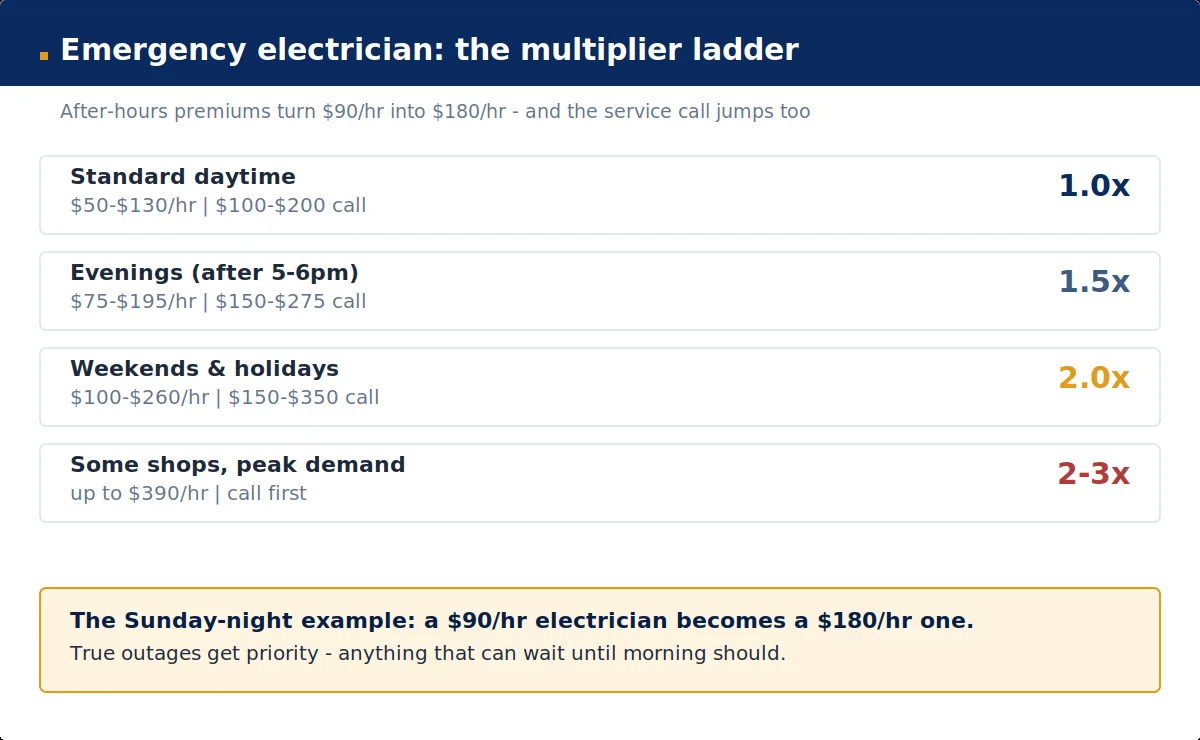
Electrical emergencies are priced on a multiplier ladder, and every source agrees on the shape:
- Standard hours: 1.0× — the $50–$130/hr band.
- Evenings: ~1.5× (ypages.us, thin affiliate — directional).
- Nights/weekends: 1.5–2× standard rate (housefly, October 2026); Angi says emergency labor can reach double the standard rate, adding $100–$200 on top of standard rates for nights/weekends.
- Holidays: up to 2× (ypages, directional); 5estimates cites $100–$250/hr emergency rates, typically 1.5–2×, with a flat emergency service fee of $150–$300 on top of hourly labor.
The worked example everyone remembers (5estimates): a $90/hr electrician becomes a $180/hr electrician on a Sunday night. housefly puts emergency service calls at $150–$350 before any repair work — the call fee alone doubles.
The consumer-protection angle: “emergency” is defined by the shop. A dead outlet on a Saturday morning is urgent to you; it’s billable at 1.5–2× to them. If the problem is safe to wait — no burning smell, no sparking, breaker holding — Monday morning pricing saves you 50–100%. If there’s a burning smell, sparking, or a breaker that won’t reset, pay the premium and call now. That’s a licensed electrician’s judgment call, not a DIY decision.
What moves your rate: region, access, timing
Four levers move any quote off the national band:
1. Region. Coastal metros and both coasts: +20–40%. Rural: −10–20%, with trip fees offsetting part of the discount (5estimates, directional). BLS state medians explain the wage floor underneath: Oregon ($101,310) vs Arkansas ($49,070) is a 2× wage gap before overhead even starts.
2. License level. Apprentice $40–$60 → journeyman $60–$90 → master $90–$120 (Angi). For a whole-house rewire or service upgrade, the master premium is money well spent; for a fixture swap, it’s money wasted.
3. Access and complexity. Finished walls vs open framing, attic vs basement routing, 100-year-old knob-and-tube vs modern Romex — access conditions swing labor hours the same way they do in plumbing. Anything un-scopeable until the panel or walls are open belongs on T&M, not flat rate.
4. Timing. Nights, weekends, holidays: 1.5–2×. And the seasonal note from the contractor side — shops price hardest when they’re busiest; a Tuesday in February quotes softer than a Saturday in July.
The shop-type lever (fastestimatemaker, Atlanta-anchored): a self-employed journeyman at $75–$105/hr vs a licensed shop with vans and techs at $100–$175/hr. The solo operator has less overhead and less backup if something goes wrong. For a panel swap, the shop’s insurance and warranty are worth the premium. For a switch, the solo journeyman is the value play.
What’s NOT in the hourly rate
The hourly rate buys labor. Three separate line items surprise first-time hirers:
Materials. Outlets, breakers, wire, fixtures — billed at retail plus the shop’s markup (the 2.0–2.5× flat-rate formula bakes this in; on T&M jobs, ask whether parts are marked up). Customer-supplied fixtures (the HouseCall Pro table is full of “customer-supplied” line items) cut this line — but the shop may reduce the labor warranty on parts they didn’t sell you.
Permits and inspection: usually $50–$500 depending on municipality. Flagged honestly: no primary 2026 source compiles residential electrical permit fees nationally — guides compile them separately from labor, and municipalities vary wildly. Panel upgrades and service changes almost always require a permit and inspection; a switch swap never does. Ask “is the permit included?” before you sign, not after the inspector shows up.
Drywall and paint. Old-work boxes, new circuits, and panel relocations all cut drywall. Most electricians patch roughly or not at all — same-walls, different-trade logic as dedicated-circuit work for a tankless heater. Budget the patch separately or confirm it’s in the quote in writing.
How to get a fair quote: 5 red flags
1. No license number on the quote. Every state that licenses electricians requires the number on advertising and invoices. No number, no hire.
2. Flat rate for a mystery. “The breaker keeps tripping” quoted flat before anyone opens the panel is priced for the shop’s worst case, not yours. Diagnostics belong on T&M.
3. The service call doesn’t apply. Many shops credit the service call toward the job if you approve the work. A shop that won’t — and charges a separate full first hour on top — is double-dipping the visit.
4. No permit for panel or service work. If the quote for a 200A upgrade doesn’t mention a permit, the shop plans to skip the inspection. That’s your homeowner’s insurance claim denied in advance.
5. Cash-only, no written scope. The electrical version of every contractor scam: verbal scope, cash discount, no paper trail. A written scope with line items (labor model, materials allowance, permit responsibility, warranty) is the minimum.
The fair-quote playbook: get three quotes, compare scope not totals (the repipe guide’s rule applies here too), ask whether the service call applies to the work, confirm permit responsibility in writing, and check the license number against your state’s board. The cheapest hourly rate on an unscoped quote is the most expensive invoice you’ll ever sign.
Sources & methodology
Consumer benchmarks: Angi, “How Much Does It Cost to Hire an Electrician? [2026 Data]” (updated Oct 21, 2026; 101,757 verified projects). Contractor data: HouseCall Pro electrical pricing guide (updated ~Oct 27, 2026; 636,022 service entries, 67 categories, 12 months ending Sep 2026); pipelineon.com contractor pricing guide (residential/commercial rates, flat-rate markup 2.0–2.5×); ServiceTitan 2026 contractor margin analysis via pipelineon (loaded truck $58–$85/hr; flat-rate shops +20–35% tickets). Wage authority: BLS Occupational Employment and Wage Statistics, May 2025 (released May 15, 2026), SOC 47-2111 — median $63,190/yr ($30.38/hr); state medians Oregon $101,310 through Arkansas $49,070. Price books: estimatekit.com (Oct 2026, 45-repair book; explicit disclaimer “No electrician has reviewed it yet”); fastestimatemaker.com (Sep 9, 2026, Atlanta-anchored job benchmarks); housefly.com (Oct 26, 2026); snapscopeai.com (contractor-facing 2026 rate tables). Directional/thin sources: 5estimates.com (emergency multipliers, minimums); ypages.us (Sep 2026, trip fees); rec.manualsgrid.com (AI-spam, secondhand Forbes Home figures); roomgic.com (AI-spam, SF coastal example). Consumer cross-checks: Thumbtack (Apr 9, 2026, lighting install $336 avg). EXCLUDED per research flags: electricalknowledge.com (stale 2017 BLS data); UK/NZ/AU/CA figures (checkatrade, neonelectrical, ges.ie, couttselectrical, service.com.au, renohouse.ca); inedjobs editorial estimates (BLS used instead). Tax-credit status: standing project rule per IRS FS-2025-05 (OBBBA, P.L. 119-21).
How much does an electrician cost per hour in 2026?
$50–$130/hr nationally, with the average job costing $351 — from Angi’s October 2026 dataset of 101,757 verified projects. HouseCall Pro’s 636,022-entry contractor dataset lands on the same $50–$130/hr band plus a $100–$200 service call fee.
What is the average electrician service call fee?
$100–$200, and it usually covers the first hour of labor — the first hour isn’t free, it’s priced into the service call. Contractor dispatch fees run $79–$179 (most commonly $99–$129). Many shops apply the service call toward the job if you approve the recommended work — always ask.
Apprentice vs journeyman vs master electrician — what’s the rate difference?
Apprentice $40–$60/hr, journeyperson $60–$90/hr, master $90–$120/hr (Angi, 2026). Self-employed journeymen run $75–$105/hr; licensed shops with vans and techs run $100–$175/hr. Pay master rates for panel upgrades and service work, journeyman rates for most residential jobs.
How much does an emergency electrician cost?
$100–$250/hr, typically 1.5–2× the standard rate, with an emergency service call of $150–$350 before any repair work (5estimates; housefly). Angi adds that emergency labor can reach double the standard rate. A $90/hr electrician becomes a $180/hr electrician on a Sunday night.
Is it cheaper to pay an electrician hourly or flat rate?
Flat rate for defined, repeatable jobs (outlets, fixtures, panel swaps) — you buy price certainty. Hourly/T&M for troubleshooting, old wiring, and anything un-scopeable until the panel is open — you buy fairness on a mystery. Match the pricing model to the job’s knowability.
Why does a 15-minute job cost $150?
The first-hour floor: the $100–$200 service call prices the visit (dispatch, drive time, diagnosis, truck roll), not the minutes. Most shops also run 1–2 hour minimums. The 15-minute fix and the 55-minute fix cost the same because the fixed costs are identical.
Do electricians charge for estimates?
It varies — but the diagnostic-waiver pattern is common: many shops apply the service call fee toward the job if you approve the recommended work. Ask “does the service call apply if I say yes?” before booking. It’s the highest-value question in electrical hiring.
1 thought on “How Much Does an Electrician Cost Per Hour in 2026?”