

Table of Contents
Nobody wakes up excited to pay for a roof inspection. It’s $75–$600 for someone to tell you what you hope is nothing. But here is the frame that matters: the inspection is the cheapest roofing money you’ll ever spend, because it converts unknown unknowns (that brown stain spreading in the guest bedroom) into priced, planned work — before the insurer’s adjuster, the home buyer’s inspector, or the renewal underwriter finds them first.
This guide is the diagnostic hub of our roofing section: it prices every inspection type in 2026, shows you the 8-point checklist a real inspection follows, tells you when to book (and when the clock is ticking after a storm), explains the certification letter lenders and insurers demand, and unpacks the insurance rules — including Florida’s 25% rule — that make a $249 inspection the highest-ROI purchase in homeownership.
Roof inspection cost by type: the 2026 ladder
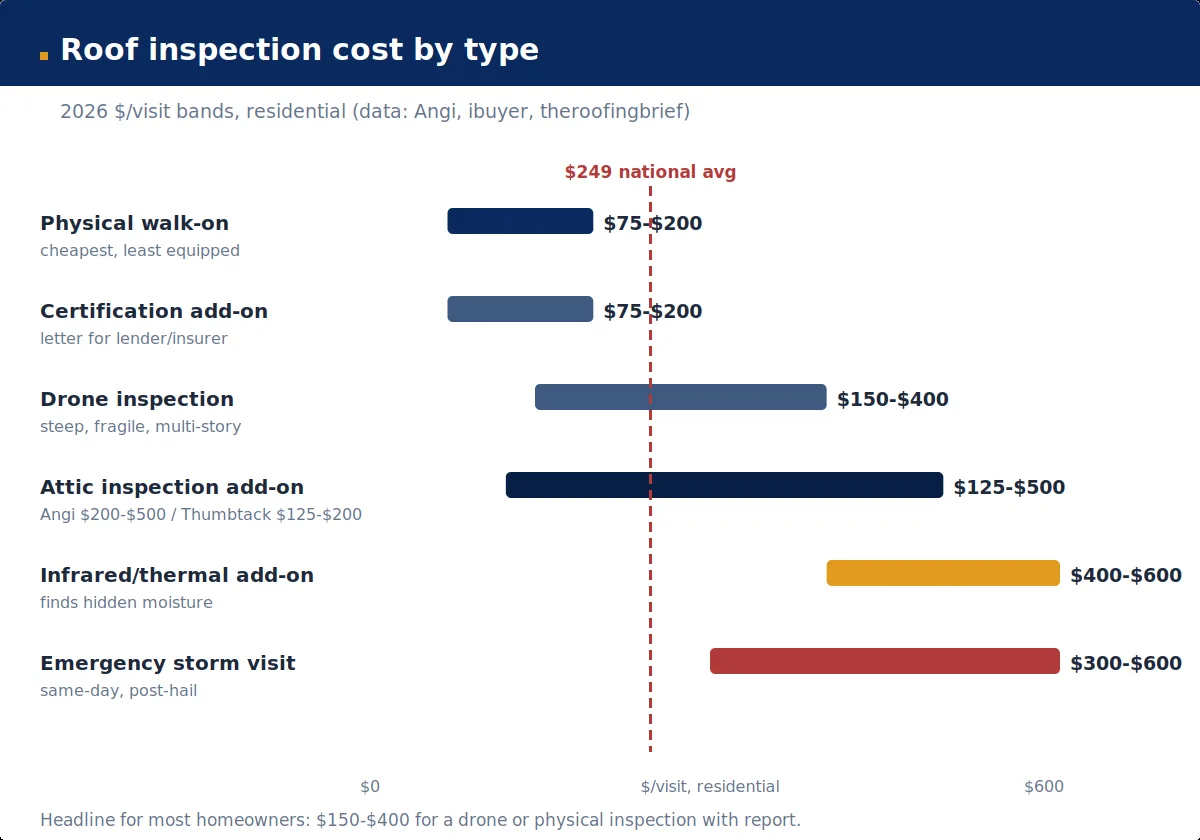
The price spread is wide because “inspection” covers everything from a guy with a ladder to a thermographic aerial survey. Buy the type that matches your situation:
| Inspection type | 2026 cost | What you get | Best for |
|---|---|---|---|
| Satellite / aerial remote estimate | $0–$100 | Instant remote measurements and condition estimate | Ballpark before you book a real visit |
| Physical walk-on | $75–$200 | Inspector on the roof, eyes on every detail | Standard homes, walkable slopes |
| Drone visual | $150–$400 | Aerial HD imagery of the full roof (residential) | Steep pitches, fragile tile/slate, multi-story homes |
| Infrared / thermal scan (add-on) | $400–$600 (up to $750 large/complex) | Finds trapped moisture invisible to eyes and drones | Flat roofs, suspected hidden leaks |
| Roof certification letter (add-on) | $75–$200 | Written “leak-free with remaining life” opinion | Insurance renewals, home sales |
| Attic interior inspection (add-on) | $125–$500 | Decking underside checked for stains, soft spots, mold | Any home where the attic is accessible |
| Emergency / same-day storm | $300–$600 | Priority post-storm assessment with claim-ready documentation | Active storm damage |
Headline numbers from 2026 sources: national average $249 (ibuyer.com), Angi’s verified average $257 (Sep 2026), residential range $75–$500 for most homes. Add commercial complexity and the ceiling runs higher — $200–$600 for commercial buildings, or $0.05–$0.10/sq ft, with commercial thermal surveys at $2,500–$8,000+ for large structures (theroofingbrief.com, Oct 2026).
Why drone pricing sits where it does. A drone inspection at $150–$400 covers the pilot’s flight time and report — but the real cost driver is the equipment behind it. A commercial drone pilot’s thermal entry costs run ~$9,000–$12,000 in equipment plus ~$1,800–$2,200 for a Level I thermographer certification (rotorrate.com, 2026). When a thermal add-on is quoted at $400–$600, part of that is amortized five-figure equipment.
Denver-type markets price certification higher. Most roof certification add-ons land at $75–$200, but in storm-heavy markets like Denver, expect $400–$750 (cencoroofing.com, Oct 2026). The add-on’s price tracks the local insurance environment — which is exactly why the certification exists.
What’s actually checked: the 8-point scope
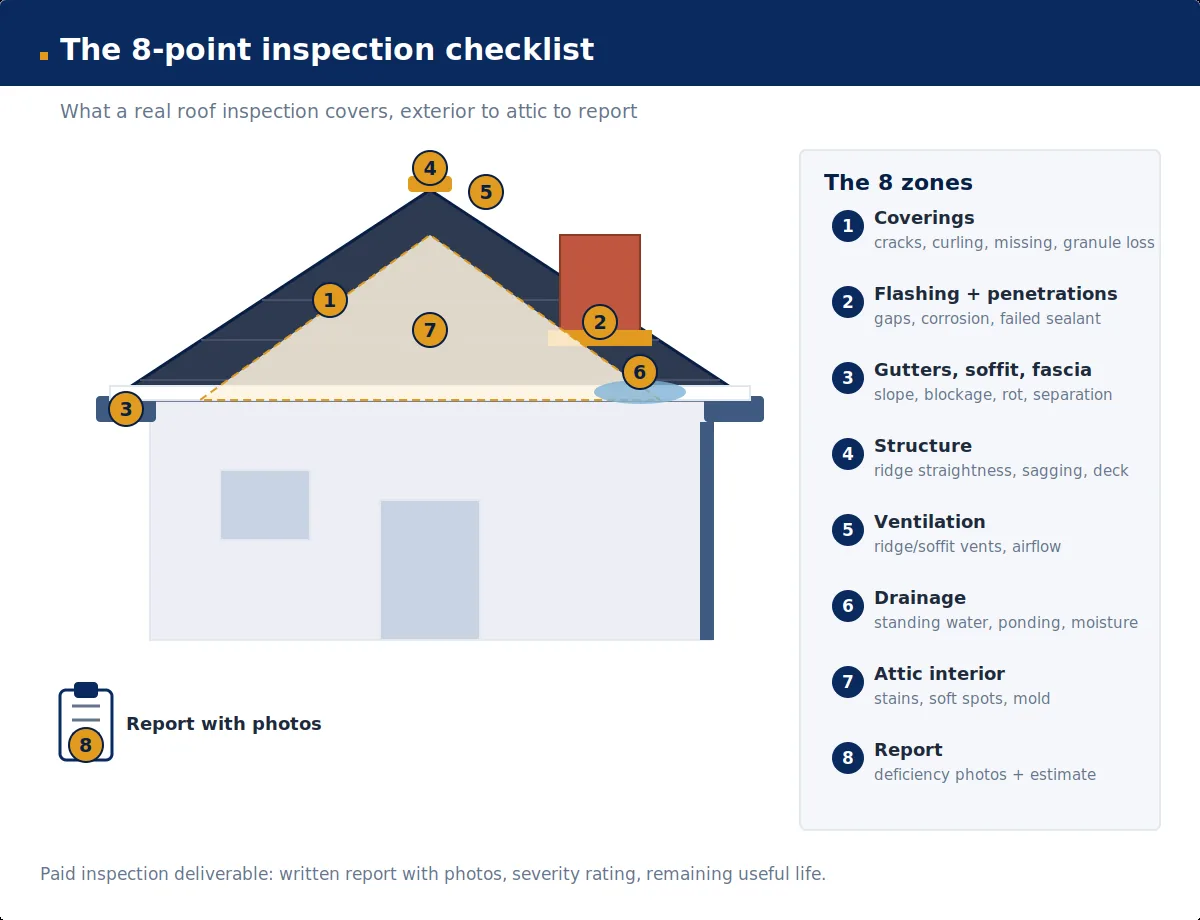
A quality inspection isn’t a glance from the sidewalk. Here is what a thorough one covers — use it as a checklist when the report lands:
- Roof coverings — cracks, curling, missing pieces, granule loss on shingles
- Flashing and penetrations — gaps, corrosion, failed sealant at chimneys, skylights, vents, pipe boots
- Gutters, downspouts, fascia, soffit — blockages, slope, rot, separation
- Structural integrity — ridge-line straightness, sagging, deck condition
- Ventilation — ridge and soffit vents, powered fans; blockages and airflow
- Drainage — standing water, ponding on flat roofs, chronic moisture patterns
- Attic interior (when accessible) — underside of decking for moisture stains, soft spots, mold
- The written report — 3–4 pages: address, date, inspector, scope, photographs of every deficiency, repair estimate, and severity ratings
The report is the deliverable that matters. A paid inspection should come back with photos of every deficiency, a severity rating (immediate repair / monitor / replace), and an estimated remaining useful life — that report is what turns a $249 inspection into a negotiating tool with insurers and buyers.
The detail bias nobody tells you about. Leaks almost never come from the middle of the shingle field. One contractor’s 2025 NRCA-field-data read puts 93% of residential roof leaks at flashing details, penetrations, or material transition points — and the top three leak zones (valleys, chimney flashing, vent pipe boots) account for ~62% of all residential leaks (ridgelineconstructionhsv.com citing NRCA 2025 field data; treat these as one contractor’s attributed figures). That’s why the checklist is 80% about edges and penetrations. If your inspector spends ten minutes on the shingles and thirty on the flashing, that’s a good inspector.
Warranty math note. GAF’s standard limited warranty requires the homeowner to “properly maintain the roof, including performing periodic inspections” (per 2025 GAF warranty documentation). The paid inspection isn’t just diagnostic — it’s maintenance documentation that keeps your warranty enforceable.
When to book: the timing triggers
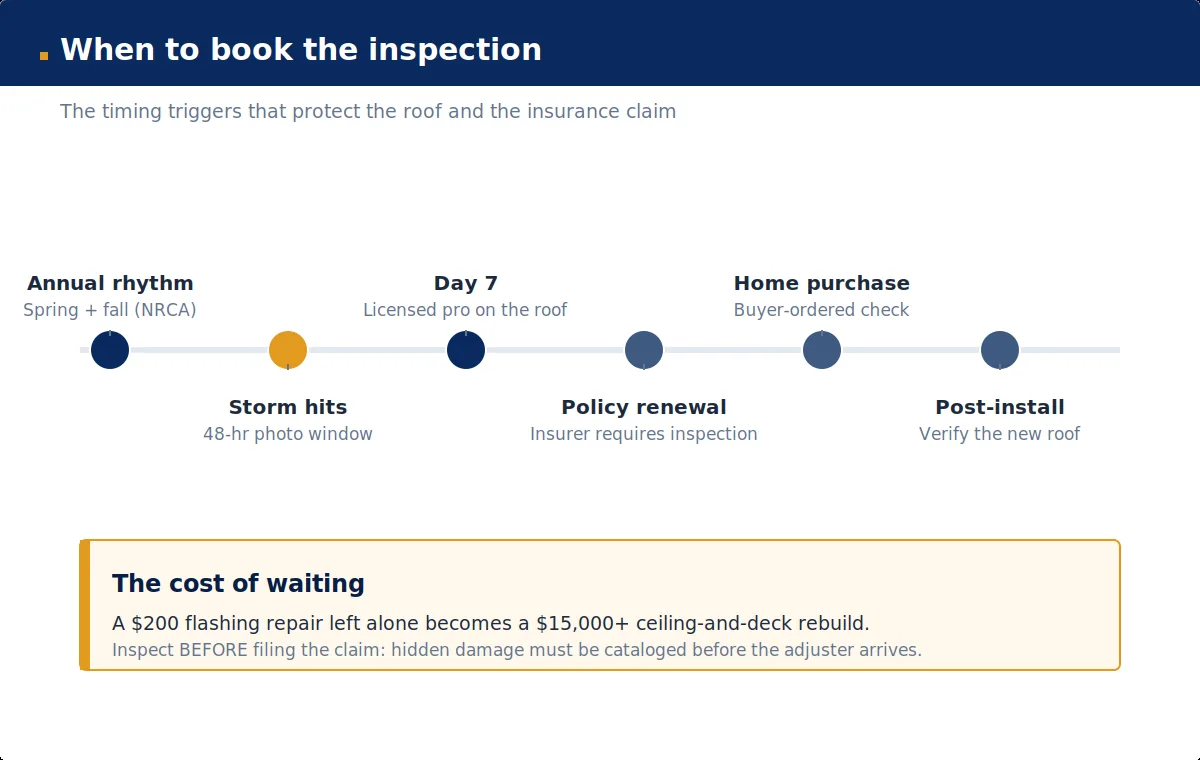
Not every year needs an inspection. These are the moments that do:
The calendar rhythm. Per NRCA guidance, as cited by roofing contractors: two professional inspections per year, spring and fall. Spring catches winter damage before the storm season; fall catches summer heat damage before winter. Fewer than 5% of US homeowners perform any scheduled roof maintenance at all (NRCA 2025, via contractor citation) — so even one inspection a year puts you ahead of 95% of owners.
After severe weather. Hail of any size, wind above 60 mph, or heavy debris impact. The timing windows matter more than most owners realize:
– Within 24–48 hours of a hailstorm: photograph visible damage before calling the insurer. A 48-hour timeline ties the damage to a specific incident on the claim (foxhavenroof.com).
– A licensed inspector on the roof within 7 days post-storm (wegnerroofing.com, Billings 2026 guide) — storm damage is perishable evidence; wind and sun erase the telltale marks.
– Inspect BEFORE filing the claim. An expert on-site before the official paperwork means hidden structural compromises get cataloged in the initial submission — before the adjuster arrives and before the insurer narrows the scope (wegnerroofing.com). This is also where our solar panel removal & reinstall guide matters: if you have rooftop panels, the storm inspection should cover the roof under the array, where detach-and-reset may be required.
Before policy renewal. Many insurers now require inspections before renewing — especially for roofs over 10 years old in storm-prone areas (foxhavenroof.com; in Texas, the trigger runs 10–15 years). Don’t learn about the requirement from a non-renewal notice.
During a home purchase. You pay for it. A standard home inspection ($250–$400) includes only a limited visual roof check — a dedicated roof inspection is warranted whenever the home inspector flags concerns, or whenever the roof is old enough to make the lender nervous.
After a new roof installation (documentation) and when switching insurers (baseline). Roofs older than 15 years deserve a third mid-summer inspection for heat deterioration and ventilation issues.
Inspection vs certification: which one you actually need
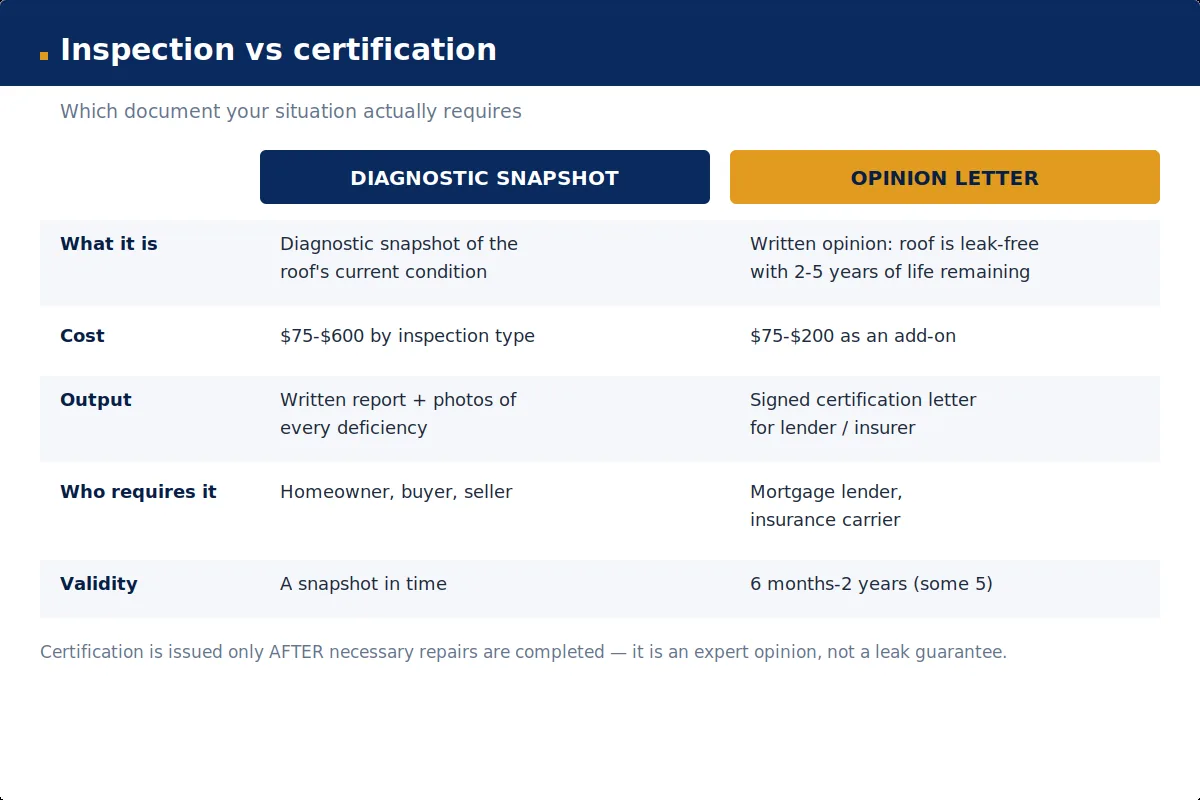
These get confused constantly. They are different products:
| Inspection | Certification | |
|---|---|---|
| What it is | Diagnostic snapshot of current conditions | Written opinion that the roof is leak-free with defined remaining life |
| Cost | $75–$600 by type | $75–$200 add-on |
| Output | Report with photos + severity ratings | “Leak-free” letter with remaining-life figure |
| Who requires it | You (maintenance) | Mortgage lenders, insurance carriers (older homes, storm zones) |
| Validity | A moment in time | Typically 6 months–2 years; some up to 5 years in excellent condition |
Certification issuance requirements: the roof must be leak-free with 2–5 years of useful life remaining — and it is issued only AFTER any necessary repairs are completed. It is an expert opinion, not a guarantee against leaks (that’s the honest framing). Some contractors sell “LeakFREE” certifications that do include a leak guarantee for the certification period, with the liability on the certifying company — ask which flavor you’re buying.
The credential trap. Not all general home inspectors can issue a binding certification — lenders and insurers may reject certifications from unlicensed or uninsured inspectors. Verify a valid contractor’s license and general liability insurance before you pay. Many mortgage lenders require the roof to show at least 3 years of remaining life.
Drone safety limit. Drone inspections are ideal for pitches above 6:12, fragile clay tile or slate surfaces, and multi-story homes — but they cannot detect hidden moisture. That’s the infrared add-on’s job: the thermal pass (best on a clear evening after a sunny day — dry material releases its heat, wet material still radiates) finds the trapped water the drone can’t see. For flat roofs, the IR moisture scan is the whole ballgame; see our flat roof replacement cost guide for where scans sit in the inspection-to-replacement funnel.
By-material inspection lines. Asphalt shingles (our roof replacement cost guide owns the pricing): granule loss, curling, hail bruising. Metal roofs: fastener backout, sealant aging at seams, coating wear — see our metal roof cost guide for what metal systems cost to install. Tile and slate: cracked units, underlayment condition (the membrane beneath the tile is doing the waterproofing, not the tile itself).
Insurance rules that make the roof inspection matter
This is where a $249 inspection earns its keep — because in several states, the rules around roofs and insurance have teeth in 2026:
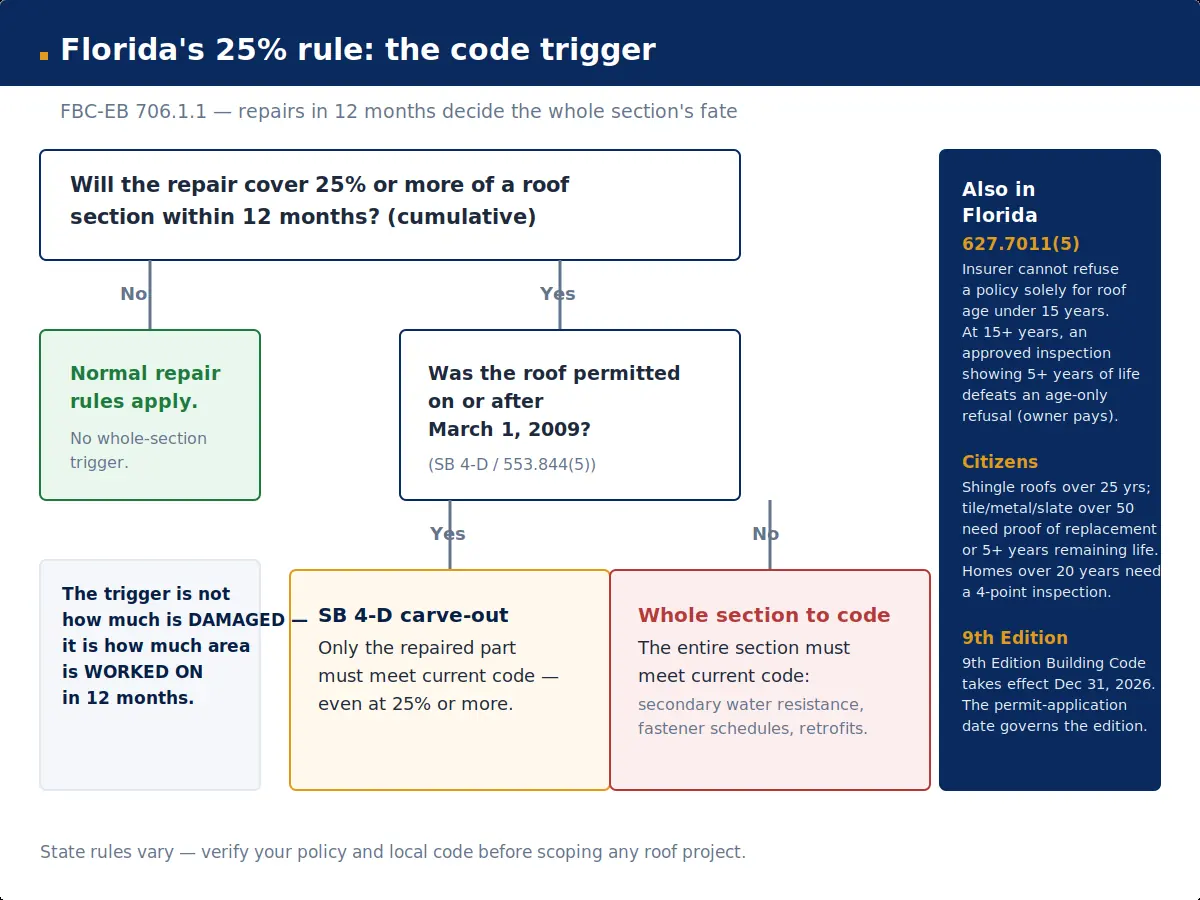
Florida. Statute §627.7011(5): an insurer may not refuse to issue or renew a policy SOLELY because the roof is under 15 years old. At 15+ years, an insurer-approved inspection showing 5+ years of useful life defeats an age-only refusal — and the homeowner pays for the inspection (reroofreport.com, reviewed Oct 2026). That’s a $150–$400 inspection that can save a policy. Citizens Property Insurance layers on its own thresholds: roofs over 25 years (shingle) or 50 years (tile, metal, slate, concrete) need proof of replacement or 5+ years of remaining life, and homes over 20 years old need a 4-point inspection. The Florida paperwork runs through two forms: the OIR-B1-1802 wind mitigation form (wind mitigation inspection $75–$200, report valid 5 years, insurer discounts required by §627.0629(1) when features are documented) and the 4-point / roof inspection forms.
Oklahoma (2026 rules). Insurers must acknowledge claims within 14 days and decide within 30 days; homeowners have up to 24 months to file for hidden damage (roofintulsa.com). That 24-month window is the reason post-storm inspections and dated photos matter — hidden damage shows up late.
Texas. Insurers can require an inspection when the roof is 10–15 years old; nearly half of all Texas home insurance claims are closed without payment; wind/hail deductibles often run 1–2% of the insured value (mmroofsiding.com).
Nebraska. A 2% wind/hail deductible on a $350,000 home means $7,000 out of pocket before coverage kicks in (homepride.net) — the inspection’s job is to make sure that $7,000 goes toward the right repairs.
Montana. Homeowners have 1 year from the storm date to file (state law, per a 2026 Billings hail guide) — and that’s Montana-specific; other states set their own deadlines. Billings hail in 2026 ranged 0.75–2.25 inches; functional shingle damage (what insurers actually cover) typically begins around 1.5 inches.
The national math. The Insurance Information Institute’s 2025 average claim for roof wind damage: $11,695 (via ridgelineconstructionhsv.com). Against that, a $249 inspection with dated photos is the cheapest claim documentation money can buy.
The 25% rule: Florida’s code trigger
Here is the 2026 edge nobody in the top five owns properly — and the reason a storm-damage inspection in Florida is really a code-compliance assessment:
The rule (FBC-Existing Building 706.1.1, 8th edition 2023): no more than 25% of a roof — or a roof section — may be repaired, replaced, or recovered in any 12-month period unless the whole covering on that roof or section is brought up to current code (reroofreport.com, Oct 2026).
The misconception that costs people money. The trigger is NOT 25% of the roof being damaged or wet. It’s how much area is worked on within 12 months, cumulatively (cesroof.com, 2026). Three 10% repairs in a year cross the threshold — the third one pulls the whole section into code compliance.
The SB 4-D carve-out (§553.844(5), 2022). Roofs built, repaired, or replaced to the 2007 Florida Building Code or later (permit on or after March 1, 2009): only the repaired portion must meet current code, even at 25%+ of a section. Pre-March-2009 roofs: crossing 25% of a section in 12 months pulls the whole section to current code — including secondary water resistance, fastener schedules, and roof-to-wall retrofit per FBC 706.8.
Why this is a 2026 story. The Florida 9th Edition Building Code takes effect December 31, 2026 (floridahomeservicesnews.com, Oct 2026) — and the permit-application date governs which edition applies (FBC §105.3). A roof project permitting late in 2026 should be scoped against the 9th Edition. An inspection done in 2026 isn’t just documenting damage; it’s documenting it against the code edition that will govern the repair.
Roof inspection economics: the $249 bet
The economics of a roof inspection are brutally simple — it’s the cheapest option at every comparison point:
| The bet | Cost |
|---|---|
| The inspection | $75–$600 (national avg $249) |
| The repairs the inspection typically finds | $400–$1,800 for most homeowners (Angi, Sep 2026); minor leak repairs $200–$600 |
| Emergency repairs when nobody inspects | $400–$1,500 |
| The nightmare when a leak runs free | A $200 flashing problem becomes a $15,000+ ceiling-and-deck rebuild (HomeAdvisor 2025 data via contractor sources; Angi’s structural-repair band above $7,000 corroborates the trajectory) |
| Annual professional maintenance | $250–$500/yr |
One contractor’s math worth remembering: kick-out flashing — a $200 component — prevents an average of $4,000–$8,000 in hidden wall rot (IBHS 2025 data via ridgelineconstructionhsv.com). The inspection finds the $200 component. The absence of the inspection funds the $8,000 rot.
The “repair vs replace” handoff. The inspection’s highest-value output is often the verdict itself: repair, or replace. When the verdict is “replace,” the inspection has paid for itself by pointing you at the right pricing — see our roof replacement cost guide for the $9,000–$18,000 shingle-replacement picture and how quotes are structured.
Free roof inspections: the conflict-of-interest trap
Many roofers offer free inspections after storms or before an insurance claim. Sounds generous. Do the math on what it costs them: a single manual roof inspection with ladder access costs $300–$600 in contractor time and liability (coloradoproroofing.com, Sep 2026). Nobody gives away a $400 service out of kindness — the “free” inspection is subsidized by the repair work it generates.
That’s the conflict of interest, stated plainly: the inspector who sells repairs has a financial interest in finding repairs. It doesn’t mean every free inspection is a scam — many are legitimate storm-response outreach — but it means:
- Get the paid, independent inspection before you accept the free one. The paid inspector has no repair revenue at stake; the report is the product.
- Never let the free-inspection company also write the claim. One party diagnosing, prescribing, and billing is the definition of a conflict.
- Compare the free inspection’s findings against your paid report. When they match, trust the diagnosis. When the free one finds three times the damage, trust your skepticism.
Who can legally inspect — and fly. Fall hazard: steep, high, or damaged roofs are licensed-pro territory. If you want any look yourself, ground-level binocular observation is the only DIY framing this article recommends — no roof-walking instructions, period. Drone inspections require an FAA Part 107 remote-pilot certificate; thermal scans require a qualified thermographer (Level I certification runs ~$1,800–$2,200). For insurance claims, use licensed contractors whose documentation adjusters will actually accept — a great inspection from an unlicensed inspector can be rejected at the claim desk.
Key takeaways
– A roof inspection costs $75–$600 in 2026 (national average $249) — physical walk-on $75–$200, drone $150–$400, infrared moisture scan $400–$600.
– Buy the inspection that matches your situation: drone for steep/fragile roofs, infrared for suspected hidden moisture (especially flat roofs), certification letter ($75–$200 add-on) for insurance renewals and home sales.
– Book on rhythm (spring + fall, per NRCA guidance) and on triggers: within 48 hours of hail for photos, a licensed inspector within 7 days post-storm, and always inspect BEFORE filing the insurance claim.
– In Florida, an inspection showing 5+ years of useful life defeats an age-only policy refusal under §627.7011(5) — and the 25% rule (FBC-EB 706.1.1) means cumulative repairs over 25% of a section pull it to current code, with the SB 4-D carve-out for roofs permitted on/after March 1, 2009.
– The economics are the argument: $249 for the inspection vs $200 becoming $15,000 without one.
– Never trust a free inspection alone — the $300–$600 it “saves” you is subsidized by the repair work it finds.
Sources & methodology
Cost figures compiled November 2026 from published 2026 cost guides: ibuyer.com (~Aug 2026; national avg $249); angi.com (Sep 2026, 2,573 verified projects, avg $257); theroofingbrief.com (Oct 2026, drone/IR guide); listwithclever.com; superdaymond-deals.com; thumbtack.com (Oct 2026); cencoroofing.com (Oct 2026, Denver certification); engineerfix.com; coloradoproroofing.com (Sep 2026); foxhavenroof.com (2026); homepride.net (Omaha/NE guide); wegnerroofing.com (Billings 2026 hail guide); roofintulsa.com (Oklahoma 2026 claim rules); mmroofsiding.com (Texas rules, TX DOI); reroofreport.com (Oct 2026, FL statutes/forms/25% rule); floridahomeservicesnews.com (Oct 2026, FL 9th Edition + forms); cesroof.com (2026, 25% rule mechanics); alexhomeinspectionservices.com (25% rule + code editions); mosaichoa.com (FBC 706.8 retrofit); rotorrate.com (2026, drone/thermal costs); kangaroof.com (InterNACHI scope); floridasbestroofing.us; ridgelineconstructionhsv.com (2025-attributed figures — NRCA/HomeAdvisor/III/IBHS 2025 data via that site, used as attributed contractor figures and only where corroborated by Angi/III bands). HomeGuide (~Dec 2025, borderline stale) used for report structure and certification definitions only — never for headline prices. Replacement pricing referenced from our article 6; storm R&R from our article 27; flat-roof methods from our article 31; metal systems from our article 30.
Disclaimer: Prices are 2026 US national averages and vary by region, roof type, and contractor — get 3 written, itemized local quotes. State insurance rules vary and change; verify your policy and current state law. This article covers cost and decision information only — never installation instructions; roofing work at height is licensed-contractor territory, drone inspections require FAA Part 107 certification, and thermal scans require a qualified thermographer.
How much does a roof inspection cost in 2026?
A roof inspection costs $75–$600 in 2026 depending on type — the national average is $249 (Angi’s verified average is $257 across 2,573 projects, Sep 2026). A physical walk-on runs $75–$200, a drone inspection $150–$400, an infrared moisture scan $400–$600, and a roof certification letter for insurance or a lender adds $75–$200.
What’s included in a roof inspection?
A thorough inspection covers six exterior areas (coverings, flashing/penetrations, gutters/soffit, structural integrity, ventilation, drainage) plus the attic interior (deck underside, moisture stains, mold), and delivers a 3–4 page report with photographs of every deficiency, severity ratings, and an estimated remaining useful life. The checklist skews toward flashing details and penetrations — not the shingle field — because that’s where roughly 90%+ of leaks originate.
How often should I get my roof inspected?
Per NRCA guidance (as cited by roofing contractors): twice a year, spring and fall — spring catches winter damage, fall catches summer heat damage. Roofs over 15 years old deserve a third mid-summer check. Add inspections after any severe weather (hail, winds above 60 mph), before a policy renewal on an older roof, during a home purchase when the roof is flagged, and after a new installation.
Is a drone roof inspection worth it?
Yes for the right roofs: steep pitches (above 6:12), fragile clay tile or slate surfaces, and multi-story homes where ladder access is risky. At $150–$400 it’s a solid mid-tier option. But a drone can’t find hidden moisture — that takes the infrared add-on ($400–$600, best on a clear evening after a sunny day), which is especially worth it on flat roofs and suspected slow leaks.
What is a roof certification and do I need one?
A certification is a written expert opinion that your roof is leak-free with 2–5 years of remaining useful life — it costs $75–$200 as an add-on (higher in storm markets like Denver). You need one when a mortgage lender or insurance carrier demands it, typically on older homes or in storm zones. Verify the inspector holds a valid contractor’s license and liability insurance, because lenders and insurers reject certifications from unlicensed inspectors.
Should I get a roof inspection before filing an insurance claim?
Yes — always. Photograph visible damage within 24–48 hours of the storm, get a licensed inspector on the roof within 7 days, and complete the inspection before filing so hidden damage is cataloged in the initial submission. In Oklahoma, insurers must acknowledge claims within 14 days and decide within 30 days; in Montana, homeowners have 1 year from the storm date to file (state law — other states differ). Dated inspection photos are the strongest claim documentation you can buy.
What is the 25% roof rule?
Florida’s 25% rule (FBC-Existing Building 706.1.1) says no more than 25% of a roof or roof section may be repaired, replaced, or recovered in any 12-month period unless the whole covering on that section is brought up to current code. The trigger is how much area is worked on — cumulatively, not how much is damaged. The SB 4-D carve-out exempts roofs permitted on or after March 1, 2009 (2007 FBC or later): only the repaired portion must meet current code. And the Florida 9th Edition code takes effect December 31, 2026, so late-2026 projects should be scoped against it.