

Sewer line replacement cost in 2026 runs $50–$250 per linear foot — $3,500–$25,000 for a typical residential lateral, depending on method, length, and depth. Traditional open-trench digging runs $50–$125/ft installed; trenchless pipe bursting $80–$200/ft; cured-in-place lining (CIPP) $80–$250/ft. Trenchless is usually MORE expensive per foot — it wins on total cost only when restoration (driveway, patio, landscaping) is a meaningful line item. You own the pipe all the way to the city main’s tap, even under the street. And the number that should be in every homeowner’s budget: a $30–$50/yr service-line insurance endorsement covering $10,000–$25,000 per occurrence.
Table of Contents
Nobody budgets for a sewer line until it fails. Then it is an emergency with a five-figure price tag and a contractor standing in the yard. The searcher for this keyword almost always has a failing line — backups, a camera report with bad news, or a point-of-sale inspection deadline — and needs to price the job today.
Two traps define this market. First, the headline averages are misleading: Angi’s $3,319 national average blends full lateral replacements with spot repairs and short jobs, so treating it as the expected total for your line is a mistake. Second, most ranking pages quote per-foot bands and stop — but the pipe is only part of the invoice. The restoration bill (driveway, patio, lawn), the depth, the permits, and the method explain why two quotes on the same job can differ by $10,000 or more. This guide prices the methods, decomposes the invoice, settles trenchless-vs-dig honestly, draws the responsibility boundary nobody draws, and compares the insurance products as distinct products.
Sewer line replacement cost per foot by method: the 2026 ladder
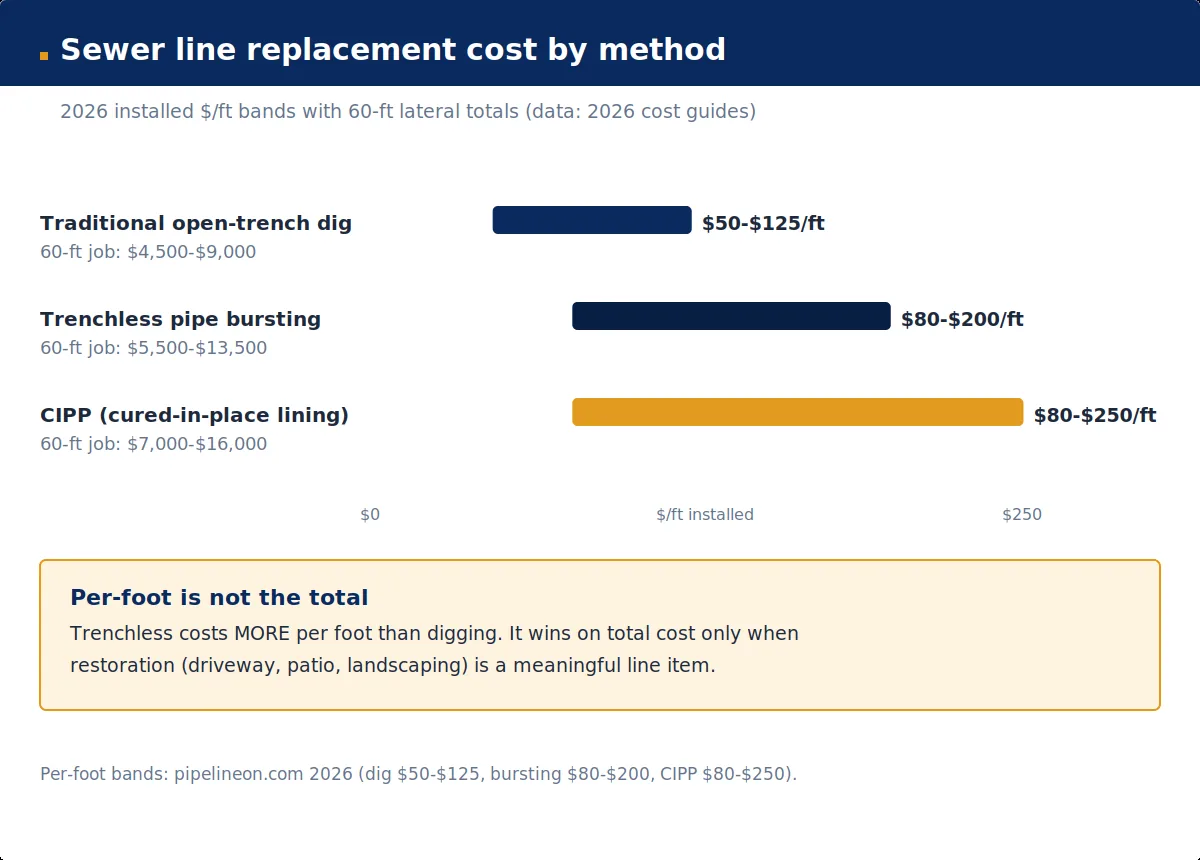
| Method | 2026 $/ft installed | 60-ft lateral total | Notes |
|---|---|---|---|
| Traditional open-trench dig | $50–$125 | $4,500–$9,000 | Cheapest per foot; most restoration |
| Trenchless pipe bursting | $80–$200 | $5,500–$13,500 | Higher per foot; minimal restoration |
| CIPP (cured-in-place lining) | $80–$250 | $7,000–$16,000 | Narrower residential bands ~$90–$250 |
The per-foot bands above use the contractor-anchored 2026 pipelineon.com ranges; broader sources agree (HomeGuide: dig $50–$180, bursting $60–$200, CIPP $90–$250 — note HomeGuide’s underlying table dates to December 2025, used here for range confirmation only; Angi: dig $50–$250, bursting $150–$190 typical residential, CIPP $135–$150 narrower band). Published full-job totals across guides: digging $7,500–$30,000, trenchless methods $4,000–$20,000 (sewerreplacementcost.com, Oct 2026), with typical residential laterals landing $3,500–$25,000 depending on method, length, and access (pipelineon.com, ~Jun 2026).
Read the ladder carefully: trenchless is more expensive per foot than digging. The entire “trenchless is cheaper” sales claim rests on what doesn’t get dug up — which is the next section’s subject.
San Diego contractor rates (2026, ~Apr 2026, plumbingprosd.com): CIPP $4,000–$12,000 ($150–$250/ft); bursting $5,000–$15,000 ($150–$200/ft); traditional $8,000–$30,000. And Angi’s length examples (Aug 2026): 45–55 ft trenchless at $2,700–$13,750; 55–75 ft at $3,300–$18,750. The typical lateral is 25–60 ft long (sewerreplacementcost.com); a wider band puts it at 30–80 ft long and 3–8 ft deep (tradesprohub.com, Mar 2026).
The $3,319 problem. Angi’s national average (Aug 3, 2026: $3,319 avg; typical $1,388–$5,323; ~$150/ft with materials and labor) and This Old House’s mirror (~$3,320 avg; $1,390–$5,320, Mar 2026) reflect “a mix of shorter and partial projects” — they should not be treated as the expected total for replacing a long line (sewerreplacementcost.com). Bob Vila’s average runs lower still ($2,914; $1,253–$4,701, compiled Sep 2026) for the same blending reason. If your lateral is 60 feet under a driveway, Angi’s average is not your budget. The 60-foot totals in the table above are.
The 60-foot driveway worked example: why restoration decides the total
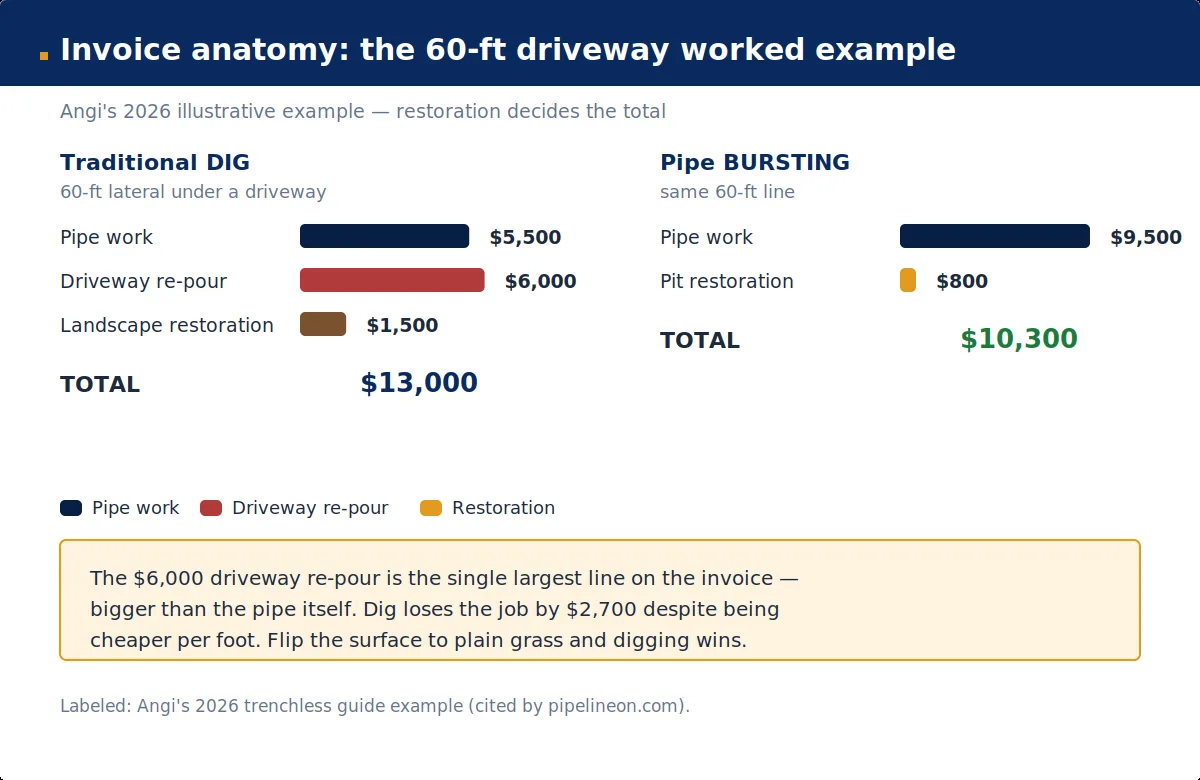
Angi’s 2026 trenchless guide walks through the comparison that settles the trenchless debate — a 60-foot lateral under a driveway (cited by pipelineon.com):
- Traditional dig: $5,500 pipe work + $6,000 driveway re-pour + $1,500 landscape restoration = ~$13,000 total
- Pipe bursting: $9,500 pipe work + $800 pit restoration = ~$10,300 total
The dig is cheaper per foot. The dig loses the job by $2,700. That is the whole truth of trenchless: it wins on total cost when restoration is a meaningful line item. Flip the conditions — a shallow line under plain grass with no hardscape — and digging wins on total too, because the $6,000 driveway line item disappears.
The invoice anatomy: everything beyond the pipe
Camera inspection + locate: $100–$500 nationally (HomeAdvisor via repairorcall.com, 2026); $295–$650 (pipelineon.com); Phoenix $125–$350 (tradesprohub). This is the non-negotiable first step: “for $100 to $500, a plumber runs a small camera down the line… and records what it sees: roots, cracks, offset joints, a collapse, and how far along the line each problem sits” (repairorcall.com). Ask whether the report follows the NASSCO PACP standard, which governs trenchless rehabilitation documentation (tornado-plumbing.com, Aug 2026) — a PACP-coded report is the language contractors and cities speak.
Cleanout installation (new access point): $750–$2,500 (pipelineon); Phoenix $500–$2,000 (tradesprohub). Required by code in many areas — and its absence is often why a simple inspection turns into excavation talk.
Permits: $75–$400 in most municipalities (pipelineon); Phoenix $200–$500; Denver $225–$575 including street-cut permit; Los Angeles $250–$625 (LADBS); Bay Area $500–$2,500+ (nextlevelplumbing.com, Jul 2026). Digging in the public right-of-way typically needs a separate excavation permit — this is one reason “the same job” quotes diverge.
Trenching/excavation alone: HomeGuide $5–$12/ft excavation-only; Angi $4–$12/ft added beyond pipe work. This is the line that explains why deep lines explode the quote.
Restoration — the real bill: lawn/landscape $1,500–$6,000 (pipelineon); concrete driveway re-pour $15–$35/sq ft; patio/paver reset $20–$50/sq ft (pipelineon); HomeAdvisor national: concrete driveway $1–$25/sq ft, asphalt $1–$15, landscaping $4.50–$12 (repairorcall.com). On the worked example, the $6,000 driveway was the single largest line. When a contractor says “the pipe is $5,500,” the next question is always: “and what’s above the pipe?”
Depth multiplier. A shallow line (under 4 ft of cover) under lawn is a small crew for one day. An 8-ft-deep line needs a bigger machine, more backfill, and trench shoring — which is an OSHA safety requirement, not an upsell (repairorcall.com). Depth is the invisible number in most quotes; ask for it in writing.
Soil. Phoenix caliche (hardpan calcium carbonate) adds 20–40% to traditional excavation cost (tradesprohub.com, Mar 2026). Rocky or hardpan soil punishes the dig method specifically — trenchless ignores soil hardness.
Slab foundation. A line running under a concrete slab costs an extra $300–$350/ft to trench — concrete broken out and replaced (HomeAdvisor national data via repairorcall.com). This is the adder that turns a $6,000 quote into a $12,000 quote.
Tree root clearing: $100–$600. Roots cut out of the pipe; the damage they caused is extra (repairorcall.com). Contractor consensus rule: if roots have been cleared twice in two years, the pipe has an opening roots keep finding — stop paying for clearing and start scoping the pipe.
Spot repair (single fitting or 5-ft section): $500–$2,500 (pipelineon); cracked-pipe spot repair $600–$1,050 nationally (Angi). Spot repair is the “repair instead of replace” option — valid when one section is bad and the rest of the line is sound.
Trenchless vs traditional dig: the decision framework
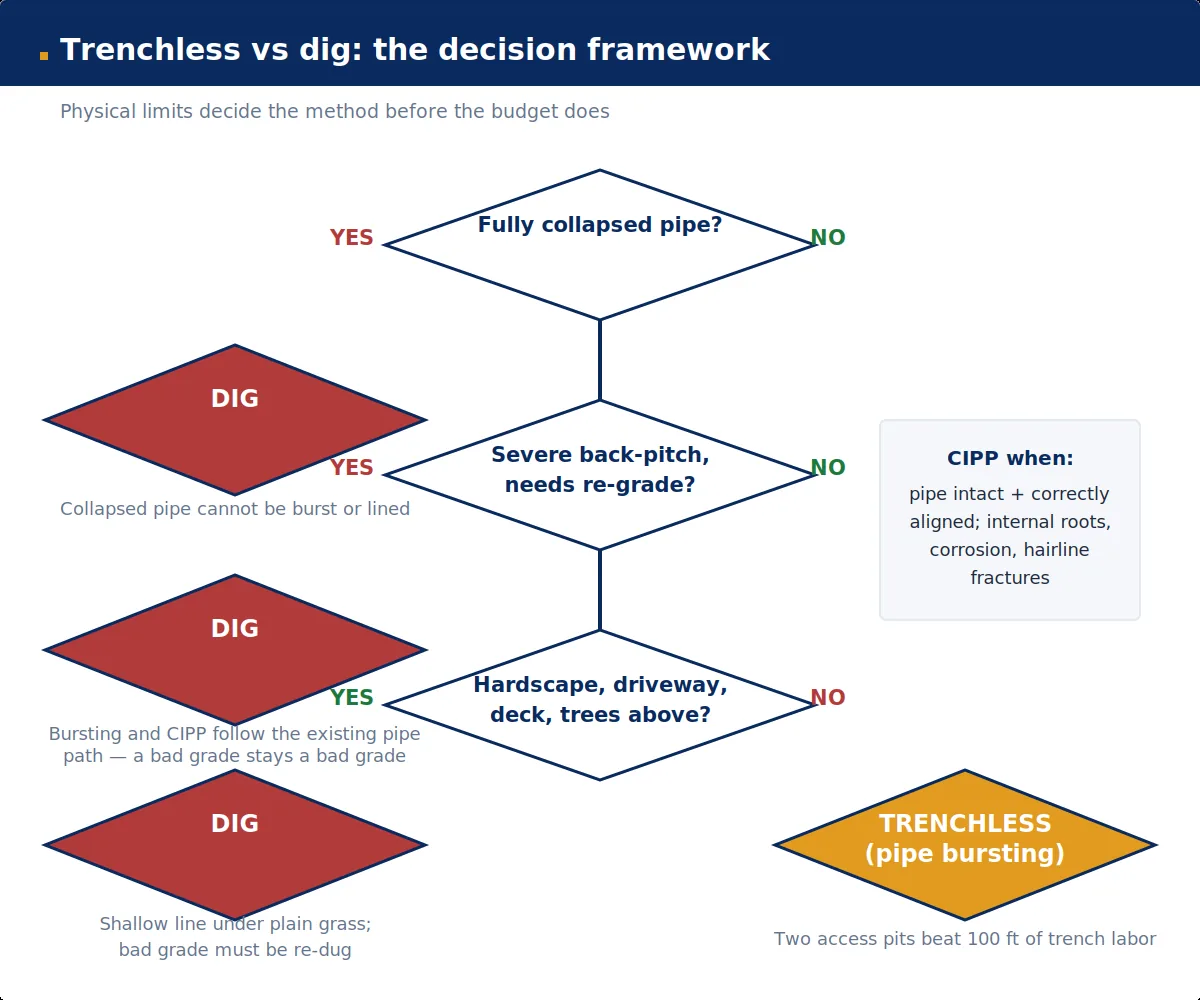
Both trenchless methods have hard limits, and the limits are physical — they decide the method before the budget does:
- Neither trenchless method works on a fully collapsed pipe. It must be dug (repairorcall.com).
- Dig wins on: shallow lines (under 4 ft of cover) under plain grass; collapsed sections that cannot be burst through; lines with severe back-pitch that need re-grading — bursting and CIPP both follow the existing pipe path, so a bad grade stays a bad grade; properties with no landscape or hardscape above the line (pipelineon.com).
- Pipe bursting wins on: lines under driveways, decks, patios, mature trees, or any high-restoration-cost surface; pipe material that bursts cleanly (vitrified clay, cast iron, original PVC, ductile iron); runs of 30–150 ft where two access pits beat 100 ft of trench labor (pipelineon.com).
- CIPP wins on: intact-but-degraded pipe with internal corrosion, root intrusion at joints, or hairline fractures needing structural reinforcement without flow loss; older homes where the existing pipe alignment is correct; partial sections inside an otherwise intact run (pipelineon.com).
The “trenchless costs 30–50% less” claim comes from trenchless sellers (readyrooteraz.com, Thompson, sewerreplacementcost.com’s attributed line — flag as interested source). The independent 2026 position, stated earlier: trenchless wins on total cost when restoration is a meaningful line item. Per foot, trenchless is usually more expensive. Any contractor who claims a universal 30–50% saving has told you what he sells.
CIPP lifespan — marketed, not established. Liners are “engineered to last 50 years or more,” with contractors offering 50-year material warranties (Thompson Trenchless press analysis, Jun 30 2026; ASI Heating & Air; NuFlow’s 100-year expectancy). These are vendor claims amplified through press channels — present as marketed, never as independently established fact. CIPP is approved by all major plumbing codes and used by municipalities (asiheatingandair.com).
Pipe material lifespans: the older-home factor
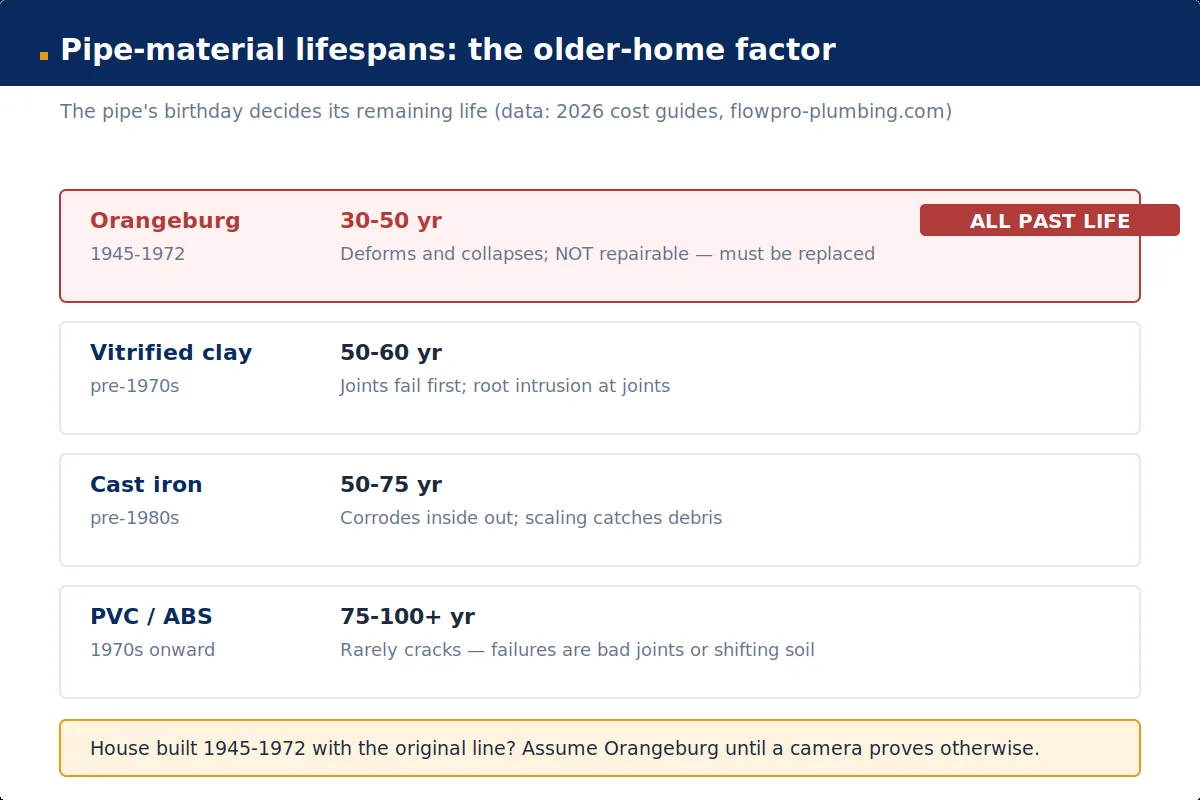
The pipe’s birthday decides its remaining life — and if the house is old enough, there is no decision to make:
| Material | Era | Lifespan | Failure mode |
|---|---|---|---|
| Orangeburg (bituminized fibre) | 1945–1972 | 30–50 yr | Deforms into an oval and collapses; not repairable — must be replaced |
| Vitrified clay | pre-1970s | 50–60 yr | Joints fail first; root intrusion at joints |
| Cast iron | pre-1980s | 50–75 yr | Corrodes from the inside out; “scaling” catches debris |
| PVC/ABS | 1970s onward | 75–100+ yr | Rarely cracks — failures are bad joints or shifting soil |
Orangeburg is the critical one. Every Orangeburg line is now past end of life in 2026. If your house was built 1945–1972 and the line was never replaced, assume Orangeburg until a camera proves otherwise (forumusta/contractor consensus; flowpro-plumbing.com). It cannot be lined or spot-repaired — it must be replaced.
Failure cause #1: tree roots. Roots find the smallest joint or crack, enter seeking moisture, and expand until they block or break the pipe. Any mature tree within ~30 ft of the line is a candidate (forumusta).
Warning signs: multiple drains slow at once (the shared indicator the problem is downstream, not in one fixture); gurgling from toilets when a sink or washing machine drains; sewage smell in the yard or basement; unusually green, fast-growing grass in a line across the yard; soggy patches; repeated backups where snaking helps only for months (flowpro-plumbing.com; forumusta).
Maintenance cadence (contractor consensus): annual camera inspection for homes with mature trees, properties over 40 years old, or cast iron/Orangeburg pipe (jrplmbg.com, Arlington TX). That’s the drain side of your plumbing — the supply side has its own replacement economics, covered in our tankless water heater cost guide.
Who pays: it’s you, not the city (the responsibility boundary)
Here is the rule nobody explains at the homebuyer’s table: in virtually all municipalities, you own and maintain the sewer lateral from your house to the point where it connects to the public main — including the portion under the sidewalk, right-of-way, or street. The city handles only the main itself (legalclarity.org, 2026; callmattioni.com PA, updated Jun 5 2026; callbrightside.com KC, Oct 2026).
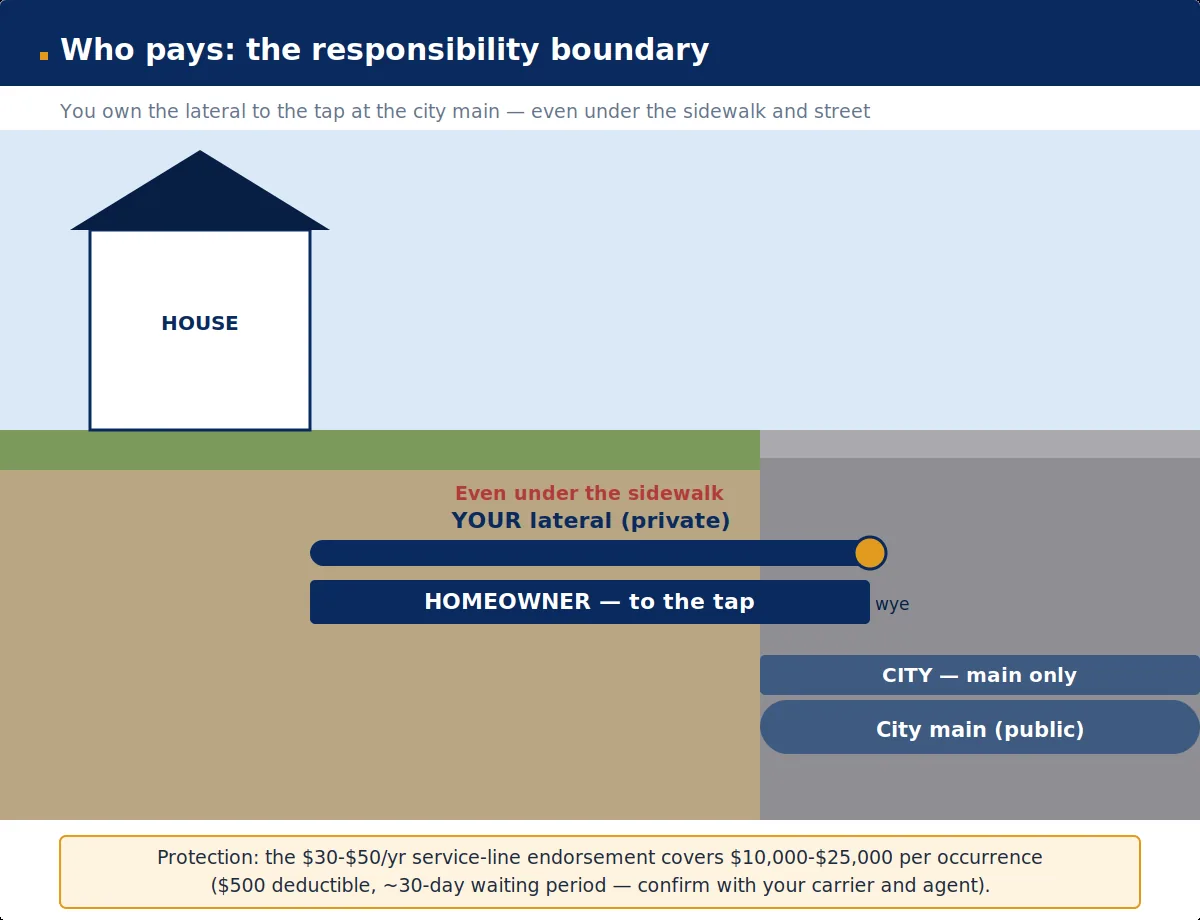
The details sharpen the sting:
- Glendale, CA: municipal code places the house connection on the property owner “all the way to the wye or saddle” at the main — responsibility does not stop at the property line, sidewalk, or curb (bbcrooter.com, 2026).
- Kansas City, MO: an ordinance changed the city’s language from “authorized to repair” to “authorized but not required,” effective May 1, 2022 (enforcement tightened Aug 2024) — homeowners didn’t feel the change until then; Independence MO and Lee’s Summit still help in narrow cases (callbrightside.com, Oct 2026; ordinances change — this reads as of 2026).
- Shared laterals: in older neighborhoods two or more homes sometimes share a pipe. Each owner is responsible for the segment from their foundation to the shared section, with the shared portion split equally — check for a maintenance agreement in property records before a crisis (legalclarity.org).
- Tree-root caveat: if roots from a tree damage the section you own, the repair is still yours — even if it’s a city-owned tree (callmattioni.com).
- The diagnostic rule: if only your home backs up, it’s your lateral. If the neighbors back up too — or water overflows from a street manhole — the city main is obstructed: call the city, which fixes it at no cost to you (rjplumbingservice.com, WA).
The lateral is the most expensive hidden-infrastructure job a home can face; inside the walls the equivalent is house rewiring, where the work is likewise invisible until the bill arrives.
Insurance: the $30–$50/yr endorsement that actually covers the pipe
Standard homeowners insurance (HO-3) does NOT cover sewer lateral failure from age, corrosion, root intrusion, or ground movement — those are treated as maintenance, not sudden accidental damage. Only covered perils (fire, explosion, vehicle impact) trigger coverage (callmattioni.com; insuranceopedia.com, Oct 2026). If you have a standard policy and an Orangeburg line, you have zero coverage for the most expensive plausible failure on the property.
The service-line endorsement (utility line rider): $30–$100/yr ($30–$50 typical), covering $10,000–$25,000 per occurrence, with a ~$500 typical deductible that operates independently of the main dwelling deductible, and roughly a 30-day waiting period. Offered by State Farm, Farmers, American Family, Liberty Mutual, Nationwide (insuranceopedia.com; legalclarity.org; boisesewerrepair.com — all 2026).
The worked example: a $40/yr endorsement; a $12,000 lateral bill; after the $500 deductible, the insurance pays $11,500 (legalclarity.org). That is roughly $0.11/day to convert a $12,000 emergency into a $500 one — the best dollar-for-dollar number in this entire guide.
The critical distinction: the service-line rider (covers the buried pipe) and the water/sewer backup endorsement (covers your flooded basement, not the pipe) are two different products. “Most homeowners have neither, or think one covers what only the other does” (callbrightside.com). When you call your agent, ask for both by name.
Utility warranty plans (HomeServe / Service Line Warranties of America): $72–$156/yr for sewer-only coverage — but these are service contracts, not insurance. The provider picks the contractor, and “whether the line is repaired or replaced is entirely within SLWA’s discretion” (legalclarity.org). Their semi-official-looking mailers are why homeowners assume the city endorses them. It doesn’t.
National home warranties (AHS, Choice, First American, 2-10): will not cover a broken or root-infested sewer lateral — all exclude collapsed lines outside the foundation and root damage even inside it (callbrightside.com). If a seller’s home warranty is your plan for the sewer line, you have no plan.
2026 freshness: point-of-sale lateral ordinances
The year’s genuinely new angle in sewer economics is municipal: more jurisdictions now force the lateral question at property transfer, which turns a plannable project into a deadline-driven one.
East Bay, CA (EBMUD Regional Sewer Compliance Program): Albany, Berkeley, El Cerrito, Emeryville, Kensington, Oakland, Piedmont + the Stege Sanitary District require a leak-free-lateral compliance certificate at sale, remodels over $100,000, or water-meter upsizes. Sellers typically pay $300–$750 for the test — and a failing test in escrow turns a plannable project into rush excavation pricing (veroax.com, 2026; nextlevelplumbingservices.com, Jul 2026).
Austin, MN — Ordinance 737 (effective March 1, 2026): every property sale or transfer requires a Certificate of I/I Compliance; a failed inspection means repairs within 180 days; certificates are valid 10 years (City of Austin MN letter, Feb 2, 2026).
West St. Paul, MN — Code § 50.08: inspection required before sale or conveyance; certificates last 25 years after a full replacement or lining, 10 years after a spot repair; penalties run $50/month (owner-occupied) or $300/month (rental/commercial) (makiseweranddrain.com, Aug 2026).
Ventura, CA: inspection + repair required after a sewage spill, when the city’s mainline camera work flags your connection, before property sale, and every 10 years for commercial and common-interest properties (hansensplumbing.com, Sep 4, 2026).
Cost-sharing, where it exists. San Mateo, CA: 50% of the lowest bid, up to $2,500, for a full replacement. Millbrae: 20% rebate up to $2,000 (nextlevelplumbingservices.com, Jul 2026). These are the exceptions — most cities inspect and fine, they don’t split the bill.
Bay Area totals (2026): $8,000–$18,000 per home; roughly $150–$300/ft all-in once permits, shoring, and restoration are counted (nextlevelplumbingservices.com, Jul 2026). That all-in figure is the honest way to read any regional quote.
Regional reads (2026)
- Phoenix (Mar 2026 dated read): full replacement ~$8,000 avg; traditional $4,000–$15,000; bursting $6,000–$12,000; CIPP $4,000–$9,000; caliche soil adds 20–40% to dig (tradesprohub.com).
- Denver (Mar 2026 dated read): most homeowners ~$9,250; traditional $4,600–$17,250; permits $225–$575 including street-cut (tradesprohub.com).
- Los Angeles (Mar 2026 dated read): most homeowners ~$10,000; traditional $5,000–$18,750; trenchless $100–$310/ft; permits $250–$625 via LADBS (tradesprohub.com).
- NYC (mid-2026): trenchless $60–$250/ft; traditional $50–$200/ft; 40–75 ft laterals $3,000–$20,000 (plumbingnyc.com).
(The tradesprohub city pages date to March 2026 — eight months old, used as dated regional reads; the national ranges above come from fresher 2026 sources.)
What a good sewer line quote itemizes — and the red flags
Demand all of these in writing — this is the checklist version of everything above:
- Camera report first — the scope is the report, not the quote. No camera, no signature. Ask whether it follows NASSCO PACP coding.
- Method and why — dig, bursting, or CIPP, with the physical reason (not the sales reason). Collapsed pipe = dig; that’s not a choice.
- Depth of cover — written, because depth decides the machine and the shoring.
- Permit lines — municipal permit AND right-of-way/street-cut permit named separately.
- Restoration line — driveway, patio, lawn priced, not “owner’s responsibility” in fine print. This is where $10,000 quote gaps live.
- Cleanout — included or code-required, priced.
- Soil contingency — caliche, rock, dewatering; ask how extras are priced before the machine arrives.
- 811 utility locate — legally required before digging; the contractor’s job to call it in, your job to confirm it’s done.
- Slab/structural work — if the line runs under a slab, the breakout-and-replace price is written, not “TBD.”
- Insurance conversation — buy the service-line endorsement ($30–$50/yr) and confirm the backup endorsement, before you need either.
And the safety framing, because trenches kill people: no DIY digging, trenching, or pipe-work information is in this guide, and none should be. Trench shoring on deep digs is an OSHA requirement — a deep trench is a cave-in hazard, not a weekend project. 811 utility location is legally required before any excavation. Camera inspection and lateral work are licensed-plumber territory. Your job is reading quotes; the contractor’s job is the ground.
Get three written, itemized quotes — each one carrying the camera report, the permit line, and the restoration line. When one quote is $10,000 cheaper than the others, it is not the same job — find the line that’s missing before you celebrate.
Key takeaways
– Sewer line replacement cost 2026: $50–$250/ft; $3,500–$25,000 per home. Angi’s $3,319 average blends partial jobs — don’t budget from it for a full lateral.
– Trenchless is MORE expensive per foot than digging; it wins on total only when restoration (driveway, patio, landscaping) is a meaningful line item — the 60-ft driveway example: dig $13,000 vs bursting $10,300.
– You own the lateral to the tap at the city main, even under the street or sidewalk. The city owns only the main.
– A $30–$50/yr service-line endorsement covers $10k–$25k per occurrence (after ~$500 deductible) — the best dollar-for-dollar protection in the guide. The backup endorsement is a different product; most homeowners have neither.
– Orangeburg (1945–1972) is all past end of life in 2026 — if your house is that age and the line was never replaced, assume Orangeburg until a camera says otherwise.
– 2026 freshness: point-of-sale lateral inspection ordinances (EBMUD cities, Austin MN Ord. 737, West St. Paul MN § 50.08) are turning replacements into deadline-driven projects.
– No federal credit or incentive applies to sewer replacement — price at full price.
Sources & methodology
Cost figures compiled November 2026 from 2026 published cost guides and contractor data: angi.com (Aug 3, 2026 national data, cited via royalclassservice.com, rapideyeinspections.com, rec.manualsgrid.com — Aug–Oct 2026; blended-dataset caveat from sewerreplacementcost.com); thisoldhouse.com (Mar 2026); pipelineon.com (~Jun 2026); sewerreplacementcost.com (Oct 2026); repairorcall.com (2026); tradesprohub.com (Mar 2026 city pages — dated regional reads); plumbingprosd.com (~Apr 2026); plumbingnyc.com (mid-2026); nextlevelplumbing.com / nextlevelplumbingservices.com (Jul 2026); veroax.com (2026); makiseweranddrain.com (Aug 2026); hansensplumbing.com (Sep 4, 2026); flowpro-plumbing.com; drainbrainllc.com (Denver 2026); legalclarity.org (2026); callmattioni.com (updated Jun 5, 2026); callbrightside.com (Oct 2026 — KC ordinance, carrier exclusions); insuranceopedia.com (Oct 2026); boisesewerrepair.com; jrplmbg.com (Arlington TX); rjplumbingservice.com (WA); bbcrooter.com (2026); callbrightside.com (KC); tornado-plumbing.com (Aug 2026); asiheatingandair.com; Thompson Trenchless (press analysis, Jun 30, 2026); City of Austin MN (ordinance letter, Feb 2, 2026); forumusta.com (contractor consensus). Vendor marketing (CIPP lifespan claims, “30–50% cheaper” trenchless claims) attributed, not stated as fact. HomeGuide (Dec 2025, via sewerreplacementcost.com/thepricer.org) used for range confirmation only — borderline stale for headline averages. Toronto/Canadian data excluded (different labor market, currency, code). Tax: no federal credit applies to sewer replacement (plumbing ineligible under §25C/§25D/HEAR/§48E) — no tax section carried, per research flag F7.
Disclaimer: Prices are 2026 US national averages and vary by region, method, depth, soil, and contractor — get 3 written, itemized local quotes, each carrying the camera report, the permit line, and the restoration line. Insurance information is general, not advice — confirm coverage, waiting periods, and deductibles with your carrier and agent. Sewer work is licensed-plumber work: 811 utility location is legally required before digging, and trench shoring on deep excavations is an OSHA safety requirement. This article covers cost and decision information only, never installation instructions.
How much does sewer line replacement cost in 2026?
Sewer line replacement costs $50–$250 per linear foot installed in 2026 — $3,500–$25,000 for a typical residential lateral. Traditional digging runs $50–$125/ft, trenchless pipe bursting $80–$200/ft, and CIPP lining $80–$250/ft. Angi’s $3,319 national average blends partial repairs and short jobs — don’t budget from it for a full lateral replacement.
Is trenchless sewer replacement cheaper than digging?
Per foot, usually not — trenchless is typically MORE expensive per foot than digging. Trenchless wins on TOTAL cost when restoration is a meaningful line item: a 60-ft lateral under a driveway cost ~$13,000 to dig (including a $6,000 driveway re-pour) vs ~$10,300 for pipe bursting in Angi’s 2026 example. Under plain grass with no hardscape, digging wins on total too. And neither trenchless method works on a fully collapsed pipe — that must be dug.
How long does sewer line replacement take?
Trenchless methods typically finish in a day — one access pit at each end, no long trench to backfill. Traditional digging runs several days: excavation, pipe work, backfill, compaction, and then the restoration trade (driveway, patio, lawn) on its own schedule. Deeper lines, permits, and right-of-way work add days; ask for the restoration timeline in writing, not just the pipe timeline.
Who pays for sewer line replacement — homeowner or city?
You do. In virtually all municipalities, the homeowner owns and maintains the lateral from the house to the point where it connects to the public main — including the portion under the sidewalk, right-of-way, or street. The city owns and maintains only the main itself. One exception test: if only your home backs up, it’s your lateral; if the neighbors back up too or a street manhole overflows, the city main is obstructed — call the city, which fixes it free.
Does homeowners insurance cover sewer line replacement?
Standard HO-3 homeowners insurance does not — lateral failure from age, corrosion, roots, or ground movement is treated as maintenance. But a service-line endorsement (utility line rider) costs $30–$50/yr and covers $10,000–$25,000 per occurrence with a ~$500 deductible and ~30-day waiting period. Don’t confuse it with the water/sewer backup endorsement (covers your flooded basement, not the pipe) — most homeowners have neither.
How do I know if my sewer line needs replacing?
Warning signs: multiple drains slow at once, gurgling toilets when another fixture drains, sewage smell in the yard or basement, an unusually green strip of grass across the yard, soggy patches, and backups that return months after snaking. The decisive step is a camera inspection ($100–$500) — and if your house was built 1945–1972 and the line was never replaced, assume Orangeburg pipe (past end of life) until the camera proves otherwise.
Can I repair instead of replacing my sewer line?
Sometimes. A spot repair ($500–$2,500) works when one section is bad and the rest is sound. CIPP lining ($80–$250/ft) reinforces an intact-but-degraded pipe without digging. Neither fixes a fully collapsed pipe — that must be dug — and Orangeburg pipe can’t be repaired at all, only replaced. Root clearing ($100–$600) buys time; if roots have been cleared twice in two years, the pipe has an opening roots keep finding, and it’s time to scope the pipe, not the calendar.