


January in Omaha averages a low of 15 degrees, and the coldest nights of a normal winter drop to 7 below zero. Lincoln runs a little colder, with 143 freezing nights a year against Omaha’s 131. A heating system bought in Nebraska is bought for those nights first, and for the mild weeks of October second.
That order is what makes the Nebraska heat pump question different from the same question in a warm state. In a warm state the buyer asks what the unit costs and how much it saves. In Nebraska the buyer has to ask a harder question first: how much heat will this machine still move when the air outside is 5 degrees, and what takes over when it cannot keep up.
This guide answers the price question with planning estimates from a published cost model, cross-checked against three more sources, and then answers the cold question with the test data behind the cold-climate label. It runs the running-cost math at Nebraska’s own rates, where electricity is among the cheapest in the country and gas is cheaper still, and it does not hide the result.
Nebraska is a gas-heating state with a large electric-heating minority. About 59 percent of occupied homes heat with piped gas, about 32 percent heat with electricity, and about 7 percent heat with propane, mostly outside the gas mains. Which of those three groups a house belongs to decides whether a heat pump saves money on fuel, breaks even, or costs a little more to run, and the running-cost section works all three cases with the arithmetic shown.
The national heat pump cost guide holds the countrywide figures to measure Nebraska against, and Nebraska sits almost exactly on the national band. What sets Nebraska apart is not the price of the box. It is the winter the box has to survive, the three-utility rebate map, and a licensing rule that puts the vetting work on the buyer.
Table of Contents
How Much Does a Heat Pump Cost in Nebraska in 2026?
The Nebraska market in 2026 is priced by four kinds of evidence that never measure quite the same job. That mismatch is what spreads the numbers, and sorting it out comes before any fair quote comparison. NumeralQ publishes planning estimates from a cost model built on materials plus local labor, priced October 26, 2026, and pins down the system, the size, and the scope: a 3-ton ducted air-source heat pump, installed, with waste and contractor markup in the materials.
Dun builds ballparks from federal wage data by state plus typical equipment pricing, updated August 2026, and lands in nearly the same place by a different road. BetterHouse scales a national baseline by the state HVAC wage index and produces a very wide band whose typical figure is the useful number. Projectcosted prices Bellevue from a wage-indexed model on a home-size basis, which answers a different question from the tonnage-based models and must not be mixed into their bands.
This guide leans on NumeralQ first because the band is specific about tonnage, system, and date, and honest about its own limits: a planning estimate, not a tally of Nebraska invoices. For the payback math later in this guide, the working figure is the middle of that band, about $8,710. Dun’s Nebraska band of $6,450–$11,900 overlaps the NumeralQ band almost exactly, which is reassuring: two models built from different inputs agree on the middle of the market.
BetterHouse puts the Nebraska typical ducted install at $10,360 inside a $3,920–$13,720 band. The band is wide because it takes the lowest low and the highest high across three national sources, so the edges describe other states’ extremes more than Nebraska prices. The typical figure sits inside the NumeralQ band, near its top third, which is where a well-specified cold-climate job lands.
Two national contractor-pricing sources run higher, and both are noted rather than followed. HomeGuide puts a full air-source heat pump system at $10,000–$25,000 or more, a band that covers wider scopes including ductwork and electrical work in many jobs. Clean Invoice prices a 3-ton 14.3 SEER2 system at $10,000–$18,000 from 2024–2025 contractor pricing.
Neither figure is wrong on its own terms. Both describe finished retail jobs with broader scopes than the NumeralQ planning model, and both run national rather than Nebraska-specific. A Nebraska quote that lands inside the HomeGuide band is not automatically overpriced, but it should be carrying ductwork, a panel upgrade, or a premium cold-climate system to justify the top half of that band, and the quote should say which.
| Source | What it prices | 2026 figure |
|---|---|---|
| NumeralQ (Oct 26, 2026, planning est.) | 3-ton ducted air-source, installed, Nebraska | $6,510–$10,910 |
| NumeralQ Omaha (Oct 26, 2026, planning est.) | 3-ton ducted air-source, installed | $6,610–$11,040 |
| NumeralQ Lincoln (Oct 26, 2026, planning est.) | 3-ton ducted air-source, installed | $6,490–$10,880 |
| Dun (Aug 2026, wage-adjusted ballpark) | Ducted air-source, installed, Nebraska | $6,450–$11,900 |
| BetterHouse (2026, wage-adjusted baseline) | Ducted, installed, Nebraska, typical $10,360 | $3,920–$13,720 |
| HomeGuide (checked Oct 2026, national) | Full air-source system, installed | $10,000–$25,000+ (wide scope) |
| Clean Invoice (2024–2025 contractor pricing, national) | 3-ton 14.3 SEER2, installed | $10,000–$18,000 |
Inside the headline band sit the outdoor unit, the indoor air handler or coil, the refrigerant lines, the controls, the removal of the old equipment, the startup and commissioning, the labor, and the contractor’s markup. Outside it sit the items that surprise buyers: new or extended ductwork at $4,090–$7,160 for the job, a 200-amp electrical panel upgrade at $2,120–$3,410, a concrete pad or risers, a hail guard, and any gas-line or venting work on a dual-fuel job.
Omaha and Lincoln pages on NumeralQ supply those add-on figures, and a serious quote lists each one separately instead of burying it in a lump sum. Quotes that fold them into one lump sum hide the part of the job that grows after the crew opens the attic or the panel.
Nebraska sits almost exactly on the national band, and the reason is pay. The same NumeralQ model prices a 3-ton ducted system at $6,550–$10,960 across the country, so the Nebraska band runs about $40–$50 under the national band at each end. Nebraska HVAC technicians earn a median $28.77 an hour, about 2 percent under the national median, and contractors bill about $58–$75 per worker-hour after insurance, payroll taxes, overhead, and profit.
Materials travel on national prices, so the small saving is all in the crew. Omaha pays a little more than the national median and Lincoln a little less, which is why the two city bands sit $120–$160 apart. The saving vanishes on a job where the crew spends its hours on ductwork, electrical work, and a difficult changeout rather than setting the new unit.
The comparison that matters for a gas home is system against system. A heat pump replaces both the furnace and the air conditioner, so the fair rival price is the furnace-plus-AC pair at $8,300–$14,060 on the same NumeralQ Nebraska model. The heat pump midpoint of about $8,710 sits about $1,470 under the furnace-plus-AC midpoint of about $11,180.
That does not make the heat pump the cheaper heater. It makes the heat pump the cheaper whole system at install time, before a dollar of fuel is burned. The running-cost section then asks the harder question: what each system costs to run through a Nebraska winter, where the answer depends entirely on which fuel the house heats with today.
Heat Pump Cost in Nebraska by System Type and Size
System type is the second-biggest lever on the price after size, and in Nebraska it is also a winter decision. The table below prices a 3-ton job in every common system from the NumeralQ Omaha and Lincoln pages, with the state dual-fuel figure beside them. A ton is 12,000 BTU per hour of heating or cooling, so a 3-ton system moves 36,000 BTU per hour at its rated condition.
Rated condition is the catch. The tonnage is measured at mild test conditions, and what the unit delivers at 5 degrees is a different number that lives in the manufacturer’s expanded performance table. The cold-climate section reads those tables in full.
| System type (3-ton job) | Omaha, installed | Lincoln, installed | Nebraska read |
|---|---|---|---|
| Ductless mini-split, single zone | $3,180–$4,960 | $3,110–$4,860 | One room or zone; not a whole-home system |
| Ducted air-source heat pump | $6,610–$11,040 | $6,490–$10,880 | The headline system; uses existing ducts |
| Ductless multi-zone (3 heads) | $6,320–$11,280 | $6,160–$11,070 | Three rooms, no ducts; strong cold-climate options |
| Cold-climate heat pump, ducted | $8,680–$15,130 | $8,540–$14,950 | The Nebraska winter system; about $2,000–$4,100 over standard |
| Dual-fuel (heat pump + gas furnace) | $9,180–$15,060 (state) | $9,160–$15,030 | Heat pump down to a setpoint, gas below it |
| Packaged unit (all-in-one) | $6,960–$9,920 (state) | Not modeled | Rooftop or slab; uncommon in Nebraska homes |
| Geothermal with ground loop | $20,390–$32,080 | $20,130–$31,750 | About 3 times the ducted price; steady ground temperatures |
A ducted air-source heat pump is the default Nebraska system, and the default earns its place. One outdoor unit and one indoor air handler use the ducts the house already has, heat in winter, and cool in summer. At $6,510–$10,910 statewide it is the cheapest whole-home path for a house with sound ducts, and it is the system every other row in the table is measured against.
The Nebraska caveat is capacity in deep cold. A standard ducted unit sized for summer cooling can fall to roughly half its rated output at 5 degrees, which is why the cold-climate row exists and why the sizing section insists on the expanded performance table. A standard unit is a fair buy for a well-insulated house with a mild microclimate or a dual-fuel backup, and a risky buy as the only heat source in a leaky older home.
A cold-climate ducted heat pump is the same idea with a compressor built for January. It uses a variable-speed inverter compressor that speeds up as the temperature falls, holding far more of its rated output at 5 degrees and working down to minus 13 or lower depending on the model. The premium runs about $2,000–$4,100 over the standard ducted band in both cities, and it buys capacity on the coldest nights rather than efficiency in mild weather.
For a house that will heat with the heat pump alone, through electric backup strips only, the cold-climate system is the honest specification. For a dual-fuel house the premium buys less, because the gas furnace carries the coldest hours anyway, and the dual-fuel section prices that trade directly.
A ductless mini-split heats rooms, not houses, and that distinction decides its value. A single-zone system at $3,110–$4,960 covers one room or one open area, which suits an addition, a converted garage, a sunroom, or a house with no ducts at all. A three-head multi-zone system at $6,160–$11,280 covers three zones from one outdoor unit and can heat a small house or a floor.
Mini-splits carry some of the strongest cold-climate ratings in the market, because the ductless lines were built for cold regions first. For the head-by-head and line-by-line mini-split math, see our mini-split installation cost guide; for the ductless-or-ducted decision itself, our ductless vs ducted guide compares the two paths for houses that could take either.
A dual-fuel system pairs a heat pump with a gas furnace and lets each do the job it does cheapest. The heat pump heats in mild and moderate cold, the thermostat hands over to the gas furnace at a set outdoor temperature, and the furnace carries the deep cold. At $9,180–$15,060 it costs more than either system alone and less than buying both separately at different times.
Dual-fuel suits the 59 percent of Nebraska homes already on piped gas, especially houses with a sound gas furnace that has years left or a gas line already at the house. Our dual-fuel heat pump cost guide covers switchover controls and furnace pairing in full, and the dual-fuel section below sets the Nebraska switchover question out plainly.
Geothermal is the steady performer at three times the price. A ground loop taps soil temperatures that barely move with the seasons, so a geothermal system delivers steady capacity in January and high efficiency all year. At $20,130–$32,080 installed with the loop, it costs about three times the ducted air-source system, and the federal credit that used to soften that price is $0 for 2026 installs.
Geothermal suits a house with the land for a loop, an owner planning to stay for decades, and a budget that can carry the loop cost for the sake of low running costs and a 20–25 year indoor unit life. Our geothermal heat pump cost guide prices horizontal and vertical loops and the drilling question. The rebate section notes the EnergyWise geothermal incentive of $2,400–$3,300, which is real money against a $20,000-plus job but does not change its rank order.
Size moves the price more than any other single factor, and the table below shows the full ladder for both verified cities. Going from 1.5 tons to 5 tons more than doubles the job in Omaha, from $4,460–$7,140 to $9,490–$16,240, and the same step in Lincoln runs from $4,350–$7,010 to $9,340–$16,050.
| Size | Omaha, installed | Lincoln, installed |
|---|---|---|
| 1.5 tons | $4,460–$7,140 | $4,350–$7,010 |
| 2 tons | $5,170–$8,440 | $5,070–$8,300 |
| 2.5 tons | $5,890–$9,740 | $5,780–$9,590 |
| 3 tons (most common) | $6,610–$11,040 | $6,490–$10,880 |
| 3.5 tons | $7,330–$12,340 | $7,210–$12,180 |
| 4 tons | $8,050–$13,640 | $7,920–$13,470 |
| 5 tons | $9,490–$16,240 | $9,340–$16,050 |
Every figure in this section uses tons of capacity, and every quote worth comparing states the measured size from a load calculation. A 3-ton system is the most common size in both cities, and a national rule of thumb puts a 3-ton system at roughly a 1,500–1,800 sq ft home and a 1.5-ton system at roughly 600–900 sq ft, in a moderate climate.
Nebraska is not a moderate climate, and the rule of thumb is not a sizing method. The residential code requires the equipment to be sized from an ACCA Manual J load calculation, which counts the windows, the insulation, the air leakage, and the local design temperature room by room, and an ACCA Manual S selection that matches a specific unit to that load. A contractor who sizes from floor area alone, or who matches the old unit ton for ton without a calculation, is guessing at the most expensive decision in the job.
Oversizing and undersizing both cost money in Nebraska, in opposite seasons. An oversized unit short-cycles in summer, cooling in bursts that leave the air damp, and wastes the premium paid for the extra ton. An undersized unit leans on electric backup heat through every cold snap, and backup heat at Nebraska rates is the most expensive heat in the house by a wide margin.
The right size is the smallest unit whose expanded performance table still covers the Manual J heating load at the design temperature, with the backup heat sized for the hours below it. That sentence is the whole sizing section in one line, and the checklist at the end turns it into a quote requirement.

Heat Pump Cost by City: Omaha, Lincoln, Bellevue & Grand Island
Nebraska has no expensive heat pump market and no cheap one. On a 3-ton job, Omaha and Lincoln land within $120–$160 of each other at both ends of the band, so Nebraska buyers face about as flat a city price map as exists anywhere. What sets the four cities apart is not the crew’s hourly rate, which shares one narrow state wage band, but the electric utility on the bill, the housing stock, the permit desk, and the storm record.
Omaha and Lincoln carry verified model figures in the table below, while Bellevue and Grand Island carry state-band planning estimates, and each column is labeled so the two kinds are never mixed up. The utility column matters more than the price column in this table, because the utility decides which rebate the house can collect, and the rebates differ by thousands of dollars across the four cities.
| City | 3-ton ducted, installed | Basis | Electric utility | Rebate to check first |
|---|---|---|---|---|
| Omaha | $6,610–$11,040 | NumeralQ verified | OPPD | OPPD HVAC Smart, $525 for a heat pump |
| Lincoln | $6,490–$10,880 | NumeralQ verified | LES | LES $800 + City combo, up to $3,800 |
| Bellevue | ~$6,510–$10,910 | State band, planning estimate | OPPD (Sarpy County) | OPPD HVAC Smart, $525 for a heat pump |
| Grand Island | ~$6,510–$10,910 | State band, planning estimate | City of Grand Island Utilities | None located; check with the city |
Omaha is the largest market, the priciest by a small margin, and the most storm-marked city in the state. The 3-ton band of $6,610–$11,040 reflects HVAC pay 3 percent above the national median, at $30.08 an hour, with contractors billing $60–$78 per worker-hour. Competition is steady rather than thick: 190 plumbing, heating, and air conditioning contractors were counted in Douglas County in 2023, or 7.5 per 10,000 homes against a national rate of 7.7, which means two or three bids without a long wait outside the busiest season.
The housing stock is old. The median Omaha home was built in 1973 and 61 percent of homes date from before 1980, so the typical install lands in a house whose ducts, panel, and insulation all deserve a look before the unit is sized. The median home is worth $245,500, which puts the midpoint heat pump install at about 3.6 percent of the house value.
Omaha’s permit rule is the strictest of the four cities on paper. The city code requires a permit from Permits and Inspections before any air conditioning or air distribution system is installed, altered, repaired, or replaced, and the work must be done under a city master air conditioning and air distribution license. The permit fee was not published in the sources retrieved, so it is confirmed at application rather than budgeted from a web figure, and the contract should state who pulls the permit.
Lincoln is the cheapest verified figure by a small margin, and the city with the richest rebate stack. The 3-ton band of $6,490–$10,880 reflects HVAC pay 3 percent below the national median, at $28.53 an hour, with contractors billing $57–$74 per worker-hour. Competition runs a little thicker than in Omaha: 121 contractors in Lancaster County in 2023, or 8.6 per 10,000 homes against the national 7.7, which is one more reason a Lincoln quote far above the others deserves a question.
The housing stock runs younger than Omaha’s, with a median year built of 1982 and 47 percent of homes from before 1980, and the median home is worth $264,000. Lincoln winters run a little colder than Omaha’s, with 143 freezing nights a year, and more Lincoln homes already heat with electricity: about 35 percent against 25 percent in Omaha, with 64 percent on piped gas.
Lincoln’s rebate position is the best in the state for a qualifying household. The LES Sustainable Energy Program offers its incentive as a credit on the contractor invoice, and the City of Lincoln adds its own heat pump incentive on top, with a low-income tier that can take the combined figure to $3,800. The rebate section sets out the eligibility rules and the first-come warning in full, because the combined figure is a program maximum with conditions, not a typical outcome.
Bellevue sits just south of Omaha in Sarpy County, inside OPPD territory, and its price is a planning estimate rather than a measured figure. No published cost model prices Bellevue on a tonnage basis, so the state band of about $6,510–$10,910 stands in, and three local quotes are the real price. A wage-indexed model from projectcosted prices Bellevue at $5,590–$13,212 for an average 1,800 sq ft home, typically near $9,401, about 4 percent above its Nebraska state figure.
The two figures cannot be compared directly, because one prices a 3-ton system and the other prices a home size, but they agree on the useful point: Bellevue is not a discount market and not a premium market, and its buyers face Omaha’s labor pool and Omaha’s rebate. Bellevue homes near Offutt Air Force Base and along the Missouri River bottoms span postwar ranches and new subdivisions, and the older ranches carry the same duct and panel questions as the rest of the metro.
Bellevue buyers collect the OPPD rebate, not the Lincoln combo and not the EnergyWise figure, because the name on the electric bill decides the program. A Bellevue quote that mentions an LES or EnergyWise figure is quoting the wrong utility, and the rebate section explains the map so the error is easy to spot.
Grand Island anchors central Nebraska on the Platte, and it is the least documented of the four cities. No published cost model prices the city, so the state band stands in as a planning estimate, and the local quote pool is smaller and more spread out than the eastern metro market. Hall County’s storm record is active, with the county among the state’s most tornado-touched, which makes the outdoor-unit protection section required reading for a Grand Island buyer.
Grand Island’s electric service is the city-owned Grand Island Utilities, and no heat pump incentive from the city utility was located in this research. That does not prove none exists, and it does not prove EnergyWise covers the city either, since EnergyWise runs through NPPD and its wholesale customers and Grand Island’s participation was not verified. The honest line for a Grand Island buyer is a phone call to the city utilities department before the quote is signed, with the answer in writing if a rebate is promised.
The permit question in Grand Island and Bellevue follows the same rule as the price question: verify locally. Neither city’s permit rule for a heat pump changeout was confirmed from a primary source in this research, so the draft asserts no fee and no exemption for either one. The contract should name who pulls the permit and who books the inspection, in both cities, before work starts.

Nebraska Winters Decide the System: Cold-Climate Performance at 5 Degrees and Below
A heat pump does not make heat the way a furnace does. It moves heat from the outdoor air into the house, using electricity to run the compressor and fans that do the moving. In mild weather there is plenty of heat in the outdoor air to move, and the machine delivers three or four units of heat for each unit of electricity it uses.
As the outdoor air gets colder, two things happen at once, and both matter. The machine delivers fewer BTU per hour, because there is less heat in each cubic foot of air passing over the outdoor coil, and it uses more electricity per BTU delivered, because the compressor works harder against a bigger temperature gap. The first change is called capacity loss, and the second is called efficiency loss, and a buyer who understands both will never again compare heat pumps by tonnage alone.
The design temperature is the outdoor temperature the system is sized to handle. Nebraska’s statewide standard design condition is minus 4 degrees, with 6,500 heating degree days and climate zone 5, and the ACCA design tables list minus 2 degrees for both Omaha and Lincoln at the 99 percent level. The 99 percent level means the temperature falls below the design value only about 1 percent of the hours in a year, which is roughly 88 hours spread across the coldest snaps.
Sizing to the design temperature is the code’s answer to the cold question, and it is a good answer as far as it goes. The gap it leaves is the hours below the design temperature, when the heat pump alone cannot cover the house’s heat loss and backup heat must make up the difference. Those hours are few, but they are the hours when a bad specification shows, and the backup-heat section prices them honestly.
The test point that separates a cold-climate heat pump from a standard one is 5 degrees. At 5 degrees, a standard heat pump typically holds only 40–60 percent of its rated capacity, at an efficiency (COP) of roughly 1.0–1.8, which means it delivers barely more heat than the resistance strips it was bought to replace. A cold-climate unit at the same temperature typically holds 70–100 percent of its rated capacity at a COP of roughly 1.8–2.6, which means it still delivers about twice as much heat as the electricity it uses.
| Outdoor temperature | Standard heat pump capacity | Cold-climate heat pump capacity | Cold-climate COP (typical) |
|---|---|---|---|
| 47°F (rated condition) | 100% | 100% | About 3.0–4.0 |
| 17°F | About 60–75% | About 85–100% | About 2.4–3.0 |
| 5°F | About 40–60% | About 70–100% | About 1.8–2.6 |
| Minus 5°F | About 25–45% | About 60–70% | About 1.8–2.4 |
| Minus 15°F | Little useful heat | About 50–70% on challenge units | About 1.2–1.5 |
The table is a compilation of NEEP listing data, manufacturer expanded performance tables, and DOE challenge field results, and the ranges are wide because models differ. No single model should be judged by the table, and every model should be judged by its own expanded performance table at the design temperature. The table’s lesson is the shape of the two curves: the standard curve falls off a cliff in single digits, and the cold-climate curve slopes down gently to minus 15.
The cold-climate label has published criteria behind it, and the criteria are worth knowing because sales language is not. The Northeast Energy Efficiency Partnerships (NEEP) cold-climate air-source heat pump specification, version 4.0, requires a variable-capacity compressor on central systems and a COP of at least 1.75 at 5 degrees at maximum capacity, with efficiency floors of 8.5 HSPF2 and 15 SEER2 for ductless systems and 7.7 HSPF2 and 14.3 SEER2 for ducted systems.
NEEP also requires manufacturers to report capacity and power draw at 47, 17, and 5 degrees and at the lowest temperature they catalog, which is the data that lets a buyer compare two units honestly. The ENERGY STAR cold-climate designation adds its own floors: SEER2 of at least 15.2, HSPF2 of at least 8.5 for ductless or 8.1 for ducted, COP of at least 1.75 at 5 degrees, and at least 70 percent of the 47-degree heating capacity held at 5 degrees.
The 70 percent capacity rule is often credited to NEEP, but it belongs to ENERGY STAR, and the distinction matters when a rebate program names one list or the other. The practical rule for a Nebraska buyer is simpler than the paperwork: ask whether the unit is on the NEEP cold-climate list, ask for its 5-degree capacity and COP in writing, and compare those two numbers across bidders before comparing prices.
The Department of Energy’s Cold Climate Heat Pump Challenge tested the idea in the field rather than in the lab. Challenge systems ran at 22–23 sites across 10 states and 2 Canadian provinces, operating at temperatures as low as minus 15 degrees while holding 70 percent or more of rated capacity. The challenge does not certify every unit on the market, and a unit that merely claims cold-climate performance without a NEEP listing or an expanded table has not earned the label.
Named models show what the top of the range looks like, and they are quoted here as manufacturer specification-sheet figures, not as promises for any Nebraska house. Mitsubishi’s Hyper-Heat line holds 100 percent of rated capacity at 5 degrees and 75 percent at minus 13, with a COP of 2.4 at 5 degrees on the cited 2-ton ductless model. Bosch’s IDS Ultra ducted system holds 100 percent of rated capacity at 5 degrees with a COP of 2.1 and operates to minus 13.
Daikin’s Aurora line holds about 100 percent of capacity at 5 degrees with a COP near 2.0 and operates to minus 13. Carrier’s challenge results reached 100 percent capacity at 0 degrees with operation to minus 23 on the cited model line. These are the best-documented performers, and they set the standard a Nebraska quote should be measured against, not the average a Nebraska buyer should expect from an unlisted unit.
The balance point is the outdoor temperature where the heat pump’s falling capacity meets the house’s rising heat loss. Above the balance point the heat pump covers the whole load alone. Below it the house needs help, and the help is either electric resistance strips inside the air handler or a gas furnace in a dual-fuel setup.
A tight, well-insulated house has a low balance point, because it loses heat slowly and the heat pump keeps up into colder weather. A leaky older house has a high balance point, because it loses heat fast and the heat pump falls behind while the temperature is still in the 20s or 30s. Insulation and air sealing lower the balance point, which is why the rebate section treats the insulation incentives as part of the heat pump decision rather than a separate project.
Defrost is the behavior that surprises first-time heat pump owners in Nebraska winters. In cold, damp weather, frost builds on the outdoor coil, and the unit briefly reverses to melt it, blowing cooler air indoors for a few minutes while the backup heat tempers the supply. Short defrost cycles on damp days near freezing are normal operation, not a fault, and a unit that defrosts constantly in dry cold deserves a service call rather than patience.
Snow and ice change the outdoor unit’s working conditions in ways the test lab never sees. A unit buried in a drift cannot breathe, a unit under a roof drip line ices over, and a unit set flat on a slab can sit in meltwater that refreezes around its base. The storm section covers pad height, clearance, and placement as quote questions, and the running-cost section counts the backup-heat hours that a poorly placed unit adds.
What to demand on the quote follows from everything above, and it fits in one paragraph. Demand the AHRI certificate for the exact indoor and outdoor combination, the NEEP cold-climate listing for the unit, and the manufacturer’s expanded performance table showing BTU output and watts at 47, 17, and 5 degrees. Demand the Manual J heating load at the local design temperature, and the balance point the installer calculates from the two together.
A bidder who produces all five documents is selling a sized system. A bidder who produces a tonnage and a price is selling a box, and in Nebraska the box alone is not the product. The product is heat on a January night at 7 below zero, delivered at a running cost the owner was told about before signing.
Heat Pump vs Gas Furnace vs Propane in Nebraska: The Running-Cost Math
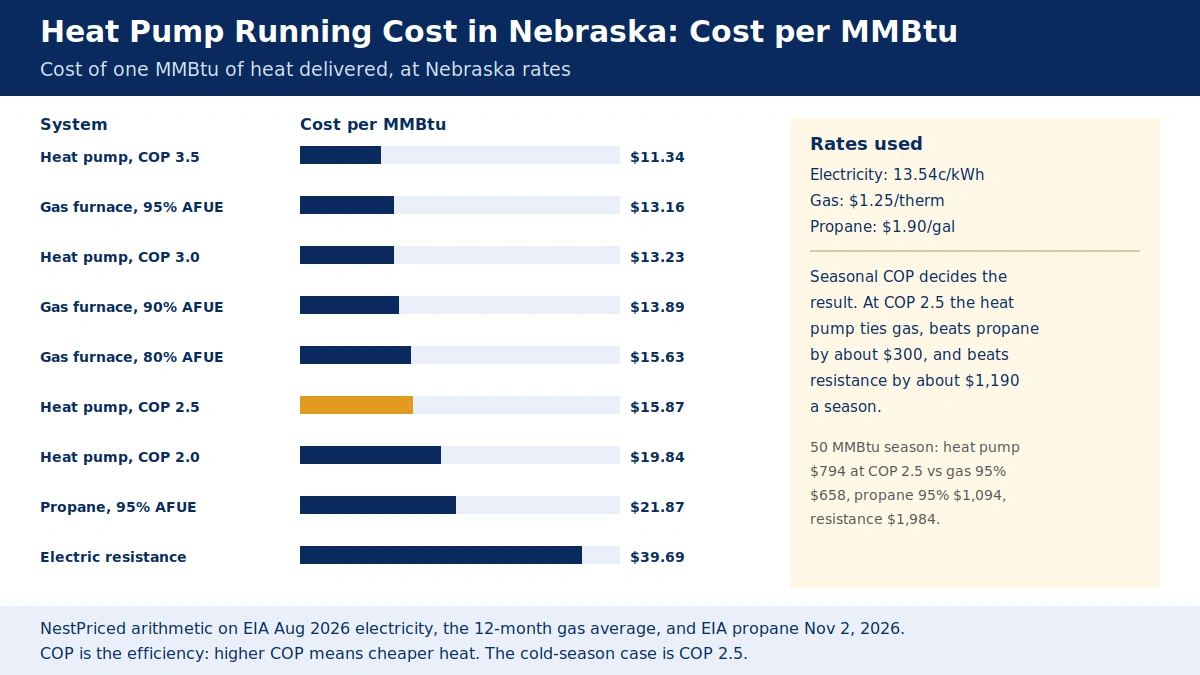
Nebraska’s fuel prices make the running-cost answer more interesting than the national story, and more honest than most sales pitches. Electricity here is cheap, at 13.54 cents per kilowatt-hour on the latest EIA average, the seventh cheapest in the country and about 25 percent under the national average. Gas is cheaper still, at about $1.25 per therm on a 12-month average, about 26 percent under the national average.
A heat pump wins by using electricity efficiently, delivering two to three units of heat per unit of electricity. Gas wins by starting cheap, so even a furnace that wastes 5 percent of its fuel delivers heat at a low price. Which one wins in a given Nebraska house depends on the heat pump’s seasonal efficiency, the furnace’s efficiency, and the fuel the house heats with today, and the tables below show all three variables instead of hiding two of them.
The rates behind the math are stated here so the reader can redo every number with the rates on their own bill. Electricity at 13.54 cents per kilowatt-hour is the EIA average residential price for August 2026, the latest month published, and the 12-month average of 12.7 cents would make the heat pump figures about 6 percent lower. Gas at $1.25 per therm is the 12-month average to July 2026, all charges included, and winter delivered prices run a little lower, near $1.00–$1.17 per therm.
Propane at $1.90 a gallon is the EIA residential price for the week ending November 2, 2026, and the 2025–2026 heating-season average of $1.61 a gallon is shown as the lower case. Summer gas prices per thousand cubic feet spike far above these figures, because fixed charges spread over tiny summer volumes, and no heating math should ever use a July gas price. The figures below use heating-season thinking throughout.
The fair unit for comparing fuels is the cost of one million BTU of heat delivered into the rooms, written as one MMBtu. A furnace’s AFUE rating says what share of the fuel’s heat reaches the rooms: a 95 percent AFUE furnace delivers 95 cents of every fuel dollar as heat, and an 80 percent furnace delivers 80 cents. A heat pump’s COP says how many units of heat it delivers per unit of electricity: a COP of 2.5 delivers two and a half units of heat per unit of power.
| Heat source | Efficiency assumed | Fuel price | Cost per MMBtu delivered |
|---|---|---|---|
| Heat pump, COP 3.5 (mild weather) | 3.5 | 13.54¢/kWh | $11.34 |
| Heat pump, COP 3.0 | 3.0 | 13.54¢/kWh | $13.23 |
| Gas furnace, 95% AFUE | 95% | $1.25/therm | $13.16 |
| Gas furnace, 90% AFUE | 90% | $1.25/therm | $13.89 |
| Heat pump, COP 2.5 (cold-season average) | 2.5 | 13.54¢/kWh | $15.87 |
| Gas furnace, 80% AFUE (older) | 80% | $1.25/therm | $15.63 |
| Propane furnace, 95% AFUE, $1.61/gal | 95% | $1.61/gal | $18.53 |
| Heat pump, COP 2.0 (deep cold) | 2.0 | 13.54¢/kWh | $19.84 |
| Propane furnace, 95% AFUE, $1.90/gal | 95% | $1.90/gal | $21.87 |
| Propane furnace, 80% AFUE, $1.90/gal | 80% | $1.90/gal | $25.97 |
| Electric resistance heat, COP 1.0 | 100% | 13.54¢/kWh | $39.69 |
The table is NestPriced arithmetic on the stated rates, and it is the most important table in this article. Read it from the top: in mild weather a heat pump is the cheapest heat in Nebraska, and in deep cold at a COP of 2.0 it costs more per unit of heat than a new gas furnace. The seasonal answer lands between those two rows, and the seasonal COP is the number that decides it.
A seasonal COP of 2.5 is the central case used below, which assumes a cold-climate unit in a Nebraska winter with some backup-heat hours pulling the average down. A standard unit in a leaky house can season closer to 2.0, and a cold-climate unit in a tight house with a low balance point can season above 3.0. The reader’s own seasonal COP is a property of the house, the unit, and the winter together, and no brochure figure replaces the installer’s calculation.
The season table scales the per-unit figures to a 50 MMBtu heating season, which is a round scenario close to the heat a Nebraska home actually needs. The federal energy survey puts average Nebraska gas space-heating use at about 51 MMBtu of fuel input per gas-heated household, which after furnace losses lands near the scenario’s delivered heat. The scenario is labeled as a scenario, and the reader with a bigger house or a colder microclimate scales it up.
| Heating season (50 MMBtu delivered) | Season fuel cost | Vs heat pump at COP 2.5 |
|---|---|---|
| Heat pump, seasonal COP 3.0 | $661 | $133 less |
| Gas furnace, 95% AFUE | $658 | $136 less |
| Heat pump, seasonal COP 2.5 | $794 | baseline |
| Gas furnace, 80% AFUE | $781 | $13 less |
| Propane furnace, 95% AFUE, $1.61/gal | $927 | $133 more |
| Propane furnace, 95% AFUE, $1.90/gal | $1,094 | $300 more |
| Propane furnace, 80% AFUE, $1.90/gal | $1,299 | $505 more |
| Electric resistance heat | $1,984 | $1,190 more |
The honest reading has three parts, and each part belongs to a different Nebraska household. Against propane, the heat pump saves real money: about $300 a year against a new 95 percent propane furnace at current prices, and about $505 a year against an older 80 percent propane furnace. Against electric resistance heat, the heat pump saves about $1,190 a year, which is the strongest fuel case in the state and the reason electric-heated homes top the priority list.
Against gas, the fuel math is a tie or a small loss. A heat pump at a seasonal COP of 2.5 costs about $136 a year more to run than a new 95 percent gas furnace, and about $13 a year more than an older 80 percent gas furnace, which is effectively a dead heat. A heat pump that seasons at a COP of 3.0 ties the new gas furnace almost exactly, at $661 against $658. No honest Nebraska guide can promise a gas home fuel savings from a heat pump alone at today’s rates.
That tie is not the end of the gas-home story, because fuel is not the whole system cost. The heat pump also replaces the air conditioner, so a gas home facing both a furnace replacement and an AC replacement compares one $6,510–$10,910 system against a $8,300–$14,060 pair, and the install saving is real money before fuel enters the question. A dual-fuel system keeps the gas furnace for the coldest hours and lets the heat pump carry the mild weather where its COP is highest, which is the configuration that best fits Nebraska’s rate structure.
Future fuel prices cut both ways and belong in the decision as uncertainty, not as a forecast. Gas prices move with commodity markets and with the gas cost adjustment on the bill, and electricity prices in Nebraska rose 5.8 percent in the year to August 2026. A buyer who expects gas to rise faster than electricity will weight the heat pump case more heavily, and a buyer who expects the current gap to hold will weight the install saving and the cooling replacement more heavily. Neither expectation is priced into the tables above.
OPPD’s Rate 115 deserves a line of its own, because it changes the electricity price for the exact hours a heat pump works hardest. The rate gives qualifying heat pump customers a lower winter electric rate from October through May, for systems of 14 SEER or better that supply at least half the home’s heating load with an outdoor sensor or thermostat setting of 20 degrees or lower. The dollar rate was not verified in this research, so no saving is claimed for it here, and an OPPD customer should get the Rate 115 winter rate in writing and redo the season table with it before deciding.
Cooling costs complete the picture in one line: the heat pump is the air conditioner, so summer running costs are the cooling costs of a system rated by its SEER2, and a high-SEER2 heat pump cools more cheaply than the aging AC it replaces. No separate Nebraska cooling-cost figure is asserted here, because cooling use varies too much by house and by summer to price honestly in one number. The system comparison in the payback section carries the cooling value as the avoided AC replacement, which is the honest way to count it.
Our heat pump vs furnace cost guide works the head-to-head choice nationally, our furnace replacement cost guide prices the gas alternative alone, and our heat pump running cost guide carries the rate-scenario method in full. The Nebraska numbers above are the local application of that method, at Nebraska rates, with the tie against gas stated plainly.
SEER2, HSPF2 and Cold-Climate Ratings: What the Numbers Mean
Heat pump ratings read like alphabet soup until each letter is explained once, and then they read like a price tag. This section explains each rating in plain words, gives the legal minimums, gives the tiers that earn rebates, and shows how to read the one certificate that settles every rating argument.
SEER2 stands for Seasonal Energy Efficiency Ratio 2, and it measures cooling efficiency over a whole season. The 2 marks the newer test method that has applied since 2023, with tougher test conditions than the old SEER test, so a SEER2 number runs lower than the SEER number for the same machine and the two must never be compared directly. Higher SEER2 means cheaper cooling, and the gap between 14.3 and 18 SEER2 is real money over a hot Nebraska summer.
EER2 measures cooling efficiency at one hot condition rather than over a season, and it matters most on the hottest afternoons, when Douglas County’s heat-wave risk runs relatively high and a unit sized by guesswork short-cycles. HSPF2 stands for Heating Seasonal Performance Factor 2, and it measures heating efficiency over a whole season. Higher HSPF2 means cheaper heating, and in Nebraska the HSPF2 deserves at least as much attention as the SEER2, because the heating season is longer and harder than the cooling season.
COP, the Coefficient of Performance, measures efficiency at one outdoor temperature rather than over a season. A COP of 3.0 at 47 degrees and a COP of 2.0 at 5 degrees describe the same machine in different weather, and the 5-degree COP is the number that decides Nebraska winter running costs. The seasonal ratings (SEER2, HSPF2) describe the average, and the COP at a stated temperature describes the moment, and a Nebraska buyer needs both.
The federal minimums set the floor, and anything sold today must clear them. Split-system heat pumps must meet 14.3 SEER2 and 7.5 HSPF2 in all regions under the Department of Energy rules effective January 1, 2023. Split-system central air conditioners in the North region, which includes Nebraska, must meet 13.4 SEER2 for systems under 45,000 BTU.
The floor is a legal minimum, not a recommendation. A 14.3 SEER2, 7.5 HSPF2 heat pump is the cheapest system a contractor may install, and it is also the system most likely to lean on backup heat through a Nebraska January. Every rebate program in the state sets its bar above the floor, which is the market telling the buyer where the value starts.
| Tier | SEER2 | HSPF2 | What it means in Nebraska |
|---|---|---|---|
| DOE federal minimum (heat pump) | 14.3 | 7.5 | Legal floor; expect heavy backup-heat use |
| ENERGY STAR (split-system heat pump) | 15.2 | 7.8 | Entry efficiency tier; EER2 11.0 also required |
| OPPD rebate threshold | 15.2 | n/a | Minimum for any OPPD HVAC Smart rebate |
| ENERGY STAR cold climate (ducted) | 15.2 | 8.1 | Plus COP 1.75+ and 70% capacity at 5°F |
| ENERGY STAR cold climate (ductless) | 15.2 | 8.5 | Plus COP 1.75+ and 70% capacity at 5°F |
| NEEP cold-climate floor (ducted) | 14.3 | 7.7 | Plus variable-capacity compressor, COP 1.75+ at 5°F |
| NEEP cold-climate floor (ductless) | 15.0 | 8.5 | Plus COP 1.75+ at 5°F, capacity reported at 5°F |
| EnergyWise top tier | 18.1+ | 7.5 | $1,200 incentive, or variable capacity at any tier |
The rebate tiers double as a shopping ladder, because each program pays more for higher ratings. OPPD pays $265 at 16 SEER, $375 at 17, $450 at 18–19, and $525 at 20-plus and for all heat pumps, so the heat pump buyer collects the top OPPD figure at any qualifying rating. EnergyWise pays $400, $800, or $1,200 by SEER2 band, and pays the top $1,200 for any variable-capacity system with manufacturer literature proving it is inverter-driven.
That last rule is the most useful line in the EnergyWise table for a Nebraska buyer. A variable-capacity cold-climate system earns the top incentive without needing an 18.1 SEER2 rating, because the program rewards the compressor behavior that holds capacity in cold weather. The buyer should still compare the 5-degree capacity across bidders, but the rebate structure points the same way the engineering does: toward the inverter machine.
The AHRI certificate settles every rating argument, and the buyer should demand it before signing. AHRI, the Air Conditioning, Heating and Refrigeration Institute, certifies matched combinations of indoor and outdoor units, and the certificate lists the SEER2, EER2, and HSPF2 for the exact combination being quoted. A rating quoted from the outdoor unit alone, or from a brochure for a different indoor match, is not the rating of the system being sold.
Every rebate program in Nebraska requires the AHRI certificate, and EnergyWise caps the incentive at $100 without one, which tells the buyer how seriously the programs take it. The certificate also carries the rated capacity at 47 degrees, which is the starting point for the expanded performance table that shows capacity at 17 and 5 degrees. Together the two documents answer the only rating questions that matter: how efficient is this exact system, and how much heat does it still deliver when Nebraska gets cold.
Paying for a higher tier is a running-cost decision, not a virtue decision, and the running-cost table is the tool for it. Moving from a seasonal COP of 2.5 to 3.0 saves about $133 a year on the 50 MMBtu scenario, so a $1,000 tier premium pays back in about seven and a half years on fuel alone, before counting the higher rebate and the cooler summer running costs. Moving from a standard unit to a cold-climate unit is a different purchase: it buys capacity on cold nights and fewer backup-heat hours, and its payback runs through the backup-heat hours it avoids, which the installer should estimate from the Manual J load and the balance point.
A final rating trap deserves a warning. Some quotes still show old SEER and HSPF numbers beside new SEER2 and HSPF2 numbers, and some show a rating for a different indoor unit than the one being installed. The buyer who checks the AHRI certificate for the exact quoted combination, and who confirms the numbers are SEER2 and HSPF2 rather than the retired SEER and HSPF, avoids both traps in one check. Our best heat pump brands cost guide compares manufacturers by tier and warranty, with the same certificate check applied to every brand.
Dual-Fuel Systems and Backup Heat: How Nebraska Homes Stay Warm Below Zero
Every Nebraska heat pump needs a plan for the hours below its balance point, and the plan is either electric resistance strips or a gas furnace. The choice between them is one of the biggest running-cost decisions in this guide, because the two backups cost wildly different amounts per unit of heat, and the hours they run are the coldest and most expensive hours of the year.
Electric backup heat is a set of resistance heating strips inside the air handler, the same technology as a toaster, at a COP of exactly 1.0. At Nebraska rates it costs $39.69 per MMBtu, which is two and a half times the cost of heat-pump heat at a COP of 2.5 and three times the cost of gas heat from a 95 percent furnace. A cold snap that runs the strips for a week can add a visible jump to the electric bill, and a whole winter of strip heat can erase the heat pump’s fuel saving entirely.
Strip heat is not a defect. It is the simplest, cheapest, and most reliable backup ever fitted to a heat pump, it needs no gas line and no flue, and it tempers the air during defrost cycles. Its cost only becomes a problem when it carries a large share of the season’s heat, which happens when the heat pump is undersized, when the house is leaky, or when the thermostat calls for strip heat too eagerly. All three causes are specification and setup questions, and all three are fixed before signing or at commissioning, not after the first bill.
A gas furnace as backup changes the economics completely. In a dual-fuel system, the heat pump heats until the outdoor temperature falls to a setpoint, the controls hand over to the gas furnace, and the furnace carries the deep cold at $13.16 per MMBtu from a 95 percent unit. The heat pump never runs in the weather where its COP is worst, the strips never run at all in most dual-fuel setups, and the house keeps the gas heat Nebraskans know for the coldest nights.
The setpoint, usually called the switchover temperature or balance point setting, is chosen by the installer from the load calculation, the heat pump’s capacity curve, and the fuel prices. Typical contractor settings run roughly 25–35 degrees, which is a statement about common practice, not a measured Nebraska figure, and the right setting for a given house depends on where the heat pump’s capacity curve crosses the house’s heat-loss curve. Set it too high and the gas furnace does work the heat pump could have done more cheaply. Set it too low and the heat pump runs past its useful range with strip heat filling the gap.
The economic balance point and the thermal balance point are different settings, and the distinction is worth one paragraph. The thermal balance point is the temperature where the heat pump alone can no longer cover the load, which is a physics fact about the house and the unit. The economic balance point is the temperature where gas heat becomes cheaper than heat-pump heat, which is a price fact about the two fuels.
In Nebraska, with gas at $1.25 a therm and electricity at 13.54 cents, the economic balance point sits higher than in most states, because gas is so cheap. A dual-fuel owner who sets the switchover at the economic balance point will burn gas on nights when the heat pump could still have kept up, and will save money doing it. A dual-fuel owner who sets it at the thermal balance point will run the heat pump as far as physics allows, and will pay a little more for the privilege. The installer should state which balance point the setting follows, and the owner should know the choice was made deliberately.
Who dual-fuel suits follows from the fuel map. It suits the 59 percent of Nebraska homes already on piped gas, especially houses with a gas furnace that has years of life left, a gas line already at the house, and no wish to upsize the electric panel for strip heat. It suits houses in the coldest microclimates, houses with high heat loss, and owners who want the psychological comfort of a furnace on a minus 10 night.
Who all-electric suits follows just as plainly. It suits the 32 percent of homes already heating with electricity, where the heat pump replaces resistance heat or an old electric furnace at a large fuel saving and no gas line exists to keep. It suits the 7 percent of homes on propane, where the heat pump replaces the most expensive fuel in the state and the propane tank can stay as a dual-fuel backup or go away entirely. It suits tight, well-insulated houses with a low balance point, where a cold-climate unit covers nearly the whole season alone.
Propane dual-fuel deserves a line of its own, because it is the configuration rural Nebraska actually buys. A heat pump with a propane furnace backup gives the house cheap heat-pump heat in mild weather and propane heat in deep cold, at $21.87 per MMBtu from a 95 percent propane furnace at current prices. That is still far cheaper than strip heat at $39.69, and it keeps the propane tank and furnace as a known quantity. EnergyWise explicitly counts heat pumps with fossil-fuel backup furnaces as eligible for its insulation incentive, which is the program recognizing how common the configuration is.
The controls decide whether any of this works as designed. A dual-fuel system needs a thermostat or outdoor sensor that manages the handover, locks out the heat pump below the setpoint, locks out the strips except in emergencies or defrost, and calls the right heat source at the right temperature. OPPD’s Rate 115 requires an outdoor sensor or thermostat setting of 20 degrees or lower, which is the utility’s way of insisting the controls are set up rather than left at factory defaults.
What to specify on the quote is a short list with large consequences. Specify the backup type and size in writing, the switchover temperature and which balance point it follows, the strip-heat lockout behavior, and the defrost tempering arrangement. Specify who programs the controls at commissioning and who shows the owner how the handover works. A dual-fuel system with unprogrammed controls is two heaters arguing, and an all-electric system with eager strips is a resistance heater wearing a heat pump’s clothes.
Ductwork in Older Nebraska Homes: The Hidden Line on the Quote
Ductwork is the largest single extra line on both verified Nebraska city pages, and it is the line most likely to be missing from the cheapest quote. New or extended ductwork runs $4,230–$7,160 for the job in Omaha and $4,090–$6,970 in Lincoln, with materials alone at $1,380–$3,450. A quote that never mentions the ducts has not priced the job the house actually needs, or has assumed ducts that may not exist in the condition the new system requires.
Heat pumps ask more of ducts than gas furnaces do, for a plain physical reason. A gas furnace delivers a small volume of very hot air, while a heat pump delivers a larger volume of moderately warm air, so the heat pump needs more airflow through the same ducts to move the same amount of heat. Ducts sized tightly for a furnace can starve a heat pump of air, which raises the noise, lowers the delivered capacity, and pushes the system toward backup heat on nights when the unit itself could have kept up.
Leaks make the problem worse in exactly the places Nebraska houses hide them. Ducts run through attics that hit 140 degrees in summer and crawl spaces that freeze in winter, and every leak in those runs dumps heated or cooled air where nobody lives. No Nebraska duct-leakage statistic is asserted here, because none was verified, but the mechanism needs no statistic: air that leaks out of a supply duct in an attic is heat the heat pump moved for the roof, and air that leaks into a return duct in a crawl space is cold air the heat pump must heat twice.
The age of the housing stock makes the duct question a Nebraska question rather than a generic one. The median Omaha home was built in 1973, with 61 percent of homes dating from before 1980, and the median Lincoln home was built in 1982, with 47 percent from before 1980. Older ducts in those houses may be undersized, uninsulated, jointed with tape that has dried out, or run in layouts that made sense for a furnace and a different floor plan.
A duct assessment belongs on every quote for a house older than the duct standards, and it should answer four questions in writing. Are the ducts sized for the airflow the new heat pump needs at the design condition. Where do they leak, and how much of the airflow is lost. Are they insulated to a level that keeps the air warm through an attic in January. And are the supply and return grilles placed and sized so every room gets its share of the Manual J load.
The answers decide which of three scopes the job carries. A house with sound, well-sized ducts needs only a new unit, a new coil or air handler, and a startup. A house with leaky or undersized ducts needs sealing, insulation, or selected duct replacement added to the quote as priced lines. A house with no usable ducts, or with ducts that cannot be brought to the needed airflow at any sane price, is a candidate for a ductless multi-zone system instead, at $6,160–$11,280 for three heads.
Sealing and insulation pair with the heat pump rebates in ways the buyer should use. EnergyWise pays $0.30 per square foot up to $600 for attic insulation in electric-heated homes, including homes with heat pumps backed by fossil-fuel furnaces, where the existing insulation averages 6 inches or less and at least 6 inches or R-19 is added. LES pays up to $1,500 for sealing and insulation, at $0.80 per square foot for walls and $0.50 for attics, with blower-door tests before and after.
Insulation also lowers the balance point, which is the gift that keeps giving through every winter after the install. A tighter house loses heat more slowly, so the heat pump keeps up into colder weather, the backup heat runs fewer hours, and the seasonal COP rises. Our attic insulation cost guide prices the insulation side of the same house, and insulation plus the heat pump should be quoted as one heating decision, not as two jobs that never meet.
The electrical panel is the second hidden line, and it travels with the duct question in older homes. A 200-amp panel upgrade runs $2,160–$3,410 in Omaha and $2,120–$3,360 in Lincoln, with materials at $690–$1,490. A heat pump with electric backup strips draws far more current than the gas furnace and air conditioner it replaces, and a 100-amp service that served a gas house for decades may not carry the new load.
Not every house needs the upgrade, and the quote should say why or why not from a load calculation on the panel, not from a guess. A dual-fuel house with a gas furnace backup draws far less than an all-electric house with 10 or 15 kilowatts of strip heat, and a house with a 200-amp service already in place needs no upgrade at all. The panel question, like the duct question, is answered by measurement on the quote, and a quote that skips both measurements is a quote with change orders waiting in it.
Rebates and Help in Nebraska in 2026: OPPD, NPPD, LES, and the $0 Federal Credit
Nebraska has no statewide heat pump rebate and no state tax credit, and that single fact organizes this whole section. The money a Nebraska buyer can collect depends on the name on the electric bill, because three separate utility programs cover three separate territories, and no house collects from two of them. The federal money that used to sit on top of the utility money is gone for 2026, and the federal rebate programs that were supposed to replace it have not launched in Nebraska.
The map comes first, because everything else follows from it. OPPD, the Omaha Public Power District, serves Omaha, Bellevue, and a 13-county area of southeast Nebraska, and runs the HVAC Smart rebate. NPPD, the Nebraska Public Power District, serves its retail customers and a large wholesale network of local public power districts and cooperatives through the EnergyWise program. LES, the Lincoln Electric System, is the exclusive retail provider for Lincoln and surrounding communities in Lancaster County, and runs the Sustainable Energy Program with the City of Lincoln’s combo incentive on top.
A buyer who does not know which utility serves the house should stop here and read the electric bill, because every figure below belongs to one territory and none of them travels. An Omaha quote that promises an EnergyWise incentive is wrong, a Lincoln quote that promises an OPPD rebate is wrong, and a Grand Island quote that promises either one is wrong until the city utility confirms it in writing.
OPPD HVAC Smart is open, and its heat pump figure is $525. The program page, opened November 15, 2026, carries an “AVAILABLE, rebates are still open” notice and a tier table: $265 at 16 SEER (15.2 SEER2), $375 at 17 SEER (16.2 SEER2), $450 at 18–19 SEER, and $525 at 20-plus SEER and for all heat pumps, including geothermal units. The system must be new, rated 15.2 SEER2 or higher on its AHRI certificate, and installed in a home served by OPPD on a residential rate, conditioning living space.
Applications must be submitted within the current calendar year and within four months of the installation date, with the AHRI certificate and the paid contractor invoice. The program terms, updated October 2026, add that systems under 2 tons receive half the standard rebate unless they condition the entire structure, that rebates are not retroactive and are paid only while funding lasts, and that processing takes up to six weeks. An older OPPD FAQ page still shows $265 and $375 wording without the heat pump tier, and the program page’s tier table governs where the two differ.
OPPD’s Rate 115 rides alongside the rebate and is worth more than the rebate over time for many households. Qualifying heat pump customers get a lower winter electric rate from October through May, for systems of 14 SEER or better that supply at least half the home’s heating load, with an outdoor sensor or thermostat setting of 20 degrees or lower. The dollar rate was not verified, so no saving is claimed here, and the buyer should get the winter rate in writing and redo the running-cost math with it.
NPPD EnergyWise pays $400–$1,200 for air-source heat pumps, by efficiency band, with a variable-capacity shortcut to the top tier. The incentive table, verified on the EnergyWise residential page on November 15, 2026, pays $400 for 15.2–16 SEER2, $800 for 16.1–18 SEER2, and $1,200 for 18.1-plus SEER2 or for any variable-capacity system with manufacturer literature proving it is inverter-driven. All three bands require 11.7 EER2 and 7.5 HSPF2.
Ductless mini-splits earn $400 at 16-plus SEER2, $600 for variable capacity, and $1,200 for a multi-head system of 3 tons or more with variable capacity. Geothermal earns $2,400 at any EER for one- and two-stage systems, and $3,300 for variable-capacity systems meeting 35-plus EER and 5.0-plus COP at partial load. An AHRI certificate is required for every tier, and without one the maximum incentive falls to $100, which is the program’s way of saying the certificate is not optional.
EnergyWise offers a choice the other programs do not: the cash incentive or a low-interest Dollar and Energy Saving Loan instead, administered through the state energy office. The loan option can also cover the furnace, the thermostat, the wiring, and the ductwork that goes with the heat pump, which makes it the better choice for a job with large add-on lines. Homes built within the last five years cannot use the loan option but can still collect the incentive.
The program’s scale is real. In 2025 EnergyWise paid $1.84 million across 1,147 high-efficiency heat pump incentives, inside a $2.6 million program budget, which means the average heat pump incentive ran about $1,600 across all system types including geothermal. The incentive comes from the homeowner’s local electric utility, the application is signed by the dealer and the homeowner, and NPPD reserves the right to spot-check installations.
LES and the City of Lincoln combine for the largest stack in the state, up to $3,800, with conditions and a first-come warning. The LES Sustainable Energy Program‘s 2026 funds run January 1 through December 31, 2026, first-come first-served until expended, from a $2.2 million incentive pool announced in February 2026. The LES incentive arrives as a credit on the contractor invoice through a participating contractor, and the LES program page does not state the heat pump dollar amount on its main page.
The $800 LES heat pump figure comes from the City of Lincoln’s announcement of August 28, 2025, which describes the combined program: $500 to replace a heat pump at least five years old, $1,500 to replace an air conditioner, up to $3,000 per household for low- to moderate-income residents, all combinable with the LES $800 incentive, for a combined maximum of $3,800. The 2025 round carried a $250,000 city fund, and the combined program was described as available again from September 1, 2026, with eligibility rules restated in October 2026 program material.
Eligibility for the combo requires an AHRI-rated system that is either inverter-driven or meets SEER2 15.2 and EER2 12, replacing a unit at least five years old, in an owner-occupied or rental residence. Low- and moderate-income households must be approved by the Urban Development Department before installation and must use a participating contractor. Ground-source systems, new construction, and mobile homes are excluded. One tracker puts the low-income limit at or below 80 percent of Lincoln area median income, a single-source figure the buyer should confirm with the city rather than rely on here.
The first-come warning is not boilerplate. A $250,000 city fund at $500–$3,000 per household covers roughly 80–500 households depending on the mix, and a program that opens September 1 can exhaust its funds well before December 31. A Lincoln buyer should confirm the current round still has funds, in writing, before budgeting the combo figure into the purchase decision, and should treat any contractor promise of the full $3,800 as unverified until the city or LES confirms it.
Smaller programs fill the gaps between the big three, and each one needs a local check. The Municipal Energy Agency of Nebraska offers $400–$3,000 high-efficiency heat pump incentives to residential customers of its wholesale participants for the 2025–2026 fiscal year, first-come first-served, on a single 2025 announcement that was not re-verified for 2026. It matters to some municipal-utility towns and to none of the four cities priced in this article as a verified matter.
Grand Island Utilities, the city-owned utility serving Grand Island, had no heat pump incentive located in this research. That is a statement about what was found, not a statement that none exists, and the Grand Island buyer checks with the city utilities department directly. No other Nebraska municipal rebate is asserted in this article, and any contractor who names one should produce the program page.
The federal help for a 2026 Nebraska heat pump totals $0, and the shortness of that sentence is the point. Congress ended both credits in the One Big Beautiful Bill Act, Public Law 119-21: the Section 25C energy efficient home improvement credit and the Section 25D residential clean energy credit both stop for property placed in service after December 31, 2025, and IRS Fact Sheet FS-2025-05 confirms the cutoff. A homeowner-owned heat pump or geothermal system installed in Nebraska in 2026 earns no federal tax credit. For a 2026 install the federal share is zero dollars, because the credits ended rather than shrinking or slipping to a later year.
Strike any federal credit line seen on a 2026 quote: the rules behind it expired on December 31, 2025, and the bidder should reissue the quote clean. For the full credit-by-credit picture, see our federal energy tax credits guide, which sorts the ended credits from the surviving ones and prices what remains. The Section 25C credit had paid up to $2,000 a year for a qualifying heat pump, and the Section 25D credit had paid 30 percent with no cap for geothermal, and both figures still circulate on stale web pages and stale quotes.
One federal route survives, through leasing rather than ownership. The Section 48E commercial credit runs through December 31, 2027, and a leasing company or power-purchase provider that owns the system can claim it and pass some or all of the value through in the lease pricing. No Nebraska lease price was verified in this research, so no saving is claimed for the route, and a buyer considering a lease should compare the total lease payments against the owned-system price net of utility rebates, with the buyout and removal terms in writing.
The federal rebate programs have not launched in Nebraska either. The Home Energy Rebates program, covering the HEAR electrification rebates and the HOMES whole-home rebates, is listed by the Nebraska Department of Water, Energy, and Environment as “Preparing Application” for both programs, a status verified against the state page on November 4, 2026, and corroborated by the national association’s September 2026 status. No Nebraska homeowner can claim a HEAR or HOMES rebate in 2026, and no contractor can reserve one.
The federal caps are worth knowing for planning only: HEAR pays up to $8,000 for a qualifying heat pump, income-qualified and point-of-sale, inside a $14,000 per-household total across measures, and HOMES pays up to $8,000 based on modeled energy savings. Federal rule changes effective May 29, 2026, narrowed HEAR to electric-to-electric upgrades, so it no longer pays to replace gas, oil, or propane equipment with electric equipment, and it requires insulation and air sealing before heating and cooling upgrades unless the home already meets the state level. A Nebraska program, whenever it launches, will carry those rules, and a gas home should not plan around a future HEAR rebate for a fuel switch.
Two more Nebraska help routes close the section, and both run on need rather than on address. The Heating and Cooling Repair and Replacement Assistance program, run by the state energy office through the federal low-income energy assistance program, may pay up to $5,000 to repair, purchase, or install an eligible heating or cooling system for qualifying households, and the state health department separately offers furnace and air conditioner repair or replacement up to $750. Eligibility runs through the two departments, and the buyer who may qualify should call before signing anything, because the assistance can change which system the household can afford.
The Dollar and Energy Saving Loans program finances the job rather than rebating it, and it is the most underused help in the state. Low-interest loans run through more than 200 Nebraska lenders, with rates to the borrower of no more than 1.5 percent for qualifying NPPD loans and no more than 3 percent for qualifying OPPD loans, and general tiers up to 5 percent, with terms up to 15 years for HVAC work. More than 31,500 projects totaling over $418 million have been financed since 1990.
The loan rule that matters is timing: improvements may not be contracted for or begun until the state energy office approves the project and commits to the lender, except for emergency heating replacements from September through May when equipment fails or is red-tagged. A buyer who signs the install contract first and applies for the loan second has the order backwards, and the loan may not follow. The final annual percentage rate varies by lender and fees, so the buyer compares the lender’s written APR, not the program’s headline rate.
Installation, Permits and Licensing: Who Can Legally Do the Work
Nebraska does not license HVAC contractors at the state level, and that sentence surprises buyers who assume every trade carries a state license. There is no statewide mechanical contractor license, no statewide general contractor license, and no state trade exam for heating and cooling work. The one construction trade Nebraska licenses statewide is electrical, through the State Electrical Division, and everything else in the HVAC job is governed by state registration plus city licensing and city permits.
The state layer is registration, and registration is not a competency test. Under the Contractor Registration Act, every contractor and subcontractor doing business in Nebraska must register annually with the Nebraska Department of Labor, Labor Standards Division, at $40 a year from August 1, 2026, with a separate number for each business name. Registration requires no exam and no experience, and small exemptions cover earnings under $5,000 a year from construction and work on the owner’s own property.
The Department of Labor runs a free lookup where any registration can be checked before signing, and the check is worth doing even though registration proves so little. A contractor who has not bothered to register has not cleared the lowest bar in the system, and a contractor who has registered has at least filed, paid, and put a name and address on record. The registration number belongs on the contract, beside the city credential that does the real vetting.
The electrical layer is a real license, and it reaches into every heat pump job. The State Electrical Act requires a license to wire for or install electrical equipment for another person, and the State Electrical Division issues a Heating, Air Conditioning, and Refrigeration special license at $37.50 per license year for the electrical work on HVAC systems. A heat pump install that adds backup strips, a new disconnect, or a panel upgrade is electrical work, and the person doing it needs the credential for it.
The refrigerant layer is federal. EPA Section 608 certification is required nationally for anyone who handles refrigerants, which covers every heat pump install, every recharge, and every compressor replacement. It is separate from state registration and separate from city licensing, and the buyer should confirm the installing technician holds it, because an uncertified refrigerant handler is working outside federal law regardless of any state or city paper.
Omaha runs the most detailed local system of the four cities, and its rules are written in the city code. Omaha Municipal Code Chapter 40, Article II requires a permit from Permits and Inspections before any air conditioning or air distribution system or equipment is installed, altered, repaired, or replaced in Omaha and its extraterritorial area, and the work must be done under a city master air conditioning and air distribution license. An owner living in a single-family home may do the work without a license after notifying the city and passing inspection.
Minor repairs that do not change ductwork or plenums or add registers need no permit in Omaha, which covers a service call but not a system replacement. Gas piping and fuel-burning appliance connections may fall under separate code articles, which matters on a dual-fuel job where the furnace side of the system touches gas work. The permit fee was not published in the sources retrieved, so it is confirmed at application, and the contract should state who pulls the permit and who books the inspection.
Lincoln runs its own mechanical licensing through the Department of Building and Safety, with apprentice, journeyman mechanical technician, and master mechanical contractor credentials, and the department enforces the Lancaster County construction codes jointly with the county. The Lincoln permit fee for an HVAC job was not published in the sources retrieved, and one secondary source’s registration and exam fees were not corroborated, so no Lincoln fee is asserted here. The buyer confirms the credential and the permit requirement with Building and Safety for the job address, and puts the answer on the quote.
Bellevue and Grand Island follow the verify-locally rule. No city-specific permit rule for a heat pump changeout was confirmed from a primary source for either city in this research, and this article asserts no fee and no exemption for either one. The building department for the job address is the only authority that matters, and a contractor who says permits are never needed anywhere in Nebraska is a contractor who has not worked across the state.
Sizing law deserves a paragraph of its own, because it is the rule that most directly protects the buyer. The residential code requires heating and cooling equipment to be sized from an ACCA Manual J load calculation, with equipment selected under ACCA Manual S, which is why this article repeats the load-calculation requirement in nearly every section. A contractor who sizes from the old unit, from floor area, or from a walk-through guess is not following the code’s method, whatever the permit desk does or does not inspect.
What a good install includes is a list the buyer can hold against any quote. It includes the equipment model and the AHRI certificate, the documented load calculation, the duct and electrical scope, the backup-heat scope and switchover setting, the removal of the old equipment, the startup testing and commissioning, the operating instructions for the owner, and the permit and inspection responsibility. EnergyWise pays the installing dealer a $50 qualified-installation incentive for complete startup testing and a review of potential issues with the customer, which is the program’s way of paying for the commissioning step that cheap quotes skip.
The lien statute is the final safeguard in this section, and it keeps working for the buyer after the last payment clears. Anyone who works on an HVAC replacement or supplies material for it and is not paid may be able to file a mechanic’s lien against the house, and Nebraska treats an owner-occupied home with one to four units as protected: a subcontractor’s lien is limited to what the owner still owed the contractor when the owner received its notice, under Nebraska Revised Statutes Section 52-136. Payments made in good faith before that notice are protected, so any notice of a right to assert a lien should be read before the next payment is made.
With a heat pump job, the supply house that sold the condenser and air handler is the lien claimant to watch for, and the buyer should ask who supplied the equipment and whether the supplier has been paid before making the final payment. The lien summary here follows a secondary legal summary checked in November 2026, and the buyer with a lien notice in hand should get legal advice rather than rely on a cost guide.
Timing the job around Nebraska weather saves money and stress in the same way it does for any HVAC work. May and September are the mildest months in both Omaha and Lincoln by degree days, which makes them the easiest months to be without the system for a day and the best months to plan an install. A January breakdown forces an emergency replacement at emergency prices with whatever unit is in stock, and a spring install competes with storm-repair work for the same crews.
The storm-chaser test from the roofing world has an HVAC version, and it is a list rather than a feeling. The bidder who sizes without a calculation, who quotes a federal credit, who promises a rebate from the wrong utility, who cannot produce an AHRI certificate or a NEEP listing, or who presses for a signature before the load calculation is done, is following a script. Run each bidder through the checklist at the end of this guide before any signature, and let the bidder who produces the documents win the job.
Tornadoes, Hail, Blizzards and Ice: Protecting the Outdoor Unit
Nebraska weather tests the outdoor unit in every season, and the unit sits outside through all of it. The same machine that must hold capacity at 7 below zero in January must survive a June afternoon when the sky turns green over the Platte Valley, and must keep breathing through a March blizzard that drifts snow against the north wall. The protection questions in this section belong on the quote, because most of them cost little at install time and cost a service call or a new coil afterward.
The tornado record is the sharpest part of the Nebraska storm story, and it is measured rather than remembered. Across the 30 years from 1996 to 2025, Nebraska recorded 1,525 tornadoes on 487 days, averaging 51 tornadoes a year over 16 tornado days a year, with 137 reaching EF2 or stronger and 9 reaching EF4. June is the busiest month with 31 percent of tornado days, the middle 80 percent of tornado days falls between April 28 and August 20, and the busiest single week centers on June 20.
| Measure | Nebraska, 1996–2025 |
|---|---|
| Tornadoes | 1,525 on 487 days (51 a year) |
| EF2 or stronger | 137 (4.6 a year) |
| EF4 / EF5 | 9 / 0 |
| Busiest month | June (31% of tornado days) |
| Night share (9 p.m.–6 a.m.) | 6.2% |
| Rank by tornado days a year | 6th of 50 |
| Biggest single day | May 22, 2004 (34 tornadoes, incl. Hallam EF4) |
The counts come from the NOAA Storm Prediction Center Severe Weather Database, analyzed in a snapshot built September 2, 2026, and the 30-year NOAA tornado record for Nebraska carries the county-by-county counts behind the table. Cherry County recorded the most tornadoes at 66, and Lancaster County recorded 32 with 7 at EF2 or stronger and a strongest rating of F4. The night share of 6.2 percent is low by national standards, because Nebraska tornadoes ride afternoon heating and mostly die with it, which is small comfort on a June evening when the warning sounds at 4 p.m., the busiest touchdown hour.
The named storm Omaha homeowners remember is the April 26, 2024 tornado through Elkhorn, Bennington, and Blair. The National Weather Service in Omaha first rated it a high-end EF3 at 165 miles per hour, then upgraded it to a low-end EF4 at 170 miles per hour in its July 29, 2024 damage review statement, after forensic analysis and high-resolution aerial photography showed a few points of EF4 damage. The track ran 32.49 miles at up to 1,900 yards wide, with 4 injuries and no fatalities, on a day when 24 tornadoes struck eastern Nebraska and western Iowa.
No outdoor unit survives a direct EF4 hit, and no honest guide pretends otherwise. What protection buys is survival through the near misses, the straight-line wind, and the debris field at the edge of a track, where an anchored unit on a sound pad with protected lines stays in place and a loose unit becomes a projectile or a torn line set. Anchoring, pad quality, line-set protection, and the electrical disconnect’s mounting are quote questions with small prices, and the buyer should ask what the install includes for each one before the spring storm season rather than after it.
Hail is the more frequent outdoor-unit killer, and it works quietly where tornadoes work loudly. Nebraska is hail country, and hailstones dent the thin aluminum fins of the outdoor coil, choke the airflow through the coil, and shorten the unit’s life with every storm. No verified Nebraska hail-day count was located for this article, so no hail statistic is asserted here, and the reader should distrust any Nebraska heat pump page that quotes one without a source.
What can be said without a statistic is practical. A hail guard or a protective grille over the coil costs little against the price of the unit and should be quoted as its own line, with the airflow effect stated. Placement under a deep eave or on the lee side of the house helps where the site allows it, and the unit should never sit where roof runoff or a valley dumps water and ice onto the coil. After a hail day, the coil deserves a look from the installer at the next service visit, because fin damage is invisible from across the yard and expensive when it is found late.
Winter weather attacks the outdoor unit from the other direction. Omaha averages 27.1 inches of snow a year, with 7.2 inches in January and 7.8 in February, and blizzards drift that snow against walls, fences, and anything standing in the open. A unit set flat on a slab can sit in meltwater that refreezes around its base, a unit in a drifted corner cannot draw air, and a unit under a roof drip line grows an ice cap that blocks the fan.
The install answers are height, clearance, and drainage, and all three are set at install time. The unit should sit on a raised pad or risers above the expected snow line, with clearance on all sides for airflow and for shoveling after a storm, and with the defrost meltwater draining away from the base rather than pooling under it. The owner clears snow from around the unit after a storm as ordinary upkeep, the same way the owner clears a walk, and never piles shoveled snow against the coil.
Ice storms add a load the summer installer forgets. Freezing rain glazes the coil, loads the fan, and ices the disconnect and the line set, and the weight of ice on an unanchored unit can shift it on its pad. The defrost cycle handles coil ice in normal operation, but the installer should confirm the unit’s defrost behavior, the crankcase heater if the model uses one, and the condensate and defrost drainage path, in writing, before the first ice storm tests them.
Power outages are the winter risk no heat pump solves alone. A heat pump needs electricity to run, and so does its backup heat, its blower, and its controls, which means a winter outage leaves an all-electric house with no heat at all until power returns. A dual-fuel house keeps the gas furnace’s burner but still needs electricity for the blower and controls, so it is warmer in an outage only if the blower has power.
Generator questions belong to the installer and the electrician, not to a cost guide, and no sizing or connection guidance is given here. The questions to ask are which circuits the generator must carry, whether the heat pump’s startup draw fits the generator, and how the transfer switching is arranged, with the answers from the licensed electrician who does the work. The buyer who lives outside the metro, where outage restoration runs slower, should ask these questions at quote time rather than during the outage.
Insurance closes the section with a check rather than a claim. The homeowner’s policy should cover the outdoor unit against wind and hail damage, and the buyer should confirm the coverage, the deductible, and the claims process with the agent before storm season, not after the adjuster is already booked. A new heat pump is a five-figure asset sitting outside the house, and the policy declarations page should reflect its value. Our Nebraska roof replacement cost guide covers the same storm record from the roof’s side, including the hail and wind exposure that shapes every exterior decision in this state.
What Pushes a Nebraska Quote Up or Down, and When a Heat Pump Pays Back
Quotes for the same house can differ by thousands of dollars without any bidder cheating, because the scope behind the price differs. This section names the drivers in order of size, so the buyer can tell a scope difference from a price difference, and then works the payback question three ways, against propane, against resistance heat, and against gas, with the arithmetic shown and the assumptions printed.
Size is the largest driver, and the size table in the system section shows the ladder: each half-ton step adds roughly $700–$1,300 in Omaha and Lincoln. A house that genuinely needs 4 tons will cost more than a house that needs 3, and a bidder who quotes 4 tons without a load calculation is selling capacity the house may not need. The load calculation is the only referee, and it should be attached to every quote.
System type is the second driver, and the type table shows the gaps: cold-climate over standard at roughly $2,000–$4,100, dual-fuel over ducted at roughly $2,670–$4,150 on the state bands, geothermal over ducted at roughly $13,600–$21,170. Each step buys something real, and each step should be justified in the quote by the house’s needs rather than by the bidder’s stock list. A cold-climate system in a tight house with electric heat is money well spent. The same system in a dual-fuel house with a new gas furnace may be money spent twice.
Efficiency tier is the third driver, and it moves the price through the equipment rather than the labor. Higher SEER2 and HSPF2 ratings cost more at the distributor, and variable-capacity inverter systems cost more than single-stage systems at the same rating. The rebate tiers soften the step: EnergyWise pays up to $1,200 for the top tier or for variable capacity, and OPPD pays its $525 top figure for any qualifying heat pump. The tier decision is a running-cost calculation, and the ratings section gives the method.
Ductwork and electrical work are the fourth and fifth drivers, and they are the ones that ambush a buyer who compared only the unit prices. Ductwork at $4,090–$7,160 and a panel upgrade at $2,120–$3,410 can together exceed the price difference between a standard and a cold-climate system, and they fall entirely on some houses and not at all on others. A quote that itemizes both lines, with the measurements behind them, can be compared. A quote that hides them in a lump sum cannot.
Access and difficulty move the labor share in ways the planning models average away. A changeout in an open basement with a straight line-set run is the cheapest install in Nebraska. A changeout in a tight attic, a crawl space, a house with no existing ducts, or a house where the line set must cross finished rooms costs more in hours, and the hours are billed at $57–$78 per worker-hour. The site visit should surface these costs, and the buyer should be suspicious of a firm price quoted without one.
Brand and warranty move the price at the margin, and the margin is smaller than brand marketing suggests. Premium brands with longer compressor warranties and wider dealer networks cost more than value brands, and the difference buys parts availability and warranty service more than efficiency. Our best heat pump brands cost guide compares the brands by tier, warranty, and price, and the buyer should weigh the local dealer’s reputation as heavily as the brand’s, because the dealer does the install and the warranty work.
Season moves the price a little and the waiting time a lot. January emergency replacements cost the most and wait the least, because the buyer cannot shop. May and September installs, planned in the mild months, give the buyer time to collect three quotes, check the rebate funds, and schedule the crew without competing with breakdowns. No seasonal price index was verified for Nebraska, so no percentage is claimed for the shoulder-season saving, and the advice stands on the shopping time alone.
Payback is the question every buyer asks last and should ask first, and the honest answer depends on what the heat pump replaces. The table below works the cold-climate premium payback, because the premium is the decision most Nebraska buyers actually face: standard unit or cold-climate unit, at roughly $2,000–$4,100 more. The fuel saving is the season saving from the running-cost table, and the payback is the premium divided by the annual saving.
| Replacing | Annual fuel saving (COP 2.5 case) | Payback on $2,000 premium | Payback on $4,100 premium |
|---|---|---|---|
| Electric resistance heat | ~$1,190/year | ~1.7 years | ~3.4 years |
| Propane furnace, 95% AFUE, $1.90/gal | ~$300/year | ~6.7 years | ~13.7 years |
| Propane furnace, 80% AFUE, $1.90/gal | ~$505/year | ~4.0 years | ~8.1 years |
| Gas furnace, 80% AFUE | ~$0 (tie) | No fuel payback | No fuel payback |
| Gas furnace, 95% AFUE | About $136/year more | No fuel payback | No fuel payback |
The table’s lesson is that the premium pays back fast against the expensive fuels and never against gas on fuel alone. Against resistance heat the premium is repaid in under four years even at the top of the range, before counting the rebate. Against propane the premium repays in roughly 4–14 years depending on the furnace efficiency and the premium size, which is inside the system’s life but not fast. Against gas the premium buys cold-weather capacity, comfort, and fewer backup-heat hours, and it should be justified on those grounds rather than on fuel savings that the math does not support.
The whole-system payback tells a different story for the gas home, because the gas home is not choosing between two heaters. It is choosing between one $6,510–$10,910 heat pump system and a $8,300–$14,060 furnace-plus-AC pair, and the heat pump midpoint sits about $1,470 under the pair midpoint before any rebate. Add the OPPD $525 rebate in Omaha and Bellevue, or the LES and city combo in Lincoln, and the install saving grows to roughly $2,000–$5,300 for a qualifying household, which is money in hand on day one rather than money saved over a decade.
Rebate-adjusted prices make the point concrete for the two verified cities. An Omaha 3-ton ducted job at $6,610–$11,040, less the OPPD $525 heat pump rebate, nets $6,085–$10,515 before any other discount. A Lincoln 3-ton job at $6,490–$10,880, less the LES $800 figure, nets $5,690–$10,080, and a qualifying low-income Lincoln household collecting the full $3,800 combo nets $2,690–$7,080, which is the lowest net price in the state for a household that qualifies. The Lincoln combo maximum is a program ceiling with conditions, not a typical outcome, and the rebate section states the conditions.
Lifespan and upkeep belong in the payback math as costs, not as footnotes. An air-source heat pump lasts roughly 12–15 years on average, with well-maintained modern units reaching 15–20, against 15–20 years for a gas furnace, because the heat pump runs year-round in both modes while the furnace rests all summer. Ductless mini-splits often reach 20 years, and geothermal indoor units last 20–25 years with ground loops warranted for 50 years or more.
Maintenance runs $200–$500 a year on a service plan covering two professional visits, one before each season, or $150–$350 per visit without a plan, plus filter changes every one to three months by the owner. A neglected unit can use 10–25 percent more energy than a maintained one, on the Department of Energy figure cited in maintenance guides, which means the service plan pays for itself in efficiency before it pays for itself in breakdowns avoided. Our heat pump maintenance cost guide prices visits, plans, and the common repair lines.
The repair-or-replace rule of thumb closes the payback question for owners of aging systems. When a repair quote tops half the replacement cost on a system older than 10 years, replacement usually wins, because the repair buys a few years on a machine near the end of its planning life. A compressor failure at $1,500–$2,500 or more usually ends an older unit on that rule alone, and a system still running R-22 refrigerant, whose production ended in 2020, faces recharge prices that push the same decision. The rule is a screen, not a law, and a sound 12-year-old system with a cheap repair is still a sound system.
Getting Quotes in Nebraska: The Checklist
Do not sign anything until every item on this list is in writing, on one identical spec sheet, from three bidders who have walked the house and run the numbers. A missing line on a quote comes back later as a change order, priced when the buyer no longer has the leverage to shop it. The strongest quote names the unit, shows the calculation, itemizes the extras, proves the credentials, and puts the rebate and the backup-heat plan in writing.
- Manual J load calculation and Manual S selection in writing, with the design temperature stated, the heating load in BTU per hour, and the balance point the installer calculates from the unit’s expanded performance table
- Equipment named exactly (outdoor unit, indoor unit, controls), with the AHRI certificate for the exact combination, the NEEP cold-climate listing, and the expanded performance table showing BTU output and watts at 47, 17, and 5 degrees
- Cash price in writing for the same scope ($6,510–$10,910 anchor for a 3-ton ducted system; $8,540–$15,130 for cold-climate ducted; $9,180–$15,060 for dual-fuel; $20,130–$32,080 for geothermal), with financing terms stated separately from the cash price
- Ductwork and electrical scope itemized (duct assessment results, sealing or replacement lines, panel load calculation, panel upgrade price if needed), with the $4,090–$7,160 ductwork and $2,120–$3,410 panel figures as the planning anchors
- Backup-heat plan in writing (strip size and lockout behavior, or dual-fuel switchover temperature and which balance point it follows, defrost tempering, and who programs the controls at commissioning)
- Rebate figures verified for the address in writing (OPPD $525, EnergyWise $400–$1,200, or LES plus City combo up to $3,800), with the program, the eligibility rule, and the application deadline named, and no federal credit line and no HEAR or HOMES line on a 2026 quote ($0 federal; rebates not launched)
- Credentials verified (Nebraska Department of Labor contractor registration number on the contract, city master or mechanical credential for Omaha or Lincoln, State Electrical Division license for the electrical work, EPA Section 608 certification for the refrigerant work)
- Permit and inspection responsibility in writing for the job address (Omaha permit and master license; Lincoln Building and Safety; Bellevue and Grand Island confirmed with the city building department), with the inspection booked before the final payment
- Storm and winter protection named (raised pad height, anchoring, line-set and disconnect protection, hail guard price, snow clearance, defrost drainage path, and the insurance check on the outdoor unit)
- Contract terms in writing (fixed price, start and finish window, payment schedule with no full payment upfront, removal and disposal, startup testing and commissioning, owner instructions, warranty terms for parts, compressor, and labor, and the lien notice procedure)
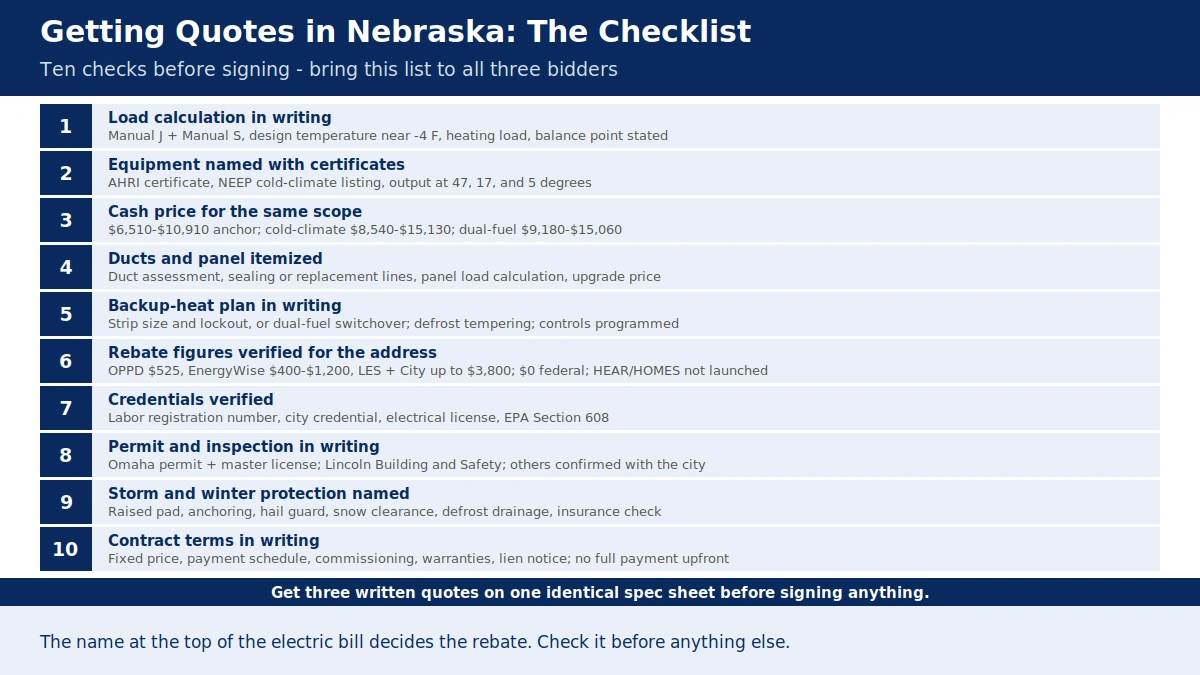
Get three written quotes on one identical spec sheet before signing anything. Compare them on what they name, not on the bottom line alone. The strongest quote names the unit, shows the load calculation, itemizes the ducts and the panel, proves the credentials, and puts the rebate and the backup-heat plan in writing.
In a state where January averages a low of 15 degrees and the storm record averages 51 tornadoes a year, the best quote is also the one written for Nebraska weather rather than for a national average. A heat pump bought that way costs what the planning band says it costs, holds its capacity on the coldest nights it was bought for, and leaves the owner with a rebate collected, a backup plan that works, and a bill that matches the math done before signing.
Sources & methodology Installed costs:
- NumeralQ, Heat Pump Cost in Omaha, NE (2026), estimator pricing as of Oct 26, 2026 (planning estimates, not contractor bids; page updated Nov 10, 2026): 3-ton ducted $6,610-$11,040; by size 1.5 tons $4,460-$7,140, 2 tons $5,170-$8,440, 2.5 tons $5,890-$9,740, 3.5 tons $7,330-$12,340, 4 tons $8,050-$13,640, 5 tons $9,490-$16,240; by type mini-split single zone $3,180-$4,960, multi-zone 3 heads $6,320-$11,280, cold-climate ducted $8,680-$15,130, geothermal $20,390-$32,080; add-ons ductwork $4,230-$7,160, panel upgrade $2,160-$3,410; labor $30.08/hr median pay, $60-$78 billed
- NumeralQ, Heat Pump Cost in Lincoln, NE (2026), pricing Oct 26, 2026 (page updated Oct 4, 2026): 3-ton ducted $6,490-$10,880; by size 1.5 tons $4,350-$7,010, 2 tons $5,070-$8,300, 2.5 tons $5,780-$9,590, 3.5 tons $7,210-$12,180, 4 tons $7,920-$13,470, 5 tons $9,340-$16,050; by type mini-split single zone $3,110-$4,860, multi-zone $6,160-$11,070, cold-climate ducted $8,540-$14,950, geothermal $20,130-$31,750, dual-fuel $9,160-$15,030; add-ons ductwork $4,090-$6,970, panel upgrade $2,120-$3,360; labor $28.53/hr median pay, $57-$74 billed
- NumeralQ, HVAC Replacement Cost in Nebraska (2026) and Heat Pump Cost (national, 2026), pricing Oct 26, 2026: Nebraska 3-ton ducted $6,510-$10,910; dual-fuel $9,180-$15,060; packaged $6,960-$9,920; central AC + gas furnace $8,300-$14,060; national 3-ton ducted $6,550-$10,960; Nebraska HVAC labor $28.77/hr median, $58-$75 billed
- Dun, Heat Pump Cost (2026), updated Aug 2026: Nebraska ducted $6,450-$11,900; national $6,500-$12,000; BLS-wage-adjusted ballparks
- BetterHouse, Heat Pump Installation Cost by State (2026): Nebraska ducted $3,920-$13,720, typical $10,360, wage index 0.94 (BLS OEWS 49-9021, May 2025); national baseline $4,000-$14,000, typical $10,575 (ConsumerAffairs July 2026, This Old House Aug 2026, Angi Aug 2026)
- projectcosted, Heat Pump Cost in Bellevue, NE (2026), prices updated Aug 2026: $5,590-$13,212, typically near $9,401, for an average 1,800 sq ft home; about 4% above its Nebraska state figure ($5,375-$12,704); different basis from the tonnage models, flagged
- Modernize, Grand Island heat pump page (national ranges only): standard air-source $4,500-$9,000; high-efficiency $9,000-$15,000; single-zone mini-split $3,000-$7,000; multi-zone $9,000-$15,000; geothermal $18,000-$45,000; dual-fuel $6,000-$14,000
- HomeGuide via 1-800deals (checked Oct 2026): full air-source system $10,000-$25,000+; unit swap $3,800-$8,200; recorded as the wide-scope high cross-check, not adopted
- Clean Invoice, HVAC Replacement Cost Calculator (2026; contractor pricing 2024-2025, national): 3-ton 14.3 SEER2 heat pump $10,000-$18,000; geothermal 3-ton $27,000-$42,000; full system + new ductwork $12,000-$22,000; tonnage guide 1.5 tons 600-900 sq ft, 3 tons 1,500-1,800 sq ft (moderate climate)
Rates and running costs:
- EIA, Electric Power Monthly Table 5.6.A, Aug 2026: Nebraska average residential price 13.54 cents/kWh, US 18.16 cents, 7th cheapest, +5.8% vs Aug 2025; average Aug bill $154.91 at 1,144 kWh; 12-month average 12.7 cents/kWh (EIA compilation, Oct 2026); NumeralQ cites 12.9 cents for 2026 so far
- EIA, Natural Gas Annual (released Sept 30, 2026): Nebraska 2025 average residential price $11.40/Mcf = $1.08/therm, 74% of the US average; 12-month average to July 2026 $1.25/therm ($12.93/Mcf, EIA compilation); monthly 2026 Nebraska prices Jan $10.33, Feb $10.83, Mar $12.06, Apr $10.06, May $15.53, Jun $20.10, Jul $24.69, Aug $26.52 per Mcf (EIA series N3010NE3, release Oct 30, 2026)
- EIA SHOPP residential propane, week ending Nov 2, 2026: Nebraska $1.90/gallon, US $2.82, Midwest $2.22-$2.35; DWEE SHOPP report (Sept 2026): 2025/26 season retail $1.57-$1.64/gallon, season average $1.61
- Heating fuel mix, ACS 2024 via DWEE (824,012 occupied units): utility gas 58.73%, electricity 31.82%, propane 7.41% (61,029 homes), fuel oil 0.29%; Omaha 72% gas / 25% electric; Lincoln 64% gas / 35% electric (Census via NumeralQ)
- EIA RECS 2020, Nebraska: average natural gas space-heating consumption 51.37 MMBtu per household using gas heat (site energy, fuel input)
- Propane heat content 91,452 BTU/gallon; electricity 3,412 BTU/kWh; one therm = 100,000 BTU (standard conversion factors used in the NestPriced arithmetic)
Cold climate, ratings, and design temperatures:
- NEEP Cold Climate Air Source Heat Pump Specification v4.0 (effective Jan 2023): variable-capacity compressor (central), COP at least 1.75 at 5 F at maximum capacity, HSPF2 8.5 / SEER2 15 non-ducted, HSPF2 7.7 / SEER2 14.3 ducted, capacity reported at 47/17/5 F (via prentis.co analysis of the NEEP and ENERGY STAR specs)
- ENERGY STAR cold climate designation, Version 6.2: SEER2 at least 15.2, HSPF2 at least 8.5 non-ducted / 8.1 ducted, COP at least 1.75 at 5 F, at least 70% of 47 F capacity at 5 F; standard ENERGY STAR split-system heat pump HSPF2 7.8+, SEER2 15.2+, EER2 11.0+ (via insidercost 2026 compilation)
- DOE Cold Climate Heat Pump Challenge: field validation at 22-23 sites, operation at -15 F holding 70%+ capacity (DOE challenge reporting via compilations, flagged)
- Capacity/COP ranges at 5 F, -5 F, -15 F: compilations of NEEP listing data, manufacturer expanded tables, NREL/PNNL field data (hvacsolver; ohmsnap, Apr 2026; homeenergygeek, July 2026)
- Model examples (manufacturer spec sheets via compilations, flagged): Mitsubishi Hyper-Heat 100% capacity at 5 F, 75% at -13 F, COP 2.4 at 5 F; Bosch IDS Ultra 100% at 5 F, COP 2.1, operates to -13 F; Daikin Aurora about 100% at 5 F, COP about 2.0, operates to -13 F; Carrier challenge results 100% at 0 F, operates to -23 F
- DOE federal minimums, 10 CFR Part 430 (effective Jan 1, 2023): split-system heat pumps 14.3 SEER2 + 7.5 HSPF2 all regions; split-system AC North region 13.4 SEER2 under 45,000 BTU (via Clean Invoice summary; Nebraska in the North region)
- Nebraska standard design conditions, 103 Neb. Admin. Code ch. 1, § 003: winter design dry-bulb -4 F, 6,500 heating degree days, climate zone 5; ACCA Manual J design tables (1997 ASHRAE 99%): Omaha AP -2 F, Omaha WSO -2 F, Lincoln -2 F, Beatrice -2 F, Scottsbluff -3 F
- NOAA 1991-2020 normals: Omaha 6,001 heating degree days, 131 freezing nights, 10 nights at or below 0 F, Jan mean 24.4 F / mean low 15.2 F / mean minimum -7.0 F, July mean high 88.1 F, snowfall 27.1 in/year; Lincoln 5,856 heating degree days, 143 freezing nights, 10 nights at or below 0 F (NOAA via NumeralQ and Eppley Airfield normals)
- Refrigerant: R-410A phased out in new home systems from 2025 (EPA AIM Act rules); new systems use R-454B or R-32 (NumeralQ Nebraska FAQ)
Rebates, credits, and help:
- OPPD HVAC Smart Rebates page (opened Nov 15, 2026; “AVAILABLE – Rebates are still open”): tiers $265 / $375 / $450 / $525 (20+ SEER and all heat pumps, incl. geothermal); 15.2 SEER2+ per AHRI; apply within the current year and within 4 months of install; Rate 115 lower winter rate Oct-May (14 SEER+, 50% of heating load, sensor/thermostat 20 F or lower); Residential Single-Family HVAC Terms updated Oct 2026 (under-2-ton systems 50% unless conditioning the whole structure; up to 6 weeks processing)
- NPPD EnergyWise residential incentives (opened Nov 15, 2026, Southwest PPD mirror): air-source $400 / $800 / $1,200 by SEER2 band or variable capacity; ductless $400 / $600 / $1,200; geothermal $2,400 / $3,300; AHRI certificate required ($100 cap without one); incentive or low-interest loan choice; attic insulation $0.30/sq ft up to $600; tune-up $30; 2025 results $1.84M / 1,147 heat pump incentives (NPPD board, May 2026)
- LES Sustainable Energy Program (opened Nov 15, 2026): 2026 funds Jan 1-Dec 31, 2026, first-come first-served; $2.2M incentive pool for 2026 (LES announcement, Feb 10, 2026); credit on the contractor invoice via participating contractors; heat pump water heater $500; sealing/insulation up to $1,500; the $800 heat pump figure is the City-announced figure (see next line), not stated on the LES main page
- City of Lincoln heat pump incentives (announcement Aug 28, 2025; round from Sept 1, 2025; $250,000 fund): $500 to replace a heat pump at least 5 years old, $1,500 to replace an air conditioner, up to $3,000 for low- to moderate-income households, combinable with the LES $800 incentive, up to $3,800 combined; 2026 round described in NumeralQ Lincoln program material (Oct 2026): AHRI rated, inverter-driven or SEER2 15.2 + EER2 12, replacing a unit at least 5 years old, Urban Development approval before install for the low-income tier, ground-source/new construction/mobile homes excluded; 80% AMI limit single-source (tracker), flagged
- MEAN heat pump incentives $400-$3,000, 2025-26 fiscal year, first-come first-served (NMPP Energy announcement, 2025; single source, flagged)
- HEAR/HOMES not launched in Nebraska: DWEE lists both programs as “Preparing Application” (verified Nov 4, 2026); NASEO Sept 2026 “hasn’t launched yet” (via NumeralQ); federal caps HEAR heat pump up to $8,000, HOMES up to $8,000; DOE Program Notices 26-1/26-2 (effective May 29, 2026): HEEHR electric-to-electric only, insulation and air sealing first
- OBBBA P.L. 119-21; IRS FS-2025-05 (§25C/§25D $0 for property placed in service after Dec 31, 2025); §48E lease pass-through through Dec 31, 2027
- HCRRA up to $5,000 (DWEE via LIHEAP; contact DWEE 402-471-2186); DHHS furnace/AC repair or replacement up to $750
- Dollar and Energy Saving Loans (DWEE): NPPD-qualifying loans no more than 1.5%, OPPD-qualifying loans no more than 3%, general tiers to 5% (DWEE lender procedures); OPPD page 3% or less, terms up to 15 years; 31,530 projects / $418M+ financed 1990-June 2025 (DWEE Annual Energy Report 2025); approval before contracting (emergency exception Sept-May)
Licensing, permits, code:
- No statewide HVAC/mechanical license; Contractor Registration Act, Neb. Rev. Stat. §§ 48-2101 to 48-2117; $40/year from Aug 1, 2026; no exam or experience requirement; free Department of Labor lookup (ReadyDocs compliance file, verified Oct 2026; qualifyingagents, checked Oct 25, 2026)
- State Electrical Act § 81-2108; Heating/AC/Refrigeration special license $37.50/license year (§ 81-2112); EPA Section 608 certification, 40 CFR Part 82 Subpart F
- Omaha Municipal Code Ch. 40, Art. II (checked Oct 10, 2026, via NumeralQ): permit required before AC/air distribution work; city master license required; owner-occupant exception with notice and inspection; minor repairs exempt; permit fee not published
- Lincoln Department of Building and Safety: apprentice / journeyman mechanical technician / master mechanical contractor credentials; joint Lancaster County code enforcement (ReadyDocs; qualifyingagents); Lincoln permit fee not published in sources retrieved
- 2021 IRC M1401.3: equipment sized per ACCA Manual S from Manual J loads
- Lien law: Neb. Rev. Stat. § 52-136, owner-occupied 1-4 unit protection (via NumeralQ/Levelset summary, checked Nov 10, 2026; flagged as a secondary summary)
Storms and climate:
- NOAA SPC Severe Weather Database 1996-2025, analyzed by MyWild (snapshot Sept 2, 2026; SPC data updated Apr 24, 2026; page opened Nov 15, 2026): 1,525 tornadoes on 487 days, 51 a year, 137 EF2+, 9 EF4, 0 EF5; June busiest month (31% of tornado days); middle 80% of tornado days Apr 28-Aug 20; night share 6.2%; ranked 6th of 50 by tornado days a year; May 22, 2004 biggest day (34 tornadoes, Hallam EF4, 54-mile path)
- NWS Omaha/Valley, Public Information Statement, July 29, 2024 (opened Nov 15, 2026 via Iowa State mesonet archive): Elkhorn-Bennington-Blair tornado upgraded to EF-4, estimated peak wind 170 mph; path 32.49 miles, width 1,900 yards, 4 injuries, 0 fatalities (NCEI summary via secondary reporting, flagged); 24 tornadoes that day in eastern Nebraska and western Iowa
- 2024 Nebraska total: 100 tornadoes (NWS Omaha via UNL Lincoln Weather); behind only 2004 (110) and 1992 (102) in 1950-2024
- FEMA National Risk Index (via NumeralQ): heat-wave risk Relatively High in Douglas County, Relatively Low in Lancaster County
- Housing: Omaha median home $245,500, 57% owner-occupied, 66% houses; Lincoln median home $264,000, 56% owner-occupied, 64% one-unit (ACS 2020-2024 via NumeralQ); median year built Omaha 1973 (61% pre-1980), Lincoln 1982 (47% pre-1980) (Census compilation via localdumpsternetwork, Nov 2026, secondary, flagged); contractors Douglas County 190 (7.5/10,000 homes), Lancaster County 121 (8.6/10,000), 2023 County Business Patterns via NumeralQ
Lifespan and maintenance:
- Air-source lifespan 12-15 years average, well-maintained modern units 15-20; mini-splits often 20 years; geothermal indoor 20-25 years, loops 50+ year warranties (insidercost 2026; filterbuy citing a 2024 HUD Cityscape study; flagged as compilations)
- Maintenance: ANSI/ACCA Standard 4 QM two visits a year; $150-$350 per visit or $200-$500/year on a plan; filters every 1-3 months; DOE 10-25% energy penalty for neglected maintenance (via filterbuy citing DOE, flagged); compressor failure $1,500-$2,500+; 50% repair-vs-replace rule of thumb (filterbuy; qualityhomeaircare)
NestPriced arithmetic (labeled in the article, not sourced figures):
- Cold-climate premium ~$2,000-$4,100: NumeralQ cold-climate ducted minus standard ducted, Omaha ($8,680-$15,130 minus $6,610-$11,040) and Lincoln ($8,540-$14,950 minus $6,490-$10,880)
- Cost per MMBtu: 293.1 kWh of heat per MMBtu divided by COP, times $0.1354/kWh; gas 10 therms per MMBtu divided by AFUE, times $1.25/therm; propane 10.935 gallons per MMBtu divided by AFUE, times $1.90 or $1.61/gallon
- 50 MMBtu season scenario: per-MMBtu figures times 50; savings vs propane 95% ~$300/year, vs resistance ~$1,190/year, vs gas 80% ~$13/year (tie), vs gas 95% about $136/year more at COP 2.5
- Premium payback scenarios: $2,000-$4,100 premium divided by the annual fuel saving vs the system replaced
- System midpoints: heat pump ($6,510+$10,910)/2 = ~$8,710; furnace + AC ($8,300+$14,060)/2 = ~$11,180; difference ~$1,470
- Rebate-adjusted examples: Omaha $6,610-$11,040 minus OPPD $525 = $6,085-$10,515; Lincoln $6,490-$10,880 minus LES $800 = $5,690-$10,080; Lincoln full combo $6,490-$10,880 minus $3,800 = $2,690-$7,080
- EnergyWise 2025 average incentive ~$1,600: $1.84M divided by 1,147 incentives, all system types incl. geothermal
EXCLUDED:
- Any Grand Island or Bellevue NumeralQ price (no such pages exist; state-band planning estimates only, flagged)
- Any Grand Island Utilities heat pump rebate (none located)
- Any OPPD Rate 115 dollar rate (not verified)
- Any LES heat pump dollar amount from the LES page itself (not stated there; $800 is the City-announced figure, flagged)
- Any HEAR/HOMES money in a 2026 Nebraska quote (not launched; $0 claimable)
- Any federal tax credit for a 2026 heat pump or geothermal system ($0 under OBBBA)
- Any Nebraska hail-day or hail-damage statistic (none verified)
- Any Omaha/Lincoln/Bellevue/Grand Island permit fee (not published in sources retrieved)
- Any Lincoln HVAC registration/exam fee (single weak source)
- Any $2,500 registration threshold, contractor exam, or $10,000 bond for Nebraska HVAC registration (contradicted by primary-Act summaries)
- Any Nebraska sales-tax figure for heat pumps (not verified)
- Any switchover-temperature claim as a measured Nebraska figure (typical contractor settings only, labeled)
- HomeGuide $10,000-$25,000+ as the headline band (wider scope; noted as the high cross-check)
- HVAC Visit $7,300-$18,850 (weak provenance; recorded in the research file only)
- Any claim that a heat pump saves money on fuel vs a new 95% gas furnace at current Nebraska rates (the math shows the opposite at COP 2.5; stated plainly)
- Any 2027 HEAR/HOMES opening date (not published)
- Any Nebraska duct-leakage percentage (not verified)
Disclaimer: The prices here are 2026 Nebraska planning figures. What you end up paying moves with the system size, the system type, the city, the ducts and the electrical panel in your own home, and the contractor. Get written quotes from three contractors on one identical spec sheet before settling on a budget, and check the registration and the city credential yourself before anyone touches the system. Nothing here is tax advice for your own return. Program rules change, including the OPPD, EnergyWise, and LES incentive funds, the City of Lincoln combo round, and the HEAR/HOMES launch status, so confirm current terms with your own utility and the state energy office before signing. Running-cost figures depend on the rates on your own bill, the efficiency of your own system, and the winter itself, so redo the math with your own numbers before deciding.
How much does a heat pump cost in Nebraska in 2026?
A 3-ton ducted air-source heat pump costs $6,510–$10,910 installed in Nebraska in 2026, on NumeralQ planning estimates priced October 26, 2026. A cold-climate ducted system runs $8,540–$15,130, a dual-fuel system runs $9,180–$15,060, and a geothermal system with a ground loop runs $20,130–$32,080. Omaha and Lincoln publish nearly identical bands, while Bellevue and Grand Island carry planning estimates from the state band because no cost model prices those cities directly.
Will a heat pump work in a Nebraska winter?
A cold-climate heat pump will, if it is sized from a load calculation and specified by its output at 5 degrees rather than by its nameplate tonnage. Cold-climate units typically hold 70–100 percent of rated capacity at 5 degrees with efficiency roughly double that of resistance heat, while standard units fall to 40–60 percent of capacity in the same cold. Nebraska’s design temperature sits near minus 4 degrees, so every quote should show the unit’s BTU output at 5 degrees, the NEEP cold-climate listing, and the backup-heat plan for the hours below the balance point.
Is a heat pump cheaper to run than a gas furnace in Nebraska?
On fuel alone, roughly a tie against gas, and the honest math says so. At Nebraska rates of 13.54 cents per kilowatt-hour and $1.25 per therm, a heat pump at a seasonal efficiency of 2.5 costs about $794 for a 50 MMBtu heating season, against $658 for a new 95 percent gas furnace and $781 for an older 80 percent furnace. The heat pump saves about $300 a year against propane and about $1,190 a year against electric resistance heat, and it also replaces the air conditioner, which is where the gas-home case is won.
What rebates can I get for a heat pump in Nebraska in 2026?
It depends on the name on the electric bill, because Nebraska has no statewide rebate. OPPD pays $525 for a qualifying heat pump at 15.2 SEER2 or higher, NPPD EnergyWise pays $400–$1,200 by efficiency band or for variable-capacity systems, and LES plus the City of Lincoln combine for up to $3,800 for qualifying households, with first-come funds. The federal tax credit is $0 for 2026 installs, and the federal HEAR and HOMES rebates have not launched in Nebraska, so no quote should show either one.
Do I need a permit to install a heat pump in Nebraska?
It depends on the city, because Nebraska licenses HVAC work locally rather than statewide. Omaha requires a permit from Permits and Inspections before an air conditioning or air distribution system is installed, altered, repaired, or replaced, with the work done under a city master license. Lincoln runs its own mechanical licensing through Building and Safety, and Bellevue and Grand Island rules should be confirmed with the city building department, so put the permit responsibility in writing on the quote for the job address.
Does Nebraska require a license for HVAC contractors?
Nebraska has no statewide HVAC or mechanical contractor license. Contractors must register annually with the Nebraska Department of Labor under the Contractor Registration Act, which requires no exam and proves no trade skill, while electrical work needs a state electrical license and refrigerant work needs federal EPA Section 608 certification. Omaha and Lincoln add their own city credentials on top, so check the state registration on the Department of Labor lookup and the city credential with the city before signing.
What size heat pump do I need for a Nebraska home?
The load calculation decides, not the floor area and not the old unit. A 3-ton system is the most common size in Omaha and Lincoln, and the installed price runs from about $4,350–$7,140 for 1.5 tons to about $9,340–$16,240 for 5 tons, but the right size is the smallest unit whose performance table still covers the home’s heating load at the local design temperature near minus 4 degrees. Ask every bidder for the Manual J load calculation and the Manual S selection in writing, and be wary of any bidder who sizes from a walk-through guess.
How long does a heat pump last in Nebraska?
An air-source heat pump lasts roughly 12–15 years on average, with well-maintained modern units reaching 15–20 years, against 15–20 years for a gas furnace, because the heat pump runs year-round in both heating and cooling modes. Ductless mini-splits often reach 20 years, and geothermal indoor units last 20–25 years with ground loops warranted for 50 years or more. Two professional service visits a year, at $200–$500 on a plan, plus filter changes every one to three months, are what stretch a Nebraska unit toward the top of its range.