


New Mexico gives a solar buyer the best sunlight in the United States and some of the cheapest grid power to compete with, and the whole buying decision lives in the tension between those two facts. A kilowatt of panels on a south-facing Albuquerque roof makes about 1,750 kilowatt-hours a year on this guide’s planning figure, more than anywhere else in the country. The power those panels replace costs about 15.31 cents a kilowatt-hour on the statewide average, and the average New Mexico home’s electric bill, $99.89 a month, is the lowest in the nation.
Cheap sun shortens the payback. The counterweight is the grid price itself: at about 15 cents a kilowatt-hour, every unit the roof produces saves only a 15-cent purchase, so the payback stretches even under the strongest sun in the country. The name at the top of the electric bill decides which force wins, because New Mexico’s three big utilities pay for surplus solar power three different ways, and the difference between the best deal and the worst is worth thousands of dollars over the life of a system.
A second fact shapes every quote in 2026. The 30% federal credit that defined home solar economics for years ended for systems placed in service after December 31, 2025, and New Mexico’s residential solar permits fell 22% in the first months of 2026 as buyers and installers adjusted. What remains is a state credit worth 10% up to $6,000, a gross receipts tax deduction on the system itself, and net metering rules that reward careful sizing and punish oversizing on every utility in the state.
The quote’s price per watt will not settle the decision for a 2026 buyer in New Mexico. What settles it is the utility serving the address, because PNM, El Paso Electric, and Xcel Energy’s Southwestern Public Service each credit month-end surplus under a different rule, and the co-ops and city utilities write their own. The other half is the system’s size against the home’s real use, because an oversized array on the wrong utility earns a few cents for power that cost 15 cents to replace. Pin both facts down in writing before comparing quotes, and the rest of the decision follows from them.
Our national solar panel cost guide carries the countrywide figures and the federal rules, and New Mexico reads best against that baseline. Everything below is priced for this state alone: its four cities, its three utility rulebooks, and the value of each kilowatt-hour under each one.
Table of Contents
How Much Do Solar Panels Cost in New Mexico in 2026?
Budget $19,430–$25,400 for an installed 8 kW rooftop system in New Mexico in 2026, the planning band NumeralQ’s estimator pricing published on October 26, 2026. Divide by 8,000 watts and the band becomes $2.43–$3.18 per watt; the payback section works from the midpoint of about $22,415. NumeralQ labels its figures planning estimates built from a national cost model adjusted for New Mexico labor and materials, not records of what New Mexico homeowners paid, and the band is presented here as what it is: a planning range to hold quotes against, not a price any installer has promised.
Three other price trackers land inside or just beside the NumeralQ band from different directions, and the agreement is reassuring. EcoGen’s Solar Cost Index (September 2026 edition) puts New Mexico at $2.71 per watt, the 10th lowest price of 51 jurisdictions, against a $2.89 national average, which prices an 8 kW system at $21,680. Arizona prices lower at $2.56 per watt and Colorado higher at $3.02, and our Arizona solar cost guide and Colorado solar cost guide price both sides of the border, while our Oklahoma solar cost guide covers the northeastern neighbor. EnergySage’s New Mexico marketplace data (November 2026) averages $2.49 per watt, but on much bigger systems: its average New Mexico system is 10.2 kW at $25,370, with quotes ranging from $21,564 to $29,176.
A fourth tracker, SolarReviews, puts an average 7.2 kW Albuquerque system at about $20,300 before incentives, or $2.84 per watt. Three methods and a city cross-check, all inside a 40-cent spread at the per-watt level: the New Mexico price is genuinely below the national average, and a quote far above $3.18 a watt for an ordinary roof needs a clear reason, such as a tile roof, a long wire run, or a panel upgrade folded into the same job.
The gap between the trackers is mostly a gap in what they measure. NumeralQ models a defined 8 kW job from materials plus local labor. EnergySage averages real marketplace quotes, which skew toward bigger roofs, bigger bills, and buyers who sought out a quote platform in the first place. EcoGen starts from the national laboratory cost benchmarks and indexes them by state. None of them is wrong, and none of them is a quote for a specific roof in Rio Rancho or Las Cruces.
A quote that lands inside the band covers a working system from the roof to the meter. That means the panels, the inverter, whether one string inverter or a microinverter per panel, the racking and flashing that hold everything to the roof, the wiring and disconnects, the permit and inspection fees, the labor, and the startup visit that commissions the system. The surprises live outside the band, in the work around the system: the roof, the panel, the trees, and the trenching, each priced on its own line, each capable of moving the total by thousands.
- Roof repairs or a roof replacement before the panels go on, priced on their own
- An electrical panel upgrade, if the existing service cannot take the solar backfeed ($2,090–$3,310 in Albuquerque on the NumeralQ model)
- A battery, priced separately and covered in its own section below ($9,990–$15,520 for 10–13 kWh in Albuquerque)
- Tree removal or trimming where cottonwoods or pines shade the roof
- Gross receipts tax wrongly added to the system, which is deductible from gross receipts under state law and must be shown as its own line so the deduction can be checked
- The utility’s interconnection fee, which is $50 for a 1–10 kW system on El Paso Electric and must be confirmed in writing on PNM and Xcel
One warning belongs before any quote is compared. A low first bid can turn into the expensive job once the system is running, and the highest bid does not guarantee the best equipment or the most careful roof work. Get written quotes from three licensed installers, all priced on the same job, and drop any bidder who will not name the panel model, the inverter type and rating, the year-one production estimate with its shade assumptions, and the export credit the savings math assumes.
| Source | Price per watt | 8 kW total | Basis |
|---|---|---|---|
| NumeralQ (Oct 2026) | $2.43–$3.18 | $19,430–$25,400 | Planning estimate, state model |
| EcoGen Index (Sept 2026) | $2.71 | $21,680 | Cost index, cash, before incentives |
| EnergySage (Nov 2026) | $2.49 | $19,920 (scaled) | Marketplace quotes, avg 10.2 kW system |
| SolarReviews Albuquerque (Sept 2026) | $2.84 | $22,720 (scaled) | Albuquerque average, 7.2 kW systems |
The EnergySage and SolarReviews 8 kW figures in that table are scaled from their per-watt averages, not prices either source publishes for an 8 kW system, and they are labeled as such. EnergySage’s own published total is $25,370 for its 10.2 kW average system, and SolarReviews’ own figure is about $20,300 for a 7.2 kW Albuquerque system. The scaling exists so the four sources can be compared on one size, and the comparison holds: every source prices an 8 kW New Mexico system between roughly $19,400 and $25,400 before incentives.
The national context sharpens the picture. Berkeley Lab measured home systems installed across the country in 2024 at $3.00–$5.20 per watt, with a median of $4.00, which is well above every New Mexico figure in the table. New Mexico labor helps explain the gap: solar installers in the state earn a median $23.31 an hour, and contractors bill about $47–$61 per worker-hour, against higher billed rates in Albuquerque itself, where installer pay runs 12% above the national median. Materials travel on national prices, so the saving is in the crew and in the competition among installers along the Rio Grande corridor.
Solar Panel Cost in New Mexico by System Size
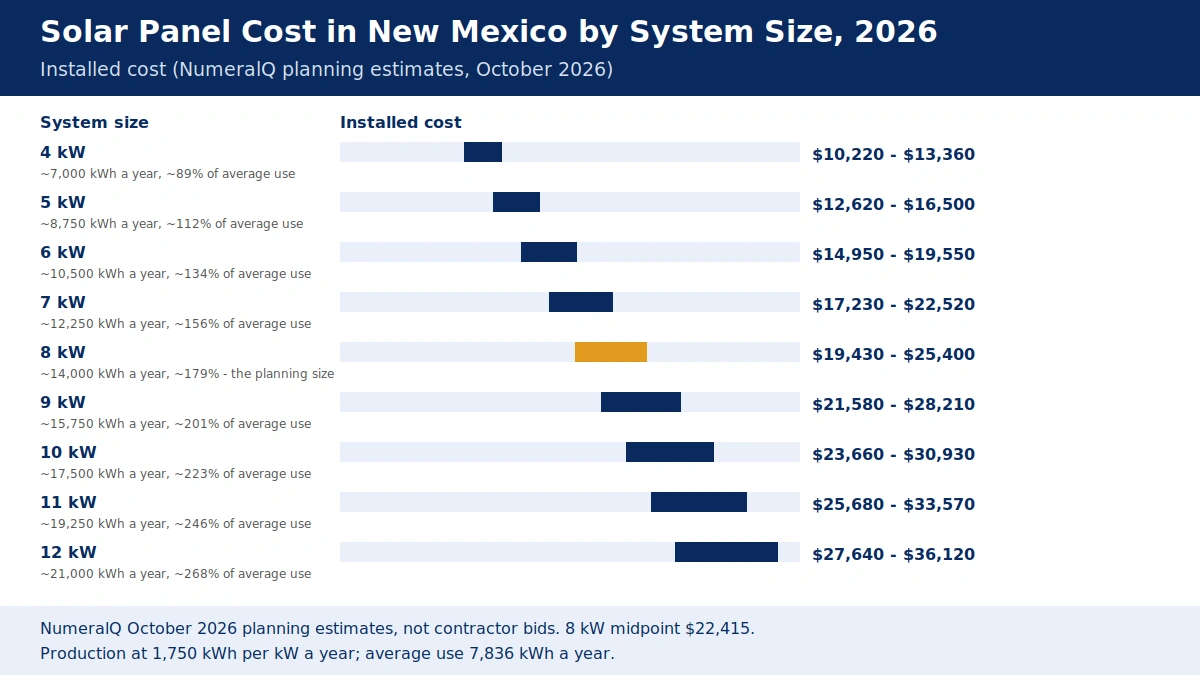
Size moves the price more than anything else, and in New Mexico it also moves the utility rule that applies, which is why this section prices every size and the net metering section explains the lines that size can cross. The table below is the NumeralQ New Mexico size table from October 2026, with the EcoGen flat-price cross-check beside it and a year-one production column at this guide’s planning figure of 1,750 kilowatt-hours per kilowatt. Production is rounded, and shade, tilt, and direction move any real roof away from it in either direction.
| System size | NumeralQ installed | EcoGen at $2.71/W | Year-one output at 1,750 kWh/kW |
|---|---|---|---|
| 4 kW | $10,220–$13,360 | $10,840 | ~7,000 kWh |
| 5 kW | $12,620–$16,500 | $13,550 | ~8,750 kWh |
| 6 kW | $14,950–$19,550 | $16,260 | ~10,500 kWh |
| 7 kW | $17,230–$22,520 | $18,970 | ~12,250 kWh |
| 8 kW | $19,430–$25,400 | $21,680 | ~14,000 kWh |
| 9 kW | $21,580–$28,210 | $24,390 | ~15,750 kWh |
| 10 kW | $23,660–$30,930 | $27,100 | ~17,500 kWh |
| 11 kW | $25,680–$33,570 | $29,810 | ~19,250 kWh |
| 12 kW | $27,640–$36,120 | $32,520 | ~21,000 kWh |
The per-watt price falls as the system grows, because the fixed costs of the job, the permit, the design, the truck rolls, and the interconnection paperwork, spread over more watts. A 4 kW system runs about $2.56–$3.34 per watt on the NumeralQ table, while a 12 kW system runs about $2.30–$3.01 per watt. The saving is real but modest, roughly 10% from the smallest size to the largest, and it is never a reason to buy watts the home cannot use well. An extra kilowatt that earns 4.52 cents on El Paso Electric is a worse buy than a smaller system priced a few cents higher per watt.
The typical New Mexico install sits below the 8 kW planning size. Berkeley Lab’s 2025 data puts the median New Mexico single-family install at 7.04 kW across 3,212 systems, which EcoGen prices at $19,078 cash. That median reflects the homes that actually bought solar in 2025, which skew larger and wealthier than the average New Mexico home. The average home, using 7,836 kilowatt-hours a year, needs only about 4.5 kW to cover its full annual use at the planning production figure, and NumeralQ’s Albuquerque page puts the cover-the-bill size at 4.3 kW on its slightly sunnier figure.
Treat size as a decision in its own right, made from the home’s last 12 months of bills, and not from the roof’s capacity or the installer’s standard package. A home with a swamp cooler and gas heat, the classic Albuquerque combination, uses far less electricity than a home with refrigerated air, an electric water heater, and an electric vehicle, and the two homes need systems two sizes apart. Our 6 kW, 8 kW, and 10 kW system cost guide works the three most common sizes in national detail, and the city section below shows what each size costs in the four big New Mexico markets.
Two size lines deserve attention before any system is ordered, and both are explained in full in the net metering section. On PNM, the line sits at 10 kW of inverter capacity: at or under it, surplus becomes kWh credits that never expire, and over it, surplus is paid monthly at PNM’s avoided-cost Rate 12 instead. On El Paso Electric, net metering covers systems expected to produce up to 120% of the home’s yearly use, and a larger system needs another metering option. A 12 kW array with a 10 kW inverter stays on the kind side of the PNM line, because the line is measured at the inverter, not the panels, which is one more reason the inverter rating belongs on every quote in writing.
What Albuquerque, Santa Fe, Las Cruces & Rio Rancho Actually Pay
New Mexico has one modeled solar market and three marketplace averages, and the table below says which is which instead of dressing all four up as the same kind of number. Albuquerque carries a NumeralQ planning band built from local labor and materials. Santa Fe, Las Cruces, and Rio Rancho carry EnergySage marketplace averages from November 2026, scaled to an 8 kW system at each city’s per-watt average so the four cities can be compared on one size. The scaled figures are arithmetic on published averages, not prices any source publishes for an 8 kW system in those cities, and three local quotes remain the real price in all four markets.
| City | 8 kW system | Basis | Utility | Surplus rule |
|---|---|---|---|---|
| Albuquerque | $21,930–$28,650 | NumeralQ verified | PNM | kWh credits, never expire (10 kW AC or less) |
| Santa Fe | ~$18,880 (scaled) | EnergySage $2.36/W avg | PNM | kWh credits, never expire (10 kW AC or less) |
| Las Cruces | ~$19,600 (scaled) | EnergySage $2.45/W avg | El Paso Electric | Fuel-cost credit, 4.5225 cents (Oct 2026) |
| Rio Rancho | ~$20,240 (scaled) | EnergySage $2.53/W avg | PNM | kWh credits, never expire (10 kW AC or less) |
Albuquerque is the largest market, the only modeled one, and the dearest of the four on the planning band, for a plain reason: labor. Solar installer pay in the Albuquerque metro runs 12% above the national median at $28.75 an hour, and contractors bill $58–$75 per worker-hour, against $47–$61 statewide. The NumeralQ Albuquerque band of $21,930–$28,650 sits about 13% above the state band of $19,430–$25,400 for the same 8 kW job, and the gap is the crew, not the panels. EnergySage’s marketplace average tells a softer story, $2.57 per watt on a 9.07 kW average system at $23,272, which scales to about $20,560 for 8 kW and sits just under the bottom of the NumeralQ band.
The two Albuquerque figures measure different things and both are useful. The NumeralQ band is the planning range to budget from, built before any installer has seen the roof. The EnergySage average is what marketplace shoppers actually saw quoted, on bigger systems, in a competitive metro where several installers bid against each other. A quote between the two, on the same equipment and scope, is a quote in the right neighborhood. Against a $291,500 median home value, the typical Albuquerque job costs about 8.7% of the house, and 62% of Albuquerque homes are owner-occupied, which is the tenure that can sign a solar contract without a landlord’s signature.
Santa Fe is the cheapest of the four on the marketplace average and the most complicated of the four in practice. EnergySage averages $2.36 per watt there, the lowest of the four cities, on a 9.22 kW average system at $21,746, with 25-year savings of $39,270 on its model. The price reflects a mature installer market in a city where solar has been normal for decades, and where several long-established New Mexico companies keep their head offices. The complication is the housing stock and the rules around it: flat-roof adobe homes with parapets and vigas, a 7,000-foot elevation that cools the panels and the nights, historic-district appearance rules that can regulate what goes on a visible roof, and a place on PNM’s high fire risk area list, which makes the battery conversation real rather than theoretical.
Santa Fe’s altitude is a genuine production advantage that the price alone does not show. Thinner air, less haze, and cool nights mean panels start each morning cool and lose less to heat across the day, and the city’s design summer temperature of 88 degrees is five degrees cooler than Albuquerque’s. A Santa Fe quote should still show the roof-specific production estimate, because a parapet-shaded flat roof gives back some of what the altitude grants, and a low tilt on a flat roof holds snow longer in winter. The state credit, the PNM kWh credits, and the gross receipts tax deduction all apply in Santa Fe exactly as they do in Albuquerque, because all three are state or utility rules, not city ones.
Las Cruces is the sunniest of the four cities and the worst paid for its surplus power, and that combination defines the buying decision there. EnergySage averages $2.45 per watt on an 8.91 kW average system at $21,876, and its 25-year savings figure of $29,877 is the lowest of the four cities by a wide margin, which is exactly what the export math predicts. Las Cruces sits in the Chihuahuan Desert at about 3,900 feet, in the warm-dry climate zone, with the hottest summers of the four cities and the strongest sun. Panels there make more power than anywhere else in the state, and El Paso Electric pays 4.5225 cents for the surplus kilowatt-hours at month end, against a retail value near 15 cents.
The Las Cruces buyer sizes to daytime use with more care than any other New Mexico buyer, because every surplus kilowatt-hour is worth less than a third of a home-used one, and the 120% sizing limit caps net metering at a system expected to produce up to 120% of yearly use. A system that covers the air conditioning load through the afternoon, when Las Cruces homes draw hardest, earns its keep. A system sized to the roof, exporting most of its output at the fuel-cost credit, does not. Two community solar projects, SLT Las Cruces and Wings for Life with 10 MW combined, opened to El Paso Electric customers for households that cannot put panels on their own roof, and the community solar section below prices that alternative.
Rio Rancho is the newest-feeling market of the four and the one where the average system is biggest. EnergySage averages $2.53 per watt there on a 10.36 kW average system at $26,227, the largest average size of the four cities, with 25-year savings of $59,503 on its model, also the largest. The pattern fits a fast-growing city of newer, larger homes on the west mesa, where buyers size for refrigerated air, bigger floor areas, and sometimes an electric vehicle, and where PNM’s kWh credits reward a bigger system more generously than El Paso Electric’s fuel-cost credit would. The scaled 8 kW figure of about $20,240 sits between Albuquerque and Las Cruces, which is plausible for a metro-adjacent market sharing Albuquerque’s labor pool.
One Rio Rancho caution deserves emphasis, because the city’s average system size sits right on top of a utility line. The PNM small-program limit is 10 kW of inverter capacity, and a 10.36 kW array paired with a 10.36 kW inverter crosses it, converting surplus from never-expiring kWh credits into monthly payments at Rate 12. A 10.36 kW array paired with a 10 kW inverter does not cross it, because the line is measured at the inverter. Rio Rancho buyers, and Albuquerque buyers sizing past 10 kW, should have the inverter rating printed on the quote and should ask the installer, in writing, which PNM program the system lands in before the equipment is ordered.

New Mexico Sun: Altitude, Desert Heat & Honest Production
New Mexico’s solar resource is the strongest in the country on every published model, and the honest version of that claim needs the numbers behind it rather than the superlative alone. Four models price the same thing, a south-facing, unshaded roof at about a 20-degree tilt with 14% system losses, and they cluster between 1,620 and 1,824 kilowatt-hours per kilowatt each year. The National Renewable Energy Laboratory’s PVWatts model, run on Albuquerque weather data, gives 1,779. The European PVGIS model on the same weather data gives 1,812. EcoGen’s index uses about 1,824. A percentile range for typical residential installs runs 1,620 to 1,780.
This guide plans on 1,750 kilowatt-hours per kilowatt per year, set deliberately near the bottom of the model cluster rather than the top. The choice is conservative on purpose: it leaves room for a roof that faces a little east of south, a parapet that shades the first hour of the morning, a dusty spell between rains, and a summer afternoon hotter than the weather file assumed. An 8 kW system at the planning figure makes about 14,000 kilowatt-hours in its first year. A perfect south-facing roof with no shade will likely beat it, and the payback section shows what that would be worth, but no buyer should sign a contract that only works if the roof beats the plan.
| Model | Basis | kWh per kW per year | 8 kW year-one output |
|---|---|---|---|
| PVWatts v8 (NREL) | Albuquerque TMY weather, 14% losses | 1,779 | ~14,230 kWh |
| PVGIS 5.2 (EU JRC) | NREL NSRDB, 20-degree tilt, south, 14% losses | 1,812 | ~14,500 kWh |
| EcoGen Index (Sept 2026) | Albuquerque-class sun | ~1,824 | ~14,590 kWh |
| SolarPriceList range | 10th–90th percentile, south-facing, unshaded | 1,620–1,780 | ~12,960–14,240 kWh |
| SolarReviews Albuquerque | Albuquerque installs, mixed roofs | ~1,563–1,750 | ~12,500–14,000 kWh |
| This guide’s planning figure | Conservative, inside the published range | 1,750 | ~14,000 kWh |
Desert heat takes some of that sun back, and understanding how much, and when, keeps a buyer from either fearing the heat or ignoring it. Solar panels are rated at a cell temperature of 25 degrees Celsius, about 77 Fahrenheit, in laboratory test conditions. On a New Mexico roof in full sun, the cells run 20 to 25 degrees Celsius hotter than the surrounding air, so a 40-degree afternoon puts the cells near 65 degrees. Every panel datasheet carries a temperature coefficient, the share of rated power lost for each degree above 25, and a typical modern residential panel loses about 0.30% to 0.35% per degree.
The arithmetic for a mainstream panel is straightforward and worth doing once. At 65 degrees cell temperature, 40 degrees above the rating point, a panel rated at minus 0.35% per degree loses about 14% of its rated power at that moment. A premium panel rated at minus 0.26% loses about 10% under the same heat. The better coefficient buys back three to four percentage points of output when it is hottest, which is also when a New Mexico home’s air conditioning draws hardest. The loss is temporary, recovered as the cells cool toward evening, and it is already inside the hourly PVWatts and PVGIS models, so it must never be subtracted a second time from the annual production figure. A savings estimate that takes the PVWatts annual total and then knocks off another 14% for heat is double-counting the same physics.
Altitude and dry air soften the heat penalty in ways that matter more than the datasheet suggests. Albuquerque sits a mile high, Santa Fe higher still, and the thin, dry air carries less haze and water vapor between the sun and the panel than the humid air of the Gulf Coast or the Southeast. Desert nights cool fast, with daily swings of 25 to 30 degrees between afternoon high and overnight low, so panels start each morning cool and spend the most productive morning hours well below their afternoon cell temperatures. Design summer temperatures tell the same story: 93 degrees in Albuquerque, 88 in Santa Fe, near 96 around Alamogordo, hot by any measure, but cooler than Phoenix, and New Mexico’s production per kilowatt leads the country anyway.
Seasonal shape matters as much as the annual total, because the value of a kilowatt-hour depends on when it arrives. New Mexico production peaks in the long, clear days of late spring and early summer, when the sun is high and the monsoon has not yet arrived. The summer monsoon, roughly July through September, brings afternoon clouds, intense downpours, and dust outflows that trim output on storm days while washing the panels clean in the process. Winter days are short but often brilliantly clear, and cold air actually helps panels hold their voltage, so a clear January day in Santa Fe can produce surprisingly well for its length. PNM’s never-expiring kWh credits turn this seasonal shape into an advantage: spring surplus banks forward to cover summer air conditioning, which is precisely the use PNM’s own page names.
Roof direction, tilt, and shade move real production further than any model refinement, and the installer’s estimate must name all three. A south-facing roof at a 20-degree tilt is the reference case in every model. An east-west roof splits production across morning and afternoon, which can suit a home whose load peaks in the afternoon, at some cost to the annual total. A flat roof with a low tilt gives up winter production and holds snow longer, and a parapet on an adobe home can shade the lowest row of panels for the first hour of the day. Cottonwoods along the Rio Grande bosque, pines in the East Mountains, and a neighbor’s second story all shade real roofs in real neighborhoods, and no statewide average survives contact with a shaded roof.
Ask every bidder for the same production evidence, in writing, before comparing savings claims. The estimate should state the roof’s direction and tilt, the shade assumptions, the model used, the system losses assumed, and the year-one kilowatt-hour total. A bidder who quotes only a dollar savings figure, with no production figure behind it, is asking to be trusted on the one number that decides whether the system pays. A bidder whose production estimate sits well above 1,824 kilowatt-hours per kilowatt, the top of the published model cluster, owes an explanation for beating every published model on a real roof with real shade.
Net Metering in New Mexico: PNM, El Paso Electric & Xcel Play by Different Rules
New Mexico requires its regulated utilities to offer net metering, and that single sentence hides the most important fact in this guide: the state rule lets each utility choose how it treats surplus power, and the three big utilities chose three different answers. Within any billing month, every regulated utility subtracts the solar kilowatt-hours from the kilowatt-hours the home used, kilowatt-hour for kilowatt-hour. The difference is what happens to power left over at month end, and that difference is worth more than the price per watt, more than the panel brand, and more than any other line on the quote.
The state rule behind all three answers is 17.9.570.14 of the New Mexico Administrative Code, part of the Public Regulation Commission’s net metering rule in force since May 24, 2022. It covers qualifying facilities up to 80 megawatts, with no statewide cap on total net-metered capacity, and it requires every utility under the Commission’s jurisdiction to offer net metering. For systems of 10 kW or less, the utility picks one of two methods for surplus power: it may credit or pay for the surplus at its energy rate, which is its avoided cost of power and sits below the retail price, or it may credit the customer for the surplus kilowatt-hours and carry those credits forward month to month, paying any unused credits at the energy rate when the customer leaves. For larger systems, surplus is bought at the energy rate, with small monthly balances carried forward and balances over $50 paid the following month. Municipal utilities outside the Commission’s jurisdiction set their own rules entirely.
PNM, the state’s largest utility with more than 550,000 customers across Albuquerque, Santa Fe, Rio Rancho, and most of central and northern New Mexico, chose the kWh-credit method, and chose it in the most generous form available. Under PNM’s Small PV Program, for systems with inverter capacity of 10 kW AC or less, net overproduction becomes a Cumulative Renewable Energy Credit in kilowatt-hours on the next month’s bill, and those credits never expire. Spring surplus banks forward through the summer air conditioning season and into winter, and only when the account closes does PNM settle remaining credits, paying for them at Rate 12, its avoided-cost rate published on its rates pages. PNM’s own interconnection page names the summer air conditioning use case directly, which tells a buyer the utility understands exactly how its customers use the bank.
Cross the 10 kW AC line on PNM and the deal changes completely. Under the Large PV Program, for inverter capacity over 10 kW AC, net overproduction is paid monthly at Rate 12 on the same bill, with no kWh banking at all. The surplus is still worth something, but it is worth an avoided-cost payment instead of a full-value credit against a future bill, and the gap between the two is the reason the inverter rating matters as much as the panel total. No current cents-per-kilowatt-hour figure for Rate 12 was found in PNM’s published pages during this guide’s research, so this guide states none: get the current Rate 12 figure from PNM or the installer in writing before sizing a system over 10 kW AC, and run the payback math on that figure, not on the retail rate. PNM’s old Solar REC Purchase Program, which once paid for renewable energy certificates, closed to new applications on January 1, 2023, so no 2026 buyer should be promised REC payments.
El Paso Electric, serving Las Cruces and the southern counties, chose the energy-rate method, and its surplus credit is the lowest of the three in plain numbers. Month-end surplus is credited at EPE’s fuel and purchased power cost, which stood at 4.5225 cents per kilowatt-hour on October 2026 bills and changes monthly with fuel costs. That figure comes from a single dated secondary compilation and must be confirmed in writing before any Las Cruces payback math is trusted, but its order of magnitude is the point: surplus power on EPE is worth less than a third of the roughly 15-cent retail value of a kilowatt-hour used at home. EPE also caps net metering at systems expected to produce up to 120% of the home’s yearly use, so a larger system needs another metering option, and its interconnection application fee for systems of 1 to 10 kW is $50. EPE’s time-of-day residential rate adds one more wrinkle: distributed generation customers on that rate have their net metering applied by time-of-day period, and the demand ratchet resets after interconnection, both confirmed in EPE’s May 2026 tariff filing.
Xcel Energy’s Southwestern Public Service, serving Roswell, Hobbs, Clovis, and the eastern plains, chose a market method that cannot be reduced to a single number. Surplus generation above the kilowatt-hours Xcel delivered accumulates in a virtual bank on the bill, rolls forward month to month, and is cashed out once the bank reaches $50 or more, with the kilowatt-hours valued at the Locational Marginal Price, the wholesale market value of power at the interconnection point as set by the Southwest Power Pool. That price moves with the wholesale market and changes regularly, which means no honest guide can print an Xcel export rate, and no honest installer should either. Xcel’s own page adds a warning worth heeding anywhere in the state: do not start construction until the application has full engineering approval and all final agreements are signed. EcoGen’s compilation adds that SPS Rate 4 credits or pays month-end surplus at its monthly energy rate rather than as kWh credits, which points the same direction: surplus on Xcel is worth a wholesale or energy rate, not the retail rate.
The co-ops and city utilities write their own endings to the same story. Rural electric cooperatives under the Commission’s jurisdiction follow the state rule’s framework but set their own energy rates and choose their own method, and no verified 2026 export figure was found for any New Mexico co-op, so this guide states none and tells co-op members to get the rule from their own utility in writing. Municipal utilities such as Farmington Electric and Los Alamos County’s utility sit outside the state rule and set their own terms entirely. The pattern across all of them is the same: the utility on the bill writes the export rule, the export rule writes the payback, and a savings estimate that prices exports at the retail rate on any utility but PNM prices a deal that does not exist.
| Utility | Territory | Month-end surplus | Size line | What to get in writing |
|---|---|---|---|---|
| PNM | Albuquerque, Santa Fe, Rio Rancho, central/north | kWh credits, never expire (10 kW AC or less) | 10 kW AC inverter | PNM program (Small/Large) + current Rate 12 |
| El Paso Electric | Las Cruces, southern NM | Fuel-cost credit, 4.5225 cents (Oct 2026, monthly) | 120% of yearly use | Current FPPCAC credit + $50 fee confirmation |
| Xcel (SPS) | Roswell, Hobbs, Clovis, eastern NM | Virtual bank, cashed out at LMP at $50+ | Ask Xcel | Current energy rate + interconnection approval |
| Co-ops / municipal | Rural + Farmington, Los Alamos | Utility’s own rule | Ask the utility | Export method + rate + size limit, all in writing |
Payback in New Mexico: Your Utility Decides More Than Your Roof
Payback math in New Mexico splits into two different stories, and running the wrong story’s numbers is the most expensive mistake a buyer can make with a spreadsheet. On PNM, every kilowatt-hour the system makes is worth the same, because monthly netting plus never-expiring kWh credits means surplus power offsets a future bill at full value, up to the home’s annual use. The home-use share, the fraction of solar power used while the sun shines, barely matters on PNM, because the grid acts as a free battery with no expiry date. On El Paso Electric, the home-use share is everything, because surplus is worth 4.52 cents while home-used power is worth about 15 cents, and every kilowatt-hour shifted from export to home use nearly triples in value.
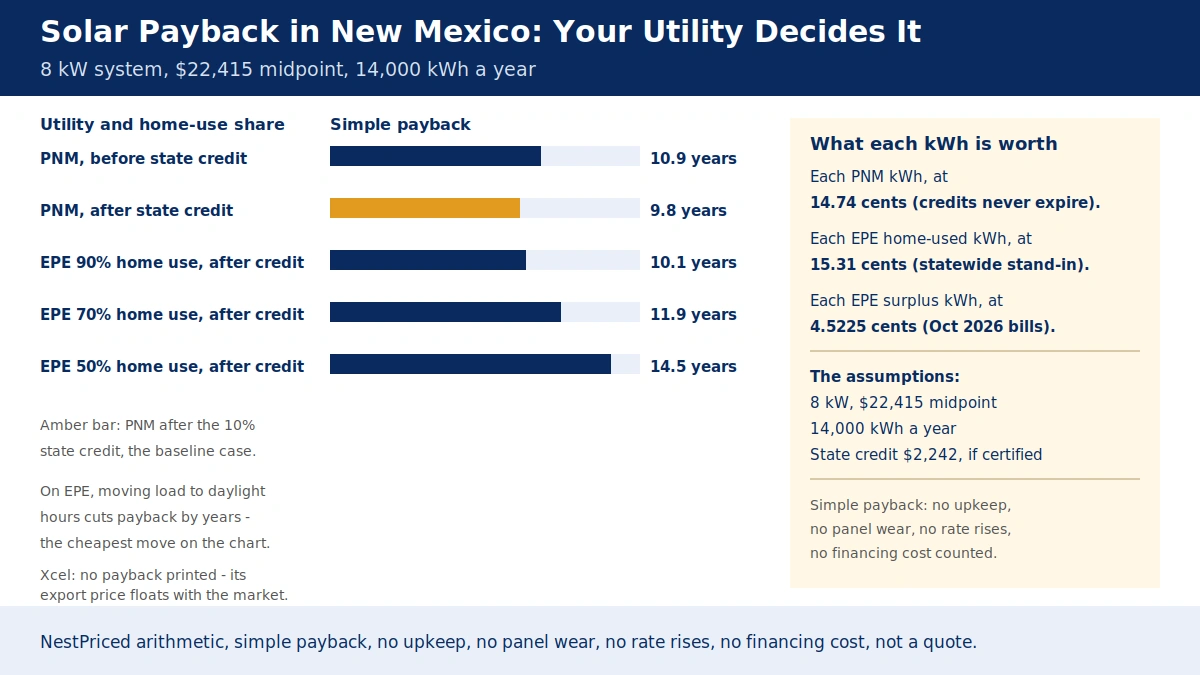
This guide’s payback math uses one system throughout so the utilities can be compared fairly: an 8 kW system at the NumeralQ midpoint of $22,415, making 14,000 kilowatt-hours in its first year at the 1,750 planning figure. The math is simple payback, the net cost divided by the first-year bill saving, with no upkeep, no panel wear, no rate rises, and no financing cost counted. Those exclusions cut both ways: upkeep and wear lengthen the true payback, while rate rises shorten it, and financing lengthens it further. The state credit is shown both ways, because certification depends on EMNRD and on a yearly budget that runs out, and no buyer should sign a contract that only works if the credit arrives.
On PNM, the arithmetic is kind. Each kilowatt-hour is valued at 14.74 cents, PNM’s 17.02-cent average price for the 12 months to August 2026 less its fixed monthly charges, following the method EcoGen published in October 2026. At that value, 14,000 kilowatt-hours save $2,064 a year, and the $22,415 system pays back in 10.9 years before incentives. The 10% state credit, $2,242 on this system, cuts the net cost to $20,173 and the payback to 9.8 years. Published cross-checks cluster around the same answer: EcoGen’s PNM payback is 10.1 years before incentives on its smaller typical system, EnergySage’s New Mexico payback is 10.21 years on its own model, and NumeralQ’s Albuquerque simple payback is 11.4 years. Three independent methods, one answer: about a decade on PNM, a year less with the state credit certified.
On El Paso Electric, the same system tells a longer story that depends entirely on how much power the home uses while the sun is up. Home-used kilowatt-hours are valued at the 15.31-cent statewide average, used here as a labeled stand-in because no verified current EPE residential rate was found, and surplus kilowatt-hours at the 4.5225-cent October 2026 fuel-cost credit. At 50% home use, the system saves $1,388 a year and pays back in 16.1 years before the credit, 14.5 years after it. At 70% home use, the saving rises to $1,690 a year and payback falls to 13.3 years, or 11.9 years after the credit. At 90% home use, the saving reaches $1,992 a year and payback falls to 11.3 years, or 10.1 years after the credit. The spread between the worst and best EPE case is six years, and it is controlled by load timing, not by hardware.
| Scenario | Year-one saving | Payback before state credit | Payback after 10% state credit |
|---|---|---|---|
| PNM, any home-use share | $2,064 | 10.9 years | 9.8 years |
| EPE, 90% home use | $1,992 | 11.3 years | 10.1 years |
| EPE, 70% home use | $1,690 | 13.3 years | 11.9 years |
| EPE, 50% home use | $1,388 | 16.1 years | 14.5 years |
| Xcel (SPS) | Not printed | Ask Xcel for its energy rate | Ask Xcel for its energy rate |
The EPE table carries a practical lesson that no hardware upgrade can replace. Running the dishwasher, the laundry, the pool pump, and the electric water heater during sun hours, and pre-cooling the house in the afternoon before the evening peak, moves kilowatt-hours from the 4.52-cent column into the 15-cent column without buying anything. A battery does the same job after sunset, at a price, and the battery section weighs that trade honestly. A smaller system, sized to daytime load rather than to annual use, can also beat a bigger one on EPE, because it exports less at the low credit and wastes less capital on watts the home cannot use well. On PNM, by contrast, sizing to annual use is sound, because the kWh bank carries spring surplus into summer at full value.
Four forces move every payback figure in the table, and each one deserves a line on the quote or in the buyer’s own notes. The state credit is worth a tenth of the cost, about a year of payback, but only if EMNRD certifies it before the $30 million yearly budget is gone, and only if the application is complete and filed promptly after inspection. Rate rises shorten payback, and New Mexico residential prices rose about 5.8% in the 12 months to August 2026, but no buyer should count on that pace continuing for a decade. Panel wear, about 0.4% a year after the first year on current warranties, and upkeep costs lengthen payback slightly, and the draft’s simple math excludes both. Financing lengthens payback the most of all: a solar loan’s dealer fee and interest can add thousands to the true cost, and a cash price and a financed price for the same system are different purchases that must be compared on total cost, not on the monthly payment alone.
Batteries in New Mexico: PSPS Cover in the High Fire Risk Areas, a Luxury Elsewhere
A battery is the most oversold item in New Mexico solar, and the most genuinely valuable, and which of those it is depends entirely on the address. In central Albuquerque, on a sturdy PNM feeder, with kWh credits banking surplus at full value and no expiry, a battery adds little bill value and buys mainly comfort during the rare outage. In Santa Fe, in the East Mountains, in Ruidoso, or on a single-feeder stretch of Santa Fe County, where PNM’s wildfire protections have already caused real outages in 2026, a battery buys something no credit bank can: lights, refrigeration, internet, and medical devices while the grid is dark. The same $10,000 to $15,000 purchase is a luxury in one neighborhood and a resilience investment in another, and the quote should say which neighborhood the home is in.
The price first, because the battery conversation too often starts with fear and never reaches the number. NumeralQ’s Albuquerque model prices a home battery of 10 to 13 kWh at $9,990–$15,520 installed, with materials at $6,900–$11,500 and the rest in labor, electrical work, and permitting. The most common named unit, the Tesla Powerwall 3, holds 13.5 kWh and delivers 11.5 kW, and EnergySage reports a typical installed cost of $13,473 before incentives nationally, with installer planning ranges running $13,000 to $17,000 depending on configuration and whether the battery goes in with new solar or is added later. Enphase’s modular IQ Battery 5P, at 5 kWh per unit, prices a two-unit 10 kWh system at about $11,300. A second battery doubles the storage and roughly doubles the battery cost, while the gateway and much of the electrical work are paid for once.
No dedicated New Mexico battery rebate was found for 2026, and no state or utility battery incentive program was verified, so the battery must justify itself on outage value and load shifting alone. The federal credit that once covered batteries of 3 kWh or more ended with Section 25D for installations completed after December 31, 2025, and pages still advertising a live 30% battery credit are stale and should be ignored. Whether the state solar credit covers a battery installed with solar is unsettled: EMNRD’s pages list a paired battery as eligible according to one careful compilation, but the statute names only solar, so this guide prices the battery with $0 credit assumed and tells the reader to ask EMNRD in writing before counting battery costs toward the 10%. A quote that deducts a state credit on the battery without that written answer is guessing with the buyer’s money.
The outage case is real, documented, and local, which is what separates it from generic battery marketing. PNM filed its 2026 Wildfire Mitigation Plan and its Public Safety Power Shutoff plan with the Public Regulation Commission on April 1, 2026, and launched a shutoff alert system on February 25, 2026, with Advisory, Watch, and Warning tiers modeled on National Weather Service standards. The high fire risk areas named for shutoff alerts are Clayton, Cochiti Pueblo, the East Mountains around the Sandias, Las Vegas, the Mescalero Apache Nation, Ruidoso, Santa Fe, Silver City, and Tesuque Pueblo. PNM’s Wildfire Safety Mode runs with heightened readiness from March through October, using more sensitive protective settings that can themselves cause outages during elevated fire weather, because circuits stay de-energized until crews inspect the line.
The summer of 2026 showed what that means for real households. In La Cienega, south of Santa Fe, PNM’s wildfire mitigation protocols caused weekend outages on June 20 and 21, 2026, with the system in a one-shot protective mode that prevented automatic re-energizing until crews had inspected the entire line, and a further outage on July 8 affected about 1,300 customers on a single radial feeder with no backup path. Those outages were not shutoffs ordered in advance, they were the protective system doing its job during extreme drought, and they are the reason a battery conversation in Santa Fe County sounds different from one in the Albuquerque Northeast Heights. A buyer in a high fire risk area, or on a feeder the utility has already shown to be fragile, should weigh the battery as outage insurance with a solar bonus, not as a payback purchase.
One hard technical fact governs the whole battery decision and is too often left out of the sales pitch. Panels alone do not power a home during an outage. A grid-tied inverter shuts down when the grid goes down, by design, so it cannot energize lines that crews may be working on. Backup power needs a battery plus an islanding-capable inverter and gateway that can separate the home from the grid and run chosen loads from stored power, and the quote must name the loads the battery will carry. A single 13.5 kWh battery runs lights, a refrigerator, internet equipment, and small loads through an evening, and recharges from the panels the next day if the sun cooperates. It does not run whole-home refrigerated air conditioning all night, and any pitch promising that from one battery is promising more than the physics allows.
The bill-shifting case for a battery is thin on PNM and real on El Paso Electric, for the same reason the payback section splits by utility. On PNM, surplus already banks as kWh credits at full value with no expiry, so a battery that stores afternoon power for evening use saves almost nothing on the bill: the credit bank does the same job for free. PNM does offer a time-of-day rate that solar customers may join, but no verified residential price spread was found to support an arbitrage saving, so this guide claims none. On El Paso Electric, the arithmetic flips: each kilowatt-hour shifted from a 4.52-cent export into evening home use avoids about 15 cents of grid power, a spread of roughly 10.8 cents per shifted kilowatt-hour at the stand-in rate, which is real money across a year of evenings, though still a long payback on a $10,000-plus battery. Size the battery to the loads that matter during an outage first, and treat bill shifting as a bonus, not the justification.
New Mexico Incentives in 2026: the 10% Credit, the Tax Breaks & the Paused Programs
New Mexico’s incentive stack in 2026 is narrower than it was, clearer than most states’, and entirely dependent on paperwork done in the right order. It has three live parts: a refundable state income tax credit worth 10% of the system up to $6,000, a gross receipts tax deduction that keeps the state’s business tax off the system itself, and a property valuation limit that constrains how much adding solar can raise the home’s taxed value. It has no utility rebate check for panels, no open free-panel program, and no federal credit for homeowner-owned systems. A buyer who understands those six facts will not be oversold, and a buyer who misses any one of them can lose thousands to a stale quote or a missed filing deadline.
The centerpiece is the New Solar Market Development Tax Credit, under state law Section 7-2-18.31, run by the Energy, Minerals and Natural Resources Department. It pays 10% of the equipment, materials, and labor costs of a qualifying solar energy system, up to $6,000 per taxpayer per year, for systems installed through December 31, 2031. It is refundable, which sets it apart from most state credits: any amount above the household’s state tax bill is paid out, so a small tax bill does not block it. It is also transferable, with the transfer reported to the Taxation and Revenue Department within 10 days on Form TRD-41417. The taxpayer must have bought and installed the system on property they own, which is why a lease or power purchase agreement household cannot claim it: the company owns the panels, the purchase test fails, and the credit is simply lost to that household.
The credit is capped, queued, and deadline-driven, and those three adjectives matter more than the 10% headline. The program certifies up to $30 million of credits a year, first come, first served, and the state posts no running balance, so no installer can honestly promise the credit is still available in any given month. Applications are reviewed in the order complete applications arrive, and an incomplete application does not hold a place in line. The application must reach EMNRD within one calendar year of installation, which for a 2026 system means by December 31, 2027, and the fund year is set by the date the building code authority certifies a successful inspection. EMNRD allows three to four weeks to process a completed application, and the certificate of eligibility arrives by email before the credit is claimed on the state return with Form TRD-41406.
The document list is the part of the credit most often botched, and it should be written into the install contract before work starts. EMNRD requires proof of ownership, a building code inspection report showing the authority, the permit number, and the date of successful inspection (the electrical inspection is preferred over the general building permit), an itemized invoice breaking out equipment, materials, permits, design, categorized fees, and installation labor, and the design schematic with technical specifications, including a site plan and a one-line or three-line electrical diagram. The contract should state who prepares the EMNRD application and by what date, because a missing diagram or an unitemized invoice discovered at tax time can cost the household its place in the queue. Married couples filing separately each claim half the credit, and the cost certified is the net cost of acquiring the system, excluding disallowed costs under the program rule.
The gross receipts tax deduction is the quiet money in the stack, and it is the line most worth checking on every quote. New Mexico has no conventional sales tax; instead it levies a gross receipts tax on businesses, at a 4.875% state rate with combined local rates of 7.625% in Albuquerque, 8.1875% in Santa Fe, and 8.39% in Las Cruces, and contractors commonly pass it through as a line on the bill. Receipts from the sale and installation of a solar energy system are deductible from gross receipts under Section 7-9-112, in place since 2007, claimed on Form RPD-41341. On a $22,415 system, the deduction is worth roughly $1,700 in Albuquerque if the tax would otherwise have been passed through, which is why the quote must show gross receipts tax as its own line and show the solar deduction applied. Whether the deduction covers a paired battery is not settled in the sources found, and the same written question to the state that covers the credit should cover the tax treatment.
Property tax treatment is the part of the stack most often overstated, so this guide states it carefully. New Mexico law limits yearly increases in residential valuations, and Section 7-36-21.2 treats solar installations differently from other improvements that would allow a home to be revalued, which constrains how much adding solar can raise the home’s taxed value. The practical reading, from the careful compilations, is that solar cannot push the taxed value past the general 3% yearly limit, or 6.1% over two years, and the limit ends when the home sells. This guide does not claim a full exclusion of the system’s value from property tax, because the statute summaries found do not support that stronger claim, and the reader should check the yearly notice of value with the county assessor and ask how the solar addition was treated. A pitch promising that panels add no taxable value at all is promising more than the law as summarized here supports.
Two programs that sound like help are not available, and naming them plainly protects buyers from pitches built on them. Solar for All, the state’s planned no-cost route for income-qualified households, has been paused since August 7, 2025, when the federal Environmental Protection Agency moved to terminate its grant, and EMNRD had announced no restart when its pages were checked on October 5, 2026. No household application has ever opened, and no free-panel program is operating in New Mexico today. The old Supplemental Solar Tax Credit expired on December 31, 2025, and a 2026 legislative proposal to raise the state credit to 30% remained a proposal, not law, when it was reported in May 2026. Neither belongs on a 2026 quote, and any quote carrying either line should be sent back for correction.
Community solar is the live alternative for households that cannot put panels on their own roof, and New Mexico’s program finally gained real momentum in 2026. The Public Regulation Commission awarded 47 projects totaling about 196 MW in May 2023, 13 were online by May 2026, 16 were operating by July 2026, and 39 were on track to finish by the end of 2026, with the program since expanded by 300 MW. The flagship eight-project, 48.4 MW portfolio from Pluma Construction, ForeFront Power, Standard Solar, and Solstice expects 103,287 megawatt-hours in its first full year, had seven of eight projects generating by October 2026, and offers room for about 2,500 more households. At least 30% of each project is reserved for low-income subscribers, and every approved project voluntarily committed at least 50%. Bill credits run 9.63 cents per kilowatt-hour on PNM, 7.16 cents on Xcel, and 6.78 cents on El Paso Electric, set in mid-2026, and the subscriber also pays the subscription manager, so the saving is the difference between the credit and the subscription charge. Our community solar cost guide explains the subscription model in full, including the separate-billing quirk under which New Mexico subscribers currently receive a second invoice and can be removed after one missed payment, a rule the Commission was reconsidering in 2026.
Federal Help in 2026: $0 Credit for Owners, HEAR Paused & HOMES Not Open
The federal help for a homeowner-owned solar system installed in New Mexico in 2026 totals $0, and the shortness of that sentence is the point. The One Big Beautiful Bill Act, Public Law 119-21, ended the Section 25D residential clean energy credit and the Section 25C energy efficient home improvement credit for property placed in service after December 31, 2025, and the Internal Revenue Service confirmed the end dates in Fact Sheet FS-2025-05. A homeowner who buys a system with cash or a loan in 2026 earns no federal tax credit. The federal government contributes $0, not a reduced amount and not a delayed amount. Strike any federal credit line seen on a 2026 quote: the rules behind it expired on December 31, 2025, and the bidder should reissue the quote clean. The federal energy tax credits guide explains which credits ended, which survived, and what each one is worth now.
The size of what ended explains the market shock that followed. The Section 25D credit paid 30% of the system cost, which on this guide’s $22,415 midpoint system would have been $6,725, more than three times the state credit that replaced it as the main incentive. Removing it raised the net cost of every owned system overnight, and New Mexico residential solar permits fell 22% in the first months of 2026 as the market adjusted. Installers responded by pitching leases and prepaid leases harder, by sharpening prices, and in some cases by keeping stale “after credit” figures on quotes that no longer had a credit behind them. A 2026 quote is honest only when its bottom line is the cash price, with the state credit shown separately as a certified-if-approved amount, and no federal line at all.
The federal rebate programs do not fill the gap for solar, and in New Mexico in late 2026 they barely fill it for anything else. The Home Electrification and Appliance Rebates program, renamed the High-Efficiency Electric Home Rebates program under Department of Energy Program Notice 26-2, launched in New Mexico first in the nation on September 3, 2024, open only to households below 80% of area median income, with up to $8,000 for a heat pump and a $14,000 maximum per address. The program paused in August 2026, was expected to reopen with limited funding in October 2026, and the latest status check, on November 9, 2026, found its portal temporarily pausing new rebates during a system change, offering a waitlist while rebates already in progress continued to be processed. An earlier check four days before had still listed the program as open, which shows how fast the status moves and why the EMNRD portal, not any guide, is the authority on the day the reader checks. Households weighing a heat pump against panels should read our heat pump vs solar comparison before spending either budget, because the rebate money favors the heat pump and the sun favors the panels.
None of that churn changes the solar answer, because the rebate program never covered panels. It pays for efficient electric appliances, insulation, air sealing, ventilation, wiring, and electrical panel upgrades, and since Program Notice 26-2 took effect on May 29, 2026, it pays only for electric-to-electric replacements, with insulation and air sealing coming before heating and cooling upgrades. A solar-only job earns nothing from it, and a panel upgrade bundled with solar alone does not qualify, because the rebate attaches to an eligible appliance upgrade, not to a solar array. No rebate line belongs on a solar quote, and a contractor promising an $8,000 rebate on a panels-only job is promising money that does not exist for that job. The whole-home HOMES program, also called the Home Efficiency Rebates program, has not launched in New Mexico at all: Franklin Energy was selected to run it in May 2026, with public availability expected in early 2027, so no HOMES money is available to a New Mexico homeowner in 2026.
One federal credit does survive, and it belongs to companies, not homeowners, which is the subject of the next section. The Section 48E clean-electricity investment credit remains open for third-party-owned systems, generally for systems in service by December 31, 2027, and a lease or power purchase agreement company that owns the system on a roof can claim it and pass part of the value through in the contract price. The pass-through is a contract term to be negotiated and written down, not a statutory guarantee, and a lease pitch that waves at the federal credit without showing the pass-through in dollars is asking the household to trust that the company shared a credit the household cannot claim itself. The next section prices that trade with the care it deserves.
Lease vs Own in New Mexico: Who Keeps the Credit Decides the Deal
Every way of paying for solar in New Mexico answers one question first: who owns the panels. Cash and loan purchases put ownership with the household, which keeps the 10% state credit, keeps the net metering credits, keeps the system at resale, and carries the maintenance and repair risk. Leases and power purchase agreements put ownership with the company, which keeps the state credit question out of the household’s hands entirely, because the household never meets the purchase test, and keeps any federal business credit it can claim, passing through whatever the contract says it passes through. The household in a lease pays a fixed monthly fee that may rise each year, or in a power purchase agreement pays a price for each kilowatt-hour the panels make, and avoids the upfront cost and most of the repair risk. Neither structure is dishonest, and neither is free, and the right one depends on the household’s cash, tax position, credit, and plans for the house.
The state credit is the sharpest edge of the ownership question, and it cuts in only one direction. A household that buys, with cash or a loan, can claim 10% up to $6,000, refundable, if EMNRD certifies the system. A household that leases or signs a power purchase agreement cannot claim it at all, because the law requires the taxpayer to have bought and installed the system on property they own, and in a lease the company owns the system. The credit is not handed to the company in the household’s place; for that household it is simply lost, and the lease price has to make up for roughly $2,242 on this guide’s midpoint system before it can even tie the purchase on incentives alone. A lease can still fit a household that cannot get a loan, does not want repair risk, or plans to move before a purchase would pay back, but it fits on those grounds, not on the credit, and any pitch implying the state credit flows through a lease is wrong.
The federal business credit is the reason leases intensified in 2026, and one documented New Mexico product shows how the structure works when it is done openly. Positive Energy Solar, selling systems in New Mexico since 1997, offers a prepaid lease under which the company owns the customer’s rooftop system for six years, claims the third-party credit as owner, passes savings to the customer, and transfers ownership to the customer after that period. The structure is lawful, it is disclosed, and it gives the household eventual ownership with a lower upfront cost. It also concentrates every risk of third-party ownership into the contract terms: the transfer date and price, the system’s condition at transfer, the warranty that survives the transfer, the roof-work terms if the roof needs attention during the lease, and the home-sale terms if the household moves before year six. Get each one in writing, in dollars and dates, before signing, and compare the total six-year cost against a loan purchase net of the state credit, not against the lease’s monthly payment alone.
New Mexico law gives lease and power purchase agreement households a specific protection that buyers should know by name. The Distributed Generation Disclosure Act requires a written disclosure statement for any agreement governing the financing, sale, or lease of a distributed energy generation system, or the sale of power to a power purchaser: at least 10-point font, no more than four pages unless a larger font is used, separate from the agreement itself, and separately signed by the buyer or lessee. The statement carries the detailed provisions of the deal in a form the household can read without the full contract beside it. A company that cannot produce the separate disclosure, or that buries its terms inside a 40-page agreement with no standalone statement, is not following the process the law requires, and the household should pause until the disclosure is in hand and understood.
Resale is where third-party ownership most often surprises its households, years after the signing excitement fades. Under conventional loan rules, leased or third-party-owned panels are not included in the appraised value of the property, the property must maintain access to an alternate power source, and the lease or power purchase agreement must be provided to the underwriter. A buyer for the home must qualify for, and agree to take over, the remaining lease or agreement, or the seller must buy the system out, and either path can delay or complicate a sale. An owned system travels differently: the receipt and sales agreement go to the underwriter, the system is part of the property, and the state credit has already been claimed by the seller. Households that may move within five years should price the transfer and buyout terms before choosing a lease, and households settled for a decade or more will usually find ownership the simpler asset.
The honest comparison is a total-cost table, not a monthly-payment comparison, and the checklist section requires it. Price the purchase as cash cost, less the certified state credit, plus financing cost if borrowed, plus expected upkeep. Price the lease as every monthly payment over the full term, plus any escalator, plus any buyout or transfer cost, less any documented federal pass-through shown in dollars. Price the power purchase agreement as the per-kilowatt-hour price times expected production over the full term, plus any escalator, plus any end-of-term terms. The structure with the lowest honest total, on the same system and the same production estimate, wins for that household. A lease that wins only because the purchase was priced without the state credit, or a purchase that wins only because the lease’s escalator was ignored, is a comparison rigged by omission, and the household pays for the rigging over 20 years.
Desert Heat, Dust, Monsoon & Hail: What New Mexico Weather Does to Panels
New Mexico weather treats solar panels better than most buyers fear and worse than most sales pitches admit, and the honest account runs through four forces: heat, dust, monsoon storms, and hail. Heat derates output on summer afternoons, as the production section explains, but the derating is temporary, modeled, and softened by altitude and dry air. Dust, the fear every desert buyer names first, turns out to cost less than expected in the one New Mexico study that measured it properly. Monsoon storms bring the year’s hardest rain, wind, and lightning in a few dozen afternoons, and hail is the one force that can break glass outright. A system designed for all four, with the right panel rating, the right mounting, and the right insurance check, lasts decades in this climate. A system designed for none of them is a warranty claim waiting for a storm.
Dust deserves its good news first, because it corrects a costly misconception. University of Texas at El Paso researchers monitored six panels at a federal research facility in Alamogordo, in the Chihuahuan Desert downwind of the White Sands gypsum dune field, across three sampling periods from late 2022 through spring 2024, recording 22 dust events. Published in the journal Atmosphere in April 2026, the study found soiling power losses of only about 2% to 3%, far below the 10% to 80% reported at desert solar sites in the Middle East, Iran, and China. Three local facts explain the result: prevailing south-to-southwest winds strike south-facing panels directly and dislodge dust as a passive cleaning mechanism, rainfall as light as 2.2 millimeters per hour restored panels to near-baseline performance, and gypsum dust absorbs less light than other common dust minerals. The authors recommend longer monitoring through the summer monsoon, and the finding covers one site, not every roof in the state, but it shifts the burden of proof: a pitch demanding frequent paid cleanings in southern New Mexico should explain why Alamogordo’s measured 2% to 3% does not apply.
Hail is the force that breaks things, and New Mexico gets enough of it to take seriously. Panels certified to the IEC 61215 standard are tested against 1-inch hail, which covers the great majority of hail days, but the National Oceanic and Atmospheric Administration logged 126 reports of hail 2 inches or larger in New Mexico from 2016 to 2025, and 2-inch stones carry far more energy than the certification test assumes. Bernalillo County alone logged 41 thunderstorm wind reports of 58 mph or more in the same decade, so mounting strength and flashing quality matter alongside glass strength. The practical checks are unglamorous and essential: confirm the panel’s hail rating and warranty hail terms in writing, confirm the mounting system’s wind rating for the roof’s exposure, and call the homeowners insurer before signing to confirm the panels are covered, how a hail claim on panels works, and whether the premium moves. No verified New Mexico premium-impact figure was found, so this guide states none, and the insurer’s own answer is the only one that matters.
The summer monsoon, roughly July through September, is the season that tests everything at once. Afternoon thunderstorms build over the mountains, race across the desert floor with gusty outflow winds, drop intense rain in minutes, and throw lightning across a sky that was clear at noon. Panels are not lightning rods, and no part of this guide instructs anyone on grounding or surge work, which belongs to the licensed electrician on the job. What the buyer should confirm is that surge protection and proper grounding are named line items on the quote, that the mounting and flashing are rated for the wind the roof actually sees, and that the production estimate accounts for monsoon cloud cover rather than assuming every summer afternoon is clear. The monsoon’s gift is the wash: the same downpours that trim an afternoon’s output clean the panels for the clear days that follow, which is part of why measured soiling losses stay low.
Roofs decide how weather reaches the panels, and New Mexico roofs are more varied than the pitched-shingle default most national guides assume. About 43% of New Mexico homes were built before 1980, so old roofs are common, and a roof near the end of its life should be replaced before panels go on, because removing and reinstalling an array later adds cost that no verified New Mexico price was found to quantify. Flat-roof adobe and pueblo-style homes, common in Albuquerque and Santa Fe, bring parapets that shade low rows, vigas and roof structures that need load calculations, and drainage paths that racking must not block. Tile roofs, common in newer subdivisions, need tile-experienced crews and careful flashing at every penetration. The permit rule requires a structural analysis by a New Mexico-licensed professional engineer when the added dead load exceeds five pounds per square foot, when any point load exceeds 45 pounds, when the added load on a single truss, rafter, or joist exceeds 200 pounds, when the mounting is a unique roof design, or when the roof structure contains over-spanned members, and the buyer’s quote should state whether any of those triggers applies.
Snow and cold are the mildest part of the weather story, and they still deserve a line. Albuquerque averages 7.9 inches of snow a year, Santa Fe more, and snow slides off tilted panels as it melts while flat, low-tilt arrays hold it longer. Cold air helps panels hold voltage, so clear winter days produce well for their length, and the wide daily temperature swing that defines the high desert means panels cycle through large temperature changes daily, which is one more reason mounting hardware and connector quality matter over decades. Our roof replacement cost guide prices the re-roof decision nationally, and our New Mexico heat pump guide covers the same high-desert climate from the heating side, including the swamp-cooler heritage that shapes how much electricity a New Mexico home actually uses.
Permits, Licenses & the Price Drivers
New Mexico licenses solar work at the state level, permits it locally, and interconnects it through the utility, and all three gates must open in order before a system can legally turn on. The licensing gate is the most specific in the country for solar, because the state permit rule names the exact license classifications that may bid on and install a solar photovoltaic system. The permit gate is local and variable: a building permit, an electrical permit, or both, depending on the jurisdiction and the roof, plus an inspection whose date sets the state credit’s fund year. The interconnection gate belongs to the utility, and it is the slowest of the three, because the utility’s technical review, meter work, and permission to operate cannot be rushed by the installer or the buyer. A realistic timeline runs weeks to a few months from signature to switch-on, and any pitch promising next-week power is promising to skip a gate.
The license rule is written in the state permit rule, 14.5.2.8 of the New Mexico Administrative Code, and it leaves no room for interpretation. Anyone bidding or contracting for the installation of a solar PV electric system must hold a Construction Industries Division license in the EE-98, EL-1, or ER-1 classification, as applicable, with the GB-98 general building classification authorized only where a specific subsection of the classification rule applies. If structural modifications are required, a GB-02 license is allowed for residential construction, and otherwise GB-98 is mandated. The EE-98 classification, residential and commercial electrical wiring at 5,000 volts or less, requires four years of experience. The people doing the installation work must hold a CID journeyman certificate in the EE-98J, EL-1J, or ER-1J classification, or work as apprentices under the direct supervision of a certified journeyman. The permit rule itself carries every classification and trigger quoted in this section, and the CID license verification portal, run through the Regulation and Licensing Department, lets any buyer check a license number before signing.
Earning the license behind those letters is a substantial undertaking, which is the point. The contractor designates a qualifying party with two to four years of foreman-level experience, passes a classification trade exam and a Business and Law exam through PSI with 70% to pass, files a financial statement showing positive net worth, posts a $10,000 surety bond, and pays the application fees. The casual-work exemption for jobs totaling $7,200 or less a year does not cover electrical work, so it never covers a solar installation. A bidder who cannot produce a CID license number in the right classification, verifiable on the state’s portal, is not a cheaper installer but an unlicensed one, and an unlicensed person cannot even be issued a permit under the rule’s eligibility section. The license check comes before the price comparison, every time, because everything downstream of it, the permit, the inspection, the interconnection, and the state credit certification, depends on licensed work.
The permit package is more paper than most buyers expect, and the paper protects the buyer. Submittal documents go to the electrical authority having jurisdiction for review and approval, and on approval an electrical permit issues to a properly licensed electrical contractor for the specific installation. The package must include, at a minimum, a site plan showing electrical equipment locations, the panel layout and arrangement, a one-line diagram identifying every component with documentation of each component’s listing, a one-line diagram identifying conductors and conductor sizes, documentation of the mounting system’s listing, the location and type of connection to other power sources for utility-interactive systems, calculated added roof loads for roof-mounted systems, system calculations, and the grounding system’s location and type. A general construction building permit is additionally required if structural reinforcement is necessary as determined by a licensed structural engineer, or if a new structure is not listed and approved to support a solar system, with engineered details sealed by a New Mexico-licensed structural engineer.
Permit fees vary by jurisdiction, and this guide states no solar permit price, because none was verified. NumeralQ’s Albuquerque research found no published solar permit figure for the city, and no Santa Fe, Las Cruces, or Rio Rancho solar permit fee was verified either. The $70 to $166 band sometimes quoted for New Mexico permits belongs to a different trade’s mechanical permits and must not be presented as a solar price. The honest instruction is simpler: every quote must show the permit and inspection fees as their own line, and the buyer should confirm the figure with the city or county permit desk for the job address. The inspection itself carries a second importance beyond safety: the date the building code authority certifies a successful inspection sets the fund year for the state tax credit, which is one more reason the inspection report, with its permit number and date, must be kept with the contract and the invoice.
Interconnection follows its own steps on each utility, and PNM’s published process shows the shape of all three. The installer checks PNM’s capacity map, submits the online application, and PNM conducts a technical review that may require an interconnection agreement. Installation follows, with the city, county, or state inspection, and the installer sends PNM an image of the approved permit tag. PNM then inspects the connection and installs a meter if one is needed. The application must specify advanced inverters compliant with IEEE 1547-2018, under the state interconnection rule and a 2024 Commission docket, a statewide requirement, not an Albuquerque one. Xcel’s warning applies with equal force everywhere: do not start construction until the application has full engineering approval and all final agreements are signed, because a system built before approval can sit idle while the paperwork catches up, earning nothing.
Beyond size, five drivers move a New Mexico quote more than any other, and each one should be visible as its own line. Roof material and pitch lead the list: tile roofs need experienced crews and careful flashing, flat roofs need racking design and drainage attention, and steep or cut-up roofs slow the crew. The electrical panel follows: a main panel upgrade runs $2,090–$3,310 in Albuquerque on the NumeralQ model, and our electrical panel upgrade cost guide prices the work nationally. Long wire runs, trenching for ground-mounted arrays, and tree work each add their own lines, and ground-mounted systems quote separately from rooftop work, with no verified New Mexico ground-mount price found for this guide. Labor geography matters too: Albuquerque installer pay runs 12% above the national median, which is why the city’s planning band sits above the state’s. The gross receipts tax line closes the list: the solar deduction must be applied, and a quote that adds the full combined rate to the system total without showing the deduction is overcharging by the tax.
Solar access law protects the investment after it is installed, and New Mexico’s version is stronger than most states’. A county or city may not restrict the installation of solar collectors except in historic districts, and any covenant or deed restriction that effectively prohibits installing or using solar is void under state law Section 3-18-32. A 2011 Attorney General opinion adds that a homeowners association may regulate solar installation, but not with rules that make it unreasonably difficult or costly. The Solar Rights Act treats the right to use solar energy as a property right. Albuquerque’s development code goes further, protecting solar access through height planes based on distance from the northern lot line in specified residential zones, allowing permits to preserve solar rights, prohibiting subdivision covenants that block solar collectors, and exempting rooftop solar equipment from screening requirements. Historic districts remain the exception everywhere, so a Santa Fe buyer in a historic district should check appearance rules before the design is finalized, not after the panels are ordered.
Getting Quotes in New Mexico: The Checklist
Do not sign anything until every item on this list is in writing, on one identical spec sheet, from three CID-licensed installers. When a line is missing from a quote, the installer fills it in later as a change order or a disappointment, and by then the buyer has already signed away the power to shop that line around. The strongest quote names the equipment, shows the production math, proves the license, prices the utility’s actual export rule, and puts the state credit paperwork in the contract. In a state with the strongest sun in the country and three different export rules, the best quote is also the one written for the utility on the buyer’s bill, not for a national average that exists nowhere in New Mexico.
- Your utility and its export rule in writing first (PNM Small vs Large PV program + current Rate 12; El Paso Electric current fuel-cost credit + 120% limit; Xcel current energy rate; co-op or municipal rule from your own provider)
- Cash price in writing for one identical system ($19,430–$25,400 anchor for 8 kW, $2.43–$3.18 per watt, gross receipts tax shown as its own line with the solar deduction applied)
- Panel and inverter models named, with the inverter AC rating (PNM 10 kW AC line), the panel temperature coefficient, the hail rating, and the mounting wind rating
- Year-one production estimate for your roof (tilt, direction, shade assumptions, model used, losses assumed, and the kilowatt-hour total, held against the 1,750 planning figure)
- Home-use share behind the savings math on El Paso Electric and Xcel (retail rate and export credit shown separately, same math at last month’s lower credit, no retail pricing of exports)
- Size against your use and the utility’s size line (12 months of bills, PNM 10 kW AC inverter line, El Paso Electric 120% of yearly use, no oversizing past the rule that pays for surplus)
- No line for a federal credit and no line for a HEAR rebate ($0 federal; HEAR paused for new rebates and never covers panels; HOMES not launched), state credit shown only as certified-if-approved
- State credit paperwork in the contract (who prepares the EMNRD application, by what date, itemized invoice, inspection report, site plan, one-line diagram, Dec 31, 2027 deadline for 2026 systems)
- Licenses verified (CID EE-98, EL-1, or ER-1 contractor license + journeyman certificates, checked on the state portal, number printed on the contract, $10,000 bond)
- Add-ons and terms itemized (roof work, panel upgrade, tree work, interconnection fee, battery if any with $0 credit assumed, permit fees, warranties for panels, inverter, roof penetrations, and labor, payment schedule with no full payment upfront, lien waiver at final payment, lease terms in full if leasing including the disclosure statement, escalator, end-of-term options, and home-sale transfer terms)
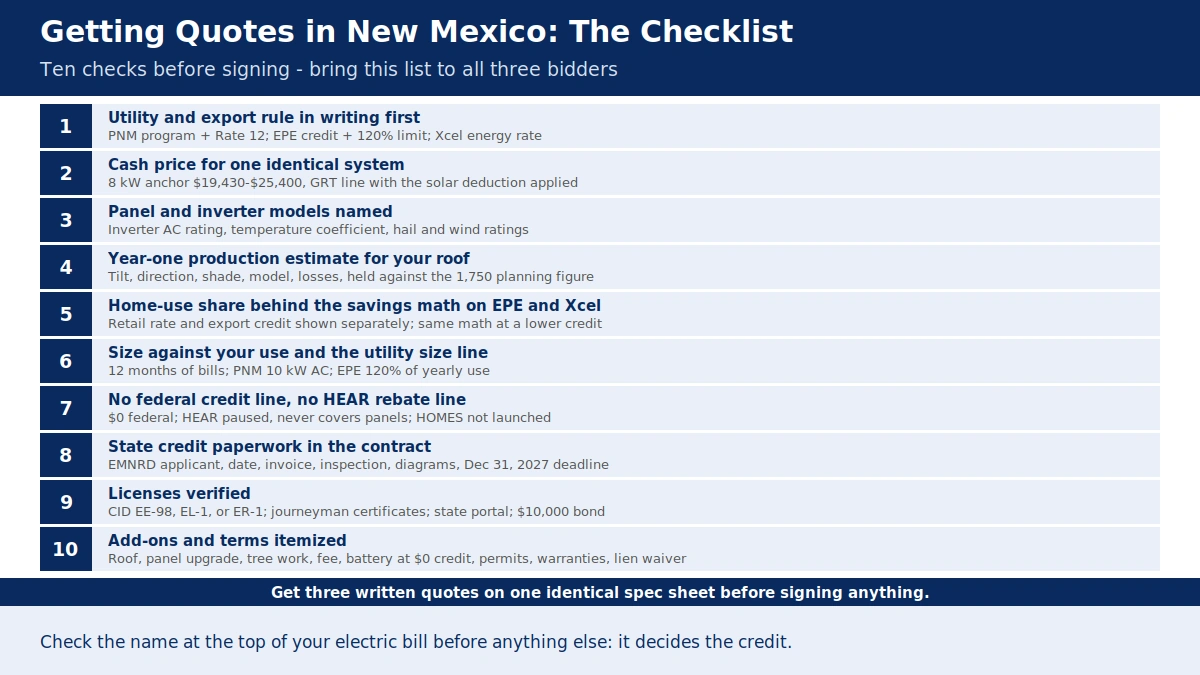
Get three written quotes on one identical spec sheet before signing anything. Compare them on what they name, not on the bottom line alone. The strongest quote names the panels and the inverter, shows the production estimate with its shade assumptions, prices the export rule the buyer’s own utility actually applies, proves the CID license, and puts the state credit application in the contract with a date attached.
New Mexico rewards the careful buyer more than almost any state in the country, because the sun is the strongest, the state credit is real money, and PNM’s never-expiring credits turn a well-sized system into a year-round bank. It punishes the careless buyer just as surely, through oversized arrays on the wrong utility, stale federal credit lines on 2026 quotes, and state credit applications filed late or incomplete. A system bought the careful way costs what the planning band says it costs, makes what the planning figure says it makes, and pays back in about a decade on PNM or in the early teens on El Paso Electric with disciplined daytime use. That is the honest New Mexico answer, and it is a good one.
Sources & methodology Installed costs:
- NumeralQ, Solar Panel Cost in New Mexico (2026), estimator pricing as of Oct 26, 2026 (planning estimates, not contractor bids): 8 kW $19,430-$25,400 ($2.43-$3.18/W); by size 4 kW $10,220-$13,360, 5 kW $12,620-$16,500, 6 kW $14,950-$19,550, 7 kW $17,230-$22,520, 9 kW $21,580-$28,210, 10 kW $23,660-$30,930, 11 kW $25,680-$33,570, 12 kW $27,640-$36,120; solar installer median pay $23.31/hr, billed $47-$61/hr
- NumeralQ, Solar Panel Cost in Albuquerque, NM (2026), pricing Oct 26, 2026: 8 kW $21,930-$28,650 ($2.74-$3.58/W); by size 4 kW $11,540-$15,070 through 12 kW $31,180-$40,740; add-ons (home battery 10-13 kWh $9,990-$15,520 installed, materials $6,900-$11,500; main panel upgrade $2,090-$3,310, materials $690-$1,490); installer pay $28.75/hr median (+12% vs US), billed $58-$75/hr; electricians $28.43/hr, billed $57-$74/hr; median home value $291,500; 62% owner-occupied; 43% of New Mexico homes built before 1980; NOAA hail/wind counts
- EnergySage, New Mexico + Albuquerque + Santa Fe + Las Cruces + Rio Rancho solar cost pages (November 2026, marketplace quote data): state $2.49/W, 10.2 kW $25,370 ($21,564-$29,176), payback 10.21 years, 25-year savings $48,226; Albuquerque $2.57/W, 9.07 kW $23,272; Santa Fe $2.36/W, 9.22 kW $21,746; Las Cruces $2.45/W, 8.91 kW $21,876; Rio Rancho $2.53/W, 10.36 kW $26,227
- EcoGen Solar Cost Index, September 2026 edition: New Mexico $2.71/W, 10th lowest of 51, US average $2.89; typical system 7.04 kW (Berkeley Lab 2025 median, 3,212 systems) at $19,078; neighbors Arizona $2.56, Texas $2.57, Utah $3.01, Colorado $3.02
- SolarReviews, Albuquerque solar page (updated Sept 1, 2026): average 7.2 kW system about $20,300 at $2.84/W; average install size 9.62 kW; 8 kW production 12,500-14,000 kWh/year
- Berkeley Lab national range (via roofpayback.com, Oct 2026): home systems installed in 2024 at $3.00-$5.20/W, median $4.00 (national context only)
Production and rates:
- NREL PVWatts v8 (Albuquerque TMY weather, 14% losses, retrieved Oct 11, 2026, via roofpayback.com): 1,779 kWh/kW/year, ranked 1st of 51
- EU Joint Research Centre PVGIS 5.2 with NREL NSRDB (20-degree tilt, south-facing, 14% losses, via NumeralQ): Albuquerque 1,812 kWh/kW/year; 8 kW makes 14,496 kWh/year; simple payback 11.4 years; 25-year savings $52,400
- EcoGen Solar Cost Index: about 1,824 kWh/kW/year (Albuquerque-class sun); 7.04 kW makes 12,839 kWh/year
- SolarPriceList, solar output by state (2026): Albuquerque 1,620-1,780 kWh/kW/year, 6.0 peak sun hours/day, derate 0.78-0.85
- EIA Electric Power Monthly Table 5.6.A (August 2026): New Mexico residential 16.51 cents/kWh, US 18.16 cents; EIA Form 861M 12 months to August 2026: New Mexico 15.31 cents/kWh, $99.89/month average bill (lowest in the US), 653 kWh/month; PNM 17.02 cents 12-month average, 14.74 cents variable after $11.93 customer charge + $0.77 Rider 60 (EcoGen, Oct 30, 2026)
- Temperature coefficients: typical modern panel -0.30% to -0.35% per degree C, premium about -0.25%, budget near -0.45%; cells run 20-25 C above air temperature; about 14% momentary loss at 65 C cell temperature for a -0.35% panel (MySolarFY, Aug 2026; HomeSolarStudio; EcoPowerGuide)
- ACCA Manual J design temperatures + IECC zones + altitude (via art. 99 research, Nov 7, 2026): Albuquerque 18F/93F at 5,311 ft, Santa Fe 10F/88F near 7,000 ft, Alamogordo 23F/96F; Zones 4B/5B/3B, all dry
Net metering and utilities:
- 17.9.570.14 NMAC (net metering, systems 10 kW or less; rule in force since May 24, 2022): utility choice of energy-rate payment or carried-forward kWh credits; larger systems bought at the energy rate with a $50 monthly threshold; no statewide aggregate cap; municipal utilities exempt (DSIRE summary, updated May 19, 2025)
- PNM solar interconnection benefits page (opened Nov 15, 2026): Small PV Program 10 kW AC or less, Cumulative Renewable Energy Credits that never expire, Rate 12 payment on account closure; Large PV Program over 10 kW AC, monthly Rate 12 payment; Rate 32 Solar REC Purchase Program closed to new applications Jan 1, 2023; Rate 12 cents value not found published
- El Paso Electric: month-end surplus credited at fuel and purchased power cost, 4.5225 cents/kWh on October 2026 bills, changing monthly (EcoGen, single dated source); net metering to 120% of yearly use (EcoGen); $50 interconnection application fee for 1-10 kW systems (EPE document cited by solarpanelscost, Nov 5, 2026); Advice Notice No. 317 (effective May 1, 2026): DG net metering by time-of-day period, demand ratchet reset, TOD 12-month minimum with bill-difference credit
- Xcel Energy (Southwestern Public Service) net energy metering page (opened Nov 15, 2026): virtual bank rolling month to month, cashed out at the Locational Marginal Price once the bank reaches $50 or more; no construction before full engineering approval and signed agreements; Rate 4 monthly energy rate (EcoGen)
- Community solar credits (EcoGen, set 2026): PNM 9.63 cents, Xcel 7.16 cents, El Paso Electric 6.78 cents per kWh
Incentives, federal programs, and lease rules:
- New Solar Market Development Tax Credit, NMSA 7-2-18.31, 3.3.14 NMAC (EMNRD page opened Nov 15, 2026; EcoGen; solarpanelscost; EnergySage): 10% of equipment, materials, and labor up to $6,000 per taxpayer per year, refundable, transferable (Form TRD-41417 within 10 days), systems installed through Dec 31, 2031; $30 million yearly cap, first come, first served (secondary-confirmed); apply within one calendar year of installation (Dec 31, 2027 for 2026 systems); fund year set by inspection date; 3-4 weeks processing; claim on Form TRD-41406; purchase-and-own test excludes leases and PPAs
- Gross receipts tax deduction, NMSA 7-9-112 (since 2007, Form RPD-41341); combined GRT rates Albuquerque 7.625%, Santa Fe 8.1875%, Las Cruces 8.39% (TRD July 2026-June 2027 schedule, via art. 99)
- Property valuation limit, NMSA 7-36-21.2 (3% yearly limit treatment; assessor check required; no full exclusion claimed)
- OBBBA P.L. 119-21; IRS FS-2025-05 (Sections 25C/25D $0 for property placed in service after Dec 31, 2025); Section 48E lease/PPA route generally for systems in service by Dec 31, 2027 (SEIA summary via solarpanelscost)
- HEAR/HEEHR: launched Sept 3, 2024, below 80% AMI only, up to $8,000 heat pump, $14,000 per address (EMNRD/ECAM, Franklin Energy); paused Aug 14, 2026; portal temporarily pausing new rebates with waitlist as of Nov 9, 2026 (betterpowered; conflict with heatpumppricing Nov 4 “open” listing noted); DOE Program Notice 26-2 (May 29, 2026): electric-to-electric only; HEAR does not cover solar panels; allocations HEAR $43,742,970 + HOMES $43,912,501
- HOMES/HER not launched: Franklin Energy selected May 4, 2026, public availability expected early 2027 (GlobeNewswire)
- Solar for All paused since Aug 7, 2025, no application opened, no restart announced as of Oct 5, 2026 (EMNRD pages via EcoGen); Supplemental Solar Tax Credit expired Dec 31, 2025; 30% SMDTC proposal (2026 session, Sen. Stewart) reported May 2026, not law
- Distributed Generation Disclosure Act (10-point font, 4-page maximum, separate statement, separately signed) + appraisal rules for leased systems (NMAR 2025 solar information sheet)
- Positive Energy Solar prepaid lease (company owns 6 years, then transfers ownership) + 22% fall in New Mexico residential solar permits in early 2026 + Wood Mackenzie/SEIA 19% national contraction forecast (Albuquerque Journal, May 10, 2026)
Batteries, wildfire, and weather:
- Battery costs: NumeralQ Albuquerque add-on $9,990-$15,520 installed (10-13 kWh); Tesla Powerwall 3 (13.5 kWh, 11.5 kW) typical $13,473 installed (EnergySage via Infinite Power Solutions, Oct 2026), installer ranges $13,000-$17,000; Enphase IQ Battery 5P two-unit 10 kWh about $11,300 (EnergyBS, June 2026); no dedicated New Mexico battery rebate verified; Section 25D battery credit ended for installations completed after Dec 31, 2025
- PNM Wildfire Mitigation Plan + PSPS Plan filed Apr 1, 2026; PSPS alert system launched Feb 25, 2026 (Advisory/Watch/Warning); high fire risk areas Clayton, Cochiti Pueblo, East Mountains, Las Vegas, Mescalero Apache Nation, Ruidoso, Santa Fe, Silver City, Tesuque Pueblo; Wildfire Safety Mode heightened readiness March-October; La Cienega outages June 20-21, 2026 (wildfire protocols, one-shot mode) + July 8, 2026 (~1,300 customers, single radial feeder) (Santa Fe County minutes, July 7, 2026)
- Hail: IEC 61215 1-inch test; NOAA 126 reports of 2-inch-plus hail in New Mexico 2016-2025; Bernalillo County 41 thunderstorm wind reports of 58 mph or more 2016-2025 (NumeralQ, citing NOAA)
- Soiling: Rodriguez Ortiz et al., Atmosphere (Apr 2026), UTEP, Alamogordo, 6 panels, 22 dust events, late 2022-spring 2024: about 2-3% soiling losses; 2.2 mm/hour rain restores near-baseline; gypsum optical properties; longer monsoon-season monitoring recommended
- Solar access and HOA law: NMSA 3-18-32 (covenants effectively prohibiting solar void; 2011 Attorney General opinion on HOA regulation); NMSA 47-3-4 (Solar Rights Act); Albuquerque IDO Table 5-10-1 solar access planes, 32-degree angle, zones R-A/R-1/R-MC/R-T/R-ML, ROA 1994 Part 14-11-7 (NumeralQ, IDO checked Oct 10, 2026)
- Community solar: 47 projects, about 196 MW awarded May 2023; 13 online May 2026, 16 operating July 2026, 39 on track by end of 2026; 300 MW expansion; 8-project 48.4 MW portfolio, 103,287 MWh first-year output, 7 of 8 generating Oct 2026, Otero due end of 2026, about 2,500 households enrollable (ForeFront Power, Mar 2026; Santa Fe New Mexican, May 2026; Las Cruces Bulletin via thecooldown, July 2026; energiesmedia, Oct 2026); 30% low-income reservation (all projects committed 50%+); Las Cruces projects 10% discount, 28% low/moderate-income (Standard Solar); separate-billing + removal-after-one-missed-payment rules (Solstice executive, May 2026)
Licensing, permits, and liens:
- 14.5.2.8 NMAC (effective Mar 10, 2022; rule text via Cornell LII, opened Nov 15, 2026): EE-98/EL-1/ER-1 contractor license; GB-98/GB-02 structural rules; EE-98J/EL-1J/ER-1J journeyman certificates or supervised apprentices; submittal documents (site plan, layout, one-line diagrams, mounting listing, load calculations, grounding); PE structural analysis triggers (5 lb/sq ft dead load, 45 lb point load, 200 lb per truss/rafter/joist, unique design, over-spanned members); building permit triggers
- 14.6.6.10 NMAC: EE-98 requires 4 years’ experience; CID license mechanics ($10,000 surety bond, PSI exams at 70%, qualifying party, financial statement) + $7,200 casual-work exemption excluding electrical work (via art. 99 research, Nov 7, 2026)
- PNM interconnection steps (NumeralQ, PNM process checked Oct 9, 2026): capacity map, online application, technical review, inspection, permit-tag image, meter work; IEEE 1547-2018 advanced inverters under 17.9.568.11 NMAC + docket 23-00203-UT (effective Mar 29, 2024); interconnection rules adopted Nov 30, 2022
- Mechanic’s liens: 4-or-fewer-unit homes exempt from preliminary notice (NMSA 48-2-2.1); liens capped at unpaid balance; 90 days subs / 120 days contractor (48-2-6); withhold/offset for unpaid subs (48-2-12) (NumeralQ citing Levelset, checked Nov 10, 2026)
- No verified solar permit fee for any New Mexico city; no verified ground-mount, removal/reinstall, EPE/Xcel timeline, co-op export, or insurance premium-impact figure (see research file flags)
NestPriced arithmetic (labeled in the article, not sourced figures):
- 8 kW midpoint $22,415: ($19,430 + $25,400) / 2
- Year-one output 14,000 kWh: 8 kW x 1,750 kWh/kW planning figure
- Average-home size about 4.5 kW: 7,836 kWh/year / 1,750 kWh/kW
- PNM payback: 14,000 kWh x 14.74 cents = $2,064/year; $22,415 / $2,064 = 10.9 years; ($22,415 – $2,242) / $2,064 = 9.8 years
- EPE scenarios: 50% home use: 7,000 x 15.31 cents + 7,000 x 4.5225 cents = $1,388/year, 16.1/14.5 years; 70%: 9,800 x 15.31 + 4,200 x 4.5225 = $1,690/year, 13.3/11.9 years; 90%: 12,600 x 15.31 + 1,400 x 4.5225 = $1,992/year, 11.3/10.1 years (15.31-cent statewide rate used as labeled stand-in for the EPE home-use value)
- State credit $2,242: 10% of $22,415, under the $6,000 cap; net cost $20,173
- Scaled 8 kW city figures: Albuquerque $2.57 x 8,000 = $20,560; Santa Fe $2.36 x 8,000 = $18,880; Las Cruces $2.45 x 8,000 = $19,600; Rio Rancho $2.53 x 8,000 = $20,240
- EPE battery shift spread about 10.8 cents: 15.31 cents – 4.5225 cents
- GRT illustration about $1,700: $22,415 x 7.625% Albuquerque combined rate
- Heat derating: (65 – 25) x 0.35% = 14%; (65 – 25) x 0.26% = about 10%
- Per-watt by size: 4 kW $10,220-$13,360 / 4,000 W = $2.56-$3.34/W; 12 kW $27,640-$36,120 / 12,000 W = $2.30-$3.01/W
EXCLUDED:
- Any federal tax credit for a 2026 homeowner-owned install ($0 under OBBBA) and any “after 30% credit” price as a current figure
- Any HEAR/HOMES money in a 2026 solar quote (HEAR paused for new rebates and never covers panels; HOMES not launched)
- Any PNM Rate 12 cents figure (not found published) and any Xcel export rate (LMP floats; no single figure exists)
- Any EPE or Xcel residential retail rate (no verified current figure found); any Texas-side EPE term (Rate 48, $30.25 minimum bill) applied to New Mexico
- Any Santa Fe, Las Cruces, or Rio Rancho NumeralQ price (no such models exist; EnergySage marketplace averages only, flagged)
- Any solar permit fee, ground-mount adder, removal/reinstall price, co-op/municipal export credit, or insurance premium-impact figure (none verified)
- SmartEnergyUSA battery pages still claiming a live 30% ITC (stale); umbdcmart $2.30-$2.80/W and 6-9 year payback claims (stale, unsourced); ConsumerAffairs March 2026 ranges as current prices (recorded only)
- The wisevoter hail-lab report (single weak source); the SunEdison-era third-party PPA legality fight (stale history); the 30% SMDTC proposal as law; the expired Supplemental Solar Tax Credit as live; any Solar for All application route (paused, none opened)
- Any full property-tax exclusion claim for solar value (valuation-limit reading adopted instead); any battery coverage under the SMDTC or GRT deduction as settled (ask EMNRD/TRD in writing)
- TheGreenWatt 1,946 kWh/kW production figure as the planning figure (method outlier; planning figure set at 1,750 inside the PVWatts/PVGIS cluster)
Disclaimer: The prices here are 2026 New Mexico planning figures. What you end up paying moves with the system size, the roof, the city, the utility on your bill, the panel and inverter models, and the installer. Get written quotes from three CID-licensed New Mexico installers before settling on a budget, and check each license yourself on the state portal before anyone touches the roof. Nothing here is tax advice for your own return. Program rules change, including the Solar Market Development Tax Credit budget, the HEAR pause status, the HOMES launch date, and utility export tariffs, so confirm current terms with EMNRD, the Taxation and Revenue Department, and your own utility before signing. Production and payback figures depend on your own roof, shade, and use, so treat the planning figures as a starting point and the installer’s roof-specific estimate as the number to hold the job to.
What does a solar panel system cost in New Mexico in 2026?
An 8 kW rooftop system costs $19,430–$25,400 installed in New Mexico in 2026, or $2.43–$3.18 per watt, on NumeralQ planning estimates priced October 26, 2026. Albuquerque runs higher at $21,930–$28,650 for the same size because installer pay there runs 12% above the national median. EnergySage marketplace data averages $2.49 per watt statewide and EcoGen’s index puts the state at $2.71 per watt, so a quote far above $3.18 per watt for an ordinary roof needs a clear reason.
How much power do solar panels make in New Mexico?
This guide plans on 1,750 kilowatt-hours per kilowatt each year, so an 8 kW system makes about 14,000 kilowatt-hours in its first year. Published models cluster between 1,620 and 1,824 kilowatt-hours per kilowatt, with NREL PVWatts at 1,779 and PVGIS at 1,812 for Albuquerque, and the planning figure sits near the bottom of that cluster on purpose. Desert heat trims afternoon output by roughly 10% to 14% at peak cell temperatures, but that loss is already inside the hourly models and must not be subtracted a second time.
Does New Mexico have net metering in 2026?
Yes, under Public Regulation Commission rule 17.9.570.14, but each utility credits surplus power differently, so the utility on the bill decides the deal. PNM banks surplus as kilowatt-hour credits that never expire for systems with inverter capacity of 10 kW AC or less, while larger PNM systems are paid monthly at the avoided-cost Rate 12. El Paso Electric credits month-end surplus at its fuel and purchased power cost, 4.5225 cents per kilowatt-hour on October 2026 bills, and Xcel pays surplus at a floating wholesale market price once the credit bank reaches $50.
What is the New Mexico solar tax credit in 2026?
The New Solar Market Development Tax Credit pays 10% of equipment, materials, and labor costs, up to $6,000 per taxpayer per year, for systems installed through December 31, 2031. It is refundable, so a small state tax bill does not block it, but it needs EMNRD certification, it is capped at $30 million of credits a year on a first-come, first-served basis, and the application must reach EMNRD within one calendar year of installation. A lease or power purchase agreement household cannot claim it, because the company owns the system and the purchase test fails.
Is there a federal tax credit for solar panels in New Mexico in 2026?
No, for a system the homeowner owns. The federal residential clean energy credit ended for systems placed in service after December 31, 2025, under the One Big Beautiful Bill Act, so a homeowner-owned 2026 install earns a $0 federal credit. A company that owns the system under a lease or power purchase agreement may still claim the federal business credit for systems in service by December 31, 2027, and may pass part of the value through in the contract price, which must be shown in dollars in writing.
How long is the solar payback in New Mexico?
On PNM, about 10.9 years before the state credit and 9.8 years after it, for an 8 kW system at the $22,415 midpoint making 14,000 kilowatt-hours a year, because never-expiring kilowatt-hour credits value every unit at the retail-equivalent rate. On El Paso Electric, payback runs 11.3 to 16.1 years before the credit depending on how much power the home uses while the sun shines, because surplus earns only about 4.52 cents. All figures are simple payback with no upkeep, panel wear, rate rises, or financing cost counted.
Do I need a battery with solar panels in New Mexico?
Most PNM customers do not need one for bill savings, because kilowatt-hour credits already bank surplus at full value with no expiry, but households in PNM’s high fire risk areas have a genuine outage case. PNM’s wildfire shutoff plans cover Santa Fe, Ruidoso, the East Mountains, and six other areas, and protective settings caused real outages in Santa Fe County in June 2026. A 10 to 13 kWh battery costs $9,990–$15,520 installed in Albuquerque, panels alone do not power a home during an outage, and one battery runs essential loads through an evening rather than whole-home air conditioning all night.
Who can legally install solar panels in New Mexico?
The installer must hold a Construction Industries Division license in the EE-98, EL-1, or ER-1 classification, and the workers doing the installation must hold matching journeyman certificates or work as apprentices under a certified journeyman’s direct supervision. The job also needs an electrical permit with approved submittal documents, an inspection, and the utility’s interconnection approval before the system can turn on. Check the license number on the state’s verification portal before signing, and confirm the $10,000 surety bond and the permit responsibility in writing on the contract.