


Solar panels in Louisiana cost $2.69 a watt in 2026. That is less per watt than a Minnesota roof at $3.11, a Wisconsin roof at $3.01, or the national average of $2.89. Yet Louisiana solar still struggles to pay for itself, and the price on the quote is not the reason.
The sun is generous. Louisiana gets about 4.5 to 4.7 peak sun hours a day, summer afternoons that stretch toward 5.9, and a kilowatt that makes roughly 1,490 kilowatt-hours a year.
The houses help too. A Louisiana home draws about 1,200 kilowatt-hours a month, among the highest in the country, because the air conditioner runs from spring into fall and the humidity never really lets up.
What breaks the case is the price of the power that leaves the roof. Since January 1, 2020, the Louisiana Public Service Commission’s two-channel rule has paid new solar homes only the utility’s avoided cost for exported power.
Avoided cost means the wholesale price, reset every year. At Entergy Louisiana that means 3.86 cents out against roughly 12.87 cents in.
A kilowatt-hour used at home the moment the panels make it is worth the full retail rate. A kilowatt-hour sent to the grid at noon is worth less than a third of that. How much of its output the house can use as it is made decides the return, along with whether the roof sits inside Orleans Parish, where the City Council kept the old one-for-one deal alive.
Storm season sets Louisiana apart in a second way. Hurricane season runs June 1 to November 30. Design wind speeds run 130 to 140 miles per hour around Baton Rouge, 150 or higher in the coastal parishes, and up to 180 in the most exposed spots.
No panel carries a single hurricane-rated stamp. The racking does the holding, and the roof does the rest. Heat cuts the other way from what a buyer expects.
Panels make less power on the hottest afternoons, not more, because a cell at 65 degrees Celsius loses about 14 percent of its rated output at a mainstream temperature coefficient. The annual production figures below already carry that loss inside them, and the heat section shows the arithmetic so nobody deducts it twice.
Table of Contents
How Much Do Solar Panels Cost in Louisiana in 2026?
Three measures describe the Louisiana market in 2026. The headline number comes from EcoGen’s September 2026 Solar Cost Index: $2.69 a watt before incentives, which prices the typical 7.84 kW system at $21,090.
That is about 7 percent below the national average of $2.89 a watt, and 9th lowest of 51 jurisdictions. It is cheaper than Mississippi at $2.70 and cheaper than Texas, though Arkansas runs about $2.60 by one planning estimate. Louisiana quotes in 2026 clustered inside the Index’s 12 percent band around that anchor, roughly $2.37 to $3.01 per watt.
Inside that band, a 6 kW system runs $14,220 to $18,060, an 8 kW system $18,960 to $24,080, a 10 kW system $23,700 to $30,100, and a 12 kW system $28,440 to $36,120.
A second measure, built from real marketplace quotes, points the same way. EnergySage, as of November 2026, puts Louisiana at $2.31 a watt, thirty-eight cents below the EcoGen anchor, but on a much bigger system: its average Louisiana system is 12.89 kW, priced at about $29,837, with a range of $25,361 to $34,313.
Look at the system sizes before the prices. The two figures describe different houses, not different prices. What flows through EnergySage’s marketplace is an average of real quotes, and the Louisiana shoppers behind them skew toward oversized systems: all-electric houses, a driveway EV, air conditioning that runs most of the year, a home bought with growth in mind.
Berkeley Lab counted 295 Louisiana systems installed in 2025 and found a median of 7.84 kW. That is the size Louisianans actually put on their roofs, and EcoGen builds its typical system on that median.
As a cross-check on price per watt, EnergySage’s $2.31 sits thirty-eight cents below EcoGen’s $2.69. Two unrelated measures, both below the national average, with the gap explained mostly by the systems behind them.
Two more figures complete the comparison, and both need a label attached. ConsumerAffairs’ 2026 figure for Louisiana, $2.34 a watt and about $29,484 for its system, is a national model assembled from EIA rates and cost-per-watt inputs, not a survey of Louisiana quotes. SolarEnergyPrices’ planning figure of $2.70 a watt, about $27,000 for a 10 kW system inside a $2.45 to $2.95 band, is a planning range built from marketplace reports, and it lands within a cent of the EcoGen anchor.
Together, the anchors put Louisiana below the national average. The width of the quote band, $2.37 to $3.01, says more than any single point in it.
One warning about that typical size before the tables, because it shapes every number that follows. Louisiana homeowners actually installed systems whose middle size is 7.84 kW, a real-world median rather than a modeled number. It falls short of what the average Louisiana household consumes in a year.
Work it out for the typical array: 1,490 kilowatt-hours per kilowatt, times 7.84 kW, comes to roughly 11,682 kilowatt-hours a year. The average Louisiana home draws roughly 14,400 a year, about 1,200 a month. That puts the typical installation at close to 81 percent of an average household’s yearly use.
Put another way, the typical array stops short of the average home’s full yearly use. Still, the typical buyer and the average home are different households. The covering size for average use is about 9.7 kW, and the sizing section further down unpacks what that gap means for a home that runs its air conditioner harder than the state average, which, in Louisiana, is most of them.
The per-watt price covers the whole job:
- Panels, inverter or microinverters, racking, and wiring
- The crew’s time, permits, inspection, and the interconnection filing
A new roof, a panel upgrade, tree work, a battery, and hurricane-rated racking engineering beyond the standard mount are all priced separately, outside that number. No incentive sits inside that arithmetic. For most Louisiana buyers in 2026 none exists that lowers the purchase price: the federal credit is gone, there is no broad state rebate, and the state offers no income-tax credit for solar.
Louisiana’s property-tax exemption for the added value of a solar system already sits outside the quoted price. It keeps a tax bill from arriving. It is not a discount on the quote, so deducting it a second time counts the same savings twice.
The exceptions are narrow and utility-specific: a rebate reported at Cleco or SWEPCO, a few hundred dollars at Entergy Louisiana or Energy Smart in New Orleans. The headline leaves those narrow exceptions out, and the incentives section below prices each one on its own.
For most Louisiana buyers, the sticker on the quote is the price of the system. Deduct more than that, and the quote is still doing its sums under a law that ended on December 31, 2025.
One caution before the tables. The cheapest Louisiana quote is rarely the cheapest system once the job is finished. Hurricane season makes the second and third quotes harder to get, and more worth getting.
Crews book out ahead of summer, and a bid taken in May for a July install can quietly carry a premium for the slot. A $0-down loan often hides a dealer fee of 20 to 30 percent of the cash price inside the amount financed. Overhead and margin are most of what an installer charges, and the fee stays invisible until the cash price sits beside the financed price.
With quotes from New Orleans, Baton Rouge, Shreveport, and Alexandria installers spread across the table, the cash price per watt for the same panels on the same Louisiana roof is the one number that lets you judge bidder against bidder. Get three installers to put that figure on paper, and walk away from any bidder who will not. Where the export rate on the bill decides the payback, that third quote also proves the company priced the household’s own utility rules, not a statewide average.
| Source | $ per watt | System | Cash total | Payback |
|---|---|---|---|---|
| EcoGen Index (Sep 2026) | $2.69 | 7.84 kW | ~$21,090 | ~23.2 yrs statewide |
| EnergySage (Nov 2026) | $2.31 | 12.89 kW avg | ~$29,837 | 15.24 yrs — flagged, modeled |
| EnergySage (Nov 2026, by-state table) | $2.32 | 12.89 kW avg | ~$29,900 | Not published |
| ConsumerAffairs (2026 model) | $2.34 | ~12.6 kW | ~$29,484 | 12.2 yrs — flagged, modeled |
| SolarEnergyPrices (planning) | $2.70 | 10 kW | ~$27,000 | Not published |
| SunMetricLab (planning) | ~$2.70 | 8 kW | ~$21,600 | 11.5 yrs — flagged, modeled |
| National range (article 4) | $2.25–$3.30 | 8.2 kW | ~$24,600 at $3.00/W | 6–12 yrs |
Four of those rows carry footnotes, and those notes qualify the figures beside them. EnergySage’s payback figure, 15.24 years statewide, is a modeled estimate built on its own marketplace averages. It runs on a 12.89 kW system, far above the 7.84 kW median that Louisiana homeowners actually install.
A payback built on a system sized for a house using 14,400 kilowatt-hours a year describes a different Louisiana than the tariffs do. The export rule punishes oversizing, and EnergySage’s model does not price the avoided-cost gap the way the LPSC tariff does.
ConsumerAffairs’ 12.2 years and SunMetricLab’s 11.5 years are national-model and planning figures that still carry the old 30 percent federal credit inside their net columns. They are excluded from the headline for that reason.
EcoGen’s figures are used from here on, with EnergySage’s figures checking them from the side.
Solar Panel Cost in Louisiana by System Size
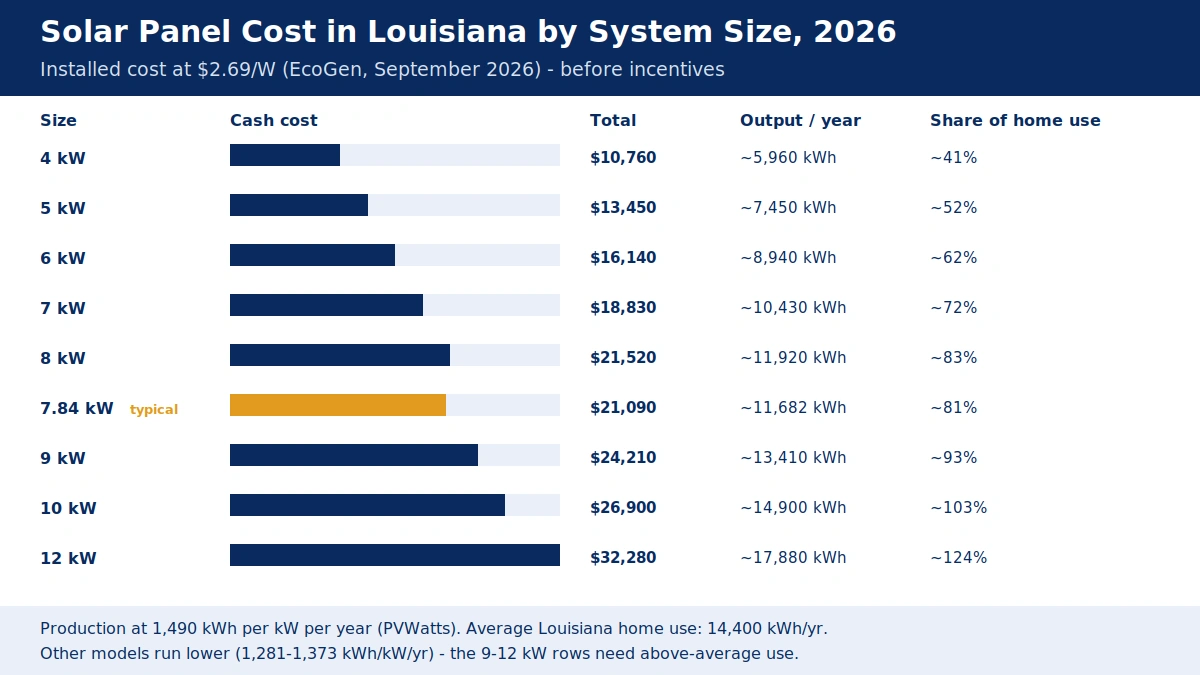
Size is the first decision a Louisiana buyer makes. The per-watt price makes it simple to price: multiply the kilowatts by $2.69 and the cash total follows.
The harder question is how much of the house the system should cover. The export rule punishes every kilowatt-hour the house cannot use as it is made.
A system sized to the home’s daytime load earns the full retail rate on nearly everything it makes. A system sized to the annual bill earns 3.86 cents on the midday surplus.
Louisiana has one mercy here. The air conditioner already runs through the afternoon, so the daytime load is bigger than in most states.
The table below prices every size at the EcoGen anchor. It shows what each one makes against a home that draws about 14,400 kilowatt-hours a year.
| Size | Cash cost at $2.69/W | Output per year | Share of average home use |
|---|---|---|---|
| 4 kW | $10,760 | ~5,960 kWh | ~41% |
| 5 kW | $13,450 | ~7,450 kWh | ~52% |
| 6 kW | $16,140 | ~8,940 kWh | ~62% |
| 7 kW | $18,830 | ~10,430 kWh | ~72% |
| 8 kW | $21,520 | ~11,920 kWh | ~83% |
| 7.84 kW (state typical) | $21,090 | ~11,682 kWh | ~81% |
| 9 kW | $24,210 | ~13,410 kWh | ~93% |
| 10 kW | $26,900 | ~14,900 kWh | ~103% |
| 12 kW | $32,280 | ~17,880 kWh | ~124% |
| 12.89 kW (EnergySage avg) | $34,674 | ~19,206 kWh | ~133% |
Output runs at 1,490 kilowatt-hours per kilowatt per year on the EcoGen anchor. Two other models run lower: about 1,281 from a SolarSpecHub calculation off NREL sun data at 78 percent system performance, and about 1,373 from SunMetricLab’s 4.7-sun-hour model.
A quote that promises more than 1,490 per kilowatt should be asked to show its PVWatts run. PVWatts is the production model from NREL, the National Renewable Energy Laboratory. The covering size for the average home is about 9.7 kW: 14,400 divided by 1,490.
A 6 kW system covers about 62 percent of average use and costs $16,140. A 10 kW system covers the whole bill and a little more at $26,900. A 12 kW system makes about a quarter more than the average home uses, and every kilowatt-hour of that quarter earns only the avoided-cost credit outside New Orleans.
Three sizing rules follow from the export math. They run opposite to the rules in a net-metering state:
- Size to the daytime load, not the annual bill: the air conditioner, the pool pump, the laundry, the hours the house is actually drawing power while the sun is up.
- Treat the roof’s south face as the budget and the west face as a bonus. West-facing panels make their power later in the day, when the house is drawing it, and late-day power is worth the retail rate instead of the export credit.
- Do not buy the 12.89 kW EnergySage average unless the house genuinely uses that much power. At 3.86 cents an exported kilowatt-hour, the extra panels pay for themselves on a calendar no buyer should accept.
Inside New Orleans, where each exported kilowatt-hour cancels one bought, the sizing rule flips back to the annual bill. A 10 kW system that covers the whole year’s use is the right target there.
The panel count follows from the wattage on the datasheet. At 400 watts a panel, a 7.84 kW system is about twenty panels.
At 450 watts, about seventeen. Our 6 kW vs 8 kW vs 10 kW guide sizes the three most common systems side by side.
Roof space is rarely the constraint in Louisiana. The ranch and the raised cottage both carry broad, low-pitched roofs. Shade is the constraint: live oaks are the state’s signature tree and the enemy of a south-facing array, and a shade study matters more here than the panel count does.
A roof that loses its afternoon to a live oak loses the very hours when its power is worth the retail rate. For a shaded roof, a renter, or a household that will move before payback arrives, our community solar cost guide prices the shared-array alternative.
What New Orleans, Baton Rouge, Shreveport & Alexandria Actually Pay
Louisiana has no single solar price, because it has no single utility. Four territories cover most of the state’s homes. The spread between them is the difference between a 14-year payback and a 26-year one.
The table below compares them on the numbers that decide the return: the retail rate the house pays, the export credit the roof earns, and the payback EcoGen modeled for the typical 7.84 kW system at $21,090.
| City / territory | Utility | Retail rate | Export credit (2026) | Payback (EcoGen) |
|---|---|---|---|---|
| New Orleans | Entergy New Orleans | ~12.75¢/kWh | One for one (net metering) | ~14.2 yrs |
| Baton Rouge | Entergy Louisiana | ~12.34¢/kWh | 3.86¢/kWh | ~26.3 yrs |
| Shreveport | SWEPCO | ~12.87¢/kWh (state avg) | 3.66¢/kWh | ~23–26 yrs (est.) |
| Alexandria | Cleco | ~12.87¢/kWh (state avg) | 3.85¢/kWh | ~23–26 yrs (est.) |
| Baton Rouge parishes | DEMCO (co-op) | ~12.87¢/kWh (state avg) | 3.85¢/kWh | ~23–26 yrs (est.) |
| Lafayette area | SLEMCO / Lafayette Utilities | Not verified | Not verified | Not verified |
New Orleans is the outlier, and the reason is jurisdiction, not weather. Entergy New Orleans answers to the New Orleans City Council, not to the Public Service Commission. The Council kept one-for-one net metering for home systems up to 25 kW.
A New Orleans kilowatt-hour sent to the grid cancels a kilowatt-hour bought later that month, at the full retail rate. The same $21,090 system pays back in about 14.2 years.
The city’s sun is the best in the state too, up to about 5.0 peak sun hours a day. But the export rule, not the sun, is what makes the New Orleans numbers work.
Baton Rouge is the cautionary tale. Entergy Louisiana serves the capital and most of south and north Louisiana outside Orleans Parish. Its export credit is 3.86 cents a kilowatt-hour from April 1, 2026, up from 2.59 cents in 2025.
Entergy Louisiana’s own average price is 12.339 cents. Once its $11.99 a month in fixed charges is taken out, the effective price on the power a solar home avoids is about 11.353 cents. EcoGen’s per-utility payback for Entergy Louisiana is about 26.3 years, the slowest of the big utilities in the state, because the gap between 11.353 cents saved and 3.86 cents earned is the widest.
A Baton Rouge buyer who sizes to the annual bill instead of the daytime load will spend a decade exporting power at a third of its value.
Shreveport and Alexandria sit in the middle of the range, and their paybacks are estimates. SWEPCO, in the northwest, credits exports at 3.66 cents, the lowest of the big four. Cleco, in central Louisiana around Alexandria, credits 3.85 cents.
Neither utility has a published EcoGen per-utility payback. The table carries the statewide 23.2-year figure as the anchor and a 23-to-26-year range as the estimate. The real number depends on the home’s self-consumption share, the share of solar power the house uses as it is made.
DEMCO, the co-op that rings Baton Rouge, credits 3.85 cents from March 1, 2026. The other co-ops in the state run 3.58 to 3.99 cents. Co-op households should treat the range as the quote: call the co-op, get the export rate and any monthly fee in writing, and do not sign until both are on paper.
Lafayette is the gap in the table. No verified figure is printed for it, rather than a guess. The Lafayette area is split between SLEMCO, a co-op, and Lafayette Utilities System, a city-owned municipal utility that the Public Service Commission does not regulate.
Neither provider’s 2026 export terms were verified to the dollar. A Lafayette buyer should get them from the provider directly. The municipal rulebook is a different document from the LPSC one, and the numbers in Baton Rouge do not travel west.
One more warning about the table. The retail rate in it is the statewide EIA average of 12.87 cents unless a utility’s own figure is shown. No home pays the statewide average.
The bill a solar home avoids is its own utility’s rate less its fixed charges. Fixed charges are the part of the bill solar can never erase.
Entergy Louisiana’s $11.99 a month is about $144 a year that stays on the bill no matter how many panels go up. Ask the installer to show the avoided rate, the utility’s price less its fixed charges, before believing any savings figure in a quote.
Louisiana Heat & Humidity: What the Gulf Climate Does to Output
Louisiana buyers expect the heat to help their panels. It does the opposite, and the physics is simple enough to check on any datasheet.
A panel is rated at a cell temperature of 25 degrees Celsius under Standard Test Conditions. That is a cool, bright laboratory day that a Louisiana roof never sees. Out on the roof, the cells run 20 to 25 degrees hotter than the surrounding air, and every degree above 25 costs power.
The number that decides how much is the temperature coefficient of Pmax. Pmax is the panel’s peak power output. The coefficient, printed on the datasheet as a negative percentage per degree Celsius, says how much of that output is lost for each degree above 25.
A typical modern residential panel runs about -0.30 to -0.35 percent per degree. Premium panels reach about -0.25 percent.
Older or budget panels run near -0.45 percent. A number closer to zero is better, and it matters most in a state where the air itself sits above 30 degrees for much of the year.
The arithmetic is one multiplication. Take a mainstream panel at -0.35 percent per degree on a hot, still Louisiana afternoon, when the cells reach 65 degrees Celsius, 40 degrees above the 25-degree rating. The loss at that moment is 40 times 0.35, or about 14 percent of rated power.
A premium panel at -0.25 percent loses about 10 percent under the same heat, so the better coefficient buys back 3 to 4 percentage points of output when it is hottest. A budget panel at -0.45 percent loses about 18 percent.
At a milder cell temperature of 55 degrees, the mainstream panel loses about 10.5 percent. At 45 degrees, about 7 percent.
The coefficient describes a worst-case afternoon, not the annual average. Panels are only cell-hot for part of the day, and the production models already account for temperature across the whole year.
That last point is the one that saves buyers money, because it is the mistake a quote can hide. NREL’s PVWatts model, the model behind the 1,490 kilowatt-hours per kilowatt per year used here, already carries temperature losses inside its annual figure.
A quote that starts from 1,490 and then deducts a further 10 percent for Louisiana heat is counting the same loss twice. Ask the installer to show the PVWatts run and its temperature assumption. If the run says 1,490, the heat is already in it.
If the run says 1,600 or more, ask what sun hours and what losses it assumed. The cross-checks run lower, about 1,281 from a SolarSpecHub calculation off NREL sun data, and about 1,373 from SunMetricLab’s model. A promise above the anchor needs a model behind it.
Humidity is the quieter half of the Gulf climate, and it costs output in ways the coefficient never touches. Louisiana air carries moisture, pollen, and salt, and all three settle on glass. Pollen season coats panels in spring, Gulf humidity leaves a film that rain only partly clears, and salt air near the coast argues for corrosion-resistant racking and anodized frames rather than bare steel.
No Louisiana-specific soiling percentage was verified, so no number is stated here. But the practice follows from the climate: a panel that is cleaned after pollen season and checked after a storm makes more power than one left to the weather, and a racking system that resists salt costs less over 25 years than one that does not.
The other humidity cost is the one every Louisiana household already pays: the air conditioner. A home that draws 1,200 kilowatt-hours a month in July is a home whose daytime load is large enough to swallow most of what its panels make. That is the one way the Gulf climate pays the solar owner back.
Panel choice in Louisiana is a heat choice before it is a wattage choice. Compare the temperature coefficient before comparing the nameplate: a 400-watt panel at -0.25 percent will outproduce a 410-watt panel at -0.40 percent on a July afternoon in Baton Rouge, and the gap widens every year the system runs.
N-type and heterojunction cells carry the better coefficients, and the premium for them is worth pricing against the extra kilowatt-hours they keep. Leave an air gap under the array.
Racking that lifts the panels off the roof lets air move behind them and keeps the cells a few degrees cooler. Favor a roof with airflow over a flush mount on a low-slope roof.
The heat will not stop a Louisiana system from working. It will shave the top off every summer afternoon.
Ask for the coefficient in writing. A quote that names it has priced the heat.
Net Metering in Louisiana: Two-Channel Billing and the 3.86-Cent Export
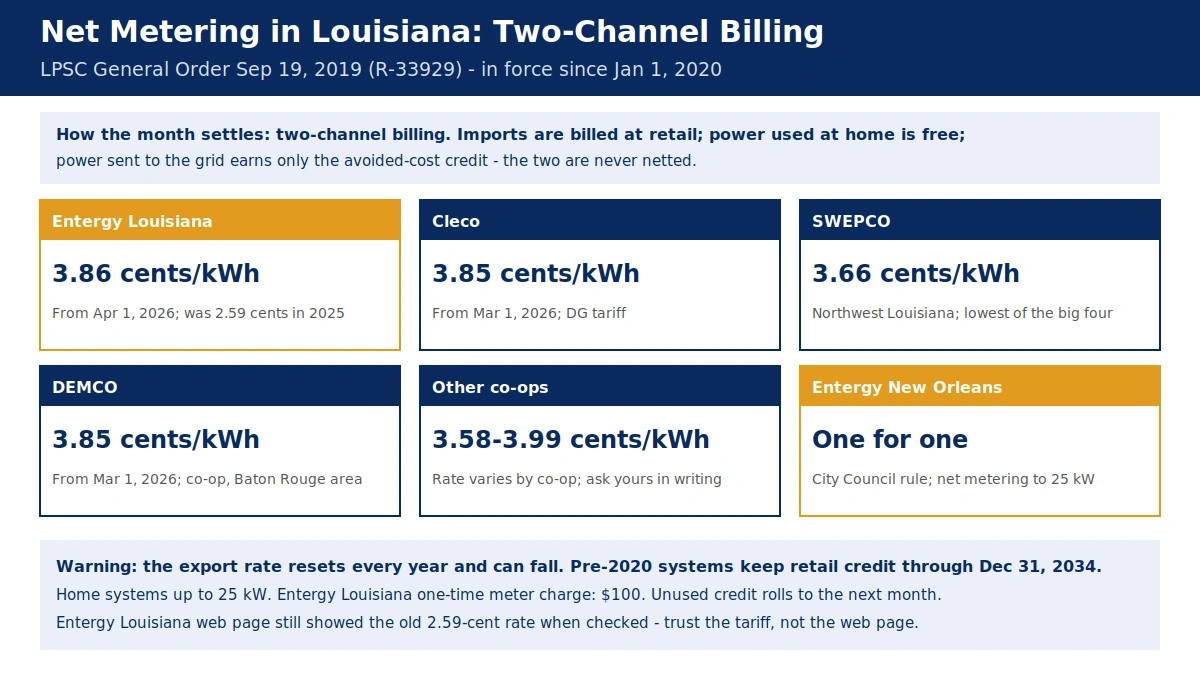
The rule that decides whether a Louisiana system pays is not a solar rule at all. It is a billing rule, written by the Louisiana Public Service Commission on September 19, 2019, in General Order R-33929, and in force since January 1, 2020.
It covers the 15 utilities the Commission regulates, Entergy Louisiana, Cleco, SWEPCO, and the co-ops among them. It replaced the old net-metering deal for every home that applied or installed after December 31, 2019. The new rule has three parts, and each one changes the arithmetic:
- The home pays the normal retail rate for every kilowatt-hour it buys from the utility.
- The home pays nothing for solar power it uses as the panels make it. That power is worth the full retail rate, because it is power the home never had to buy.
- Power the home sends to the grid earns a credit at avoided cost, the average wholesale price of power in the utility’s area over the last calendar year.
The two directions are metered separately and never netted against each other. That is what two-channel billing means: one channel counts what comes in, the other counts what goes out, and the bill is the difference between their values, not their volumes.
The 2026 avoided-cost rates, from the Commission’s annual schedule as checked in late September 2026, are the numbers every Louisiana quote should carry:
| Utility | Export credit (2026) | In effect since |
|---|---|---|
| Entergy Louisiana | 3.86¢/kWh | April 1, 2026 |
| Cleco | 3.85¢/kWh | March 1, 2026 |
| SWEPCO | 3.66¢/kWh | — |
| DEMCO | 3.85¢/kWh | March 1, 2026 |
| Other co-ops | 3.58–3.99¢/kWh | — |
| Entergy New Orleans | One for one | City Council rule |
The rate is not fixed. Each utility resets it once a year, and it can fall as well as rise. Entergy Louisiana paid 2.59 cents a kilowatt-hour in 2025 and pays 3.86 cents now, which is $2.59 against $3.86 for the same 100 kilowatt-hours.
A savings estimate that treats today’s 3.86 cents as a 25-year promise is selling a rate the Commission reprices every year. Entergy Louisiana’s own net-metering web page still showed the old 2.59-cent rate when it was checked. Trust the tariff and the Commission’s schedule, not the web page.
The billing details matter as much as the rate. Under Entergy Louisiana’s Rider Schedule DG, the meter counts power in and power out separately, and the bill can be reduced to the fixed customer charge or minimum bill, but not below it. Unused credit rolls to the next month’s bill.
If the account closes, Entergy pays what is left by check at the same low avoided-cost rate. There is a one-time meter charge of $100. Home systems can be up to 25 kW and should cover no more than the home’s own yearly use.
The Commission’s rule is written for self-supply, not for a home that sells power for a living. See Entergy Louisiana’s net-metering page for the utility’s own description of the program.
Cleco’s distributed-generation tariff carries the same structure. Pre-2020 customers keep full retail credit through December 31, 2034. Customers on or after January 1, 2020 earn the avoided-cost rate published and updated annually in the tariff.
The grandfathering is the one generous corner of the rule, and it belongs to the house, not the owner. Systems installed by December 31, 2019 keep full retail, one-for-one credit through December 31, 2034, and the grandfathering stays with the home when it is sold.
A buyer looking at a Louisiana house with a pre-2020 array is buying a billing arrangement that a new array cannot get. A seller with one should price it that way. For everyone else, the rule is the avoided-cost rule, and the sizing advice here follows from it: the kilowatt-hour used at home is worth about 12.87 cents, the kilowatt-hour exported is worth about 3.86, and a system that exports most of its power gives two-thirds of its value away.
The New Orleans Exception: One-for-One Net Metering Inside Orleans Parish
New Orleans is the only place in Louisiana where the old deal survived, and the reason is a line on a map. Entergy New Orleans is regulated by the New Orleans City Council, not by the Public Service Commission, and the Council never adopted the Commission’s 2019 order.
Inside Orleans Parish, a home system up to 25 kW still trades extra power one for one: each kilowatt-hour sent to the grid cancels a kilowatt-hour bought later that month, at the full retail rate. Monthly excess is credited toward the next month, and credit left when the account closes is paid at avoided cost. The meter charge is $50 on Entergy New Orleans’ schedule.
The difference is worth about twelve years of payback on the same panels at the same price. EcoGen’s modeled payback for the typical 7.84 kW system is about 14.2 years in New Orleans against about 26.3 years on Entergy Louisiana. The arithmetic behind it is plain.
At Entergy New Orleans’ price of about 12.753 cents, the typical system’s 11,682 kilowatt-hours a year are worth about $1,490 whether the house uses them at noon or exports them at noon, because every exported kilowatt-hour cancels one bought. Outside the parish line, the same system’s value depends on how much of its output the house uses as it is made: at a 40 percent self-consumption share, about $872 a year.
The New Orleans home earns about $600 more a year from the same roof, and that gap compounds for 25 years.
The exception changes the sizing rule as well. Outside New Orleans, the right system is the one sized to the daytime load, because exports are worth a third of retail. Inside New Orleans, the right system is the one sized to the annual bill, about 9.7 kW for the average Louisiana home, because an exported kilowatt-hour is worth the same as a used one, and oversizing costs only the price of the extra panels, not two-thirds of their output.
A New Orleans buyer who sizes to the daytime load is leaving free bill credits on the table. A Baton Rouge buyer who sizes to the annual bill is buying panels whose output earns 3.86 cents.
Two warnings travel with the exception. First, it is a City Council rule, not a state statute, and a buyer should confirm it is still in force at the time of the install. Councils change rules, and the Commission’s order has been the direction of travel everywhere else in the state.
Second, the parish line is the line. A home in Jefferson Parish or St. Bernard Parish is on Entergy Louisiana’s avoided-cost rule even if the roof can see the New Orleans skyline. The utility on the bill decides, and the bill says which side of the line the house sits on.
A quote built on statewide numbers undervalues a New Orleans home’s exports by about two-thirds. A quote built on New Orleans numbers overvalues a Metairie home’s by the same amount.
Payback in Louisiana: 23 Years Statewide, 14 in New Orleans
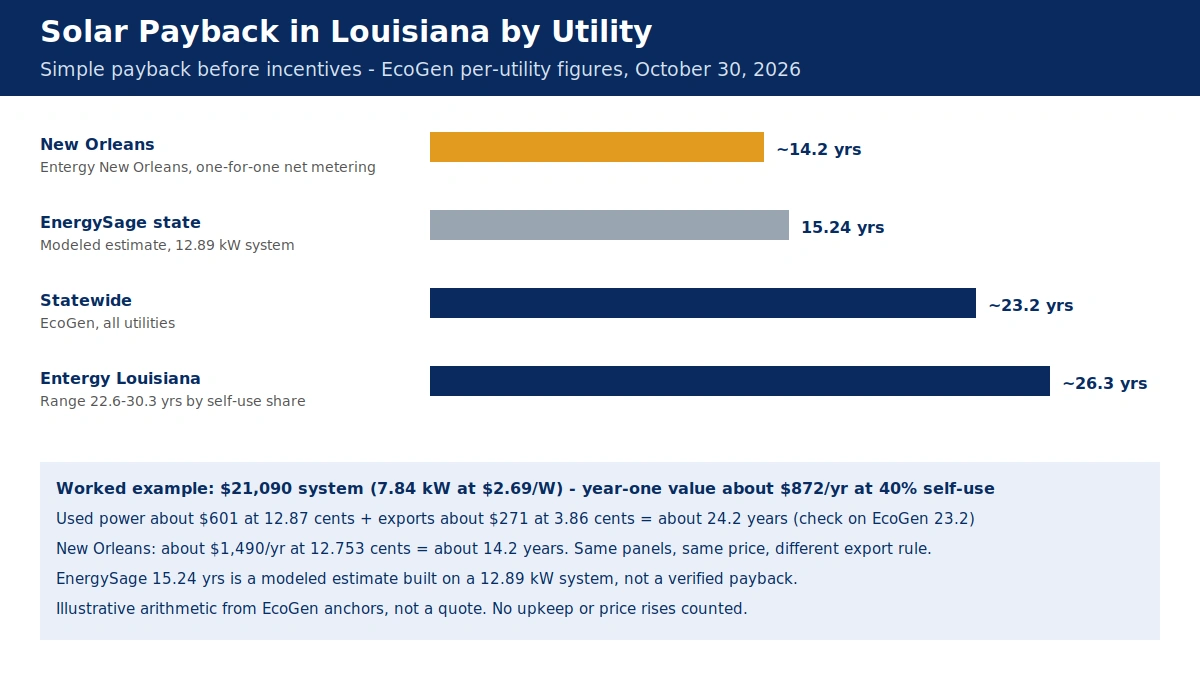
Payback is where the Louisiana numbers turn blunt. EcoGen’s simple payback before incentives, from its per-utility figures of October 30, 2026, is about 23.2 years statewide, about 26.3 years on Entergy Louisiana, and about 14.2 years in New Orleans on Entergy New Orleans’ net metering.
The range on Entergy Louisiana runs 22.6 to 30.3 years depending on how much of the solar power the house uses as it is made. No upkeep, no price rises, and no battery are counted in those figures. They are the payback on the panels alone, at the prices and rules of 2026.
The worked arithmetic shows why the range is so wide. Take the typical 7.84 kW system at $21,090, making about 11,682 kilowatt-hours a year. If the house uses 40 percent of that power as the panels make it, EcoGen’s modeled share, the used part is worth about $601 a year at the 12.87-cent retail rate, and the exported 60 percent is worth about $271 a year at Entergy Louisiana’s 3.86-cent credit.
The year’s total value is about $872, and $21,090 divided by $872 is about 24.2 years. That sits within a year of EcoGen’s 23.2, and the difference is the statewide rate mix.
Push the self-consumption share to 55 percent and the value rises to about $1,021 a year, for a payback near 20.7 years. Drop it to 28 percent and the value falls to about $735 a year, for a payback near 28.7 years.
The share is the payback. The share is a property of the house: when its people are home, when the air conditioner runs, whether the pool pump and the laundry run at noon.
In New Orleans the same division is simpler, because the export credit is the retail rate. The typical system’s 11,682 kilowatt-hours are worth about $1,490 a year at 12.753 cents, whatever the self-consumption share, and $21,090 divided by $1,490 is about 14.2 years.
That is the whole story of the New Orleans exception in one line: the export rule is worth about $600 a year on the typical system, and twelve years of payback.
Three other payback figures circulate for Louisiana, and all three should be read with their labels attached. EnergySage’s modeled payback of 15.24 years is built on a 12.89 kW system and its own marketplace averages, and it does not price the avoided-cost gap the way the LPSC tariff does.
A 12.89 kW system exports far more of its output than a 7.84 kW one, and at 3.86 cents that export is worth little. ConsumerAffairs’ 12.2-year figure and SunMetricLab’s 11.5-year figure are national-model and planning estimates whose net columns still carry the old 30 percent federal credit. None of the three is a Louisiana quote.
The EcoGen figures are the ones built on the tariff, and they are the ones used here.
What the payback figures do not show is the 25-year return. A system that pays back in 23 years has about two years of free power left in its 25-year warranty life.
That is thin, and thinner still once an inverter replacement is priced in. A New Orleans system that pays back in 14 years has about eleven years of free power.
Read the statewide number plainly: a cash purchase outside New Orleans is a marginal investment on bill savings alone. It becomes a good one only when the house uses most of its power at home, when the roof is new enough to outlive the panels, or when a lease carries the federal pass-through that an owned system can no longer claim. The next sections price each of those conditions.
Batteries in Louisiana: The Hurricane Case and the Outage Rule
A battery changes a Louisiana solar system in two different ways, and the quote should price them separately. The first way is the bill: a battery stores the midday surplus that would otherwise earn 3.86 cents and releases it in the evening, when the house would otherwise buy power at the retail rate.
Every kilowatt-hour shifted that way is worth the difference, about 9 cents at Entergy Louisiana’s rates. The battery earns its keep by the kilowatt-hour, a few hundred dollars a year on a typical system. The second way is the outage: a grid-tied solar system shuts down when the grid goes down, and a battery with an islanding-capable inverter is what keeps the lights on.
In a state where hurricanes take the grid down for days, the second way is the one most Louisiana buyers are actually buying.
The outage rule is the one to understand first, because it surprises buyers. A standard grid-tied inverter is required to shut down when the grid fails. The rule is called anti-islanding, under safety standard UL 1741, and it exists so the system never sends power into lines a repair crew believes are dead.
Panels on the roof do not help a house in a blackout unless the system was built to island. Islanding means the system can run apart from the grid. It needs a battery, a hybrid or battery-ready inverter, and a critical-loads panel that separates the circuits the battery will carry from the ones it will not.
The air conditioner is the question that decides the battery size. A whole-home battery that carries a central air conditioner through a Louisiana night is a large battery.
A battery that carries lights, refrigeration, phones, and a fan is a much smaller one. The quote should name the circuits, the hours, and the air conditioner, or the buyer will discover in the first outage which of them the battery was sized for.
The bill case for a battery is thinner than the outage case, and the arithmetic shows it. Shifting a kilowatt-hour from a 3.86-cent export to a 12.87-cent avoided purchase is worth about 9 cents. A typical Louisiana system exports about 7,000 kilowatt-hours a year at a 40 percent self-consumption share.
Shifting all of it would be worth about $630 a year before losses. A battery round-trips at about 85 to 90 percent efficiency, so the real figure is lower, and the battery’s own price is not in the $2.69-a-watt headline. A battery also has a shorter life than the panels, about 10 to 15 years against the panels’ 25, so the house will buy a second battery before the panels wear out.
On bill savings alone, a Louisiana battery rarely pays for itself. On outage resilience, it is the only product that does what it claims.
Entergy Louisiana’s home battery rewards were reported as new in 2026, and no dollar figure was verified. A buyer should ask Entergy Louisiana for the current program terms before counting a cent of it. The same caution applies to any installer who prices a battery as a money-saver: ask for the shifted kilowatt-hours, the round-trip efficiency, and the replacement year, and the payback will show itself.
For most Louisiana homes, a battery is hurricane equipment that happens to save a little on the bill. For a home in New Orleans, where exports already earn the retail rate, the bill case for a battery is thinner still. The battery’s only job there is the outage.
Louisiana Incentives in 2026: The Full Stack, Program by Program
Louisiana’s incentive stack in 2026 is short. There is no state income-tax credit, no state rebate for panels, no sales-tax exemption, and no renewable-energy credit market for a home system.
What survives is a property-tax exemption, a handful of utility rebates that must be verified before they are counted, and two federal rebate programs that have not launched in Louisiana at all. Each one is priced below, including the ones worth $0, because a quote that lists a credit that does not exist is the most expensive line in it.
Property tax exemption: real, and worth about $90 a year. State law exempts the added value of a solar system from property tax, so an array should not raise the home’s assessment. At Louisiana’s roughly 0.5 percent property-tax rate, the exemption is worth on the order of $90 a year on a $21,090 system.
That is a small amount, but it adds up over 25 years, and it is the one state benefit that actually exists. Confirm with the parish assessor that the exemption is on the record before the install, because an assessor who never sees the paperwork can assess the value anyway.
State income-tax credit: $0, expired. Louisiana once offered one of the country’s most generous state solar tax credits, worth up to half of system cost. It expired for purchased systems installed after 2015, and the law sunset on January 1, 2018. Nothing comparable has replaced it.
Any quote, article, or installer that lists a Louisiana state tax credit in 2026 is working from a law that has been dead for a decade.
Sales tax: no exemption. As of 2026, most residential solar systems in Louisiana are subject to standard state and local sales tax unless a parish-level exemption exists, and those are rare. The $2.69-a-watt headline is a cash installed price. Whether the quote in front of you includes sales tax is a question to ask, not an assumption to make.
Utility rebates: reported, verify before counting. The secondary sources report rebates of up to $3,500 from SWEPCO and Cleco, $500 from Entergy Louisiana, and $200 to $500 from Energy Smart in New Orleans. Those figures come from a single secondary source last checked in June 2026, and utility rebate windows in Louisiana have opened and closed without much notice.
Do not sign a contract that depends on one. Call the utility, confirm the program is open, confirm the amount, and get it in writing. If the program is closed, the system must still pencil out without it.
HEAR and HOMES: not launched in Louisiana, and HEAR does not pay for solar. The federal Home Energy Rebates programs carry about $212.4 million allocated to Louisiana: $105,972,960 for HEEHR, the program formerly called HEAR, and $106,383,841 for HOMES. As of checks in October and November 2026, the Louisiana Department of Conservation and Energy’s implementation is still described as “in progress,” with no consumer launch date and no application route.
A November 9, 2026 status check found no status posted at all: the state’s only rebate page is an archive from before its energy agency was renamed on October 1, 2025. Two further facts matter more than the allocation.
First, HEAR does not pay for solar panels. It pays for efficient electric appliances, insulation, air sealing, wiring, and panel upgrades, and DOE Program Notice 26-2, effective May 29, 2026, limits it to electric-to-electric replacements with no fuel-switching.
Second, HOMES pays for whole-home energy savings of at least 20 percent, not for a solar array on its own. A Louisiana buyer who waits for a federal rebate to pay for panels is waiting for a program that has not opened and would not pay for panels if it had.
Solar for All and local subsidies: check current status. Louisiana’s federal Solar for All award and New Orleans’ local “Solar for Y’all” subsidy were both in flux through 2026, and neither was verified in detail. No dollar figure from either program is stated here.
A New Orleans buyer should ask the city and the installer what is open now. A local subsidy that is open is worth more than a federal credit that is gone, and a local subsidy that closed last month is worth nothing.
Federal Help in 2026: No Credit for Owners, and No Lease Market to Fall Back On
The federal picture for a Louisiana homeowner in 2026 is a single sentence with a single exception. For a system you buy yourself and place in service after December 31, 2025, the Residential Clean Energy Credit, Section 25D, the 30 percent credit, is gone.
Section 25D was a tax credit that cut the tax bill by 30 percent of the system cost. Our federal energy tax credits guide tracks what ended and what survived across every credit, not just solar. The One Big Beautiful Bill Act, Public Law 119-21, ended it, and the installation’s finish date is what decides it.
A system placed in service on December 31, 2025 could claim it. A system placed in service on January 1, 2026 cannot. The $21,090 typical system costs $21,090, and no federal line on the quote reduces it.
The exception is the lease, and it is the one route through which federal money still reaches a Louisiana roof. The commercial credit under Section 48E survives for systems in service by December 31, 2027. A leasing company that owns the system can claim it and pass part of it through to the homeowner as a lower lease payment.
Leases are explicitly allowed in Louisiana, and the pass-through is the reason a lease quote in 2026 can look cheaper than a cash quote for the same panels. The pass-through is not automatic, and it is not the full 30 percent: the leasing company keeps part of it for its cost of capital, its risk, and its margin.
A lease quote should name the payment, the escalator, the term, who keeps the renewable-energy credits, and what happens at the end of the term: buyout price, removal, or renewal. The escalator is the clause that lifts the payment a little each year. A quote that says “includes the federal credit” without naming the payment gives the buyer nothing to check.
The residential power-purchase agreement, the PPA, is the gray area. Under a PPA the homeowner buys the power the panels make instead of leasing the panels.
DSIRE’s map marks Louisiana’s residential PPA status as unclear, and no company was found offering a residential PPA to Louisiana homes as of October 2026. DSIRE is the national database of state incentives for renewables and efficiency.
A buyer who is offered one should ask for the contract and read the escalator before anything else. The other federal route that does not exist for a Louisiana homeowner is the Section 25C home-improvement credit: P.L. 119-21 ended that too for property placed in service after December 31, 2025, so a panel upgrade, wiring work, or insulation done alongside the solar job earns no federal credit either.
The HEAR rebate for a panel upgrade is a different program. It has not launched in Louisiana.
One more federal fact belongs here because it changes the calendar: the Section 48E pass-through has a deadline. Systems must be in service by December 31, 2027 for the commercial credit to apply, and a lease signed in 2026 for an install that slips into 2028 loses it.
A buyer weighing a lease against a cash purchase should weigh the deadline as well as the payment. The lease’s federal benefit is the leasing company’s to claim, not the homeowner’s, so the homeowner’s protection is the written payment, not the tax code.
Hurricane-Proofing a Louisiana Array: Wind Ratings, Roof Age & Insurance
A Louisiana array is a hurricane array whether the buyer thinks of it that way or not, and the wind code is the first document in the job. Under ASCE 7-22, the structural standard most parishes now reference, design wind speeds along coastal Louisiana commonly run 150 to 180 miles per hour in exposure C or D.
Exposure categories describe the ground around the building. Open coastal ground, exposure C or D, lets wind hit harder than sheltered inland ground.
Around Baton Rouge, including Livingston and Ascension parishes, design speeds fall in the 130 to 140 mile-per-hour range under the 2021 International Residential Code as adopted by the Louisiana State Uniform Construction Code Council. Coastal parishes require 150 miles per hour or higher.
The parish permit office confirms the figure for the address, and the figure decides the racking.
There is no single hurricane-rated panel certification, and any installer who claims one is selling a label that does not exist. What matters is the racking and mounting system’s engineered wind-load rating for the site’s exposure category, plus a structural engineer’s stamp where the parish requires one.
Most engineered racking systems in 2026 carry ratings between 120 and 180 miles per hour depending on exposure category and attachment spacing. A rail rated for 140 miles per hour in exposure B is not the same as 140 miles per hour in exposure C or D. Coastal terrain multiplies the wind force compared with a sheltered inland site.
The panel itself typically tolerates far more than the racking. Panels are commonly tested to 5,400 pascals of uplift and snow load, about 112 pounds per square foot. Failures in a storm are almost always uplift failures: wind getting under the array and pulling it off the roof, not pressure pushing it down.
The attachment spacing, the fastener count, and the roof deck are the system. Ask the installer for the engineered wind rating in writing, for the exposure category it was calculated in, and for the structural calculation the parish will want at permitting. A quote that prices racking without asking for the parish’s design wind speed first was written for a different parish.
Roof age is the second hurricane decision, and it is the one buyers regret most. A solar array lasts 25 years, and a roof that has ten years left in it will need replacing underneath the panels. That is a detach-and-reinstall job that costs thousands and voids the installer’s workmanship warranty if it is done by anyone else.
In Louisiana, where a roof already carries the hurricane history of its parish, the rule is simple: if the roof has less than ten years of life left, replace it before the panels go on, and price the roof in the same conversation. Our Louisiana roof replacement guide prices that job by material and parish, and our Florida solar guide covers the same wind-code questions for the Gulf’s other hurricane coast.
The installer who will not discuss the roof’s age is the installer who will charge for the reinstall later. The roofing detail matters too: six nails per shingle at 110 miles per hour or higher is the standard, and south Louisiana sits above that threshold, so six-nail fastening should be in the written scope before work begins.
Insurance is the third hurricane decision, and it is a phone call, not a line in the quote. A homeowners policy in Louisiana generally covers the array for hail and storm damage once it is listed on the policy. But the coverage, the deductible, and the hurricane deductible are three different numbers, and the hurricane deductible in a coastal parish can be a percentage of the home’s insured value.
Call the insurer before the install, confirm the array is covered, confirm the deductible that applies to a hurricane claim, and confirm whether the premium changes. A system that survives a storm but is not on the policy is a system the owner pays to replace.
After the install, photograph the array, keep the racking’s wind rating and the structural calculation with the policy papers, and keep the installer’s warranty, workmanship, panels, and inverter, in the same folder. Hurricane season runs June 1 to November 30, and an install that goes in ahead of summer needs its wind-load math finalized well before storm season, not during it.
Permits, Licenses, HOA Rules & the Price Drivers
A Louisiana solar job passes through three gates before the panels go up: the parish, the utility, and the license. Each one has a Louisiana detail that a buyer from another state would not expect.
The parish gate is the permit, and it is where the wind speed becomes a number. The permit office confirms the ASCE 7-22 design speed for the address, the structural-engineering requirement, and the inspection schedule. Most high-wind parishes require a stamped structural calculation before permitting, not just the manufacturer’s generic wind chart, and skipping that step is the most common reason a Louisiana install gets rejected at inspection.
The utility gate is the interconnection application. Interconnection is the utility’s permission to connect the system to its lines.
It is Entergy Louisiana’s Rider DG filing, Cleco’s distributed-generation tariff, SWEPCO’s interconnection process, or the co-op’s own form. It is where the export rate, the meter charge, and the 25 kW residential cap get set in writing.
The job does not start until both gates are through. A crew that starts without them is a crew the parish can stop.
The license gate is the one to check before the deposit. Louisiana requires a Louisiana State Licensing Board for Contractors license with the Solar Energy Equipment classification for solar jobs of $10,000 or more, which is every residential system here, and an electrical license to connect the wiring. Both numbers should be on the quote, and both should be verified with the board before money changes hands.
A company that holds only one of the two is a company that subcontracts the other half of the job, and the buyer should know whose name is on each half. The deposit itself is the other license check: a Louisiana installer who asks for the full price up front is an installer to walk away from.
A staged payment, deposit, delivery, completion, is the norm. The final payment should wait for the inspection and the interconnection approval.
The HOA gate is gentler in Louisiana than in most states, and the reason is a statute. Louisiana’s solar access law, enacted in HB 751, “prohibits any person or entity from unreasonably restricting the right of a property owner to install or use a solar collector.” An association may impose reasonable conditions on placement or aesthetics, but an outright ban on solar panels is on shaky legal ground under that law.
The practical advice is the same as in a state without the law: get architectural-review approval in writing before ordering panels, even when the statute is on your side, because a dispute after the install costs more than an application before it. Louisiana overhauled its homeowners association laws in 2024, replacing the old Homeowners Association Act with the Louisiana Planned Community Act effective January 1, 2025. An association’s rules should be read against the current act, not the one the neighborhood’s covenants were written under.
Four price drivers sit behind the $2.69-a-watt headline, and a buyer can negotiate each one:
- Roof condition. A roof that needs decking repair, a re-roof, or a panel upgrade from a 100-amp service adds thousands outside the per-watt figure. A service under 200 amps is common in older Louisiana homes. Our electrical panel upgrade guide prices that job from 100 amps to 200 amps.
- Tree work. The live oak that shades the south roof has to be trimmed or the array has to move, and neither is free.
- Racking engineering. Hurricane-rated racking, closer attachment spacing, and a structural engineer’s stamp cost more than standard racking, and the coastal parishes cost more than Baton Rouge.
- Distance. A crew that drives two hours to a rural parish prices the drive into the job.
None of these is a reason to pay more than the band, $2.37 to $3.01 a watt. But each is a reason a quote at the top of the band can still be fair, and a quote below the bottom of it should be asked what it left out.
Getting Quotes in Louisiana: The Checklist
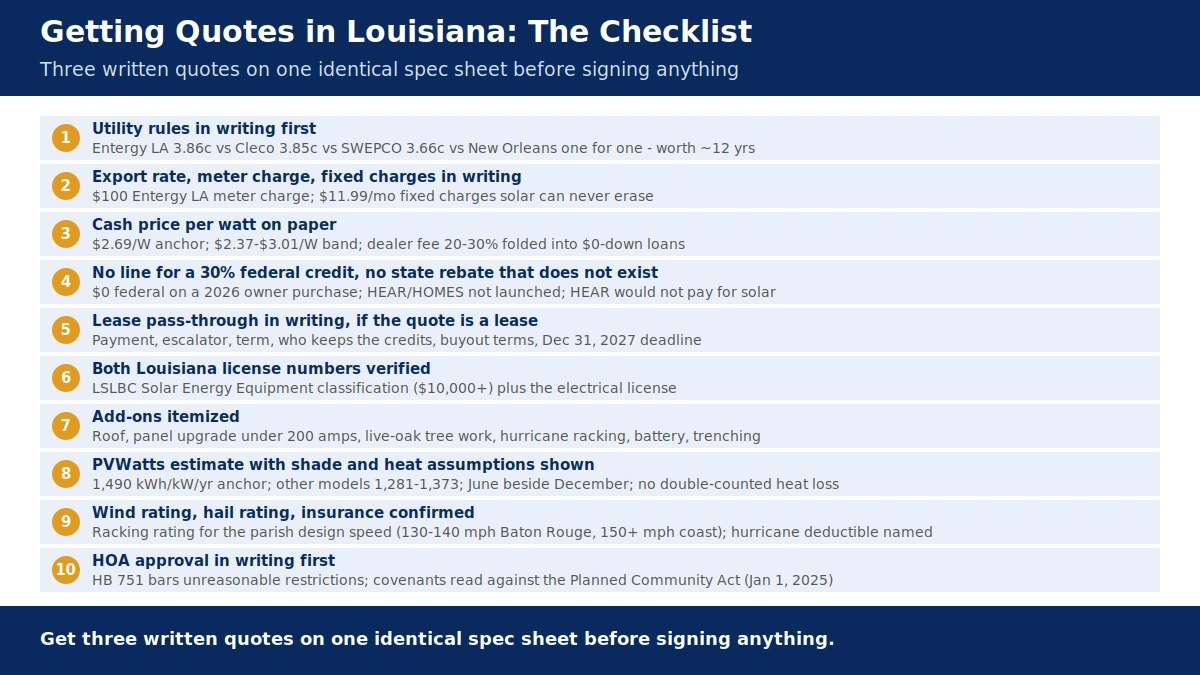
- Your utility’s rules in writing first. Entergy Louisiana 3.86 cents, Cleco 3.85 cents, SWEPCO 3.66 cents, DEMCO 3.85 cents, co-ops 3.58 to 3.99 cents, or one-for-one net metering if the roof is in Orleans Parish. The gap between New Orleans and Baton Rouge is worth about twelve years of payback, and a quote that prices the wrong utility’s rules is wrong by more than its price.
- The export rate, the meter charge, and the fixed charges in writing. The $100 Entergy Louisiana meter charge, the $11.99 a month in fixed charges that solar can never erase, the annual reset of the avoided-cost rate. The avoided rate, the utility’s price less its fixed charges, is the number the savings must be calculated on.
- Cash price per watt on paper. $2.69 a watt is the anchor, $2.37 to $3.01 the band. Dealer fees of 20 to 30 percent are often folded into the amount a $0-down loan finances, so the cash price and the financed price must sit side by side before anything is signed.
- No line for a 30 percent federal credit, and no line for a state rebate Louisiana does not offer. $0 federal on a 2026 owner purchase; no Louisiana state income-tax credit; no sales-tax exemption; HEAR and HOMES not launched in Louisiana, and HEAR would not pay for solar panels even after launch. The only state benefit on the quote should be the property-tax exemption, and it is a tax bill that never arrives, not a discount.
- The lease pass-through in writing, if the quote is a lease. The payment, the escalator, the term, who keeps the renewable-energy credits, the end-of-term buyout or removal terms, and the Section 48E in-service deadline of December 31, 2027. A lease that says “includes the federal credit” without naming the payment is not a lease quote.
- Both Louisiana license numbers verified. The LSLBC license with the Solar Energy Equipment classification for jobs of $10,000 or more, plus the electrical license for the wiring, both checked with the board, both names matched to the company on the contract.
- Add-ons itemized. Roof work, panel upgrade when service is under 200 amps, tree work for the live oaks, hurricane-rated racking engineering and the structural stamp, battery and critical-loads panel, trenching for a ground mount. Price every add-on on its own line, with a dollar figure beside it, not a footnote at the bottom of the quote.
- A PVWatts production estimate that states its shade and heat assumptions. The anchor model puts production at about 1,490 kilowatt-hours per kilowatt per year, with other models at 1,281 to 1,373, so the estimate must name its model and its assumed shade, soiling, and temperature losses, month by month, June beside December, from a shade study of the roof in question, not a statewide average. A quote that deducts a further heat loss from a PVWatts figure is counting the same loss twice.
- Wind rating, hail rating, and insurance confirmed. The racking’s engineered wind-load rating for the site’s exposure category and ASCE 7-22 design speed, 130 to 140 miles per hour around Baton Rouge, 150 or higher on the coast, the structural calculation the parish requires, UL 61730 / IEC 61730 on the panels by name, six-nail fastening in the roofing scope, and written confirmation that the homeowners policy covers the array, with the hurricane deductible named.
- HOA approval in writing first. Louisiana’s solar access law (HB 751) bars unreasonable restrictions on a solar collector, and an outright ban is on shaky legal ground, but the association’s architectural-review approval should still be in hand before the panels are ordered, and the covenants should be read against the Louisiana Planned Community Act in force since January 1, 2025.
The last step is comparison: three written quotes on one spec sheet, from installers whose crews already work in the home’s utility territory, all in hand before anything is signed. Where the export rate can swing the payback from 14 years to 26, the cheapest quote is the one that priced the household’s own utility rules correctly, and filed the interconnection application before the hurricane season it will be installed in.
Sources & methodology
Headline price and production:
- EcoGen Solar Cost Index, September 2026 edition: $2.69/W Louisiana, 7.84 kW typical system, $21,090, ±12% quote band $2.37–3.01/W; 1,490 kWh/kW/yr, 11,682 kWh/yr; Berkeley Lab 2025 median 7.84 kW from 295 Louisiana systems; 9th lowest of 51; US $2.89
- EnergySage Louisiana cost data: $2.31/W Nov 2026 (12.89 kW avg, $25,361–34,313 range, 15.24-yr modeled payback, $27,139 25-yr savings); by-state table $2.32/W; EnergySage averages marketplace quotes on bigger systems; EcoGen’s median-installed size is the headline, EnergySage the cross-check
- ConsumerAffairs 2026 model: $2.34/W, ~$29,484, 12.2-yr modeled payback (national model, not headline); SolarEnergyPrices planning: $2.70/W, 10 kW $27,000, $2.45–2.95/W band; SunMetricLab planning: ~$2.70/W, 8 kW ~$21,600, 11.5-yr modeled payback (net column carries the old 30% credit; flagged); production cross-checks: SolarSpecHub/NREL ~1,281 kWh/kW/yr, SunMetricLab ~1,373 (conflict with EcoGen 1,490, flagged)
Use, rates and export rules:
- EIA residential average: Louisiana 12.87¢/kWh, August 2026; EcoGen statewide average 12.99¢/kWh (Sep 2025-Aug 2026 EIA utility data); average Louisiana home use ~1,200 kWh/mo, ~14,400 kWh/yr (SolarEnergyPrices citing EIA May 2026)
- Entergy Louisiana own price 12.339¢, less $11.99/mo fixed charges → 11.353¢ effective; Entergy New Orleans 12.753¢ (EcoGen per-utility figures, Oct 30, 2026)
- LPSC General Order Sep 19, 2019 (Docket R-33929), effective Jan 1, 2020; two-channel billing, Rider Schedule DG; 2026 avoided-cost rates checked Sep 29-Oct 1, 2026 (Entergy LA 3.86¢ from Apr 1, 2026, was 2.59¢ in 2025; Cleco 3.85¢ from Mar 1, 2026; SWEPCO 3.66¢; DEMCO 3.85¢ from Mar 1, 2026; co-ops 3.58–3.99¢); grandfathering through Dec 31, 2034; 25 kW residential cap; $100 Entergy LA meter charge
- Entergy New Orleans one-for-one net metering to 25 kW under the New Orleans City Council; $50 meter charge (EcoGen table; secondary, flagged); Lafayette Utilities System export terms not verified; flagged
Payback and incentives:
- EcoGen per-utility figures Oct 30, 2026: statewide ~23.2 yrs, Entergy LA ~26.3 yrs (22.6–30.3 by self-consumption share, 40% modeled), New Orleans ~14.2 yrs; simple payback before incentives, no upkeep or price rises counted; worked check at 40% self-consumption ≈ $872/yr → ~24.2 yrs
- §25D $0 for owned installs placed in service after Dec 31, 2025 to OBBBA P.L. 119-21 / IRS FS-2025-05; §48E lease pass-through for systems in service by Dec 31, 2027; leases explicitly allowed in Louisiana, PPA status unclear (DSIRE)
- State income-tax credit expired (50% credit, installs after 2015; law sunset Jan 1, 2018, LDR bulletin); property-tax exemption for added solar value under state law (~$90/yr at 0.5% rate; secondary estimate, flagged); no sales-tax exemption found; no SREC market
- Utility rebates reported (SWEPCO/Cleco up to $3,500, Entergy LA $500, Energy Smart $200–500) to homeenergybasics, sources last checked Jun 10, 2026; verify before counting; Entergy LA home battery rewards reported as new, no dollars verified; flagged
- HEAR/HOMES not launched in Louisiana: HEEHR $105,972,960 + HOMES $106,383,841 ≈ $212.4M allocated; implementation “in progress” at the Louisiana Department of Conservation and Energy, no launch date (checks Oct 6, Nov 4, Nov 9, 2026); DOE Program Notice 26-2 dated May 29, 2026, electric-to-electric only, no fuel-switching; HEAR does not pay for solar
- Solar for All award status and New Orleans “Solar for Y’all” current status/dollars not verified in detail; flagged, no figure stated
Heat, hurricane, licensing, HOA:
- Temperature coefficient -0.30 to -0.35%/°C typical, premium ~-0.25%, budget ~-0.45%; cell 65°C → ~14% loss at -0.35%/°C (mysolarfy Aug 2026; ecopowerguide; aguilarhs Oct 6, 2026); PVWatts annual figures already include temperature losses
- Peak sun hours 4.5–4.7/day statewide, summer ~5.9, winter ~2.7 (SolarSpecHub NSRDB; SunMetricLab 4.7); New Orleans up to ~5.0, Alexandria ~4.3; secondary
- ASCE 7-22 design speeds: coastal Louisiana 150–180 mph exposure C/D; Baton Rouge area 130–140 mph, coastal parishes 150+ mph under the 2021 IRC as adopted by the LSUCCC (josephmill, Nov 3, 2026); racking 120–180 mph; panels tested to 5,400 Pa (112 psf); no single “hurricane-rated” certification; six nails per shingle at 110+ mph; hurricane season Jun 1-Nov 30
- Licensing: LSLBC Solar Energy Equipment classification for jobs $10,000+, electrical license for wiring (EcoGen companies page)
- HOA: Louisiana solar access law HB 751 prohibits unreasonable restriction of a solar collector (Palmetto; LegalClarity); Louisiana Planned Community Act, Acts 2024 No. 158, effective Jan 1, 2025
What do solar panels cost in Louisiana in 2026?
Solar panels cost $2.69 a watt in Louisiana in 2026, about $21,090 for the typical 7.84 kW system, based on EcoGen’s September 2026 index. Quotes generally land between $2.37 and $3.01 a watt, which puts a 6 kW system near $16,140 and a 10 kW system near $26,900. A homeowner-owned system installed in 2026 earns a $0 federal credit, and Louisiana offers no state income-tax credit.
How does net metering work in Louisiana?
Outside New Orleans, it works as two-channel billing, not one-for-one netting. Under the Public Service Commission’s General Order of September 19, 2019, in force since January 1, 2020, homes that installed after December 31, 2019 buy power at the full retail rate, use solar power at home free as it is made, and earn only avoided cost for power sent to the grid: 3.86 cents at Entergy Louisiana, 3.85 cents at Cleco, 3.66 cents at SWEPCO, and 3.58 to 3.99 cents at the co-ops, reset every year. Systems installed by the end of 2019 keep full retail credit through December 31, 2034, and Entergy New Orleans, regulated by the City Council, still trades extra power one for one for home systems up to 25 kW.
Why is solar payback about 23 years in Louisiana?
The export rule decides it. The price sits below the national average at $2.69 a watt, and the sun delivers about 1,490 kilowatt-hours a year per installed kilowatt, but power sent to the grid earns only 3.86 cents a kilowatt-hour at Entergy Louisiana against a retail rate near 12.87 cents, so a system that exports most of its output gives two-thirds of its value away. Statewide simple payback lands near 23.2 years before incentives, about 26.3 years on Entergy Louisiana, with a 22.6 to 30.3 year range by self-consumption share, while the same system pays back in about 14.2 years in New Orleans, where each exported kilowatt-hour cancels one bought.
Do solar panels survive a Louisiana hurricane?
A properly built array can, but the panels are not the part that decides it. There is no single hurricane-rated panel certification; what matters is the racking system’s engineered wind-load rating for the site’s exposure category, plus a structural engineer’s stamp where the parish requires one. Design wind speeds run 130 to 140 miles per hour around Baton Rouge and 150 or higher in the coastal parishes under ASCE 7-22, and most engineered racking in 2026 carries ratings of 120 to 180 miles per hour, while failures in a storm are almost always uplift failures, wind getting under the array and pulling it off, so attachment spacing, fastener count, and the roof deck are the system.
Does Louisiana heat hurt solar panel output?
Yes, on the hottest afternoons, and the datasheet says by how much. Panels are rated at a cell temperature of 25 degrees Celsius, and a typical modern panel loses about 0.30 to 0.35 percent of its rated power for every degree above that, while a premium panel loses about 0.25 percent. On a hot, still Louisiana afternoon, when rooftop cells reach about 65 degrees, a mainstream panel loses roughly 14 percent of its rated power at that moment and a premium panel about 10 percent, and the annual production figures already carry that loss inside them through NREL’s PVWatts model, so a quote that deducts a further heat loss from a PVWatts figure counts the same loss twice.
Is the 30% federal solar tax credit still available to Louisiana homeowners in 2026?
No. A Louisiana homeowner who buys the system outright and puts it in service after December 31, 2025 gets nothing from the Residential Clean Energy Credit, because Public Law 119-21, the One Big Beautiful Bill Act, ended the 30 percent Section 25D credit, and the finish date of the install is what decides it. The lease route is the exception: the commercial credit under Section 48E survives for systems in service by December 31, 2027, and a leasing company that owns the system can claim it and pass part of it through as a lower lease payment, while leases are explicitly allowed in Louisiana and residential power-purchase agreements sit in a gray area, with DSIRE marking the state’s PPA status as unclear.
Are there any Louisiana solar rebates in 2026?
Almost none that a buyer can count on. Louisiana offers no state income-tax credit for solar, since the old 50% credit expired for systems installed after 2015, no state rebate for panels, no sales-tax exemption, and no renewable-energy credit market, while the one state benefit that exists is a property-tax exemption on the added value of a solar system, worth on the order of $90 a year on a typical system. Utility rebates of up to $3,500 have been reported at SWEPCO and Cleco, $500 at Entergy Louisiana, and $200 to $500 from Energy Smart in New Orleans, but those figures come from a single secondary source last checked in June 2026 and must be verified with the utility before they are counted, and the federal HEAR and HOMES rebate programs, with about $212.4 million allocated to Louisiana, have not launched in the state, and HEAR does not pay for solar panels in any case.
Should I get solar panels in Louisiana, or wait?
It depends on the parish line, the roof, and the house’s daytime load. Sign if the roof is in Orleans Parish, where one-for-one net metering pays the system back in about 14 years; sign if the house uses most of its power while the sun is up, because a kilowatt-hour used at home is worth the full retail rate and a kilowatt-hour exported is worth 3.86 cents; sign if the roof is new enough to outlive the panels and the racking carries an engineered wind rating for the parish’s design speed. Wait, or take a lease, if the roof is on Entergy Louisiana and the house exports most of its power, because a cash purchase there takes about 26 years to pay back; wait if the roof has less than ten years of life left, because the detach-and-reinstall will cost thousands; and wait on a battery unless the outage case, not the bill case, is what the household is buying.