


Solar panels in Minnesota cost $3.11 a watt in 2026, about $25,067 for the typical 8.06 kW system. Minnesota is the coldest solar market in the lower forty-eight where that price still pays.
The weather is the obstacle. A December day in Minneapolis delivers about 2.3 peak sun hours, hours of full-strength sun, against 6.4 in July. Snow buries panels after every storm, and install crews work a season that runs roughly May to October.
The reason the numbers still work is one law: Minn. Stat. 216B.164. It binds every electric utility in Minnesota, investor-owned, cooperative, and municipal alike, to credit home systems under 40 kW at the retail energy rate.
Across most of the country, the power company named on the bill controls if a home system ever earns its money back. In Minnesota it decides how fast it pays, and the spread between the fastest and slowest big utilities runs from about 13.9 years to about 21.2 years on the same panels at the same price.
Much of the return arrives as cash, not just as lower bills. Xcel Energy serves about 53% of Minnesota homes, and it pays a production incentive called Solar*Rewards on every kilowatt-hour a system makes, whether the home uses the power or sends it to the grid, for ten years.
In October 2026 Xcel raised that rate from 3 cents to 5 cents per kilowatt-hour for 2026 applications, including systems already running. That lifts the typical system’s ten-year income by roughly $2,250 over the old rate.
Minnesota Power runs a different deal in the northeast, an income-limited rebate called SolarSense. Otter Tail Power buys the renewable credits a system produces at 2 cents a kilowatt-hour.
None of these payments lowers the sticker price, but all of them change the payback. A quote that leaves them out understates what the system earns by hundreds of dollars a year.
Minnesota also runs the country’s most developed community solar program. It started under a 2013 law, moved to Commerce Department administration in 2024, and was renamed in April 2026 for Melissa Hortman.
For a renter, a shaded roof, or a household that will move before payback arrives, a garden subscription is not a consolation prize. It is the product Minnesota built first, and it now carries reservation quotas for low- and moderate-income subscribers that rooftop solar has never had.
Table of Contents
How Much Do Solar Panels Cost in Minnesota in 2026?
Three measures describe the Minnesota market in 2026, and the headline figure sits between the cheapest and the dearest of them. The headline number comes from EcoGen’s September 2026 Solar Cost Index: $3.11 per watt before incentives for a Minnesota installation, which puts the typical 8.06 kW system at $25,067. That is 7.6% above the national average of $2.89 a watt, 44th lowest of 51 jurisdictions, and dearer than every state Minnesota touches except North Dakota, which runs $3.39: South Dakota is $2.85, Wisconsin $3.01, and Iowa $3.07.
Minnesota quotes in 2026 clustered inside the Index’s 12% band around that anchor, roughly $2.74 to $3.48 per watt. A 6 kW system runs $16,400 to $20,900 inside that band, an 8 kW system $21,900 to $27,900, a 10 kW system $27,400 to $34,800, and a 12 kW system $32,800 to $41,800.
The marketplace shows the same picture from a second angle. EnergySage, as of November 2026, puts Minnesota at $3.23 a watt, twelve cents above the EcoGen anchor, but on a much bigger system: its average Minnesota system is 12.44 kW, priced at about $40,176, with a range of $34,150 to $46,202. An October 2026 reading from the same source put the state at $3.24 a watt on a 12.6 kW system, about $40,700.
The two price figures come from different kinds of homes, so the gap between them says more about system size than about what installers charge. What flows through EnergySage’s marketplace is an average of real quotes, and the Minnesota shoppers behind them skew toward oversized systems, all-electric houses, a driveway EV, electric heat in a state where winter heating dominates the bill, a home bought with growth in mind.
Berkeley Lab counted 2,106 Minnesota systems installed in 2025 and found a median of 8.06 kW, the size Minnesotans actually bolt to their roofs, and EcoGen builds its typical system on that median. That middle value sets the size of the typical system behind the headline price. As a cross-check on price per watt, EnergySage’s $3.23 sits twelve cents above EcoGen’s $3.11: two unrelated measures, both dearer than the national average.
A third measure comes from signed contracts rather than quotes. Wolf River Electric, a Minnesota installer based in Isanti, published the middle half of 40 Minnesota roof-mount contracts signed from June through October 2026, no battery, no ground mount, no trenching, no panel upgrade, at $2.70 to $3.15 per watt, with a median near $2.93, or about $29,300 for a 10 kW system.
That is one company’s book of business, not a statewide sample, and it is labeled as one. It still tells a useful story: the bottom of the EcoGen band is reachable on an ordinary Minnesota roof, and the gap between $2.93 and $3.23 is mostly the difference between a signed contract and a marketplace average.
Two further numbers round out the comparison, and each carries a warning label. SolarReviews’ November 2026 figure for Minnesota, $2.96 a watt, about $23,900 for its 7.6 kW average system, is a national model assembled from NREL, EIA, and Bureau of Labor Statistics inputs, not a survey of Minnesota quotes, and it counts as one.
NumeralQ’s planning estimate prices an 8 kW system at $22,590 to $29,500, or $2.82 to $3.69 a watt, a planning range built from EnergySage data retrieved October 26, 2026, wider than the EcoGen band at both ends. Read together, the anchors put Minnesota above the national average, and the width of the quote band, $2.74 to $3.48, says more than any single point inside it.
Before the tables, one warning about the typical size, because it shapes every figure after it. The 8.06 kW figure is a median drawn from systems that were actually installed, not a model output. It runs far past what the average Minnesota household consumes in a year.
At about 1,397 kilowatt-hours per kilowatt each year, an 8.06 kW array makes roughly 11,260 kilowatt-hours annually, while the average Minnesota home draws roughly 8,940 a year, about 745 a month. Put another way, the typical installation generates close to 126% of an average household’s annual consumption.
For a home using the state average, that is a materially bigger array than the household can consume. Still, the typical buyer and the average home are different households: quote-seekers in Minnesota draw considerably more power than the state average, electric heat, a hot tub, a workshop, an EV, and the sizing section further down unpacks what that gap means for a home that doesn’t.
Everything the job needs rides inside that per-watt figure:
- Panels
- Inverter or microinverters
- Racking
- Wiring
- Crew time
- Permits
- Inspection
- The interconnection filing
A new roof, a panel upgrade, tree work, a battery, and snow-load engineering beyond the standard racking are all priced separately, outside that number. That arithmetic credits no incentive, and for most Minnesota buyers in 2026 there is none that reduces the purchase price: the federal credit is gone, no broad state rebate exists, and the state offers no income-tax credit for solar.
Minnesota’s 6.875% sales-tax exemption already sits inside the quoted price. It is taken off at the point of sale, so deducting it a second time counts the same savings twice.
The exceptions are narrow and utility-specific: SolarSense for income-limited Minnesota Power households, the $500 Dakota Electric rebate, and the Minneapolis group buy. The incentives section below prices them separately, so the headline still fits everyone else.
For most buyers, then, the quoted sticker is what the system costs. Any quote that deducts more than that is still calculating under a law that expired on December 31, 2025.
A caution before the tables: the cheapest quote in Minnesota is rarely the cheapest system once the job is done, and the short install season makes the second and third quotes harder to get, and more worth getting. Crews book out through the summer, and a bid taken in June for a September install can quietly carry a premium for the slot. Dealer fees of 20-30% of the cash price are often folded into the amount a $0-down loan finances, since overhead and margin are most of what an installer charges, and the fee is invisible until the cash price sits next to the financed price.
With quotes from Minneapolis, St. Paul, Rochester, and Duluth installers spread across the table, the cash price per watt for the same panels on the same Minnesota roof is the one number that lets you judge bidder against bidder. Insist that three installers commit that figure to paper, and drop any bidder who refuses.
In a state where the utility’s export rate and any co-op fee decide the payback, that third quote is also the check that the company you are talking to has priced your utility’s rules, not the state average.
| Source | $ per watt | System | Cash total | Payback |
|---|---|---|---|---|
| EcoGen Index (Sep 2026) | $3.11 | 8.06 kW | ~$25,067 | ~14.5 yrs statewide |
| EnergySage (Nov 2026) | $3.23 | 12.44 kW avg | ~$40,176 | 14.62 yrs — flagged, modeled |
| EnergySage (Oct 2026) | $3.24 | 12.6 kW avg | ~$40,700 | Not published |
| Wolf River contracts (Jun–Oct 2026) | $2.70–$3.15, median ~$2.93 | 10 kW typical | ~$29,300 | Not published |
| SolarReviews (Nov 2026) | $2.96 | 7.6 kW avg | ~$23,900 | Not published |
| NumeralQ planning (Oct 2026) | $2.82–$3.69 | 8 kW | ~$22,590–$29,500 | Not published |
| EnergySage Minneapolis, Hennepin (Nov 2026) | $3.22 | 10.86 kW avg | ~$34,918 | 12.40 yrs — flagged, modeled |
| EnergySage Minneapolis, Anoka (Nov 2026) | $3.25 | 12.39 kW avg | ~$40,225 | 13.87 yrs — flagged, modeled |
| EnergySage Saint Paul, Ramsey (Nov 2026) | $3.18 | 12.38 kW avg | ~$39,438 | 14.17 yrs — flagged, modeled |
| EnergySage Saint Paul, Dakota (Nov 2026) | $3.11 | 14.01 kW avg | ~$43,583 | 14.74 yrs — flagged, modeled |
| National range (article 4) | $2.25–$3.30 | 8.2 kW | ~$24,600 at $3.00/W | 6–12 yrs |
Read the footnotes on four of those rows before trusting the numbers in them. EnergySage’s payback figures, 14.62 years statewide, 12.40 to 14.74 years across the four Twin Cities county pages, are modeled estimates built on its own marketplace averages, and they run on systems of 10.86 to 14.01 kW, far above the 8.06 kW median that Minnesota homeowners actually install. System size explains the gap: a payback built on a 14.01 kW system for a house using 8,940 kilowatt-hours a year describes a different Minnesota than the tariffs do.
SolarReviews’ $2.96 and NumeralQ’s $2.82–$3.69 are national-model and planning figures, not Minnesota quotes, and they are excluded from the headline for that reason. EcoGen’s numbers lead throughout, while EnergySage’s numbers audit them from the side.
Solar Panel Cost in Minnesota by System Size
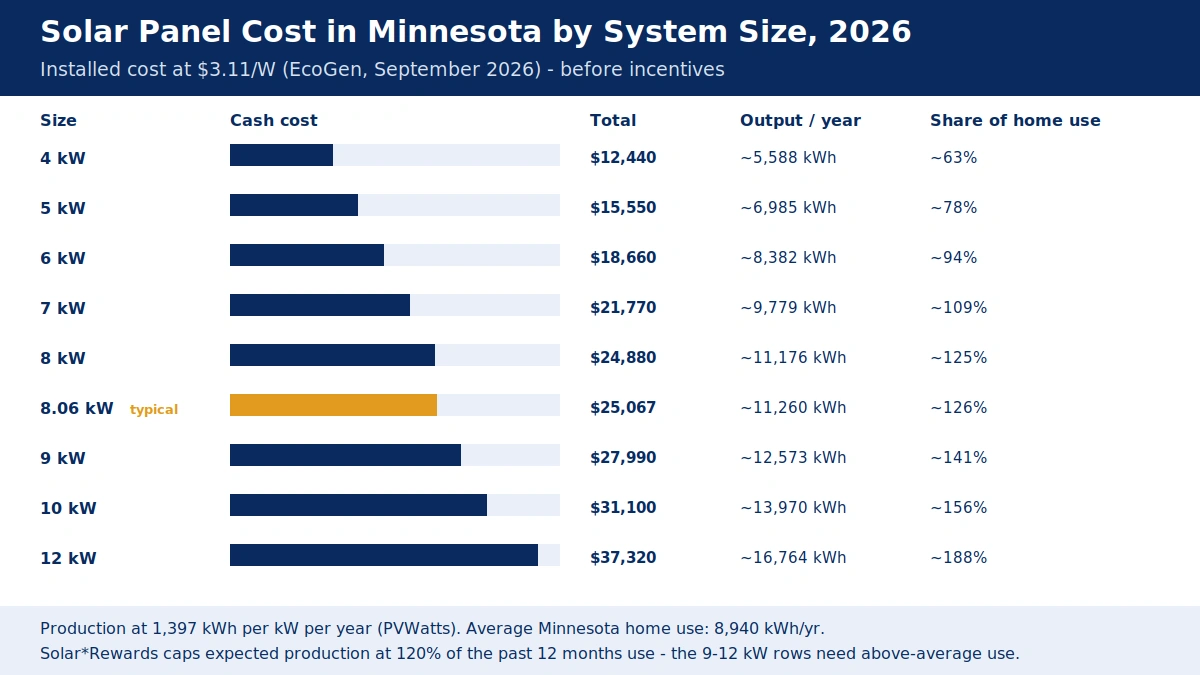
Minnesota turns the sizing question upside down: because the typical installation already outstrips the average home, the real question is not whether extra power has value, but how much of it the household will ever consume. EIA billing data through August 2026 puts average Minnesota household consumption near 745 kilowatt-hours a month, roughly 8,940 a year, with a monthly bill near $121. At roughly 1,397 kilowatt-hours a year from each installed kilowatt, an array of 6.4 kW generates about 8,940 kilowatt-hours, matching an average home’s yearly use almost exactly.
The typical 8.06 kW installation, by the same arithmetic, generates about 11,260 kilowatt-hours, roughly 126% of average household use. Since about six and a half kilowatts covers the average home outright, 6 kW counts as the average home’s size and 8.06 kW as the average buyer’s size, because buyers’ consumption runs well past the state average.
On paper, 6 kW already answers nearly all of a typical household’s annual demand. The paper is the problem: demand swings unevenly through the year, and output does the same, with December delivering barely two-fifths of June.
Oversizing pays off better here than where export rules are stingy. Surplus kilowatt-hours net against later use inside the month at the retail energy rate. Yet it still loses to consuming the power at home: whatever surplus remains at month-end settles at the average retail energy rate, which strips out the fixed charges, and at a co-op or city utility a kWh-credit election wipes unused credits at year-end with no payment at all.
Power sent out in June and drawn back in January still earns value while the monthly netting lasts. That is the generous half of the deal.
A kilowatt-hour that is still sitting in the bank at a co-op’s year-end earns nothing, which is the part that punishes oversizing. Past the covering size, every additional kilowatt stops supplying the house directly and starts accumulating power the household may never use.
The table prices every row at EcoGen’s $3.11 a watt and credits each installed kilowatt with 1,397 kilowatt-hours a year. The final column expresses each size as a share of average household use, so the point where the array flips from supplying the house to stockpiling power is easy to spot.
| Size | Cash cost at $3.11/W | Annual output | Share of a typical Minnesota home’s use (8,940 kWh/yr) |
|---|---|---|---|
| 4 kW | $12,440 | ~5,588 kWh | ~63% |
| 5 kW | $15,550 | ~6,985 kWh | ~78% |
| 6 kW | $18,660 | ~8,382 kWh | ~94% |
| 7 kW | $21,770 | ~9,779 kWh | ~109% |
| 8 kW | $24,880 | ~11,176 kWh | ~125% |
| 8.06 kW (state typical) | ~$25,067 | ~11,260 kWh | ~126% |
| 9 kW | $27,990 | ~12,573 kWh | ~141% |
| 10 kW | $31,100 | ~13,970 kWh | ~156% |
| 12 kW | $37,320 | ~16,764 kWh | ~188% |
Two rows deserve a closer look. First, even the 6 kW system already covers about 94% of average annual use, so every kilowatt past 6.5 kW on an average-use home is power the house cannot use itself. It nets inside the month at the retail energy rate, and whatever is left at a co-op year-end under a kWh-credit election is wiped out unpaid.
Second, the Solar*Rewards sizing rule puts a ceiling on the table that the numbers alone do not show: for Xcel customers, expected production must not exceed 120% of the past twelve months’ use, so an average-use home cannot enroll a system much above 7.7 kW in the production incentive at all. The 9, 10, and 12 kW rows belong to homes that use far more than average, or to homes willing to forgo the production payment on the oversized share.
The oversized rows fit households whose consumption dwarfs the average, electric heat, a pool, a home-charged EV, a heat pump displacing gas, and the utility will want that consumption documented before it signs off on the size.
Let twelve months of bills set the system size, and keep empty roof space out of the sizing math. And in Minnesota, size from use you can document, because documented use is what both the 120% Solar*Rewards rule and the co-op credit rules count. Total twelve months of kilowatt-hours from the bills, divide by about 1,397 for the covering size, and then examine June, July, and August on their own: when a surplus already shows at 6 kW, hold there, since each kilowatt beyond that line stores power the house may never reclaim.
Allow 1–2 kW more for a planned EV or heat pump, more again for electric heat, less for a shaded or north-facing roof, then test the result against the 120% rule before signing, because a system the utility will not enroll earns no production payment on the excess. An EV or heat pump on the way means designing for the household’s future load, not today’s: get the new demand onto the plan before installation day, or the array ends up matched to a smaller home than the one that arrives.
The national sizing comparison behind this choice is worked out in our 6 kW vs 8 kW vs 10 kW guide.
What Minneapolis, St. Paul, Rochester & Duluth Actually Pay
Minnesota is a big state with four different solar markets inside it, and the city prices show the split before anything else does, though not in the way a reader might expect. City-level pricing is only half documented in Minnesota: EnergySage maintains pages for the Twin Cities, split by county, and none that could be retrieved for Rochester or Duluth. The Twin Cities figures therefore carry a warning other states did not need.
Minneapolis and St. Paul each have two EnergySage county pages, and the two pages disagree with each other by more than the two cities disagree with each other. Both figures are printed below, labeled by county, because picking one and calling it the city price would be inventing a precision the source does not have.
| City page | $ per watt | Avg. system | Cash total | Utility |
|---|---|---|---|---|
| Minneapolis (Hennepin County) | $3.22 | 10.86 kW | ~$34,918 | Xcel Energy |
| Minneapolis (Anoka County) | $3.25 | 12.39 kW | ~$40,225 | Xcel Energy |
| Saint Paul (Ramsey County) | $3.18 | 12.38 kW | ~$39,438 | Xcel Energy |
| Saint Paul (Dakota County) | $3.11 | 14.01 kW | ~$43,583 | Xcel Energy |
| Rochester (state anchor) | $3.11 | 8.06 kW typical | ~$25,067 | Rochester Public Utilities |
| Duluth (state anchor) | $3.11 | 8.06 kW typical | ~$25,067 | Minnesota Power |
Minneapolis is the biggest city in the state, served by Xcel Energy, and the two county pages bracket the statewide anchor from above. The Hennepin County page, per EnergySage’s November 2026 data, averages $3.22 a watt on a 10.86 kW system, about $34,918 before incentives, a modeled 12.40-year payback, and $48,837 in 25-year savings. The Anoka County page averages $3.25 a watt on a 12.39 kW system, about $40,225, a modeled 13.87-year payback, and $43,094 in savings.
The per-watt gap between the two pages is three cents; the total gap is more than $5,000, and it is all system size. Treat either Minneapolis total as the price of the average Minneapolis quote in that county’s marketplace data, not the price of the typical Minneapolis system.
Do not quote either end of the $29,680 to $46,259 combined range as the Minneapolis price, because it is not one. What Minneapolis adds that no other Minnesota city does is the group buy: the city pays 20 cents per kilowatt-hour of a system’s expected yearly output, about $2,252 on the typical system, to homes that go solar through a partner the city funds, though the city does not say how much money remains.
St. Paul is the state capital, served by the same utility, and its two pages tell the same story with the numbers reversed. The Ramsey County page puts St. Paul at $3.18 a watt on a 12.38 kW average system, about $39,438, with a modeled payback of 14.17 years and 25-year savings of $44,172. The Dakota County page puts it at $3.11 a watt, exactly the statewide EcoGen anchor, but on a 14.01 kW average system, about $43,583, with a modeled payback of 14.74 years and savings of $41,602.
The cheaper per-watt page is the dearer system, because the system is nearly 2 kW bigger. St. Paul’s housing stock explains the size: older, larger homes on the Summit Avenue side and in Highland Park, with roofs that hold big arrays, and a deep installer bench headquartered in the city itself.
All Energy Solar’s headquarters sits on Energy Lane in St. Paul. A St. Paul quote at $3.11 a watt is a fair price on a big system. It is not a cheap system.
Rochester has no EnergySage city figure that could be retrieved, so it is priced at the state anchor and labeled as such: $3.11 a watt, about $25,067 for the typical 8.06 kW system. What Rochester has that the Twin Cities do not is a municipal utility. Rochester Public Utilities is city-owned, which puts it inside the co-op and municipal branch of §216B.164: the net-metering law still binds it, but the fee clause and the kWh-credit year-end wipeout apply, and the average retail energy rate it pays for surplus power must be confirmed from its own current rate sheet.
No 2026 RPU export rate was verified, so none is stated. Older guides claim a $500 Rochester rebate, alongside $500 rebates at Austin Utilities and Owatonna Public Utilities; those claims date to May 2026 at the newest and were not confirmed current, so they are not priced here.
Rochester’s other advantage is contractor competition: the southeast Minnesota market runs cheaper than the metro on roofing work, and the same competition shows up in solar bidding. Get the RPU rate sheet and any solar fee in writing before comparing a Rochester quote against a Twin Cities one. The per-watt price is only half the comparison.
Duluth has no EnergySage city figure either, and the same anchor pricing applies: $3.11 a watt, about $25,067 for the typical system, labeled as the state anchor rather than a Duluth quote average. Duluth’s story is Minnesota Power territory and Lake Superior weather in equal measure. Minnesota Power pays 13.75 cents per kilowatt-hour for a month’s surplus power since July 1, 2026, below Xcel’s summer rate, above Otter Tail’s, and runs the SolarSense rebate for income-limited households, the only panel rebate in the northeast.
The lake takes back some of what the rebate gives: Duluth gets about 4.4 peak sun hours a day against Minneapolis’s 4.6, takes 86 inches of snow a year against the Twin Cities’ 54, and sits under lake-effect cloud that thins the winter sun further. The ground snow load in the north is 60 pounds per square foot against 50 in the south, which sizes the racking and the roof structure together.
A Duluth quote at the state anchor is a fair price on a hard-weather roof. It is not the same system a Minneapolis quote buys, even at the same dollars per watt, because the production behind it is lower and the structure holding it up is heavier.
Let the utility column, not the price column, order the city comparison. Judge every incoming quote on its price per watt rather than on the headline total at the top of the page.
A Dakota County St. Paul quote at the low end of its range and a Hennepin County Minneapolis quote at the statewide anchor are not a close call once the install conditions are in: the St. Paul array is bigger because its roofs are bigger, and the Minneapolis array earns the same Xcel export rate either way. The payback section prices each utility’s numbers one at a time.
One more city-level note: the installer field is deep in the Twin Cities and thin everywhere else, which is the one disadvantage of living outside the metro. Minneapolis and St. Paul each have many installers bidding for the same jobs, which is what pulls quotes toward $3.11 on the Dakota County page. Rochester and Duluth have fewer bidders, longer travel, and shorter seasons, and a Duluth or Iron Range install can carry a logistics premium that has nothing to do with the panels.
Whatever the ZIP code, gather three quotes, at least one from a firm already working inside the utility’s territory, and confirm the license numbers independently. Minnesota requires two separate licenses, and the licensing section below names both.
A Minnesota Winter on the Roof: Snow, Cold & Short Days
In Minnesota the sun is a seasonal resource: it has to clear a low winter arc, punch through lake-effect cloud, and land on panels that spent the night under snow, so the buyer who reads the monthly shape gets more from it than the buyer who counts only the bright July afternoons. A trustworthy production estimate shows both halves, annual total and seasonal shape, because the shape, more than the total, determines whether the system pays.
The sun, by the numbers. One kilowatt of Minnesota panels is credited with roughly 1,397 kilowatt-hours a year in EcoGen’s PVWatts-based figures. That is a solid middle-of-the-pack resource for the Upper Midwest, close to Iowa’s number, despite sitting a full degree of latitude further north, and it lands Minnesota’s typical system at about 11,260 kilowatt-hours a year.
Other models run lower, and the gap is worth stating plainly: iSolar’s NREL peak-sun math puts the Twin Cities near 1,260 kilowatt-hours per kilowatt per year, iamhome’s tables imply about 1,294, and SolarBidAnalyzer uses about 1,250. The spread comes from the models, not the climate: EcoGen’s figure is the anchor, and the lower range is why any single production number should be read as an estimate rather than a guarantee.
The number that matters more than the annual total is the winter one, and Minnesota’s is unforgiving by any standard: in December the sun is up for about nine hours, it never climbs far above the rooftops, and cloud hides it for much of that window.
The seasonal swing is what matters. Minneapolis gets nearly three times as much sun per day in July as in December, 6.4 peak sun hours against 2.3, on NREL’s long-term averages for a south-facing panel. The monthly production table makes the same point in kilowatt-hours: PVGIS figures put a Minneapolis kilowatt at about 136 kilowatt-hours in June and about 59 in December, or 43% of the June figure.
A system sized to cover the house in June will cover barely two-fifths of it in December, and no tilt fixes that, though tilt helps more than most buyers expect. PVWatts modeling for Minneapolis puts a December day at 2.13 peak sun hours on a shallow 20-degree tilt and 2.89 on a steep 60-degree tilt, a 36% gain from pitch alone.
Rooftop arrays follow the roof’s pitch, not the ideal one, so the gain is mostly theoretical on a fixed roof. But it is the reason a steep-pitched Minnesota roof outperforms a shallow one in winter by more than the annual average suggests, and the reason a ground mount, where the lot allows it, earns its keep in December.
Snow is a smaller loss than the snowfall suggests. A panel buried under snow produces almost nothing until the snow slides or melts off, no argument there. But panels shed snow faster than the shingles around them: the glass is smooth, the array sits at a tilt, and the dark cells warm a few degrees the moment any light gets through, melting a slip layer under the snowpack.
Field modeling with the Marion 2013 NREL snow-loss model puts Minneapolis annual snow losses at 2.8% to 4.0% of yearly production at a 30-degree tilt, roughly 200 to 400 kilowatt-hours a year on a 6 kW array, worth $30 to $70 at average retail rates. The intuition behind the small number is arithmetic, not optimism: December is only about 4% of annual production, so losing half of December costs about 2% of the year.
Snow sitting on the panels for a day or two after a storm is a January problem, not a yearly one. What the annual loss figure does not capture is the shallow roof that holds snow for weeks, a low-slope roof in Duluth, under 86 inches a year, can hold a load long enough to matter, and that is a roof-by-roof question the production estimate must answer with its snow assumption printed on the page.
Cold is a genuine help. Above 25 degrees Celsius, a cell loses roughly 0.3-0.5% of its efficiency with each additional degree, physics that favors a cold Minnesota rooftop in January over a Phoenix roof in July. July in Minneapolis almost never subjects a roof to Phoenix-style heat, which means an hour of Minnesota sun yields more than the same hour on a scorching southern roof.
Frigid, clear winter air is a genuine asset for output, and it accounts for much of what Minnesota coaxes from each kilowatt in spite of its latitude. The same physics cuts the other way: the panels can only use the sun while it is up, and in December it is up for about nine hours, behind cloud for much of it.
Fresh snow on the ground adds a second, smaller gift: it bounces sunlight back up onto tilted panels, an albedo gain that PVWatts already folds into its weather data, and one reason steep tilts overperform in January.
Shade is the factor that bites hardest exactly when the sun is scarcest. A shaded panel produces less, and on a string inverter one shaded panel pulls its whole string down with it. That is the case for microinverters or optimizers on a mature-tree Minnesota lot: a boulevard oak, a neighbor’s spruce, and the chimney take turns crossing the array as the low winter sun moves across the sky, and winter shade matters most precisely because the sun is low, a tree that clears the array in June can shade it all afternoon in December.
A north-facing roof is a tougher case: the sun never strikes it squarely, and no inverter choice repairs the orientation. No Minnesota shade-loss percentage is stated, because none could be verified, so when an installer presents a production estimate, ask which shade loss it assumes, and whether that figure came from a shade study of your own roof or from a statewide average.
On a mature-tree lot, the shade study is what the estimate is worth.
The roof, and the weight it has to hold. A rooftop array in Minnesota sits under a snow load the racking and the roof must carry together, and the load is heavier in the north than in the south. Minnesota’s rules set the ground snow load at 50 pounds per square foot in the southern portion of the state, including the Twin Cities, and 60 psf in the northern portion, and the roof snow load, what the structure actually has to carry, is 0.7 times the ground load, so 35 psf in the Twin Cities.
Panels themselves are rated for snow loads far beyond code minimums, but the racking and the attachments are the engineering that matters, and that engineering is one reason installs cost more here than the national average. When a roof has fewer than eight to ten years of life remaining, replace it before the panels go up.
Reroofing later means a detach-and-reset that adds a second roofing bill on top of the solar job, no Minnesota-specific detach-and-reset price was verified, so none is stated, and the panels have to come off and go back on before the roof underneath can be touched. A failing roof reverses the order of work: price the replacement through our Minnesota roof replacement guide before signing for panels, because an array installed over a dying roof gets paid for twice, first as panels, then again as the roof beneath them. Name UL 61730 / IEC 61730 ratings in the spec for the panels, and ask the insurer to confirm in writing that the policy covers the array against storm damage, Minnesota averages more than 40 hail days a year statewide, with 2-inch hail on 7 to 8 days a year.
Putting it together. The panels and inverters are standard parts. What has to suit Minnesota is the arrangement: the direction the array faces, the pitch, and how shade and snow are handled.
Where the roof allows, face the array south; let a steep pitch serve the low winter sun; choose microinverters or optimizers so that one shaded or snow-covered string cannot pull the whole array down; and demand a PVWatts estimate with its shade and snow assumptions printed on the page rather than hidden. Under monthly netting, the most valuable kilowatt-hours are the ones the household uses the instant they are generated, inside the month of generation.
Ask the installer about a west-facing tilt: evening production lines up with evening demand, and the small annual-output sacrifice can be worth it.
Net Metering Under 216B.164: One Law for Every Utility
Minnesota’s net-metering law is the strongest sentence here, and it is one sentence long: under Minn. Stat. 216B.164, every electric utility in the state must offer net metering to home systems under 40 kW. Most states write the rule for the big investor-owned utilities and leave the co-ops and city utilities to set their own terms. Minnesota does not.
Xcel Energy, Minnesota Power, and Otter Tail Power are bound by it, and so are Connexus Energy, Dakota Electric, and the dozens of other co-ops, and so are Rochester Public Utilities and every other city-owned utility. Nearly half of Minnesota homes sit outside Xcel’s territory, so a law that reaches every utility is worth real money here.
It is the difference between a statewide solar market and a Twin Cities one.
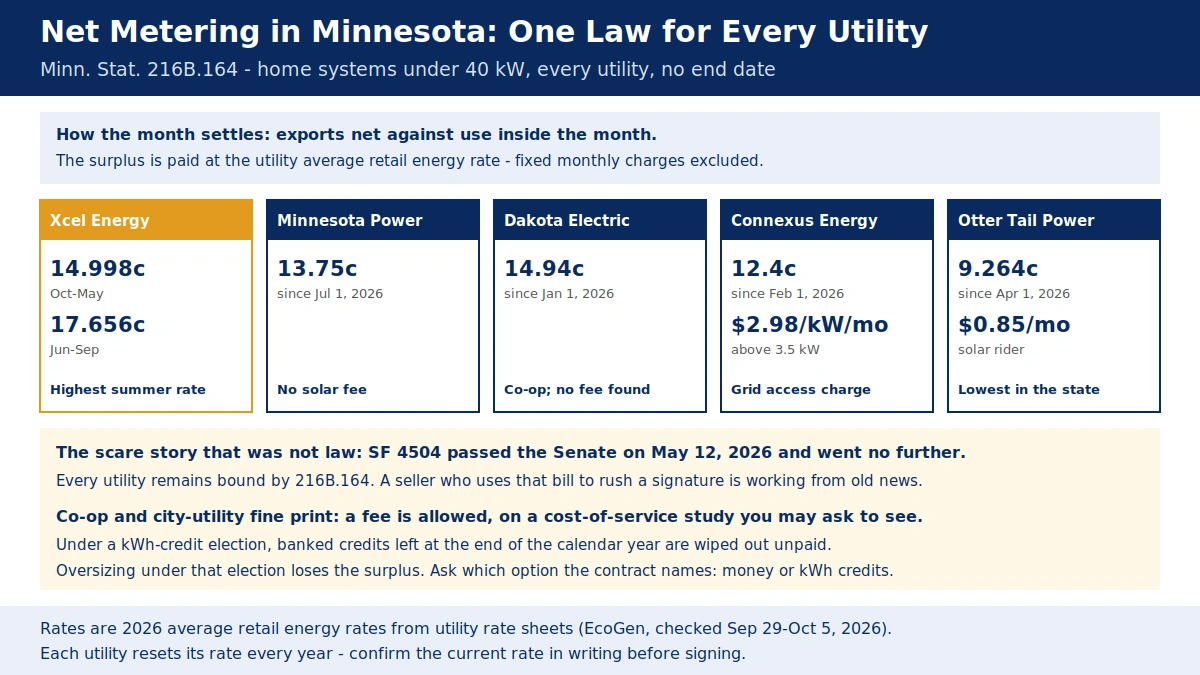
The mechanics are monthly netting at the retail energy rate. The utility bills the home only for the power it takes from the grid minus the power the panels send out. If the panels send out more than the home takes in during a month, the surplus is paid at the utility’s average retail utility energy rate, the average of the utility’s retail energy rates, which leaves out the fixed monthly charges, so it runs a little below the all-in price on the bill.
Each utility resets its rate every year, and the 2026 rates are printed in the table below. The customer may instead elect to be paid at the utility’s avoided cost, what the utility would have paid to generate or buy the power itself, but for a typical home the retail energy rate is the better deal, and almost nobody should take the avoided-cost election.
The statute also caps the arrangement at systems under 40 kW, which covers every home system several times over.
| Utility | Pay for a month’s extra power (2026) | Extra charge for solar homes |
|---|---|---|
| Xcel Energy | 14.998 cents Oct–May, 17.656 cents Jun–Sep (Rate A50, eff. Apr 1, 2026) | $1.90/mo counted in EcoGen payback figures — tariff basis unverified, flagged |
| Minnesota Power | 13.75 cents (since Jul 1, 2026) | None — co-op fee clause does not apply |
| Otter Tail Power | 9.264 cents (since Apr 1, 2026) | $0.85/mo on the solar rider |
| Dakota Electric (co-op) | 14.94 cents (since Jan 1, 2026) | None found |
| Connexus Energy (co-op) | 12.4 cents (since Feb 1, 2026) | $2.98 per kW per month above 3.5 kW |
Xcel’s rate deserves a closer look, because it is seasonal in a way that helps. From October to May the surplus rate is 14.998 cents; from June to September it is 17.656 cents, the months when Minnesota systems produce the most are the months Xcel pays the most for the surplus. The seasonal shape of the rate matches the seasonal shape of the output, which is the kindest alignment a net-metering rule can offer a northern system.
Minnesota Power’s single rate of 13.75 cents sits in the middle of the table. Otter Tail’s 9.264 cents is the lowest in the state by a wide margin, and it is the main reason Otter Tail payback stretches past 21 years, the same panels, at the same price, earning barely three-fifths of Xcel’s summer surplus rate.
The exception to the one-law story sits in subdivision 3, and it belongs to the co-ops and city utilities. The law lets a cooperative or municipal utility add a reasonable extra fee to recover fixed costs the solar home’s bill no longer covers, based on its latest cost of service study, a study the customer may ask to see. Connexus Energy is the worked example: a monthly grid access charge of $2.98 per kilowatt of system size above 3.5 kW, which comes to $13.59 a month, or about $163 a year, on the typical 8.06 kW system.
Dakota Electric, the other big co-op in the table, has no extra charge that could be found, and a payback near 15.6 years to show for it. The fee is usually modest.
Priced in, it is a small line item. Left out, it is the only Minnesota surprise left. At Connexus it adds more than five years to the payback all by itself, once the co-op’s lower energy price is counted alongside it.
The same subdivision offers a second choice that can quietly cost money: at a co-op or city utility, the customer may choose kWh credits instead of a money payment for surplus power. The credits roll forward month by month. Any banked credits left at the end of the calendar year are wiped out, with no payment.
That election is fine for a system sized to the home’s own use, where the bank empties every winter. It is a loss for an oversized system that banks summer surplus the house never draws down.
Before choosing the credit election, ask which option the contract names, money or kWh credits, and size the system to the answer. At an investor-owned utility the question does not arise in the same form, which is one more reason the utility on the bill matters more than the panels on the roof.
Two conflicts in the 2026 guides need naming, because both could mislead a buyer who reads only one source. First, one widely circulated incentives guide claims that Solar*Rewards replaces net metering, that an Xcel customer in Solar*Rewards gives up the retail export credit and takes the production payment instead. That is wrong against Xcel’s own program page, which states that all Solar*Rewards customers also get net metering: the two stack.
The same guide claims Minnesota Power pays avoided cost for exports; the statute and Minnesota Power’s own 13.75-cent average retail energy rate say otherwise. Second, one Minnesota guide describes Xcel credits rolling forward month to month with an annual true-up at the end of February, forfeiting leftovers.
That description conflicts with the monthly-payout reading of Xcel’s Rate A50 tariff used here, and the rate-sheet reading is followed while flagging the alternative. Confirm the settlement mechanics on the current Xcel tariff before signing, and get the answer in writing.
One more reassurance, because 2026 produced a scare story. Some guides warned that a 2026 bill would end net metering for co-op and city-utility customers. Senate File 4504 did pass the Senate on May 12, 2026.
It went no further, and it is not law. Every utility in Minnesota remains bound by §216B.164, and a seller who uses that bill to rush a signature is working from old news.
The law has no end date in it. What changes year to year is the average retail energy rate each utility files. That is a number to check annually, not a deadline to fear.
Solar*Rewards: Xcel’s 5-Cent Production Payment
Solar*Rewards is the second income stream, and for Xcel customers it is the difference between a 14-year payback and an 11-year one. The program pays the system owner for every kilowatt-hour the panels produce, whether the home uses the power or sends it to the grid, for ten years, in exchange for the system’s renewable energy credits. The credits go to Xcel; the checks go to the homeowner, paid annually in January and February.
The program runs under Minn. Stat. 116C.7792, it is funded through the Renewable Development Account, and it is open only to Xcel Energy customers who own their home. A co-op member, a Minnesota Power customer, and an Otter Tail customer cannot get it at any price, which is why the first question in any Minnesota solar conversation is the name at the top of the electric bill.
The 2026 rate is 5 cents per kilowatt-hour, and the date matters. Xcel raised the production incentive for general residential projects from $0.03 to $0.05 per kilowatt-hour effective October 2, 2026, and the higher rate applies to all eligible 2026-vintage general residential projects, active, installed, or already producing power. On the typical 8.06 kW system making about 11,260 kilowatt-hours a year, that is about $563 a year, or about $5,630 across the ten-year term, against about $338 a year at the old rate.
Any guide still quoting 3 cents for a 2026 application is out of date, and any quote built on 3 cents understates the system’s income by about $225 a year. Xcel has not announced a 2027 rate, so a system applied for in 2027 must be priced on whatever rate Xcel publishes for that program year.
Do not carry the 5-cent figure forward as a promise.
The income-qualified track works differently, and it is the most valuable single offer in the Minnesota stack for the households that can reach it. Income-qualified homes get $0.03 per kilowatt-hour plus an upfront payment of $3.00 per watt of system size. The upfront payment is large enough that it is not multiplied out: no cap on the $3.00-per-watt payment was verified, and stating an uncapped total would be guessing.
What is verified is the scarcity: 96% of the 2026 income-qualified budget was already assigned as of September 21, 2026, and a waitlist is in effect, with applications moving off it only as funding becomes available. By state law, half of each year’s Solar*Rewards money is set aside for low-income installs.
An income-qualified household that waits until spring to apply is likely to find the year’s money already assigned.
Three limits govern who can enroll. First, the system may not exceed 40 kW, the same ceiling as the net-metering law. Second, expected production must not exceed 120% of the home’s past twelve months of use, which is the rule that stops an average-use home from enrolling a 12 kW system in the incentive.
Third, the yearly budget is limited, and applications are handled in program-year vintages: the 2026 program opened January 7, 2026 at 9:00 AM Central, the 2025 waitlist did not carry over, and future program years start on the first Wednesday after January 4. The practical advice follows from the calendar: file the application as soon as the system is signed, before work starts, and get the rate for the application vintage in writing.
Xcel also asks for a home liability insurance policy of at least $300,000, per EcoGen’s reading of the program rules. That comes from a single secondary source, flagged here rather than asserted flatly, and worth confirming on the program page before signing.
What the homeowner gives up is the renewable energy credits, the proof that the power is clean. Xcel retires the credits against its own renewable obligations, which means the homeowner cannot separately claim to be buying or selling green power from the same kilowatt-hours. For most households that is an abstraction with no cash consequence.
It matters in one case: a home that also buys a green-power product from a third party, or a business claiming renewable use for reporting, should not double-count the same credits. The production payment is the compensation for the credits, and at 5 cents a kilowatt-hour it is generous compensation by national standards, most states offer no production payment at all.
A final warning about a program that no longer exists. Older guides, and some current ones, describe a Made in Minnesota adder, an extra cent or so per kilowatt-hour for systems using Minnesota-manufactured components. The Made in Minnesota Solar Incentive Program was established in 2013, its statute was repealed in 2017, and it no longer exists.
There is no Made in Minnesota adder in 2026, and a quote that prices one is pricing a ghost. Similarly, 2025 bills that would have repealed the Renewable Development Account and sunset the solar production incentive program, HF 1738 and SF 2369, stayed in committee and are not law.
Solar*Rewards is open for 2026 applications. What it pays in 2027 is Xcel’s next announcement, not a guess.
Payback in Minnesota: 14 Years Before Incentives, Faster on Xcel
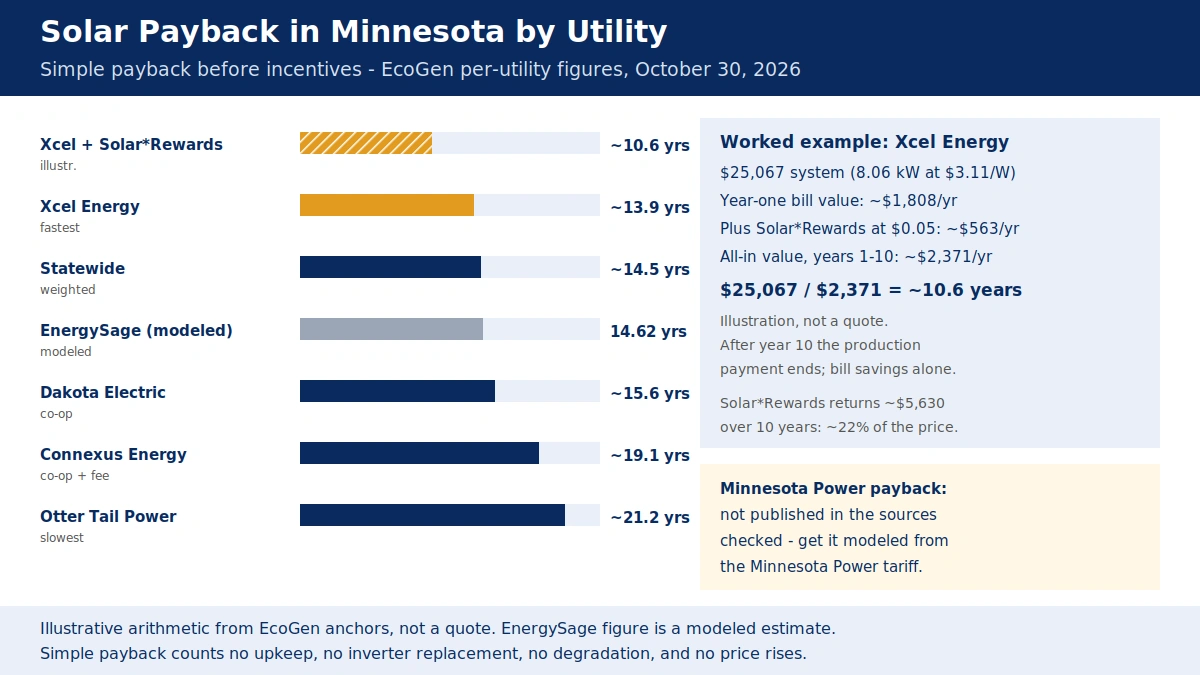
Payback in Minnesota is a utility story before it is a solar story. The same 8.06 kW system at the same $25,067 cash price pays back in about 13.9 years on Xcel Energy, about 15.6 years on Dakota Electric, about 19.1 years on Connexus Energy, and about 21.2 years on Otter Tail Power. The panels do not change.
The price does not change. What changes is the value of each kilowatt-hour the system makes, and whether the utility charges the solar home a monthly fee for the privilege of being connected.
The statewide figure, weighted by the homes each utility serves, is about 14.5 years of simple payback before incentives. That is the gross cost divided by a year of bill savings, counting no upkeep and no price rises. One EcoGen page prints 14.1 years for the statewide figure; the two pages that show the arithmetic print 14.5, and the pages that show their work are the ones used.
The Xcel case is the one to understand first, because it covers about 53% of Minnesota homes. The typical system makes about 11,260 kilowatt-hours a year. Xcel’s EIA price for the twelve months to August 2026 was 17.22 cents; less the $6.00 monthly customer charge, the variable value of each kilowatt-hour works out to 16.26 cents.
Eleven thousand two hundred sixty kilowatt-hours at 16.26 cents is $1,831 a year. Less Xcel’s $1.90 monthly solar charge, $22.80 a year, counted in EcoGen’s payback figures, the yearly savings come to about $1,808.
Twenty-five thousand sixty-seven dollars divided by $1,808 a year is about 13.9 years. The export mechanics barely move the answer: power used at home saves the full variable rate, power sent out first cancels power bought later in the month at the same value, and only the month-end leftover settles at the seasonal average retail energy rate of 14.998 or 17.656 cents, close enough to 16.26 cents that the split between self-use and export changes the payback by months, not years.
The Connexus case shows what the co-op fee does. Move the same house into Connexus territory and two things change at once: the energy price is lower, 15.10 cents less a $16.50 monthly basic charge, working out to 13.08 cents a kilowatt-hour, so the power is worth $1,473 a year instead of $1,831; and the grid access charge on an 8.06 kW system runs $13.59 a month, or about $163 a year. Yearly savings fall to about $1,310, and the same $25,067 system takes about 19.1 years to pay back, more than five years longer than the Xcel case, on identical hardware.
Dakota Electric shows the other co-op outcome: no extra charge found, a 14.94-cent surplus rate, and a payback near 15.6 years. The co-op’s own rate sheet decides how close a co-op home lands to the no-fee case, which is why the fee question has to be asked before the system is sized, not after it is installed.
Otter Tail Power is the slowest case in the state, and the reason is the rate, not a fee. Otter Tail pays 9.264 cents for surplus power, the lowest average retail energy rate in the table, and charges only $0.85 a month on the solar rider. Cheap power is good news for the bill and bad news for the payback: every kilowatt-hour the panels make displaces a kilowatt-hour that cost little to begin with.
EcoGen’s per-utility figures put Otter Tail payback at about 21.2 years before incentives. The REC purchase softens it, $0.02 per kilowatt-hour on all production, about $225 a year on the typical system, but no combined Otter Tail figure was published, and none is invented: the bill value at Otter Tail’s own EIA price was not printed in the sources checked, so the arithmetic cannot be completed from published anchors.
An Otter Tail home should ask its installer to model the combined case, bill savings at the Otter Tail variable rate, plus the REC payment, less the $0.85 monthly rider, and should expect a payback in the high teens at best.
Minnesota Power’s payback was not published in the sources checked, and none is estimated. What can be said is directional: the 13.75-cent surplus rate sits between Xcel’s winter rate and Otter Tail’s, no solar fee applies, and income-limited households can cut the net cost with a SolarSense rebate of up to $5,000, which, on a $25,067 system, would move any payback computed from it by roughly a fifth. A Duluth household should get the payback modeled from Minnesota Power’s own tariff, with the SolarSense eligibility question answered first, because the rebate is the single biggest variable in the northeast.
Now add the production payment, and the Xcel case changes shape. The illustration below is labeled as NestPriced arithmetic from EcoGen’s anchors, not as a quote: the $25,067 system, $1,808 a year in bill savings on Xcel, plus $563 a year in Solar*Rewards at 5 cents, for a combined $2,371 a year in the first ten years, a simple payback near 10.6 years while the production payment runs. After year ten the payment ends and the remaining value is bill savings alone, so the ten-year figure is a front-loaded average, not a promise that the system pays for itself in 10.6 calendar years under every reading.
Stated plainly: Solar*Rewards returns about $5,630 over ten years on the typical system, which is roughly 22% of the system’s cash price, and it pulls the Xcel payback forward by about three years. For an income-qualified household, the $3.00-per-watt upfront payment plus the 3-cent production rate would pull it forward further.
How far depends on a cap that could not be verified, so no figure is given.
| Utility | Yearly bill value (EcoGen) | Yearly solar charge | Yearly savings | Simple payback |
|---|---|---|---|---|
| Xcel Energy | ~$1,831 | $22.80 | ~$1,808 | ~13.9 yrs |
| Xcel Energy + Solar*Rewards (illustration) | ~$1,831 + ~$563 | $22.80 | ~$2,371 (yrs 1–10) | ~10.6 yrs (illustration) |
| Dakota Electric (co-op) | Not published | None found | Not published | ~15.6 yrs |
| Connexus Energy (co-op) | ~$1,473 | ~$163 | ~$1,310 | ~19.1 yrs |
| Otter Tail Power | Not published | $10.20/yr | Not published | ~21.2 yrs |
| Minnesota Power | Not published | None | Not published | Not published |
| Statewide weighted | — | — | — | ~14.5 yrs |
Two cautions close the section. First, every payback here is a simple payback: gross cost divided by first-year savings, with no upkeep, no inverter replacement, no panel degradation, and no electricity price rises counted. Degradation at the NREL median of about 0.5% a year trims output to about 88% of rated capacity by year 25, and a string inverter will likely need one replacement in a 10-to-15-year window, both push the true payback later than the simple figure.
Rising electricity prices push it earlier: Minnesota’s residential rate rose about 1.7% in the year to August 2026, and Xcel’s pending rate case, if granted, would raise the value of every kilowatt-hour the system makes. The simple figure is the right comparison tool across utilities.
It is not a promise about any one roof. Second, the payback answers only the question of when the system pays for itself.
A household that will move in five years does not need a 14-year payback. It needs the community solar section, three sections down, or a smaller system sized to the stay.
Batteries in Minnesota: The Storage Incentive Changes the Question
A battery in Minnesota is a backup purchase with an incentive attached, not a bill-savings purchase. The net-metering law already banks surplus power inside the month at the retail energy rate, so a battery’s usual job, shifting solar power from midday to evening, earns little extra here: the grid already does the shifting, for free, at nearly the same value. What a battery buys in Minnesota is power through an outage, in a state where winter outages are a safety issue rather than an inconvenience, and where a well pump, a furnace blower, and a sump pump all stop together when the grid goes down.
The storage incentive makes that purchase cheaper than it has ever been. It does not make it pay for itself on bill savings, and a quote that claims otherwise is double-counting value the net-metering law already provides.
Minnesota runs two battery incentive programs, split by territory, and both pay once, after the battery is running. Inside Xcel territory, the Xcel Battery Storage Incentive pays $175 per kilowatt-hour of battery capacity, or $370 per kilowatt-hour for income-qualified customers, capped at $5,000, with payment within 30 business days of operation. Outside Xcel territory, the Minnesota Department of Commerce’s Energy Storage Incentive pays $250 per kilowatt-hour, up to $7,000, for batteries installed on or after August 1, 2024, with the program running until June 30, 2027 or until the money runs out.
Both require a battery of 50 kWh or less paired with solar at the same home, or a solar application already filed. Both are first come, first served.
On a 10 kWh battery the payments are $1,750, $3,700, and $2,500 respectively; on a 13.5 kWh battery they are $2,363, $4,995, and $3,375, all under their caps.
The funding picture, as of the last published updates, shows money still available but moving. Xcel’s program budget was $3,480,000, with $1,474,512 remaining as of August 11, 2026, about 42% of the budget. The Commerce program showed $1,395,369 remaining as of October 7, 2026.
Neither figure is current as of the publication date, and both programs allocate money when a project passes completeness review, so the only reliable answer to “is money left?” comes from Xcel or the Commerce Department on the day the application is filed. One further wrinkle: the Commerce program says the payment may be taxable, so the after-tax value of a $2,500 payment is less than $2,500 for most households.
Ask a tax professional before counting the full amount.
No Minnesota-specific installed battery cost was verified, so none is stated. That absence is itself the most important battery fact in this section. Without a verified installed price, no battery payback can be computed, and none is computed.
What can be said is structural: the federal credit that used to cover 30% of a home battery ended December 31, 2025 along with the solar credit, so the storage incentive is now the only money against the battery’s price. A battery bought on its own, without solar panels, is not named in the sales-tax exemption law, so the quote may charge sales tax on a standalone battery where it charges none on the solar system.
Ask the installer whether the battery line carries sales tax, and get the installed battery price, equipment, installation, critical-loads panel, and any service work, as a separate line item before deciding.
Size the battery to the loads that matter in a winter outage, not to the solar array. A 10 kWh battery runs a furnace blower, a refrigerator, lights, and phones through a night; it does not run electric heat, a well pump, and a water heater together through a three-day ice storm. A 13.5 kWh battery stretches the same loads further, and a second battery stretches them further still, at full price for each additional unit, since the incentive caps bind quickly.
The right question for the installer is not “how big a battery can I get?” but “which circuits stay live when the grid drops, for how many hours, at what temperature, and what happens when the battery empties on the second cloudy day?” A battery that cannot answer that question in writing is a backup plan in name only.
For most Minnesota homes, the battery verdict is: valuable insurance, subsidized once, never a money-maker, and worth pricing alongside the panels, while the incentive money lasts, rather than as an afterthought at full price later.
Minnesota Incentives in 2026: The Full Stack, Program by Program
Minnesota’s incentive stack is wide, shallow, and sliced by utility, which is why it confuses buyers more than a single big rebate would. No program cuts the sticker price for everyone. Instead, five mechanisms stack in different combinations depending on the name at the top of the electric bill, the household’s income, and whether the home sits in Minneapolis.
The table below is the whole stack on one page. The paragraphs after it price each program, state who can get it, and name the ones that are closed, dead, or never launched, because in 2026 the closed programs outnumber the open ones, and stale guides still price most of them as live.
| Program | What it pays | Who can get it | Status (Nov 2026) |
|---|---|---|---|
| Net metering (§216B.164) | Surplus at avg retail energy rate | Home systems under 40 kW, every utility | In force, no end date |
| Xcel Solar*Rewards | $0.05/kWh for 10 yrs (~$563/yr typical) | Xcel customers who own their home | Open, limited yearly budget |
| Solar*Rewards income-qualified | $0.03/kWh + $3.00/W upfront | Income-qualified Xcel customers | Waitlist; 96% of 2026 budget assigned Sep 21, 2026 |
| Minnesota Power SolarSense | $0.27/kWh expected output, up to $5,000 or 60% | Income under 150% of area median income, MN Power territory | 2026 lottery closed; leftover first come, first served |
| Otter Tail REC purchase | $0.02/kWh on all production (~$225/yr) | Otter Tail customers who sell RECs | Open |
| Dakota Electric rebate | $500 one-time | Co-op members, owned system up to 20.01 kW | Open, approval before purchase |
| Battery incentive (Xcel) | $175/kWh, $370/kWh income-qualified, up to $5,000 | Xcel customers, battery up to 50 kWh + solar | Open, first come, first served |
| Battery incentive (state) | $250/kWh, up to $7,000 | Outside Xcel territory, battery up to 50 kWh + solar | Open until Jun 30, 2027 or funds out |
| Sales-tax exemption | No 6.875% state sales tax on the system | Every buyer | In force, no end date |
| Property-tax exemption | System exempt as personal property | Every owner | In force, nothing to file |
| Minneapolis group buy | $0.20/kWh expected output (~$2,252 typical) | Minneapolis homes via funded partner | Open; funding remaining not stated |
| Community solar gardens | Bill credit, 85% of Xcel avg home rate | Xcel territory subscribers, renters too | Open; 2026 capacity 33.0 MW approved Nov 1, 2026 |
Net metering is the foundation, not a bonus. It is covered in full two sections up, and it belongs at the top of this table because every other program stacks on it. The surplus payment, the monthly netting, and the co-op fee exception are the economics of the system; everything below this row is additional income or avoided tax.
Solar*Rewards is the Xcel income stream. Covered in full in the section above: 5 cents per kilowatt-hour for ten years on 2026 general residential applications, about $563 a year on the typical system, in exchange for the renewable credits, stacking with net metering.
The income-qualified track, 3 cents plus $3.00 per watt upfront, is waitlisted, with nearly the whole 2026 budget assigned by late September. The 2027 rate is not announced.
SolarSense is the northeast rebate, and it is narrow. Minnesota Power’s program pays a one-time rebate of $0.27 per kilowatt-hour of the system’s expected yearly output, capped at $5,000 or 60% of the installed cost, whichever binds first. Minnesota Power’s own example: a system expected to make 8,874 kilowatt-hours a year earns $2,396.
Eligibility is income-limited, household income under 150% of area median income, and the household must own both the home and the system. The 2026 money was handed out by lottery from applications sent March 1 to March 5, 2026; the window is closed, leftover money goes first come, first served, and the funding table showed $80,730 remaining on March 19, 2026 without an update since.
Get approval before the install, finish within six months, and confirm money remains before signing. A rebate the utility has already allocated to someone else is not a rebate. Minnesota Power retains the renewable credits from SolarSense systems.
Otter Tail’s REC purchase is small and steady. Otter Tail Power buys the system’s renewable energy credits at $0.02 per kilowatt-hour on every kilowatt-hour produced, installs the extra meter free, and pays about $225 a year on the typical system. There is no Otter Tail rebate for panels.
If the customer keeps the credits instead of selling them, the extra meter is not free. The payment is modest, but on the state’s slowest payback it is the only additional income available, and it should be in every Otter Tail quote.
Dakota Electric’s $500 rebate is real and small. One-time, per home, for a system the member owns of no more than 20.01 kW, with approval required before purchase.
Five hundred dollars on a $25,067 system is 2%, worth claiming, never worth choosing a utility territory over. Connexus Energy, the other large co-op, offers no panel rebate in the sources checked; its members get the 12.4-cent surplus rate and the grid access charge, and nothing else.
The battery incentives are the only money against storage. Covered in full in the section above: $175 or $370 per kilowatt-hour inside Xcel territory up to $5,000, $250 per kilowatt-hour outside it up to $7,000, both capped, both first come, first served, both requiring solar at the same home.
The two tax exemptions are the quiet part of the stack. A solar energy system is exempt from Minnesota sales tax under Minn. Stat. 297A.67, subdivision 29, the state rate is 6.875%, claimed by the buyer with Form ST3, Certificate of Exemption, exemption number 34, so a quote that charges sales tax on the system is charging tax the law does not impose. On $10,000 of solar equipment, the exemption is worth $687.50.
The property-tax exemption, under Minn. Stat. 272.02, subdivision 24, exempts the solar energy system from property tax as personal property, with the land classified without regard to the system, and nothing to file. Here a conflict must be flagged: some guides state that the added home value from solar is automatically excluded from assessment, while EcoGen cautions that the statute exempts the system itself and does not expressly say the value solar adds to the house is left out, and advises asking the county assessor how a home with solar is valued.
The statute and the assessor check are stated, not the broader claim. Minnesota has no state income-tax credit for home solar: the 2025 M1C and M1REF schedules list none.
The Minneapolis group buy is the local layer. The city pays 20 cents per kilowatt-hour of a system’s expected yearly output, about $2,252 on the typical system, to homes that go solar through a partner the city funds.
The city does not say how much money remains, and the figure comes from a single secondary source, so it is flagged here rather than asserted flatly. A Minneapolis buyer should ask the city’s program partner about current funding before counting the payment.
What is closed, dead, or never launched. The federal 30% credit ended December 31, 2025. The Made in Minnesota program was repealed in 2017.
The $1,000-class state rebates that older guides describe do not exist in 2026. Solar for All, the federal program Minnesota’s Commerce Department was to run, saw its EPA grants terminated in August 2025, the termination ruled unlawful by federal courts in September 2026, and no Minnesota restart found as of October 5, 2026: no household route exists.
The HEAR and HOMES rebates under Save Energy Minnesota have not launched, are awaiting formal DOE approval with no estimated date, and would not cover solar panels in any case. USDA REAP grants are paused and under federal review in 2026, with loan guarantees remaining.
REAP is a farm and rural-business program, not a homeowner program. A quote that prices any of these as live money for a 2026 home install is pricing a program that is not there.
Community Solar Gardens: Minnesota’s Other Way Onto Solar
Minnesota built community solar before almost anyone else, and it shows. The Community Solar Garden program dates to 2013, when the Legislature created a way for Xcel Energy customers to subscribe to a shared solar farm and receive bill credits for their share of its output. No roof required, no upfront cost, no equipment to maintain.
The program grew into one of the largest community solar markets in the country under an uncapped model, then was rebuilt by the 2023 Legislature into a capped, equity-focused program administered by the Minnesota Department of Commerce. In April 2026 it was renamed the Melissa Hortman Community Solar Garden Program, by a law enacted April 14 and effective the next day.
For a household that cannot put panels on its own roof, this is not a footnote to the rooftop story. In Minnesota, it is the older story, and the bigger market.
The current program works like this. A developer builds a solar garden of up to 5 megawatts inside Xcel Energy’s Minnesota service territory. Households and organizations subscribe to shares of the garden’s output.
The garden’s production earns bill credits on the subscriber’s Xcel bill, and the subscriber pays the garden operator a subscription fee. For most homes the bill credit runs at 85% of Xcel’s average home rate, and the subscription may not cost more than the credit.
So the subscriber’s net position is a saving, not a cost, by program design. Gardens approved from January 1, 2024 fall under the Commerce-administered program; gardens approved before that date remain in Xcel’s earlier legacy program, which accepted applications through December 31, 2023, and may carry different processes. Ask which program a garden belongs to before subscribing, because the rules that protect the subscriber differ between them.
The equity quotas are what make the current program different from the legacy one. At least 30% of each current garden is reserved for low- and moderate-income subscribers, and when affordable-housing providers and public-interest subscribers such as schools and nonprofits are added, the combined share must reach at least 55%. An income-qualified subscription may not cost more than 90% of the value of the bill credits it earns.
The program is meeting those mandates: the Commerce Department’s annual report counted 179 megawatts approved across 133 gardens as of December 16, 2025, with 90% of participants in low-income, residential, or public-interest categories and low- and moderate-income subscribers at 62% of the total, above the 55% goal. A one-bill option, putting the credit and the subscription on a single Xcel statement, began in 2025.
Capacity is now capped annually, and the caps are the constraint to watch. The program makes 100 megawatts available in each of 2024, 2025, and 2026, then 80 megawatts a year in 2027 through 2030, then 60 megawatts a year after that. Unused megawatts do not roll over into the next year.
As of November 1, 2026, the Commerce Department reported 33.0 megawatts of 2026 capacity approved, with 7.5 megawatts of applications under review. That is a program with room in it, not a program that has filled.
But the room is finite, and a household that wants a 2026-vintage garden subscription should not assume the capacity waits until spring. A 2026 bill proposal, SF 2393, would sunset the low- and moderate-income program by 2030; it is a proposal only, flagged here so no reader mistakes it for law.
Scale claims about the whole market need labeling. An October 30, 2026 announcement from Enterprise Energy, a Minneapolis community solar developer, put Minnesota’s active community solar capacity above 800 megawatts and subscriber savings at up to 15% with no upfront fees, developer claims, reported through a trade magazine, and labeled as such here rather than asserted as verified fact. An earlier trade report noted the uncapped legacy market had previously surpassed 1 gigawatt.
The verified Commerce figures, 179 megawatts in the current program as of late 2025, 33.0 megawatts of 2026 capacity approved, describe the new program only, not the legacy fleet behind it. In short: Minnesota’s community solar market is among the largest in the nation by any measure, the current program is open and has 2026 capacity approved, and the savings on any one subscription depend on the garden’s own subscription price against the bill credit.
Get both numbers in writing before signing.
Who should choose the garden over the roof? The renter, first. A subscription needs no roof, no landlord’s structural approval, and no 14-year stay.
The shaded roof, second. A garden subscription earns the same bill credit whether the subscriber’s own roof faces north under an oak canopy or not.
The short-stay household, third. A subscription typically transfers or ends when the household moves inside Xcel territory, while a rooftop system must be sold with the house or left behind. And the household that cannot use the tax exemptions or the production payment, fourth, the garden’s saving arrives as a bill credit, with no purchase, no loan, and no maintenance.
Who should choose the roof? The household that will stay past payback, owns a sound south-facing roof, and wants the full 25-year return rather than the subscription discount.
The national comparison of the two paths, with the subscription-versus-ownership math worked through, is in our community solar cost guide.
Federal Help in 2026: No Credit for Owners, and No Lease Market to Fall Back On
The federal picture for a Minnesota homeowner in 2026 is the shortest section, because there is almost nothing in it. The Residential Clean Energy Credit, §25D, which paid 30% of a home solar system’s cost, ended for property placed in service after December 31, 2025, under the One Big Beautiful Bill Act, Public Law 119-21. The completion date is what decides it: a system paid for in 2025 but installed in 2026 gets no credit.
For a homeowner-owned system installed in 2026, the federal credit is $0, and any quote that subtracts a 30% credit from a 2026 owned install is wrong, not optimistic, wrong. The same law ended §25C, the efficiency credit, for the same placed-in-service window.
Our federal energy tax credits guide sets out what the 2025 tax law preserved and what it removed.
In most states, the end of the homeowner credit leaves a second door open: lease or buy power from a company that owns the system, and let the company claim the commercial clean-energy credit, §48E at 30%, for systems in service by December 31, 2027, passing some of the value through as a lower monthly payment. In Minnesota, that door is barely ajar. The Database of State Incentives for Renewables and Efficiency, in its May 2026 map of third-party solar power purchase agreements, marks Minnesota’s residential PPA status as “unclear or unknown.”
EcoGen, checking in October 2026, found no company offering a residential solar lease or PPA to Minnesota homes at all. iSolar MN, a Minnesota installer, states plainly that it does no residential leases or PPAs in the state, on ownership-first grounds. Zero-down solar in Minnesota in 2026 almost always means a loan.
The homeowner owns the panels, keeps the net-metering value, keeps the Solar*Rewards payments, and owes the loan.
The picture is grayer than “banned,” and the gray deserves one paragraph. A Minnesota solar lawyer interviewed on an energy-policy podcast in October 2025 described the state as a middle gray zone for third-party ownership, with pathways to third-party residential solar and hundreds of third-party projects structured, largely commercial, nonprofit, and public-building systems, where the economics and the legal footing are firmer. All Energy Solar mentions prepaid leases and PPAs that use the surviving commercial credits.
Neither account names a residential lease or PPA product a Minnesota homeowner can sign in 2026. The practical rule follows: do not budget a §48E pass-through for a home system unless a written offer names the lease or PPA, the monthly payment or per-kilowatt-hour rate, the escalator, the term, and who keeps the Solar*Rewards payments and the net-metering value.
A verbal promise that “the commercial credit covers it” is not an offer.
Cash, loan, or the lease that likely does not exist, the 2026 math. A cash purchase runs about $25,067 for the typical system, leaves nothing to pay monthly, and keeps every net-metering credit and every Solar*Rewards payment with the homeowner. A $0-down loan swaps the electric bill for a monthly payment, check that the payment is lower than the bill it displaces, yet the dealer fee, 20% to 30% of the system cost on installer financing generally, is rolled into the amount financed, making the loan dearer than the cash price for identical panels.
Take a lease or PPA, if one can be found, and the upfront cost is $0. But the company keeps the production payments and the certificates, the payments typically escalate year after year, and the system is not yours when the house sells.
The best long-term return is still the cash purchase, thanks to the retail-rate net metering that every Minnesota utility must offer and the production payment that Xcel adds on top. A loan is the better second choice. A lease is a product to verify exists before it is compared against anything.
HEAR and HOMES deserve a paragraph here only so no buyer mistakes them for solar money. The federal Home Electrification and Appliance Rebates, HEAR, would pay up to $8,000 toward a heat pump for income-qualified households, but Minnesota’s program, Save Energy Minnesota, has not launched. The Commerce Department’s October 12, 2026 update says the state is waiting for formal DOE approval of a revised application submitted in August 2026, with no estimated launch date, and federal rules bar retroactive rebates for purchases made before launch.
The program the state first applied for is not the program described in the latest federal guidance: two things changed. First, DOE Program Notice 26-2, dated May 29, 2026, limits HEAR to electric-to-electric upgrades.
It no longer pays to replace gas, oil, or propane equipment. The second change matters more here: HEAR never covered solar panels, batteries, EV chargers, or windows, so a launched HEAR program would still leave the price of a Minnesota solar system untouched. The HOMES whole-home rebate program is in the same unlaunched position, and it prioritizes weatherization upgrades, not solar.
Permits, Licenses, HOA Rules & the Price Drivers
Minnesota regulates solar installers through two licenses, and a buyer who checks both is protected in a way buyers in most states are not. Since July 1, 2023, a company that contracts with a residential homeowner to install a solar photovoltaic system must be licensed as a residential building contractor or remodeler by the Minnesota Department of Labor and Industry, licenses starting with BC for building contractors and CR for remodelers. The point of the requirement is the Contractor Recovery Fund: if the company goes out of business, goes bankrupt, or cannot finish the job, the homeowner can claim against the fund for the out-of-pocket loss.
The second license covers the work itself: all electrical work in the installation, including the integrated-grounding elements of the racking, must be performed by a Minnesota-licensed electrical contractor. The residential contractor license covers the contracting and the mounting; it does not authorize electrical work, and the electrical work must be done by the electrical contractor, whether in-house or subcontracted.
Ask for both numbers, and check both against the Department of Labor and Industry’s license lookup before signing. NABCEP certification is the credential to ask for on the crew: it is the industry standard, and some rebate programs require it.
The Department censured one solar company in two 2026 consent orders, in May and August. The company was unnamed in the source, so no company is named, but the enforcement is a reminder that the lookup exists for a reason.
Permits and inspection follow a shape every Minnesota county recognizes, with the details set locally. An electrical permit and inspection are always required when a solar array goes in, and a building permit may be needed as well. Confirm which permits the city or county requires before work starts, and confirm who pulls them.
The 2020 Minnesota Building Code and Residential Code regulate photovoltaic systems, including roof access, pathways, and spacing requirements written to aid firefighting operations; Section 3111 of the Building Code covers systems on buildings outside the one- and two-family and townhouse classifications. No Minnesota permit-fee schedule was verified, so no fee figure is stated.
Ask the permitting office for its schedule, and ask the installer whether the permit fees sit inside the quote or on top of it. One timing note, from a secondary source and flagged as such: permits filed on or after August 17, 2026 follow the 2026 National Electrical Code. The slow part of the process is rarely the permit.
It is the interconnection application with the utility and the permission to operate that follows it. No Minnesota permission-to-operate timeline was verified, so ask the installer for its recent track record with your utility, in writing, and treat a company that cannot answer as a company that has not done this before.
The HOA question is answered by statute, and the statute is newer than most HOA documents in the state. Minn. Stat. 500.216, enacted in 2023, provides that a private entity, a homeowners association, community association, or similar body, must not prohibit or refuse to permit the owner of a single-family dwelling to install, maintain, or use a roof-mounted solar energy system, notwithstanding any covenant, restriction, or condition in a deed, security instrument, or association document. The section applies to single-family detached dwellings, and to multifamily attached dwellings, where the owner is the sole owner of the entire building and solely responsible for the maintenance, repair, replacement, and insurance of the entire building.
The association may still require a licensed contractor, may require that the system not extend above the peak of a pitched roof or beyond the roof edge, and may require the owner or installer to indemnify or reimburse it for loss or damage from the system. Other reasonable restrictions are allowed only if they do not cut the system’s projected generation by more than 10% or raise a photovoltaic system’s cost by more than $1,000, compared with the system as originally proposed and certified by its designer or installer.
Older bills proposed 20% and $2,000. Those are not the enacted numbers, and a board citing them is citing a bill that never passed. A 2022 claim, still circulating in one installer’s updated guide, that no Minnesota law limits HOA solar bans is stale: it pre-dates the 2023 statute.
Secure the architectural-review approval on paper before any panels are ordered. The statute may favor the homeowner, but a written approval costs less than a dispute.
Solar easements are a separate tool: under Minn. Stat. 500.30, neighbors may negotiate a recorded easement protecting a system’s sunlight access for its lifetime.
The panel upgrade, priced by absence. An electrical panel upgrade may be required before connection for homes on under 200-amp service, and that cost seldom appears inside a per-watt quote. No Minnesota-specific panel-upgrade price was verified, so none is stated.
The upgrade should be itemized in the quote or confirmed as unnecessary in writing, and the full comparison is in our electrical panel upgrade guide. The same absence applies to the detach-and-reset cost of a later reroof: real, sometimes large, and unpriced here because no Minnesota figure was verified.
What pushes a Minnesota quote up or down, in the order that matters most:
- The utility is the biggest price driver of all, and it is not in the quote. Xcel’s 17.656-cent summer surplus rate against Otter Tail’s 9.264 cents is worth more than seven years of payback on the same system, and no installer can change which utility serves the house. The quote can only respond to it: size the system to the rate, count the production payment at the rate Xcel publishes for the application year, and do not let a low per-watt price on an Otter Tail roof distract from a 21-year payback.
- The co-op fee pushes the price up. Connexus Energy’s grid access charge, $2.98 per kilowatt per month above 3.5 kW, costs about $163 a year on the typical system and adds more than five years to the payback once the co-op’s lower energy price is counted. Any co-op or city utility may charge such a fee. Get the fee in writing, with the cost-of-service study behind it, before sizing the system.
- Snow-load engineering and the short season push the price up. Racking and attachments engineered for 50 to 60 pounds per square foot of ground snow load, installed in a May-to-October window by crews that book out through the summer, cost more than the same work in a year-round market. That is the structural reason Minnesota sits at $3.11 a watt against a $2.89 national average.
- Roof complexity and shade push the price up. Dormers and chimneys breaking up the roof, a north-facing slope, a shallow pitch that keeps snow in place, or a neighbor’s spruce shading the array all inflate the quote: extra racking, extra labor, microinverters or optimizers in place of a string inverter, and a smaller array than the roof could hold in theory. The estimate stands or falls on its shade study; a quote that skips the study is guessing.
- A service panel too small for the array adds cost. Homes on under 200-amp service may need a panel upgrade before the array can connect, a cost the per-watt quote rarely shows. Find out whether that work is included or billed later, and keep the answer on paper.
- A dying roof pushes the price up twice. Panels over a roof with under eight to ten years of life left must come off and go back on when the roof is replaced. The detach-and-reset is a second bill, unpriced here, and the sequence matters more than the number: roof first, panels second.
- The tax exemptions keep the price down. The 6.875% sales-tax exemption comes off at the point of sale, and the property-tax exemption keeps the system itself off the tax roll. Both are automatic in the sense that no separate application buys them. But the sales-tax exemption must be claimed on the quote, with Form ST3, so check that no sales tax appears on the system lines.
- Cash keeps the price down. A cash purchase carries no dealer fee. A $0-down loan commonly carries a dealer fee of 20% to 30% of the system cost, folded into the amount financed and invisible until the cash price sits next to the financed price. Larger, open, south-facing roofs also keep the per-watt number low. A big open roof is faster to work on than a cut-up one, and the crew finishes in fewer days.
Getting Quotes in Minnesota: The Checklist
Ten checks, ordered by how much money each one saves. A quote clearing all ten checks is ready to sign. A quote failing the first three belongs in the discard pile, no matter what its monthly payment promises.
- Your utility’s rules in writing first. Xcel pays 14.998 cents in winter and 17.656 cents in summer for surplus power, Minnesota Power pays 13.75 cents, Otter Tail pays 9.264 cents, Dakota Electric pays 14.94 cents, and Connexus pays 12.4 cents plus a grid access charge. That spread is worth more than seven years of payback on the same system. Start with the household’s own utility tariff page, and test every quote against the export rate on that page, not against any statewide average.
- The co-op or municipal fee in writing, or a written none. At a co-op or city utility, the law allows a fee based on a cost-of-service study, and Connexus charges $2.98 per kilowatt per month above 3.5 kW. Ask for the fee in dollars per month, the study behind it, and whether the contract elects money or kWh credits for surplus power. Banked kWh credits at a co-op are wiped out at year-end unpaid.
- Cash price per watt on paper. $3.11 a watt is the anchor; 2026 Minnesota quotes clustered between $2.74 and $3.48. Always pair the financed price with its cash equivalent: a dealer fee of 20% to 30% of the system cost on installer financing generally is buried in the financed total, and only the side-by-side comparison exposes it.
- No line for a 30% federal credit, no line for a state rebate that does not exist. A 2026 owner purchase earns a $0 federal credit, Minnesota offers no general state rebate and no state income-tax credit, the sales-tax exemption is already in the quote, and the Made in Minnesota program was repealed in 2017. The only panel money in the stack is utility-specific, SolarSense for income-limited Minnesota Power households, the $500 Dakota Electric rebate, the Minneapolis group buy, and each must be confirmed open before it is counted.
- The production payment in writing, at the right rate. Xcel’s Solar*Rewards pays $0.05 per kilowatt-hour for ten years on 2026 general residential applications, raised from $0.03 on October 2, 2026, and the system must stay within 120% of the past twelve months’ use. Ask whether the application is filed, what vintage year it carries, what rate that vintage earns, and whether the household qualifies for the income-qualified track, which is waitlisted, with 96% of the 2026 budget assigned by September 21, 2026.
- Both Minnesota license numbers verified. The residential building contractor or remodeler license for the contracting company, required since July 1, 2023, and a Minnesota-licensed electrical contractor for all electrical work including the racking’s grounding elements. Check both against the Department of Labor and Industry’s lookup, and ask whether the crew is NABCEP-certified. A firm unable to show both numbers has not done this work before.
- Add-ons itemized. Roof work, panel upgrade when service is under 200 amps, tree work, snow-load racking engineering, battery and critical-loads panel, ground-mount trenching. Ask for each extra priced on its own line, with its own dollar figure beside it. The battery line should state whether sales tax is charged on it, since a standalone battery is not named in the exemption law.
- PVWatts production estimate, with shade and snow assumptions stated. Production runs about 1,397 kilowatt-hours per kilowatt per year on the anchor model, with other models at 1,250 to 1,294, so the estimate must name its model and its assumed shade and snow losses, month by month, June beside December, derived from a shade study of the roof in question, not a statewide average. A December promise is a red flag: December delivers about 59 kilowatt-hours per kilowatt, barely two-fifths of June.
- Snow load, hail rating, and insurance confirmed. The racking’s snow-load engineering for the local ground snow load, 50 pounds per square foot in the south, 60 in the north, UL 61730 / IEC 61730 on the panels by name, and written confirmation that the homeowners policy covers the array for hail and storm damage. Minnesota averages more than 40 hail days a year.
- HOA approval in writing first. Minn. Stat. 500.216 bars an association from prohibiting a roof-mounted system for a qualifying single-family dwelling owner, and other restrictions must not cut generation by more than 10% or raise a photovoltaic system’s cost by more than $1,000. But the section applies only where the owner solely owns the building and solely carries its maintenance, repair, replacement, and insurance. Get written architectural-review approval before the panels are ordered, even when the law supports the installation.
The closing step is comparison: three written quotes, all priced against the same spec sheet, all from installers with crews already working in the home’s utility territory, all in hand before a signature goes anywhere. Where the export rate and any co-op fee can swing the payback from 14 years to 21, the cheapest quote is the one that priced the household’s own utility rules correctly, and filed the Solar*Rewards application before the year’s money was gone.
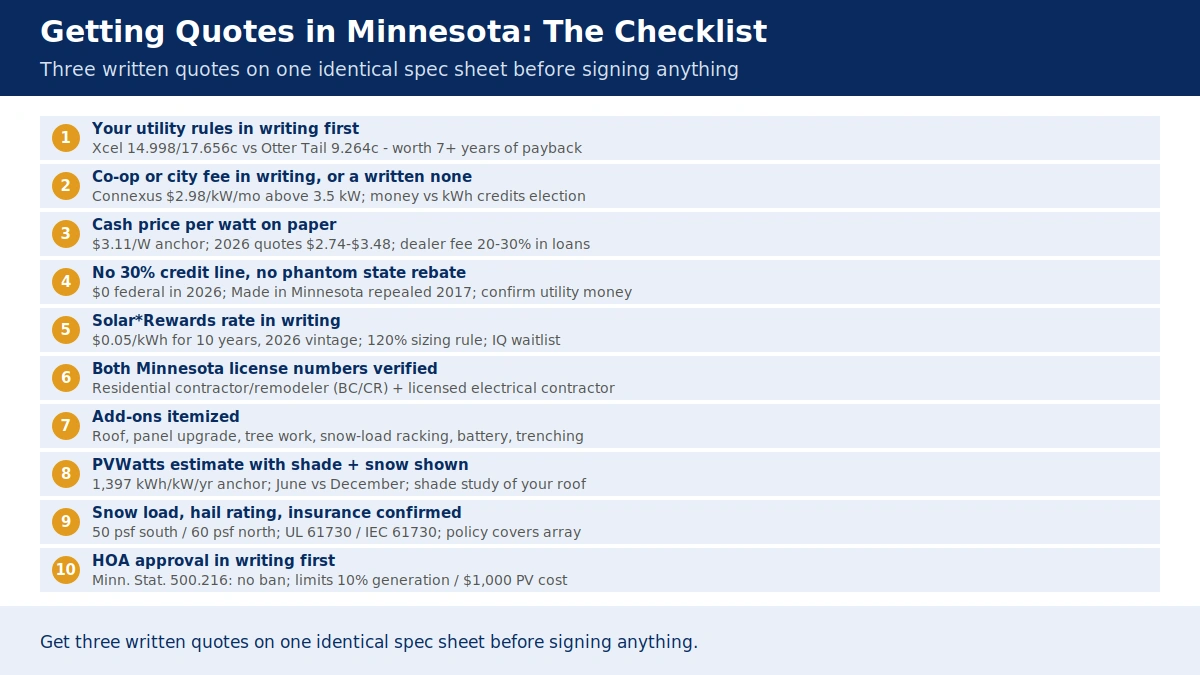
Sources & methodology
Headline price and production:
- EcoGen Solar Cost Index, September 2026 edition: $3.11/W Minnesota, 8.06 kW typical system, $25,067, ±12% quote band $2.74–$3.48/W; 1,397 kWh/kW/yr, 11,260 kWh/yr; Berkeley Lab 2025 median 8.06 kW from 2,106 Minnesota systems; 44th lowest of 51; neighbors SD $2.85, WI $3.01, IA $3.07, ND $3.39, US $2.89
- EnergySage Minnesota cost data: $3.23/W Nov 2026 (12.44 kW avg, $34,150–$46,202 range, 14.62-yr modeled payback, $41,650 25-yr savings); $3.24/W Oct 2026 (12.6 kW avg, ~$40,700); city pages Nov 2026, Minneapolis Hennepin $3.22/W, 10.86 kW, $34,918, 12.40-yr modeled, $48,837; Minneapolis Anoka $3.25/W, 12.39 kW, $40,225, 13.87-yr modeled, $43,094; Saint Paul Ramsey $3.18/W, 12.38 kW, $39,438, 14.17-yr modeled, $44,172; Saint Paul Dakota $3.11/W, 14.01 kW, $43,583, 14.74-yr modeled, $41,602
- Wolf River Electric: 40 Minnesota roof-mount contracts, Jun-Oct 2026, middle half $2.70–$3.15/W, median ~$2.93/W, 10 kW ~$29,300 (single-installer data, labeled)
- SolarReviews Nov 2026: $2.96/W, 7.6 kW avg, $23,900 (national model, not headline); NumeralQ planning, EnergySage data retrieved Oct 26, 2026: 8 kW $22,590–$29,500 ($2.82–$3.69/W); production cross-checks: iSolar/NREL ~1,260 kWh/kW/yr, iamhome ~1,294, SolarBidAnalyzer ~1,250 (conflict with EcoGen 1,397, flagged)
- EIA Electric Power Monthly, 12 months to Aug 2026: Minnesota residential 16.28¢/kWh, ~745 kWh/mo, ~$121/mo bill (~8,940 kWh/yr); Aug 2026 single month 17.20¢ (+1.7% YoY); 2024 Form 861 variant 712 kWh/mo, $110.06/mo flagged
Net metering:
- Minn. Stat. §216B.164: net metering for systems under 40 kW at every utility (investor-owned, co-op, municipal); monthly netting; surplus at average retail utility energy rate; avoided-cost election available; co-op/municipal fee allowed on cost-of-service study; kWh-credit election wiped at calendar year-end unpaid
- 2026 average retail energy rates (EcoGen, from utility rate sheets, checked Sep 29-Oct 5, 2026): Xcel 14.998¢ Oct-May / 17.656¢ Jun-Sep (Rate A50, eff. Apr 1, 2026); Minnesota Power 13.75¢ (since Jul 1, 2026); Otter Tail 9.264¢ (since Apr 1, 2026) + $0.85/mo rider; Dakota Electric 14.94¢ (since Jan 1, 2026), no fee found; Connexus 12.4¢ (since Feb 1, 2026) + $2.98/kW/mo above 3.5 kW ($13.59/mo on 8.06 kW)
- Xcel $1.90/mo solar charge counted in EcoGen payback figures; tariff basis not independently verified, flagged; Xcel $300,000 liability insurance requirement per EcoGen, single secondary source, flagged
- SF 4504 passed Senate May 12, 2026, went no further, not law (EcoGen, three pages)
- Conflicts flagged: solarpricelist Solar*Rewards-replaces-net-metering claim (wrong vs Xcel page); iamhome Xcel February true-up/forfeiture description (conflicts with Rate A50 monthly-payout reading); Xcel share ~53% of homes (EcoGen) vs ~60% of households / ~40% of load (other guides)
Solar*Rewards and utility programs:
- Xcel Energy Solar*Rewards program page (read Nov 13, 2026): $0.05/kWh for general residential 2026-vintage projects, raised from $0.03 eff. Oct 2, 2026, applies to all eligible 2026 projects incl. already running; paid annually by check Jan-Feb for 10 years; RECs to Xcel; income-qualified $0.03/kWh + $3.00/W upfront, waitlist in effect; size under 40 kW, expected output under 120% of past 12 months’ use; must own home; 2026 applications opened Jan 7, 2026, 9:00 AM CST; 2025 waitlist did not carry over; future years first Wednesday after Jan 4
- 96% of 2026 income-qualified budget assigned Sep 21, 2026 (EcoGen); half of each year’s money set aside for low-income installs by law (EcoGen); 2027 rate not announced (Centauri, Oct 2026)
- Minnesota Power SolarSense: $0.27/kWh expected output, cap $5,000 or 60% of cost; income under 150% of area median income; own home and system; example 8,874 kWh/yr → $2,396; 2026 lottery window Mar 1-5, 2026 (closed); $80,730 left Mar 19, 2026, table not updated since; approval before install, finish within 6 months (EcoGen, checked Oct 5, 2026)
- Otter Tail REC purchase $0.02/kWh, free extra meter, ~$225/yr typical (EcoGen); Dakota Electric $500 rebate, owned system up to 20.01 kW, approval before purchase (EcoGen)
- Made in Minnesota: established 2013, statute repealed 2017, no longer exists (Aaron Hall, updated Aug 2026); HF 1738 / SF 2369 sunset bills in committee, not law
Payback arithmetic:
- EcoGen per-utility figures, Oct 30, 2026: statewide weighted ~14.5 yrs (Xcel, Otter Tail, Connexus, Dakota Electric, 65% of homes); Xcel ~13.9 yrs; range 13.9–21.2 yrs; Connexus ~19.1 yrs; Dakota Electric ~15.6 yrs; Minnesota Power not published
- Xcel worked example: 11,260 kWh × 16.26¢ (17.22¢ EIA less $6.00/mo customer charge) = $1,831, less $22.80/yr = $1,808/yr; $25,067 / $1,808 = ~13.9 yrs; Connexus: 11,260 × 13.08¢ (15.10¢ less $16.50/mo basic charge) = $1,473, less ~$163/yr = $1,310/yr → ~19.1 yrs
- NestPriced illustration (labeled as such): Xcel + Solar*Rewards $25,067 / ($1,808 + $563) = ~10.6 yrs for years 1-10; $563/yr = 11,260 × $0.05; ~$5,630 over 10 years
- Statewide conflict flagged: EcoGen companies page 14.1 yrs vs cost + worth-it pages 14.5 yrs; EnergySage modeled paybacks flagged as modeled estimates, not verified paybacks
Batteries:
- Xcel Battery Storage Incentive: $175/kWh, $370/kWh income-qualified, cap $5,000, paid within 30 business days; budget $3,480,000, $1,474,512 left Aug 11, 2026 (Xcel page; Commerce page)
- Commerce Energy Storage Incentive (outside Xcel): $250/kWh, up to $7,000, battery installed on or after Aug 1, 2024, ends Jun 30, 2027 or when funds run out; $1,395,369 left Oct 7, 2026 (Commerce page); both programs battery up to 50 kWh paired with solar, first come first served; payment may be taxable
- No Minnesota-specific installed battery cost verified, none stated; income-qualified pilot $1,000/kWh up to $15,000 single secondary source (Wolf River), flagged
Community solar:
- Minn. Stat. §216B.1641 (2013); legacy Xcel program applications through Dec 31, 2023; 2023 Laws ch. 60 sunset legacy program, Commerce-administered LMI-Accessible program from Jan 1, 2024; renamed Melissa Hortman Community Solar Garden Program, law enacted Apr 14, 2026, effective Apr 15, 2026
- Commerce developers page Nov 1, 2026: 33.0 MW of 2026 capacity approved, 7.5 MW under review; annual caps 100 MW 2024–2026, 80 MW 2027–2030, 60 MW after, unused MW do not roll over (Lightstar); gardens up to 5 MW; ≥30% LMI per garden, ≥55% combined LMI + affordable housing + public interest; income-qualified subscription ≤90% of bill-credit value; one-bill option from 2025
- 179 MW across 133 gardens approved as of Dec 16, 2025; 90% low-income/residential/public-interest participants; LMI 62% vs 55% goal (Commerce annual report via pv-magazine); bill credit 85% of Xcel average home rate, subscription ≤ credit (EcoGen)
- 800+ MW active capacity and up to 15% savings: Enterprise Energy developer claims via Renewable Energy Magazine, Oct 30, 2026, labeled as developer claims; SF 2393 sunset proposal flagged as proposal only
Incentives and taxes:
- Sales tax: Minn. Stat. §297A.67, subd. 29, 6.875%, Form ST3 exemption 34; standalone-battery ambiguity flagged (EcoGen)
- Property tax: Minn. Stat. §272.02, subd. 24, system exempt as personal property, land classified without regard to system, nothing to file; scope conflict flagged (EcoGen caution vs Centauri broader claim, assessor check advised)
- No Minnesota income-tax credit: 2025 M1C/M1REF schedules list none (EcoGen)
- Minneapolis group buy: $0.20/kWh expected output, ~$2,252 typical, funding remaining not stated (EcoGen, single secondary source, flagged)
- Rochester/Austin/Owatonna $500 rebates: A1 SolarStore May 1, 2026, stale, unverified, not stated as fact
Federal and financing:
- OBBBA P.L. 119-21 and IRS FS-2025-05: §25D and §25C $0 for post-Dec-31-2025 installs, completion date counts
- §48E 30% for third-party-owned systems, in service by Dec 31, 2027; DSIRE May 2026 third-party PPA map marks Minnesota “unclear or unknown”; EcoGen Oct 5, 2026 found no residential lease/PPA offerings; iSolar MN does no residential leases/PPAs; gray-zone counterpoint: ILSR podcast Oct 2025 (Minnesota solar lawyer, pathways exist, largely commercial) and All Energy Solar prepaid-lease mention, flagged
- Dealer fees 20-30% on $0-down loans: general installer-financing figure (EcoGen Maryland page); no Minnesota-specific figure verified
- HEAR/HOMES: Save Energy Minnesota NOT launched; Commerce update Oct 12, 2026, awaiting DOE approval, no launch date, revised application Aug 2026; allocations HEAR $74,027,440 / HOMES $74,311,171 (DOE May 2024 figures); DOE Program Notice 26-2 dated May 29, 2026, electric-to-electric only; HEAR does not cover solar/batteries/EV chargers/windows; no retroactive rebates
- Solar for All: EPA terminated all 60 grants Aug 7, 2025; courts ruled termination unlawful Sep 18 and Sep 22, 2026; no Minnesota restart as of Oct 5, 2026 (EcoGen); USDA REAP grants paused, loan guarantees remain (iSolar, Oct 2026)
Licensing, permits, HOA:
- DLI solar installer licensing: law eff. Jul 1, 2023, residential building contractor/remodeler license required (BC/CR prefixes), Contractor Recovery Fund purpose; all electrical work incl. integrated-grounding racking by Minnesota-licensed electrical contractor (DLI solar FAQ, revised Jul 31, 2026); NABCEP credential to ask for (Commerce); DLI censured one company in two 2026 consent orders, May 21 and Aug 28, 2026, company unnamed (EcoGen)
- Electrical permit + inspection always required; building permit may also be needed (Commerce); 2020 Minnesota Building/Residential Code, §3111 for non-IRC buildings; 2026 NEC for permits filed on or after Aug 17, 2026 (splicejobs, secondary, flagged); no permit-fee schedule or PTO timeline verified
- HOA: Minn. Stat. §500.216 (2023 c 60, art 12, s 63; statute text verified at revisor.mn.gov): private entity must not prohibit roof-mounted system for qualifying single-family dwelling owner (sole owner of entire building, solely responsible for maintenance/repair/replacement/insurance); allowable: licensed contractor, not above peak/beyond edge, indemnification; other restrictions must not cut generation by more than 10% or raise PV cost by more than $1,000 (20% solar water heater); older 20%/$2,000 bill figures flagged as not enacted; 2022 no-law claim stale; solar easements Minn. Stat. §500.30
- Panel upgrade and detach-and-reset: no Minnesota-specific prices verified, none stated
Production and climate:
- EcoGen: 1,397 kWh/kW/yr PVWatts-based; peak sun hours NREL Solar Radiation Data Manual via iSolar (Oct 2026): Minneapolis/St. Cloud 4.6/day, Duluth 4.4, International Falls 4.3; Minneapolis July 6.4 vs December 2.3; January 3.1, November 2.6
- PVGIS-NSRDB (retrieved Oct 21, 2026): Minneapolis 1 kW at 30° south, 14% losses: December ~59 kWh/kW, June ~136 kWh/kW (43%); PVGIS does not model snow cover
- PVWatts V8 (queried Oct 23, 2026): Minneapolis December 2.13 PSH at 20° tilt vs 2.89 at 60° (+36%)
- Snow loss: Marion 2013 NREL model via SolarCalculatorHQ: Minneapolis 2.8-4.0%/yr at 30° tilt, 54 in snowfall, ~200-400 kWh/yr on 6 kW; snowfall Twin Cities ~54 in, Duluth ~86 in (art 84, BestRoofingEstimates 2026)
- Snow load: Minnesota Administrative Rules 1303.1700, ground 50 psf south / 60 psf north, roof load 0.7x ground = 35 psf Twin Cities (via art 84); install window May-October (art 84); hail 40+ days/yr statewide, 2-inch hail 7–8 days/yr (State Climatology Office via art 84)
- Heat penalty 0.3-0.5% per degree C above 25 C cell temperature; temperature coefficient typically -0.26% to -0.40% per °C (national figures)
- Lifespan 25–30 years productive service; NREL median degradation ~0.5%/yr, ~88% of rated output at year 25; product warranty typically 10–25 years; performance warranty typically 25–30 years, guaranteeing 80-92% of rated output at year 25 depending on tier; string inverter 10–15 years, one replacement expected; microinverters ~25 years (national figures)
EXCLUDED:
- Any “after 30% credit” prices
- Any HEAR-for-solar claim: HEAR does not cover solar, batteries, EV chargers, or windows; electric-to-electric only since DOE Program Notice 26-2, May 29, 2026; Minnesota’s program has not launched
- Any state rebate or state tax credit for Minnesota solar: none exists beyond utility-specific programs (SolarSense, Dakota $500, Minneapolis group buy)
- The Made in Minnesota program as open: repealed 2017; no MiM adder exists in 2026
- Solar*Rewards at $0.03 as the 2026 general rate: raised to $0.05 on October 2, 2026
- The claim that Solar*Rewards replaces net metering: WRONG against Xcel’s own program page; the two stack
- The claim that Minnesota Power pays avoided cost for exports: WRONG against §216B.164 and the 13.75-cent average retail energy rate
- The claim that net metering ended for co-op and city-utility customers: WRONG against §216B.164; SF 4504 passed the Senate May 12, 2026 and went no further. It is not law
- The claim that Minnesota has no solar-access HOA law: WRONG against Minn. Stat. §500.216 (2023); the 20%/$2,000 thresholds in older bills are not the enacted 10%/$1,000 numbers
- A residential lease or PPA as a live Minnesota product: DSIRE “unclear or unknown,” no offerings found October 2026. Do not budget a §48E pass-through without a written offer
- Solar for All as an open Minnesota program: grants terminated August 2025, no restart found as of October 5, 2026
- Rochester and Duluth EnergySage city prices: none retrieved, both cities priced at the state anchor and labeled as such
- A Minnesota-specific battery installed cost, panel-upgrade cost, detach-and-reset cost, permit-fee schedule, or interconnection timeline, none verified, none stated
- Rochester/Austin/Owatonna $500 rebates as current: May 2026 claims, unverified
- A cap on Xcel’s $3.00/W income-qualified upfront payment: not verified, not multiplied out
- EnergySage’s city and state paybacks as verified: modeled, EcoGen’s per-utility figures are the anchor
- SolarReviews’ $2.96/W and NumeralQ’s $2.82–$3.69/W as headline prices: national model / planning estimate, not Minnesota quotes
- The “800 MW active community solar” and “up to 15% savings” figures as verified fact: developer claims, labeled as such
- A Minnesota-specific shade-loss percentage, monthly PVWatts table beyond the cited points, BLS electrician wage, or county solar grant programs, none verified, none stated
Disclaimer: The prices here are 2026 Minnesota planning figures. Your utility, your roof, your shade, and the installer you pick all move the final price, and the utility moves it more than any of them. The same system pays back in about 14 years on Xcel and about 21 years on Otter Tail, and a co-op fee can add five years on its own.
Before settling on a budget, line up three written quotes from installers working in Minnesota, on one identical spec sheet, and ask each one for your utility’s current export rate and any solar fee in writing. Treat every tax point here as background reading, not advice about your own filing.
Have a Minnesota tax professional look over your own return before you file it. Program rules change, and the Solar*Rewards rate is set by program year, so confirm current terms with Xcel Energy, the Minnesota Department of Commerce, and your own utility before signing.
What do solar panels cost in Minnesota in 2026?
A Minnesota install in 2026 runs $3.11 a watt on EcoGen’s September 2026 index, about $25,067 for the typical 8.06 kW system, with quotes through the year generally spanning $2.74–$3.48 a watt. At the EcoGen rate, a 6 kW home system typically runs about $18,660, while EnergySage puts the state average at $3.23 a watt on a larger 12.44 kW system. A homeowner-owned system installed in 2026 earns a $0 federal credit and Minnesota offers no state income-tax credit, so the return rests on net metering at every utility plus, for Xcel customers, a Solar*Rewards production payment of 5 cents per kilowatt-hour for ten years.
Do solar panels work in a Minnesota winter?
They work, and cold air raises cell efficiency: each kilowatt of panels makes about 1,397 kilowatt-hours a year on EcoGen’s PVWatts-based figure, with December delivering about 59 kilowatt-hours per kilowatt against about 136 in June. Snow costs less than most buyers fear: modeled annual snow losses in Minneapolis run 2.8% to 4.0% of yearly production, because December is only about 4% of the year’s output and panels shed snow within a day or two at roof pitch. Fresh snow on the ground reflects light back onto tilted panels, and a 60-degree tilt earns about 36% more December sun than a 20-degree tilt in PVWatts modeling for Minneapolis.
How does net metering work in Minnesota?
One statute covers every utility: under Minn. Stat. 216B.164, every electric utility in Minnesota, investor-owned, cooperative, and municipal, must offer net metering to home systems under 40 kW, billing the home only for power taken from the grid minus power sent out, with monthly netting. A month’s surplus is paid at the utility’s average retail energy rate: 14.998 cents in winter and 17.656 cents in summer at Xcel, 13.75 cents at Minnesota Power, 9.264 cents at Otter Tail, 14.94 cents at Dakota Electric, and 12.4 cents at Connexus. Co-ops and city utilities may add a reasonable fee based on a cost-of-service study, Connexus charges $2.98 per kilowatt per month above 3.5 kW, and they may offer kWh credits instead of money, with unused credits wiped out at the end of the calendar year.
What is Xcel Solar*Rewards worth in 2026?
It is worth about $563 a year on the typical system, for ten years, at the 2026 general residential rate of $0.05 per kilowatt-hour, raised from $0.03 on October 2, 2026, for all eligible 2026 projects including systems already running. Solar*Rewards pays Xcel Energy customers for every kilowatt-hour their system produces, whether the home uses it or exports it, in exchange for the system’s renewable energy credits, and the payment stacks with net metering instead of replacing it. The typical 8.06 kW system making about 11,260 kilowatt-hours a year earns about $5,630 across the ten-year term, while income-qualified households get $0.03 per kilowatt-hour plus $3.00 per watt upfront on a track that is waitlisted, with 96% of the 2026 budget assigned by September 21, 2026.
Can my HOA stop me from installing solar panels in Minnesota?
Usually not: Minnesota law bars outright bans, and since 2023 the limits have numbers attached. Under Minn. Stat. 500.216, a homeowners association or similar private entity must not prohibit or refuse to permit a roof-mounted solar energy system for the owner of a single-family dwelling, where the owner solely owns the entire building and solely carries its maintenance, repair, replacement, and insurance, though the association may require a licensed contractor, may require the system to stay below the roof peak and inside the roof edge, and may require indemnification for damage. Other restrictions must not cut the system’s projected generation by more than 10% or raise a photovoltaic system’s cost by more than $1,000, so get architectural-review approval in writing before ordering panels, even when the law is on your side.
Is the 30% federal solar tax credit still available to Minnesota homeowners in 2026?
No: for a homeowner-owned system placed in service after December 31, 2025, that 30% Residential Clean Energy Credit (§25D) pays $0, since Public Law 119-21, the One Big Beautiful Bill Act, ended it, and the install finish date is the date that counts. The lease route that rescues the federal benefit in some states is barely available here: the DSIRE map marks Minnesota’s residential PPA status as unclear or unknown, and no company was found offering a residential lease or PPA to Minnesota homes as of October 2026. Do not budget a commercial-credit pass-through for a home system unless a written lease or PPA offer names the payment, the escalator, and who keeps the Solar*Rewards money.
Why is solar payback about 14 years in Minnesota?
The price sits above the national average at $3.11 a watt, pushed up by snow-load engineering and a short install season, and the sun delivers about 1,397 kilowatt-hours a year per installed kilowatt, respectable for the latitude, but seasonal enough that December earns barely two-fifths of June. What saves the case is the law: every utility must net-meter at the retail energy rate, so the bright summer months earn nearly the same value the dark winter months bill at, and Xcel adds a 5-cent production payment on top. The statewide simple payback lands near 14.5 years before incentives, about 13.9 years on Xcel, and near 10.6 years on Xcel with the production payment counted for its ten-year term, while on Otter Tail’s 9.264-cent surplus rate the payback drifts past 21 years under any plausible assumptions.
Should I join a community solar garden instead of putting panels on my roof?
For some Minnesota households, yes: Minnesota’s program is the most developed in the country, so the choice is real. Community solar gardens, created by a 2013 law and now administered by the Commerce Department as the Melissa Hortman Community Solar Garden Program, let Xcel Energy customers subscribe to a shared solar farm and earn bill credits with no roof, no upfront cost, and no equipment to maintain, reserving at least 30% of each garden for low- and moderate-income subscribers, capping an income-qualified subscription at 90% of its bill-credit value, with 33.0 megawatts of 2026 capacity approved as of November 1, 2026. Choose the garden if you rent, if your roof is shaded or faces north, or if you will move before a rooftop system pays back, and choose the roof if you will stay past payback on a sound, south-facing roof and want the full 25-year return.