


Virginia sells solar on a promise most states have already broken: the kilowatt-hour your panels send out in June is worth the same as the kilowatt-hour you buy back in January. That promise is written into Virginia law, it survived two rounds of utility proposals to cut it, and the State Corporation Commission’s order of April 30, 2026 kept it for every application Dominion approves before May 1, 2027 — while writing a new version of the rule for everyone after that date. The panels themselves are almost the cheapest part of the story. At $2.79 a watt, Virginia installs run below the national average, and the typical system is big because Virginia homes are hungry: the average household draws about 1,066 kilowatt-hours a month, roughly a fifth more than the typical American home, and the 9.42 kW median system exists to feed exactly that appetite. The hardware is not what decides whether the purchase pays. The meter is.
That is why this guide starts with the meter and only then prices the panels. The per-watt anchor is settled and public, the production figure is settled too, and the two together make a system that covers the average home almost exactly — 12,924 kilowatt-hours made against 12,792 used. The questions that move the answer are the ones no per-watt figure can settle: which utility sends the bill, whether the application lands before or after May 1, 2027, whether the system is sized to the house’s own use or to the roof’s full area, and who keeps the certificates the panels mint. A Richmond home on Dominion and a Roanoke home on Appalachian Power can buy the same panels at the same price and pay back a year apart. A system approved in April 2027 and one approved in May 2027 will live under different rules for the next twenty-five years. The countrywide figures above are the backdrop; what follows prices Virginia utility by utility, Dominion first and the co-ops last.
Table of Contents
How Much Do Solar Panels Cost in Virginia in 2026?
Two datasets describe Virginia in 2026, and they look further apart than they are until you see what each one counts. EcoGen’s Solar Cost Index, September 2026 edition, is the anchor this guide works from: it puts a Virginia install at $2.79 per watt, which works out to roughly $26,282 for the typical 9.42 kW system before any incentive. That runs 3.5% below the $2.89 national average and below every state Virginia touches except North Carolina — Maryland is $2.80, West Virginia $2.93, Tennessee $3.18. The total looks large because the system is large, not because the price is high: Virginia’s 9.42 kW median is the Berkeley Lab 2025 median across 3,258 Virginia systems actually installed, and it exists because Virginia homes use so much power. Against that anchor, a 6 kW system is $16,740, 8 kW is $22,320, 10 kW is $27,900, and 12 kW is $33,480.
The second dataset is the marketplace. EnergySage’s November 2026 Virginia page reads $2.56 a watt — twenty-three cents under the EcoGen anchor — on a far larger system: its average Virginia quote is 13.86 kW at about $35,477, ranging from $30,155 to $40,799. The size gap is the thing to read, not the twenty-three cents — the two sources disagree about size, not about price. EnergySage averages the quotes moving through its marketplace, and Virginia homeowners who go looking for quotes usually want large systems: electric heat, a heat pump, an EV, a house they expect to grow into. Berkeley Lab counted what installers actually put on roofs — a 9.42 kW median across 3,258 Virginia systems installed in 2025. That median describes what Virginians actually install, so this guide builds on it. EnergySage still serves as the cross-check: two independent readings, $2.56 and $2.79, twenty-three cents apart, both under the national average.
A third reading comes from ConsumerAffairs, working from EnergySage data: $2.54 a watt on a 13.94 kW typical system, with an 8 kW system at about $20,320 — between the two anchors on price and consistent with both on the size story. Put the three together and Virginia lands a little below the national average on price, with the quote spread mattering more than any single number — and with the size of the system doing more work than the price per watt.
Keep one fact about the typical size in mind before the tables begin, because it shades every number that follows. The 9.42 kW median is a real installed median rather than a model, and it sits almost exactly on the average Virginia home’s annual use: at roughly 1,372 kilowatt-hours per kilowatt, 9.42 kW produces about 12,924 kilowatt-hours a year, against about 1,066 kilowatt-hours a month — roughly 12,792 a year — for the average Virginia home. On an annual basis that looks like a perfect fit — but the house does not use power evenly through the year and the panels do not make it evenly either, and the surplus that survives the twelve-month bank earns about six cents. What that mismatch does to the payback math is worked through in the sizing section; what the surplus is actually worth gets priced in the net-metering section.
That per-watt price is meant to cover the whole job, start to finish. One quoted price should carry the whole job: panels and inverter or microinverters, racking and wiring, the crew’s labour, permits, inspection, and the interconnection application. Roof work, a panel upgrade, tree work, a battery, and rapid-shutdown gear all sit outside that per-watt price. Nothing has been taken off the arithmetic yet, because there is almost nothing to take off: Virginia pays no rebate, no state tax credit, and the federal credit is $0 for a 2026 owner install. The sticker is close to the final price in Virginia in a way it is not in Illinois or New Jersey — and the small money that does exist, the certificate income and the property-tax exemption, gets its own sections below.
One more warning before the tables: the lowest quote in Virginia is rarely the lowest system once the job is finished, and with installers spread from Arlington to Virginia Beach the second and third quotes are worth obtaining. The quiet part of a loan quote is the dealer fee — 15 to 30% of the cash price, sometimes more, folded into the amount financed, because an installer’s total is mostly overhead and margin. With quotes from Richmond, Virginia Beach, Norfolk, and Arlington installers spread across the table, compare them on cash price per watt for the same panels on the same Virginia roof — that is the one number that lets you judge bidder against bidder. Collect it in writing from at least three installers, and walk away from any bidder who will not hand it over — and from any bidder who cannot name the utility that serves your address, because the net-metering rules that decide the payback differ by utility, and a quote built on the wrong utility’s rules is built on the wrong numbers.
| Source | $ per watt | System | Cash total | Payback |
|---|---|---|---|---|
| EcoGen Index (Sep 2026) | $2.79 | 9.42 kW | ~$26,282 | 12.3 yrs Dominion |
| EnergySage (Nov 2026) | $2.56 | 13.86 kW avg | ~$35,477 | 11.65 yrs — flagged, modeled |
| ConsumerAffairs (Nov 2026) | $2.54 | 13.94 kW | ~$35,400 | Not published |
| EnergySage Richmond (Nov 2026) | $2.54 | 13.69 kW avg | ~$34,792 | 10.48 yrs — flagged, modeled |
| EnergySage Virginia Beach (Nov 2026) | $2.66 | 13.66 kW avg | ~$36,371 | 10.91 yrs — flagged, modeled |
| EnergySage Norfolk (Nov 2026) | $2.57 | 12.42 kW avg | ~$31,911 | 11.15 yrs — flagged, modeled |
| EnergySage Arlington (Nov 2026) | $2.74 | 10.7 kW avg | ~$29,330 | 11.72 yrs — flagged, modeled |
| National range (article 4) | $2.25-$3.30 | 8.2 kW | ~$24,600 at $3.00/W | 6-12 yrs |
Two rows in that table carry a warning label — read it before trusting them. EnergySage’s payback figures — 11.65 years statewide, 10.48 in Richmond, 10.91 in Virginia Beach, 11.15 in Norfolk, 11.72 in Arlington — are modelled estimates built on its own marketplace averages, and they run shorter than EcoGen’s per-utility figures of 12.3 to 14.0 years on bill savings alone. The gap comes from system size and certificate income: any payback that prices a 13.86 kW system against a house using 12,792 kilowatt-hours a year is modeling a different Virginia from the one the tariffs describe. The payback section below builds the Virginia answer from the EcoGen anchors and the certificate income instead.
Solar Panel Cost in Virginia by System Size
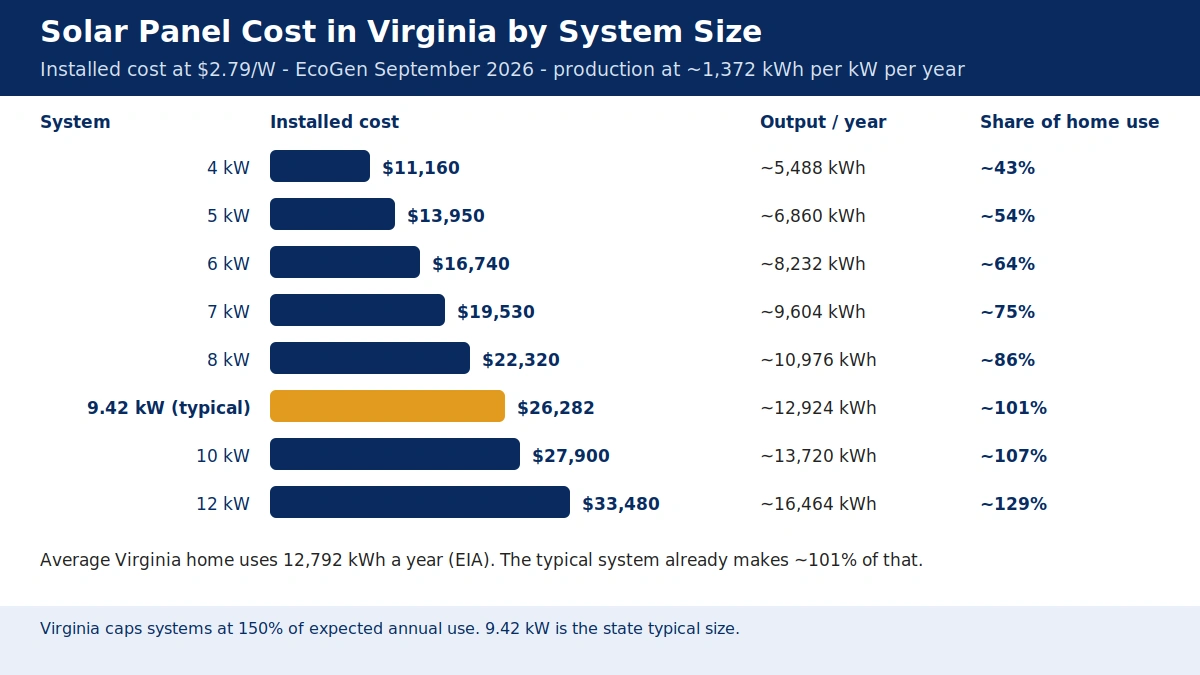
Sizing comes first, and in Virginia the sizing question is unusually honest: the typical system already matches the average home almost exactly, so the question is not how much bigger to build but whether to build to the average at all. EIA billing data to August 2026 puts the average Virginia home at about 1,066 kilowatt-hours a month — about 12,792 a year — paying close to $177 a month. The 9.42 kW median times the 1,372 figure gives the typical array about 12,924 kilowatt-hours a year — just over the average home’s annual use, about 101% of it. A Virginia system sized to the average home is a 9.42 kW system. That is the whole sizing story in one sentence, and it is a kinder story than the one Illinois tells, where the typical system overshoots the average home by 42%.
Building past the house’s own use is a poorer deal in Virginia than in a state where surplus banks forever, because the surplus that survives the twelve-month bank earns about six cents at Dominion — a third of the retail rate — and nothing at all without a purchase agreement signed in advance. An exported kilowatt-hour that is still sitting in the bank at the true-up is worth a third of one used at home. That gap is what makes the table below turn unattractive past 10 kW for most Virginia homes, unless the home genuinely uses the power. Every row in the table is priced from the EcoGen anchor. Each kilowatt installed at the $2.79 anchor generates roughly 1,372 kilowatt-hours across the year. The final column states each size as a share of an average home’s use, so the crossover point — where the array stops feeding the house and starts selling power — stands out at a glance.
| Size | Cash cost at $2.79/W | Annual output | Share of a typical Virginia home’s use (12,792 kWh/yr) |
|---|---|---|---|
| 4 kW | $11,160 | ~5,488 kWh | ~43% |
| 5 kW | $13,950 | ~6,860 kWh | ~54% |
| 6 kW | $16,740 | ~8,232 kWh | ~64% |
| 7 kW | $19,530 | ~9,604 kWh | ~75% |
| 8 kW | $22,320 | ~10,976 kWh | ~86% |
| 9.42 kW (state typical) | ~$26,282 | ~12,924 kWh | ~101% |
| 10 kW | $27,900 | ~13,720 kWh | ~107% |
| 12 kW | $33,480 | ~16,464 kWh | ~129% |
Two rows deserve a closer look. First, even an 8 kW system already covers about 86% of average annual use, so an 8 kW array is the right size for the average Virginia home that wants to leave a little headroom — and the 9.42 kW typical system belongs to a home that uses the state average or a little more, or plans to. Second, Virginia law caps the system at 150% of expected annual use, so nothing in the law stops an average-use home from installing a 12 kW system — but the arithmetic stops it instead. Every kilowatt past the house’s own use earns the year-end cash-out rate in the months it makes the most, and the certificate income, which grows with size too, cushions the mistake only slightly: a 12 kW system mints about 16 certificates a year against 13 for the typical system, worth roughly $100 more a year at the market range. That cushion is genuine, and it softens the cost of oversizing in Virginia — yet it does not make a 12 kW array on a 1,066-kilowatt-hour-a-month home a good buy.
Begin with a year of electric bills, not with the empty roof area. Total twelve months of kilowatt-hours, then divide by roughly 1,372, and the size that covers the house falls out. Then take June, July, and August on their own: where a surplus already shows at 8 kW, stop there, since each kilowatt past that line earns the year-end rate in the months it makes the most. Plan on another 1 to 2 kW for an EV or a heat pump on the way, more again for electric heat, and less where the roof is shaded or faces north. Then test the result against your utility’s export rules before signing: a system earning six cents on everything past your own use pays back on self-use alone. With an EV or a heat pump coming, size the solar for the bigger household you are about to become. Design the array around the load you will have, not the load you have today — a heat pump or EV added a year later lands on a system sized for a smaller house. Our sizing guide for 6, 8 and 10 kW systems walks through the whole sizing exercise — reading twelve months of bills, knowing where to stop, and allowing for an EV or a heat pump.
Solar Panel Cost by City: Richmond, Virginia Beach, Norfolk & Arlington
Panel prices barely move from one city to the next. System size does move the total — the bigger the array, the bigger the bill. When you read the city table, let the utility column decide the comparison before the price column does. Once quotes arrive, compare them on dollars per watt and ignore the headline total entirely. A Virginia Beach quote at the high end of its range and an Arlington quote at the statewide anchor are not a close call once the systems are compared: the Virginia Beach array is nearly 3 kW bigger, and its total is bigger for that reason alone.
| City | $ per watt | Avg. system | Cash total | Utility |
|---|---|---|---|---|
| Richmond | $2.54 | 13.69 kW | ~$34,792 | Dominion Energy |
| Virginia Beach | $2.66 | 13.66 kW | ~$36,371 | Dominion Energy |
| Norfolk | $2.57 | 12.42 kW | ~$31,911 | Dominion Energy |
| Arlington | $2.74 | 10.7 kW | ~$29,330 | Dominion Energy |
Richmond runs cheapest per watt of the four and second dearest in total — the same fact read two ways. EnergySage puts Richmond at $2.54 a watt — the lowest of the four — but on a 13.69 kW average system, about $34,792, with a modeled payback of 10.48 years and 25-year savings of $58,926, the highest savings of the four. Richmond homes on Dominion run big systems for the same reason the state median is big: central Virginia gets strong sun, the housing stock skews larger, and electric heat is common inland. A Richmond quote at $2.54 a watt is a good price on a very big system. It is not a cheap system, and a Richmond home that uses the state average of 1,066 kilowatt-hours a month has no business buying 13.69 kW of panels — that array makes about 18,783 kilowatt-hours a year, nearly half again what the average home uses, and most of the surplus would settle at the year-end cash-out rate instead of the retail rate. One caution on the Richmond figure itself: a second EnergySage page for a Richmond in Goochland County reads $2.65 a watt on an 11.81 kW system with an 11.01-year payback. The city-county figure above is the one for the city of Richmond; the conflict is flagged in the sources.
Virginia Beach is the dearest total of the four. EnergySage puts Virginia Beach at $2.66 a watt on a 13.66 kW average system, about $36,371, with a modeled payback of 10.91 years and 25-year savings of $57,196. The coastal city runs big systems for a coastal reason: large homes, air conditioning that runs hard through a humid summer, and a long cooling season that stretches the electric bill. What Virginia Beach adds that Richmond does not is weather risk on the roof itself: hurricane and tropical-storm wind, salt air on the hardware, and a racking specification that has to be written for the coast rather than copied from an inland job. A Virginia Beach quote should name the racking’s wind rating and the panel’s salt-mist rating in writing — a quote that does not has left the coastal question unanswered.
Norfolk sits in the middle of the four on price and at the bottom on savings. EnergySage puts Norfolk at $2.57 a watt on a 12.42 kW average system, about $31,911, with a modeled payback of 11.15 years and 25-year savings of $48,050 — the lowest savings of the four, because Norfolk homes run smaller systems than Richmond or Virginia Beach homes and the same Dominion rules apply to all three. Norfolk shares Virginia Beach’s coastal exposure: the same wind, the same salt, the same need for a racking specification written for the shore. A planning estimate from NumeralQ, built on EnergySage cost data retrieved October 26, 2026, prices an 8 kW Norfolk system at $19,310 to $25,240 — a planning estimate, wider than the EcoGen anchor, and labeled as one.
Arlington is the dearest per watt of the four and the cheapest in total. EnergySage puts Arlington at $2.74 a watt — the highest of the four — but on a 10.7 kW average system, about $29,330, the smallest average system in the state, with a modeled payback of 11.72 years and 25-year savings of $42,370. Arlington is the Northern Virginia story in miniature: dense suburbs, smaller lots, older housing stock with cut-up roofs and mature trees, and labor that costs more inside the Washington metro than anywhere else in the state. The smaller system is the honest thing about the Arlington figure: Arlington roofs fit fewer panels, and Arlington homes that install solar tend to size to the roof they have rather than the usage they wish they had. An Arlington quote at $2.74 a watt is a fair price on a small system in an expensive metro. It is not a cheap system — but it is the system most likely to be sized right.
One last city point: installer depth is a Northern Virginia thing. Many installers bid for the same jobs across the metro, which is what holds quotes near $2.74 there rather than higher. Farther out, longer drives and fewer competing installers push quotes toward the top of the range for no reason other than distance. Get three quotes wherever you are in Virginia, and make sure one of them comes from an installer with active jobs in your utility’s service area.
Virginia Sunshine: Hot Humid Summers, Short Winter Days & the Coast
Virginia sunshine comes with a shape that rewards the buyer who plans for summer cooling rather than the one who falls for a single sunny-day estimate. Trust a production estimate only if it shows the seasonal shape as well as the yearly total — the shape, not the total, is what settles whether the system pays.
The sun, by the numbers. By the EcoGen-implied figure, a kilowatt of panels in Virginia yields roughly 1,372 kilowatt-hours a year, at about 4.5 peak sun hours a day. That sits a little above the national figure and well above the cloudy Northeast, yet a long way below the desert Southwest — a solid upper-middle resource, stronger than New Jersey’s, stronger than New York’s, and close to North Carolina’s. The winter figure matters more than the yearly total, and Richmond’s climate data states it plainly: about 5.4 to 5.5 hours of sunshine a day in December against 9.7 to 10.3 in June, and the shortest day, December 21, gives about 9 hours and 40 minutes of daylight against 14 hours and 45 minutes on June 21. Work from 1,372 kilowatt-hours per kilowatt for the year, and let the seasonal shape drive the design. The coast runs a little stronger than the capital on the same measure: a kilowatt of panels makes about 1,450 kilowatt-hours a year in Norfolk and about 1,387 in Richmond on the PVGIS figures, so a statewide average flatters a Richmond roof and short-changes a Norfolk one — and an installer who quotes one statewide number is quoting a guess.
The humidity is the story in the east. Richmond sits in a humid subtropical climate, and the summer is the season that defines it: July averages a high of 89 to 90 degrees with the air thick enough that the dew point sits in the high 60s, and August is the wettest month at about 4.5 to 4.7 inches of rain. The city sees about 2,781 to 2,830 hours of sunshine a year against a national figure near 2,500, with only about nine inches of snow a year — January the snowiest month at about 3.7 inches — and about 43 to 46 inches of rain spread across the year. The heat does real work against the panels: cell efficiency falls by roughly 0.3-0.5% for every degree Celsius above 25, so a July rooftop in Richmond runs hotter than a July roof in Maine — and less efficiently. An hour of Virginia sunshine in July is worth less than the same hour on a cool spring roof, which is one more reason the production estimate should show its monthly shape rather than one yearly average.
Snow pulls the outcome both ways at once, and only in the west. Snow slides off a tilted array on its own, and a steeper tilt sheds it sooner. A fixed Virginia install is usually set near the latitude tilt, around 37 to 39 degrees in Richmond — steep enough to let most snow slide off on its own after a storm, and Richmond’s nine inches a year rarely stays on a tilted array for long. The mountains are the exception: western Virginia gets colder winters and materially more snow than the capital, and a low-slope mountain roof holds it longer than a steep one does. Snow on the ground helps too. Through spring and fall, with the sun low and the ground still white, snow reflection can lift energy capture by an estimated 15 to 30% — the engineerfix estimate cited in the sources. While it sits there, snow on the panels earns nothing, and a low-slope Virginia roof holds it longer than a steep one. No Virginia snow-loss percentage is printed in this guide, because none was verified — so ask any installer handing you a production estimate what snow loss it assumes and which tilt it is built on. On a steep mountain roof, snow guards deserve their own line on the quote — the hardware that keeps sliding snow off walkways and gutters.
The roof, and the storm it carries. A rooftop array in Virginia carries a wind load on the racking and the roof together, heaviest where the hurricanes come ashore. This guide verified no Virginia design wind-load number, so none is printed — ask the local building department for the roof’s wind rating and let that number govern, not the installer’s guess. A roof with under ten years left should be replaced before the panels go on: a later reroof means taking the panels off and putting them back, $2,000 to $4,500 over the roofing job, and many Virginia insurers refuse to cover an array on a roof past 15 to 20 years. Price the reroof first if the roof is close to done — before any contract is signed. Putting new panels on a roof that is nearly done is the costly mistake this guide exists to help you avoid. For solar, standing-seam metal is hard to beat in Virginia — clamps grip its seams with no penetrations at all, and rain leaves metal sooner than asphalt. Specify panels by their UL 61730 / IEC 61730 ratings, and get written confirmation that your homeowners policy covers the array for storm damage — coastal policies in Hampton Roads sometimes treat rooftop equipment differently from inland ones.
Putting it together. The gear is ordinary — the settings are Virginia’s. Face the array south where the roof allows, and tilt it steep enough to catch the low winter sun and shed what little snow falls. Fit microinverters or optimizers so one shaded string cannot drag the whole array down — Virginia roofs, with their trees, dormers, and chimneys, carry shade more often than installers admit — and insist on a PVWatts estimate that prints its monthly shape on the page, June next to December, Richmond next to Norfolk.
Net Metering in Virginia: One-for-One Credits — and the 2027 Change
Virginia is one of the states that people get wrong in both directions, and the correction matters more here than almost anywhere else, because the rule changed on a date — May 1, 2027 — and which side of that date your application falls on decides what every surplus kilowatt-hour is worth for the next twenty-five years. You will hear it said that Virginia has no net metering at all. That is wrong. Others claim Virginia’s net metering will never change. That is wrong too, for anyone who applies after the spring of 2027. What Virginia has is a one-for-one rule today, with a new version of the rule already written and dated — and the difference between the two versions is smaller than the headlines suggest, but real enough to plan around.
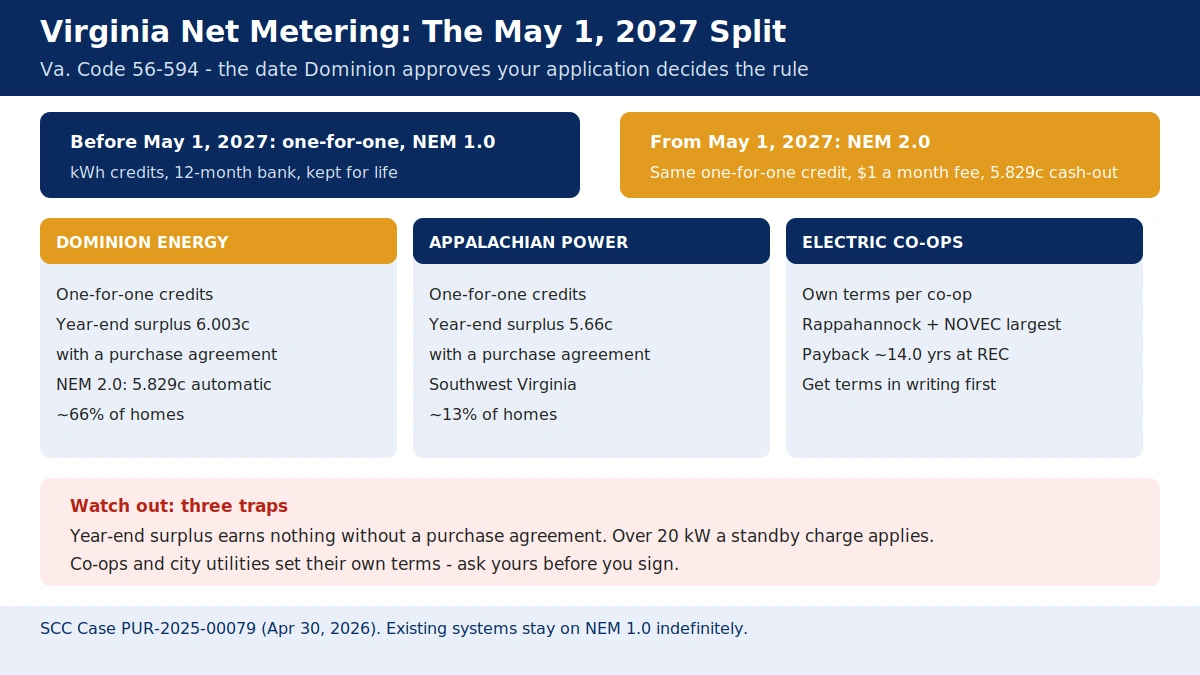
The rule today. The net-metering statute, Va. Code § 56-594, binds the big investor-owned utilities: Dominion Energy and Appalachian Power. For a home system up to 25 kW, sized to no more than 150% of expected annual use, every kilowatt-hour sent to the grid is credited one-for-one against a kilowatt-hour the house buys later — supply and delivery together, in kilowatt-hours rather than dollars — and those credits carry forward across a twelve-month netting period. That is the whole rule in one paragraph, and it is the most generous export rule in this series: the summer surplus banks at full retail value and spends itself in the winter, which is why a Virginia system sized to annual use pays back at all. The program runs first come, first served up to a 6% cap on each utility’s peak load, and as of June 1, 2026 every co-op listed by the state association still had room for homes.
The catch comes once a year. The twelve-month bank closes, and what happens to the power still sitting in it is where the utilities differ — and where Virginia buyers lose money they did not know they were losing. At Dominion, year-end surplus is paid only if you signed a purchase agreement with the utility in advance, at the PJM Dominion-zone annual average: 6.003 cents per kilowatt-hour for 2025. At Appalachian Power the figure is 5.66 cents, also only with an agreement. Without one, the leftover earns nothing at all. A hundred kilowatt-hours left over at year end earns about $6 from Dominion or $5.66 from Appalachian Power with an agreement, and nothing without one. The same hundred kilowatt-hours used to cancel power the house buys are worth about $16.64 at the statewide average price. That gap — six cents against sixteen — is the reason this guide keeps saying to size to your own use and not to your roof.
The rule from May 1, 2027. In its final order of April 30, 2026 (Case PUR-2025-00079), the State Corporation Commission set Dominion’s next rules, NEM 2.0, for applications Dominion approves on or after May 1, 2027 — a follow-up order of May 20, 2026 fixed the start date. Three things change, and three things do not. What changes: credits are counted every 30 minutes (though the Commission kept annual netting in kilowatt-hours and rejected Dominion’s proposal to net in dollars), a $1 monthly administrative fee is added, and year-end surplus is cashed out automatically at 5.829 cents per kilowatt-hour — 4.829 cents of avoided cost plus one cent for avoided renewable-portfolio-standard costs — with no purchase agreement needed. What does not change: the one-for-one credit for power that offsets your own use, the twelve-month netting period, and your ownership of the renewable energy certificates. The Commission also rejected Dominion’s proposed application fees of $100 to $750. Systems already interconnected under the old rules stay on NEM 1.0 indefinitely, so nothing changes for them — and an application approved in April 2027 keeps the old rule for the life of the system, which is a real reason to file early if the roof is ready.
Appalachian Power’s own order came first. In August 2025 the Commission ruled on Appalachian Power’s proposal, which had asked to cut compensation by roughly 70%, from the full retail rate down to an avoided-cost rate as low as 11 cents. The Commission preserved full retail credit for all solar generation that offsets the home’s own use over the twelve-month period, kept the 6% net-metering cap, and approved only the narrower change: net excess generation left beyond the twelve months is paid at the avoided-cost rate of 5.66 cents. The pattern across both utilities is the same — the one-for-one credit survived, the year-end surplus got cheaper — and the lesson for the buyer is the same in both territories: right-size the system, because the surplus is where the value leaks out.
The co-ops set their own terms. About a tenth of Virginia homes sit on a cooperative meter — Rappahannock Electric Cooperative and NOVEC are the largest — and the statute that covers them, § 56-594.01, leaves the fine print to each co-op. Rappahannock’s own payback on EcoGen’s figures runs 14.0 years, the slowest of the four utilities named in this guide, and its terms deserve a line-item check before anything is signed. A household on a co-op or a municipal meter needs its own utility’s solar terms in writing — no state statute covers those utilities in the same detail, so the paper is the only protection. Over 20 kW at Dominion there is one more line to read: a monthly standby charge applies, a fee for the grid staying ready to serve a large system, which is one more reason the 150% sizing cap is not a target to aim at.
SRECs in Virginia: A Small Market Payment, Not a Program
Every Virginia solar quote has a line the buyer should read twice. It is the line about renewable energy certificates — and in Virginia it is worth less than the same line in New Jersey, and worth reading for exactly that reason. One REC stands for 1,000 kilowatt-hours of power generated from a renewable source. A typical Virginia system makes about 13 of them a year. In a state with a fixed-price REC program, those 13 credits are real money. In Virginia there is no fixed price and no state program at all — the certificates are sold on an open market, at a price that moves, through a broker — and the difference between a fixed $77 and a floating $27 is the difference between a paycheck and a bonus.
Virginia has no SREC program. Say it plainly, because most solar advertising in the state does not. There is no state agency that buys your certificates at a published price, no fifteen-year contract, no registration date that locks in a rate. What exists is a market: Virginia Energy, the state energy office, says owners generally get $10 to $75 each for a certificate on the open market. Dominion pays $10 under a purchase agreement of its own, or about $130 a year for a typical system. Virtue Solar, writing in June 2026, puts the recent trading range at $27 to $33 each. Palmetto’s 2025 figure is $22.50 to $35. Those ranges overlap but they are not the same number, and no quote should present any one of them as the price. The certificates are sold through brokers or aggregators such as SRECTrade, SolSystems, or RECmint, and they stay valid for five years from the year they are generated — so a certificate you do not sell this year is not lost, but it is not worth more for waiting either.
The money, at the market range. A typical 9.42 kW system makes about 12,924 kilowatt-hours a year, which mints about 13 certificates. At $27 to $33 each, that is about $351 to $429 a year, or roughly $390 at the middle of the range. Over twenty-five years at the middle of the range, that is about $9,750 — real money, and the reason the payback section below shows two figures instead of one. The table below prices the certificate income by system size at the same range, so the buyer can see what the certificates add and what they do not add: they shorten the payback by about two years on the typical system, and they do not turn a bad system into a good one.
| System size | Certificates per year | Annual value at $27-$33 each | 25-year value at $30 each |
|---|---|---|---|
| 6 kW | ~8 | ~$216-$264 | ~$6,000 |
| 8 kW | ~11 | ~$297-$363 | ~$8,250 |
| 9.42 kW (state typical) | ~13 | ~$351-$429 | ~$9,750 |
| 10 kW | ~14 | ~$378-$462 | ~$10,500 |
| 12 kW | ~16 | ~$432-$528 | ~$12,000 |
The certificate counts in this table are NestPriced arithmetic from the EcoGen production figure (about 1,372 kilowatt-hours per kilowatt per year, one certificate per 1,000 kilowatt-hours), and the values are illustrative at the quoted market range — not a price anyone will guarantee. One more point before the table is closed: the certificates stay with the homeowner. Dominion asked the Commission for ownership of customers’ certificates in the NEM 2.0 case, and the Commission said no. In a lease, check who keeps them — the contract decides, and a lease that keeps the certificates has taken roughly $390 a year off the table before the first payment is even calculated.
One law may push the price up. A new 2026 law, the Distributed Generation Expansion Act (effective July 1, 2026), raises Virginia’s solar requirement — the share of power utilities must buy from solar — from 1% to 4.5%. A bigger mandated market for solar certificates should, in time, lift what a certificate sells for. That is the expectation, not a fact: it rests on a single source, Virtue Solar, and no certificate price has been published under the new requirement yet. Count the certificates at today’s $27 to $33, and treat anything above that as upside you have not been promised.
Payback: How Long Until Virginia Solar Pays for Itself?
Whether a Virginia system earns its keep comes down to payback, and the answer hinges on something no other state in this series shares in quite this form: the sticker price is nearly the whole price, since almost nothing comes off it, yet the payback still lands near twelve years, because the power the panels replace is dear and the system is sized to the household that uses it. The worked examples below build on EcoGen’s anchors, lay out every input, and treat EnergySage as a cross-check only — each disagreement between the two is marked.
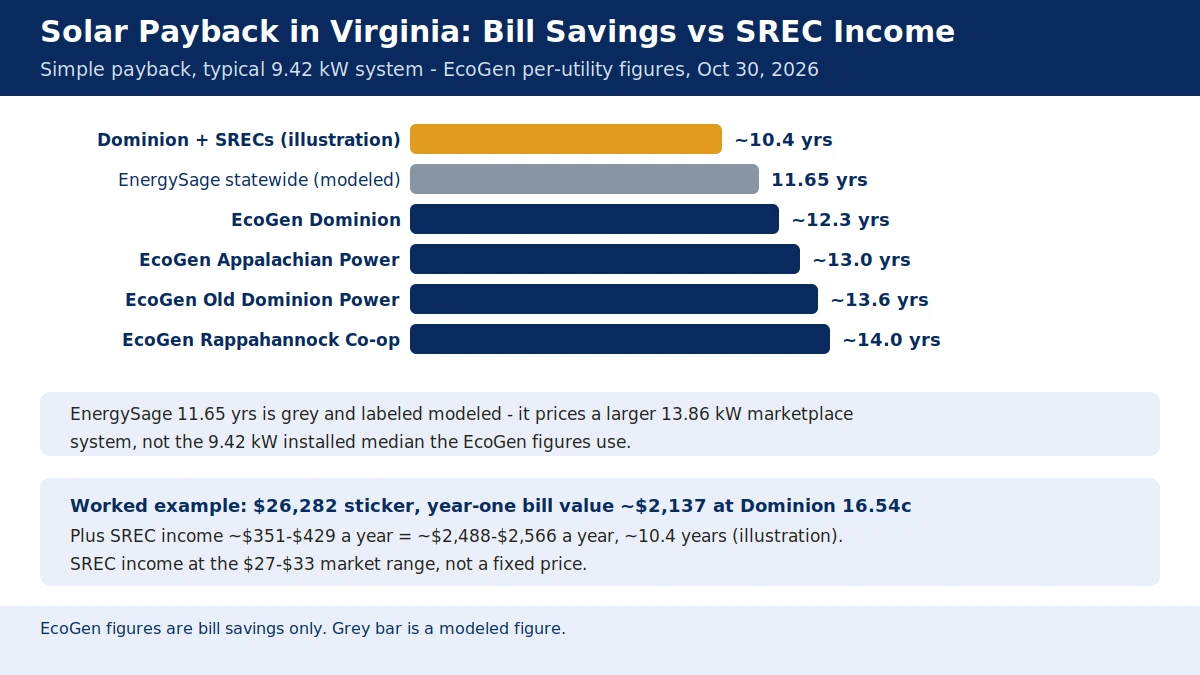
A worked example. Take the typical 9.42 kW system at $2.79 a watt — $26,282 before incentives, and, in Virginia, very nearly after them too. At roughly 1,372 per kilowatt, the yearly output comes to near 12,924 kilowatt-hours. At Dominion, the year-one value of that power is about $2,137: the full 12,924 kilowatt-hours valued at Dominion’s 16.54 cents — its 17.27-cent average with the $7.58 monthly customer charge taken out — on the assumption the system is sized to the house and every kilowatt-hour cancels one the house would have bought. Against the $26,282 sticker, that is about 12.3 years. That figure is EcoGen’s, published per utility on October 30, 2026, and it is the headline this guide uses: 12.3 years at Dominion, 13.0 years at Appalachian Power, 13.6 years at Old Dominion Power, 14.0 years at Rappahannock Electric Cooperative, and 12.5 years statewide weighted by homes across the four. No upkeep, no price rises, and no certificate income are counted in any of them.
The certificate income shortens it by about two years. Add the certificates at the market range — about $351 to $429 a year on the typical system, about $390 at the middle — and the Dominion year-one value rises to about $2,488 to $2,566 a year. Against the same $26,282 sticker, that is about 10.2 to 10.6 years, or about 10.4 years at the middle of the range. That second figure is a NestPriced illustration, labeled as one, built on EcoGen’s $2,137 and the quoted $27-to-$33 certificate range. Use the 12.3-year figure as the headline. Use the 10.4-year figure to see what the certificates are doing: they are doing about two years of work, and they are doing it only while the market holds at $27 to $33.
| Case | Simple payback | Source |
|---|---|---|
| EcoGen, Dominion (bill savings only) | ~12.3 yrs | EcoGen, Oct 30, 2026 |
| EcoGen, Appalachian Power (bill savings only) | ~13.0 yrs | EcoGen, Oct 30, 2026 |
| EcoGen, Old Dominion Power (bill savings only) | ~13.6 yrs | EcoGen, Oct 30, 2026 |
| EcoGen, Rappahannock Electric Cooperative (bill savings only) | ~14.0 yrs | EcoGen, Oct 30, 2026 |
| EcoGen, statewide weighted (bill savings only) | ~12.5 yrs | EcoGen, Oct 30, 2026 |
| NestPriced illustration, Dominion + SRECs at $27-$33 | ~10.2-10.6 yrs | Illustration from EcoGen anchors |
| EnergySage statewide (13.86 kW) | 11.65 yrs | EnergySage, Nov 2026 — flagged, modeled |
| EnergySage Richmond | 10.48 yrs | EnergySage, Nov 2026 — flagged, modeled |
| EnergySage Virginia Beach | 10.91 yrs | EnergySage, Nov 2026 — flagged, modeled |
| EnergySage Norfolk | 11.15 yrs | EnergySage, Nov 2026 — flagged, modeled |
| EnergySage Arlington | 11.72 yrs | EnergySage, Nov 2026 — flagged, modeled |
The flagged conflict. EnergySage reports an 11.65-year payback statewide, with 10.48 years in Richmond and 11.72 in Arlington, alongside 25-year savings of $52,551 statewide. None of those figures is measured — all are modeled. EnergySage derives them from marketplace averages of its own (a 13.86 kW system at $2.56 a watt, on average) and from savings projections that keep the surplus near today’s value for a full 25 years. The gap between 11.65 years and 12.3 years is not a rounding difference — it is the system size and the certificate income, and any payback that prices a 13.86 kW system against a house that uses 12,792 kilowatt-hours a year is modeling a different Virginia than the one the tariffs describe. This guide does not resolve the gap. It flags it, and it builds its headline from EcoGen’s per-utility figures instead.
What moves the payback most. Sizing to the house’s own use is the biggest lever. In Virginia it matters more than in a state where surplus banks forever, because the surplus that survives the year settles at about six cents. Size to twelve months of bills and the system earns retail on nearly every kilowatt-hour it makes; build past the house’s use and the extra panels earn the year-end rate in the months they make the most. The certificate price is the second lever, and in Virginia it is a market lever, not a program lever: the difference between $10 a certificate under Dominion’s purchase agreement and $33 on the open market is about $300 a year on a typical system, or more than a year of payback. Rate escalation is the third lever, and in Virginia it is a live one: the statewide all-in price rose 11.3% in the year to August 2026, and Dominion’s first base-rate increase since 1992 took effect in January 2026, adding about $11 to $13 a month to typical bills. Buying at today’s prices means the payback shortens if rates keep climbing and stretches if they do not, and no honest quote can promise which way rates will go. Financing is the fourth lever. A solar loan’s dealer fees can push the effective price up 15 to 30%, so judge every quote on its cash price per watt and set the monthly payment aside until then. And the timing lever is the one buyers forget: an application approved before May 1, 2027 keeps the old net-metering rule for the life of the system, with year-end surplus paid only under a purchase agreement, while one approved after that date gets the surplus cashed out automatically at 5.829 cents plus a $1 monthly fee — a small difference, but a difference that runs for twenty-five years.
Who still comes out ahead. Four kinds of Virginia household come out ahead on these numbers. The Dominion customer, where the payback is the shortest in the state at about 12.3 years on bill savings alone. A home that uses a lot of power in daylight — someone working from home, laundry and dishes at midday, an EV plugged in while the sun is up — keeps most of what it makes at full retail value, even under a rule that pays six cents for the rest. The household that pairs panels with a heat pump or an EV and sizes the array to the bigger daytime load, stopping at its own use. And the household whose main bet is rising rates — Virginia power climbed 11.3% in a year, so a system that looks slow at today’s prices looks quicker after five more years of the same. If the house is empty all day and the roof faces north, walk away. Under 600 kilowatt-hours a month, the fixed charges swallow the savings — that household should walk away. And walk away when the installer projects savings without naming your utility’s year-end surplus rate and the certificate price on the open market.
Batteries in Virginia: Backup Value, Almost No Bill Savings
No add-on turns up in Virginia solar quotes as often as a battery, and none is oversold as often. Here a battery justifies itself for one reason alone, and a quote that sells it on any other reason is selling a feeling rather than a return.
What a battery costs. Adding a 13.5 kWh storage unit costs about $15,228 installed at the current national rate of about $1,128 per kWh; on top of the $26,282 typical 9.42 kW system, the combined job reaches about $41,510. No Virginia-specific battery price per kilowatt-hour could be verified, so the figure used is national and flagged as national. Virginia has no battery rebate to take anything off it: EcoGen’s check found no state or utility cash rebate for home solar or storage when it last looked, and no Virginia battery rebate turned up in this guide’s research either. A 2026 owner install earns no federal credit for storage either, because §25D covered batteries as well and it ended the same day.
The rebate has no strings because there is no rebate. That sentence is the whole Virginia battery story in miniature. In Illinois the battery rebate comes with a time-of-use plan and a five-year virtual power plant commitment. In Virginia there is no rebate to accept and no commitment to sign — which is simpler, and also means the battery’s full $15,228 sits on the buyer’s shoulders with nothing to offset it. A 2026 law does tell Dominion and Appalachian Power to ask regulators by December 31, 2026 to approve solar, battery, and efficiency pilots for low-income, elderly, and disabled customers — but nothing is open yet, and no household can join a pilot that has not been filed.
What a battery earns on the bill. A grid-tied battery makes its money on one gap only: the gap between what an exported kilowatt-hour earns and what a bought one costs. It banks a kilowatt-hour that would have been exported, then spends it after dark instead of buying that same kilowatt-hour at retail. In Virginia that spread is almost nothing inside the year, because the grid already banks the power for free: a kilowatt-hour sent out in June and used in January earns its full retail value under the twelve-month netting, so a battery that moves midday production into the evening saves nothing at all on the months the bank is open. The only spread left is the year-end one — the kilowatt-hours that would otherwise be cashed out at about six cents instead of spent at about 16.6 cents. A battery that rescues 1,000 kilowatt-hours a year from that year-end cash-out earns about $106 a year — that is NestPriced arithmetic on the retail-minus-cash-out spread, stated as an illustration. At that pace a $15,228 battery needs more than a century to repay itself from bill savings alone — longer than any battery survives. The spread is real but vanishingly small, and it is smaller in Virginia than in any state in this series: with one-for-one annual netting, the grid is already the battery, and it charges nothing.
What a battery is actually for. Think of a battery as outage insurance rather than an investment: you buy it for the blackout, not for the payback. Virginia’s grid is generally reliable, but hurricanes and tropical storms do take power out along the coast, summer thunderstorms knock it out inland, and the occasional ice storm does the same in the mountains. Size the battery around the loads that keep a household livable in a blackout — heating, refrigeration, water, medical equipment — and it will carry the house through one. Size the battery around the loads that matter when the power is out, not around the whole house, and treat what you spend as insurance rather than an investment. A household on a co-op meter gets a second benefit from the same battery: co-op terms vary, and a battery that keeps the house running when the co-op’s export terms are thin is worth more there than on Dominion’s one-for-one rule. That benefit is real, and it trims the payback slightly — yet a $15,228 battery remains no money-maker, whatever the quote promises. Our solar battery cost guide carries the full battery arithmetic: what a battery earns on the bill, what it costs net, and what it is actually for.
Virginia Incentives in 2026: What Exists and What Does Not
The federal credit is gone, yet Virginia still offers more than a first glance suggests — a net-metering rule that banks power at full value, a property-tax rule that costs nothing, a certificate market, and a shared-solar program for homes without a roof. Read the list below carefully: most solar advertising in Virginia skips the conditions, and the two genuine benefits are easy to mistake for something they are not.
No rebate from Richmond, and no income-tax credit either. Virginia pays no rebate for rooftop panels from the state itself — no check from Richmond, and none from Dominion or Appalachian Power either. The state’s money arrives through the electric bill, not through a rebate: power used at home earns full retail, and surplus power banks for twelve months at the same value. EcoGen’s check found no state or utility cash rebate for home solar when it last looked, and this guide’s research found none open either. Any quote that knocks a state rebate off the price is pricing a program that does not exist.
The property-tax exemption is the one genuine tax break — and it is automatic. State law exempts the added home value from a solar system from property tax: under Va. Code § 58.1-3661, a home or farm system of 25 kW or less has been exempt from state and local property tax since January 1, 2023, with no end date, in every city and county. There is no form to file and no application to make — the exemption applies by law — though EcoGen notes it is worth asking the local tax office whether it wants a form on file. A typical system that adds value to the home adds nothing to the tax bill. That is a real saving in a state where property taxes run high, and it is the one Virginia incentive that asks nothing of the buyer in return.
The certificates are the second benefit, and they are a market, not a program. The typical system mints about 13 certificates a year, worth roughly $351 to $429 at the quoted $27-to-$33 market range, or about $130 a year at Dominion’s $10 purchase-agreement rate. The full mechanics are in the SREC section above; the point here is that the certificates are the only production payment in the project, they arrive through a broker rather than from the state, and their price moves — so a quote that prices them at $75 each is pricing the top of Virginia Energy’s $10-to-$75 range, not the market.
Shared solar is the route for renters and condo owners. No roof of your own? You can subscribe to a shared solar farm and get a credit on your bill. Virginia’s shared solar law, Va. Code § 56-594.3, covers Dominion customers, and § 56-594.4 covers the Phase I utility’s customers; the Commission’s shared-solar rules (20VAC5-340) took effect February 14, 2025, and Appalachian Power’s program opened July 1, 2025. A shared solar facility may be no larger than 5 MW, must have at least three subscribers, and at least 40% of its capacity must be subscribed in pieces of 25 kW or less. Dominion’s program is capped at 200 MW in its first part with 150 MW more behind it, and the 2026 Acts of Assembly added 525 MW more in Phase II, most of it reserved for projects serving low-income customers. Subscribers get a bill credit of about 13.232 cents per kilowatt-hour for their share, subject to a minimum bill that low-income customers — households at or below 80% of area median income — do not pay. One condition matters: a household in shared solar may not take part in net metering at the same time, so the two routes are a choice, not a stack.
Virginia Solar for All is real money that no household can touch. The state was awarded a federal Solar for All grant of more than $156 million for income-qualified households. That money was cut before it paid a single household: the EPA terminated all 60 Solar for All grants on August 7, 2025. Two federal courts ruled the termination unlawful in September 2026 — Rhode Island on September 18, the District of Columbia on September 22 — and the EPA was still weighing an appeal when this guide was written. WHRO reported on October 28, 2026 that Virginia Energy had not reopened the program. The money sits frozen, its future sits in court, and no Virginia household can apply today. Do not confuse it with the shared solar program above, which is state law, not federal money, and is still open.
Virginia has no open federal home energy rebates. The state was awarded federal HEAR and HOMES money — proposed budgets of about $75.2 million for HEAR and about $75.6 million for HOMES — but Virginia Energy’s own FAQ, updated October 13, 2026, says the launch is contingent on the Department of Energy’s review and approval of the state’s updated application materials, submitted in September 2026. Virginia Energy has named no launch date, and no household in the state can apply at this point. Work finished before launch earns no rebate, so do not spend money on the strength of a rebate you hope for. And even after those programs eventually open, buying solar panels still draws nothing from HEAR. What it buys is electrification work, and nothing beyond that. The whole eligible list runs to heat pumps, heat-pump water heaters, electrical panels, and wiring tied to insulation work — and stops there. Solar panels, batteries, EV chargers, and windows are all outside what the program will pay for.
| Item | Value | Notes |
|---|---|---|
| Net-metering bill credits | Full retail, one-for-one | 12-month bank; year-end surplus ~6 cents with a purchase agreement (Dominion 6.003, APCo 5.66); NEM 2.0 from May 1, 2027: $1/mo fee, 5.829 cents automatic |
| SREC / REC income (owned 9.42 kW) | ~$351-$429/yr | ~13 certificates/yr at $27-$33 market range; $10-$75 range per Virginia Energy; Dominion purchase agreement $10 |
| Property-tax rule | $0 added tax | Va. Code § 58.1-3661; systems up to 25 kW exempt since Jan 1, 2023; automatic statewide |
| VA state rebate for panels | $0 — none exists | No state or utility cash rebate found |
| VA state income-tax credit | None | No state solar tax credit |
| Sales-tax exemption | None found | No Virginia sales-tax exemption found; ask whether sales tax is in the quote |
| Shared solar | Available | Va. Code § 56-594.3/56-594.4; ~13.232 cents/kWh bill credit; minimum bill; low-income customers exempt from minimum bill |
| Federal Solar for All | $0 — no program open for VA households | EPA ended all 60 grants Aug 7, 2025; courts ruled the termination unlawful Sep 2026; funds frozen |
| HEAR / HOMES rebates | Not launched | VA Energy: updated application submitted Sep 2026, DOE review pending; no start date; ~$75.2M HEAR + ~$75.6M HOMES proposed |
| Battery rebate | None | No state or utility battery rebate found |
| Low-income pilots | Not open | 2026 law: Dominion + APCo to seek approval by Dec 31, 2026; nothing filed yet |
Federal Help in 2026: No Tax Credit Remains — and the Lease Route Is Narrow
The federal picture for 2026 is short enough to fit in a single paragraph — and that shortness is exactly what lets so much solar advertising mislead buyers. In Virginia the paragraph grows a second half most states never need, and the second half is a warning rather than a rescue: the lease route that saves other states is narrower here than the advertising suggests.
Buy in 2026 and the federal credit is zero. A system you purchase and install this year earns no federal tax credit at all. Systems entering service after December 31, 2025 no longer earn the Residential Clean Energy Credit — the §25D credit at 30% is gone for them. The cutoff comes from the One Big Beautiful Bill Act — Public Law 119-21, signed July 4, 2025. IRS fact sheet FS-2025-05 makes the finish date the deciding factor. Paying a deposit in 2025 buys nothing if the crew did not finish the work until January 2026. The §25C efficient-home-improvement credit went with it, ending on the same day. If a 2026 quote still knocks 30% off the price, it is pricing a credit that died on December 31, 2025. Ask the installer to strip that line out and re-price the job. An “after tax credit” column still appears on some Virginia cost pages. Virginia cost pages still print that column — a 30% credit taken off a total the law stopped supporting on December 31, 2025. No figure in this guide touches it.
Leases and PPAs are restricted in Virginia, and the provider’s credit is not broadly available. Leasing companies still have something to work with. A system owned by the provider can still earn the 30% commercial clean-electricity credit under §48E — but only if construction began by July 4, 2026 and the array enters service by December 31, 2027, the two dates IRS Notice 2025-42 sets. But Virginia is not Illinois, where leases and power purchase agreements are both legal and widely sold. In Virginia, third-party power purchase agreements are restricted, allowed only through a pilot program, per DSIRE’s May 2026 map of state PPA policies and EcoGen’s reading of the same rules. The lease-style route that carries the remaining federal credit is therefore not broadly available to Virginia homeowners the way it is in states where the route is clear. One conflict is flagged here rather than resolved: Virtue Solar markets third-party-owned leases in Virginia at $0.11 to $0.14 per kilowatt-hour in year one. A lease is not a PPA, and the two are treated differently under Virginia law — so before signing any third-party-owned contract, ask in writing whether it is a lease or a PPA, whether the provider claims the §48E credit, and how much of that credit the monthly payment actually passes along. Whatever value the provider passes along is set by the contract, not by the full 30%. Work the escalator — commonly 1.9% to 2.9% a year — across the full term before setting a lease beside a loan, and have a lawyer read any lease or PPA before signing: a lease is the contract behind free-solar advertising, and no Virginia program offers free panels.
HEAR money never touches solar. In 2026 an income-eligible Virginia household can still draw up to $8,000 from the Home Electrification and Appliance Rebates program — once the state’s program opens, which it has not. That money is for electrification work, and for nothing else. It never pays for panels. HEAR’s money goes to electrification gear, and to nothing else. That is the full list of what qualifies: heat pumps, heat-pump water heaters, electrical panels, and wiring tied to insulation work. None of those four items qualifies: not panels, not batteries, not EV chargers, not windows. The Department of Energy’s Program Notices 26-1 and 26-2 — dated May 29, 2026, announced June 1 — limit the funding to upgrades that swap one electric system for another. Fuel-switching is out. The state’s own HOMES and HEAR programs have not opened, and no start date has been announced — Virginia Energy submitted updated application materials in September 2026 and is waiting on the Department of Energy. Counting a HEAR rebate inside a solar price describes a program that does not work that way. HEAR can still help a Virginia homeowner. Pairing a heat pump with new panels is a common Virginia combination, and the heat-pump side of that job may qualify once the state’s program finally opens. The solar half never will.
Here is the honest summary: in 2026 the federal government contributes nothing to a Virginia homeowner who buys solar panels outright, and it contributes indirectly through a lease or a PPA only in a narrow, pilot-limited way that most homeowners cannot reach. On a cash quote, the price is the price, less the certificate income over time and the property tax that never arrives. For the federal picture in full — every credit, and what replaced each one — see our federal tax credits guide. For the full lease-versus-buy comparison, see our national solar cost guide.
Permits & Licensing: What Virginia Requires
In one respect Virginia’s licensing picture is simpler than most states’: a buyer who knows where to look finds a state contractor registry to check, and the check itself is short. The check runs the same way for every installer in Virginia.
A DPOR contractor license is what the installer needs, and it is the first document to ask for. Virginia solar work runs under the Department of Professional and Occupational Regulation’s contractor licensing, and the electrical work requires the ELE classification — the electrical contractor classification. Ask for the license numbers and check them with DPOR before you sign — a company that waves a general business license instead has shown you the wrong paper. Virginia has no solar-specific installer certification of the kind Illinois runs through its Commerce Commission, so the DPOR license and the company’s track record are the credentials that exist, and both should be checked. NABCEP certification is a plus, and a company that holds it has shown its installers to an independent standard rather than its own.
The paperwork takes real time. How long the job takes is set by that timetable. Three permissions have to come in order — building permit, electrical permit, and the utility’s interconnection agreement — and none of them can be skipped. Of the three, the permits are usually the fast part in the suburbs and the slow part in the older cities, where the housing stock adds review steps, and interconnection takes longer still. Dominion and Appalachian Power run separate interconnection queues, and delay is a cost even when it never appears as a line item. No Virginia permit timeline, no statewide schedule of permit fees, and no utility interconnection timeline could be verified, so this guide quotes no figure for any of them. The city or county building department sets the fee, and it sets the wind-load figure governing a coastal roof too. Every new home install should include rapid shutdown to NEC 690.12 as standard — if a quote leaves it out, ask why. If an installer quotes you two weeks to permission to operate, treat it as a hope, not a commitment. The utility sets that timetable. It is not the installer’s call. One timing point is worth planning around: an application approved before May 1, 2027 keeps the old net-metering rule for the life of the system, so a buyer whose roof is ready has a real reason to file early rather than late.
Virginia has a solar-access law, and it is one of the more precise in the country. Under Va. Code § 55.1-1820.1 for property owners’ associations and § 55.1-1951.1 for condominiums, an association may not prohibit an owner from installing a solar energy collection device on their own property unless the association’s recorded declaration itself establishes the prohibition. The association may set reasonable restrictions on the size, place, and manner of placement — but the statute gives “reasonable” a number: a restriction is deemed not reasonable if it raises the installation cost by more than 5% or cuts the system’s projected energy production by more than 10%. The law has taken several forms since it was first enacted in 2008, and it was recodified to its current sections effective October 1, 2022, a change of location only. The law does not cover everything: the association keeps full authority over common areas, so a condo owner whose roof is common area needs the board’s approval as the whole decision, and a homeowner who believes a restriction crosses the 5% or 10% line needs documentation from an independent solar design specialist certified by NABCEP and licensed in Virginia. Get the architectural-review approval in writing first, before a single panel is ordered. If an installer tells you Virginia has no solar-access law, ask them to read § 55.1-1820.1 — the law has been on the books since 2008, and it is on the homeowner’s side unless the declaration itself bans solar.
The warning is national; the moral is Virginian. Door-to-door solar selling has drawn the same complaints in Virginia as everywhere else — tax-credit eligibility misstated, pitches pushed hard, and installs that do not match the contract. A door-to-door pitch deserves caution. Look up the Attorney General’s complaint record before signing, and remember that the largest advertising budget in Virginia is no guarantee the company will still be around in five years.
What Pushes Your Virginia Quote Up or Down
Every quote starts from the per-watt anchor. No single quote is bound to land there. A Virginia quote can move by thousands of dollars on seven factors. Three of them come from Virginia’s geography and climate, not from the equipment.
Northern Virginia labor, permitting, and old roofs are the Virginia factors. The metro’s labor costs more than anywhere else in the state, older housing stock in Arlington and Alexandria adds roof work before panels go on, and Virginia housing has plenty of steep, multi-plane roofs, which add labor hours while fitting fewer panels on the best-facing side. On an Arlington roof, the quote should carry the permitting and the roof work as their own lines. When a quote leaves those lines out, the cost is buried somewhere else in the total. Ask the bidder which roof face will carry the panels, how the racking attaches, and what the schedule does if roof work has to come first.
Labor is the quiet factor. No Virginia-specific electrician wage could be verified, so none is printed here. For scale, electricians nationally earn a median of about $30.38 an hour (BLS, May 2025). Of the soft costs in an install, labour is the largest. What moves a Virginia quote is the bench, not the hourly rate: Northern Virginia’s installer market runs deep and the rest of the state runs thin, so the crew’s experience in your utility’s territory counts for more than the headline rate.
First, the roof itself: will it carry a hurricane’s wind? Through a Virginia summer, heat and humidity grind away at flashing and shingles — something roofs up north simply never experience. A roof that has baked through a decade of 90-degree Julys carries wear no cool-climate roof ever has to bear. When a roof has less than ten years left in it, replace it before the array goes on. Removing the panels and refitting them for a later reroof costs $2,000 to $4,500 all on its own. Before fixing a budget, find out what a reroof would add to the bill. Our roof replacement guide works through the reroof arithmetic. Standing-seam metal, common across Virginia homes, takes solar as well as any roof can. Clamps grip the seams without piercing them, and rain leaves metal sooner than it leaves asphalt. On a coastal roof, the racking’s wind rating is a genuine line item. It is the hardware that keeps the array on the roof when the storm comes ashore. Ask the building department to settle the roof’s wind rating before installation day. After is too late.
Panel tier. Expect top-tier panels to run about a tenth to a fifth above value-tier panels on price per watt. The premium buys two things that matter in Virginia. The premium buys better low-light performance on cloudy winter days, and slower degradation across a quarter century of hot, bright sun. On a tight roof, the extra money for higher-efficiency panels earns its keep. Cheaper value-tier panels usually win on a large array across a wide-open roof in central Virginia. The premium n-type tier holds its output longer across the system’s life. They shed 0.25 to 0.5% a year and still hold 91 to 93% of rated output at year 25. NREL puts the fleet median near 0.5% a year, or about 88% of rated output at year 25.
Inverter choice. A string inverter costs less up front. Microinverters or optimizers cost more up front, yet they produce more on roofs that carry partial shade. Virginia roofs, with their trees, dormers, and chimneys, carry shade more often than installers admit, and a summer thunderstorm that darkens one part of an array shades it just like a tree. A microinverter watches its own panel. A single shaded panel cannot pull the whole string down with it. Expect a string inverter to last roughly 10 to 15 years. Plan on paying for one replacement during the system’s life. Microinverter warranties typically run close to 25 years. Our inverter replacement guide prices every inverter type across its whole working life. Every dollar figure in that guide is national, not Virginian.
The electrical panel. Plenty of Virginia homes still run on 100-amp service, above all older homes in Richmond, Norfolk, and the inner-ring suburbs, and a solar install often forces the question. For a 200-amp service, budget $1,500-$4,000 at national rates — see our panel upgrade guide for the full breakdown. It is the add-on that catches Virginia buyers by surprise most often. Before signing, check that the quote says plainly whether the panel upgrade is included in the price. Settle that question before the electrician’s truck shows up. No dollar figure for a Virginia panel upgrade could be verified, so the guide uses a national figure in its place, clearly marked as national. One Virginia wrinkle here: a panel upgrade counts as electrification work, the kind HEAR exists to pay for. Virginia’s HEAR program has not opened yet.
Financing terms. Cash wins on lifetime cost. Paying any other way costs more across the years. With a $0-down loan, dealer fees of 15 to 30% of the cash price — sometimes above 50% — are folded quietly into the amount financed, a range the Consumer Financial Protection Bureau documented in its August 2024 market spotlight. That number is national, and Virginia quotes carry the same figure in full. In Virginia the dealer fees can quietly exceed everything the certificate market pays, because the certificate value is modest and the financed total is larger. A lease or PPA is the fourth path, and unlike Illinois it is a narrow one here: PPAs are restricted to a pilot, so price the contract’s escalator over the full term and ask in writing whether the provider claims the §48E credit before comparing it on its monthly payment at all. Shared solar is the fifth path, and unlike Ohio it is available here: the state law and the Dominion and Appalachian Power programs both offer it, so renters and condo owners have a route that does not need a roof at all.
Upkeep and lifespan. Panels keep producing power for 25 to 30 productive years. Warranties expire before the panels stop working, and output slips a little further every year past that point. Materials and workmanship usually carry a warranty of 10 to 25 years. The performance warranty typically runs 25 to 30 years. By year 25 the guarantee runs 80 to 92% of rated output, with the exact figure set by the panel tier. Upkeep is light work. Upkeep amounts to an occasional cleaning and a yearly check that production is on track; with nothing moving, there is almost nothing to wear out. On a steep array, Virginia snow usually slides off on its own. Leaves and pollen linger longer on a low-slope roof, and a spring rinse does the work rain does not. Each of those lifespan, degradation, and maintenance numbers comes from national data, not Virginia data. Virginia versions of those figures do not exist, so every one of them carries a national flag.
Getting Quotes in Virginia: The Checklist
Virginia is a fair state to buy solar in — a one-for-one net-metering rule, a property-tax exemption that asks nothing of the buyer, a certificate market, and a solar-access law with numbers in it — but only for a homeowner who checks the paperwork before the sales pitch. The sticker is nearly the final price here, which makes the small print matter more, not less. Carry this checklist into every meeting you hold with a bidder. Sign nothing until every item on the list has a written answer.
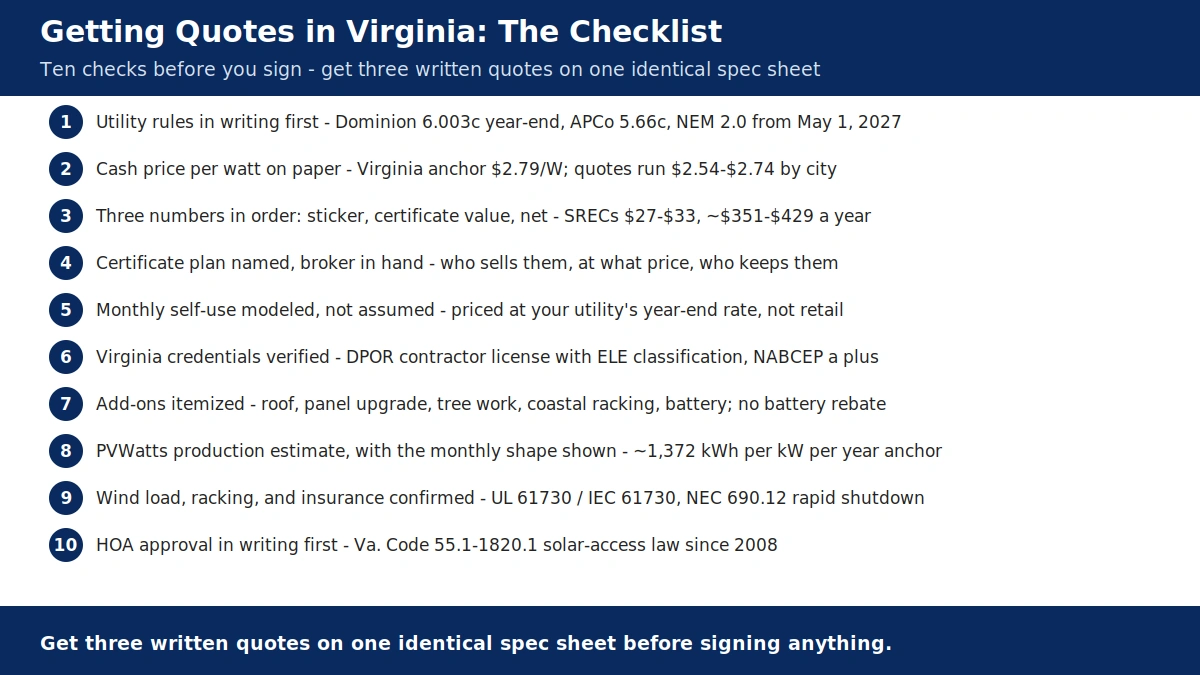
The ten-item quote checklist:
- Your utility’s rules, in writing, first — Dominion’s one-for-one credits with a 6.003-cent year-end cash-out only under a purchase agreement, Appalachian Power’s 5.66-cent figure, or your co-op’s own terms, plus the May 1, 2027 NEM 2.0 date and its $1 monthly fee and 5.829-cent automatic cash-out. Export rules and the 2027 change decide the payback before anything else — and an application approved before May 1, 2027 keeps the old rule for the life of the system.
- Cash price per watt, written down — a single spec sheet, the same one, handed to all three bidders. The Virginia anchor sits at $2.79 a watt: a quote far above it needs an explanation, and a quote far below it needs a closer look at what was left out, above all the permitting and the roof work on an Arlington house.
- The three numbers, in order: sticker, certificate value, net price — the sticker at $2.79 a watt, the certificate income at the $27-to-$33 market range (about $351-$429 a year on the typical system, or about $130 a year at Dominion’s $10 purchase-agreement rate), and the net. Cross out any line claiming the 30% federal credit and any line claiming a state rebate. A 2026 purchase by an owner receives $0 from Washington, and Virginia offers neither a state rebate nor a state income-tax credit. Any quote line that still claims the 30% credit is leaning on a statute that no longer exists. Ask for it to be removed.
- The certificate plan named, and the broker in hand — who sells the certificates, at what price, and who keeps them. The certificates stay with the homeowner under the NEM 2.0 order, but a lease can take them — ask how the contract handles them, and whether the $27-to-$33 range or the $10 Dominion rate is the one the quote uses.
- Work out monthly self-use; never assume it — for each month, calculate how much of what the panels make the house uses as it is made, and price the rest at your own utility’s year-end rate. Any quote that prices every export at the all-in retail price is wrong — and so is one that banks June into January without naming the twelve-month true-up.
- All Virginia credentials verified — the installer’s DPOR contractor license with the ELE electrical classification, checked on the DPOR registry, with names matched to the contract. NABCEP certification is a plus.
- Every add-on priced on its own line — roof work, panel upgrade, tree work, coastal racking, and battery, never folded into the per-watt figure. Check that the racking names its wind rating on a coastal roof, or the quote has not answered the storm question.
- A PVWatts estimate showing the monthly shape — the monthly curve itself, not one yearly average, built on roughly 1,372 kilowatt-hours per kilowatt each year rather than nameplate watts. Insist on the monthly curve itself, June next to December, and ask whether the estimate uses Norfolk’s 1,450 or Richmond’s 1,387 — the two are not the same roof.
- Wind load, racking, and insurance settled — ask the building department for the roof’s wind rating, name the racking’s wind rating and tilt, specify UL 61730 / IEC 61730 panels by name, confirm rapid shutdown to NEC 690.12, and get written confirmation that homeowners insurance covers the array before signing.
- HOA approval, in writing, first — Virginia’s solar-access law (Va. Code § 55.1-1820.1, since 2008, recodified 2022) bars an association from prohibiting solar unless its recorded declaration already does, and a restriction is unreasonable if it raises the cost by more than 5% or cuts production by more than 10%. Have architectural-review approval in hand before ordering panels; condo owners need the board’s sign-off too, since a common-area roof sits outside the Act’s protection.
Buy, lease, or shared solar? Across 25 years, buying wins for a homeowner who uses plenty of power in daylight, sits on Dominion’s one-for-one rule, or pairs the array with a heat pump or an EV. Buy the system and it is yours — the resale value, the certificates, and every kilowatt-hour you use yourself at full retail value. Leasing suits a homeowner who wants no upfront cost and no maintenance — and in Virginia it is a narrower door than in Illinois, the PPA route limited to a pilot, so price the 1.9% to 2.9% escalator over the full term and ask in writing whether the provider claims the §48E credit before comparing it on its monthly payment. Shared solar wins for renters, condo owners, and homes whose roofs are shaded or unsuitable — and in Virginia, unlike Ohio, that door is open, through the state shared-solar law and the Dominion and Appalachian Power programs. An off-grid cabin past the end of the road is a separate question, and this guide does not try to answer it. A rural Virginia home on a co-op meter should get its own utility’s terms in writing before doing anything else.
Sources & methodology
Cost anchors (per watt, system size, totals):
- EcoGen Solar Cost Index, September 2026 Edition, Virginia page updated Oct 19, 2026: $2.79/W; 9.42 kW typical (Berkeley Lab 2025 median, 3,258 systems); $26,282 total; neighbours NC $2.76, MD $2.80, US $2.89, WV $2.93, TN $3.18; 6 kW $16,740, 12 kW $33,480
- EnergySage Virginia page, Nov 2026: $2.56/W; 13.86 kW average; $35,477 (range $30,155-$40,799); payback 11.65 yrs; 25-yr savings $52,551 — modeled, flagged
- ConsumerAffairs (Nov 2026): $2.54/W, 13.94 kW typical; 8 kW $20,320
- sunmetriclab (data Sep 10, 2026): ~4.5 peak sun hrs/day; 8 kW ~10,510 kWh/yr; models $3.00/W with a stale 30% credit column — not used for headline
- NumeralQ Virginia pages (Oct 26, 2026, planning estimates): 8 kW $19,310-$25,240 in Norfolk/Virginia Beach; $19,590-$25,610 in Richmond
Rates and home use:
- EIA, 12 months to Aug 2026 (via wheredmymoney, updated Oct 29, 2026): VA 16.6 cents/kWh (US 18.0 cents); average use ~1,066 kWh/mo (~12,792 kWh/yr); average bill ~$177/mo
- EIA Table 5.6.A, Aug 2026 alone: VA 17.64 cents, +11.3% YoY; average bill $219.74; use 1,246 kWh (energyfactbook / priceofelectricity, updated Oct 28-Nov 5, 2026)
- EIA Form 861, 2024: VA 1,032 kWh/mo, 14.41 cents, $148.77 bill — the figure EcoGen cites
- Dominion: 17.27 cents average less $7.58/mo customer charge = 16.54 cents usable (EcoGen, Oct 30, 2026); statewide modeled 16.64 cents
- Appalachian Power monthly customer charge $7.96 (solarenergyworld)
- Dominion base-rate increase approved Jan 2026 (first since 1992), ~$11-$13/mo on typical bills (electricityrates.com)
Production:
- EcoGen-implied ~1,372 kWh/kW/yr (9.42 kW makes ~12,924 kWh/yr)
- NumeralQ PVGIS (20-degree tilt, south, 14% losses): Norfolk ~1,450 kWh/kW/yr, Richmond ~1,387
- sunmetriclab ~4.5 peak sun hrs/day; 8 kW ~10,510 kWh/yr (~1,314/kW)
- Richmond climate (NOAA 1991-2020 normals via usclimatedata/myperfectweather): ~2,781-2,830 sunshine hrs/yr; ~9 in snow/yr (Jan snowiest ~3.7 in); July avg high 89-90 F, Jan avg low 28 F; ~43-46 in rain/yr; longest day Jun 21 ~14 hrs 45 min; Dec sunshine ~5.4-5.5 hrs/day vs June ~9.7-10.3
- Snow albedo boost estimated 15-30% spring/fall (engineerfix, cited estimate)
- Heat penalty 0.3-0.5% per degree C above 25 C cell temperature, national figure
Net metering and export credits:
- Va. Code § 56-594 (investor-owned utilities); § 56-594.01 (co-ops); residential systems up to 25 kW, no more than 150% of expected annual use; 6% program cap
- One-for-one kWh credits, 12-month netting; year-end surplus paid only with a purchase agreement: Dominion 6.003 cents/kWh (2025 PJM Dominion-zone average), Appalachian Power 5.66 cents; nothing without an agreement
- SCC final order Apr 30, 2026, Case PUR-2025-00079; follow-up order May 20, 2026: NEM 2.0 for Dominion applications approved on or after May 1, 2027 — 30-minute interval measurement with kWh credits and annual netting kept, $1/mo administrative fee, year-end surplus 5.829 cents/kWh automatic (4.829 avoided cost + 1 cent RPS); $100-$750 application fees rejected; utility REC ownership rejected
- Appalachian Power SCC order, Aug 2025: full retail credit kept; net excess beyond 12 months at avoided cost (5.66 cents); 6% cap kept; APCo’s proposed ~70% cut to ~$0.11/kWh rejected in substance
- Dominion ~66% of homes, Appalachian Power ~13%, co-ops ~10% (EcoGen); over 20 kW at Dominion: monthly standby charge; existing systems stay on NEM 1.0 indefinitely
- CONFLICT: guides that say NEM 2.0 already applies are out of date (EcoGen incentives page)
SRECs / RECs:
- No state SREC program, no fixed price; one REC per 1,000 kWh; typical 9.42 kW system earns ~13/yr
- Virginia Energy: owners generally get $10-$75 each; Dominion purchase agreement $10 (~$130/yr typical); Virtue Solar Jun 2026: $27-$33 each; Palmetto 2025: $22.50-$35; SRECs valid 5 years; sold via SRECTrade, SolSystems, RECmint
- Distributed Generation Expansion Act (effective Jul 1, 2026) raises solar carve-out 1% to 4.5% — SINGLE SOURCE (Virtue Solar), effect on prices not yet published
- SCC rejected Dominion’s claim to customers’ RECs in the NEM 2.0 order
Payback arithmetic:
- EcoGen per-utility simple payback, Oct 30, 2026 (bill savings only): Dominion 12.3 yrs ($26,282 / ~$2,137 yr-one offset at 16.54 cents); Appalachian Power 13.0 yrs; Old Dominion Power 13.6 yrs; Rappahannock Electric Cooperative 14.0 yrs; statewide weighted 12.5 yrs
- EnergySage modeled paybacks (11.65 yrs statewide; 10.48 Richmond; 10.91 Virginia Beach; 11.15 Norfolk; 11.72 Arlington) flagged as modeled estimates built on marketplace-average system sizes
- NestPriced illustration (labeled as such): Dominion bill value ~$2,137/yr + SREC income ~$351-$429/yr = ~$2,488-$2,566/yr; $26,282 / $2,527 mid = ~10.4 yrs (range ~10.2-10.6 yrs)
- Battery illustration: 1,000 kWh/yr rescued from year-end cash-out x (16.6 – 6.0 cents) = ~$106/yr; $15,228 battery = 100+ yrs on bill savings alone (national $/kWh)
Incentives:
- No state rebate, no state income-tax credit; no sales-tax exemption found (solarpanelscost.com, Nov 5, 2026)
- Property tax: Va. Code § 58.1-3661; home/farm systems up to 25 kW exempt from state and local property tax since Jan 1, 2023; automatic statewide, no end date
- Shared solar: Va. Code § 56-594.3 (Dominion) / § 56-594.4 (Phase I); SCC rules 20VAC5-340 effective Feb 14, 2025; APCo program effective Jul 1, 2025; facility max 5 MW AC, at least 3 subscribers, at least 40% of capacity in subscriptions of 25 kW or less; Dominion 200 MW part 1 + 150 MW part 2; 2026 Acts added 525 MW Phase II (450 MW serving no more than 51% low-income, 75 MW serving more than 51% low-income); subscriber bill credit ~13.232 cents/kWh with a minimum bill (low-income customers exempt); cannot combine with net metering
- Federal Solar for All: Virginia grant over $156M; EPA terminated all 60 grants Aug 7, 2025; courts ruled the termination unlawful Sep 18 (Rhode Island) and Sep 22, 2026 (DC); EPA weighing appeal; WHRO Oct 28, 2026 — no reopening found
- HEAR/HOMES: not launched in Virginia; Virginia Energy FAQ updated Oct 13, 2026 — updated application submitted Sep 2026, DOE review pending, no launch date; proposed budgets ~$75.2M HEAR + ~$75.6M HOMES; FAQ reflects DOE Program Notices released May 29, 2026
- Low-income pilots: 2026 law tells Dominion + Appalachian Power to seek approval by Dec 31, 2026 — nothing open yet (EcoGen free-solar page)
Federal and financing:
- OBBBA P.L. 119-21 and IRS FS-2025-05: §25D and §25C $0 for post-Dec-31-2025 installs, completion date counts
- §48E 30% for third-party-owned systems, in service by Dec 31, 2027, construction begun by Jul 4, 2026 per IRS Notice 2025-42; PPAs restricted in Virginia, allowed only through a pilot (DSIRE May 2026; EcoGen) — CONFLICT: Virtue Solar markets TPO leases at $0.11-$0.14/kWh year one; lease-vs-PPA distinction flagged, not resolved
- DOE Program Notices 26-1 and 26-2, dated May 29, 2026, announced Jun 1, 2026: HEAR electric-to-electric upgrades only, no fuel-switching; solar, batteries, EV chargers, windows outside HEAR — date confirmed by Virginia Energy FAQ (Oct 13, 2026); art 120 recorded Sep 1, 2026 — discrepancy flagged, May 29 used here
- CFPB Solar Financing Market Issue Spotlight, Aug 2024: dealer fees 10-30%, sometimes over 50%; EcoGen: 15-30% on $0-down loans
- Battery cost: 13.5 kWh add-on ~$15,228 at national ~$1,128/kWh; battery rescue illustration (~$106/yr) is NestPriced arithmetic from the retail-minus-cash-out spread, labeled as an illustration
HOA and licensing:
- Solar access: Va. Code § 55.1-1820.1 (property owners’ associations) and § 55.1-1951.1 (condominiums); no prohibition unless the recorded declaration establishes one; reasonable restrictions on size, place, manner; unreasonable if cost +5% or production -10%; common areas excluded; originally enacted 2008, recodified Oct 1, 2022 (organizational only); challenge needs documentation from a NABCEP-certified independent solar design specialist licensed in Virginia
- Licensing: DPOR contractor licensing, electrical work requires ELE classification; no Virginia-specific solar installer certification found; NABCEP a plus
- Interconnection under utility queues; NEC 690.12 rapid shutdown standard (national practice)
- No verified Virginia permit timeline, permit-fee schedule, or utility interconnection timeline — none stated
Labor and lifespan (national figures):
- BLS OEWS May 2025: electricians national median $30.38/hr (no Virginia-specific figure pulled)
- Lifespan 25-30 years productive service; NREL median degradation ~0.5%/yr, ~88% of rated output at year 25; premium n-type 0.25-0.5%/yr, 91-93% at year 25 (NREL Jordan et al. 2022)
- Product warranty typically 10-25 years; performance warranty typically 25-30 years, guaranteeing 80-92% of rated output at year 25 depending on tier; string inverter 10-15 years, one replacement expected; microinverters ~25 years
EXCLUDED:
- Any “after 30% credit” prices
- Any HEAR-for-solar claim: HEAR does not cover solar, batteries, EV chargers, or windows; electric-to-electric only since DOE Notices 26-1/26-2, May 29, 2026
- Any state rebate or state tax credit for Virginia solar: none exists
- EnergySage’s 11.65-year statewide payback as verified: modeled, EcoGen publishes per-utility figures of 12.3-14.0 years on bill savings alone
- The $75 top-of-range SREC price as the market price: Virginia Energy’s $10-$75 is a range, not a price; $27-$33 used
- The claim that Virginia has no net metering: WRONG — one-for-one net metering today, NEM 2.0 from May 1, 2027
- The claim that NEM 2.0 already applies: WRONG — it applies to Dominion applications approved on or after May 1, 2027
- sunmetriclab / smartenergyusa / solarcostbyzip tables that still subtract the 30% credit: stale on the ITC; not used
- Virginia-specific battery $/kWh, design wind load, monthly PVWatts table, snow-loss percentage, BLS electrician wage, panel-upgrade price, permit-fee schedule, permit timeline, Dominion/APCo interconnection timeline, APCo all-in residential rate, Virginia HEAR/HOMES launch date: not verified, national figures used and flagged as national
- Alaska/PCE/co-op figures: none imported
*Disclaimer: Treat every figure in this guide as a 2026 Virginia planning number, not a quote for your own roof — your county, your utility, the shape and age of your roof, and the company you hire each push the price in a different direction. Before you settle on a budget, have three Virginia installers put their numbers in writing. Nothing in the tax discussion here counts as advice for your own return; run it past a tax professional licensed in Virginia first. Rules keep moving — Dominion’s net-metering terms shift for applications approved from May 1, 2027, and certificate prices rise and fall with the market — so check the current terms with your utility and your installer before you sign anything.*
What do solar panels cost in Virginia in 2026?
In Virginia in 2026, solar panels install at $2.79 a watt — about $26,282 for the typical 9.42 kW system (EcoGen, September 2026) — with EnergySage’s November 2026 marketplace reading at $2.56 a watt on a larger 13.86 kW average system. An 8 kW home system typically runs about $22,320 at the EcoGen anchor, and each kilowatt of panels makes about 1,372 kilowatt-hours a year. A homeowner-owned system installed in 2026 earns a $0 federal credit, Virginia offers no state rebate and no state income-tax credit, but the panels’ certificates are worth roughly $351-$429 a year and a home system up to 25 kW pays no property tax on the value solar adds.
Is solar worth it in Virginia?
Closer than the sticker price suggests — the answer turns on which utility serves the house. Here, one installed kilowatt yields roughly 1,372 kilowatt-hours a year — a solid upper-middle resource. The power it displaces runs about 16.6 cents a kilowatt-hour on the 12-month average, and Dominion’s all-in residential price sits near 17.27 cents. Net metering still banks every exported kilowatt-hour one-for-one over twelve months, so a system sized to the house’s own use earns retail on nearly everything it makes. On EcoGen’s per-utility figures, payback runs about 12.3 years at Dominion and 13.0 years at Appalachian Power on bill savings alone, and about 10.4 years at Dominion once the certificate income is counted. The system that overshoots the house’s use is the one that does not pay — its surplus settles at about six cents at year end.
How does net metering work in Virginia?
It still credits every kilowatt-hour you send out one-for-one against a kilowatt-hour you buy, banked over twelve months — and a new version of the rule is already dated. Under Va. Code § 56-594, home systems up to 25 kW and 150% of expected annual use earn full retail credits for power that offsets their own use. Surplus left at the end of the twelve months is paid only with a purchase agreement signed in advance: 6.003 cents a kilowatt-hour at Dominion, 5.66 cents at Appalachian Power, and nothing without one. From May 1, 2027, Dominion applications fall under NEM 2.0, set by the State Corporation Commission’s April 30, 2026 order: credits are counted every 30 minutes but kept in kilowatt-hours with annual netting, a $1 monthly fee is added, and year-end surplus is cashed out automatically at 5.829 cents. Existing systems keep the old rule indefinitely.
What are Virginia SRECs worth?
Less than in New Jersey, and priced by a market rather than a program. Virginia has no state SREC program and no fixed price. A typical 9.42 kW system mints about 13 certificates a year, one per 1,000 kilowatt-hours, and Virginia Energy says owners generally get $10 to $75 each on the open market. Recent trading has run $27 to $33 each, which puts the typical system’s income at roughly $351 to $429 a year, or about $390 at the middle of the range. Dominion’s own purchase agreement pays $10 a certificate, or about $130 a year. A 2026 law raises the state’s solar requirement from 1% to 4.5% from July 1, 2026, which may push certificate prices up — but no price under the new requirement has been published yet, so count the certificates at today’s range.
Is the 30% federal solar tax credit still available to Virginia homeowners in 2026?
Not for a system you own. Congress ended the Residential Clean Energy Credit — §25D at 30% — for homeowner-owned systems. Any owned system that enters service after December 31, 2025 earns nothing from it. The One Big Beautiful Bill Act (P.L. 119-21) drew that line, and IRS fact sheet FS-2025-05 pins the test on the day the installation finishes, not the day you paid the deposit. Virginia offers a narrower second door than some states do. Third-party power purchase agreements are restricted here, allowed only through a pilot, so the commercial credit (§48E, 30%) that a leasing company can claim for systems in service by December 31, 2027 is not broadly available to Virginia homeowners. Before signing any third-party-owned contract, ask in writing whether it is a lease or a PPA and whether the provider claims the §48E credit.
Do I need a special license to install solar in Virginia?
The installer holds it — and in Virginia, it boils down to one credential. Virginia solar work runs under the Department of Professional and Occupational Regulation’s contractor licensing, and the electrical work requires the ELE classification. Ask for the license numbers and check them on the DPOR registry before you sign. Virginia has no solar-specific installer certification of the kind Illinois runs, so the DPOR license and the company’s track record are the credentials that exist. NABCEP certification is a plus. The permits themselves — building, electrical, and the utility’s interconnection agreement — come from the city or county and the utility, and no verified timeline for any of them was available for this guide.
Can my HOA stop me from installing solar panels in Virginia?
Usually not — unless the association’s own founding document already bans them. Under Va. Code § 55.1-1820.1 for property owners’ associations and § 55.1-1951.1 for condominiums, an association may not prohibit an owner from installing a solar energy collection device on their own property unless its recorded declaration establishes the prohibition. The association may set reasonable restrictions on size, place, and manner of placement, but a restriction is deemed unreasonable if it raises the installation cost by more than 5% or cuts the system’s projected production by more than 10%. The association keeps full authority over common areas, so a condo owner whose roof is common area needs the board’s approval, and a homeowner challenging a restriction needs documentation from a NABCEP-certified independent solar design specialist licensed in Virginia.
Why is solar payback about 12 years in Virginia, but about 10 years once SRECs are counted?
The payback math gets tugged in two directions at once, and the meter is the one that usually wins. The price is below the national average at $2.79 a watt, and the sun is strong at about 1,372 kilowatt-hours a year per installed kilowatt — but the surplus that survives the twelve-month bank settles at about six cents while the power it replaces costs about 16.6 cents, so the bright summer months earn retail only while the bank is open. What shortens the case is the certificate income: about $351 to $429 a year at the $27-to-$33 market range, which lifts the Dominion year-one value from about $2,137 to about $2,488-$2,566 and pulls the payback from about 12.3 years to about 10.4 years. In Appalachian Power territory, with a 13.0-year payback on bill savings alone and the same certificate income, the same arithmetic lands near 11 years.