


New Jersey rewards the solar buyer who reads the registration date before the price. The hardware costs almost the same as it does anywhere in the Northeast — $2.92 a watt, a few cents above the national average, a few cents below New York — and the sun is nothing special, about 4.3 peak hours a day, below the national figure. What sets the state apart is the machinery that pays the owner back: a net-metering rule that still credits exports at the full retail rate, a production payment that arrives for fifteen years on top of the bill savings, and two tax exemptions that are worth more here than in any other state because New Jersey’s property taxes are the highest in the country. The same machinery has a tripwire in it. The production payment was cut from $85 to $77 in the middle of 2026, and the rate a system locks in is the rate on its registration date, so two identical systems installed a month apart now earn different money for fifteen years.
The state is also the most crowded solar market in America, and the crowding shapes every quote. More than nine million people live in a state smaller than most counties out west, and the roofs are close together, cut up by dormers and chimneys, shaded by the neighbor’s maple, and split between four utilities whose prices disagree by nearly eight cents a kilowatt-hour. A system in Atlantic City and a system in Jersey City can cost the same per watt and pay back four years apart. The national guide above sets the countrywide baseline — the sections below measure New Jersey against it, utility by utility and city by city.
Table of Contents
How Much Do Solar Panels Cost in New Jersey in 2026?
The New Jersey market in 2026 is described by two kinds of evidence, and they agree on the price per watt once you know what each one measures. EcoGen’s Solar Cost Index, September 2026 edition, is the anchor for this guide: it prices a New Jersey install at $2.92 per watt — about $26,192 for the typical 8.97 kW system, before incentives. That is 1.0% above the national average of $2.89 a watt, and dearer than every state New Jersey touches: Connecticut runs $2.80, Delaware $2.83, Pennsylvania $2.87, and only New York, at $3.02, costs more. New Jersey quotes in 2026 came in between roughly $2.57 and $3.27 per watt, the Index’s plus-or-minus 12% band around the anchor. A 6 kW system runs $15,420 to $19,620 inside that band, an 8 kW system $20,560 to $26,160, a 10 kW system $25,700 to $32,700, and a 12 kW system $30,840 to $39,240.
Marketplace averages are the second body of evidence. EnergySage, as of November 2026, puts New Jersey at $2.60 a watt — thirty-two cents below the EcoGen anchor — but on a much bigger system: its average New Jersey system is 12.43 kW, priced at about $32,328, with a range of $27,479 to $37,177. The system-size gap is the thing to understand, because it is not a disagreement about price at all. EnergySage averages the quotes that pass through its marketplace, and New Jersey homeowners who go looking for quotes tend to ask for big systems — all-electric homes, an EV in the driveway, a heat pump replacing oil heat, a house they plan to grow into. Berkeley Lab’s figure, the 9.02 kW median from 15,442 New Jersey systems actually installed in 2025, describes what New Jerseyans really put on their roofs, and EcoGen calibrates its 8.97 kW typical size from it. This guide uses the median as the typical size, because it describes what New Jerseyans actually install. The EnergySage figure is still useful as a cross-check on the per-watt price: two independent measures, $2.60 and $2.92, thirty-two cents apart, both within a few percent of the national average.
The picture is rounded out by two more data points, and both arrive with a warning label rather than a headline. Berkeley Lab’s 2026 data update puts New Jersey’s median transacted price at about $3.70 a watt for home systems installed in 2025 — well above both anchors, because transacted prices include premium equipment, door-to-door sales, and loan dealer fees, and they lag the market by a year or more. NumeralQ’s New Jersey page, built on EnergySage cost data retrieved October 26, 2026, prices an 8 kW system at $26,160 to $34,140, or $3.27 to $4.27 a watt — a planning estimate, wider and higher than the EcoGen anchor, and labeled as one. Taken together, the anchors put New Jersey a hair above the national average on price, and the spread between quotes — $2.57 to $3.27 — does more work than any single number.
Before the tables begin, one warning about that typical size — it shapes every figure that follows. The 8.97 kW typical system is a real installed median, not a model, and it lands well above the average New Jersey home’s annual use: at 1,342 kilowatt-hours per kilowatt, 8.97 kW makes about 12,038 kilowatt-hours a year, and the average New Jersey home uses about 675 kilowatt-hours a month, or roughly 8,100 a year. The typical system makes about 149% of what the average home uses. That sounds like a system built too big, and for a home that uses the average it is. The typical buyer is not the average home, though — the households that ask for quotes in New Jersey use more power than the state average, and the sizing section below works through what that means for a home that does not.
The whole job has to fit inside that per-watt price — panels plus inverter or microinverters, racking and wiring, the crew’s labor, the permits, the inspection, and the interconnection application, with nothing left out. A new roof, a panel upgrade, tree work, a battery, and rapid-shutdown gear all sit outside that price. And no incentive is baked into the arithmetic, because no 2026 incentive lowers the purchase price in New Jersey: the federal credit is gone, the state pays no rebate, and there is no state tax credit to claim. The sales-tax exemption is already in the quote, not on top of it — the 6.625% comes off at the point of sale, so a quote that knocks it off a second time is double-counting. So the sticker is the final price. Any quote that takes something else off it is still pricing a law that ended on December 31, 2025.
A caution before the tables: the cheapest quote in New Jersey is rarely the cheapest system once the job is done, and with the densest installer market in the country the second and third quotes are easy to get — and worth getting. Dealer fees of 10-30% of the cash price — sometimes more than 50% — are often folded into the amount the loan finances, since overhead and margin are most of what an installer charges. With quotes from Newark, Jersey City, and Trenton installers spread across the table, the cash price per watt for the same panels on the same New Jersey roof is the one number that lets you judge bidder against bidder. Get the number in writing from at least three installers, and walk away from any bidder who refuses to hand it over. In a state where the registration date of the system now decides fifteen years of SREC-II income, that third quote is also the check that the company you are talking to knows how to file the paperwork on time — and still answers the phone.
| Source | $ per watt | System | Cash total | Payback |
|---|---|---|---|---|
| EcoGen Index (Sep 2026) | $2.92 | 8.97 kW | ~$26,192 | ~9.3 yrs statewide |
| EnergySage (Nov 2026) | $2.60 | 12.43 kW avg | ~$32,328 | 8.9 yrs — flagged, modeled |
| Berkeley Lab transacted (2025 installs) | ~$3.70 | 9.02 kW median | ~$33,400 | Not published |
| NumeralQ planning (Oct 2026) | $3.27-$4.27 | 8 kW | ~$26,160-$34,140 | Not published |
| EnergySage Newark (Nov 2026) | $3.02 | 8.82 kW avg | ~$26,646 | 11.39 yrs — flagged, modeled |
| EnergySage Jersey City (Nov 2026) | $3.07 | 9.93 kW avg | ~$30,448 | 10.81 yrs — flagged, modeled |
| EnergySage Trenton (Nov 2026) | $2.57 | 12.06 kW avg | ~$30,987 | 8.96 yrs — flagged, modeled |
| EnergySage Atlantic City (Nov 2026) | $2.44 | 12.83 kW avg | ~$31,288 | 6.83 yrs — flagged, modeled |
| National range (article 4) | $2.25-$3.30 | 8.2 kW | ~$24,600 at $3.00/W | 6-12 yrs |
Four of those rows carry footnotes — read them before you trust the table. EnergySage’s payback figures — 8.9 years statewide, 11.39 in Newark, 10.81 in Jersey City, 8.96 in Trenton, 6.83 in Atlantic City — are modeled estimates built on its own marketplace averages, and they run shorter than EcoGen’s per-utility figures of 8.1 to 11.6 years on bill savings alone. The gap is the system size and the SREC-II income, and any payback that prices a 12.43 kW system against a house that uses 8,100 kilowatt-hours a year is modeling a different New Jersey than the one the tariffs describe. Berkeley Lab’s $3.70 transacted median is excluded from the headline for the same reason: it counts dealer fees and premium gear that a cash buyer comparing three quotes will never pay. This guide builds on the EcoGen figures, and the EnergySage figures are the cross-check, not the headline.
Solar Panel Cost in New Jersey by System Size
Size is the first decision, and in New Jersey the sizing question runs backwards from most states in this series — not because the surplus is worthless, but because the typical system is already bigger than the average home. EIA billing data to August 2026 puts the average New Jersey home at about 675 kilowatt-hours a month, or roughly 8,100 a year, and the bill that goes with it near $160 a month. At about 1,342 kilowatt-hours a year per installed kilowatt, 6 kW of panels produces about 8,052 kilowatt-hours — roughly 99% of what the average home uses in a year. The 8.97 kW typical system makes about 12,038 kilowatt-hours, or about 149% of average use. Since 6 kW already covers the average home at about 99%, this guide treats 6 kW as the size that fits the average home — and 8.97 kW as the size that fits the average buyer, who uses far more than the average home. On paper, the arithmetic already covers the entire house at 6 kW. Paper is exactly the problem: household demand swings unevenly across the year, and so does panel output.
Going bigger than the house uses is a better deal in New Jersey than in a state with weak export rules, because the utility credits every surplus kilowatt-hour at the full retail rate and banks it for twelve months — but it is still a worse deal than using the power at home, because the surplus that survives the year settles at the wholesale price of about five cents, and because the state caps the system at the home’s own annual use. A kilowatt-hour sent out in June and used in January still earns its full retail value under the twelve-month bank, which is the generous part. A kilowatt-hour that is still sitting in the bank at the true-up earns about five cents, which is the part that punishes oversizing. The table below turns unattractive past the point where the array stops feeding the house and starts banking power it will never use. The table’s pricing anchor is EcoGen’s $2.92 a watt, and its output anchor is 1,342 kilowatt-hours per installed kilowatt each year. The last column gives the share of an average home’s use each size covers, so the point where the array stops feeding the house and starts banking power shows up at a glance.
| Size | Cash cost at $2.92/W | Annual output | Share of a typical New Jersey home’s use (8,100 kWh/yr) |
|---|---|---|---|
| 4 kW | $11,680 | ~5,368 kWh | ~66% |
| 5 kW | $14,600 | ~6,710 kWh | ~83% |
| 6 kW | $17,520 | ~8,052 kWh | ~99% |
| 7 kW | $20,440 | ~9,394 kWh | ~116% |
| 8 kW | $23,360 | ~10,736 kWh | ~133% |
| 8.97 kW (state typical) | ~$26,192 | ~12,038 kWh | ~149% |
| 9 kW | $26,280 | ~12,078 kWh | ~149% |
| 10 kW | $29,200 | ~13,420 kWh | ~166% |
| 12 kW | $35,040 | ~16,104 kWh | ~199% |
Two rows deserve a closer look. First, even the 6 kW system already covers about 99% of average annual use, so every kilowatt past 6 kW on an average-use home is power the house cannot use itself — it banks at retail for twelve months, and whatever is left at the true-up settles at about five cents. Second, the sizing cap puts a ceiling on the table that the numbers alone do not show: the system cannot be bigger than the home’s yearly electricity needs, so an average-use home cannot install a 10 kW or 12 kW system at all under the net-metering rule. Those rows are for homes that use far more than average — electric heat, a pool, an EV charged at home, a heat pump replacing oil — and the quote has to prove the use before the utility approves the size.
Size the array from twelve months of electric bills, not from however much roof is empty — and in New Jersey, size it from the use you can actually document, because that is what the rule measures. Work from twelve months of bills: add up the kilowatt-hours, divide by roughly 1,342 to find the size that covers them, then check June, July, and August on their own — if a surplus already shows at 6 kW, stop there, because each kilowatt past that line banks power the house may never draw down. Add 1-2 kW for a planned EV or a heat pump, more for electric heat, less for a shaded or north-facing roof — then check the result against the annual-use cap before you sign, because a system the utility will not net-meter is a system that earns the wholesale rate on everything it makes. When an EV or a heat pump is on the way, size the solar for the bigger house now: put the load in first and the panels second, or the new load will arrive after the array has already been sized for the smaller house. The same sizing decision is covered in full in our 6 kW vs 8 kW vs 10 kW guide.

Solar Panel Cost by City: Newark, Jersey City, Trenton & Atlantic City
New Jersey is the densest state in the country, and the density shows up in the city prices before anything else does. The verified city prices run thicker here than in most states in this series, because EnergySage publishes a city page for each of the big four, and the pattern in them is worth reading carefully: the per-watt prices spread wide, by sixty-three cents from the cheapest city to the dearest, while the average system sizes swing from 8.82 kW in Newark to 12.83 kW in Atlantic City. The price of the panel is not the same everywhere in New Jersey. The size of the system is not the same everywhere, and the size is what moves the total.
| City | $ per watt | Avg. system | Cash total | Utility |
|---|---|---|---|---|
| Newark | $3.02 | 8.82 kW | ~$26,646 | PSE&G |
| Jersey City | $3.07 | 9.93 kW | ~$30,448 | PSE&G |
| Trenton | $2.57 | 12.06 kW | ~$30,987 | PSE&G |
| Atlantic City | $2.44 | 12.83 kW | ~$31,288 | Atlantic City Electric |
Newark is the biggest city in the state, served by PSE&G, and the second-dearest per watt of the four. EnergySage, November 2026, puts Newark at $3.02 a watt on an 8.82 kW average system, about $26,646 before incentives, with a modeled payback of 11.39 years and 25-year savings of $35,739 — the lowest savings of the four, because Newark’s average system is the smallest and its per-watt price sits near the top of the statewide band. That average system is almost exactly the statewide typical size of 8.97 kW, and the reason is visible in the housing stock: Newark’s homes are older, smaller, and closer together, with cut-up roofs and less room for a big array. Treat the Newark total as the price of the average Newark quote, not the price of the typical Newark system — and do not quote either end of its $22,649 to $30,643 range as the Newark price, because it is not one.
Jersey City is the dearest per watt of the four and the most expensive in total after Trenton, which is the same fact read two ways. EnergySage puts Jersey City at $3.07 a watt — the highest of the four — on a 9.93 kW average system, about $30,448, with a modeled payback of 10.81 years and 25-year savings of $43,939. Jersey City homes sit across the Hudson from Manhattan, and the price shows it: dense rowhouses and small lots, staging a crew on a street with no parking, and roofs that are flat, shared, or shaded by the building next door all push the quote toward the top of the statewide $2.57 to $3.27 band. A Jersey City quote at $3.07 a watt is a fair price on a hard roof. It is not a cheap system.
Trenton is the cheapest per watt of the PSE&G cities and the biggest system on that utility, which is the same fact read two ways. EnergySage puts Trenton at $2.57 a watt — the lowest of the three PSE&G cities — but on a 12.06 kW average system, about $30,987, with a modeled payback of 8.96 years and 25-year savings of $60,822. Trenton homes run big systems for the same reason the statewide average does, and then some: the capital’s housing stock skews larger and detached, the roofs have room, and the same PSE&G retail rate that Newark pays — about 24.9 cents after the fixed charge — rewards every extra kilowatt the same way. A Trenton quote at $2.57 a watt is a good price on a big system. It is not a cheap system.
Atlantic City is the cheapest per watt in the state and the biggest system, which is the Shore talking. EnergySage puts Atlantic City at $2.44 a watt on a 12.83 kW average system, about $31,288, with a modeled payback of 6.83 years and 25-year savings of $100,884 — the fastest payback and the biggest savings of the four, because Atlantic City Electric pays the highest retail value in the state at about 26.7 cents a kilowatt-hour and its customers build the biggest systems. Shore roofs are wider and flatter than the rowhouses up north, the installer field along the coast competes hard, and the same sun that fills the beach fills the array. A low per-watt price on a big system is still a big check, and the modeled 6.83-year payback is the most optimistic figure in this guide — it assumes the big system keeps earning Atlantic City Electric’s top rate for 25 years.
Start with your utility when you read the city table, and look at the price second. Judge the quotes that arrive on price per watt — never on the headline total. A Trenton quote at the low end of its range and a Jersey City quote at the statewide anchor are not a close call once the install conditions are in: the Jersey City array costs more to put up on a crowded roof, and its system is smaller because its roofs are smaller. Each utility’s numbers get worked out in the payback section below.
One more city-level note: the installer field is deep everywhere in New Jersey and thin nowhere, which is the one advantage of density. Newark, Jersey City, Trenton, and Atlantic City each have many installers bidding for the same jobs, which is what pulls quotes toward $2.44 on the Shore. What varies is not the competition but the roof: a flat Jersey City roof needs ballasted racking and a structural check, a slate roof in an older Newark neighborhood needs specialty mounting, and a Shore roof needs wind engineering. Get three quotes wherever you live, and make at least one from a company that already works in your utility’s territory — and check the license numbers yourself, because New Jersey has two registrations to check and the guide names both in the licensing section below.
New Jersey’s Sun: Dense Suburbs, Short Winters & the Shore
New Jersey’s sunshine arrives with a shape that rewards the buyer who plans around the shade, not the buyer who falls in love with the summer. A production estimate that tells the truth carries both halves of that story: the seasonal shape, not the annual total, is what decides whether the system pays.
The sun, by the numbers. EcoGen’s PVWatts-based figures put one kilowatt of New Jersey panels at roughly 1,342 kilowatt-hours a year, at 4.3 peak sun hours a day. That is below the national figure of about 5.0 and far below the desert Southwest, yet it is a solid middle-of-the-pack resource — better than Michigan’s, better than New York’s, and close to Pennsylvania’s. The number that matters more than the annual total is the winter one, and Somerset County’s climate data tells it plainly: a kilowatt of panels there makes about 6.05 kilowatt-hours a day in summer and about 2.18 in winter, nearly a three-fold swing from the brightest season to the darkest. Work from 1,342 as the annual figure from EcoGen, and let the seasonal shape govern the design.
The density is the story in the north. New Jersey is the most densely populated state in the country, and the density writes the shading map for the whole northern half of the state. Roofs sit close together, trees grow tall between them, and a neighbor’s maple can shade a south-facing array for half the afternoon. Newark and Jersey City add a second layer: rowhouses and small lots, flat roofs shared between units, and buildings next door that are taller than the roof being quoted. A production estimate built on statewide averages will overstate a shaded Newark roof and understate an open Atlantic City one, and the installer who shows you a single statewide number is showing you a guess.
The Shore is the story in the south. Atlantic City and the Shore towns get a little more sun than the inland north, and the difference shows in the city table: Atlantic City builds the biggest systems in the state at the lowest price per watt, and its modeled payback is the fastest of the four cities. The same coast brings the wind that the racking has to survive — Shore and South Jersey installs sit in higher design-wind zones under the Uniform Construction Code, which calls for sturdier racking and a structural review. Salt air is a second Shore cost: it corrodes exposed metal faster than inland air, so the racking and the fasteners need to be specified for the coast, not for a generic inland job.
Cold is a genuine help. A cell loses roughly 0.3-0.5% of its efficiency for every degree Celsius above 25, so a January rooftop in New Jersey runs cooler — and therefore more efficiently — than a July roof in Phoenix. A July rooftop in Trenton almost never bakes the way a Phoenix roof does, so an hour of New Jersey sunshine is worth more than the same hour on a hot southern roof. Winter air that is cold and clear is genuinely good for solar, and it explains a good part of why New Jersey squeezes as much as it does from each kilowatt despite the cloud. The same physics means the panels need the sun up to use it. In December it is up for about nine hours, and hidden behind cloud for much of that time.
No other variable swings the outcome in both directions at once the way shade does. A shaded panel makes less power, and on a string inverter one shaded panel can drag the whole string down with it — which is why microinverters or optimizers earn their keep on a crowded New Jersey roof, where a dormer, a chimney, and the neighbor’s oak each take their turn across the array through the day. A north-facing roof is the harder case: it never sees the sun squarely, and no inverter fixes that. This guide states no New Jersey shade-loss percentage, because none was verified — so when an installer hands you a production estimate, ask what shade loss it assumes and whether it was modeled from a shade study of your roof or from a statewide average. On a dense-suburb roof, the shade study is the estimate.
The roof, and the weight it has to hold. A rooftop array in New Jersey sits under a snow load the racking and the roof must carry together, and the load is heaviest in the northern counties, where snow-load engineering is required. No New Jersey-specific design snow-load figure was verified for this guide, so none is stated — confirm the roof’s snow-load rating with the local construction official and let that official’s figure govern, not the installer’s guess. If the roof has under ten years left in it, replace it before the panels go on — a detach-and-reset for a later reroof adds $2,000 to $4,500 to the roofing job, and many New Jersey insurers want a roof under 15 to 20 years old before they will cover an array at all. A roof near the end of its life changes the order of work: price the reroof in our roof replacement guide before you sign anything, because a new roof under new panels is the expensive mistake this guide exists to help you avoid. Slate and cedar-shake roofs, common in older northern towns, need specialty mounting and slower labor, and they raise the quote for reasons that have nothing to do with the panels. Specify UL 61730 / IEC 61730 ratings on the panels by name, and get written confirmation that your homeowners policy covers the array for storm damage.
Putting it together. Nothing exotic is needed — but the ordinary gear has to be set up for New Jersey conditions. Point the array south where the roof allows, tilt it to catch the low winter sun, fit microinverters or optimizers so one shaded or snow-covered string cannot pull the whole array down, and demand a PVWatts production estimate whose shade assumption is printed on the page, not buried. Where the utility banks credits for twelve months, the best-paying kilowatt-hours are the ones the house uses the instant they are made, in the month they are made. A west-facing tilt that shifts production into the evening, when the house is actually drawing power, is worth raising with the installer even at the cost of a little total annual output.
Net Metering in New Jersey: Full-Retail Credit & the Annual True-Up
New Jersey is one of the few states that people still get right in both directions, and the correction matters more here than almost anywhere else, because the state kept the rule other states gave up — and the rule is now under review. One common claim is that New Jersey’s net metering is gone, or that it was replaced by a wholesale rate. That is wrong. The other common claim is that New Jersey pays full retail for every kilowatt-hour you send back, forever, with no catch. That is wrong too. What New Jersey has is a statewide rule with a twelve-month clock, an annual-use sizing cap, and a year-end settlement at the wholesale price — and the difference between those two wrong claims and the real rule is the difference between a system that pays in nine years and one that never does.
The rule. The Board of Public Utilities’ net-metering rule, N.J.A.C. 14:8-4, binds the four investor-owned utilities: PSE&G, JCP&L, Atlantic City Electric, and Rockland Electric. Within each billing month, what the panels make cancels what the house uses, kilowatt-hour for kilowatt-hour, at the full retail rate. Whatever is left over — the monthly surplus — is not paid out and not lost. It rolls forward as kilowatt-hour credits through a twelve-month annualized period, and the bank keeps growing through the bright months and drawing down through the dark ones. At the end of the twelve months, whatever is still left in the bank is converted into a dollar credit at the supplier’s avoided cost of wholesale power — the average locational marginal price in the utility’s PJM transmission zone, about 5.1 cents a kilowatt-hour on PJM’s 2025 load-weighted average of $50.73 per megawatt-hour — and the bank resets to zero.
That twelve-month bank is the fact this whole guide turns on, so here it is three ways, plainly. First, a summer surplus can sit on the bill until winter: a June kilowatt-hour can cancel a January kilowatt-hour at full retail value, which is the most generous settlement in the Northeast. Second, the bank has a hard end: the leftover at the true-up earns about five cents, not twenty-four, so a system that banks power it never uses is a system that sells its best months at the worst price. Third, the rule binds only the investor-owned utilities: municipal utilities and co-ops set their own terms, and some pay little or nothing for exports — Vineland’s town utility says it cannot support new solar above 5 kW AC at all — so a household on a municipal meter needs its own utility’s solar terms in writing. No BPU rule covers those utilities, so the paper is the only protection.
The true-up month is a choice, and you get to make it once. The annualized period ends in the month the account became net-metered, and the leftover bank settles in that month. Over the life of the account you can change the true-up month once — and the choice is worth making well, because it decides which month’s leftover gets cashed out at five cents. A household whose bank peaks in late summer wants a true-up month that falls after the winter drawdown, not before it. Ask the utility which month your period ends in, and change it once, deliberately, before the first true-up — after that, the choice is spent.
The sizing cap. A net-metered system cannot be bigger than the home’s yearly electricity needs. That is the rule in the NJ Clean Energy Program’s own words, and it is the reason the size table above stops being useful past about 6 kW for an average-use home. Size past your own use and the extra falls outside net metering — it earns the wholesale rate on everything it makes, instead of the retail rate on the part the house uses.
PSE&G — about 56% of New Jersey homes, the dense corridor from Bergen County through Newark to Trenton. PSE&G is the state’s largest utility, and its retail value sits in the middle of the four. Its all-in residential price runs about 25.907 cents a kilowatt-hour on the 12-month EIA average, less a $5.63 monthly fixed charge, for a solar value of 24.928 cents a kilowatt-hour. Its supply rate comes from the February 2026 auction at 10.938 cents, blended with the two earlier auctions, and the cheap 2024 auction falls away on June 1, 2027 — so the PSE&G bill is set to rise even if the next auction only matches this year’s. PSE&G’s interconnection queue is the longest in the state, because it serves the most homes, and its announced home battery rebate of August 26, 2026 is still unconfirmed in detail.
JCP&L — the northwest and much of the Shore, the cheapest power in the state. JCP&L’s all-in residential price runs about 19.323 cents a kilowatt-hour on the 12-month EIA average, less a $4.27 monthly fixed charge, for a solar value of 18.796 cents a kilowatt-hour — nearly eight cents below Atlantic City Electric. Its supply rate from the February 2026 auction is 11.327 cents. JCP&L territory is where the export math is hardest in a full-retail state: a surplus kilowatt-hour still earns the full retail rate, but the retail rate itself is the lowest in New Jersey, and the case for solar there rests on the SREC-II income and the rate rises, not on the bill alone.
Atlantic City Electric — the south, the dearest power in the state. Atlantic City Electric’s all-in residential price runs about 27.750 cents a kilowatt-hour on the 12-month EIA average, less a $6.75 monthly fixed charge, for a solar value of 26.700 cents a kilowatt-hour — the highest of the four. Its supply rate from the February 2026 auction is 11.275 cents. Atlantic City Electric territory is where the bill savings are biggest: every kilowatt-hour the panels make is worth nearly twenty-seven cents, and the modeled payback on its turf is the fastest in the state.
Rockland Electric — the small area near the New York line. Rockland’s all-in residential price runs about 25.248 cents a kilowatt-hour on the 12-month EIA average, less a $6.00 monthly fixed charge, for a solar value of 24.585 cents a kilowatt-hour. Its supply rate from the February 2026 auction is 12.057 cents, the highest of the four. Rockland serves the fewest homes of the four, and its customers get the same full-retail rule as everyone else — the utility is small, the rule is not.
The review hanging over the rule. The Board opened a review of net metering for new customers in November 2024, in Docket QO24090723, after staff calculated that statewide net-metered capacity had passed 5.8% of annual kilowatt-hours sold in Energy Year 2024. State law lets the Board allow suppliers to stop offering net metering to customers who are not already net-metered once that mark is passed. No replacement has been proposed, no final decision has been made, and no order yet promises today’s terms to systems already connected. It is a reason to register sooner rather than later — and a reason to get the current terms in writing from your own utility before you sign, because a quote that promises today’s rule for twenty-five years is promising something no order has guaranteed.

SREC-IIs in New Jersey: The $77 SuSI Paycheck for 15 Years
Every New Jersey solar quote has a line the buyer should read twice, and it is the line about renewable energy certificates — because in New Jersey, unlike in most states in this series, that line is real money. An SREC-II is the certificate proving that 1,000 kilowatt-hours of power came from a renewable source, and a typical New Jersey system earns about 12 of them a year. In a state with a weak certificate market, those 12 credits are a rounding error. In New Jersey in 2026, they are close to a thousand dollars a year, every year, for fifteen years — and the reason is a state program that pays a fixed, administratively-set price instead of letting the market decide.
The program. The Successor Solar Incentive program — SuSI — replaced New Jersey’s old market-traded SREC program, and its residential track is called the Administratively Determined Incentive, or ADI. A net-metered home system earns one SREC-II for every megawatt-hour it produces, at a fixed price set by the Board of Public Utilities, for 15 years from registration. The price locks in at registration and does not move for the full term, whatever the Board does later. The payment goes to whoever owns the system, so under a lease or a PPA the company keeps it, and the income is federally taxable — the check arrives, and the tax bill follows.
The cut that changed the math. The Board’s May 21, 2026 three-year review cut the residential value from $85 to $77 per SREC-II for registrations received on or after July 27, 2026. Systems registered before that date keep $85 for fifteen years. The Board said it made the cut because demand for residential solar keeps running ahead of the program’s available capacity, and it raised the residential capacity for Energy Year 2027 to 300 MW, up from about 285 MW in 2026. The state can change the value again by board order, at least every three years, and application blocks can fill — so the rate on the day the system registers is the rate for fifteen years, and a registration filed a week late is a registration that pays $8 less per certificate for a decade and a half.
What it is worth. The typical 8.97 kW system makes about 12,038 kilowatt-hours a year, or about 12.0 SREC-IIs. At $77, that is about $927 a year, or about $13,900 over fifteen years. At $85, the same system earns about $1,023 a year, or about $15,350 over fifteen years — a difference of about $1,450 across the term, decided entirely by the registration date. A 6 kW system making about 8,052 kilowatt-hours earns about $620 a year at $77, or about $9,300 over fifteen years. A 12 kW system making about 16,104 kilowatt-hours earns about $1,240 a year at $77, or about $18,600 over fifteen years. The money arrives quarterly, it arrives whether or not the household owes any tax, and it arrives on top of the bill savings — which is why New Jersey’s payback is years shorter than a state with the same price per watt and no production payment.
The fact that published SREC-II prices contradict each other is the finding to carry away. Two 2026 guides put the residential rate at $76.50 per SREC-II for registrations on or after March 6, 2026. A third puts it at $85.90 for Energy Year 2025–26, rising to $95.23 for Energy Year 2026–27. All three cannot be right at the same time, and the $95.23 figure is not corroborated anywhere else this guide could find. The anchor here is the Board’s own order of May 21, 2026, as reported by EcoGen and Xpansiv: $85 before July 27, 2026, $77 from that date. The $76.50 figure appears to reflect an earlier or interim step in the same review, and it is printed here as a conflicting report, not as a price to plan around. Confirm the live value and the block status with the NJ Clean Energy Program at registration, before you sign — and if a quote counts SREC-II income at $85 for a system that will register after July 27, 2026, ask for the price, the registration date, and the contract in writing, and watch what happens to the payback when the line is corrected.
The honest summary is short. New Jersey’s production payment is the strongest state-level solar incentive left in the Northeast: fixed, guaranteed, fifteen years, and worth roughly a third of the system’s cost over its term. It is also the one that punishes a slow installer, because the registration date sets the rate. A quote that leans on it is a quote that has a real incentive to lean on — which is exactly why the registration date belongs in the contract, in writing, before anything is signed.
Payback: How Long Until New Jersey Solar Pays for Itself?
Payback is where a New Jersey system either earns its keep or does not, and the answer turns on which utility sends the bill — more sharply than the price per watt suggests, because the utilities disagree with each other by nearly eight cents a kilowatt-hour on what the power is worth. EcoGen’s anchors carry the worked examples below, with every input checkable and EnergySage as the cross-check — each place the two part ways is marked.
The worked example. Start with the typical 8.97 kW system at $2.92 a watt — $26,192 before any incentive is counted. Multiply 1,342 by the 8.97 kW system and yearly output lands near 12,038 kilowatt-hours. EcoGen publishes the payback figures below on bill savings alone, before any SREC-II income, which keeps the arithmetic comparable from one utility to the next. In New Jersey that distinction matters, because the SREC-II income is real and large — so the bill-only payback and the all-in payback are two different numbers, and this section gives both.
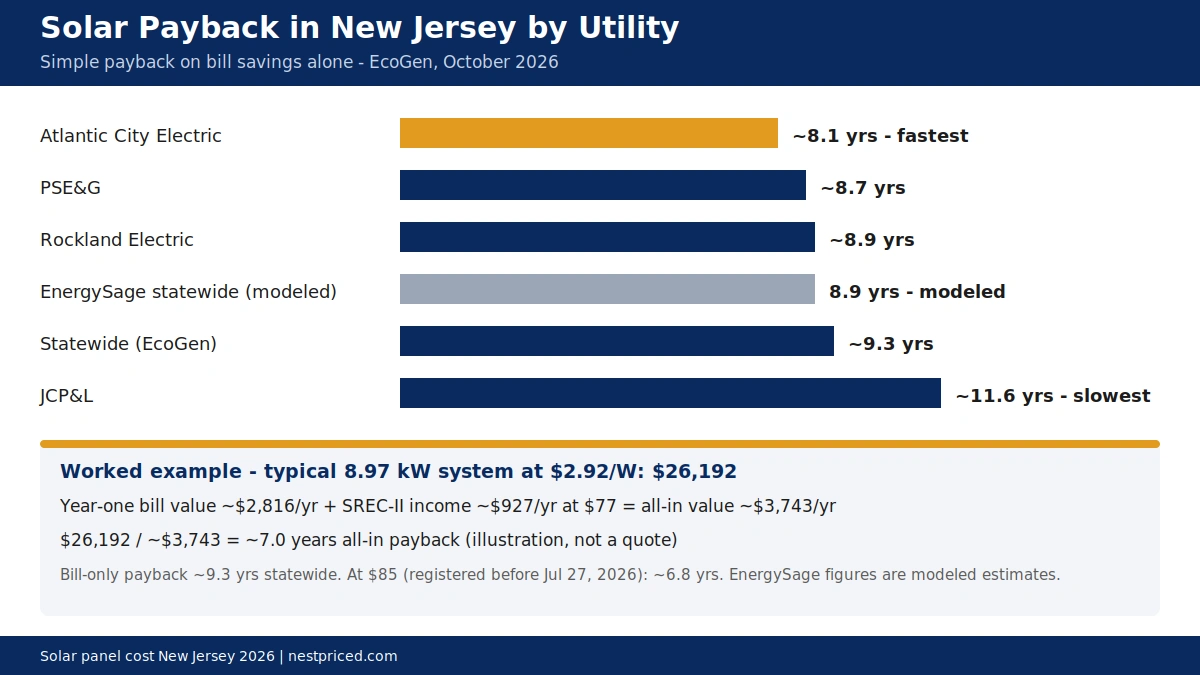
The statewide figure is about 9.3 years on bill savings alone. EcoGen puts the statewide payback at 9.3 years, weighted by homes across PSE&G, JCP&L, Atlantic City Electric, and Rockland Electric. PSE&G, the largest utility at 56% of homes, comes in at 8.7 years. The range across the big utilities runs 8.1 to 11.6 years, from Atlantic City Electric at the fast end to JCP&L at the slow end. Those are the numbers to plan around on bill savings alone. They are faster than the national range of 6 to 12 years in our national guide at the fast end, and the reason is not the price — New Jersey’s $2.92 a watt is above the national average — it is the export rule and the retail rate. A system that banks its summer surplus at full retail and draws it down in winter cannot pay back slowly when the power it replaces costs nearly twenty-four cents.
The illustration, assumptions in the open. EcoGen publishes totals rather than worked sums, so the arithmetic that follows is a NestPriced illustration built from those totals, not a quote. Start with the 12,038 kilowatt-hours the typical system makes. At the statewide value of about 23.74 cents a kilowatt-hour, less the fixed monthly charges solar cannot avoid, the year-one bill value comes to about $2,816 a year, and $26,192 divided by $2,816 is about 9.3 years — exactly EcoGen’s published figure. Now add the SREC-II income: about 12.0 certificates at $77 is about $927 a year, which lifts the year-one value to about $3,743 a year, and $26,192 divided by $3,743 is about 7.0 years. That is the all-in payback for a system registered on or after July 27, 2026. A system registered before that date, at $85, earns about $1,023 a year from SREC-IIs, for a year-one value near $3,839 and a payback near 6.8 years. Use EcoGen’s 9.3 years as the bill-only headline. Use the illustration to see which lever moves it — and to see that the registration date is worth about two months of payback all by itself.
| Case | Simple payback | Source |
|---|---|---|
| EcoGen statewide (8.97 kW, bill only) | ~9.3 yrs | EcoGen, Oct 2026 |
| EcoGen PSE&G (8.97 kW, bill only) | ~8.7 yrs | EcoGen, Oct 2026 |
| EcoGen Atlantic City Electric (bill only) | ~8.1 yrs | EcoGen, Oct 2026 |
| EcoGen Rockland Electric (bill only) | ~8.9 yrs | EcoGen, Oct 2026 |
| EcoGen JCP&L (bill only) | ~11.6 yrs | EcoGen, Oct 2026 |
| NestPriced illustration, bill + SREC-II at $77 | ~7.0 yrs | Illustration from EcoGen anchors |
| EnergySage statewide (12.43 kW) | 8.9 yrs | EnergySage, Nov 2026 — flagged, modeled |
| EnergySage Newark | 11.39 yrs | EnergySage, Nov 2026 — flagged, modeled |
| EnergySage Jersey City | 10.81 yrs | EnergySage, Nov 2026 — flagged, modeled |
| EnergySage Trenton | 8.96 yrs | EnergySage, Nov 2026 — flagged, modeled |
| EnergySage Atlantic City | 6.83 yrs | EnergySage, Nov 2026 — flagged, modeled |
The flagged conflict. EnergySage reports an 8.9-year payback statewide, with 11.39 years in Newark, 10.81 in Jersey City, 8.96 in Trenton, and 6.83 in Atlantic City, alongside 25-year savings of $67,429 statewide. EnergySage builds those figures as modeled estimates on its own marketplace averages — a 12.43 kW average system, a $2.60 a watt price, and savings that assume the surplus holds something close to its current value for 25 years. Do not present any of them as a verified New Jersey payback, and do not let a quote cite the Atlantic City figure for a JCP&L home. The gap between 6.83 years and 11.6 years is not a rounding difference — it is the retail rate, the system size, and the SREC-II registration date, and any payback that ignores them is modeling a different state.
What moves the payback most. The retail rate is the biggest lever, and in New Jersey it matters more than in a cheap-power state. A kilowatt-hour on Atlantic City Electric is worth about 26.7 cents, and the same kilowatt-hour on JCP&L is worth about 18.8 cents — a gap of nearly eight cents on every unit the system makes, every year, for twenty-five years. Rate escalation is the second lever, and in New Jersey it is a live one: the statewide all-in price rose 10.3% in the year to August 2026, and about 7.1% a year from 2020 to 2025, and the cheap 2024 auction falls away on June 1, 2027. A system bought at today’s prices pays back sooner if rates keep climbing — or later if they level off — and no honest quote can say in advance which way it will go. The third lever is the SREC-II registration date, worth about $1,450 over fifteen years between the $85 and $77 rates. Financing is the fourth lever: dealer fees on a solar loan can lift the effective price by 10-30%, sometimes more than 50%, so compare quotes on cash price per watt and set the monthly payment aside until then.
Who still comes out ahead. Four kinds of New Jersey household come out ahead on the numbers. The Atlantic City Electric customer, where the published payback is the fastest in the state and even the surplus earns its full retail value for twelve months. The home that is busy in daylight — a home office, laundry and dishes run at midday, an EV plugged in while the sun is up — and so keeps most of its production at full retail value inside the twelve-month bank. The household that adds panels alongside a heat pump or an EV, sizing the array to the new daytime load and staying inside the annual-use cap. And the household that buys mainly for the rate rises — New Jersey’s all-in price is up more than a third in five years, and a system that looks fair at today’s rates looks different after five more years of the same. Walk away when your home sits on a municipal utility that will not net-meter above 5 kW, when you use under 500 kilowatt-hours a month and the fixed charges eat the savings, or when the installer projects savings without naming your utility’s retail rate and your SREC-II registration date.
Batteries in New Jersey: Backup Value, Not Bill Savings
In New Jersey, the battery is the add-on that shows up on the most quotes — and the one that earns its keep the least often. There is exactly one good reason to buy a battery in this state, and a quote that sells it for any other reason is selling a feeling, not a return.
What a battery costs. A 13.5 kWh storage unit adds about $14,850 installed at the current $1,000 to $1,200 per kWh range, per EcoGen’s New Jersey page — on top of the $26,192 for the typical 8.97 kW system, which takes the combined job to about $41,042. New Jersey has no open statewide battery rebate to set against it, and a battery the owner installs in 2026 gets no federal credit either, because §25D covered storage too and it closed on the same date. The battery costs what it costs, like the panels.
What a battery earns on the bill. On the grid, a battery’s earnings are the spread between the export rate and the retail rate: it stores a kilowatt-hour that would have earned the export price, and releases it after dark instead of buying a kilowatt-hour at the retail price. In New Jersey that spread is zero, because the export rate is the retail rate — a kilowatt-hour sent out at noon already earns the full 23.74 cents, and a kilowatt-hour stored and released at night saves the same 23.74 cents. Store 13.5 kilowatt-hours a day and release them all, and the saving comes to roughly $0 a day, before the round-trip losses that eat 10% or so of every stored kilowatt-hour. At that rate a $14,850 battery never pays for itself on bill savings alone, which is longer than the battery will last. The spread is not narrow here. It does not exist.
What a battery is actually for. Its job is backup and resilience — not investment. New Jersey’s grid is generally reliable, but nor’easters, summer thunderstorms, and the occasional hurricane do take power out — Hurricane Sandy took it out for two weeks in parts of the state — and a battery sized for the loads that matter in an outage — heat, refrigeration, water, medical equipment — keeps a house livable through one. Pick the battery size for the loads that matter, not for the whole house, and treat what you spend as insurance, not as a return. A battery also helps a household that is empty all day and full all evening in a state without full-retail net metering — but New Jersey has full-retail net metering, so that benefit does not apply here, and no quote should claim it does. We work through battery sizing, cost, and payback in detail in our solar battery cost guide.
The rebate that is not a rebate yet. Two battery payments are talked about in New Jersey in 2026, and neither one is open. The Garden State Energy Storage Program, approved by the Board in June 2025, has a statewide home battery payment that exists only as a draft dated August 17, 2026 — until the Board approves it there is nothing to apply for. PSE&G announced a home battery rebate on August 26, 2026, and its details are still unconfirmed. Treat any installer-quoted battery rebate as unconfirmed, and do not let a battery line in a quote carry a rebate that no program has opened.
New Jersey Incentives in 2026: What Exists and What Does Not
The federal credit is gone, yet New Jersey still dangles more than most states — a production payment, two tax exemptions, and a community solar program that just tripled in size. The short list below deserves a careful read, because most solar advertising in the state skips the parts that cost the buyer money — and because the two real tax breaks are both easy to double-count.
No upfront state rebate, no state income-tax credit. For a rooftop array, neither Trenton nor any of the four big utilities writes a rebate check. The New Jersey income tax return has no line for a solar credit. EcoGen’s incentives page lists no panel or battery rebate at any of the four utilities. The only money in a New Jersey solar project is on the electric bill, in the SREC-II check, and in the taxes the system does not pay. Everything else in this section is either a program for someone else, a tax you do not pay, or a program that has not opened yet.
Sales tax is the first real exemption, and it is already in the quote. Solar energy equipment is exempt from New Jersey’s 6.625% sales tax under N.J.S.A. 54:32B-8.33, and the exemption covers a battery that stores solar power too. The buyer claims it by giving the seller a filled-in Form ST-4, the state’s Exempt Use Certificate, and the installer should already show it in the quote. On a $26,192 system, the exemption is worth roughly $1,700 on the equipment — real money, already taken off, and not to be subtracted a second time. A quote that knocks the sales tax off a second time is double-counting, and the payback that follows it is wrong by the same amount.
Property tax is the second real exemption, and it is worth more here than anywhere else. State law, N.J.S.A. 54:4-3.113a, leaves the value solar adds to a home out of the property tax assessment entirely — 100% of the added value, exempt. New Jersey’s effective property-tax rate runs about 1.88% of home value, the highest in the country, so the exemption is worth more on a New Jersey home than on the same home anywhere else. But the exemption is not automatic: you and the installer sign Form CRES, the local construction official certifies the system, and then it goes to the municipal assessor — and it starts the tax year after the year it is certified, so file soon after the install. A system certified in December does not save a dollar until the following tax year.
Community solar is the route for the homes that cannot host panels. The Board opened a 3,000 MW community solar solicitation effective March 6, 2026, under P.L. 2025, c.135 and the Governor’s Executive Order 2, using a rolling application process. Every project must give subscribers a 20% discount on electricity costs, and a 25% discount to low- and moderate-income subscribers, and the program reserves 51% of its capacity for LMI households — the strongest carve-out in the country. The incentive behind it was cut from $80 to $60 per megawatt-hour in the same order. A renter in Jersey City, a condo owner whose roof is common property, or a homeowner whose roof is too shaded for panels can subscribe to a shared project and get a bill credit tied to their share, with no equipment on their own roof. Terms vary by project, so check the subscription fee, the contract length, the cancellation terms, and whether the subscriber organization is registered with the Board — and do not assume rooftop-solar benefits transfer to a community solar subscription, because they do not.
Solar for All is not open to New Jersey households. The federal Solar for All program was terminated by the EPA on August 7, 2025, citing the One Big Beautiful Bill Act. Two federal courts ruled the termination unlawful, on September 18 and again on September 22, 2026, and the EPA had not decided whether to appeal by the time this guide was written. For now, the grants sit frozen while the courts decide — and no New Jersey household has a way to apply.
New Jersey has no open federal home energy rebates. The state was awarded about $183 million for the HEAR and HOMES programs — $91,307,380 for HEAR and $91,654,709 for HOMES — and its applications were conditionally approved, but the NJBPU’s own program page still says the programs are in development and not open for applications, as of late 2026. New Jersey folded its award into a low-income multifamily program and an electrification adder to the existing Comfort Partners weatherization program, rather than a standalone household rebate. Even once those programs finally open, HEAR will still put nothing toward a solar purchase. What HEAR pays for is electrification gear and nothing beyond it — a heat pump, a heat-pump water heater, an electrical panel, or wiring work tied to insulation. HEAR’s list of qualifying equipment leaves all four out: panels, batteries, EV chargers, and windows.
| Item | Value | Notes |
|---|---|---|
| NJ state rebate for panels | $0 — none exists | No state or utility rebate for home solar |
| NJ state income-tax credit | None | No line for a solar credit on the NJ return |
| SuSI / SREC-II (ADI) | $77/MWh, 15 yrs | Registrations on/after Jul 27, 2026; $85 before; owner only |
| Sales-tax exemption | 6.625% exempt | N.J.S.A. 54:32B-8.33; Form ST-4; already in the quote |
| Property-tax exemption | 100% of added value exempt | N.J.S.A. 54:4-3.113a; file Form CRES; starts next tax year |
| Community solar | 3,000 MW solicitation open Mar 6, 2026 | 20% discount all subscribers, 25% LMI; 51% LMI carve-out |
| Battery rebate (statewide) | Not open | GSEP payment only a draft (Aug 17, 2026) |
| Battery rebate (PSE&G) | Unconfirmed | Announced Aug 26, 2026; details not confirmed |
| Solar for All | $0 — no program open for NJ households | EPA ended all 60 grants Aug 7, 2025; courts ruled the termination unlawful Sep 2026; funds frozen |
| HEAR / HOMES rebates | Not launched | ~$183M awarded; conditionally approved; in development, no start date |
| Old traded SRECs | Closed | Do not model traded-SREC income for new systems |
Federal Help in 2026: No Tax Credit Remains — but Leasing Still Has a Path
The federal story for 2026 is short enough to tell in a breath — and that brevity is exactly what lets so much New Jersey solar advertising get away with stale numbers. In New Jersey the paragraph grows a second half that most states never need, because the lease route that rescues other states works here, and the buyer who does not know that has one fewer option than they actually have.
Buy the panels yourself, finish the install in 2026, and the federal credit on the return is $0. After December 31, 2025, a homeowner-owned system placed in service earns no Residential Clean Energy Credit — the 30% §25D credit is gone, ended by the One Big Beautiful Bill Act, Public Law 119-21, signed July 4, 2025. The finish date is what decides it, per IRS fact sheet FS-2025-05: a deposit paid in 2025 counts for nothing if the crew finished the work in January 2026. That same day also ended the §25C efficient-home-improvement credit. See 30% off on a 2026 quote and you are looking at a law that ended on December 31, 2025. Have the installer remove it and send a revised quote. A few New Jersey cost pages still print an “after tax credit” column. The dead 30% credit still comes off in that column, and no figure in this guide touches it.
Leases and PPAs are legal in New Jersey, and the company can still claim the commercial credit. Leasing firms have not lost everything: on a system the company owns, the 30% commercial clean-electricity credit under §48E is still claimable, provided construction started by July 4, 2026 and the array enters service by December 31, 2027. Both cutoff dates trace back to the same IRS guidance, Notice 2025-42. Where the law lets a homeowner host a company-owned array, the household gets that credit through a lease or a power purchase agreement, with the company folding some of the value into a lower monthly payment for the home. New Jersey is one of those states: leases and third-party PPAs are both legal here, and national installers are still signing new residential contracts in New Jersey in 2026. The catch is the escalator: lease payments commonly climb 1.9% to 2.9% a year over decades, and the value the provider passes along is whatever the contract says it is, not the full 30% — and under a lease the company keeps the SREC-II income and the net-metering credits, not the homeowner. Work the escalator out over the full term before you set a lease beside a loan, and have a lawyer read any lease or PPA before signing, because a lease is the contract behind free-solar advertising and no program in New Jersey offers free panels.
HEAR money never touches solar. Households in New Jersey that meet the income test can still draw as much as $8,000 through the Home Electrification and Appliance Rebates program during 2026. Electrification work is all that money funds; it never pays for panels. HEAR’s money goes to electrification gear and nothing else — a heat pump, a heat-pump water heater, an electrical panel, or wiring work tied to insulation. For HEAR purposes, the eligibility list stops short of all four: panels do not count, batteries do not count, EV chargers do not count, and windows do not count. Only electric-to-electric upgrades qualify for funding under the Energy Department’s Notice 26-2, dated September 1, 2026. Fuel-switching is out. Neither of New Jersey’s own rebate programs — HOMES or HEAR — has opened its doors yet, and the state has published no date for when either will. Fold a HEAR rebate into a solar price and you are describing a program that does not work that way. HEAR can still be useful to a New Jersey homeowner. A heat pump paired with new panels is a common New Jersey combination, and the heat-pump half may qualify once the state’s program opens. The solar half never will.
Here is the honest summary: in 2026, Washington contributes nothing to a New Jersey homeowner who buys solar panels outright. Where the lease market is thin or unclear elsewhere, New Jersey buyers still have that second door: the legal route is clear, providers are signing contracts, and some of the credit’s value can flow through a lease or a PPA. On a cash quote, the price is the price. The only state help is a production payment that depends on the registration date, two tax exemptions that depend on forms filed on time, and a bill credit that banks for twelve months. The full 2026 federal picture is in our federal tax credits guide. For lease-versus-buy, see our national solar cost guide.
Permits & Licensing: What New Jersey Requires
New Jersey’s licensing picture is thicker than most states’ in one respect that helps a buyer who knows where to look: there are two registrations to check, not one, and a company that waves a general business license instead of those two documents has shown you the wrong paper. The check itself is short, and it runs the same for every installer in New Jersey.
The electrical work needs a license, and the home-improvement work needs a registration. New Jersey has no statewide general contractor license. A company selling home improvements must register as a Home Improvement Contractor with the Division of Consumer Affairs — $110 to register, $90 to renew every two years, a compliance bond of $10,000 to $50,000 depending on volume, and $500,000 of liability cover. The electrical work needs a licensed electrical contractor business permit from the Board of Examiners of Electrical Contractors under N.J.S.A. 45:5A — an exam, about five years of hands-on experience, a $1,000 surety bond, and $300,000 of liability cover. Ask for both numbers and check both before you sign — a company that waves a general business license in place of those two documents is showing you the wrong paper. EcoGen’s own roster check in other states found best-known installers showing no license under their names, which is exactly why the check matters: a good reputation is not a license, and the roster is the place to look.
No New Jersey rule demands NABCEP certification — yet it is still the credential worth asking an installer about. No state solar license category turned up in this guide’s verification, so there is nothing state-issued to demand. The North American Board of Certified Energy Practitioners (NABCEP) photovoltaic installer certification remains the leading industry credential, and it is worth asking about in a state with deep installer benches in every city and thin ones nowhere. Treat it as a plus, not a license.
The schedule is set by how long permits and interconnection actually take. The sequence starts with three approvals: the building permit, the electrical permit, and the utility’s interconnection agreement. Of the three, the permits are the slow part in New Jersey: solar permits are approved town by town in 564 municipalities under the State Uniform Construction Code, and a December 2025 law orders a statewide instant-permitting platform, due by mid-2027. Until it is built, local review costs stay in your price. This guide found no statewide schedule of permit fees and no verified interconnection timeline, so it quotes no fee figure and no timeline — the town sets the fee, and the utility sets the interconnection clock. Two weeks to permission to operate is not a promise any installer can give you — only the utility controls that clock. It is not the installer’s call.
New Jersey has a solar-access law, and it has a hard number in it. Since 2007, N.J.S.A. 45:22A-48.2 has barred an association from adopting or enforcing a rule that prohibits solar collectors on the roof of an owner-owned single-family home, or on a townhouse roof the owner is responsible for repairing. The association may regulate installers, placement, concealment, color, and total size — but no rule may add more than 10% to the cost of installation or maintenance, and no rule may stop the panels from working at their intended maximum efficiency. The Commissioner of Community Affairs enforces the law. It does not apply while the developer controls the association, and it does not cover a condominium roof designated as common property — so many multi-unit condo roofs are outside it. Associations faced an April 1, 2026 deadline to adopt a written policy on members’ solar rights, and a bill introduced in February 2026 would widen the protection to more roofs. Get the architectural-review approval on paper before a single panel is ordered. Condo ownership adds a second layer to the problem: with the roof normally held as common area, nothing moves forward unless the board says yes. If an installer tells you New Jersey has no solar-access law, ask them to read N.J.S.A. 45:22A-48.2 — the law has been on the books since 2007.
The new balcony rule is real but not yet in effect. On September 1, 2026, Governor Mikie Sherrill signed the Garden State Balcony Solar Act, which legalizes portable plug-in solar devices of up to 1,200 watts per address, connected through a standard wall outlet with a built-in microinverter. Landlords and associations may not prohibit a qualifying device outright, and municipalities may not require a permit for one. The law takes effect March 1, 2027 — so at the time this guide was written, it is a promise, not a right. A renter who wants solar today still needs community solar, not a balcony panel.
What Pushes Your New Jersey Quote Up or Down
Think of $2.92 a watt as the middle of the market, not a promise: any single New Jersey quote can land well clear of it in either direction. A New Jersey quote can move by thousands of dollars on seven factors, and three of them come from the state’s geography and density rather than the equipment.
Dense-suburb roofs and shade are the New Jersey factors. EcoGen names them outright as the reason quotes spread from $2.57 to $3.27 a watt: in the northern suburbs, cut-up roofs with dormers and chimneys add labor hours while fitting fewer panels on the best-facing side, and the neighbor’s trees shade the array for part of the day. A quote for a Newark or Jersey City roof should show the racking, the shade mitigation, and the microinverters or optimizers as their own lines, and a quote that does not show them has hidden them somewhere else. Before signing, get answers on three things: where the panels will sit, how the racking attaches, and what happens to the schedule if the roof needs work first.
Coastal wind and salt air are the Shore factors. Shore and South Jersey installs sit in higher design-wind zones under the Uniform Construction Code, which calls for sturdier racking and a structural review. Salt air corrodes exposed metal faster than inland air, so the racking and the fasteners need to be specified for the coast. A quote for an Atlantic City roof should show the wind engineering and the corrosion-resistant hardware as their own lines, and a quote that does not show them has hidden them somewhere else.
Labor is the quiet factor. No New Jersey-specific BLS wage for electricians turned up in this pass, so no New Jersey figure appears here. The national figure gives the context: electricians earn a median of about $30.38 an hour (BLS, May 2025), and labor is the biggest soft-cost line in an install. What moves a New Jersey quote is not the hourly rate but the bench: with deep installer markets in every city, how much experience the crew has in your utility’s territory matters more than the headline rate. Ask the crew for a count of installs in your utility’s territory — that number answers a different question than years in business.
Your roof, and the snow load a New Jersey winter piles on it. Freeze-thaw cycles wear down flashing and shingles through a New Jersey winter, in a way a roof down south never has to deal with. Snow sitting on a roof for weeks adds a load no summer roof ever has to bear, and the northern counties require snow-load engineering for it. When the roof has under a decade left in it, put the new roof on before the array does. Taking panels off and putting them back for a later reroof is a separate job on its own, running $2,000 to $4,500. Before you budget, check our roof replacement guide for what the reroof adds to the bill. Slate and cedar-shake roofs — common in older northern towns — take solar as poorly as any roof in the state: the specialty mounting is slow, the labor is dear, and the panels sit on a roof that was never built for them. On a steep New Jersey roof, snow guards belong on the quote as a genuine line item — the hardware that keeps sliding snow off walkways and gutters. Get the local construction official’s snow-load rating for the roof settled before installation day. After is too late.
Panel tier. Expect to pay roughly a tenth to a fifth more per watt for top-tier panels than for value-tier ones. In New Jersey the premium pays for two things that matter here: stronger low-light output on cloudy winter days, and slower degradation across a quarter century of cold, bright sun. On a tight roof, the extra money for efficiency pays its way — a crowded New Jersey roof has no spare square feet to waste on a weaker panel. For a large array on a wide-open Shore roof, cheaper value-tier panels usually win the comparison. Premium n-type panels also keep their output up longer: 0.25-0.5% lost a year, 91-93% of rated output still there at year 25, against a fleet median near 0.5% a year and about 88% at year 25, per NREL. With payback already long, that gap matters more still — every extra year of strong output is a year the system counts on.
Inverter choice. Buying a string inverter costs less than buying microinverters. Microinverters or optimizers cost more but squeeze more out of roofs that carry partial shade — and New Jersey roofs, with their trees, dormers, and chimneys, carry shade more often than installers admit, while snow lingering on one part of an array shades it just like a tree. A microinverter looks after its own panel, so one shaded or snow-covered panel cannot pull the whole string down with it. A string inverter usually gives 10-15 years of service, so plan on one replacement over the system’s life. Microinverters usually come with warranties near 25 years. Every inverter type across its whole lifespan is covered in our inverter replacement guide — yet every dollar figure there is a national one, not a New Jersey figure.
The electrical panel. Many New Jersey homes still run on 100-amp service — especially older homes in Newark, Jersey City, and the inner-ring suburbs — and a solar install often forces the question. A 200-amp panel upgrade runs $1,500-$4,000 nationally, per our electrical panel upgrade guide. It is the add-on that most often surprises a New Jersey buyer. Before you sign, make sure the quote says whether the panel upgrade is included in the price. Do not let the electrician arrive in your driveway with this still unsettled. No New Jersey panel-upgrade dollar figure turned up for this guide. A national figure fills the gap, and it is flagged as national wherever it appears. Here is the New Jersey wrinkle: a panel upgrade is electrification work, the kind HEAR exists to pay for — once New Jersey’s HEAR program opens, which it has not.
Financing terms. Over the life of the system, cash is the cheapest way to pay — loans, leases, and PPAs all cost more in the end. A $0-down loan does not make the dealer fee disappear: 10-30% of the cash price — sometimes more than 50% — is simply rolled into what the borrower owes. The Consumer Financial Protection Bureau’s August 2024 market spotlight is where that figure comes from. It is a national number, yet New Jersey quotes carry it in full. A lease or PPA is the fourth path, and it is genuinely available here: leases and PPAs are legal in New Jersey, the provider claims the §48E credit, and the monthly payment may carry some of that value — but the escalator, commonly 1.9% to 2.9% a year, has to be priced over the full term before the lease is judged on its monthly payment at all, and the company keeps the SREC-II income under a lease. Community solar is the fifth path, and it is open here: the Board’s 3,000 MW solicitation is live, so renters and condo owners have a community-solar route today.
Upkeep and lifespan. Expect 25-30 productive years from the panels, past the warranty, with output fading a little each year. The warranty covering materials and workmanship typically runs 10-25 years. Look for a performance warranty of 25-30 years, guaranteeing 80-92% of rated output at year 25 — the exact figure depends on the tier. Upkeep is light work: an occasional cleaning, a yearly production check, and nothing that moves to wear out. On a steep New Jersey array the snow usually slides off on its own; a low-slope roof holds it longer, and a spring rinse does what rain does not. None of those lifespan, degradation, or maintenance figures is a New Jersey figure — all of them come from national data. No New Jersey versions of those figures exist, so each one is flagged as national.
Getting Quotes in New Jersey: The Checklist
New Jersey is a strong state to buy solar in — ordinary sun, expensive power, a surplus rule that still pays the retail rate, and a production payment that lasts fifteen years — but only for a homeowner who checks the registration date before the sales pitch. Bring this list with you to every meeting with a bidder. Hold off on signing until you have a written answer for each item on the list.
The ten-item quote checklist:
- Your utility’s rules, in writing, first — PSE&G’s 24.928-cent value, JCP&L’s 18.796 cents, Atlantic City Electric’s 26.700 cents, Rockland’s 24.585 cents, or your municipal utility’s own terms. Retail value and the twelve-month bank decide the payback before anything else — and Atlantic City Electric’s rate is worth about three years of payback against JCP&L’s.
- Cash price per watt, on paper — one identical spec sheet handed to every one of the three bidders. The New Jersey anchor is $2.92 a watt; a quote far above it calls for an explanation, and a quote far below it calls for a closer look at what was left out — especially the racking and the shade mitigation on a dense-suburb roof.
- Take any 30% federal credit line and any state rebate line off the quote. Washington pays $0 on an owner purchase in 2026, and New Jersey offers neither a state rebate nor a state income-tax credit. The sales-tax exemption is already in the quote, and the battery rebate is not open. A quote that still carries a 30% credit line leans on a law that expired before the year began. Ask for it to be removed.
- The SREC-II registration date, in writing — the rate locks at registration: $85 for systems registered before July 27, 2026, $77 from that date, for fifteen years. The installer registers the system, and the date decides about $1,450 over the term. Get the registration plan in the contract.
- Model monthly self-use; never assume it — work out, month by month, how much production the house consumes the moment it is generated, and how much banks into the twelve-month period. A quote that values all exports at one blended price, or that banks June into the true-up month, is wrong.
- Both New Jersey numbers verified — the installer’s electrical contractor business permit under N.J.S.A. 45:5A and the Home Improvement Contractor registration, checked on the roster, with names matched to the contract. NABCEP certification is a plus. Do not accept a quote that cites only a general business license.
- Add-ons priced on their own lines — roof work, the panel upgrade, tree work, snow guards, racking, wind engineering, and the battery each listed separately, never folded into the per-watt figure.
- A PVWatts estimate that names its shade loss — built on about 1,342 kilowatt-hours per kilowatt each year rather than nameplate watts, and laid out as a monthly curve instead of a single yearly average. Insist on seeing the monthly curve itself, with June placed next to December, and the shade study behind it.
- Wind load, snow load, and insurance confirmed — the roof’s snow-load rating checked with the local construction official, the racking’s wind rating named for a Shore roof, the tilt stated, UL 61730 / IEC 61730 panels specified by name, rapid shutdown to NEC 690.12 confirmed, and homeowners insurance confirmed in writing to cover the array before signing.
- HOA approval, in writing, first — New Jersey’s solar-access law (N.J.S.A. 45:22A-48.2, since 2007) bars an association from prohibiting solar on an owner-owned single-family roof, and no association rule may add more than 10% to the cost or stop the panels working at their intended maximum efficiency. Have the architectural-review approval in hand before panels are ordered. Condo owners need the board’s approval for the common-area roof too.
Buy, lease, or community solar? Across 25 years, buying comes out ahead for households with heavy daytime use, Atlantic City Electric or PSE&G territory terms, or a heat pump or EV to pair with the array. Buy it, and the array stays yours, the resale value stays yours, the SREC-II income stays yours, and every kilowatt-hour you use yourself keeps its full retail value. Leasing suits homeowners who want no upfront cost and no maintenance — and in New Jersey it is genuinely available, with the provider claiming the §48E credit, so price the 1.9% to 2.9% escalator over the full term before you compare it on its monthly payment, and remember the company keeps the SREC-II income under a lease. Community solar wins for renters, condo owners, and homes whose roofs are shaded or unsuitable — and in New Jersey it is open, with a 3,000 MW solicitation live and a 20% discount guaranteed to every subscriber. Off the grid, a cabin past the end of the road is a different question entirely, and this guide does not answer it: New Jersey has no Alaska-style off-grid market, and a home on a municipal meter needs its own utility’s terms in writing before anything else.

Sources & methodology
Cost anchors (per watt, system size, totals):
- EcoGen Solar Cost Index, September 2026 Edition, prices as of Sep 25, 2026: $2.92/W; 8.97 kW typical (Berkeley Lab 2025 median 9.02 kW, 15,442 systems); $26,192 total; 1,342 kWh/kW/yr; neighbors CT $2.80, DE $2.83, PA $2.87, US $2.89, NJ $2.92, NY $3.02; quotes ±12% ($2.57-$3.27/W)
- EcoGen New Jersey cost page: 6 kW $15,420-$19,620; 8 kW $20,560-$26,160; 10 kW $25,700-$32,700; 12 kW $30,840-$39,240; 13.5 kWh battery $14,850 ($1,000-$1,200/kWh); payback 9.3 yrs statewide, 8.7 yrs PSE&G, 8.1 yrs ACE, 8.9 yrs Rockland, 11.6 yrs JCP&L
- EnergySage New Jersey page, Nov 2026: $2.60/W; 12.43 kW average; $32,328 (range $27,479-$37,177); payback 8.9 yrs; 25-yr savings $67,429 — modeled, flagged
- EnergySage city pages, Nov 2026: Newark $3.02/W, 8.82 kW, $26,646, payback 11.39 yrs, savings $35,739; Jersey City $3.07/W, 9.93 kW, $30,448, payback 10.81 yrs, savings $43,939; Trenton $2.57/W, 12.06 kW, $30,987, payback 8.96 yrs, savings $60,822; Atlantic City $2.44/W, 12.83 kW, $31,288, payback 6.83 yrs, savings $100,884
- Berkeley Lab 2026 data update (via EcoGen): median transacted price ~$3.70/W for NJ home systems installed in 2025
- NumeralQ New Jersey page (planning estimate, EnergySage data retrieved Oct 26, 2026): 8 kW $26,160-$34,140 ($3.27-$4.27/W)
Rates and home use:
- EIA, 12 months to Aug 2026: NJ 23.74 cents/kWh (US 18.0 cents); average use 675 kWh/mo (~8,100 kWh/yr); average bill ~$160/mo; Aug 2026 alone 24.61 cents, 960 kWh, $236.26 bill, +10.3% YoY
- EIA final 2024: 662 kWh/mo, 19.34 cents, $128.13/mo
- Per-utility values (EcoGen, EIA 12-mo less fixed charge): PSE&G 25.907 cents less $5.63 = 24.928 cents; ACE 27.750 cents less $6.75 = 26.700 cents; Rockland 25.248 cents less $6.00 = 24.585 cents; JCP&L 19.323 cents less $4.27 = 18.796 cents
- Feb 2026 BGS auction (effective Jun 1, 2026): PSE&G 10.938 cents, JCP&L 11.327 cents, ACE 11.275 cents, Rockland 12.057 cents; cheap 2024 auction falls away Jun 1, 2027
- State average price rose ~7.1%/yr 2020-2025 (EIA, via EcoGen)
Net metering:
- N.J.A.C. 14:8-4: full retail 1:1 credit at all four investor-owned utilities; monthly netting; credits roll through a 12-month annualized period; year-end leftover paid at avoided cost of wholesale power (average LMP in the utility’s PJM zone); PJM 2025 load-weighted average $50.73/MWh, about 5.1 cents/kWh; true-up month changeable once; system capped at annual use
- BPU review Docket QO24090723 (notice Nov 8, 2024): net-metered capacity passed 5.8% of annual kWh sold in Energy Year 2024; proceeding on a successor mechanism for new customers; no final decision, no replacement proposed as of Nov 2026
- Vineland municipal utility: unable to support new solar above 5 kW AC, if at all
SuSI / SREC-II:
- BPU Order of May 21, 2026 (three-year ADI review): $85/MWh for registrations before Jul 27, 2026; $77/MWh for registrations on or after Jul 27, 2026; 15-year term locked at registration; residential capacity 300 MW for Energy Year 2027 (from ~285 MW in 2026); owner only; federally taxable
- Conflicts flagged: $76.50/MWh for registrations on/after Mar 6, 2026 (roi.solar, solarcostguide.org); $85.90 EY 2025-26 rising to $95.23 EY 2026-27 (kheinc.us, uncorroborated)
- Typical system: 12,038 kWh/yr → ~12.0 SREC-IIs → ~$927/yr at $77 (~$13,900 over 15 yrs); ~$1,023/yr at $85 (~$15,350 over 15 yrs)
- Old market SREC program closed; do not model traded-SREC income for new systems
Payback arithmetic:
- EcoGen published figures (Oct 2026): statewide ~9.3 yrs, PSE&G ~8.7 yrs, ACE ~8.1 yrs, Rockland ~8.9 yrs, JCP&L ~11.6 yrs, bill savings only
- NestPriced illustration (labeled as such): 8.97 kW, $26,192, 12,038 kWh/yr; year-one bill value ~$2,816/yr at 23.74 cents less fixed charges; $26,192 / $2,816 = ~9.3 yrs; plus SREC-II ~$927/yr at $77 → ~$3,743/yr → ~7.0 yrs; at $85 → ~$3,839/yr → ~6.8 yrs
- EnergySage modeled paybacks (8.9 yrs statewide; 11.39 Newark; 10.81 Jersey City; 8.96 Trenton; 6.83 Atlantic City) flagged as modeled estimates
Production and climate:
- EcoGen: 1,342 kWh/kW/yr PVWatts-based; 4.3 peak sun hrs/day (NREL NSRDB via Unbound Solar; sunmetriclab 4.3; solarspechub 4.2 — small conflict, 4.3 used)
- Somerset, NJ seasonal output (NASA POWER via profilesolar): summer ~6.05 kWh/day/kW, spring ~5.47, autumn ~3.54, winter ~2.18
- Heat penalty 0.3-0.5% per degree C above 25 C cell temperature, national figure
- Detach-and-reset for a later reroof $2,000-$4,500 (national, EcoGen)
Incentives:
- No state rebate, no state income-tax credit; no panel or battery rebate at the four big utilities (EcoGen incentives page, Oct 2026)
- Sales tax: N.J.S.A. 54:32B-8.33 exempts solar equipment from 6.625% sales tax; Form ST-4; covers a battery storing solar power
- Property tax: N.J.S.A. 54:4-3.113a exempts 100% of added home value; file Form CRES; starts the tax year after certification; NJ effective property-tax rate ~1.88%, highest in the country
- Community solar: 3,000 MW solicitation opened Mar 6, 2026 (P.L. 2025, c.135; Gov. Sherrill EO 2); 20% discount all subscribers, 25% LMI; incentive cut $80 to $60/MWh; 51% LMI carve-out in CSEP
- Battery: Garden State Energy Storage Program approved Jun 2025; statewide home battery payment only a draft (Aug 17, 2026); PSE&G home battery rebate announced Aug 26, 2026, details unconfirmed
- Solar for All: EPA terminated all 60 grants Aug 7, 2025; courts ruled the termination unlawful Sep 18 and Sep 22, 2026; funds frozen, no household route
- HEAR/HOMES: ~$183M awarded to NJ (HEAR $91,307,380 + HOMES $91,654,709); applications conditionally approved (Mar 2026); NJBPU page says in development, not open for applications (verified Sep 30-Nov 4, 2026); folded into low-income multifamily program + Comfort Partners electrification adder
Federal and financing:
- OBBBA P.L. 119-21 and IRS FS-2025-05: §25D and §25C $0 for post-Dec-31-2025 installs, completion date counts
- §48E 30% for third-party-owned systems, in service by Dec 31, 2027, construction begun by Jul 4, 2026 per IRS Notice 2025-42; leases and PPAs legal in NJ; escalators commonly 1.9-2.9%/yr
- DOE Notice 26-2, Sep 1, 2026: HEAR electric-to-electric upgrades only, no fuel-switching; solar, batteries, EV chargers, windows outside HEAR
- CFPB Solar Financing Market Issue Spotlight, Aug 2024: dealer fees 10-30%, sometimes over 50%; EcoGen NJ page: 10-30% on $0-down loans
- Battery cost: 13.5 kWh add-on $14,850 installed ($1,000-$1,200/kWh) (EcoGen NJ cost page)
HOA, licensing, permits:
- N.J.S.A. 45:22A-48.2 (P.L.2007, c.153): associations may not prohibit solar collectors on solely-owned single-family roofs or owner-repair townhouse roofs; rules may not add more than 10% to cost or stop panels working at intended maximum efficiency; enforced by Commissioner of Community Affairs; not applicable under developer control; condo common roofs outside it; associations faced Apr 1, 2026 deadline to adopt a written solar policy (secondary source)
- Garden State Balcony Solar Act: signed Sep 1, 2026 (Gov. Sherrill), effective Mar 1, 2027 — portable plug-in devices up to 1,200 W per address; landlords/HOAs may not prohibit outright
- No statewide general contractor license; HIC registration via Division of Consumer Affairs ($110 initial, $90 biennial, bond $10k-$50k, $500k liability); electrical contractor business permit via Board of Examiners of Electrical Contractors under N.J.S.A. 45:5A (exam, ~5 yrs experience, $1,000 bond, $300k liability); NABCEP is the credential to ask for
- Permits town by town in 564 municipalities under the State Uniform Construction Code; Dec 2025 law orders a statewide instant-permitting platform due mid-2027; no statewide permit-fee schedule or interconnection timeline verified
- Shore and South Jersey installs in higher design-wind zones under the Uniform Construction Code; northern counties require snow-load engineering; slate and cedar-shake roofs need specialty mounting
Labor and lifespan (national figures):
- BLS OEWS May 2025: electricians national median $30.38/hr (no New Jersey-specific figure pulled)
- Lifespan 25-30 years productive service; NREL median degradation ~0.5%/yr, ~88% of rated output at year 25; premium n-type 0.25-0.5%/yr, 91-93% at year 25 (NREL Jordan et al. 2022)
- Product warranty typically 10-25 years; performance warranty typically 25-30 years, guaranteeing 80-92% of rated output at year 25 depending on tier; string inverter 10-15 years, one replacement expected; microinverters ~25 years
EXCLUDED:
- Any “after 30% credit” prices
- Any HEAR-for-solar claim: HEAR does not cover solar, batteries, EV chargers, or windows; electric-to-electric only since DOE Notice 26-2, Sep 1, 2026
- Any state rebate or state tax credit for New Jersey solar: none exists
- SREC-II income at $85 for systems registering on or after Jul 27, 2026: the rate is $77 from that date
- Traded-SREC income for new systems: old program closed
- Residential battery rebate: no open program (GSEP draft only; PSE&G announcement unconfirmed)
- EnergySage’s 8.9-year statewide payback as verified: modeled, EcoGen’s 9.3 years is the anchor
- NumeralQ’s $3.27-$4.27/W planning range and Berkeley Lab’s $3.70/W transacted median as headline prices: planning estimate / transacted median, not competitive quotes
- Sunmetriclab’s $3.35/W modeled price and 10.4-yr payback: modeled, not used as headline
- The $76.50 and $95.23 SREC-II figures as headline: conflicting reports, flagged above
- The claim that New Jersey has no solar-access law: WRONG against N.J.S.A. 45:22A-48.2 (2007)
- The claim that New Jersey net metering is gone: WRONG against N.J.A.C. 14:8-4; review open, no final decision
- New Jersey-specific interconnection timeline, permit-fee schedule, design snow-load figure, monthly PVWatts table, shade-loss percentage, BLS electrician wage, panel-upgrade price (national figures used, flagged as national)
*Disclaimer: The prices here are 2026 New Jersey planning figures. Where you live in New Jersey, which utility serves you, the state of your roof, and the installer you pick all move the final price. Before settling on a budget, line up three written quotes from installers working in New Jersey. Treat every tax point in this guide as background reading, not advice about your own filing. Have a New Jersey tax professional look over your own return before you file it. Program rules change — the SREC-II rate is set by Board order and the net-metering rule is under review — so confirm current terms with the NJ Clean Energy Program and your own utility before signing.*
What do solar panels cost in New Jersey in 2026?
In New Jersey in 2026, solar panels install at $2.92 a watt — about $26,192 for the typical 8.97 kW system (EcoGen, September 2026) — with 2026 quotes spanning roughly $2.57-$3.27 a watt. At the EcoGen rate a 6 kW home system typically runs about $17,520, while EnergySage puts the state average at $2.60 a watt on a bigger 12.43 kW system. A homeowner-owned system installed in 2026 earns a $0 federal credit, New Jersey offers no state rebate and no state income-tax credit, and the return rests on full-retail net metering plus SREC-II payments of $77 per megawatt-hour for fifteen years.
Is solar worth it in New Jersey with so little roof space and so much shade?
New Jersey’s paybacks sit closer together than the state’s density would lead you to expect, and the utility on the bill decides where a house lands. A kilowatt of panels here makes about 1,342 kilowatt-hours a year — a solid middle-of-the-pack resource — and the power it replaces costs about 23.74 cents a kilowatt-hour on the 12-month average, with Atlantic City Electric customers paying about 26.7 cents after the fixed charge. EcoGen puts simple payback at about 9.3 years statewide on bill savings alone, about 8.7 years on PSE&G, and 8.1 to 11.6 years across the big utilities — and roughly 7 years once the SREC-II income is counted. Jersey City, on PSE&G’s middle rate and the dearest install prices in the state, is the slowest of the big cities; Atlantic City, on the highest retail rate and the cheapest installs, is the fastest.
How does net metering work in New Jersey?
It is full retail, banked for a year. Under Board of Public Utilities rule N.J.A.C. 14:8-4, customers of the four big investor-owned utilities net their consumption kilowatt-hour for kilowatt-hour inside each billing month at the full retail rate. The month’s surplus rolls forward as kilowatt-hour credits through a twelve-month annualized period, so a June surplus can cancel a January kilowatt-hour at full value. Whatever is still left at the end of the twelve months is paid out at the wholesale price, about 5.1 cents a kilowatt-hour, and the bank resets to zero. You can change your true-up month once in the life of the account. The Board opened a review of the rule in November 2024, but no replacement has been proposed and no final decision has been made.
What is the SREC-II payment worth in New Jersey in 2026?
About $927 a year on the typical system, for fifteen years. Under the Successor Solar Incentive program, a net-metered home earns one SREC-II for every megawatt-hour it produces, at a fixed price locked at registration. The Board cut the residential rate from $85 to $77 per SREC-II for registrations received on or after July 27, 2026, so the typical 8.97 kW system making about 12,038 kilowatt-hours a year earns about $927 a year at $77 — about $13,900 over fifteen years — against about $1,023 a year at $85. Only the system owner collects it, so under a lease or a PPA the company keeps it, and the income is federally taxable.
What is the 12-month bank, and why does the true-up month matter?
The bank is the twelve-month period over which your net-metering credits roll forward, and the true-up month is the month it ends. Inside the bank, every surplus kilowatt-hour cancels a kilowatt-hour you would otherwise buy at the full retail rate, whenever in the year you use it. At the true-up, whatever is still in the bank is paid out at the wholesale price of about five cents and the bank resets to zero. Pick the true-up month well — after the winter drawdown, not before it — and you buy less power at retail. You get to change it once, so make the choice deliberately before the first true-up.
Can my HOA stop me from installing solar panels in New Jersey?
Usually not — New Jersey has had a solar-access law since 2007. Under N.J.S.A. 45:22A-48.2, an association may not prohibit solar collectors on the roof of an owner-owned single-family home or a townhouse roof the owner is responsible for repairing, and no association rule may add more than 10% to the cost of installation or maintenance, or stop the panels from working at their intended maximum efficiency. The association may still regulate installers, placement, concealment, color, and size. The law does not cover a condominium roof designated as common property, and it does not apply while the developer controls the association, so get architectural-review approval in writing before you order panels.
Is the 30% federal solar tax credit still available to New Jersey homeowners in 2026?
No — not on a system you buy yourself. For homeowner-owned systems placed in service after December 31, 2025, the Residential Clean Energy Credit (§25D, 30%) is gone — the One Big Beautiful Bill Act, Public Law 119-21, ended it. The IRS has made clear that the installation’s finish date is what decides it. New Jersey does offer a second door that some states do not: leases and power purchase agreements are legal here, and the company that owns the system can still claim the commercial credit (§48E, 30%) for systems in service by December 31, 2027, passing some of the value along as a lower monthly payment — but the company keeps the SREC-II income under a lease, and the escalator, commonly 1.9% to 2.9% a year, has to be priced over the full term.
Why is solar payback about 9 years in New Jersey?
Three forces pull in the same direction, and the middle one usually wins. The price is a hair above the national average at $2.92 a watt, and the sun is ordinary at about 1,342 kilowatt-hours a year per installed kilowatt — but the surplus is banked for twelve months at the full retail rate instead of settling at wholesale every month, so the bright summer months earn the same twenty-four cents the dark winter months bill at. What saves the case is the price of the power: 23.74 cents a kilowatt-hour on average, 26.7 cents on Atlantic City Electric, and rising — the state average rose about 7.1% a year from 2020 to 2025. Add the SREC-II payment of about $927 a year for fifteen years, and the all-in payback lands near seven years. In JCP&L territory, where the retail value is 18.8 cents, the payback stretches toward the slow end of the range on any plausible rate.