

Illinois does not sell solar the way most states do. In most states the quote is a price and the incentives are a footnote. In Illinois the quote is three numbers — the sticker, the REC value, and the net price — and the middle number moves the answer more than the other two combined. A $28,152 system becomes a $7,340 system in Chicago, or a $9,200 system in Springfield, or an $11,970 system in the Quad Cities, and the only difference between those three outcomes is which utility sends the bill and how much of the state payment the paperwork company passes along. The hardware is the same. The roof is the same. The sun is nearly the same. The paperwork is everything.
That is why this guide reads the paperwork before it reads the price. The per-watt anchor is settled and public: $3.05 a watt, a typical system of 9.23 kW, quotes between $16,000 and $29,000. The value of what the hardware makes is settled too, but only if you know which of three utilities delivers your power, whether your system switched on before or after January 1, 2025, and whether your contract puts the Illinois Shines payment in your column or keeps it in the vendor’s. Two neighbors on the same street in Chicago, with the same roof and the same quote, can end up thousands of dollars apart because one of them filed promptly against an open block and the other signed a contract that kept the REC value.
The state sits above the national average on price and below it on sun. Hardware costs $3.05 a watt against $2.89 nationally, and a kilowatt of panels makes about 1,290 kilowatt-hours a year here — a solid middle-of-the-pack resource, better than Michigan’s, close to Ohio’s, and a long way below the desert Southwest. Power is dearer than average: about 18.91 cents a kilowatt-hour all-in on the 12-month average to August 2026, against 18.0 cents nationally, with the average home using only about 697 kilowatt-hours a month and paying about $132. What makes Illinois distinctive is the machinery around those numbers: a state program that buys fifteen years of clean-energy credits at a published price, a utility rebate that pays $300 a kilowatt for a smart inverter, a net-metering rule that changed on January 1, 2025 and now credits only the supply part of the bill, and a property-tax rule that costs nothing but only works if you file the form. Start with the national guide above for the countrywide baseline, then read on — the Illinois numbers follow, utility by utility.
Table of Contents
How Much Do Solar Panels Cost in Illinois in 2026?
Start with the two datasets that describe Illinois in 2026, because they look like they disagree until you see what each one counts. The anchor for this guide is EcoGen’s Solar Cost Index, September 2026 edition: an Illinois install at $3.05 per watt, or about $28,152 for the typical 9.23 kW system before the Illinois Shines REC payment. That runs 5.5% above the $2.89 national average and above every bordering state except Iowa — Missouri is $2.74, Indiana $2.97, Wisconsin $3.01, Iowa $3.07. Quotes in 2026 spanned $16,000 to $29,000 by system size, with the Index price sitting near the top of the range. At the anchor, 6 kW costs $18,300, 8 kW costs $24,400, 10 kW costs $30,500, and 12 kW costs $36,600.
The second dataset is the marketplace. EnergySage’s November 2026 Illinois page reads $2.92 a watt — thirteen cents under the EcoGen anchor — on a far larger system: its average Illinois quote is 11.6 kW at about $33,903, ranging from $28,818 to $38,988. Read that size gap, not the thirteen cents, because the two sources are not arguing about price. EnergySage averages the quotes that flow through its marketplace, and the Illinois homeowners who seek quotes usually want large systems — electric heat, an EV, a pool, a house they expect to grow into. Berkeley Lab counted what actually went on roofs: a 9.23 kW median across 19,742 Illinois systems installed in 2025. That median is the truer typical size, so it is the one this guide builds on. EnergySage still earns its place as the cross-check: two independent readings, $2.92 and $3.05, thirteen cents apart and both above the national average.
A third reading comes from ConsumerAffairs, working from EnergySage data: $2.98 a watt on an 11.56 kW typical system, about $34,449 — between the two anchors and consistent with both. Put the three together and Illinois lands a little above the national average on price, with the quote spread — $16,000 to $29,000 — mattering more than any single number.
Hold one thought about the typical size before the tables start, because it colours every figure that follows. The 9.23 kW median is a real installed median, not a model, and it overshoots the average Illinois home by a wide margin: at about 1,290 kilowatt-hours per kilowatt, 9.23 kW produces about 11,907 kilowatt-hours a year, while the average Illinois home uses about 697 kilowatt-hours a month, or roughly 8,364 a year. On an annual basis that looks generous — but the house does not use power evenly through the year and the panels do not make it evenly either, and since January 1, 2025 the surplus has earned only the supply part of the bill. The sizing section below works out what that means, and the net-metering section puts a price on it.
The per-watt price is meant to cover the entire job. Panels plus inverter or microinverters, racking and wiring, the crew’s labour, the permits, the inspection, and the interconnection application. A new roof, a panel upgrade, tree work, a battery, and rapid-shutdown gear are all extra. Nothing has been taken off the arithmetic yet, because the sticker is the price before the REC payment and the utility rebate — the two numbers that turn $28,152 into $7,340 in ComEd territory get their own sections, with their own conditions, because neither of them is automatic. A quote that shows only one number — the net — is hiding the two numbers that decide whether the net is real.
One more warning before the tables: the lowest quote in Illinois is rarely the lowest system once the job is finished, and with Chicago’s installer market the second and third quotes are easy to obtain — and worth obtaining. The dealer fee is the quiet part of a loan quote: 15-30% of the cash price, sometimes more, folded into the amount financed, because overhead and margin make up most of any installer’s total. With quotes from Chicago, Springfield, Rockford, and Peoria installers spread across the table, compare them on cash price per watt for the same panels on the same Illinois roof — that is the one number that lets you judge bidder against bidder. Collect it in writing from at least three installers, and walk away from any bidder who will not hand it over — and from any bidder who cannot name its Illinois Shines Approved Vendor, because without a vendor there is no REC payment at all, and the $18,040 that makes the whole deal work never arrives.
| Source | $ per watt | System | Cash total | Payback |
|---|---|---|---|---|
| EcoGen Index (Sep 2026) | $3.05 | 9.23 kW | ~$28,152 | No single figure published |
| EnergySage (Nov 2026) | $2.92 | 11.6 kW avg | ~$33,903 | 12.37 yrs — flagged, modeled |
| ConsumerAffairs (Nov 2026) | $2.98 | 11.56 kW | ~$34,449 | Not published |
| EnergySage Chicago (Nov 2026) | $3.00 | 9.59 kW avg | ~$28,807 | 11.28 yrs — flagged, modeled |
| EnergySage Springfield (Nov 2026) | $2.74 | 14.82 kW avg | ~$40,543 | 11.86 yrs — flagged, modeled |
| EnergySage Rockford (Nov 2026) | $2.90 | 9.95 kW avg | ~$28,886 | 12.30 yrs — flagged, modeled |
| EnergySage Peoria (Nov 2026) | $2.84 | 11.86 kW avg | ~$33,723 | 12.14 yrs — flagged, modeled |
| National range (article 4) | $2.25-$3.30 | 8.2 kW | ~$24,600 at $3.00/W | 6-12 yrs |
Two rows of that table need a warning label before you trust them. EnergySage’s payback figures — 12.37 years statewide, 11.28 in Chicago, 11.86 in Springfield, 12.30 in Rockford, 12.14 in Peoria — are modelled estimates built on its own marketplace averages, and the page itself says its figures leave out Illinois and local incentives while its savings text says incentives are factored in. That tension is flagged here, not resolved, and the payback section below builds the Illinois answer from the EcoGen anchors and the Shines payment instead.
Solar Panel Cost in Illinois by System Size
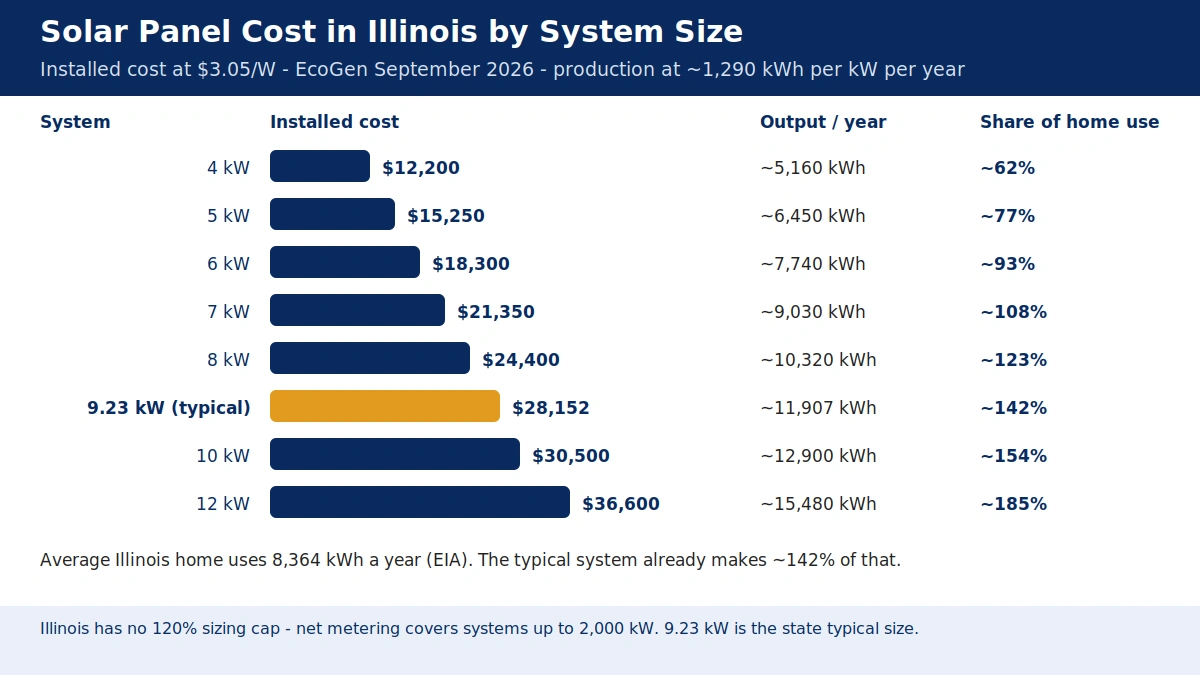
Sizing comes first, and in Illinois the sizing question runs backwards from most states in this series. The problem is not that the surplus is worthless. It is that the typical system already produces far more than the average home consumes, and since January 1, 2025 that surplus has earned only the supply part of the bill. Per EIA billing data to August 2026, the average Illinois home draws about 697 kilowatt-hours a month — about 8,364 a year — and pays close to $132 a month for it. Multiply the two together and the typical array turns out about 11,907 kilowatt-hours a year, which is roughly 42% more than the average home needs.
Building past the house’s own use is a poorer deal in Illinois than in a state with full-retail net metering, because the surplus earns only the supply part of the bill — about 8.413 cents at ComEd, against an all-in price of about 18.91 cents. An exported kilowatt-hour is worth less than half of one used at home. That gap is why the table below turns unattractive beyond 8 kW for most Illinois homes — unless the home actually uses the power. The 9.23 kW median describes exactly that case: Illinois homes that install solar tend to be bigger, newer, and hungrier than the state average. Every row is priced off the EcoGen anchor. At $3.05 a watt, output runs about 1,290 kilowatt-hours per installed kilowatt each year. The last column gives each size as a share of an average home’s use, so the crossover — where the array stops feeding the house and starts selling power — is easy to spot.
| Size | Cash cost at $3.05/W | Annual output | Share of a typical Illinois home’s use (8,364 kWh/yr) |
|---|---|---|---|
| 4 kW | $12,200 | ~5,160 kWh | ~62% |
| 5 kW | $15,250 | ~6,450 kWh | ~77% |
| 6 kW | $18,300 | ~7,740 kWh | ~93% |
| 7 kW | $21,350 | ~9,030 kWh | ~108% |
| 8 kW | $24,400 | ~10,320 kWh | ~123% |
| 9.23 kW (state typical) | ~$28,152 | ~11,907 kWh | ~142% |
| 10 kW | $30,500 | ~12,900 kWh | ~154% |
| 12 kW | $36,600 | ~15,480 kWh | ~185% |
Two rows deserve a closer look. First, even a 6 kW system already covers about 93% of average annual use, so a 6 kW array is the right size for the average Illinois home — and the 9.23 kW typical system belongs to a home that uses far more than average, or plans to. Second, Illinois has no 120% sizing cap like Ohio’s: net metering here covers systems up to 2,000 kW, so nothing in the law stops an average-use home from installing a 12 kW system. What stops it is the arithmetic — every kilowatt past the house’s own use earns the supply rate in the months it makes the most, and the Shines payment, which is priced per REC, grows with size too, so the oversizing mistake is partly cushioned by a bigger REC payment. That cushion is real, and it is the reason Illinois oversizing is less punishing than Ohio oversizing — but it does not make a 12 kW array on a 697-kilowatt-hour-a-month home a good buy.
Start from a year of electric bills, not from the empty roof area. Add up twelve months of kilowatt-hours and divide by roughly 1,290 to find the size that covers them. Then look at June, July, and August on their own: if a surplus already shows at 6 kW, stop there, because each kilowatt past that line earns the supply rate in the months it makes the most. Add 1-2 kW for a planned EV or a heat pump, more for electric heat, less for a shaded or north-facing roof. Then check the result against your utility’s export credit before you sign: a system that earns 8.413 cents on everything past your own use is a system that pays back on self-use alone. An EV or a heat pump on the way means the solar should be sized for the bigger house now. Add the load first and the panels second, or the new load arrives after the array is already sized for the smaller house. For the full sizing walk-through — how to read twelve months of bills, where to stop, and what to add for an EV or a heat pump — see our 6 kW vs 8 kW vs 10 kW guide.
Solar Panel Cost by City: Chicago, Springfield, Rockford & Peoria
Panel prices barely move from one city to the next. System size does — and size is what moves the total. Read the city table utility-first and price-second. When quotes land, judge them on price per watt — never on the headline total. A Springfield quote at the low end of its range and a Chicago quote at the statewide anchor are not a close call once the Shines payments are in: the Chicago array earns about $1,860 more in REC value on the same 9.23 kW system, and its rebate is the same $2,769 either way.
| City | $ per watt | Avg. system | Cash total | Utility |
|---|---|---|---|---|
| Chicago | $3.00 | 9.59 kW | ~$28,807 | ComEd |
| Springfield | $2.74 | 14.82 kW | ~$40,543 | Ameren Illinois |
| Rockford | $2.90 | 9.95 kW | ~$28,886 | ComEd |
| Peoria | $2.84 | 11.86 kW | ~$33,723 | Ameren Illinois |
Chicago is the biggest market in the state, served by ComEd, and the dearest per watt of the four. EnergySage, November 2026, puts Chicago at $3.00 a watt on a 9.59 kW average system, about $28,807 before incentives, with a modeled payback of 11.28 years and 25-year savings of $32,432. That average system is close to the statewide median of 9.23 kW, which is the honest thing about the Chicago figure: Chicago quotes describe the typical system, not a supersized one. The price runs dearer for reasons that are visible from the street — city permitting through the Department of Buildings, older Cook County housing stock that needs roof work before panels go on, and labor that costs more in the metro than downstate. In exchange, Chicago-based installers tend to carry the ComEd interconnection queue fluency that prevents expensive delay, and Chicago is where the Shines payment is worth the most: $80.77 a REC against $70.37 in Ameren territory. A Chicago quote at $3.00 a watt is a fair price on a typical system. It is not a cheap system — but it is the system with the biggest incentive behind it.
Springfield is the cheapest per watt of the four and the most expensive in total, which is the same fact read two ways. EnergySage puts Springfield at $2.74 a watt — the lowest of the four — but on a 14.82 kW average system, about $40,543, the biggest average system in the state. Springfield homes on Ameren Illinois run big systems for the same reason Columbus homes did in Ohio, and then some: central Illinois gets more sun than the lake shore, the housing stock skews larger, and electric heat is more common downstate. A Springfield quote at $2.74 a watt is a good price on a very big system. It is not a cheap system, and a Springfield home that uses the state average of 697 kilowatt-hours a month has no business buying 14.82 kW of panels — that array makes about 19,118 kilowatt-hours a year, more than twice what the average home uses, and most of it would earn the supply-and-transmission credit instead of the retail rate.
Rockford is the middle of the state in every sense that matters. EnergySage puts Rockford at $2.90 a watt on a 9.95 kW average system, about $28,886, with a modeled payback of 12.30 years and 25-year savings of $26,708 — the lowest savings of the four, because Rockford sits in ComEd territory with the supply-only export credit and gets lake-effect cloud off the same weather system that hits Chicago.
Peoria is the Ameren city that prices most like Chicago. EnergySage puts Peoria at $2.84 a watt on an 11.86 kW average system, about $33,723, with a modeled payback of 12.14 years and 25-year savings of $35,689. Peoria homes run bigger systems than Chicago homes for the same reason Springfield homes do — more sun, larger houses, more electric heat — and Peoria’s Shines payment is the Ameren rate, $70.37 a REC, about ten dollars less per credit than Chicago’s. At the same price per watt, a Peoria system and a Chicago system are different investments: the Peoria array makes more power per kilowatt, and the Chicago array earns more per REC. Read the city table by its utility column first, and by its system-size column second.
One last city point: installer depth is a Chicago thing. The metro has many installers bidding for the same jobs, which is what pulls quotes toward $2.92 there. Beyond it, longer drives and thinner competition push quotes toward the top of the band for no reason other than distance. Wherever you live, get three quotes — and make at least one of them from a company that already works in your utility’s territory.
Illinois Sunshine: Cloudy Winters, a Short December Day & Four Real Seasons
Illinois sunshine comes with a shape that rewards the buyer who plans for winter rather than the one who falls for summer. A production estimate worth trusting tells both halves of that story: the seasonal shape, not the yearly total, is what decides whether the system pays.
The sun, by the numbers. On the EcoGen-implied figure, one kilowatt of panels in Illinois yields roughly 1,290 kilowatt-hours a year, at about 4.2 peak sun hours a day in Chicago. That sits a little under the national figure and far under the desert Southwest, yet it is a solid middle-of-the-pack resource — stronger than Michigan’s, stronger than New York’s, and close to Ohio’s. The winter figure matters more than the yearly total, and Chicago’s climate data states it plainly: about 6.8 kilowatt-hours per square meter per day of shortwave solar energy in June, about 1.7 in December — a four-fold swing from the brightest month to the darkest — and December the cloudiest month of the year, overcast or broken cloud about 67% of the time. The shortest day, December 21, gives 9 hours and 8 minutes of daylight against 15 hours and 14 minutes on June 21. Use 1,290 kilowatt-hours per kilowatt as the year’s figure, and design around the seasonal shape instead.
The lake is the story in the north. Chicago hugs the southwestern shore of Lake Michigan, and the lake dictates the weather across the whole northeast corner of the state. Cold wind off the lake brings cloud and lake-effect snow from late November until the lake cools, and Chicago averages about 37 to 38 inches of snow a year — more than the national average of 28 inches — with January the snowiest month at about 11.7 inches, and the city sees about 2,478 sunshine hours a year against a national figure near 2,500, with only about 84 days of clear skies. Springfield and Peoria, further from the lake, get less snow and a little more sun, which is one more reason the same panels in Chicago and Springfield are not the same investment. A statewide average flatters a Chicago roof and short-changes a Springfield one — and an installer who quotes one statewide number is quoting a guess. The north-south split is real and measurable: about 1,200 kilowatt-hours per kilowatt a year in northern Illinois, rising to about 1,330 in the far south.
Cold helps more than it hurts. Cell efficiency falls by roughly 0.3-0.5% for every degree Celsius above 25, so a January rooftop in Illinois runs cooler than a July roof in Phoenix — and more efficiently. Chicago rooftops rarely bake in July the way a Phoenix roof does — an hour of Illinois sunshine is worth more than the same hour on a hot southern roof. Cold, clear winter air is good solar weather, and it does a lot to explain why a kilowatt of Illinois panels produces as much as it does under so much cloud. The catch is that the panels can only use the sun while it is up — and in December it is up for about nine hours, hidden behind cloud for much of that time.
Snow pulls the outcome both ways at once. A tilted array sheds snow, and a steeper one sheds it faster. A fixed Illinois install is usually set near the latitude tilt, around 42 degrees in Chicago — steep enough to let most snow slide off on its own after a storm. Snow on the ground helps too. In the spring and fall months, when the sun is low and the ground is still white, reflection off snow can boost energy capture by an estimated 15-30%, according to the engineerfix estimate cited in the sources. Until it slides, snow on the panels earns nothing, and a low-slope Illinois roof holds it longer than a steep one does. This guide prints no Illinois snow-loss percentage — none was verified — so ask any installer handing you a production estimate what snow loss it assumes and what tilt it is built on. Snow guards belong on the quote as their own line on a steep Illinois roof — the hardware that keeps sliding snow off walkways and gutters.
The roof, and the snow load it carries. A rooftop array in Illinois carries a snow load on the racking and the roof together, heaviest where the lake-effect snow falls. No Illinois design snow-load number was verified for this guide, so none is printed here — ask the local building department for the roof’s snow-load rating and let its number govern, not the installer’s guess. Replace a roof with under ten years left before the panels go on: a later reroof means taking the panels off and putting them back, $2,000 to $4,500 on top of the roofing job, and many Illinois insurers will not cover an array on a roof over 15 to 20 years old. If the roof is near the end of its life, price the reroof before you sign anything. A new roof under new panels is the expensive mistake this guide is trying to help you avoid. For solar, standing-seam metal is hard to beat in Illinois: its seams take clamps with no penetrations at all, and snow slides off metal sooner than asphalt. Specify panels by their UL 61730 / IEC 61730 ratings, and get written confirmation that your homeowners policy covers the array for storm damage.
Putting it together. The gear is ordinary; the settings are Illinois ones. Face the array south where the roof allows, and tilt it steep enough to shed snow and catch the low winter sun. Fit microinverters or optimizers so one shaded or snow-covered string cannot drag the whole array down, and insist on a PVWatts estimate that prints its snow assumption on the page.
Net Metering in Illinois: Supply-Only Credits Since 2025
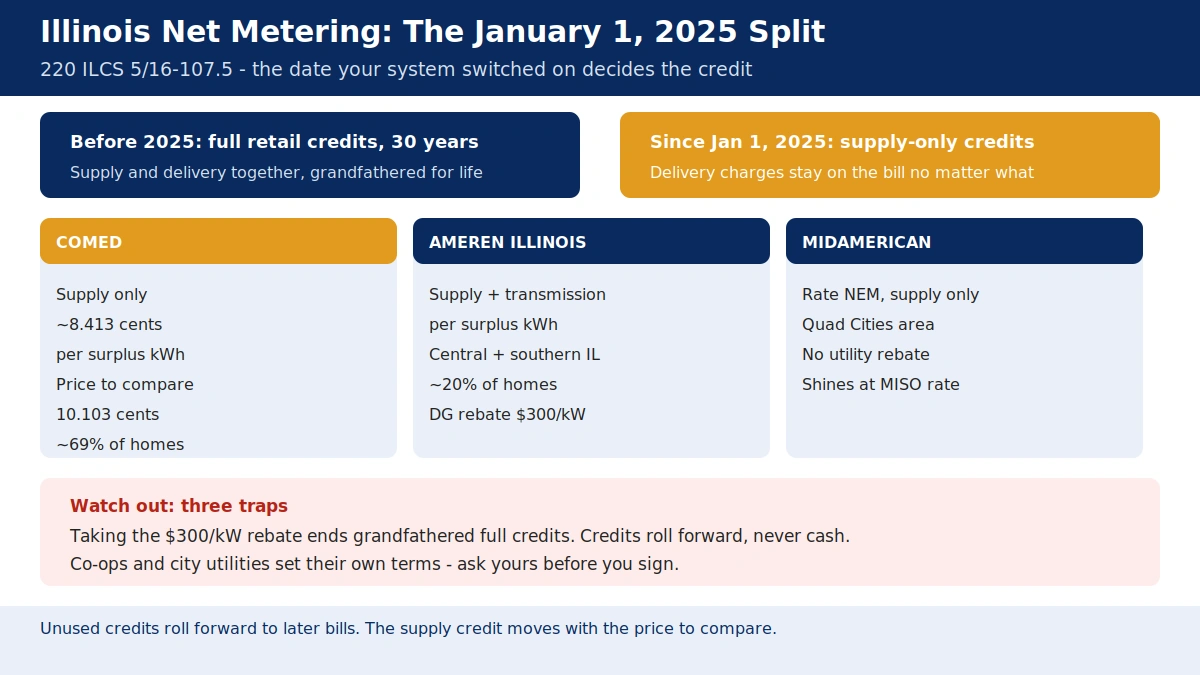
Illinois is one of the states that people get wrong in both directions, and the correction matters more here than almost anywhere else, because the rule changed on a date — January 1, 2025 — and which side of that date your system falls on decides what every exported kilowatt-hour is worth for the next thirty years. Some people claim Illinois has no net metering at all. That is wrong. Others claim Illinois still pays full retail for every kilowatt-hour you send back. That is wrong too, for anyone who installs today. What Illinois has is a two-tier rule: full retail credits for systems switched on before 2025, grandfathered for thirty years, and supply-only credits for everyone since — and the difference between those two tiers is the difference between a system that banks its summer surplus at full value and one that sells it for about eight cents.
The rule. The net-metering statute, 220 ILCS 5/16-107.5, binds the big investor-owned utilities: ComEd, Ameren Illinois, and MidAmerican Energy. For a home whose system was switched on before January 1, 2025, every kilowatt-hour sent to the grid is credited at the full retail rate — supply and delivery together — and those credits carry forward. That household keeps full credits for 30 years, the life of the system. For a home whose system is switched on on or after January 1, 2025, the credit covers the supply part of the bill only. At ComEd that means supply alone — about 8.413 cents a kilowatt-hour on the October 2026 price to compare — while delivery charges stay on the bill no matter how much the panels make. At Ameren Illinois the credit covers supply and transmission, which is worth a little more. At MidAmerican, the post-2025 Rate NEM credits supply only, like ComEd. Unused credits keep rolling forward to later bills in all three territories; they are not paid out in cash.
That change is the fact this whole guide turns on, so it is worth stating three ways, plainly. First, the date decides the credit, not the size of the system or the price of the panels: a system switched on December 31, 2024 earns full retail for thirty years, and one switched on January 2, 2025 earns supply only. Second, the supply-only credit is worth less than half the all-in price — 8.413 cents of supply against about 18.91 cents all-in — so a kilowatt-hour used at home the moment it is made is worth more than twice a kilowatt-hour sent out. Third, the rule binds only the investor-owned utilities: co-ops and city utilities set their own terms, and some pay little or nothing for exports, so a household on a co-op or a municipal meter needs its own utility’s solar terms in writing — no state statute covers those utilities, so the paper is the only protection.
The rebate trap. There is a catch that catches real households, and it is printed in the fine print of the rebate, not the net-metering rule. If you already have solar with grandfathered full credits and you add panels, taking the $300-per-kilowatt DG rebate ends your full bill credits. The rebate is real money — $2,769 on a typical system — but for a grandfathered household it trades thirty years of full-retail credits for a one-time check, and that trade is almost never worth taking. If your system predates 2025, ask your utility in writing what happens to your grandfathered status before you accept any rebate, sign any expansion, or let any installer file anything on your behalf.
The size of the credit, in numbers. ComEd’s price to compare — the supply-only benchmark — sits at 10.103 cents a kilowatt-hour from October 1, 2026 through May 31, 2027, made up of 8.413 cents of supply and 1.69 cents of transmission. The export credit itself is the supply part: about 8.413 cents. Ameren’s credit is supply plus transmission, which runs a little higher, though no Ameren all-in residential rate was verified for this guide, so none is stated. The credit moves with the price to compare, which resets twice a year, and the supply part of it moves with the wholesale market — so a payback built on today’s 8.413 cents is a payback built on a number that will change, and the installer who quotes a fixed export value for twenty-five years is quoting a fiction.
The supplier in the supply section. In Illinois you can buy power from a company other than your utility. Many towns sign residents up as a group through a municipal aggregation. In both cases the utility still delivers the power and sends the bill, but the credit described above is for homes on the utility’s default supply. A household on a supplier contract or an aggregation deal needs that supplier’s export terms in writing, because the supply credit follows the supply arrangement. Chicago’s own aggregation program expired in August 2015, so Chicago homes are on ComEd supply unless someone signed with a supplier. The supply section of the bill is the first thing to read before any solar contract is signed. If it names a supplier, ask that supplier in writing how it credits extra solar power, and check the bill again just before the system is switched on, because an aggregation can enroll you in between.
Illinois Shines: What the RECs Are Worth in 2026-27
Every Illinois solar quote has a line the buyer should read twice. It is the line about renewable energy credits. A REC certifies that 1,000 kilowatt-hours of power came from a renewable source. A typical Illinois system makes about 12 of them a year. In a state with a fixed-price REC program, those 12 credits are real money — about $18,040 over fifteen years in ComEd territory — and the reason is a program with a name every Illinois buyer should know before they sign anything.
Illinois Shines is the Adjustable Block Program, and it buys fifteen years of your RECs. Under Illinois Shines, the state contracts to buy the renewable energy credits your system will produce over fifteen years, at a price fixed when your application is accepted. The price depends on your utility’s grid and your system size, and the contract is filed through an Approved Vendor — a state-registered company, often your installer — who receives the payment and is supposed to pass the value to you through a lower contract price. Before you sign, the vendor gives you a Disclosure Form showing how many credits the system will earn and how much money they are worth. That form is the most important piece of paper in the whole transaction, and the quote that does not match it is the quote to walk away from.
The prices, for the 2026-27 program year. The program year began June 1, 2026, and the prices below are the Illinois Power Agency’s final 2026-27 REC prices. For a home system up to 10 kW: $80.77 per REC in the ComEd area and the PJM grid, and $70.37 per REC in the Ameren, MidAmerican, and MISO grid. For a system of 10 to 25 kW: $79.21 in ComEd territory and $60.92 in Ameren territory. On top of that, a $20-per-REC adder applies in 2026-27 to customer-owned small systems that do not claim the federal credit — a direct response to the federal credit ending, and it goes only to owners, never to leases or PPAs. A typical 9.23 kW system you own therefore earns $100.77 a REC in ComEd territory and $90.37 in Ameren territory, and makes about 179 RECs over fifteen years: about $18,040 in ComEd territory, about $16,180 in Ameren territory.
| System size | RECs over 15 years | ComEd value (owned) | Ameren value (owned) |
|---|---|---|---|
| 6 kW | ~116 | ~$11,690 | ~$10,480 |
| 8 kW | ~155 | ~$15,600 | ~$13,990 |
| 9.23 kW (state typical) | ~179 | ~$18,040 | ~$16,180 |
| 10 kW | ~194 | ~$19,500 | ~$17,490 |
| 12 kW | ~232 | ~$23,020 | ~$18,770 |
The 12 kW row prices at the 10-to-25 kW tier — $79.21 plus the $20 adder in ComEd territory, $60.92 plus the $20 adder in Ameren territory — which is why the Ameren value falls behind by more than the ten-dollar gap on the smaller sizes. The REC counts and values in this table are NestPriced arithmetic from the EcoGen anchors (about 1,290 kilowatt-hours per kilowatt per year, fifteen years, one REC per 1,000 kilowatt-hours), and the 9.23 kW row reproduces EcoGen’s own published figures of about $18,040 and about $16,180 exactly.
The payment schedule changed in 2026, and the change matters. Since June 1, 2026, Illinois Shines pays 50% of the REC payment when the system is switched on, and the rest in equal parts over the next six years. Before that, small systems were paid in full at energization. On a typical ComEd system that means about $9,020 at switch-on and about $1,500 a year for six years after. The state pays the Approved Vendor, not you — and because the vendor waits years for half the money, some vendors do not pass on the full value. Ask each installer, in writing: how much of the state payment lowers my price? If the contract’s discount is smaller than the Disclosure Form’s value, the difference stays with the company, not with you. If the installer cannot name its Approved Vendor at all, there is no state payment — walk away.
The honest summary is short. Illinois Shines is the largest incentive in the state by a wide margin, it is priced in public, it is fixed for fifteen years once your application is accepted, and it is the reason an Illinois system pays back in about five years on the net price instead of about seventeen on the sticker. It is also the incentive most likely to be mishandled: the block can fill, the application can be filed late, and the vendor can keep part of the value. A quote that leans on the REC value without showing the Disclosure Form is a quote that has not done the paperwork yet.
Payback: How Long Until Illinois Solar Pays for Itself?
Payback is where an Illinois system either earns its keep or does not, and the answer turns on a fact no other state in this series shares: the sticker price is nearly irrelevant, because the REC payment and the utility rebate together remove about three-quarters of it. The worked examples below start from EcoGen’s anchors, show every input, and use EnergySage only as a cross-check — each place the two disagree is marked.
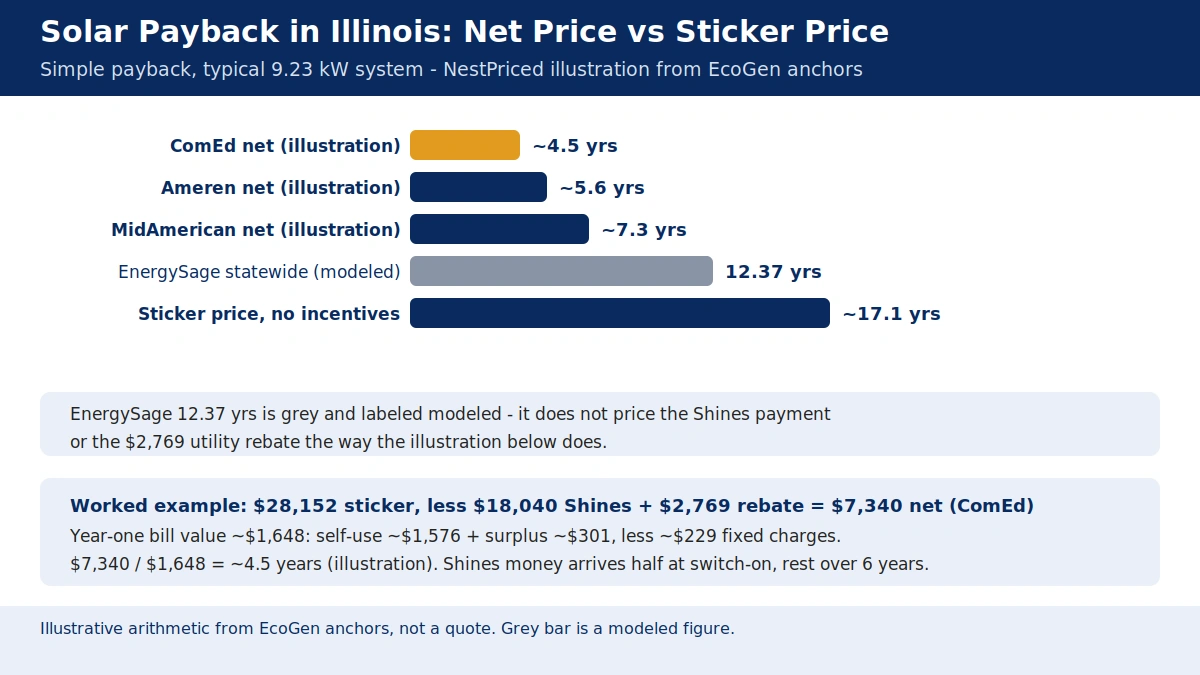
A worked example. Take the typical 9.23 kW system at $3.05 a watt — $28,152 before incentives. At about 1,290 per kilowatt, yearly output lands near 11,907 kilowatt-hours. In ComEd territory the Illinois Shines payment is about $18,040 and the DG rebate is $2,769, so the net price is about $7,340 — if the full Shines value reaches you. In Ameren territory the Shines payment is about $16,180 and the rebate is the same $2,769, so the net price is about $9,200. In MidAmerican territory there is no rebate, so the net price is about $11,970. Those three net prices are the ones the payback is measured against, not the sticker — and the gap between them is the whole story of Illinois solar in one paragraph.
The statewide figure does not exist. EcoGen publishes no single statewide payback for Illinois, and it says why: the payback depends on the Shines payment, the monthly supply credits for exports, your utility’s rules, and your home’s use. One Illinois payback, with no utility named, is a guess — not a figure. EnergySage’s modeled figures — 12.37 years statewide, 11.28 in Chicago, 11.86 in Springfield, 12.30 in Rockford, 12.14 in Peoria — are modeled estimates built on its own marketplace averages, and its page says its figures exclude Illinois and local incentives. None of them is a verified Illinois payback, and no quote should cite one for a ComEd home. The gap between 11.28 years and the illustration below is not a rounding difference — it is the Shines payment, and any payback that leaves it out is modeling a different state.
The payback math, worked out here with every assumption stated. What follows is the arithmetic behind EcoGen’s published totals, set out step by step and labelled a NestPriced illustration rather than a quote. Start with what the typical system makes in a year: 11,907 kilowatt-hours. Suppose the house uses 70% of it the moment it is made — 8,335 kilowatt-hours at the all-in price of 18.91 cents, worth about $1,576 a year — and exports the other 30% — 3,572 kilowatt-hours at ComEd’s supply rate of about 8.413 cents, worth about $301 a year. The gross value comes to about $1,877 a year, less about $229 a year in fixed charges that solar cannot avoid — ComEd’s standard tariff carries a $19.07 monthly fixed charge — for a net year-one bill value of about $1,648 a year. Against the ComEd net price of $7,340, that is about 4.5 years. Against the Ameren net price of $9,200, about 5.6 years. Against the MidAmerican net price of $11,970, about 7.3 years. And against the sticker price of $28,152, with no incentives at all, about 17.1 years. Use the net-price figures as the headline. Use the sticker figure to see what the incentives are doing: they are doing most of the work.
| Case | Simple payback | Source |
|---|---|---|
| NestPriced illustration, ComEd net ($7,340) | ~4.5 yrs | Illustration from EcoGen anchors |
| NestPriced illustration, Ameren net ($9,200) | ~5.6 yrs | Illustration from EcoGen anchors |
| NestPriced illustration, MidAmerican net ($11,970) | ~7.3 yrs | Illustration from EcoGen anchors |
| NestPriced illustration, sticker price ($28,152) | ~17.1 yrs | Illustration from EcoGen anchors |
| EnergySage statewide (11.6 kW) | 12.37 yrs | EnergySage, Nov 2026 — flagged, modeled |
| EnergySage Chicago | 11.28 yrs | EnergySage, Nov 2026 — flagged, modeled |
| EnergySage Springfield | 11.86 yrs | EnergySage, Nov 2026 — flagged, modeled |
| EnergySage Rockford | 12.30 yrs | EnergySage, Nov 2026 — flagged, modeled |
| EnergySage Peoria | 12.14 yrs | EnergySage, Nov 2026 — flagged, modeled |
The flagged conflict. EnergySage reports a 12.37-year payback statewide, with 11.28 years in Chicago and 12.30 in Rockford, alongside 25-year savings of $32,554 statewide. All of them are modeled, not measured: EnergySage builds them from its own marketplace averages — an 11.6 kW average system at $2.92 a watt — and from savings that assume the surplus keeps something close to its current value for 25 years. The page itself says the figures leave out Illinois and local incentives; the savings text on the same page says incentives are factored in. Both cannot be true at once, and this guide does not resolve the contradiction — it flags it. The gap between 11.28 years and 4.5 years is not a rounding difference — it is the $18,040 Shines payment and the $2,769 rebate, and any payback that ignores them is modeling a different state.
What moves the payback most. Daytime self-use is the biggest lever. In Illinois it matters more than in a full-retail state. Run the dishwasher, the laundry, and the EV charger in daylight and those kilowatt-hours leave the 8.413-cent export bucket for the 18.91-cent self-use bucket — no other change pays as well. The illustration above assumes 70% self-use. A household that pushes that share higher shortens its payback materially, and one that is empty all day lengthens it just as fast. The Shines pass-through is the second lever, and in Illinois it is the largest one: the difference between a vendor that passes on the full $18,040 and one that keeps a quarter of it is about $4,500, or nearly three years of bill value. Rate escalation is the third lever, and in Illinois it is a live one: the statewide all-in price rose 7.2% in the year to August 2026, and ComEd’s fixed charge alone is $19.07 a month before the first kilowatt-hour. Buy at today’s prices and the payback shortens if rates keep climbing, lengthens if they do not — and no honest quote can promise which it will be. Financing is the fourth lever. Dealer fees on a solar loan can lift the effective price by 15-30% — judge quotes on cash price per watt, and ignore the monthly payment until then. And the timing lever is the one buyers forget: the Shines payment arrives half at switch-on and the rest over six years, so the net price is not all in hand on day one — budget for the sticker minus the rebate first, and treat the Shines tail as money that arrives, not money already spent.
Who still comes out ahead. The numbers work for four kinds of Illinois household. The ComEd customer, where the Shines payment is the highest in the state and the net price is about $7,340. A home that stays busy in daylight — someone working from home, laundry and dishes at midday, an EV plugged in while the sun is up — keeps most of what it makes at full retail value, even under supply-only crediting. The household that adds panels alongside a heat pump or an EV, sizing the array to the new daytime load without building past its own use. And the household that buys mainly for the rate rises — Illinois power is up 7.2% in a year, and a system that looks fast at today’s rates looks faster after five more years of the same. Walk away when the home sits empty all day and the roof faces north. Walk away when you use under 500 kilowatt-hours a month and the fixed charges eat the savings. And walk away when the installer projects savings without naming your utility’s export rate and the Shines value on the Disclosure Form.
Batteries in Illinois: Backup Value, Not Bill Savings
No add-on shows up in Illinois solar quotes more often than a battery, and none is oversold more often. In this state it earns its keep for exactly one reason — and any quote that sells it on another reason is selling a feeling, not a return.
What a battery costs. A 13.5 kWh storage unit adds about $15,228 installed at the current national rate of about $1,128 per kWh — on top of the $28,152 for the typical 9.23 kW system, which takes the combined job to about $43,380. No Illinois-specific battery price per kilowatt-hour was verified for this guide, so that figure is national, and it is flagged as national. Illinois does have a battery rebate that most states do not: ComEd and Ameren each pay $300 per kWh for a home battery, which is $4,050 on a 13.5 kWh unit, taking the net battery cost to about $11,178 where the rebate applies. MidAmerican pays no battery rebate. One secondary source claims ComEd bumped the battery rebate to $450 a kWh in 2025; EcoGen and ConsumerAffairs both say $300, so this guide uses $300 and flags the $450 claim as a conflict. Storage gets no federal credit on a 2026 owner install either: §25D covered batteries as well, and it closed the same day.
The rebate has strings. The $300-per-kWh battery rebate is not a check for buying a battery. At ComEd you must move to a plan where the price of power changes by the hour or by time of day — Rate BESH or Rate BEST — for as long as you have the battery, and the battery must join ComEd’s battery-sharing program for five years, during which ComEd may use power from your battery at set times. ComEd expects that virtual power plant program to begin March 1, 2027. At Ameren you must use Real-Time Pricing, Power Smart Pricing, or Peak Time Rewards, and customers whose rebates fall under rules effective on or after June 1, 2026 must join Ameren’s Scheduled Dispatch virtual power plant once it is operational. A plan with changing prices can raise your bill if you use a lot of power in the late afternoon and your battery is empty — check your usage before you switch, because the rebate is not worth a higher bill.
What a battery earns on the bill. On the grid, a battery’s earnings are the spread between the export rate and the retail rate: it stores a kilowatt-hour that would have earned about 8.413 cents as an export, and releases it after dark instead of buying a kilowatt-hour at about 18.91 cents. That spread runs about 10.5 cents a kilowatt-hour in ComEd territory. A full 13.5 kilowatt-hours stored and released every day saves roughly $1.42 a day, or about $520 a year — that is NestPriced arithmetic on the retail-minus-supply spread, stated as an illustration. At that rate a $15,228 battery takes about 29 years to pay for itself on bill savings alone, which is longer than the battery will last — and even the $4,050 rebate only brings it to about 21 years. The spread is real but narrow, and it narrows further in Illinois: with the export rate already low, the battery has less value to recover than it would under full-retail net metering. What the battery does recover is the evening: it moves midday production into the hours the house is actually drawing power, which lifts the self-use share that the payback section above says matters most.
What a battery is actually for. A battery is backup and resilience, not an investment — buy it for the outage, not the return. Illinois’ grid is generally reliable, but ice storms, summer thunderstorms, and the occasional polar-vortex cold snap do take power out. A battery sized for the loads that matter in an outage — heat, refrigeration, water, medical equipment — keeps a house livable through one. Size it for the loads that matter in an outage, not for the whole house, and treat the money as insurance, not as an investment. A household that is empty all day and full all evening gets a second benefit from the same battery: it shifts midday production into the evening hours, and the self-use share the payback section above calls the most important number goes up with it. That is a real benefit, and it shortens the payback a little — but a $15,228 battery is still not a money-maker, whatever the quote claims. The full battery arithmetic — what a battery earns on the bill, what the rebate covers, and what it costs net — lives in our solar battery cost guide.
Illinois Incentives in 2026: What Exists and What Does Not
The federal credit is gone, yet Illinois still dangles more than most states — a state REC payment, a utility rebate, a property-tax rule, and a program for lower-income homes. The list below deserves a careful read, because most solar advertising in the state skips the conditions — and because the two real programs are both easy to confuse with something they are not.
No rebate from Springfield, and no income-tax credit either. Illinois pays no rebate for rooftop panels from the state itself — no check from Springfield, and none from MidAmerican. The state’s money arrives through Illinois Shines, which is a REC purchase, not a rebate, and through the utility DG rebate, which is ComEd’s and Ameren’s money, not the state’s. EcoGen’s check in October 2026 found no rebate for panels at any Illinois utility beyond the $300-per-kilowatt DG rebate at ComEd and Ameren. The only other money in an Illinois solar project sits on the electric bill. Power used at home earns full retail, and surplus power earns the supply rate.
Illinois Shines is the big one, and it is priced in public. The 2026-27 prices are $80.77 a REC in ComEd territory and $70.37 in Ameren and MidAmerican territory for systems up to 10 kW, plus a $20 adder for customer-owned systems — about $18,040 for a typical owned system in ComEd territory, about $16,180 in Ameren territory, paid half at switch-on and the rest over six years. The full mechanics are in the Shines section above; the point here is that it is the only state-level money in the project, and it arrives through an Approved Vendor, not from the state directly.
The utility rebate is the second one, and it has a condition. ComEd and Ameren each pay $300 per kilowatt for a solar system with a smart inverter — $2,769 on a typical 9.23 kW system — paid by check after the system is switched on at ComEd, and within 60 days of a complete form at Ameren. The inverter must be the smart kind, able to follow signals from the utility. MidAmerican pays no DG rebate. And the rebate carries the trap named in the net-metering section: taking it ends grandfathered full-retail credits for a pre-2025 system. For a new system there is no trap — take the rebate, it is free money — but for an expansion of an old system, the rebate is the most expensive $2,769 in the state.
On property tax, one genuine exemption exists — and it only counts once you file for it. State law values a home with solar as if it had a conventional heating and cooling system instead — the added home value from the panels adds nothing to the property tax. But the exemption is not automatic: you file Form PTAX-330, the Application for Solar Energy Assessment, with your county assessment office, with your receipts. If you never file the form, your assessment can go up. If you stop using the system, tell the assessor by certified mail within 30 days. The state tax site does not post the form, so get it from your county. One more Illinois wrinkle, flagged in the sources: a bill in the House (HB 5444) that would roughly double the statutory per-megawatt property-tax basis from 2027 stalled in House Rules in March 2026 — it is not law, and this guide counts nothing from it.
There is no sales-tax exemption, and no state income-tax credit. Illinois has no sales-tax exemption for home solar — the Department of Revenue’s letter ST 25-0047-GIL says so, and EcoGen lists none. Any quote that knocks sales tax or a state credit off the price is pricing a law that does not exist.
Illinois Solar for All is real, and it is not the federal program. Illinois Solar for All is a state program for households with an income at or below 80% of the area median income: no upfront cost, and yearly payments of no more than half the value of the power the panels make. You can own the system with a loan or lease it. Approved companies file projects during set rounds — ask an approved company when it can file yours. If you qualify and a salesperson steers you to a normal contract instead, ask why. Do not confuse it with the federal Solar for All program, which is a different thing entirely and is dealt with in the paragraph below.
Federal Solar for All is not open to Illinois households. Washington had earmarked federal Solar for All money for Illinois, along with other states. That funding vanished when the EPA cancelled the program outright — all 60 grants, on August 7, 2025 — and pointed to the One Big Beautiful Bill Act as the reason. Two federal courts ruled the termination unlawful in September 2026. The EPA was still weighing an appeal when this guide was written. The money is frozen, the future is in court, and no Illinois household can apply for it today. The state program above is unaffected — it is state money, not federal money, and it is still open.
Community solar is the route for renters and condo owners. No roof of your own? You can join a community solar project, take a share of a shared solar farm, and get a credit on your bill. Illinois Shines and Illinois Solar for All both offer it. Unlike Ohio, where community solar is still not law, Illinois has a working route — and for a renter in Chicago or a condo owner whose roof is common area, it is the only route that exists.
Illinois has no open federal home energy rebates. The state was awarded federal HEAR and HOMES money, but the Illinois EPA says the Department of Energy has not yet processed its HEAR application, and the state’s own energy-rebate page says the federal home rebate programs have not yet launched for general use. No date has been announced and no household can apply. Work done before launch will not get the rebate — do not spend money based on a hoped-for rebate. Even once those programs finally open, a solar purchase still gets nothing from HEAR. What it buys is electrification and nothing else. Heat pumps, heat-pump water heaters, electrical panels, and wiring tied to insulation — that is the whole list. The program’s scope leaves out panels, batteries, EV chargers, and windows.
| Item | Value | Notes |
|---|---|---|
| Illinois Shines REC payment (owned 9.23 kW) | ~$18,040 ComEd / ~$16,180 Ameren | 15-yr contract; 50% at switch-on, rest over 6 yrs; $80.77 / $70.37 per REC + $20 owned adder |
| DG rebate (ComEd & Ameren) | $2,769 | $300/kW, smart inverter required; taking it ends grandfathered full credits |
| Battery rebate (ComEd & Ameren) | $4,050 | $300/kWh on 13.5 kWh; hourly/TOU plan + 5-yr VPP required |
| IL state rebate for panels | $0 — none exists | No state or utility rebate beyond the DG rebate |
| IL state income-tax credit | None | No state solar tax credit |
| Property-tax rule | $0 added tax | Home valued as if conventional heating/cooling; file Form PTAX-330 |
| Sales-tax exemption | None | IL Dept of Revenue letter ST 25-0047-GIL |
| Illinois Solar for All | No upfront cost | Income at or below 80% of area median income; payments capped at half the power’s value |
| Community solar | Available | Via Illinois Shines and Solar for All |
| Federal Solar for All | $0 — no program open for IL households | EPA ended all 60 grants Aug 7, 2025; courts ruled the termination unlawful Sep 2026; funds frozen |
| HEAR / HOMES rebates | Not launched | IL EPA: DOE has not yet processed the HEAR application; no start date |
| MidAmerican rebate | None | No DG rebate and no battery rebate in the Quad Cities |
Federal Help in 2026: No Tax Credit Remains — but the Lease Route Survives
One paragraph holds the whole federal picture for 2026 — which is precisely why so much solar advertising still gets it wrong. In Illinois the paragraph grows a second half most states never need. The lease route that rescues other states works here, and a buyer who does not know that has one fewer option than they actually have.
Buy it and install it in 2026, and the federal tax credit is $0. The Residential Clean Energy Credit (§25D, 30%) ended for systems placed in service after December 31, 2025. The One Big Beautiful Bill Act, Public Law 119-21, signed July 4, 2025, set the cutoff. The IRS fact sheet FS-2025-05 makes the finish date decisive. A deposit paid in 2025 counts for nothing if the crew finished the work in January 2026. The §25C efficient-home-improvement credit closed on the same day as §25D. A 2026 quote that still shows 30% off rests on a law that ended on December 31, 2025. Tell the installer to strip it out and re-price the work. Illinois cost pages still print an “after tax credit” column, some of them. That column still subtracts the dead 30% credit. No figure in this guide touches it.
Leases and PPAs are legal in Illinois, and the provider can still claim the commercial credit. Leasing companies have not lost everything. A system they own can still collect the 30% commercial clean-electricity credit under §48E. Construction must have started by July 4, 2026, and the array must enter service by December 31, 2027. IRS Notice 2025-42 is where both of those deadlines come from. A homeowner who may legally host a company-owned array sees the credit through a lease or a power purchase agreement. The company folds some of the value into a lower monthly payment. Illinois is such a state: leases and third-party PPAs are both legal here, and national installers are still taking new Illinois residential contracts in 2026. The catch is the escalator. Lease payments commonly climb 1.9% to 2.9% a year over decades. The value the provider passes along is whatever the contract says it is, not the full 30%. There is a second catch that is purely Illinois: a leased system gets no $20-per-REC Shines adder, because the adder goes only to customer-owned systems — so the lease gives up about $3,580 of REC value on a typical system before the first payment is even calculated. Price the escalator over the full term before you set a lease beside a loan. Have a lawyer read any lease or PPA before signing, because a lease is the contract behind free-solar advertising and no program in Illinois offers free panels.
HEAR money never touches solar. An income-eligible Illinois household can still draw up to $8,000 from the Home Electrification and Appliance Rebates program in 2026. That money funds electrification work only. It never pays for panels. HEAR pays for electrification gear and nothing else. The eligible list stops there: heat pumps, heat-pump water heaters, electrical panels, and wiring that goes with insulation work. None of those four qualifies under the program: not panels, not batteries, not EV chargers, not windows. DOE Program Notices 26-1 and 26-2, dated May 29, 2026 and announced June 1, 2026, confine funding to upgrades that replace one electric system with another. Fuel-switching is out. The state’s own HOMES and HEAR programs have not opened, and no start date has been announced. Fold a HEAR rebate into a solar price and the program you are describing does not work that way. HEAR can still help an Illinois homeowner. A heat pump paired with new panels is common, and the heat-pump half may qualify once the state’s program opens. The solar half never will.
Here is the honest summary: in 2026 the federal government contributes nothing to an Illinois homeowner who buys solar panels outright. Unlike in states where the lease market is thin or unclear, it can still contribute indirectly through a lease or a PPA here, because the legal route is clear and providers are selling them. On a cash quote, the price is the price, less the Shines payment and the utility rebate. The full 2026 federal picture is in our federal tax credits guide. Lease-versus-buy is treated in full in our national solar cost guide.
Permits & Licensing: What Illinois Requires
In one respect Illinois’ licensing picture is stronger than most states’: a buyer who knows where to look finds a state-level installer certification to check, and no installer may legally work without it. The check itself is short. It is the same for every installer in the state.
The installer needs an ICC certification, and the certification is the first document to ask for. The Illinois Commerce Commission certifies installers of distributed generation facilities under 220 ILCS 5/16-128A and 83 Ill. Adm. Code Part 468, amended November 5, 2025. Since December 31, 2013, every entity that installs distributed generation facilities in Illinois — except a homeowner installing their own — must hold that certification before installing anything. The work must be performed by a qualified person: someone who has completed at least five installations of that generation technology, or who holds a NABCEP distributed-generation certification, a UL distributed-generation certification, an Electronics Technicians Association certification, a Department of Labor-registered journeyman-electrician apprenticeship, or an associate degree from an approved Illinois community-college program in the technology. The certification carries annual recertification and reporting duties. Ask for the ICC certificate number and check it on the Commission’s registry before you sign — a company that waves a general business license instead has shown you the wrong paper.
The electrical work needs a local license, and the license depends on where the house sits. Illinois has no statewide electrician license. Chicago and most home-rule municipalities license electrical contractors locally, so “licensed” means different things in different counties. Ask for the local electrical contractor license and the city registration, and check both before you sign. And ask for the third credential, the one that decides whether the Shines money arrives at all: the Illinois Shines Approved Vendor registration. Only an Approved Vendor can file your Shines paperwork and receive the REC payment, and the vendor is often — but not always — your installer. If the installer cannot name its Approved Vendor, there is no state payment, and the $18,040 that makes the whole deal work never arrives.
Permits and interconnection take real time. That timeline is what limits the schedule. The three permissions run in order: a building permit, an electrical permit, and the utility’s interconnection agreement. Of the three, the permits are usually the fast part in the suburbs and the slow part in Chicago, where the Department of Buildings runs the process and older housing stock adds review steps. Interconnection takes longer. ComEd and Ameren run separate interconnection queues under 83 Ill. Adm. Code Part 466, and delay is a cost even when it never appears as a line item — EcoGen names the two utility queues outright as a reason Illinois quotes spread. No verified Chicago permit timeline, no statewide schedule of permit fees, and no verified utility interconnection timeline turned up for this guide, so it quotes no figure for any of them. The fee comes from the city or county building department, and so does the snow-load figure that governs the roof. Rapid shutdown to NEC 690.12 is standard on every new home install — if a quote does not list it, ask why. Permission to operate inside two weeks is a promise no installer can keep. The utility sets that timetable. It is not the installer’s call.
Illinois has a solar-access law, and it is one of the strongest in the country. The Homeowners’ Energy Policy Statement Act, 765 ILCS 165, has been in effect since January 1, 2011, and was substantially rewritten in 2021 and again in 2023. Under it, any bylaw or exercise of power by a homeowners’ association, common interest community association, or condominium unit owners’ association that prohibits — or has the effect of prohibiting — a solar energy system is expressly prohibited, and no deed restriction, covenant, or similar binding agreement running with the land may prohibit one either. The association may determine the configuration of the system’s elements on a given roof face, but it may not prohibit elements from being installed on any roof face, and its determination may not reduce the system’s production by more than 10%. The association must adopt and hand over a written energy policy statement within 90 days of a written request, and it must process a complete installation application within 75 days. The law does not cover everything: it excludes buildings over 60 feet tall and buildings with a shared roof under an association, which takes many condominiums out of it altogether. Get architectural-review approval in writing before you order the panels. For a condo owner the hurdle is doubled: the roof is usually common area, so the board’s approval is the whole decision. If an installer tells you Illinois has no solar-access law, ask them to read 765 ILCS 165 — the law has been on the books since 2011, and it is on the homeowner’s side unless the building is over 60 feet or shares its roof.
The cautionary case is a national one with an Illinois moral. Door-to-door solar sales have produced the same complaints in Illinois as everywhere else: misstated tax-credit eligibility, aggressive pitches, and installs that do not match the contract. A door-to-door pitch deserves caution. Check the Attorney General’s complaint record before you sign, and remember that the biggest advertising budget in the state is no promise the company will still be there in five years.
What Pushes Your Illinois Quote Up or Down
Pricing starts at the per-watt anchor. No single quote is bound to land there. Seven factors can shift an Illinois quote by thousands of dollars. Three of them trace to the state’s geography and climate rather than the equipment.
Chicago labor, permitting, and old roofs are the Illinois factors. EcoGen names them outright as the reason quotes spread from $16,000 to $29,000. City permitting and older Cook County housing stock add process and roof-work cost, and Illinois housing stock is old enough that structural surprises are a budget line, not a footnote. Illinois housing has plenty of steep, multi-plane roofs, and they add labor hours while fitting fewer panels on the best-facing side. A quote for a Chicago roof should show the permitting and the roof work as their own lines. A quote that does not show them has hidden them somewhere else. Ask where the panels will sit, how the racking attaches, and what the schedule does if the roof needs work first.
Labor is the quiet factor. No Illinois-specific wage for electricians was verified for this guide, so none appears here. For context, the national figure puts electricians at a median of about $30.38 an hour (BLS, May 2025). Labor is the largest soft-cost component of an install. What moves an Illinois quote is not the hourly rate but the bench: with a deep installer market in Chicago and thin ones outside it, the crew’s experience in your utility’s territory matters more than the headline rate.
First, the roof itself: will it carry a winter’s worth of snow? Through an Illinois winter, freeze-thaw cycles grind away at flashing and shingles — something roofs down south simply never experience. A roof that holds snow for weeks carries a load no summer roof ever has to bear. A roof with under a decade left needs replacing before the array goes on. Taking the panels off and putting them back for a later reroof runs $2,000 to $4,500 on its own. Before you budget, find what a reroof adds to the bill. Our roof replacement guide has it. Standing-seam metal, common on Illinois homes, takes solar as well as any roof. The clamps grip the seams without penetrating them, and snow leaves metal sooner than asphalt. On a steep Illinois roof, snow guards are a genuine line item. They are the hardware that keeps sliding snow off walkways and gutters. Settle the roof’s snow-load rating with the building department before installation day. After is too late.
Panel tier. Top-tier panels run roughly a tenth to a fifth dearer per watt than value-tier ones. The premium buys two things worth having in Illinois. Better low-light performance on cloudy winter days, and degradation that runs slower across a quarter century of cold, bright sun. A tight roof is where paying extra for efficiency pays off. A large array on a wide-open roof around central Illinois is where cheaper value-tier panels usually win. Premium n-type panels also hold their output longer. They lose 0.25-0.5% a year and keep 91-93% of rated output at year 25. The fleet median sits near 0.5% a year and about 88% at year 25, per NREL.
Inverter choice. A string inverter costs less up front. Microinverters or optimizers cost more, but they generate more where roofs carry partial shade. Illinois roofs, with their trees, dormers, and chimneys, carry shade more often than installers admit, and snow lingering on one part of an array shades it just like a tree. A microinverter watches its own panel. One shaded or snow-covered panel cannot drag the whole string down with it. A string inverter usually lasts 10-15 years. Budget for one replacement over the system’s life. Microinverter warranties usually run near 25 years. Every inverter type is priced across its whole lifespan in our inverter replacement guide. Every dollar figure there is a national one, not an Illinois figure. One Illinois wrinkle: the $300-per-kilowatt rebate requires a smart inverter, able to follow signals from the utility — so the inverter choice is not only about shade, it is about whether the rebate arrives at all.
The electrical panel. Plenty of Illinois homes still run on 100-amp service — older homes in Chicago, Rockford, and the inner-ring suburbs especially — and a solar install often forces the question. A 200-amp panel upgrade runs $1,500-$4,000 nationally, per our electrical panel upgrade guide. It is the add-on that most often surprises an Illinois buyer. Before you sign, the quote should say whether the panel upgrade is in the price. Settle it before the electrician is standing in the driveway. No Illinois panel-upgrade dollar figure was verified for this guide — a national figure fills the gap instead, clearly marked as national. One Illinois wrinkle: a panel upgrade is electrification work, the kind HEAR exists to pay for. Illinois’ HEAR program has not opened yet.
Financing terms. Cash wins on lifetime cost. Every other way of paying costs more over the years. On a $0-down loan, dealer fees worth 15-30% of the cash price — sometimes more than 50% — are quietly absorbed into the amount financed. That figure comes from the Consumer Financial Protection Bureau’s August 2024 market spotlight. It is a national number, and Illinois quotes carry it in full. In Illinois the dealer fees can quietly exceed everything the Shines paperwork wins, because the REC value is large and the financed total is larger. A lease or PPA is the fourth path. It is real here. Leases and PPAs are legal in Illinois, the provider claims the §48E credit, and the monthly payment may carry some of that value. The escalator, commonly 1.9% to 2.9% a year, has to be priced over the full term before the lease is compared on its monthly payment at all, and the lease gives up the $20-per-REC Shines adder. Community solar is the fifth path, and unlike Ohio it is available here: Illinois Shines and Illinois Solar for All both offer it, so renters and condo owners have a route that does not need a roof at all.
Upkeep and lifespan. Panels keep making power for 25-30 productive years. The warranty ends first; the output fades a little each year after that. Materials and workmanship are usually warranted for 10-25 years. The performance warranty usually runs 25-30 years. At year 25 it guarantees 80-92% of rated output — the exact figure depends on the tier. Upkeep is light work. A cleaning now and then and a yearly production check are the whole job — nothing moves, so nothing wears out. A steep array in Illinois usually sheds its snow on its own. A low-slope roof holds snow longer, and a spring rinse does the job rain does not. Every one of those lifespan, degradation, and maintenance figures comes from national data. No Illinois version of any of them exists, so each one carries a national flag.
Getting Quotes in Illinois: The Checklist
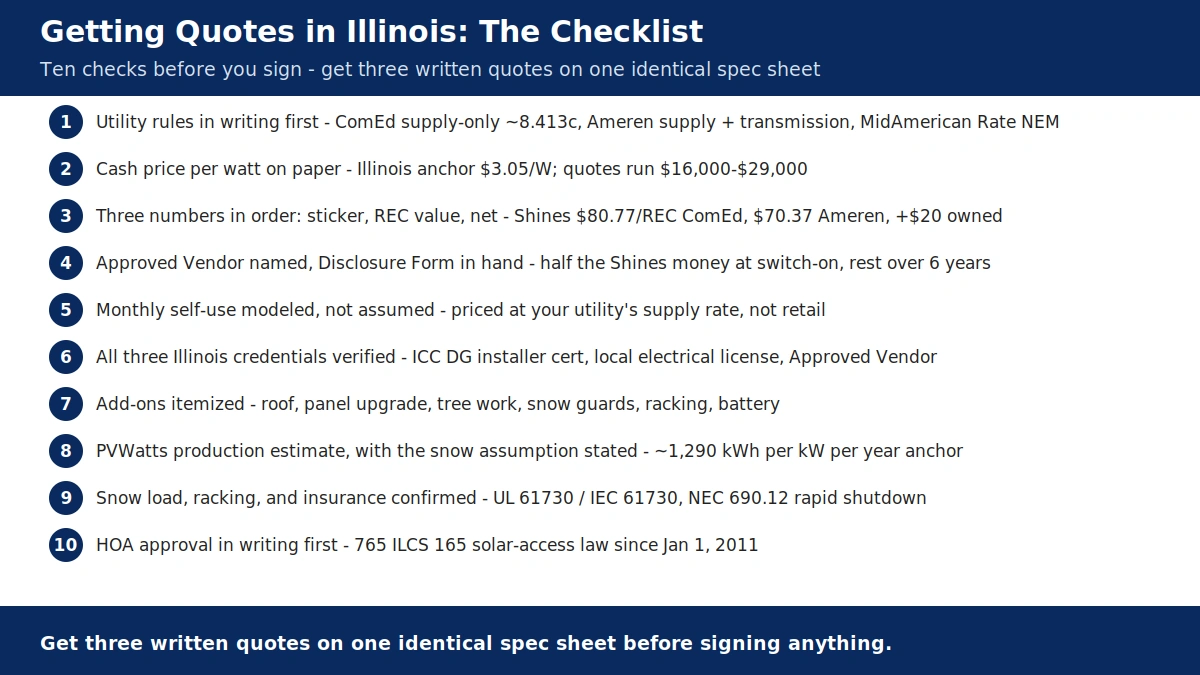
Illinois is a generous state to buy solar in — a published REC price, a utility rebate, a property-tax rule, and a solar-access law — but only for a homeowner who checks the paperwork before the sales pitch. The sticker is the least informative number on the quote. Carry this checklist into every bidder meeting. Sign nothing until every item has an answer in writing.
The ten-item quote checklist:
- Your utility’s rules, in writing, first — ComEd’s supply-only credit at about 8.413 cents, Ameren’s supply-plus-transmission credit, or MidAmerican’s Rate NEM, or your co-op or city utility’s own terms. Export credit and the January 1, 2025 change decide the payback before anything else — and a pre-2025 system’s grandfathered full credits are worth more than any rebate.
- Cash price per watt, in writing — one spec sheet, identical, for all three bidders. The Illinois anchor is $3.05 a watt; a quote far above it calls for an explanation, and a quote far below it calls for a closer look at what was left out — especially the permitting and the roof work on a Chicago house.
- The three numbers, in order: sticker, REC value, net price — the Illinois Shines payment on the Disclosure Form ($80.77 a REC in ComEd territory, $70.37 in Ameren territory, plus $20 for an owned system), the $300-per-kilowatt rebate, and the net. Strike any 30% federal credit line and any state rebate line. A 2026 owner purchase receives $0 from Washington — Illinois offers no state rebate and no state income-tax credit. A 30% credit line on a 2026 quote rests on a law that has already expired. Ask for it to be removed.
- The Approved Vendor named, and the Disclosure Form in hand — the vendor’s name, the REC count, the price per credit, and how much of the state payment lowers your price. Half the Shines money arrives at switch-on and the rest over six years — ask how the contract handles the wait.
- Model monthly self-use; never assume it — for each month, work out how much of what the panels make the house uses the moment it is made, and price the rest at your own utility’s supply rate. Any quote that prices every export at the all-in retail price is wrong — and so is one that banks June into January at retail.
- All three Illinois credentials verified — the installer’s ICC distributed generation installer certification (220 ILCS 5/16-128A, 83 Ill. Adm. Code Part 468), the local electrical contractor license, and the Illinois Shines Approved Vendor registration, checked on the registries, with names matched to the contract. NABCEP certification is a plus.
- Add-ons itemized — roof work, panel upgrade, tree work, snow guards, racking, and battery, each priced separately, never folded into the per-watt figure. Check that the inverter is a smart inverter, or the $300-per-kilowatt rebate does not arrive.
- A PVWatts estimate that shows its snow assumption — ask for the monthly shape, not one yearly average, built on roughly 1,290 kilowatt-hours per kilowatt each year rather than nameplate watts. Insist on the monthly curve itself, June next to December, and ask whether the estimate uses Chicago’s 1,226 or the far south’s 1,330 — the two are not the same roof.
- Snow load, racking, and insurance confirmed — ask the building department for the roof’s snow-load rating, name the racking’s uplift rating and the tilt, specify UL 61730 / IEC 61730 panels by name, confirm rapid shutdown to NEC 690.12, and get homeowners insurance confirmed in writing to cover the array before signing.
- HOA approval, in writing, first — Illinois’ solar-access law (765 ILCS 165, since January 1, 2011, rewritten 2021 and 2023) prohibits an association from banning solar outright, and the association may not cut the system’s production by more than 10% through placement rules; it must hand over its energy policy statement within 90 days and process an application within 75 days. Architectural-review approval in hand before panels are ordered; condo owners also need board approval for the common-area roof, and shared-roof buildings fall outside the Act.
Buy, lease, or community solar? Over 25 years, buying wins for a homeowner who uses a lot of power in daylight, sits in ComEd territory, or pairs the array with a heat pump or an EV. Buy it, and the system is yours, the resale value is yours, the Shines payment is yours, and every kilowatt-hour you use yourself keeps its full retail value. Leasing suits a homeowner who wants no upfront cost and no maintenance — and in Illinois it is genuinely available, the provider claiming the §48E credit — so price the 1.9% to 2.9% escalator over the full term before comparing it on its monthly payment, and remember the lease gives up the $20-per-REC Shines adder. Community solar wins for renters, condo owners, and homes whose roofs are shaded or unsuitable — and in Illinois, unlike Ohio, that door is open, through Illinois Shines and Illinois Solar for All. A cabin past the end of the road, off the grid, is a different question entirely — one this guide does not answer. A rural Illinois home on a co-op meter needs its own utility’s terms in writing before anything else.
Sources & methodology
Cost anchors (per watt, system size, totals):
- EcoGen Solar Cost Index, September 2026 Edition, prices as of Sep 25, 2026 (page updated Oct 19, 2026): $3.05/W; 9.23 kW typical (Berkeley Lab 2025 median, 19,742 systems); $28,152 total; quotes $16,000-$29,000; neighbors MO $2.74, US $2.89, IN $2.97, WI $3.01, IL $3.05, IA $3.07
- EcoGen Illinois cost page: 6.22 kW system makes about 120 RECs over 15 years, worth about $12,090 in ComEd territory or $10,840 in Ameren or MidAmerican territory
- EnergySage Illinois page, Nov 2026: $2.92/W; 11.6 kW average; $33,903 (range $28,818-$38,988); payback 12.37 yrs; 25-yr savings $32,554 — modeled, flagged
- EnergySage city pages, Nov 2026: Chicago $3.00/W, 9.59 kW, $28,807, payback 11.28 yrs, savings $32,432; Springfield $2.74/W, 14.82 kW, $40,543, payback 11.86 yrs, savings $38,646; Rockford $2.90/W, 9.95 kW, $28,886, payback 12.30 yrs, savings $26,708; Peoria $2.84/W, 11.86 kW, $33,723, payback 12.14 yrs, savings $35,689
- ConsumerAffairs (Nov 2026): $2.98/W, 11.56 kW, $34,449; Chicago $3.00/W range $15,150-$30,300
- SunSent / EnergySage October 2026 market data: $2.94/W, $34,060
- solarenergyprices.com (Aug 2026): $2.95/W, range $2.70-$3.20; 10 kW $29,500; production ~1,307 kWh/kW/yr
- livingwithsolar.com (early 2026): $3.02/W, 13.23 kW, $40,006 — planning estimate, flagged
Rates and home use:
- EIA, 12 months to Aug 2026: IL 18.91 cents/kWh (US 18.0 cents); average use 697 kWh/mo (~8,364 kWh/yr); average bill ~$131.83/mo; Aug 2026 alone 19.32 cents, 886 kWh, $171.18 bill, +7.2% YoY
- ComEd standard residential tariff: $19.07/mo fixed charge, all-in ~19.45 cents/kWh at 900 kWh (priceofelectricity.com, EIA Aug 2026)
- ComEd Price to Compare 10.103 cents/kWh Oct 1, 2026-May 31, 2027 (8.413 cents supply + 1.69 cents transmission); summer 2026 10.399 cents (ICC Plug In Illinois, pulled Oct 8, 2026)
Production:
- EcoGen-implied ~1,290 kWh/kW/yr (179 RECs over 15 yrs for 9.23 kW; 120 RECs for 6.22 kW)
- Chicago PVWatts ~1,226 kWh/kW/yr (8 kW makes ~9,810 kWh/yr; sunmetriclab, data Sep 10, 2026); Chicago ~4.2 peak sun hrs/day
- North ~1,200, far south ~1,330 kWh/kW/yr (ilsolardeals.com, 2026-27 program year)
Net metering and export credits:
- 220 ILCS 5/16-107.5; 83 Ill. Adm. Code Part 466 (interconnection) and Part 468 (installer certification)
- Pre-2025 systems: full retail credits, grandfathered 30 years; post-Jan 1, 2025: supply-only (ComEd supply only; Ameren supply + transmission; MidAmerican Rate NEM supply only); credits roll forward; no cash payout
- Taking the $300/kW DG rebate ends grandfathered full credits (EcoGen warning)
- Net metering cap 2,000 kW; no 120%-of-use sizing cap in Illinois
- DSIRE May 2026 map: Illinois moved new systems to supply-only crediting in 2025
Illinois Shines (2026-27, program year began Jun 1, 2026):
- REC prices: up to 10 kW $80.77 ComEd/PJM, $70.37 Ameren/MISO; 10-25 kW $79.21 / $60.92; +$20/REC adder for customer-owned Small DG not claiming the federal credit
- Typical 9.23 kW owned: ~179 RECs over 15 yrs = ~$18,040 ComEd / ~$16,180 Ameren
- Payment: 50% at energization, rest in equal parts over 6 years (changed Jun 1, 2026; was 100% upfront)
- Net after incentives (EcoGen, full pass-through): ComEd ~$7,340; Ameren ~$9,200; MidAmerican ~$11,970
Utility rebates:
- ComEd and Ameren: $300/kW solar (smart inverter), $2,769 on 9.23 kW; $300/kWh battery, $4,050 on 13.5 kWh; ComEd VPP expected Mar 1, 2027; Ameren Scheduled Dispatch VPP once operational; MidAmerican pays neither
- CONFLICT: one Rockford calculator claims ComEd battery rebate $450/kWh since 2025; EcoGen + ConsumerAffairs say $300/kWh; $300 used, $450 flagged
Payback arithmetic:
- EcoGen publishes no single statewide payback for Illinois
- EnergySage modeled paybacks (12.37 yrs statewide; 11.28 Chicago; 11.86 Springfield; 12.30 Rockford; 12.14 Peoria) flagged as modeled estimates; EnergySage page says figures exclude IL/local incentives while its savings text says incentives are factored in — internal tension flagged
- NestPriced illustration (labeled as such): 9.23 kW, $28,152, 11,907 kWh/yr; 70% self-used at 18.91 cents = ~$1,576/yr; 30% exported at ComEd supply 8.413 cents = ~$301/yr; gross ~$1,877/yr less ~$229/yr fixed charges = ~$1,648/yr; ComEd net $7,340 = ~4.5 yrs; Ameren net $9,200 = ~5.6 yrs; MidAmerican net $11,970 = ~7.3 yrs; sticker $28,152 = ~17.1 yrs
- Battery illustration: 13.5 kWh/day at ~10.5-cent spread = ~$1.42/day, ~$520/yr; $15,228 battery = ~29 yrs on bill savings alone (national $/kWh)
Production and climate:
- Chicago (1991-2020 normals): 37-38.4 inches of snow a year; January snowiest (~11.7 in); December cloudiest (~67% overcast); shortest day Dec 21, 9 hrs 8 min; longest day Jun 21, 15 hrs 14 min; ~2,478-2,510 sunshine hrs/yr; ~54% of possible sunshine; 84 clear days/yr
- Shortwave solar energy: December ~1.7 vs June ~6.8 kWh/m2/day (WeatherSpark) — four-fold swing
- Snow albedo boost estimated 15-30% spring/fall (engineerfix, cited estimate)
- Heat penalty 0.3-0.5% per degree C above 25 C cell temperature, national figure
- Detach-and-reset for a later reroof $2,000-$4,500 (national figure)
Incentives:
- No state rebate, no state income-tax credit; no sales-tax exemption (IL Dept of Revenue letter ST 25-0047-GIL)
- Property tax: home valued as if conventional heating/cooling; file Form PTAX-330 with county assessment office; not automatic; notify assessor by certified mail within 30 days if system stops being used
- HB 5444 (would roughly double the statutory per-MW property-tax basis from 2027) stalled in House Rules, Mar 2026 — not law
- Illinois Solar for All: active; income at or below 80% of area median income; no upfront cost; yearly payments capped at half the value of the power produced; Approved Vendor Manual 9.0
- Community solar available via Illinois Shines and Solar for All
- Federal Solar for All: EPA terminated all 60 grants Aug 7, 2025; courts ruled the termination unlawful Sep 18 and Sep 22, 2026; EPA weighing appeal; funds frozen
- HEAR/HOMES: not launched in Illinois; IL EPA says DOE has not yet processed the HEAR application (checked Oct 27, 2026); no start date; Illinois allocation figure not verified
Federal and financing:
- OBBBA P.L. 119-21 and IRS FS-2025-05: §25D and §25C $0 for post-Dec-31-2025 installs, completion date counts
- §48E 30% for third-party-owned systems, in service by Dec 31, 2027, construction begun by Jul 4, 2026 per IRS Notice 2025-42; leases and PPAs legal in Illinois; escalators commonly 1.9-2.9%/yr
- DOE Program Notices 26-1 and 26-2, dated May 29, 2026, announced Jun 1, 2026: HEAR electric-to-electric upgrades only, no fuel-switching; solar, batteries, EV chargers, windows outside HEAR
- CFPB Solar Financing Market Issue Spotlight, Aug 2024: dealer fees 10-30%, sometimes over 50%; EcoGen: 15-30% on $0-down loans
- Battery cost: 13.5 kWh add-on ~$15,228 at national ~$1,128/kWh; battery daily-savings illustration (~$1.42/day, ~$520/yr) is NestPriced arithmetic from the retail-minus-supply spread, labeled as an illustration
HOA and licensing:
- Homeowners’ Energy Policy Statement Act, 765 ILCS 165, in effect Jan 1, 2011; rewritten P.A. 102-161 (2021) and P.A. 103-296 (2023); §165/15 bans prohibitions; §165/20(a) voids deed restrictions; association may set configuration but not cut production by more than 10%; 90 days to adopt energy policy statement; 75 days to process an application; excludes buildings over 60 ft and shared-roof buildings
- ICC DG Installer certification: 220 ILCS 5/16-128A; 83 Ill. Adm. Code Part 468 (amended Nov 5, 2025); qualified person = 5 installs or NABCEP/UL/ETA/apprenticeship/AAS; annual recertification (§468.80)
- No statewide electrician license; local electrical contractor license required in Chicago and most home-rule municipalities; Illinois Shines Approved Vendor registration required to file Shines paperwork
- Interconnection under 83 Ill. Adm. Code Part 466; ComEd and Ameren run separate queues; NEC 690.12 rapid shutdown standard (national practice)
- No verified Chicago permit timeline, permit-fee schedule, or utility interconnection timeline — none stated
Labor and lifespan (national figures):
- BLS OEWS May 2025: electricians national median $30.38/hr (no Illinois-specific figure pulled)
- Lifespan 25-30 years productive service; NREL median degradation ~0.5%/yr, ~88% of rated output at year 25; premium n-type 0.25-0.5%/yr, 91-93% at year 25 (NREL Jordan et al. 2022)
- Product warranty typically 10-25 years; performance warranty typically 25-30 years, guaranteeing 80-92% of rated output at year 25 depending on tier; string inverter 10-15 years, one replacement expected; microinverters ~25 years
EXCLUDED:
- Any “after 30% credit” prices
- Any HEAR-for-solar claim: HEAR does not cover solar, batteries, EV chargers, or windows; electric-to-electric only since DOE Notices 26-1/26-2, May 29, 2026
- Any state rebate or state tax credit for Illinois solar: none exists
- EnergySage’s 12.37-year statewide payback as verified: modeled, EcoGen publishes no single statewide payback
- The $450/kWh ComEd battery rebate claim: single secondary source, conflicts with EcoGen + ConsumerAffairs $300/kWh
- The claim that Illinois has no net metering: WRONG — supply-only net metering since Jan 1, 2025, full retail grandfathered for pre-2025 systems
- solarplannerguide.com’s “federal ITC 30% + payback 7-10 years” table: stale on the ITC; not used
- Illinois-specific design snow load, monthly PVWatts table, snow-loss percentage, BLS electrician wage, panel-upgrade price, permit-fee schedule, Chicago permit timeline, ComEd/Ameren interconnection timeline, Ameren all-in residential rate, Illinois HEAR/HOMES allocation figure, battery $/kWh: not verified, national figures used and flagged as national
- Alaska/PCE/co-op figures: none imported
*Disclaimer: The prices here are 2026 Illinois planning figures. Where you live, who supplies your power, the condition of your roof, and which installer you hire all move the final price. Before you fix a budget, collect three written quotes from Illinois installers. Treat every tax point in this guide as background reading, not advice tailored to your own filing. Before you file, have a tax professional licensed in Illinois look over your return. Program rules change — Illinois Shines REC prices reset each June 1 and ComEd’s price to compare resets twice a year — so confirm current terms with your own utility and your Approved Vendor before signing.*
What do solar panels cost in Illinois in 2026?
In Illinois in 2026, solar panels install at $3.05 a watt — about $28,152 for the typical 9.23 kW system (EcoGen, September 2026) — with 2026 quotes spanning $16,000-$29,000 by system size. An 8 kW home system typically runs about $24,400 — $3.05 a watt at the EcoGen anchor — and EnergySage puts the state average at $2.92 a watt on a bigger 11.6 kW system. A homeowner-owned system installed in 2026 earns a $0 federal credit, Illinois offers no state rebate and no state income-tax credit, but Illinois Shines pays about $18,040 in ComEd territory and about $16,180 in Ameren territory, plus a $2,769 utility rebate — cutting the net price to about $7,340 in ComEd territory and about $9,200 in Ameren territory.
Is solar worth it in Illinois with so many cloudy winters?
Closer than the lake-effect reputation suggests — the answer turns on which utility serves the house. Each kilowatt of panels makes about 1,290 kilowatt-hours a year here — a solid middle-of-the-pack resource — while the power it replaces runs about 18.91 cents a kilowatt-hour on the 12-month average, and ComEd customers pay about 19.45 cents all-in at 900 kilowatt-hours a month. The Shines payment does the heavy lifting: on the net price after incentives, payback runs about 4.5 years in ComEd territory and about 5.6 years in Ameren territory on NestPriced’s illustration, against about 17 years on the sticker price. Chicago, on ComEd’s $80.77-a-REC Shines price, is the fastest of the big cities; the Quad Cities, with no utility rebate, is the slowest.
How does net metering work in Illinois?
It changed on January 1, 2025, and the date decides the credit. Under 220 ILCS 5/16-107.5, homes whose systems were switched on before 2025 keep full-retail bill credits — supply and delivery together — for 30 years. Homes that switch on since January 1, 2025 earn credits for the supply part of the bill only: about 8.413 cents a kilowatt-hour at ComEd, supply plus transmission at Ameren, and supply only at MidAmerican under Rate NEM. Unused credits roll forward to later bills. Taking the $300-per-kilowatt DG rebate ends grandfathered full credits, so a pre-2025 household should ask its utility in writing before accepting any rebate or expansion.
What is Illinois Shines, and what is it worth?
Illinois Shines is the state’s Adjustable Block Program, and it buys fifteen years of your system’s renewable energy credits at a published price. For the 2026-27 program year, a home system up to 10 kW earns $80.77 per credit in ComEd territory and $70.37 in Ameren and MidAmerican territory, plus $20 more per credit if you own the system and claim no federal credit. A typical 9.23 kW system you own makes about 179 credits over fifteen years — about $18,040 in ComEd territory, about $16,180 in Ameren territory. The state pays your Approved Vendor, half when the system switches on and the rest over six years, and the vendor is supposed to pass the value to you through a lower contract price. Check the Disclosure Form before you sign.
Is the 30% federal solar tax credit still available to Illinois homeowners in 2026?
Not for a system you own. The Residential Clean Energy Credit (§25D, 30%) ended. Homeowner-owned systems placed in service after December 31, 2025 get none of it. The One Big Beautiful Bill Act (P.L. 119-21) set the cutoff, and the IRS has made clear that the installation’s finish date — not the deposit date — is what decides it. Illinois does offer a second door that some states do not. Leases and power purchase agreements are legal here, and the company that owns the system can still claim the commercial credit (§48E, 30%) for systems in service by December 31, 2027, passing some of the value along as a lower monthly payment. A leased system gets no $20-per-REC Shines adder, though, and the escalator — commonly 1.9% to 2.9% a year — has to be priced over the full term.
Do I need a special license to install solar in Illinois?
Your installer does — three credentials, in fact. Under 220 ILCS 5/16-128A and 83 Ill. Adm. Code Part 468, installers of distributed generation facilities need certification from the Illinois Commerce Commission, and no company may install without it. The electrical work needs a local electrical contractor license, because Illinois has no statewide electrician license, and Chicago and most home-rule municipalities license contractors themselves. And the Illinois Shines paperwork needs an Approved Vendor registration — without one, the REC payment never arrives. Ask for all three numbers and check them on the registries before you sign.
Can my HOA stop me from installing solar panels in Illinois?
Usually not. Illinois has had a solar-access law since 2011. Under the Homeowners’ Energy Policy Statement Act (765 ILCS 165), rewritten in 2021 and 2023, an association may not prohibit a solar energy system, and no deed restriction or covenant may prohibit one either. The association may set the configuration of the system’s elements on a given roof face, but it may not prohibit elements on any roof face, and its placement rules may not cut the system’s production by more than 10%. The association must hand over its written energy policy statement within 90 days of a written request and process a complete application within 75 days. The law does not cover buildings over 60 feet tall or buildings with a shared roof, which takes many condominiums out of it — so get architectural-review approval in writing before you order panels.
Why is solar payback about 5 years in Illinois after incentives, but 17 years before them?
Two forces pull against each other, and the paperwork usually wins. The price is above the national average at $3.05 a watt, and the sun is ordinary at about 1,290 kilowatt-hours a year per installed kilowatt — but the surplus is settled at the supply rate instead of banking at retail, so the bright summer months earn about 8.4 cents while the dark winter months bill in full. What saves the case is the Shines payment: about $18,040 in ComEd territory and about $16,180 in Ameren territory, plus a $2,769 utility rebate, which together remove about three-quarters of the sticker price. On the $7,340 net price in ComEd territory, about $1,648 a year of bill value pays the system back in about 4.5 years. In MidAmerican territory, with no rebate, the same arithmetic takes about 7.3 years.